Questions as text
Q1 · Explain why houses in hot countries are often painted white 0625/42 Oct/Nov 2017
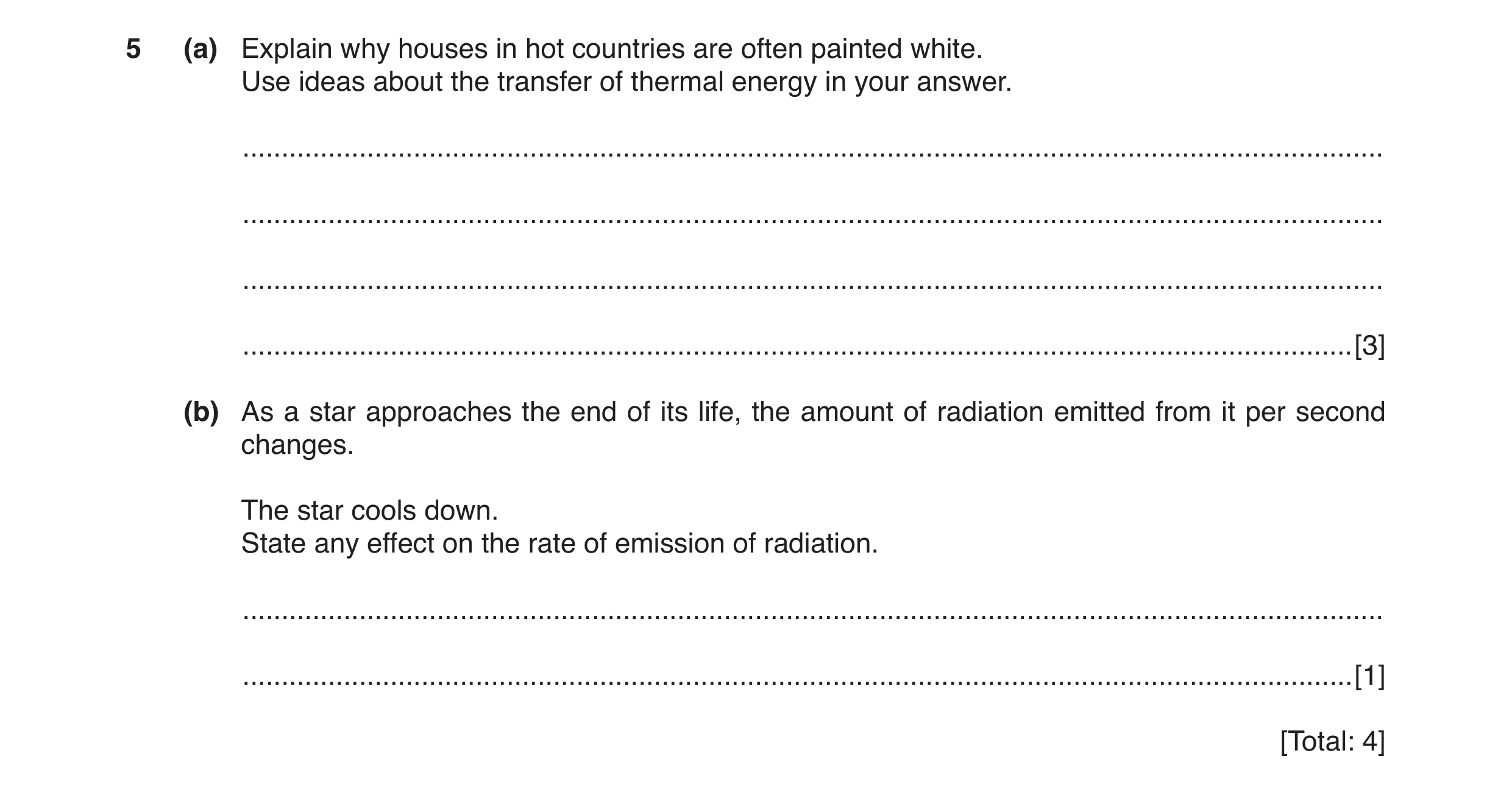
5 (a) Explain why houses in hot countries are often painted white. Use ideas about the transfer of thermal energy in your answer. … … … … [3] (b) As a star approaches the end of its life, the amount of radiation emitted from it per second changes. The star cools down. State any effect on the rate of emission of radiation. … … [1] [Total: 4]
4 marks
Mark scheme: 5(a) any three of these five: • any sensible mention of the sun (as source of energy) • (thermal / heat / IR / electromagnetic) radiation • white (or clearly implied) surfaces absorb less or don’t absorb • white (or clearly implied) surfaces reflect more • to keep house cooler OR to reduce thermal energy / heat transferred to house B3 5(b) decreases B1
This question in 0625/42 Oct/Nov 2017
Q2 · The time taken for Mars to orbit the Sun is 690 Earth days 0625/42 Feb/March 2023
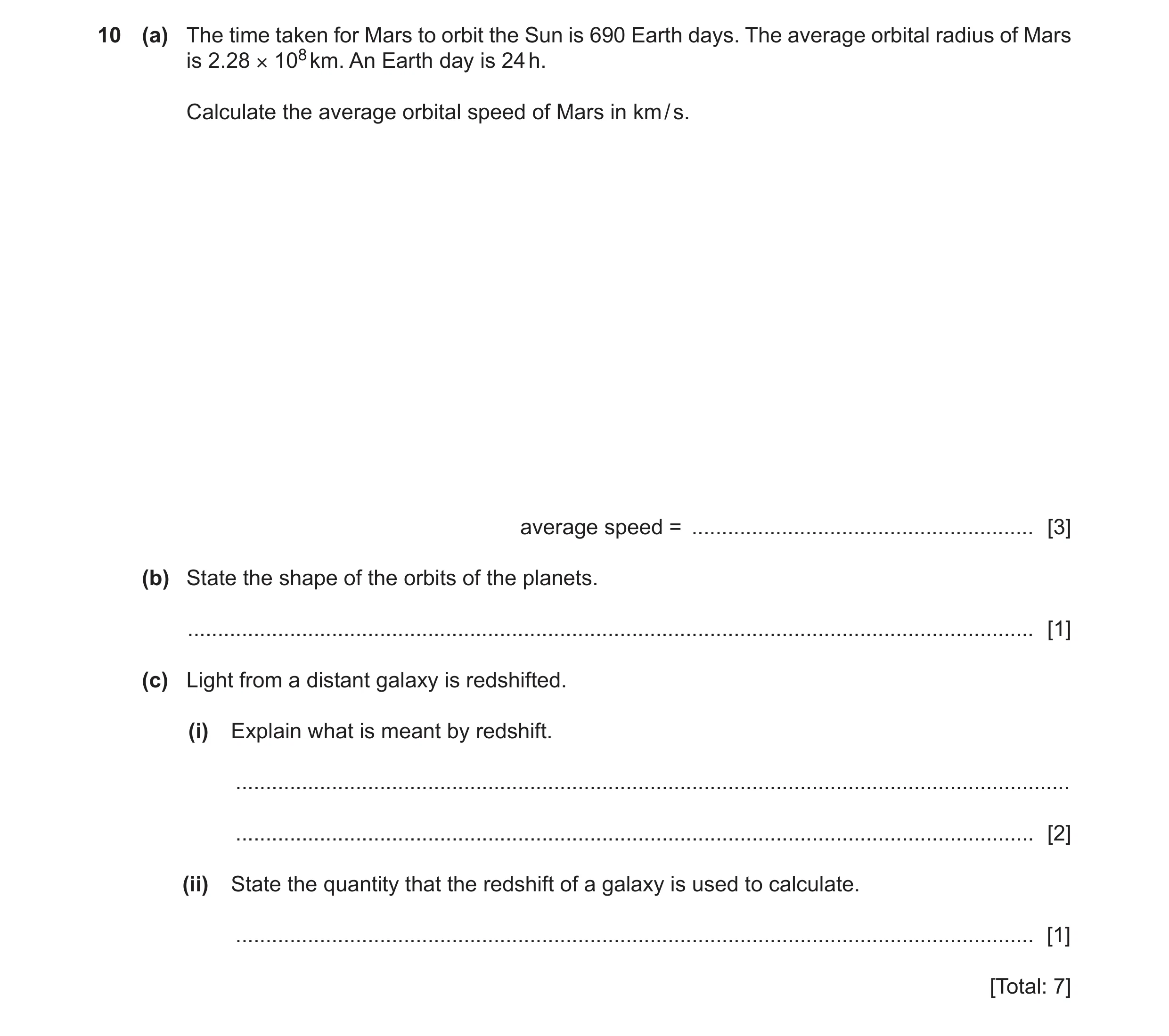
10 (a) The time taken for Mars to orbit the Sun is 690 Earth days. The average orbital radius of Mars is 2.28 × 10⁸ km. An Earth day is 24 h. Calculate the average orbital speed of Mars in km / s. average speed = … [3] (b) State the shape of the orbits of the planets. … [1] (c) Light from a distant galaxy is redshifted. (i) Explain what is meant by redshift. … … [2] (ii) State the quantity that the redshift of a galaxy is used to calculate. … [1] [Total: 7]
7 marks
Mark scheme: 10(a) 24 km / s A3 v = 2r / T OR (v =) 2r / T OR (2 2.28 108) / (690 24 60 60) (C1) (2 2.28 108) / (690 24 60 60) OR (T =) 690 24 60 60 OR (T=) 59 616 000 (s) (C1) 10(b) elliptical / ellipse B1 10(c)(i) wavelength (of light from distant galaxies) increases B1 occurs when galaxies are moving away (from Earth) B1 10(c)(ii) speed / velocity (that galaxy is moving away from Earth) B1
This question in 0625/42 Feb/March 2023
Q3 · State the equation that defines the average orbital speed v of a planet 0625/42 May/June 2023
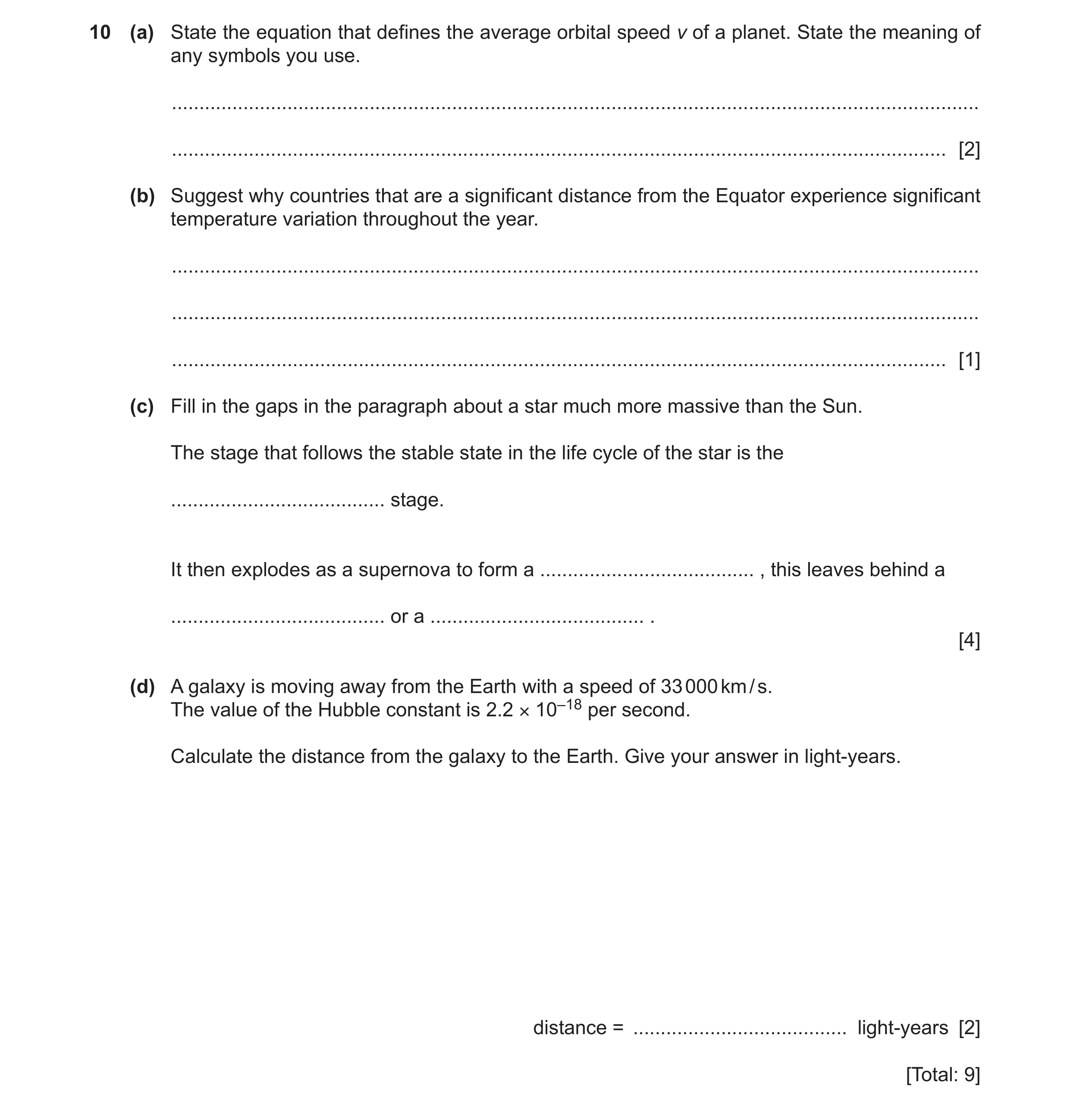
10 (a) State the equation that defines the average orbital speed v of a planet. State the meaning of any symbols you use. … … [2] (b) Suggest why countries that are a significant distance from the Equator experience significant temperature variation throughout the year. … … … [1] (c) Fill in the gaps in the paragraph about a star much more massive than the Sun. The stage that follows the stable state in the life cycle of the star is the … stage. It then explodes as a supernova to form a … , this leaves behind a … or a … . [4] (d) A galaxy is moving away from the Earth with a speed of 33 000 km / s. The value of the Hubble constant is 2.2 × 10⁻¹⁸ per second. Calculate the distance from the galaxy to the Earth. Give your answer in light-years. distance = … light-years [2] [Total: 9]
9 marks
Mark scheme: 10(a) B1 r = (average) radius of the orbit AND T = (orbital) period B1 10(b) rays from Sun strike the country at different angles through the year OR rays from Sun strike the country for different number of hours per day through the year B1 10(c) (first space:) red supergiant B1 (second space:) nebula B1 (3rd and 4th spaces:) neutron star B1 black hole B1 10(d) 1.6 109 (light-years) A2 H0 = v / d OR (d =) v / H0 OR (d =) [33 000 103] / [ 2.2 10–18 9.5 1015] C1
This question in 0625/42 May/June 2023
Q4 · The Milky Way is one of many billions of galaxies 0625/41 Oct/Nov 2023
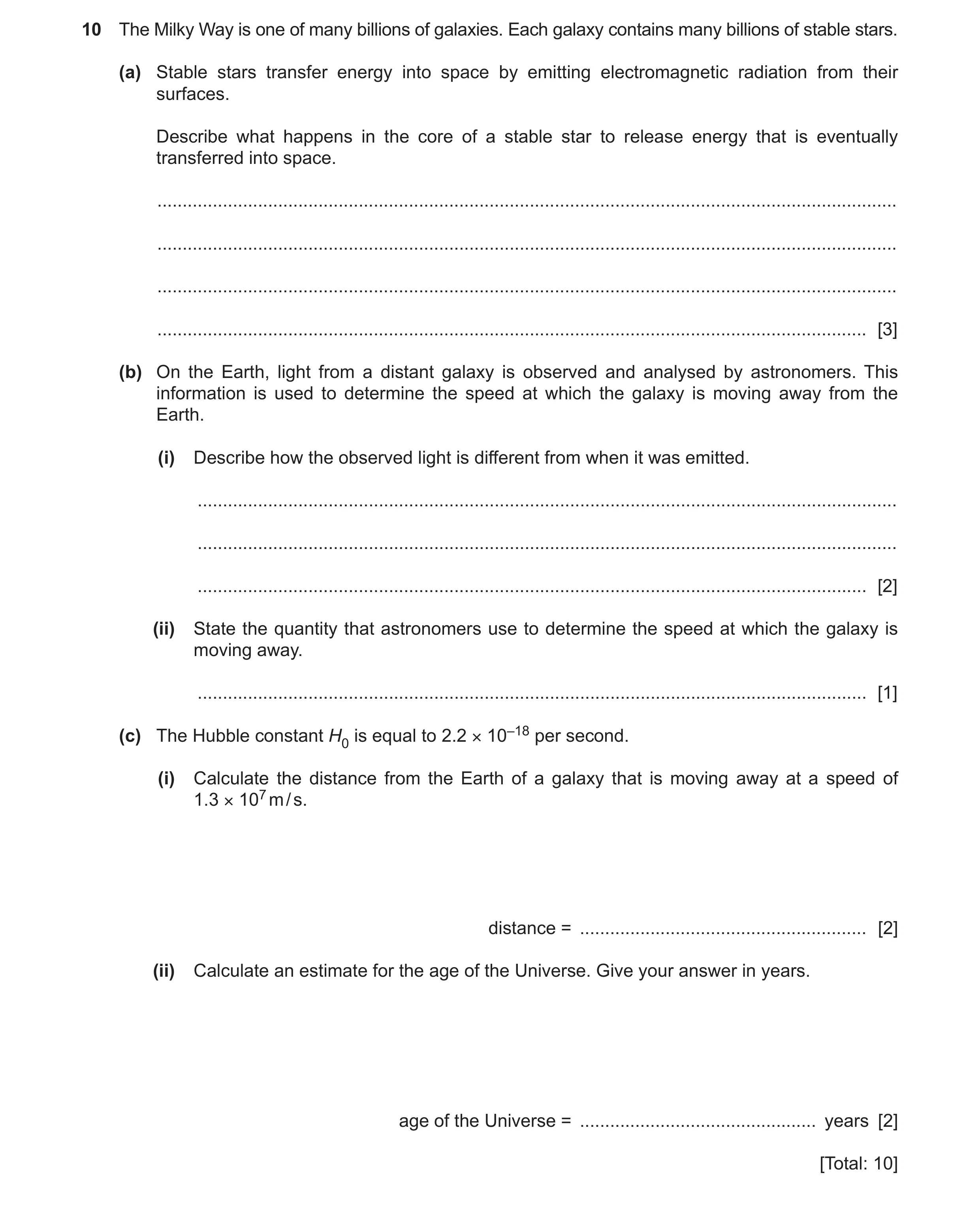
10 The Milky Way is one of many billions of galaxies. Each galaxy contains many billions of stable stars. (a) Stable stars transfer energy into space by emitting electromagnetic radiation from their surfaces. Describe what happens in the core of a stable star to release energy that is eventually transferred into space. … … … … [3] (b) On the Earth, light from a distant galaxy is observed and analysed by astronomers. This information is used to determine the speed at which the galaxy is moving away from the Earth. (i) Describe how the observed light is different from when it was emitted. … … … [2] (ii) State the quantity that astronomers use to determine the speed at which the galaxy is moving away. … [1] (c) The Hubble constant H0 is equal to 2.2 × 10⁻¹⁸ per second. (i) Calculate the distance from the Earth of a galaxy that is moving away at a speed of 1.3 × 10⁷ m / s. distance = … [2] (ii) Calculate an estimate for the age of the Universe. Give your answer in years. age of the Universe = … years [2] [Total: 10]
10 marks
Mark scheme: 10(a) hydrogen nuclei fuse to become helium nuclei A3 nuclear reactions OR (nuclear) fusion C1 hydrogen fuses into helium C1 10(b)(i) (observed) wavelength is longer / wavelength is shifted towards the red end of the spectrum A2 (light from galaxy) redshifted / shifted towards red (end of spectrum) C1 10(b)(ii) change in wavelength (or starlight due to redshift) B1 10(c)(i) 5.9 1024 m A2 H0 = v/d OR (d =) v / H0 OR 1.3 107 / 2.2 10–18 OR 5.9 10N (m) C1 10(c)(ii) 1.4 1010 (years) A2 (age =) 1 / H0 or 1 / 2.2 10–18 or 4.5 1017 C1
This question in 0625/41 Oct/Nov 2023
Q5 · Complete the sentences about the life cycle of stars 0625/42 Oct/Nov 2023
10 Complete the sentences about the life cycle of stars. (a) Protostars are formed from … … [1] (b) A protostar becomes a stable star when … … is balanced by … … [2] (c) The initial fuel used to power nuclear reactions in stars is … [1] (d) Stars that are approximately the same size as the Sun become red giant stars which then form a … with a white dwarf star at its centre. [1] [Total: 5]
5 marks
Mark scheme: 10(a) (interstellar clouds of) gas and dust OR (stellar) nebula B1 10(b) (inward) force of gravitational attraction (is balanced by) B1 (outward) force due to the high temperature (in the centre of the star) B1 10(c) hydrogen B1 10(d) planetary nebula B1
This question in 0625/42 Oct/Nov 2023
Q6 · State the condition required for a protostar to become a stable star 0625/42 Feb/March 2024
11 (a) State the condition required for a protostar to become a stable star. … … … [1] (b) (i) Define the Hubble constant. … … … [2] (ii) The current estimate for the Hubble constant is 2.2 × 10⁻¹⁸ per second. State the equation which gives an estimate for the age of the Universe. … [1] (iii) Calculate an estimate for the age of the Universe. estimate of age = … s [1] [Total: 5]
5 marks
Mark scheme: 11(a) inward force / force of gravitational attraction, is balanced by an outward force / force due to fusion reactions B1 11(b)(i) ratio of the speed at which the galaxy is moving away from the Earth/observer to its distance (from the Earth/observer) A2 ratio of speed (of a galaxy) to distance (away from observer) (C1) 11(b)(ii) (age of universe =) d / v = 1 / H0 OR age (of universe) = 1 / H0 B1 11(b)(iii) 4.5 1017 (s) B1
This question in 0625/42 Feb/March 2024
Q7 · The Sun is one of many billions of stars in the Milky Way 0625/41 May/June 2024
9 The Sun is one of many billions of stars in the Milky Way. The Sun emits a very large quantity of energy as electromagnetic radiation. (a) State the three regions of the electromagnetic spectrum in which the Sun emits the most energy. 1 … 2 … 3 … [2] (b) Electromagnetic radiation from the Sun travels at a speed of 3.0 × 10⁸ m / s. The radiation takes 500 s to reach the Earth. Calculate the distance from the Sun to the Earth. distance = … [2] (c) Approximately 4.6 billion years ago, the Sun formed from an interstellar cloud of gas and became a stable star. (i) Describe and explain what happens as an interstellar cloud of gas forms a protostar. … … … [2] (ii) Describe and explain what happens as a protostar becomes a stable star. … … … … [3] [Total: 9]
9 marks
Mark scheme: 9(a) ultraviolet AND visible light AND infrared only A2 any two from: ultraviolet; visible light; infrared and no more than one incorrect addition C1 9(b) 1.5 1011 m A2 v = s / t OR (s =) vt OR 3.0 108 500 OR 1.5 10N C1 9(c)(i) any two from: cloud / nebula / it collapses due to (internal) gravitational attraction (internal) temperature increases B2 Question Answer Marks 9(c)(ii) any three from: (nuclear) fusion / nuclear reactions (in the star) forces are balanced gravitational force is inwards outwards force is due to high temperature B3
This question in 0625/41 May/June 2024
Q8 · Name the galaxy that contains the Sun 0625/42 May/June 2024
11 (a) Name the galaxy that contains the Sun. … [1] (b) Light observed from distant galaxies is redshifted. State the theory of the Universe that this observation supports. … [1] (c) Cosmic microwave background radiation (CMBR) is observed at all points in space. (i) State when this radiation was produced. … [1] (ii) Explain why this radiation is now in the microwave region of the electromagnetic spectrum. … … [2] [Total: 5]
5 marks
Mark scheme: 11(a) Milky Way B1 11(b) Big Bang (Theory) B1 11(c)(i) shortly after the Universe was formed B1 11(c)(ii) Universe has expanded B1 (radiation) has been redshifted (to the microwave region of the electromagnetic spectrum) B1
This question in 0625/42 May/June 2024
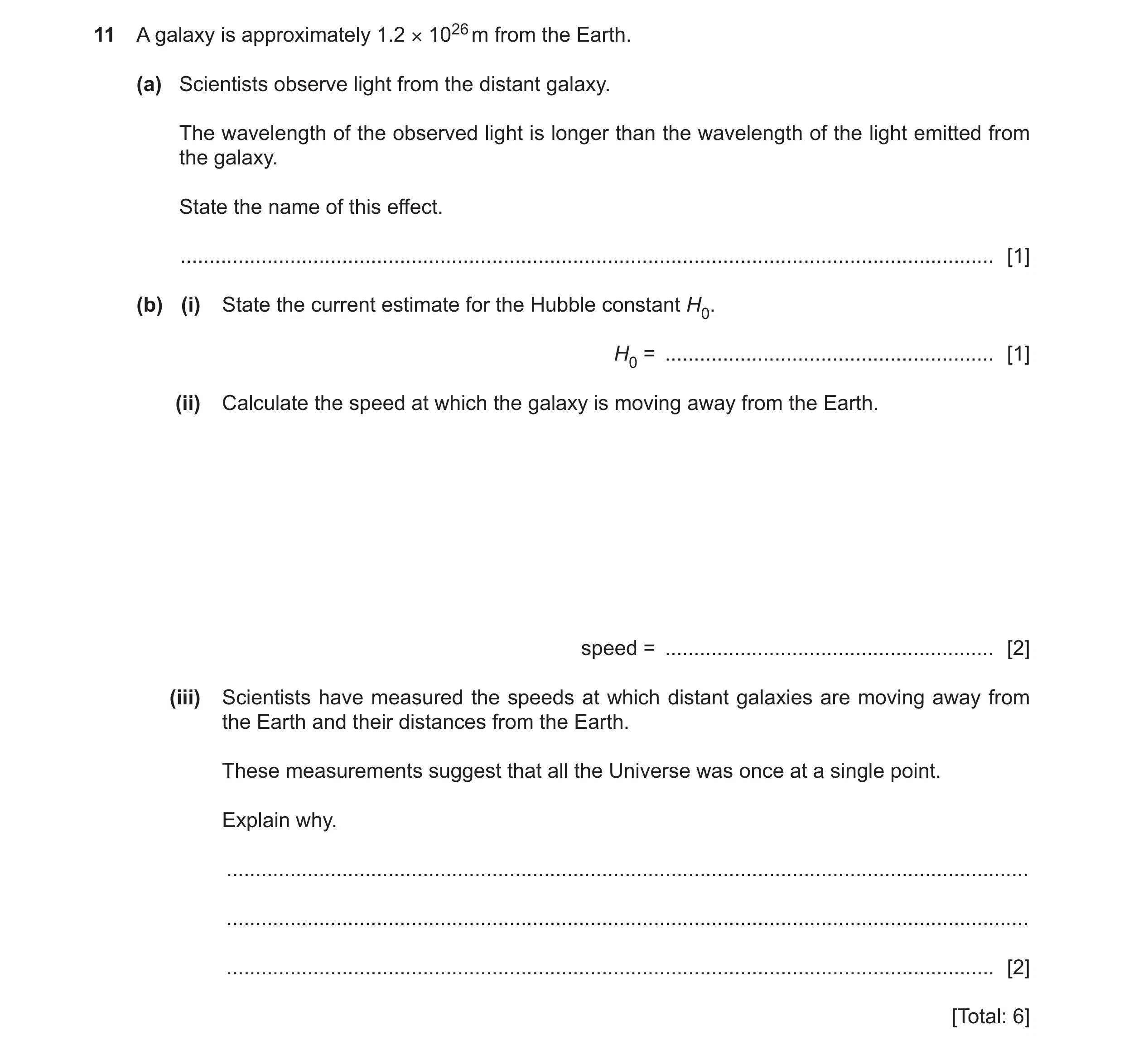
Q9 · A galaxy is approximately 1.2 × 1026 m from the Earth 0625/43 May/June 2024
11 A galaxy is approximately 1.2 × 1026 m from the Earth. (a) Scientists observe light from the distant galaxy. The wavelength of the observed light is longer than the wavelength of the light emitted from the galaxy. State the name of this effect. … [1] (b) (i) State the current estimate for the Hubble constant H0. H0 = … [1] (ii) Calculate the speed at which the galaxy is moving away from the Earth. speed = … [2] (iii) Scientists have measured the speeds at which distant galaxies are moving away from the Earth and their distances from the Earth. These measurements suggest that all the Universe was once at a single point. Explain why. … … … [2] [Total: 6]
6 marks
Mark scheme: 11(a) redshift B1 11(b)(i) (H0 =) 2.2 10–18 per second B1 11(b)(ii) 2.6 108 m / s A2 H0 = v / d OR (v =) H0d OR (v =) 1.2 1026 2.2 10–18 C1 11(b)(iii) any two from: more distant galaxies are moving away faster universe is expanding (if galaxies are moving away from each other now, then) in the past galaxies were closer together B2
This question in 0625/43 May/June 2024
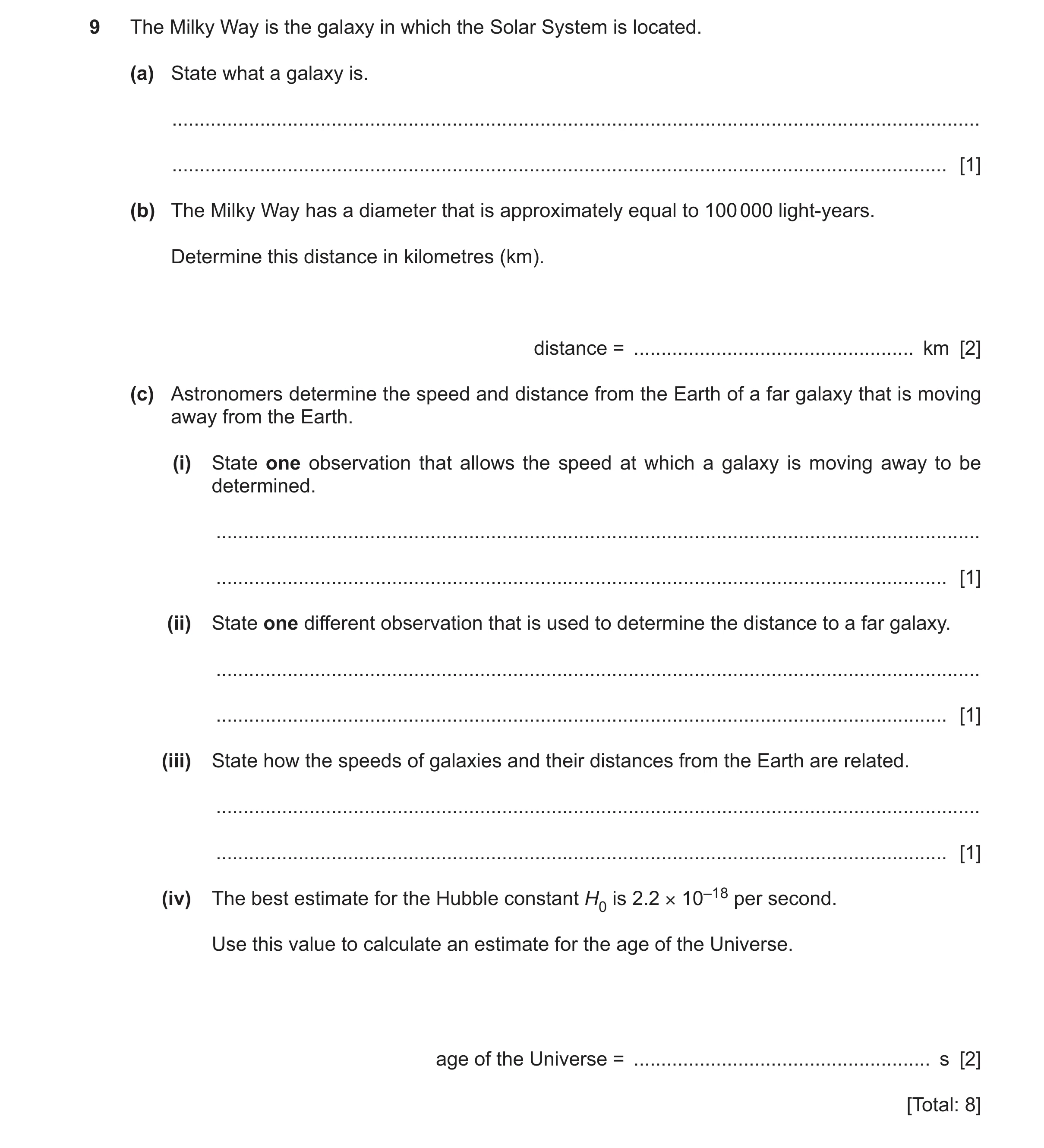
Q10 · The Milky Way is the galaxy in which the Solar System is located 0625/41 Oct/Nov 2024
9 The Milky Way is the galaxy in which the Solar System is located. (a) State what a galaxy is. … … [1] (b) The Milky Way has a diameter that is approximately equal to 100 000 light-years. Determine this distance in kilometres (km). distance = … km [2] (c) Astronomers determine the speed and distance from the Earth of a far galaxy that is moving away from the Earth. (i) State one observation that allows the speed at which a galaxy is moving away to be determined. … … [1] (ii) State one different observation that is used to determine the distance to a far galaxy. … … [1] (iii) State how the speeds of galaxies and their distances from the Earth are related. … … [1] (iv) The best estimate for the Hubble constant H0 is 2.2 × 10⁻¹⁸ per second. Use this value to calculate an estimate for the age of the Universe. age of the Universe = … s [2] [Total: 8]
8 marks
Mark scheme: 9(a) group / collection of (billions of) stars B1 9(b) 9.5 1017 (km) A2 (1 light-year =) 9.5 1015 (m) OR (1 light-year =) 3 108 365 24 3600 C1 9(c)(i) increase in wavelength (of light from far galaxy) OR (amount of) redshift B1 9(c)(ii) brightness of a supernova B1 9(c)(iii) (their) speeds are (directly) proportional to distances (from Earth) OR H0= v / d B1 9(c)(iv) 4.5 1017 (s) A2 (age of Universe =) 1 / H0 OR 1 / (2.2 10–18) C1
This question in 0625/41 Oct/Nov 2024
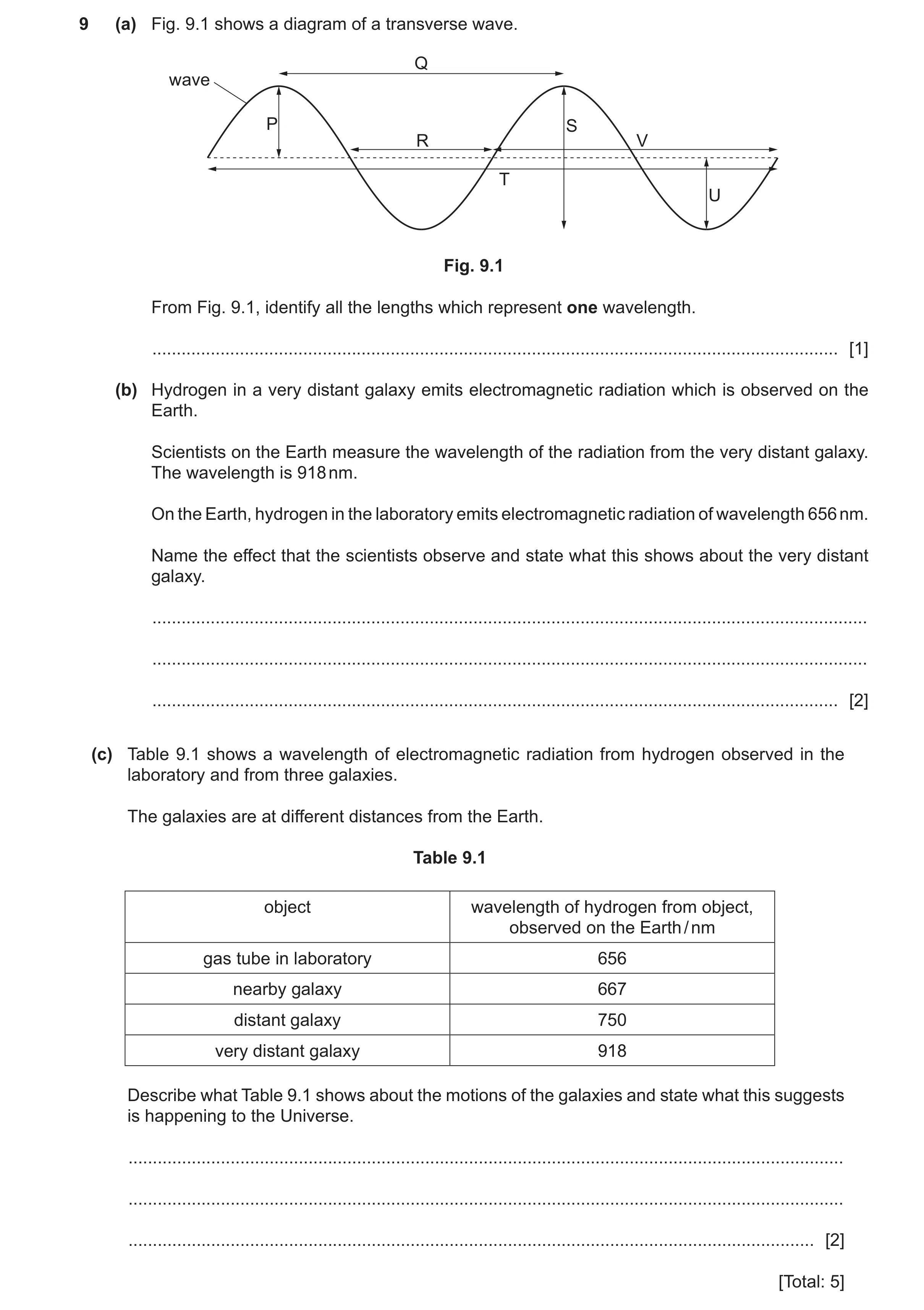
Q11 · A diagram of a transverse wave 0625/43 Oct/Nov 2024
9 (a) Fig. 9.1 shows a diagram of a transverse wave. Q wave P S R V T U Fig. 9.1 From Fig. 9.1, identify all the lengths which represent one wavelength. … [1] (b) Hydrogen in a very distant galaxy emits electromagnetic radiation which is observed on the Earth. Scientists on the Earth measure the wavelength of the radiation from the very distant galaxy. The wavelength is 918 nm. On the Earth, hydrogen in the laboratory emits electromagnetic radiation of wavelength 656 nm. Name the effect that the scientists observe and state what this shows about the very distant galaxy. … … … [2] (c) Table 9.1 shows a wavelength of electromagnetic radiation from hydrogen observed in the laboratory and from three galaxies. The galaxies are at different distances from the Earth. Table 9.1 object wavelength of hydrogen from object, observed on the Earth / nm gas tube in laboratory 656 nearby galaxy 667 distant galaxy 750 very distant galaxy 918 Describe what Table 9.1 shows about the motions of the galaxies and state what this suggests is happening to the Universe. … … … [2] [Total: 5]
5 marks
Mark scheme: 9(a) Q and V B1 9(b) red shift B1 (galaxy) moving away / receding (from Earth/us) B1 9(c) galaxies further away (are receding) with higher speed OR galaxies further away have greater redshift B1 Universe is expanding B1
This question in 0625/43 Oct/Nov 2024
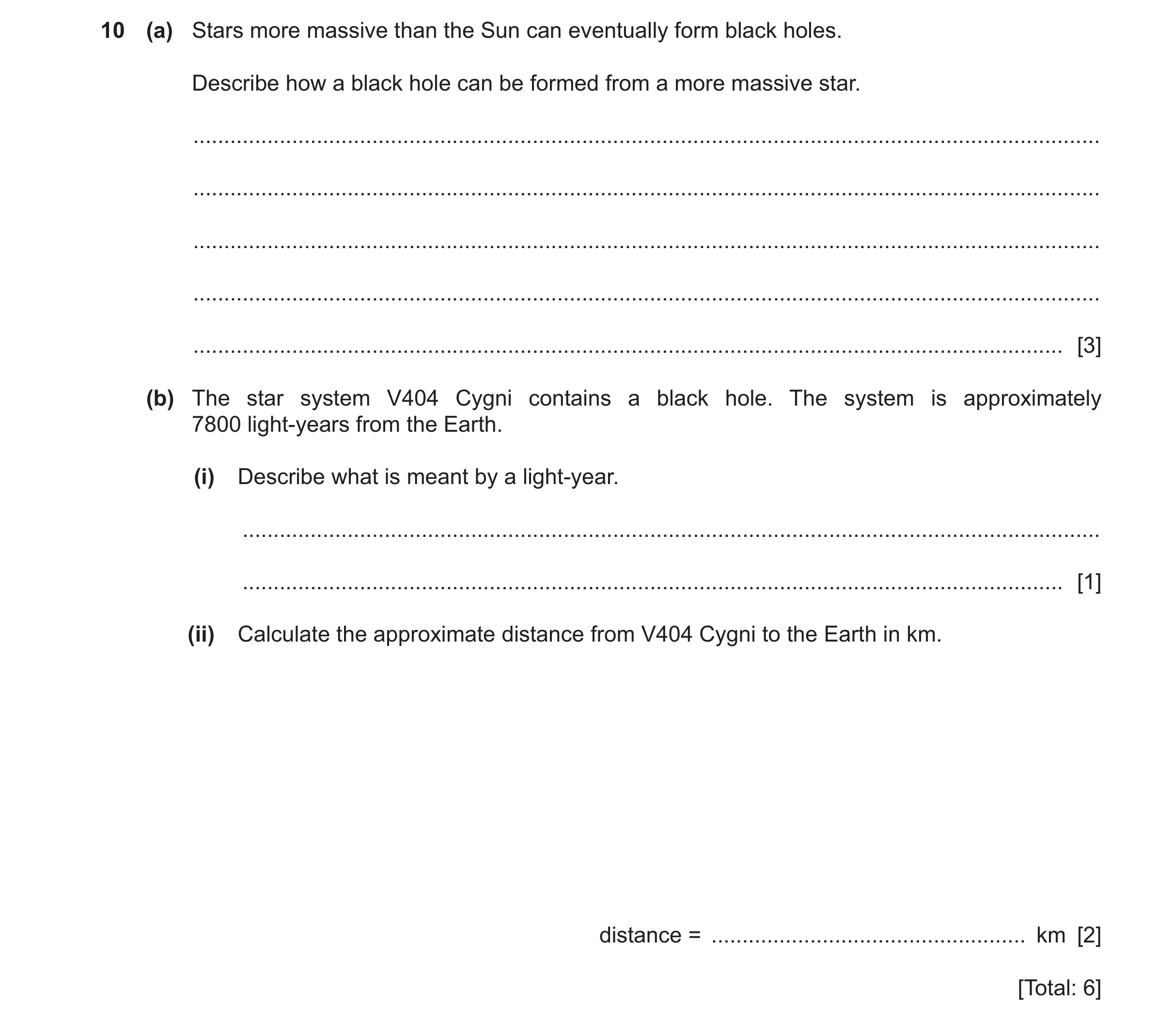
Q12 · Stars more massive than the Sun can eventually form black holes 0625/43 Oct/Nov 2024
10 (a) Stars more massive than the Sun can eventually form black holes. Describe how a black hole can be formed from a more massive star. … … … … … [3] (b) The star system V404 Cygni contains a black hole. The system is approximately 7800 light‑years from the Earth. (i) Describe what is meant by a light‑year. … … [1] (ii) Calculate the approximate distance from V404 Cygni to the Earth in km. distance = … km [2] [Total: 6]
6 marks
Mark scheme: 10(a) any two from: B2 • (most of the) hydrogen has been converted to helium or hydrogen begins to run out • (star expands and) forms a red supergiant • (red supergiant) explodes as a supernova (forming a nebula) core (of red supergiant collapses and) forms black hole OR a black hole forms at the centre (of the supernova/nebula) B1 10(b)(i) the distance travelled (in the vacuum of space) by light in one year B1 10(b)(ii) 7.4 1016 km A2 9.5 1015 (m) or 9.5 1012 (km) C1
This question in 0625/43 Oct/Nov 2024
Q13 · Data for planets A, B, C and D 0625/42 May/June 2025
10 (a) Table 10.1 shows data for planets A, B, C and D. Table 10.1 surface temperature diameter gravitational field strength planet / K / km N / kg A 153 143 000 23.0 B 623 4 800 3.7 C 53 50 000 11.0 D 93 120 000 9.0 (i) State and explain which one of these planets is closest to the Sun. … … [2] (ii) Calculate the surface temperature of planet D in °C. surface temperature = … °C [1] (iii) An object falls through a height of 2 m on each of the planets in Table 10.1. State and explain on which planet the object falls 2 m in the shortest time. Ignore any effect due to the atmosphere. … … [2] (b) Fig. 10.1 shows some of the stages in the life cycle of a massive star. massive star expands … supernova nebula which contains … leaves behind … or … Fig. 10.1 (i) Complete Fig. 10.1 by adding the correct terms. [4] (ii) State the quantity that the brightness of a supernova in a galaxy can be used to determine. … [1] [Total: 10]
10 marks
Mark scheme: 10(a)(i) planet B B1 high(est) (surface) temperature B1 10(a)(ii) –180 (°C) B1 10(a)(iii) planet A B1 gravitational field strength is highest so acceleration (due to gravity) is greater B1 OR gravitational field strength is highest so greater (downward) force on the object 10(b)(i) red supergiant B1 (new) heavier elements OR hydrogen B1 any two from: B2 • neutron star • black hole • new stars (with orbiting planets) 10(b)(ii) distance (from Earth) to galaxy B1
This question in 0625/42 May/June 2025
Q14 · Define a light-year in words 0625/43 May/June 2025
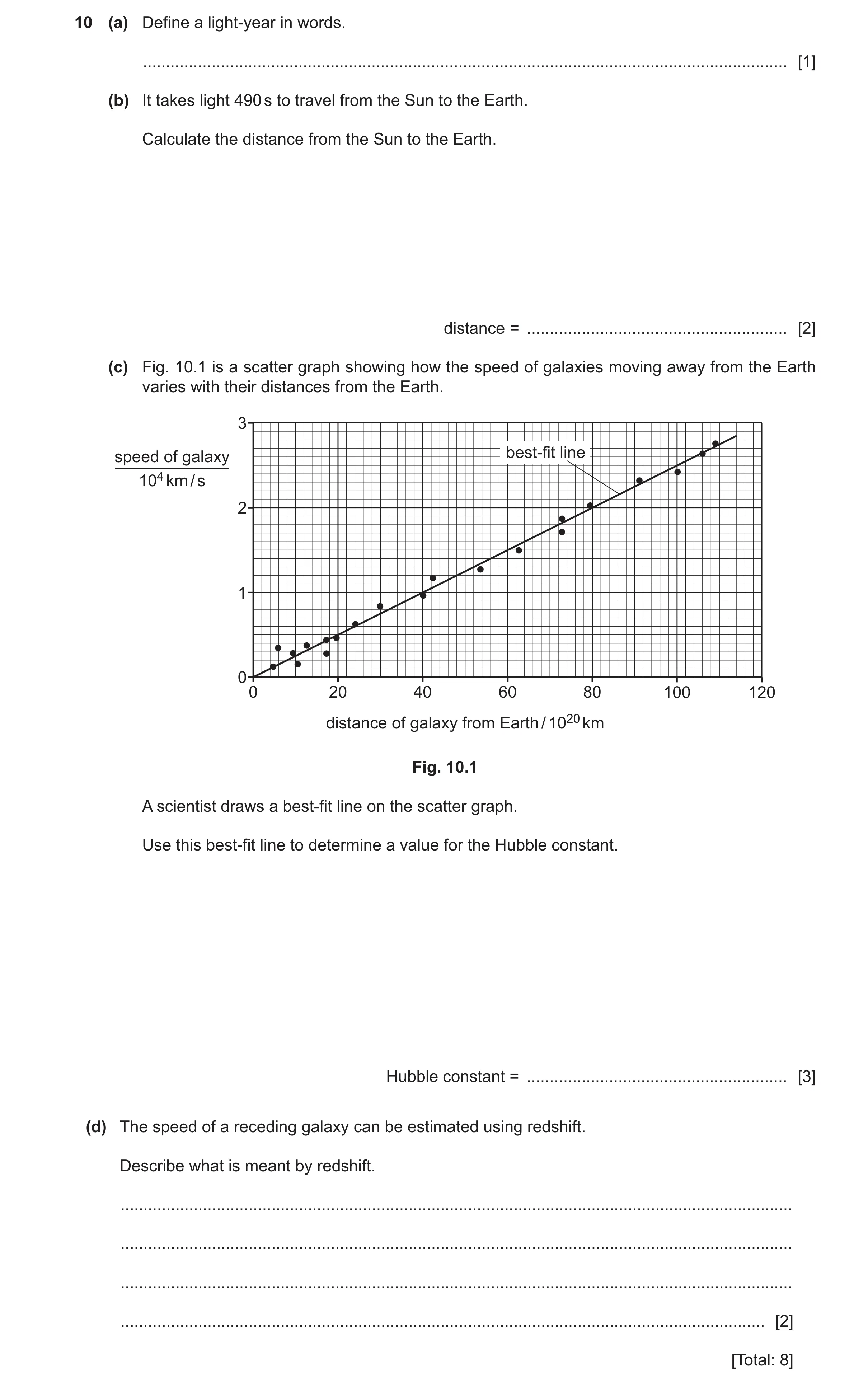
10 (a) Define a light-year in words. … [1] (b) It takes light 490 s to travel from the Sun to the Earth. Calculate the distance from the Sun to the Earth. distance = … [2] (c) Fig. 10.1 is a scatter graph showing how the speed of galaxies moving away from the Earth varies with their distances from the Earth. 3 speed of galaxy best-fit line 104 km / s 2 1 0 0 20 40 60 80 100 120 distance of galaxy from Earth / 1020 km Fig. 10.1 A scientist draws a best-fit line on the scatter graph. Use this best-fit line to determine a value for the Hubble constant. Hubble constant = … [3] (d) The speed of a receding galaxy can be estimated using redshift. Describe what is meant by redshift. … … … … [2] [Total: 8]
8 marks
Mark scheme: 10(a) distance travelled (in the vacuum of space) by light in one year B1 10(b) 1.5 1011 m A2 9.5 1015 (m) OR (c =) 3(.0) 108 (m / s) OR 3(.0) 10N 490 C1 10(c) 2.5 10–18 per second A3 (Hubble’s constant =) gradient OR (H0 =) v ÷ d C1 2.5 104(– 0) ÷ {100 1020 (– 0)} C1 10(d) electromagnetic radiation / light from (distant) galaxies B1 (observed) increase in wavelength (compared to wavelength measured on the Earth) B1
This question in 0625/43 May/June 2025
Q15 · Describe the structure of an atom of helium-4, 4He 0625/41 Oct/Nov 2025
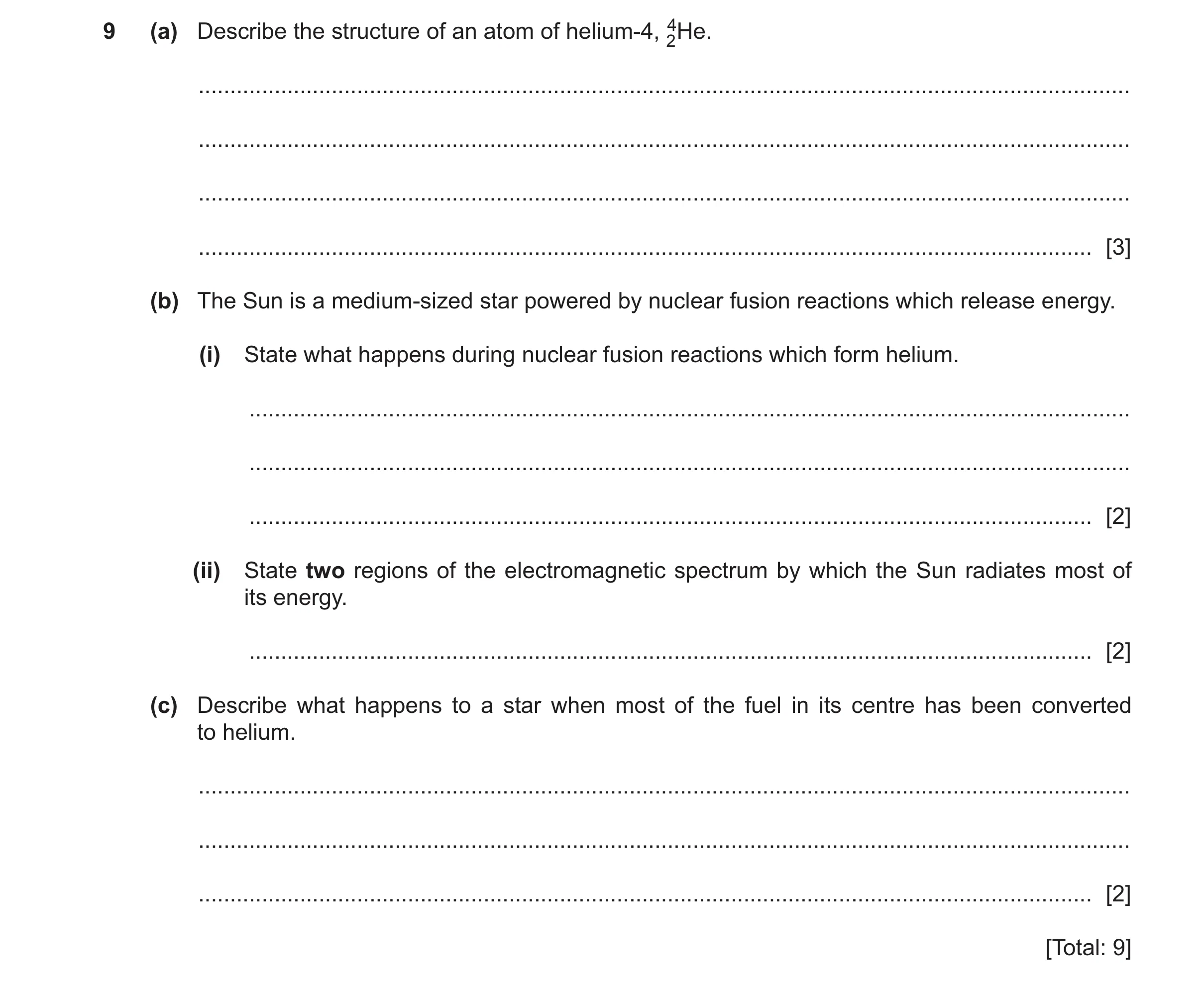
9 (a) Describe the structure of an atom of helium-4, 4He. 2 … … … … [3] (b) The Sun is a medium-sized star powered by nuclear fusion reactions which release energy. (i) State what happens during nuclear fusion reactions which form helium. … … … [2] (ii) State two regions of the electromagnetic spectrum by which the Sun radiates most of its energy. … [2] (c) Describe what happens to a star when most of the fuel in its centre has been converted to helium. … … … [2] [Total: 9]
9 marks
Mark scheme: 9(a) Any three from: B3 • nucleus containing protons and neutrons • protons (in nucleus) • 2 neutrons (in nucleus) • 2 electrons outside the nucleus • Protons are positive (charges) OR electrons are negative (charges) 9(b)(i) hydrogen B1 (hydrogen) nuclei join (together) B1 9(b)(ii) Any two from: B2 • infrared • visible • ultraviolet 9(c) • (the star) expands B1 Any one from: B1 • (smaller star) forms a red giant • (more massive star) forms a red supergiant
This question in 0625/41 Oct/Nov 2025
Q16 · The orbit of the Earth and the orbit of a comet around the Sun 0625/41 Oct/Nov 2025
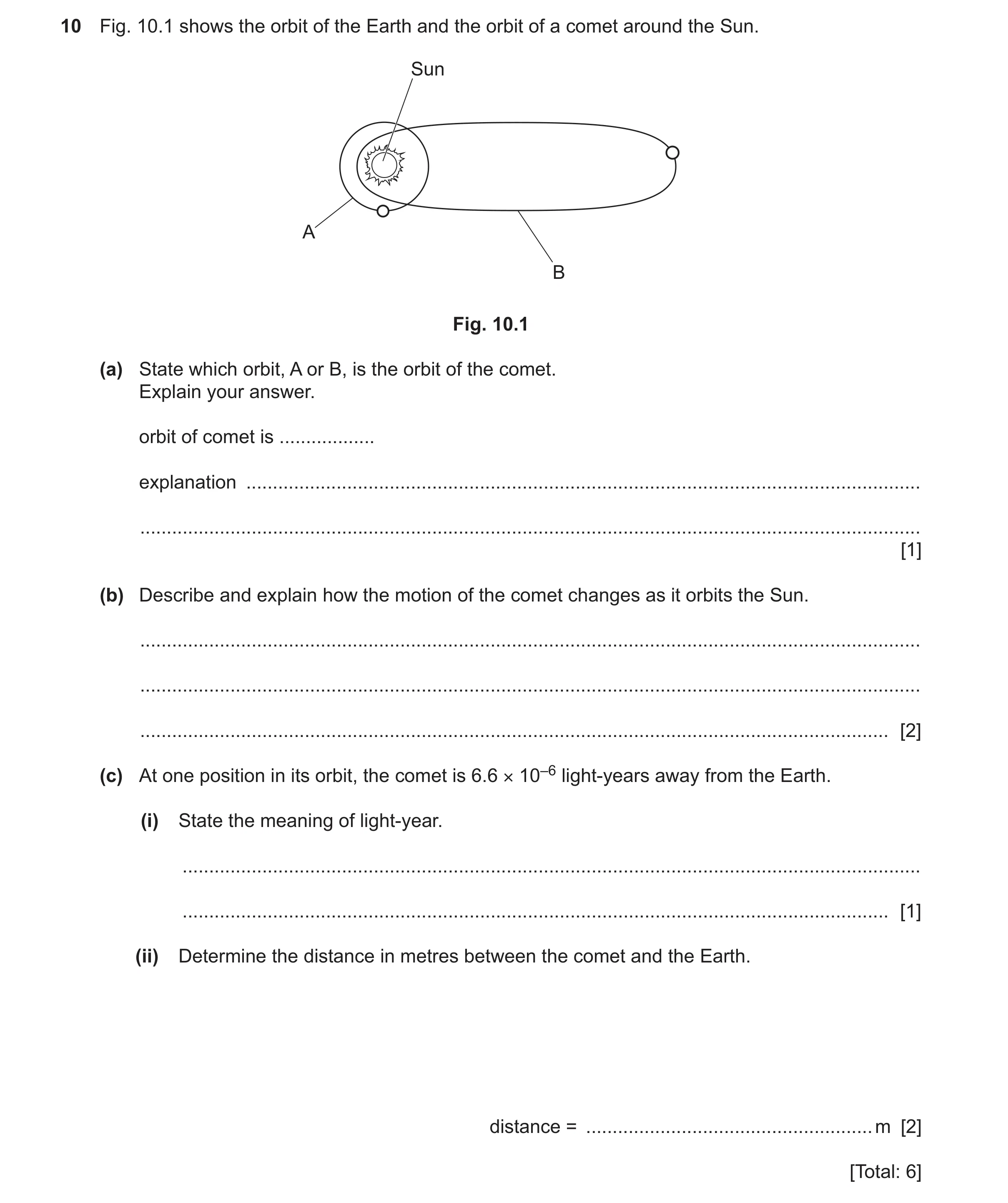
10 Fig. 10.1 shows the orbit of the Earth and the orbit of a comet around the Sun. Sun A B Fig. 10.1 (a) State which orbit, A or B, is the orbit of the comet. Explain your answer. orbit of comet is … explanation … … [1] (b) Describe and explain how the motion of the comet changes as it orbits the Sun. … … … [2] (c) At one position in its orbit, the comet is 6.6 × 10⁻⁶ light-years away from the Earth. (i) State the meaning of light-year. … … [1] (ii) Determine the distance in metres between the comet and the Earth. distance = … m [2] [Total: 6]
6 marks
Mark scheme: 10(a) B B1 AND Sun is not at the centre of the orbit OR comets have an elliptical orbit 10(b) Comet travels faster when it is closer to the Sun ORA B1 GPE decreases AND KE increases as comet gets closer to the Sun ORA B1 10(c)(i) distance travelled (in the vacuum of space) by light in one year. B1 10(c)(ii) 6.3 1010 (m) OR 63 000 000 000 (m) A2 (1 light-year =) 9.5 1015 (m) OR (1 light-year =) 9.5 1012 (km) OR SEEN (distance =) 6.6 10–6 9.5 10N C1
This question in 0625/41 Oct/Nov 2025
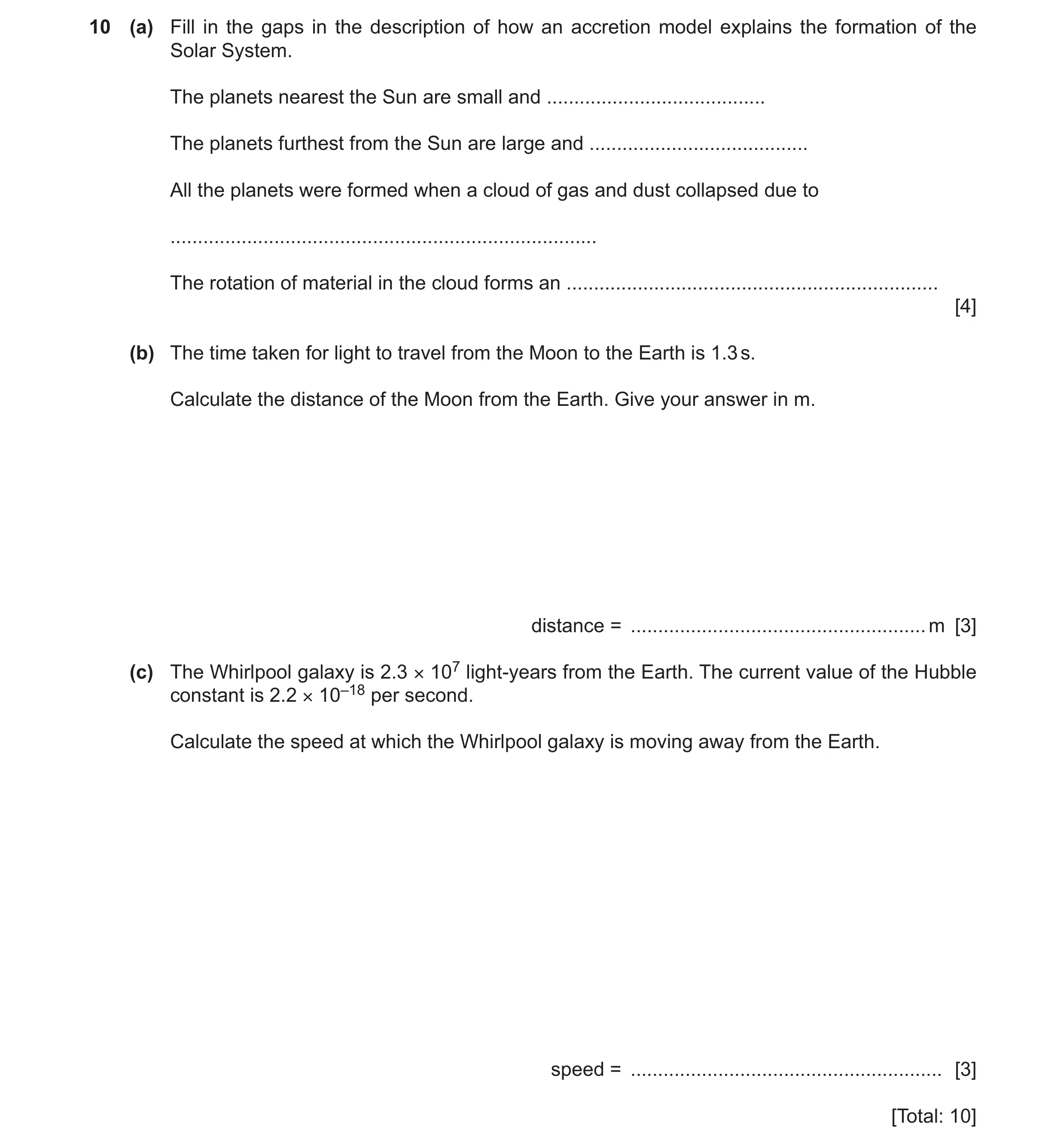
Q17 · Fill in the gaps in the description of how an accretion model explains the formation of… 0625/42 Oct/Nov 2025
10 (a) Fill in the gaps in the description of how an accretion model explains the formation of the Solar System. The planets nearest the Sun are small and … The planets furthest from the Sun are large and … All the planets were formed when a cloud of gas and dust collapsed due to … The rotation of material in the cloud forms an … [4] (b) The time taken for light to travel from the Moon to the Earth is 1.3 s. Calculate the distance of the Moon from the Earth. Give your answer in m. distance = … m [3] (c) The Whirlpool galaxy is 2.3 × 10⁷ light‑years from the Earth. The current value of the Hubble constant is 2.2 × 10⁻¹⁸ per second. Calculate the speed at which the Whirlpool galaxy is moving away from the Earth. speed = … [3] [Total: 10]
10 marks
Mark scheme: 10(a) rocky B1 gaseous B1 gravitational force B1 accretion disc B1 10(b) 3.9 108 (m) A3 (speed of light =) 3.0 108 C1 (s =) vt OR (s =) 3.0 108 1.3 C1 10(c) 4.8 105 m / s OR 4.8 102 km / s A3 (1 light-year =) 9.5 1015 (m) OR 9.5 1012 (km) OR 4.8 10N C1 (v =) H0 d OR (v =) 2.2 10-18 2.3 107 9.5 1015 C1
This question in 0625/42 Oct/Nov 2025
 1 / 15
 2 / 15
 3 / 15
 4 / 15
 5 / 15
 6 / 15
 7 / 15
 8 / 15
 9 / 15
 10 / 15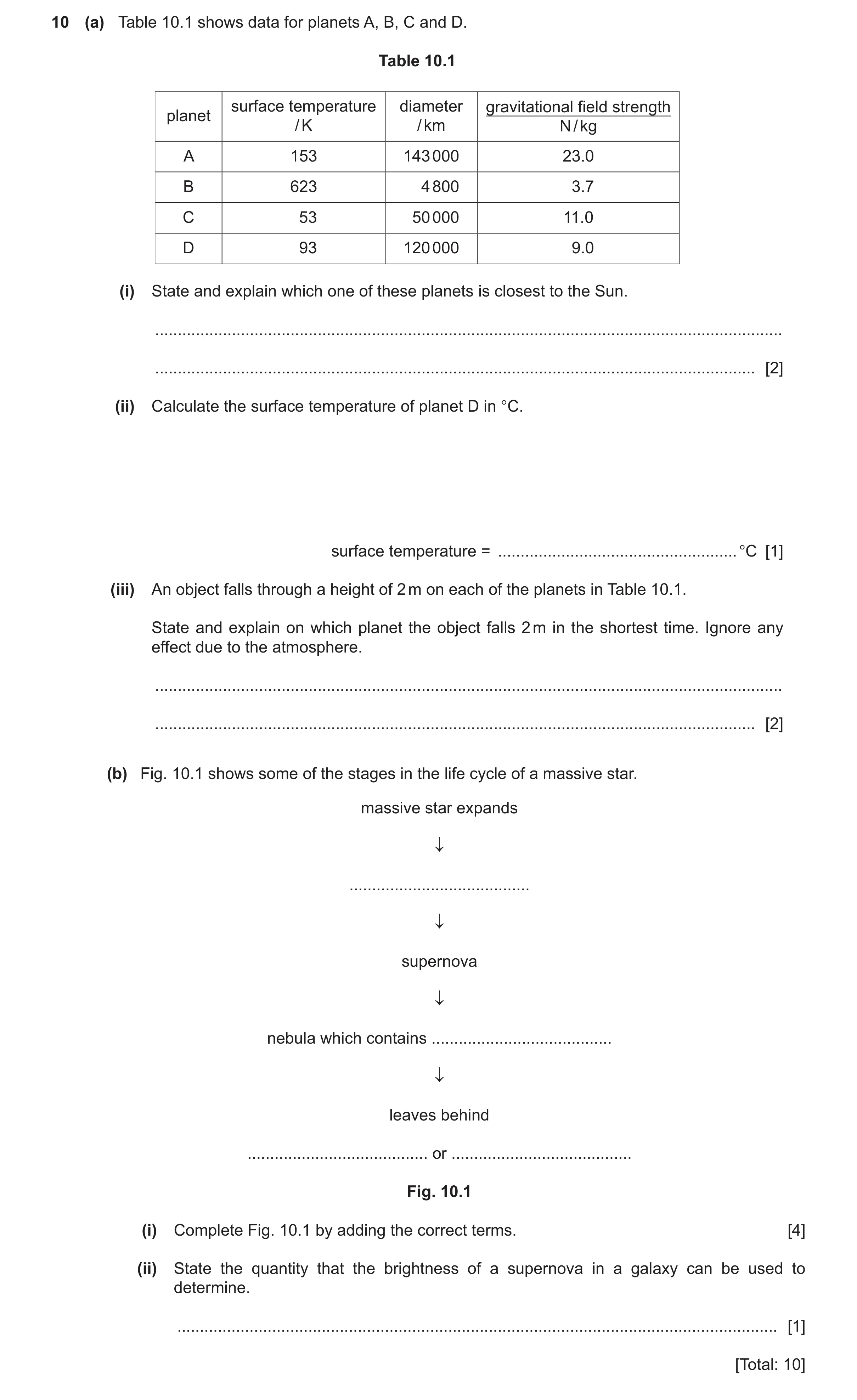
 13 / 15
 14 / 15
 15 / 15
 4
4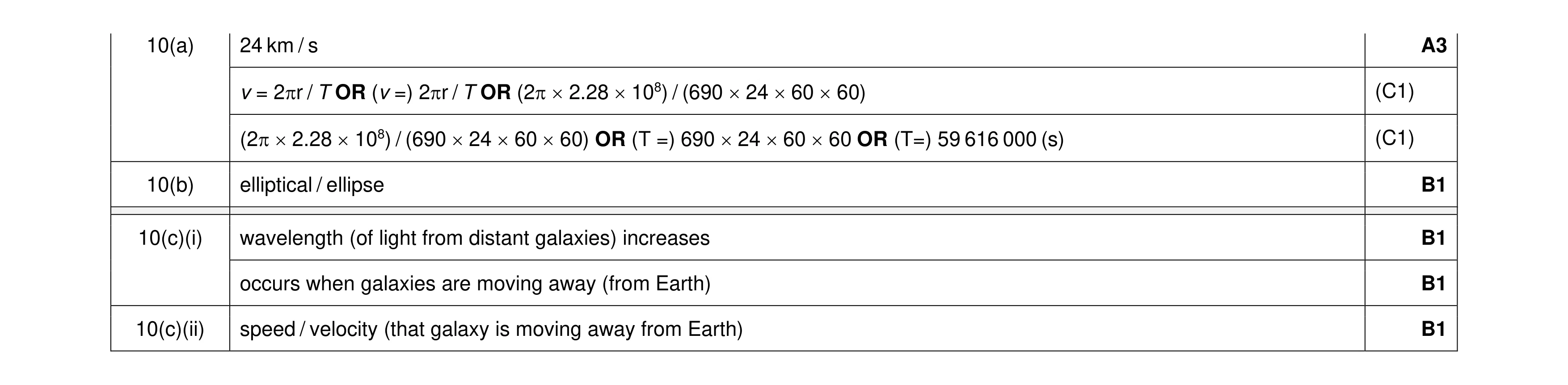 7
7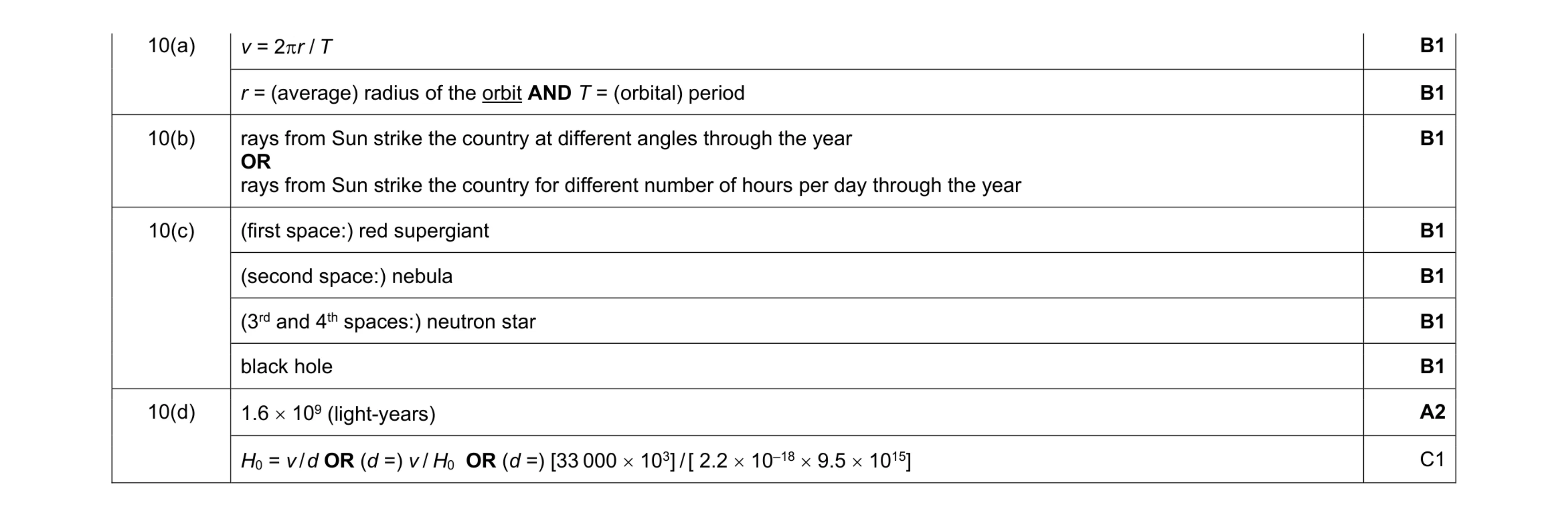 9
9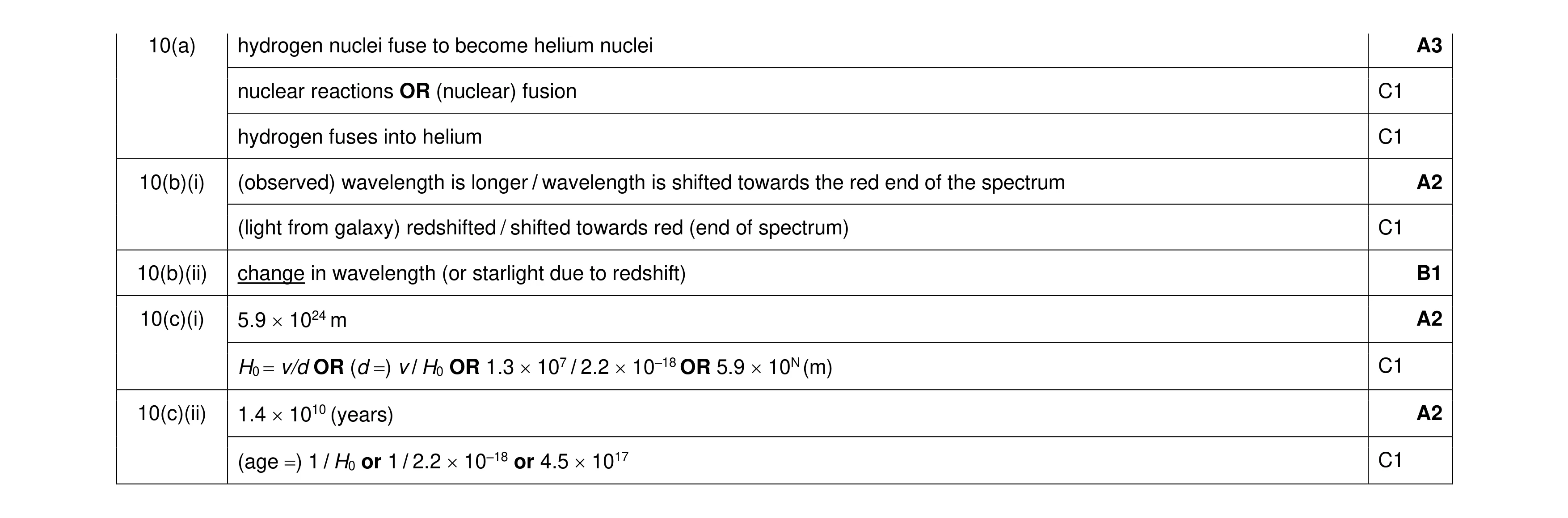 10
10 5
5 5
5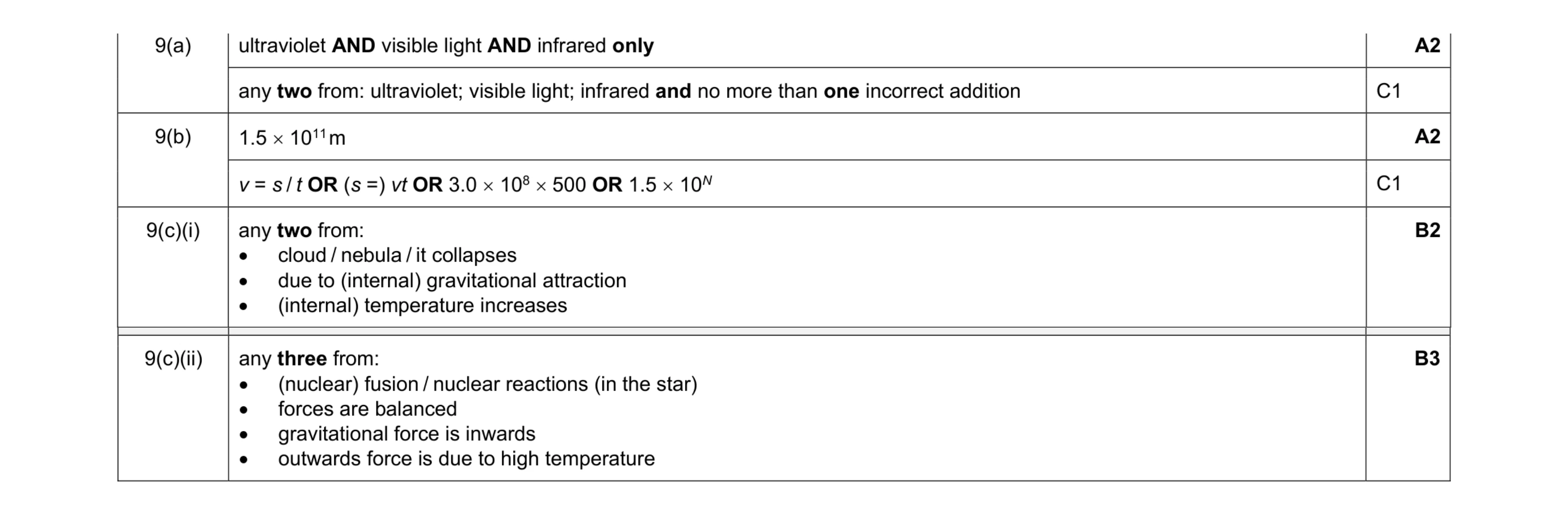 9
9 5
5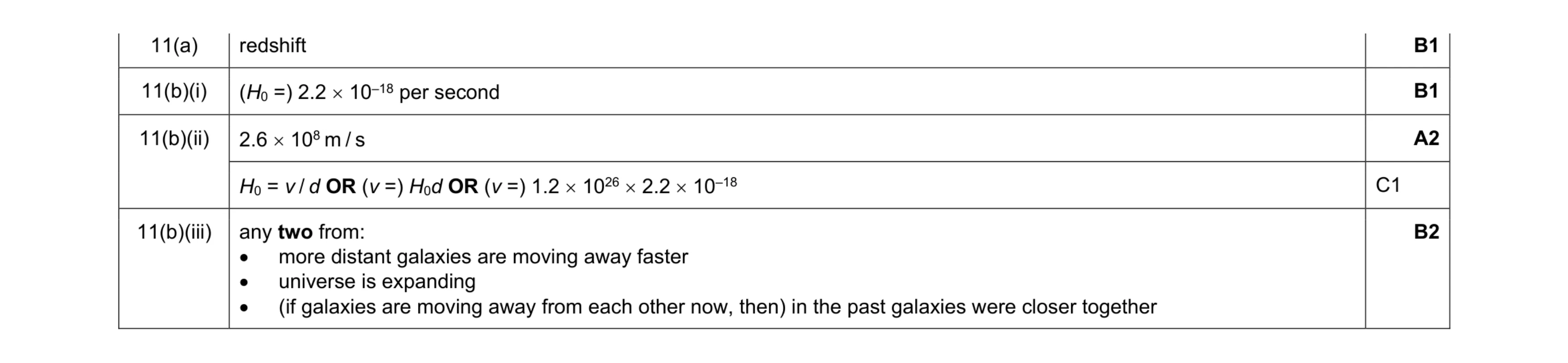 6
6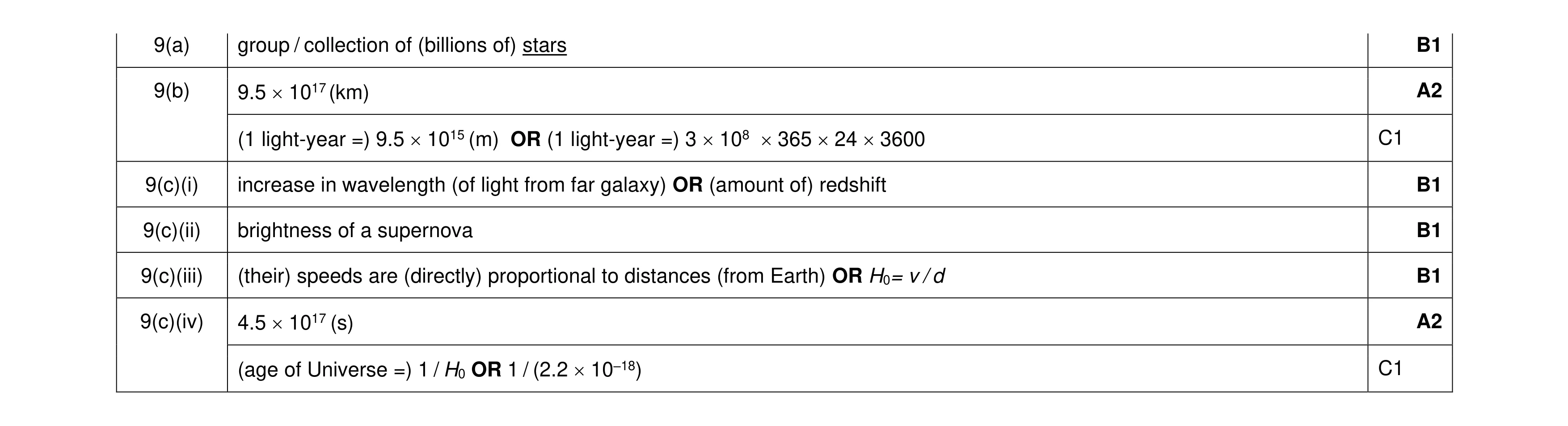 8
8 5
5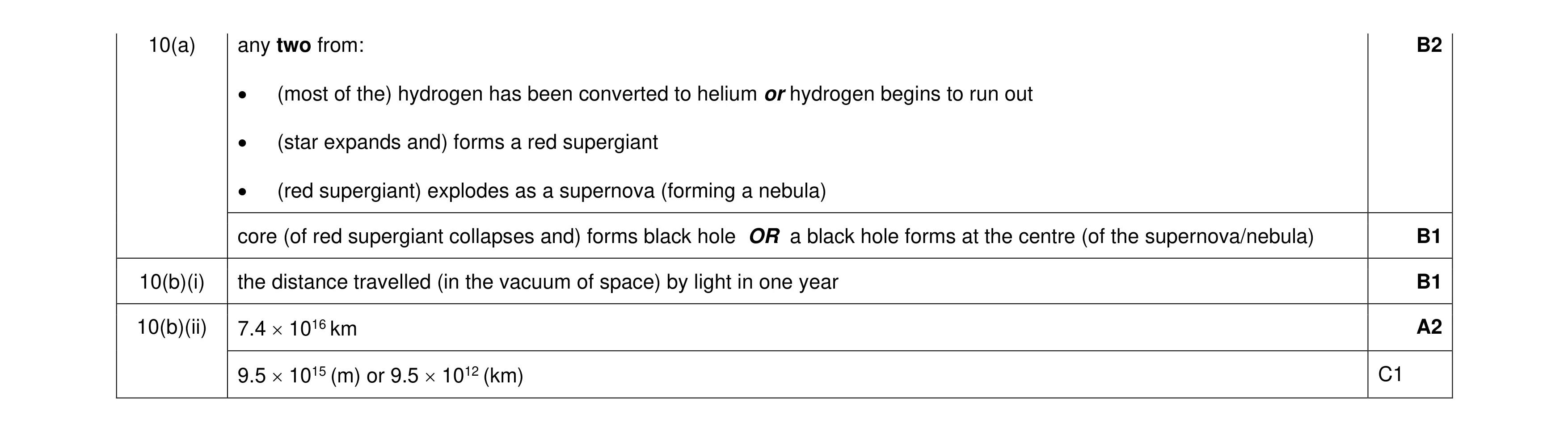 6
6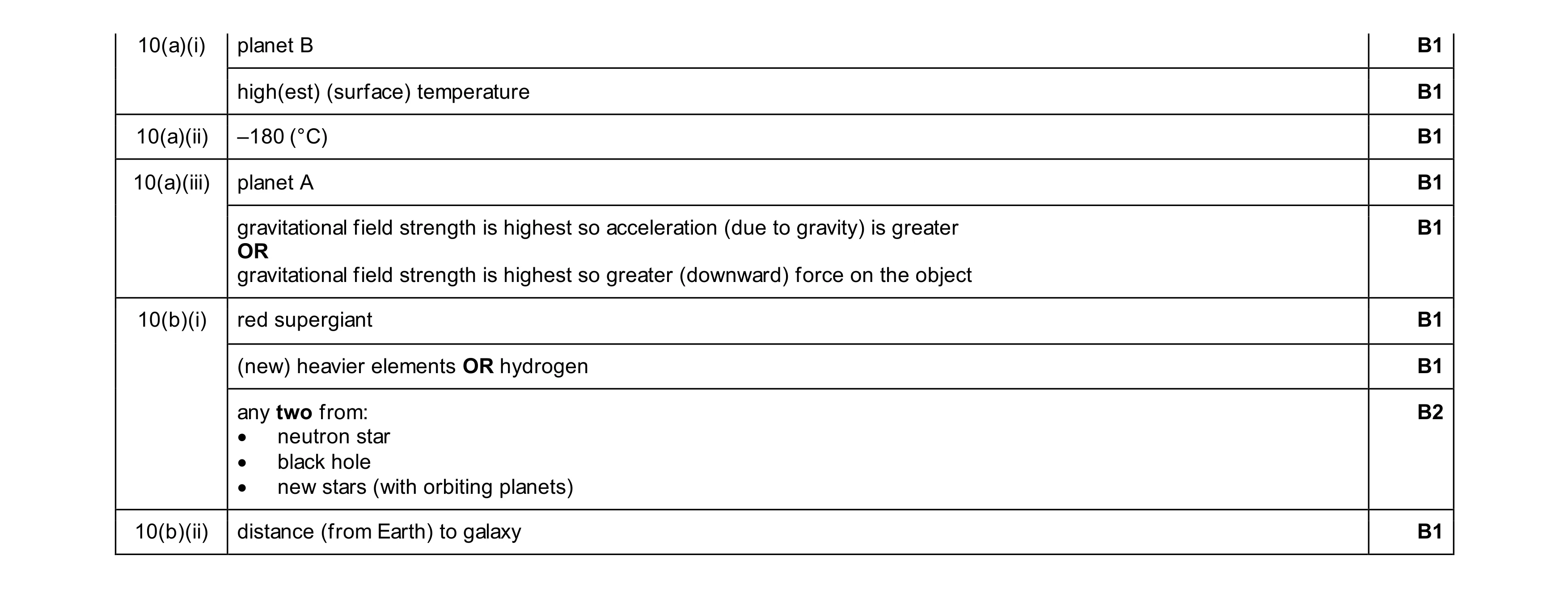 10
10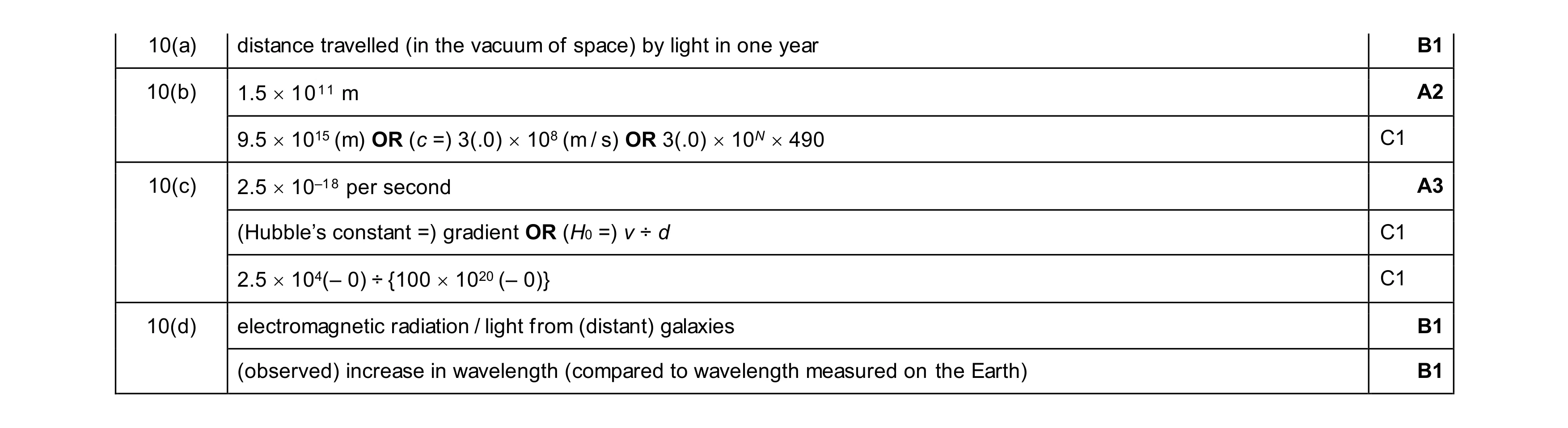 8
8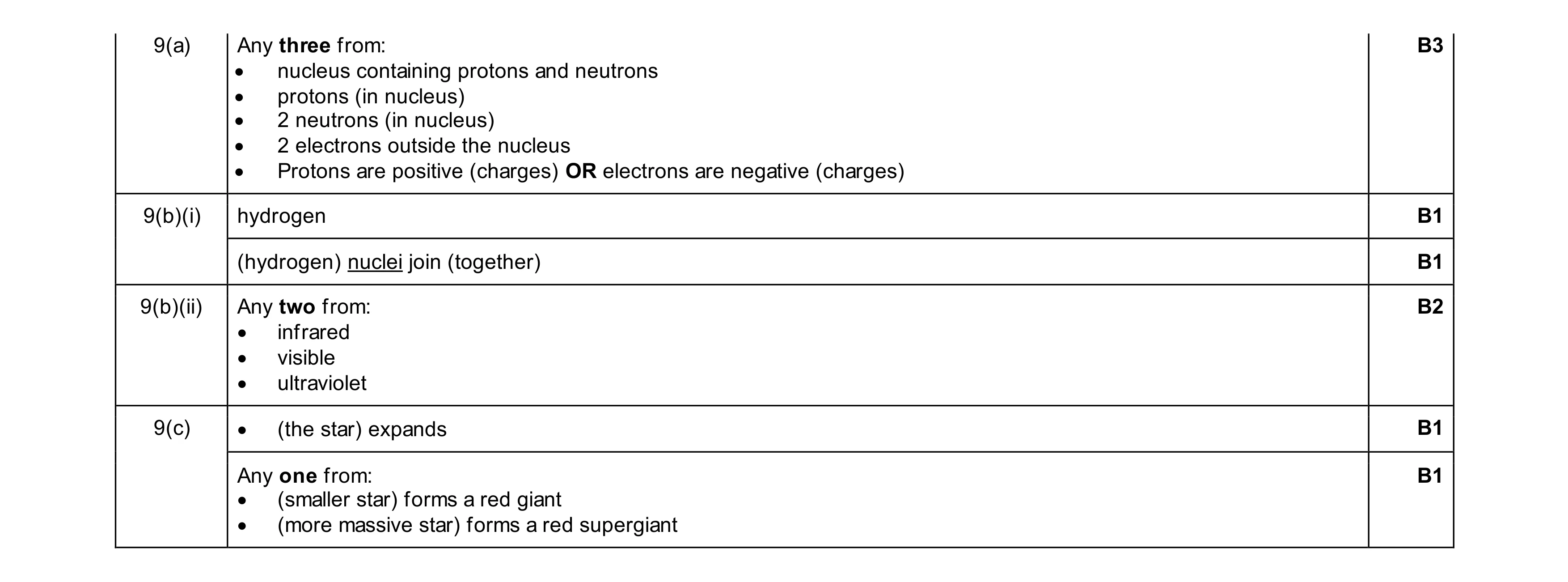 9
9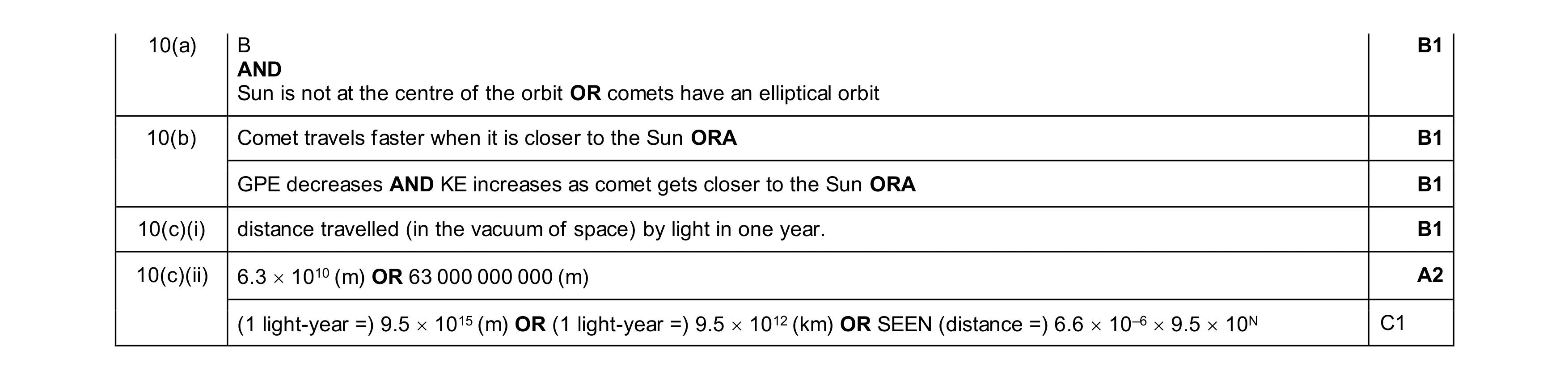 6
6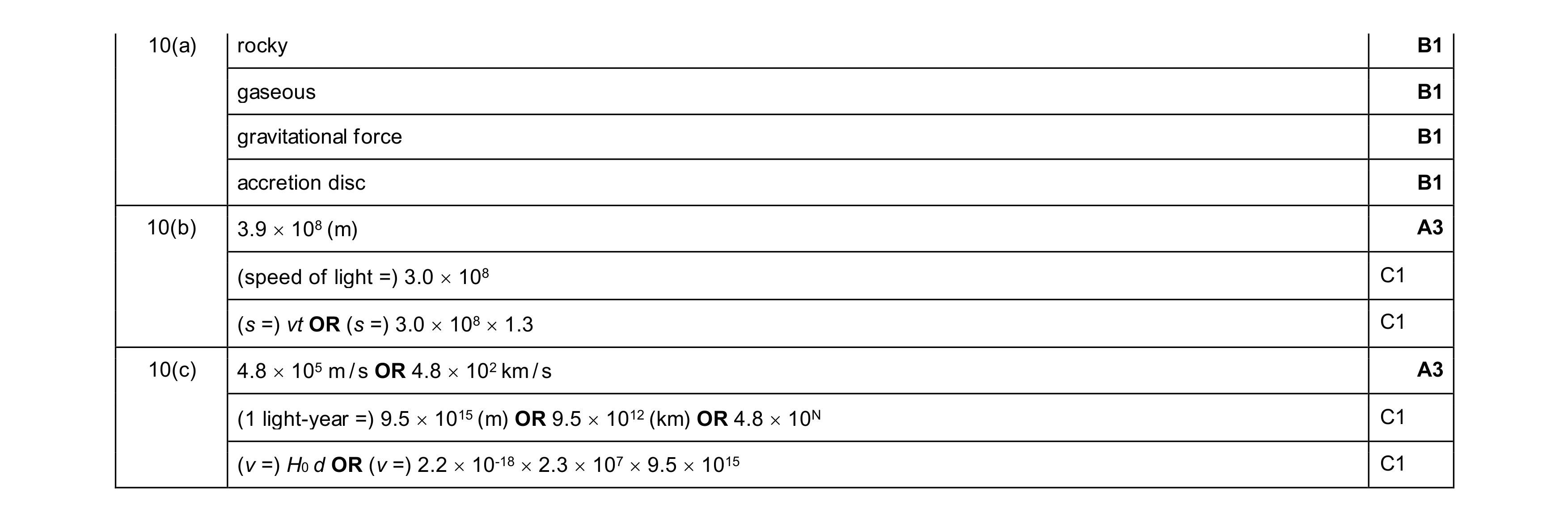 10
10