Questions as text
Q1 · In experiments on rusting, some students are given metal objects to study 0652/11 Oct/Nov 2007
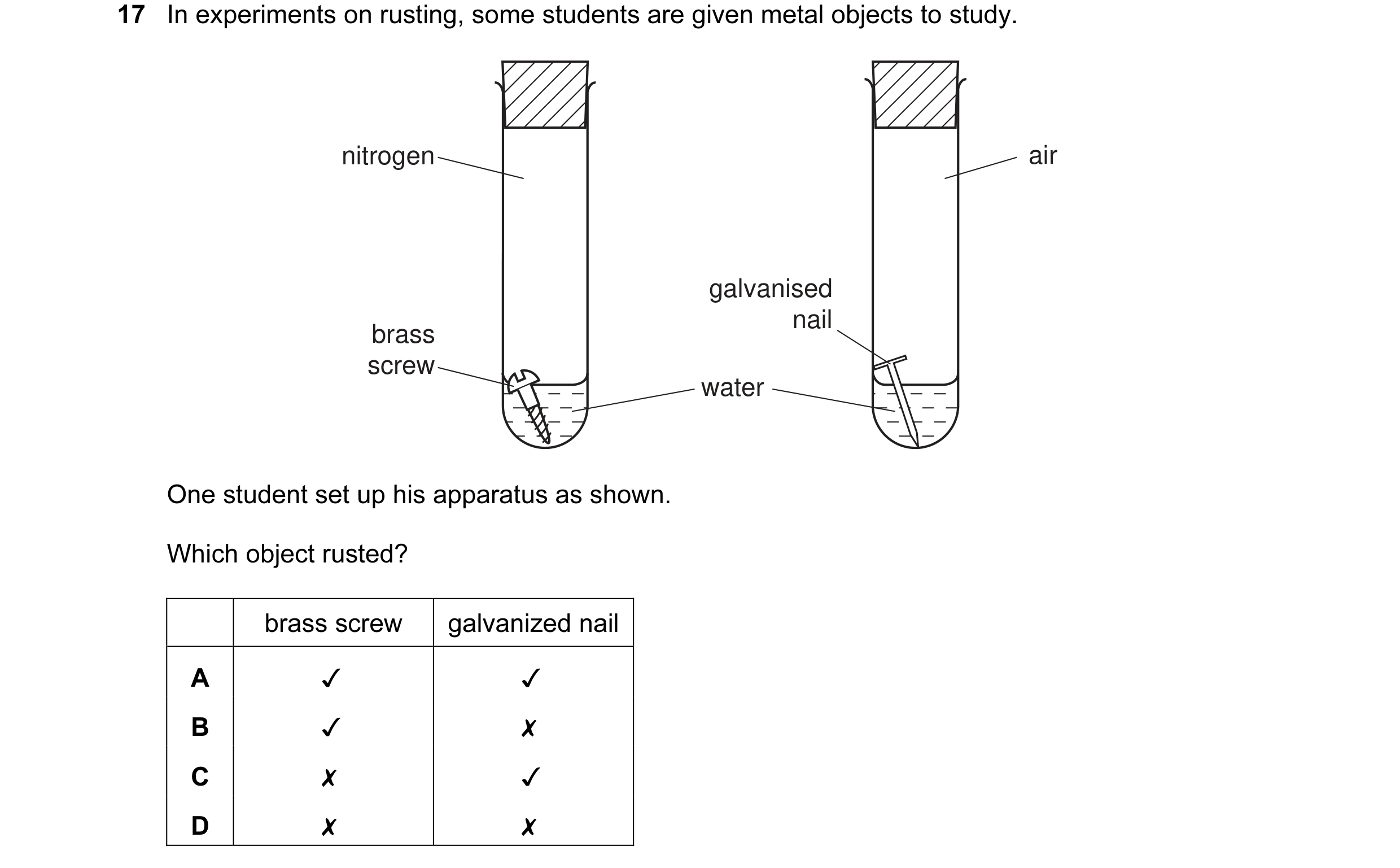
17 In experiments on rusting, some students are given metal objects to study.
nitrogen air
galvanised
water
One student set up his apparatus as shown.
Which object rusted?
brass screw | galvanized nail
A v v
B v x
Cc x v
D x x
1 marks
Answer: D
This question in 0652/11 Oct/Nov 2007
Q2 · The diagrams show apparatus used to test the reaction of chlorine with different liquids 0652/11 Oct/Nov 2008
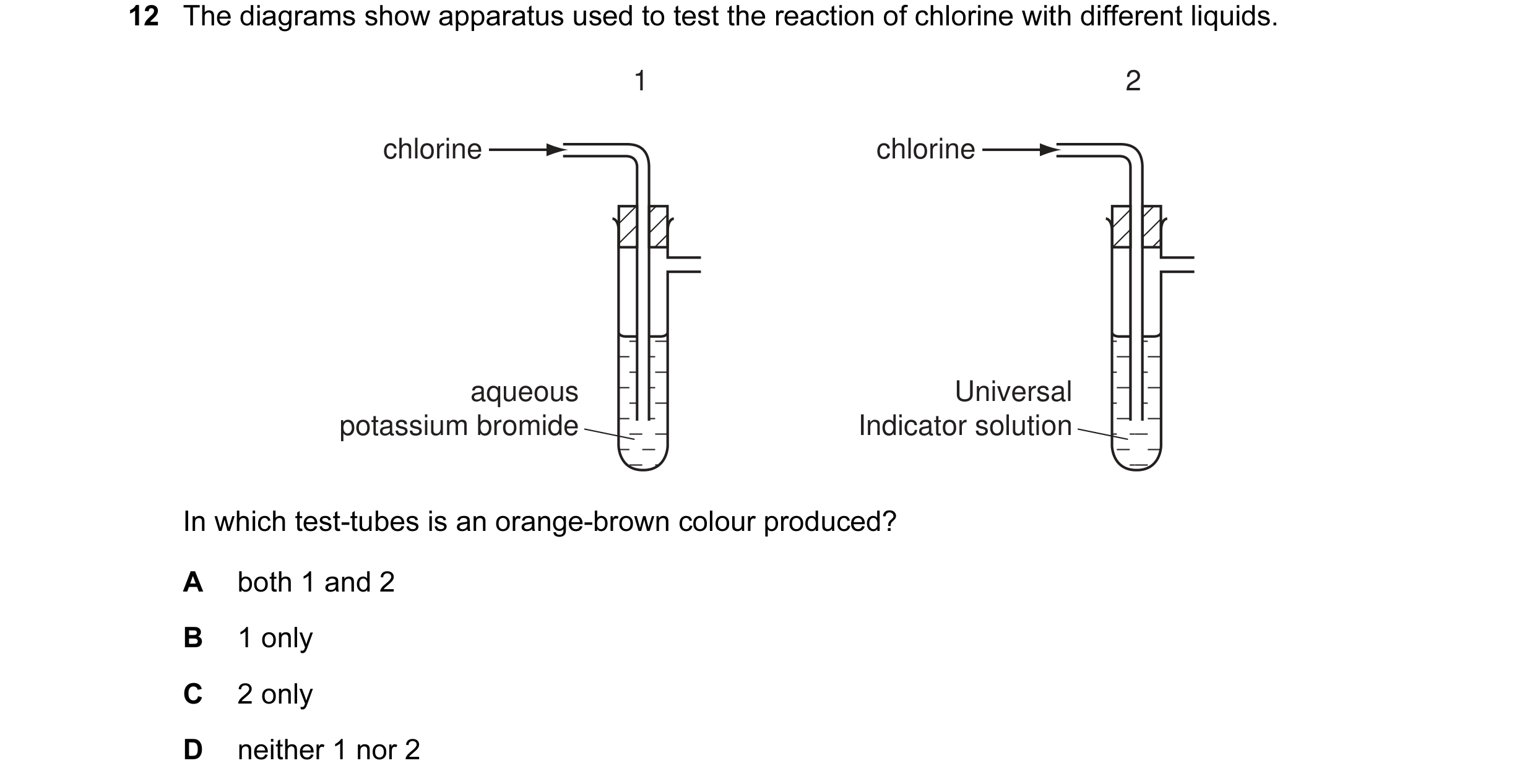
12 The diagrams show apparatus used to test the reaction of chlorine with different liquids. 1 2 chlorine chlorine aqueous Universal potassium bromide Indicator solution In which test-tubes is an orange-brown colour produced? A both 1 and 2 B 1 only C 2 only D neither 1 nor 2
1 marks
Answer: B
This question in 0652/11 Oct/Nov 2008
Q3 · The table shows some properties of elements P and Q 0652/11 Oct/Nov 2009
11 The table shows some properties of elements P and Q.
has a coloured oxide
oxide can be reduced by carbon
reacts with dilute sulfuric acid
x \ \ {90
<< s/o
What are elements P and Q?
P Q
A Cu Fe
B Cu Zn
Cc Fe Cu
D Fe Zn
1 marks
Answer: A
This question in 0652/11 Oct/Nov 2009
Q4 · Metal X is below hydrogen in the reactivity series 0652/11 Oct/Nov 2009
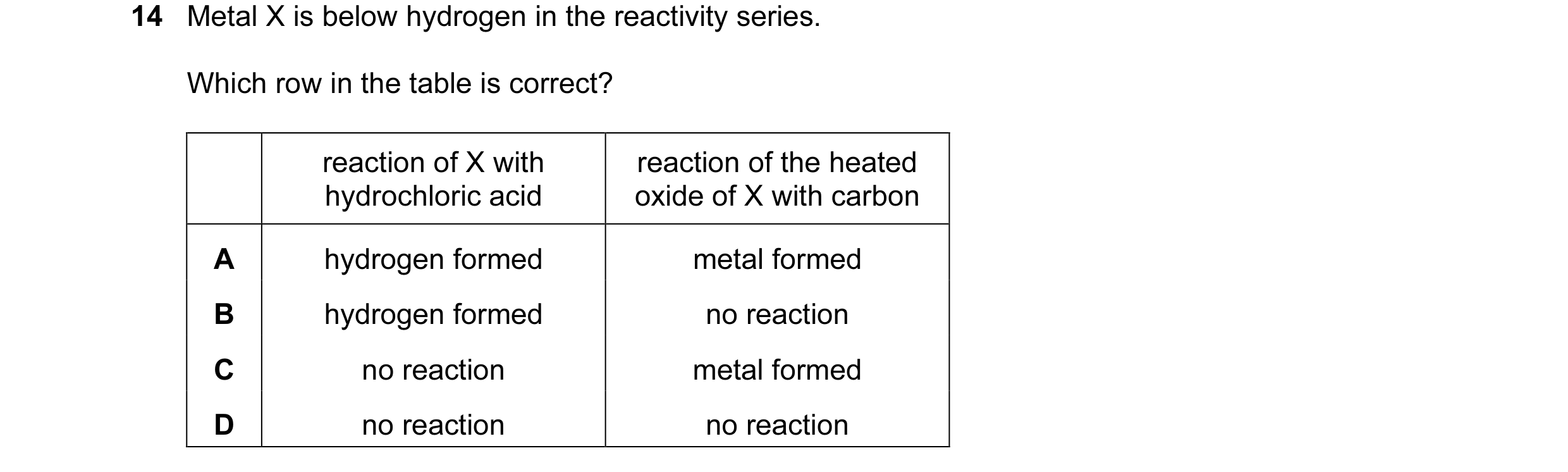
14 Metal X is below hydrogen in the reactivity series. Which row in the table is correct? reaction of X with reaction of the heated hydrochloric acid oxide of X with carbon A hydrogen formed metal formed B hydrogen formed no reaction C no reaction metal formed D no reaction no reaction
1 marks
Answer: C
This question in 0652/11 Oct/Nov 2009
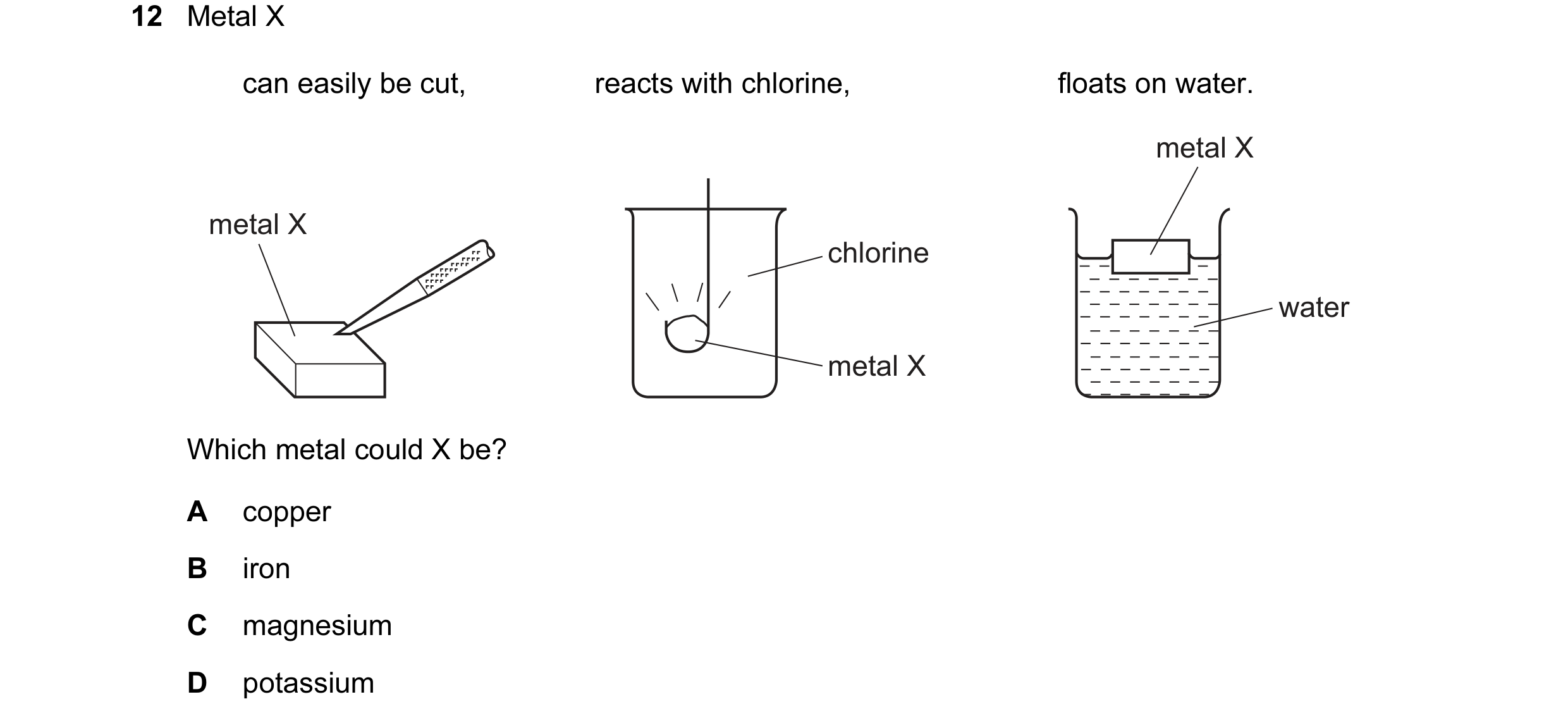
Q5 · Metal X can easily be cut, reacts with chlorine, floats on water 0652/11 Oct/Nov 2010
12 Metal X can easily be cut, reacts with chlorine, floats on water. metal X metal X chlorine water metal X Which metal could X be? A copper B iron C magnesium D potassium
1 marks
Answer: D
This question in 0652/11 Oct/Nov 2010
Q6 · Metal M is only present in its ores as a compound 0652/11 Oct/Nov 2011
13 Metal M is only present in its ores as a compound. M is extracted from these compounds by heating them with carbon. In which position in the reactivity series shown is M most likely to be found? potassium A sodium calcium B magnesium zinc C iron copper D
1 marks
Answer: C
This question in 0652/11 Oct/Nov 2011
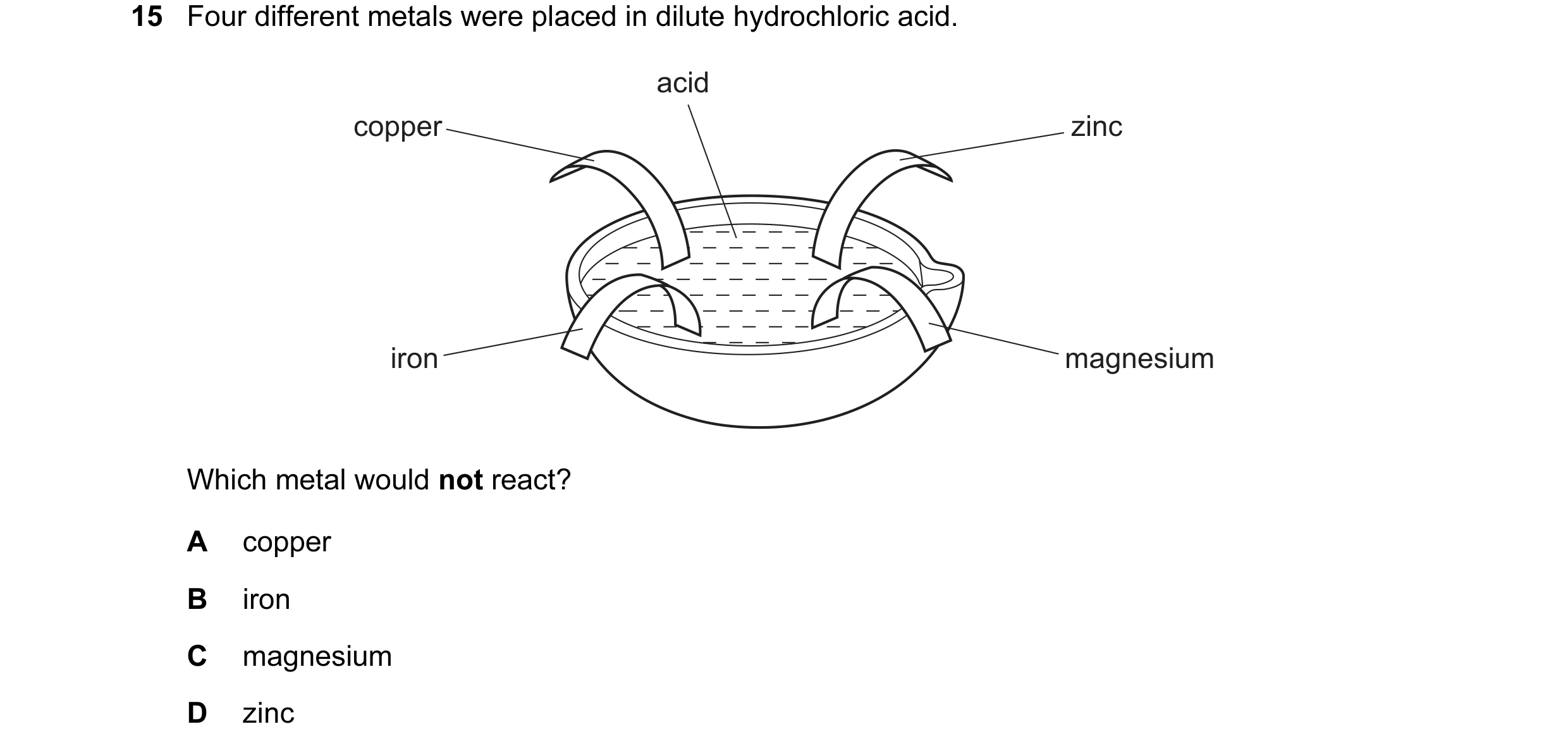
Q7 · Four different metals were placed in dilute hydrochloric acid 0652/11 Oct/Nov 2011
15 Four different metals were placed in dilute hydrochloric acid. acid copper zinc iron magnesium Which metal would not react? A copper B iron C magnesium D zinc
1 marks
Answer: A
This question in 0652/11 Oct/Nov 2011
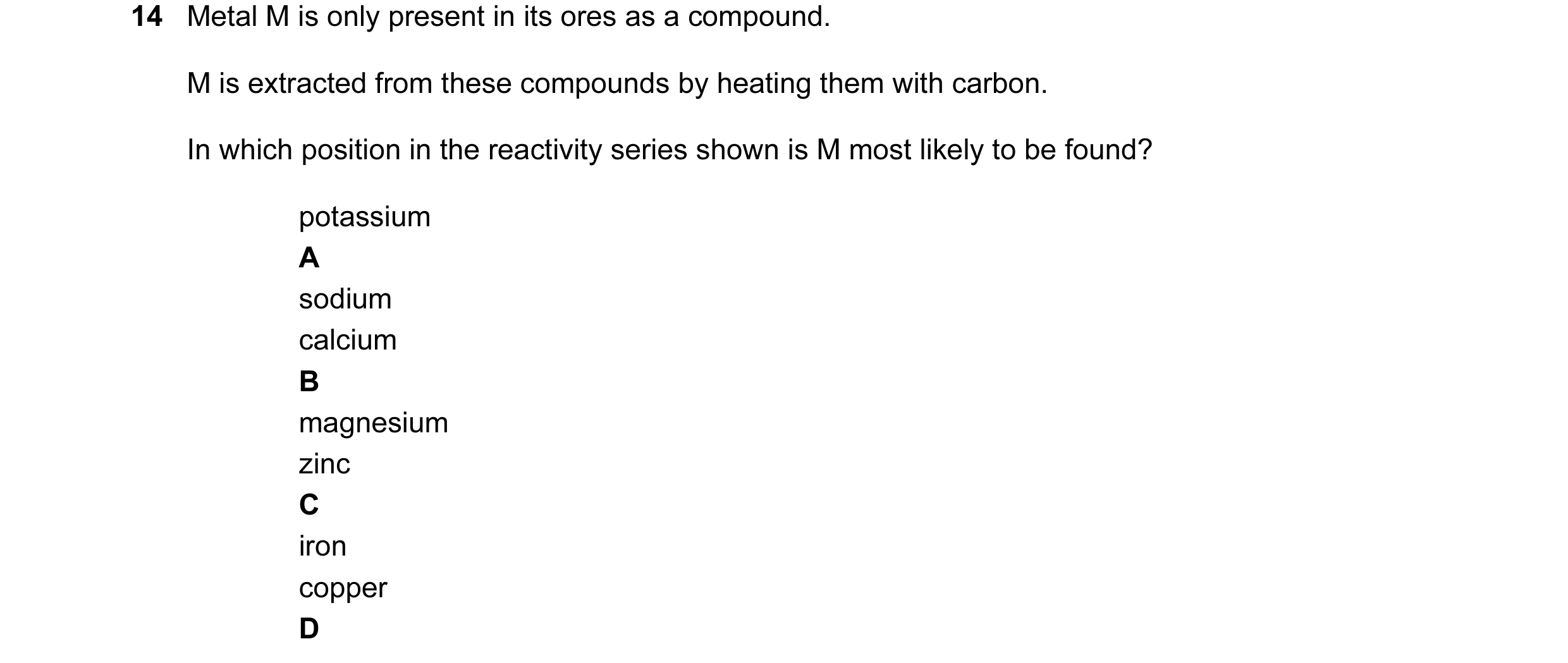
Q8 · Metal M is only present in its ores as a compound 0652/12 Oct/Nov 2011
14 Metal M is only present in its ores as a compound. M is extracted from these compounds by heating them with carbon. In which position in the reactivity series shown is M most likely to be found? potassium A sodium calcium B magnesium zinc C iron copper D
1 marks
Answer: C
This question in 0652/12 Oct/Nov 2011
Q9 · Four different metals were placed in dilute hydrochloric acid 0652/12 Oct/Nov 2011
17 Four different metals were placed in dilute hydrochloric acid. acid copper zinc iron magnesium Which metal would not react? A copper B iron C magnesium D zinc
1 marks
Answer: A
This question in 0652/12 Oct/Nov 2011
Q10 · The table shows some of the reactions of four metals and their oxides 0652/11 Oct/Nov 2013
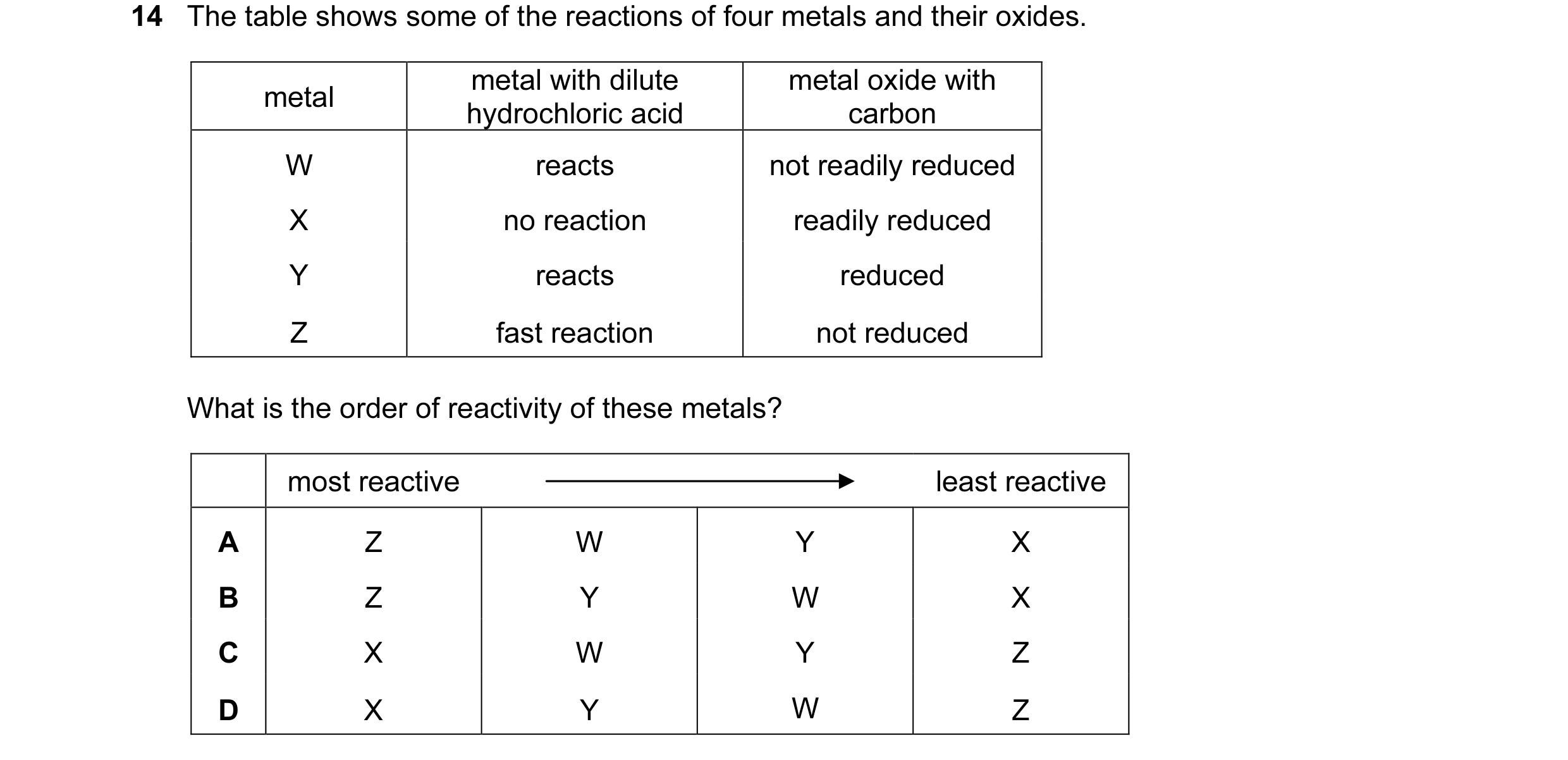
14 The table shows some of the reactions of four metals and their oxides. metal with dilute metal oxide with metal hydrochloric acid carbon W reacts not readily reduced X no reaction readily reduced Y reacts reduced Z fast reaction not reduced What is the order of reactivity of these metals? most reactive least reactive A Z W Y X B Z Y W X C X W Y Z D X Y W Z
1 marks
Answer: A
This question in 0652/11 Oct/Nov 2013
Q11 · The table shows some of the reactions of four metals and their oxides 0652/12 Oct/Nov 2013
14 The table shows some of the reactions of four metals and their oxides. metal with dilute metal oxide with metal hydrochloric acid carbon W reacts not readily reduced X no reaction readily reduced Y reacts reduced Z fast reaction not reduced What is the order of reactivity of these metals? most reactive least reactive A Z W Y X B Z Y W X C X W Y Z D X Y W Z
1 marks
Answer: A
This question in 0652/12 Oct/Nov 2013
Q12 · Metal M is only present as a compound in its ores 0652/11 Oct/Nov 2014
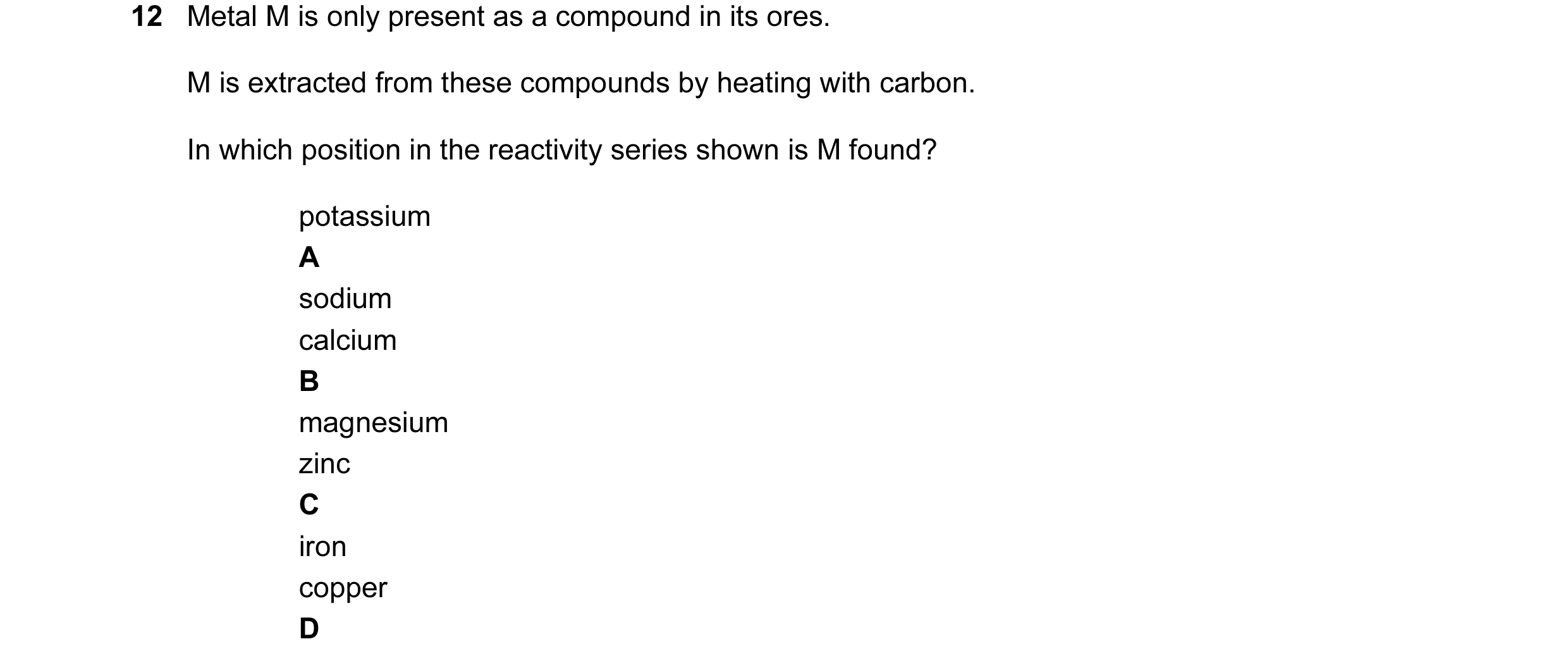
12 Metal M is only present as a compound in its ores. M is extracted from these compounds by heating with carbon. In which position in the reactivity series shown is M found? potassium A sodium calcium B magnesium zinc C iron copper D
1 marks
Answer: C
This question in 0652/11 Oct/Nov 2014
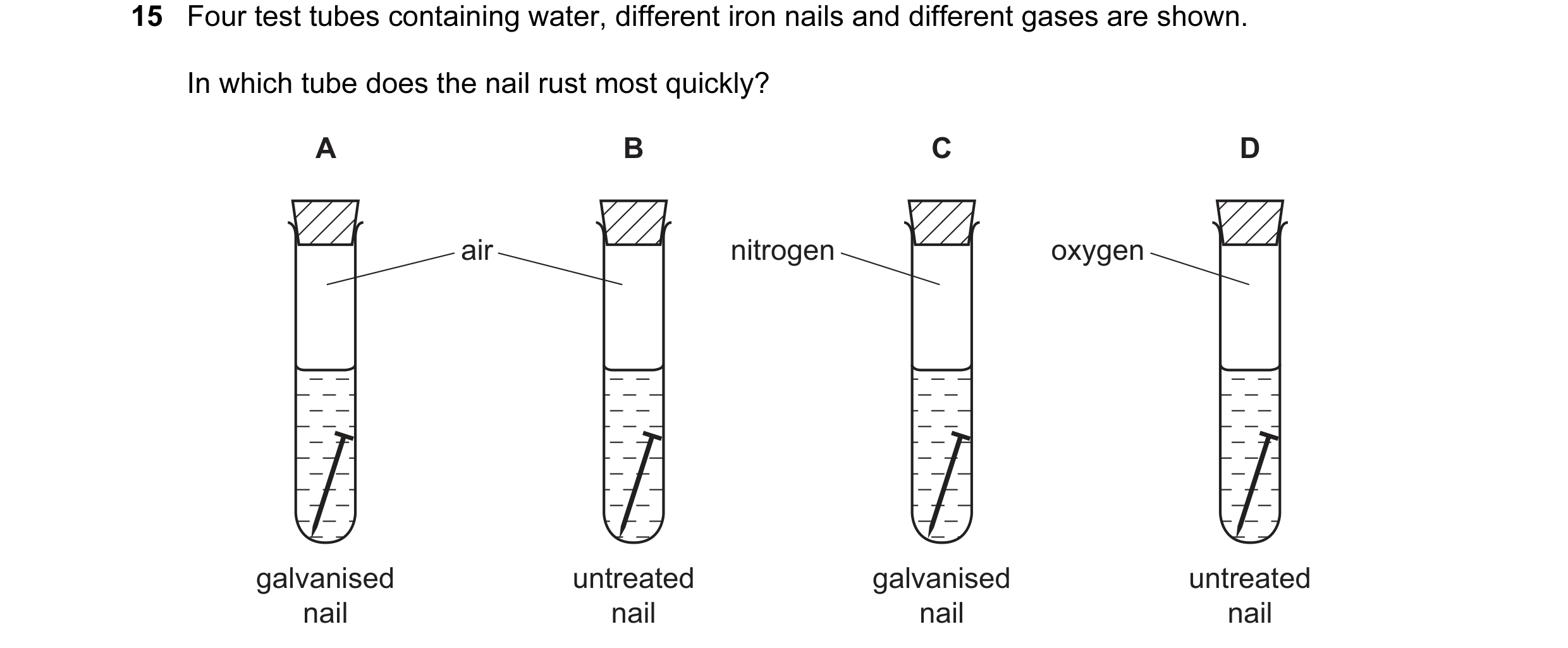
Q13 · Four test tubes containing water, different iron nails and different gases are shown 0652/11 Oct/Nov 2014
15 Four test tubes containing water, different iron nails and different gases are shown. In which tube does the nail rust most quickly? A B C D air nitrogen oxygen galvanised untreated galvanised untreated nail nail nail nail
1 marks
Answer: D
This question in 0652/11 Oct/Nov 2014
Q14 · Metal M is only present as a compound in its ores 0652/12 Oct/Nov 2014
12 Metal M is only present as a compound in its ores. M is extracted from these compounds by heating with carbon. In which position in the reactivity series shown is M found? potassium A sodium calcium B magnesium zinc C iron copper D
1 marks
Answer: C
This question in 0652/12 Oct/Nov 2014
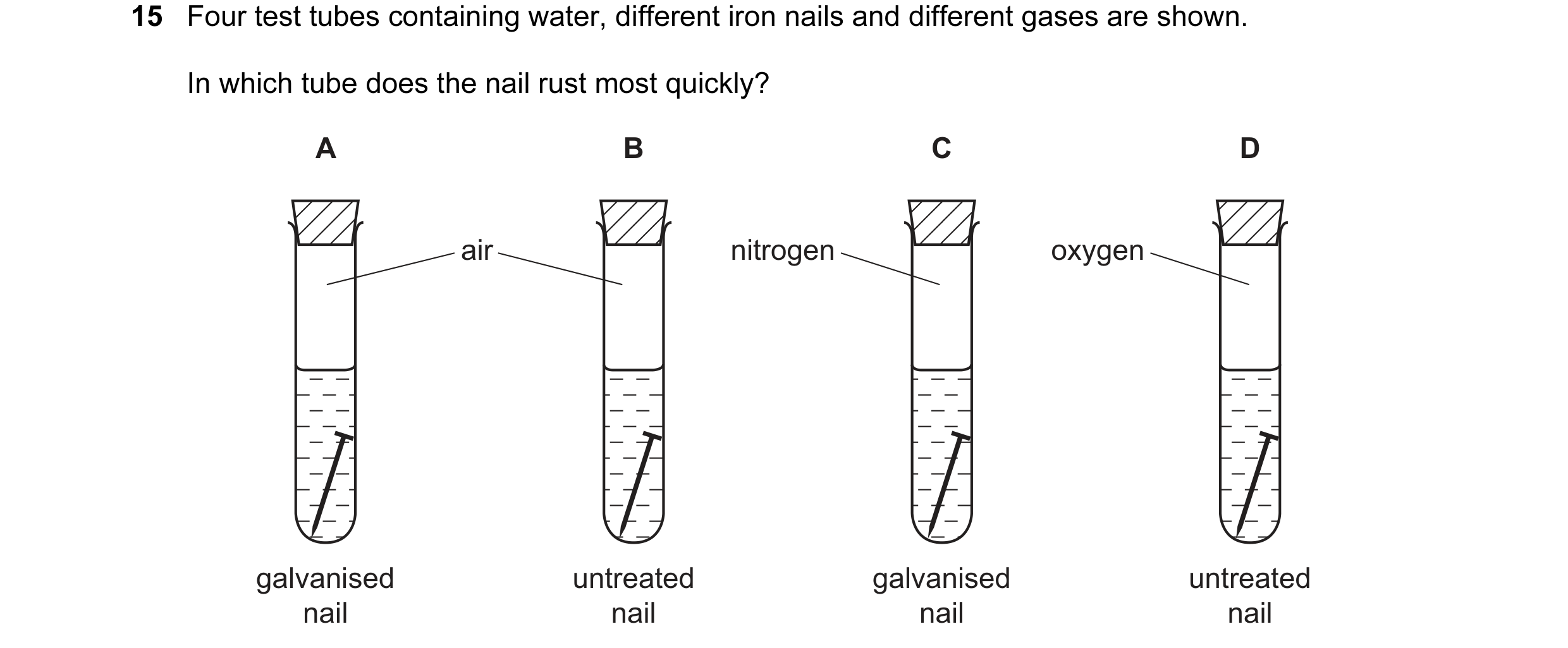
Q15 · Four test tubes containing water, different iron nails and different gases are shown 0652/12 Oct/Nov 2014
15 Four test tubes containing water, different iron nails and different gases are shown. In which tube does the nail rust most quickly? A B C D air nitrogen oxygen galvanised untreated galvanised untreated nail nail nail nail
1 marks
Answer: D
This question in 0652/12 Oct/Nov 2014
Q16 · Which metal produces a solution of a metal hydroxide when added to water? 0652/11 Oct/Nov 2015
12 Which metal produces a solution of a metal hydroxide when added to water? A calcium B copper C iron D zinc
1 marks
Answer: A
This question in 0652/11 Oct/Nov 2015
Q17 · Which metal produces a solution of a metal hydroxide when added to water? 0652/12 Oct/Nov 2015
12 Which metal produces a solution of a metal hydroxide when added to water? A calcium B copper C iron D zinc
1 marks
Answer: A
This question in 0652/12 Oct/Nov 2015
Q18 · Hydrogen is passed over a heated metal oxide as shown 0652/12 Oct/Nov 2016
9 Hydrogen is passed over a heated metal oxide as shown. metal oxide excess of hydrogen burning hydrogen heat The metal and steam are formed. What happens to the hydrogen and to the metal oxide? hydrogen metal oxide A oxidised oxidised B oxidised reduced C reduced oxidised D reduced reduced
1 marks
Answer: B
This question in 0652/12 Oct/Nov 2016
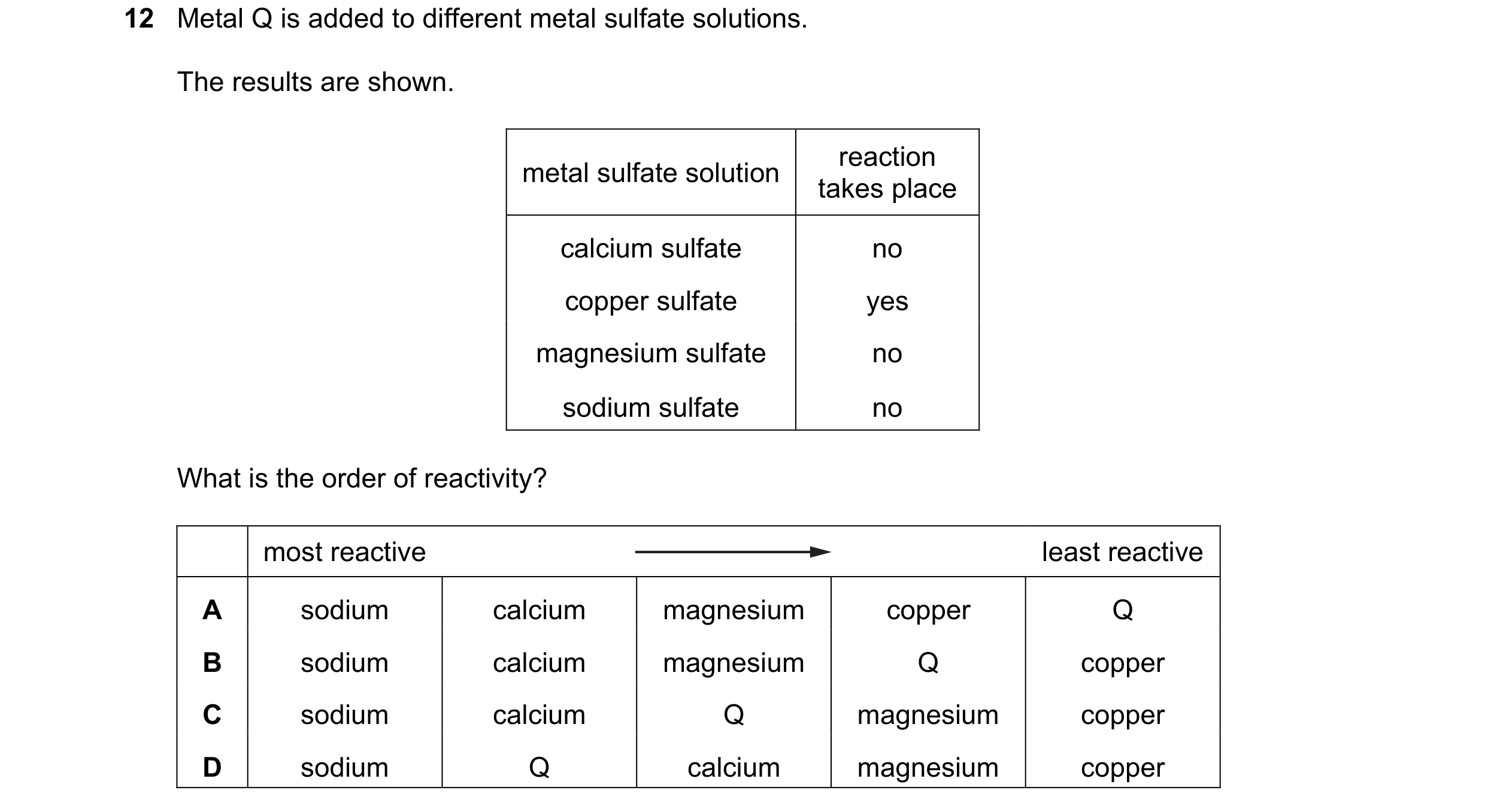
Q19 · Metal Q is added to different metal sulfate solutions 0652/11 Oct/Nov 2017
12 Metal Q is added to different metal sulfate solutions. The results are shown. reaction metal sulfate solution takes place calcium sulfate no copper sulfate yes magnesium sulfate no sodium sulfate no What is the order of reactivity? most reactive least reactive A sodium calcium magnesium copper Q B sodium calcium magnesium Q copper C sodium calcium Q magnesium copper D sodium Q calcium magnesium copper
1 marks
Answer: B
This question in 0652/11 Oct/Nov 2017
Q20 · Metal Q is added to different metal sulfate solutions 0652/12 Oct/Nov 2017
12 Metal Q is added to different metal sulfate solutions. The results are shown. reaction metal sulfate solution takes place calcium sulfate no copper sulfate yes magnesium sulfate no sodium sulfate no What is the order of reactivity? most reactive least reactive A sodium calcium magnesium copper Q B sodium calcium magnesium Q copper C sodium calcium Q magnesium copper D sodium Q calcium magnesium copper
1 marks
Answer: B
This question in 0652/12 Oct/Nov 2017
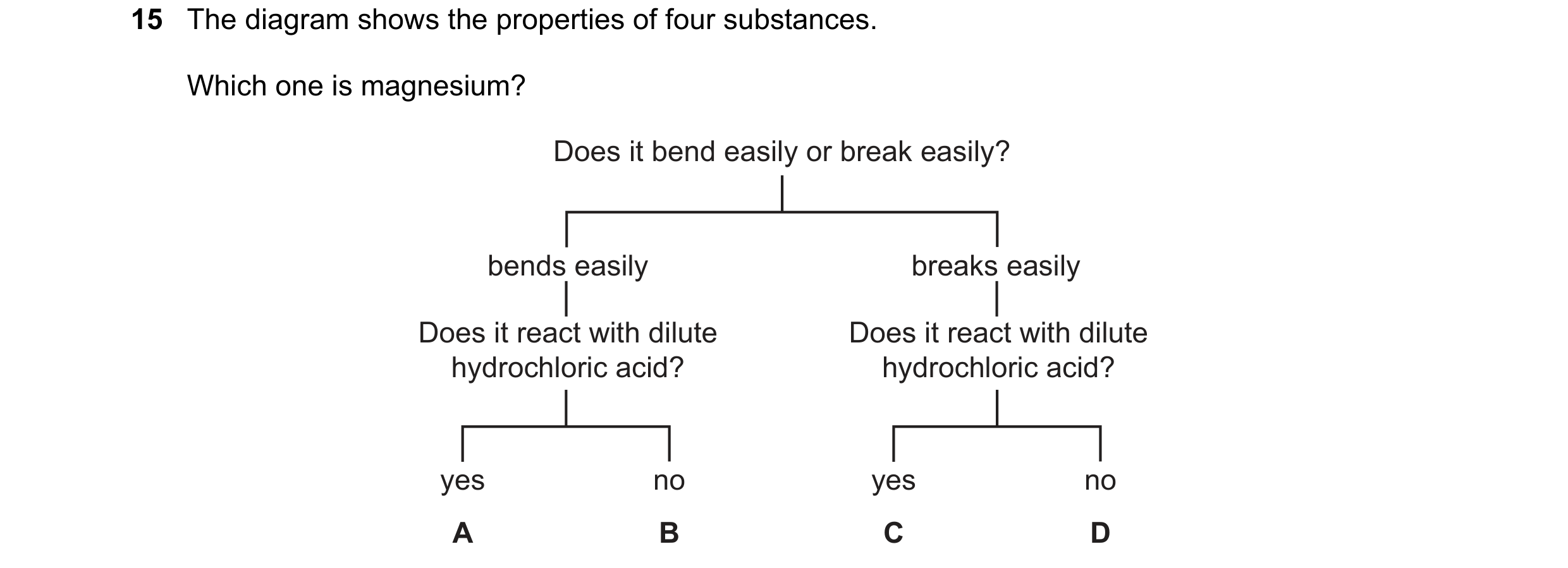
Q21 · The diagram shows the properties of four substances 0652/11 Oct/Nov 2018
15 The diagram shows the properties of four substances. Which one is magnesium? Does it bend easily or break easily? bends easily breaks easily Does it react with dilute Does it react with dilute hydrochloric acid? hydrochloric acid? yes no yes no A B C D
1 marks
Answer: A
This question in 0652/11 Oct/Nov 2018
Q22 · Some reactions of four metals W, X, Y and Z and their oxides are shown 0652/11 Oct/Nov 2019
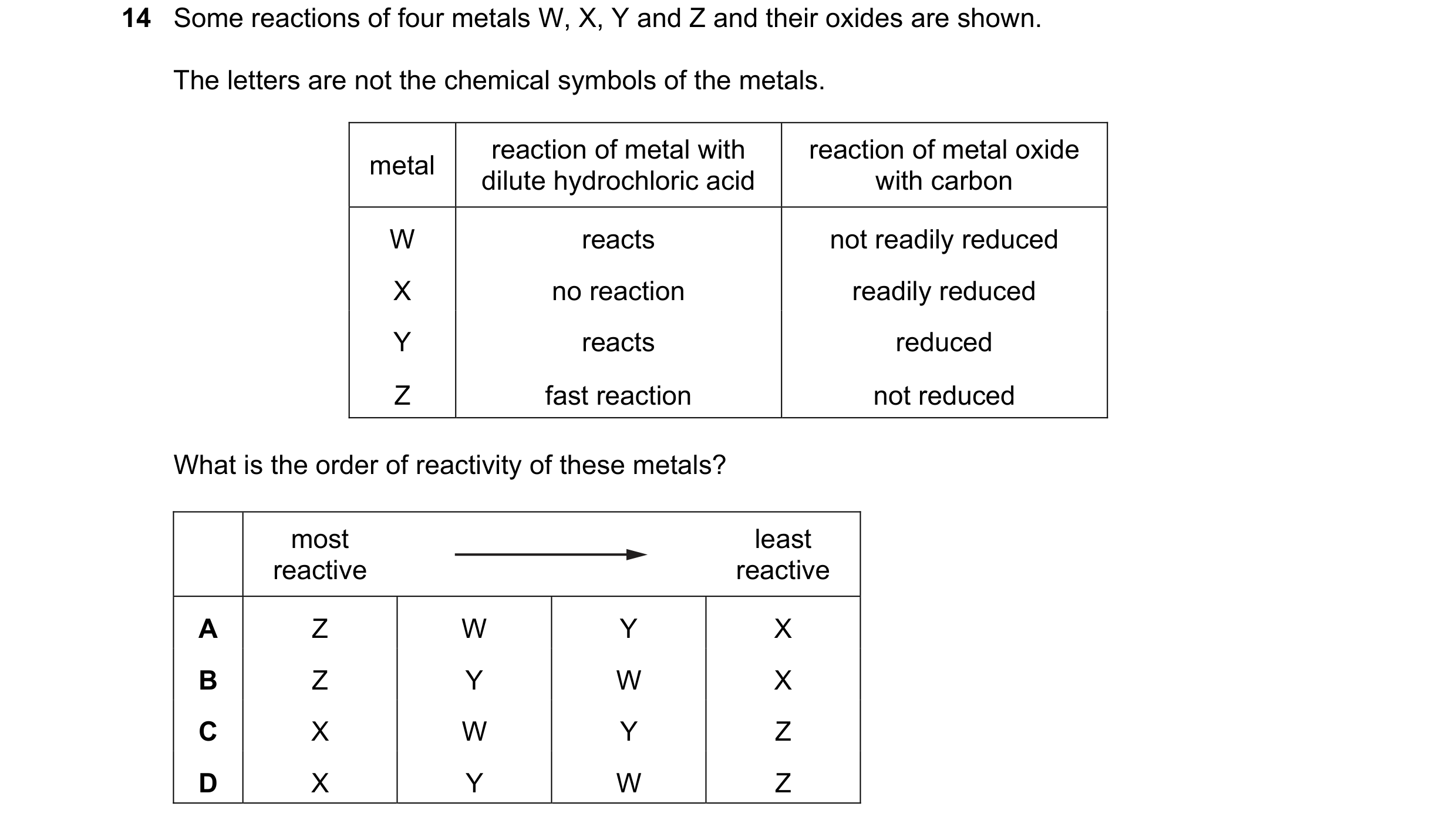
14 Some reactions of four metals W, X, Y and Z and their oxides are shown. The letters are not the chemical symbols of the metals. reaction of metal with reaction of metal oxide metal dilute hydrochloric acid with carbon W reacts not readily reduced X no reaction readily reduced Y reacts reduced Z fast reaction not reduced What is the order of reactivity of these metals? most least reactive reactive A Z W Y X B Z Y W X C X W Y Z D X Y W Z
1 marks
Answer: A
This question in 0652/11 Oct/Nov 2019
Q23 · Some reactions of four metals W, X, Y and Z and their oxides are shown 0652/12 Oct/Nov 2019
14 Some reactions of four metals W, X, Y and Z and their oxides are shown. The letters are not the chemical symbols of the metals. reaction of metal with reaction of metal oxide metal dilute hydrochloric acid with carbon W reacts not readily reduced X no reaction readily reduced Y reacts reduced Z fast reaction not reduced What is the order of reactivity of these metals? most least reactive reactive A Z W Y X B Z Y W X C X W Y Z D X Y W Z
1 marks
Answer: A
This question in 0652/12 Oct/Nov 2019
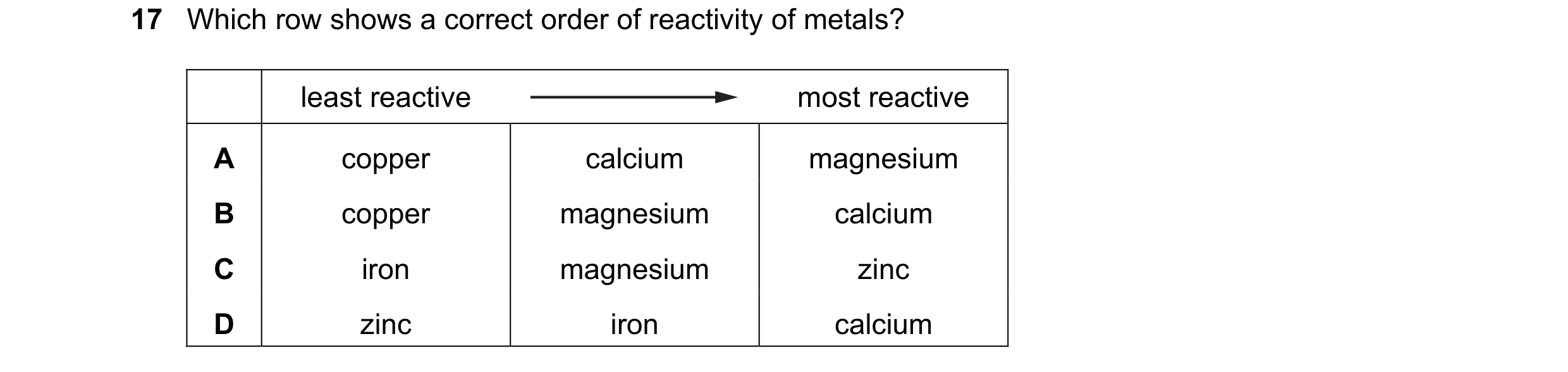
Q24 · Which row shows a correct order of reactivity of metals? 0652/11 Oct/Nov 2020
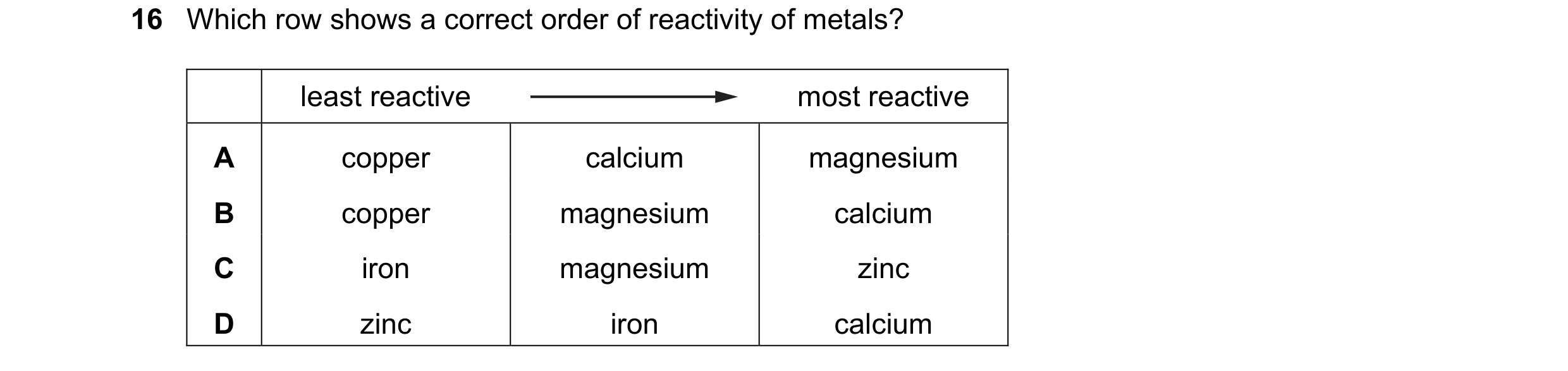
16 Which row shows a correct order of reactivity of metals? least reactive most reactive A copper calcium magnesium B copper magnesium calcium C iron magnesium zinc D zinc iron calcium
1 marks
Answer: B
This question in 0652/11 Oct/Nov 2020
Q25 · Metal M is formed when its oxide is heated with carbon 0652/11 Oct/Nov 2021
15 Metal M is formed when its oxide is heated with carbon. From this information, which deductions are correct? 1 M is less reactive than carbon. 2 M is more reactive than potassium. 3 The oxide of M is acidic. A 1 only B 1 and 3 C 2 only D 2 and 3
1 marks
Answer: A
This question in 0652/11 Oct/Nov 2021
Q26 · Some reactions of four metals, W, X, Y and Z, and their oxides are shown 0652/11 Oct/Nov 2022
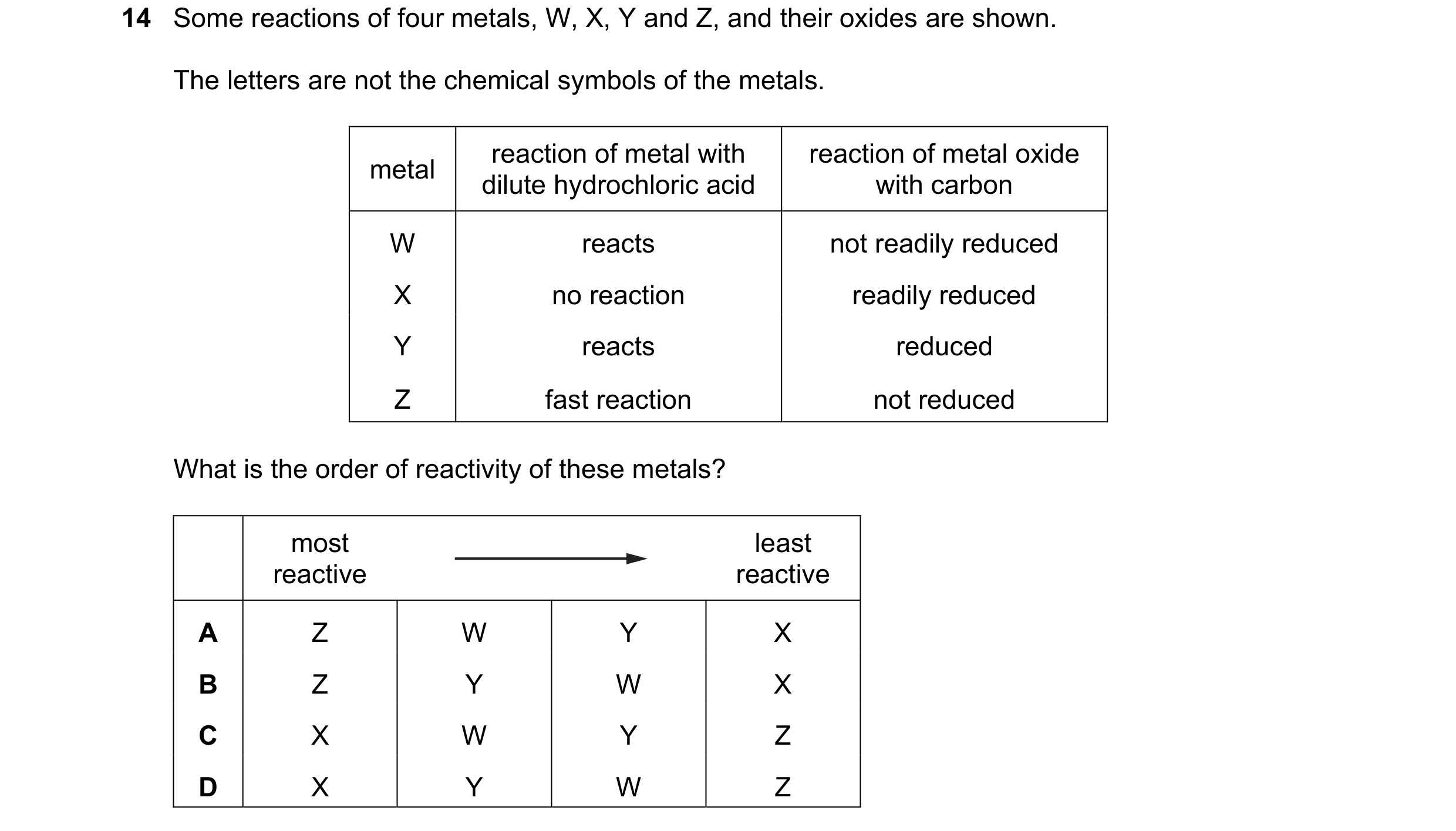
14 Some reactions of four metals, W, X, Y and Z, and their oxides are shown. The letters are not the chemical symbols of the metals. reaction of metal with reaction of metal oxide metal dilute hydrochloric acid with carbon W reacts not readily reduced X no reaction readily reduced Y reacts reduced Z fast reaction not reduced What is the order of reactivity of these metals? most least reactive reactive A Z W Y X B Z Y W X C X W Y Z D X Y W Z
1 marks
Answer: A
This question in 0652/11 Oct/Nov 2022
Q27 · Which row shows a correct order of reactivity of metals? 0652/11 Oct/Nov 2023
17 Which row shows a correct order of reactivity of metals? least reactive most reactive A copper calcium magnesium B copper magnesium calcium C iron magnesium zinc D zinc iron calcium
1 marks
Answer: B
This question in 0652/11 Oct/Nov 2023
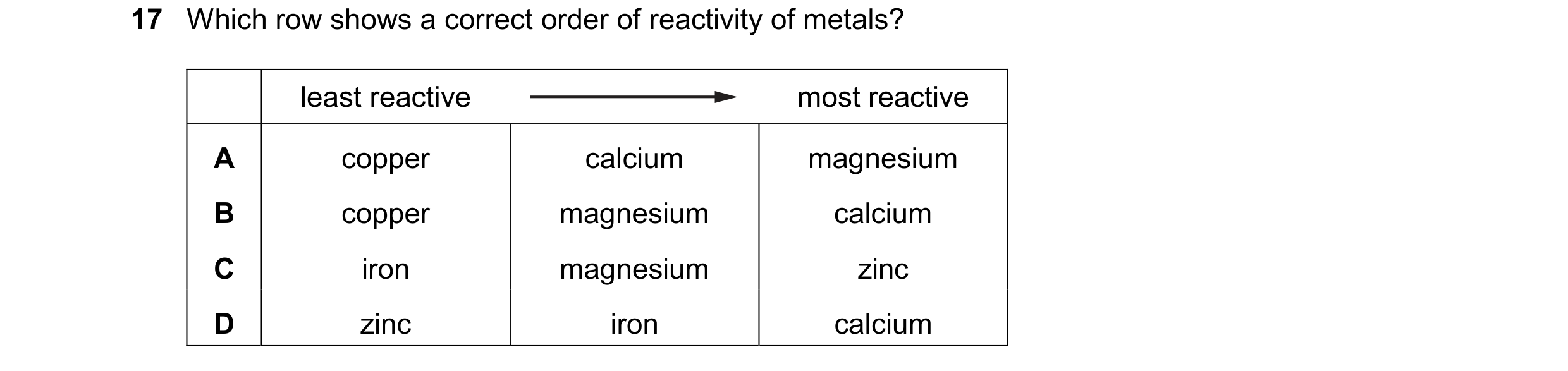
Q28 · Which row shows a correct order of reactivity of metals? 0652/12 Oct/Nov 2023
17 Which row shows a correct order of reactivity of metals? least reactive most reactive A copper calcium magnesium B copper magnesium calcium C iron magnesium zinc D zinc iron calcium
1 marks
Answer: B
This question in 0652/12 Oct/Nov 2023
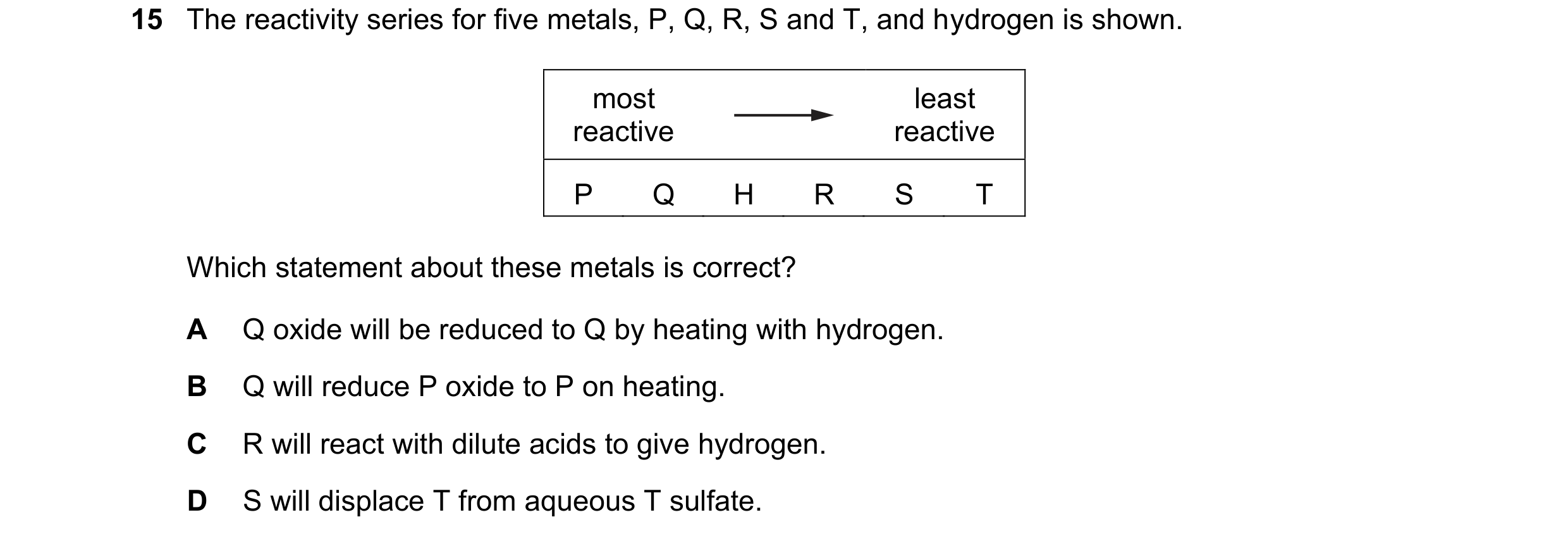
Q29 · The reactivity series for five metals, P, Q, R, S and T, and hydrogen is shown 0652/11 Oct/Nov 2024
15 The reactivity series for five metals, P, Q, R, S and T, and hydrogen is shown. most least reactive reactive P Q H R S T Which statement about these metals is correct? A Q oxide will be reduced to Q by heating with hydrogen. B Q will reduce P oxide to P on heating. C R will react with dilute acids to give hydrogen. D S will displace T from aqueous T sulfate.
1 marks
Answer: D
This question in 0652/11 Oct/Nov 2024
 1 / 11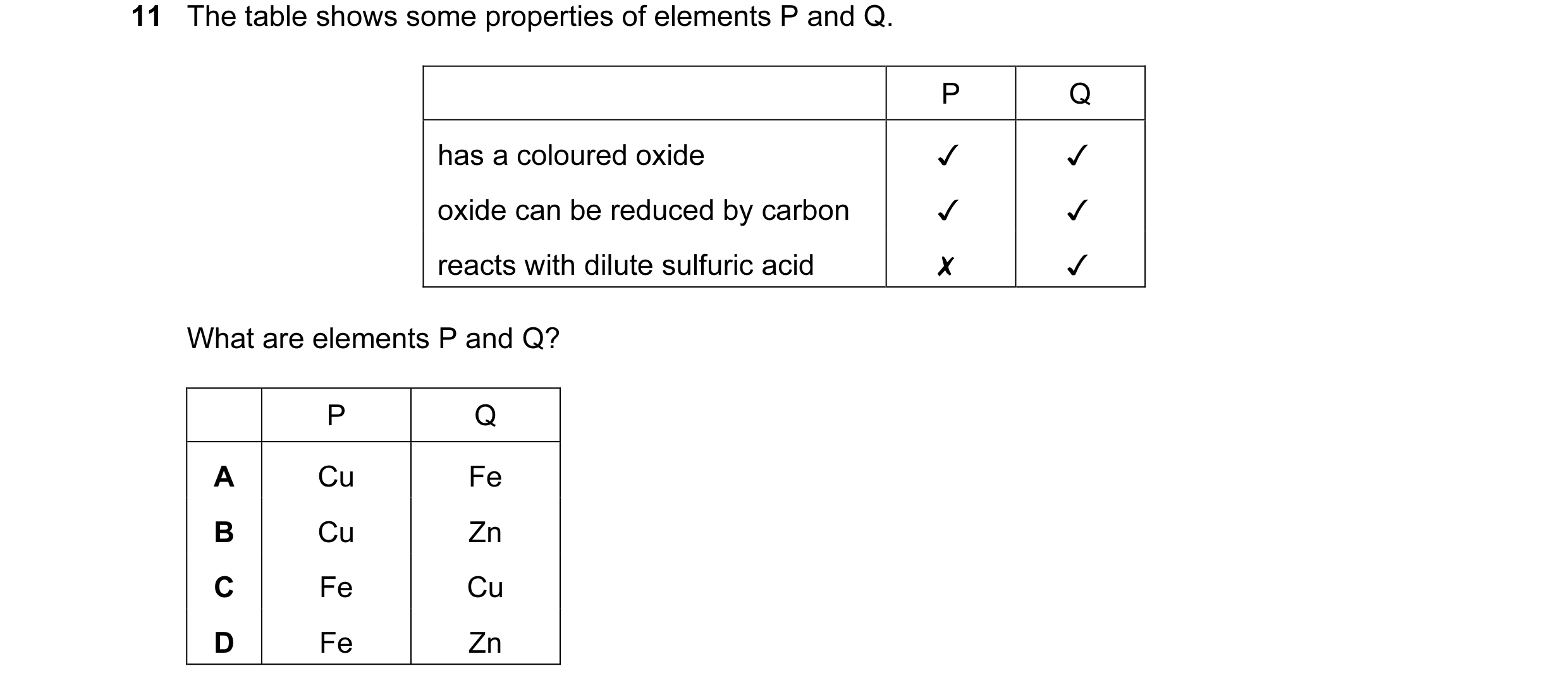
 2 / 11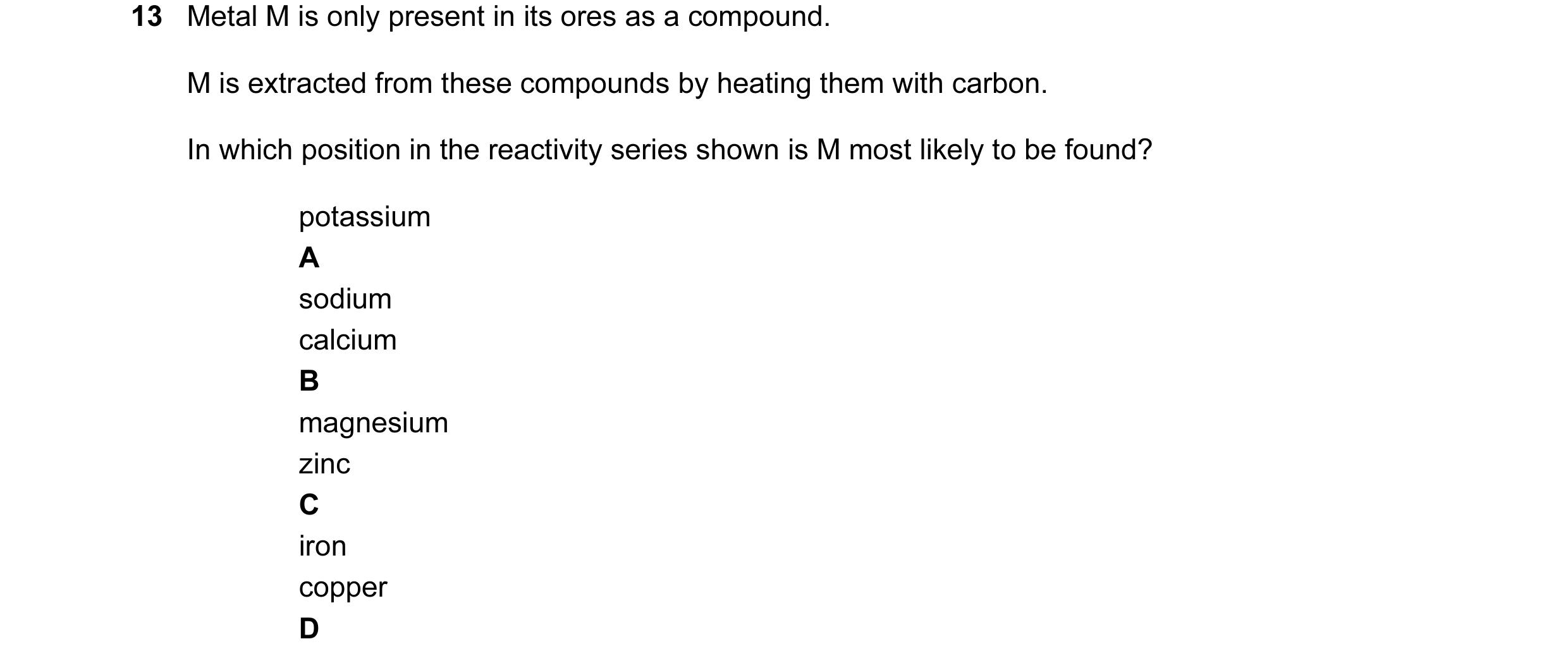
 3 / 11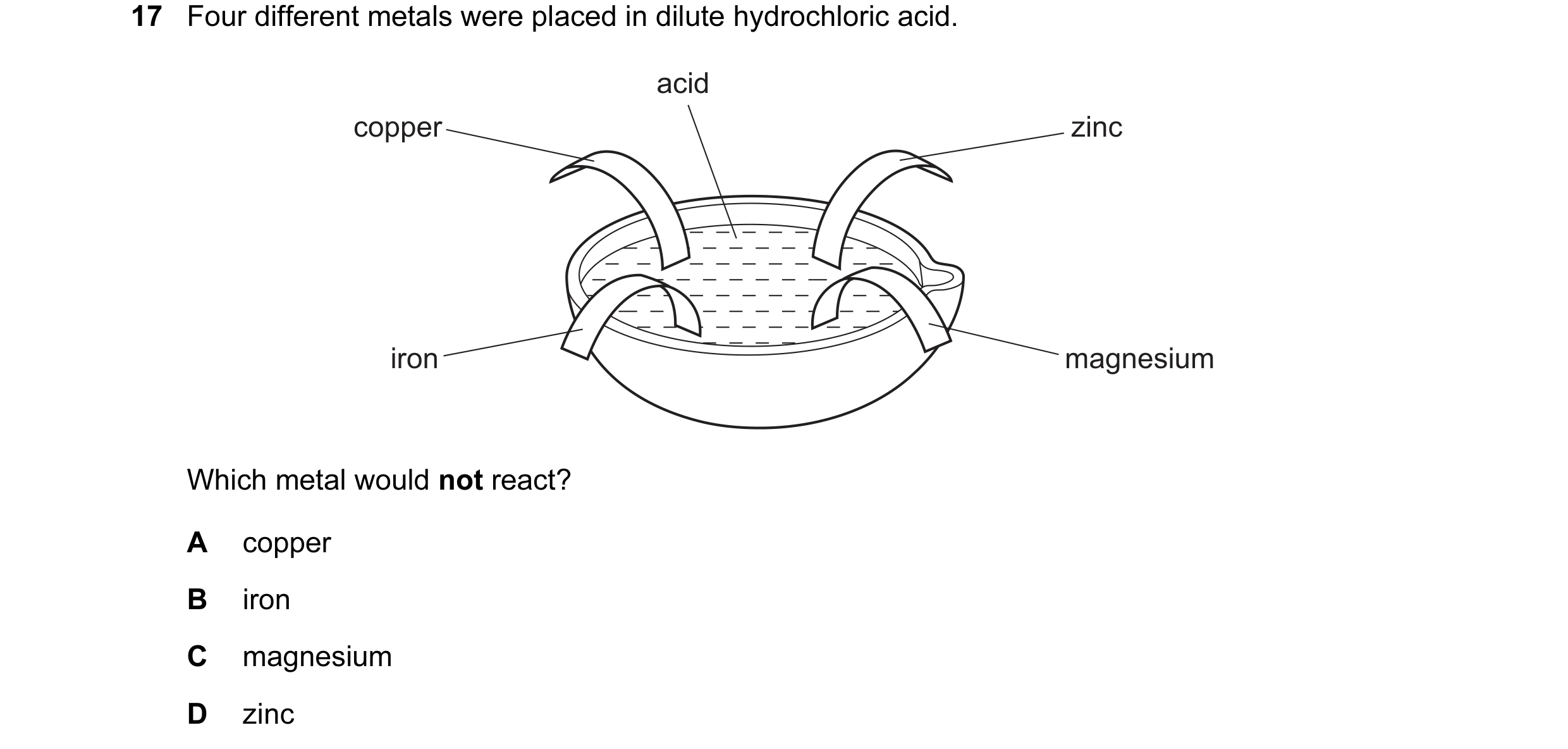
 4 / 11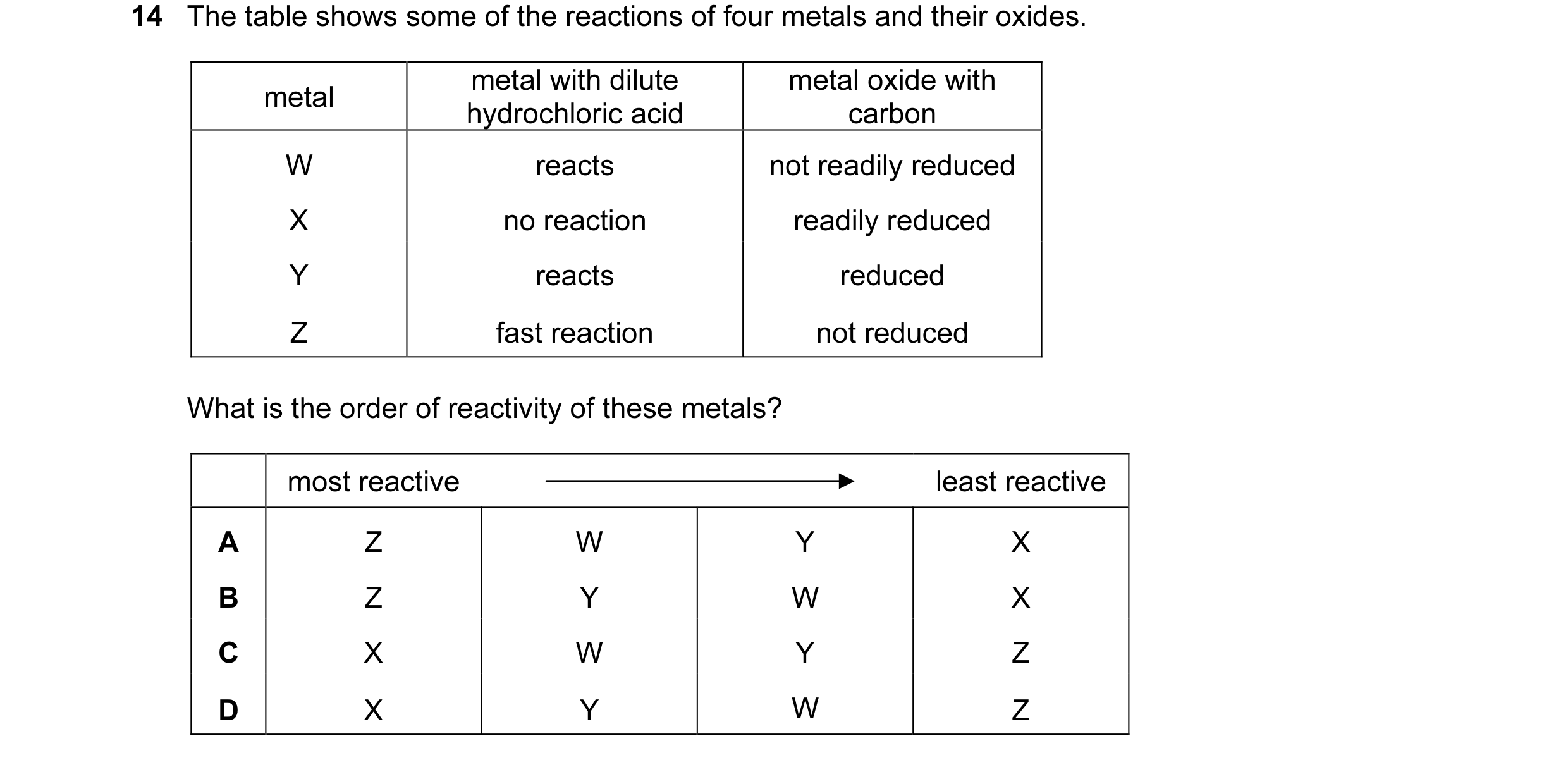
 5 / 11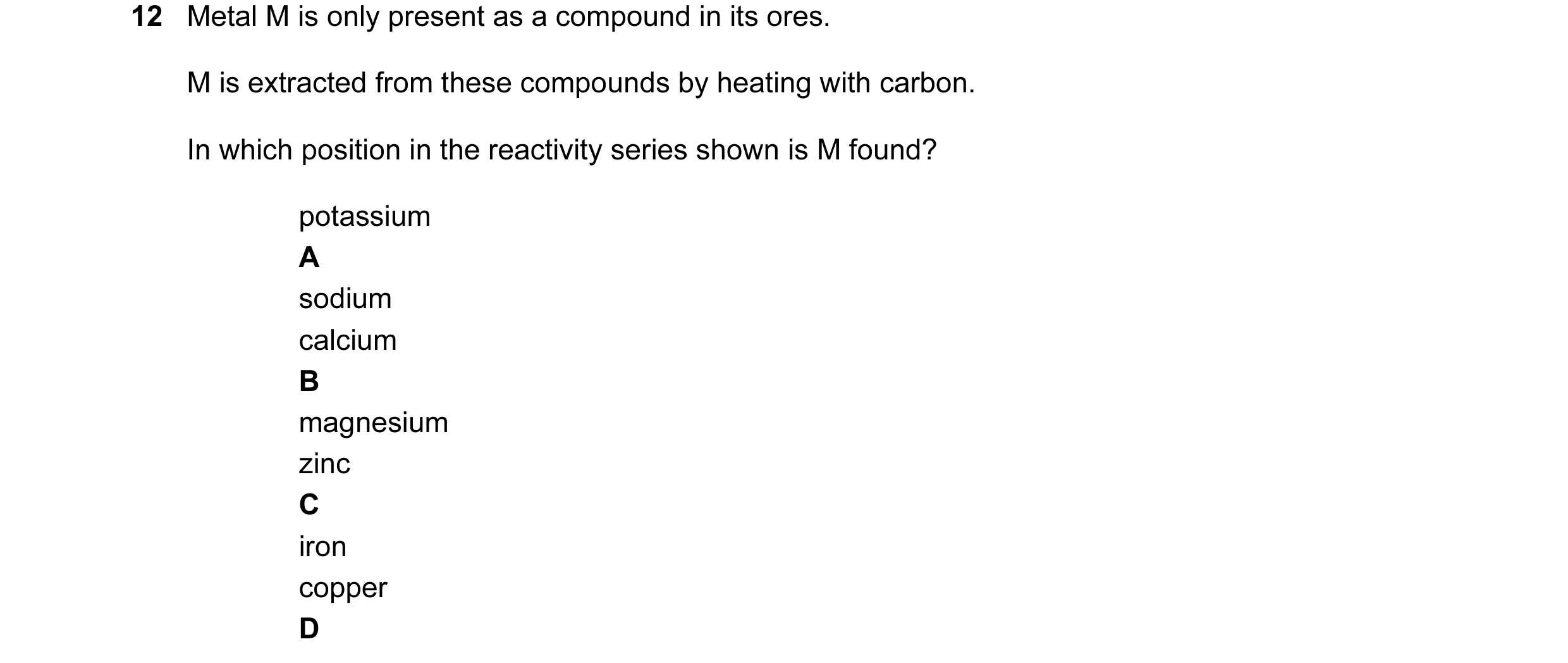

 6 / 11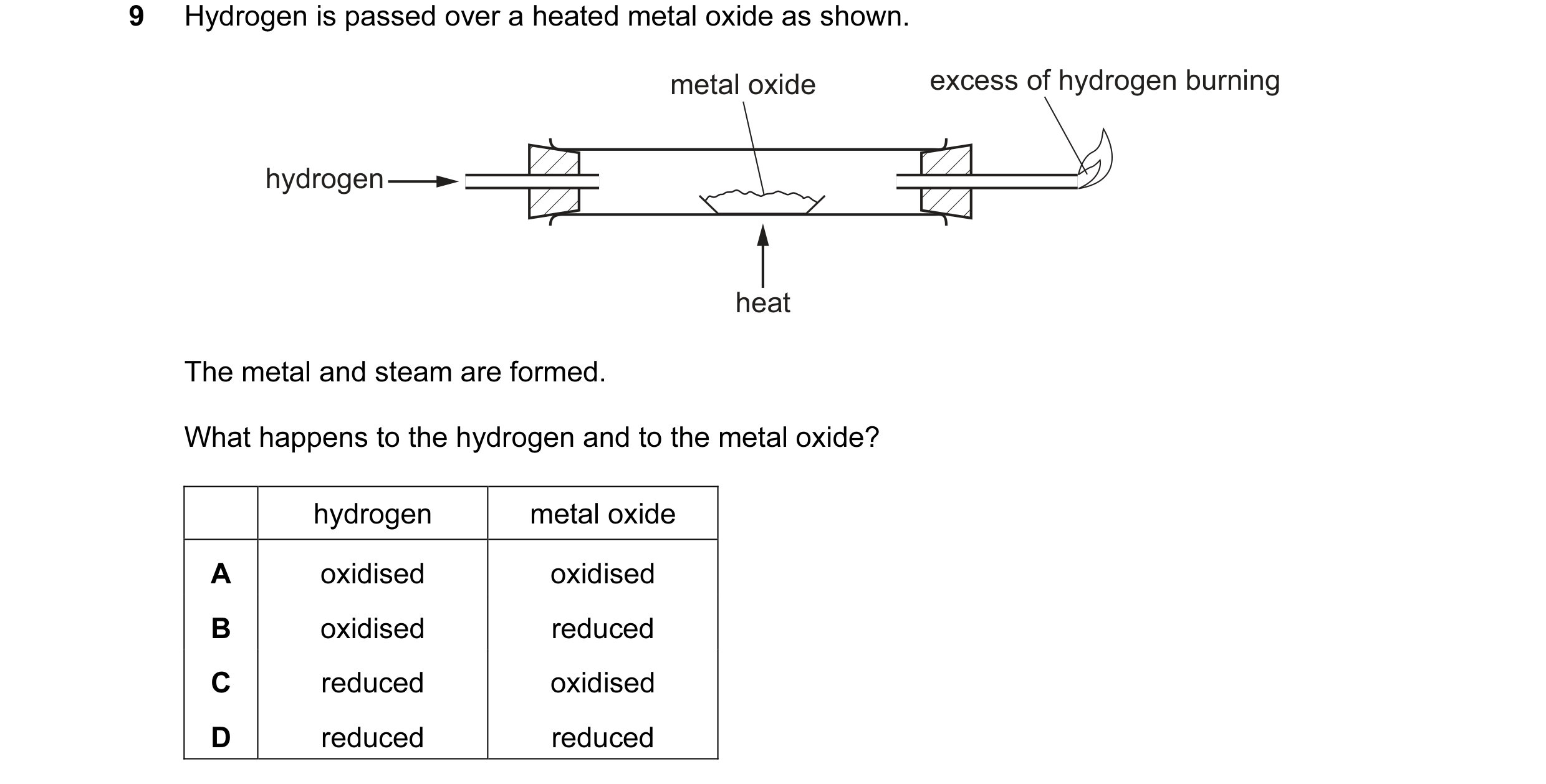
 7 / 11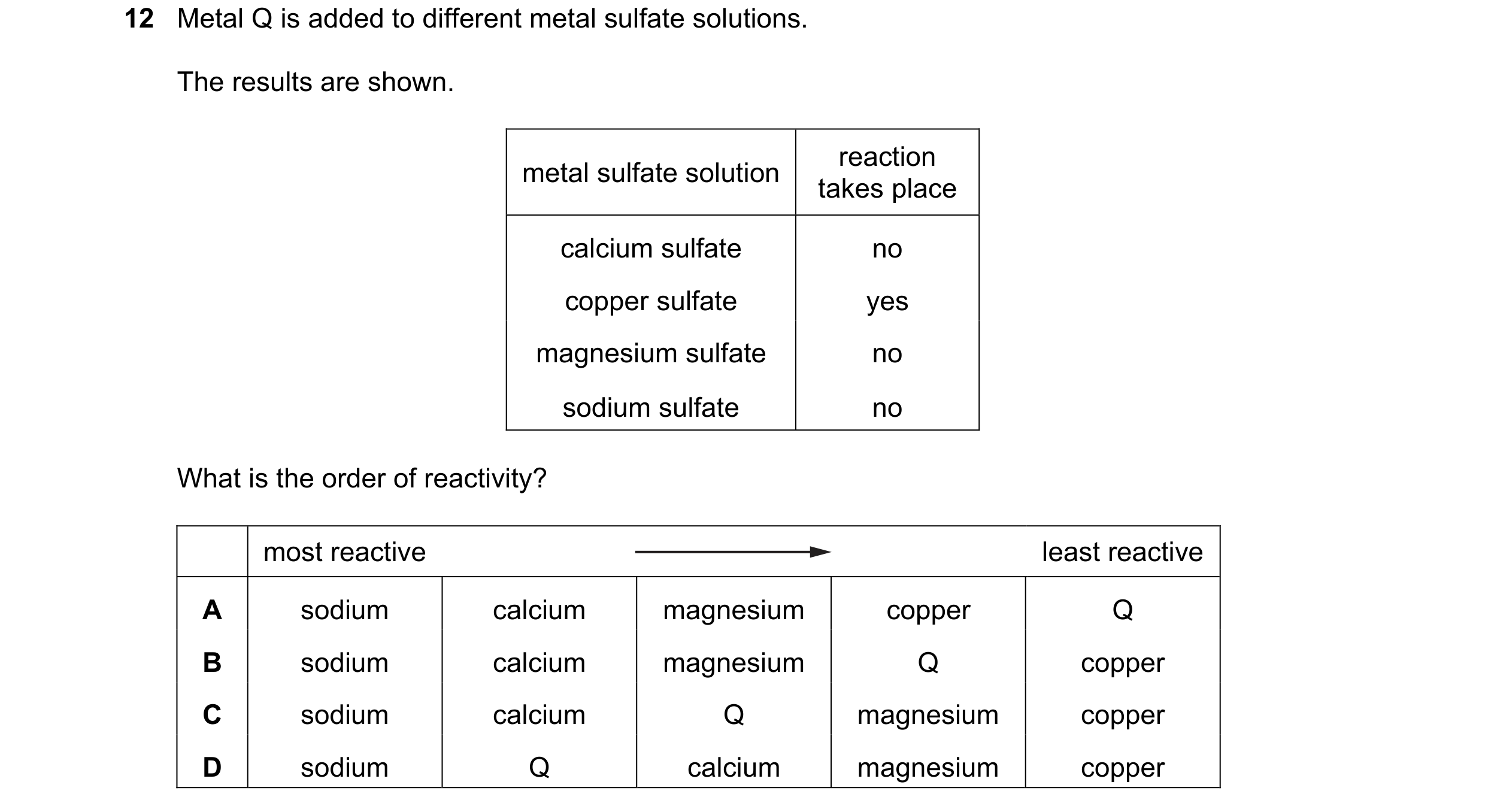
 8 / 11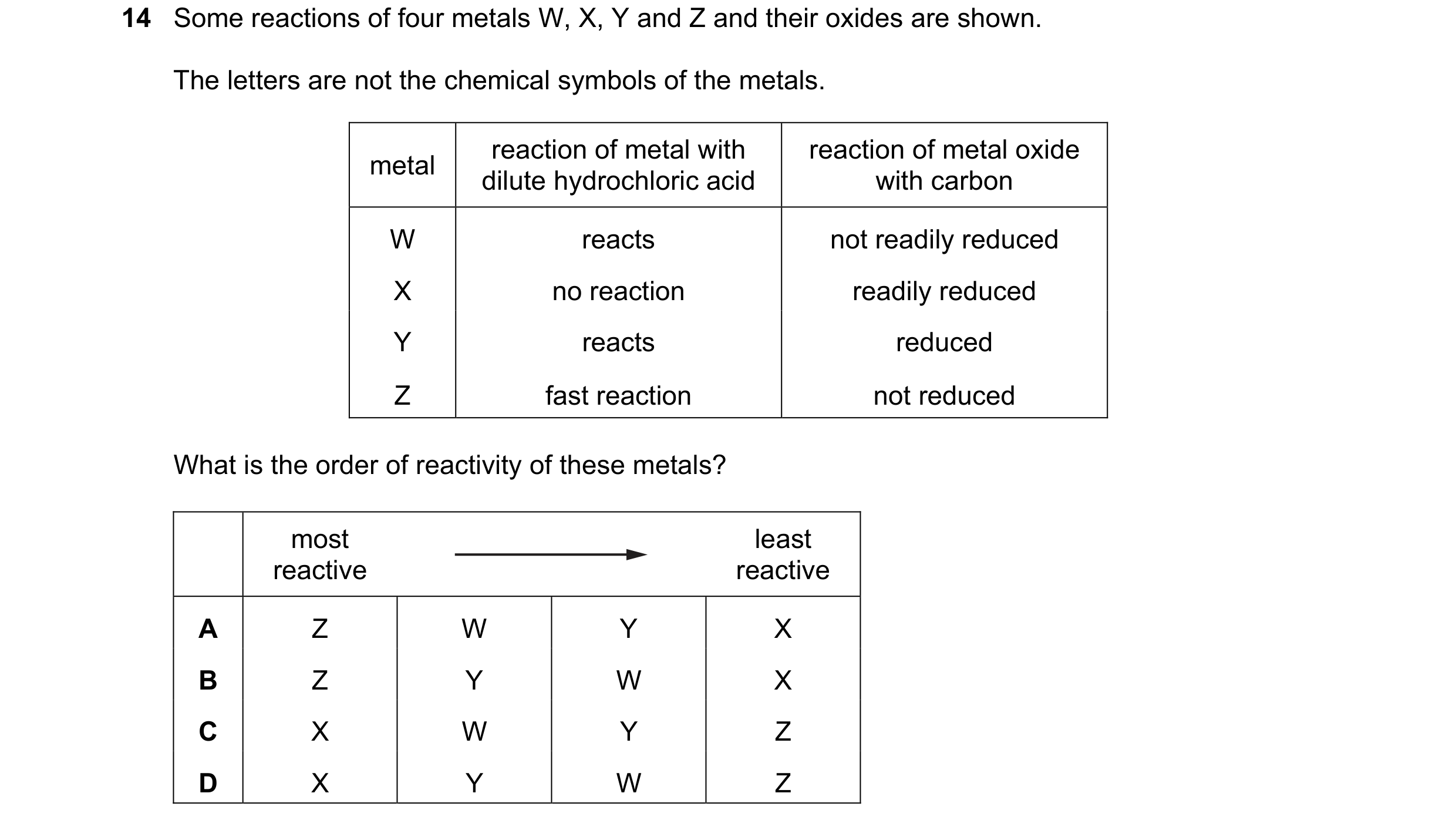
 9 / 11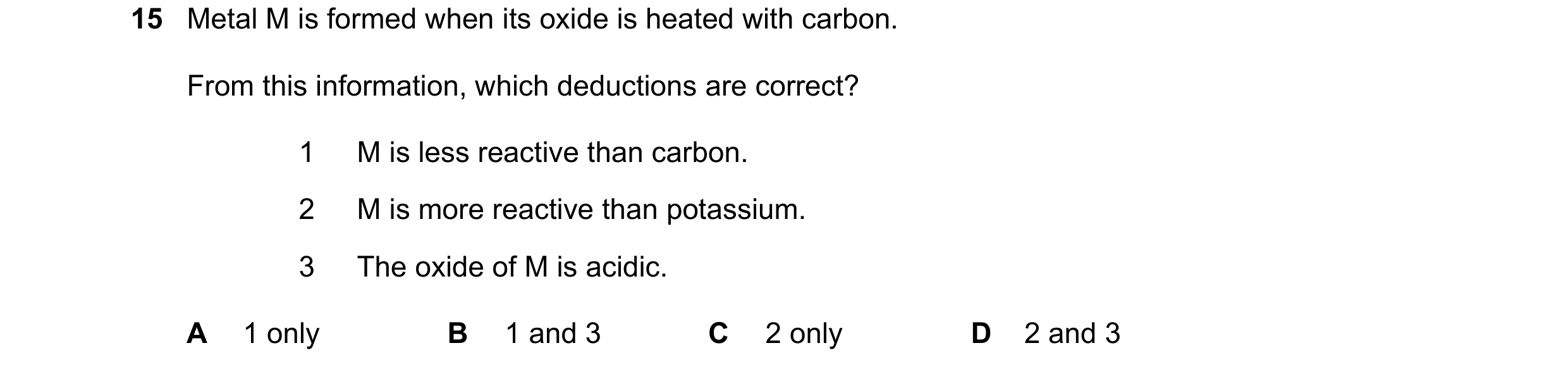
 10 / 11
 11 / 11