Questions as text
Q1 · A 1 g sample of marble chips reacts with an excess of 1 mol / dm3 hydrochloric acid, as… 0652/11 Oct/Nov 2005
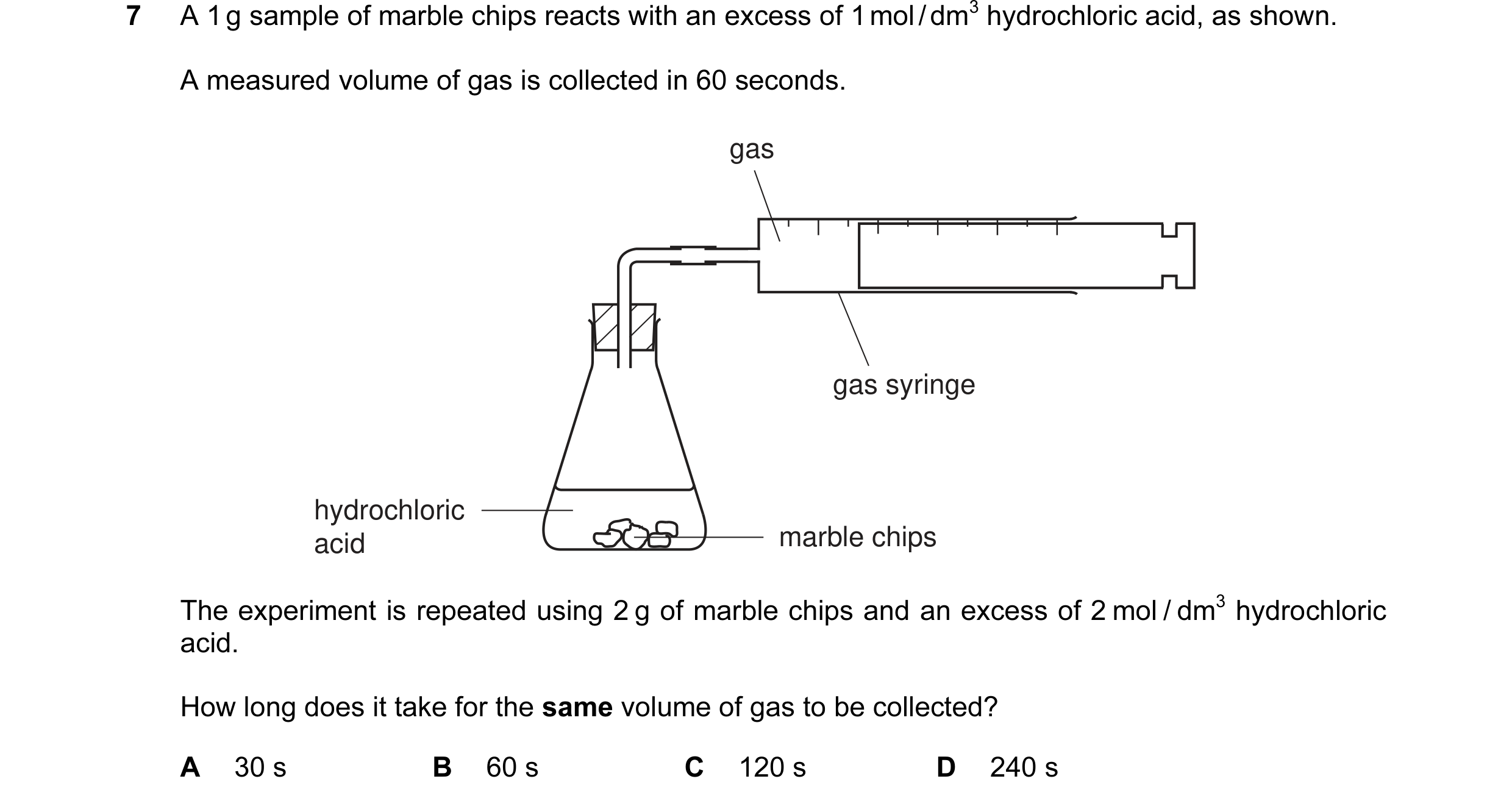
7 A 1 g sample of marble chips reacts with an excess of 1 mol / dm3 hydrochloric acid, as shown. A measured volume of gas is collected in 60 seconds. gas gas syringe hydrochloric acid marble chips The experiment is repeated using 2 g of marble chips and an excess of 2 mol / dm3 hydrochloric acid. How long does it take for the same volume of gas to be collected? A 30 s B 60 s C 120 s D 240 s
1 marks
Answer: A
This question in 0652/11 Oct/Nov 2005
Q2 · Substance X does not react with dilute acid but substance Y does, forming a gaseous… 0652/11 Oct/Nov 2006
7
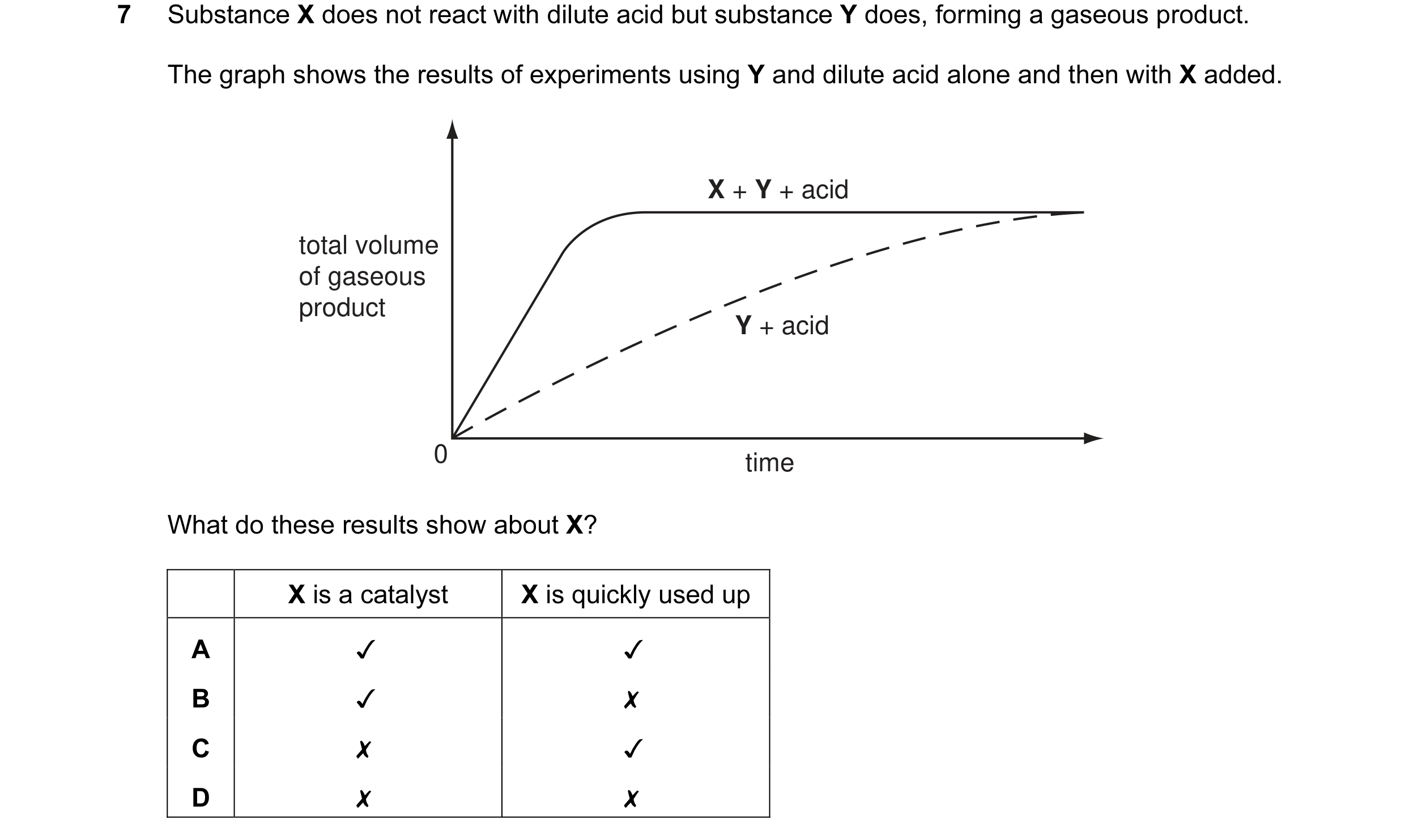
Substance X does not react with dilute acid but substance Y does, forming a gaseous product.
The graph shows the results of experiments using Y and dilute acid alone and then with X added.
X+ Y + acid
total volume
of gaseous
product
0 time
What do these results show about X?
X is a catalyst X is quickly used up
A v v
B v x
Cc x v
D x x
1 marks
Answer: B
This question in 0652/11 Oct/Nov 2006
Q3 · The diagram shows apparatus being used to fill a balloon with hydrogen 0652/11 Oct/Nov 2007
7 The diagram shows apparatus being used to fill a balloon with hydrogen. balloon iron + dilute hydrochloric acid Which form of iron makes the balloon fill most quickly? A a lump B pieces of wire C a powder D thin sheets
1 marks
Answer: C
This question in 0652/11 Oct/Nov 2007
Q4 · Antacid tablets react with hydrochloric acid in the stomach to form carbon dioxide gas 0652/11 Oct/Nov 2009
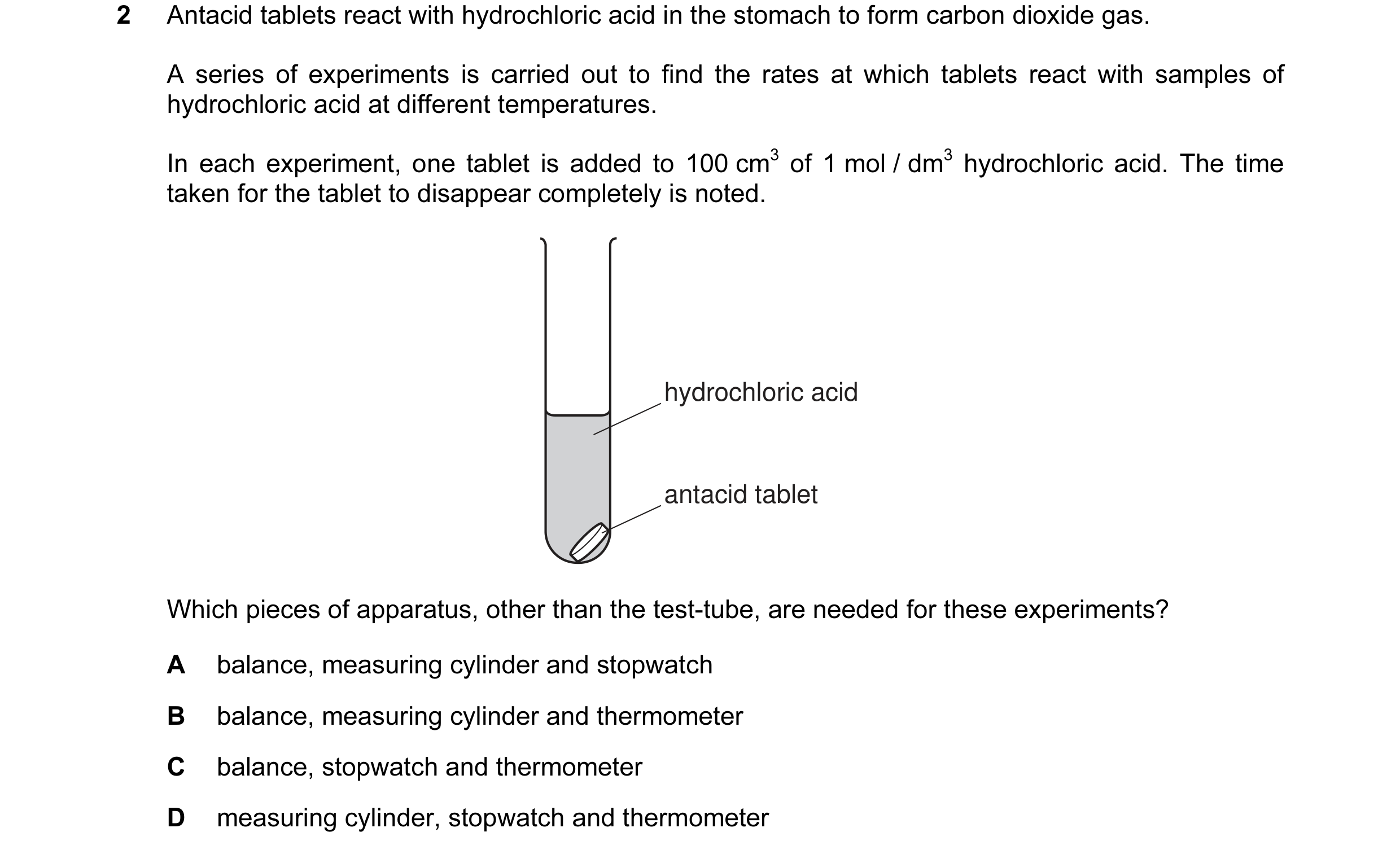
2 Antacid tablets react with hydrochloric acid in the stomach to form carbon dioxide gas. A series of experiments is carried out to find the rates at which tablets react with samples of hydrochloric acid at different temperatures. In each experiment, one tablet is added to 100 cm3 of 1 mol / dm3 hydrochloric acid. The time taken for the tablet to disappear completely is noted. hydrochloric acid antacid tablet Which pieces of apparatus, other than the test-tube, are needed for these experiments? A balance, measuring cylinder and stopwatch B balance, measuring cylinder and thermometer C balance, stopwatch and thermometer D measuring cylinder, stopwatch and thermometer
1 marks
Answer: D
This question in 0652/11 Oct/Nov 2009
Q5 · How can the speed of reaction between lumps of zinc and dilute hydrochloric acid be… 0652/11 Oct/Nov 2009
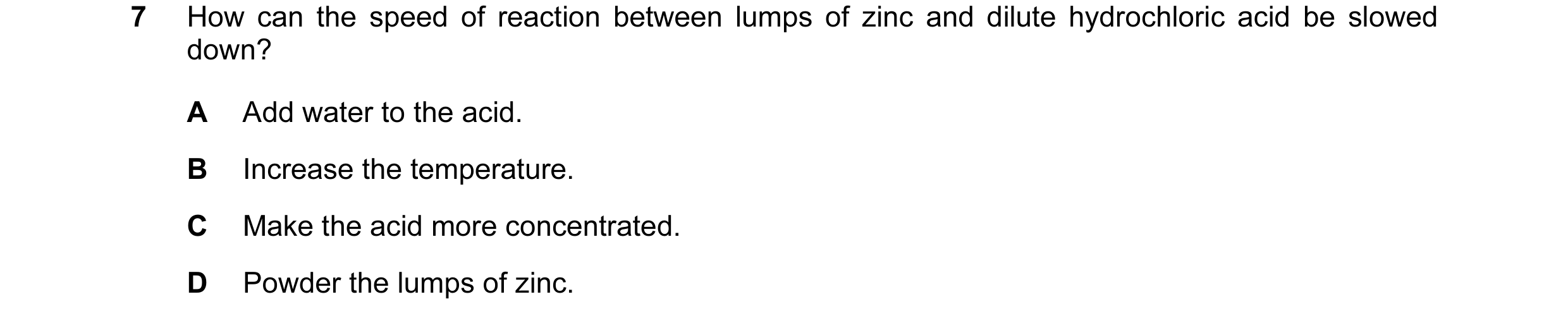
7 How can the speed of reaction between lumps of zinc and dilute hydrochloric acid be slowed down? A Add water to the acid. B Increase the temperature. C Make the acid more concentrated. D Powder the lumps of zinc.
1 marks
Answer: A
This question in 0652/11 Oct/Nov 2009
Q6 · The diagram shows a cup of tea with a spoon in it 0652/11 Oct/Nov 2010
6 The diagram shows a cup of tea with a spoon in it. What will not make the sugar in the tea dissolve more quickly? A adding more sugar B stirring the tea C using hotter water D using more water
1 marks
Answer: A
This question in 0652/11 Oct/Nov 2010
Q7 · A student reacts 10 cm3 of hydrochloric acid with two large lumps of calcium carbonate 0652/11 Oct/Nov 2011
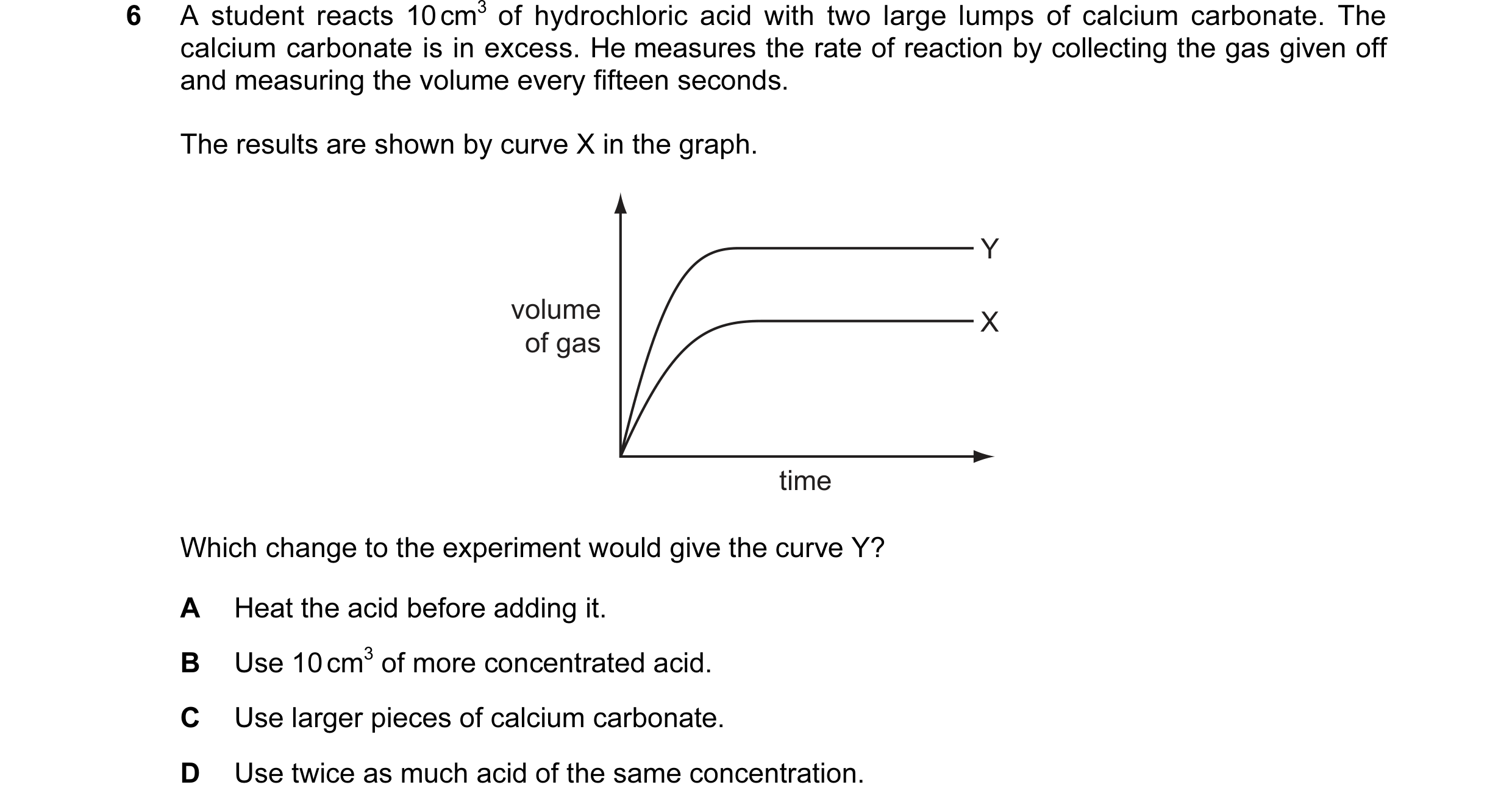
6 A student reacts 10 cm3 of hydrochloric acid with two large lumps of calcium carbonate. The calcium carbonate is in excess. He measures the rate of reaction by collecting the gas given off and measuring the volume every fifteen seconds. The results are shown by curve X in the graph. Y volume X of gas time Which change to the experiment would give the curve Y? A Heat the acid before adding it. B Use 10 cm3 of more concentrated acid. C Use larger pieces of calcium carbonate. D Use twice as much acid of the same concentration.
1 marks
Answer: B
This question in 0652/11 Oct/Nov 2011
Q8 · A student reacts 10 cm3 of hydrochloric acid with two large lumps of calcium carbonate 0652/12 Oct/Nov 2011
4 A student reacts 10 cm3 of hydrochloric acid with two large lumps of calcium carbonate. The calcium carbonate is in excess. He measures the rate of reaction by collecting the gas given off and measuring the volume every fifteen seconds. The results are shown by curve X in the graph. Y volume X of gas time Which change to the experiment would give the curve Y? A Heat the acid before adding it. B Use 10 cm3 of more concentrated acid. C Use larger pieces of calcium carbonate. D Use twice as much acid of the same concentration.
1 marks
Answer: B
This question in 0652/12 Oct/Nov 2011
Q9 · Which statements about catalysts are correct? 0652/11 Oct/Nov 2013
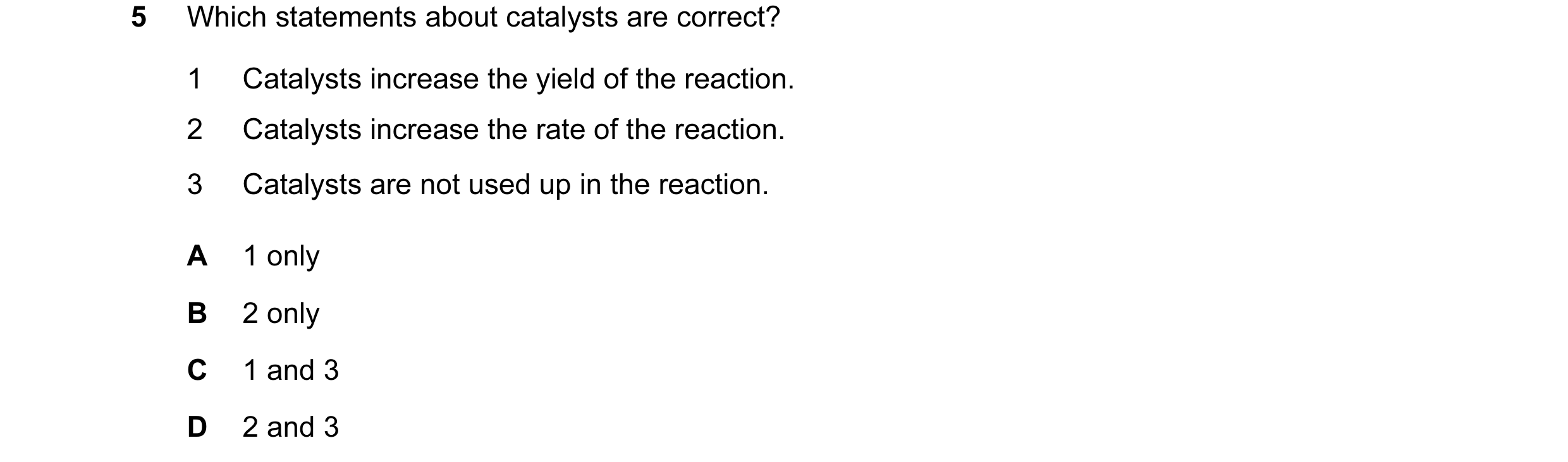
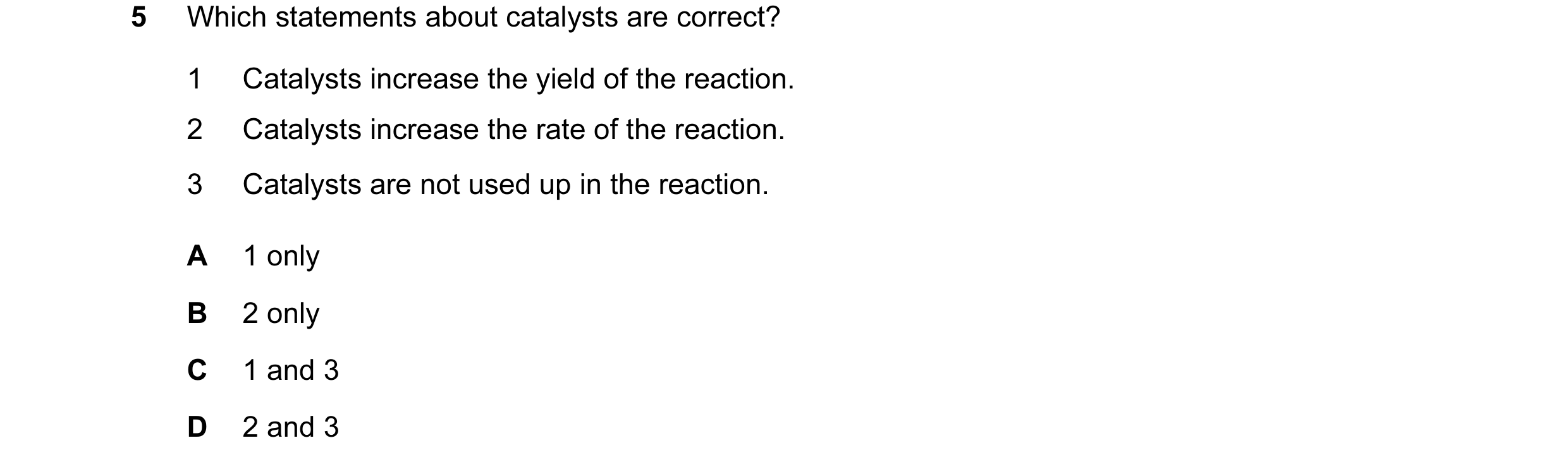
5 Which statements about catalysts are correct? 1 Catalysts increase the yield of the reaction. 2 Catalysts increase the rate of the reaction. 3 Catalysts are not used up in the reaction. A 1 only B 2 only C 1 and 3 D 2 and 3
1 marks
Answer: D
This question in 0652/11 Oct/Nov 2013
Q10 · Which statements about catalysts are correct? 0652/12 Oct/Nov 2013
5 Which statements about catalysts are correct? 1 Catalysts increase the yield of the reaction. 2 Catalysts increase the rate of the reaction. 3 Catalysts are not used up in the reaction. A 1 only B 2 only C 1 and 3 D 2 and 3
1 marks
Answer: D
This question in 0652/12 Oct/Nov 2013
Q11 · When hydrochloric acid is added to calcium carbonate, carbon dioxide gas is given off 0652/11 Oct/Nov 2014
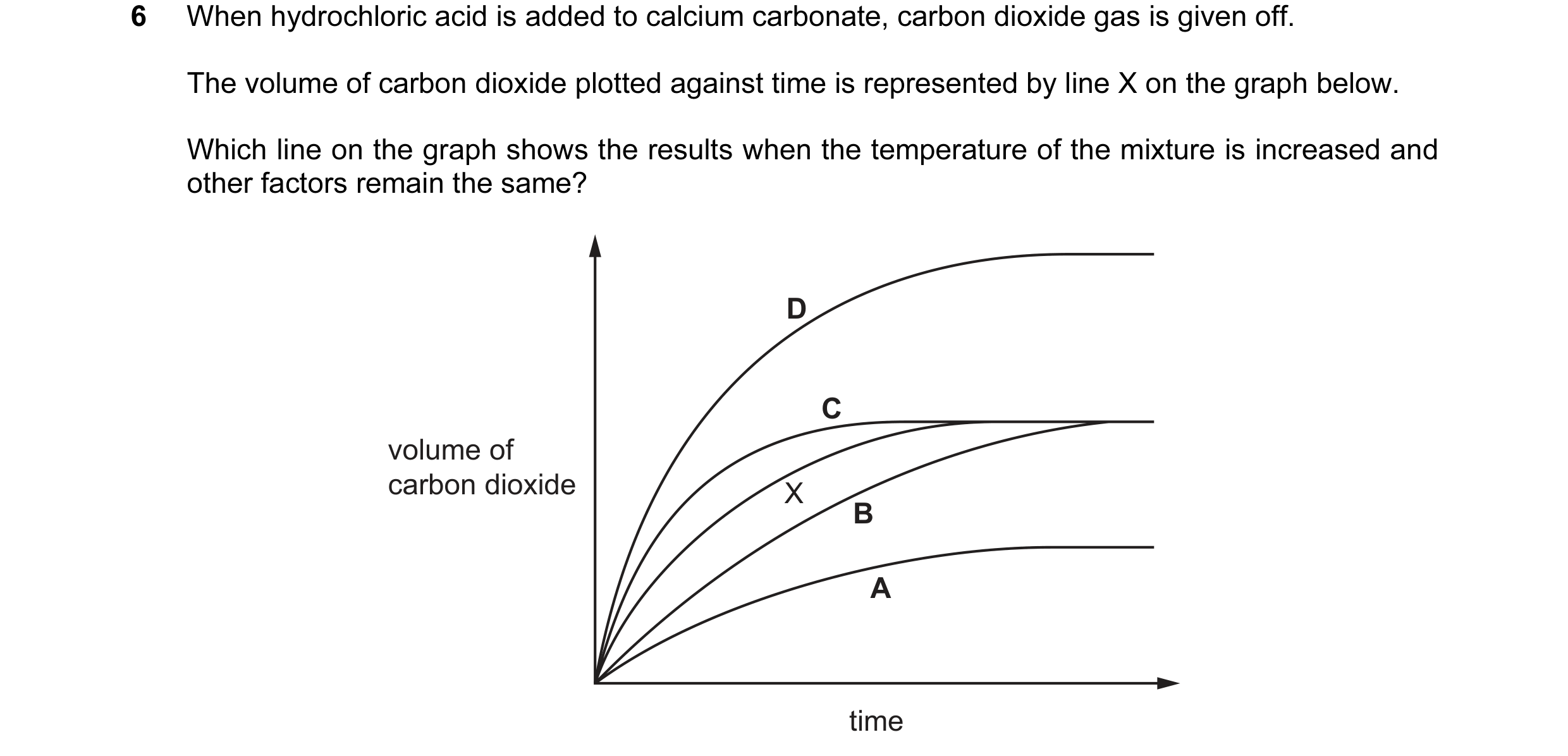
6 When hydrochloric acid is added to calcium carbonate, carbon dioxide gas is given off. The volume of carbon dioxide plotted against time is represented by line X on the graph below. Which line on the graph shows the results when the temperature of the mixture is increased and other factors remain the same? D C volume of carbon dioxide X B A time
1 marks
Answer: C
This question in 0652/11 Oct/Nov 2014
Q12 · When hydrochloric acid is added to calcium carbonate, carbon dioxide gas is given off 0652/12 Oct/Nov 2014
6 When hydrochloric acid is added to calcium carbonate, carbon dioxide gas is given off. The volume of carbon dioxide plotted against time is represented by line X on the graph below. Which line on the graph shows the results when the temperature of the mixture is increased and other factors remain the same? D C volume of carbon dioxide X B A time
1 marks
Answer: C
This question in 0652/12 Oct/Nov 2014
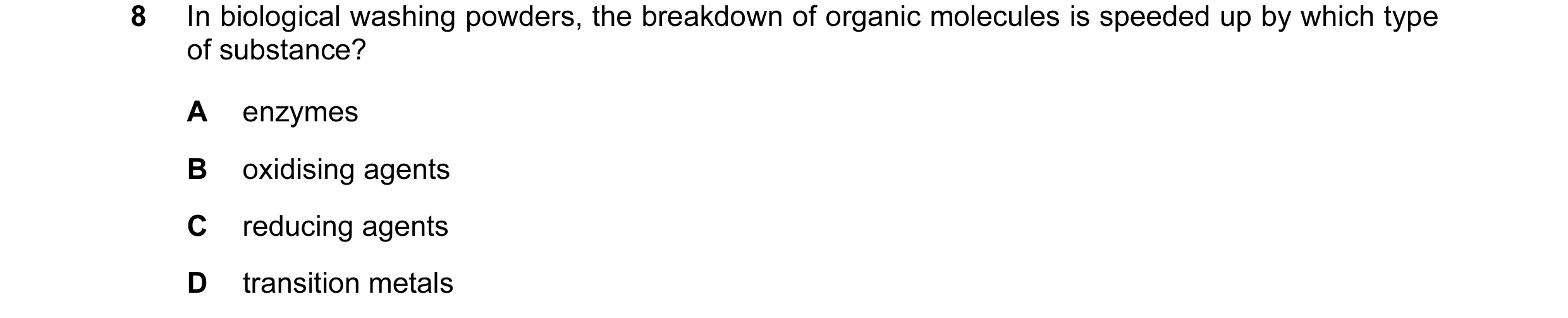
Q13 · In biological washing powders, the breakdown of organic molecules is speeded up by which… 0652/11 Oct/Nov 2015
8 In biological washing powders, the breakdown of organic molecules is speeded up by which type of substance? A enzymes B oxidising agents C reducing agents D transition metals
1 marks
Answer: A
This question in 0652/11 Oct/Nov 2015
Q14 · In biological washing powders, the breakdown of organic molecules is speeded up by which… 0652/12 Oct/Nov 2015
8 In biological washing powders, the breakdown of organic molecules is speeded up by which type of substance? A enzymes B oxidising agents C reducing agents D transition metals
1 marks
Answer: A
This question in 0652/12 Oct/Nov 2015
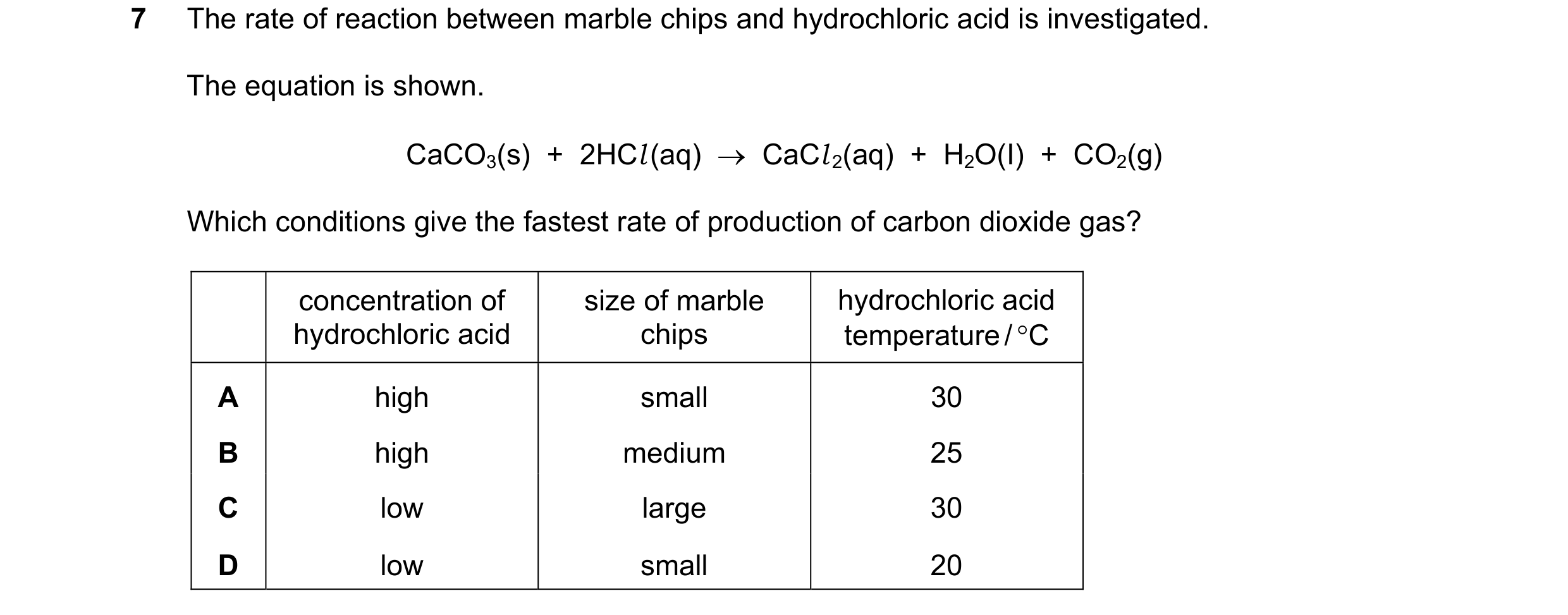
Q15 · The rate of reaction between marble chips and hydrochloric acid is investigated 0652/11 Oct/Nov 2017
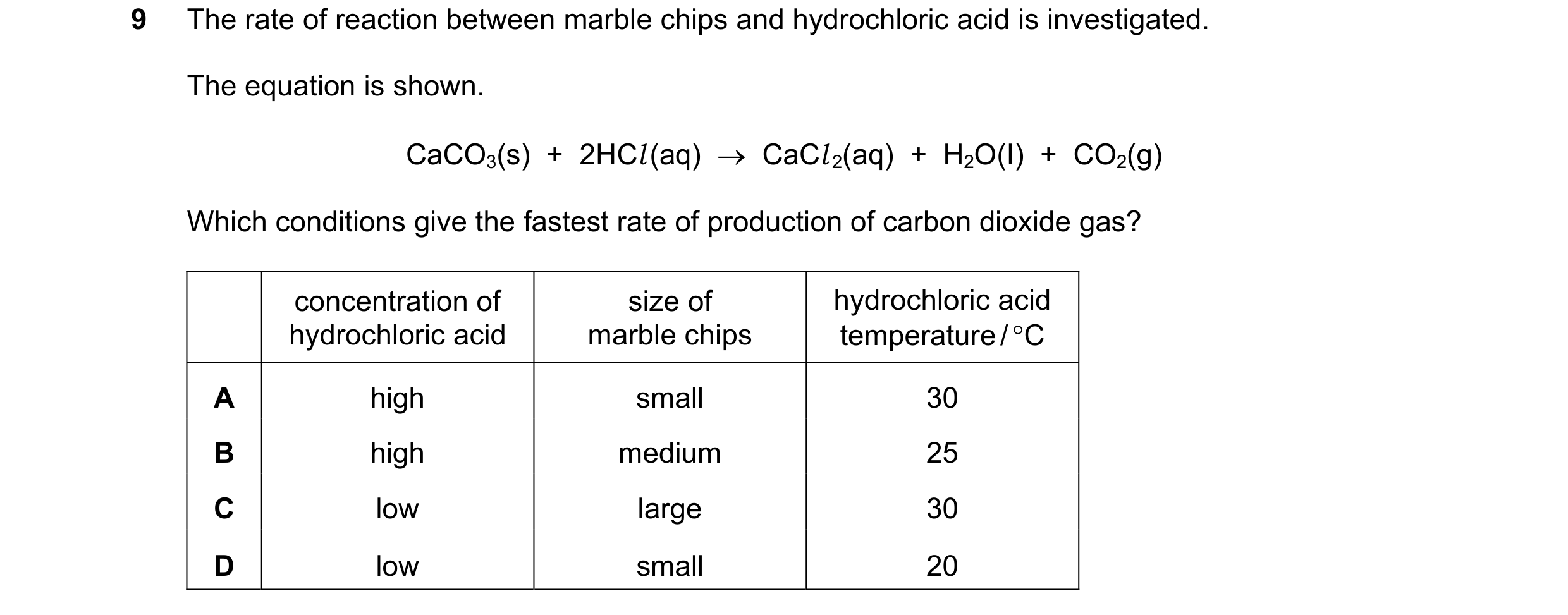
7 The rate of reaction between marble chips and hydrochloric acid is investigated. The equation is shown. CaCO3(s) + 2HCl (aq) → CaCl 2(aq) + H2O(I) + CO2(g) Which conditions give the fastest rate of production of carbon dioxide gas? concentration of size of marble hydrochloric acid hydrochloric acid chips temperature / °C A high small 30 B high medium 25 C low large 30 D low small 20
1 marks
Answer: A
This question in 0652/11 Oct/Nov 2017
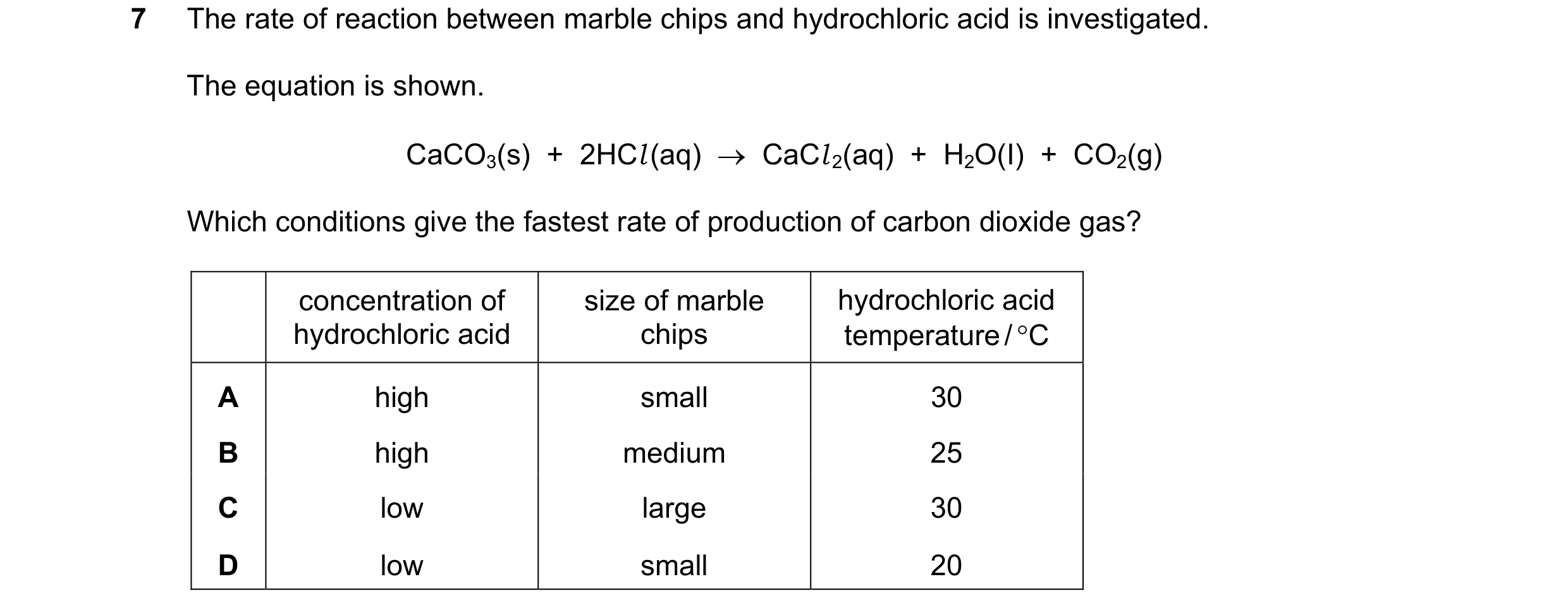
Q16 · The rate of reaction between marble chips and hydrochloric acid is investigated 0652/12 Oct/Nov 2017
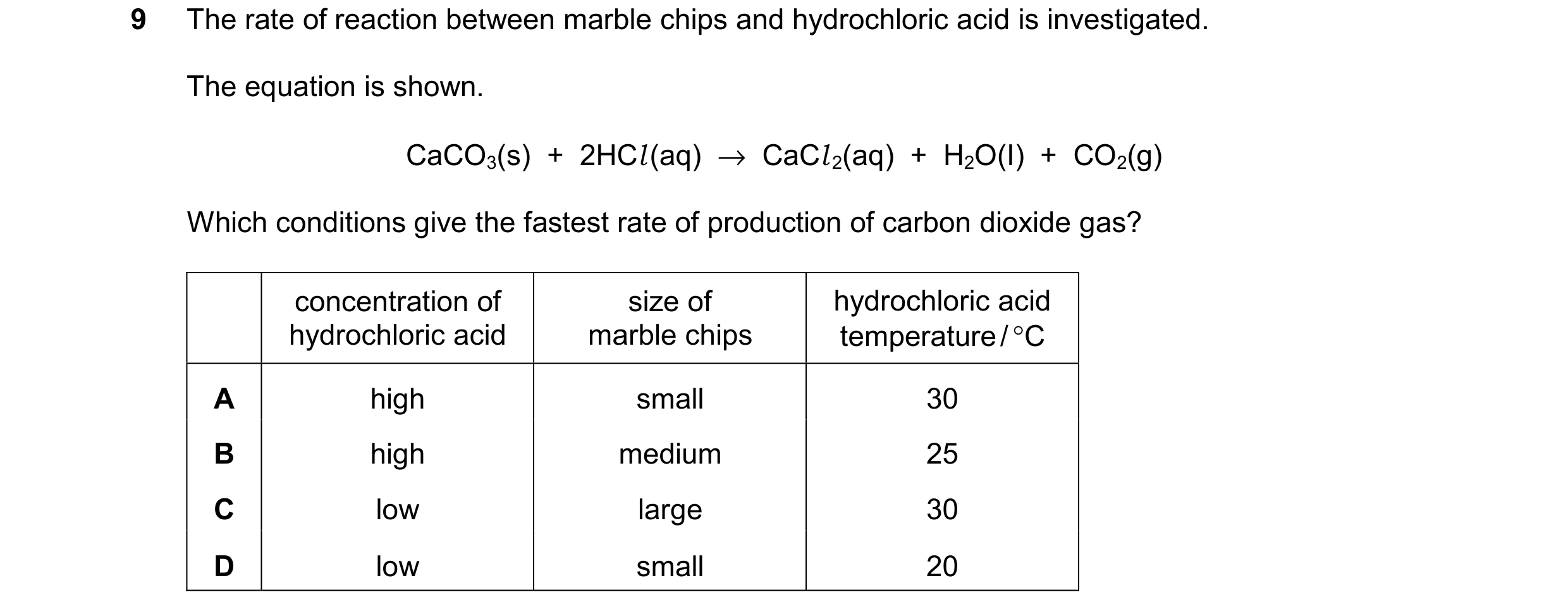
7 The rate of reaction between marble chips and hydrochloric acid is investigated. The equation is shown. CaCO3(s) + 2HCl (aq) → CaCl 2(aq) + H2O(I) + CO2(g) Which conditions give the fastest rate of production of carbon dioxide gas? concentration of size of marble hydrochloric acid hydrochloric acid chips temperature / °C A high small 30 B high medium 25 C low large 30 D low small 20
1 marks
Answer: A
This question in 0652/12 Oct/Nov 2017
Q17 · When hydrochloric acid is added to calcium carbonate, carbon dioxide is given off 0652/11 Oct/Nov 2019
7 When hydrochloric acid is added to calcium carbonate, carbon dioxide is given off. The volume of carbon dioxide given off is plotted against time and is represented by the dashed line X on the graph. Which solid line on the graph shows the results obtained when the temperature of the mixture is increased and all other factors remain the same? D C volume of carbon dioxide X B A time
1 marks
Answer: C
This question in 0652/11 Oct/Nov 2019
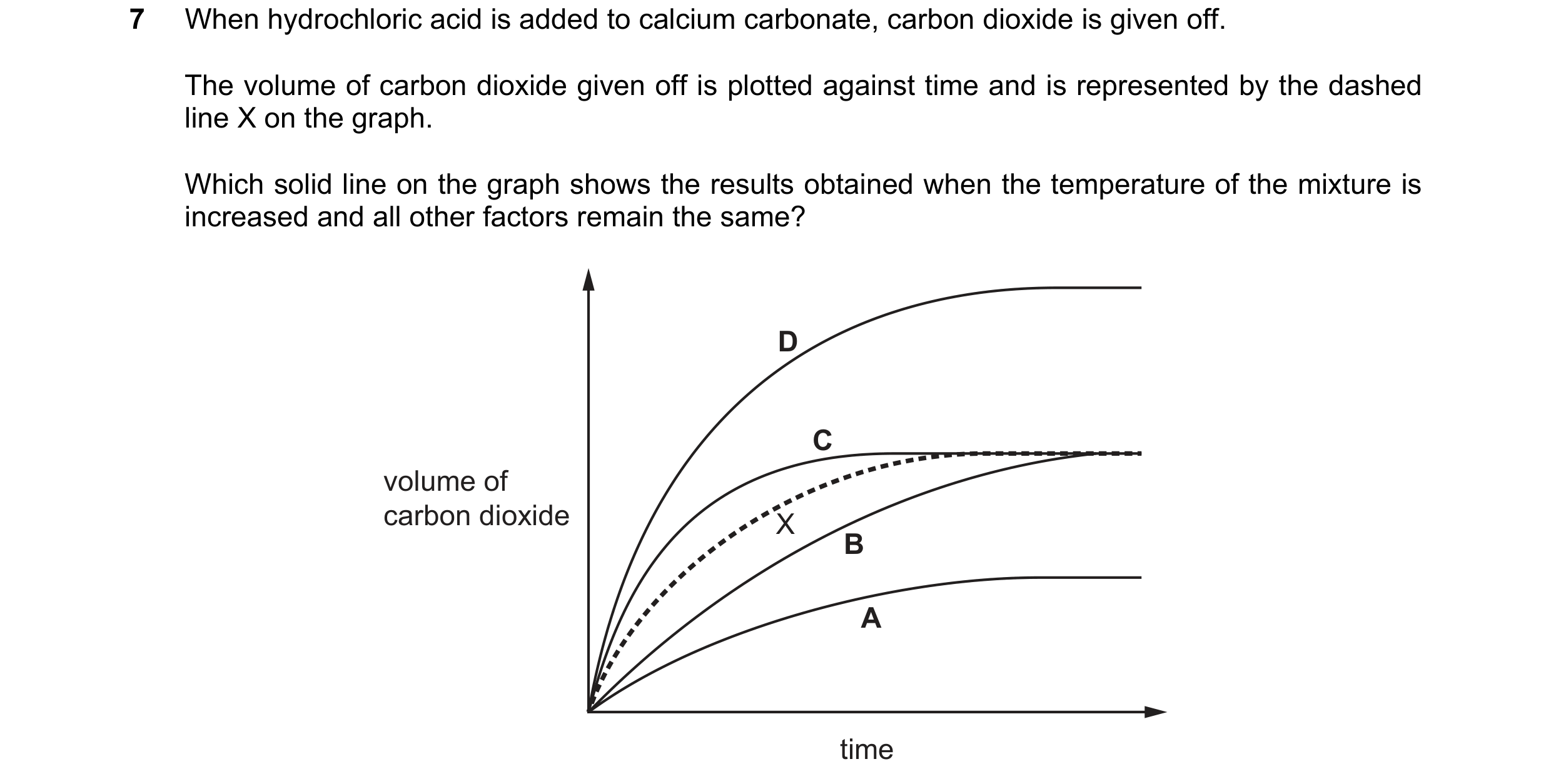
Q18 · When hydrochloric acid is added to calcium carbonate, carbon dioxide is given off 0652/12 Oct/Nov 2019
7 When hydrochloric acid is added to calcium carbonate, carbon dioxide is given off. The volume of carbon dioxide given off is plotted against time and is represented by the dashed line X on the graph. Which solid line on the graph shows the results obtained when the temperature of the mixture is increased and all other factors remain the same? D C volume of carbon dioxide X B A time
1 marks
Answer: C
This question in 0652/12 Oct/Nov 2019
Q19 · Magnesium reacts with acids to produce hydrogen gas 0652/11 Oct/Nov 2020
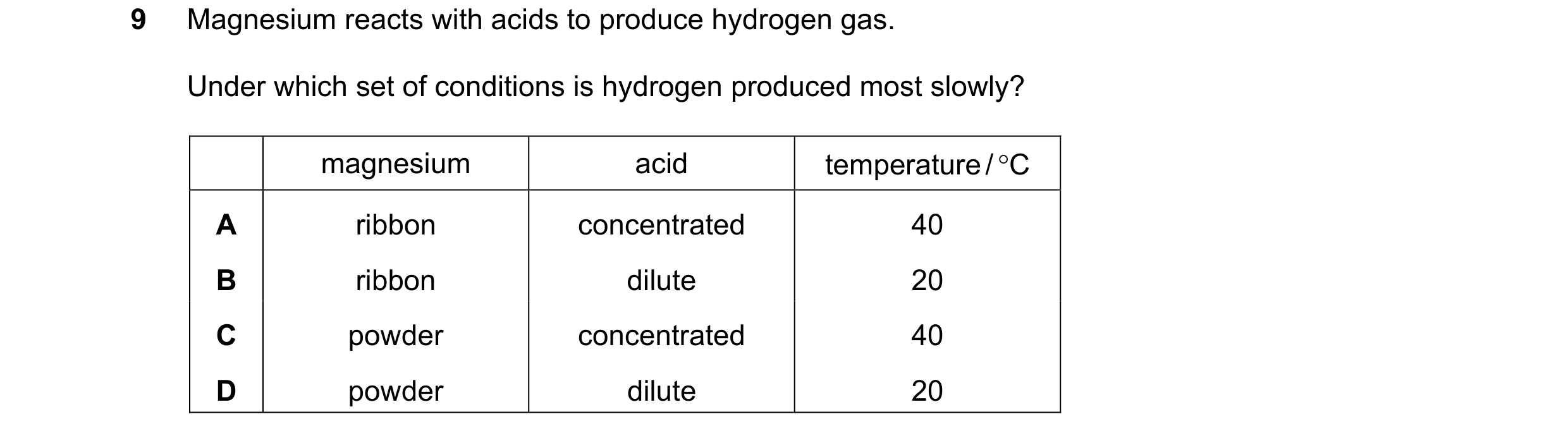
9 Magnesium reacts with acids to produce hydrogen gas. Under which set of conditions is hydrogen produced most slowly? magnesium acid temperature / C A ribbon concentrated 40 B ribbon dilute 20 C powder concentrated 40 D powder dilute 20
1 marks
Answer: B
This question in 0652/11 Oct/Nov 2020
Q20 · Which change decreases the rate of reaction between lumps of zinc and dilute sulfuric… 0652/11 Oct/Nov 2021
10 Which change decreases the rate of reaction between lumps of zinc and dilute sulfuric acid? A Add a suitable catalyst. B Add water to the acid. C Break the lumps of zinc into smaller pieces. D Use a higher temperature.
1 marks
Answer: B
This question in 0652/11 Oct/Nov 2021
Q21 · Calcium carbonate reacts with hydrochloric acid 0652/11 Oct/Nov 2022
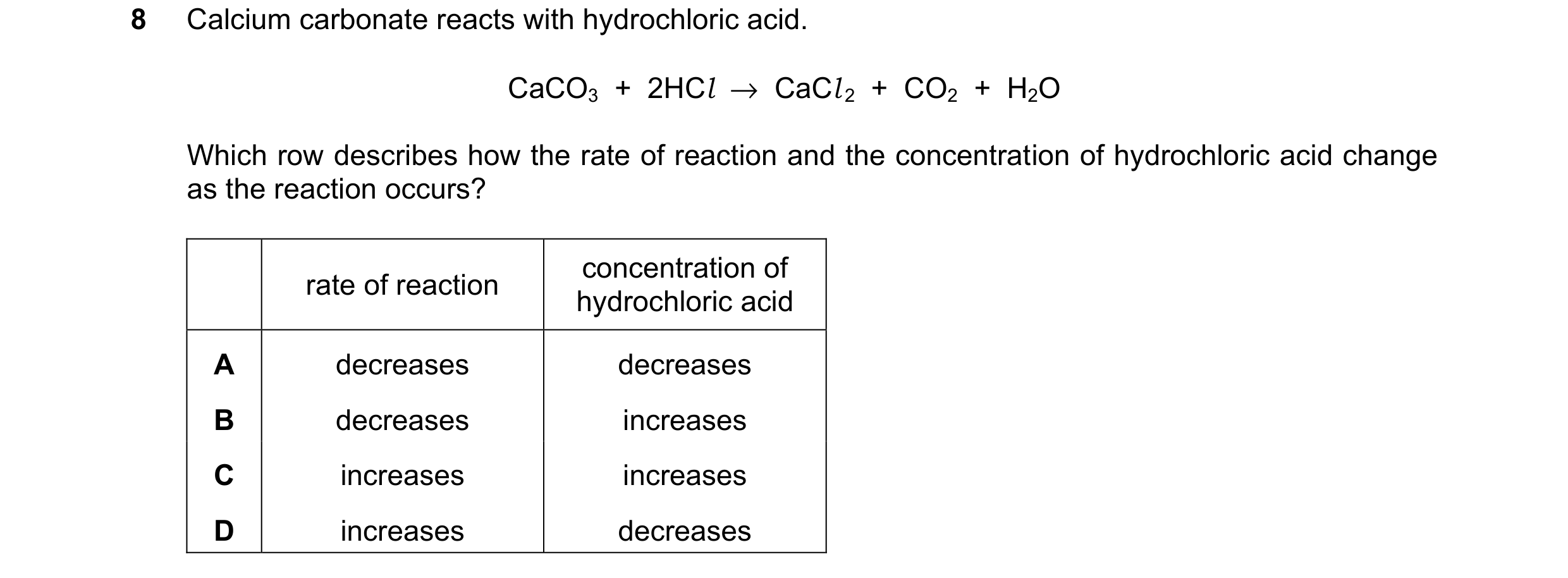
8 Calcium carbonate reacts with hydrochloric acid. CaCO3 + 2HCl → CaCl 2 + CO2 + H2O Which row describes how the rate of reaction and the concentration of hydrochloric acid change as the reaction occurs? concentration of rate of reaction hydrochloric acid A decreases decreases B decreases increases C increases increases D increases decreases
1 marks
Answer: A
This question in 0652/11 Oct/Nov 2022
Q22 · The rate of reaction between marble chips and hydrochloric acid is investigated 0652/11 Oct/Nov 2023
9 The rate of reaction between marble chips and hydrochloric acid is investigated. The equation is shown. CaCO3(s) + 2HCl (aq) → CaCl 2(aq) + H2O(I) + CO2(g) Which conditions give the fastest rate of production of carbon dioxide gas? concentration of size of hydrochloric acid hydrochloric acid marble chips temperature / °C A high small 30 B high medium 25 C low large 30 D low small 20
1 marks
Answer: A
This question in 0652/11 Oct/Nov 2023
Q23 · The rate of reaction between marble chips and hydrochloric acid is investigated 0652/12 Oct/Nov 2023
9 The rate of reaction between marble chips and hydrochloric acid is investigated. The equation is shown. CaCO3(s) + 2HCl (aq) → CaCl 2(aq) + H2O(I) + CO2(g) Which conditions give the fastest rate of production of carbon dioxide gas? concentration of size of hydrochloric acid hydrochloric acid marble chips temperature / °C A high small 30 B high medium 25 C low large 30 D low small 20
1 marks
Answer: A
This question in 0652/12 Oct/Nov 2023
Q24 · Magnesium carbonate reacts with dilute hydrochloric acid 0652/11 Oct/Nov 2024
9 Magnesium carbonate reacts with dilute hydrochloric acid. Which statement explains why the rate of reaction decreases as time increases? A The concentration of the dilute hydrochloric acid decreases. B The particle size of the magnesium carbonate decreases. C The surface area of the magnesium carbonate increases. D The temperature of the reaction mixture increases.
1 marks
Answer: A
This question in 0652/11 Oct/Nov 2024
 1 / 9
1 / 9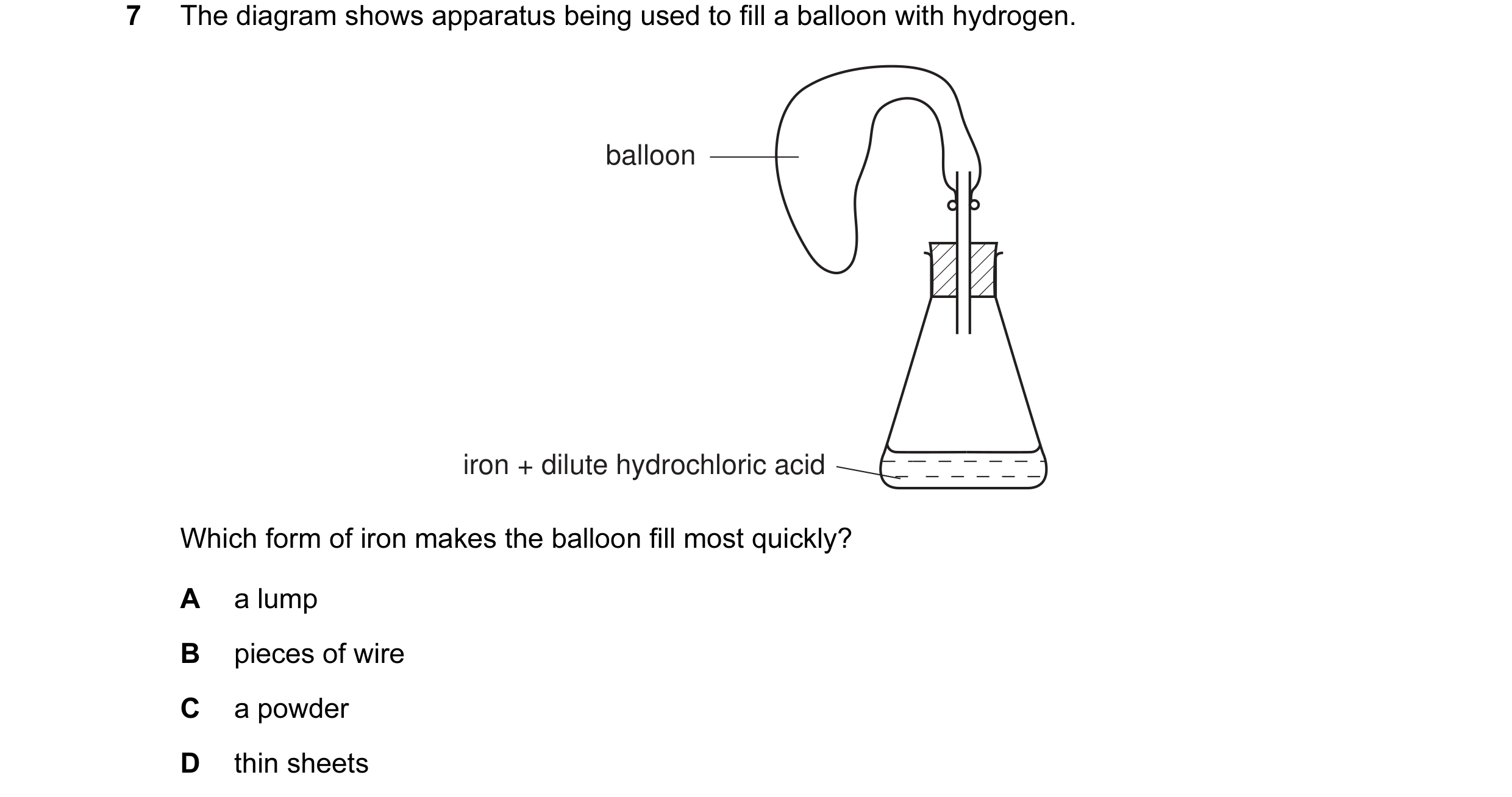
 2 / 9
2 / 9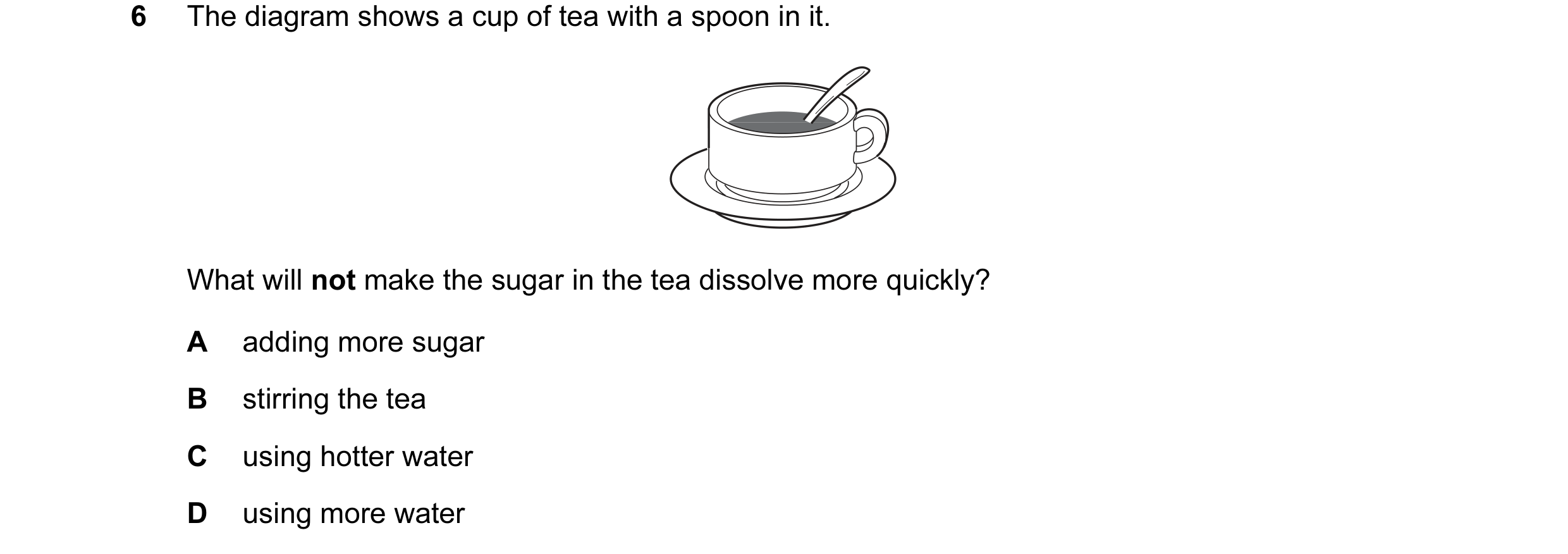
 3 / 9
3 / 9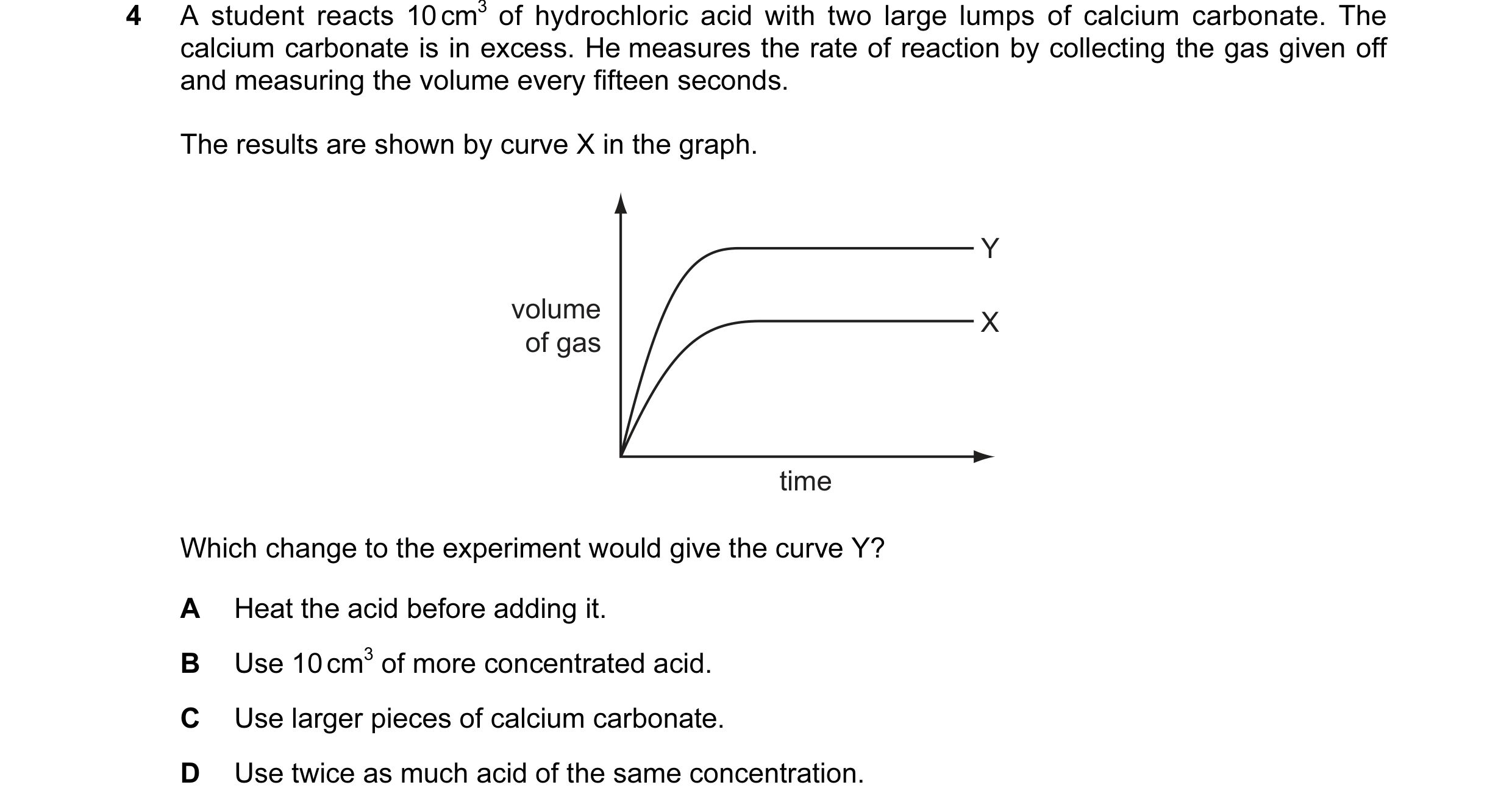
 4 / 9
4 / 9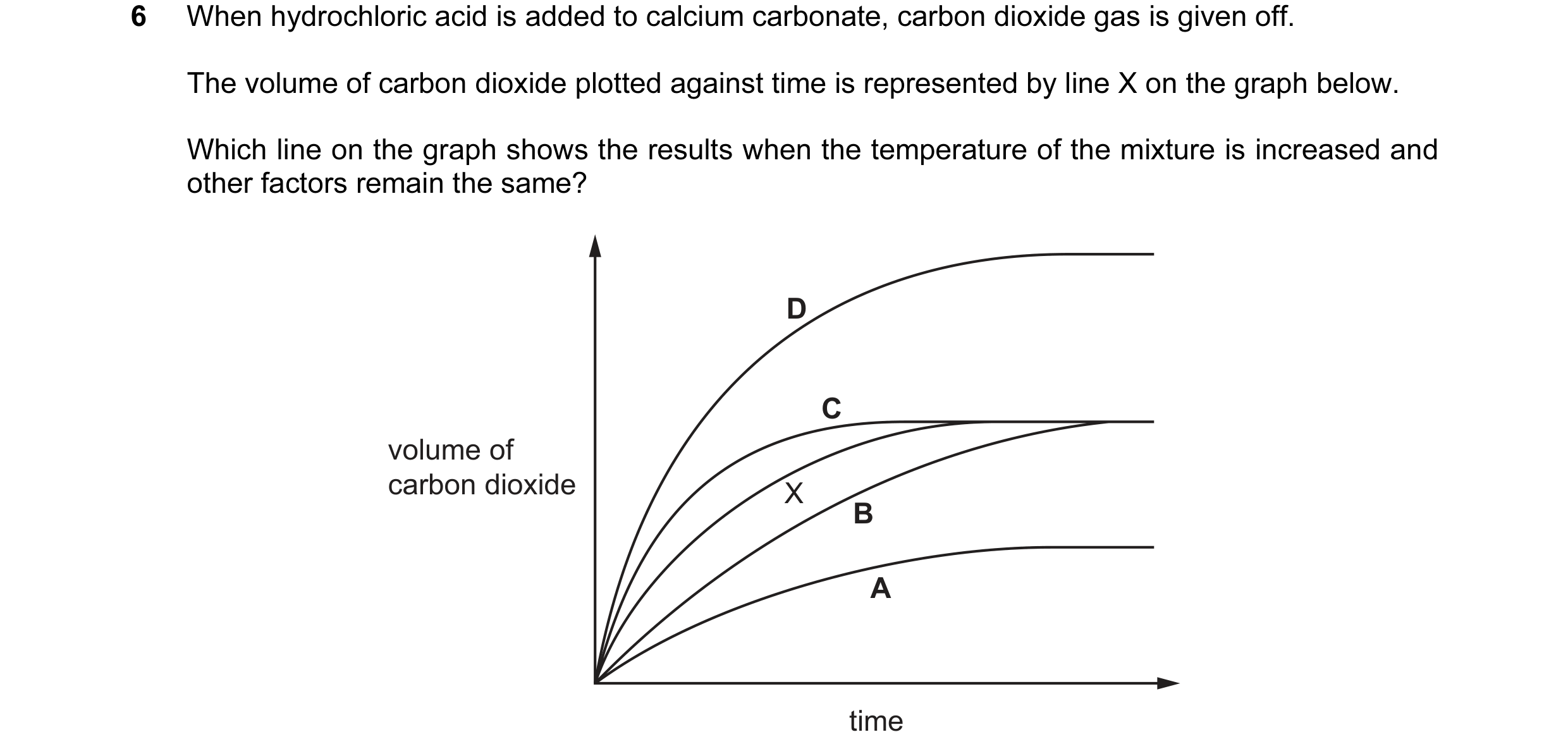
 5 / 9
5 / 9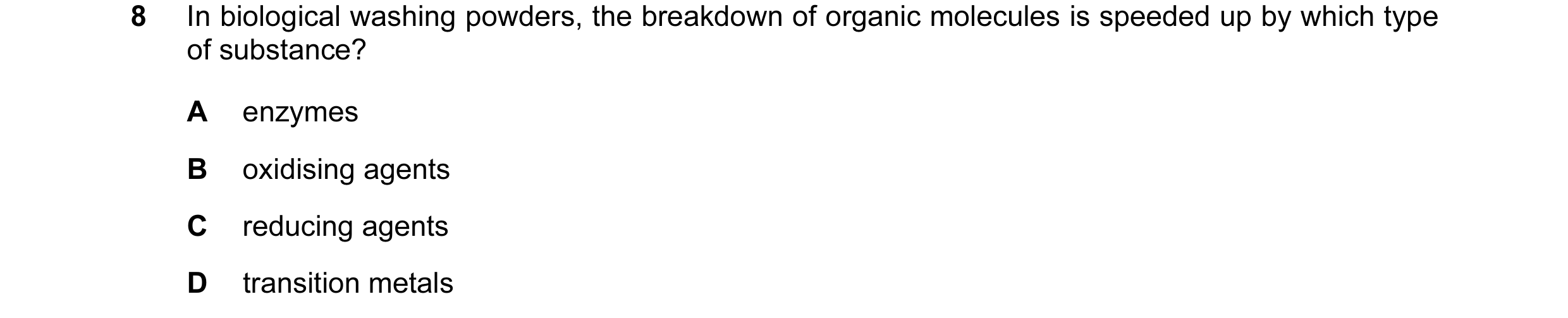
 6 / 9
6 / 9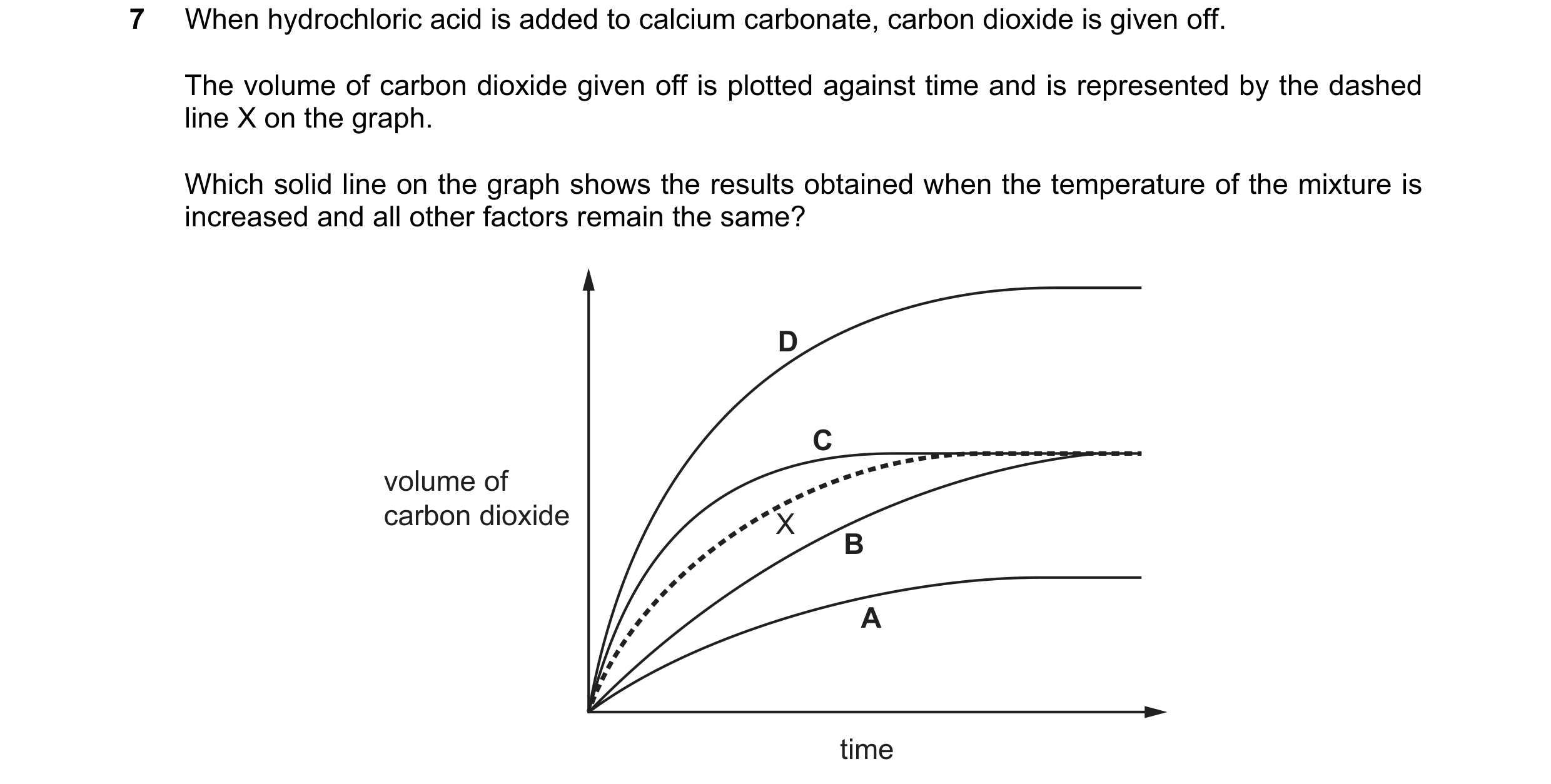
 7 / 9
7 / 9
 8 / 9
8 / 9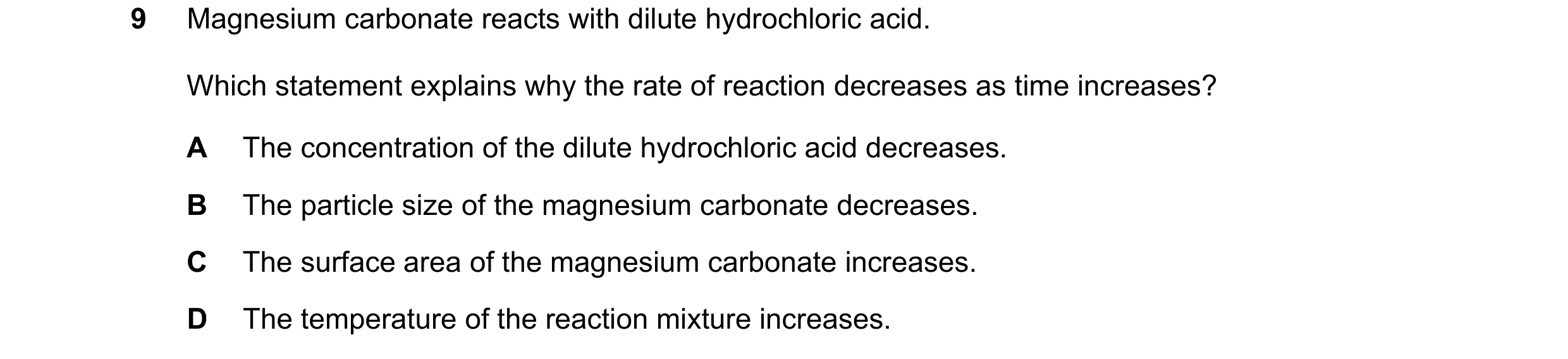 9 / 9
9 / 9