Questions as text
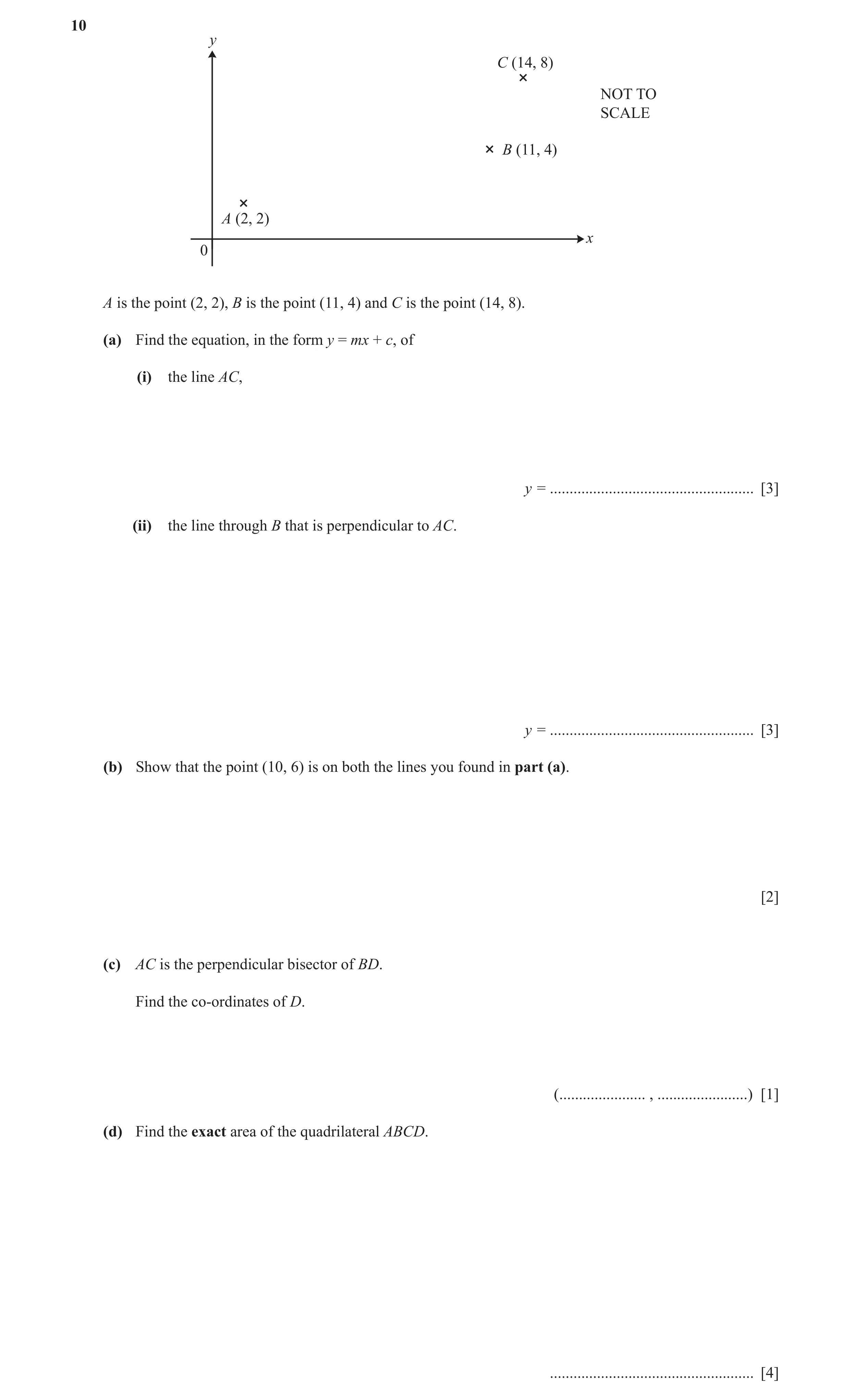
Q1 · Y C (14, 8) NOT TO SCALE B (11, 4) A (2, 2) x 0 A is the point (2, 2), B is the point… 0607/42 May/June 2017
10 y C (14, 8) NOT TO SCALE B (11, 4) A (2, 2) x 0 A is the point (2, 2), B is the point (11, 4) and C is the point (14, 8). (a) Find the equation, in the form y = mx + c, of (i) the line AC, y = … [3] (ii) the line through B that is perpendicular to AC. y = … [3] (b) Show that the point (10, 6) is on both the lines you found in part (a). [2] (c) AC is the perpendicular bisector of BD. Find the co-ordinates of D. ( … , … ) [1] (d) Find the exact area of the quadrilateral ABCD. … [4]
13 marks
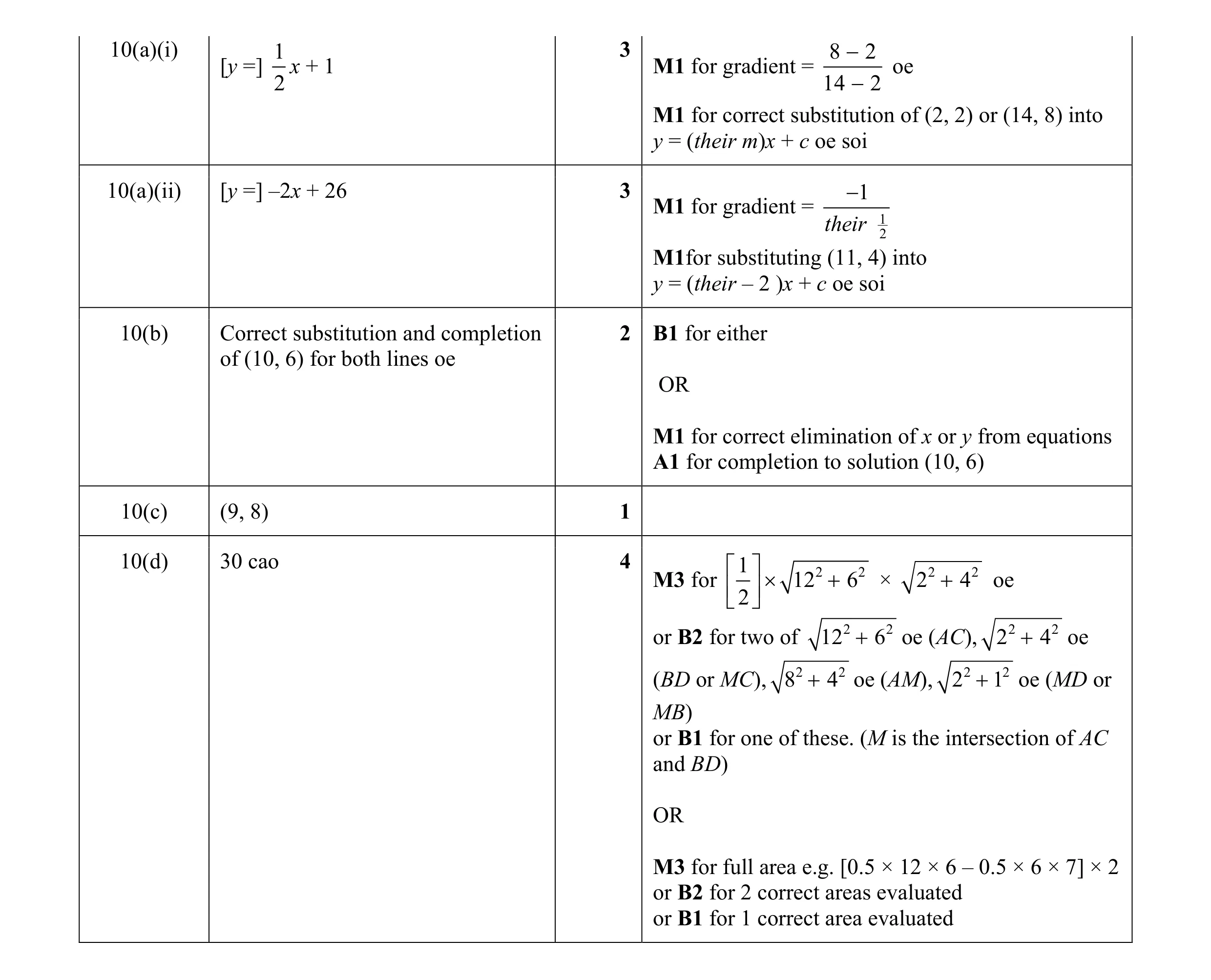
Mark scheme: 10(a)(i) 1 3 8 − 2 [y =] x + 1 M1 for gradient = oe 2 14 − 2 M1 for correct substitution of (2, 2) or (14, 8) into y = (their m)x + c oe soi 10(a)(ii) [y =] –2x + 26 3 −1 M1 for gradient = their 12 M1for substituting (11, 4) into y = (their – 2 )x + c oe soi 10(b) Correct substitution and completion 2 B1 for either of (10, 6) for both lines oe OR M1 for correct elimination of x or y from equations A1 for completion to solution (10, 6) 10(c) (9, 8) 1 10(d) 30 cao 4 1 2 2 2 2 M3 for × 12 + 6 × 2 + 4 oe 2 or B2 for two of 12 2 + 6 2 oe (AC), 2 2 + 4 2 oe (BD or MC), 8 2 + 4 2 oe (AM), 2 2 + 12 oe (MD or MB) or B1 for one of these. (M is the intersection of AC and BD) OR M3 for full area e.g. [0.5 × 12 × 6 – 0.5 × 6 × 7] × 2 or B2 for 2 correct areas evaluated or B1 for 1 correct area evaluated
This question in 0607/42 May/June 2017
Q2 · Find the equation of the line that passes through the points (1, 2) and (3, 12) 0607/42 Oct/Nov 2017
9 (a) (i) Find the equation of the line that passes through the points (1, 2) and (3, 12). Give your answer in the form y = mx + c . y = … [3] (ii) Find the equation of the line that passes through the point (0, 2) and is perpendicular to the line in part (a)(i). … [2] . (b) (i) Solve the equation 3x 2 + 4x - 4 = 0 . You must show all your working. x = … or x = … [3] (ii) Solve the inequality 3x 2 + 4x - 4 1 0 . … [2] (c) The graph of y = ax 2 + bx + c has its vertex at the point (1, 5) and intersects the y-axis at (0, 1). Find the values of a, b and c. a = … b = … c = … [3]
13 marks
Mark scheme: 9(a)(i) [y =] 5x – 3 3 12 − 2 M1 for gradient = oe 3 − 1 M1 for substituting (1, 2) or (3, 12) into y = mx + c OR y − 2 12 − 2 M2 for = oe x − 1 3 − 1 9(a)(ii) 1 2 FT their gradient in (i) y = − x + 2 oe M1 for answer in form y = mx + 2 oe or 5 −1 for y = x + c oe their 5 9(b)(i) 2 3 B2 for sketch with one –ve and one +ve − 2, oe with correct working zero 3 or B1 for sketch of parabola vertex downwards OR B2 for (3x – 2)(x + 2) or B1 for 3 x ( x + 2) − 2( x + 2) or x (3 x − 2) + 2(3 x − 2) or for (3 x + a )( x + b ) where ab = – 4 or a + 3b = 4 OR −±4 4 2 − 4(3)( − 4) B2 for oe 2(3) 2 −±4 … or B1 for 4 − 4(3)( −4) or 2(3) 2 If 0 or B1 scored, then + B1 for − 2, 3 9(b)(ii) 2 2 FT their (b)(i) −<2 x < 3 2 B1 for −<2 x or for x < seen 3 2 If 0 scored SC1 FT for −≤2 x ≤ 3 9(c) [a =] – 4, [b =] 8, [c =] 1 3 M2 for y = a ( x − 1) 2 + 5 or M1 for use of y = a ( x − h ) 2 + k or b for c = 1 or − = 1 2 a
This question in 0607/42 Oct/Nov 2017
Q3 · Y A NOT TO SCALE D x O B C ABCD is a rectangle 0607/41 Oct/Nov 2018
4 y A NOT TO SCALE D x O B C ABCD is a rectangle. The equation of the line AB is 4x + 3y = 24 . (a) Find the co-ordinates of (i) point A, ( … , … ) [1] (ii) point B, ( … , … ) [1] (iii) the midpoint of AB. ( … , … ) [2] (b) Rearrange the equation 4x + 3y = 24 to make y the subject. y = … [2] (c) Find the equation of the line BC. Give your answer in the form y = mx + c . y = … [3] (d) Find the co-ordinates of (i) point C, ( … , … ) [1] (ii) point D. ( … , … ) [3]
13 marks
Mark scheme: 4(a)(i) (0, 8) 1 4(a)(ii) (6, 0) 1 4(a)(iii) (3, 4) 2 FT their (i) and (ii) B1FT for each co-ordinate 4(b) 4 [ y = ] − x + 8 oe 2 M1 for correct isolating y term or for 3 correct division 4(c) 3 FT their (a)(ii) y = x − 4.5 oe 3 3 4 B2 for y = x + k , k ≠ 0 4 or M1 for gradient = 0.75 oe and M1 for correct subst of their (a)(ii) into y = mx + c 4(d)(i) (0, –4.5) 1 Strict FT their (c) and only if in form y = mx + c 4(d)(ii) (–6, 3.5) 3 FT their (a), (d)(i) B2 for one correct co-ordinate − 6 6 or M1 for or soi −4.5 4.5
This question in 0607/41 Oct/Nov 2018
Q4 · A is the point (1, 9) and B is the point (7, 1) 0607/42 Oct/Nov 2018
14 A is the point (1, 9) and B is the point (7, 1). (a) Find the length of AB. … [3] (b) Find the co-ordinates of the midpoint of AB. ( … , … ) [2] (c) B is the reflection of A in the line L. Find the equation of the line L. … [4]
9 marks
Mark scheme: 14(a) 10 3 2 2 M2 for 6 + 8 or B1 for 6 and 8 seen nfww 14(b) (4, 5) 2 B1 for each co-ordinate 14(c) 3 4 Must be 3 term equation y = x + 2 oe 4 3 B2 for gradient = 4 4 or B1 for gradient of AB = – 3 M1 for substituting their (b) into y = (their m) x + c oe
This question in 0607/42 Oct/Nov 2018
Q5 · The points A (1, 2) and B (7, 5) are shown on the diagram below 0607/43 May/June 2019
10 The points A (1, 2) and B (7, 5) are shown on the diagram below. y 12 NOT TO SCALE B A 0 16 x (a) Write AB as a column vector. [1] f p (b) Calculate the length of the line AB. … [2] (c) The point C has co-ordinates (10, k). AB = BC and k 2 0. Show that k = 11. [3] (d) Find the equation of the line that is perpendicular to AC that passes through the midpoint of AC. Give your answer in the form y = mx + c. y = … [4] (e) The points A, B, C and D form a rhombus. Find the co-ordinates of D. ( … , … ) [3]
13 marks
Mark scheme: 10(a) 6 1 3 10(b) 6.71 or 6.708… or 45 oe 2 2 2 M1 for (7 −1) + (5 − 2) oe 10(c) 2 2 2 2 2 k −=5 (their (b)) − 3 M2 M1 for (k − 5) + (10 − 7) = (their(b)) oe Reverse process scores 0. k −=5 6 A1 10(d) [ y = ] − x + 12 oe 4 11 − 2 M1 for grad AC = oe 10 − 1 1 M1 for grad perp = − their grad B1 for midpoint (5.5, 6.5) 10(e) (4, 8) 3 10 6 7 −3 M2 for − or − oe 11 3 5 3 6 −3 or M1 for CD = or BD = oe 3 3
This question in 0607/43 May/June 2019
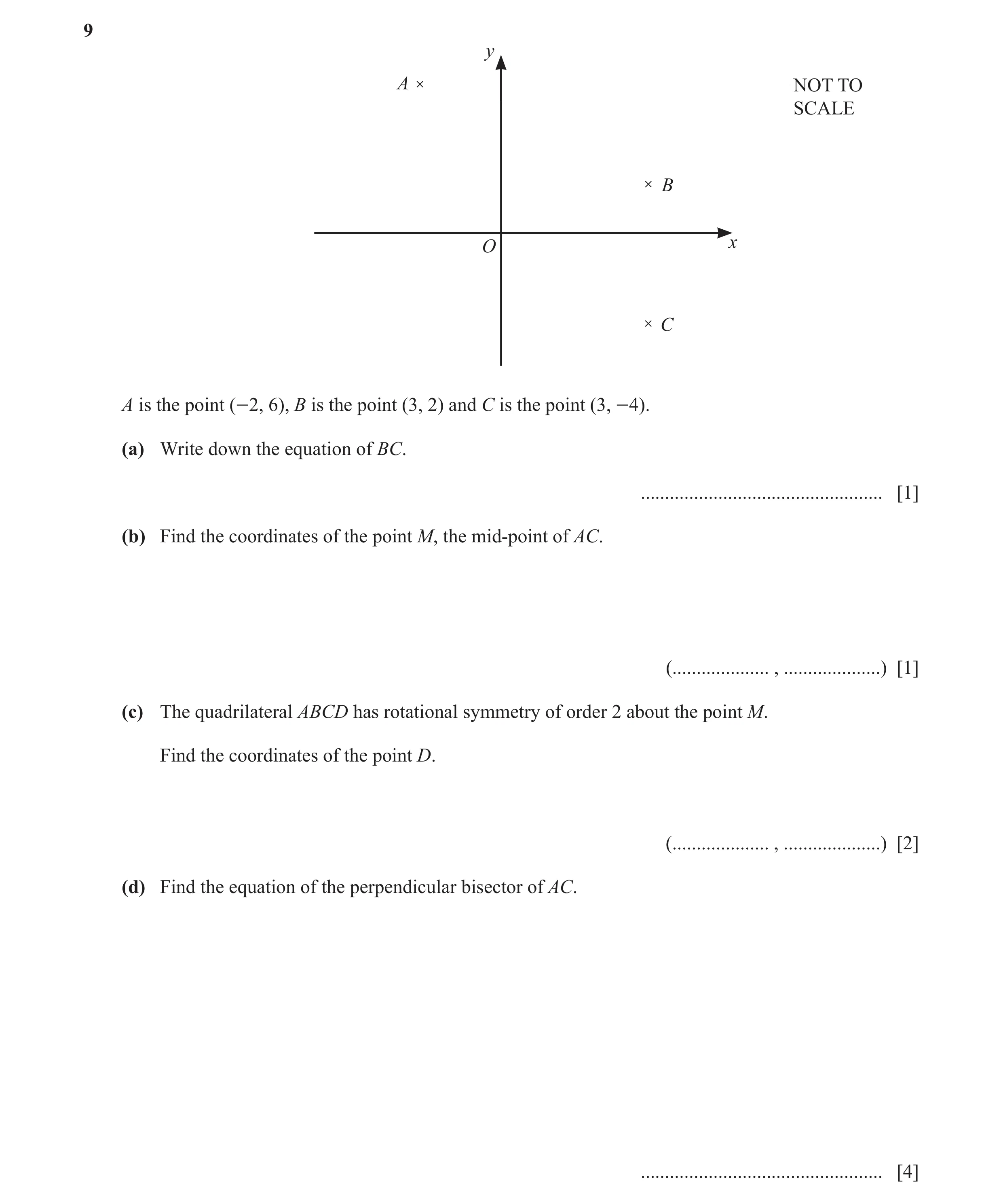
Q6 · Y A NOT TO SCALE B O x C A is the point (-2, 6), B is the point (3, 2) and C is the point… 0607/43 May/June 2020
9 y A NOT TO SCALE B O x C A is the point (-2, 6), B is the point (3, 2) and C is the point (3, -4). (a) Write down the equation of BC. … [1] (b) Find the coordinates of the point M, the mid-point of AC. ( … , … ) [1] (c) The quadrilateral ABCD has rotational symmetry of order 2 about the point M. Find the coordinates of the point D. ( … , … ) [2] (d) Find the equation of the perpendicular bisector of AC. … [4]
8 marks
Mark scheme: 9(a) x = 3 oe 1 9(b) 1 1 , 1 oe 2 9(c) (–2, 0) 2 B1 for each coordinate 9(d) 1 3 4 3 term equivalent y = x + oe −−4 6 2 4 M1 for gradient of AC = 3 −−( 2) −1 M1 for m = theirgradient M1 for substituting their (b) into their y = mx + c
This question in 0607/43 May/June 2020
Q7 · P = q = 3 - 1 A is the point (3, 4) 0607/43 Oct/Nov 2020
9 p = q = 3 - 1 A is the point (3, 4). (a) Find p - q . [1] f p (b) A is translated onto H by the vector p. Find the coordinates of H. ( … , … ) [1] (c) J is translated onto A by the vector q. Find the coordinates of J. ( … , … ) [1] (d) Find the coordinates of the mid-point of HJ. ( … , … ) [1] (e) Find the length of HJ. HJ = … [3] 1 (f) A line L, parallel to the vector q, has gradient - . 2 Find the equation of the line perpendicular to the line L that passes through the point A. … [3]
10 marks
Mark scheme: 9(a) − 3 1 4 9(b) (2, 7) 1 9(c) (1, 5) 1 9(d) (1.5, 6) 1 FT their (b) and (c). 9(e) 2.24 or 2.236... 3 FT their (b) and (c). M2 for (their 2 – their 1)2 + (their 7 – their 5)2 oe or M1 for (their 2 – their 1) and (their 7 – their 5) seen 9(f) y = 2x – 2 oe 3 − 1 M1 for gradient = oe soi 2 1 − 2 M1 for substituting (3, 4) in y = their m x + c Answer 2x – 2 implies M1 M1
This question in 0607/43 Oct/Nov 2020
Q8 · Write down the coordinates of the point where the line y =- 2x + 3 crosses the y-axis 0607/42 Feb/March 2021
3 (a) (i) Write down the coordinates of the point where the line y =- 2x + 3 crosses the y-axis. ( … , … ) [1] (ii) Write down the gradient of the line y =- 2x + 3 . … [1] (b) The line x + y = 6 crosses the line x =- 2 at point A. Find the y-coordinate of A. … [1] (c) Find the equation of the straight line that passes through the points (3, -1) and (12, 5). … [3] (d) The line L passes through the point (3, 4). Line L is perpendicular to the line 2y = 5x + 6 . Find the equation of line L. … [4] (e) y 7 6 5 4 3 2 1 – 2 – 1 0 1 2 3 4 5 6 7 x – 1 – 2 (i) On the grid, draw the lines y = 4, x + y = 3 and y = x - 1 . [3] (ii) By shading the unwanted regions, find and label the region R that satisfies these three inequalities. y G 4 x + y H 3 y H x - 1 [1]
14 marks
Mark scheme: 3(a)(i) (0, 3) 1 3(a)(ii) –2 1 3(b) 8 1 3(c) 2 3 2 y = x − 3 oe final answer B2 for answer x − 3 3 3 OR 5 −−( 1) M1 for oe 12 − 3 M1 for correct substitution of point into y = (their m)x + c or e.g. y – 5 = (their m)(x – 12) 3(d) 2 26 4 2 26 y = − x + oe final answer B3 for answer − x + oe 5 5 5 5 OR 5 M1 for gradient 2 −1 M1 for m = or better their ( 52 ) M1 for (3, 4) substituted into y = (their m)x + c or e.g. y – 4 = (their m)(x – 3) 3(e)(i) 3 correct ruled lines 3 B1 for each line correct 3(e)(ii) Clear indication of correct 1 FT if appropriate region
This question in 0607/42 Feb/March 2021
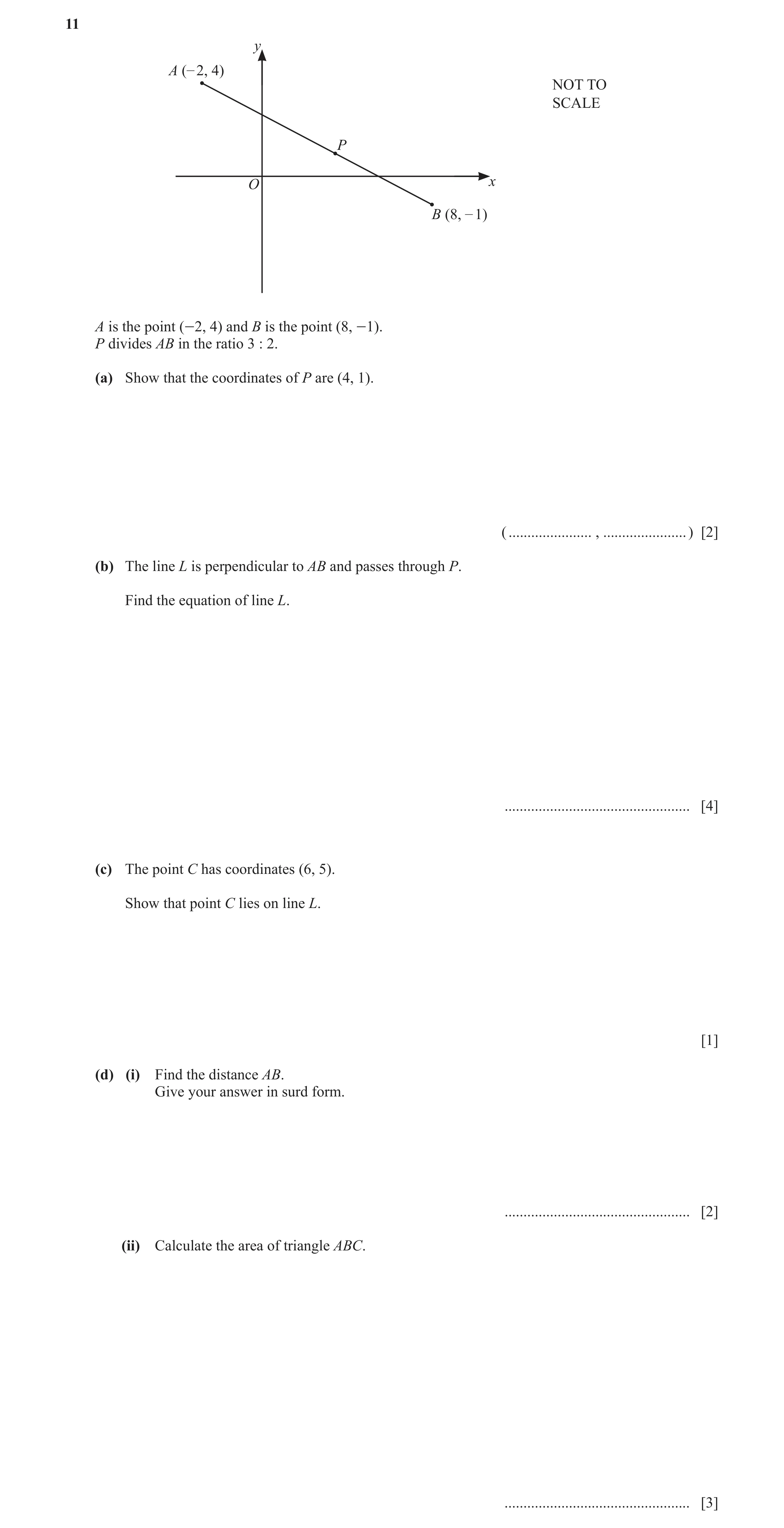
Q9 · Y A (– 2, 4) NOT TO SCALE P O x B (8, – 1) A is the point (-2, 4) and B is the point (8… 0607/42 May/June 2021
11 y A (– 2, 4) NOT TO SCALE P O x B (8, – 1) A is the point (-2, 4) and B is the point (8, -1). P divides AB in the ratio 3 : 2. (a) Show that the coordinates of P are (4, 1). ( … , … ) [2] (b) The line L is perpendicular to AB and passes through P. Find the equation of line L. … [4] (c) The point C has coordinates (6, 5). Show that point C lies on line L. [1] (d) (i) Find the distance AB. Give your answer in surd form. … [2] (ii) Calculate the area of triangle ABC. … [3]
12 marks
Mark scheme: 11(a) 8 – –2 = 10, 3 : 2 = 6 : 4, M2 M1 for each coordinate x = –2 + 6 = 4 oe 4 to –1 = 5, y = 4 – 3 = 1 oe 11(b) y = 2x – 7 oe final answer 4 B3 for 2x – 7 as final answer OR −−1 4 M1 for gradient of AB = 8 −−( 2 ) −1 M1 for m = 1 their − 2 M1 for 1 = (their2) × 4 + c or y – 1 = their2(x – 4)) 11(c) 2 × 6 – 7 = 5 oe 1 11(d)(i) 5 5 or 125 final answer 2 M1 for (8 – (–2))2 + ((–1) – 4)2 oe 11(d)(ii) 25 [.0] cao nfww 3 M1 for (6 – 4)2 + (5 – 1)2 M1 dep on first M1 for 1 × their ( d )( i ) × their 20 2
This question in 0607/42 May/June 2021
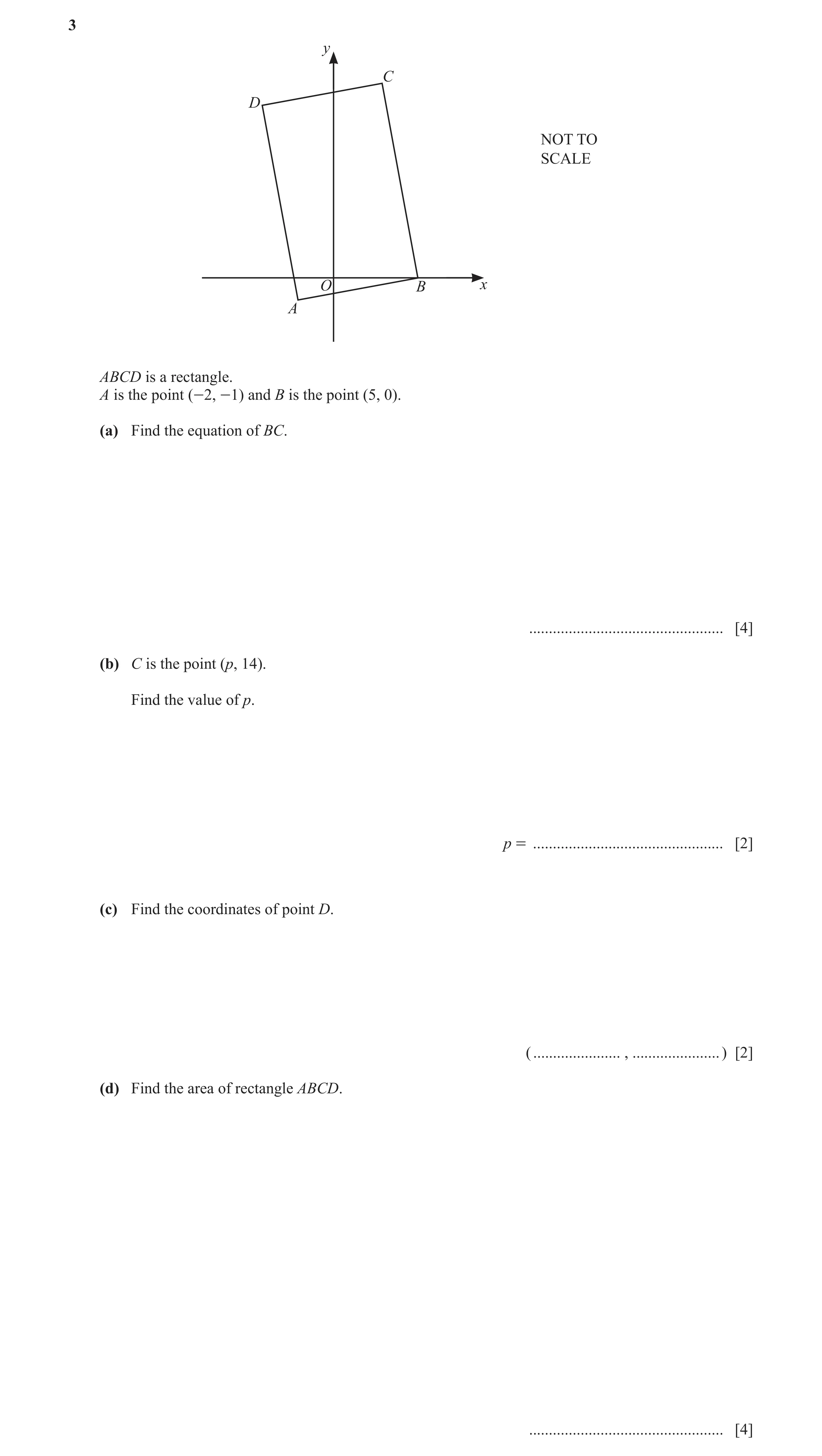
Q10 · Y C D NOT TO SCALE O B x A ABCD is a rectangle 0607/43 May/June 2021
3 y C D NOT TO SCALE O B x A ABCD is a rectangle. A is the point (-2, -1) and B is the point (5, 0). (a) Find the equation of BC. … [4] (b) C is the point (p, 14). Find the value of p. p = … [2] (c) Find the coordinates of point D. ( … , … ) [2] (d) Find the area of rectangle ABCD. … [4]
12 marks
Mark scheme: 3(a) y = −7 x + 35 oe final answer 4 B3 for –7x + 35 as final answer OR 0 −−1 M1 for gradient of AB = oe 5 −−2 −1 M1 for gradient of BC = (m) their gradient of AB M1 for substitution of (5, 0) in y = (their m)x + c oe 3(b) 3 2 x 1 M1 for use of 14 = 2 × 7 oe e.g. = 2 14 −7 or 14 = their ( −7 p + 35 ) 3(c) (–4, 13) 2 FT their p – 7 for x-coordinate B1 for each. 3(d) 100 nfww 4 M3 for 200 × 50 oe or M2 for 7 2 + 12 oe or ( −2) 2 + 14 2 oe or M1 for (5 −−2) 2 + (0 −−1) 2 oe or ( −−−4 2) 2 + (14 − 0) 2 oe OR 1 1 M3 for 9 × 15 – 2 × × 2 × 14 – 2 × × 7 × 1 2 2 or M1 for 9 × 15 1 1 and M1 for × 2 × 14 or × 7 × 1 2 2
This question in 0607/43 May/June 2021
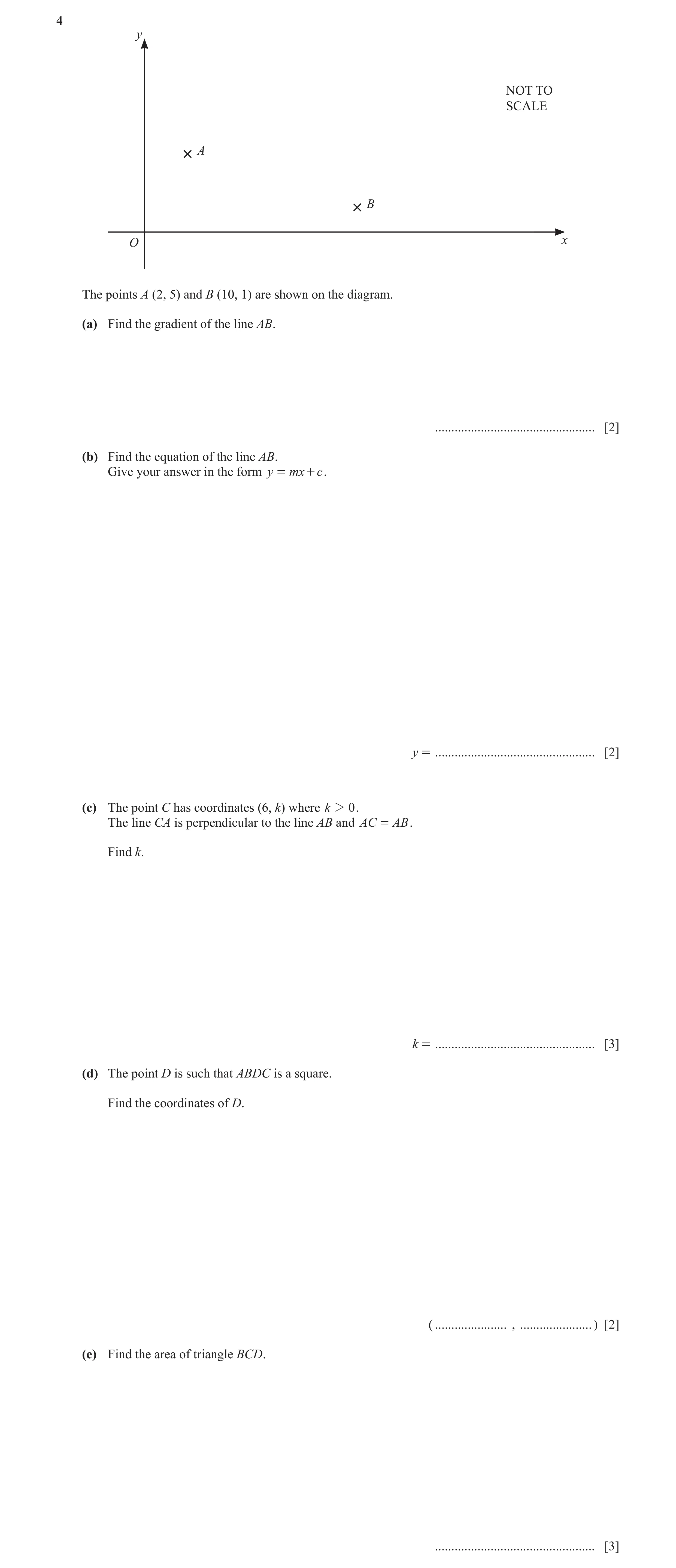
Q11 · Y NOT TO SCALE A B O x The points A (2, 5) and B (10, 1) are shown on the diagram 0607/43 Oct/Nov 2021
4 y NOT TO SCALE A B O x The points A (2, 5) and B (10, 1) are shown on the diagram. (a) Find the gradient of the line AB. … [2] (b) Find the equation of the line AB. Give your answer in the form y = m x + c . y = … [2] (c) The point C has coordinates (6, k) where k 2 0 . The line CA is perpendicular to the line AB and AC = AB . Find k. k = … [3] (d) The point D is such that ABDC is a square. Find the coordinates of D. ( … , … ) [2] (e) Find the area of triangle BCD. … [3]
12 marks
Mark scheme: 4(a) –0.5 oe 2 1 − 5 M1 for oe 10 − 2 4(b) [ y = ] − 0.5 x + 6 2 M1 for substituting (2, 5) or (10, 1) into y = their ( −0.5) x + c 4(c) 13 3 −1 M1 for grad perp = their ( −0.5) k − 5 M1 for = their 2 6 − 2 OR M2 for ( k − 5) 2 = 64 or M1 for (10 − 2) 2 + (1 − 5) 2 [ = (6 − 2) 2 + ( k − 5) 2 ] 4(d) (14, 9) 2 B1 for each 4(e) 40 3 M2 for 0.5 × [(10 − 2) 2 + (1 − 5) 2 ] oe or M1 for (10 − 2) 2 + (1 − 5) 2 oe
This question in 0607/43 Oct/Nov 2021
Q12 · A is the point ( - 11, 7) and B is the point ( 8 , - 13) 0607/41 May/June 2022
8 (a) A is the point ( - 11, 7) and B is the point ( 8 , - 13) . Find the length of AB. … [3] (b) P is the point ( 2, - 5) and Q is the point ( 6, 11) . Line L is perpendicular to PQ and crosses PQ at point R. The ratio PR : RQ = 3 : 1. Find the equation of line L. … [6]
9 marks
Mark scheme: 8(a) 27.6 or 27.58 to 27.59 3 M2 for (( 11) 8) 2 (7 ( 13)) 2 oe or M1 for (( 11) 8) or (7 ( 13)) oe 8(b) y 14 x 8 14 oe 6 B5 for answer 14 x 8 14 OR B2 for (5, 7) or B1 for (5, k) or (k, 7) 11 5 M1 for oe (=m1) 6 2 1 M1 for grad = their m1 M1 for substituting their (5, 7) into y = (their m)x + c
This question in 0607/41 May/June 2022
Q13 · A is the point ( - 2 , - 3) and B is the point (4, 9) 0607/42 Oct/Nov 2022
4 A is the point ( - 2 , - 3) and B is the point (4, 9). (a) Find the length of AB. … [3] (b) Find the equation of the perpendicular bisector of AB. … [5] (c) C is a point on AB. C divides AB in the ratio 2 : 1. Find the coordinates of C. ( … , … ) [2]
10 marks
Mark scheme: 4(a) 13.4 or 13.41 to 13.42 3 M2 for (4 – (–2))2 + (9 – (–3))2 oe or M1 for (4 – (–2)) oe and (9 – (–3)) oe soi by 6 and 12 4(b) 1 7 5 1 7 y = – x + oe B4 for – x + 2 2 2 2 OR 9 −−( 3) M1 for oe 4 −−( 2) M1 for –1 ÷ (their 2) B1 for mid-point = (1, 3) M1 for substituting their (1, 3) into 1 y = (their(– )x) + c 2 4(c) (2, 5) 2 B1 for each coordinate
This question in 0607/42 Oct/Nov 2022
Q14 · P = r = 4 7 (i) Find 2p 0607/43 Oct/Nov 2022
6 (a) p = r = 4 7 (i) Find 2p. [1] f p 1 (ii) Find p - r . 4 [2] f p (iii) Find the magnitude of p. … [2] (b) K is the point (3, 4). - 1 (i) The vector from K to L is e 1o. Find the coordinates of L. ( … , … ) [1] 5 (ii) The vector from J to K is e- 2o. Find the coordinates of J. ( … , … ) [1] (c) A is the point ( - 1, 3 ) and B is the point (5, 7). The perpendicular bisector of the line AB meets the x-axis at C. Find the coordinates of C. ( … , … ) [7]
14 marks
Mark scheme: 6(a)(i) 4 1 cao 8 6(a)(ii) 1.5 2 1 k oe cao B1 for answers oe or 12 −6 6 − k 1 or for 2 seen 1 6(a)(iii) 2 M1 for 22 + 42 2 5 or 4.47 or 4.472... final answer 6(b)(i) (2, 5) cao 1 6(b)(ii) (–2, 6) cao 1 6(c) 16 7 3 ,0 oe B5 for y = − x + 8 oe 3 2 3 M1 for − x + 8 = 0 oe 2 OR B1 for (2, 5) 7 − 3 M1 for oe (= m1) 5 −−1 1 M1 for grad ( m2 ) = − their m1 M1 for substituting their (2, 5) into y = (their m2) x + c M1 for substituting y = 0 into their equation of line
This question in 0607/43 Oct/Nov 2022
Q15 · The equation of line L is y = 4x + 7 0607/41 May/June 2023
5 (a) The equation of line L is y = 4x + 7 . (i) Write down the gradient of line L. … [1] (ii) Write down the coordinates of the point where line L cuts the y-axis. ( … , … ) [1] (b) A is the point (3, 1) and B is the point (11, 5). (i) Calculate the length of AB. … [3] (ii) Find the equation of the perpendicular bisector of the line AB. Give your answer in the form y = mx + c . y = … [5]
10 marks
Mark scheme: 5(a)(i) 4 1 5(a)(ii) (0, 7) 1 5(b)(i) 8.94 or 8.944... 3 M2 for (5 – 1)2 (11 – 3)2 oe soi by 42 82 or M1 for (5 – 1) or (11 – 3) or (1 – 5) or (3 – 11) soi by 4 or 8 5(b)(ii) –2x 17 5 B1 for (7, 3) 5 1 M1 for gradient = oe 11 3 1 M1 for perp gradient = – m their 1 2 M1 for their 3 = their m their 7 c oe
This question in 0607/41 May/June 2023
Q16 · A is the point ( - 8 , 2) and C is the point (8, 10) 0607/42 May/June 2023
7 A is the point ( - 8 , 2) and C is the point (8, 10). y C NOT TO SCALE A x O (a) Find the equation of the line AC. … [3] (b) N is the point (4, 8). Show that N lies on AC. [1] (c) Find the equation of the line that is perpendicular to AC and passes through N. … [3] (d) A and C are two vertices of a quadrilateral ABCD. B is the point (2, 12). D is the reflection of B in the line AC. (i) Find the coordinates of D. ( … , … ) [2] (ii) Write down the name of the special quadrilateral ABCD. … [1] (iii) Find the length AC. … [2] (iv) Find the area of the quadrilateral ABCD. … [3]
15 marks
Mark scheme: 7(a) 1 3 1 y = x + 6 oe final answer B2 for x + 6 2 2 OR 10 2 M1 for oe 8 ( 8) M1 for substituting (–8, 2) or (8, 10) into y = (their m)x + c oe 7(b) 1 1 × 4 + 6 = 8 oe 2 7(c) y = –2x + 16 oe final answer 3 B2 for –2x + 16 OR 1 M1 for grad = 1 their 2 M1 for substituting (4, 8) into y = (their m)x + c 1 oe, their m ≠ their 2 7(d)(i) (6, 4) 2 B1 for each coordinate 7(d)(ii) Kite 1 7(d)(iii) 2 M1 for (8 – (–8))2 + (10 – 2)2 17.9 or 17.88 to 17.89 or 8 5 oe 7(d)(iv) 80 or 79.5 to 80.5 3 1 M2 for × their (d)(iii) × their BD 2 1 or 2 × × their (d)(iii) × their BN oe 2 i.e. a correct method for the area of ABCD. or B1for [BN =] 4.47 or 4.472... or 2 5 oe or [BD =] 8.94 or 8.944... or 4 5 oe or M1 for a correct method for the area of one of the triangles in ABCD.
This question in 0607/42 May/June 2023
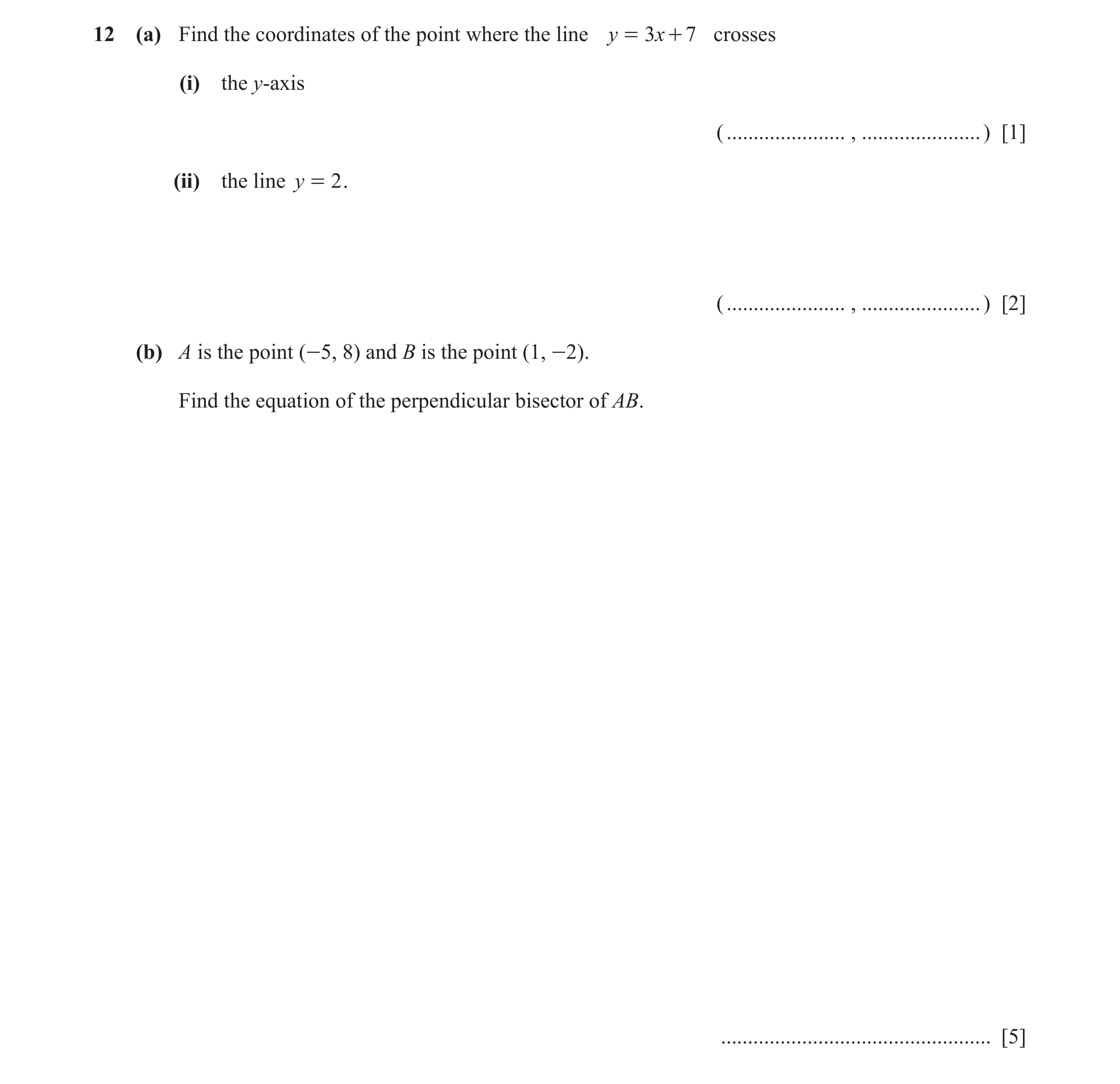
Q17 · Find the coordinates of the point where the line y = 3x + 7 crosses (i) the y-axis ( …… 0607/43 Oct/Nov 2023
12 (a) Find the coordinates of the point where the line y = 3x + 7 crosses (i) the y-axis ( … , … ) [1] (ii) the line y = 2 . ( … , … ) [2] (b) A is the point (-5, 8) and B is the point (1, -2). Find the equation of the perpendicular bisector of AB. … [5]
8 marks
Mark scheme: 12(a)(i) (0, 7) 1 12(a)(i) − 5,2 2 M1 for 2 – 7 = 3x 3 or −5 B1 for 3 12(b) 3 21 5 3 21 y = x + oe B4 for x + oe 5 5 5 5 OR B1 for midpoint = (–2, 3) 8 −−( 2) M1 for m AB = oe −−5 1 −1 M1 for m = their ( m AB ) M1 for substituting their (–2, 3) into y = (their m)x + c oe
This question in 0607/43 Oct/Nov 2023
Q18 · Y A NOT TO SCALE B O x A is the point (-4, 6) and B is the point (8, 2) 0607/42 Feb/March 2024
9 y A NOT TO SCALE B O x A is the point (-4, 6) and B is the point (8, 2). (a) Find the coordinates of the mid-point of AB. ( … , … ) [2] (b) Find the equation of AB. … [3] (c) Show that the equation of the perpendicular bisector of AB is y = 3x - 2 . [3] (d) The point C has coordinates (3, 7). Show that C lies on the perpendicular bisector of AB. [1] (e) Find the area of triangle ABC. … [4]
13 marks
Mark scheme: 9(a) (2, 4) 2 B1 for each coordinate 9(b) 1 2 3 2 − 6 y = − x + 4 oe cao M1 for 3 3 8 −−( 4) final answer M1 for substituting (2, 8) or (–4, 6) into 1 y = their − x + c oe 3 9(c) 1 M1 Gradient = for –1 ÷ their − oe 3 substituting their (2, 4) into M1 y = their 3 x + c oe Completion to y = 3x – 2 with no errors A1 Dep on M1, M1 or omissions 9(d) 3 × 3 – 2 = 7 1 9(e) 20 4 2 2 M1 for [AB =] ( 8 + 4 ) + ( 2 − 6 ) M1 for [h =] ( 7 − their 4 ) 2 + ( 3 − their 2 ) 2 1 M1 for their 160 their 10 2
This question in 0607/42 Feb/March 2024
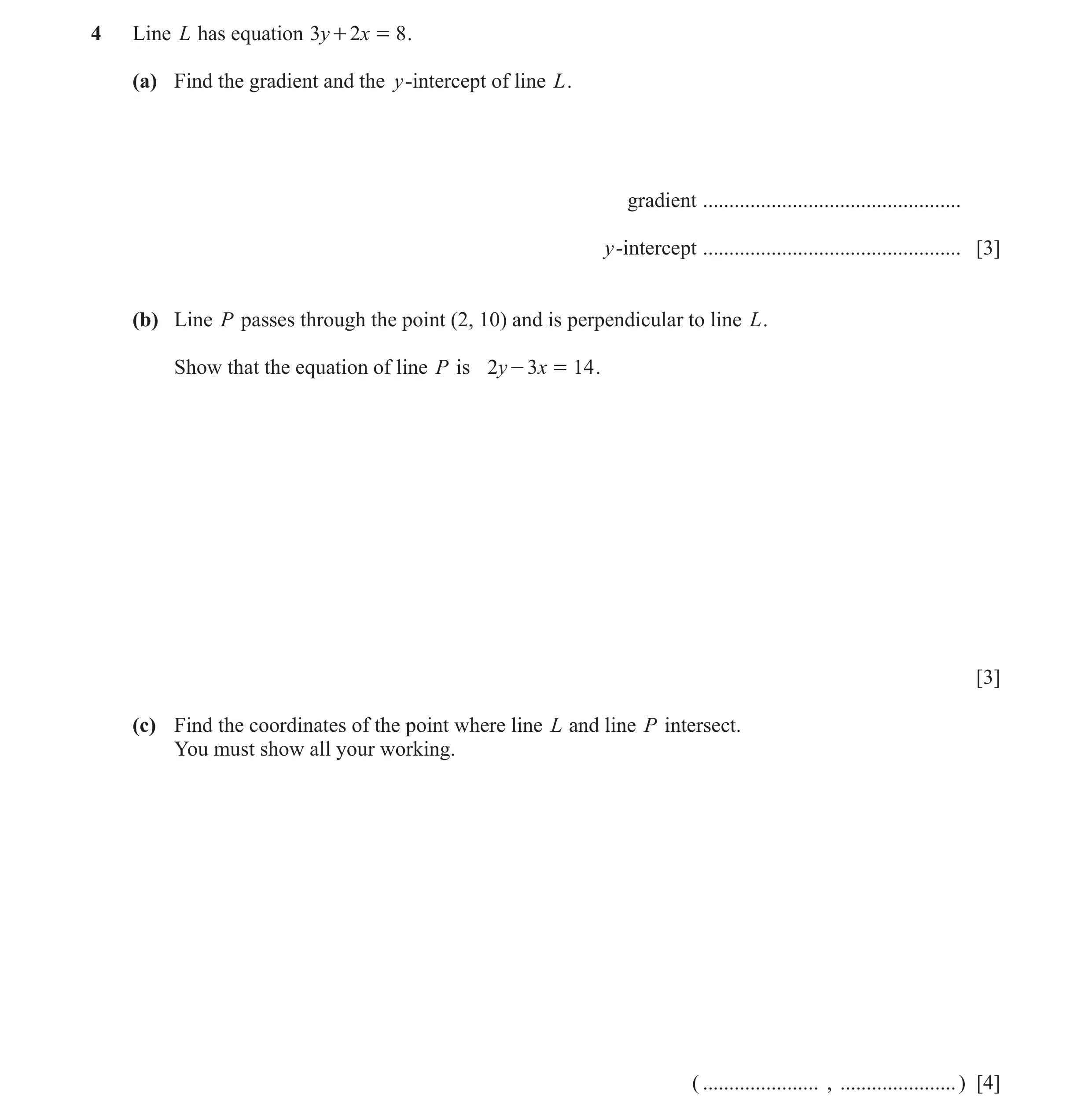
Q19 · Line L has equation 3y + 2x = 8 0607/43 May/June 2024
4 Line L has equation 3y + 2x = 8 . (a) Find the gradient and the y-intercept of line L. gradient … y-intercept … [3] (b) Line P passes through the point (2, 10) and is perpendicular to line L. Show that the equation of line P is 2y - 3x = 14 . [3] (c) Find the coordinates of the point where line L and line P intersect. You must show all your working. ( … , … ) [4]
10 marks
Mark scheme: 4(a) 2 3 B2 for one correct oe or M1 for correctly isolating y oe 3 8 2 or 2 oe 3 3 4(b) 3 M1 2 gradient = FT 1 ÷ their 2 3 substituting (2, 10) into M1 2 FT their m ≠ y = their m + c 3 completing to 2y – 3x = 14 with at A1 least one line of working and no errors 4(c) Correctly equating coefficients M1 or sketch of one equation with positive slope and positive y-intercept Correct method to eliminate one M1 variable or sketch of other equation with negative slope and positive y-intercept x = –2 in correct answer space A1 y = 4 in correct answer space A1 If 0 scored, SC1 for correct answer with no working
This question in 0607/43 May/June 2024
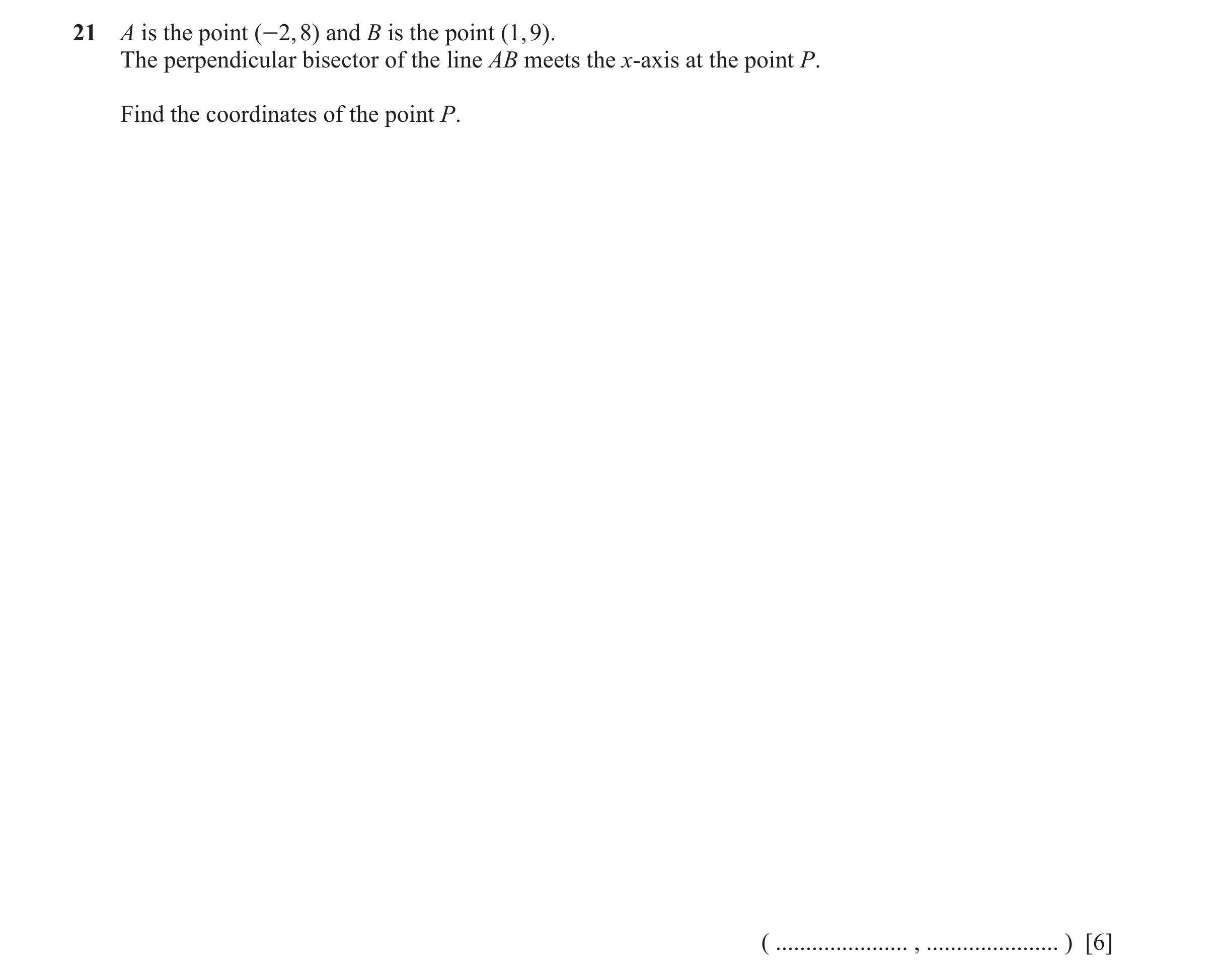
Q20 · A is the point (-2, 8) and B is the point (1, 9) 0607/43 May/June 2025
21 A is the point (-2, 8) and B is the point (1, 9). The perpendicular bisector of the line AB meets the x-axis at the point P. Find the coordinates of the point P. ( … , … ) [6]
6 marks
Mark scheme: 21 1 6 B5 for −3x + 7 = 0 2 oe , 0 or −8.5 = −3 ( x + 0.5 ) oe 3 OR B1 for (–0.5, 8.5) seen 9 − 8 M1 for gradient of AB = = m1 1 −−2 1 M1 for gradient of perp = −their m1 (m2) M1 for substituting their midpoint into y = their m2 x + c M1 dep for their ( −3 x + 7 ) = 0 dep on third M1 If 0 scored, SC1 for answer (k, 0)
This question in 0607/43 May/June 2025
 3 / 27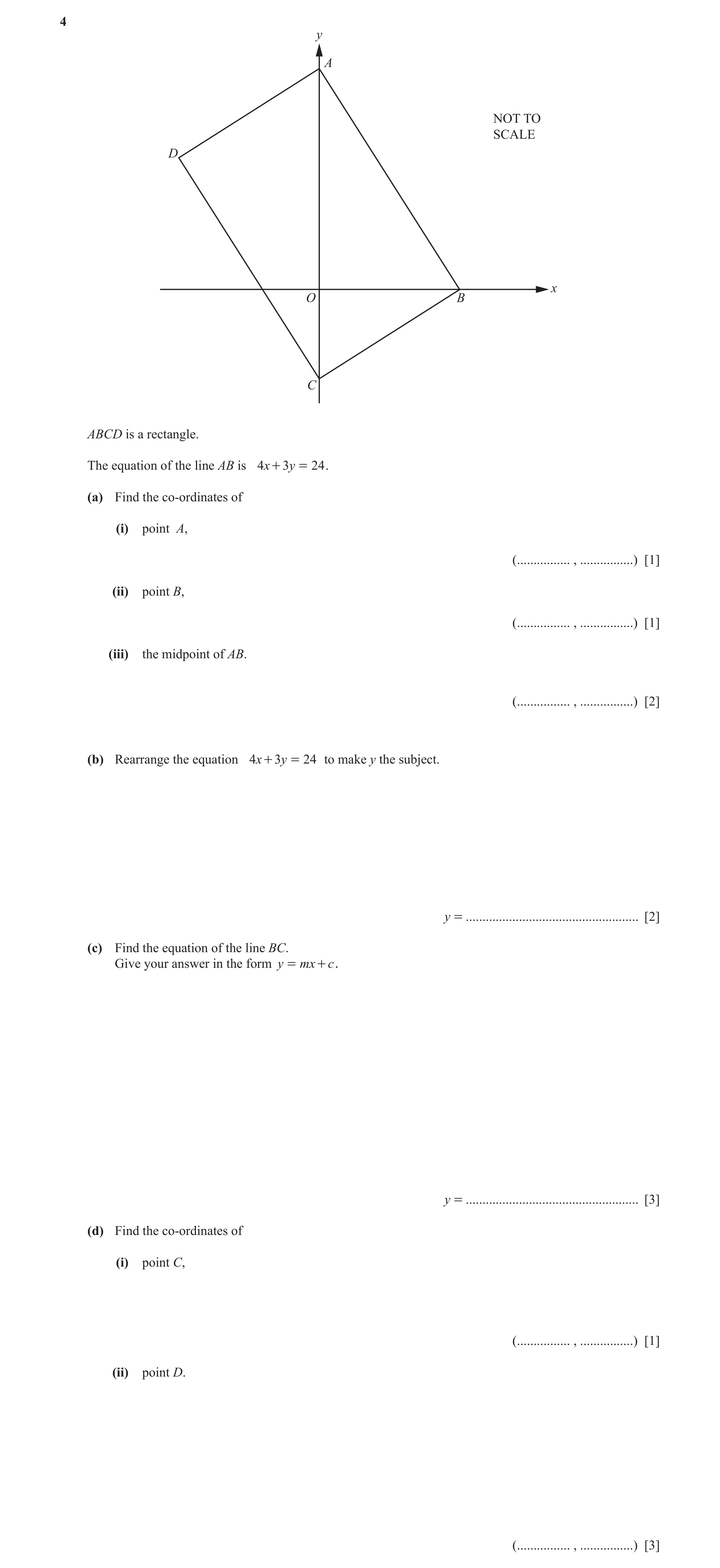
![Question 4: A is the point (1, 9) and B is the point (7, 1). (a) Find the length of AB. .................................................... [3] (b) Fi…](https://img.pastlit.com/crops/f087cf99-e494-4936-a76c-139454080cf6/q14.webp) 6 / 27
6 / 27![Question 5: The points A (1, 2) and B (7, 5) are shown on the diagram below. y 12 NOT TO SCALE B A 0 16 x (a) Write AB as a column vector. [1] f p (b) …](https://img.pastlit.com/crops/802bc314-abf0-45ac-8900-48a1c2fc1e2f/q10.webp)
 9 / 27
![Question 7: p = q = 3 - 1 A is the point (3, 4). (a) Find p - q . [1] f p (b) A is translated onto H by the vector p. Find the coordinates of H. ( ....…](https://img.pastlit.com/crops/c1682ce7-7004-48f5-a553-e846709c547a/q9.webp) 10 / 27
10 / 27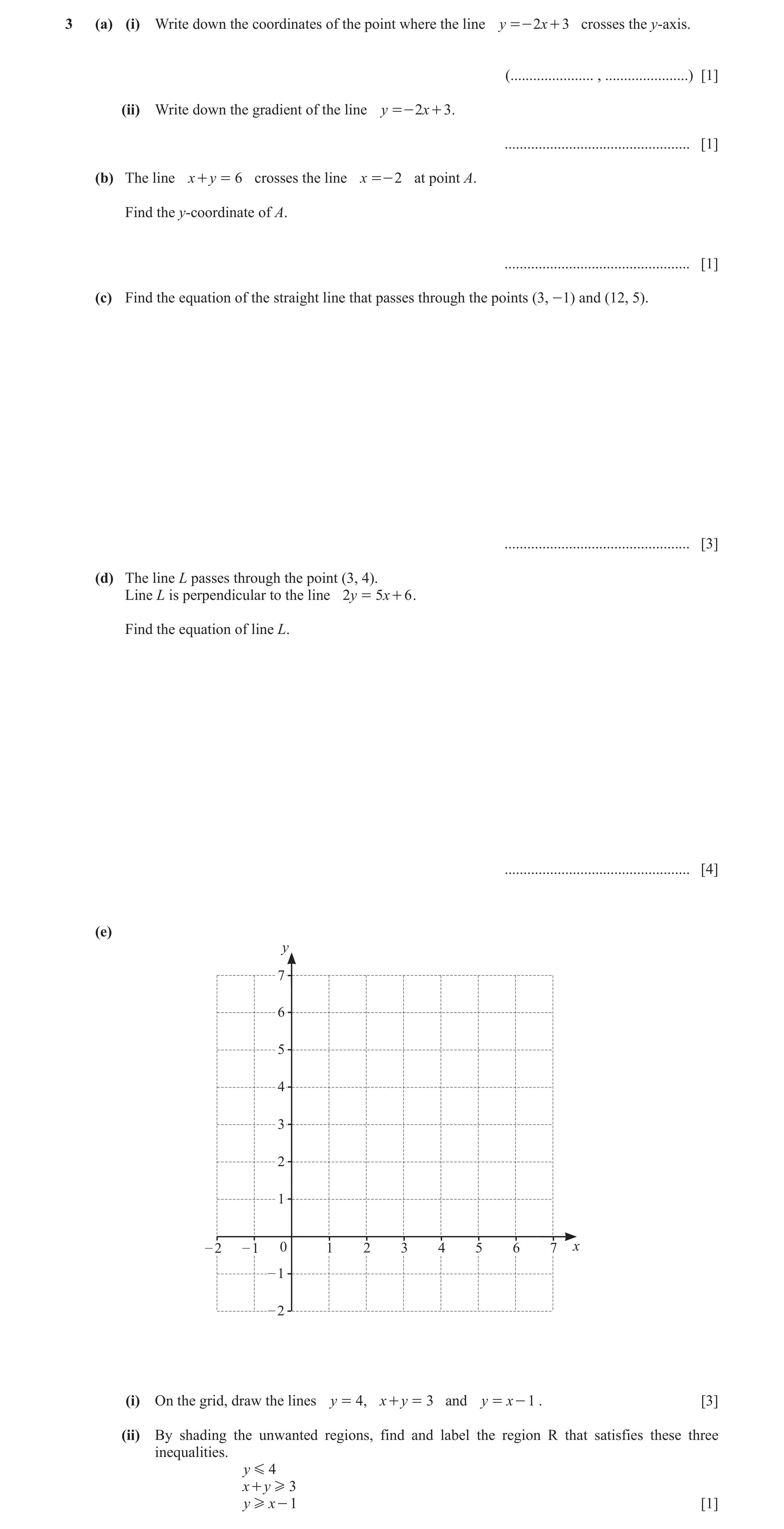
![Question 12: (a) A is the point ( - 11, 7) and B is the point ( 8 , - 13) . Find the length of AB. ................................................. [3]…](https://img.pastlit.com/crops/96b06246-de38-4446-9003-fdaf39ad4eaa/q8.webp) 17 / 27
17 / 27![Question 13: A is the point ( - 2 , - 3) and B is the point (4, 9). (a) Find the length of AB. ................................................. [3] (b)…](https://img.pastlit.com/crops/b12f2f85-7b1b-4ede-ac89-d2fc695d452b/q4.webp) 18 / 27
18 / 27![Question 14: (a) p = r = 4 7 (i) Find 2p. [1] f p 1 (ii) Find p - r . 4 [2] f p (iii) Find the magnitude of p. .........................................…](https://img.pastlit.com/crops/b1c6253c-bcbe-4c33-9614-2f00e9d25aa9/q6.webp)
![Question 15: (a) The equation of line L is y = 4x + 7 . (i) Write down the gradient of line L. ................................................. [1] (ii…](https://img.pastlit.com/crops/9de25c6e-d93d-4815-8c28-1cb03f0bc1ea/q5.webp) 21 / 27
21 / 27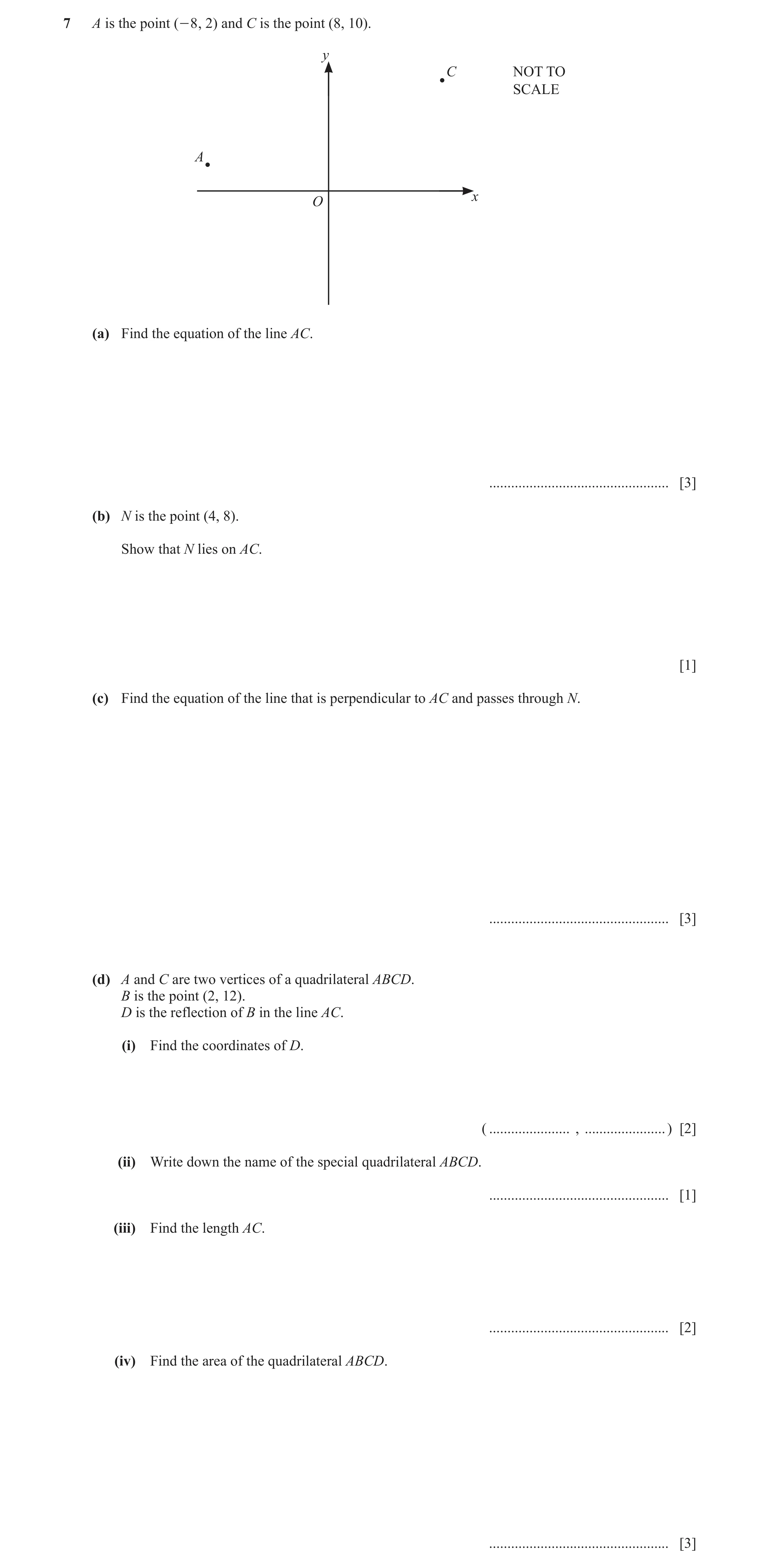
 24 / 27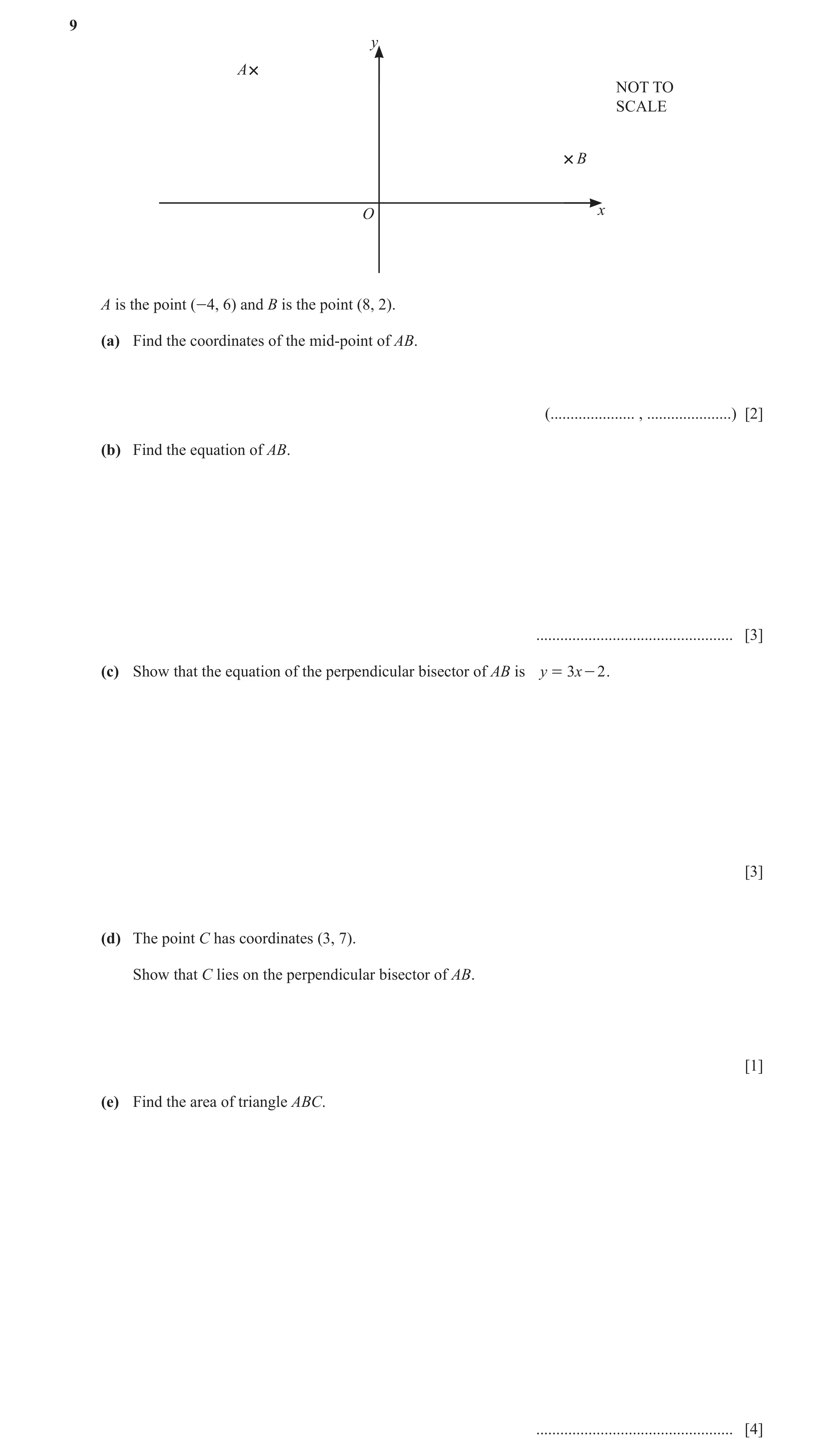
 26 / 27
 27 / 27
 13
13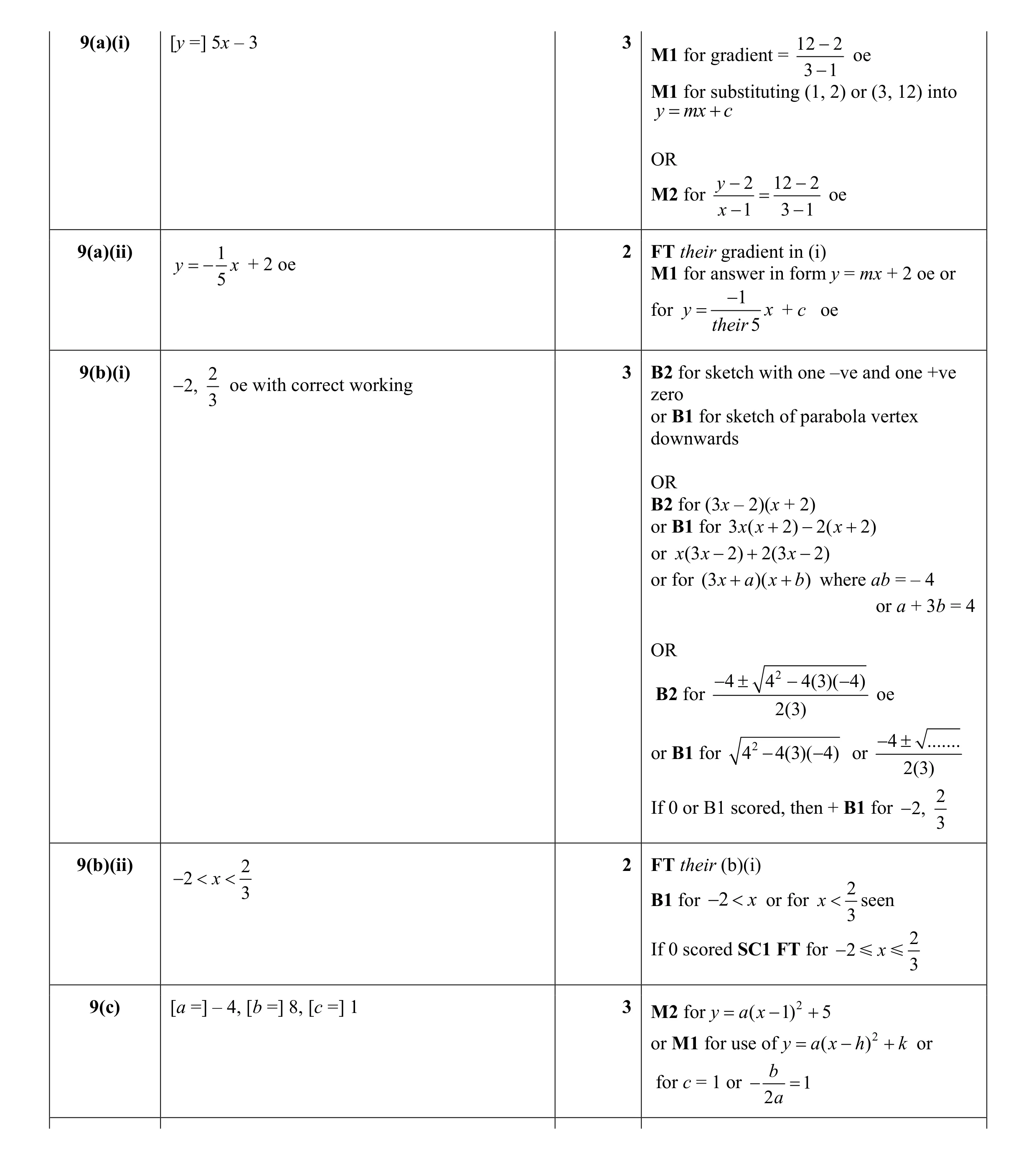 13
13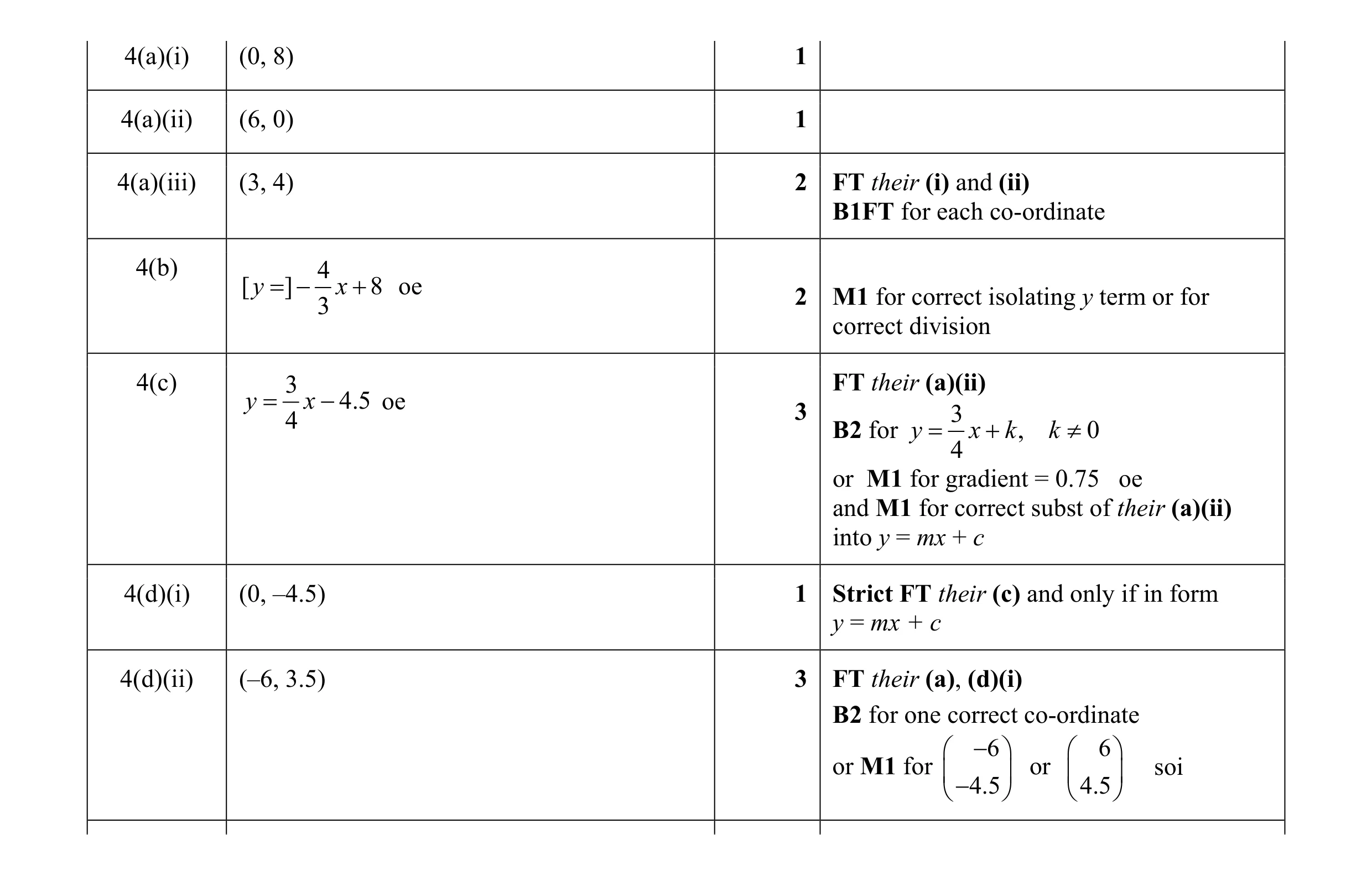 13
13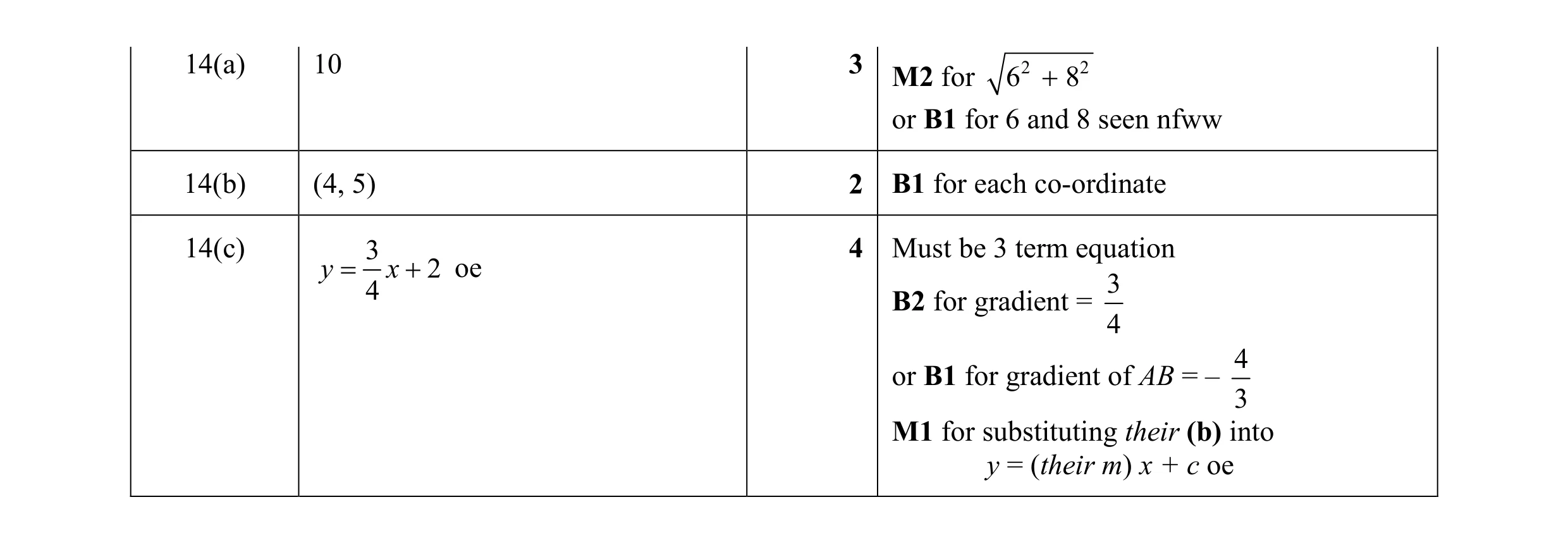 9
9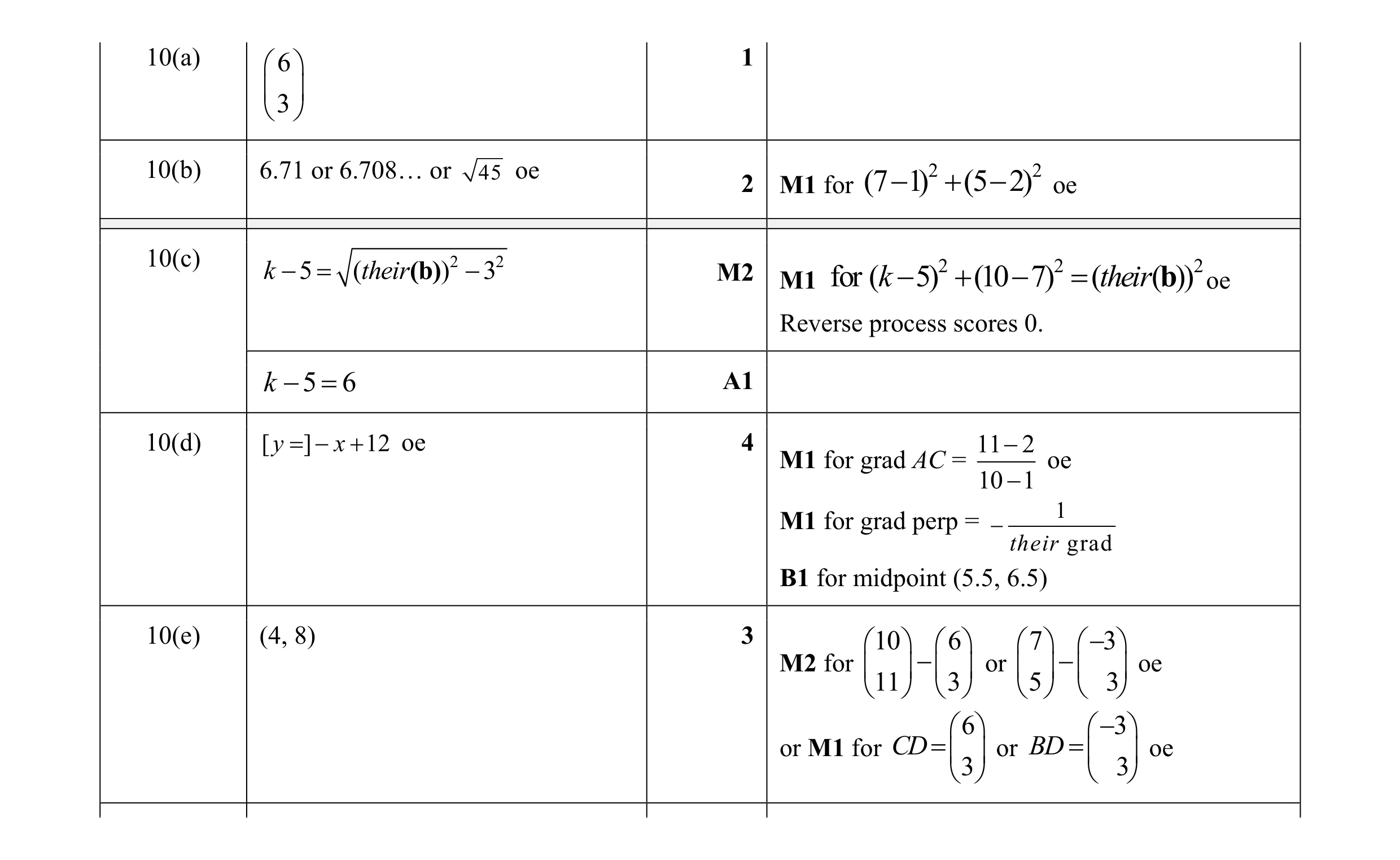 13
13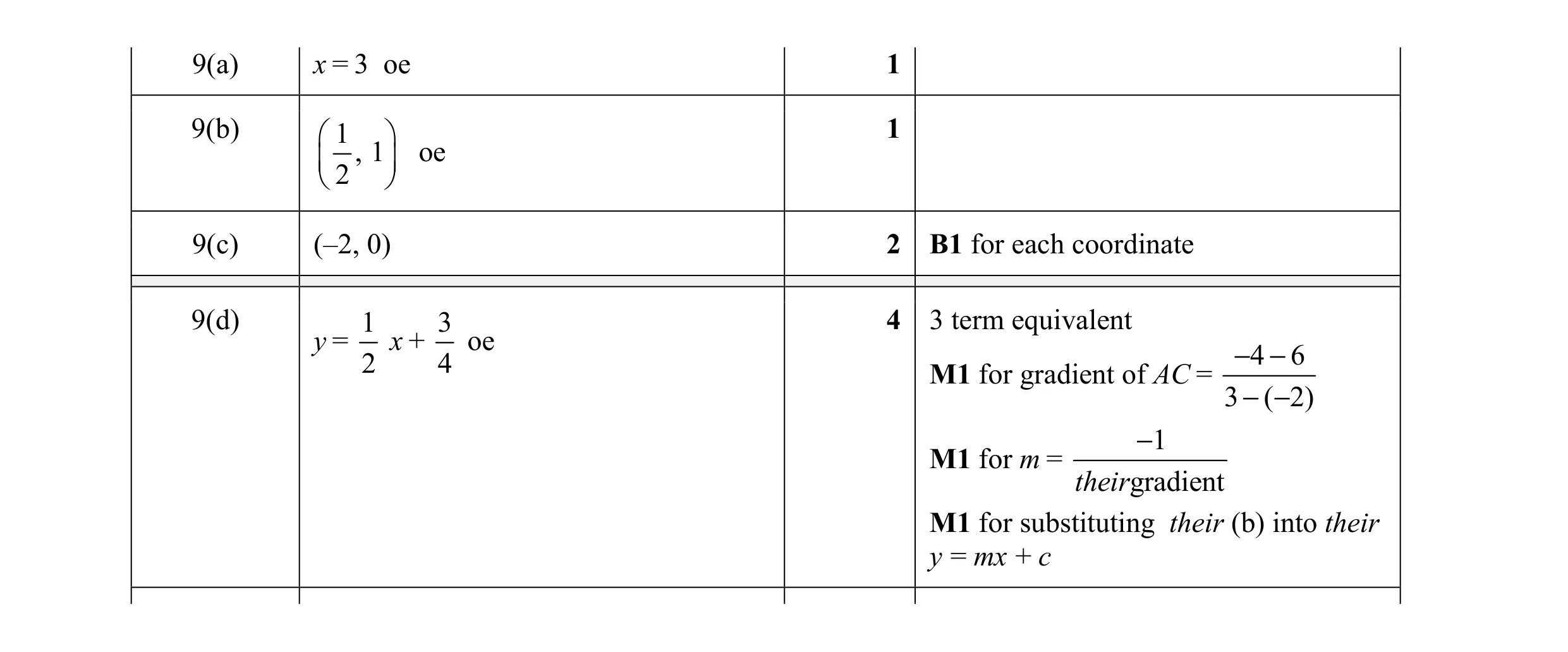 8
8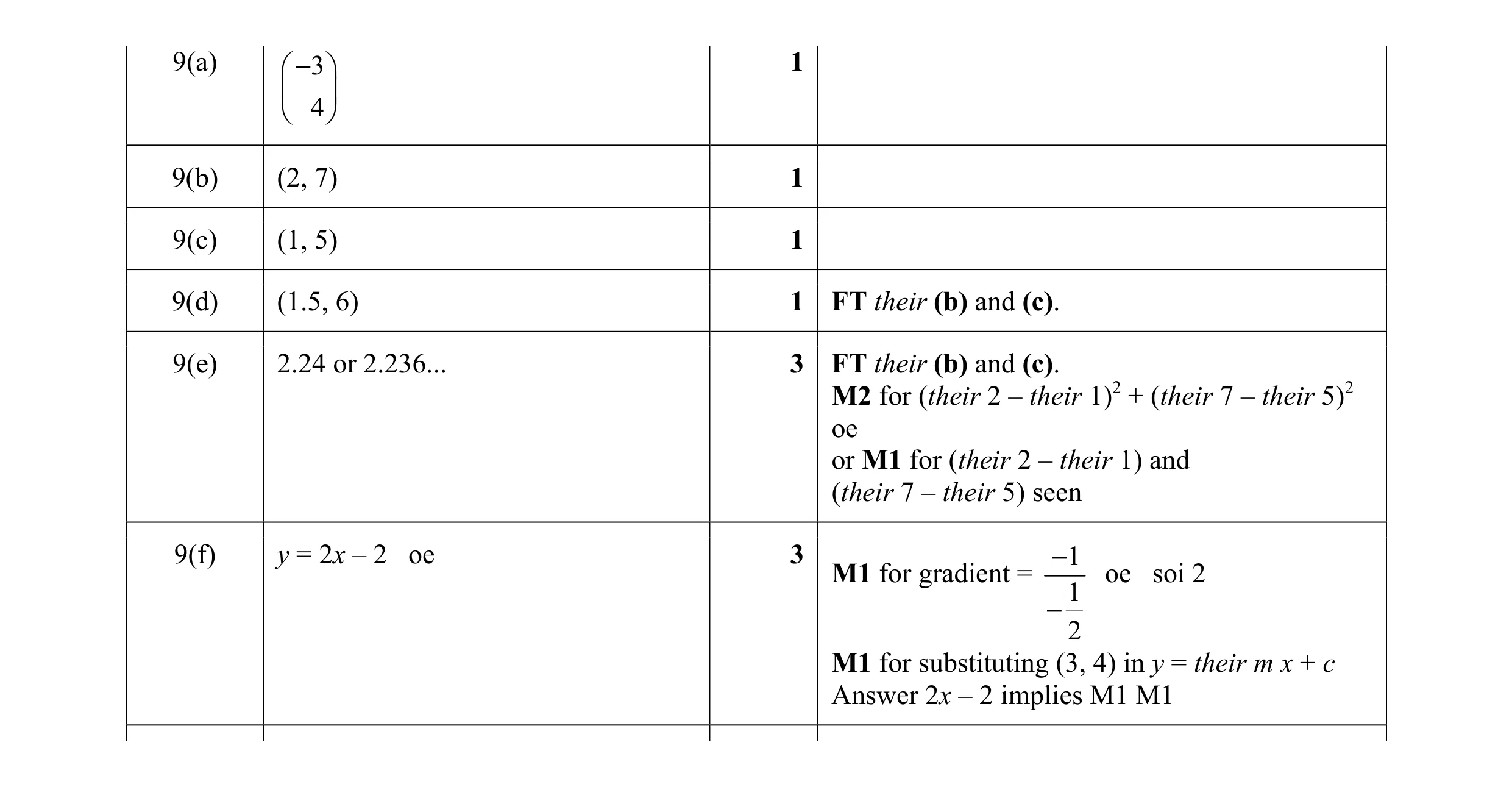 10
10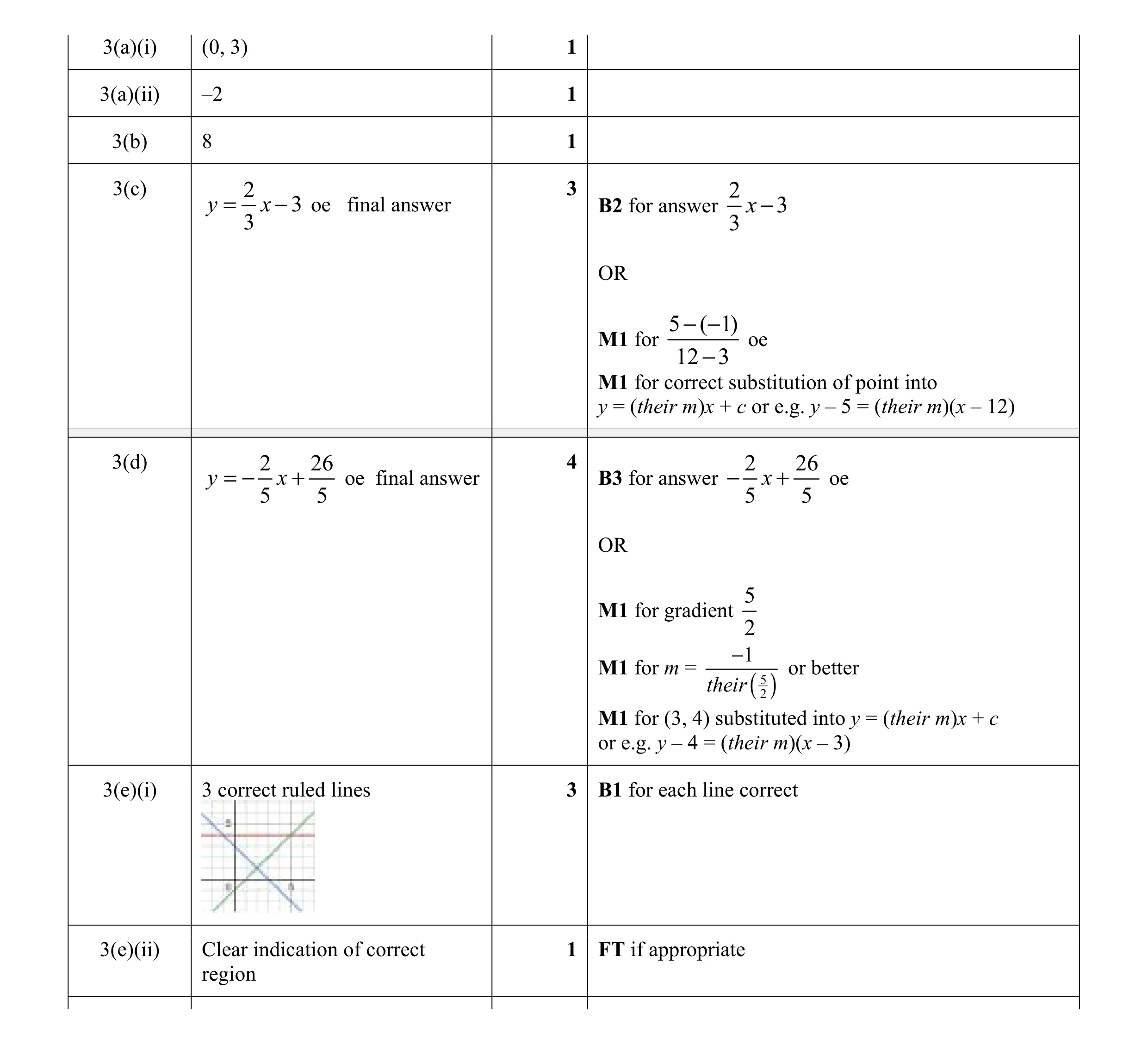 14
14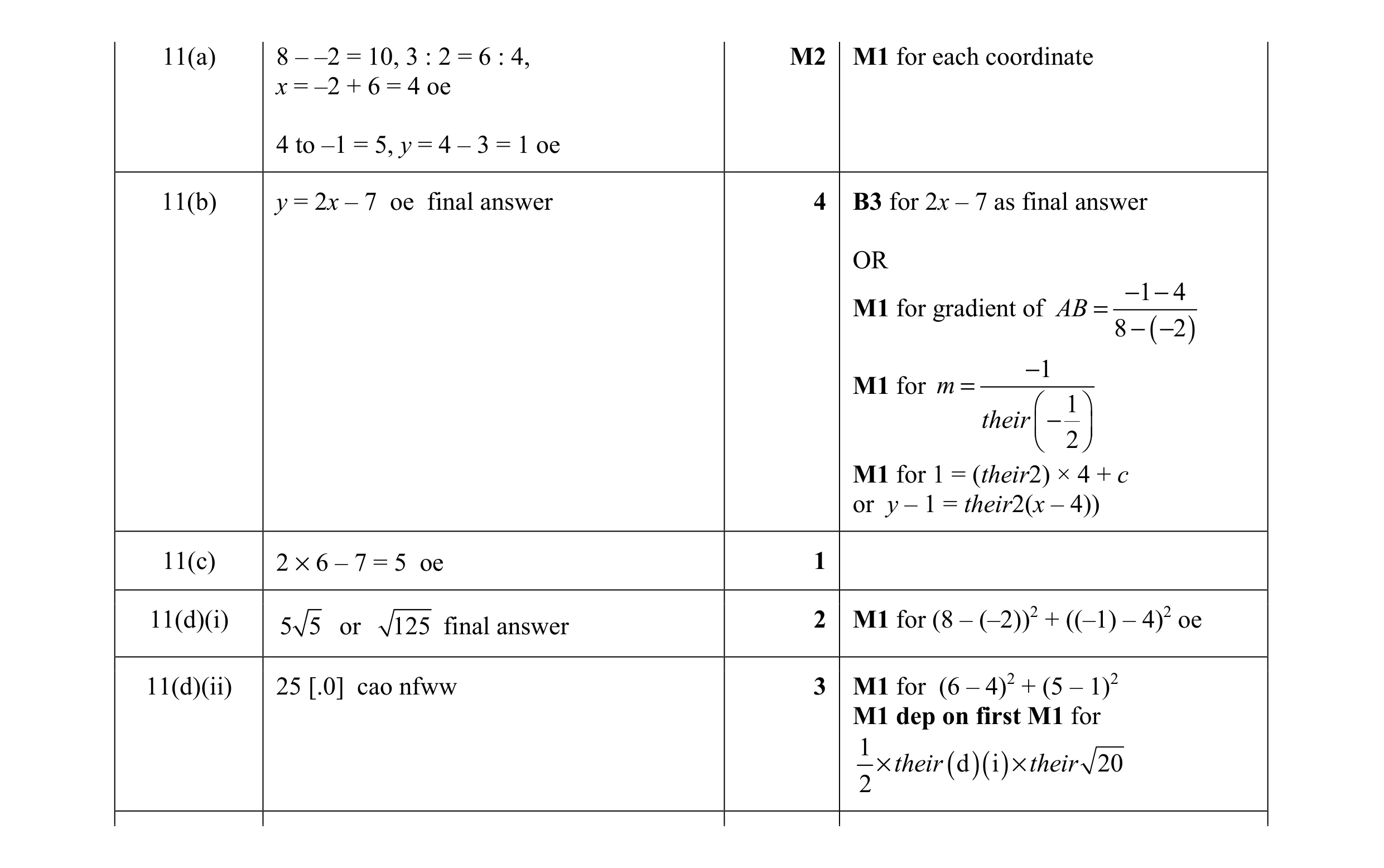 12
12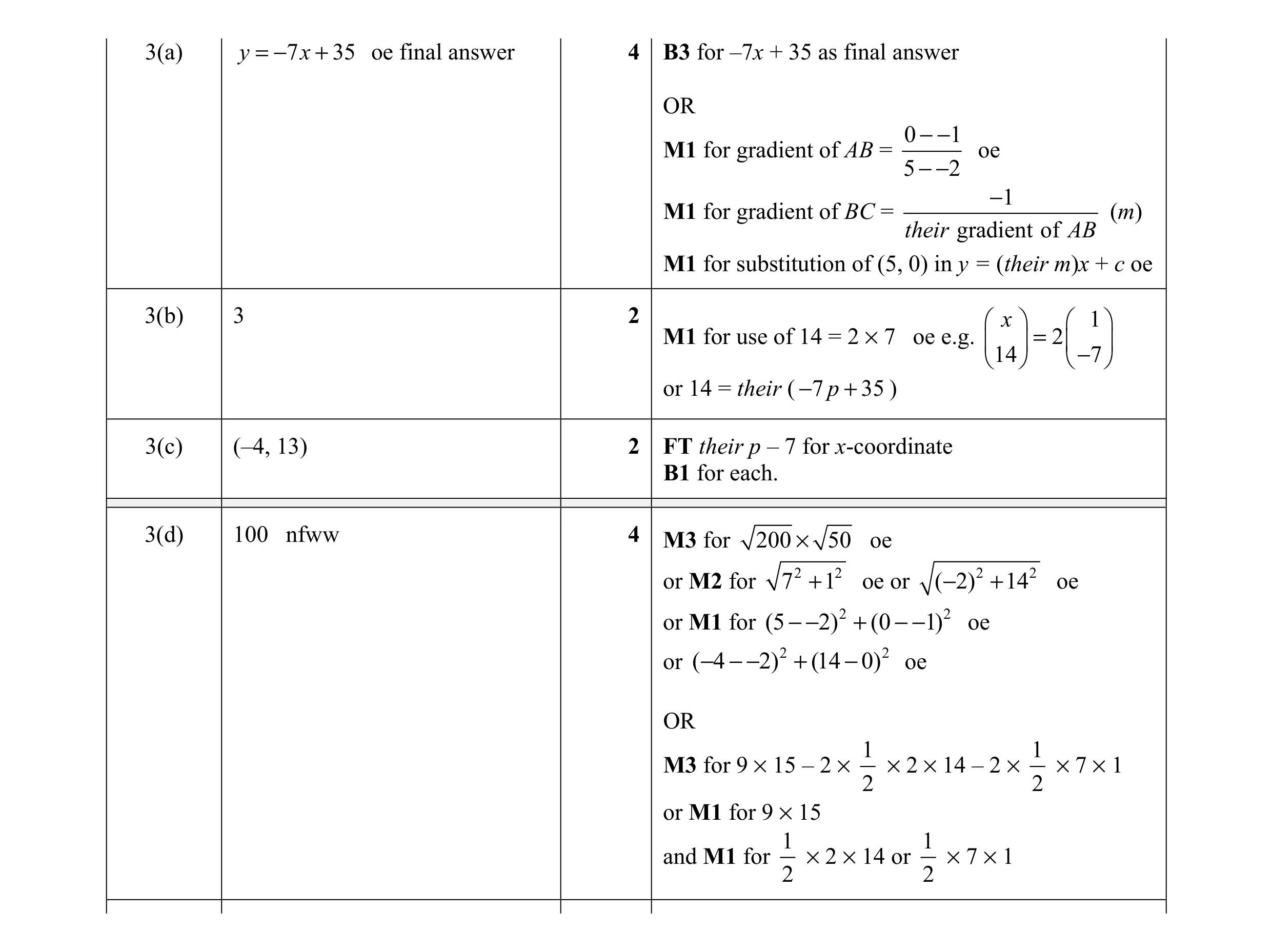 12
12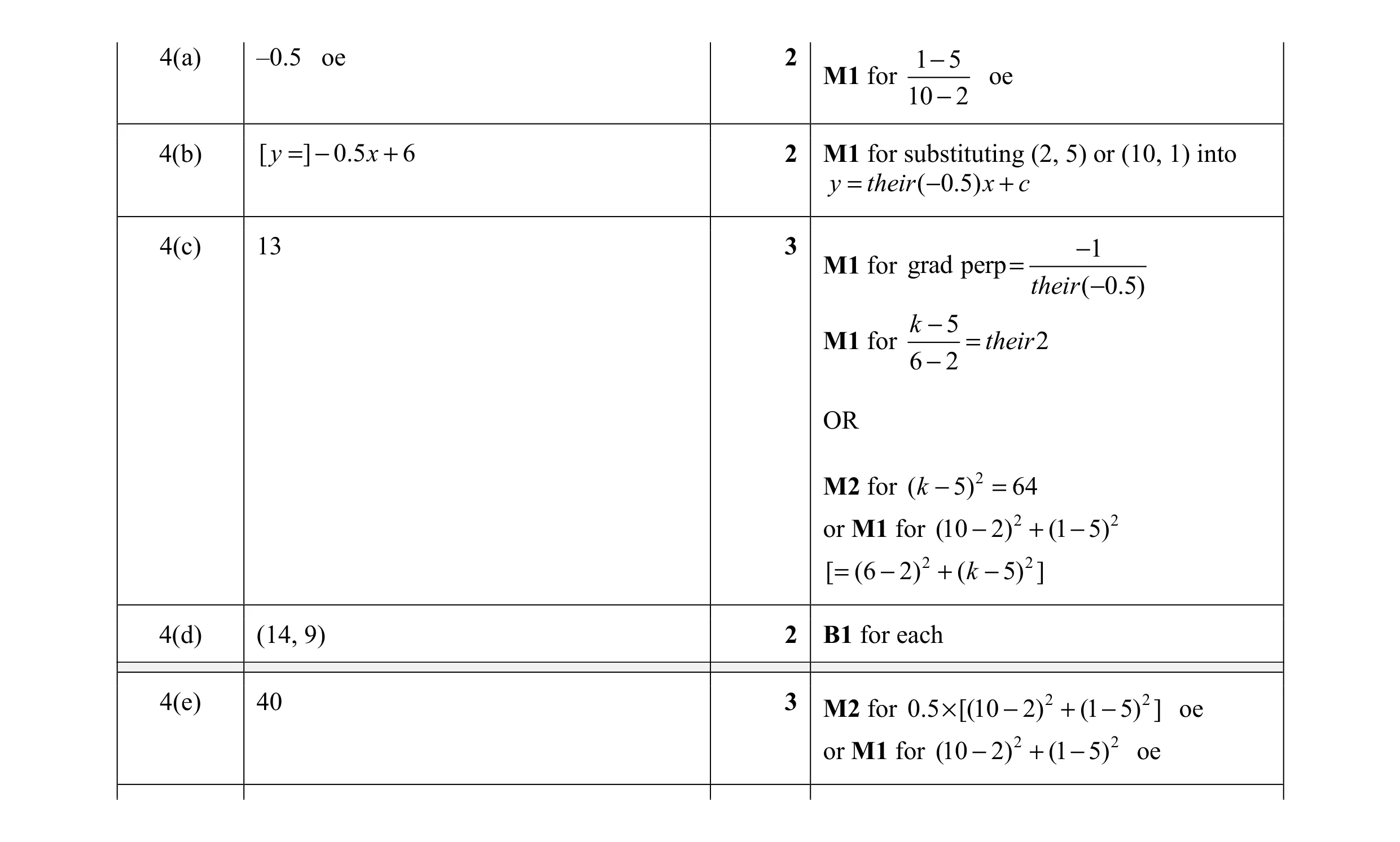 12
12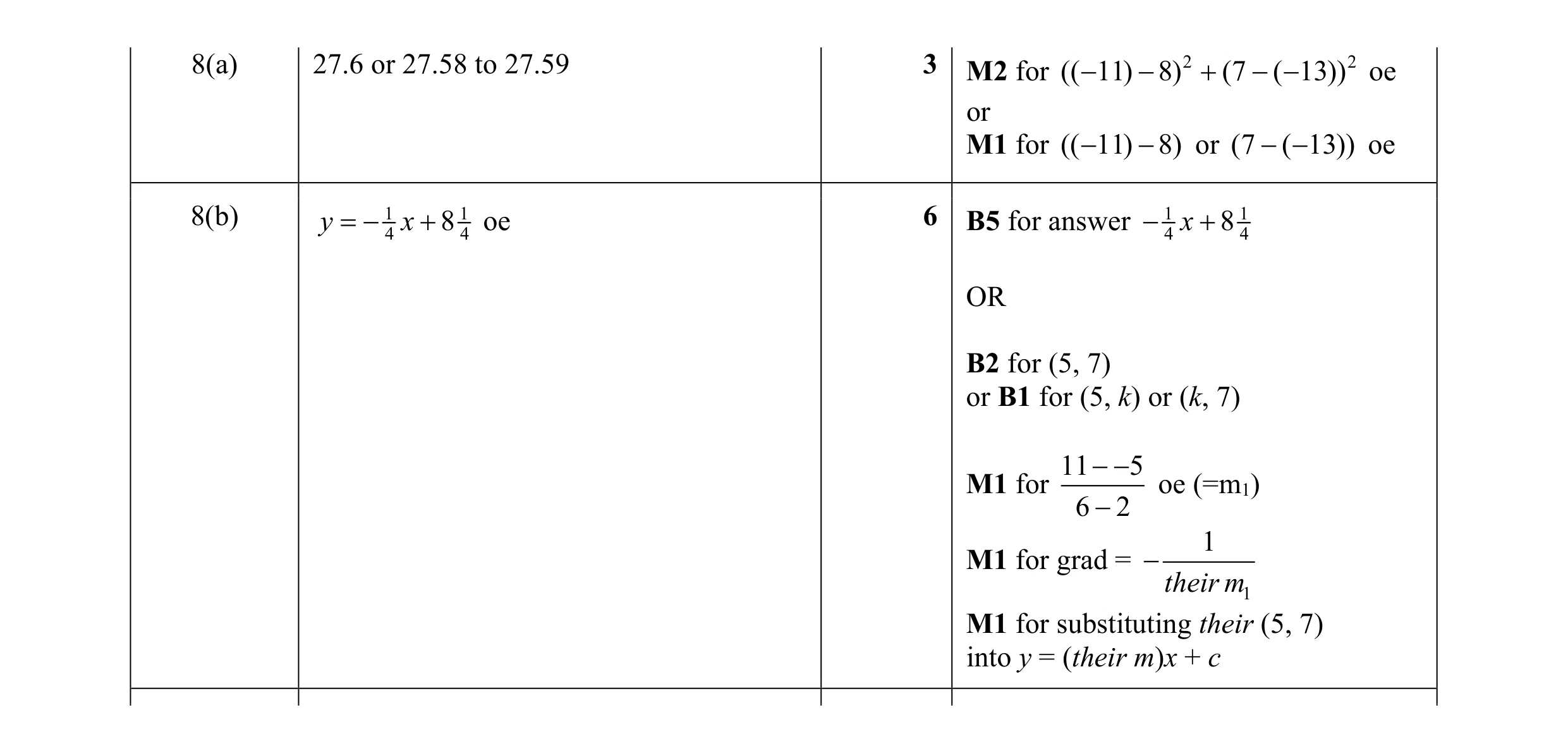 9
9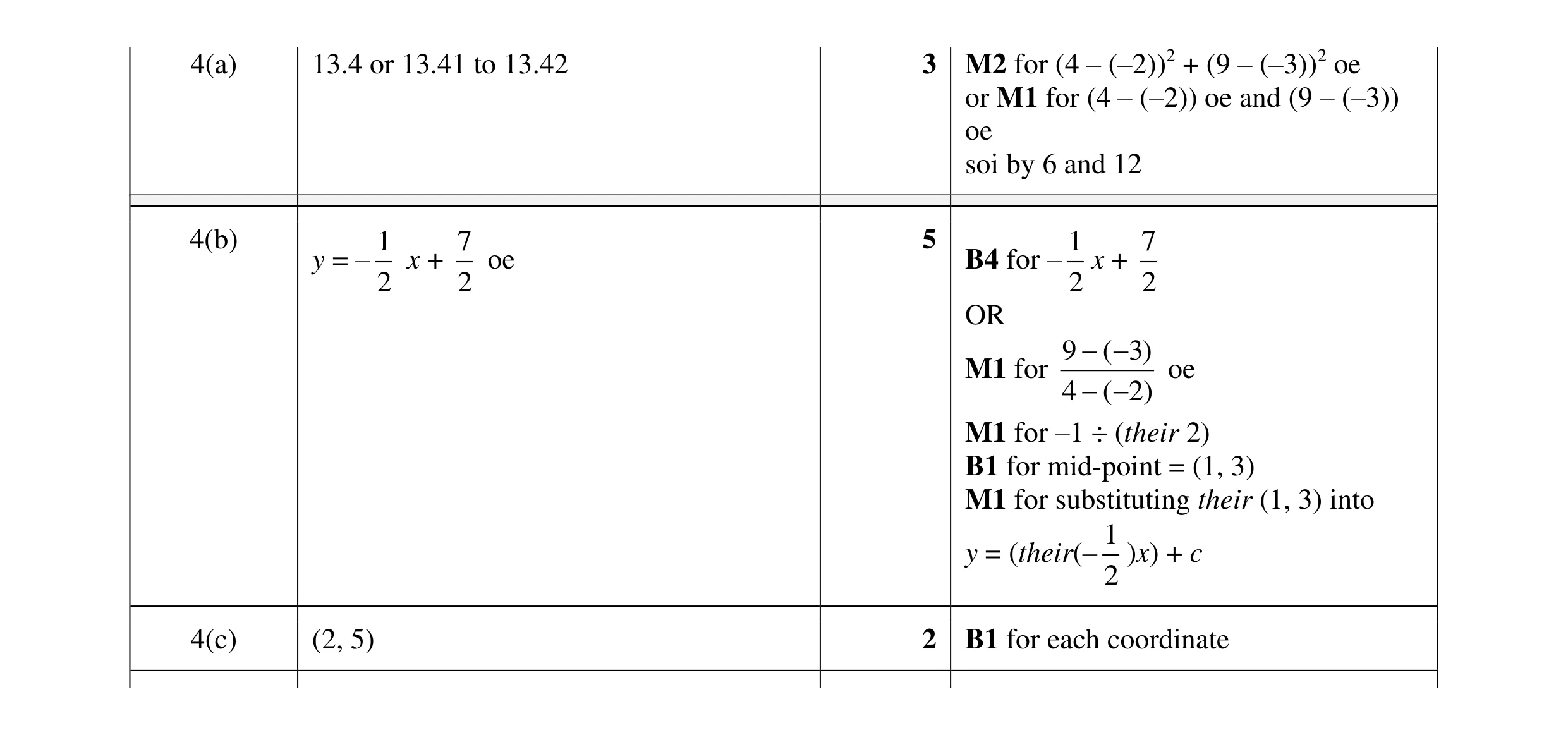 10
10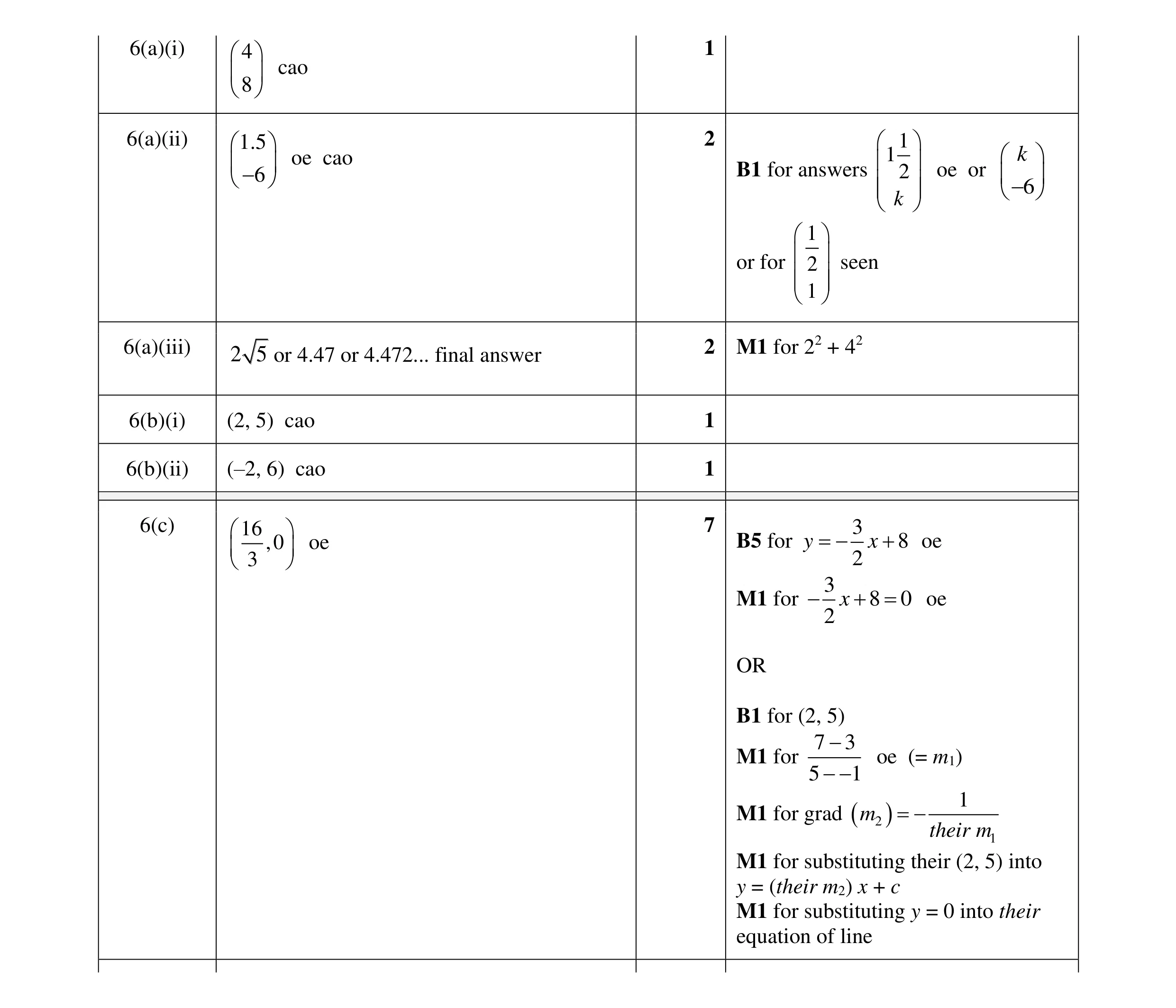 14
14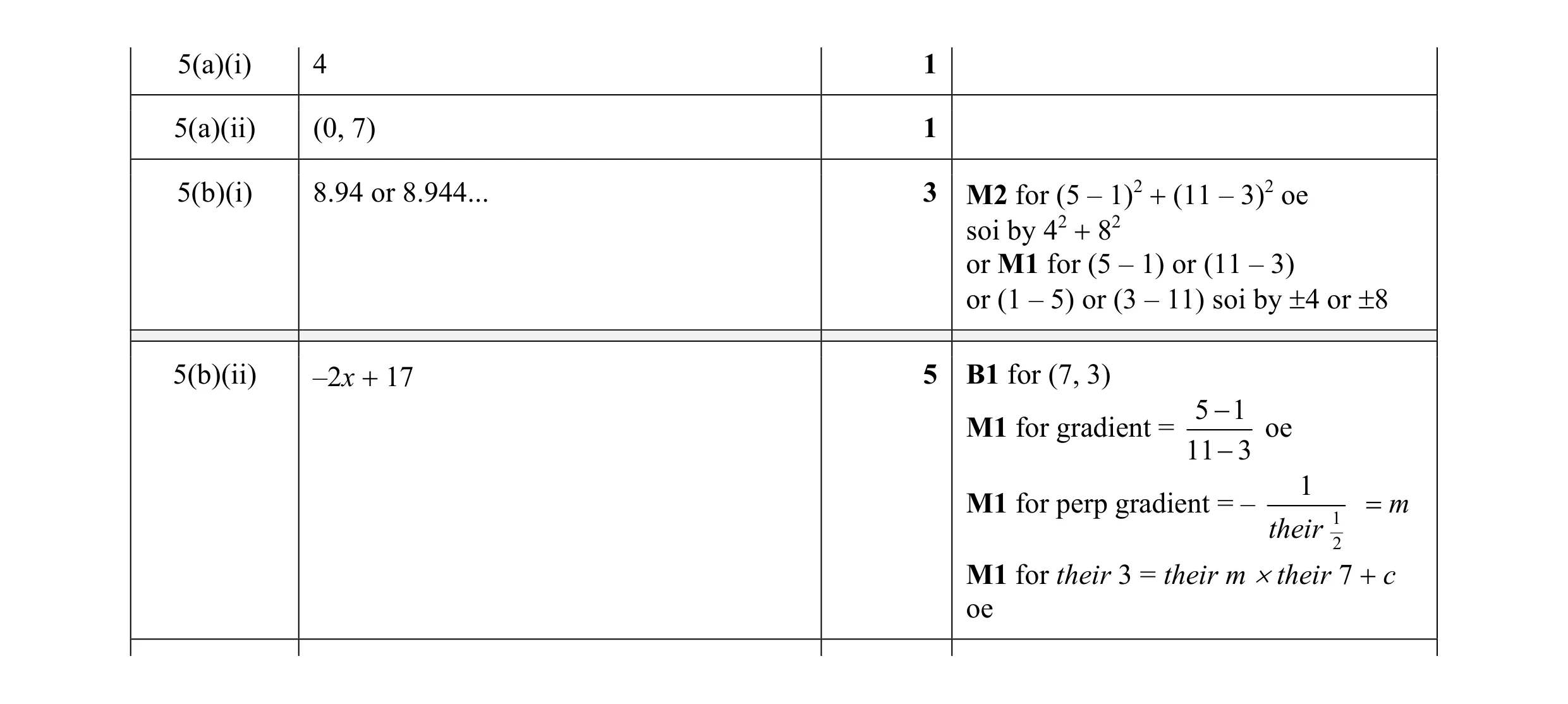 10
10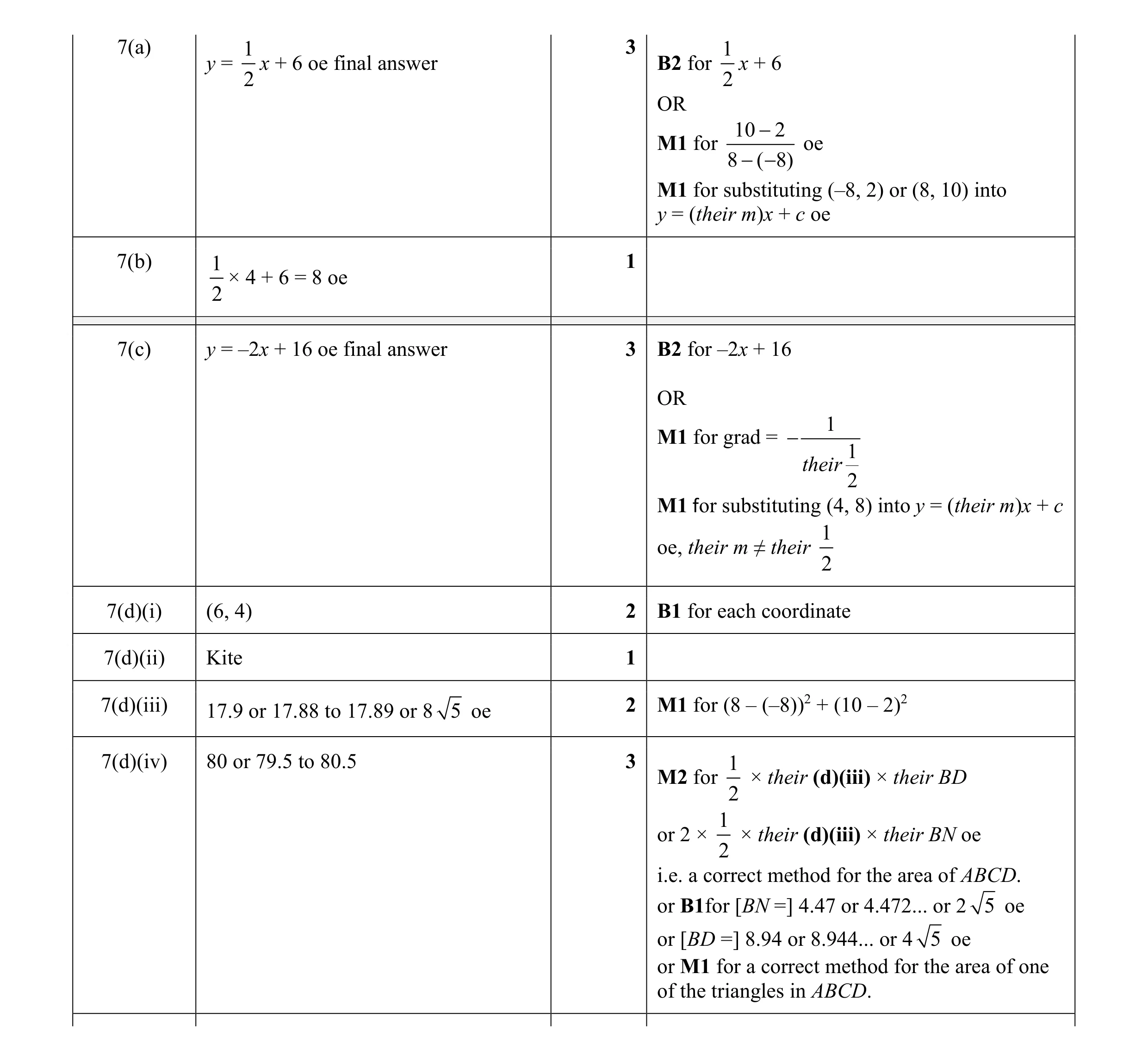 15
15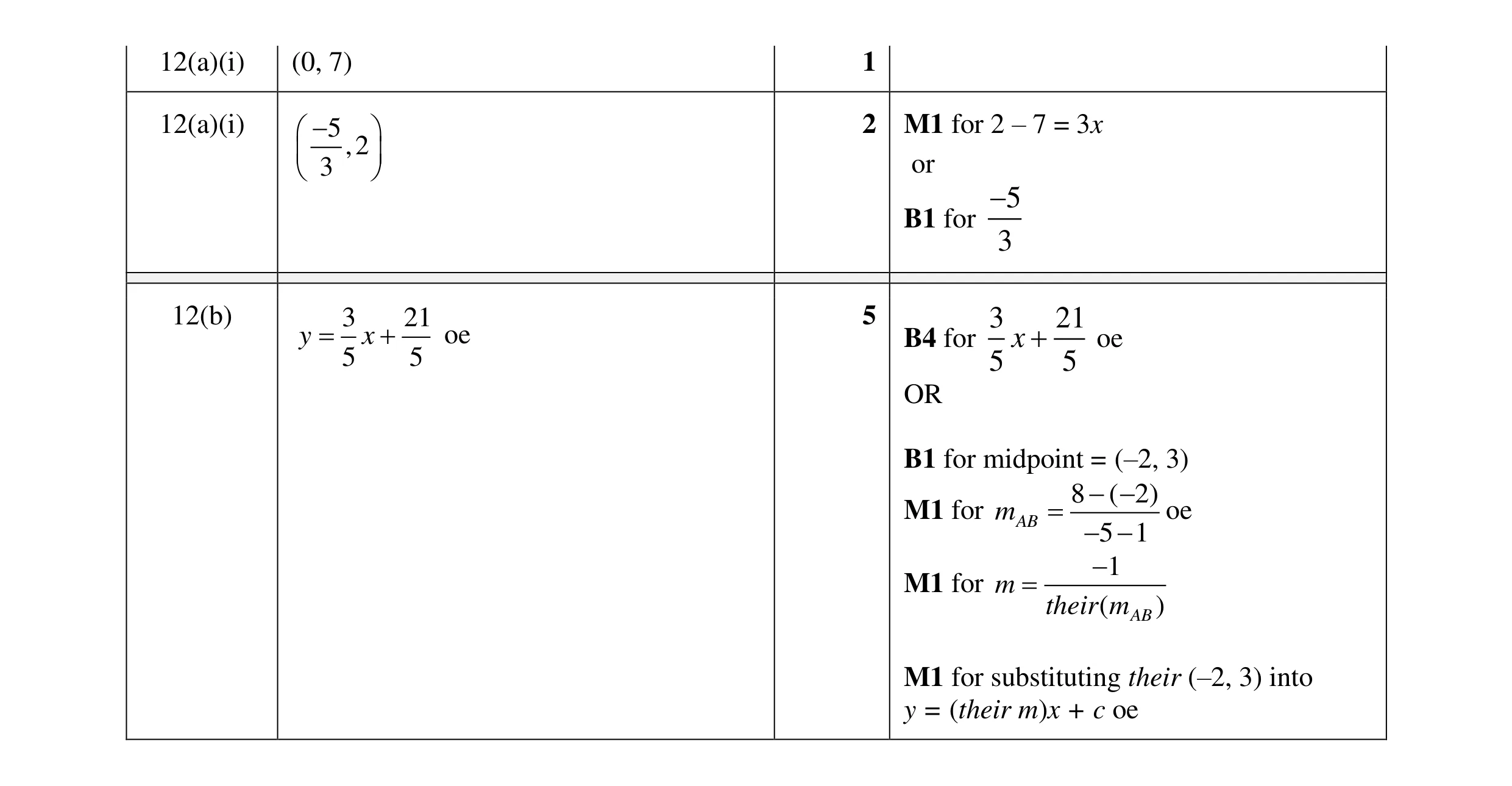 8
8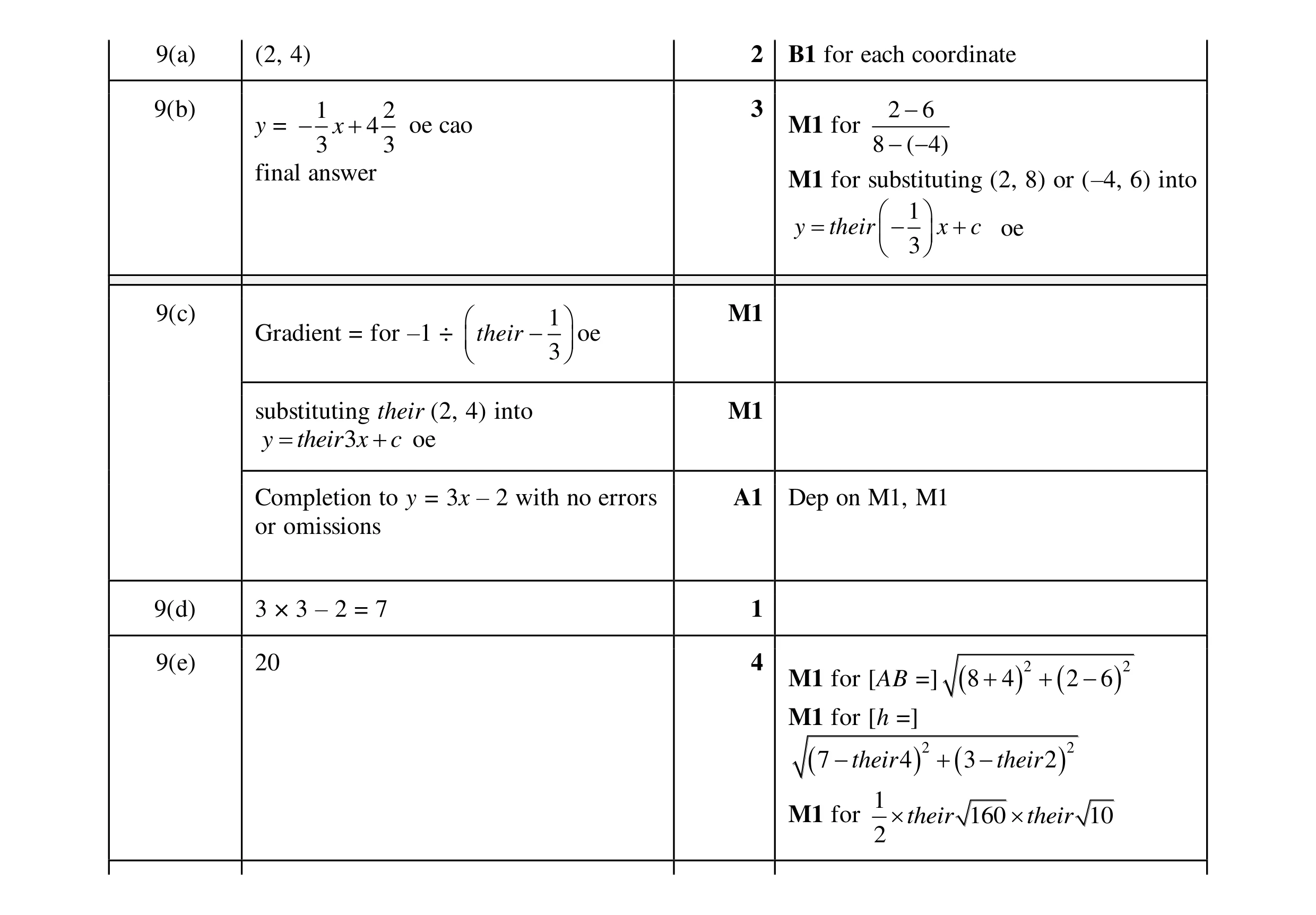 13
13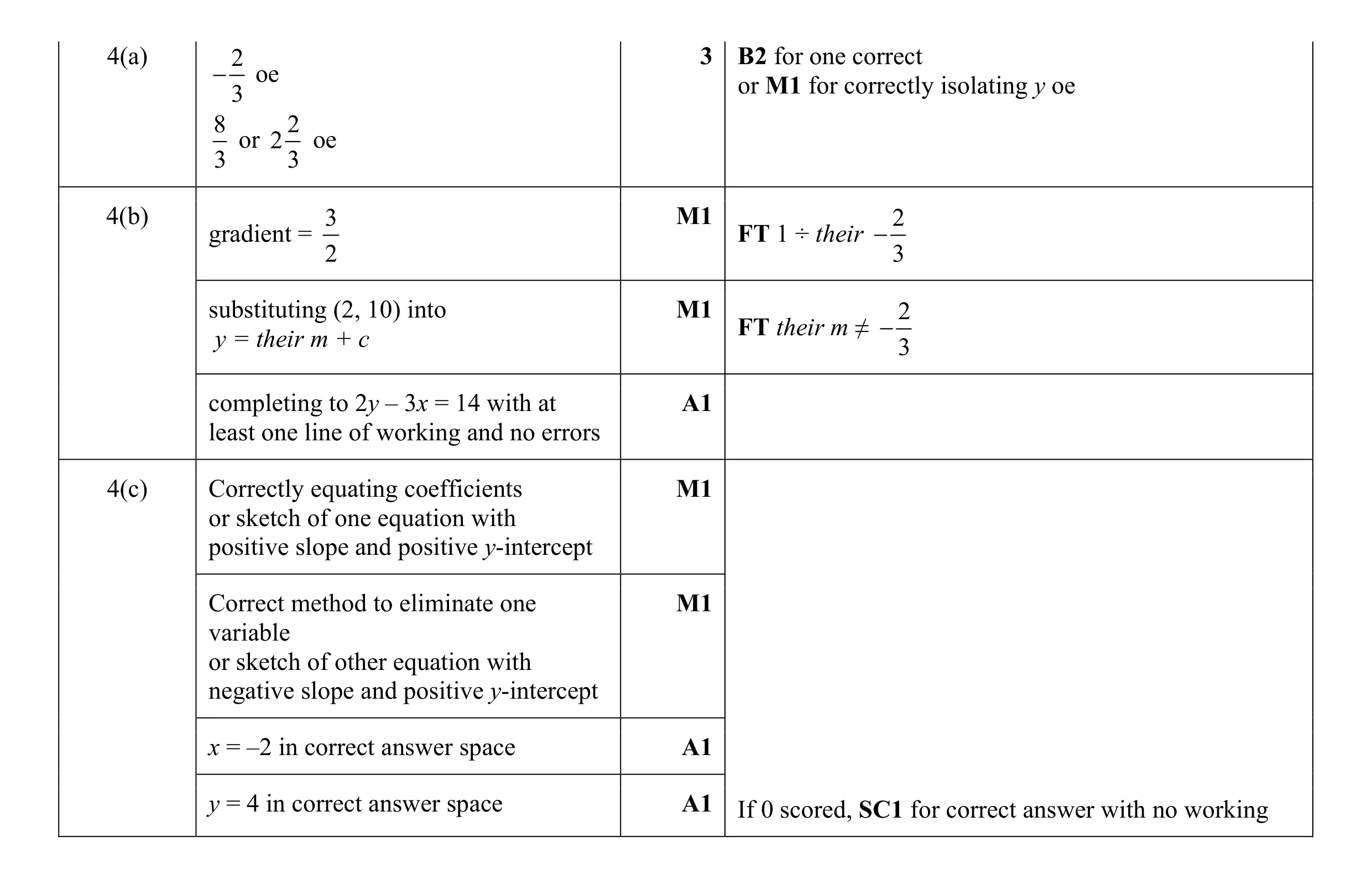 10
10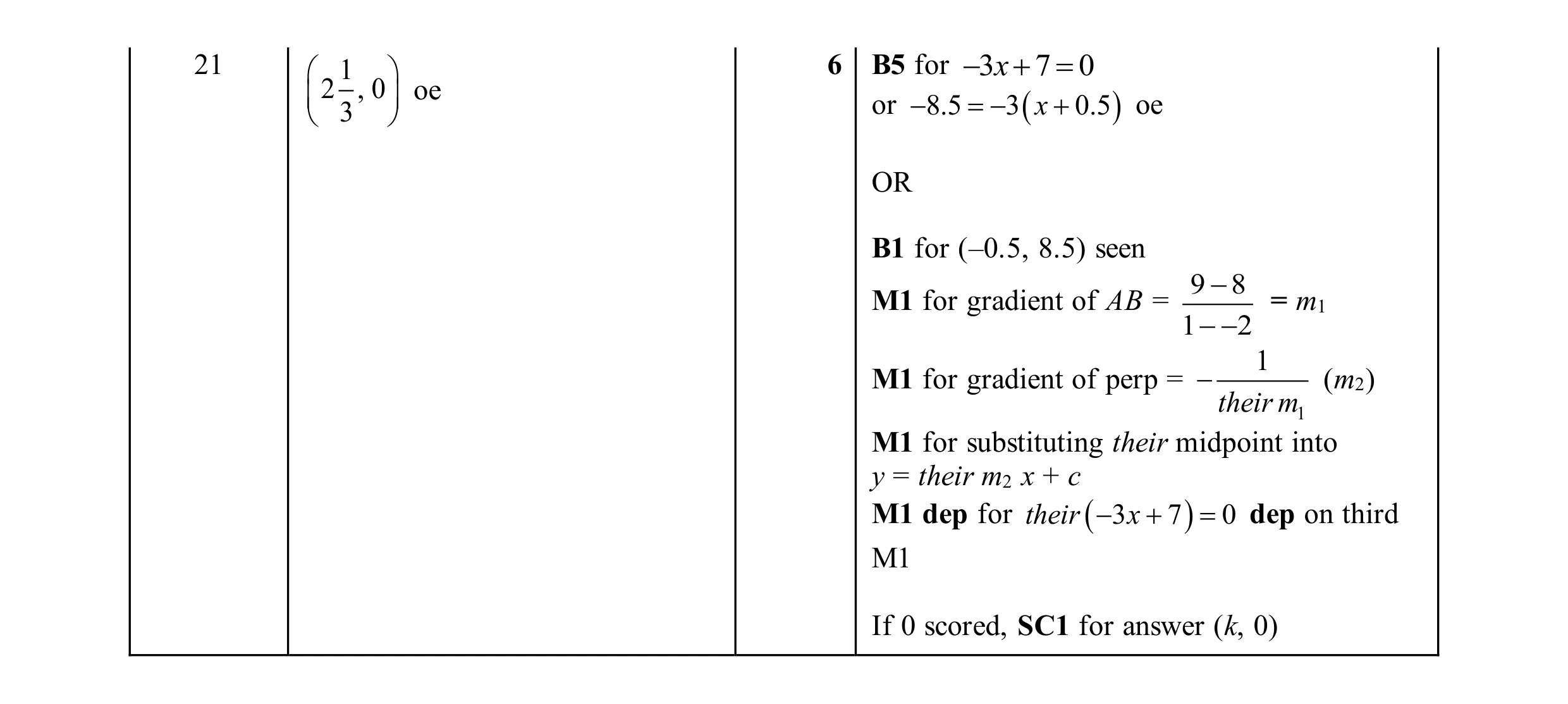 6
6