Cambridge IGCSE Mathematics - International 0607 — 2021 Oct/Nov Paper 4 · Variant 3
0607/43/O/N/21 · 13 questions · 120 marks · ≈135 min
The question paper and its mark scheme, free to read here and free to download. This is Cambridge’s own paper, exactly as it was sat.
Question paper20 pages
Mark scheme9 pages
Answers below. Sit the paper first if you are practising.
Questions as text
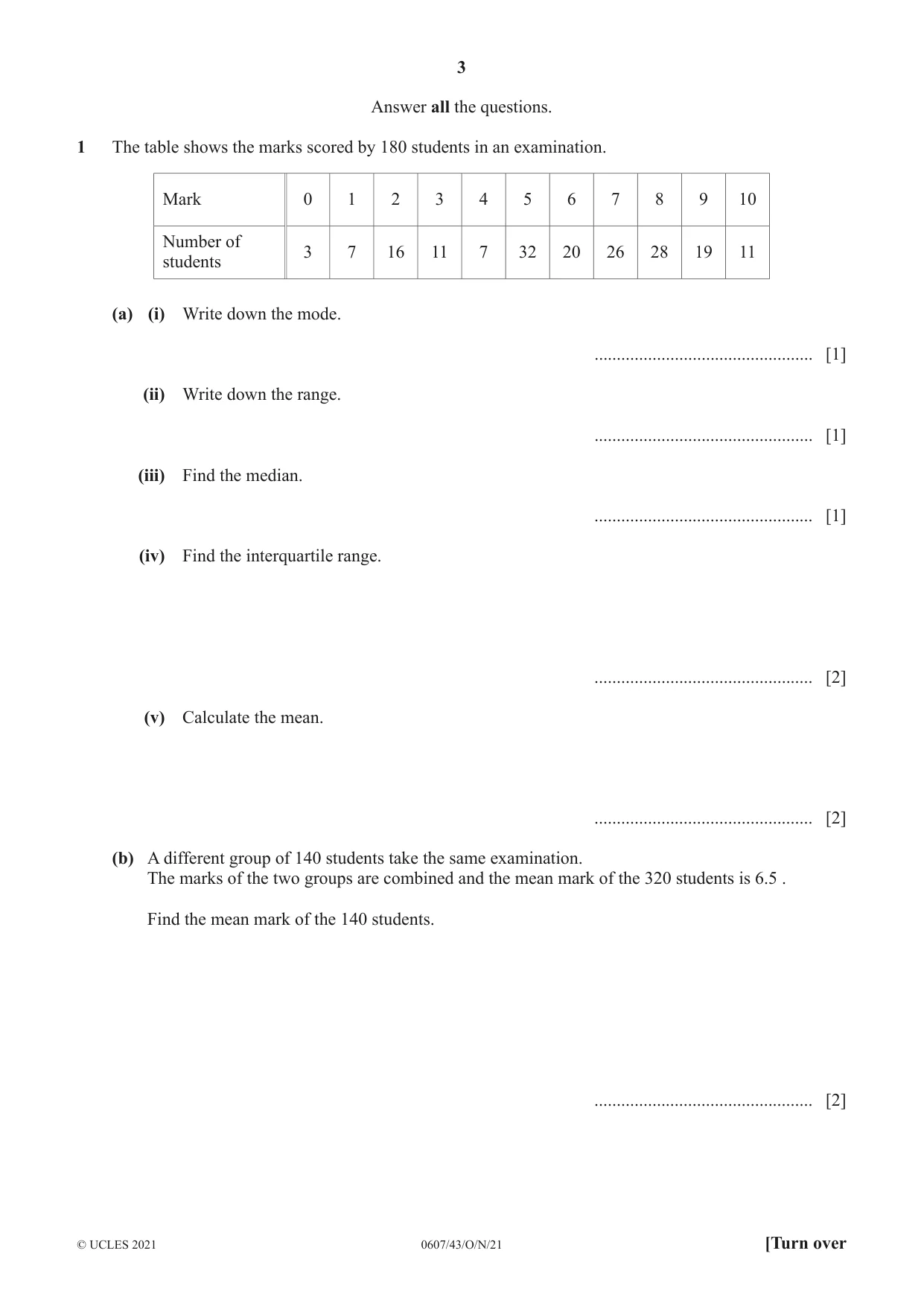
Q1 · The table shows the marks scored by 180 students in an examination
1 The table shows the marks scored by 180 students in an examination. Mark 0 1 2 3 4 5 6 7 8 9 10 Number of 3 7 16 11 7 32 20 26 28 19 11 students (a) (i) Write down the mode. ................................................. [1] (ii) Write down the range. ................................................. [1] (iii) Find the median. ................................................. [1] (iv) Find the interquartile range. ................................................. [2] (v) Calculate the mean. ................................................. [2] (b) A different group of 140 students take the same examination. The marks of the two groups are combined and the mean mark of the 320 students is 6.5 . Find the mean mark of the 140 students. ................................................. [2]
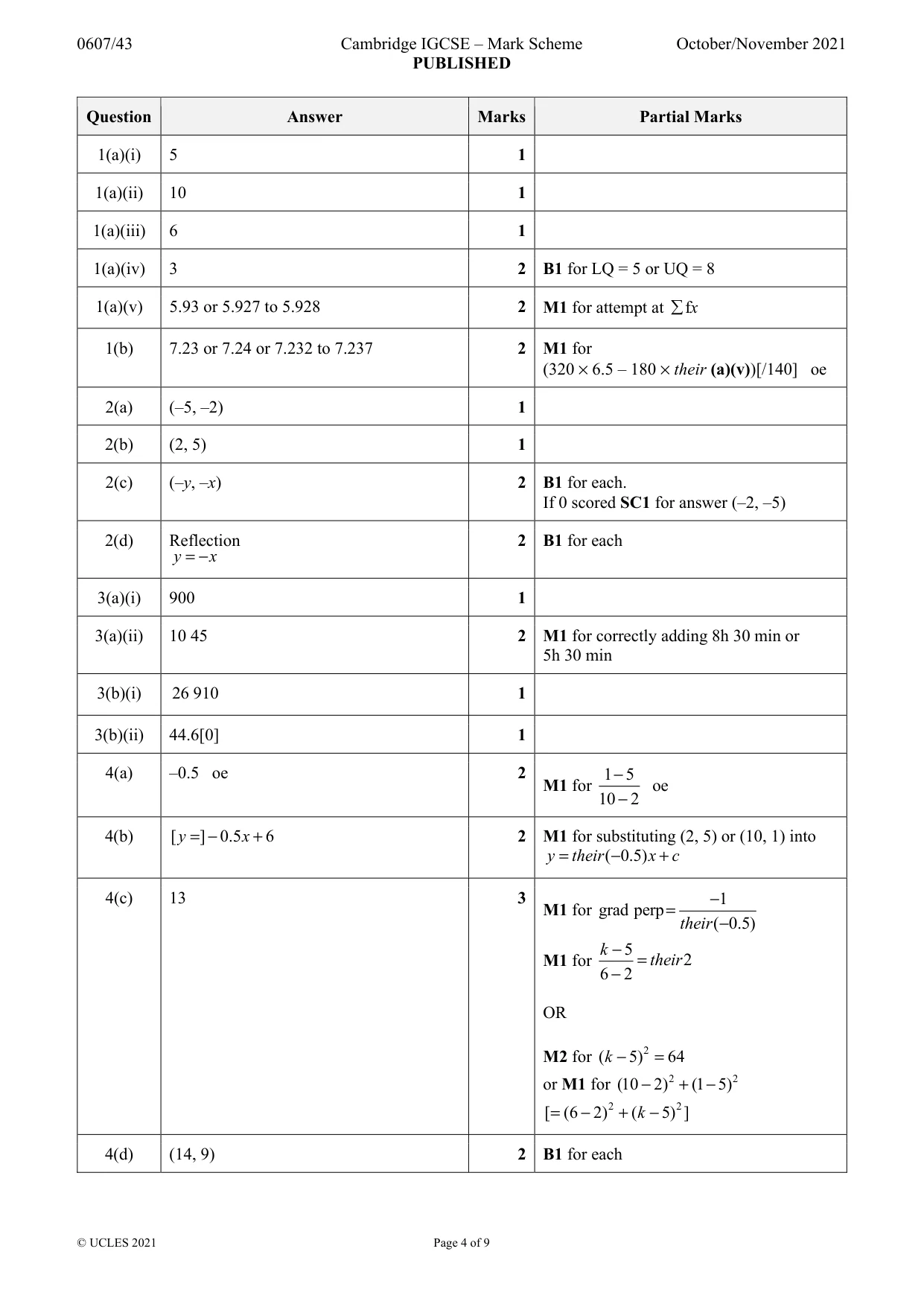
Mark scheme: Question Answer Marks Partial Marks 1(a)(i) 5 1 1(a)(ii) 10 1 1(a)(iii) 6 1 1(a)(iv) 3 2 B1 for LQ = 5 or UQ = 8 1(a)(v) 5.93 or 5.927 to 5.928 2 M1 for attempt at xf 1(b) 7.23 or 7.24 or 7.232 to 7.237 2 M1 for (320 × 6.5 – 180 × their (a)(v))[/140] oe
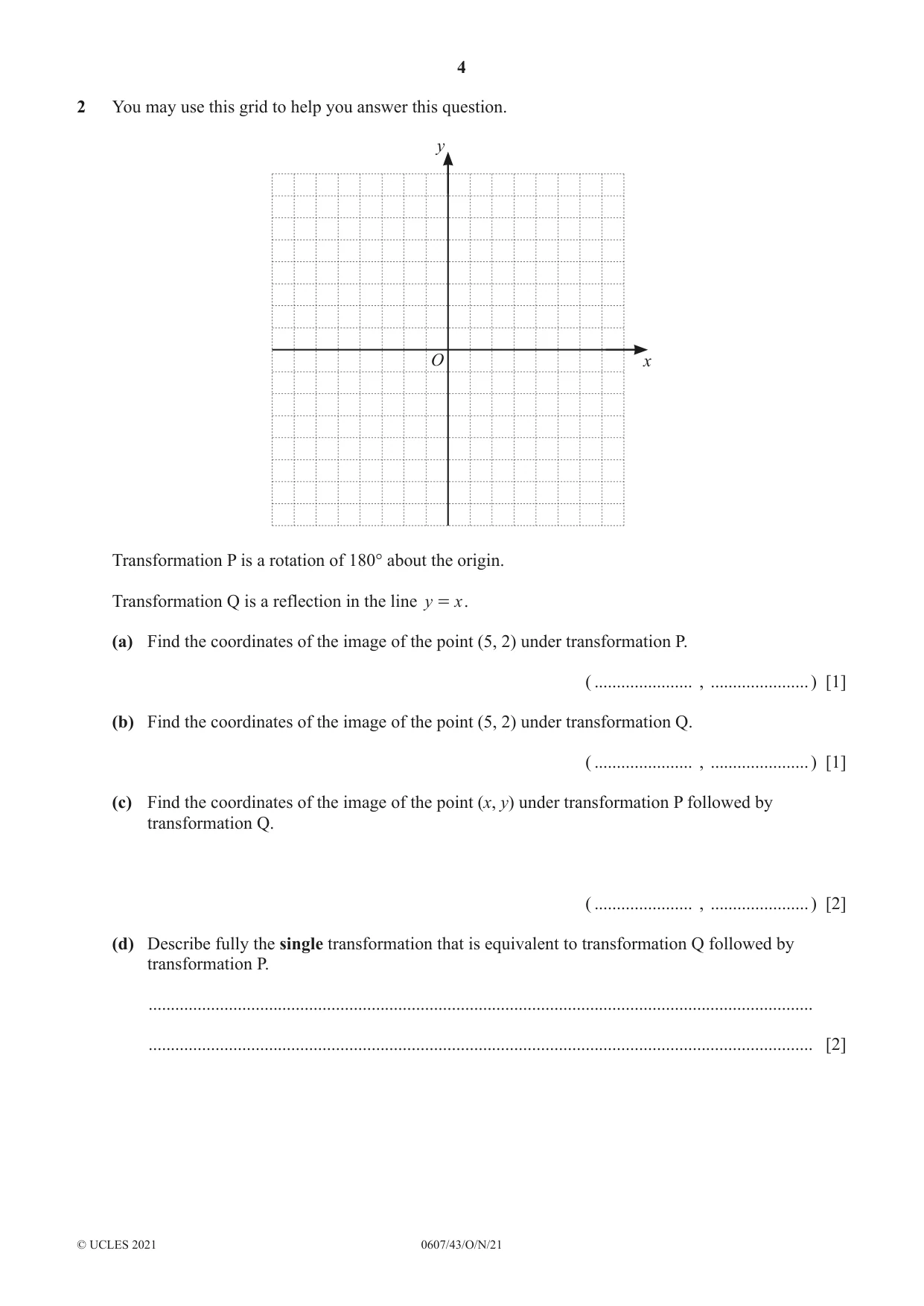
Q2 · You may use this grid to help you answer this question
2 You may use this grid to help you answer this question. y O x Transformation P is a rotation of 180° about the origin. Transformation Q is a reflection in the line y = x . (a) Find the coordinates of the image of the point (5, 2) under transformation P. ( ...................... , ...................... ) [1] (b) Find the coordinates of the image of the point (5, 2) under transformation Q. ( ...................... , ...................... ) [1] (c) Find the coordinates of the image of the point (x, y) under transformation P followed by transformation Q. ( ...................... , ...................... ) [2] (d) Describe fully the single transformation that is equivalent to transformation Q followed by transformation P. ..................................................................................................................................................... ..................................................................................................................................................... [2]
Mark scheme: 2(a) (–5, –2) 1 2(b) (2, 5) 1 2(c) (–y, –x) 2 B1 for each. If 0 scored SC1 for answer (–2, –5) 2(d) Reflection 2 B1 for each y = − x
Q3 · Anna flies by plane from Manchester (UK) to Goa (India)
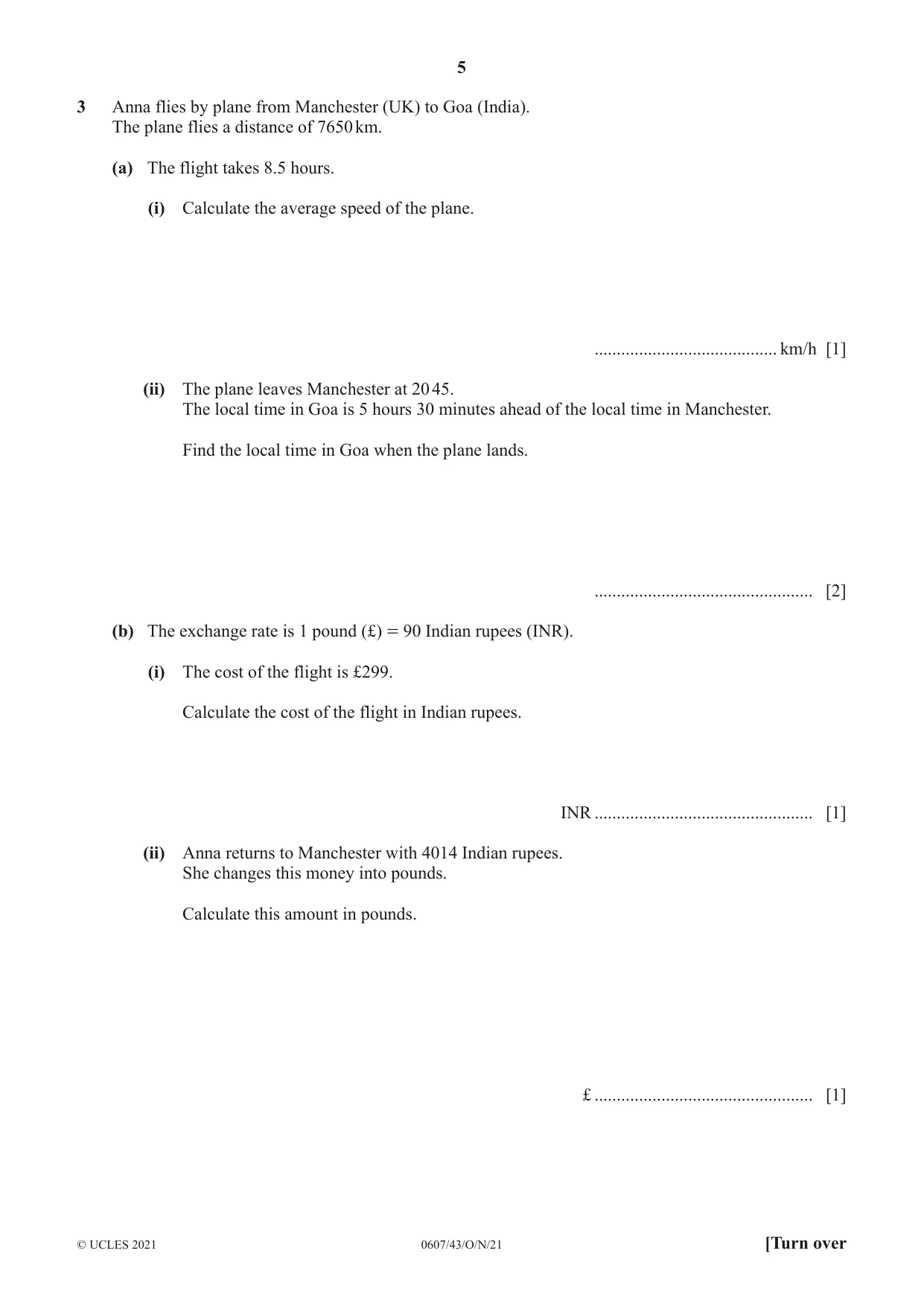
3 Anna flies by plane from Manchester (UK) to Goa (India). The plane flies a distance of 7650 km. (a) The flight takes 8.5 hours. (i) Calculate the average speed of the plane. ......................................... km/h [1] (ii) The plane leaves Manchester at 20 45. The local time in Goa is 5 hours 30 minutes ahead of the local time in Manchester. Find the local time in Goa when the plane lands. ................................................. [2] (b) The exchange rate is 1 pound (£) = 90 Indian rupees (INR). (i) The cost of the flight is £299. Calculate the cost of the flight in Indian rupees. INR ................................................. [1] (ii) Anna returns to Manchester with 4014 Indian rupees. She changes this money into pounds. Calculate this amount in pounds. £ ................................................. [1]
Mark scheme: 3(a)(i) 900 1 3(a)(ii) 10 45 2 M1 for correctly adding 8h 30 min or 5h 30 min 3(b)(i) 26 910 1 3(b)(ii) 44.6[0] 1
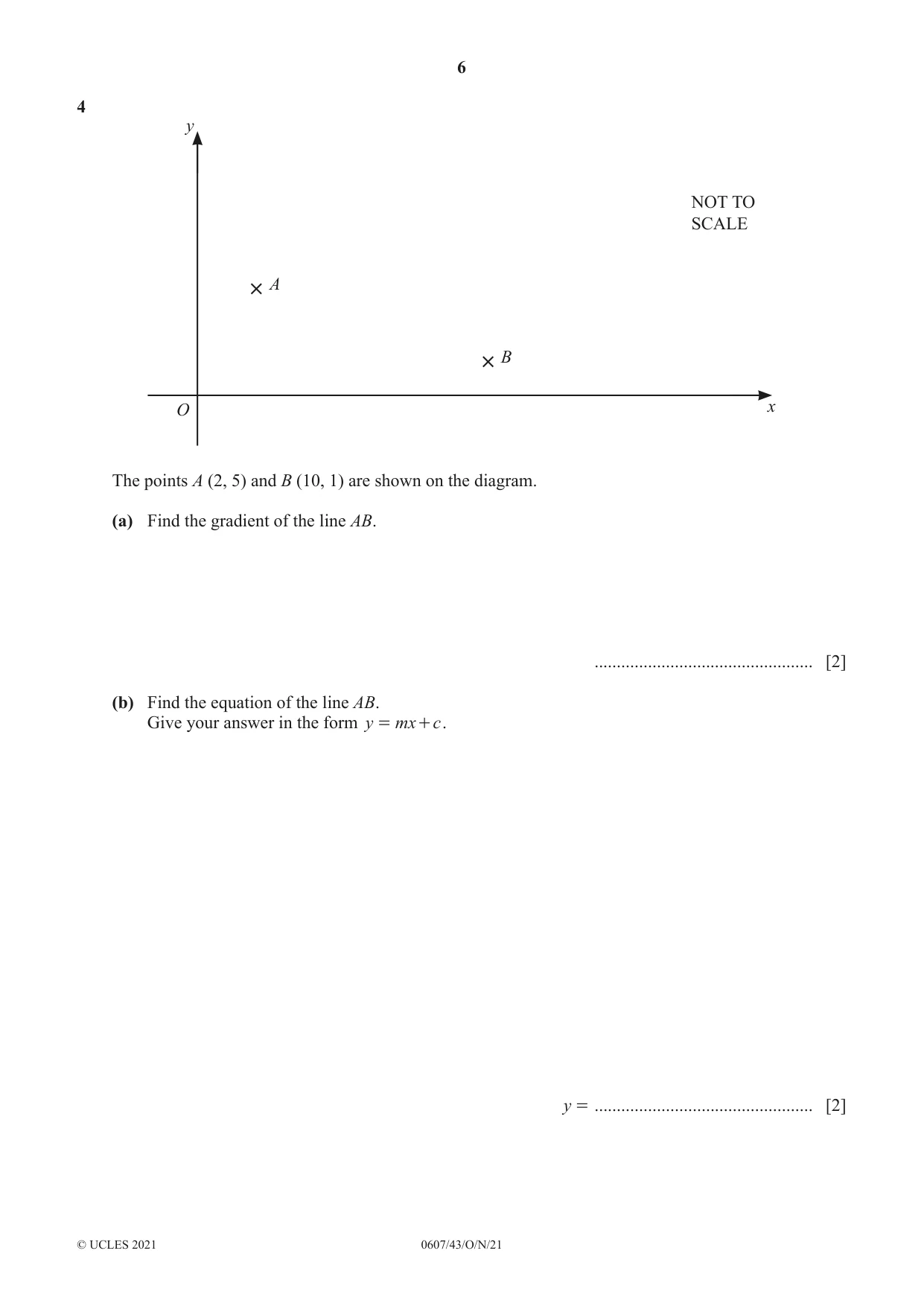
Q4 · Y NOT TO SCALE A B O x The points A (2, 5) and B (10, 1) are shown on the diagram
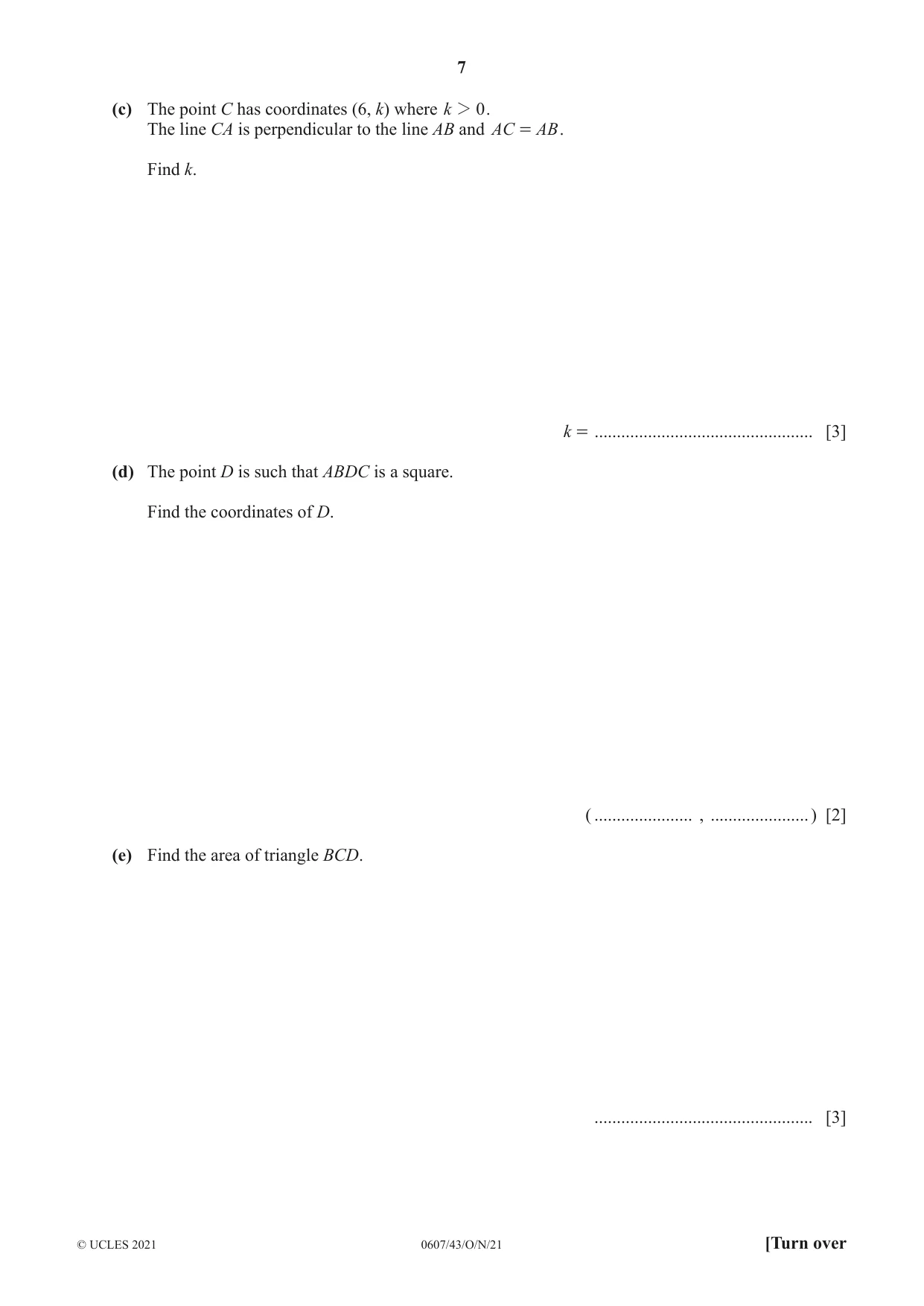
4 y NOT TO SCALE A B O x The points A (2, 5) and B (10, 1) are shown on the diagram. (a) Find the gradient of the line AB. ................................................. [2] (b) Find the equation of the line AB. Give your answer in the form y = m x + c . y = ................................................. [2] (c) The point C has coordinates (6, k) where k 2 0 . The line CA is perpendicular to the line AB and AC = AB . Find k. k = ................................................. [3] (d) The point D is such that ABDC is a square. Find the coordinates of D. ( ...................... , ...................... ) [2] (e) Find the area of triangle BCD. ................................................. [3]
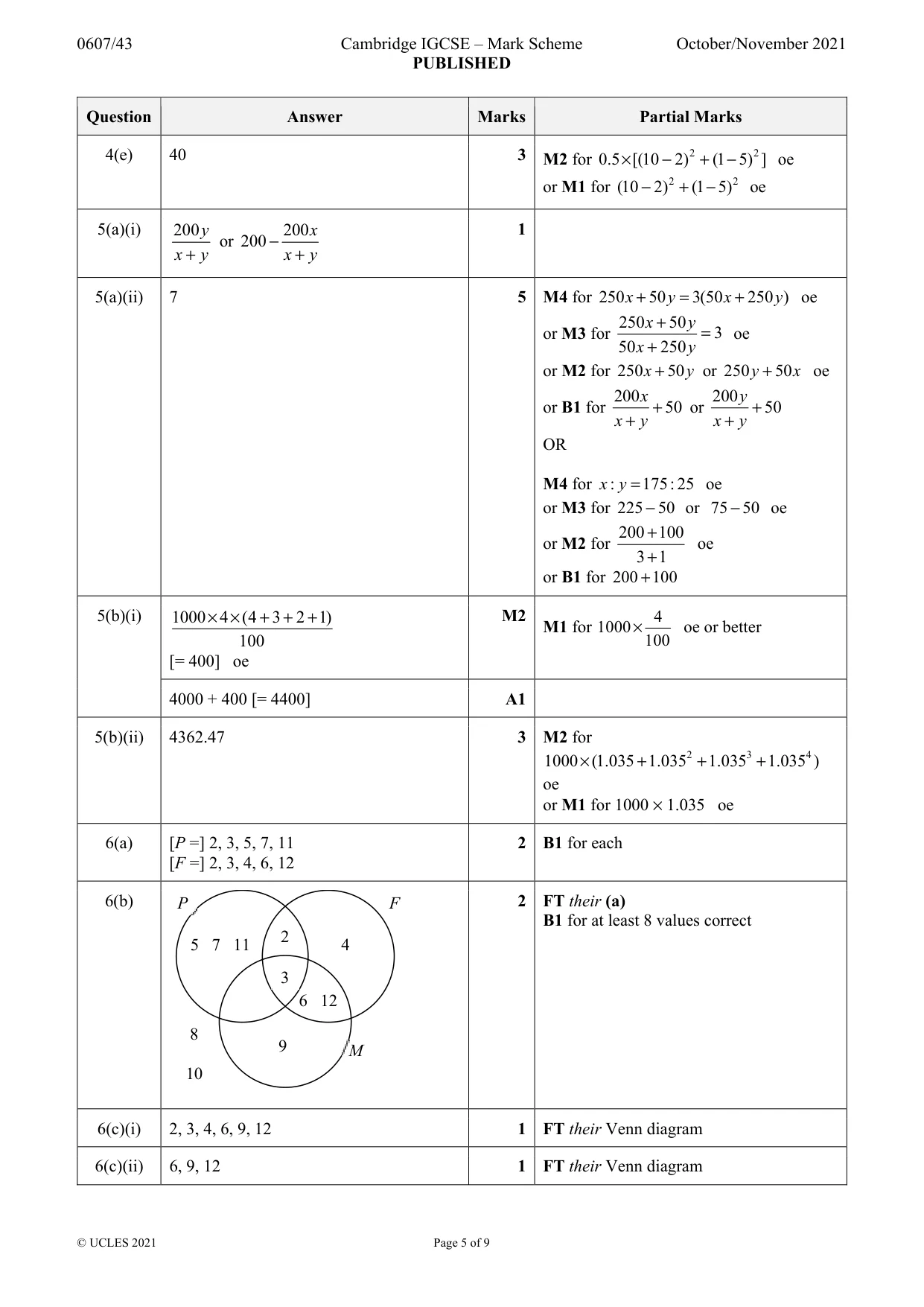
Mark scheme: 4(a) –0.5 oe 2 1 − 5 M1 for oe 10 − 2 4(b) [ y = ] − 0.5 x + 6 2 M1 for substituting (2, 5) or (10, 1) into y = their ( −0.5) x + c 4(c) 13 3 −1 M1 for grad perp = their ( −0.5) k − 5 M1 for = their 2 6 − 2 OR M2 for ( k − 5) 2 = 64 or M1 for (10 − 2) 2 + (1 − 5) 2 [ = (6 − 2) 2 + ( k − 5) 2 ] 4(d) (14, 9) 2 B1 for each 4(e) 40 3 M2 for 0.5 × [(10 − 2) 2 + (1 − 5) 2 ] oe or M1 for (10 − 2) 2 + (1 − 5) 2 oe
Q5 · Alana and Beau share $200 in the ratio x : y
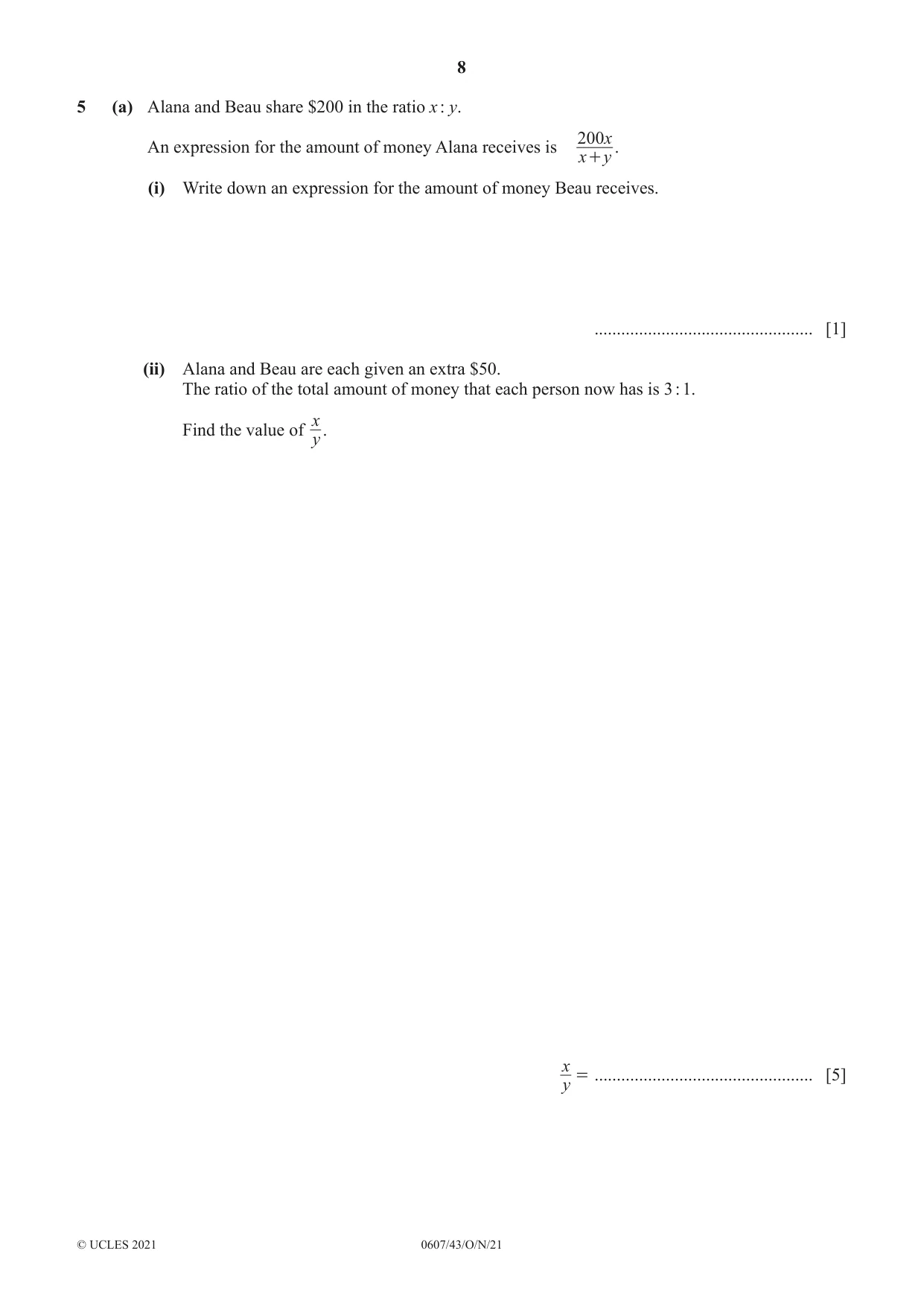
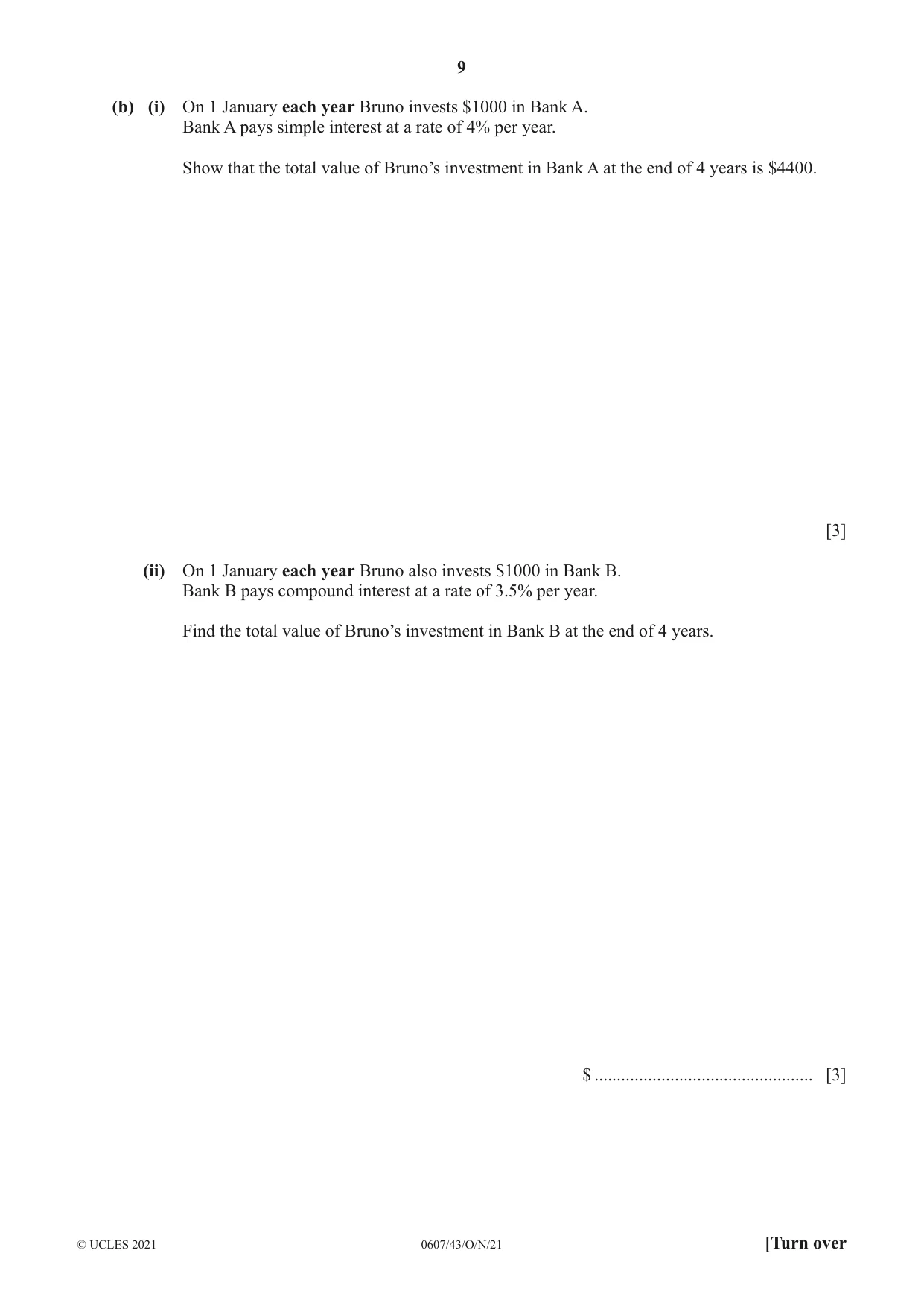
5 (a) Alana and Beau share $200 in the ratio x : y. 200x An expression for the amount of money Alana receives is . x + y (i) Write down an expression for the amount of money Beau receives. ................................................. [1] (ii) Alana and Beau are each given an extra $50. The ratio of the total amount of money that each person now has is 3 : 1. x Find the value of . y x = ................................................. [5] y (b) (i) On 1 January each year Bruno invests $1000 in Bank A. Bank A pays simple interest at a rate of 4% per year. Show that the total value of Bruno’s investment in Bank A at the end of 4 years is $4400. [3] (ii) On 1 January each year Bruno also invests $1000 in Bank B. Bank B pays compound interest at a rate of 3.5% per year. Find the total value of Bruno’s investment in Bank B at the end of 4 years. $ ................................................. [3]
Mark scheme: 5(a)(i) 200 y 200 x 1 or 200 − x + y x + y 5(a)(ii) 7 5 M4 for 250 x + 50 y = 3(50 x + 250 y ) oe 250 x + 50 y or M3 for = 3 oe 50 x + 250 y or M2 for 250 x + 50 y or 250 y + 50 x oe 200 x 200 y or B1 for + 50 or + 50 x + y x + y OR M4 for x : y = 175: 25 oe or M3 for 225 − 50 or 75 − 50 oe 200 + 100 or M2 for oe 3 + 1 or B1 for 200 + 100 5(b)(i) 1000 × 4 × (4 + 3 + 2 + 1) M2 4 M1 for 1000 × oe or better 100 100 [= 400] oe 4000 + 400 [= 4400] A1 5(b)(ii) 4362.47 3 M2 for 1000 × (1.035 + 1.035 2 + 1.0353 + 1.035 4 ) oe or M1 for 1000 × 1.035 oe
Q6 · The Venn diagram shows the sets P, F and M
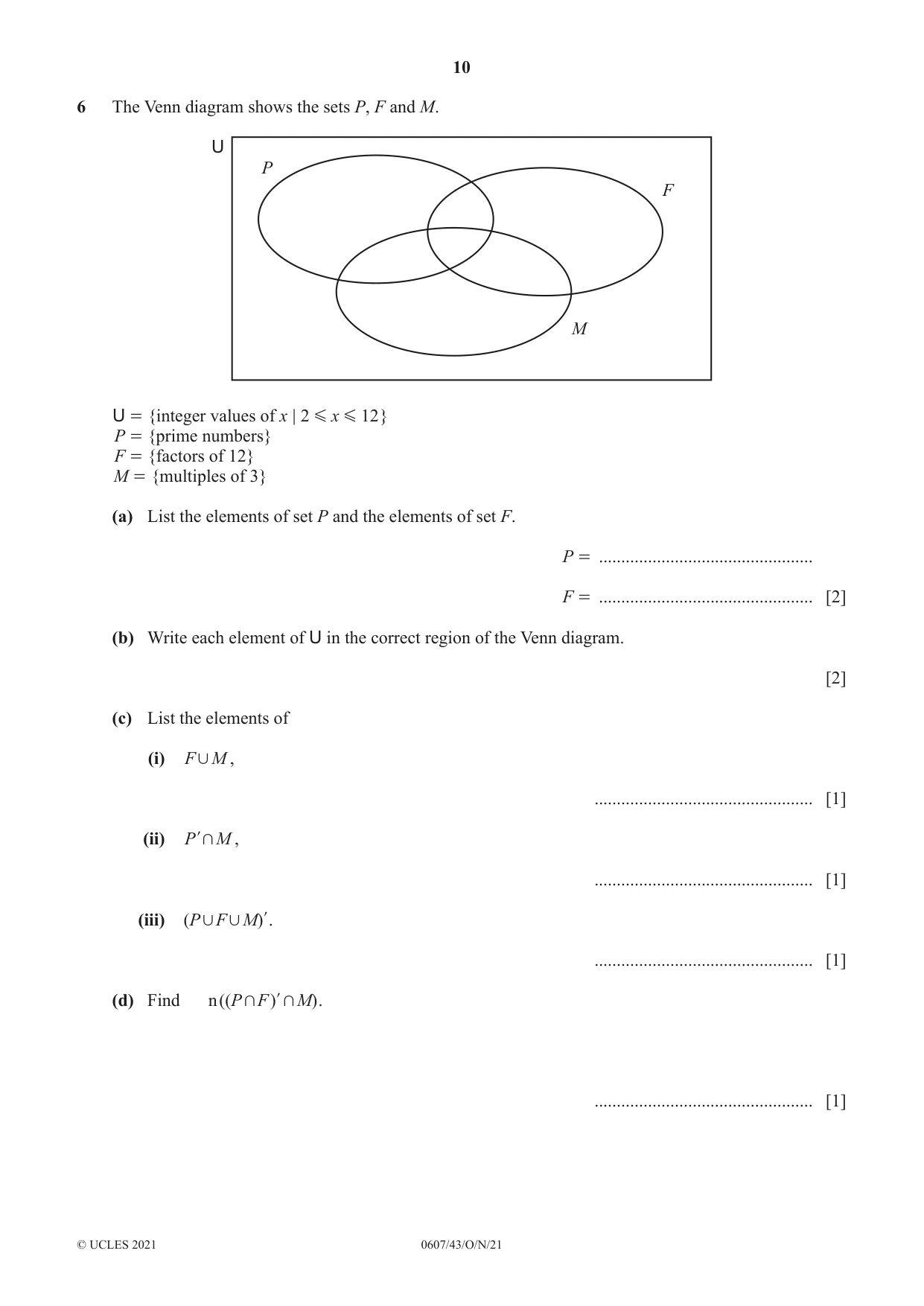
6 The Venn diagram shows the sets P, F and M. U P F M U = {integer values of x ; 2 G x G 12 } P = {prime numbers} F = {factors of 12} M = {multiples of 3} (a) List the elements of set P and the elements of set F. P = ................................................ F = ................................................ [2] (b) Write each element of U in the correct region of the Venn diagram. [2] (c) List the elements of (i) F , M , ................................................. [1] (ii) P l + M , ................................................. [1] (iii) ( P , F , M ) l. ................................................. [1] (d) Find n (( P + F ) l + M ) . ................................................. [1]
Mark scheme: 6(a) [P =] 2, 3, 5, 7, 11 2 B1 for each [F =] 2, 3, 4, 6, 12 6(b) P F 2 FT their (a) B1 for at least 8 values correct 2 5 7 11 4 3 6 12 8 9 M 10 6(c)(i) 2, 3, 4, 6, 9, 12 1 FT their Venn diagram 6(c)(ii) 6, 9, 12 1 FT their Venn diagram 6(c)(iii) 8, 10 1 FT their Venn diagram 6(d) 3 1 FT their Venn diagram
Q7 · Y varies inversely as the square of x
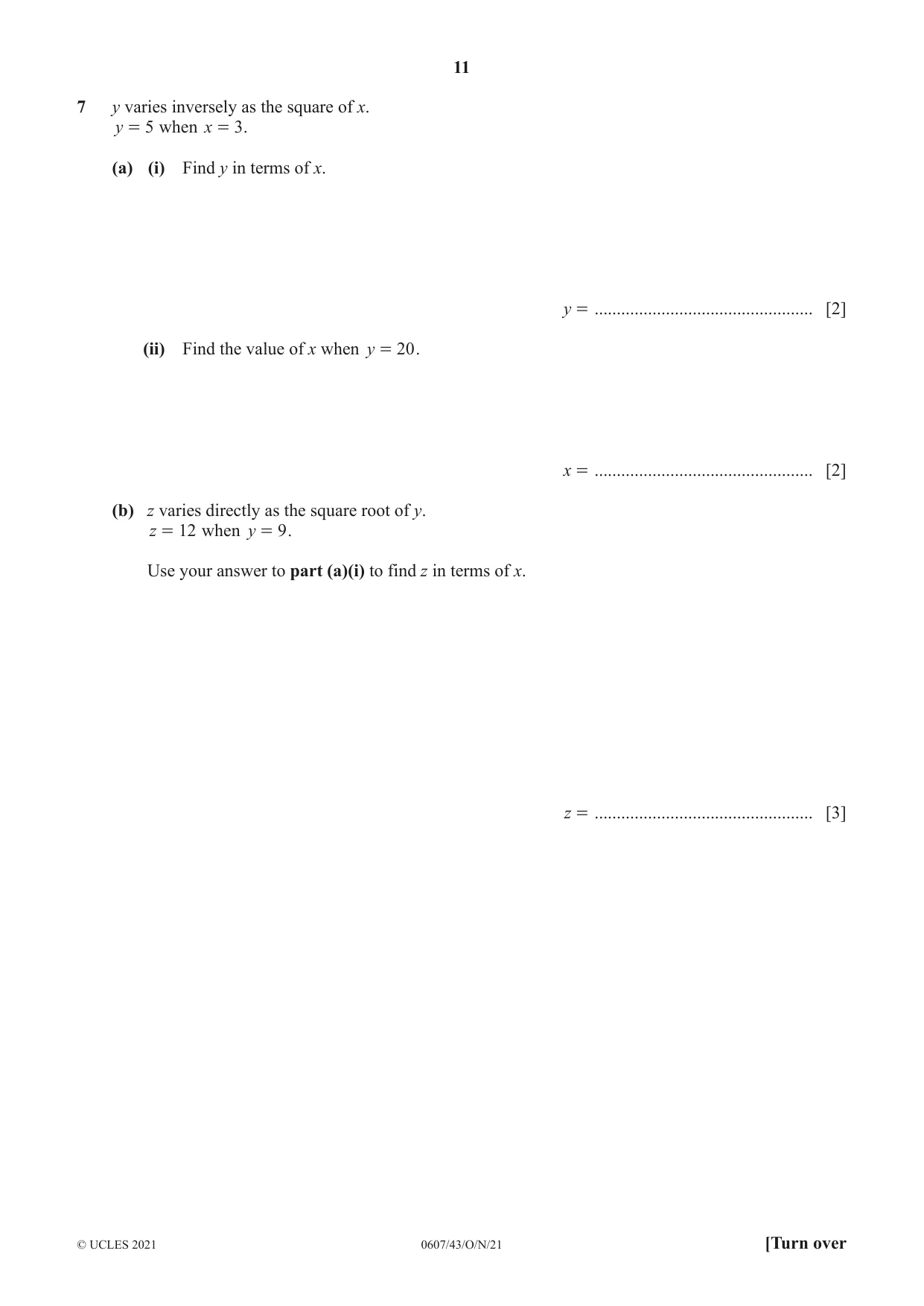
7 y varies inversely as the square of x. y = 5 when x = 3 . (a) (i) Find y in terms of x. y = ................................................. [2] (ii) Find the value of x when y = 20 . x = ................................................. [2] (b) z varies directly as the square root of y. z = 12 when y = 9 . Use your answer to part (a)(i) to find z in terms of x. z = ................................................. [3]
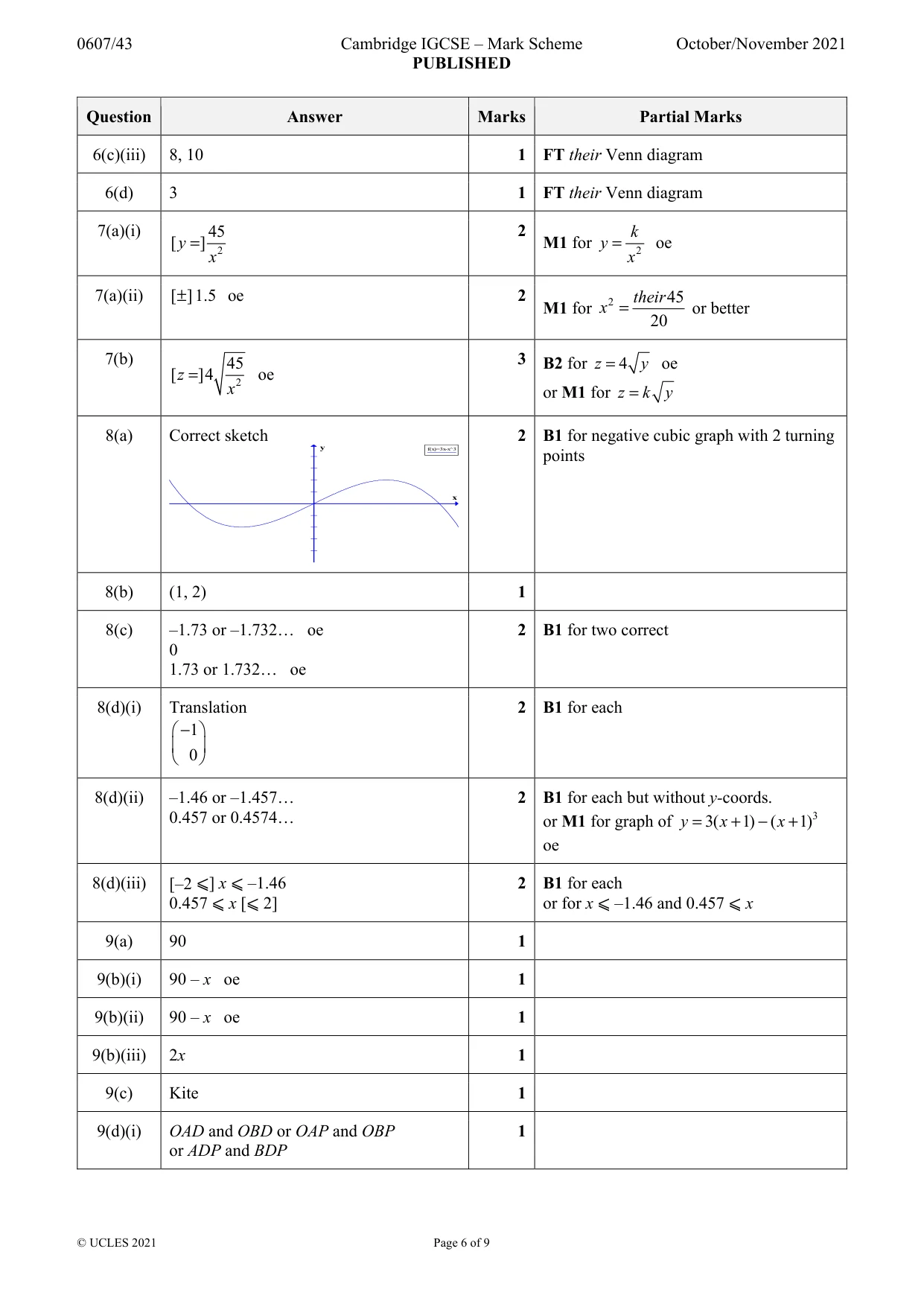
Mark scheme: 7(a)(i) 45 2 k [ y = ] M1 for y = oe x 2 x 2 7(a)(ii) [ ± ]1.5 oe 2 2 their 45 M1 for x = or better 20 7(b) 45 3 B2 for z = 4 y oe [ z = ]4 oe x 2 or M1 for z = k y
Q8 · Y 5 – 2 0 2 x – 5 f ( x) = 3 x - x 3 for - 2 G x G 2 (a) On the diagram, sketch the graph…
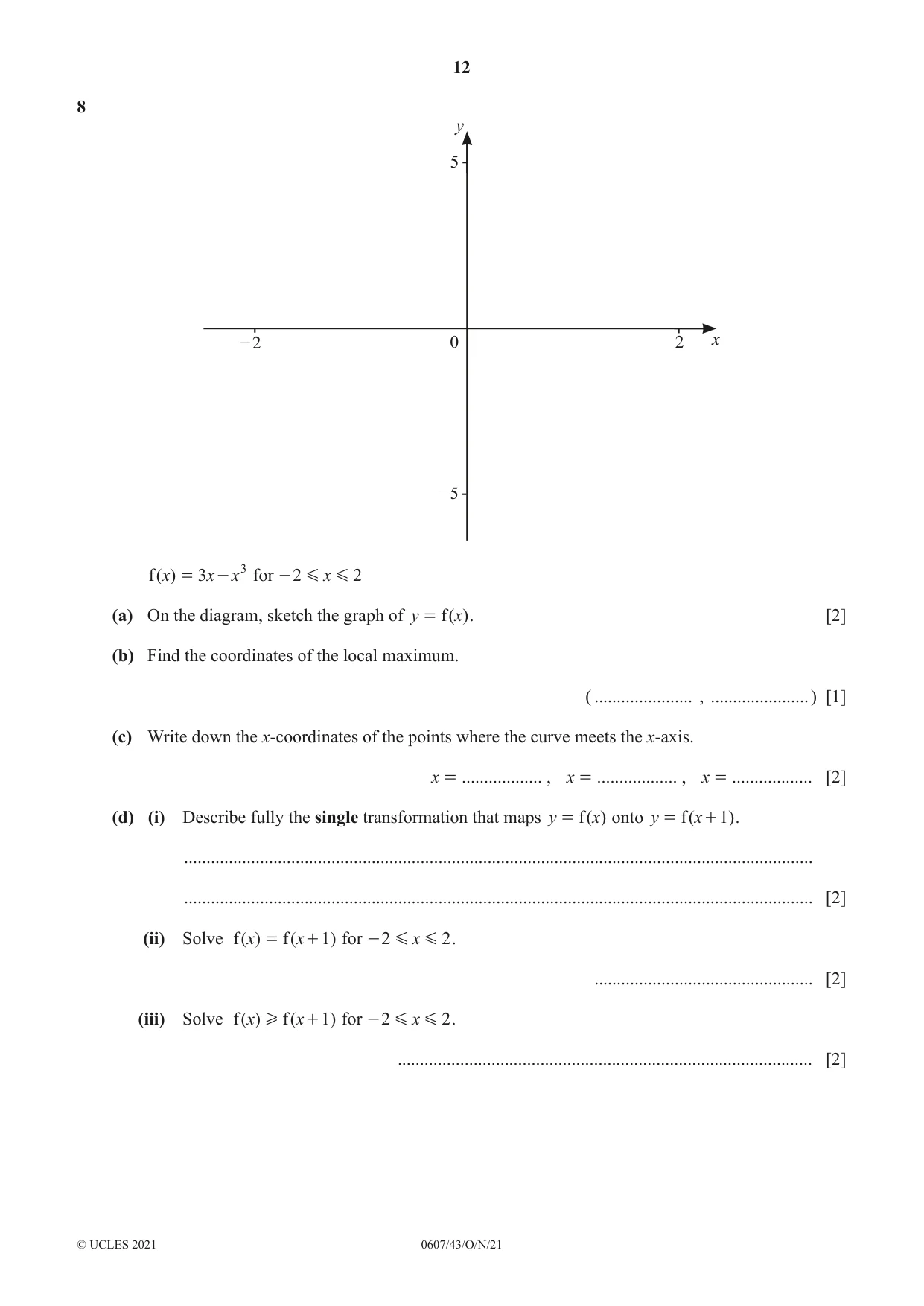
8 y 5 – 2 0 2 x – 5 f ( x) = 3 x - x 3 for - 2 G x G 2 (a) On the diagram, sketch the graph of y = f ( x) . [2] (b) Find the coordinates of the local maximum. ( ...................... , ...................... ) [1] (c) Write down the x-coordinates of the points where the curve meets the x-axis. x = .................. , x = .................. , x = .................. [2] (d) (i) Describe fully the single transformation that maps y = f ( x) onto y = f ( x + 1) . ............................................................................................................................................. ............................................................................................................................................. [2] (ii) Solve f ( x) = f ( x + 1) for - 2 G x G 2 . ................................................. [2] (iii) Solve f ( x) H f ( x + 1) for - 2 G x G 2 . ............................................................................................. [2]
Mark scheme: 8(a) Correct sketch 2 B1 for negative cubic graph with 2 turning y f(x)=3x-x^3 points x 8(b) (1, 2) 1 8(c) –1.73 or –1.732… oe 2 B1 for two correct 0 1.73 or 1.732… oe 8(d)(i) Translation 2 B1 for each − 1 0 8(d)(ii) –1.46 or –1.457… 2 B1 for each but without y-coords. 0.457 or 0.4574… or M1 for graph of y = 3( x + 1) − ( x + 1) 3 oe 8(d)(iii) [–2 ⩽] x ⩽ –1.46 2 B1 for each 0.457 ⩽ x [⩽ 2] or for x ⩽ –1.46 and 0.457 ⩽ x
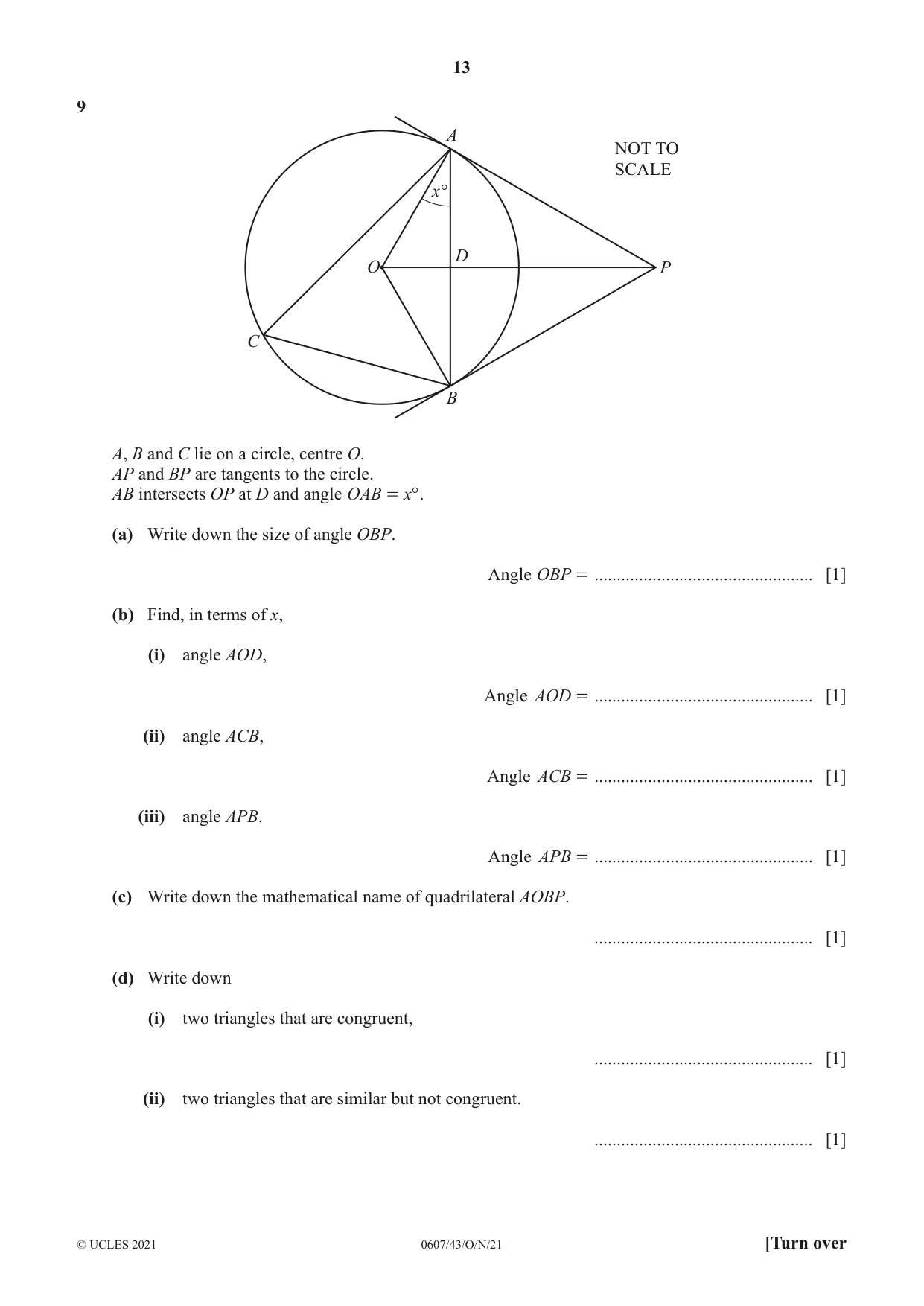
Q9 · A NOT TO SCALE x° D O P C B A, B and C lie on a circle, centre O
9 A NOT TO SCALE x° D O P C B A, B and C lie on a circle, centre O. AP and BP are tangents to the circle. AB intersects OP at D and angle O AB = x° . (a) Write down the size of angle OBP. Angle OBP = ................................................. [1] (b) Find, in terms of x, (i) angle AOD, Angle AOD = ................................................. [1] (ii) angle ACB, Angle ACB = ................................................. [1] (iii) angle APB. Angle APB = ................................................. [1] (c) Write down the mathematical name of quadrilateral AOBP. ................................................. [1] (d) Write down (i) two triangles that are congruent, ................................................. [1] (ii) two triangles that are similar but not congruent. ................................................. [1]
Mark scheme: 9(a) 90 1 9(b)(i) 90 – x oe 1 9(b)(ii) 90 – x oe 1 9(b)(iii) 2x 1 9(c) Kite 1 9(d)(i) OAD and OBD or OAP and OBP 1 or ADP and BDP 9(d)(ii) One from one of pairs in part (i) 1 and One from one of other pairs in part (i)
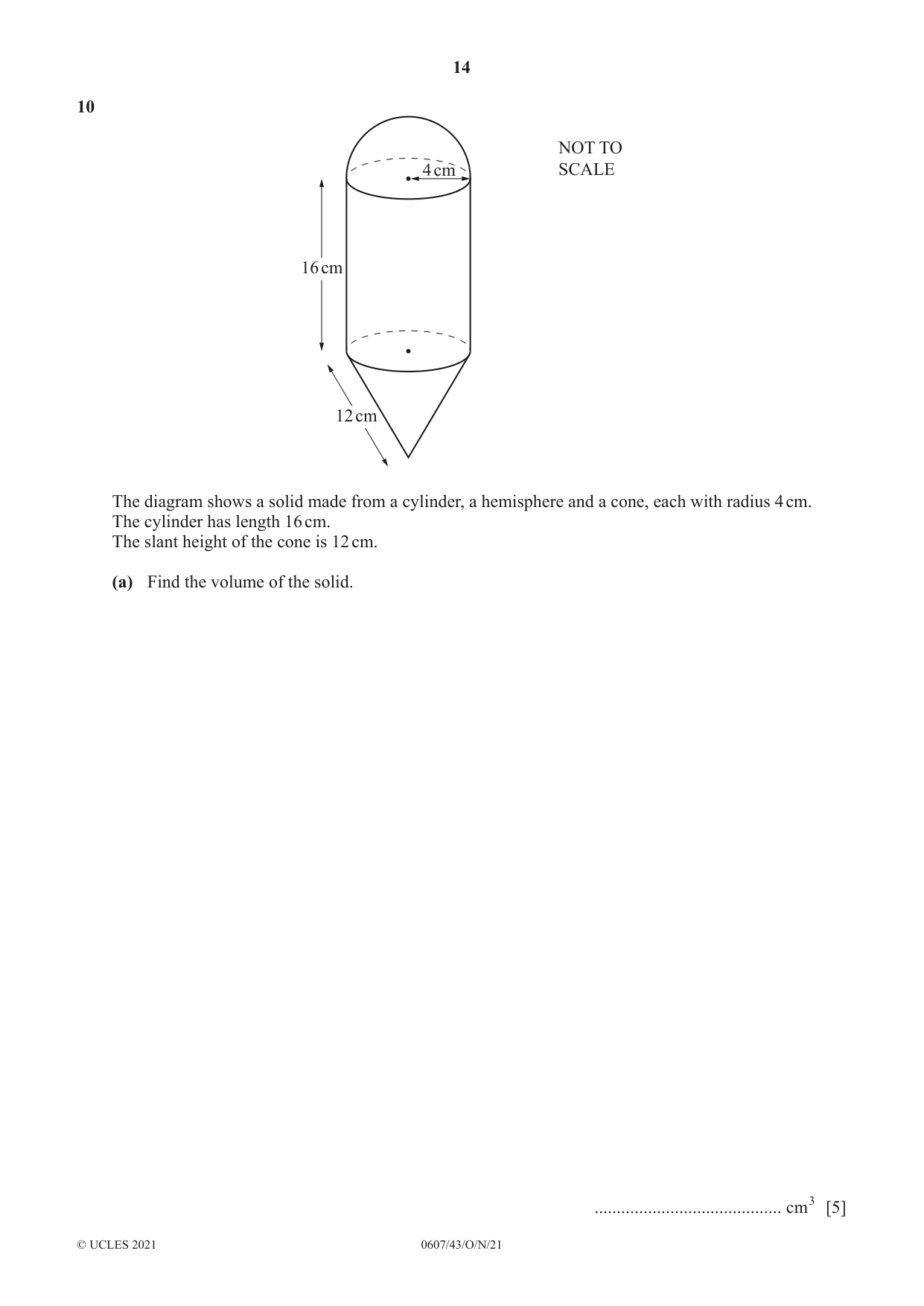
Q10 · NOT TO 4 cm SCALE 16 cm 12 cm The diagram shows a solid made from a cylinder, a…
10 NOT TO 4 cm SCALE 16 cm 12 cm The diagram shows a solid made from a cylinder, a hemisphere and a cone, each with radius 4 cm. The cylinder has length 16 cm. The slant height of the cone is 12 cm. (a) Find the volume of the solid. .......................................... cm3 [5] (b) Show that the total surface area of the solid is 208 r cm2. [4] (c) A mathematically similar solid has a total surface area of 468 r cm2. Find the radius of the cylinder in this solid. ............................................ cm [3]
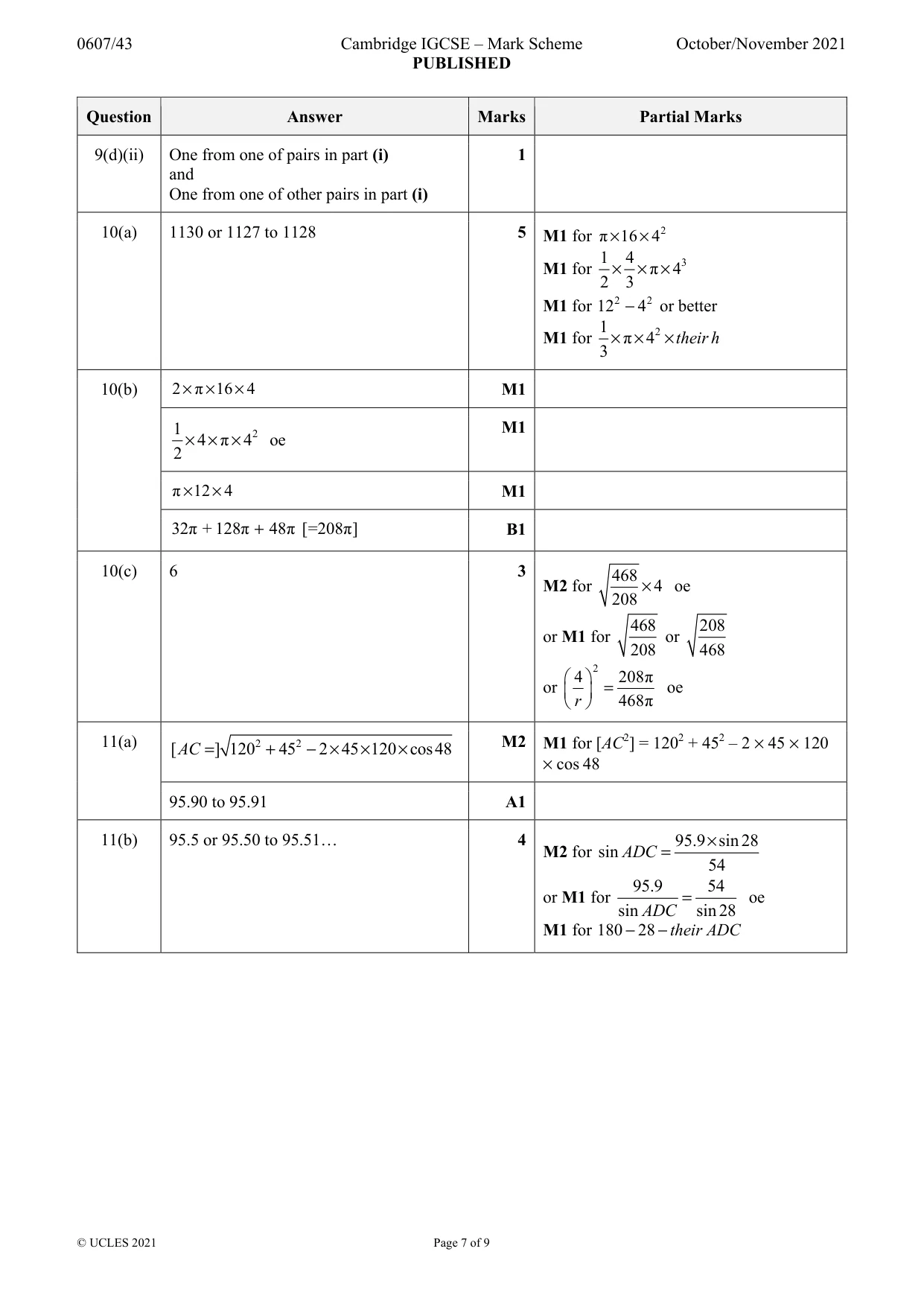
Mark scheme: 10(a) 1130 or 1127 to 1128 5 M1 for π × 16 × 4 2 1 4 3 M1 for × × π × 4 2 3 M1 for 12 2 − 4 2 or better 1 2 M1 for × π × 4 ×their h 3 10(b) 2 × π × 16 × 4 M1 1 2 M1 × 4 × π × 4 oe 2 π × 12 × 4 M1 32π + 128π + 48π [=208π] B1 10(c) 6 3 468 M2 for × 4 oe 208 468 208 or M1 for or 208 468 or 4 =2 208π oe r 468π
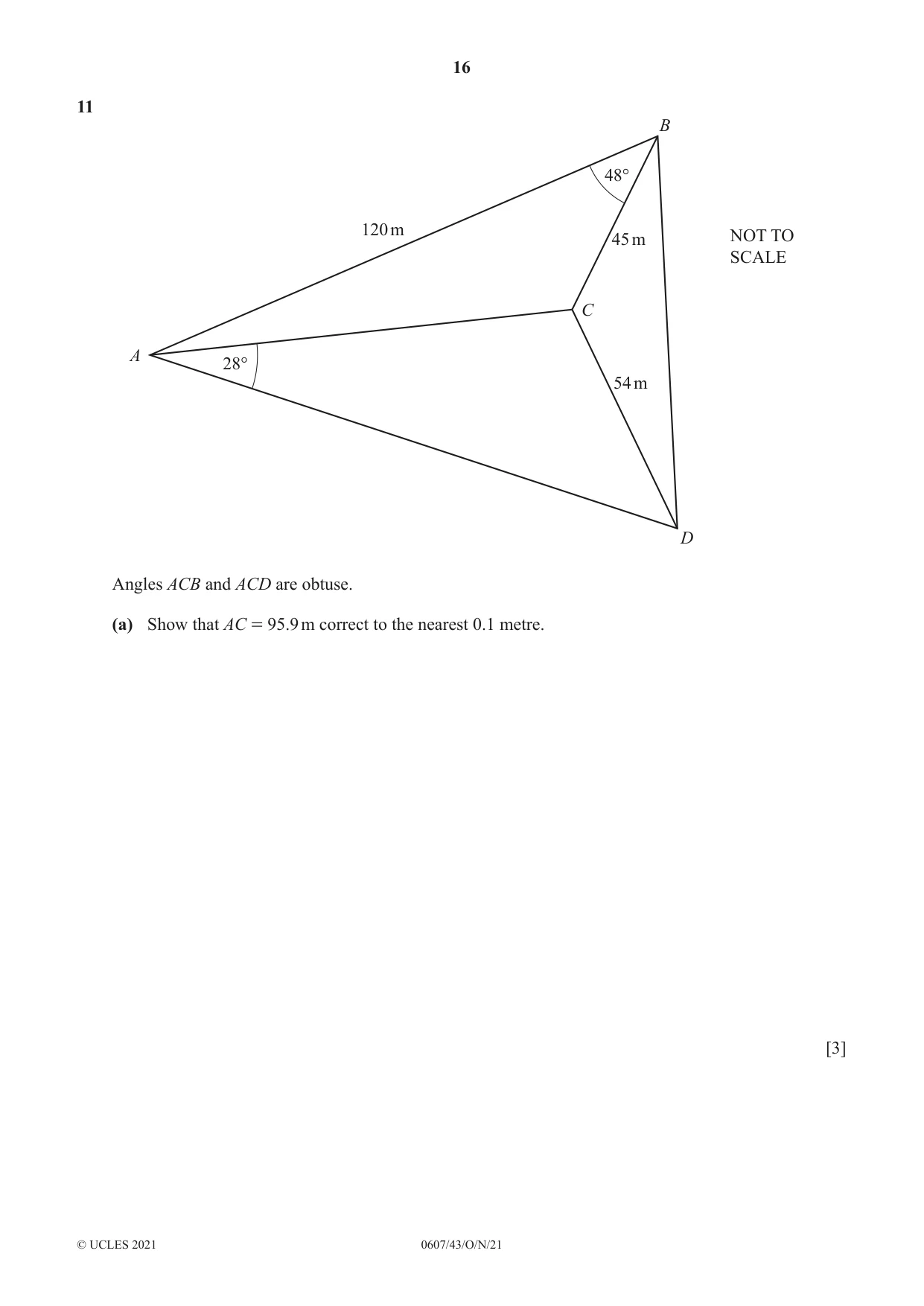
Q11 · B 48° 120 m 45 m NOT TO SCALE C A 28° 54 m D Angles ACB and ACD are obtuse
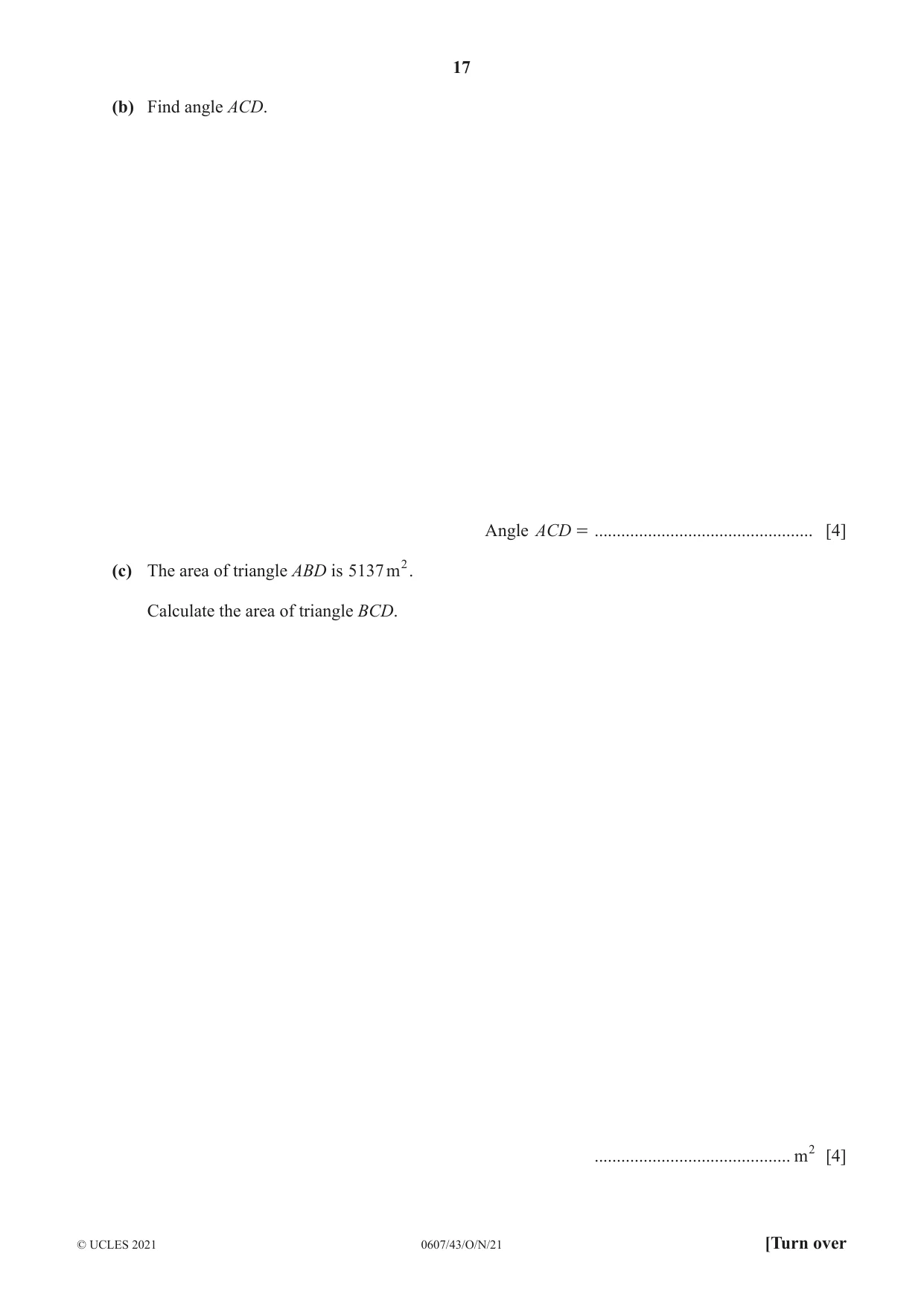
11 B 48° 120 m 45 m NOT TO SCALE C A 28° 54 m D Angles ACB and ACD are obtuse. (a) Show that AC = 95.9 m correct to the nearest 0.1 metre. [3] (b) Find angle ACD. Angle ACD = ................................................. [4] (c) The area of triangle ABD is 5137m2. Calculate the area of triangle BCD. ............................................ m2 [4]
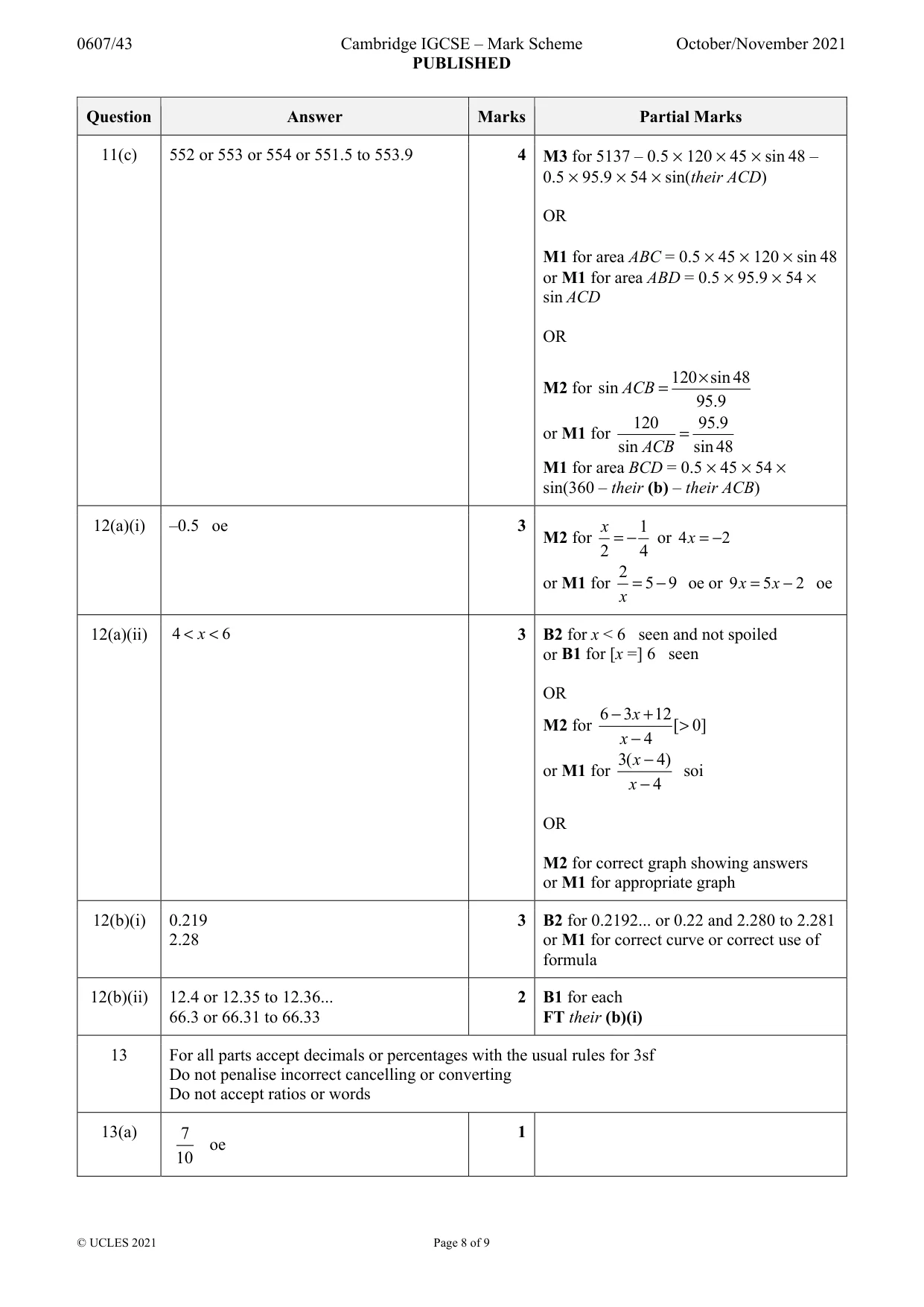
Mark scheme: 11(a) 2 2 M2 M1 for [AC2] = 1202 + 452 – 2 × 45 × 120 [ AC = ] 120 + 45 −×2 45 × 120 × cos48 × cos 48 95.90 to 95.91 A1 11(b) 95.5 or 95.50 to 95.51… 4 95.9 × sin 28 M2 for sin ADC = 54 95.9 54 or M1 for = oe sin ADC sin28 M1 for 180 − 28 −their ADC 11(c) 552 or 553 or 554 or 551.5 to 553.9 4 M3 for 5137 – 0.5 × 120 × 45 × sin 48 – 0.5 × 95.9 × 54 × sin(their ACD) OR M1 for area ABC = 0.5 × 45 × 120 × sin 48 or M1 for area ABD = 0.5 × 95.9 × 54 × sin ACD OR 120 × sin48 M2 for sin ACB = 95.9 120 95.9 or M1 for = sin ACB sin48 M1 for area BCD = 0.5 × 45 × 54 × sin(360 – their (b) – their ACB)
Question 12
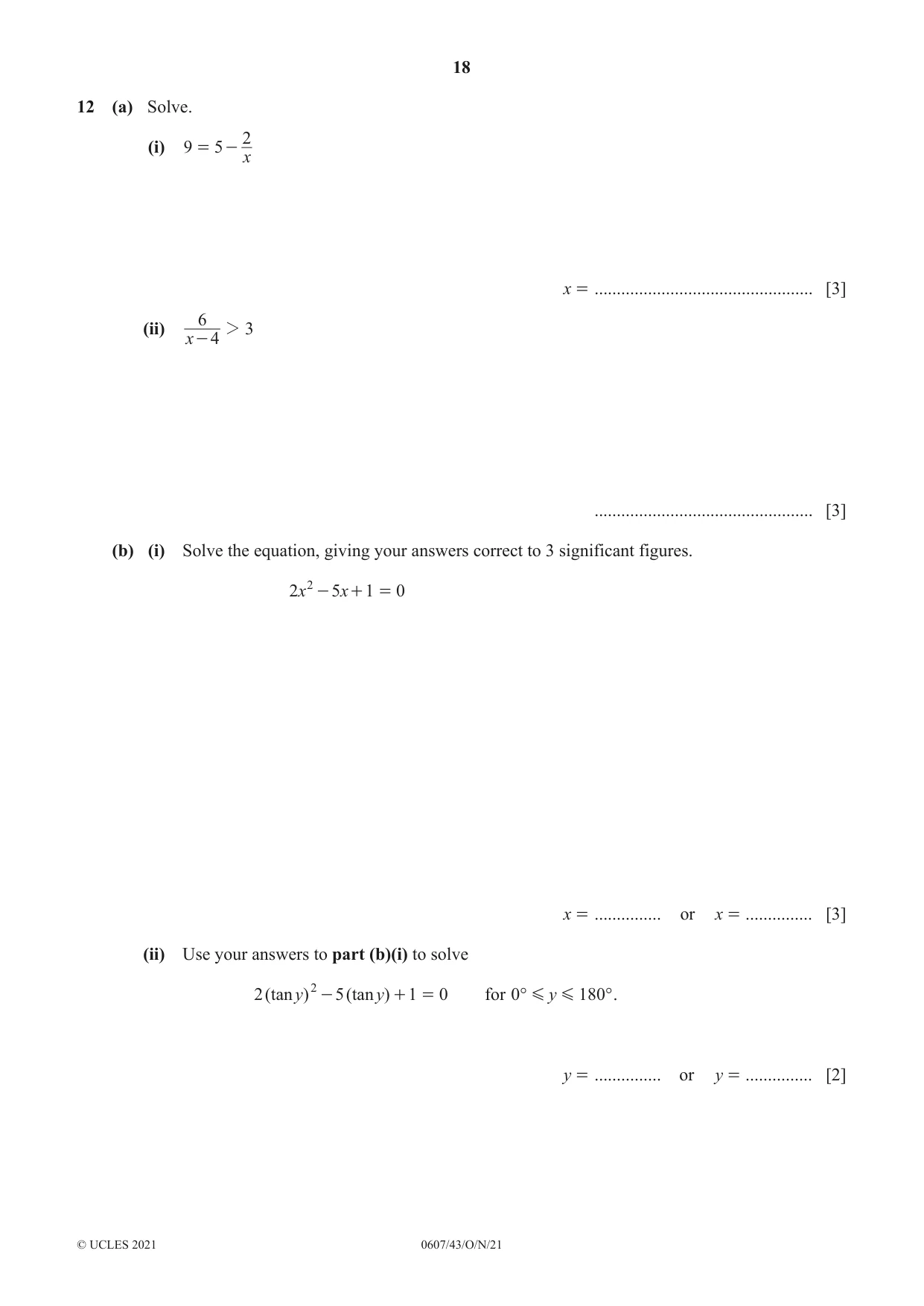
12 (a) Solve. 2 (i) 9 = 5 - x x = ................................................. [3] 6 (ii) 2 3 x - 4 ................................................. [3] (b) (i) Solve the equation, giving your answers correct to 3 significant figures. 2x 2 - 5x + 1 = 0 x = ............... or x = ............... [3] (ii) Use your answers to part (b)(i) to solve 2 ( tan y) 2 - 5 ( tan y) + 1 = 0 for 0° G y G 180° . y = ............... or y = ............... [2]
Mark scheme: 12(a)(i) –0.5 oe 3 x 1 M2 for = − or 4 x = − 2 2 4 2 or M1 for = 5 − 9 oe or 9 x = 5 x − 2 oe x 12(a)(ii) 4 < x < 6 3 B2 for x < 6 seen and not spoiled or B1 for [x =] 6 seen OR 6 − 3 x + M2 for 12[ > 0] x − 4 3( x − 4) or M1 for soi x − 4 OR M2 for correct graph showing answers or M1 for appropriate graph 12(b)(i) 0.219 3 B2 for 0.2192... or 0.22 and 2.280 to 2.281 2.28 or M1 for correct curve or correct use of formula 12(b)(ii) 12.4 or 12.35 to 12.36... 2 B1 for each 66.3 or 66.31 to 66.33 FT their (b)(i) 13 For all parts accept decimals or percentages with the usual rules for 3sf Do not penalise incorrect cancelling or converting Do not accept ratios or words
Q13 · Two bags each contain only blue balls and red balls
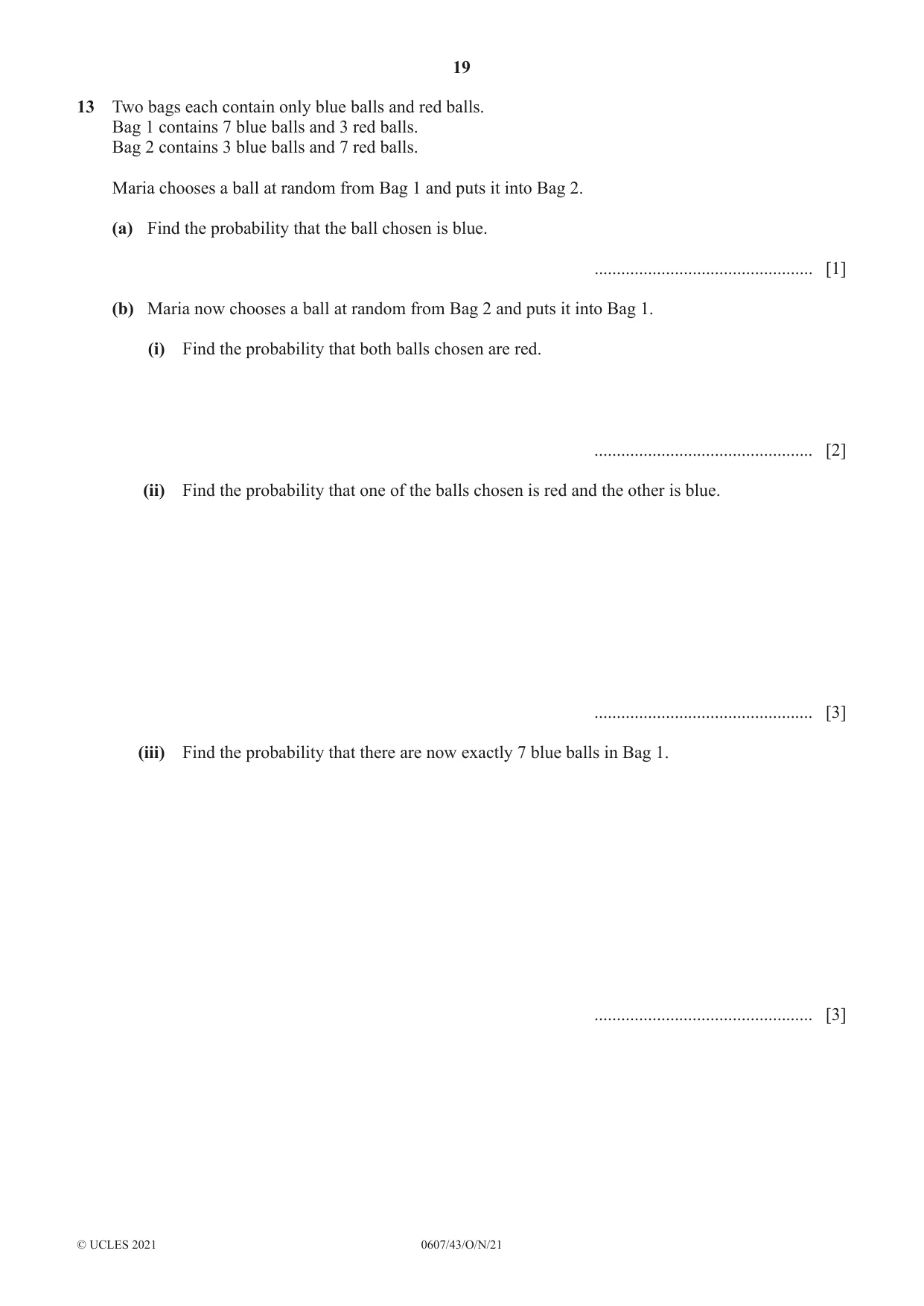
13 Two bags each contain only blue balls and red balls. Bag 1 contains 7 blue balls and 3 red balls. Bag 2 contains 3 blue balls and 7 red balls. Maria chooses a ball at random from Bag 1 and puts it into Bag 2. (a) Find the probability that the ball chosen is blue. ................................................. [1] (b) Maria now chooses a ball at random from Bag 2 and puts it into Bag 1. (i) Find the probability that both balls chosen are red. ................................................. [2] (ii) Find the probability that one of the balls chosen is red and the other is blue. ................................................. [3] (iii) Find the probability that there are now exactly 7 blue balls in Bag 1. ................................................. [3]
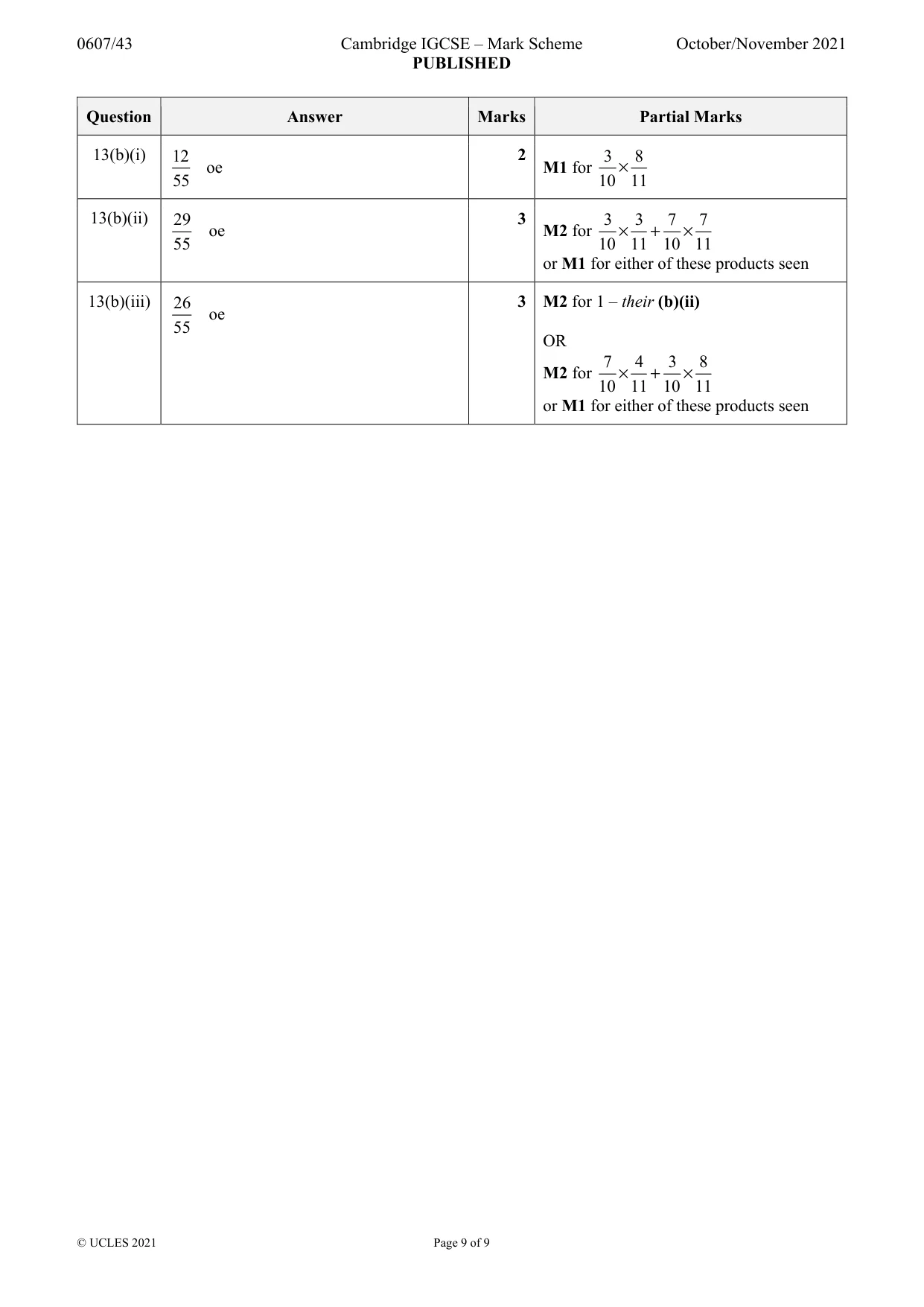
Mark scheme: 13(a) 7 1 oe 10 13(b)(i) 12 2 3 8 oe M1 for × 55 10 11 13(b)(ii) 29 3 3 3 7 7 oe M2 for × + × 55 10 11 10 11 or M1 for either of these products seen 13(b)(iii) 26 3 M2 for 1 – their (b)(ii) oe 55 OR 7 4 3 8 M2 for × + × 10 11 10 11 or M1 for either of these products seen
What was in this paper
The subtopics covered by these 13 questions, and how many questions each got. Open one in a new tab to see every Cambridge question on it.
What you needed in this session
Cambridge’s own grade thresholds for 2021 Oct/Nov, Paper 4 · Variant 3. A higher threshold means an easier paper — the bar moves with how the cohort did.