Cambridge IGCSE Mathematics - International 0607 — 2017 May/June Paper 4 · Variant 2
0607/42/M/J/17 · 12 questions · 120 marks · ≈135 min
The question paper and its mark scheme, free to read here and free to download. This is Cambridge’s own paper, exactly as it was sat.
Question paper20 pages
Mark scheme7 pages
Answers below. Sit the paper first if you are practising.
Questions as text
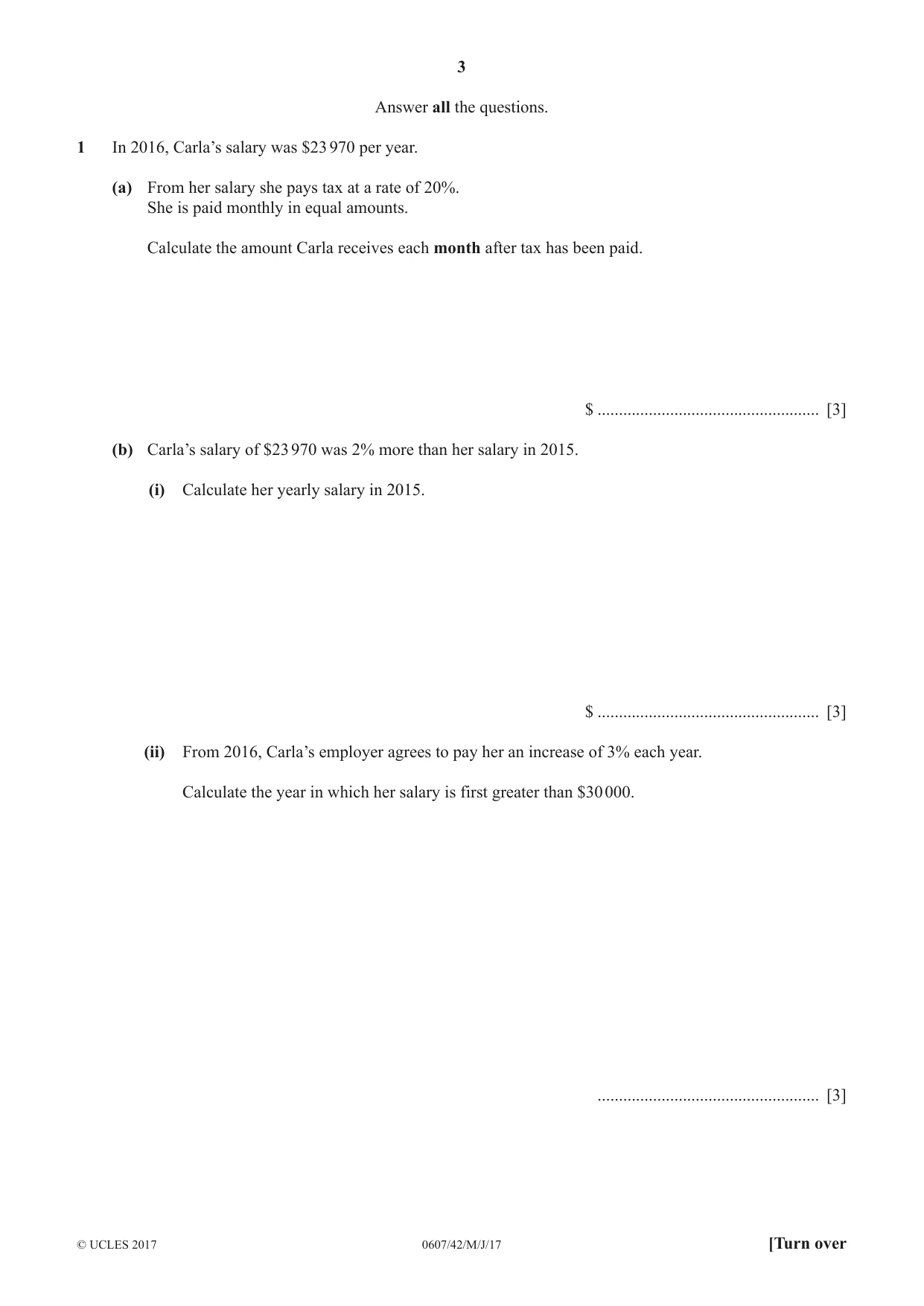
Q1 · In 2016, Carla’s salary was $23 970 per year
1 In 2016, Carla’s salary was $23 970 per year. (a) From her salary she pays tax at a rate of 20%. She is paid monthly in equal amounts. Calculate the amount Carla receives each month after tax has been paid. $ .................................................... [3] (b) Carla’s salary of $23 970 was 2% more than her salary in 2015. (i) Calculate her yearly salary in 2015. $ .................................................... [3] (ii) From 2016, Carla’s employer agrees to pay her an increase of 3% each year. Calculate the year in which her salary is first greater than $30 000. .................................................... [3]
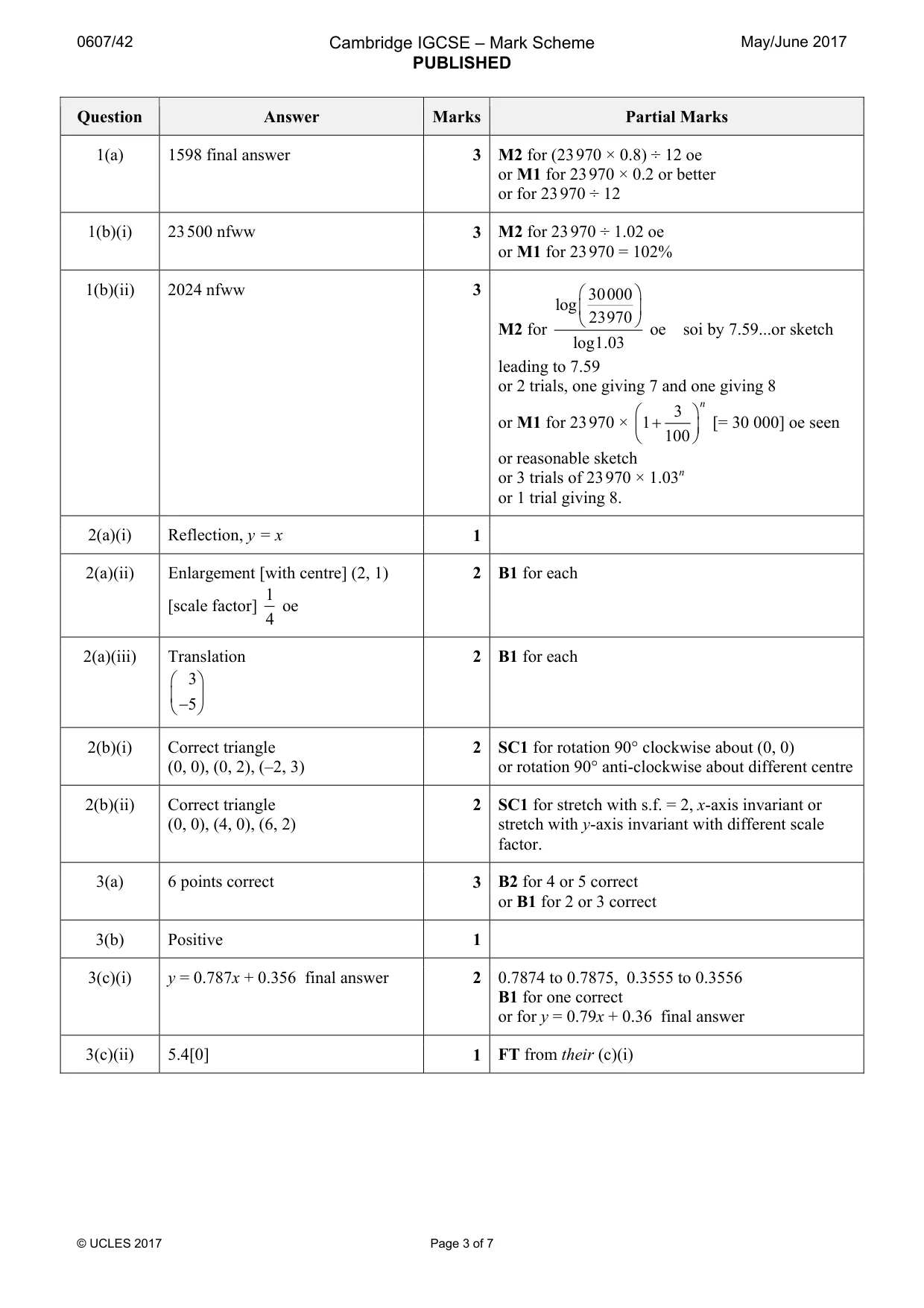
Mark scheme: Question Answer Marks Partial Marks 1(a) 1598 final answer 3 M2 for (23 970 × 0.8) ÷ 12 oe or M1 for 23 970 × 0.2 or better or for 23 970 ÷ 12 1(b)(i) 23 500 nfww 3 M2 for 23 970 ÷ 1.02 oe or M1 for 23 970 = 102% 1(b)(ii) 2024 nfww 3 30000 log 23970 M2 for oe soi by 7.59...or sketch log1.03 leading to 7.59 or 2 trials, one giving 7 and one giving 8 3 n or M1 for 23 970 × 1 + [= 30 000] oe seen 100 or reasonable sketch or 3 trials of 23 970 × 1.03n or 1 trial giving 8.
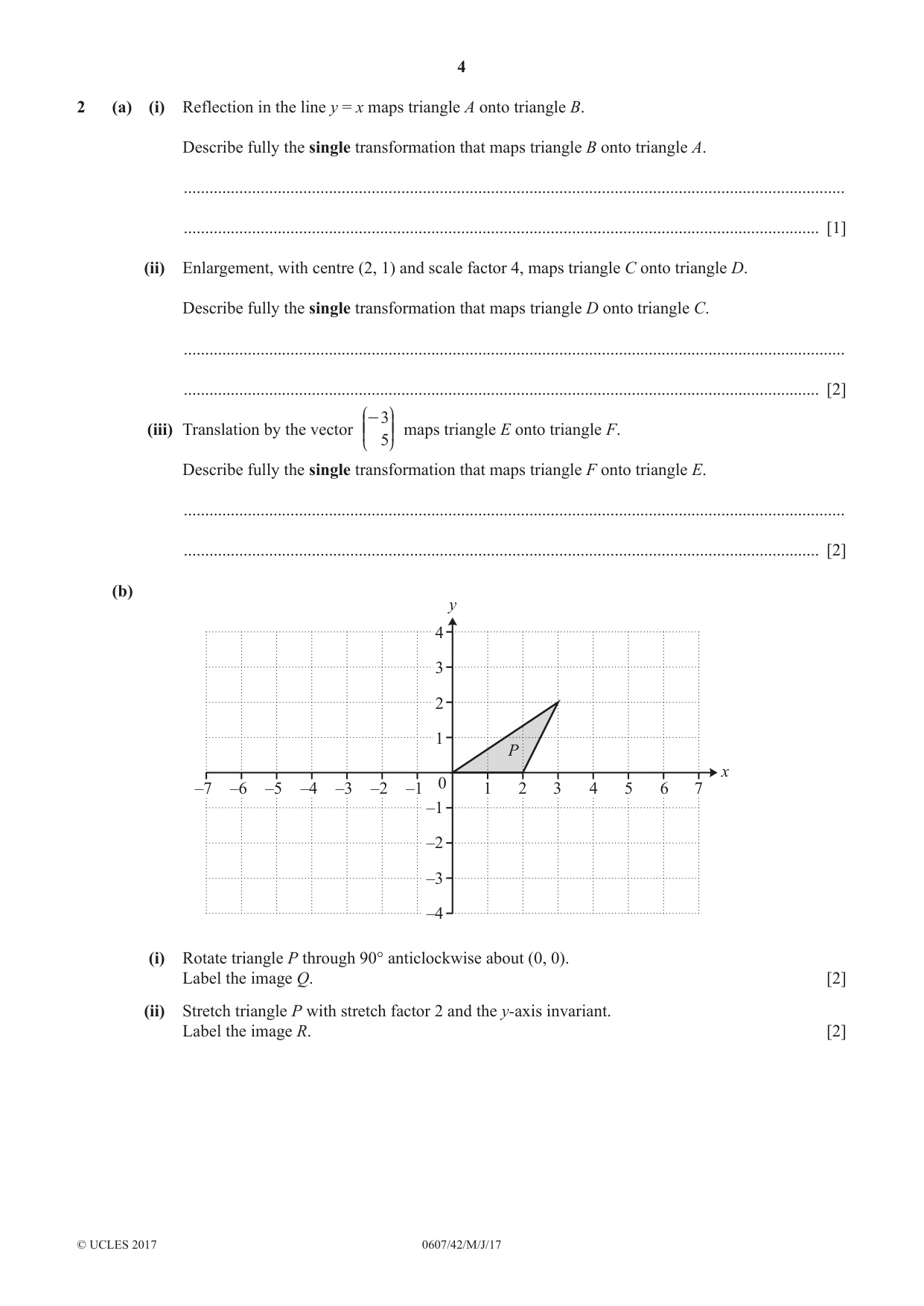
Q2 · Reflection in the line y = x maps triangle A onto triangle B
2 (a) (i) Reflection in the line y = x maps triangle A onto triangle B. Describe fully the single transformation that maps triangle B onto triangle A. ........................................................................................................................................................... ..................................................................................................................................................... [1] (ii) Enlargement, with centre (2, 1) and scale factor 4, maps triangle C onto triangle D. Describe fully the single transformation that maps triangle D onto triangle C. ........................................................................................................................................................... ..................................................................................................................................................... [2] J N - 3 (iii) Translation by the vector KK OO maps triangle E onto triangle F. 5 L P Describe fully the single transformation that maps triangle F onto triangle E. ........................................................................................................................................................... ..................................................................................................................................................... [2] (b) y 4 3 2 1 P x 0 –7 –6 –5 –4 –3 –2 –1 1 2 3 4 5 6 7 –1 –2 –3 –4 (i) Rotate triangle P through 90° anticlockwise about (0, 0). Label the image Q. [2] (ii) Stretch triangle P with stretch factor 2 and the y-axis invariant. Label the image R. [2]
Mark scheme: 2(a)(i) Reflection, y = x 1 2(a)(ii) Enlargement [with centre] (2, 1) 2 B1 for each 1 [scale factor] oe 4 2(a)(iii) Translation 2 B1 for each 3 −5 2(b)(i) Correct triangle 2 SC1 for rotation 90° clockwise about (0, 0) (0, 0), (0, 2), (–2, 3) or rotation 90° anti-clockwise about different centre 2(b)(ii) Correct triangle 2 SC1 for stretch with s.f. = 2, x-axis invariant or (0, 0), (4, 0), (6, 2) stretch with y-axis invariant with different scale factor.
Q3 · Two judges each give a mark out of ten for each dancer in a competition
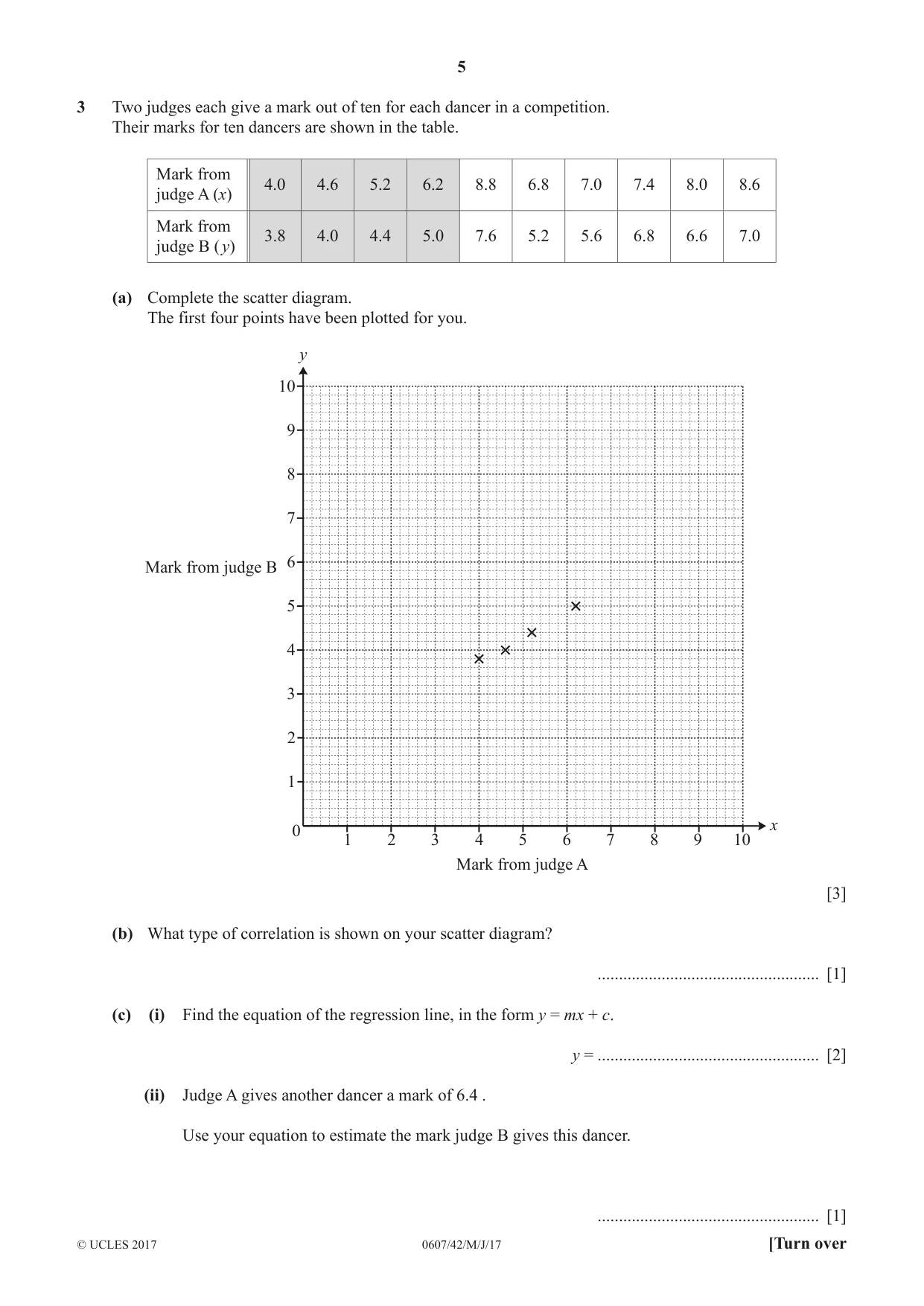
3 Two judges each give a mark out of ten for each dancer in a competition. Their marks for ten dancers are shown in the table. Mark from 4.0 4.6 5.2 6.2 8.8 6.8 7.0 7.4 8.0 8.6 judge A (x) Mark from 3.8 4.0 4.4 5.0 7.6 5.2 5.6 6.8 6.6 7.0 judge B (y) (a) Complete the scatter diagram. The first four points have been plotted for you. y 10 9 8 7 6 Mark from judge B 5 4 3 2 1 x 0 1 2 3 4 5 6 7 8 9 10 Mark from judge A [3] (b) What type of correlation is shown on your scatter diagram? .................................................... [1] (c) (i) Find the equation of the regression line, in the form y = mx + c. y = .................................................... [2] (ii) Judge A gives another dancer a mark of 6.4 . Use your equation to estimate the mark judge B gives this dancer. .................................................... [1]
Mark scheme: 3(a) 6 points correct 3 B2 for 4 or 5 correct or B1 for 2 or 3 correct 3(b) Positive 1 3(c)(i) y = 0.787x + 0.356 final answer 2 0.7874 to 0.7875, 0.3555 to 0.3556 B1 for one correct or for y = 0.79x + 0.36 final answer 3(c)(ii) 5.4[0] 1 FT from their (c)(i)
Q4 · =4 p = KK OO and q KK OO 2 3 L P L P (a) Find 1 (i) the column vector p , 2 J N K O K O…
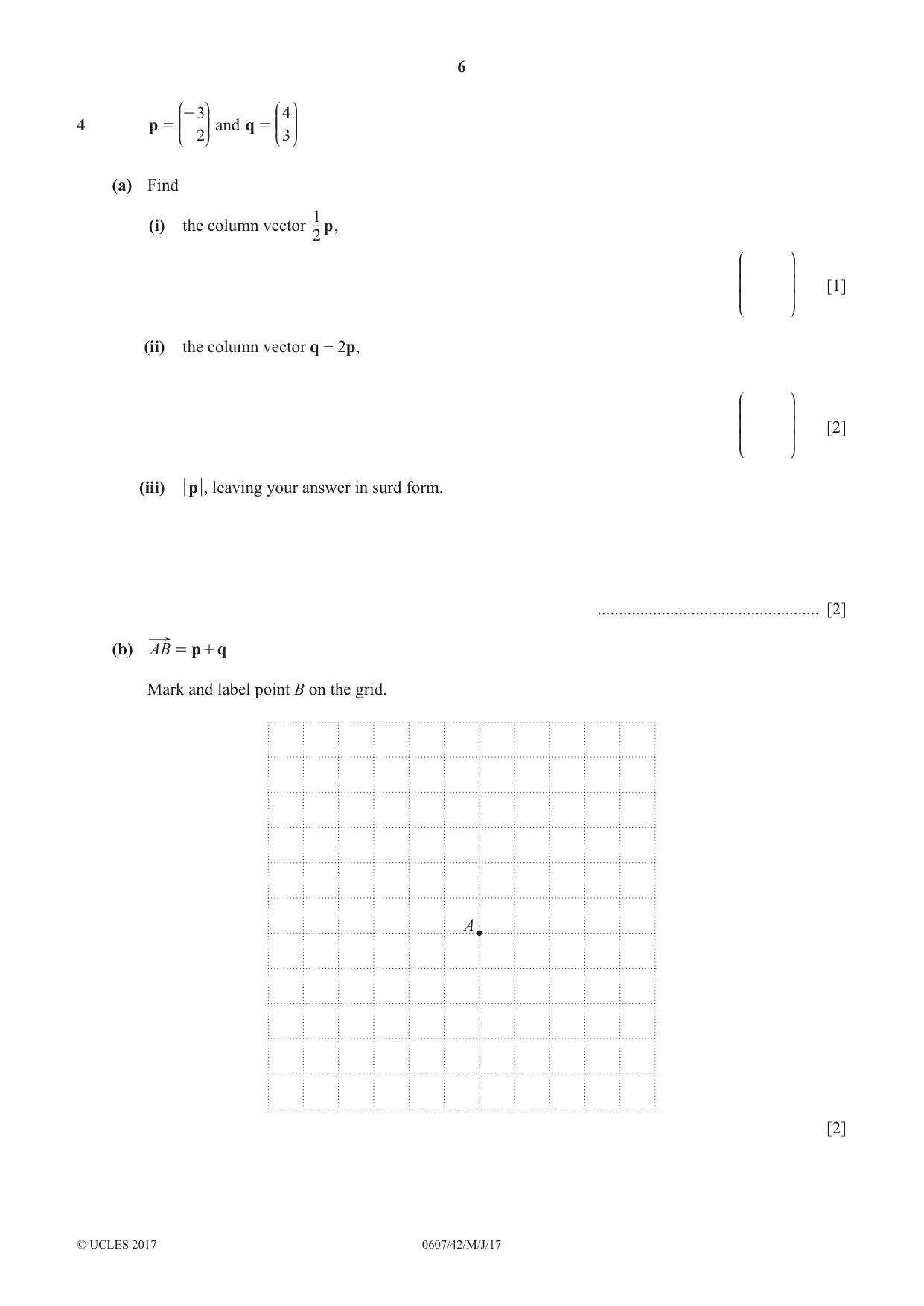
=4 p = KK OO and q KK OO 2 3 L P L P (a) Find 1 (i) the column vector p , 2 J N K O K O [1] K O L P (ii) the column vector q − 2p, J N K O K O [2] K O L P (iii) p , leaving your answer in surd form. .................................................... [2] (b) AB = p + q Mark and label point B on the grid. A [2]
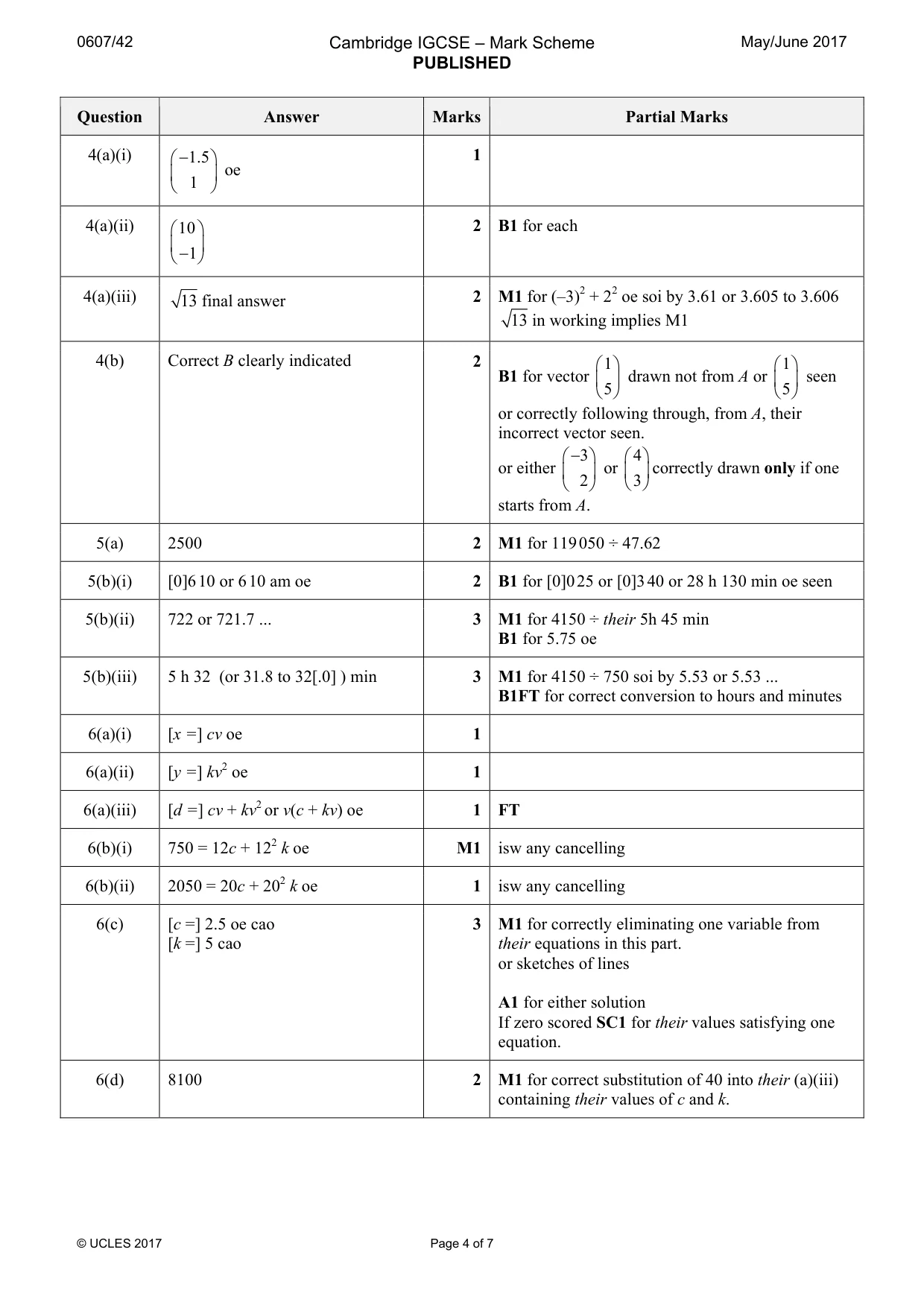
Mark scheme: 4(a)(i) −1.5 1 oe 1 4(a)(ii) 10 2 B1 for each − 1 4(a)(iii) 13 final answer 2 M1 for (–3)2 + 22 oe soi by 3.61 or 3.605 to 3.606 13 in working implies M1 4(b) Correct B clearly indicated 2 1 1 B1 for vector drawn not from A or seen 5 5 or correctly following through, from A, their incorrect vector seen. −3 4 or either or correctly drawn only if one 2 3 starts from A.
Q5 · Nitini flies from New Delhi to Singapore for a holiday
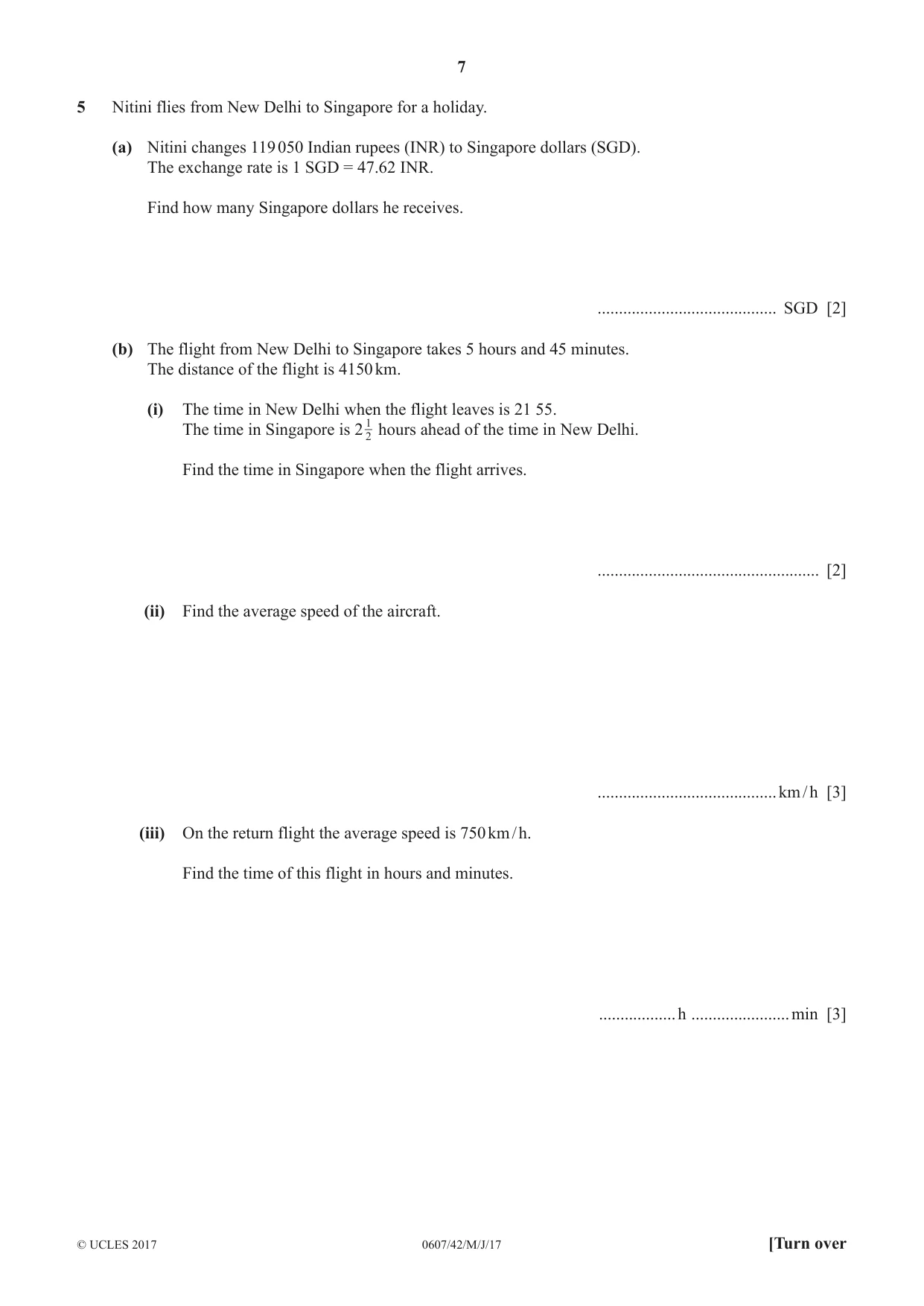
5 Nitini flies from New Delhi to Singapore for a holiday. (a) Nitini changes 119 050 Indian rupees (INR) to Singapore dollars (SGD). The exchange rate is 1 SGD = 47.62 INR. Find how many Singapore dollars he receives. .......................................... SGD [2] (b) The flight from New Delhi to Singapore takes 5 hours and 45 minutes. The distance of the flight is 4150 km. (i) The time in New Delhi when the flight leaves is 21 55. The time in Singapore is 2 12 hours ahead of the time in New Delhi. Find the time in Singapore when the flight arrives. .................................................... [2] (ii) Find the average speed of the aircraft. .......................................... km / h [3] (iii) On the return flight the average speed is 750 km / h. Find the time of this flight in hours and minutes. .................. h ....................... min [3]
Mark scheme: 5(a) 2500 2 M1 for 119 050 ÷ 47.62 5(b)(i) [0]6 10 or 6 10 am oe 2 B1 for [0]0 25 or [0]3 40 or 28 h 130 min oe seen 5(b)(ii) 722 or 721.7 ... 3 M1 for 4150 ÷ their 5h 45 min B1 for 5.75 oe 5(b)(iii) 5 h 32 (or 31.8 to 32[.0] ) min 3 M1 for 4150 ÷ 750 soi by 5.53 or 5.53 ... B1FT for correct conversion to hours and minutes
Q6 · X is proportional to v
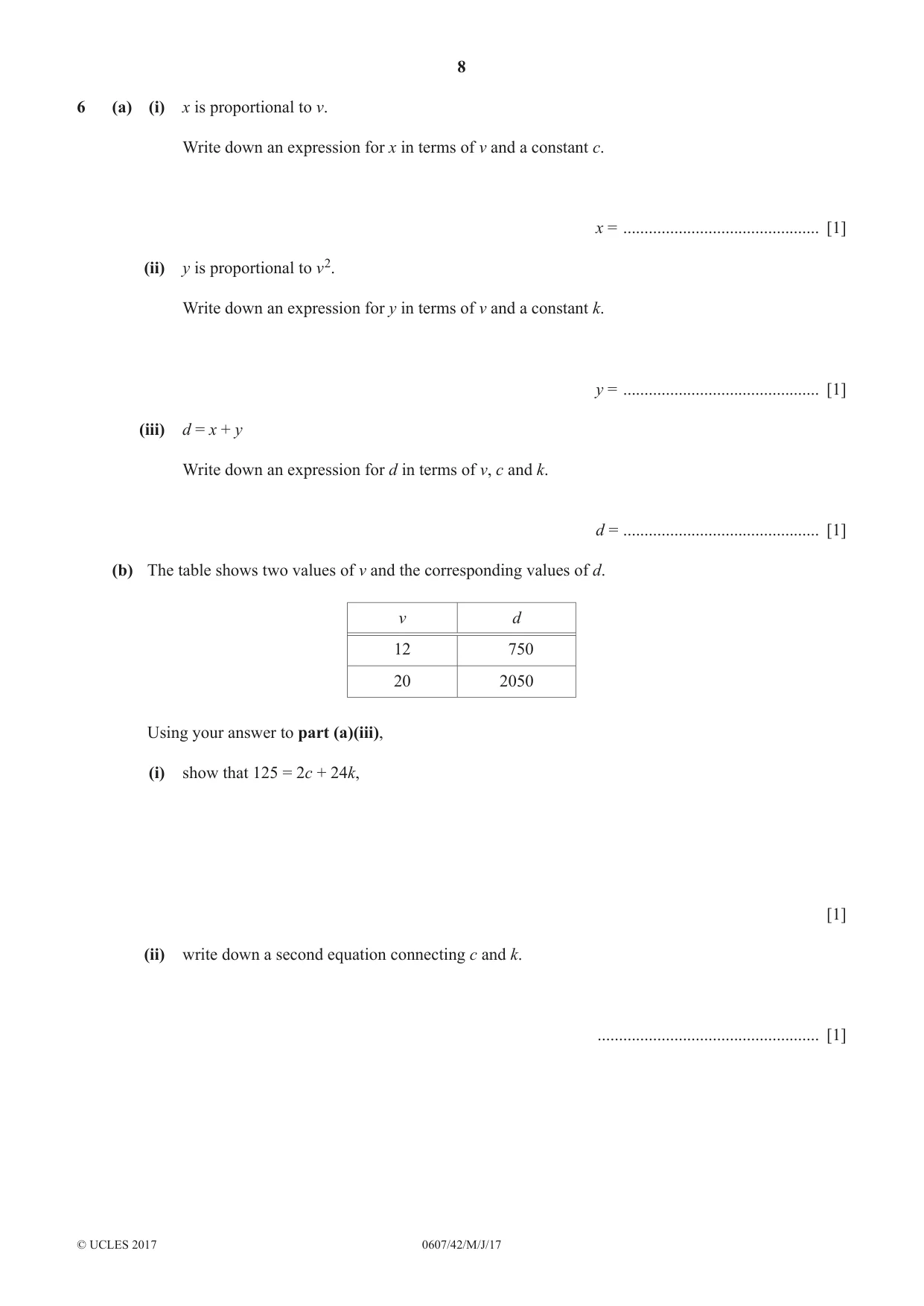
6 (a) (i) x is proportional to v. Write down an expression for x in terms of v and a constant c. x = .............................................. [1] (ii) y is proportional to v2. Write down an expression for y in terms of v and a constant k. y = .............................................. [1] (iii) d = x + y Write down an expression for d in terms of v, c and k. d = .............................................. [1] (b) The table shows two values of v and the corresponding values of d. v d 12 750 20 2050 Using your answer to part (a)(iii), (i) show that 125 = 2c + 24k, [1] (ii) write down a second equation connecting c and k. .................................................... [1] (c) Solve the simultaneous equations in part (b) to find the value of c and the value of k. c = .................................................... k = .................................................... [3] (d) Find the value of d when v = 40. d = .................................................... [2]
Mark scheme: 6(a)(i) [x =] cv oe 1 6(a)(ii) [y =] kv2 oe 1 6(a)(iii) [d =] cv + kv2 or v(c + kv) oe 1 FT 6(b)(i) 750 = 12c + 122 k oe M1 isw any cancelling 6(b)(ii) 2050 = 20c + 202 k oe 1 isw any cancelling 6(c) [c =] 2.5 oe cao 3 M1 for correctly eliminating one variable from [k =] 5 cao their equations in this part. or sketches of lines A1 for either solution If zero scored SC1 for their values satisfying one equation. 6(d) 8100 2 M1 for correct substitution of 40 into their (a)(iii) containing their values of c and k.
Q7 · A ship sails 65 km on a bearing of 310° from A to B
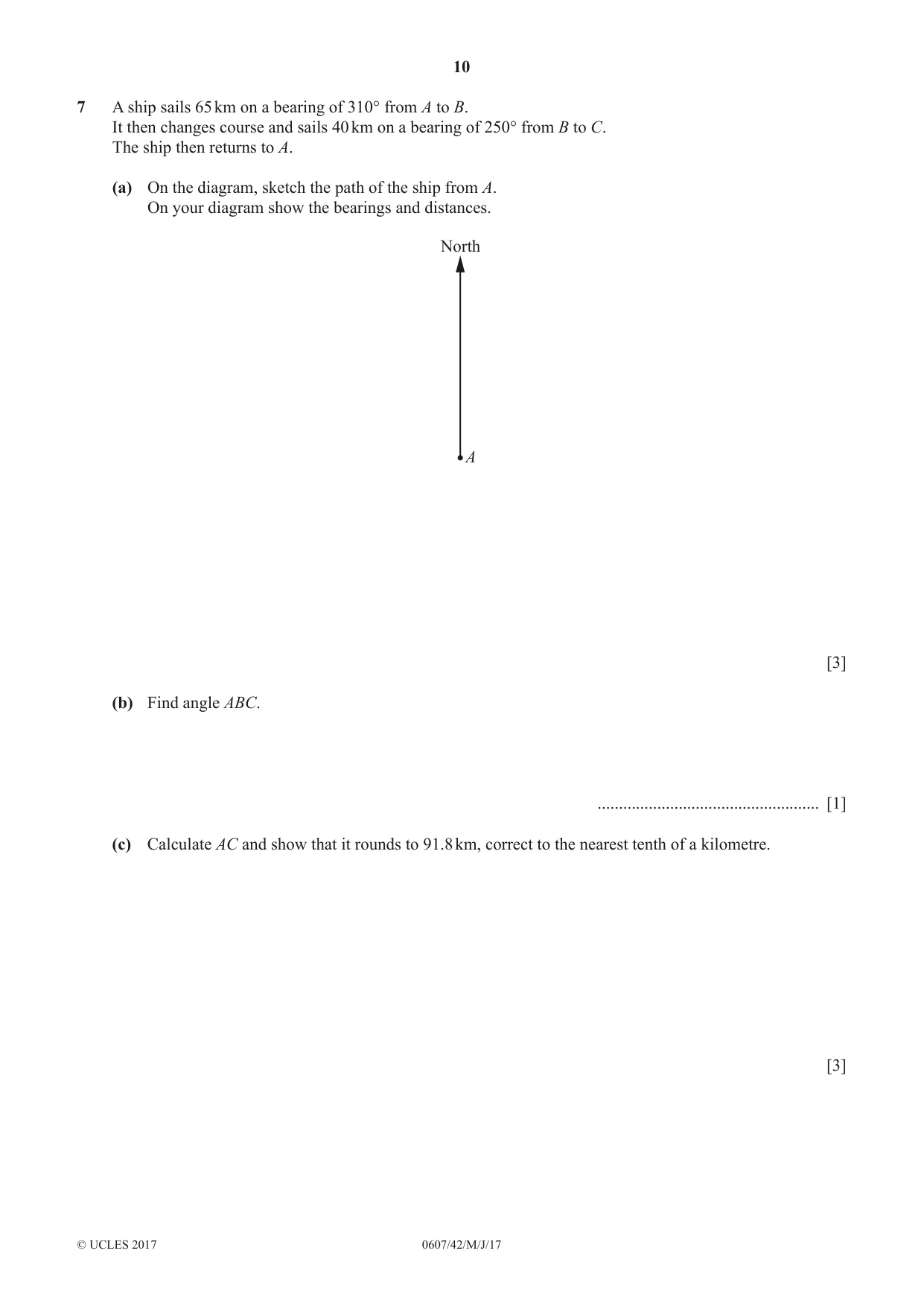
7 A ship sails 65 km on a bearing of 310° from A to B. It then changes course and sails 40 km on a bearing of 250° from B to C. The ship then returns to A. (a) On the diagram, sketch the path of the ship from A. On your diagram show the bearings and distances. North A [3] (b) Find angle ABC. .................................................... [1] (c) Calculate AC and show that it rounds to 91.8 km, correct to the nearest tenth of a kilometre. [3] (d) Find the bearing of C from A. .................................................... [4]
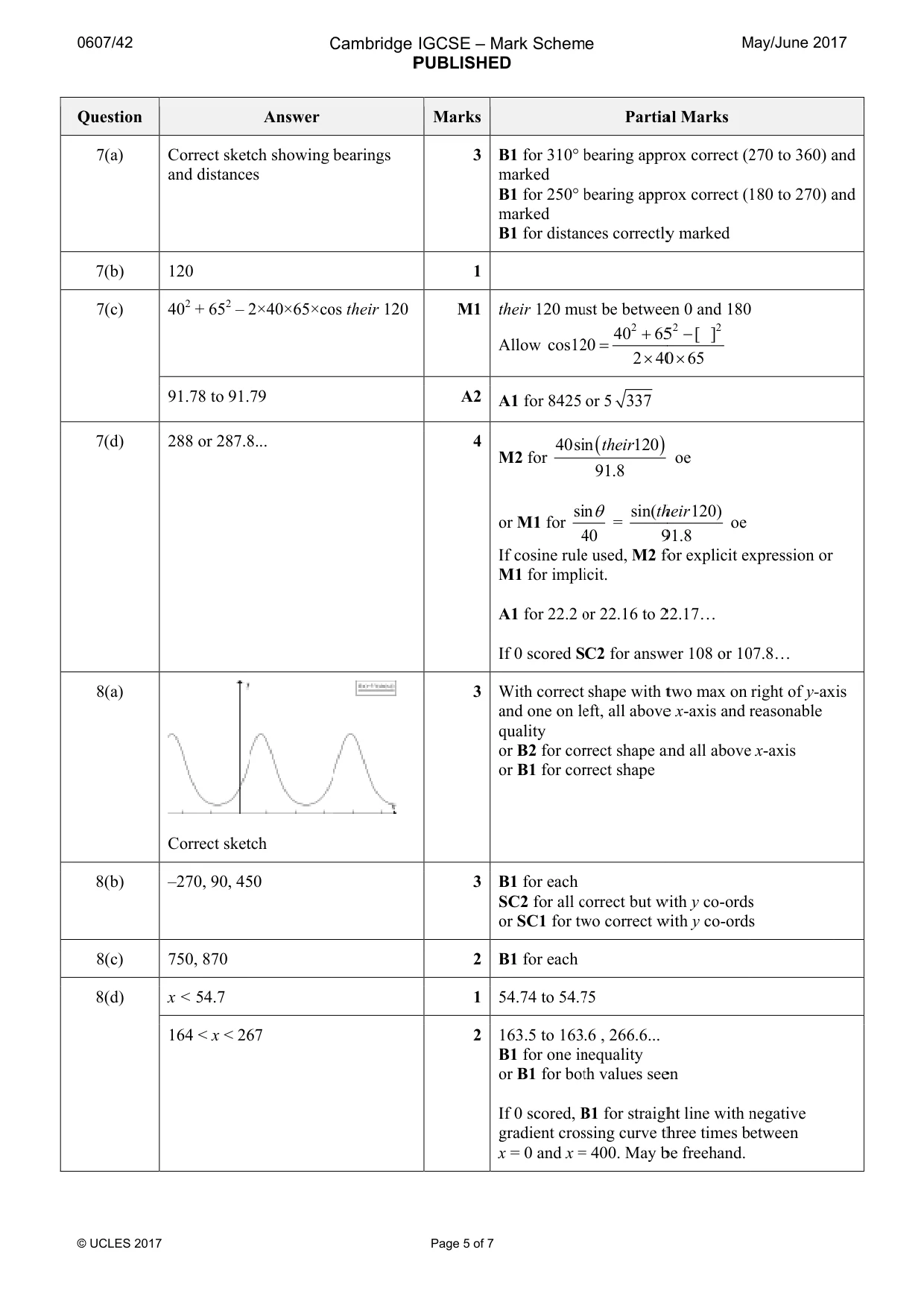
Mark scheme: 7(a) Correct skettch showing bearingsb 3 B1B for 310° bearingb apprrox correct (2270 to 360) aand and distancees markedm B1B for 250° bearingb apprrox correct (1180 to 270) aand markedm B1B for distannces correctlyy marked 7(b) 120 1 7(c) 402 + 652 – 22×40×65×coos their 120 M1 theirt 120 muust be betweeen 0 and 180 40 2 + 655 2 − [ ]2 AllowA cos1220 = 2 × 400 × 65 91.78 to 91.779 A2 A1A for 8425 or 5 337 7(d) 288 or 287.88... 4 40sin ( their120 ) M2M for oe 91.8 sinθ sin(thheir 120) oro M1 for = oe 404 991.8 IfI cosine rulee used, M2 fofor explicit exxpression or M1M for impliicit. A1A for 22.2 oro 22.16 to 222.17… IfI 0 scored SC2 for answwer 108 or 1007.8…
Q8 · Y 5 x –400 0 600 f(x) = 3sinx (a) Sketch the graph of y = f(x) for - 400 ° G x G 600 °
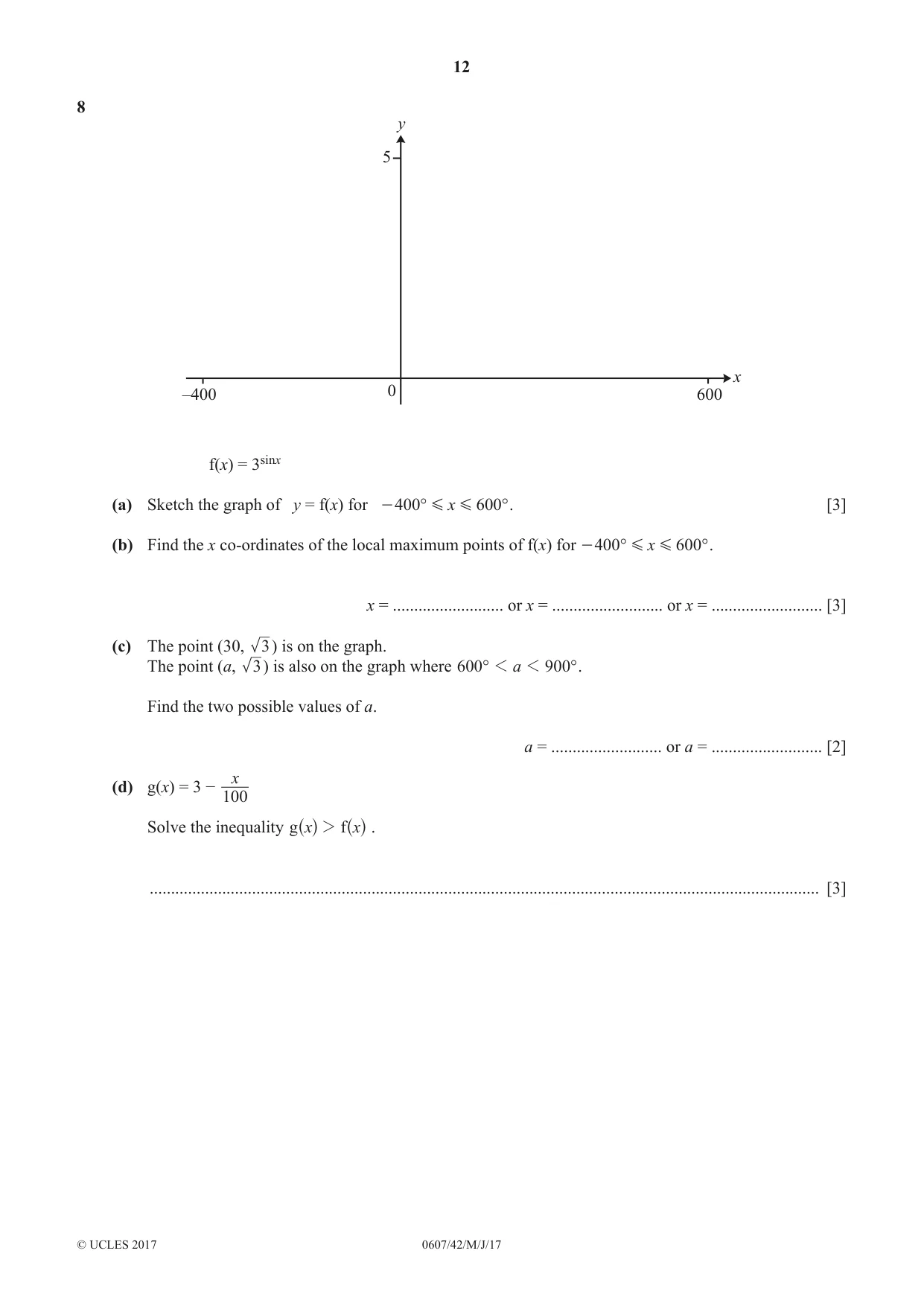
8 y 5 x –400 0 600 f(x) = 3sinx (a) Sketch the graph of y = f(x) for - 400 ° G x G 600 ° . [3] (b) Find the x co-ordinates of the local maximum points of f(x) for - 400° G x G 600° . x = .......................... or x = .......................... or x = .......................... [3] (c) The point (30, 3) is on the graph. The point (a, 3) is also on the graph where 600° 1 a 1 900 ° . Find the two possible values of a. a = .......................... or a = .......................... [2] x (d) g(x) = 3 − 100 Solve the inequality g x 2 f x . ^ h ^ h ............................................................................................................................................................. [3]
Mark scheme: 8(a) 3 WithW correct shape with ttwo max on right of y-axxis anda one on leeft, all abovee x-axis and reasonabler qualityq oro B2 for corrrect shape anand all above x-axis oro B1 for corrrect shape Correct skettch 8(b) –270, 90, 4550 3 B1B for each SC2S for all correctc but wwith y co-ordss oro SC1 for twwo correct wwith y co-ordss 8(c) 750, 870 2 B1B for each 8(d) x < 54.7 1 54.745 to 54.775 164 < x < 2667 2 163.51 to 163.6 , 266.6... B1B for one innequality oro B1 for botth values seeen IfI 0 scored, B1B for straighht line with negativen gradientg crosssing curve thhree times beetween xx = 0 and x == 400. May bbe freehand.
Q9 · C x cm NOT TO SCALE 60° A B (x + 2) cm In the diagram AC = x cm, AB = (x + 2) cm and…
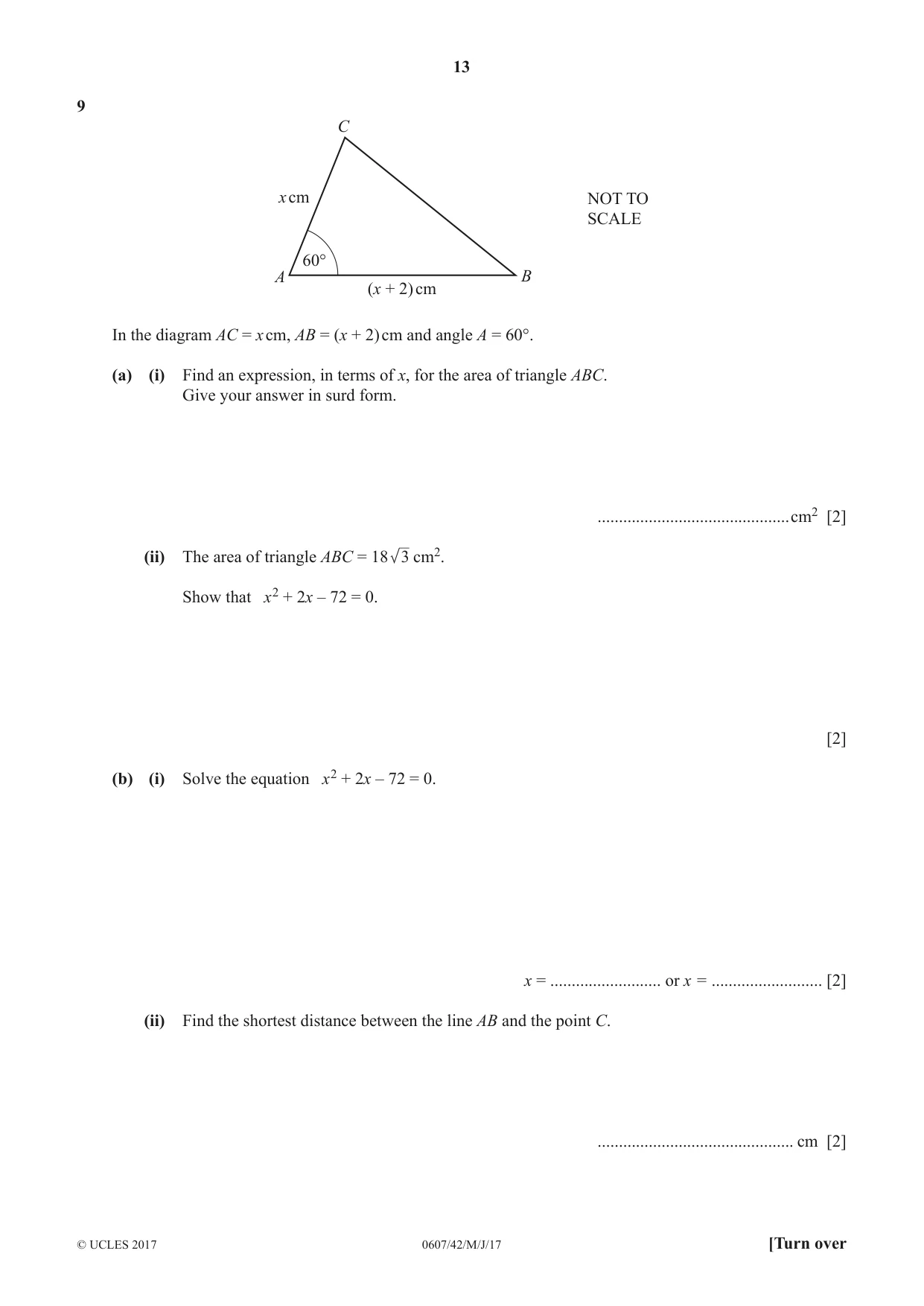
9 C x cm NOT TO SCALE 60° A B (x + 2) cm In the diagram AC = x cm, AB = (x + 2) cm and angle A = 60°. (a) (i) Find an expression, in terms of x, for the area of triangle ABC. Give your answer in surd form. .............................................cm2 [2] (ii) The area of triangle ABC = 18 3 cm2. Show that x2 + 2x – 72 = 0. [2] (b) (i) Solve the equation x2 + 2x – 72 = 0. x = .......................... or x = .......................... [2] (ii) Find the shortest distance between the line AB and the point C. .............................................. cm [2]
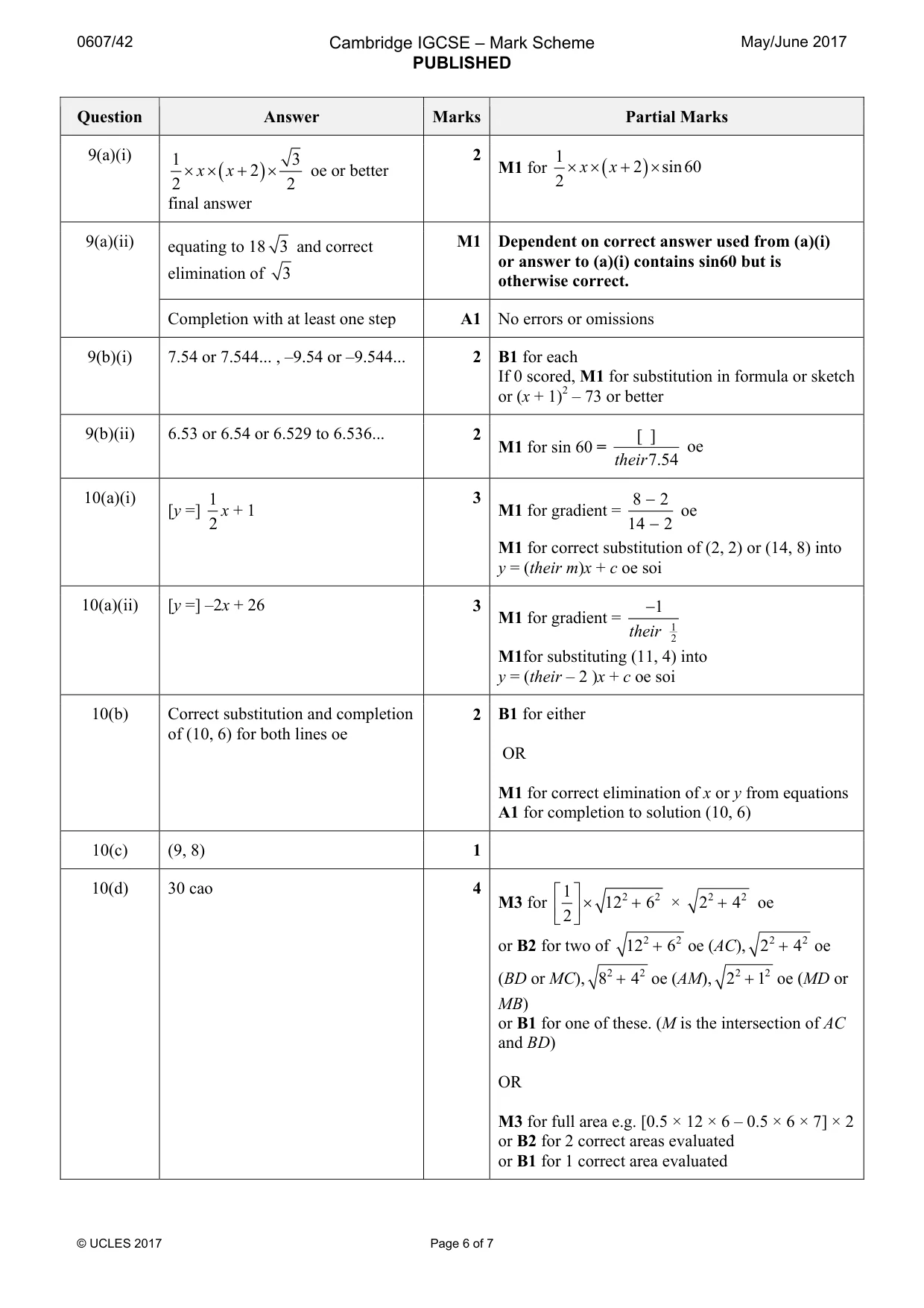
Mark scheme: 9(a)(i) 1 3 2 1 x + 2 ) × sin60 × x × ( x + 2 ) × oe or better M1 for × x × ( 2 2 2 final answer 9(a)(ii) equating to 18 3 and correct M1 Dependent on correct answer used from (a)(i) or answer to (a)(i) contains sin60 but is elimination of 3 otherwise correct. Completion with at least one step A1 No errors or omissions 9(b)(i) 7.54 or 7.544... , –9.54 or –9.544... 2 B1 for each If 0 scored, M1 for substitution in formula or sketch or (x + 1)2 – 73 or better 9(b)(ii) 6.53 or 6.54 or 6.529 to 6.536... 2 [ ] M1 for sin 60 = oe their 7.54
Q10 · Y C (14, 8) NOT TO SCALE B (11, 4) A (2, 2) x 0 A is the point (2, 2), B is the point…
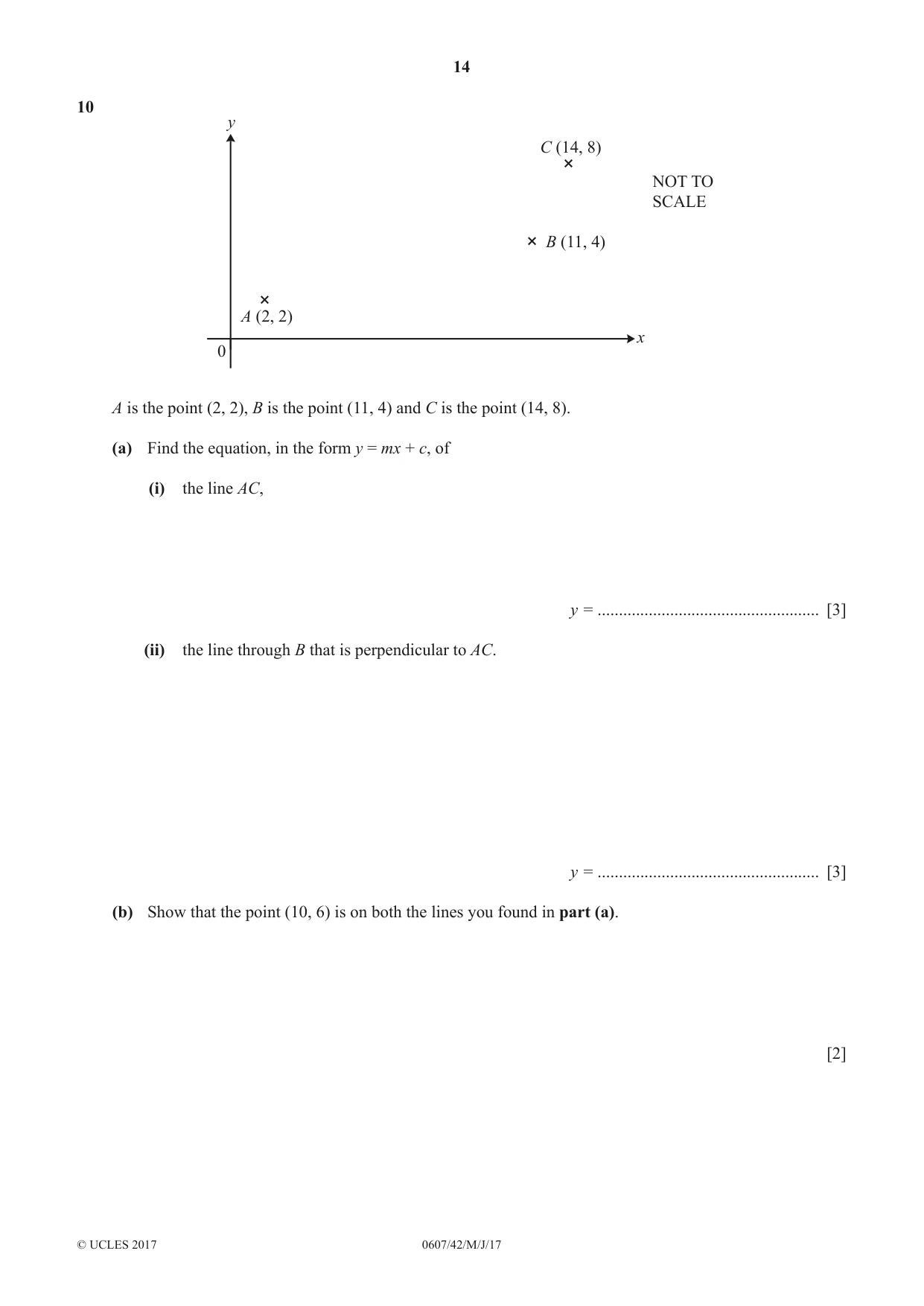
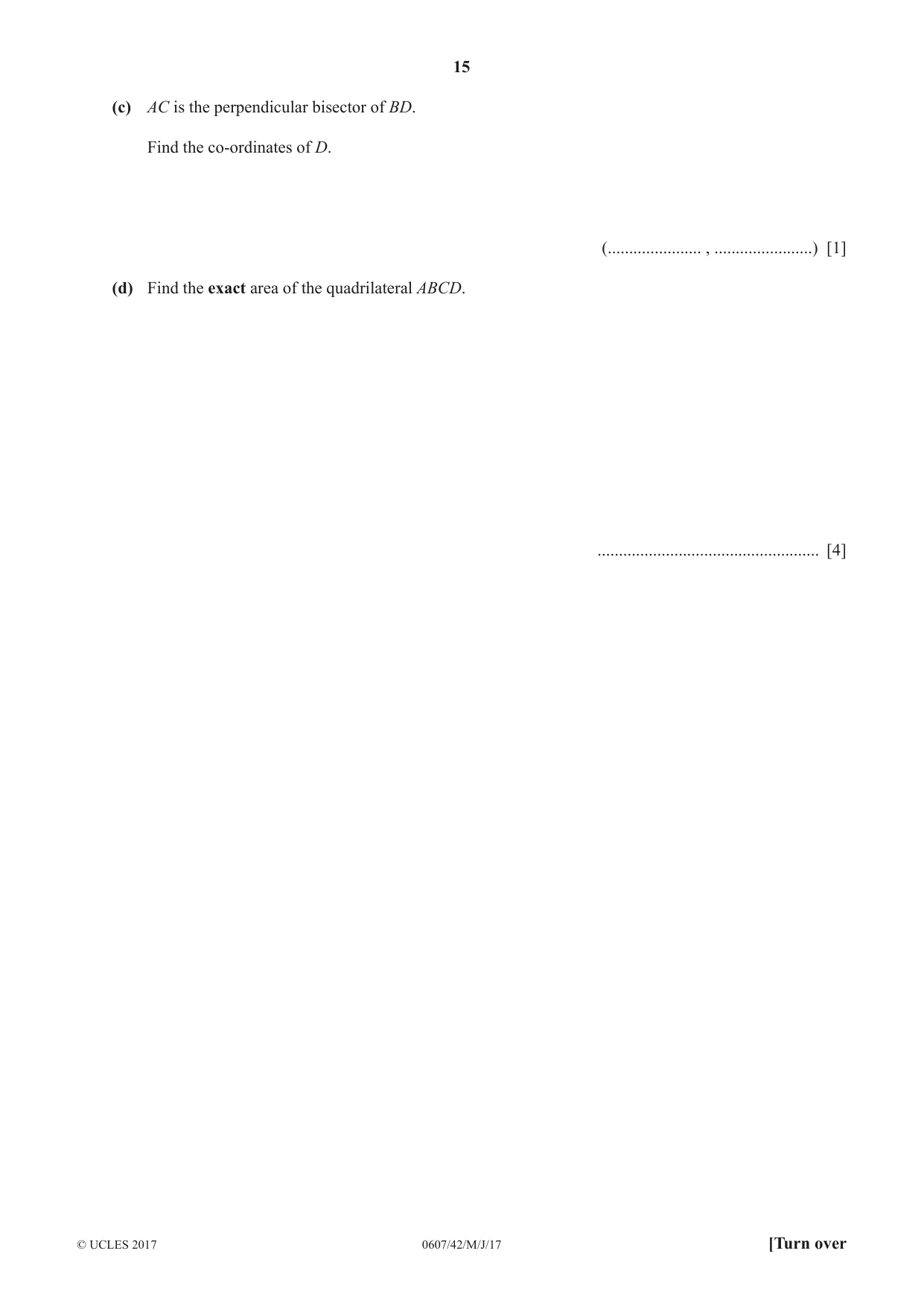
10 y C (14, 8) NOT TO SCALE B (11, 4) A (2, 2) x 0 A is the point (2, 2), B is the point (11, 4) and C is the point (14, 8). (a) Find the equation, in the form y = mx + c, of (i) the line AC, y = .................................................... [3] (ii) the line through B that is perpendicular to AC. y = .................................................... [3] (b) Show that the point (10, 6) is on both the lines you found in part (a). [2] (c) AC is the perpendicular bisector of BD. Find the co-ordinates of D. (...................... , .......................) [1] (d) Find the exact area of the quadrilateral ABCD. .................................................... [4]
Mark scheme: 10(a)(i) 1 3 8 − 2 [y =] x + 1 M1 for gradient = oe 2 14 − 2 M1 for correct substitution of (2, 2) or (14, 8) into y = (their m)x + c oe soi 10(a)(ii) [y =] –2x + 26 3 −1 M1 for gradient = their 12 M1for substituting (11, 4) into y = (their – 2 )x + c oe soi 10(b) Correct substitution and completion 2 B1 for either of (10, 6) for both lines oe OR M1 for correct elimination of x or y from equations A1 for completion to solution (10, 6) 10(c) (9, 8) 1 10(d) 30 cao 4 1 2 2 2 2 M3 for × 12 + 6 × 2 + 4 oe 2 or B2 for two of 12 2 + 6 2 oe (AC), 2 2 + 4 2 oe (BD or MC), 8 2 + 4 2 oe (AM), 2 2 + 12 oe (MD or MB) or B1 for one of these. (M is the intersection of AC and BD) OR M3 for full area e.g. [0.5 × 12 × 6 – 0.5 × 6 × 7] × 2 or B2 for 2 correct areas evaluated or B1 for 1 correct area evaluated
Q11 · A farmer sorts the grapefruit he grows into sizes, according to their diameter
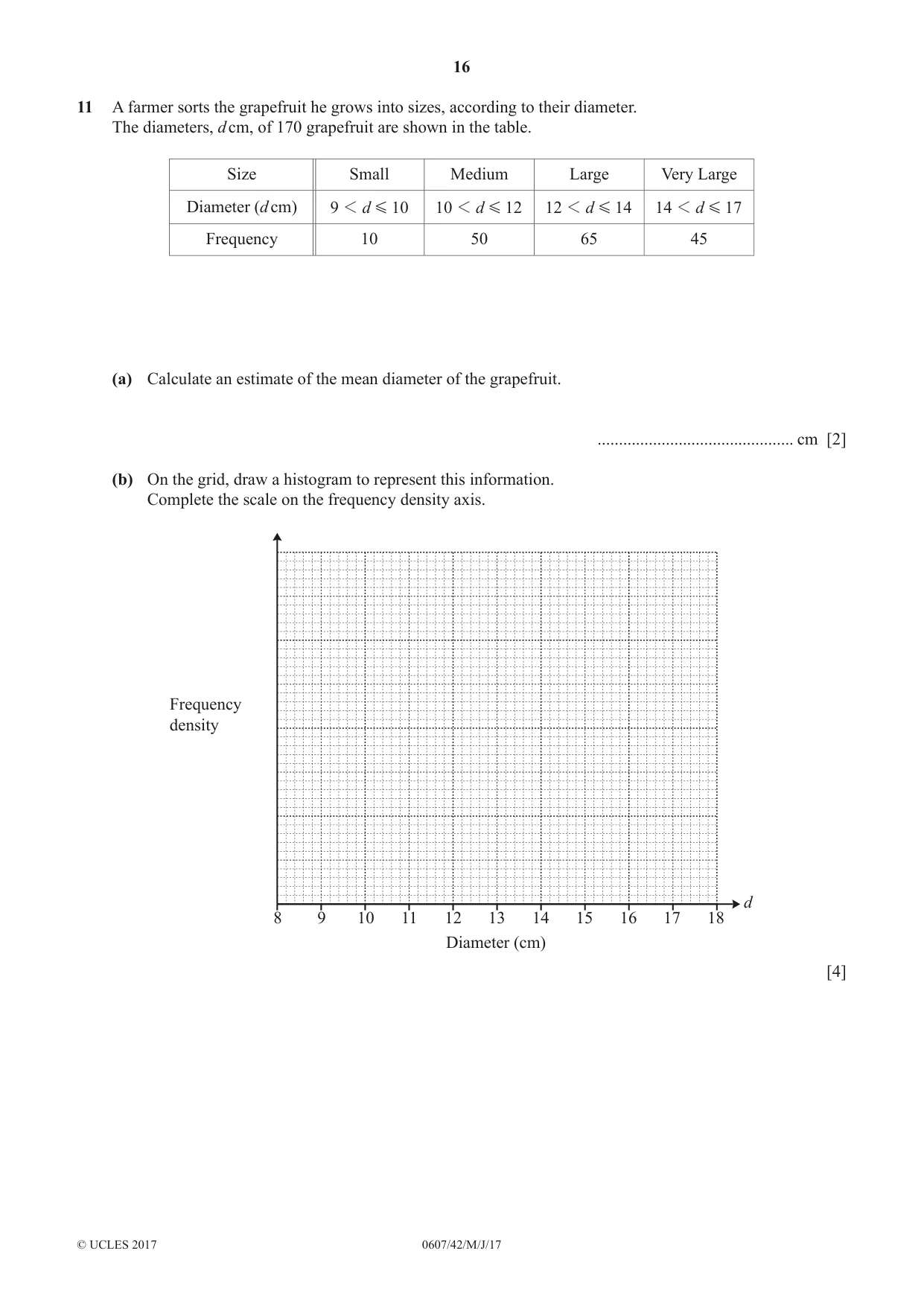
11 A farmer sorts the grapefruit he grows into sizes, according to their diameter. The diameters, d cm, of 170 grapefruit are shown in the table. Size Small Medium Large Very Large Diameter (d cm) 9 1 d G 10 10 1 d G 12 12 1 d G 14 14 1 d G 17 Frequency 10 50 65 45 (a) Calculate an estimate of the mean diameter of the grapefruit. .............................................. cm [2] (b) On the grid, draw a histogram to represent this information. Complete the scale on the frequency density axis. Frequency density d 8 9 10 11 12 13 14 15 16 17 18 Diameter (cm) [4] (c) Two of the 170 grapefruit are chosen at random. Calculate the probability that (i) they are both Very Large, .................................................... [2] (ii) one is Small and the other is Medium. .................................................... [3]
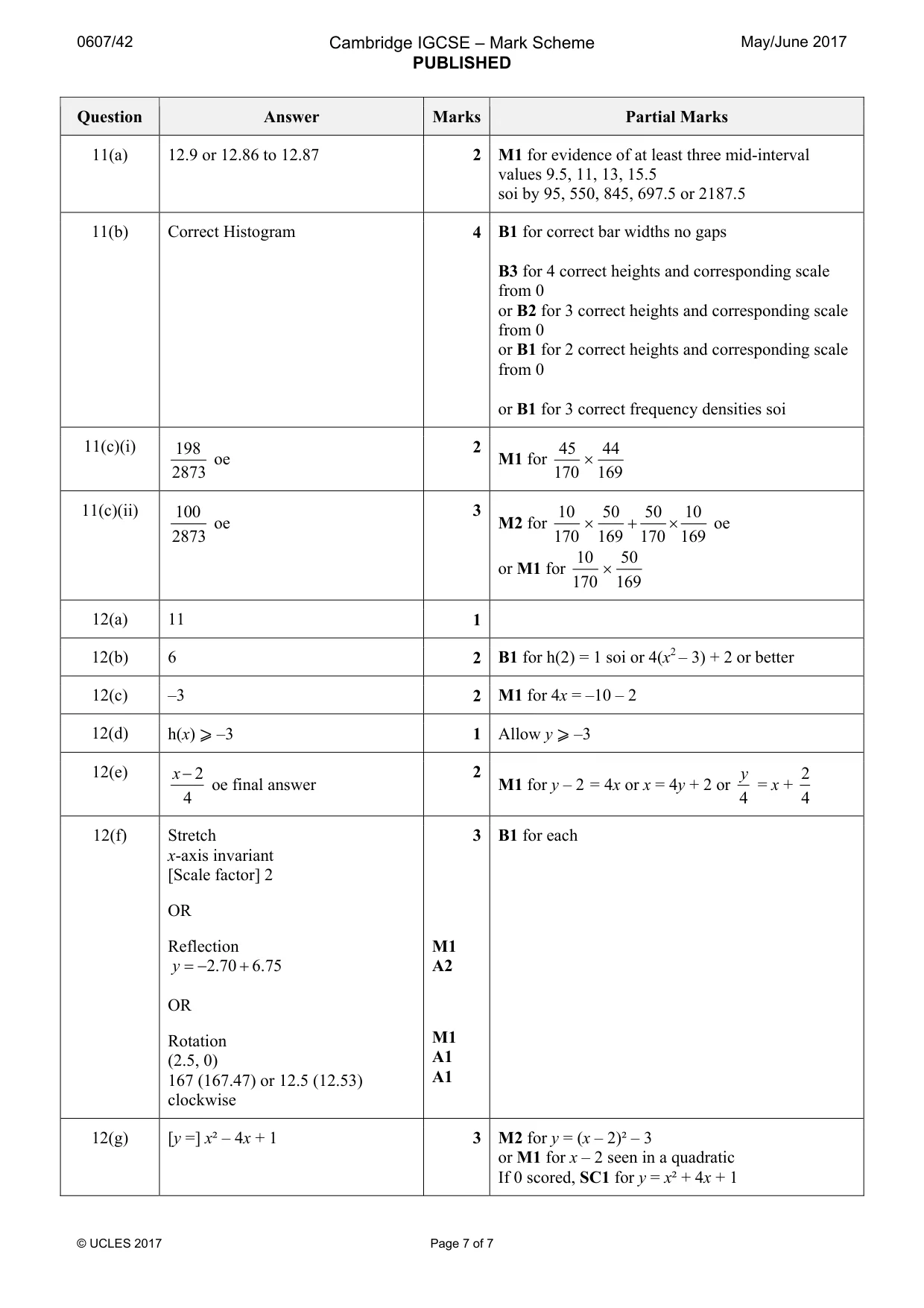
Mark scheme: 11(a) 12.9 or 12.86 to 12.87 2 M1 for evidence of at least three mid-interval values 9.5, 11, 13, 15.5 soi by 95, 550, 845, 697.5 or 2187.5 11(b) Correct Histogram 4 B1 for correct bar widths no gaps B3 for 4 correct heights and corresponding scale from 0 or B2 for 3 correct heights and corresponding scale from 0 or B1 for 2 correct heights and corresponding scale from 0 or B1 for 3 correct frequency densities soi 11(c)(i) 198 2 45 44 oe M1 for × 2873 170 169 11(c)(ii) 100 3 10 50 50 10 oe M2 for × + × oe 2873 170 169 170 169 10 50 or M1 for × 170 169
Q12 · F(x) = 4x + 2 g(x) = 5 − 2x h(x) = x2 − 3 (a) Find g(−3)
12 f(x) = 4x + 2 g(x) = 5 − 2x h(x) = x2 − 3 (a) Find g(−3). .................................................... [1] (b) Find f(h(2)). .................................................... [2] (c) Find x when f(x) = −10. x = .................................................... [2] (d) Write down the range of h(x). .................................................... [1] (e) Find f−1(x). f−1(x) = .................................................... [2] (f) k(x) = 10 − 4x Describe fully the single transformation that maps the graph of y = g(x) onto the graph of y = k(x). ................................................................................................................................................................... ............................................................................................................................................................. [3] J N 2 (g) The graph of y = h(x) is translated by the vector KK OO . 0 L P Find the equation of the graph of the image. Write your answer in the form y = ax2 + bx + c. y = .................................................... [3]
Mark scheme: 12(a) 11 1 12(b) 6 2 B1 for h(2) = 1 soi or 4(x2 – 3) + 2 or better 12(c) –3 2 M1 for 4x = –10 – 2 12(d) h(x) ⩾ –3 1 Allow y ⩾ –3 12(e) x − 2 2 y 2 oe final answer M1 for y – 2 = 4x or x = 4y + 2 or = x + 4 4 4 12(f) Stretch 3 B1 for each x-axis invariant [Scale factor] 2 OR Reflection M1 y = −2.70 + 6.75 A2 OR Rotation M1 (2.5, 0) A1 167 (167.47) or 12.5 (12.53) A1 clockwise 12(g) [y =] x² – 4x + 1 3 M2 for y = (x – 2)² – 3 or M1 for x – 2 seen in a quadratic If 0 scored, SC1 for y = x² + 4x + 1
What was in this paper
The subtopics covered by these 12 questions, and how many questions each got. Open one in a new tab to see every Cambridge question on it.
What you needed in this session
Cambridge’s own grade thresholds for 2017 May/June, Paper 4 · Variant 2. A higher threshold means an easier paper — the bar moves with how the cohort did.