Cambridge IGCSE Mathematics - International 0607 — 2019 May/June Paper 4 · Variant 3
0607/43/M/J/19 · 12 questions · 120 marks · ≈135 min
The question paper and its mark scheme, free to read here and free to download. This is Cambridge’s own paper, exactly as it was sat.
Question paper20 pages
Mark scheme9 pages
Answers below. Sit the paper first if you are practising.
Questions as text
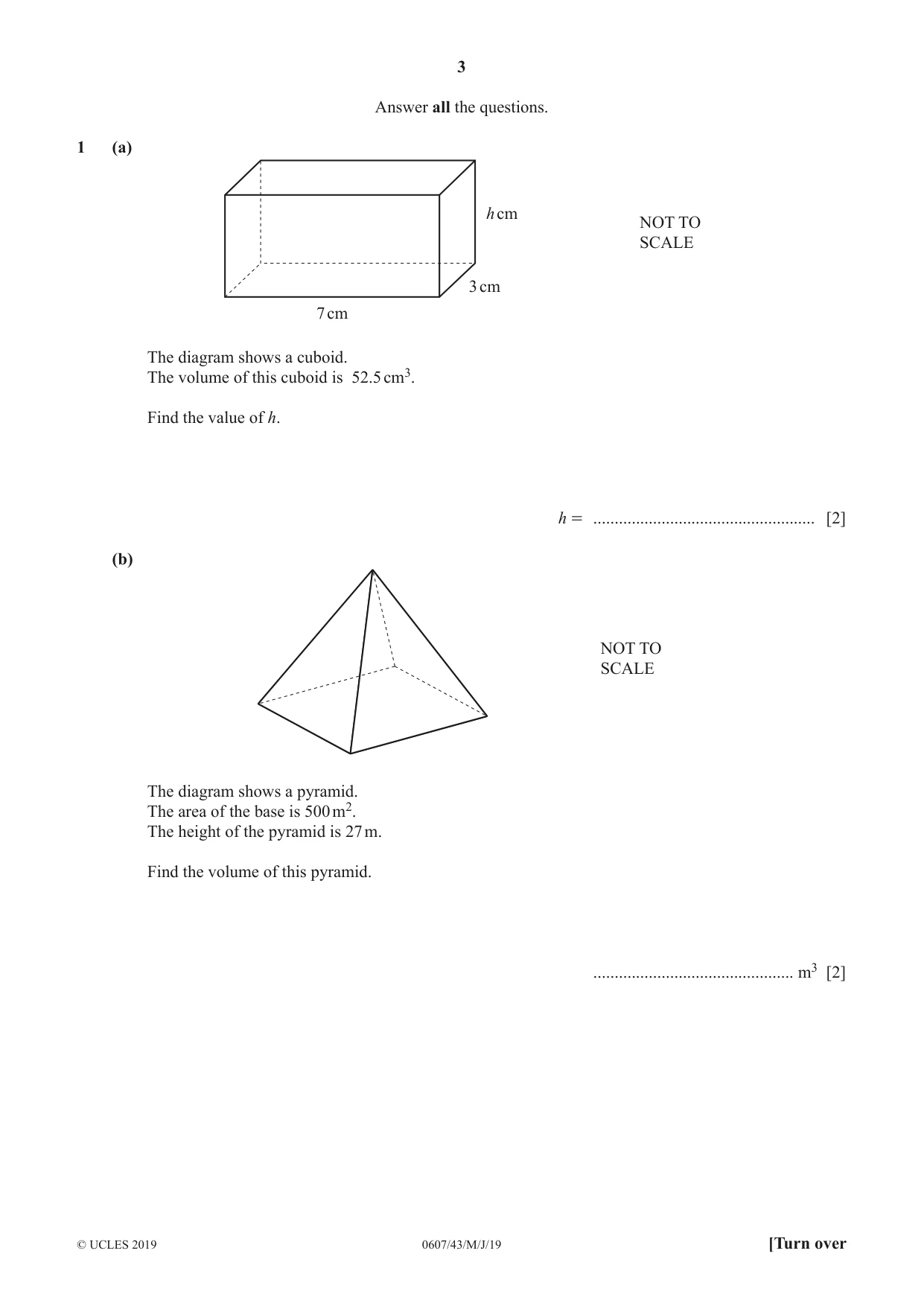
Q1 · H cm NOT TO SCALE 3 cm 7 cm The diagram shows a cuboid
1 (a) h cm NOT TO SCALE 3 cm 7 cm The diagram shows a cuboid. The volume of this cuboid is 52.5 cm3. Find the value of h. h = .................................................... [2] (b) NOT TO SCALE The diagram shows a pyramid. The area of the base is 500 m2. The height of the pyramid is 27 m. Find the volume of this pyramid. ............................................... m3 [2]
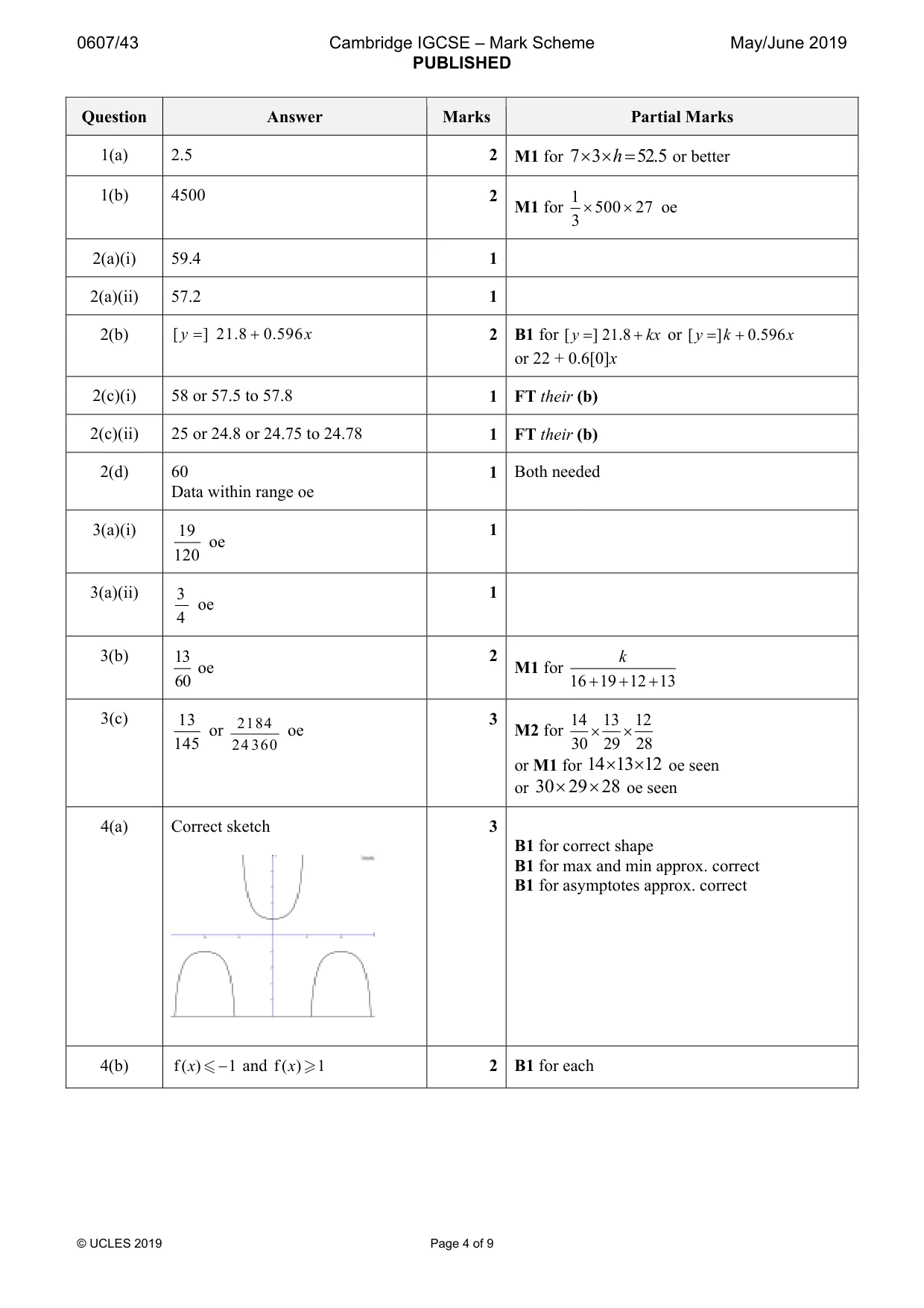
Mark scheme: Question Answer Marks Partial Marks 1(a) 2.5 2 M1 for 7 × 3 × h = 52.5 or better 1(b) 4500 2 1 M1 for × 500 × 27 oe 3
Q2 · The table shows the marks of 10 students in a physics examination and a chemistry…
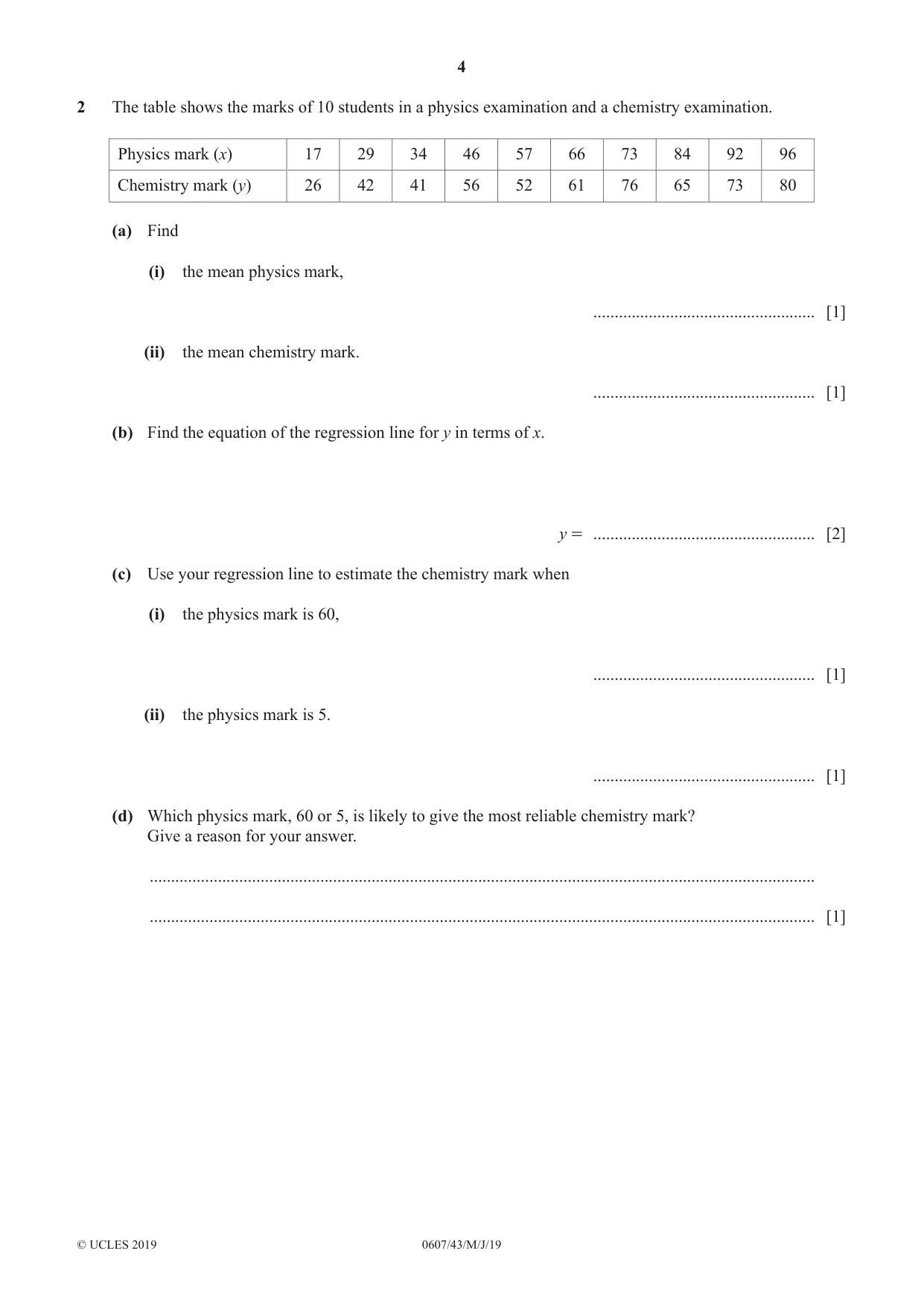
2 The table shows the marks of 10 students in a physics examination and a chemistry examination. Physics mark (x) 17 29 34 46 57 66 73 84 92 96 Chemistry mark (y) 26 42 41 56 52 61 76 65 73 80 (a) Find (i) the mean physics mark, .................................................... [1] (ii) the mean chemistry mark. .................................................... [1] (b) Find the equation of the regression line for y in terms of x. y = .................................................... [2] (c) Use your regression line to estimate the chemistry mark when (i) the physics mark is 60, .................................................... [1] (ii) the physics mark is 5. .................................................... [1] (d) Which physics mark, 60 or 5, is likely to give the most reliable chemistry mark? Give a reason for your answer. ............................................................................................................................................................ ............................................................................................................................................................ [1]
Mark scheme: 2(a)(i) 59.4 1 2(a)(ii) 57.2 1 2(b) [ y = ] 21.8 + 0.596 x 2 B1 for [ y = ] 21.8 + kx or [ y = ] k + 0.596 x or 22 + 0.6[0]x 2(c)(i) 58 or 57.5 to 57.8 1 FT their (b) 2(c)(ii) 25 or 24.8 or 24.75 to 24.78 1 FT their (b) 2(d) 60 1 Both needed Data within range oe
Q3 · There are 120 students at a school
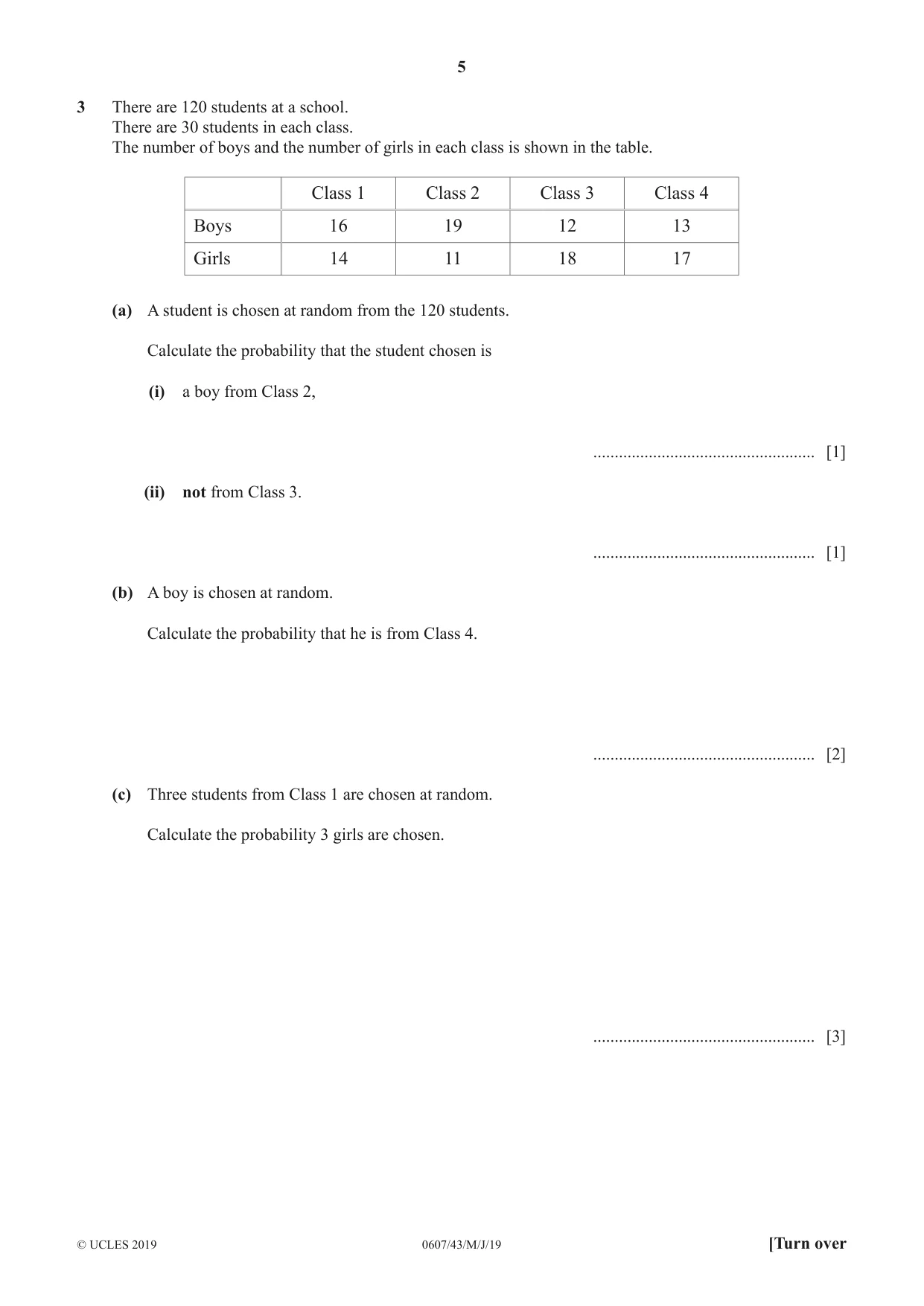
3 There are 120 students at a school. There are 30 students in each class. The number of boys and the number of girls in each class is shown in the table. Class 1 Class 2 Class 3 Class 4 Boys 16 19 12 13 Girls 14 11 18 17 (a) A student is chosen at random from the 120 students. Calculate the probability that the student chosen is (i) a boy from Class 2, .................................................... [1] (ii) not from Class 3. .................................................... [1] (b) A boy is chosen at random. Calculate the probability that he is from Class 4. .................................................... [2] (c) Three students from Class 1 are chosen at random. Calculate the probability 3 girls are chosen. .................................................... [3]
Mark scheme: 3(a)(i) 19 1 oe 120 3(a)(ii) 3 1 oe 4 3(b) 13 2 k oe M1 for 60 16 + 19 + 12 + 13 3(c) 13 2184 3 14 13 12 or oe M2 for × × 145 24 360 30 29 28 or M1 for 14 ×13 ×12 oe seen or 30 × 29 × 28 oe seen
Q4 · Y 6 –270 0 270 x –6 (a) On the diagram, sketch the graph of y = f(x) where 1 f (x) = for…
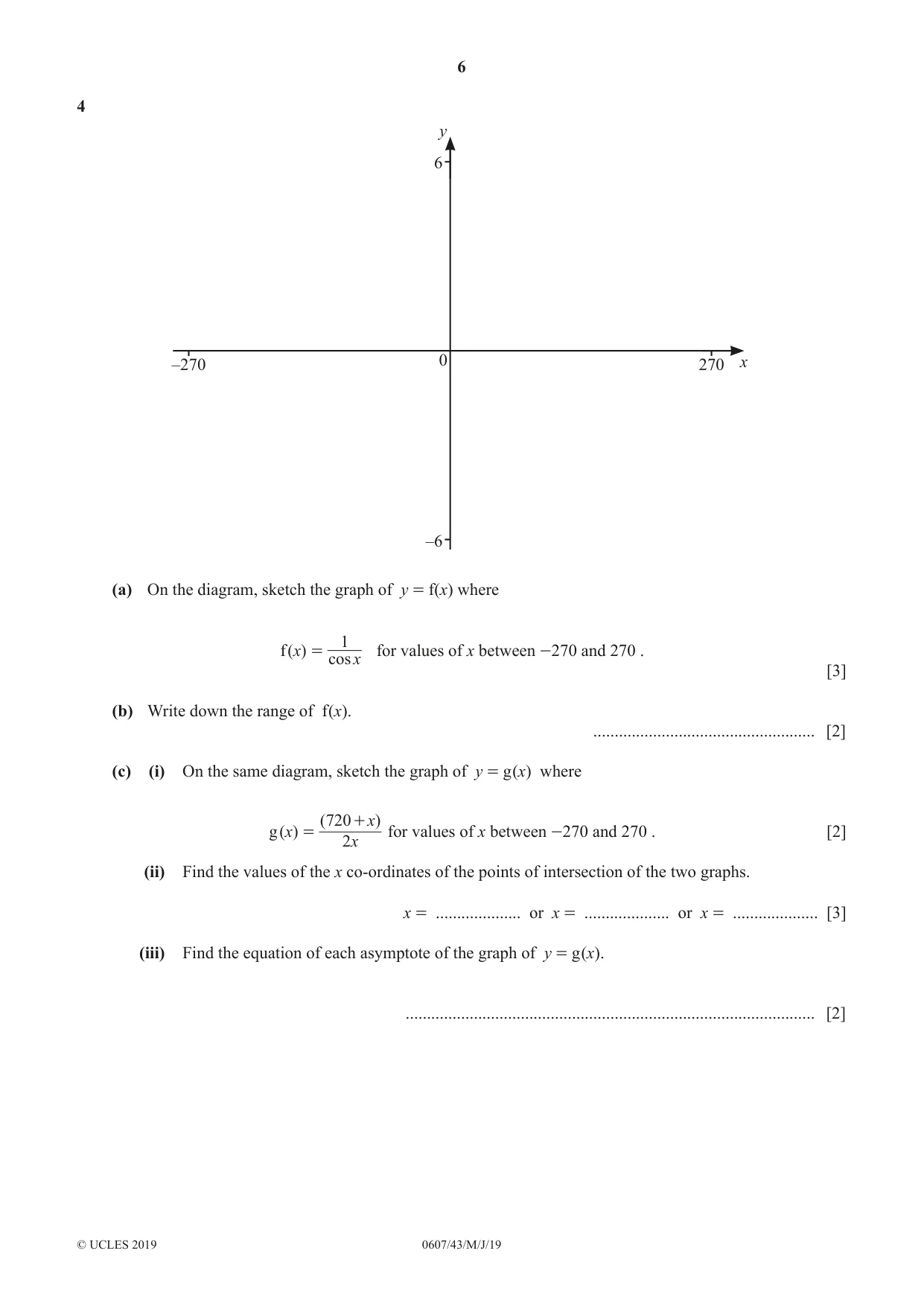
4 y 6 –270 0 270 x –6 (a) On the diagram, sketch the graph of y = f(x) where 1 f (x) = for values of x between -270 and 270 . cos x [3] (b) Write down the range of f(x). .................................................... [2] (c) (i) On the same diagram, sketch the graph of y = g(x) where (720 + x) g (x) = for values of x between -270 and 270 . [2] 2x (ii) Find the values of the x co-ordinates of the points of intersection of the two graphs. x = .................... or x = .................... or x = .................... [3] (iii) Find the equation of each asymptote of the graph of y = g(x). ................................................................................................ [2]
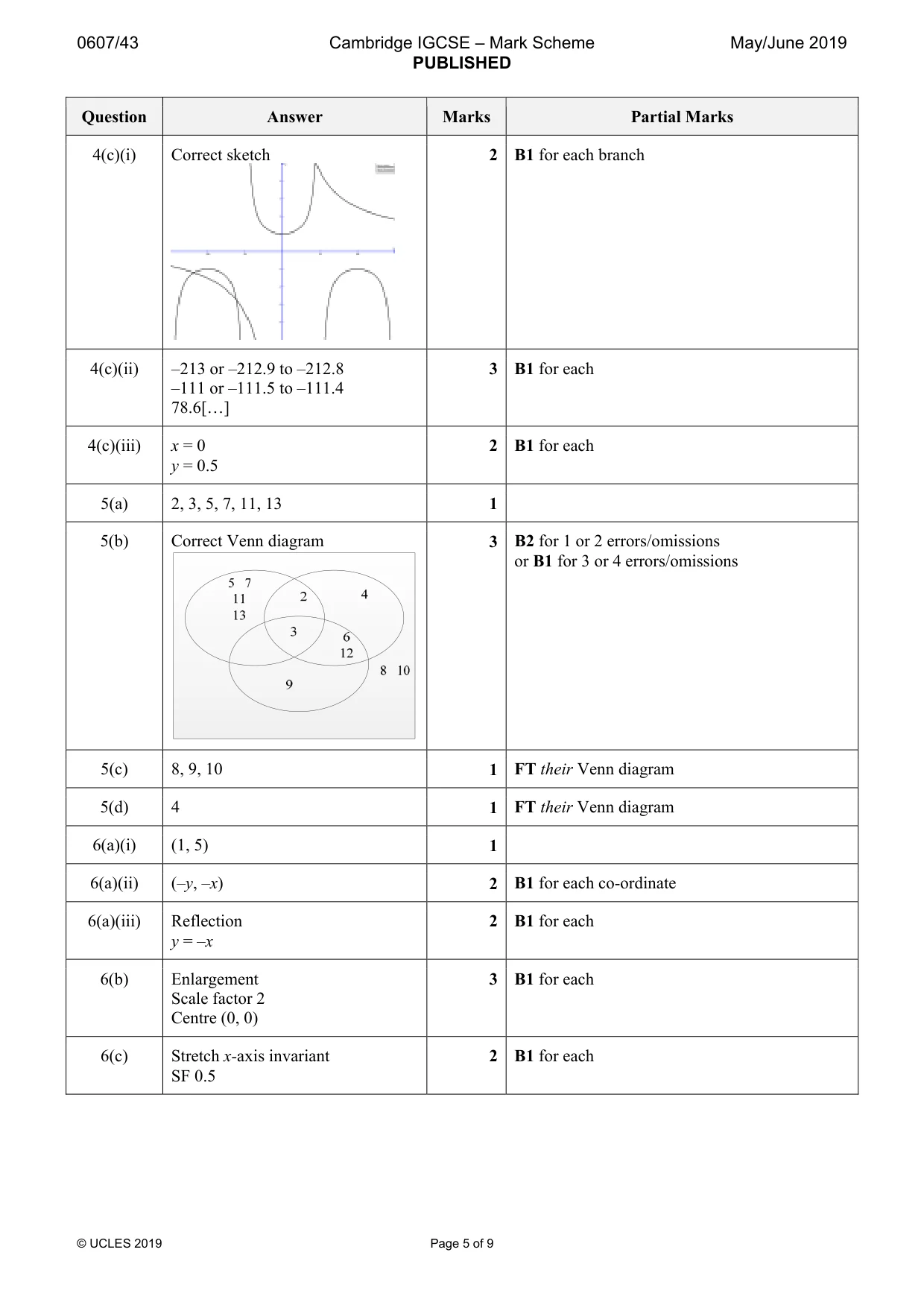
Mark scheme: 4(a) Correct sketch 3 B1 for correct shape B1 for max and min approx. correct B1 for asymptotes approx. correct 4(b) f( x ) - − 1 and f ( x ) . 1 2 B1 for each 4(c)(i) Correct sketch 2 B1 for each branch 4(c)(ii) –213 or –212.9 to –212.8 3 B1 for each –111 or –111.5 to –111.4 78.6[…] 4(c)(iii) x = 0 2 B1 for each y = 0.5
Q5 · The Venn diagram shows the sets A, B and C
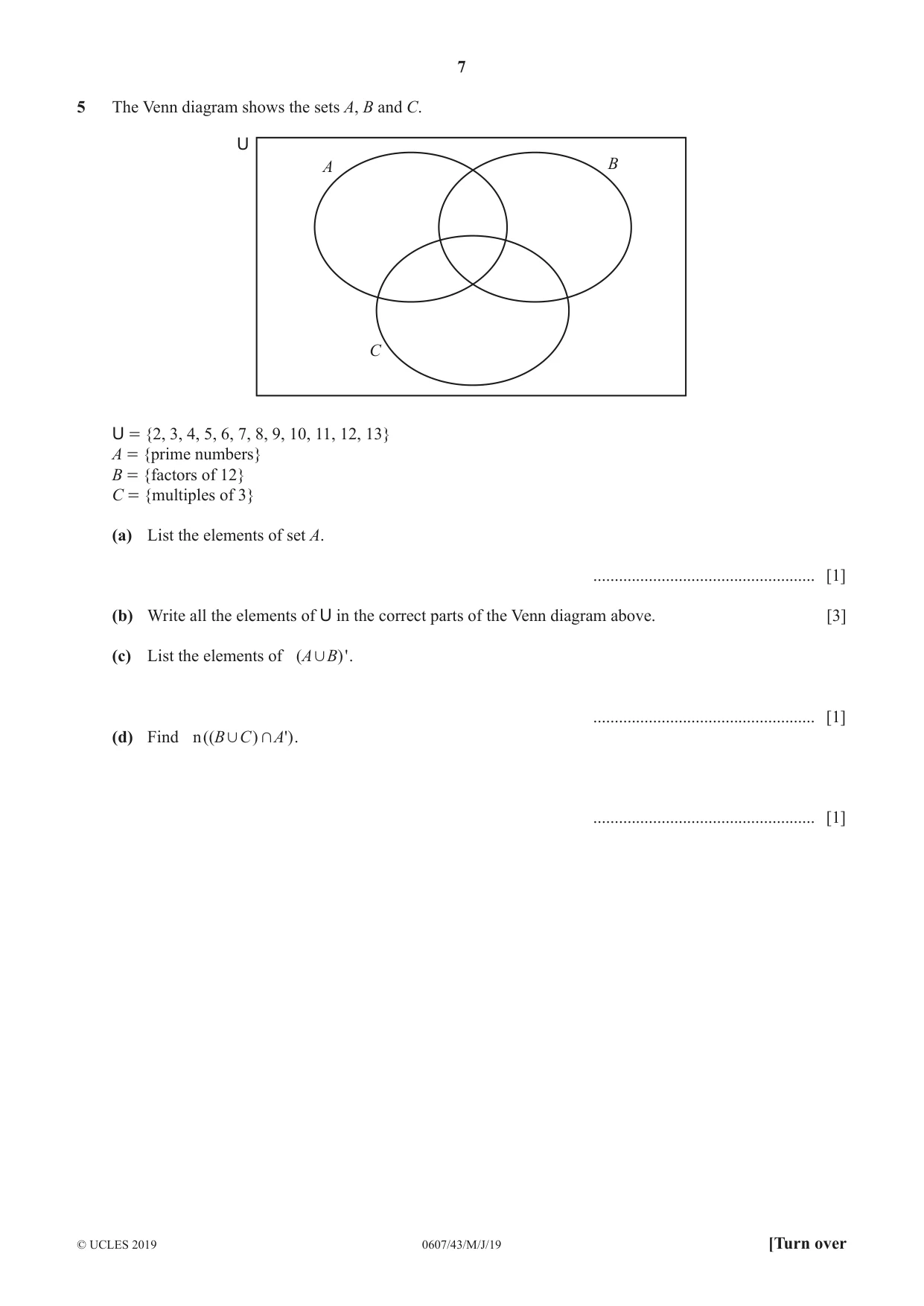
5 The Venn diagram shows the sets A, B and C. U A B C U = {2, 3, 4, 5, 6, 7, 8, 9, 10, 11, 12, 13} A = {prime numbers} B = {factors of 12} C = {multiples of 3} (a) List the elements of set A. .................................................... [1] (b) Write all the elements of U in the correct parts of the Venn diagram above. [3] (c) List the elements of (A , B )' . .................................................... [1] (d) Find n (( B , C ) + A') . .................................................... [1]
Mark scheme: 5(a) 2, 3, 5, 7, 11, 13 1 5(b) Correct Venn diagram 3 B2 for 1 or 2 errors/omissions or B1 for 3 or 4 errors/omissions 5(c) 8, 9, 10 1 FT their Venn diagram 5(d) 4 1 FT their Venn diagram
Q6 · You may use this grid to help you answer this question
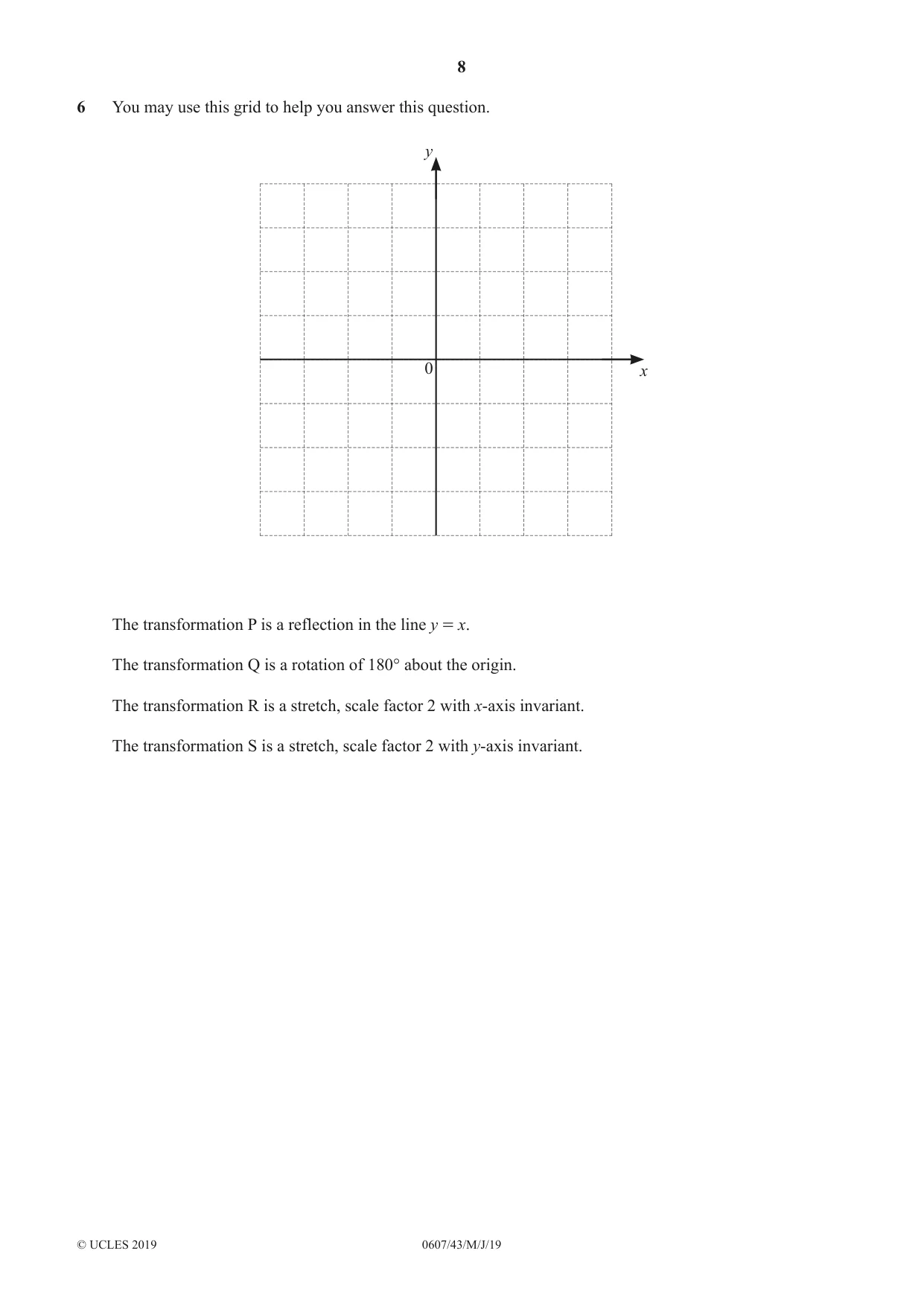
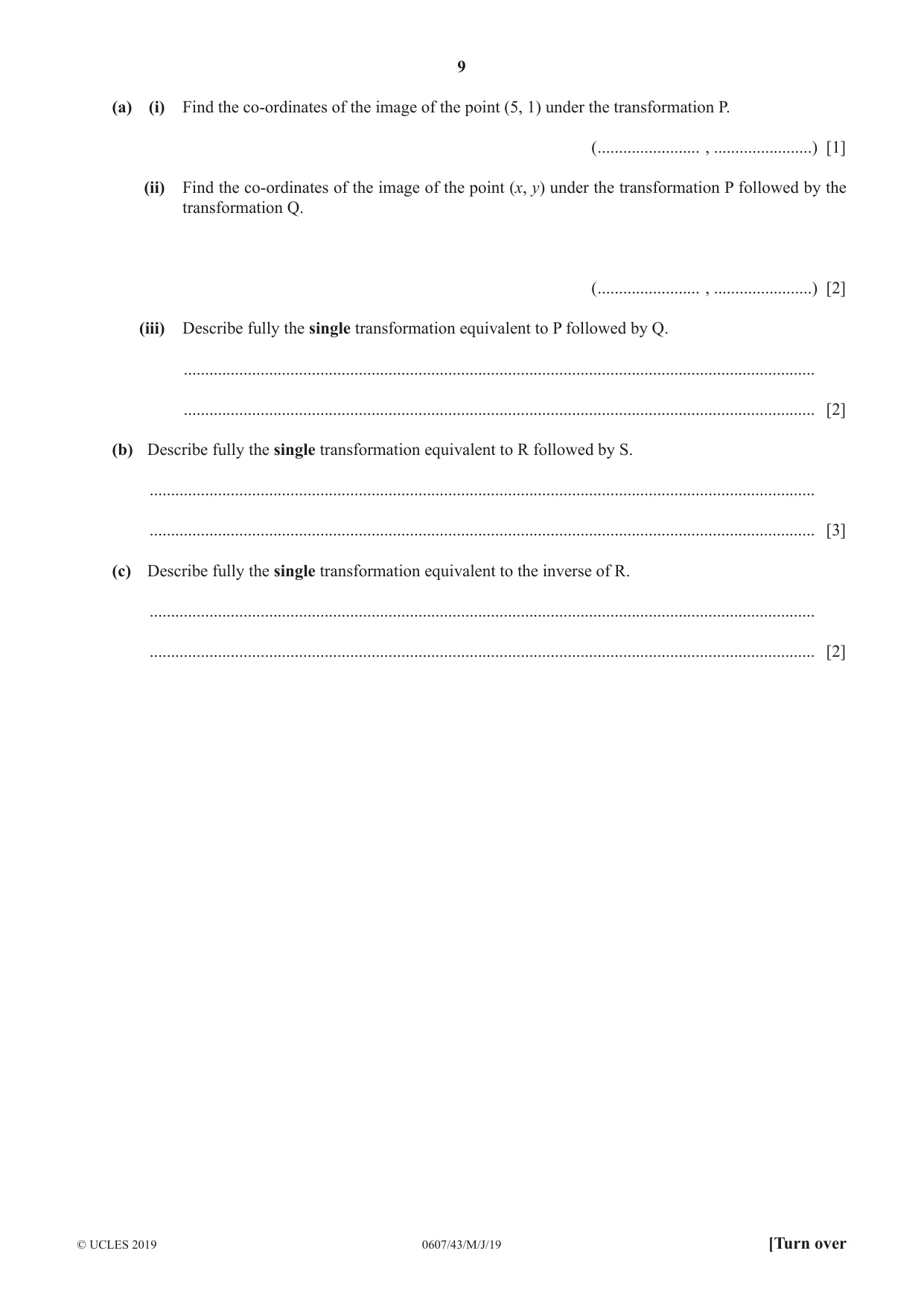
6 You may use this grid to help you answer this question. y 0 x The transformation P is a reflection in the line y = x. The transformation Q is a rotation of 180° about the origin. The transformation R is a stretch, scale factor 2 with x-axis invariant. The transformation S is a stretch, scale factor 2 with y-axis invariant. (a) (i) Find the co-ordinates of the image of the point (5, 1) under the transformation P. ( ........................ , .......................) [1] (ii) Find the co-ordinates of the image of the point (x, y) under the transformation P followed by the transformation Q. ( ........................ , .......................) [2] (iii) Describe fully the single transformation equivalent to P followed by Q. .................................................................................................................................................... .................................................................................................................................................... [2] (b) Describe fully the single transformation equivalent to R followed by S. ............................................................................................................................................................ ............................................................................................................................................................ [3] (c) Describe fully the single transformation equivalent to the inverse of R. ............................................................................................................................................................ ............................................................................................................................................................ [2]
Mark scheme: 6(a)(i) (1, 5) 1 6(a)(ii) (–y, –x) 2 B1 for each co-ordinate 6(a)(iii) Reflection 2 B1 for each y = –x 6(b) Enlargement 3 B1 for each Scale factor 2 Centre (0, 0) 6(c) Stretch x-axis invariant 2 B1 for each SF 0.5
Q7 · Sergio invests $2000 at a rate of 3% per year compound interest
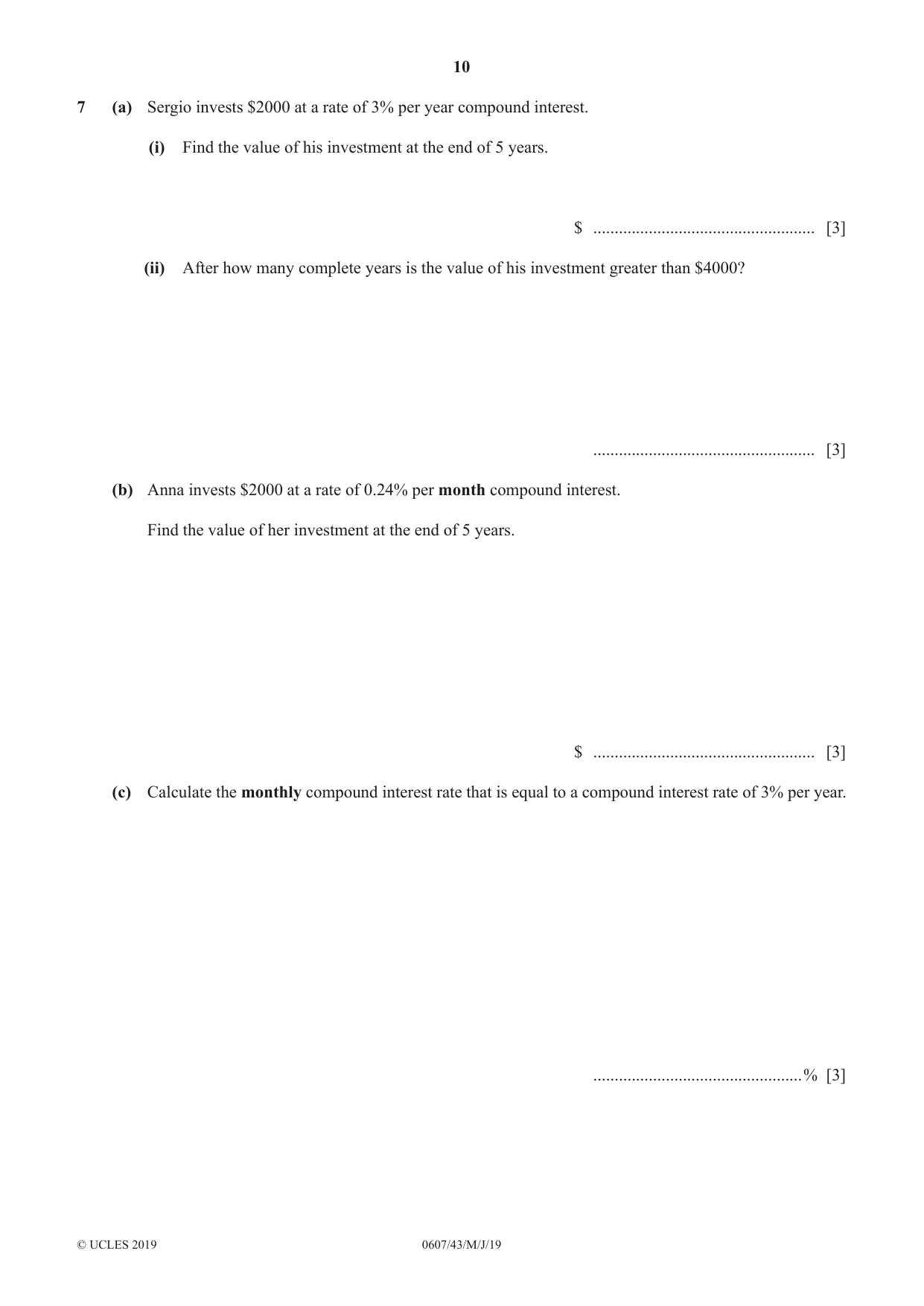
7 (a) Sergio invests $2000 at a rate of 3% per year compound interest. (i) Find the value of his investment at the end of 5 years. $ .................................................... [3] (ii) After how many complete years is the value of his investment greater than $4000? .................................................... [3] (b) Anna invests $2000 at a rate of 0.24% per month compound interest. Find the value of her investment at the end of 5 years. $ .................................................... [3] (c) Calculate the monthly compound interest rate that is equal to a compound interest rate of 3% per year. .................................................% [3]
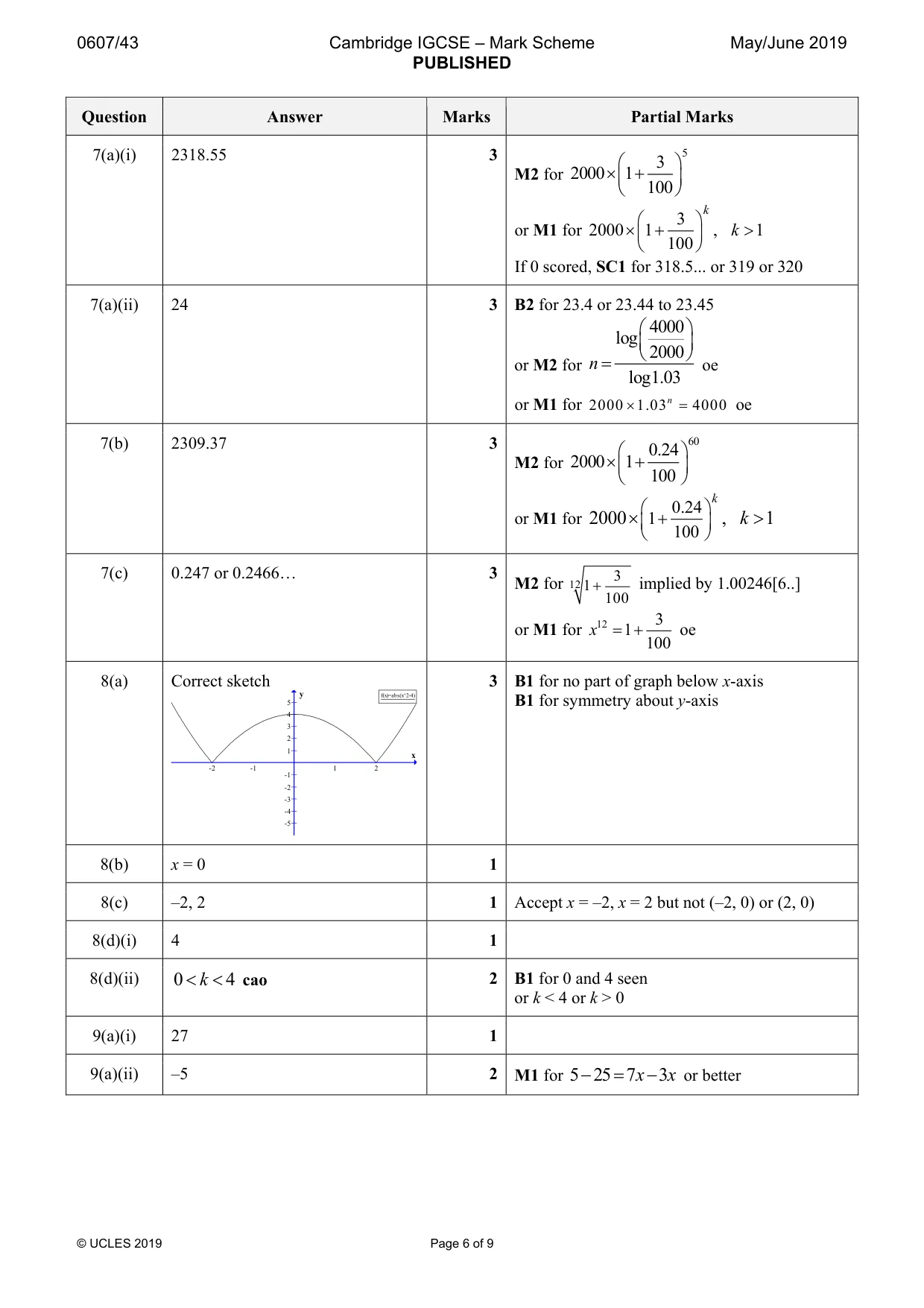
Mark scheme: 7(a)(i) 2318.55 3 5 3 M2 for 2000 × 1 + 100 k 3 or M1 for 2000 × 1 + , k > 1 100 If 0 scored, SC1 for 318.5... or 319 or 320 7(a)(ii) 24 3 B2 for 23.4 or 23.44 to 23.45 4000 log 2000 or M2 for n = oe log1.03 or M1 for 2000 × 1.03 n = 4000 oe 7(b) 2309.37 3 60 0.24 M2 for 2000 × 1 + 100 k 0.24 or M1 for 2000 × 1 + , k > 1 100 7(c) 0.247 or 0.2466… 3 3 M2 for 12 1 + implied by 1.00246[6..] 100 12 3 or M1 for x = 1 + oe 100
Q8 · Y 6 –3 0 3 x –6 (a) On the diagram, sketch the graph of y = f(x), where f ()x = x 2 - 4…
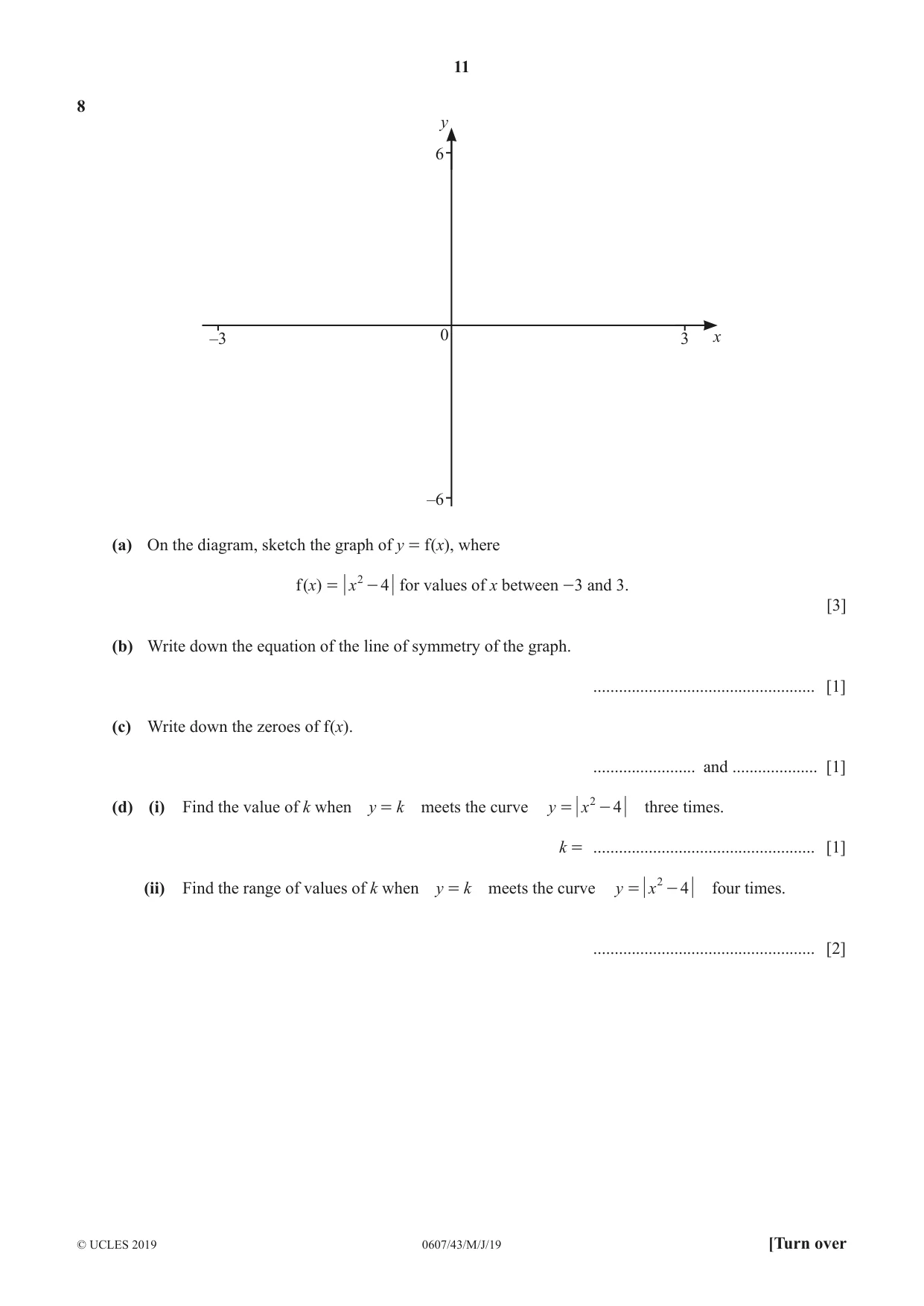
8 y 6 –3 0 3 x –6 (a) On the diagram, sketch the graph of y = f(x), where f ()x = x 2 - 4 for values of x between -3 and 3. [3] (b) Write down the equation of the line of symmetry of the graph. .................................................... [1] (c) Write down the zeroes of f(x). ........................ and .................... [1] (d) (i) Find the value of k when y = k meets the curve y = x 2 - 4 three times. k = .................................................... [1] (ii) Find the range of values of k when y = k meets the curve y = x 2 - 4 four times. .................................................... [2]
Mark scheme: 8(a) Correct sketch 3 B1 for no part of graph below x-axis y f(x)=abs(x^2-4) 5 B1 for symmetry about y-axis 4 3 2 1 x -2 -1 1 2 -1 -2 -3 -4 -5 8(b) x = 0 1 8(c) –2, 2 1 Accept x = –2, x = 2 but not (–2, 0) or (2, 0) 8(d)(i) 4 1 8(d)(ii) 0 < k < 4 cao 2 B1 for 0 and 4 seen or k < 4 or k > 0
Q9 · Solve the following equations
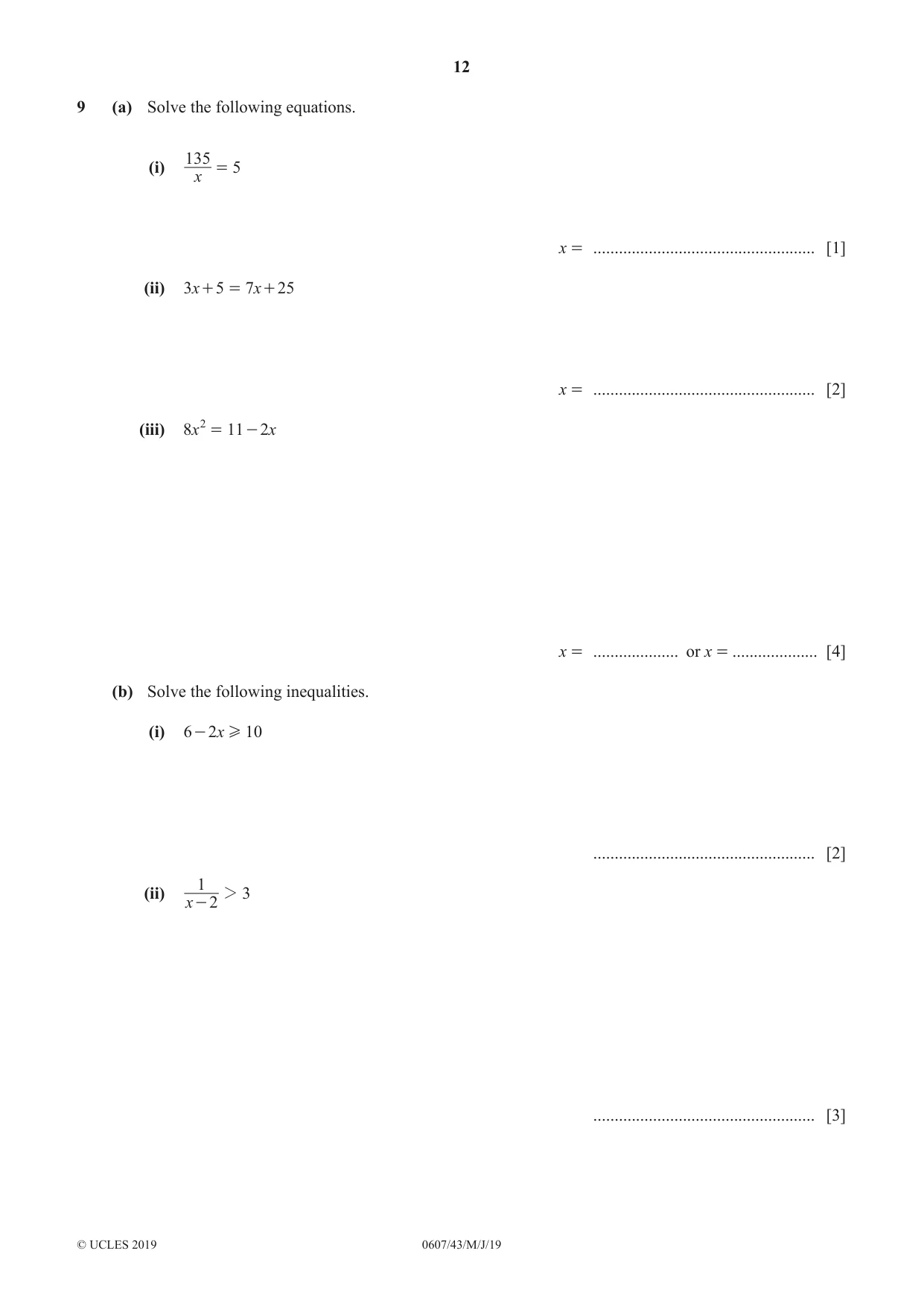
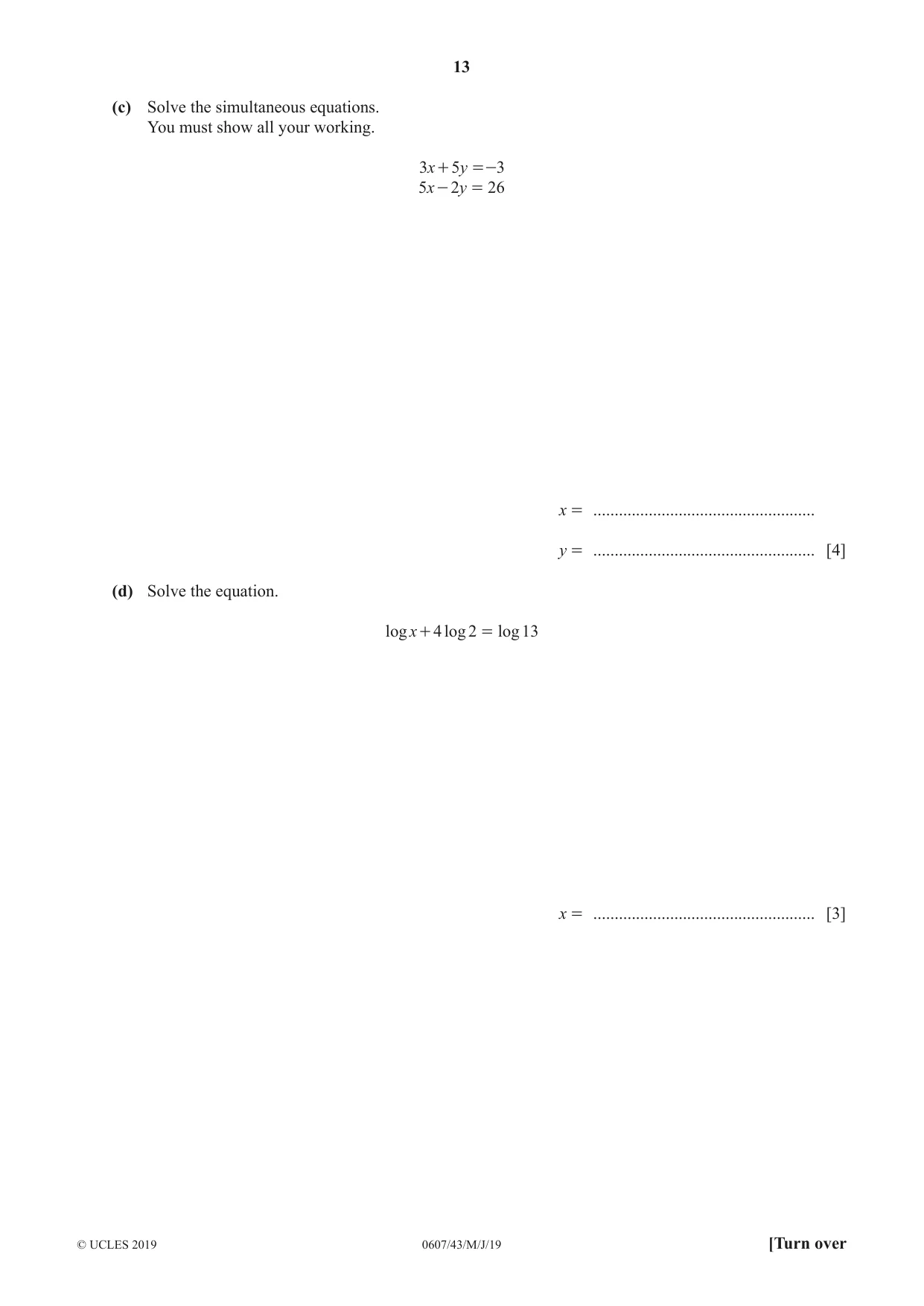
9 (a) Solve the following equations. 135 (i) = 5 x x = .................................................... [1] (ii) 3x + 5 = 7x + 25 x = .................................................... [2] (iii) 8x 2 = 11 - 2x x = .................... or x = .................... [4] (b) Solve the following inequalities. (i) 6 - 2x H 10 .................................................... [2] 1 (ii) 2 3 x - 2 .................................................... [3] (c) Solve the simultaneous equations. You must show all your working. 3x + 5y =-3 5x - 2y = 26 x = .................................................... y = .................................................... [4] (d) Solve the equation. log x + 4 log 2 = log 13 x = .................................................... [3]
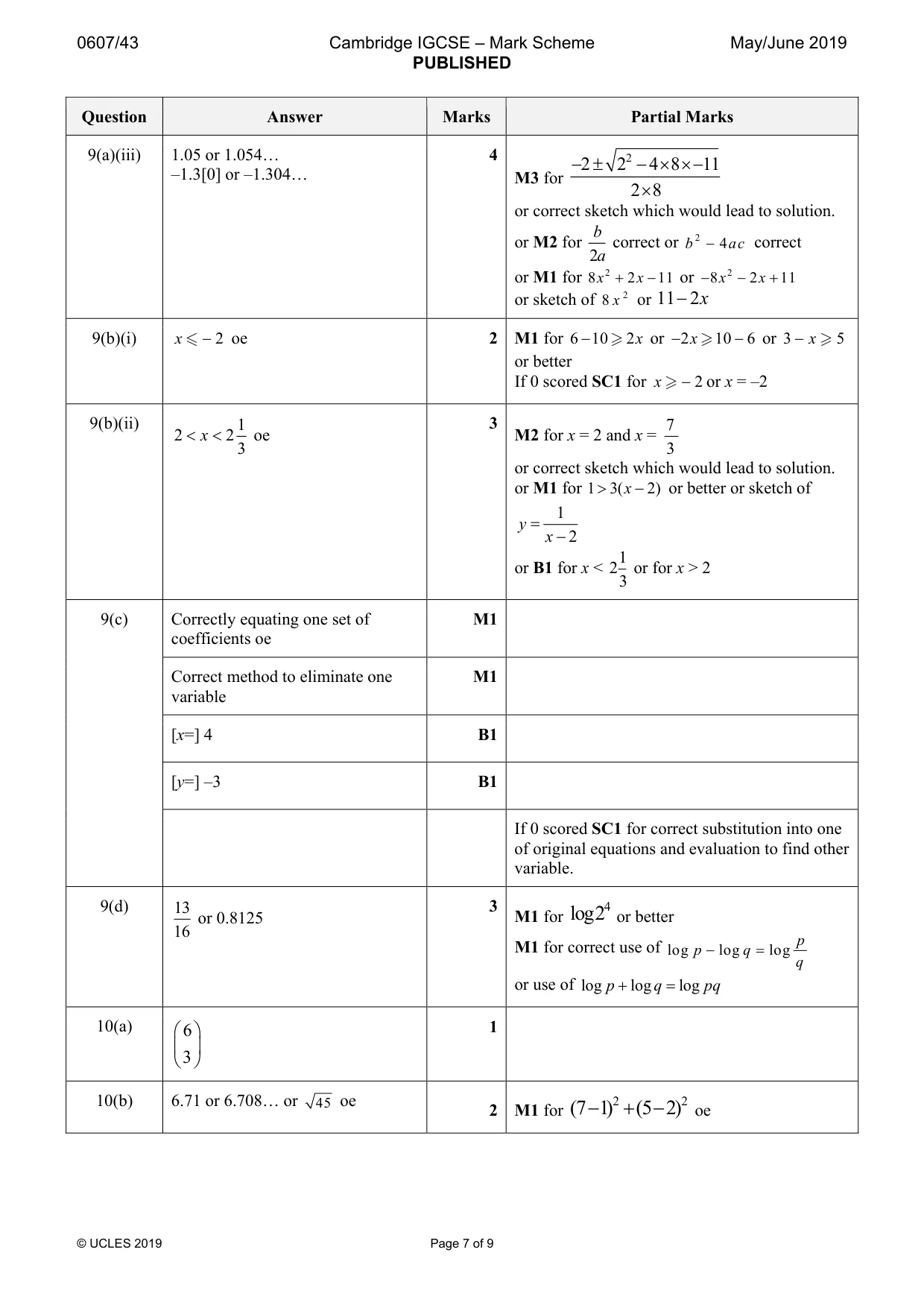
Mark scheme: 9(a)(i) 27 1 9(a)(ii) –5 2 M1 for 5 − 25 = 7 x − 3x or better 9(a)(iii) 1.05 or 1.054… 4 2 −±2 2 −×4 8 ×−11 –1.3[0] or –1.304… M3 for 2 × 8 or correct sketch which would lead to solution. b 2 or M2 for correct or b − 4 ac correct 2a or M1 for 8 x 2 + 2 x − 11 or − 8 x 2 − 2 x + 11 or sketch of 8 x 2 or 11 − 2x 9(b)(i) x - − 2 oe 2 M1 for 6 − 10 . 2x or − 2 x . 10 − 6 or 3 − x . 5 or better If 0 scored SC1 for x . − 2 or x = –2 9(b)(ii) 1 3 7 2 < x < 2 oe M2 for x = 2 and x = 3 3 or correct sketch which would lead to solution. or M1 for 1 > 3( x − 2) or better or sketch of 1 y = x − 2 1 or B1 for x < 23 or for x > 2 9(c) Correctly equating one set of M1 coefficients oe Correct method to eliminate one M1 variable [x=] 4 B1 [y=] –3 B1 If 0 scored SC1 for correct substitution into one of original equations and evaluation to find other variable. 9(d) 13 3 4 or 0.8125 M1 for log2 or better 16 p M1 for correct use of log p − log q = log q or use of log p + log q = log pq
Q10 · The points A (1, 2) and B (7, 5) are shown on the diagram below
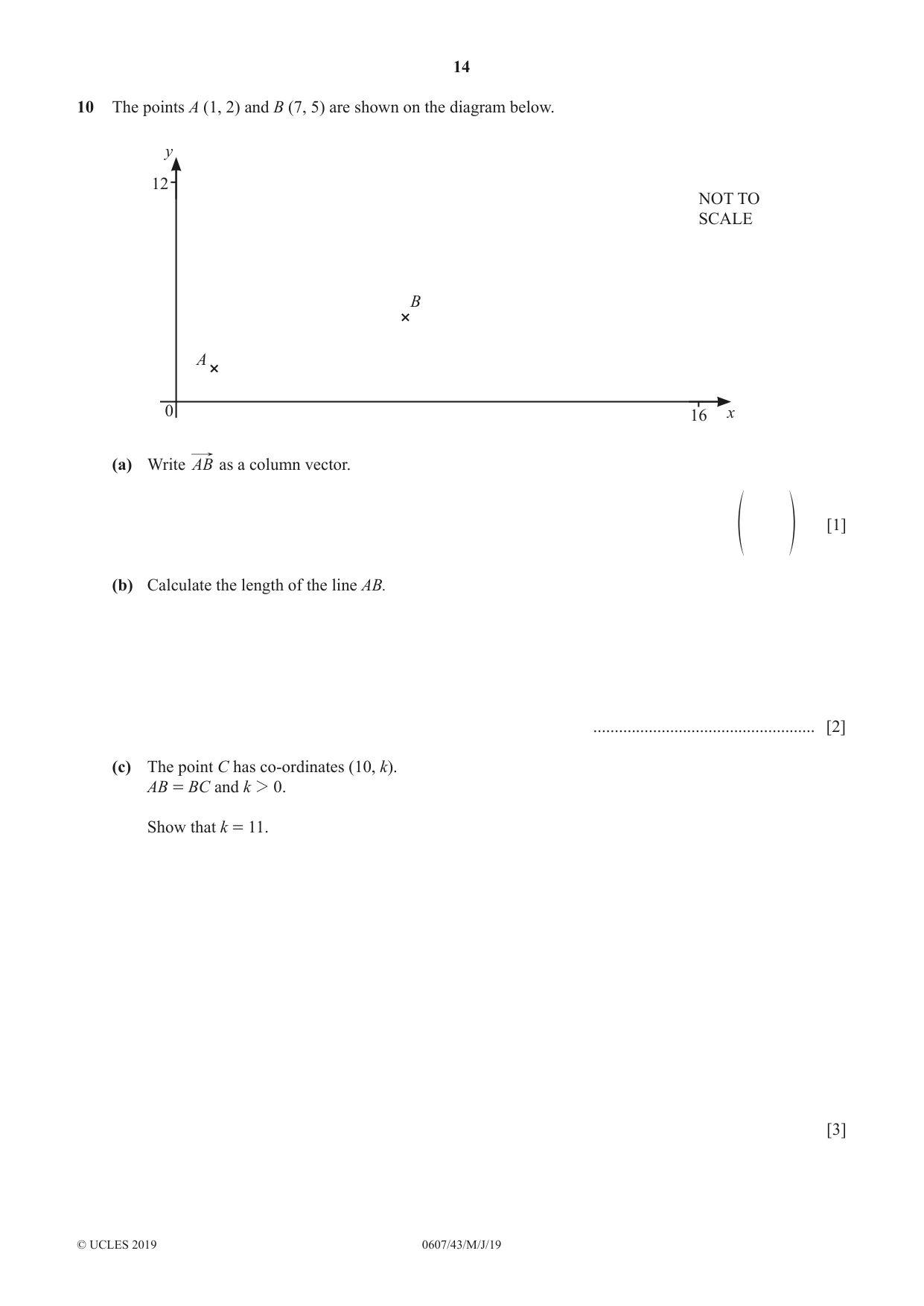
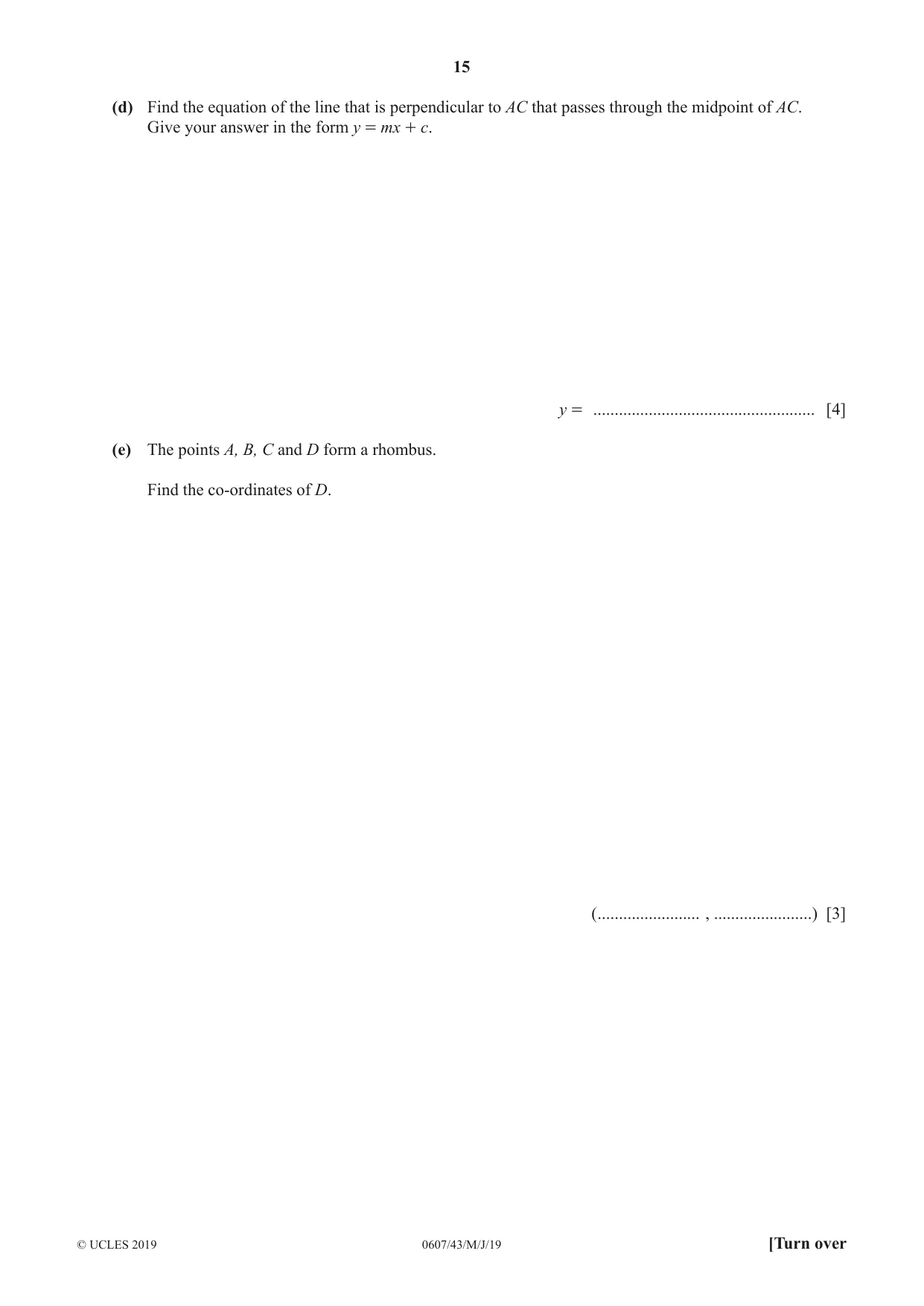
10 The points A (1, 2) and B (7, 5) are shown on the diagram below. y 12 NOT TO SCALE B A 0 16 x (a) Write AB as a column vector. [1] f p (b) Calculate the length of the line AB. .................................................... [2] (c) The point C has co-ordinates (10, k). AB = BC and k 2 0. Show that k = 11. [3] (d) Find the equation of the line that is perpendicular to AC that passes through the midpoint of AC. Give your answer in the form y = mx + c. y = .................................................... [4] (e) The points A, B, C and D form a rhombus. Find the co-ordinates of D. ( ........................ , .......................) [3]
Mark scheme: 10(a) 6 1 3 10(b) 6.71 or 6.708… or 45 oe 2 2 2 M1 for (7 −1) + (5 − 2) oe 10(c) 2 2 2 2 2 k −=5 (their (b)) − 3 M2 M1 for (k − 5) + (10 − 7) = (their(b)) oe Reverse process scores 0. k −=5 6 A1 10(d) [ y = ] − x + 12 oe 4 11 − 2 M1 for grad AC = oe 10 − 1 1 M1 for grad perp = − their grad B1 for midpoint (5.5, 6.5) 10(e) (4, 8) 3 10 6 7 −3 M2 for − or − oe 11 3 5 3 6 −3 or M1 for CD = or BD = oe 3 3
Q11 · F NOT TO SCALE B 41° 5.5 m 6.2 m A C D The diagram shows four points A, B, C and D on…
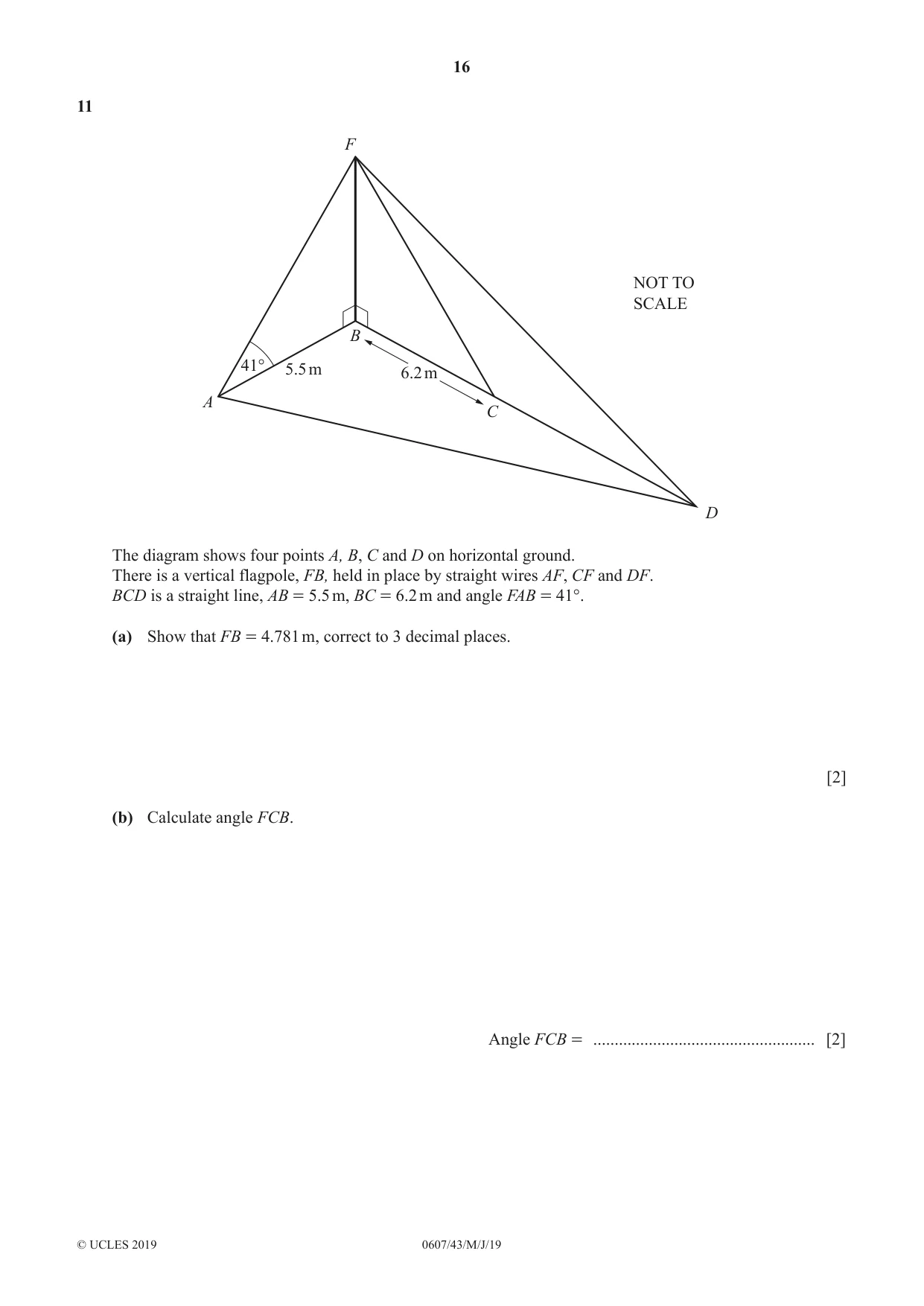
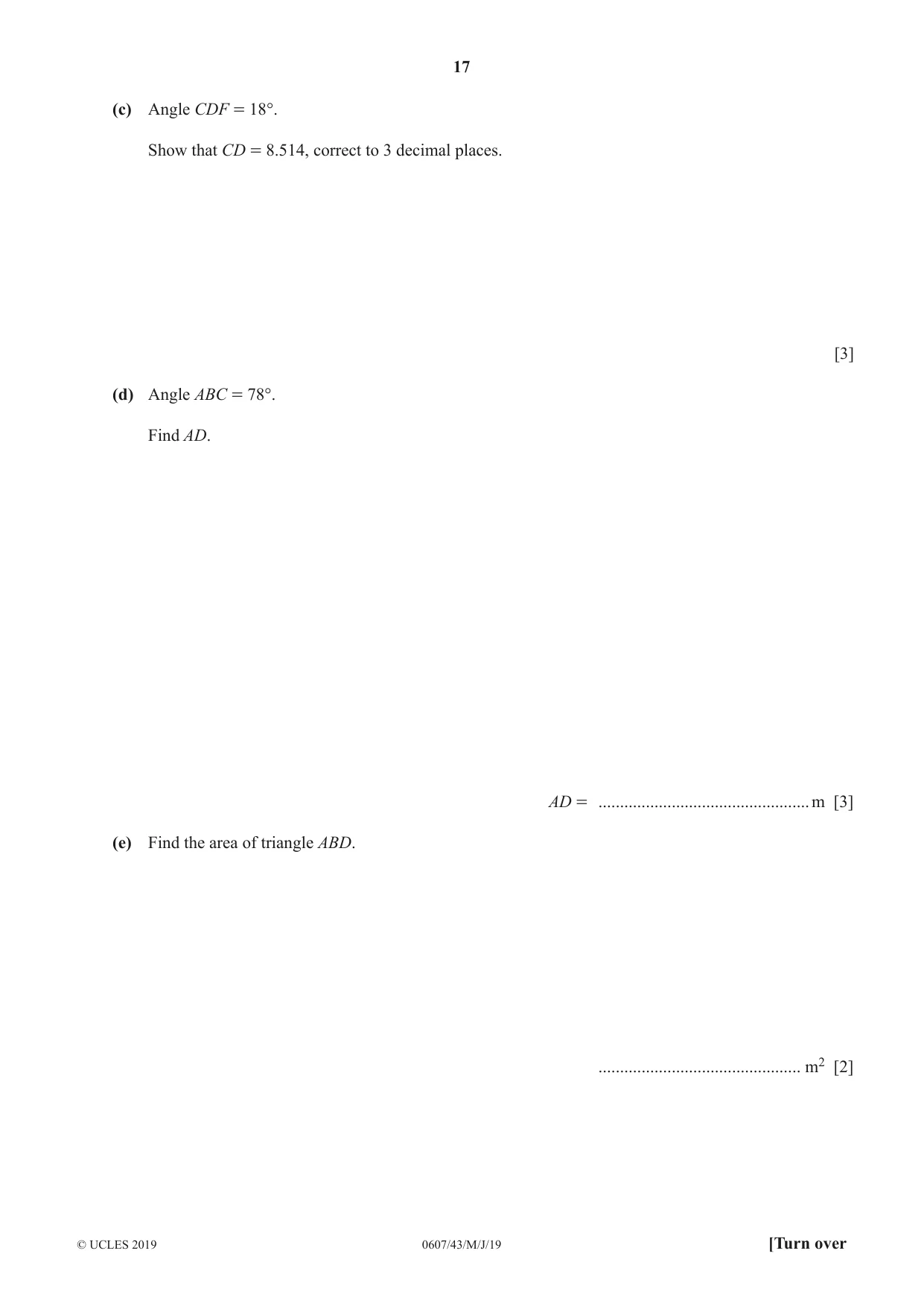
11 F NOT TO SCALE B 41° 5.5 m 6.2 m A C D The diagram shows four points A, B, C and D on horizontal ground. There is a vertical flagpole, FB, held in place by straight wires AF, CF and DF. BCD is a straight line, AB = 5.5 m, BC = 6.2 m and angle FAB = 41°. (a) Show that FB = 4.781 m, correct to 3 decimal places. [2] (b) Calculate angle FCB. Angle FCB = .................................................... [2] (c) Angle CDF = 18°. Show that CD = 8.514, correct to 3 decimal places. [3] (d) Angle ABC = 78°. Find AD. AD = .................................................m [3] (e) Find the area of triangle ABD. ............................................... m2 [2]
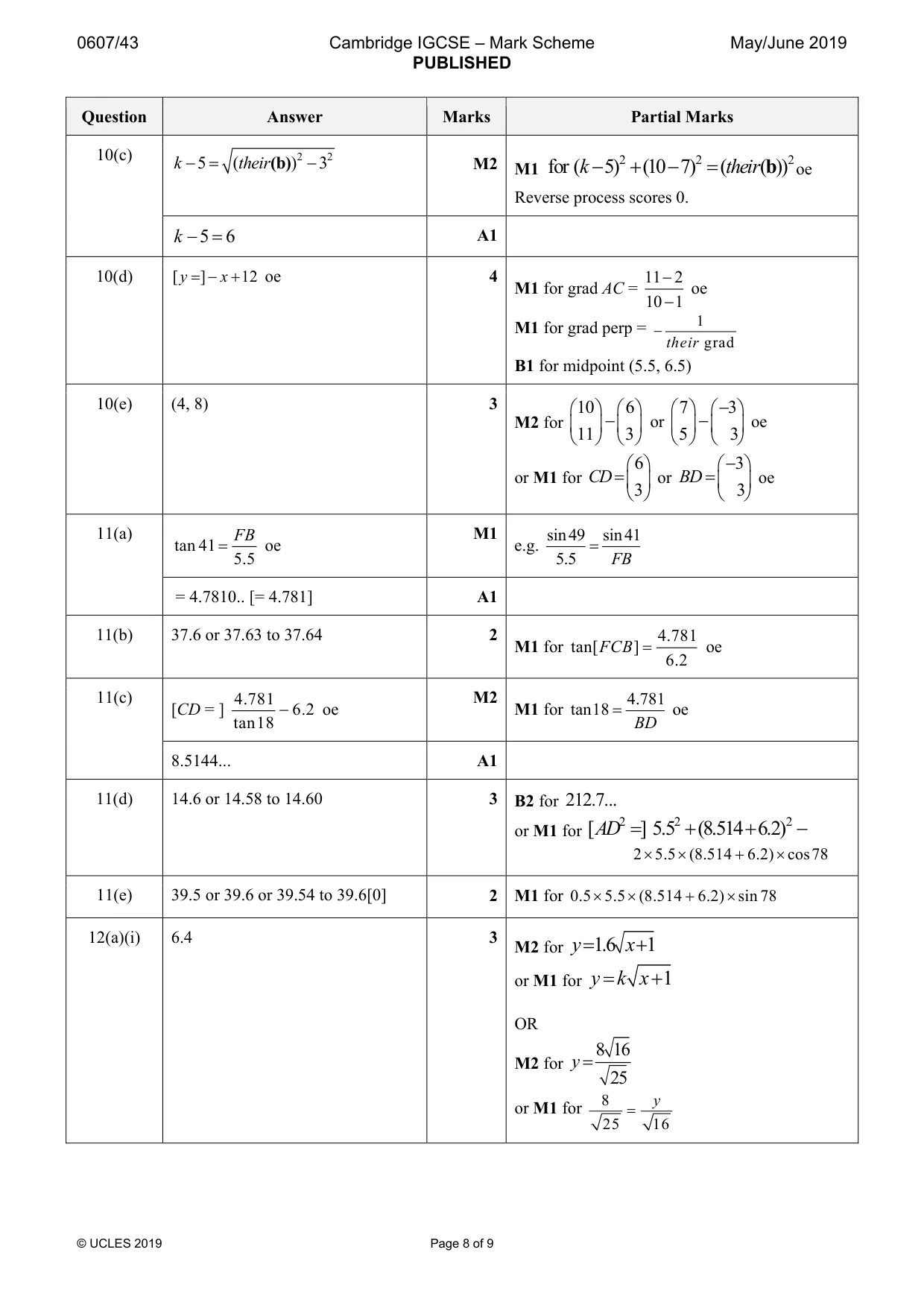
Mark scheme: 11(a) FB M1 sin49 sin41 tan 41 = oe e.g. = 5.5 5.5 FB = 4.7810.. [= 4.781] A1 11(b) 37.6 or 37.63 to 37.64 2 4.781 M1 for tan[ FCB ] = oe 6.2 11(c) 4.781 M2 4.781 [CD = ] − 6.2 oe M1 for tan18 = oe tan18 BD 8.5144... A1 11(d) 14.6 or 14.58 to 14.60 3 B2 for 212.7... or M1 for [ AD2 =] 5.52 + (8.514 + 6.2)2 − 2 × 5.5 × (8.514 + 6.2) × cos78 11(e) 39.5 or 39.6 or 39.54 to 39.6[0] 2 M1 for 0.5 × 5.5 × (8.514 + 6.2) × sin 78
Q12 · Y varies directly as the square root of (x + 1)
12 (a) y varies directly as the square root of (x + 1). y = 8 when x = 24. (i) Find the value of y when x = 15. y = .................................................... [3] (ii) Find the value of x when y = 16. x = .................................................... [2] (b) Find the next term in each of the following sequences. (i) 18, 13, 8, 3, –2, … .................................................... [1] (ii) 3, 6, 11, 18, 27, … .................................................... [1] (iii) –1000, 100, –10, 1, … .................................................... [1] (iv) 0, 0, 0, 6, 24, 60, … .................................................... [2]
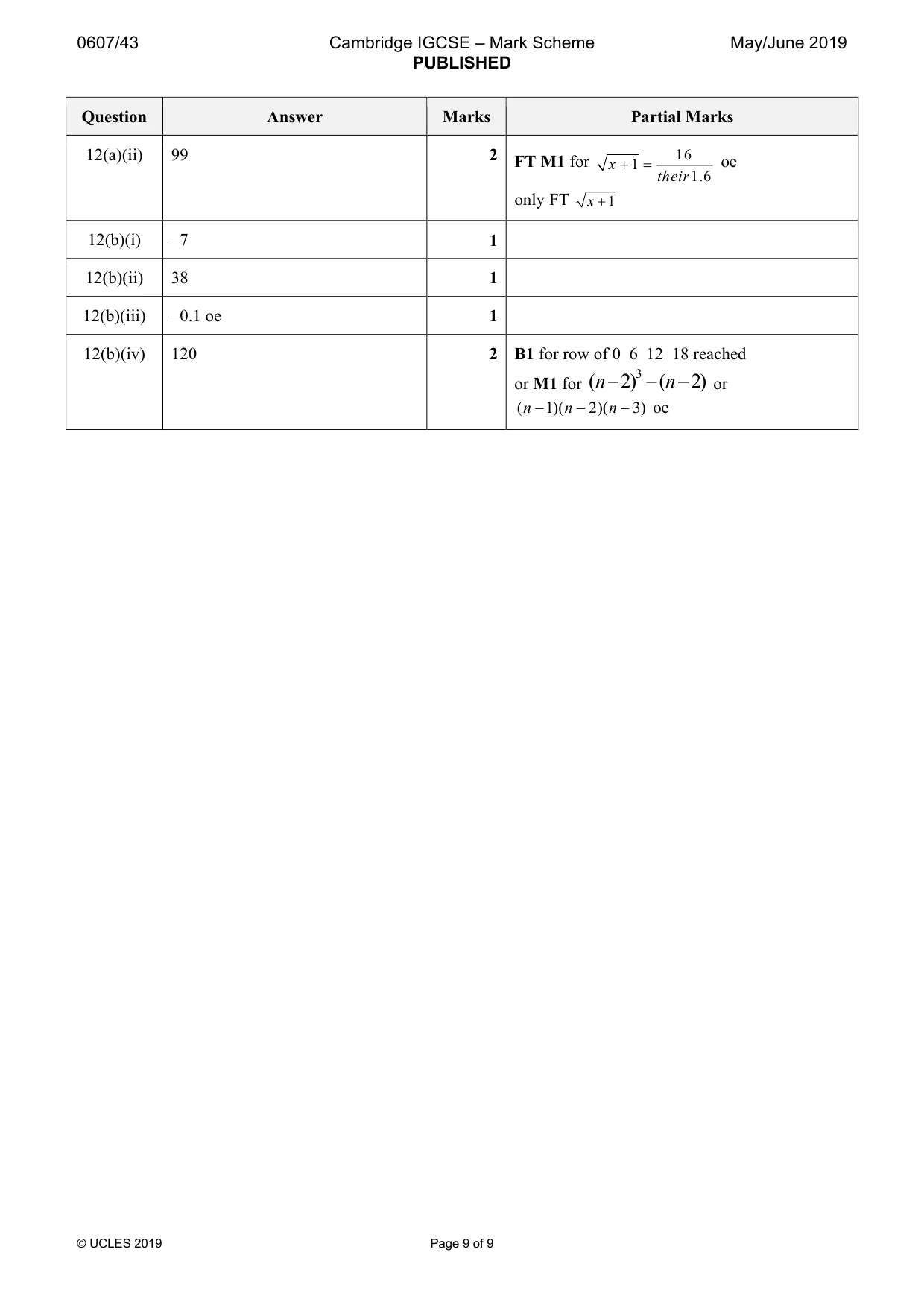
Mark scheme: 12(a)(i) 6.4 3 M2 for y =1.6 x +1 or M1 for y = k x + 1 OR 8 16 M2 for y = 25 8 y or M1 for = 25 16 12(a)(ii) 99 2 16 FT M1 for x + 1 = oe their 1.6 only FT x + 1 12(b)(i) –7 1 12(b)(ii) 38 1 12(b)(iii) –0.1 oe 1 12(b)(iv) 120 2 B1 for row of 0 6 12 18 reached or M1 for (n − 2)3 − (n − 2) or ( n − 1)( n − 2)( n − 3) oe
What was in this paper
The subtopics covered by these 12 questions, and how many questions each got. Open one in a new tab to see every Cambridge question on it.
What you needed in this session
Cambridge’s own grade thresholds for 2019 May/June, Paper 4 · Variant 3. A higher threshold means an easier paper — the bar moves with how the cohort did.