Cambridge IGCSE Mathematics - International 0607 — 2023 Oct/Nov Paper 4 · Variant 3
0607/43/O/N/23 · 12 questions · 120 marks · ≈135 min
The question paper and its mark scheme, free to read here and free to download. This is Cambridge’s own paper, exactly as it was sat.
Question paper20 pages
Mark scheme9 pages
Answers below. Sit the paper first if you are practising.
Questions as text
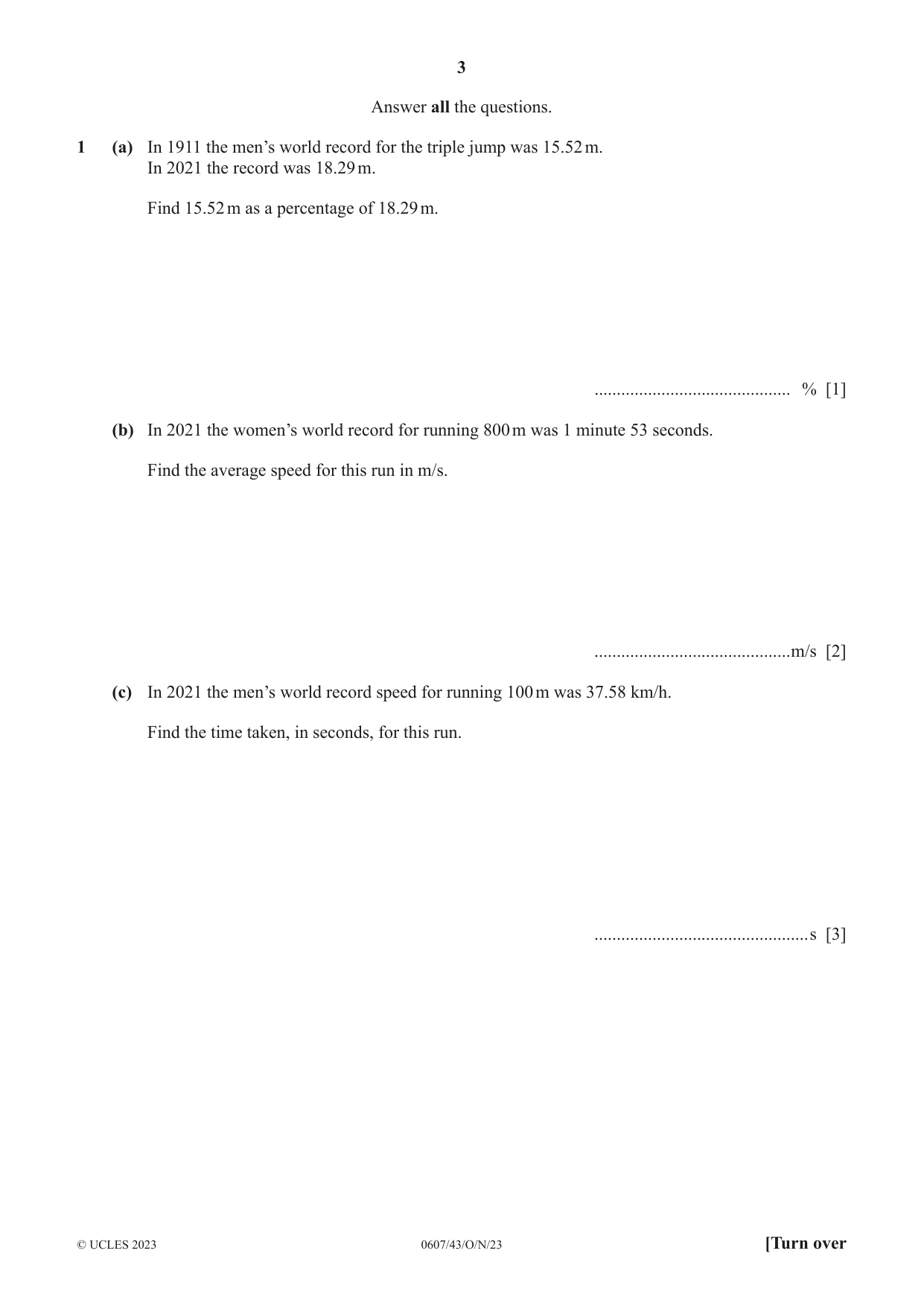
Q1 · In 1911 the men’s world record for the triple jump was 15.52 m
1 (a) In 1911 the men’s world record for the triple jump was 15.52 m. In 2021 the record was 18.29 m. Find 15.52 m as a percentage of 18.29 m. ............................................ % [1] (b) In 2021 the women’s world record for running 800 m was 1 minute 53 seconds. Find the average speed for this run in m/s. ............................................m/s [2] (c) In 2021 the men’s world record speed for running 100 m was 37.58 km/h. Find the time taken, in seconds, for this run. ................................................s [3]
Mark scheme: Question Answer Marks Partial Marks 1(a) 84.9 or 84.85 to 84.86 1 1(b) 7.08 or 7.079 to 7.08 2 M1 for distance divided by time. or B1 for 113 1(c) 9.58 or 9.579 to 9.580 3 M1 for distance divided by speed M1 for ÷ 1000 and × 60 60
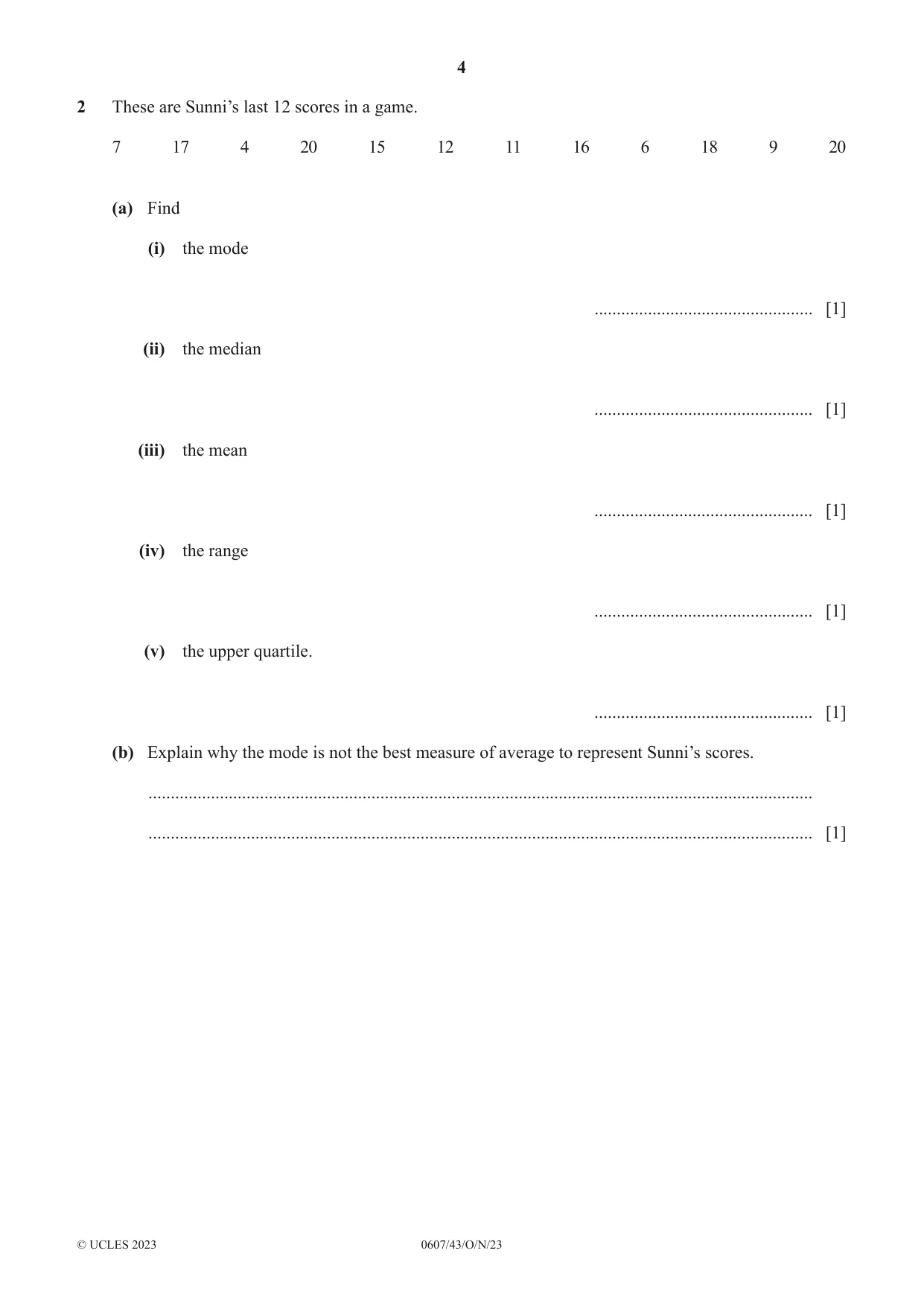
Q2 · These are Sunni’s last 12 scores in a game
2 These are Sunni’s last 12 scores in a game. 7 17 4 20 15 12 11 16 6 18 9 20 (a) Find (i) the mode ................................................. [1] (ii) the median ................................................. [1] (iii) the mean ................................................. [1] (iv) the range ................................................. [1] (v) the upper quartile. ................................................. [1] (b) Explain why the mode is not the best measure of average to represent Sunni’s scores. ..................................................................................................................................................... ..................................................................................................................................................... [1]
Mark scheme: 2(a)(i) 20 1 2(a)(ii) 13.5 1 2(a)(iii) 12.9 or 12.91 to 12.92 1 2(a)(iv) 16 1 2(a)(v) 17.5 1 2(b) It’s the highest oe 1
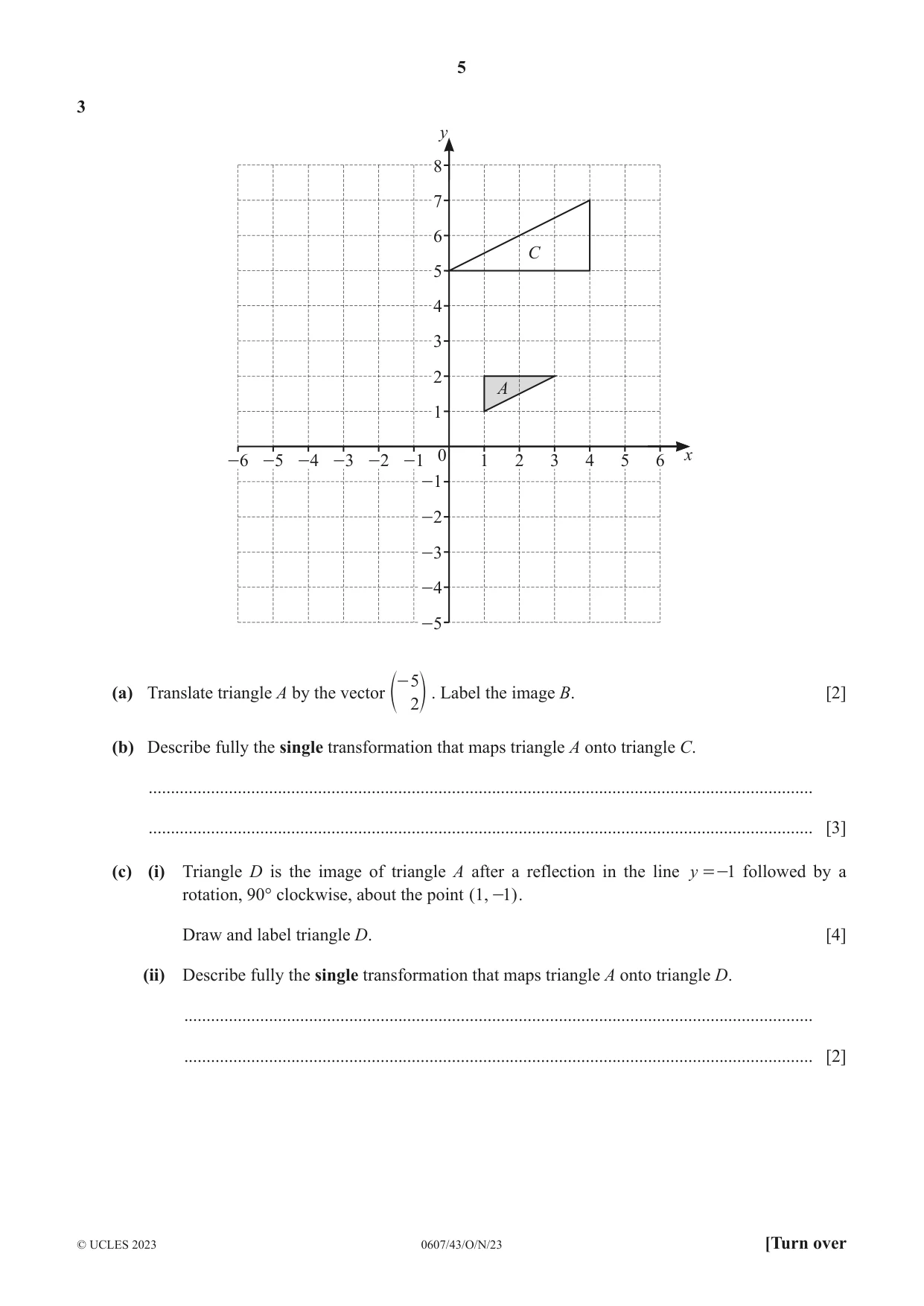
Q3 · Y 8 7 6 C 5 4 3 2 A 1 0 x -6 -5 -4 -3 -2 -1 1 2 3 4 5 6 -1 -2 -3 -4 -5 - 5 (a) Translate…
3 y 8 7 6 C 5 4 3 2 A 1 0 x -6 -5 -4 -3 -2 -1 1 2 3 4 5 6 -1 -2 -3 -4 -5 - 5 (a) Translate triangle A by the vector . Label the image B. [2] e 2o (b) Describe fully the single transformation that maps triangle A onto triangle C. ..................................................................................................................................................... ..................................................................................................................................................... [3] (c) (i) Triangle D is the image of triangle A after a reflection in the line y =-1 followed by a rotation, 90° clockwise, about the point ( 1, -1) . Draw and label triangle D. [4] (ii) Describe fully the single transformation that maps triangle A onto triangle D. ............................................................................................................................................. ............................................................................................................................................. [2]
Mark scheme: 3(a) Triangle at (–4, 4), (–2, 4), (–4, 3) 2 − 5 k B1 for translation through or k 2 3(b) Enlargement 3 B1 for each [Scale Factor] –2 [Centre] (2, 3) 3(c)(i) Triangle at (–2, –1), (–1, –1), (–2, –3) 4 B2 for triangle at (1, –3), (1, –4), (3, –4) or B1 for reflection in y = k or x = –1 dep B1 for rotation of their first image 90˚ clockwise or anticlockwise about (1, – 1) or rotation 90˚ clockwise about wrong centre. If 0 scored, SC1 for correct triangle translated 3(c)(ii) Reflection 2 B1 for each y = –x oe
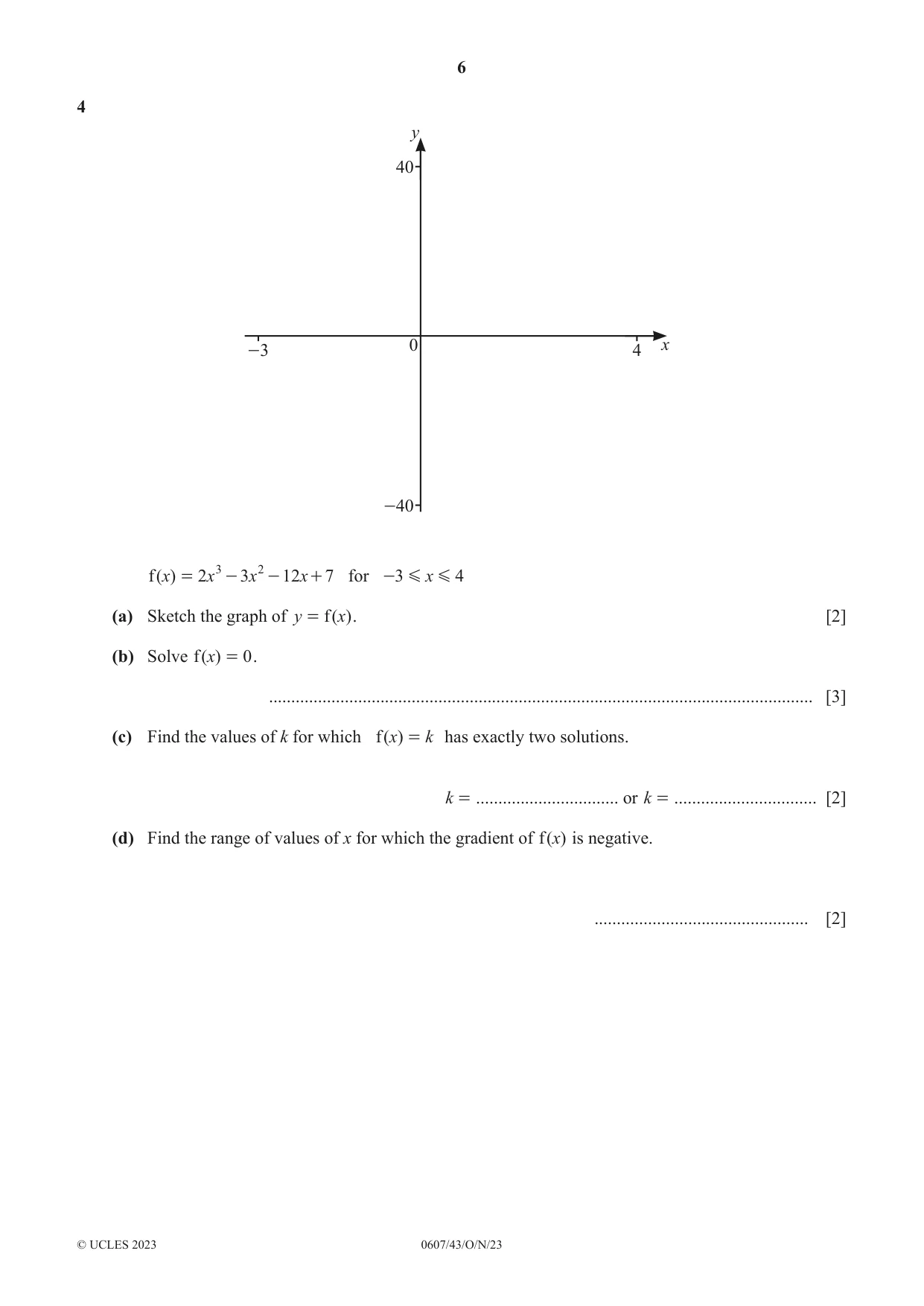
Q4 · Y 40 0 x -3 4 -40 f ( x) = 2x 3 - 3x 2 - 12x + 7 for -3 G x G 4 (a) Sketch the graph of y…
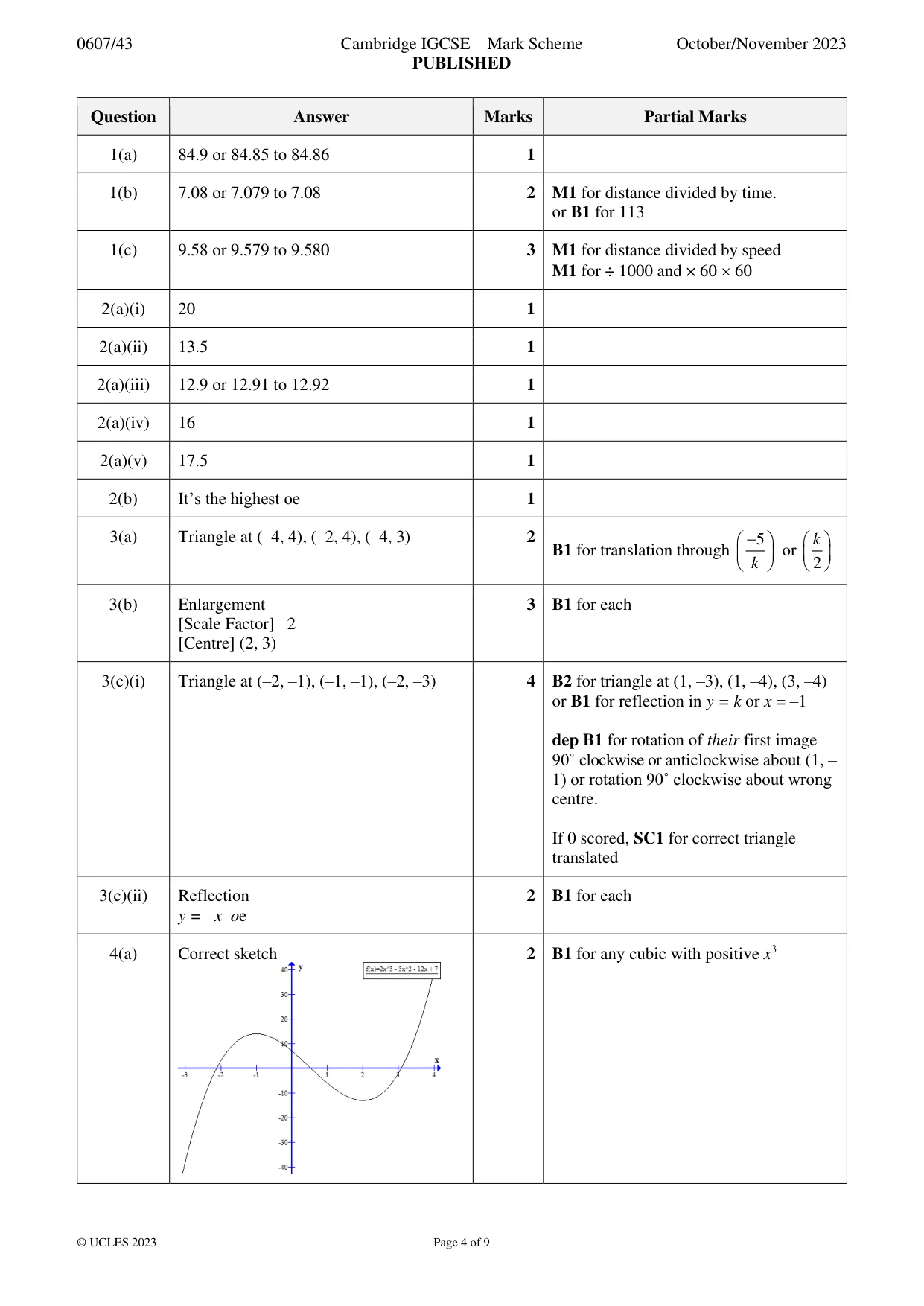
4 y 40 0 x -3 4 -40 f ( x) = 2x 3 - 3x 2 - 12x + 7 for -3 G x G 4 (a) Sketch the graph of y = f ( x) . [2] (b) Solve f ( x) = 0 . .......................................................................................................................... [3] (c) Find the values of k for which f ( x) = k has exactly two solutions. k = ................................ or k = ................................ [2] (d) Find the range of values of x for which the gradient of f ( x) is negative. ................................................ [2]
Mark scheme: 4(a) Correct sketch 2 B1 for any cubic with positive x3 4(b) –2.12 or –2.116... 3 B1 for each 0.537 or 0.5370... 3.08 or 3.079... 4(c) 14 and –13 cao 2 B1 for each or B1 for both14 and -13 seen 4(d) –1 < x < 2 2 B1 for each
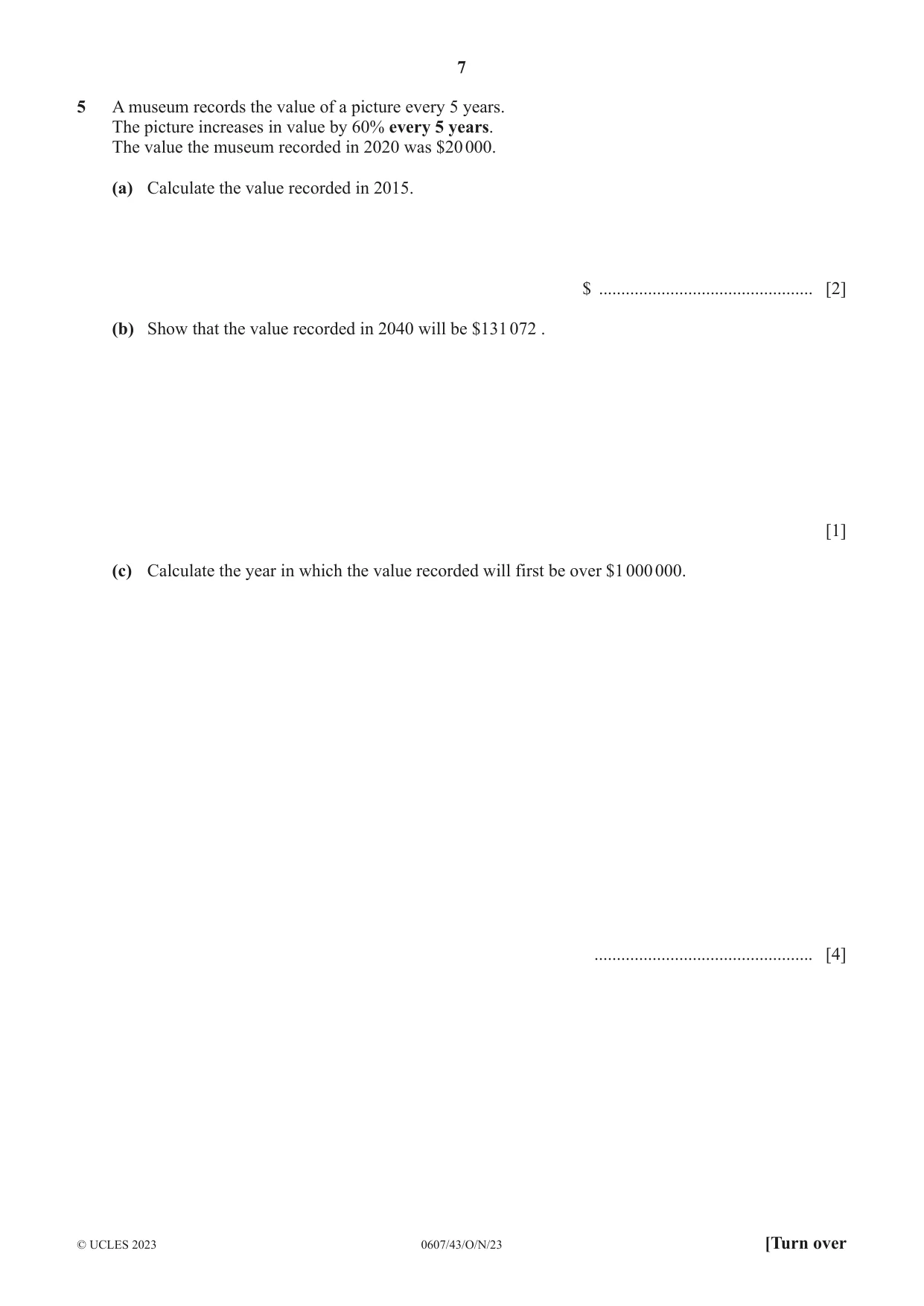
Q5 · A museum records the value of a picture every 5 years
5 A museum records the value of a picture every 5 years. The picture increases in value by 60% every 5 years. The value the museum recorded in 2020 was $20 000. (a) Calculate the value recorded in 2015. $ ................................................ [2] (b) Show that the value recorded in 2040 will be $131 072 . [1] (c) Calculate the year in which the value recorded will first be over $1 000 000. ................................................. [4]
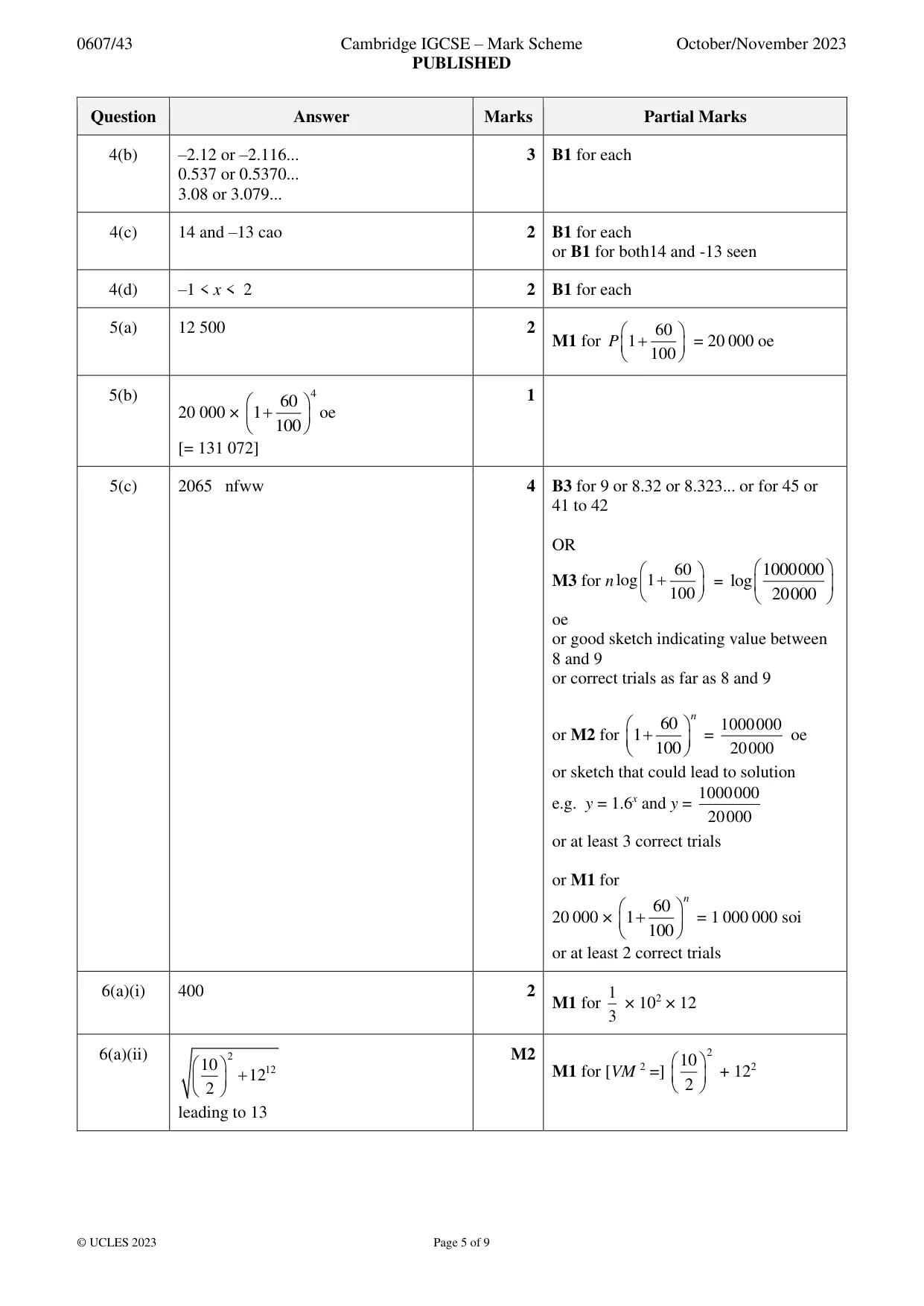
Mark scheme: 5(a) 12 500 2 60 M1 for P 1 + = 20 000 oe 100 5(b) 4 1 60 20 000 × 1 + oe 100 [= 131 072] 5(c) 2065 nfww 4 B3 for 9 or 8.32 or 8.323... or for 45 or 41 to 42 OR 60 1000000 M3 for n log 1 + = log 100 20000 oe or good sketch indicating value between 8 and 9 or correct trials as far as 8 and 9 60 n 1000000 or M2 for 1 + = oe 100 20000 or sketch that could lead to solution 1000000 e.g. y = 1.6x and y = 20000 or at least 3 correct trials or M1 for 60 n 20 000 × 1 + = 1 000 000 soi 100 or at least 2 correct trials
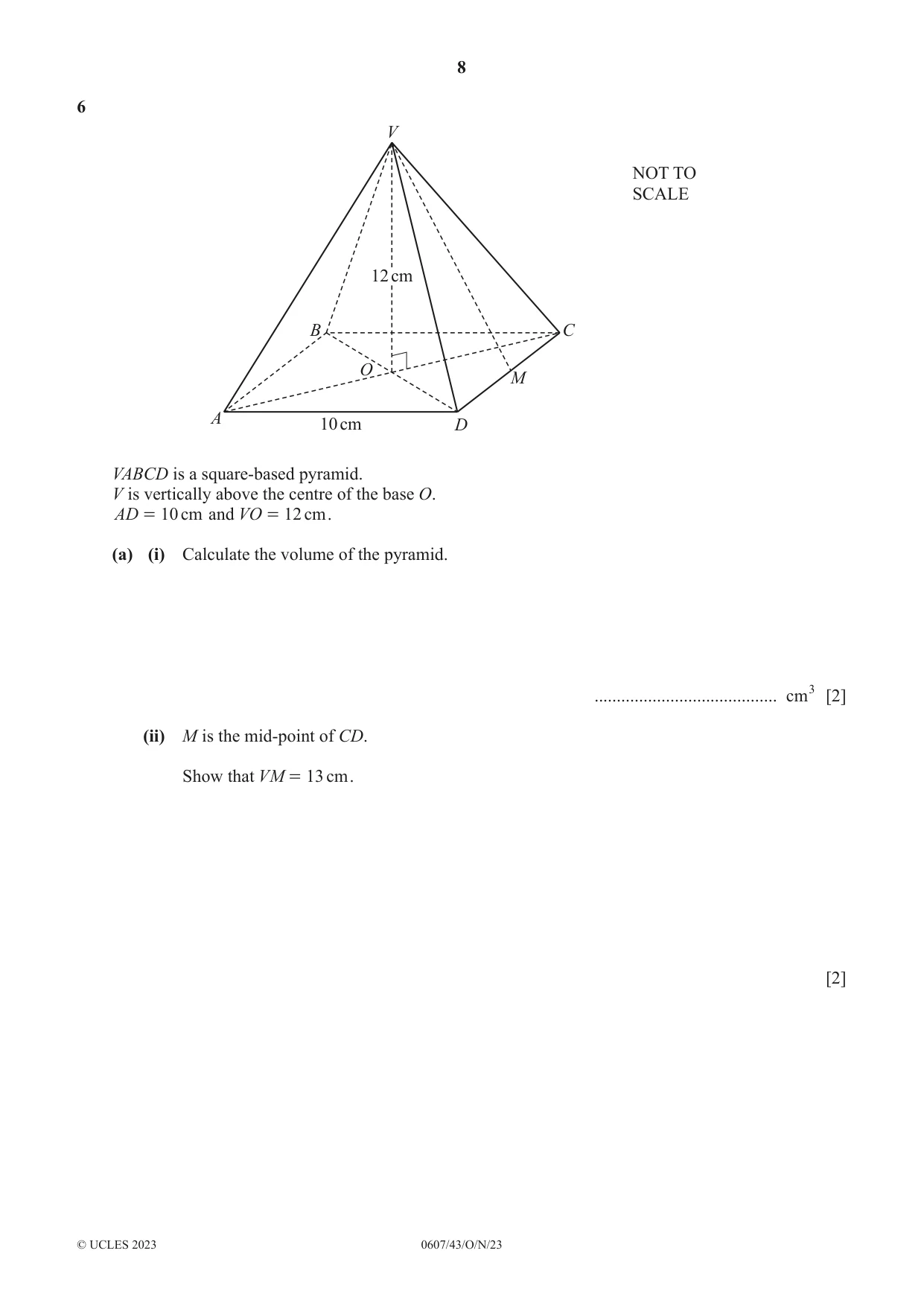
Q6 · V NOT TO SCALE 12 cm B C O M A 10 cm D VABCD is a square-based pyramid
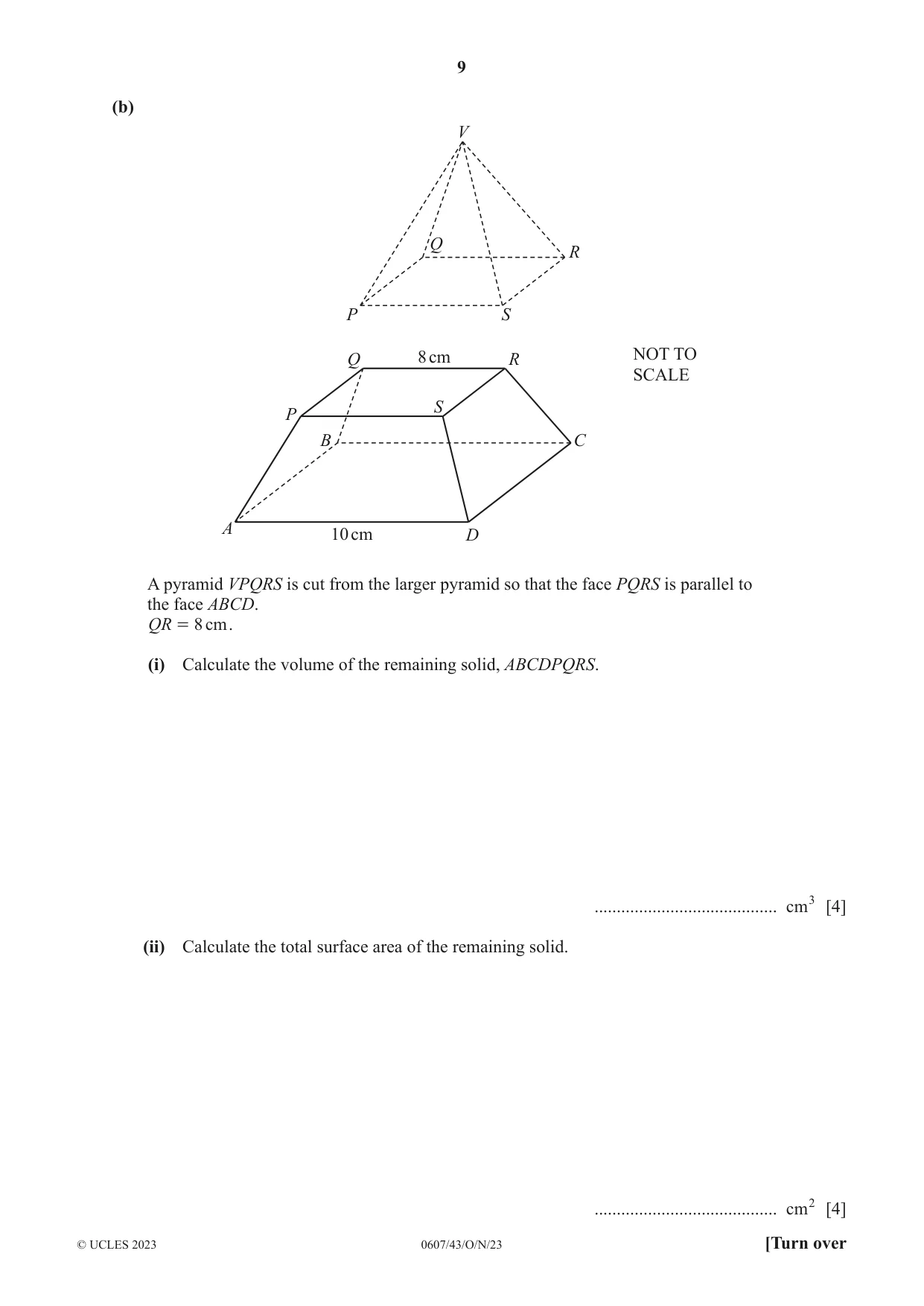
6 V NOT TO SCALE 12 cm B C O M A 10 cm D VABCD is a square-based pyramid. V is vertically above the centre of the base O. AD = 10 cm and VO = 12 cm . (a) (i) Calculate the volume of the pyramid. ......................................... cm3 [2] (ii) M is the mid-point of CD. Show that VM = 13 cm . [2] (b) V Q R P S Q 8 cm R NOT TO SCALE S P B C A 10 cm D A pyramid VPQRS is cut from the larger pyramid so that the face PQRS is parallel to the face ABCD. QR = 8 cm . (i) Calculate the volume of the remaining solid, ABCDPQRS. ......................................... cm3 [4] (ii) Calculate the total surface area of the remaining solid. ......................................... cm2 [4]
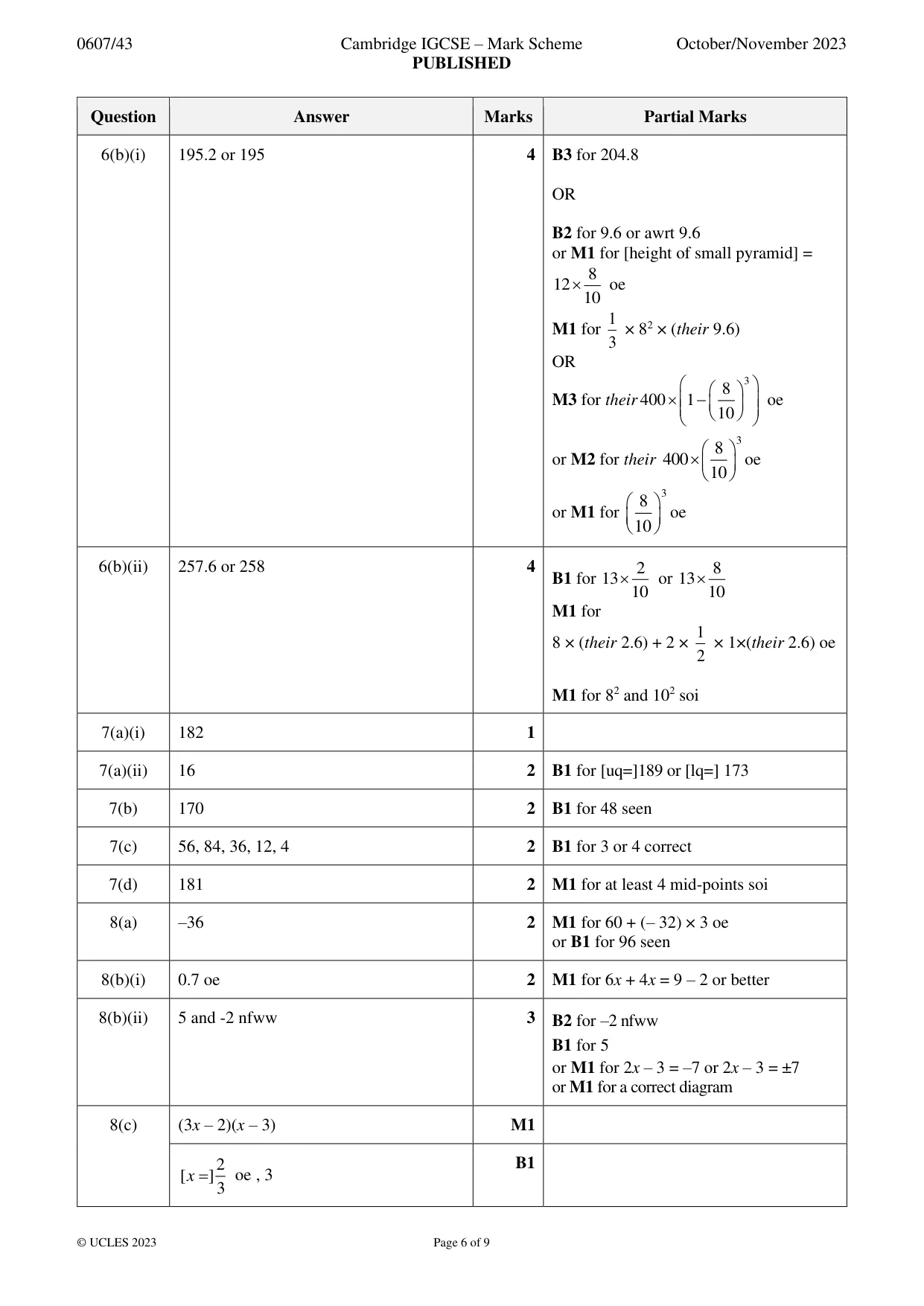
Mark scheme: 6(a)(i) 400 2 1 M1 for × 102 × 12 3 6(a)(ii) 2 M2 2 10 12 2 10 M1 for [VM =] + 122 + 12 2 2 leading to 13 6(b)(i) 195.2 or 195 4 B3 for 204.8 OR B2 for 9.6 or awrt 9.6 or M1 for [height of small pyramid] = 8 12 oe 10 1 M1 for × 82 × (their 9.6) 3 OR 8 3 M3 for their 400 1 − oe 10 8 3 or M2 for their 400 oe 10 8 3 or M1 for oe 10 6(b)(ii) 257.6 or 258 4 2 8 B1 for 13 or 13 10 10 M1 for 1 8 × (their 2.6) + 2 × × 1×(their 2.6) oe 2 M1 for 82 and 102 soi
Q7 · 240 people take part in a marathon race
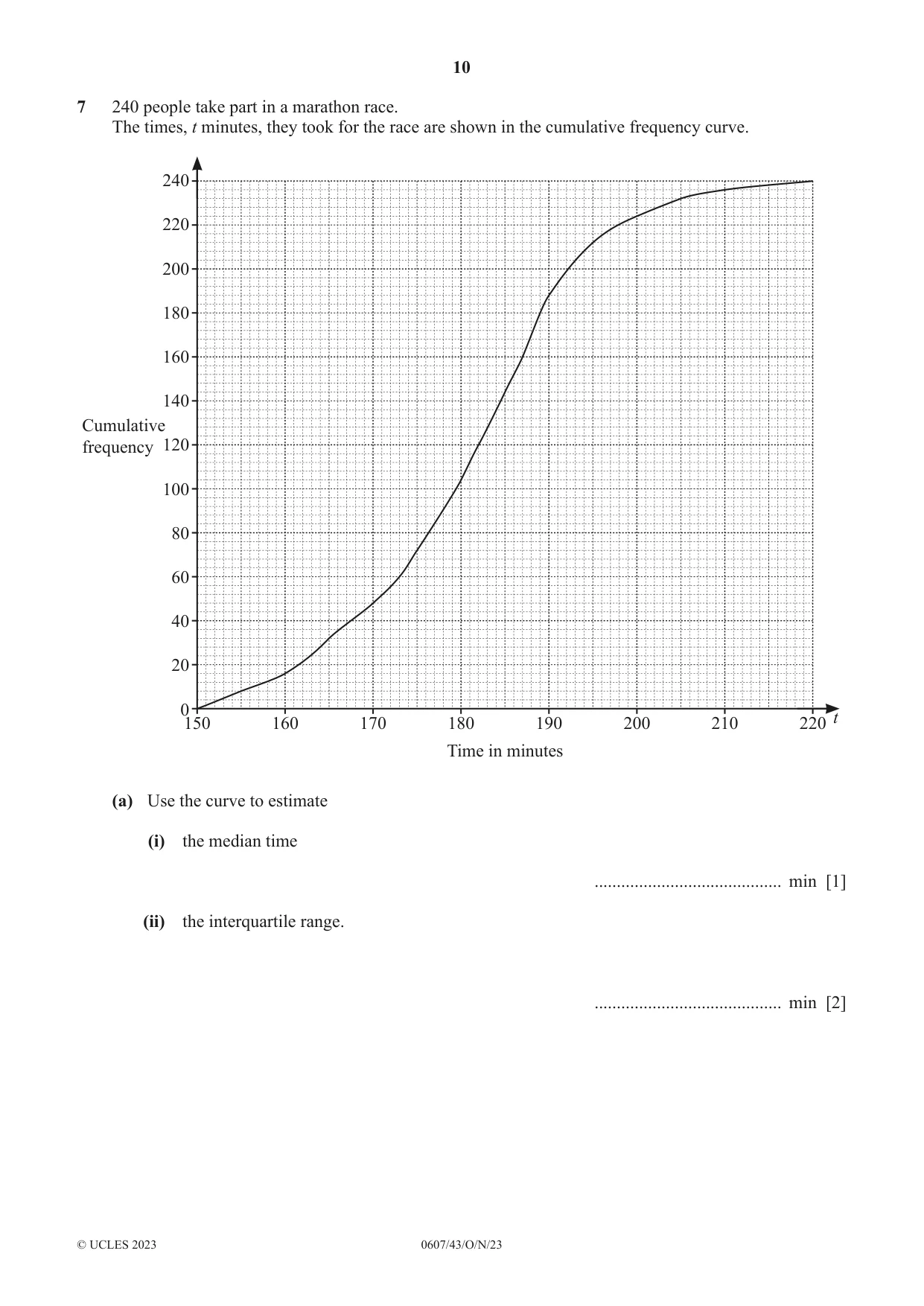
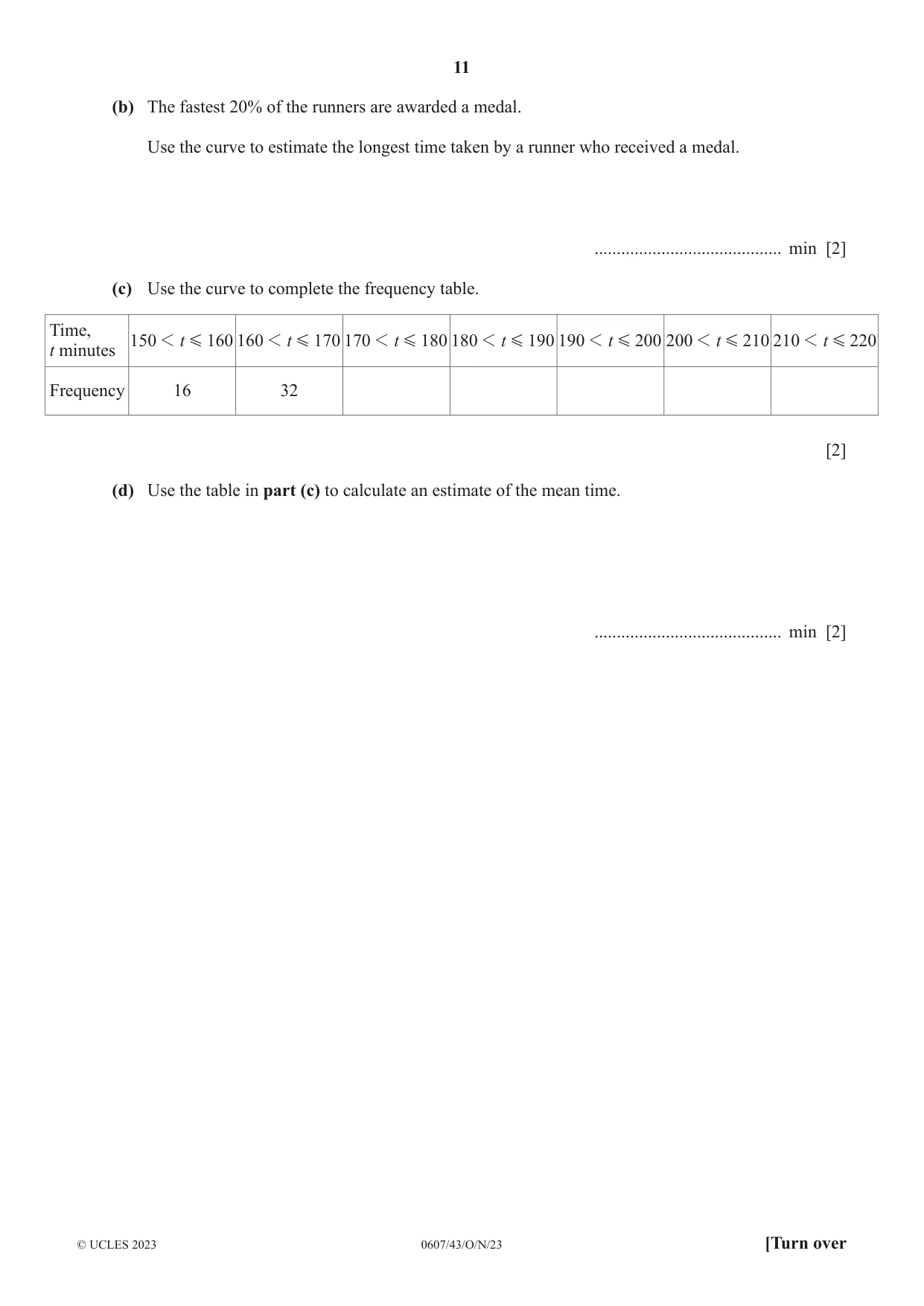
7 240 people take part in a marathon race. The times, t minutes, they took for the race are shown in the cumulative frequency curve. 240 220 200 180 160 140 Cumulative frequency 120 100 80 60 40 20 0 t 150 160 170 180 190 200 210 220 Time in minutes (a) Use the curve to estimate (i) the median time .......................................... min [1] (ii) the interquartile range. .......................................... min [2] (b) The fastest 20% of the runners are awarded a medal. Use the curve to estimate the longest time taken by a runner who received a medal. .......................................... min [2] (c) Use the curve to complete the frequency table. Time, 150 1 t G 160 160 1 t G 170 170 1 t G 180 180 1 t G 190 190 1 t G 200 200 1 t G 210 210 1 t G 220t minutes Frequency 16 32 [2] (d) Use the table in part (c) to calculate an estimate of the mean time. .......................................... min [2]
Mark scheme: 7(a)(i) 182 1 7(a)(ii) 16 2 B1 for [uq=]189 or [lq=] 173 7(b) 170 2 B1 for 48 seen 7(c) 56, 84, 36, 12, 4 2 B1 for 3 or 4 correct 7(d) 181 2 M1 for at least 4 mid-points soi
Q8 · V = u + at Find v when u = 60, a =-32 and t = 3
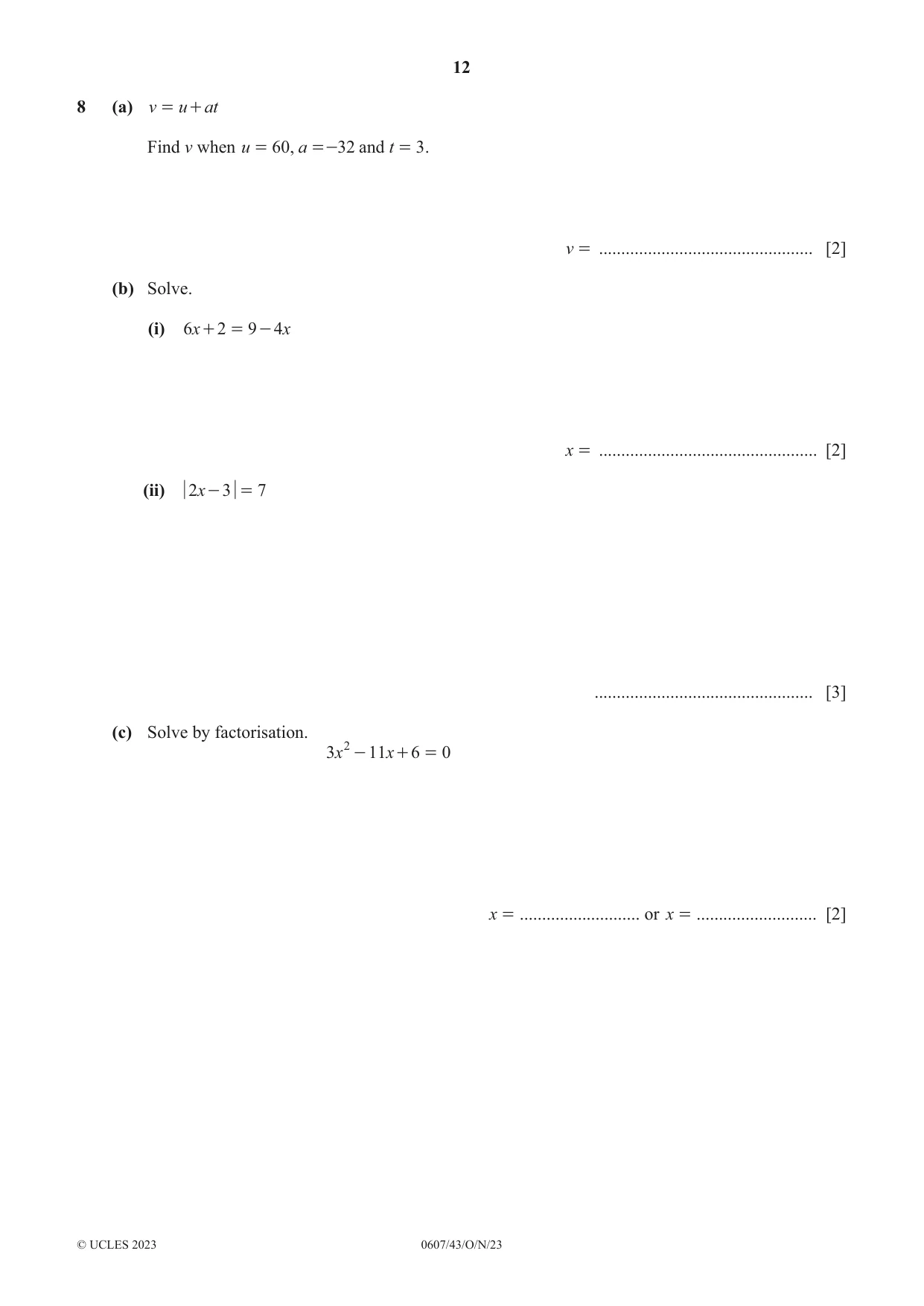
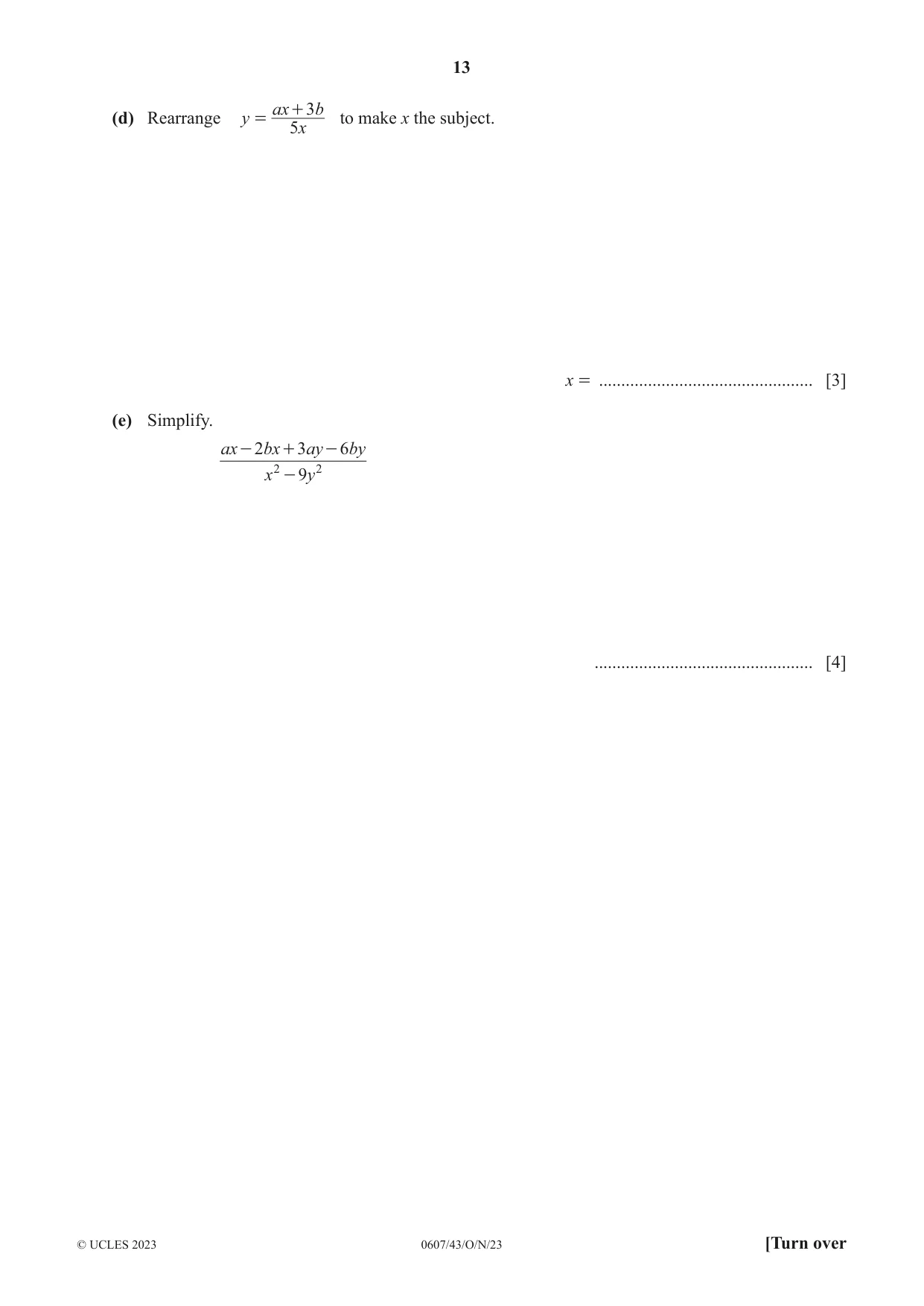
8 (a) v = u + at Find v when u = 60, a =-32 and t = 3 . v = ................................................ [2] (b) Solve. (i) 6x + 2 = 9 - 4x x = ................................................. [2] (ii) 2x - 3 = 7 ................................................. [3] (c) Solve by factorisation. 3x 2 - 11x + 6 = 0 x = ........................... or x = ........................... [2] ax + 3b(d) Rearrange y = to make x the subject. 5x x = ................................................ [3] (e) Simplify. ax - 2bx + 3ay - 6by x 2 - 9y 2 ................................................. [4]
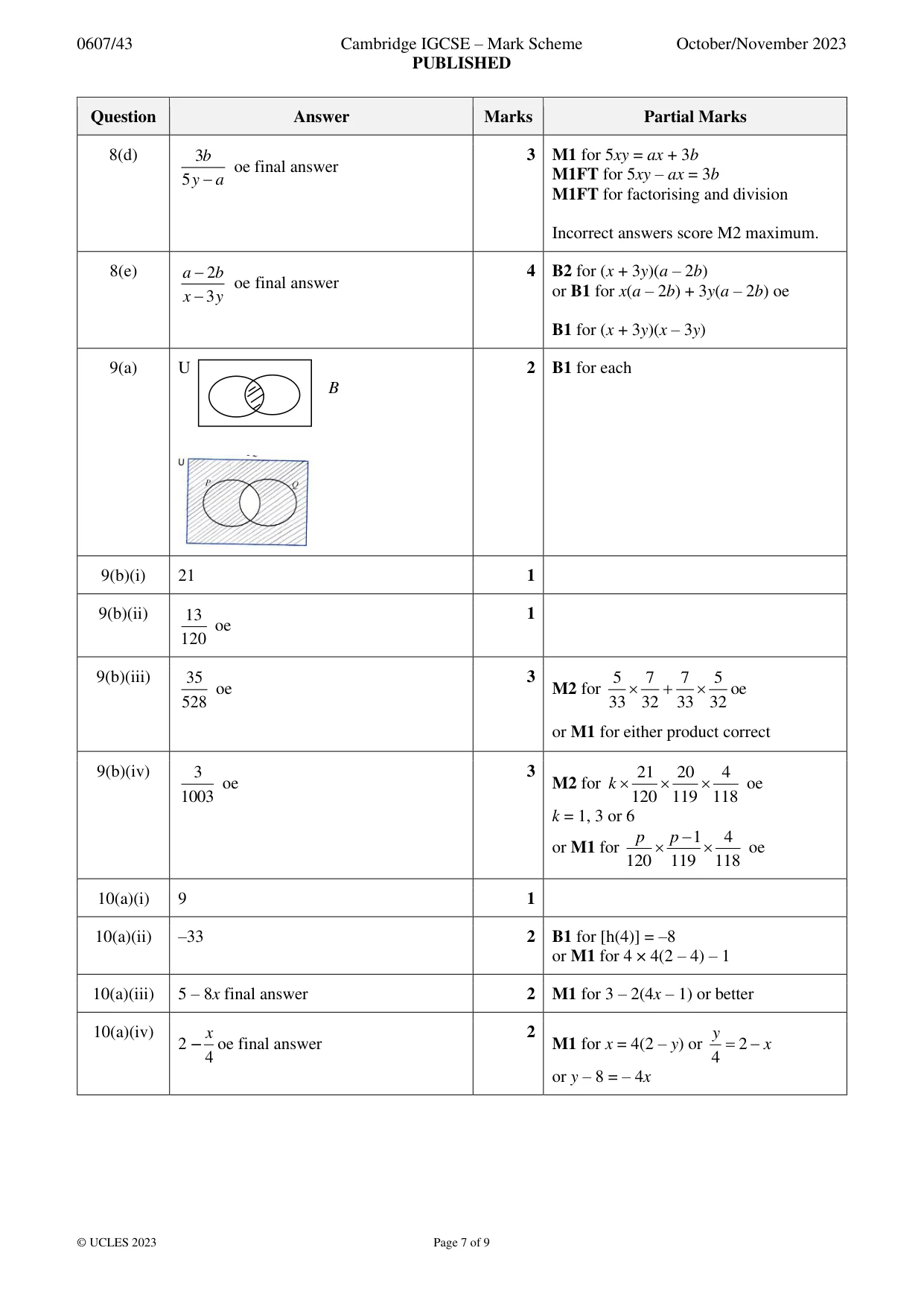
Mark scheme: 8(a) –36 2 M1 for 60 + (– 32) × 3 oe or B1 for 96 seen 8(b)(i) 0.7 oe 2 M1 for 6x + 4x = 9 – 2 or better 8(b)(ii) 5 and -2 nfww 3 B2 for –2 nfww B1 for 5 or M1 for 2x – 3 = –7 or 2x – 3 = ±7 or M1 for a correct diagram 8(c) (3x – 2)(x – 3) M1 2 B1 [ x = ]3 oe , 3 8(d) 3b 3 M1 for 5xy = ax + 3b oe final answer M1FT for 5xy – ax = 3b 5 y − a M1FT for factorising and division Incorrect answers score M2 maximum. 8(e) a − 2b 4 B2 for (x + 3y)(a – 2b) oe final answer or B1 for x(a – 2b) + 3y(a – 2b) oe x − 3 y B1 for (x + 3y)(x – 3y)
Q9 · For each Venn diagram, shade the given set
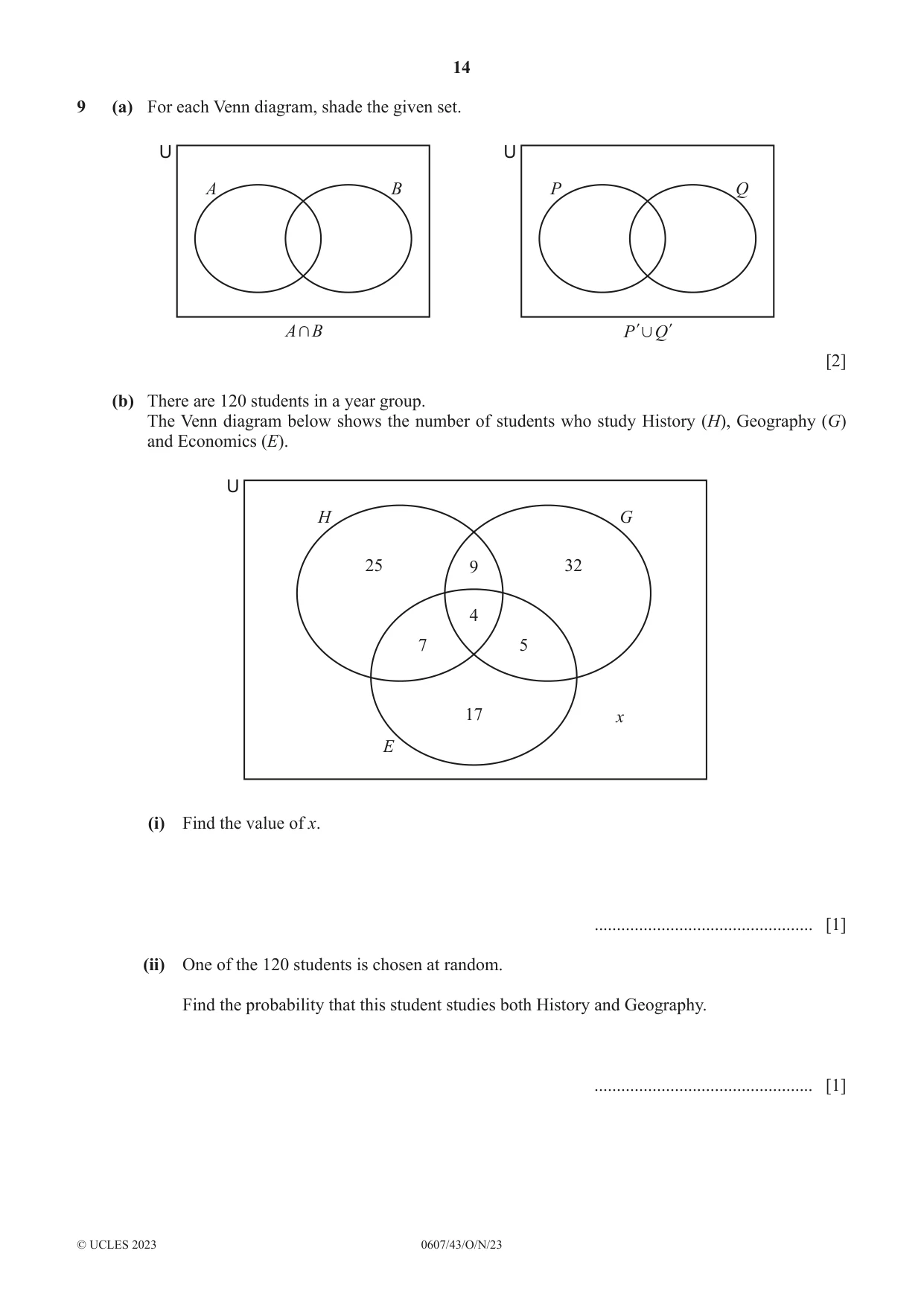
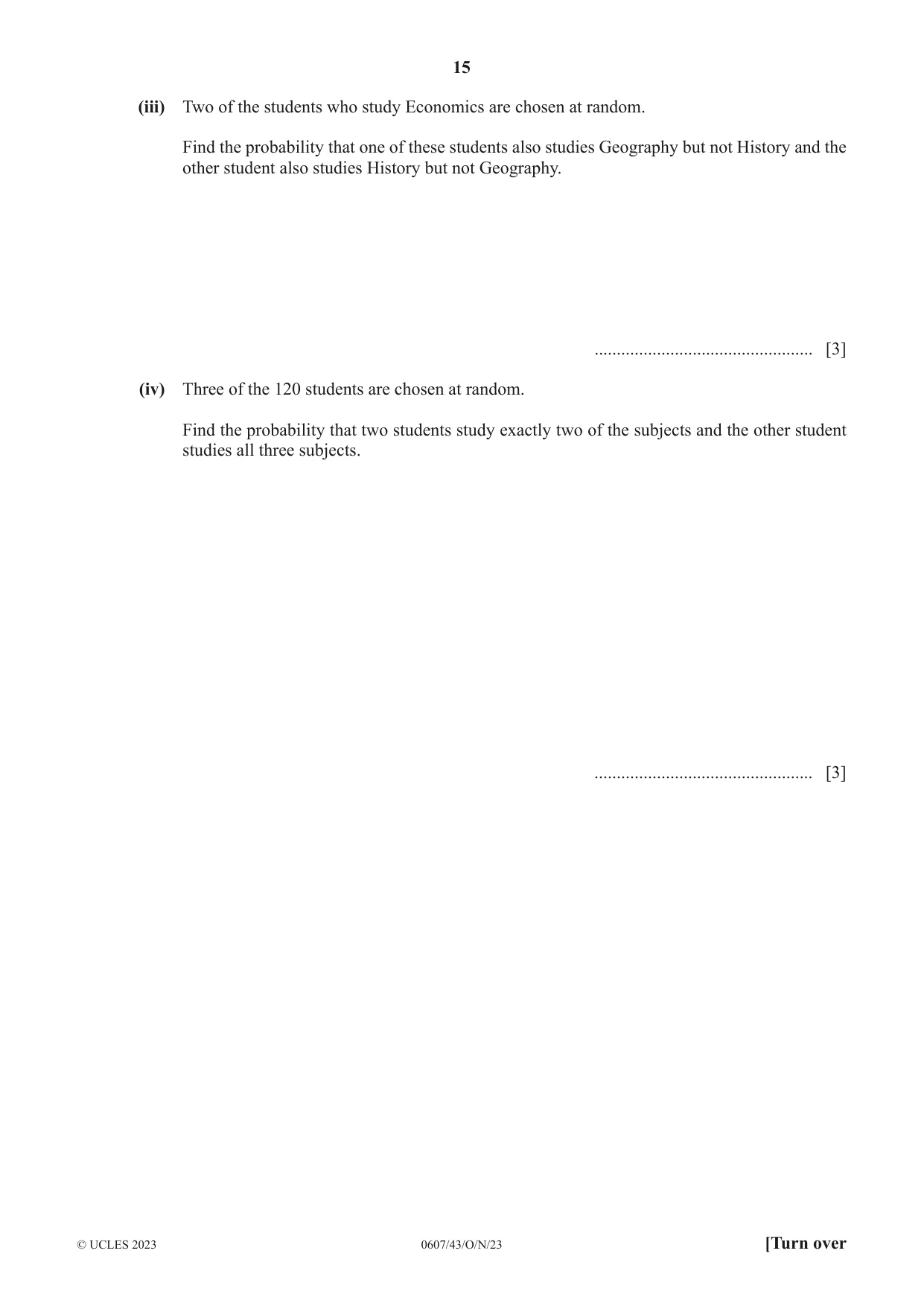
9 (a) For each Venn diagram, shade the given set. U U A B P Q A + B P l , Q l [2] (b) There are 120 students in a year group. The Venn diagram below shows the number of students who study History (H), Geography (G) and Economics (E). U H G 25 9 32 4 7 5 17 x E (i) Find the value of x. ................................................. [1] (ii) One of the 120 students is chosen at random. Find the probability that this student studies both History and Geography. ................................................. [1] (iii) Two of the students who study Economics are chosen at random. Find the probability that one of these students also studies Geography but not History and the other student also studies History but not Geography. ................................................. [3] (iv) Three of the 120 students are chosen at random. Find the probability that two students study exactly two of the subjects and the other student studies all three subjects. ................................................. [3]
Mark scheme: 9(a) U 2 B1 for each A B 9(b)(i) 21 1 9(b)(ii) 13 1 oe 120 9(b)(iii) 35 3 5 7 7 5 oe M2 for + oe 528 33 32 33 32 or M1 for either product correct 9(b)(iv) 3 3 21 20 4 oe M2 for k oe 1003 120 119 118 k = 1, 3 or 6 p p − 1 4 or M1 for oe 120 119 118
Q10 · F ( x) = 4x - 1 g ( x) = 3 - 2x h ( x) = 4 ( 2 - x) (a) (i) Find g ( -3)
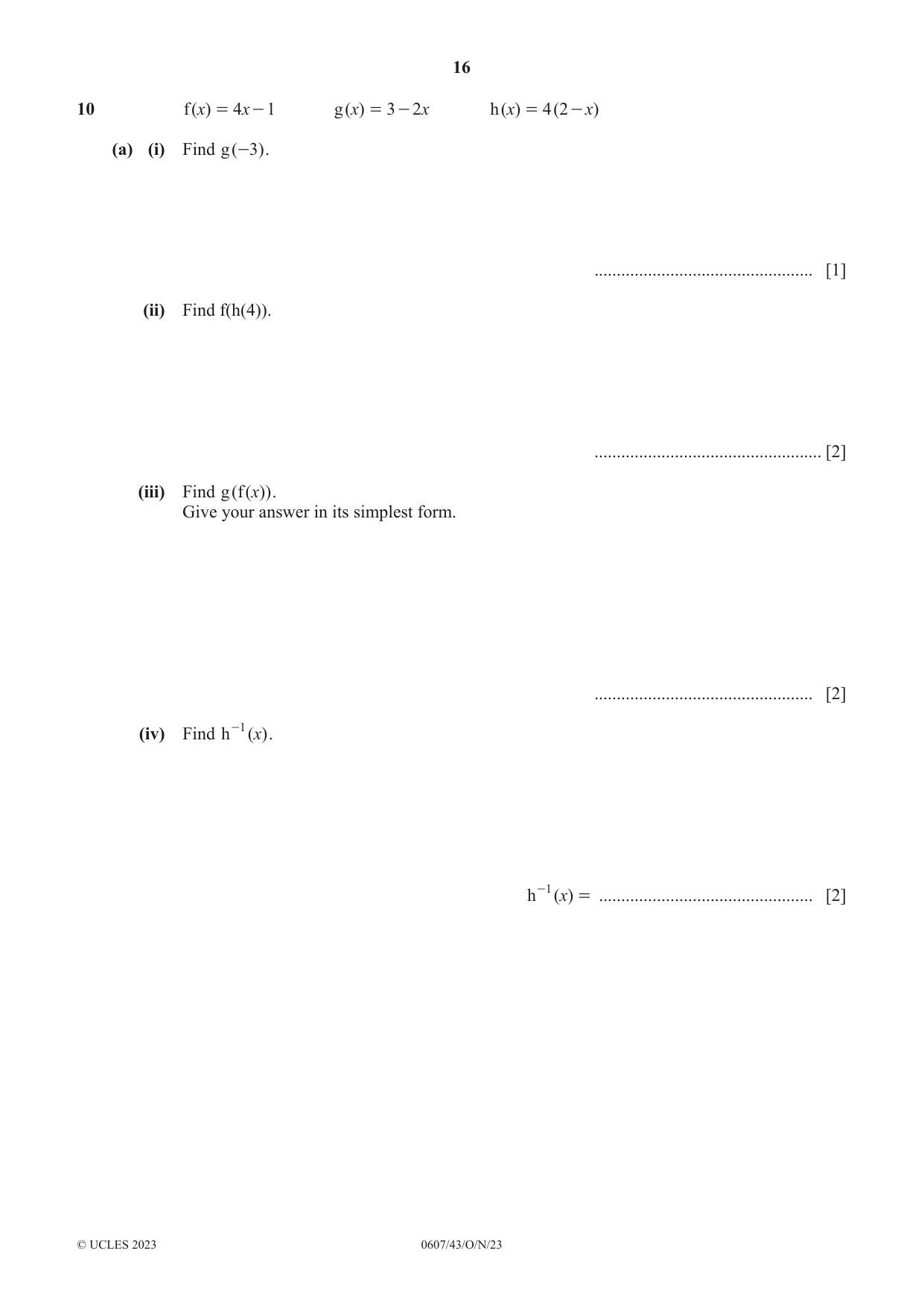
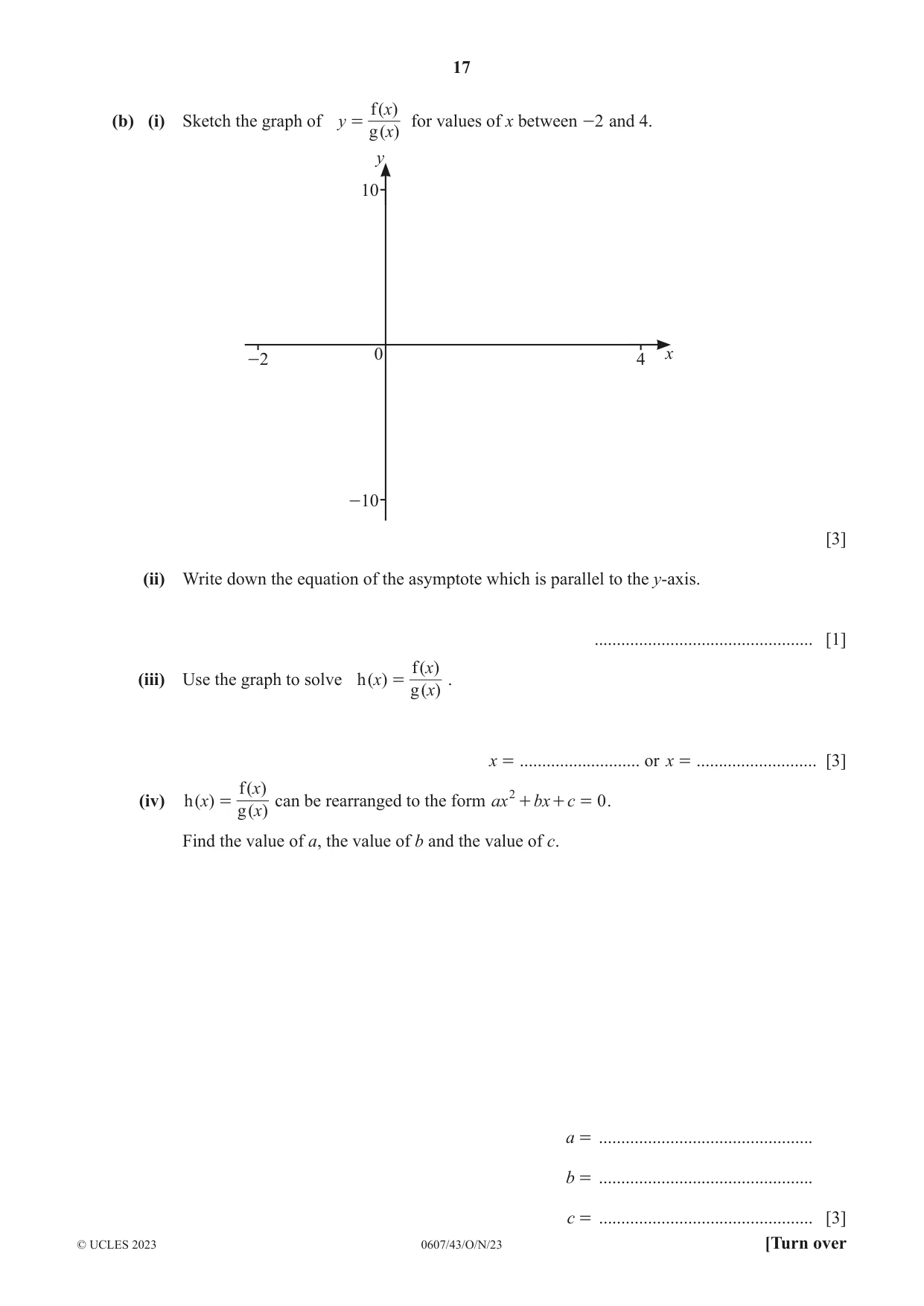
10 f ( x) = 4x - 1 g ( x) = 3 - 2x h ( x) = 4 ( 2 - x) (a) (i) Find g ( -3) . ................................................. [1] (ii) Find f(h(4)). ................................................... [2] (iii) Find g ( f ( x)) . Give your answer in its simplest form. ................................................. [2] (iv) Find h -1 ( x) . h -1 ( x) = ................................................ [2] f ( x) (b) (i) Sketch the graph of y = for values of x between -2 and 4. g ( x) y 10 0 x -2 4 -10 [3] (ii) Write down the equation of the asymptote which is parallel to the y-axis. ................................................. [1] f ( x) (iii) Use the graph to solve h ( x) = . g ( x) x = ........................... or x = ........................... [3] f ( x) 2 (iv) h ( x) = can be rearranged to the form ax + bx + c = 0 . g ( x) Find the value of a, the value of b and the value of c. a = ................................................ b = ................................................ c = ................................................ [3]
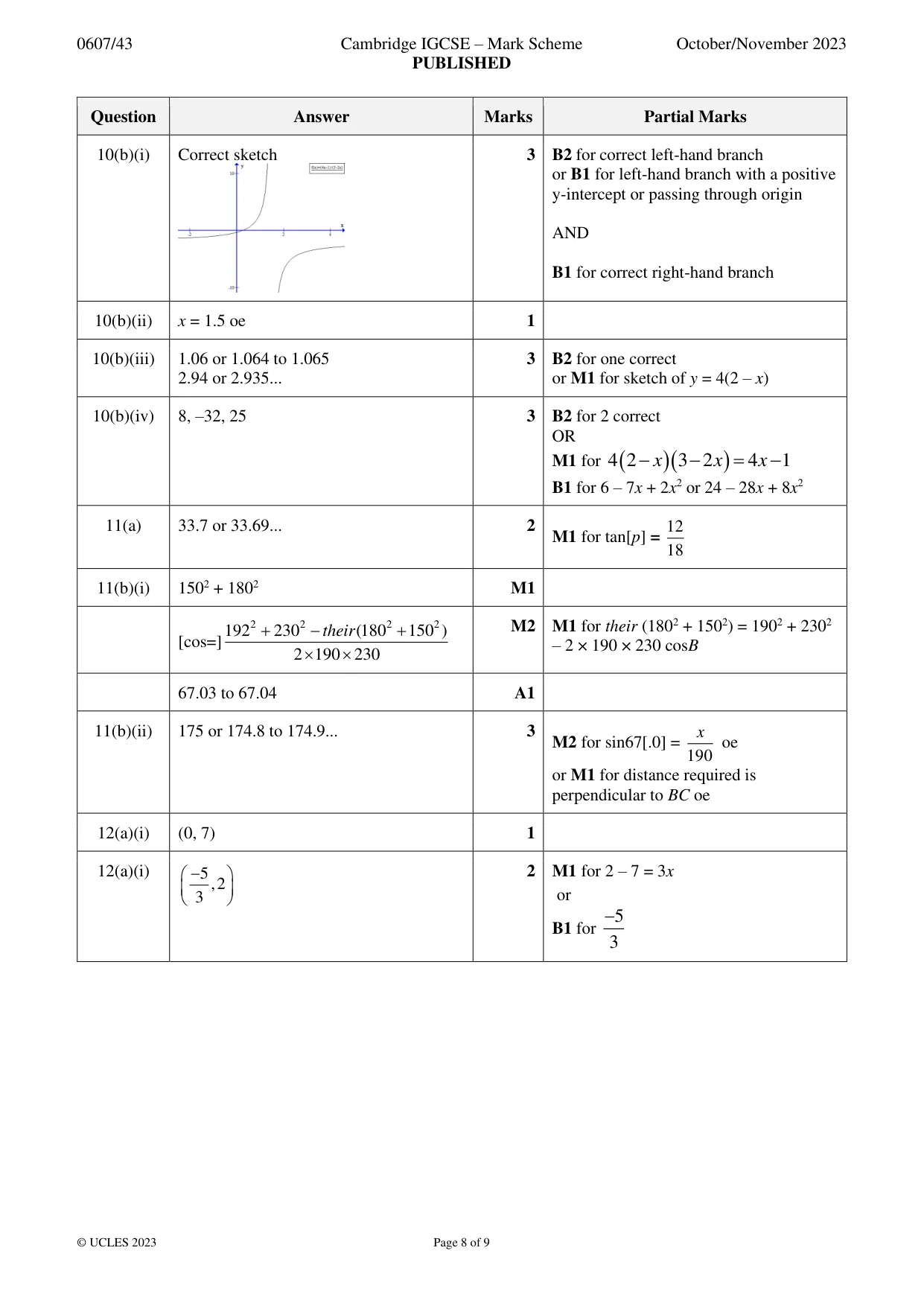
Mark scheme: 10(a)(i) 9 1 10(a)(ii) –33 2 B1 for [h(4)] = –8 or M1 for 4 × 4(2 – 4) – 1 10(a)(iii) 5 – 8x final answer 2 M1 for 3 – 2(4x – 1) or better 10(a)(iv) x 2 y 2 – oe final answer M1 for x = 4(2 – y) or = 2 − x 4 4 or y – 8 = – 4x 10(b)(i) Correct sketch 3 B2 for correct left-hand branch or B1 for left-hand branch with a positive y-intercept or passing through origin AND B1 for correct right-hand branch 10(b)(ii) x = 1.5 oe 1 10(b)(iii) 1.06 or 1.064 to 1.065 3 B2 for one correct 2.94 or 2.935... or M1 for sketch of y = 4(2 – x) 10(b)(iv) 8, –32, 25 3 B2 for 2 correct OR M1 for 4 ( 2 − x )( 3 − 2 x ) = 4 x − 1 B1 for 6 – 7x + 2x2 or 24 – 28x + 8x2
Q11 · NOT TO SCALE 12 cm p° 18 cm Calculate the value of p
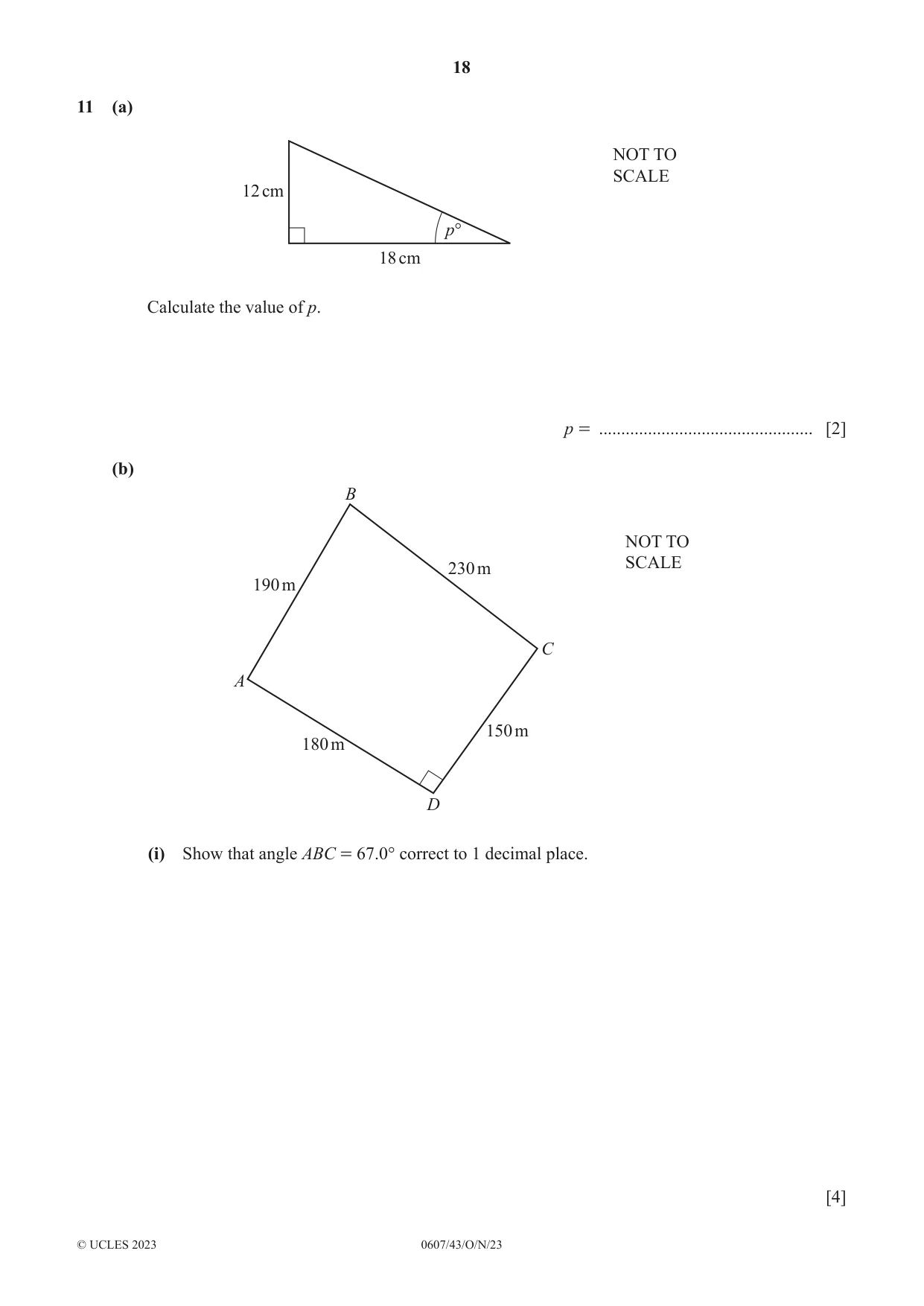
11 (a) NOT TO SCALE 12 cm p° 18 cm Calculate the value of p. p = ................................................ [2] (b) B NOT TO SCALE 230 m 190 m C A 150 m 180 m D (i) Show that angle ABC = 67.0° correct to 1 decimal place. [4] (ii) Calculate the shortest distance from A to the side BC. ............................................. m [3] Question 12 is printed on the next page.
Mark scheme: 11(a) 33.7 or 33.69... 2 12 M1 for tan[p] = 18 11(b)(i) 1502 + 1802 M1 192 2 + 230 2 − their (180 2 + 150 2 ) M2 M1 for their (1802 + 1502) = 1902 + 2302 [cos=] – 2 × 190 × 230 cosB 2 190 230 67.03 to 67.04 A1 11(b)(ii) 175 or 174.8 to 174.9... 3 x M2 for sin67[.0] = oe 190 or M1 for distance required is perpendicular to BC oe
Q12 · Find the coordinates of the point where the line y = 3x + 7 crosses (i) the y-axis (…
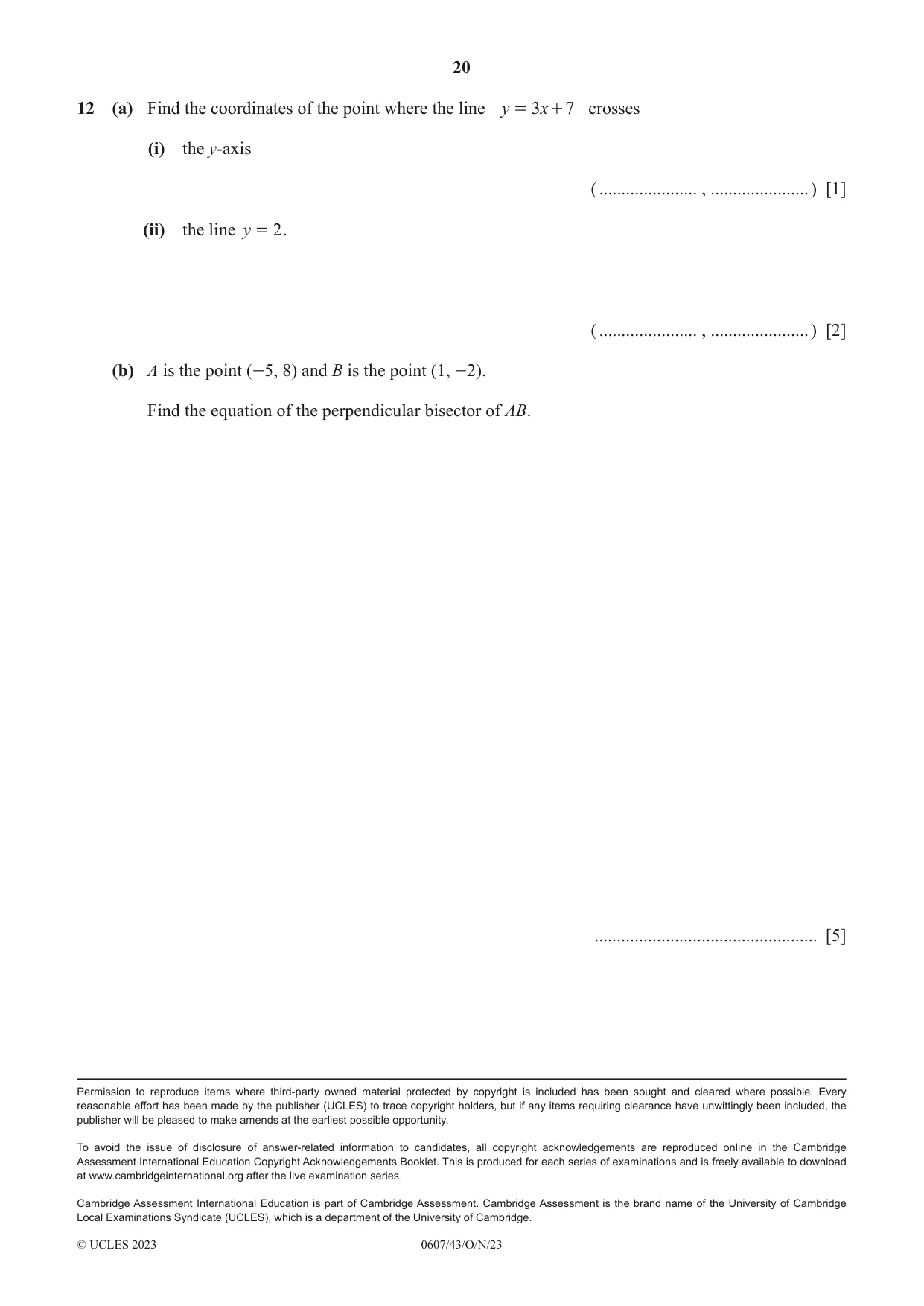
12 (a) Find the coordinates of the point where the line y = 3x + 7 crosses (i) the y-axis ( ...................... , ...................... ) [1] (ii) the line y = 2 . ( ...................... , ...................... ) [2] (b) A is the point (-5, 8) and B is the point (1, -2). Find the equation of the perpendicular bisector of AB. .................................................. [5]
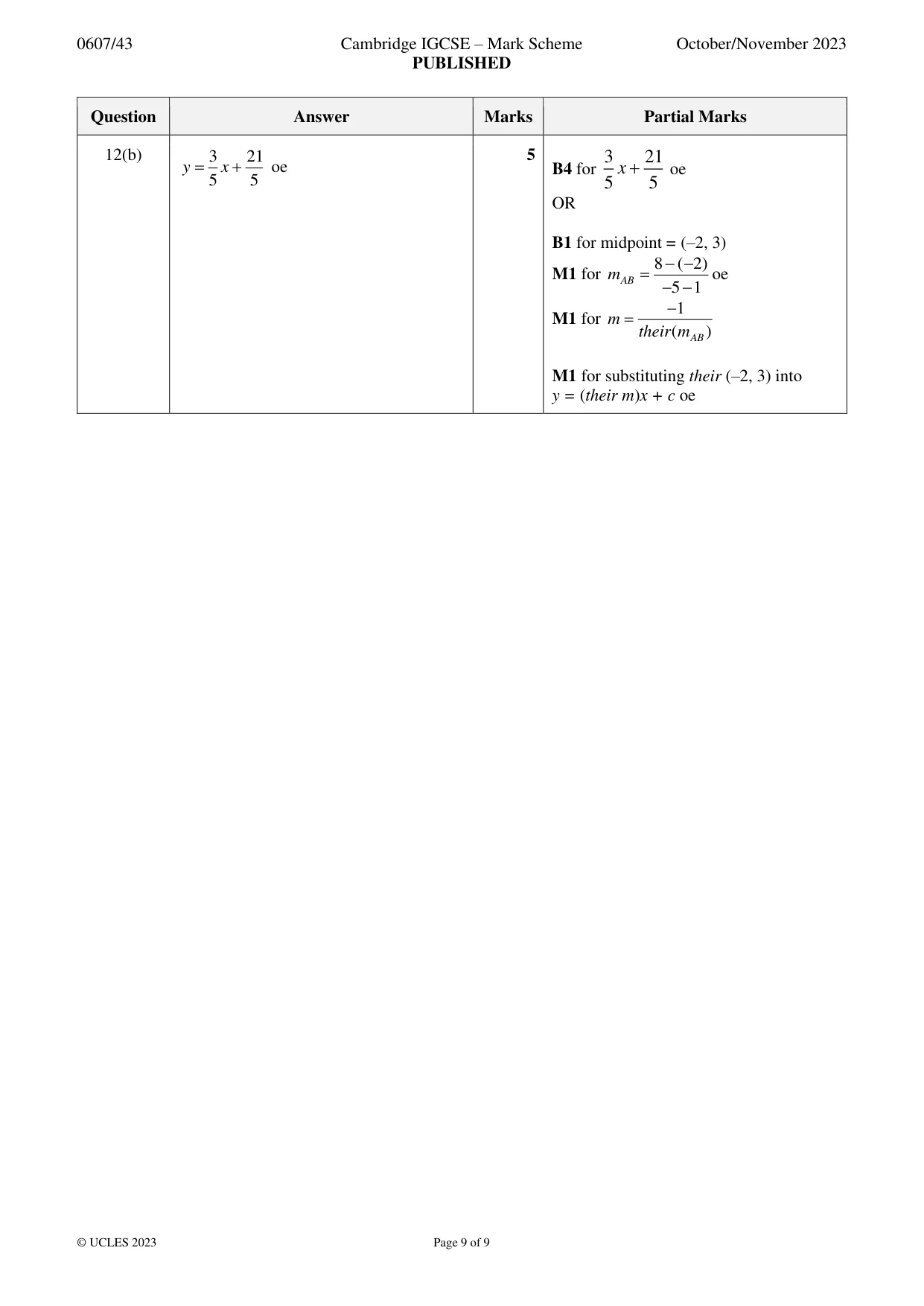
Mark scheme: 12(a)(i) (0, 7) 1 12(a)(i) − 5,2 2 M1 for 2 – 7 = 3x 3 or −5 B1 for 3 12(b) 3 21 5 3 21 y = x + oe B4 for x + oe 5 5 5 5 OR B1 for midpoint = (–2, 3) 8 −−( 2) M1 for m AB = oe −−5 1 −1 M1 for m = their ( m AB ) M1 for substituting their (–2, 3) into y = (their m)x + c oe
What was in this paper
The subtopics covered by these 12 questions, and how many questions each got. Open one in a new tab to see every Cambridge question on it.
What you needed in this session
Cambridge’s own grade thresholds for 2023 Oct/Nov, Paper 4 · Variant 3. A higher threshold means an easier paper — the bar moves with how the cohort did.