Cambridge IGCSE Mathematics - International 0607 — 2024 May/June Paper 4 · Variant 3
0607/43/M/J/24 · 11 questions · 120 marks · ≈135 min
The question paper and its mark scheme, free to read here and free to download. This is Cambridge’s own paper, exactly as it was sat.
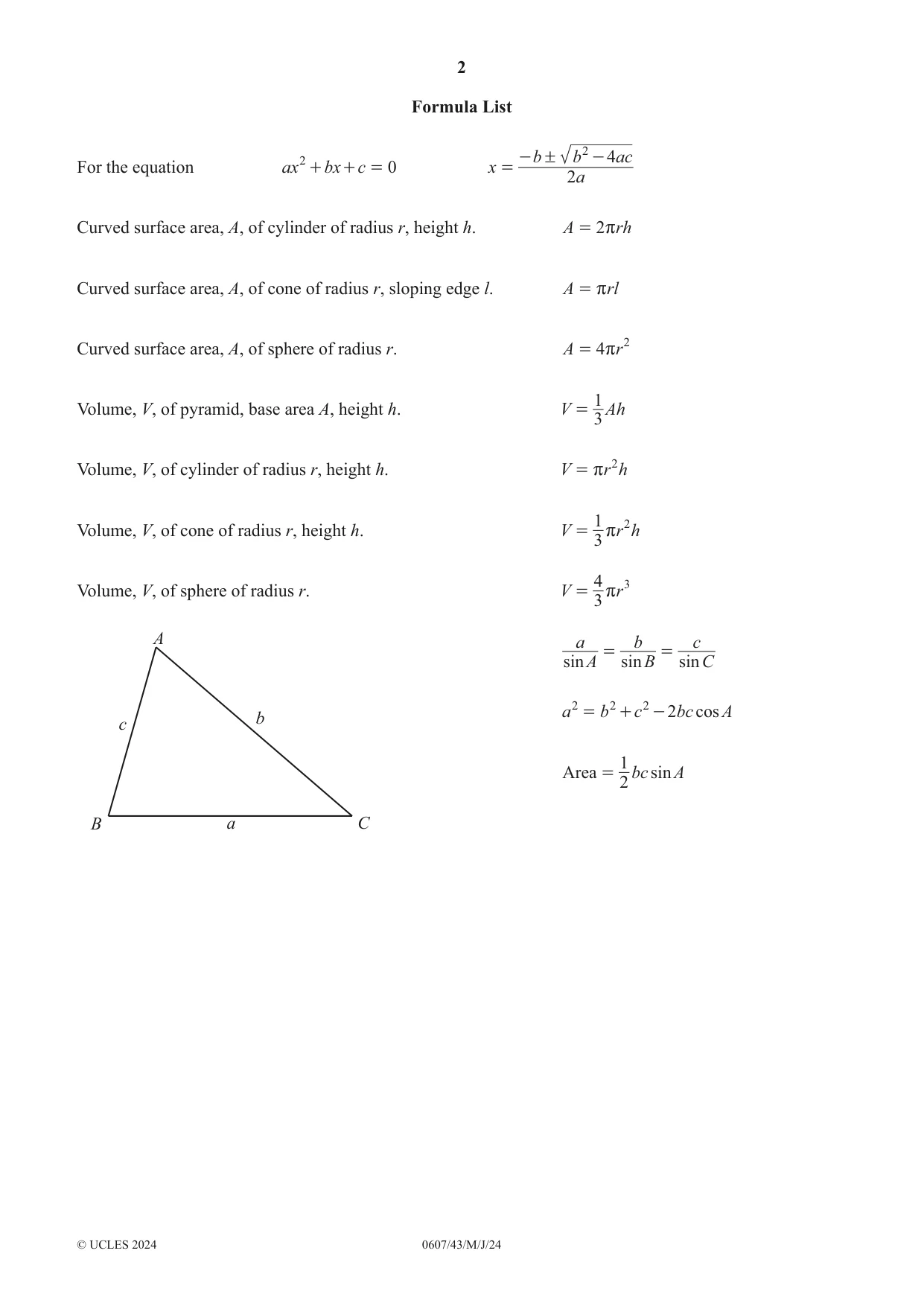
Question paper20 pages
Mark scheme9 pages
Answers below. Sit the paper first if you are practising.
Questions as text
Q1 · There are 120 houses in a street
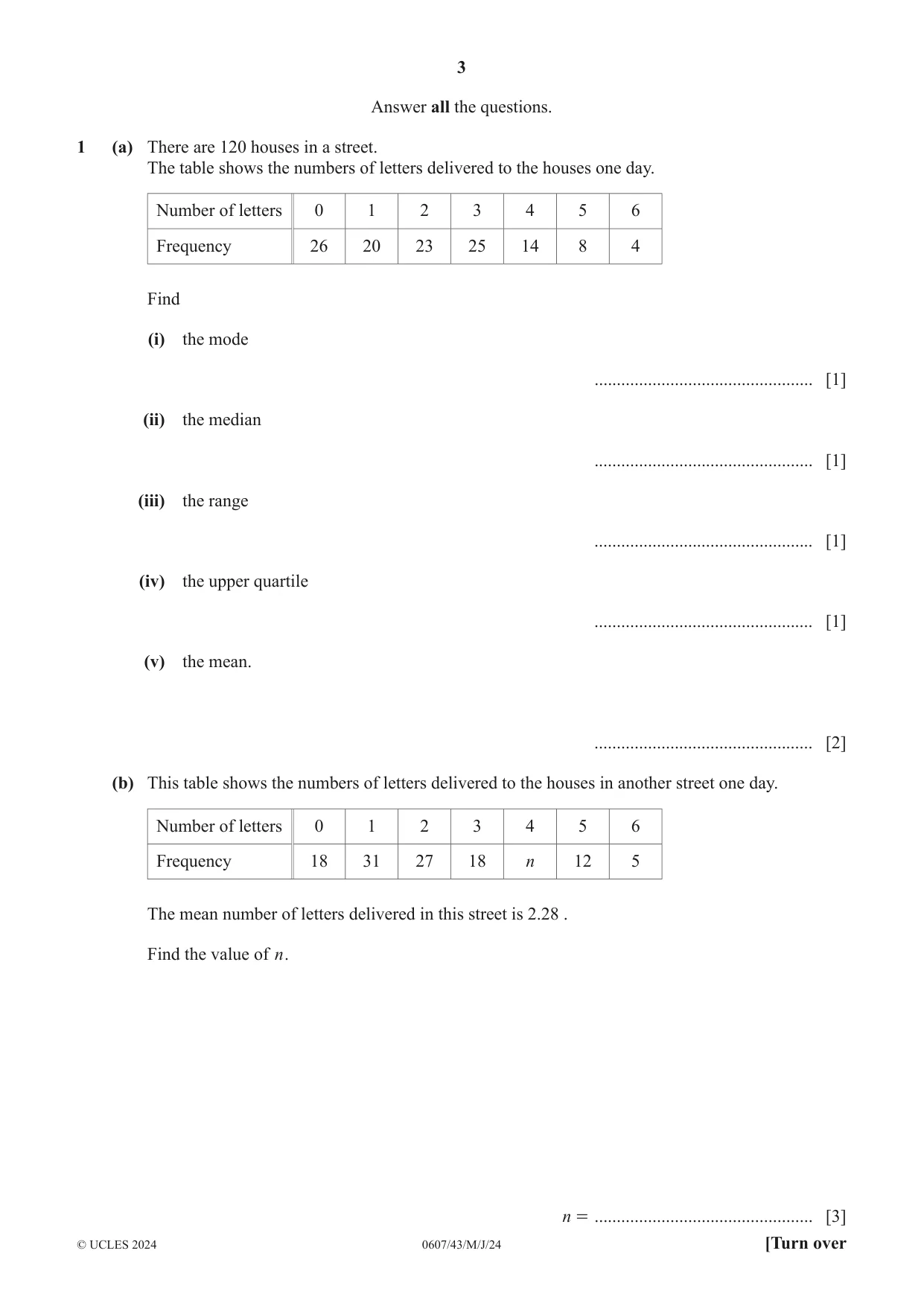
1 (a) There are 120 houses in a street. The table shows the numbers of letters delivered to the houses one day. Number of letters 0 1 2 3 4 5 6 Frequency 26 20 23 25 14 8 4 Find (i) the mode ................................................. [1] (ii) the median ................................................. [1] (iii) the range ................................................. [1] (iv) the upper quartile ................................................. [1] (v) the mean. ................................................. [2] (b) This table shows the numbers of letters delivered to the houses in another street one day. Number of letters 0 1 2 3 4 5 6 Frequency 18 31 27 18 n 12 5 The mean number of letters delivered in this street is 2.28 . Find the value of n. n = ................................................. [3]
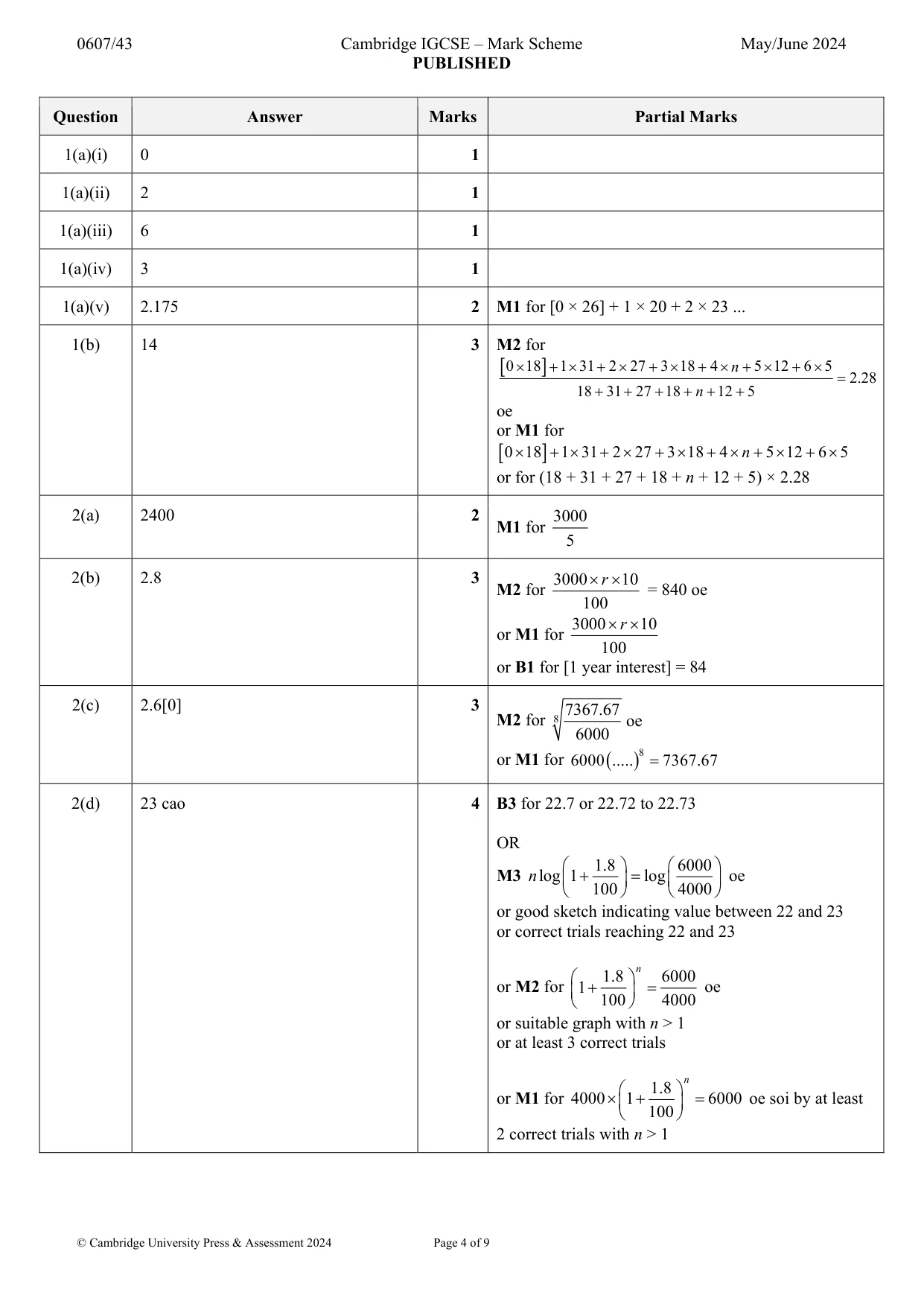
Mark scheme: Question Answer Marks Partial Marks 1(a)(i) 0 1 1(a)(ii) 2 1 1(a)(iii) 6 1 1(a)(iv) 3 1 1(a)(v) 2.175 2 M1 for [0 × 26] + 1 × 20 + 2 × 23 ... 1(b) 14 3 M2 for 0 18 1 31 2 27 3 18 4 n 5 12 6 5 2.28 18 31 27 18 n 12 5 oe or M1 for 0 18 1 31 2 27 3 18 4 n 5 12 6 5 or for (18 + 31 + 27 + 18 + n + 12 + 5) × 2.28
Q2 · Ameera and Bertrand share some money in the ratio 4 : 5
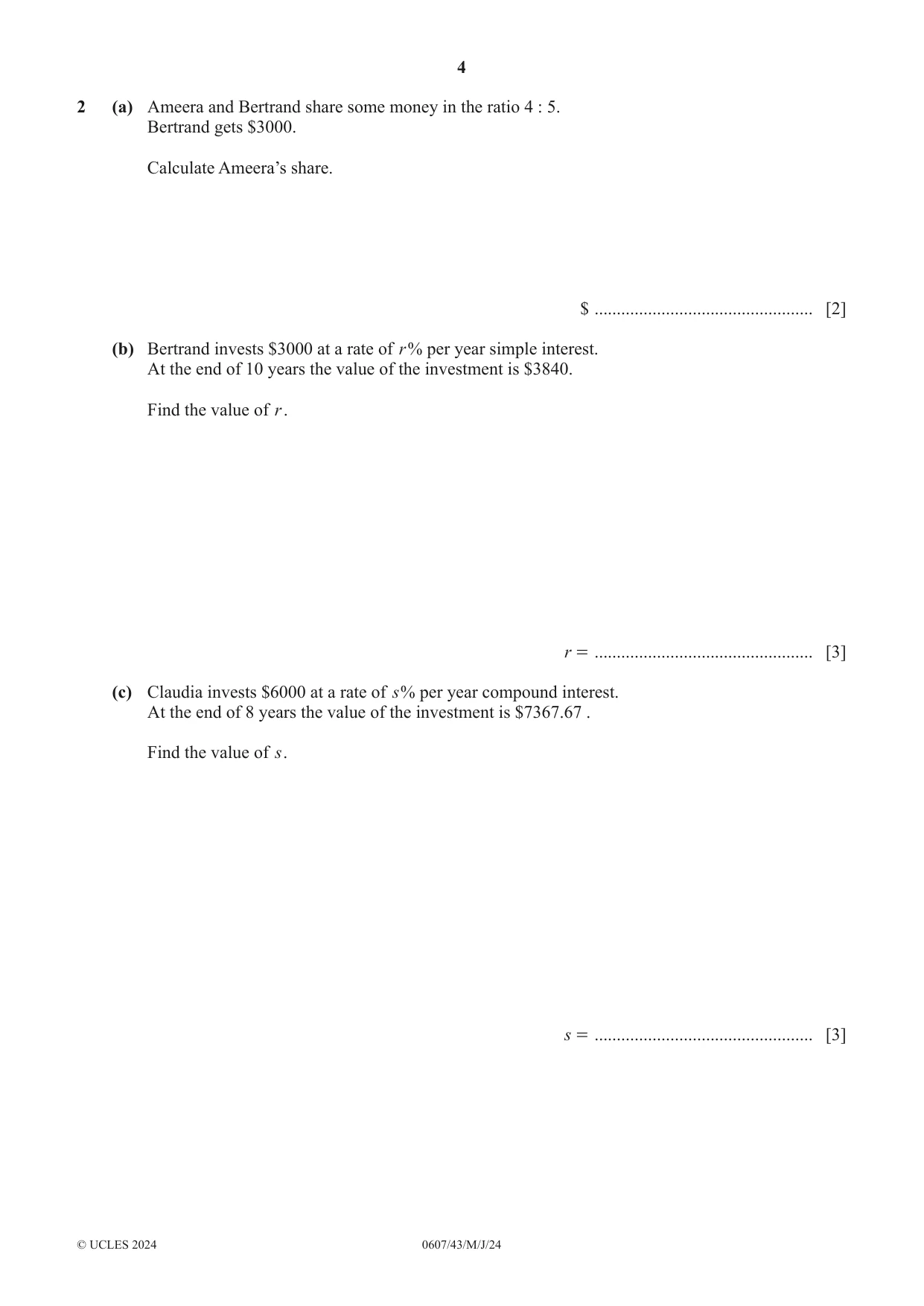
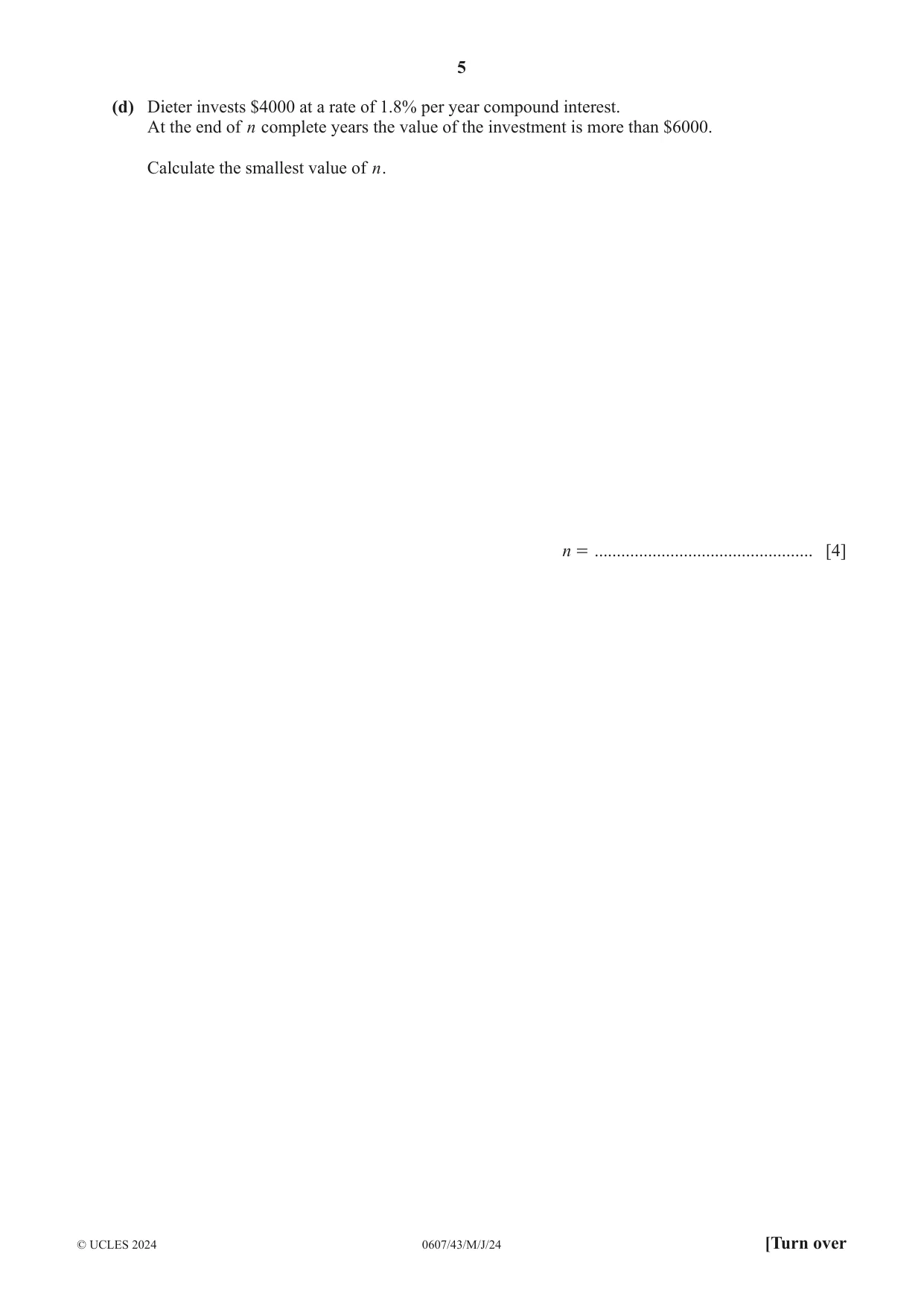
2 (a) Ameera and Bertrand share some money in the ratio 4 : 5. Bertrand gets $3000. Calculate Ameera’s share. $ ................................................. [2] (b) Bertrand invests $3000 at a rate of r% per year simple interest. At the end of 10 years the value of the investment is $3840. Find the value of r. r = ................................................. [3] (c) Claudia invests $6000 at a rate of s% per year compound interest. At the end of 8 years the value of the investment is $7367.67 . Find the value of s. s = ................................................. [3] (d) Dieter invests $4000 at a rate of 1.8% per year compound interest. At the end of n complete years the value of the investment is more than $6000. Calculate the smallest value of n. n = ................................................. [4]
Mark scheme: 2(a) 2400 2 3000 M1 for 5 2(b) 2.8 3 3000 r 10 M2 for = 840 oe 100 3000 r 10 or M1 for 100 or B1 for [1 year interest] = 84 2(c) 2.6[0] 3 7367.67 M2 for 8 oe 6000 or M1 for 6000 ..... 8 7367.67 2(d) 23 cao 4 B3 for 22.7 or 22.72 to 22.73 OR 1.8 6000 M3 n log 1 log oe 100 4000 or good sketch indicating value between 22 and 23 or correct trials reaching 22 and 23 1.8 n 6000 or M2 for 1 oe 100 4000 or suitable graph with n > 1 or at least 3 correct trials 1.8 n or M1 for 4000 1 6000 oe soi by at least 100 2 correct trials with n > 1
Q3 · Noora throws a fair 6-sided die numbered from 1 to 6
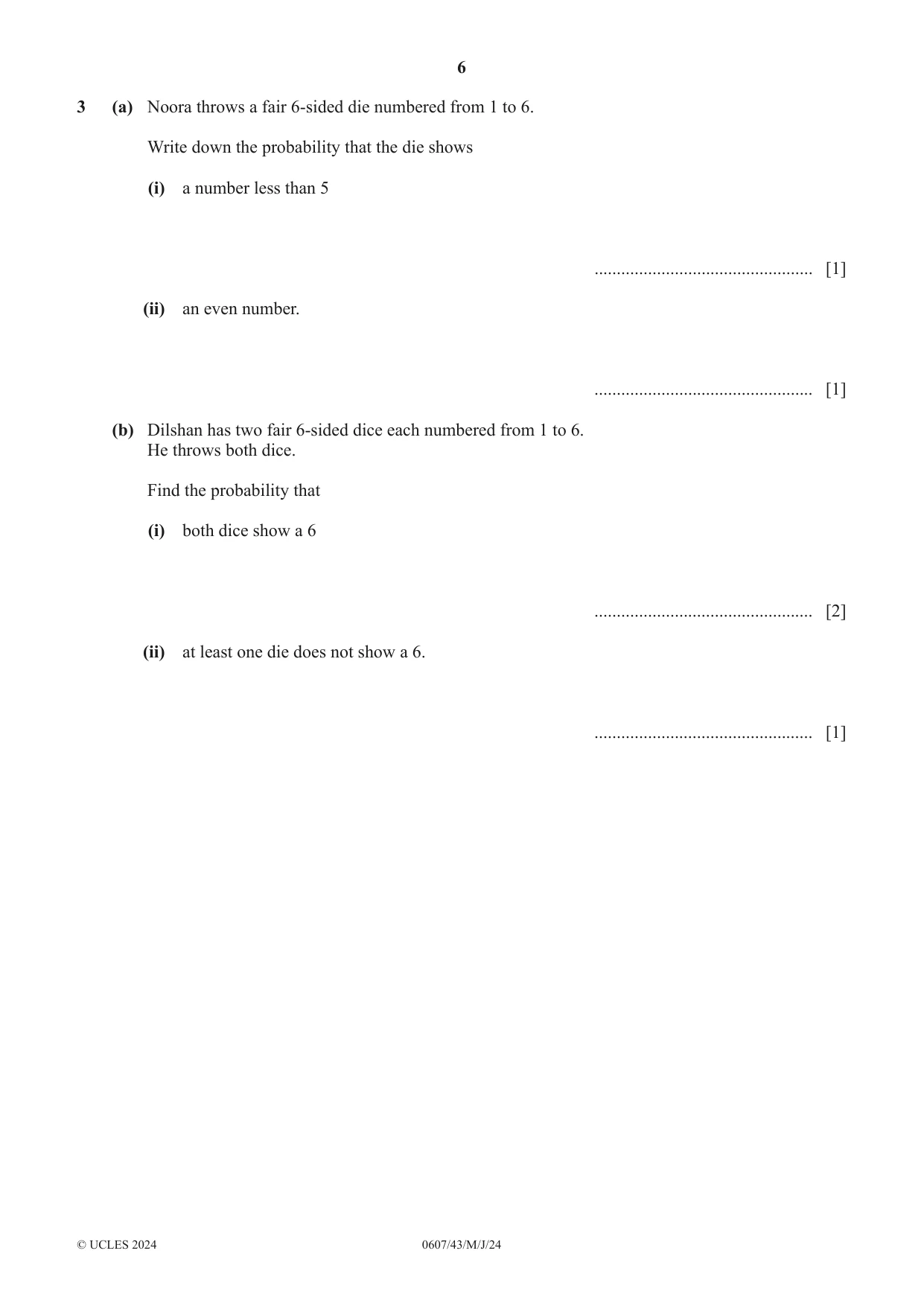
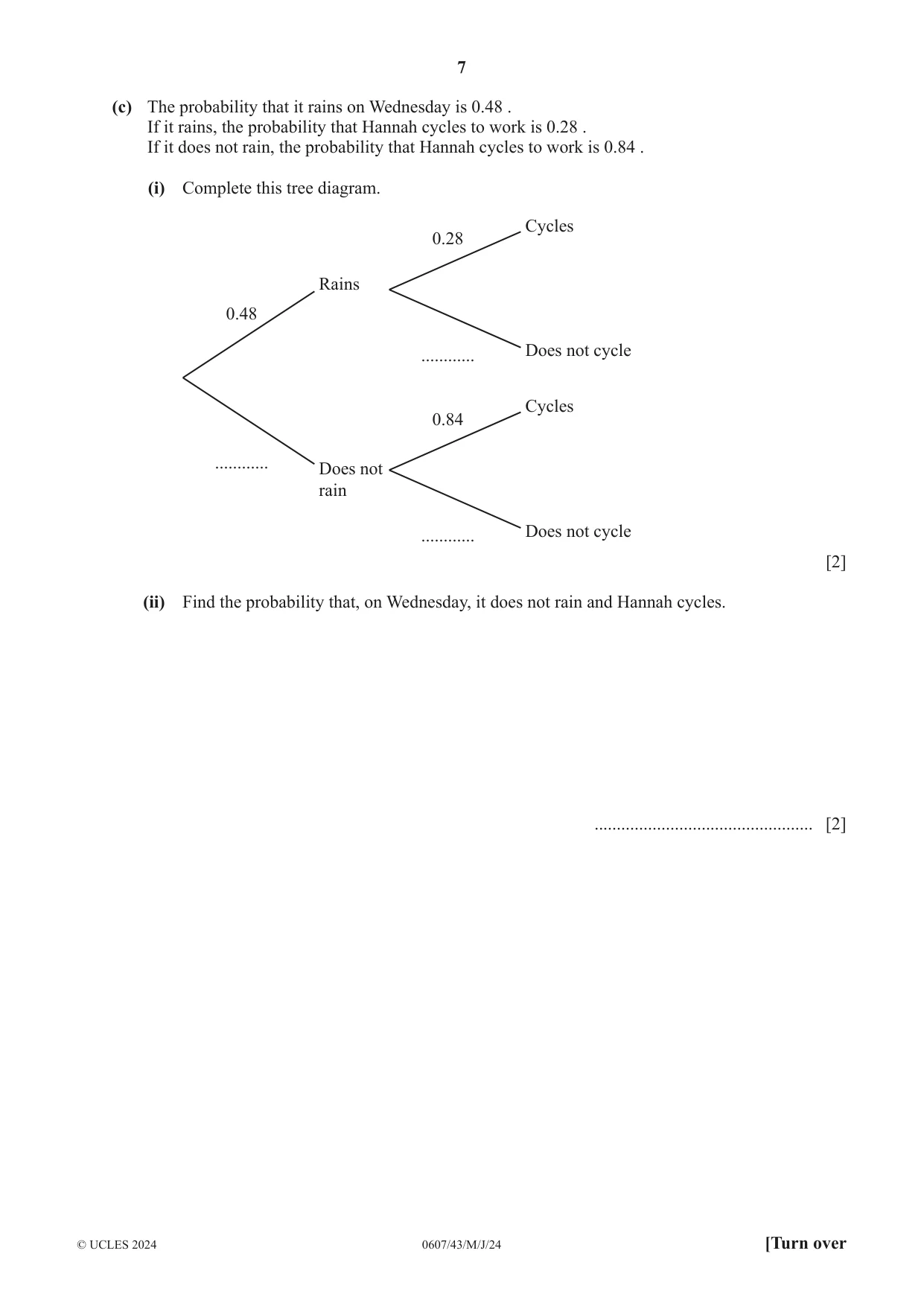
3 (a) Noora throws a fair 6-sided die numbered from 1 to 6. Write down the probability that the die shows (i) a number less than 5 ................................................. [1] (ii) an even number. ................................................. [1] (b) Dilshan has two fair 6-sided dice each numbered from 1 to 6. He throws both dice. Find the probability that (i) both dice show a 6 ................................................. [2] (ii) at least one die does not show a 6. ................................................. [1] (c) The probability that it rains on Wednesday is 0.48 . If it rains, the probability that Hannah cycles to work is 0.28 . If it does not rain, the probability that Hannah cycles to work is 0.84 . (i) Complete this tree diagram. Cycles 0.28 Rains 0.48 Does not cycle ............ Cycles 0.84 ............ Does not rain Does not cycle ............ [2] (ii) Find the probability that, on Wednesday, it does not rain and Hannah cycles. ................................................. [2]
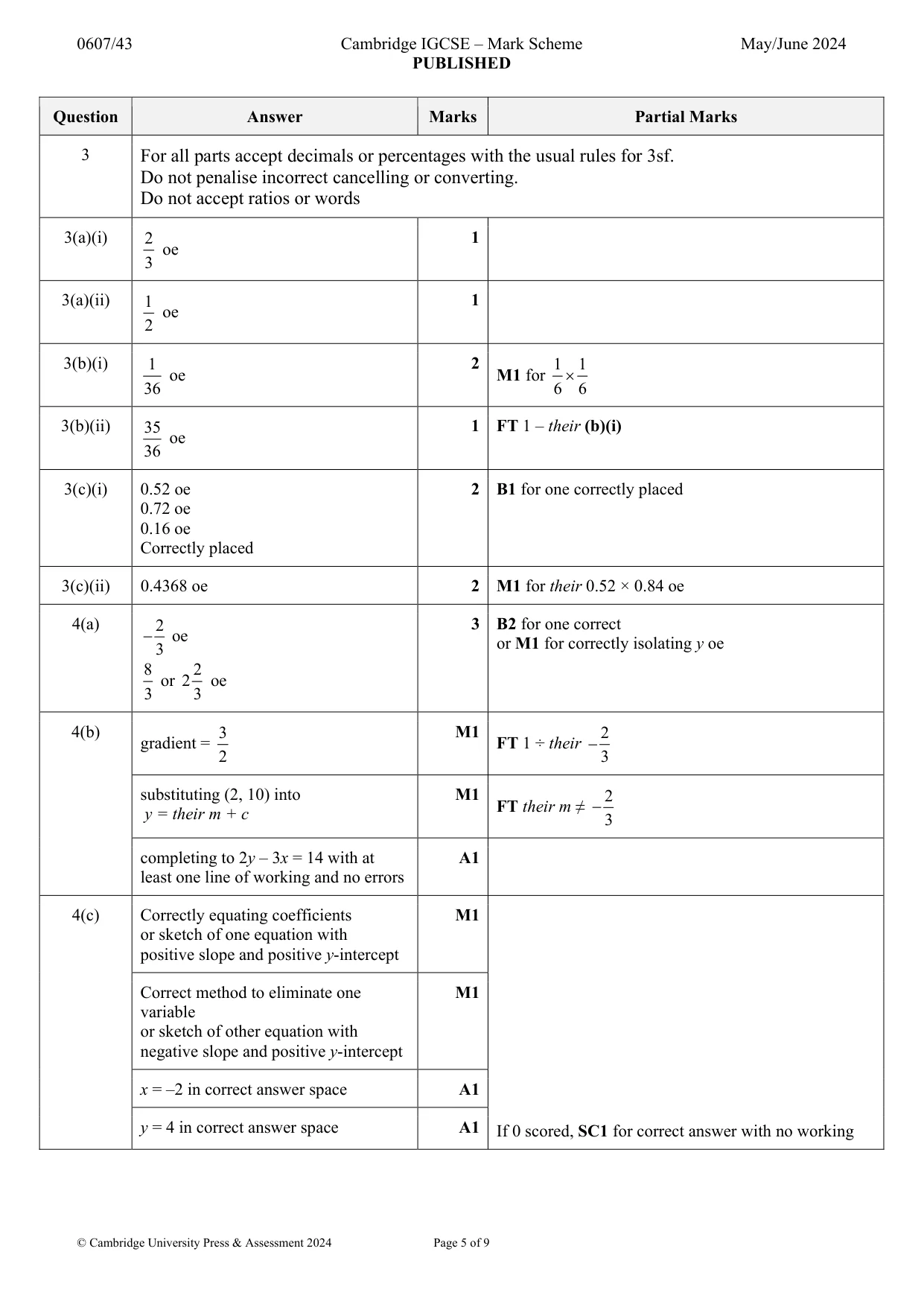
Mark scheme: 3(a)(i) 2 1 oe 3 3(a)(ii) 1 1 oe 2 3(b)(i) 1 2 1 1 oe M1 for 36 6 6 3(b)(ii) 35 1 FT 1 – their (b)(i) oe 36 3(c)(i) 0.52 oe 2 B1 for one correctly placed 0.72 oe 0.16 oe Correctly placed 3(c)(ii) 0.4368 oe 2 M1 for their 0.52 × 0.84 oe
Q4 · Line L has equation 3y + 2x = 8
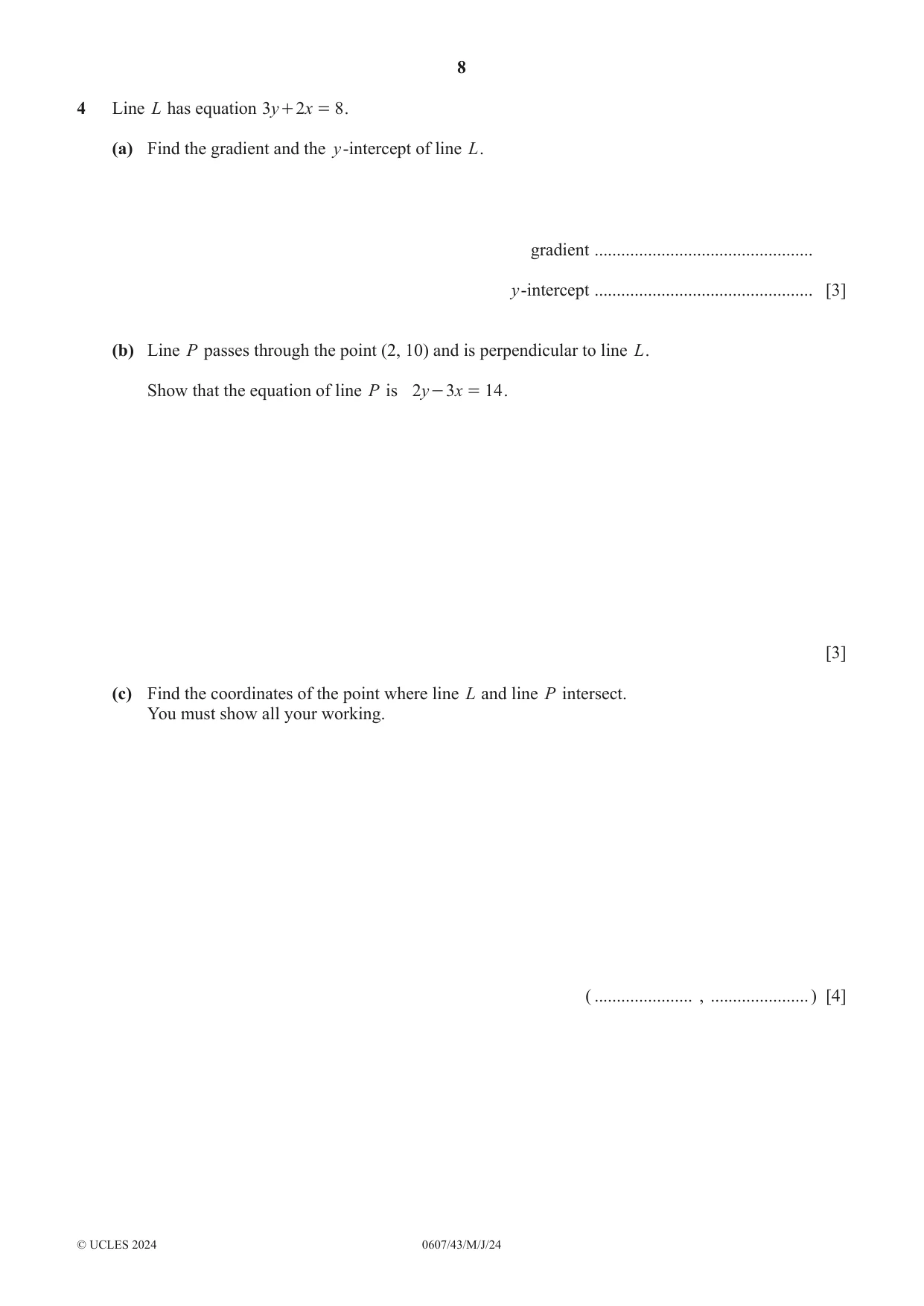
4 Line L has equation 3y + 2x = 8 . (a) Find the gradient and the y-intercept of line L. gradient ................................................. y-intercept ................................................. [3] (b) Line P passes through the point (2, 10) and is perpendicular to line L. Show that the equation of line P is 2y - 3x = 14 . [3] (c) Find the coordinates of the point where line L and line P intersect. You must show all your working. ( ...................... , ...................... ) [4]
Mark scheme: 4(a) 2 3 B2 for one correct oe or M1 for correctly isolating y oe 3 8 2 or 2 oe 3 3 4(b) 3 M1 2 gradient = FT 1 ÷ their 2 3 substituting (2, 10) into M1 2 FT their m ≠ y = their m + c 3 completing to 2y – 3x = 14 with at A1 least one line of working and no errors 4(c) Correctly equating coefficients M1 or sketch of one equation with positive slope and positive y-intercept Correct method to eliminate one M1 variable or sketch of other equation with negative slope and positive y-intercept x = –2 in correct answer space A1 y = 4 in correct answer space A1 If 0 scored, SC1 for correct answer with no working
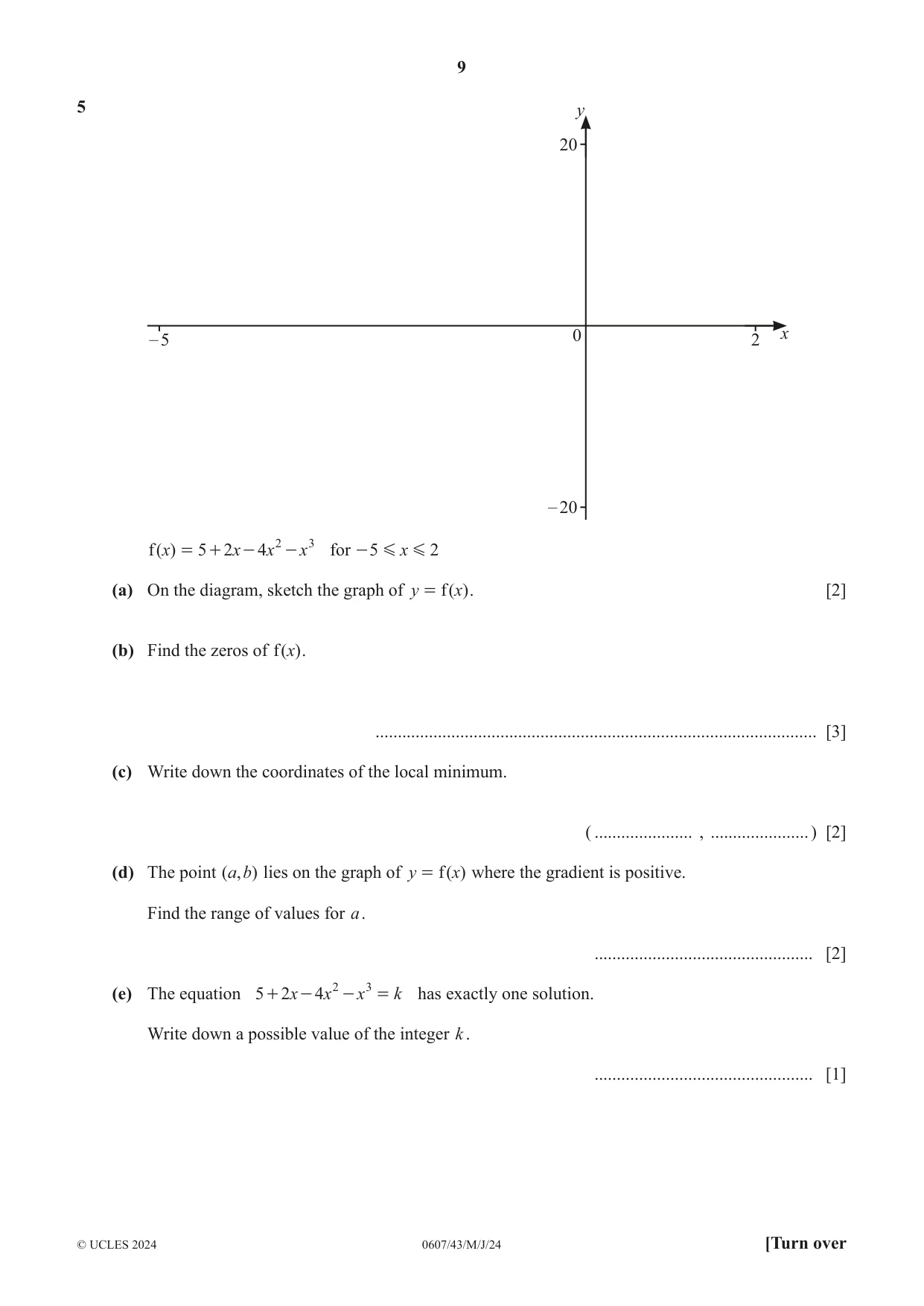
Q5 · Y 20 – 5 0 2 x – 20 f ( x) = 5 + 2x - 4x 2 - x 3 for - 5 G x G 2 (a) On the diagram…
5 y 20 – 5 0 2 x – 20 f ( x) = 5 + 2x - 4x 2 - x 3 for - 5 G x G 2 (a) On the diagram, sketch the graph of y = f ( x) . [2] (b) Find the zeros of f ( x) . ................................................................................................... [3] (c) Write down the coordinates of the local minimum. ( ...................... , ...................... ) [2] (d) The point ( a, b) lies on the graph of y = f ( x) where the gradient is positive. Find the range of values for a. ................................................. [2] (e) The equation 5 + 2 x - 4 x 2 - x 3 = k has exactly one solution. Write down a possible value of the integer k. ................................................. [1]
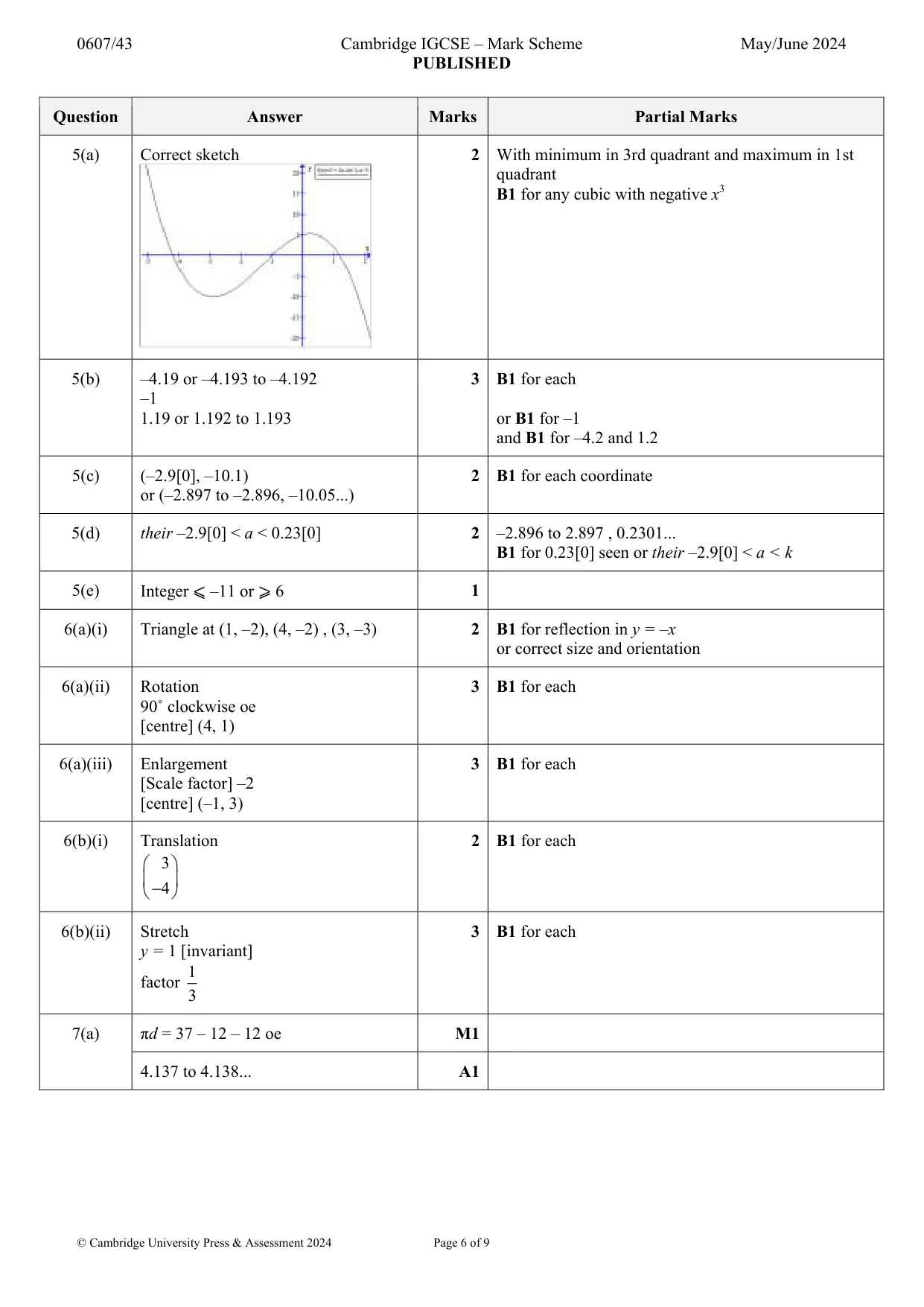
Mark scheme: 5(a) Correct sketch 2 With minimum in 3rd quadrant and maximum in 1st quadrant B1 for any cubic with negative x3 5(b) –4.19 or –4.193 to –4.192 3 B1 for each –1 1.19 or 1.192 to 1.193 or B1 for –1 and B1 for –4.2 and 1.2 5(c) (–2.9[0], –10.1) 2 B1 for each coordinate or (–2.897 to –2.896, –10.05...) 5(d) their –2.9[0] < a < 0.23[0] 2 –2.896 to 2.897 , 0.2301... B1 for 0.23[0] seen or their –2.9[0] < a < k 5(e) Integer ⩽ –11 or ⩾ 6 1
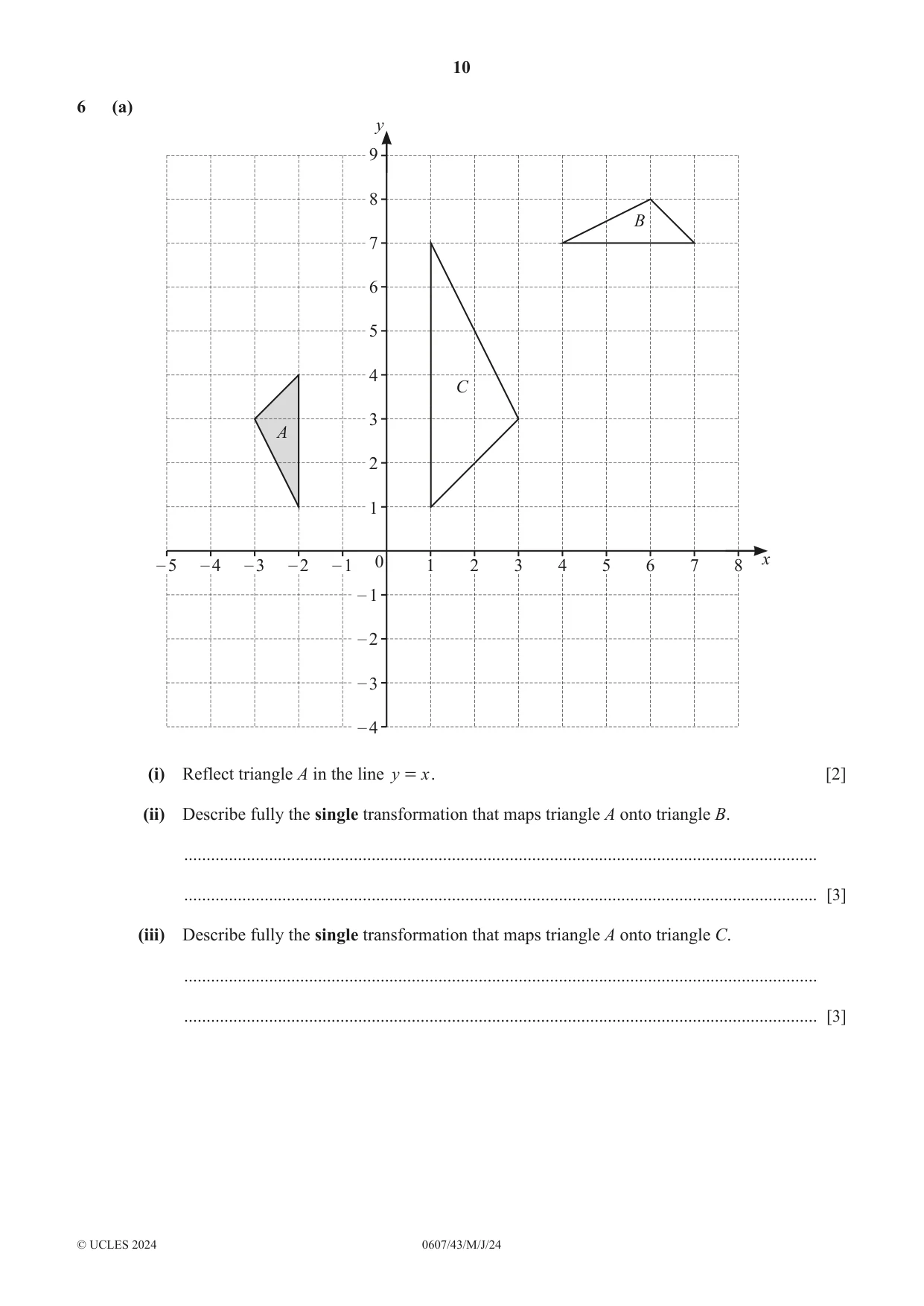
Q6 · Y 9 8 B 7 6 5 4 C 3 A 2 1 – 5 – 4 – 3 – 2 – 1 0 1 2 3 4 5 6 7 8 x – 1 – 2 – 3 – 4 (i)…
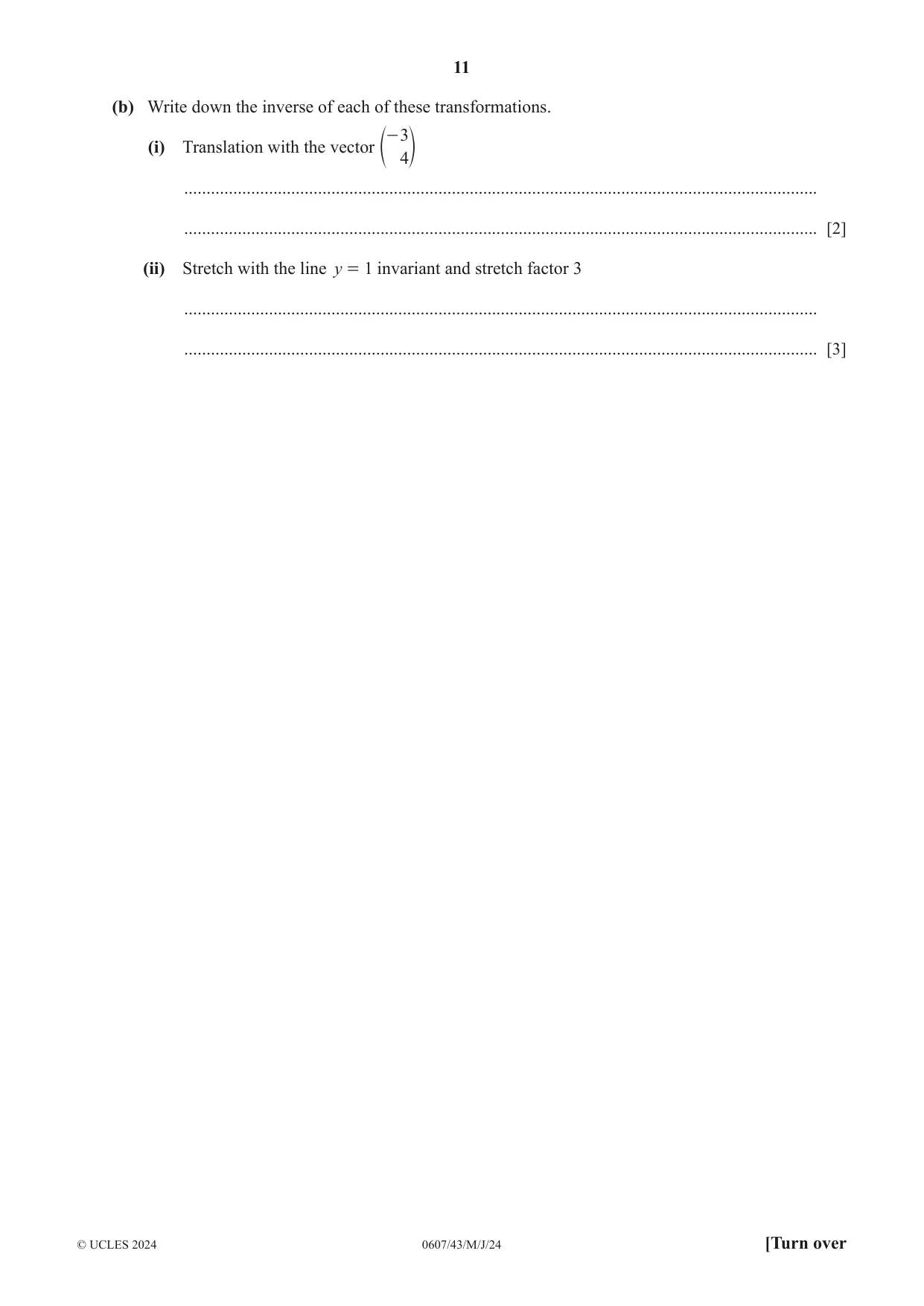
6 (a) y 9 8 B 7 6 5 4 C 3 A 2 1 – 5 – 4 – 3 – 2 – 1 0 1 2 3 4 5 6 7 8 x – 1 – 2 – 3 – 4 (i) Reflect triangle A in the line y = x . [2] (ii) Describe fully the single transformation that maps triangle A onto triangle B. .............................................................................................................................................. .............................................................................................................................................. [3] (iii) Describe fully the single transformation that maps triangle A onto triangle C. .............................................................................................................................................. .............................................................................................................................................. [3] (b) Write down the inverse of each of these transformations. - 3 (i) Translation with the vector e 4o .............................................................................................................................................. .............................................................................................................................................. [2] (ii) Stretch with the line y = 1 invariant and stretch factor 3 .............................................................................................................................................. .............................................................................................................................................. [3]
Mark scheme: 6(a)(i) Triangle at (1, –2), (4, –2) , (3, –3) 2 B1 for reflection in y = –x or correct size and orientation 6(a)(ii) Rotation 3 B1 for each 90˚ clockwise oe [centre] (4, 1) 6(a)(iii) Enlargement 3 B1 for each [Scale factor] –2 [centre] (–1, 3) 6(b)(i) Translation 2 B1 for each 3 4 6(b)(ii) Stretch 3 B1 for each y = 1 [invariant] 1 factor 3
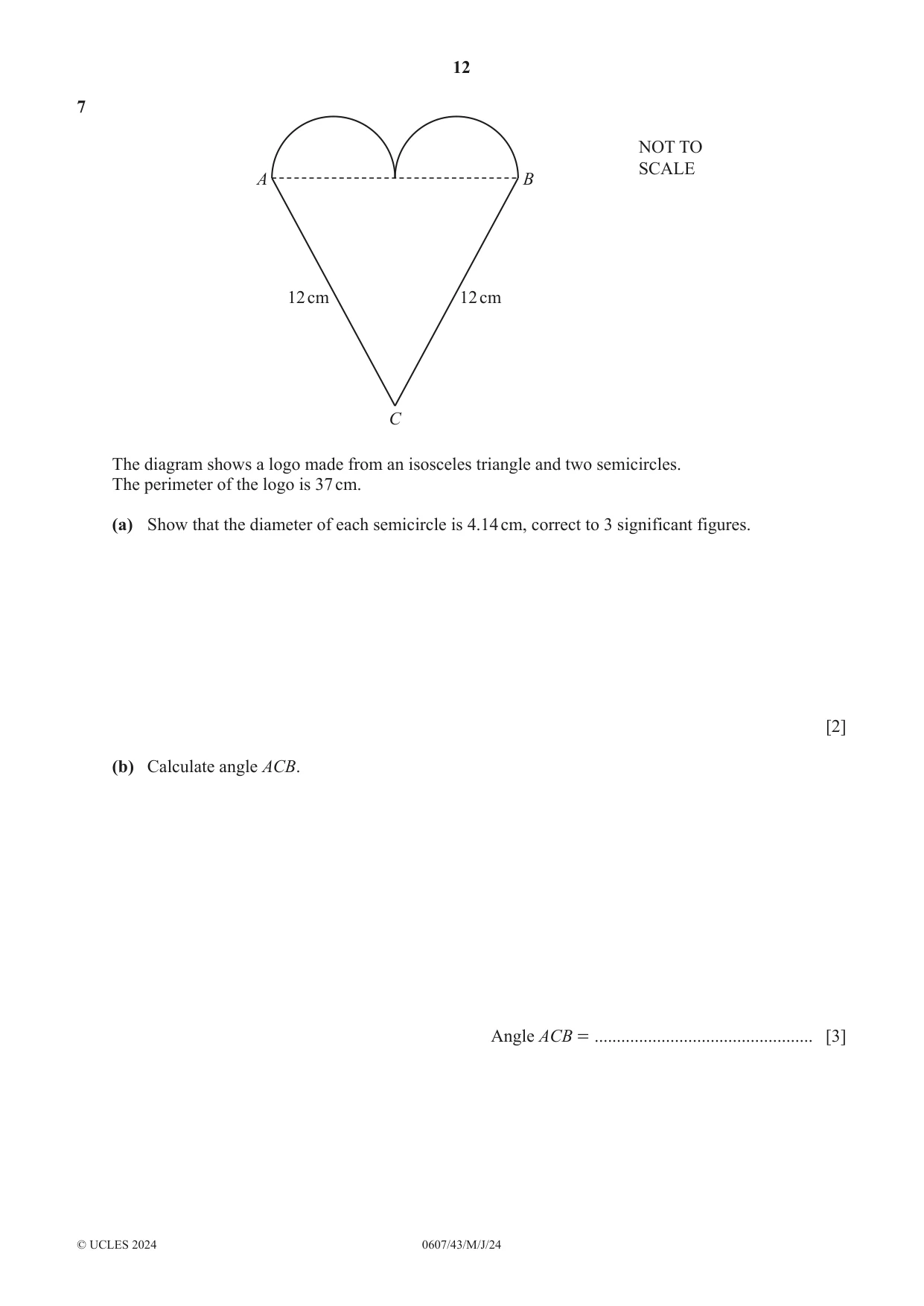
Q7 · NOT TO SCALE A B 12 cm 12 cm C The diagram shows a logo made from an isosceles triangle…
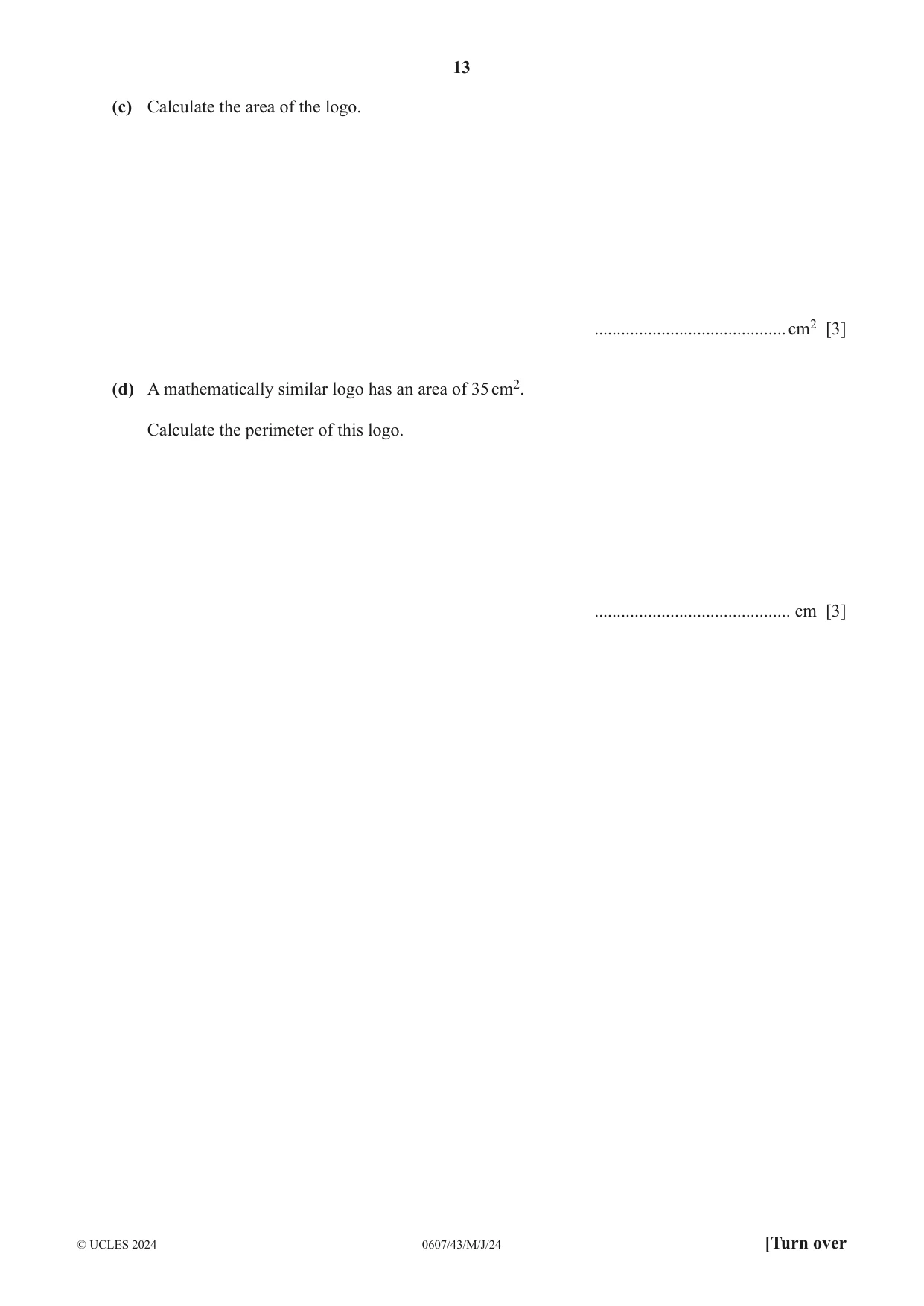
7 NOT TO SCALE A B 12 cm 12 cm C The diagram shows a logo made from an isosceles triangle and two semicircles. The perimeter of the logo is 37 cm. (a) Show that the diameter of each semicircle is 4.14 cm, correct to 3 significant figures. [2] (b) Calculate angle ACB. Angle ACB = ................................................. [3] (c) Calculate the area of the logo. ........................................... cm2 [3] (d) A mathematically similar logo has an area of 35 cm2. Calculate the perimeter of this logo. ............................................ cm [3]
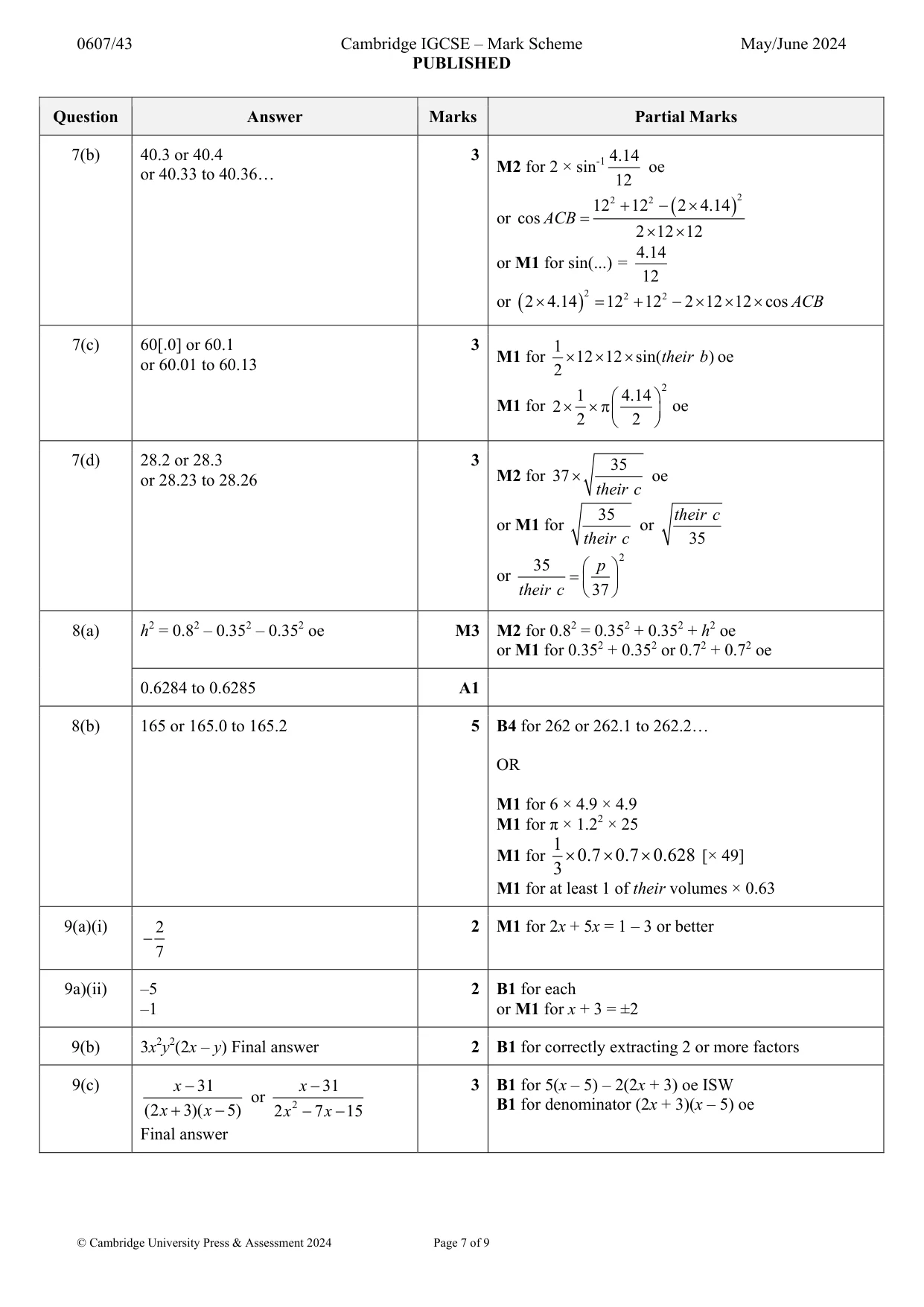
Mark scheme: 7(a) πd = 37 – 12 – 12 oe M1 4.137 to 4.138... A1 7(b) 40.3 or 40.4 3 4.14 M2 for 2 × sin-1 oe or 40.33 to 40.36… 12 12 2 12 2 2 4.14 2 or cos ACB 2 12 12 4.14 or M1 for sin(...) = 12 2 12 2 2 12 12 cos ACB or 2 4.14 2 12 7(c) 60[.0] or 60.1 3 1 M1 for 12 12 sin( their b ) oe or 60.01 to 60.13 2 1 4.14 2 M1 for 2 oe 2 2 7(d) 28.2 or 28.3 3 35 or 28.23 to 28.26 M2 for 37 oe their c 35 their c or M1 for or their c 35 35 p 2 or their c 37
Q8 · NOT TO SCALE 0.8 cm 0.7 cm 0.7 cm The diagram shows a square-based pyramid
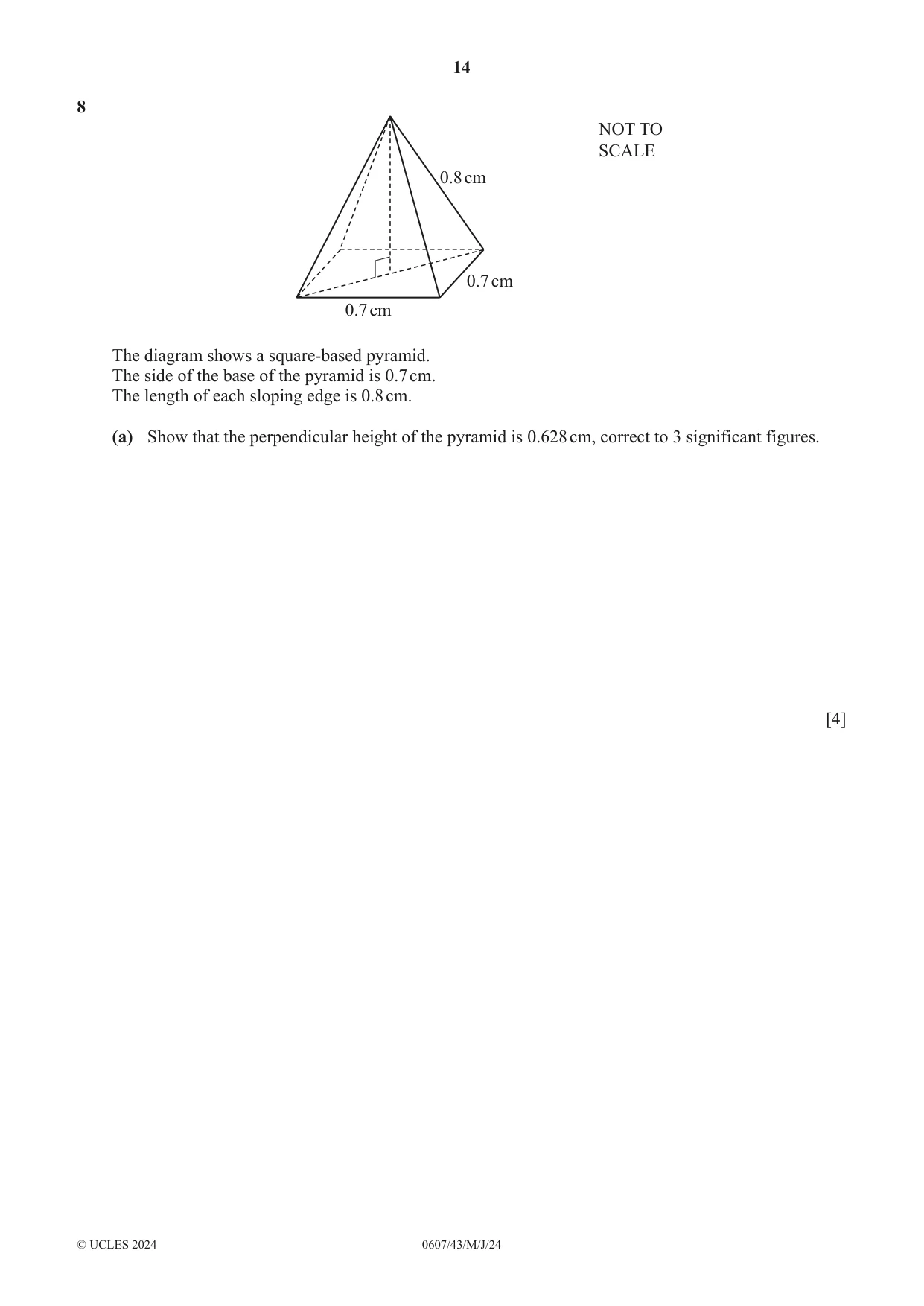
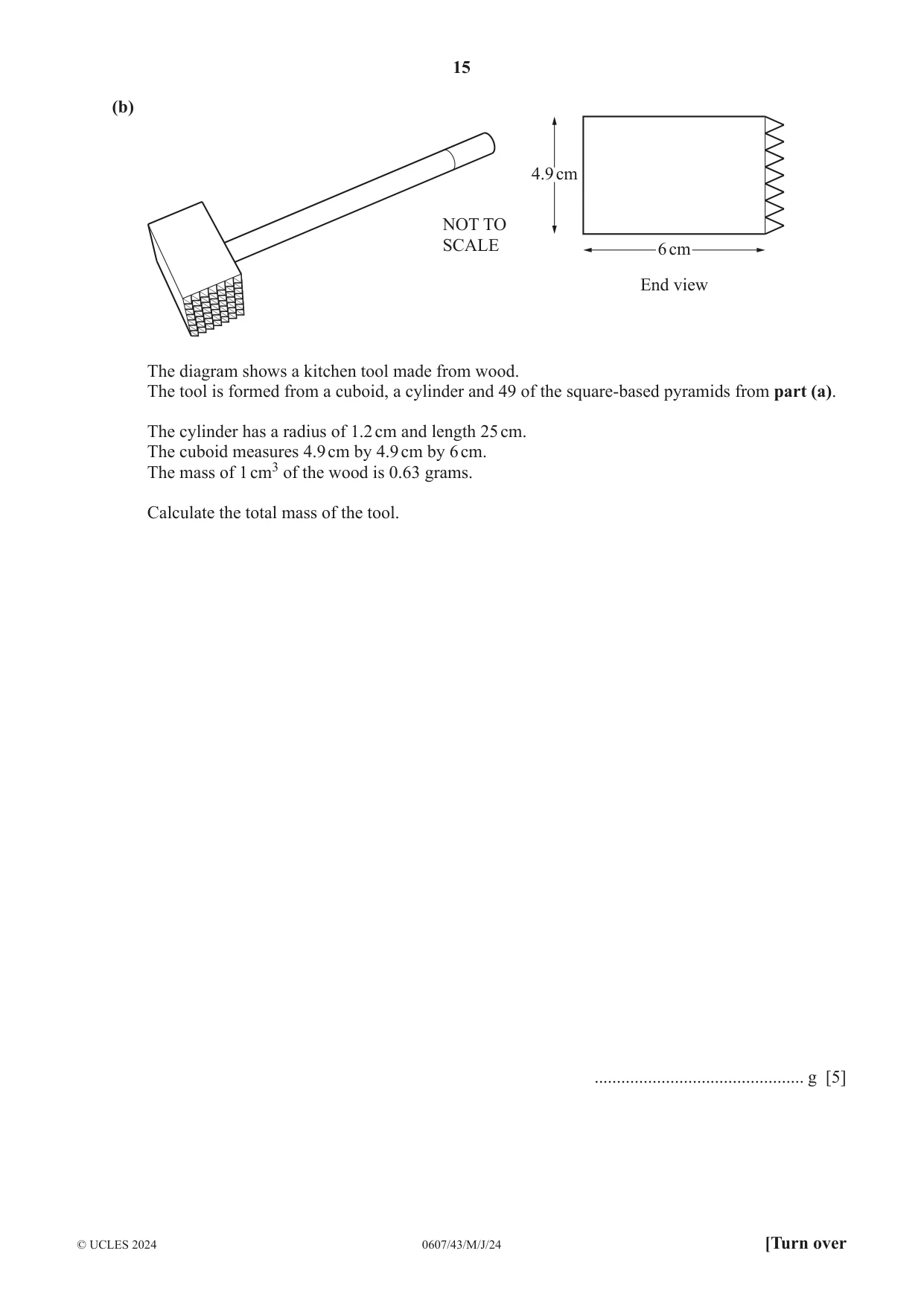
8 NOT TO SCALE 0.8 cm 0.7 cm 0.7 cm The diagram shows a square-based pyramid. The side of the base of the pyramid is 0.7 cm. The length of each sloping edge is 0.8 cm. (a) Show that the perpendicular height of the pyramid is 0.628 cm, correct to 3 significant figures. [4] (b) 4.9 cm NOT TO SCALE 6 cm End view The diagram shows a kitchen tool made from wood. The tool is formed from a cuboid, a cylinder and 49 of the square-based pyramids from part (a). The cylinder has a radius of 1.2 cm and length 25 cm. The cuboid measures 4.9 cm by 4.9 cm by 6 cm. The mass of 1 cm3 of the wood is 0.63 grams. Calculate the total mass of the tool. ............................................... g [5]
Mark scheme: 8(a) h2 = 0.82 – 0.352 – 0.352 oe M3 M2 for 0.82 = 0.352 + 0.352 + h2 oe or M1 for 0.352 + 0.352 or 0.72 + 0.72 oe 0.6284 to 0.6285 A1 8(b) 165 or 165.0 to 165.2 5 B4 for 262 or 262.1 to 262.2… OR M1 for 6 × 4.9 × 4.9 M1 for π × 1.22 × 25 1 M1 for 3 0.7 0.7 0.628 [× 49] M1 for at least 1 of their volumes × 0.63
Question 9
9 (a) Solve. (i) 2x + 3 = 1 - 5x x = ................................................. [2] (ii) x + 3 = 2 ................................................. [2] (b) Factorise completely. 6x 3 y 2 - 3x 2 y 3 ................................................. [2] 5 2 (c) Write - as a single fraction in its simplest form. 2x + 3 x - 5 ................................................. [3] (d) Solve 2x 2 + 3x = 7 . You must show all your working and give your answers correct to 2 decimal places. x = .................. or x = .................. [3]
Mark scheme: 9(a)(i) 2 2 M1 for 2x + 5x = 1 – 3 or better 7 9a)(ii) –5 2 B1 for each –1 or M1 for x + 3 = ±2 9(b) 3x2y2(2x – y) Final answer 2 B1 for correctly extracting 2 or more factors 9(c) x 31 x 31 3 B1 for 5(x – 5) – 2(2x + 3) oe ISW or 2 B1 for denominator (2x + 3)(x – 5) oe (2 x 3)( x 5) 2 x 7 x 15 Final answer 9(d) M2 2 M1 for 3 4 2 7 3 32 4 2 x 7 3 p 3 p or M1 for or 2 2 2 2 2 2 or suitable sketch(es) with both Denominator must be shown as 2 2 to earn the answers indicated second M1 but a denominator of 4 is condoned for M2 1.27 and –2.77 cao B1
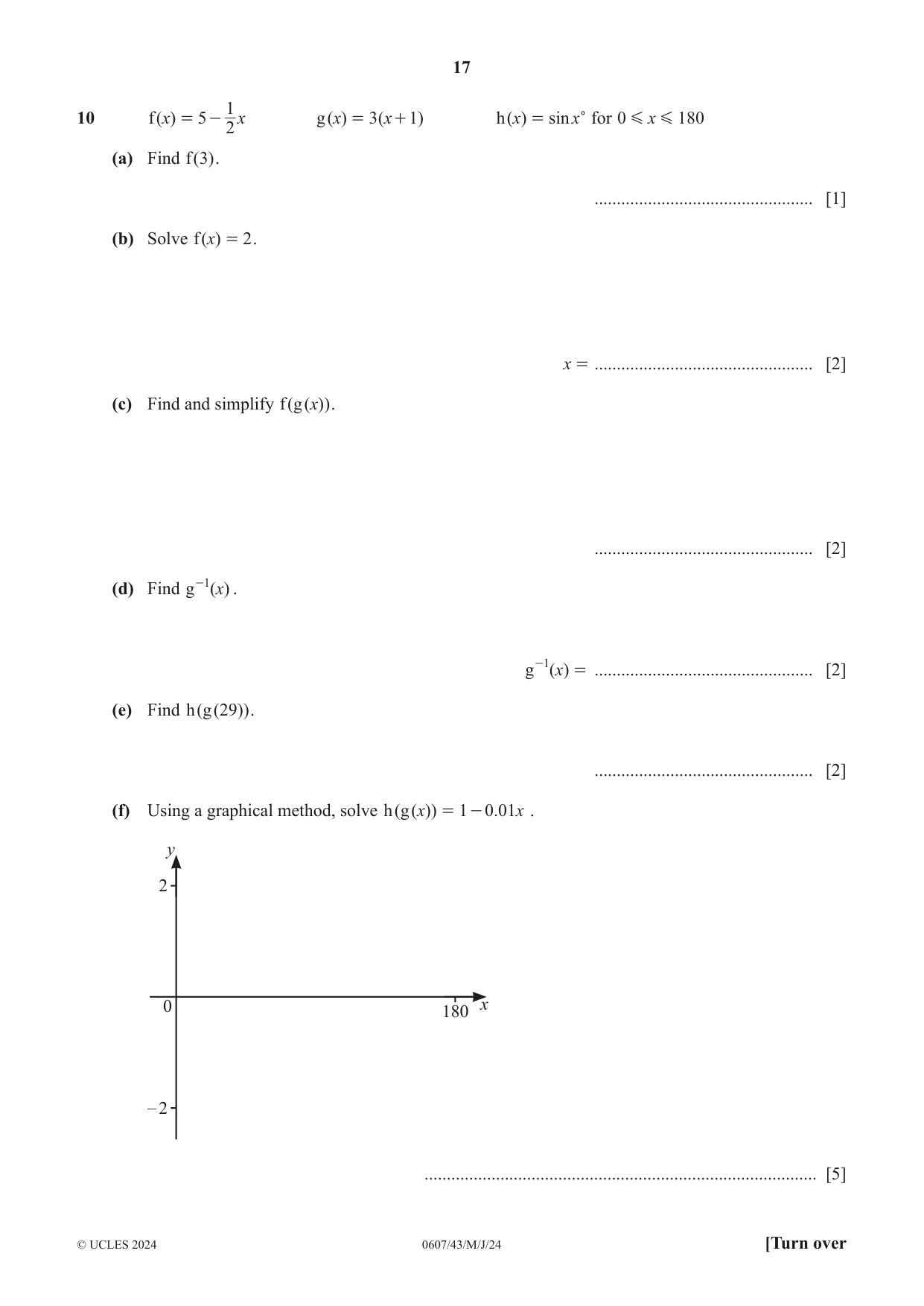
Q10 · F ( x) = 5 - x g ( x) = 3 ( x + 1) h ( x) = sin xc for 0 G x G 180 2 (a) Find f ( 3)
10 f ( x) = 5 - x g ( x) = 3 ( x + 1) h ( x) = sin xc for 0 G x G 180 2 (a) Find f ( 3) . ................................................. [1] (b) Solve f ( x) = 2 . x = ................................................. [2] (c) Find and simplify f ( g ( x) ) . ................................................. [2] (d) Find g -1( )x . g -1( )x = ................................................. [2] (e) Find h ( g ( 29)) . ................................................. [2] (f) Using a graphical method, solve h ( g ( x)) = 1 - 0. 01x . y 2 0 x 180 – 2 ........................................................................................ [5]
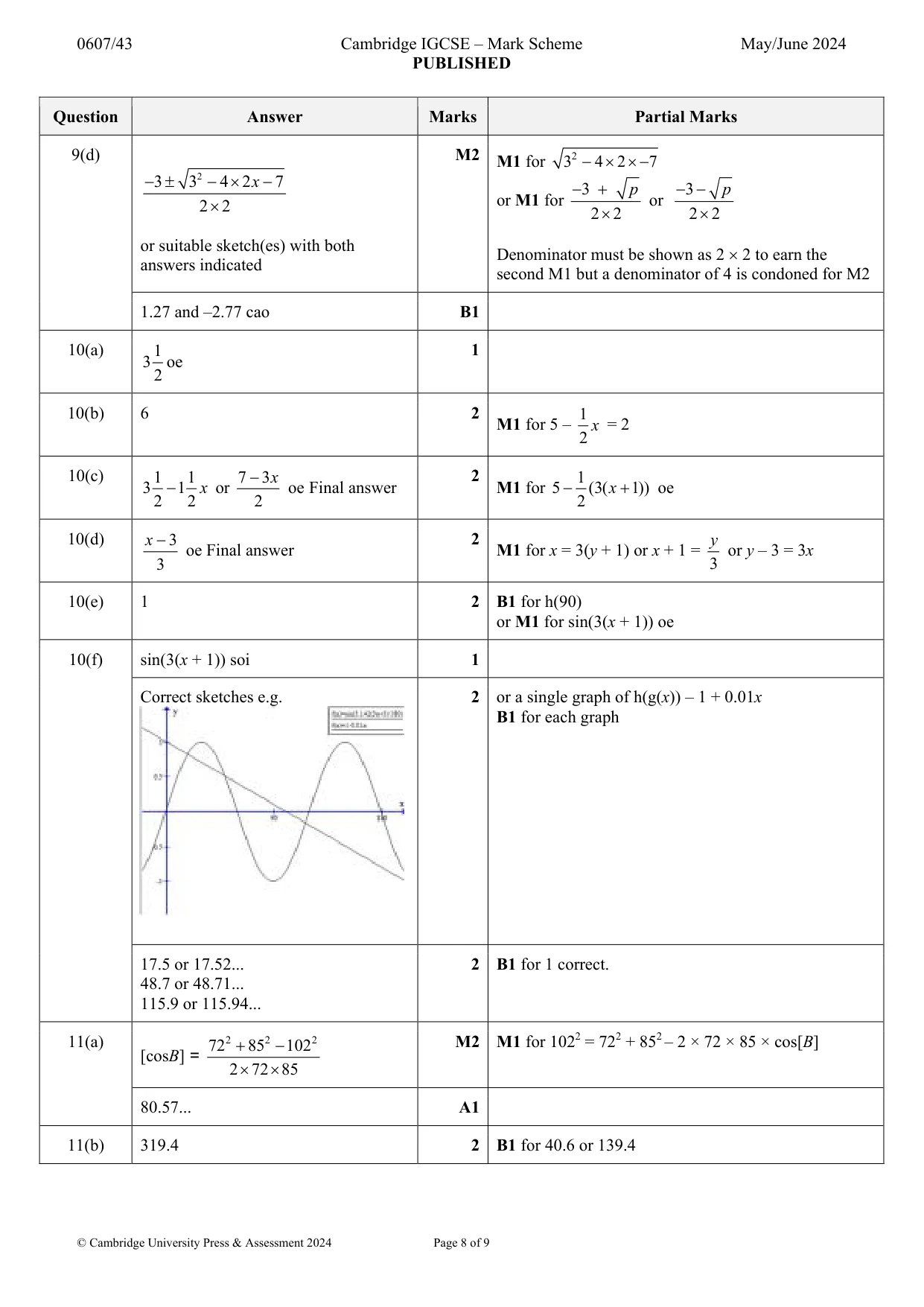
Mark scheme: 10(a) 1 1 3 oe 2 10(b) 6 2 1 M1 for 5 – x = 2 2 10(c) 1 1 7 x3 2 1 3 1 x or oe Final answer M1 for 5 (3( x 1)) oe 2 2 2 2 10(d) x 3 2 y oe Final answer M1 for x = 3(y + 1) or x + 1 = or y – 3 = 3x 3 3 10(e) 1 2 B1 for h(90) or M1 for sin(3(x + 1)) oe 10(f) sin(3(x + 1)) soi 1 Correct sketches e.g. 2 or a single graph of h(g(x)) – 1 + 0.01x B1 for each graph 17.5 or 17.52... 2 B1 for 1 correct. 48.7 or 48.71... 115.9 or 115.94...
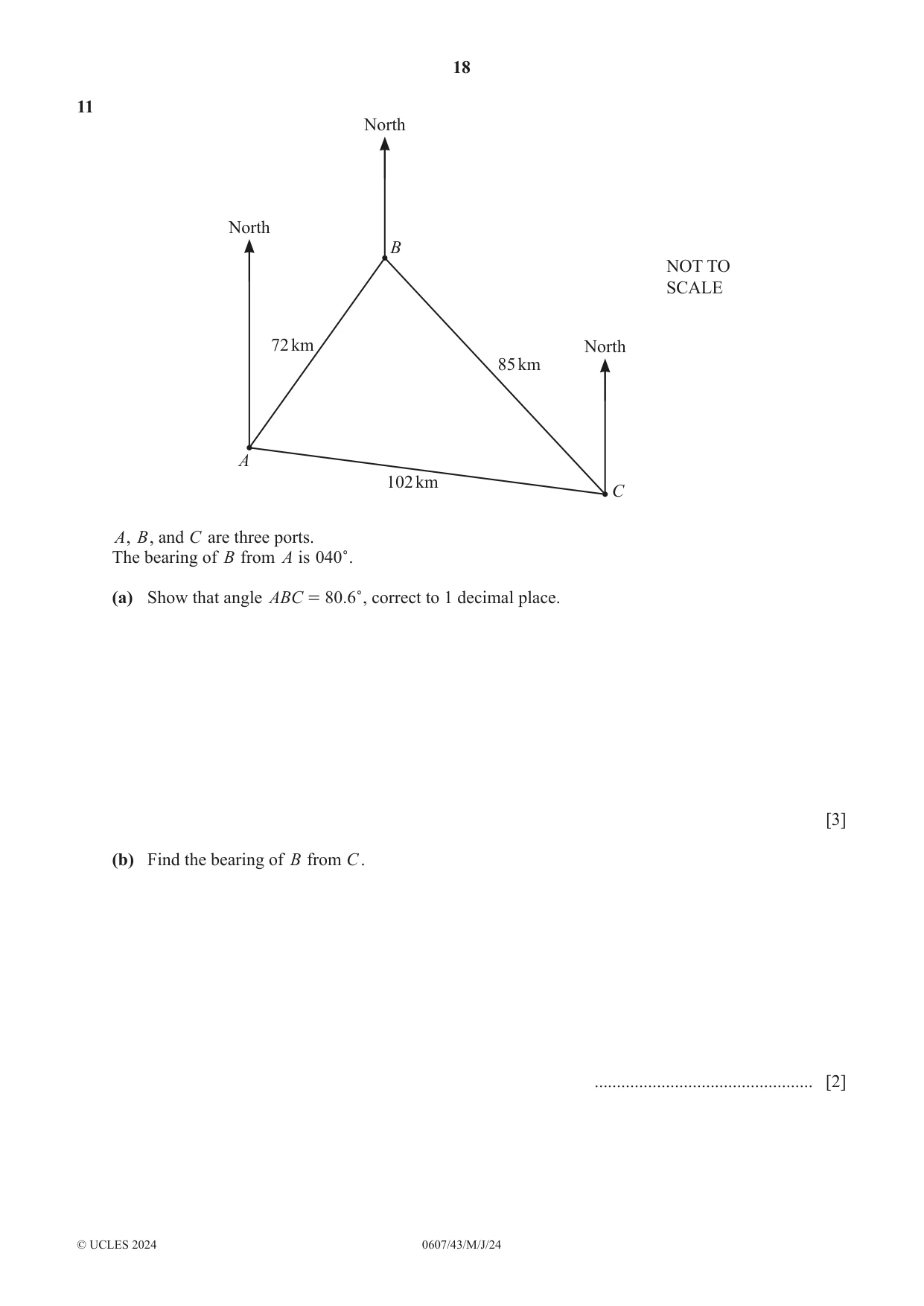
Q11 · North North B NOT TO SCALE 72 km North 85 km A 102 km C A, B, and C are three ports
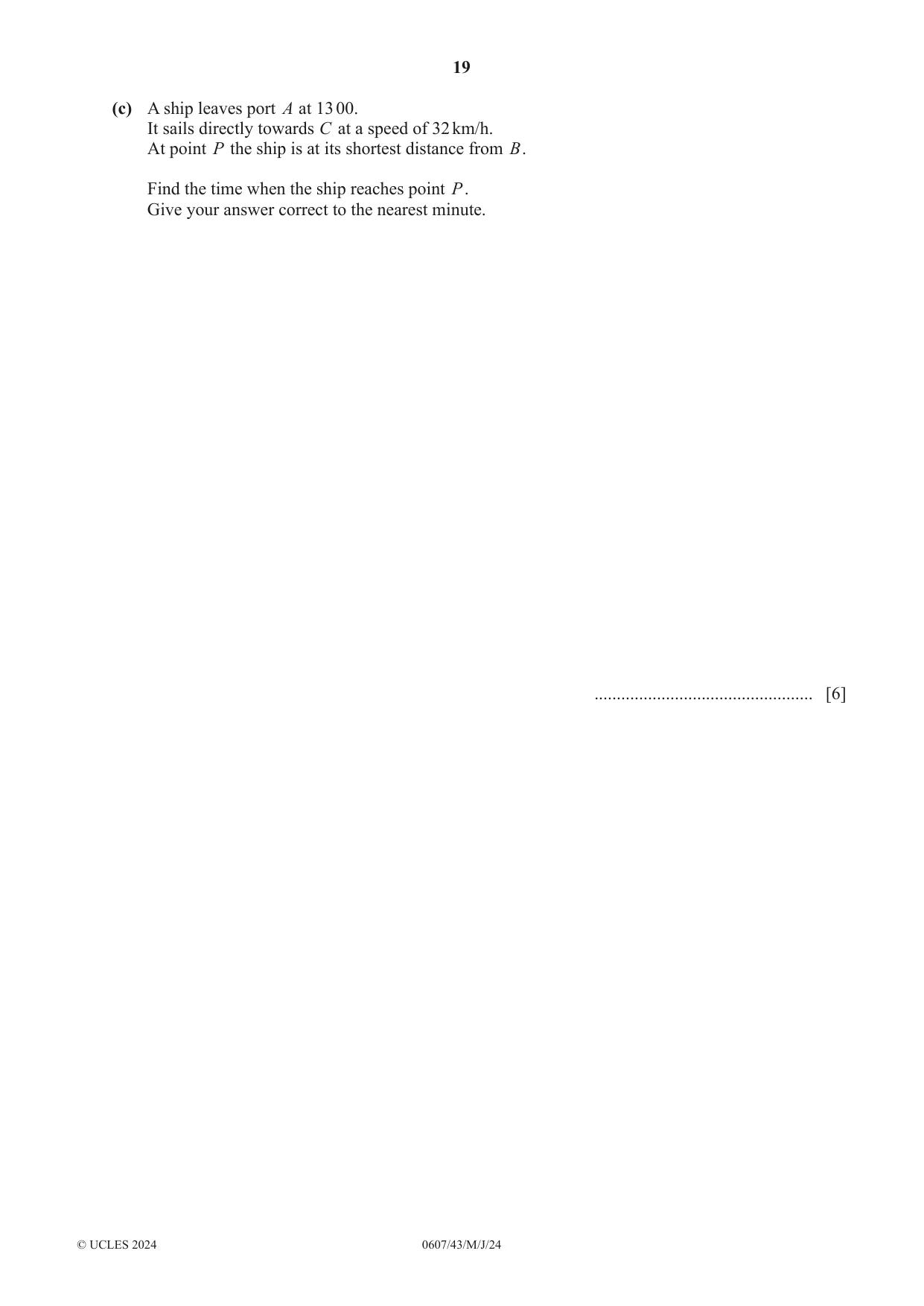
11 North North B NOT TO SCALE 72 km North 85 km A 102 km C A, B, and C are three ports. The bearing of B from A is 040c. (a) Show that angle ABC = 80.6c , correct to 1 decimal place. [3] (b) Find the bearing of B from C. ................................................. [2] (c) A ship leaves port A at 13 00. It sails directly towards C at a speed of 32 km/h. At point P the ship is at its shortest distance from B. Find the time when the ship reaches point P. Give your answer correct to the nearest minute. ................................................. [6]
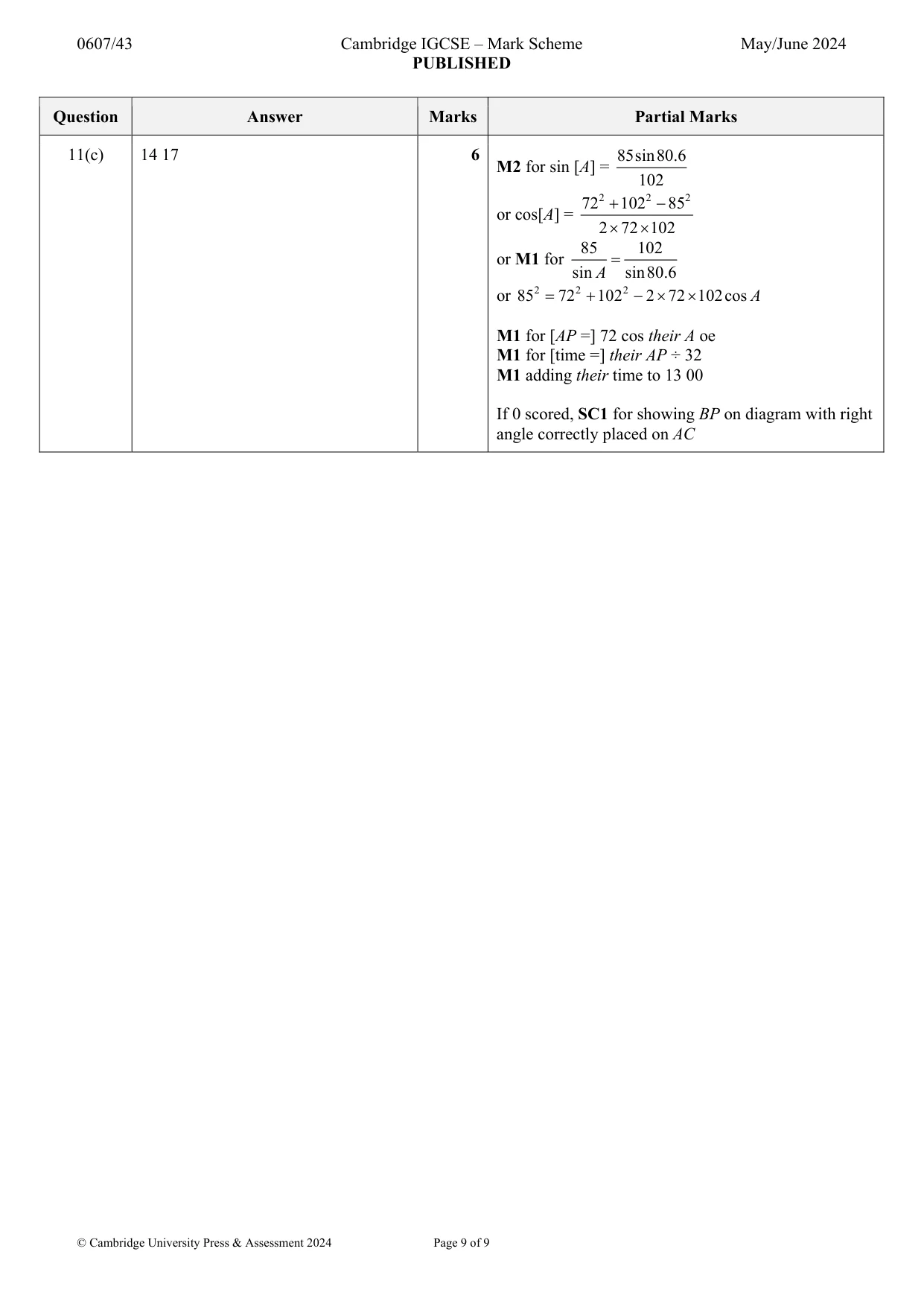
Mark scheme: 11(a) 72 2 85 2 102 2 M2 M1 for 1022 = 722 + 852 – 2 × 72 × 85 × cos[B] [cosB] = 2 72 85 80.57... A1 11(b) 319.4 2 B1 for 40.6 or 139.4 11(c) 14 17 6 85sin80.6 M2 for sin [A] = 102 72 2 102 2 85 2 or cos[A] = 2 72 102 85 102 or M1 for sin A sin80.6 or 85 2 72 2 102 2 2 72 102cos A M1 for [AP =] 72 cos their A oe M1 for [time =] their AP ÷ 32 M1 adding their time to 13 00 If 0 scored, SC1 for showing BP on diagram with right angle correctly placed on AC
What was in this paper
The subtopics covered by these 11 questions, and how many questions each got. Open one in a new tab to see every Cambridge question on it.
What you needed in this session
Cambridge’s own grade thresholds for 2024 May/June, Paper 4 · Variant 3. A higher threshold means an easier paper — the bar moves with how the cohort did.