Cambridge IGCSE Mathematics - International 0607 — 2023 May/June Paper 4 · Variant 1
0607/41/M/J/23 · 11 questions · 120 marks · ≈135 min
The question paper and its mark scheme, free to read here and free to download. This is Cambridge’s own paper, exactly as it was sat.
Question paper20 pages
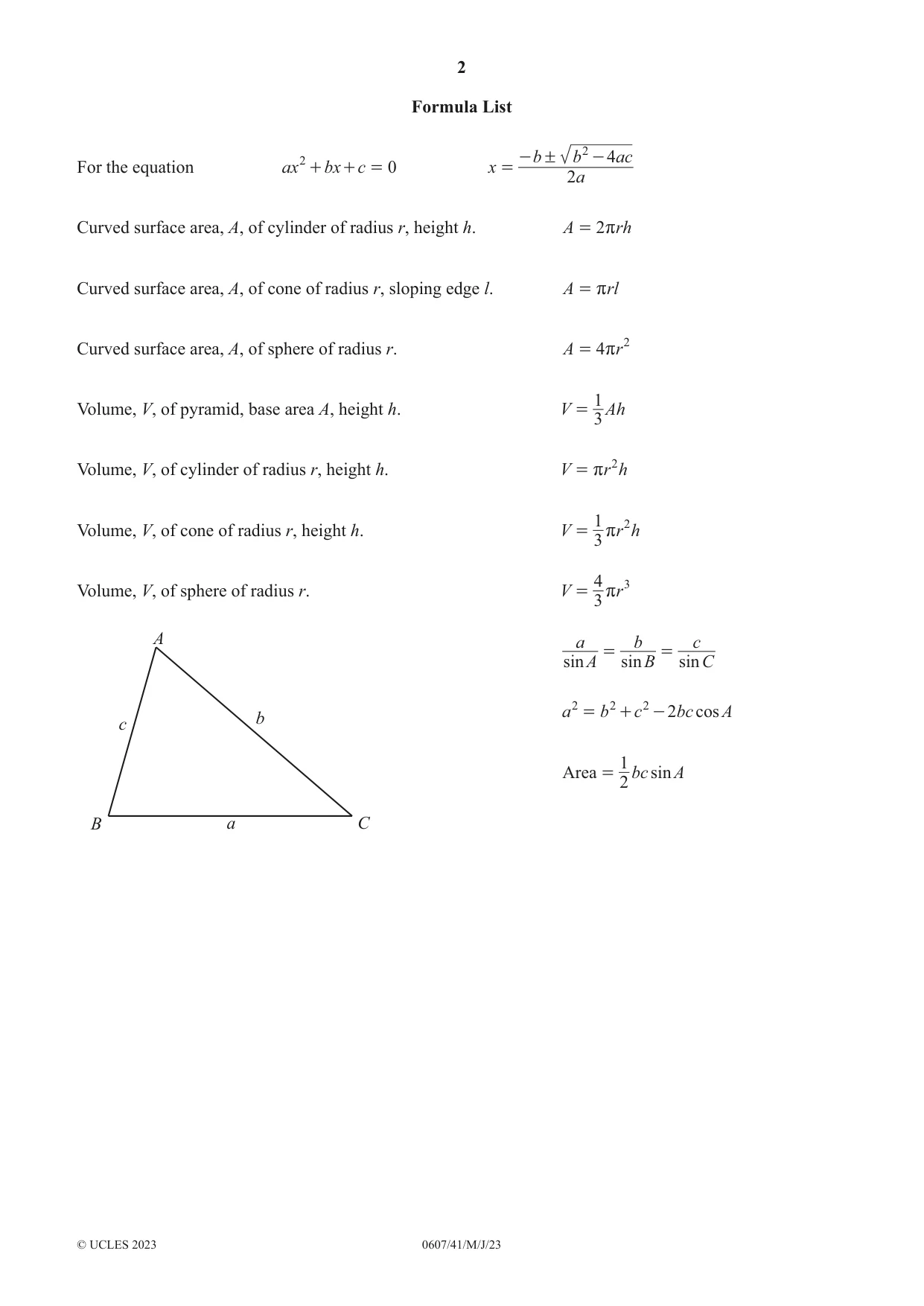
Mark scheme9 pages
Answers below. Sit the paper first if you are practising.
Questions as text
Q1 · 25 students each record the number of logic problems they solve in one hour
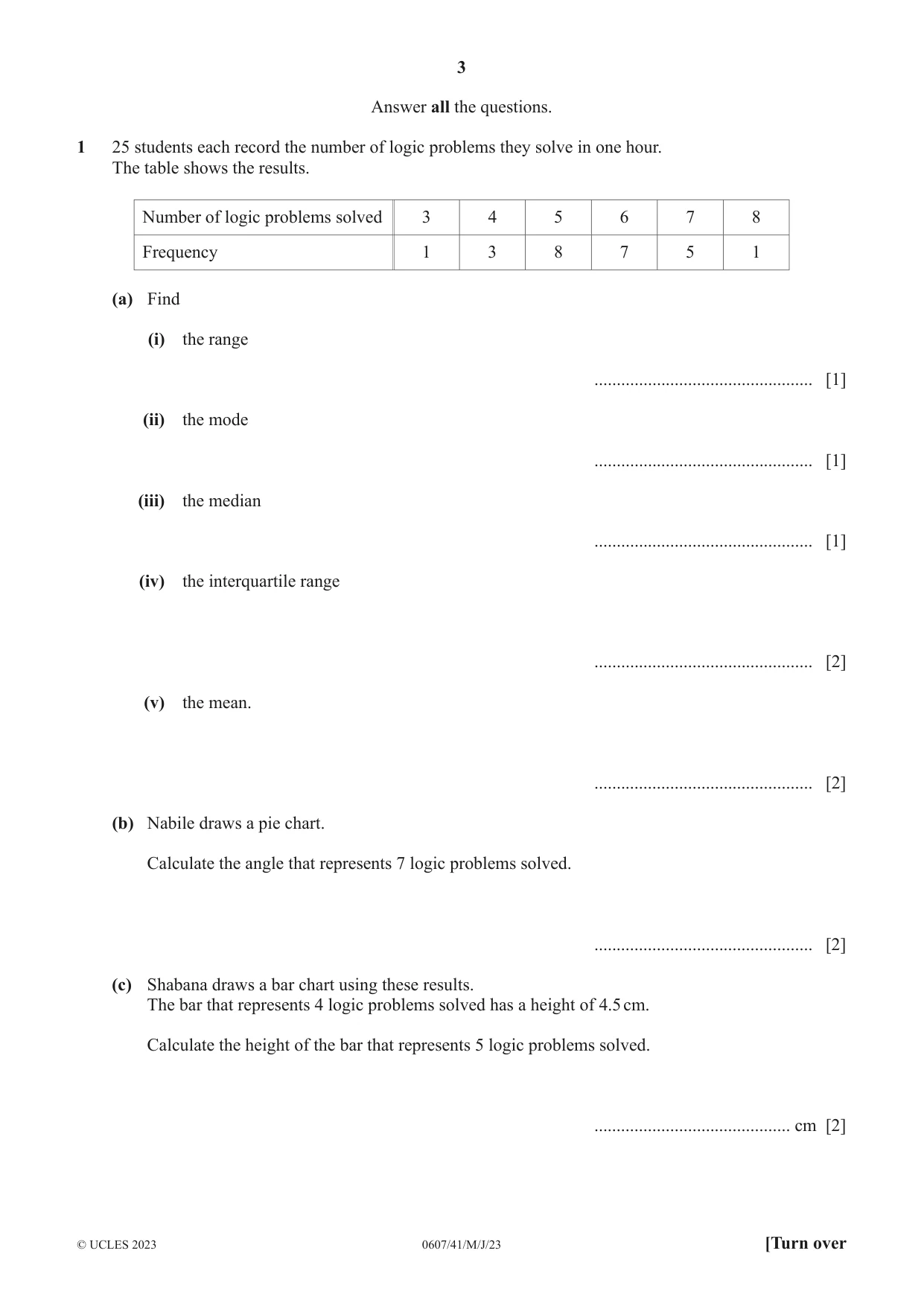
1 25 students each record the number of logic problems they solve in one hour. The table shows the results. Number of logic problems solved 3 4 5 6 7 8 Frequency 1 3 8 7 5 1 (a) Find (i) the range ................................................. [1] (ii) the mode ................................................. [1] (iii) the median ................................................. [1] (iv) the interquartile range ................................................. [2] (v) the mean. ................................................. [2] (b) Nabile draws a pie chart. Calculate the angle that represents 7 logic problems solved. ................................................. [2] (c) Shabana draws a bar chart using these results. The bar that represents 4 logic problems solved has a height of 4.5 cm. Calculate the height of the bar that represents 5 logic problems solved. ............................................ cm [2]
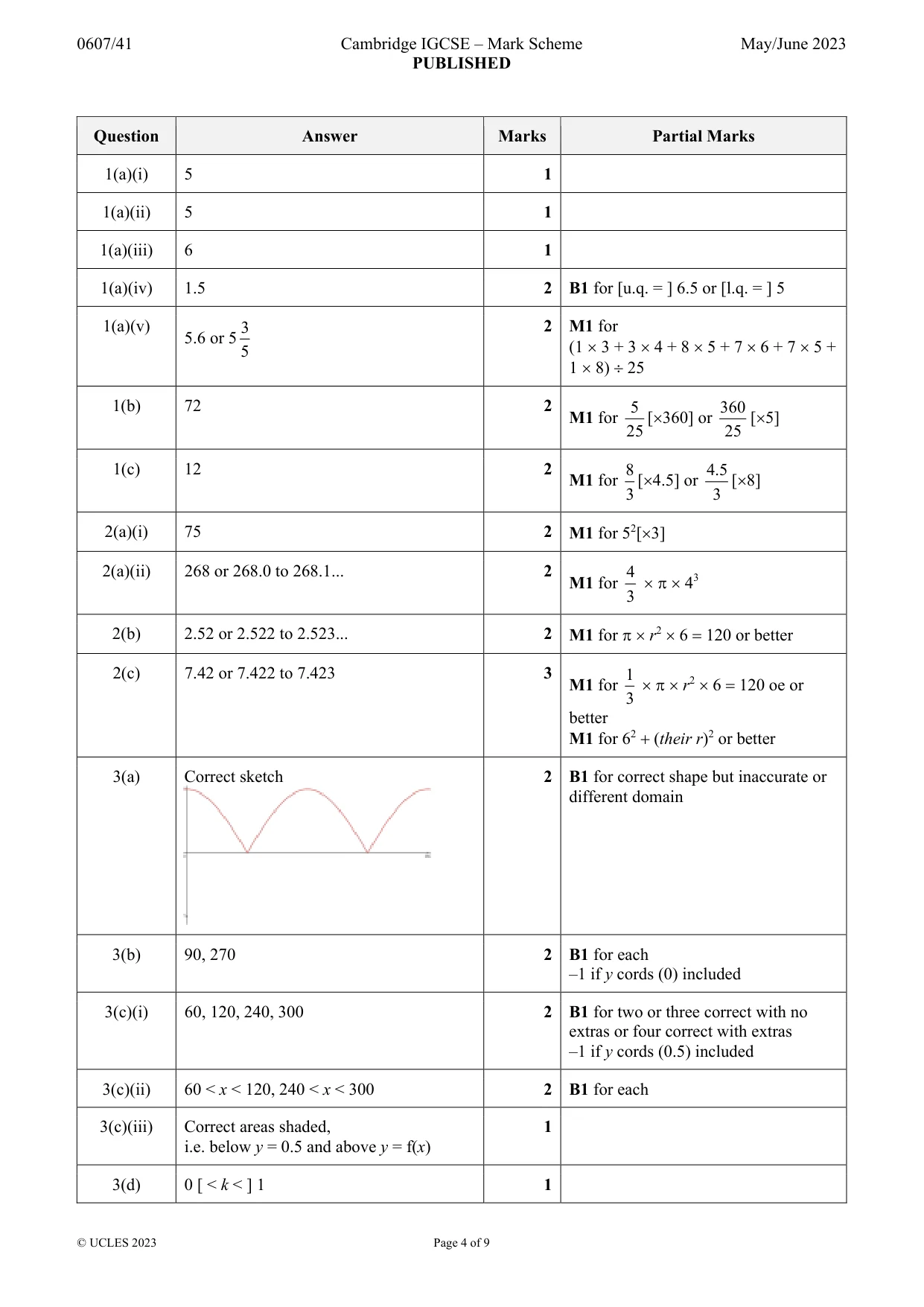
Mark scheme: Question Answer Marks Partial Marks 1(a)(i) 5 1 1(a)(ii) 5 1 1(a)(iii) 6 1 1(a)(iv) 1.5 2 B1 for [u.q. = ] 6.5 or [l.q. = ] 5 1(a)(v) 3 2 M1 for 5.6 or 5 5 (1 3 + 3 4 + 8 5 + 7 6 + 7 5 + 1 8) 25 1(b) 72 2 5 360 M1 for [360] or [5] 25 25 1(c) 12 2 8 4.5 M1 for [4.5] or [8] 3 3
Q2 · Calculate the volume of each shape
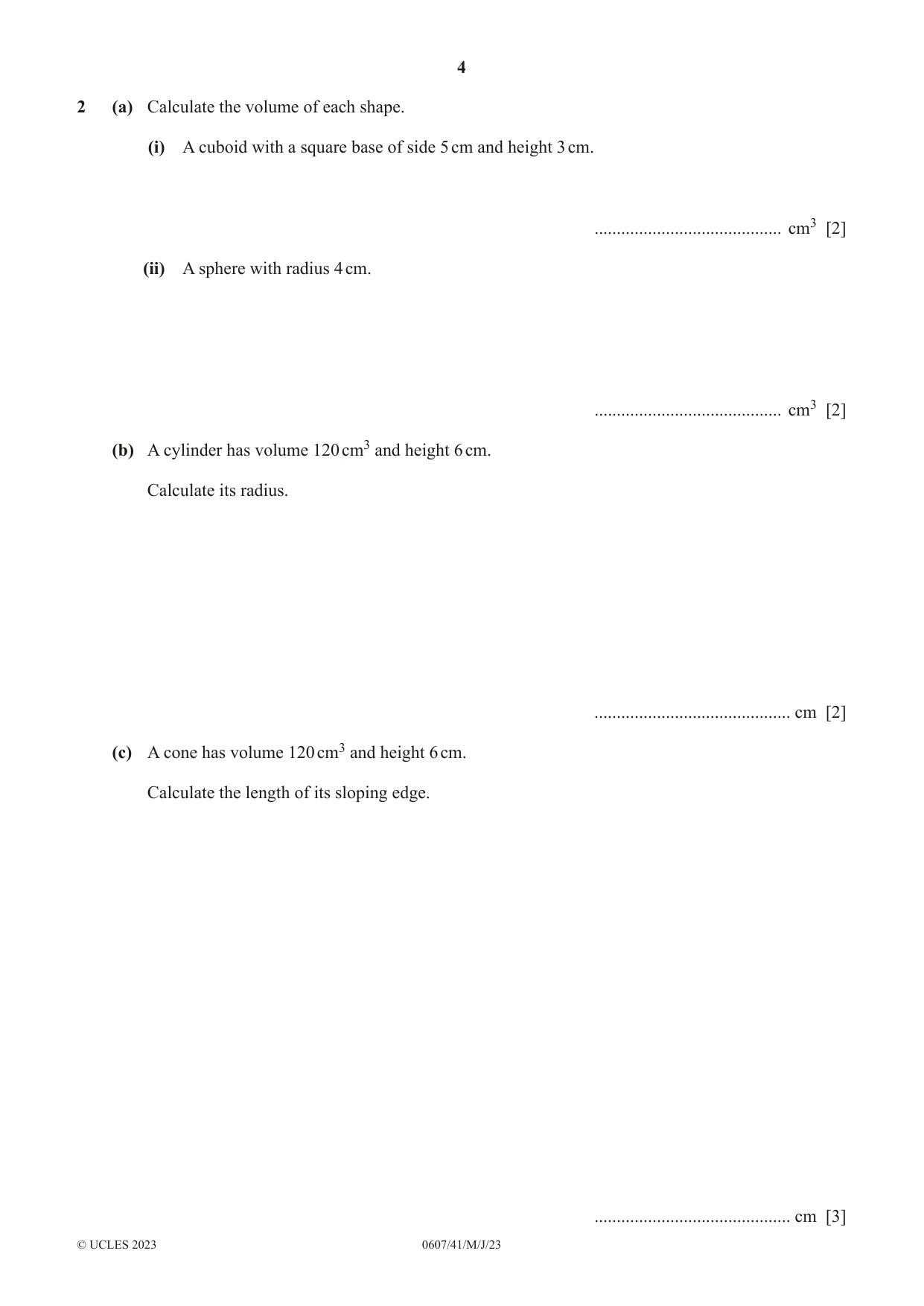
2 (a) Calculate the volume of each shape. (i) A cuboid with a square base of side 5 cm and height 3 cm. .......................................... cm3 [2] (ii) A sphere with radius 4 cm. .......................................... cm3 [2] (b) A cylinder has volume 120 cm3 and height 6 cm. Calculate its radius. ............................................ cm [2] (c) A cone has volume 120 cm3 and height 6 cm. Calculate the length of its sloping edge. ............................................ cm [3]
Mark scheme: 2(a)(i) 75 2 M1 for 52[3] 2(a)(ii) 268 or 268.0 to 268.1... 2 4 M1 for 43 3 2(b) 2.52 or 2.522 to 2.523... 2 M1 for r2 6 120 or better 2(c) 7.42 or 7.422 to 7.423 3 1 M1 for r2 6 120 oe or 3 better M1 for 62 (their r)2 or better
Q3 · Y 1 0 x 360 –1 f ( x) = cos x° for 0 G x G 360 (a) On the diagram, sketch the graph of y…
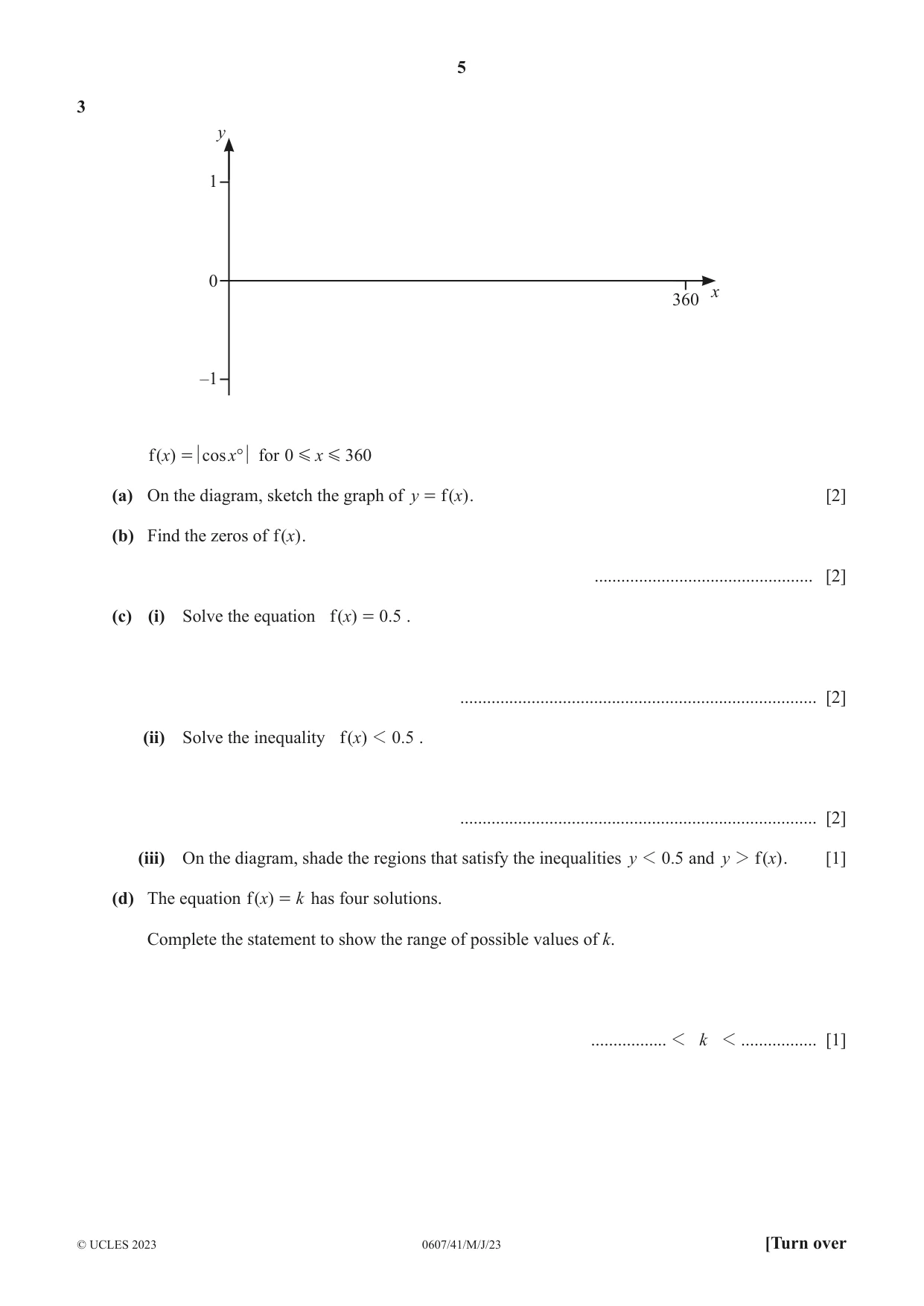
3 y 1 0 x 360 –1 f ( x) = cos x° for 0 G x G 360 (a) On the diagram, sketch the graph of y = f ( x) . [2] (b) Find the zeros of f ( )x . ................................................. [2] (c) (i) Solve the equation f ( x) = 0.5 . ................................................................................ [2] (ii) Solve the inequality f ( x) 1 0 .5 . ................................................................................ [2] (iii) On the diagram, shade the regions that satisfy the inequalities y 1 0.5 and y 2 f ( x) . [1] (d) The equation f ( )x = k has four solutions. Complete the statement to show the range of possible values of k. ................. 1 k 1 ................. [1]
Mark scheme: 3(a) Correct sketch 2 B1 for correct shape but inaccurate or different domain 3(b) 90, 270 2 B1 for each –1 if y cords (0) included 3(c)(i) 60, 120, 240, 300 2 B1 for two or three correct with no extras or four correct with extras –1 if y cords (0.5) included 3(c)(ii) 60 < x < 120, 240 < x < 300 2 B1 for each 3(c)(iii) Correct areas shaded, 1 i.e. below y = 0.5 and above y = f(x) 3(d) 0 [ < k < ] 1 1
Q4 · Alex invests $650 at a rate of 2% per year compound interest
4 (a) Alex invests $650 at a rate of 2% per year compound interest. (i) Calculate the value of this investment at the end of 10 years. $ ................................................ [2] (ii) Calculate the number of complete years it takes for the value of this investment of $650 to be first greater than $1000. ................................................. [4] (b) 2 years ago Chris invested $x at a rate of 3% per year compound interest. The value of this investment is now $607.90 correct to the nearest cent. Calculate the value of x. x = ................................................ [2] (c) Sam invested $200 at a rate of r % per year compound interest. At the end of 18 years, the value of this investment is $247.90 correct to the nearest cent. Find the value of r. r = ................................................ [3]
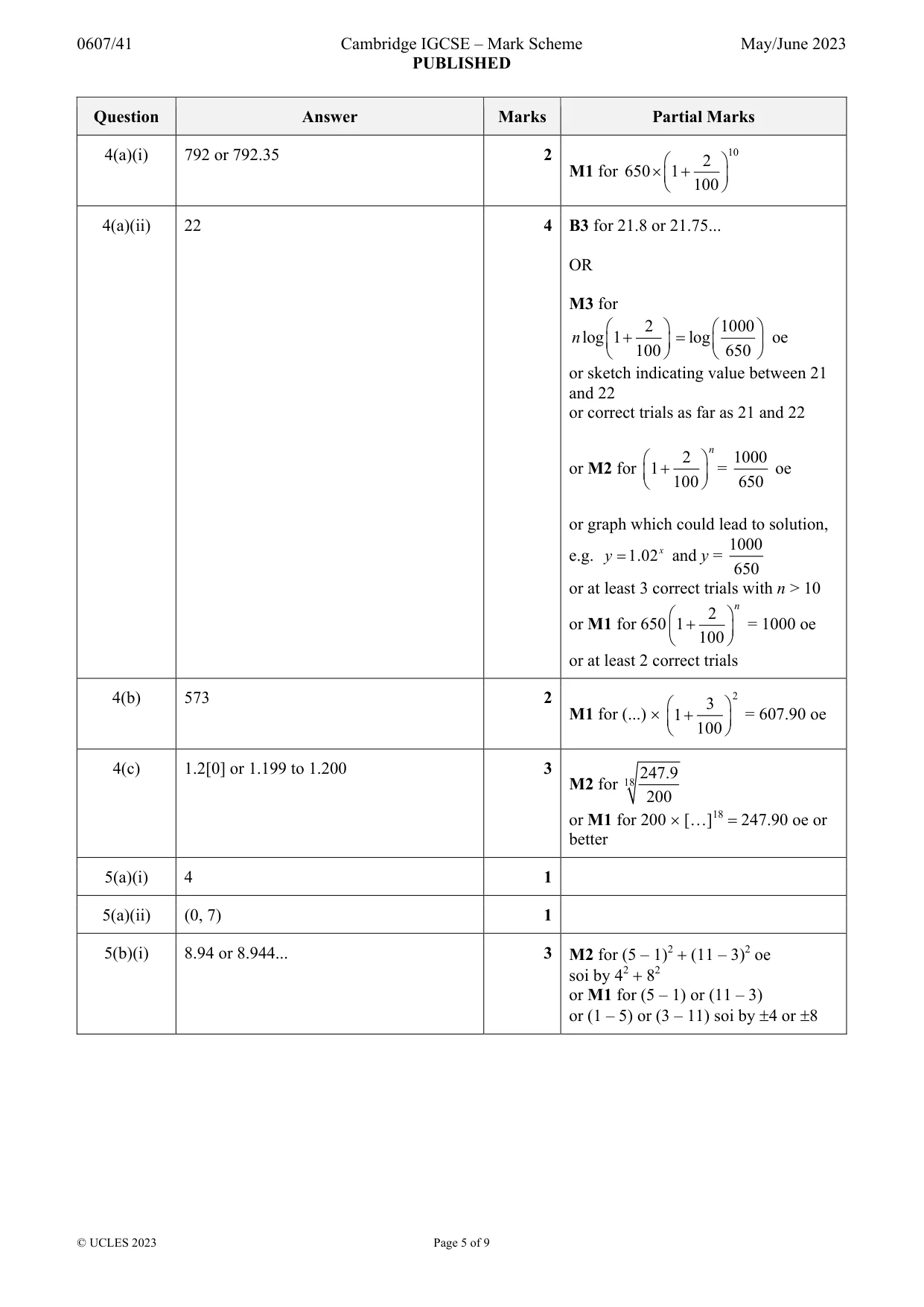
Mark scheme: 4(a)(i) 792 or 792.35 2 10 2 M1 for 650 1 100 4(a)(ii) 22 4 B3 for 21.8 or 21.75... OR M3 for 2 1000 n log 1 log oe 100 650 or sketch indicating value between 21 and 22 or correct trials as far as 21 and 22 2 n 1000 or M2 for 1 = oe 100 650 or graph which could lead to solution, 1000 e.g. y 1.02x and y = 650 or at least 3 correct trials with n > 10 2 n or M1 for 650 1 = 1000 oe 100 or at least 2 correct trials 4(b) 573 2 2 3 M1 for (...) 1 = 607.90 oe 100 4(c) 1.2[0] or 1.199 to 1.200 3 247.9 M2 for 18 200 or M1 for 200 […]18 247.90 oe or better
Q5 · The equation of line L is y = 4x + 7
5 (a) The equation of line L is y = 4x + 7 . (i) Write down the gradient of line L. ................................................. [1] (ii) Write down the coordinates of the point where line L cuts the y-axis. (....................... , .......................) [1] (b) A is the point (3, 1) and B is the point (11, 5). (i) Calculate the length of AB. ................................................. [3] (ii) Find the equation of the perpendicular bisector of the line AB. Give your answer in the form y = mx + c . y = ................................................ [5]
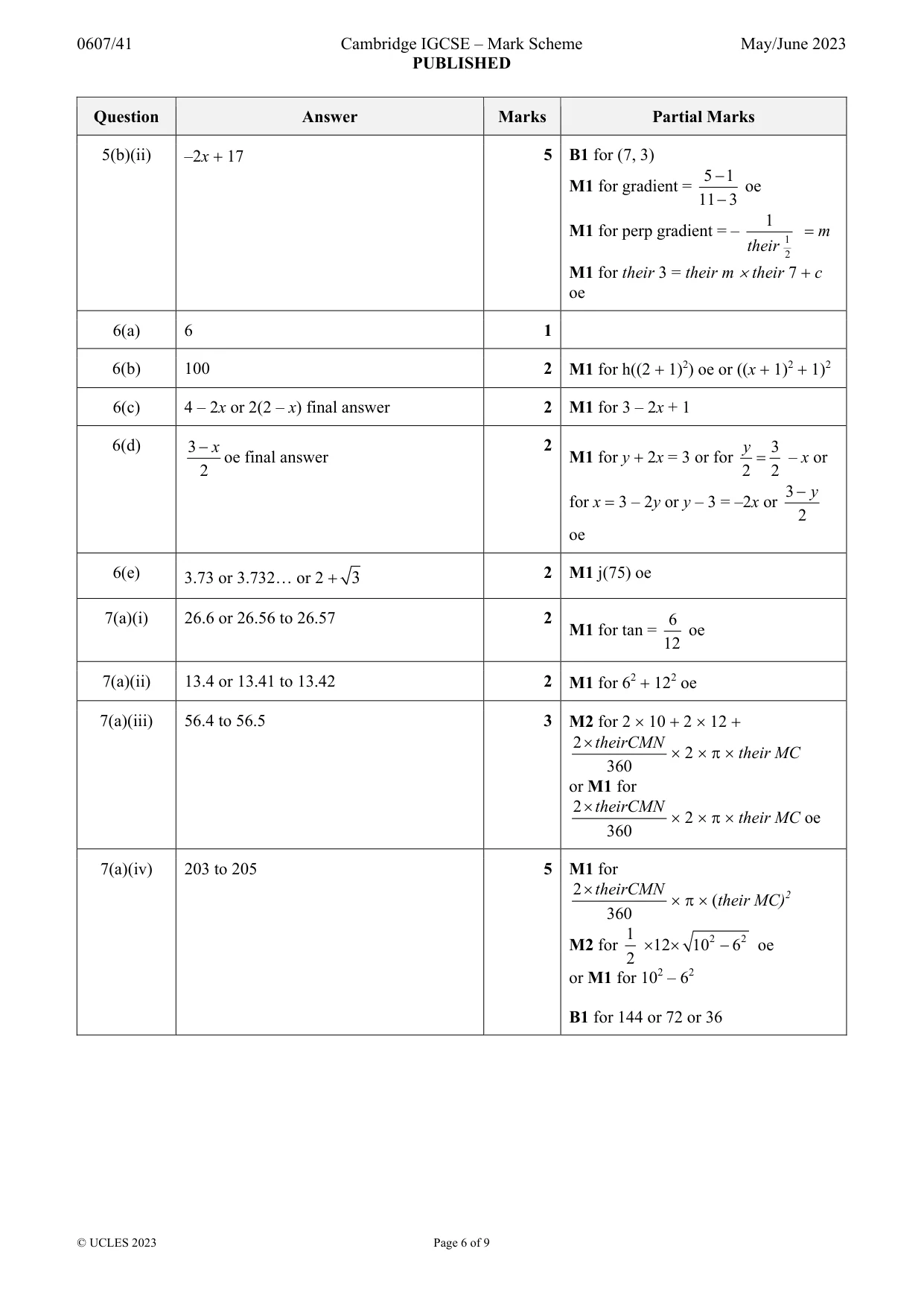
Mark scheme: 5(a)(i) 4 1 5(a)(ii) (0, 7) 1 5(b)(i) 8.94 or 8.944... 3 M2 for (5 – 1)2 (11 – 3)2 oe soi by 42 82 or M1 for (5 – 1) or (11 – 3) or (1 – 5) or (3 – 11) soi by 4 or 8 5(b)(ii) –2x 17 5 B1 for (7, 3) 5 1 M1 for gradient = oe 11 3 1 M1 for perp gradient = – m their 1 2 M1 for their 3 = their m their 7 c oe
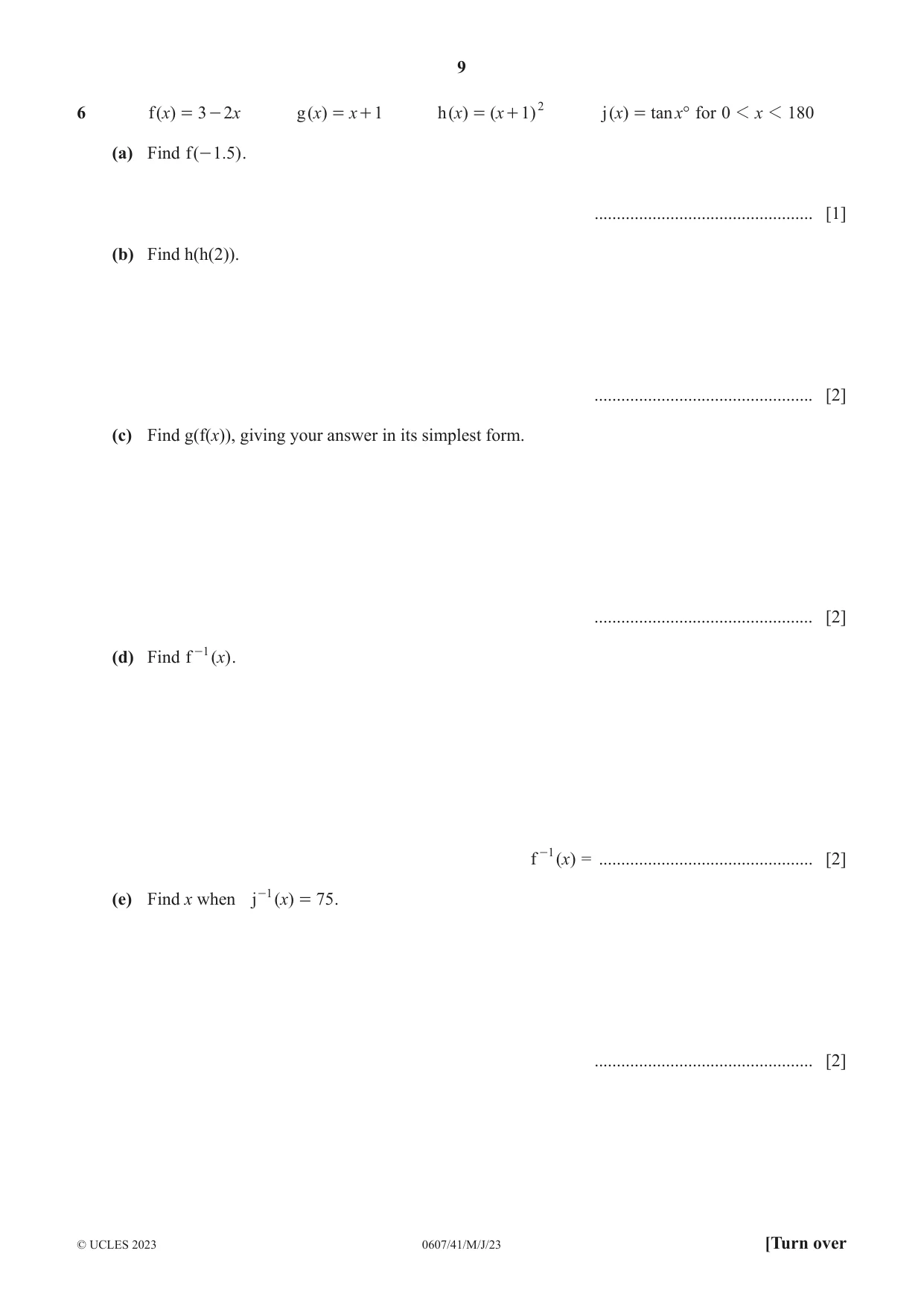
Q6 · F ( )x = 3 - 2 x g ( )x = x + 1 h ( x) = ( x + 1) 2 j ( x) = tan x° for 0 1 x 1 180 (a)…
6 f ( )x = 3 - 2 x g ( )x = x + 1 h ( x) = ( x + 1) 2 j ( x) = tan x° for 0 1 x 1 180 (a) Find f ( - 1.5) . ................................................. [1] (b) Find h(h(2)). ................................................. [2] (c) Find g(f(x)), giving your answer in its simplest form. ................................................. [2] (d) Find f -1 ( )x . f -1 ( )x = ................................................ [2] (e) Find x when j -1 ( )x = 75 . ................................................. [2]
Mark scheme: 6(a) 6 1 6(b) 100 2 M1 for h((2 1)2) oe or ((x 1)2 1)2 6(c) 4 – 2x or 2(2 – x) final answer 2 M1 for 3 – 2x + 1 6(d) 3 x 2 y 3 oe final answer M1 for y 2x = 3 or for – x or 2 2 2 3 y for x 3 – 2y or y – 3 = –2x or 2 oe 6(e) 3.73 or 3.732… or 2 3 2 M1 j(75) oe
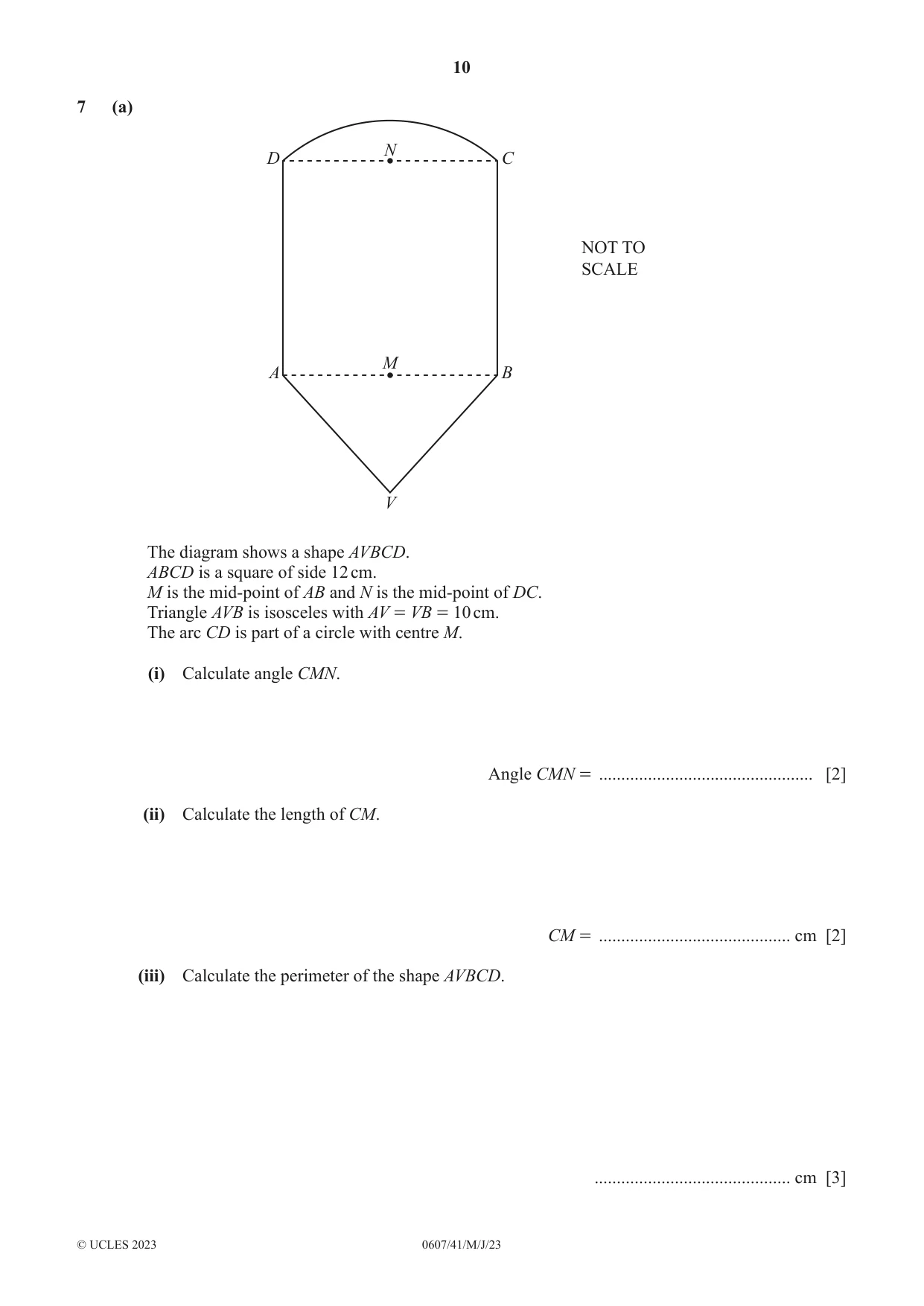
Q7 · N D C NOT TO SCALE M A B V The diagram shows a shape AVBCD
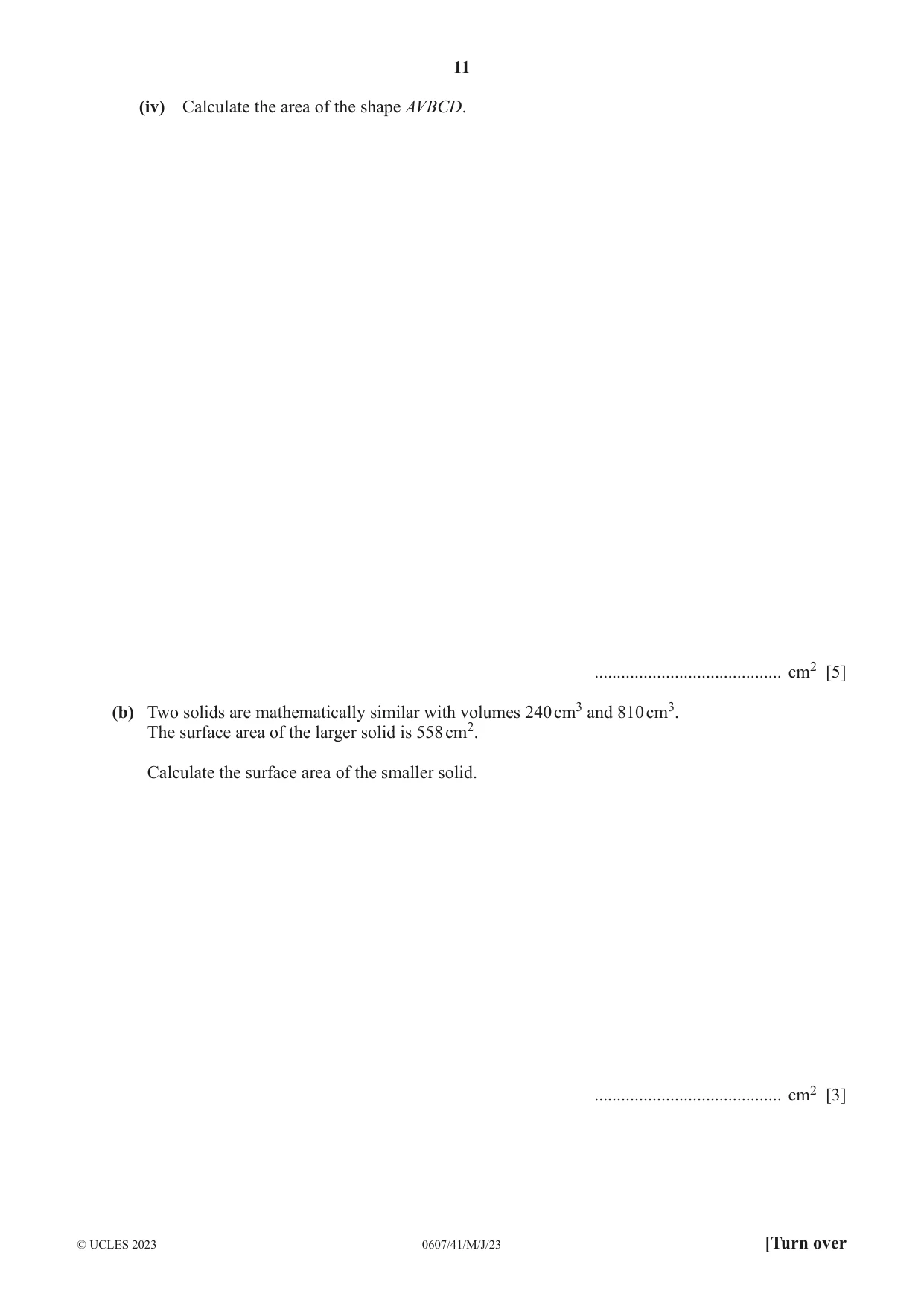
7 (a) N D C NOT TO SCALE M A B V The diagram shows a shape AVBCD. ABCD is a square of side 12 cm. M is the mid-point of AB and N is the mid-point of DC. Triangle AVB is isosceles with AV = VB = 10 cm. The arc CD is part of a circle with centre M. (i) Calculate angle CMN. Angle CMN = ................................................ [2] (ii) Calculate the length of CM. CM = ........................................... cm [2] (iii) Calculate the perimeter of the shape AVBCD. ............................................ cm [3] (iv) Calculate the area of the shape AVBCD. .......................................... cm2 [5] (b) Two solids are mathematically similar with volumes 240 cm3 and 810 cm3. The surface area of the larger solid is 558 cm2. Calculate the surface area of the smaller solid. .......................................... cm2 [3]
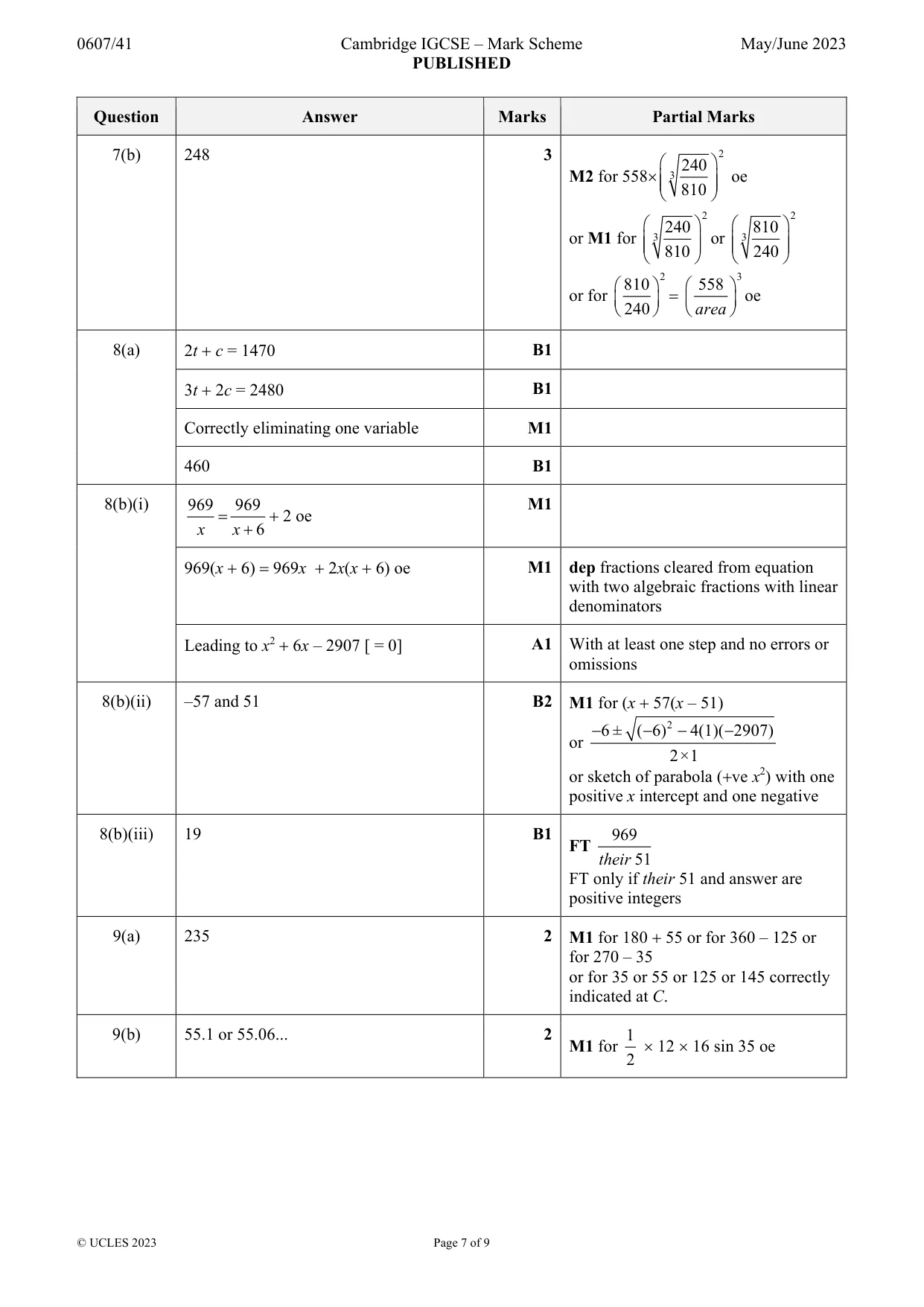
Mark scheme: 7(a)(i) 26.6 or 26.56 to 26.57 2 6 M1 for tan = oe 12 7(a)(ii) 13.4 or 13.41 to 13.42 2 M1 for 62 122 oe 7(a)(iii) 56.4 to 56.5 3 M2 for 2 10 2 12 2 theirCMN their MC 360 or M1 for 2 theirCMN their MC oe 360 7(a)(iv) 203 to 205 5 M1 for 2 theirCMN their MC)2 360 1 2 2 M2 for 10 6 oe 2 or M1 for 102 – 62 B1 for 144 or 72 or 36 7(b) 248 3 2 240 M2 for 558 3 oe 810 240 2 810 2 or M1 for 3 or 3 810 240 810 2 558 3 or for oe 240 area
Q8 · The cost of a television is $t and the cost of a computer is $c
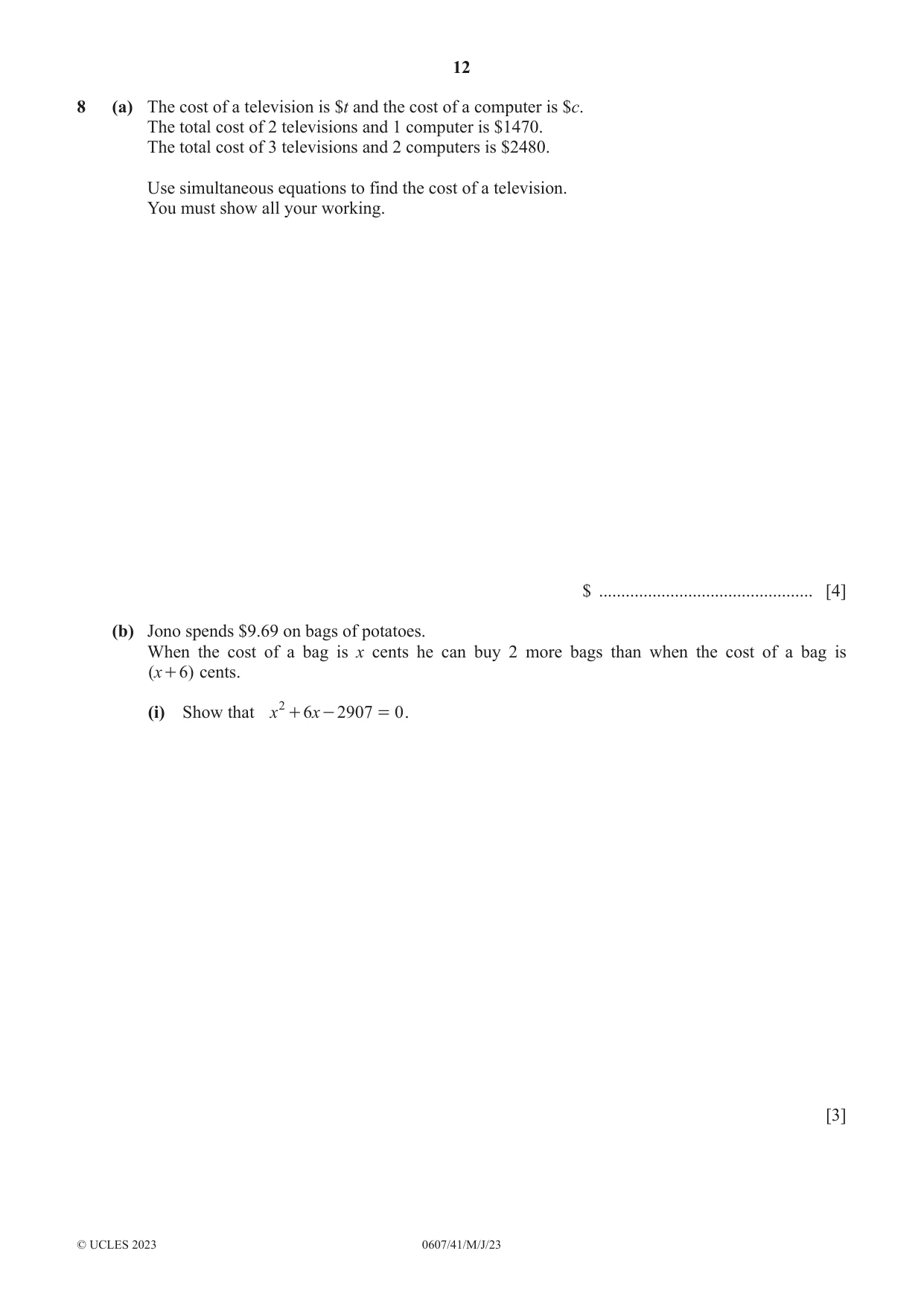
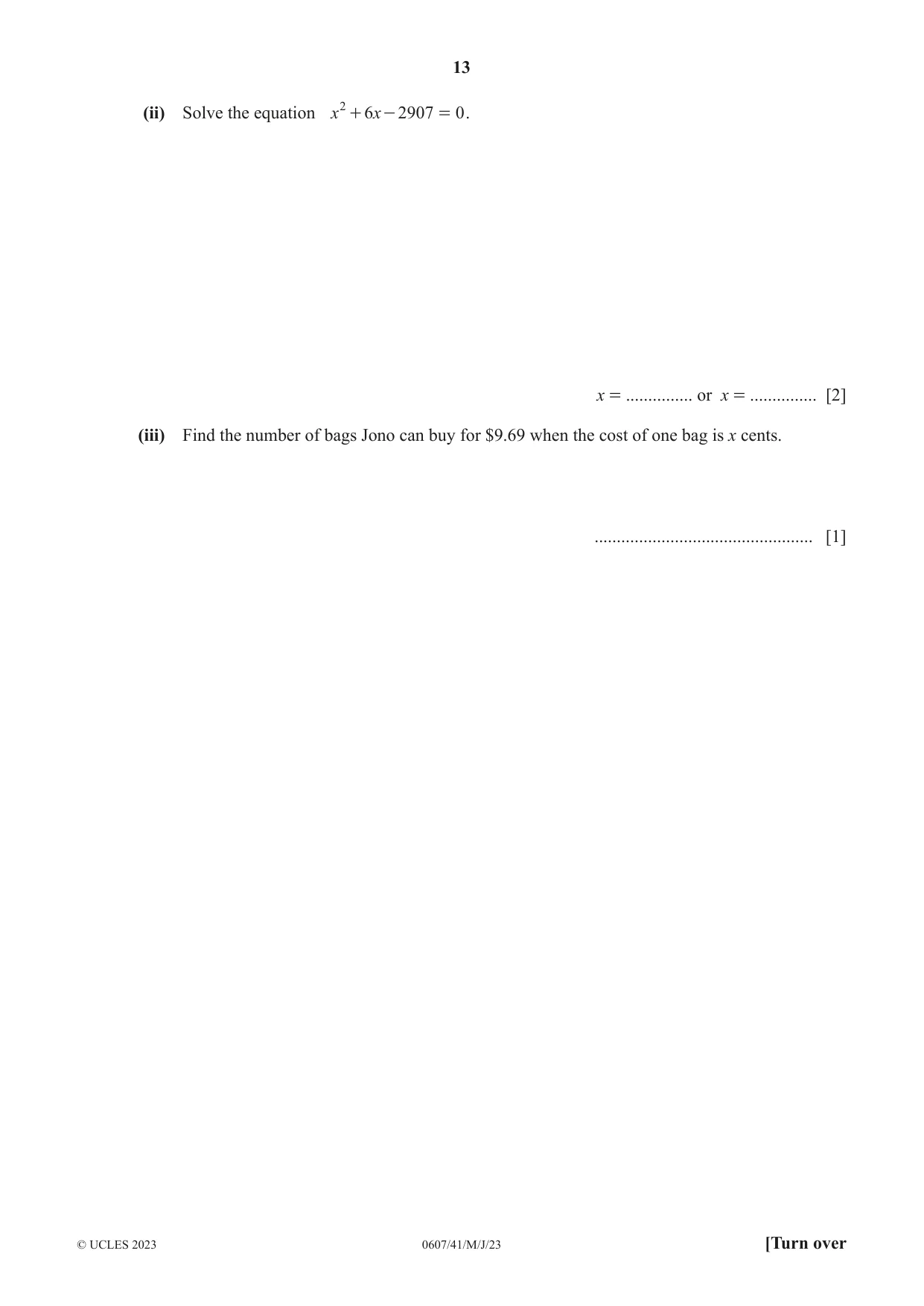
8 (a) The cost of a television is $t and the cost of a computer is $c. The total cost of 2 televisions and 1 computer is $1470. The total cost of 3 televisions and 2 computers is $2480. Use simultaneous equations to find the cost of a television. You must show all your working. $ ................................................ [4] (b) Jono spends $9.69 on bags of potatoes. When the cost of a bag is x cents he can buy 2 more bags than when the cost of a bag is ( x + 6) cents. (i) Show that x 2 + 6x - 2907 = 0 . [3] (ii) Solve the equation x 2 + 6x - 2907 = 0 . x = ............... or x = ............... [2] (iii) Find the number of bags Jono can buy for $9.69 when the cost of one bag is x cents. ................................................. [1]
Mark scheme: 8(a) 2t c = 1470 B1 3t 2c = 2480 B1 Correctly eliminating one variable M1 460 B1 8(b)(i) 969 969 2 oe M1 x x 6 969(x 969x x(x 6) oe M1 dep fractions cleared from equation with two algebraic fractions with linear denominators Leading to x2 6x – 2907 [ = 0] A1 With at least one step and no errors or omissions 8(b)(ii) –57 and 51 B2 M1 for (x (x – 51) 6 ± ( 6) 2 4(1)( 2907) or 2×1 or sketch of parabola (ve x2) with one positive x intercept and one negative 8(b)(iii) 19 B1 969 FT their 51 FT only if their 51 and answer are positive integers
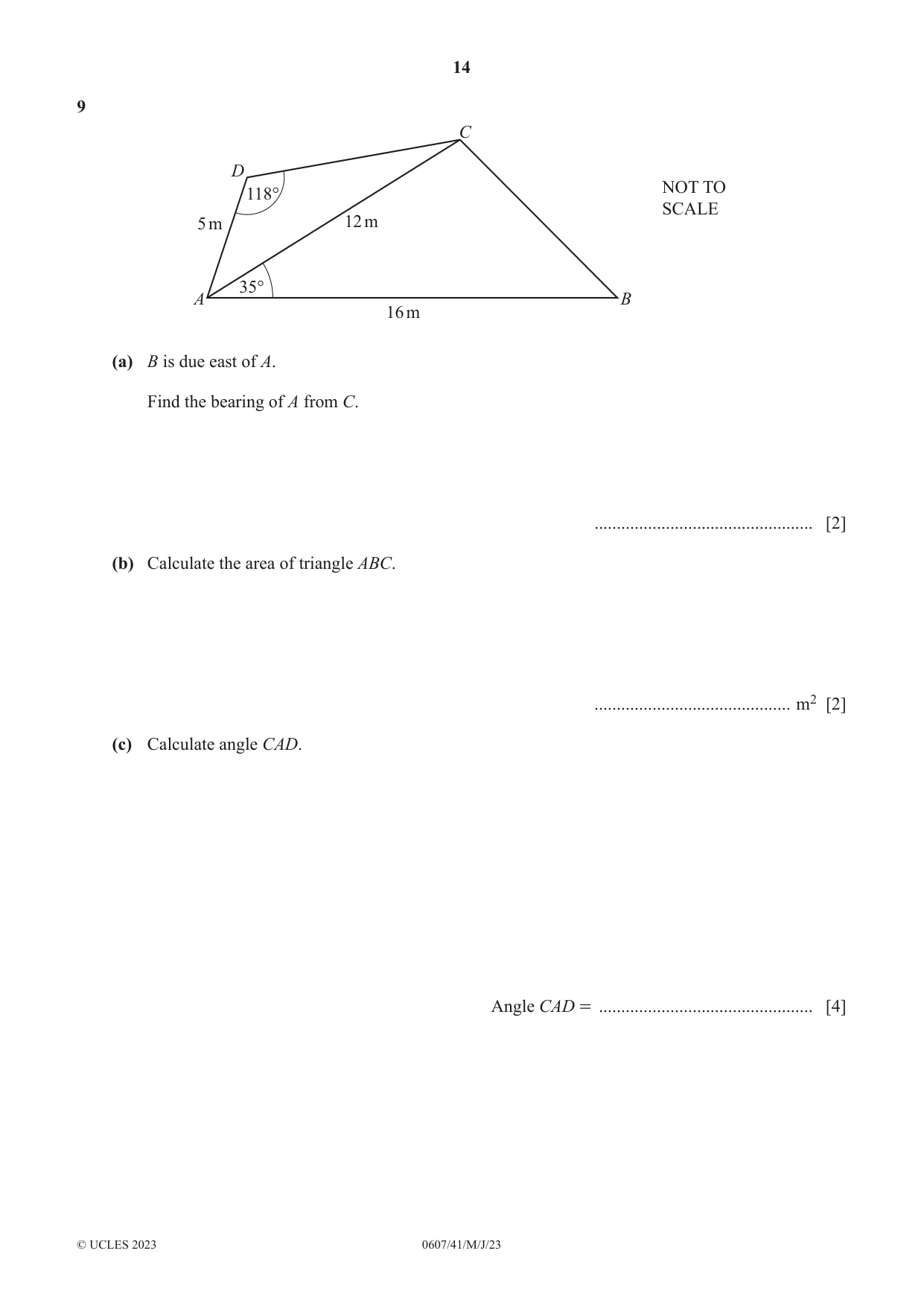
Q9 · C D NOT TO 118° SCALE 5 m 12 m 35° A B 16 m (a) B is due east of A
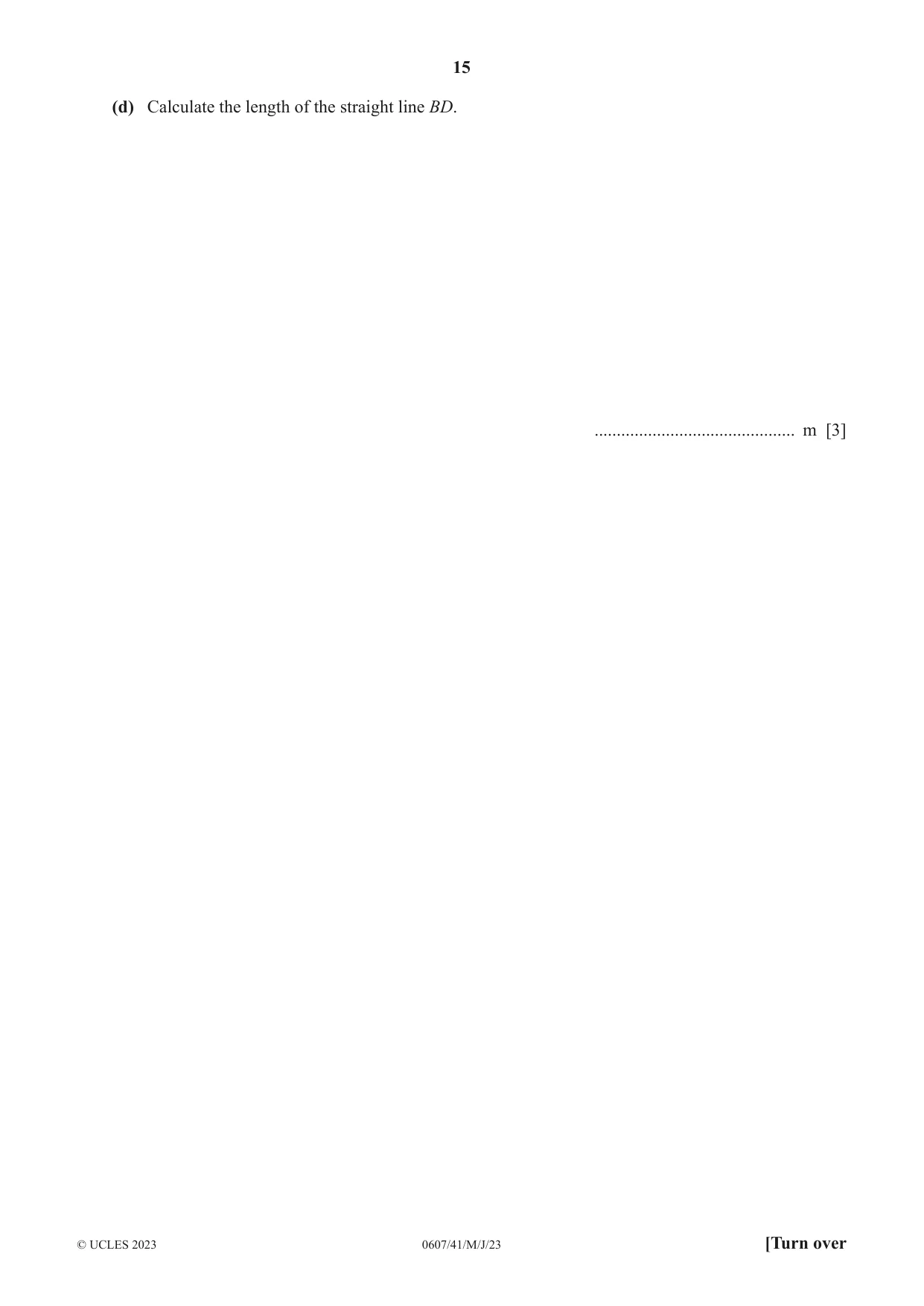
9 C D NOT TO 118° SCALE 5 m 12 m 35° A B 16 m (a) B is due east of A. Find the bearing of A from C. ................................................. [2] (b) Calculate the area of triangle ABC. ............................................ m2 [2] (c) Calculate angle CAD. Angle CAD = ................................................ [4] (d) Calculate the length of the straight line BD. ............................................. m [3]
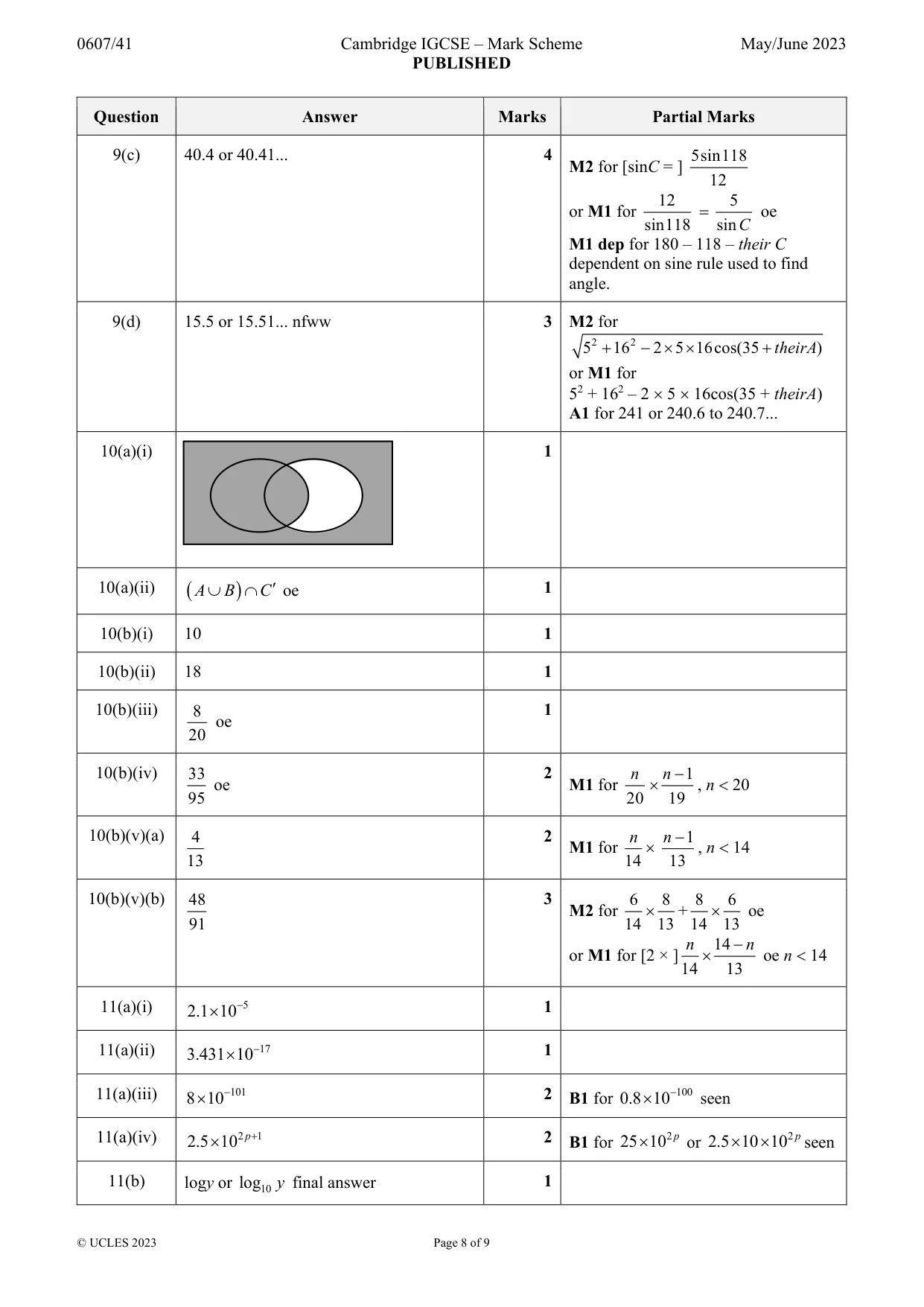
Mark scheme: 9(a) 235 2 M1 for 180 55 or for 360 – 125 or for 270 – 35 or for 35 or 55 or 125 or 145 correctly indicated at C. 9(b) 55.1 or 55.06... 2 1 M1 for 12 16 sin 35 oe 2 9(c) 40.4 or 40.41... 4 5sin118 M2 for [sinC = ] 12 12 5 or M1 for oe sin118 sinC M1 dep for 180 – 118 – their C dependent on sine rule used to find angle. 9(d) 15.5 or 15.51... nfww 3 M2 for 5 2 16 2 2 5 16cos(35 theirA) or M1 for 52 + 162 – 2 516cos(35 + theirA) A1 for 241 or 240.6 to 240.7...
Q10 · In the Venn diagram, shade the region P , Q l
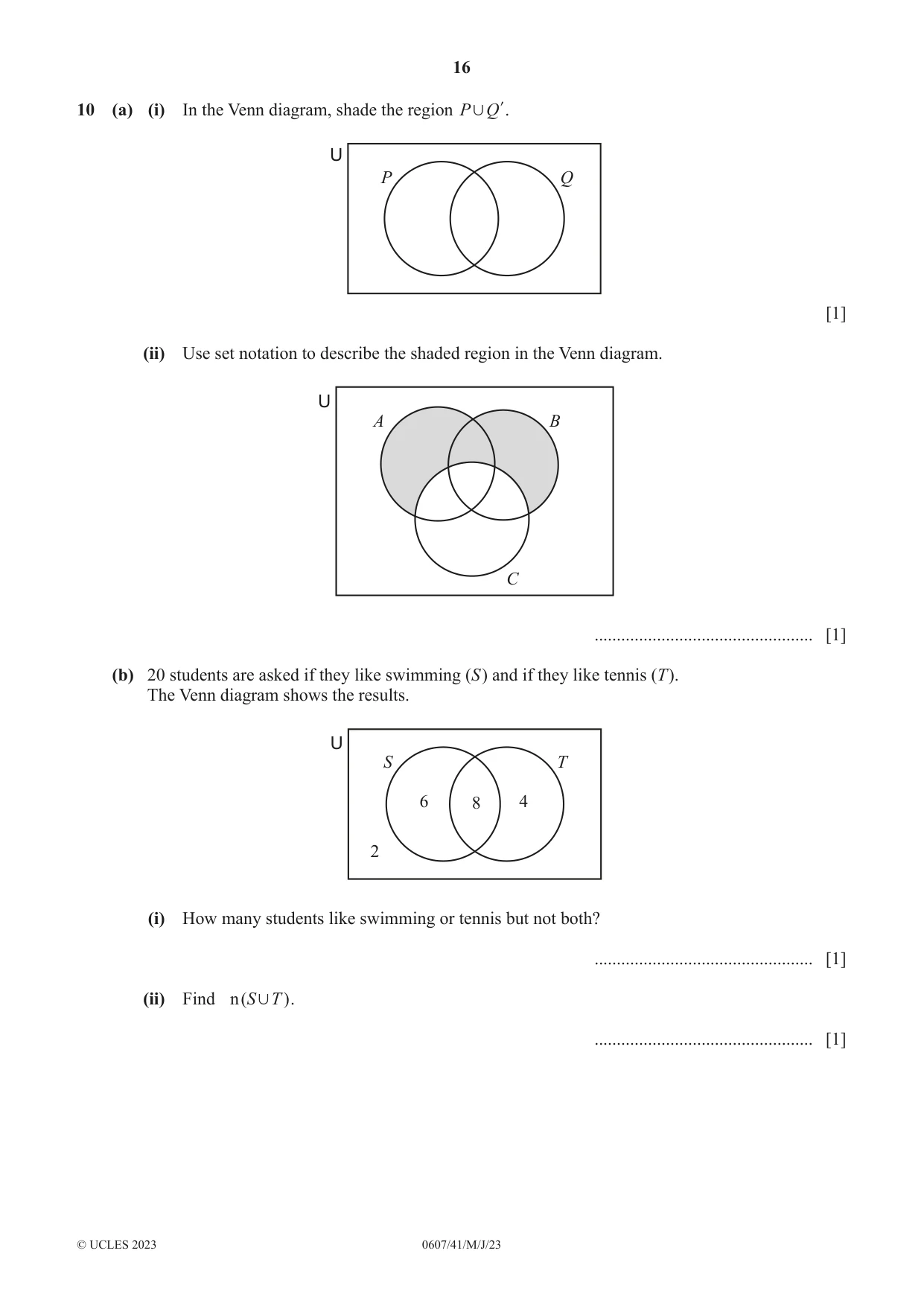
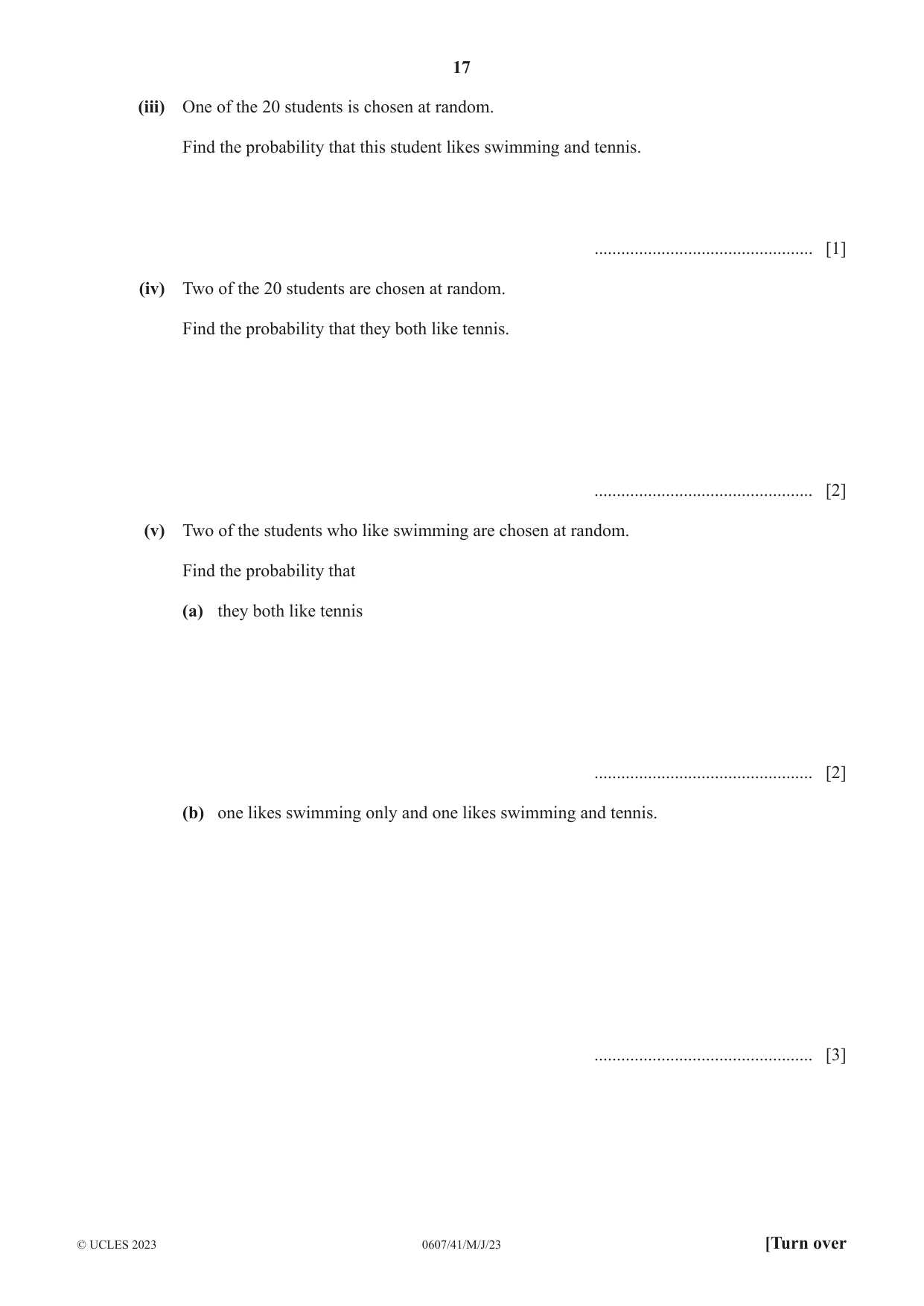
10 (a) (i) In the Venn diagram, shade the region P , Q l. U P Q [1] (ii) Use set notation to describe the shaded region in the Venn diagram. U A B C ................................................. [1] (b) 20 students are asked if they like swimming (S ) and if they like tennis (T ). The Venn diagram shows the results. U S T 6 8 4 2 (i) How many students like swimming or tennis but not both? ................................................. [1] (ii) Find n ( S , T ) . ................................................. [1] (iii) One of the 20 students is chosen at random. Find the probability that this student likes swimming and tennis. ................................................. [1] (iv) Two of the 20 students are chosen at random. Find the probability that they both like tennis. ................................................. [2] (v) Two of the students who like swimming are chosen at random. Find the probability that (a) they both like tennis ................................................. [2] (b) one likes swimming only and one likes swimming and tennis. ................................................. [3]
Mark scheme: 10(a)(i) 1 10(a)(ii) A B C oe 1 10(b)(i) 10 1 10(b)(ii) 18 1 10(b)(iii) 8 1 oe 20 10(b)(iv) 33 2 n n 1 oe M1 for , n 20 95 20 19 10(b)(v)(a) 4 2 n n 1 M1 for , n 14 13 14 13 10(b)(v)(b) 48 3 6 8 M2 for 8 + 6 oe 91 14 13 14 13 n n or M1 for [2 × 14 oe n 14 ]14 13
Q11 · Write 0.000 021 in standard form
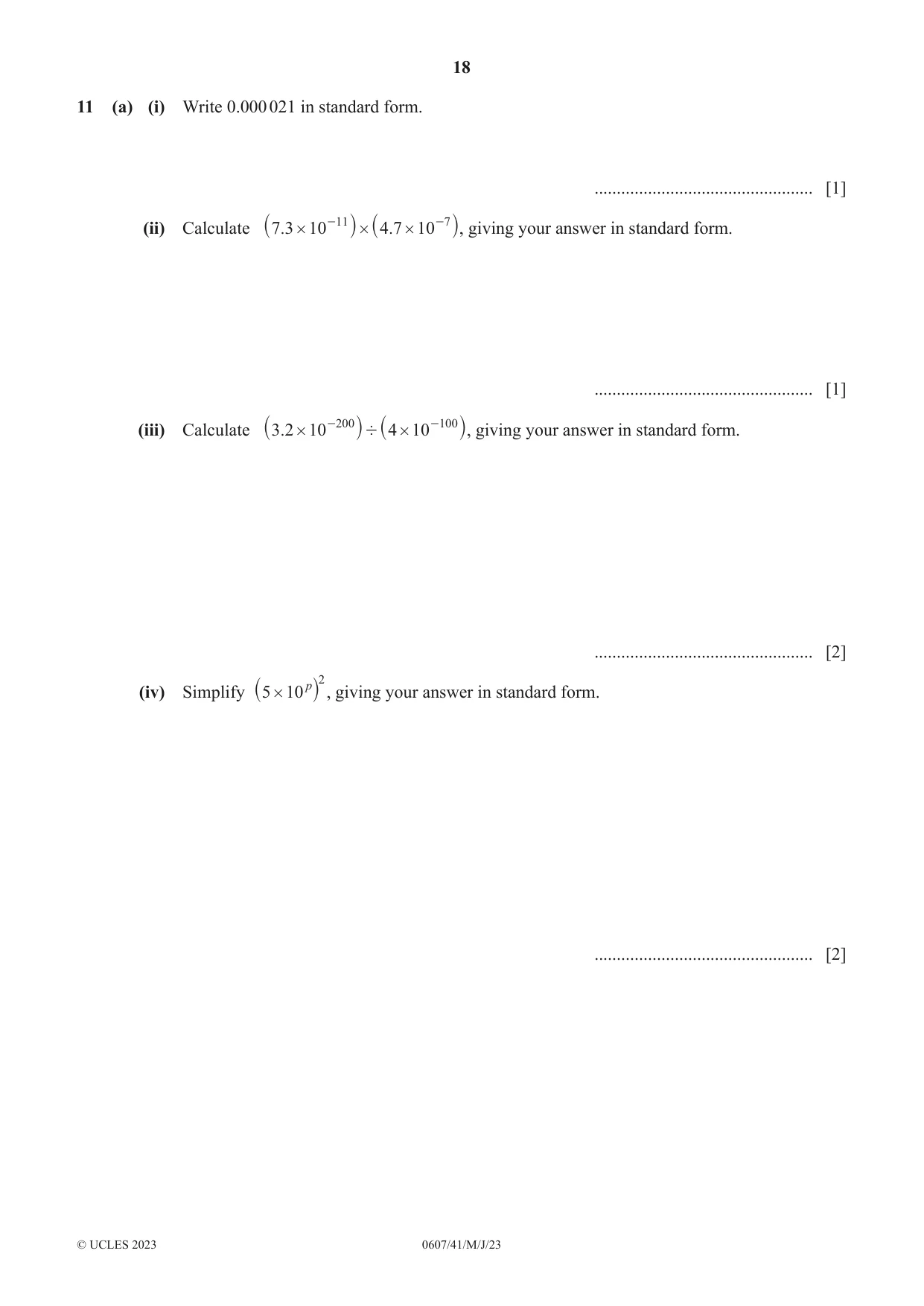
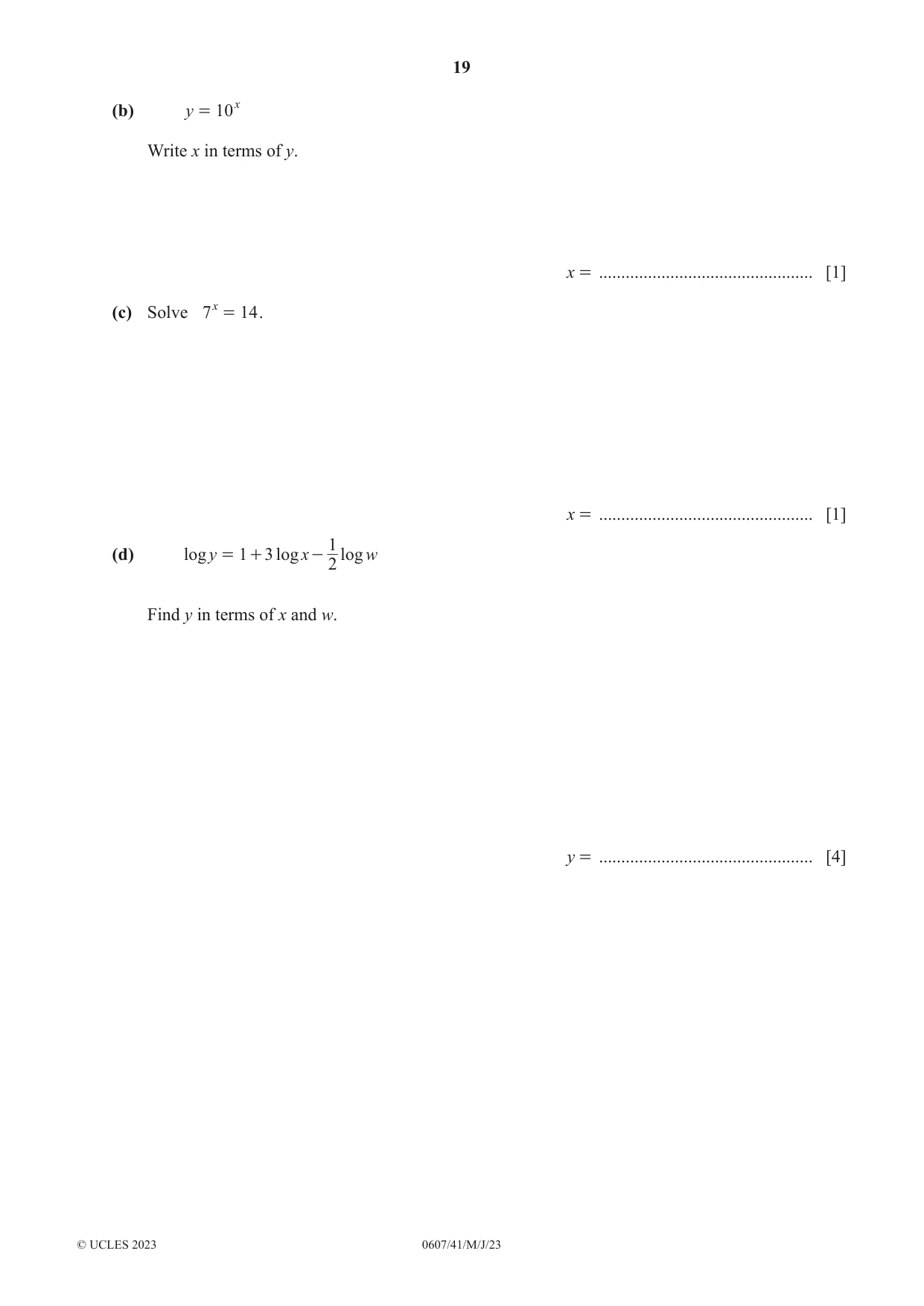
11 (a) (i) Write 0.000 021 in standard form. ................................................. [1] (ii) Calculate 7.3 # 10 -11 # 4.7 # 10 -7 giving your answer in standard form. ` j ` j, ................................................. [1] (iii) Calculate .32 # 10 -200 ' 4 # 10 - 100 giving your answer in standard form. ` j ` j, ................................................. [2] 2 (iv) Simplify 5 # 10 p , giving your answer in standard form. ` j ................................................. [2] (b) y = 10x Write x in terms of y. x = ................................................ [1] (c) Solve 7 x = 14 . x = ................................................ [1] 1(d) log y = 1 + 3 log x - log w 2 Find y in terms of x and w. y = ................................................ [4]
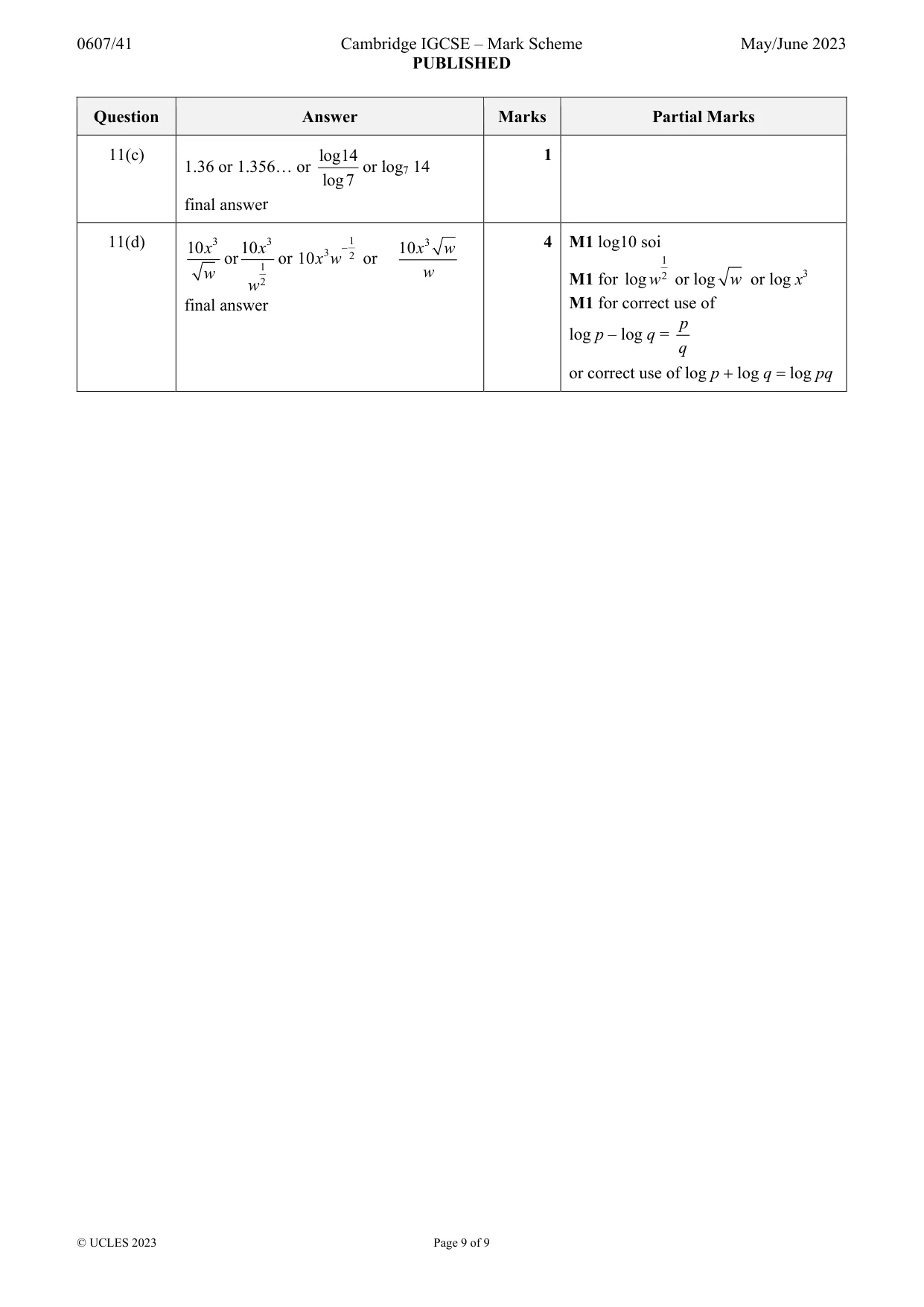
Mark scheme: 11(a)(i) 2.1 105 1 11(a)(ii) 3.431 1017 1 11(a)(iii) 8 10101 2 B1 for 0.8 10100 seen 11(a)(iv) 2.5 10 2 p1 2 B1 for 25 10 2 p or 2.5 10 10 2 p seen 11(b) logy or log10 y final answer 1 11(c) log14 1 1.36 or 1.356… or or log7 14 log7 final answer 11(d) 10x 3 10x 3 3 12 10x 3 w 4 M1 log10 soi or or 10 x w or 1 w 1 w 2 2 M1 for log w or log w or log x3 w final answer M1 for correct use of p log p – log q = q or correct use of log p log q log pq
What was in this paper
The subtopics covered by these 11 questions, and how many questions each got. Open one in a new tab to see every Cambridge question on it.
What you needed in this session
Cambridge’s own grade thresholds for 2023 May/June, Paper 4 · Variant 1. A higher threshold means an easier paper — the bar moves with how the cohort did.