Cambridge IGCSE Mathematics - International 0607 — 2021 May/June Paper 4 · Variant 3
0607/43/M/J/21 · 11 questions · 120 marks · ≈135 min
The question paper and its mark scheme, free to read here and free to download. This is Cambridge’s own paper, exactly as it was sat.
Question paper20 pages
Mark scheme9 pages
Answers below. Sit the paper first if you are practising.
Questions as text
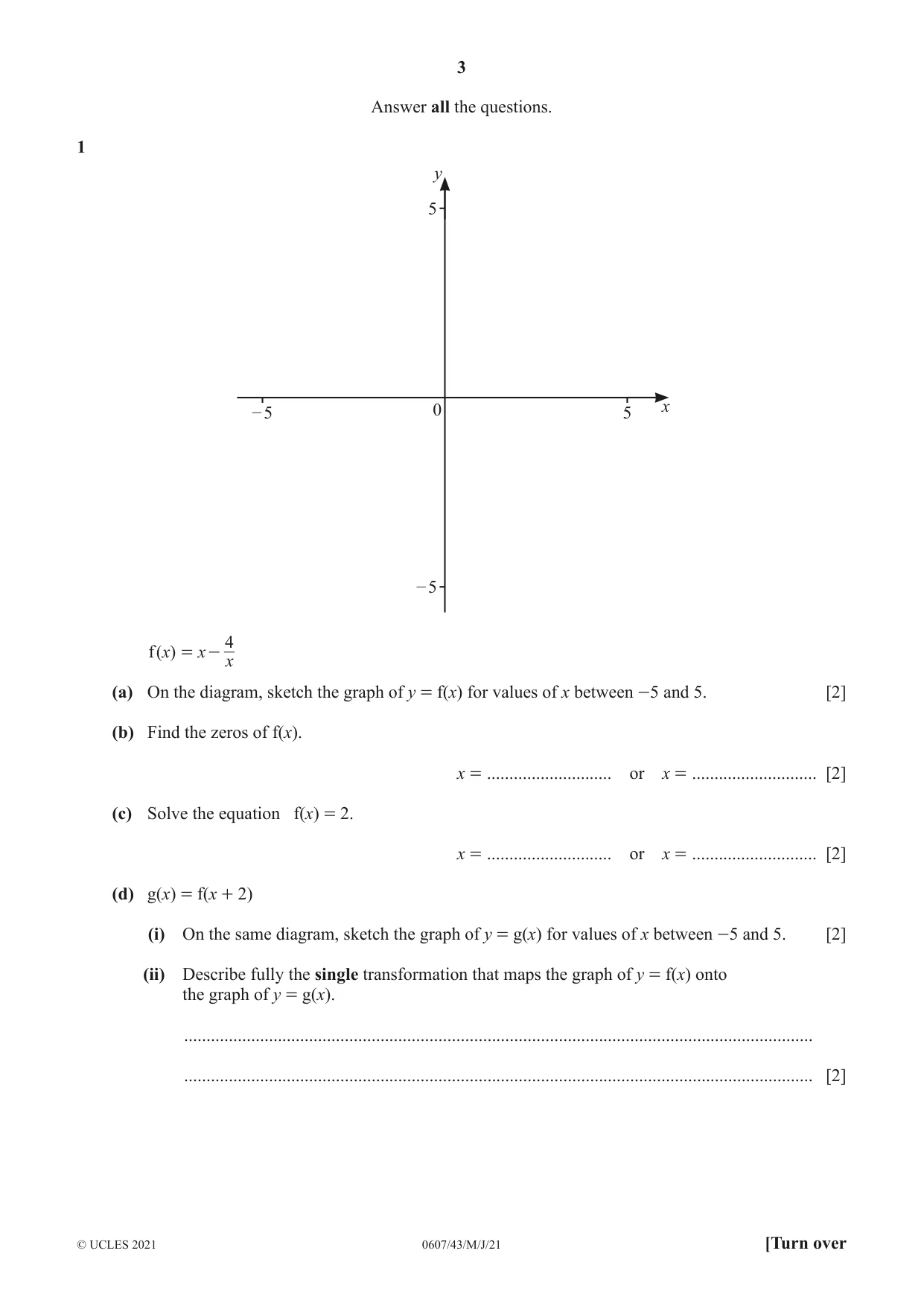
Q1 · Y 5 – 5 0 5 x – 5 4 f ( )x = x - x (a) On the diagram, sketch the graph of y = f(x) for…
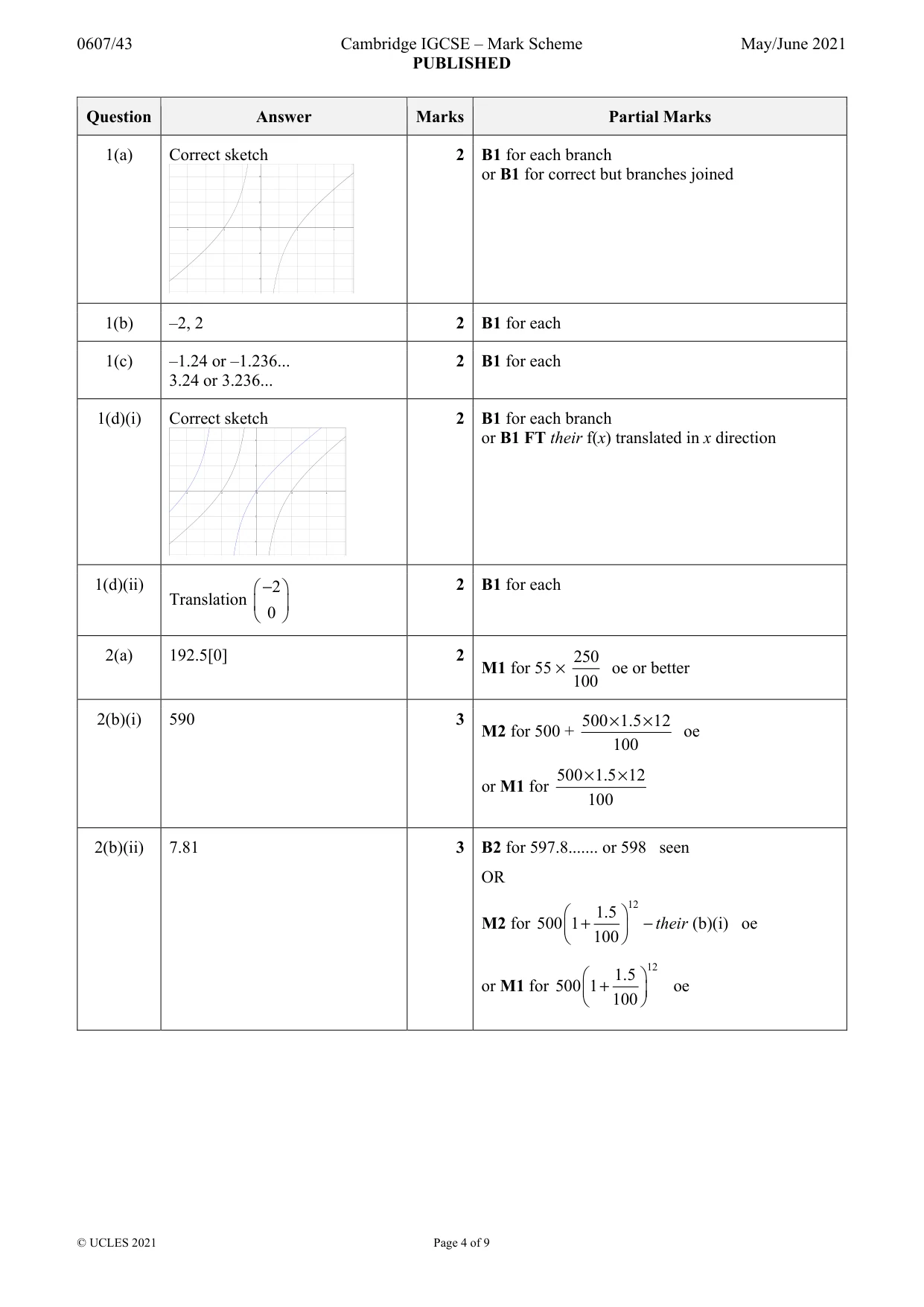
1 y 5 – 5 0 5 x – 5 4 f ( )x = x - x (a) On the diagram, sketch the graph of y = f(x) for values of x between -5 and 5. [2] (b) Find the zeros of f(x). x = ............................ or x = ............................ [2] (c) Solve the equation f(x) = 2. x = ............................ or x = ............................ [2] (d) g(x) = f(x + 2) (i) On the same diagram, sketch the graph of y = g(x) for values of x between -5 and 5. [2] (ii) Describe fully the single transformation that maps the graph of y = f(x) onto the graph of y = g(x). ............................................................................................................................................. ............................................................................................................................................. [2]
Mark scheme: Question Answer Marks Partial Marks 1(a) Correct sketch 2 B1 for each branch 4444 or B1 for correct but branches joined 2222 -4-4-4-4 -2-2-2-2 0000 0000 2222 4444 -2-2-2-2 -4-4-4-4 1(b) –2, 2 2 B1 for each 1(c) –1.24 or –1.236... 2 B1 for each 3.24 or 3.236... 1(d)(i) Correct sketch 2 B1 for each branch 4444 or B1 FT their f(x) translated in x direction 2222 -4-4-4-4 -2-2-2-2 0000 0000 2222 4444 -2-2-2-2 -4-4-4-4 1(d)(ii) − 2 2 B1 for each Translation 0
Q2 · Increase $55 by 250%
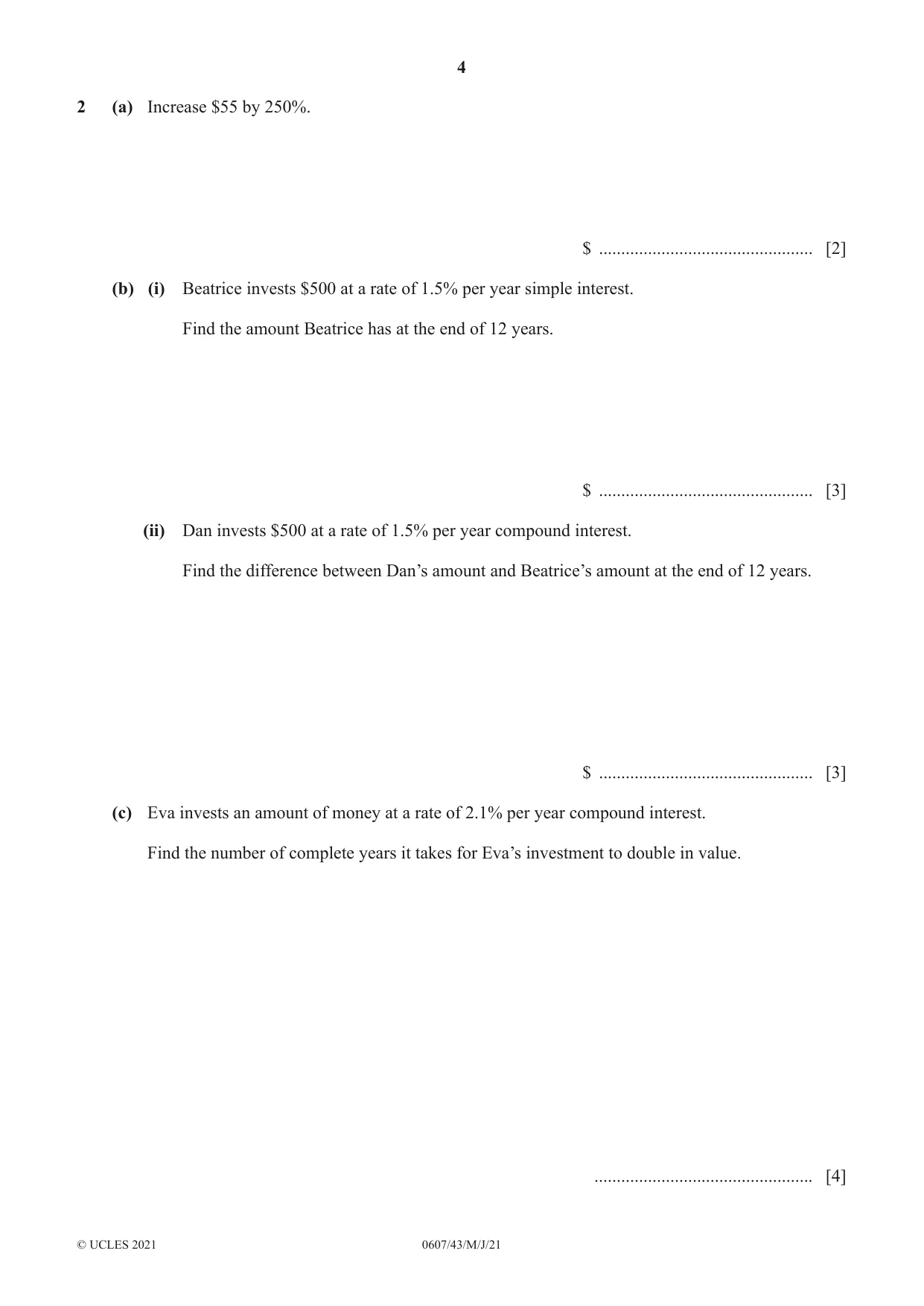
2 (a) Increase $55 by 250%. $ ................................................ [2] (b) (i) Beatrice invests $500 at a rate of 1.5% per year simple interest. Find the amount Beatrice has at the end of 12 years. $ ................................................ [3] (ii) Dan invests $500 at a rate of 1.5% per year compound interest. Find the difference between Dan’s amount and Beatrice’s amount at the end of 12 years. $ ................................................ [3] (c) Eva invests an amount of money at a rate of 2.1% per year compound interest. Find the number of complete years it takes for Eva’s investment to double in value. ................................................. [4] (d) Each year the value of Fred’s car reduces by 15% of its value at the start of that year. The value of the car is now $5158.65 . Find the value of Fred’s car 3 years ago. $ ................................................ [3]
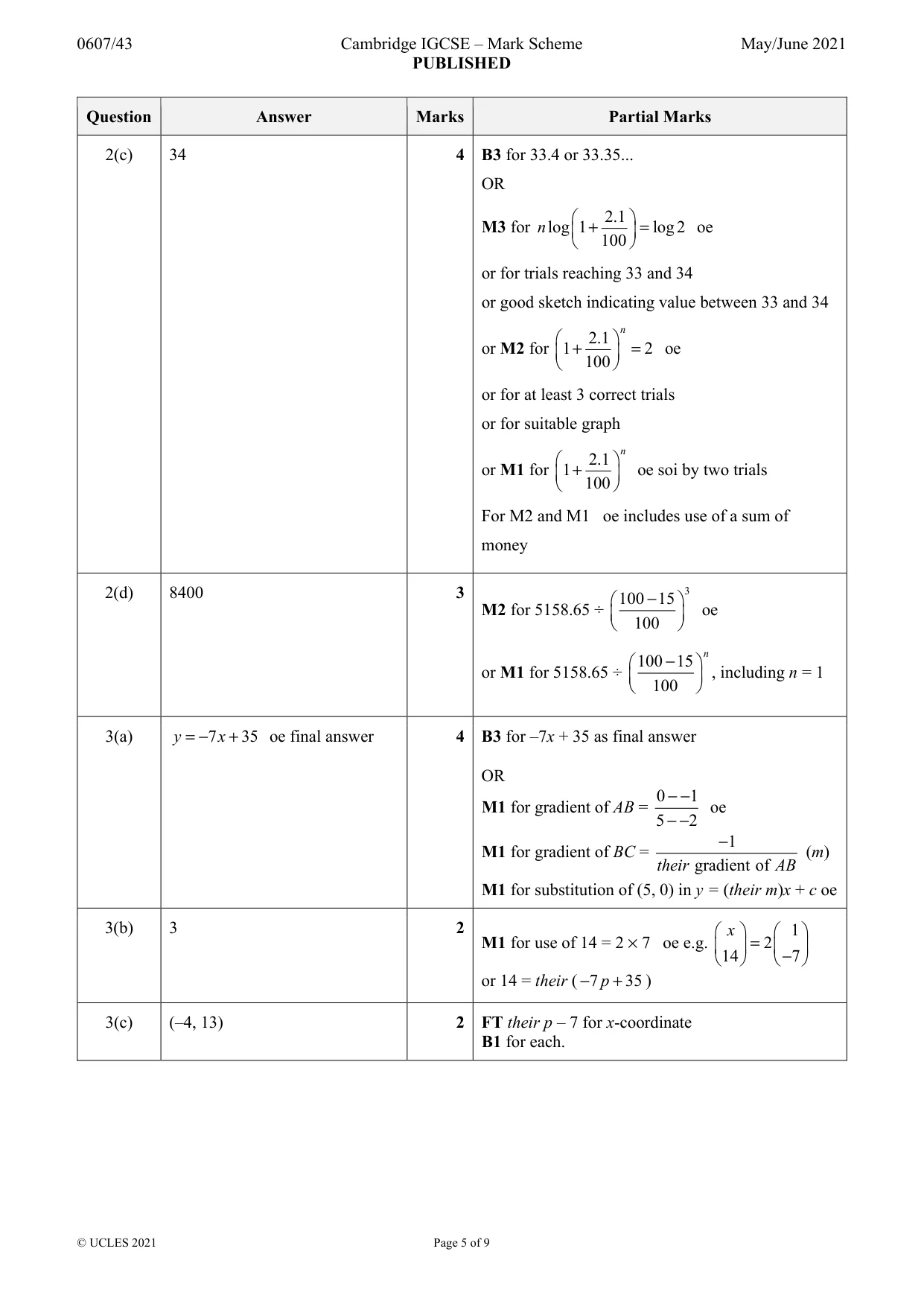
Mark scheme: 2(a) 192.5[0] 2 250 M1 for 55 × oe or better 100 2(b)(i) 590 3 500 × 1.5 × 12 M2 for 500 + oe 100 500 × 1.5 × 12 or M1 for 100 2(b)(ii) 7.81 3 B2 for 597.8....... or 598 seen OR 1.5 12 M2 for 500 1 + − their (b)(i) oe 100 1.5 12 or M1 for 500 1 + oe 100 2(c) 34 4 B3 for 33.4 or 33.35... OR 2.1 M3 for n log 1 + = log2 oe 100 or for trials reaching 33 and 34 or good sketch indicating value between 33 and 34 2.1 n or M2 for 1 + = 2 oe 100 or for at least 3 correct trials or for suitable graph 2.1 n or M1 for 1 + oe soi by two trials 100 For M2 and M1 oe includes use of a sum of money 2(d) 8400 3 3 100 − 15 M2 for 5158.65 ÷ oe 100 100 − 15 n or M1 for 5158.65 ÷ , including n = 1 100
Q3 · Y C D NOT TO SCALE O B x A ABCD is a rectangle
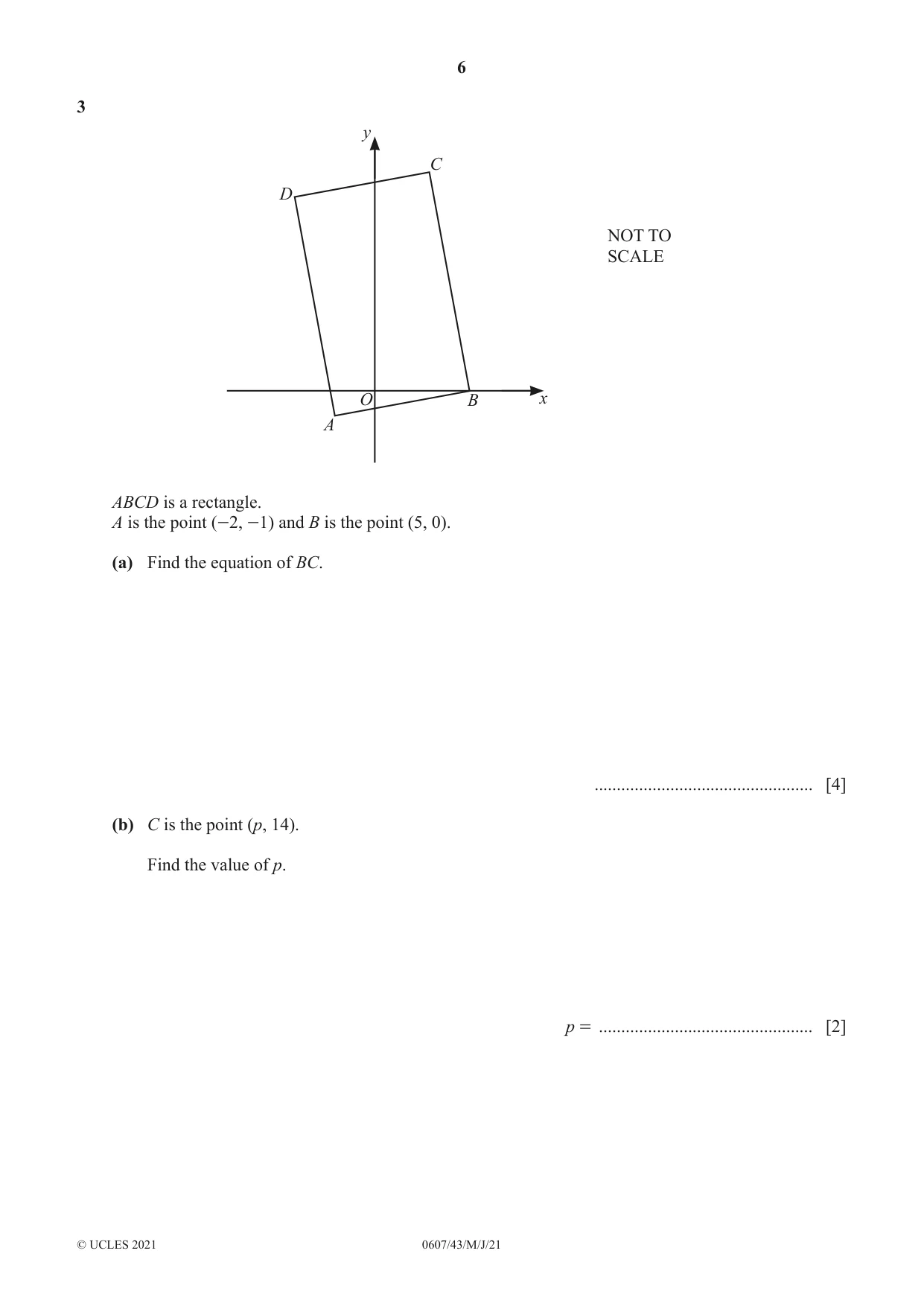
3 y C D NOT TO SCALE O B x A ABCD is a rectangle. A is the point (-2, -1) and B is the point (5, 0). (a) Find the equation of BC. ................................................. [4] (b) C is the point (p, 14). Find the value of p. p = ................................................ [2] (c) Find the coordinates of point D. ( ...................... , ...................... ) [2] (d) Find the area of rectangle ABCD. ................................................. [4]
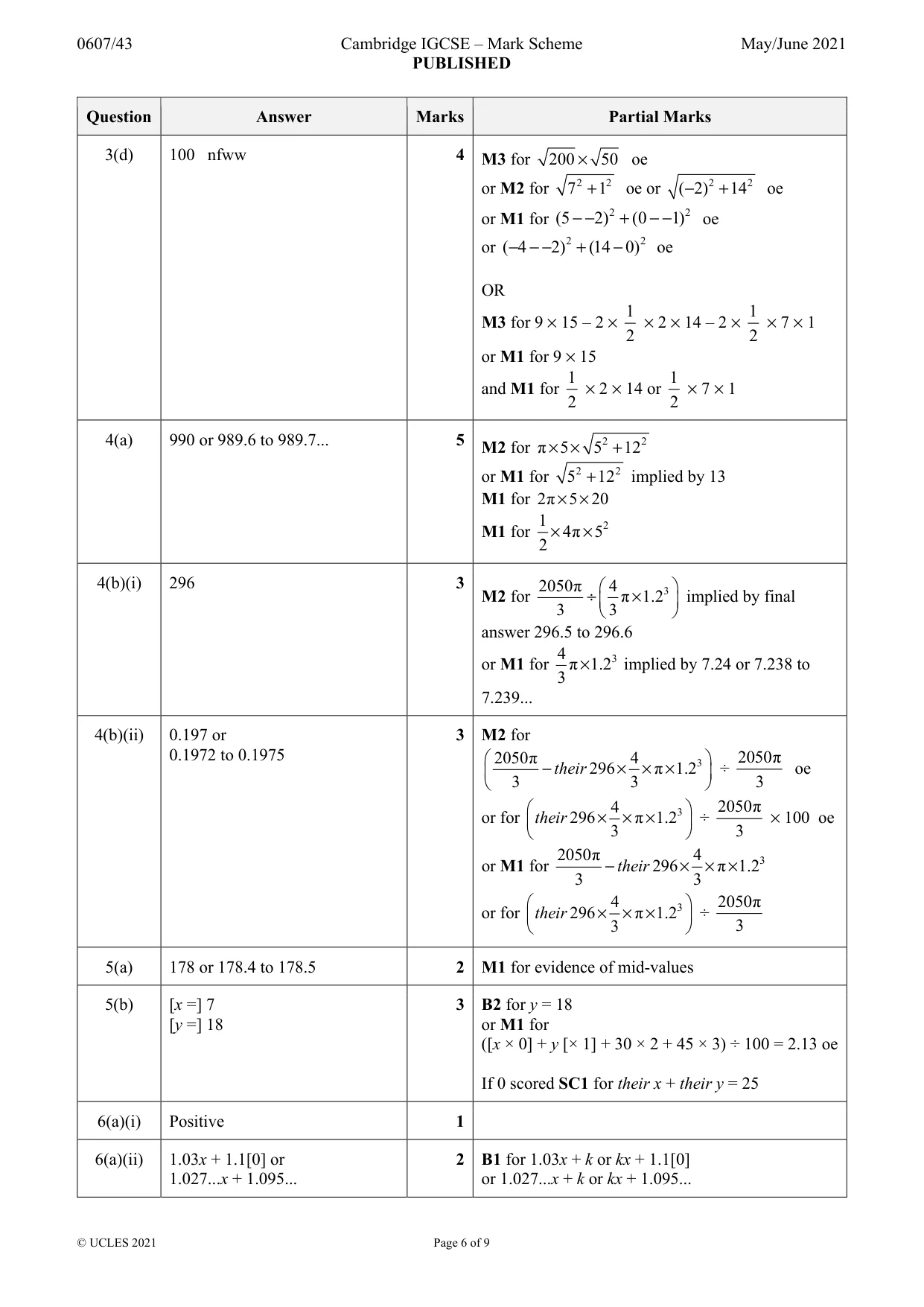
Mark scheme: 3(a) y = −7 x + 35 oe final answer 4 B3 for –7x + 35 as final answer OR 0 −−1 M1 for gradient of AB = oe 5 −−2 −1 M1 for gradient of BC = (m) their gradient of AB M1 for substitution of (5, 0) in y = (their m)x + c oe 3(b) 3 2 x 1 M1 for use of 14 = 2 × 7 oe e.g. = 2 14 −7 or 14 = their ( −7 p + 35 ) 3(c) (–4, 13) 2 FT their p – 7 for x-coordinate B1 for each. 3(d) 100 nfww 4 M3 for 200 × 50 oe or M2 for 7 2 + 12 oe or ( −2) 2 + 14 2 oe or M1 for (5 −−2) 2 + (0 −−1) 2 oe or ( −−−4 2) 2 + (14 − 0) 2 oe OR 1 1 M3 for 9 × 15 – 2 × × 2 × 14 – 2 × × 7 × 1 2 2 or M1 for 9 × 15 1 1 and M1 for × 2 × 14 or × 7 × 1 2 2
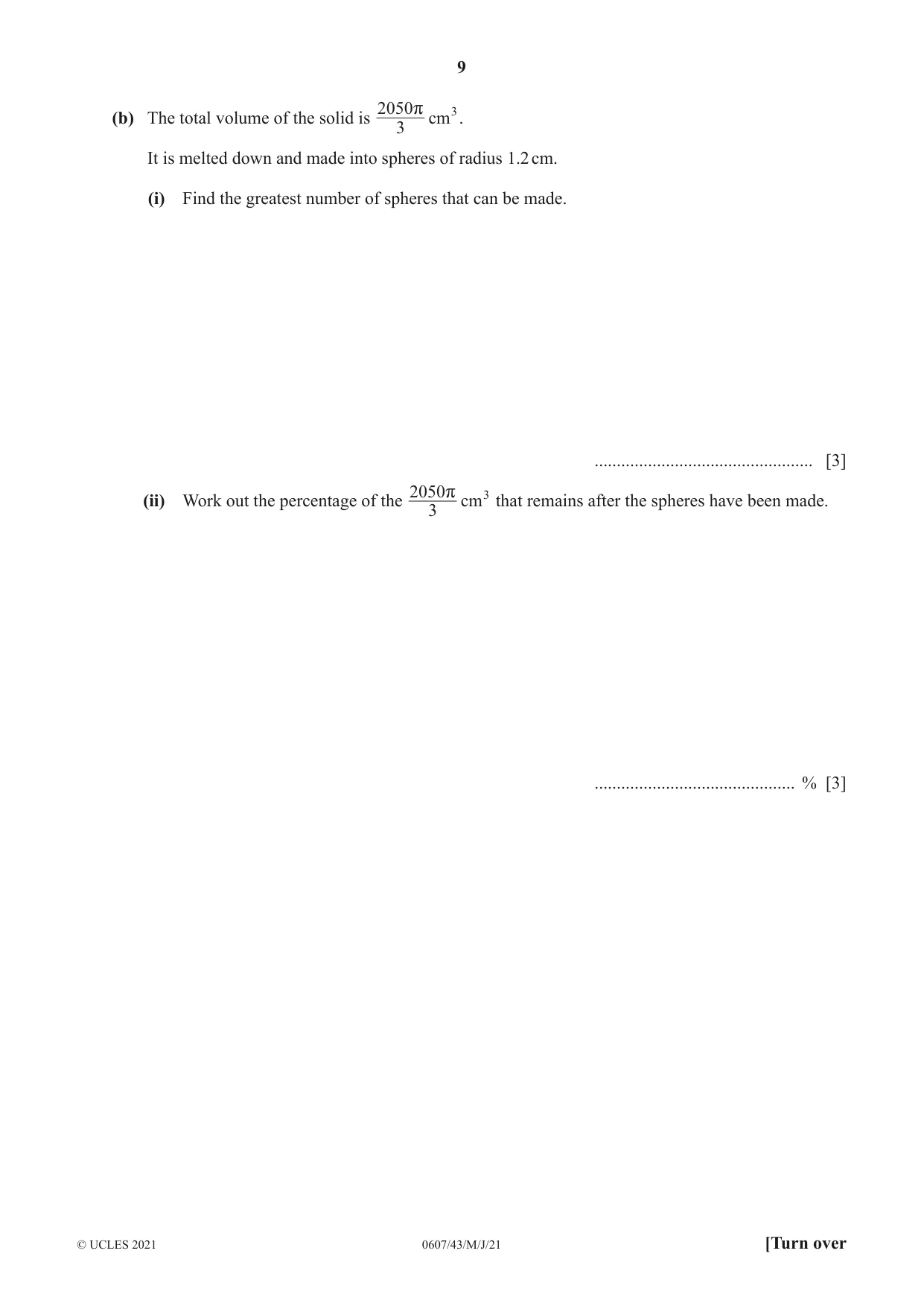
Q4 · 12 cm NOT TO SCALE 20 cm 5 cm The diagram shows a solid made by joining a cone and a…
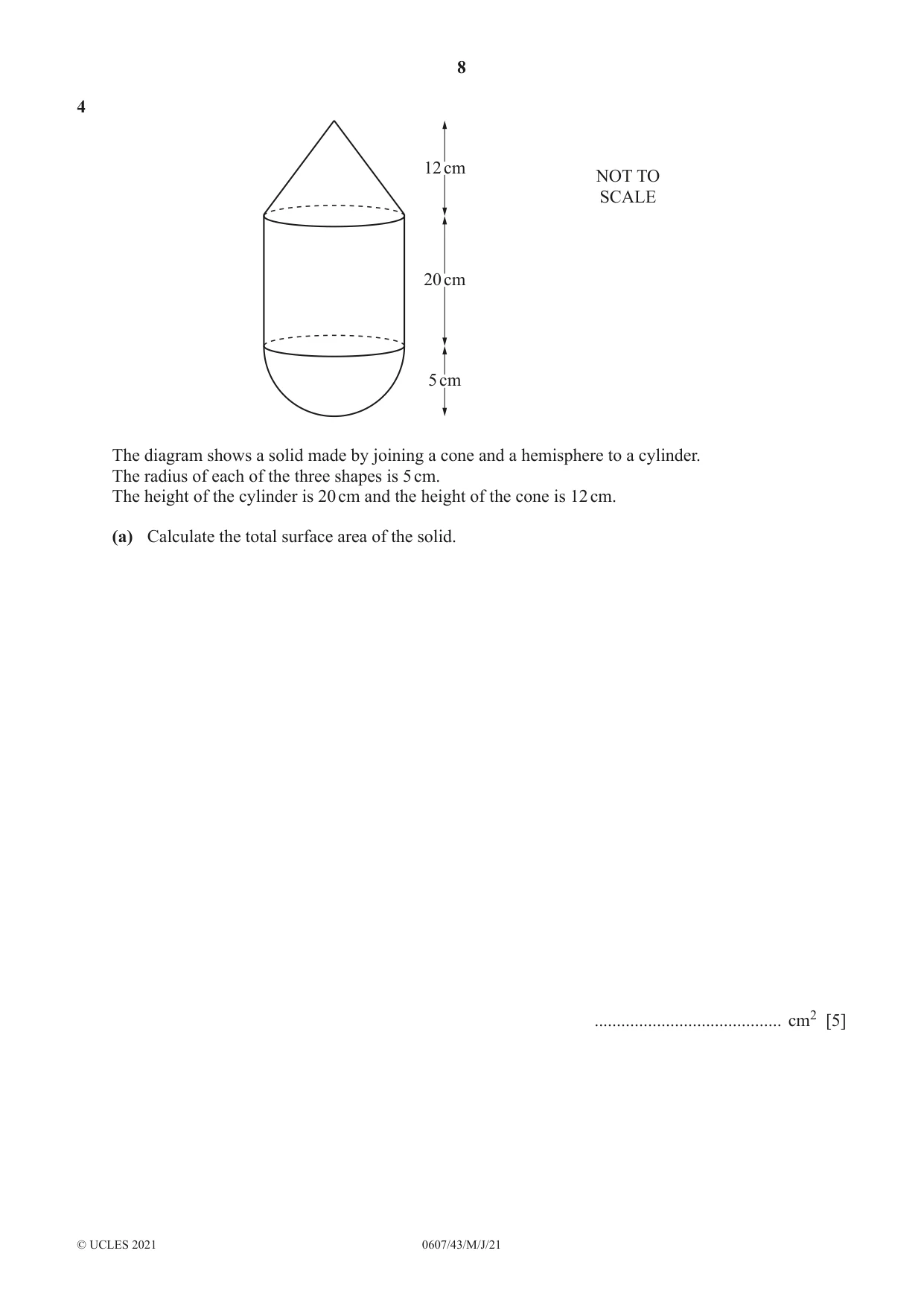
4 12 cm NOT TO SCALE 20 cm 5 cm The diagram shows a solid made by joining a cone and a hemisphere to a cylinder. The radius of each of the three shapes is 5 cm. The height of the cylinder is 20 cm and the height of the cone is 12 cm. (a) Calculate the total surface area of the solid. .......................................... cm2 [5] 2050 r(b) The total volume of the solid is cm3 . 3 It is melted down and made into spheres of radius 1.2 cm. (i) Find the greatest number of spheres that can be made. ................................................. [3] 2050 r (ii) Work out the percentage of the cm3 that remains after the spheres have been made. 3 ............................................. % [3]
Mark scheme: 4(a) 990 or 989.6 to 989.7... 5 2 2 M2 for π × 5 × 5 + 12 or M1 for 5 2 + 12 2 implied by 13 M1 for 2π × 5 × 20 1 2 M1 for × 4π × 5 2 4(b)(i) 296 3 2050π 4 3 M2 for ÷ π × 1.2 implied by final 3 3 answer 296.5 to 296.6 4 3 or M1 for π × 1.2 implied by 7.24 or 7.238 to 3 7.239... 4(b)(ii) 0.197 or 3 M2 for 0.1972 to 0.1975 2050π 4 3 2050π − their 296 × × π × 1.2 ÷ oe 3 3 3 4 3 2050π or for their 296 × × π × 1.2 ÷ × 100 oe 3 3 2050π 4 3 or M1 for − their 296 × × π × 1.2 3 3 4 3 2050π or for their 296 × × π × 1.2 ÷ 3 3
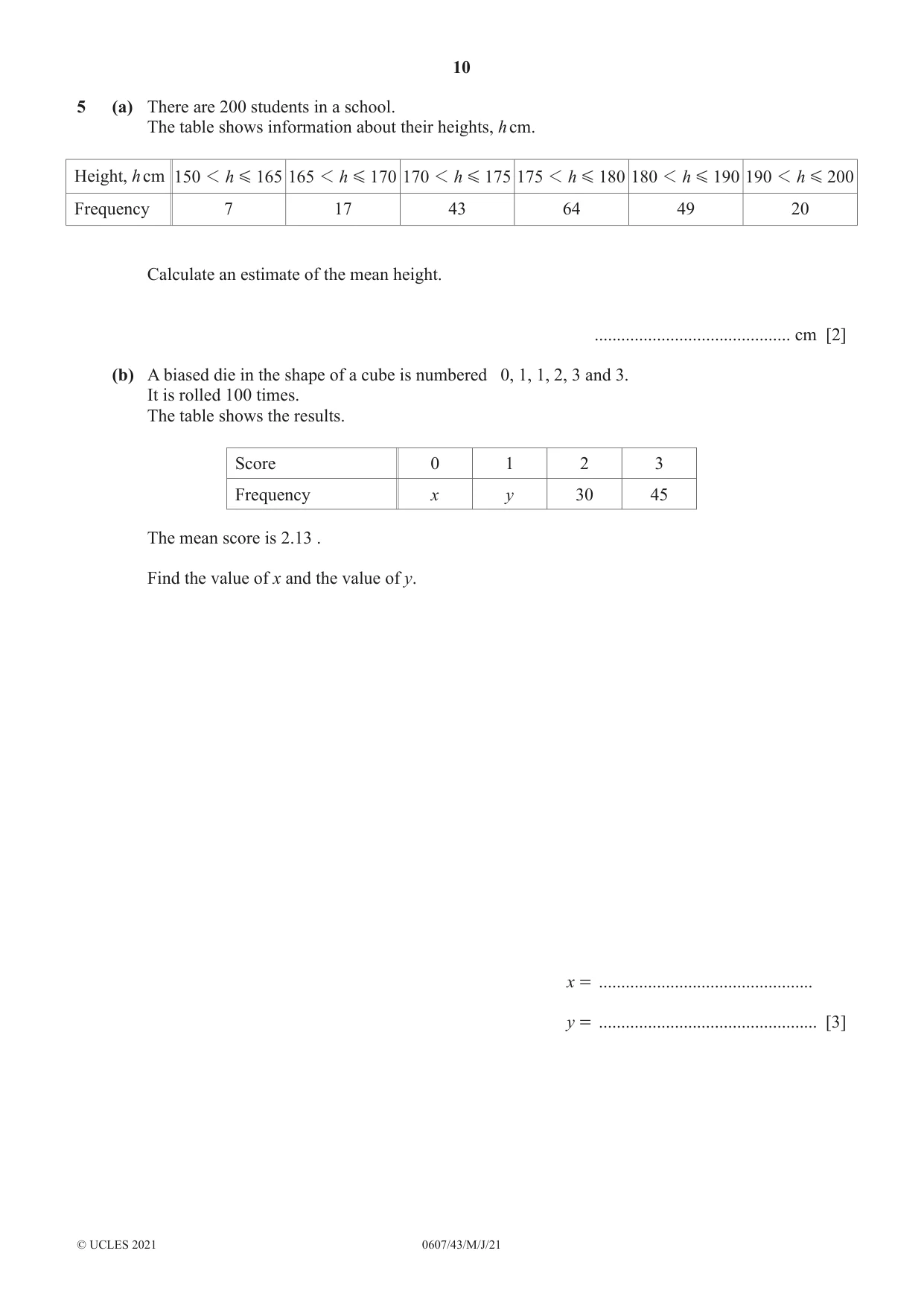
Q5 · There are 200 students in a school
5 (a) There are 200 students in a school. The table shows information about their heights, h cm. Height, h cm 150 1 h G 165 165 1 h G 170 170 1 h G 17 5 175 1 h G 1 80 180 1 h G 190 190 1 h G 200 Frequency 7 17 43 64 49 20 Calculate an estimate of the mean height. ............................................ cm [2] (b) A biased die in the shape of a cube is numbered 0, 1, 1, 2, 3 and 3. It is rolled 100 times. The table shows the results. Score 0 1 2 3 Frequency x y 30 45 The mean score is 2.13 . Find the value of x and the value of y. x = ................................................ y = ................................................. [3]
Mark scheme: 5(a) 178 or 178.4 to 178.5 2 M1 for evidence of mid-values 5(b) [x =] 7 3 B2 for y = 18 [y =] 18 or M1 for ([x × 0] + y [× 1] + 30 × 2 + 45 × 3) ÷ 100 = 2.13 oe If 0 scored SC1 for their x + their y = 25
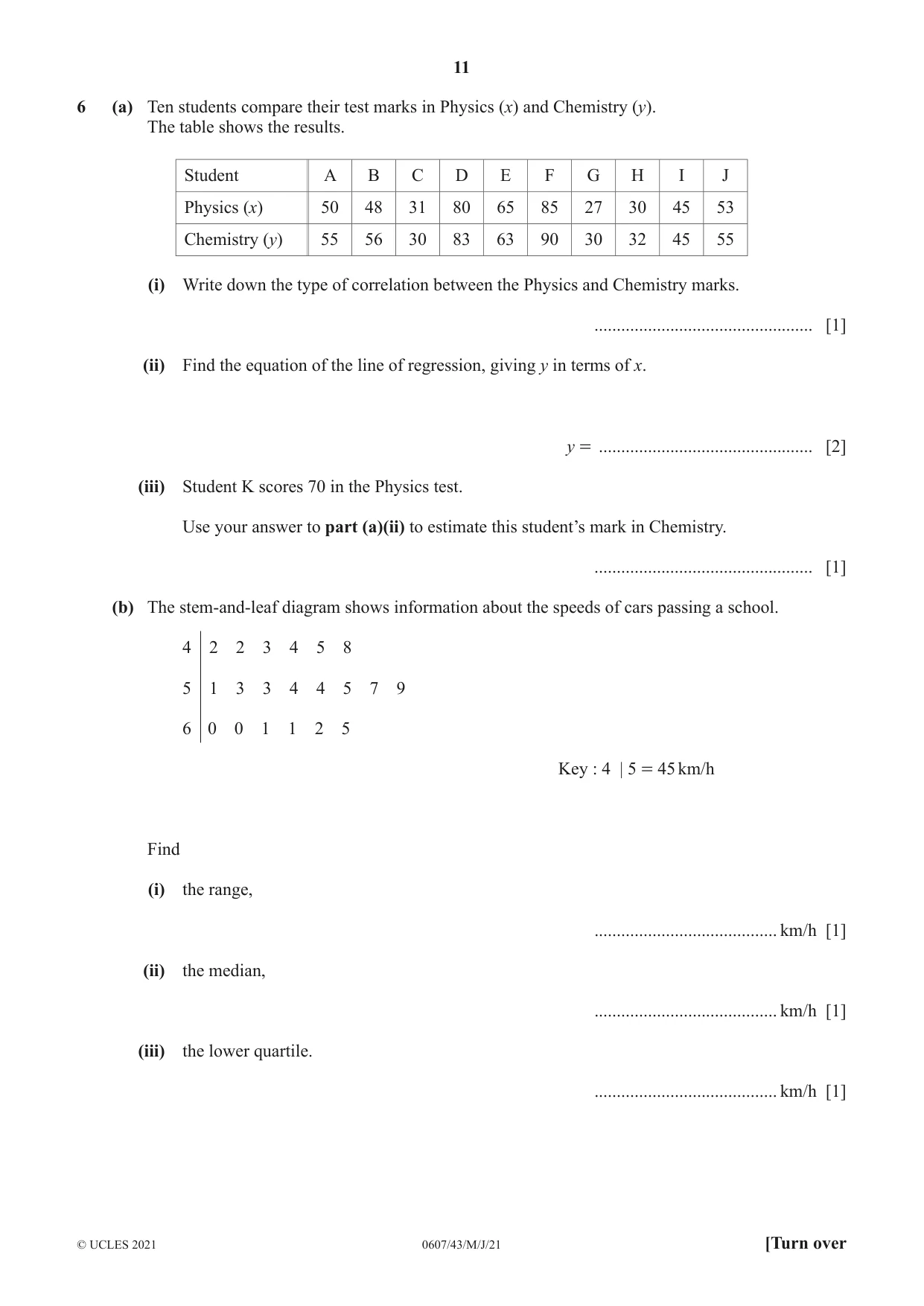
Q6 · Ten students compare their test marks in Physics (x) and Chemistry (y)
6 (a) Ten students compare their test marks in Physics (x) and Chemistry (y). The table shows the results. Student A B C D E F G H I J Physics (x) 50 48 31 80 65 85 27 30 45 53 Chemistry (y) 55 56 30 83 63 90 30 32 45 55 (i) Write down the type of correlation between the Physics and Chemistry marks. ................................................. [1] (ii) Find the equation of the line of regression, giving y in terms of x. y = ................................................ [2] (iii) Student K scores 70 in the Physics test. Use your answer to part (a)(ii) to estimate this student’s mark in Chemistry. ................................................. [1] (b) The stem-and-leaf diagram shows information about the speeds of cars passing a school. 4 2 2 3 4 5 8 5 1 3 3 4 4 5 7 9 6 0 0 1 1 2 5 Key : 4 | 5 = 45 km/h Find (i) the range, ......................................... km/h [1] (ii) the median, ......................................... km/h [1] (iii) the lower quartile. ......................................... km/h [1]
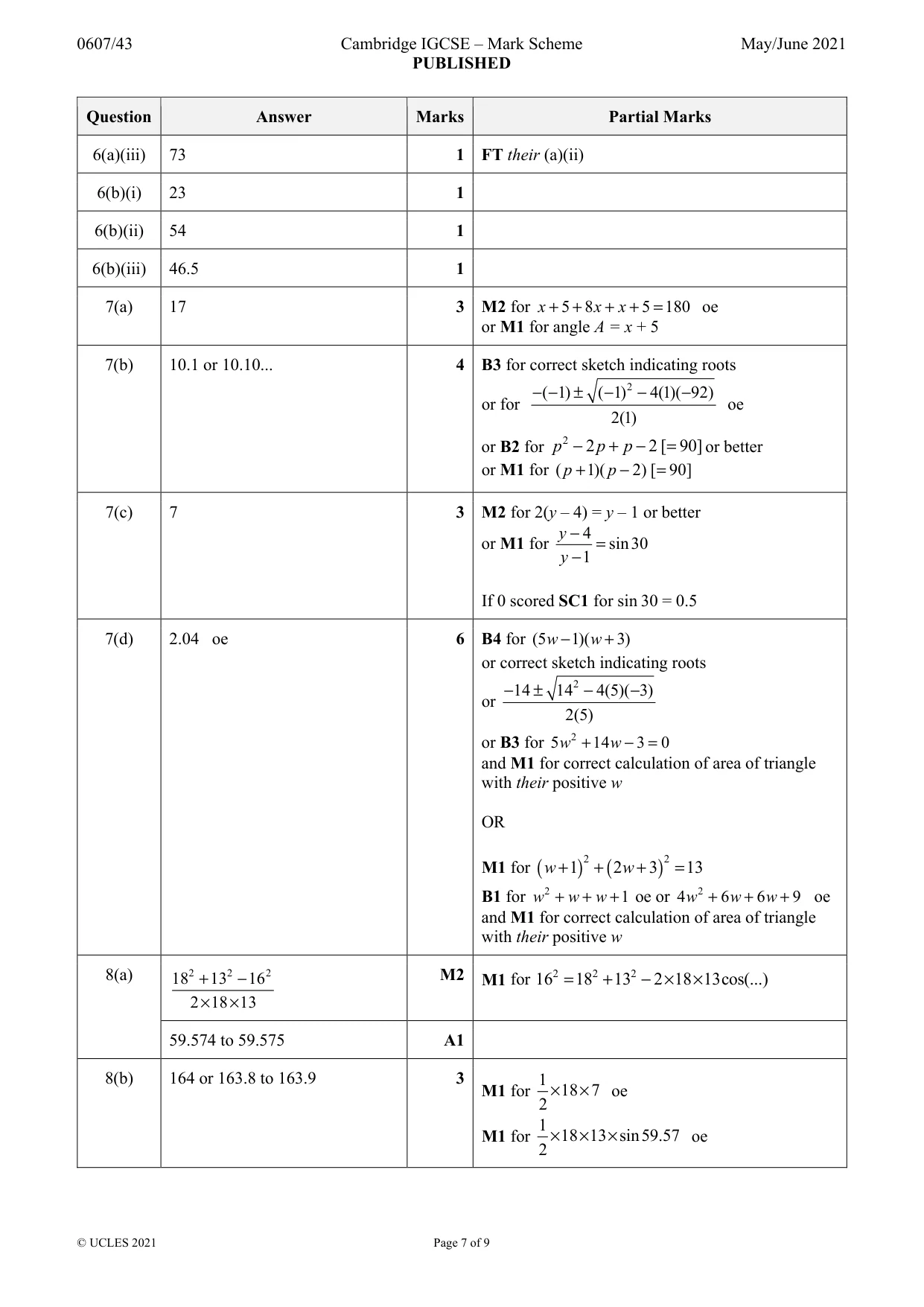
Mark scheme: 6(a)(i) Positive 1 6(a)(ii) 1.03x + 1.1[0] or 2 B1 for 1.03x + k or kx + 1.1[0] 1.027...x + 1.095... or 1.027...x + k or kx + 1.095... 6(a)(iii) 73 1 FT their (a)(ii) 6(b)(i) 23 1 6(b)(ii) 54 1 6(b)(iii) 46.5 1
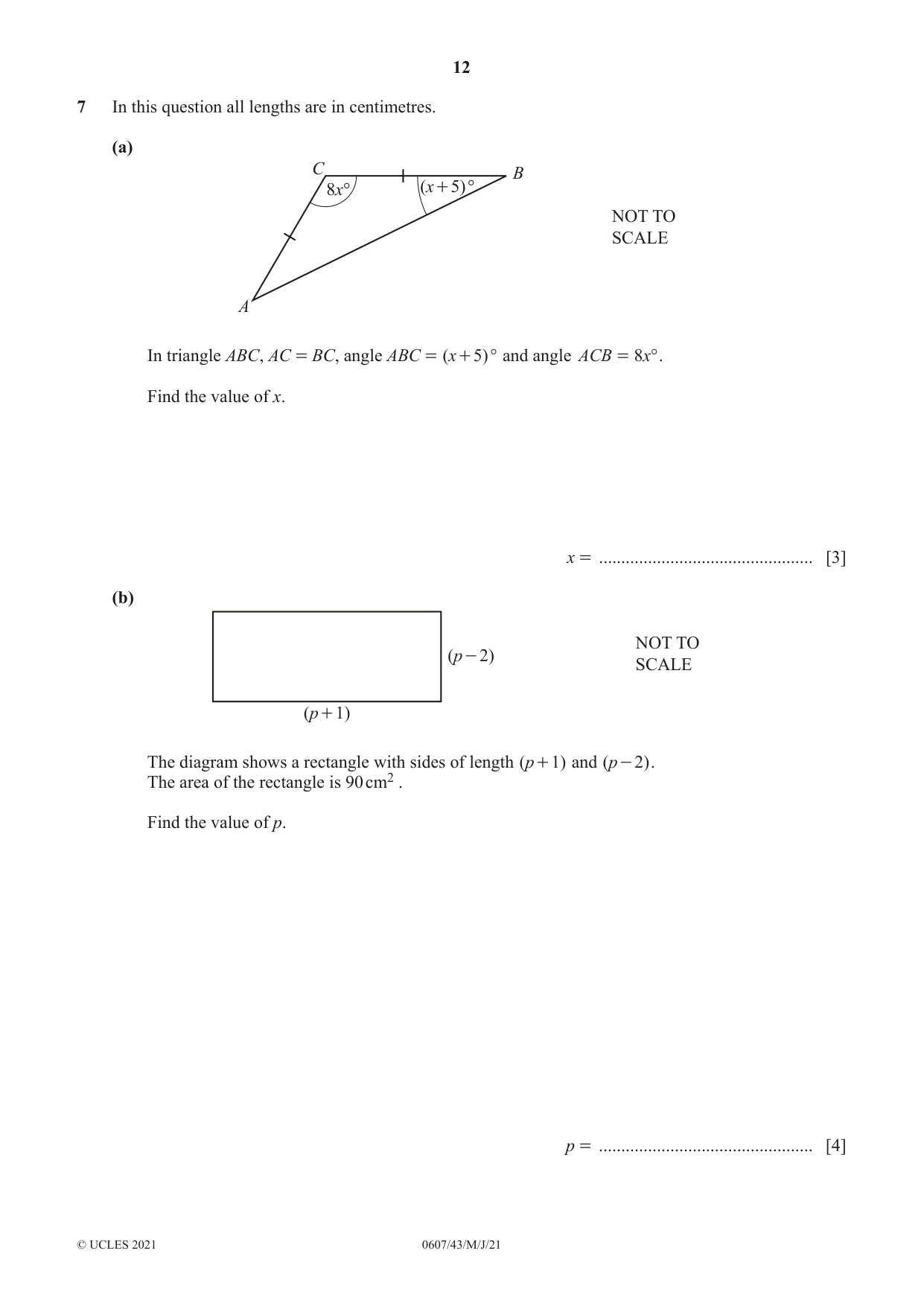
Q7 · In this question all lengths are in centimetres
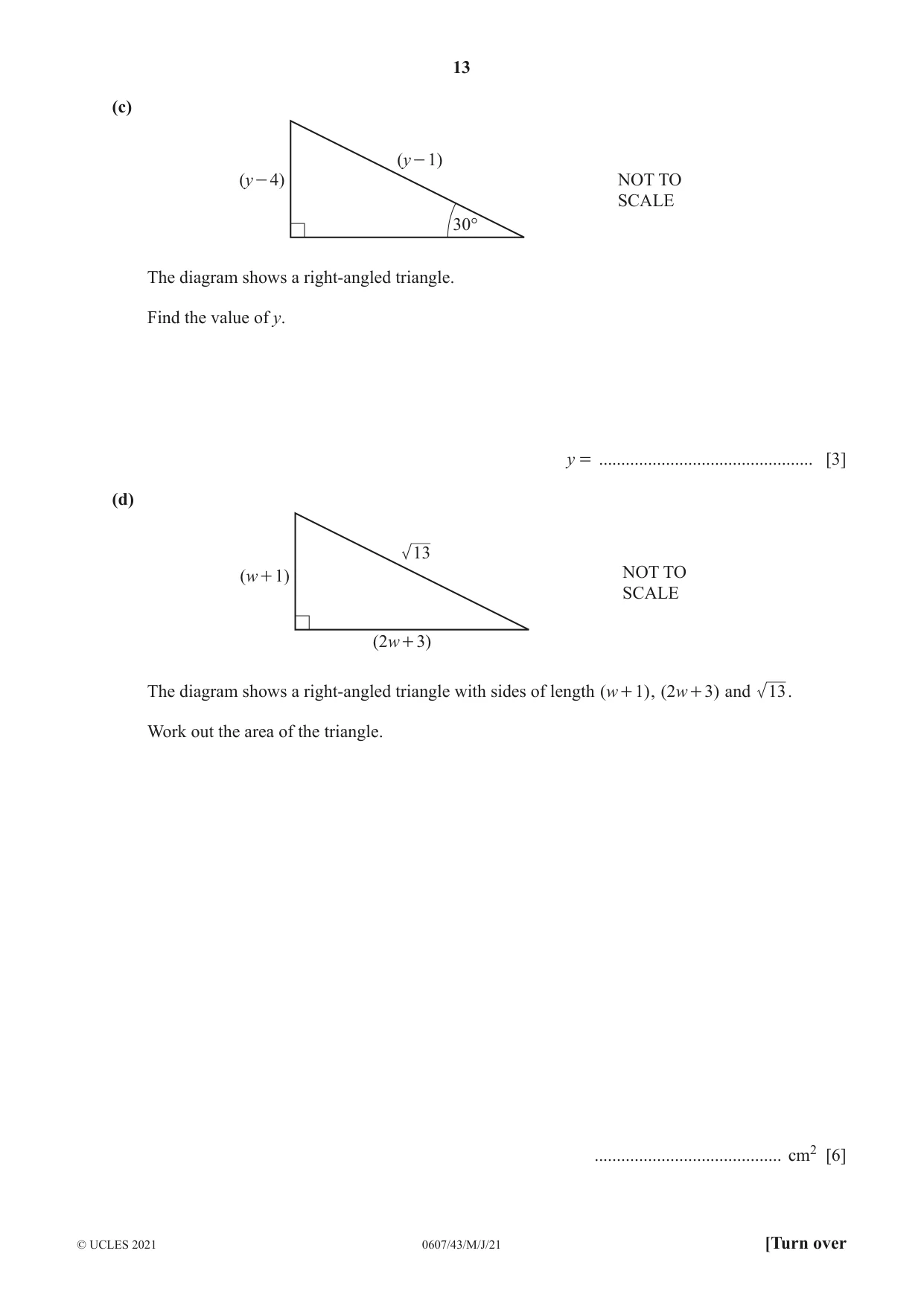
7 In this question all lengths are in centimetres. (a) C B 8x° ( x + 5 )° NOT TO SCALE A In triangle ABC, AC = BC, angle ABC = ( x + 5)° and angle ACB = 8x° . Find the value of x. x = ................................................ [3] (b) NOT TO ( p - 2) SCALE ( p + 1) The diagram shows a rectangle with sides of length ( p + 1) and ( p - 2) . The area of the rectangle is 90 cm2 . Find the value of p. p = ................................................ [4] (c) ( y - 1) ( y - 4) NOT TO SCALE 30° The diagram shows a right-angled triangle. Find the value of y. y = ................................................ [3] (d) 13 ( w + 1 ) NOT TO SCALE ( 2w + 3) The diagram shows a right-angled triangle with sides of length ( w + 1) , ( 2w + 3) and 13. Work out the area of the triangle. .......................................... cm2 [6]
Mark scheme: 7(a) 17 3 M2 for x + 5 + 8 x + x + 5 = 180 oe or M1 for angle A = x + 5 7(b) 10.1 or 10.10... 4 B3 for correct sketch indicating roots −−( 1) ± ( − 1) 2 − 4(1)( − 92) or for oe 2(1) or B2 for p 2 − 2 p + p − 2 [ = 90] or better or M1 for ( p + 1)( p − 2) [ = 90] 7(c) 7 3 M2 for 2(y – 4) = y – 1 or better y − 4 or M1 for = sin30 y − 1 If 0 scored SC1 for sin 30 = 0.5 7(d) 2.04 oe 6 B4 for (5 w − 1)( w + 3) or correct sketch indicating roots − 14 ± 14 2 − 4(5)( −3) or 2(5) or B3 for 5 w 2 + 14 w − 3 = 0 and M1 for correct calculation of area of triangle with their positive w OR 2 2 M1 for ( w + 1) + ( 2 w + 3 ) = 13 B1 for w 2 + w + w + 1 oe or 4 w 2 + 6 w + 6 w + 9 oe and M1 for correct calculation of area of triangle with their positive w
Q8 · D 7 cm NOT TO C SCALE 18 cm A 13 cm 16 cm B (a) Calculate angle BCA and show that it…
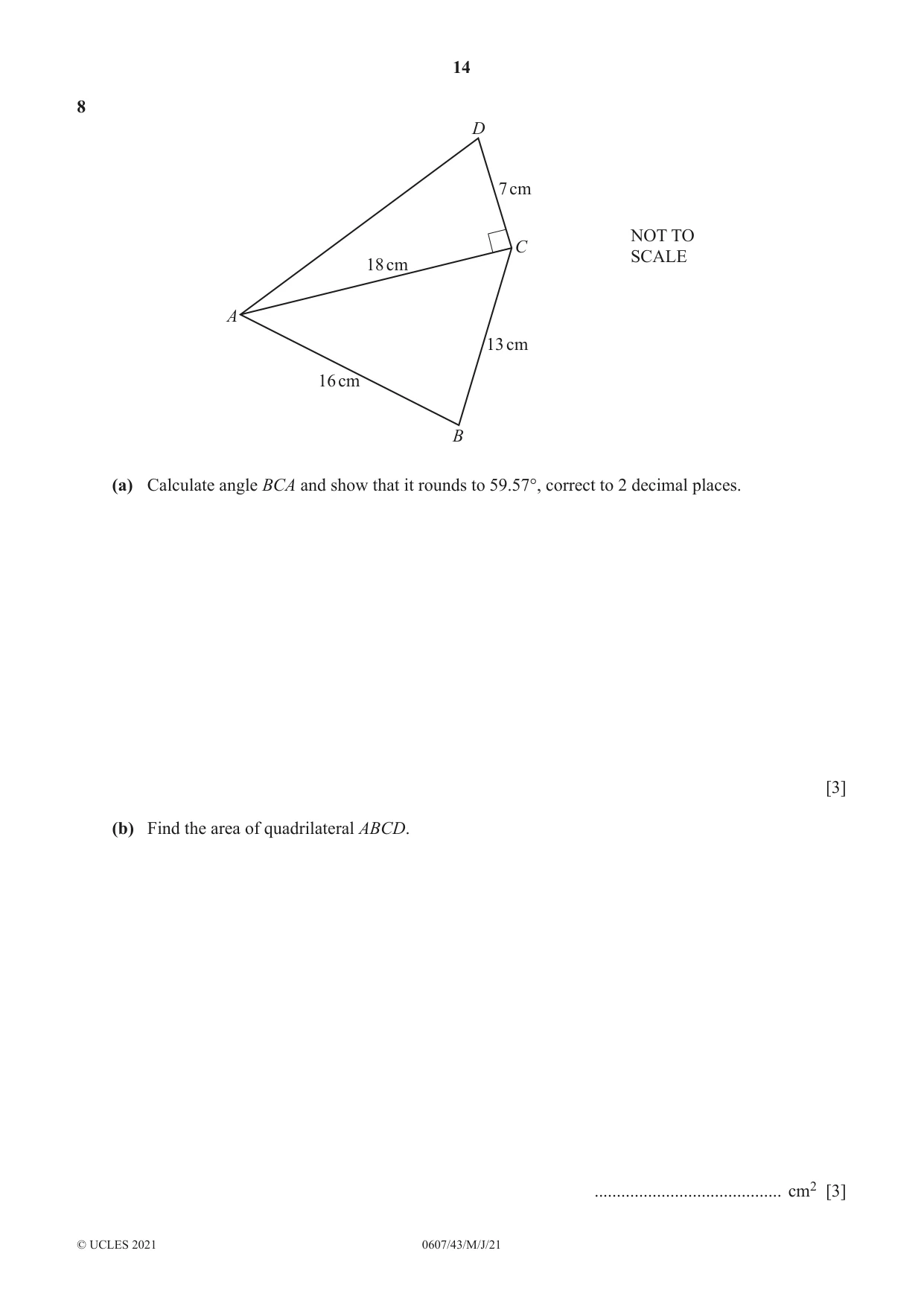
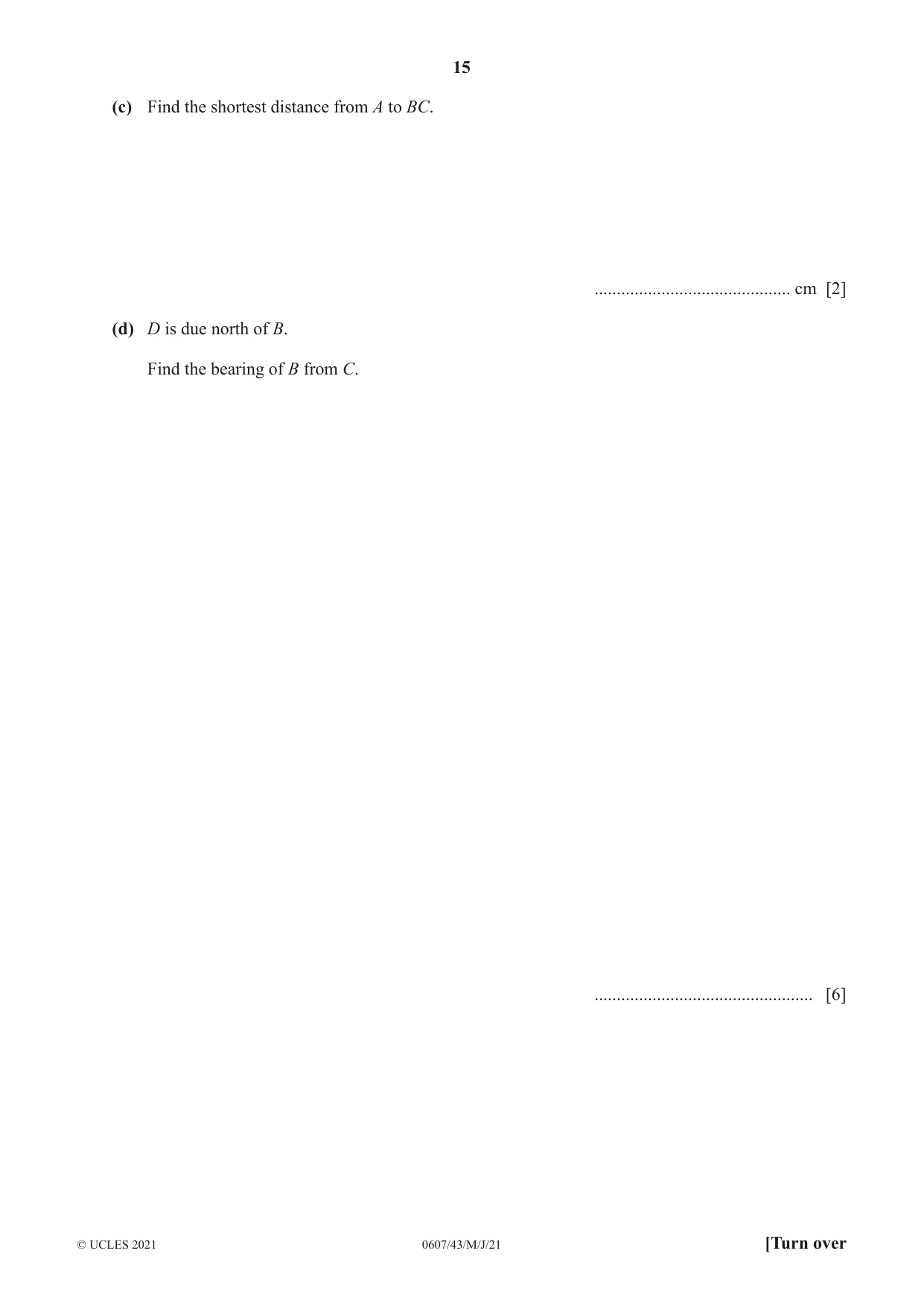
8 D 7 cm NOT TO C SCALE 18 cm A 13 cm 16 cm B (a) Calculate angle BCA and show that it rounds to 59.57°, correct to 2 decimal places. [3] (b) Find the area of quadrilateral ABCD. .......................................... cm2 [3] (c) Find the shortest distance from A to BC. ............................................ cm [2] (d) D is due north of B. Find the bearing of B from C. ................................................. [6]
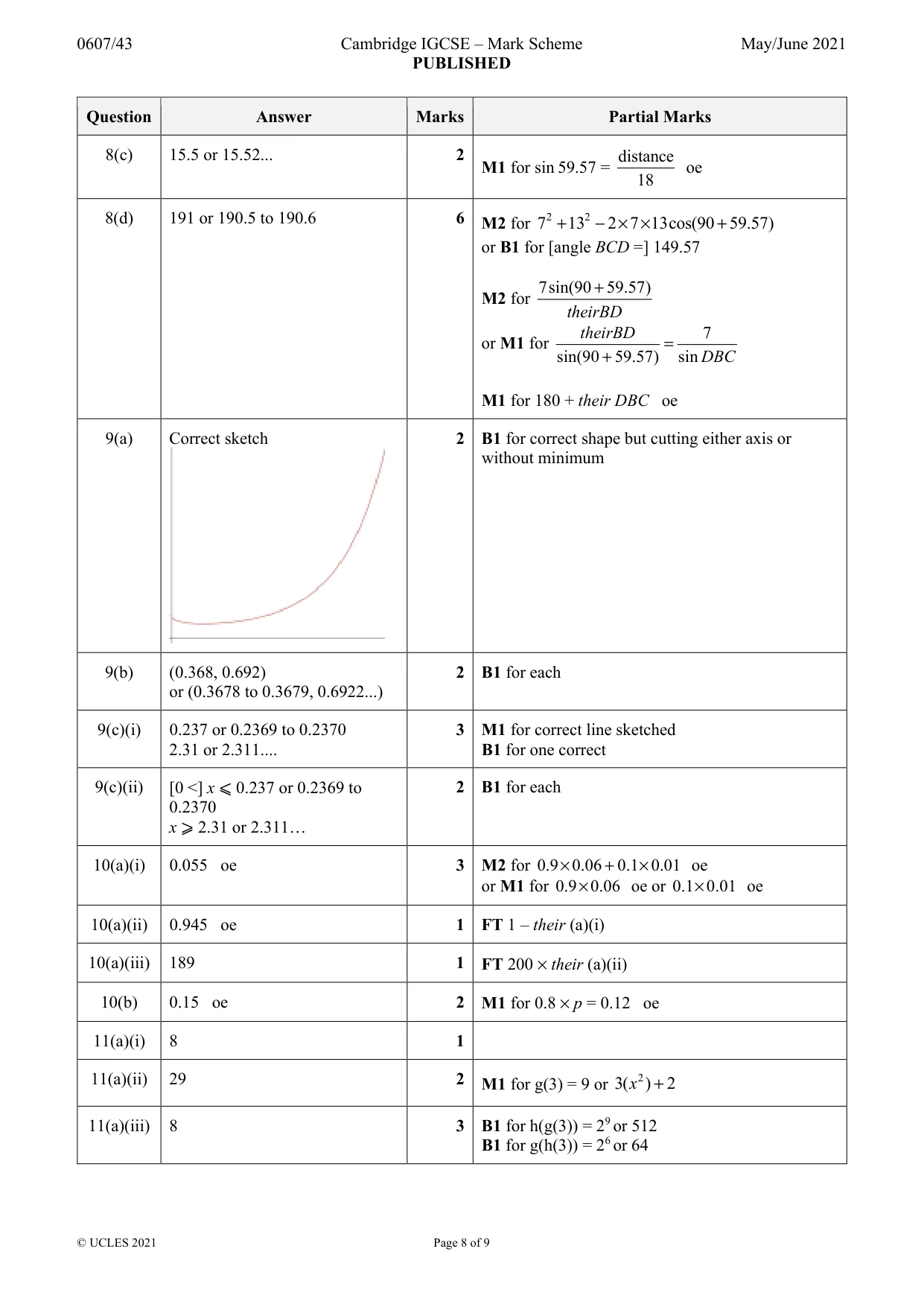
Mark scheme: 8(a) 18 2 + 132 − 16 2 M2 M1 for 16 2 = 182 + 132 −×2 18 × 13cos(...) 2 × 18 × 13 59.574 to 59.575 A1 8(b) 164 or 163.8 to 163.9 3 1 M1 for × 18 × 7 oe 2 1 M1 for × 18 × 13 × sin59.57 oe 2 8(c) 15.5 or 15.52... 2 distance M1 for sin 59.57 = oe 18 8(d) 191 or 190.5 to 190.6 6 M2 for 7 2 + 132 −×2 7 × 13cos(90 + 59.57) or B1 for [angle BCD =] 149.57 7sin(90 + 59.57) M2 for theirBD theirBD 7 or M1 for = sin(90 + 59.57) sin DBC M1 for 180 + their DBC oe
Q9 · Y 10 0 x 2.5 f ( x) = x x, x 2 0 (a) On the diagram, sketch the graph of y = f(x) for 0 1…
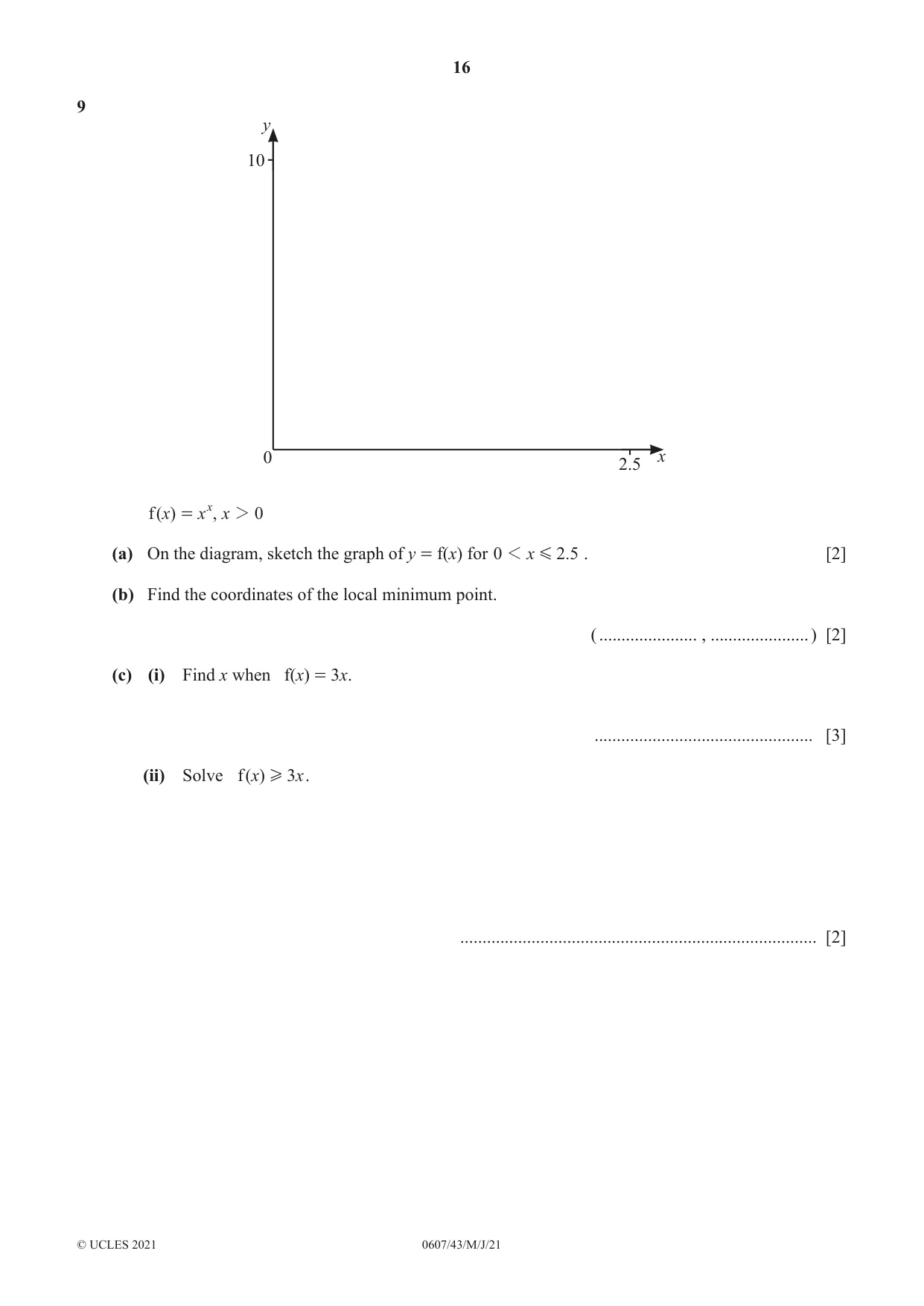
9 y 10 0 x 2.5 f ( x) = x x, x 2 0 (a) On the diagram, sketch the graph of y = f(x) for 0 1 x G 2.5 . [2] (b) Find the coordinates of the local minimum point. ( ...................... , ...................... ) [2] (c) (i) Find x when f(x) = 3x. ................................................. [3] (ii) Solve f ( )x H 3x . ................................................................................ [2]
Mark scheme: 9(a) Correct sketch 2 B1 for correct shape but cutting either axis or without minimum 9(b) (0.368, 0.692) 2 B1 for each or (0.3678 to 0.3679, 0.6922...) 9(c)(i) 0.237 or 0.2369 to 0.2370 3 M1 for correct line sketched 2.31 or 2.311.... B1 for one correct 9(c)(ii) [0 <] x ⩽ 0.237 or 0.2369 to 2 B1 for each 0.2370 x ⩾ 2.31 or 2.311…
Q10 · Kris can go to school by bus or by taxi
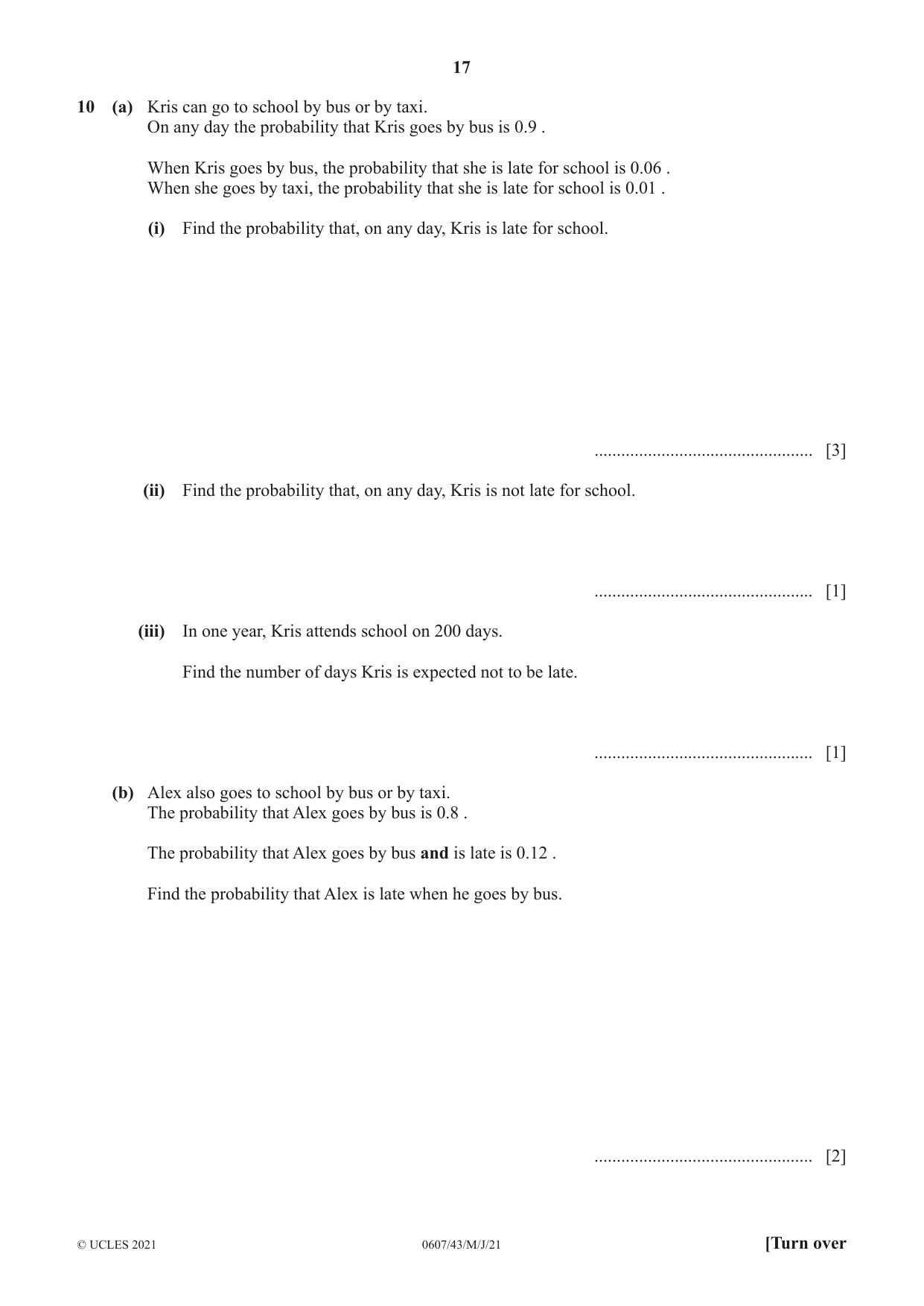
10 (a) Kris can go to school by bus or by taxi. On any day the probability that Kris goes by bus is 0.9 . When Kris goes by bus, the probability that she is late for school is 0.06 . When she goes by taxi, the probability that she is late for school is 0.01 . (i) Find the probability that, on any day, Kris is late for school. ................................................. [3] (ii) Find the probability that, on any day, Kris is not late for school. ................................................. [1] (iii) In one year, Kris attends school on 200 days. Find the number of days Kris is expected not to be late. ................................................. [1] (b) Alex also goes to school by bus or by taxi. The probability that Alex goes by bus is 0.8 . The probability that Alex goes by bus and is late is 0.12 . Find the probability that Alex is late when he goes by bus. ................................................. [2]
Mark scheme: 10(a)(i) 0.055 oe 3 M2 for 0.9 × 0.06 + 0.1 × 0.01 oe or M1 for 0.9 × 0.06 oe or 0.1 × 0.01 oe 10(a)(ii) 0.945 oe 1 FT 1 – their (a)(i) 10(a)(iii) 189 1 FT 200 × their (a)(ii) 10(b) 0.15 oe 2 M1 for 0.8 × p = 0.12 oe
Q11 · F(x) = 3x + 2 g(x) = x2 h(x) = 2x (i) Find f(2)
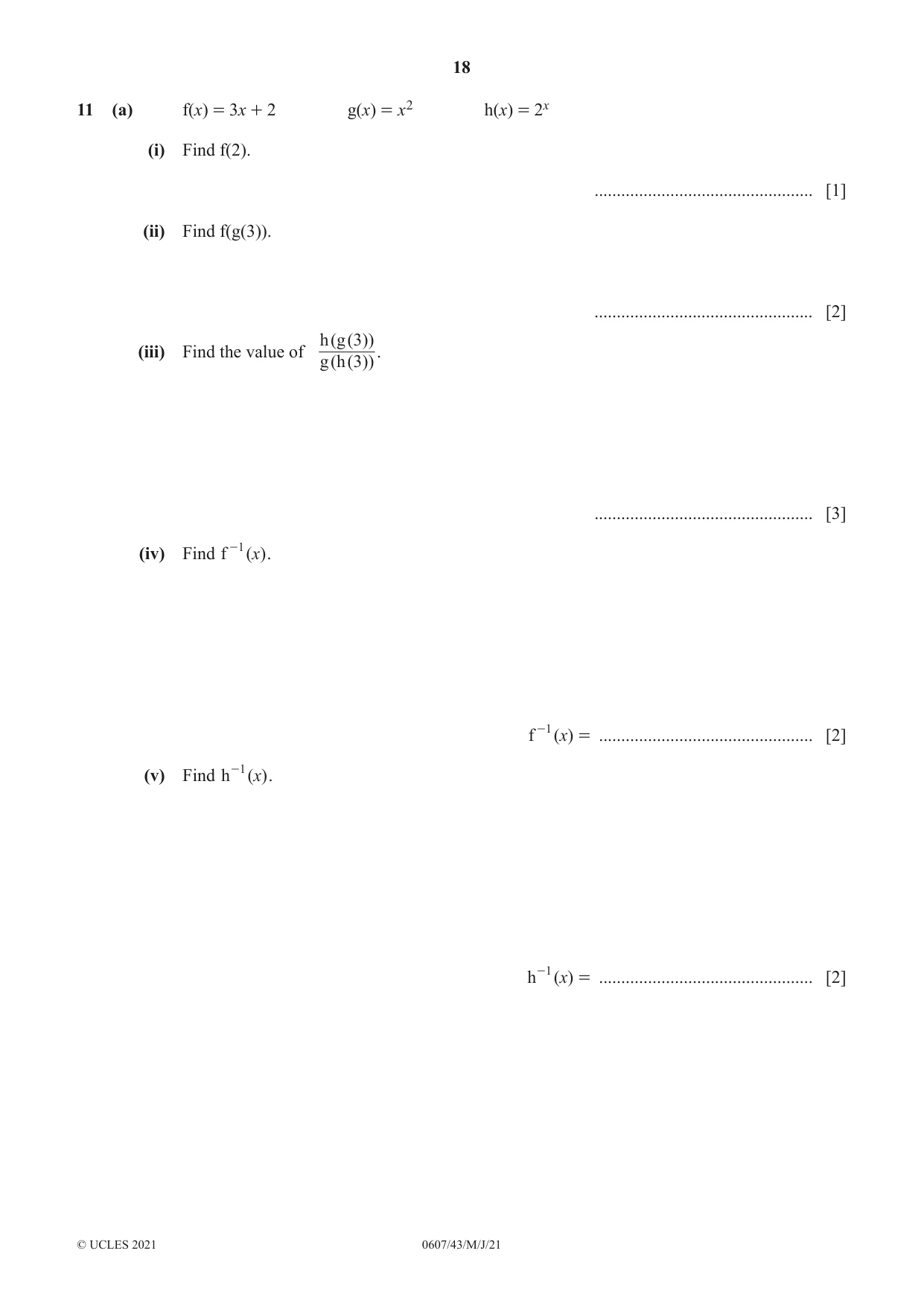
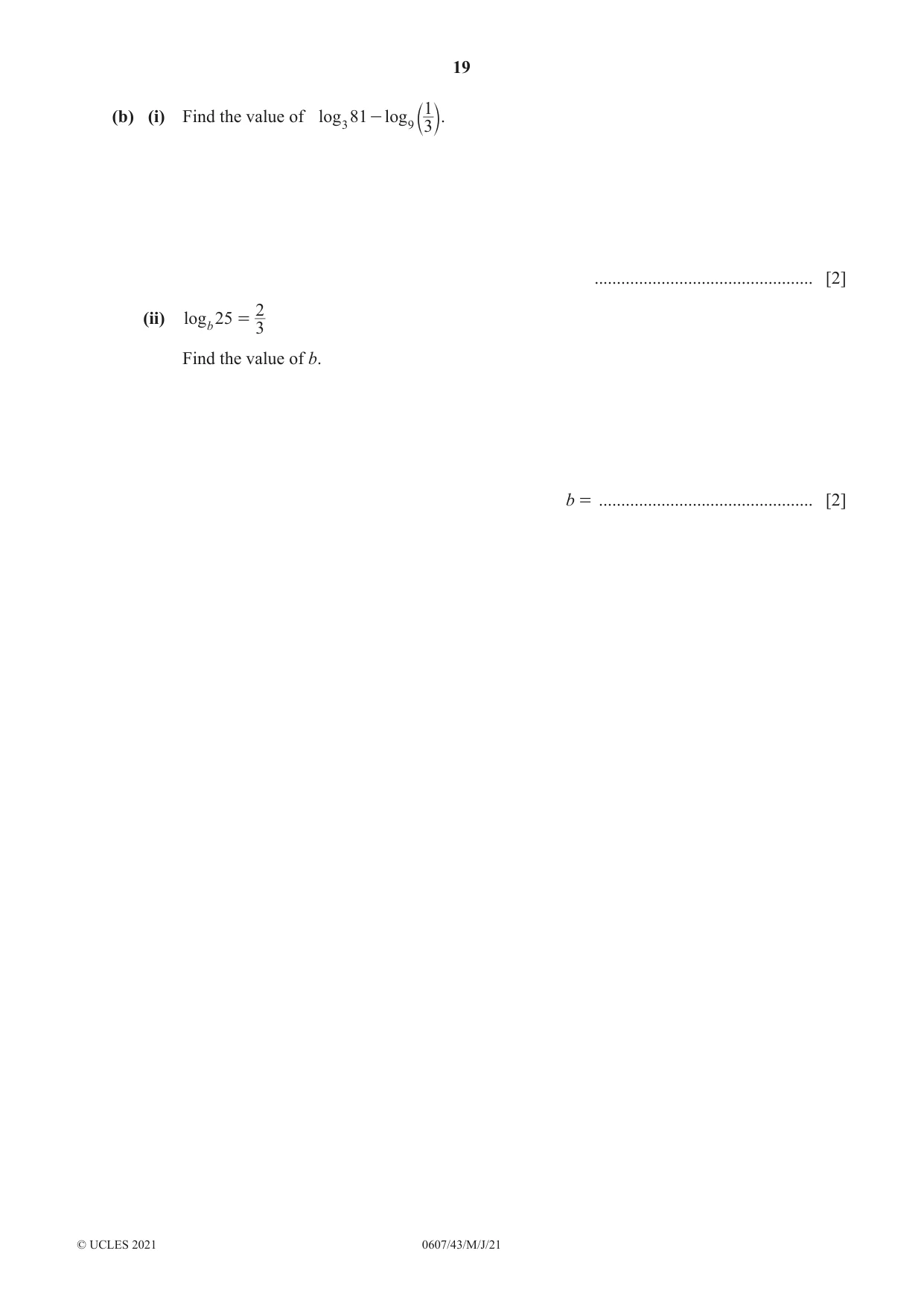
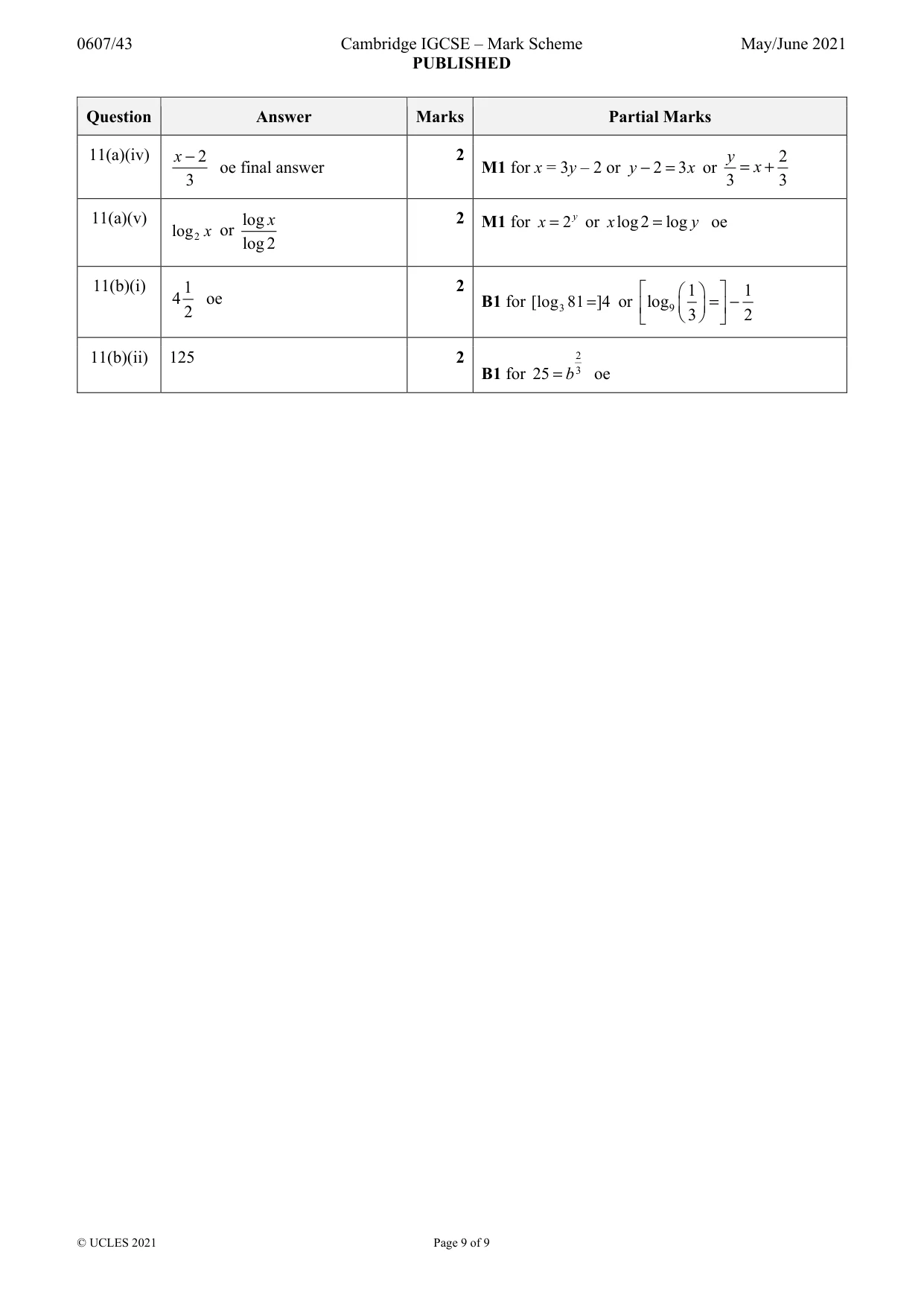
11 (a) f(x) = 3x + 2 g(x) = x2 h(x) = 2x (i) Find f(2). ................................................. [1] (ii) Find f(g(3)). ................................................. [2] h ( g ( 3)) (iii) Find the value of . g ( h ( 3)) ................................................. [3] (iv) Find f -1 ( )x . f -1 ( )x = ................................................ [2] (v) Find h -1 ( )x . h -1 ( )x = ................................................ [2] 1(b) (i) Find the value of log 3 81 - log 9 3 b l. ................................................. [2] 2 (ii) log b 25 = 3 Find the value of b. b = ................................................ [2]
Mark scheme: 11(a)(i) 8 1 11(a)(ii) 29 2 M1 for g(3) = 9 or 3( x 2 ) + 2 11(a)(iii) 8 3 B1 for h(g(3)) = 29 or 512 B1 for g(h(3)) = 26 or 64 11(a)(iv) x − 2 2 y 2 oe final answer M1 for x = 3y – 2 or y − 2 = 3 x or = x + 3 3 3 11(a)(v) log x 2 M1 for x = 2y or x log2 = log y oe log 2 x or log 2 11(b)(i) 1 2 1 1 = 4 oe B1 for [log 3 81 = ]4 or log 9 − 2 3 2 11(b)(ii) 125 2 2 B1 for 25 = b 3 oe
What was in this paper
The subtopics covered by these 11 questions, and how many questions each got. Open one in a new tab to see every Cambridge question on it.
What you needed in this session
Cambridge’s own grade thresholds for 2021 May/June, Paper 4 · Variant 3. A higher threshold means an easier paper — the bar moves with how the cohort did.