Cambridge IGCSE Mathematics - International 0607 — 2020 Oct/Nov Paper 4 · Variant 3
0607/43/O/N/20 · 11 questions · 120 marks · ≈135 min
The question paper and its mark scheme, free to read here and free to download. This is Cambridge’s own paper, exactly as it was sat.
Question paper20 pages
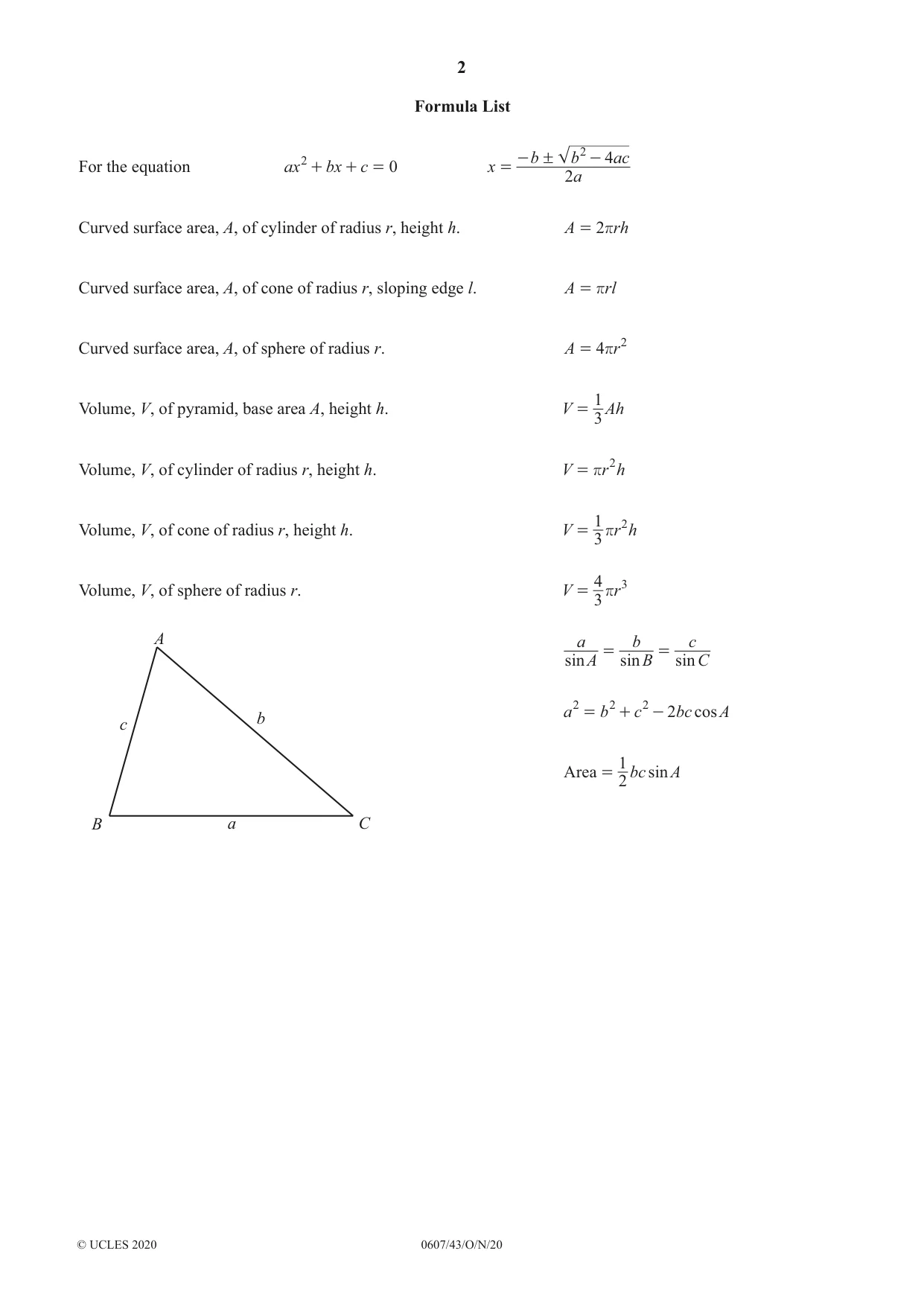
Mark scheme8 pages
Answers below. Sit the paper first if you are practising.
Questions as text
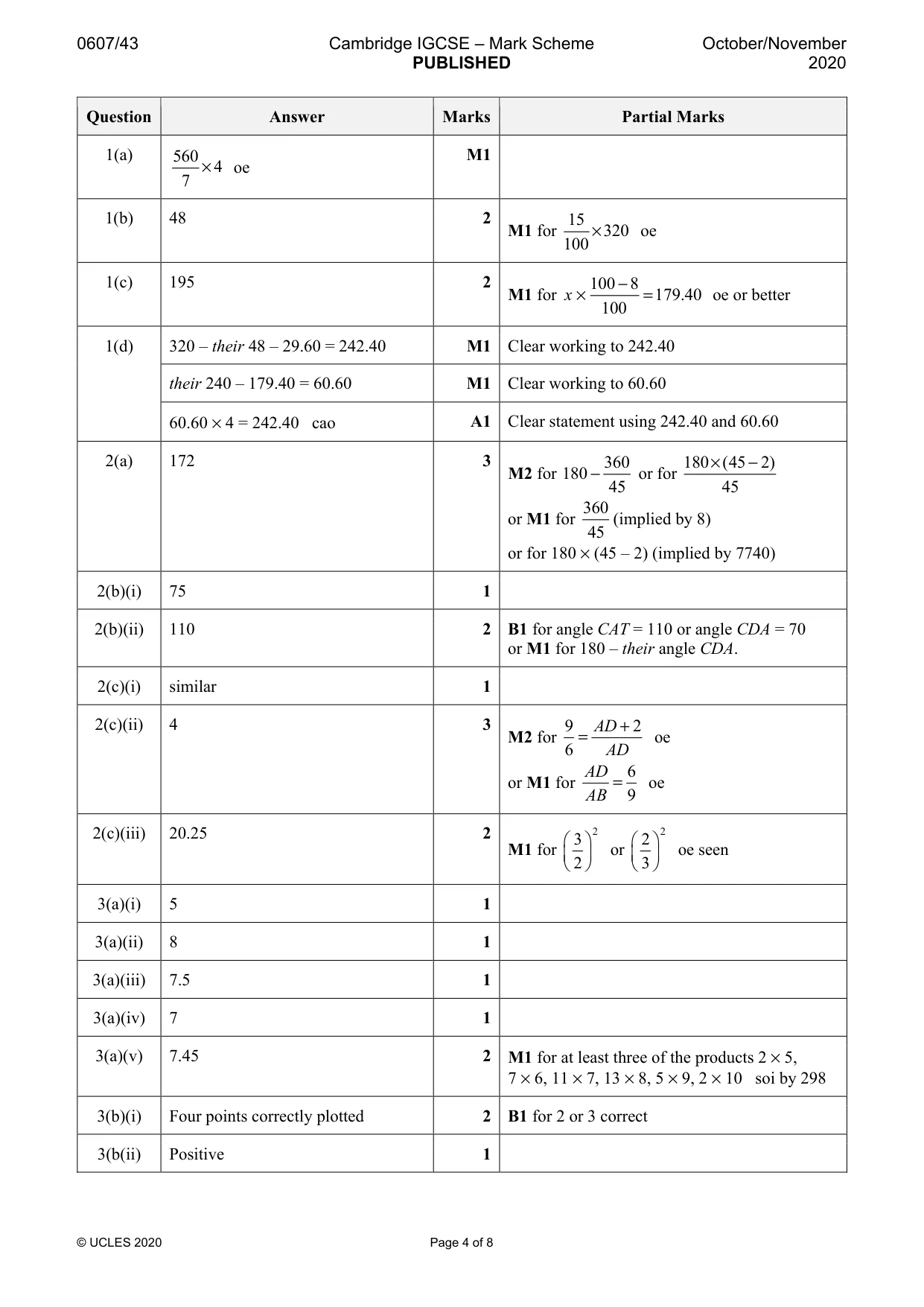
Q1 · Adam and Brenda share $560 in the ratio Adam : Brenda = 4 : 3
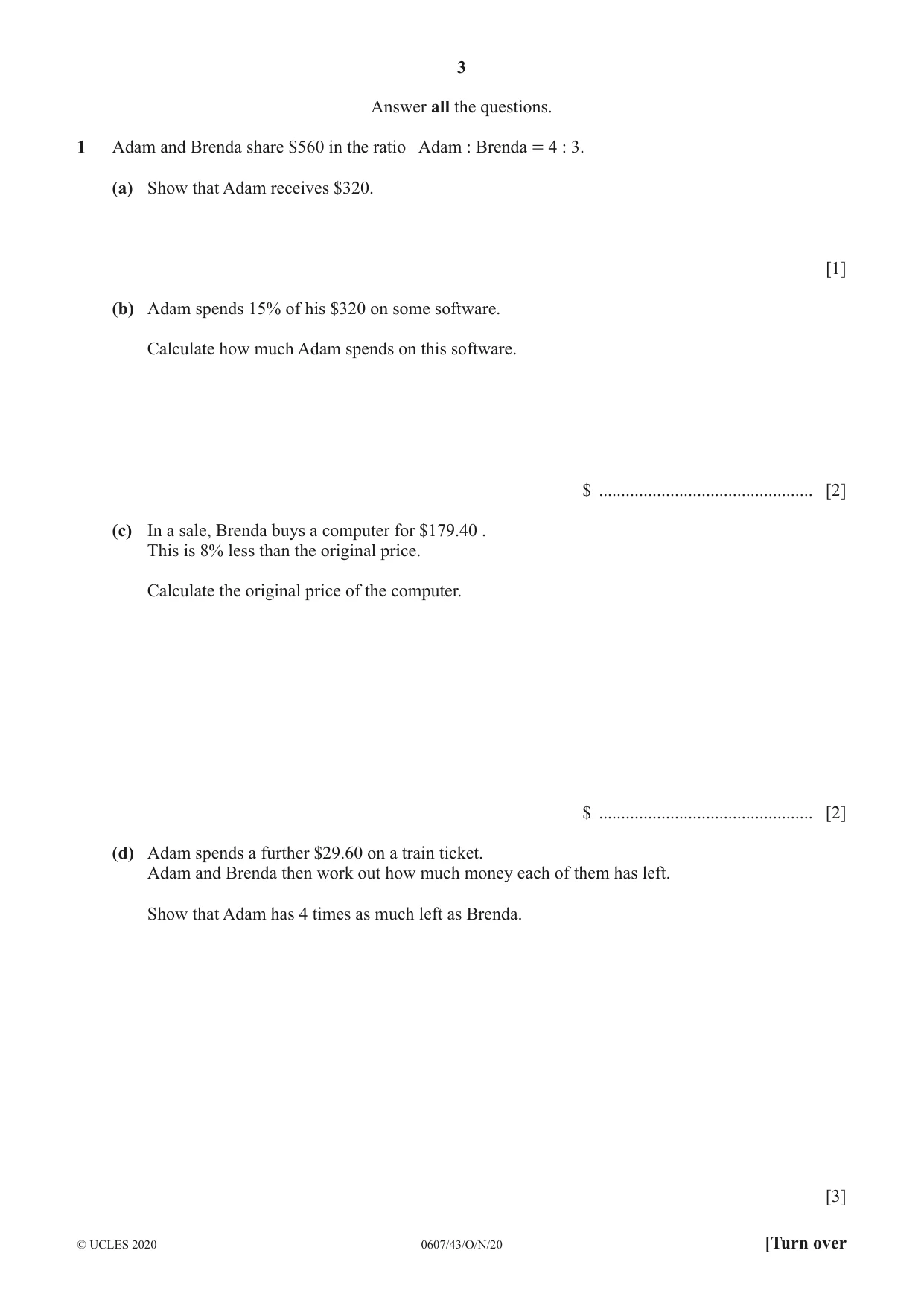
1 Adam and Brenda share $560 in the ratio Adam : Brenda = 4 : 3. (a) Show that Adam receives $320. [1] (b) Adam spends 15% of his $320 on some software. Calculate how much Adam spends on this software. $ ................................................ [2] (c) In a sale, Brenda buys a computer for $179.40 . This is 8% less than the original price. Calculate the original price of the computer. $ ................................................ [2] (d) Adam spends a further $29.60 on a train ticket. Adam and Brenda then work out how much money each of them has left. Show that Adam has 4 times as much left as Brenda. [3]
Mark scheme: Question Answer Marks Partial Marks 1(a) 560 M1 × 4 oe 7 1(b) 48 2 15 M1 for × 320 oe 100 1(c) 195 2 100 − 8 M1 for x × = 179.40 oe or better 100 1(d) 320 – their 48 – 29.60 = 242.40 M1 Clear working to 242.40 their 240 – 179.40 = 60.60 M1 Clear working to 60.60 60.60 × 4 = 242.40 cao A1 Clear statement using 242.40 and 60.60
Q2 · Find the size of one interior angle of a regular polygon with 45 sides
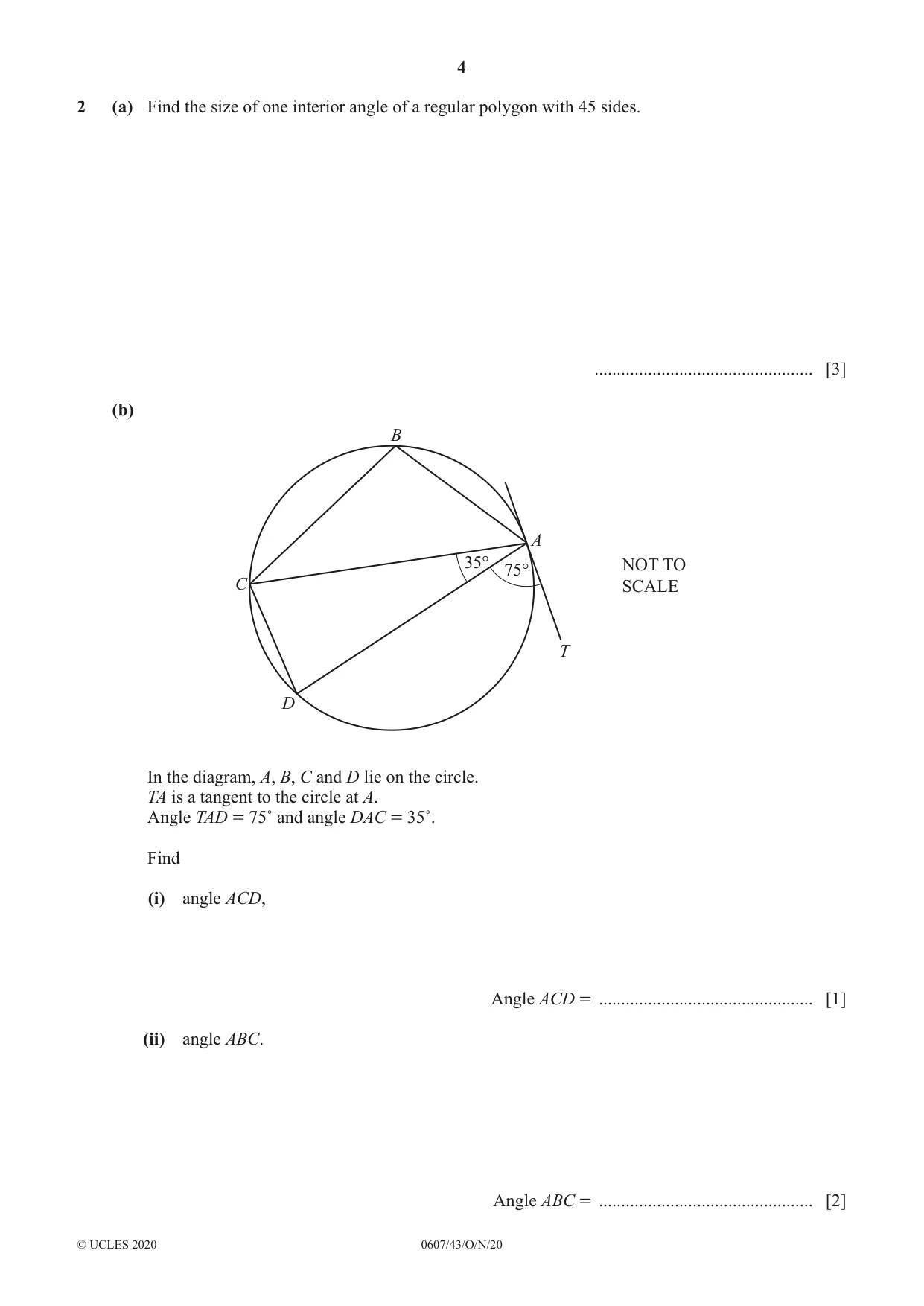
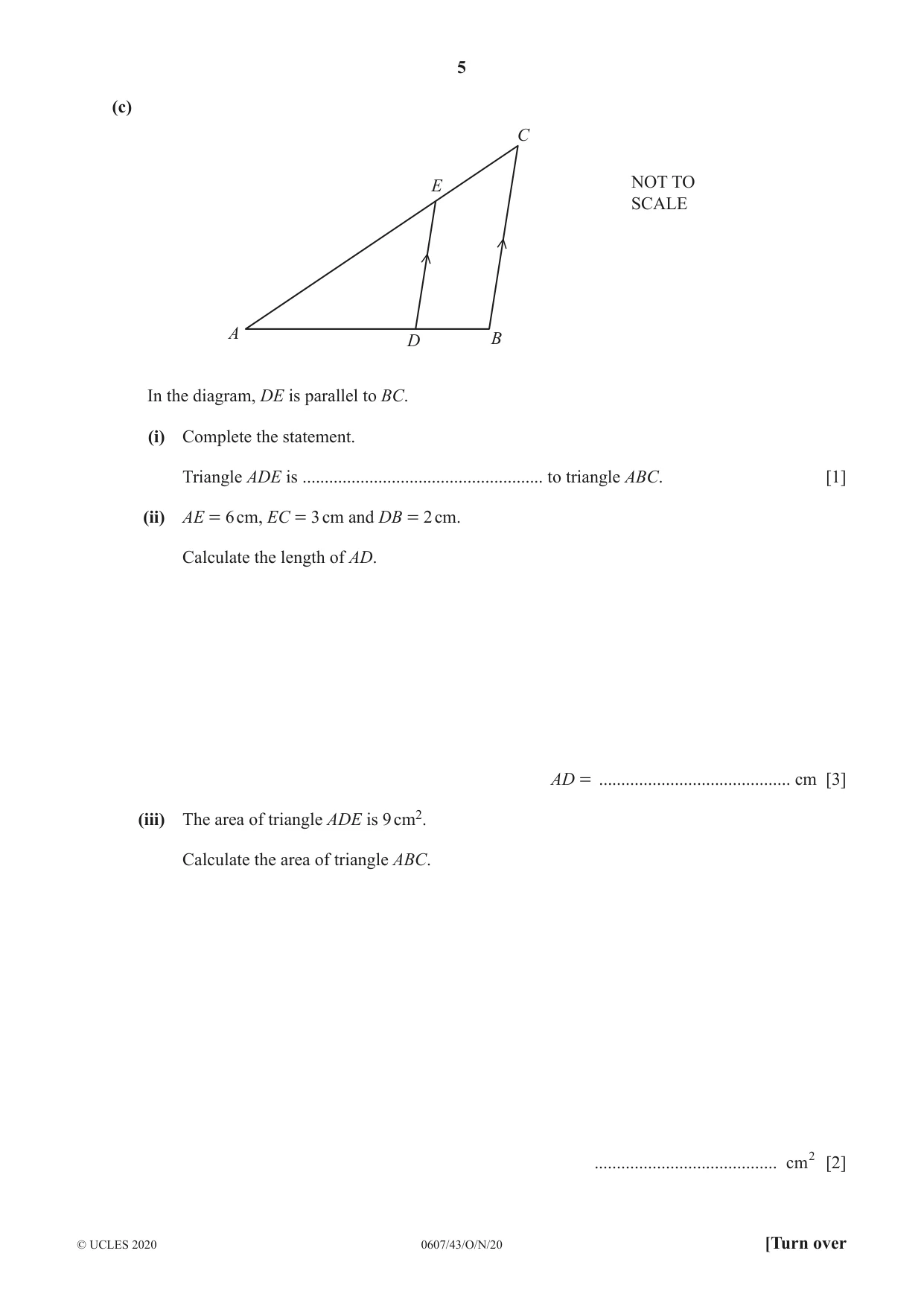
2 (a) Find the size of one interior angle of a regular polygon with 45 sides. ................................................. [3] (b) B A 35° NOT TO 75° C SCALE T D In the diagram, A, B, C and D lie on the circle. TA is a tangent to the circle at A. Angle TAD = 75˚ and angle DAC = 35˚. Find (i) angle ACD, Angle ACD = ................................................ [1] (ii) angle ABC. Angle ABC = ................................................ [2] (c) C E NOT TO SCALE A D B In the diagram, DE is parallel to BC. (i) Complete the statement. Triangle ADE is ...................................................... to triangle ABC. [1] (ii) AE = 6 cm, EC = 3 cm and DB = 2 cm. Calculate the length of AD. AD = ........................................... cm [3] (iii) The area of triangle ADE is 9 cm2. Calculate the area of triangle ABC. ......................................... cm2 [2]
Mark scheme: 2(a) 172 3 360 180 × (45 − 2) M2 for 180 − or for 45 45 360 or M1 for (implied by 8) 45 or for 180 × (45 – 2) (implied by 7740) 2(b)(i) 75 1 2(b)(ii) 110 2 B1 for angle CAT = 110 or angle CDA = 70 or M1 for 180 – their angle CDA. 2(c)(i) similar 1 2(c)(ii) 4 3 9 AD + 2 M2 for = oe 6 AD AD 6 or M1 for = oe AB 9 2(c)(iii) 20.25 2 2 2 3 2 M1 for or oe seen 2 3
Q3 · Eva records her science homework marks during the school year
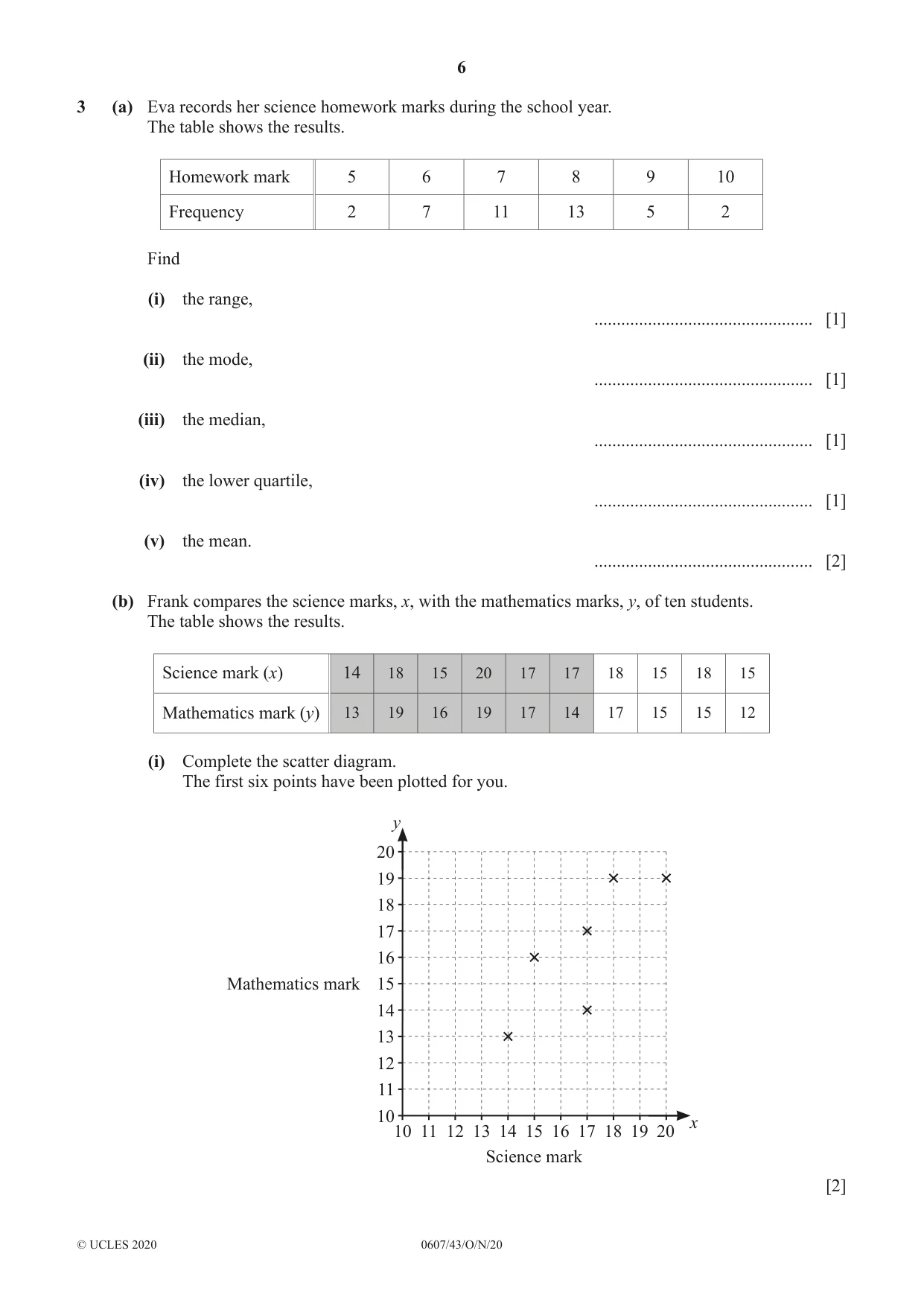
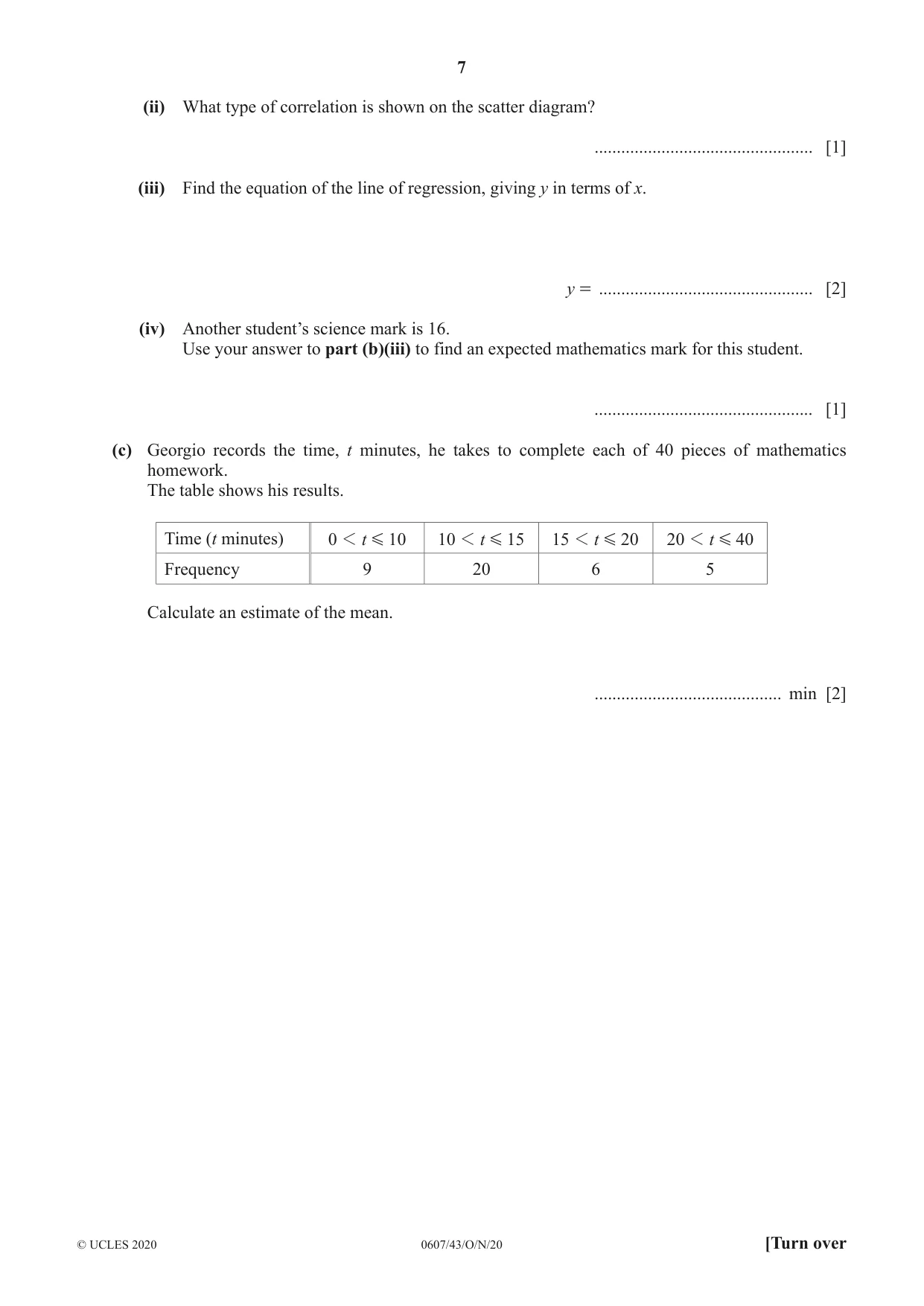
3 (a) Eva records her science homework marks during the school year. The table shows the results. Homework mark 5 6 7 8 9 10 Frequency 2 7 11 13 5 2 Find (i) the range, ................................................. [1] (ii) the mode, ................................................. [1] (iii) the median, ................................................. [1] (iv) the lower quartile, ................................................. [1] (v) the mean. ................................................. [2] (b) Frank compares the science marks, x, with the mathematics marks, y, of ten students. The table shows the results. Science mark (x) 14 18 15 20 17 17 18 15 18 15 Mathematics mark (y) 13 19 16 19 17 14 17 15 15 12 (i) Complete the scatter diagram. The first six points have been plotted for you. y 20 19 18 17 16 Mathematics mark 15 14 13 12 11 10 x 10 11 12 13 14 15 16 17 18 19 20 Science mark [2] (ii) What type of correlation is shown on the scatter diagram? ................................................. [1] (iii) Find the equation of the line of regression, giving y in terms of x. y = ................................................ [2] (iv) Another student’s science mark is 16. Use your answer to part (b)(iii) to find an expected mathematics mark for this student. ................................................. [1] (c) Georgio records the time, t minutes, he takes to complete each of 40 pieces of mathematics homework. The table shows his results. Time (t minutes) 0 1 t G 10 10 1 t G 15 15 1 t G 20 20 1 t G 40 Frequency 9 20 6 5 Calculate an estimate of the mean. .......................................... min [2]
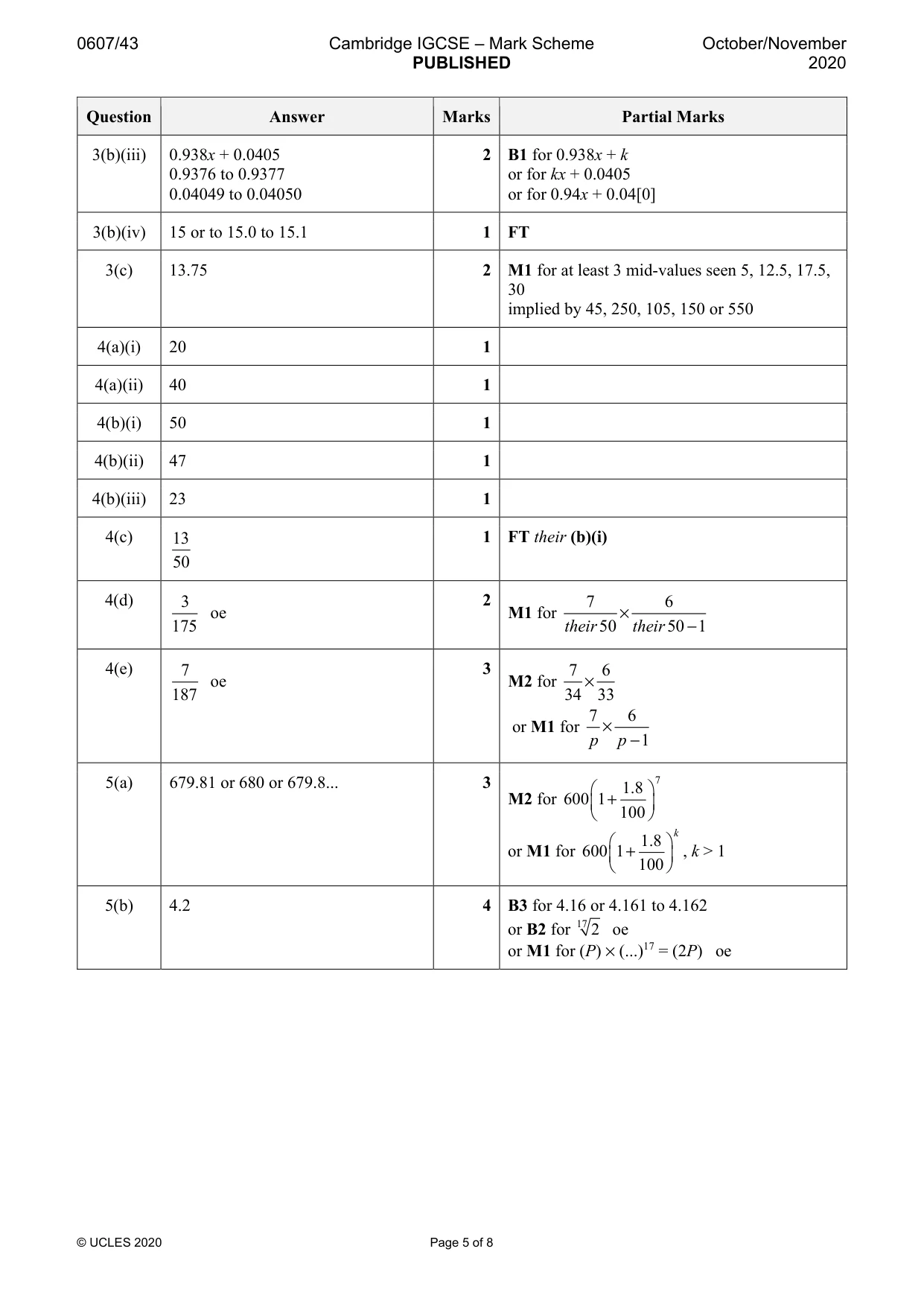
Mark scheme: 3(a)(i) 5 1 3(a)(ii) 8 1 3(a)(iii) 7.5 1 3(a)(iv) 7 1 3(a)(v) 7.45 2 M1 for at least three of the products 2 × 5, 7 × 6, 11 × 7, 13 × 8, 5 × 9, 2 × 10 soi by 298 3(b)(i) Four points correctly plotted 2 B1 for 2 or 3 correct 3(b(ii) Positive 1 3(b)(iii) 0.938x + 0.0405 2 B1 for 0.938x + k 0.9376 to 0.9377 or for kx + 0.0405 0.04049 to 0.04050 or for 0.94x + 0.04[0] 3(b)(iv) 15 or to 15.0 to 15.1 1 FT 3(c) 13.75 2 M1 for at least 3 mid-values seen 5, 12.5, 17.5, 30 implied by 45, 250, 105, 150 or 550
Q4 · The Venn diagram shows the number of students who like sweets (S) and the number of…
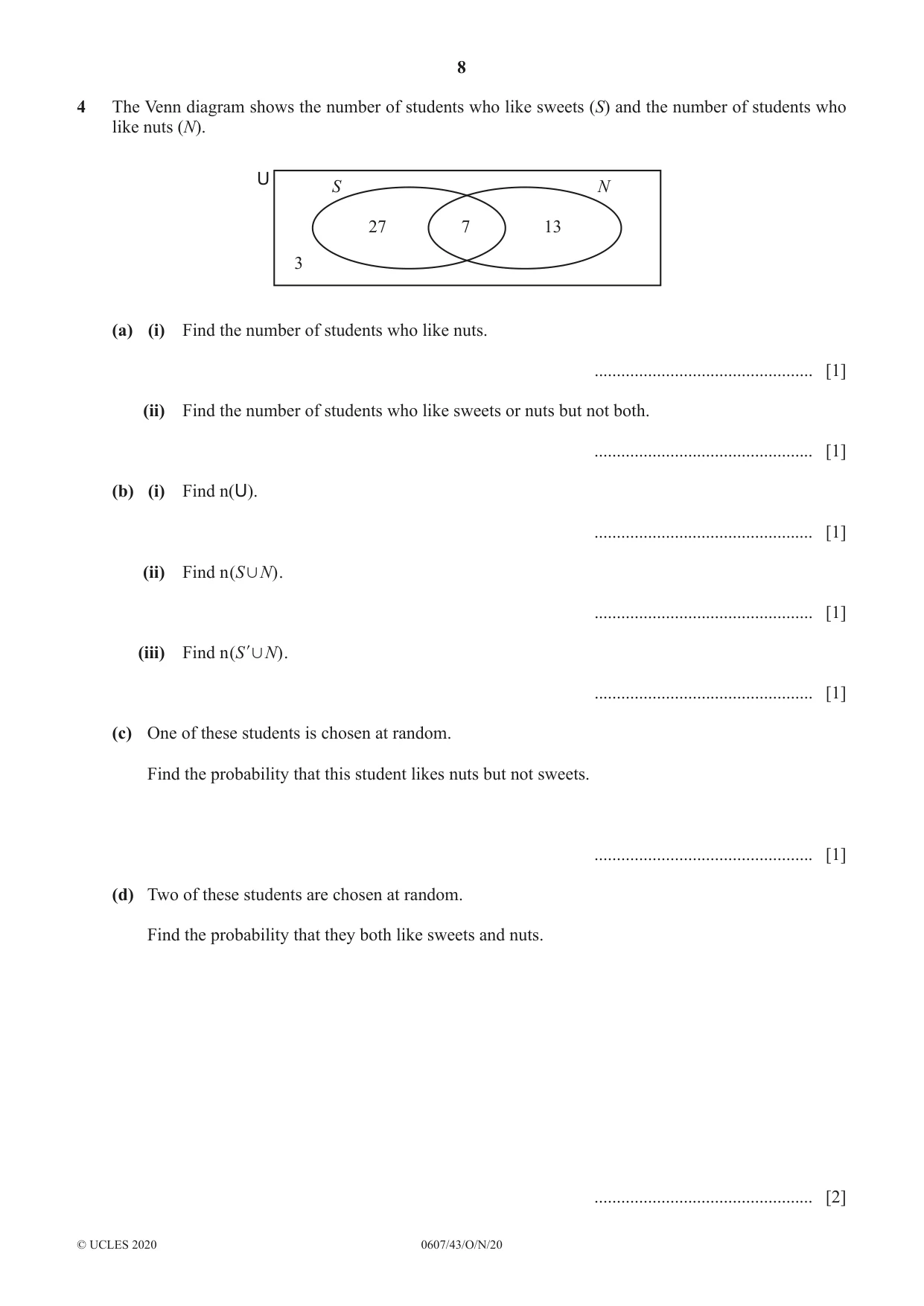
4 The Venn diagram shows the number of students who like sweets (S) and the number of students who like nuts (N). U S N 27 7 13 3 (a) (i) Find the number of students who like nuts. ................................................. [1] (ii) Find the number of students who like sweets or nuts but not both. ................................................. [1] (b) (i) Find n(U). ................................................. [1] (ii) Find n( S , N) . ................................................. [1] (iii) Find n( S l , N) . ................................................. [1] (c) One of these students is chosen at random. Find the probability that this student likes nuts but not sweets. ................................................. [1] (d) Two of these students are chosen at random. Find the probability that they both like sweets and nuts. ................................................. [2] (e) Two students who like sweets are chosen at random. Find the probability that they both also like nuts. ................................................. [3]
Mark scheme: 4(a)(i) 20 1 4(a)(ii) 40 1 4(b)(i) 50 1 4(b)(ii) 47 1 4(b)(iii) 23 1 4(c) 13 1 FT their (b)(i) 50 4(d) 3 2 7 6 oe M1 for × 175 their 50 their 50 − 1 4(e) 7 3 7 6 oe M2 for × 187 34 33 7 6 or M1 for × p p − 1
Q5 · Carla invests $600 at a rate of 1.8% per year compound interest
5 (a) Carla invests $600 at a rate of 1.8% per year compound interest. Calculate the value of Carla’s investment at the end of 7 years. $ ................................................ [3] (b) Dominic wants to invest his money so that it will double its value in 17 years. Find the lowest possible rate of compound interest per year that will give Dominic this result. Give your answer correct to 1 decimal place. ............................................ % [4] (c) Each year, the population of a village is decreasing at a rate of 4% of its value at the beginning of that year. The population is now 2120. Find the number of complete years since the population was last greater than 2700. ................................................. [4]
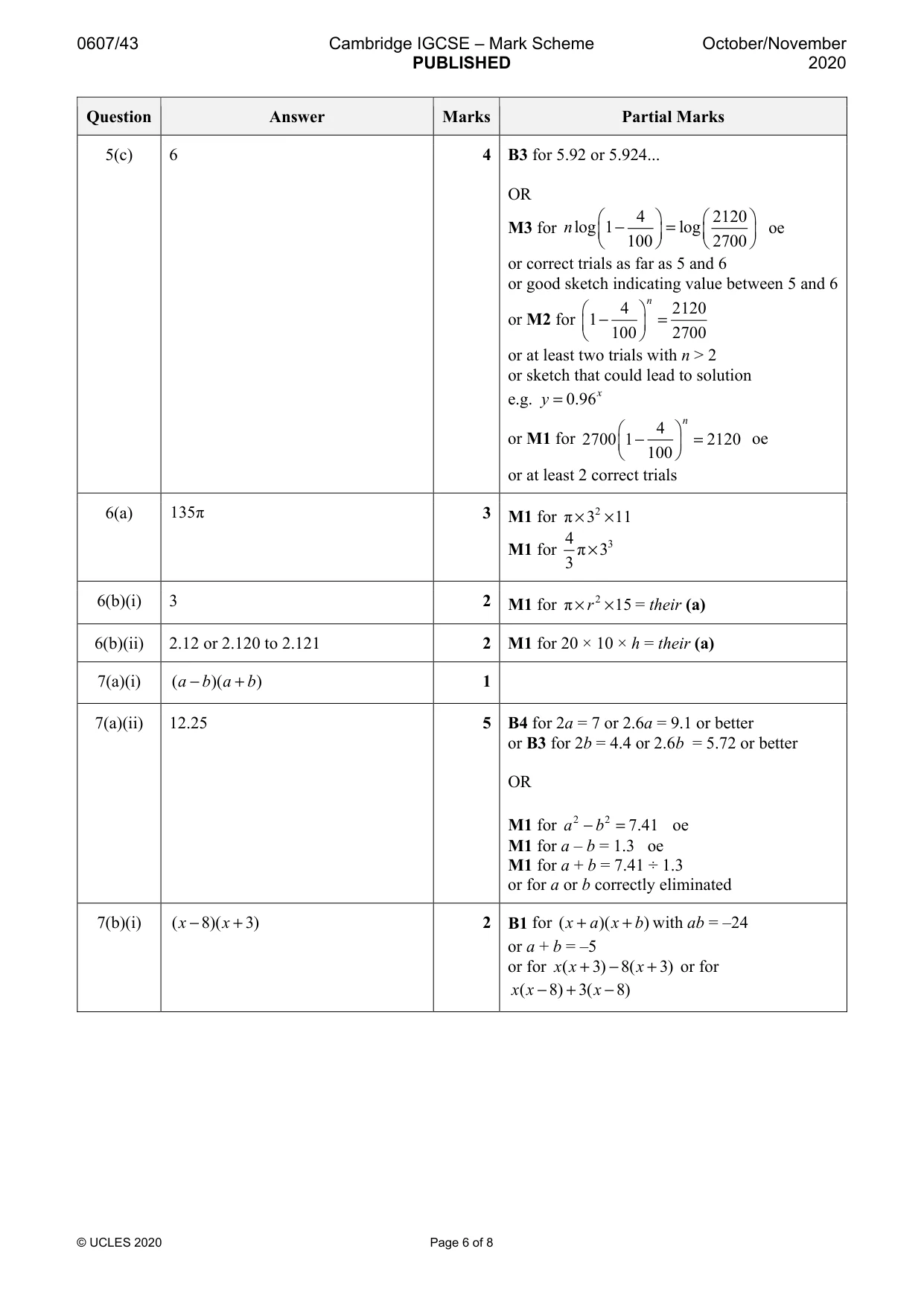
Mark scheme: 5(a) 679.81 or 680 or 679.8... 3 7 1.8 M2 for 600 1 + 100 1.8 k or M1 for 600 1 + , k > 1 100 5(b) 4.2 4 B3 for 4.16 or 4.161 to 4.162 or B2 for 17 2 oe or M1 for (P) × (...)17 = (2P) oe 5(c) 6 4 B3 for 5.92 or 5.924... OR 4 2120 M3 for n log 1 − = log oe 100 2700 or correct trials as far as 5 and 6 or good sketch indicating value between 5 and 6 4 n 2120 or M2 for 1 − = 100 2700 or at least two trials with n > 2 or sketch that could lead to solution e.g. y = 0.96x 4 n or M1 for 2700 1 − = 2120 oe 100 or at least 2 correct trials
Q6 · 11 cm NOT TO SCALE 3 cm The diagram shows a solid made from a cylinder and two hemispheres
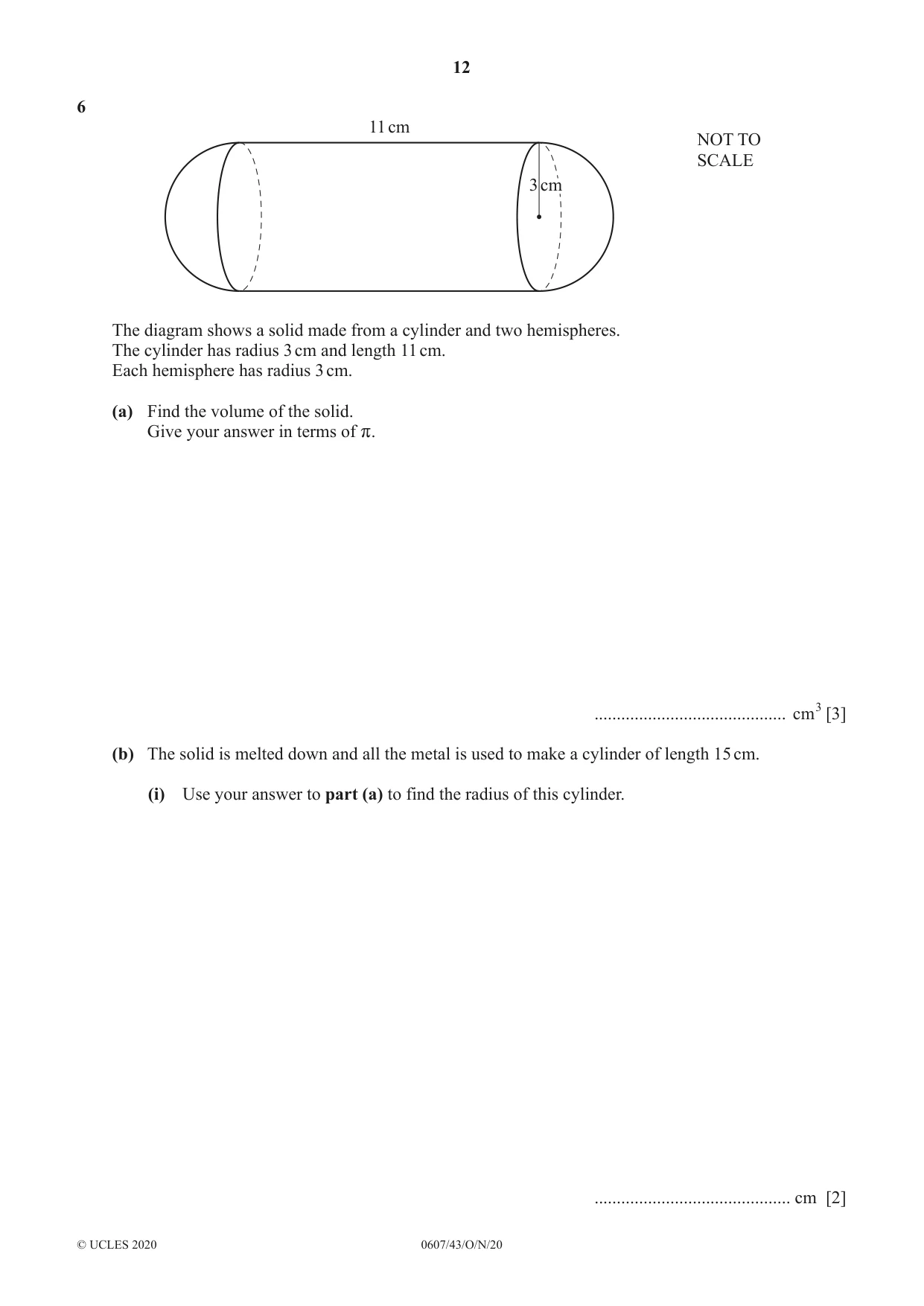
6 11 cm NOT TO SCALE 3 cm The diagram shows a solid made from a cylinder and two hemispheres. The cylinder has radius 3 cm and length 11 cm. Each hemisphere has radius 3 cm. (a) Find the volume of the solid. Give your answer in terms of r. ........................................... cm3 [3] (b) The solid is melted down and all the metal is used to make a cylinder of length 15 cm. (i) Use your answer to part (a) to find the radius of this cylinder. ............................................ cm [2] (ii) A rectangular tank contains water. The base of the tank measures 20 cm by 10 cm. The cylinder is placed in the tank so that it is completely covered by water. No water overflows the tank. Calculate the increase in the depth of the water in the tank. ........................................... cm [2]
Mark scheme: 6(a) 135π 3 M1 for π × 3 2 × 11 4 3 M1 for π × 3 3 6(b)(i) 3 2 M1 for π × r 2 × 15 = their (a) 6(b)(ii) 2.12 or 2.120 to 2.121 2 M1 for 20 × 10 × h = their (a)
Q7 · Factorise a 2 - b 2
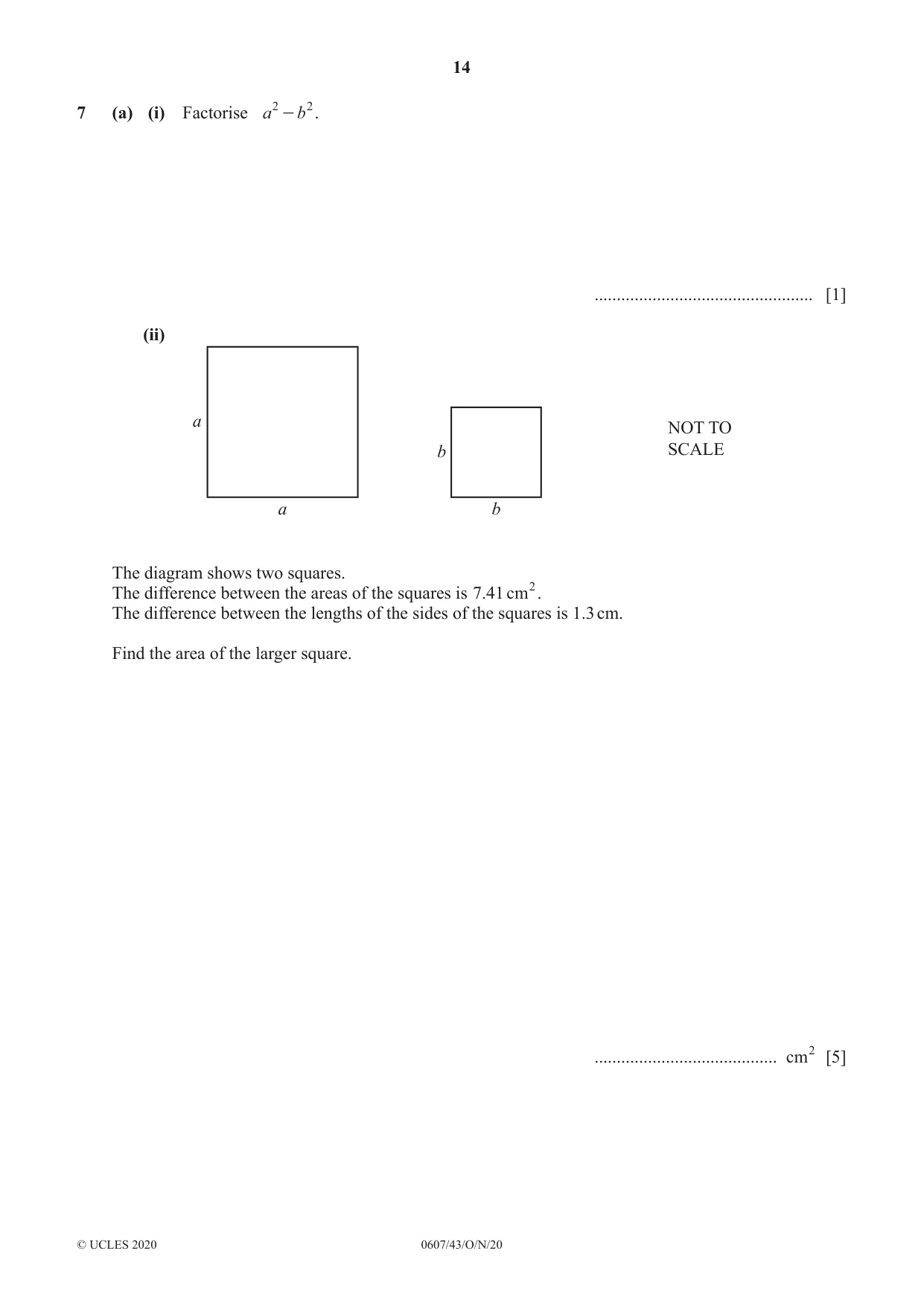
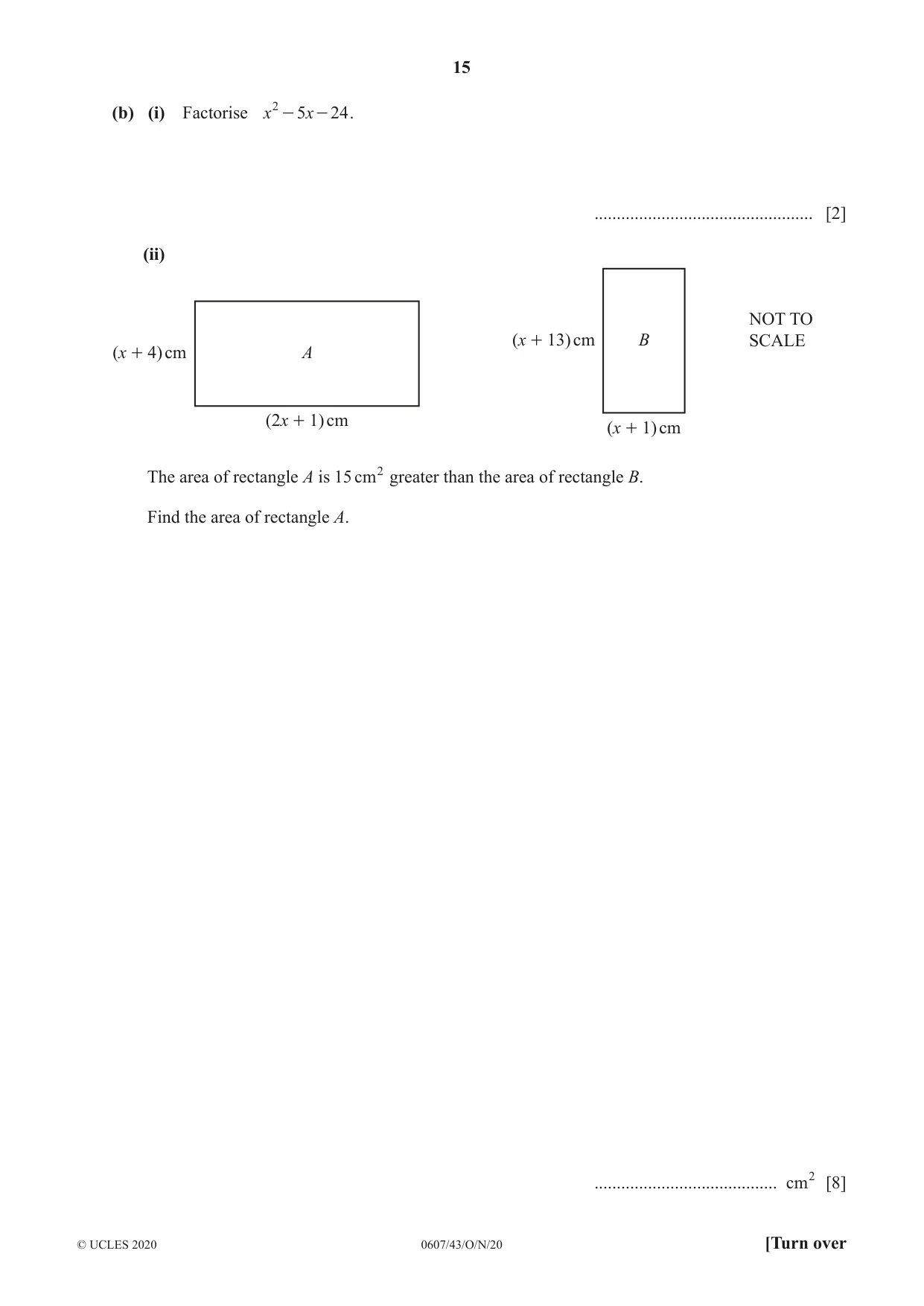
7 (a) (i) Factorise a 2 - b 2 . ................................................. [1] (ii) a NOT TO b SCALE a b The diagram shows two squares. The difference between the areas of the squares is 7.41 cm 2. The difference between the lengths of the sides of the squares is 1.3 cm. Find the area of the larger square. ......................................... cm2 [5] (b) (i) Factorise x 2 - 5 x - 24 . ................................................. [2] (ii) NOT TO (x + 13) cm B SCALE (x + 4) cm A (2x + 1) cm (x + 1) cm The area of rectangle A is 15 cm 2 greater than the area of rectangle B. Find the area of rectangle A. ......................................... cm2 [8]
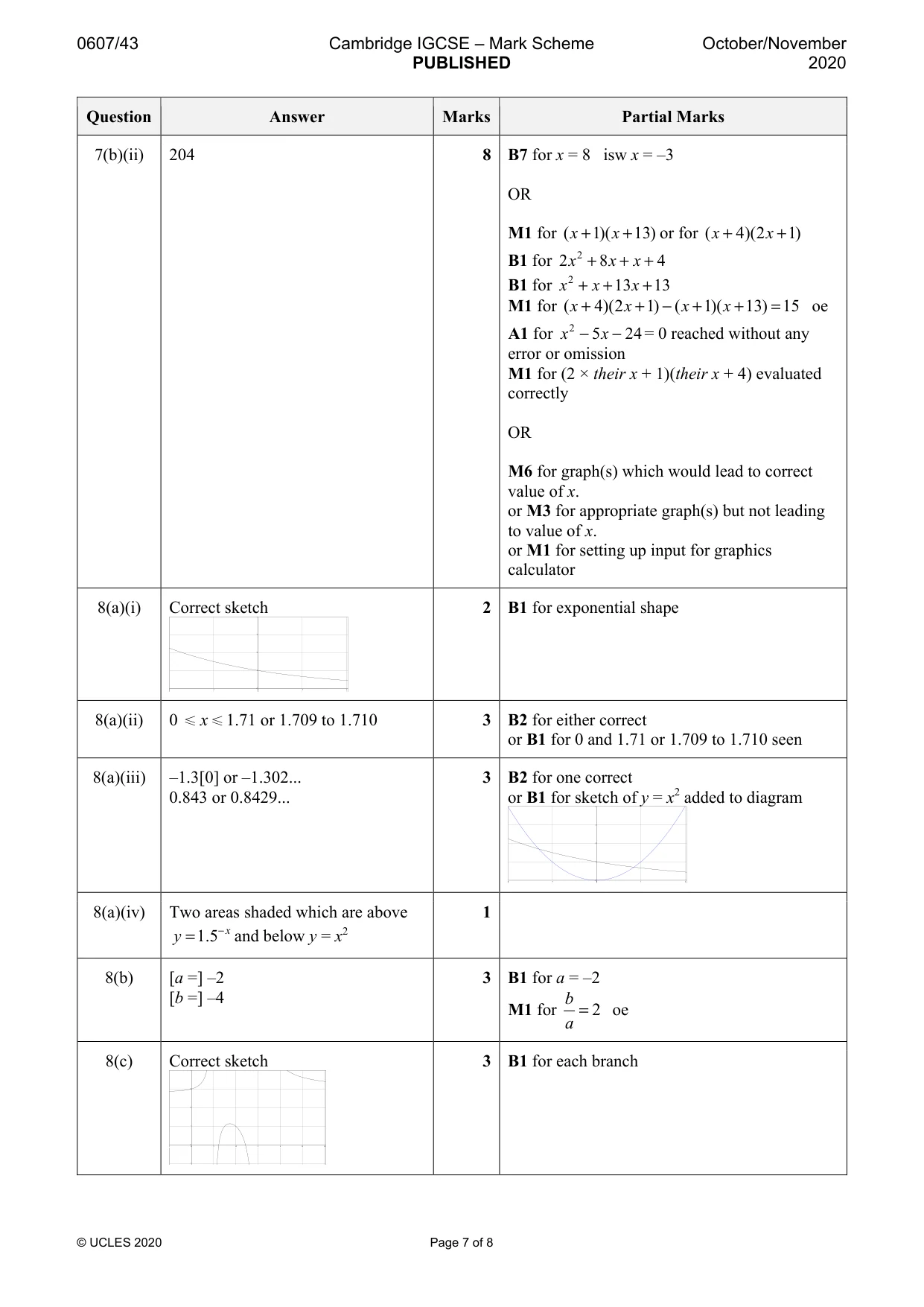
Mark scheme: 7(a)(i) ( a − b )( a + b ) 1 7(a)(ii) 12.25 5 B4 for 2a = 7 or 2.6a = 9.1 or better or B3 for 2b = 4.4 or 2.6b = 5.72 or better OR M1 for a 2 − b 2 = 7.41 oe M1 for a – b = 1.3 oe M1 for a + b = 7.41 ÷ 1.3 or for a or b correctly eliminated 7(b)(i) ( x − 8)( x + 3) 2 B1 for ( x + a )( x + b ) with ab = –24 or a + b = –5 or for x ( x + 3) − 8( x + 3) or for x ( x − 8) + 3( x − 8) 7(b)(ii) 204 8 B7 for x = 8 isw x = –3 OR M1 for ( x + 1)( x + 13) or for ( x + 4)(2 x + 1) B1 for 2 x 2 + 8 x + x + 4 B1 for x 2 + x + 13 x + 13 M1 for ( x + 4)(2 x + 1) − ( x + 1)( x + 13) = 15 oe A1 for x 2 − 5 x − 24 = 0 reached without any error or omission M1 for (2 × their x + 1)(their x + 4) evaluated correctly OR M6 for graph(s) which would lead to correct value of x. or M3 for appropriate graph(s) but not leading to value of x. or M1 for setting up input for graphics calculator
Q8 · Y 4 x – 2 0 2 (i) On the diagram, sketch the graph of y = 1.5 -x for - 2 G x G 2
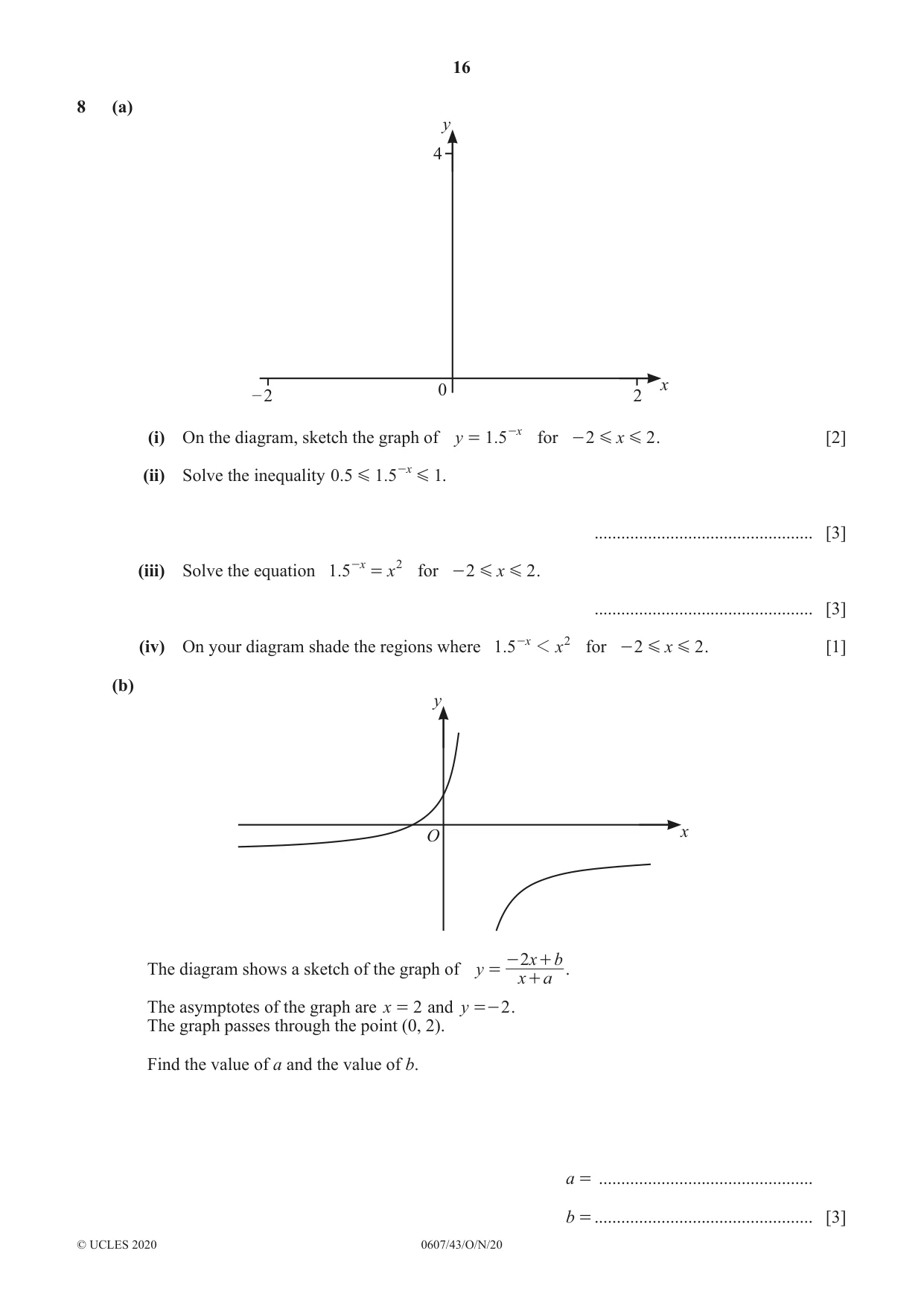
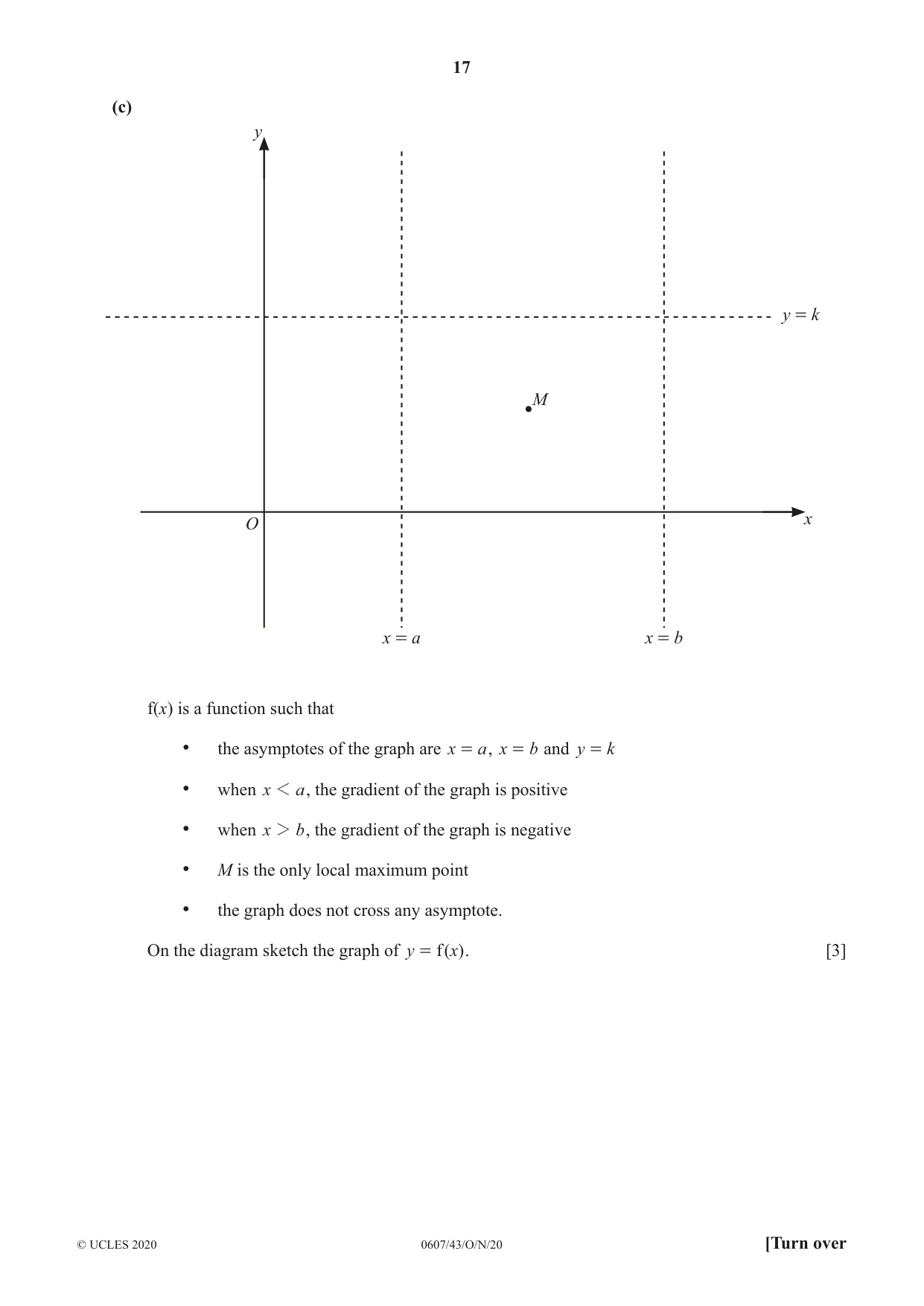
8 (a) y 4 x – 2 0 2 (i) On the diagram, sketch the graph of y = 1.5 -x for - 2 G x G 2 . [2] (ii) Solve the inequality 0.5 G 1.5 -x G 1. ................................................. [3] (iii) Solve the equation 1.5 -x = x 2 for - 2 G x G 2 . ................................................. [3] (iv) On your diagram shade the regions where 1.5 -x 1 x 2 for - 2 G x G 2 . [1] (b) y O x - 2x + b The diagram shows a sketch of the graph of y = . x + a The asymptotes of the graph are x = 2 and y =- 2 . The graph passes through the point (0, 2). Find the value of a and the value of b. a = ................................................ b = ................................................. [3] (c) y y = k M x O x = a x = b f(x) is a function such that • the asymptotes of the graph are x = a , x = b and y = k • when x 1 a , the gradient of the graph is positive • when x 2 b , the gradient of the graph is negative • M is the only local maximum point • the graph does not cross any asymptote. On the diagram sketch the graph of y = f ( x) . [3]
Mark scheme: 8(a)(i) Correct sketch4444 2 B1 for exponential shape 3333 2222 1111 2222 -1-1-1-1 0000 0000 1111 2222 8(a)(ii) 0 ≤ x ≤1.71 or 1.709 to 1.710 3 B2 for either correct or B1 for 0 and 1.71 or 1.709 to 1.710 seen 8(a)(iii) –1.3[0] or –1.302... 3 B2 for one correct 0.843 or 0.8429... or B1 for sketch4444 of y = x2 added to diagram 3333 2222 1111 2222 -1-1-1-1 0000 0000 1111 2222 8(a)(iv) Two areas shaded which are above 1 y = 1.5 − x and below y = x2 8(b) [a =] –2 3 B1 for a = –2 [b =] –4 b M1 for = 2 oe a 8(c) Correct4444 sketch 3 B1 for each branch 3333 2222 1111 1111 0000 0000 1111 2222 3333 4444 5555 6666 -1-1-1-1
Q9 · P = q = 3 - 1 A is the point (3, 4)
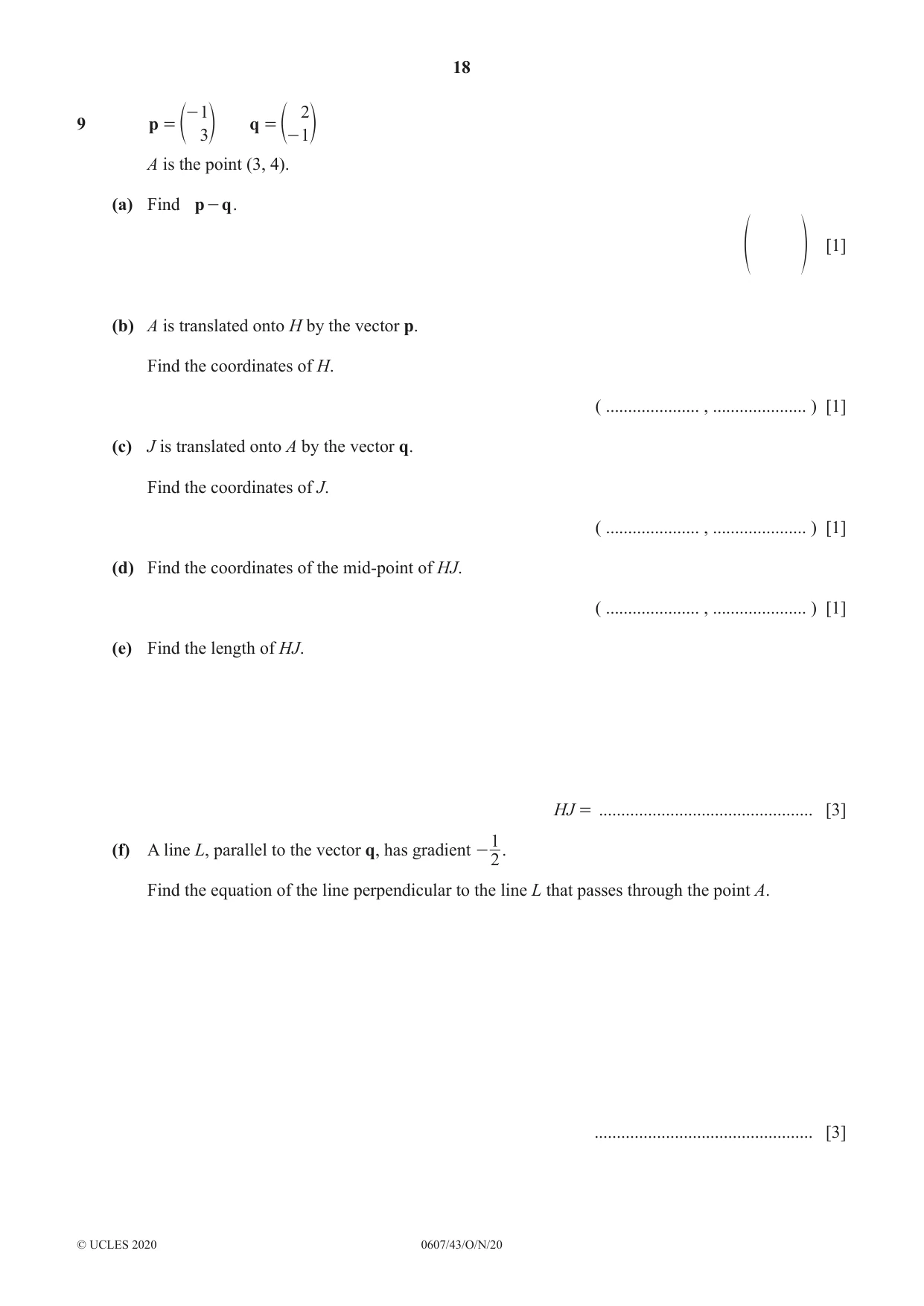
9 p = q = 3 - 1 A is the point (3, 4). (a) Find p - q . [1] f p (b) A is translated onto H by the vector p. Find the coordinates of H. ( ..................... , ..................... ) [1] (c) J is translated onto A by the vector q. Find the coordinates of J. ( ..................... , ..................... ) [1] (d) Find the coordinates of the mid-point of HJ. ( ..................... , ..................... ) [1] (e) Find the length of HJ. HJ = ................................................ [3] 1 (f) A line L, parallel to the vector q, has gradient - . 2 Find the equation of the line perpendicular to the line L that passes through the point A. ................................................. [3]
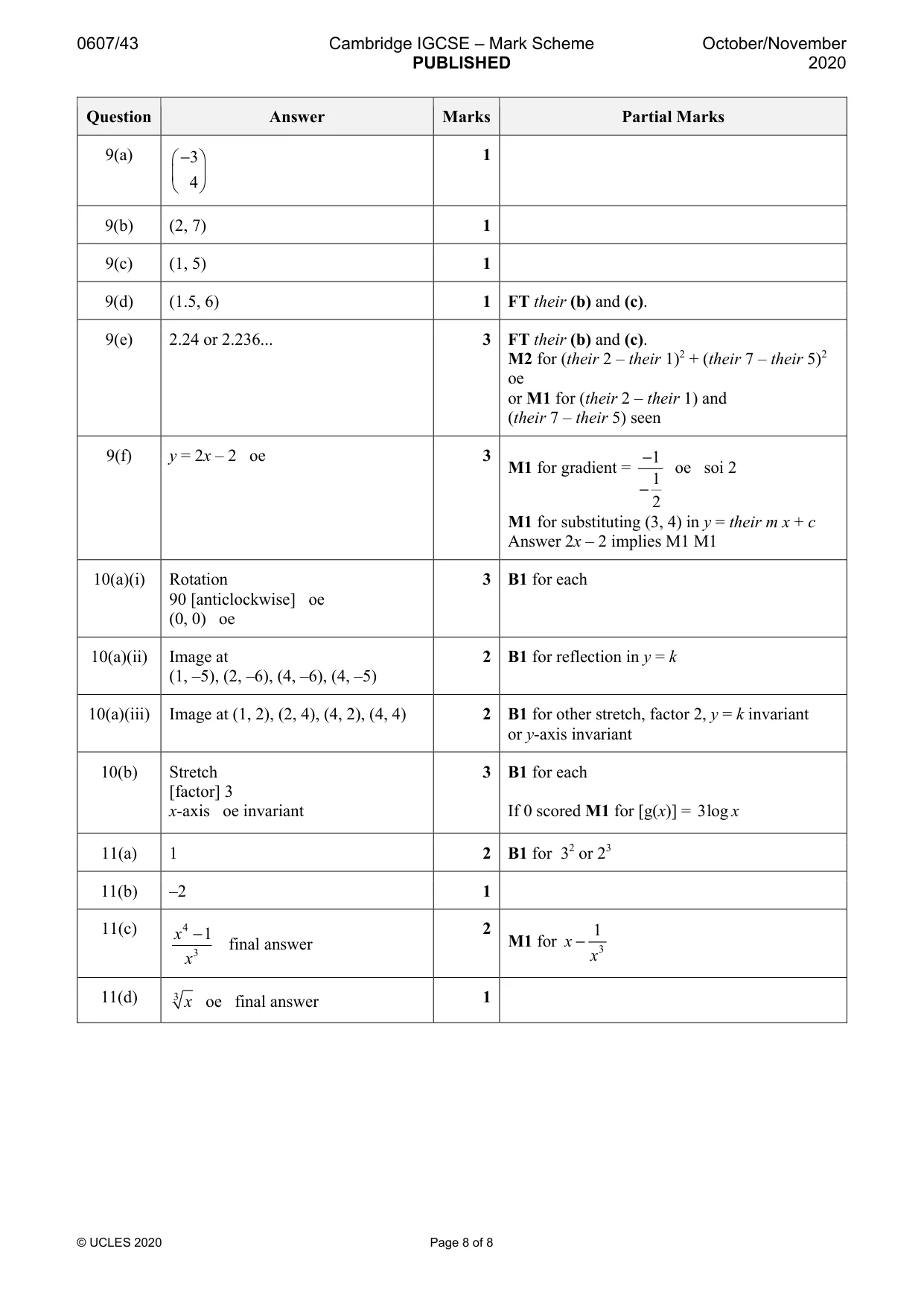
Mark scheme: 9(a) − 3 1 4 9(b) (2, 7) 1 9(c) (1, 5) 1 9(d) (1.5, 6) 1 FT their (b) and (c). 9(e) 2.24 or 2.236... 3 FT their (b) and (c). M2 for (their 2 – their 1)2 + (their 7 – their 5)2 oe or M1 for (their 2 – their 1) and (their 7 – their 5) seen 9(f) y = 2x – 2 oe 3 − 1 M1 for gradient = oe soi 2 1 − 2 M1 for substituting (3, 4) in y = their m x + c Answer 2x – 2 implies M1 M1
Q10 · Y 6 5 4 3 V 2 T 1 x – 6 – 5 – 4 – 3 – 2 – 1 0 1 2 3 4 5 6 – 1 – 2 – 3 – 4 – 5 – 6 (i)…
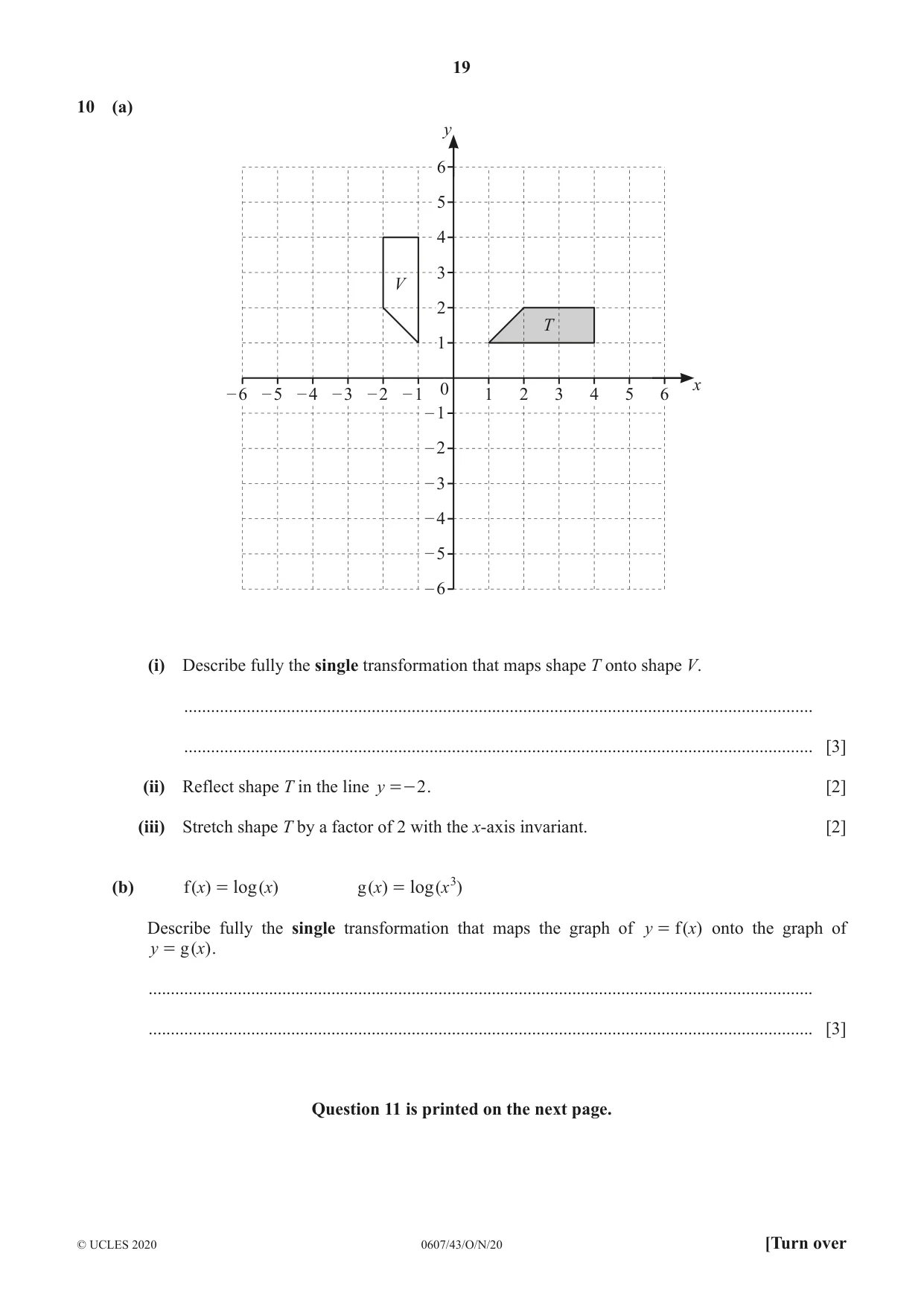
10 (a) y 6 5 4 3 V 2 T 1 x – 6 – 5 – 4 – 3 – 2 – 1 0 1 2 3 4 5 6 – 1 – 2 – 3 – 4 – 5 – 6 (i) Describe fully the single transformation that maps shape T onto shape V. ............................................................................................................................................. ............................................................................................................................................. [3] (ii) Reflect shape T in the line y =- 2 . [2] (iii) Stretch shape T by a factor of 2 with the x-axis invariant. [2] (b) f ( x) = log ( x) g ( x) = log ( x3 ) Describe fully the single transformation that maps the graph of y = f ( x) onto the graph of y = g ( x) . ..................................................................................................................................................... ..................................................................................................................................................... [3] Question 11 is printed on the next page.
Mark scheme: 10(a)(i) Rotation 3 B1 for each 90 [anticlockwise] oe (0, 0) oe 10(a)(ii) Image at 2 B1 for reflection in y = k (1, –5), (2, –6), (4, –6), (4, –5) 10(a)(iii) Image at (1, 2), (2, 4), (4, 2), (4, 4) 2 B1 for other stretch, factor 2, y = k invariant or y-axis invariant 10(b) Stretch 3 B1 for each [factor] 3 x-axis oe invariant If 0 scored M1 for [g(x)] = 3log x
Q11 · F ( x) = x3 g ( x) = 3x (a) Find g ( 2) - f ( 2)
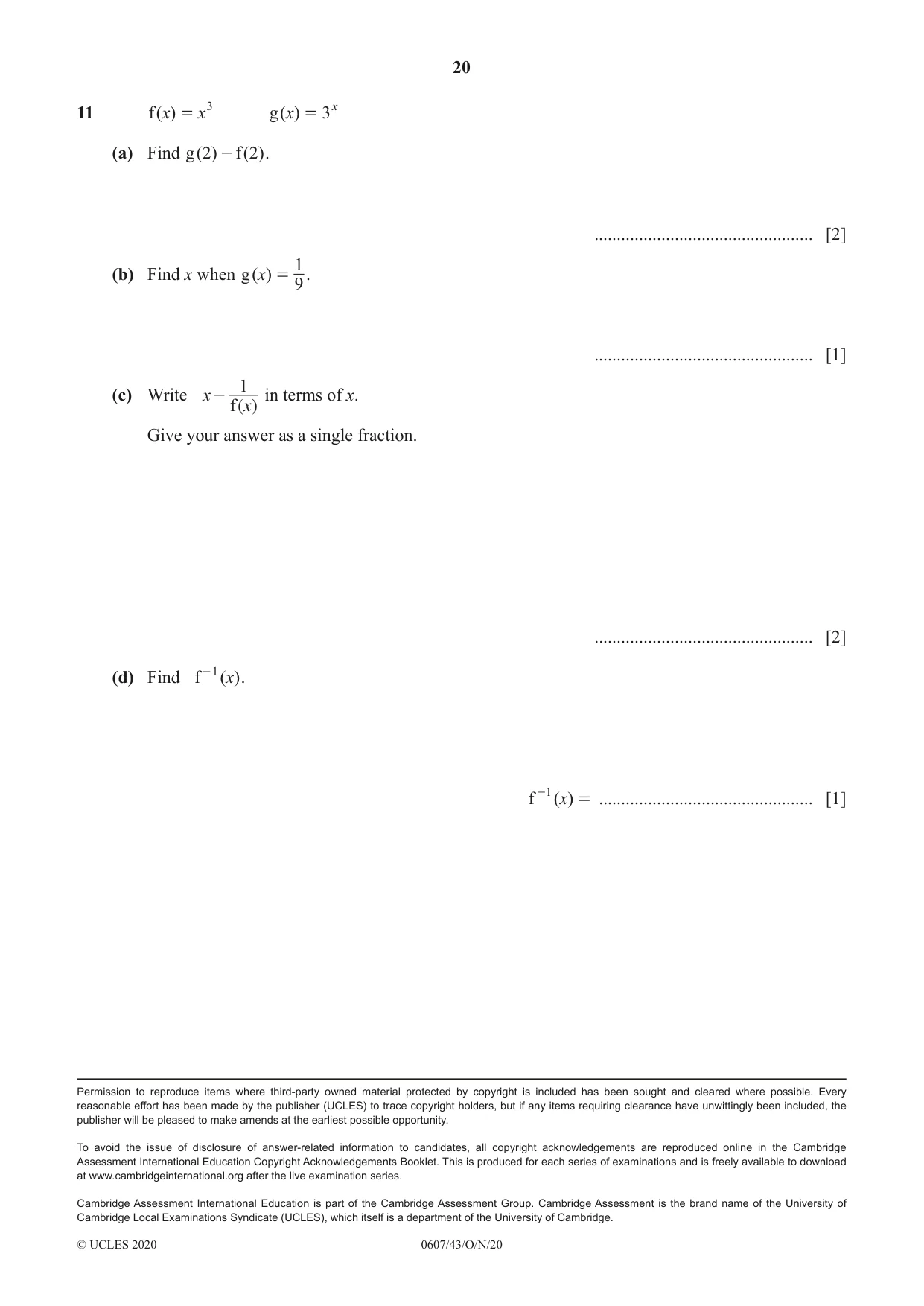
11 f ( x) = x3 g ( x) = 3x (a) Find g ( 2) - f ( 2) . ................................................. [2] 1 (b) Find x when g ( x) = . 9 ................................................. [1] 1 (c) Write x - in terms of x. f ( x) Give your answer as a single fraction. ................................................. [2] (d) Find f - 1 ( x) . f -1 ( x) = ................................................ [1]
Mark scheme: 11(a) 1 2 B1 for 32 or 23 11(b) –2 1 11(c) x 4 − 1 2 1 final answer M1 for x − 3 3 x x 11(d) 3 x oe final answer 1
What was in this paper
The subtopics covered by these 11 questions, and how many questions each got. Open one in a new tab to see every Cambridge question on it.
What you needed in this session
Cambridge’s own grade thresholds for 2020 Oct/Nov, Paper 4 · Variant 3. A higher threshold means an easier paper — the bar moves with how the cohort did.