Questions as text
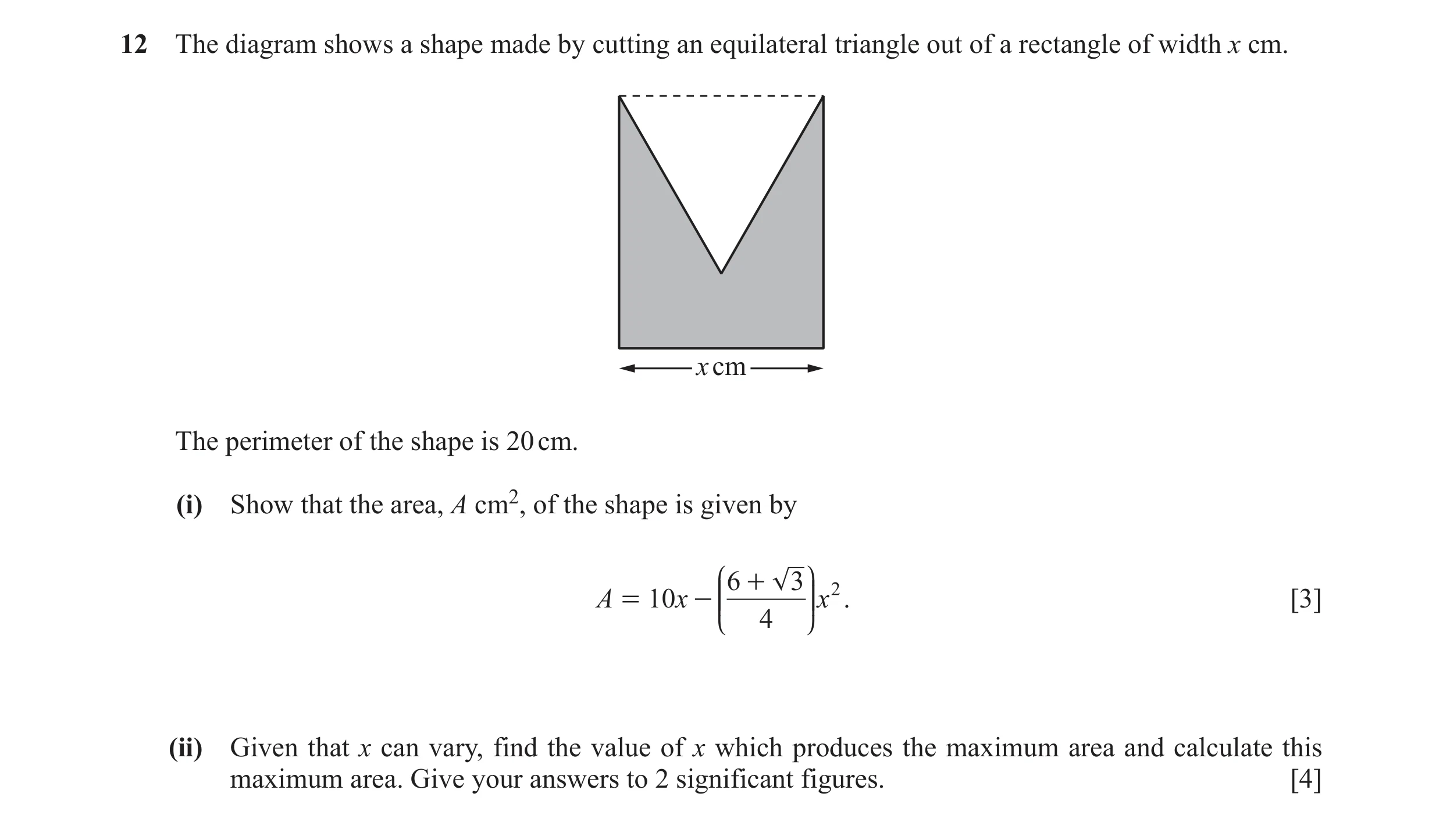
Q1 · The diagram shows a shape made by cutting an equilateral triangle out of a rectangle of… 0606/22 Feb/March 2017
12 The diagram shows a shape made by cutting an equilateral triangle out of a rectangle of width x cm. x cm The perimeter of the shape is 20 cm. (i) Show that the area, A cm2, of the shape is given by J N 6 + 3 A = 10x - KK OO x 2 . [3] 4 L P (ii) Given that x can vary, find the value of x which produces the maximum area and calculate this maximum area. Give your answers to 2 significant figures. [4]
7 marks
This question in 0606/22 Feb/March 2017
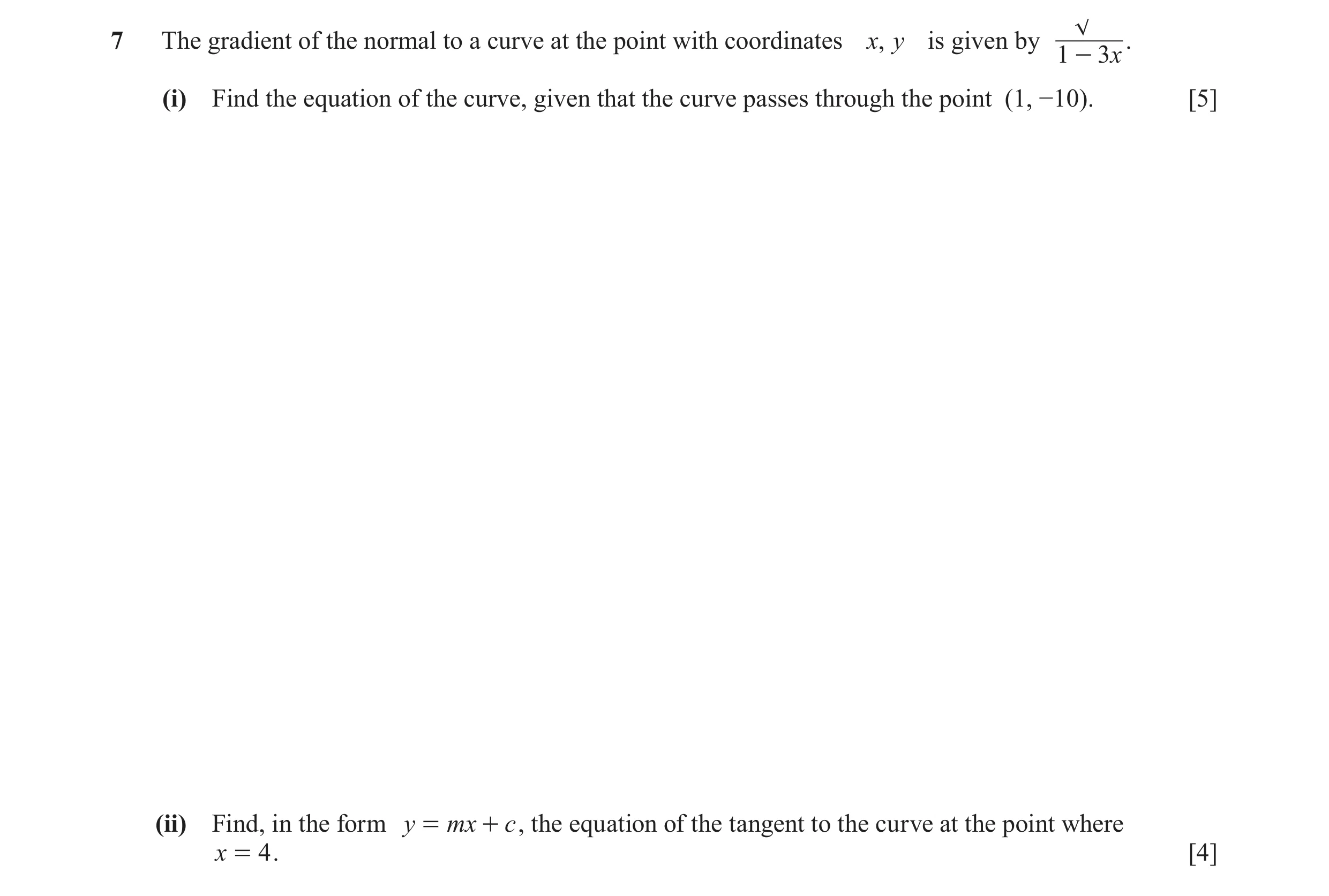
Q2 · The gradient of the normal to a curve at the point with coordinates ,x y is given by 0606/22 Oct/Nov 2017
7 The gradient of the normal to a curve at the point with coordinates ,x y is given by . 1 - 3x (i) Find the equation of the curve, given that the curve passes through the point (1, −10). [5] (ii) Find, in the form y = mx + c , the equation of the tangent to the curve at the point where x = 4 . [4]
9 marks
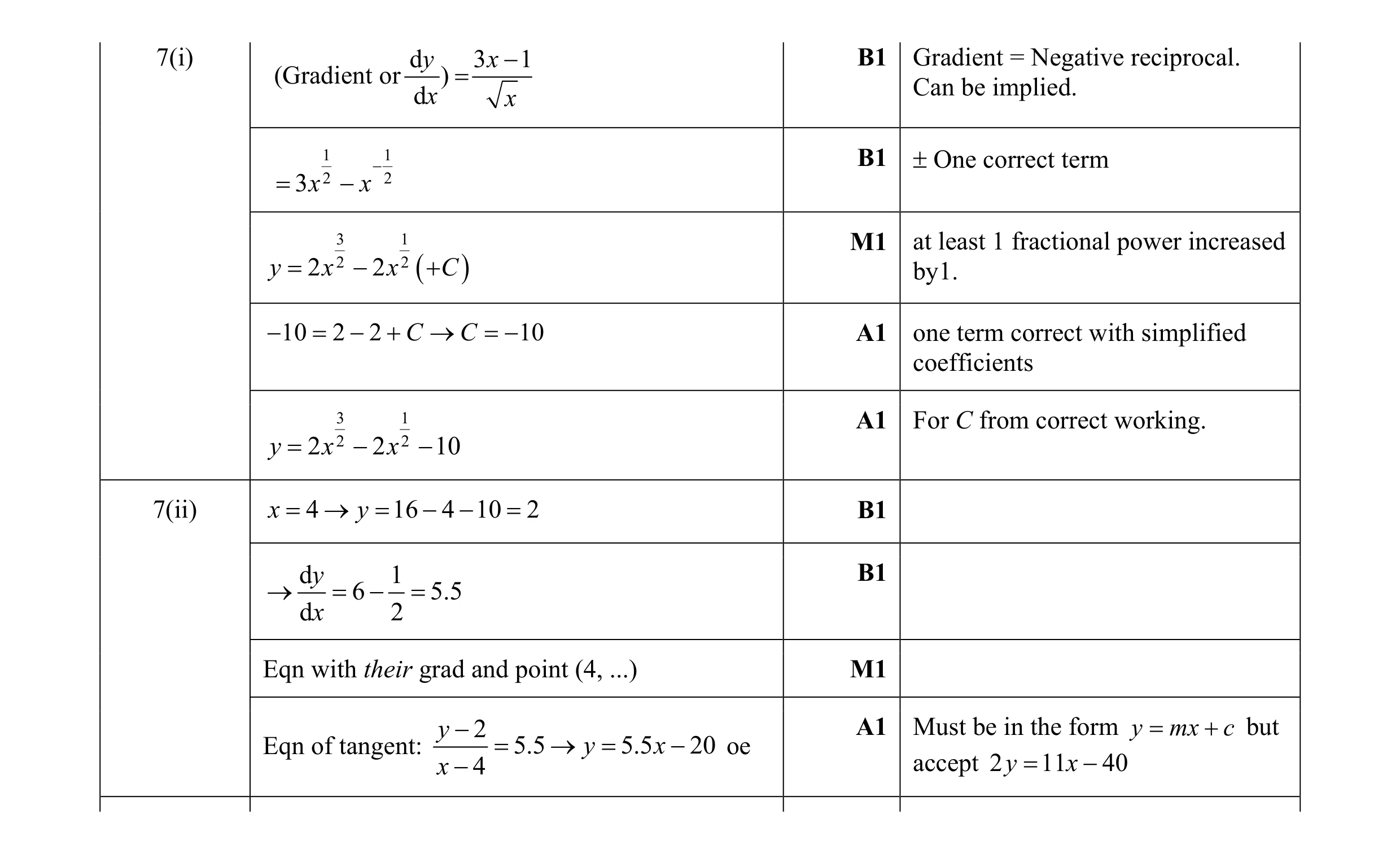
Mark scheme: 7(i) d y 3 x − 1 B1 Gradient = Negative reciprocal. (Gradient or ) = Can be implied. d x x 1 1 B1 ± One correct term − = 3x 2 − x 2 3 1 M1 at least 1 fractional power increased y = 2 x 2 − 2 x 2 ( + C ) by1. − 10 = 2 − 2 + C → C = − 10 A1 one term correct with simplified coefficients 3 1 A1 For C from correct working. y = 2 x 2 − 2 x 2 − 10 7(ii) x = 4 → y = 16 − 4 − 10 = 2 B1 dy 1 B1 → = 6 − = 5.5 dx 2 Eqn with their grad and point (4, ...) M1 y − 2 A1 Must be in the form y = mx + c but Eqn of tangent: = 5.5 → y = 5.5 x − 20 oe x − 4 accept 2 y = 11x − 40
This question in 0606/22 Oct/Nov 2017
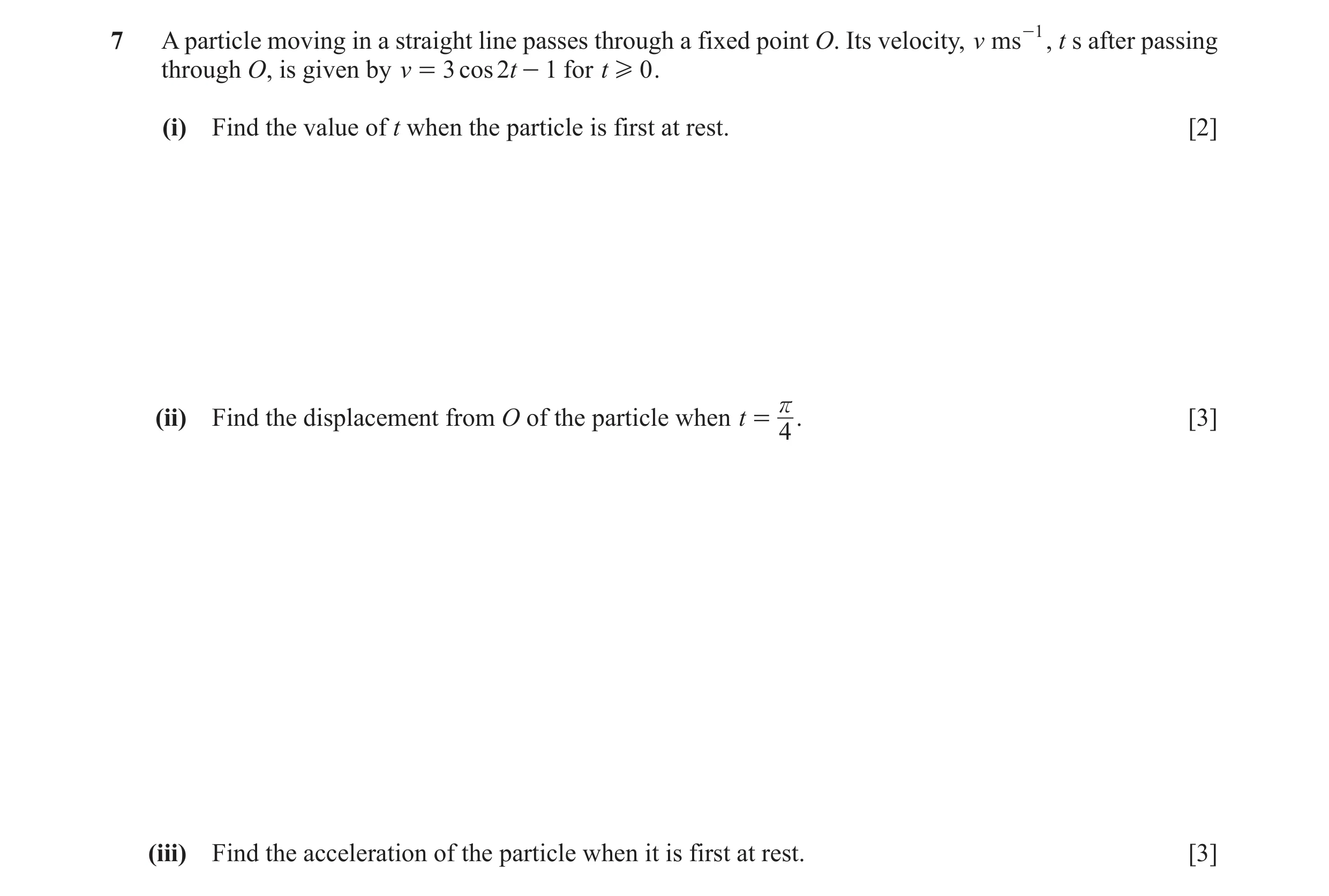
Q3 · A particle moving in a straight line passes through a fixed point O 0606/23 Oct/Nov 2017
7 A particle moving in a straight line passes through a fixed point O. Its velocity, v ms -1 , t s after passing through O, is given by v = 3 cos 2t - 1 for t H 0 . (i) Find the value of t when the particle is first at rest. [2] r (ii) Find the displacement from O of the particle when t = . [3] 4 (iii) Find the acceleration of the particle when it is first at rest. [3]
8 marks
Mark scheme: 7(i) 1 M1 set v = 0 and solve for cos2t v = 0 → cos2t = 3 →=t 0.615 or 0.616 A1 7(ii) 3 M1A1 M1 for sin2t and ± t s = sin2t − t ( + c ) 2 π π A1 t = → s = 1.5 − ( = 0.715 ) 4 4 7(iii) a = −6sin2t M1A1 M1 for −sin2t t = 0.615 → a = –5.66 or –5.65 or −2 8 A1 condone substitution of degrees
This question in 0606/23 Oct/Nov 2017
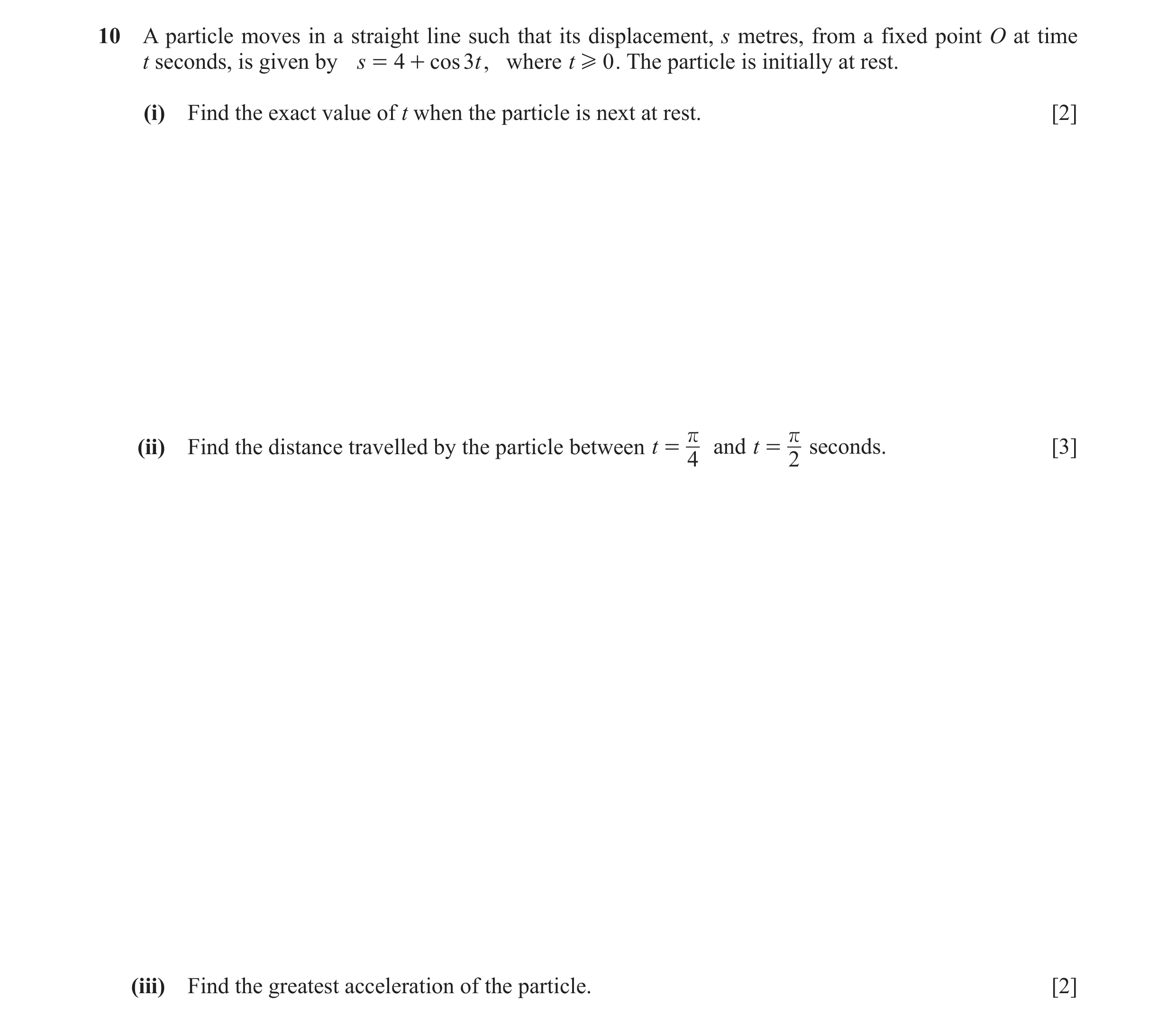
Q4 · A particle moves in a straight line such that its displacement, s metres, from a fixed… 0606/21 May/June 2018
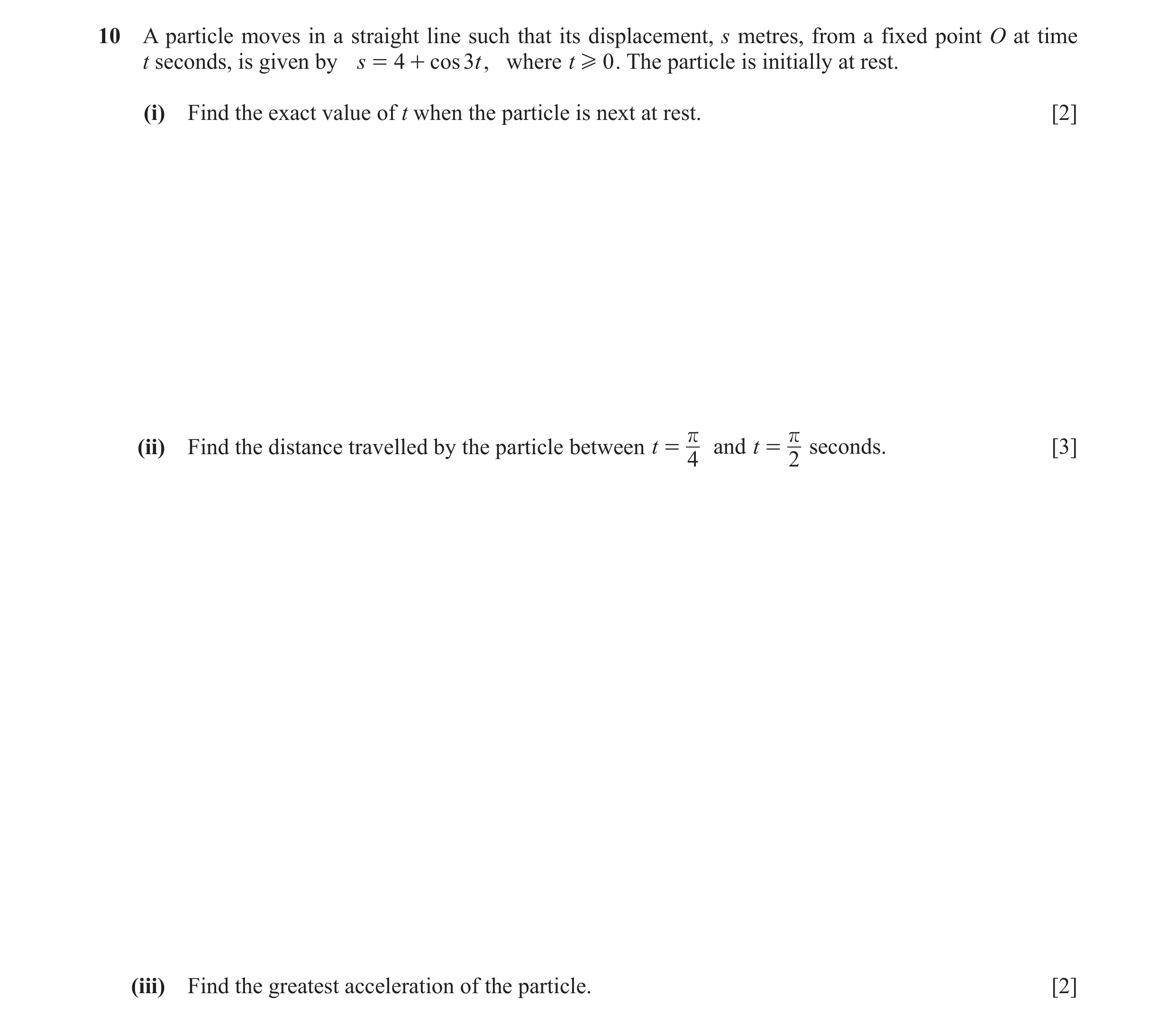
10 A particle moves in a straight line such that its displacement, s metres, from a fixed point O at time t seconds, is given by s = 4 + cos 3t , where t H 0 . The particle is initially at rest. (i) Find the exact value of t when the particle is next at rest. [2] r r (ii) Find the distance travelled by the particle between t = and t = seconds. [3] 4 2 (iii) Find the greatest acceleration of the particle. [2]
7 marks
Mark scheme: 10(i) ds B1 v = = −3sin3t dt π B1 When v = 0, t = 3 10(ii) Finding s when M1 π π t = and t = 4 2 Finding s when M1 Using their (i) correctly π t = their and correct plan 3 1.29 nfww A1 10(iii) dv B1 a = = −9cos3t dt 9 B1 FT their k cos3t
This question in 0606/21 May/June 2018
Q5 · A particle moves in a straight line such that its displacement, s metres, from a fixed… 0606/23 May/June 2018
10 A particle moves in a straight line such that its displacement, s metres, from a fixed point O at time t seconds, is given by s = 4 + cos 3t , where t H 0 . The particle is initially at rest. (i) Find the exact value of t when the particle is next at rest. [2] r r (ii) Find the distance travelled by the particle between t = and t = seconds. [3] 4 2 (iii) Find the greatest acceleration of the particle. [2]
7 marks
Mark scheme: 10(i) ds B1 v = = −3sin3t dt π B1 When v = 0, t = 3 10(ii) Finding s when M1 π π t = and t = 4 2 Finding s when M1 Using their (i) correctly π t = their and correct plan 3 1.29 nfww A1 10(iii) dv B1 a = = −9cos3t dt 9 B1 FT their k cos3t
This question in 0606/23 May/June 2018
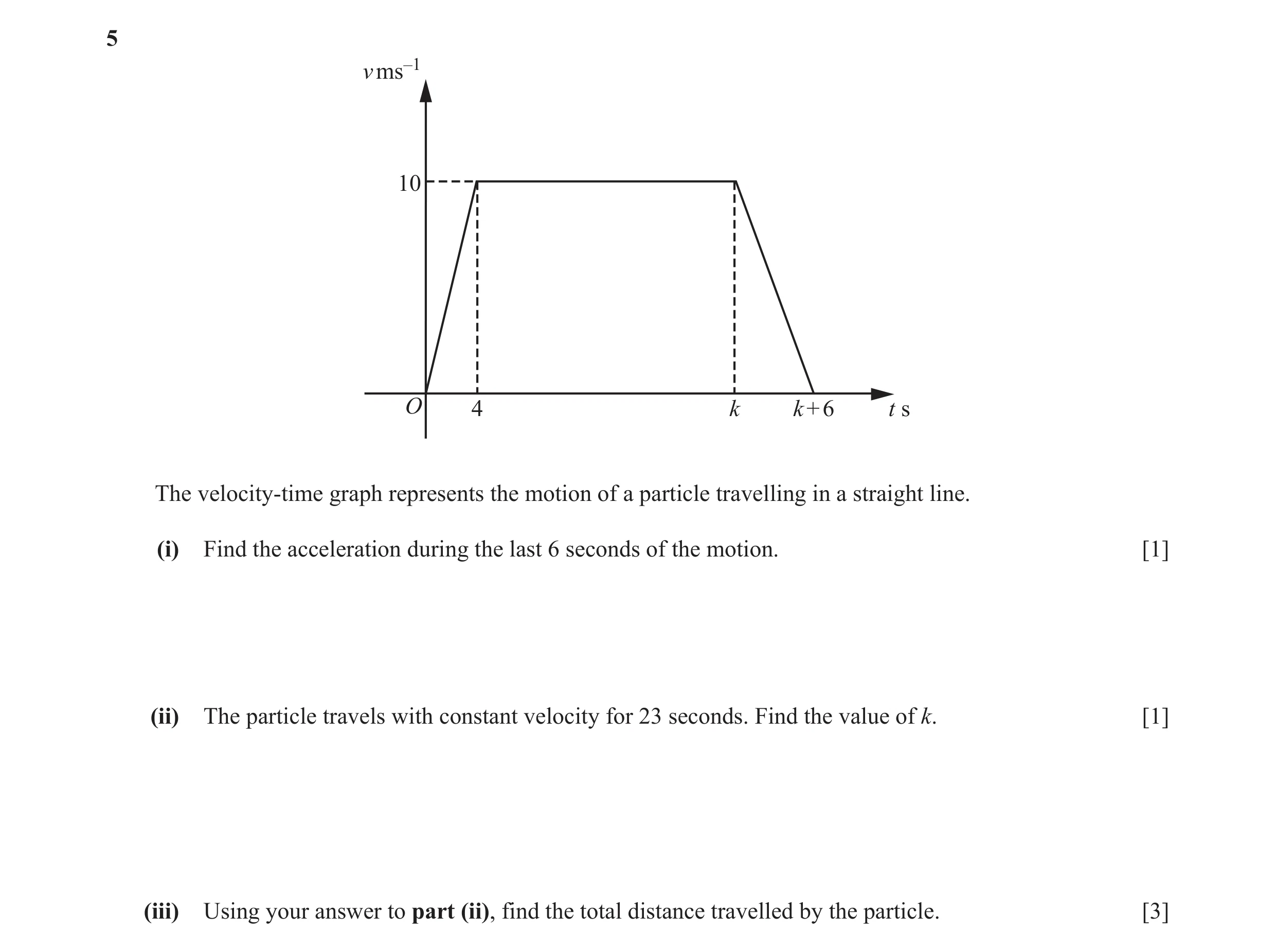
Q6 · V ms–1 10 O 4 k k + 6 t s The velocity-time graph represents the motion of a particle… 0606/21 May/June 2019
5 v ms–1 10 O 4 k k + 6 t s The velocity-time graph represents the motion of a particle travelling in a straight line. (i) Find the acceleration during the last 6 seconds of the motion. [1] (ii) The particle travels with constant velocity for 23 seconds. Find the value of k. [1] (iii) Using your answer to part (ii), find the total distance travelled by the particle. [3]
5 marks
Mark scheme: 5(i) 10 B1 − oe 6 5(ii) 27 B1 5(iii) Attempts to find total area M1 1 M1 (23 + their k + 6) × 10 2 1 1 or × 4 × 10 + 23 × 10 + × 6 × 10 2 2 280 A1
This question in 0606/21 May/June 2019
Q7 · A particle travelling in a straight line passes through a fixed point O 0606/23 May/June 2019
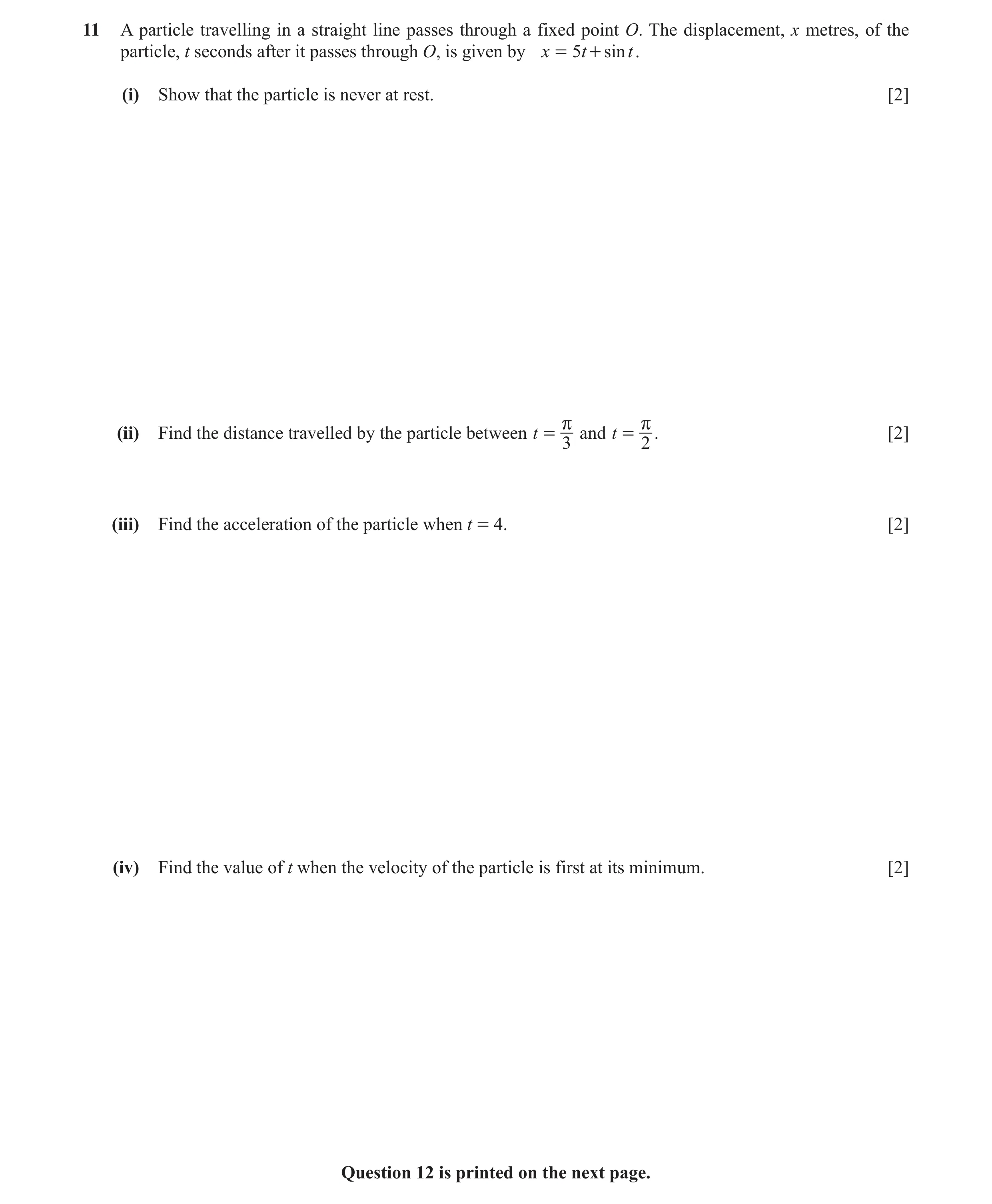
11 A particle travelling in a straight line passes through a fixed point O. The displacement, x metres, of the particle, t seconds after it passes through O, is given by x = 5t + sin t . (i) Show that the particle is never at rest. [2] (ii) Find the distance travelled by the particle between t = r and t = r . [2] 3 2 (iii) Find the acceleration of the particle when t = 4. [2] (iv) Find the value of t when the velocity of the particle is first at its minimum. [2] Question 12 is printed on the next page.
8 marks
Mark scheme: 11(i) d x B1 v = = 5 + cos t d t 5 + cos t ≠ 0 (and so never at rest) oe B1 11(ii) π π M1 x = 5 + sin or 3 3 π π x = 5 + sin seen 2 2 2.75 to 2.752 A1 11(iii) d v M1 FT their v provided of the form k ± cos t a = = − sin t d t [ t = 4, a = − sin 4 = ] 0.757 or A1 0.7568[024…] 11(iv) Valid method soi e.g. M1 their ( − sin t ) = 0 or cos t = −1 sketch of v = 5 + cos t t = π A1
This question in 0606/23 May/June 2019
Q8 · A particle is moving in a straight line such that t seconds after passing a fixed point O… 0606/21 Oct/Nov 2019
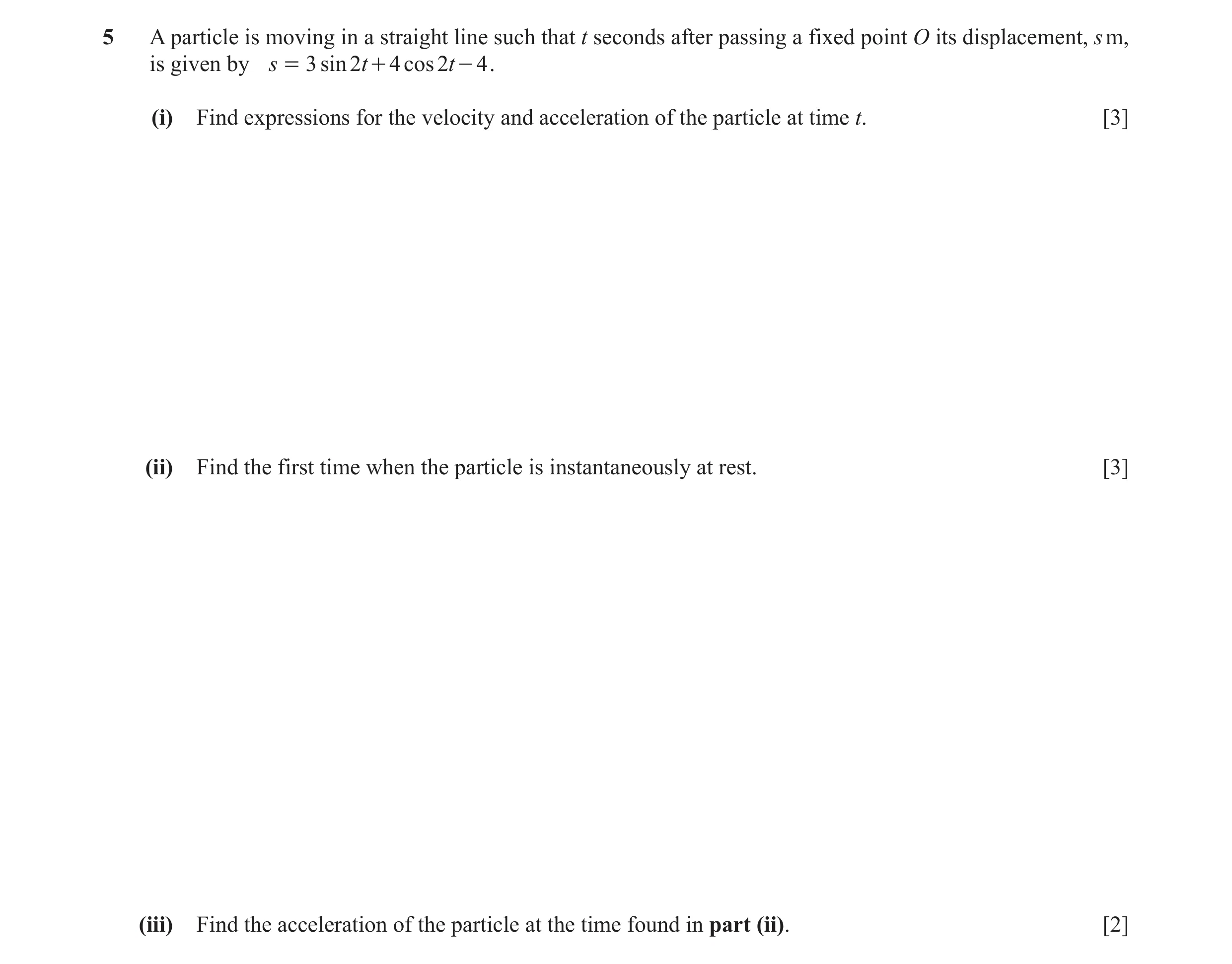
5 A particle is moving in a straight line such that t seconds after passing a fixed point O its displacement, s m, is given by s = 3 sin 2 t + 4 cos 2 t - 4 . (i) Find expressions for the velocity and acceleration of the particle at time t. [3] (ii) Find the first time when the particle is instantaneously at rest. [3] (iii) Find the acceleration of the particle at the time found in part (ii). [2]
8 marks
Mark scheme: 5(i) Differentiate M1 Obtain 2cos2t or − 2sin2t v = 6cos2t − 8sin2t A1 a = −12sin2t − 16cos2t A1 5(ii) Equate v to 0 and attempt to solve M1 tan2t = 0.75 A1 or sin2t = 0.6 or cos2t = 0.8 t = 0.32(2) A1 Must be in radians 5(iii) Insert value of t into expression for a M1 Radians or degrees a = −20 A1 Must have used radians
This question in 0606/21 Oct/Nov 2019
Q9 · A particle travels in a straight line 0606/21 May/June 2020
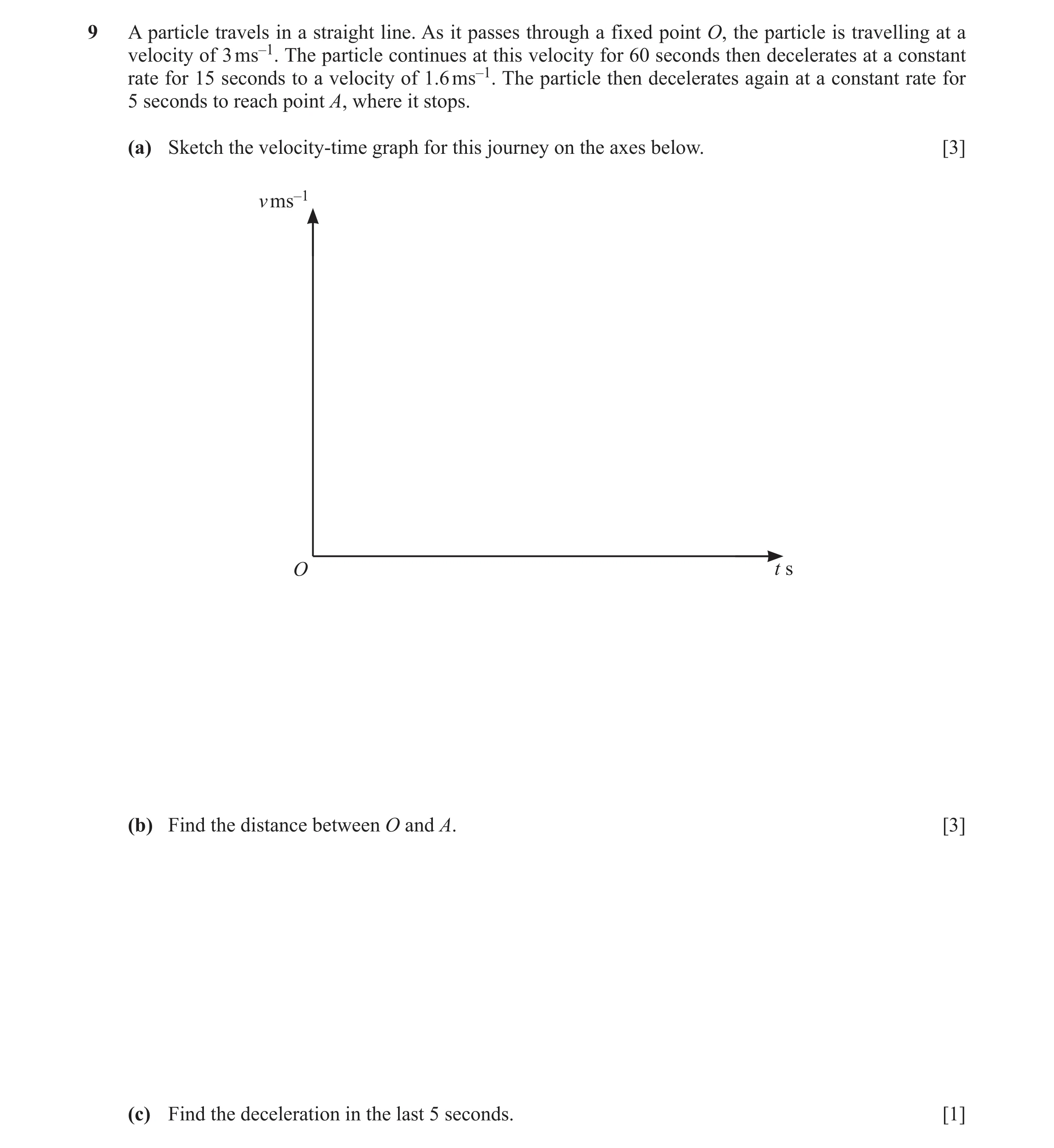
9 A particle travels in a straight line. As it passes through a fixed point O, the particle is travelling at a velocity of 3 ms–1. The particle continues at this velocity for 60 seconds then decelerates at a constant rate for 15 seconds to a velocity of 1.6 ms–1. The particle then decelerates again at a constant rate for 5 seconds to reach point A, where it stops. (a) Sketch the velocity-time graph for this journey on the axes below. [3] v ms–1 O t s (b) Find the distance between O and A. [3] (c) Find the deceleration in the last 5 seconds. [1]
7 marks
Mark scheme: 9(a) v ms-1 B3 B1 for correct shape with three distinct 3 linear sections B1 for 3 and 1.6 on vertical axis B1 for 60, 75, 80 on horizontal axis 1.6 t s O 60 75 80 9(b) 3 × 60 + 15 (1.6) + 0.5 (15) (1.4) + M2 M1 for attempting at least two terms of 0.5 (5) (1.6) the sum: or 3 × 60 + 0.5 (3 + 1.6) (15) + 0.5 (5) (1.6) 218.5 (metres) A1 9(c) 0.32 (ms–2) B1
This question in 0606/21 May/June 2020
Q10 · In this question all lengths are in centimetres 0606/23 May/June 2020
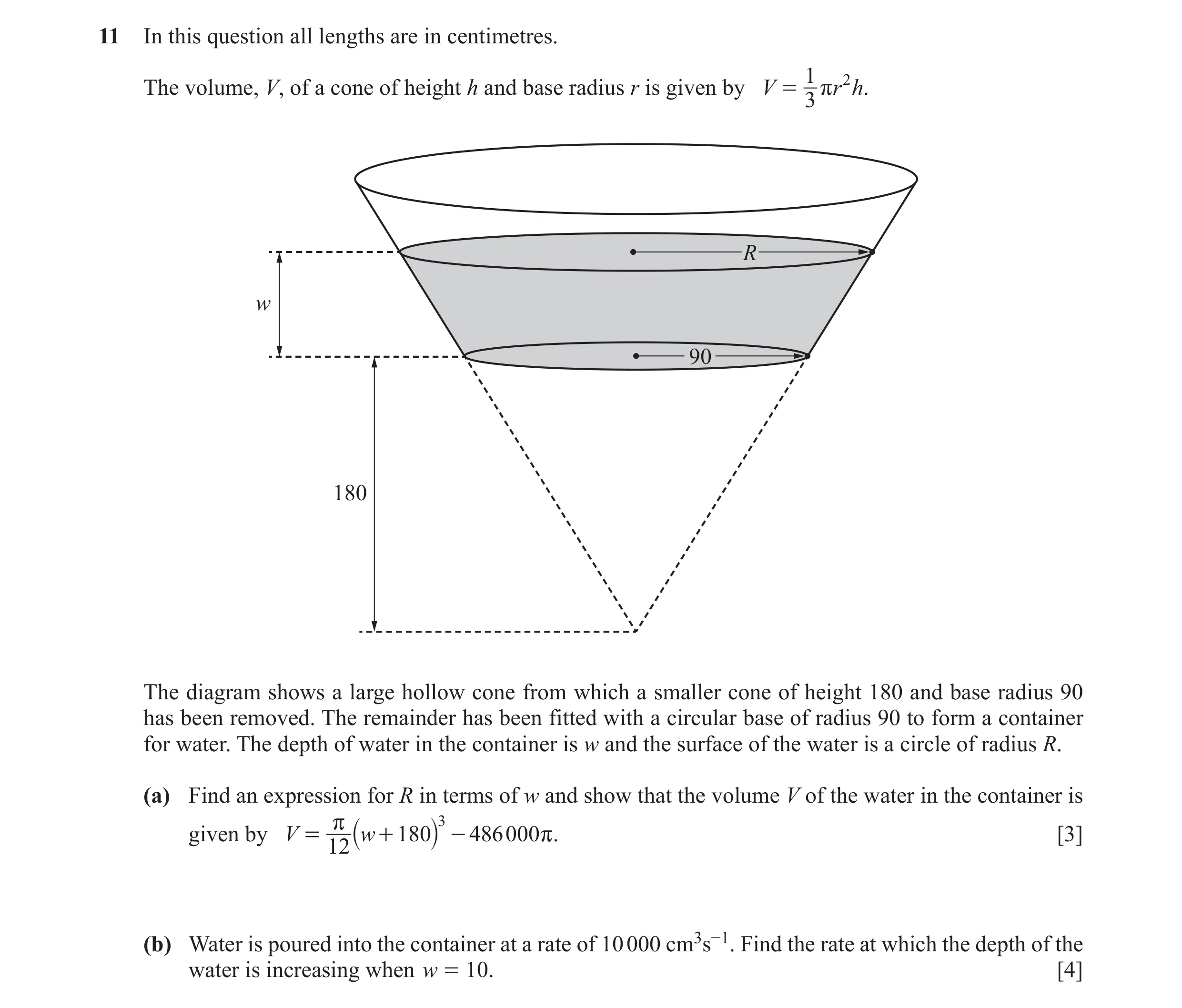
11 In this question all lengths are in centimetres. 1 2 The volume, V, of a cone of height h and base radius r is given by V = r r h. 3 R w 90 180 The diagram shows a large hollow cone from which a smaller cone of height 180 and base radius 90 has been removed. The remainder has been fitted with a circular base of radius 90 to form a container for water. The depth of water in the container is w and the surface of the water is a circle of radius R. (a) Find an expression for R in terms of w and show that the volume V of the water in the container is r 3 given by V = w + 180 - 486000r . [3] 12 ` j (b) Water is poured into the container at a rate of 10 000 cm3s−1. Find the rate at which the depth of the water is increasing when w = 10. [4]
7 marks
Mark scheme: 11(a) 1 B1 R = ( w + 180) 2 1 2 M1 V = π ( their R ) ( w + 180 ) 3 1 2 − π ( 90 ) (180 ) 3 Correct completion to given answer: A1 π V = ( w + 180 )3 − 486000π 12 11(b) dV π B1 = 3 ( w + 180 )2 oe dw 12 dw dw dV M1 = × soi dt dV dt d w 1 M1 = × 10000 d t d V their dw w =10 0.353 [cms−1] A1 or 0.3526[97...] [cms−1] rot to four or more figs
This question in 0606/23 May/June 2020
Q11 · A particle moves in a straight line such that, t seconds after passing a fixed point O… 0606/21 Oct/Nov 2020
9 A particle moves in a straight line such that, t seconds after passing a fixed point O, its displacement from O is s m, where s = e 2 t - 10 e t - 12 t + 9 . (a) Find expressions for the velocity and acceleration at time t. [3] (b) Find the time when the particle is instantaneously at rest. [3] (c) Find the acceleration at this time. [2]
8 marks
Mark scheme: 9(a) v = 2e 2 t − 10e t − 12 3 M1 for correctly differentiating 2e t . a = 4e 2 t − 10e t A1 for v correct A1 for a correct 9(b) v = 0 → e 2 t − 5e t − 6 = 0 M1 Factorise quadratic Solve and discard et = –1 → = 0 ( e t + 1)( e t − 6 ) e t = 6 A1 t = ln6 = 1.79 A1 9(c) t = ln6 → a = 4 × 36 − 10 × 6 = 84 2 M1 for inserting their value of t into a
This question in 0606/21 Oct/Nov 2020
Q12 · A curve has equation y = x cos x 0606/23 Oct/Nov 2020
7 A curve has equation y = x cos x . d y. [2] (a) Find d x (b) Find the equation of the normal to the curve at the point where x = r , giving your answer in the form y = mx + c . [4] r (c) Using your answer to part (a), find the exact value of x sin x d x . [5] 6y0
11 marks
Mark scheme: 7(a) − x sin x + cos x isw B2 accept unsimplified if incorrect allow B1 for d ( cos x ) = − sin x clearly seen d x 7(b) x = π, y = −π B1 or –3.14 or better d y B1 d y x = π, = − 1 from correct d x d x gradient of normal =1 M1 use m1m2 = –1 with their grad of tangent y = x −π2 cso A1 or y = x − 6.28 or better fully correct solution their ( a ) = x cos x7(c) M1 * − sin x + cos xd x = x cos x ( ) B1 clearly seen anywhere cos xdx = sin x − x cos x + sin x A1 implies previous marks if (a) is correct π M1 * dep insert into their integral 6 1 3 A1 reject decimals −π 2 12
This question in 0606/23 Oct/Nov 2020
Q13 · A particle moves in a straight line so that, t seconds after passing through a fixed… 0606/22 May/June 2021
8 A particle moves in a straight line so that, t seconds after passing through a fixed point O, its velocity, v ms -1 , is given by v = 3t 2 - 30t + 72 . (a) Find the distance between the particle’s two positions of instantaneous rest. [6] (b) Find the acceleration of the particle when t = 2 . [2]
8 marks
Mark scheme: 8(a) Factorises or solves M1 3t 2 − 30t + 72 = 0 or t 2 − 10t + 24 = 0 t = 4, t = 6 A1 Integrates v to find F(t): M2 M1 for any two terms correct 3t 3 30t 2 − + 72t 3 2 Correct substitution for M1 dep on at least M1 for integration F(6) – F(4) or F(4) – F(6) FT their 4 and their 6 provided they are both positive 4 (m) A1 dep on all previous marks being awarded 8(b) [ a = ]6t − 30 B1 [When t = 2: a = 6(2) – 30 =] B1 −18 (ms−2) cao
This question in 0606/22 May/June 2021
Q14 · A vehicle travels along a straight, horizontal road 0606/22 Feb/March 2022
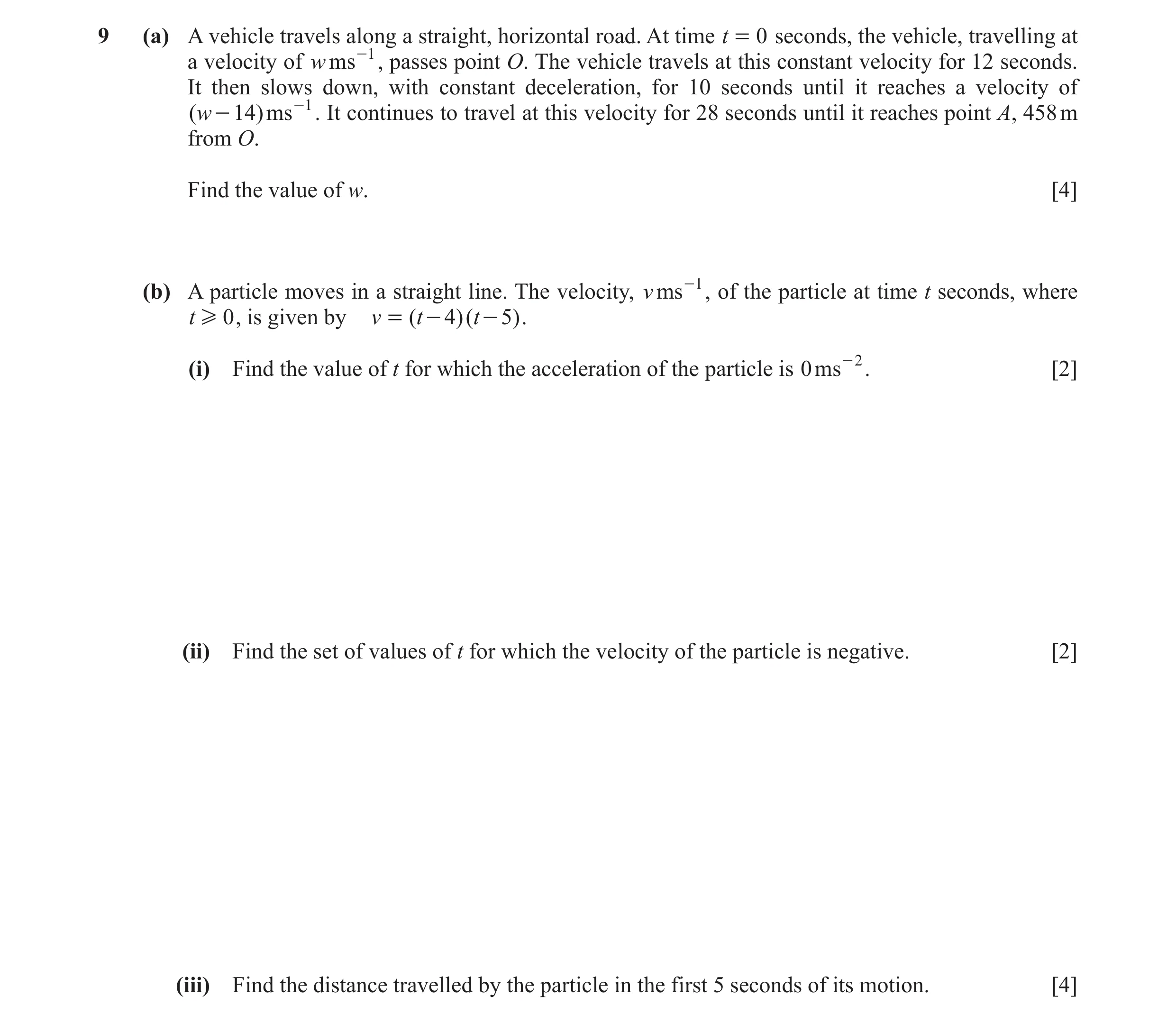
9 (a) A vehicle travels along a straight, horizontal road. At time t = 0 seconds, the vehicle, travelling at a velocity of w ms -1 , passes point O. The vehicle travels at this constant velocity for 12 seconds. It then slows down, with constant deceleration, for 10 seconds until it reaches a velocity of ( w - 14) ms -1 . It continues to travel at this velocity for 28 seconds until it reaches point A, 458 m from O. Find the value of w. [4] (b) A particle moves in a straight line. The velocity, v ms -1 , of the particle at time t seconds, where t H 0 , is given by v = ( t - 4 )( t - 5 ) . (i) Find the value of t for which the acceleration of the particle is 0ms - 2 . [2] (ii) Find the set of values of t for which the velocity of the particle is negative. [2] (iii) Find the distance travelled by the particle in the first 5 seconds of its motion. [4]
12 marks
Mark scheme: 9(a) Correct v-t graph soi e.g. B1 v w w – 14 t O 12 22 50 [A] Equates ‘area’ and distance M2 implies B1 1 e.g. 12 w + × 10 × ( w + w − 14) + M1 for 2 12w + ... + 28(w – 14) = 458 soi 28( w − 14) = 458 or 12w + 70 + 10(w – 14) + ... = 458 soi or ... + 70 + 10(w – 14) + 28(w – 14) = 458 18.4 (m s–1) A1 9(b)(i) v = t 2 − 9 t + 20 , a = 2t – 9 M1 or a = t – 5 + t – 4 from product rule t = 4.5 A1 9(b)(ii) Critical values 4, 5 M1 4 < t < 5 A1 9(b)(iii) 4 2 5 2 M1 FT their t 2 − 9t + 20 providing 3 terms (t − 9t + 20)d t + ( t − 9t + 20)d t 0 4 oe, soi 4 5 B1 3 2 3 2 t 9t t 9t − + 20t + − + 20t 3 2 0 3 2 4 64 M1 dep on an attempt to integrate − 72 + 80 + 3 125 225 64 − + 100 − − 72 + 80 3 2 3 59 A1 oe or 29.5 2
This question in 0606/22 Feb/March 2022
Q15 · In this question all lengths are in metres 0606/21 May/June 2022
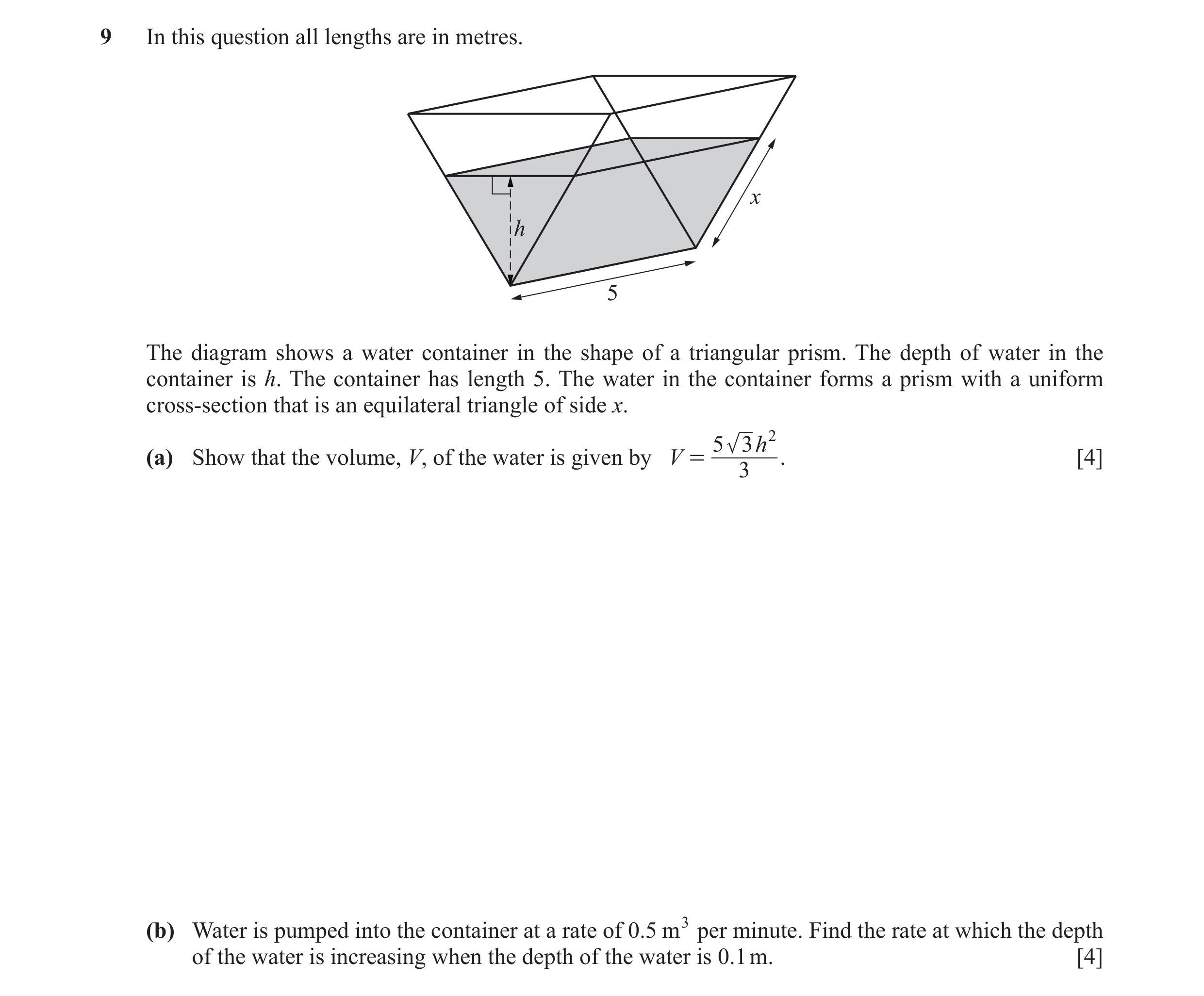
9 In this question all lengths are in metres. x h 5 The diagram shows a water container in the shape of a triangular prism. The depth of water in the container is h. The container has length 5. The water in the container forms a prism with a uniform cross-section that is an equilateral triangle of side x. 5 3 h 2 (a) Show that the volume, V, of the water is given by V = . [4] 3 (b) Water is pumped into the container at a rate of 0.5 m3 per minute. Find the rate at which the depth of the water is increasing when the depth of the water is 0.1 m. [4]
8 marks
Mark scheme: 9(a) 2 M1 Correct expression 2 x h x connecting x and h 2 oe h or cos30 oe x 1 1 2 or xh = x sin60 2 2 2 h A1 Must be x = x oe 3 2 M1 1 2 h V = their sin60 5 2 3 1 2 h or h their 5 2 3 5 3 h 2 A1 Correct completion to given answer V 3 9(b) 10 3 B1 Correct derivative of V e.g. h 3 d h d V d h B1 V soi Not d t d t d V h 10 3 M1 0.5 0.1 3 oe 0.866 (metres per minute) A1 3 or 0.8660[25…] rot to 4 or more sf Allow isw 2
This question in 0606/21 May/June 2022
Q16 · A particle P moves in a straight line such that, t seconds after passing a fixed point O… 0606/22 Feb/March 2023
10 A particle P moves in a straight line such that, t seconds after passing a fixed point O, its acceleration, a ms -2 , is given by a = 6t for 0 G t G 3, 18e 3 a = t for t H 3. e When t = 1, the velocity of P is 2 ms -1 and its displacement from O is – 4 m. (a) (i) Find the velocity of P when t = 3 . [3] (ii) Find the displacement of P from O when t = 3 . [3] (b) Find an expression in terms of t for the displacement of P from O when t H 3 . [4] Question 11 is printed on the next page.
10 marks
Mark scheme: 10(a)(i) v = 3t 2 + c M1 v = 3t 2 − 1 A1 When t = 3 v = 26 A1 10(a)(ii) s = t 3 −+t c M1 FT kt 2 + c s = t 3 −−t 4 A1 When t = 3 s = 20 A1 10(b) −18e 3 M1 v = + c oe e t −18e 3 A1 FT (their 26) + 18 v = + 44 oe e t 18e 3 M1 dep on previous M1 s = + their 44t + d oe e t 18e 3 A1 s = + 44t − 130 oe, cao e t
This question in 0606/22 Feb/March 2023
Q17 · A particle moves in a straight line 0606/21 Oct/Nov 2023
7 A particle moves in a straight line. At time t seconds after passing through a fixed point O, its velocity, v ms -1 , is given by v = 10 sin 2 t - 6 cos 2 t . (a) Find an expression for the acceleration of the particle. [2] (b) Find the acceleration when t = r . [1] 4 (c) Find the first time at which the acceleration is zero. [3] (d) Find the displacement of the particle between t = r and t = r . [4] 4 2
10 marks
Mark scheme: 7(a) 20cos2t + 12sin2t 2 B1 for 20cos2t or 12sin2t 7(b) 12 B1 7(c) 20 M1 FT acos2t + bsin2t where a and b are non-zero tan 2t = their − oe integers 12 t = 1.06 or 1.055[60…] rot to 3 or more dp A2 A1 for 2t = –1.030[3…] or 2t = 2.111[2…] 7(d) s = −5cos2t −3sin2t (+ c) B2 B1 for −5cos2t or −3sin2t π π M1 FT providing at least B1 previously awarded −5cosπ − 3sinπ − (−5cos − 3sin ) 2 2 or s = −5cos2t −3sin2t + 5 and s π − s π = 10 − 2 2 4 8 A1
This question in 0606/21 Oct/Nov 2023
Q18 · A particle is travelling in a straight line 0606/22 Oct/Nov 2023
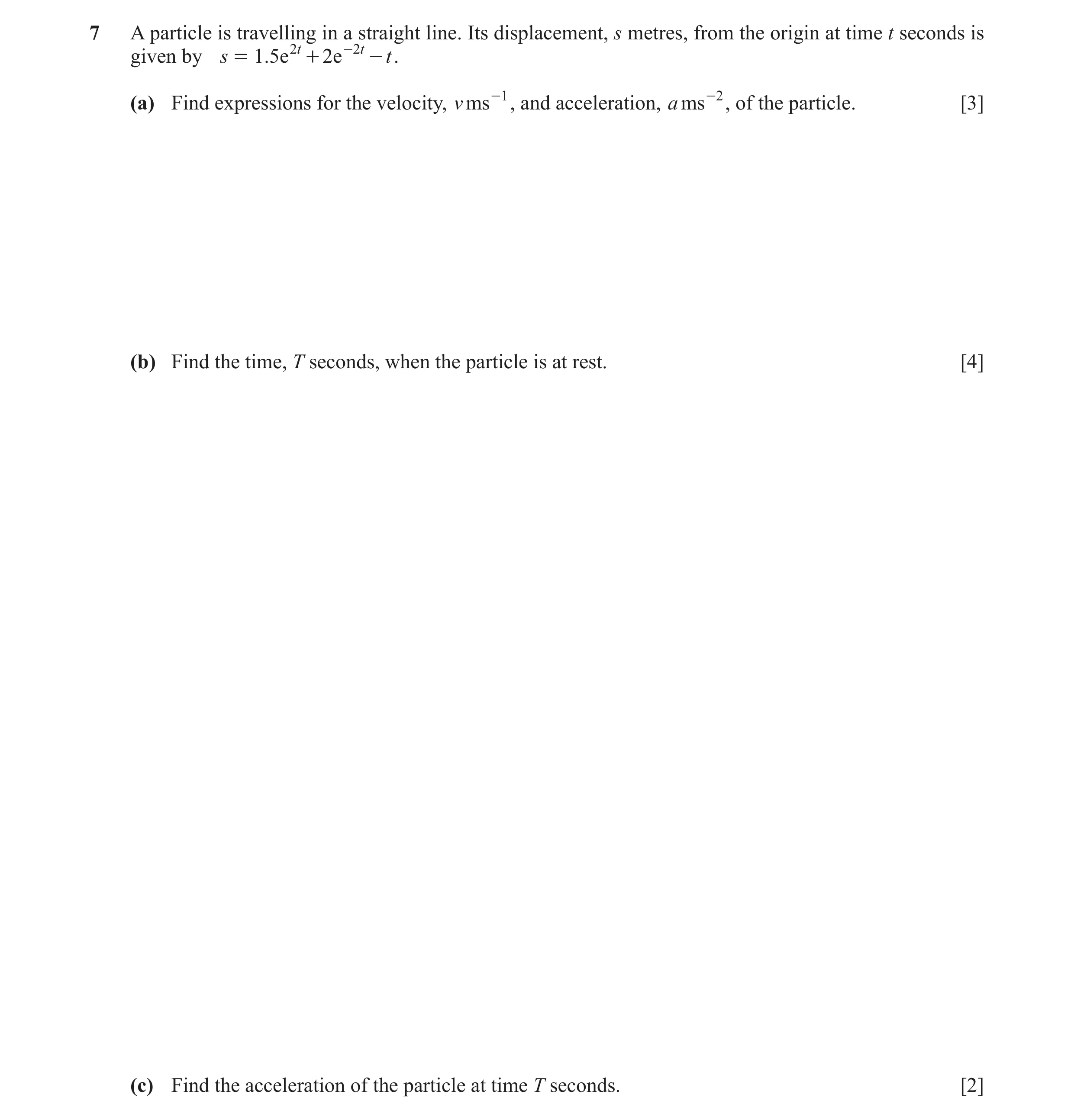
7 A particle is travelling in a straight line. Its displacement, s metres, from the origin at time t seconds is given by s = 1.5e 2 t + 2e -2 t - t . (a) Find expressions for the velocity, v ms -1 , and acceleration, a ms -2 , of the particle. [3] (b) Find the time, T seconds, when the particle is at rest. [4] (c) Find the acceleration of the particle at time T seconds. [2]
9 marks
Mark scheme: 7(a) Velocity: 3e 2 t − 4e −2 t − 1 isw B2 B1 for 3e 2 t or −4e−2 t Acceleration: 6e 2 t + 8e−2 t isw B1 FT me 2 t + ne−2 t + k where m, n and k are constants 7(b) 3e 4 t − e 2 t − 4 = 0 B1 2 or 3 e 2 t − e 2 t − 4 = 0 ( ) 2 t 2 t M1 FT their 3-term quadratic in e2t oe 3e − 4 e + 1 = 0 ( )( ) 2 t 4 A1 e = nfww 3 1 4 A1 ln oe, isw or 0.144 2 3 or 0.1438[41…] rot to 4 or more dp and no other solutions 7(c) 2 1 ln 4 −2 1 ln 4 M1 FT p e 2 t + q e−2 t where p and q are non-zero 6 e 2 3 + 8 e 2 3 constants and their positive 1 ln 4 from part 2 3 (b) 14 nfww A1
This question in 0606/22 Oct/Nov 2023
Q19 · A particle travels in a straight line 0606/23 Oct/Nov 2023
6 A particle travels in a straight line. Its displacement, s metres, from the origin, at time t seconds, where t 2 2 , is given by s = ln ( 4t 2 - 5 ) - t . (a) Find expressions for the velocity, v ms -1 , and acceleration, a ms -2 , of the particle. [4] (b) Find the time when the particle is at rest. [3] (c) Find the acceleration at this time. [2]
9 marks
Mark scheme: 6(a) 8t B2 f ( t ) 8t Velocity: − 1 B1 for 2 − 1 or for 2 + g(t) 2 4t − 5 4t − 5 4t − 5 Correct structure of quotient rule or equivalent product M1 FT their v if possible; must be of rule equivalent difficulty (4t 2 − 5)(8) − (8t )(8t ) A1 8t Acceleration: oe, isw FT 2 + k where k is a constant 2 2 (4t − 5) 4t − 5 6(b) 4t2 − 8t – 5 = 0 oe B1 ( 2t + 1)( 2t − 5 ) = 0 M1 FT their 3-term quadratic in t t = 2.5 and no other values A1 dep on correct quadratic seen 6(c) (4 2.52 − 5)(8) − (8 2.5)(8 2.5) M1 Substitutes a value of t 2 in an oe, soi 2 2 expression for a which has at least one (4 2.5 − 5) 1 term with a factor of or 2 4t 2 − 5 ( ) 1 16t 4 − 40t 2 + 25 3 A1 a = − oe only 5
This question in 0606/23 Oct/Nov 2023
Q20 · It is given that y = mx 2 + + n , where m and n are non-zero constants 0606/21 May/June 2024
7 It is given that y = mx 2 + + n , where m and n are non-zero constants. It is also given that 2 2 2 d y d y 3 2 = - y for all values of x. Find the values of m and n. [4] f d x p e d x o
4 marks
Mark scheme: 7 d y 1 B1 2 mx d x 2 d 2 y B1 2 m d x 2 1 5 2 M1 for m and n and no other values 2 4 4 1 2 x 3(2 m ) 2 mx mx n 2 2 soi
This question in 0606/21 May/June 2024
 1 / 17
 2 / 17
 3 / 17
 4 / 17
 5 / 17
 6 / 17
 7 / 17
 8 / 17
 9 / 17
 10 / 17
![Question 12: A curve has equation y = x cos x . d y. [2] (a) Find d x (b) Find the equation of the normal to the curve at the point where x = r , giving…](https://img.pastlit.com/crops/21d35263-eb8f-4de9-bb12-e75c58f9e911/q7.webp)
 11 / 17
 12 / 17
 13 / 17
 15 / 17
 16 / 17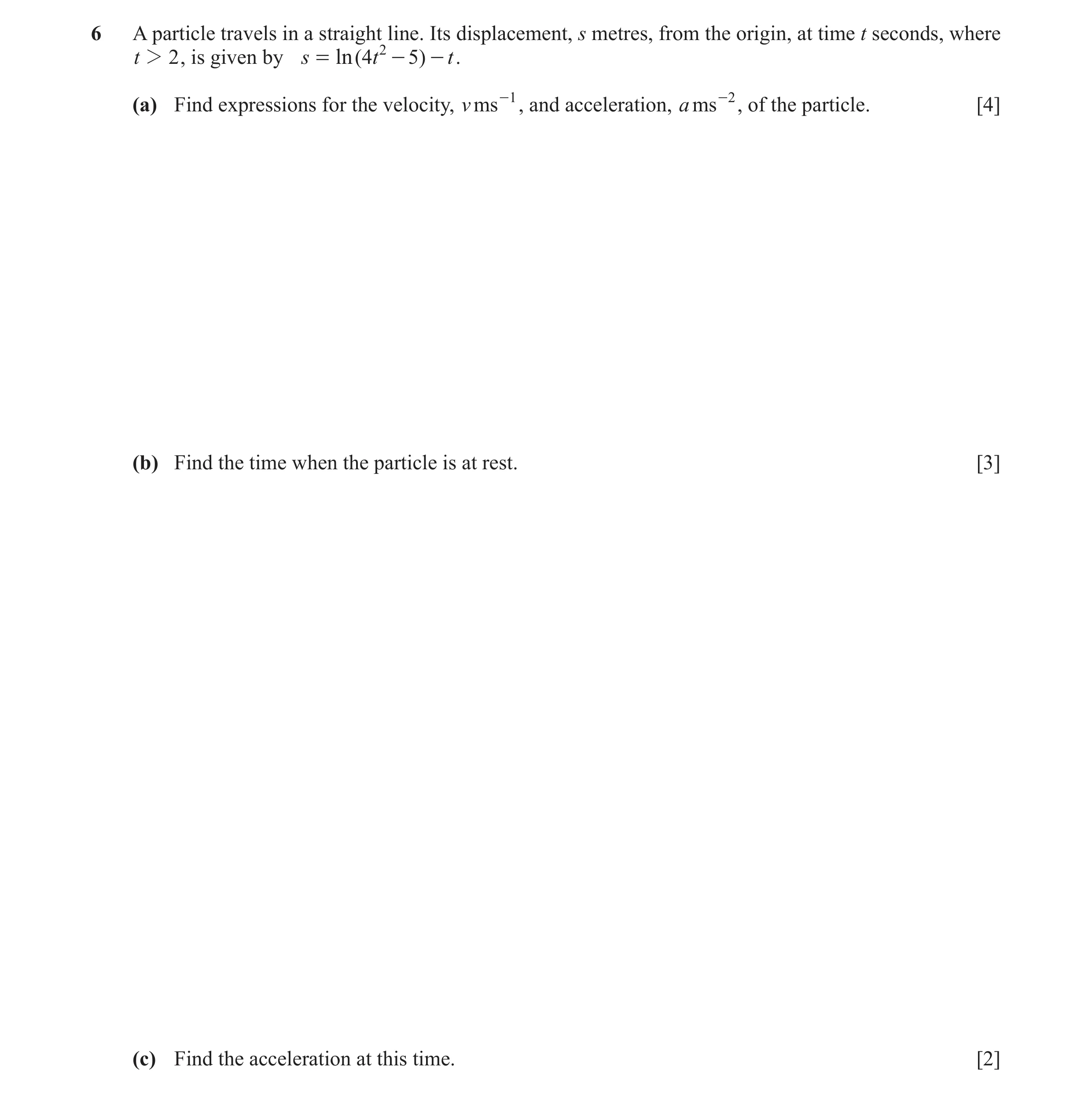
 17 / 17
 9
9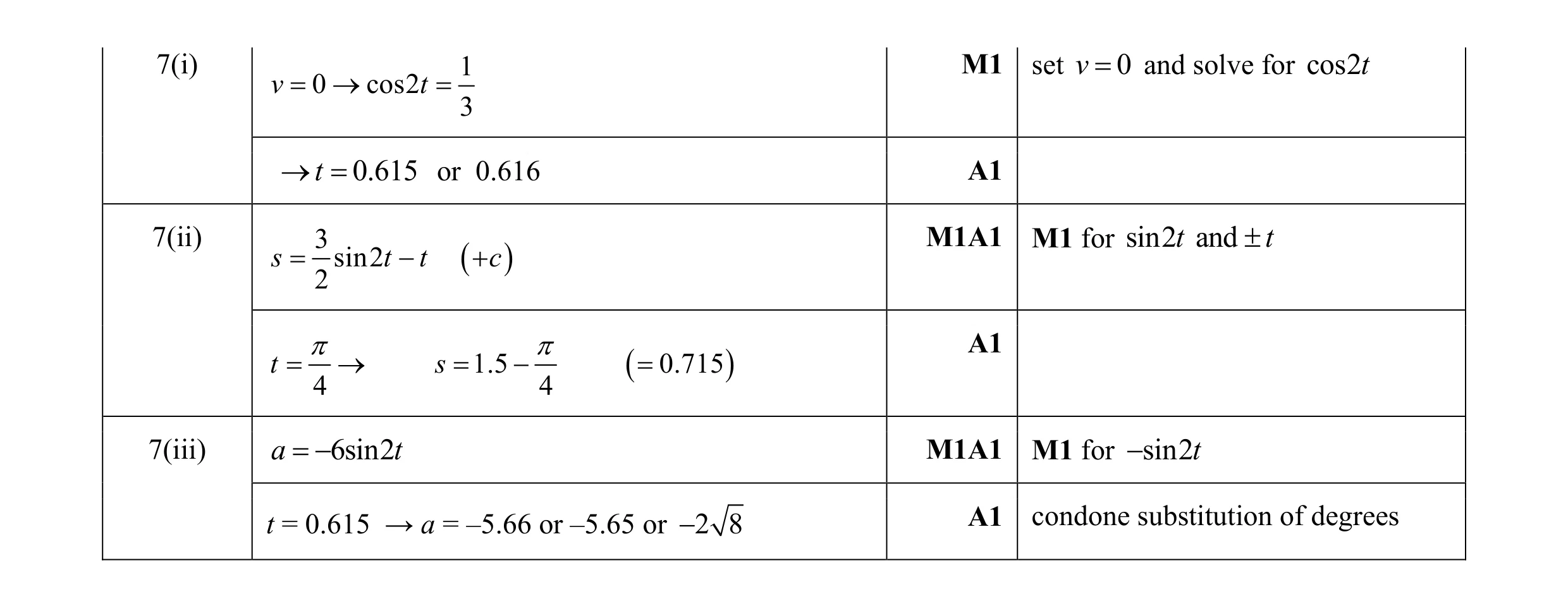 8
8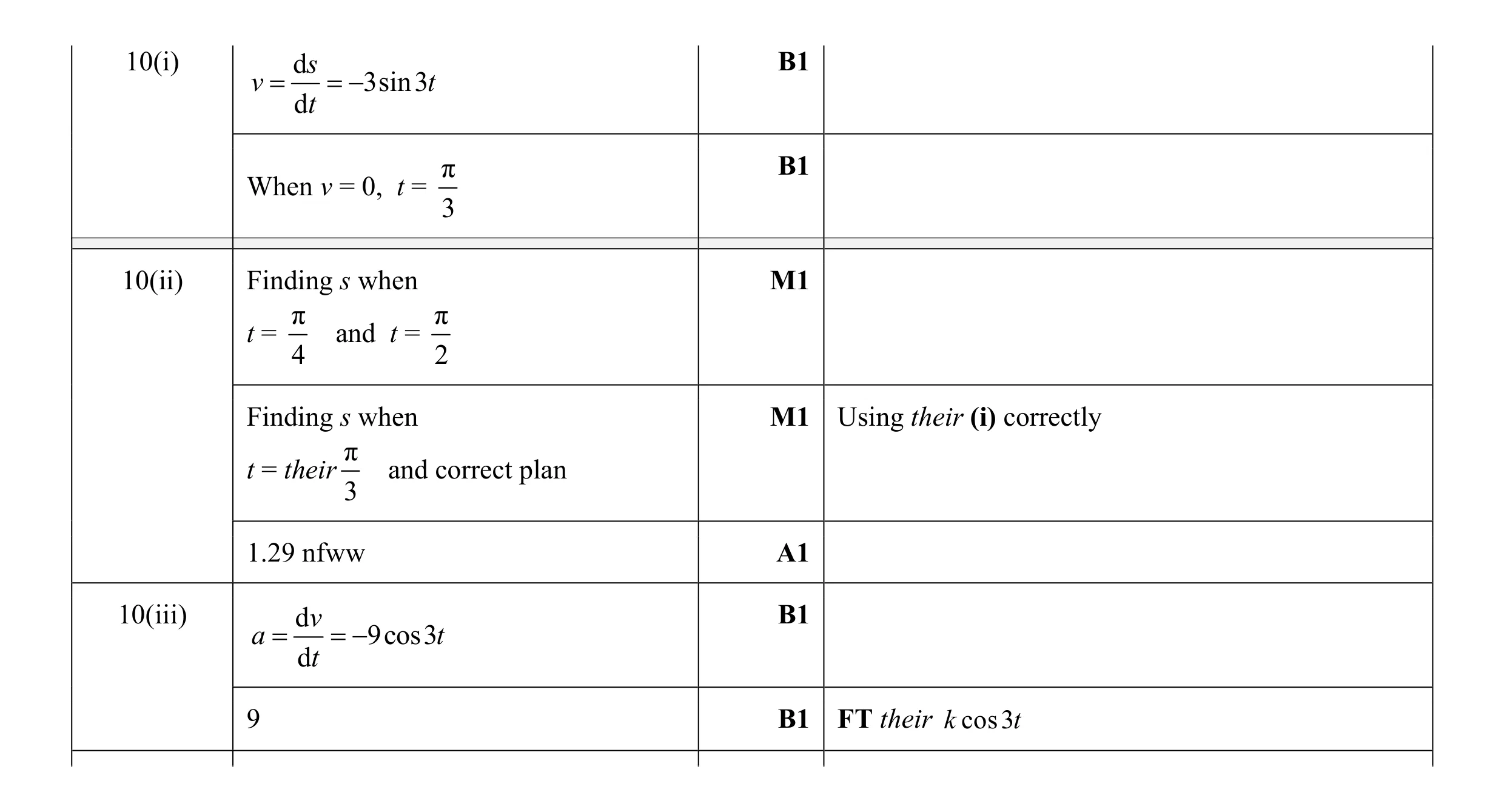 7
7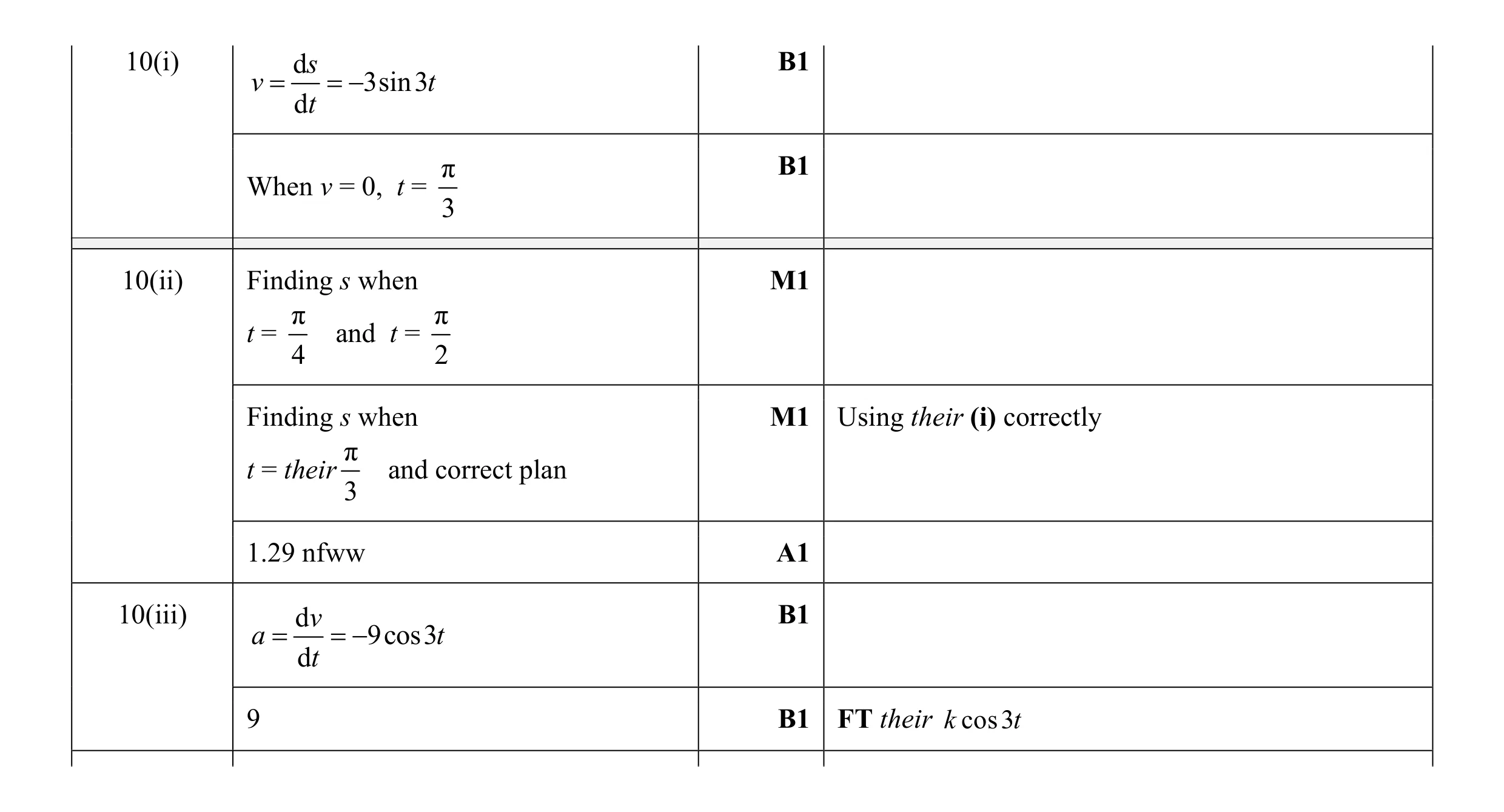 7
7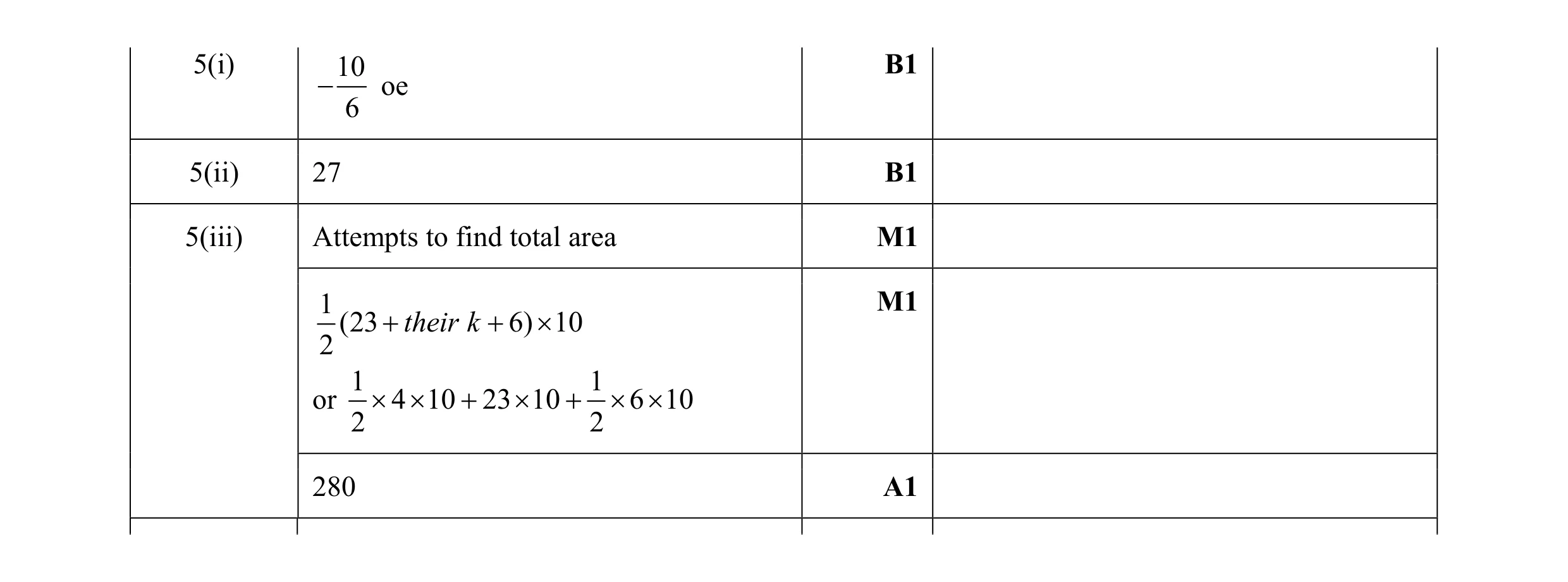 5
5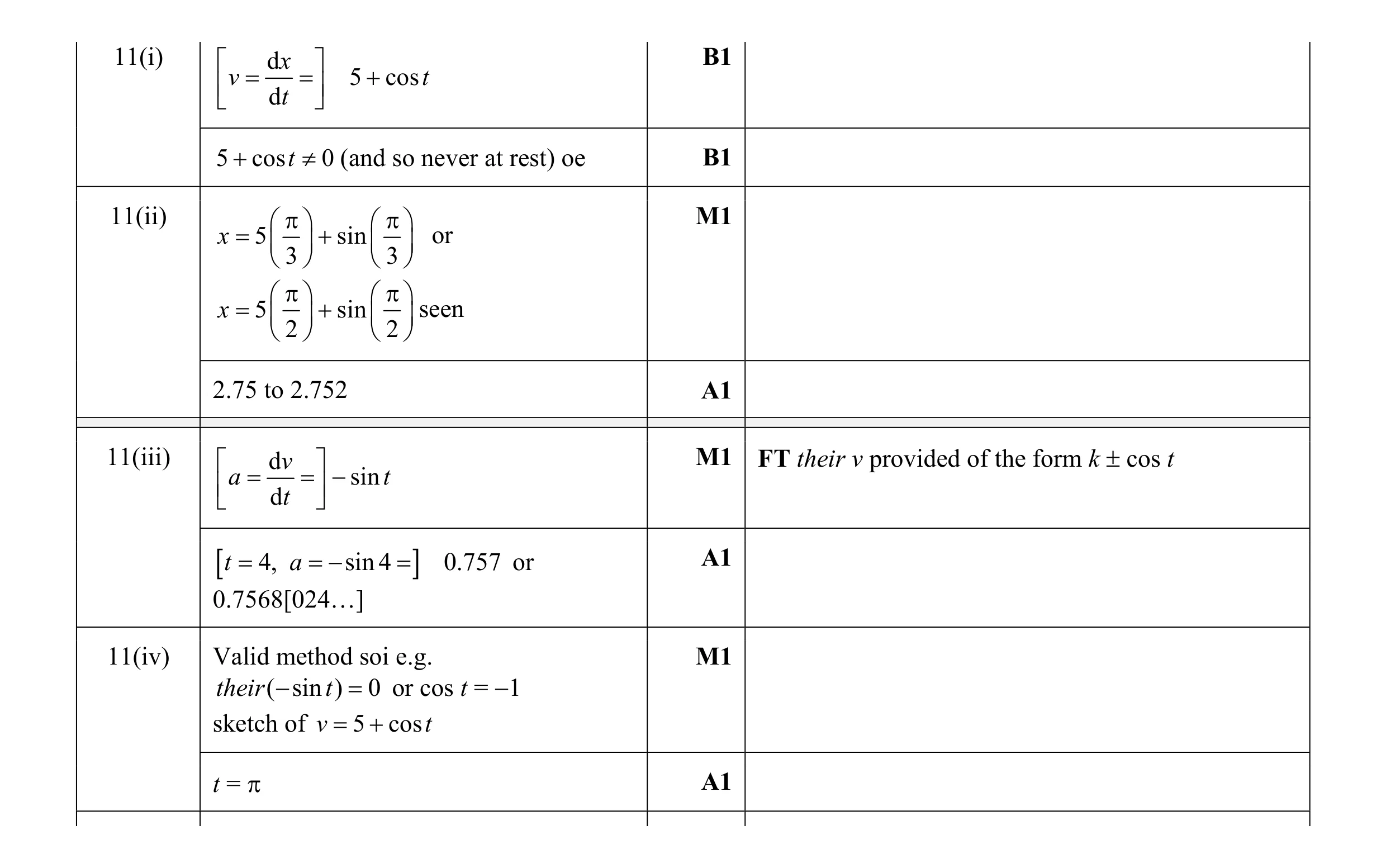 8
8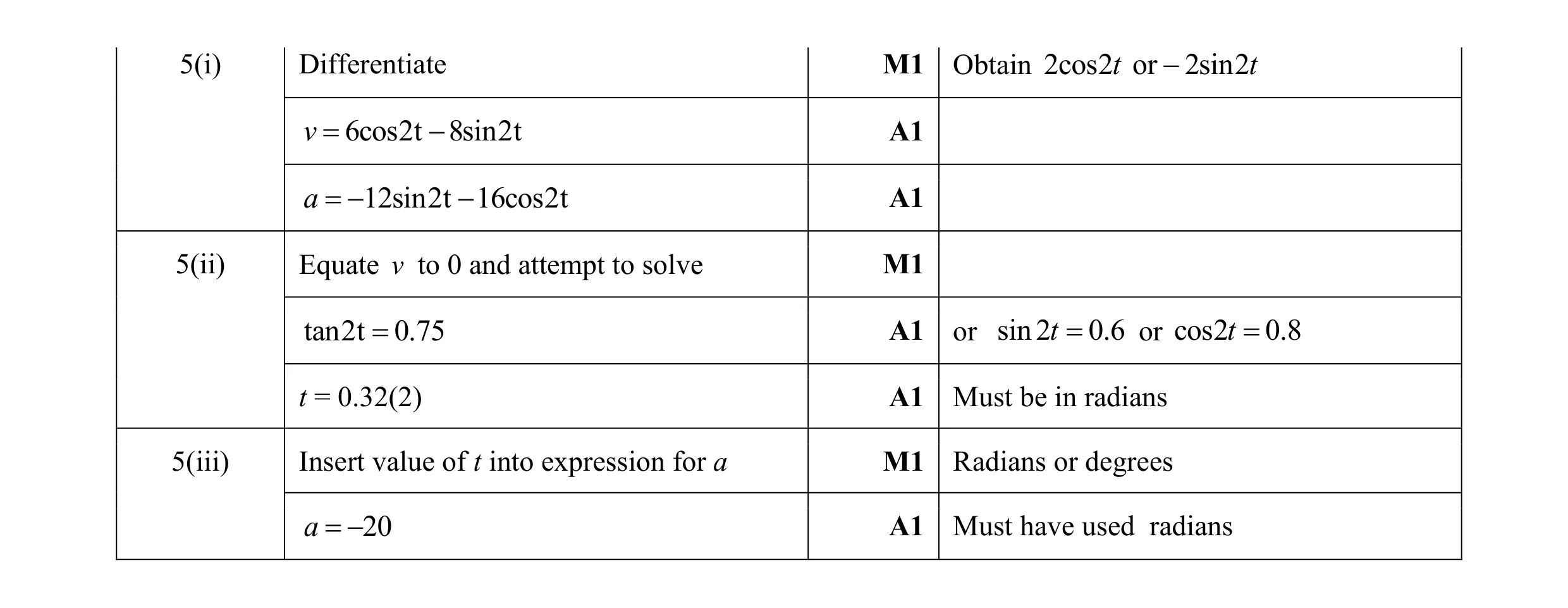 8
8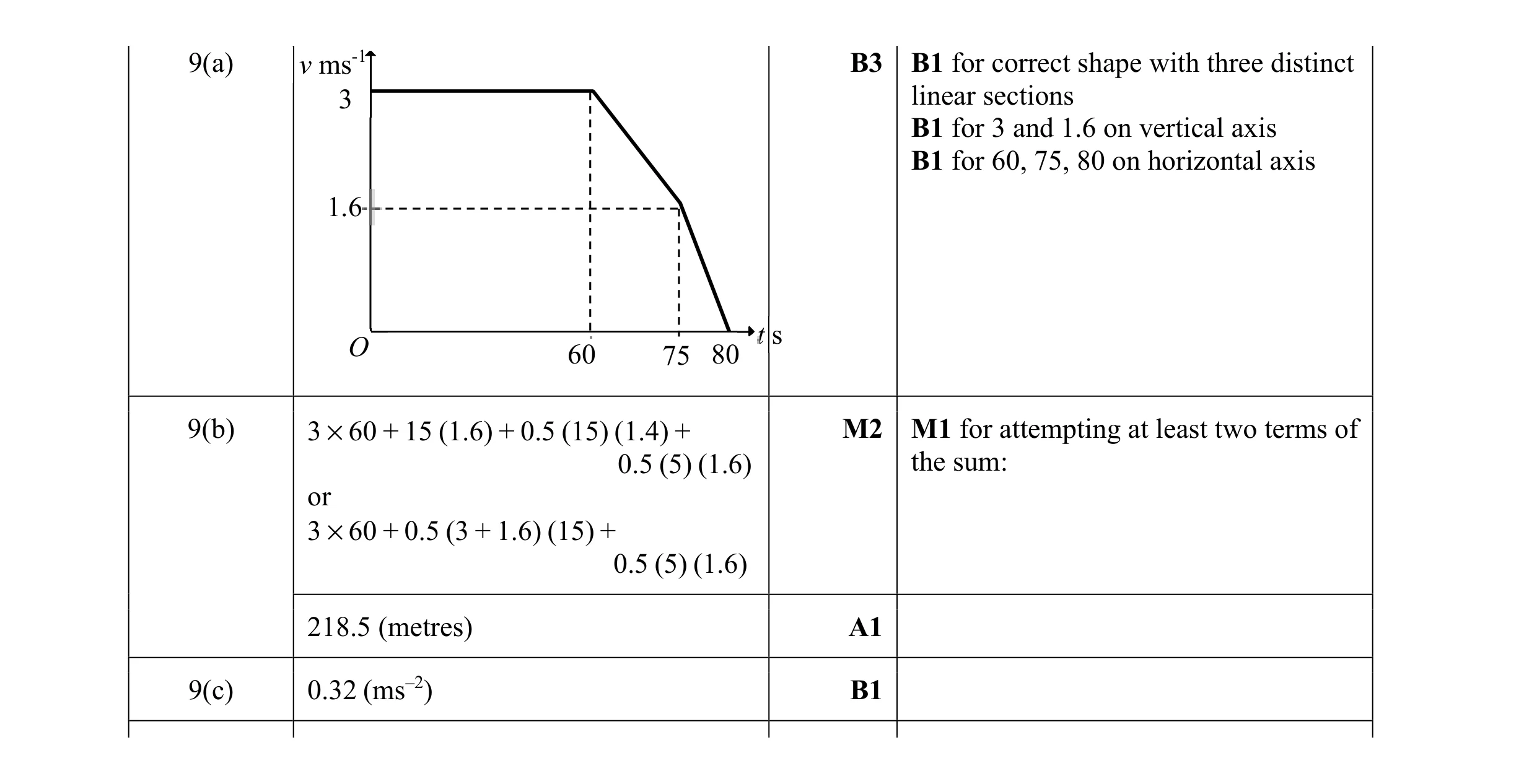 7
7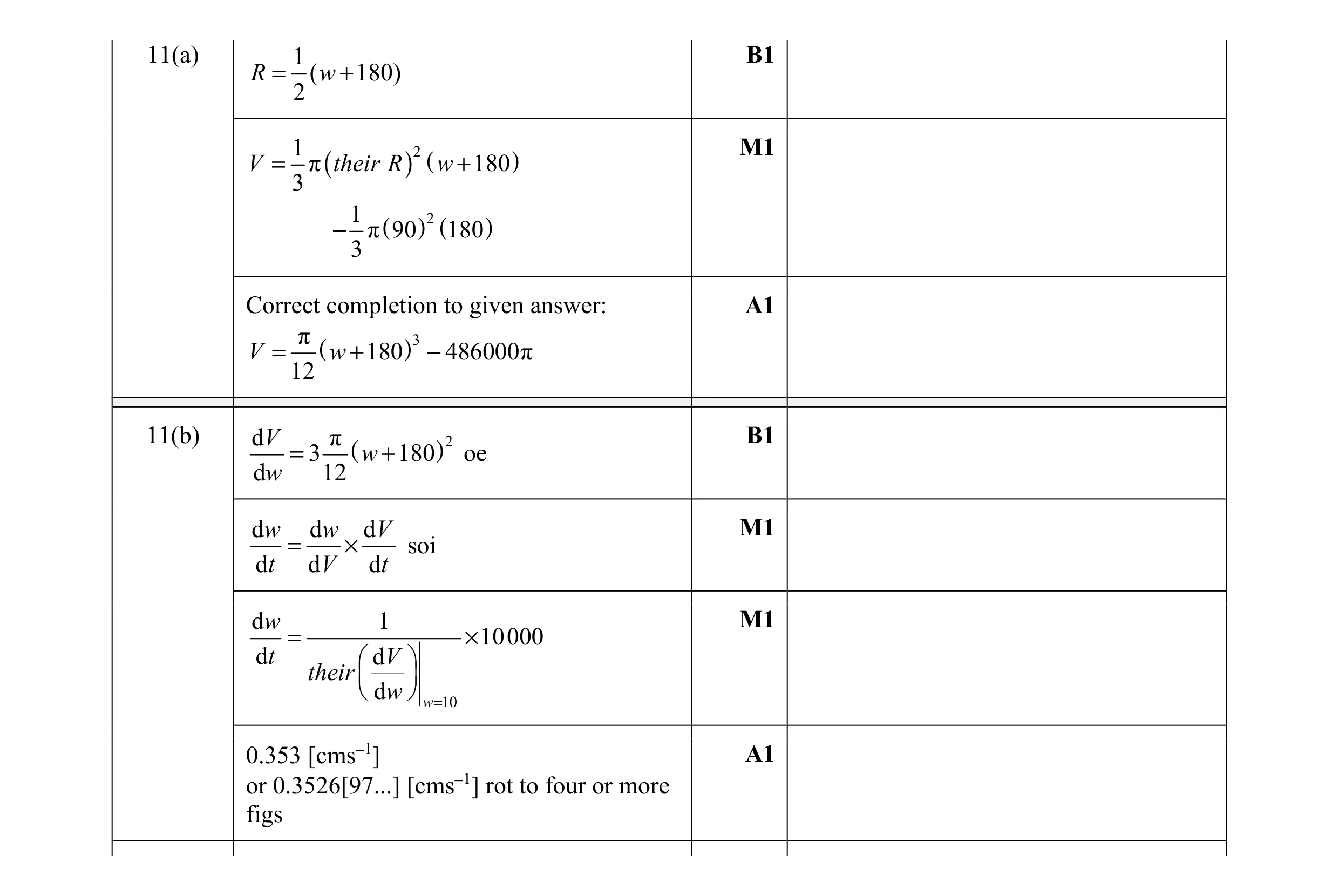 7
7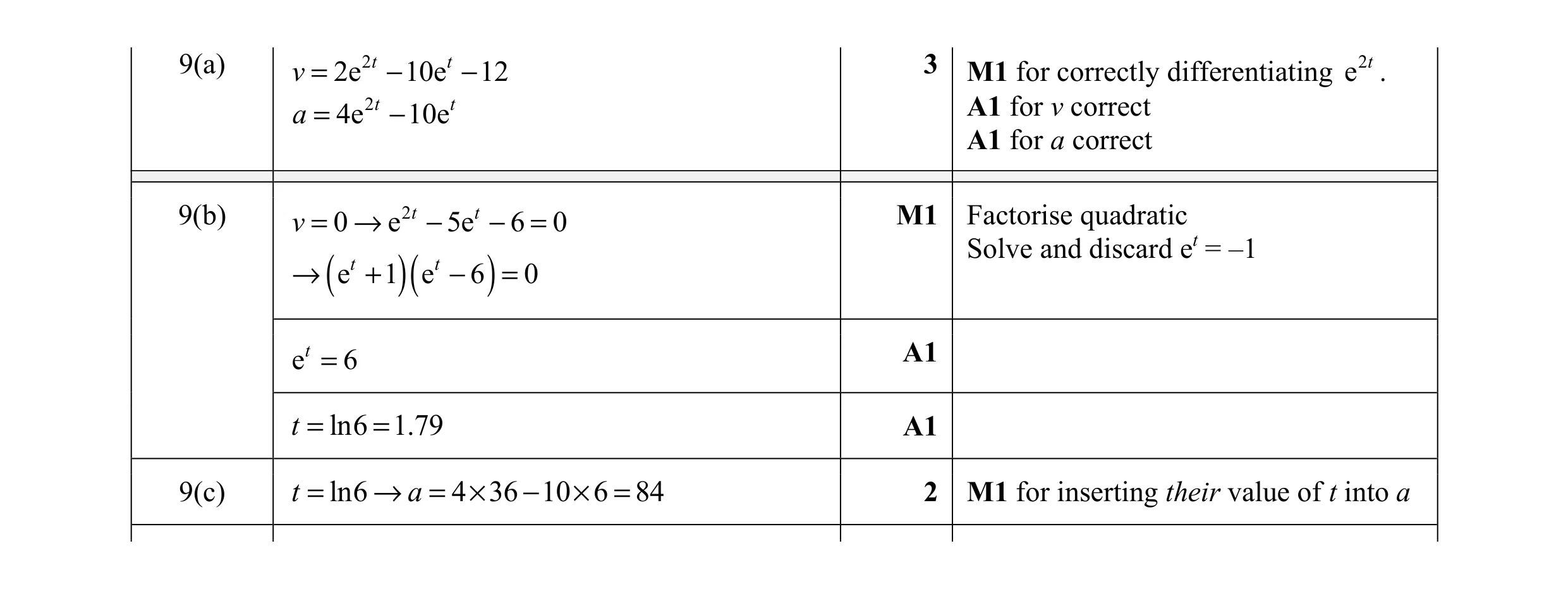 8
8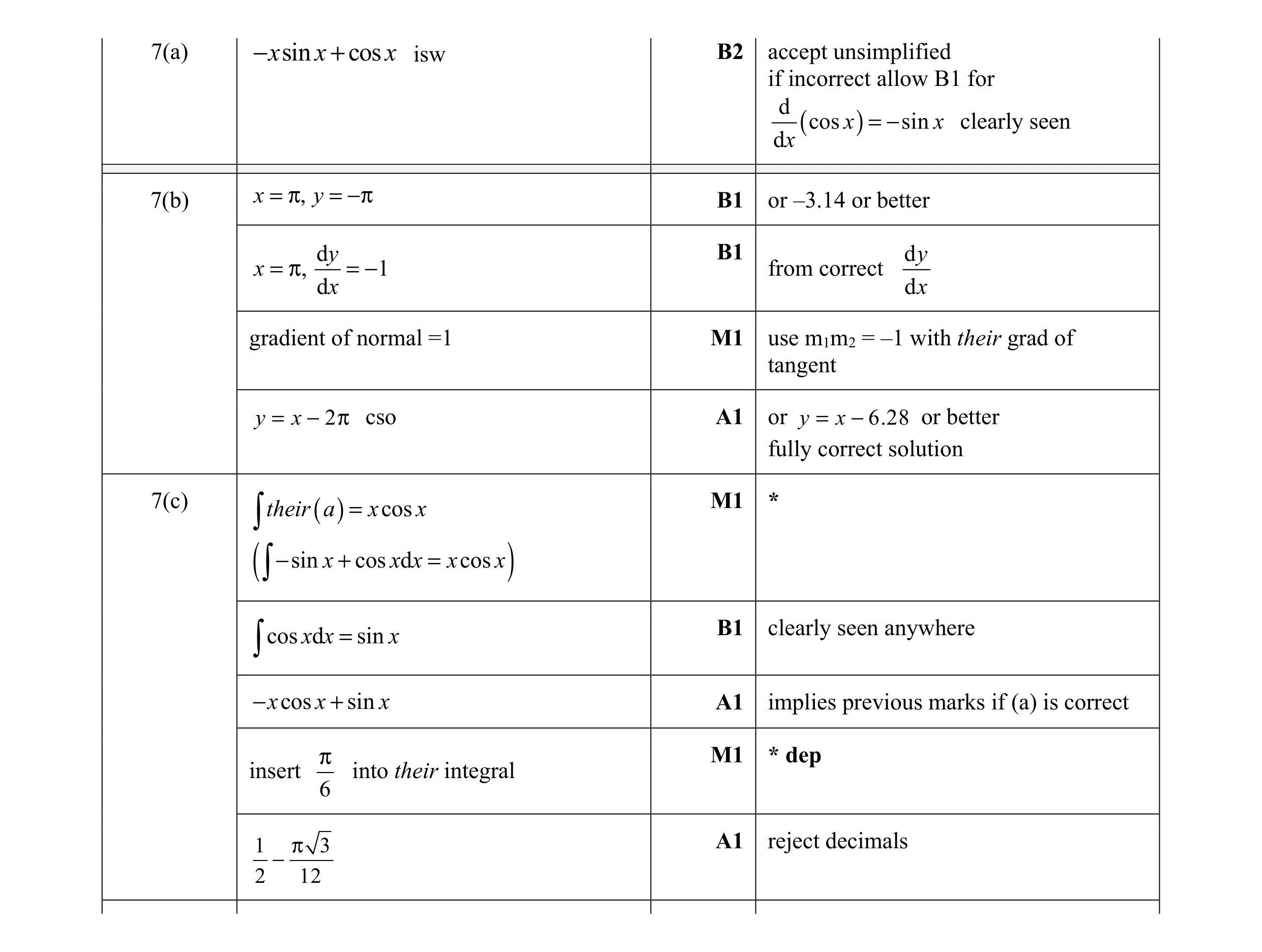 11
11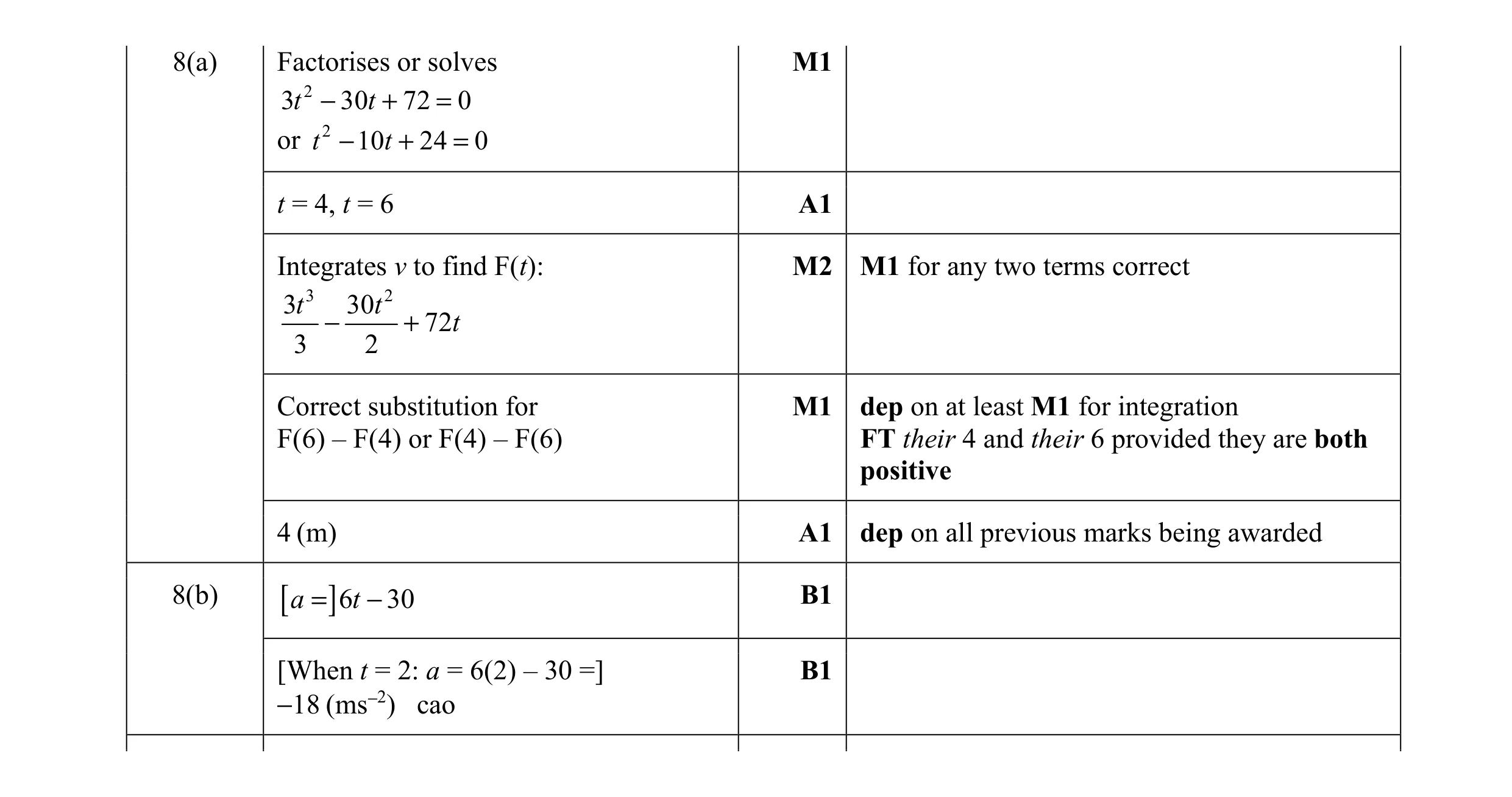 8
8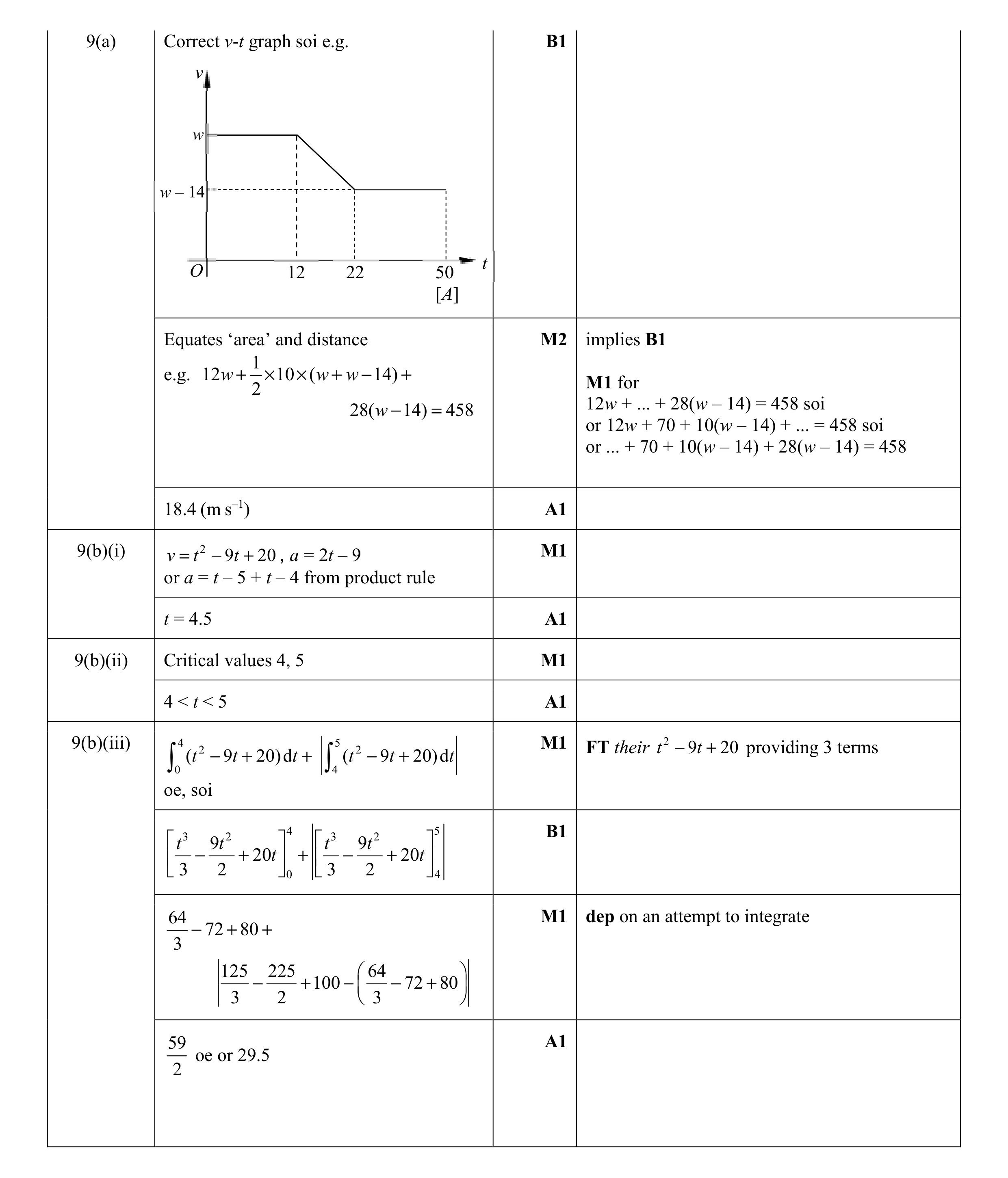 12
12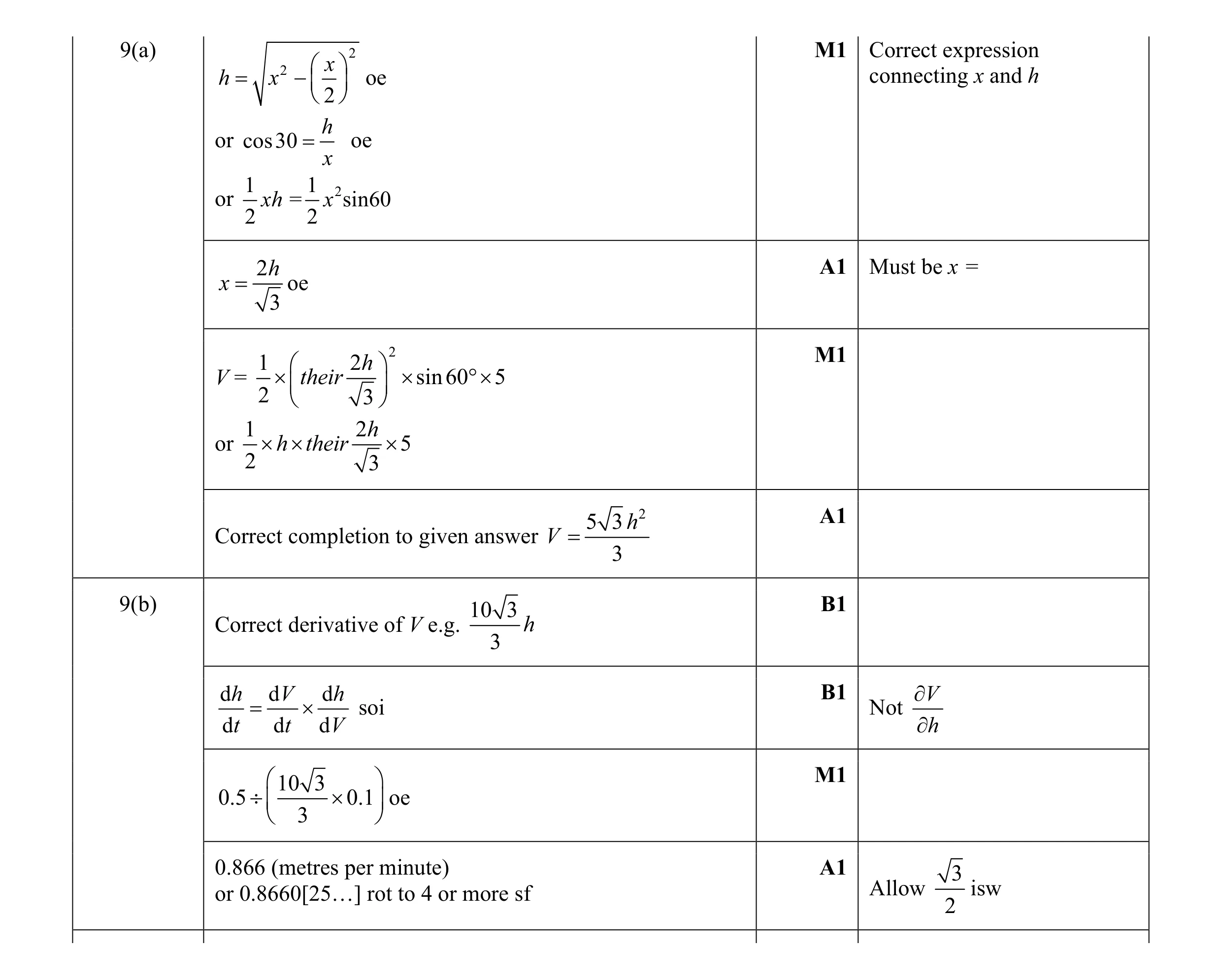 8
8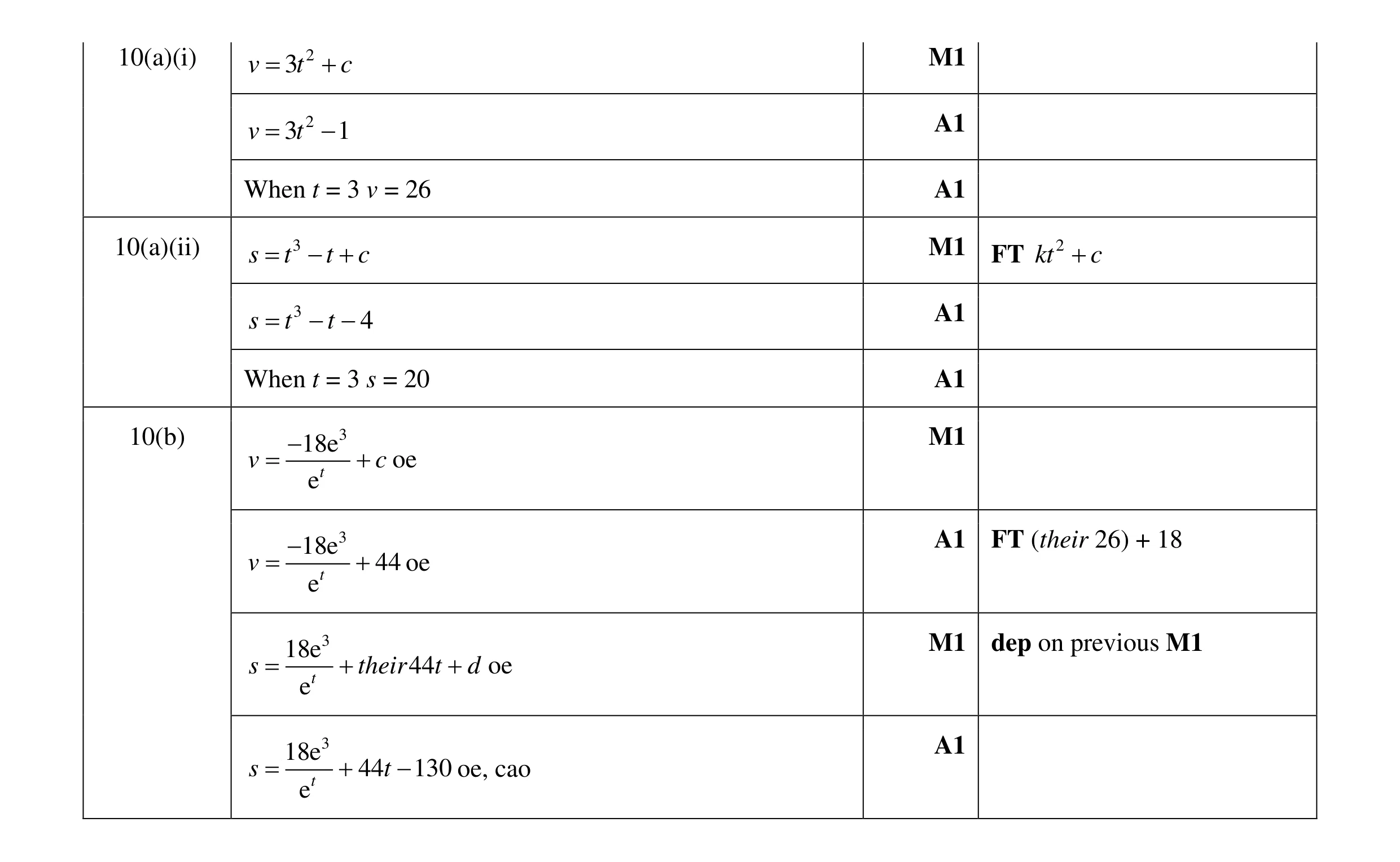 10
10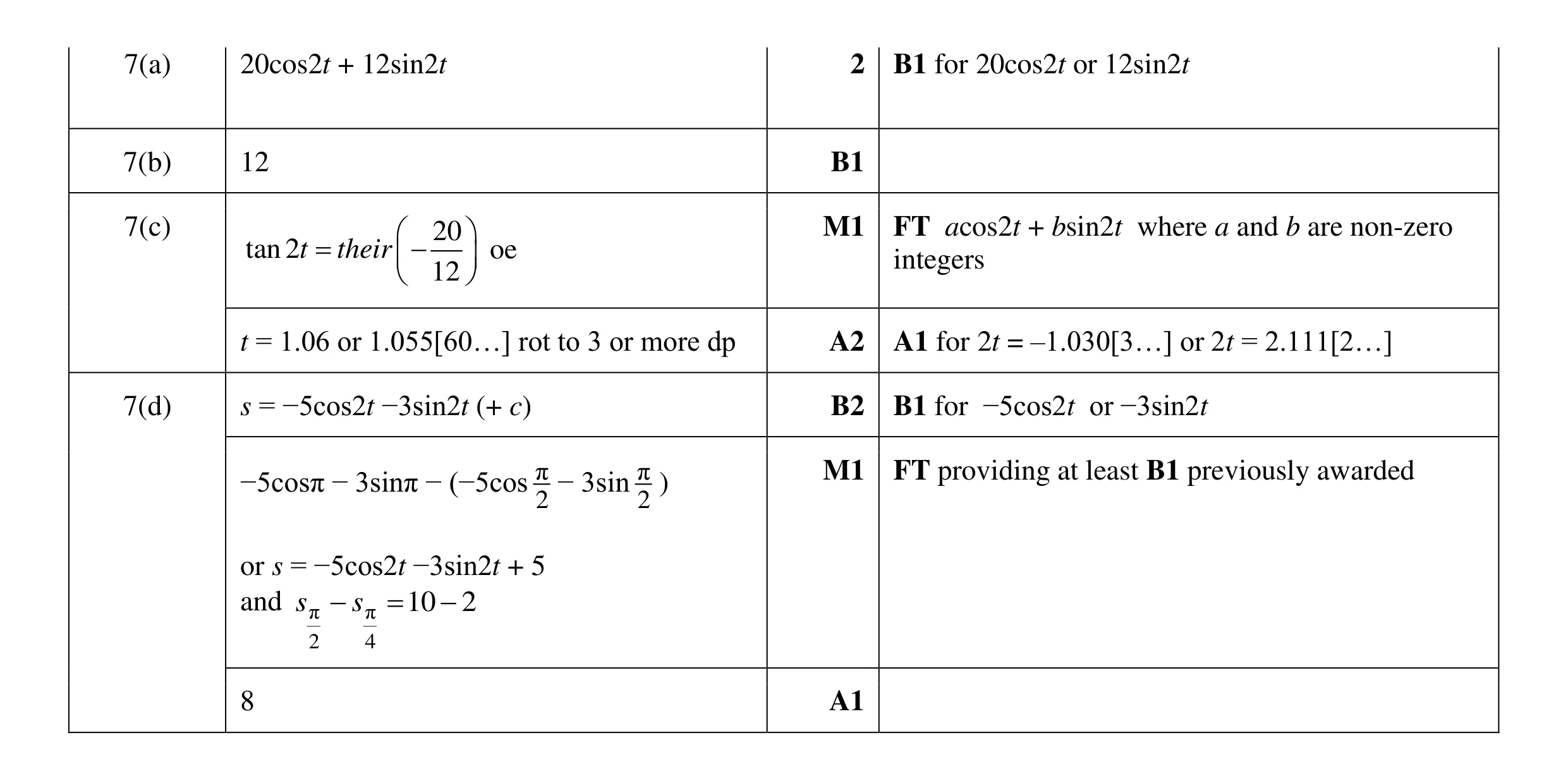 10
10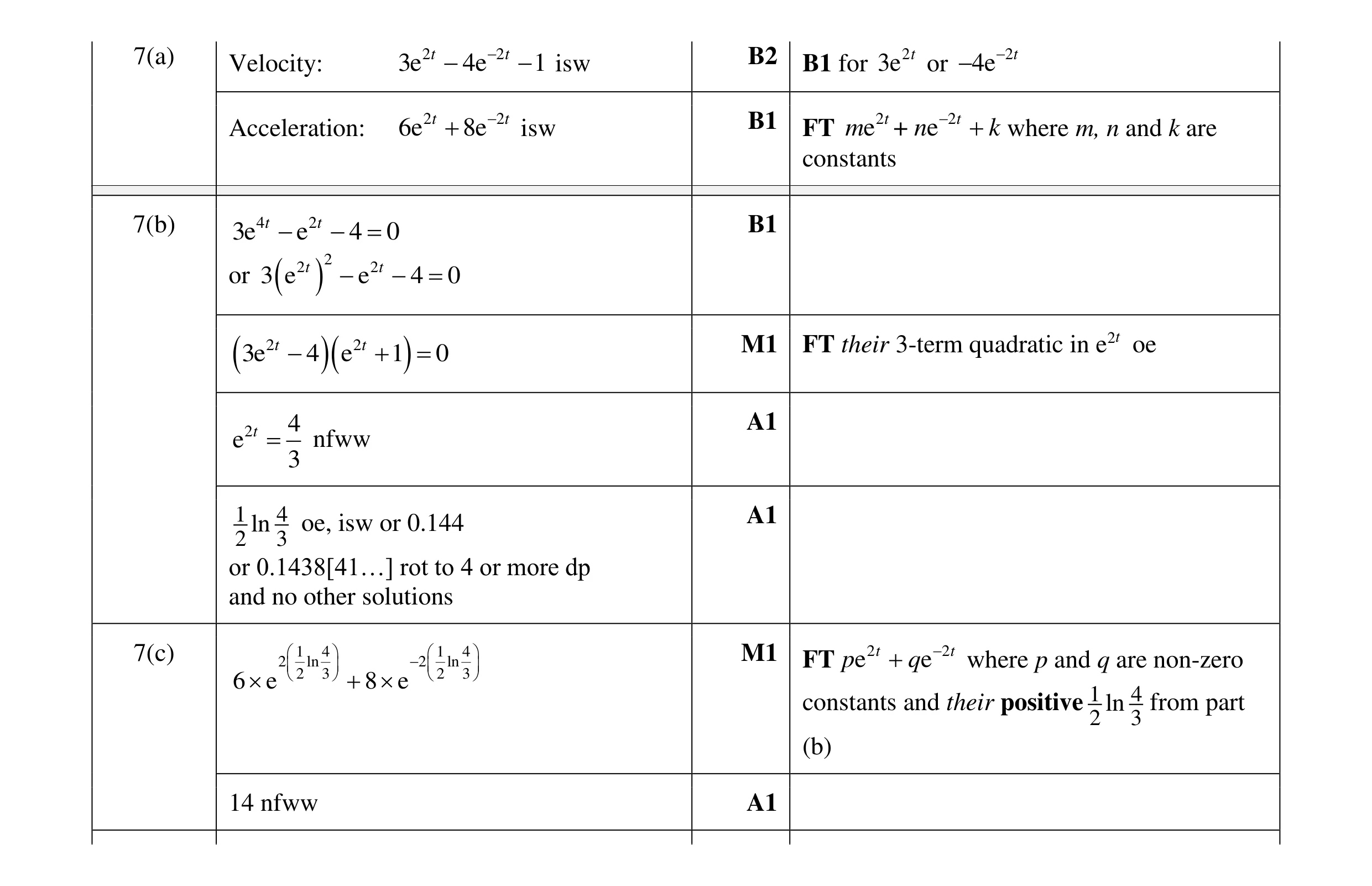 9
9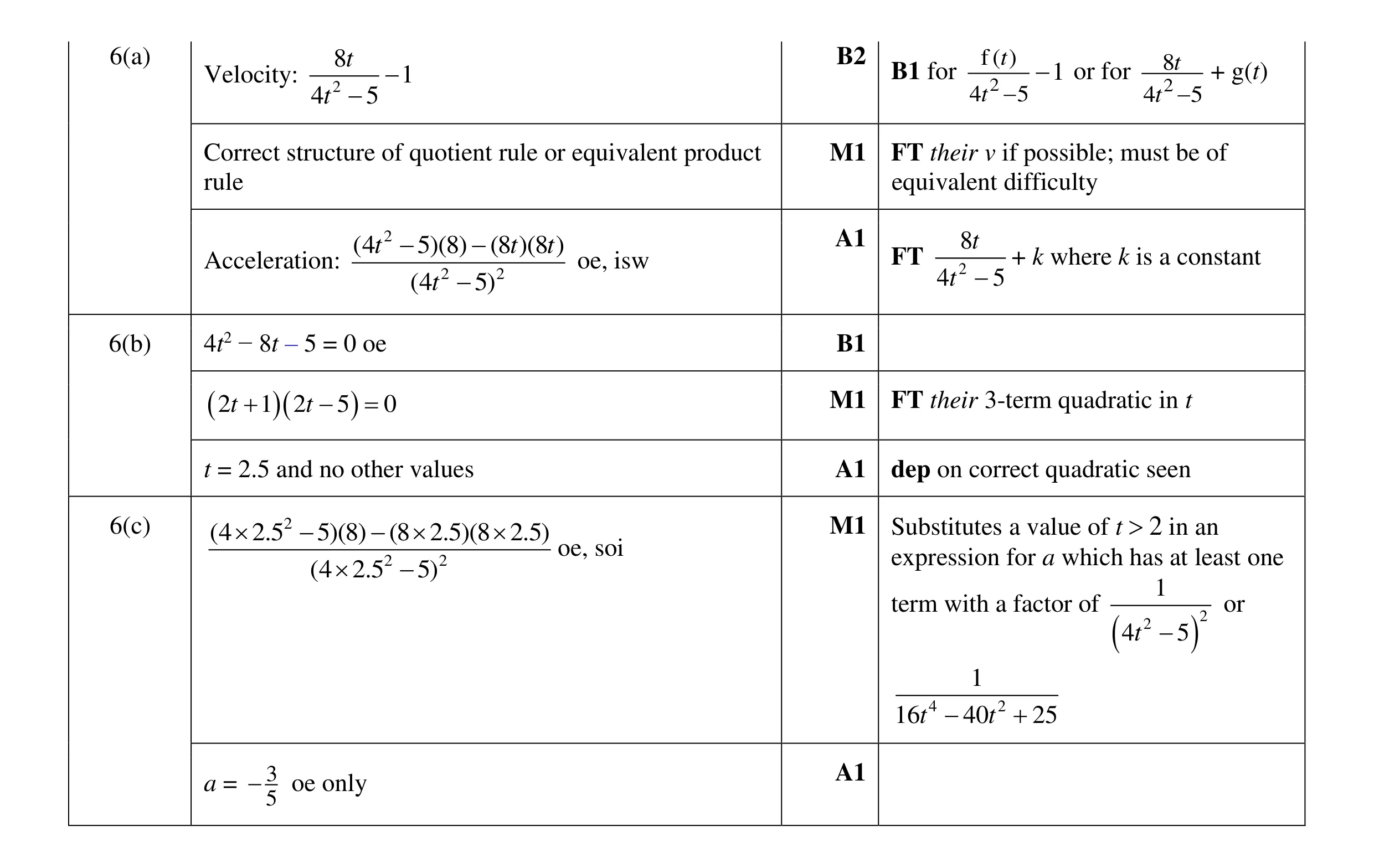 9
9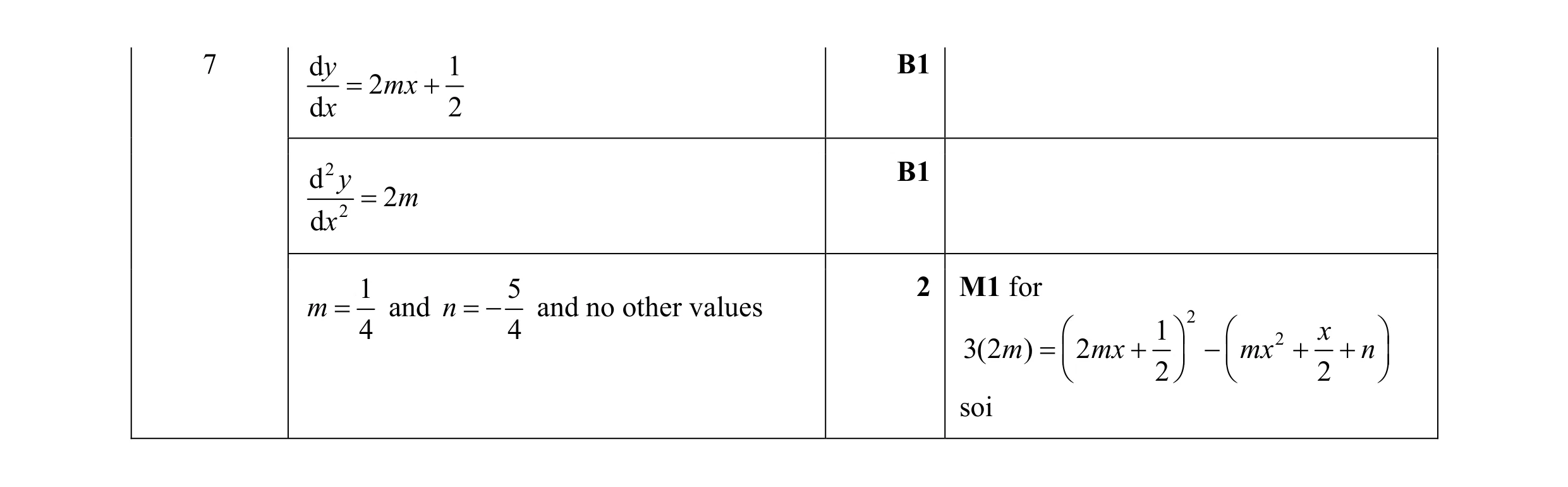 4
4