Cambridge IGCSE Mathematics - Additional 0606 — 2017 Oct/Nov Paper 2 · Variant 2
0606/22/O/N/17 · 9 questions · 80 marks · ≈90 min
The question paper and its mark scheme, free to read here and free to download. This is Cambridge’s own paper, exactly as it was sat.
Question paper16 pages
Mark scheme8 pages
Answers below. Sit the paper first if you are practising.
Questions as text
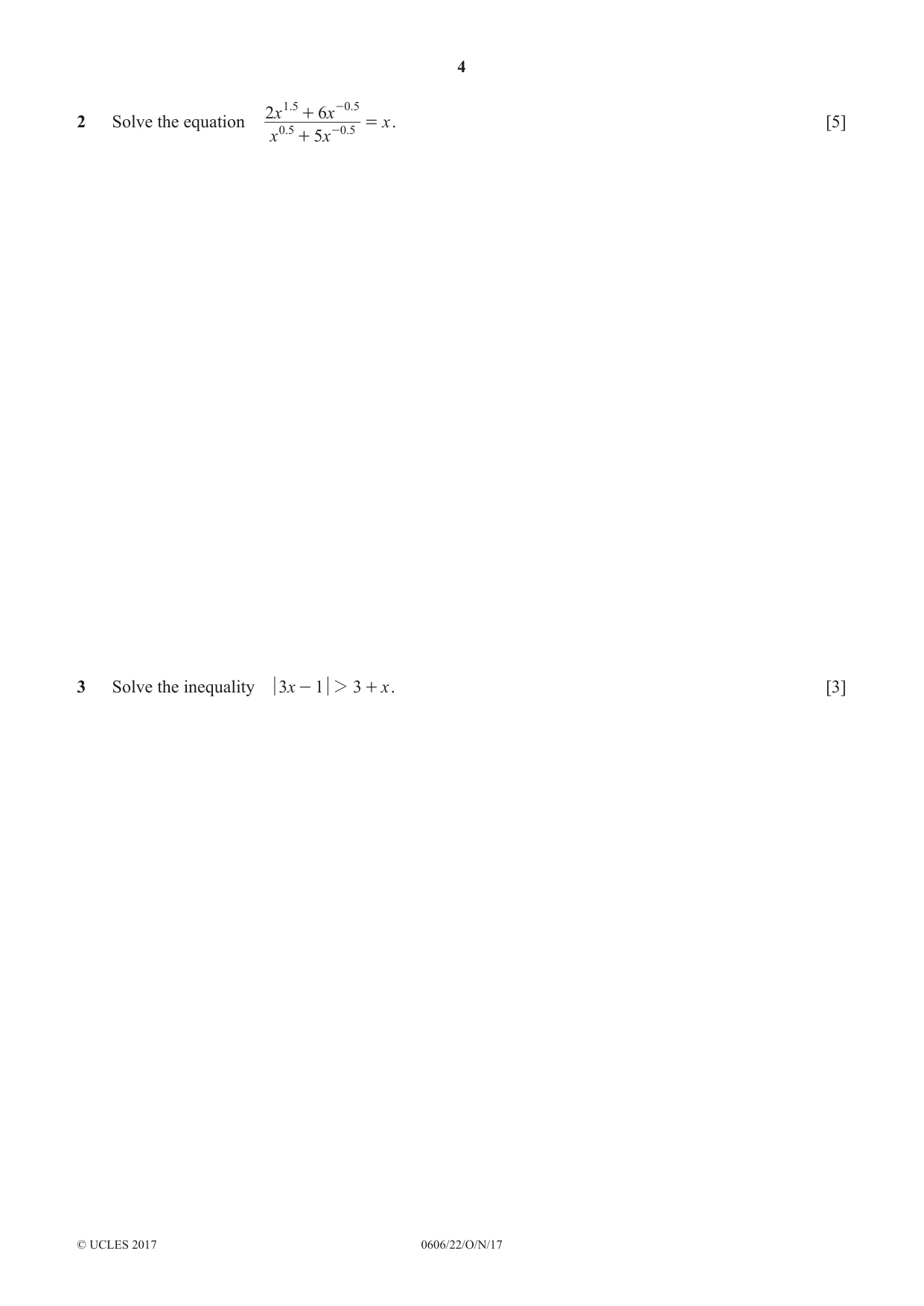
Q2 · Solve the equation 0 .5 -0 .5 = x
2 Solve the equation 0 .5 -0 .5 = x . [5] x + 5 x
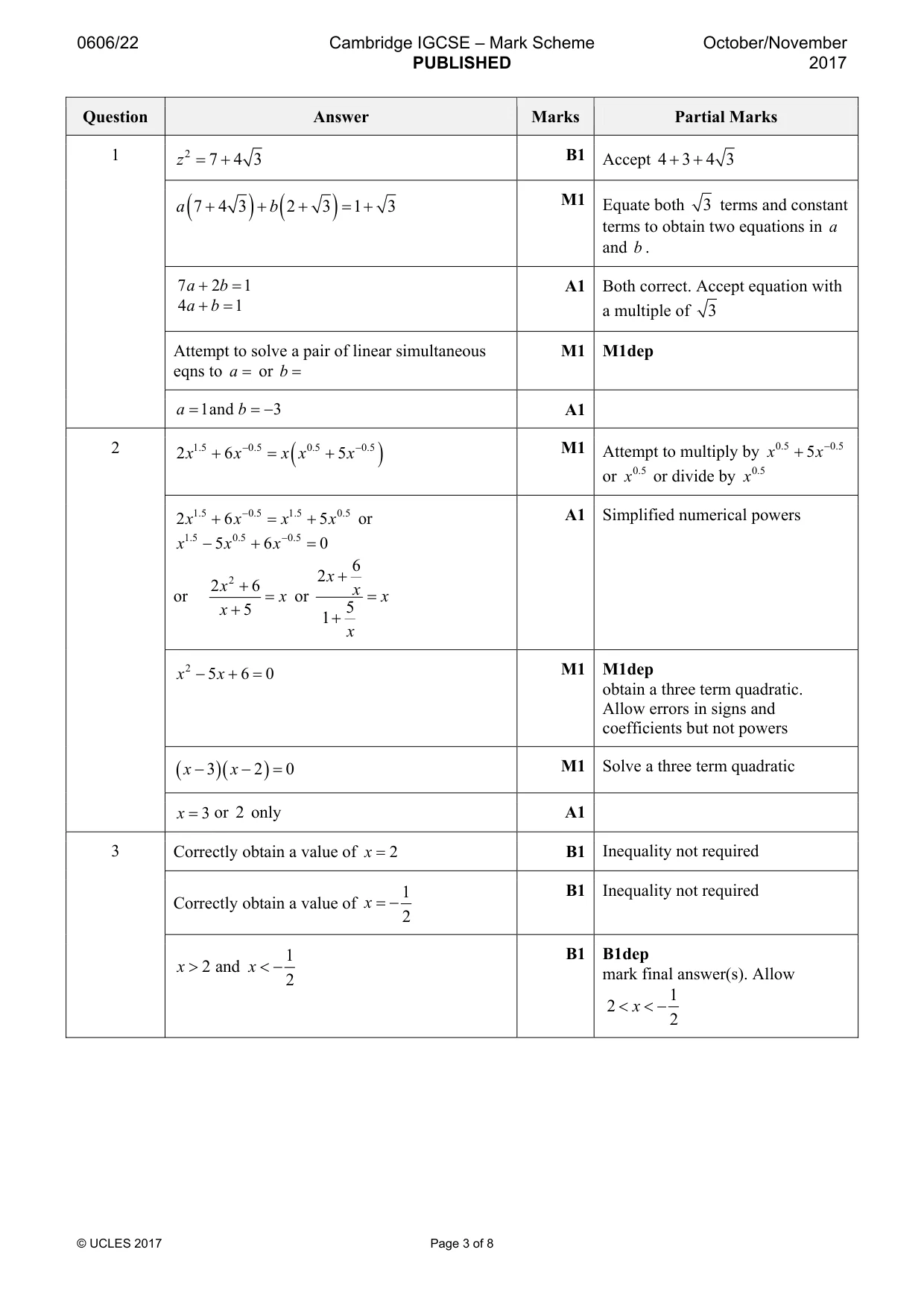
Mark scheme: 2 2 x1.5 + 6 x −0.5 = x x 0.5 + 5 x −0.5 M1 Attempt to multiply by x 0.5 + 5 x− 0.5 ( ) or x 0.5 or divide by x 0.5 2 x1.5 + 6 x − 0.5 = x1.5 + 5 x 0.5 or A1 Simplified numerical powers x1.5 − 5 x 0.5 + 6 x− 0.5 = 0 6 2 2 x + 2 x + 6 x or = x or = x x + 5 5 1 + x x 2 − 5 x + 6 = 0 M1 M1dep obtain a three term quadratic. Allow errors in signs and coefficients but not powers ( x − 3 )( x − 2 ) = 0 M1 Solve a three term quadratic x = 3 or 2 only A1
More questions on Use substitution to form and solve a quadratic
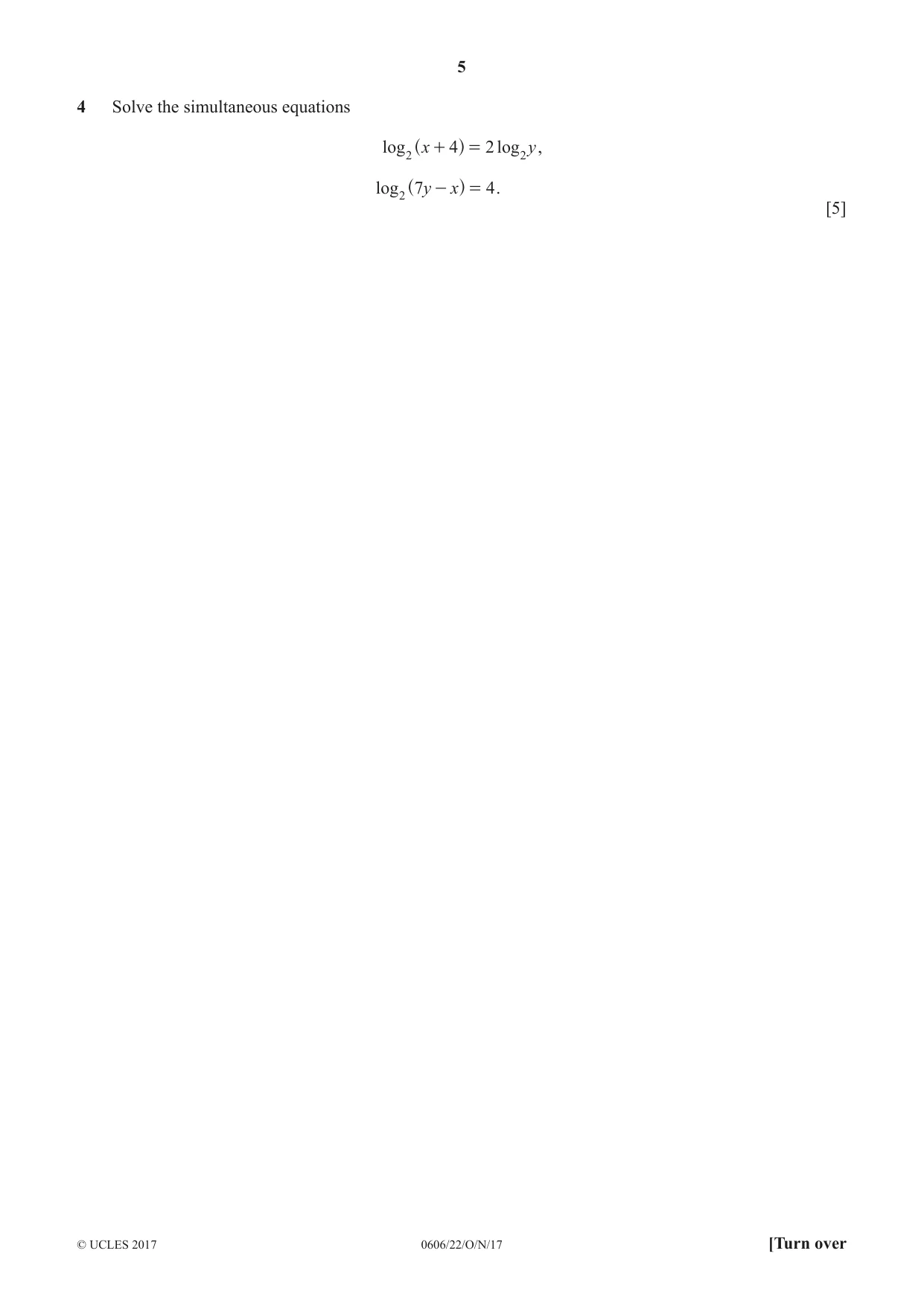
Q4 · Solve the simultaneous equations log 2 x + 4 = 2 log 2 y , ^ h log 2 7y - x = 4
4 Solve the simultaneous equations log 2 x + 4 = 2 log 2 y , ^ h log 2 7y - x = 4 . ^ h [5]
Mark scheme: 4 x + 4 = y 2 B1 7 y − x = 16 B1 allow 2 4 for1 6 7 y − 16 + 4 = y 2 y 2 − 7 y + 12 → ( y − 3 )( y − 4 )( = 0 ) M1 Attempt to eliminate x or y to 2 obtain a three term quadratic. or x − 17 x + 60 → ( x − 5 )( x − 12 )( = 0 ) Solve a three term quadratic M1 M1dep → y = 3, x = 5 or y = 4 x = 12 A1 Allow for values seen even if correct pairs not clear.
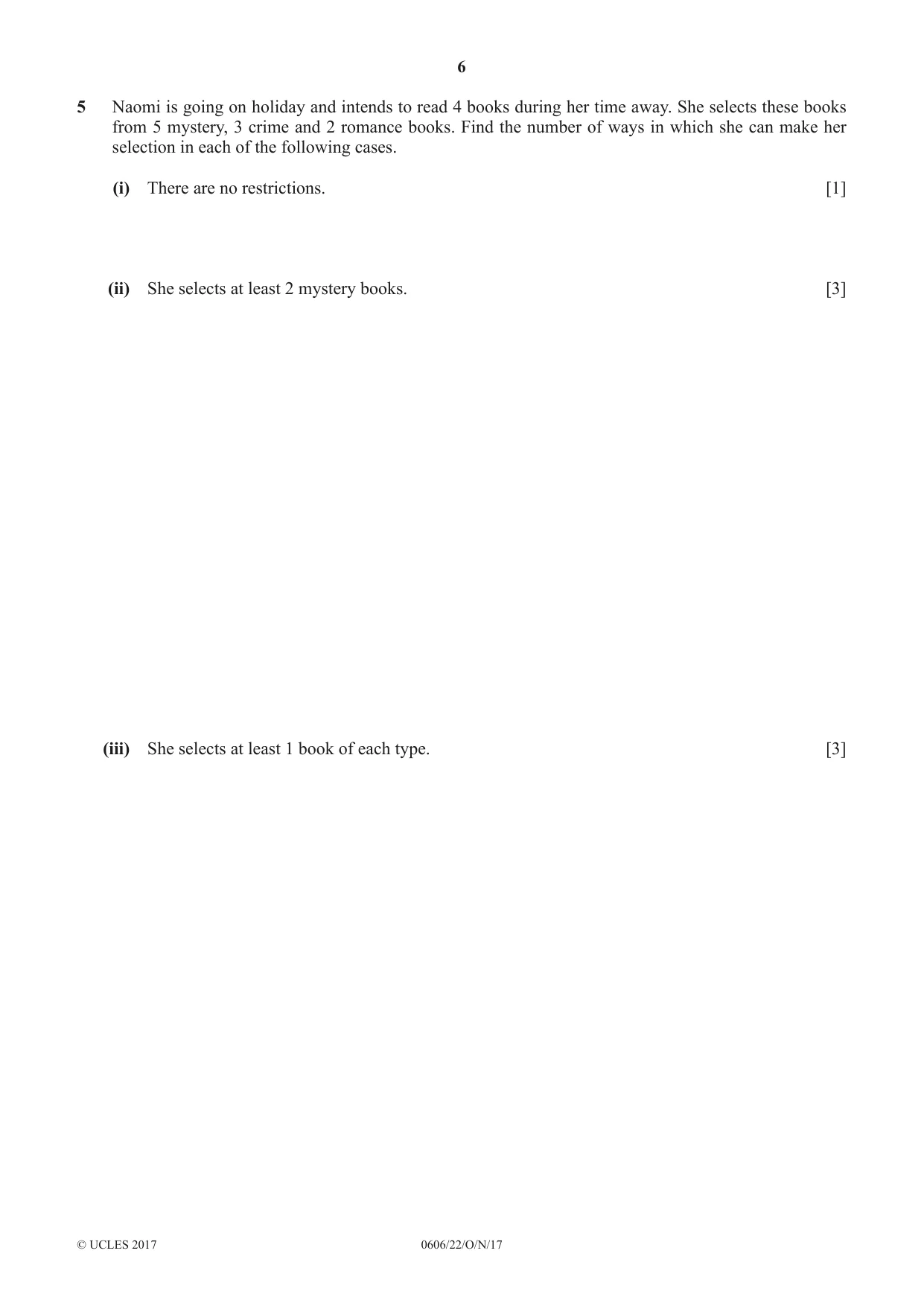
Q5 · Naomi is going on holiday and intends to read 4 books during her time away
5 Naomi is going on holiday and intends to read 4 books during her time away. She selects these books from 5 mystery, 3 crime and 2 romance books. Find the number of ways in which she can make her selection in each of the following cases. (i) There are no restrictions. [1] (ii) She selects at least 2 mystery books. [3] (iii) She selects at least 1 book of each type. [3]
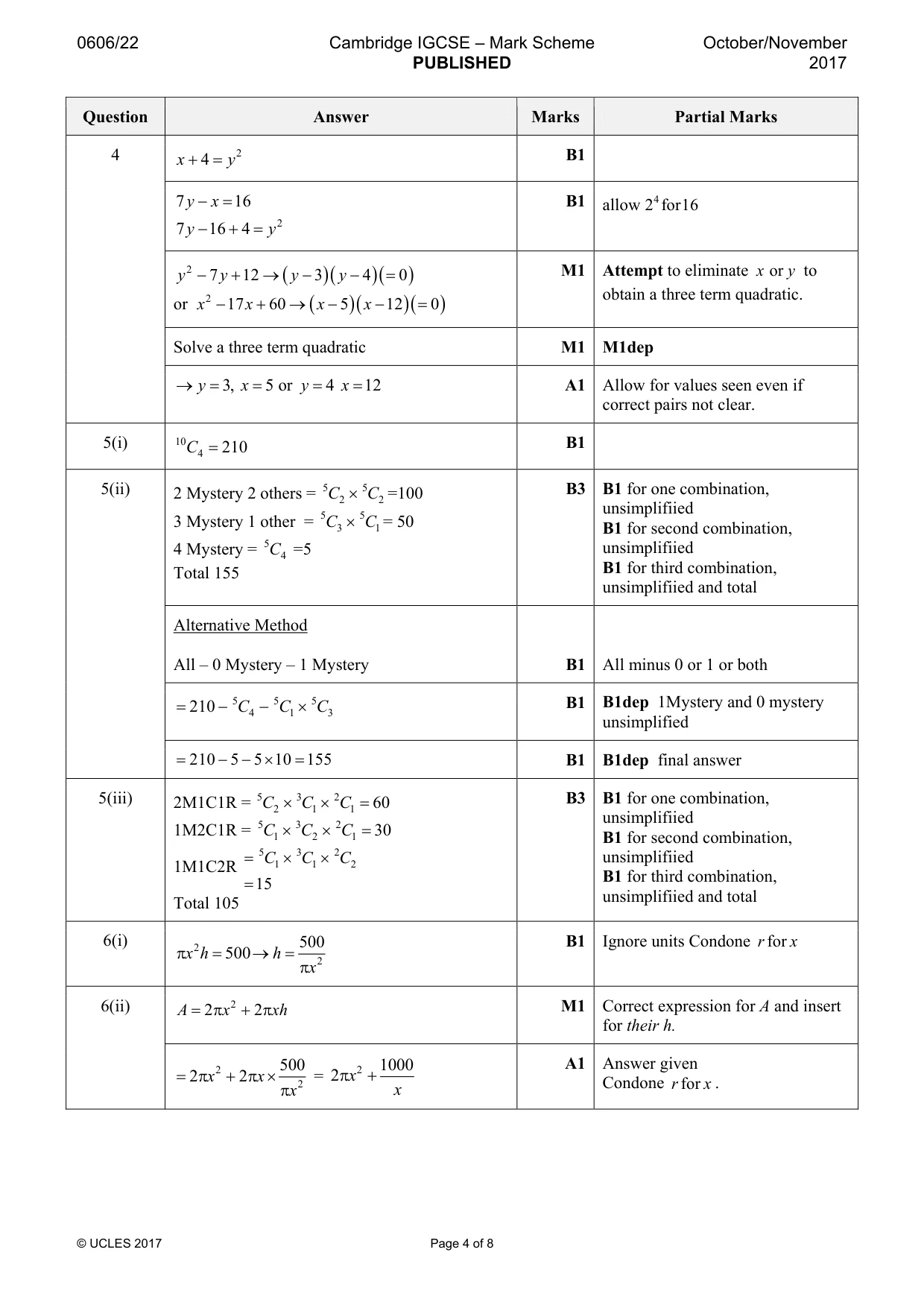
Mark scheme: 5(i) 10C 4 = 210 B1 5(ii) 2 Mystery 2 others = 5C2 × 5C2 =100 B3 B1 for one combination, 5 5 unsimplifiied 3 Mystery 1 other = C3 × C1 = 50 B1 for second combination, 4 Mystery = 5C 4 =5 unsimplifiied B1 for third combination, Total 155 unsimplifiied and total Alternative Method All – 0 Mystery – 1 Mystery B1 All minus 0 or 1 or both = 210 − 5C 4 − 5C1 × 5C3 B1 B1dep 1Mystery and 0 mystery unsimplified = 210 − 5 −×5 10 = 155 B1 B1dep final answer 5(iii) 2M1C1R = 5C 2 × 3C1 × 2C1 = 60 B3 B1 for one combination, 5 3 2 unsimplifiied 1M2C1R = C1 × C 2 × C1 = 30 B1 for second combination, = 5C1 × 3C1 × 2C 2 unsimplifiied 1M1C2R B1 for third combination, = 15 unsimplifiied and total Total 105
More questions on Solve problems on arrangement and selection
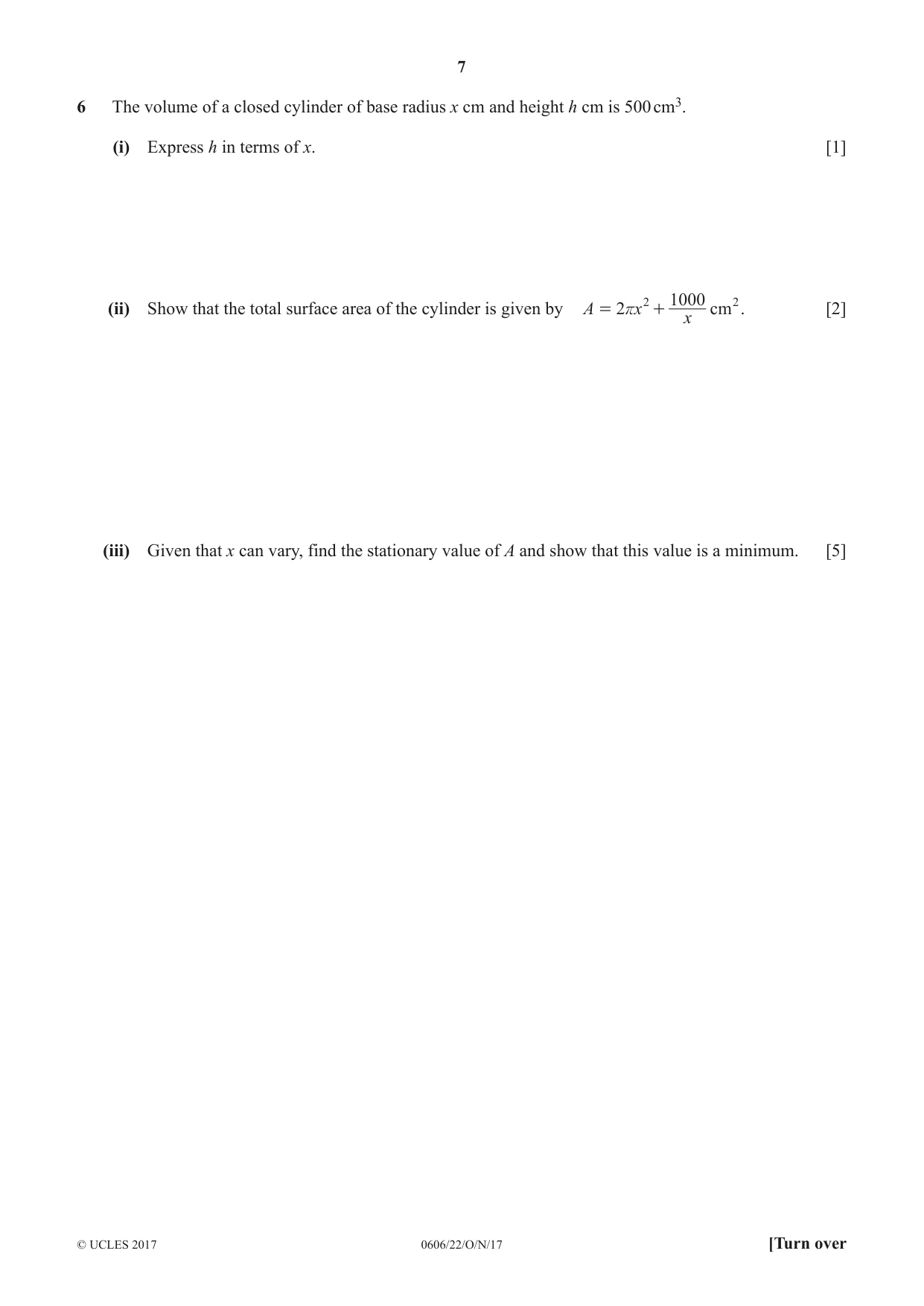
Q6 · The volume of a closed cylinder of base radius x cm and height h cm is 500 cm3
6 The volume of a closed cylinder of base radius x cm and height h cm is 500 cm3. (i) Express h in terms of x. [1] 2 1000 2 (ii) Show that the total surface area of the cylinder is given by A = 2r x + cm . [2] x (iii) Given that x can vary, find the stationary value of A and show that this value is a minimum. [5]
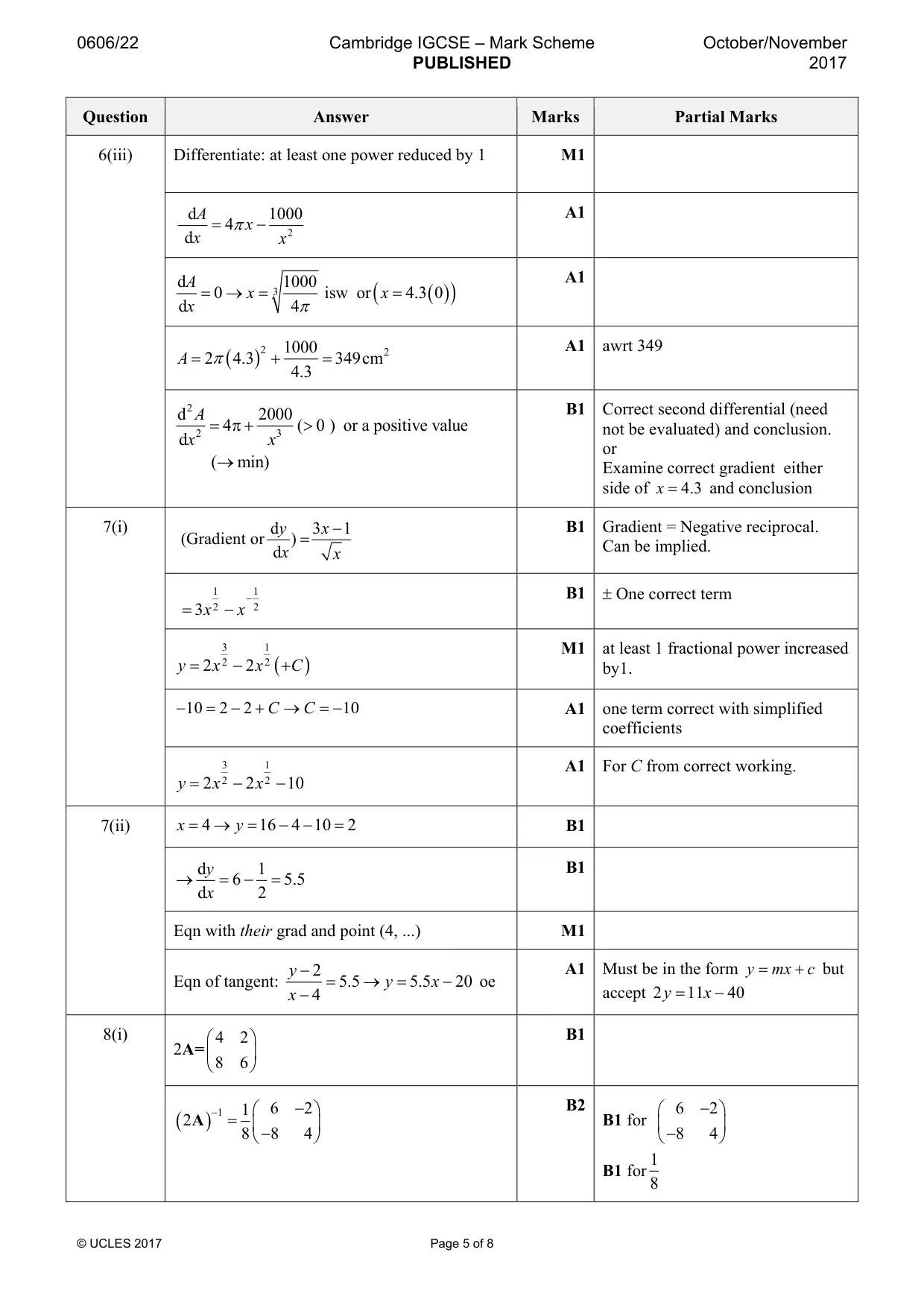
Mark scheme: 6(i) 2 500 B1 Ignore units Condone r for x πx h = 500 → h = πx 2 6(ii) A = 2 πx 2 + 2 πxh M1 Correct expression for A and insert for their h. 2 500 2 1000 A1 Answer given = 2 πx + 2 πx × = 2 πx + 2 Condone r for x . πx x 6(iii) Differentiate: at least one power reduced by 1 M1 d A 1000 A1 = 4πx − d x x 2 dA 1000 A1 = 0 → x = 3 isw or ( x = 4.3 ( 0 ) ) dx 4π 2 1000 2 A1 awrt 349 A = 2π( 4.3 ) + = 349 cm 4.3 d 2 A 2000 B1 Correct second differential (need = 4 π + ( > 0 ) or a positive value not be evaluated) and conclusion. 2 3 dx x or ( → min) Examine correct gradient either side of x = 4.3 and conclusion
More questions on Use the first and second derivative tests to
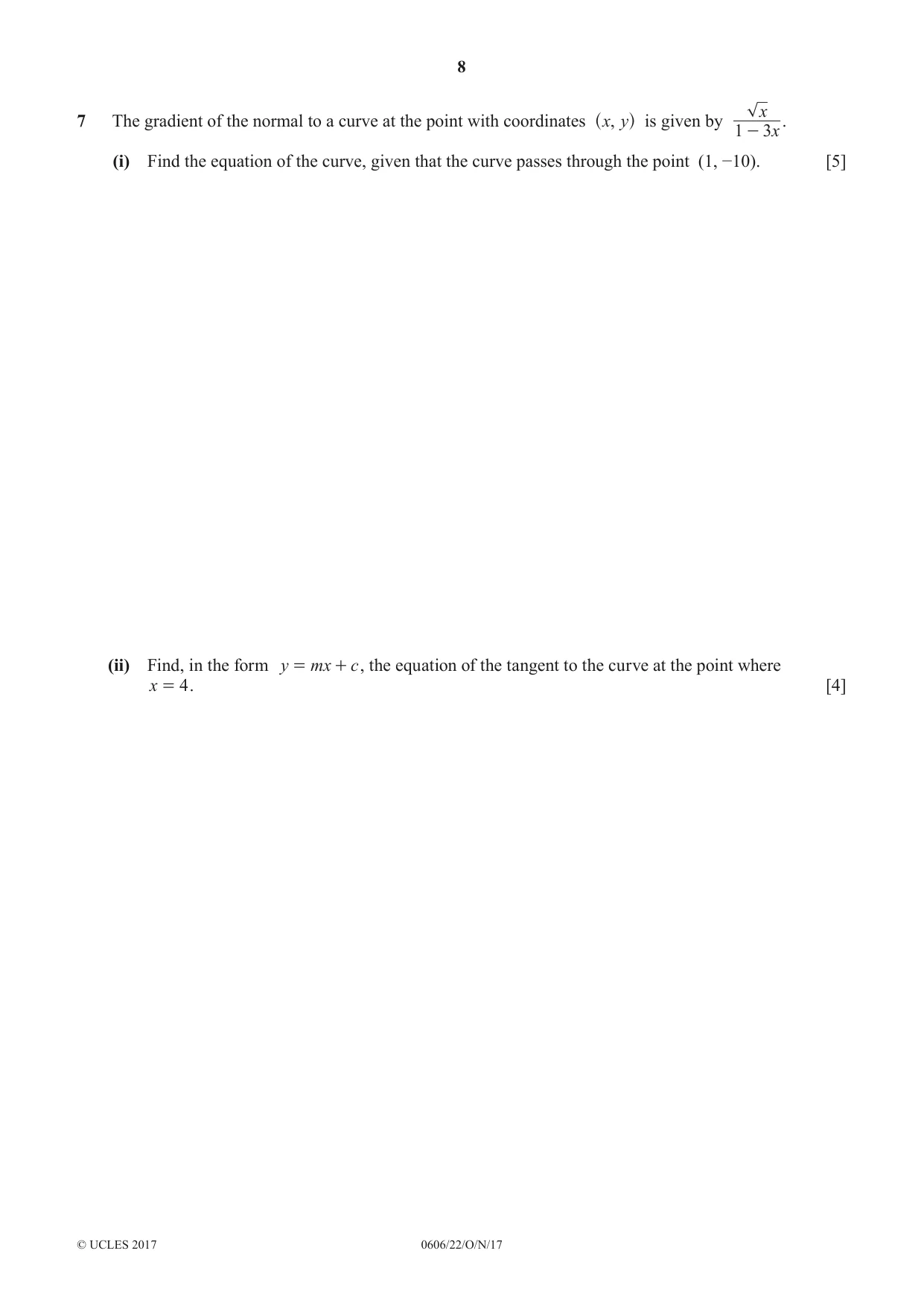
Q7 · The gradient of the normal to a curve at the point with coordinates ,x y is given by
7 The gradient of the normal to a curve at the point with coordinates ,x y is given by . 1 - 3x (i) Find the equation of the curve, given that the curve passes through the point (1, −10). [5] (ii) Find, in the form y = mx + c , the equation of the tangent to the curve at the point where x = 4 . [4]
Mark scheme: 7(i) d y 3 x − 1 B1 Gradient = Negative reciprocal. (Gradient or ) = Can be implied. d x x 1 1 B1 ± One correct term − = 3x 2 − x 2 3 1 M1 at least 1 fractional power increased y = 2 x 2 − 2 x 2 ( + C ) by1. − 10 = 2 − 2 + C → C = − 10 A1 one term correct with simplified coefficients 3 1 A1 For C from correct working. y = 2 x 2 − 2 x 2 − 10 7(ii) x = 4 → y = 16 − 4 − 10 = 2 B1 dy 1 B1 → = 6 − = 5.5 dx 2 Eqn with their grad and point (4, ...) M1 y − 2 A1 Must be in the form y = mx + c but Eqn of tangent: = 5.5 → y = 5.5 x − 20 oe x − 4 accept 2 y = 11x − 40
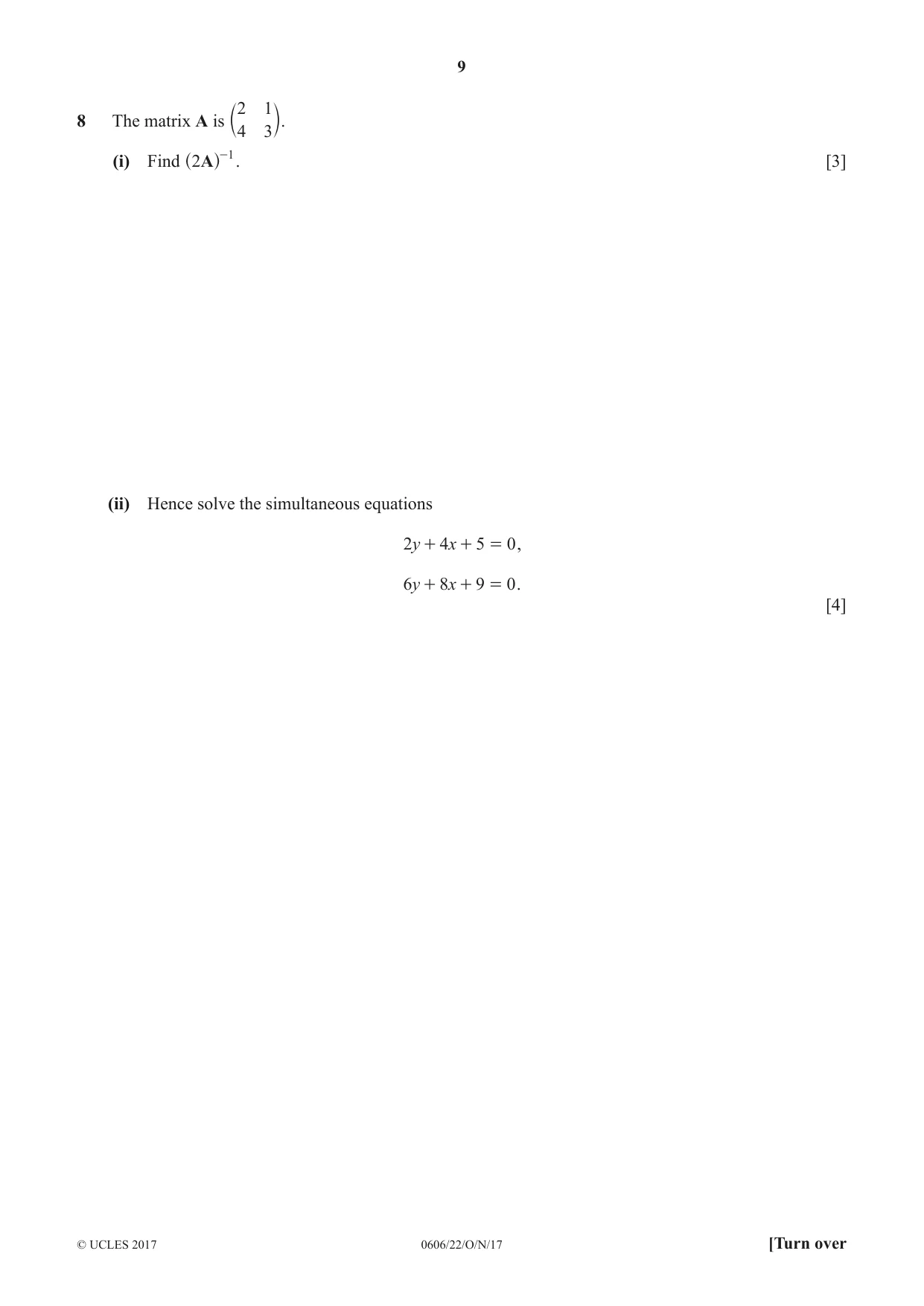
Q8 · The matrix A is
8 The matrix A is . 4 3 (i) Find 2A -1 . [3] ^ h (ii) Hence solve the simultaneous equations 2y + 4x + 5 = 0 , 6y + 8x + 9 = 0 . [4]
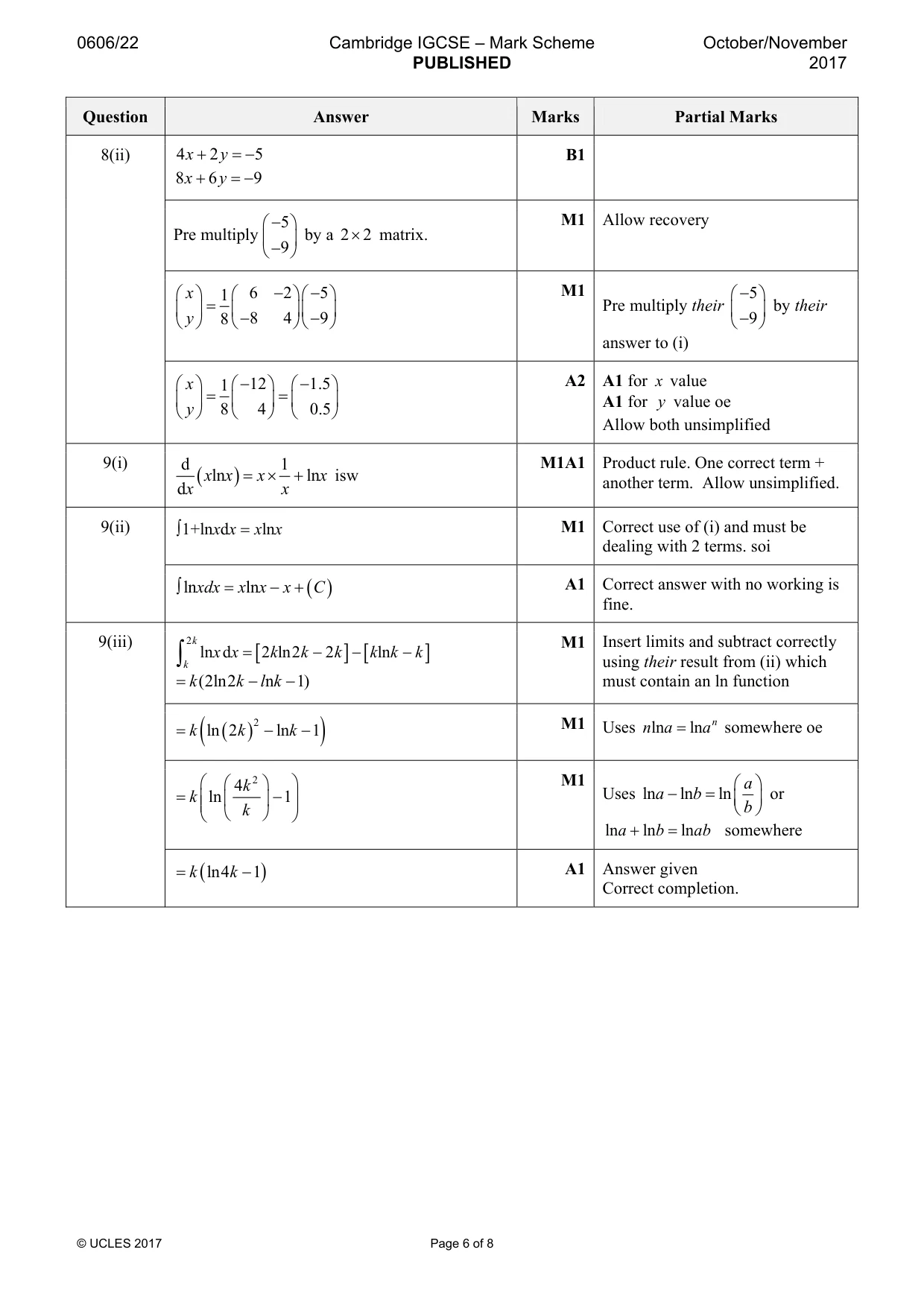
Mark scheme: 8(i) 4 2 B1 2A= 8 6 −1 1 6 − 2 B2 6 − 2 ( 2 A ) = B1 for 8 − 8 4 − 8 4 1 B1 for 8 8(ii) 4 x + 2 y = −5 B1 8 x + 6 y = − 9 − 5 M1 Allow recovery Pre multiply by a 2 × 2 matrix. − 9 x 1 6 − 2 − 5 M1 − 5 = Pre multiply their by their y 8 − 8 4 − 9 − 9 answer to (i) x 1 − 12 − 1.5 A2 A1 for x value = = A1 for y value oe y 8 4 0.5 Allow both unsimplified
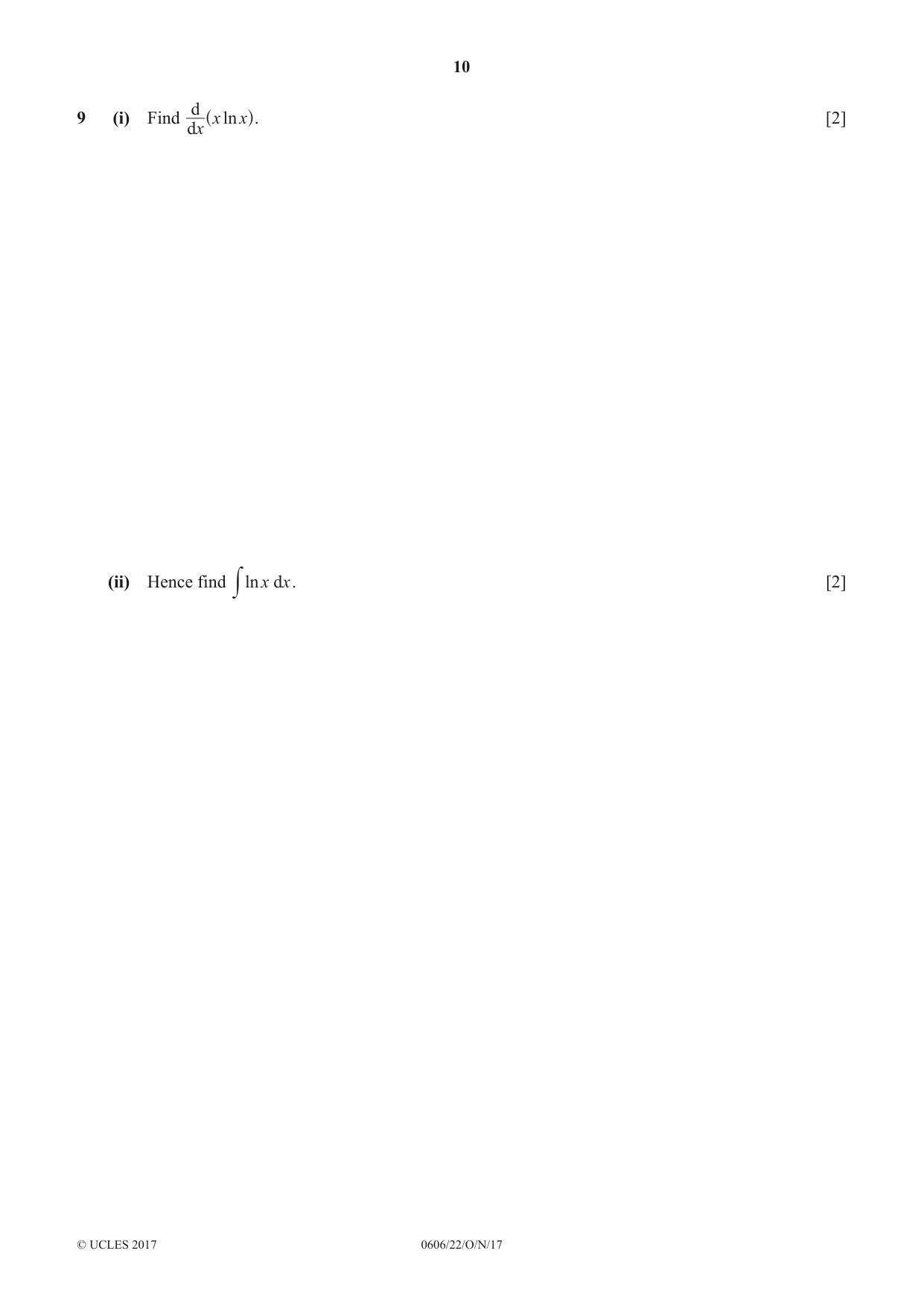
Q9 · Find x ln x
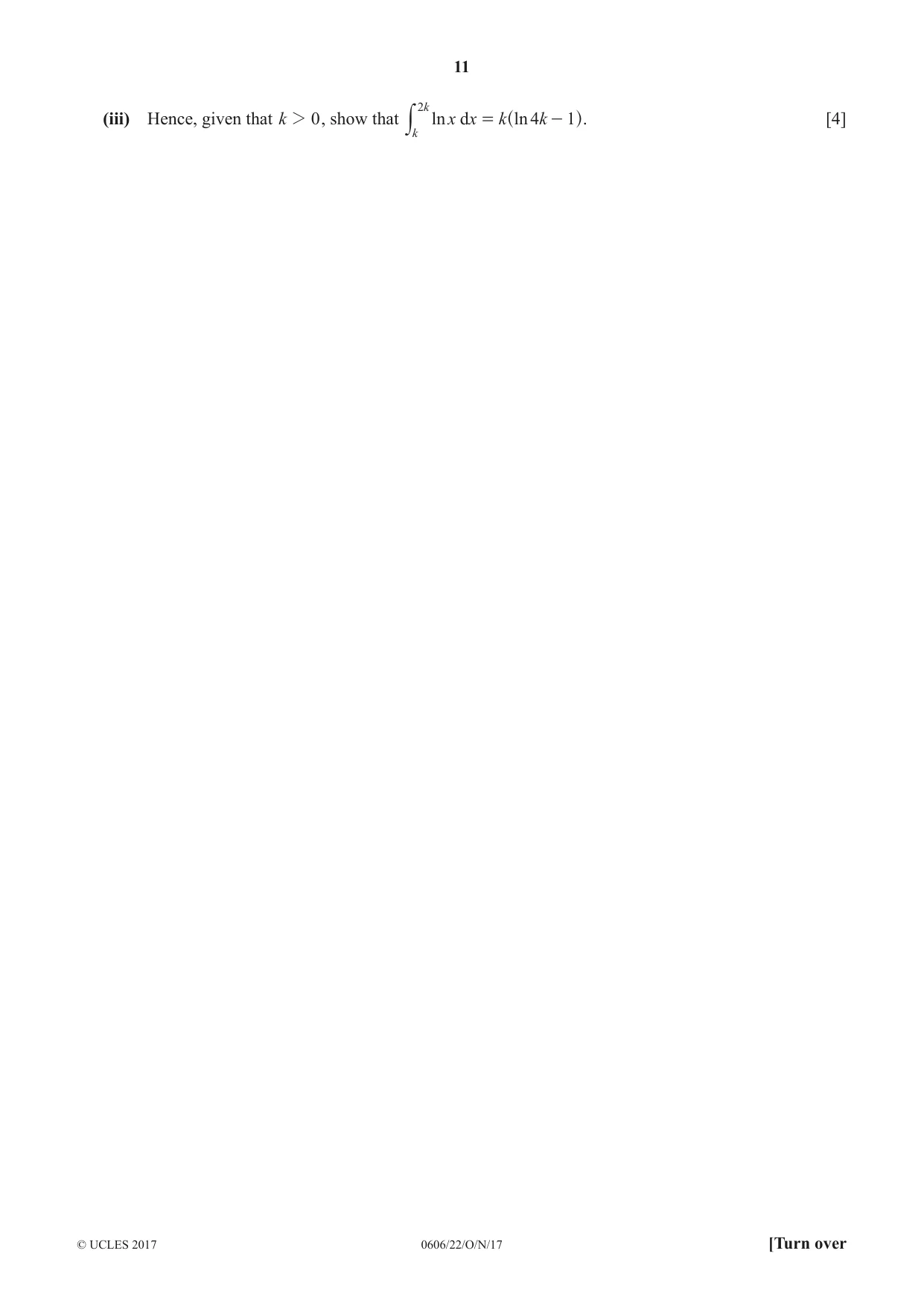
9 (i) Find x ln x . [2] dx (ii) Hence find lnx d x . [2] y 2k (iii) Hence, given that k 2 0 , show that ln x d x = k ln 4 k - 1 . [4] y k ^ h
Mark scheme: 9(i) d 1 M1A1 Product rule. One correct term + ( xlnx ) = x × + lnx isw another term. Allow unsimplified. dx x 9(ii) ∫ 1+ln x d x = x ln x M1 Correct use of (i) and must be dealing with 2 terms. soi ∫ ln xdx = xln x − x + ( C ) A1 Correct answer with no working is fine. 9(iii) 2 k M1 Insert limits and subtract correctly ∫k ln x d x = [ 2 k ln2 k − 2 k ] − [ k ln k − k ] using their result from (ii) which = k (2ln2 k − l n k − 1) must contain an ln function = k ln ( 2 k ) 2 − ln k − 1 M1 Uses n ln a = ln a n somewhere oe ( ) 4 k 2 M1 a = k ln − 1 Uses lna − lnb = ln or k b ln a + ln b = ln ab somewhere = k ( ln4 k − 1) A1 Answer given Correct completion.
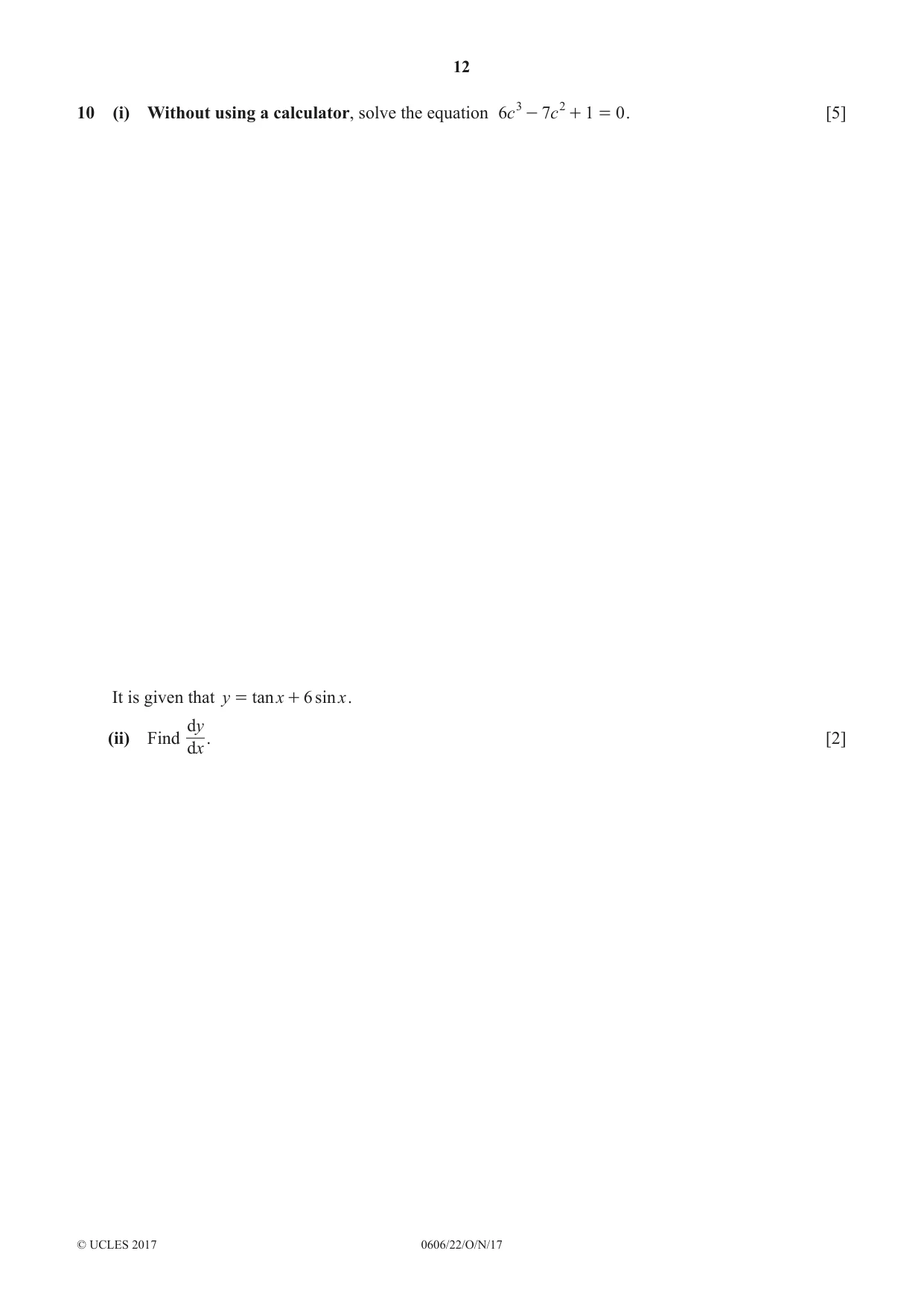
Q10 · Without using a calculator, solve the equation 6c 3 - 7c 2 + 1 = 0
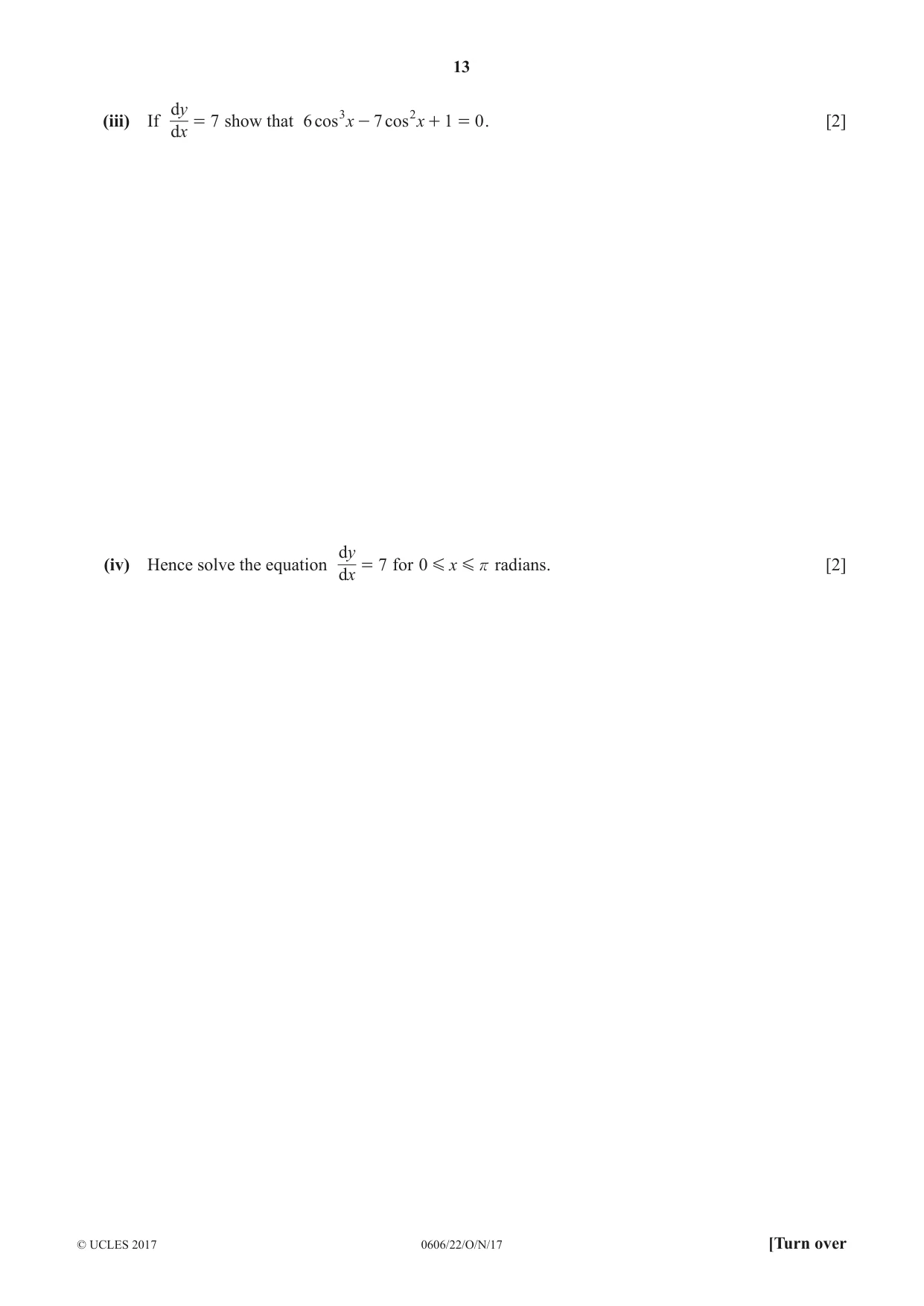
10 (i) Without using a calculator, solve the equation 6c 3 - 7c 2 + 1 = 0 . [5] It is given that y = tan x + 6 sin x . dy (ii) Find . [2] dx dy 3 2(iii) If = 7 show that 6 cos x - 7 cos x + 1 = 0 . [2] dx dy (iv) Hence solve the equation = 7 for 0 G x G r radians. [2] dx
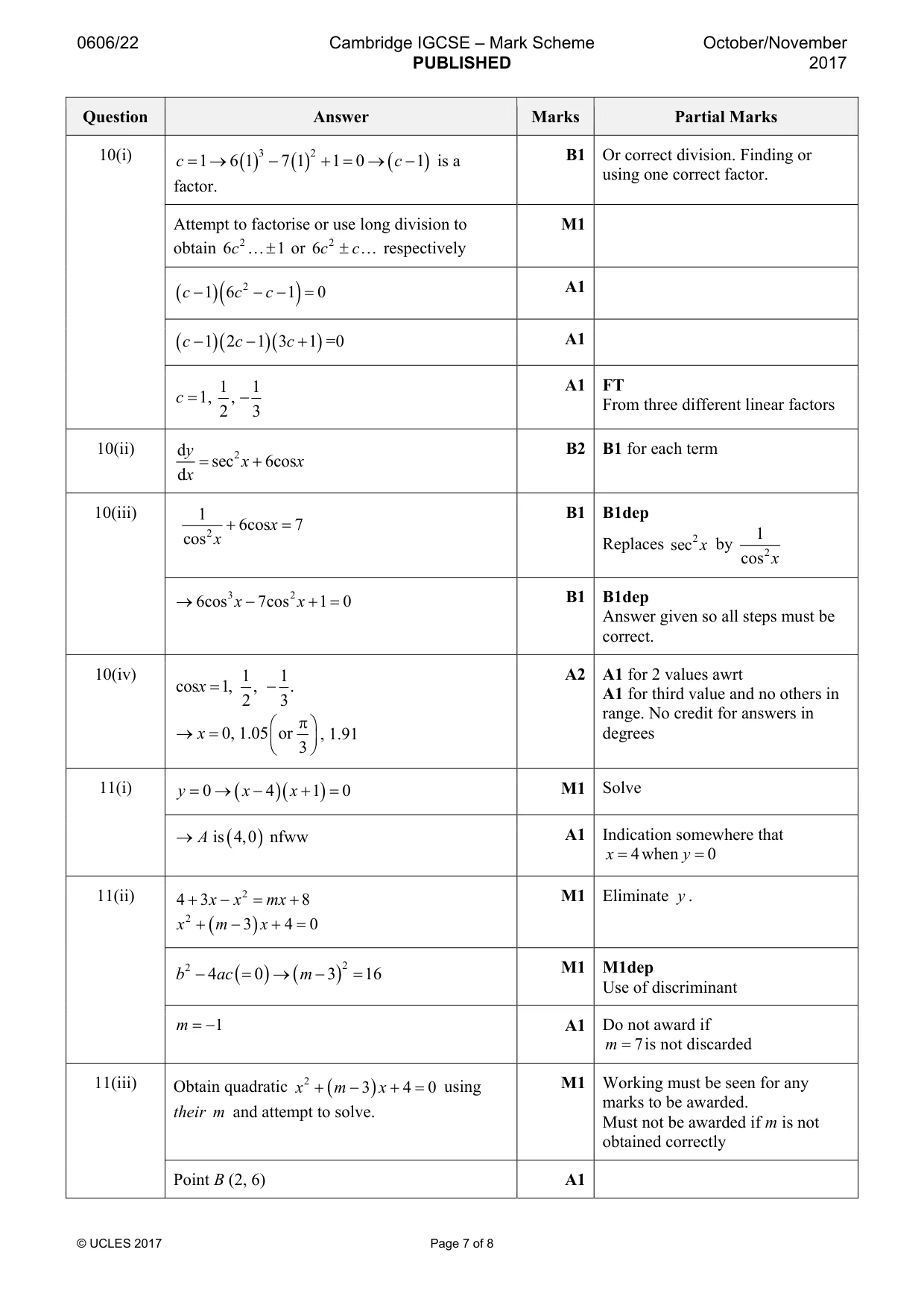
Mark scheme: 10(i) 3 2 B1 Or correct division. Finding or c = 1 → 6 (1) − 7 (1) + 1 = 0 → ( c − 1) is a using one correct factor. factor. Attempt to factorise or use long division to M1 obtain 6 c 2 …± 1 or 6c 2 ± c … respectively 6 c − c − 1 = 0 ( c − 1)( 2 A1 ) ( c − 1)( 2 c − 1)( 3c + 1) =0 A1 1 1 A1 FT c = 1, , − From three different linear factors 2 3 10(ii) dy 2 B2 B1 for each term = sec x + 6cosx dx 10(iii) 1 B1 B1dep + 6cosx = 7 cos 2 x 2 1 Replaces sec x by cos 2 x → 6cos 3 x − 7cos 2 x + 1 = 0 B1 B1dep Answer given so all steps must be correct. 10(iv) 1 1 A2 A1 for 2 values awrt cosx = 1, , − . A1 for third value and no others in 2 3 range. No credit for answers in π → x = 0, 1.05 or , 1.91 degrees 3
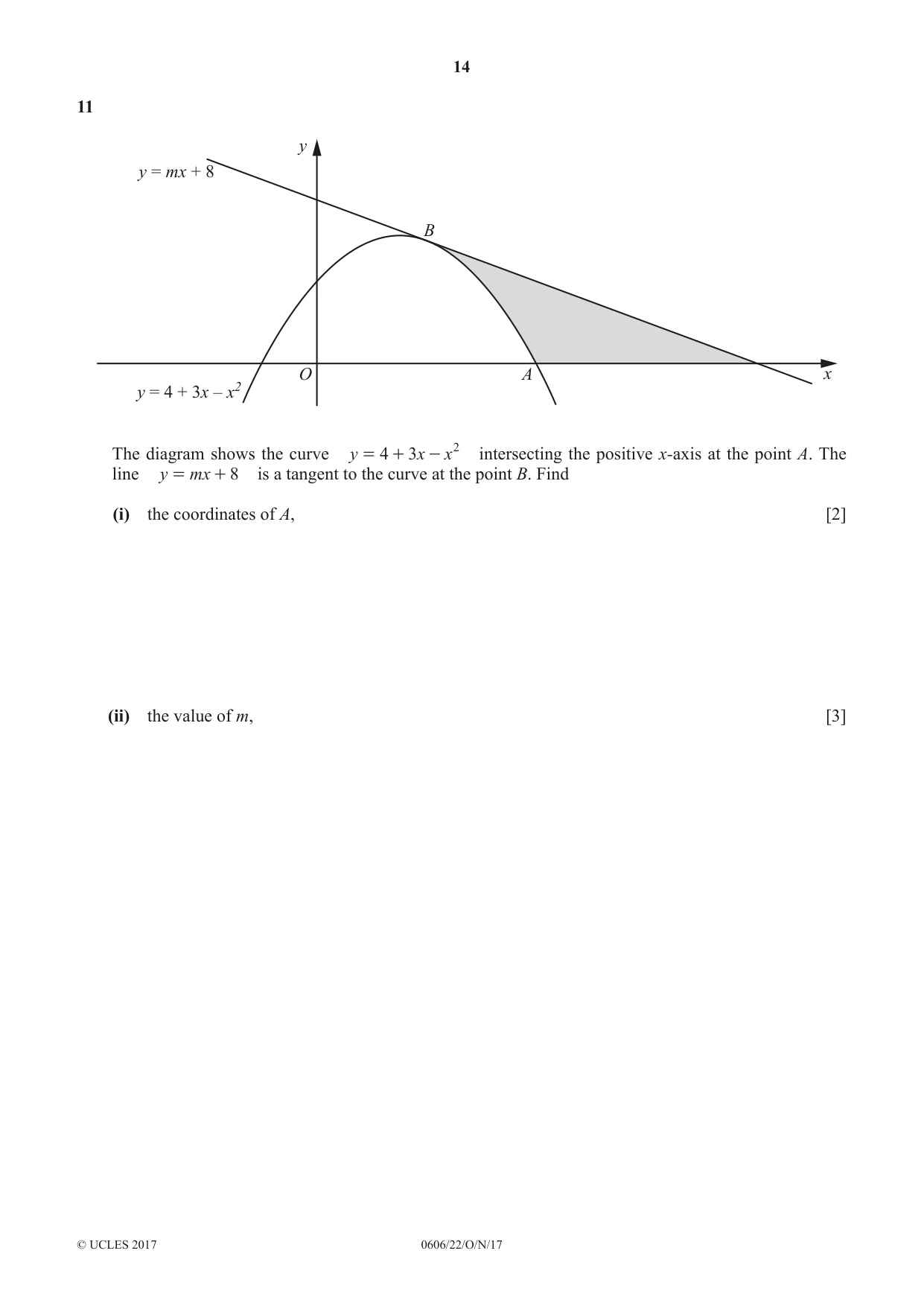
Q11 · Y y = mx + 8 B O A x y = 4 + 3x – x2 The diagram shows the curve y = 4 + 3 x - x 2…
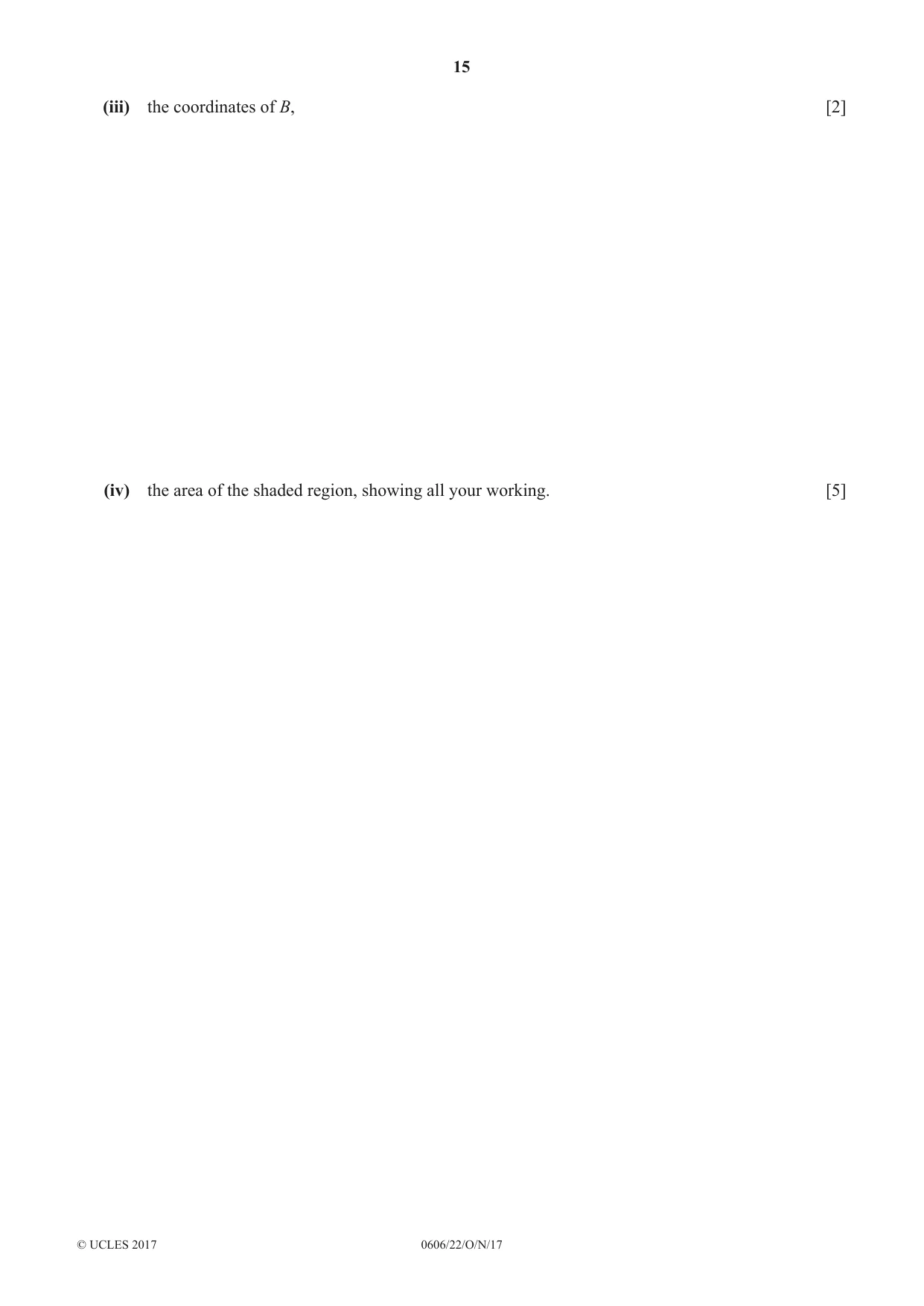
11 y y = mx + 8 B O A x y = 4 + 3x – x2 The diagram shows the curve y = 4 + 3 x - x 2 intersecting the positive x-axis at the point A. The line y = mx + 8 is a tangent to the curve at the point B. Find (i) the coordinates of A, [2] (ii) the value of m, [3] (iii) the coordinates of B, [2] (iv) the area of the shaded region, showing all your working. [5]
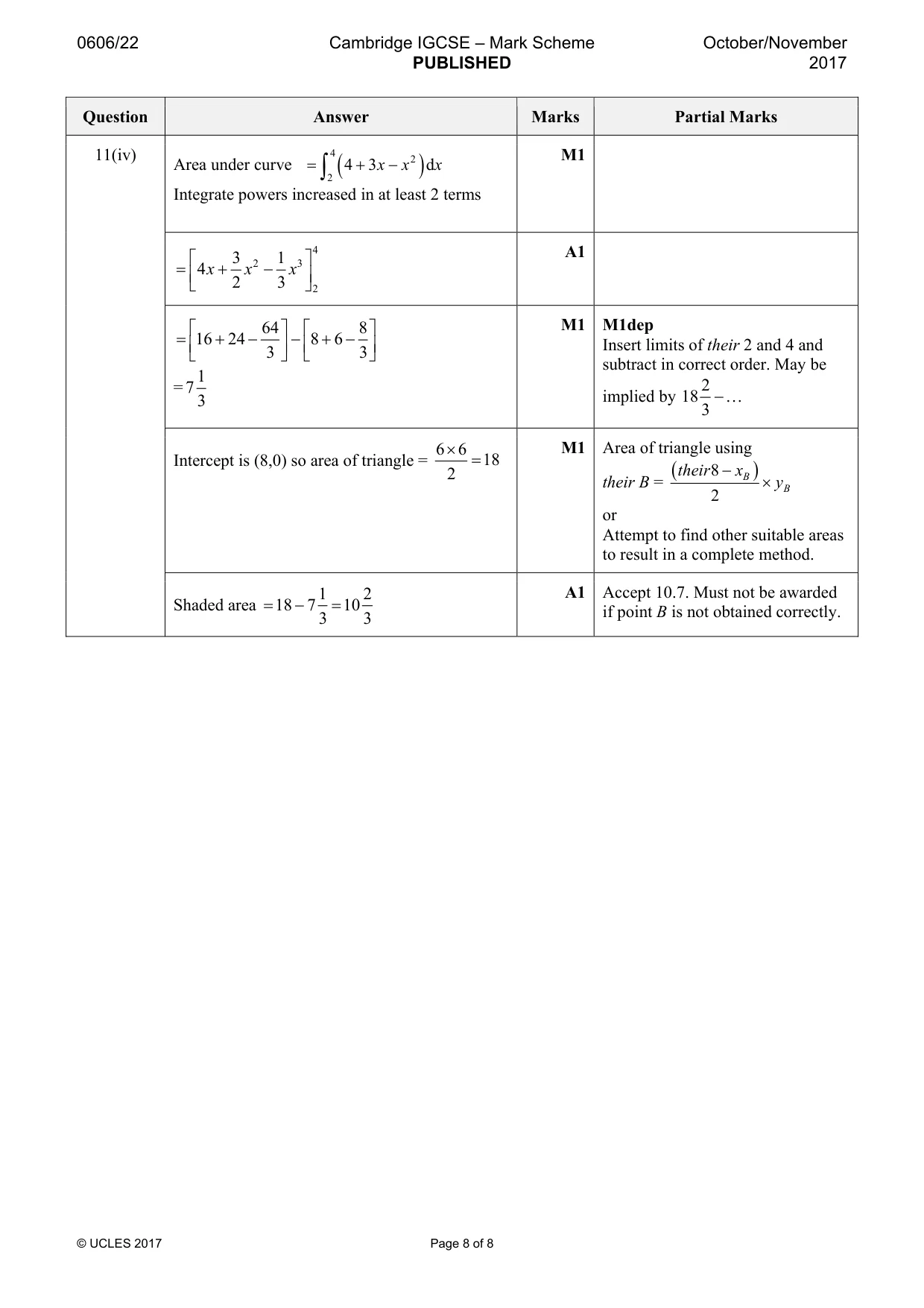
Mark scheme: 11(i) y = 0 → ( x − 4 )( x + 1) = 0 M1 Solve → A is ( 4,0 ) nfww A1 Indication somewhere that x = 4 when y = 0 11(ii) 4 + 3 x − x 2 = mx + 8 M1 Eliminate y . x 2 + ( m − 3 ) x + 4 = 0 2 2 M1 M1dep b − 4 ac ( = 0 ) → ( m − 3 ) = 16 Use of discriminant m = − 1 A1 Do not award if m = 7 is not discarded 11(iii) Obtain quadratic x 2 + ( m − 3 ) x + 4 = 0 using M1 Working must be seen for any marks to be awarded. their m and attempt to solve. Must not be awarded if m is not obtained correctly Point B (2, 6) A1 11(iv) 4 2 M1 Area under curve = ∫2 ( 4 + 3 x − x ) d x Integrate powers increased in at least 2 terms 4 A1 3 2 1 3 = 4 x + x − x 2 3 2 64 8 M1 M1dep = 16 + 24 − − 8 + 6 − Insert limits of their 2 and 4 and 3 3 subtract in correct order. May be 1 = 7 2 3 implied by 18 −… 3 6 × 6 M1 Area of triangle using Intercept is (8,0) so area of triangle = = 18 2 ( their 8 − x B ) their B = × y B 2 or Attempt to find other suitable areas to result in a complete method. 1 2 A1 Accept 10.7. Must not be awarded Shaded area = 18 − 7 = 10 if point B is not obtained correctly. 3 3
More questions on Use differentiation to find gradients, tangents
What was in this paper
The subtopics covered by these 9 questions, and how many questions each got. Open one in a new tab to see every Cambridge question on it.
1Evaluate definite integrals and apply1Know and use the laws of logarithms1Solve cubic equations1Solve problems on arrangement and selection1Solve simultaneous equations in two1Use differentiation to find gradients, tangents1Use substitution to form and solve a quadratic1Use the first and second derivative tests to1What you needed in this session
Cambridge’s own grade thresholds for 2017 Oct/Nov, Paper 2 · Variant 2. A higher threshold means an easier paper — the bar moves with how the cohort did.