Cambridge IGCSE Mathematics - Additional 0606 — 2019 Oct/Nov Paper 2 · Variant 1
0606/21/O/N/19 · 11 questions · 80 marks · ≈90 min
The question paper and its mark scheme, free to read here and free to download. This is Cambridge’s own paper, exactly as it was sat.
Question paper16 pages
Mark scheme7 pages
Answers below. Sit the paper first if you are practising.
Questions as text
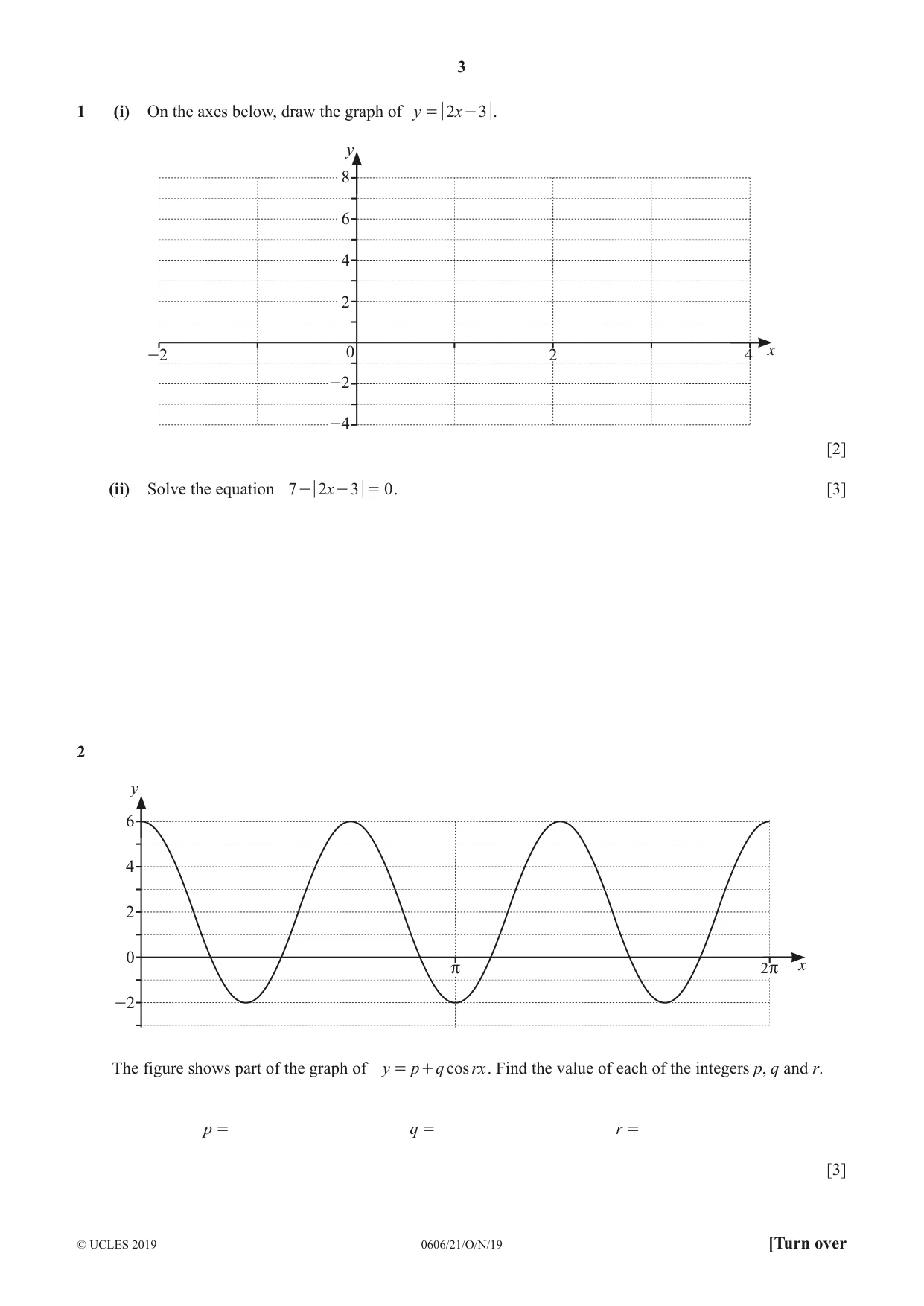
Q1 · On the axes below, draw the graph of y = 2x - 3
1 (i) On the axes below, draw the graph of y = 2x - 3 . y 8 6 4 2 -2 0 2 4 x -2 -4 [2] (ii) Solve the equation 7 - 2x - 3 = 0 . [3]
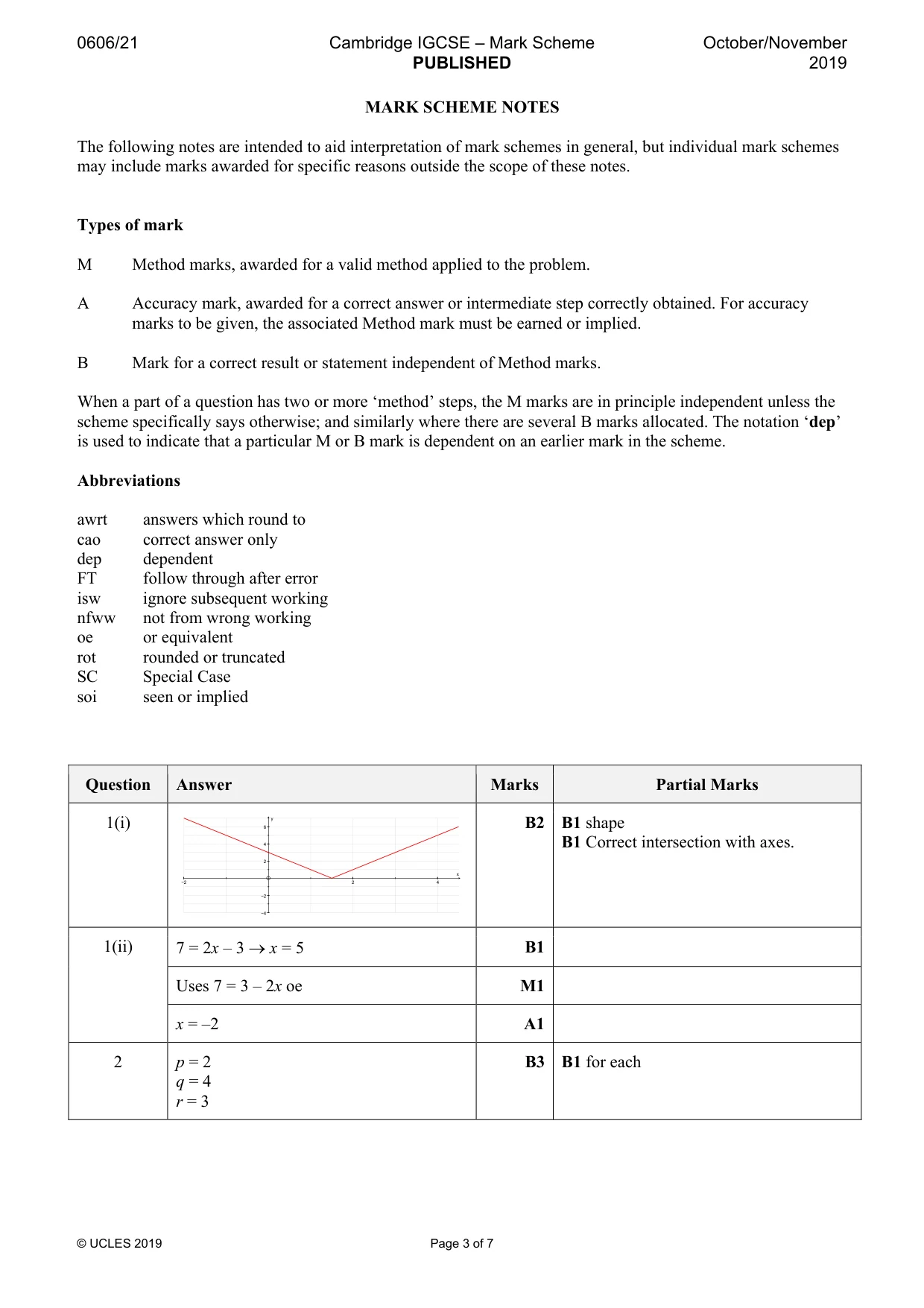
Mark scheme: Question Answer Marks Partial Marks 1(i) 6 y B2 B1 shape 4 B1 Correct intersection with axes. 2 x −2 2 4 −2 −4 1(ii) 7 = 2x – 3 → x = 5 B1 Uses 7 = 3 – 2x oe M1 x = –2 A1
Q2 · Y 6 4 2 0 r 2r x -2 The figure shows part of the graph of y = p + q cos rx
2 y 6 4 2 0 r 2r x -2 The figure shows part of the graph of y = p + q cos rx . Find the value of each of the integers p, q and r. p = q = r = [3]
Mark scheme: 2 p = 2 B3 B1 for each q = 4 r = 3
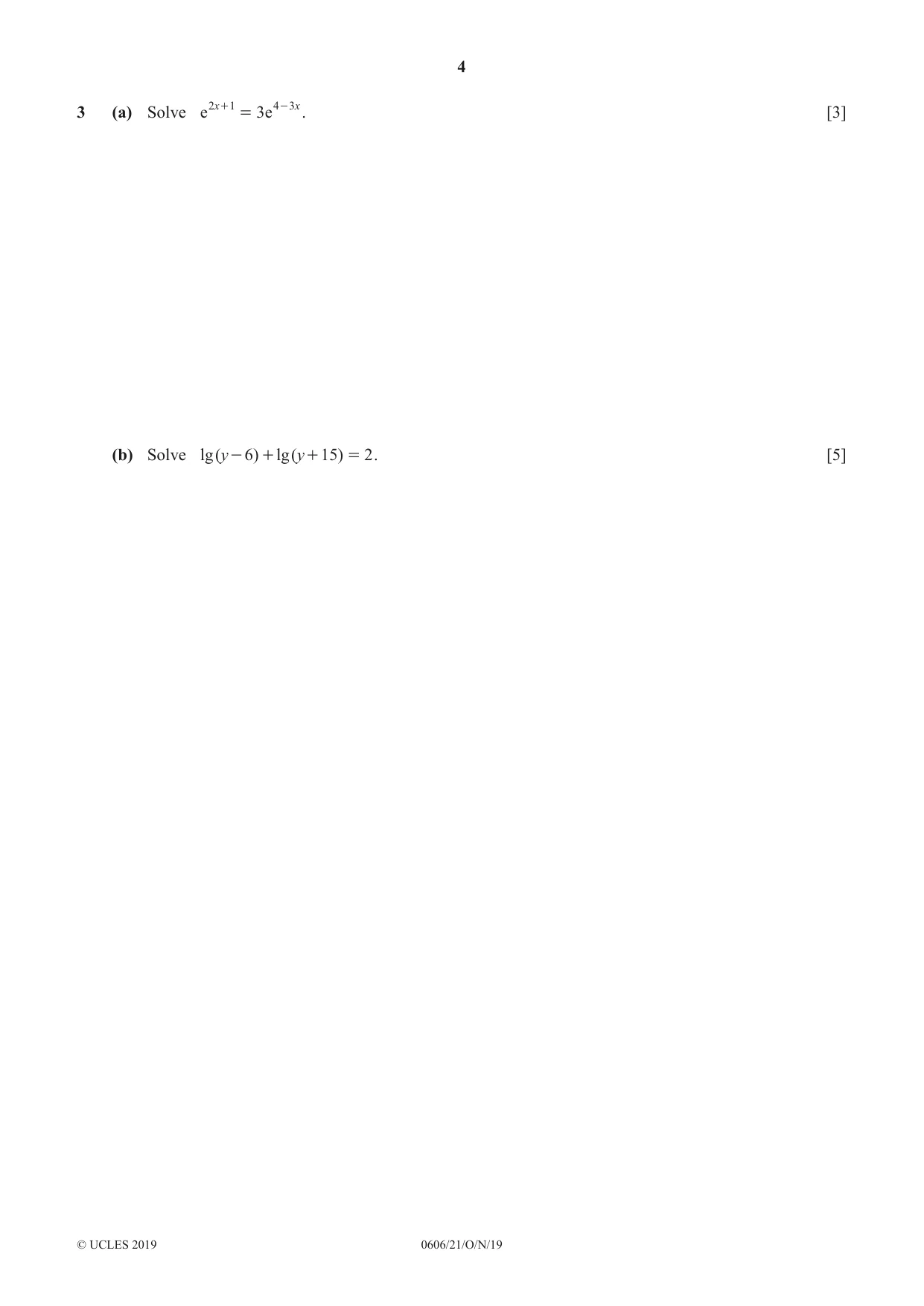
Q3 · Solve e 2x + 1 = 3e 4 - 3x
3 (a) Solve e 2x + 1 = 3e 4 - 3x . [3] (b) Solve lg (y - 6) + lg (y + 15) = 2 . [5]
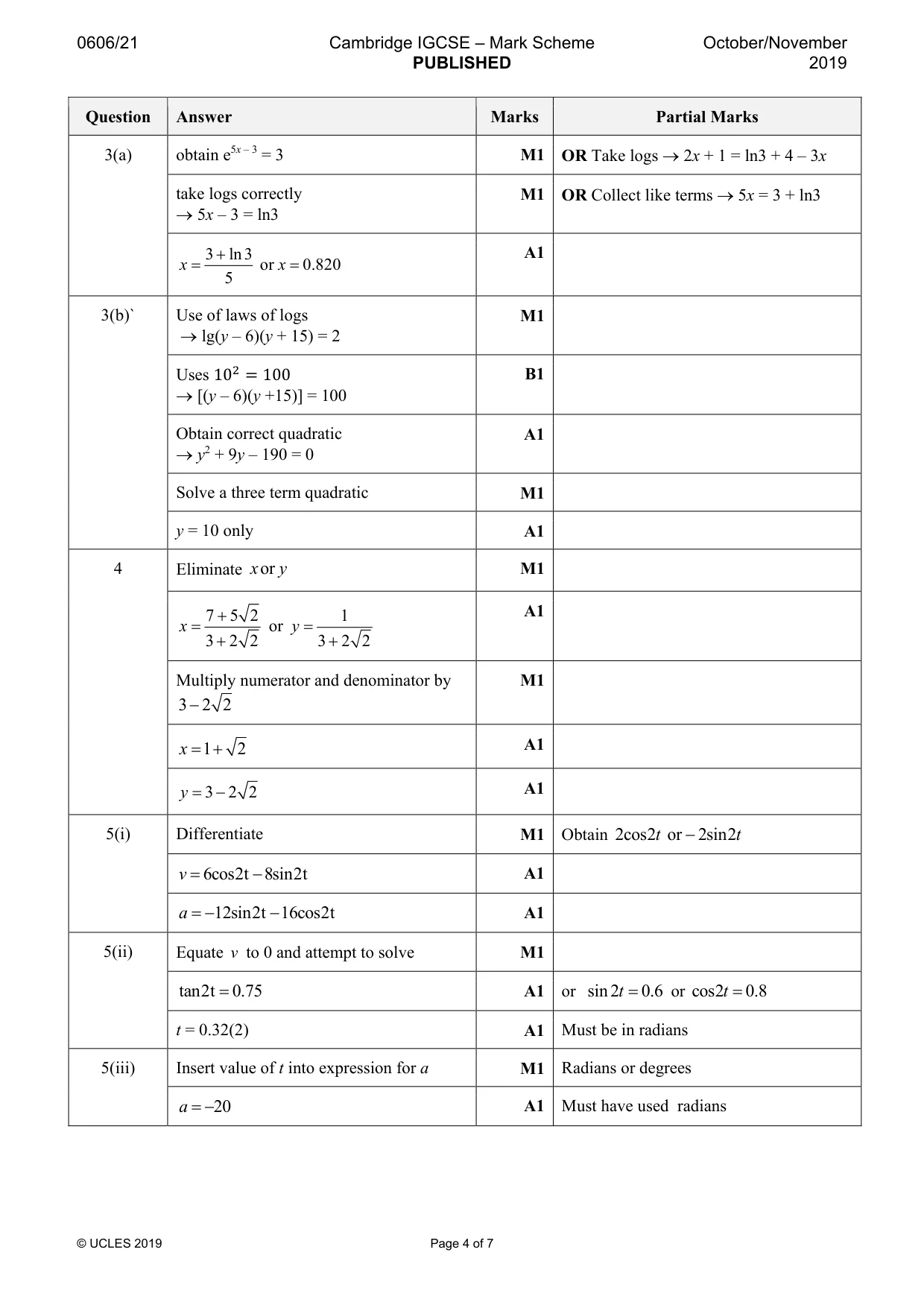
Mark scheme: 3(a) obtain e5x – 3 = 3 M1 OR Take logs → 2x + 1 = ln3 + 4 – 3x take logs correctly M1 OR Collect like terms → 5x = 3 + ln3 → 5x – 3 = ln3 3 + ln3 A1 x = or x = 0.820 5 3(b)` Use of laws of logs M1 → lg(y – 6)(y + 15) = 2 Uses 10ଶ= 100 B1 → [(y – 6)(y +15)] = 100 Obtain correct quadratic A1 → y2 + 9y – 190 = 0 Solve a three term quadratic M1 y = 10 only A1
Q4 · Do not use a calculator in this question
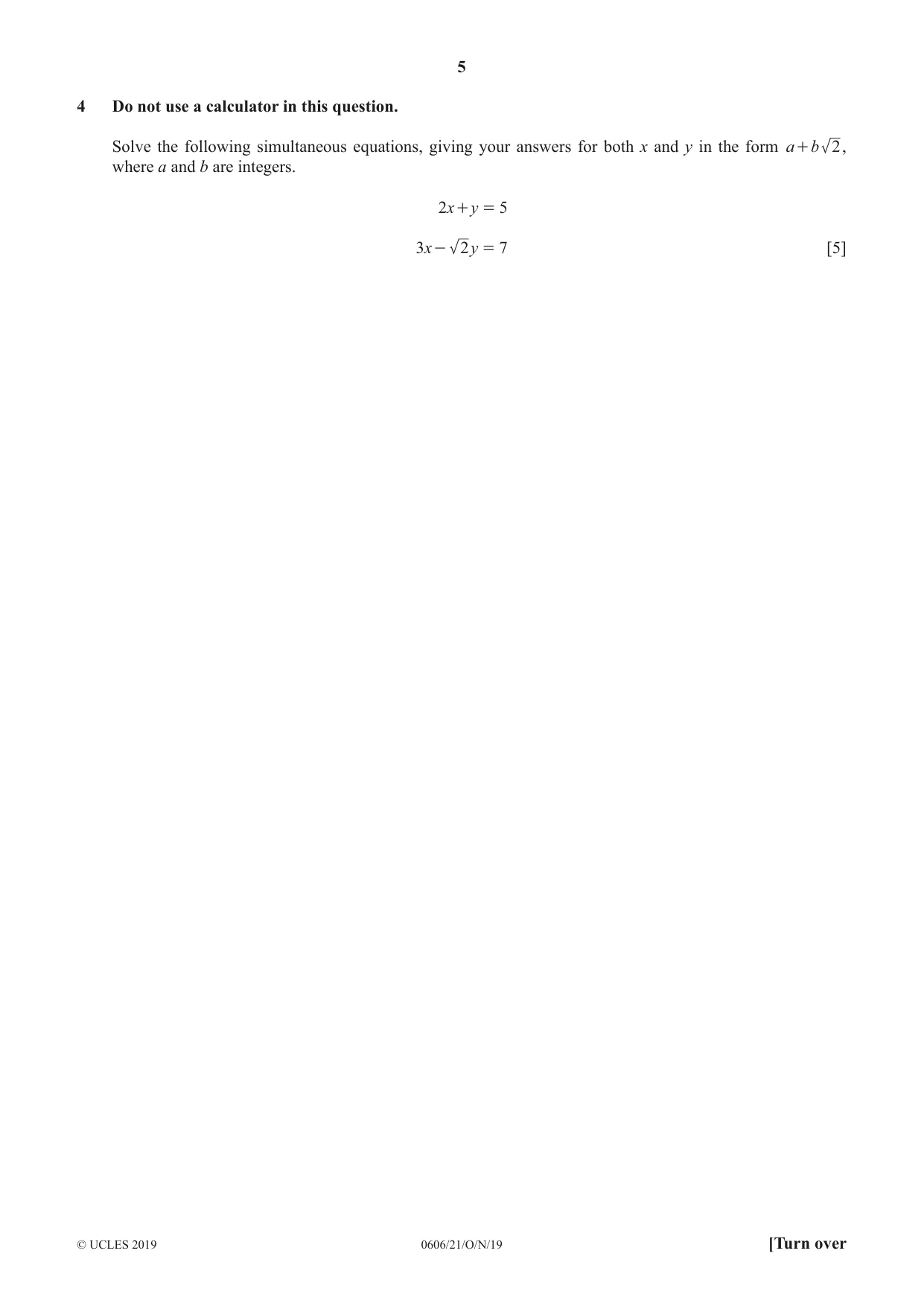
4 Do not use a calculator in this question. Solve the following simultaneous equations, giving your answers for both x and y in the form a + b 2 , where a and b are integers. 2x + y = 5 3x - 2 y = 7 [5]
Mark scheme: 4 Eliminate x or y M1 7 + 5 2 1 A1 x = or y = 3 + 2 2 3 + 2 2 Multiply numerator and denominator by M1 3 − 2 2 x = 1 + 2 A1 y = 3 − 2 2 A1
Q5 · A particle is moving in a straight line such that t seconds after passing a fixed point O…
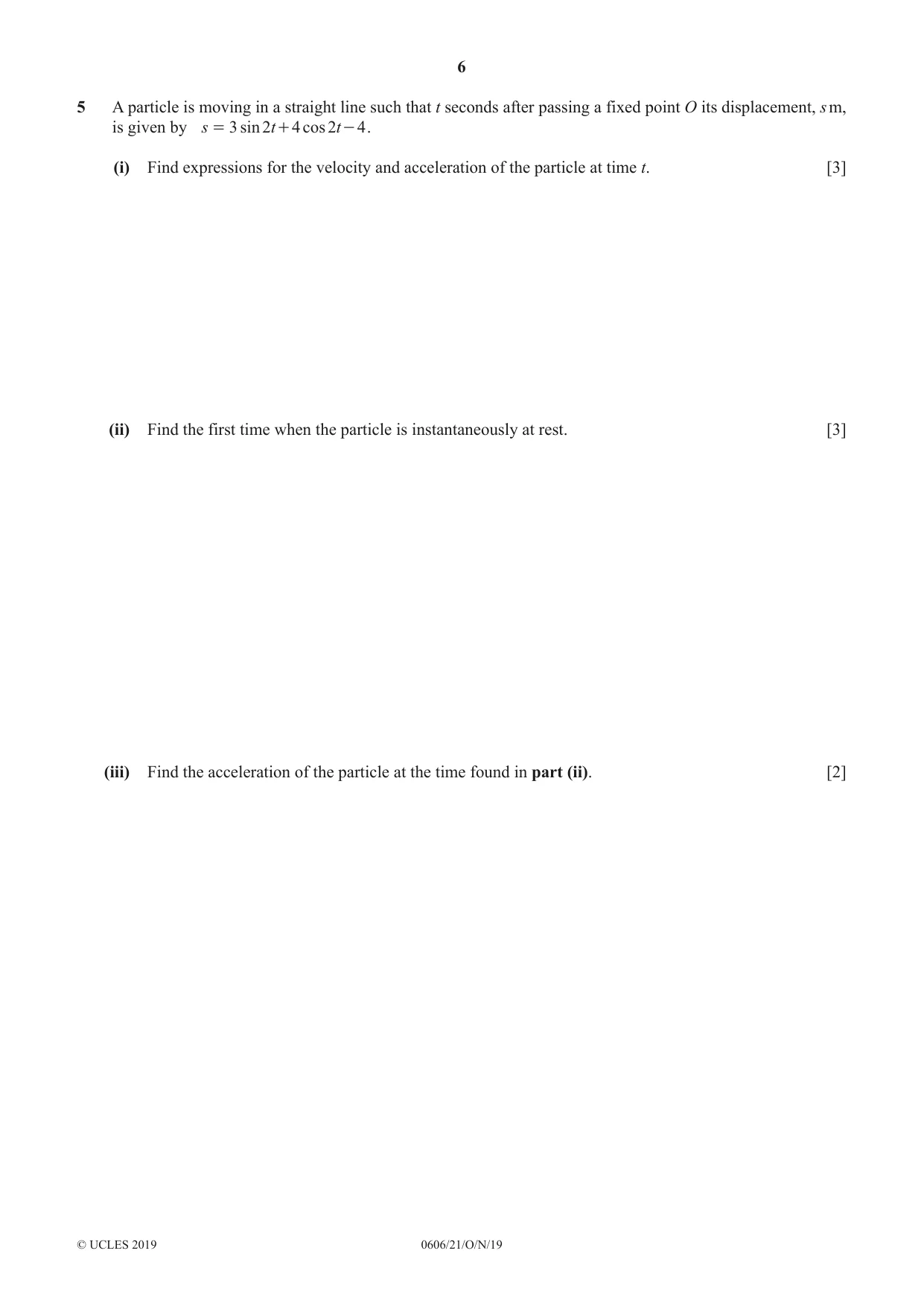
5 A particle is moving in a straight line such that t seconds after passing a fixed point O its displacement, s m, is given by s = 3 sin 2 t + 4 cos 2 t - 4 . (i) Find expressions for the velocity and acceleration of the particle at time t. [3] (ii) Find the first time when the particle is instantaneously at rest. [3] (iii) Find the acceleration of the particle at the time found in part (ii). [2]
Mark scheme: 5(i) Differentiate M1 Obtain 2cos2t or − 2sin2t v = 6cos2t − 8sin2t A1 a = −12sin2t − 16cos2t A1 5(ii) Equate v to 0 and attempt to solve M1 tan2t = 0.75 A1 or sin2t = 0.6 or cos2t = 0.8 t = 0.32(2) A1 Must be in radians 5(iii) Insert value of t into expression for a M1 Radians or degrees a = −20 A1 Must have used radians
Q6 · Do not use a calculator in this question
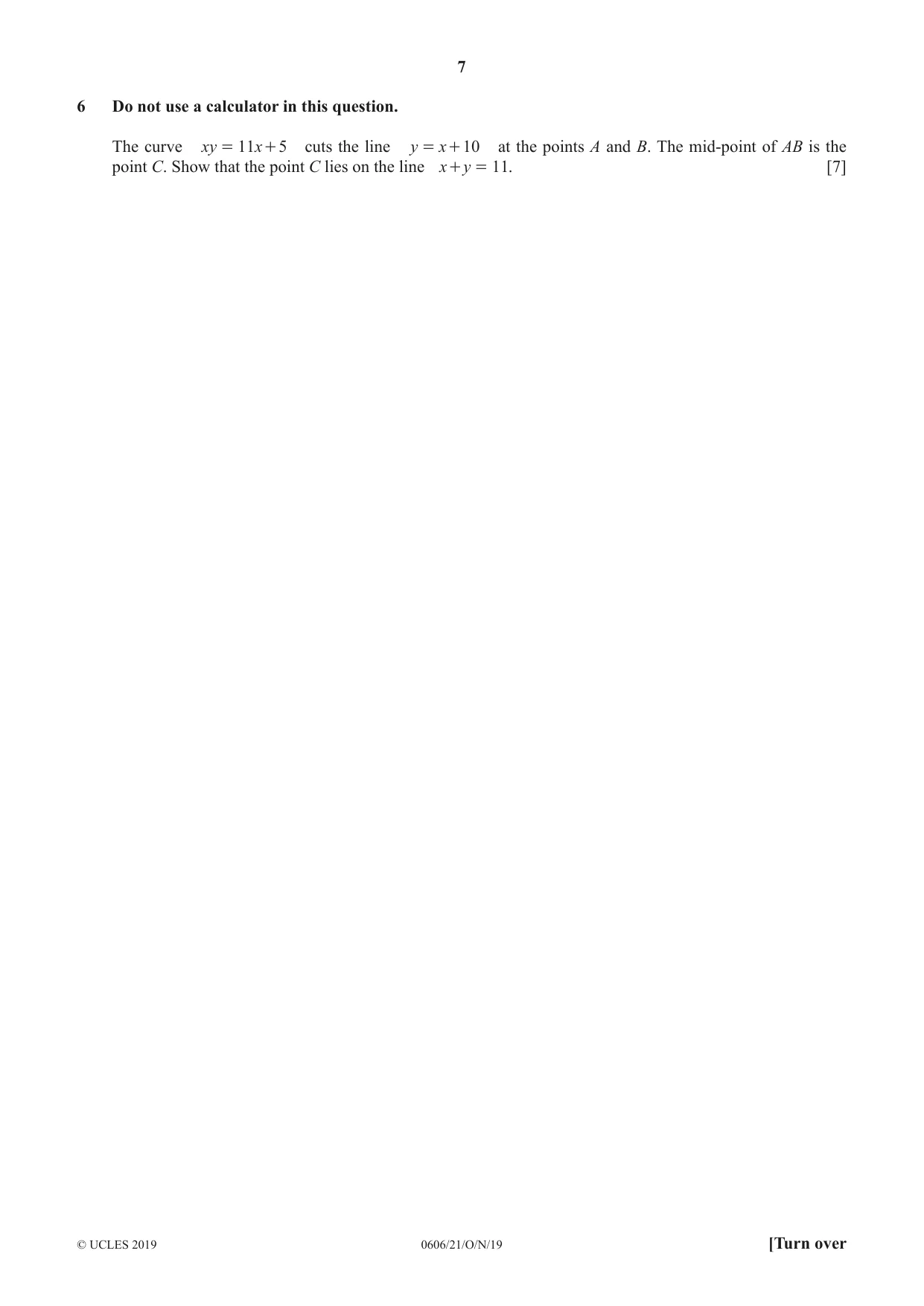
6 Do not use a calculator in this question. The curve xy = 11x + 5 cuts the line y = x + 10 at the points A and B. The mid-point of AB is the point C. Show that the point C lies on the line x + y = 11. [7]
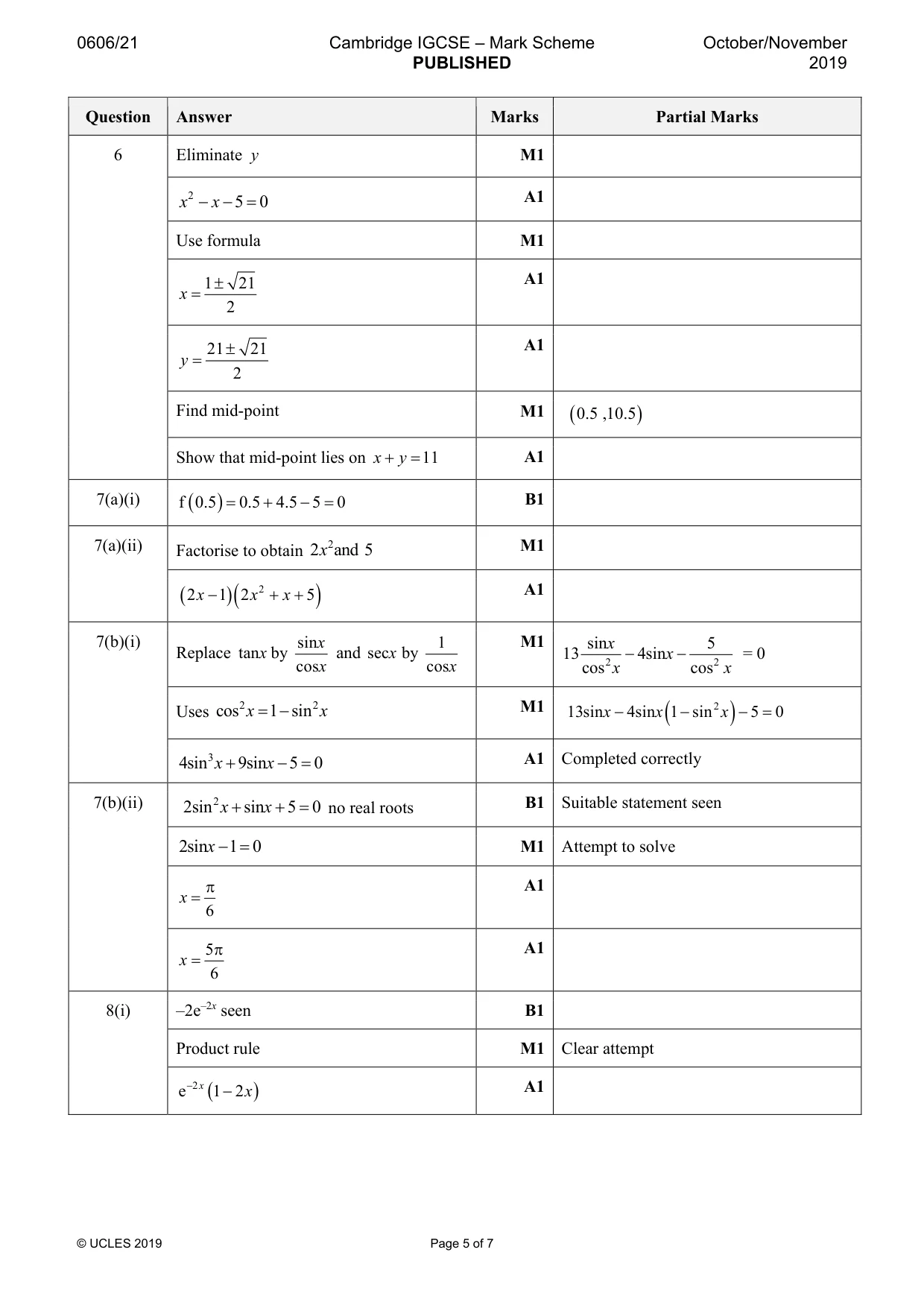
Mark scheme: 6 Eliminate y M1 x 2 − x − 5 = 0 A1 Use formula M1 1 ± 21 A1 x = 2 21 ± 21 A1 y = 2 Find mid-point M1 ( 0.5 ,1 0.5 ) Show that mid-point lies on x + y = 11 A1
Q7 · Use the factor theorem to show that 2x - 1 is a factor of p ()x , where p ()x = 4x 3 + 9x…
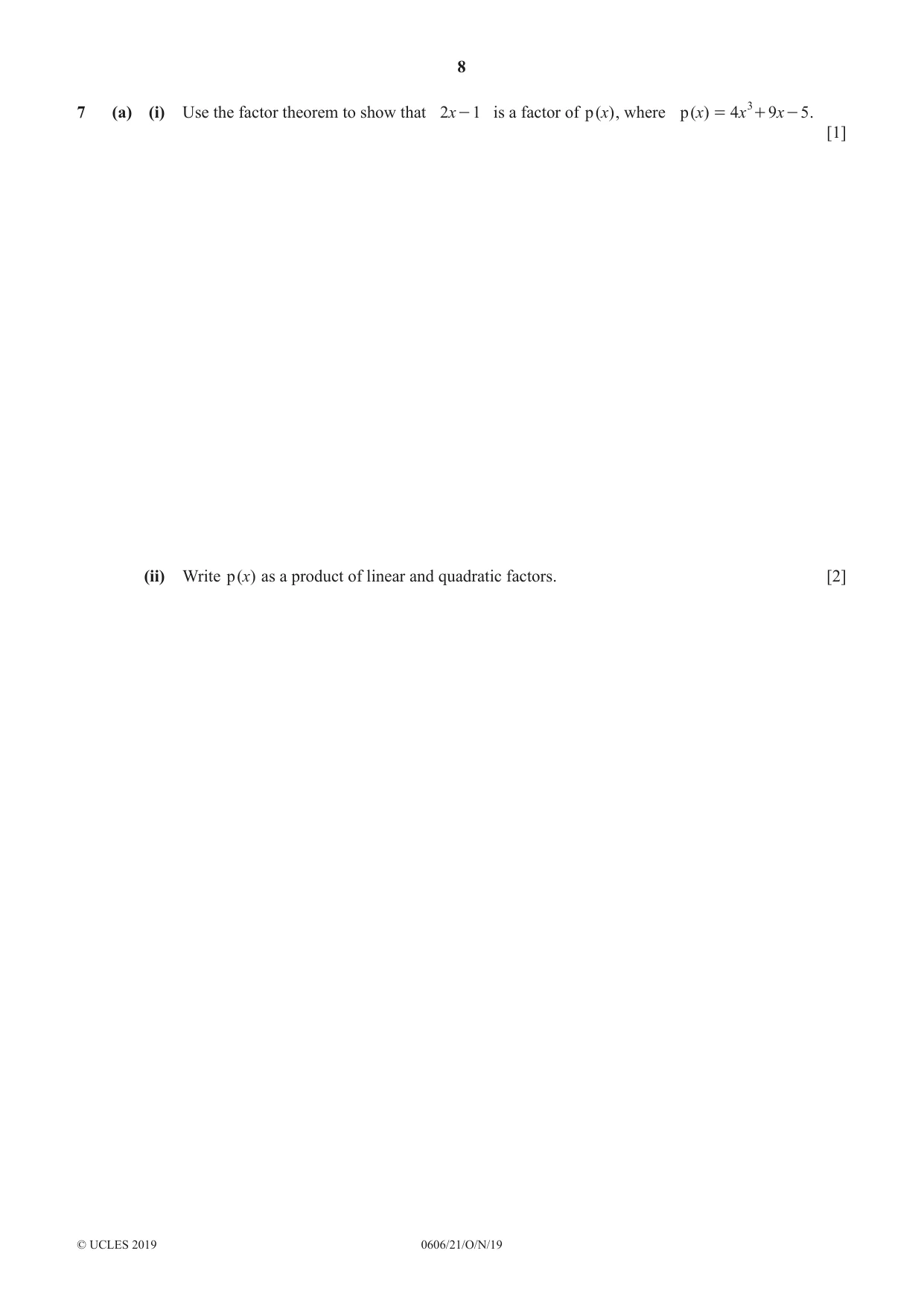
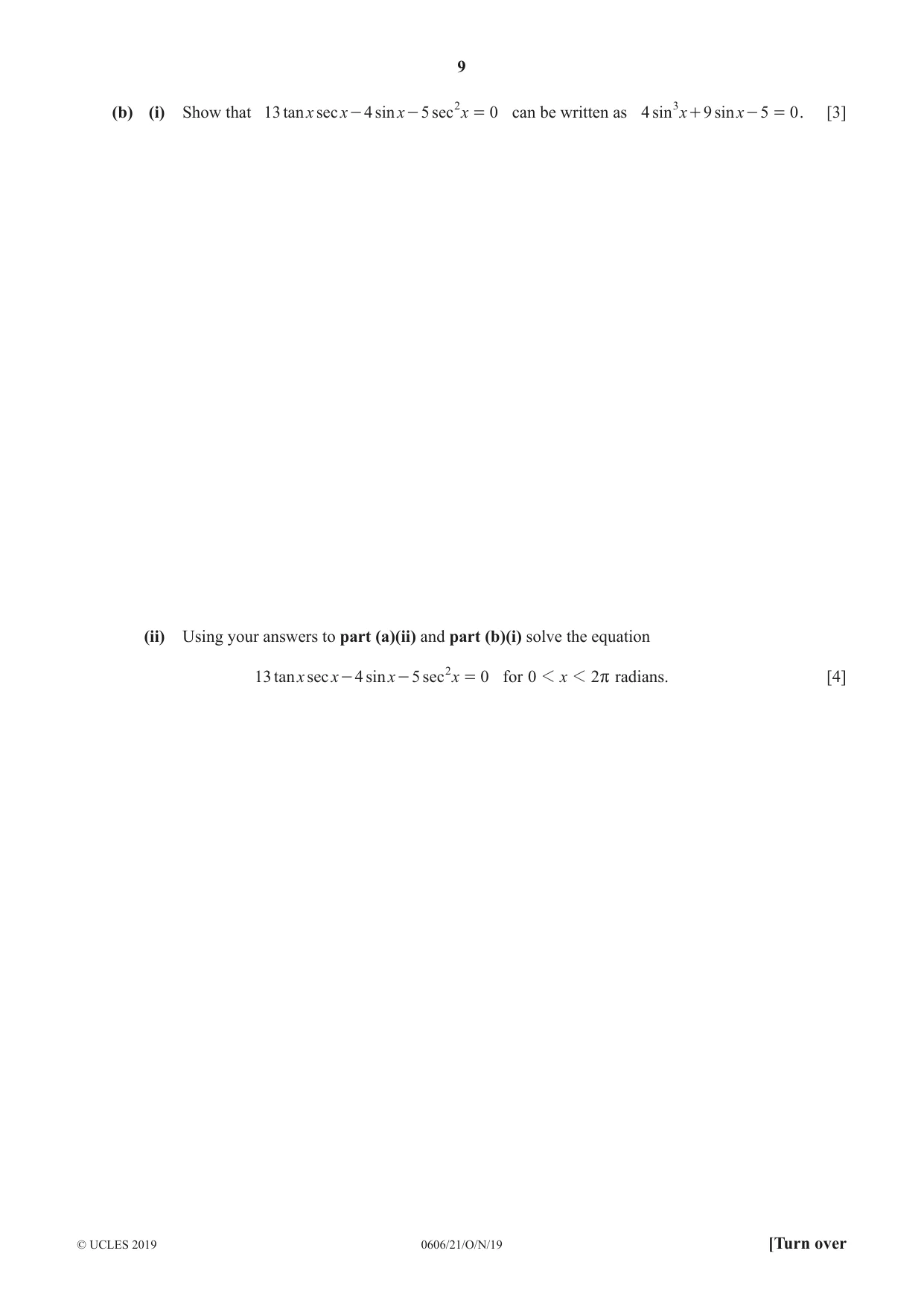
7 (a) (i) Use the factor theorem to show that 2x - 1 is a factor of p ()x , where p ()x = 4x 3 + 9x - 5 . [1] (ii) Write p ()x as a product of linear and quadratic factors. [2] (b) (i) Show that 13 tan x sec x - 4 sin x - 5 sec 2 x = 0 can be written as 4 sin 3 x + 9 sin x - 5 = 0 . [3] (ii) Using your answers to part (a)(ii) and part (b)(i) solve the equation 13 tan x sec x - 4 sin x - 5 sec 2 x = 0 for 0 1 x 1 2 r radians. [4]
Mark scheme: 7(a)(i) f ( 0.5 ) = 0.5 + 4.5 − 5 = 0 B1 7(a)(ii) Factorise to obtain 2 x 2 and 5 M1 2 x + x + 5 ( 2 x − 1)( 2 A1 ) 7(b)(i) sin x 1 M1 sin x 5 Replace tan x by and sec x by 13 − 4sin x − = 0 cos x cos x cos 2 x cos 2 x Uses cos 2 x = 1 − sin 2 x M1 13sin x − 4sin x 1 − sin 2 x − 5 = 0 ( ) 4sin 3 x + 9sinx − 5 = 0 A1 Completed correctly 7(b)(ii) 2sin 2 x + sinx + 5 = 0 no real roots B1 Suitable statement seen 2sinx −=1 0 M1 Attempt to solve π A1 x = 6 5 π A1 x = 6
Q8 · The equation of a curve is given by y = xe -2x
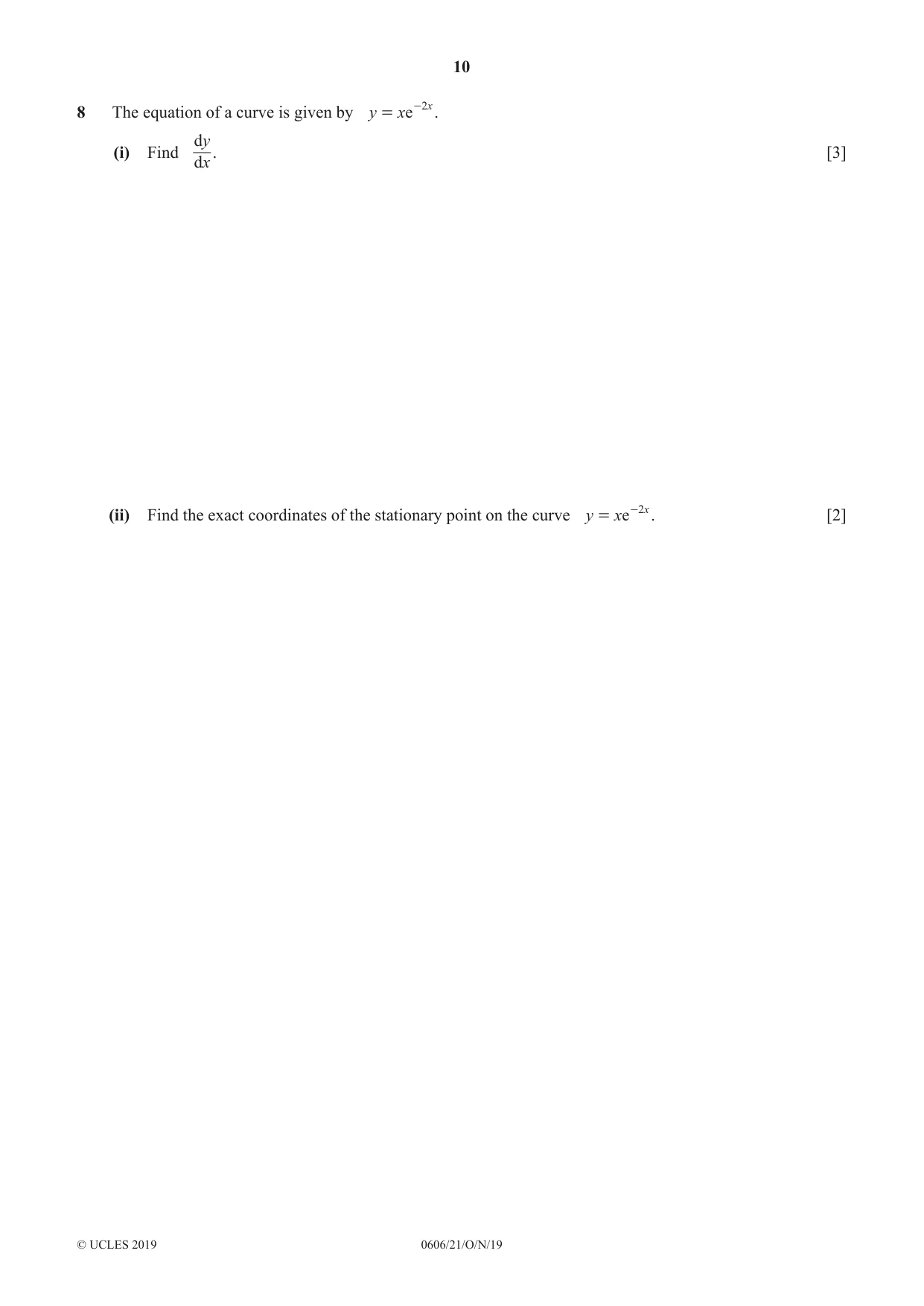
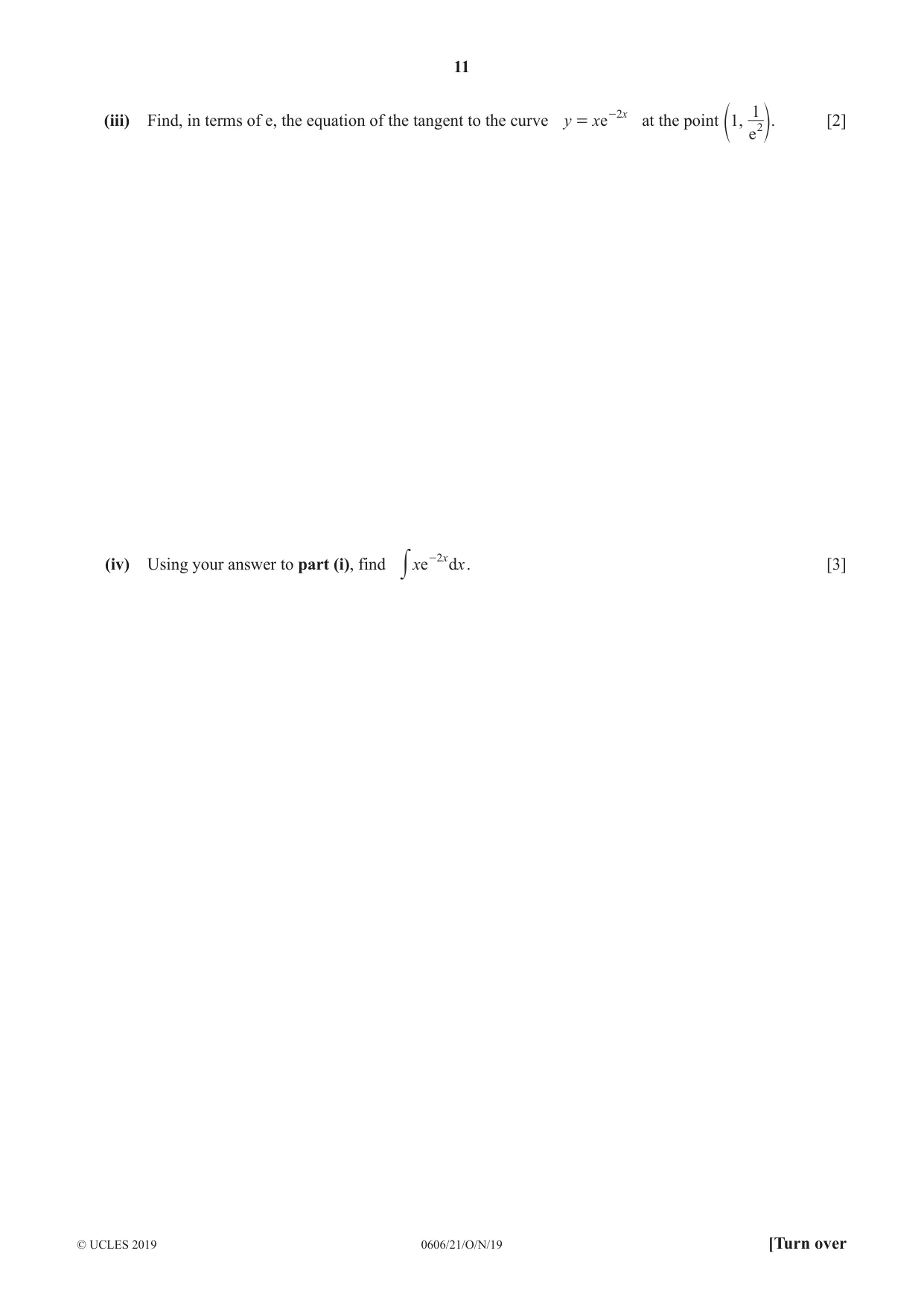
8 The equation of a curve is given by y = xe -2x . dy (i) Find . [3] dx (ii) Find the exact coordinates of the stationary point on the curve y = xe -2x . [2] -2x 1(iii) Find, in terms of e, the equation of the tangent to the curve y = xe at the point ,1 [2] e e2 o. (iv) Using your answer to part (i), find xe -2x d x . [3] y
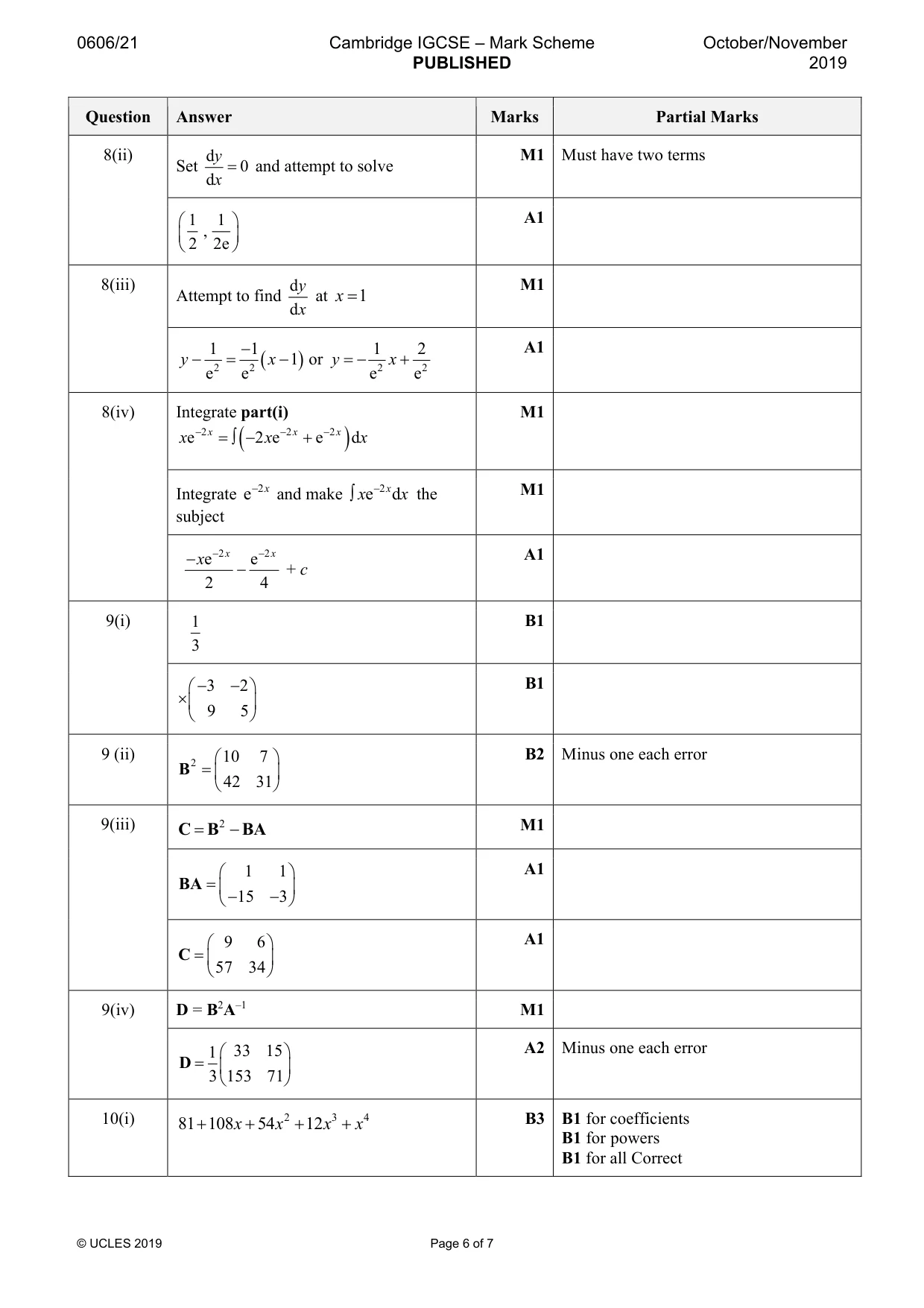
Mark scheme: 8(i) –2e–2x seen B1 Product rule M1 Clear attempt e −2 x (1 − 2 x ) A1 8(ii) dy M1 Must have two terms Set = 0 and attempt to solve dx 1 1 A1 , 2 2e 8(iii) d y M1 Attempt to find at x = 1 d x 1 −1 1 2 A1 y − = x + 2 2 ( x − 1) or y = − 2 e e e e 2 8(iv) Integrate part(i) M1 xe −2 x = ∫− 2 xe −2 x + e −2 x d x ( ) Integrate e −2 x and make ∫ xe −2 x dx the M1 subject − xe − 2 x e −2 x A1 − + c 2 4
Q9 · Given that A = and B = , find - 9 - 3 6 5 (i) A -1 , [2] (ii) B2, [2] (iii) the matrix C…
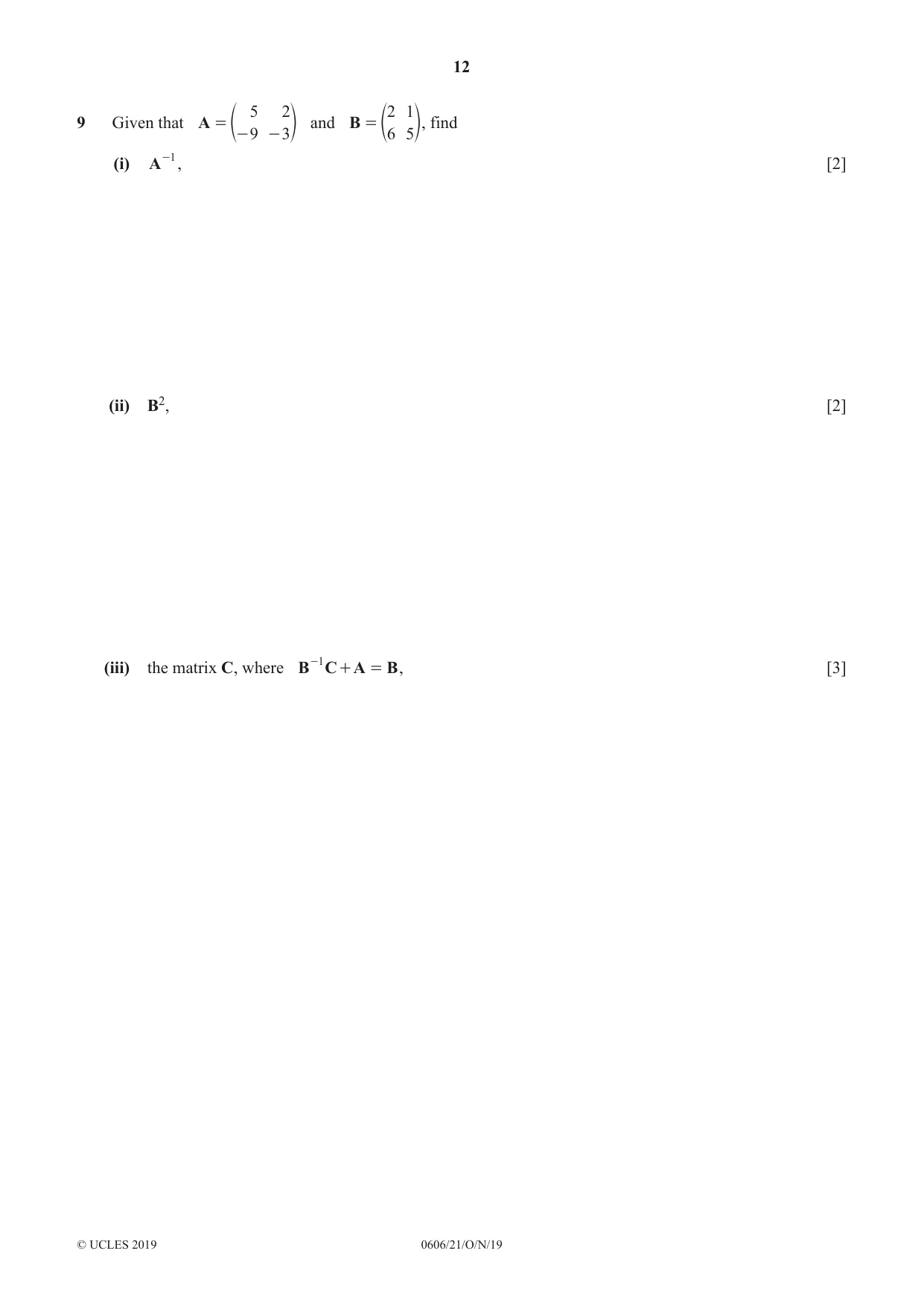
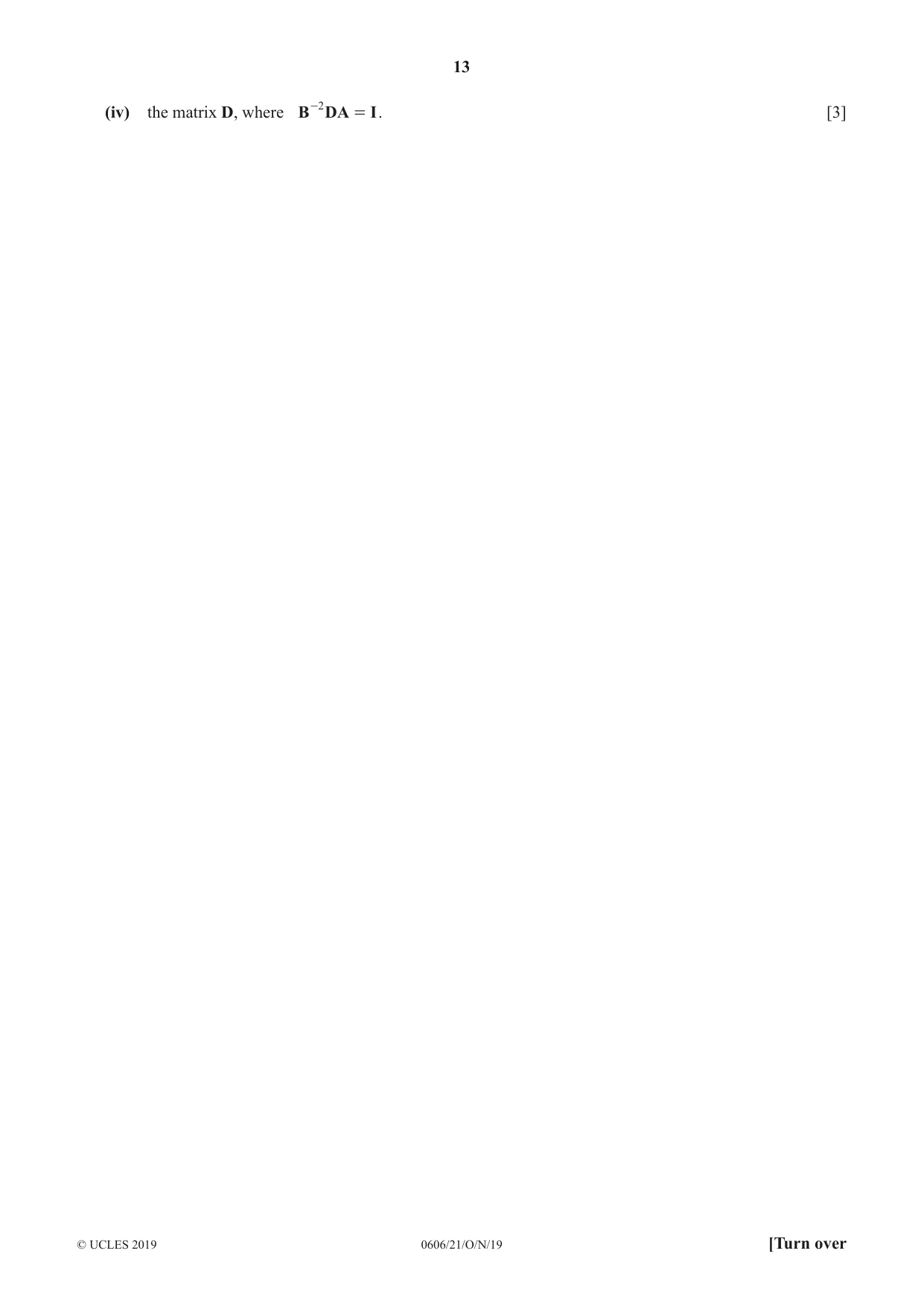
9 Given that A = and B = , find - 9 - 3 6 5 (i) A -1 , [2] (ii) B2, [2] (iii) the matrix C, where B -1 C + A = B , [3] (iv) the matrix D, where B -2 DA = I . [3]
Mark scheme: 9(i) 1 B1 3 − 3 − 2 B1 × 9 5 9 (ii) 2 10 7 B2 Minus one each error B = 42 31 9(iii) C = B 2 − BA M1 1 1 A1 BA = − 15 − 3 9 6 A1 C = 57 34 9(iv) D = B2A–1 M1 1 33 15 A2 Minus one each error D = 3 153 71
Q10 · Expand (3 + )x 4 evaluating each coefficient
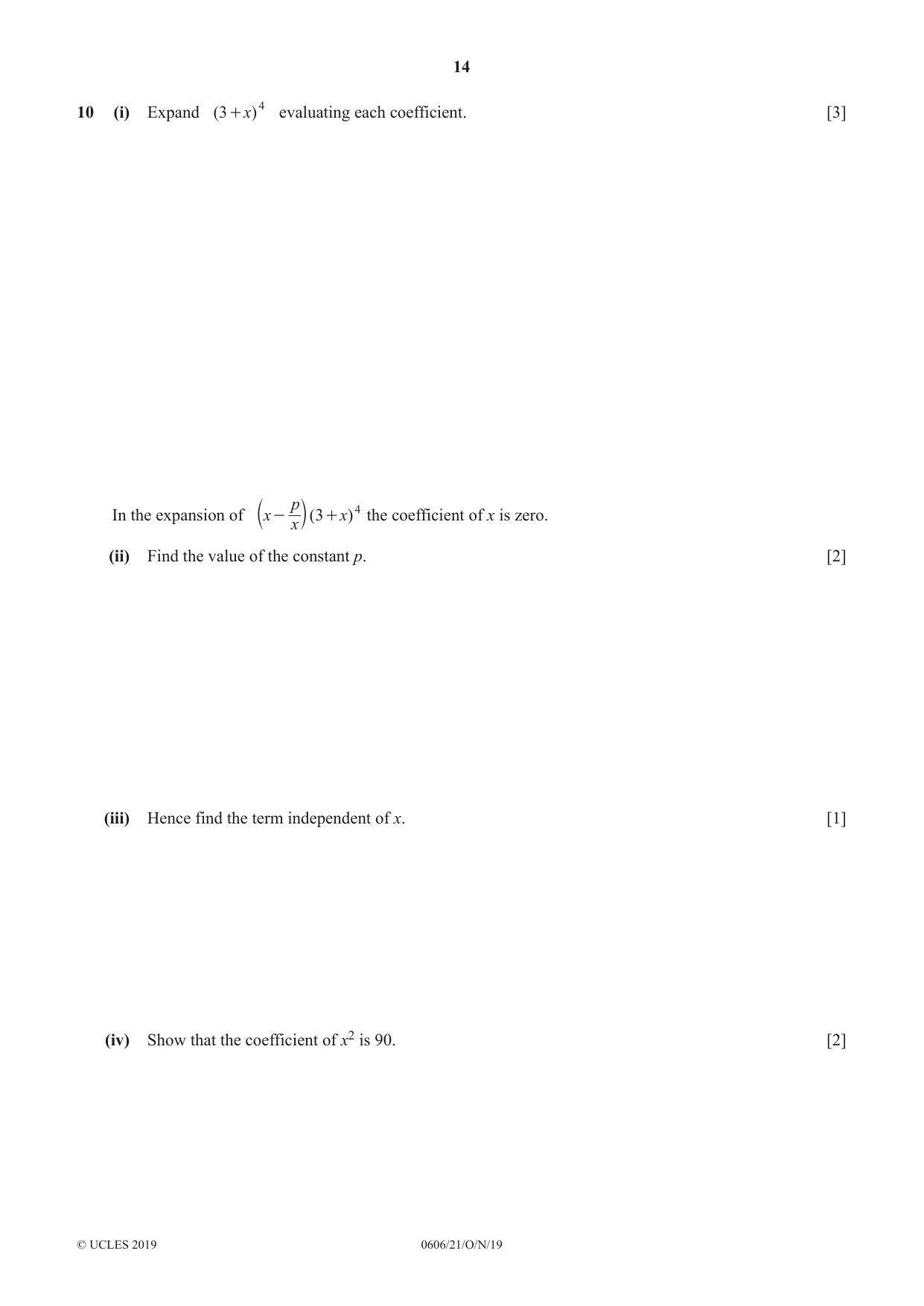
10 (i) Expand (3 + )x 4 evaluating each coefficient. [3] p 4 In the expansion of x - (3 + x) the coefficient of x is zero. b x l (ii) Find the value of the constant p. [2] (iii) Hence find the term independent of x. [1] (iv) Show that the coefficient of x2 is 90. [2]
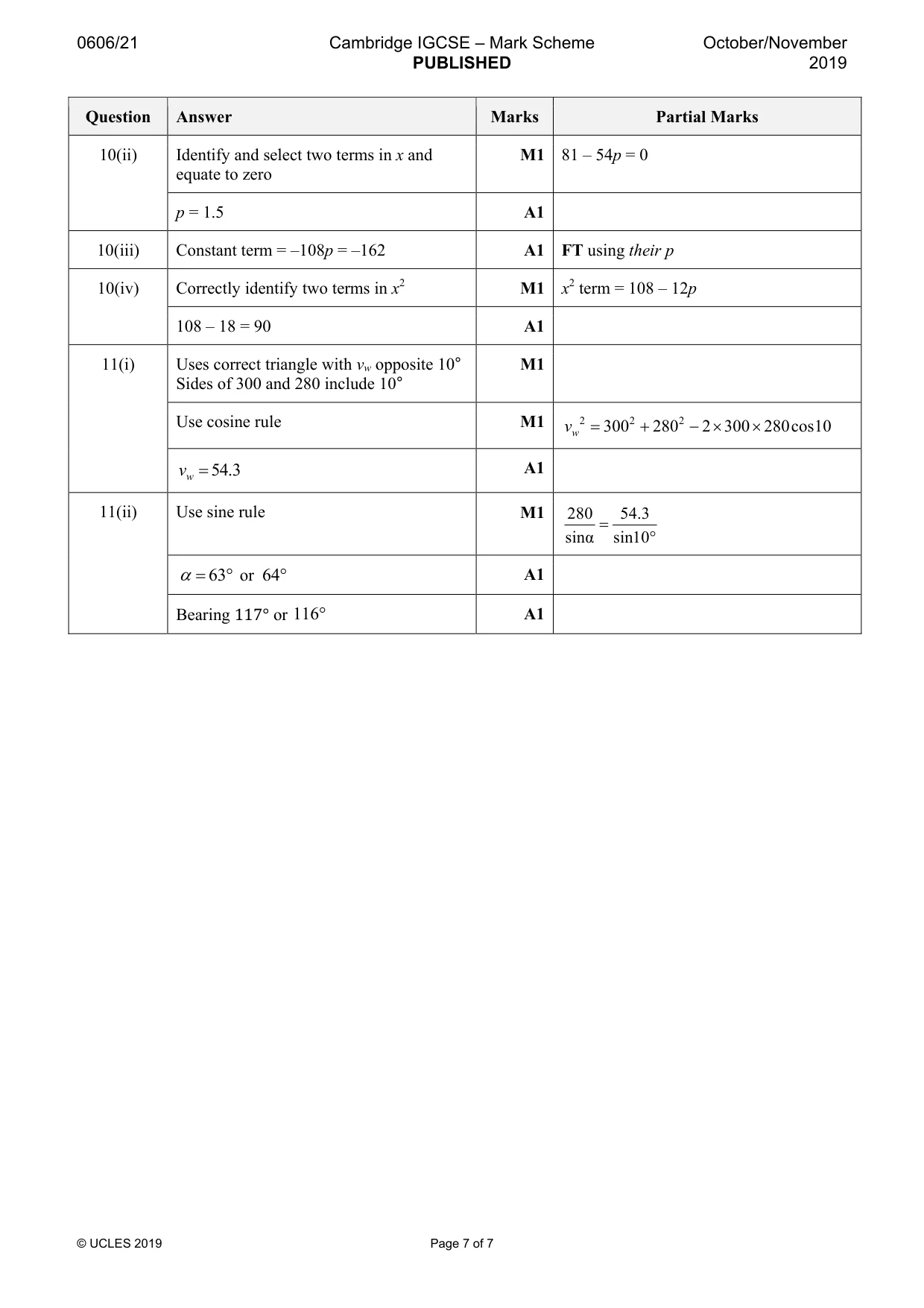
Mark scheme: 10(i) 81 + 108 x + 54 x 2 + 12 x 3 + x 4 B3 B1 for coefficients B1 for powers B1 for all Correct 10(ii) Identify and select two terms in x and M1 81 – 54p = 0 equate to zero p = 1.5 A1 10(iii) Constant term = –108p = –162 A1 FT using their p 10(iv) Correctly identify two terms in x2 M1 x2 term = 108 – 12p 108 – 18 = 90 A1
Q11 · A plane, which can travel at a speed of 300 km h–1 in still air, heads due north
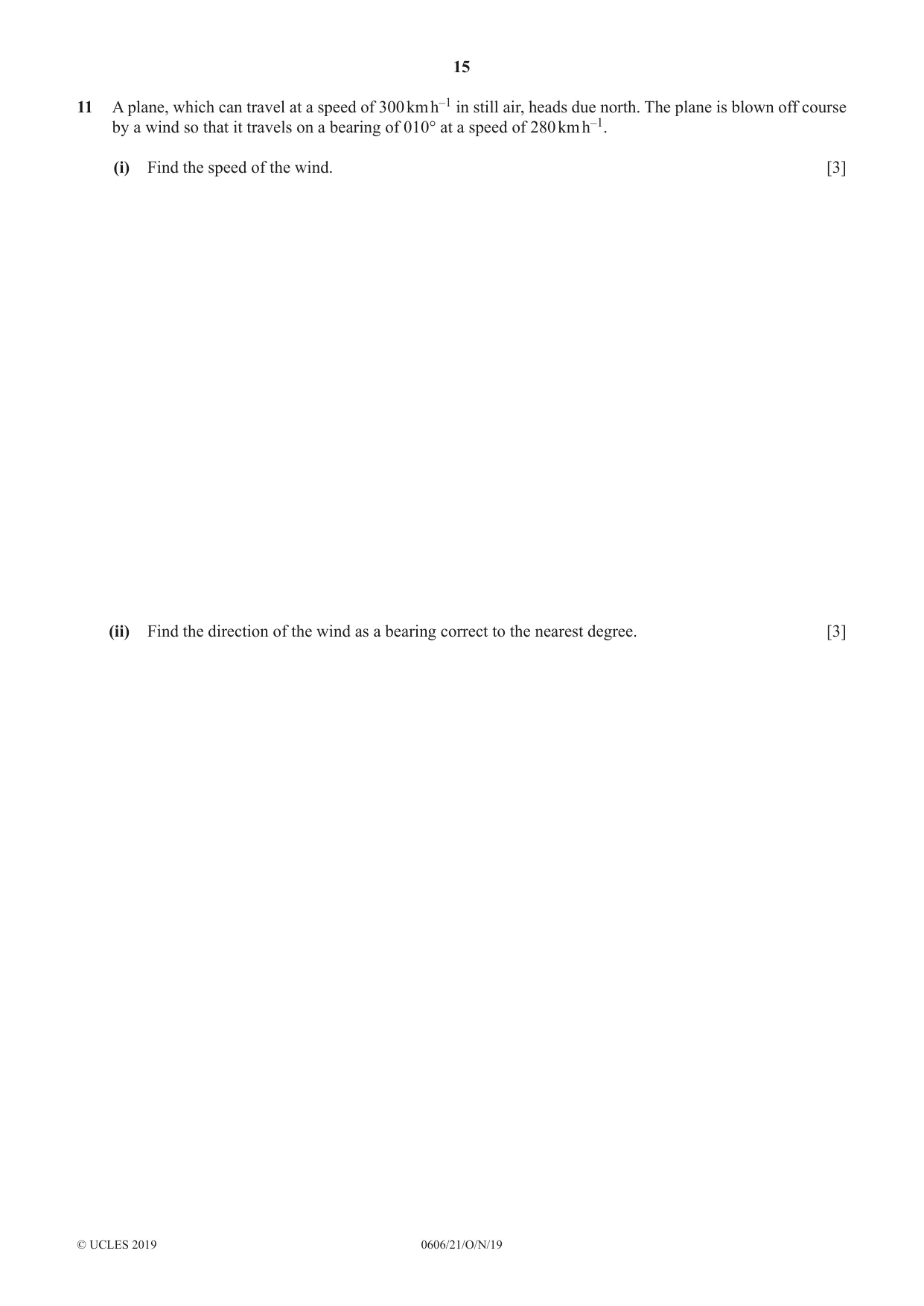
11 A plane, which can travel at a speed of 300 km h–1 in still air, heads due north. The plane is blown off course by a wind so that it travels on a bearing of 010° at a speed of 280 km h–1. (i) Find the speed of the wind. [3] (ii) Find the direction of the wind as a bearing correct to the nearest degree. [3]
Mark scheme: 11(i) Uses correct triangle with vw opposite 10° M1 Sides of 300 and 280 include 10° Use cosine rule M1 vw 2 = 300 2 + 280 2 − 2 × 300 × 280cos10 vw = 54.3 A1 11(ii) Use sine rule M1 280 54.3 = sinα sin10 ° α= 63° or 64° A1 Bearing 117° or 116° A1
What was in this paper
The subtopics covered by these 11 questions, and how many questions each got. Open one in a new tab to see every Cambridge question on it.
2Apply differentiation and integration1Compose and resolve velocities1Differentiate products and quotients of1Find factors of polynomials1Form and use composite functions1Know and use the laws of logarithms1Solve equations of the type1Understand and use the amplitude and1Use the binomial theorem for expansion of1What you needed in this session
Cambridge’s own grade thresholds for 2019 Oct/Nov, Paper 2 · Variant 1. A higher threshold means an easier paper — the bar moves with how the cohort did.