Cambridge IGCSE Mathematics - Additional 0606 — 2023 Oct/Nov Paper 2 · Variant 2
0606/22/O/N/23 · 9 questions · 80 marks · ≈90 min
The question paper and its mark scheme, free to read here and free to download. This is Cambridge’s own paper, exactly as it was sat.
Question paper16 pages

Mark scheme11 pages
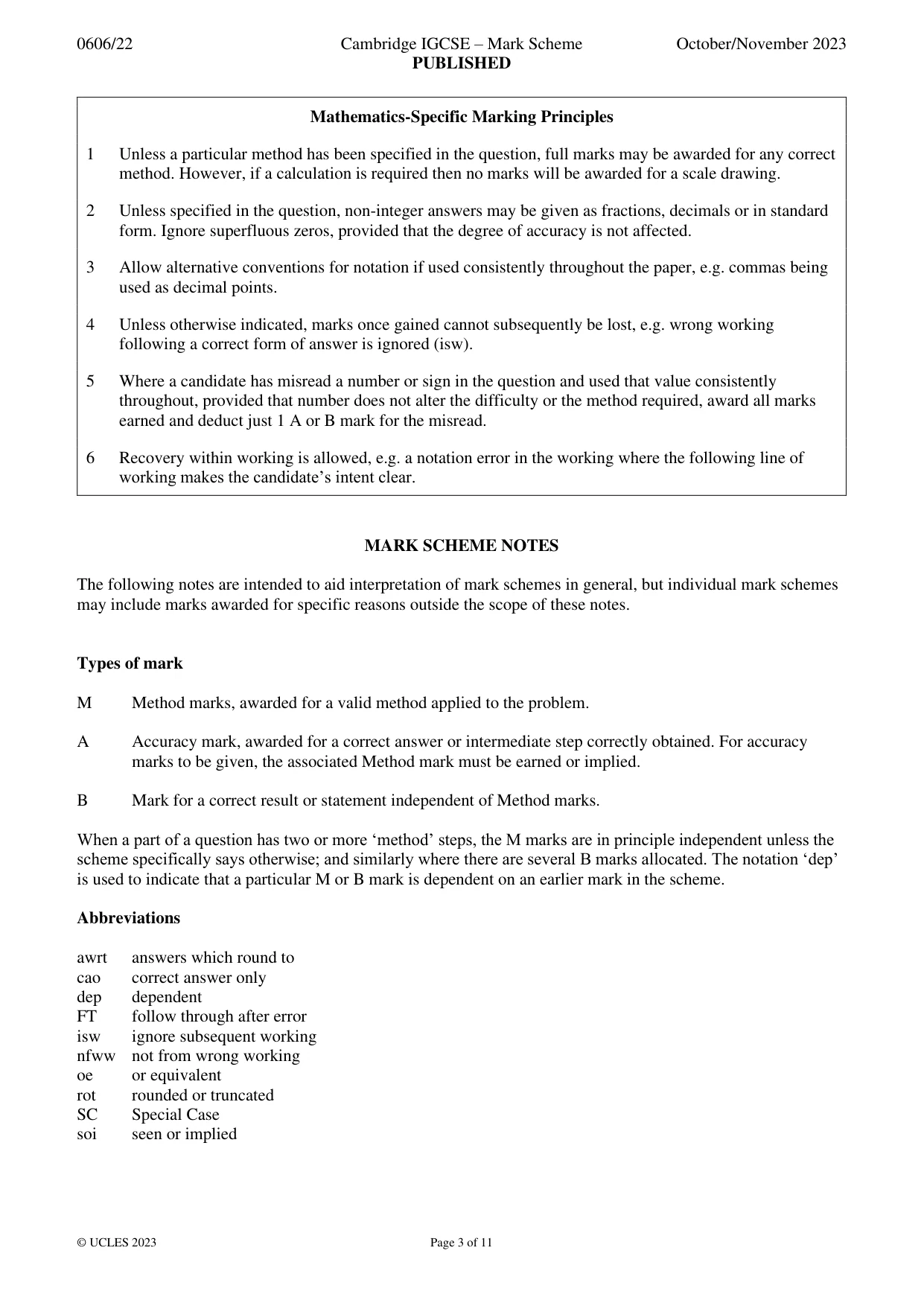
Answers below. Sit the paper first if you are practising.
Questions as text
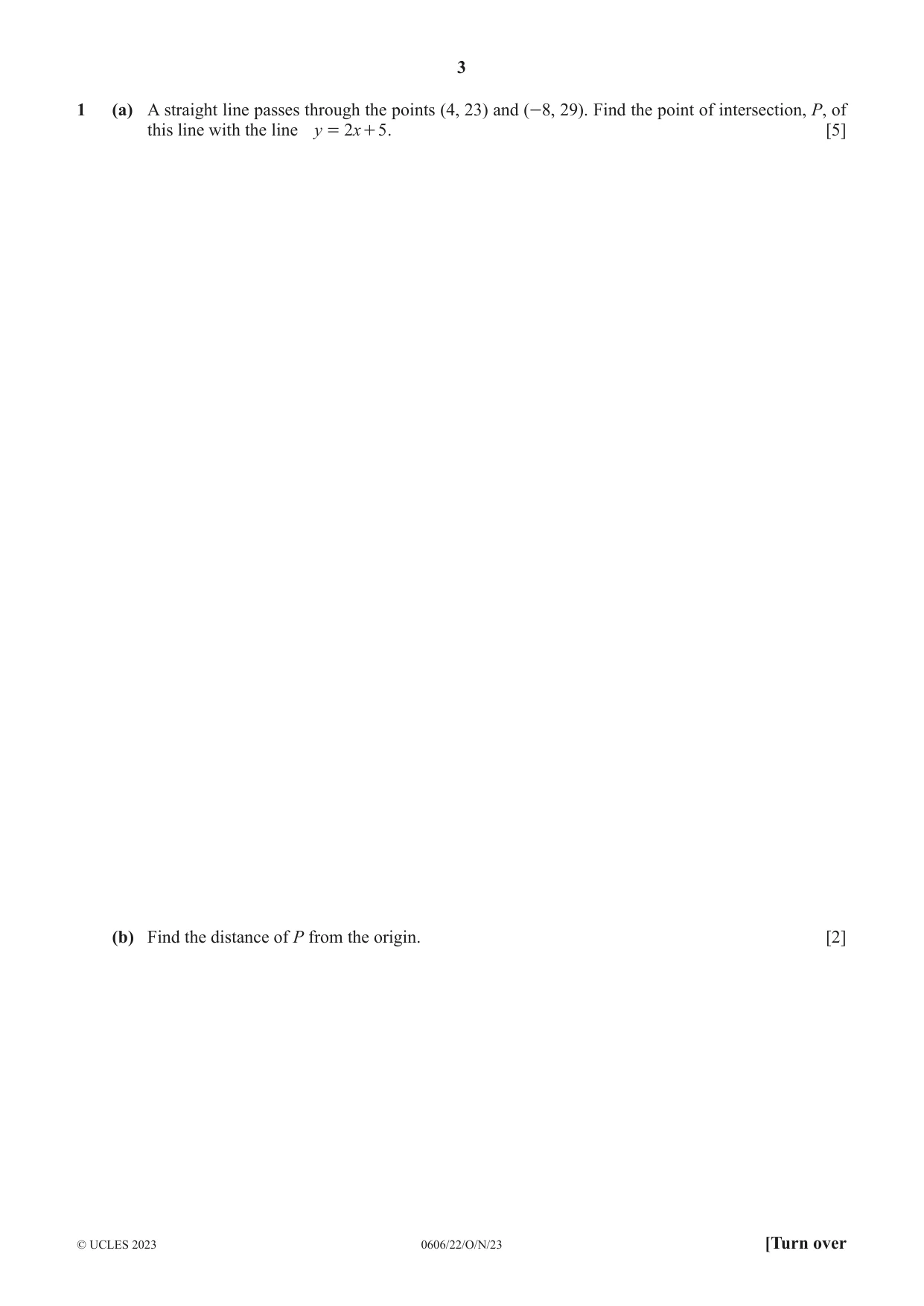
Q1 · A straight line passes through the points (4, 23) and (-8, 29)
1 (a) A straight line passes through the points (4, 23) and (-8, 29). Find the point of intersection, P, of this line with the line y = 2x + 5 . [5] (b) Find the distance of P from the origin. [2]
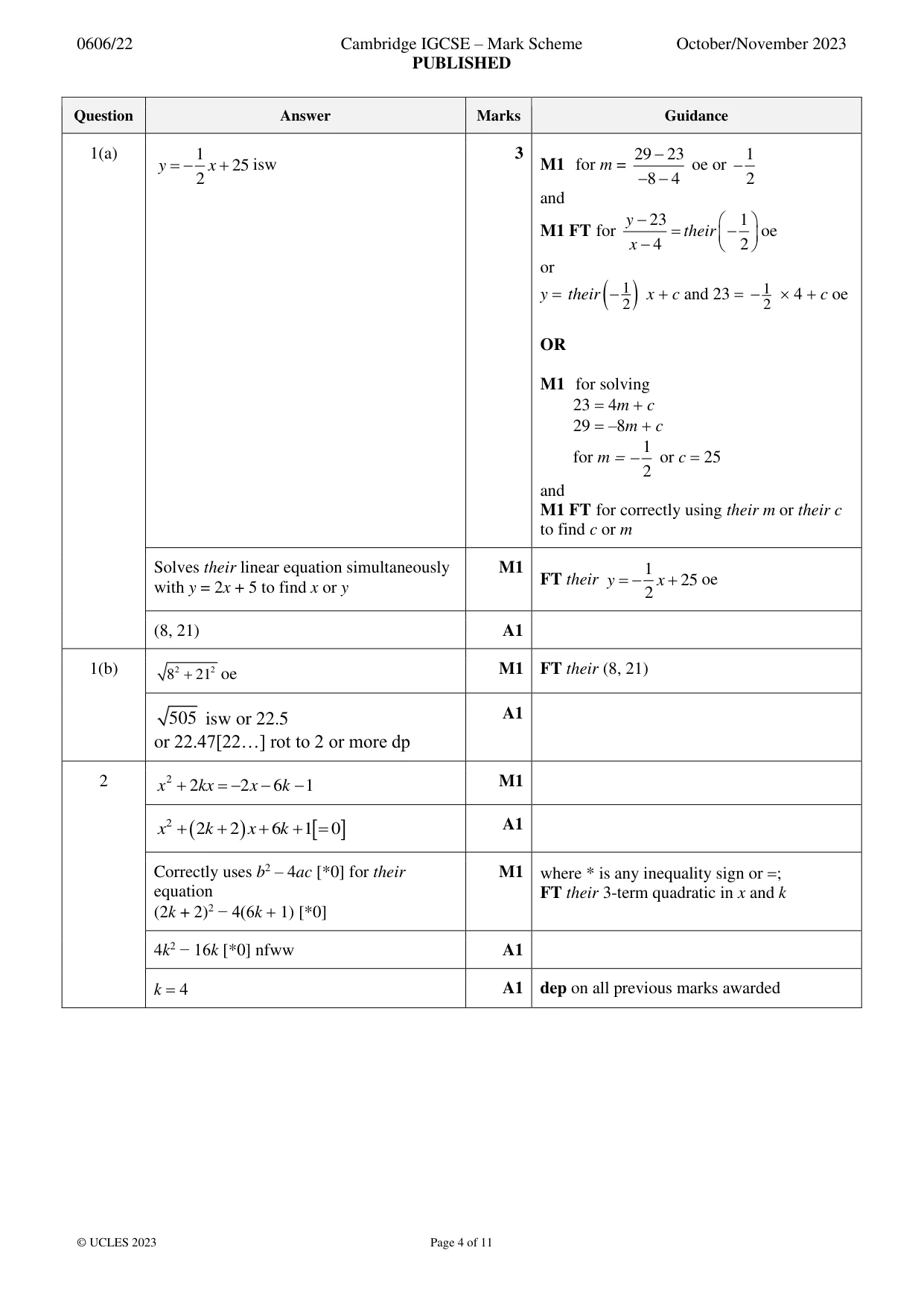
Mark scheme: Question Answer Marks Guidance 1(a) 1 3 29 − 23 1 y = − x + 25 isw M1 for m = oe or − 2 −−8 4 2 and y − 23 1 M1 FT for = their − oe x − 4 2 or 1 1 y = their − x + c and 23 = − 4 + c oe ( 2 ) 2 OR M1 for solving 23 = 4m + c 29 = –8m + c 1 for m = − or c = 25 2 and M1 FT for correctly using their m or their c to find c or m Solves their linear equation simultaneously M1 1 FT their y = − x + 25 oe with y = 2x + 5 to find x or y 2 (8, 21) A1 1(b) 2 2 M1 FT their (8, 21) 8 + 21 oe 505 isw or 22.5 A1 or 22.47[22…] rot to 2 or more dp
Q2 · Find the non-zero value of k for which the line y =- 2x - 6k - 1 is a tangent to the…
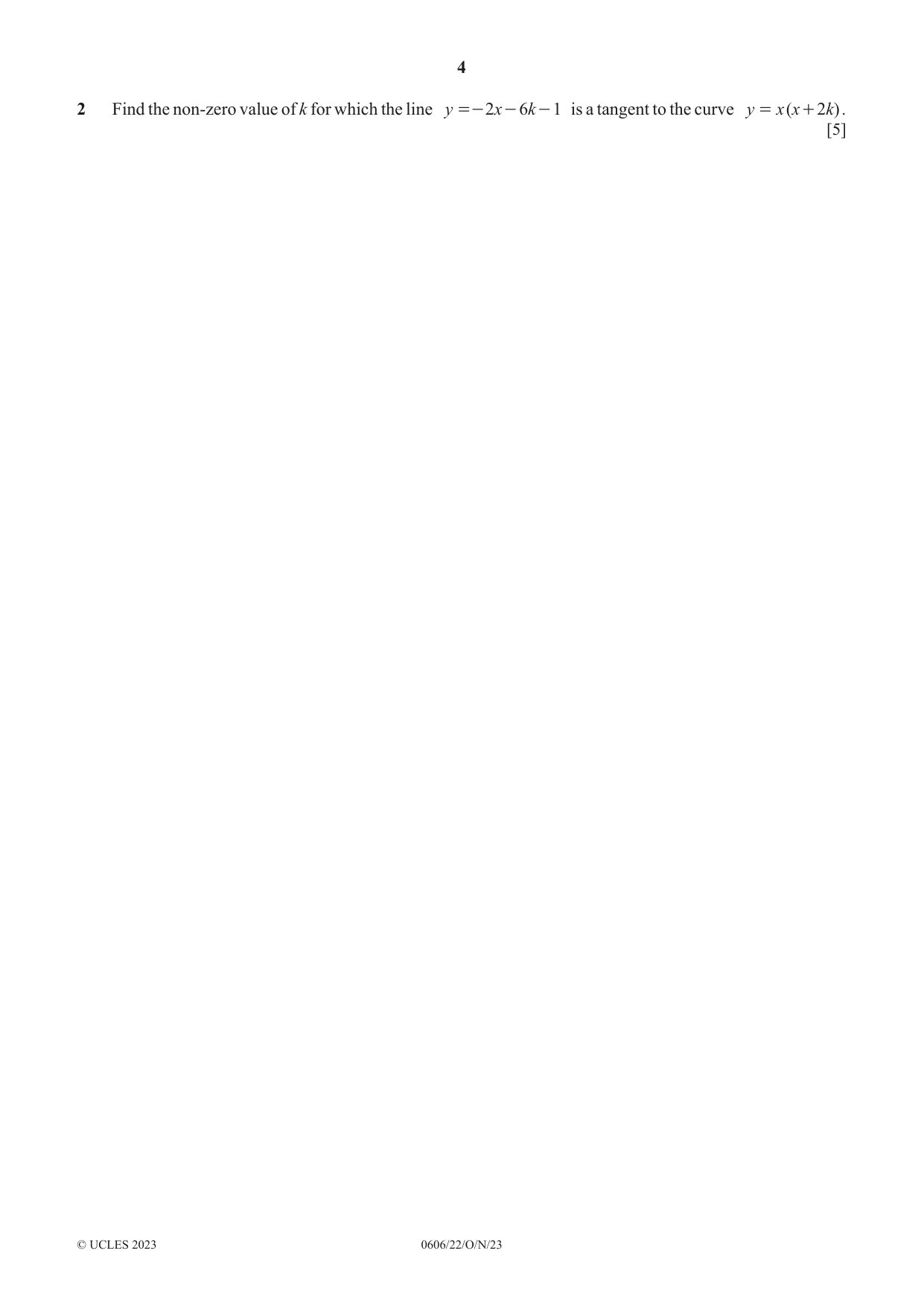
2 Find the non-zero value of k for which the line y =- 2x - 6k - 1 is a tangent to the curve y = x ( x + 2k). [5]
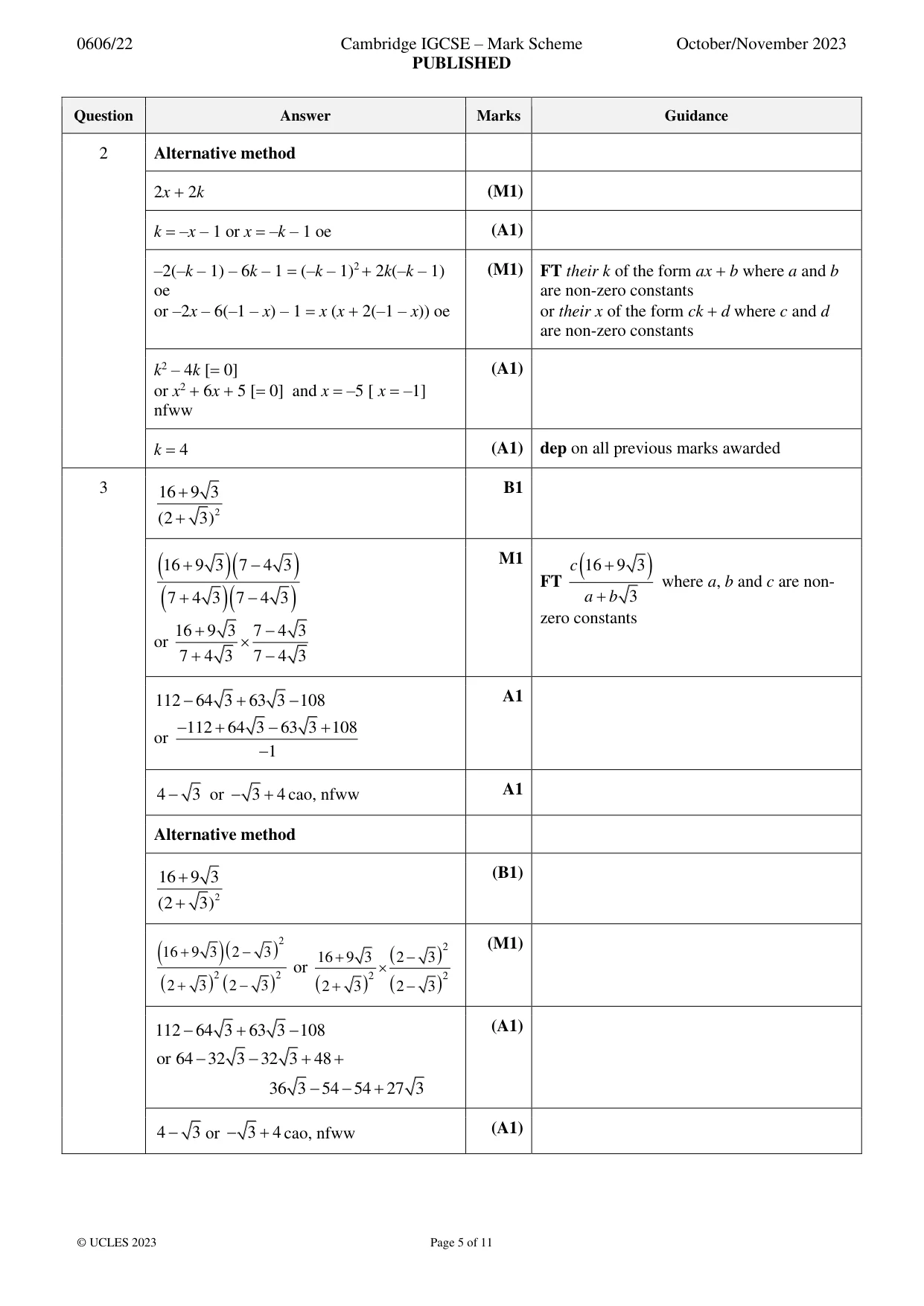
Mark scheme: 2 x 2 + 2 kx = −2 x − 6 k − 1 M1 x 2 + ( 2k + 2 ) x + 6k + 1 = 0 A1 Correctly uses b2 – 4ac [*0] for their M1 where * is any inequality sign or =; equation FT their 3-term quadratic in x and k (2k + 2)2 − 4(6k + 1) [*0] 4k2 − 16k [*0] nfww A1 k = 4 A1 dep on all previous marks awarded 2 Alternative method 2x + 2k (M1) k = –x – 1 or x = –k – 1 oe (A1) –2(–k – 1) – 6k – 1 = (–k – 1)2 + 2k(–k – 1) (M1) FT their k of the form ax + b where a and b oe are non-zero constants or –2x – 6(–1 – x) – 1 = x (x + 2(–1 – x)) oe or their x of the form ck + d where c and d are non-zero constants k2 – 4k [= 0] (A1) or x2 + 6x + 5 [= 0] and x = –5 [ x = –1] nfww k = 4 (A1) dep on all previous marks awarded
Q3 · DO NOT USE A CALCULATOR IN THIS QUESTION
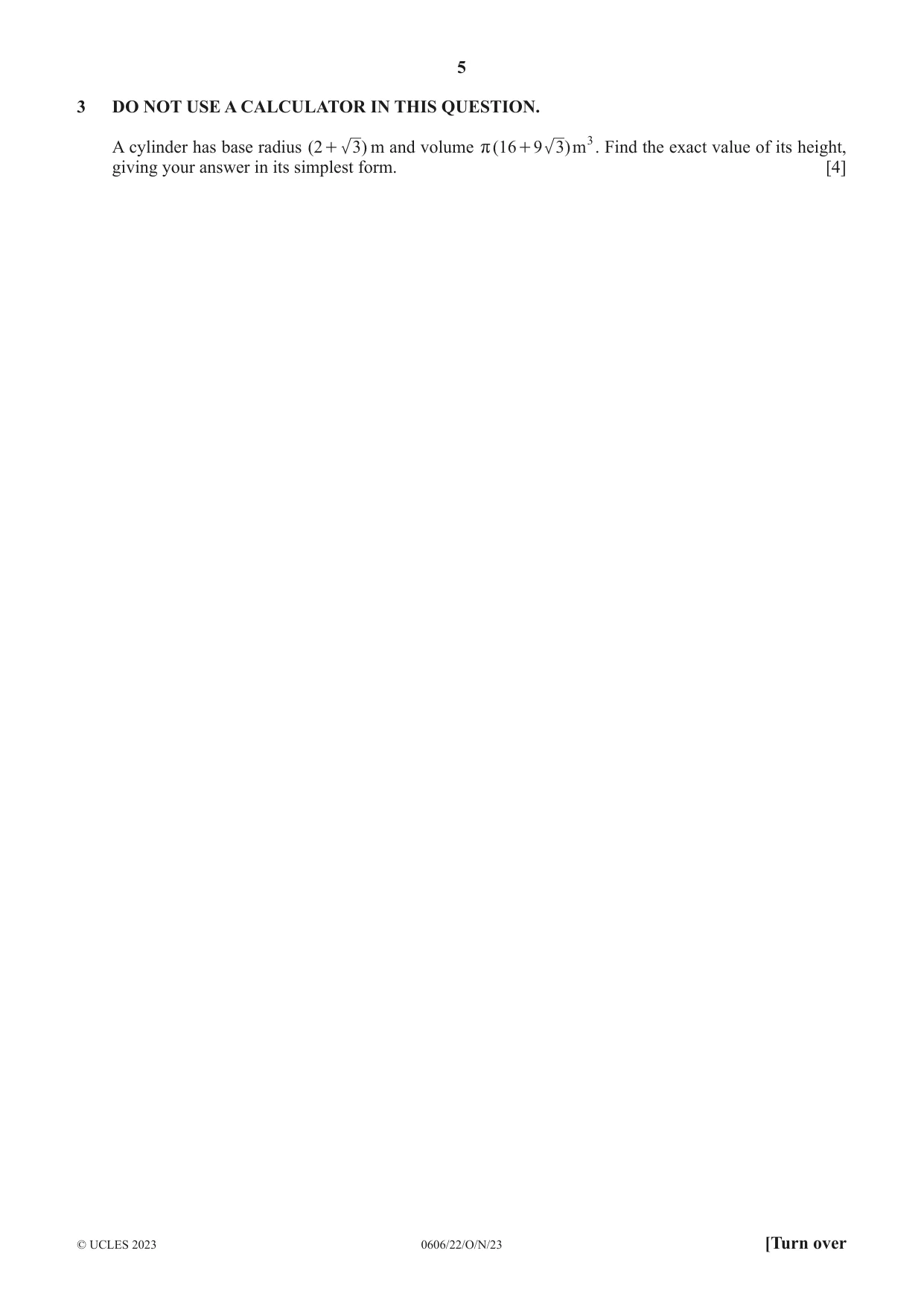
3 DO NOT USE A CALCULATOR IN THIS QUESTION. A cylinder has base radius ( 2 + 3) m and volume r ( 16 + 9 3) m3 . Find the exact value of its height, giving your answer in its simplest form. [4]
Mark scheme: 3 16 + 9 3 B1 (2 + 3) 2 M1 16 + 9 3 7 − 4 3 c 16 + 9 3 ( )( ) ( ) FT where a, b and c are non- 7 + 4 3 7 − 4 3 a + b 3 ( )( ) zero constants 16 + 9 3 7 − 4 3 or 7 + 4 3 7 − 4 3 112 − 64 3 + 63 3 − 108 A1 −112 + 64 3 − 63 3 + 108 or −1 4 − 3 or − 3 + 4 cao, nfww A1 Alternative method 16 + 9 3 (B1) (2 + 3) 2 2 16 + 9 3 2 − 3 ) ( )( 16 + 9 3 ( 2 − 3 ) 2 (M1) 2 2 or 2 2 ( 2 + 3 ) ( 2 − 3 ) ( 2 + 3 ) ( 2 − 3 ) 112 − 64 3 + 63 3 − 108 (A1) or 64 − 32 3 − 32 3 + 48 + 36 3 − 54 − 54 + 27 3 4 − 3 or − 3 + 4 cao, nfww (A1)
Q4 · Solve the following equations
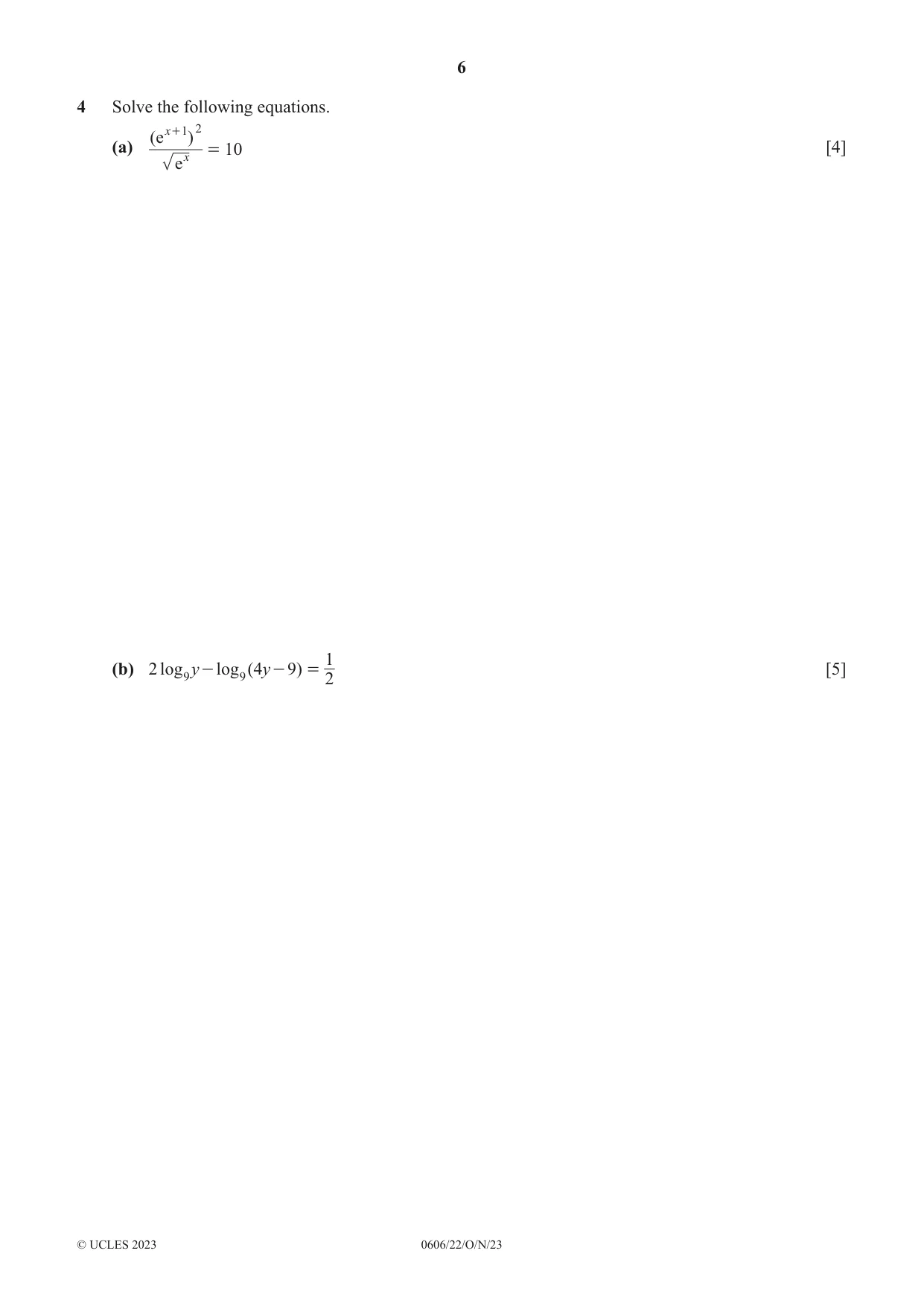
4 Solve the following equations. x + 1 2 ( e ) (a) = 10 [4] x e 1 (b) 2 log 9 y - log 9 ( 4y - 9) = [5] 2
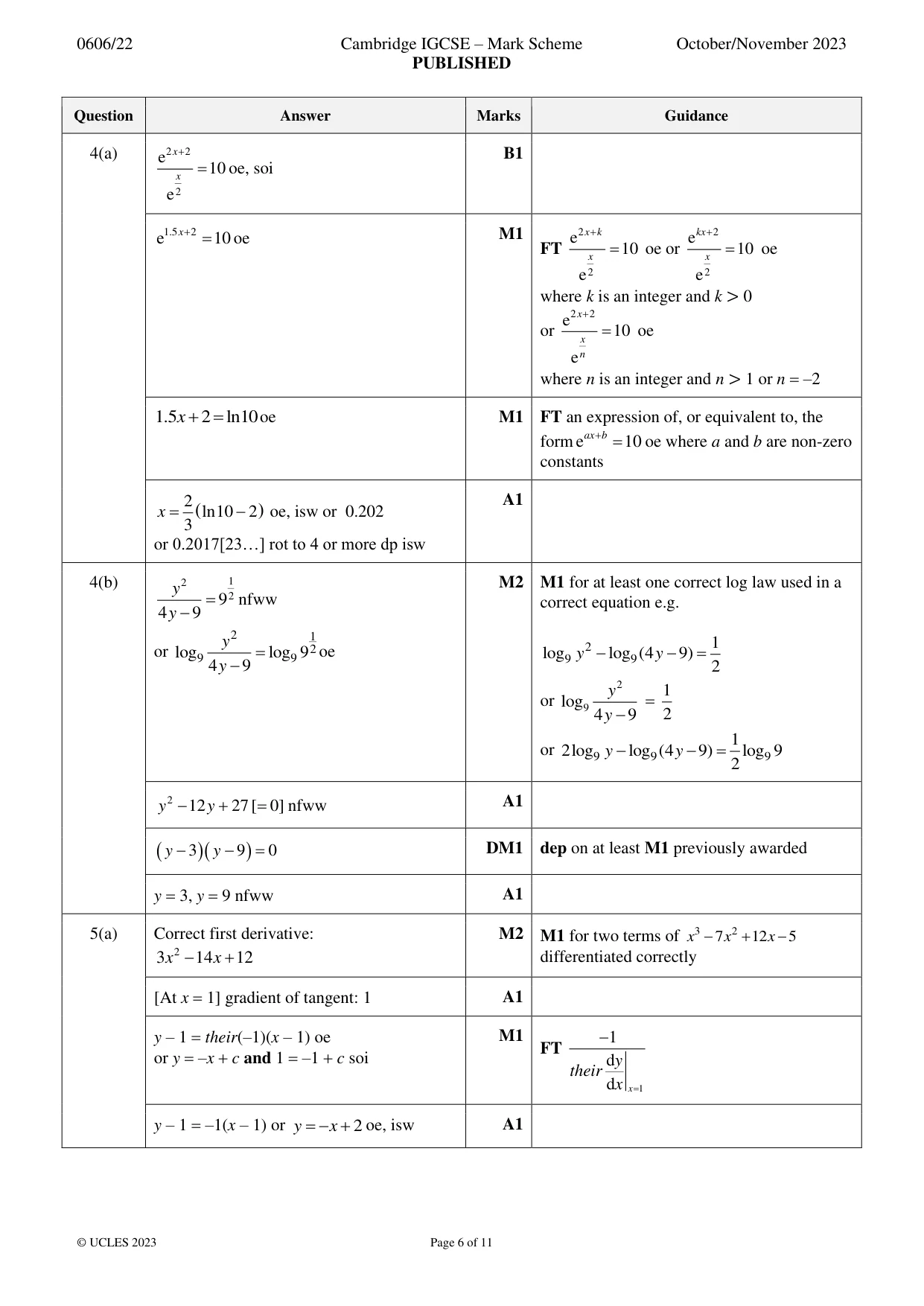
Mark scheme: 4(a) e 2 x + 2 B1 = 10 oe, soi x e 2 e1.5 x + 2 = 10 oe M1 e 2 x + k e kx + 2 FT = 10 oe or = 10 oe x x e 2 e 2 where k is an integer and k > 0 e 2 x + 2 or = 10 oe x e n where n is an integer and n > 1 or n = –2 1.5 x + 2 = ln10 oe M1 FT an expression of, or equivalent to, the forme ax + b = 10 oe where a and b are non-zero constants 2 A1 x = ( ln10 − 2 ) oe, isw or 0.202 3 or 0.2017[23…] rot to 4 or more dp isw 4(b) 2 1 M2 M1 for at least one correct log law used in a y 2 = 9 nfww correct equation e.g. 4 y − 9 y 2 1 2 2 1 or log 9 = log 9 9 oe log 9 y − log 9 (4 y − 9) = 4 y − 9 2 y 2 1 or log 9 = 4 y − 9 2 1 or 2log 9 y − log 9 (4 y − 9) = log 9 9 2 y 2 − 12 y + 27[ = 0] nfww A1 ( y − 3 )( y − 9 ) = 0 DM1 dep on at least M1 previously awarded y = 3, y = 9 nfww A1
Q5 · Find the equation of the normal to the curve y = x 3 - 7x 2 + 12x - 5 at the point (1, 1)
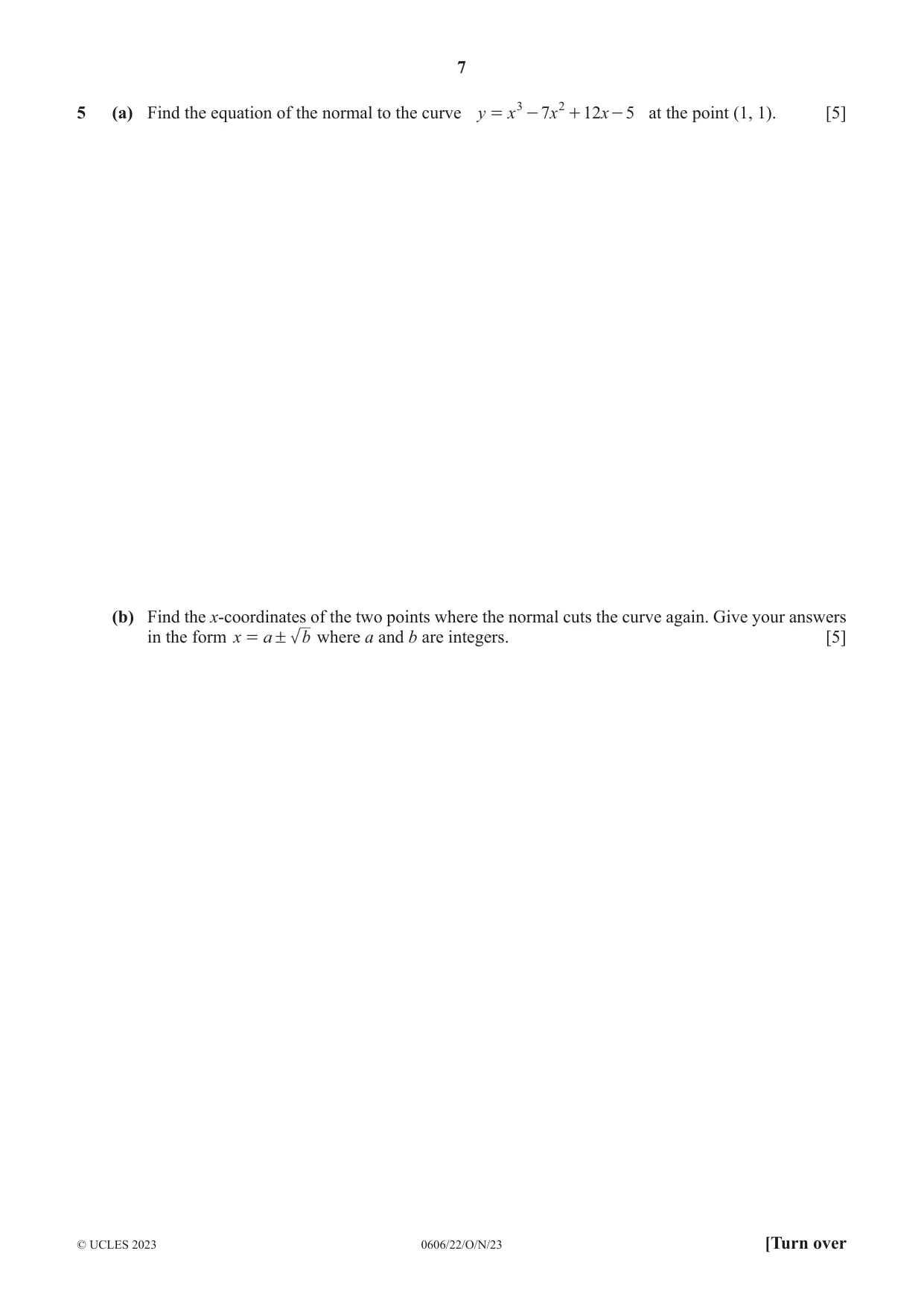
5 (a) Find the equation of the normal to the curve y = x 3 - 7x 2 + 12x - 5 at the point (1, 1). [5] (b) Find the x-coordinates of the two points where the normal cuts the curve again. Give your answers in the form x = a ! b where a and b are integers. [5]
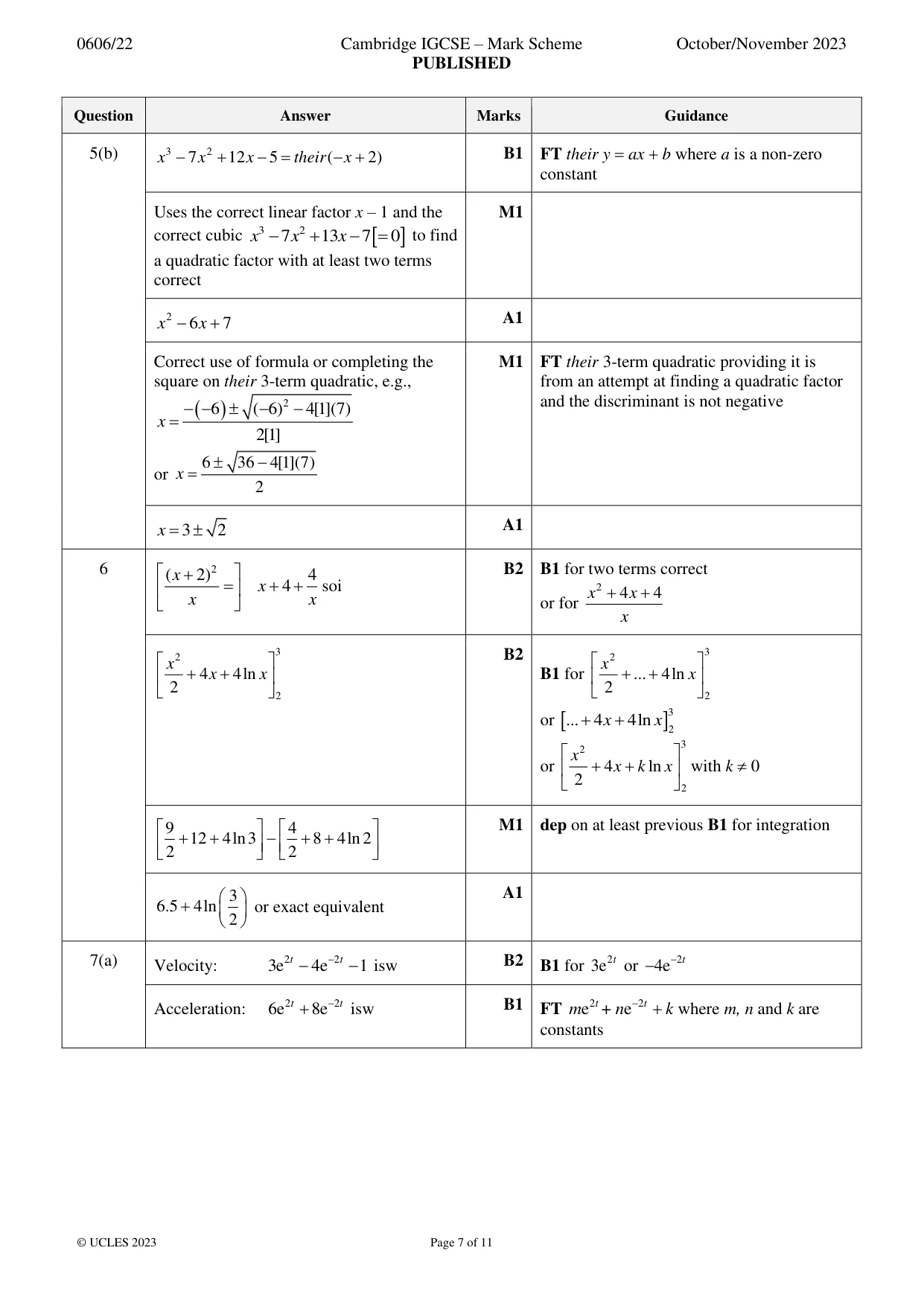
Mark scheme: 5(a) Correct first derivative: M2 M1 for two terms of x 3 − 7 x 2 + 12 x − 5 3 x 2 − 14 x + 12 differentiated correctly [At x = 1] gradient of tangent: 1 A1 y – 1 = their(–1)(x – 1) oe M1 −1 FT or y = –x + c and 1 = –1 + c soi dy their dx x =1 y – 1 = –1(x – 1) or y = −+x 2 oe, isw A1 5(b) x 3 − 7 x 2 + 12 x − 5 = their ( −+x 2) B1 FT their y = ax + b where a is a non-zero constant Uses the correct linear factor x – 1 and the M1 correct cubic x3 − 7 x 2 + 13x − 7 = 0 to find a quadratic factor with at least two terms correct x 2 − 6 x + 7 A1 Correct use of formula or completing the M1 FT their 3-term quadratic providing it is square on their 3-term quadratic, e.g., from an attempt at finding a quadratic factor 2 and the discriminant is not negative −−( 6 ) ( −6) − 4[1](7) x = 2[1] 6 36 − 4[1](7) or x = 2 x = 3 2 A1
More questions on Use differentiation to find gradients, tangents
Q7 · A particle is travelling in a straight line
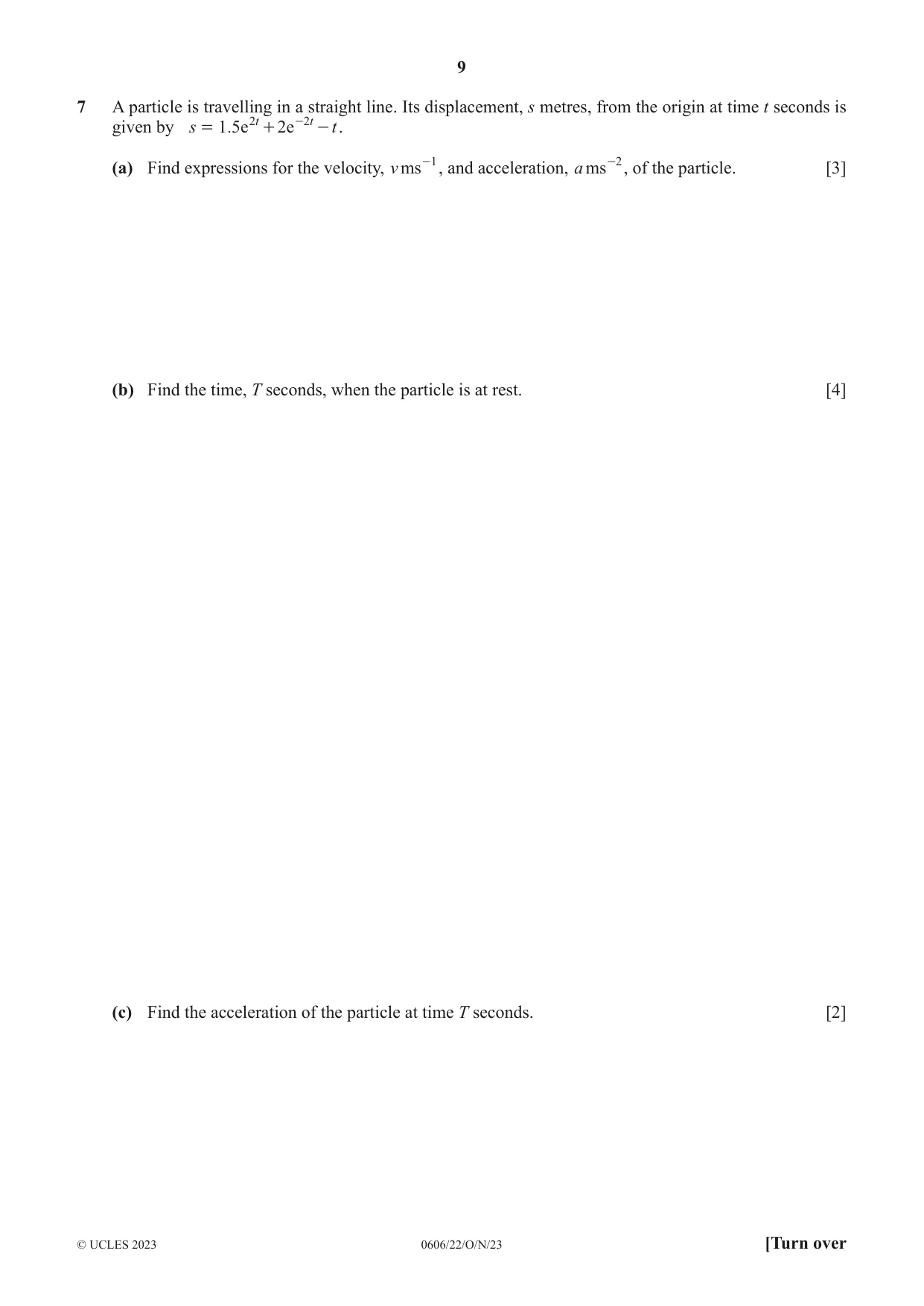
7 A particle is travelling in a straight line. Its displacement, s metres, from the origin at time t seconds is given by s = 1.5e 2 t + 2e -2 t - t . (a) Find expressions for the velocity, v ms -1 , and acceleration, a ms -2 , of the particle. [3] (b) Find the time, T seconds, when the particle is at rest. [4] (c) Find the acceleration of the particle at time T seconds. [2]
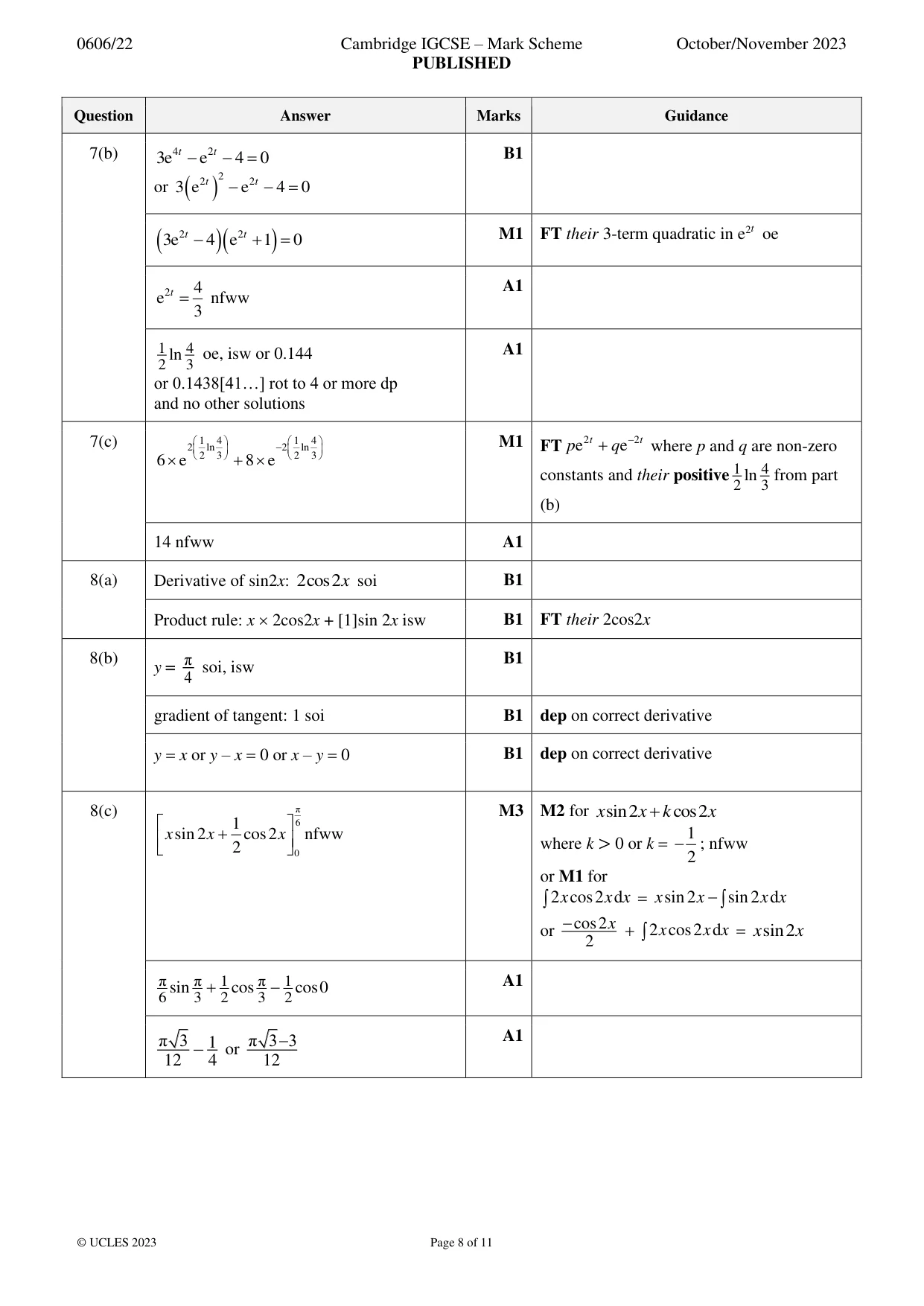
Mark scheme: 7(a) Velocity: 3e 2 t − 4e −2 t − 1 isw B2 B1 for 3e 2 t or −4e−2 t Acceleration: 6e 2 t + 8e−2 t isw B1 FT me 2 t + ne−2 t + k where m, n and k are constants 7(b) 3e 4 t − e 2 t − 4 = 0 B1 2 or 3 e 2 t − e 2 t − 4 = 0 ( ) 2 t 2 t M1 FT their 3-term quadratic in e2t oe 3e − 4 e + 1 = 0 ( )( ) 2 t 4 A1 e = nfww 3 1 4 A1 ln oe, isw or 0.144 2 3 or 0.1438[41…] rot to 4 or more dp and no other solutions 7(c) 2 1 ln 4 −2 1 ln 4 M1 FT p e 2 t + q e−2 t where p and q are non-zero 6 e 2 3 + 8 e 2 3 constants and their positive 1 ln 4 from part 2 3 (b) 14 nfww A1
Q8 · A curve has equation y = x sin 2x
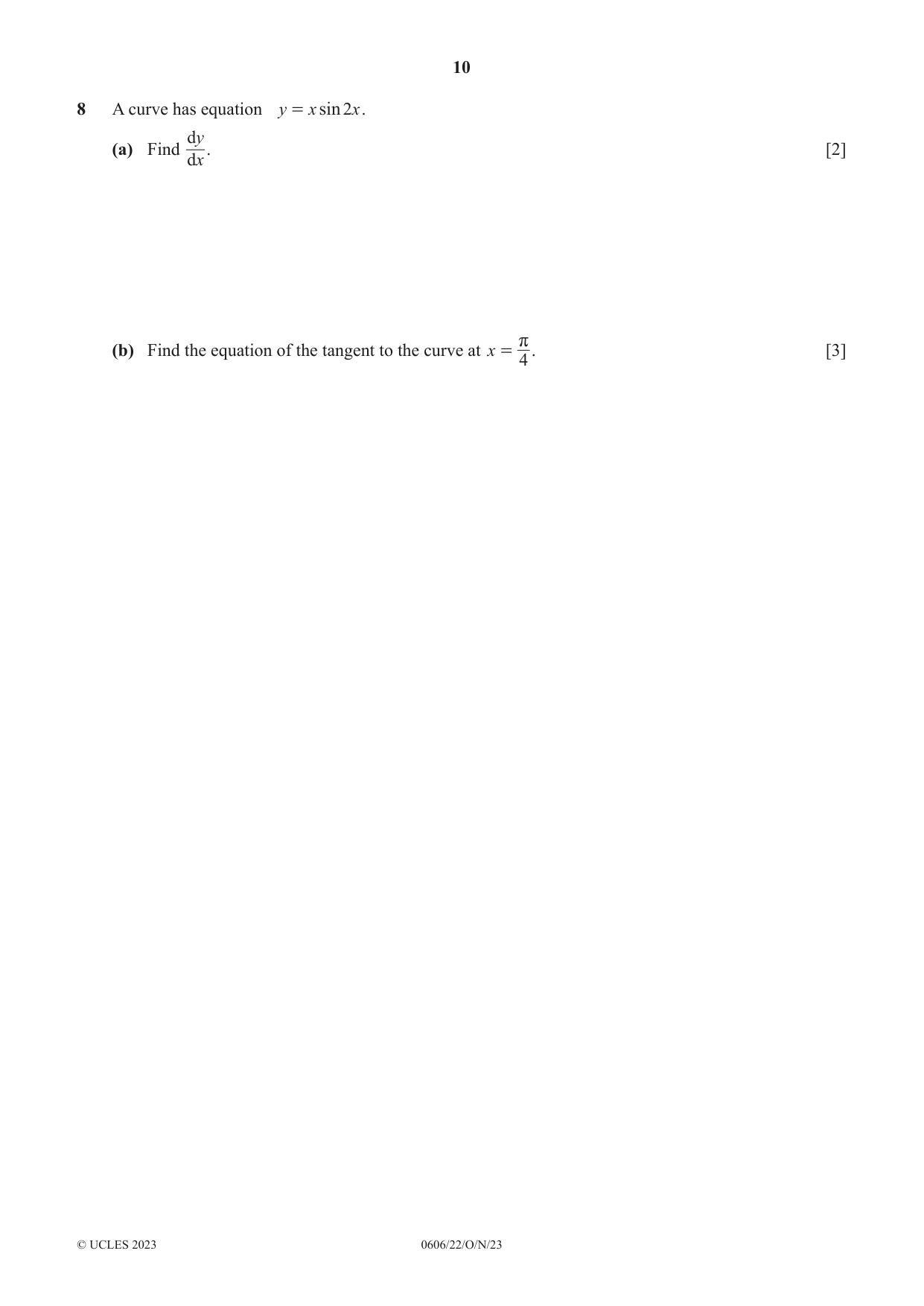
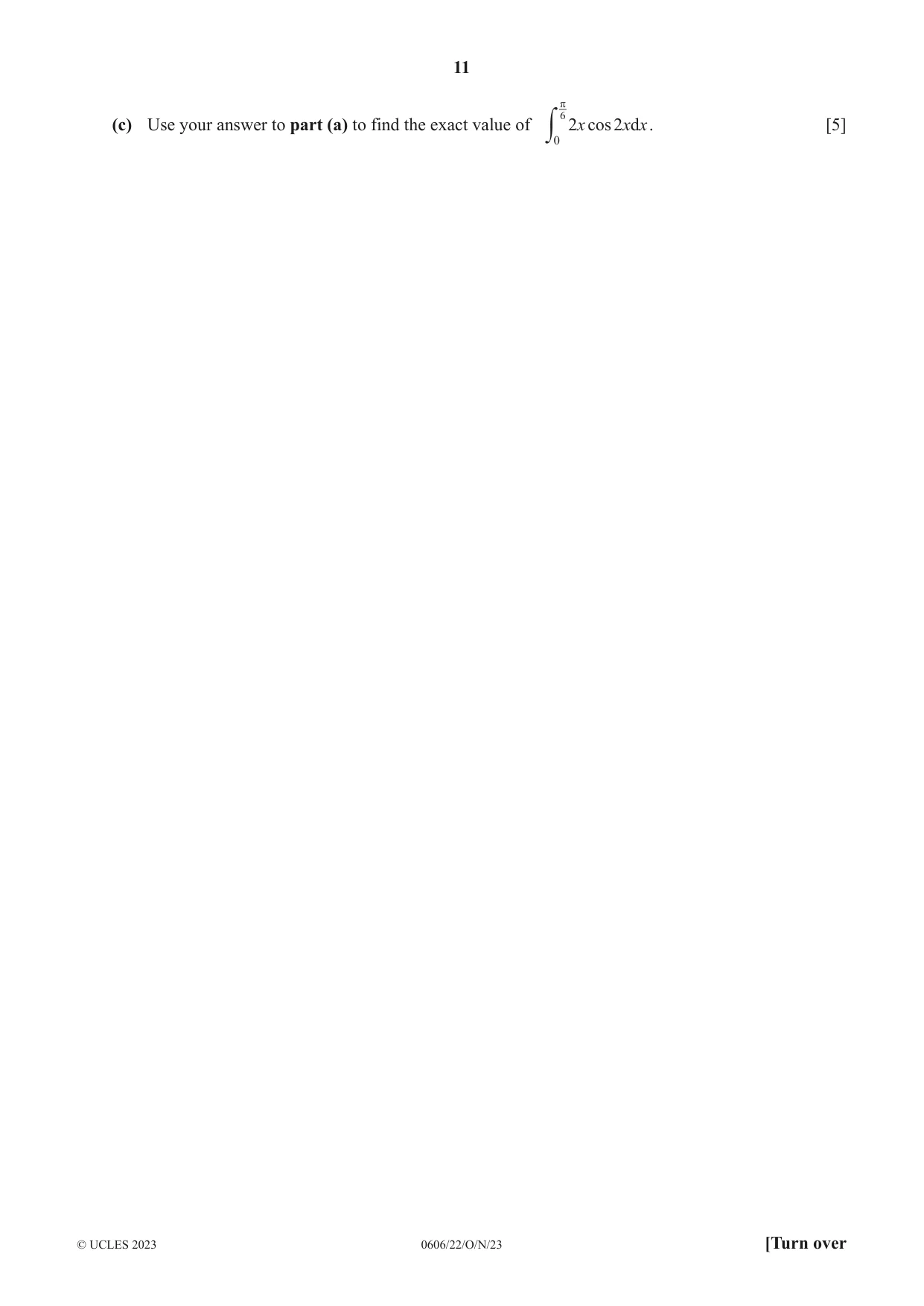
8 A curve has equation y = x sin 2x . dy (a) Find . [2] dx (b) Find the equation of the tangent to the curve at x = r . [3] 4 r (c) Use your answer to part (a) to find the exact value of 2x cos 2xdx . [5] 6y0
Mark scheme: 8(a) Derivative of sin2x: 2cos2x soi B1 Product rule: x 2cos2x + [1]sin 2x isw B1 FT their 2cos2x 8(b) π B1 y = soi, isw 4 gradient of tangent: 1 soi B1 dep on correct derivative y = x or y – x = 0 or x – y = 0 B1 dep on correct derivative 8(c) π M3 M2 for x sin2 x + k cos2 x 1 6 x sin 2 x + cos2 x nfww 1 2 0 where k > 0 or k = − ; nfww 2 or M1 for x2 cos2 x dx = x sin2 x − sin2 x dx − cos2 x or + x2 cos2 x dx = x sin2 x 2 π π 1 π 1 A1 sin + cos − cos0 6 3 2 3 2 A1 π 3 1 π 3 − 3 − or 12 4 12
Q9 · An arithmetic progression has twelve terms
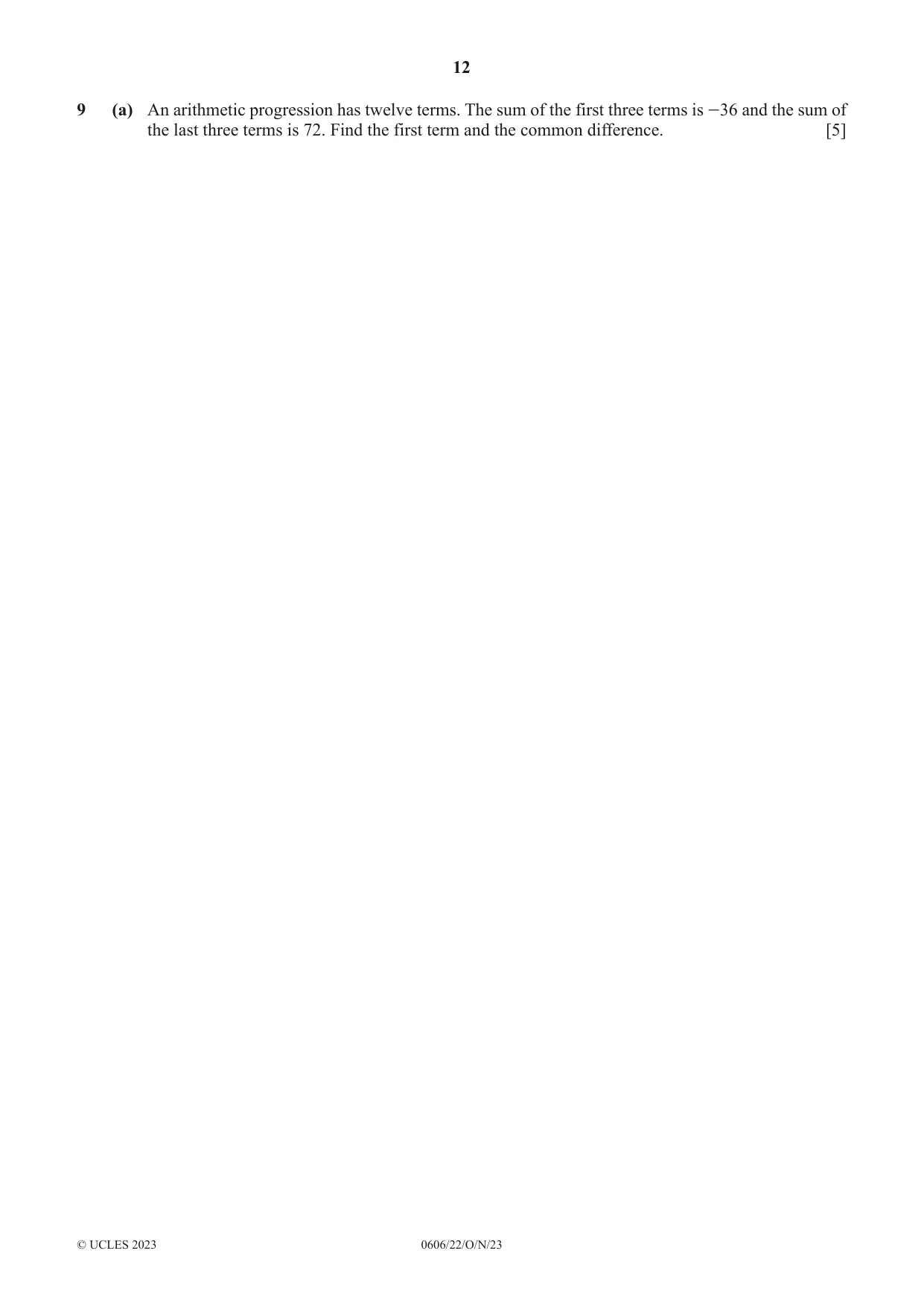
9 (a) An arithmetic progression has twelve terms. The sum of the first three terms is -36 and the sum of the last three terms is 72. Find the first term and the common difference. [5] (b) The first three terms of a geometric progression are 1, 1.2 and 1.44. Find the smallest value of n such that the sum of the first n terms is greater than 500. [5]
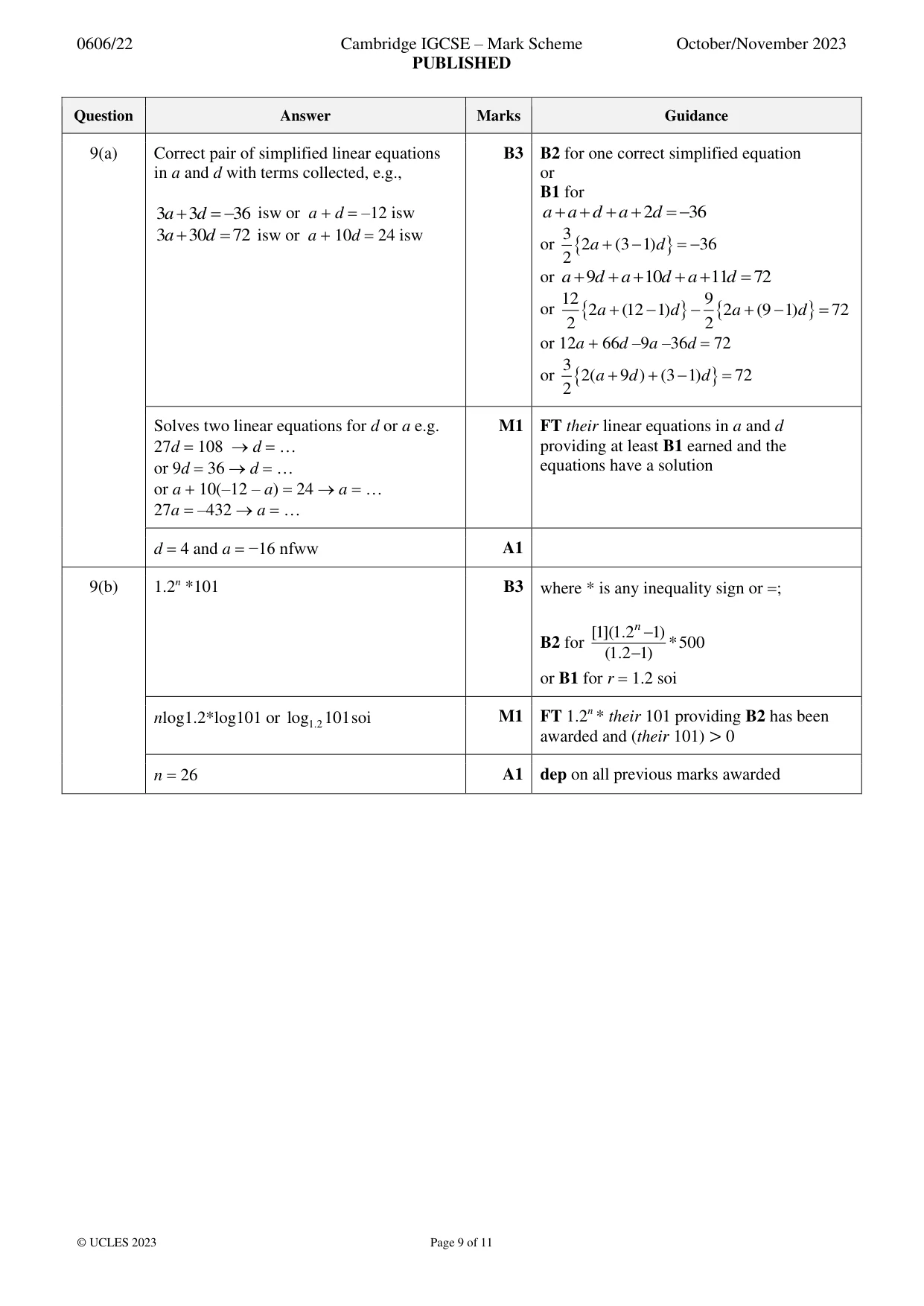
Mark scheme: 9(a) Correct pair of simplified linear equations B3 B2 for one correct simplified equation in a and d with terms collected, e.g., or B1 for 3a + 3d = −36 isw or a + d = –12 isw a + a + d + a + 2d = −36 3a + 30d = 72 isw or a + 10d = 24 isw 3 or 2 a + (3 − 1) d = −36 2 or a + 9d + a + 10d + a + 11d = 72 12 9 or 2a + (12 − 1) d − 2a + (9 − 1) d = 72 2 2 or 12a + 66d –9a –36d = 72 3 or 2( a + 9 d ) + (3 − 1) d = 72 2 Solves two linear equations for d or a e.g. M1 FT their linear equations in a and d 27d = 108 → d = … providing at least B1 earned and the or 9d = 36 → d = … equations have a solution or a + 10(–12 – a) = 24 → a = … 27a = –432 → a = … d = 4 and a = −16 nfww A1 9(b) 1.2n *101 B3 where * is any inequality sign or =; [1](1.2 n −1) B2 for *500 (1.2 −1) or B1 for r = 1.2 soi nlog1.2*log101 or log1.2 101soi M1 FT 1.2n * their 101 providing B2 has been awarded and (their 101) > 0 n = 26 A1 dep on all previous marks awarded
More questions on Use the formulas for the nth term and for the
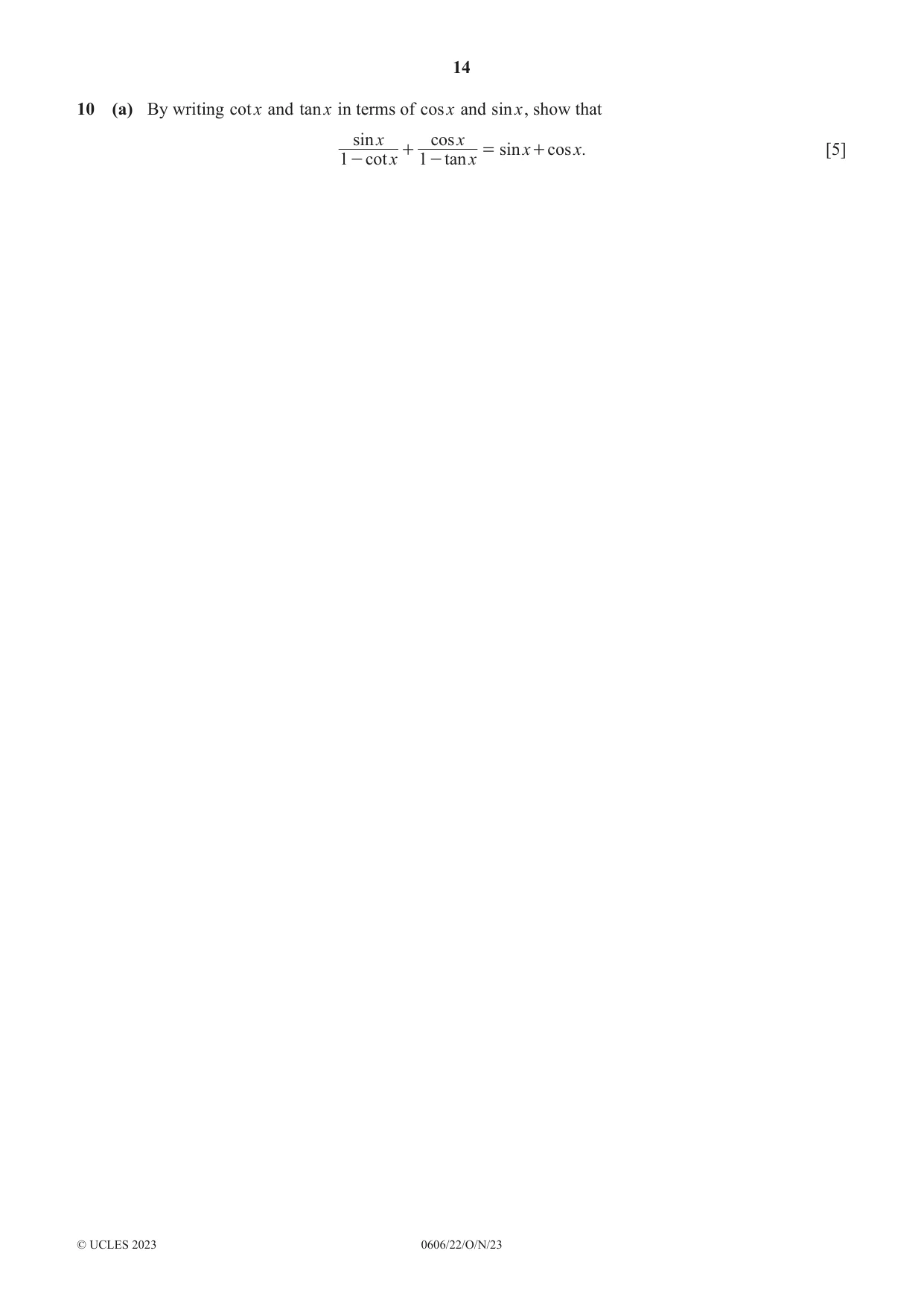
Q10 · By writing cotx and tanx in terms of cosx and sinx, show that sin x cos x + = sin x + cos…
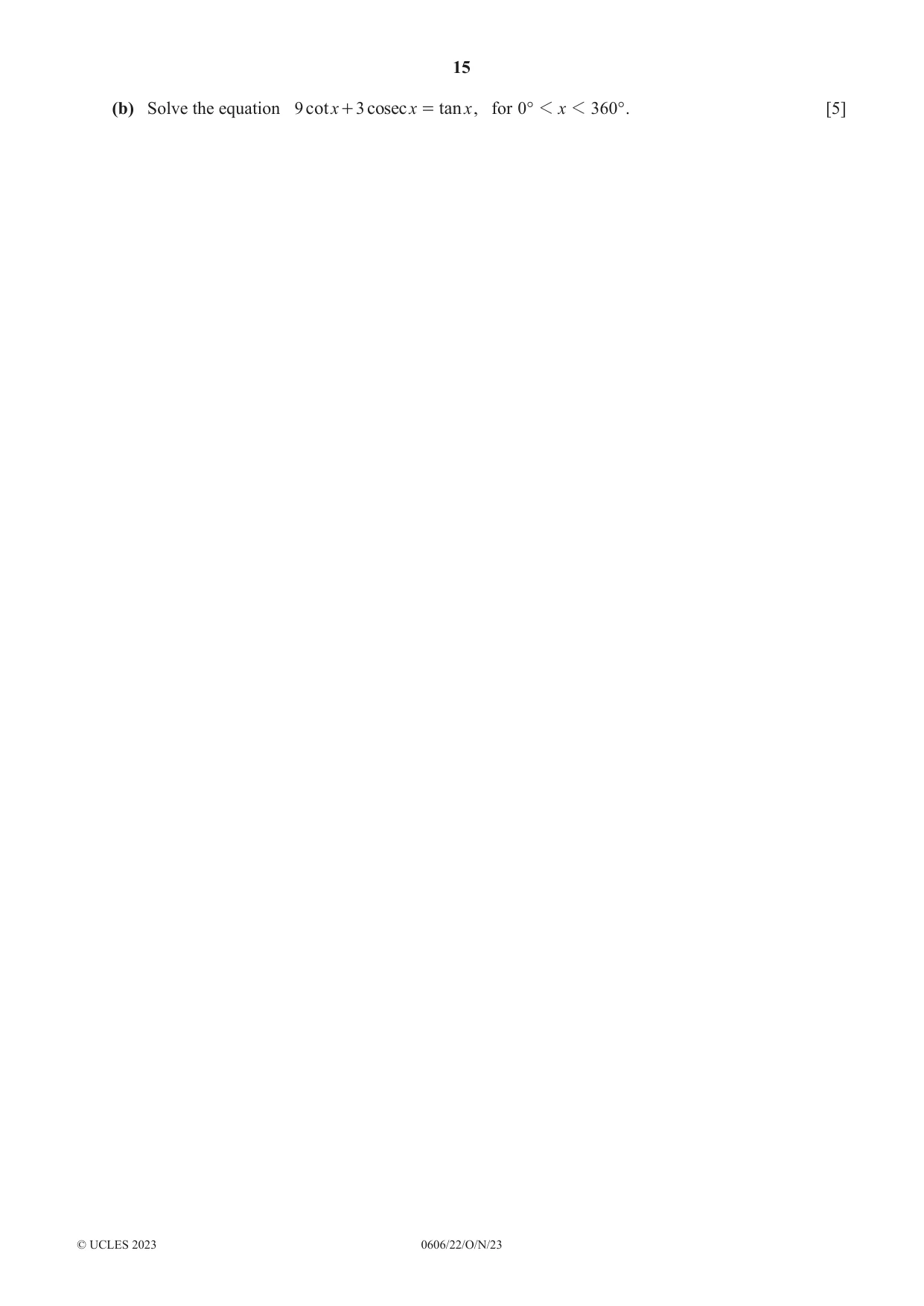
10 (a) By writing cotx and tanx in terms of cosx and sinx, show that sin x cos x + = sin x + cos x. [5] 1 - cot x 1 - tan x (b) Solve the equation 9 cot x + 3 cosec x = tan x , for 0° 1 x 1 360° . [5]
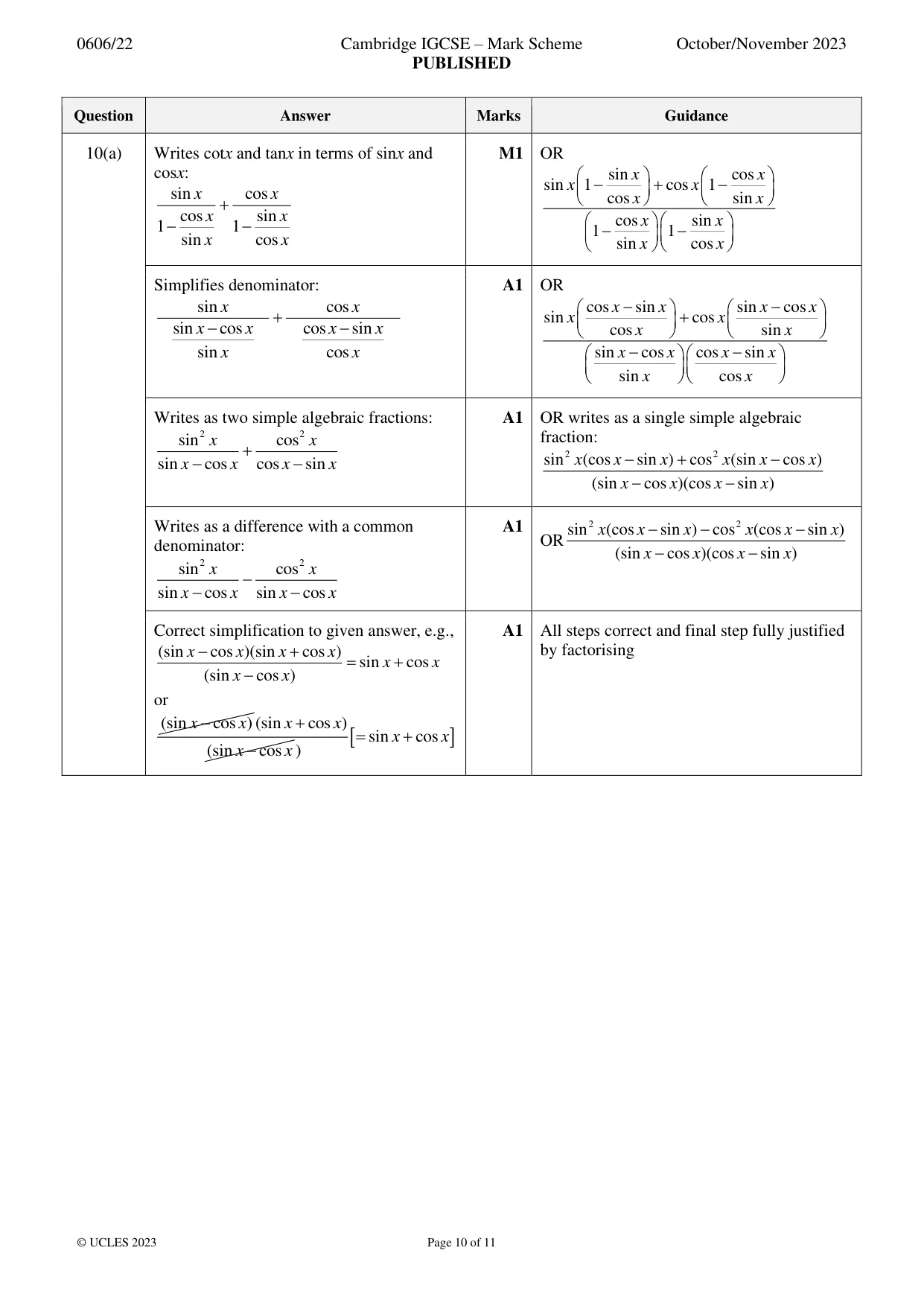
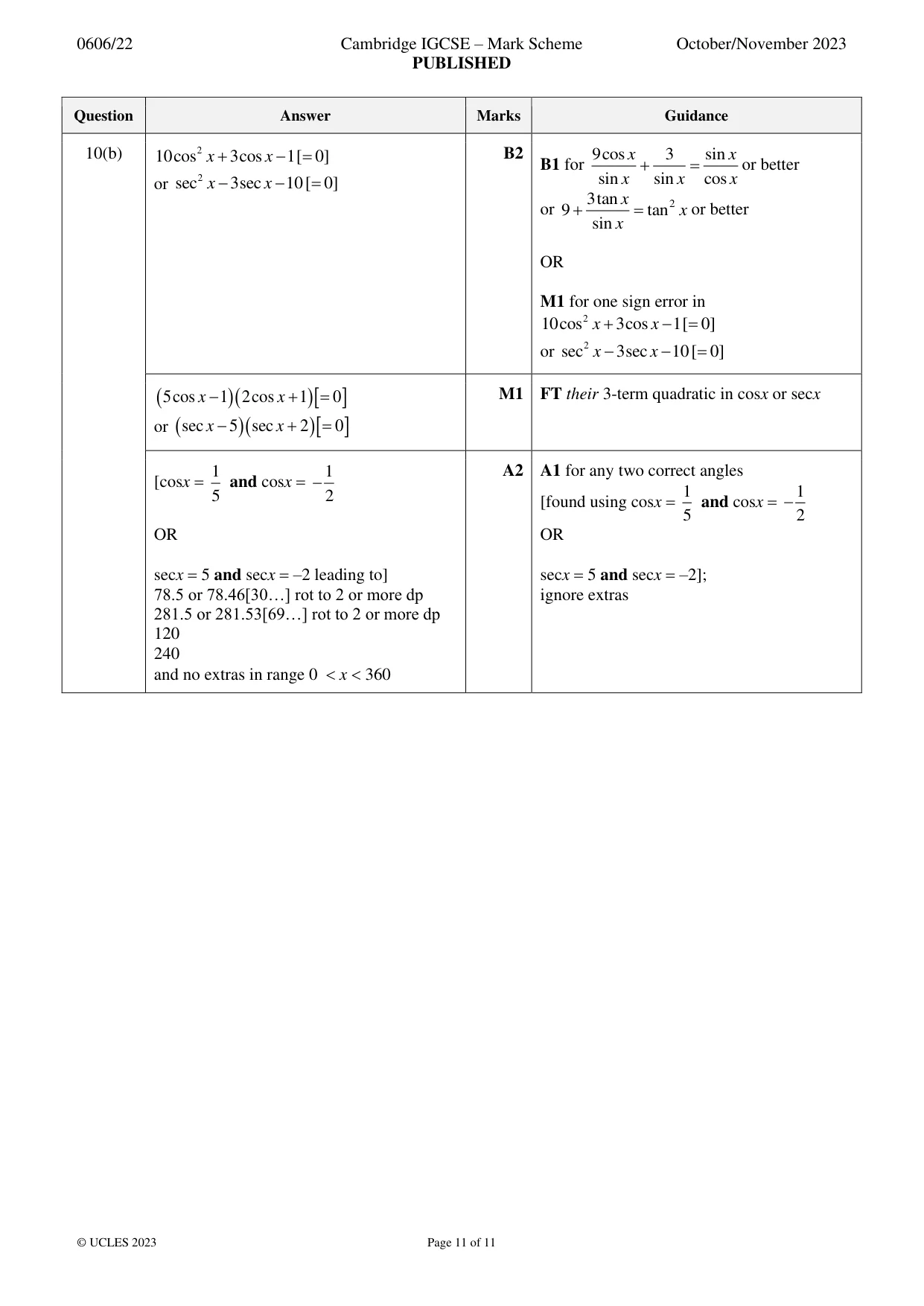
Mark scheme: 10(a) Writes cotx and tanx in terms of sinx and M1 OR cosx: sin x cos x sin x 1 − + cos x 1 − sin x cos x cos x sin x + cos x sin x cos x sin x 1 − 1 − 1 − 1 − sin x cos x sin x cos x Simplifies denominator: A1 OR sin x cos x cos x − sin x sin x − cos x + sin x + cos x sin x − cos x cos x − sin x cos x sin x sin x cos x sin x − cos x cos x − sin x sin x cos x Writes as two simple algebraic fractions: A1 OR writes as a single simple algebraic sin 2 x cos 2 x fraction: + 2 2 sin x (cos x − sin x ) + cos x (sin x − cos x ) sin x − cos x cos x − sin x (sin x − cos x )(cos x − sin x ) Writes as a difference with a common A1 sin 2 x (cos x − sin x ) − cos 2 x (cos x − sin x ) OR denominator: (sin x − cos x )(cos x − sin x ) sin 2 x cos 2 x − sin x − cos x sin x − cos x Correct simplification to given answer, e.g., A1 All steps correct and final step fully justified (sin x − cos x )(sin x + cos x ) by factorising = sin x + cos x (sin x − cos x ) or (sin x − cos x ) (sin x + cos x ) = sin x + cos x (sin x − cos x ) 10(b) 10cos 2 x + 3cos x − 1[ = 0] B2 9cos x 3 sin x B1 for + = or better or sec 2 x − 3sec x − 10[ = 0] sin x sin x cos x 3tan x 2 or 9 + = tan x or better sin x OR M1 for one sign error in 10cos 2 x + 3cos x − 1[ = 0] or sec 2 x − 3sec x − 10[ = 0] ( 5cos x − 1)( 2cos x + 1) = 0 M1 FT their 3-term quadratic in cosx or secx or ( sec x − 5 )( sec x + 2 ) = 0 1 1 A2 A1 for any two correct angles [cosx = and cosx = − 5 2 1 1 [found using cosx = and cosx = − 5 2 OR OR secx = 5 and secx = –2 leading to] secx = 5 and secx = –2]; 78.5 or 78.46[30…] rot to 2 or more dp ignore extras 281.5 or 281.53[69…] rot to 2 or more dp 120 240 and no extras in range 0 x 360
More questions on Prove trigonometric relationships involving the
What was in this paper
The subtopics covered by these 9 questions, and how many questions each got. Open one in a new tab to see every Cambridge question on it.
1Evaluate definite integrals and apply1Know and use the laws of logarithms1Prove trigonometric relationships involving the1Solve equations of the type1Solve problems involving the intersection of a1Solve simultaneous equations in two1Use differentiation to find gradients, tangents1Use the formulas for the nth term and for the1What you needed in this session
Cambridge’s own grade thresholds for 2023 Oct/Nov, Paper 2 · Variant 2. A higher threshold means an easier paper — the bar moves with how the cohort did.