Cambridge IGCSE Mathematics - Additional 0606 — 2020 Oct/Nov Paper 2 · Variant 1
0606/21/O/N/20 · 12 questions · 80 marks · ≈90 min
The question paper and its mark scheme, free to read here and free to download. This is Cambridge’s own paper, exactly as it was sat.
Question paper16 pages

Mark scheme7 pages
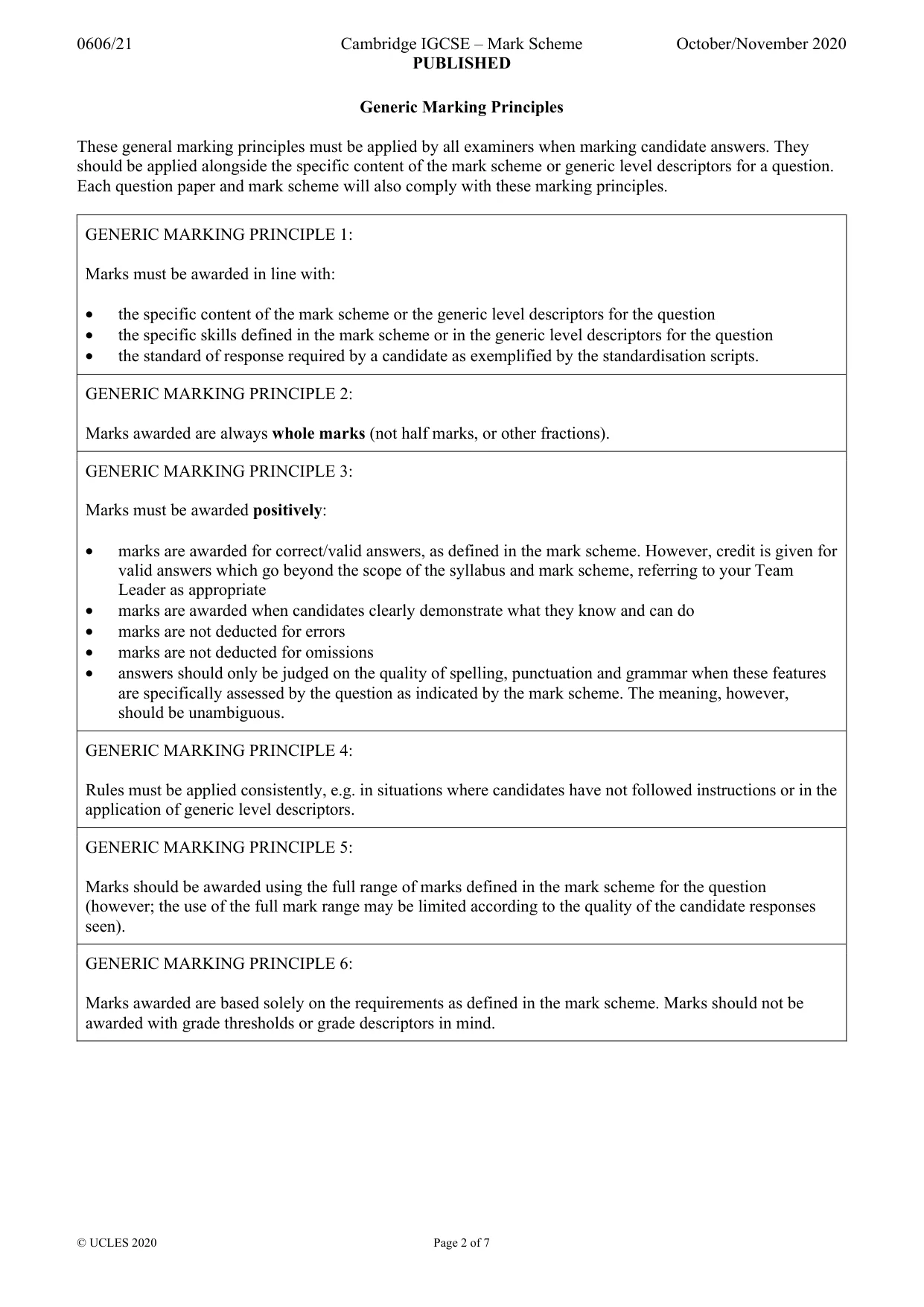
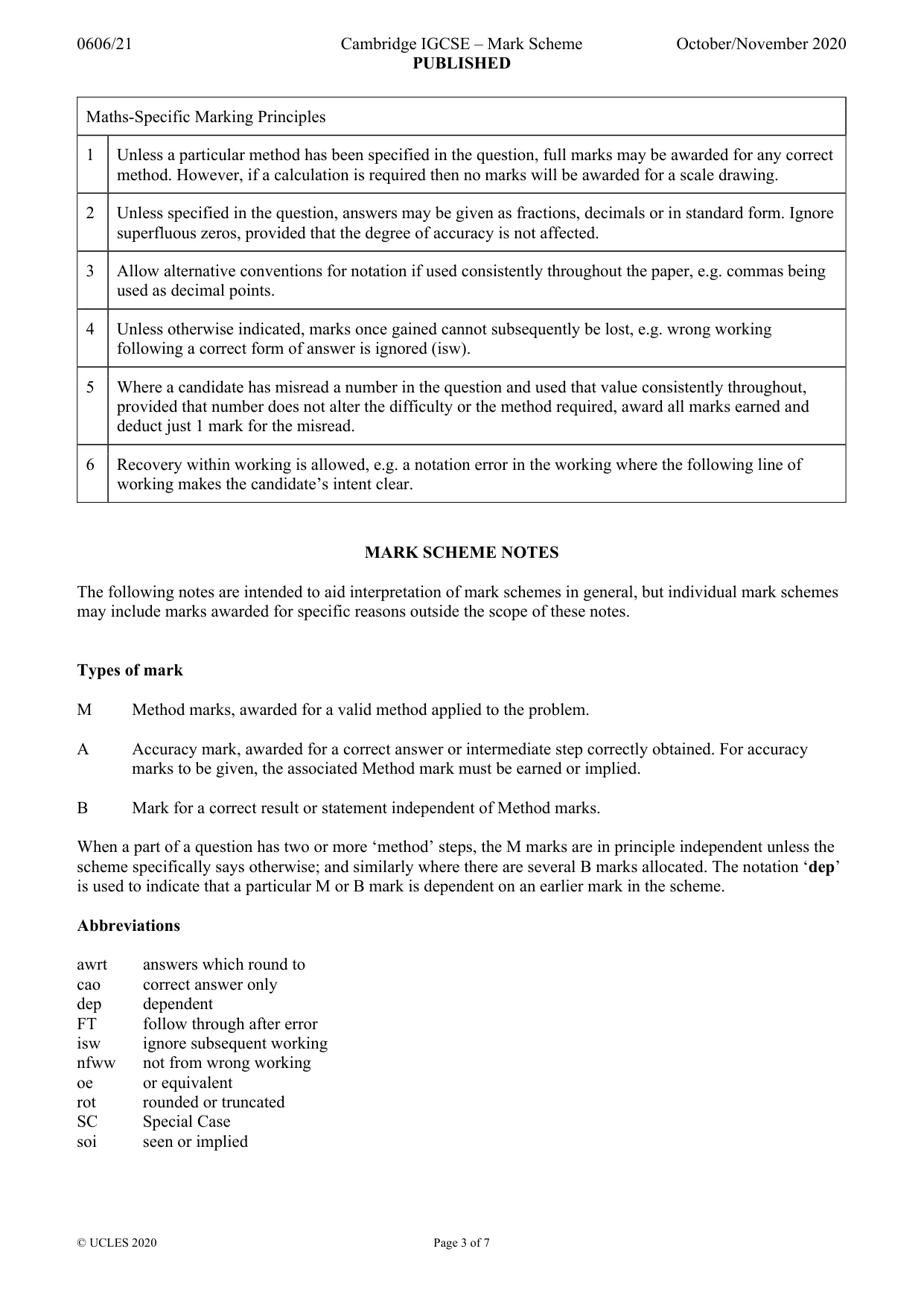
Answers below. Sit the paper first if you are practising.
Questions as text
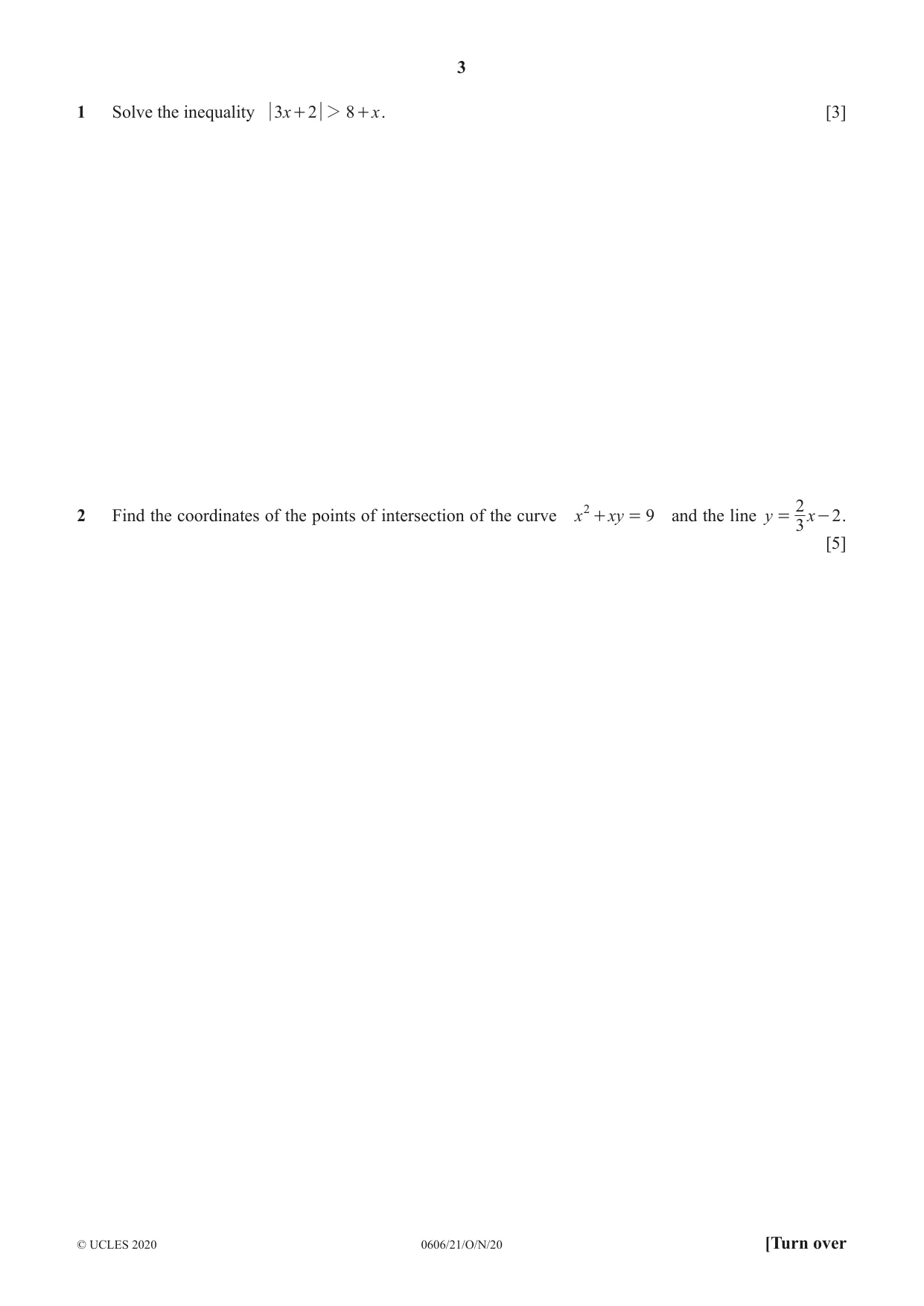
Q1 · Solve the inequality 3x + 2 2 8 + x
1 Solve the inequality 3x + 2 2 8 + x . [3]
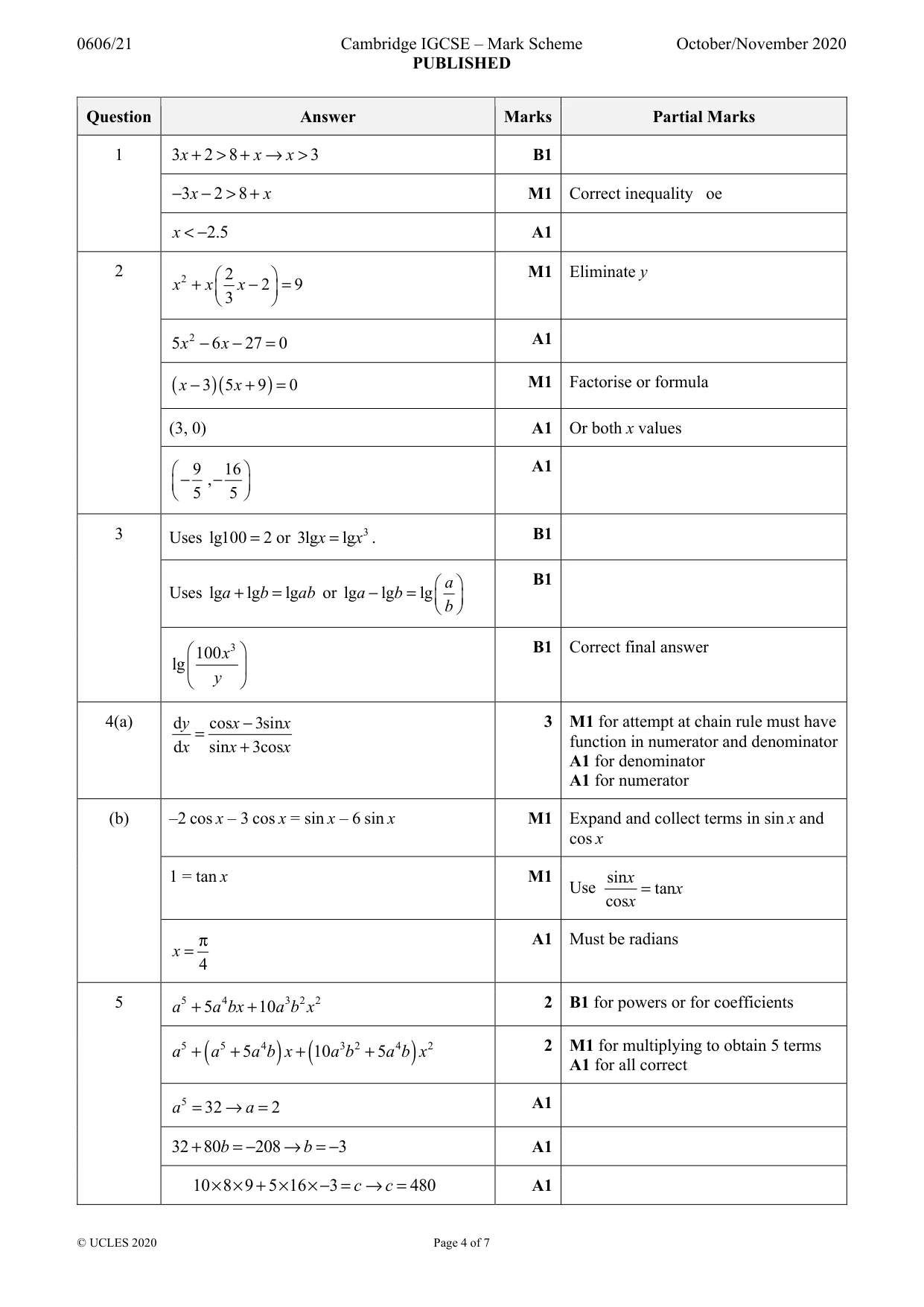
Mark scheme: Question Answer Marks Partial Marks 1 3 x + 2 > 8 + x → x > 3 B1 −3 x − 2 > 8 + x M1 Correct inequality oe x < −2.5 A1
More questions on Solve graphically or algebraically inequalities
Q2 · Find the coordinates of the points of intersection of the curve x 2 + xy = 9 and the line…
2 Find the coordinates of the points of intersection of the curve x 2 + xy = 9 and the line y = x - 2 . 3 [5]
Mark scheme: 2 2 2 M1 Eliminate y x + x x − 2 = 9 3 5 x 2 − 6 x − 27 = 0 A1 ( x − 3 )( 5 x + 9 ) = 0 M1 Factorise or formula (3, 0) A1 Or both x values 9 16 A1 − , − 5 5
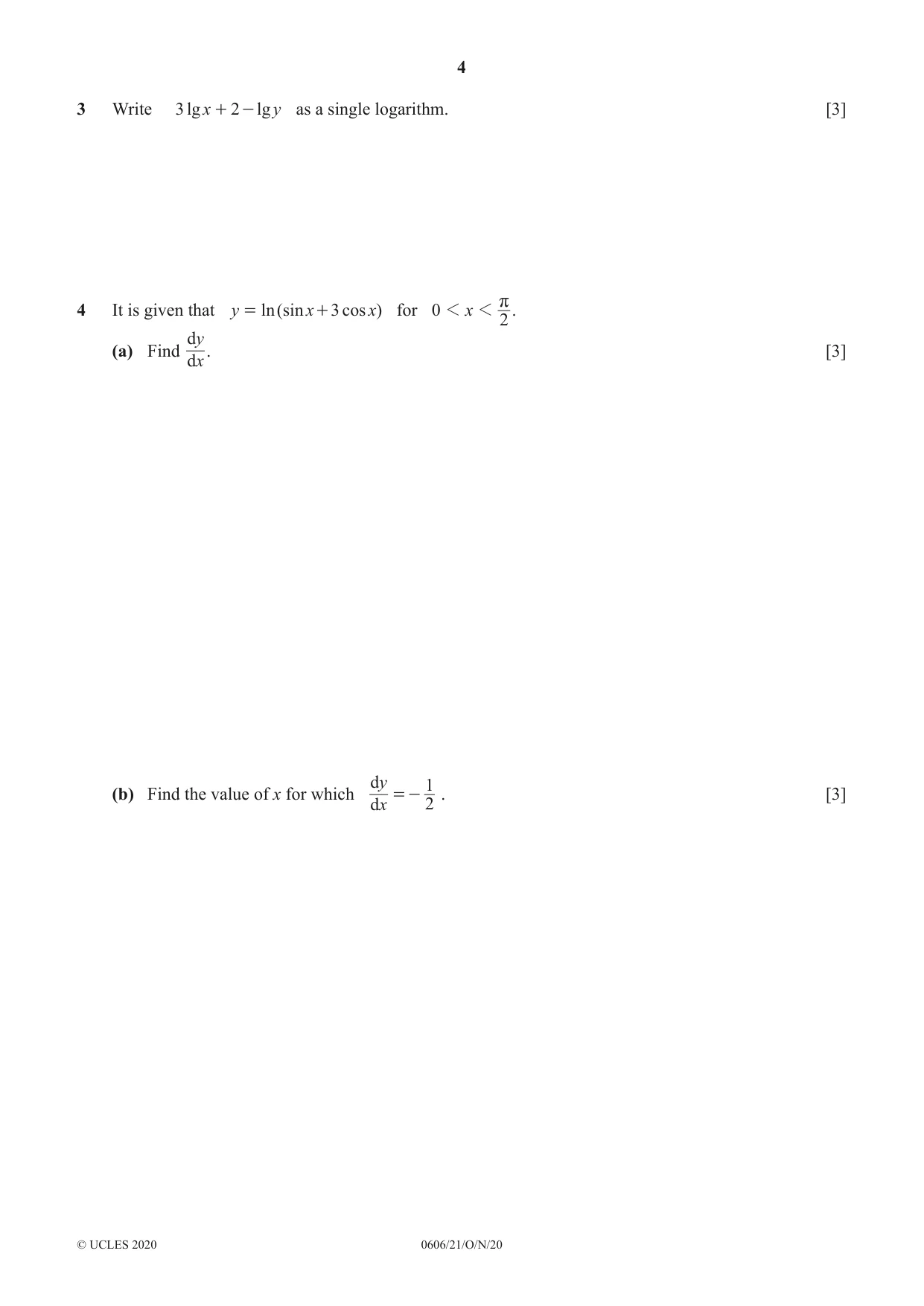
Q3 · Write 3 lg x + 2 - lg y as a single logarithm
3 Write 3 lg x + 2 - lg y as a single logarithm. [3]
Mark scheme: 3 Uses lg100 = 2 or 3lgx = lgx 3 . B1 a B1 Uses lg a + lg b = lg ab or lg a − lg b = lg b lg 100 x 3 B1 Correct final answer y
Q4 · It is given that y = ln ( sin x + 3 cos x) for 0 1 x 1 r
4 It is given that y = ln ( sin x + 3 cos x) for 0 1 x 1 r. 2 dy (a) Find . [3] dx dy 1 (b) Find the value of x for which = - . [3] dx 2
Mark scheme: 4(a) d y cos x − 3sin x 3 M1 for attempt at chain rule must have = function in numerator and denominator d x sin x + 3cos x A1 for denominator A1 for numerator (b) –2 cos x – 3 cos x = sin x – 6 sin x M1 Expand and collect terms in sin x and cos x 1 = tan x M1 sinx Use = tanx cos x π A1 Must be radians x = 4
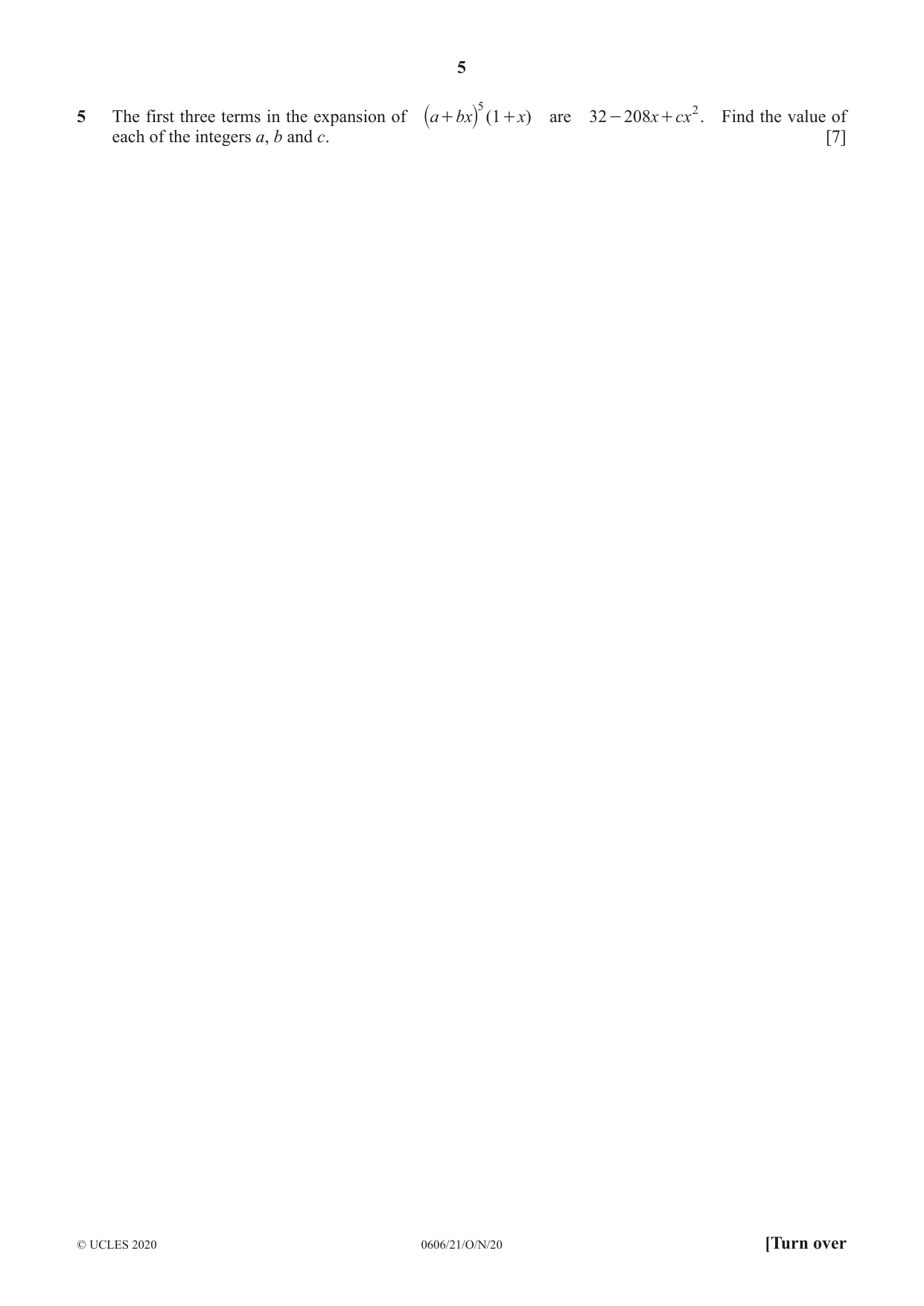
Q5 · The first three terms in the expansion of a + bx ( 1 + x) are 32 - 208x + cx 2
5 The first three terms in the expansion of a + bx ( 1 + x) are 32 - 208x + cx 2 . Find the value of each of the integers a, b and c. [7]
Mark scheme: 5 a 5 + 5 a 4 bx + 10 a 3 b 2 x 2 2 B1 for powers or for coefficients 5 5 4 3 2 4 2 2 M1 for multiplying to obtain 5 terms a + a + 5a b x + 10 a b + 5a b x ( ) ( ) A1 for all correct a 5 = 32 → a = 2 A1 32 + 80b = −208 → b = −3 A1 10 × 8 × 9 + 5 × 16 ×−=3 c → c = 480 A1
Q6 · DO NOT USE A CALCULATOR IN THIS QUESTION
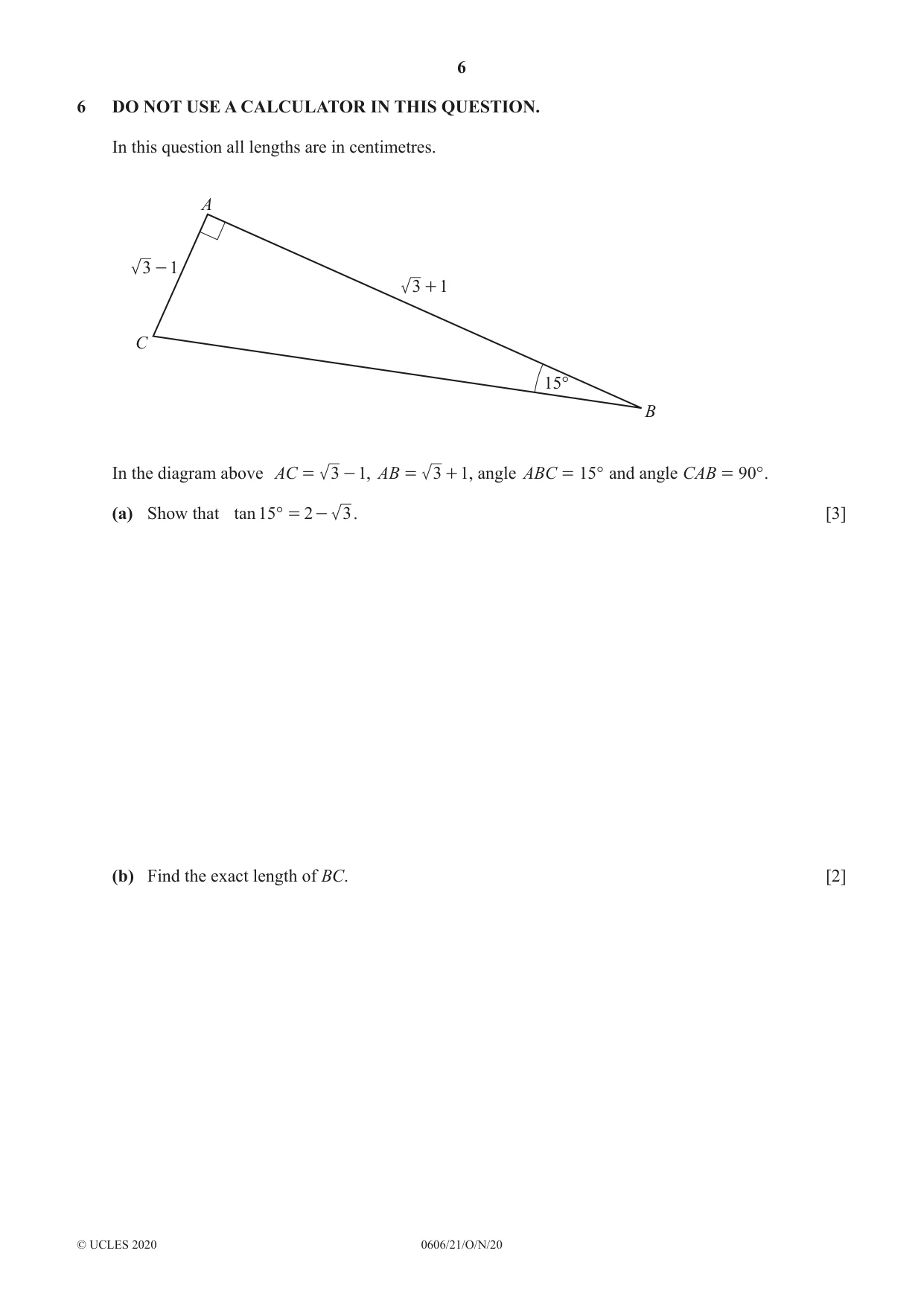
6 DO NOT USE A CALCULATOR IN THIS QUESTION. In this question all lengths are in centimetres. A 3 - 1 3 + 1 C 15° B In the diagram above AC = 3 - 1, AB = 3 + 1, angle ABC = 15° and angle CAB = 90° . (a) Show that tan15° = 2 - 3 . [3] (b) Find the exact length of BC. [2]
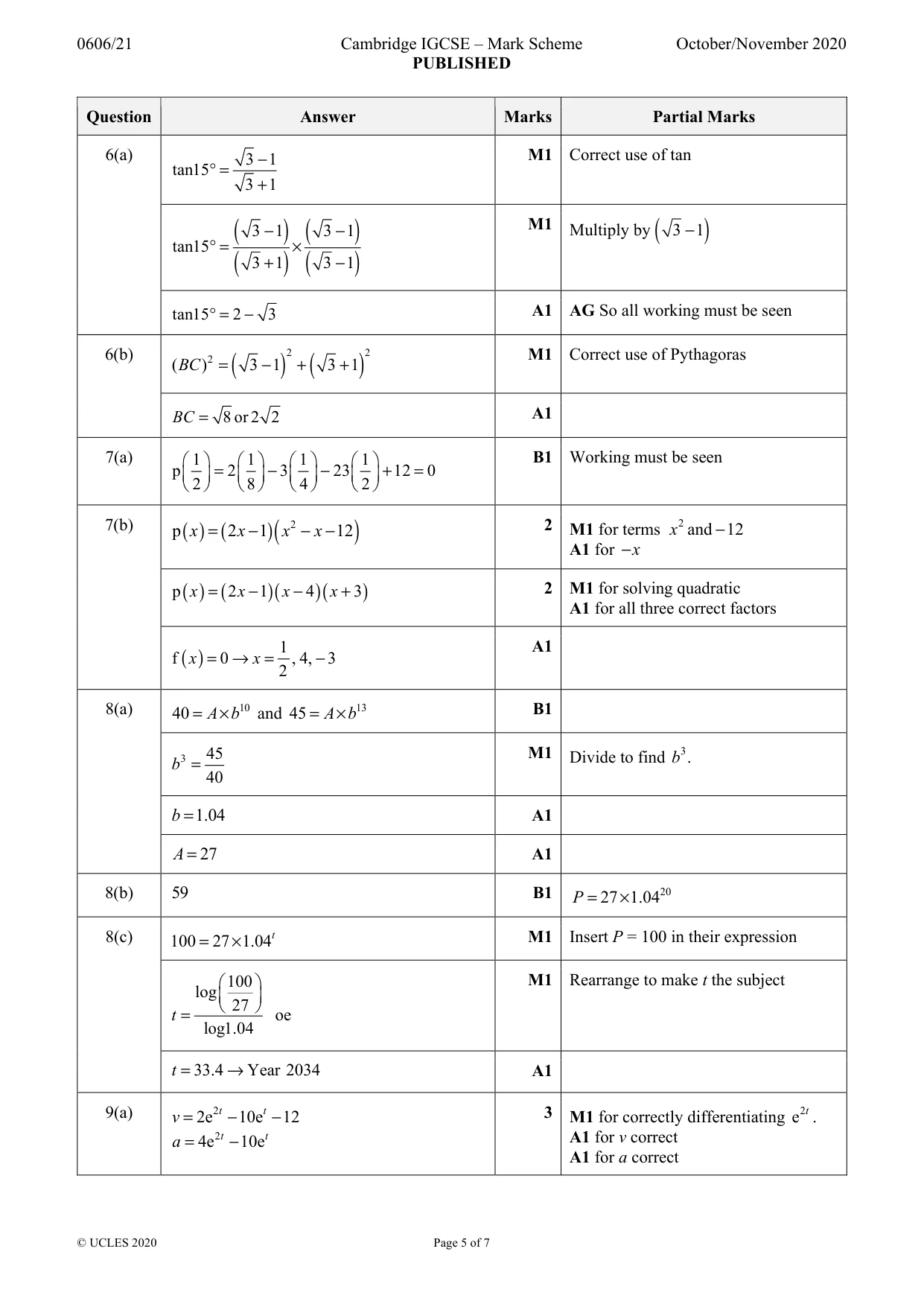
Mark scheme: 6(a) 3 − 1 M1 Correct use of tan tan15 ° = 3 + 1 M1 3 − 1 3 − 1 Multiply by 3 − 1 ( ) ( ) ( ) tan15 ° = × 3 + 1 3 − 1 ( ) ( ) tan15 ° = 2 − 3 A1 AG So all working must be seen 6(b) 2 2 2 M1 Correct use of Pythagoras ( BC ) = 3 − 1 + 3 + 1 ( ) ( ) BC = 8 or 2 2 A1
More questions on Know and use the six trigonometric functions
Q7 · DO NOT USE A CALCULATOR IN THIS QUESTION
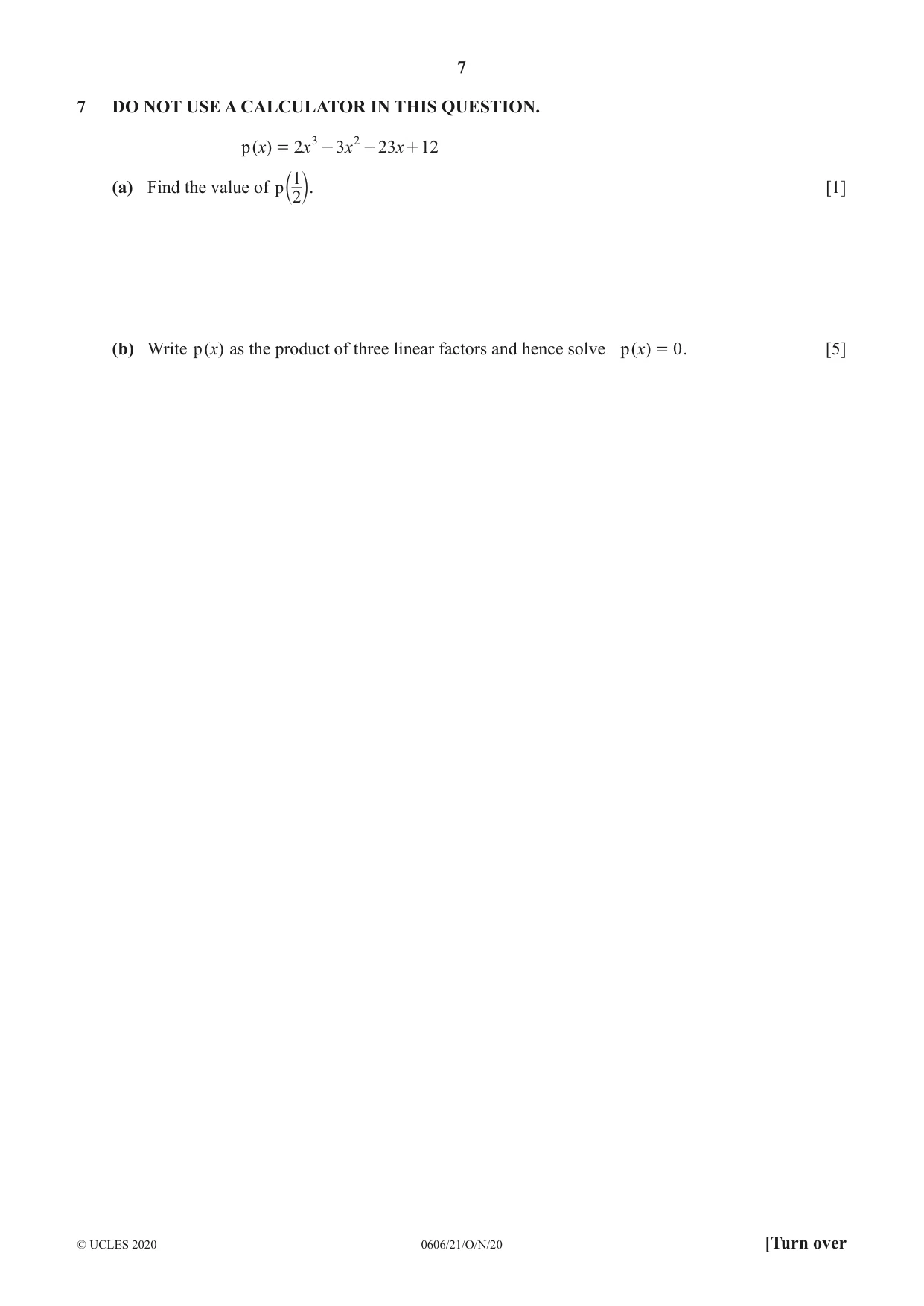
7 DO NOT USE A CALCULATOR IN THIS QUESTION. p ( x) = 2x 3 - 3x 2 - 23 x + 12 1 (a) Find the value of p [1] b 2 l. (b) Write p ( x) as the product of three linear factors and hence solve p ( x) = 0 . [5]
Mark scheme: 7(a) 1 1 1 1 B1 Working must be seen p = 2 − 3 − 23 + 12 = 0 2 8 4 2 7(b) − 12 p ( x ) = ( 2 x − 1)( x 2 − x − 12 ) 2 M1 for terms x 2 and A1 for −x p ( x ) = ( 2 x − 1)( x − 4 )( x + 3 ) 2 M1 for solving quadratic A1 for all three correct factors 1 A1 f ( x ) = 0 → x = , 4, − 3 2
Q8 · The population P, in millions, of a country is given by P = A # bt , where t is the…
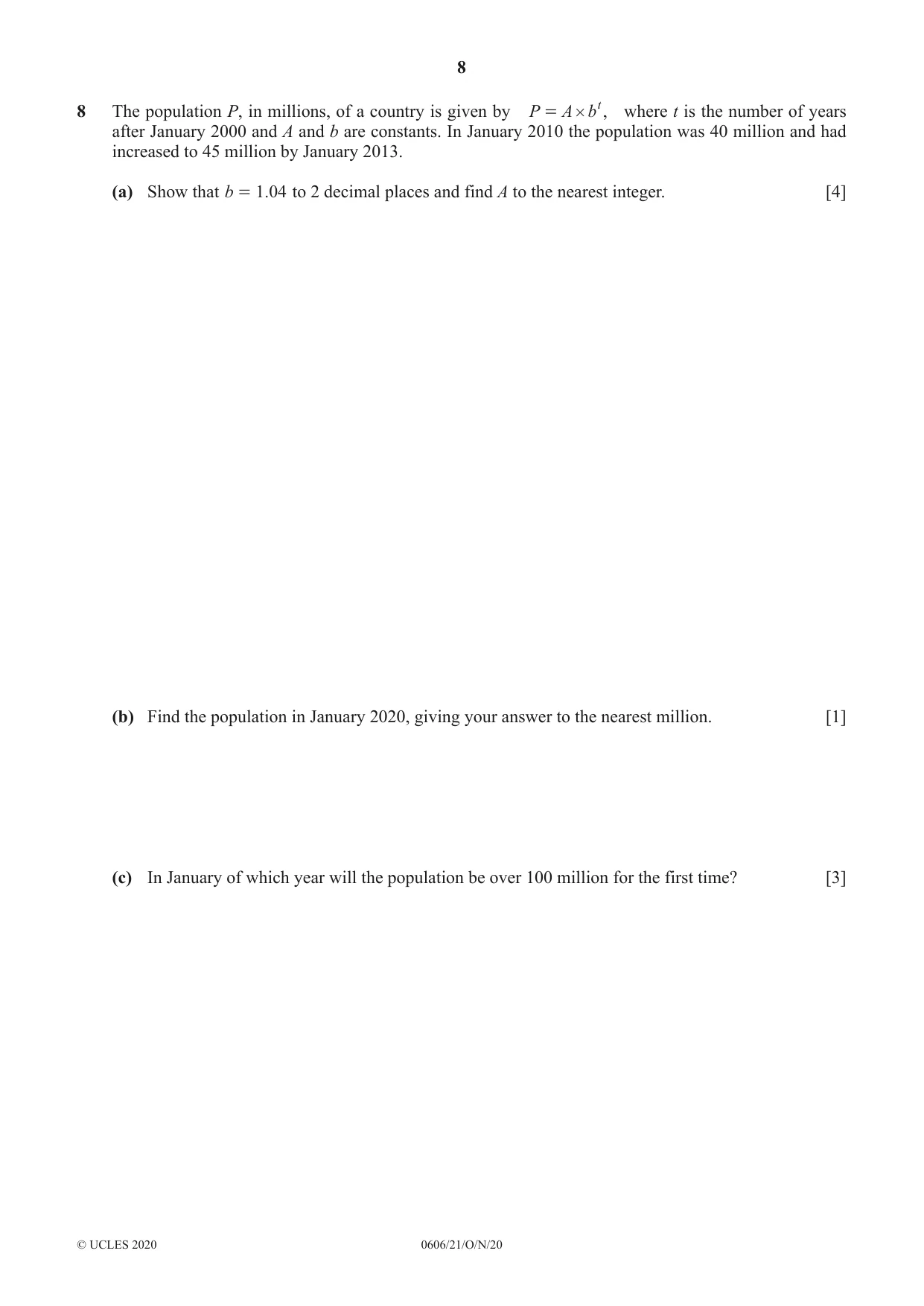
8 The population P, in millions, of a country is given by P = A # bt , where t is the number of years after January 2000 and A and b are constants. In January 2010 the population was 40 million and had increased to 45 million by January 2013. (a) Show that b = 1.04 to 2 decimal places and find A to the nearest integer. [4] (b) Find the population in January 2020, giving your answer to the nearest million. [1] (c) In January of which year will the population be over 100 million for the first time? [3]
Mark scheme: 8(a) 40 = A × b10 and 45 = A × b13 B1 3 45 M1 Divide to find b 3. b = 40 b = 1.04 A1 A = 27 A1 8(b) 59 B1 P = 27 × 1.04 20 8(c) 100 = 27 × 1.04 t M1 Insert P = 100 in their expression 100 M1 Rearrange to make t the subject log 27 t = oe log1.04 t = 33.4 → Year 2034 A1
Q9 · A particle moves in a straight line such that, t seconds after passing a fixed point O…
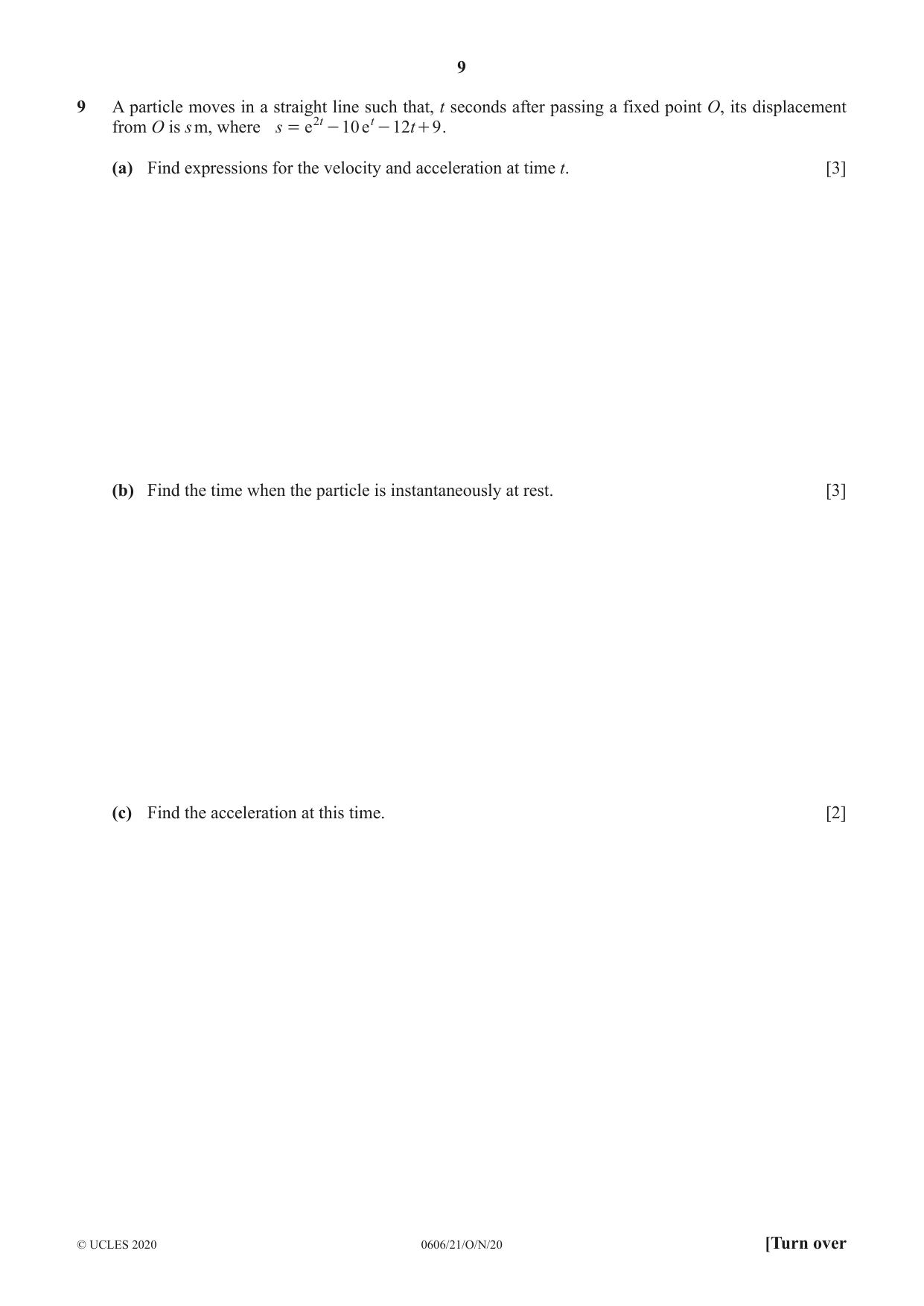
9 A particle moves in a straight line such that, t seconds after passing a fixed point O, its displacement from O is s m, where s = e 2 t - 10 e t - 12 t + 9 . (a) Find expressions for the velocity and acceleration at time t. [3] (b) Find the time when the particle is instantaneously at rest. [3] (c) Find the acceleration at this time. [2]
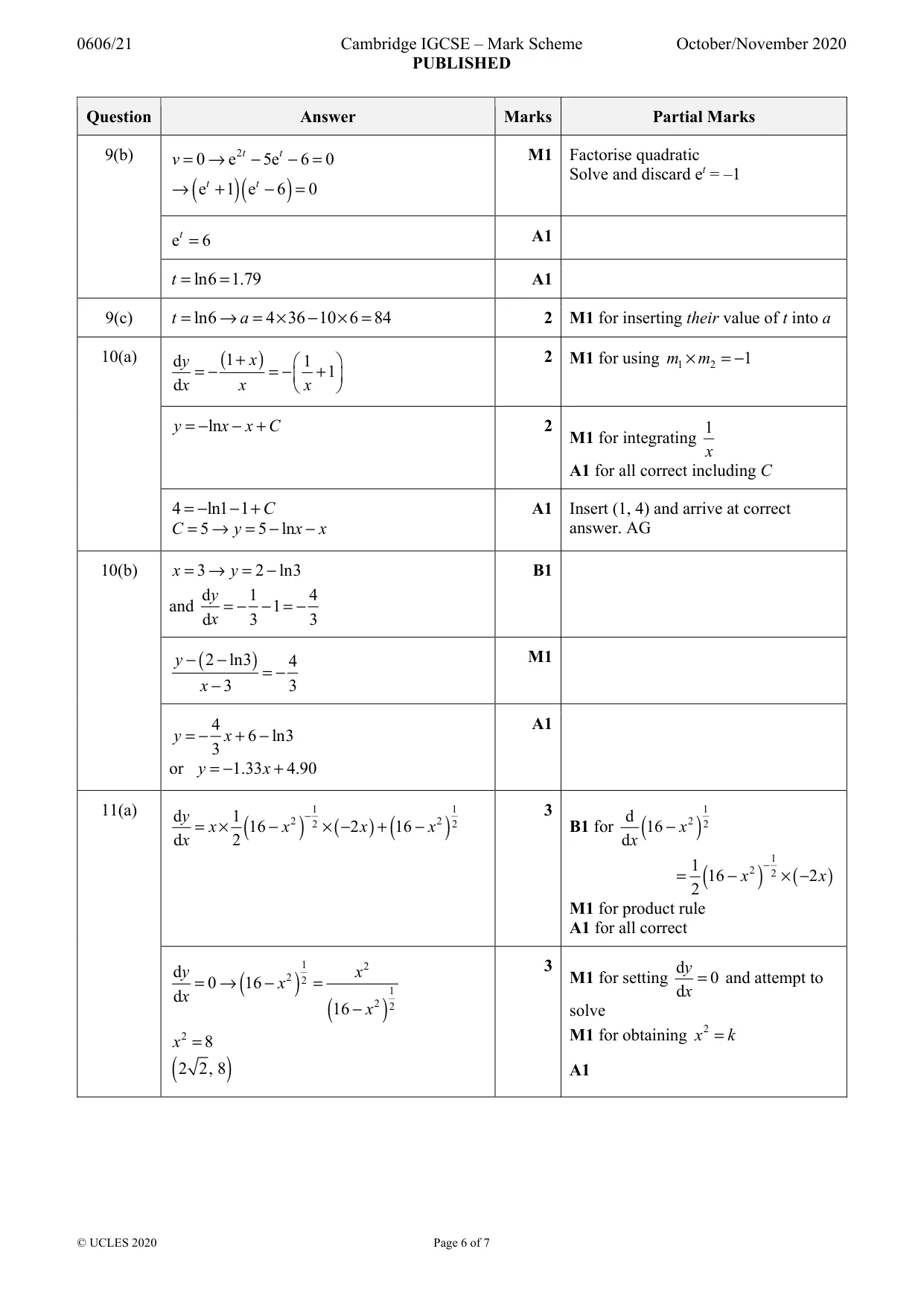
Mark scheme: 9(a) v = 2e 2 t − 10e t − 12 3 M1 for correctly differentiating 2e t . a = 4e 2 t − 10e t A1 for v correct A1 for a correct 9(b) v = 0 → e 2 t − 5e t − 6 = 0 M1 Factorise quadratic Solve and discard et = –1 → = 0 ( e t + 1)( e t − 6 ) e t = 6 A1 t = ln6 = 1.79 A1 9(c) t = ln6 → a = 4 × 36 − 10 × 6 = 84 2 M1 for inserting their value of t into a
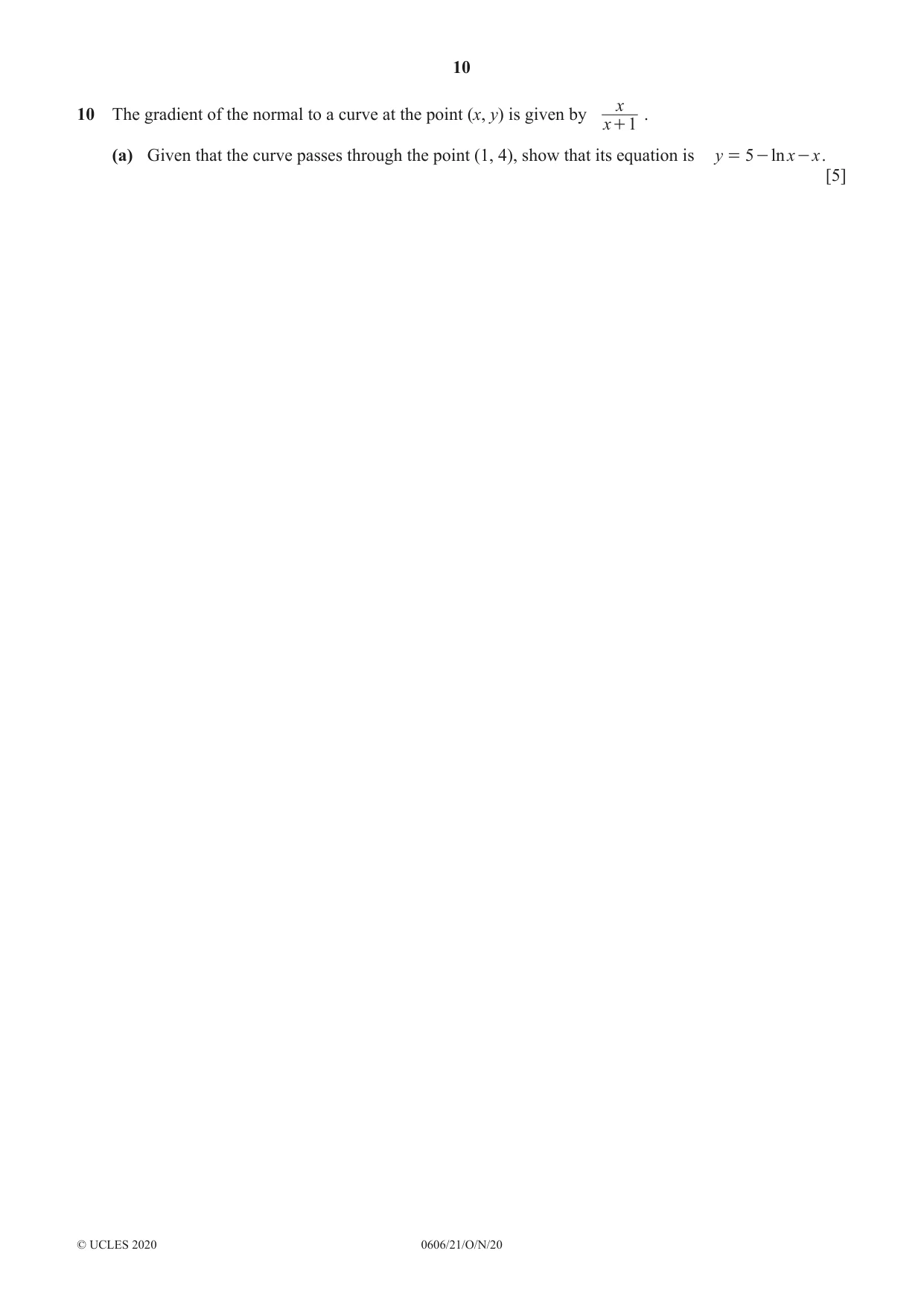
Q10 · The gradient of the normal to a curve at the point (x, y) is given by
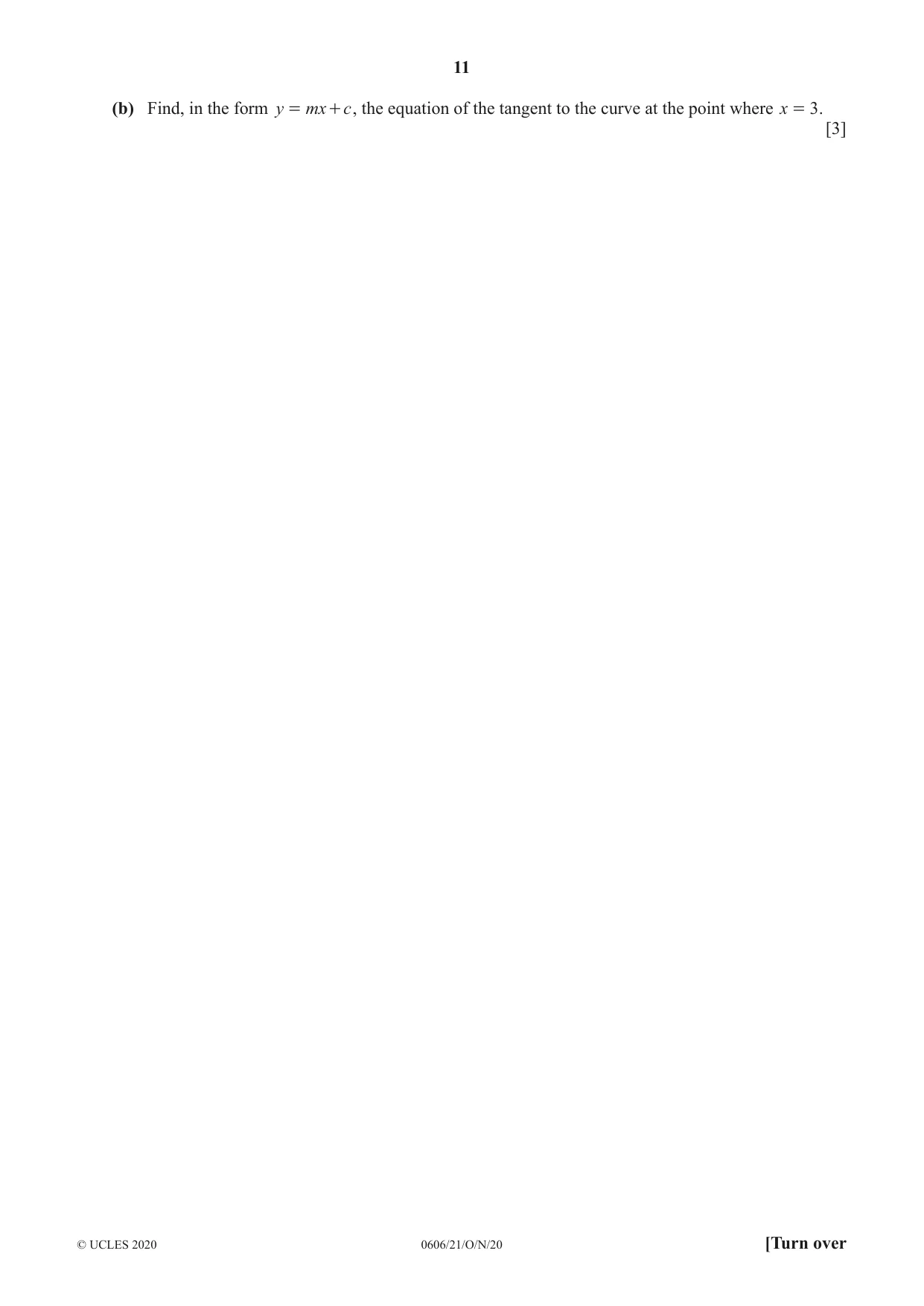
10 The gradient of the normal to a curve at the point (x, y) is given by . x + 1 (a) Given that the curve passes through the point (1, 4), show that its equation is y = 5 - ln x - x . [5] (b) Find, in the form y = mx + c , the equation of the tangent to the curve at the point where x = 3 . [3]
Mark scheme: 10(a) d y (1 + x ) 1 2 M1 for using m1 × m2 = −1 = − = − + 1 dx x x y = − lnx − x + C 2 1 M1 for integrating x A1 for all correct including C 4 = −ln1 −+1 C A1 Insert (1, 4) and arrive at correct C = 5 → y = 5 − lnx − x answer. AG 10(b) x = 3 → y = 2 − ln3 B1 d y 1 4 and = − −=1 − d x 3 3 y − ( 2 − ln3 ) 4 M1 = − x − 3 3 4 A1 y = − x + 6 − ln3 3 or y = −1.33 x + 4.90
More questions on Understand integration as the reverse process
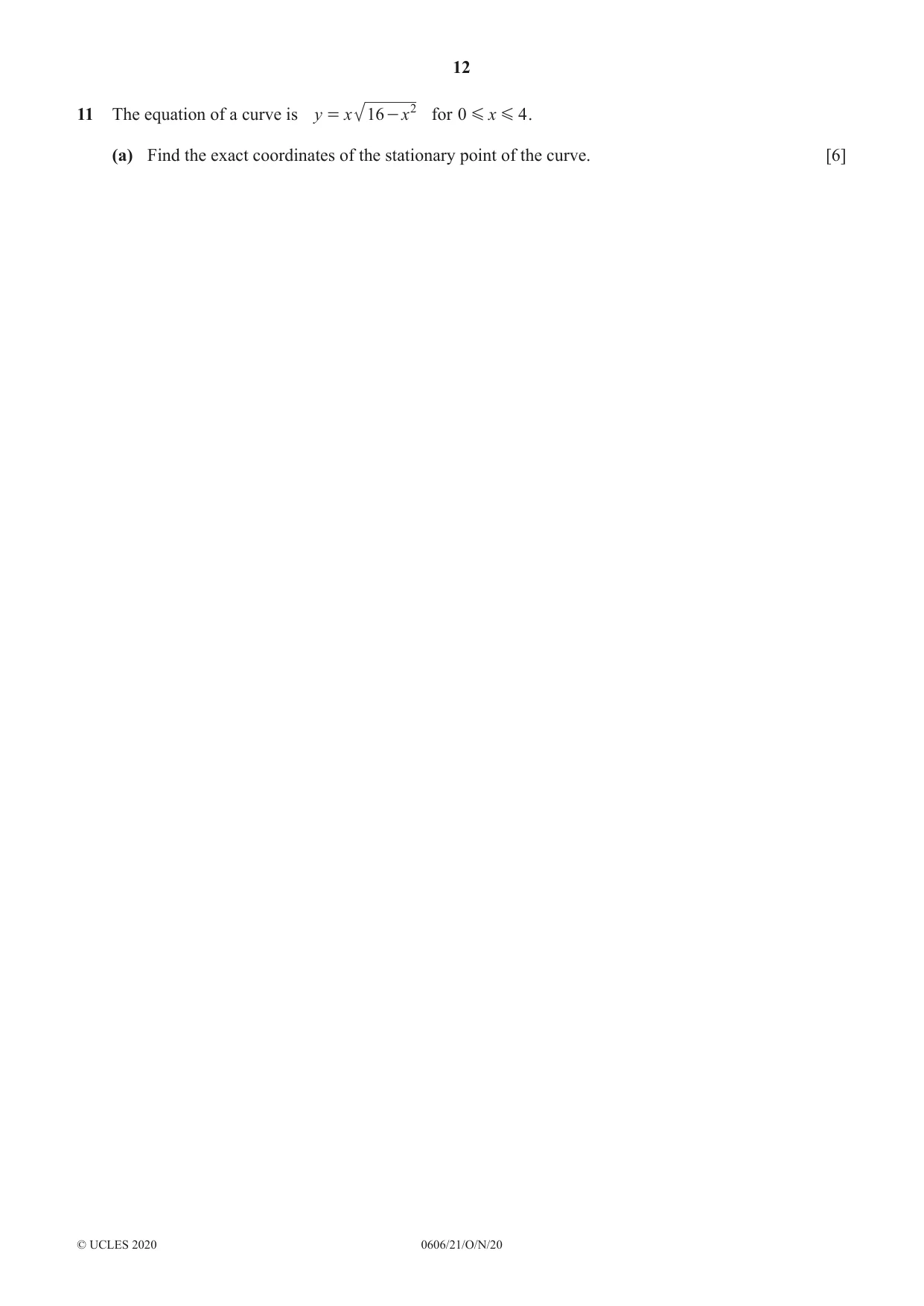
Q11 · The equation of a curve is y = x 16 - x 2 for 0 G x G 4
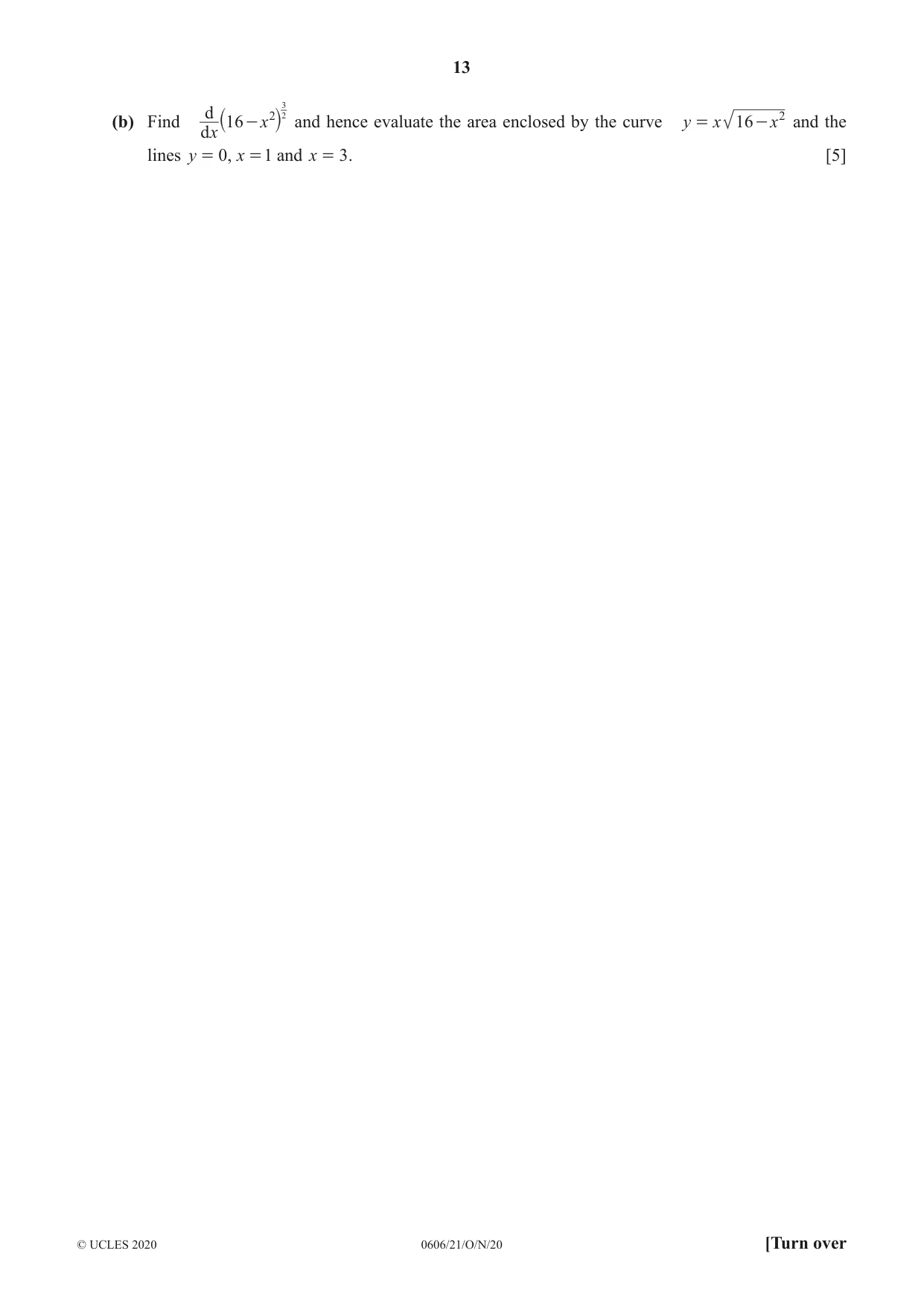
11 The equation of a curve is y = x 16 - x 2 for 0 G x G 4 . (a) Find the exact coordinates of the stationary point of the curve. [6] d 2 23 2(b) Find 16 - x and hence evaluate the area enclosed by the curve y = x 16 - x and the d x ` j lines y = 0, x = 1 and x = 3 . [5]
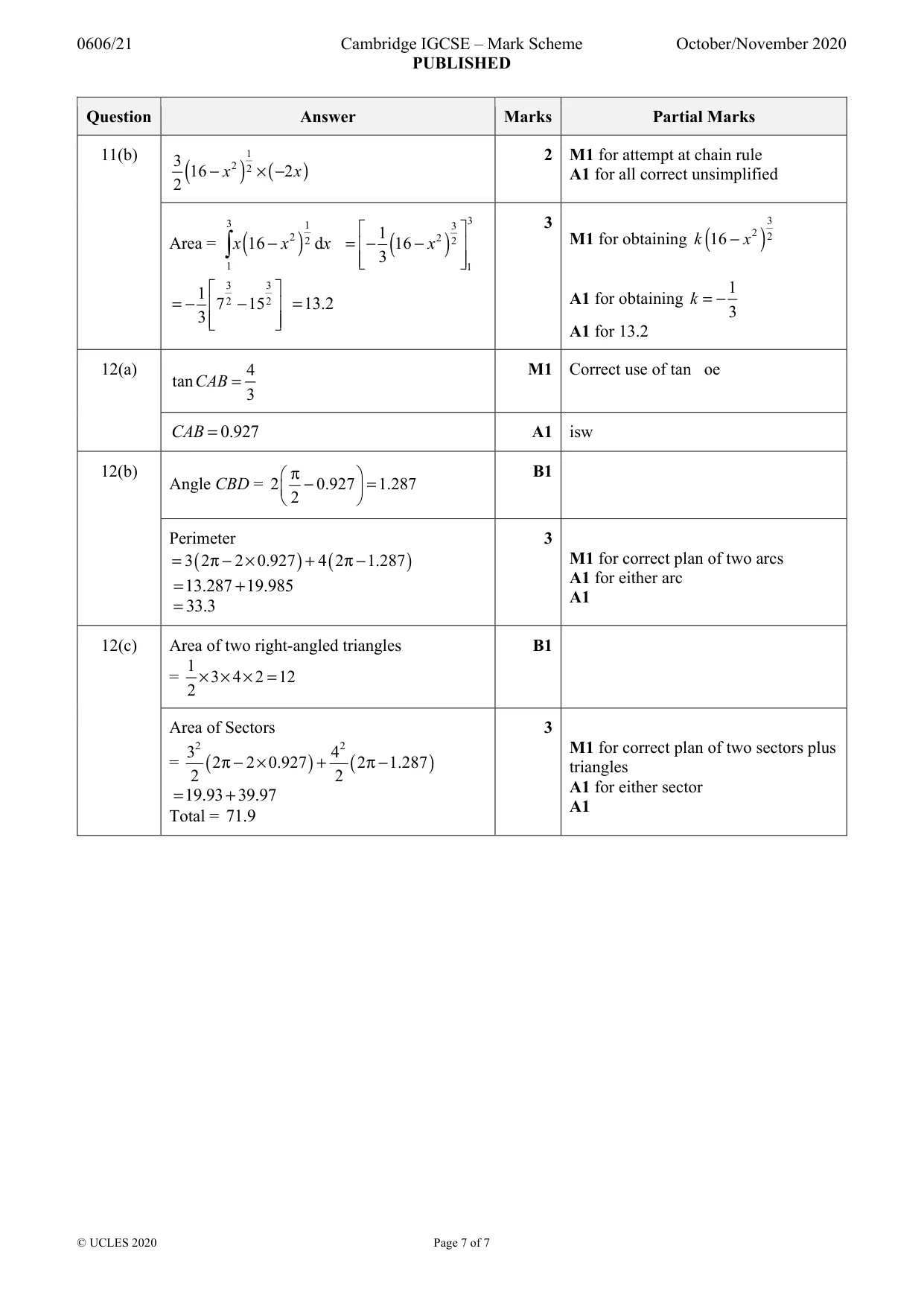
Mark scheme: 11(a) d y 1 2 − 12 2 12 3 d 2 12 B1 for = x × (16 − x ) × ( − 2 x ) + (16 − x ) (16 − x ) d x 2 d x − 1 2 1 = 2 × ( − 2 x ) (16 − x ) 2 M1 for product rule A1 for all correct 1 2 3 dy d y 2 2 x M1 for setting = 0 and attempt to = 0 → 16 − x = ( ) 1 dx dx 2 2 16 − x ( ) solve 2 2 M1 for obtaining x = k x = 8 2 2, 8 ( ) A1 11(b) 1 2 M1 for attempt at chain rule 3 2 2 × ( − 2 x ) A1 for all correct unsimplified (16 − x ) 2 3 1 3 3 3 3 1 2 2 M1 for obtaining k − 2 dx = ( 16 − x 2 ) Area = ( 16 − x 2 ) ( 16 − x 2 ) x 3 1 1 1 32 32 A1 for obtaining k = − 1 = − 7 − 15 = 13.2 3 3 A1 for 13.2
More questions on Use differentiation to find stationary points
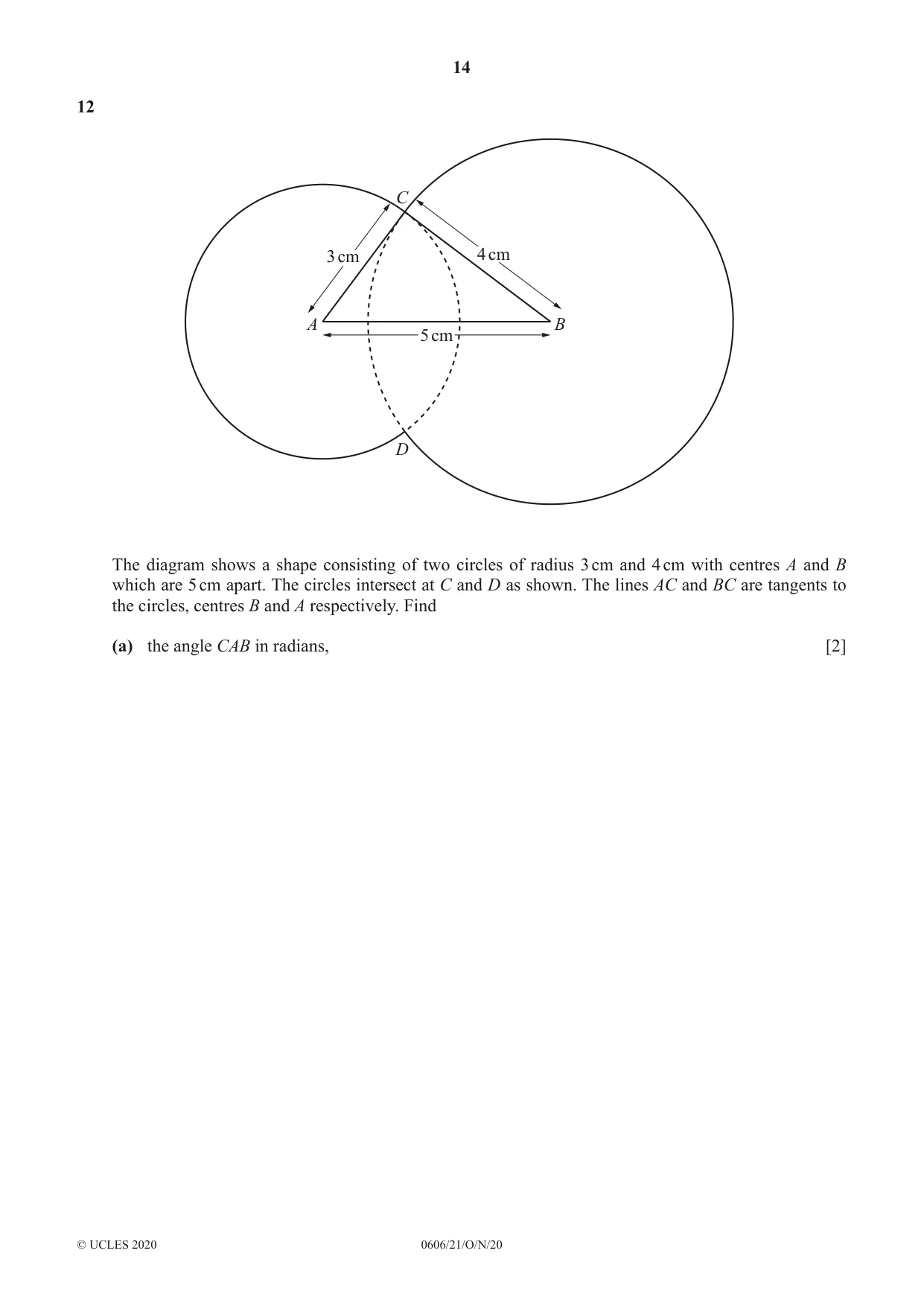
Q12 · C 3 cm 4 cm A B 5 cm D The diagram shows a shape consisting of two circles of radius 3 cm…
12 C 3 cm 4 cm A B 5 cm D The diagram shows a shape consisting of two circles of radius 3 cm and 4 cm with centres A and B which are 5 cm apart. The circles intersect at C and D as shown. The lines AC and BC are tangents to the circles, centres B and A respectively. Find (a) the angle CAB in radians, [2] (b) the perimeter of the whole shape, [4] (c) the area of the whole shape. [4]
Mark scheme: 12(a) 4 M1 Correct use of tan oe tan CAB = 3 CAB = 0.927 A1 isw 12(b) π B1 Angle CBD = 2 − 0.927 = 1.287 2 Perimeter 3 = 3 ( 2 π − 2 × 0.927 ) + 4 ( 2 π − 1.287 ) M1 for correct plan of two arcs A1 for either arc = 13.287 + 19.985 A1 = 33.3 12(c) Area of two right-angled triangles B1 1 = × 3 × 4 × 2 = 12 2 Area of Sectors 3 32 4 2 M1 for correct plan of two sectors plus = ( 2 π − 2 × 0.927 ) + ( 2 π − 1.287 ) triangles 2 2 A1 for either sector = 19.93 + 39.97 A1 Total = 71.9
More questions on Solve problems involving the arc length and
What was in this paper
The subtopics covered by these 12 questions, and how many questions each got. Open one in a new tab to see every Cambridge question on it.
1Find factors of polynomials1Integrate functions of the form1Know and use the laws of logarithms1Know and use the six trigonometric functions1Solve equations of the form ax = b1Solve graphically or algebraically inequalities1Solve problems involving the arc length and1Solve simultaneous equations in two1Understand integration as the reverse process1Use differentiation to find stationary points1Use the binomial theorem for expansion of1What you needed in this session
Cambridge’s own grade thresholds for 2020 Oct/Nov, Paper 2 · Variant 1. A higher threshold means an easier paper — the bar moves with how the cohort did.