Cambridge IGCSE Mathematics - Additional 0606 — 2019 May/June Paper 2 · Variant 3
0606/23/M/J/19 · 11 questions · 80 marks · ≈90 min
The question paper and its mark scheme, free to read here and free to download. This is Cambridge’s own paper, exactly as it was sat.
Question paper16 pages

Mark scheme8 pages
Answers below. Sit the paper first if you are practising.
Questions as text
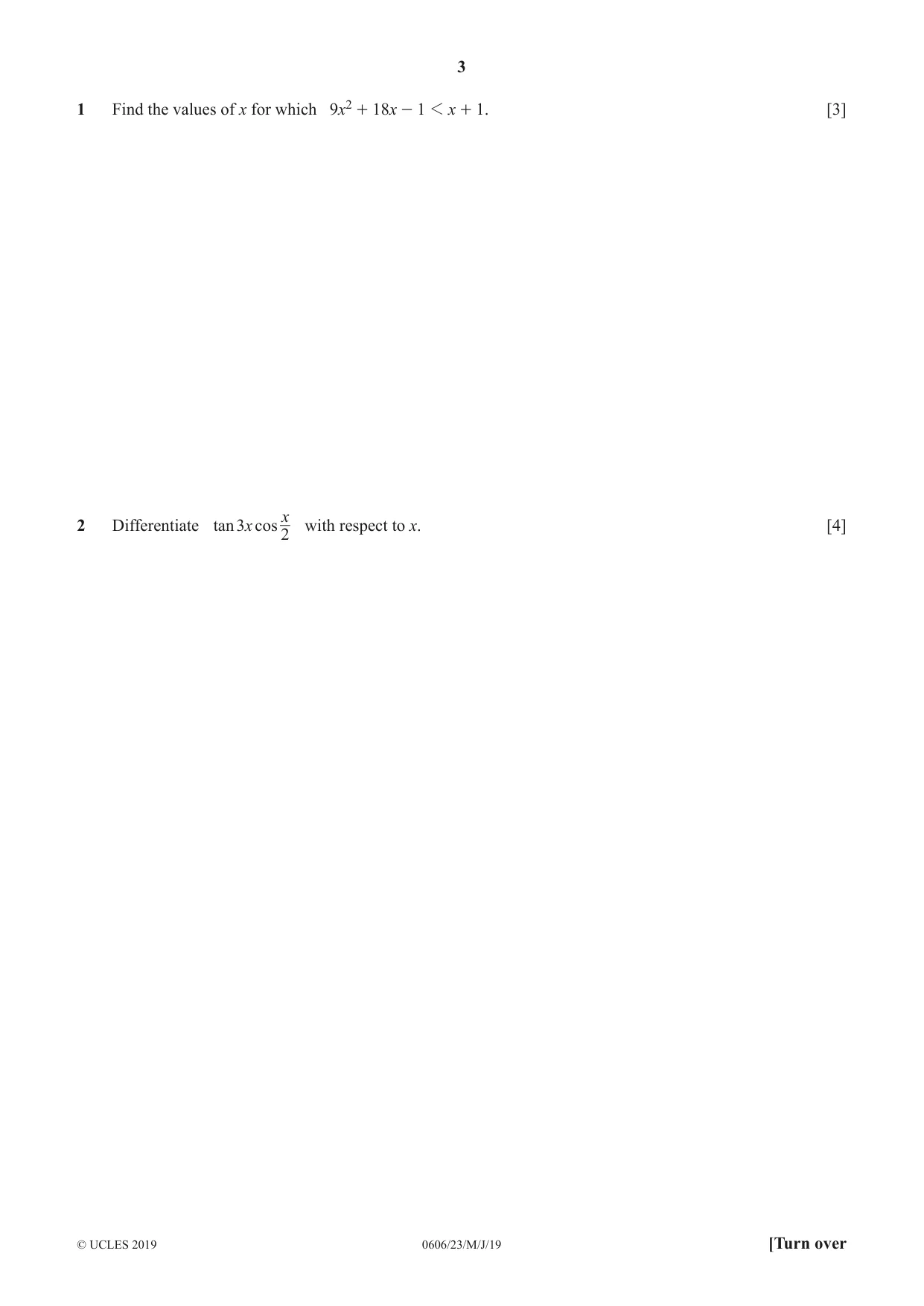
Q1 · Find the values of x for which 9x2 + 18x - 1 1 x + 1
1 Find the values of x for which 9x2 + 18x - 1 1 x + 1. [3]
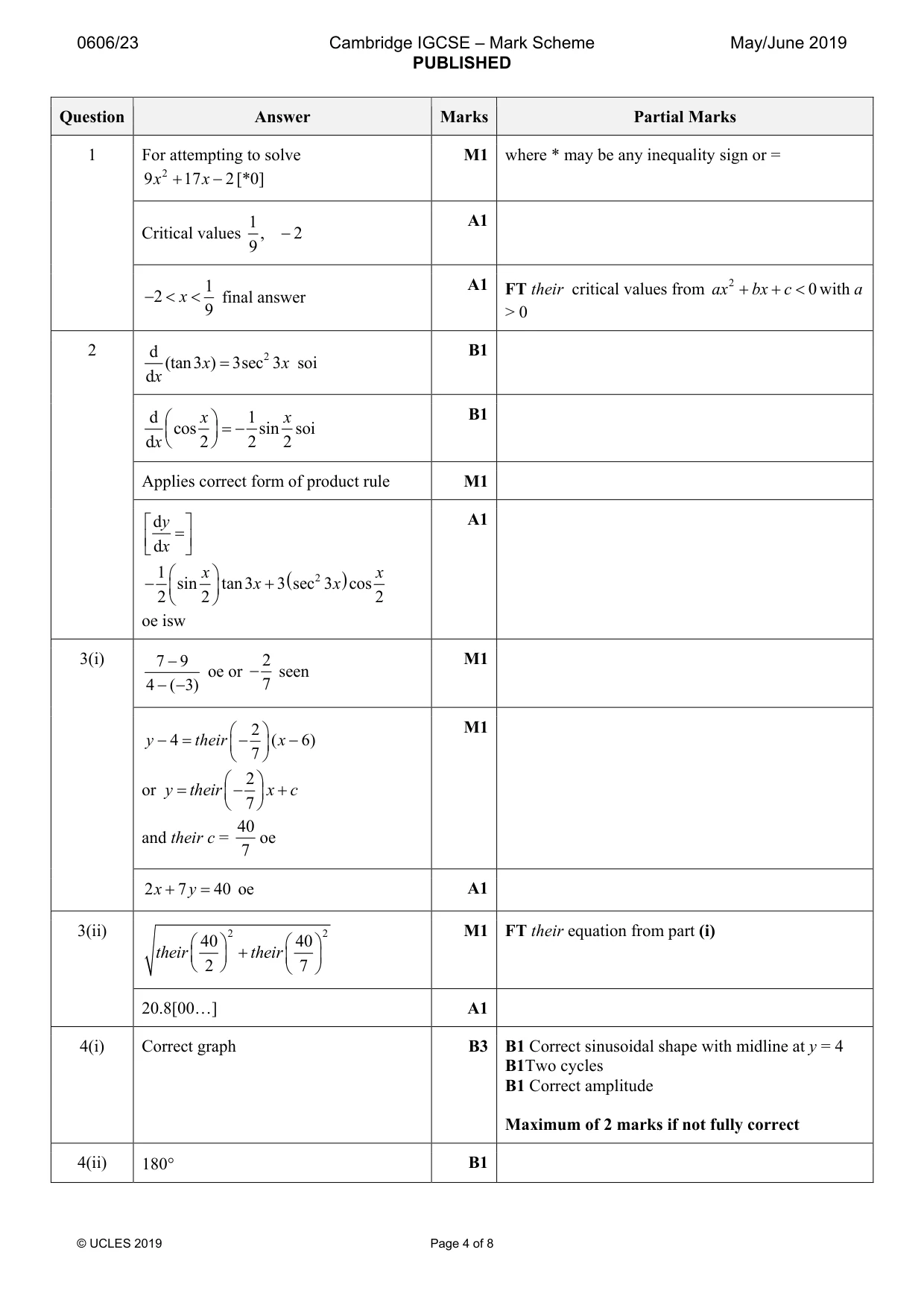
Mark scheme: Question Answer Marks Partial Marks 1 For attempting to solve M1 where * may be any inequality sign or = 9 x 2 + 17 x − 2[*0] 1 A1 Critical values , − 2 9 1 A1 FT their critical values from ax 2 + bx + c < 0 with a −<2 x < final answer 9 > 0
More questions on Find the solution set for quadratic inequalities
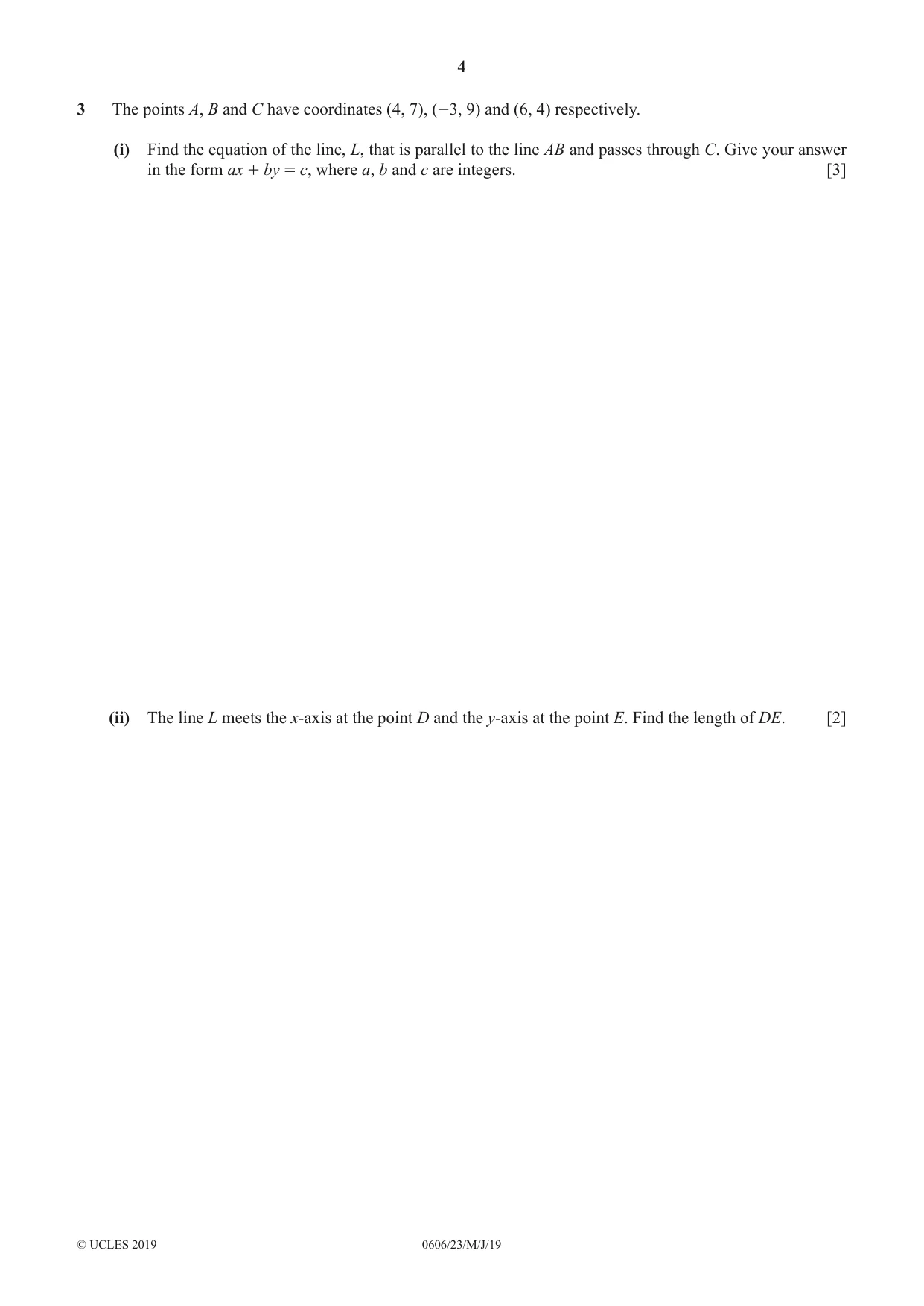
Q3 · The points A, B and C have coordinates (4, 7), (-3, 9) and (6, 4) respectively
3 The points A, B and C have coordinates (4, 7), (-3, 9) and (6, 4) respectively. (i) Find the equation of the line, L, that is parallel to the line AB and passes through C. Give your answer in the form ax + by = c, where a, b and c are integers. [3] (ii) The line L meets the x-axis at the point D and the y-axis at the point E. Find the length of DE. [2]
Mark scheme: 3(i) 7 − 9 2 M1 oe or − seen 4 −−( 3) 7 2 M1 y − 4 = their − ( x − 6) 7 2 or y = their − x + c 7 40 and their c = oe 7 2 x + 7 y = 40 oe A1 3(ii) 2 2 M1 FT their equation from part (i) 40 40 their + their 2 7 20.8[00…] A1
Q4 · The function f is defined, for 0° G x G 360°, by f (x) = 4 + 3 sin 2x
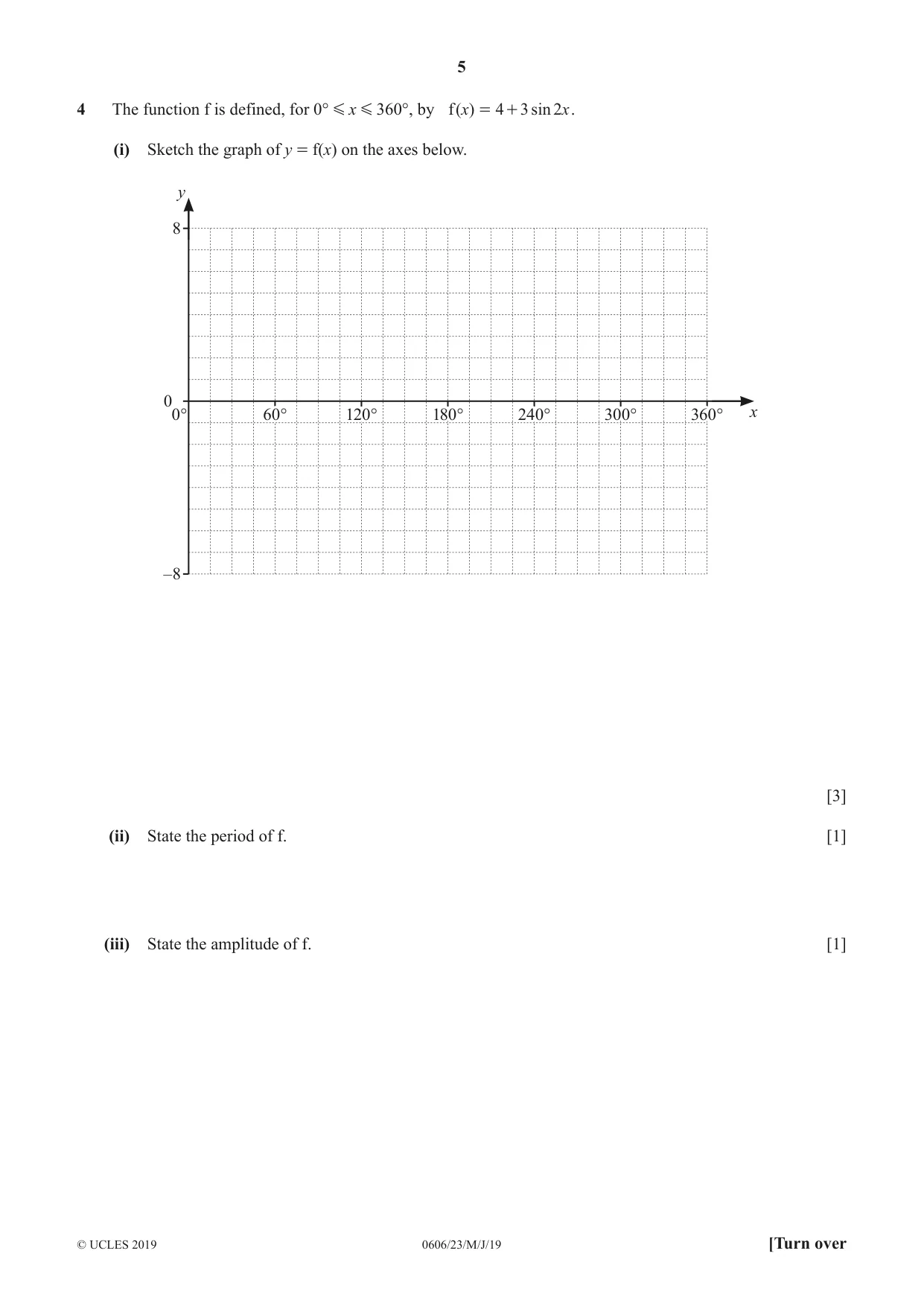
4 The function f is defined, for 0° G x G 360°, by f (x) = 4 + 3 sin 2x . (i) Sketch the graph of y = f(x) on the axes below. y 8 00° 60° 120° 180° 240° 300° 360° x –8 [3] (ii) State the period of f. [1] (iii) State the amplitude of f. [1]
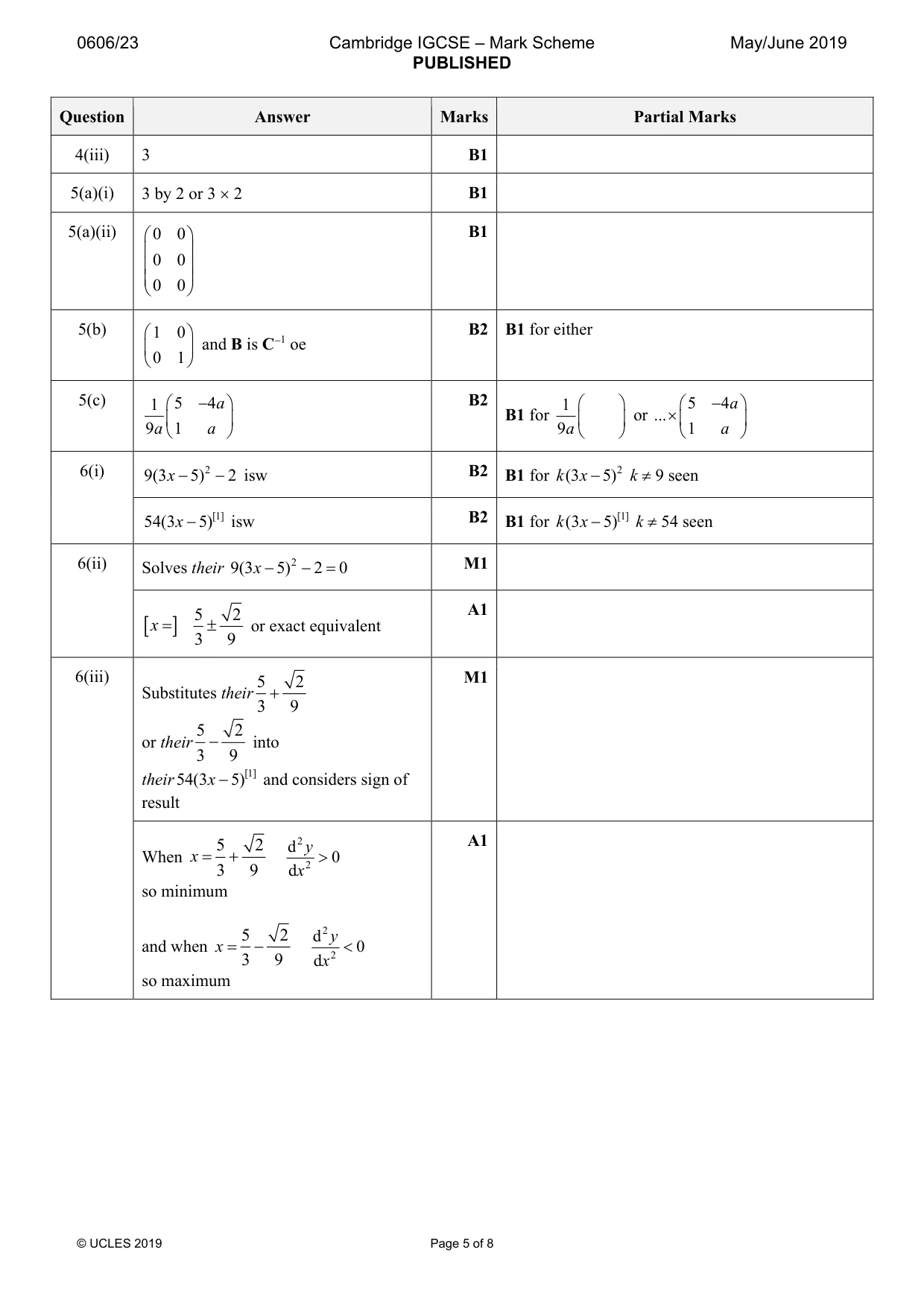
Mark scheme: 4(i) Correct graph B3 B1 Correct sinusoidal shape with midline at y = 4 B1Two cycles B1 Correct amplitude Maximum of 2 marks if not fully correct 4(ii) 180° B1 4(iii) 3 B1
Q5 · Given that A = 0 - 1 and that A + O = A, 6 4 (i) state the order of the matrix A, [1]…
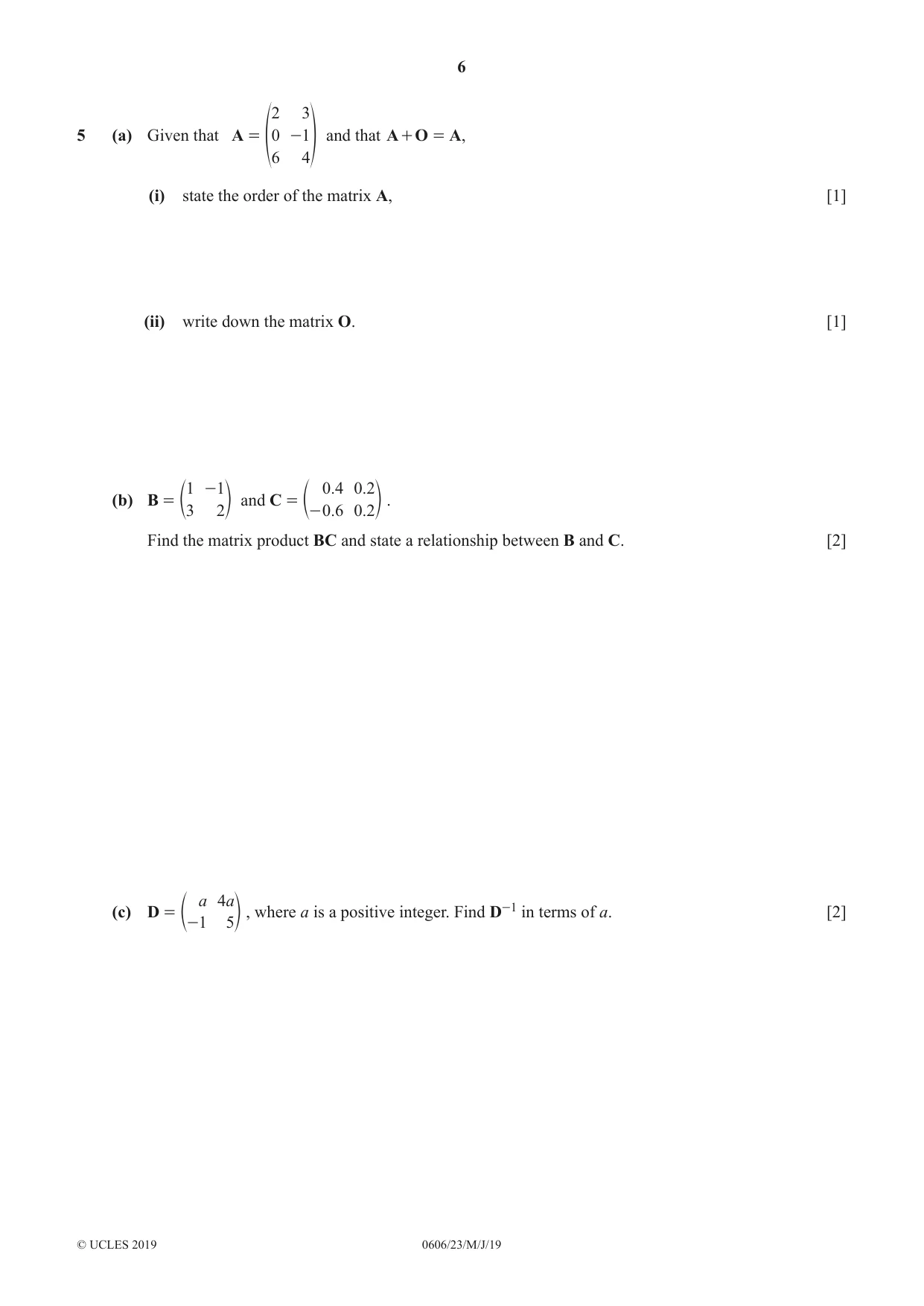
5 (a) Given that A = 0 - 1 and that A + O = A, 6 4 (i) state the order of the matrix A, [1] (ii) write down the matrix O. [1] 1 - 1 0.4 0.2 (b) B = and C = . e3 2o e- 0.6 0.2o Find the matrix product BC and state a relationship between B and C. [2] a 4 a (c) D = , where a is a positive integer. Find D-1 in terms of a. [2] e- 1 5o
Mark scheme: 5(a)(i) 3 by 2 or 3 × 2 B1 5(a)(ii) 0 0 B1 0 0 0 0 5(b) 1 0 B2 B1 for either and B is C−1 oe 0 1 5(c) 1 5 −4 a B2 1 5 − 4 a B1 for or ... × 9 a 1 a 9 a 1 a
Q6 · A curve has equation y = 3x - 5 - 2x
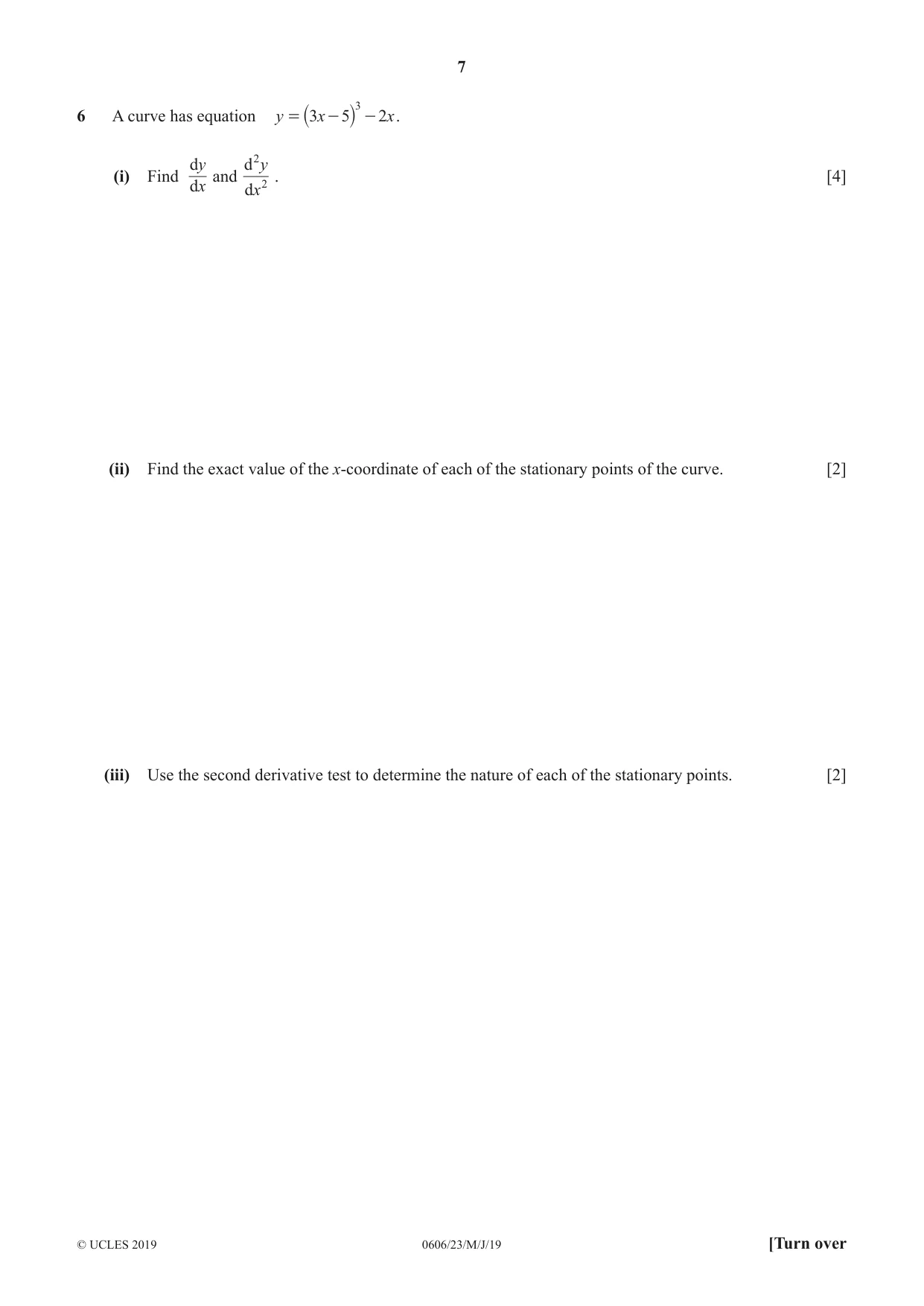
6 A curve has equation y = 3x - 5 - 2x . dy d2 y (i) Find and 2 . [4] dx dx (ii) Find the exact value of the x-coordinate of each of the stationary points of the curve. [2] (iii) Use the second derivative test to determine the nature of each of the stationary points. [2]
Mark scheme: 6(i) 9(3 x − 5) 2 − 2 isw B2 B1 for k (3 x − 5) 2 k ≠ 9 seen 54(3 x − 5)[1] isw B2 B1 for k (3 x − 5)[1] k ≠ 54 seen 6(ii) Solves their 9(3 x − 5) 2 − 2 = 0 M1 5 2 A1 [ x = ] ± or exact equivalent 3 9 6(iii) 5 2 M1 Substitutes their + 3 9 5 2 or their − into 3 9 their 54(3 x − 5)[1] and considers sign of result 5 2 d 2 y A1 When x = + > 0 3 9 d x 2 so minimum 5 2 d 2 y and when x = − < 0 3 9 d x 2 so maximum
Q7 · A B 50 cm D C 4r rad 9 O The diagram shows a company logo, ABCD
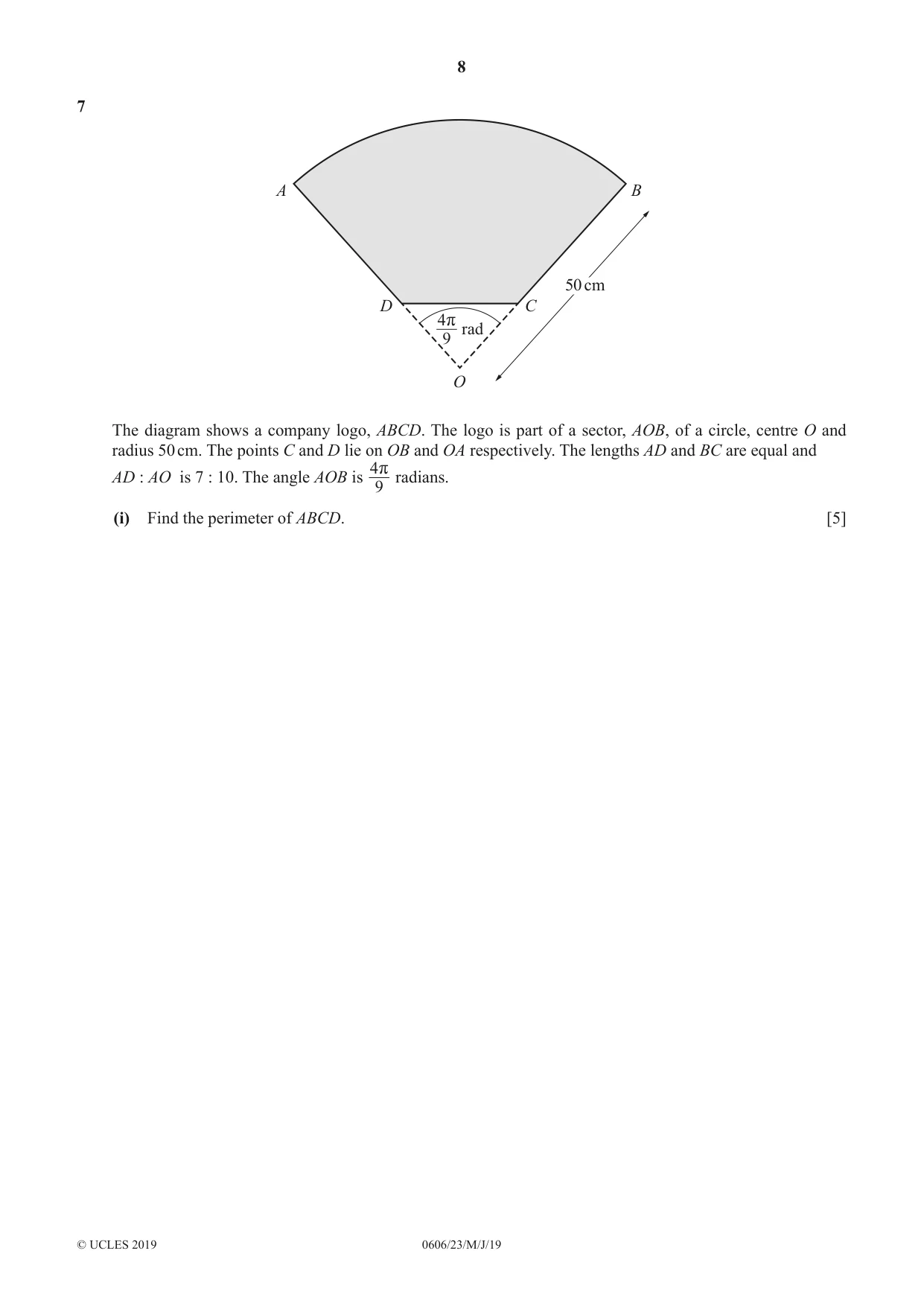
7 A B 50 cm D C 4r rad 9 O The diagram shows a company logo, ABCD. The logo is part of a sector, AOB, of a circle, centre O and radius 50 cm. The points C and D lie on OB and OA respectively. The lengths AD and BC are equal and 4r AD : AO is 7 : 10. The angle AOB is radians. 9 (i) Find the perimeter of ABCD. [5]
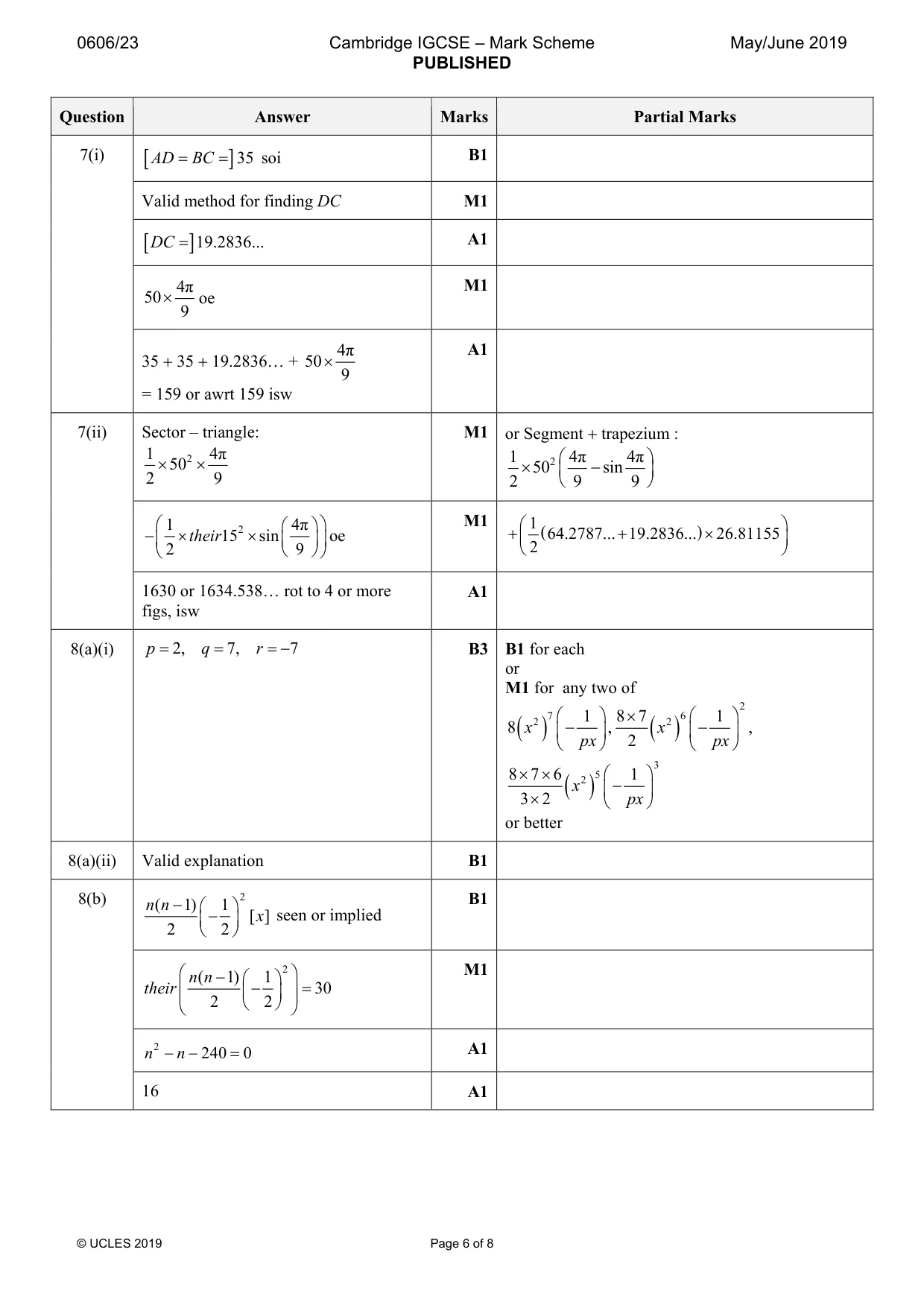
Mark scheme: 7(i) [ AD = BC = ] 35 soi B1 Valid method for finding DC M1 [ DC = ]19.2836... A1 4π M1 50 × oe 9 4π A1 35 + 35 + 19.2836… + 50 × 9 = 159 or awrt 159 isw 7(ii) Sector – triangle: M1 or Segment + trapezium : 1 2 4π 1 2 4π 4π × 50 × × 50 − sin 2 9 2 9 9 1 2 4π M1 1 − × their15 × sin oe + ( 64.2787... + 19.2836... ) × 26.81155 2 9 2 1630 or 1634.538… rot to 4 or more A1 figs, isw
More questions on Solve problems involving the arc length and
Q8 · Given that x 2 - = x 16 - 4x 13 + qx 10 + rx 7 + f, find the value of each of the…
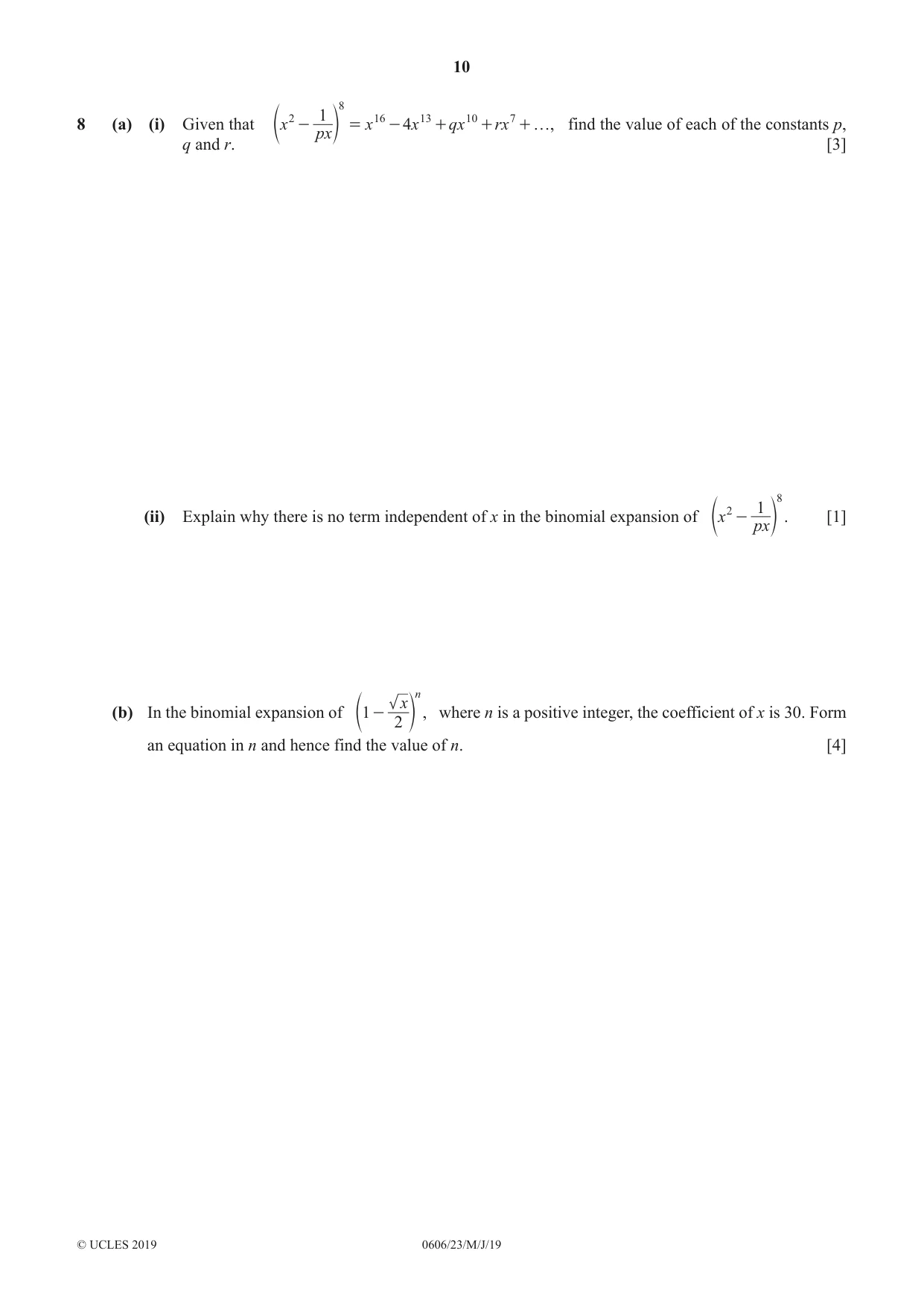
8 (a) (i) Given that x 2 - = x 16 - 4x 13 + qx 10 + rx 7 + f, find the value of each of the constants p, px q and r. [3] 8 2 1 (ii) Explain why there is no term independent of x in the binomial expansion of x - . [1] e px o n x (b) In the binomial expansion of 1 - , where n is a positive integer, the coefficient of x is 30. Form e 2 o an equation in n and hence find the value of n. [4]
Mark scheme: 8(a)(i) p = 2, q = 7, r = −7 B3 B1 for each or M1 for any two of 2 6 1 2 7 1 8 × 7 2 x x 8 − , ( ) − , ( ) px 2 px 3 8 × 7 × 6 2 x − ( 5 1 ) 3 × 2 px or better 8(a)(ii) Valid explanation B1 8(b) 2 B1 n ( n − 1) 1 − [ x ] seen or implied 2 2 n ( n − 1) 1 2 M1 their − = 30 2 2 n 2 − n − 240 = 0 A1 16 A1
Q9 · Y y = 16 - x 2 y = 7 O x The diagram shows the curve y = 16 - x2 and the straight line y…
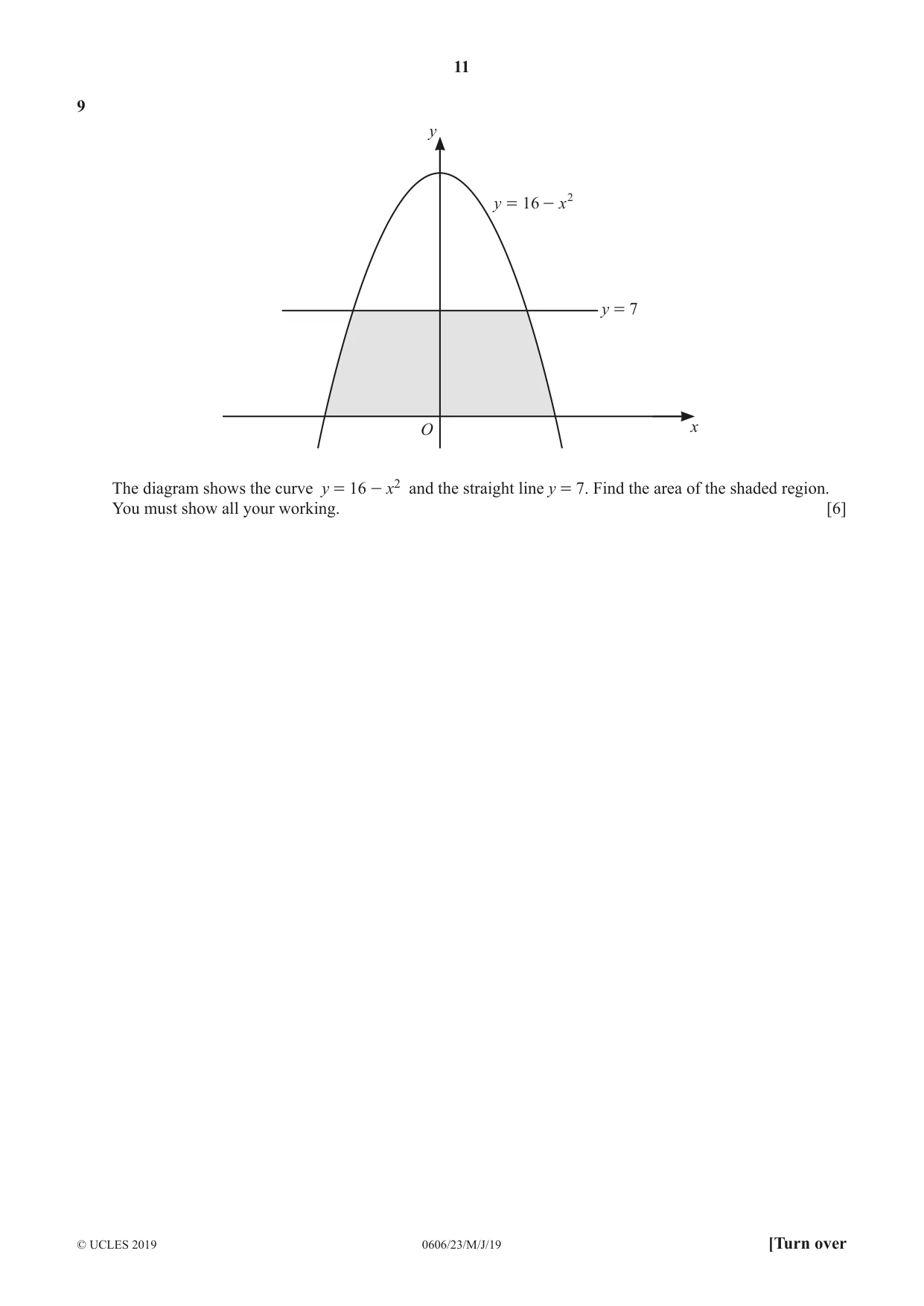
9 y y = 16 - x 2 y = 7 O x The diagram shows the curve y = 16 - x2 and the straight line y = 7. Find the area of the shaded region. You must show all your working. [6]
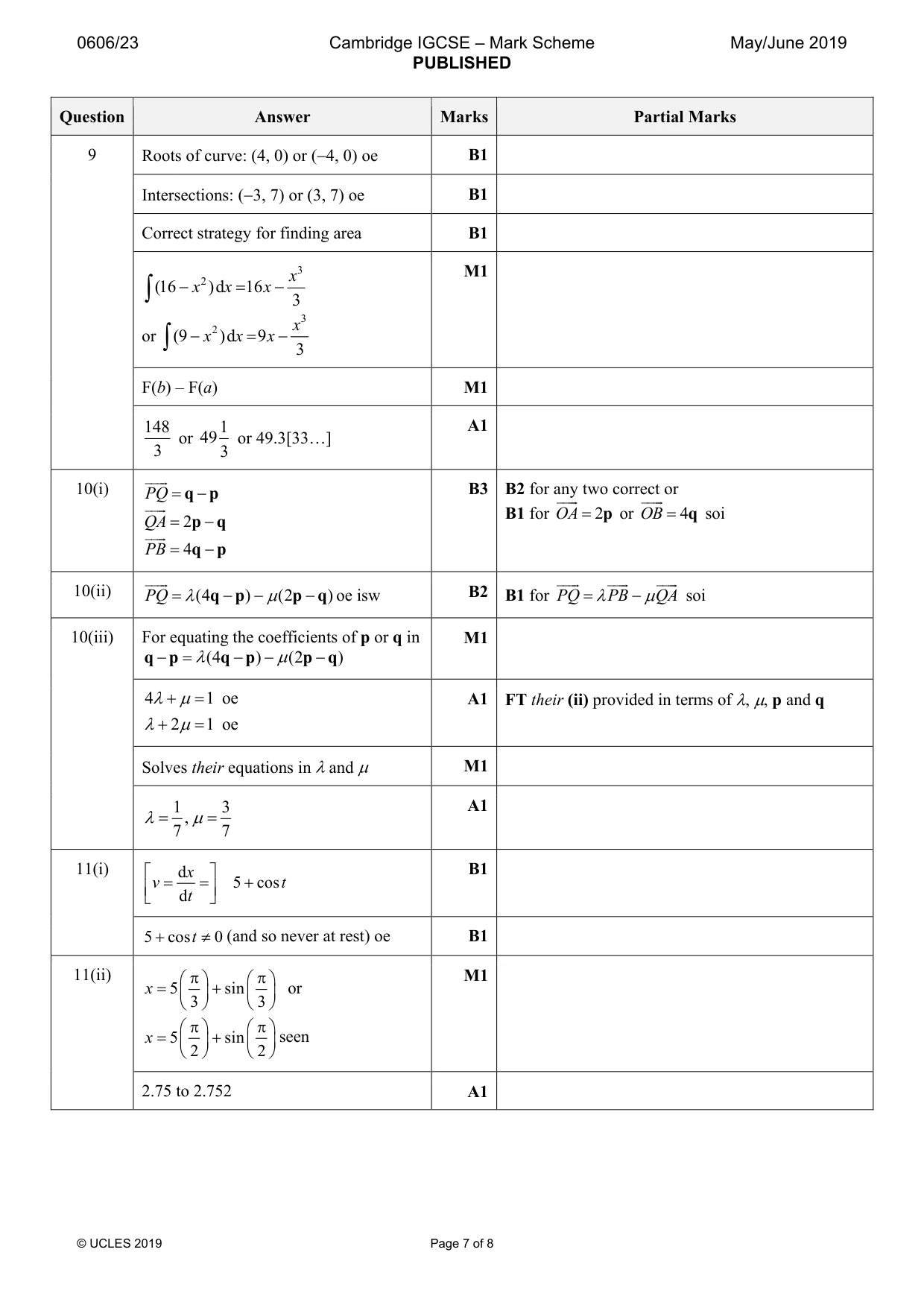
Mark scheme: 9 Roots of curve: (4, 0) or (−4, 0) oe B1 Intersections: (−3, 7) or (3, 7) oe B1 Correct strategy for finding area B1 2 x 3 M1 (16 − x )dx = 16 x − ∫ 3 2 x 3 (9 − x )dx = 9 x − or ∫ 3 F(b) – F(a) M1 148 1 A1 or 49 or 49.3[33…] 3 3
Q10 · O q p Q P R B A The diagram shows a triangle OAB
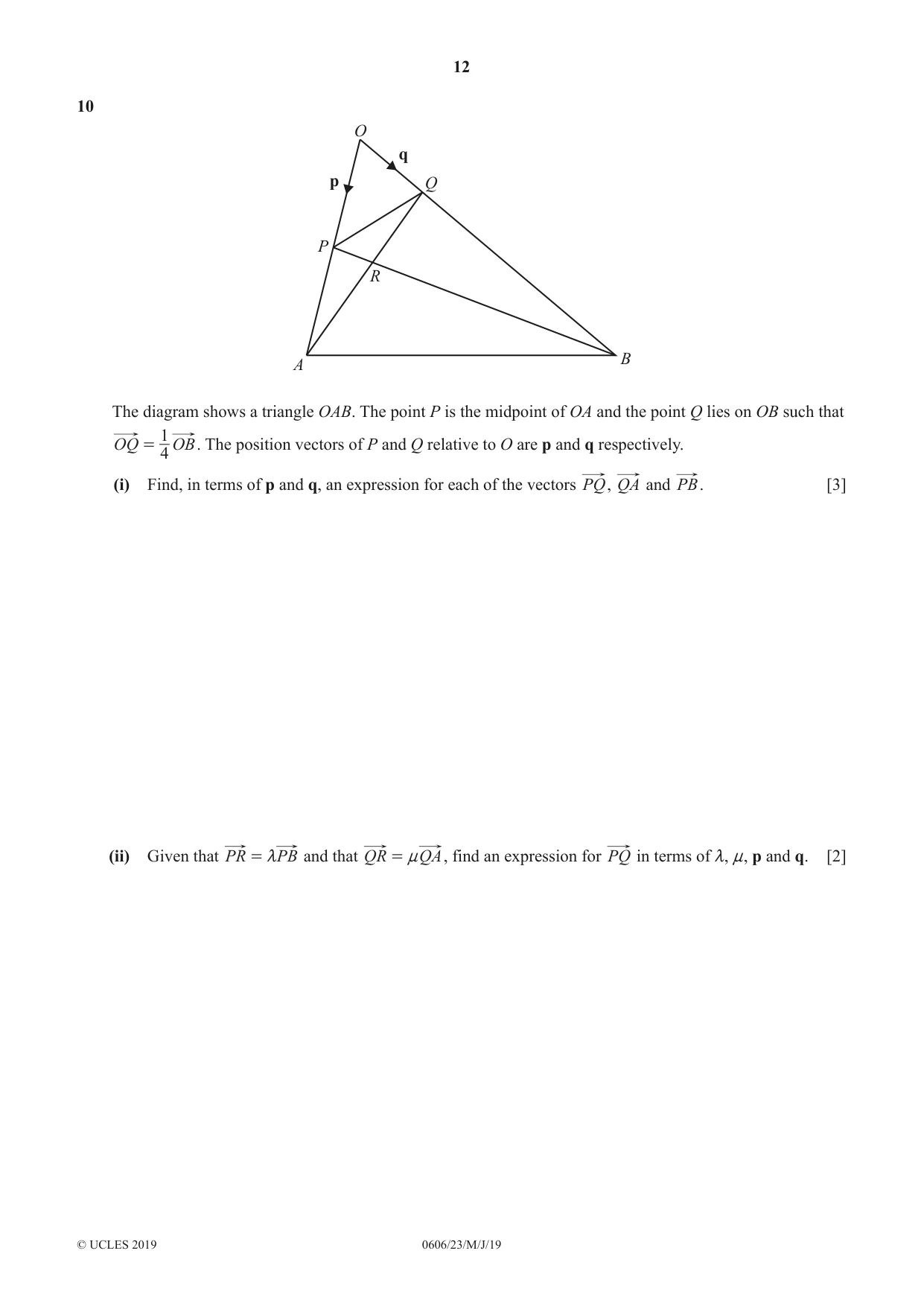
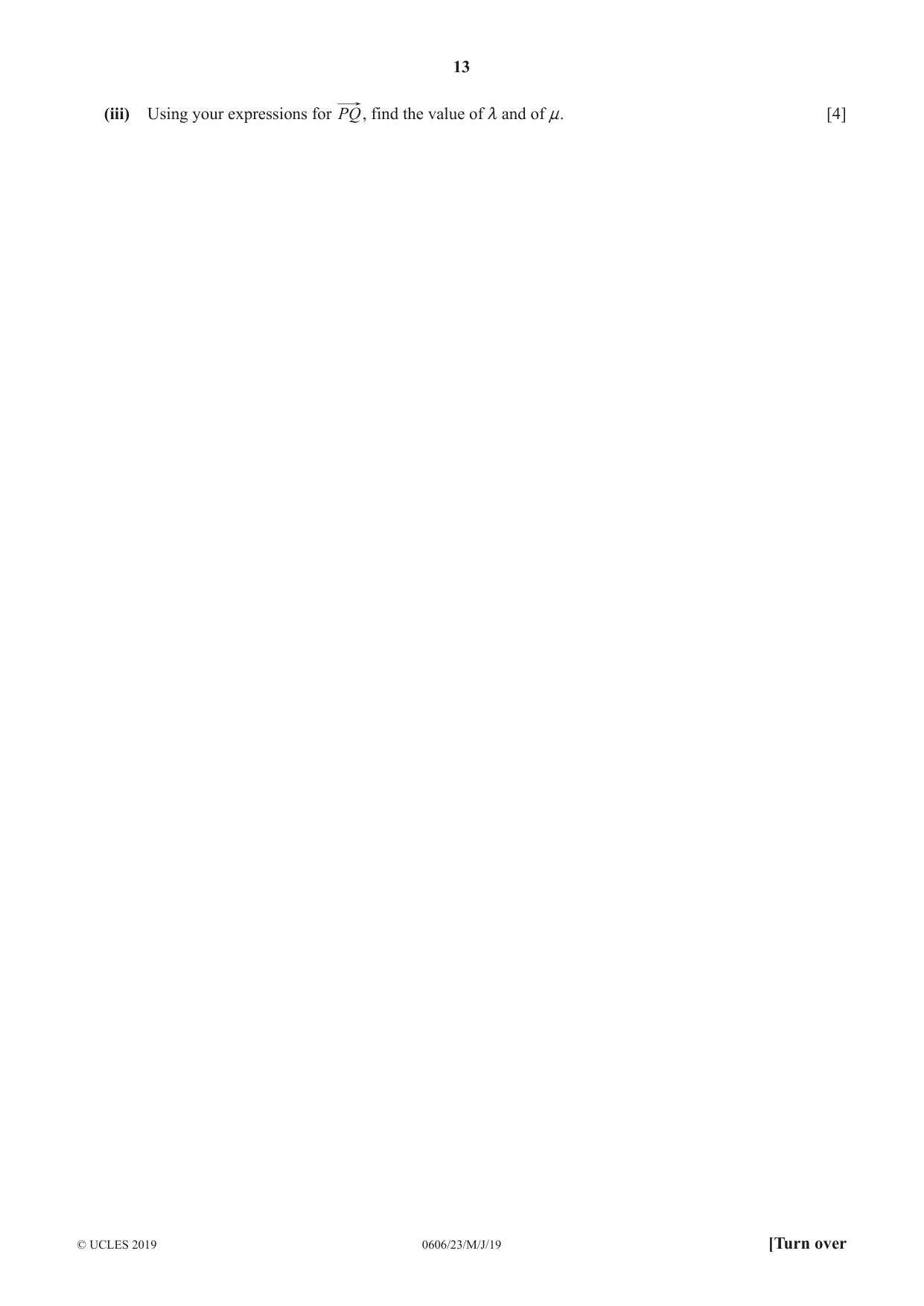
10 O q p Q P R B A The diagram shows a triangle OAB. The point P is the midpoint of OA and the point Q lies on OB such that 1 OQ = OB . The position vectors of P and Q relative to O are p and q respectively. 4 (i) Find, in terms of p and q, an expression for each of the vectors PQ, QA and PB. [3] (ii) Given that PR = mPB and that QR = n QA , find an expression for PQ in terms of m, n, p and q. [2] (iii) Using your expressions for PQ, find the value of m and of n. [4]
Mark scheme: JJJG 10(i) PQ = q − p B3 B2 for anyJJJG two correctJJJG or JJJG B1 for OA = 2p or OB = 4q soi QA = 2p − q JJJG PB = 4q − p JJJG JJJG JJJG JJJG 10(ii) PQ = λ(4q − p ) − µ(2p − q ) oe isw B2 B1 for PQ = λPB − µQA soi 10(iii) For equating the coefficients of p or q in M1 q − p = λ(4q − p ) − µ(2p − q ) 4λ+ µ= 1 oe A1 FT their (ii) provided in terms of λ, µ, p and q λ+ 2µ= 1 oe Solves their equations in λand µ M1 1 3 A1 λ= , µ= 7 7
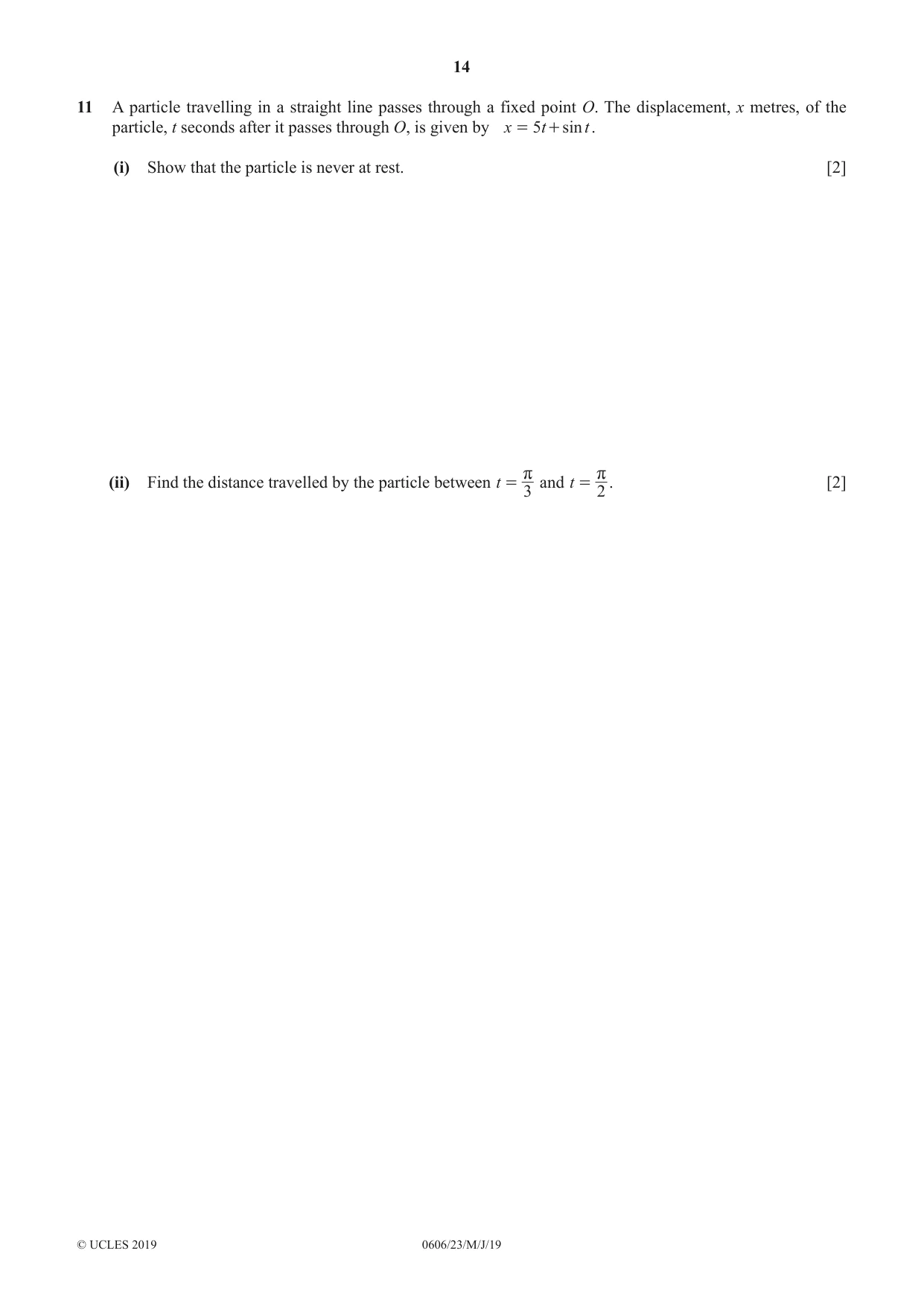
Q11 · A particle travelling in a straight line passes through a fixed point O
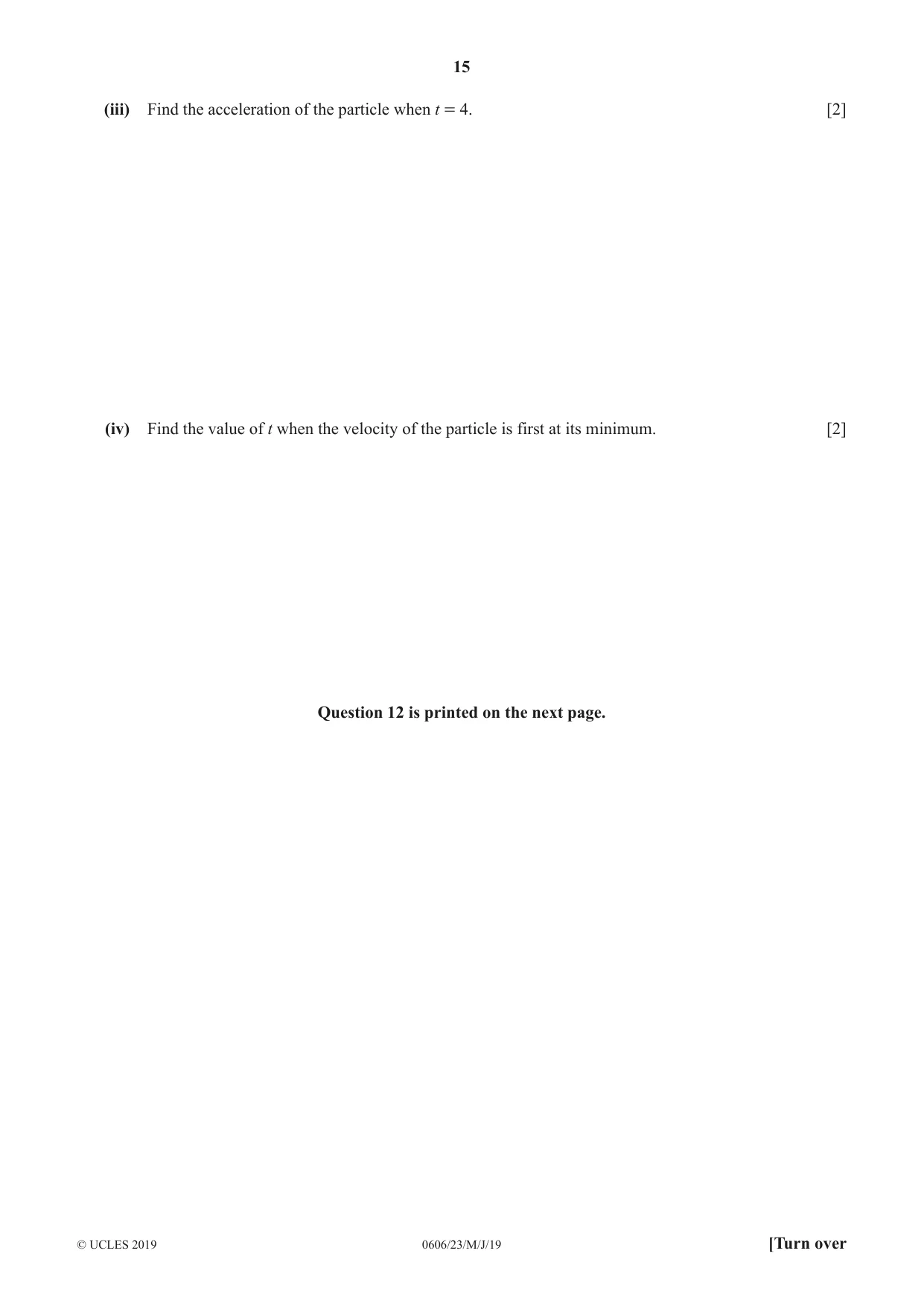
11 A particle travelling in a straight line passes through a fixed point O. The displacement, x metres, of the particle, t seconds after it passes through O, is given by x = 5t + sin t . (i) Show that the particle is never at rest. [2] (ii) Find the distance travelled by the particle between t = r and t = r . [2] 3 2 (iii) Find the acceleration of the particle when t = 4. [2] (iv) Find the value of t when the velocity of the particle is first at its minimum. [2] Question 12 is printed on the next page.
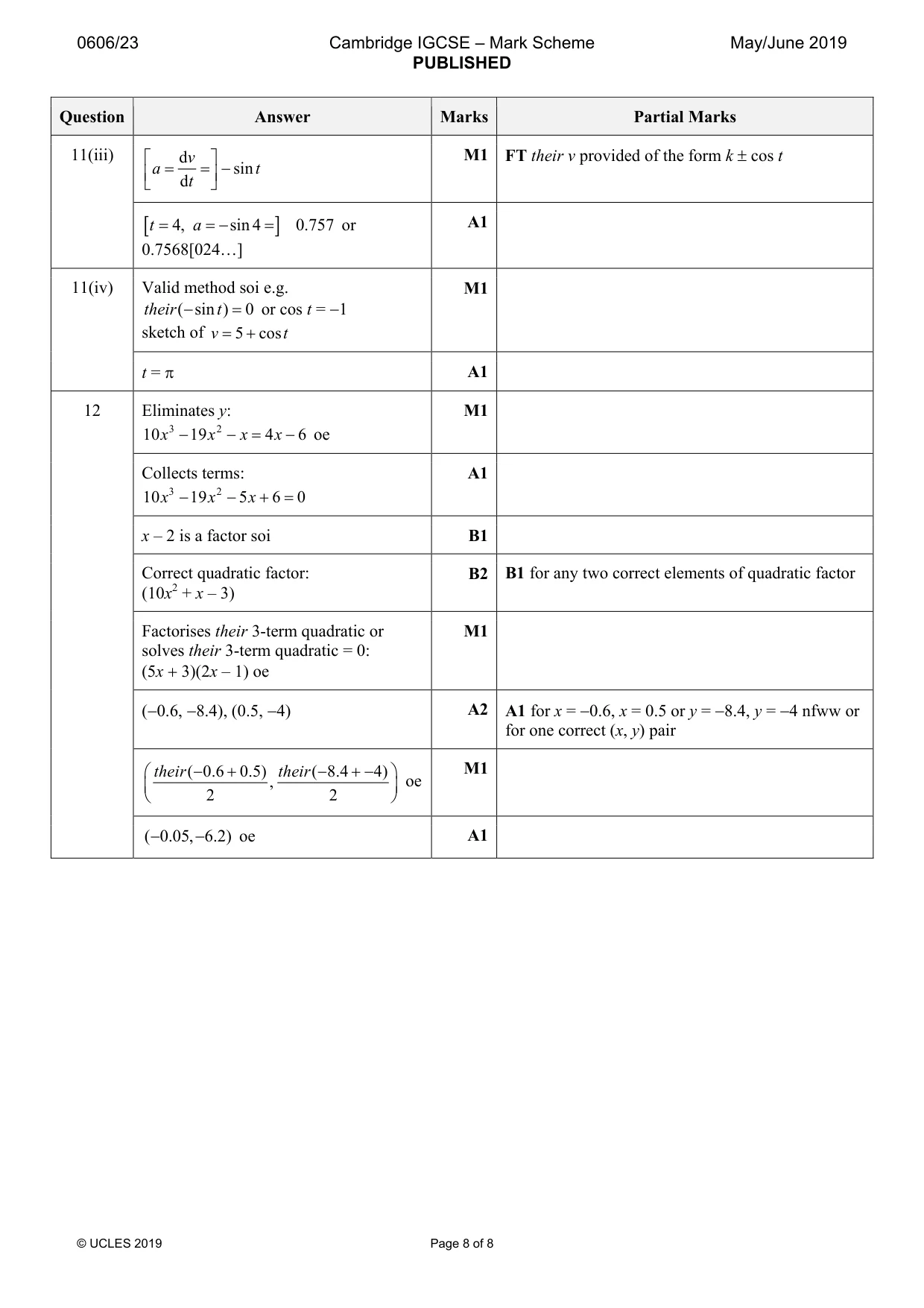
Mark scheme: 11(i) d x B1 v = = 5 + cos t d t 5 + cos t ≠ 0 (and so never at rest) oe B1 11(ii) π π M1 x = 5 + sin or 3 3 π π x = 5 + sin seen 2 2 2.75 to 2.752 A1 11(iii) d v M1 FT their v provided of the form k ± cos t a = = − sin t d t [ t = 4, a = − sin 4 = ] 0.757 or A1 0.7568[024…] 11(iv) Valid method soi e.g. M1 their ( − sin t ) = 0 or cos t = −1 sketch of v = 5 + cos t t = π A1
Q12 · Do not use a calculator in this question
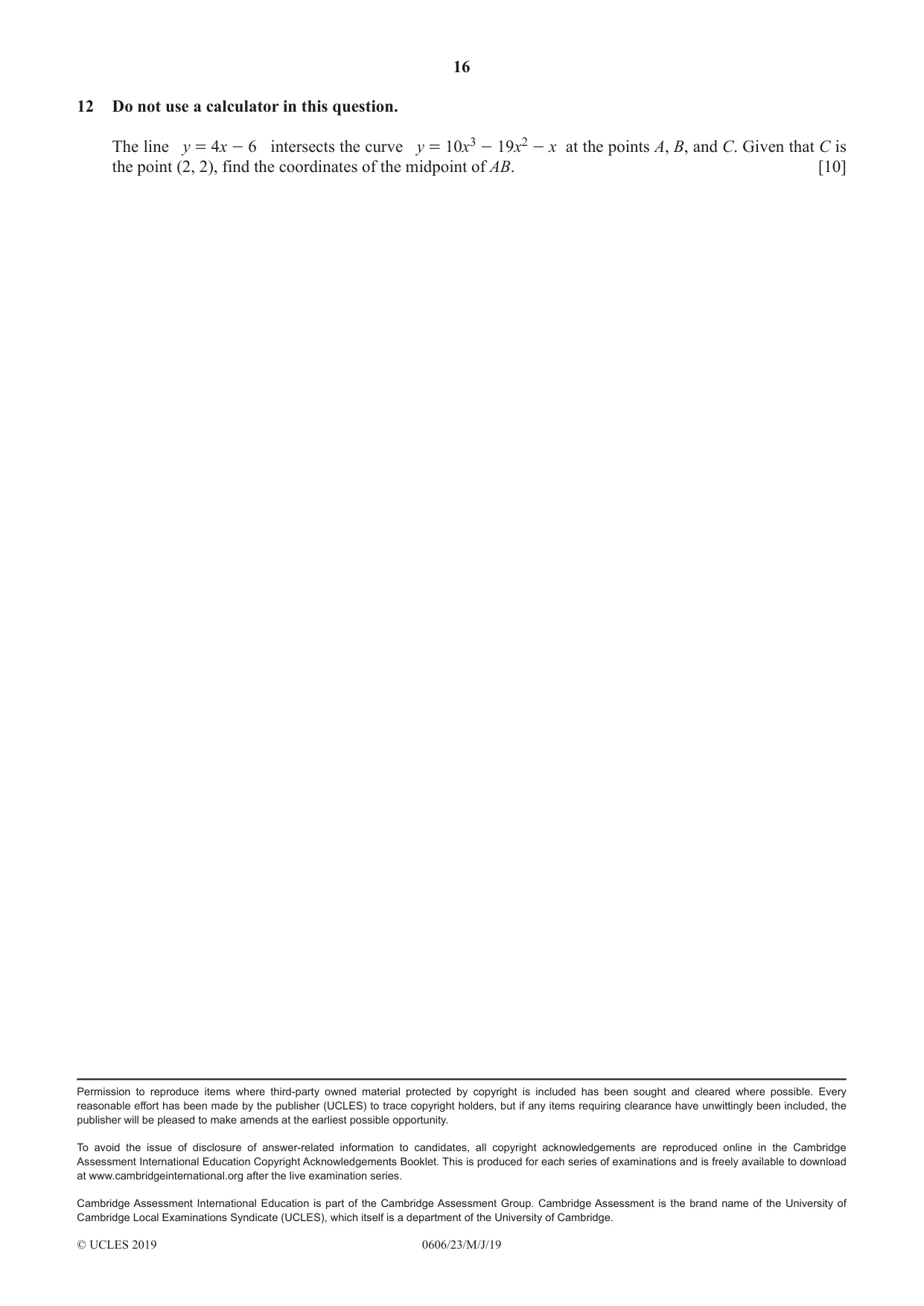
12 Do not use a calculator in this question. The line y = 4x - 6 intersects the curve y = 10x3 - 19x2 - x at the points A, B, and C. Given that C is the point (2, 2), find the coordinates of the midpoint of AB. [10]
Mark scheme: 12 Eliminates y: M1 10 x 3 − 19 x 2 − x = 4 x − 6 oe Collects terms: A1 10 x 3 − 19 x 2 − 5 x + 6 = 0 x – 2 is a factor soi B1 Correct quadratic factor: B2 B1 for any two correct elements of quadratic factor (10x2 + x – 3) Factorises their 3-term quadratic or M1 solves their 3-term quadratic = 0: (5x + 3)(2x – 1) oe (−0.6, −8.4), (0.5, −4) A2 A1 for x = −0.6, x = 0.5 or y = −8.4, y = −4 nfww or for one correct (x, y) pair their ( − 0.6 + 0.5) their ( − 8.4 + − 4) M1 , oe 2 2 ( −0.05, −6.2) oe A1
What was in this paper
The subtopics covered by these 11 questions, and how many questions each got. Open one in a new tab to see every Cambridge question on it.
1Draw and use the graphs of1Evaluate definite integrals and apply1Find the magnitude of a vector; add and1Find the solution set for quadratic inequalities1Solve cubic equations1Solve problems involving the arc length and1Understand and use vector notation1Understand the idea of a derived function1Use the binomial theorem for expansion of1Use the equation of a straight line1What you needed in this session
Cambridge’s own grade thresholds for 2019 May/June, Paper 2 · Variant 3. A higher threshold means an easier paper — the bar moves with how the cohort did.