Cambridge IGCSE Mathematics - Additional 0606 — 2020 Oct/Nov Paper 2 · Variant 3
0606/23/O/N/20 · 10 questions · 80 marks · ≈90 min
The question paper and its mark scheme, free to read here and free to download. This is Cambridge’s own paper, exactly as it was sat.
Question paper16 pages






Mark scheme8 pages
Answers below. Sit the paper first if you are practising.
Questions as text
Q2 · Solve the simultaneous equations
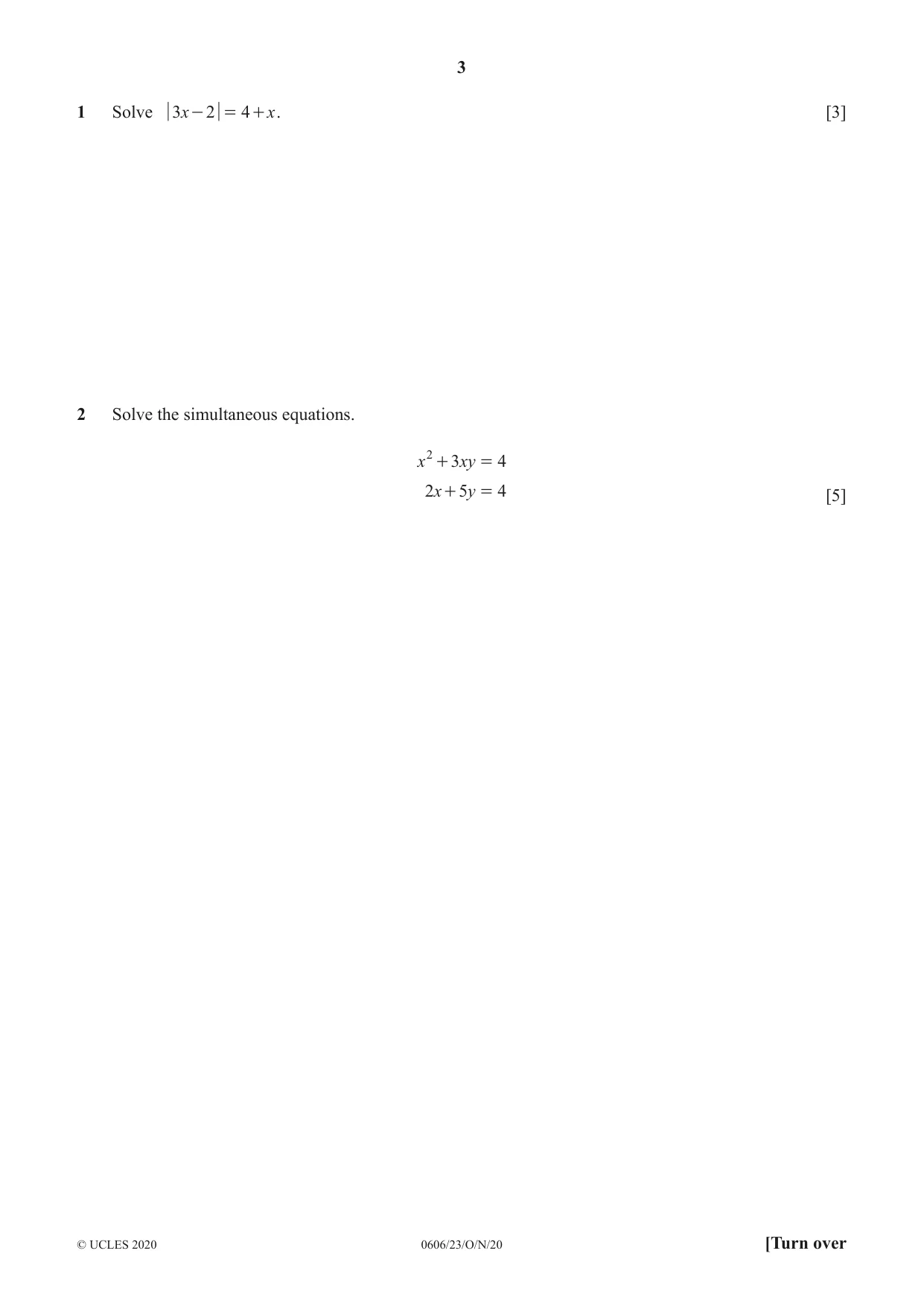
2 Solve the simultaneous equations. x 2 + 3xy = 4 2x + 5y = 4 [5]
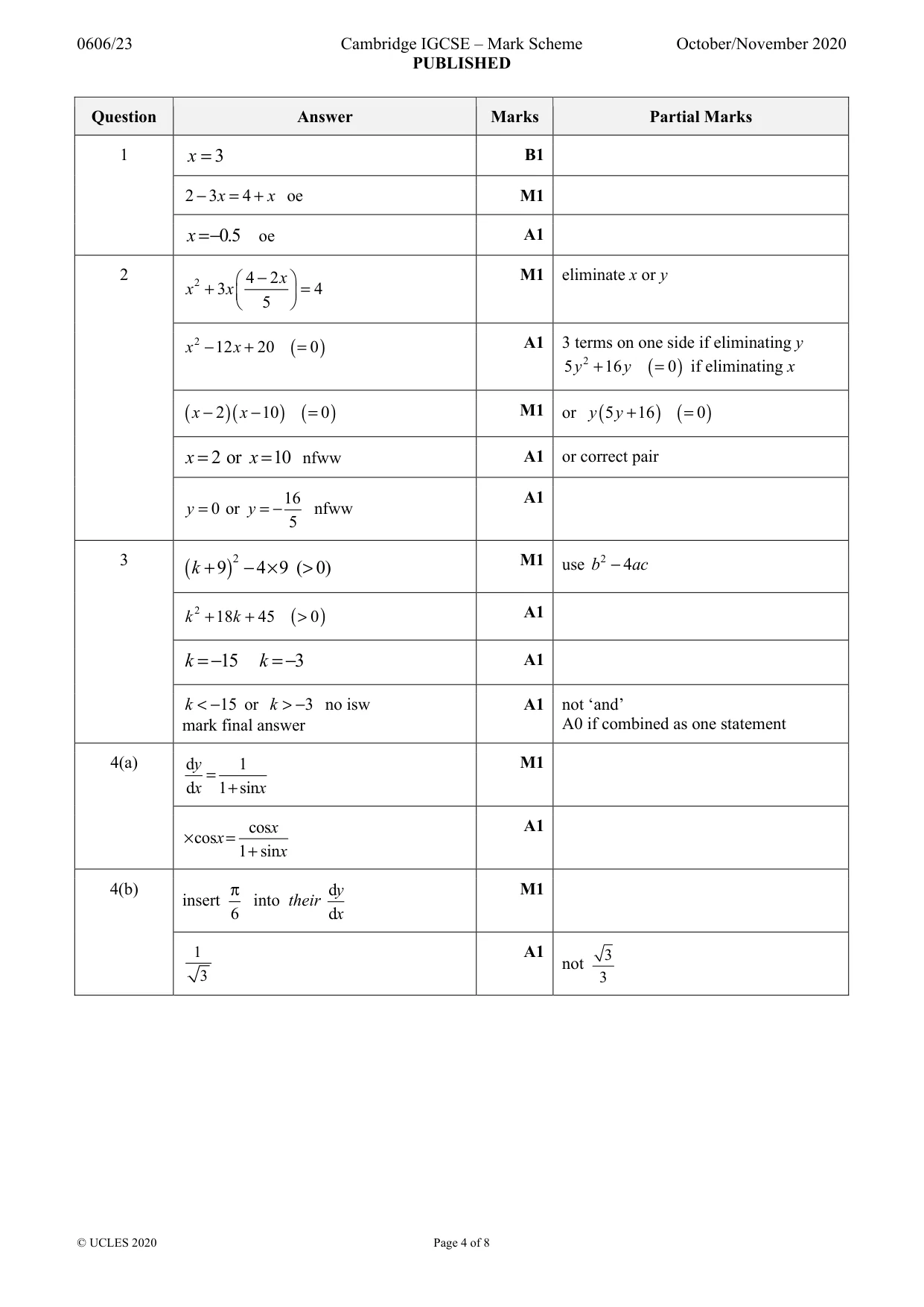
Mark scheme: 2 2 4 − 2 x M1 eliminate x or y x + 3 x = 4 5 x 2 − 12 x + 20 ( = 0 ) A1 3 terms on one side if eliminating y 5 y 2 + 16 y ( = 0 ) if eliminating x ( x − 2 )( x − 10 ) ( = 0 ) M1 or y ( 5 y + 16 ) ( = 0 ) x = 2 or x = 10 nfww A1 or correct pair 16 A1 y = 0 or y = − nfww 5
Q3 · Find the values of k for which the equation x 2 + ( k + 9) x + 9 = 0 has two distinct…
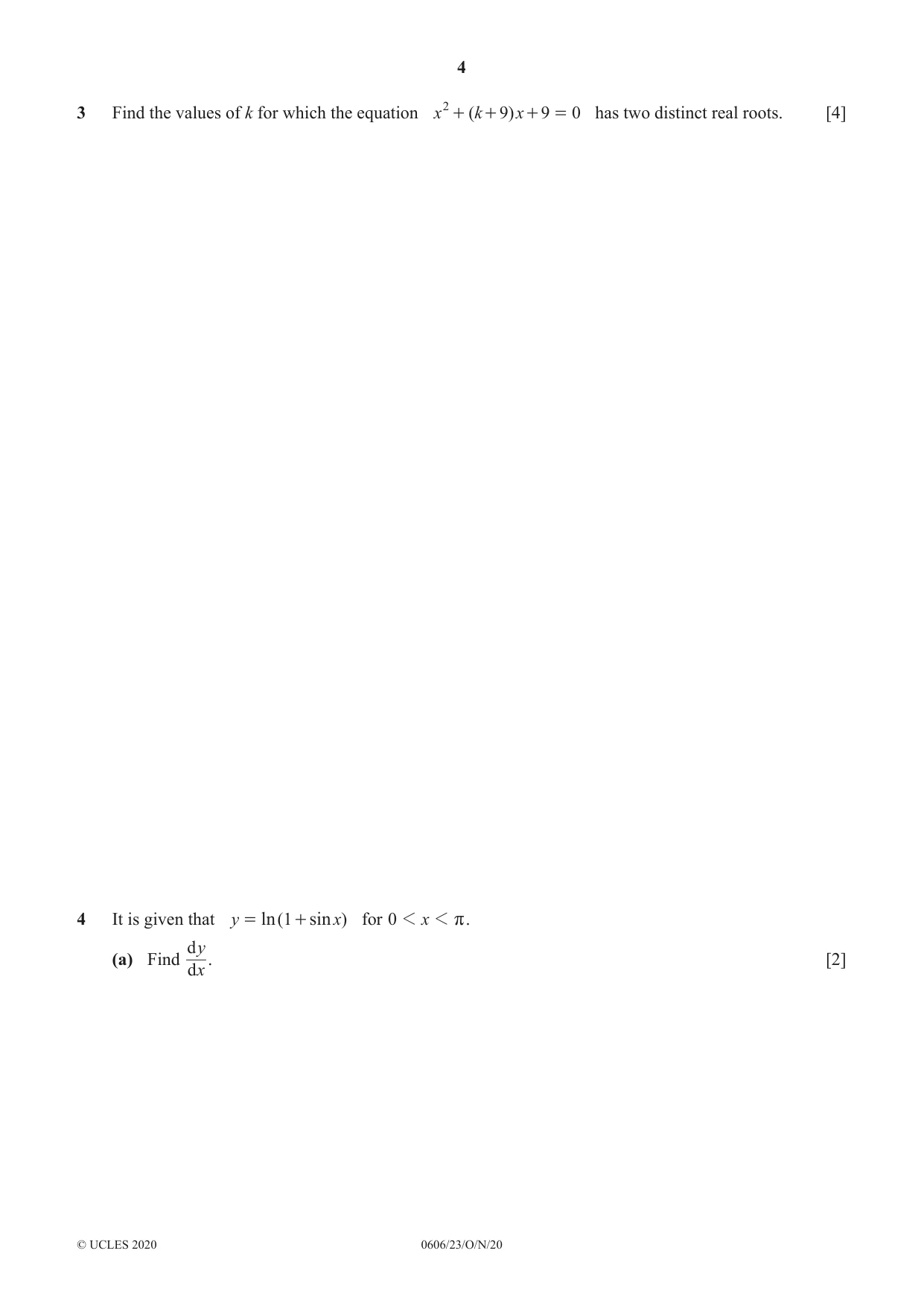
3 Find the values of k for which the equation x 2 + ( k + 9) x + 9 = 0 has two distinct real roots. [4]
Mark scheme: 3 use b 2 − 4 ac ( k + 9 ) 2 −×4 9 ( > 0) M1 k 2 + 18 k + 45 ( > 0 ) A1 k =−15 k =−3 A1 k < −15 or k > −3 no isw A1 not ‘and’ mark final answer A0 if combined as one statement
Q4 · It is given that y = ln ( 1 + sin x) for 0 1 x 1 r
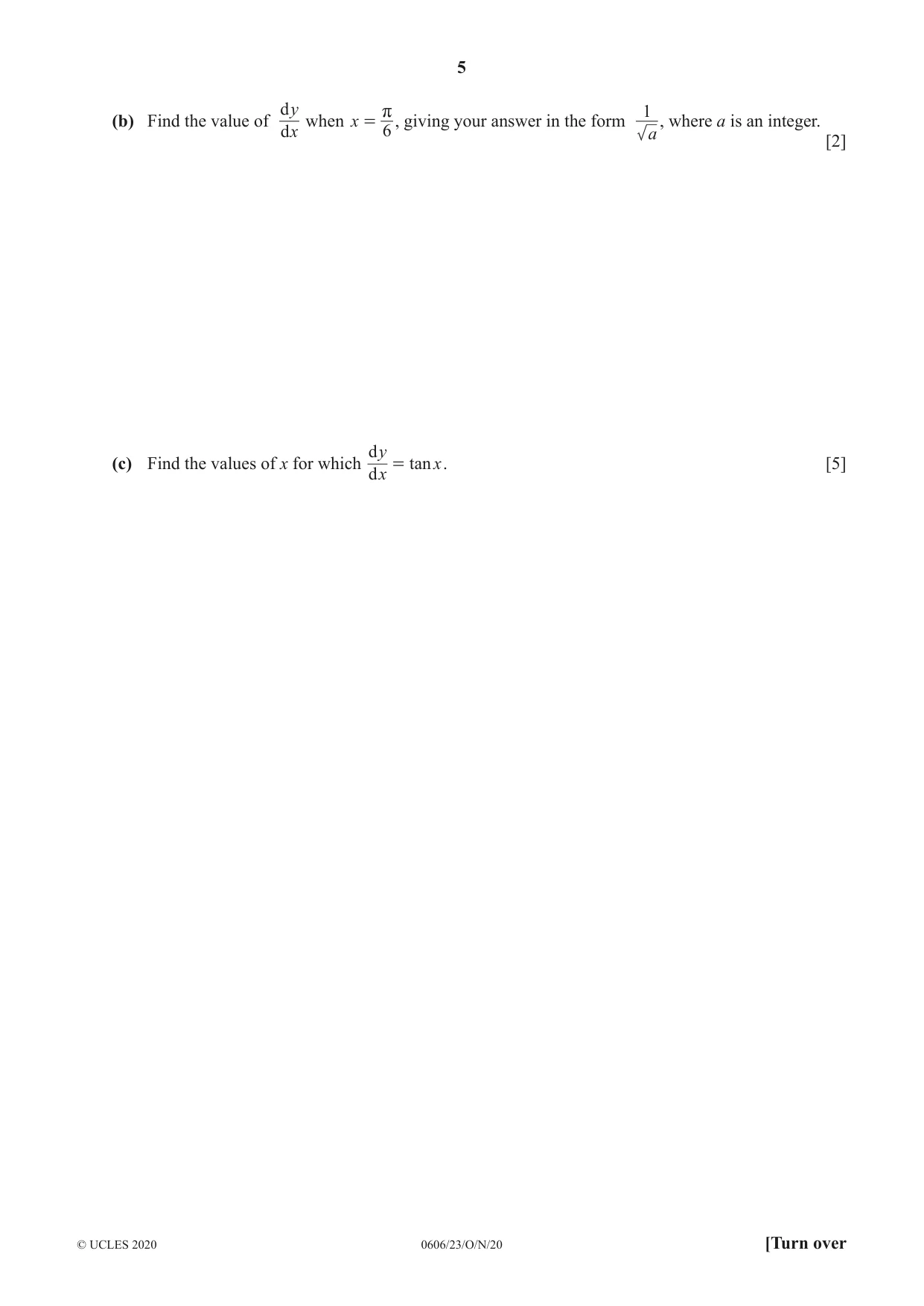
4 It is given that y = ln ( 1 + sin x) for 0 1 x 1 r. d y. [2] (a) Find d x d y r 1(b) Find the value of when x = , giving your answer in the form , where a is an integer. d x 6 a [2] d y (c) Find the values of x for which = tan x . [5] d x
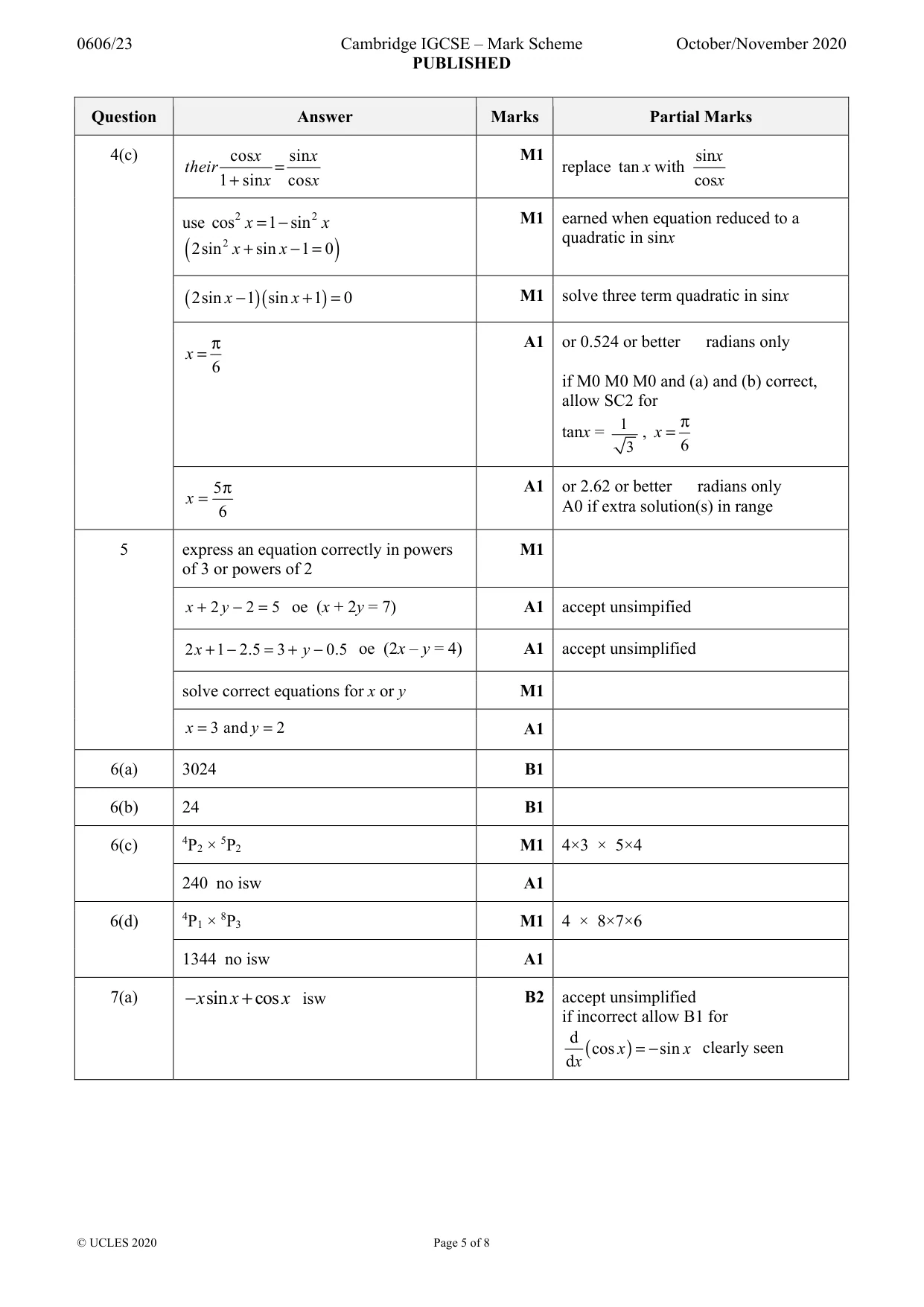
Mark scheme: 4(a) dy 1 M1 = dx 1 + sinx cosx A1 × cosx = 1 + sinx 4(b) π dy M1 insert into their 6 dx 1 A1 3 not 3 3 4(c) cos x sin x M1 sinx their = replace tan x with 1 + sin x cos x cos x use cos 2 x = 1 − sin 2 x M1 earned when equation reduced to a 2 quadratic in sinx 2sin x + sin x −=1 0 ( ) ( 2sin x − 1)( sin x + 1) = 0 M1 solve three term quadratic in sinx π A1 or 0.524 or better radians only x = 6 if M0 M0 M0 and (a) and (b) correct, allow SC2 for 1 π tanx = , x = 3 6 5 π A1 or 2.62 or better radians only x = A0 if extra solution(s) in range 6
Q5 · Solve the following simultaneous equations
5 Solve the following simultaneous equations. 3 x # 9 y - 1 = 243 1 2 x + 1 y - 2 2 8 # 2 = [5] 4 2
Mark scheme: 5 express an equation correctly in powers M1 of 3 or powers of 2 x + 2 y − 2 = 5 oe (x + 2y = 7) A1 accept unsimpified 2 x + 1 − 2.5 = 3 + y − 0.5 oe (2x – y = 4) A1 accept unsimplified solve correct equations for x or y M1 x = 3 and y = 2 A1
Q6 · A 4-digit code is to be formed using 4 different numbers selected from 1, 2, 3, 4, 5, 6…
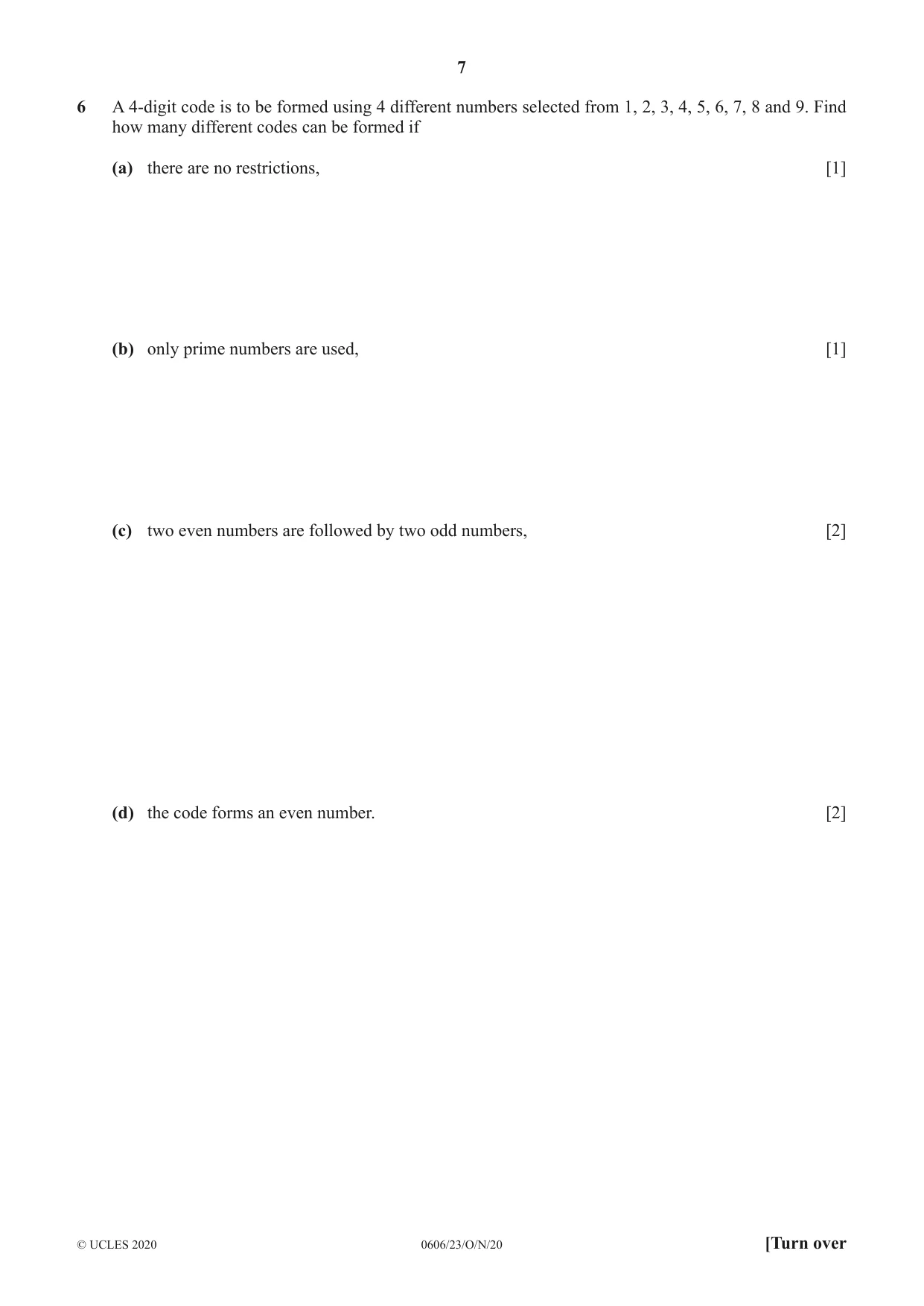
6 A 4-digit code is to be formed using 4 different numbers selected from 1, 2, 3, 4, 5, 6, 7, 8 and 9. Find how many different codes can be formed if (a) there are no restrictions, [1] (b) only prime numbers are used, [1] (c) two even numbers are followed by two odd numbers, [2] (d) the code forms an even number. [2]
Mark scheme: 6(a) 3024 B1 6(b) 24 B1 6(c) 4P2 × 5P2 M1 4×3 × 5×4 240 no isw A1 6(d) 4P1 × 8P3 M1 4 × 8×7×6 1344 no isw A1
More questions on Solve problems on arrangement and selection
Q7 · A curve has equation y = x cos x
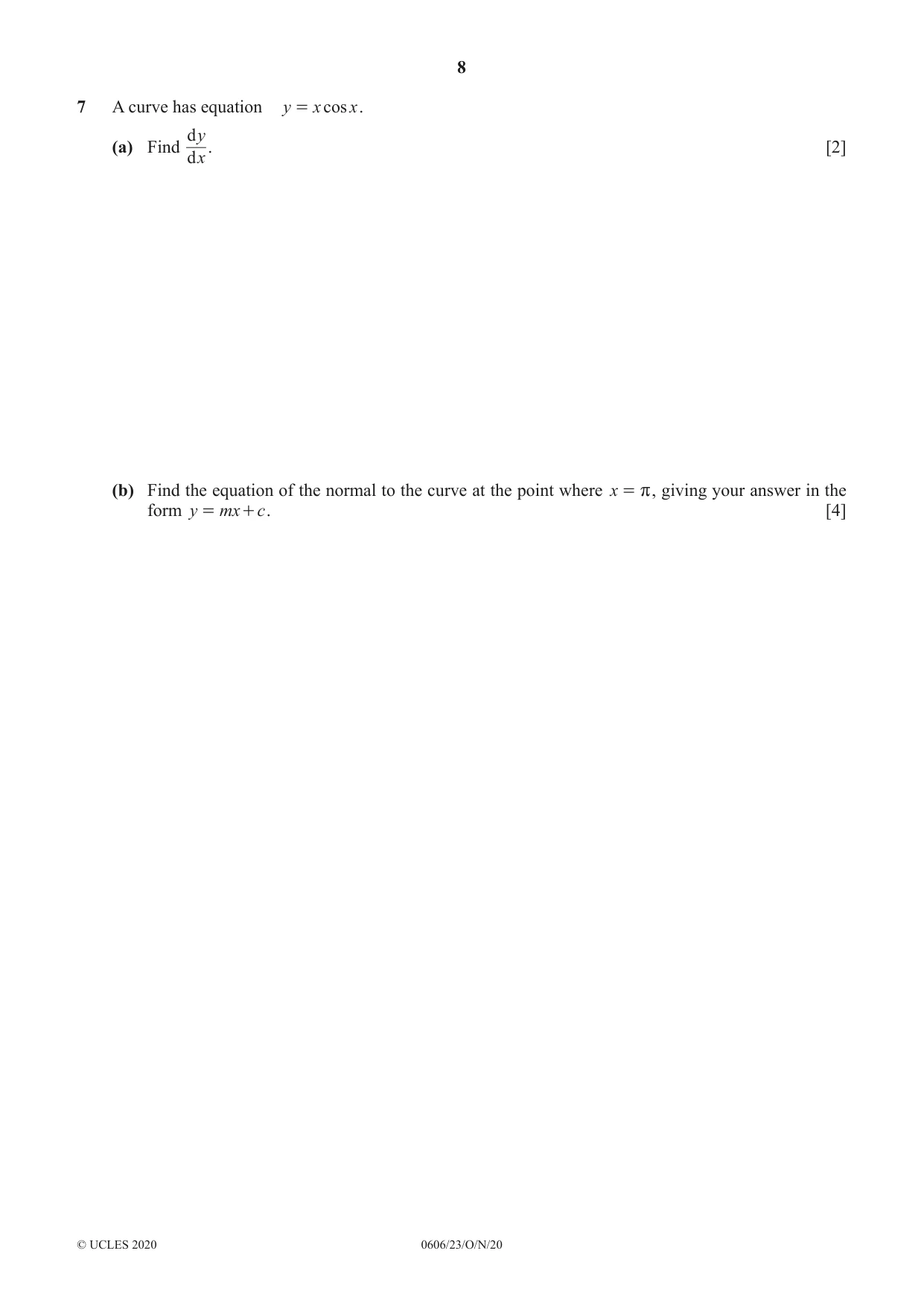
7 A curve has equation y = x cos x . d y. [2] (a) Find d x (b) Find the equation of the normal to the curve at the point where x = r , giving your answer in the form y = mx + c . [4] r (c) Using your answer to part (a), find the exact value of x sin x d x . [5] 6y0
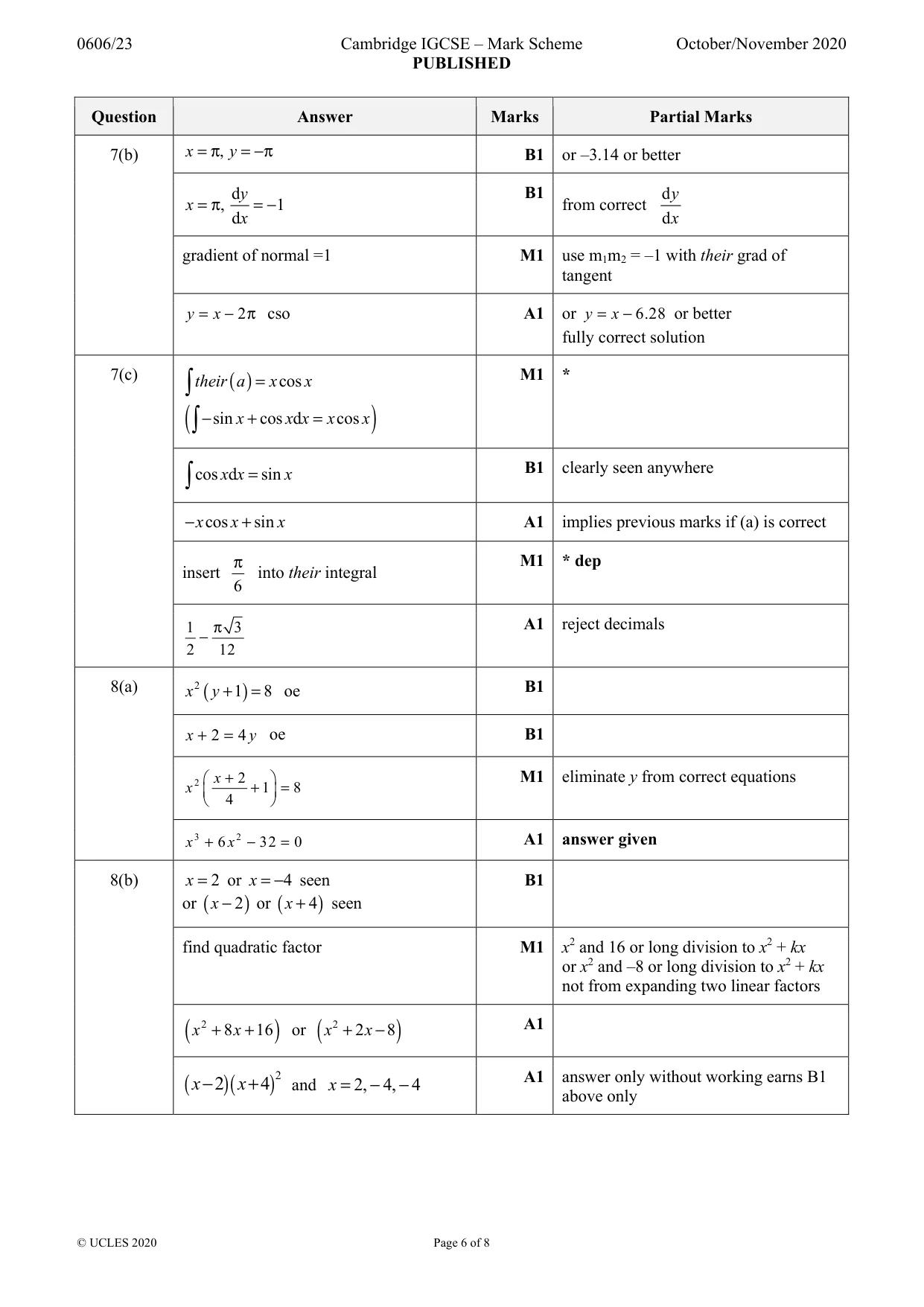
Mark scheme: 7(a) − x sin x + cos x isw B2 accept unsimplified if incorrect allow B1 for d ( cos x ) = − sin x clearly seen d x 7(b) x = π, y = −π B1 or –3.14 or better d y B1 d y x = π, = − 1 from correct d x d x gradient of normal =1 M1 use m1m2 = –1 with their grad of tangent y = x −π2 cso A1 or y = x − 6.28 or better fully correct solution their ( a ) = x cos x7(c) M1 * − sin x + cos xd x = x cos x ( ) B1 clearly seen anywhere cos xdx = sin x − x cos x + sin x A1 implies previous marks if (a) is correct π M1 * dep insert into their integral 6 1 3 A1 reject decimals −π 2 12
Q8 · DO NOT USE A CALCULATOR IN THIS QUESTION
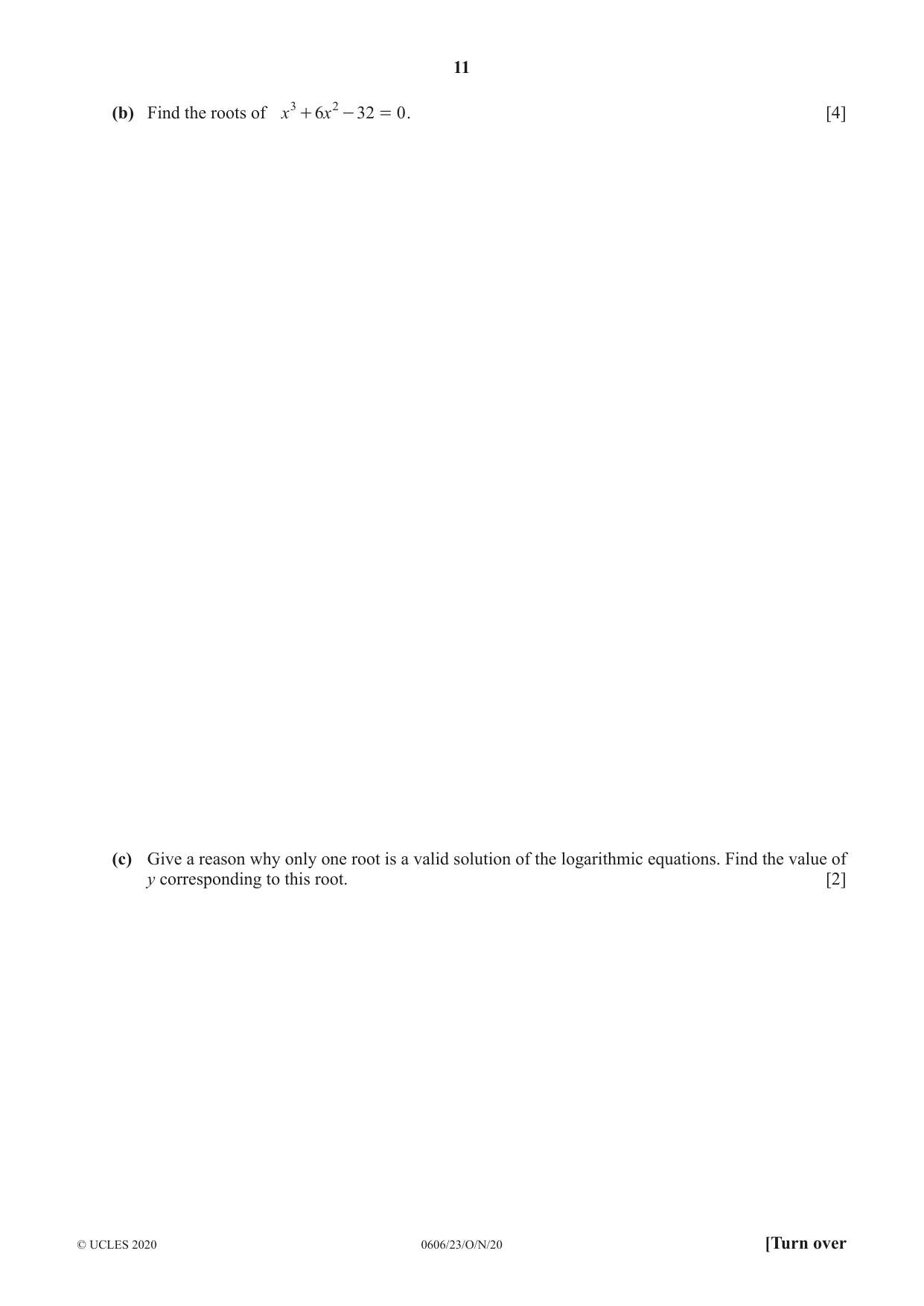
8 DO NOT USE A CALCULATOR IN THIS QUESTION. log 2 ( y + 1) = 3 - 2 log 2 x log 2 ( x + 2) = 2 + log 2 y (a) Show that x 3 + 6x 2 - 32 = 0 . [4] (b) Find the roots of x 3 + 6x 2 - 32 = 0 . [4] (c) Give a reason why only one root is a valid solution of the logarithmic equations. Find the value of y corresponding to this root. [2]
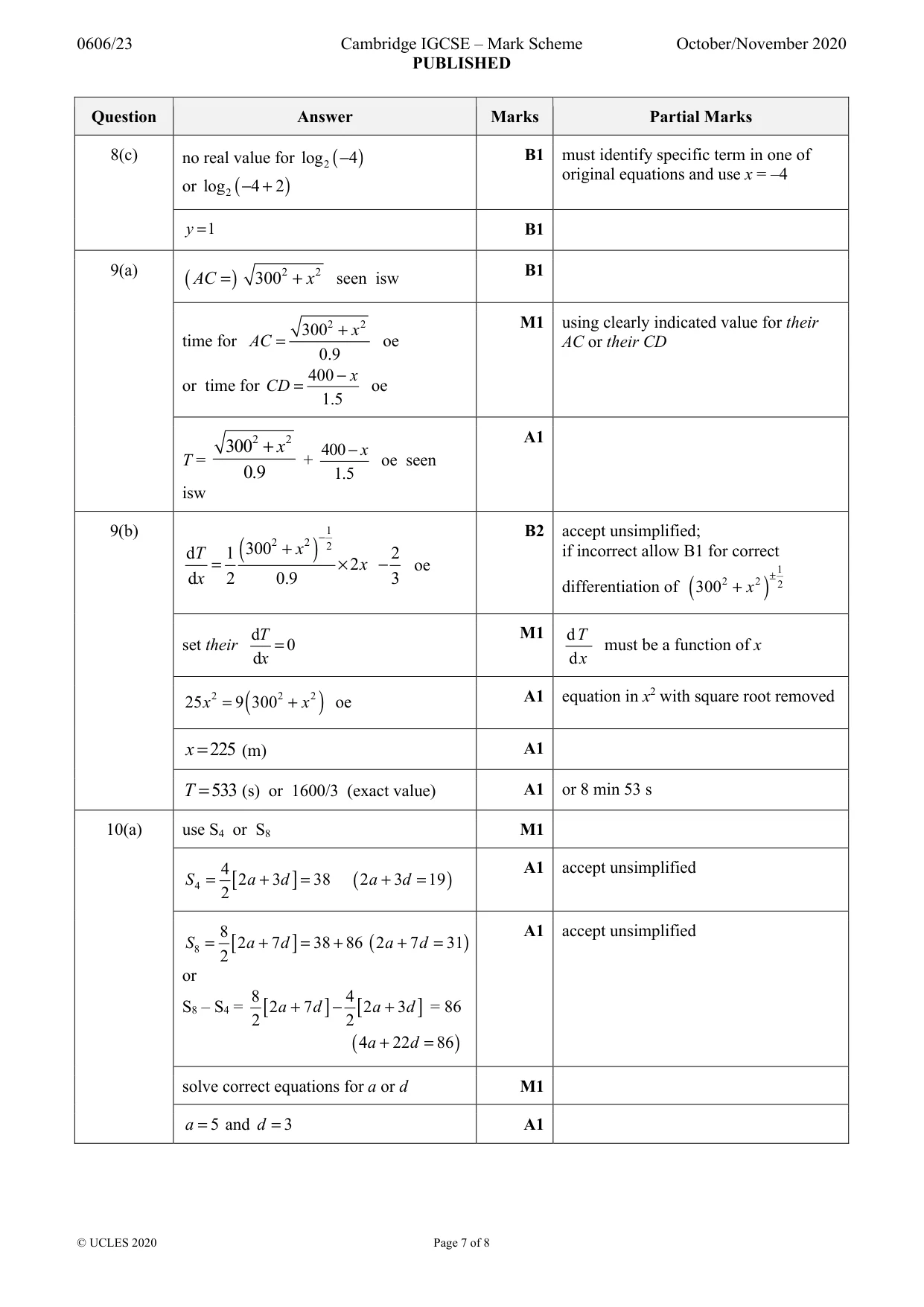
Mark scheme: 8(a) x 2 ( y + 1) = 8 oe B1 x + 2 = 4 y oe B1 2 x + 2 M1 eliminate y from correct equations x + 1 = 8 4 x 3 + 6 x 2 − 32 = 0 A1 answer given 8(b) x = 2 or x = −4 seen B1 or ( x − 2 ) or ( x + 4 ) seen find quadratic factor M1 x2 and 16 or long division to x2 + kx or x2 and –8 or long division to x2 + kx not from expanding two linear factors 2 2 A1 x + 8 x + 16 or x + 2 x − 8 ( ) ( ) 2 A1 answer only without working earns B1 ( x − 2)( x + 4) and x = 2, − 4, − 4 above only 8(c) no real value for log 2 ( −4 ) B1 must identify specific term in one of original equations and use x = –4 or log 2 ( −+4 2 ) y = 1 B1
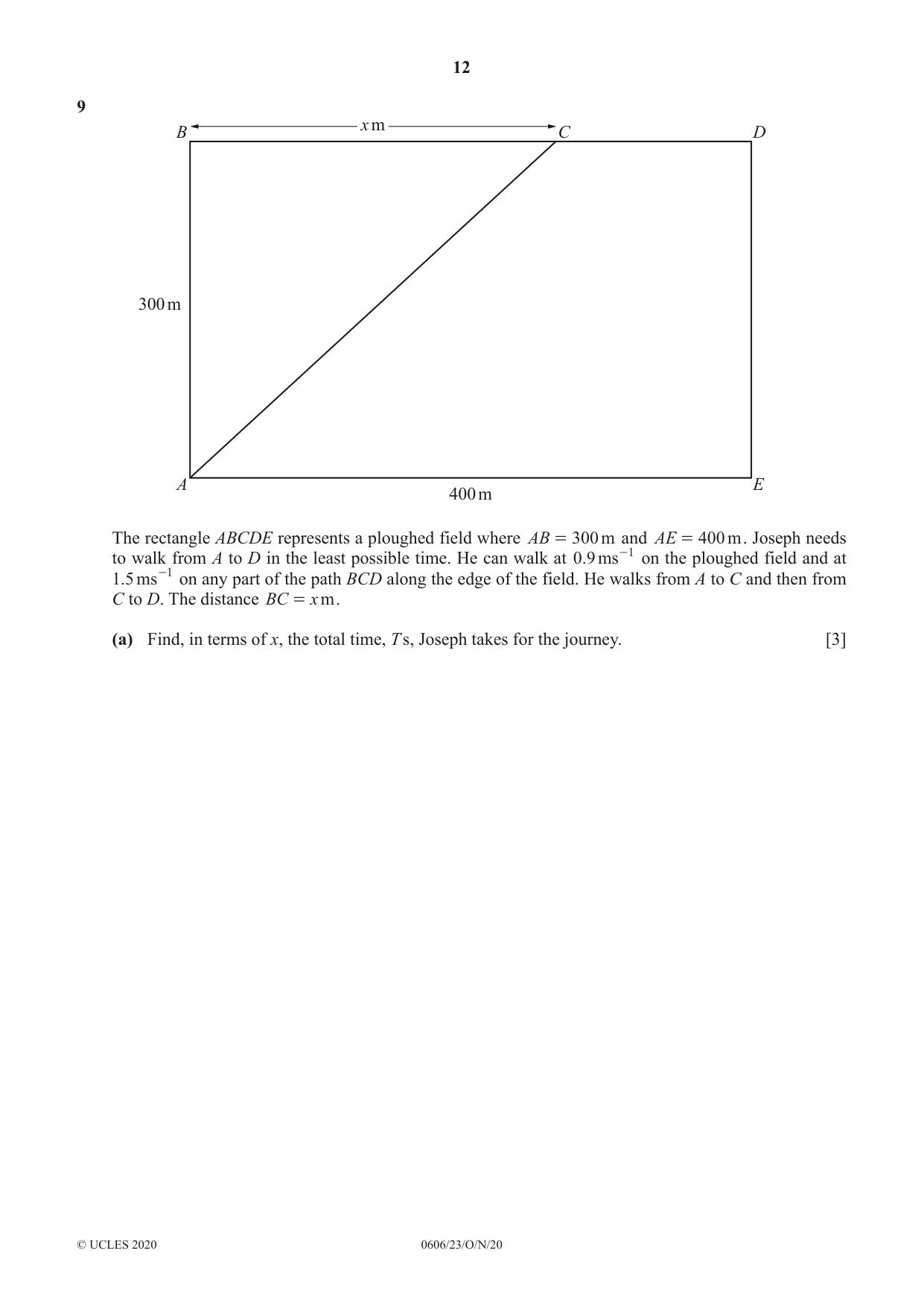
Q9 · X m B C D 300 m A E 400 m The rectangle ABCDE represents a ploughed field where AB = 300…
9 x m B C D 300 m A E 400 m The rectangle ABCDE represents a ploughed field where AB = 300 m and AE = 400 m . Joseph needs to walk from A to D in the least possible time. He can walk at 0.9 ms -1 on the ploughed field and at 1.5 ms -1 on any part of the path BCD along the edge of the field. He walks from A to C and then from C to D. The distance BC = x m . (a) Find, in terms of x, the total time, T s, Joseph takes for the journey. [3] (b) Given that x can vary, find the value of x for which T is a minimum and hence find the minimum value of T. [6]
Mark scheme: 9(a) 2 2 B1 ( AC = ) 300 + x seen isw 2 2 M1 using clearly indicated value for their 300 + x time for AC = oe AC or their CD 0.9 400 − x or time for CD = oe 1.5 2 2 A1 300 + x 400 − x T = + oe seen 0.9 1.5 isw 9(b) − 1 B2 accept unsimplified; 2 2 if incorrect allow B1 for correct dT 1 ( 300 2 + x 2 ) = × 2 x − oe 1 dx 2 0.9 3 2 2 ± 2 differentiation of 300 + x ( ) dT M1 d T set their = 0 must be a function of x dx d x 2 2 2 A1 equation in x2 with square root removed 25 x = 9 300 + x oe ( ) x = 225 (m) A1 T = 533 (s) or 1600/3 (exact value) A1 or 8 min 53 s
More questions on Use differentiation to find stationary points
Q10 · The sum of the first 4 terms of an arithmetic progression is 38 and the sum of the next 4…
10 (a) The sum of the first 4 terms of an arithmetic progression is 38 and the sum of the next 4 terms is 86. Find the first term and the common difference. [5] (b) The third term of a geometric progression is 12 and the sixth term is - 96 . Find the sum of the first 10 terms of this progression. [6] Question 11 is printed on the next page.
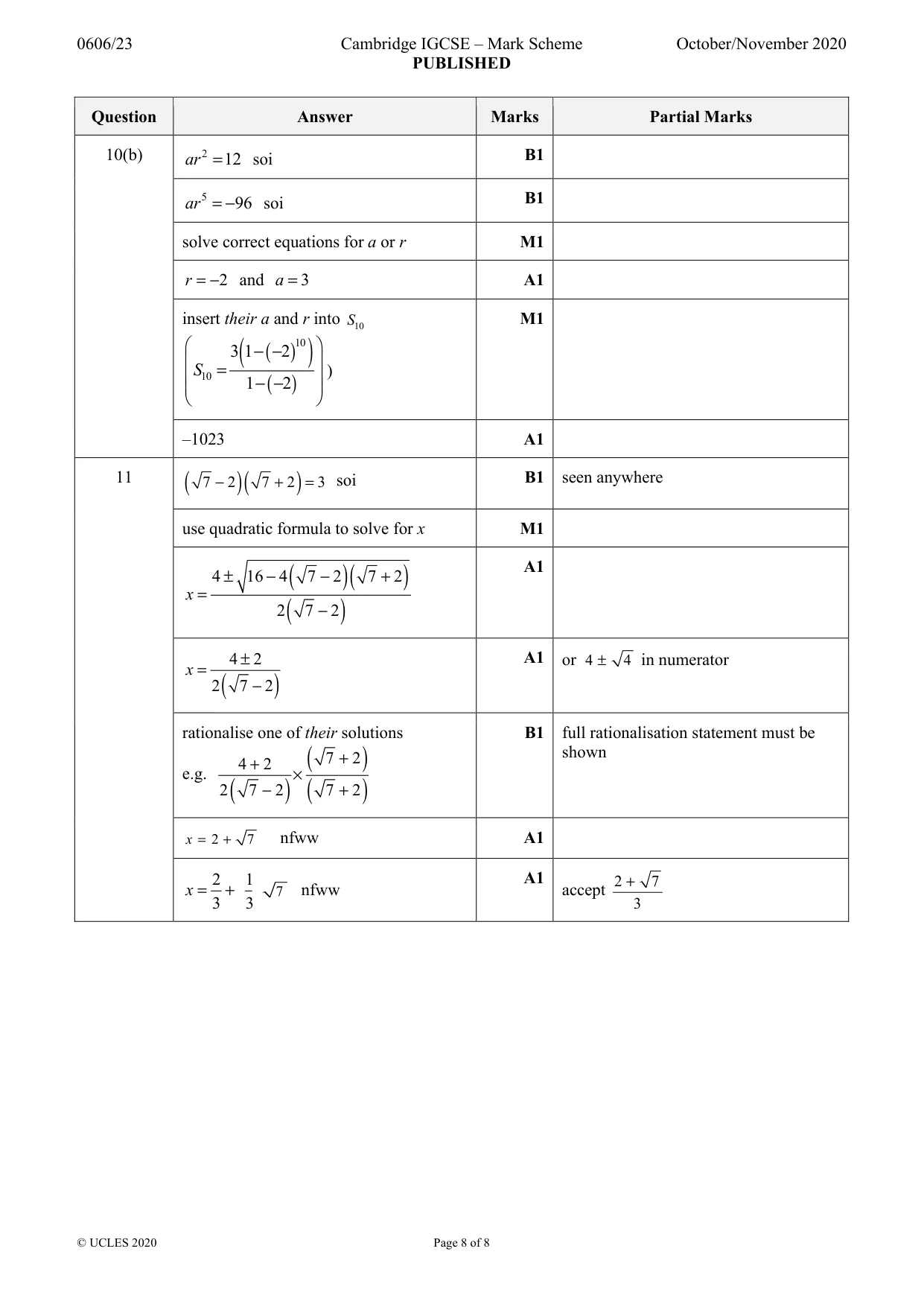
Mark scheme: 10(a) use S4 or S8 M1 4 A1 accept unsimplified S 4 = [ 2 a + 3d ] = 38 ( 2 a + 3d = 19 ) 2 8 A1 accept unsimplified S 8 = [ 2 a + 7 d ] = 38 + 86 ( 2 a + 7 d = 31) 2 or 8 4 S8 – S4 = [ 2 a + 7 d ] − [ 2 a + 3 d ] = 86 2 2 ( 4 a + 22 d = 86 ) solve correct equations for a or d M1 a = 5 and d = 3 A1 10(b) ar 2 = 12 soi B1 ar 5 = −96 soi B1 solve correct equations for a or r M1 r = − 2 and a = 3 A1 insert their a and r into S10 M1 10 3 1 −−( 2 ) ( ) S10 = ) 1 −−( 2 ) –1023 A1
More questions on Use the formulas for the nth term and for the
Q11 · DO NOT USE A CALCULATOR IN THIS QUESTION
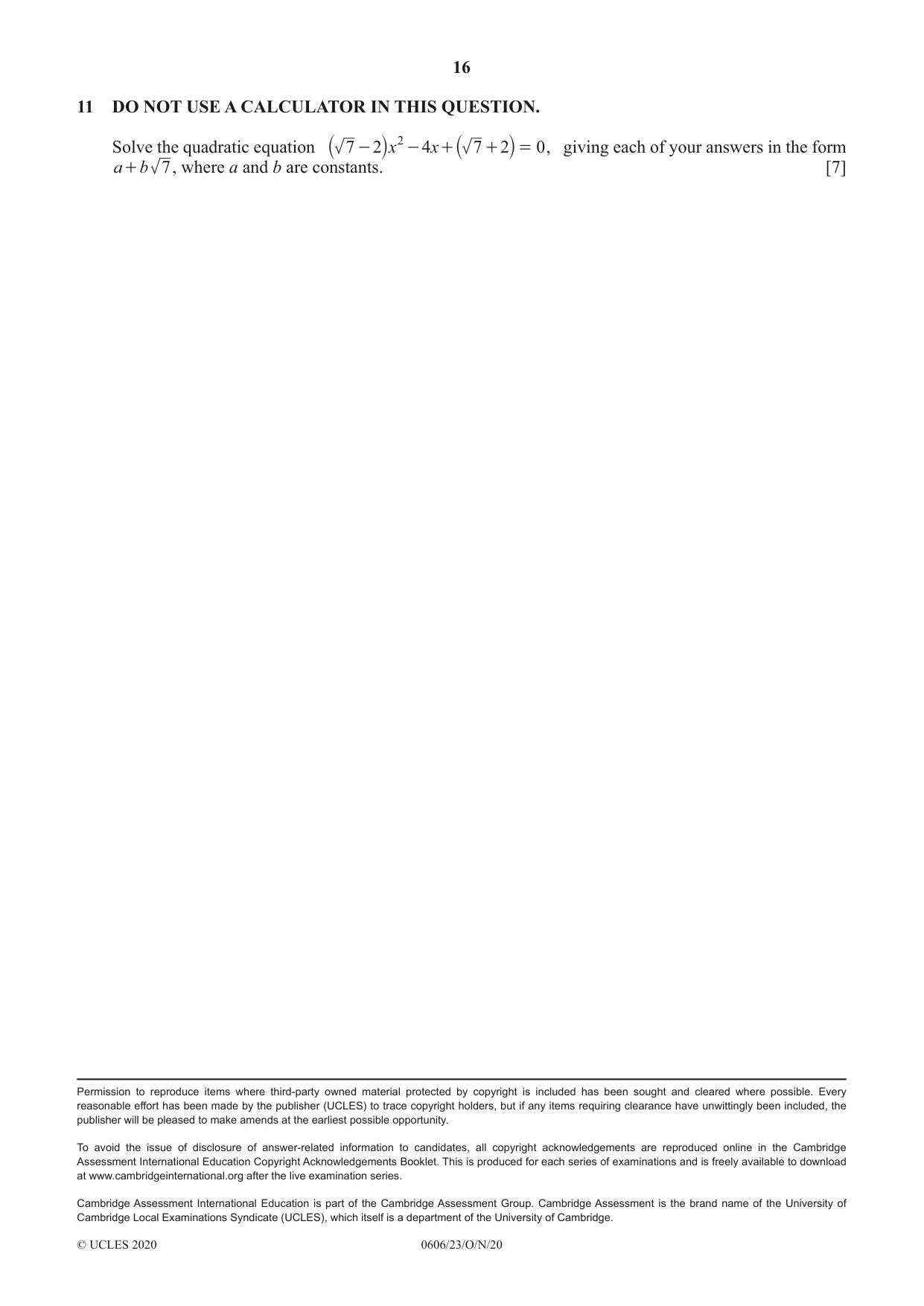
11 DO NOT USE A CALCULATOR IN THIS QUESTION. Solve the quadratic equation 7 - 2 x 2 - 4x + 7 + 2 = 0 , giving each of your answers in the form ` j ` j a + b 7 , where a and b are constants. [7]
Mark scheme: 7 − 2 7 + 2 = 3 soi B1 seen anywhere11 ( )( ) use quadratic formula to solve for x M1 A1 4 ± 16 − 4 7 − 2 7 + 2 ( )( ) x = 2 7 − 2 ( ) 4 ± 2 A1 or 4 ± 4 in numerator x = 2 7 − 2 ( ) rationalise one of their solutions B1 full rationalisation statement must be shown 7 + 2 4 + 2 ( ) e.g. × 2 7 − 2 7 + 2 ( ) ( ) x = 2 + 7 nfww A1 2 1 A1 2 + 7 x = + 7 nfww accept 3 3 3
What was in this paper
The subtopics covered by these 10 questions, and how many questions each got. Open one in a new tab to see every Cambridge question on it.
2Apply differentiation and integration1Know and use the laws of logarithms1Know the conditions for f(x) = 0 to have1Solve problems on arrangement and selection1Solve quadratic equations for real roots1Solve, for a given domain, trigonometric1Use differentiation to find stationary points1Use the formulas for the nth term and for the1What you needed in this session
Cambridge’s own grade thresholds for 2020 Oct/Nov, Paper 2 · Variant 3. A higher threshold means an easier paper — the bar moves with how the cohort did.