Cambridge IGCSE Mathematics - Additional 0606 — 2021 May/June Paper 2 · Variant 2
0606/22/M/J/21 · 12 questions · 80 marks · ≈90 min
The question paper and its mark scheme, free to read here and free to download. This is Cambridge’s own paper, exactly as it was sat.
Question paper16 pages
Mark scheme10 pages
Answers below. Sit the paper first if you are practising.
Questions as text
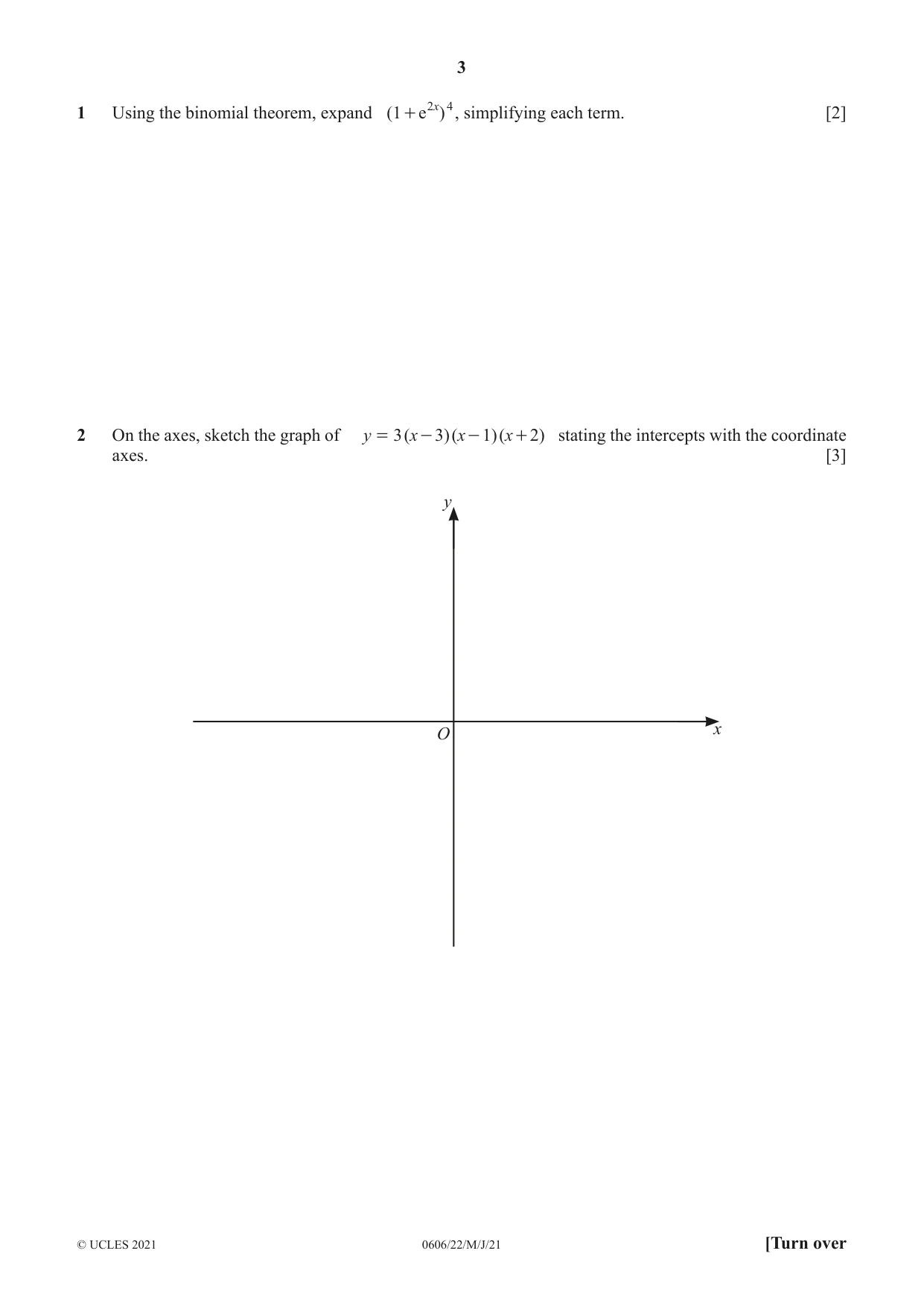
Q1 · Using the binomial theorem, expand ( 1 + e 2 x) 4 , simplifying each term
1 Using the binomial theorem, expand ( 1 + e 2 x) 4 , simplifying each term. [2]
Mark scheme: Question Answer Marks Partial Marks 1 1 + 4e 2 x + 6e 4 x + 4e 6 x + e 8 x B2 mark final answer for B2 B1 for any 3 correct simplified terms in a sum or all 5 simplified terms listed but not summed or for a correct, simplified expansion that is not their final answer or M1 for a correct unsimplified expansion e.g. 2 x 4 × 3 2 x 2 4 × 3 × 2 2 x 3 2 x 4 1 + 4e + (e ) + (e ) + (e ) 2 6 If 0 scored, SC1 for a complete, correct, simplified expansion as final answer found by multiplying out the brackets
Q2 · On the axes, sketch the graph of y = 3 ( x - 3)( x - 1)( x + 2) stating the intercepts…
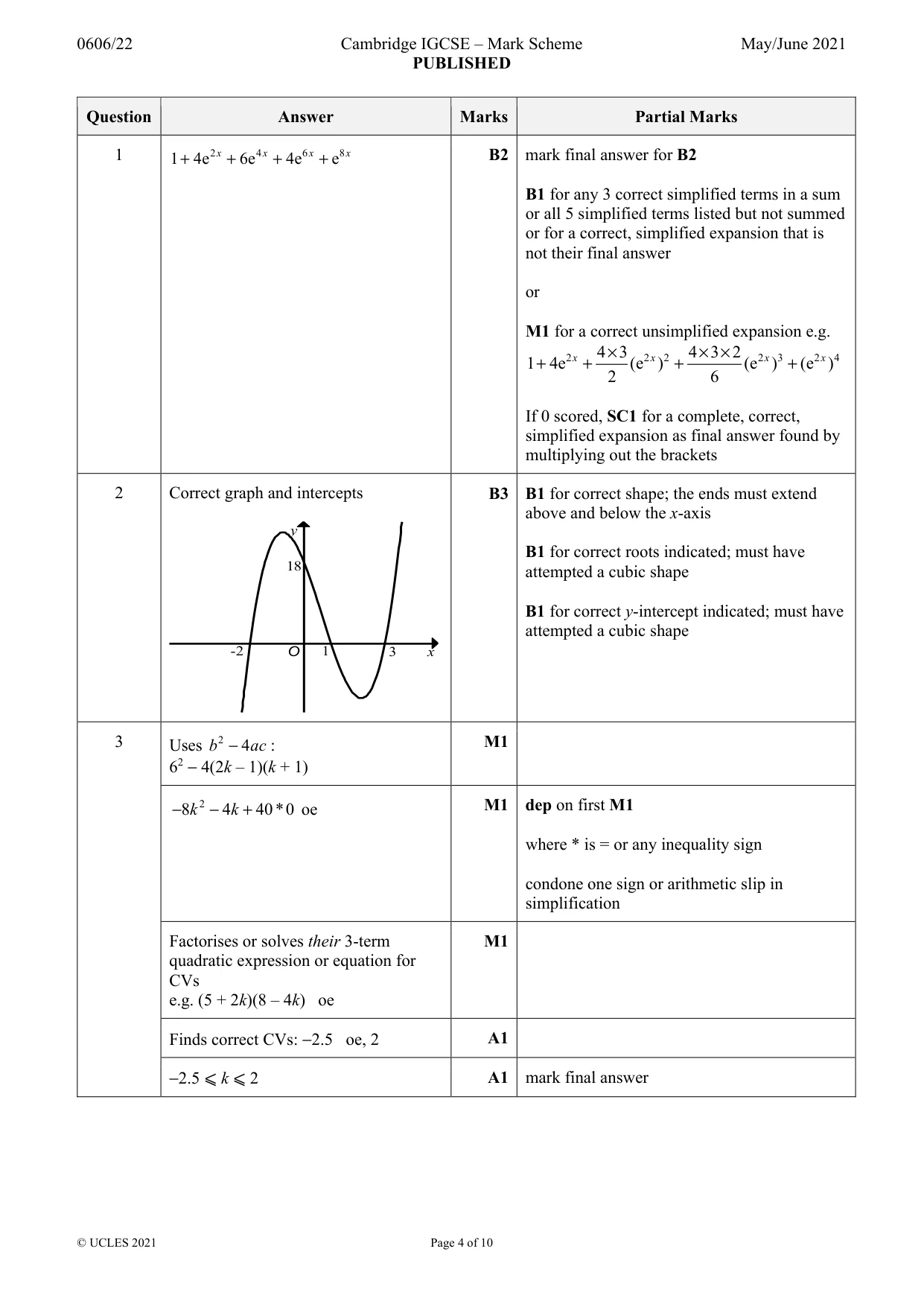
2 On the axes, sketch the graph of y = 3 ( x - 3)( x - 1)( x + 2) stating the intercepts with the coordinate axes. [3] y x O
Mark scheme: 2 Correct graph and intercepts B3 B1 for correct shape; the ends must extend above and below the x-axis y B1 for correct roots indicated; must have 18 attempted a cubic shape B1 for correct y-intercept indicated; must have attempted a cubic shape -2 O 1 3 x
More questions on Sketch the graphs of cubic polynomials and
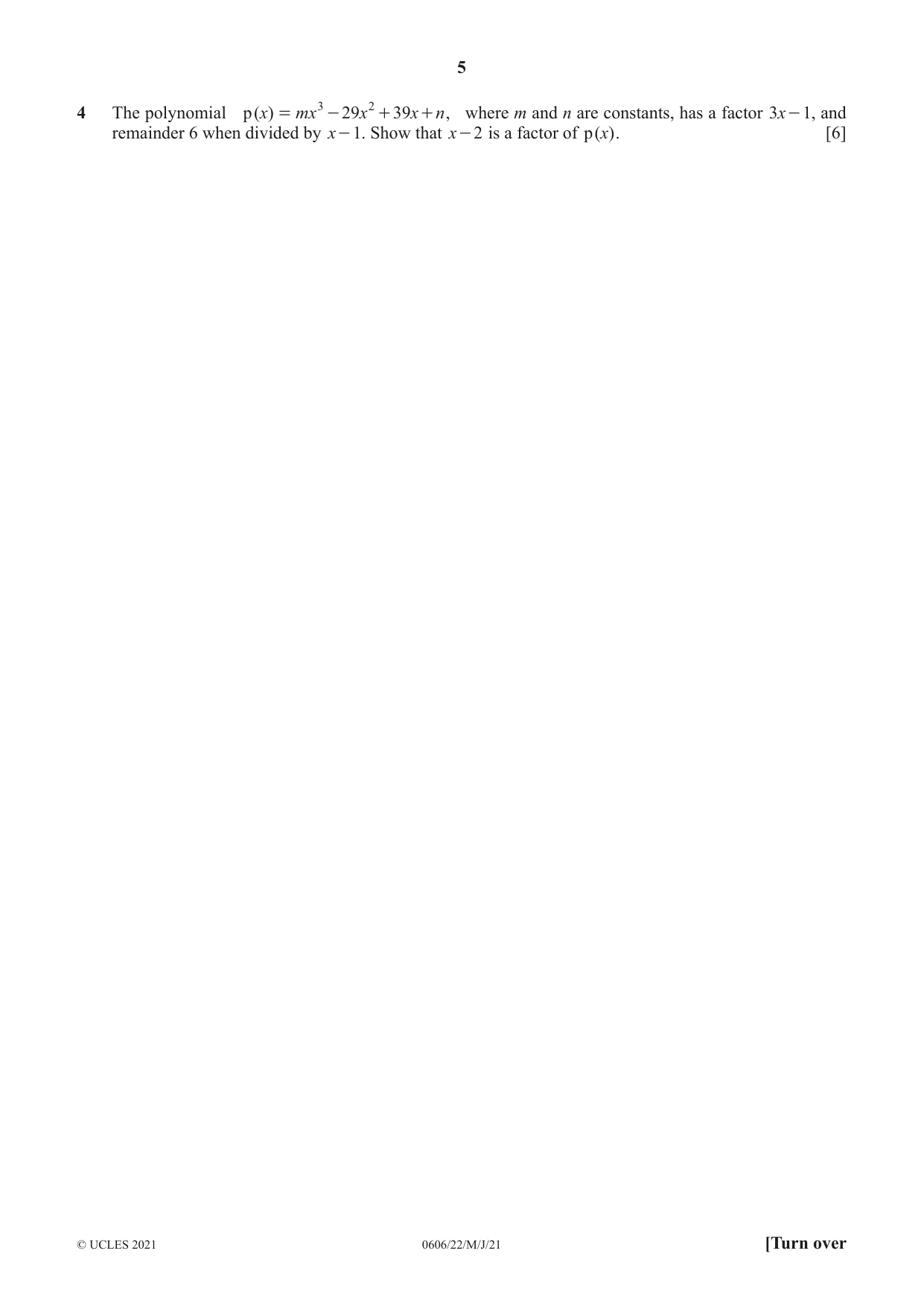
Q4 · The polynomial p ( x) = mx 3 - 29 x 2 + 39x + n , where m and n are constants, has a…
4 The polynomial p ( x) = mx 3 - 29 x 2 + 39x + n , where m and n are constants, has a factor 3x - 1, and remainder 6 when divided by x - 1. Show that x - 2 is a factor of p ( x) . [6]
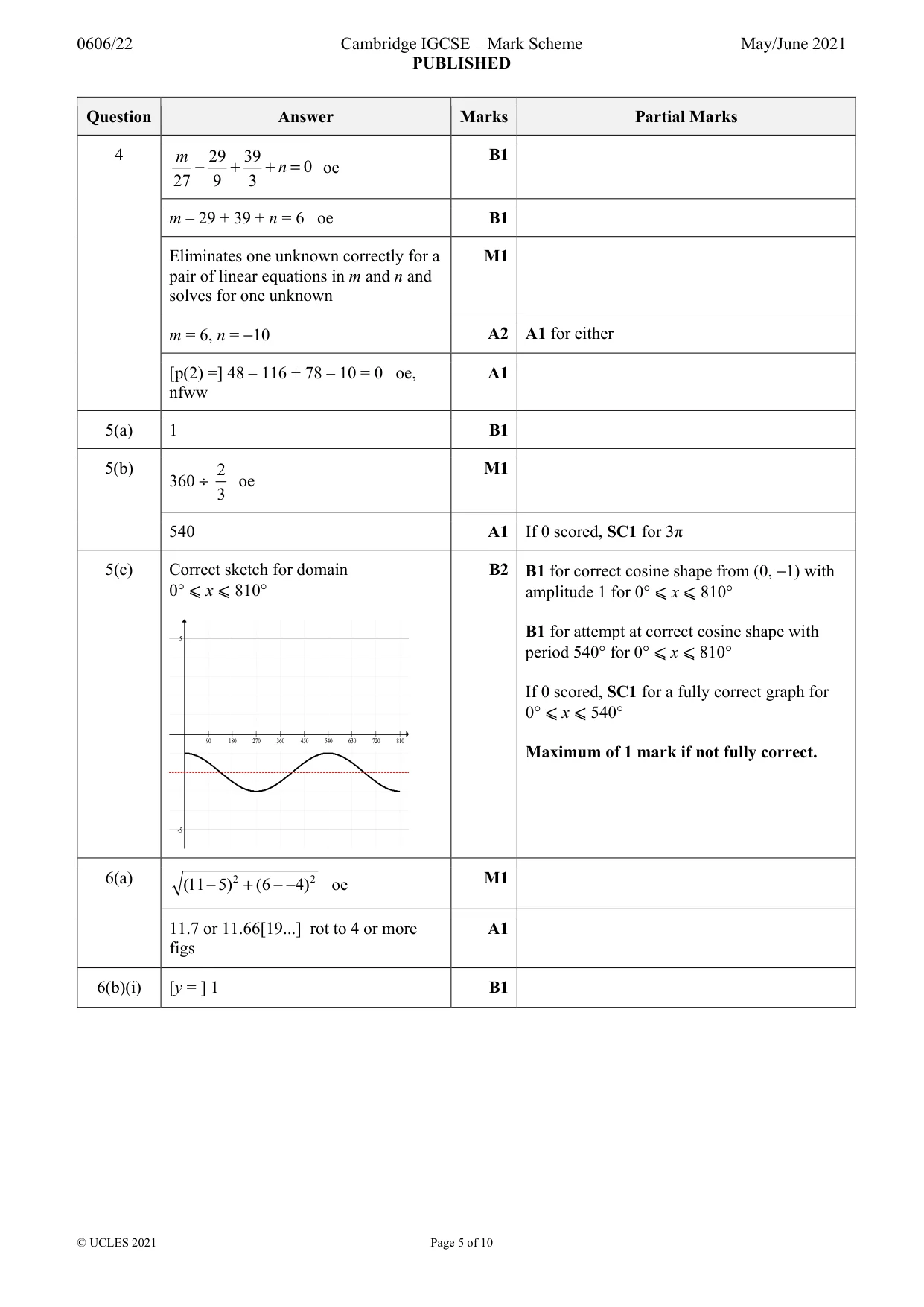
Mark scheme: 4 m 29 39 B1 − + + n = 0 oe 27 9 3 m – 29 + 39 + n = 6 oe B1 Eliminates one unknown correctly for a M1 pair of linear equations in m and n and solves for one unknown m = 6, n = −10 A2 A1 for either [p(2) =] 48 – 116 + 78 – 10 = 0 oe, A1 nfww
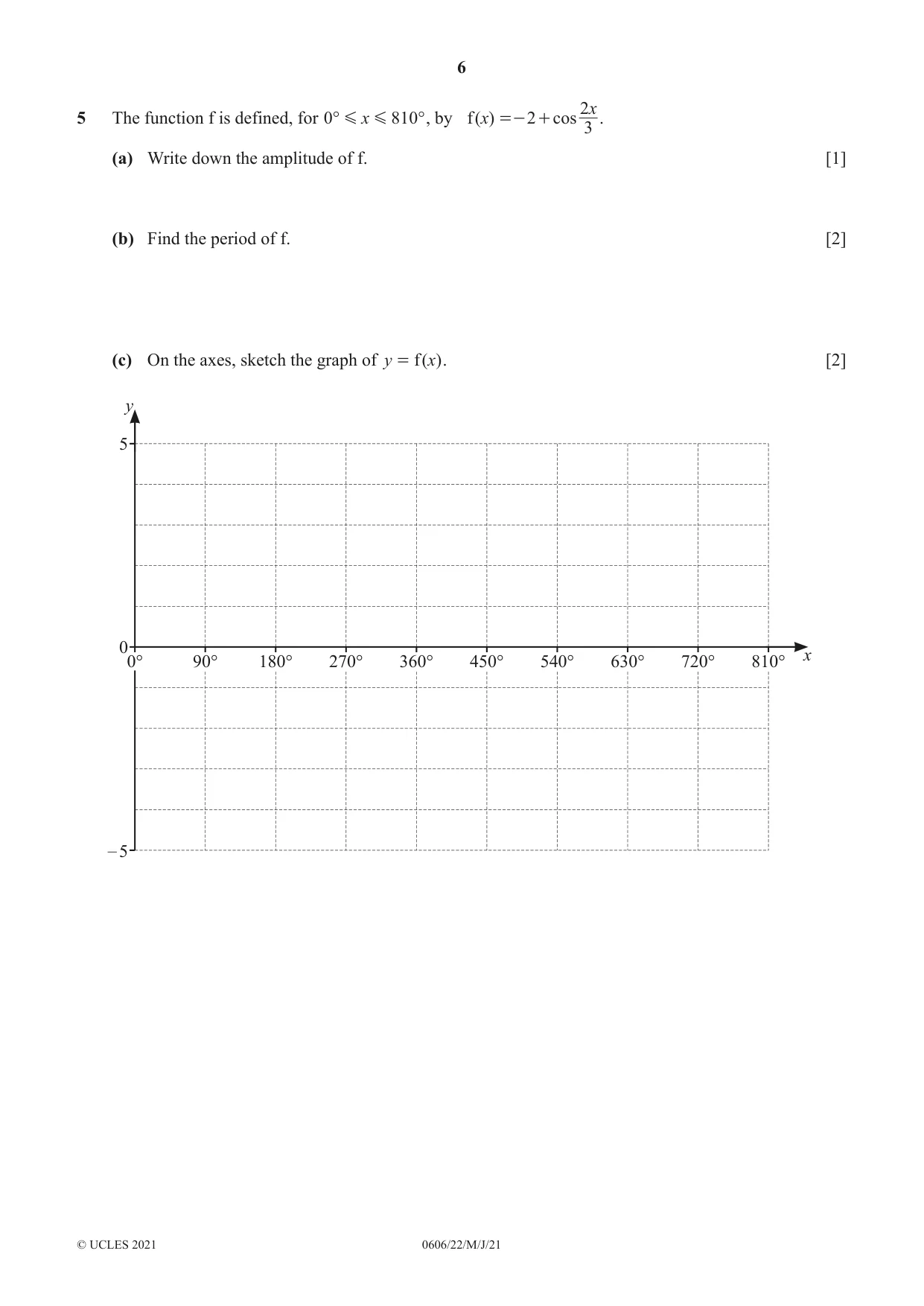
Q5 · The function f is defined, for 0° G x G 810° , by f ( x) =- 2 + cos
5 The function f is defined, for 0° G x G 810° , by f ( x) =- 2 + cos . 3 (a) Write down the amplitude of f. [1] (b) Find the period of f. [2] (c) On the axes, sketch the graph of y = f ( x) . [2] y 5 x 00° 90° 180° 270° 360° 450° 540° 630° 720° 810° – 5
Mark scheme: 5(a) 1 B1 5(b) 2 M1 360 ÷ oe 3 540 A1 If 0 scored, SC1 for 3π 5(c) Correct sketch for domain B2 B1 for correct cosine shape from (0, −1) with 0° ⩽ x ⩽ 810° amplitude 1 for 0° ⩽ x ⩽ 810° 5 B1 for attempt at correct cosine shape with period 540° for 0° ⩽ x ⩽ 810° If 0 scored, SC1 for a fully correct graph for 0° ⩽ x ⩽ 540° 90 180 270 360 450 540 630 720 810 Maximum of 1 mark if not fully correct. -5
Q6 · The points A(5, - 4 ) and C(11, 6) are such that AC is the diagonal of a square, ABCD
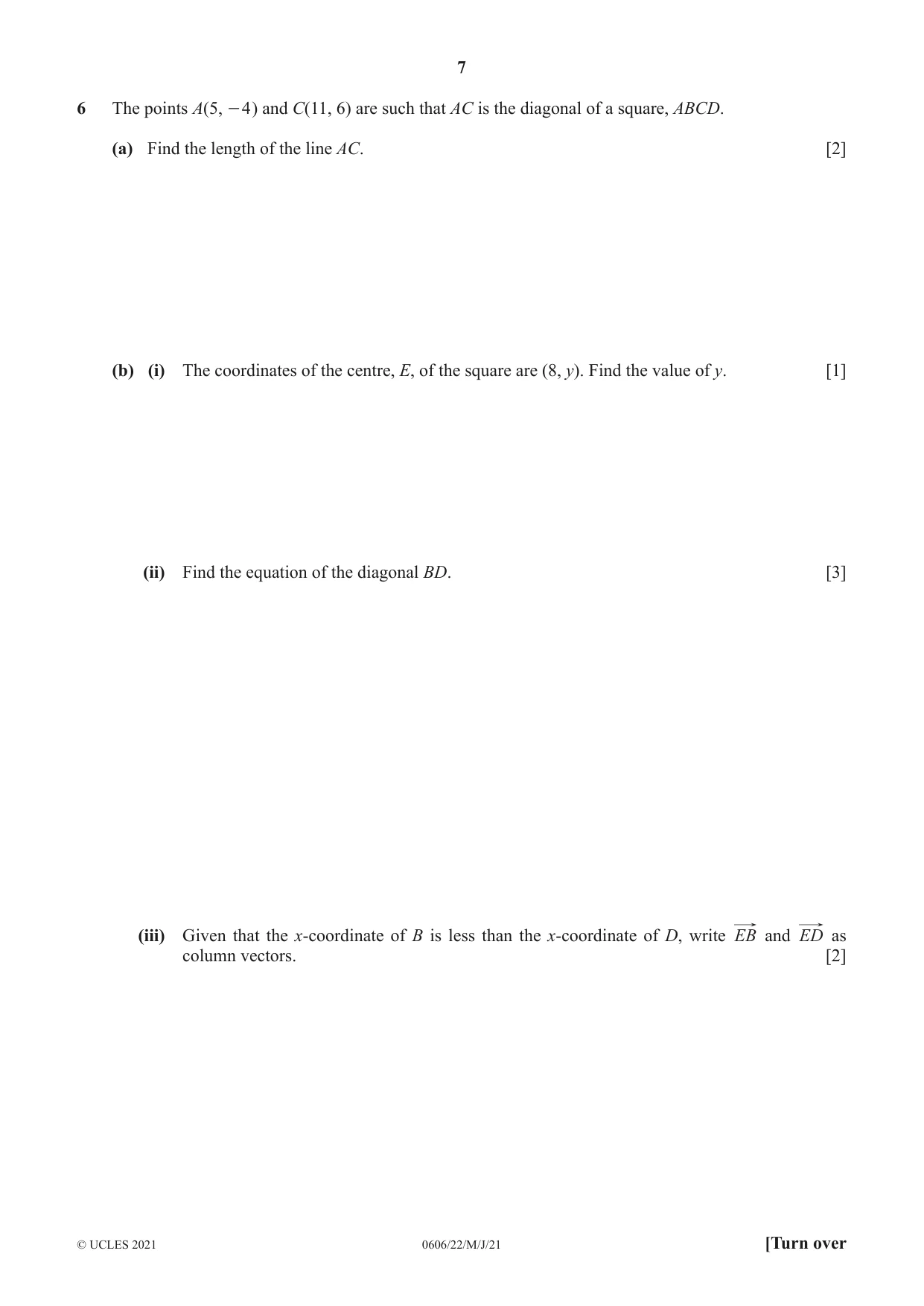
6 The points A(5, - 4 ) and C(11, 6) are such that AC is the diagonal of a square, ABCD. (a) Find the length of the line AC. [2] (b) (i) The coordinates of the centre, E, of the square are (8, y). Find the value of y. [1] (ii) Find the equation of the diagonal BD. [3] (iii) Given that the x‑coordinate of B is less than the x‑coordinate of D, write EB and ED as column vectors. [2]
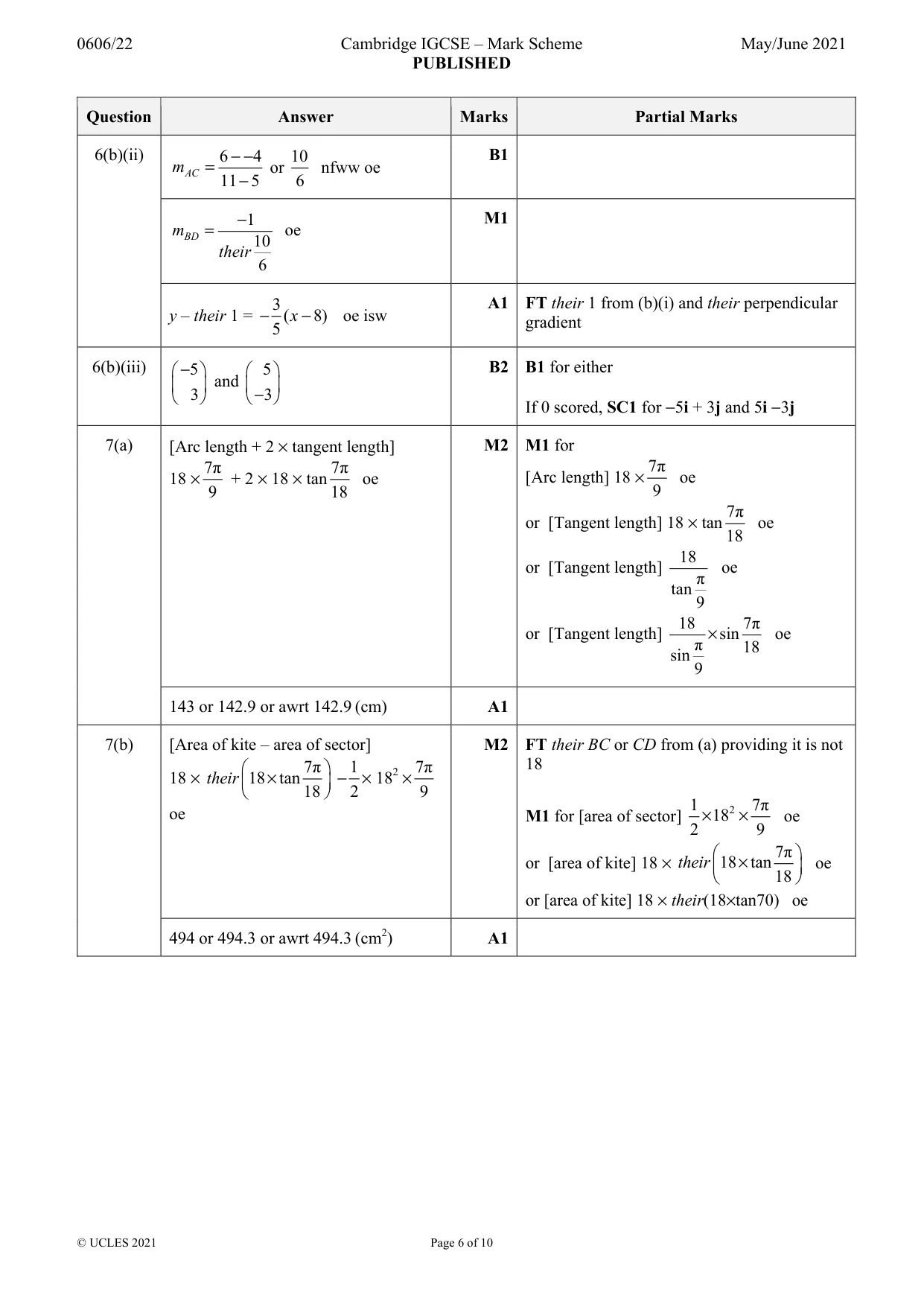
Mark scheme: 6(a) 2 2 M1 (11 − 5) + (6 −−4) oe 11.7 or 11.66[19...] rot to 4 or more A1 figs 6(b)(i) [y = ] 1 B1 6(b)(ii) 6 −−4 10 B1 m AC = or nfww oe 11 − 5 6 −1 M1 m BD = oe 10 their 6 A1 FT their 1 from (b)(i) and their perpendicular y – their 1 = − 3( x − 8) oe isw gradient 5 6(b)(iii) − 5 5 B2 B1 for either and 3 − 3 If 0 scored, SC1 for −5i + 3j and 5i −3j
More questions on Solve problems involving midpoint and length
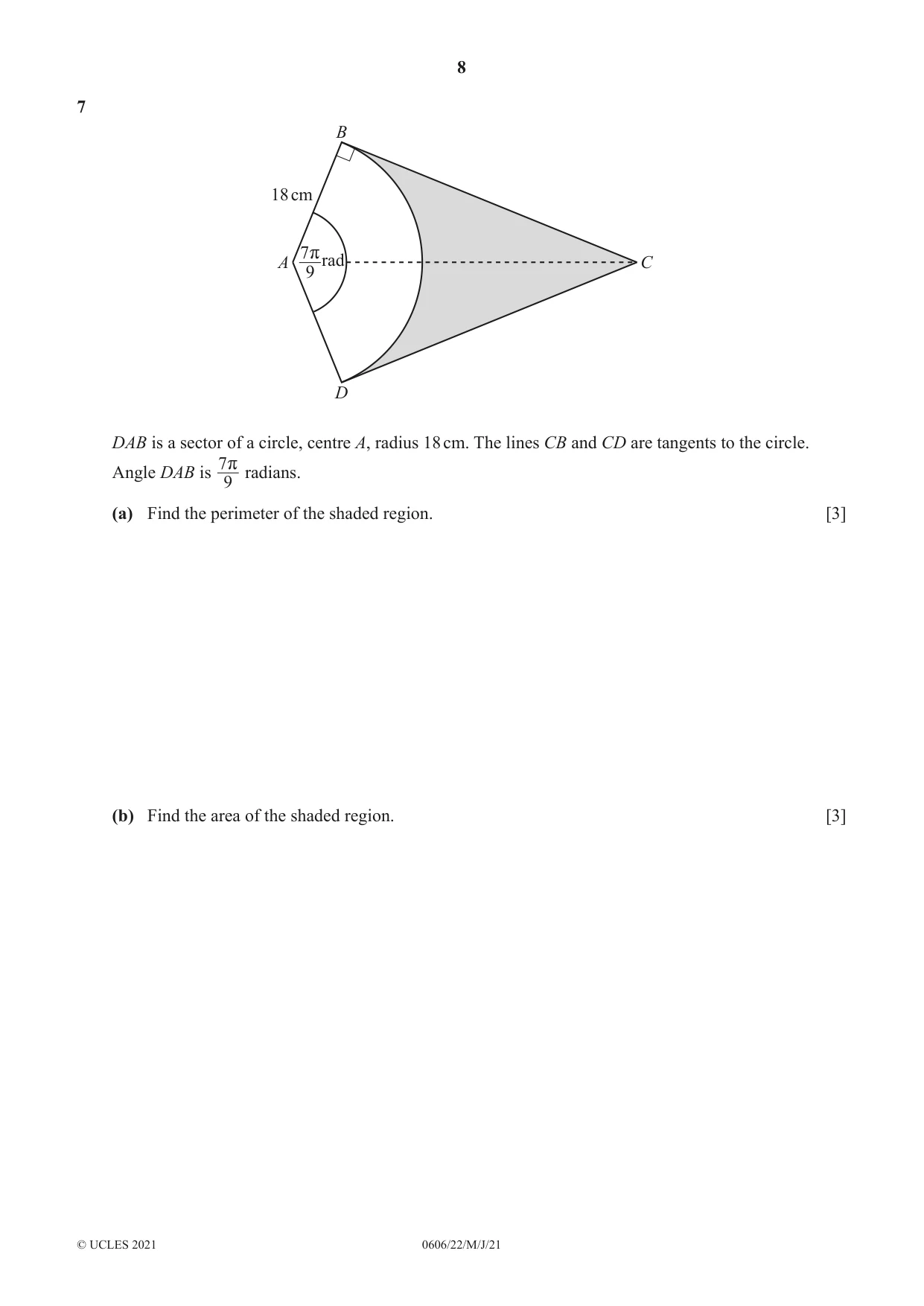
Q7 · B 18 cm A 7rrad C 9 D DAB is a sector of a circle, centre A, radius 18 cm
7 B 18 cm A 7rrad C 9 D DAB is a sector of a circle, centre A, radius 18 cm. The lines CB and CD are tangents to the circle. 7 r Angle DAB is radians. 9 (a) Find the perimeter of the shaded region. [3] (b) Find the area of the shaded region. [3]
Mark scheme: 7(a) [Arc length + 2 × tangent length] M2 M1 for 7π 7π 7π 18 × + 2 × 18 × tan oe [Arc length] 18 × oe 9 18 9 7π or [Tangent length] 18 × tan oe 18 18 or [Tangent length] oe π tan 9 18 7π or [Tangent length] × sin oe π 18 sin 9 143 or 142.9 or awrt 142.9 (cm) A1 7(b) [Area of kite – area of sector] M2 FT their BC or CD from (a) providing it is not 7π 1 2 7π 18 18 × their 18 × tan − × 18 × 18 2 9 1 2 7π oe M1 for [area of sector] × 18 × oe 2 9 7π or [area of kite] 18 × their 18 × tan oe 18 or [area of kite] 18 × their(18×tan70) oe 494 or 494.3 or awrt 494.3 (cm2) A1
More questions on Solve problems involving the arc length and
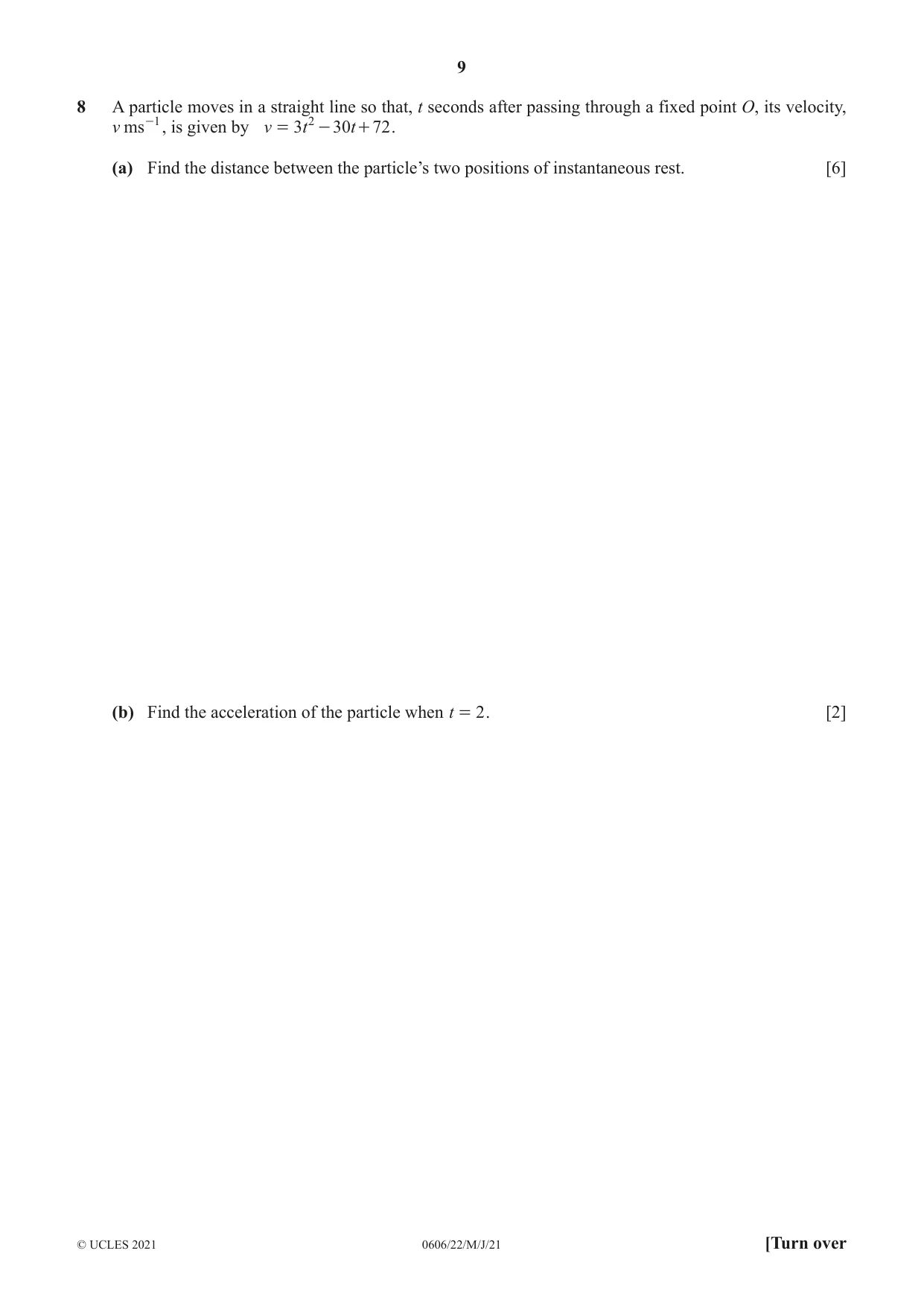
Q8 · A particle moves in a straight line so that, t seconds after passing through a fixed…
8 A particle moves in a straight line so that, t seconds after passing through a fixed point O, its velocity, v ms -1 , is given by v = 3t 2 - 30t + 72 . (a) Find the distance between the particle’s two positions of instantaneous rest. [6] (b) Find the acceleration of the particle when t = 2 . [2]
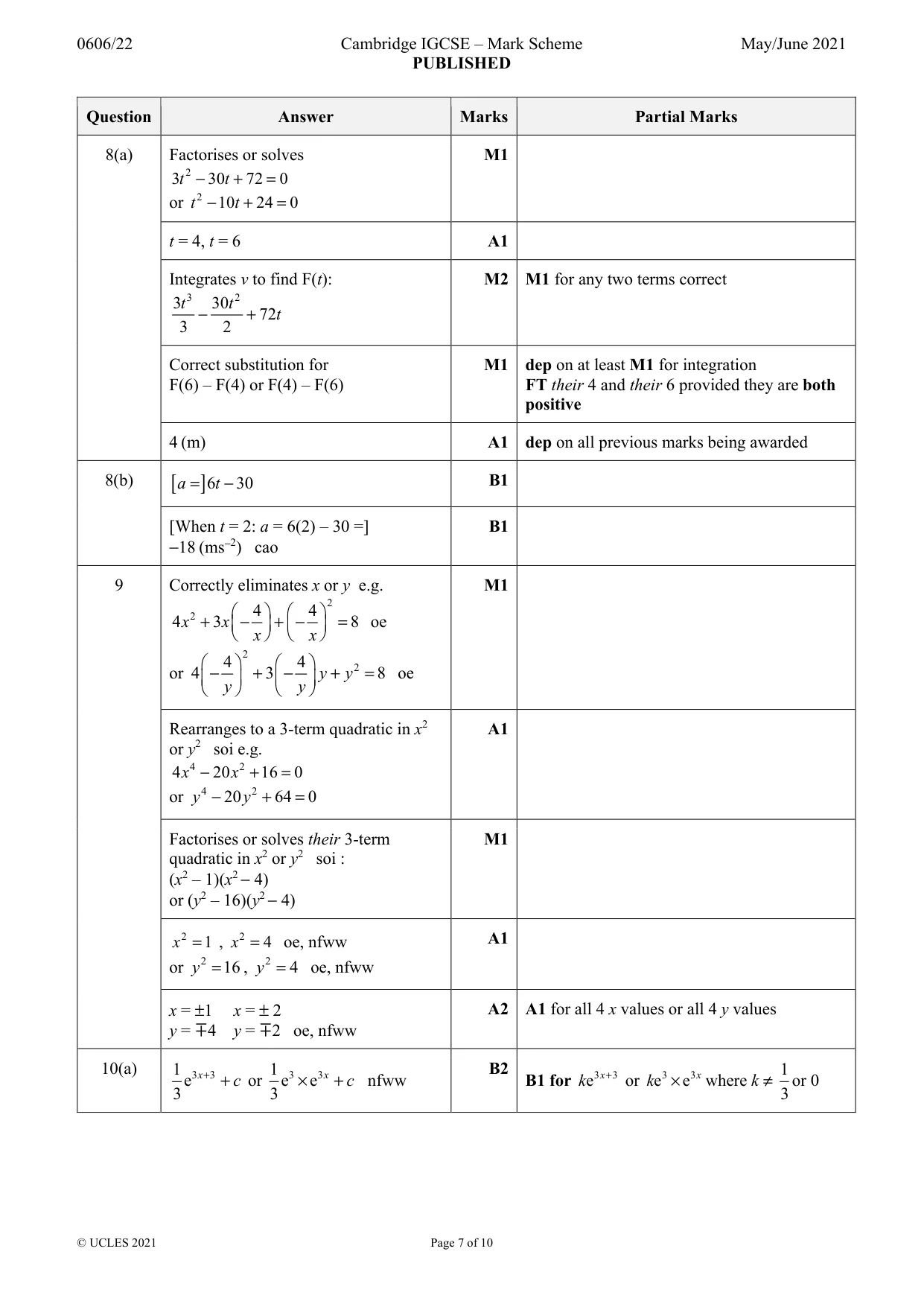
Mark scheme: 8(a) Factorises or solves M1 3t 2 − 30t + 72 = 0 or t 2 − 10t + 24 = 0 t = 4, t = 6 A1 Integrates v to find F(t): M2 M1 for any two terms correct 3t 3 30t 2 − + 72t 3 2 Correct substitution for M1 dep on at least M1 for integration F(6) – F(4) or F(4) – F(6) FT their 4 and their 6 provided they are both positive 4 (m) A1 dep on all previous marks being awarded 8(b) [ a = ]6t − 30 B1 [When t = 2: a = 6(2) – 30 =] B1 −18 (ms−2) cao
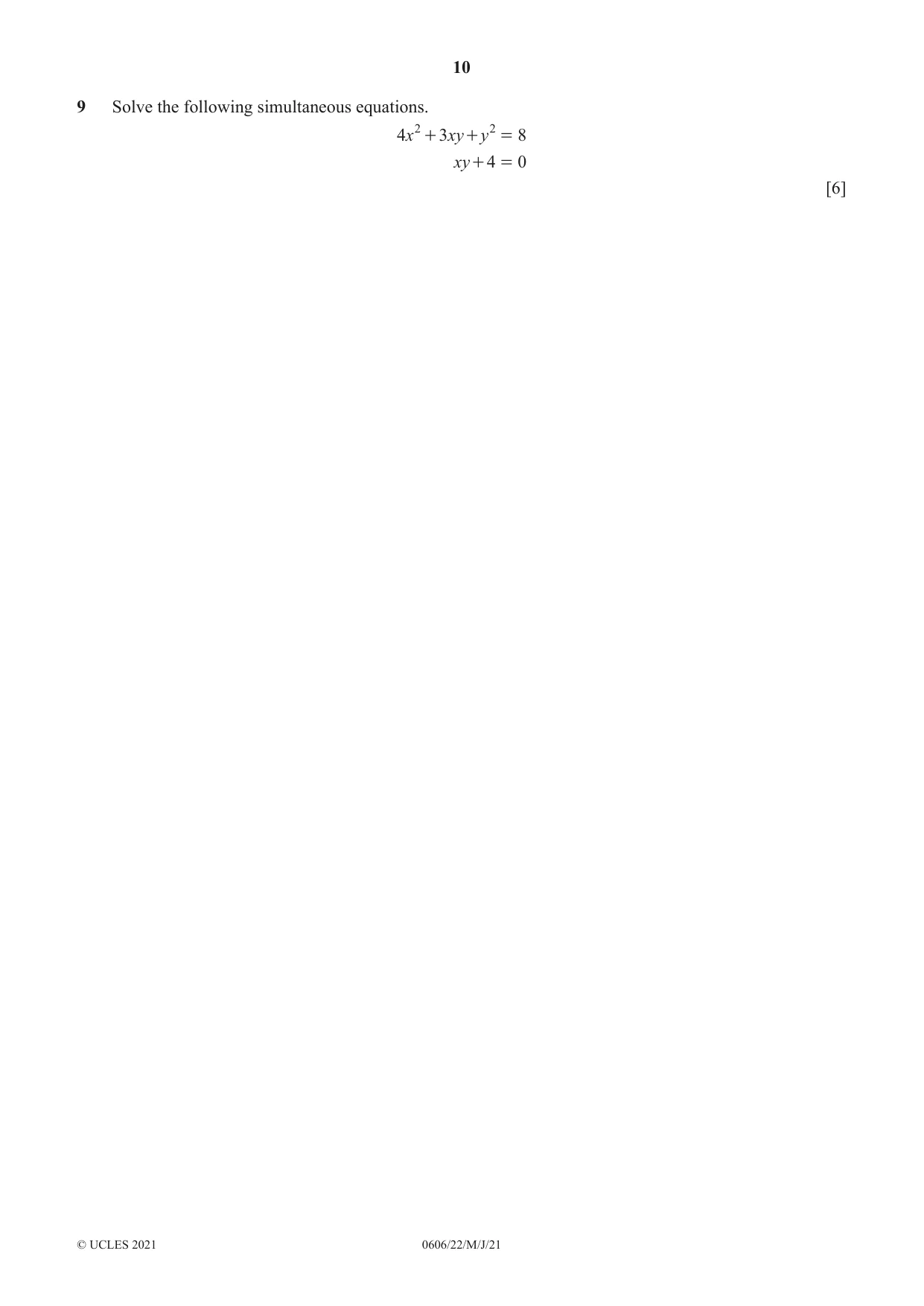
Q9 · Solve the following simultaneous equations
9 Solve the following simultaneous equations. 4 x 2 + 3 xy + y 2 = 8 xy + 4 = 0 [6]
Mark scheme: 9 Correctly eliminates x or y e.g. M1 2 4 4 2 4 x + 3 x − + − = 8 oe x x 4 2 4 2 or 4 − + 3 − y + y = 8 oe y y Rearranges to a 3-term quadratic in x2 A1 or y2 soi e.g. 4 x 4 − 20 x 2 + 16 = 0 or y 4 − 20 y 2 + 64 = 0 Factorises or solves their 3-term M1 quadratic in x2 or y2 soi : (x2 – 1)(x2 − 4) or (y2 – 16)(y2 − 4) x 2 = 1 , x 2 = 4 oe, nfww A1 or y 2 = 16 , y 2 = 4 oe, nfww x = ±1 x = ± 2 A2 A1 for all 4 x values or all 4 y values y = ∓4 y = ∓2 oe, nfww
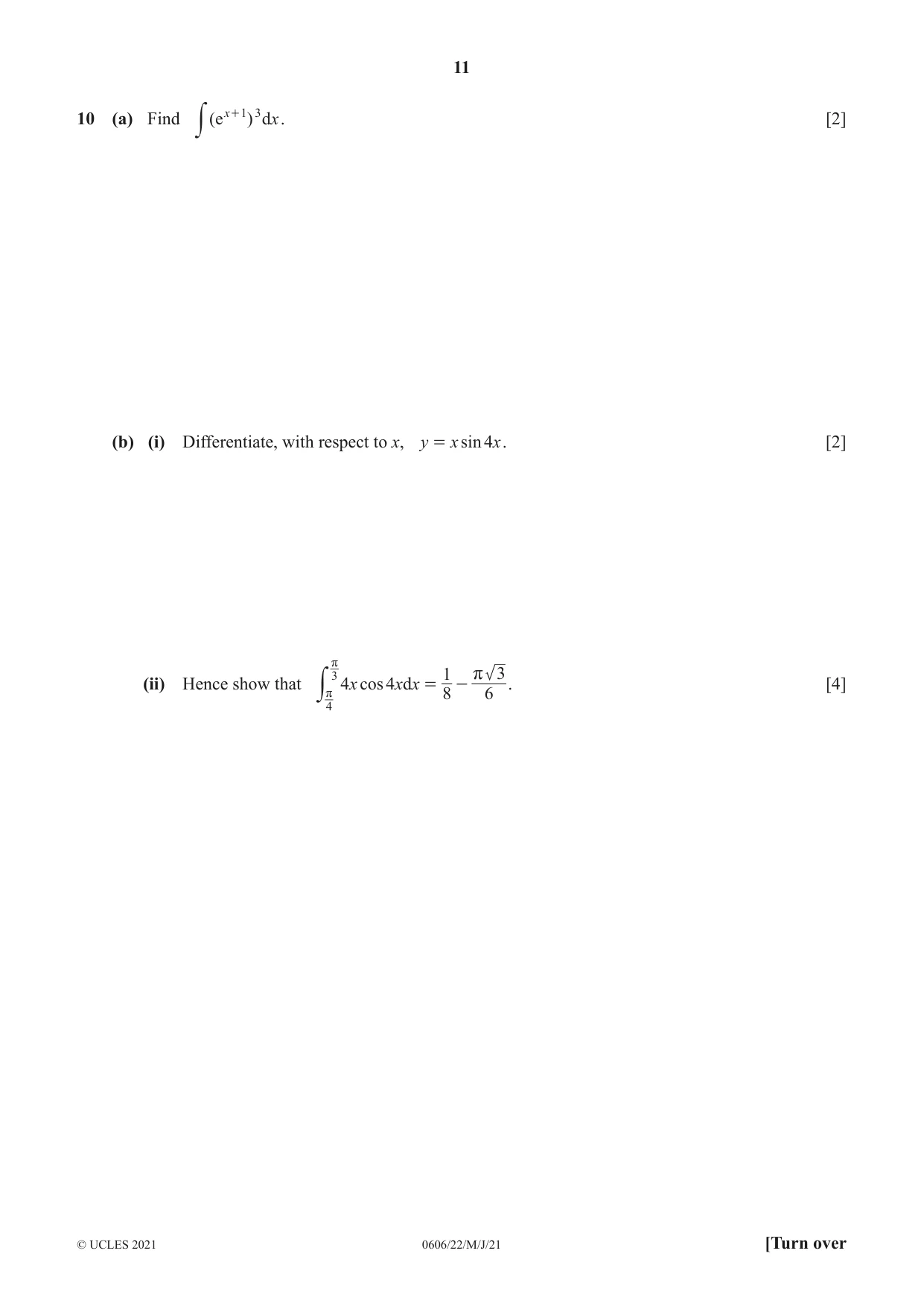
Q10 · Find ( e x + 1 ) 3 d x
10 (a) Find ( e x + 1 ) 3 d x . [2] (b) (i) Differentiate, with respect to x, y = x sin 4x . [2] r 3 1 r 3 (ii) Hence show that 4x cos 4xdx = - . [4] yr 8 6 4
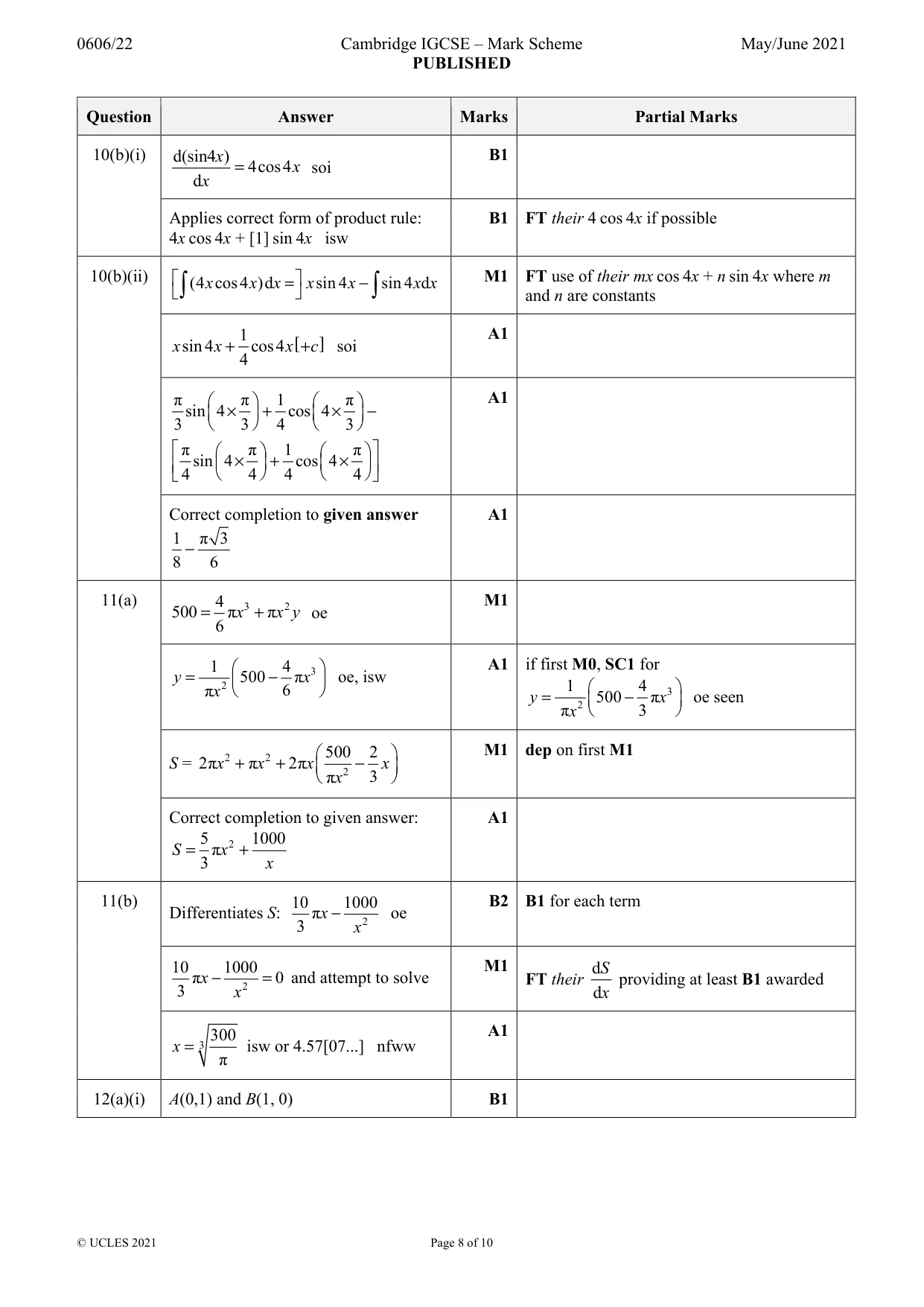
Mark scheme: 10(a) 1 3 x + 3 1 3 3 x B2 3 x + 3 3 3 x 1 e + c or e × e + c nfww B1 for k e or ke × e where k ≠ or 0 3 3 3 10(b)(i) d(sin4x ) B1 = 4cos4 x soi dx Applies correct form of product rule: B1 FT their 4 cos 4x if possible 4x cos 4x + [1] sin 4x isw M1 FT use of their mx cos 4x + n sin 4x where m10(b)(ii) (4 x cos4 x )d x = x sin 4 x − sin 4 xd x and n are constants 1 A1 x sin4 x + cos4 x [ + c ] soi 4 π π 1 π A1 sin 4 × + cos 4 × − 3 3 4 3 π π 1 π sin 4 × + cos 4 × 4 4 4 4 Correct completion to given answer A1 1 π 3 − 8 6
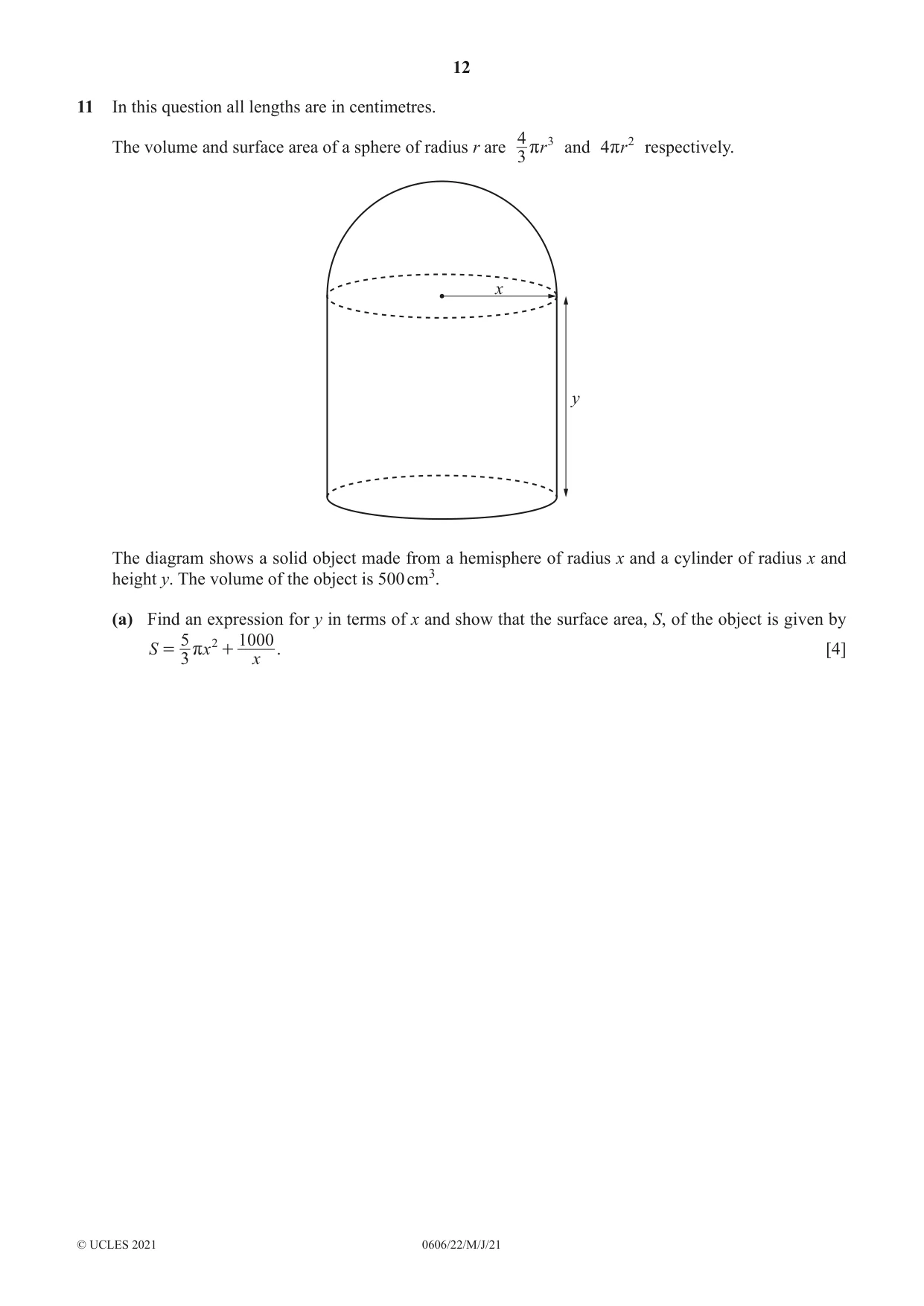
Q11 · In this question all lengths are in centimetres
11 In this question all lengths are in centimetres. 4 3 2 The volume and surface area of a sphere of radius r are rr and 4rr respectively. 3 x y The diagram shows a solid object made from a hemisphere of radius x and a cylinder of radius x and height y. The volume of the object is 500 cm3. (a) Find an expression for y in terms of x and show that the surface area, S, of the object is given by 5 2 1000 S = r x + . [4] 3 x (b) Given that x can vary and that S has a minimum value, find the value of x for which S is a minimum. [4]
Mark scheme: 11(a) 4 3 2 M1 500 = πx + πx y oe 6 1 4 3 A1 if first M0, SC1 for oe, isw 500 − y = πx 1 4 3 6 πx 2 y = 2 500 − πx oe seen πx 3 2 2 500 2 M1 dep on first M1 S = 2πx + πx + 2πx 2 − x πx 3 Correct completion to given answer: A1 5 2 1000 S = πx + 3 x 11(b) 10 1000 B2 B1 for each term Differentiates S: πx − oe 3 x 2 10 1000 M1 d S πx − = 0 and attempt to solve FT their providing at least B1 awarded 2 3 x d x 300 A1 x = 3 isw or 4.57[07...] nfww π
More questions on Apply differentiation to practical problems
Q12 · DO NOT USE A CALCULATOR IN THIS QUESTION
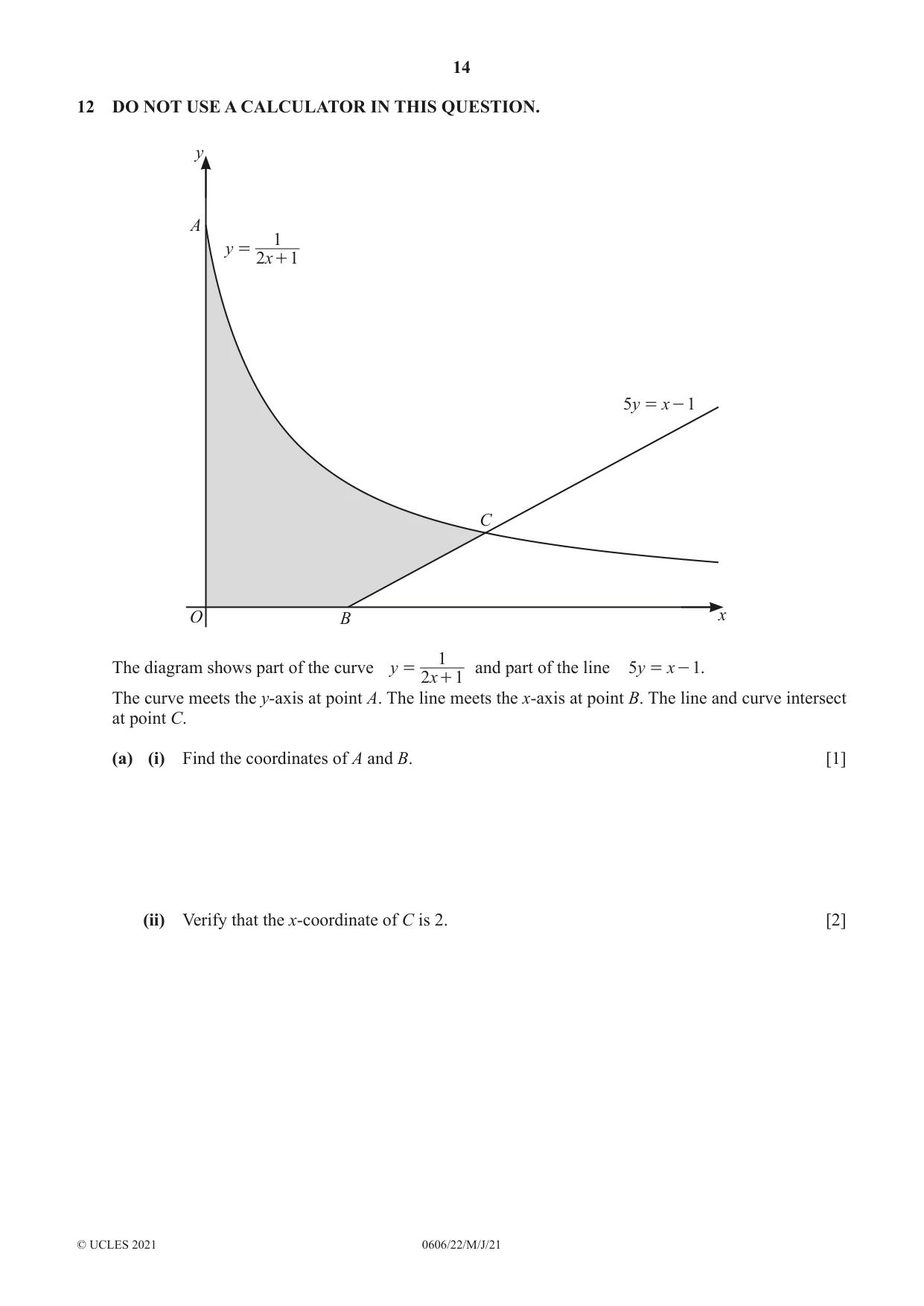
12 DO NOT USE A CALCULATOR IN THIS QUESTION. y A 1 y = 2x + 1 5y = x - 1 C O B x 1 The diagram shows part of the curve y = and part of the line 5y = x - 1. 2x + 1 The curve meets the y‑axis at point A. The line meets the x‑axis at point B. The line and curve intersect at point C. (a) (i) Find the coordinates of A and B. [1] (ii) Verify that the x‑coordinate of C is 2. [2] (b) Find the exact area of the shaded region. [5] Question 13 is printed on the next page.
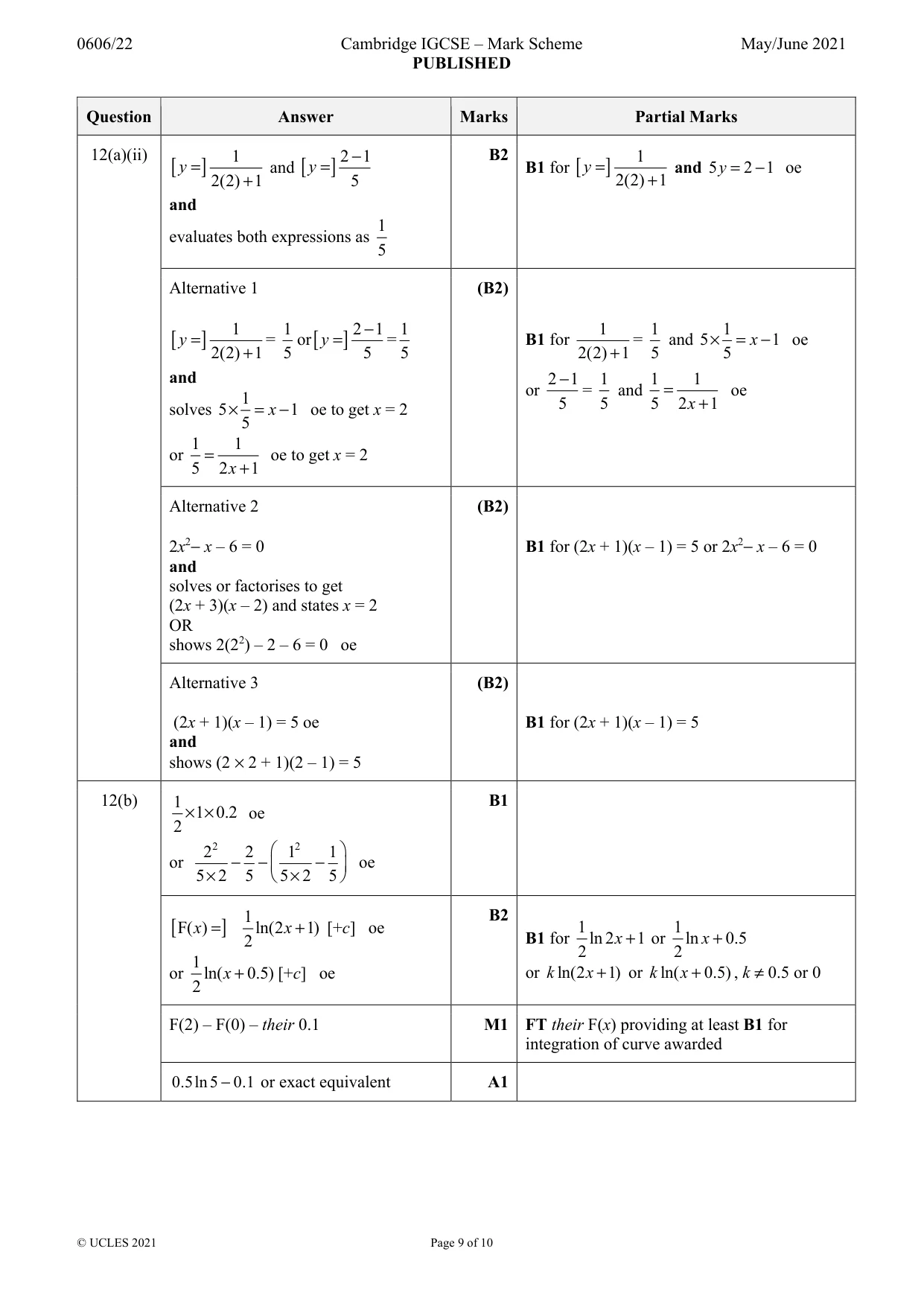
Mark scheme: 12(a)(i) A(0,1) and B(1, 0) B1 12(a)(ii) 1 2 − 1 B2 1 [ y = ] and [ y = ] B1 for [ y = ] and 5 y = 2 − 1 oe 2(2) + 1 5 2(2) + 1 and 1 evaluates both expressions as 5 Alternative 1 (B2) 1 1 2 − 1 1 1 1 1 [ y = ] = or[ y = ] = B1 for = and 5 × = x − 1 oe 2(2) + 1 5 5 5 2(2) + 1 5 5 and 2 1 1 1 1 or −= and = oe 1 5 5 5 2 x + 1 solves 5 × = x − 1 oe to get x = 2 5 1 1 or = oe to get x = 2 5 2 x + 1 Alternative 2 (B2) 2x2− x – 6 = 0 B1 for (2x + 1)(x – 1) = 5 or 2x2− x – 6 = 0 and solves or factorises to get (2x + 3)(x – 2) and states x = 2 OR shows 2(22) – 2 – 6 = 0 oe Alternative 3 (B2) (2x + 1)(x – 1) = 5 oe B1 for (2x + 1)(x – 1) = 5 and shows (2 × 2 + 1)(2 – 1) = 5 12(b) 1 B1 × 1 × 0.2 oe 2 2 2 2 12 1 or − − − oe 5 × 2 5 5 × 2 5 1 B2 [ F( x ) = ] ln(2 x + 1) [+c] oe 1 1 2 B1 for ln 2 x + 1 or ln x + 0.5 2 2 1 or ln( x + 0.5) [+c] oe or k ln(2 x + 1) or k ln( x + 0.5) , k ≠ 0.5 or 0 2 F(2) – F(0) – their 0.1 M1 FT their F(x) providing at least B1 for integration of curve awarded 0.5ln5 − 0.1 or exact equivalent A1
Q13 · The functions f and g are defined, for x 2 0 , by 2x 2 - 1 f ( x) = , 3x 1 g ( x) =
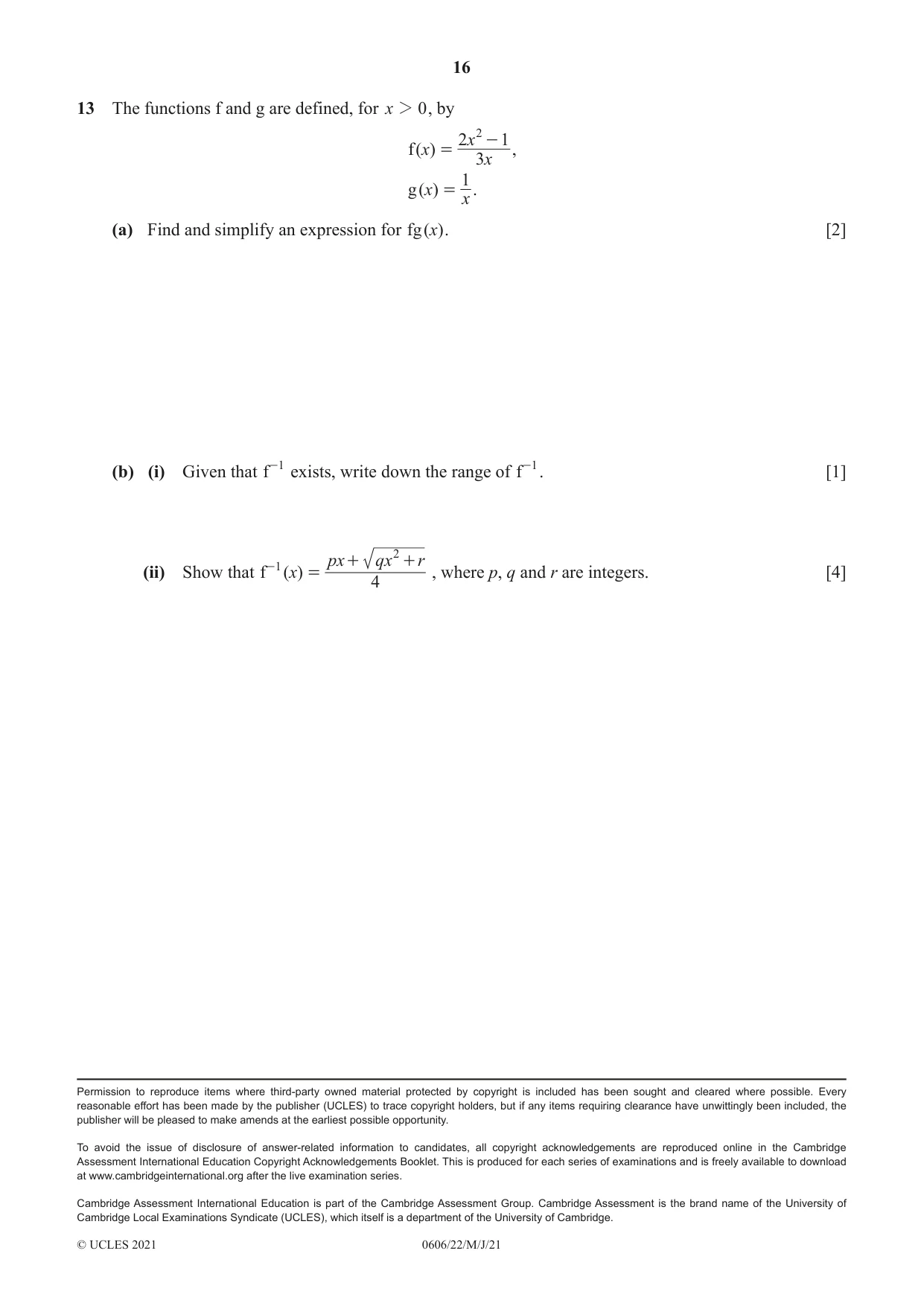
13 The functions f and g are defined, for x 2 0 , by 2x 2 - 1 f ( x) = , 3x 1 g ( x) = . x (a) Find and simplify an expression for fg ( x) . [2] (b) (i) Given that f -1 exists, write down the range of f -1 . [1] 2 -1 px + qx + r (ii) Show that f ( x) = , where p, q and r are integers. [4] 4
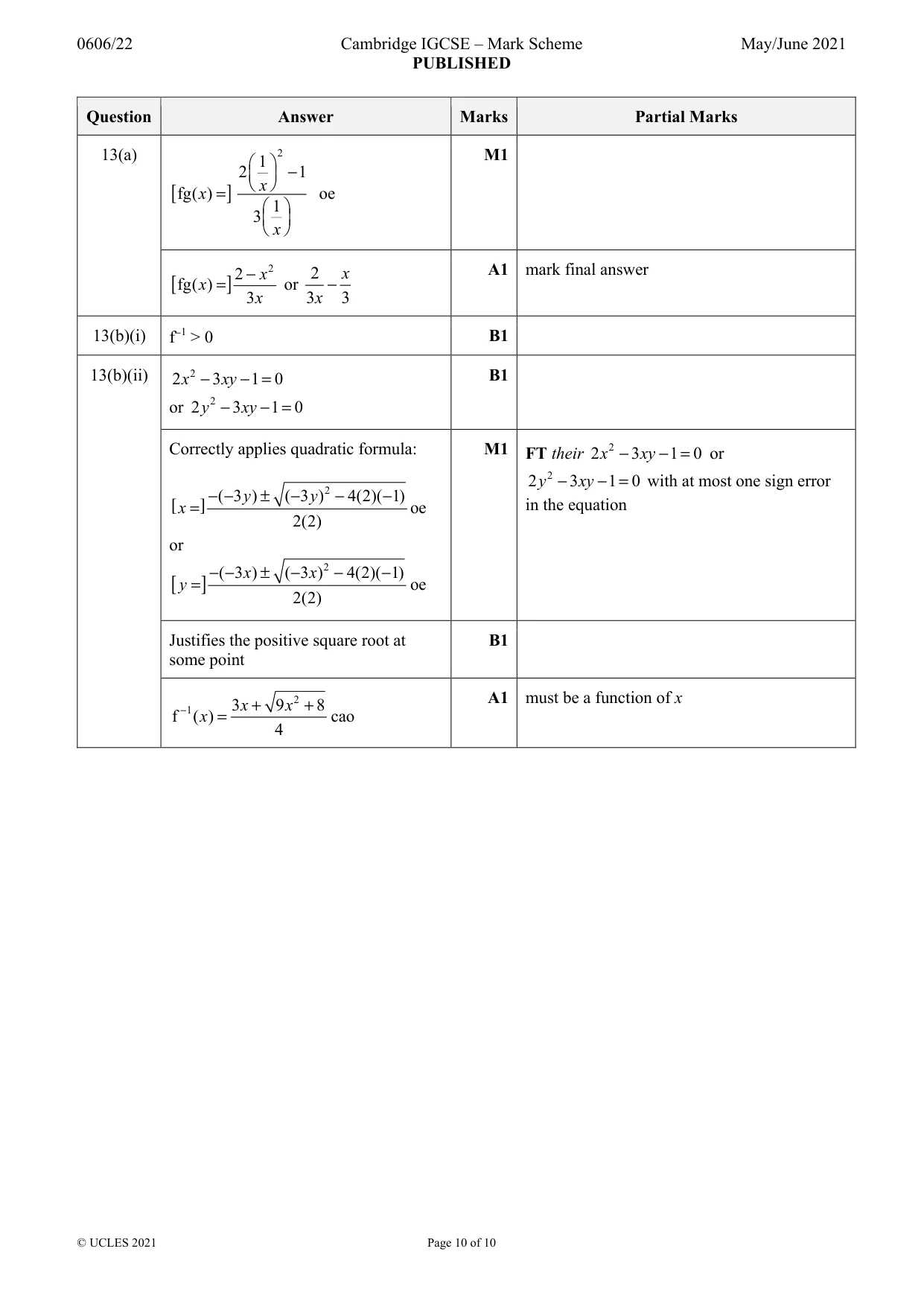
Mark scheme: 13(a) 2 M1 2 1 − 1 x [ fg( x ) = ] oe 1 3 x 2 − x 2 2 −x A1 mark final answer or [ fg( x ) = ] 3 x 3 x 3 13(b)(i) f−1 > 0 B1 13(b)(ii) 2 x 2 − 3 xy −=1 0 B1 or 2 y 2 − 3 xy −=1 0 Correctly applies quadratic formula: M1 FT their 2 x 2 − 3 xy −=1 0 or 2 y 2 − 3 xy −=1 0 with at most one sign error −−( 3 y ) ± ( − 3 y ) 2 − 4(2)( − 1) [ x = ] oe in the equation 2(2) or −−( 3 x ) ± ( − 3 x ) 2 − 4(2)( − 1) [ y = ] oe 2(2) Justifies the positive square root at B1 some point 2 A1 must be a function of x −1 3 x + 9 x + 8 f ( x ) = cao 4
What was in this paper
The subtopics covered by these 12 questions, and how many questions each got. Open one in a new tab to see every Cambridge question on it.
1Apply differentiation to practical problems1Differentiate products and quotients of1Evaluate definite integrals and apply1Find the domain and range of functions1Know and use the remainder and factor1Sketch the graphs of cubic polynomials and1Solve problems involving midpoint and length1Solve problems involving the arc length and1Solve simultaneous equations in two1Understand and use the amplitude and1Use the binomial theorem for expansion of1What you needed in this session
Cambridge’s own grade thresholds for 2021 May/June, Paper 2 · Variant 2. A higher threshold means an easier paper — the bar moves with how the cohort did.