Cambridge IGCSE Mathematics - Additional 0606 — 2020 May/June Paper 2 · Variant 1
0606/21/M/J/20 · 11 questions · 76 marks · ≈86 min
The question paper and its mark scheme, free to read here and free to download. This is Cambridge’s own paper, exactly as it was sat.
Question paper16 pages
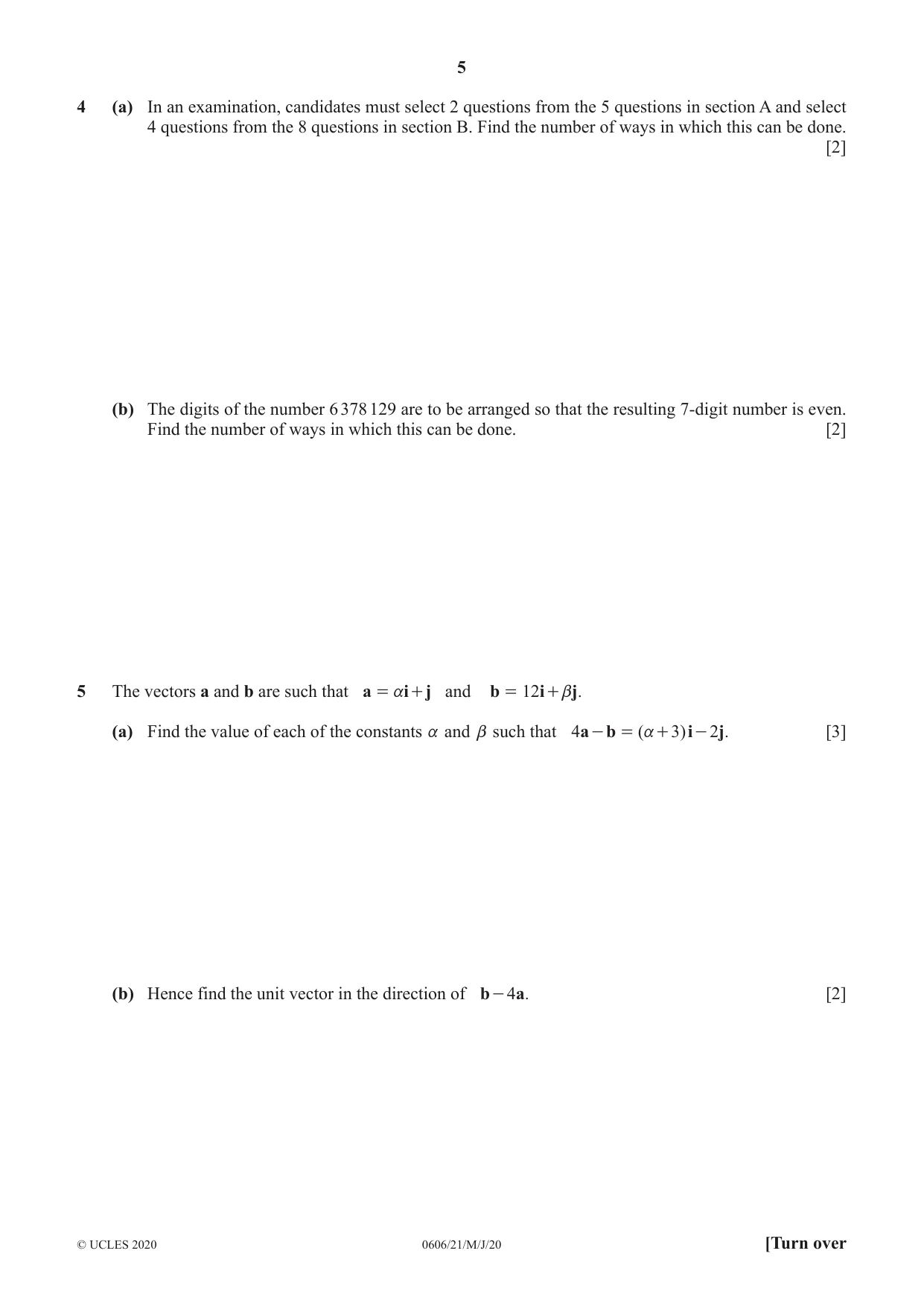
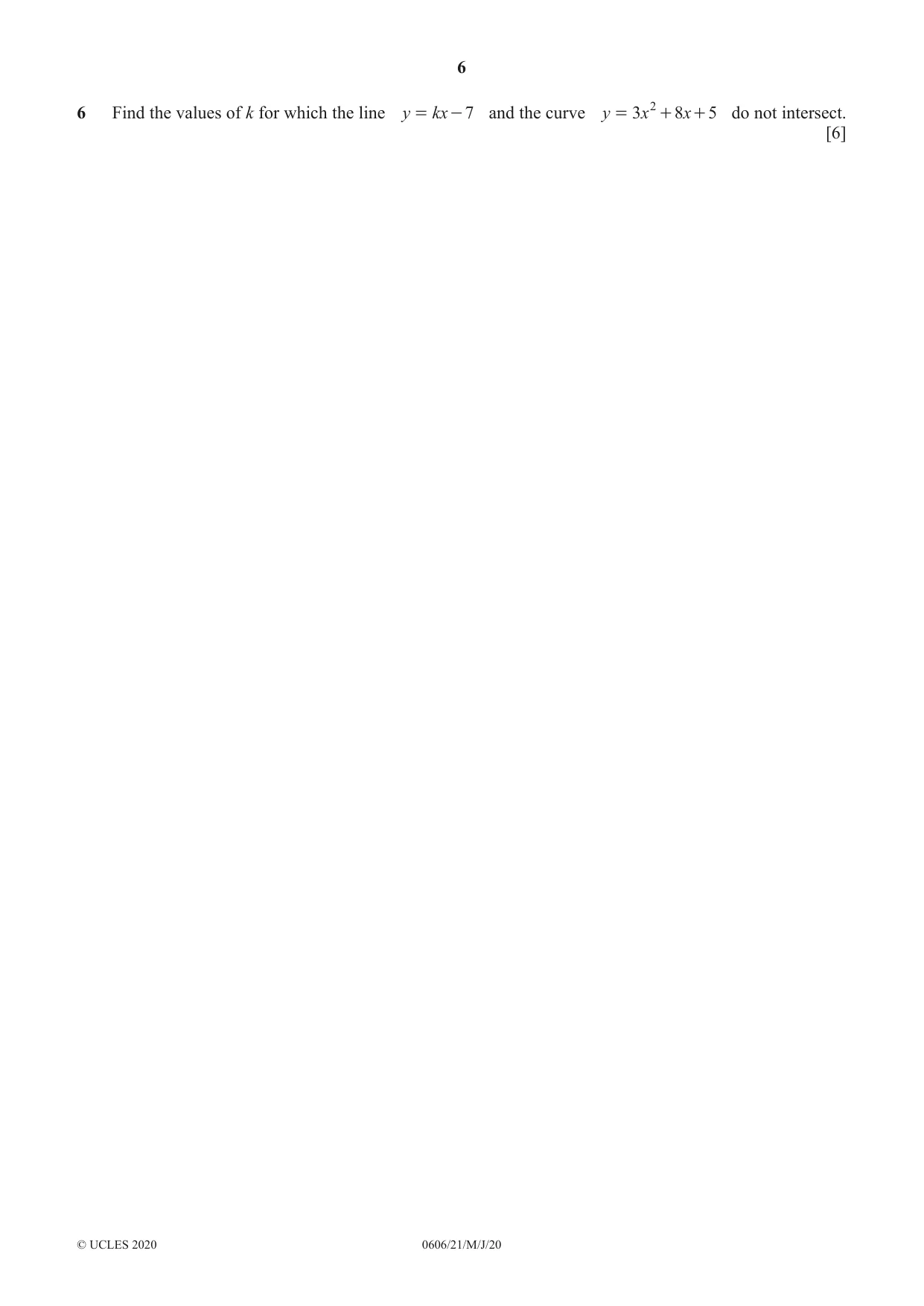
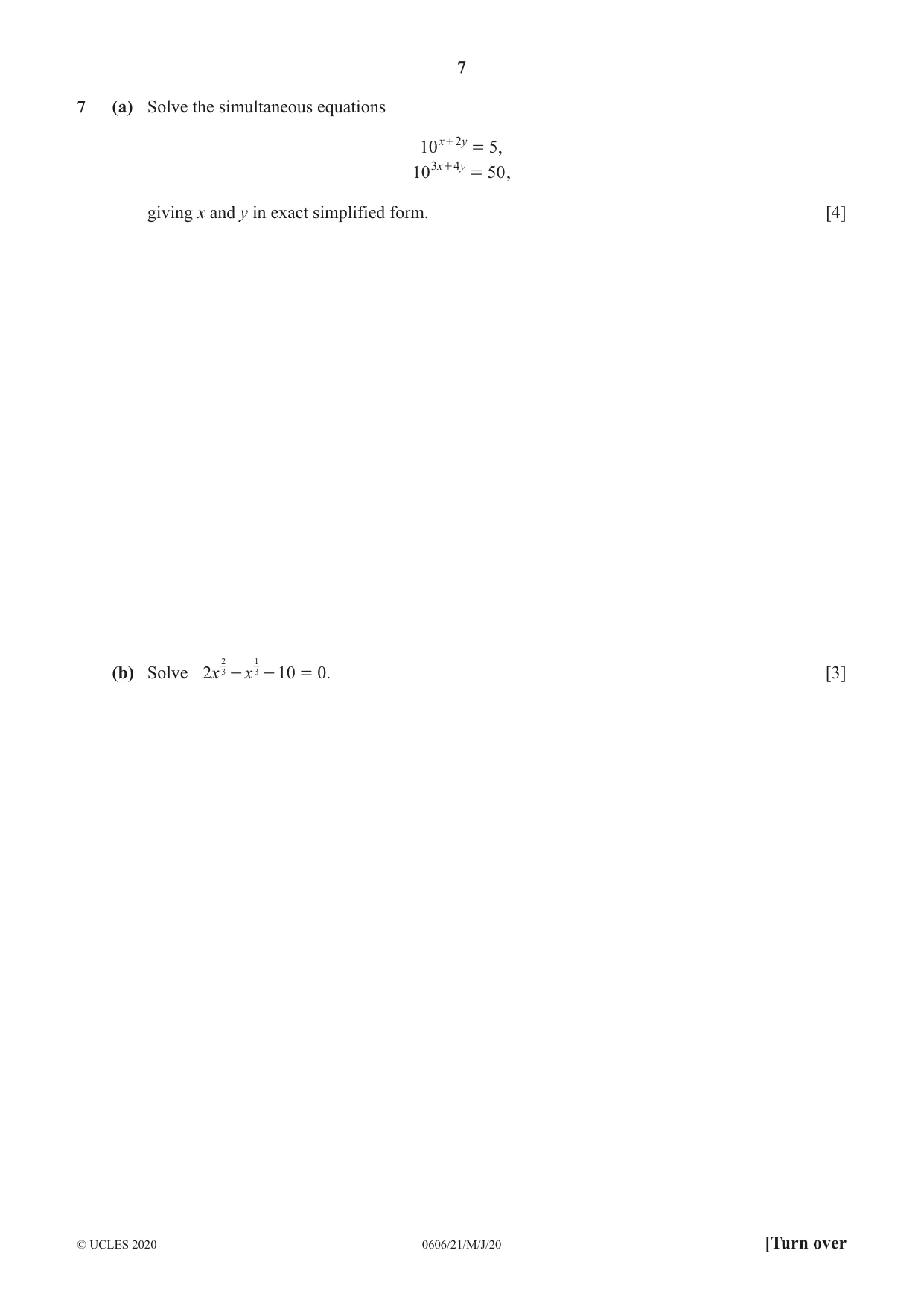
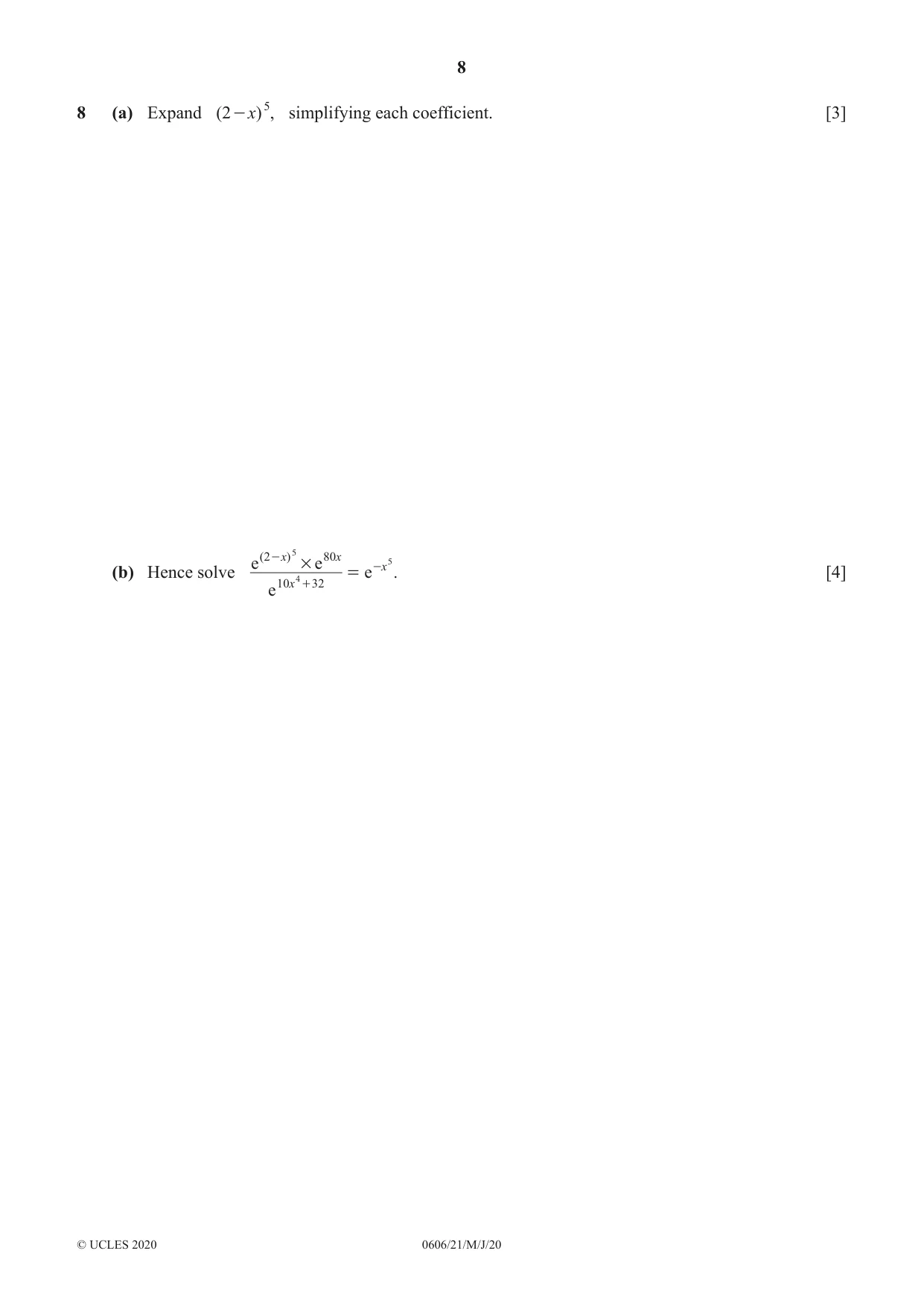

Mark scheme8 pages
Answers below. Sit the paper first if you are practising.
Questions as text
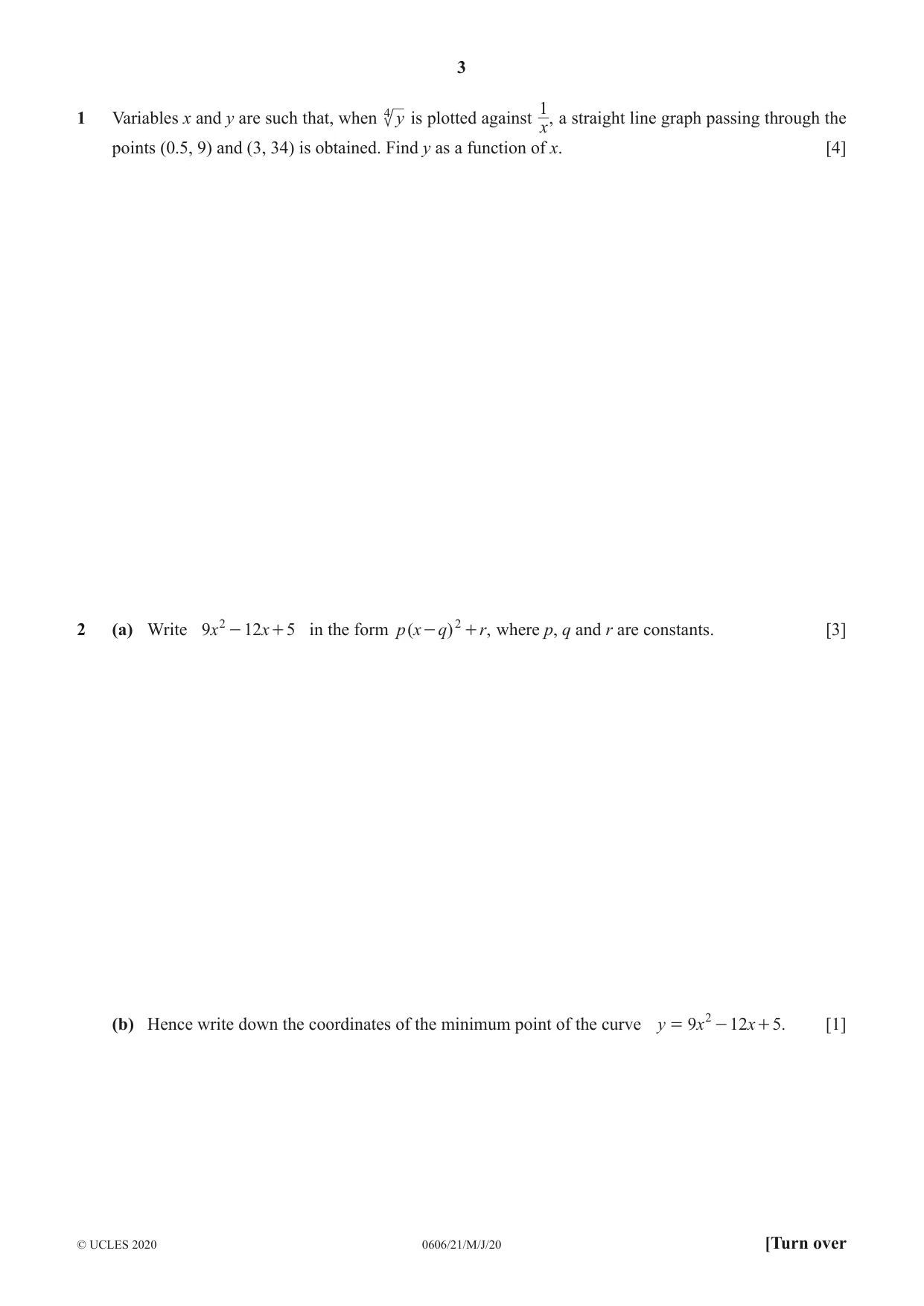
Q1 · Variables x and y are such that, when 4 y is plotted against ,x a straight line graph…
1 Variables x and y are such that, when 4 y is plotted against ,x a straight line graph passing through the points (0.5, 9) and (3, 34) is obtained. Find y as a function of x. [4]
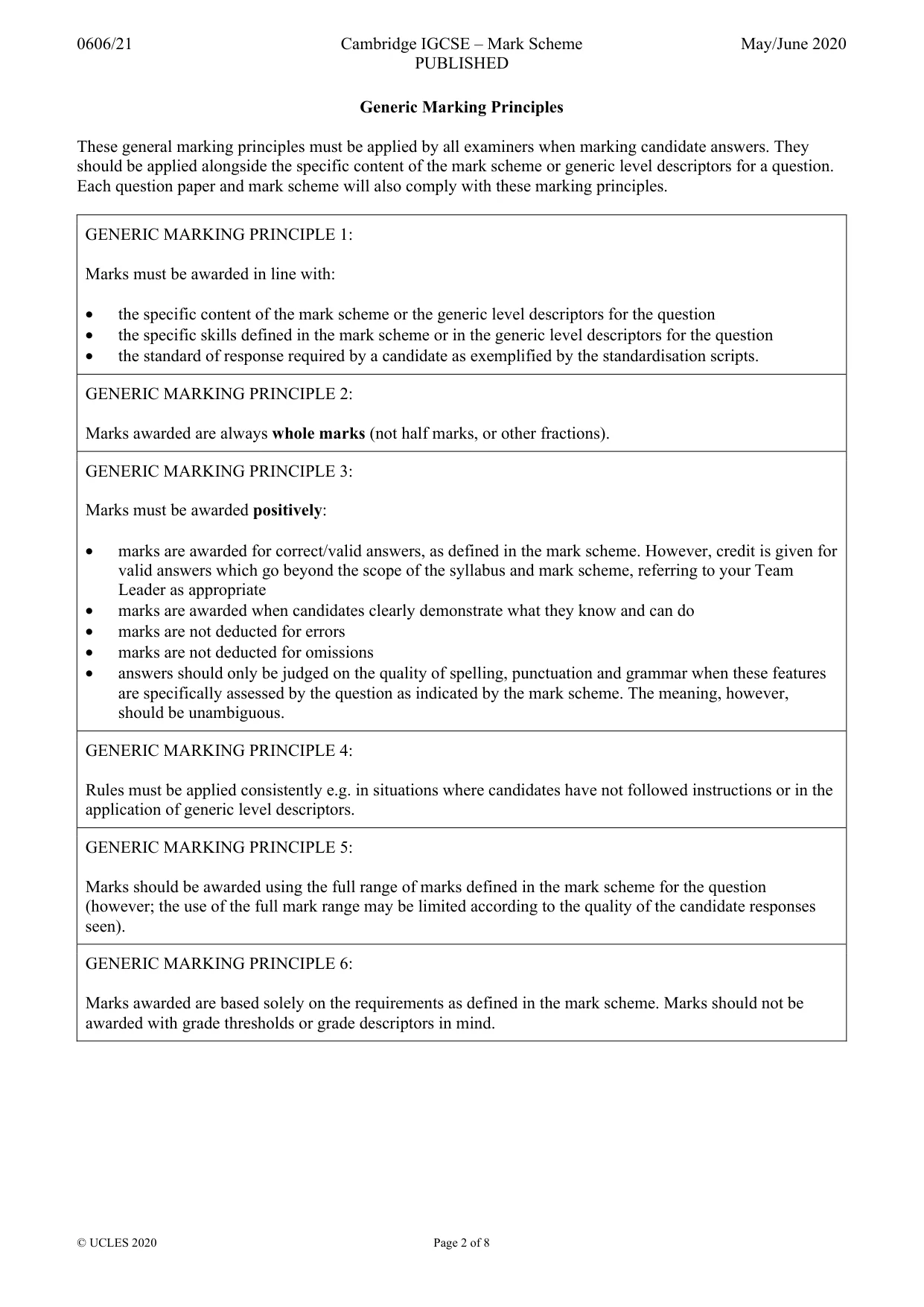
Mark scheme: Question Answer Marks Partial Marks 1 Valid method to find m M1 34 − 9 m = [ = 10 ] oe 3 − 0.5 Valid method to find c, e.g. M1 34 = their 10 × 3 + c 1 M1 4 y = ( their10 ) + their 4 x 4 A1 10 y = + 4 oe, cao x
Q2 · Write 9x 2 - 12x + 5 in the form p ( x - q) 2 + r, where p, q and r are constants
2 (a) Write 9x 2 - 12x + 5 in the form p ( x - q) 2 + r, where p, q and r are constants. [3] (b) Hence write down the coordinates of the minimum point of the curve y = 9x 2 - 12x + 5. [1]
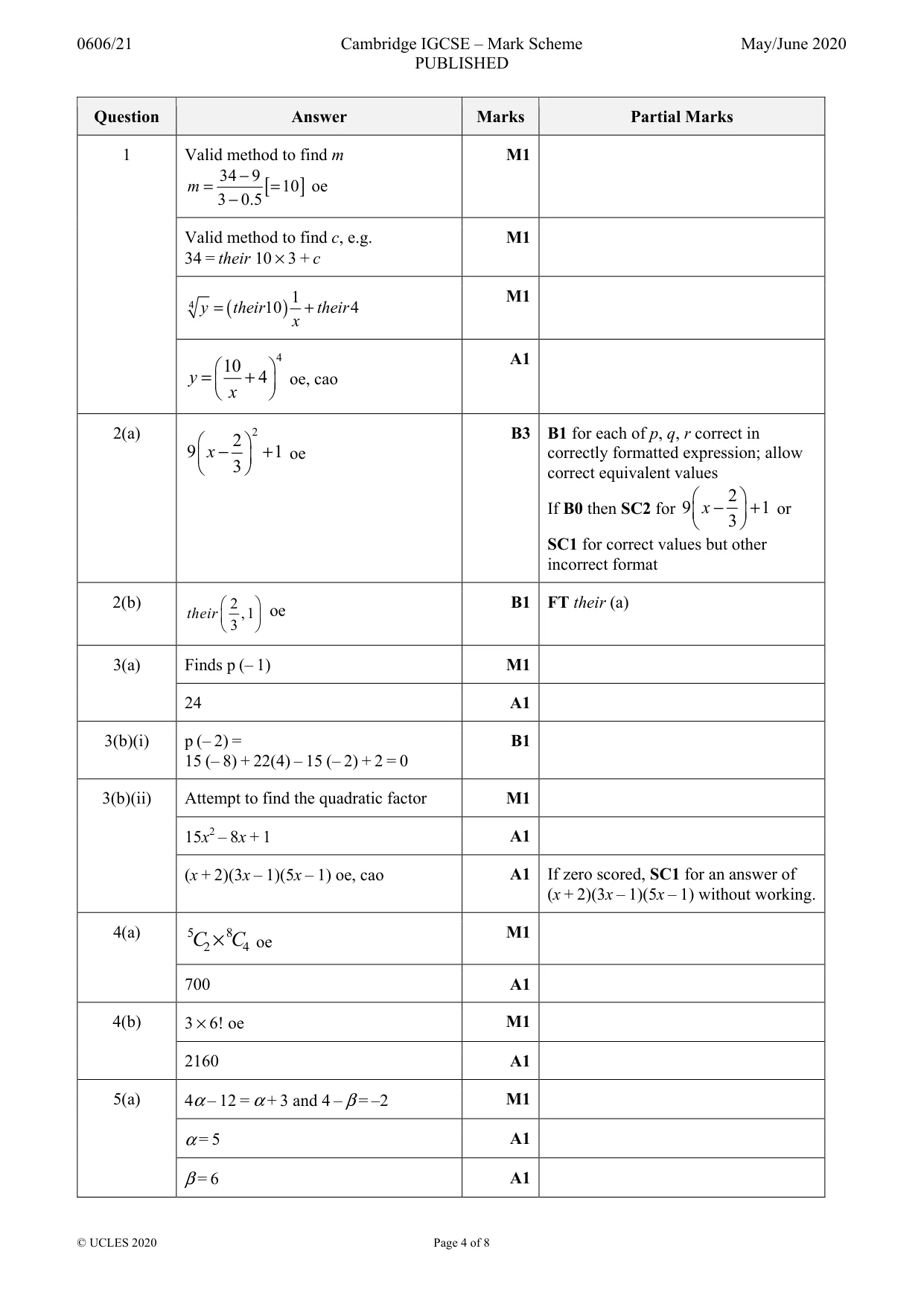
Mark scheme: 2(a) 2 B3 B1 for each of p, q, r correct in 2 9 x − + 1 oe correctly formatted expression; allow 3 correct equivalent values 2 If B0 then SC2 for 9 x − + 1 or 3 SC1 for correct values but other incorrect format 2(b) 2 B1 FT their (a) their ,1 oe 3
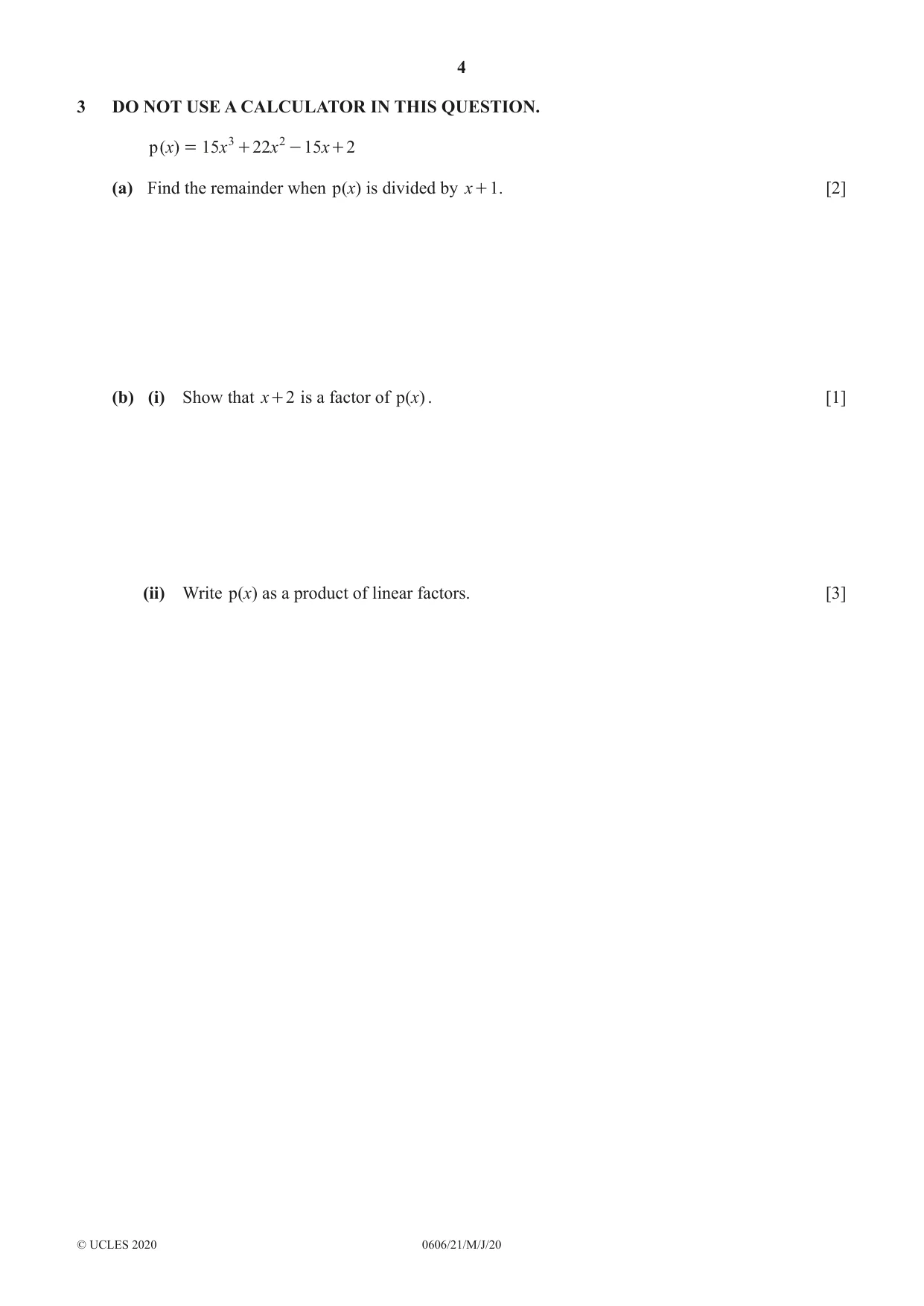
Q3 · DO NOT USE A CALCULATOR IN THIS QUESTION
3 DO NOT USE A CALCULATOR IN THIS QUESTION. p( )x = 15x 3 + 22x 2 - 15 x + 2 (a) Find the remainder when p ( )x is divided by x + 1. [2] (b) (i) Show that x + 2 is a factor of p ( )x . [1] (ii) Write p ( )x as a product of linear factors. [3]
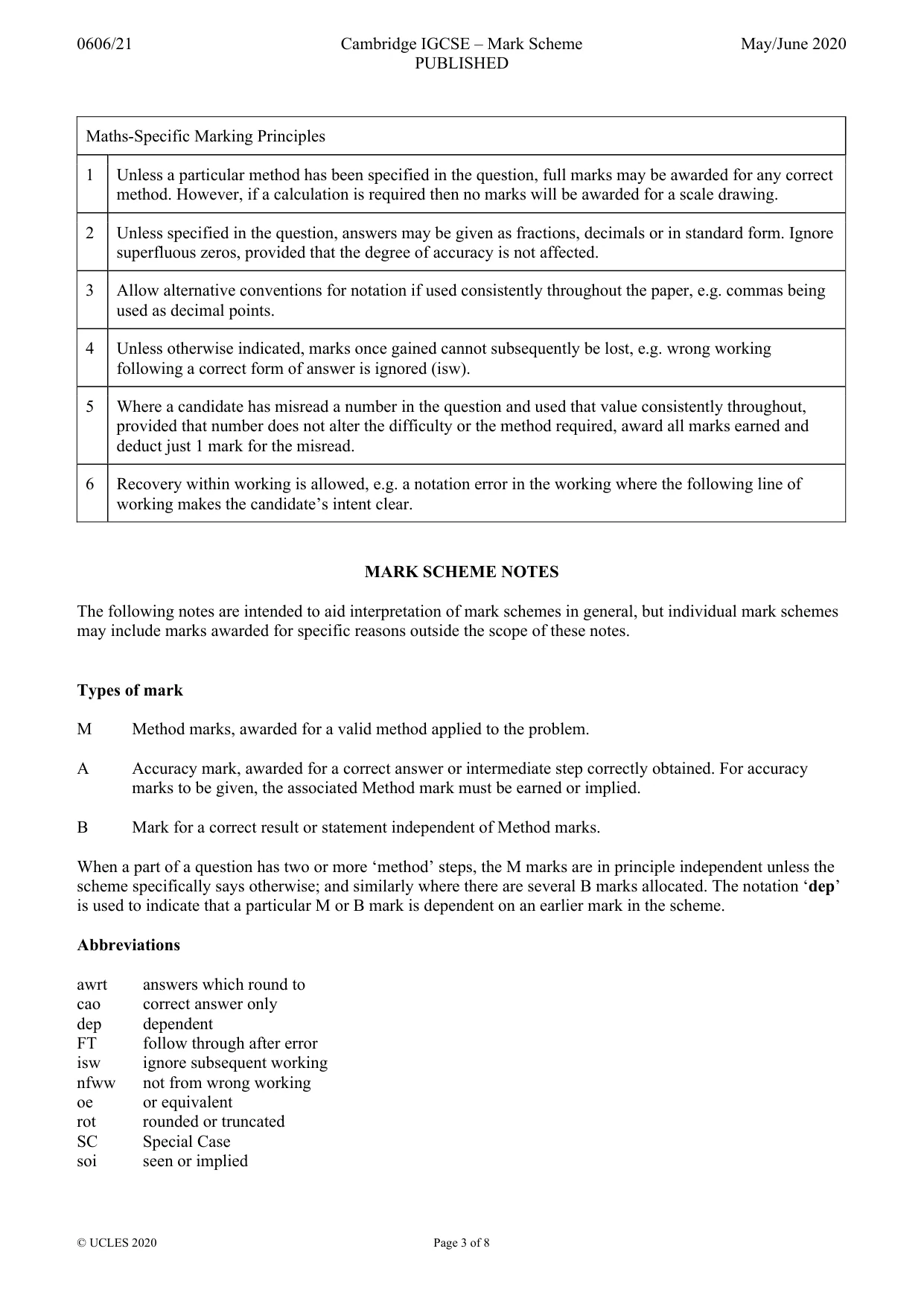
Mark scheme: 3(a) Finds p (– 1) M1 24 A1 3(b)(i) p (– 2) = B1 15 (– 8) + 22(4) – 15 (– 2) + 2 = 0 3(b)(ii) Attempt to find the quadratic factor M1 15x2 – 8x + 1 A1 (x + 2)(3x – 1)(5x – 1) oe, cao A1 If zero scored, SC1 for an answer of (x + 2)(3x – 1)(5x – 1) without working.
Q5 · The vectors a and b are such that a = a i + j and b = 12i + bj
5 The vectors a and b are such that a = a i + j and b = 12i + bj . (a) Find the value of each of the constants a and b such that 4a - b = ( a + 3) i - 2j . [3] (b) Hence find the unit vector in the direction of b - 4a. [2]
Mark scheme: 5(a) 4α – 12 = α + 3 and 4 – β = –2 M1 α = 5 A1 β = 6 A1 5(b) 2 2 M1 their (α + 3 ) + ( − 2 ) 2 j − their 8 i A1 FT their α their 68
Q6 · Find the values of k for which the line y = kx - 7 and the curve y = 3x 2 + 8x + 5 do not…
6 Find the values of k for which the line y = kx - 7 and the curve y = 3x 2 + 8x + 5 do not intersect. [6]
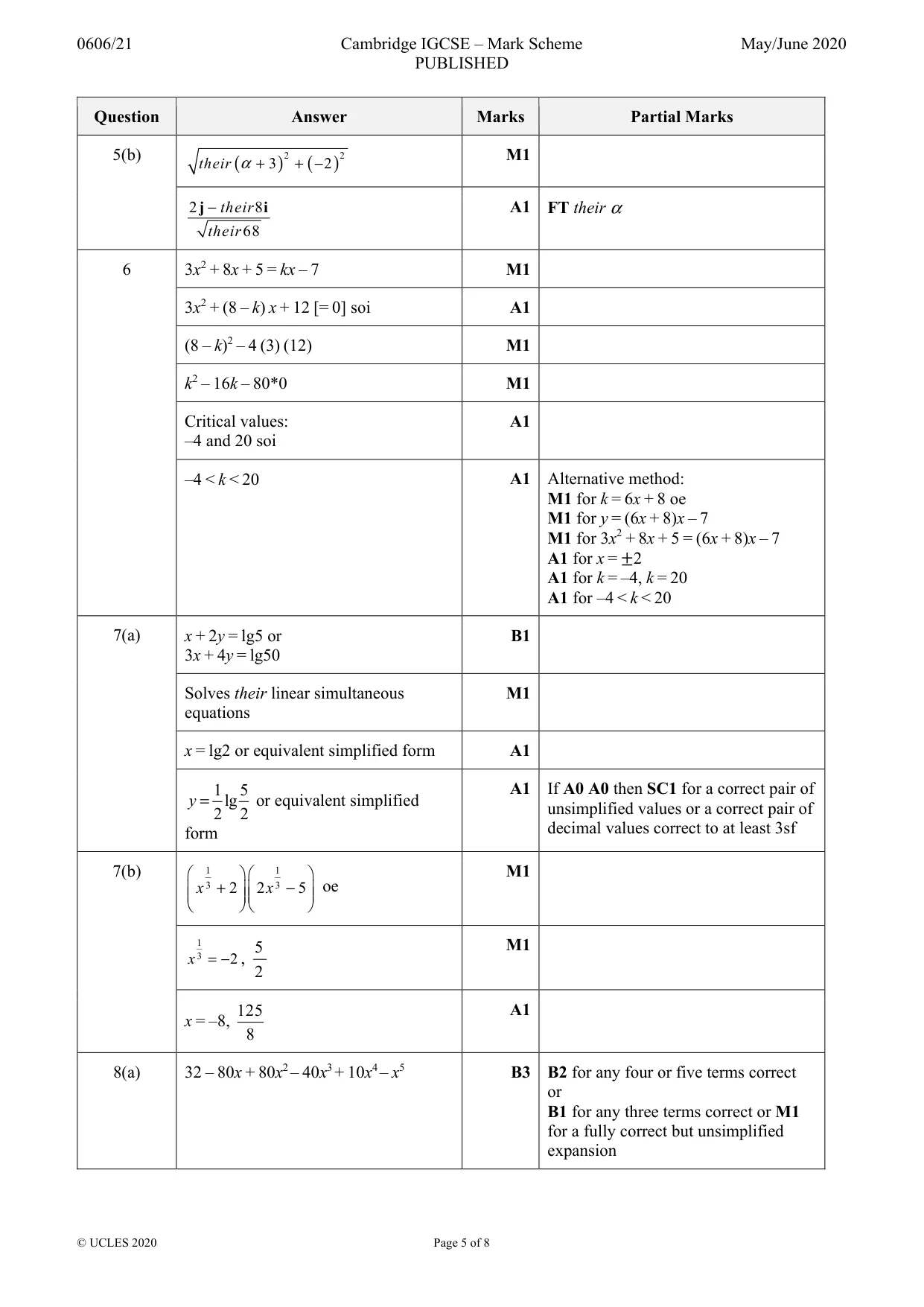
Mark scheme: 6 3x2 + 8x + 5 = kx – 7 M1 3x2 + (8 – k) x + 12 [= 0] soi A1 (8 – k)2 – 4 (3) (12) M1 k2 – 16k – 80*0 M1 Critical values: A1 –4 and 20 soi –4 < k < 20 A1 Alternative method: M1 for k = 6x + 8 oe M1 for y = (6x + 8)x – 7 M1 for 3x2 + 8x + 5 = (6x + 8)x – 7 A1 for x = ±2 A1 for k = –4, k = 20 A1 for –4 < k < 20
Q7 · Solve the simultaneous equations 10 x + 2 y = 5, 10 3 x + 4 y = 50 , giving x and y in…
7 (a) Solve the simultaneous equations 10 x + 2 y = 5, 10 3 x + 4 y = 50 , giving x and y in exact simplified form. [4] 3 - x 3 - 10 = 0. [3] (b) Solve 2x 2 1
Mark scheme: 7(a) x + 2y = lg5 or B1 3x + 4y = lg50 Solves their linear simultaneous M1 equations x = lg2 or equivalent simplified form A1 1 5 A1 If A0 A0 then SC1 for a correct pair of y = lg or equivalent simplified unsimplified values or a correct pair of 2 2 decimal values correct to at least 3sf form 7(b) 1 1 M1 x 3 + 2 2 x 3 − 5 oe 1 5 M1 x 3 = −,2 2 125 A1 x = –8, 8
Q8 · Expand ( 2 - x) 5 , simplifying each coefficient
8 (a) Expand ( 2 - x) 5 , simplifying each coefficient. [3] e ( 2 - )x 5 # e 80 x -x 5 (b) Hence solve 4 = e . [4] e 10x + 32
Mark scheme: 8(a) 32 – 80x + 80x2 – 40x3 + 10x4 – x5 B3 B2 for any four or five terms correct or B1 for any three terms correct or M1 for a fully correct but unsimplified expansion 8(b) Combines powers sufficiently to be M1 able to take logs or applies correct log laws For making use of their expansion M1 from part (a) 40x2 (2 – x) [= 0] oe M1 FT their (a) if possible x = 0, x = 2 cao A1
Q9 · A particle travels in a straight line
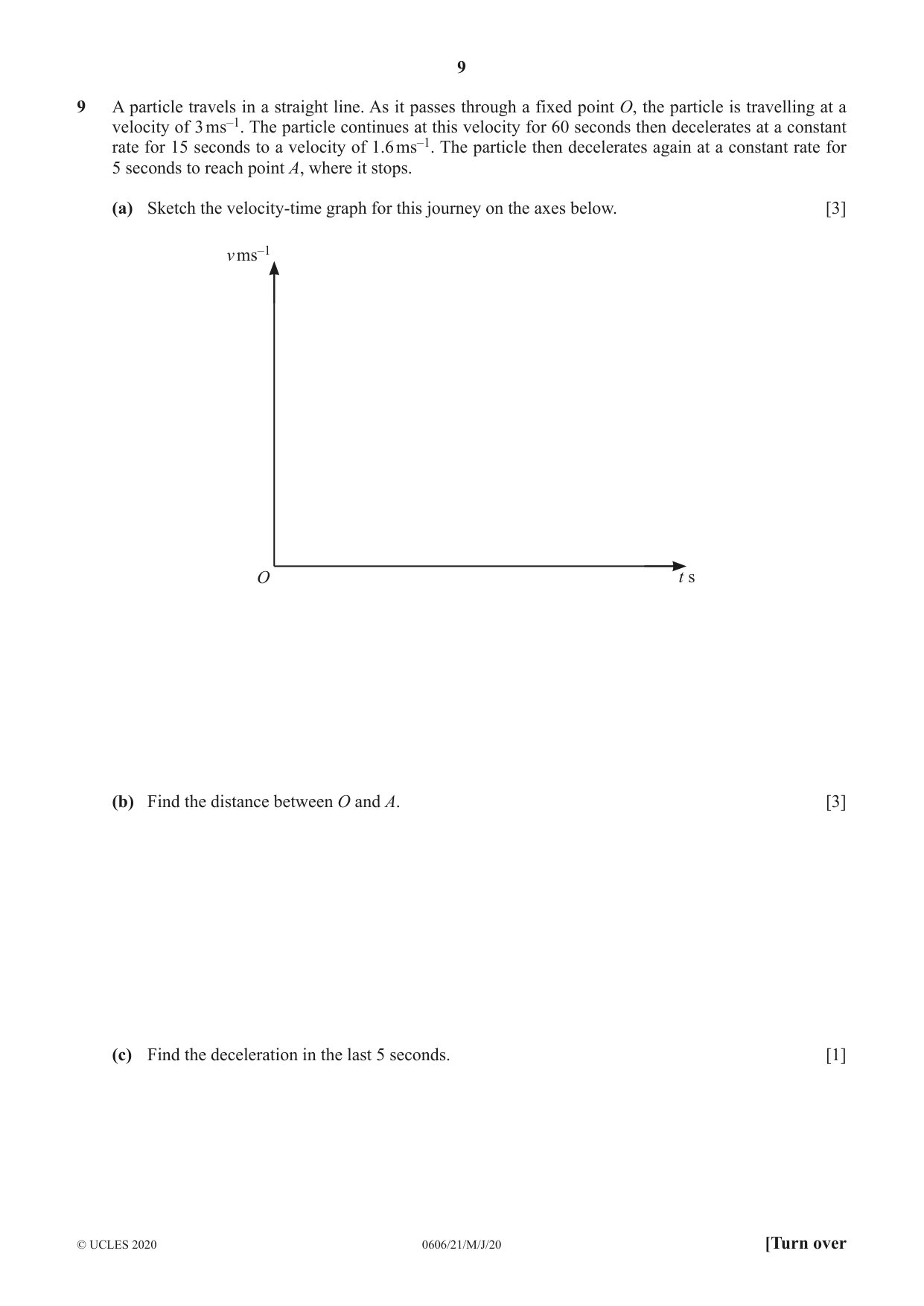
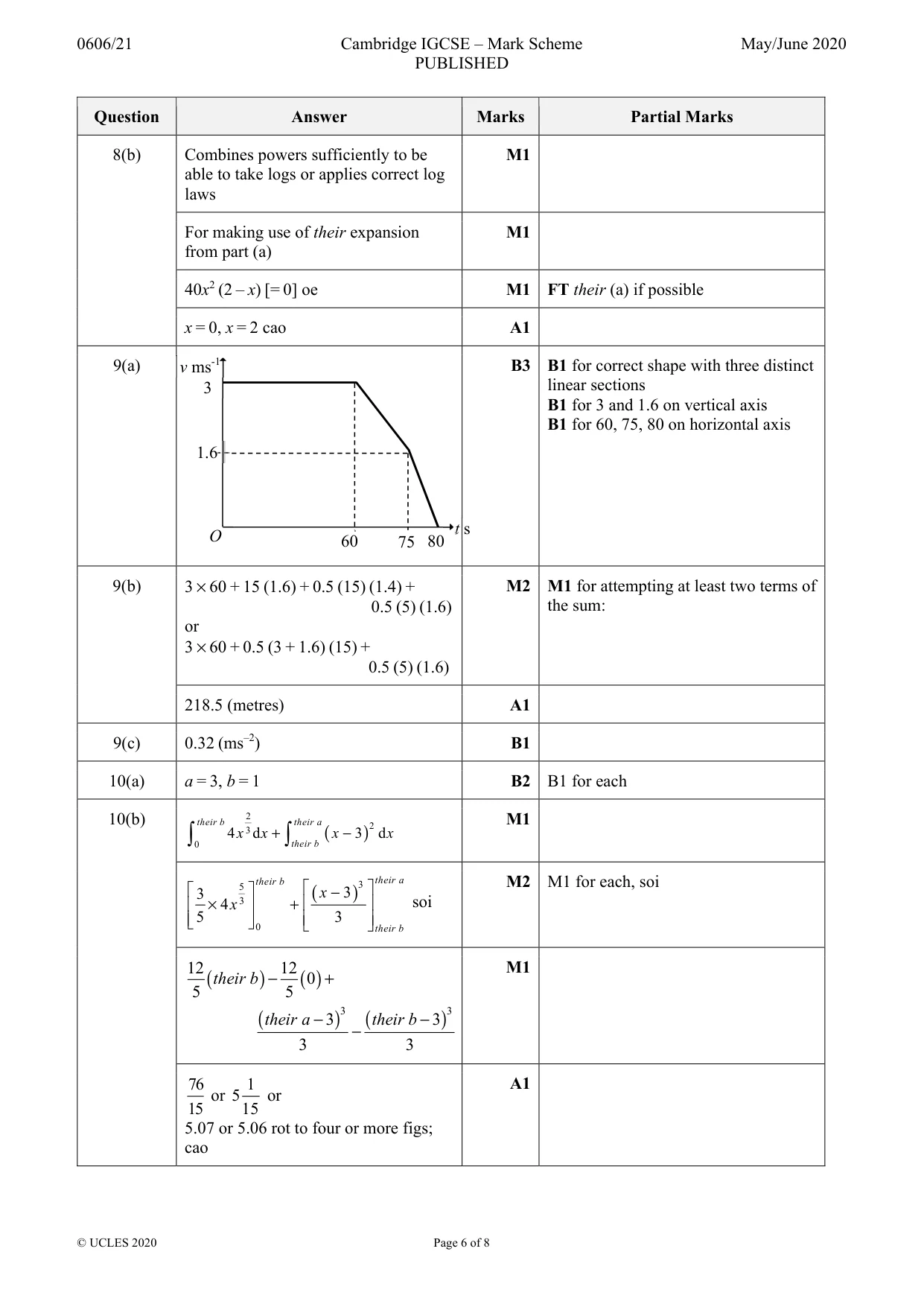
9 A particle travels in a straight line. As it passes through a fixed point O, the particle is travelling at a velocity of 3 ms–1. The particle continues at this velocity for 60 seconds then decelerates at a constant rate for 15 seconds to a velocity of 1.6 ms–1. The particle then decelerates again at a constant rate for 5 seconds to reach point A, where it stops. (a) Sketch the velocity-time graph for this journey on the axes below. [3] v ms–1 O t s (b) Find the distance between O and A. [3] (c) Find the deceleration in the last 5 seconds. [1]
Mark scheme: 9(a) v ms-1 B3 B1 for correct shape with three distinct 3 linear sections B1 for 3 and 1.6 on vertical axis B1 for 60, 75, 80 on horizontal axis 1.6 t s O 60 75 80 9(b) 3 × 60 + 15 (1.6) + 0.5 (15) (1.4) + M2 M1 for attempting at least two terms of 0.5 (5) (1.6) the sum: or 3 × 60 + 0.5 (3 + 1.6) (15) + 0.5 (5) (1.6) 218.5 (metres) A1 9(c) 0.32 (ms–2) B1
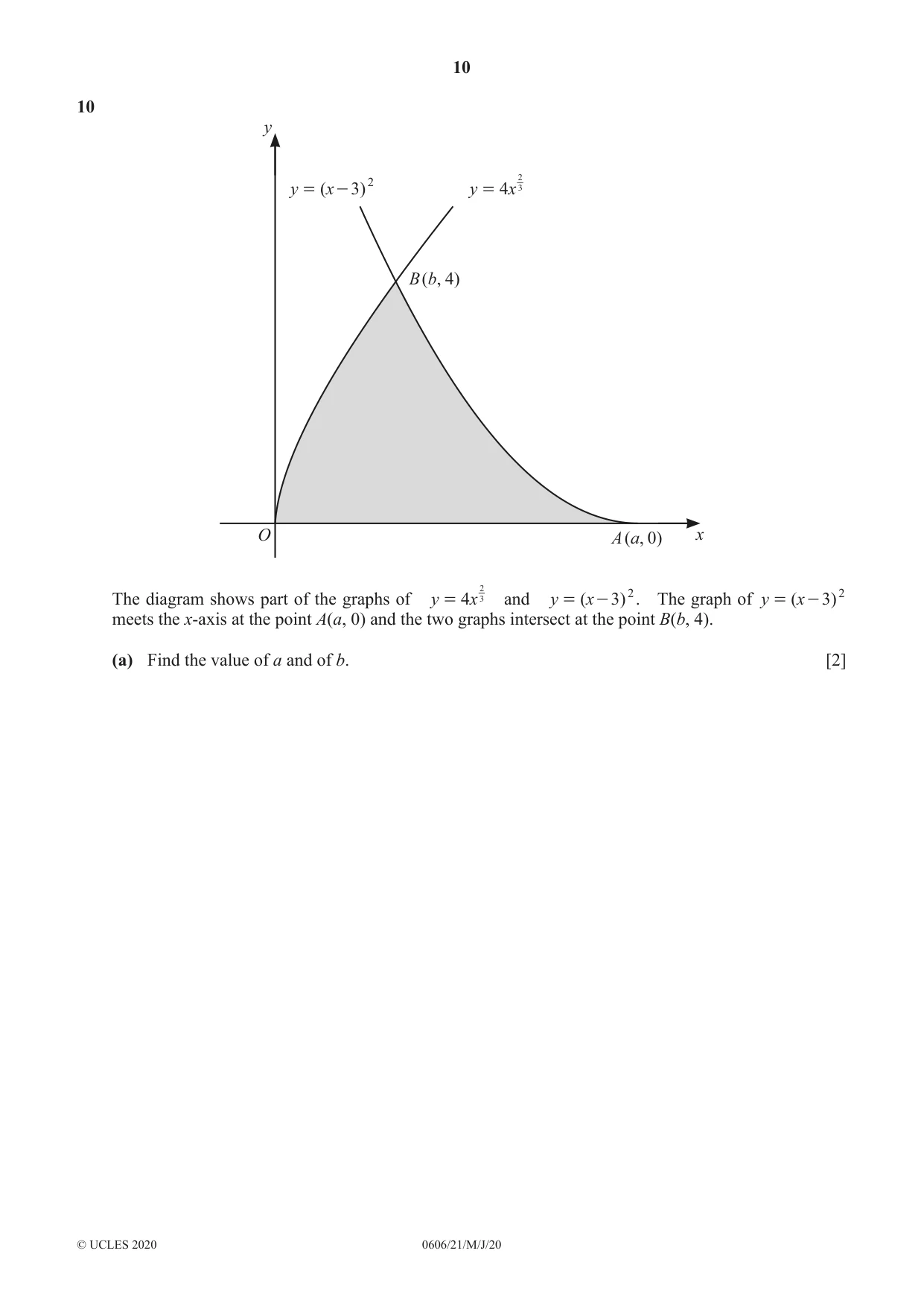
Q10 · Y y = ( x - 3) 2 y = 4x 23 B ( b, 4) O A ( a, 0) x 2 The diagram shows part of the graphs…
10 y y = ( x - 3) 2 y = 4x 23 B ( b, 4) O A ( a, 0) x 2 The diagram shows part of the graphs of y = 4x 3 and y = ( x - 3 ) 2 . The graph of y = ( x - 3) 2 meets the x-axis at the point A(a, 0) and the two graphs intersect at the point B(b, 4). (a) Find the value of a and of b. [2]
Mark scheme: 10(a) a = 3, b = 1 B2 B1 for each 10(b) their b 2 their a 2 M1 3 0 4 x d x + their b ( x − 3 ) d x their b 3 their a M2 M1 for each, soi 5 3 ( x − 3 ) × 4 x 3 soi + 5 0 3 their b 12 12 M1 ( their b ) − ( 0 ) + 5 5 ( their a − 3 ) 3 ( their b − 3 ) 3 − 3 3 76 1 A1 or or 15 515 5.07 or 5.06 rot to four or more figs; cao
Q11 · The function f is defined by f( x) = nl ( 2 x + 1) for x H 0
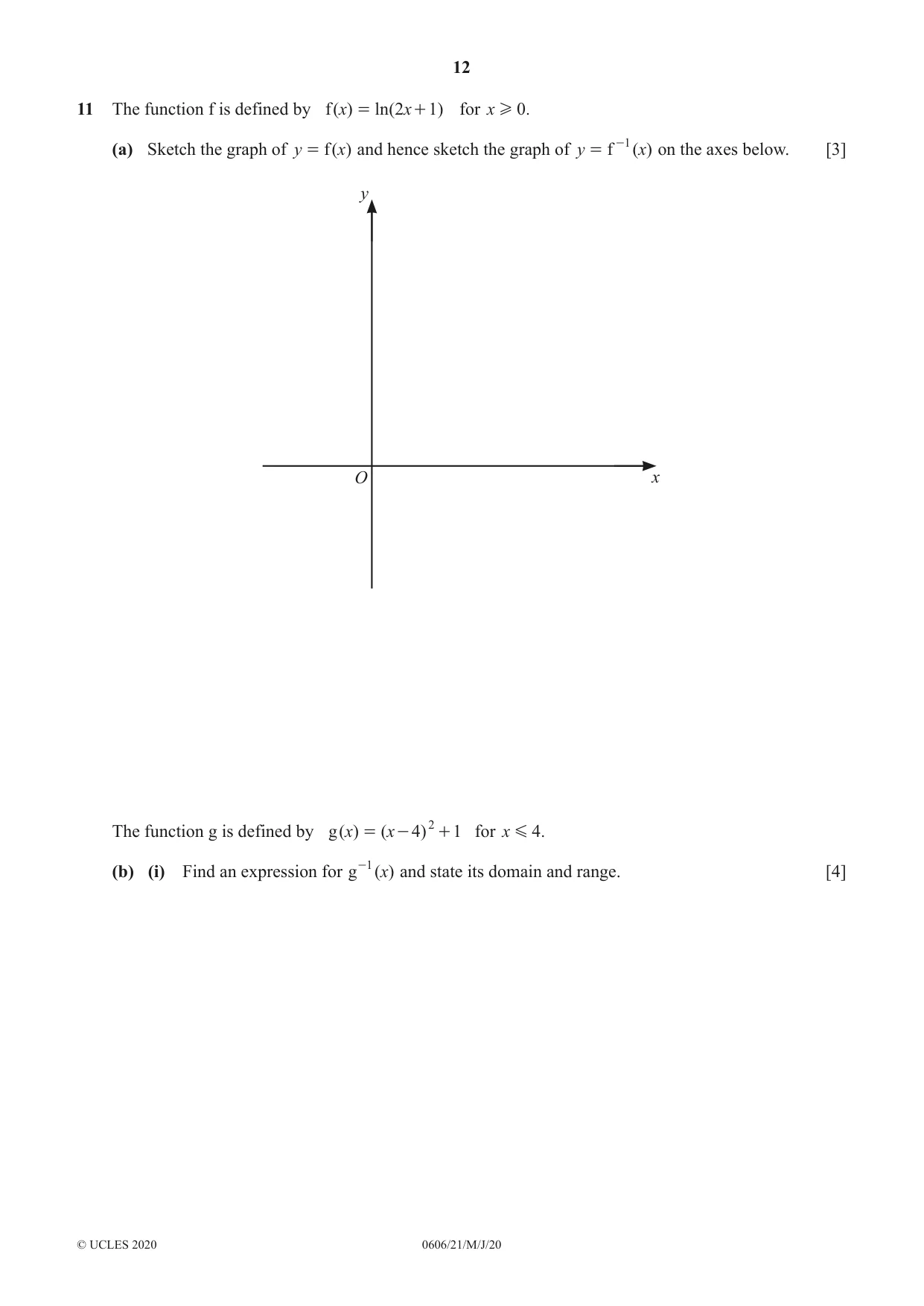
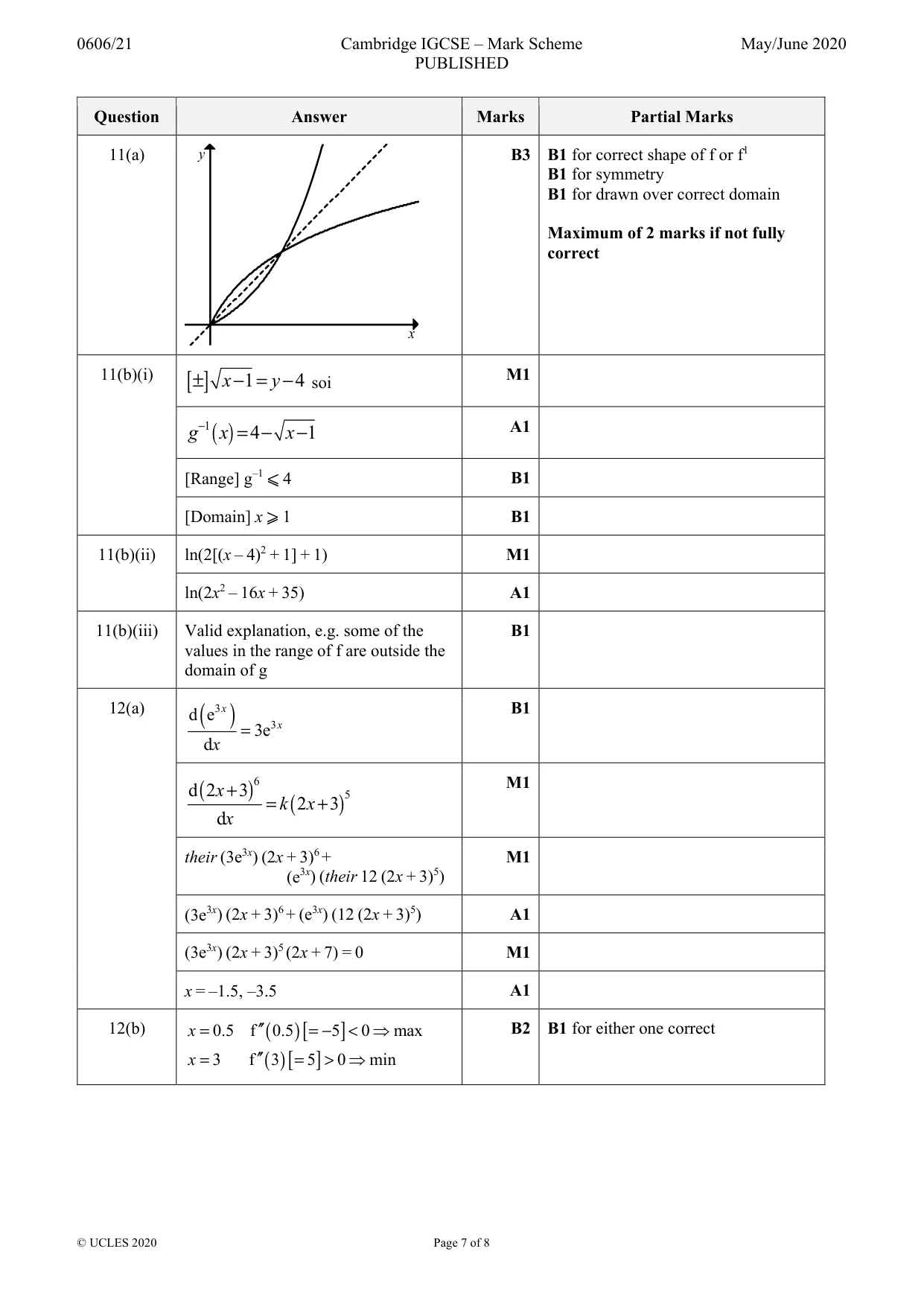
11 The function f is defined by f( x) = nl ( 2 x + 1) for x H 0. (a) Sketch the graph of y = f( x) and hence sketch the graph of y = f -1 ( x) on the axes below. [3] y O x The function g is defined by g( x) = ( x - 4) 2 + 1 for x G 4. (b) (i) Find an expression for g -1 ( )x and state its domain and range. [4] (ii) Find and simplify an expression for fg( x). [2] (iii) Explain why the function gf does not exist. [1]
Mark scheme: 11(a) y B3 B1 for correct shape of f or f1 B1 for symmetry B1 for drawn over correct domain Maximum of 2 marks if not fully correct x 11(b)(i) [ ±] x −=1 y − 4 soi M1 −1 A1 g ( x ) = 4 − x −1 [Range] g–1 ⩽ 4 B1 [Domain] x ⩾ 1 B1 11(b)(ii) ln(2[(x – 4)2 + 1] + 1) M1 ln(2x2 – 16x + 35) A1 11(b)(iii) Valid explanation, e.g. some of the B1 values in the range of f are outside the domain of g
Q12 · Find the x-coordinates of the stationary points of the curve y = e 3 x ( 2x + 3) 6
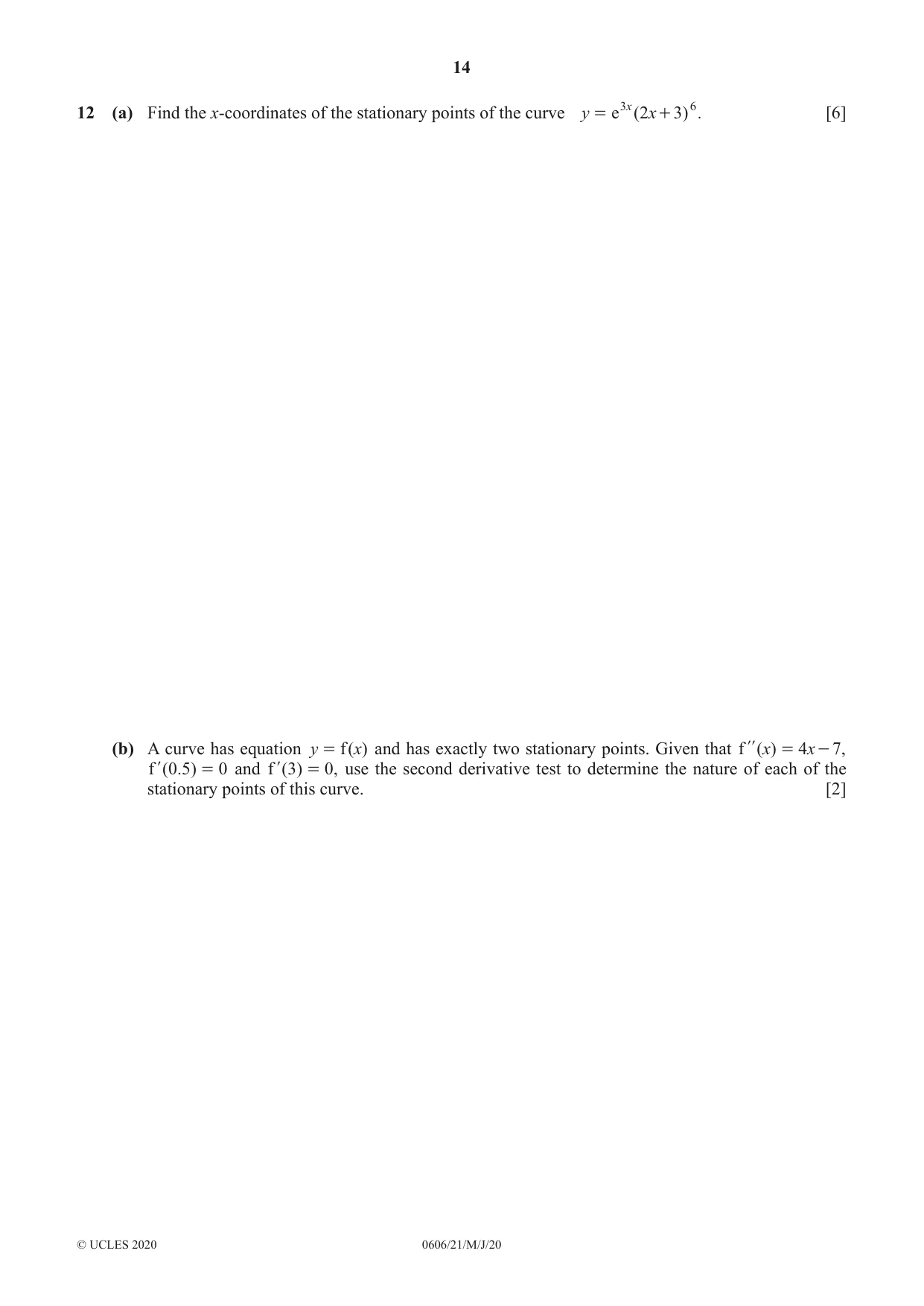
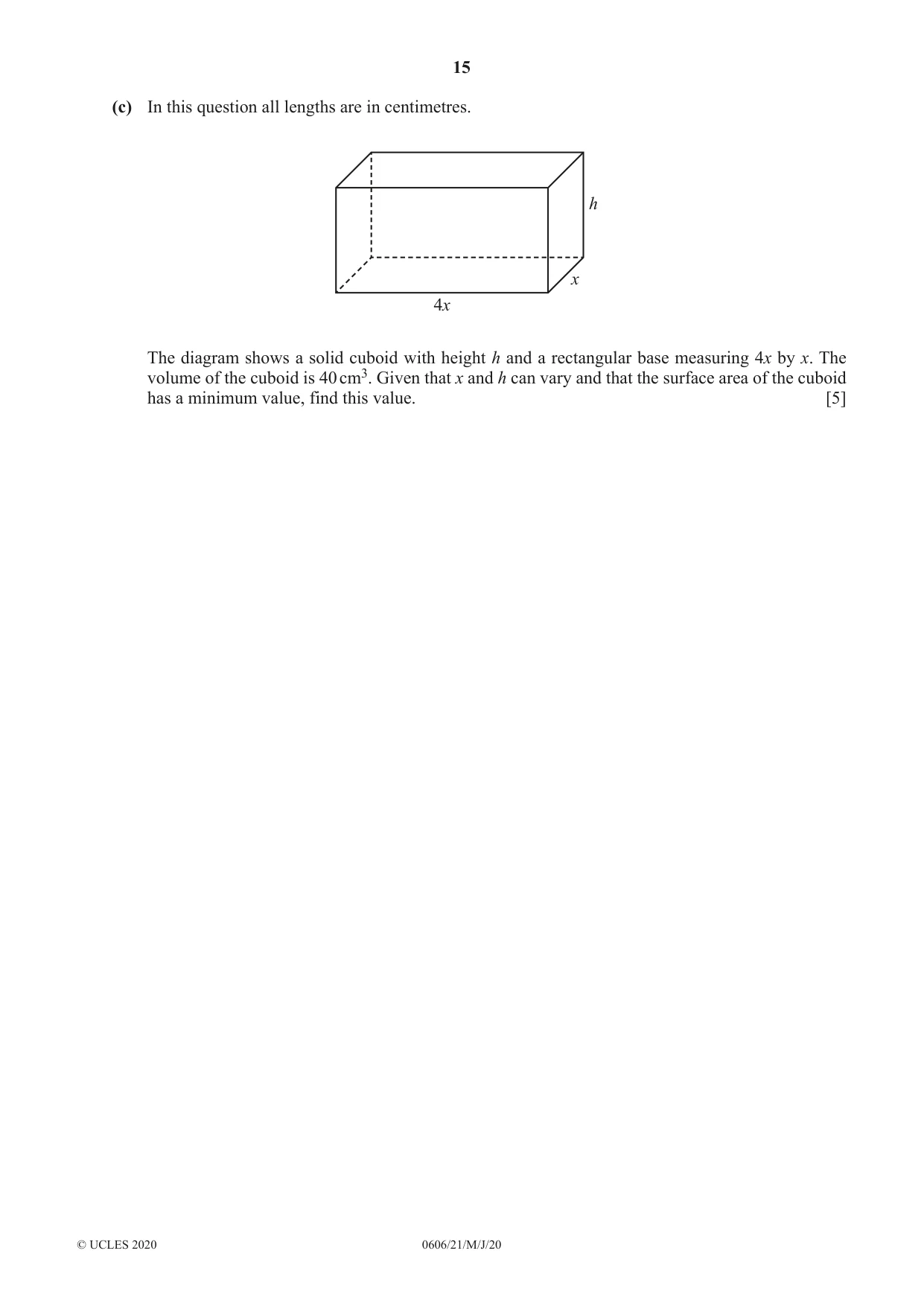
12 (a) Find the x-coordinates of the stationary points of the curve y = e 3 x ( 2x + 3) 6 . [6] (b) A curve has equation y = f( x) and has exactly two stationary points. Given that f ll ( x) = 4 x - 7 , f l ( 0.5) = 0 and f l ( 3) = 0, use the second derivative test to determine the nature of each of the stationary points of this curve. [2] (c) In this question all lengths are in centimetres. h x 4x The diagram shows a solid cuboid with height h and a rectangular base measuring 4x by x. The volume of the cuboid is 40 cm3. Given that x and h can vary and that the surface area of the cuboid has a minimum value, find this value. [5]
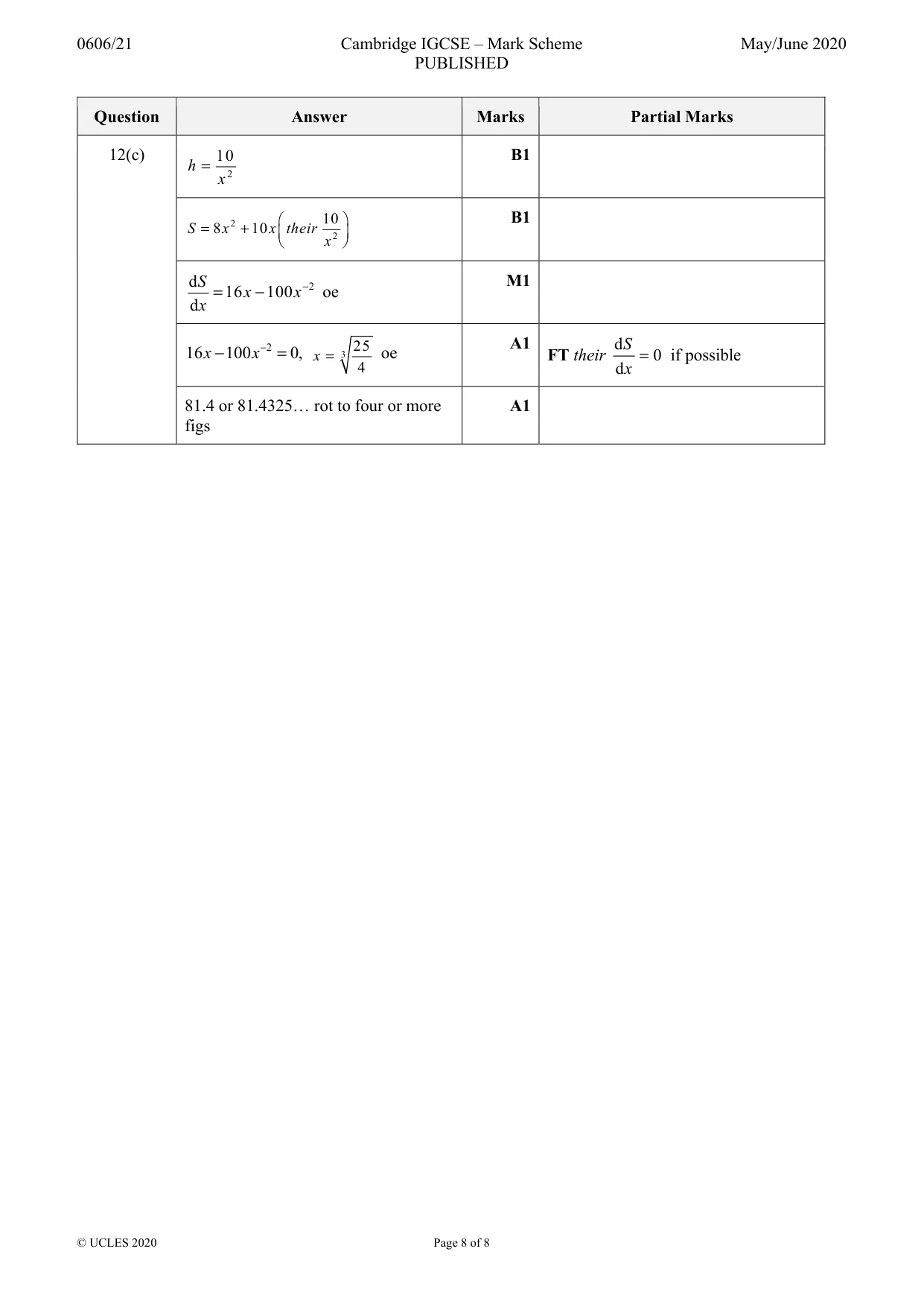
Mark scheme: 12(a) 3 x B1 d e ( ) 3 x = 3e d x 6 M1 d ( 2 x + 3) 5 = k ( 2 x + 3) dx their (3e3x) (2x + 3)6 + M1 (e3x) (their 12 (2x + 3)5) (3e3x) (2x + 3)6 + (e3x) (12 (2x + 3)5) A1 (3e3x) (2x + 3)5 (2x + 7) = 0 M1 x = –1.5, –3.5 A1 12(b) x = 0.5 f ′′ ( 0.5 )[ = −5 ] < 0 max B2 B1 for either one correct x = 3 f ′′ ( 3 )[ = 5 ] > 0 min 12(c) 10 B1 h = x 2 2 10 B1 S = 8 x + 10 x their 2 x d S − 2 M1 = 16 x − 100 x oe d x 2 25 A1 d S 16 x − 100 x− = 0, x = 3 oe FT their = 0 if possible 4 d x 81.4 or 81.4325… rot to four or more A1 figs
More questions on Use differentiation to find stationary points
What was in this paper
The subtopics covered by these 11 questions, and how many questions each got. Open one in a new tab to see every Cambridge question on it.
1Find the inverse of a one–one function1Find the magnitude of a vector; add and1Find the maximum or minimum value of the1Know and use the remainder and factor1Know the conditions for f(x) = 0 to have1Solve equations of the form ax = b1Solve equations of the type1Solve simultaneous equations in two1Transform given relationships to and from1Use differentiation to find stationary points1