Cambridge IGCSE Mathematics - Additional 0606 — 2018 May/June Paper 2 · Variant 1
0606/21/M/J/18 · 12 questions · 80 marks · ≈90 min
The question paper and its mark scheme, free to read here and free to download. This is Cambridge’s own paper, exactly as it was sat.
Question paper16 pages

Mark scheme9 pages
Answers below. Sit the paper first if you are practising.
Questions as text
Q1 · A, B and C are subsets of the same universal set
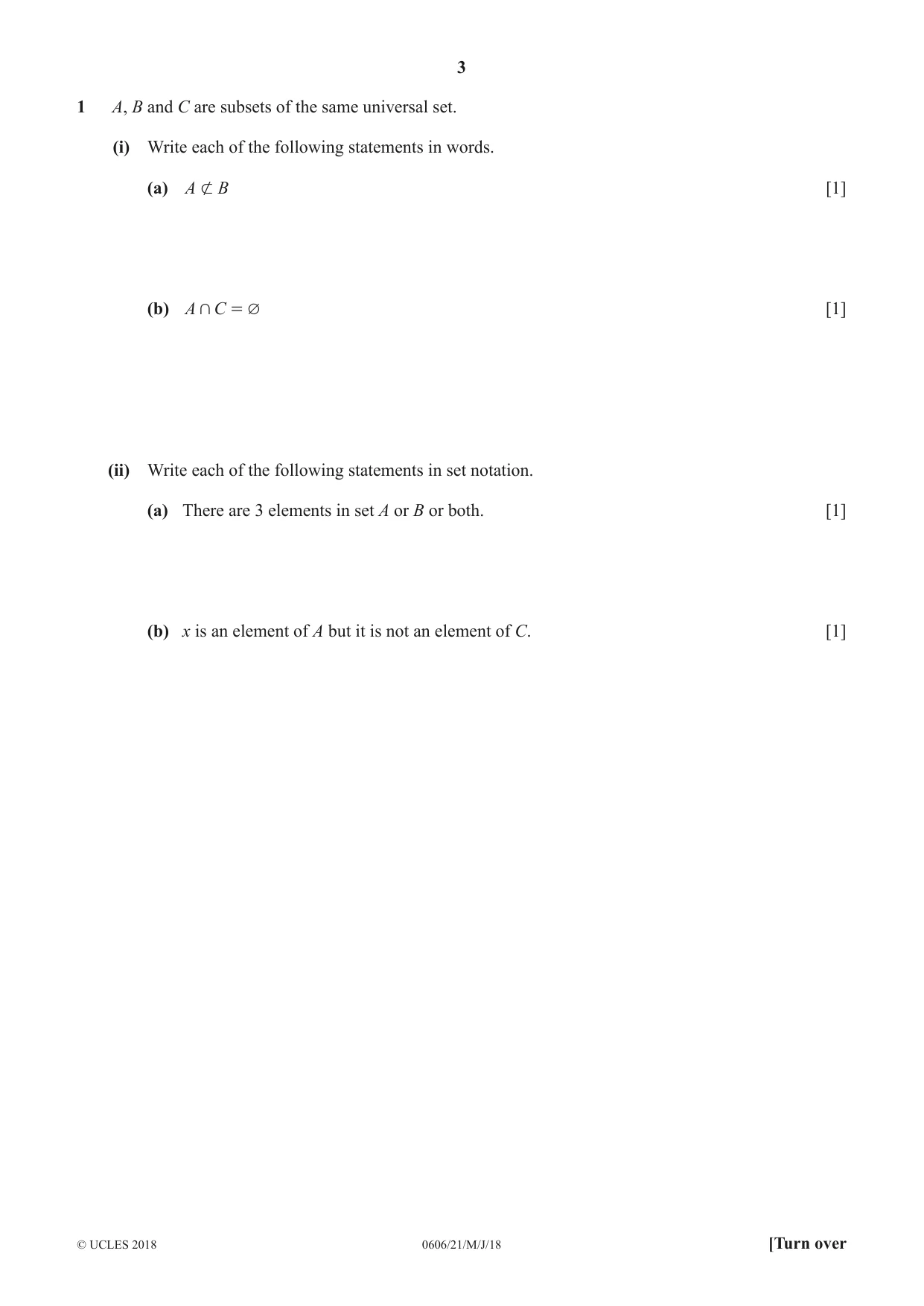
1 A, B and C are subsets of the same universal set. (i) Write each of the following statements in words. (a) A 1Y B [1] (b) A + C = Q [1] (ii) Write each of the following statements in set notation. (a) There are 3 elements in set A or B or both. [1] (b) x is an element of A but it is not an element of C. [1]
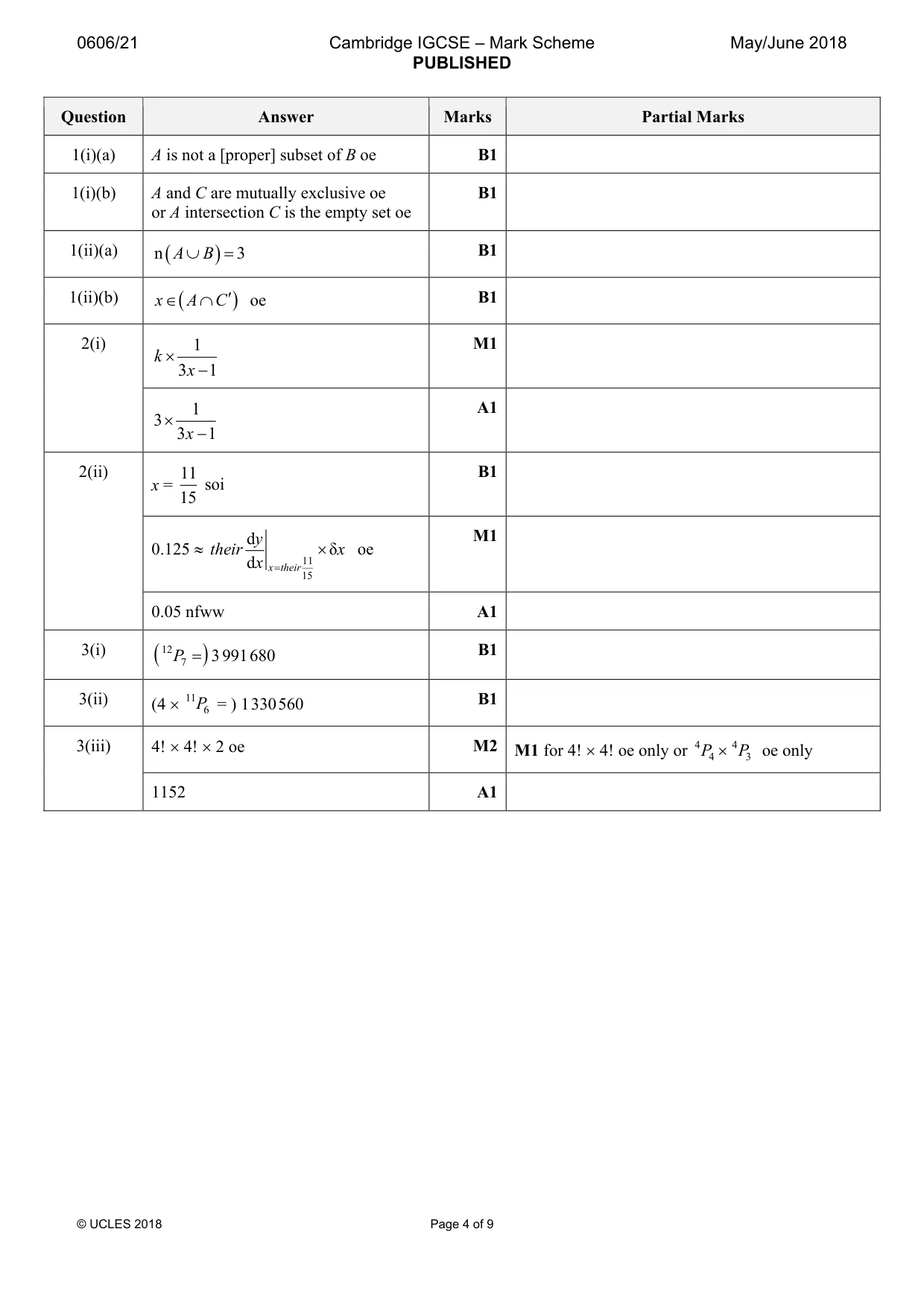
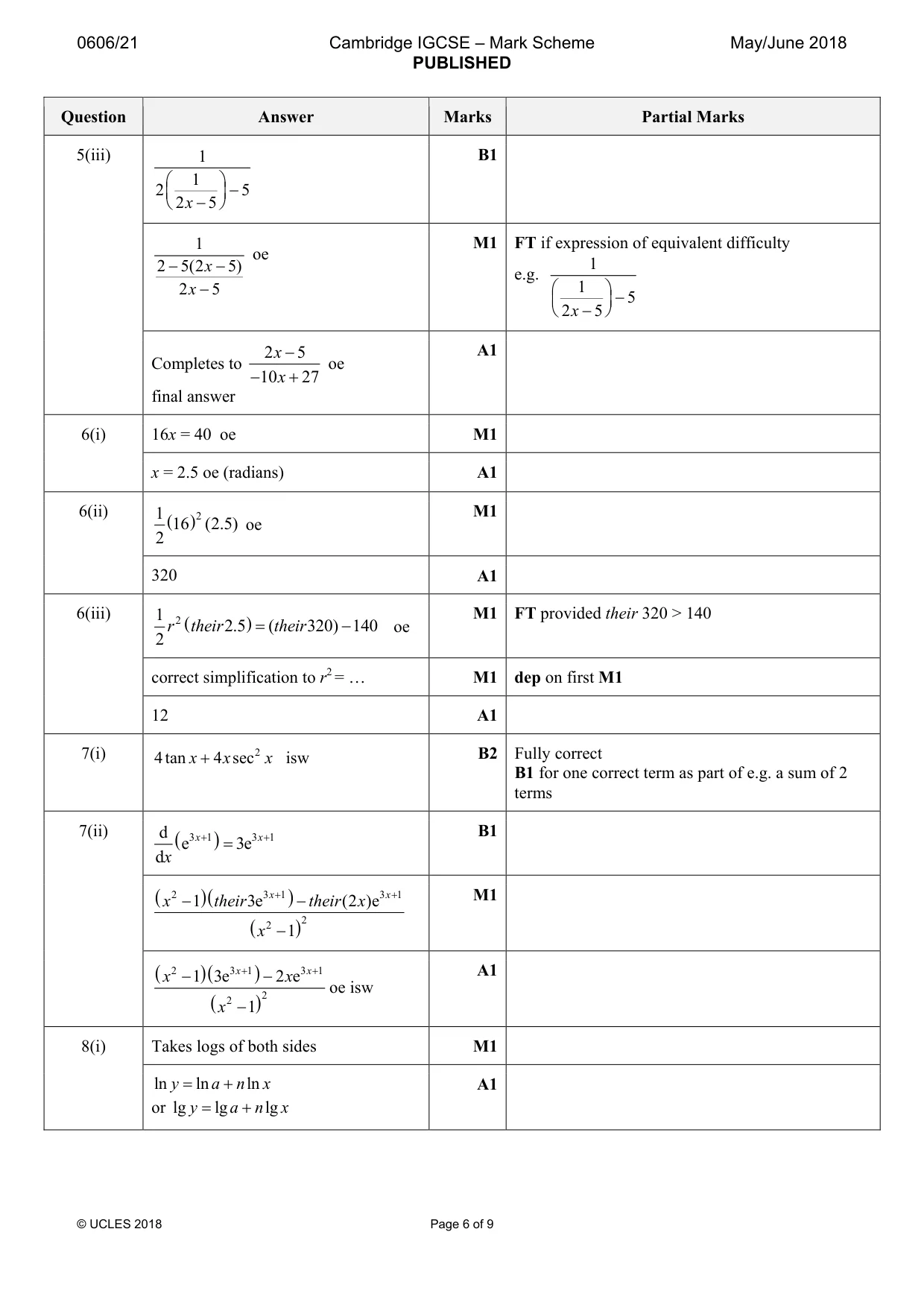
Mark scheme: Question Answer Marks Partial Marks 1(i)(a) A is not a [proper] subset of B oe B1 1(i)(b) A and C are mutually exclusive oe B1 or A intersection C is the empty set oe 1(ii)(a) n ( A ∪ B ) = 3 B1 1(ii)(b) x ∈ ( A ∩ C′ ) oe B1
Q2 · The variables x and y are such that y = ln 3x - 1 for x 2
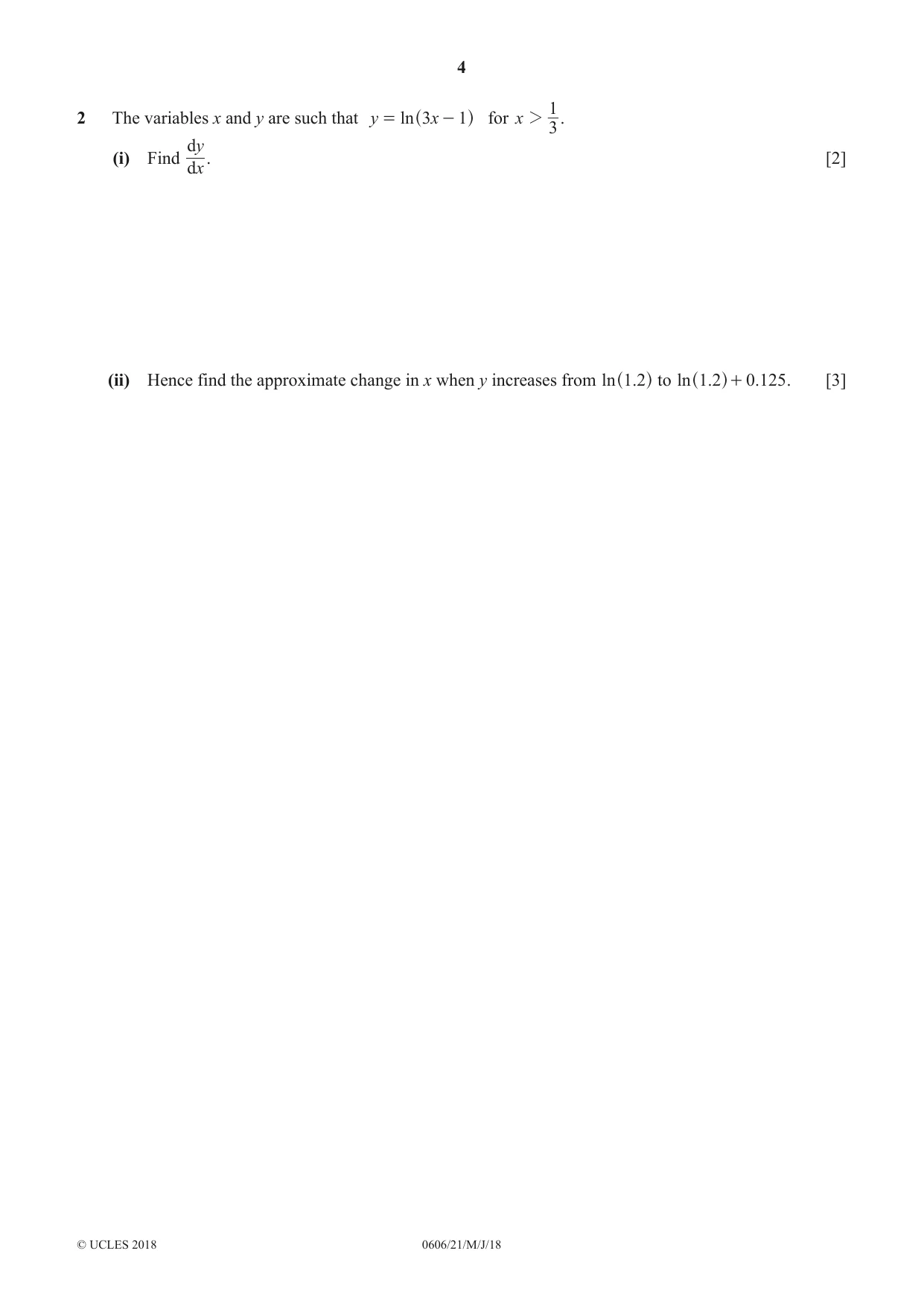
2 The variables x and y are such that y = ln 3x - 1 for x 2 . 3 dy (i) Find . [2] dx (ii) Hence find the approximate change in x when y increases from ln 1.2 to ln 1.2 + 0. 125 . [3] ^ h ^ h
Mark scheme: 2(i) 1 M1 k × 3 x − 1 1 A1 3 × 3 x − 1 2(ii) 11 B1 x = soi 15 d y M1 0.125 ≈ their × δx oe d x x = their 11 15 0.05 nfww A1
More questions on Use differentiation to find gradients, tangents
Q3 · A 7-character password is to be selected from the 12 characters shown in the table
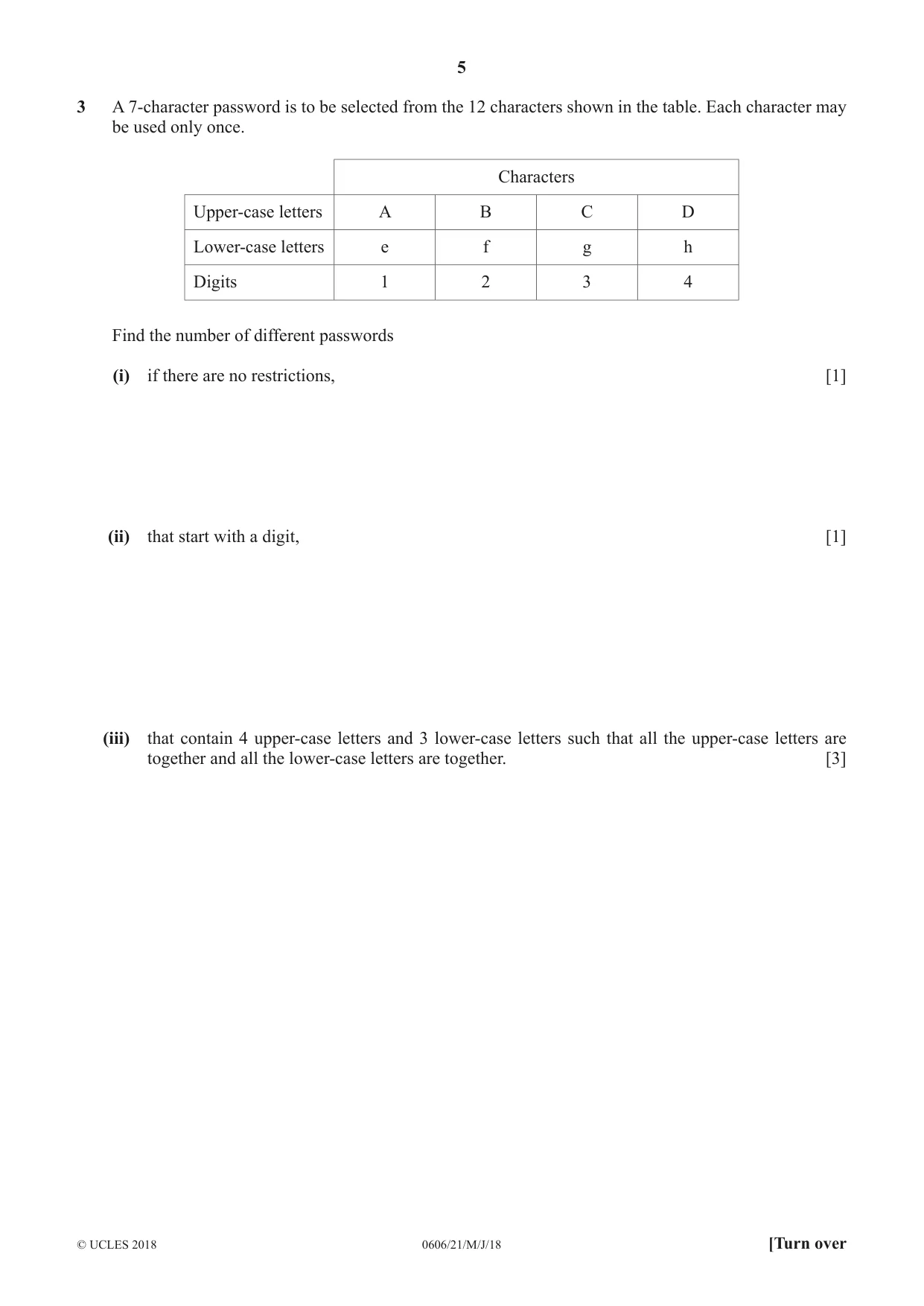
3 A 7-character password is to be selected from the 12 characters shown in the table. Each character may be used only once. Characters Upper-case letters A B C D Lower-case letters e f g h Digits 1 2 3 4 Find the number of different passwords (i) if there are no restrictions, [1] (ii) that start with a digit, [1] (iii) that contain 4 upper-case letters and 3 lower-case letters such that all the upper-case letters are together and all the lower-case letters are together. [3]
Mark scheme: 3(i) ( 12 P7 = ) 3991680 B1 3(ii) 11 B1 (4 × 6P = ) 1 330 560 3(iii) 4! × 4! × 2 oe M2 M1 for 4! × 4! oe only or 4 P4 × 4 P3 oe only 1152 A1
More questions on Solve problems on arrangement and selection
Q4 · Do not use a calculator in this question
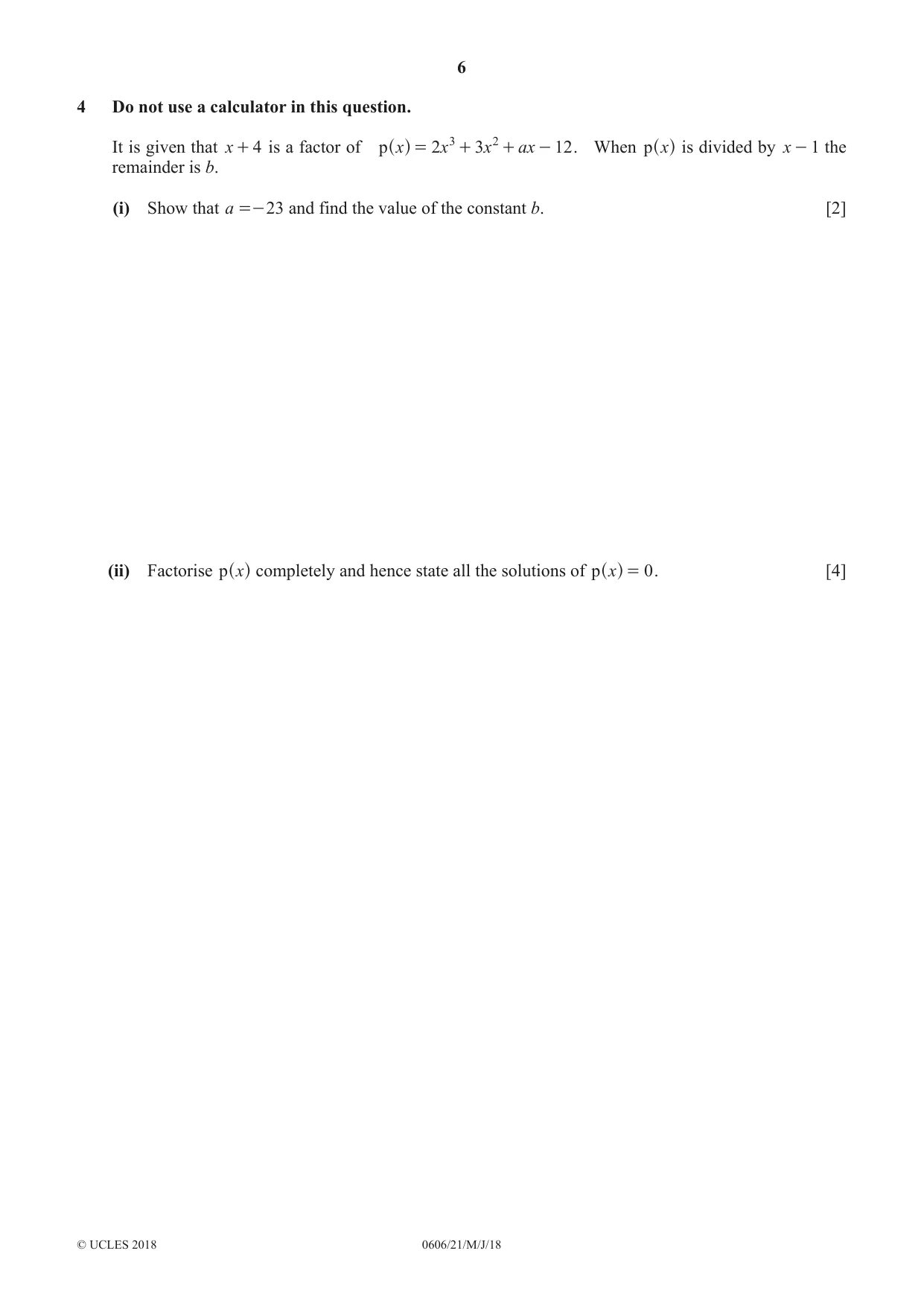
4 Do not use a calculator in this question. It is given that x + 4 is a factor of p x = 2x 3 + 3x 2 + ax - 12 . When x is divided by x - 1 the ^ h p^ h remainder is b. (i) Show that a =- 23 and find the value of the constant b. [2] (ii) Factorise x completely and hence state all the solutions of p x = 0 . [4] p^ h ^ h
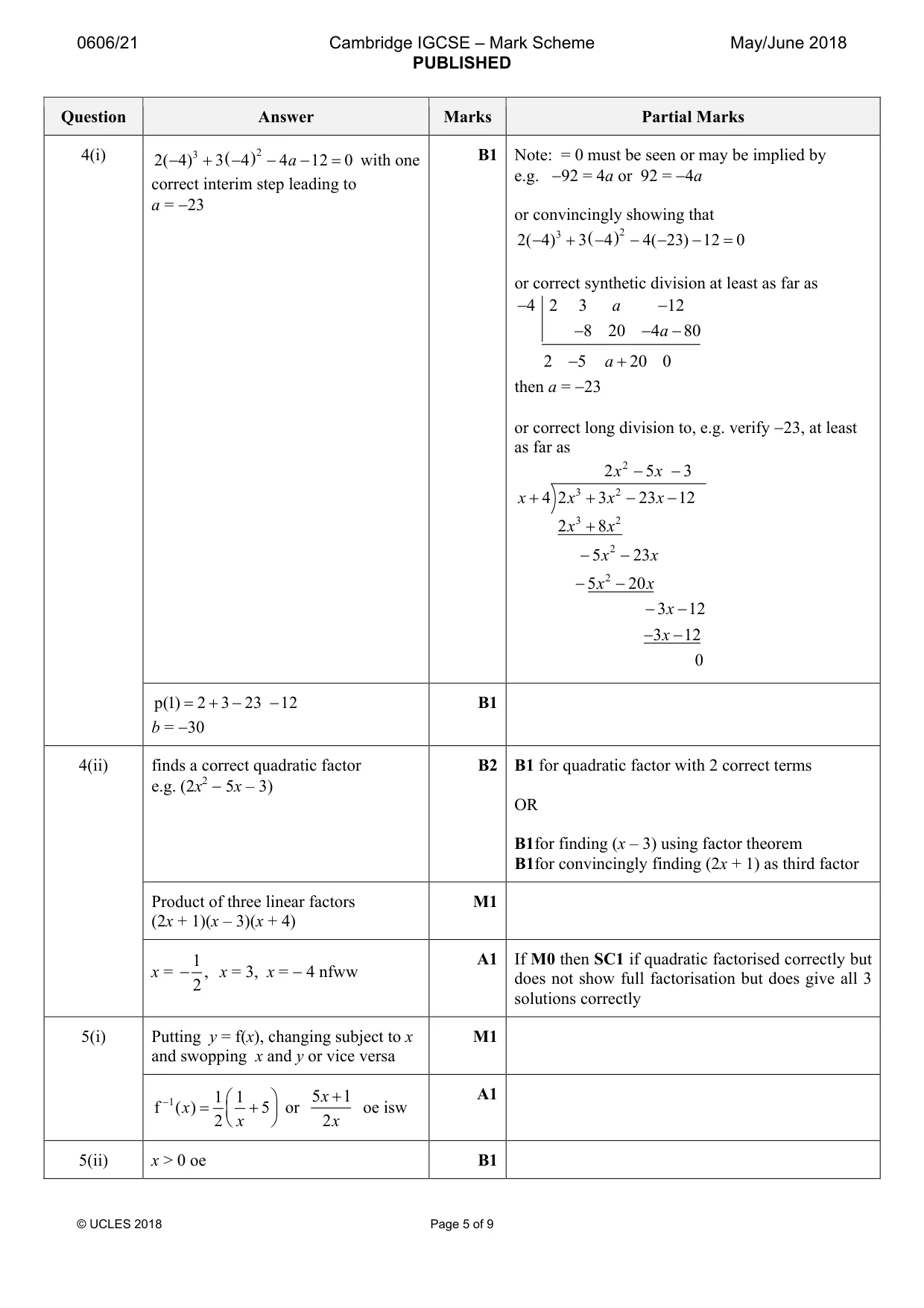
Mark scheme: 4(i) 2( − 4) 3 + 3 ( − 4 )2 − 4 a − 12 = 0 with one B1 Note: = 0 must be seen or may be implied by e.g. −92 = 4a or 92 = −4a correct interim step leading to a = −23 or convincingly showing that 2( − 4) 3 + 3 ( − 4 )2 − 4( − 23) − 12 = 0 or correct synthetic division at least as far as −4 2 3 a −12 −8 20 −4 a − 80 2 −5 a + 20 0 then a = −23 or correct long division to, e.g. verify −23, at least as far as 2 x 2 − 5 x − 3 x + 4 2 x 3 + 3 x 2 − 23 x − 12 2 x 3 + 8 x 2 − 5 x 2 − 23 x − 5 x 2 − 20 x − 3 x − 12 −3 x − 12 0 p(1) = 2 + 3 − 23 − 12 B1 b = −30 4(ii) finds a correct quadratic factor B2 B1 for quadratic factor with 2 correct terms e.g. (2x2 − 5x – 3) OR B1for finding (x – 3) using factor theorem B1for convincingly finding (2x + 1) as third factor Product of three linear factors M1 (2x + 1)(x – 3)(x + 4) 1 A1 If M0 then SC1 if quadratic factorised correctly but x = − , x = 3, x = − 4 nfww does not show full factorisation but does give all 3 2 solutions correctly
Q5 · The function f is defined by f x = for x 2 2.5
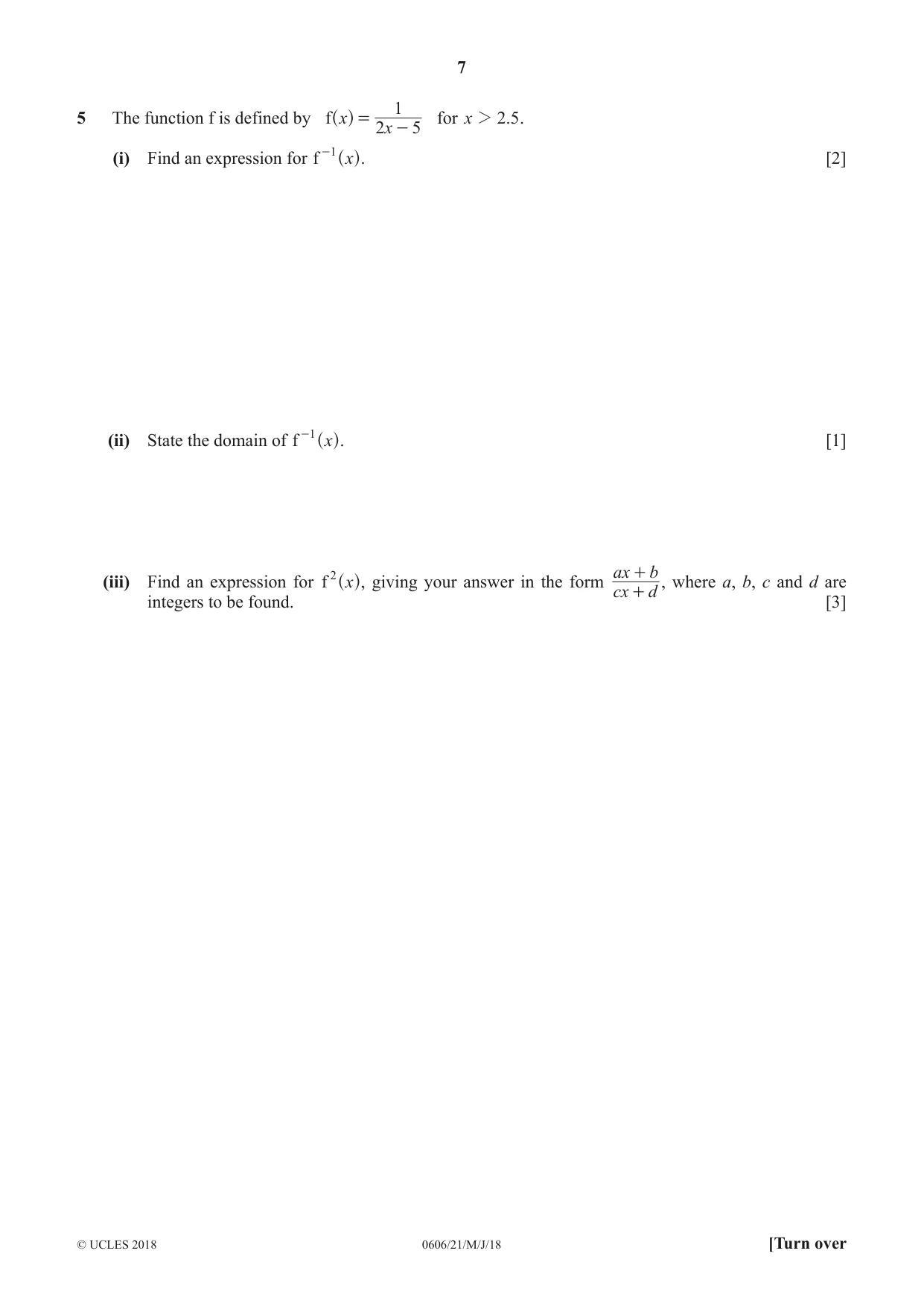
5 The function f is defined by f x = for x 2 2.5 . 2x - 5 (i) Find an expression for f -1 x [2] ^ h. (ii) State the domain of f -1 x [1] ^ h. ax + b (iii) Find an expression for f x giving your answer in the form , where a, b, c and d are 2^ h, cx + d integers to be found. [3]
Mark scheme: 5(i) Putting y = f(x), changing subject to x M1 and swopping x and y or vice versa − 1 1 1 5 x + 1 A1 f ( x ) = + 5 or oe isw 2 x 2 x 5(ii) x > 0 oe B1 5(iii) 1 B1 1 2 − 5 2 x − 5 1 M1 FT if expression of equivalent difficulty oe 2 − 5(2 x − 5) 1 e.g. 2 x − 5 1 − 5 2 x − 5 2 x − 5 A1 Completes to oe −10 x + 27 final answer
Q6 · 40 cm A D x rad O C B 16 cm In the diagram AOB and DOC are sectors of a circle centre O
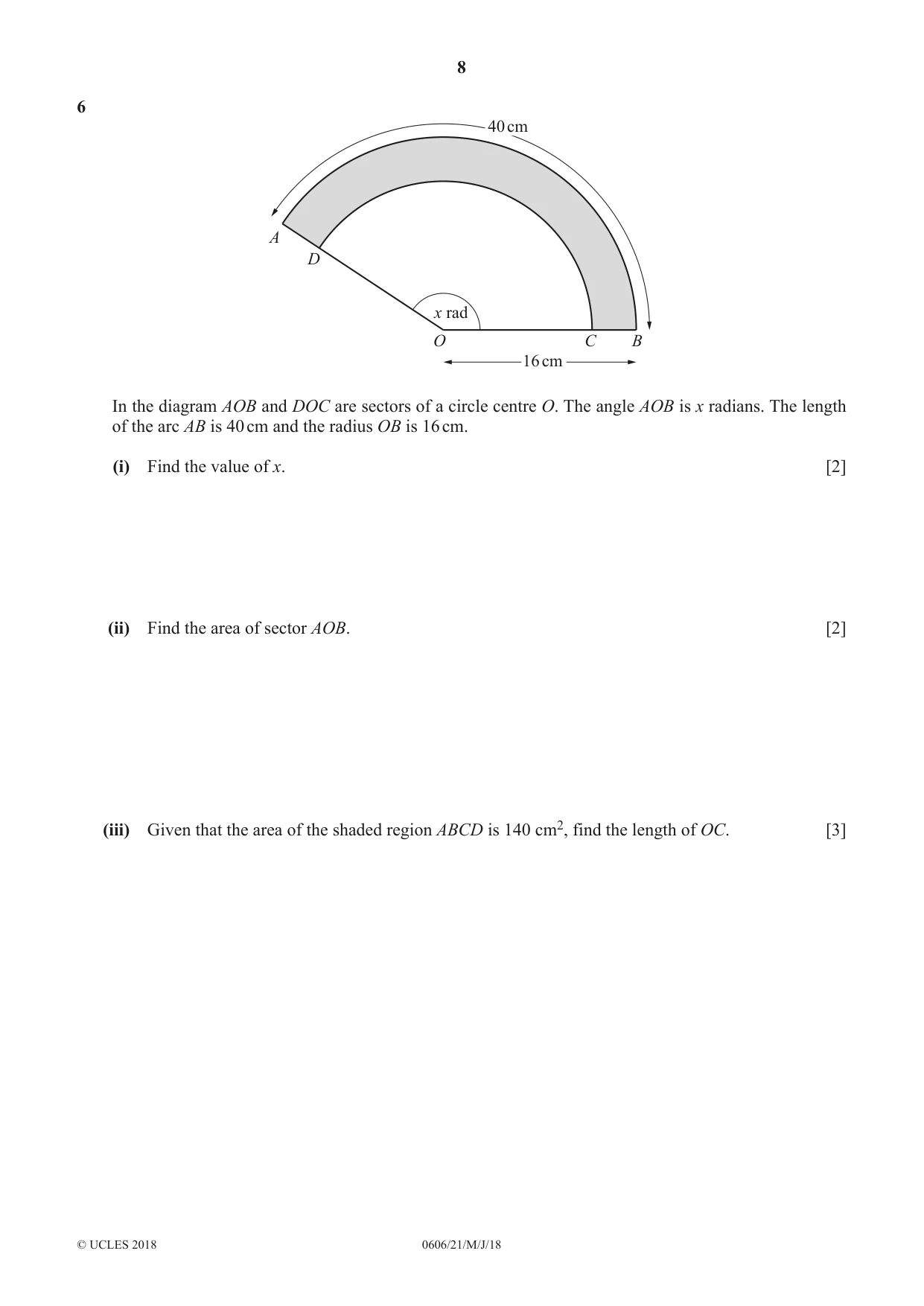
6 40 cm A D x rad O C B 16 cm In the diagram AOB and DOC are sectors of a circle centre O. The angle AOB is x radians. The length of the arc AB is 40 cm and the radius OB is 16 cm. (i) Find the value of x. [2] (ii) Find the area of sector AOB. [2] (iii) Given that the area of the shaded region ABCD is 140 cm2, find the length of OC. [3]
Mark scheme: 6(i) 16x = 40 oe M1 x = 2.5 oe (radians) A1 6(ii) 1 M1 (16 )2 (2.5) oe 2 320 A1 6(iii) 1 2 M1 FT provided their 320 > 140 r ( their 2.5 ) = (their 320) − 140 oe 2 correct simplification to r2 = … M1 dep on first M1 12 A1
More questions on Solve problems involving the arc length and
Q7 · Differentiate with respect to x (i) 4x tan x , [2] e 3x + 1 (ii) 2
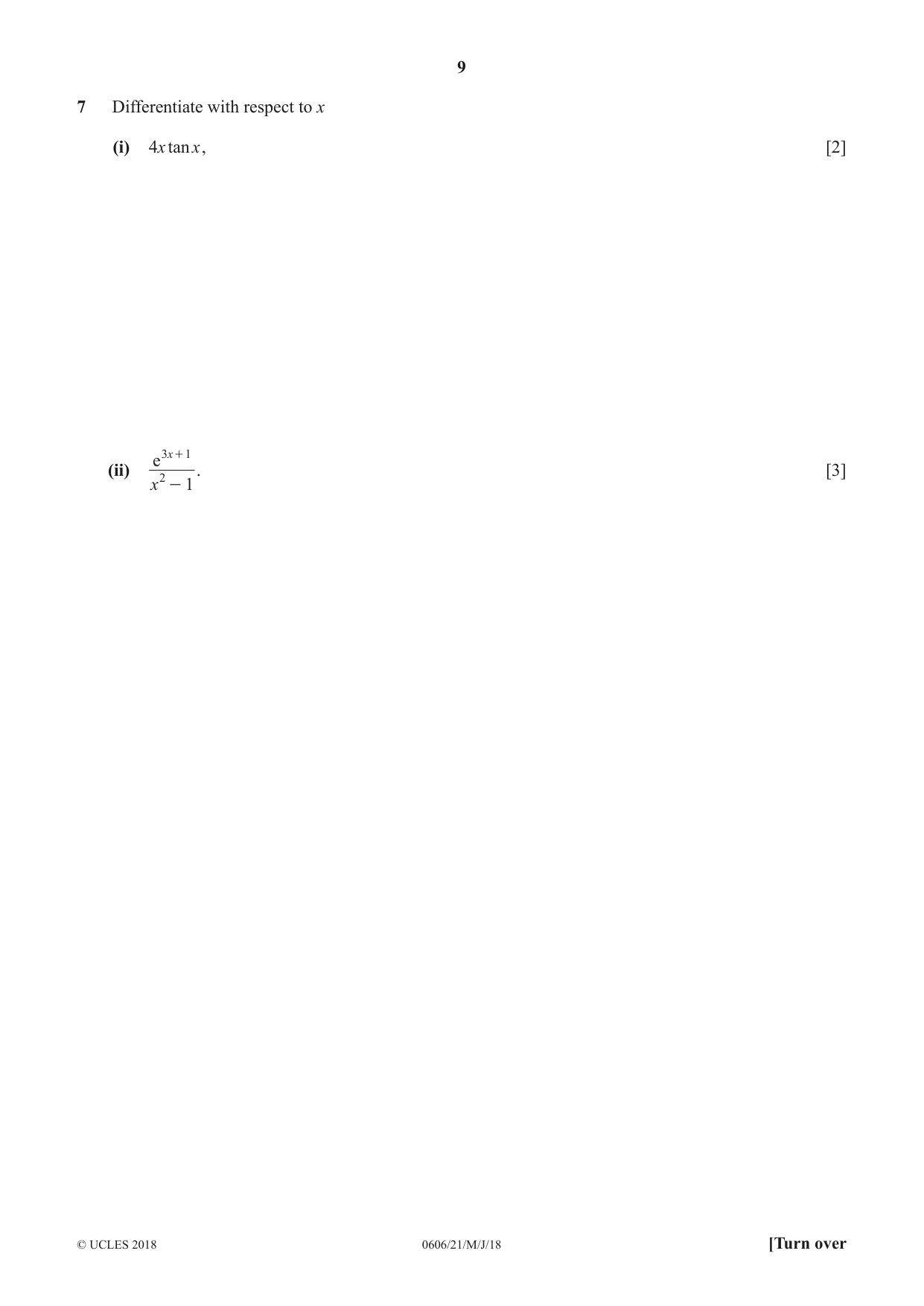
7 Differentiate with respect to x (i) 4x tan x , [2] e 3x + 1 (ii) 2 . [3] x - 1
Mark scheme: 7(i) 4tan x + 4 x sec 2 x isw B2 Fully correct B1 for one correct term as part of e.g. a sum of 2 terms 3 x +1 3 x +1 B17(ii) d ( e ) = 3e dx 3 x +1 3 x +1 M1 ( x 2 − 1)( their 3e ) − their (2 x )e 2 2 ( x − 1) 3 x +1 3 x +1 A1 ( x 2 − 1)( 3e ) − 2 xe oe isw 2 2 ( x − 1)
Q8 · An experiment was carried out recording values of y for certain values of x
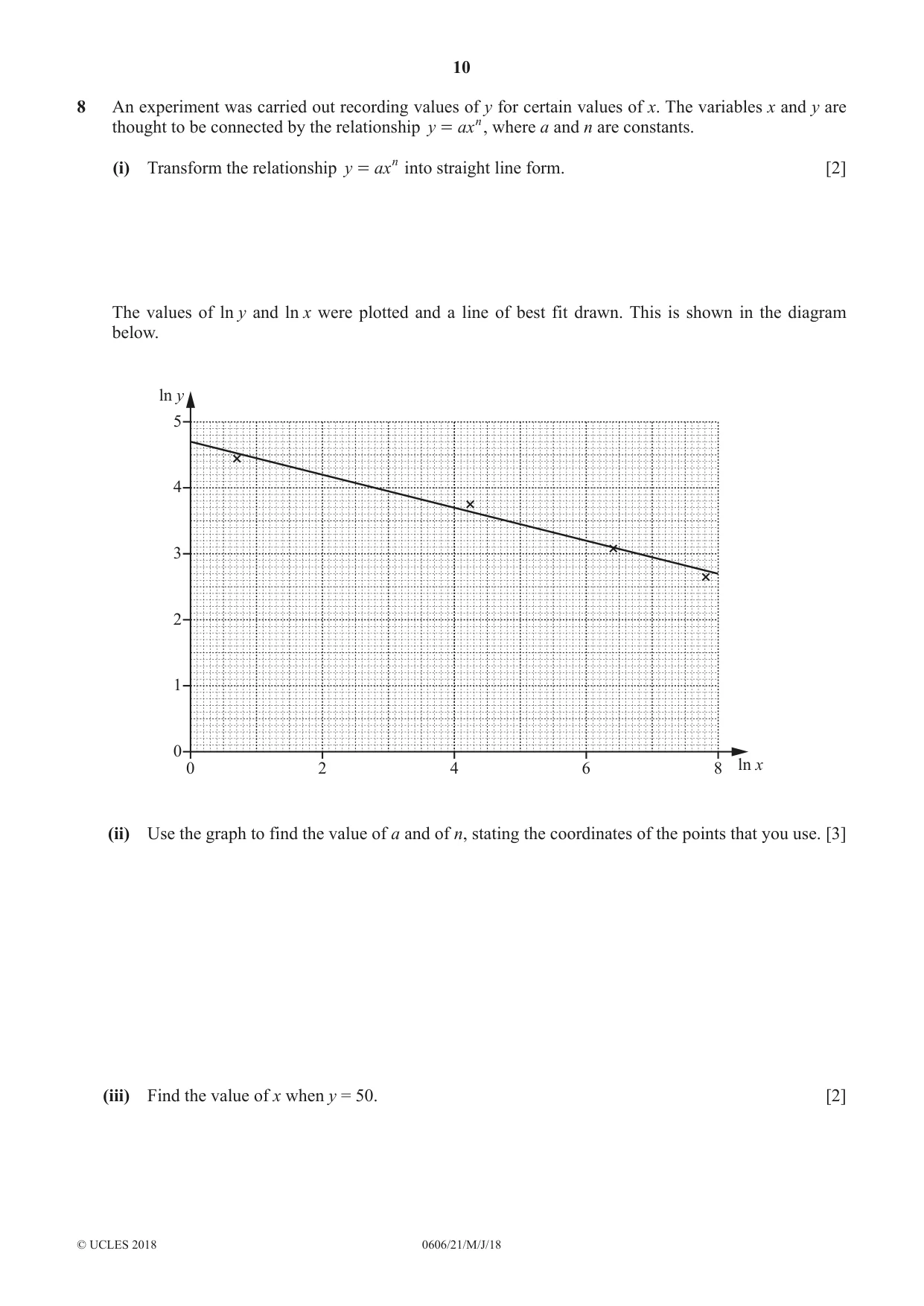
8 An experiment was carried out recording values of y for certain values of x. The variables x and y are thought to be connected by the relationship y = axn , where a and n are constants. (i) Transform the relationship y = axn into straight line form. [2] The values of ln y and ln x were plotted and a line of best fit drawn. This is shown in the diagram below. ln y 5 4 3 2 1 0 0 2 4 6 8 ln x (ii) Use the graph to find the value of a and of n, stating the coordinates of the points that you use. [3] (iii) Find the value of x when y = 50. [2]
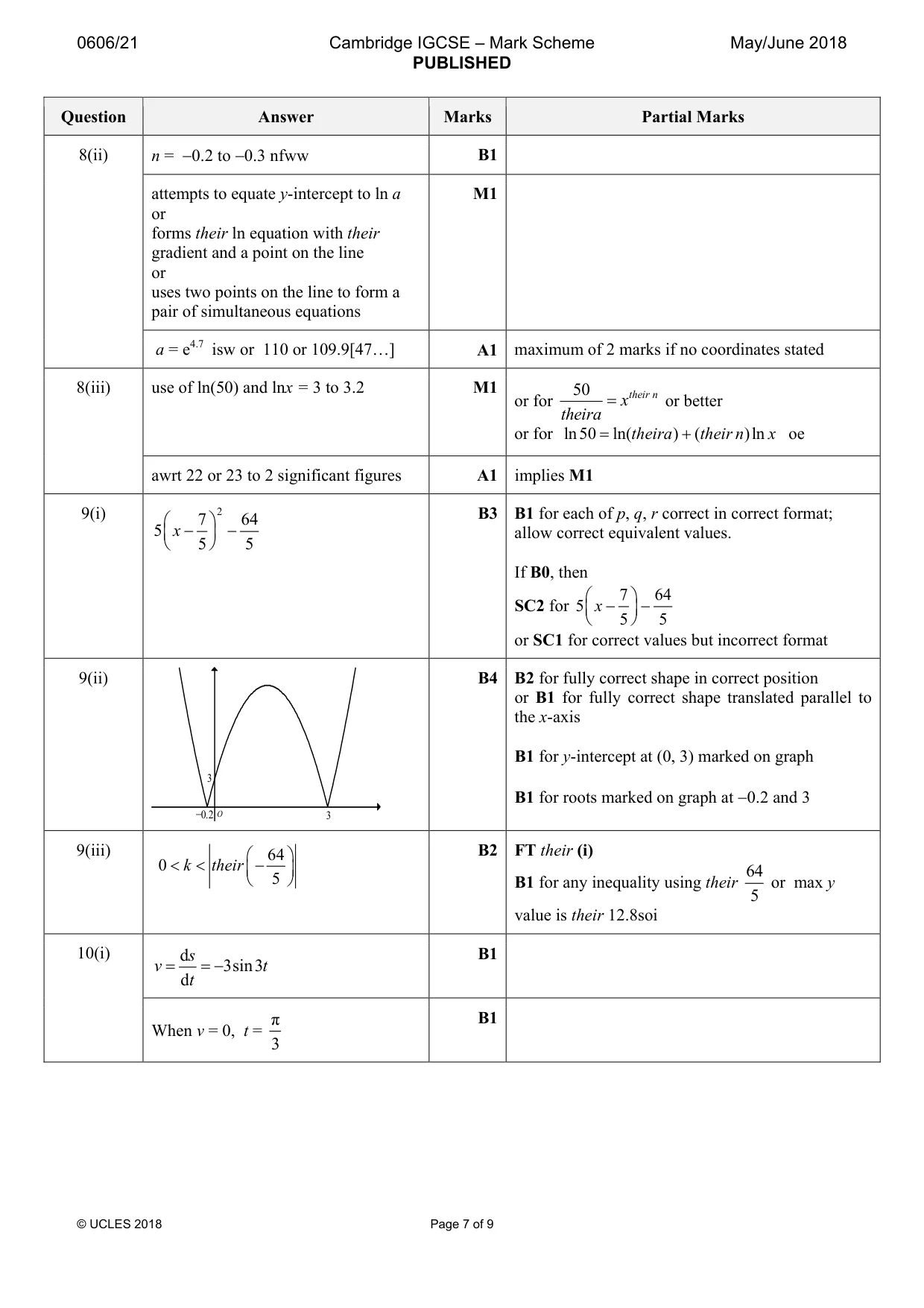
Mark scheme: 8(i) Takes logs of both sides M1 ln y = ln a + n ln x A1 or lg y = lg a + n lg x 8(ii) n = −0.2 to −0.3 nfww B1 attempts to equate y-intercept to ln a M1 or forms their ln equation with their gradient and a point on the line or uses two points on the line to form a pair of simultaneous equations a = e4.7 isw or 110 or 109.9[47…] A1 maximum of 2 marks if no coordinates stated 8(iii) use of ln(50) and lnx = 3 to 3.2 M1 50 their n or for = x or better theira or for ln50 = ln(theira ) + (their n )ln x oe awrt 22 or 23 to 2 significant figures A1 implies M1
Q9 · Express 5x 2 - 14x - 3 in the form p x + q 2 + r , where p, q and r are constants
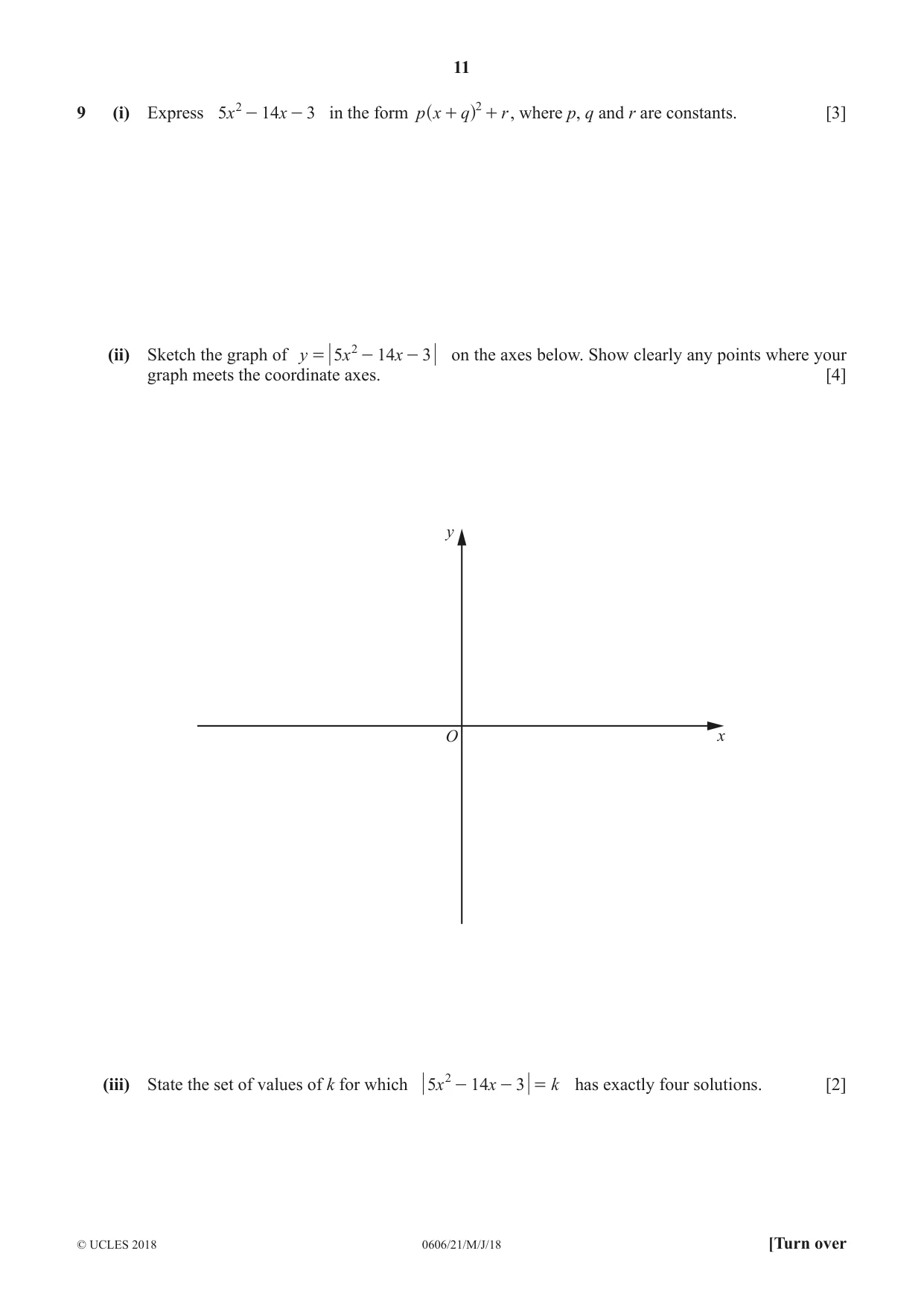
9 (i) Express 5x 2 - 14x - 3 in the form p x + q 2 + r , where p, q and r are constants. [3] (ii) Sketch the graph of y = 5x 2 - 14x - 3 on the axes below. Show clearly any points where your graph meets the coordinate axes. [4] y O x (iii) State the set of values of k for which 5 x 2 - 14 x - 3 = k has exactly four solutions. [2]
Mark scheme: 9(i) 2 B3 B1 for each of p, q, r correct in correct format; 7 64 5 x − − allow correct equivalent values. 5 5 If B0, then 7 64 SC2 for 5 x − − 5 5 or SC1 for correct values but incorrect format 9(ii) B4 B2 for fully correct shape in correct position or B1 for fully correct shape translated parallel to the x-axis B1 for y-intercept at (0, 3) marked on graph 3 B1 for roots marked on graph at −0.2 and 3 −0.2 O 3 9(iii) 64 B2 FT their (i) 0 < k < their − 64 5 B1 for any inequality using their or max y 5 value is their 12.8soi
More questions on Sketch the graphs of cubic polynomials and
Q10 · A particle moves in a straight line such that its displacement, s metres, from a fixed…
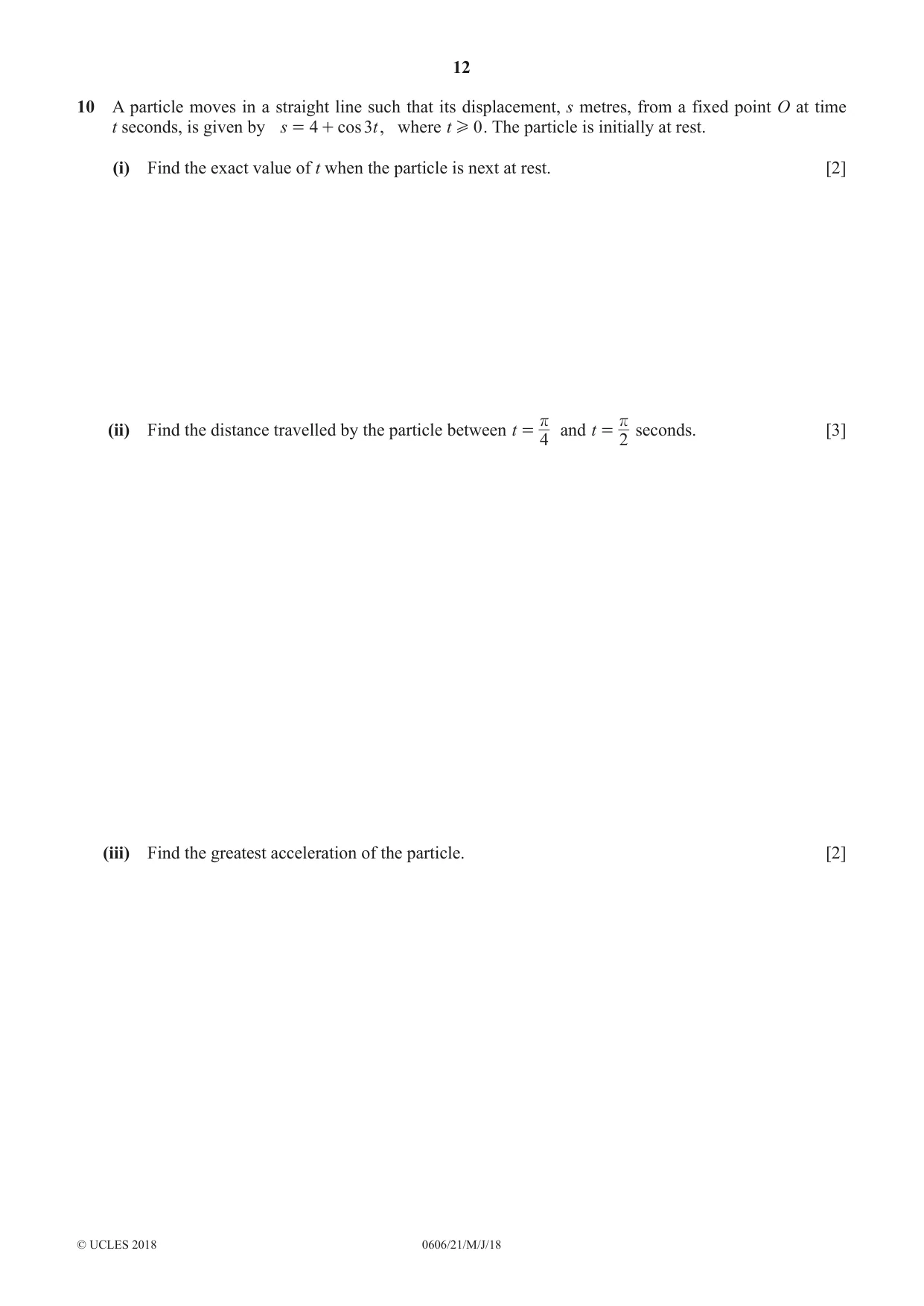
10 A particle moves in a straight line such that its displacement, s metres, from a fixed point O at time t seconds, is given by s = 4 + cos 3t , where t H 0 . The particle is initially at rest. (i) Find the exact value of t when the particle is next at rest. [2] r r (ii) Find the distance travelled by the particle between t = and t = seconds. [3] 4 2 (iii) Find the greatest acceleration of the particle. [2]
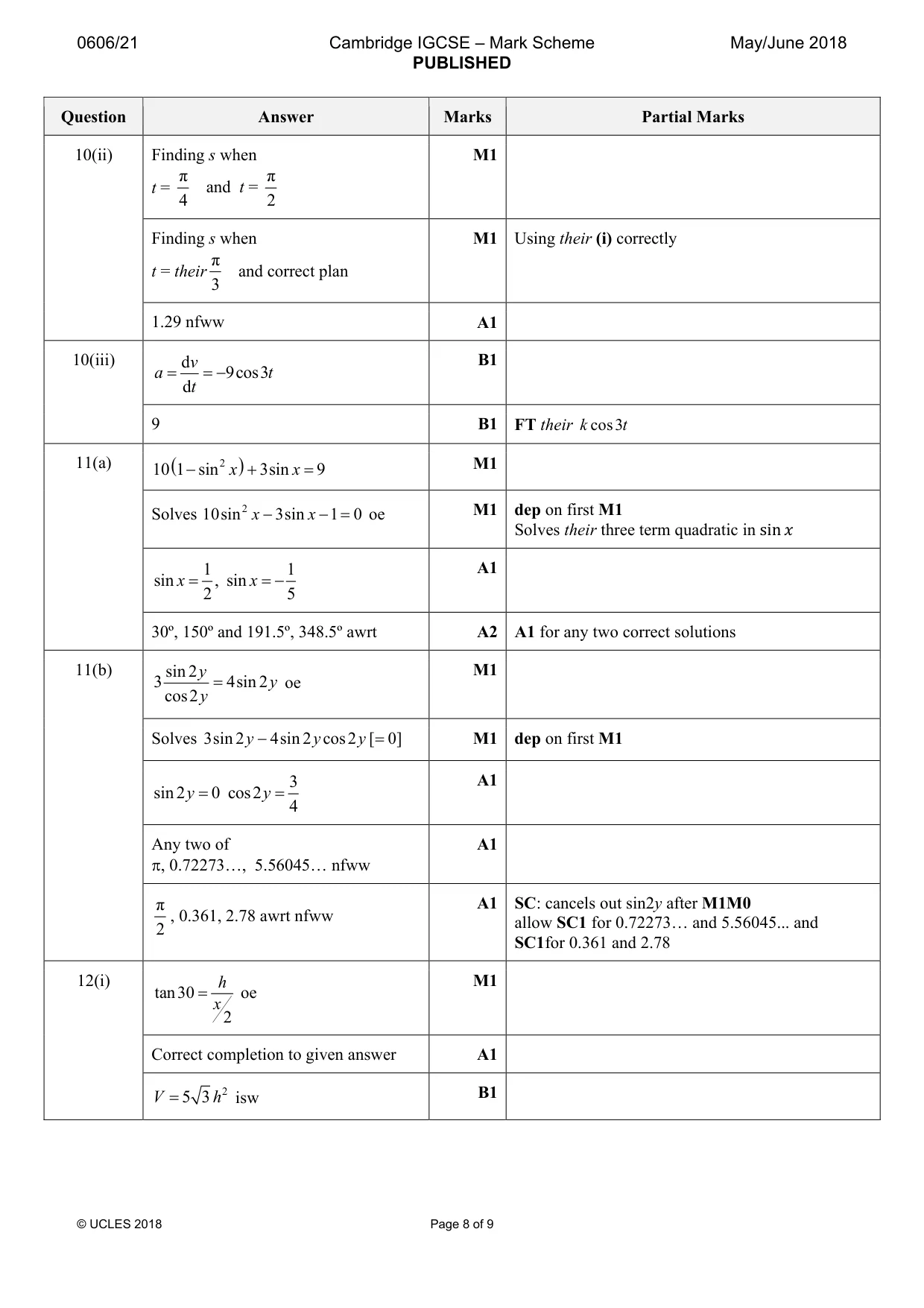
Mark scheme: 10(i) ds B1 v = = −3sin3t dt π B1 When v = 0, t = 3 10(ii) Finding s when M1 π π t = and t = 4 2 Finding s when M1 Using their (i) correctly π t = their and correct plan 3 1.29 nfww A1 10(iii) dv B1 a = = −9cos3t dt 9 B1 FT their k cos3t
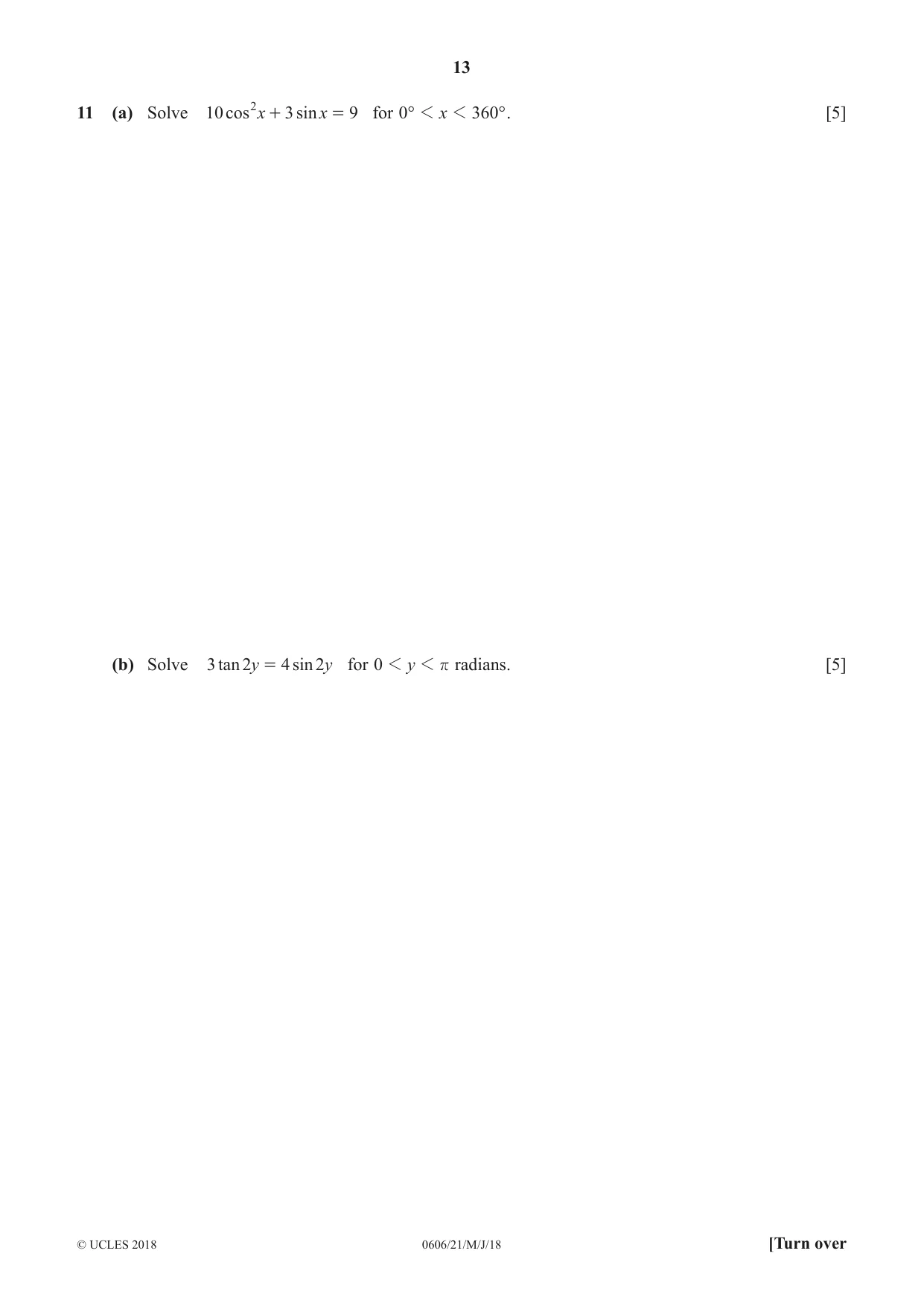
Q11 · Solve 10 cos 2 x + 3 sin x = 9 for 0° 1 x 1 360°
11 (a) Solve 10 cos 2 x + 3 sin x = 9 for 0° 1 x 1 360° . [5] (b) Solve 3 tan 2y = 4 sin 2 y for 0 1 y 1 r radians. [5]
Mark scheme: 11(a) 10 (1 − sin 2 x ) + 3sin x = 9 M1 Solves 10sin 2 x − 3sin x −=1 0 oe M1 dep on first M1 Solves their three term quadratic in sin ݔ 1 1 A1 sin x = , sin x = − 2 5 30º, 150º and 191.5º, 348.5º awrt A2 A1 for any two correct solutions 11(b) sin 2 y M1 3 = 4sin 2 y oe cos2 y Solves 3sin 2 y − 4sin 2 y cos2 y [ = 0] M1 dep on first M1 3 A1 sin2 y = 0 cos2 y = 4 Any two of A1 π, 0.72273…, 5.56045… nfww π A1 SC: cancels out sin2y after M1M0 , 0.361, 2.78 awrt nfww allow SC1 for 0.72273… and 5.56045... and 2 SC1for 0.361 and 2.78
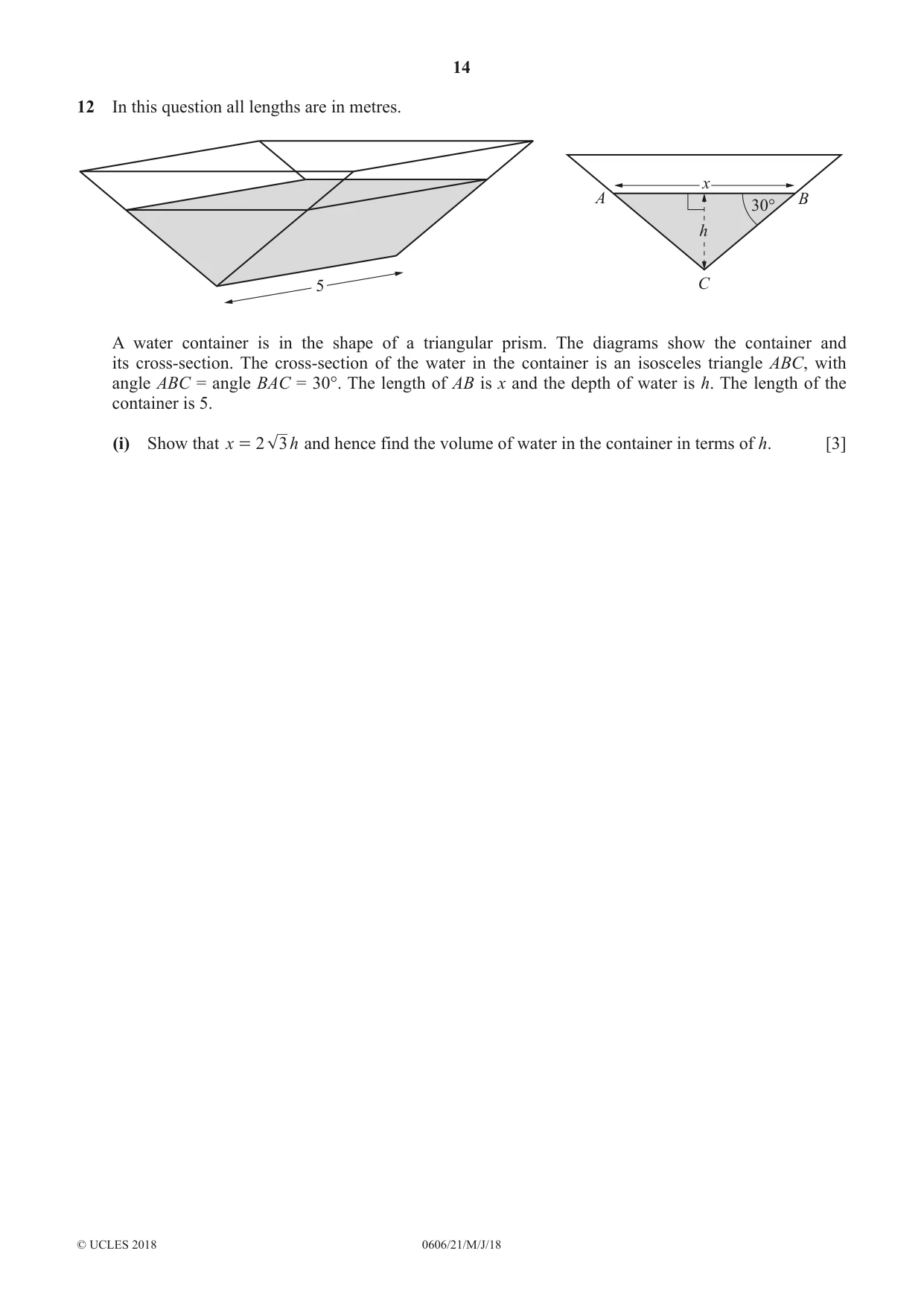
Q12 · In this question all lengths are in metres
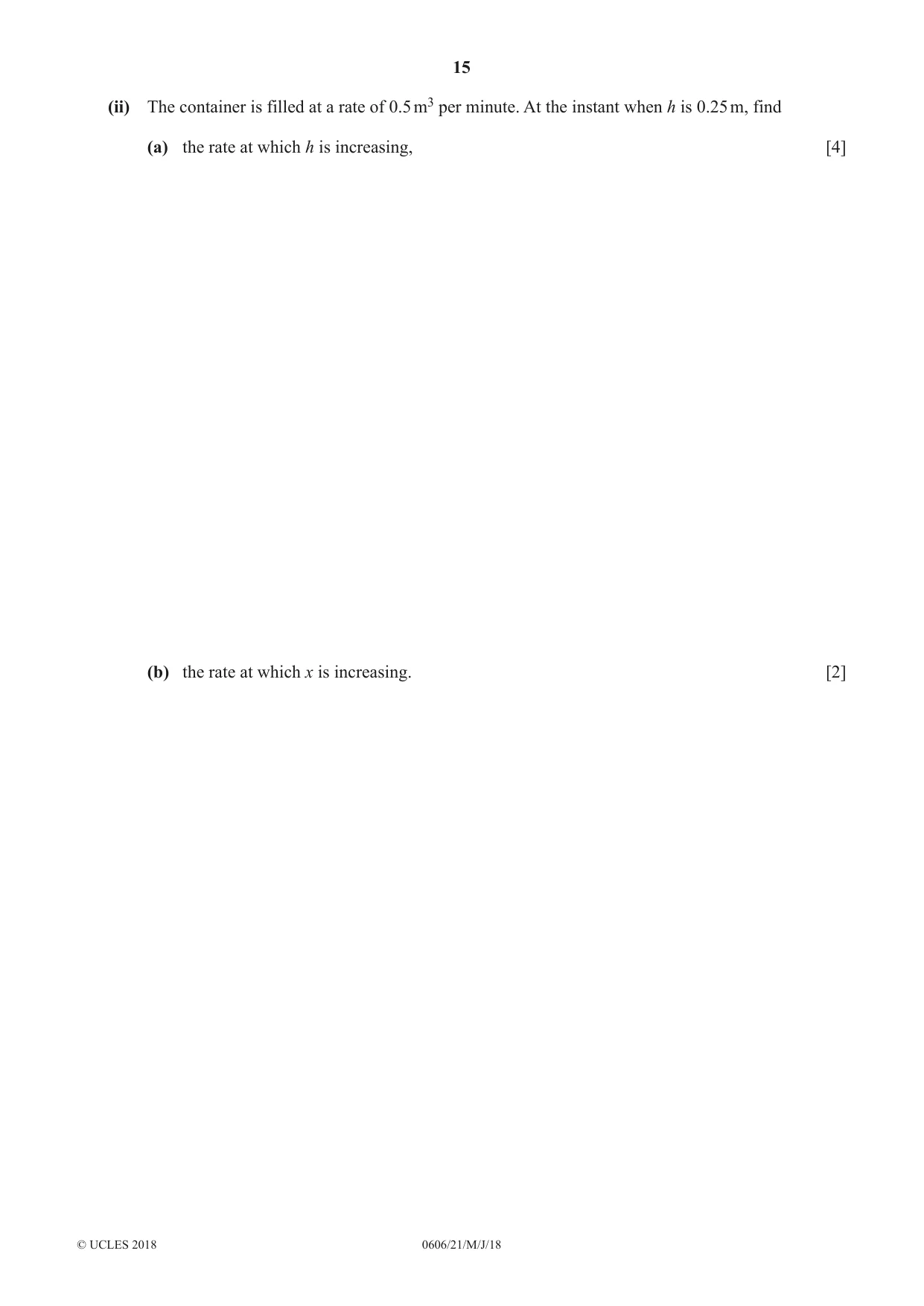
12 In this question all lengths are in metres. x A B 30° h 5 C A water container is in the shape of a triangular prism. The diagrams show the container and its cross-section. The cross-section of the water in the container is an isosceles triangle ABC, with angle ABC = angle BAC = 30°. The length of AB is x and the depth of water is h. The length of the container is 5. (i) Show that x = 2 3 h and hence find the volume of water in the container in terms of h. [3] (ii) The container is filled at a rate of 0.5 m3 per minute. At the instant when h is 0.25 m, find (a) the rate at which h is increasing, [4] (b) the rate at which x is increasing. [2]
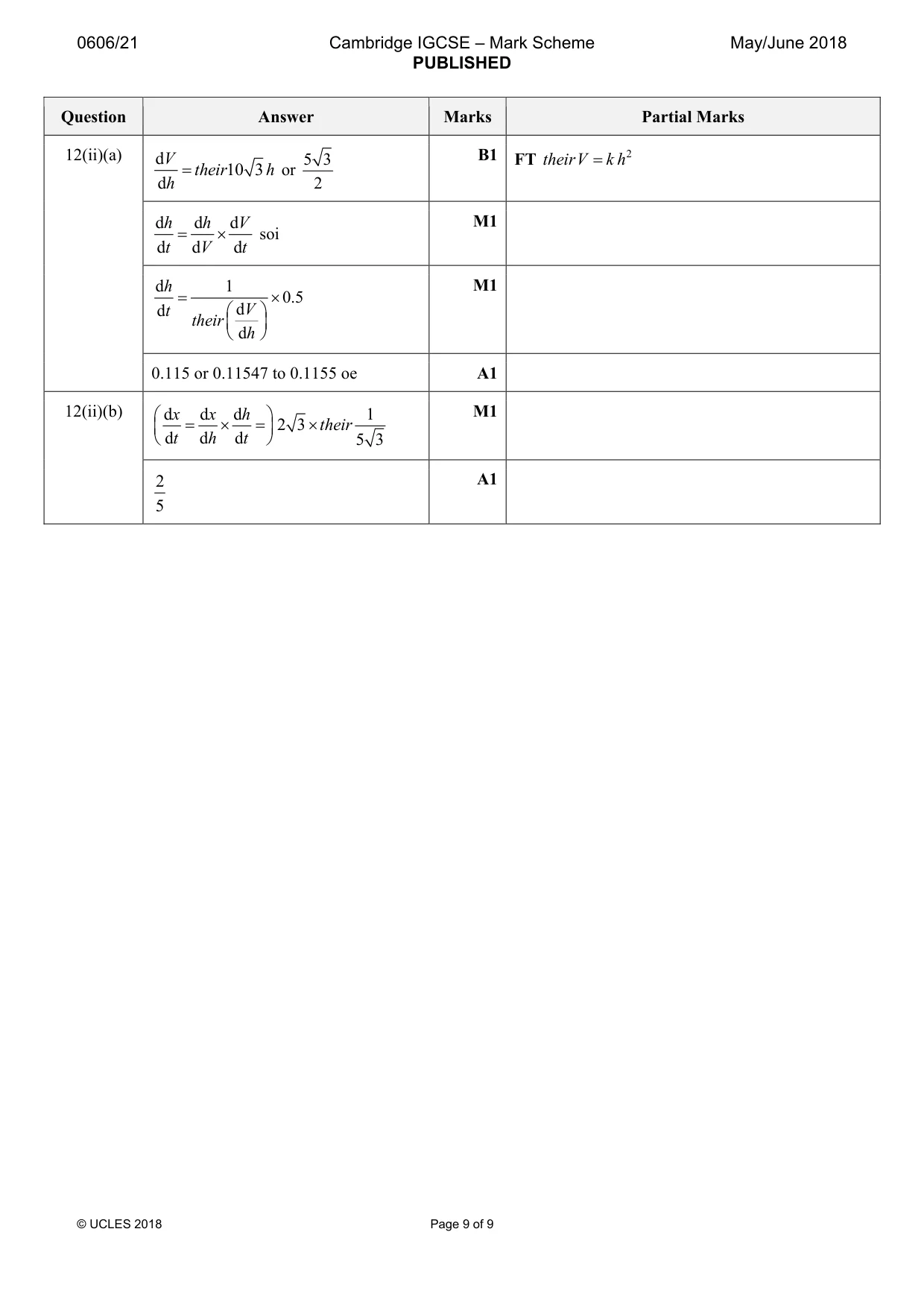
Mark scheme: 12(i) h M1 tan30 = oe x 2 Correct completion to given answer A1 V = 5 3 h 2 isw B1 12(ii)(a) dV 5 3 B1 FT theirV = k h 2 = their10 3 h or dh 2 dh dh dV M1 = × soi dt dV dt dh 1 M1 = × 0.5 dt d V their dh 0.115 or 0.11547 to 0.1155 oe A1 12(ii)(b) dx dx dh 1 M1 = × = 2 3 × their dt dh dt 5 3 2 A1 5
More questions on Apply differentiation to connected rates of
What was in this paper
The subtopics covered by these 12 questions, and how many questions each got. Open one in a new tab to see every Cambridge question on it.
1Apply differentiation to connected rates of1Differentiate products and quotients of1Find factors of polynomials1Form and use composite functions1Sketch the graphs of cubic polynomials and1Solve problems involving the arc length and1Solve problems on arrangement and selection1Solve, for a given domain, trigonometric1Transform given relationships to and from1Understand the terms: function, domain1Use differentiation to find gradients, tangents1What you needed in this session
Cambridge’s own grade thresholds for 2018 May/June, Paper 2 · Variant 1. A higher threshold means an easier paper — the bar moves with how the cohort did.