Cambridge IGCSE Mathematics - Additional 0606 — 2020 May/June Paper 2 · Variant 3
0606/23/M/J/20 · 11 questions · 75 marks · ≈84 min
The question paper and its mark scheme, free to read here and free to download. This is Cambridge’s own paper, exactly as it was sat.
Question paper16 pages
Mark scheme8 pages
Answers below. Sit the paper first if you are practising.
Questions as text
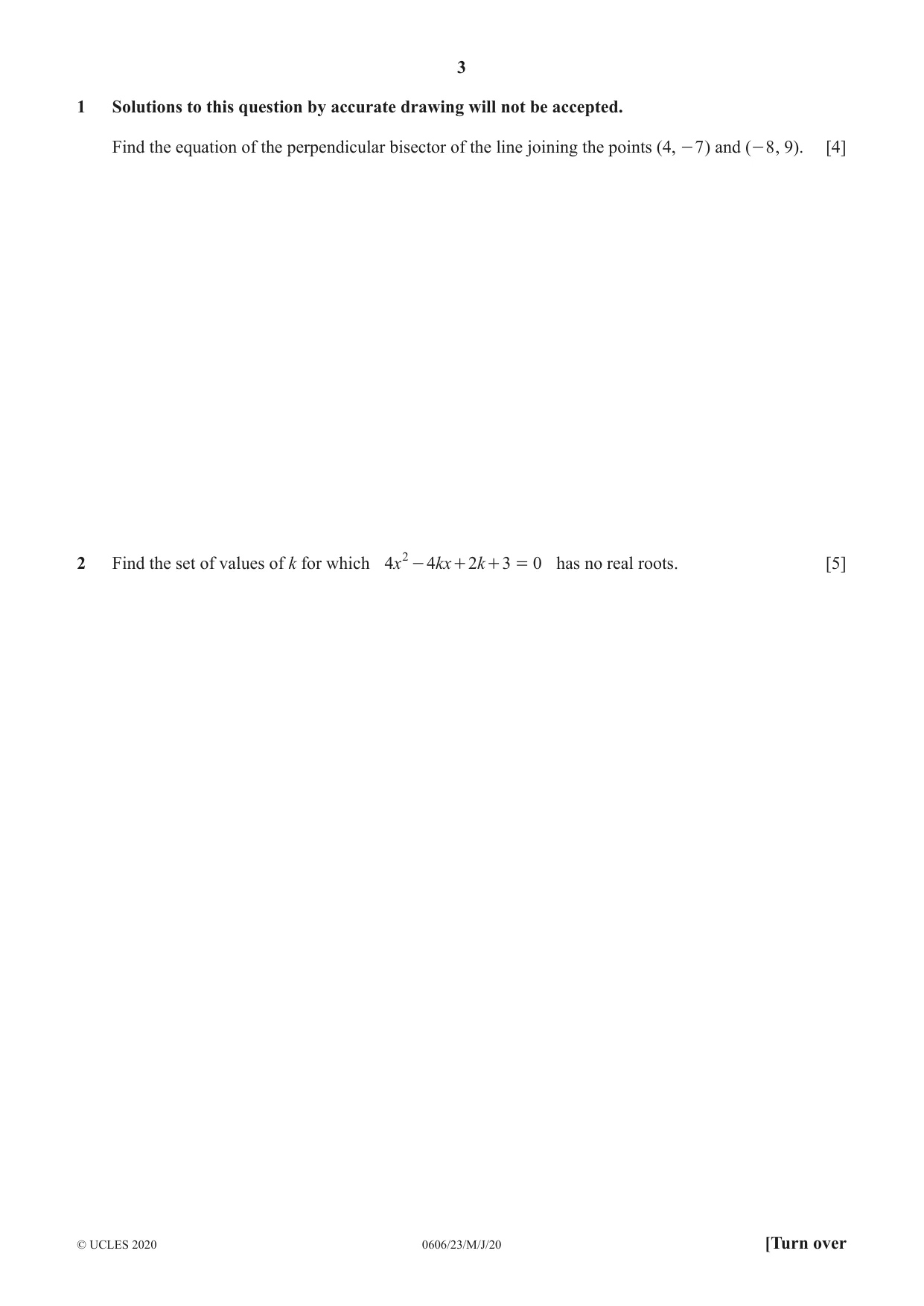
Q1 · Solutions to this question by accurate drawing will not be accepted
1 Solutions to this question by accurate drawing will not be accepted. Find the equation of the perpendicular bisector of the line joining the points (4, - 7 ) and ( - 8 , 9). [4]
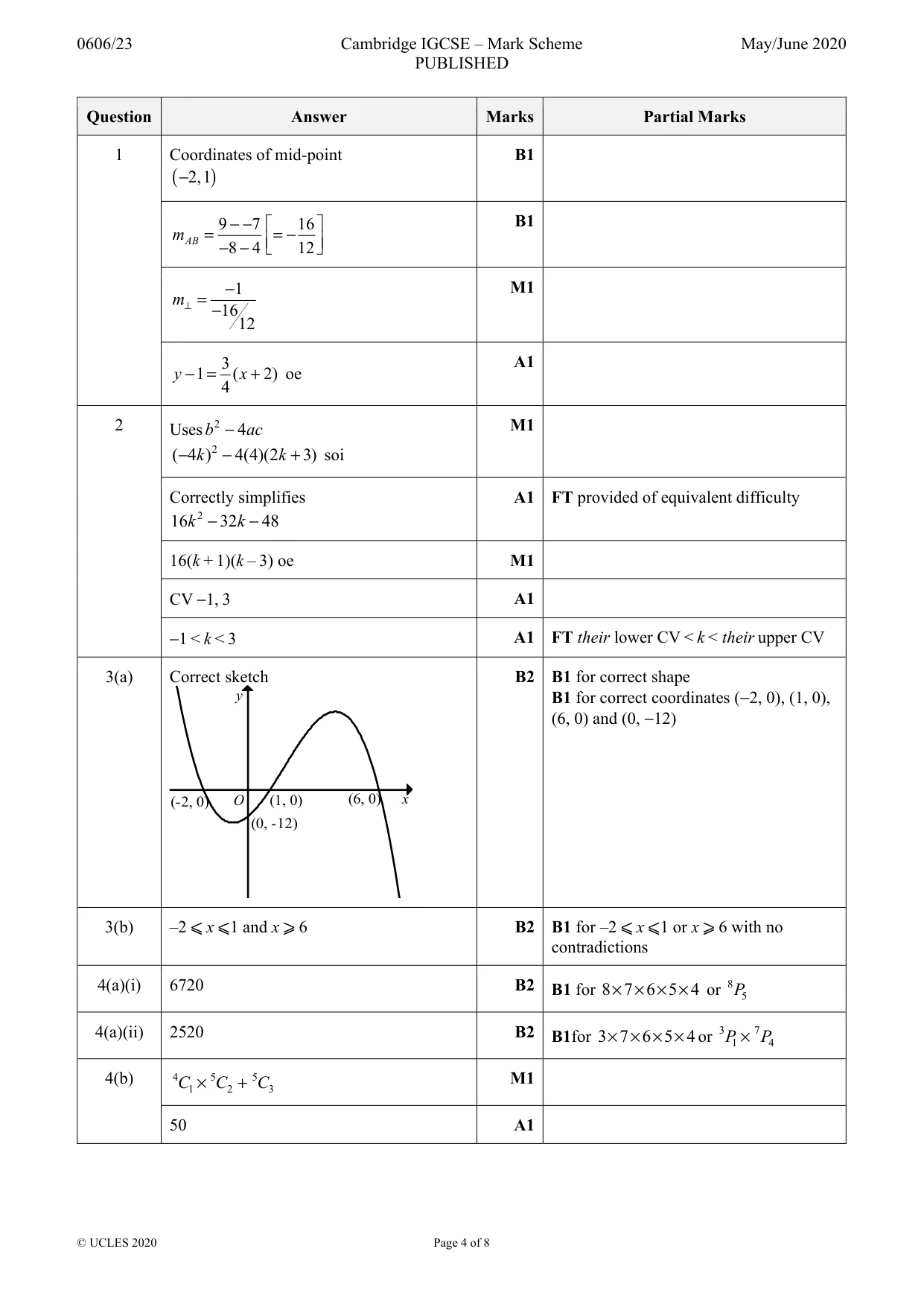
Mark scheme: Question Answer Marks Partial Marks 1 Coordinates of mid-point B1 ( −2,1) 9 −−7 16 B1 m AB = = − −−8 4 12 −1 M1 m⊥ = −1612 3 A1 y −=1 ( x + 2) oe 4
More questions on Know and use the condition for two lines to
Q3 · On the axes below, sketch the graph of y =- ( x + 2)( x - 1)( x - 6), showing the…
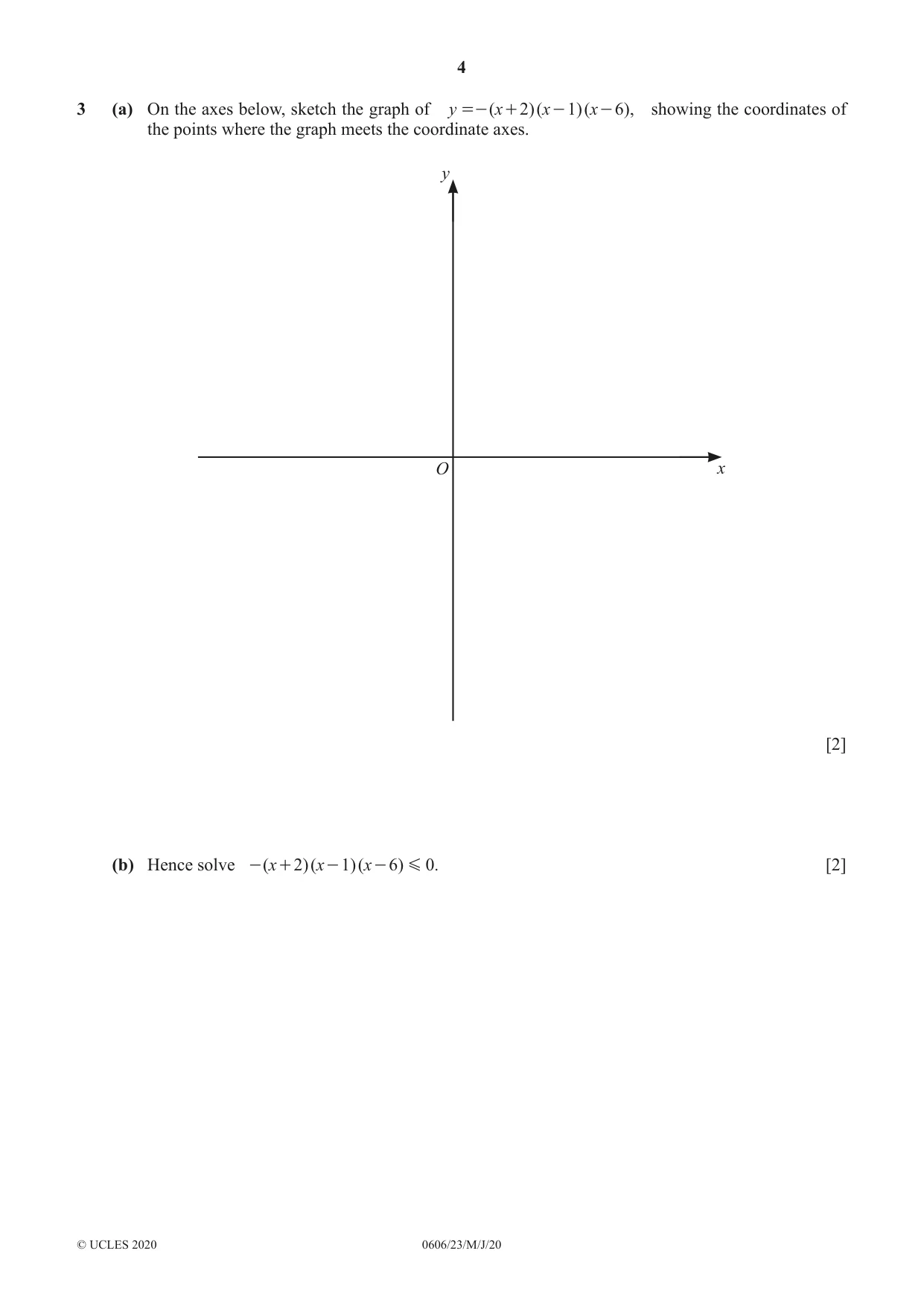
3 (a) On the axes below, sketch the graph of y =- ( x + 2)( x - 1)( x - 6), showing the coordinates of the points where the graph meets the coordinate axes. y O x [2] (b) Hence solve - ( x + 2)( x - 1)( x - 6) G 0. [2]
Mark scheme: 3(a) Correct sketch B2 B1 for correct shape y B1 for correct coordinates (−2, 0), (1, 0), (6, 0) and (0, −12) (-2, 0) O (1, 0) (6, 0) x (0, -12) 3(b) –2 ⩽ x ⩽1 and x ⩾ 6 B2 B1 for –2 ⩽ x ⩽1 or x ⩾ 6 with no contradictions
More questions on Sketch the graphs of cubic polynomials and
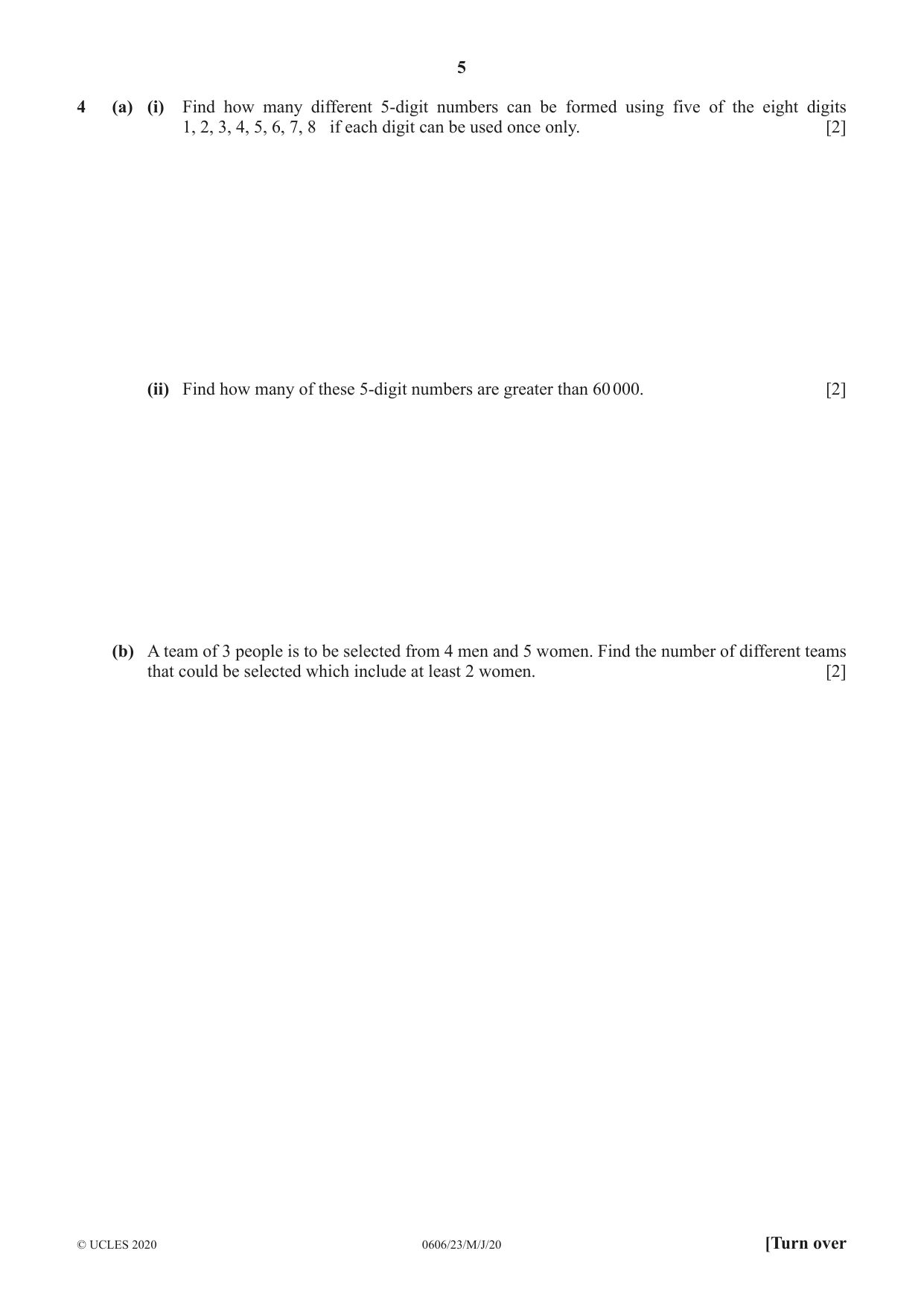
Q4 · Find how many different 5-digit numbers can be formed using five of the eight digits 1…
4 (a) (i) Find how many different 5-digit numbers can be formed using five of the eight digits 1, 2, 3, 4, 5, 6, 7, 8 if each digit can be used once only. [2] (ii) Find how many of these 5-digit numbers are greater than 60 000. [2] (b) A team of 3 people is to be selected from 4 men and 5 women. Find the number of different teams that could be selected which include at least 2 women. [2]
Mark scheme: 4(a)(i) 6720 B2 B1 for 8 × 7 × 6 × 5 × 4 or 8 5P 4(a)(ii) 2520 B2 B1for 3 × 7 × 6 × 5 × 4 or 3 P1 × 7 P4 4(b) 4C1 × 5C2 + 5C3 M1 50 A1
More questions on Solve problems on arrangement and selection
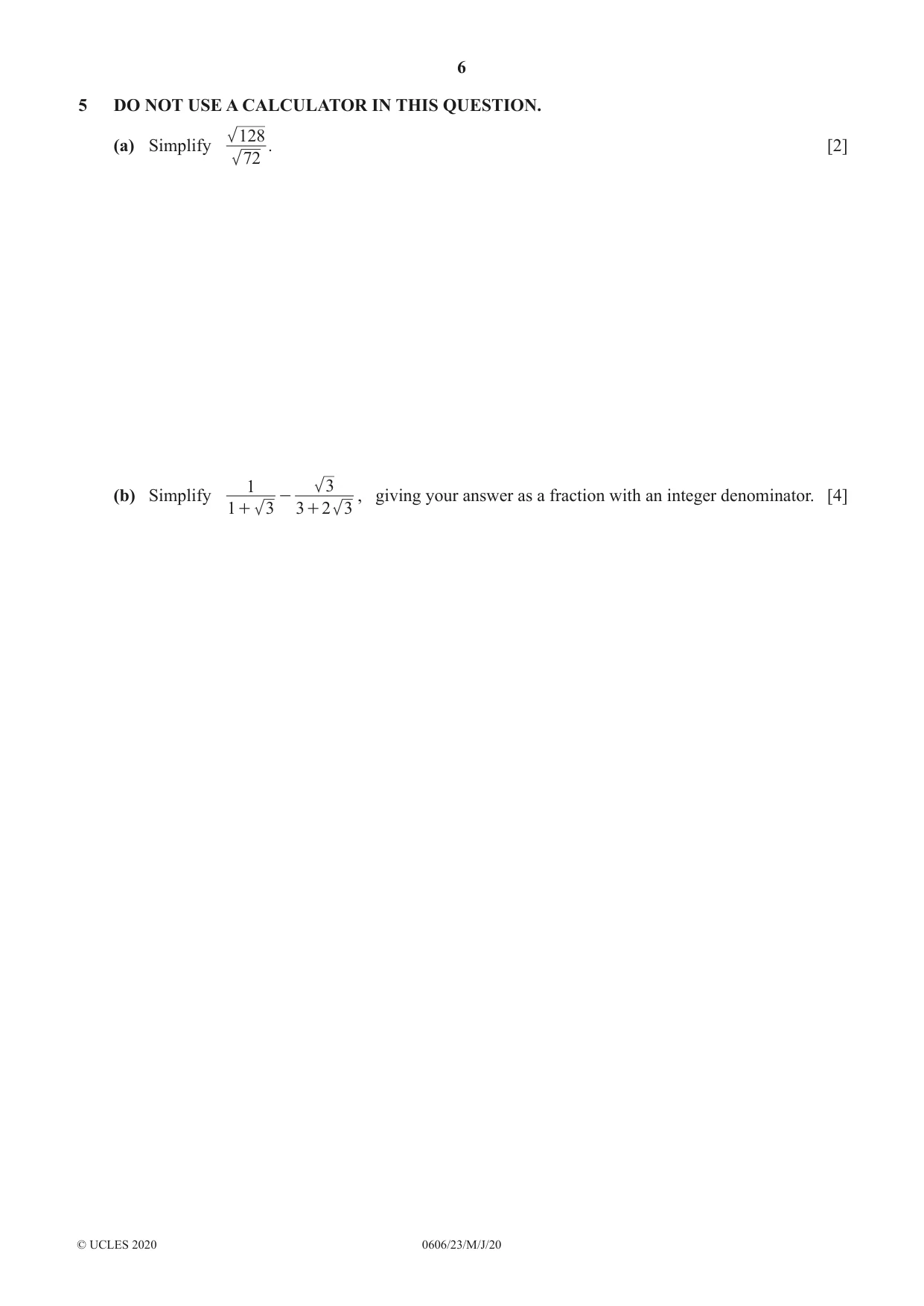
Q5 · DO NOT USE A CALCULATOR IN THIS QUESTION
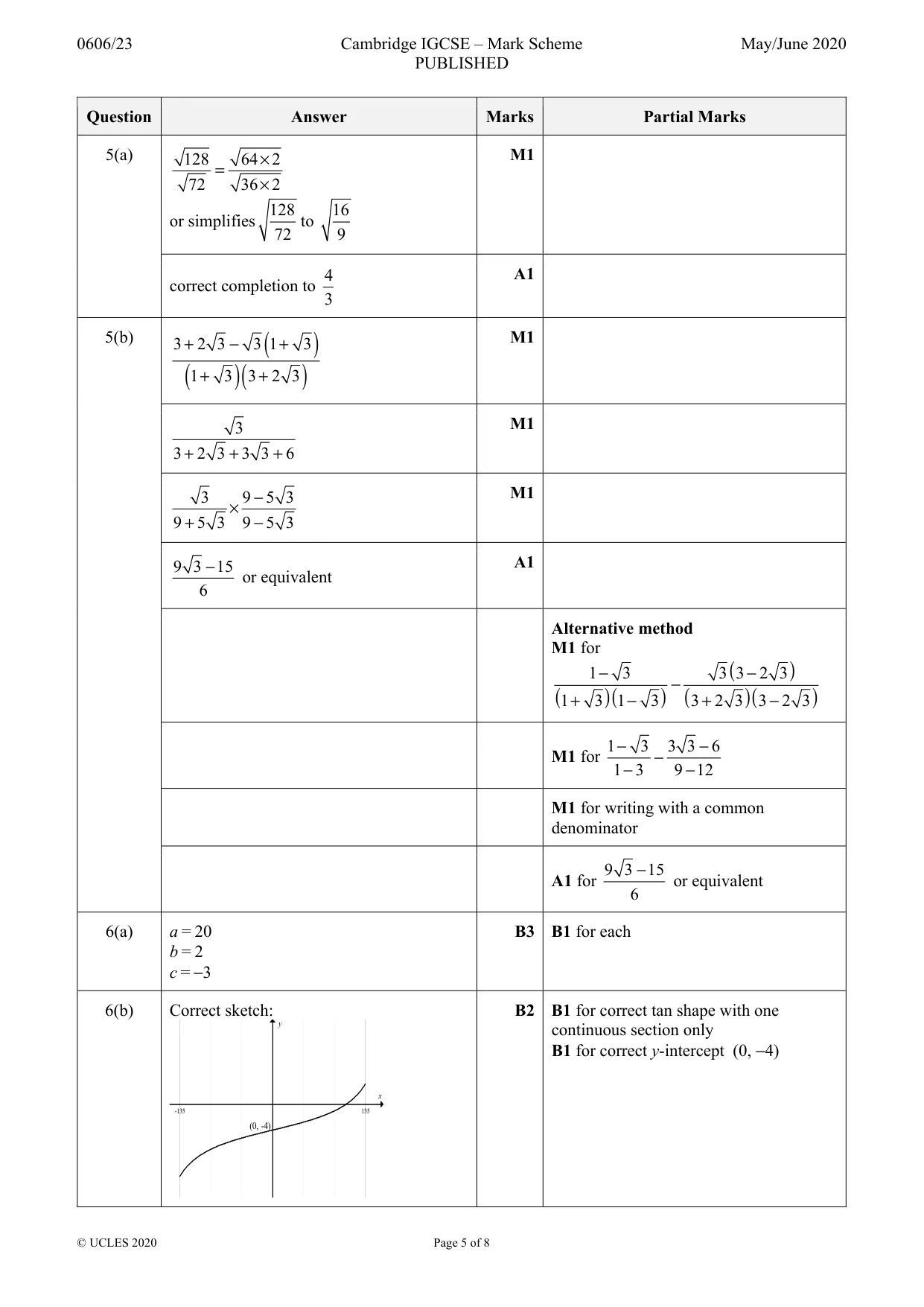
5 DO NOT USE A CALCULATOR IN THIS QUESTION. 128 (a) Simplify . [2] 72 1 3 (b) Simplify - , giving your answer as a fraction with an integer denominator. [4] 1 + 3 3 + 2 3
Mark scheme: 5(a) 128 64 × 2 M1 = 72 36 × 2 128 16 or simplifies to 72 9 4 A1 correct completion to 3 5(b) M1 3 + 2 3 − 3 1 + 3 ( ) 1 + 3 3 + 2 3 ( )( ) 3 M1 3 + 2 3 + 3 3 + 6 3 9 − 5 3 M1 × 9 + 5 3 9 − 5 3 9 3 − 15 A1 or equivalent 6 Alternative method M1 for 1 − 3 3 ( 3 − 2 3 ) − (1 + 3 )(1 − 3 ) ( 3 + 2 3 )( 3 − 2 3 ) 1 − 3 3 3 − 6 M1 for − 1 − 3 9 − 12 M1 for writing with a common denominator 9 3 − 15 A1 for or equivalent 6
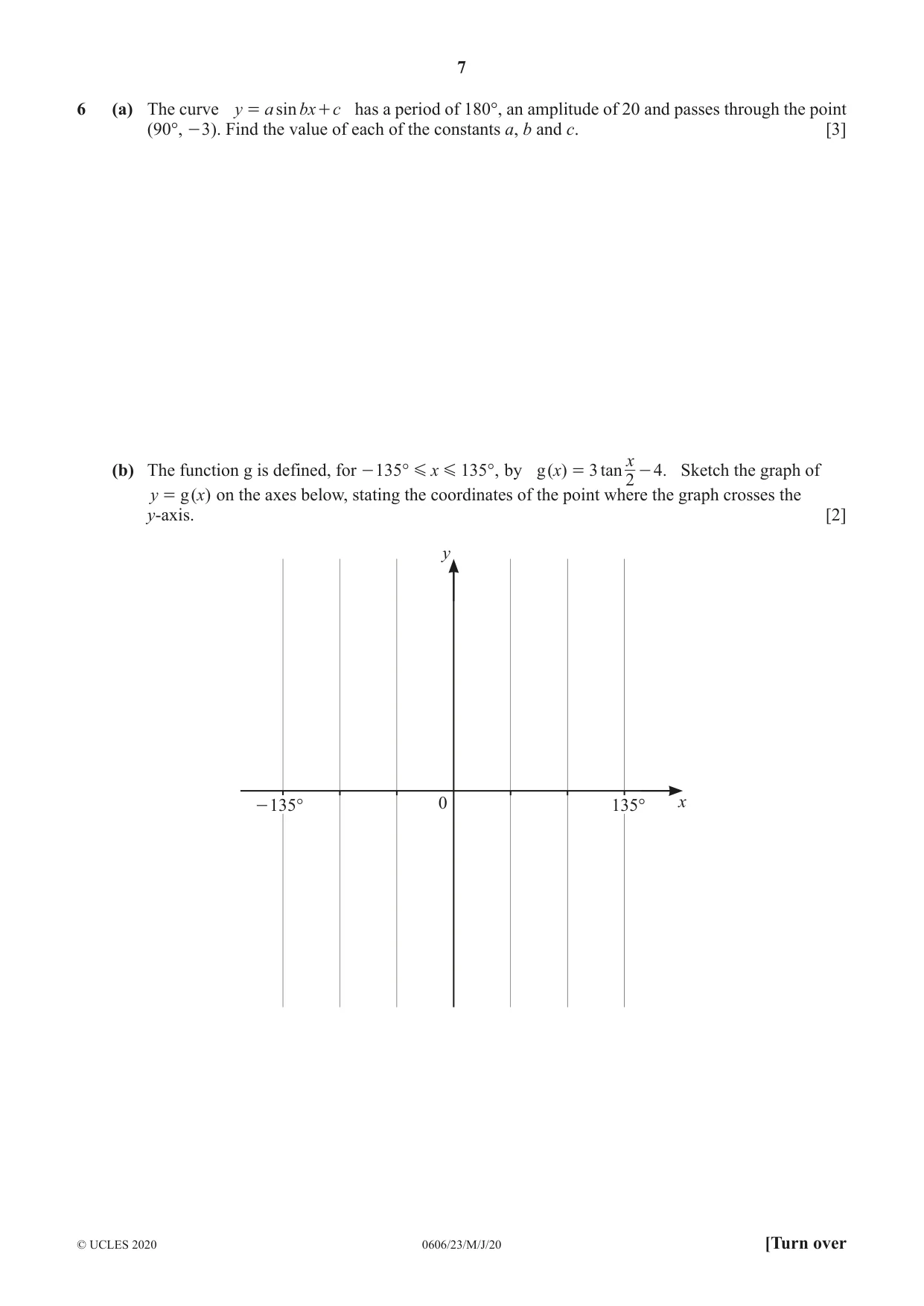
Q6 · The curve y = a sin bx + c has a period of 180°, an amplitude of 20 and passes through…
6 (a) The curve y = a sin bx + c has a period of 180°, an amplitude of 20 and passes through the point (90°, - 3 ). Find the value of each of the constants a, b and c. [3] x (b) The function g is defined, for - 135° G x G 135°, by g ( x) = 3 tan - 4. Sketch the graph of 2 y = g ( x) on the axes below, stating the coordinates of the point where the graph crosses the y-axis. [2] y - 135° 0 135° x
Mark scheme: 6(a) a = 20 B3 B1 for each b = 2 c = −3 6(b) Correct sketch: B2 B1 for correct tan shape with one y continuous section only B1 for correct y-intercept (0, −4) x -135 135 (0, -4)
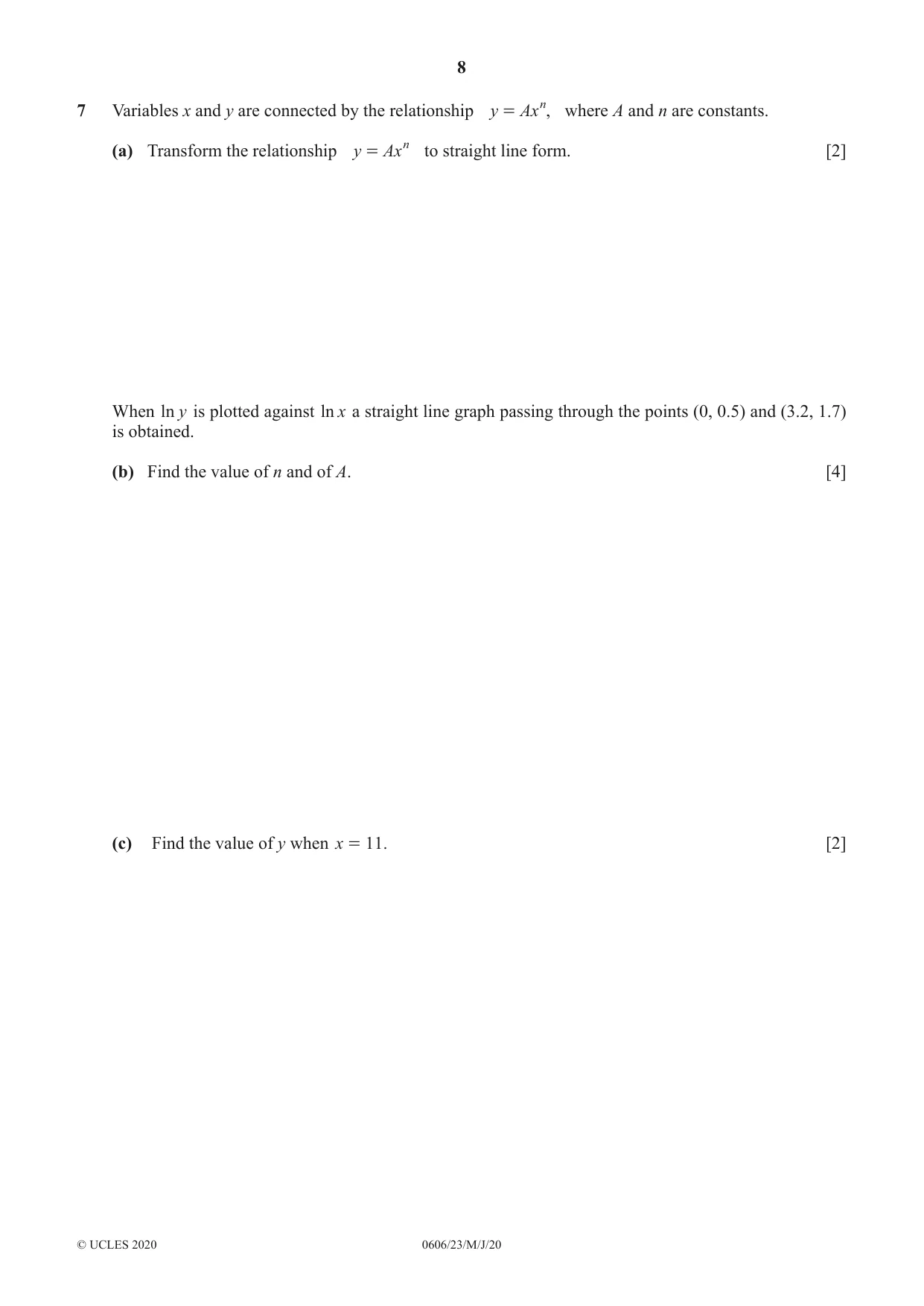
Q7 · Variables x and y are connected by the relationship y = Axn , where A and n are constants
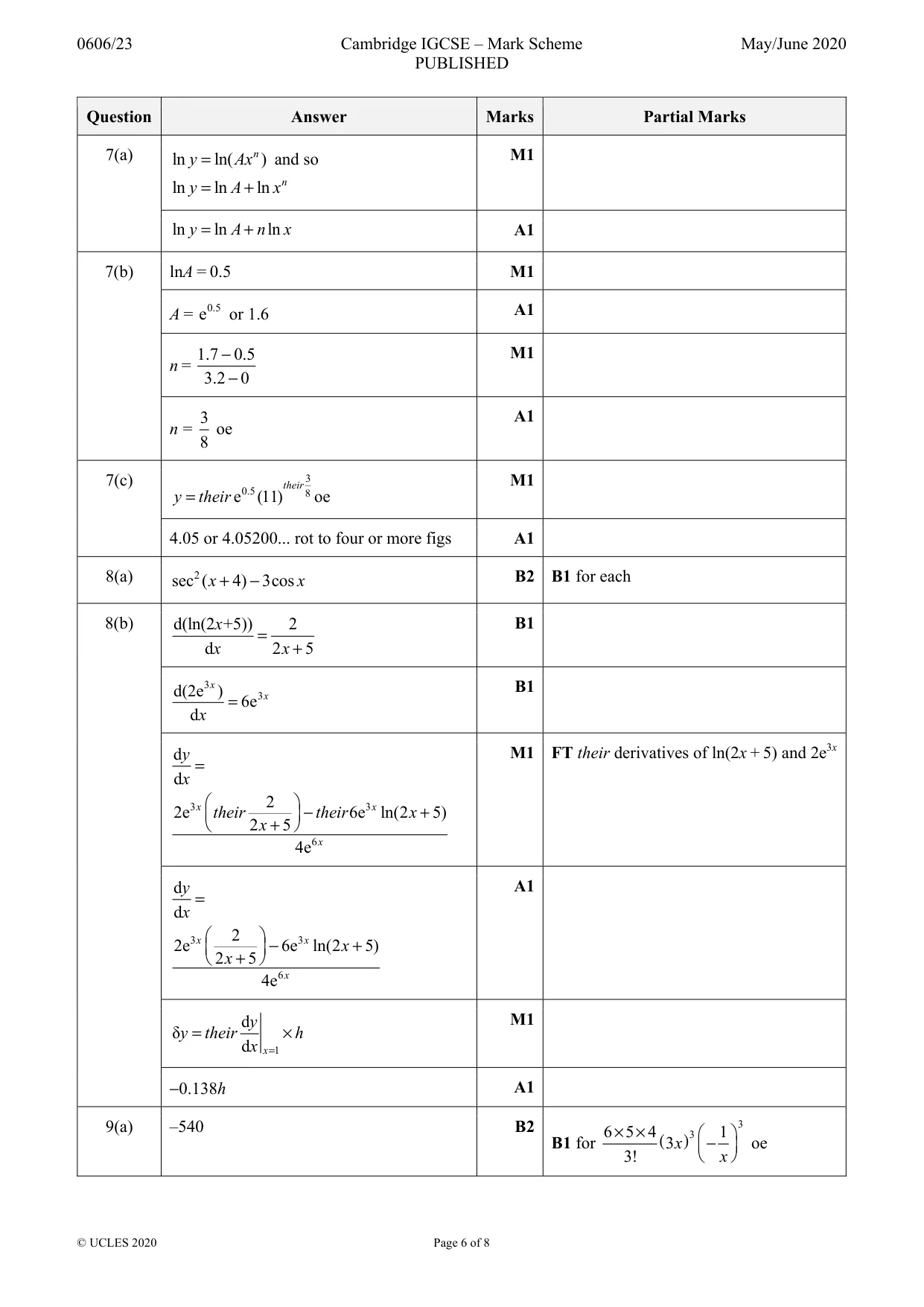
7 Variables x and y are connected by the relationship y = Axn , where A and n are constants. (a) Transform the relationship y = Axn to straight line form. [2] When ln y is plotted against ln x a straight line graph passing through the points (0, 0.5) and (3.2, 1.7) is obtained. (b) Find the value of n and of A. [4] (c) Find the value of y when x = 11. [2]
Mark scheme: 7(a) ln y = ln( Ax n ) and so M1 ln y = ln A + ln x n ln y = ln A + n ln x A1 7(b) lnA = 0.5 M1 A = e 0.5 or 1.6 A1 n = 1.7 − 0.5 M1 3.2 − 0 3 A1 n = oe 8 7(c) their 3 M1 y = their e 0.5 (11) 8 oe 4.05 or 4.05200... rot to four or more figs A1
Q8 · Differentiate y = tan( x + 4) - 3 sin x with respect to x
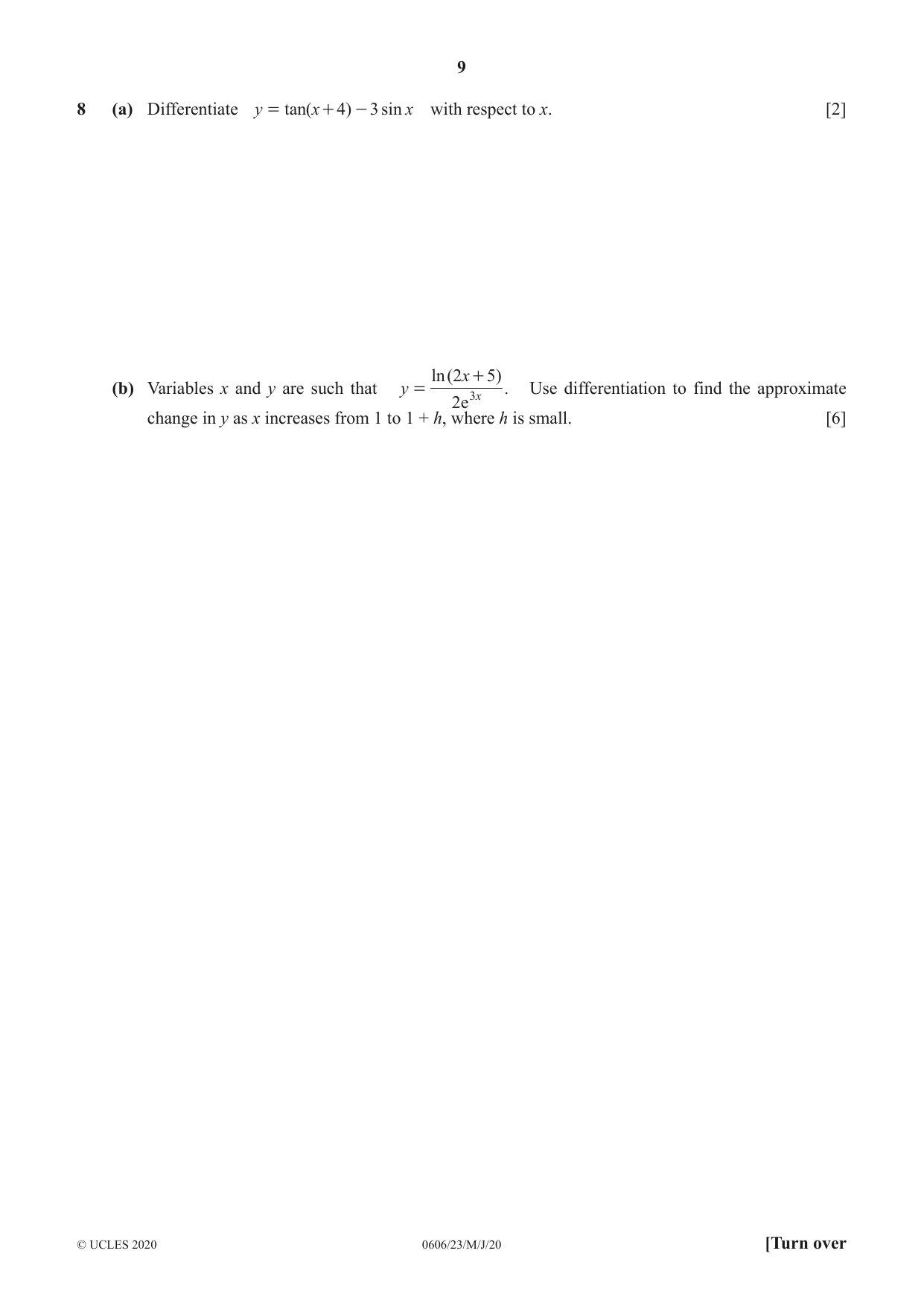
8 (a) Differentiate y = tan( x + 4) - 3 sin x with respect to x. [2] ln( 2x + 5) (b) Variables x and y are such that y = 3 x . Use differentiation to find the approximate 2e change in y as x increases from 1 to 1 + h, where h is small. [6]
Mark scheme: 8(a) sec 2 ( x + 4) − 3cos x B2 B1 for each 8(b) d(ln(2x +5)) 2 B1 = dx 2 x + 5 d(2e 3 x ) 3 x B1 = 6e d x d y M1 FT their derivatives of ln(2x + 5) and 2e3x = d x 2e 3 x 3 x ln(2 x + 5) their 2 − their 6e 2 x + 5 4e 6 x d y A1 = d x 2e 3 x 3 x ln(2 x + 5) 2 − 6e 2 x + 5 4e 6 x d y M1 δy = their × h d x x =1 −0.138h A1
More questions on Apply differentiation to connected rates of
Q9 · DO NOT USE A CALCULATOR IN THIS QUESTION
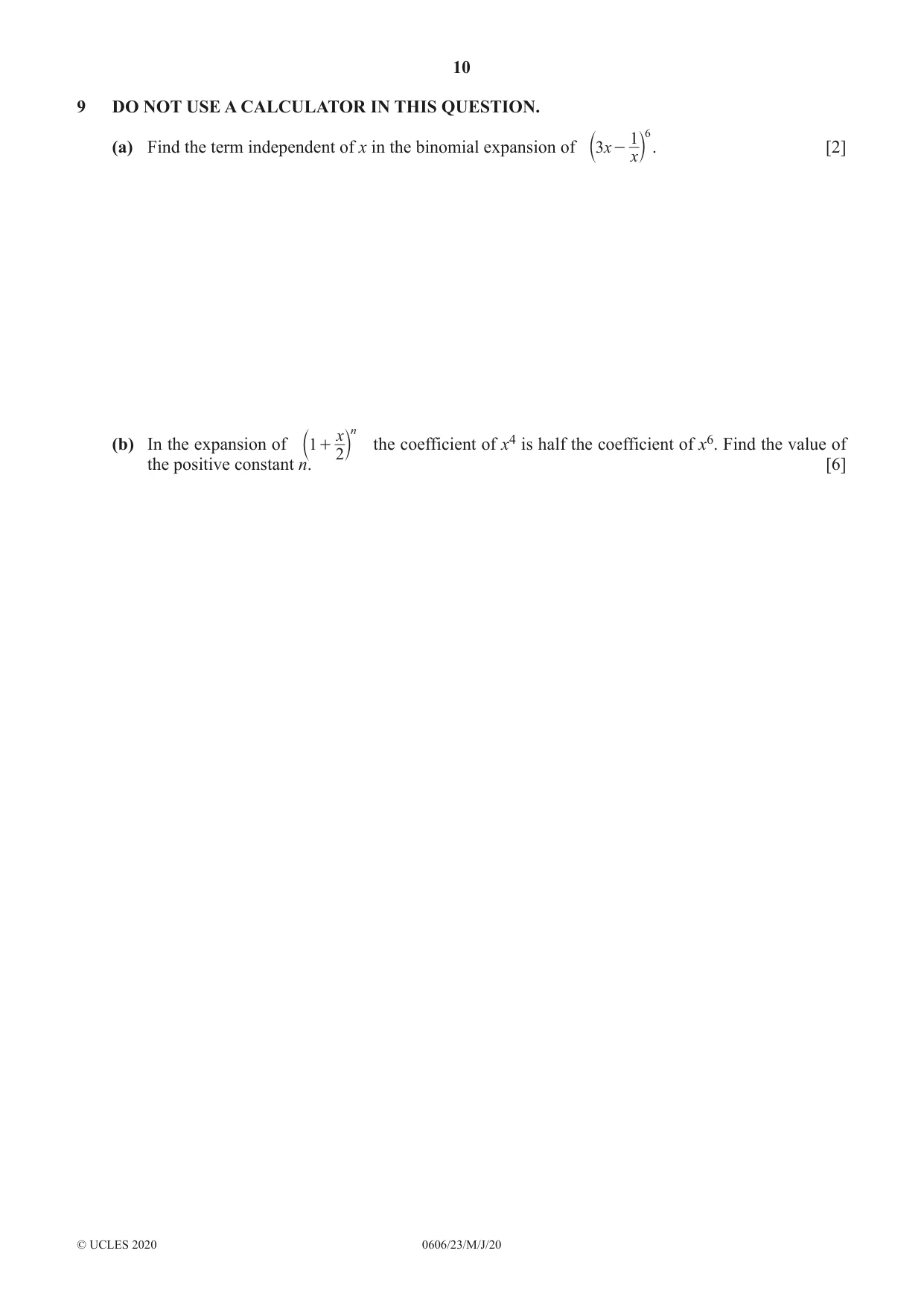
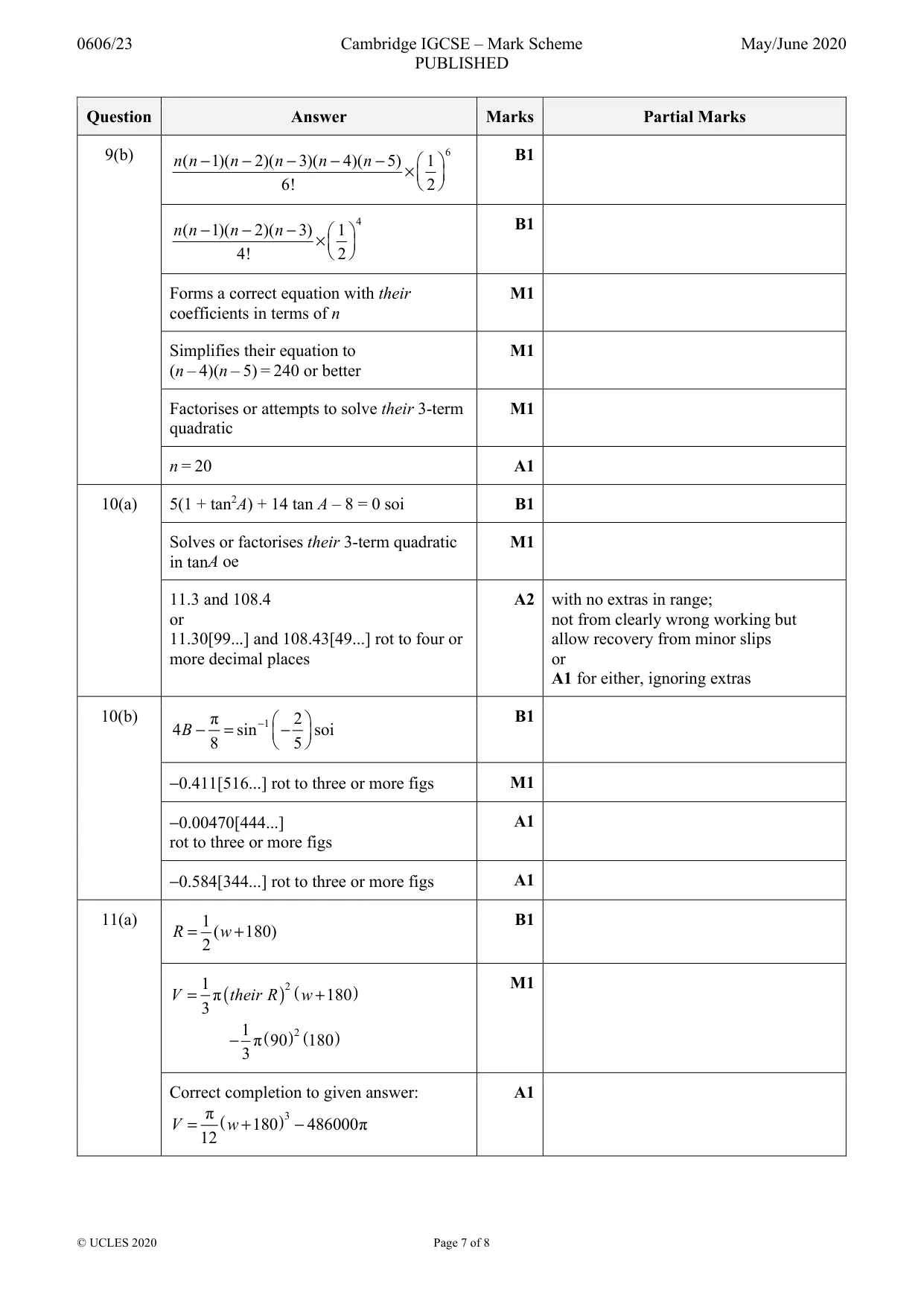
9 DO NOT USE A CALCULATOR IN THIS QUESTION. 1 6 (a) Find the term independent of x in the binomial expansion of 3x - . [2] b x l x n (b) In the expansion of 1 + the coefficient of x4 is half the coefficient of x6. Find the value of b 2 l the positive constant n. [6]
Mark scheme: 9(a) –540 B2 3 6 × 5 × 4 3 1 B1 for ( 3 x ) − oe 3! x 9(b) 6 B1 n ( n − 1)( n − 2)( n − 3)( n − 4)( n − 5) 1 × 6! 2 4 B1 n ( n − 1)( n − 2)( n − 3) 1 × 4! 2 Forms a correct equation with their M1 coefficients in terms of n Simplifies their equation to M1 (n – 4)(n – 5) = 240 or better Factorises or attempts to solve their 3-term M1 quadratic n = 20 A1
Q10 · Solve the equation (a) 5 sec 2 A + 14 tan A - 8 = 0 for 0° G A G 180°, [4] (b) 5 sin 4B…
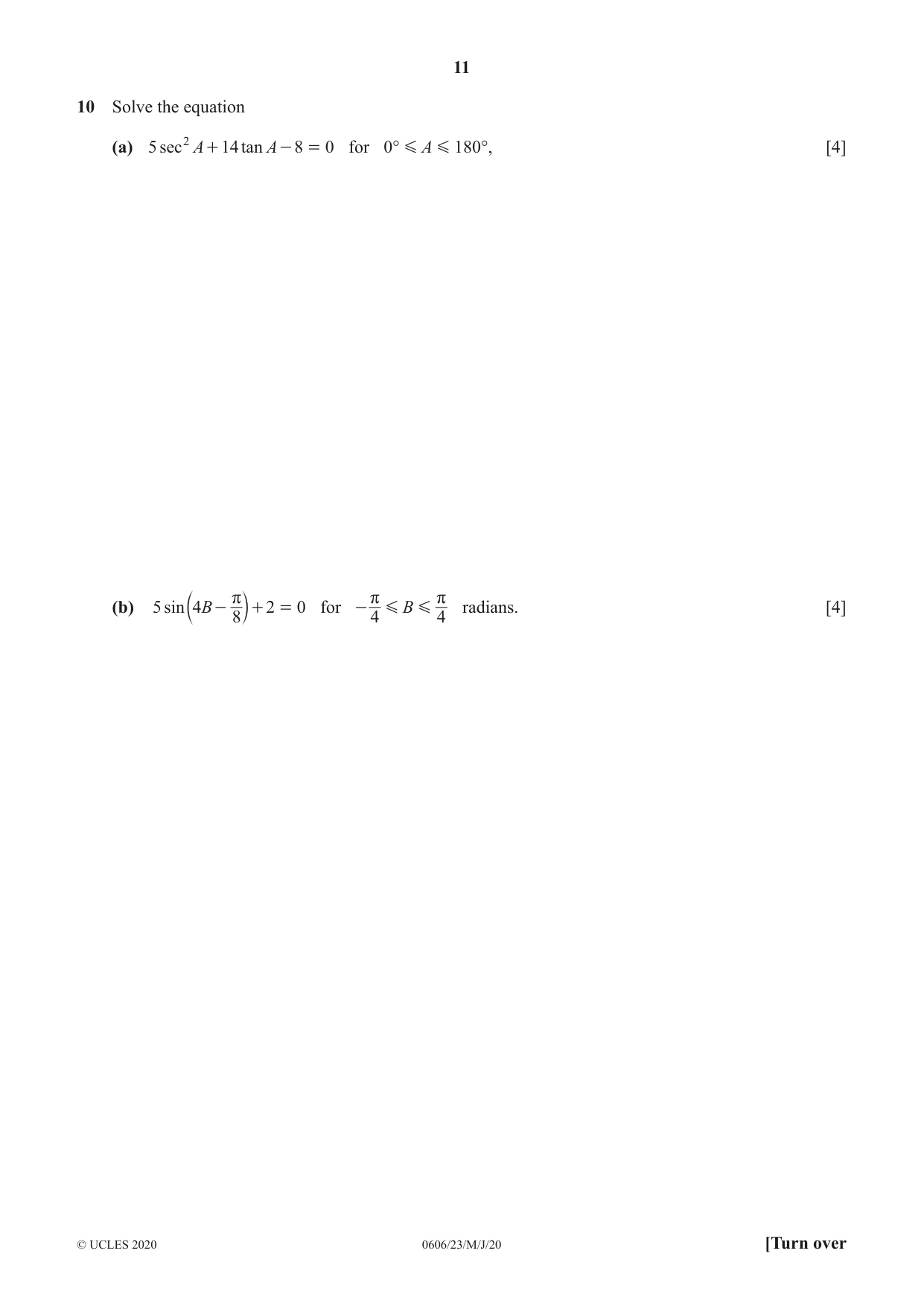
10 Solve the equation (a) 5 sec 2 A + 14 tan A - 8 = 0 for 0° G A G 180°, [4] (b) 5 sin 4B - r + 2 = 0 for - r G B G r radians. [4] b 8 l 4 4
Mark scheme: 10(a) 5(1 + tan2A) + 14 tan A – 8 = 0 soi B1 Solves or factorises their 3-term quadratic M1 in tanA oe 11.3 and 108.4 A2 with no extras in range; or not from clearly wrong working but 11.30[99...] and 108.43[49...] rot to four or allow recovery from minor slips more decimal places or A1 for either, ignoring extras 10(b) π −1 2 B1 4 B − = sin − soi 8 5 −0.411[516...] rot to three or more figs M1 −0.00470[444...] A1 rot to three or more figs −0.584[344...] rot to three or more figs A1
Q11 · In this question all lengths are in centimetres
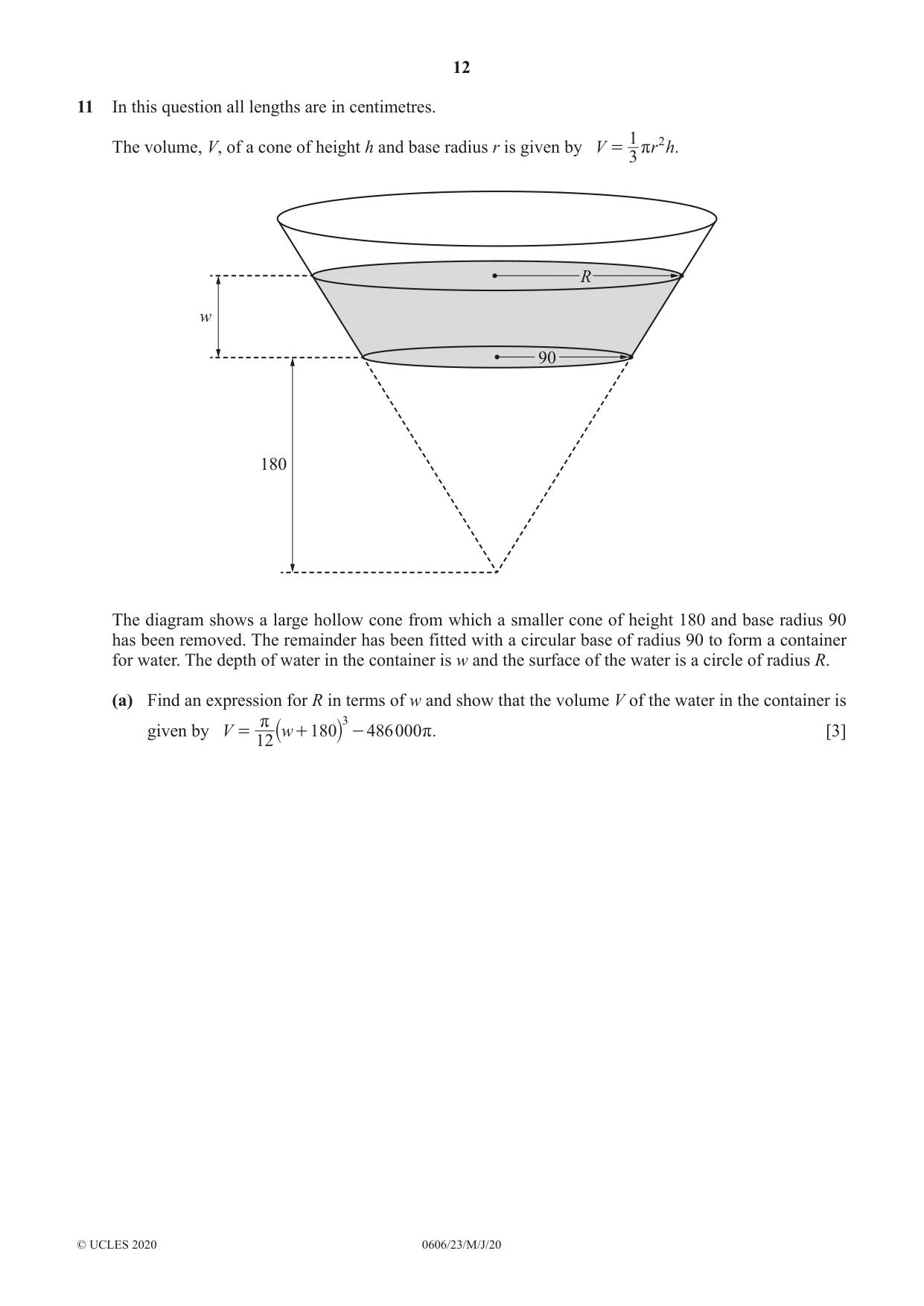
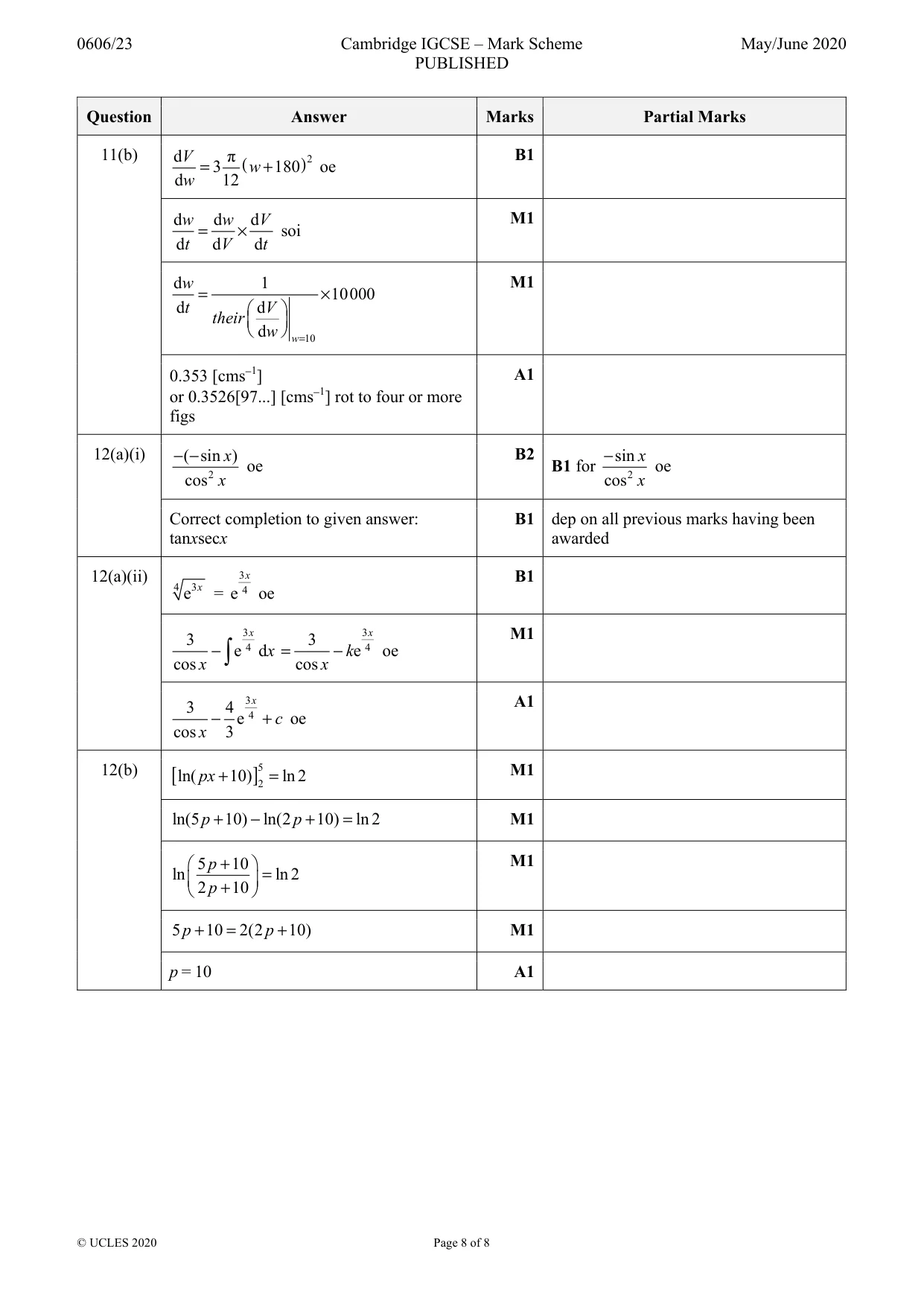
11 In this question all lengths are in centimetres. 1 2 The volume, V, of a cone of height h and base radius r is given by V = r r h. 3 R w 90 180 The diagram shows a large hollow cone from which a smaller cone of height 180 and base radius 90 has been removed. The remainder has been fitted with a circular base of radius 90 to form a container for water. The depth of water in the container is w and the surface of the water is a circle of radius R. (a) Find an expression for R in terms of w and show that the volume V of the water in the container is r 3 given by V = w + 180 - 486000r . [3] 12 ` j (b) Water is poured into the container at a rate of 10 000 cm3s−1. Find the rate at which the depth of the water is increasing when w = 10. [4]
Mark scheme: 11(a) 1 B1 R = ( w + 180) 2 1 2 M1 V = π ( their R ) ( w + 180 ) 3 1 2 − π ( 90 ) (180 ) 3 Correct completion to given answer: A1 π V = ( w + 180 )3 − 486000π 12 11(b) dV π B1 = 3 ( w + 180 )2 oe dw 12 dw dw dV M1 = × soi dt dV dt d w 1 M1 = × 10000 d t d V their dw w =10 0.353 [cms−1] A1 or 0.3526[97...] [cms−1] rot to four or more figs
More questions on Apply differentiation to connected rates of
Q12 · Given that f( x) = , show that f l ( x) = tan x sec x
12 (a) (i) Given that f( x) = , show that f l ( x) = tan x sec x. [3] cos x (ii) Hence find y `3 tan x sec x - 4 e 3 xj dx. [3] 5 p (b) Given that dx = ln 2, find the value of the positive constant p. [5] y 2 px + 10
Mark scheme: 12(a)(i) −−( sin x ) B2 − sin x oe B1 for oe cos 2 x cos 2 x Correct completion to given answer: B1 dep on all previous marks having been tanxsecx awarded 12(a)(ii) 3 x B1 4 3e x = e 4 oe 3 x 3 x M1 3 4 3 4 e d x = − ke oe cos x − cos x 3 x A1 3 4 4 − e + c oe cos x 3 = ln 2 12(b) [ ln( px + 10) ]52 M1 ln(5 p + 10) − ln(2 p + 10) = ln 2 M1 ln 5 p + 10 = ln 2 M1 2 p + 10 5 p + 10 = 2(2 p + 10) M1 p = 10 A1
What was in this paper
The subtopics covered by these 11 questions, and how many questions each got. Open one in a new tab to see every Cambridge question on it.
2Differentiate products and quotients of1Know and use the condition for two lines to1Sketch the graphs of cubic polynomials and1Solve problems on arrangement and selection1Solve, for a given domain, trigonometric1Transform given relationships to and from1Understand and use the amplitude and1Use the binomial theorem for expansion of1Use the relationships1