Cambridge IGCSE Mathematics - Additional 0606 — 2017 Oct/Nov Paper 2 · Variant 3
0606/23/O/N/17 · 10 questions · 80 marks · ≈90 min
The question paper and its mark scheme, free to read here and free to download. This is Cambridge’s own paper, exactly as it was sat.
Question paper16 pages
Mark scheme6 pages
Answers below. Sit the paper first if you are practising.
Questions as text
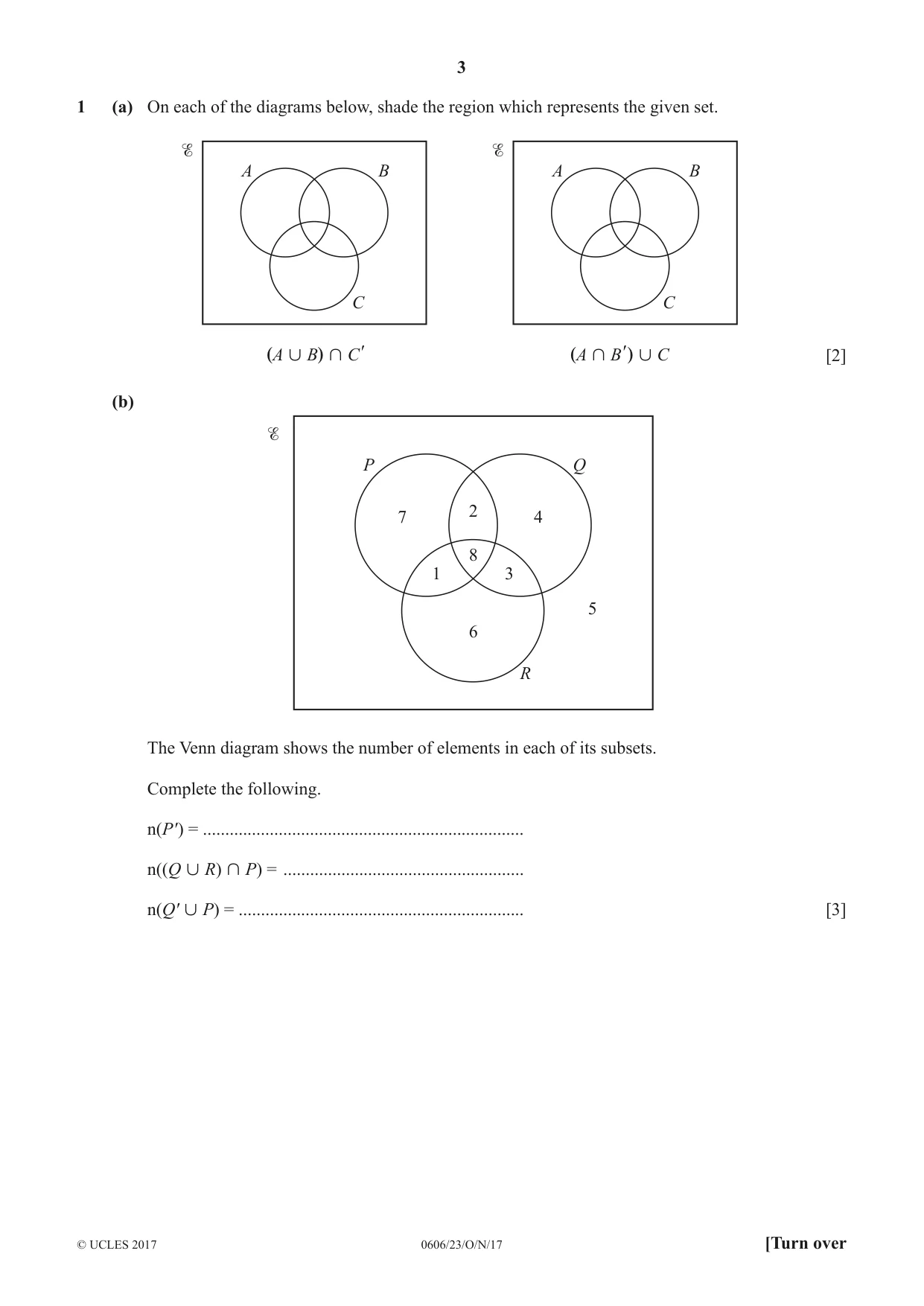
Q1 · On each of the diagrams below, shade the region which represents the given set
1 (a) On each of the diagrams below, shade the region which represents the given set. A B A B C C A B C' A B' C [2] (b) P Q 2 7 4 8 1 3 5 6 R The Venn diagram shows the number of elements in each of its subsets. Complete the following. n(P') = ........................................................................ n((Q R) P) = ...................................................... n(Q' P) = ................................................................ [3]
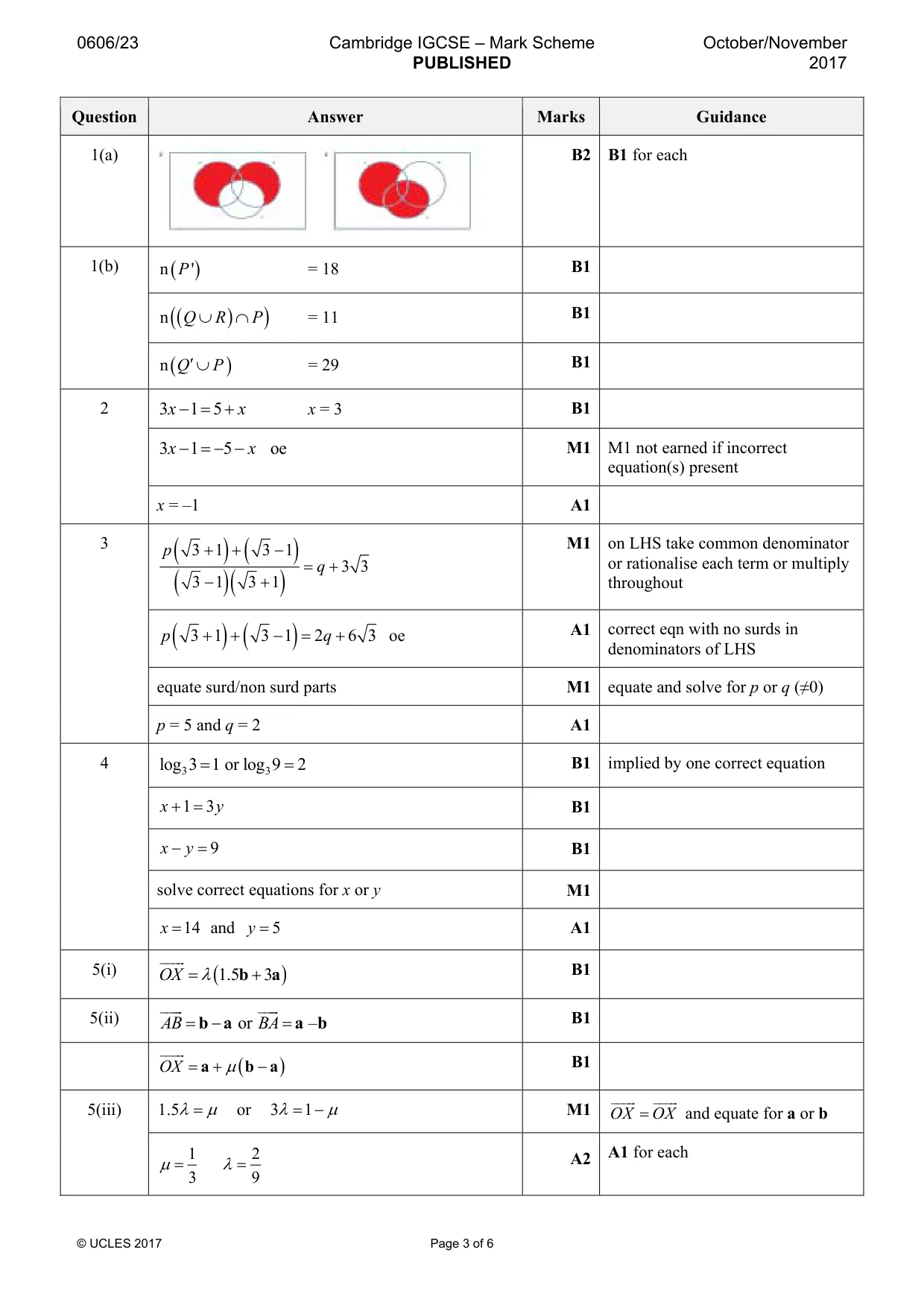
Mark scheme: Question Answer Marks Guidance 1(a) B2 B1 for each 1(b) n ( P ' ) = 18 B1 n ( ( Q ∪ R ) ∩ P ) = 11 B1 n ( Q ′∪ P ) = 29 B1
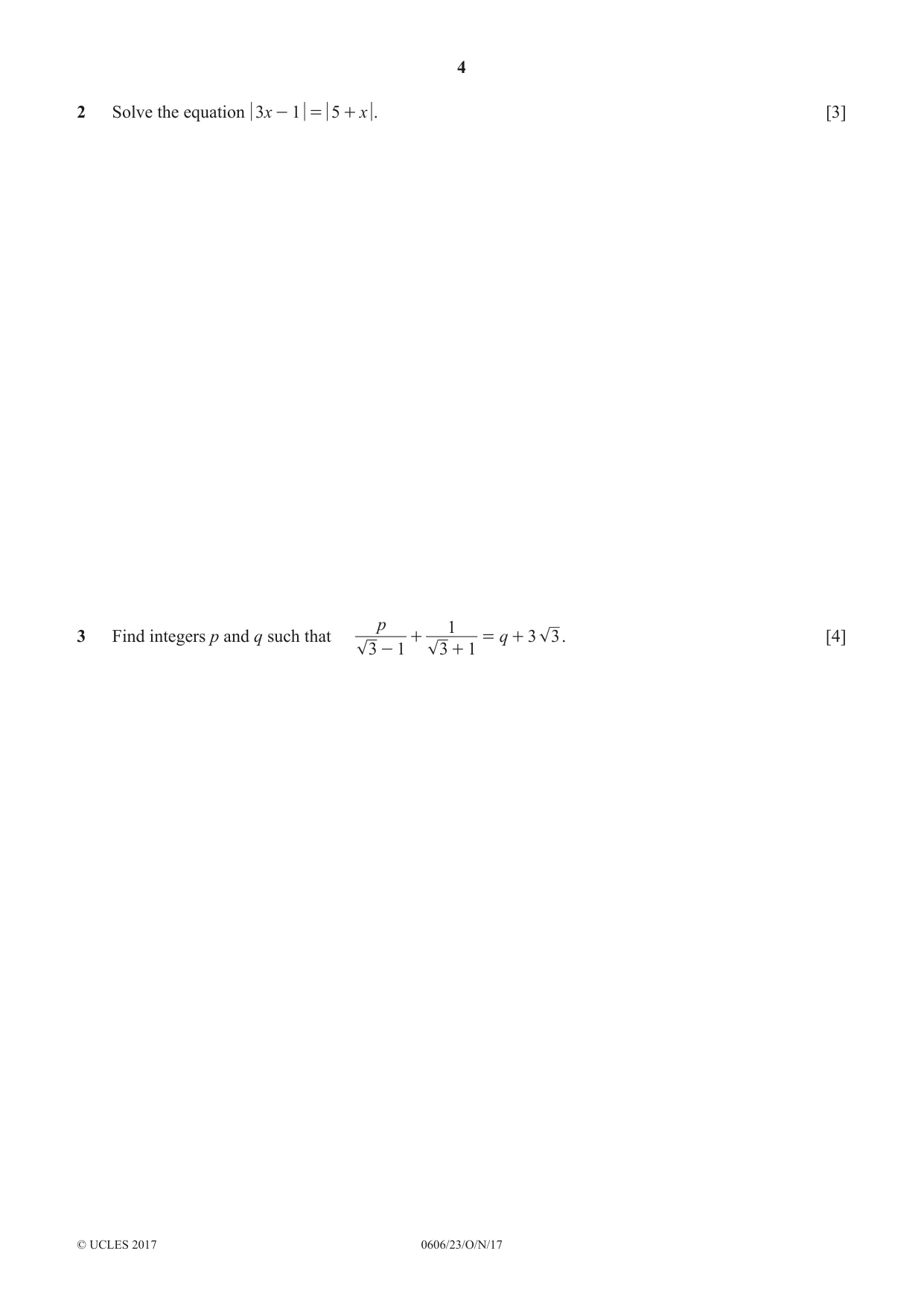
Q2 · Solve the equation 3x - 1 = 5 + x
2 Solve the equation 3x - 1 = 5 + x . [3]
Mark scheme: 2 3 x −=1 5 + x x = 3 B1 3 x −=1 −−5 x oe M1 M1 not earned if incorrect equation(s) present x = –1 A1
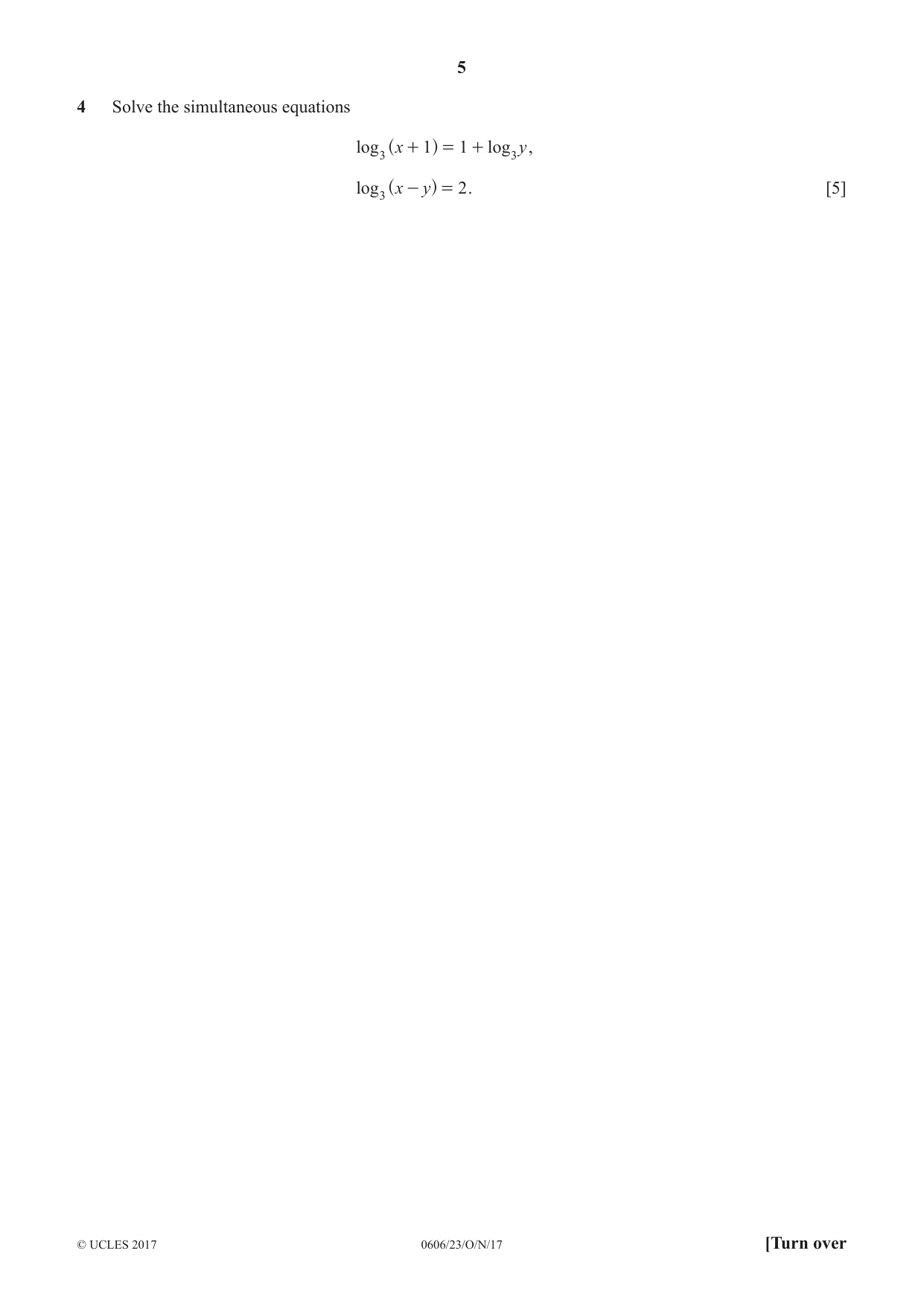
Q4 · Solve the simultaneous equations log 3 x + 1 = 1 + log 3 y , ^ h log 3 x - y = 2
4 Solve the simultaneous equations log 3 x + 1 = 1 + log 3 y , ^ h log 3 x - y = 2 . [5] ^ h
Mark scheme: 4 log 3 3 = 1 or log 3 9 = 2 B1 implied by one correct equation x + 1 = 3 y B1 x − y = 9 B1 solve correct equations for x or y M1 x = 14 and y = 5 A1
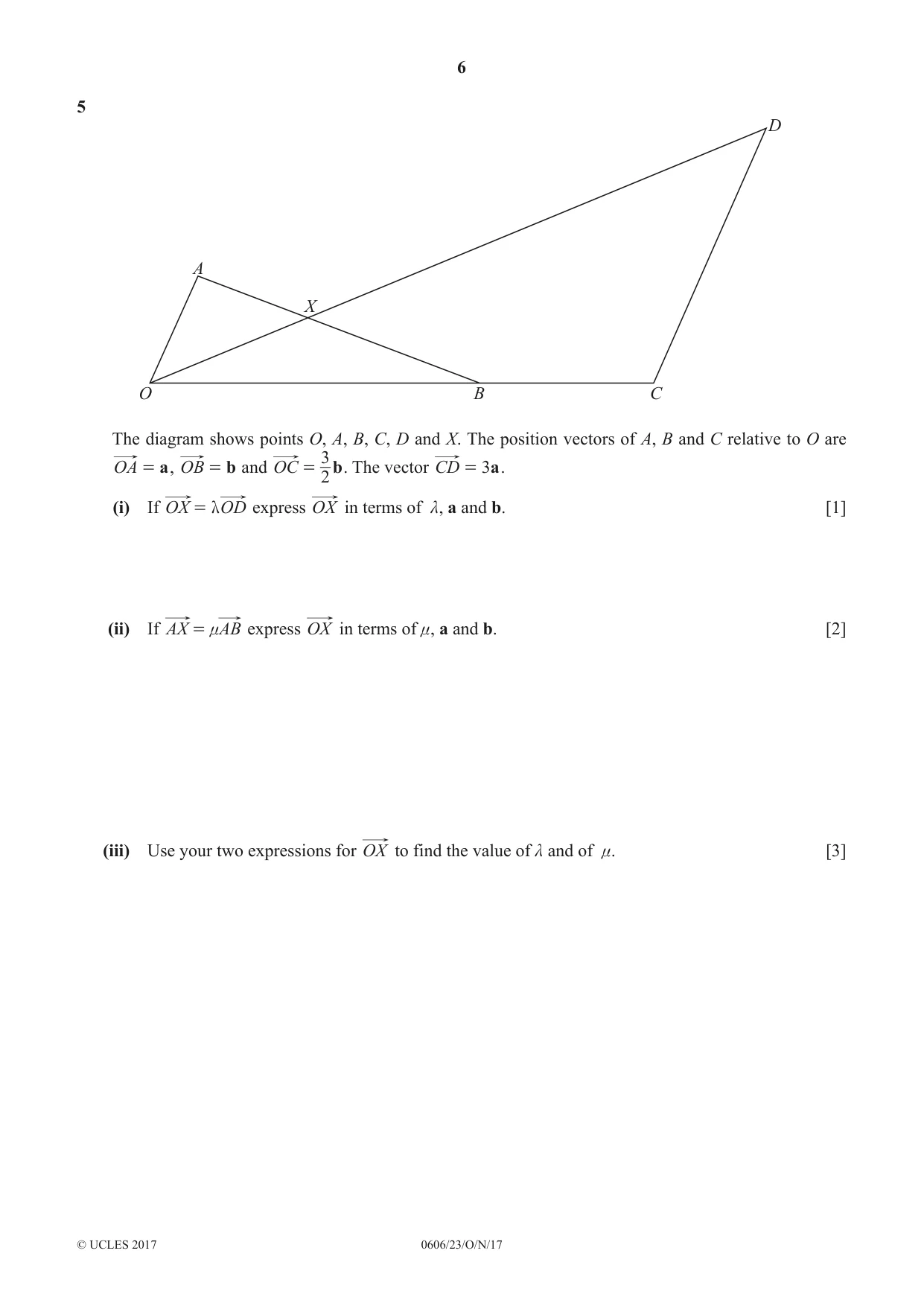
Q5 · D A X O B C The diagram shows points O, A, B, C, D and X
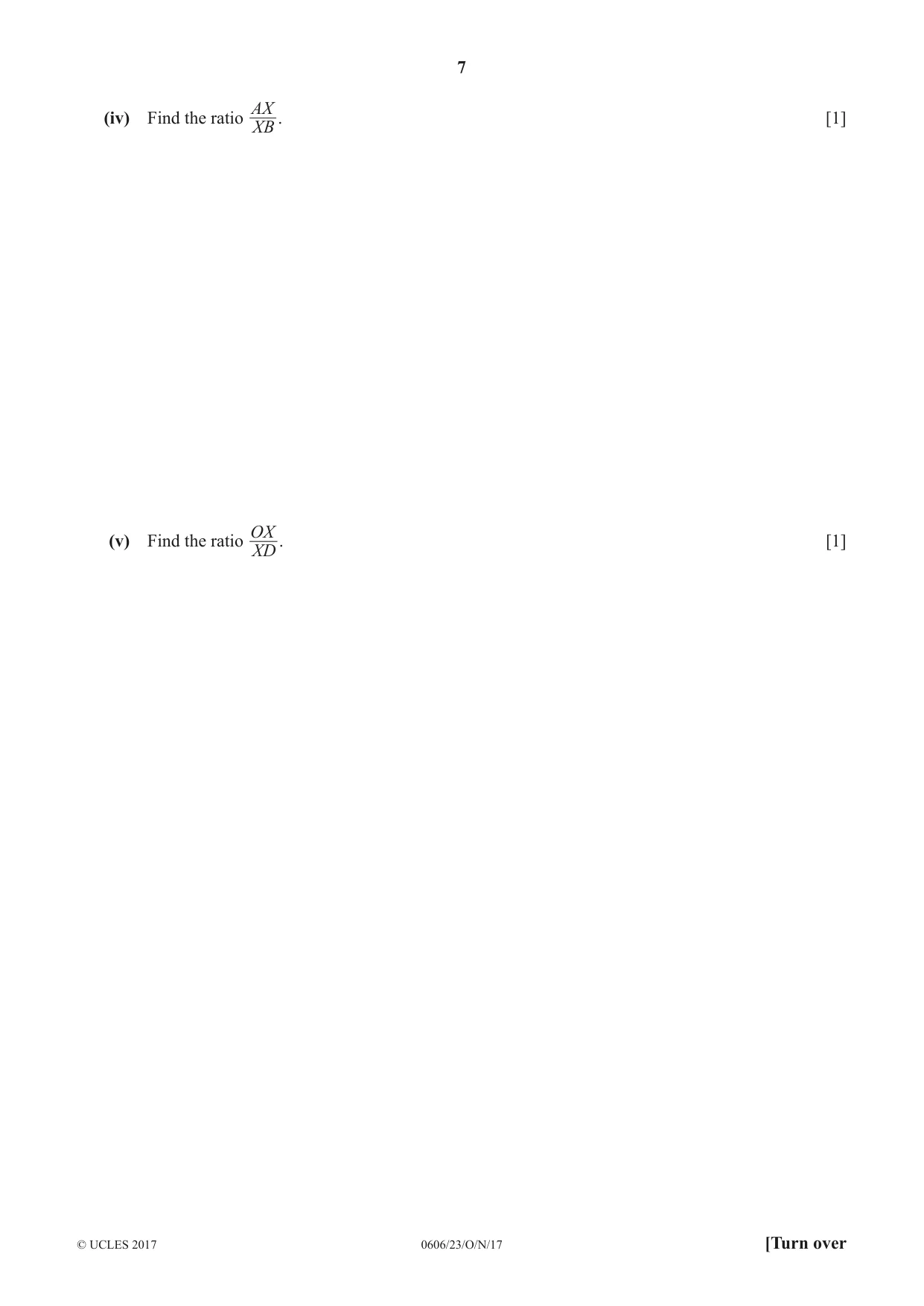
5 D A X O B C The diagram shows points O, A, B, C, D and X. The position vectors of A, B and C relative to O are 3 OA = a , OB = b and OC = b . The vector CD = 3a . 2 (i) If OX = m OD express OX in terms of m, a and b. [1] (ii) If AX = n AB express OX in terms of n, a and b. [2] (iii) Use your two expressions for OX to find the value of m and of n. [3] AX(iv) Find the ratio . [1] XB OX (v) Find the ratio . [1] XD
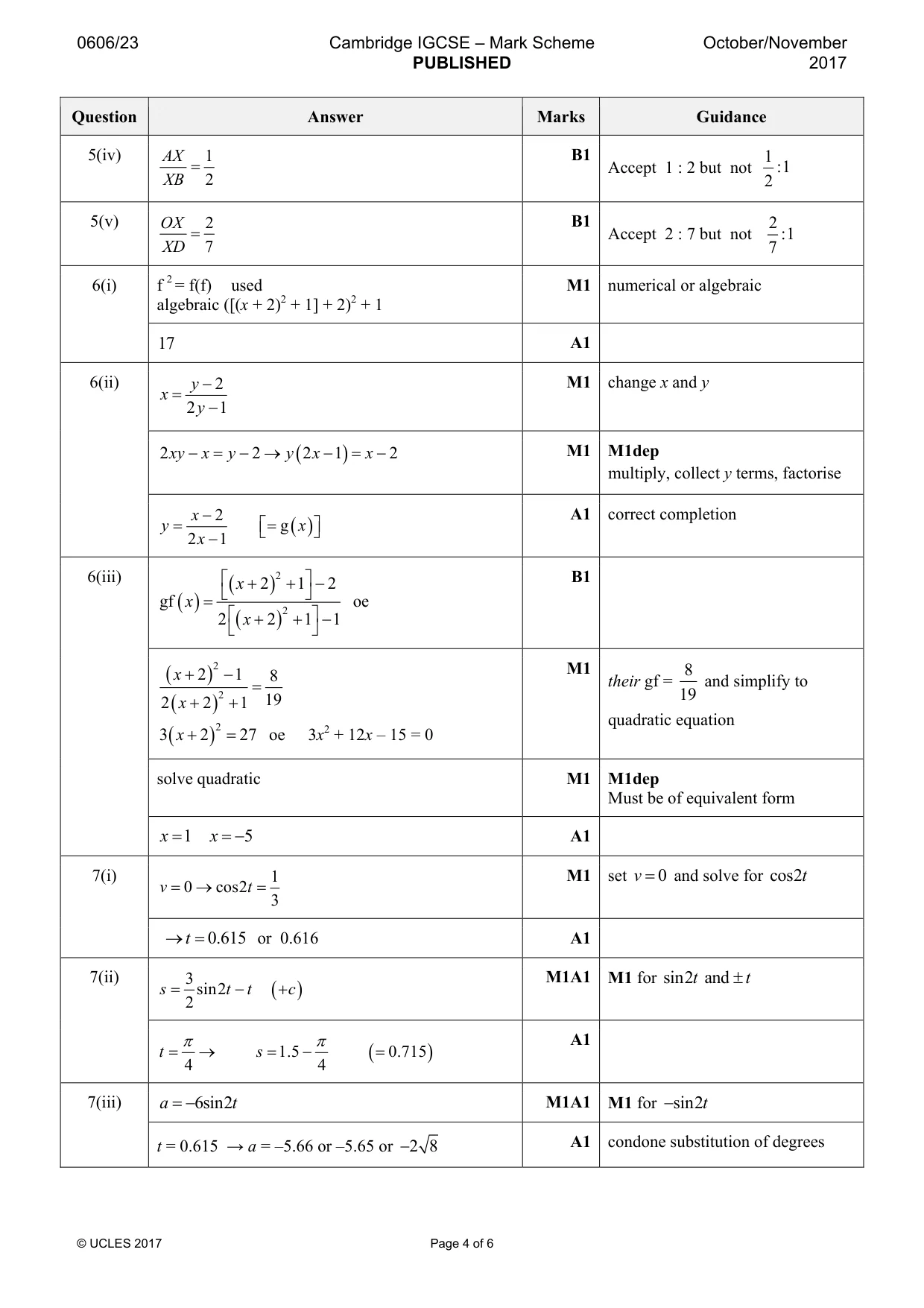
Mark scheme: JJJG 5(i) OX = λ(1.5b + 3a ) B1 JJJG JJJG 5(ii) AB = b − a or BA = a – b B1 JJJG OX = a + µ( b − a ) B1 JJJG JJJG 5(iii) 1.5λ= µ or 3λ= 1 − µ M1 OX = OX and equate for a or b 1 2 A1 for each µ= λ= A2 3 9 5(iv) AX 1 B1 1 = Accept 1 : 2 but not :1 XB 2 2 5(v) OX 2 B1 2 = Accept 2 : 7 but not :1 XD 7 7
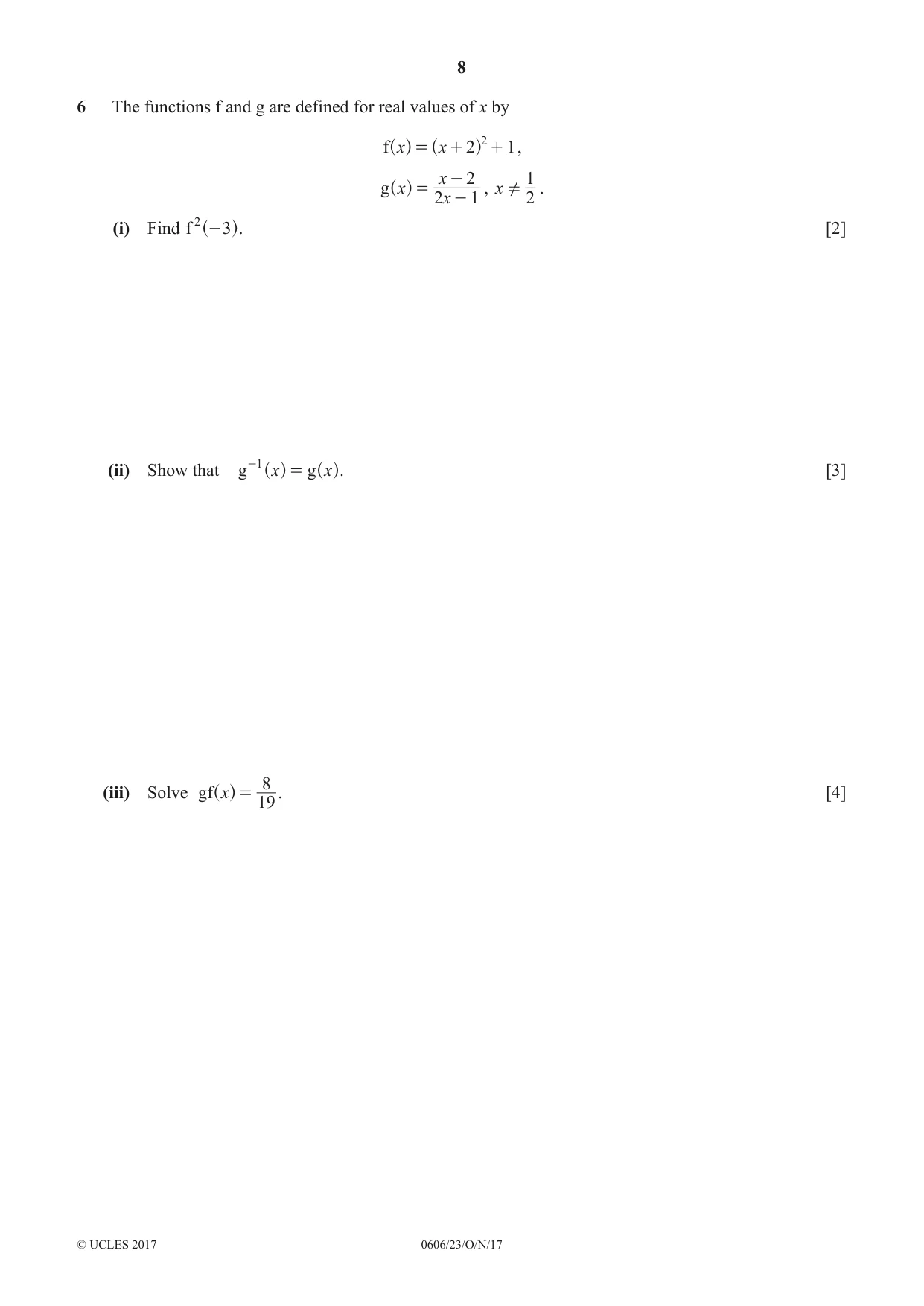
Q6 · The functions f and g are defined for real values of x by f x = x + 2 2 + 1 , ^ h ^ h x…
6 The functions f and g are defined for real values of x by f x = x + 2 2 + 1 , ^ h ^ h x - 2 1 g x = , x ! . ^ h 2x - 1 2 (i) Find f 2 - 3 [2] ^ h. (ii) Show that g -1 x = g x [3] ^ h ^ h. 8 (iii) Solve gf x = . [4] ^ h 19
Mark scheme: 6(i) f 2 = f(f) used M1 numerical or algebraic algebraic ([(x + 2)2 + 1] + 2)2 + 1 17 A1 6(ii) y − 2 M1 change x and y x = 2 y − 1 2 xy − x = y − 2 → y ( 2 x − 1) = x − 2 M1 M1dep multiply, collect y terms, factorise x − 2 A1 correct completion y = = g ( x ) 2 x − 1 6(iii) ( x + 2 ) 2 + 1 − 2 B1 oe gf ( x ) = 2 2 ( x + 2 ) + 1 − 1 ( x + 2 ) 2 − 1 8 M1 their gf = 8 and simplify to = 2 19 2 ( x + 2 ) + 1 19 2 quadratic equation 3 ( x + 2 ) = 27 oe 3x2 + 12x – 15 = 0 solve quadratic M1 M1dep Must be of equivalent form x = 1 x = −5 A1
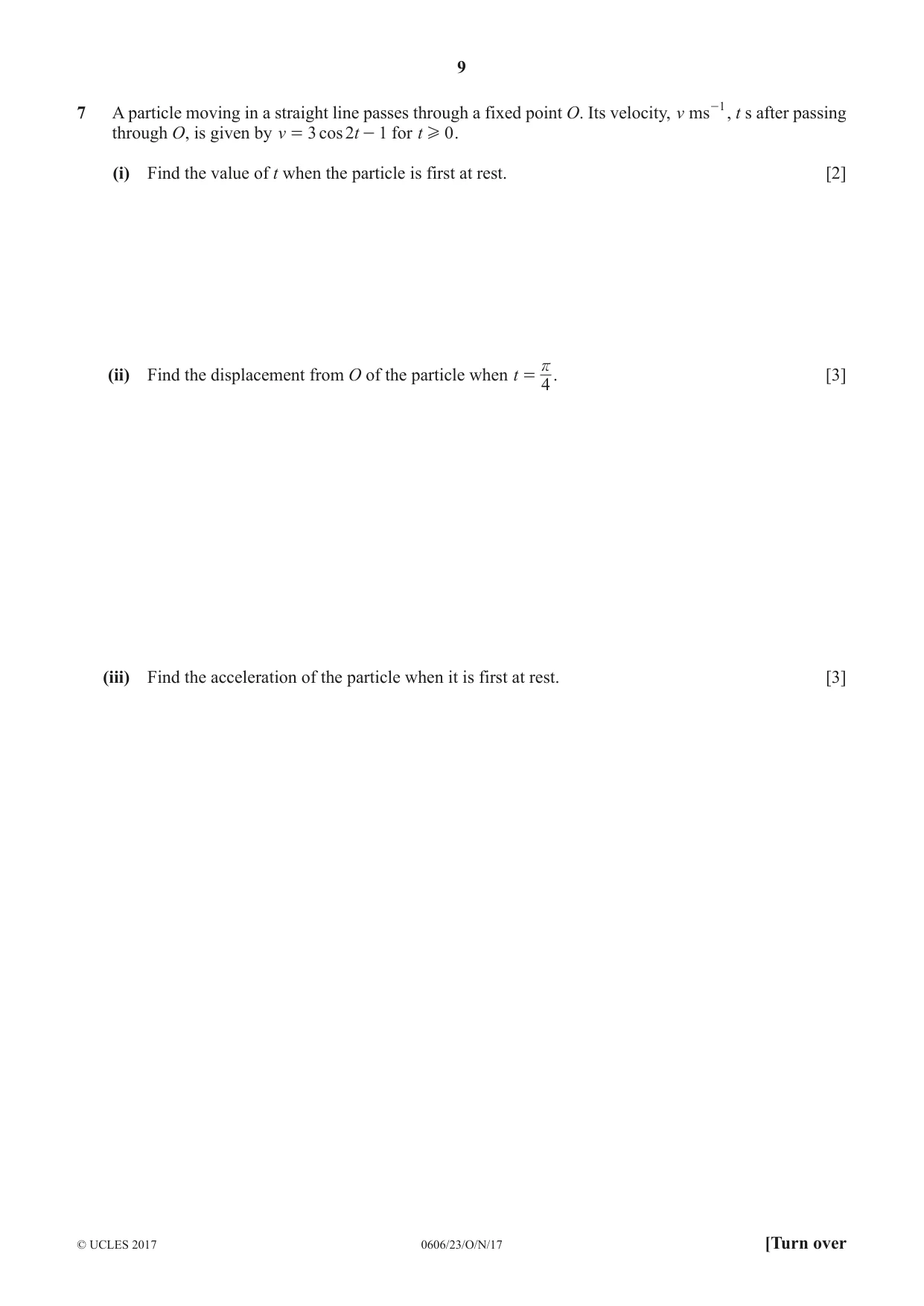
Q7 · A particle moving in a straight line passes through a fixed point O
7 A particle moving in a straight line passes through a fixed point O. Its velocity, v ms -1 , t s after passing through O, is given by v = 3 cos 2t - 1 for t H 0 . (i) Find the value of t when the particle is first at rest. [2] r (ii) Find the displacement from O of the particle when t = . [3] 4 (iii) Find the acceleration of the particle when it is first at rest. [3]
Mark scheme: 7(i) 1 M1 set v = 0 and solve for cos2t v = 0 → cos2t = 3 →=t 0.615 or 0.616 A1 7(ii) 3 M1A1 M1 for sin2t and ± t s = sin2t − t ( + c ) 2 π π A1 t = → s = 1.5 − ( = 0.715 ) 4 4 7(iii) a = −6sin2t M1A1 M1 for −sin2t t = 0.615 → a = –5.66 or –5.65 or −2 8 A1 condone substitution of degrees
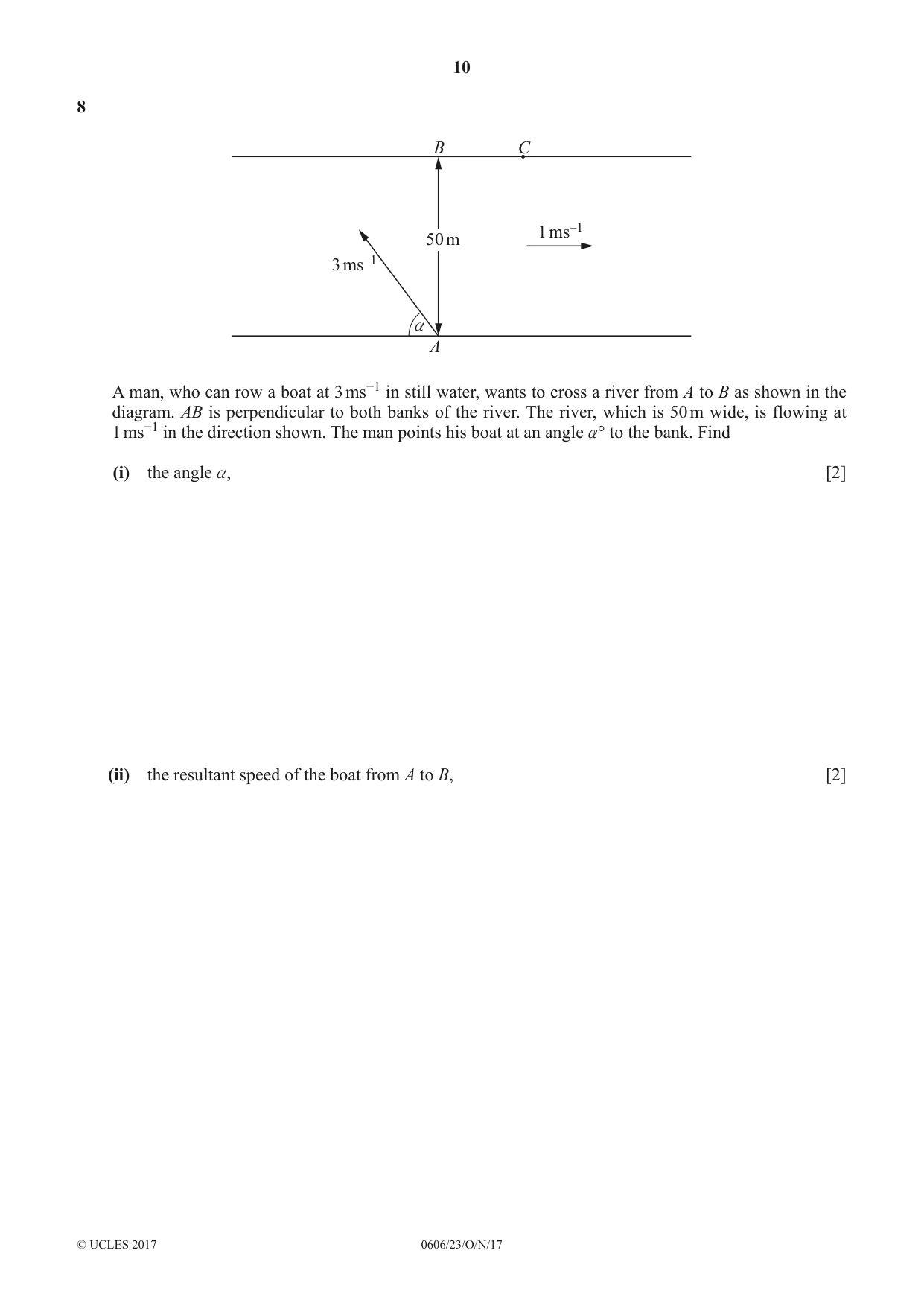
Q8 · B C 1 ms–1 50 m 3 ms–1 a A A man, who can row a boat at 3 ms−1 in still water, wants to…
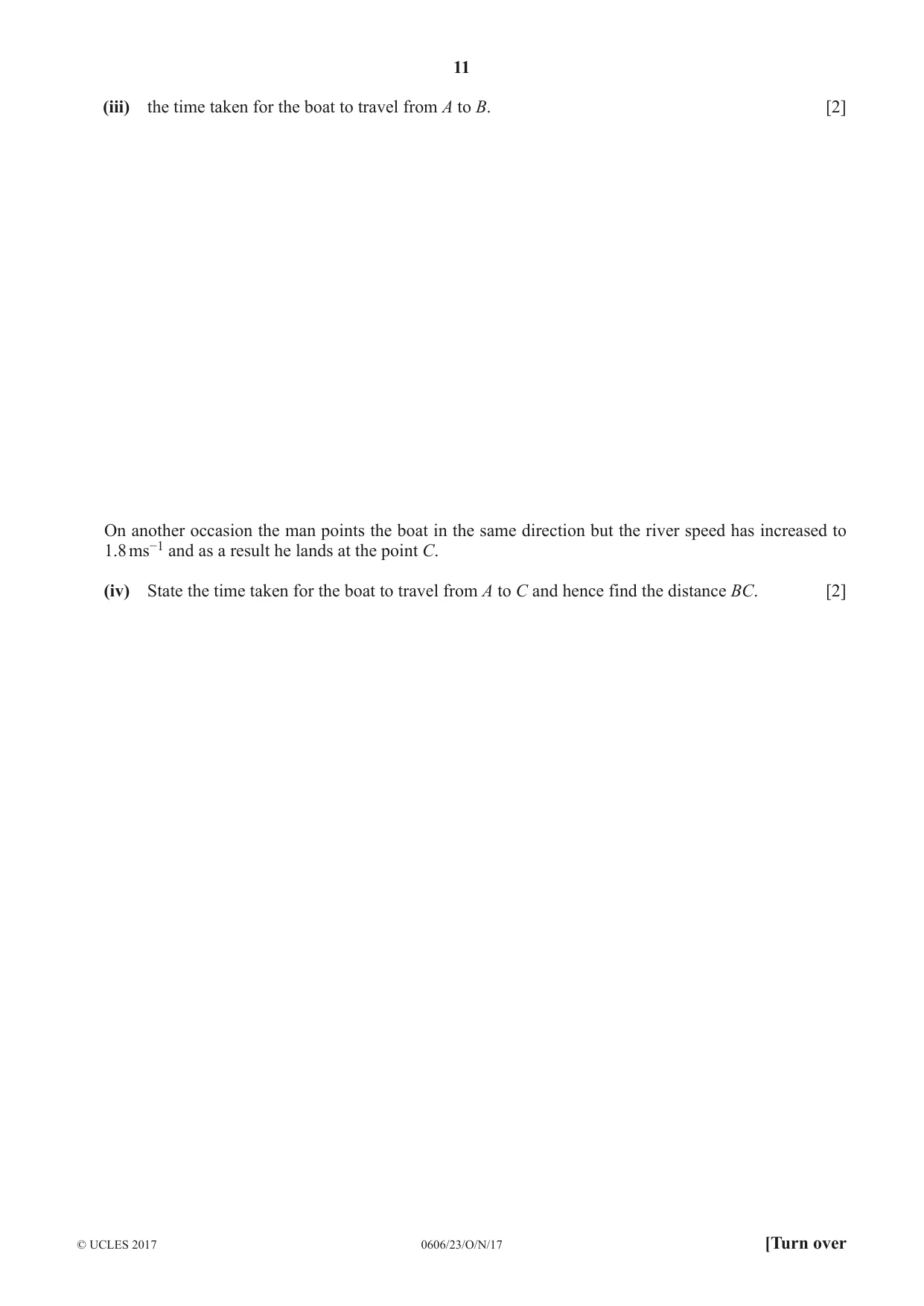
8 B C 1 ms–1 50 m 3 ms–1 a A A man, who can row a boat at 3 ms−1 in still water, wants to cross a river from A to B as shown in the diagram. AB is perpendicular to both banks of the river. The river, which is 50 m wide, is flowing at 1 ms−1 in the direction shown. The man points his boat at an angle a° to the bank. Find (i) the angle a, [2] (ii) the resultant speed of the boat from A to B, [2] (iii) the time taken for the boat to travel from A to B. [2] On another occasion the man points the boat in the same direction but the river speed has increased to 1.8 ms−1 and as a result he lands at the point C. (iv) State the time taken for the boat to travel from A to C and hence find the distance BC. [2]
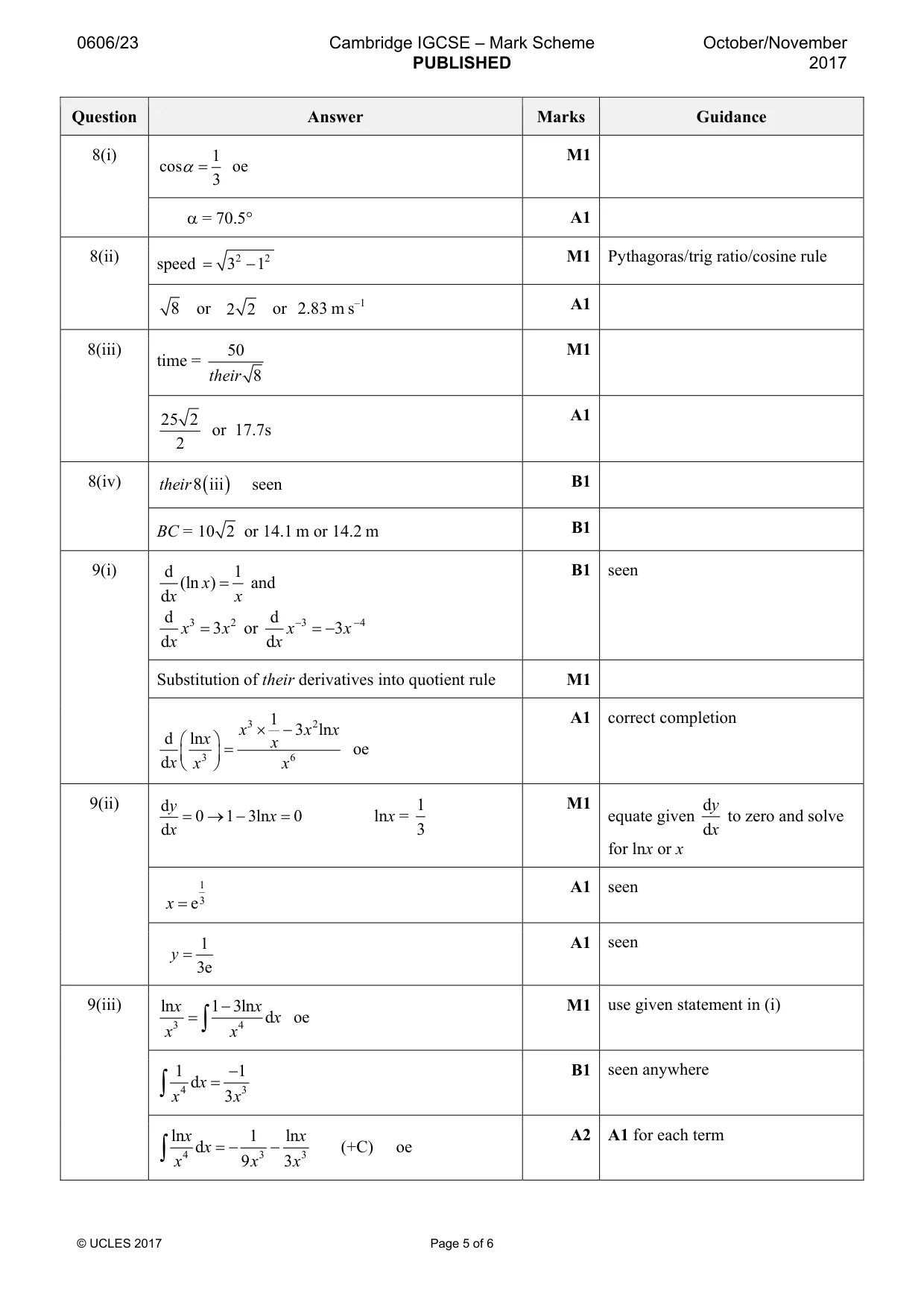
Mark scheme: 8(i) 1 M1 cosα= oe 3 α = 70.5° A1 8(ii) 2 2 M1 Pythagoras/trig ratio/cosine rule speed = 3 − 1 8 or 2 2 or 2.83 m s–1 A1 8(iii) 50 M1 time = their 8 25 2 A1 or 17.7s 2 8(iv) their 8 ( iii ) seen B1 BC = 10 2 or 14.1 m or 14.2 m B1
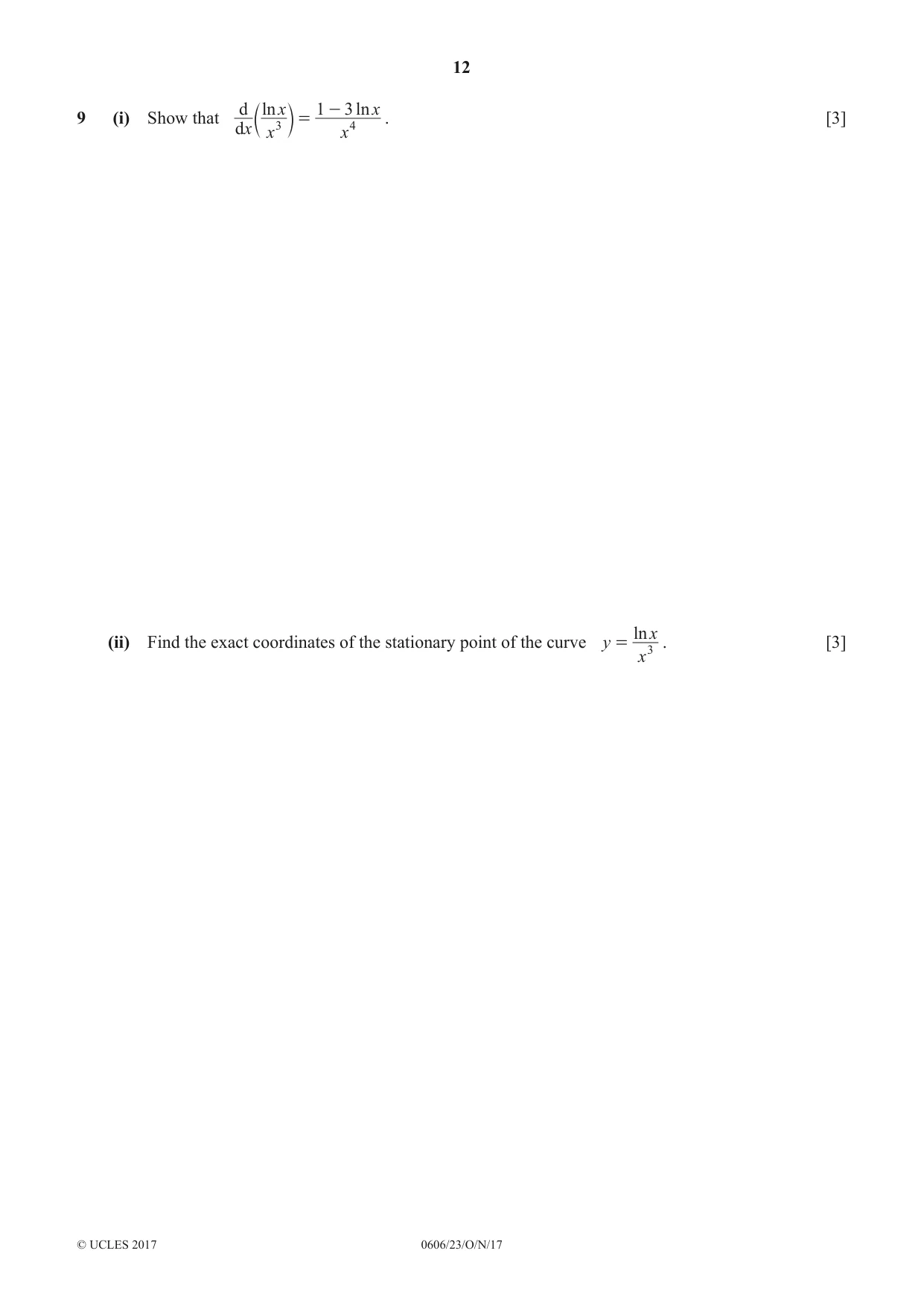
Q9 · Show that 3 = 4
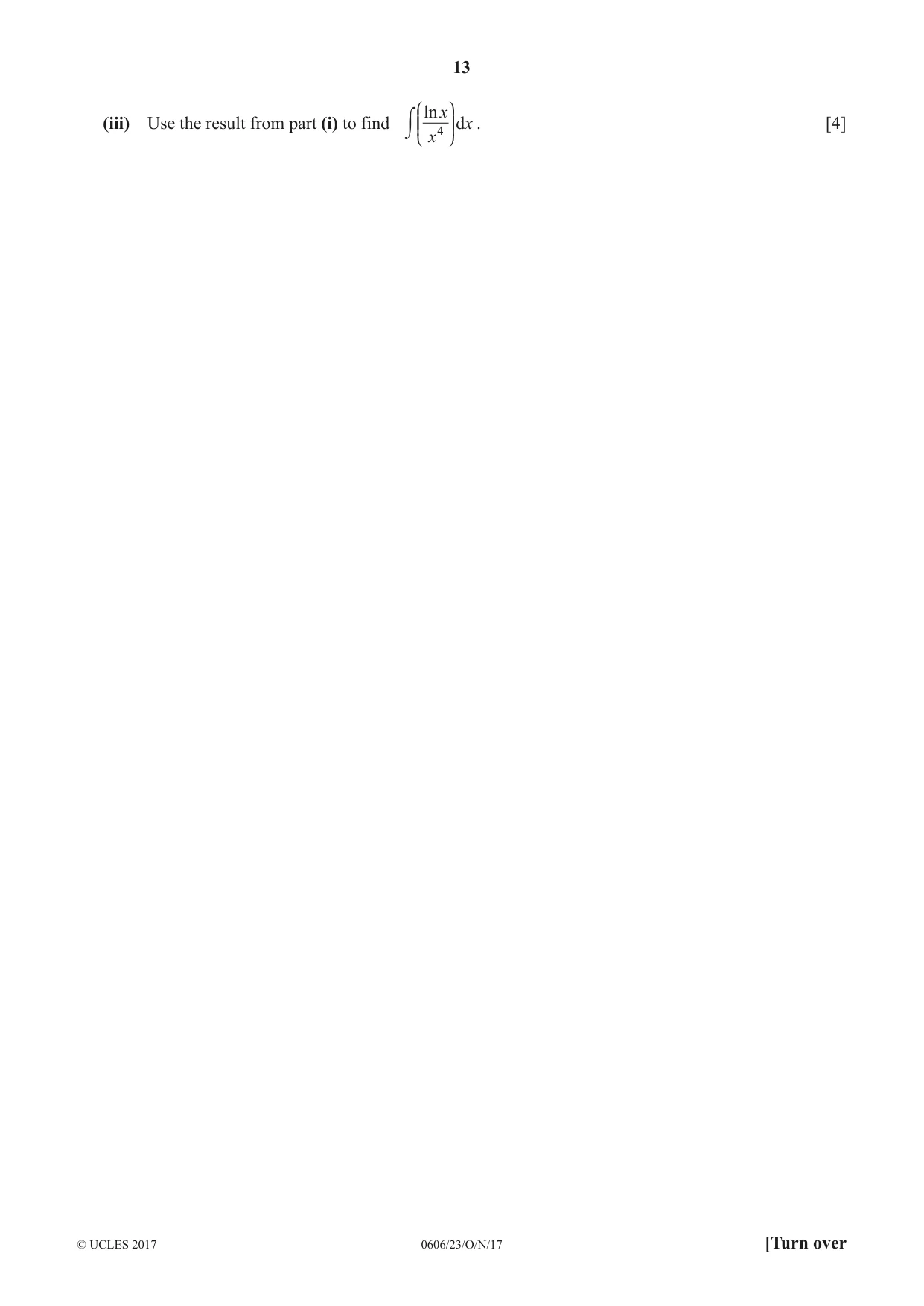
9 (i) Show that 3 = 4 . [3] dx x x ln x (ii) Find the exact coordinates of the stationary point of the curve y = 3 . [3] x J ln x N(iii) Use the result from part (i) to find dx . [4] y KK 4 OO x L P
Mark scheme: 9(i) d 1 B1 seen (ln x ) = and dx x d 3 2 d −3 −4 x = 3 x or x = −3 x d x dx Substitution of their derivatives into quotient rule M1 3 1 2 A1 correct completion x × − 3 x ln x d ln x x oe 3 = 6 d x x x 9(ii) d y 1 M1 dy = 0 →−1 3ln x = 0 lnx = equate given to zero and solve d x 3 dx for lnx or x 1 A1 seen x = e 3 1 A1 seen y = 3e 9(iii) lnx 1 − 3lnx M1 use given statement in (i) dx oe 4 x 3 =∫ x 1 −1 B1 seen anywhere ∫ x dx = 4 3 x 3 ln x 1 ln x A2 A1 for each term ∫ x d x = − − (+C) oe 4 9 x 3 3 x 3
More questions on Understand integration as the reverse process
Q10 · Show that + = 2 cosec x
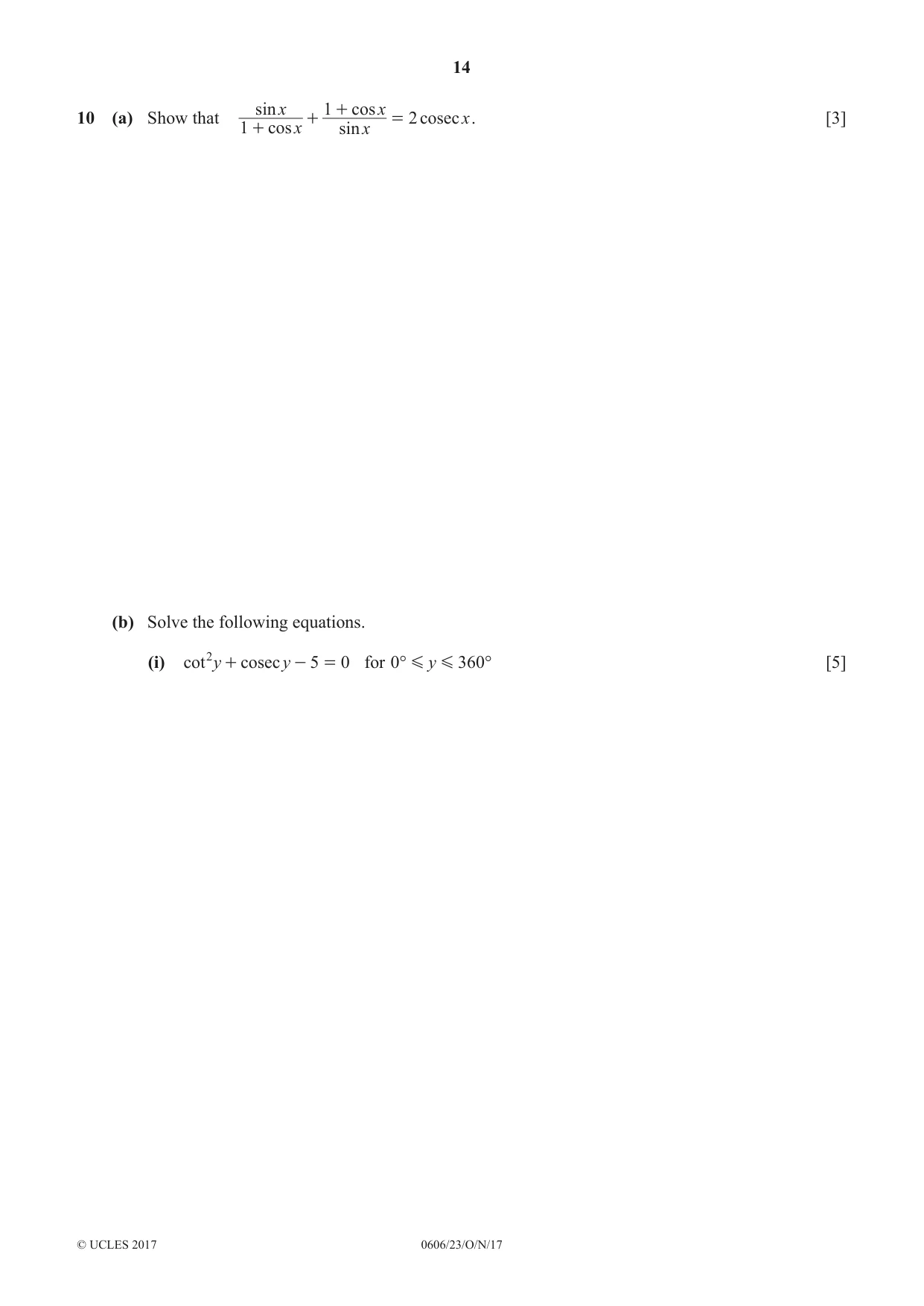
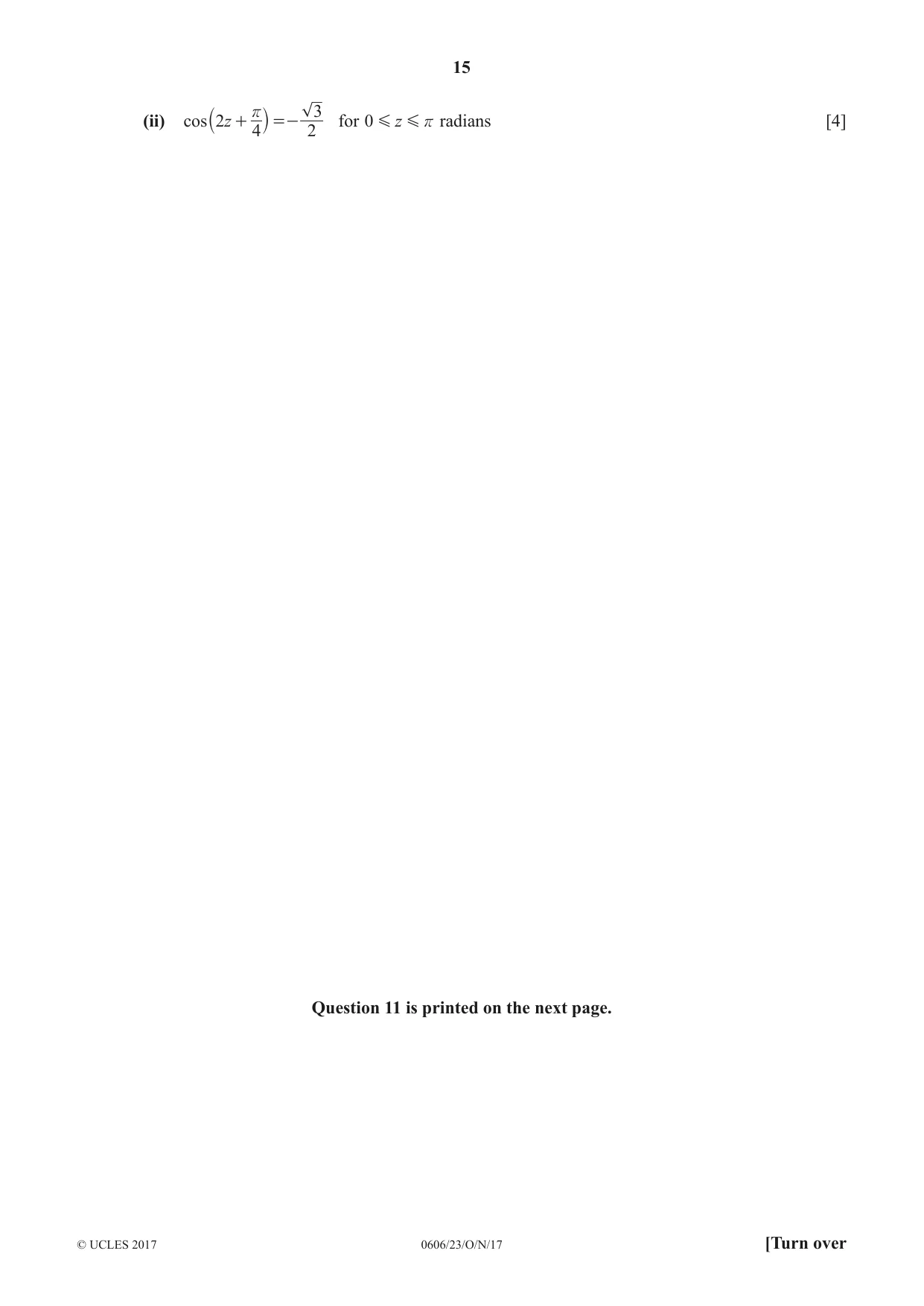
10 (a) Show that + = 2 cosec x . [3] 1 + cos x sin x (b) Solve the following equations. (i) cot 2 y + cosec y - 5 = 0 for 0° G y G 360° [5] r 3(ii) cos 2z + =- for 0 G z G r radians [4] ` 4 j 2 Question 11 is printed on the next page.
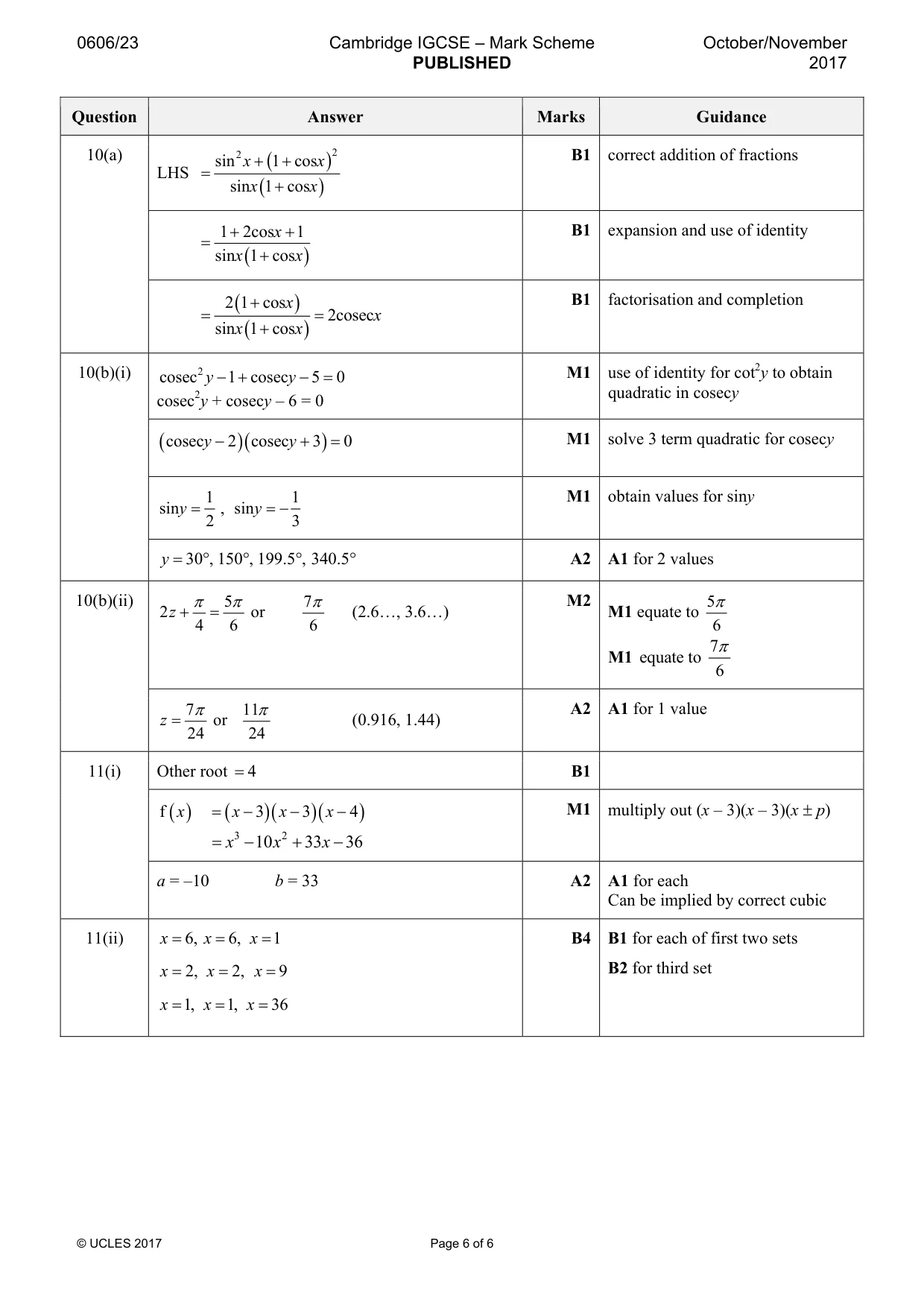
Mark scheme: 10(a) 2 2 B1 correct addition of fractions sin x + (1 + cos x ) LHS = sin x (1 + cos x ) 1 + 2cos x + 1 B1 expansion and use of identity = sin x (1 + cosx ) 2 (1 + cos x ) B1 factorisation and completion = = 2cosecx sinx (1 + cosx ) 10(b)(i) cosec 2 y −+1 cosecy − 5 = 0 M1 use of identity for cot2y to obtain quadratic in cosecy cosec2y + cosecy – 6 = 0 ( cosecy − 2 )( cosecy + 3 ) = 0 M1 solve 3 term quadratic for cosecy 1 1 M1 obtain values for siny sin y = , sin y = − 2 3 y = 30°, 150°, 199.5 °, 340.5 ° A2 A1 for 2 values 10(b)(ii) π 5π 7π M2 5π 2 z + = or (2.6…, 3.6…) M1 equate to 4 6 6 6 7π M1 equate to 6 7π 11π A2 A1 for 1 value z = or (0.916, 1.44) 24 24
Q11 · The cubic equation x3 + ax2 + bx − 36 = 0 has a repeated positive integer root
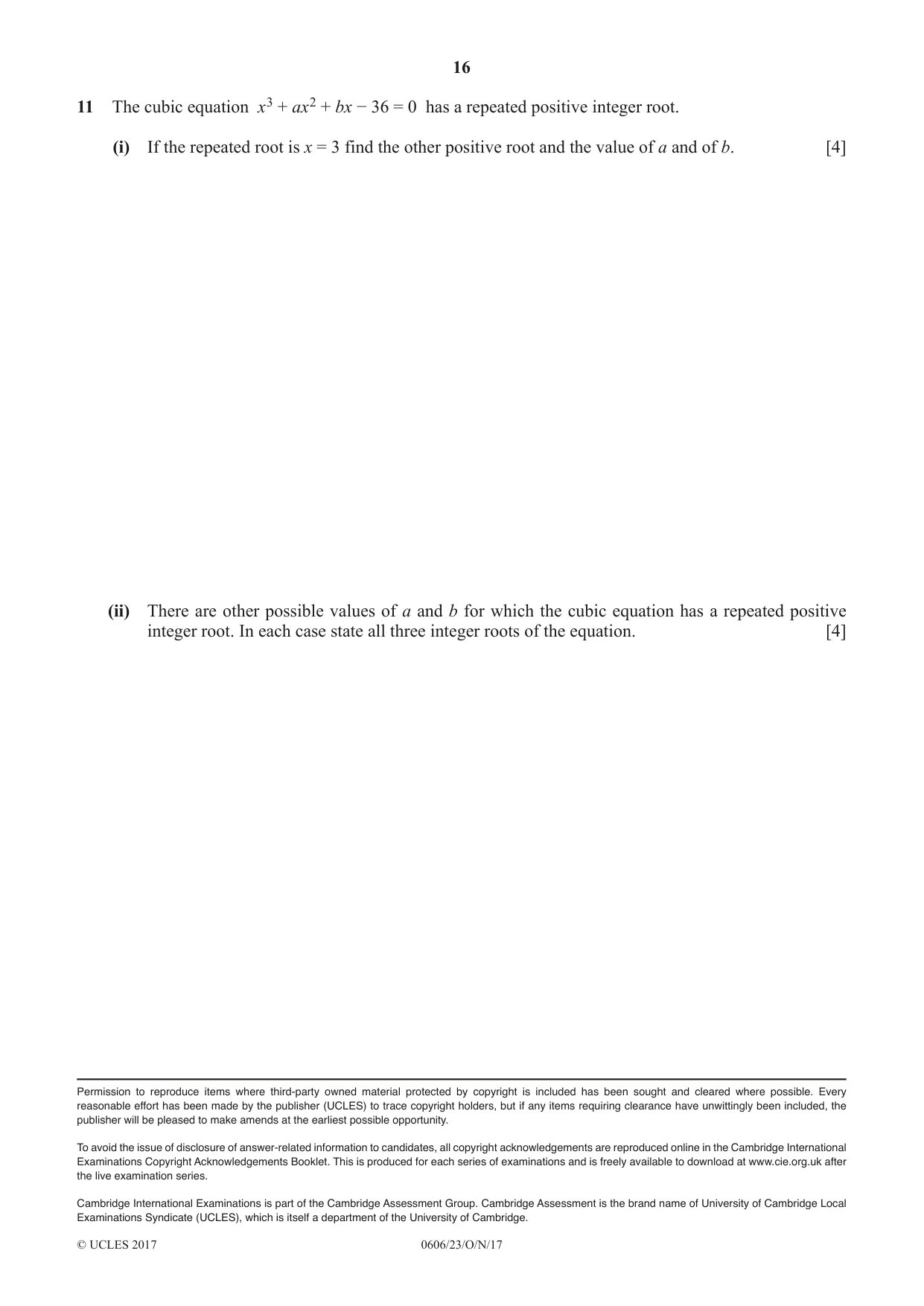
11 The cubic equation x3 + ax2 + bx − 36 = 0 has a repeated positive integer root. (i) If the repeated root is x = 3 find the other positive root and the value of a and of b. [4] (ii) There are other possible values of a and b for which the cubic equation has a repeated positive integer root. In each case state all three integer roots of the equation. [4]
Mark scheme: 11(i) Other root = 4 B1 f ( x ) = ( x − 3 )( x − 3 )( x − 4 ) M1 multiply out (x – 3)(x – 3)(x ± p) = x 3 − 10 x 2 + 33 x − 36 a = –10 b = 33 A2 A1 for each Can be implied by correct cubic 11(ii) x = 6, x = 6, x = 1 B4 B1 for each of first two sets x = 2, x = 2, x = 9 B2 for third set x = 1, x = 1, x = 36
What was in this paper
The subtopics covered by these 10 questions, and how many questions each got. Open one in a new tab to see every Cambridge question on it.
1Evaluate definite integrals and apply1Form and use composite functions1Know and use position vectors and unit1Know and use the laws of logarithms1Solve cubic equations1Solve equations of the type1Solve, for a given domain, trigonometric1Understand integration as the reverse process1Understand the terms: function, domain1What you needed in this session
Cambridge’s own grade thresholds for 2017 Oct/Nov, Paper 2 · Variant 3. A higher threshold means an easier paper — the bar moves with how the cohort did.