Cambridge IGCSE Mathematics - Additional 0606 — 2023 Oct/Nov Paper 2 · Variant 1
0606/21/O/N/23 · 11 questions · 80 marks · ≈90 min
The question paper and its mark scheme, free to read here and free to download. This is Cambridge’s own paper, exactly as it was sat.
Question paper16 pages


Mark scheme10 pages
Answers below. Sit the paper first if you are practising.
Questions as text
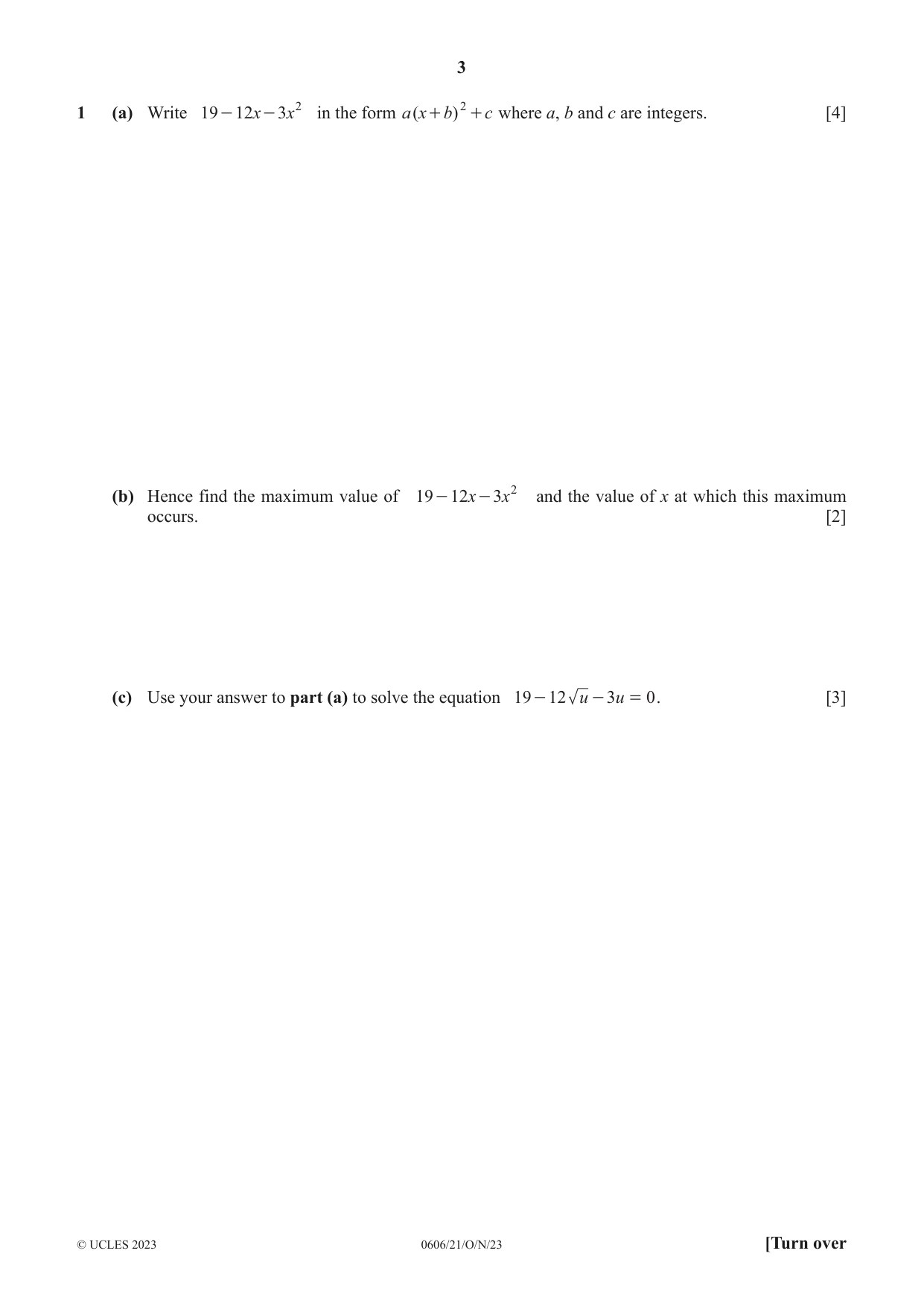
Q1 · Write 19 - 12x - 3x 2 in the form a ( x + b) 2 + c where a, b and c are integers
1 (a) Write 19 - 12x - 3x 2 in the form a ( x + b) 2 + c where a, b and c are integers. [4] (b) Hence find the maximum value of 19 - 12x - 3 x 2 and the value of x at which this maximum occurs. [2] (c) Use your answer to part (a) to solve the equation 19 - 12 u - 3 u = 0 . [3]
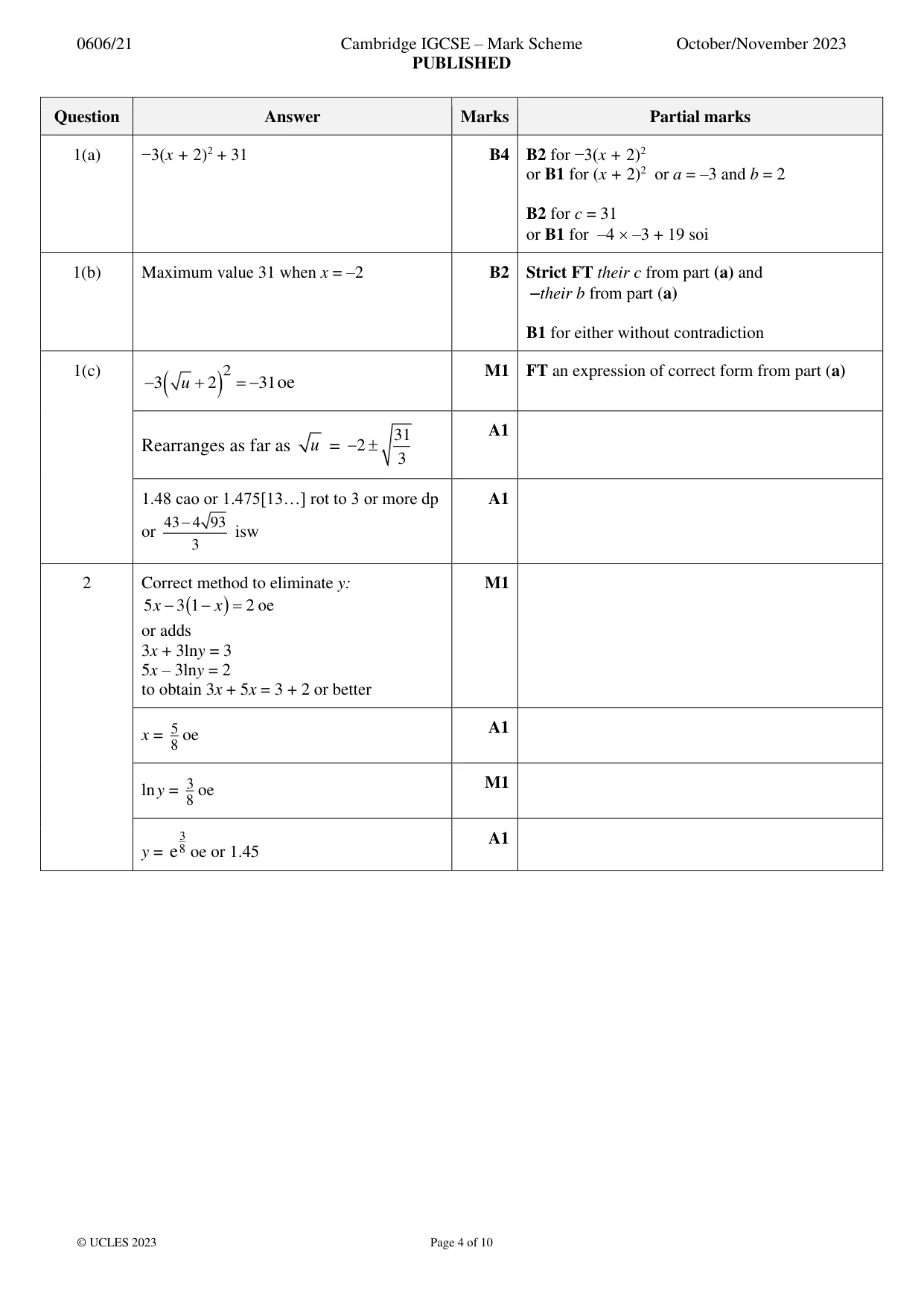
Mark scheme: Question Answer Marks Partial marks 1(a) −3(x + 2)2 + 31 B4 B2 for −3(x + 2)2 or B1 for (x + 2)2 or a = –3 and b = 2 B2 for c = 31 or B1 for –4 –3 + 19 soi 1(b) Maximum value 31 when x = –2 B2 Strict FT their c from part (a) and −their b from part (a) B1 for either without contradiction 1(c) 2 M1 FT an expression of correct form from part (a) −3 u + 2 = −31 oe ( ) 31 A1 Rearranges as far as u = −2 3 1.48 cao or 1.475[13…] rot to 3 or more dp A1 43 − 4 93 or isw 3
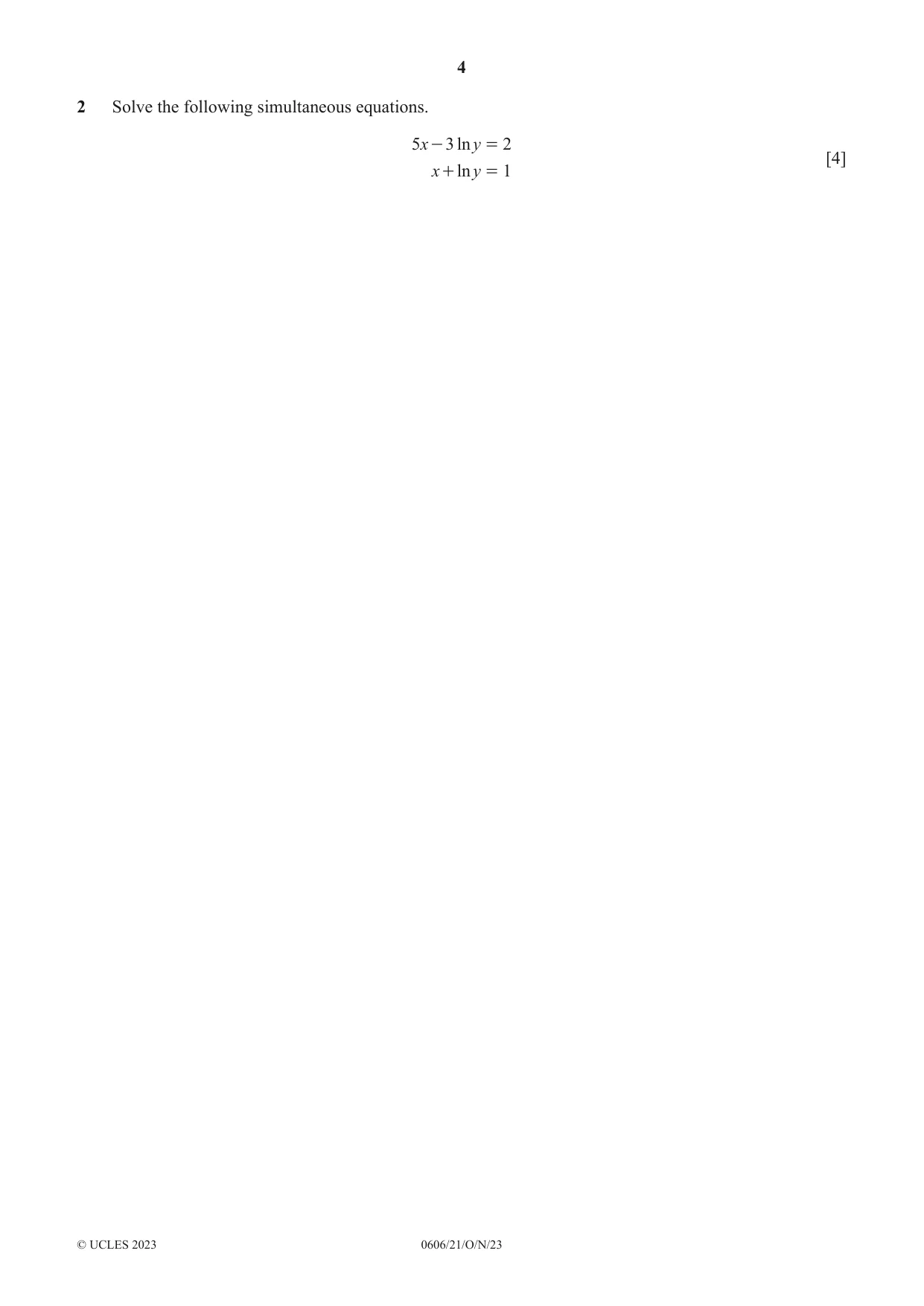
Q2 · Solve the following simultaneous equations
2 Solve the following simultaneous equations. 5x - 3 ln y = 2 [4] x + ln y = 1
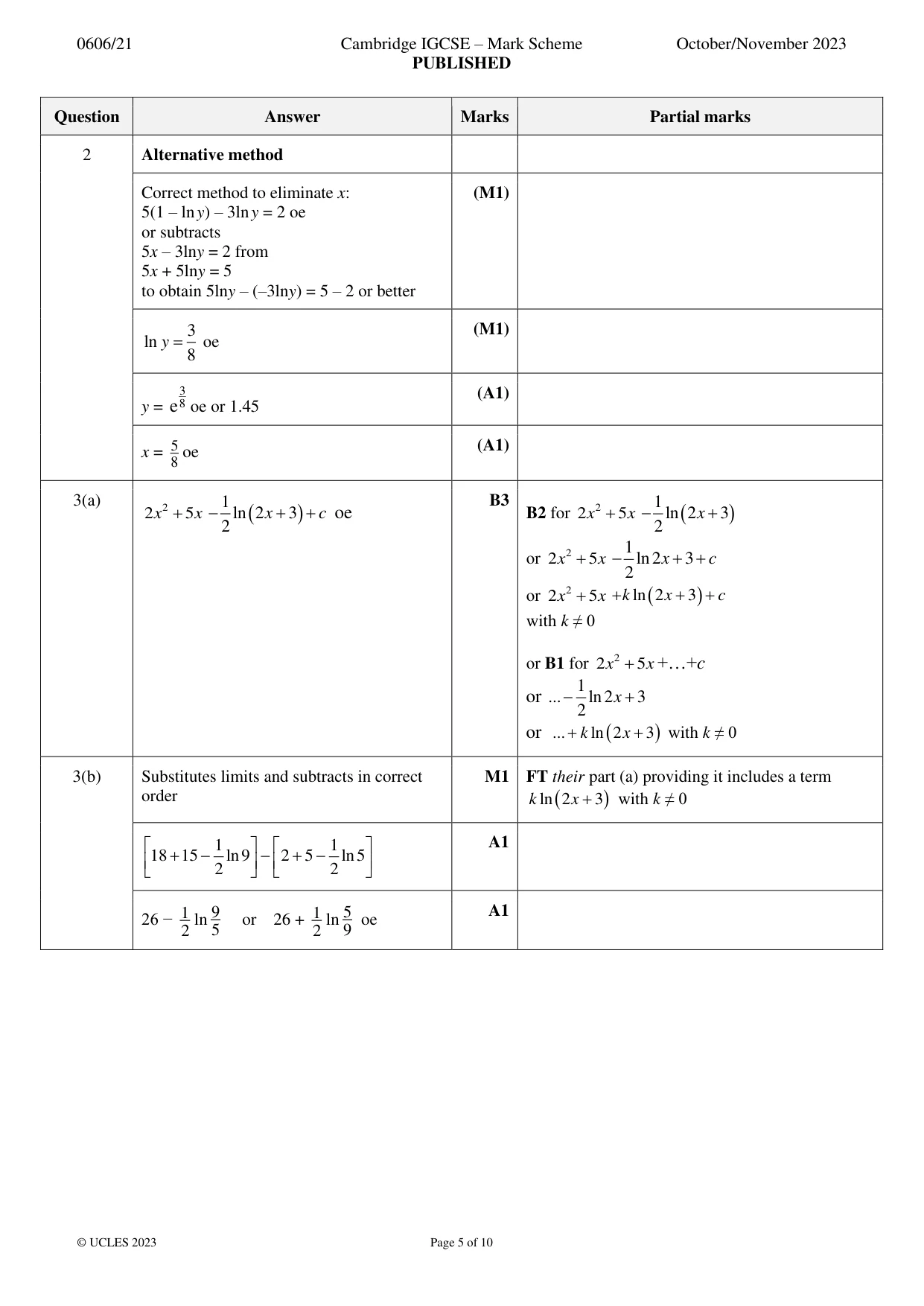
Mark scheme: 2 Correct method to eliminate y: M1 5 x − 3 (1 − x ) = 2 oe or adds 3x + 3lny = 3 5x – 3lny = 2 to obtain 3x + 5x = 3 + 2 or better 5 A1 x = oe 8 3 M1 ln y = oe 8 3 A1 y = e 8 oe or 1.45 2 Alternative method Correct method to eliminate x: (M1) 5(1 – ln y) – 3ln y = 2 oe or subtracts 5x – 3lny = 2 from 5x + 5lny = 5 to obtain 5lny – (–3lny) = 5 – 2 or better 3 (M1) ln y = oe 8 3 (A1) y = e 8 oe or 1.45 5 (A1) x = oe 8
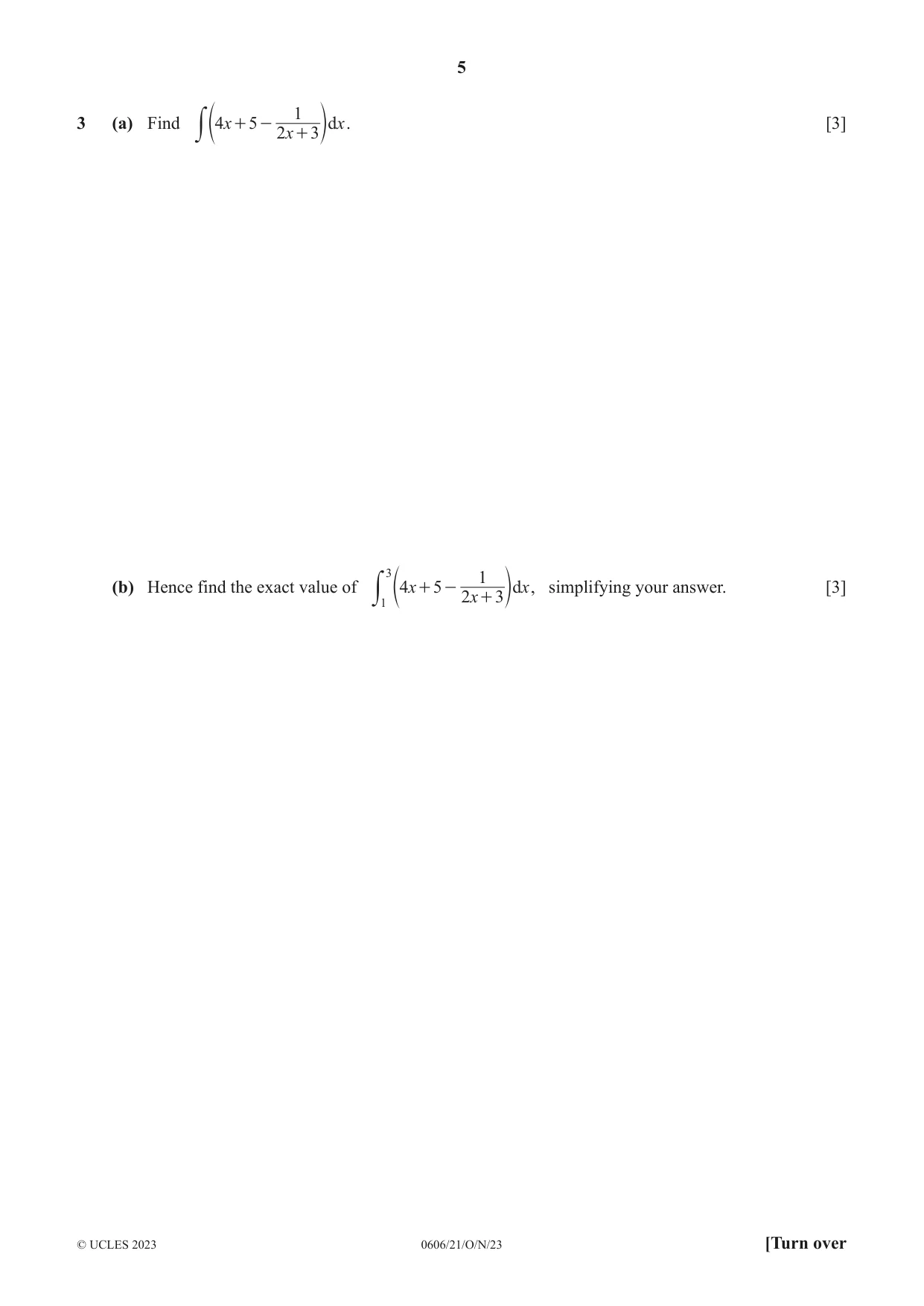
Q3 · Find 4x + 5 - dx
3 (a) Find 4x + 5 - dx . [3] 2x + 3 3 1 (b) Hence find the exact value of 4x + 5 - dx , simplifying your answer. [3] + 3 o y1 e 2x
Mark scheme: 3(a) 2 1 B3 2 1 2 x + 5 x − ln ( 2 x + 3 ) + c oe B2 for 2 x + 5 x − ln ( 2 x + 3 ) 2 2 2 1 or 2 x + 5 x − ln2 x + 3 + c 2 or 2 x 2 + 5 x + k ln ( 2 x + 3 ) + c with k ≠ 0 or B1 for 2 x 2 + 5 x +…+c 1 or ... − ln2 x + 3 2 or ... + k ln ( 2 x + 3 ) with k ≠ 0 3(b) Substitutes limits and subtracts in correct M1 FT their part (a) providing it includes a term order k ln ( 2 x + 3 ) with k ≠ 0 1 1 A1 18 + 15 − ln9 − 2 + 5 − ln5 2 2 1 9 1 5 A1 26 − ln or 26 + ln oe 2 5 2 9
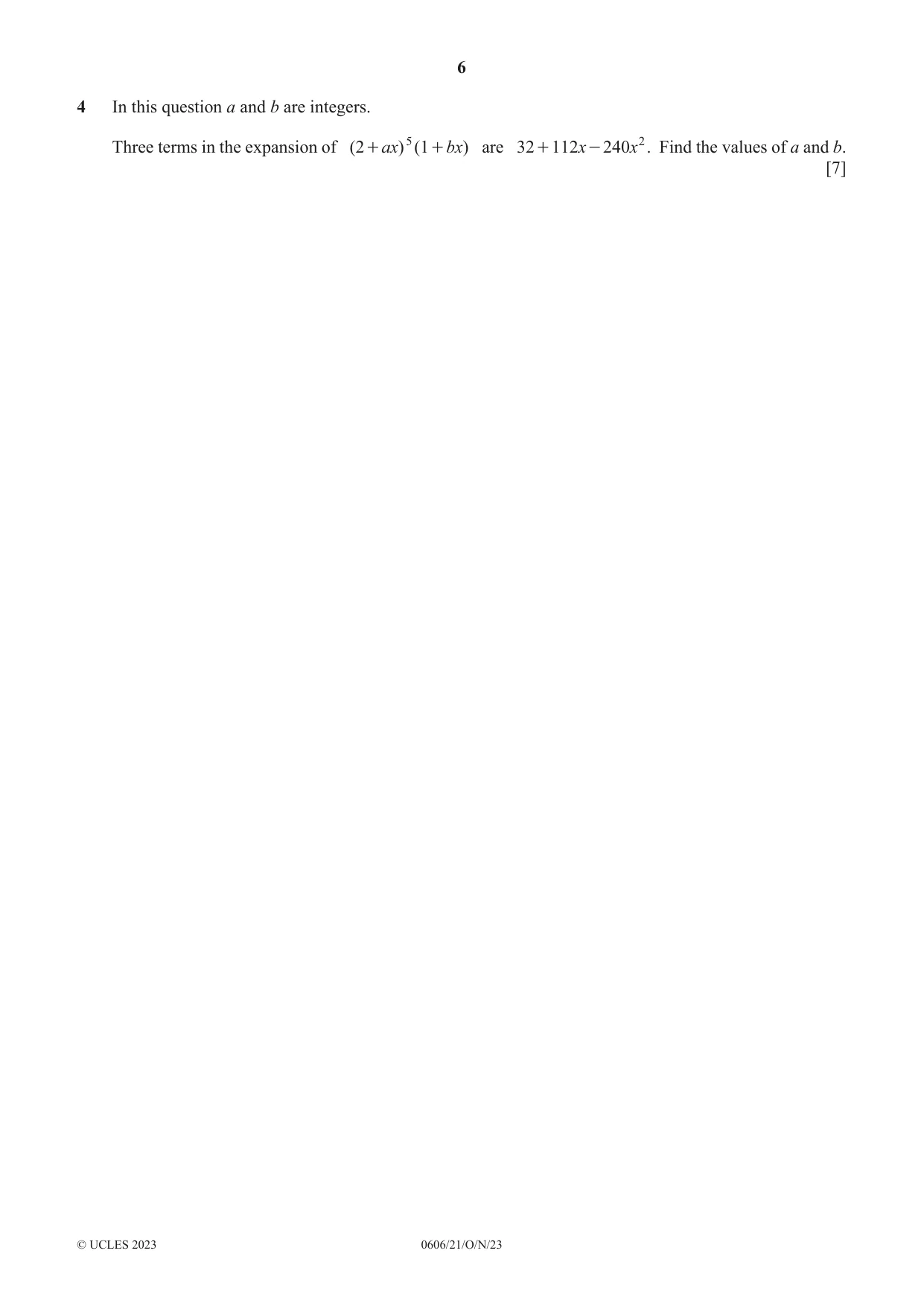
Q4 · In this question a and b are integers
4 In this question a and b are integers. Three terms in the expansion of ( 2 + ax) 5 ( 1 + bx) are 32 + 112x - 240 x 2 . Find the values of a and b. [7]
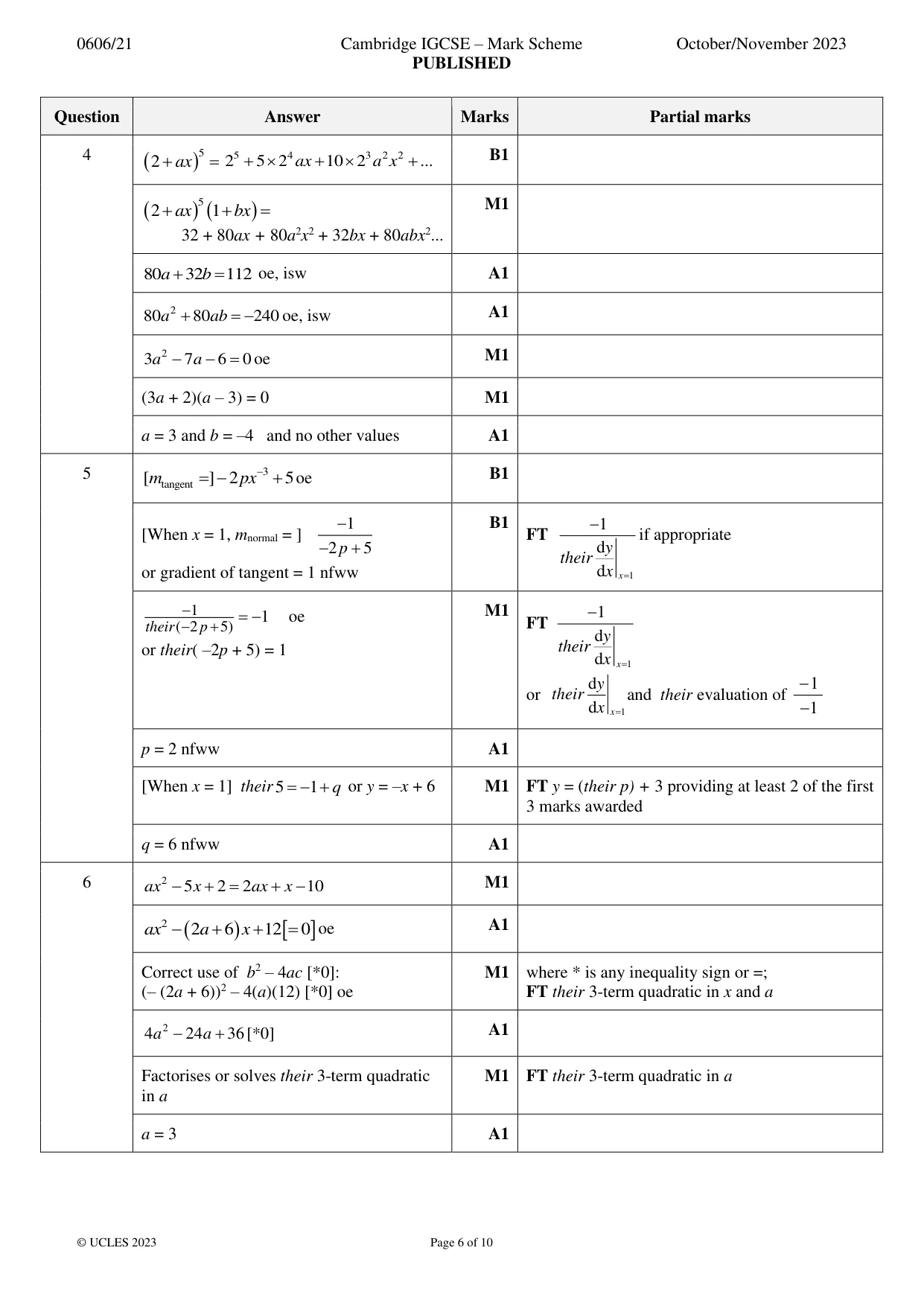
Mark scheme: 4 ( 2 + ax )5 = 25 + 5 2 4 ax + 10 23 a 2 x 2 + ... B1 ( 2 + ax )5 (1 + bx ) = M1 32 + 80ax + 80a2x2 + 32bx + 80abx2... 80a + 32b = 112 oe, isw A1 80 a 2 + 80 ab = −240 oe, isw A1 3a 2 − 7 a − 6 = 0 oe M1 (3a + 2)(a – 3) = 0 M1 a = 3 and b = –4 and no other values A1
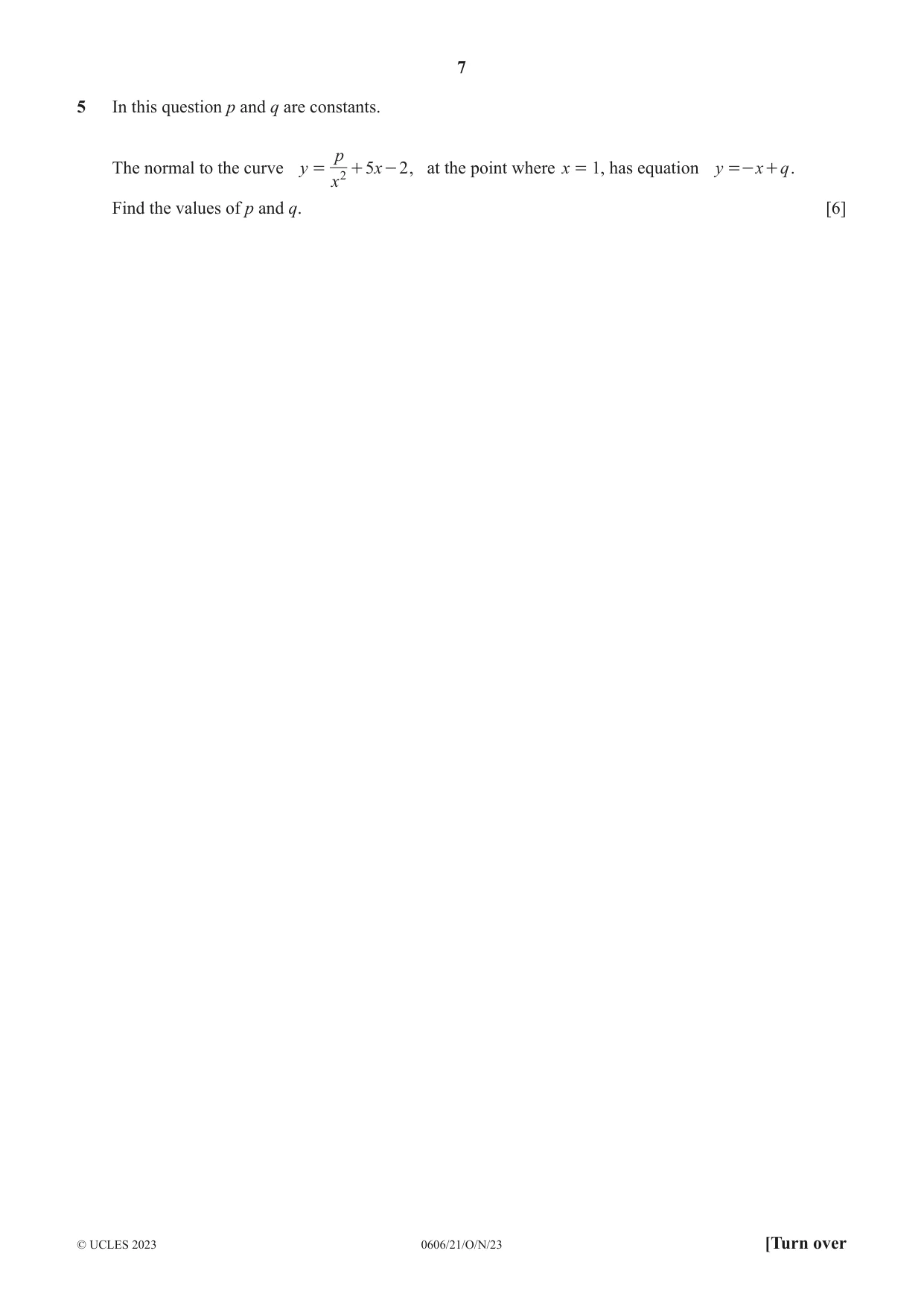
Q5 · In this question p and q are constants
5 In this question p and q are constants. p The normal to the curve y = 2 + 5x - 2 , at the point where x = 1, has equation y =- x + q . x Find the values of p and q. [6]
Mark scheme: 5 [ mtangent =] − 2 px−3 + 5 oe B1 −1 B1 −1 [When x = 1, mnormal = ] FT if appropriate −2 p + 5 dy their or gradient of tangent = 1 nfww dx x =1 −1 = −1 oe M1 −1 their ( −2 p + 5) FT dy or their( –2p + 5) = 1 their dx x =1 d y − 1 or their and their evaluation of d x x =1 −1 p = 2 nfww A1 [When x = 1] their5 = −+1 q or y = –x + 6 M1 FT y = (their p) + 3 providing at least 2 of the first 3 marks awarded q = 6 nfww A1
More questions on Use differentiation to find gradients, tangents
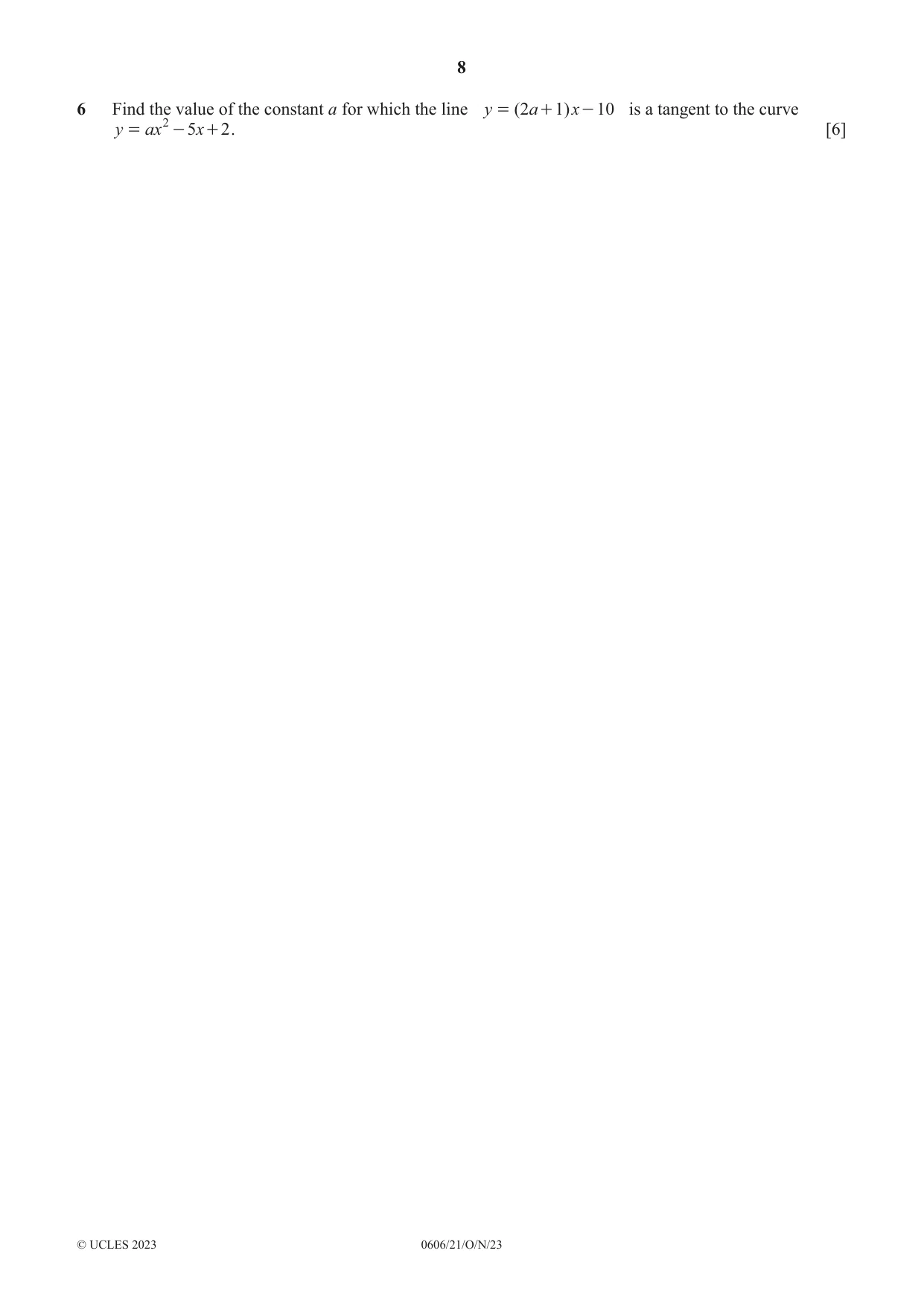
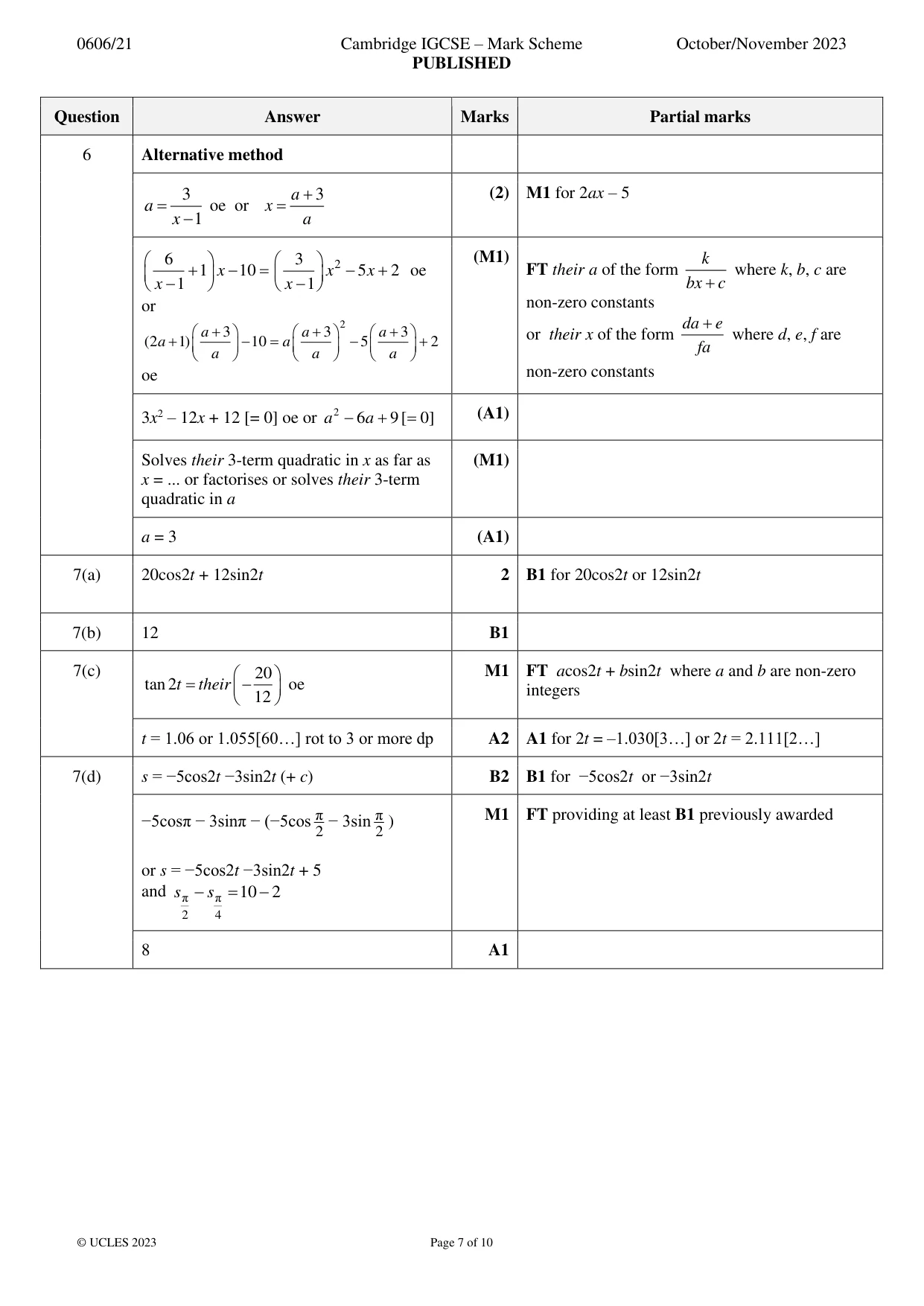
Q6 · Find the value of the constant a for which the line y = ( 2a + 1 ) x - 10 is a tangent to…
6 Find the value of the constant a for which the line y = ( 2a + 1 ) x - 10 is a tangent to the curve y = ax 2 - 5 x + 2 . [6]
Mark scheme: 6 ax 2 − 5 x + 2 = 2 ax + x − 10 M1 ax 2 − ( 2a + 6 ) x + 12 = 0 oe A1 Correct use of b2 – 4ac [*0]: M1 where * is any inequality sign or =; (– (2a + 6))2 – 4(a)(12) [*0] oe FT their 3-term quadratic in x and a 4 a 2 − 24 a + 36[*0] A1 Factorises or solves their 3-term quadratic M1 FT their 3-term quadratic in a in a a = 3 A1 6 Alternative method 3 a + 3 (2) M1 for 2ax – 5 a = oe or x = x − 1 a 6 3 2 (M1) k + 1 x − 10 = x − 5 x + 2 oe FT their a of the form where k, b, c are x − 1 x − 1 bx + c or non-zero constants 2 da + e a + 3 a + 3 a + 3 or their x of the form where d, e, f are (2 a + 1) − 10 = a − 5 + 2 fa a a a oe non-zero constants 3x2 – 12x + 12 [= 0] oe or a 2 − 6 a + 9[ = 0] (A1) Solves their 3-term quadratic in x as far as (M1) x = ... or factorises or solves their 3-term quadratic in a a = 3 (A1)
More questions on Use differentiation to find gradients, tangents
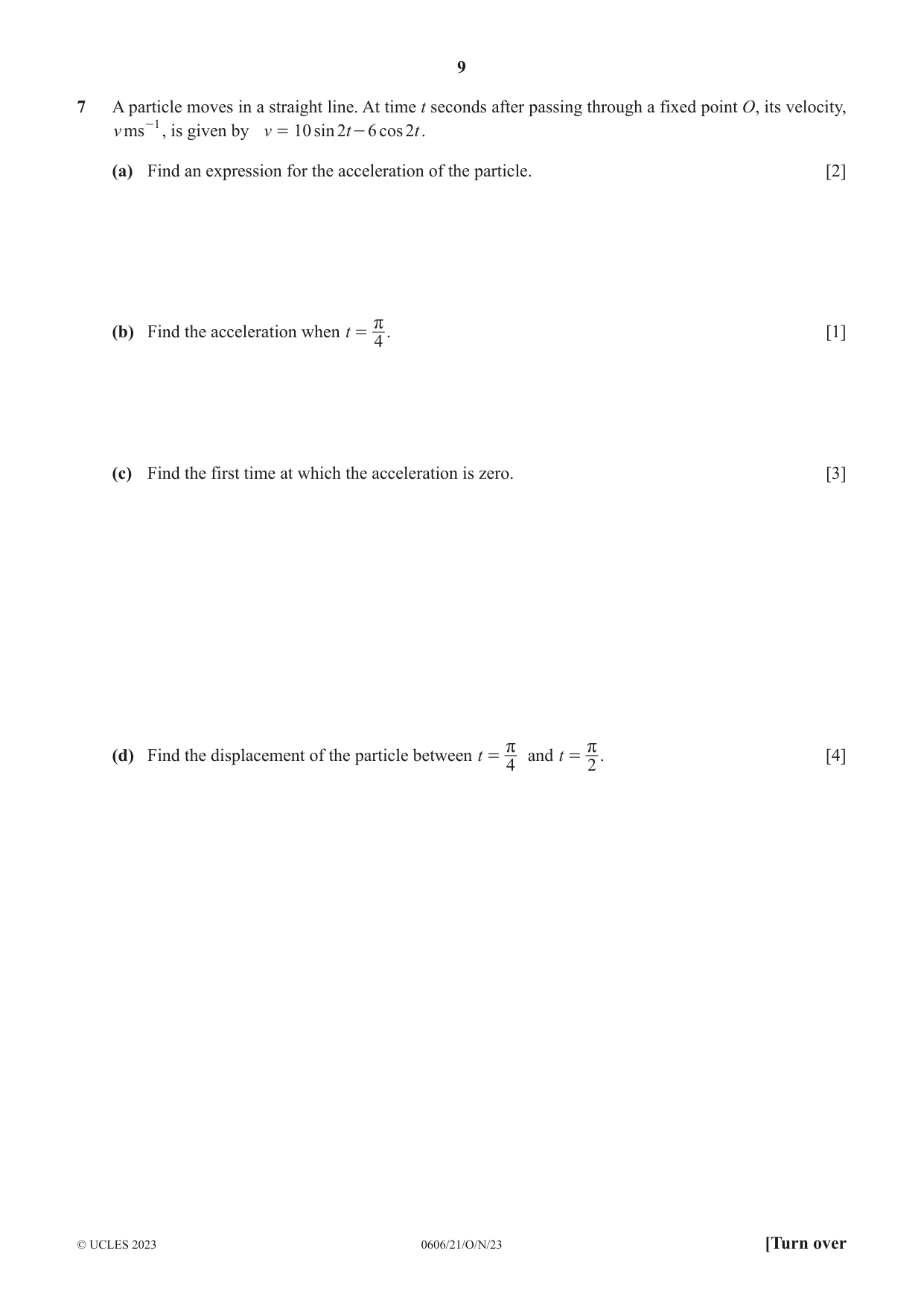
Q7 · A particle moves in a straight line
7 A particle moves in a straight line. At time t seconds after passing through a fixed point O, its velocity, v ms -1 , is given by v = 10 sin 2 t - 6 cos 2 t . (a) Find an expression for the acceleration of the particle. [2] (b) Find the acceleration when t = r . [1] 4 (c) Find the first time at which the acceleration is zero. [3] (d) Find the displacement of the particle between t = r and t = r . [4] 4 2
Mark scheme: 7(a) 20cos2t + 12sin2t 2 B1 for 20cos2t or 12sin2t 7(b) 12 B1 7(c) 20 M1 FT acos2t + bsin2t where a and b are non-zero tan 2t = their − oe integers 12 t = 1.06 or 1.055[60…] rot to 3 or more dp A2 A1 for 2t = –1.030[3…] or 2t = 2.111[2…] 7(d) s = −5cos2t −3sin2t (+ c) B2 B1 for −5cos2t or −3sin2t π π M1 FT providing at least B1 previously awarded −5cosπ − 3sinπ − (−5cos − 3sin ) 2 2 or s = −5cos2t −3sin2t + 5 and s π − s π = 10 − 2 2 4 8 A1
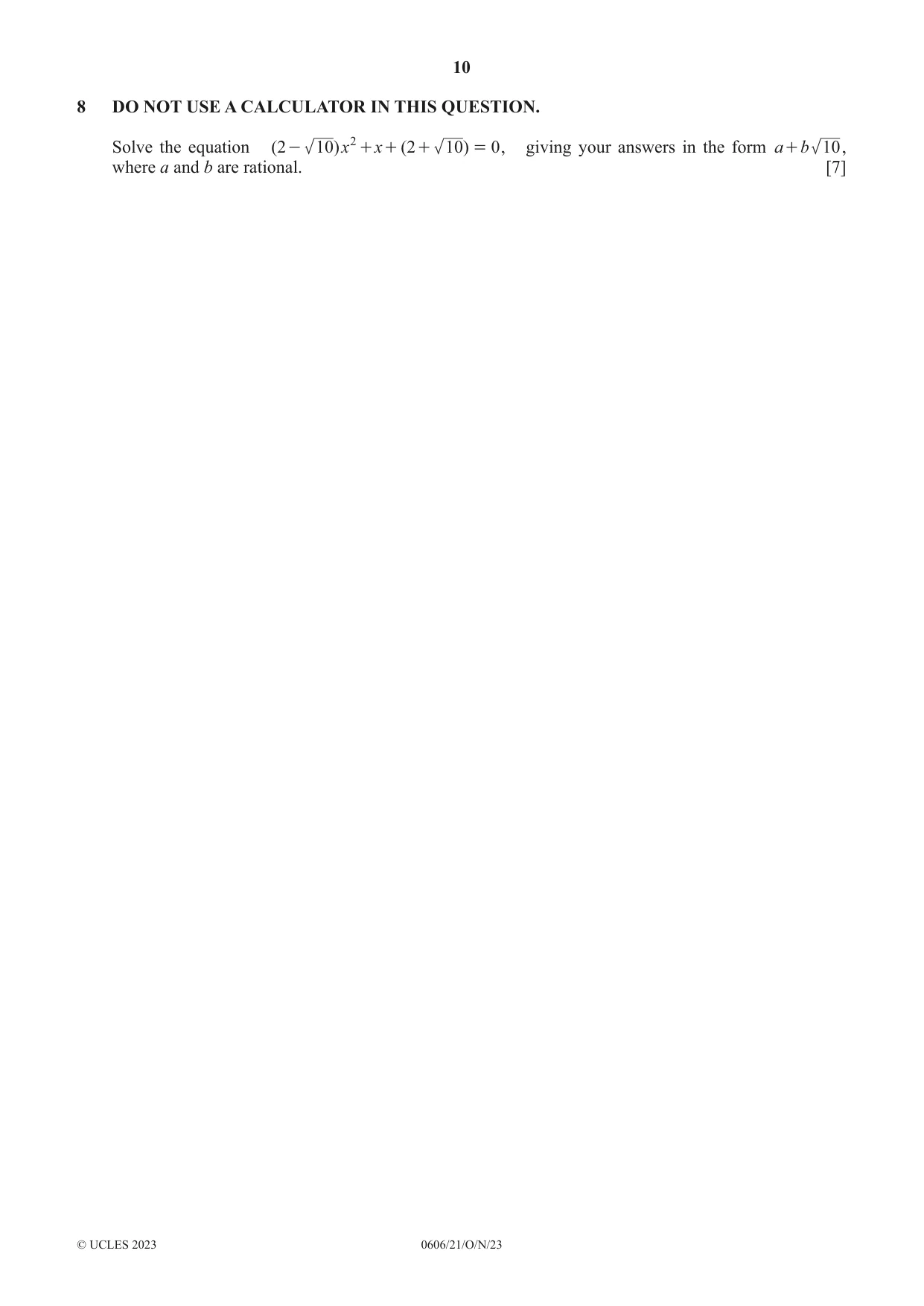
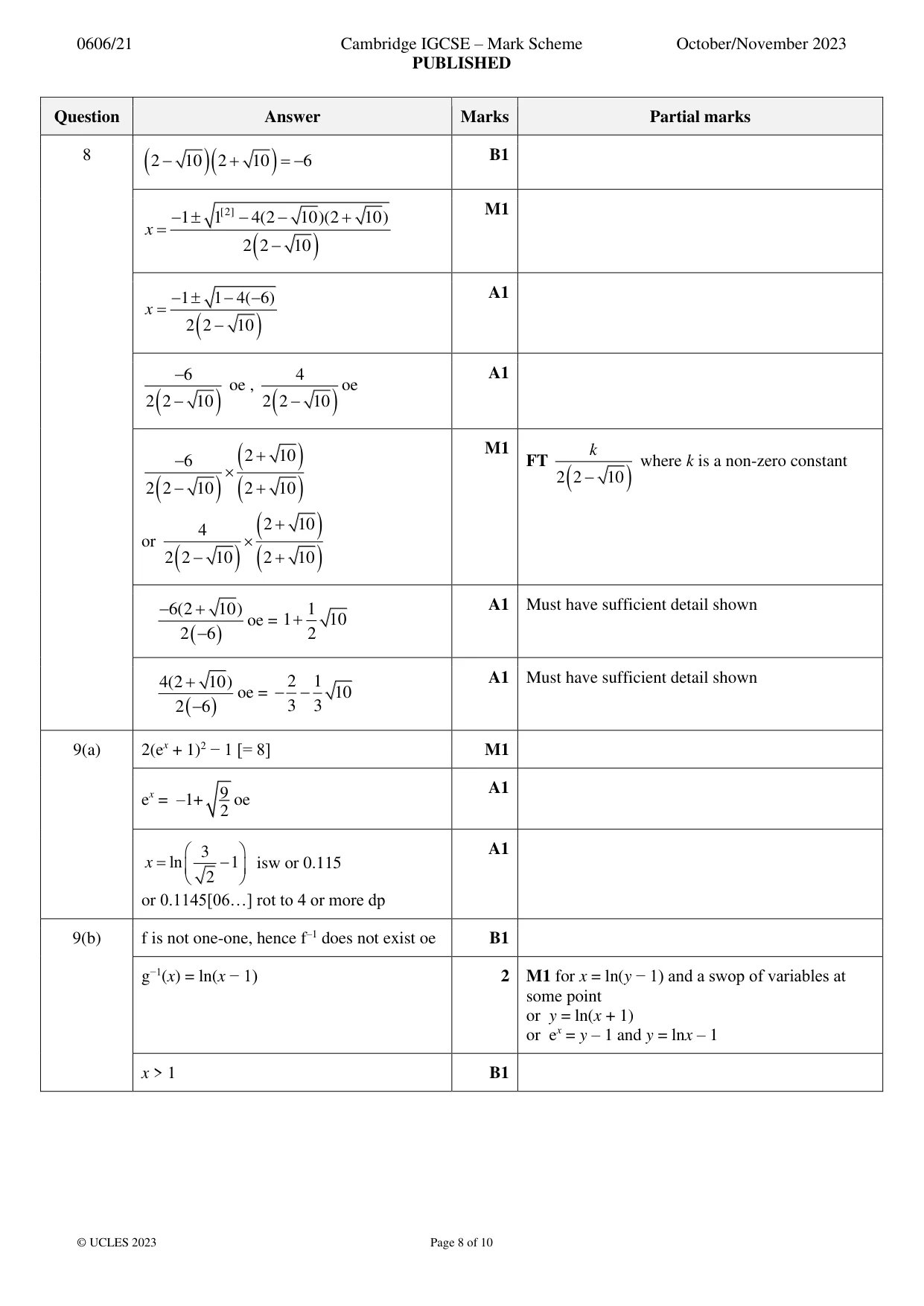
Q8 · DO NOT USE A CALCULATOR IN THIS QUESTION
8 DO NOT USE A CALCULATOR IN THIS QUESTION. Solve the equation ( 2 - 10) x 2 + x + ( 2 + 10) = 0 , giving your answers in the form a + b 10 , where a and b are rational. [7]
Mark scheme: 8 B1 2 − 10 2 + 10 = −6 ( )( ) [2] M1 −1 1 − 4(2 − 10)(2 + 10) x = 2 2 − 10 ( ) −1 1 − 4( − 6) A1 x = 2 2 − 10 ( ) −6 4 A1 oe , oe 2 2 − 10 2 2 − 10 ( ) ( ) M1 k 2 + 10 −6 ( ) FT where k is a non-zero constant 2 2 − 10 ( ) 2 2 − 10 2 + 10 ( ) ( ) 2 + 10 4 ( ) or 2 2 − 10 2 + 10 ( ) ( ) −6(2 + 10) 1 A1 Must have sufficient detail shown oe = 1 + 10 2 ( −6 ) 2 4(2 + 10) 2 1 A1 Must have sufficient detail shown oe = − − 10 2 ( −6 ) 3 3
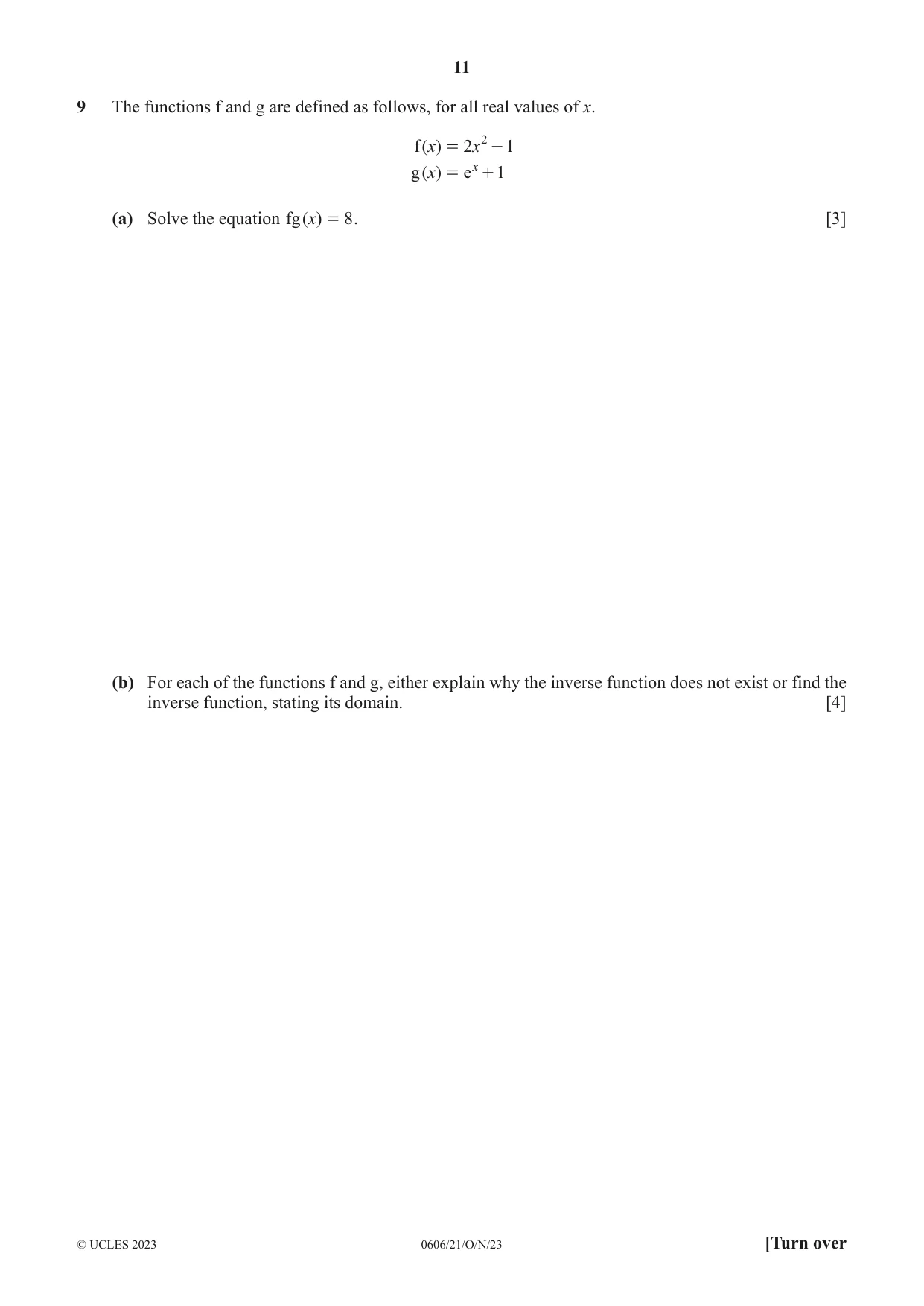
Q9 · The functions f and g are defined as follows, for all real values of x
9 The functions f and g are defined as follows, for all real values of x. f (x) = 2 x 2 - 1 g (x) = e x + 1 (a) Solve the equation fg ( x) = 8 . [3] (b) For each of the functions f and g, either explain why the inverse function does not exist or find the inverse function, stating its domain. [4]
Mark scheme: 9(a) 2(ex + 1)2 − 1 [= 8] M1 9 A1 ex = –1+ oe 2 3 A1 x = ln − 1 isw or 0.115 2 or 0.1145[06…] rot to 4 or more dp 9(b) f is not one-one, hence f–1 does not exist oe B1 g−1(x) = ln(x − 1) 2 M1 for x = ln(y − 1) and a swop of variables at some point or y = ln(x + 1) or ex = y – 1 and y = lnx – 1 x > 1 B1
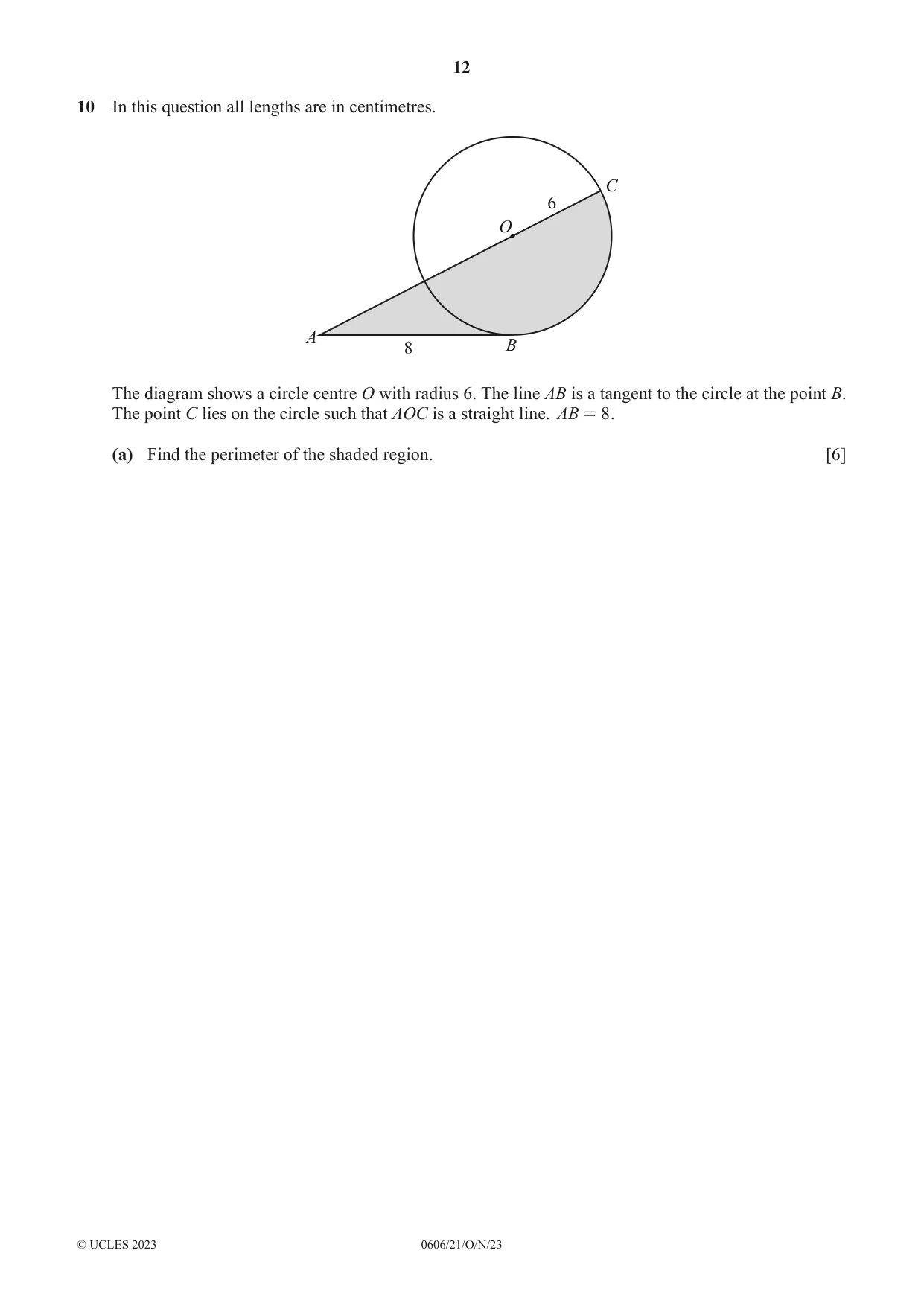
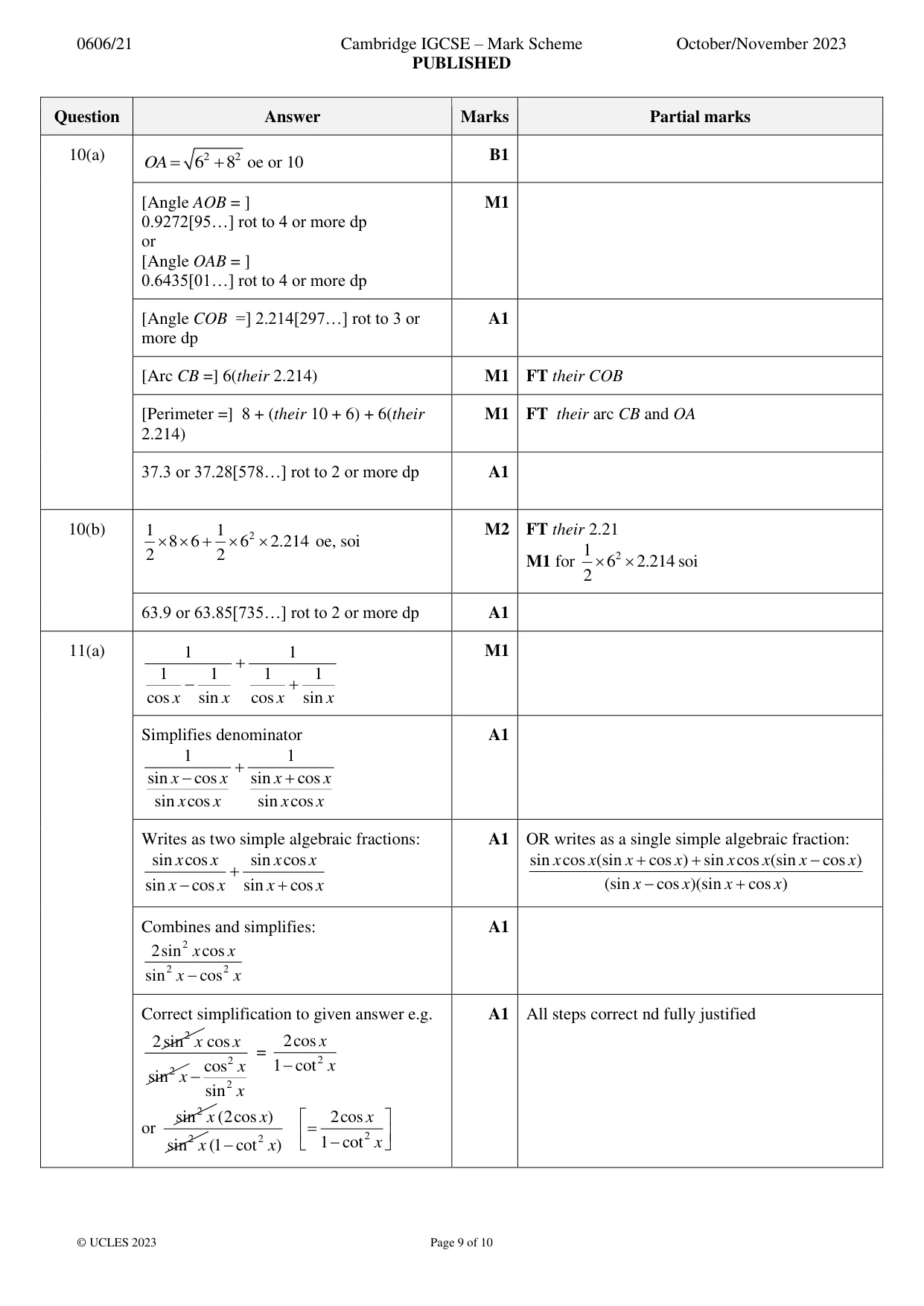
Q10 · In this question all lengths are in centimetres
10 In this question all lengths are in centimetres. C 6 O A 8 B The diagram shows a circle centre O with radius 6. The line AB is a tangent to the circle at the point B. The point C lies on the circle such that AOC is a straight line. AB = 8 . (a) Find the perimeter of the shaded region. [6]
Mark scheme: 10(a) 2 2 B1 OA= 6 + 8 oe or 10 [Angle AOB = ] M1 0.9272[95…] rot to 4 or more dp or [Angle OAB = ] 0.6435[01…] rot to 4 or more dp [Angle COB =] 2.214[297…] rot to 3 or A1 more dp [Arc CB =] 6(their 2.214) M1 FT their COB [Perimeter =] 8 + (their 10 + 6) + 6(their M1 FT their arc CB and OA 2.214) 37.3 or 37.28[578…] rot to 2 or more dp A1 10(b) 1 1 2 M2 FT their 2.21 +8 6 6 2.214 oe, soi 2 2 1 2 M1 for 6 2.214 soi 2 63.9 or 63.85[735…] rot to 2 or more dp A1
More questions on Solve problems involving the arc length and
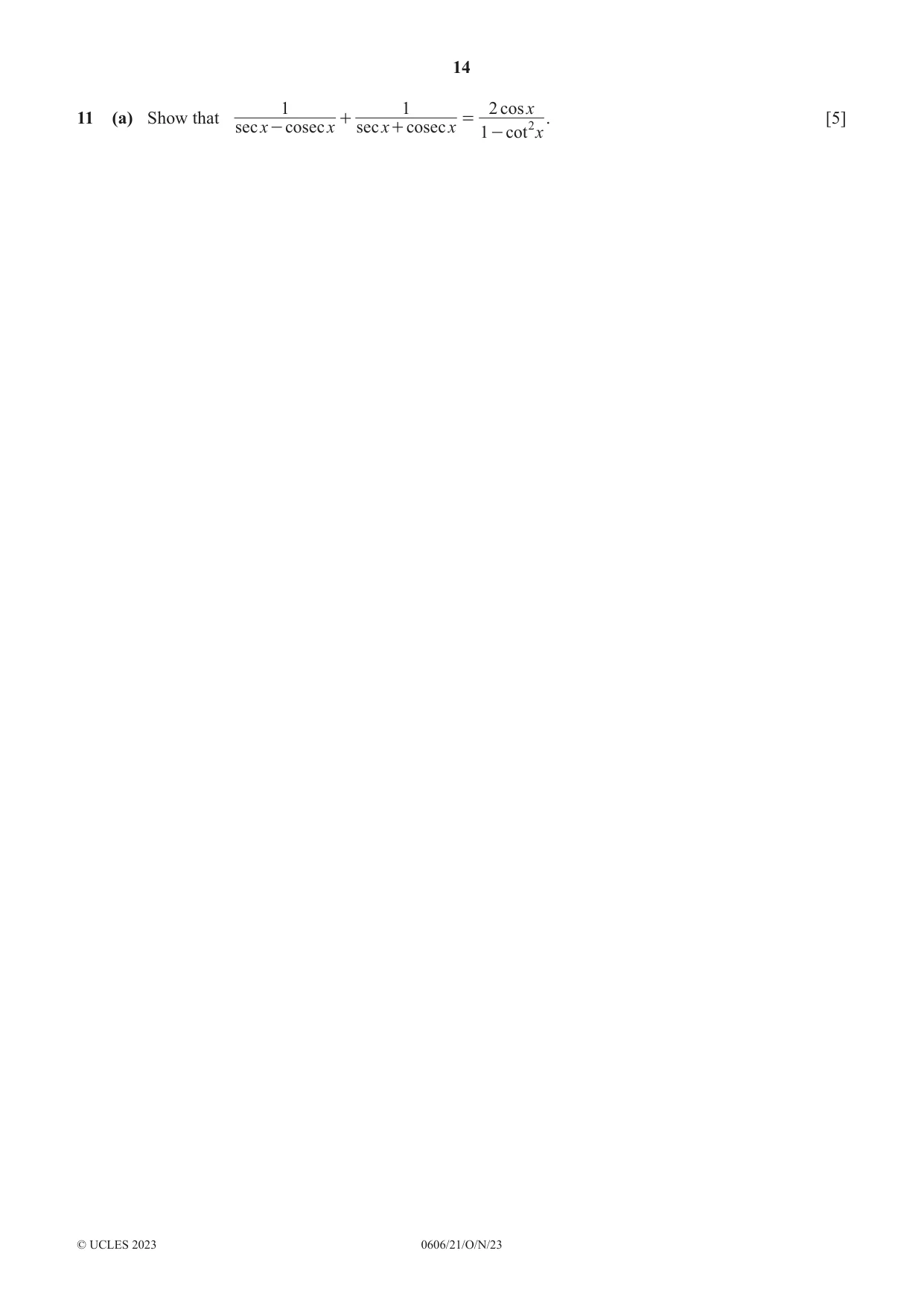
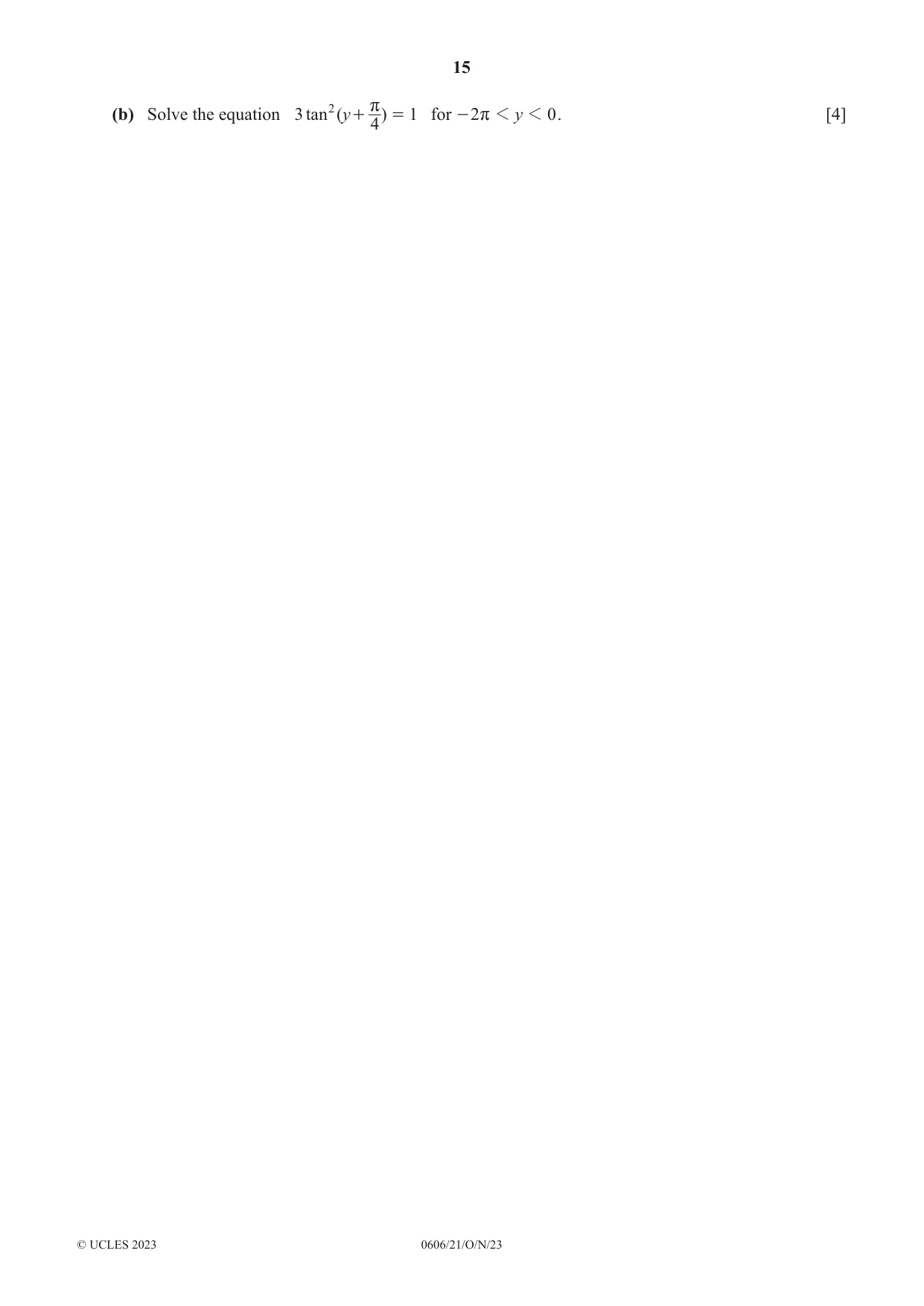
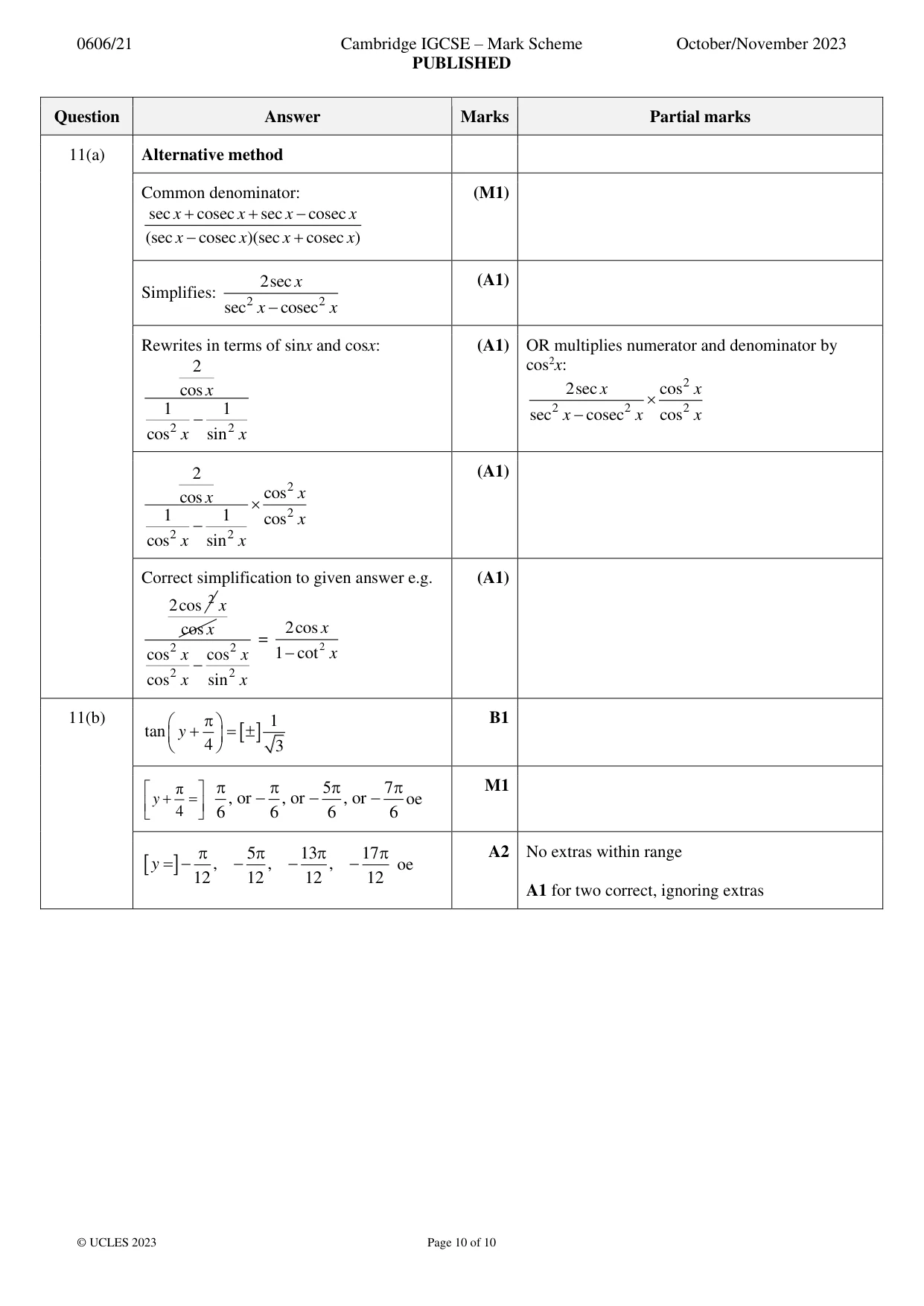
Q11 · Solve the equation 3 tan 2 ( y + r ) = 1 for - 2r 1 y 1 0
(b) Solve the equation 3 tan 2 ( y + r ) = 1 for - 2r 1 y 1 0 . [4] 4
Mark scheme: 11(a) 1 1 M1 + 1 1 1 1 − + cos x sin x cos x sin x Simplifies denominator A1 1 1 + sin x − cos x sin x + cos x sin x cos x sin x cos x Writes as two simple algebraic fractions: A1 OR writes as a single simple algebraic fraction: sin x cos x sin x cos x sin x cos x (sin x + cos x ) + sin x cos x (sin x − cos x ) + sin x − cos x sin x + cos x (sin x − cos x )(sin x + cos x ) Combines and simplifies: A1 2sin 2 x cos x sin 2 x − cos 2 x Correct simplification to given answer e.g. A1 All steps correct nd fully justified 2sin 2 x cos x 2cos x = 2 cos 2 x 1 − cot 2 x sin x − sin 2 x sin 2 x (2cos x ) 2cos x or = 2 2 2 sin x (1 − cot x ) 1 − cot x 11(a) Alternative method Common denominator: (M1) sec x + cosec x + sec x − cosec x (sec x − cosec x )(sec x + cosec x ) 2sec x (A1) Simplifies: sec 2 x − cosec 2 x Rewrites in terms of sinx and cosx: (A1) OR multiplies numerator and denominator by 2 cos2x: cos x 2sec x cos 2 x 1 1 2 2 2 − sec x − cosec x cos x cos 2 x sin 2 x 2 (A1) cos x cos 2 x 1 1 cos 2 x − cos 2 x sin 2 x Correct simplification to given answer e.g. (A1) 2cos 2 x cos x 2cos x = cos 2 x cos 2 x 1 − cot 2 x − cos 2 x sin 2 x 11(b) B1 tan y + = 1 4 3 π 7 M1 y + = , or − , or − , or − oe 4 6 6 6 6 5 13 17 A2 No extras within range y = − , − , − , − oe 12 12 12 12 A1 for two correct, ignoring extras
What was in this paper
The subtopics covered by these 11 questions, and how many questions each got. Open one in a new tab to see every Cambridge question on it.
2Apply differentiation and integration1Find the inverse of a one–one function1Find the maximum or minimum value of the1Integrate functions of the form1Solve problems involving the arc length and1Solve quadratic equations for real roots1Solve simultaneous equations in two1Solve, for a given domain, trigonometric1Use the binomial theorem for expansion of1What you needed in this session
Cambridge’s own grade thresholds for 2023 Oct/Nov, Paper 2 · Variant 1. A higher threshold means an easier paper — the bar moves with how the cohort did.