Cambridge IGCSE Mathematics - Additional 0606 — 2023 Oct/Nov Paper 2 · Variant 3
0606/23/O/N/23 · 8 questions · 80 marks · ≈90 min
The question paper and its mark scheme, free to read here and free to download. This is Cambridge’s own paper, exactly as it was sat.
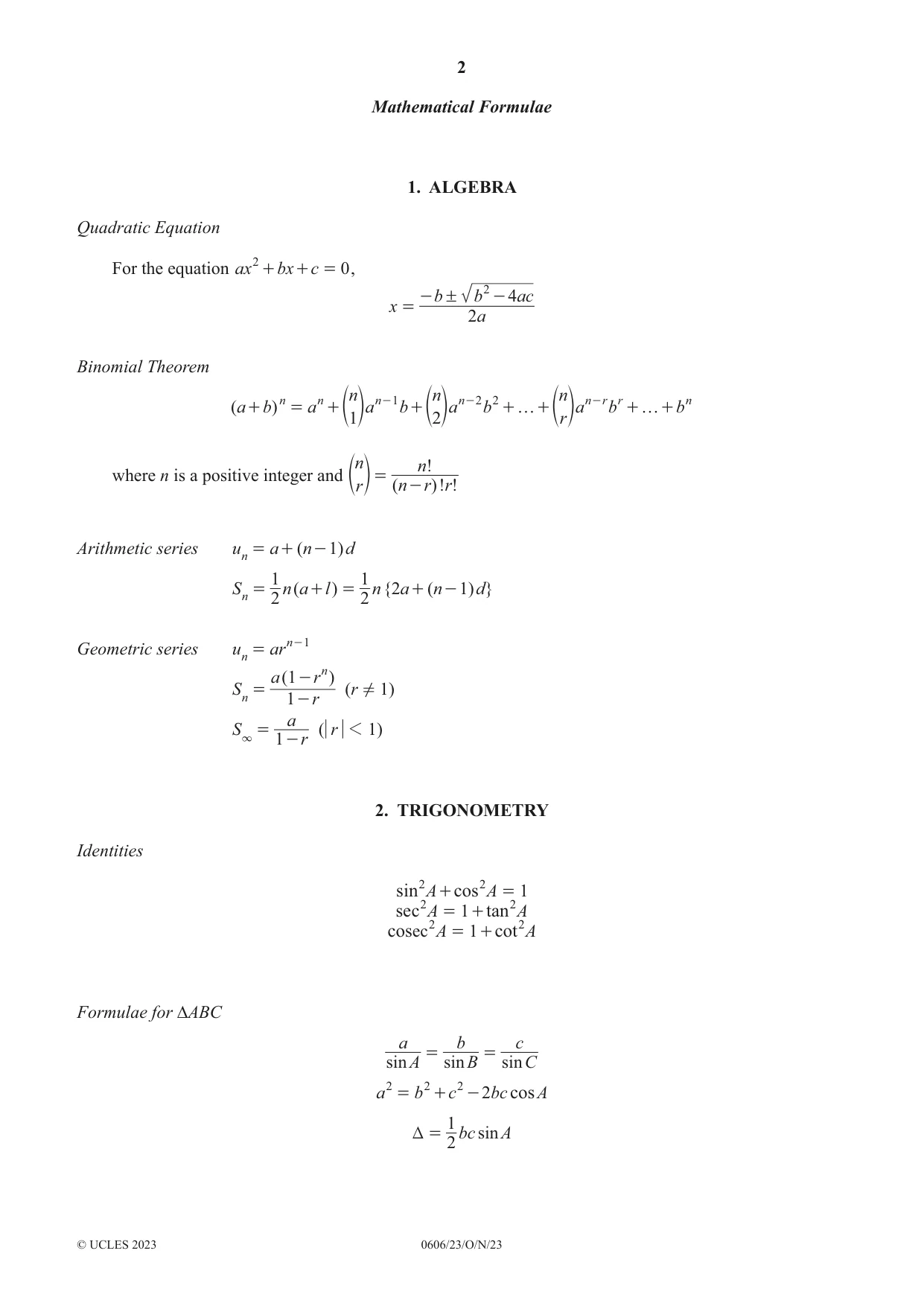
Question paper16 pages
Mark scheme11 pages
Answers below. Sit the paper first if you are practising.
Questions as text
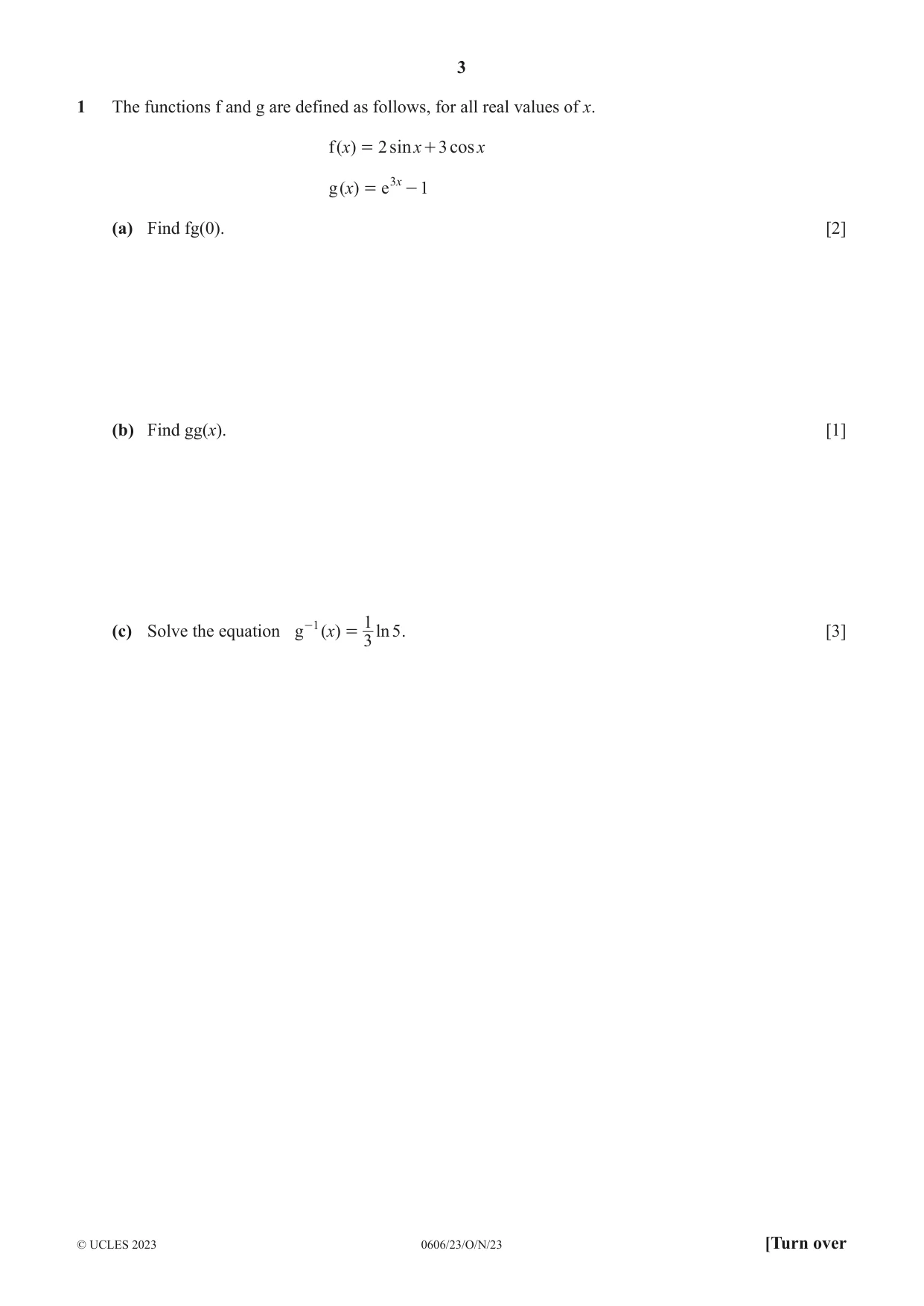
Q1 · The functions f and g are defined as follows, for all real values of x
1 The functions f and g are defined as follows, for all real values of x. f ( x) = 2 sin x + 3 cos x g ( x) = e 3 x - 1 (a) Find fg(0). [2] (b) Find gg(x). [1] -1 1 (c) Solve the equation g ( x) = ln 5 . [3] 3
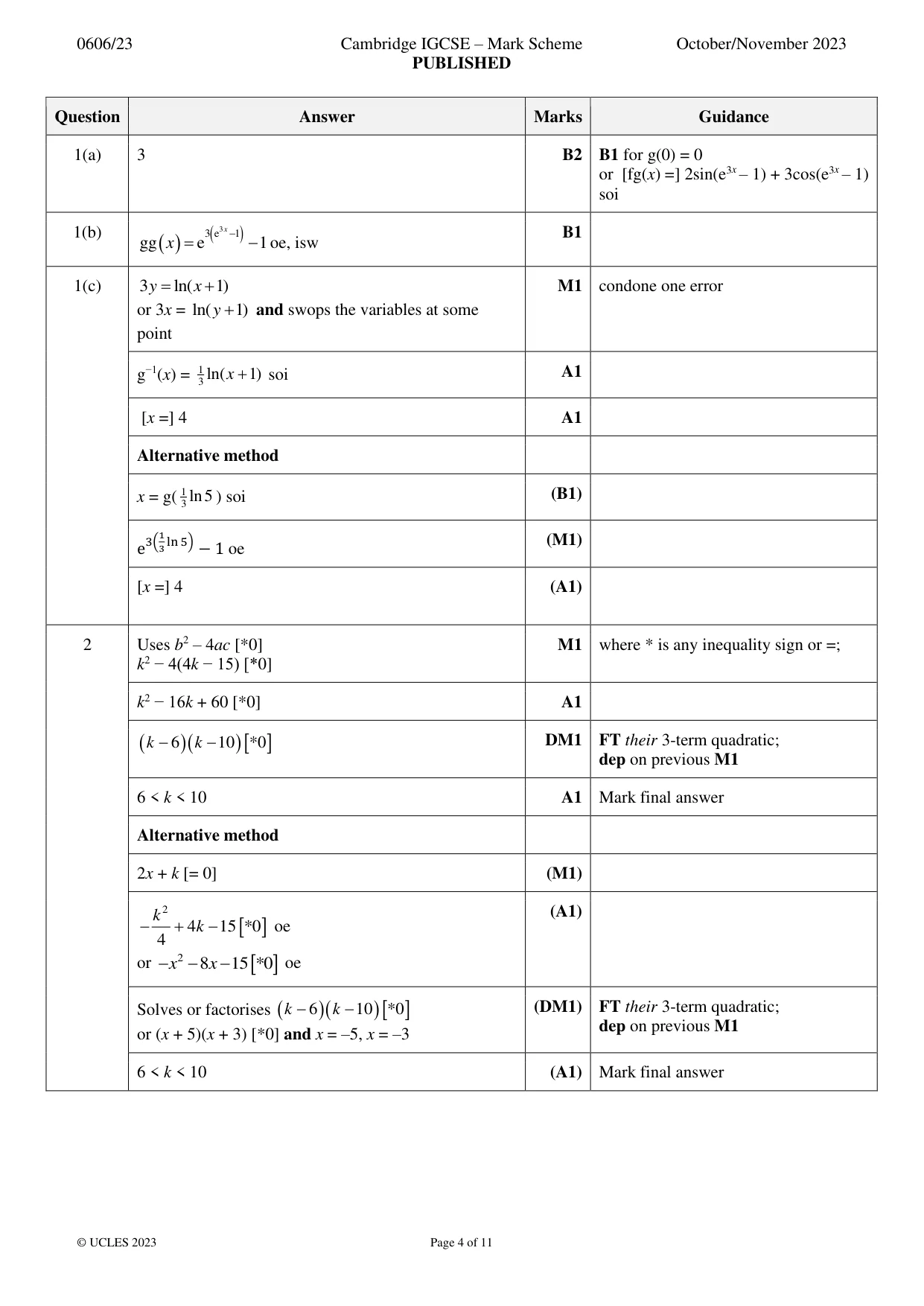
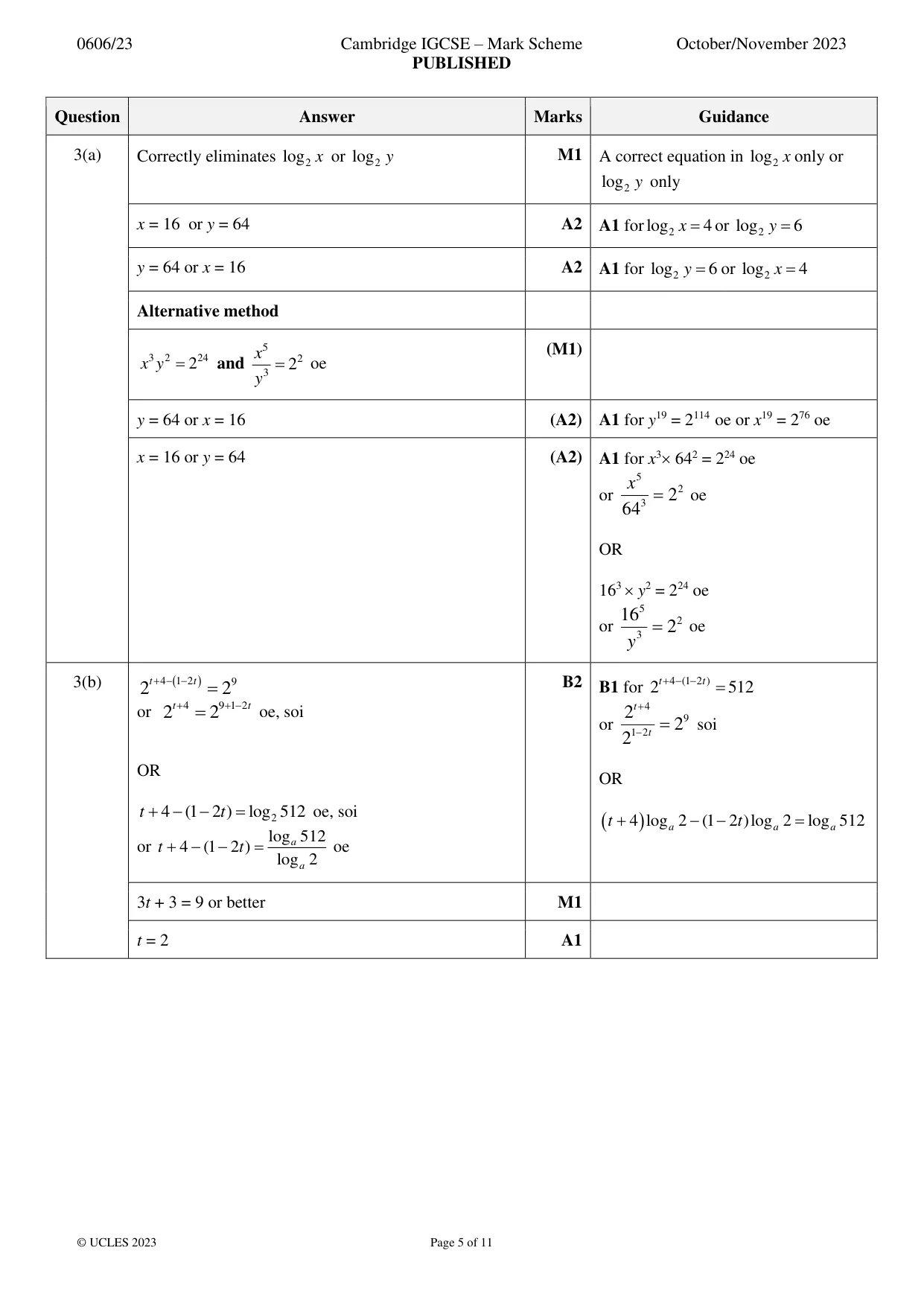
Mark scheme: Question Answer Marks Guidance 1(a) 3 B2 B1 for g(0) = 0 or [fg(x) =] 2sin(e3x – 1) + 3cos(e3x – 1) soi 1(b) 3( e 3 x −1) B1 gg ( x ) = e − 1 oe, isw 1(c) 3 y = ln( x + 1) M1 condone one error or 3x = ln( y + 1) and swops the variables at some point g−1(x) = 13 ln( x + 1) soi A1 [x =] 4 A1 Alternative method x = g( 13 ln5 ) soi (B1) e3(13ln 5) −1 oe (M1) [x =] 4 (A1)
Q3 · Solve the following simultaneous equations
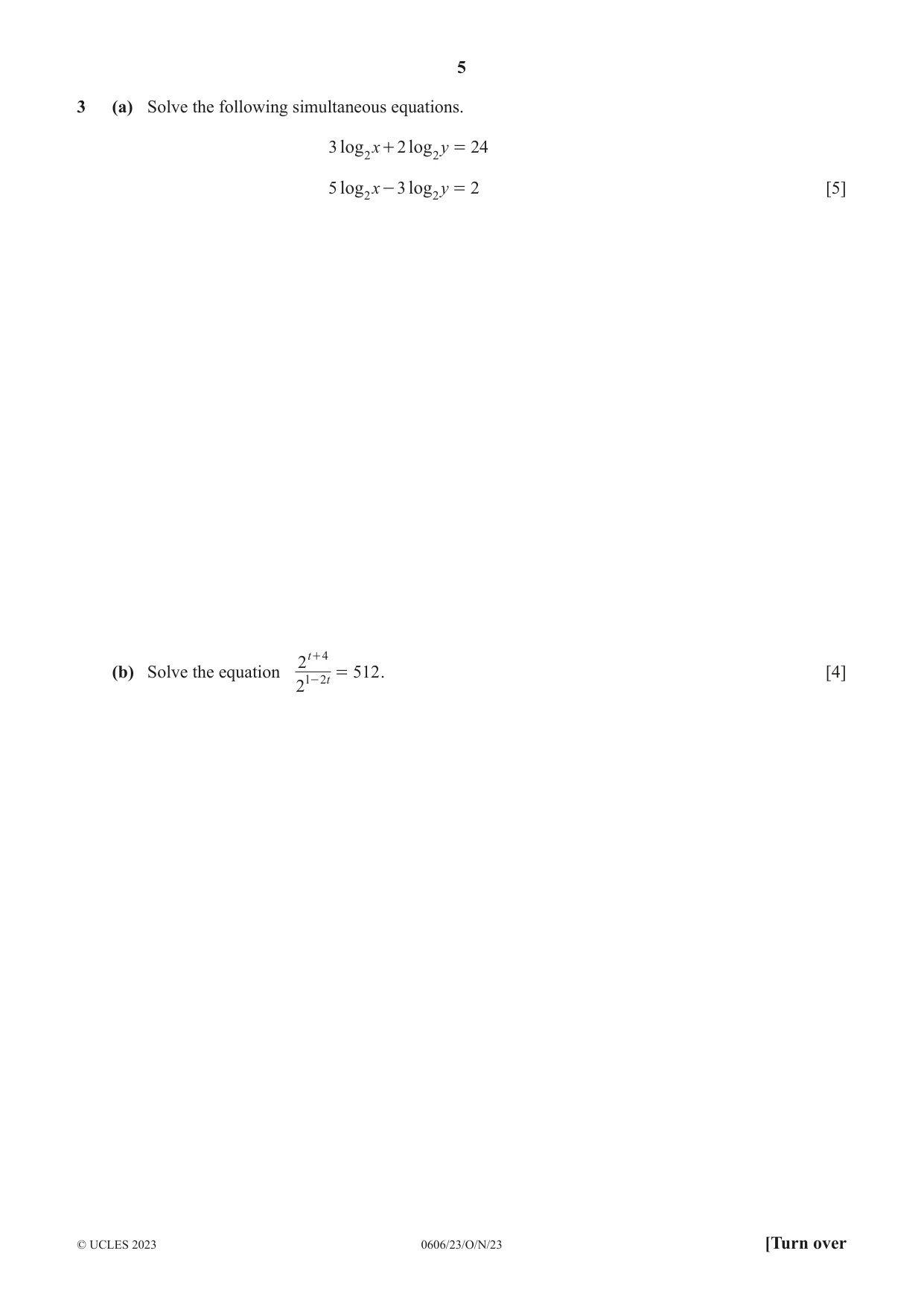
3 (a) Solve the following simultaneous equations. 3 log 2 x + 2 log 2 y = 24 5 log 2 x - 3 log 2 y = 2 [5] 2 t + 4 (b) Solve the equation = 512 . [4] l - 2 t 2
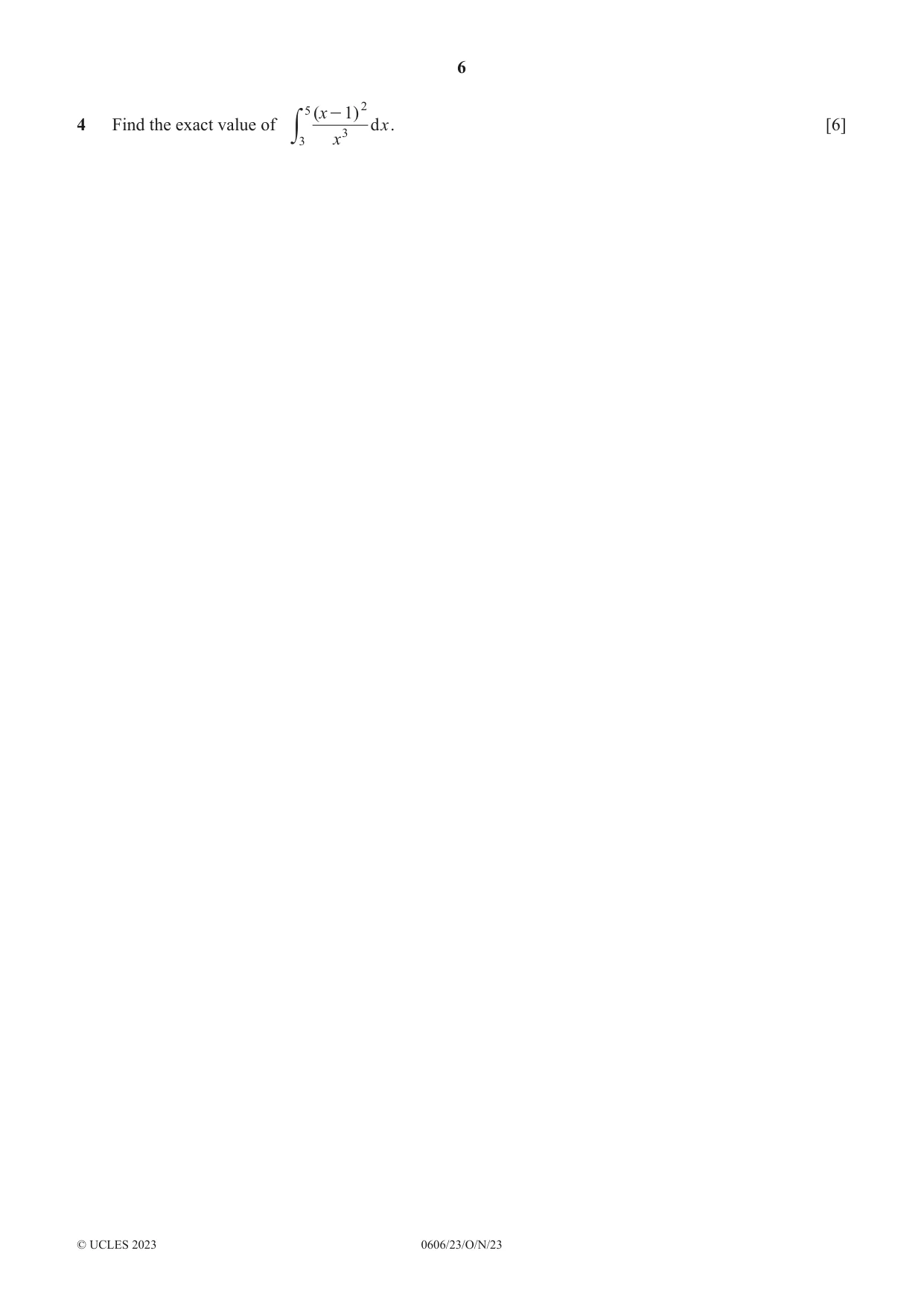
Mark scheme: 3(a) Correctly eliminates log 2 x or log 2 y M1 A correct equation in log 2 x only or log 2 y only x = 16 or y = 64 A2 A1 for log 2 x = 4 or log 2 y = 6 y = 64 or x = 16 A2 A1 for log 2 y = 6 or log 2 x = 4 Alternative method 3 2 24 x 5 2 (M1) x y = 2 and = 2 oe y 3 y = 64 or x = 16 (A2) A1 for y19 = 2114 oe or x19 = 276 oe x = 16 or y = 64 (A2) A1 for x3 642 = 224 oe x 5 2 or 3 = 2 oe 64 OR 163 y2 = 224 oe 16 5 2 or 3 = 2 oe y 3(b) t + 4 −−(1 2 t ) 9 B2 t + 4 −−(1 2 t ) 2 = 2 B1 for 2 = 512 or 2t + 4 = 29 +1− 2 t oe, soi 2 t + 4 9 or 1− 2 t = 2 soi 2 OR OR t + 4 − (1 − 2t ) = log 2 512 oe, soi ( t + 4 ) log a 2 − (1 − 2t )log a 2 = log a 512 log a 512 or t + 4 − (1 − 2t ) = oe log a 2 3t + 3 = 9 or better M1 t = 2 A1
Q5 · The curved surface area of a cylinder with radius r and height h is 2rrh
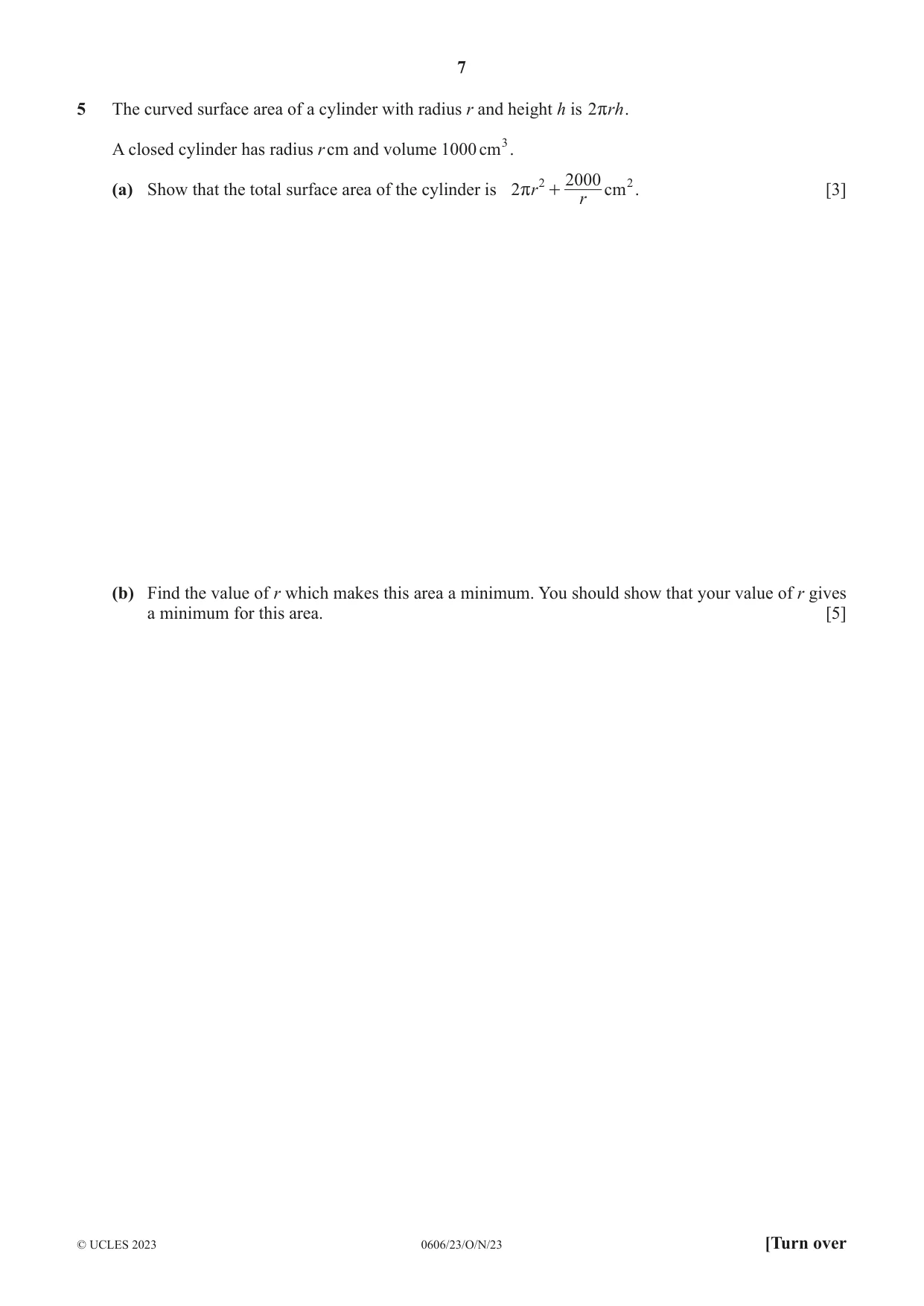
5 The curved surface area of a cylinder with radius r and height h is 2rrh . A closed cylinder has radius r cm and volume 1000 cm 3. 2 2000 2 (a) Show that the total surface area of the cylinder is 2rr + cm . [3] r (b) Find the value of r which makes this area a minimum. You should show that your value of r gives a minimum for this area. [5]
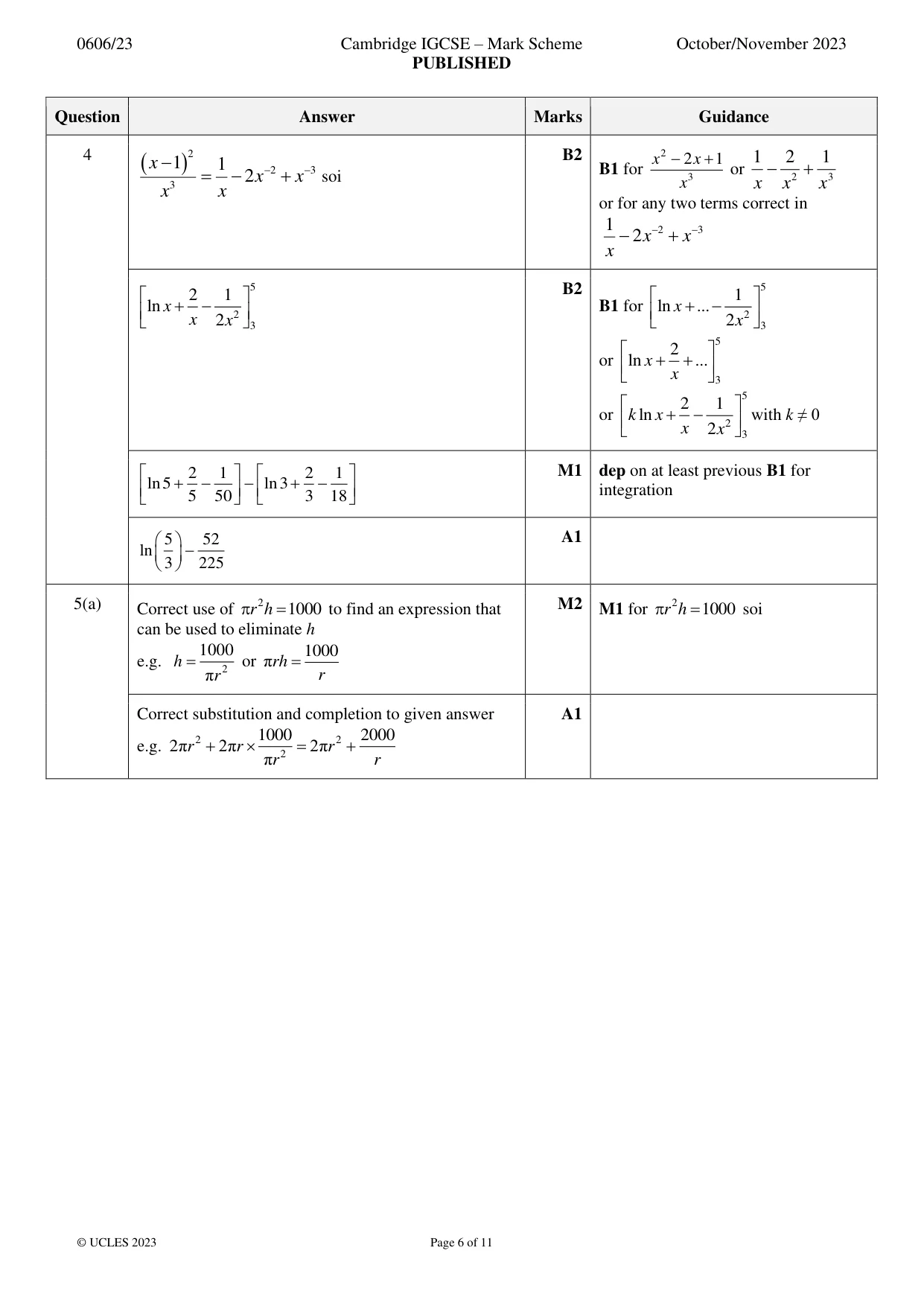
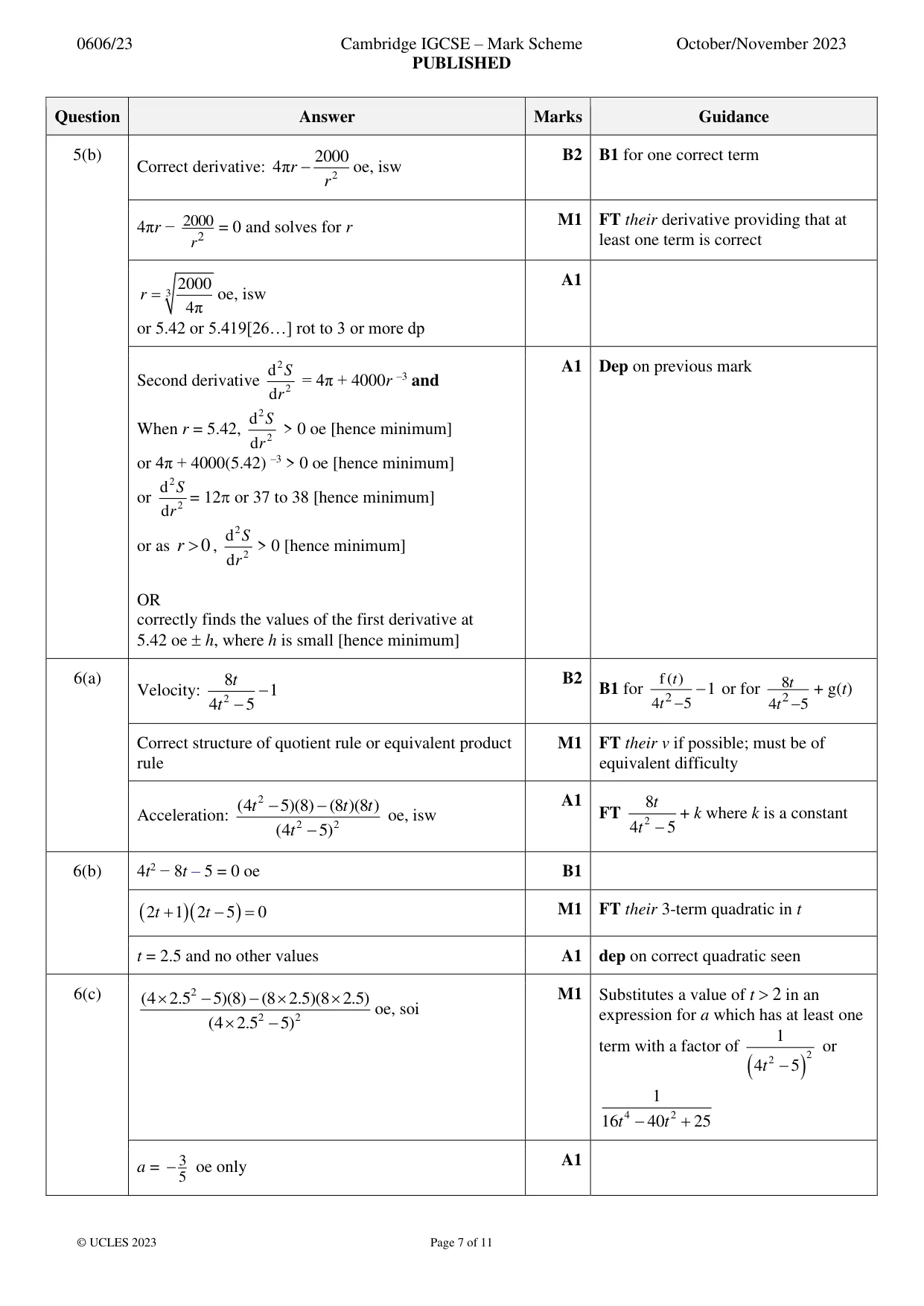
Mark scheme: 5(a) Correct use of r 2 h = 1000 to find an expression that M2 M1 for r 2 h = 1000 soi can be used to eliminate h 1000 1000 e.g. h = or πrh = πr 2 r Correct substitution and completion to given answer A1 2 1000 2 2000 e.g. 2πr + 2πr = 2πr + πr 2 r 5(b) 2000 B2 B1 for one correct term Correct derivative: 4πr − oe, isw r 2 2000 M1 FT their derivative providing that at 4πr − = 0 and solves for r r 2 least one term is correct 2000 A1 r = 3 oe, isw 4π or 5.42 or 5.419[26…] rot to 3 or more dp d 2 S –3 A1 Dep on previous mark Second derivative = 4π + 4000r and d r 2 d 2 S When r = 5.42, > 0 oe [hence minimum] d r 2 or 4π + 4000(5.42) –3 > 0 oe [hence minimum] d 2 S or = 12 or 37 to 38 [hence minimum] d r 2 d 2 S or as r 0 , > 0 [hence minimum] d r 2 OR correctly finds the values of the first derivative at 5.42 oe h, where h is small [hence minimum]
More questions on Use the first and second derivative tests to
Q6 · A particle travels in a straight line
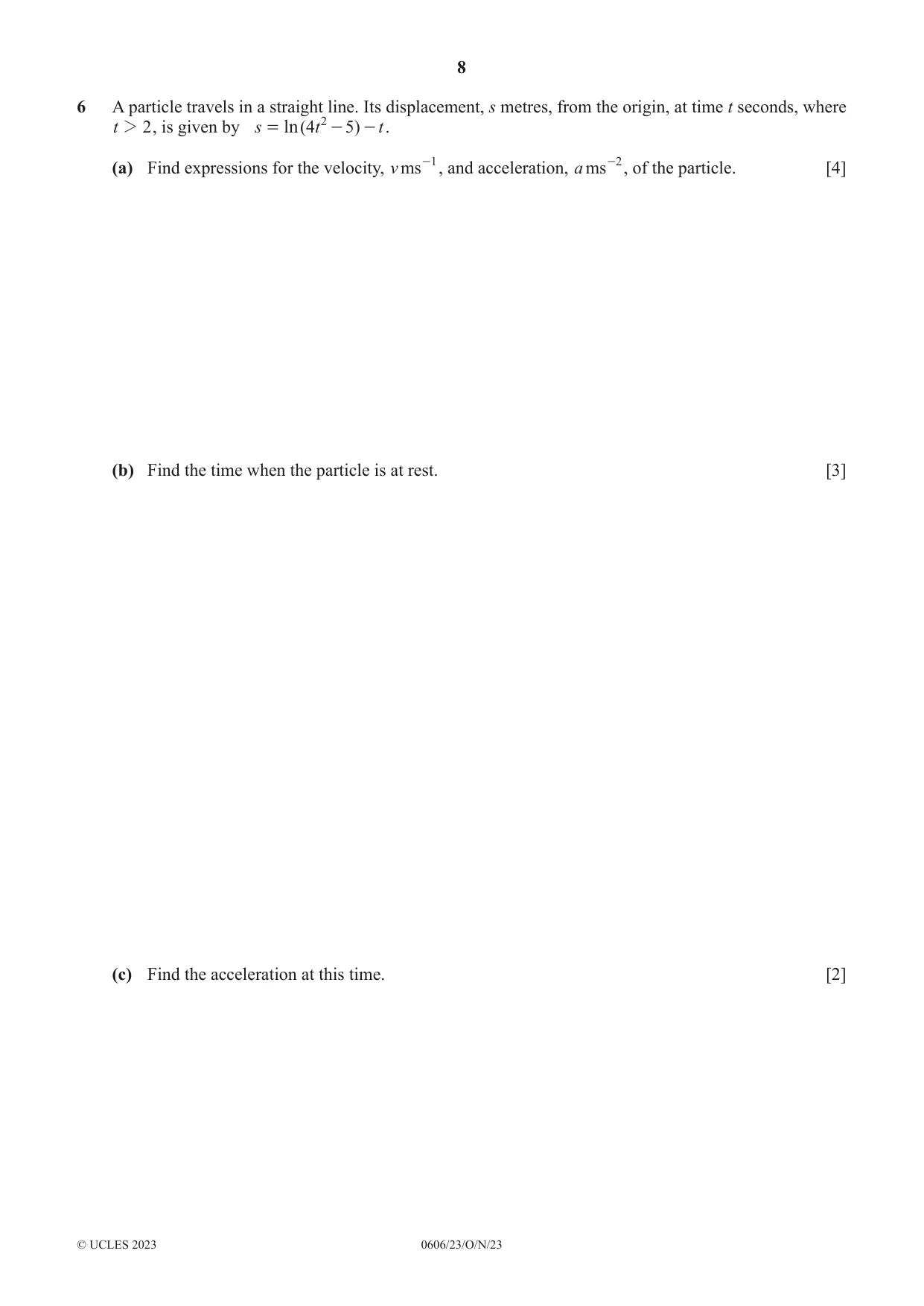
6 A particle travels in a straight line. Its displacement, s metres, from the origin, at time t seconds, where t 2 2 , is given by s = ln ( 4t 2 - 5 ) - t . (a) Find expressions for the velocity, v ms -1 , and acceleration, a ms -2 , of the particle. [4] (b) Find the time when the particle is at rest. [3] (c) Find the acceleration at this time. [2]
Mark scheme: 6(a) 8t B2 f ( t ) 8t Velocity: − 1 B1 for 2 − 1 or for 2 + g(t) 2 4t − 5 4t − 5 4t − 5 Correct structure of quotient rule or equivalent product M1 FT their v if possible; must be of rule equivalent difficulty (4t 2 − 5)(8) − (8t )(8t ) A1 8t Acceleration: oe, isw FT 2 + k where k is a constant 2 2 (4t − 5) 4t − 5 6(b) 4t2 − 8t – 5 = 0 oe B1 ( 2t + 1)( 2t − 5 ) = 0 M1 FT their 3-term quadratic in t t = 2.5 and no other values A1 dep on correct quadratic seen 6(c) (4 2.52 − 5)(8) − (8 2.5)(8 2.5) M1 Substitutes a value of t 2 in an oe, soi 2 2 expression for a which has at least one (4 2.5 − 5) 1 term with a factor of or 2 4t 2 − 5 ( ) 1 16t 4 − 40t 2 + 25 3 A1 a = − oe only 5
Q7 · DO NOT USE A CALCULATOR IN THIS QUESTION
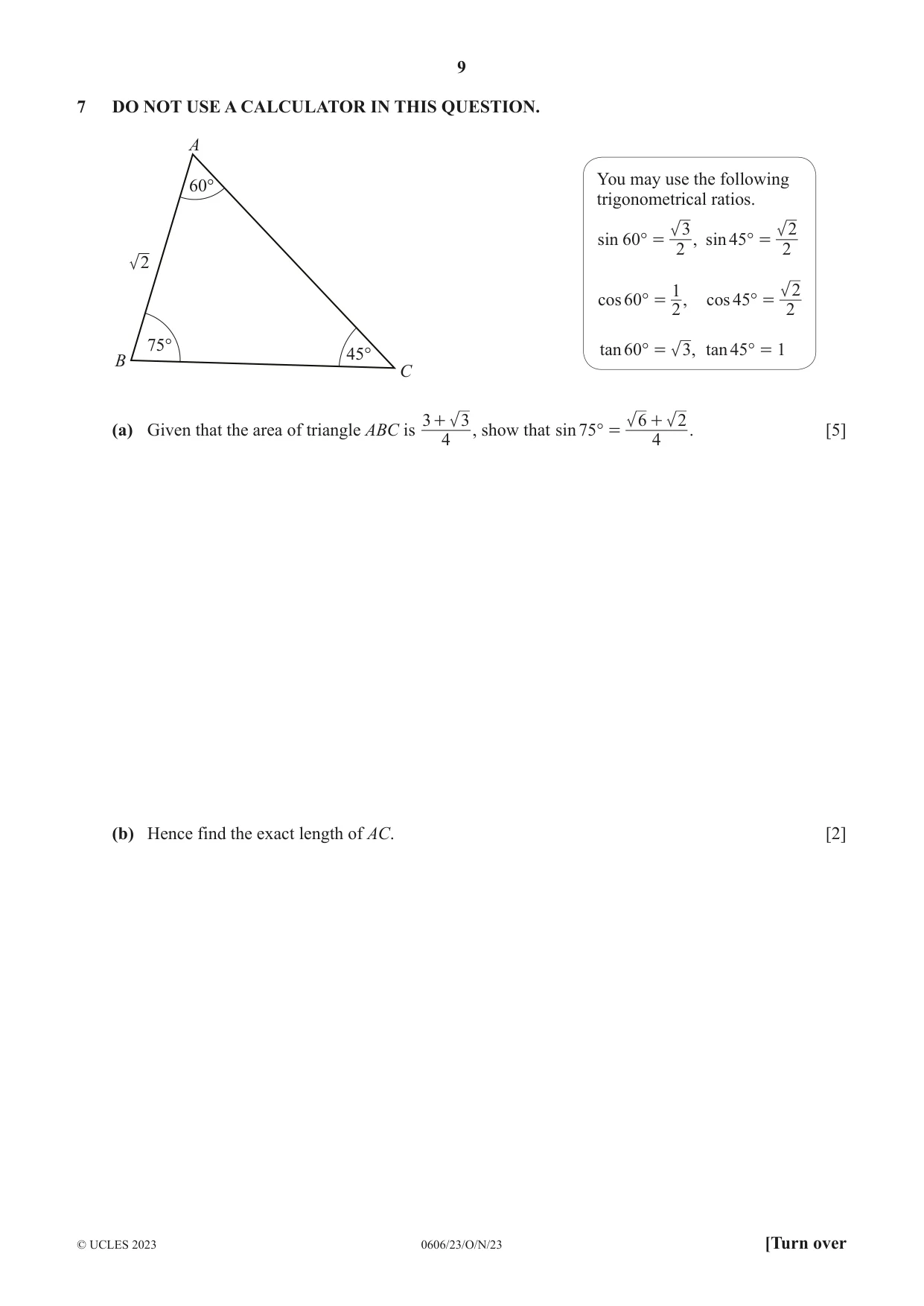
7 DO NOT USE A CALCULATOR IN THIS QUESTION. A You may use the following 60° trigonometrical ratios. 3 2 sin 60 ° = , sin 45 ° = 2 2 2 1 2 cos60 ° = , cos45° = 2 2 75° tan60° = 3, tan45° = 1 45° B C 3 + 3 6 + 2 (a) Given that the area of triangle ABC is , show that sin75° = . [5] 4 4 (b) Hence find the exact length of AC. [2]
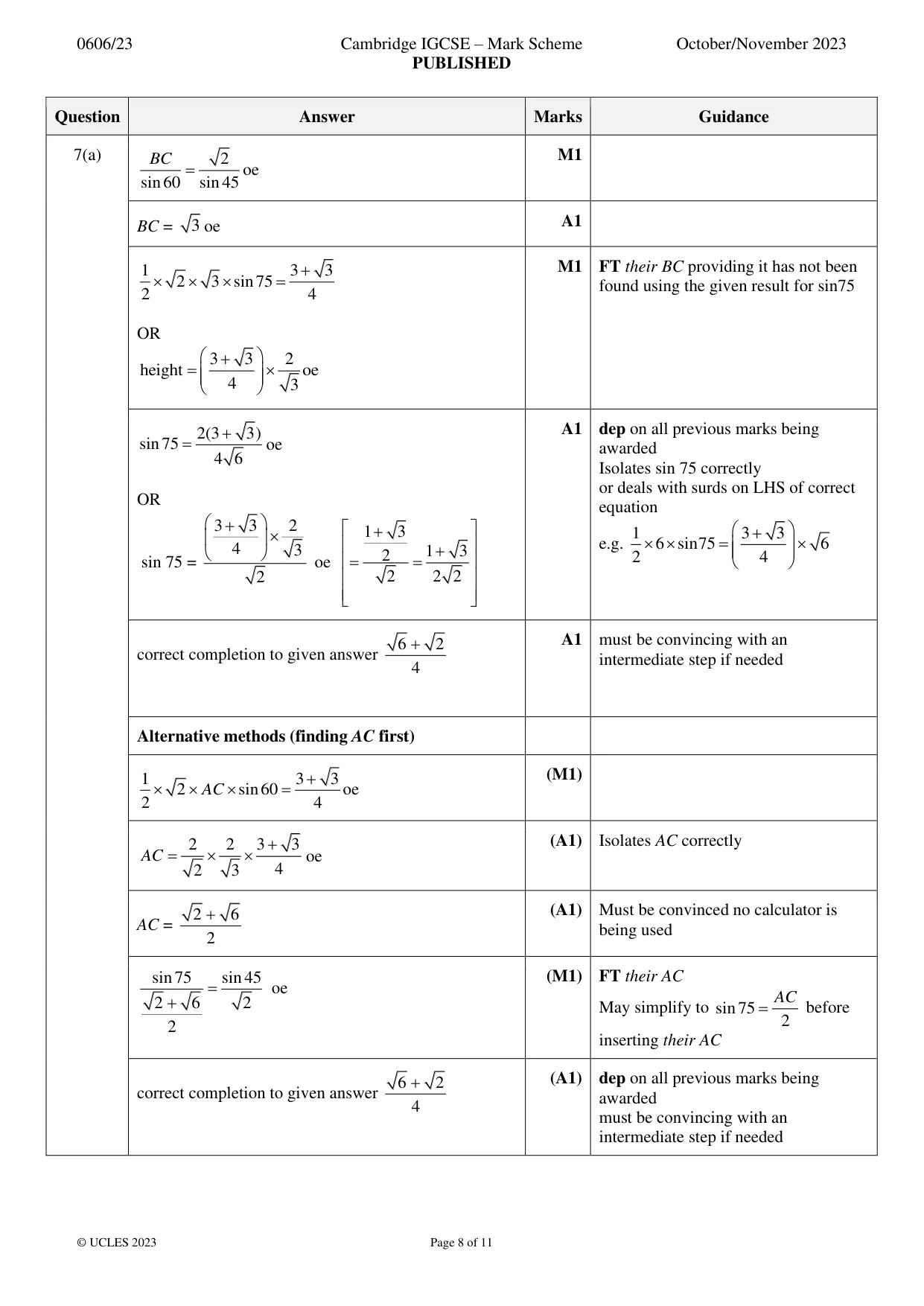
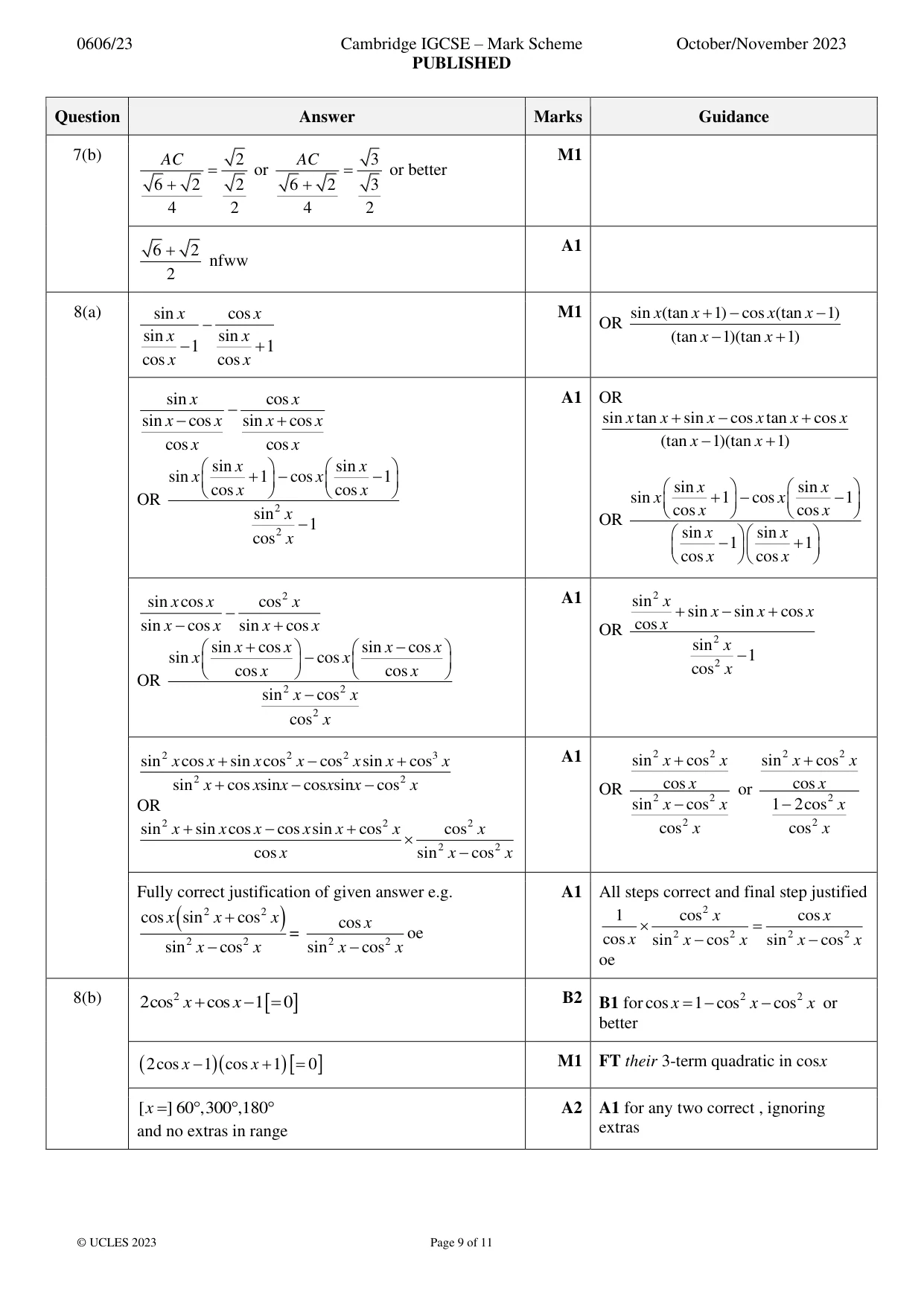
Mark scheme: 7(a) BC 2 M1 = oe sin60 sin 45 BC = 3 oe A1 1 3 + 3 M1 FT their BC providing it has not been 2 3 sin75 = found using the given result for sin75 2 4 OR 3 + 3 2 height = oe 4 3 2(3 + 3) A1 dep on all previous marks being sin75 = oe awarded 4 6 Isolates sin 75 correctly or deals with surds on LHS of correct OR equation 3 + 3 2 1 + 3 1 3 + 3 6 e.g. 6 sin75 = 4 3 2 1 + 3 2 4 sin 75 = oe = = 2 2 2 2 6 + 2 A1 must be convincing with an correct completion to given answer intermediate step if needed 4 Alternative methods (finding AC first) 1 3 + 3 (M1) 2 AC sin60 = oe 2 4 2 2 3 + 3 (A1) Isolates AC correctly AC = oe 2 3 4 2 + 6 (A1) Must be convinced no calculator is AC = being used 2 sin75 sin45 (M1) FT their AC = oe AC 2 + 6 2 May simplify to sin75 = before 2 2 inserting their AC 6 + 2 (A1) dep on all previous marks being correct completion to given answer awarded 4 must be convincing with an intermediate step if needed 7(b) AC 2 AC 3 M1 = or = or better 6 + 2 2 6 + 2 3 4 2 4 2 6 + 2 A1 nfww 2
More questions on Prove trigonometric relationships involving the
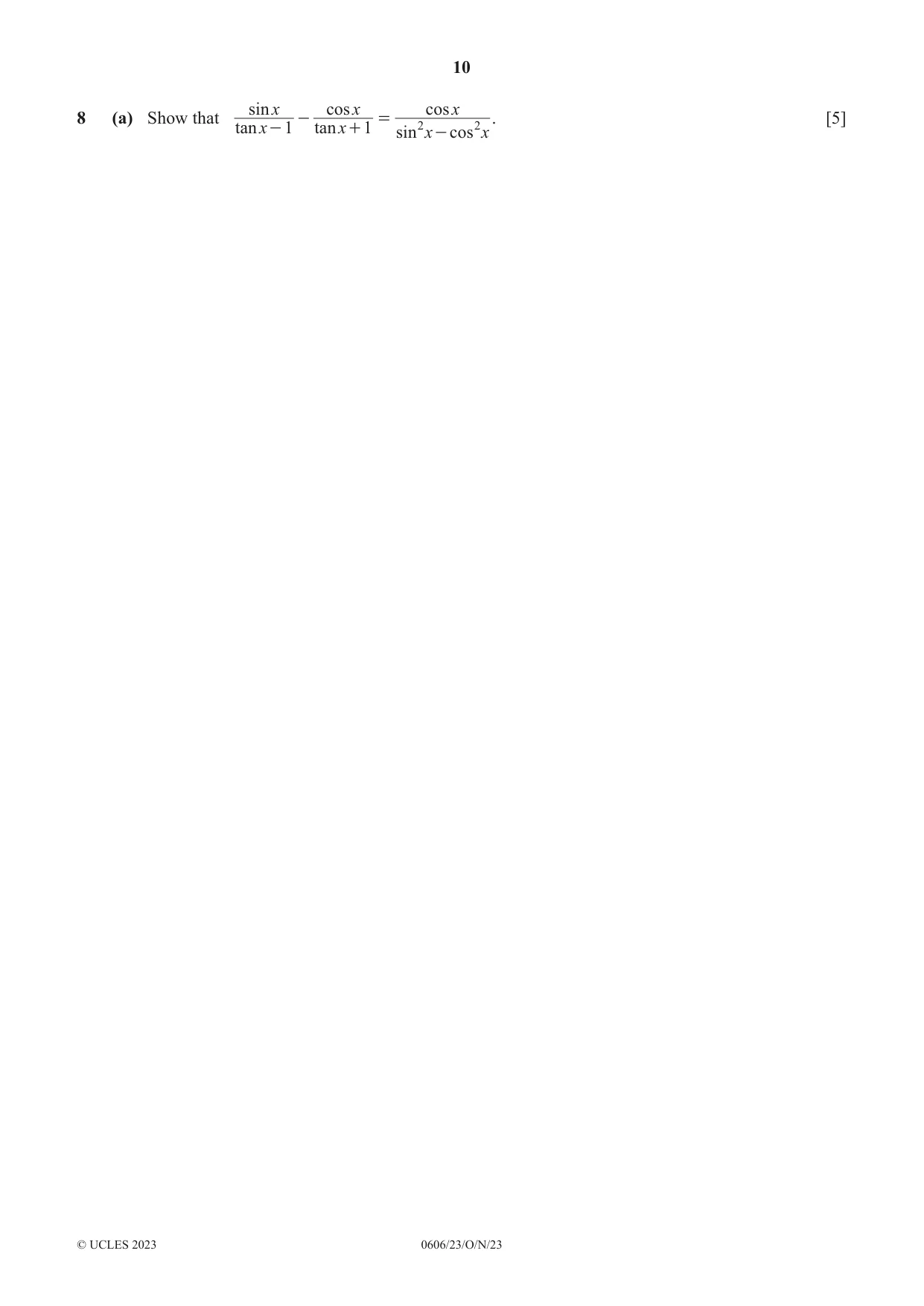
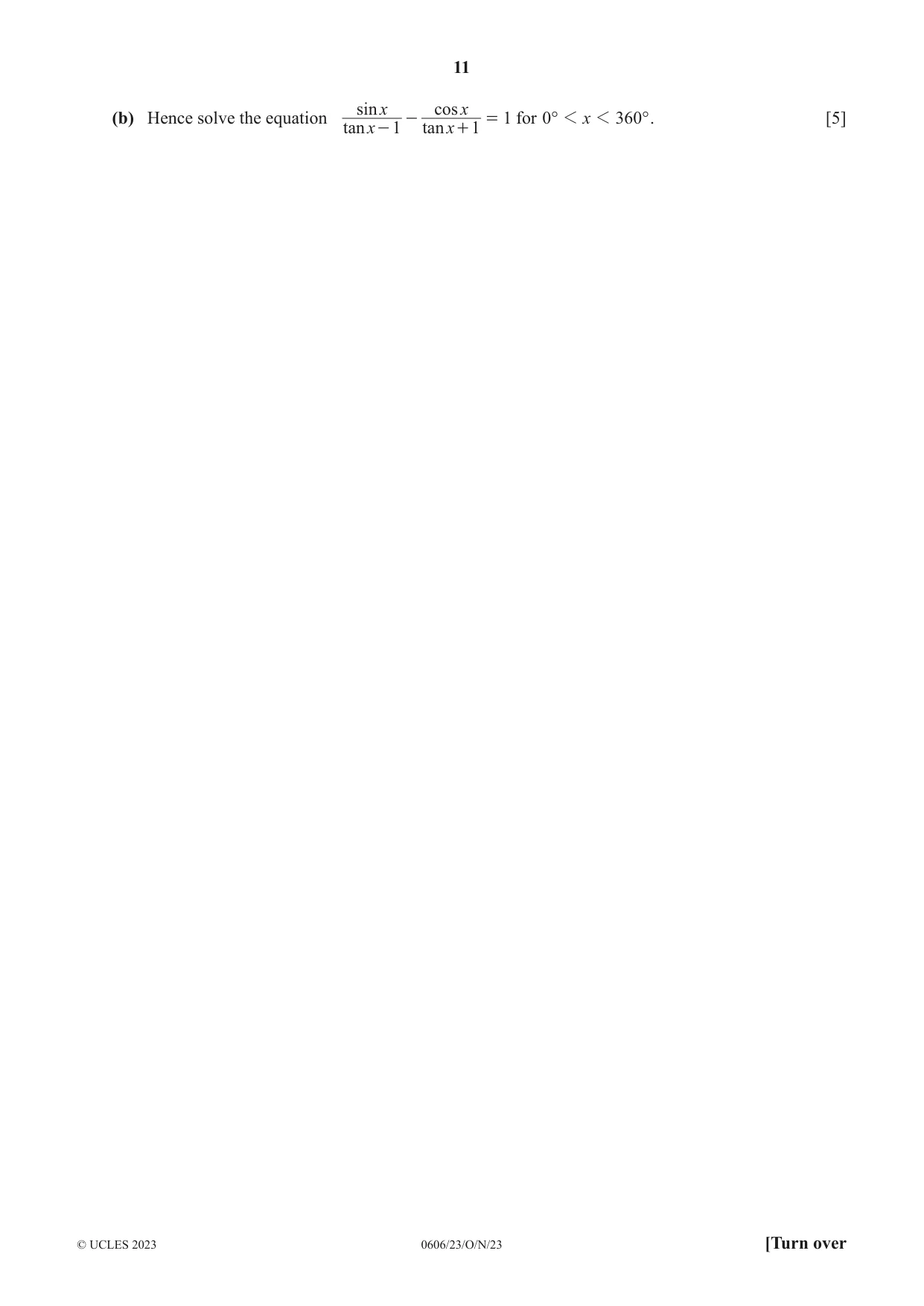
Q8 · Sin x cos x(b) Hence solve the equation - = 1 for 0° 1 x 1 360°
sin x cos x(b) Hence solve the equation - = 1 for 0° 1 x 1 360° . [5] tan x - 1 tan x + 1
Mark scheme: 8(a) sin x cos x M1 sin x (tan x + 1) − cos x (tan x − 1) − OR sin x sin x (tan x − 1)(tan x + 1) − 1 + 1 cos x cos x sin x cos x A1 OR − sin x − cos x sin x + cos x sin x tan x + sin x − cos x tan x + cos x cos x cos x (tan x − 1)(tan x + 1) sin x sin x sin x + 1 − cos x − 1 cos x cos x sin x sin x OR sin x + 1 − cos x − 1 2 sin x cos x cos x − 1 OR cos 2 x sin x sin x − 1 + 1 cos x cos x sin x cos x cos 2 x A1 sin 2 x − + sin x − sin x + cos x sin x − cos x sin x + cos x OR cos x sin x + cos x sin x − cos x sin 2 x sin x − cos x 2 − 1 cos x cos x cos x OR sin 2 x − cos 2 x cos 2 x sin 2 x cos x + sin x cos 2 x − cos 2 x sin x + cos 3 x A1 sin 2 x + cos 2 x sin 2 x + cos 2 x sin 2 x + cos xsinx − cosxsinx − cos 2 x cos x cos x OR or OR sin 2 x − cos 2 x 1 − 2cos 2 x sin 2 x + sin x cos x − cos x sin x + cos 2 x cos 2 x cos 2 x cos 2 x cos x sin 2 x − cos 2 x Fully correct justification of given answer e.g. A1 All steps correct and final step justified 1 cos 2 x cos x cos x sin 2 x + cos 2 x ( ) cos x = = oe 2 2 2 2 2 2 2 2 cos x sin x − cos x sin x − cos x sin x − cos x sin x − cos x oe 2 x − cos 2 x or8(b) 2cos 2 x + cos x − 1 = 0 B2 B1 for cos x = 1 − cos better ( 2cos x − 1)( cos x + 1) = 0 M1 FT their 3-term quadratic in cosx [ x =] 60,300,180 A2 A1 for any two correct , ignoring and no extras in range extras
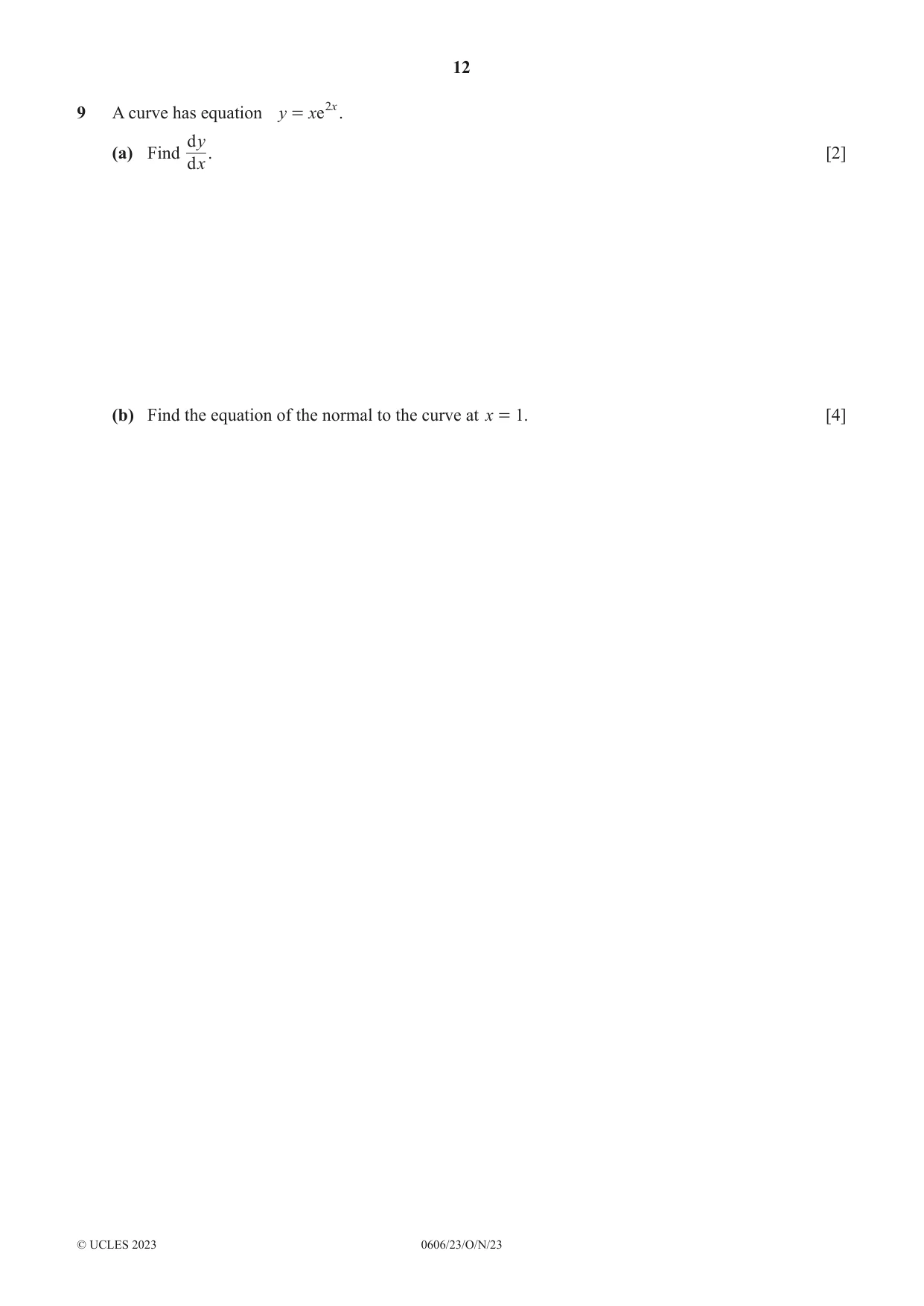
Q9 · A curve has equation y = xe 2 x
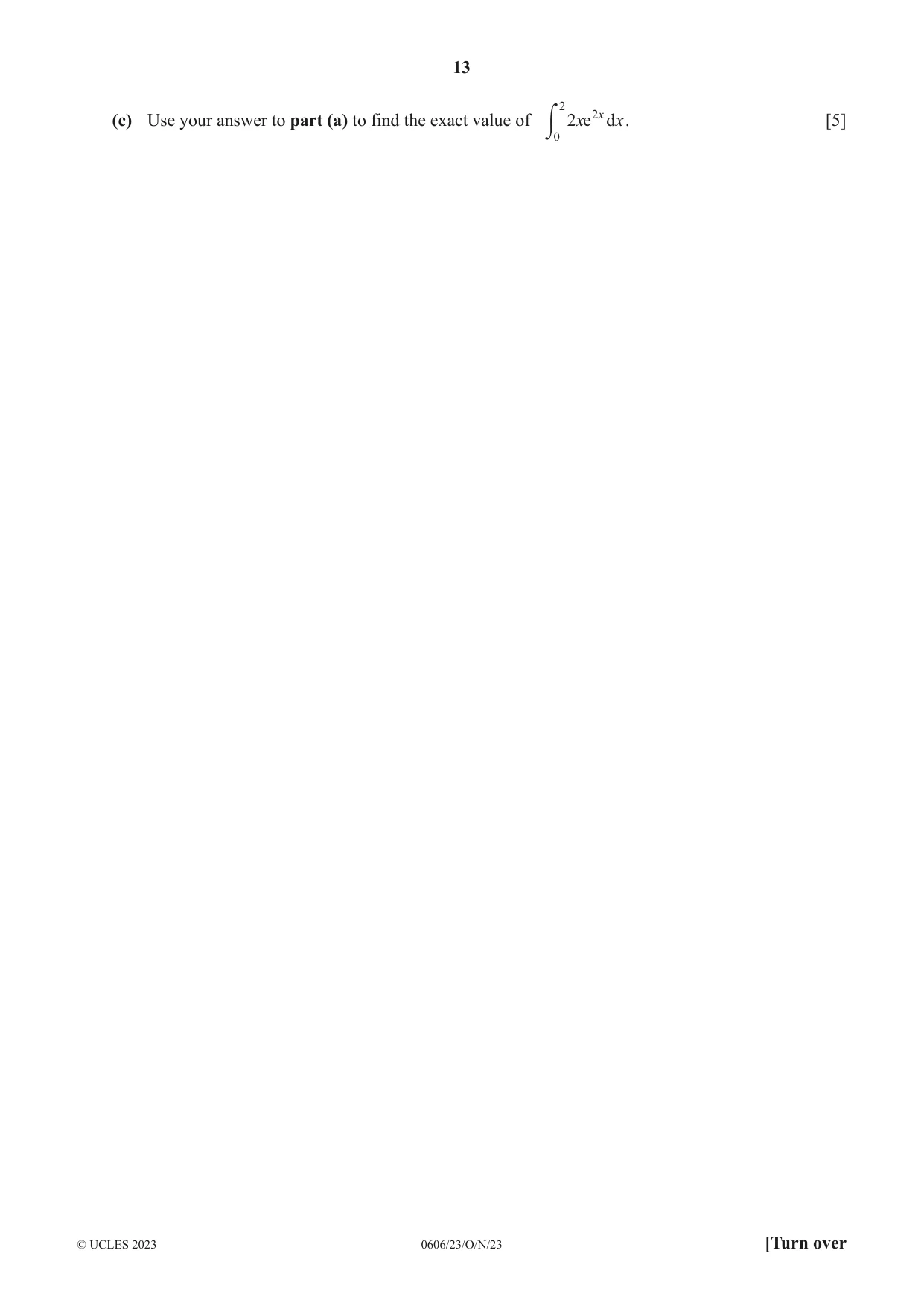
9 A curve has equation y = xe 2 x . d y. [2] (a) Find d x (b) Find the equation of the normal to the curve at x = 1. [4] (c) Use your answer to part (a) to find the exact value of 2 xe 2 x d x . [5] 2y0
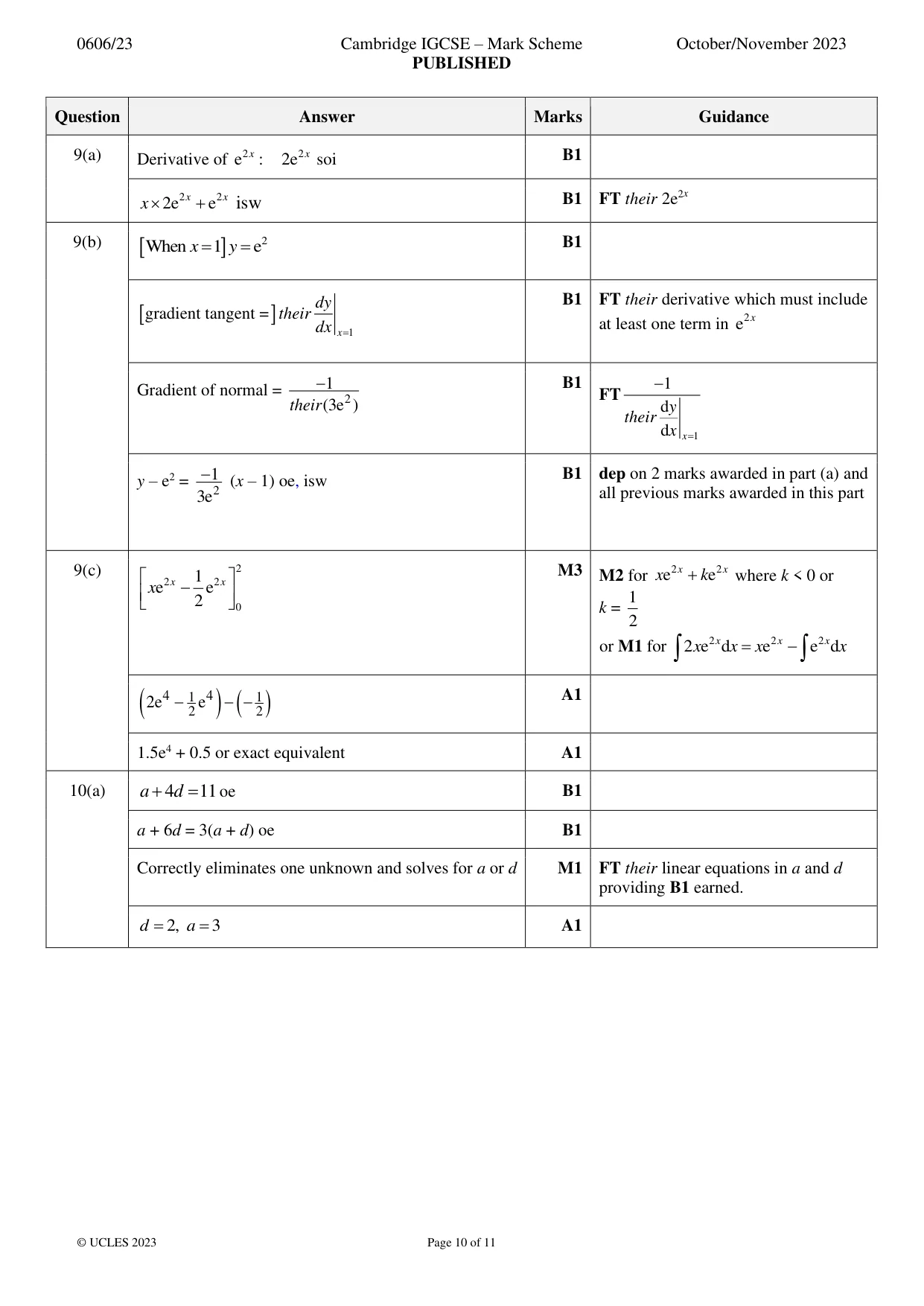
Mark scheme: 9(a) Derivative of e 2 x : 2e 2 x soi B1 2 x 2 x B1 FT their 2e2x x 2e + e isw 9(b) When x = 1 y = e2 B1 dy B1 FT their derivative which must include gradient tangent = their x dx x =1 at least one term in 2e −1 B1 −1 Gradient of normal = 2 FT their (3e ) d y their d x x =1 −1 B1 dep on 2 marks awarded in part (a) and y – e2 = (x – 1) oe, isw 3e 2 all previous marks awarded in this part 9(c) 2 x 1 2 x 2 M3 M2 for xe 2 x + ke 2 x where k < 0 or xe − e 2 0 k = 1 2 e 2 x dx or M1 for 2 xe 2 x dx = xe 2 x − 4 1 4 1 A1 2e − e −− ( 2 ) ( 2 ) 1.5e4 + 0.5 or exact equivalent A1
More questions on Understand integration as the reverse process
Q10 · In an arithmetic progression the 5th term is 11
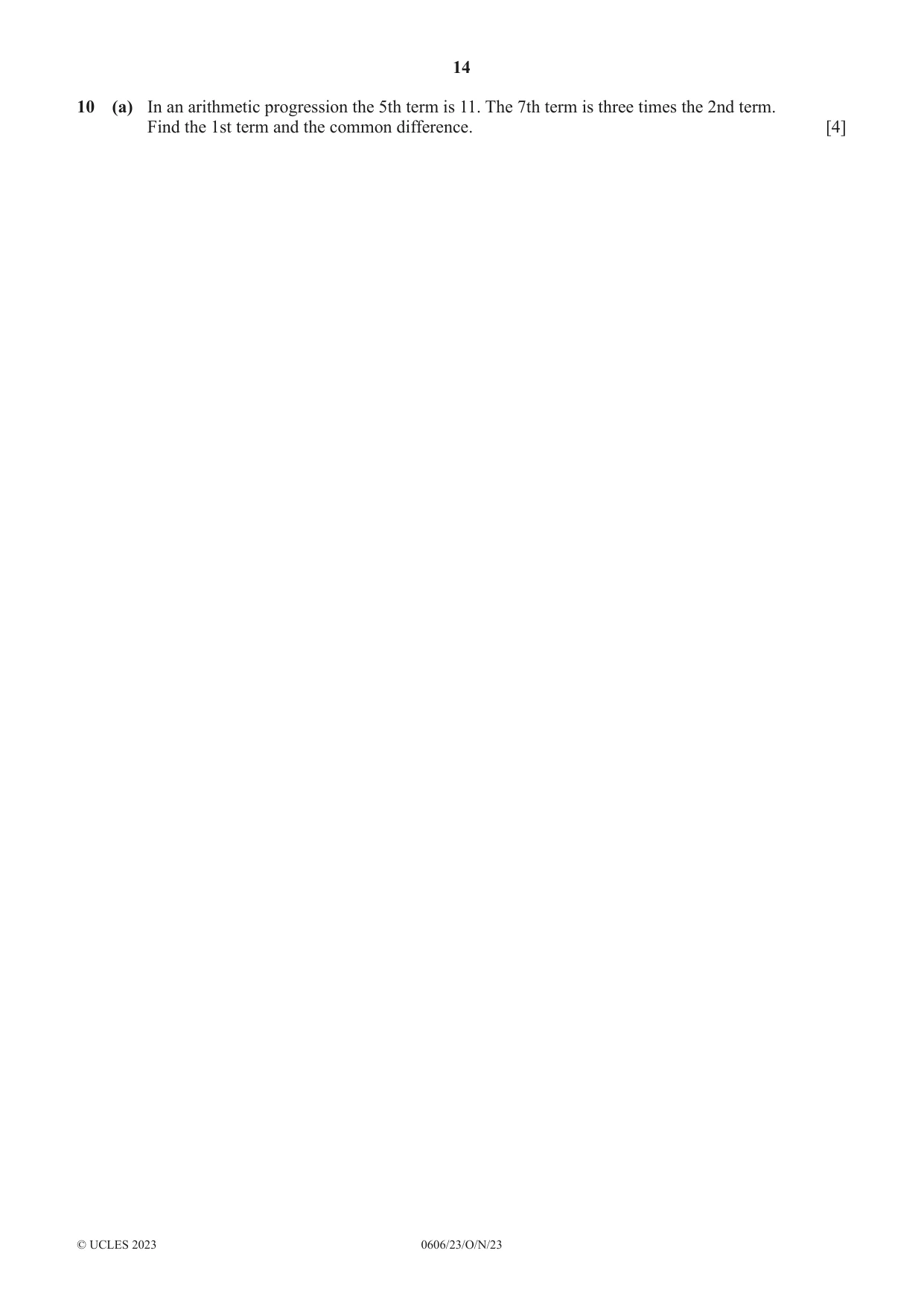
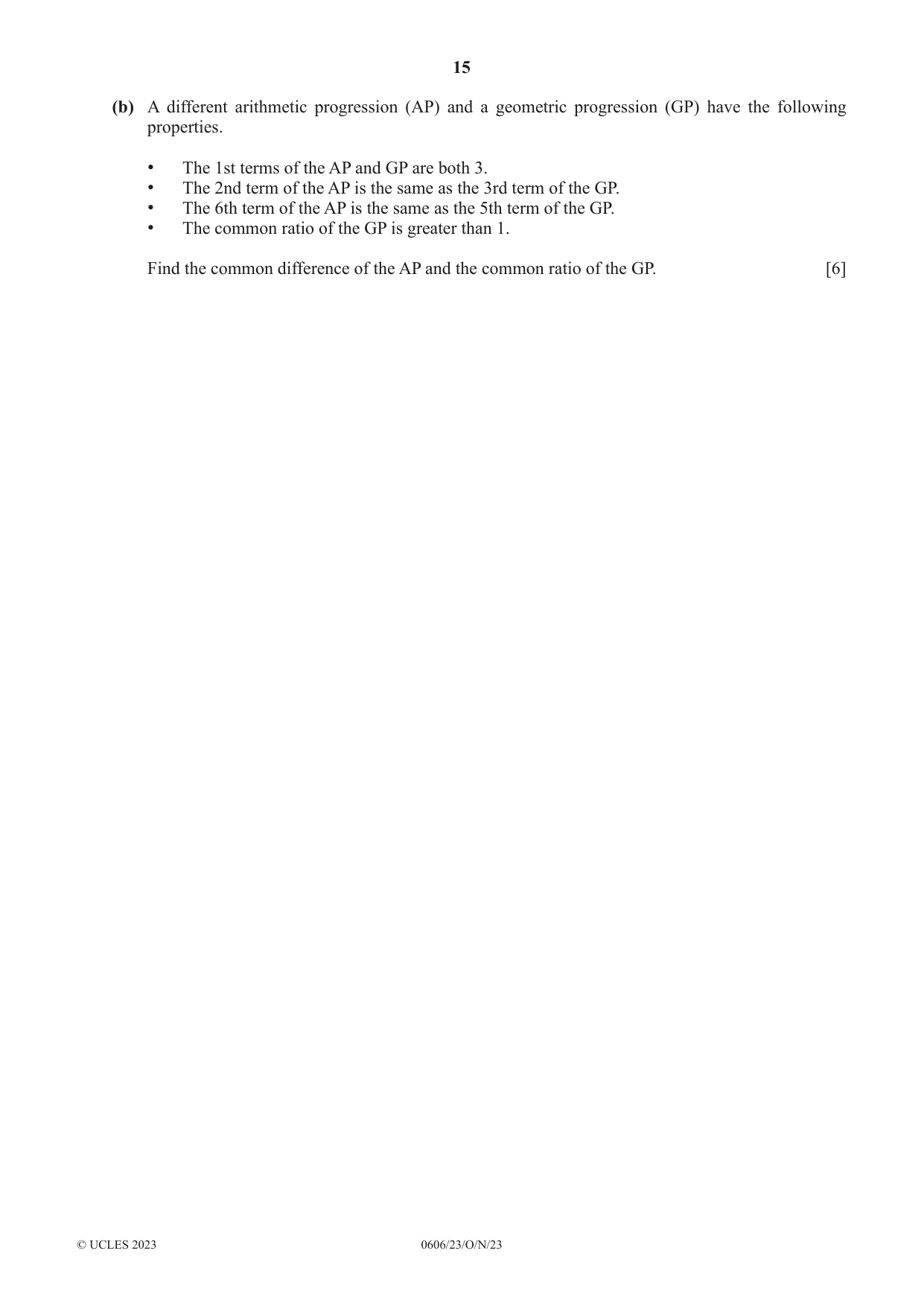
10 (a) In an arithmetic progression the 5th term is 11. The 7th term is three times the 2nd term. Find the 1st term and the common difference. [4] (b) A different arithmetic progression (AP) and a geometric progression (GP) have the following properties. • The 1st terms of the AP and GP are both 3. • The 2nd term of the AP is the same as the 3rd term of the GP. • The 6th term of the AP is the same as the 5th term of the GP. • The common ratio of the GP is greater than 1. Find the common difference of the AP and the common ratio of the GP. [6]
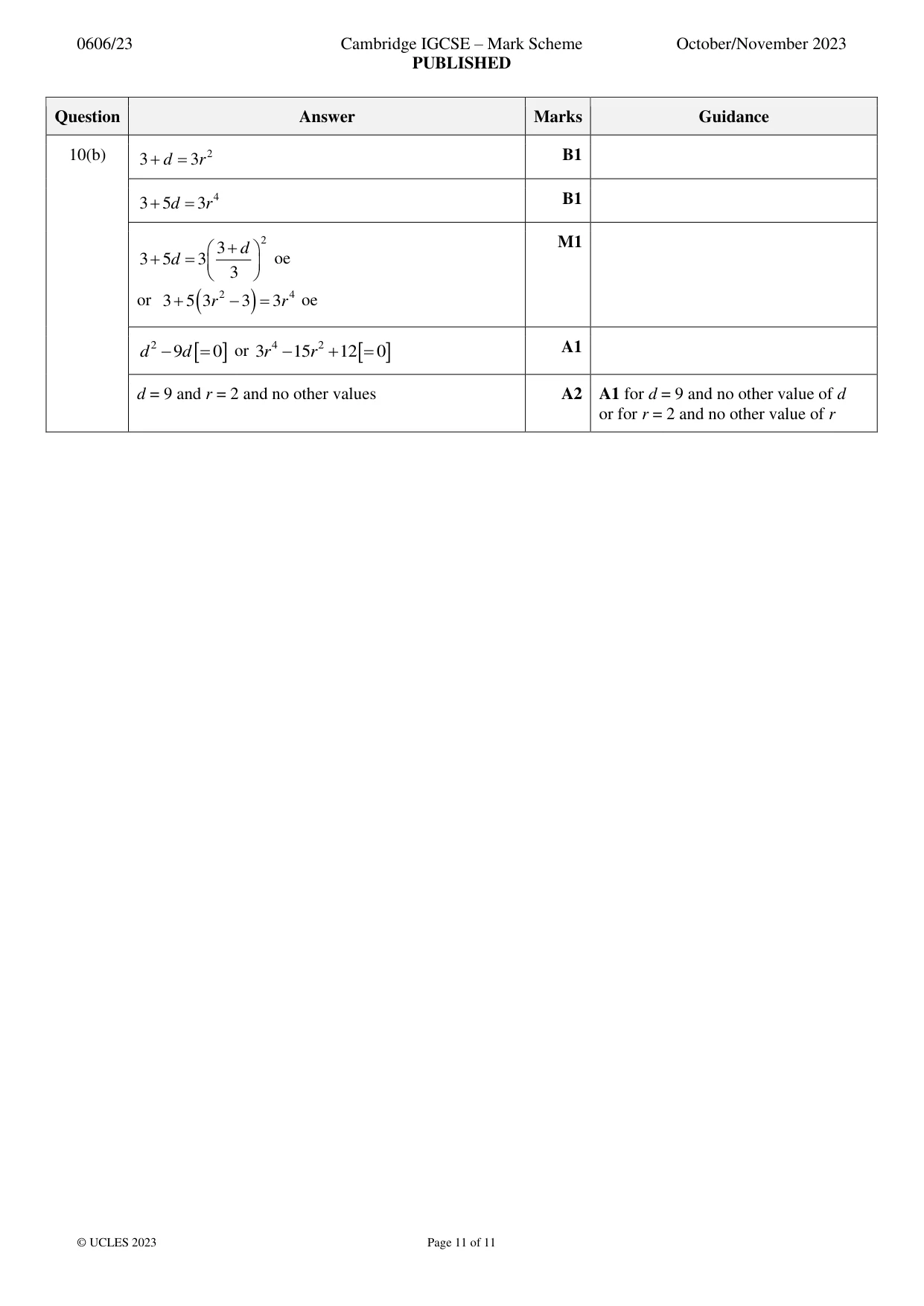
Mark scheme: 10(a) a + 4d = 11 oe B1 a + 6d = 3(a + d) oe B1 Correctly eliminates one unknown and solves for a or d M1 FT their linear equations in a and d providing B1 earned. d = 2, a = 3 A1 10(b) 3 + d = 3r 2 B1 3 + 5d = 3r 4 B1 2 M1 3 + d 3 + 5d = 3 oe 3 or 3 + 5 3r 2 − 3 = 3r 4 oe ( ) d 2 − 9d = 0 or 3r 4 − 15r 2 + 12 = 0 A1 d = 9 and r = 2 and no other values A2 A1 for d = 9 and no other value of d or for r = 2 and no other value of r
More questions on Use the formulas for the nth term and for the
What was in this paper
The subtopics covered by these 8 questions, and how many questions each got. Open one in a new tab to see every Cambridge question on it.
1Form and use composite functions1Prove trigonometric relationships involving the1Solve simultaneous equations in two1Solve, for a given domain, trigonometric1Understand integration as the reverse process1Use the first and second derivative tests to1Use the formulas for the nth term and for the1What you needed in this session
Cambridge’s own grade thresholds for 2023 Oct/Nov, Paper 2 · Variant 3. A higher threshold means an easier paper — the bar moves with how the cohort did.