Cambridge IGCSE Mathematics - Additional 0606 — 2023 Feb/March Paper 2 · Variant 2
0606/22/F/M/23 · 11 questions · 80 marks · ≈90 min
The question paper and its mark scheme, free to read here and free to download. This is Cambridge’s own paper, exactly as it was sat.
Question paper16 pages
Mark scheme11 pages
Answers below. Sit the paper first if you are practising.
Questions as text
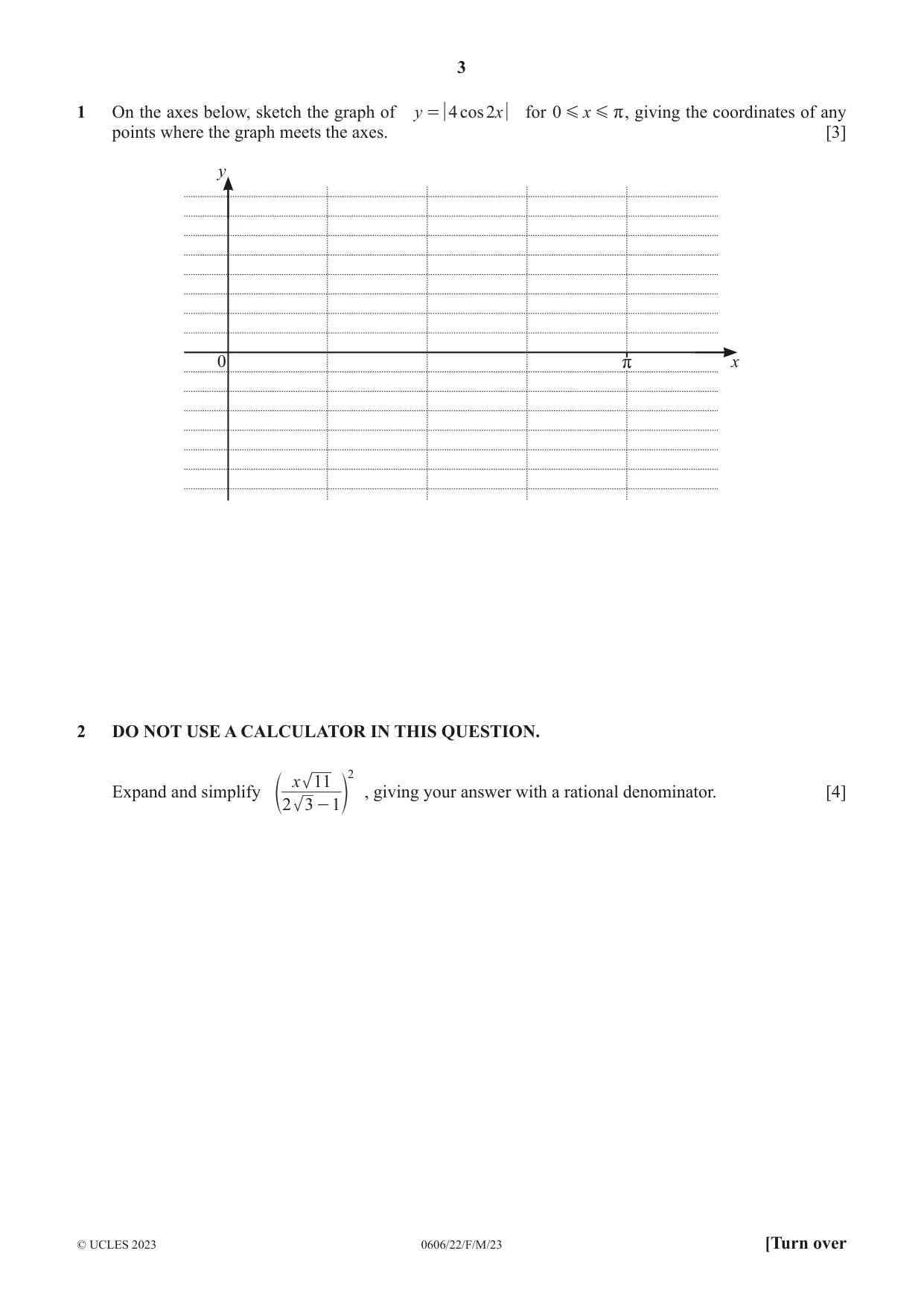
Q1 · On the axes below, sketch the graph of y = 4 cos 2x for 0 G x G r , giving the…
1 On the axes below, sketch the graph of y = 4 cos 2x for 0 G x G r , giving the coordinates of any points where the graph meets the axes. [3] y 0 r x
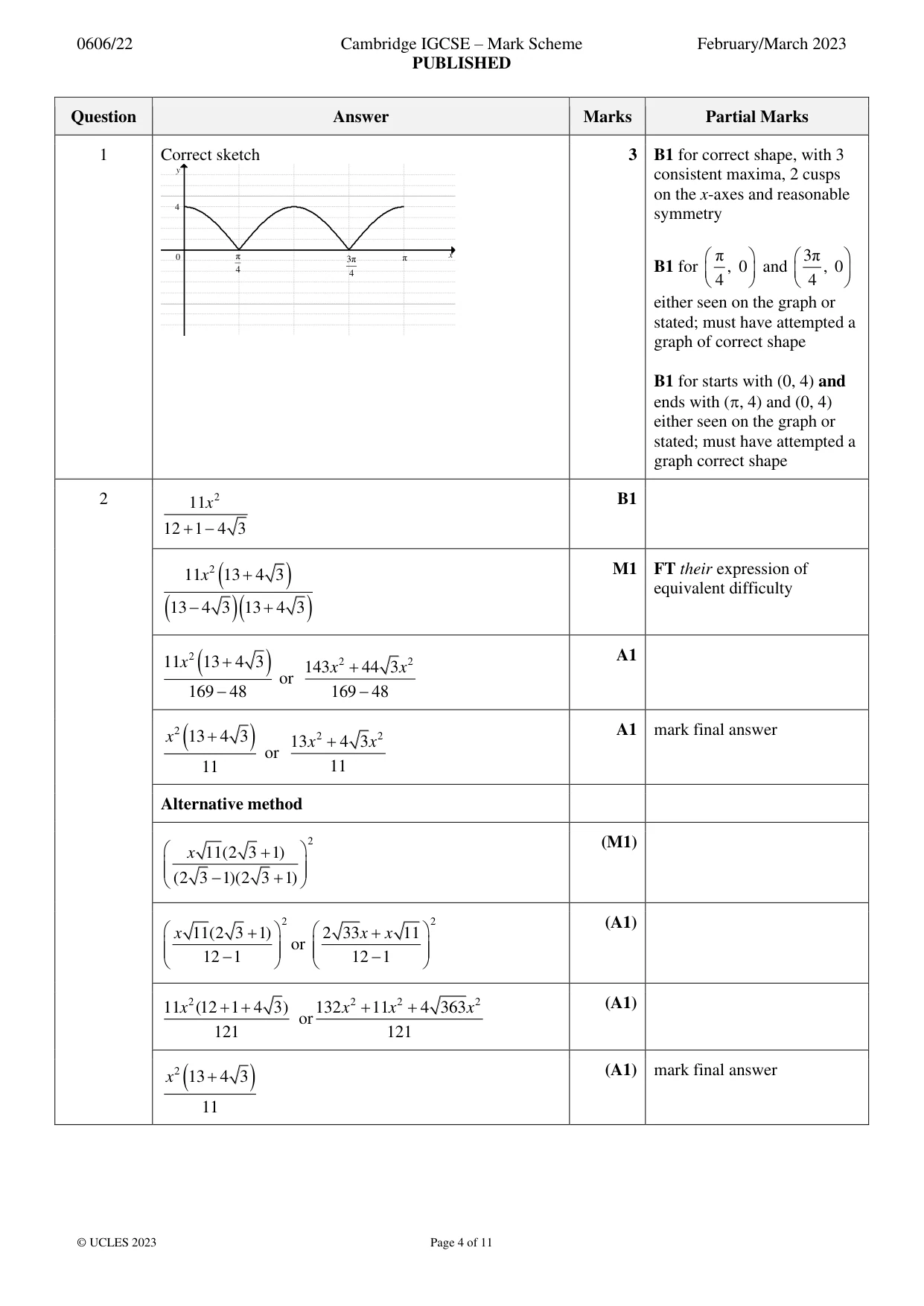
Mark scheme: Question Answer Marks Partial Marks 1 Correct sketch 3 B1 for correct shape, with 3 y consistent maxima, 2 cusps on the x-axes and reasonable 4 symmetry 0 π 3π π x π 3π 4 4 B1 for , 0 and , 0 4 4 either seen on the graph or stated; must have attempted a graph of correct shape B1 for starts with (0, 4) and ends with (, 4) and (0, 4) either seen on the graph or stated; must have attempted a graph correct shape
Q2 · DO NOT USE A CALCULATOR IN THIS QUESTION
2 DO NOT USE A CALCULATOR IN THIS QUESTION. x 11 2 Expand and simplify , giving your answer with a rational denominator. [4] e 2 3 - 1 o
Mark scheme: 2 11x 2 B1 12 + 1 − 4 3 2 M1 FT their expression of 11x 13 + 4 3 ( ) equivalent difficulty 13 − 4 3 13 + 4 3 ( )( ) A1 11x 2 13 + 4 3 2 2 ( ) 143 x + 44 3 x or 169 − 48 169 − 48 A1 mark final answer x 2 13 + 4 3 2 2 ( ) 13 x + 4 3 x or 11 11 Alternative method 2 (M1) x 11(2 3 + 1) (2 3 − 1)(2 3 + 1) 2 2 (A1) x 11(2 3 + 1) 2 33 x + x 11 or 12 − 1 12 − 1 11x 2 (12 + 1 + 4 3) 132 x 2 + 11x 2 + 4 363 x 2 (A1) or 121 121 2 (A1) mark final answer x 13 + 4 3 ( ) 11
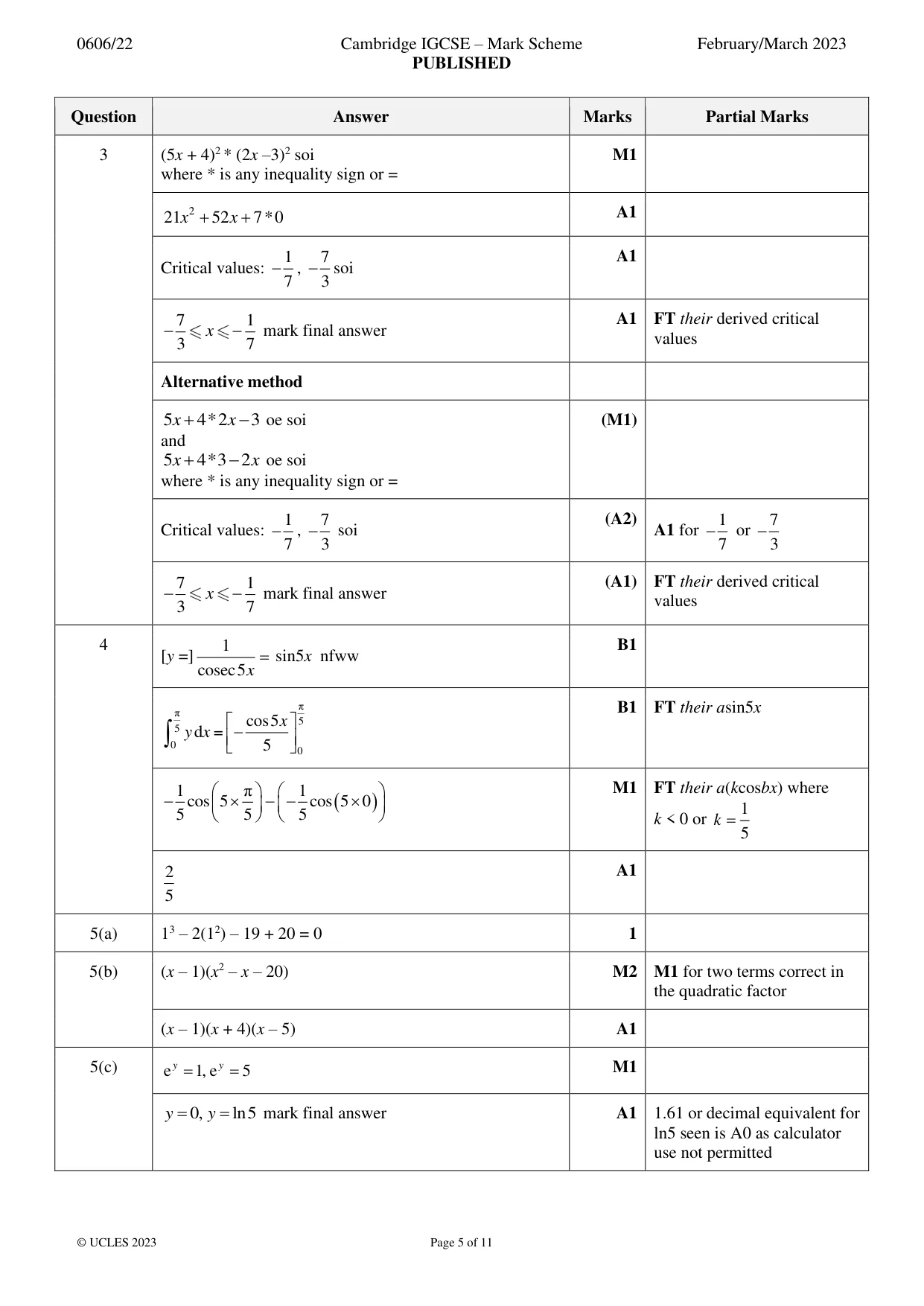
Q3 · Solve the inequality 5x + 4 G 2x - 3
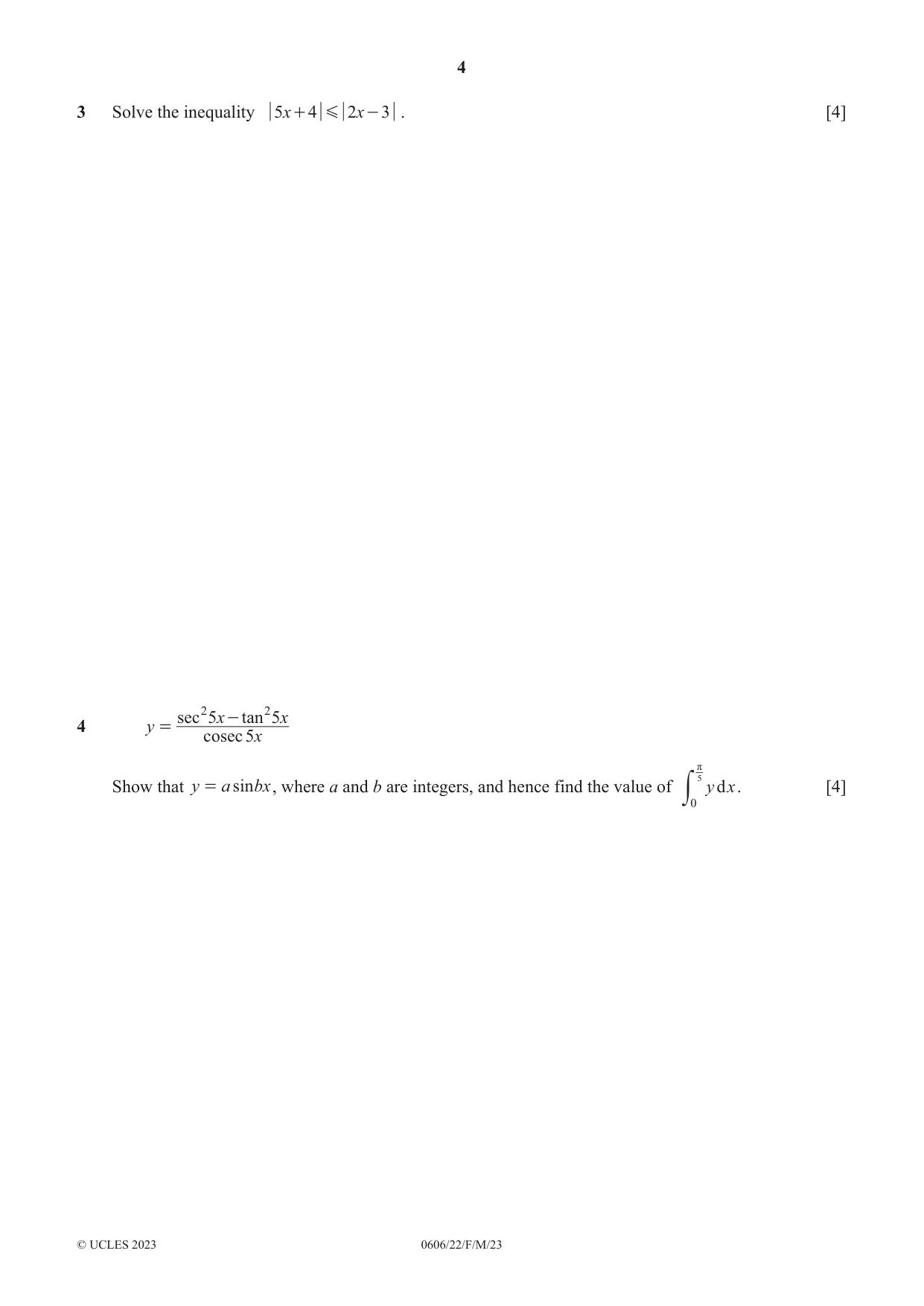
3 Solve the inequality 5x + 4 G 2x - 3 . [4]
Mark scheme: 3 (5x + 4)2 * (2x –3)2 soi M1 where * is any inequality sign or = 21x 2 + 52 x + 7*0 A1 1 7 A1 Critical values: − , − soi 7 3 7 1 A1 FT their derived critical − x − mark final answer values 3 7 Alternative method 5 x + 4*2 x − 3 oe soi (M1) and 5 x + 4*3 − 2 x oe soi where * is any inequality sign or = 1 7 (A2) 1 7 Critical values: − , − soi A1 for − or − 7 3 7 3 7 1 (A1) FT their derived critical − x − mark final answer values 3 7
More questions on Solve graphically or algebraically inequalities
Q4 · Y = cosec 5x r Show that y = a sin bx , where a and b are integers, and hence find the…
4 y = cosec 5x r Show that y = a sin bx , where a and b are integers, and hence find the value of y d x . [4] 5y0
Mark scheme: 4 1 B1 [y =] = sin5x nfww cosec5 x π B1 FT their asin5x π 5 cos5 x 5 y0 dx = − 5 0 1 π 1 M1 FT their a(kcosbx) where − cos 5 −− cos ( 5 0 ) 1 5 5 5 k < 0 or k = 5 2 A1 5
Q5 · DO NOT USE A CALCULATOR IN THIS QUESTION
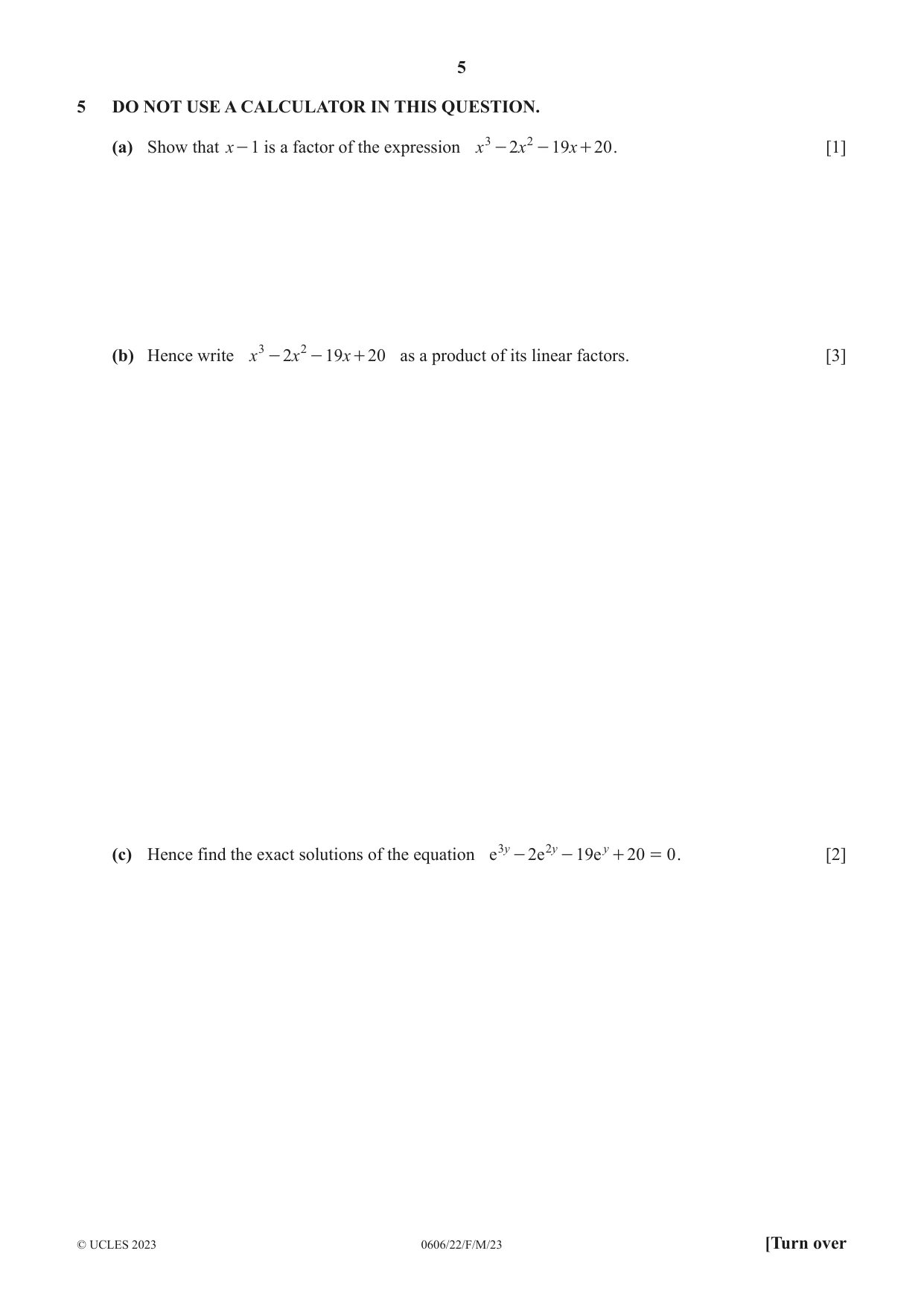
5 DO NOT USE A CALCULATOR IN THIS QUESTION. (a) Show that x - 1 is a factor of the expression x 3 - 2 x 2 - 19x + 20 . [1] (b) Hence write x 3 - 2x 2 - 19x + 20 as a product of its linear factors. [3] (c) Hence find the exact solutions of the equation e 3 y - 2e 2 y - 19e y + 20 = 0 . [2]
Mark scheme: 5(a) 13 – 2(12) – 19 + 20 = 0 1 5(b) (x – 1)(x2 – x – 20) M2 M1 for two terms correct in the quadratic factor (x – 1)(x + 4)(x – 5) A1 5(c) e y = 1, e y = 5 M1 y = 0, y = ln5 mark final answer A1 1.61 or decimal equivalent for ln5 seen is A0 as calculator use not permitted
Q6 · A geometric progression has first term 64 and common ratio 0.5
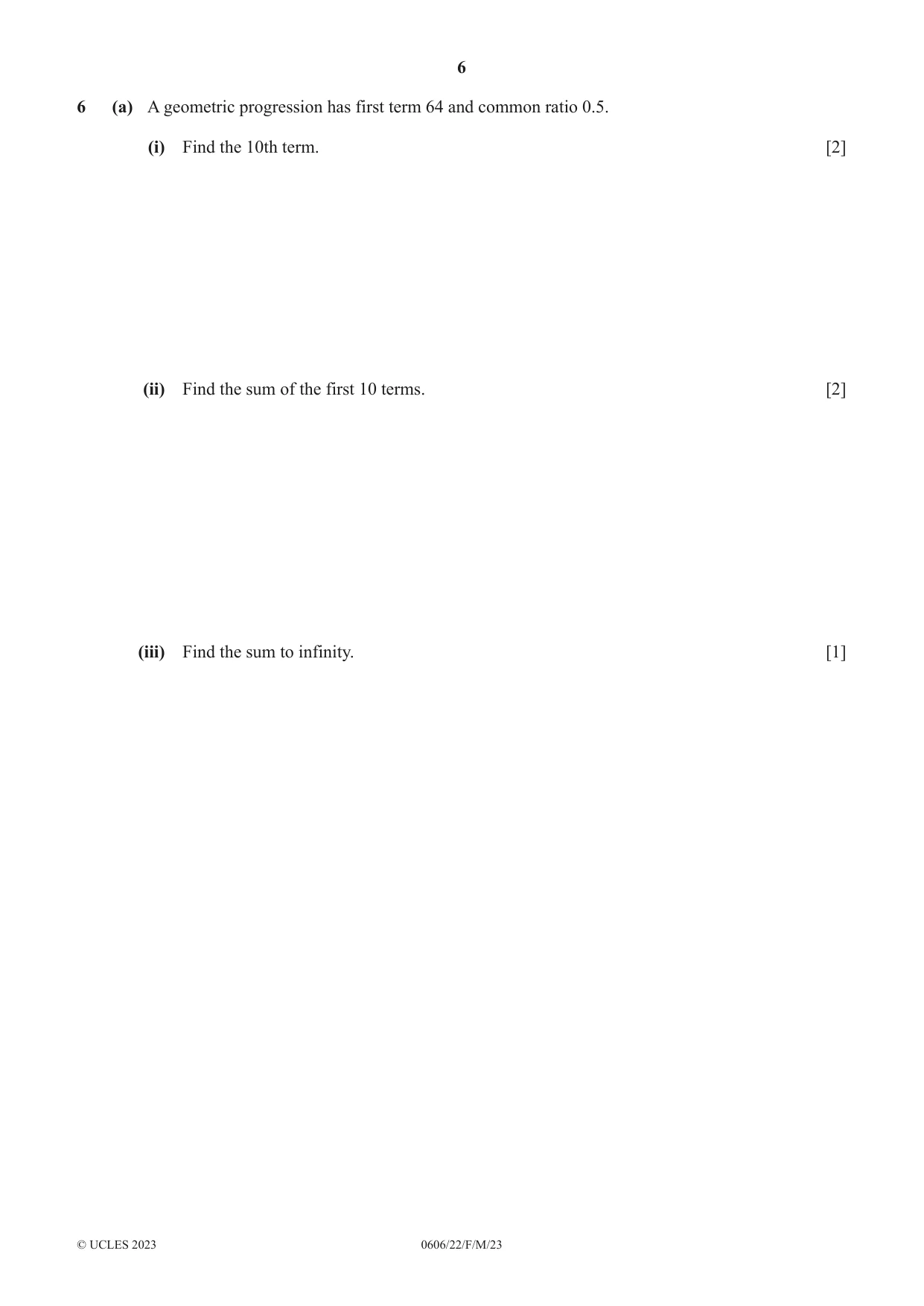
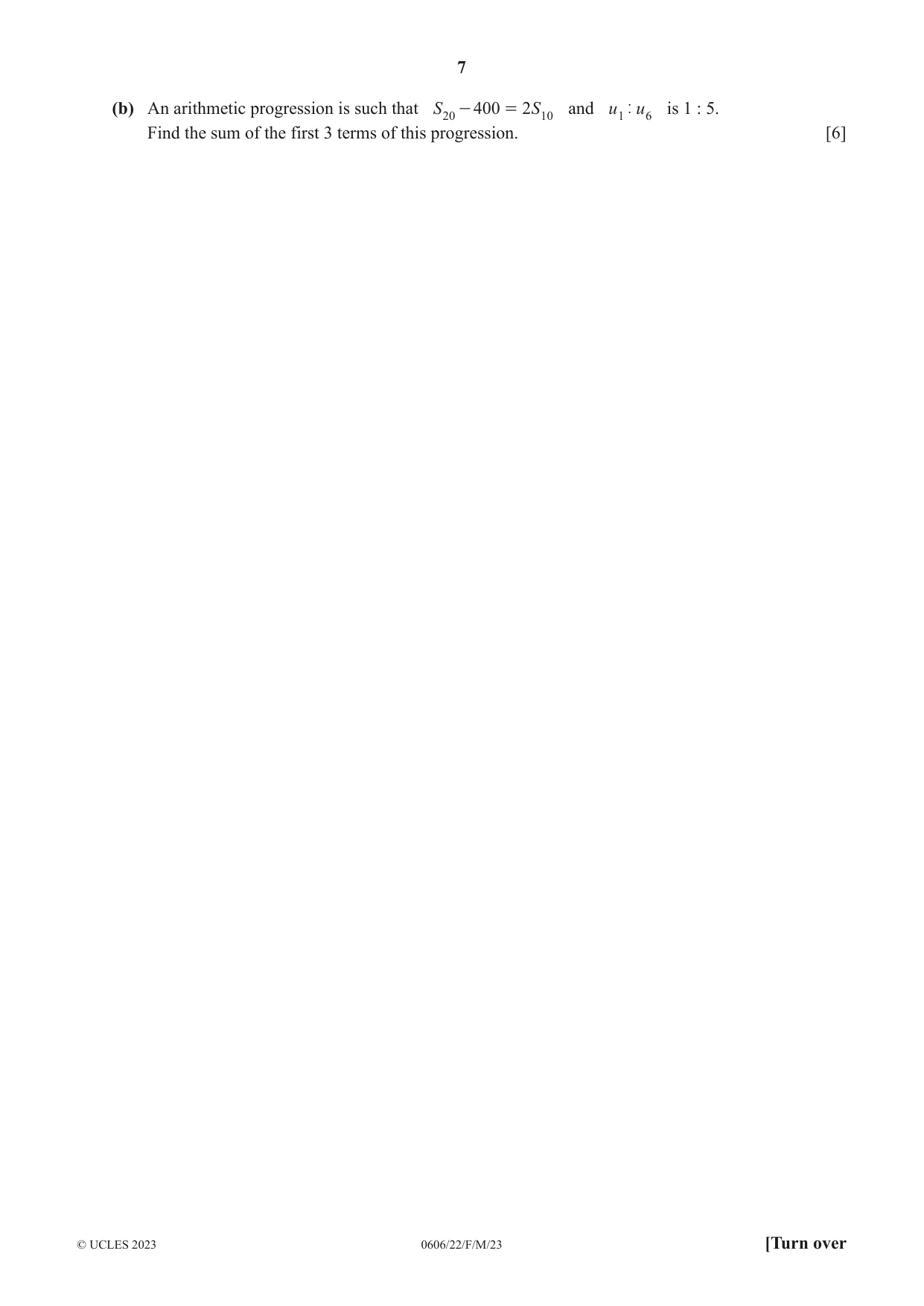
6 (a) A geometric progression has first term 64 and common ratio 0.5. (i) Find the 10th term. [2] (ii) Find the sum of the first 10 terms. [2] (iii) Find the sum to infinity. [1] (b) An arithmetic progression is such that S 20 - 400 = 2 S 10 and u 1| u 6 is 1 : 5. Find the sum of the first 3 terms of this progression. [6]
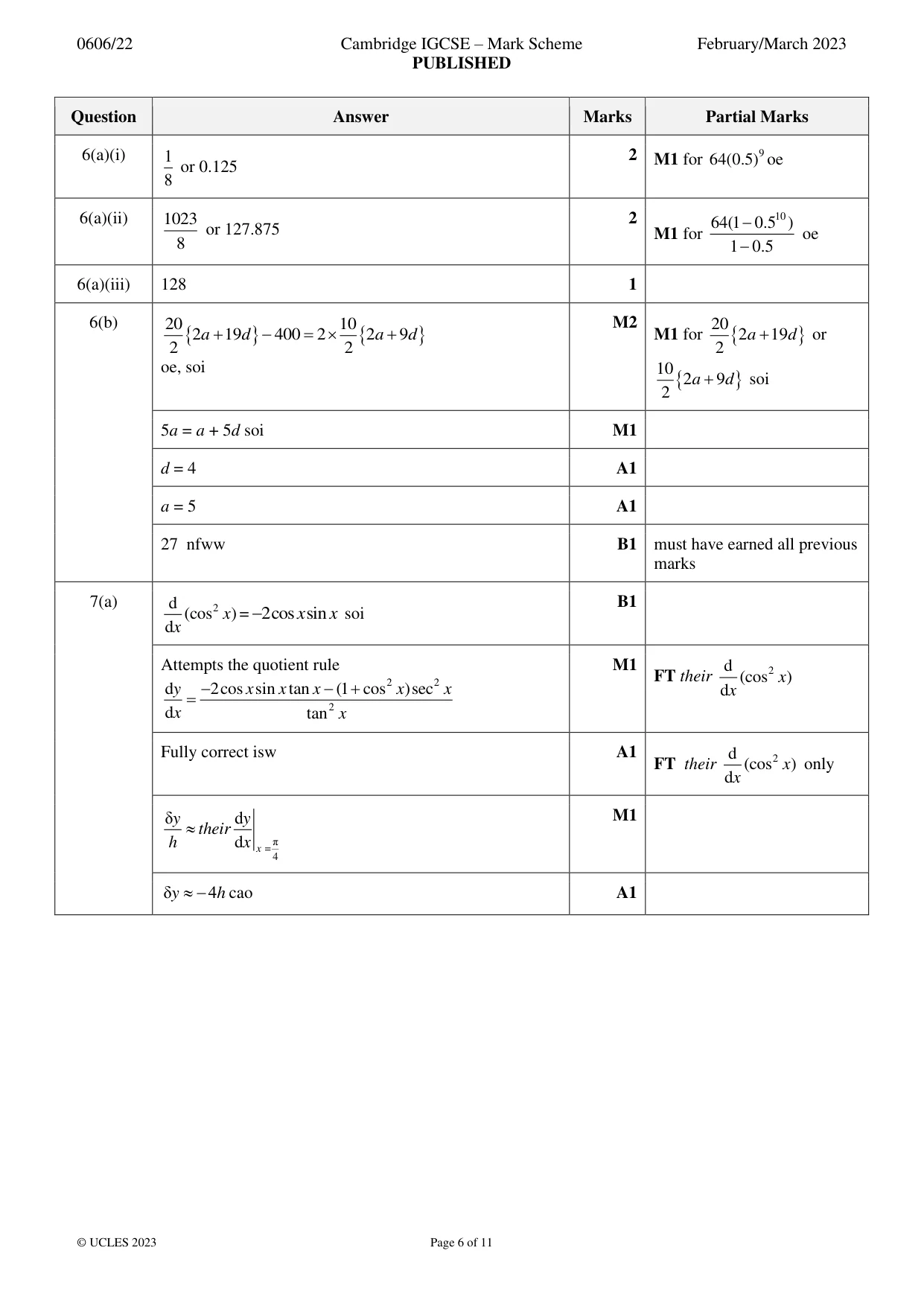
Mark scheme: 6(a)(i) 1 2 M1 for 64(0.5) 9 oe or 0.125 8 6(a)(ii) 1023 2 64(1 − 0.510 ) or 127.875 M1 for oe 8 1 − 0.5 6(a)(iii) 128 1 6(b) 20 10 M2 20 2a + 19d − 400 = 2 2a + 9d M1 for 2 a + 19 d or 2 2 2 oe, soi 10 2 a + 9 d soi 2 5a = a + 5d soi M1 d = 4 A1 a = 5 A1 27 nfww B1 must have earned all previous marks
More questions on Use the formulas for the nth term and for the
Q7 · Variables x and y are such that y =
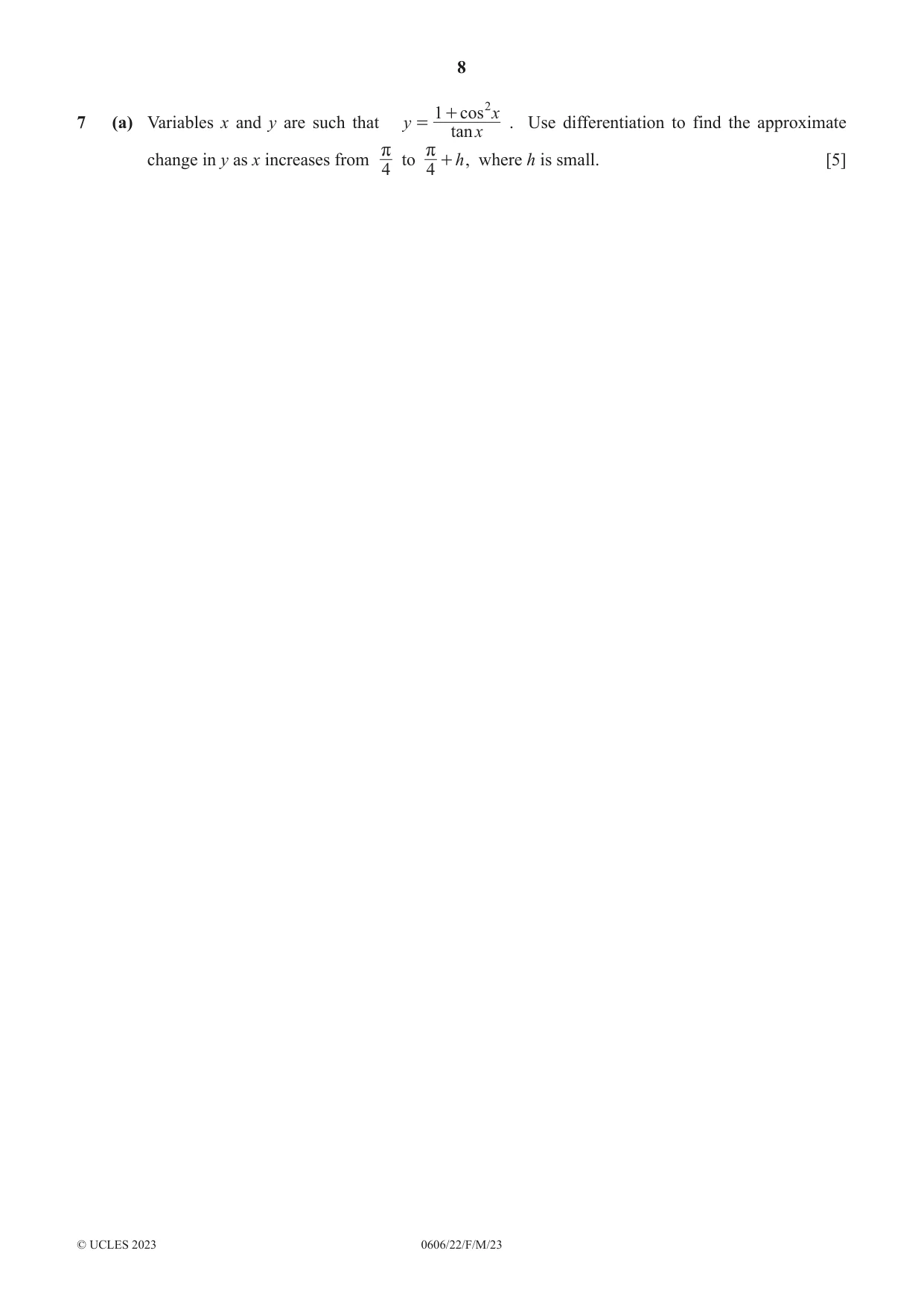
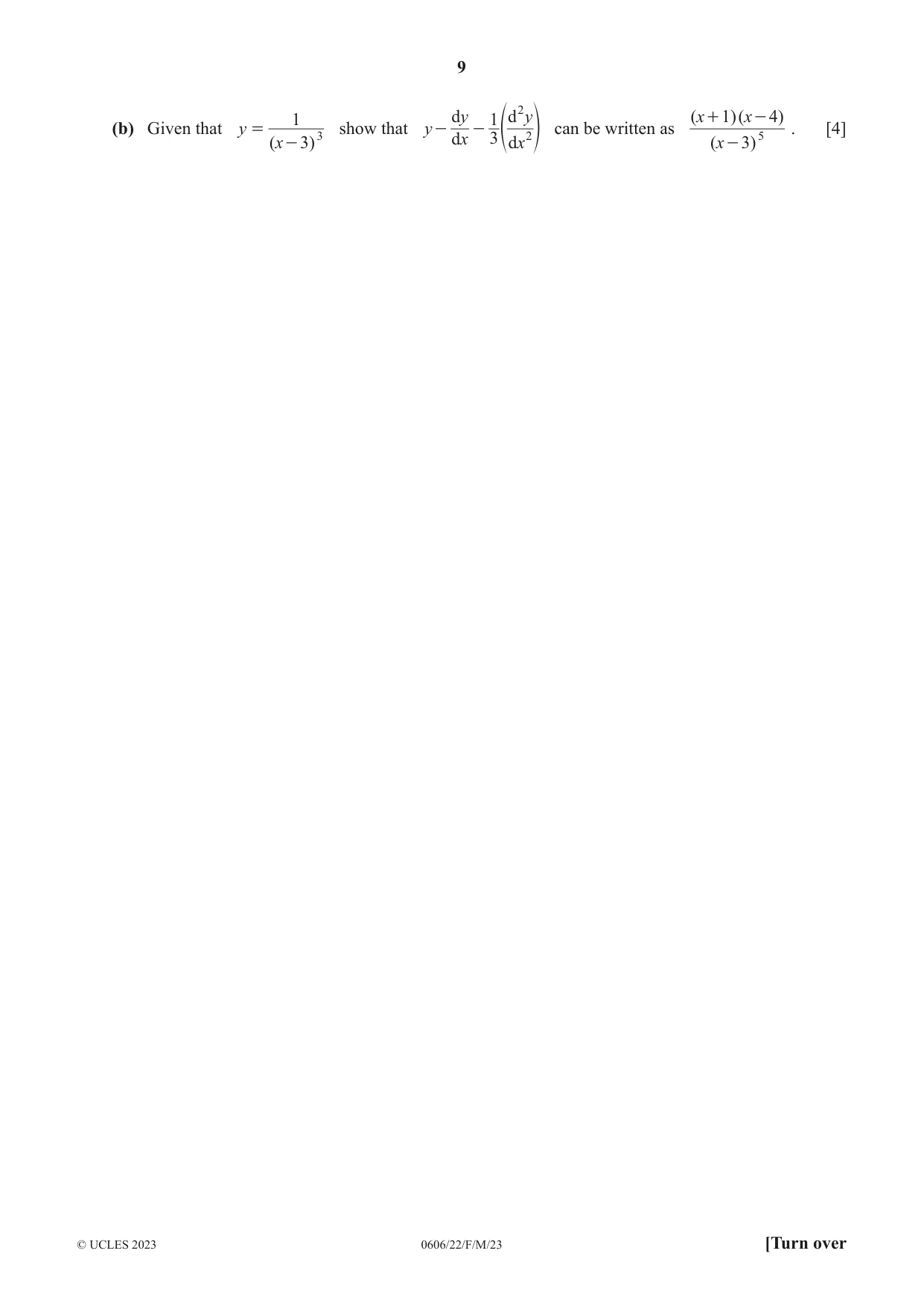
7 (a) Variables x and y are such that y = . Use differentiation to find the approximate tan x r r change in y as x increases from to + h , where h is small. [5] 4 4 2 1 d y 1 d y ( x + 1)( x - 4)(b) Given that y = 3 show that y - - 2 can be written as 5 . [4] ( x - 3) dx 3 f d x p ( x - 3)
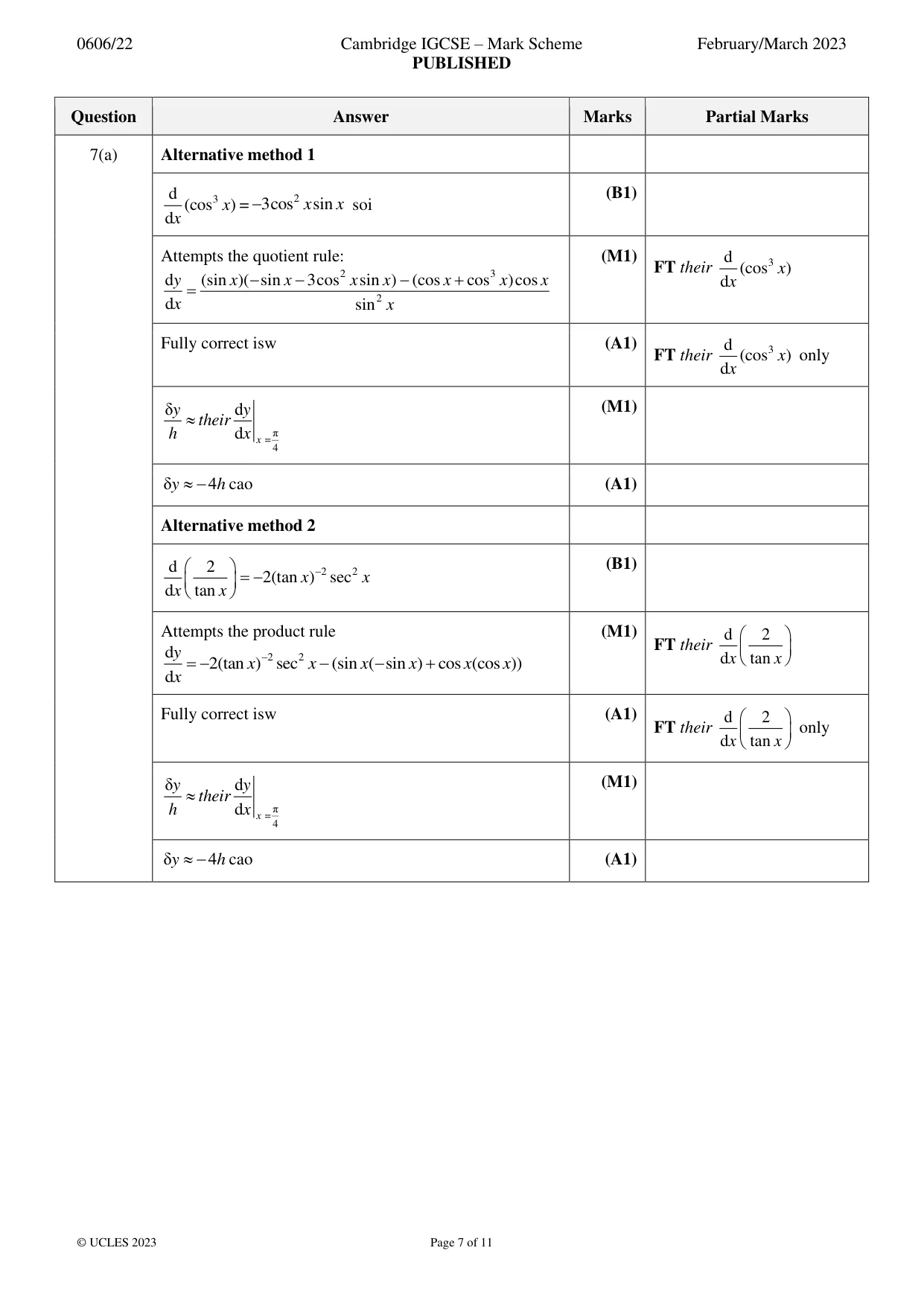
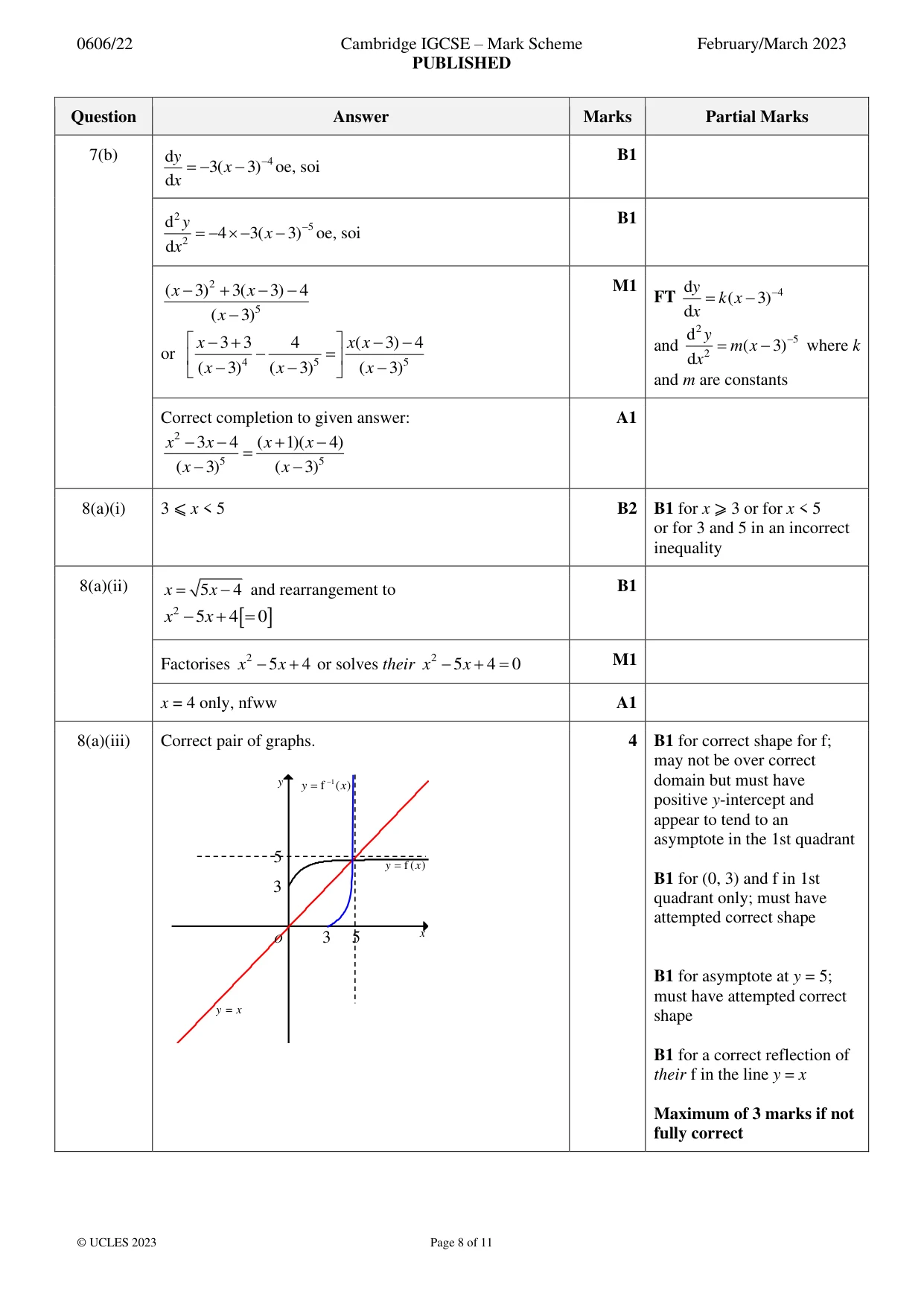
Mark scheme: 7(a) d 2 B1 (cos x ) = −2cos x sin x soi dx Attempts the quotient rule M1 d 2 2 2 FT their (cos x ) dy −2cos x sin x tan x − (1 + cos x )sec x dx = dx tan 2 x Fully correct isw A1 d 2 FT their (cos x ) only dx δy dy M1 their h dx x = π 4 δy − 4 h cao A1 7(a) Alternative method 1 d 3 2 (B1) (cos x ) = −3cos x sin x soi dx Attempts the quotient rule: (M1) d 3 2 3 FT their (cos x ) dy (sin x )( − sin x − 3cos x sin x ) − (cos x + cos x )cos x dx = dx sin 2 x Fully correct isw (A1) d 3 FT their (cos x ) only dx δy dy (M1) their h dx x = π 4 δy − 4 h cao (A1) Alternative method 2 (B1) d −2 sec 2 x 2 = −2(tan x ) dx tan x Attempts the product rule (M1) d 2 FT their dy d x tan x = −2(tan x ) −2 sec 2 x − (sin x ( − sin x ) + cos x (cos x )) dx Fully correct isw (A1) d 2 FT their only d x tan x δy dy (M1) their h dx x = π 4 δy − 4 h cao (A1) 7(b) dy −4 B1 = −3( x − 3) oe, soi dx d 2 y −5 B1 = −−4 3( x − 3) oe, soi dx 2 ( x − 3) 2 + 3( x − 3) − 4 M1 dy −4 FT = k ( x − 3) ( x − 3) 5 dx d 2 y −5 x −+3 3 4 x ( x − 3) − 4 and = m ( x − 3) where k 2 or 4 − 5 = 5 dx ( x − 3) ( x − 3) ( x − 3) and m are constants Correct completion to given answer: A1 x 2 − 3 x − 4 ( x + 1)( x − 4) = ( x − 3)5 ( x − 3)5
More questions on Apply differentiation to connected rates of
Q8 · The function f is defined for x H 0 by f ( x) = 5 - 2e -x
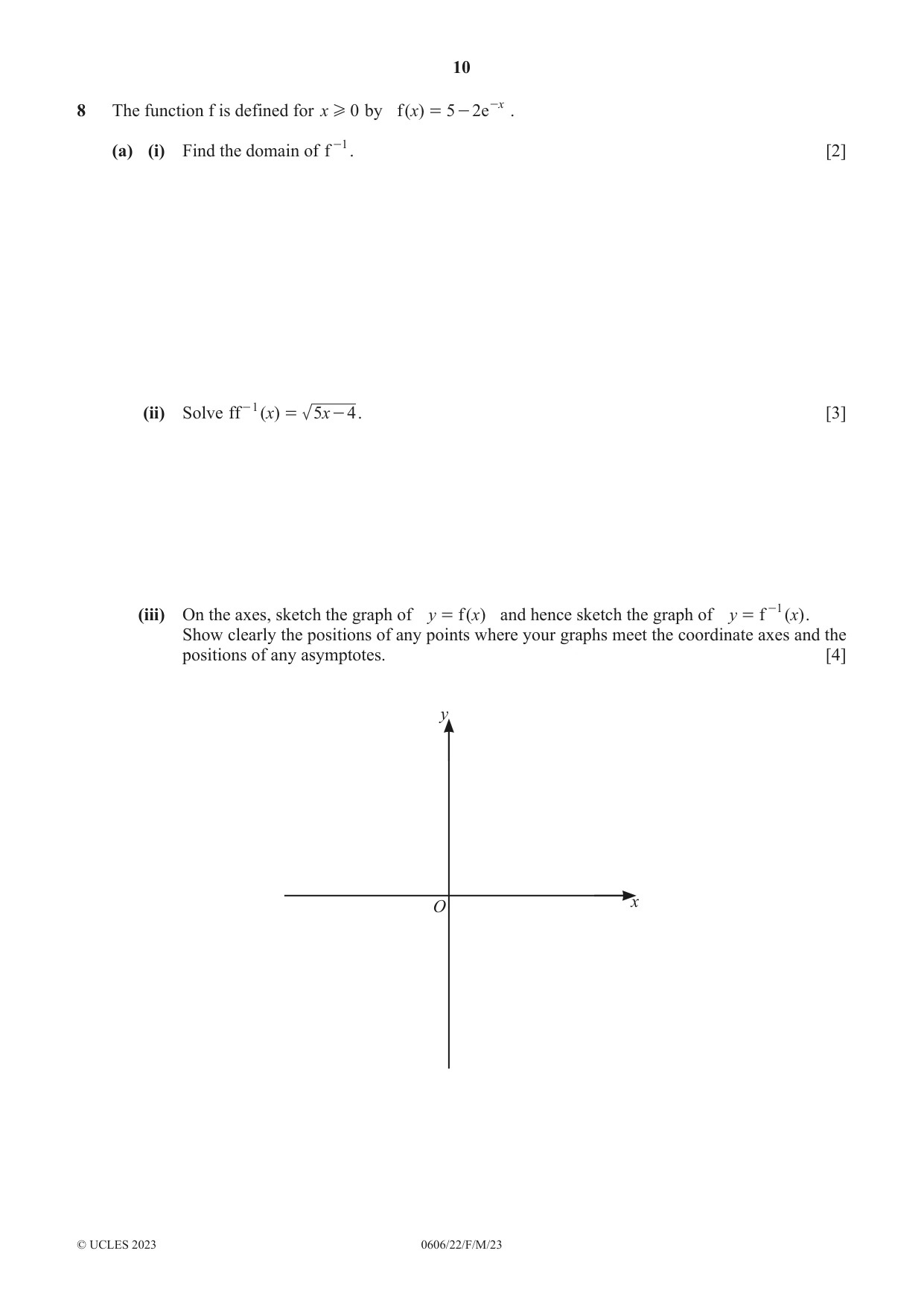
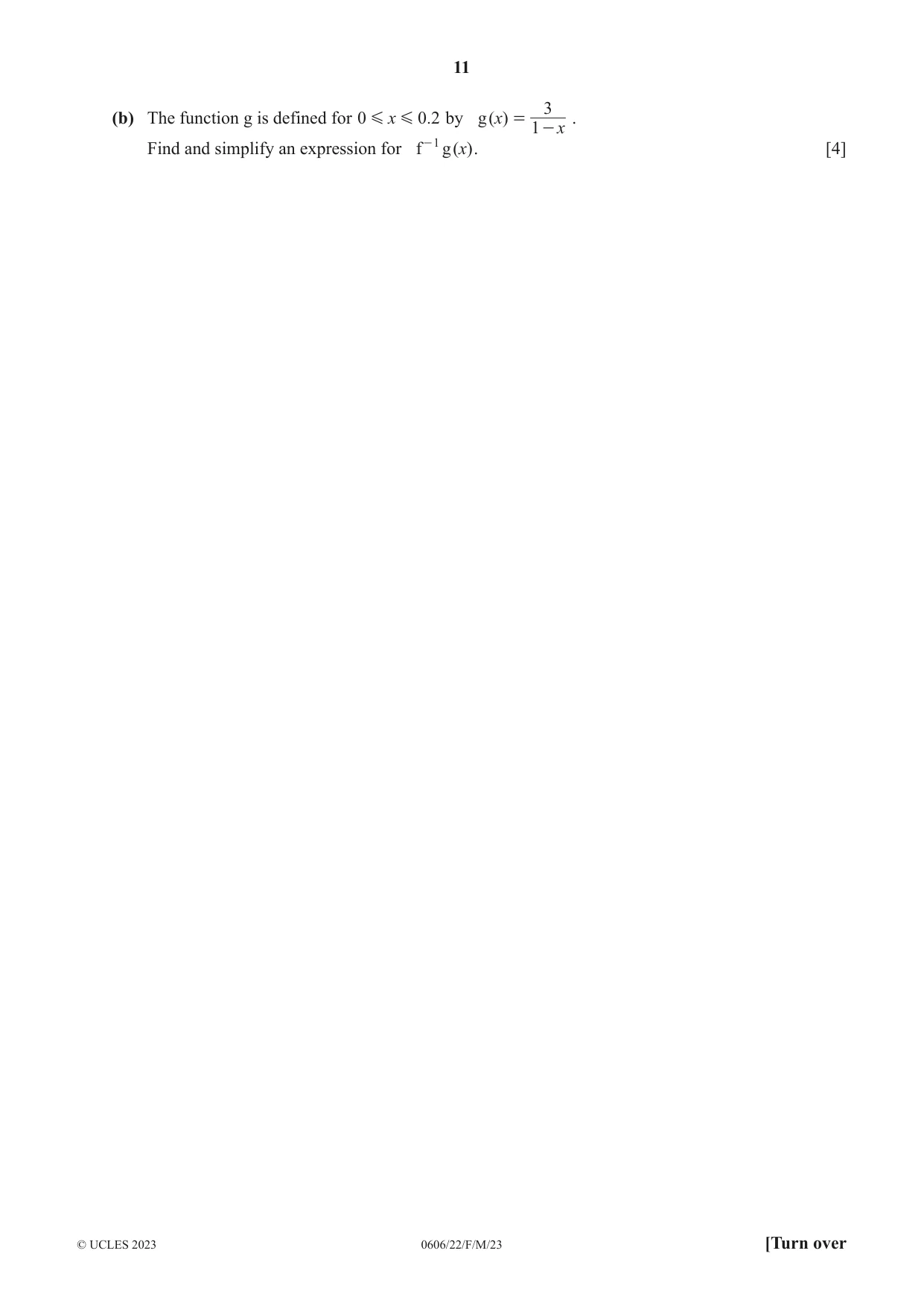
8 The function f is defined for x H 0 by f ( x) = 5 - 2e -x . (a) (i) Find the domain of f -1 . [2] (ii) Solve ff - 1 ( x) = 5 x - 4 . [3] (iii) On the axes, sketch the graph of y = f ( x) and hence sketch the graph of y = f -1 ( x) . Show clearly the positions of any points where your graphs meet the coordinate axes and the positions of any asymptotes. [4] y x O 3(b) The function g is defined for 0 G x G 0.2 by g ( x) = . 1 - x Find and simplify an expression for f - 1 g ( x) . [4]
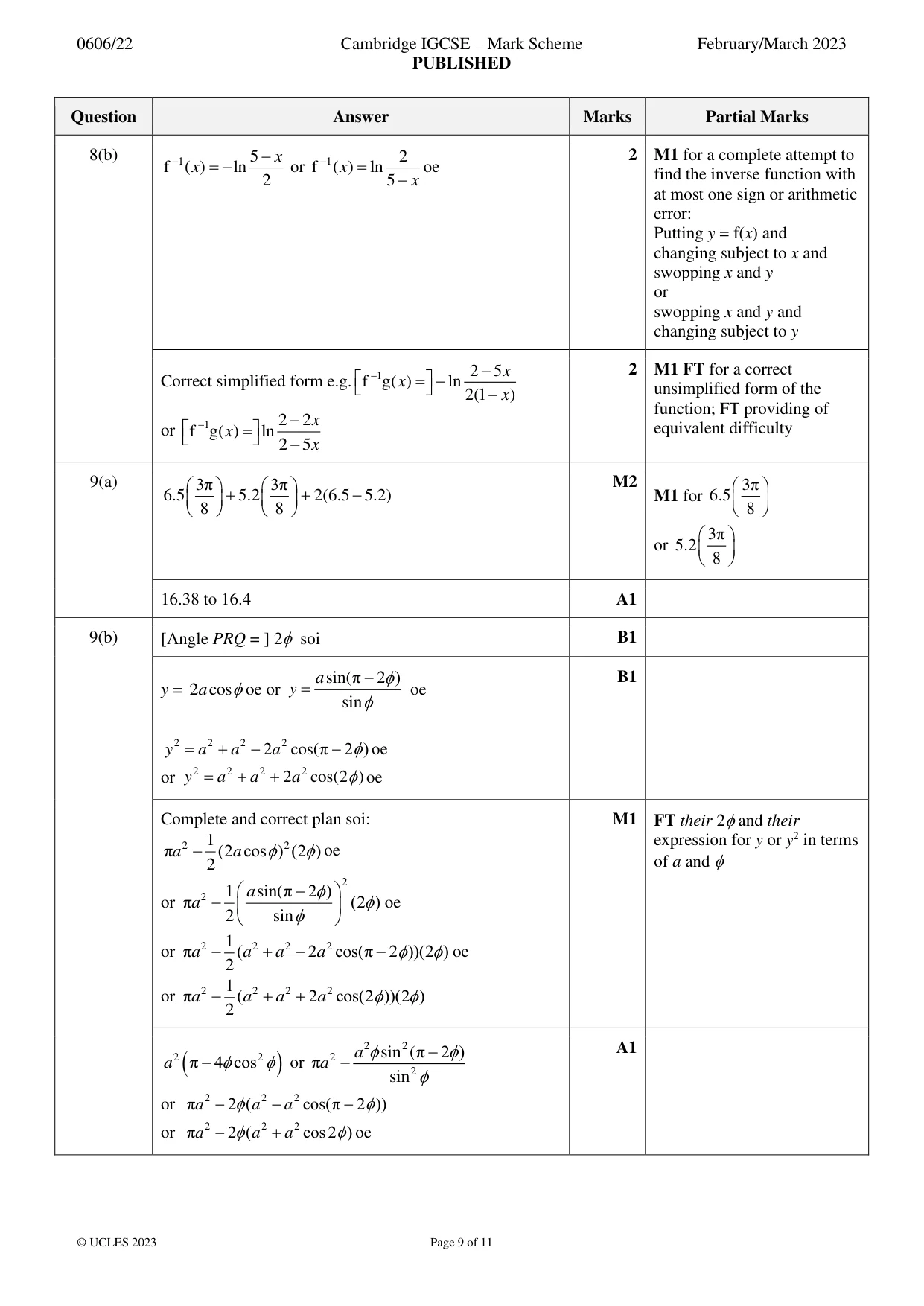
Mark scheme: 8(a)(i) 3 ⩽ x < 5 B2 B1 for x ⩾ 3 or for x < 5 or for 3 and 5 in an incorrect inequality 8(a)(ii) x = 5 x − 4 and rearrangement to B1 x 2 − 5 x + 4 = 0 Factorises x 2 − 5 x + 4 or solves their x 2 − 5 x + 4 = 0 M1 x = 4 only, nfww A1 8(a)(iii) Correct pair of graphs. 4 B1 for correct shape for f; may not be over correct y y = f − 1 ( x ) domain but must have positive y-intercept and appear to tend to an asymptote in the 1st quadrant 5 y = f ( x ) B1 for (0, 3) and f in 1st 3 quadrant only; must have attempted correct shape x O 3 5 B1 for asymptote at y = 5; must have attempted correct y = x shape B1 for a correct reflection of their f in the line y = x Maximum of 3 marks if not fully correct 8(b) −1 5 − x −1 2 2 M1 for a complete attempt to f ( x ) = − ln or f ( x ) = ln oe find the inverse function with 2 5 − x at most one sign or arithmetic error: Putting y = f(x) and changing subject to x and swopping x and y or swopping x and y and changing subject to y −1 2 − 5 x 2 M1 FT for a correct Correct simplified form e.g. f g( x ) = − ln unsimplified form of the 2(1 − x ) function; FT providing of −1 2 − 2 x or f g( x ) = ln equivalent difficulty 2 − 5 x
Q9 · In this question, all lengths are in centimetres and all angles are in radians
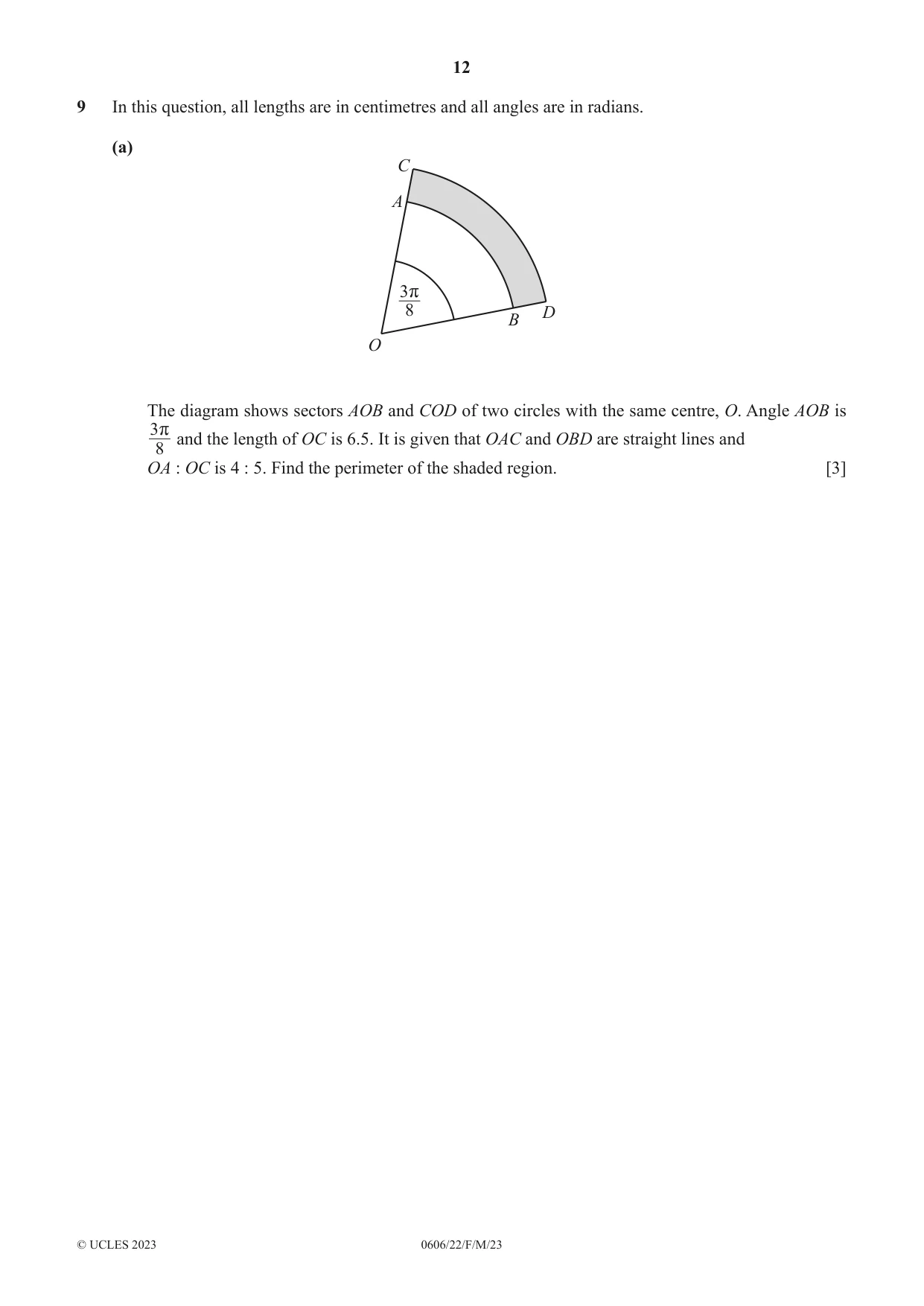
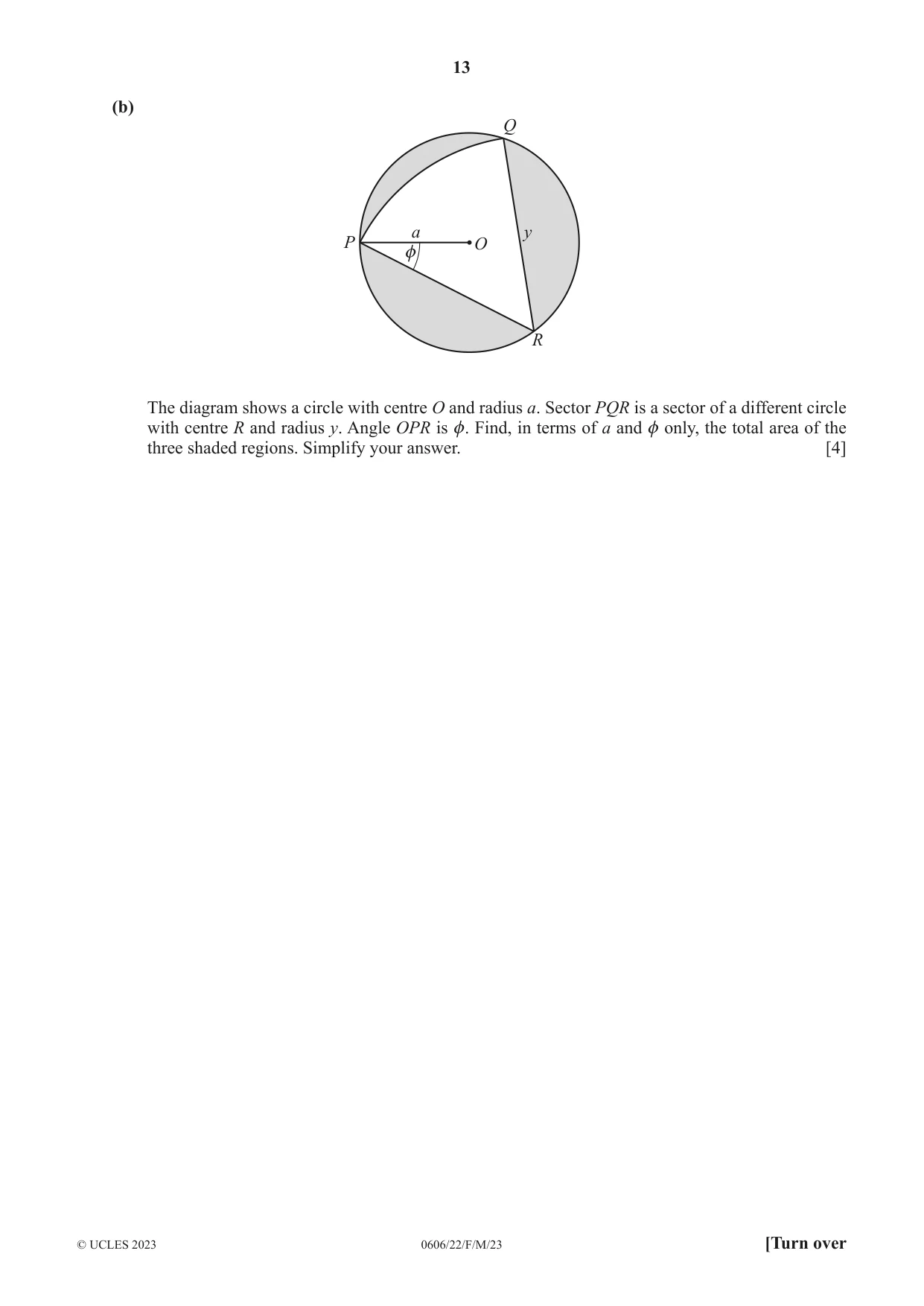
9 In this question, all lengths are in centimetres and all angles are in radians. (a) C A 3r 8 D B O The diagram shows sectors AOB and COD of two circles with the same centre, O. Angle AOB is 3 r and the length of OC is 6.5. It is given that OAC and OBD are straight lines and 8 OA : OC is 4 : 5. Find the perimeter of the shaded region. [3] (b) Q a y P O z R The diagram shows a circle with centre O and radius a. Sector PQR is a sector of a different circle with centre R and radius y. Angle OPR is z. Find, in terms of a and z only, the total area of the three shaded regions. Simplify your answer. [4]
Mark scheme: 9(a) 3π 3π M2 3π 6.5 + 5.2 + 2(6.5 − 5.2) M1 for 6.5 8 8 8 3π or 5.2 8 16.38 to 16.4 A1 9(b) [Angle PRQ = ] 2 soi B1 a sin(π − 2) B1 y = 2a cosoe or y = oe sin y 2 = a 2 + a 2 − 2 a 2 cos(π − 2) oe or y 2 = a 2 + a 2 + 2 a 2 cos(2) oe Complete and correct plan soi: M1 FT their 2and their 2 1 2 expression for y or y2 in terms πa − (2 a cos) (2) oe 2 of a and 2 1 a sin(π − 2) 2 or πa − (2) oe 2 sin 2 1 2 2 2 or πa − ( a + a − 2a cos(π − 2))(2) oe 2 2 1 2 2 2 or πa − ( a + a + 2a cos(2))(2) 2 2sin 2 (π − 2) A1 2 2 2 a π − 4cos or πa −a ( ) sin 2 or πa 2 − 2( a 2 − a 2 cos(π − 2)) or πa 2 − 2( a 2 + a 2 cos2) oe
More questions on Solve problems involving the arc length and
Q10 · A particle P moves in a straight line such that, t seconds after passing a fixed point O…
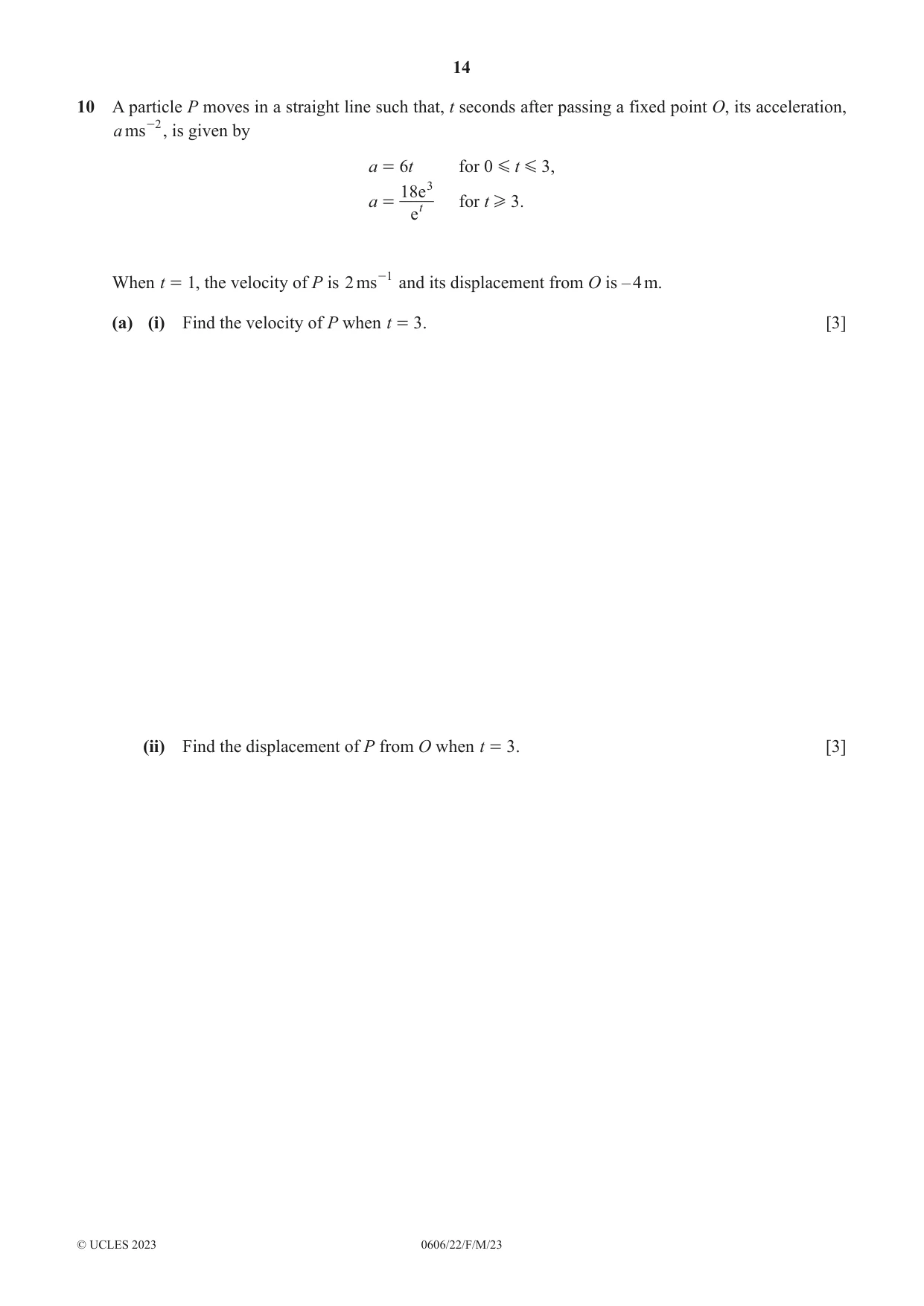
10 A particle P moves in a straight line such that, t seconds after passing a fixed point O, its acceleration, a ms -2 , is given by a = 6t for 0 G t G 3, 18e 3 a = t for t H 3. e When t = 1, the velocity of P is 2 ms -1 and its displacement from O is – 4 m. (a) (i) Find the velocity of P when t = 3 . [3] (ii) Find the displacement of P from O when t = 3 . [3] (b) Find an expression in terms of t for the displacement of P from O when t H 3 . [4] Question 11 is printed on the next page.
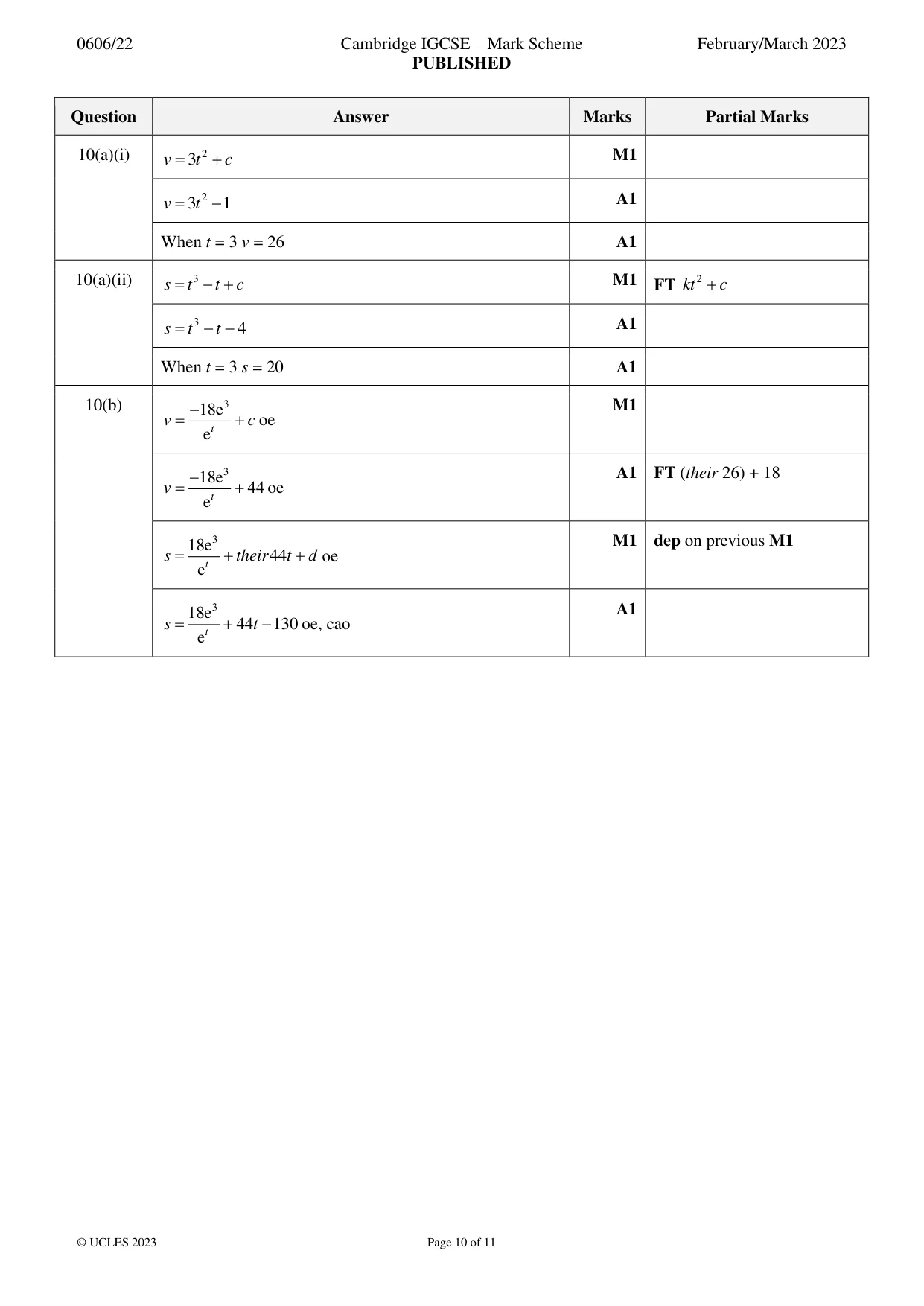
Mark scheme: 10(a)(i) v = 3t 2 + c M1 v = 3t 2 − 1 A1 When t = 3 v = 26 A1 10(a)(ii) s = t 3 −+t c M1 FT kt 2 + c s = t 3 −−t 4 A1 When t = 3 s = 20 A1 10(b) −18e 3 M1 v = + c oe e t −18e 3 A1 FT (their 26) + 18 v = + 44 oe e t 18e 3 M1 dep on previous M1 s = + their 44t + d oe e t 18e 3 A1 s = + 44t − 130 oe, cao e t
Q11 · The normal to the curve y = sin ( 4 x - r ) at the point A(a, 0), where r 1 a 1 r , meets…
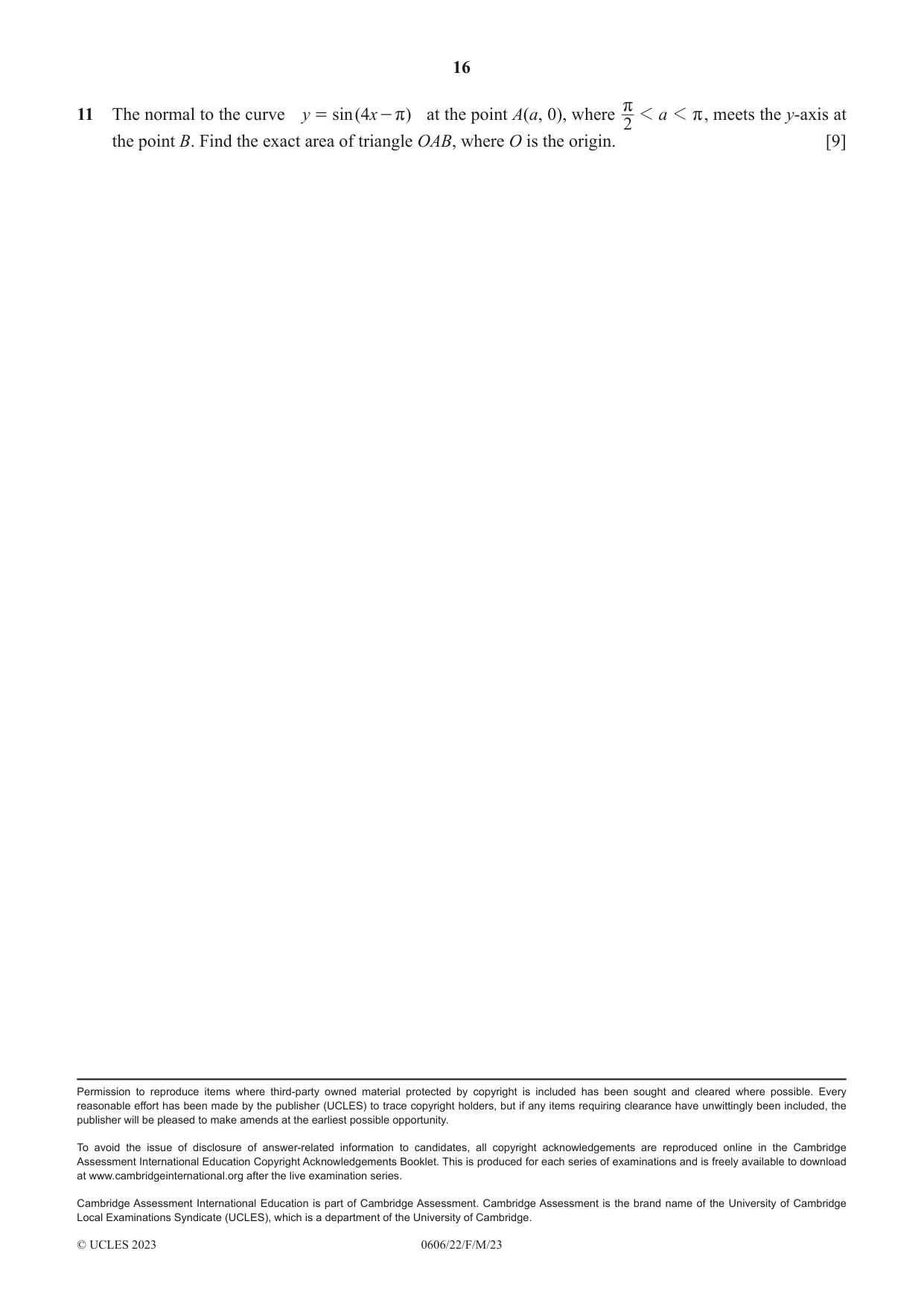
11 The normal to the curve y = sin ( 4 x - r ) at the point A(a, 0), where r 1 a 1 r , meets the y-axis at 2 the point B. Find the exact area of triangle OAB, where O is the origin. [9]
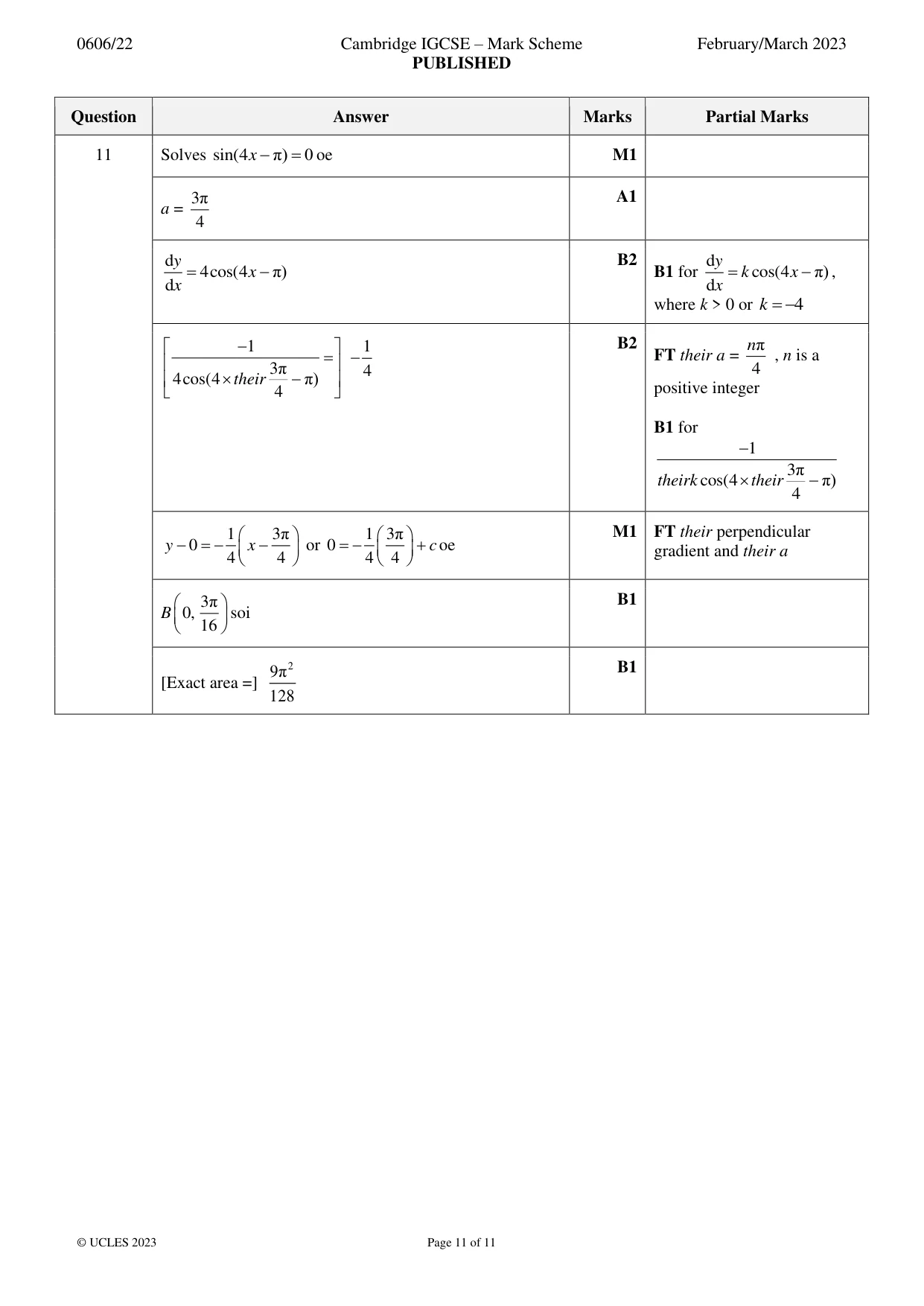
Mark scheme: 11 Solves sin(4 x − π) = 0 oe M1 3π A1 a = 4 dy B2 dy = 4cos(4 x − π) B1 for = k cos(4 x − π) , dx dx where k > 0 or k = −4 −1 1 B2 nπ = − FT their a = , n is a 3π 4 4 4cos(4 their − π) 4 positive integer B1 for −1 3π theirk cos(4 their − π) 4 1 3π 1 3π M1 FT their perpendicular y − 0 = − x − or 0 = − + coe gradient and their a 4 4 4 4 3π B1 B 0, soi 16 9π 2 B1 [Exact area =] 128
More questions on Use differentiation to find gradients, tangents
What was in this paper
The subtopics covered by these 11 questions, and how many questions each got. Open one in a new tab to see every Cambridge question on it.
1Apply differentiation to connected rates of1Draw and use the graphs of1Evaluate definite integrals and apply1Find factors of polynomials1Find the domain and range of functions1Solve graphically or algebraically inequalities1Solve problems involving the arc length and1Use differentiation to find gradients, tangents1Use the binomial theorem for expansion of1Use the formulas for the nth term and for the1What you needed in this session
Cambridge’s own grade thresholds for 2023 Feb/March, Paper 2 · Variant 2. A higher threshold means an easier paper — the bar moves with how the cohort did.