Questions as text
Q1 · Three metals, X, Y and Z, were reacted with water 0971/11 May/June 2018
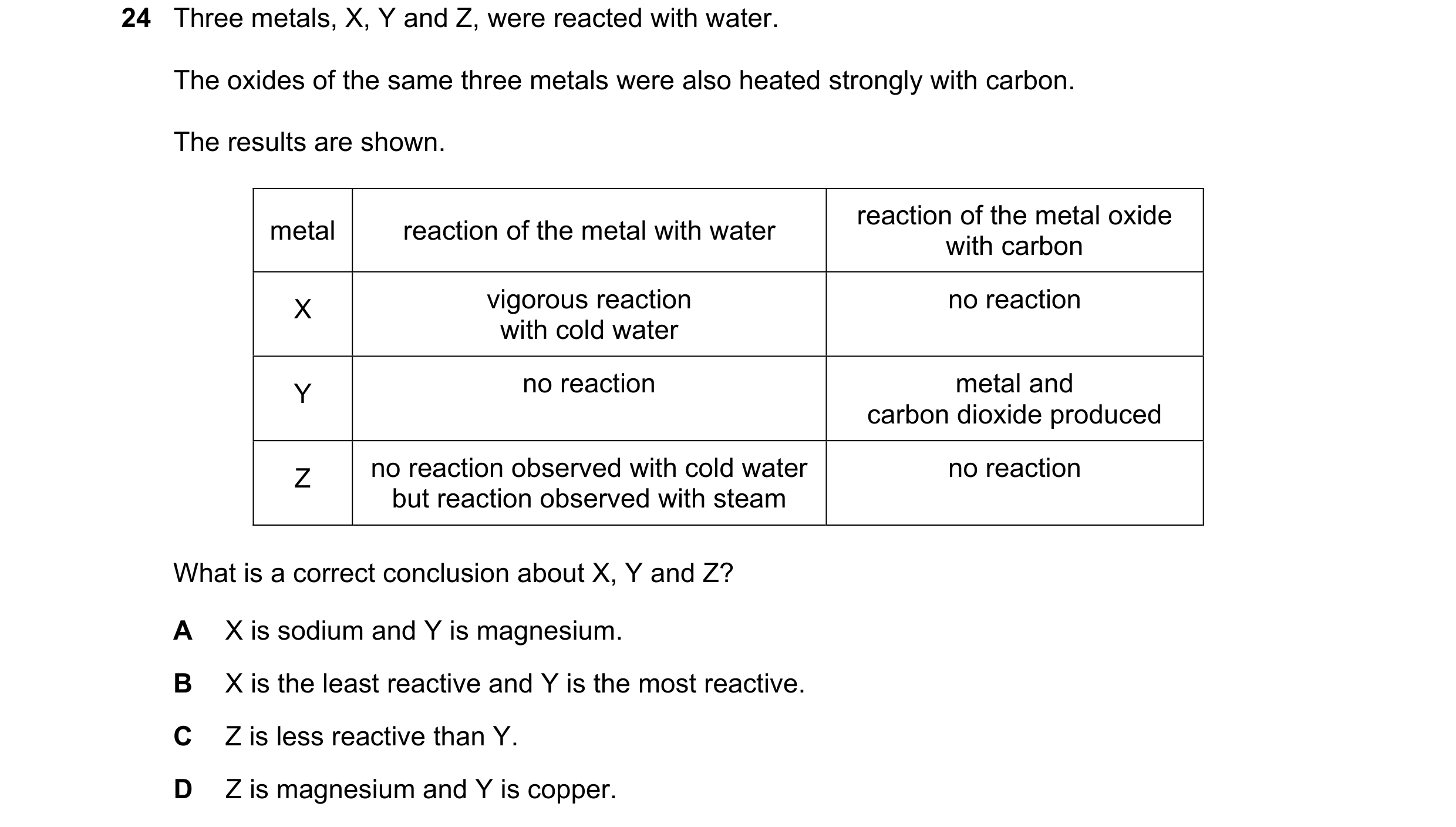
24 Three metals, X, Y and Z, were reacted with water. The oxides of the same three metals were also heated strongly with carbon. The results are shown. reaction of the metal oxide metal reaction of the metal with water with carbon X vigorous reaction no reaction with cold water Y no reaction metal and carbon dioxide produced Z no reaction observed with cold water no reaction but reaction observed with steam What is a correct conclusion about X, Y and Z? A X is sodium and Y is magnesium. B X is the least reactive and Y is the most reactive. C Z is less reactive than Y. D Z is magnesium and Y is copper.
1 marks
Answer: D
This question in 0971/11 May/June 2018
Q2 · In a blast furnace, iron ore is mixed with coke and limestone, and heated in hot air 0971/11 May/June 2018
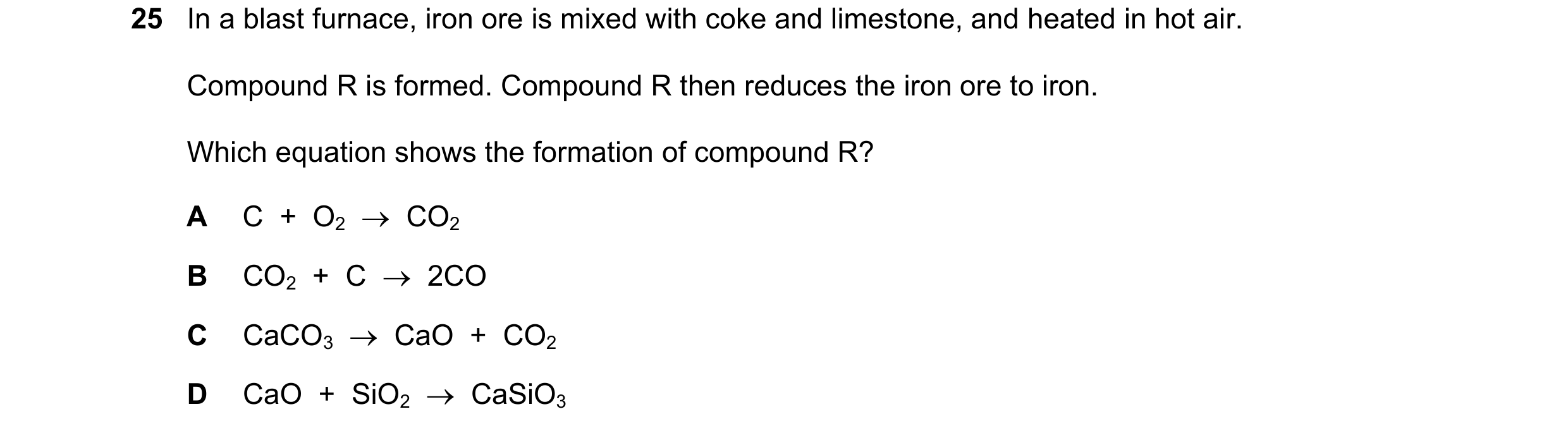
25 In a blast furnace, iron ore is mixed with coke and limestone, and heated in hot air. Compound R is formed. Compound R then reduces the iron ore to iron. Which equation shows the formation of compound R? A C + O2 → CO2 B CO2 + C → 2CO C CaCO3 → CaO + CO2 D CaO + SiO2 → CaSiO3
1 marks
Answer: B
This question in 0971/11 May/June 2018
Q3 · Iron is extracted from its ore in a blast furnace 0971/11 May/June 2019
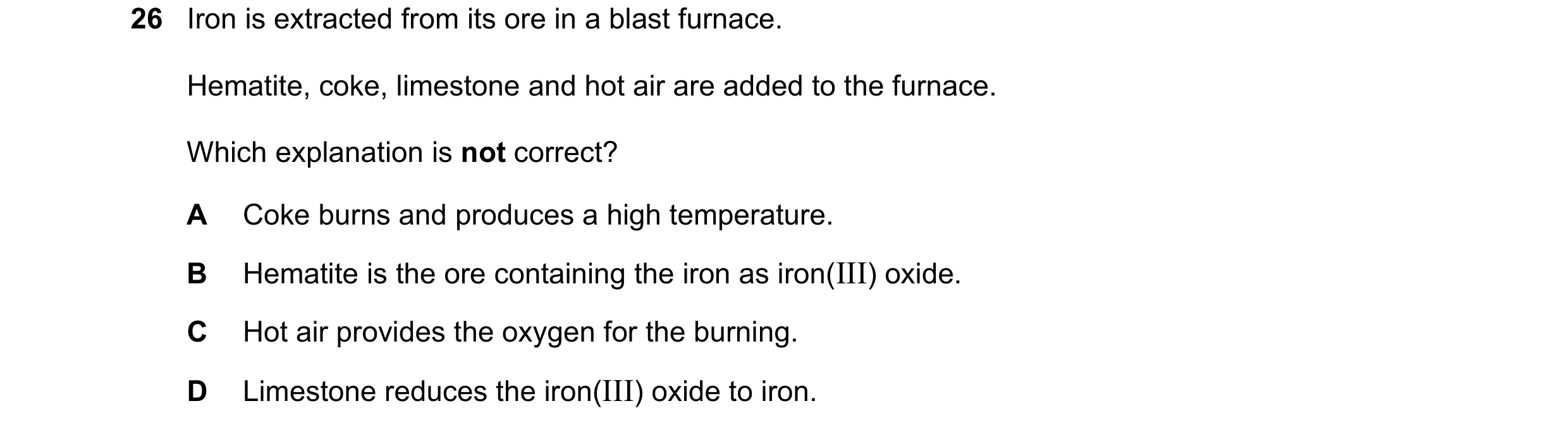
26 Iron is extracted from its ore in a blast furnace. Hematite, coke, limestone and hot air are added to the furnace. Which explanation is not correct? A Coke burns and produces a high temperature. B Hematite is the ore containing the iron as iron(III) oxide. C Hot air provides the oxygen for the burning. D Limestone reduces the iron(III) oxide to iron.
1 marks
Answer: D
This question in 0971/11 May/June 2019
Q4 · What is added to molten iron to make steel? 0971/12 Oct/Nov 2019
26 What is added to molten iron to make steel? A small amounts of carbon B limestone and coke C calcium oxide and oxygen D hematite and air
1 marks
Answer: C
This question in 0971/12 Oct/Nov 2019
Q5 · Molten iron from the blast furnace contains impurities 0971/11 May/June 2020
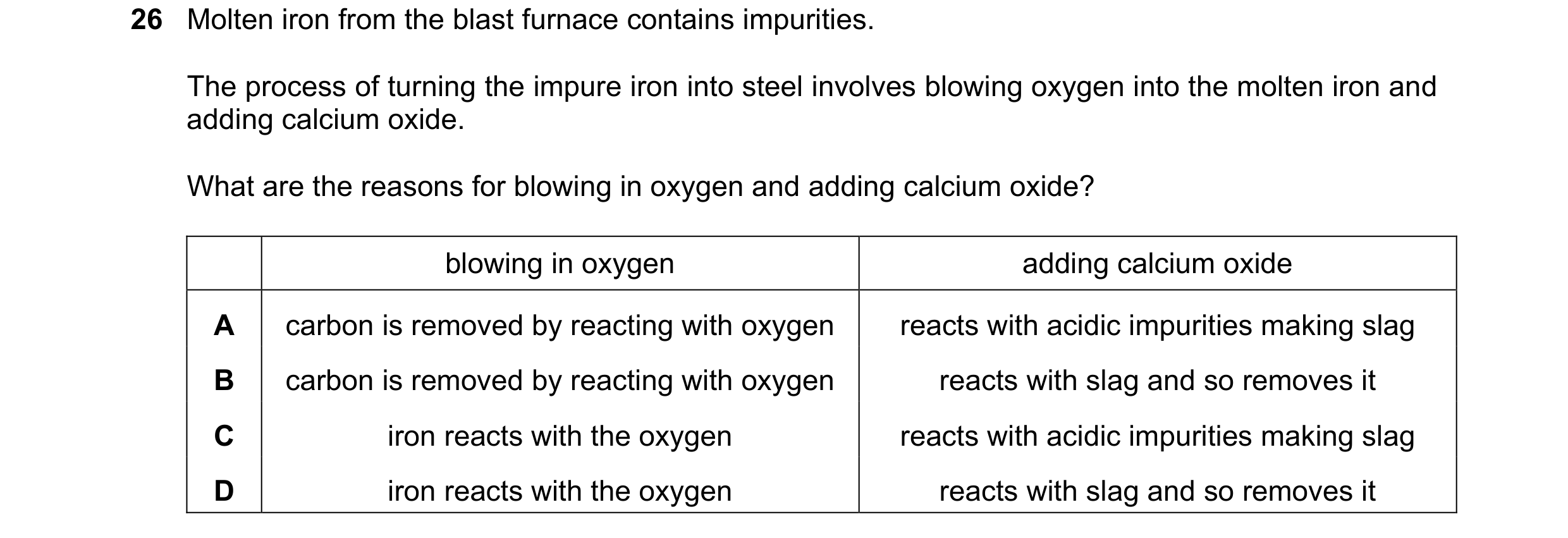
26 Molten iron from the blast furnace contains impurities. The process of turning the impure iron into steel involves blowing oxygen into the molten iron and adding calcium oxide. What are the reasons for blowing in oxygen and adding calcium oxide? blowing in oxygen adding calcium oxide A carbon is removed by reacting with oxygen reacts with acidic impurities making slag B carbon is removed by reacting with oxygen reacts with slag and so removes it C iron reacts with the oxygen reacts with acidic impurities making slag D iron reacts with the oxygen reacts with slag and so removes it
1 marks
Answer: A
This question in 0971/11 May/June 2020
Q6 · Molten iron from the blast furnace contains impurities 0971/12 May/June 2020
26 Molten iron from the blast furnace contains impurities. The process of turning the impure iron into steel involves blowing oxygen into the molten iron and adding calcium oxide. What are the reasons for blowing in oxygen and adding calcium oxide? blowing in oxygen adding calcium oxide A carbon is removed by reacting with oxygen reacts with acidic impurities making slag B carbon is removed by reacting with oxygen reacts with slag and so removes it C iron reacts with the oxygen reacts with acidic impurities making slag D iron reacts with the oxygen reacts with slag and so removes it
1 marks
Answer: A
This question in 0971/12 May/June 2020
Q7 · A student suggests three uses of calcium carbonate (limestone) 0971/12 May/June 2020
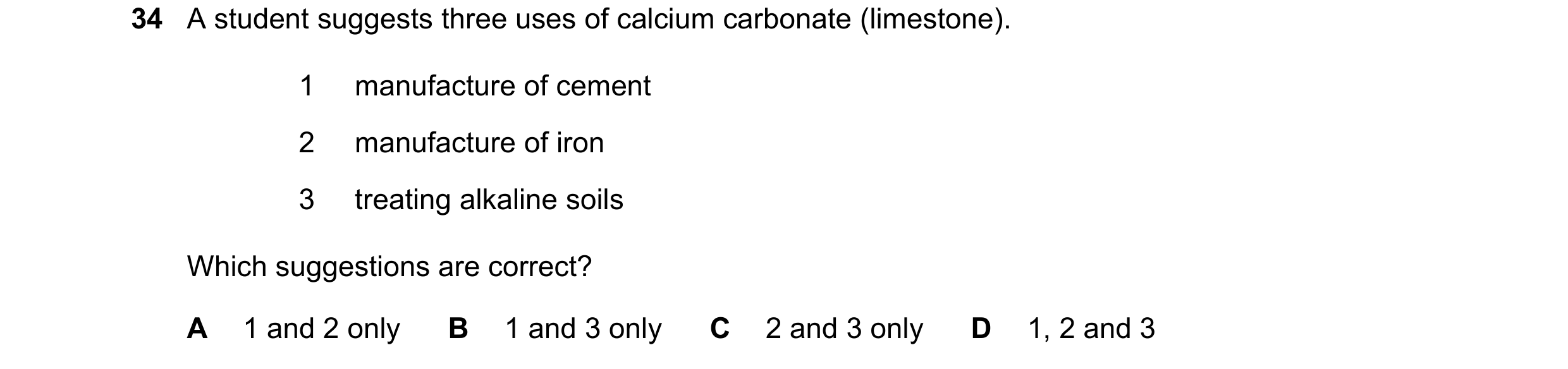
34 A student suggests three uses of calcium carbonate (limestone). 1 manufacture of cement 2 manufacture of iron 3 treating alkaline soils Which suggestions are correct? A 1 and 2 only B 1 and 3 only C 2 and 3 only D 1, 2 and 3
1 marks
Answer: A
This question in 0971/12 May/June 2020
Q8 · Some properties of element Y are listed 0971/12 Oct/Nov 2020
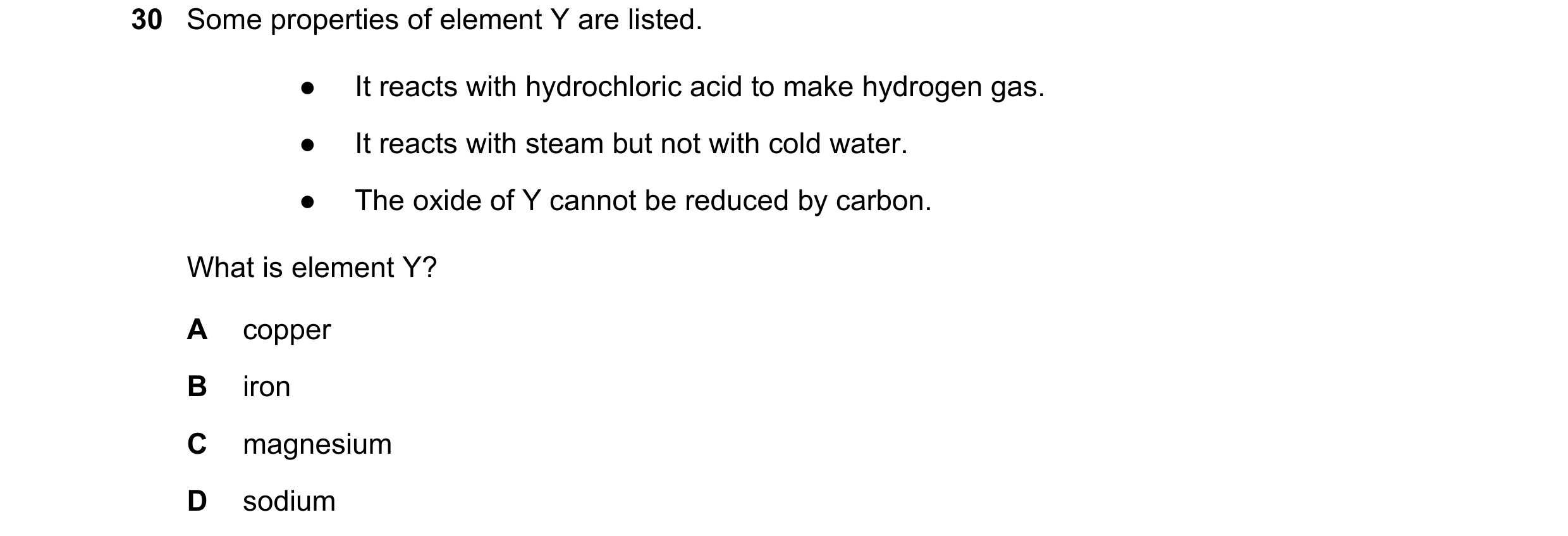
30 Some properties of element Y are listed. ● It reacts with hydrochloric acid to make hydrogen gas. ● It reacts with steam but not with cold water. ● The oxide of Y cannot be reduced by carbon. What is element Y? A copper B iron C magnesium D sodium
1 marks
Answer: C
This question in 0971/12 Oct/Nov 2020
Q9 · Iron from a blast furnace is treated with oxygen and with calcium oxide to make steel 0971/11 May/June 2021
26 Iron from a blast furnace is treated with oxygen and with calcium oxide to make steel. Which substances in the iron are removed? oxygen calcium oxide removes removes A carbon acidic oxides B carbon basic oxides C iron acidic oxides D iron basic oxides
1 marks
Answer: A
This question in 0971/11 May/June 2021
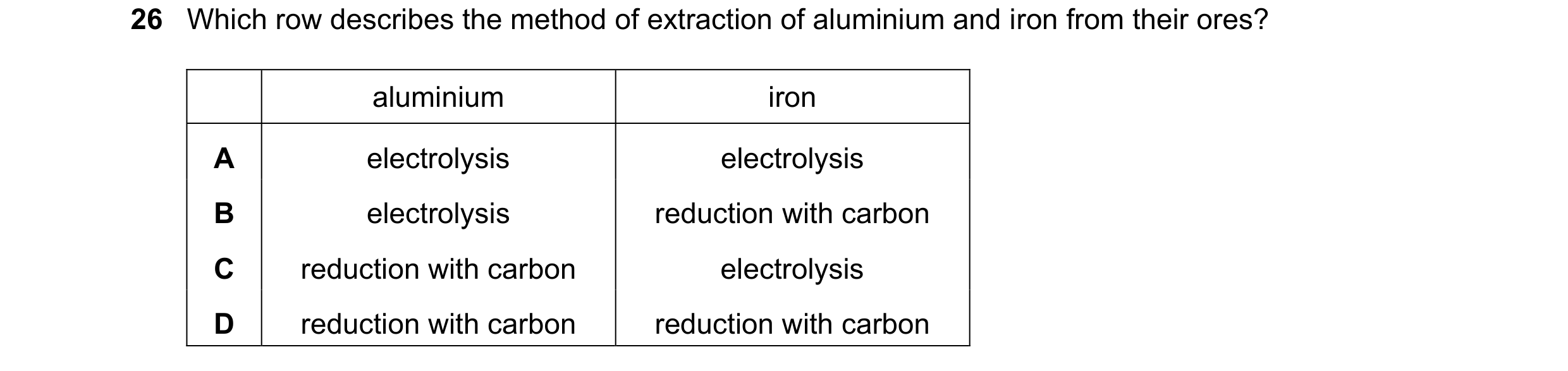
Q10 · Which row describes the method of extraction of aluminium and iron from their ores? 0971/12 Oct/Nov 2021
26 Which row describes the method of extraction of aluminium and iron from their ores? aluminium iron A electrolysis electrolysis B electrolysis reduction with carbon C reduction with carbon electrolysis D reduction with carbon reduction with carbon
1 marks
Answer: B
This question in 0971/12 Oct/Nov 2021
Q11 · Which statement about the reactions in the blast furnace is correct? 0971/11 May/June 2022
29 Which statement about the reactions in the blast furnace is correct? A Carbon reacts with oxygen and heats the furnace. B Carbon monoxide removes the silicon dioxide impurity forming slag. C Iron(III) oxide is oxidised to iron. D Limestone reduces iron(III) oxide to iron.
1 marks
Answer: A
This question in 0971/11 May/June 2022
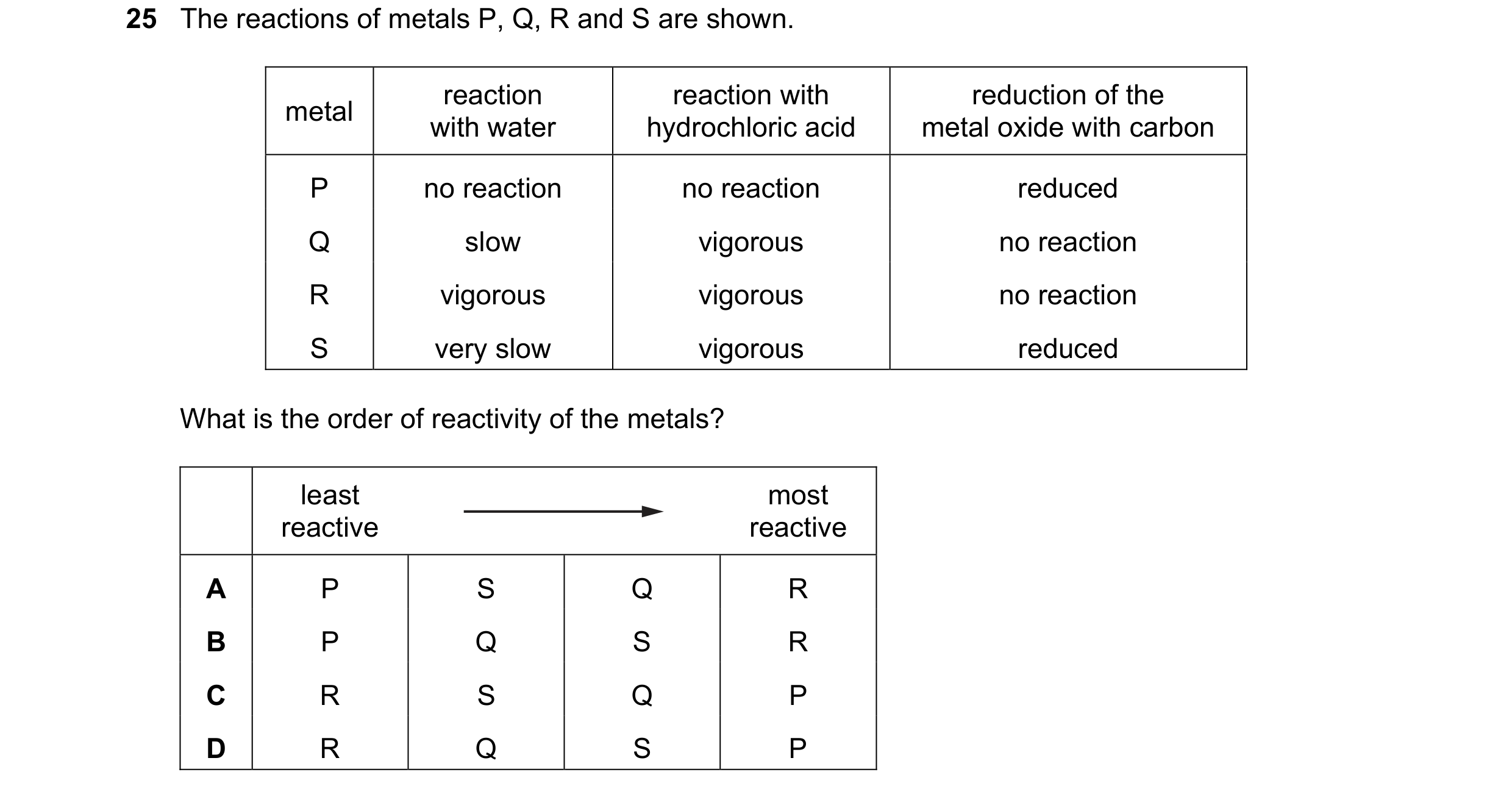
Q12 · The reactions of metals P, Q, R and S are shown 0971/12 May/June 2022
25 The reactions of metals P, Q, R and S are shown. reaction reaction with reduction of the metal with water hydrochloric acid metal oxide with carbon P no reaction no reaction reduced Q slow vigorous no reaction R vigorous vigorous no reaction S very slow vigorous reduced What is the order of reactivity of the metals? least most reactive reactive A P S Q R B P Q S R C R S Q P D R Q S P
1 marks
Answer: A
This question in 0971/12 May/June 2022
Q13 · Iron is extracted from hematite in the blast furnace at a temperature of about 1550 C 0971/12 May/June 2022
26 Iron is extracted from hematite in the blast furnace at a temperature of about 1550 C. Which equation shows the main reaction that increases the temperature in the furnace? A CaCO3 CaO + CO2 B C + O2 CO2 C CO2 + C 2CO D Fe2O3 + 3CO 2Fe + 3CO2
1 marks
Answer: B
This question in 0971/12 May/June 2022
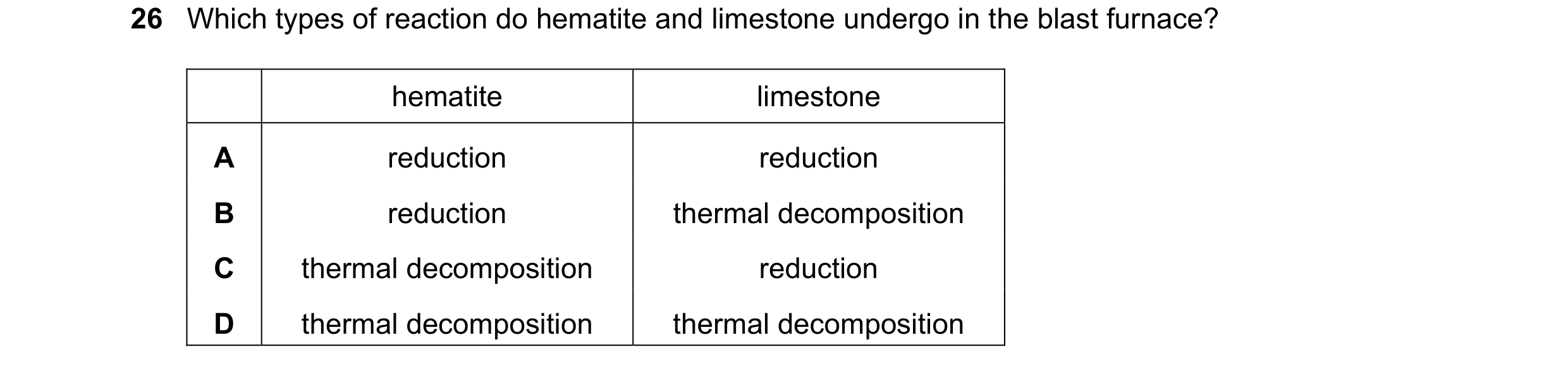
Q14 · Which types of reaction do hematite and limestone undergo in the blast furnace? 0971/12 Oct/Nov 2022
26 Which types of reaction do hematite and limestone undergo in the blast furnace? hematite limestone A reduction reduction B reduction thermal decomposition C thermal decomposition reduction D thermal decomposition thermal decomposition
1 marks
Answer: B
This question in 0971/12 Oct/Nov 2022
Q15 · Part of the reactivity series of metals is shown 0971/11 May/June 2023
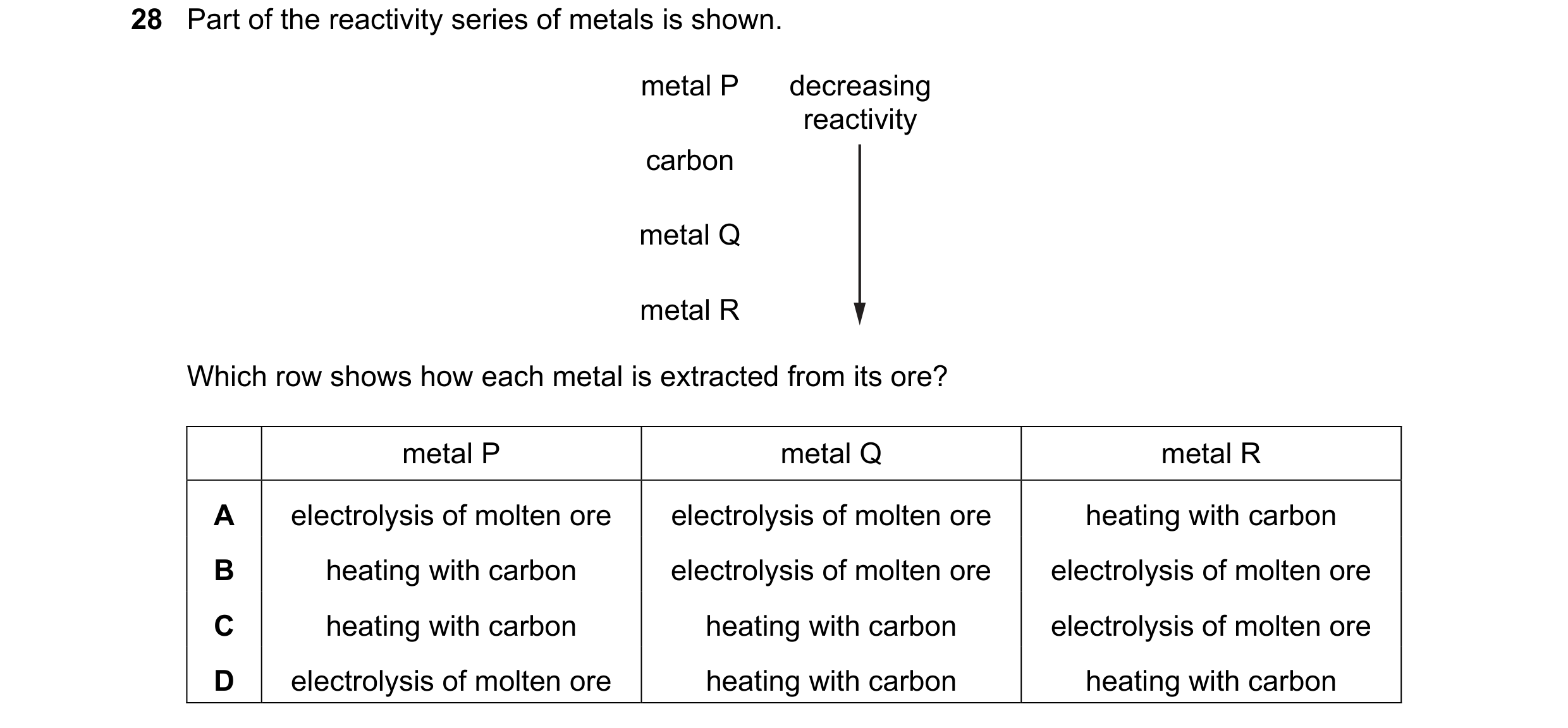
28 Part of the reactivity series of metals is shown. metal P decreasing reactivity carbon metal Q metal R Which row shows how each metal is extracted from its ore? metal P metal Q metal R A electrolysis of molten ore electrolysis of molten ore heating with carbon B heating with carbon electrolysis of molten ore electrolysis of molten ore C heating with carbon heating with carbon electrolysis of molten ore D electrolysis of molten ore heating with carbon heating with carbon
1 marks
Answer: D
This question in 0971/11 May/June 2023
Q16 · The equation for the reaction between iron(III) oxide and carbon is shown 0971/12 May/June 2023
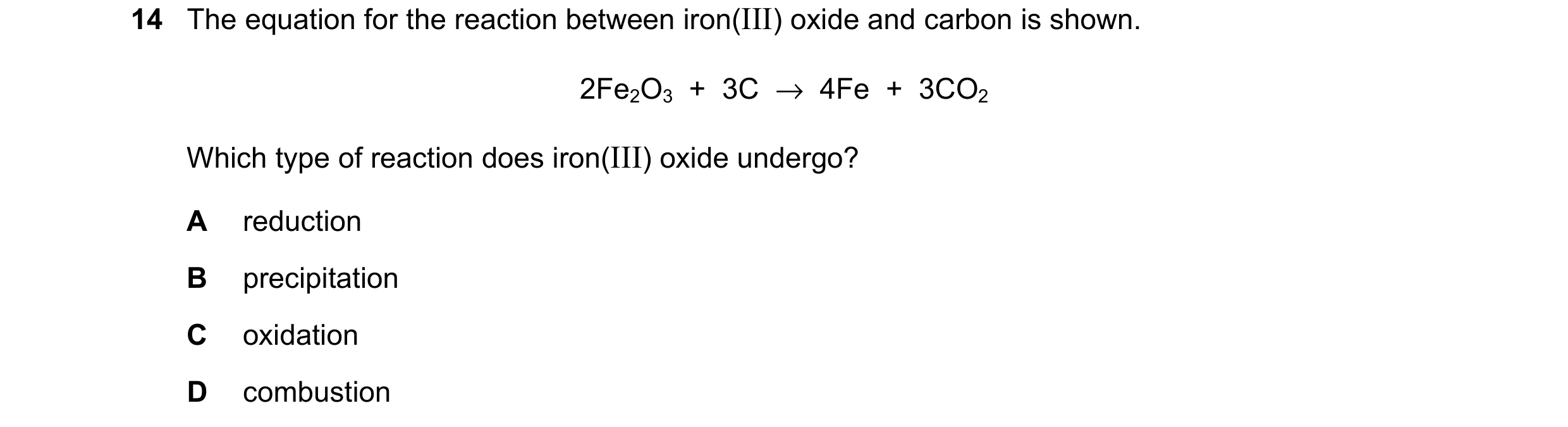
14 The equation for the reaction between iron(III) oxide and carbon is shown. 2Fe2O3 + 3C → 4Fe + 3CO2 Which type of reaction does iron(III) oxide undergo? A reduction B precipitation C oxidation D combustion
1 marks
Answer: A
This question in 0971/12 May/June 2023
Q17 · P, Q, R and S are metals 0971/12 May/June 2023
26 P, Q, R and S are metals. P reacts with dilute hydrochloric acid, forming hydrogen. Q reacts violently with water. R reacts with water to give hydrogen. S is formed by heating its oxide with carbon. Which row identifies the metals? P Q R S A copper sodium potassium iron B zinc magnesium calcium iron C zinc sodium calcium magnesium D iron potassium sodium zinc
1 marks
Answer: D
This question in 0971/12 May/June 2023
Q18 · Which reaction in the blast furnace releases heat energy? 0971/12 May/June 2023
28 Which reaction in the blast furnace releases heat energy? A C + O2 → CO2 B CaCO3 → CaO + CO2 C CO2 + C → 2CO D Fe2O3 + 3CO → 2Fe + 3CO2
1 marks
Answer: A
This question in 0971/12 May/June 2023
Q19 · In a blast furnace, iron(III) oxide is converted to iron and carbon monoxide is converted… 0971/12 Oct/Nov 2023
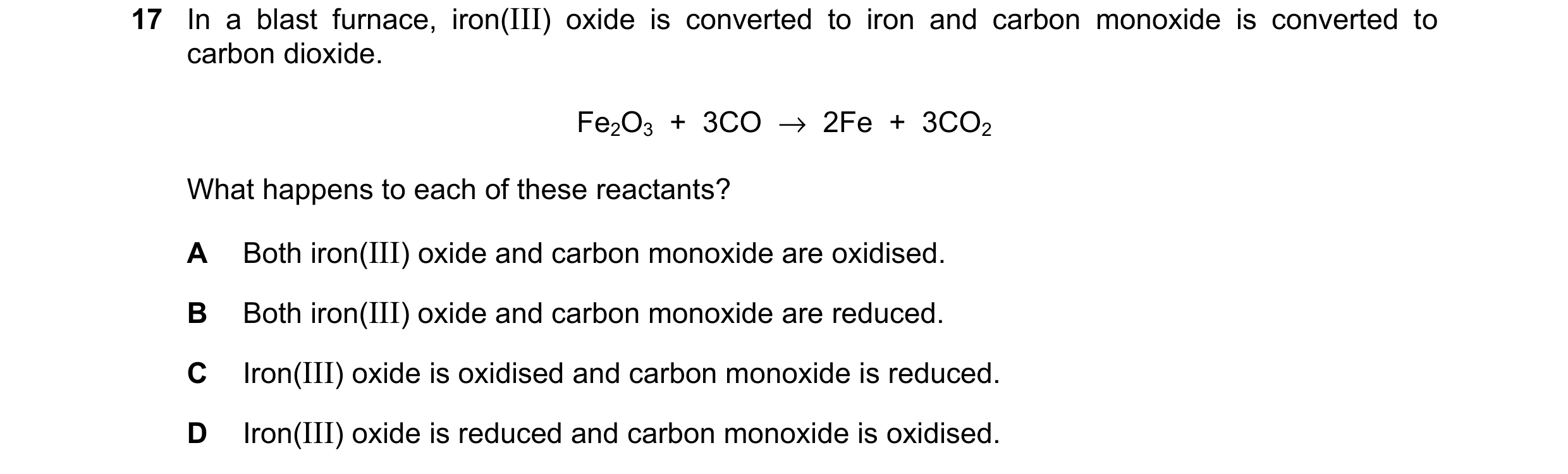
17 In a blast furnace, iron(III) oxide is converted to iron and carbon monoxide is converted to carbon dioxide. Fe2O3 + 3CO → 2Fe + 3CO2 What happens to each of these reactants? A Both iron(III) oxide and carbon monoxide are oxidised. B Both iron(III) oxide and carbon monoxide are reduced. C Iron(III) oxide is oxidised and carbon monoxide is reduced. D Iron(III) oxide is reduced and carbon monoxide is oxidised.
1 marks
Answer: D
This question in 0971/12 Oct/Nov 2023
Q20 · The list gives the order of some metals and hydrogen in the reactivity series 0971/12 Oct/Nov 2023
27 The list gives the order of some metals and hydrogen in the reactivity series. Metal X is also included. most reactive K Mg Zn H X least reactive Cu Which row shows the properties of metal X? reacts with oxide reduced dilute acids by carbon A no no B no yes C yes no D yes yes
1 marks
Answer: B
This question in 0971/12 Oct/Nov 2023
Q21 · Why is limestone added to the blast furnace? 0971/12 Oct/Nov 2023
29 Why is limestone added to the blast furnace? A It neutralises the molten slag produced. B It reacts with impurities to form slag. C It releases carbon dioxide which reduces the iron(III) oxide. D It removes acidic gases such as carbon dioxide.
1 marks
Answer: B
This question in 0971/12 Oct/Nov 2023
Q22 · Which statement about aluminium is correct? 0971/12 May/June 2024
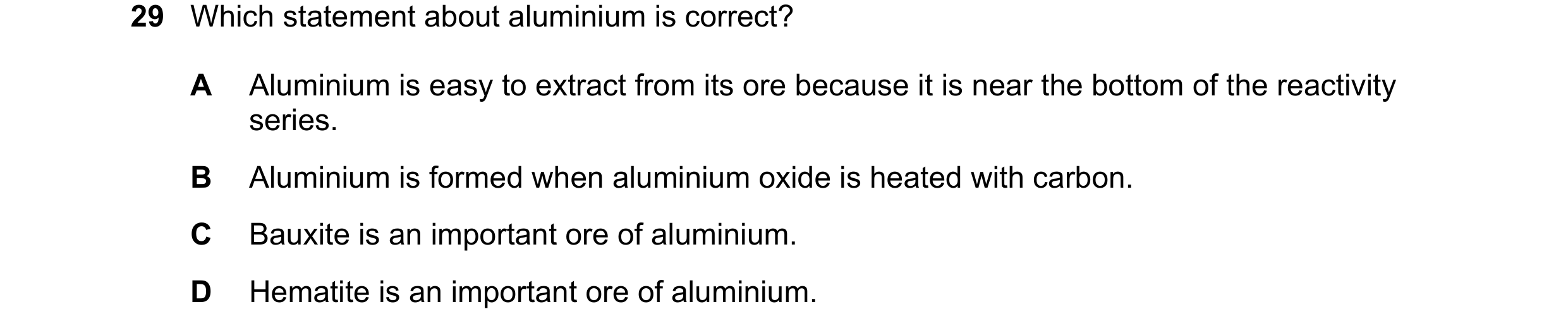
29 Which statement about aluminium is correct? A Aluminium is easy to extract from its ore because it is near the bottom of the reactivity series. B Aluminium is formed when aluminium oxide is heated with carbon. C Bauxite is an important ore of aluminium. D Hematite is an important ore of aluminium.
1 marks
Answer: C
This question in 0971/12 May/June 2024
Q23 · Zinc is formed when zinc oxide is heated with carbon 0971/12 Oct/Nov 2024
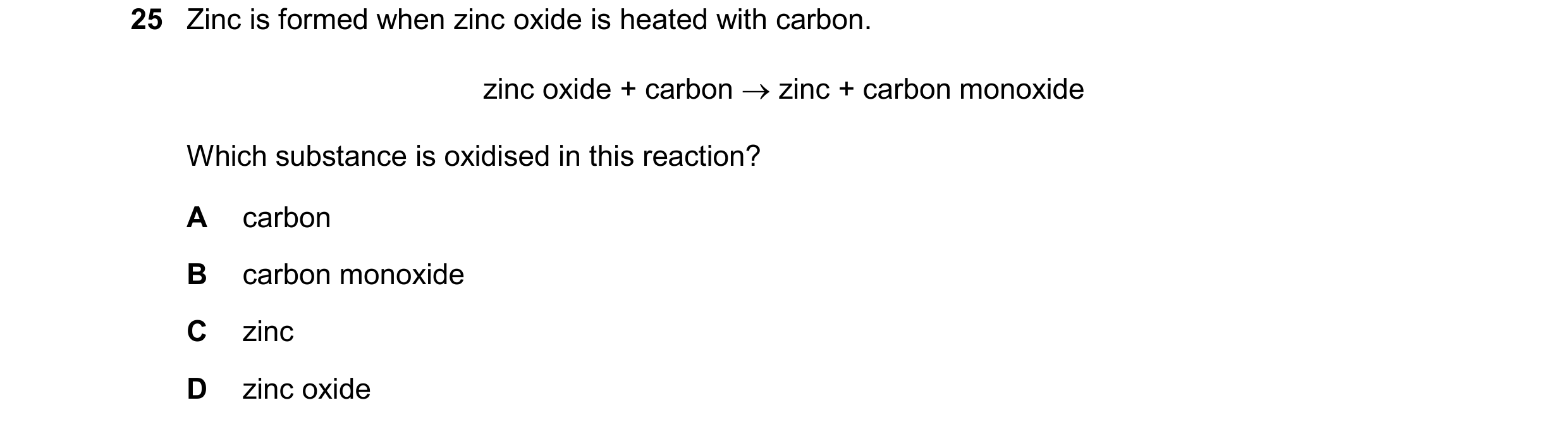
25 Zinc is formed when zinc oxide is heated with carbon. zinc oxide + carbon zinc + carbon monoxide Which substance is oxidised in this reaction? A carbon B carbon monoxide C zinc D zinc oxide
1 marks
Answer: A
This question in 0971/12 Oct/Nov 2024
Q24 · Which statements about aluminium are correct? 0971/11 May/June 2025
27 Which statements about aluminium are correct? 1 It is more reactive than calcium. 2 The main ore of aluminium is bauxite. 3 It can be extracted from its oxide using carbon. 4 Brass is an alloy of aluminium and copper. A 1 and 2 B 1 and 3 C 2 only D 3 and 4
1 marks
Answer: C
This question in 0971/11 May/June 2025
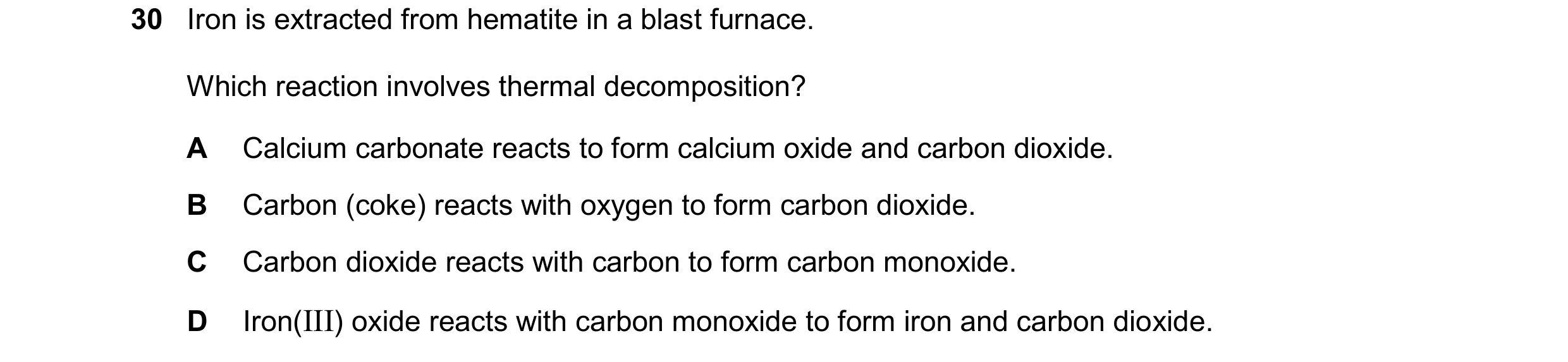
Q25 · Iron is extracted from hematite in a blast furnace 0971/12 Oct/Nov 2025
30 Iron is extracted from hematite in a blast furnace. Which reaction involves thermal decomposition? A Calcium carbonate reacts to form calcium oxide and carbon dioxide. B Carbon (coke) reacts with oxygen to form carbon dioxide. C Carbon dioxide reacts with carbon to form carbon monoxide. D Iron(III) oxide reacts with carbon monoxide to form iron and carbon dioxide.
1 marks
Answer: A
This question in 0971/12 Oct/Nov 2025
 1 / 7
1 / 7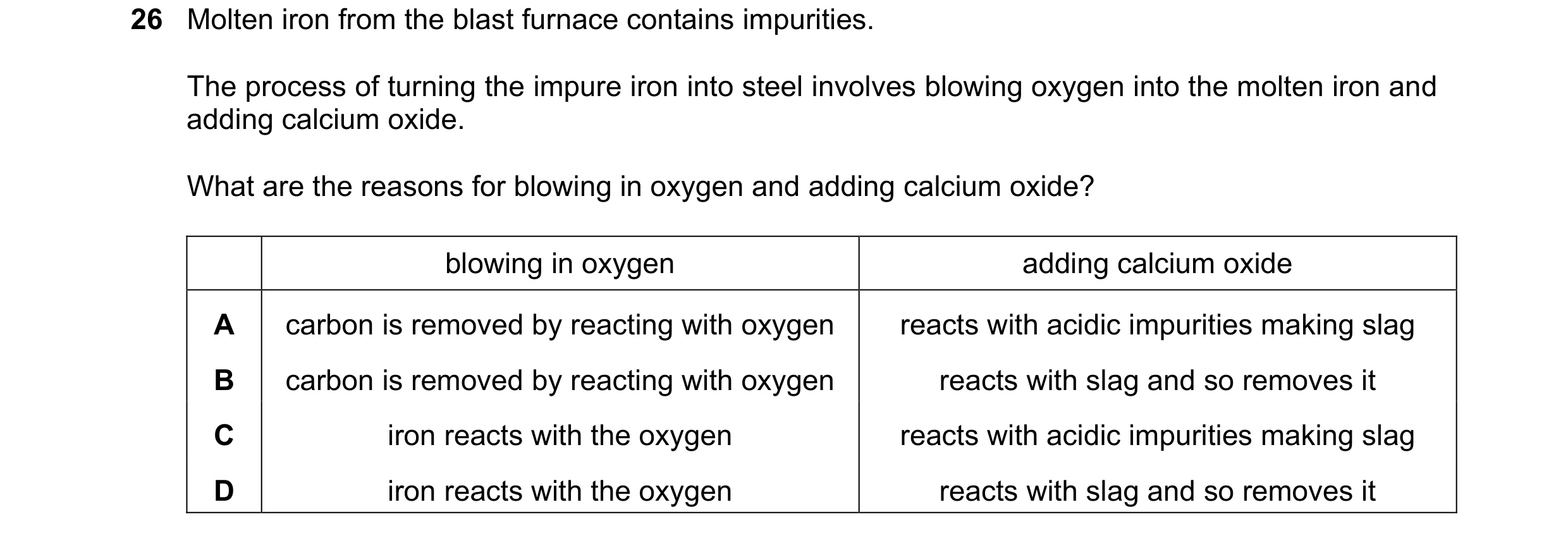
 2 / 7
2 / 7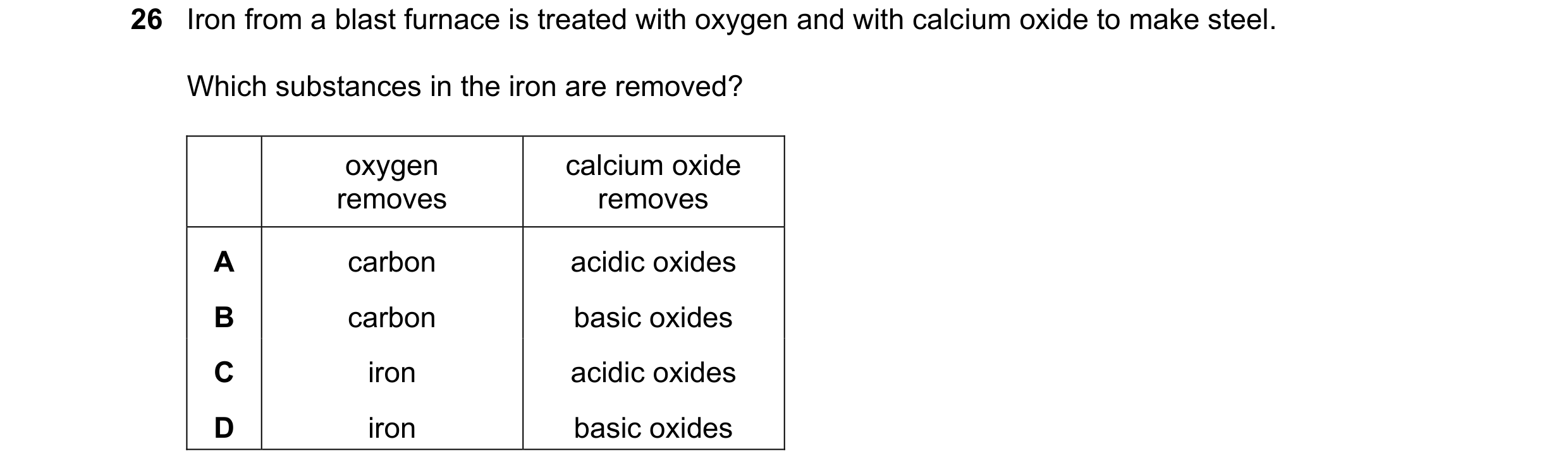

 3 / 7
3 / 7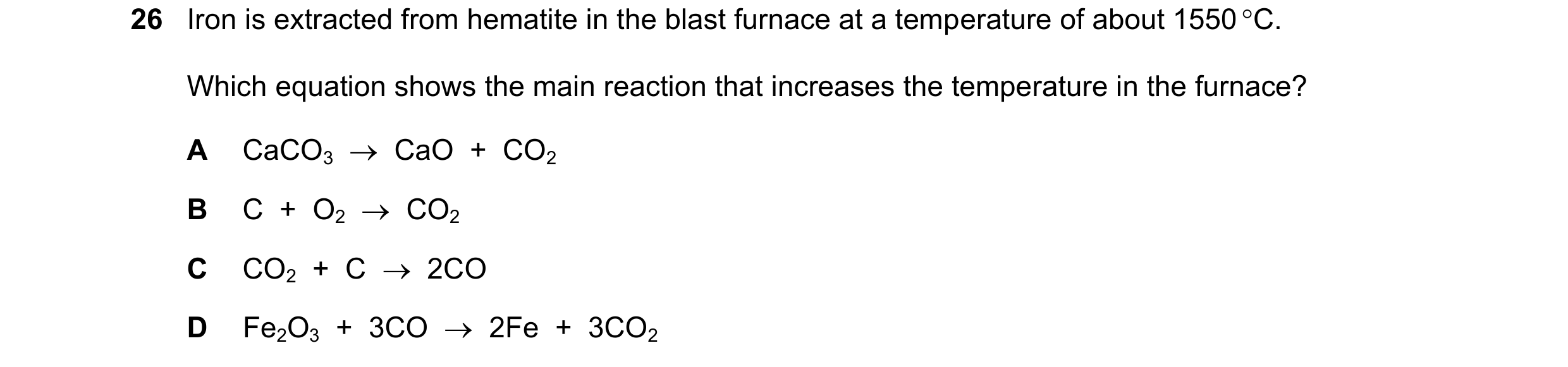
 4 / 7
4 / 7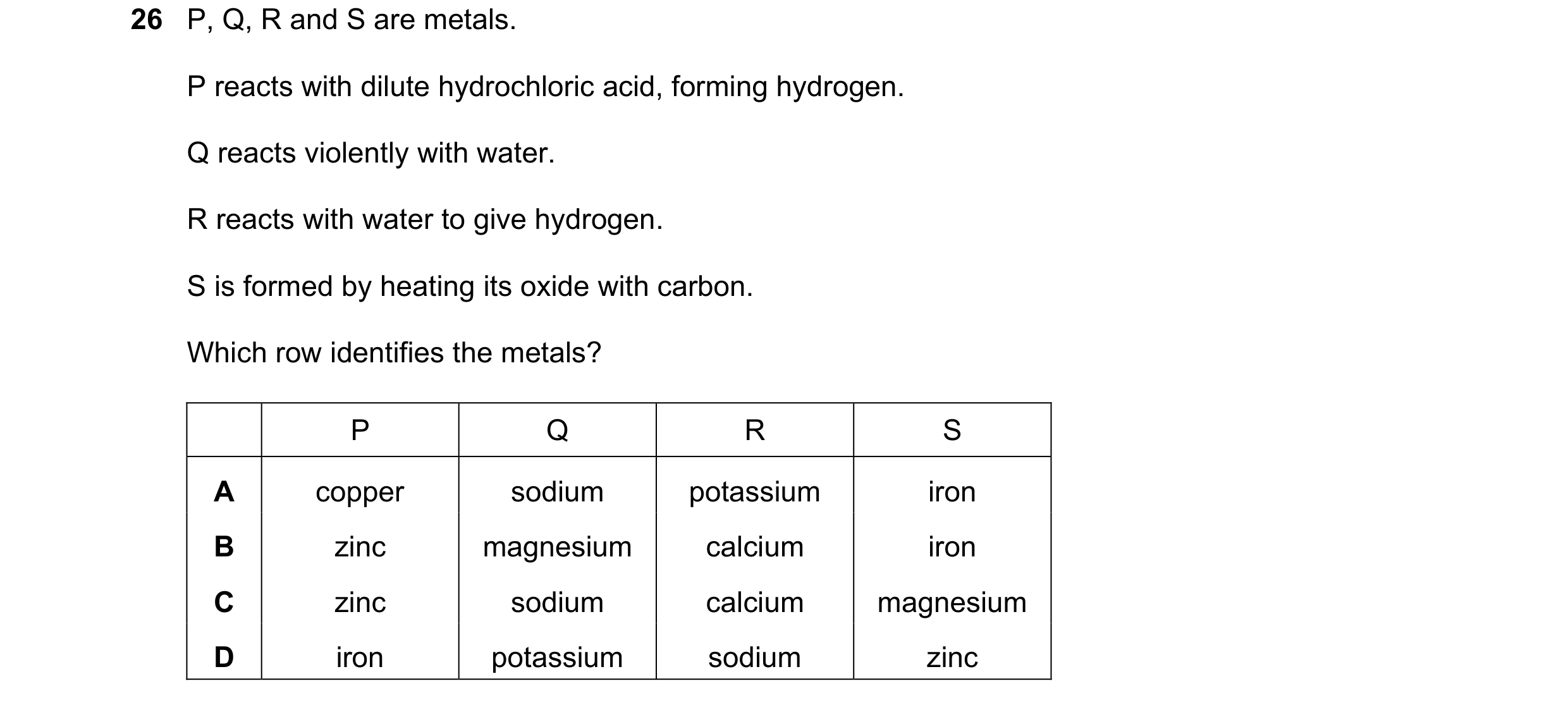

 5 / 7
5 / 7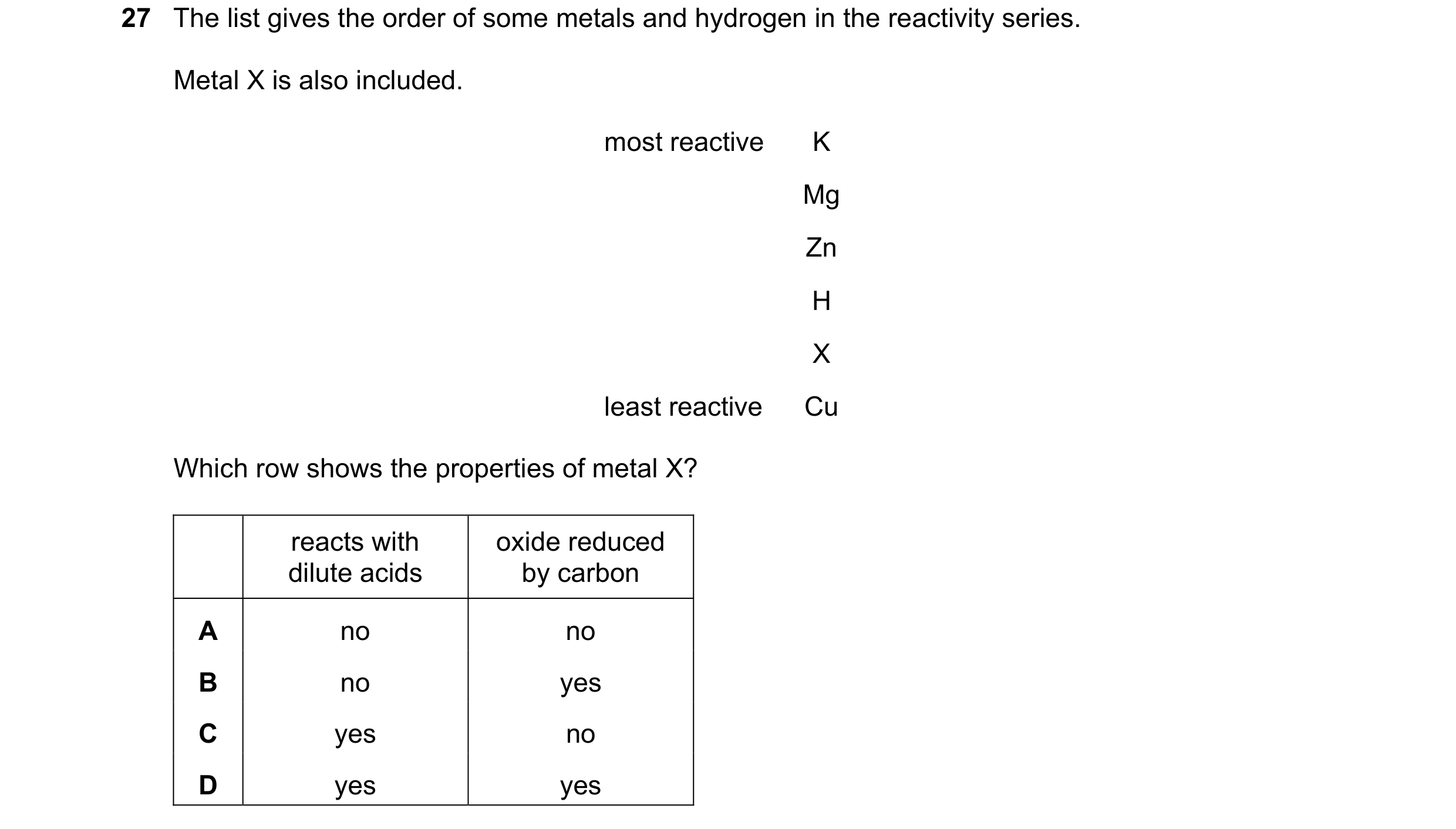

 6 / 7
6 / 7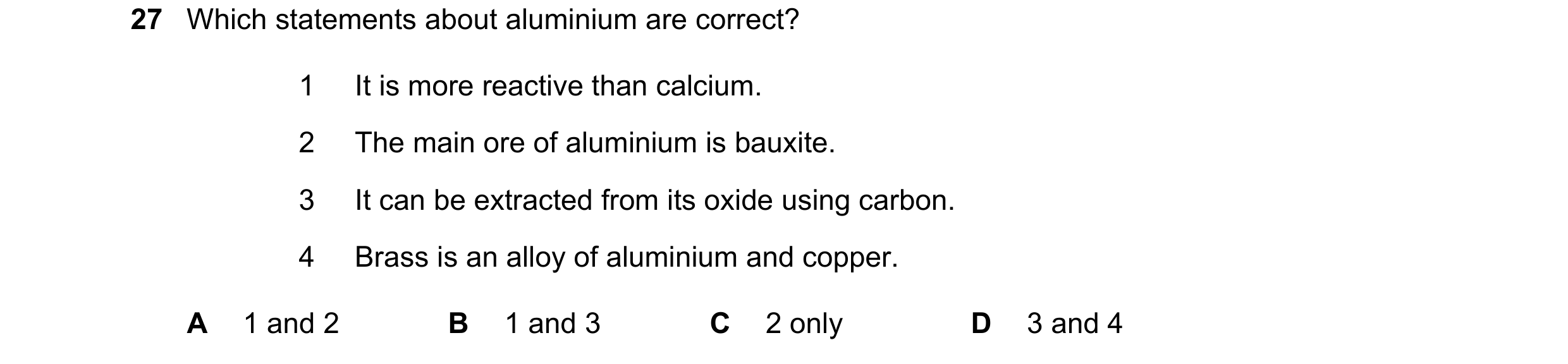
 7 / 7
7 / 7