Questions as text
Q1 · Aluminium metal is extracted from aluminium oxide using electrolysis 0971/21 May/June 2018
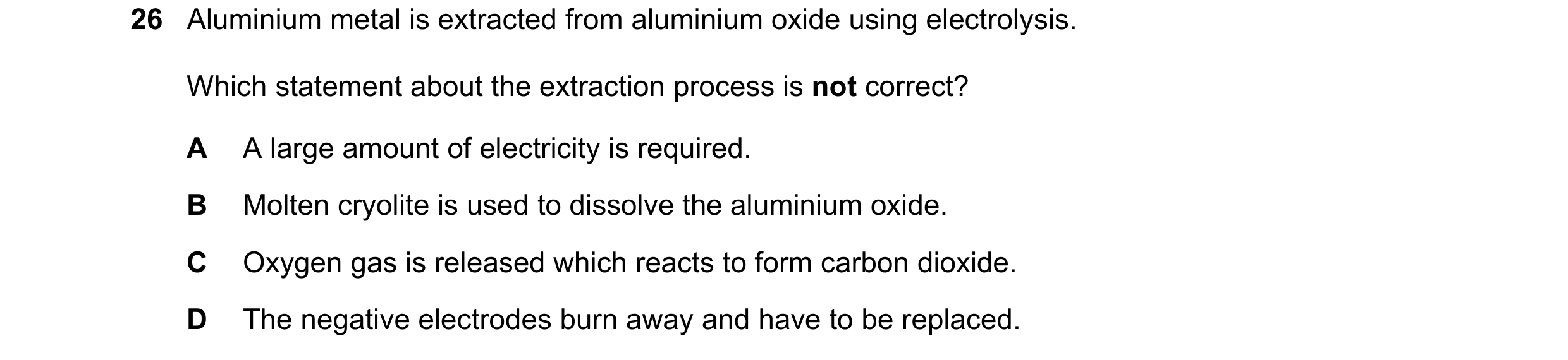
26 Aluminium metal is extracted from aluminium oxide using electrolysis. Which statement about the extraction process is not correct? A A large amount of electricity is required. B Molten cryolite is used to dissolve the aluminium oxide. C Oxygen gas is released which reacts to form carbon dioxide. D The negative electrodes burn away and have to be replaced.
1 marks
Answer: D
This question in 0971/21 May/June 2018
Q2 · Heating copper(II) carbonate produces copper(II) oxide and carbon dioxide 0971/22 Oct/Nov 2018
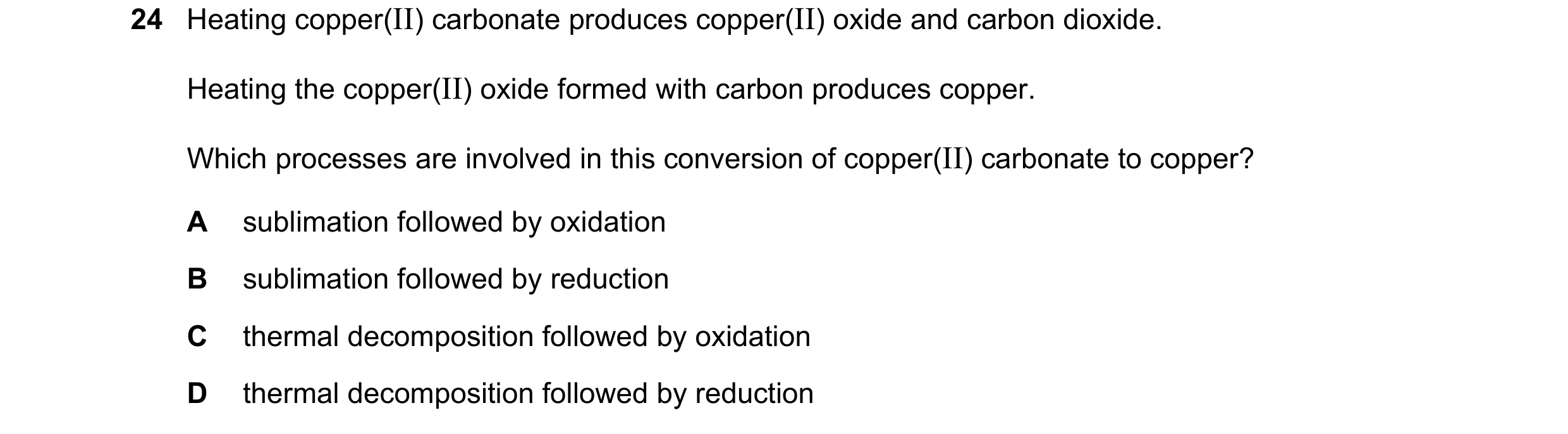
24 Heating copper(II) carbonate produces copper(II) oxide and carbon dioxide. Heating the copper(II) oxide formed with carbon produces copper. Which processes are involved in this conversion of copper(II) carbonate to copper? A sublimation followed by oxidation B sublimation followed by reduction C thermal decomposition followed by oxidation D thermal decomposition followed by reduction
1 marks
Answer: D
This question in 0971/22 Oct/Nov 2018
Q3 · Bauxite contains aluminium oxide 0971/22 Oct/Nov 2018
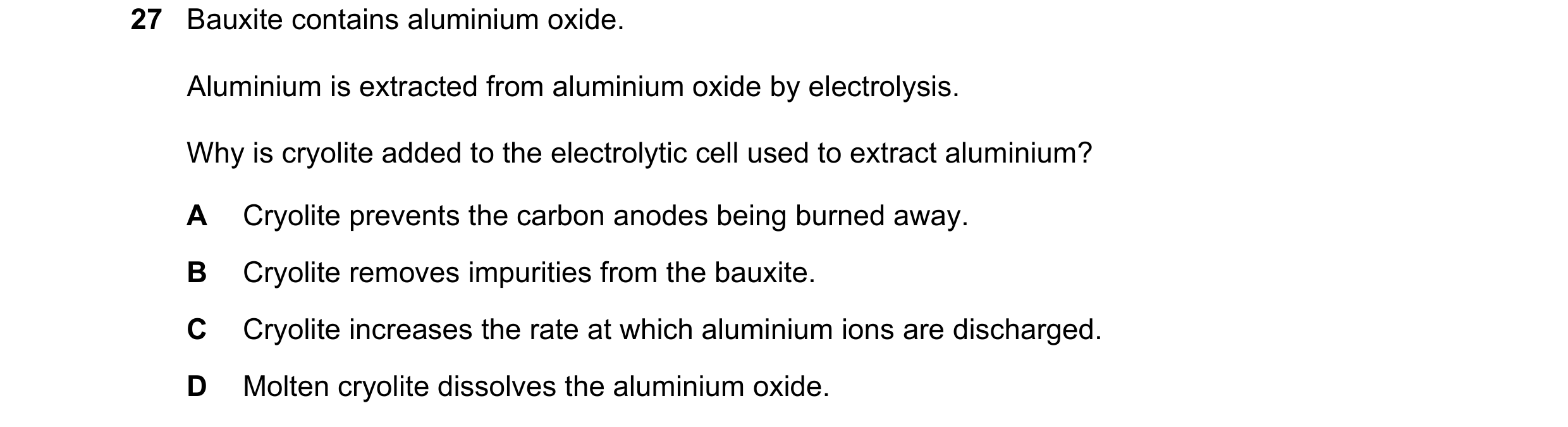
27 Bauxite contains aluminium oxide. Aluminium is extracted from aluminium oxide by electrolysis. Why is cryolite added to the electrolytic cell used to extract aluminium? A Cryolite prevents the carbon anodes being burned away. B Cryolite removes impurities from the bauxite. C Cryolite increases the rate at which aluminium ions are discharged. D Molten cryolite dissolves the aluminium oxide.
1 marks
Answer: D
This question in 0971/22 Oct/Nov 2018
Q4 · Aluminium metal is extracted from aluminium oxide by electrolysis 0971/21 May/June 2019
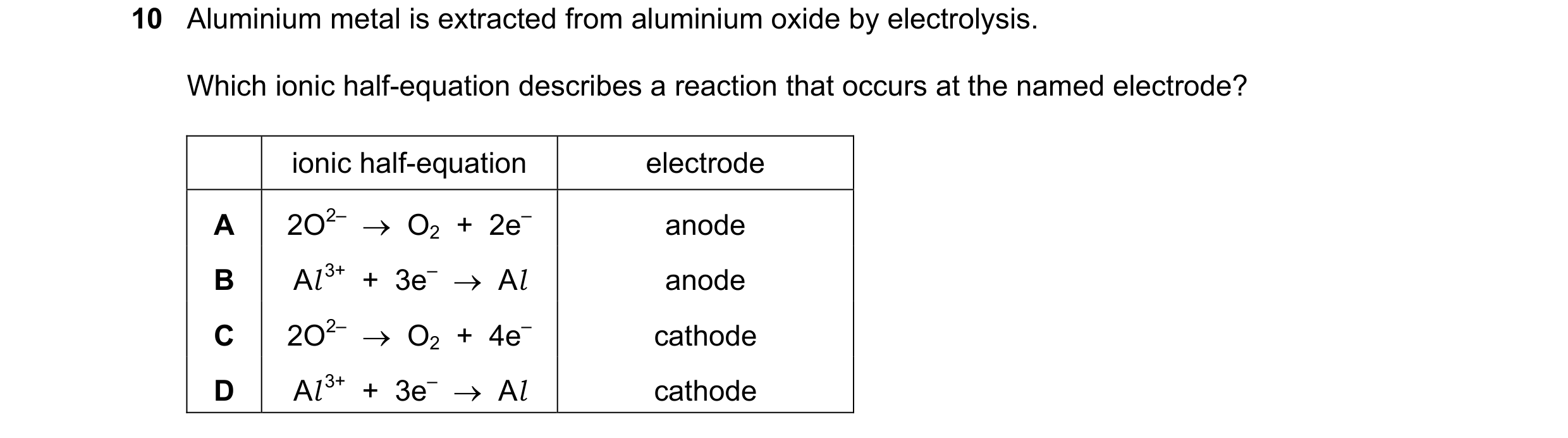
10 Aluminium metal is extracted from aluminium oxide by electrolysis. Which ionic half-equation describes a reaction that occurs at the named electrode? ionic half-equation electrode A 2O2– → O2 + 2e– anode B Al 3+ + 3e– → Al anode C 2O2– → O2 + 4e– cathode D Al 3+ + 3e– → Al cathode
1 marks
Answer: D
This question in 0971/21 May/June 2019
Q5 · Zinc is extracted from its ore, zinc blende, using two chemical reactions 0971/21 May/June 2019
25 Zinc is extracted from its ore, zinc blende, using two chemical reactions. 1 2ZnS + 3O2 → 2ZnO + 2SO2 2 2ZnO + C → 2Zn + CO2 Which substance is reduced in reactions 1 and 2? reaction 1 reaction 2 A O2 C B O2 ZnO C ZnS C D ZnS ZnO
1 marks
Answer: B
This question in 0971/21 May/June 2019
Q6 · Which statement about the extraction of aluminium from aluminium oxide is correct? 0971/22 Oct/Nov 2019
29 Which statement about the extraction of aluminium from aluminium oxide is correct? A Aluminium is formed at the positive electrode during electrolysis. B Pure aluminium oxide is dissolved in molten cryolite. C Pure aluminium oxide is electrolysed using aluminium as the positive electrode. D Pure aluminium oxide is heated with carbon to form carbon dioxide and aluminium.
1 marks
Answer: B
This question in 0971/22 Oct/Nov 2019
Q7 · Molten iron from the blast furnace contains impurities 0971/21 May/June 2020
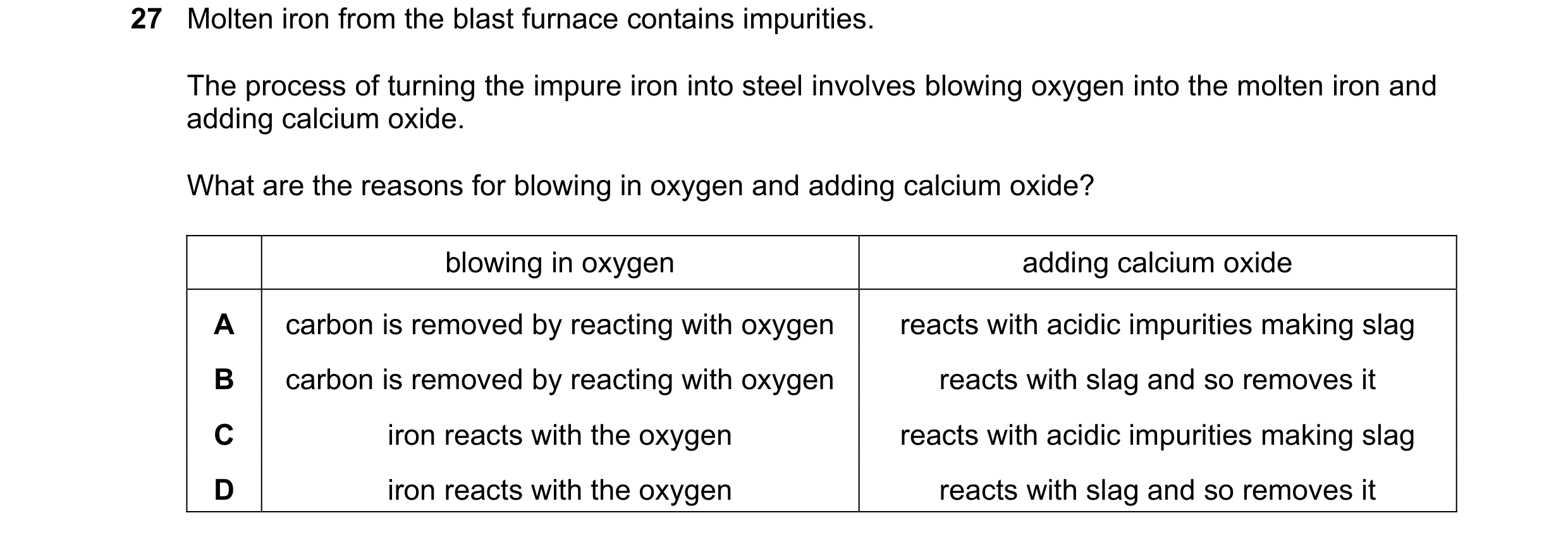
27 Molten iron from the blast furnace contains impurities. The process of turning the impure iron into steel involves blowing oxygen into the molten iron and adding calcium oxide. What are the reasons for blowing in oxygen and adding calcium oxide? blowing in oxygen adding calcium oxide A carbon is removed by reacting with oxygen reacts with acidic impurities making slag B carbon is removed by reacting with oxygen reacts with slag and so removes it C iron reacts with the oxygen reacts with acidic impurities making slag D iron reacts with the oxygen reacts with slag and so removes it
1 marks
Answer: A
This question in 0971/21 May/June 2020
Q8 · Many metal carbonates decompose when they are heated 0971/22 May/June 2020
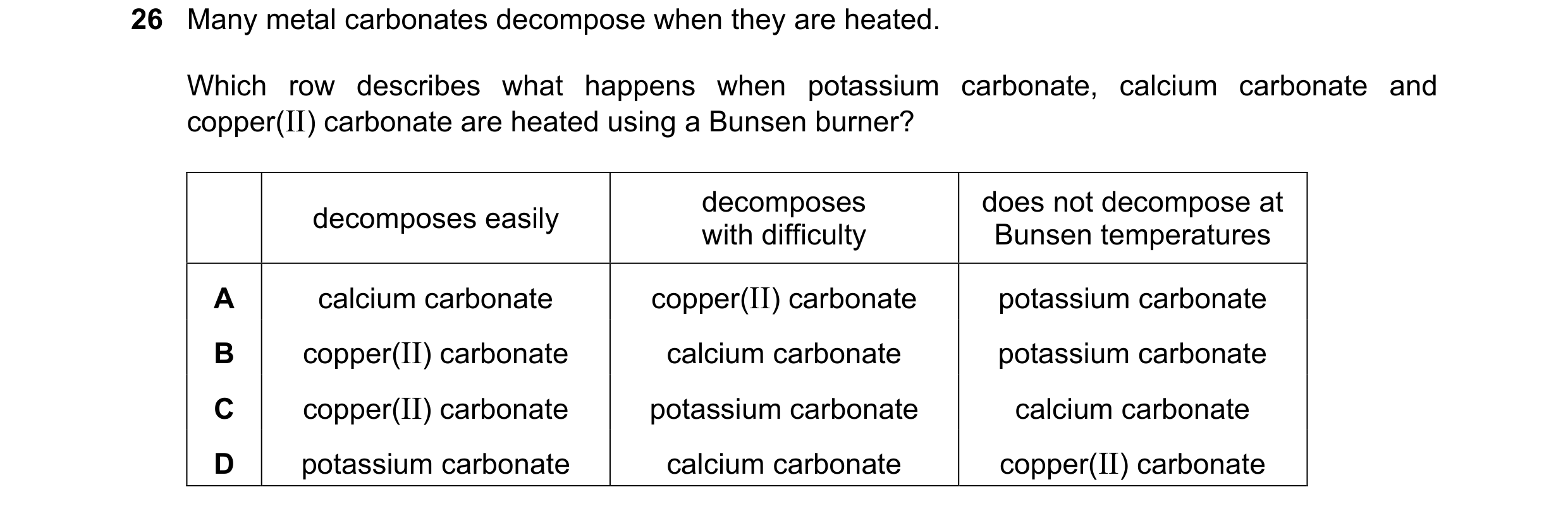
26 Many metal carbonates decompose when they are heated. Which row describes what happens when potassium carbonate, calcium carbonate and copper(II) carbonate are heated using a Bunsen burner? decomposes does not decompose at decomposes easily with difficulty Bunsen temperatures A calcium carbonate copper(II) carbonate potassium carbonate B copper(II) carbonate calcium carbonate potassium carbonate C copper(II) carbonate potassium carbonate calcium carbonate D potassium carbonate calcium carbonate copper(II) carbonate
1 marks
Answer: B
This question in 0971/22 May/June 2020
Q9 · Molten iron from the blast furnace contains impurities 0971/22 May/June 2020
27 Molten iron from the blast furnace contains impurities. The process of turning the impure iron into steel involves blowing oxygen into the molten iron and adding calcium oxide. What are the reasons for blowing in oxygen and adding calcium oxide? blowing in oxygen adding calcium oxide A carbon is removed by reacting with oxygen reacts with acidic impurities making slag B carbon is removed by reacting with oxygen reacts with slag and so removes it C iron reacts with the oxygen reacts with acidic impurities making slag D iron reacts with the oxygen reacts with slag and so removes it
1 marks
Answer: A
This question in 0971/22 May/June 2020
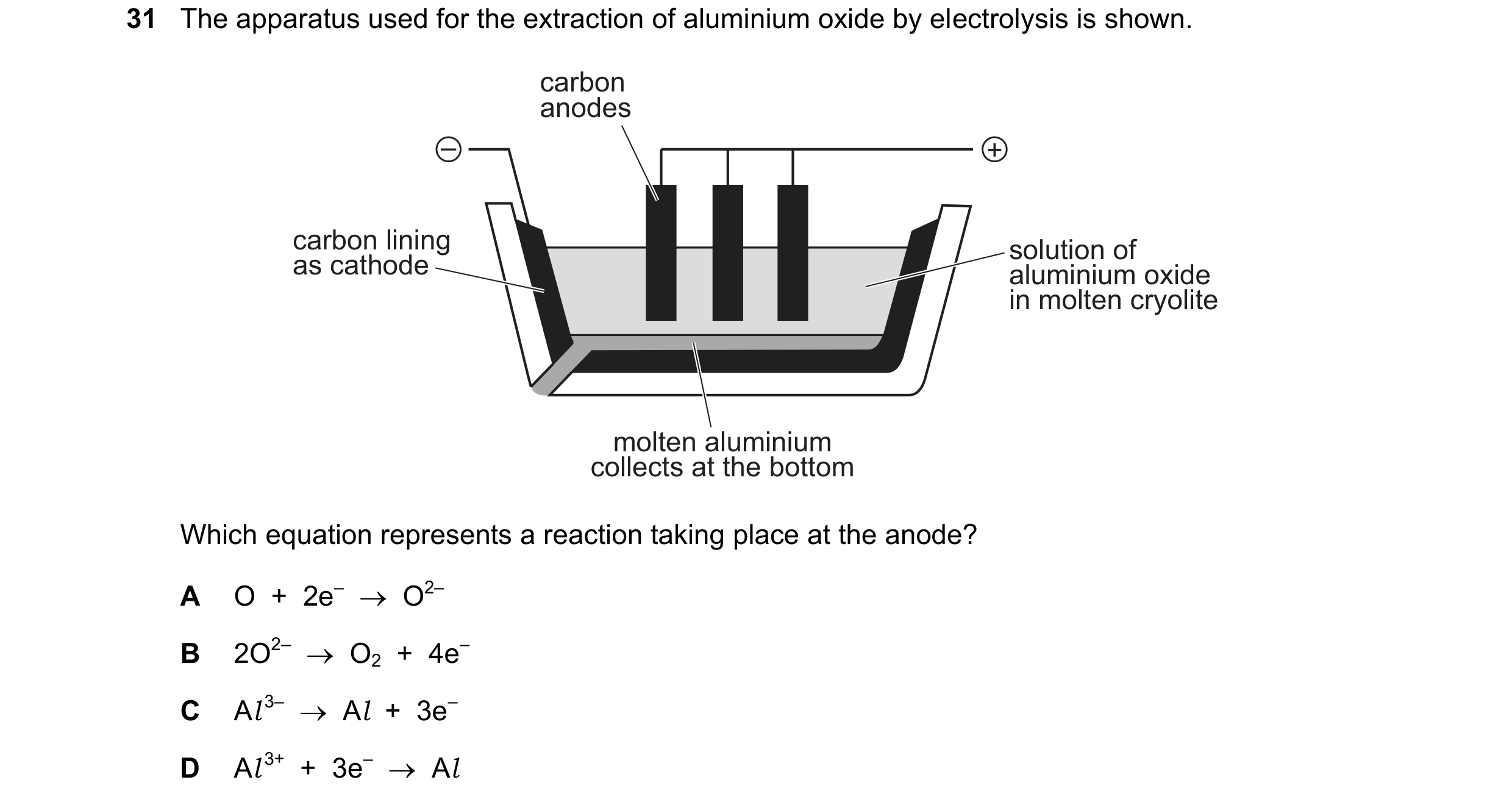
Q10 · The apparatus used for the extraction of aluminium oxide by electrolysis is shown 0971/22 Oct/Nov 2020
31 The apparatus used for the extraction of aluminium oxide by electrolysis is shown. carbon anodes – + carbon lining solution of as cathode aluminium oxide in molten cryolite molten aluminium collects at the bottom Which equation represents a reaction taking place at the anode? A O + 2e– O2– B 2O2– O2 + 4e– C Al 3– Al + 3e– D Al 3+ + 3e– Al
1 marks
Answer: B
This question in 0971/22 Oct/Nov 2020
Q11 · Some metal nitrates and carbonates decompose when heated strongly 0971/21 May/June 2021
26 Some metal nitrates and carbonates decompose when heated strongly. Metal Q has a nitrate that decomposes to give a salt and a colourless gas only. The carbonate of metal Q does not decompose when heated with a Bunsen burner. What is metal Q? A calcium B copper C sodium D zinc
1 marks
Answer: C
This question in 0971/21 May/June 2021
Q12 · Which substances are used in the extraction of aluminium? 0971/21 May/June 2021
27 Which substances are used in the extraction of aluminium? A bauxite and cryolite B bauxite and hematite C cryolite and zinc blende D hematite and zinc blende
1 marks
Answer: A
This question in 0971/21 May/June 2021
Q13 · Some metal nitrates and carbonates decompose when heated strongly 0971/22 May/June 2021
26 Some metal nitrates and carbonates decompose when heated strongly. Metal Q has a nitrate that decomposes to give a salt and a colourless gas only. The carbonate of metal Q does not decompose when heated with a Bunsen burner. What is metal Q? A calcium B copper C sodium D zinc
1 marks
Answer: C
This question in 0971/22 May/June 2021
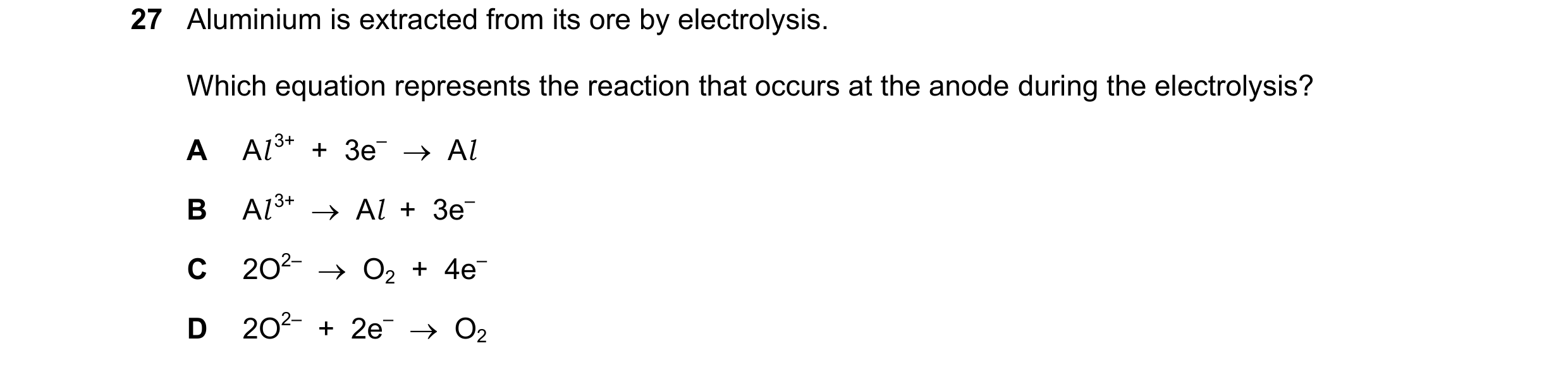
Q14 · Aluminium is extracted from its ore by electrolysis 0971/22 May/June 2021
27 Aluminium is extracted from its ore by electrolysis. Which equation represents the reaction that occurs at the anode during the electrolysis? A Al 3+ + 3e– Al B Al 3+ Al + 3e– C 2O2– O2 + 4e– D 2O2– + 2e– O2
1 marks
Answer: C
This question in 0971/22 May/June 2021
Q15 · The equations represent two reactions, P and Q, of lime (calcium oxide) 0971/22 May/June 2021
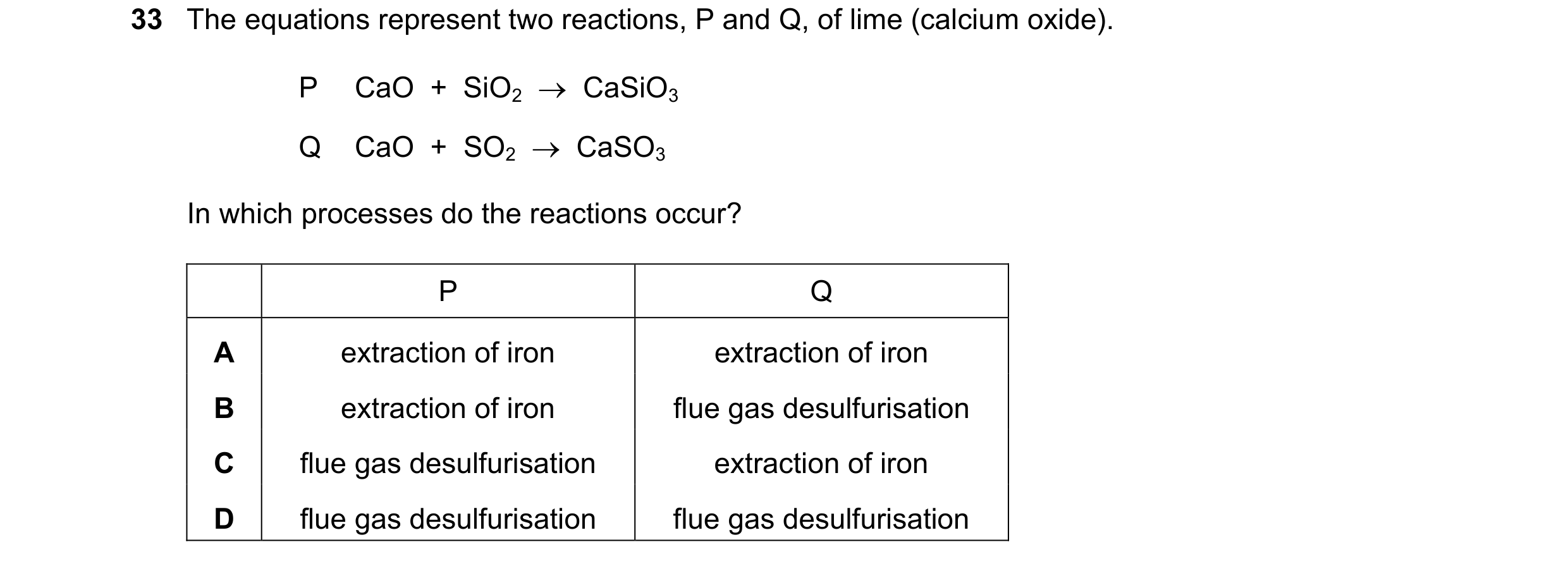
33 The equations represent two reactions, P and Q, of lime (calcium oxide). P CaO + SiO2 CaSiO3 Q CaO + SO2 CaSO3 In which processes do the reactions occur? P Q A extraction of iron extraction of iron B extraction of iron flue gas desulfurisation C flue gas desulfurisation extraction of iron D flue gas desulfurisation flue gas desulfurisation
1 marks
Answer: B
This question in 0971/22 May/June 2021
Q16 · Carbon dioxide is produced during the extraction of aluminium from bauxite 0971/22 Oct/Nov 2021
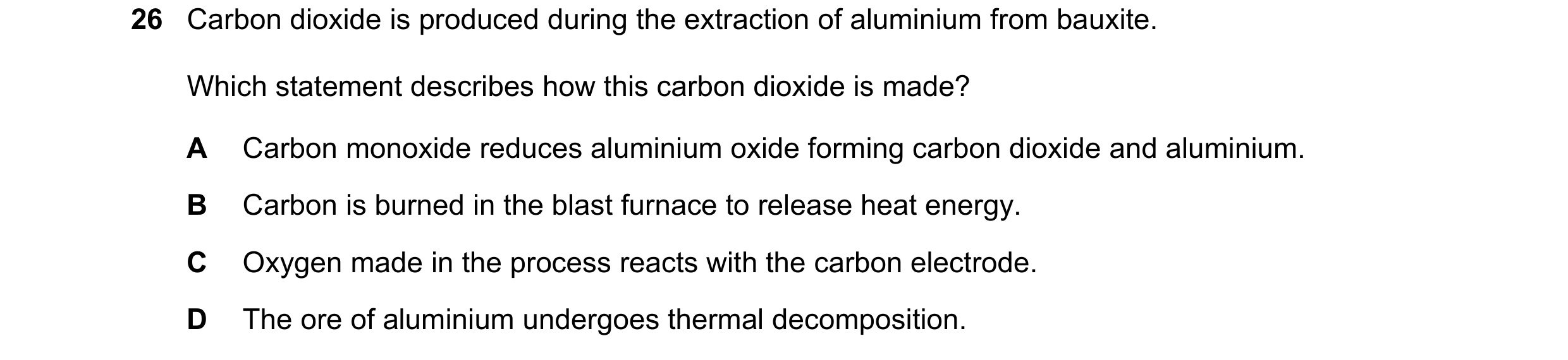
26 Carbon dioxide is produced during the extraction of aluminium from bauxite. Which statement describes how this carbon dioxide is made? A Carbon monoxide reduces aluminium oxide forming carbon dioxide and aluminium. B Carbon is burned in the blast furnace to release heat energy. C Oxygen made in the process reacts with the carbon electrode. D The ore of aluminium undergoes thermal decomposition.
1 marks
Answer: C
This question in 0971/22 Oct/Nov 2021
Q17 · Which reaction involving sulfur dioxide is correct? 0971/22 Oct/Nov 2021
31 Which reaction involving sulfur dioxide is correct? A It is produced during the extraction of zinc from zinc blende. B It reacts with concentrated sulfuric acid to form oleum. C It reacts with sulfur to form sulfur trioxide. D It turns an acidified solution of potassium manganate(VII) purple.
1 marks
Answer: A
This question in 0971/22 Oct/Nov 2021
Q18 · In the extraction of aluminium by electrolysis, cryolite is added to the bauxite ore 0971/21 May/June 2022
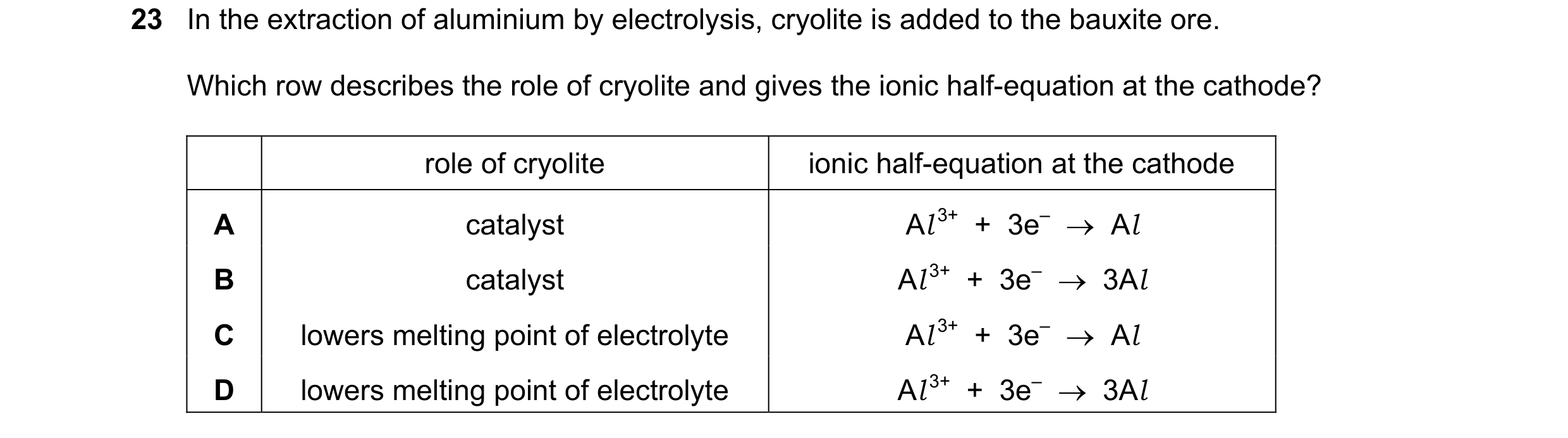
23 In the extraction of aluminium by electrolysis, cryolite is added to the bauxite ore. Which row describes the role of cryolite and gives the ionic half-equation at the cathode? role of cryolite ionic half-equation at the cathode A catalyst Al 3+ + 3e– Al B catalyst Al 3+ + 3e– 3Al C lowers melting point of electrolyte Al 3+ + 3e– Al D lowers melting point of electrolyte Al 3+ + 3e– 3Al
1 marks
Answer: C
This question in 0971/21 May/June 2022
Q19 · Processes involved in the extraction of zinc are listed 0971/22 May/June 2022
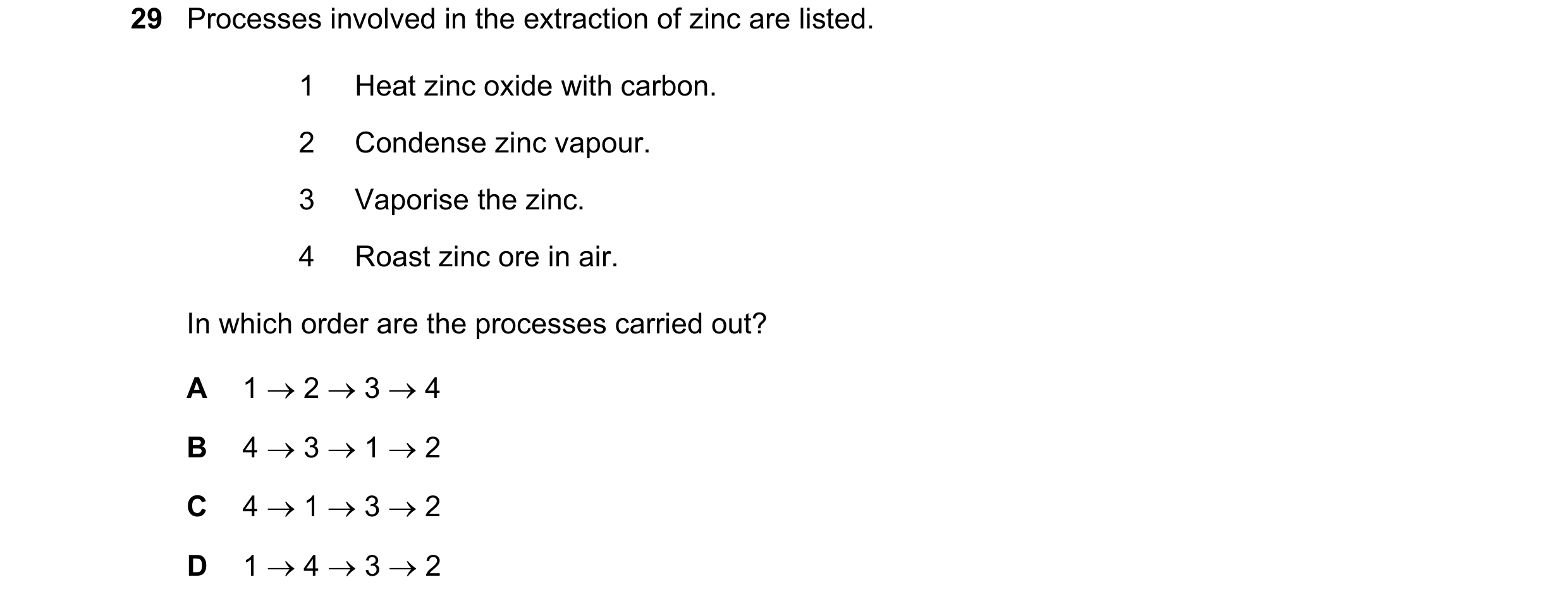
29 Processes involved in the extraction of zinc are listed. 1 Heat zinc oxide with carbon. 2 Condense zinc vapour. 3 Vaporise the zinc. 4 Roast zinc ore in air. In which order are the processes carried out? A 1 2 3 4 B 4 3 1 2 C 4 1 3 2 D 1 4 3 2
1 marks
Answer: C
This question in 0971/22 May/June 2022
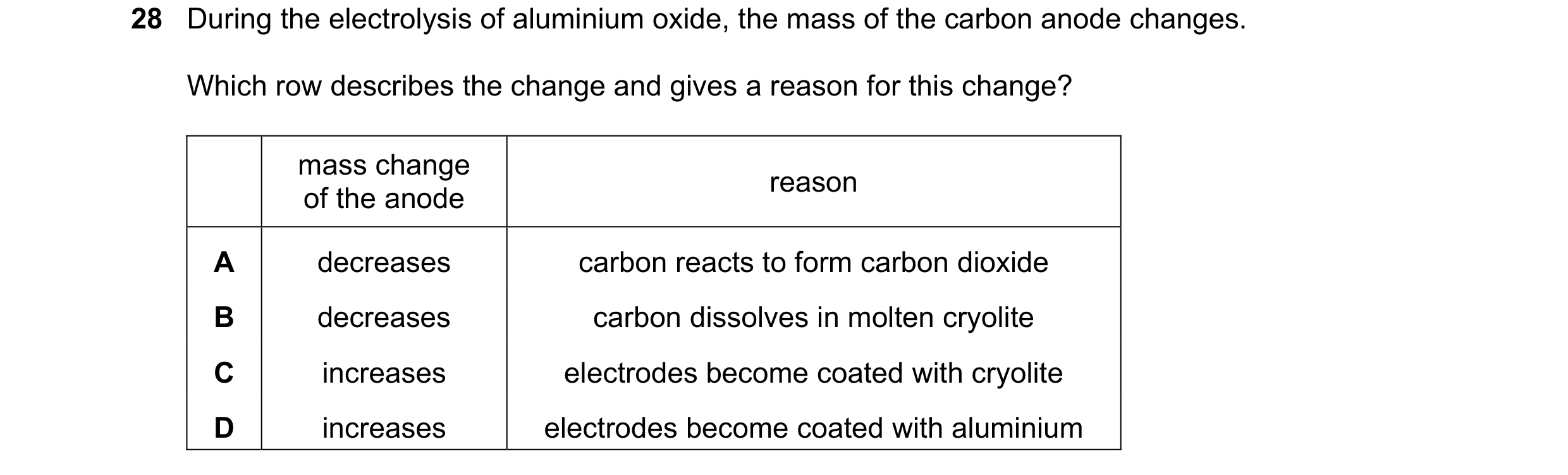
Q20 · During the electrolysis of aluminium oxide, the mass of the carbon anode changes 0971/21 May/June 2023
28 During the electrolysis of aluminium oxide, the mass of the carbon anode changes. Which row describes the change and gives a reason for this change? mass change reason of the anode A decreases carbon reacts to form carbon dioxide B decreases carbon dissolves in molten cryolite C increases electrodes become coated with cryolite D increases electrodes become coated with aluminium
1 marks
Answer: A
This question in 0971/21 May/June 2023
Q21 · Why is cryolite used in the extraction of aluminium by electrolysis? 0971/22 May/June 2023
28 Why is cryolite used in the extraction of aluminium by electrolysis? A It dissolves the aluminium oxide. B It protects the anodes from corrosion. C It changes bauxite to aluminium oxide. D It decreases the melting point of the aluminium.
1 marks
Answer: A
This question in 0971/22 May/June 2023
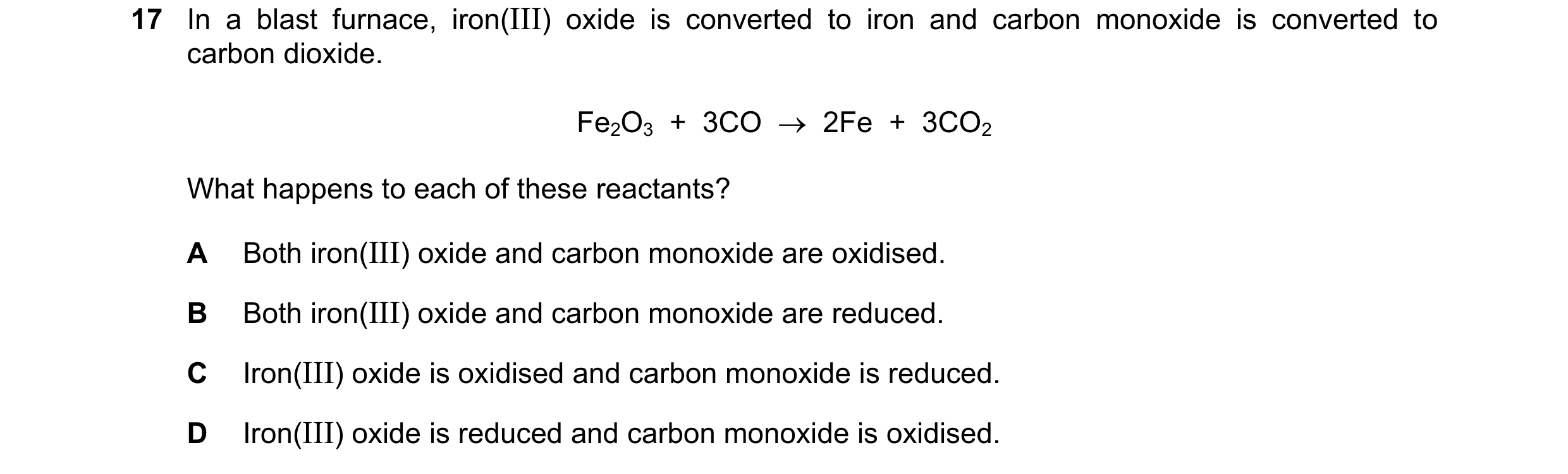
Q22 · In a blast furnace, iron(III) oxide is converted to iron and carbon monoxide is converted… 0971/22 Oct/Nov 2023
17 In a blast furnace, iron(III) oxide is converted to iron and carbon monoxide is converted to carbon dioxide. Fe2O3 + 3CO 2Fe + 3CO2 What happens to each of these reactants? A Both iron(III) oxide and carbon monoxide are oxidised. B Both iron(III) oxide and carbon monoxide are reduced. C Iron(III) oxide is oxidised and carbon monoxide is reduced. D Iron(III) oxide is reduced and carbon monoxide is oxidised.
1 marks
Answer: D
This question in 0971/22 Oct/Nov 2023
Q23 · Why is limestone added to the blast furnace? 0971/22 Oct/Nov 2023
29 Why is limestone added to the blast furnace? A It neutralises the molten slag produced. B It reacts with impurities to form slag. C It releases carbon dioxide which reduces the iron(III) oxide. D It removes acidic gases such as carbon dioxide.
1 marks
Answer: B
This question in 0971/22 Oct/Nov 2023
Q24 · Which equation represents the reduction of a compound found in hematite in the blast… 0971/22 May/June 2024
26 Which equation represents the reduction of a compound found in hematite in the blast furnace? A 2Al 2O3 →4Al + 3O2 B CaO + SiO2 →CaSiO3 C 2FeO + CO →Fe2O3 + C D Fe2O3 + 3CO →2Fe + 3CO2
1 marks
Answer: D
This question in 0971/22 May/June 2024
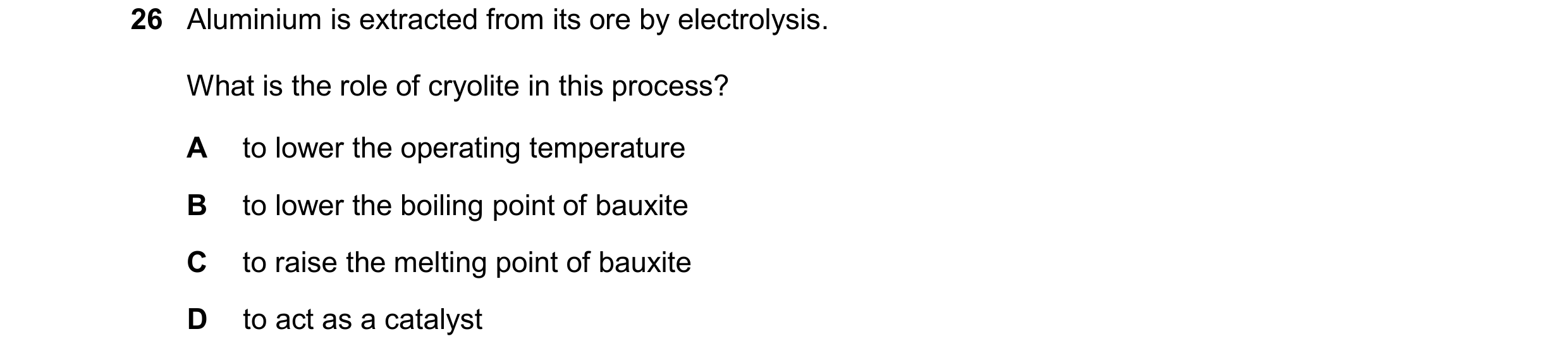
Q25 · Aluminium is extracted from its ore by electrolysis 0971/22 Oct/Nov 2024
26 Aluminium is extracted from its ore by electrolysis. What is the role of cryolite in this process? A to lower the operating temperature B to lower the boiling point of bauxite C to raise the melting point of bauxite D to act as a catalyst
1 marks
Answer: A
This question in 0971/22 Oct/Nov 2024
Q26 · Which equation represents a reaction that occurs in a blast furnace during the extraction… 0971/22 May/June 2025
28 Which equation represents a reaction that occurs in a blast furnace during the extraction of iron from hematite? A Ca + CO2 CaO + CO B Fe2O3 + 3Ca 2Fe + 3CaO C Ca(OH)2 CaO + H2O D Fe2O3 + 3CO 2Fe + 3CO2
1 marks
Answer: D
This question in 0971/22 May/June 2025
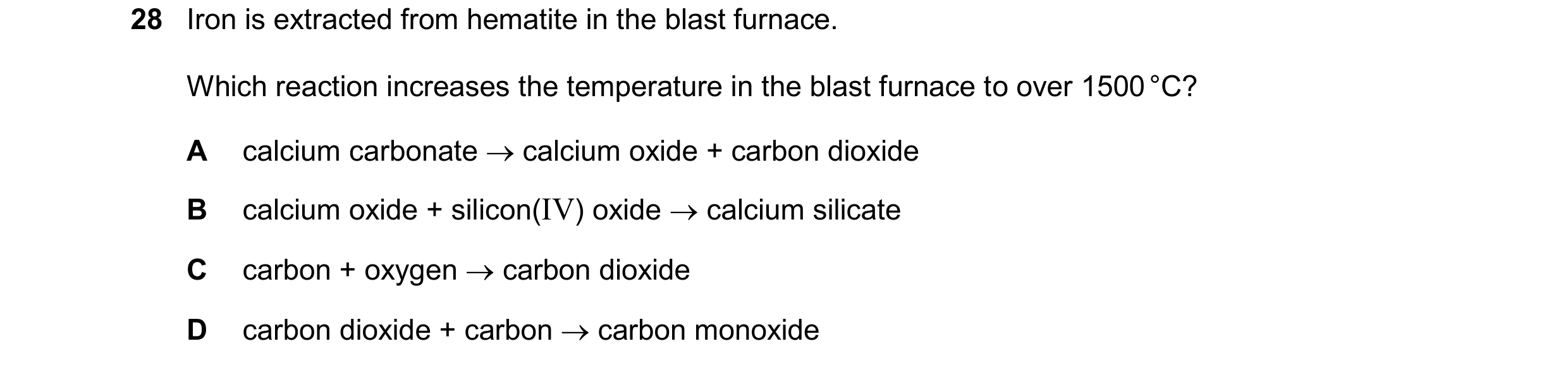
Q27 · Iron is extracted from hematite in the blast furnace 0971/22 Oct/Nov 2025
28 Iron is extracted from hematite in the blast furnace. Which reaction increases the temperature in the blast furnace to over 1500 °C? A calcium carbonate calcium oxide + carbon dioxide B calcium oxide + silicon(IV) oxide calcium silicate C carbon + oxygen carbon dioxide D carbon dioxide + carbon carbon monoxide
1 marks
Answer: C
This question in 0971/22 Oct/Nov 2025
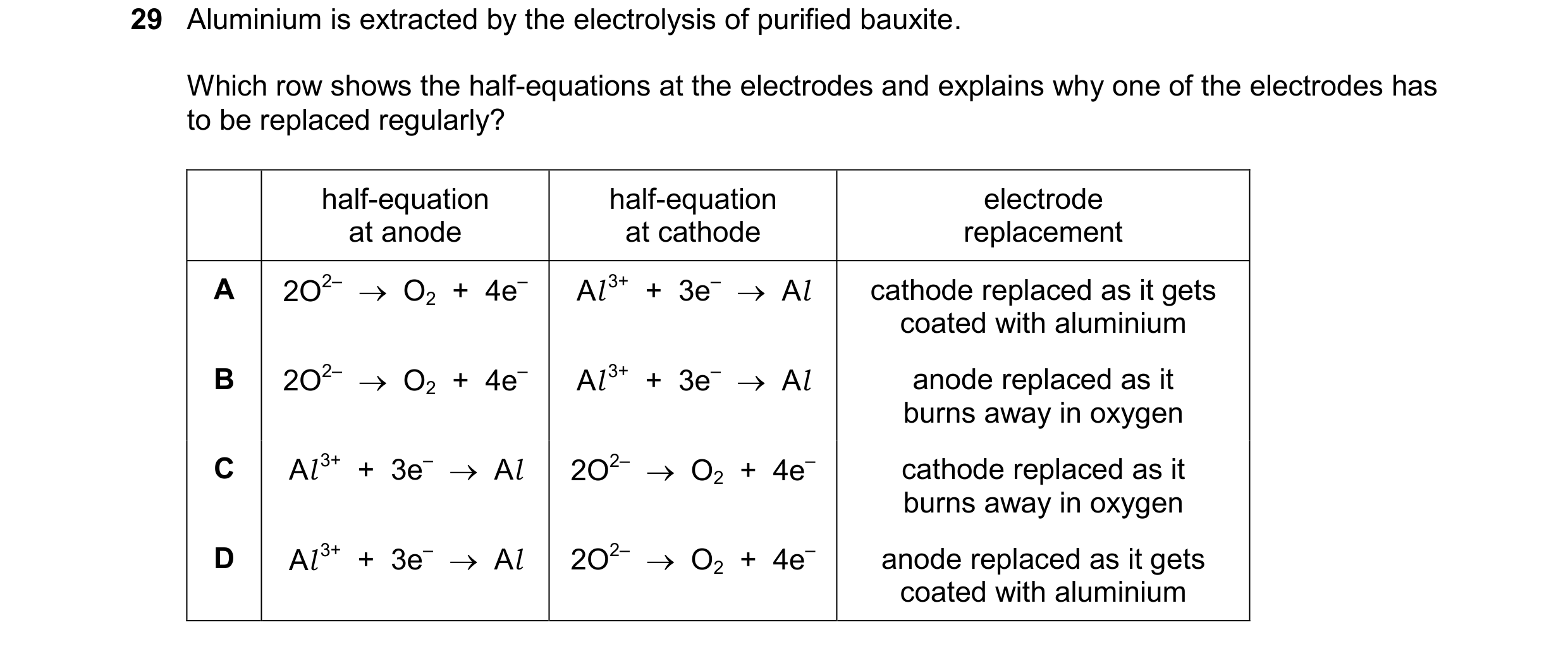
Q28 · Aluminium is extracted by the electrolysis of purified bauxite 0971/22 Oct/Nov 2025
29 Aluminium is extracted by the electrolysis of purified bauxite. Which row shows the half-equations at the electrodes and explains why one of the electrodes has to be replaced regularly? half-equation half-equation electrode at anode at cathode replacement A 2O2– O2 + 4e– Al 3+ + 3e– Al cathode replaced as it gets coated with aluminium B 2O2– O2 + 4e– Al 3+ + 3e– Al anode replaced as it burns away in oxygen C Al 3+ + 3e– Al 2O2– O2 + 4e– cathode replaced as it burns away in oxygen D Al 3+ + 3e– Al 2O2– O2 + 4e– anode replaced as it gets coated with aluminium
1 marks
Answer: B
This question in 0971/22 Oct/Nov 2025
 1 / 7
1 / 7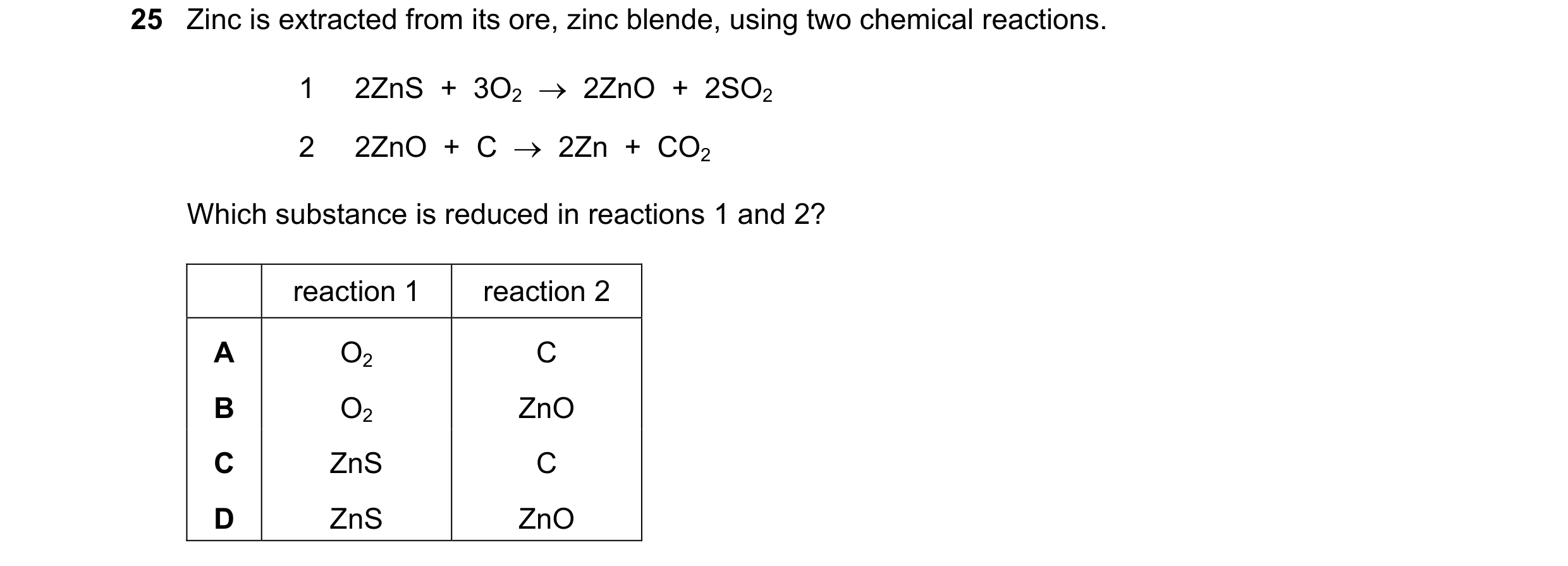

 2 / 7
2 / 7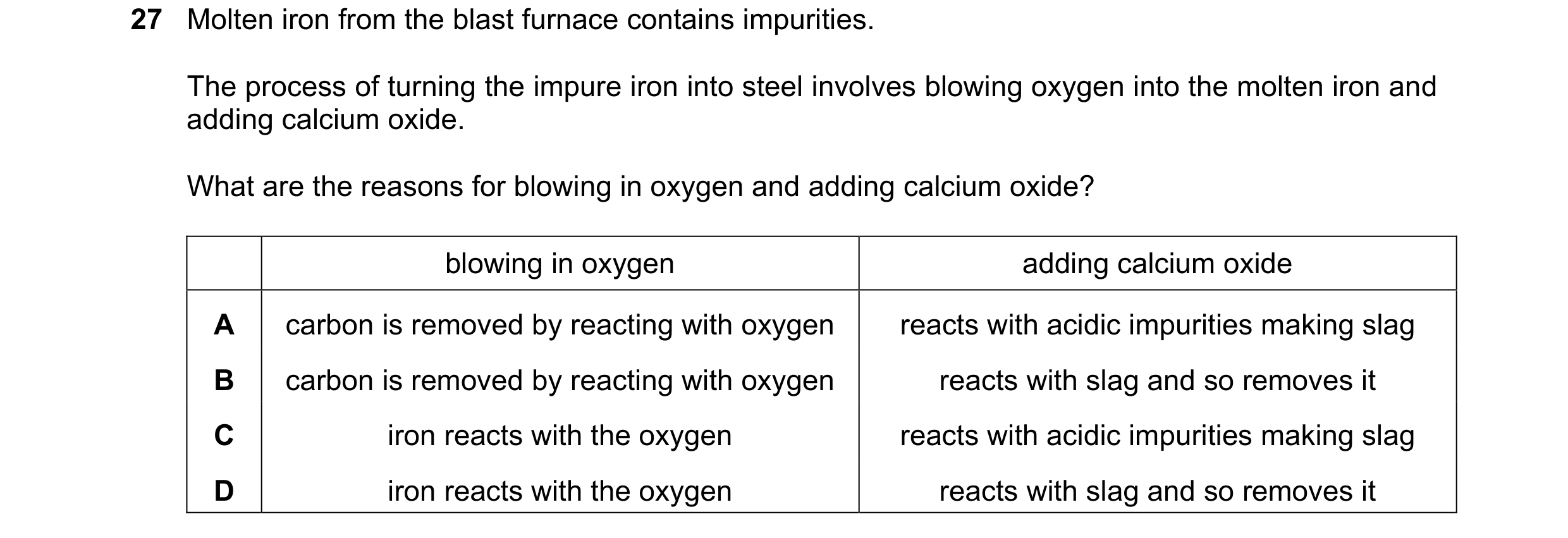
 3 / 7
3 / 7
 4 / 7
4 / 7
 5 / 7
5 / 7


 6 / 7
6 / 7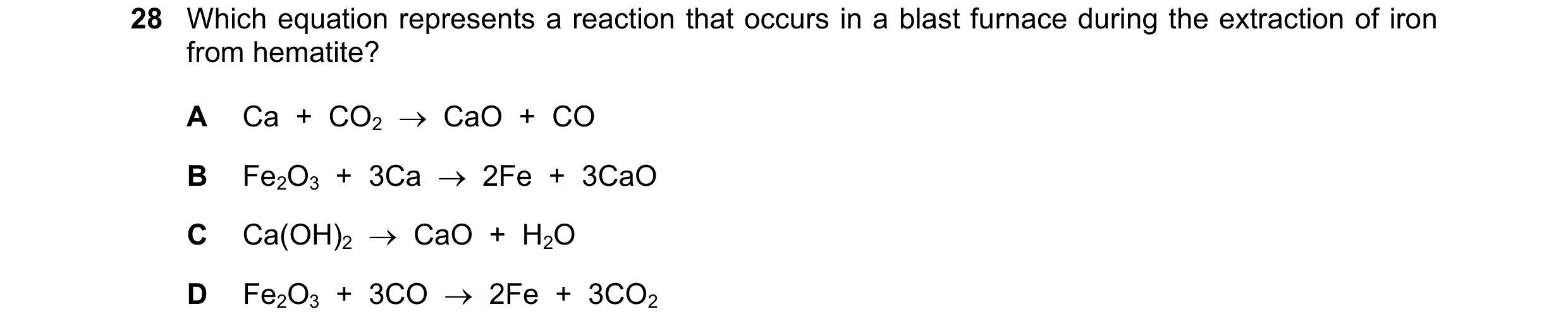
 7 / 7
7 / 7