Questions as text
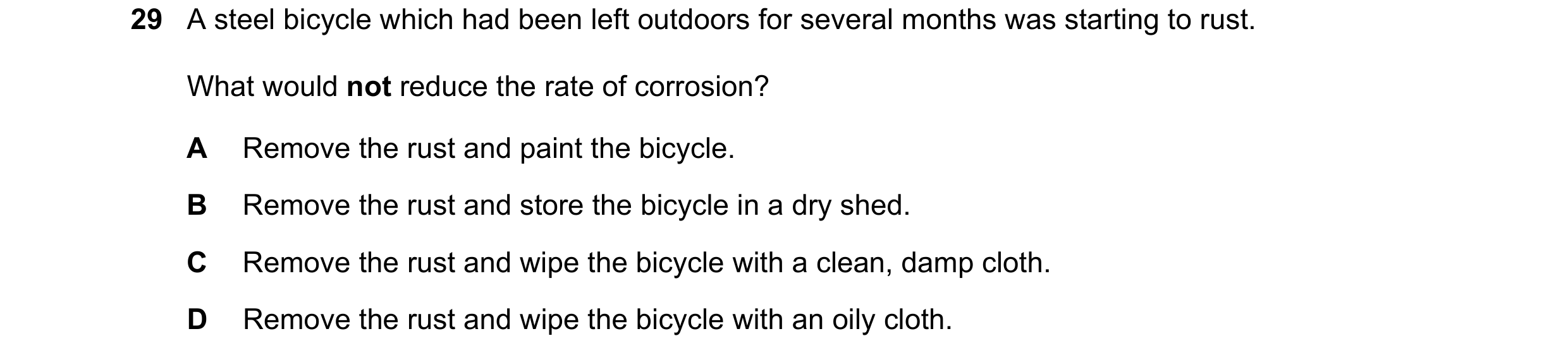
Q1 · A steel bicycle which had been left outdoors for several months was starting to rust 0971/21 May/June 2018
29 A steel bicycle which had been left outdoors for several months was starting to rust. What would not reduce the rate of corrosion? A Remove the rust and paint the bicycle. B Remove the rust and store the bicycle in a dry shed. C Remove the rust and wipe the bicycle with a clean, damp cloth. D Remove the rust and wipe the bicycle with an oily cloth.
1 marks
Answer: C
This question in 0971/21 May/June 2018
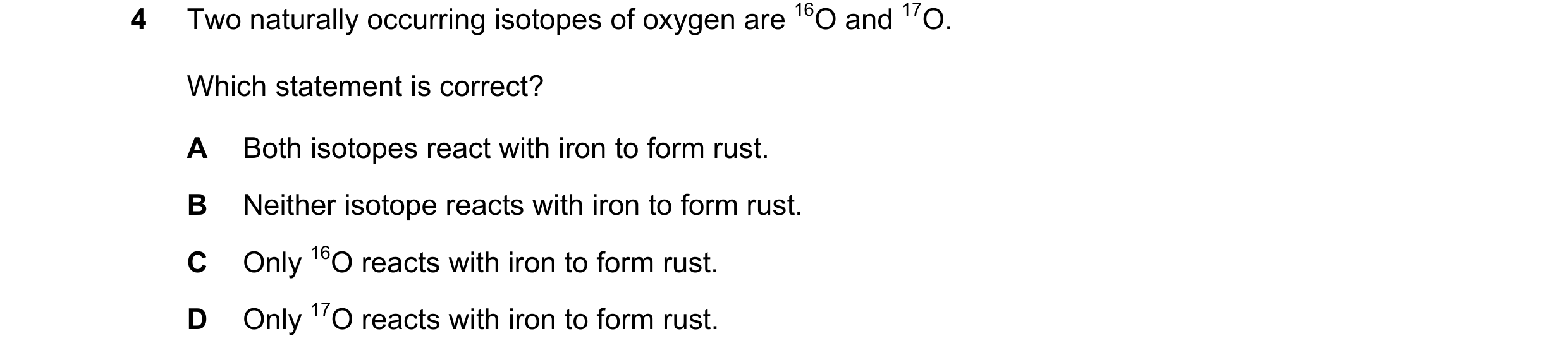
Q2 · Two naturally occurring isotopes of oxygen are 16O and 17O 0971/22 Oct/Nov 2018
4 Two naturally occurring isotopes of oxygen are 16O and 17O. Which statement is correct? A Both isotopes react with iron to form rust. B Neither isotope reacts with iron to form rust. C Only 16O reacts with iron to form rust. D Only 17O reacts with iron to form rust.
1 marks
Answer: A
This question in 0971/22 Oct/Nov 2018
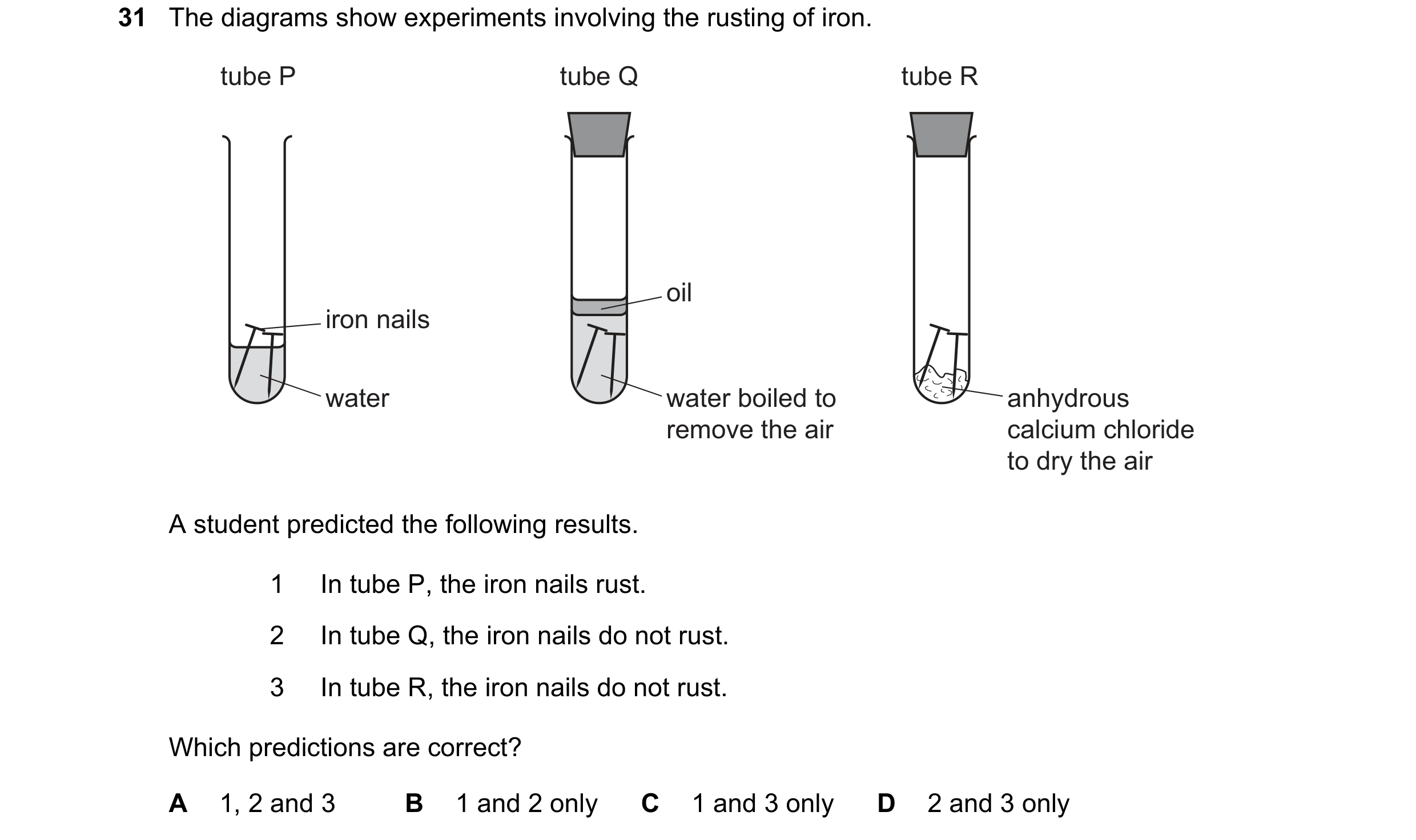
Q3 · The diagrams show experiments involving the rusting of iron 0971/22 Oct/Nov 2018
31 The diagrams show experiments involving the rusting of iron. tube P tube Q tube R oil iron nails water water boiled to anhydrous remove the air calcium chloride to dry the air A student predicted the following results. 1 In tube P, the iron nails rust. 2 In tube Q, the iron nails do not rust. 3 In tube R, the iron nails do not rust. Which predictions are correct? A 1, 2 and 3 B 1 and 2 only C 1 and 3 only D 2 and 3 only
1 marks
Answer: A
This question in 0971/22 Oct/Nov 2018
Q4 · Why is aluminium used to make containers for storing food? 0971/21 May/June 2019
27 Why is aluminium used to make containers for storing food? A It conducts electricity. B It has a high melting point. C It is resistant to corrosion. D It is strong.
1 marks
Answer: C
This question in 0971/21 May/June 2019
Q5 · The diagram shows an experiment to investigate how paint affects the rusting of iron 0971/21 May/June 2019
30 The diagram shows an experiment to investigate how paint affects the rusting of iron. P Q iron painted iron air water What happens to the water level in tubes P and Q? tube P tube Q A falls rises B no change rises C rises falls D rises no change
1 marks
Answer: D
This question in 0971/21 May/June 2019
Q6 · The apparatus shown is set up and left for a week 0971/22 Oct/Nov 2019
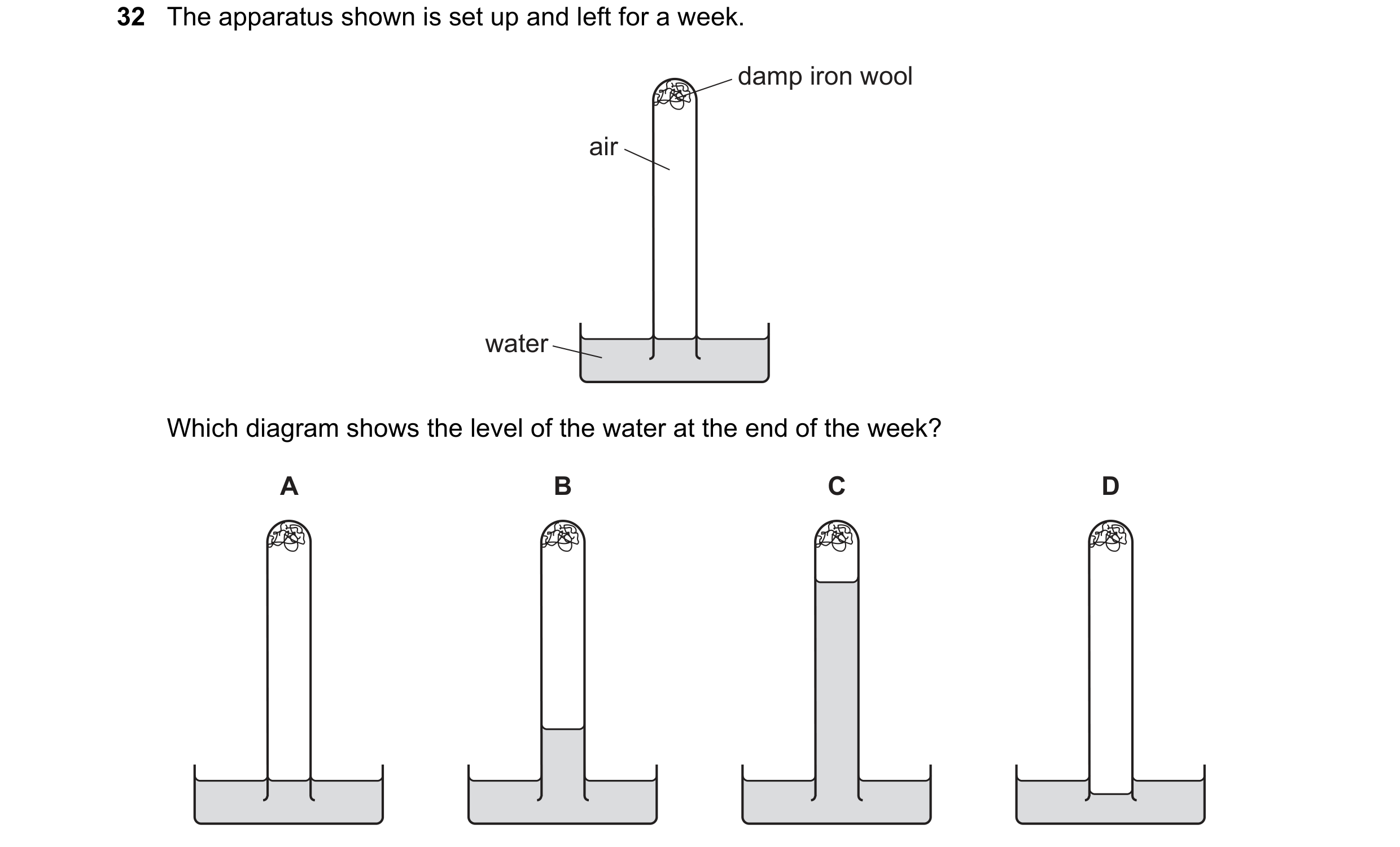
32 The apparatus shown is set up and left for a week. damp iron wool air water Which diagram shows the level of the water at the end of the week? A B C D
1 marks
Answer: B
This question in 0971/22 Oct/Nov 2019
Q7 · Coating iron helps to prevent rusting 0971/21 May/June 2020
32 Coating iron helps to prevent rusting. Which coating will continue to protect the iron even when the coating is damaged? A copper B paint C plastic D zinc
1 marks
Answer: D
This question in 0971/21 May/June 2020
Q8 · Which process, used to prevent iron from rusting, involves sacrificial protection? 0971/22 May/June 2020
32 Which process, used to prevent iron from rusting, involves sacrificial protection? A alloying B electroplating C galvanising D painting
1 marks
Answer: C
This question in 0971/22 May/June 2020
Q9 · Why is aluminium metal unreactive with air? 0971/22 Oct/Nov 2020
30 Why is aluminium metal unreactive with air? A It is covered with a layer of oxide. B It is low in the reactivity series. C It is produced by electrolysis of its oxide. D It melts at a high temperature.
1 marks
Answer: A
This question in 0971/22 Oct/Nov 2020
Q10 · A piece of aluminium is dropped into dilute hydrochloric acid 0971/22 May/June 2021
25 A piece of aluminium is dropped into dilute hydrochloric acid. No immediate reaction is observed. Which statement explains this observation? A Aluminium does not neutralise acids. B Aluminium is a non-metal so does not react with acids. C Aluminium is below hydrogen in the reactivity series. D Aluminium is covered in an unreactive oxide layer.
1 marks
Answer: D
This question in 0971/22 May/June 2021
Q11 · Mild steel consists mostly of iron 0971/22 May/June 2021
28 Mild steel consists mostly of iron. Mild steel can be prevented from rusting by a process called galvanising. Copper is not a very strong metal, however if it is mixed with a suitable metal a strong alloy called brass is produced. Which statement is correct? A Copper corrodes very quickly when wet and brass does not. B Copper is mixed with zinc to produce brass. C Galvanising mild steel changes it from a pure metal into an alloy. D When a steel object is galvanised this means it is coated with a thin layer of tin.
1 marks
Answer: B
This question in 0971/22 May/June 2021
Q12 · Iron can be electroplated with zinc to make it resistant to corrosion 0971/22 Oct/Nov 2021
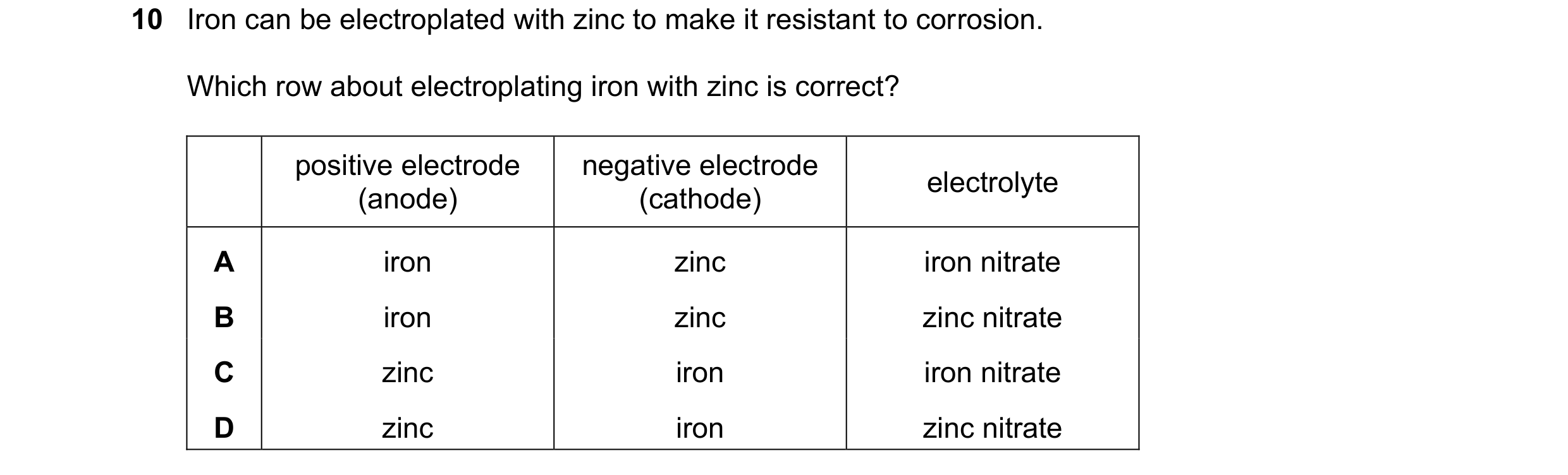
10 Iron can be electroplated with zinc to make it resistant to corrosion. Which row about electroplating iron with zinc is correct? positive electrode negative electrode electrolyte (anode) (cathode) A iron zinc iron nitrate B iron zinc zinc nitrate C zinc iron iron nitrate D zinc iron zinc nitrate
1 marks
Answer: D
This question in 0971/22 Oct/Nov 2021
Q13 · Aluminium objects do not need protection from corrosion 0971/22 Oct/Nov 2021
27 Aluminium objects do not need protection from corrosion. Iron objects must be protected from corrosion. Which statement explains why aluminium resists corrosion? A Aluminium does not form ions easily. B Aluminium does not react with water or air. C Aluminium has a protective oxide layer. D Aluminium is below iron in the reactivity series.
1 marks
Answer: C
This question in 0971/22 Oct/Nov 2021
Q14 · Which statements explain why zinc is used to protect iron from rusting? 0971/22 Oct/Nov 2021
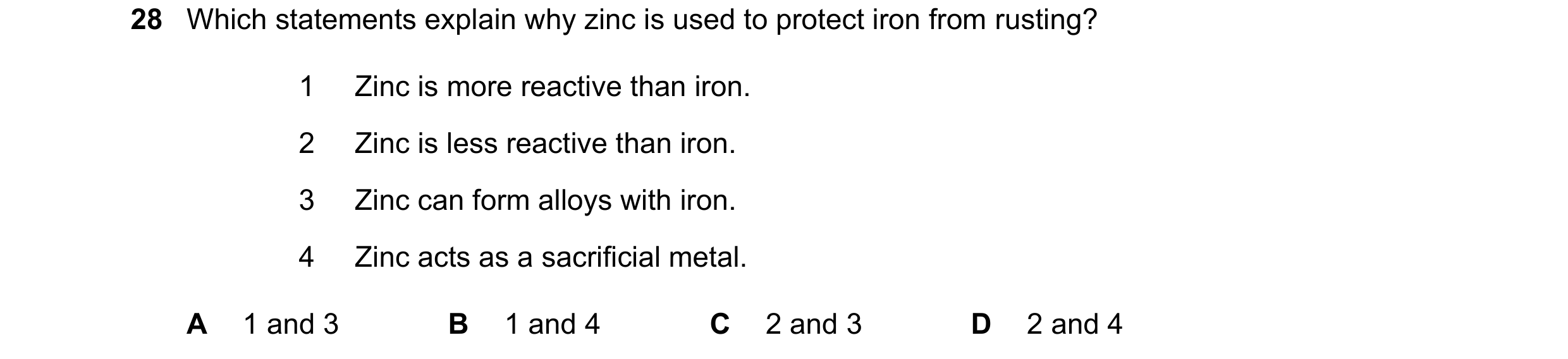
28 Which statements explain why zinc is used to protect iron from rusting? 1 Zinc is more reactive than iron. 2 Zinc is less reactive than iron. 3 Zinc can form alloys with iron. 4 Zinc acts as a sacrificial metal. A 1 and 3 B 1 and 4 C 2 and 3 D 2 and 4
1 marks
Answer: B
This question in 0971/22 Oct/Nov 2021
Q15 · Mild steel is galvanised to prevent corrosion of the iron 0971/21 May/June 2022
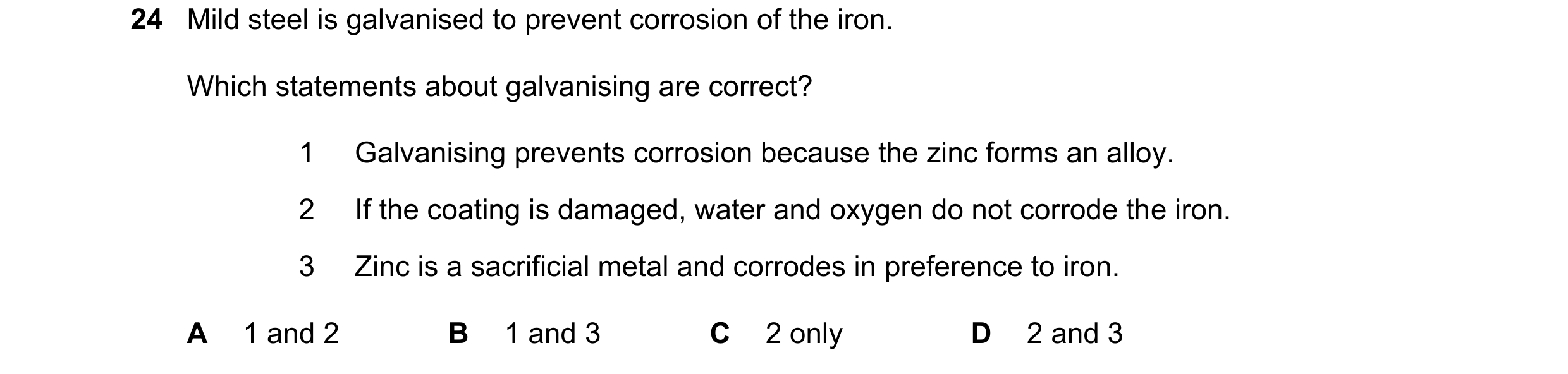
24 Mild steel is galvanised to prevent corrosion of the iron. Which statements about galvanising are correct? 1 Galvanising prevents corrosion because the zinc forms an alloy. 2 If the coating is damaged, water and oxygen do not corrode the iron. 3 Zinc is a sacrificial metal and corrodes in preference to iron. A 1 and 2 B 1 and 3 C 2 only D 2 and 3
1 marks
Answer: D
This question in 0971/21 May/June 2022
Q16 · Which process uses sacrificial protection to prevent steel from rusting? 0971/22 May/June 2022
30 Which process uses sacrificial protection to prevent steel from rusting? A galvanising B oiling C copper plating D painting
1 marks
Answer: A
This question in 0971/22 May/June 2022
Q17 · Three experiments, J, K and L, are set up to investigate rusting 0971/22 Oct/Nov 2022
25 Three experiments, J, K and L, are set up to investigate rusting.
J K L
water water water
mild steel painted iron stainless steel
In which experiments does rusting occur?
key
/=yes
X=no
1 marks
Answer: C
This question in 0971/22 Oct/Nov 2022
Q18 · Iron is galvanised by coating it in zinc 0971/22 Oct/Nov 2022
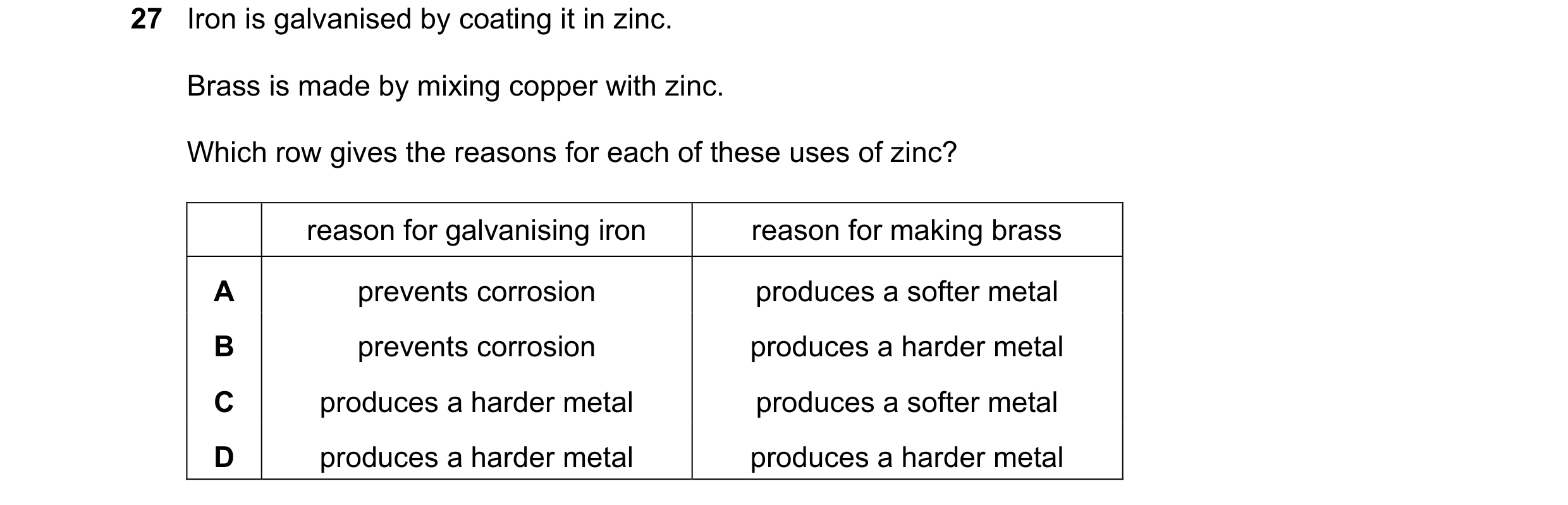
27 Iron is galvanised by coating it in zinc. Brass is made by mixing copper with zinc. Which row gives the reasons for each of these uses of zinc? reason for galvanising iron reason for making brass A prevents corrosion produces a softer metal B prevents corrosion produces a harder metal C produces a harder metal produces a softer metal D produces a harder metal produces a harder metal
1 marks
Answer: B
This question in 0971/22 Oct/Nov 2022
Q19 · Which statement explains why aluminium appears to be unreactive? 0971/21 May/June 2023
27 Which statement explains why aluminium appears to be unreactive? A It is coated in an oxide layer. B It has a low density. C It is low in the reactivity series. D It is solid at room temperature.
1 marks
Answer: A
This question in 0971/21 May/June 2023
Q20 · Which compound is formed when iron rusts? 0971/22 May/June 2023
27 Which compound is formed when iron rusts? A anhydrous iron(II) oxide B anhydrous iron(III) oxide C hydrated iron(III) hydroxide D hydrated iron(III) oxide
1 marks
Answer: D
This question in 0971/22 May/June 2023
Q21 · Which gas in the air is needed for iron to rust? 0971/22 Oct/Nov 2023
27 Which gas in the air is needed for iron to rust? A argon B carbon dioxide C nitrogen D oxygen
1 marks
Answer: D
This question in 0971/22 Oct/Nov 2023
Q22 · Which coating prevents iron from rusting even when the coating is damaged? 0971/22 Oct/Nov 2023
28 Which coating prevents iron from rusting even when the coating is damaged? A grease B paint C plastic D zinc
1 marks
Answer: D
This question in 0971/22 Oct/Nov 2023
Q23 · Iron rusts in the presence of oxygen and water 0971/21 May/June 2024
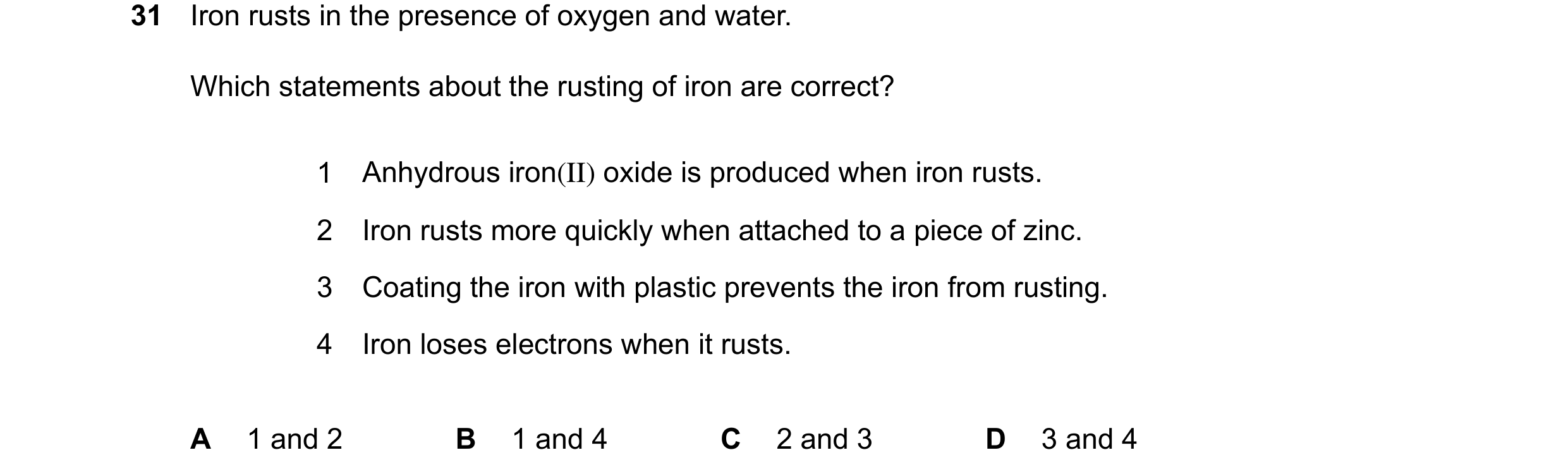
31 Iron rusts in the presence of oxygen and water. Which statements about the rusting of iron are correct? 1 Anhydrous iron(II) oxide is produced when iron rusts. 2 Iron rusts more quickly when attached to a piece of zinc. 3 Coating the iron with plastic prevents the iron from rusting. 4 Iron loses electrons when it rusts. A 1 and 2 B 1 and 4 C 2 and 3 D 3 and 4
1 marks
Answer: D
This question in 0971/21 May/June 2024
Q24 · Metal X acts as a sacrificial metal to prevent iron from corroding 0971/22 May/June 2024
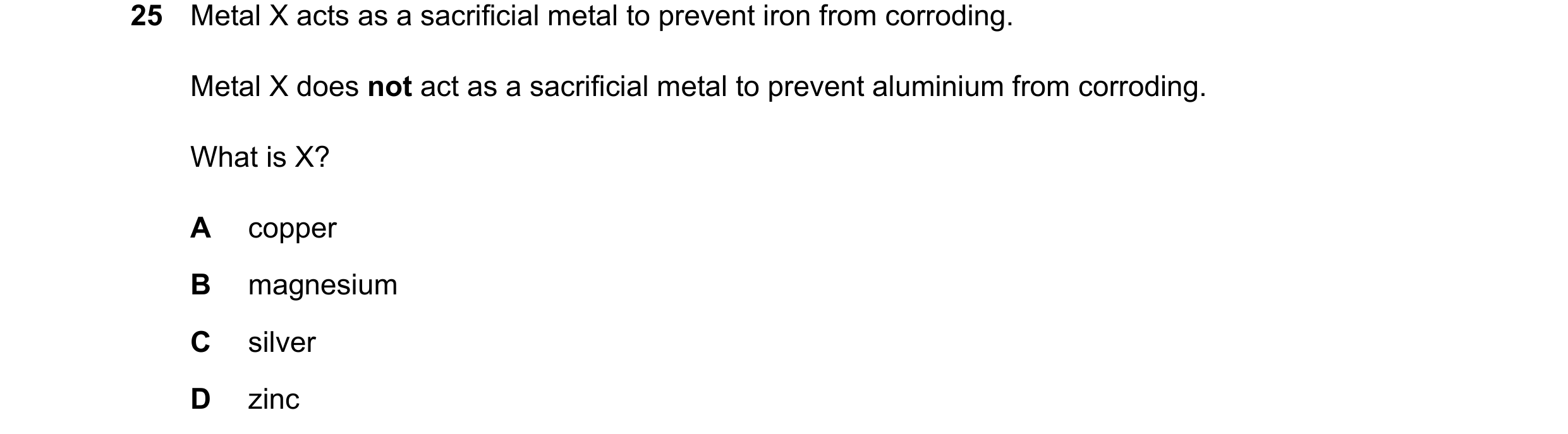
25 Metal X acts as a sacrificial metal to prevent iron from corroding. Metal X does not act as a sacrificial metal to prevent aluminium from corroding. What is X? A copper B magnesium C silver D zinc
1 marks
Answer: D
This question in 0971/22 May/June 2024
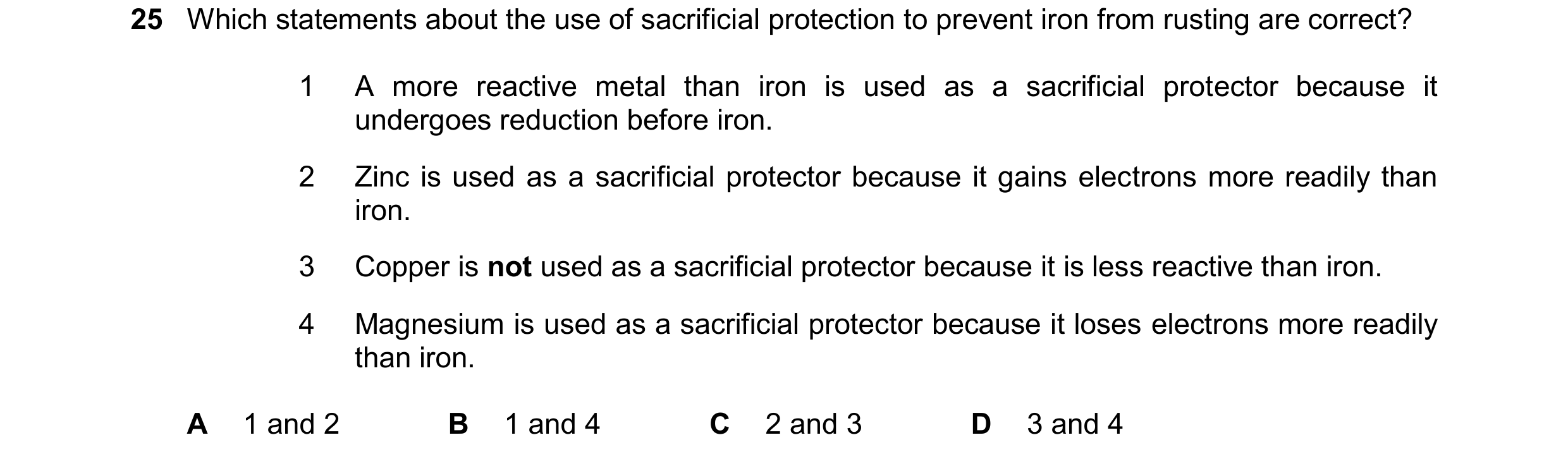
Q25 · Which statements about the use of sacrificial protection to prevent iron from rusting are… 0971/22 Oct/Nov 2024
25 Which statements about the use of sacrificial protection to prevent iron from rusting are correct? 1 A more reactive metal than iron is used as a sacrificial protector because it undergoes reduction before iron. 2 Zinc is used as a sacrificial protector because it gains electrons more readily than iron. 3 Copper is not used as a sacrificial protector because it is less reactive than iron. 4 Magnesium is used as a sacrificial protector because it loses electrons more readily than iron. A 1 and 2 B 1 and 4 C 2 and 3 D 3 and 4
1 marks
Answer: D
This question in 0971/22 Oct/Nov 2024
Q26 · Zinc is used to galvanise iron to prevent it from rusting 0971/22 May/June 2025
27 Zinc is used to galvanise iron to prevent it from rusting. Which statements are correct? 1 Galvanising is an example of a barrier method. 2 If the zinc is scratched, the iron will rust very quickly. 3 Galvanising is an example of sacrificial protection. 4 Zinc is more reactive than iron and so accepts electrons more readily. A 1, 2 and 4 B 1 and 3 C 2, 3 and 4 D 2 and 3 only
1 marks
Answer: B
This question in 0971/22 May/June 2025
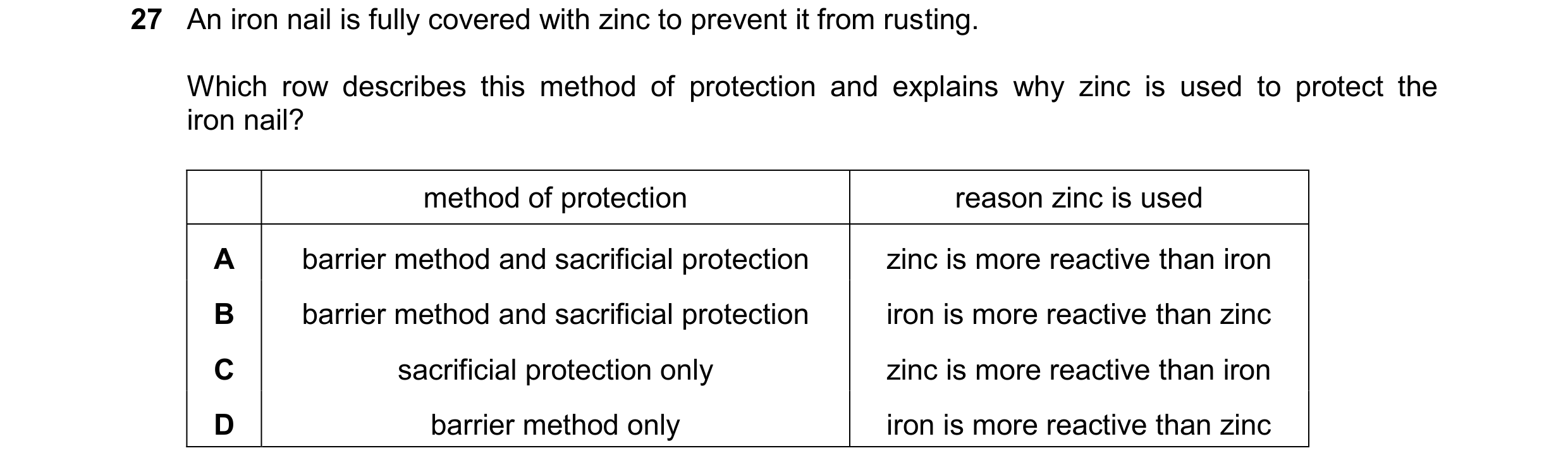
Q27 · An iron nail is fully covered with zinc to prevent it from rusting 0971/22 Oct/Nov 2025
27 An iron nail is fully covered with zinc to prevent it from rusting. Which row describes this method of protection and explains why zinc is used to protect the iron nail? method of protection reason zinc is used A barrier method and sacrificial protection zinc is more reactive than iron B barrier method and sacrificial protection iron is more reactive than zinc C sacrificial protection only zinc is more reactive than iron D barrier method only iron is more reactive than zinc
1 marks
Answer: A
This question in 0971/22 Oct/Nov 2025
 1 / 7
1 / 7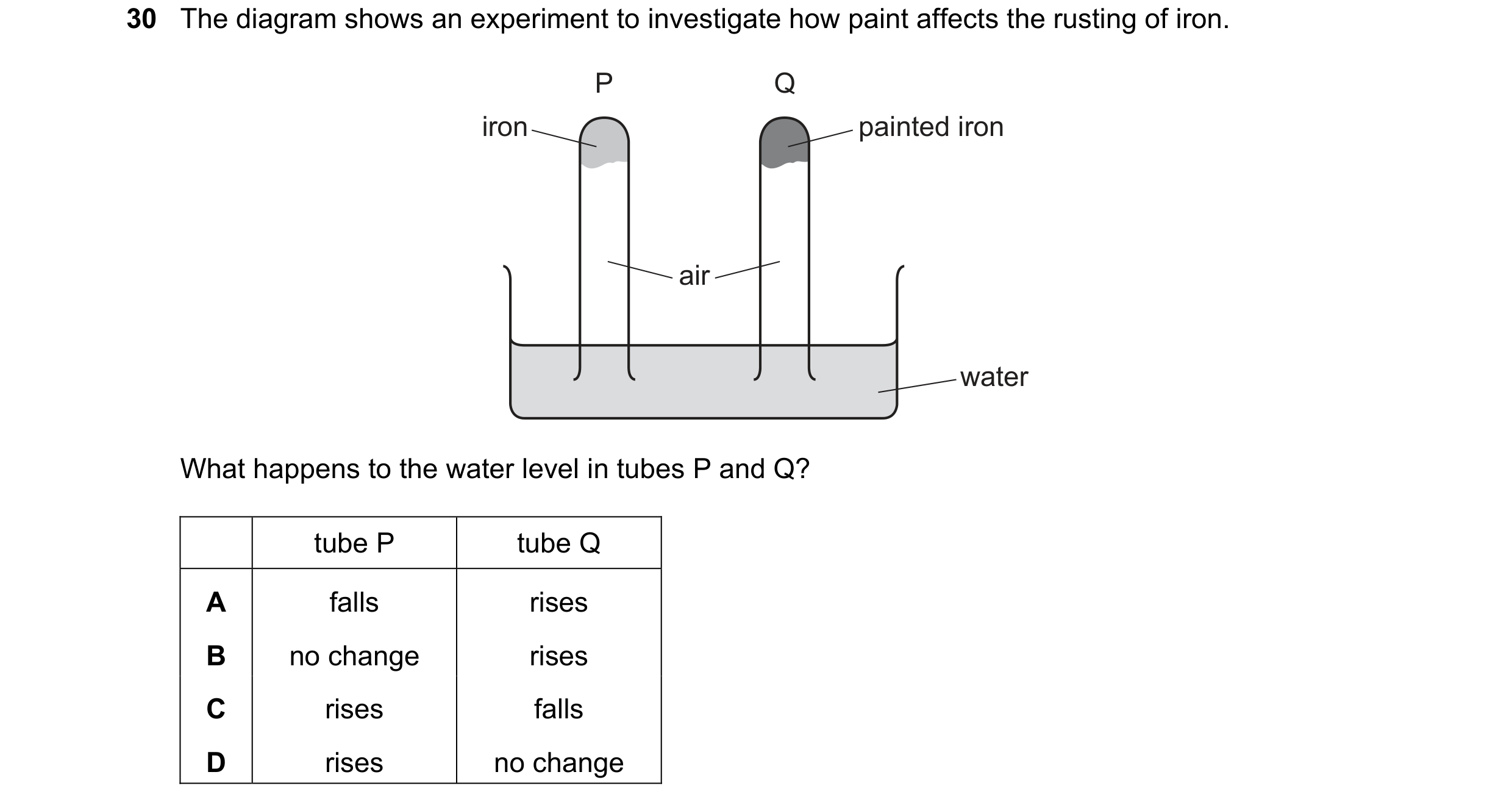
 2 / 7
2 / 7

 3 / 7
3 / 7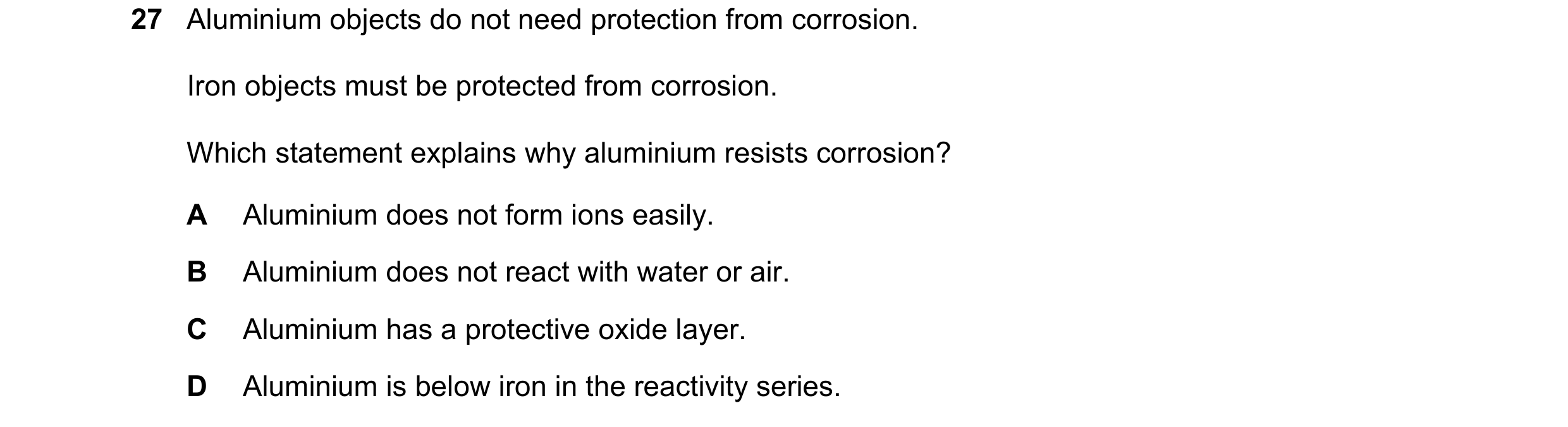
 4 / 7
4 / 7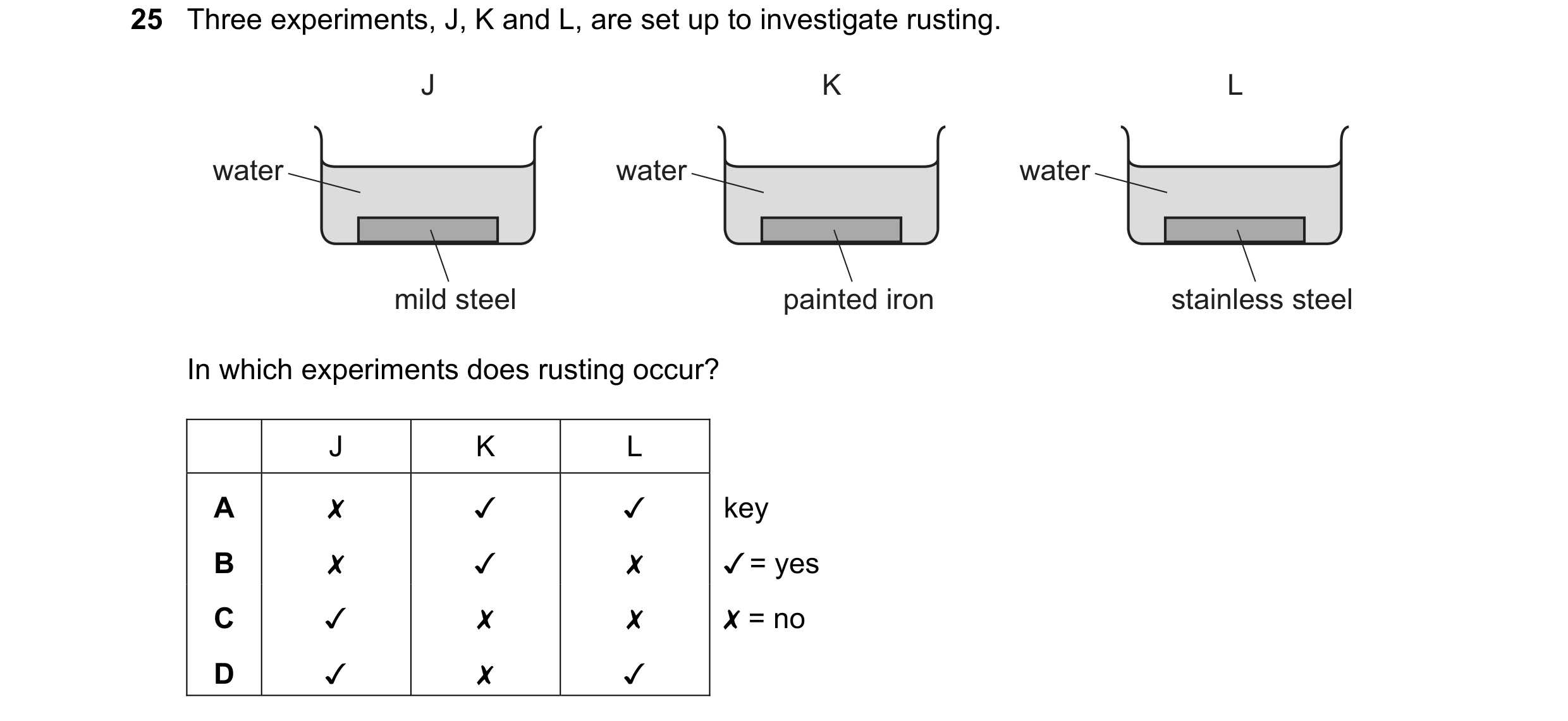

 5 / 7
5 / 7

 6 / 7
6 / 7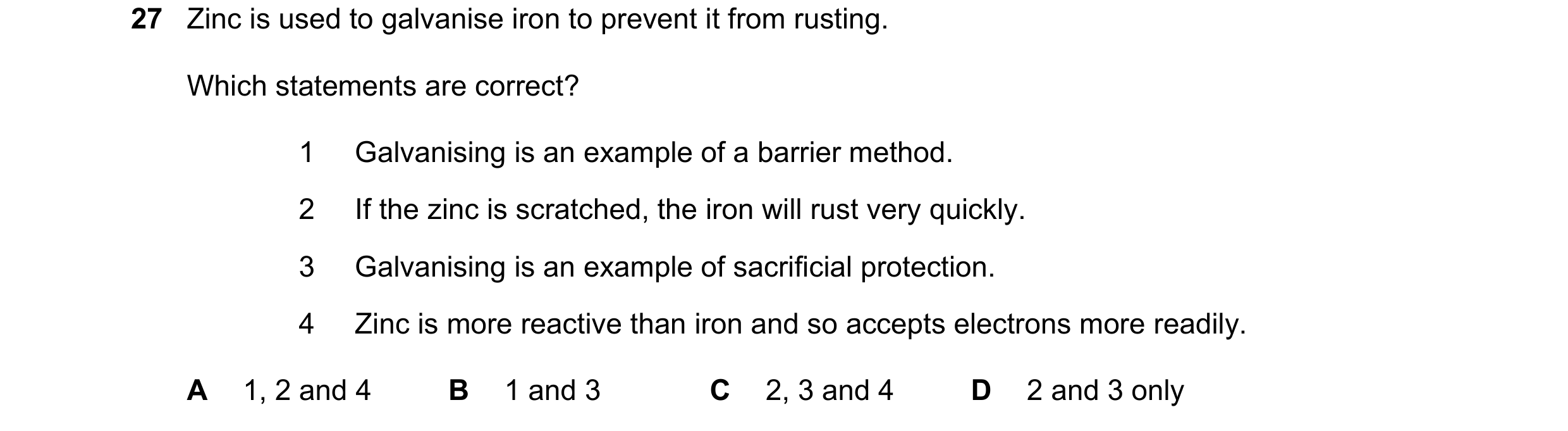
 7 / 7
7 / 7