Questions as text
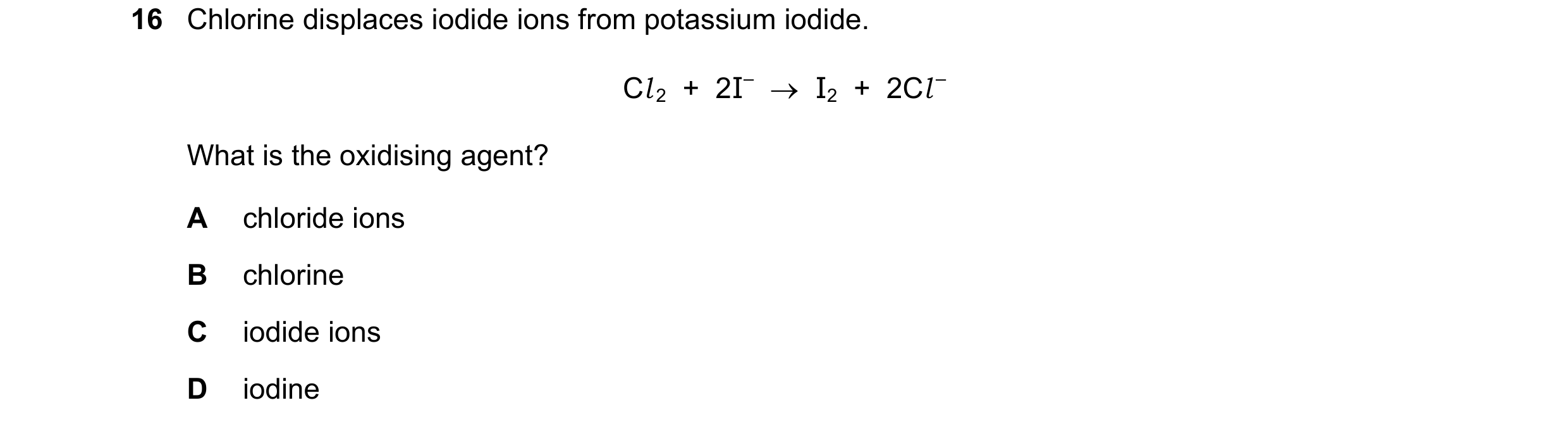
Q1 · Chlorine displaces iodide ions from potassium iodide 0971/21 May/June 2018
16 Chlorine displaces iodide ions from potassium iodide. Cl 2 + 2I– → I2 + 2Cl – What is the oxidising agent? A chloride ions B chlorine C iodide ions D iodine
1 marks
Answer: B
This question in 0971/21 May/June 2018
Q2 · Which statement about sulfur and its compounds is not correct? 0971/21 May/June 2018
33 Which statement about sulfur and its compounds is not correct? A Sulfur dioxide is used as a food preservative. B Sulfur dioxide turns acidified aqueous potassium manganate(VII) from purple to colourless. C Sulfur forms a basic oxide. D Sulfur is used in the manufacture of sulfuric acid.
1 marks
Answer: C
This question in 0971/21 May/June 2018
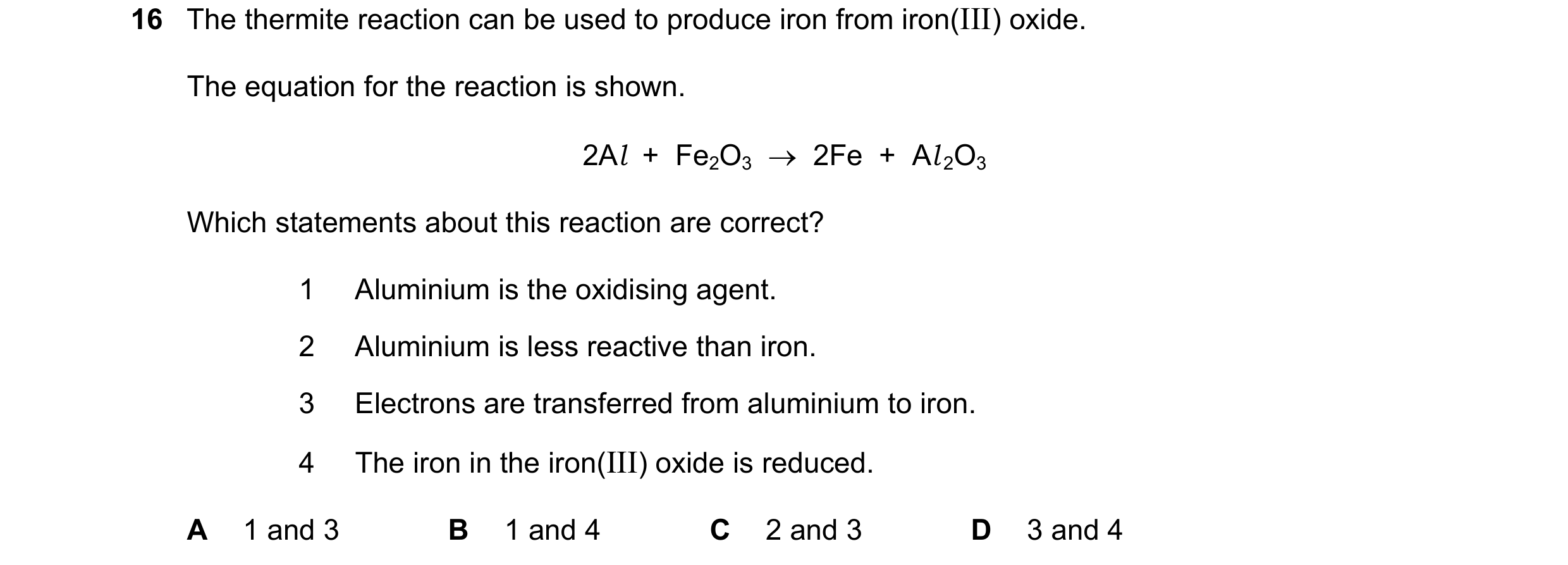
Q3 · The thermite reaction can be used to produce iron from iron(III) oxide 0971/22 Oct/Nov 2018
16 The thermite reaction can be used to produce iron from iron(III) oxide. The equation for the reaction is shown. 2Al + Fe2O3 → 2Fe + Al 2O3 Which statements about this reaction are correct? 1 Aluminium is the oxidising agent. 2 Aluminium is less reactive than iron. 3 Electrons are transferred from aluminium to iron. 4 The iron in the iron(III) oxide is reduced. A 1 and 3 B 1 and 4 C 2 and 3 D 3 and 4
1 marks
Answer: D
This question in 0971/22 Oct/Nov 2018
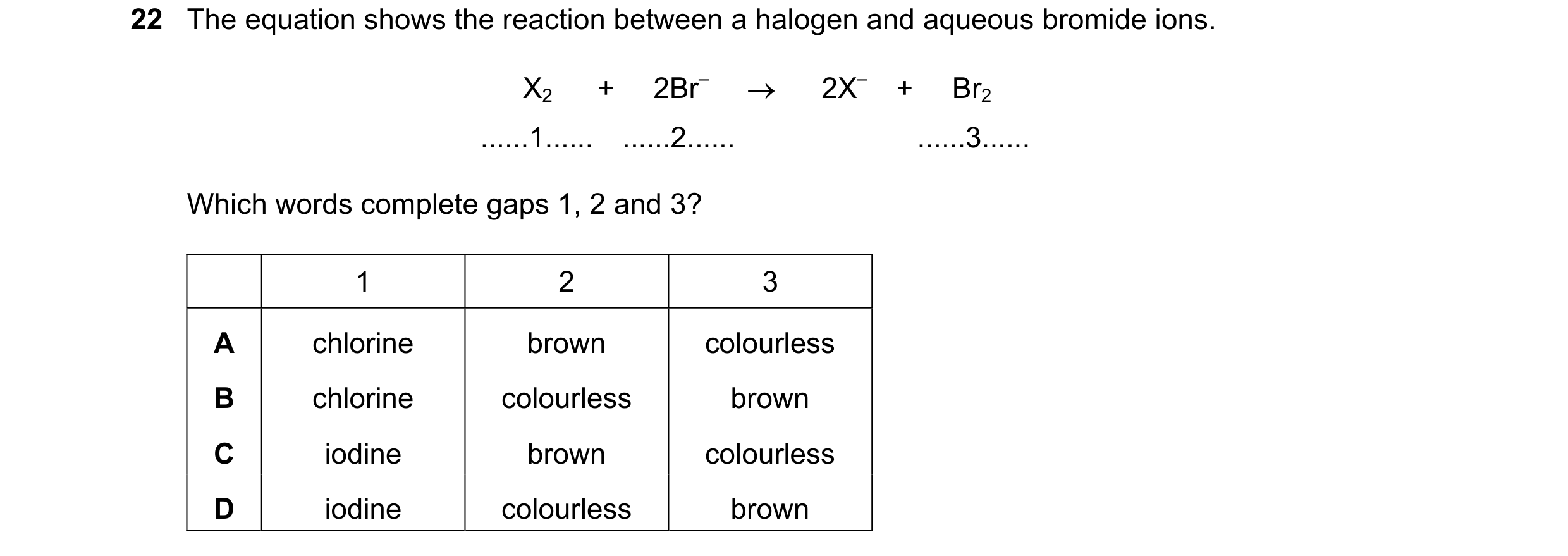
Q4 · The equation shows the reaction between a halogen and aqueous bromide ions 0971/22 Oct/Nov 2018
22 The equation shows the reaction between a halogen and aqueous bromide ions. X2 + 2Br– → 2X– + Br2 … 1 … … 2 … … 3 … Which words complete gaps 1, 2 and 3? 1 2 3 A chlorine brown colourless B chlorine colourless brown C iodine brown colourless D iodine colourless brown
1 marks
Answer: B
This question in 0971/22 Oct/Nov 2018
Q5 · Heating copper(II) carbonate produces copper(II) oxide and carbon dioxide 0971/22 Oct/Nov 2018
24 Heating copper(II) carbonate produces copper(II) oxide and carbon dioxide. Heating the copper(II) oxide formed with carbon produces copper. Which processes are involved in this conversion of copper(II) carbonate to copper? A sublimation followed by oxidation B sublimation followed by reduction C thermal decomposition followed by oxidation D thermal decomposition followed by reduction
1 marks
Answer: D
This question in 0971/22 Oct/Nov 2018
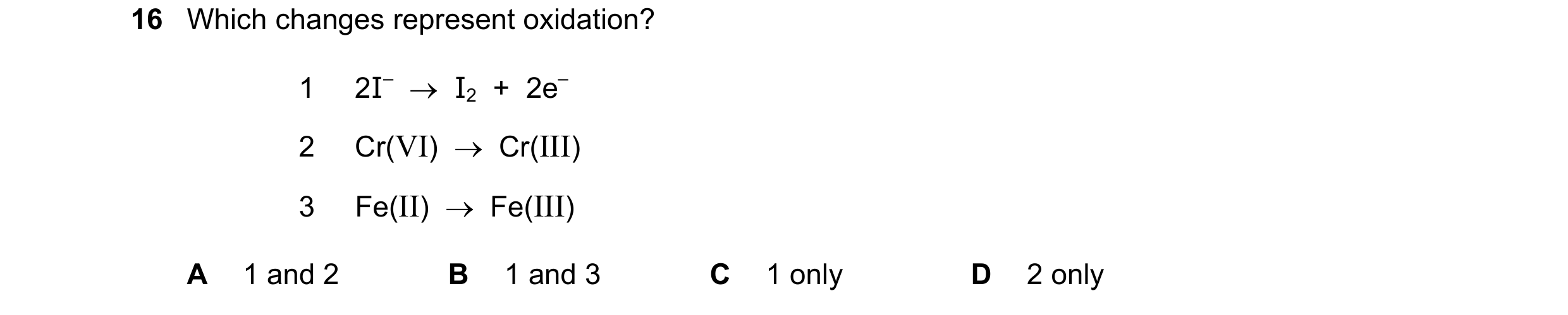
Q6 · Which changes represent oxidation? 0971/21 May/June 2019
16 Which changes represent oxidation? 1 2I– → I2 + 2e– 2 Cr(VI) → Cr(III) 3 Fe(II) → Fe(III) A 1 and 2 B 1 and 3 C 1 only D 2 only
1 marks
Answer: B
This question in 0971/21 May/June 2019
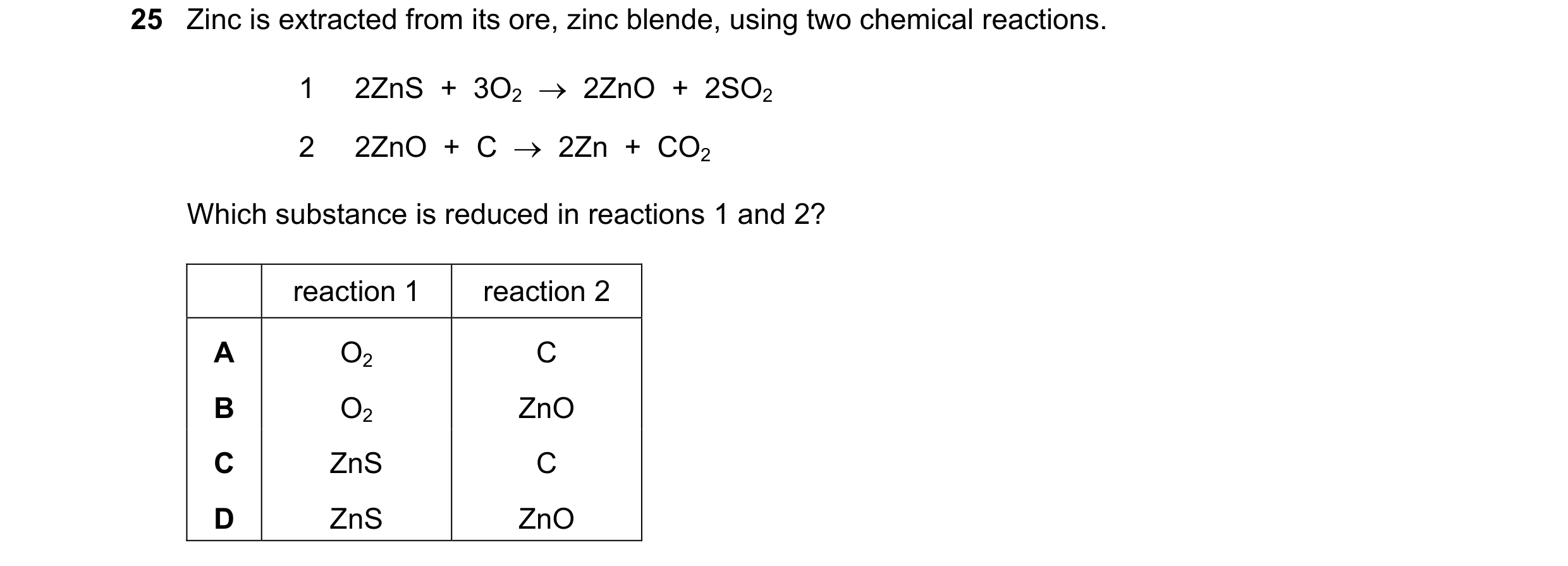
Q7 · Zinc is extracted from its ore, zinc blende, using two chemical reactions 0971/21 May/June 2019
25 Zinc is extracted from its ore, zinc blende, using two chemical reactions. 1 2ZnS + 3O2 → 2ZnO + 2SO2 2 2ZnO + C → 2Zn + CO2 Which substance is reduced in reactions 1 and 2? reaction 1 reaction 2 A O2 C B O2 ZnO C ZnS C D ZnS ZnO
1 marks
Answer: B
This question in 0971/21 May/June 2019
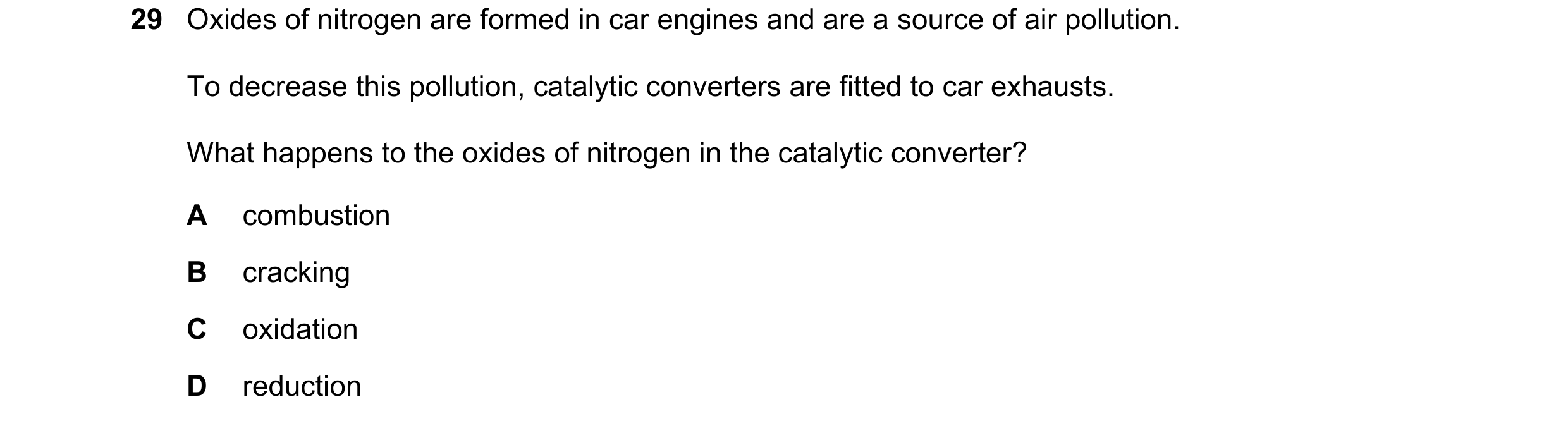
Q8 · Oxides of nitrogen are formed in car engines and are a source of air pollution 0971/21 May/June 2019
29 Oxides of nitrogen are formed in car engines and are a source of air pollution. To decrease this pollution, catalytic converters are fitted to car exhausts. What happens to the oxides of nitrogen in the catalytic converter? A combustion B cracking C oxidation D reduction
1 marks
Answer: D
This question in 0971/21 May/June 2019
Q9 · In the blast furnace, iron is formed when iron(III) oxide reacts with carbon monoxide in… 0971/22 Oct/Nov 2019
18 In the blast furnace, iron is formed when iron(III) oxide reacts with carbon monoxide in a redox reaction. Fe2O3 + 3CO → 2Fe + 3CO2 Which substance is the oxidising agent and which substance is the reducing agent? oxidising agent reducing agent A CO Fe2O3 B CO2 Fe C Fe CO2 D Fe2O3 CO
1 marks
Answer: D
This question in 0971/22 Oct/Nov 2019
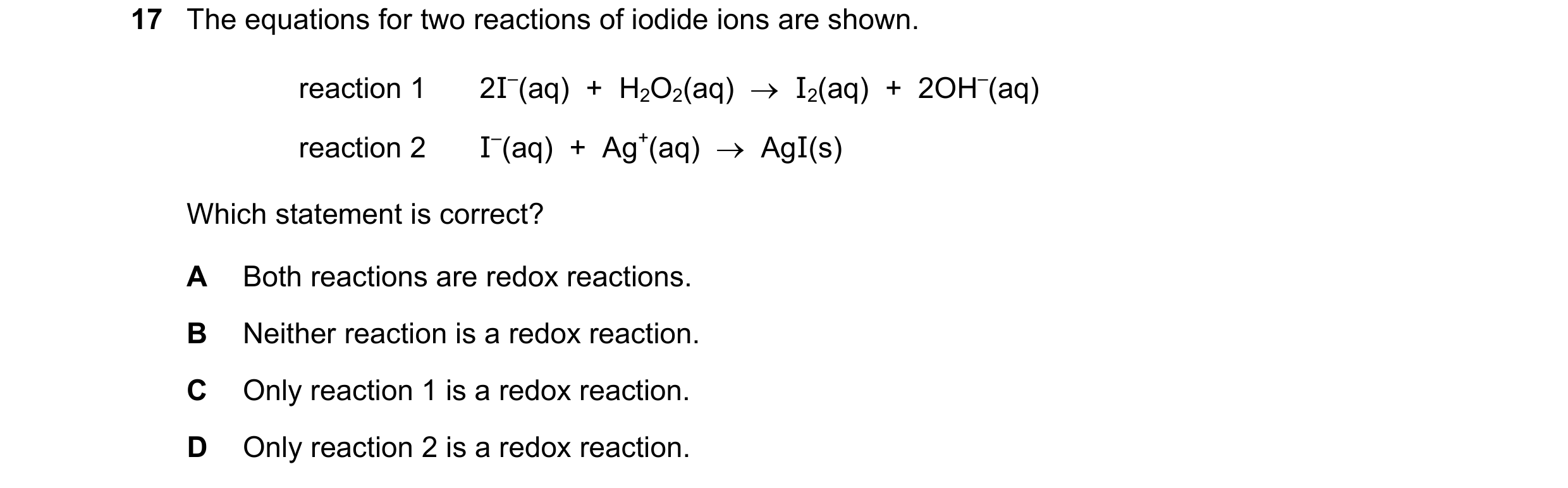
Q10 · The equations for two reactions of iodide ions are shown 0971/21 May/June 2020
17 The equations for two reactions of iodide ions are shown. reaction 1 2I–(aq) + H2O2(aq) → I2(aq) + 2OH–(aq) reaction 2 I–(aq) + Ag+(aq) → AgI(s) Which statement is correct? A Both reactions are redox reactions. B Neither reaction is a redox reaction. C Only reaction 1 is a redox reaction. D Only reaction 2 is a redox reaction.
1 marks
Answer: C
This question in 0971/21 May/June 2020
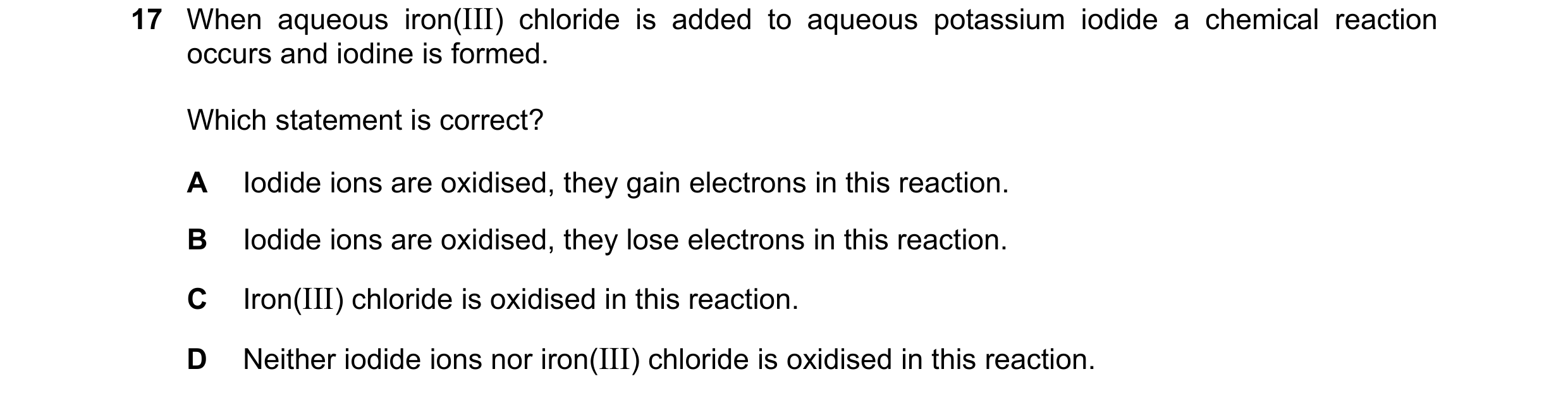
Q11 · When aqueous iron(III) chloride is added to aqueous potassium iodide a chemical reaction… 0971/22 May/June 2020
17 When aqueous iron(III) chloride is added to aqueous potassium iodide a chemical reaction occurs and iodine is formed. Which statement is correct? A Iodide ions are oxidised, they gain electrons in this reaction. B Iodide ions are oxidised, they lose electrons in this reaction. C Iron(III) chloride is oxidised in this reaction. D Neither iodide ions nor iron(III) chloride is oxidised in this reaction.
1 marks
Answer: B
This question in 0971/22 May/June 2020
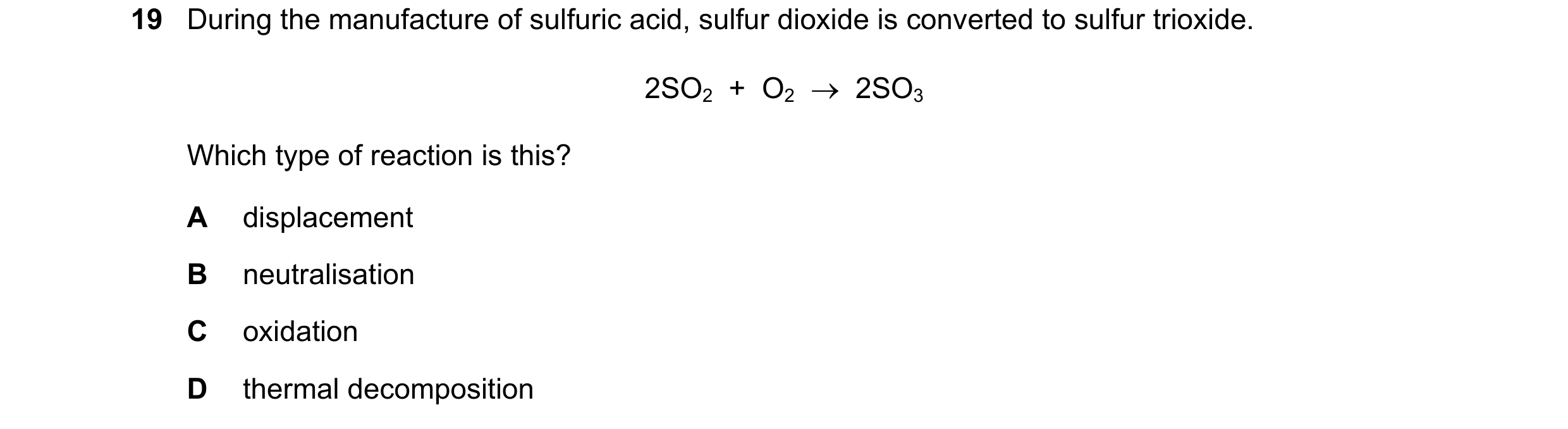
Q12 · During the manufacture of sulfuric acid, sulfur dioxide is converted to sulfur trioxide 0971/22 Oct/Nov 2020
19 During the manufacture of sulfuric acid, sulfur dioxide is converted to sulfur trioxide. 2SO2 + O2 2SO3 Which type of reaction is this? A displacement B neutralisation C oxidation D thermal decomposition
1 marks
Answer: C
This question in 0971/22 Oct/Nov 2020
Q13 · The equation for a redox reaction is shown 0971/22 Oct/Nov 2020
20 The equation for a redox reaction is shown. 2FeSO4 + Cl 2 + H2SO4 Fe2(SO4)3 + 2HCl Which element is reduced? A chlorine B iron C oxygen D sulfur
1 marks
Answer: A
This question in 0971/22 Oct/Nov 2020
Q14 · An example of a redox reaction is shown 0971/21 May/June 2021
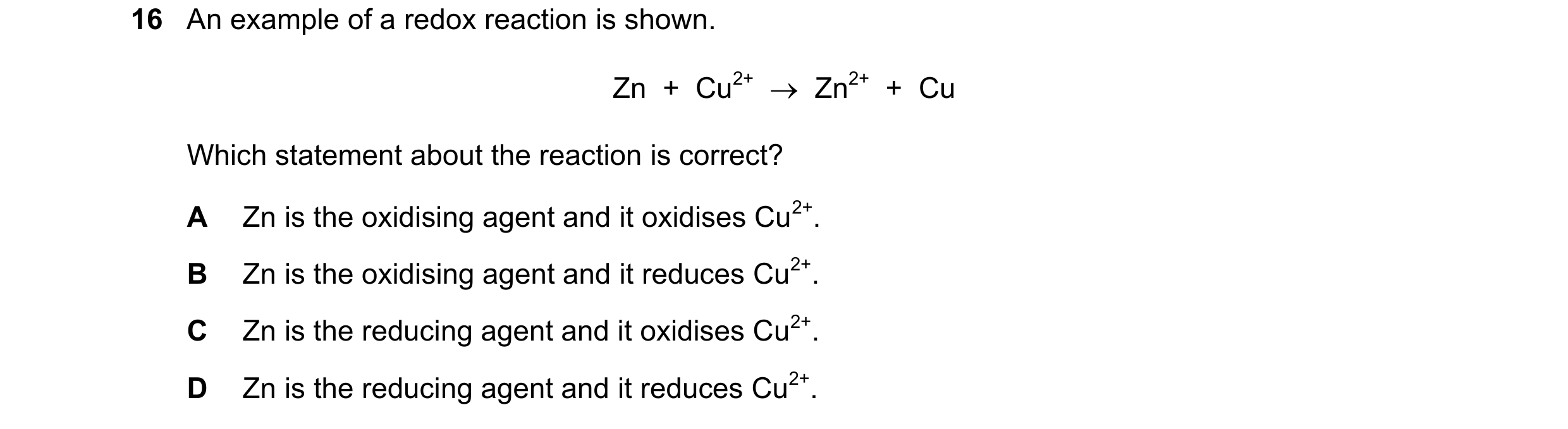
16 An example of a redox reaction is shown. Zn + Cu2+ Zn2+ + Cu Which statement about the reaction is correct? A Zn is the oxidising agent and it oxidises Cu2+. B Zn is the oxidising agent and it reduces Cu2+. C Zn is the reducing agent and it oxidises Cu2+. D Zn is the reducing agent and it reduces Cu2+.
1 marks
Answer: D
This question in 0971/21 May/June 2021
Q15 · Some reactions of element M are shown 0971/21 May/June 2021
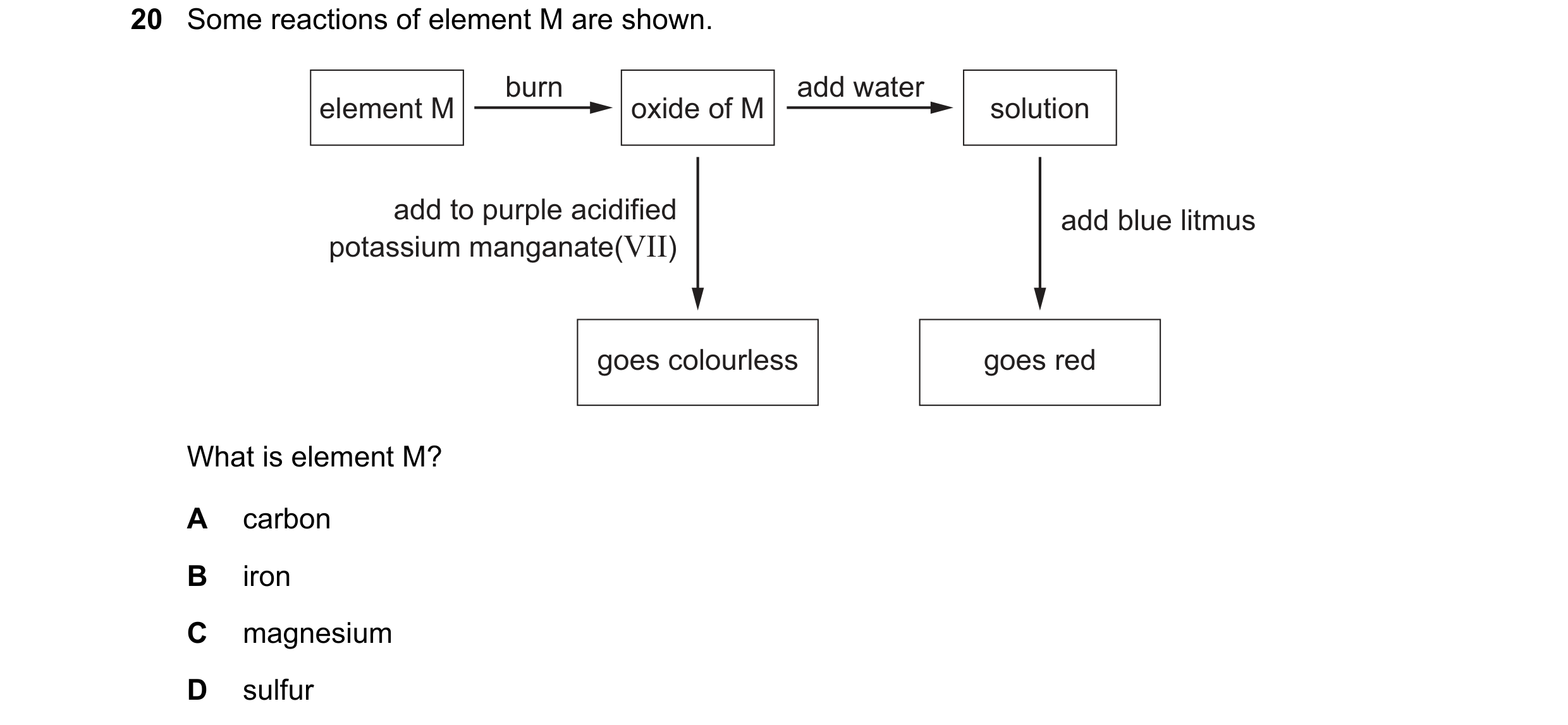
20 Some reactions of element M are shown. burn add water element M oxide of M solution add to purple acidified add blue litmus potassium manganate(VII) goes colourless goes red What is element M? A carbon B iron C magnesium D sulfur
1 marks
Answer: D
This question in 0971/21 May/June 2021
Q16 · An example of a redox reaction is shown 0971/22 May/June 2021
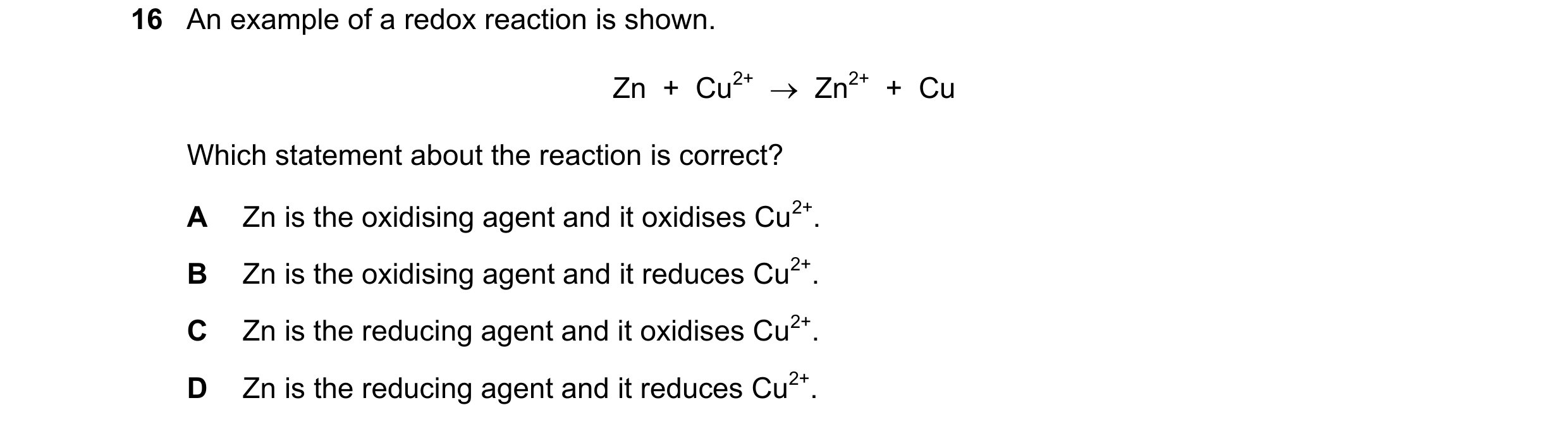
16 An example of a redox reaction is shown. Zn + Cu2+ Zn2+ + Cu Which statement about the reaction is correct? A Zn is the oxidising agent and it oxidises Cu2+. B Zn is the oxidising agent and it reduces Cu2+. C Zn is the reducing agent and it oxidises Cu2+. D Zn is the reducing agent and it reduces Cu2+.
1 marks
Answer: D
This question in 0971/22 May/June 2021
Q17 · When aqueous iodine is added to a solution of vanadium ions, V2+, the V2+ ions each lose… 0971/22 May/June 2021
24 When aqueous iodine is added to a solution of vanadium ions, V2+, the V2+ ions each lose one electron. Which property of transition elements is shown by this reaction? A Transition elements have variable oxidation states. B Transition elements form a stable 1+ ion. C Transition elements are oxidising agents. D Transition elements can act as catalysts.
1 marks
Answer: A
This question in 0971/22 May/June 2021
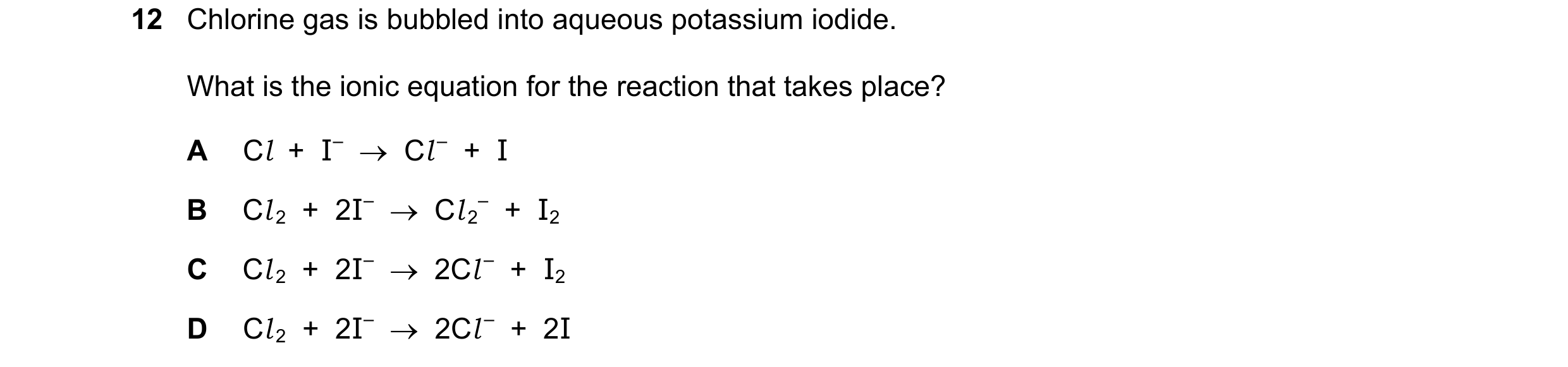
Q18 · Chlorine gas is bubbled into aqueous potassium iodide 0971/22 Oct/Nov 2021
12 Chlorine gas is bubbled into aqueous potassium iodide. What is the ionic equation for the reaction that takes place? A Cl + I– Cl – + I B Cl 2 + 2I– Cl 2 – + I2 C Cl 2 + 2I– 2Cl – + I2 D Cl 2 + 2I– 2Cl – + 2I
1 marks
Answer: C
This question in 0971/22 Oct/Nov 2021
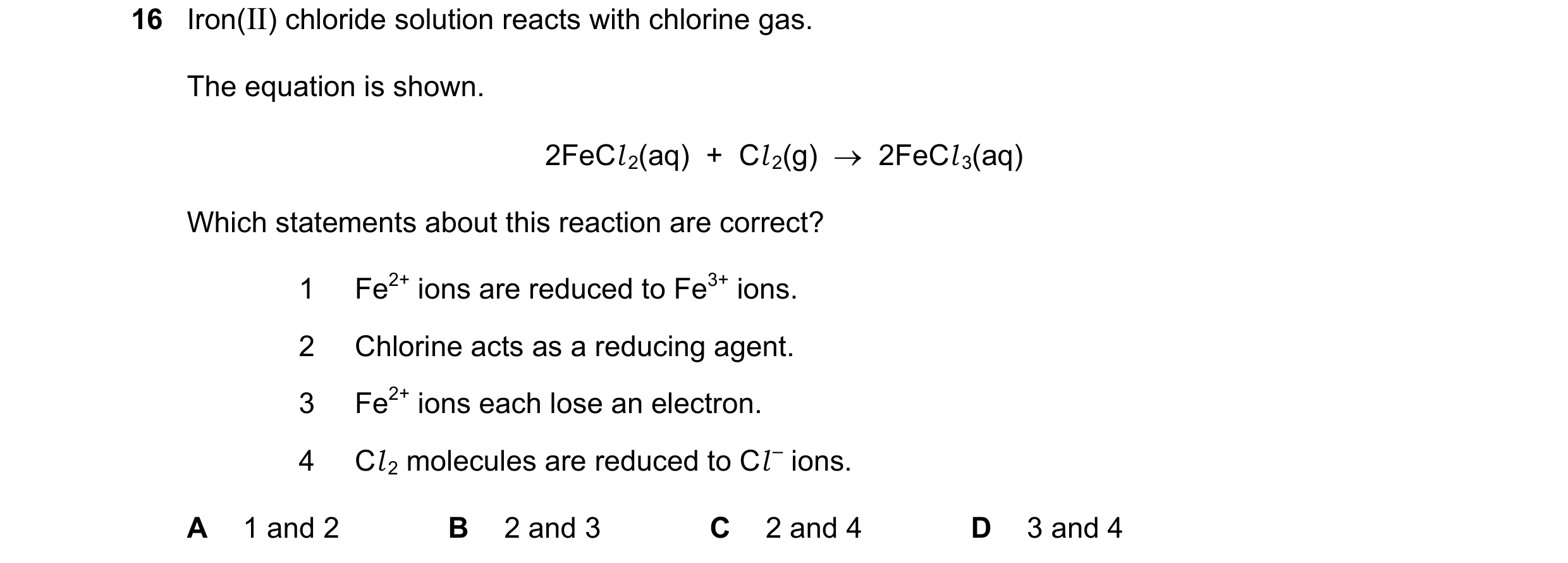
Q19 · Iron(II) chloride solution reacts with chlorine gas 0971/22 Oct/Nov 2021
16 Iron(II) chloride solution reacts with chlorine gas. The equation is shown. 2FeCl 2(aq) + Cl 2(g) 2FeCl 3(aq) Which statements about this reaction are correct? 1 Fe2+ ions are reduced to Fe3+ ions. 2 Chlorine acts as a reducing agent. 3 Fe2+ ions each lose an electron. 4 Cl 2 molecules are reduced to Cl – ions. A 1 and 2 B 2 and 3 C 2 and 4 D 3 and 4
1 marks
Answer: D
This question in 0971/22 Oct/Nov 2021
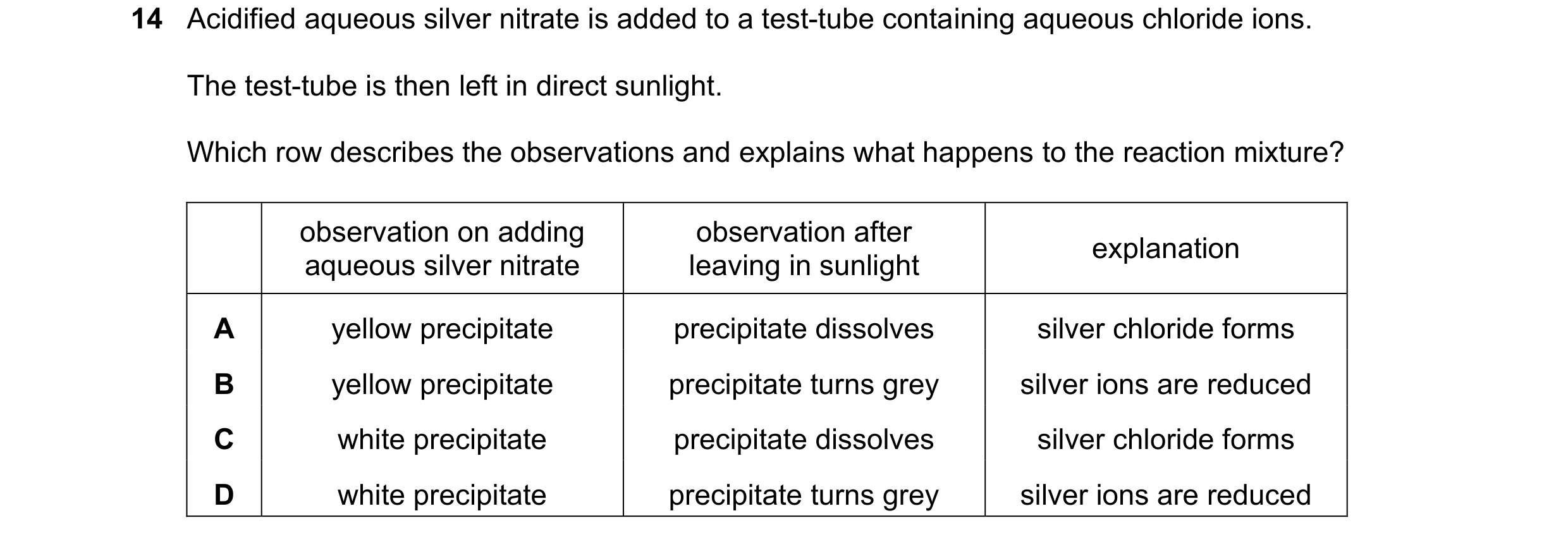
Q20 · Acidified aqueous silver nitrate is added to a test-tube containing aqueous chloride ions 0971/21 May/June 2022
14 Acidified aqueous silver nitrate is added to a test-tube containing aqueous chloride ions. The test-tube is then left in direct sunlight. Which row describes the observations and explains what happens to the reaction mixture? observation on adding observation after explanation aqueous silver nitrate leaving in sunlight A yellow precipitate precipitate dissolves silver chloride forms B yellow precipitate precipitate turns grey silver ions are reduced C white precipitate precipitate dissolves silver chloride forms D white precipitate precipitate turns grey silver ions are reduced
1 marks
Answer: D
This question in 0971/21 May/June 2022
Q21 · Aqueous iron(III) chloride, FeCl 3, reacts with aqueous potassium iodide, KI 0971/21 May/June 2022
16 Aqueous iron(III) chloride, FeCl 3, reacts with aqueous potassium iodide, KI. vFeCl 3 + wKI xFeCl 2 + yKCl + I2 Which statements are correct? 1 In the balanced equation, v, w, x and y have the same value. 2 Potassium iodide is an oxidising agent. 3 A dark brown solution is produced in the reaction. A 1 and 2 B 1 and 3 C 2 only D 2 and 3
1 marks
Answer: B
This question in 0971/21 May/June 2022
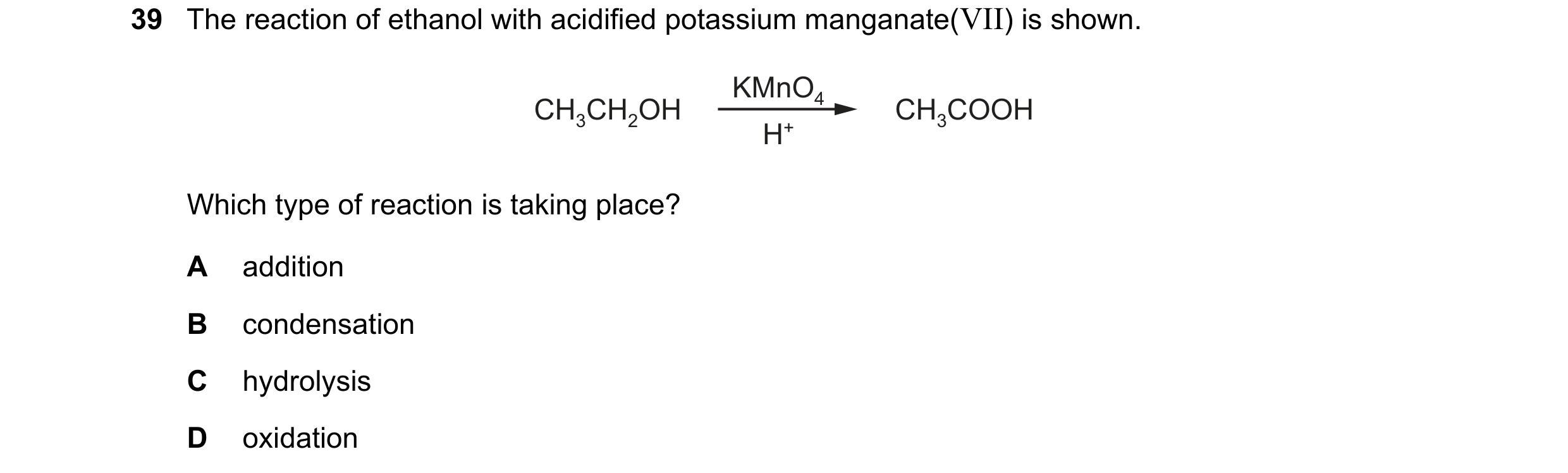
Q22 · The reaction of ethanol with acidified potassium manganate(VII) is shown 0971/21 May/June 2022
39 The reaction of ethanol with acidified potassium manganate(VII) is shown. KMnO4 CH3CH2OH CH3COOH H+ Which type of reaction is taking place? A addition B condensation C hydrolysis D oxidation
1 marks
Answer: D
This question in 0971/21 May/June 2022
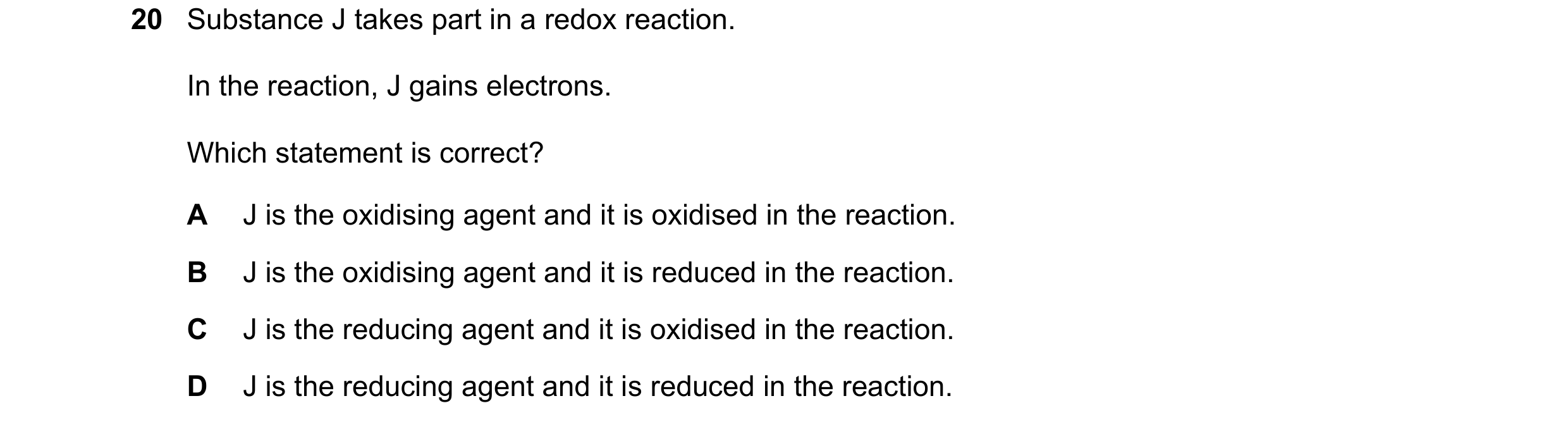
Q23 · Substance J takes part in a redox reaction 0971/22 May/June 2022
20 Substance J takes part in a redox reaction. In the reaction, J gains electrons. Which statement is correct? A J is the oxidising agent and it is oxidised in the reaction. B J is the oxidising agent and it is reduced in the reaction. C J is the reducing agent and it is oxidised in the reaction. D J is the reducing agent and it is reduced in the reaction.
1 marks
Answer: B
This question in 0971/22 May/June 2022
Q24 · The electrical energy, or voltage, of two simple cells is measured 0971/22 Oct/Nov 2022
13 The electrical energy, or voltage, of two simple cells is measured. V V zinc magnesium magnesium copper electrolyte electrolyte cell 1 cell 2 statement 1 The voltage of cell 1 is greater than cell 2. statement 2 Zinc is more reactive than copper. statement 3 Magnesium is oxidised in both cells. statement 4 Magnesium atoms lose electrons to form magnesium ions. Which option is correct? A All the statements are correct. B Only statements 1 and 3 are correct. C Statement 2 is correct and explains statement 1. D Statement 4 is correct and explains statement 3.
1 marks
Answer: D
This question in 0971/22 Oct/Nov 2022
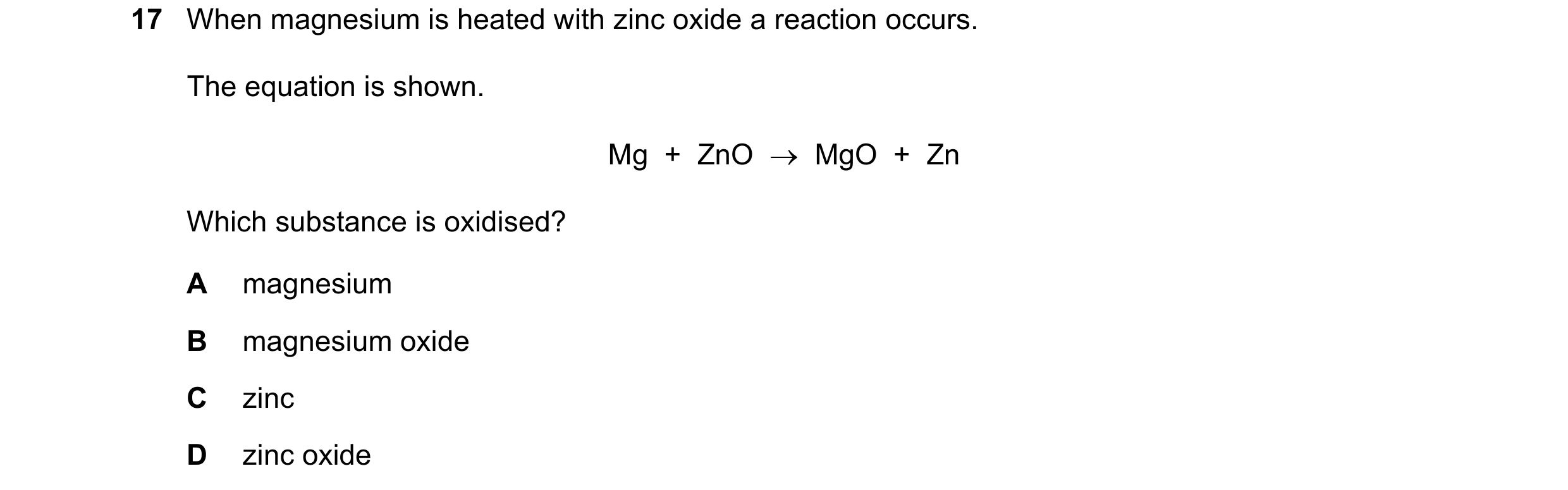
Q25 · When magnesium is heated with zinc oxide a reaction occurs 0971/22 Oct/Nov 2022
17 When magnesium is heated with zinc oxide a reaction occurs. The equation is shown. Mg + ZnO MgO + Zn Which substance is oxidised? A magnesium B magnesium oxide C zinc D zinc oxide
1 marks
Answer: A
This question in 0971/22 Oct/Nov 2022
Q26 · Which type of reaction occurs when ethanol is converted to ethanoic acid? 0971/22 Oct/Nov 2022
37 Which type of reaction occurs when ethanol is converted to ethanoic acid? A combustion B decomposition C neutralisation D oxidation
1 marks
Answer: D
This question in 0971/22 Oct/Nov 2022
Q27 · Sodium ions, Na+, and oxygen ions, O2–, combine with chromium ions to form a salt 0971/21 May/June 2023
14 Sodium ions, Na+, and oxygen ions, O2–, combine with chromium ions to form a salt. The salt sodium dichromate has the formula Na2Cr2O7. What is the oxidation state of chromium in this salt? A +2 B +3 C +6 D +12
1 marks
Answer: C
This question in 0971/21 May/June 2023
Q28 · In experiment 1, aqueous copper(II) sulfate is electrolysed using graphite electrodes 0971/22 May/June 2023
9 In experiment 1, aqueous copper(II) sulfate is electrolysed using graphite electrodes. In experiment 2, aqueous copper(II) sulfate is electrolysed using copper electrodes. Which statement identifies a half-equation for a reaction at one of the electrodes? A In experiment 1, the half-equation for the anode reaction is 4OH– → 2H2O + O2 + 4e–. B In experiment 1, the half-equation for the cathode reaction is 2H+ + 2e– → H2. C In experiment 2, the half-equation for the anode reaction is Cu2+ + 2e– → Cu. D In experiment 2, the half-equation for the cathode reaction is 4OH– → 2H2O + O2 + 4e–.
1 marks
Answer: A
This question in 0971/22 May/June 2023
Q29 · The equation for the reaction of sulfur dioxide with acidified potassium dichromate(VI)… 0971/22 May/June 2023
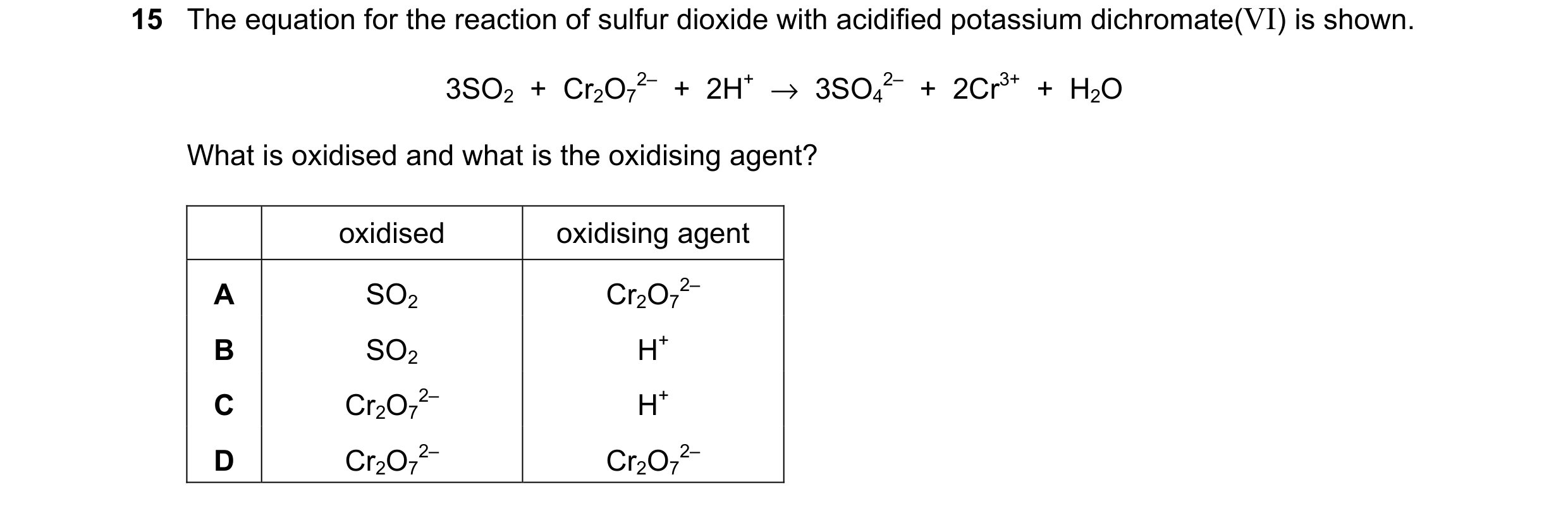
15 The equation for the reaction of sulfur dioxide with acidified potassium dichromate(VI) is shown. 3SO2 + Cr2O7 2– + 2H+ → 3SO4 2– + 2Cr3+ + H2O What is oxidised and what is the oxidising agent? oxidised oxidising agent A SO2 Cr2O7 2– B SO2 H+ C Cr2O7 2– H+ D Cr2O7 2– Cr2O7 2–
1 marks
Answer: A
This question in 0971/22 May/June 2023
Q30 · In a blast furnace, iron(III) oxide is converted to iron and carbon monoxide is converted… 0971/22 Oct/Nov 2023
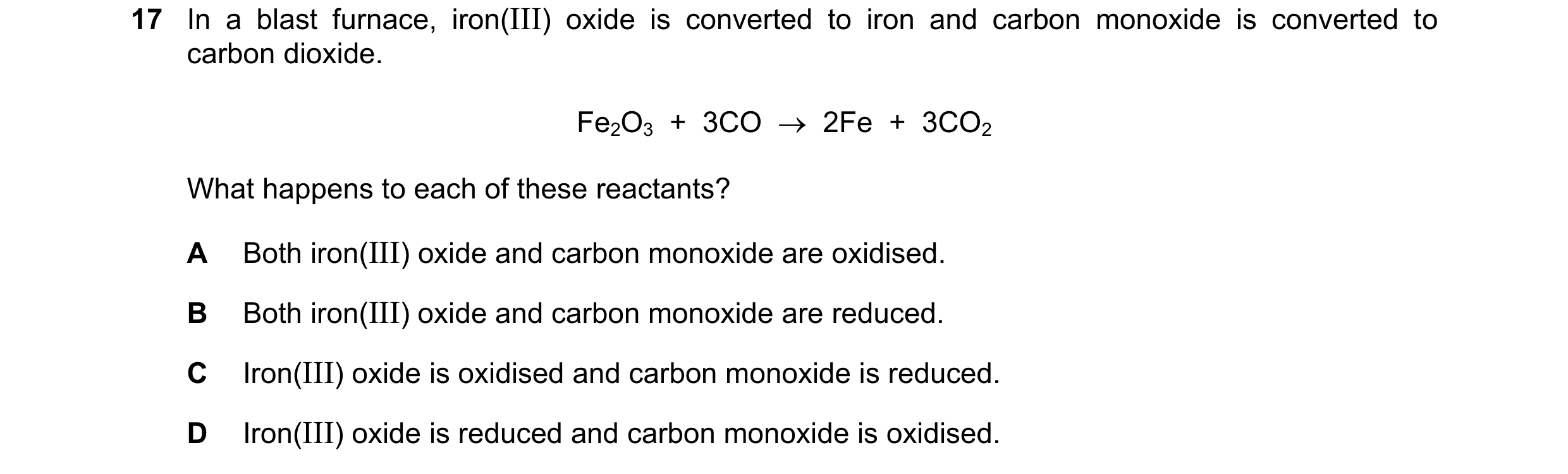
17 In a blast furnace, iron(III) oxide is converted to iron and carbon monoxide is converted to carbon dioxide. Fe2O3 + 3CO 2Fe + 3CO2 What happens to each of these reactants? A Both iron(III) oxide and carbon monoxide are oxidised. B Both iron(III) oxide and carbon monoxide are reduced. C Iron(III) oxide is oxidised and carbon monoxide is reduced. D Iron(III) oxide is reduced and carbon monoxide is oxidised.
1 marks
Answer: D
This question in 0971/22 Oct/Nov 2023
Q31 · Which row describes what happens to Fe2+ ions when they are oxidised? 0971/22 Oct/Nov 2023
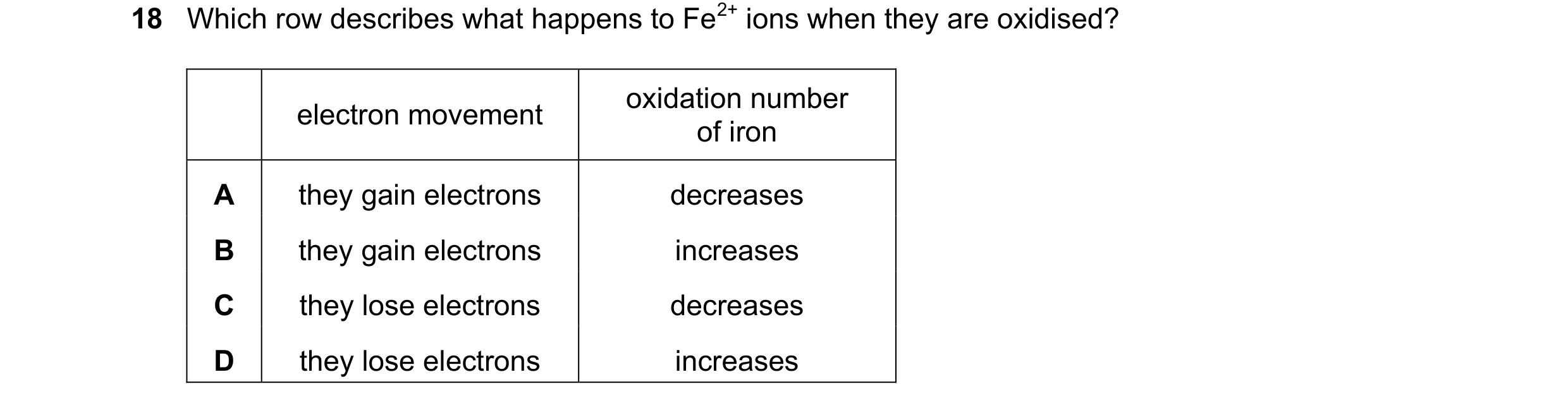
18 Which row describes what happens to Fe2+ ions when they are oxidised? oxidation number electron movement of iron A they gain electrons decreases B they gain electrons increases C they lose electrons decreases D they lose electrons increases
1 marks
Answer: D
This question in 0971/22 Oct/Nov 2023
Q32 · The equation for the reaction of magnesium with carbon dioxide is shown 0971/21 May/June 2024
22 The equation for the reaction of magnesium with carbon dioxide is shown. 2Mg + CO2 →2MgO + C Which statement about this reaction is correct? A Magnesium is oxidised and carbon dioxide is reduced. B Magnesium is reduced and carbon dioxide is oxidised. C Magnesium and carbon dioxide are both oxidised. D Magnesium and carbon dioxide are neither oxidised nor reduced.
1 marks
Answer: A
This question in 0971/21 May/June 2024
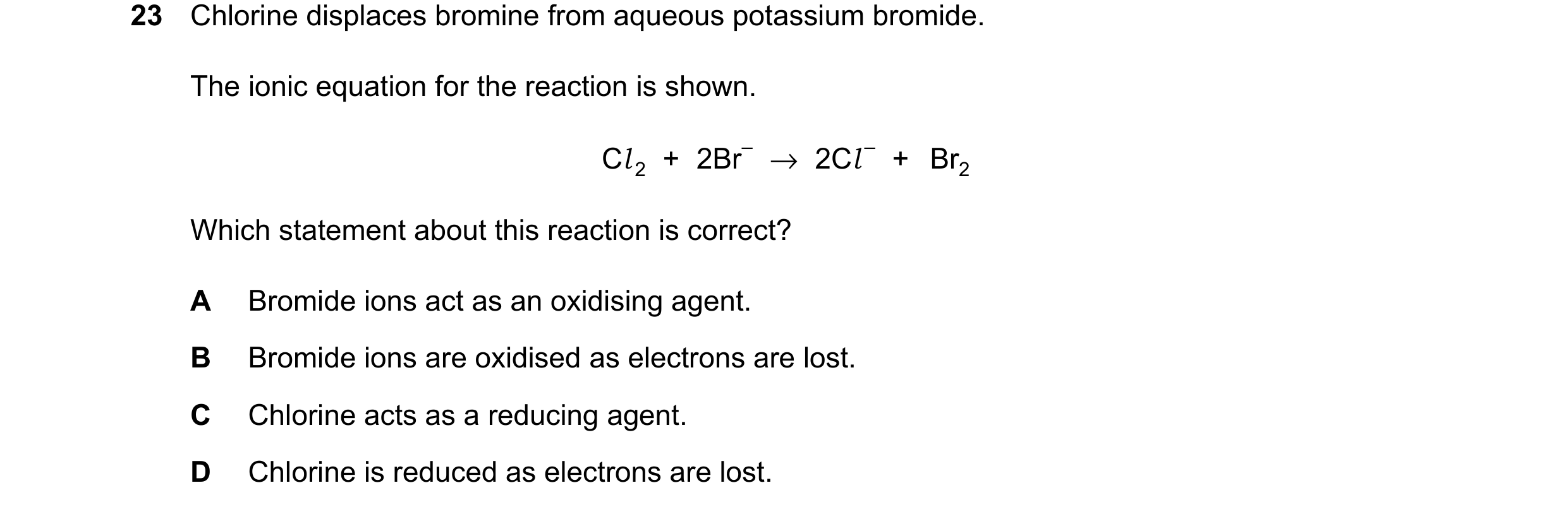
Q33 · Chlorine displaces bromine from aqueous potassium bromide 0971/21 May/June 2024
23 Chlorine displaces bromine from aqueous potassium bromide. The ionic equation for the reaction is shown. Cl 2 + 2Br– →2Cl – + Br2 Which statement about this reaction is correct? A Bromide ions act as an oxidising agent. B Bromide ions are oxidised as electrons are lost. C Chlorine acts as a reducing agent. D Chlorine is reduced as electrons are lost.
1 marks
Answer: B
This question in 0971/21 May/June 2024
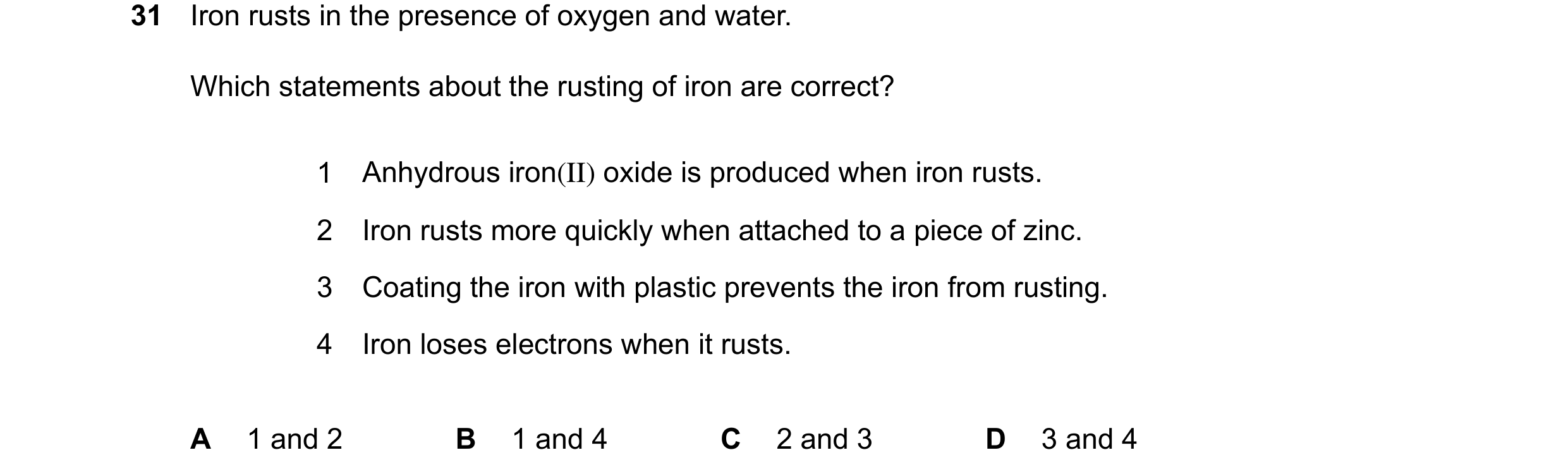
Q34 · Iron rusts in the presence of oxygen and water 0971/21 May/June 2024
31 Iron rusts in the presence of oxygen and water. Which statements about the rusting of iron are correct? 1 Anhydrous iron(II) oxide is produced when iron rusts. 2 Iron rusts more quickly when attached to a piece of zinc. 3 Coating the iron with plastic prevents the iron from rusting. 4 Iron loses electrons when it rusts. A 1 and 2 B 1 and 4 C 2 and 3 D 3 and 4
1 marks
Answer: D
This question in 0971/21 May/June 2024
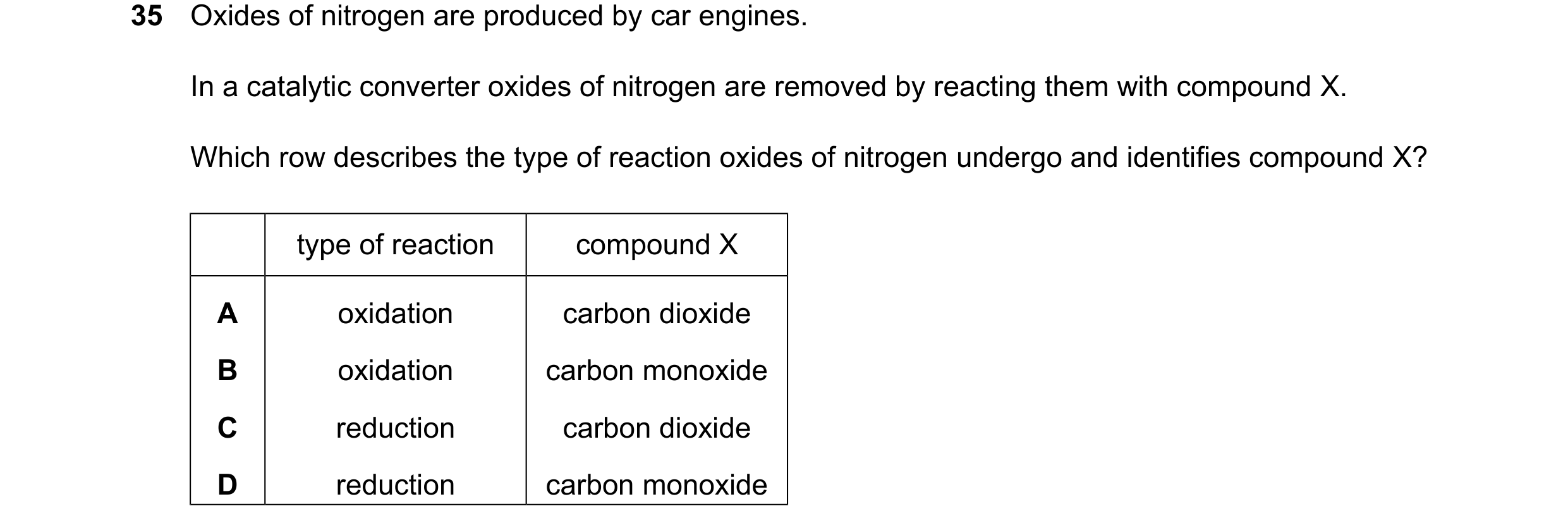
Q35 · Oxides of nitrogen are produced by car engines 0971/21 May/June 2024
35 Oxides of nitrogen are produced by car engines. In a catalytic converter oxides of nitrogen are removed by reacting them with compound X. Which row describes the type of reaction oxides of nitrogen undergo and identifies compound X? type of reaction compound X A oxidation carbon dioxide B oxidation carbon monoxide C reduction carbon dioxide D reduction carbon monoxide
1 marks
Answer: D
This question in 0971/21 May/June 2024
Q36 · Which equation represents a redox reaction? 0971/22 May/June 2024
16 Which equation represents a redox reaction? A AgNO3 + NaCl →AgCl + NaNO3 B PCl 5 + 4H2O →H3PO4 + 5HCl C 3Fe + 4H2O →Fe3O4 + 4H2 D MgCO3 + 2HCl →MgCl 2 + CO2 + H2O
1 marks
Answer: C
This question in 0971/22 May/June 2024
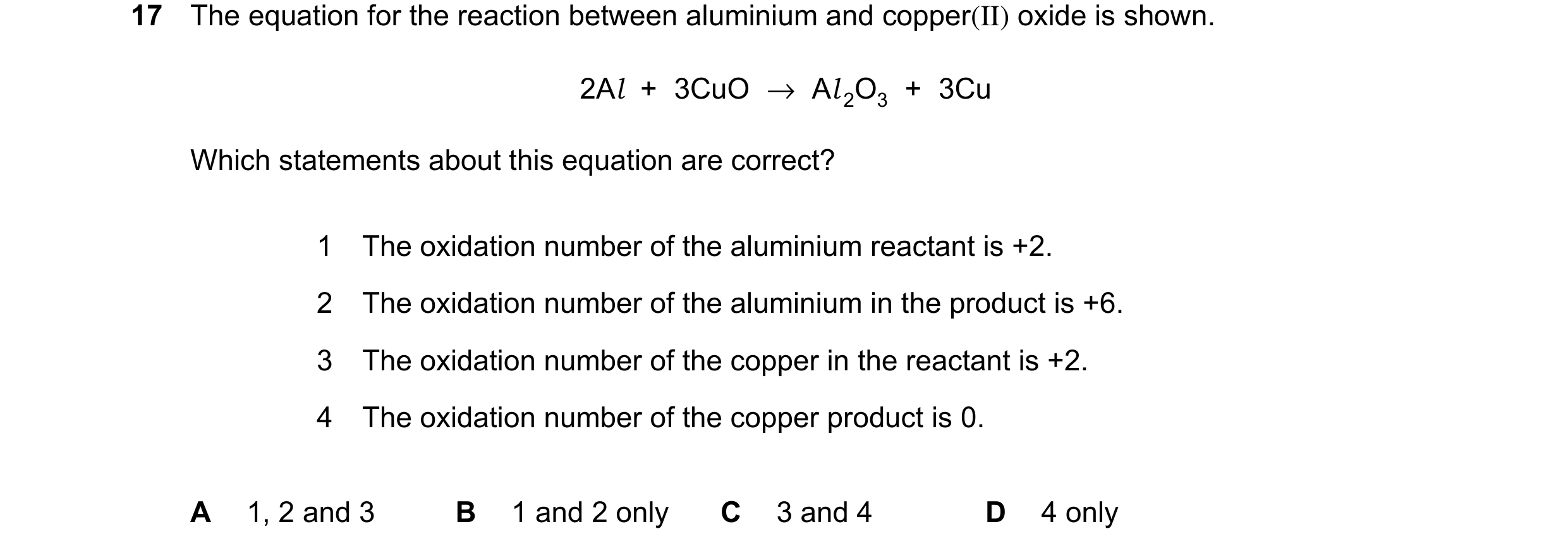
Q37 · The equation for the reaction between aluminium and copper(II) oxide is shown 0971/22 May/June 2024
17 The equation for the reaction between aluminium and copper(II) oxide is shown. 2Al + 3CuO →Al 2O3 + 3Cu Which statements about this equation are correct? 1 The oxidation number of the aluminium reactant is +2. 2 The oxidation number of the aluminium in the product is +6. 3 The oxidation number of the copper in the reactant is +2. 4 The oxidation number of the copper product is 0. A 1, 2 and 3 B 1 and 2 only C 3 and 4 D 4 only
1 marks
Answer: C
This question in 0971/22 May/June 2024
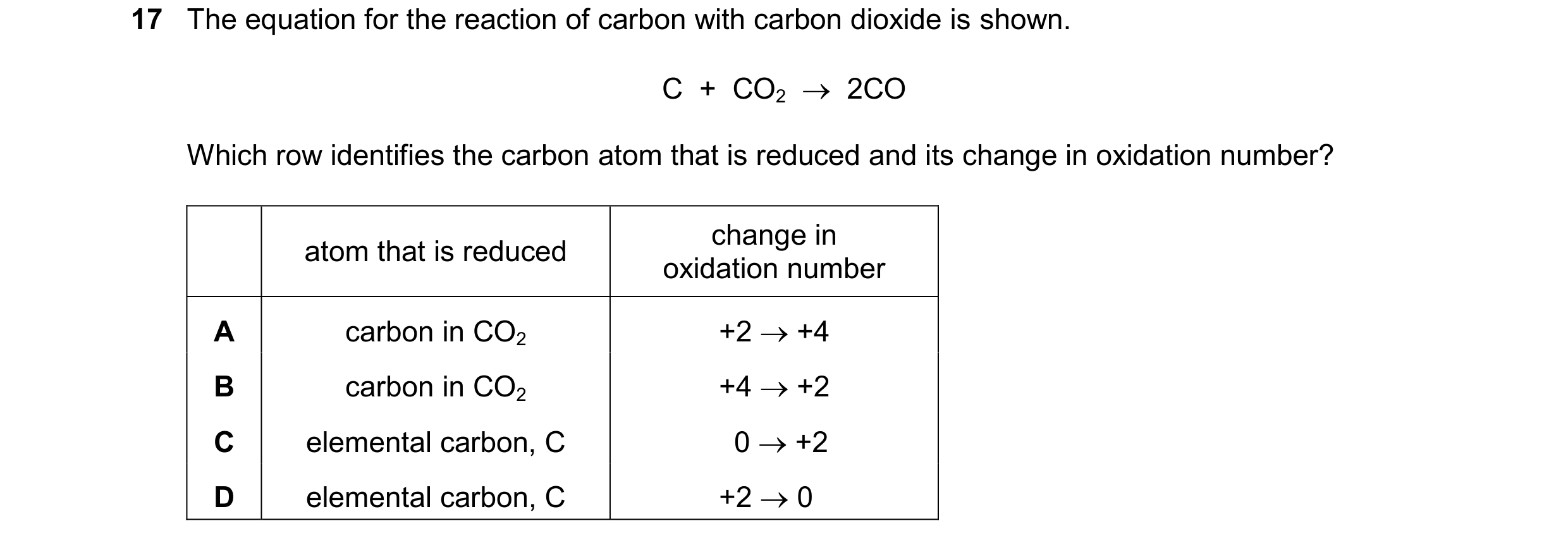
Q38 · The equation for the reaction of carbon with carbon dioxide is shown 0971/22 Oct/Nov 2024
17 The equation for the reaction of carbon with carbon dioxide is shown. C + CO2 2CO Which row identifies the carbon atom that is reduced and its change in oxidation number? change in atom that is reduced oxidation number A carbon in CO2 +2 +4 B carbon in CO2 +4 +2 C elemental carbon, C 0 +2 D elemental carbon, C +2 0
1 marks
Answer: B
This question in 0971/22 Oct/Nov 2024
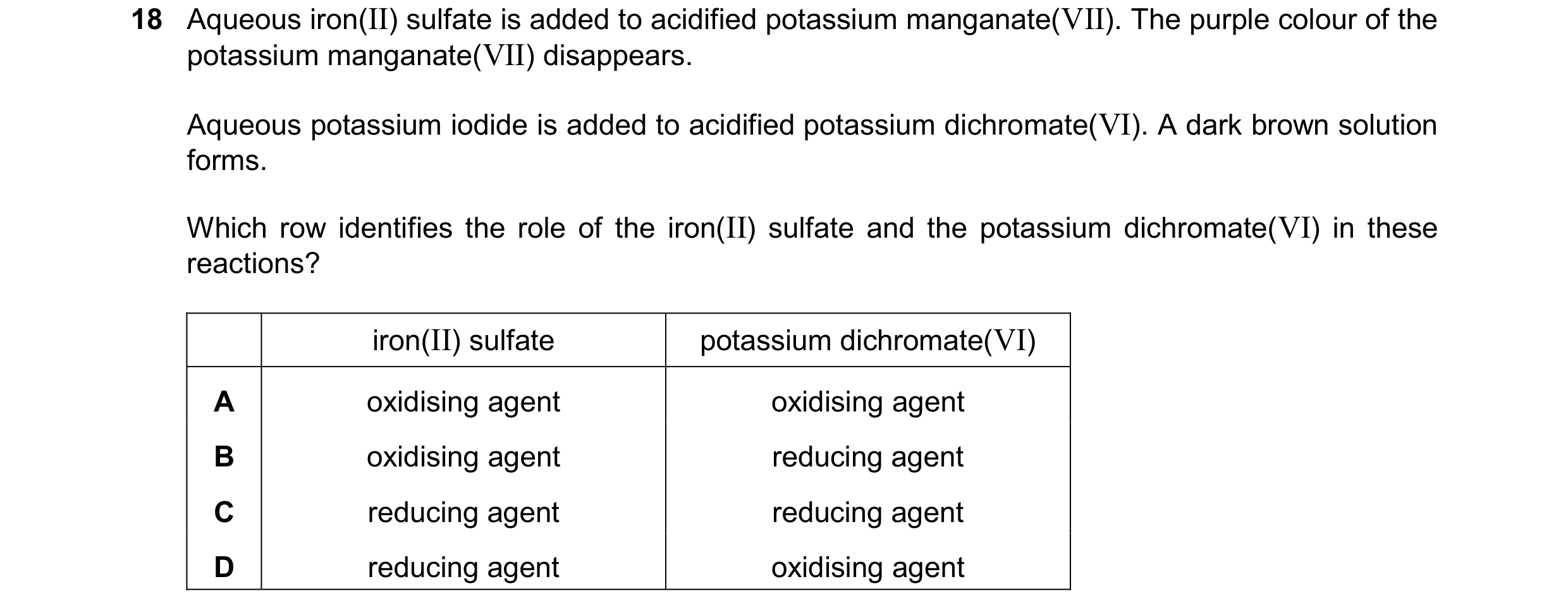
Q39 · Aqueous iron(II) sulfate is added to acidified potassium manganate(VII) 0971/22 Oct/Nov 2024
18 Aqueous iron(II) sulfate is added to acidified potassium manganate(VII). The purple colour of the potassium manganate(VII) disappears. Aqueous potassium iodide is added to acidified potassium dichromate(VI). A dark brown solution forms. Which row identifies the role of the iron(II) sulfate and the potassium dichromate(VI) in these reactions? iron(II) sulfate potassium dichromate(VI) A oxidising agent oxidising agent B oxidising agent reducing agent C reducing agent reducing agent D reducing agent oxidising agent
1 marks
Answer: D
This question in 0971/22 Oct/Nov 2024
Q40 · Which equations show the underlined species acting as a reducing agent? 0971/22 May/June 2025
17 Which equations show the underlined species acting as a reducing agent? 1 Fe2O3 + 3CO 2Fe + 3CO2 2 Fe + CuSO4 FeSO4 + Cu 3 5Fe2+ + MnO4 – + 8H+ 5Fe3+ + Mn2+ + 4H2O 4 Fe(OH)2 + H2SO4 FeSO4 + 2H2O A 1 and 2 B 1 and 4 C 2 and 3 D 3 and 4
1 marks
Answer: C
This question in 0971/22 May/June 2025
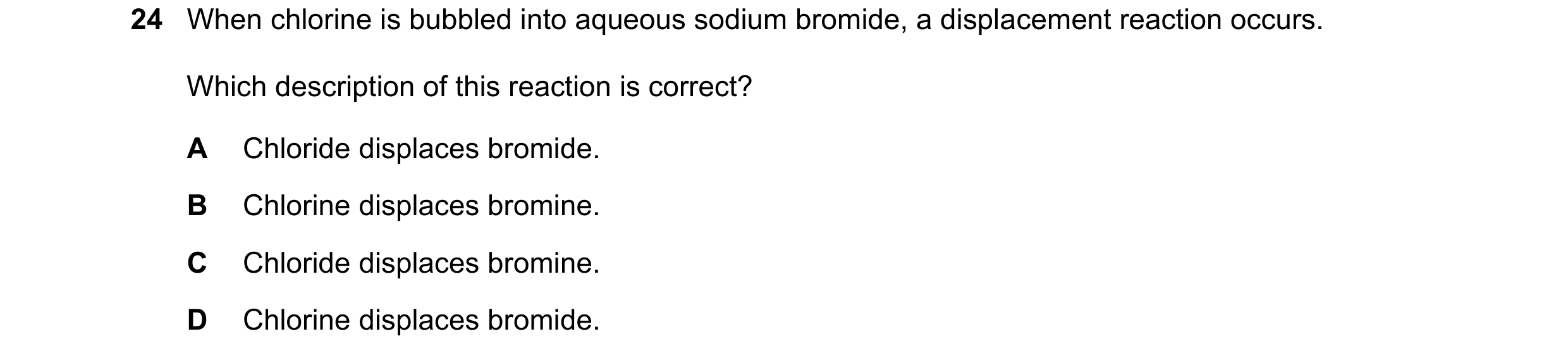
Q41 · When chlorine is bubbled into aqueous sodium bromide, a displacement reaction occurs 0971/22 May/June 2025
24 When chlorine is bubbled into aqueous sodium bromide, a displacement reaction occurs. Which description of this reaction is correct? A Chloride displaces bromide. B Chlorine displaces bromine. C Chloride displaces bromine. D Chlorine displaces bromide.
1 marks
Answer: B
This question in 0971/22 May/June 2025
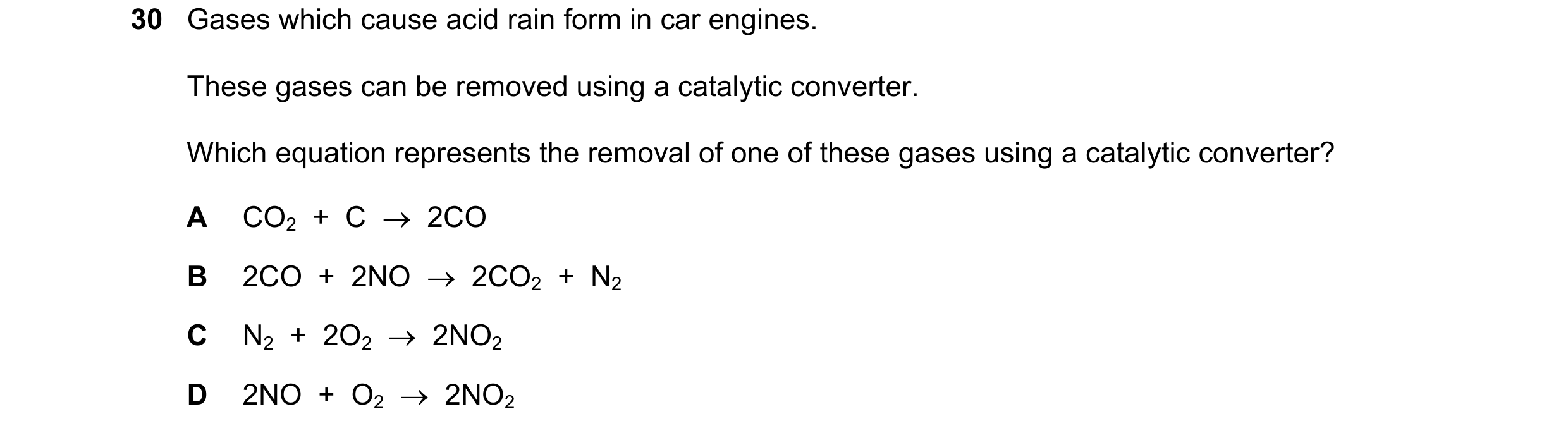
Q42 · Gases which cause acid rain form in car engines 0971/22 May/June 2025
30 Gases which cause acid rain form in car engines. These gases can be removed using a catalytic converter. Which equation represents the removal of one of these gases using a catalytic converter? A CO2 + C 2CO B 2CO + 2NO 2CO2 + N2 C N2 + 2O2 2NO2 D 2NO + O2 2NO2
1 marks
Answer: B
This question in 0971/22 May/June 2025
Q43 · What is the oxidation number of chromium in the Cr2O7 2– ion? 0971/22 Oct/Nov 2025
19 What is the oxidation number of chromium in the Cr2O7 2– ion? A –2 B –1 C +6 D +12
1 marks
Answer: C
This question in 0971/22 Oct/Nov 2025

 1 / 11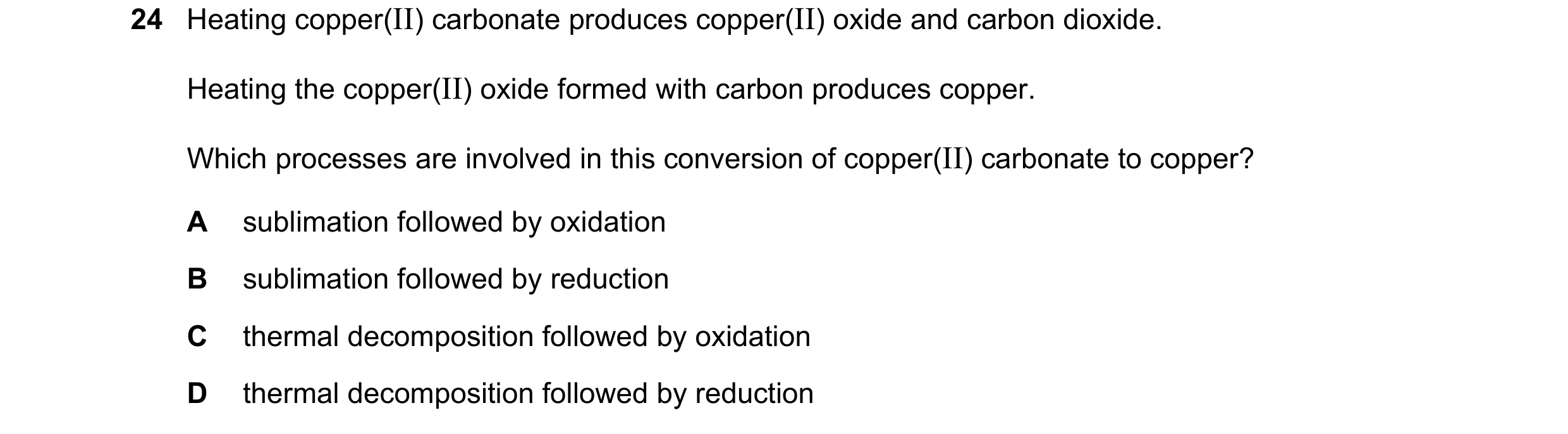
 2 / 11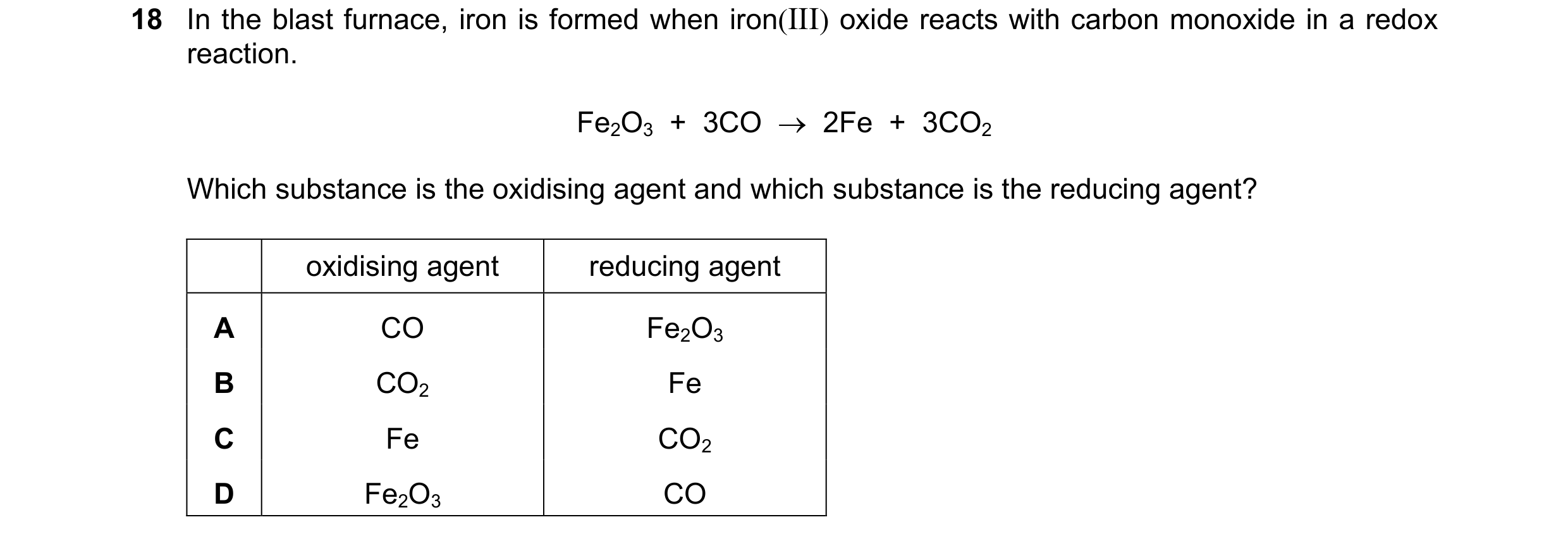
 3 / 11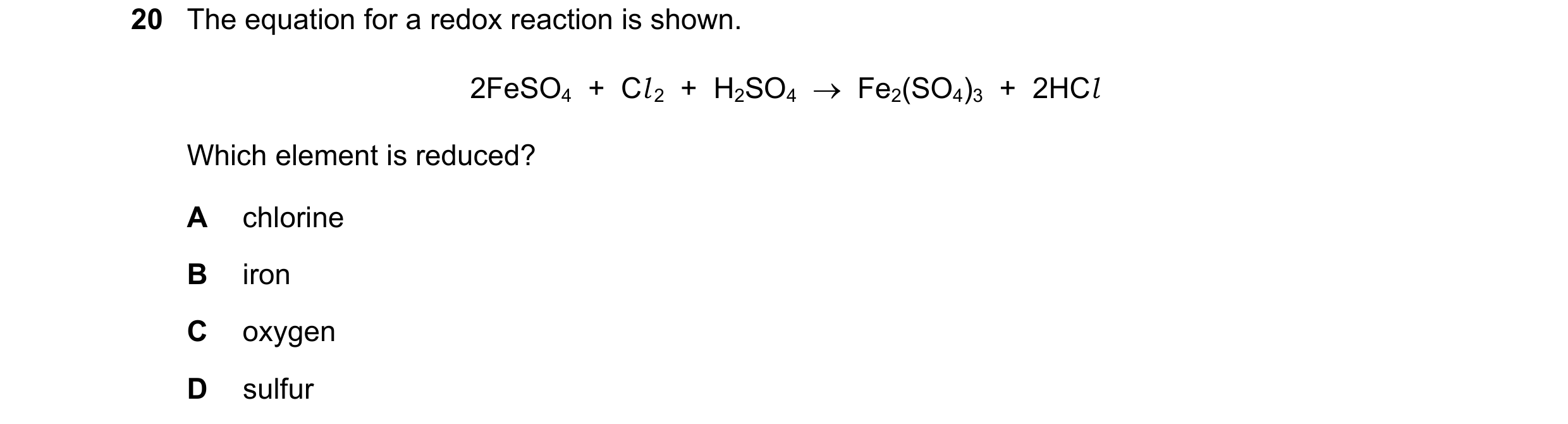
 4 / 11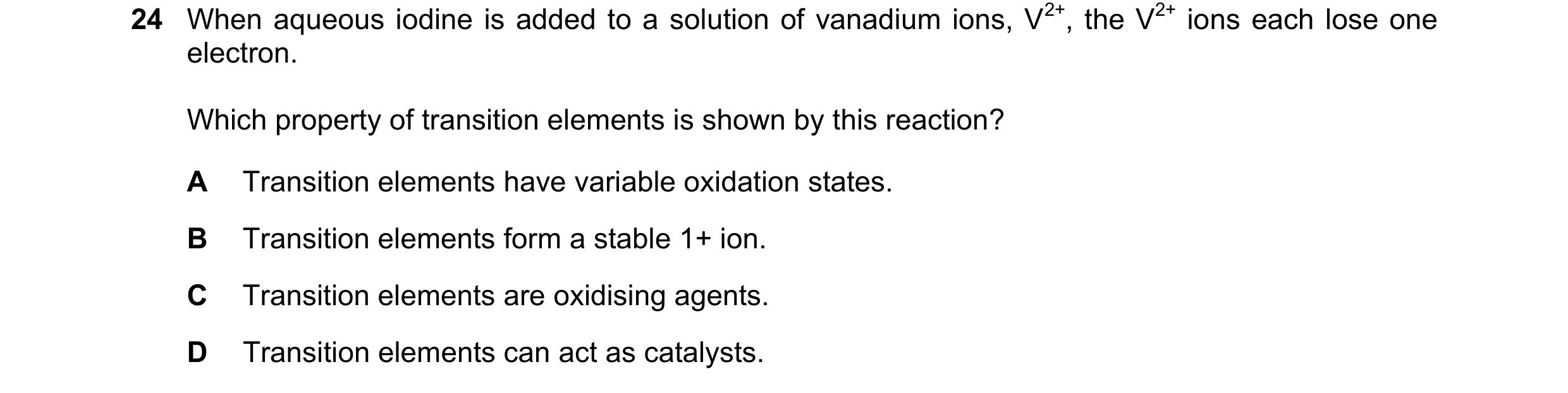
 5 / 11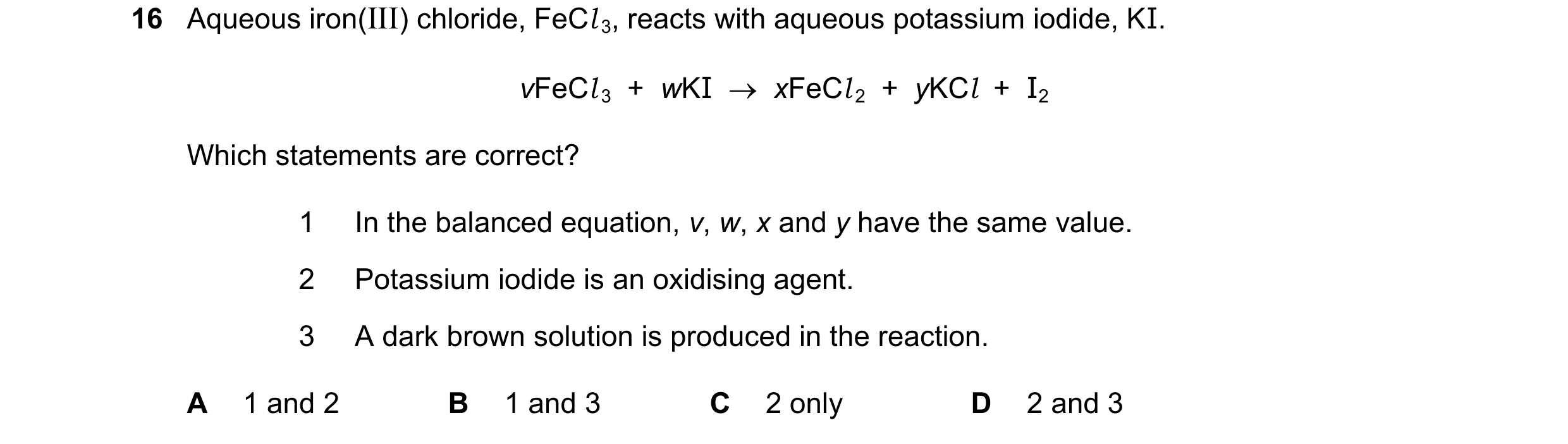
 6 / 11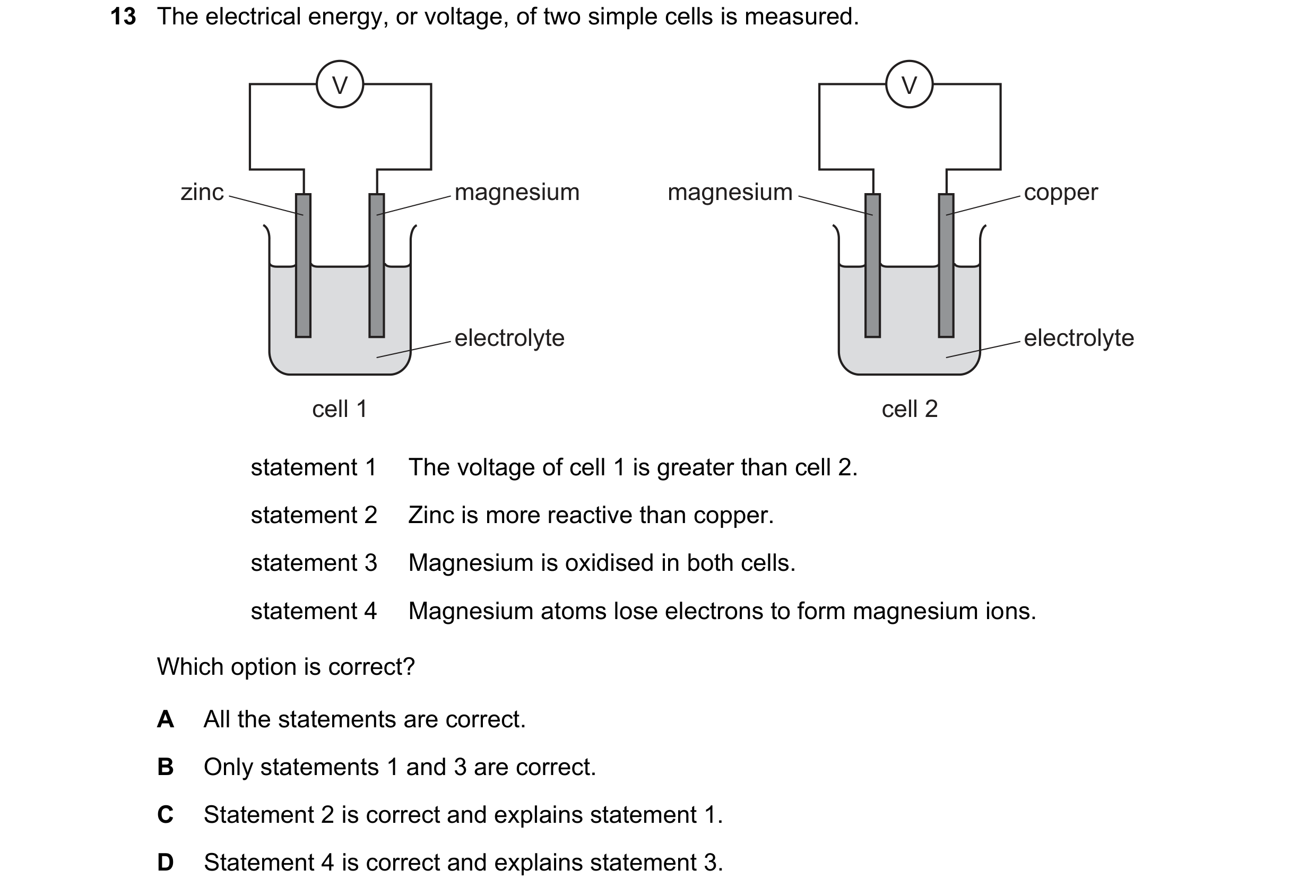

 7 / 11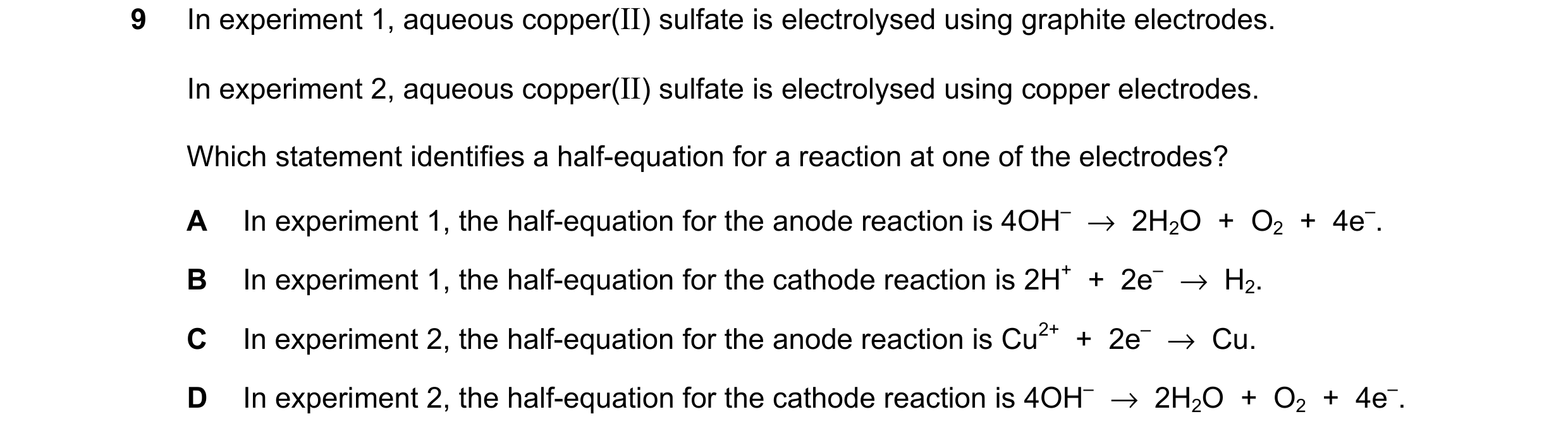
 8 / 11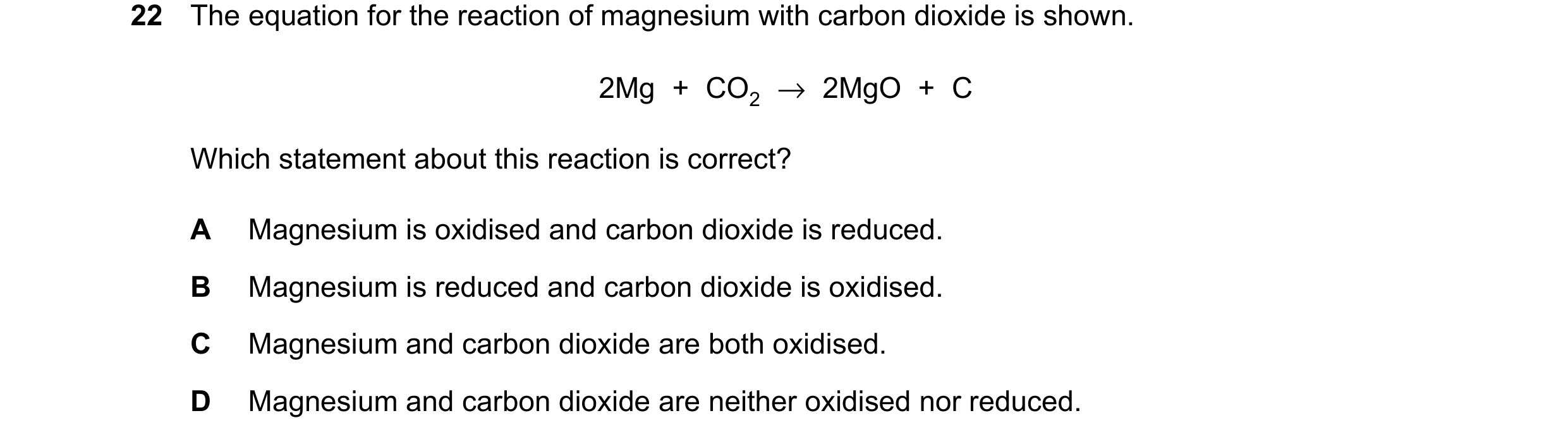
 9 / 11
 10 / 11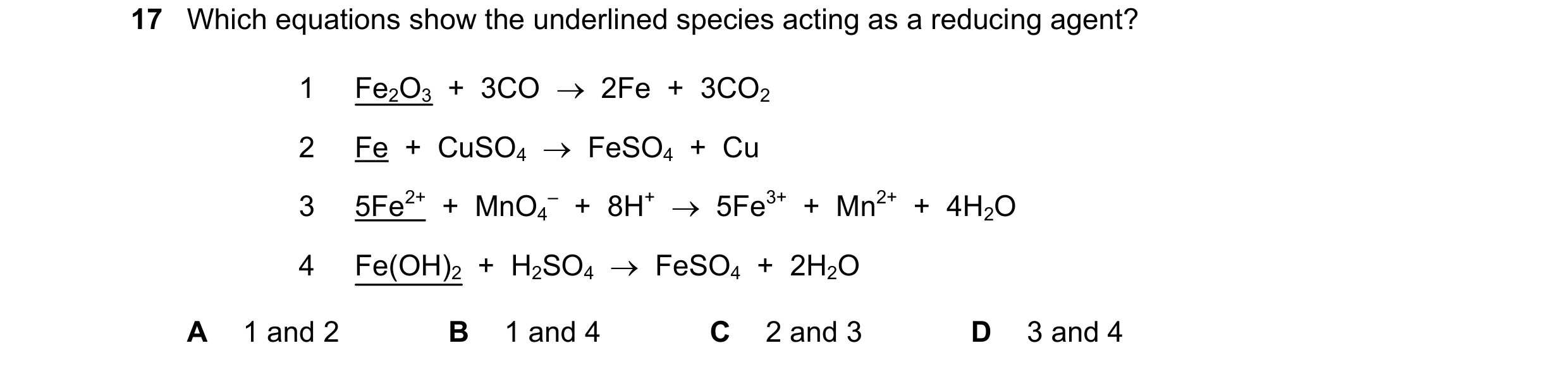
 11 / 11