Questions as text
Q1 · The formation of sulfur trioxide is a reversible reaction 0971/21 May/June 2018
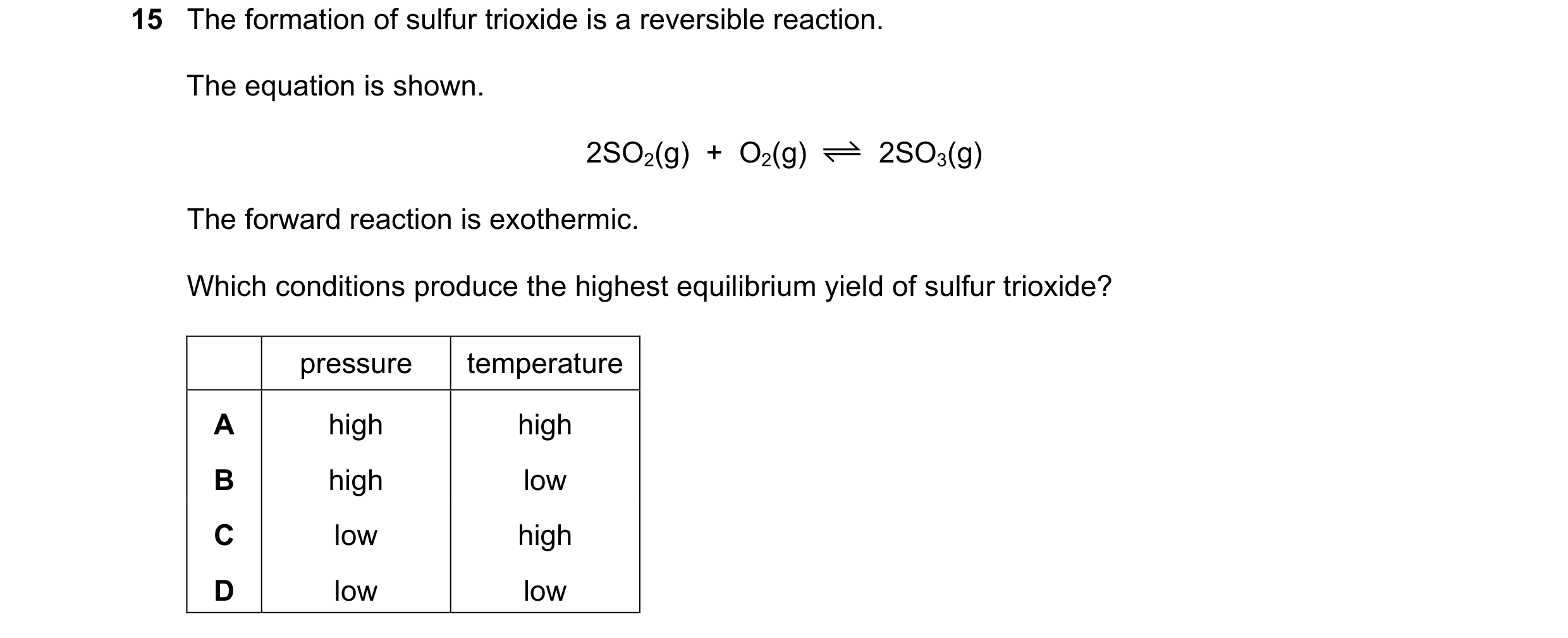
15 The formation of sulfur trioxide is a reversible reaction. The equation is shown. 2SO2(g) + O2(g) 2SO3(g) The forward reaction is exothermic. Which conditions produce the highest equilibrium yield of sulfur trioxide? pressure temperature A high high B high low C low high D low low
1 marks
Answer: B
This question in 0971/21 May/June 2018
Q2 · Ammonia is manufactured by reacting hydrogen with nitrogen in the Haber process 0971/21 May/June 2018
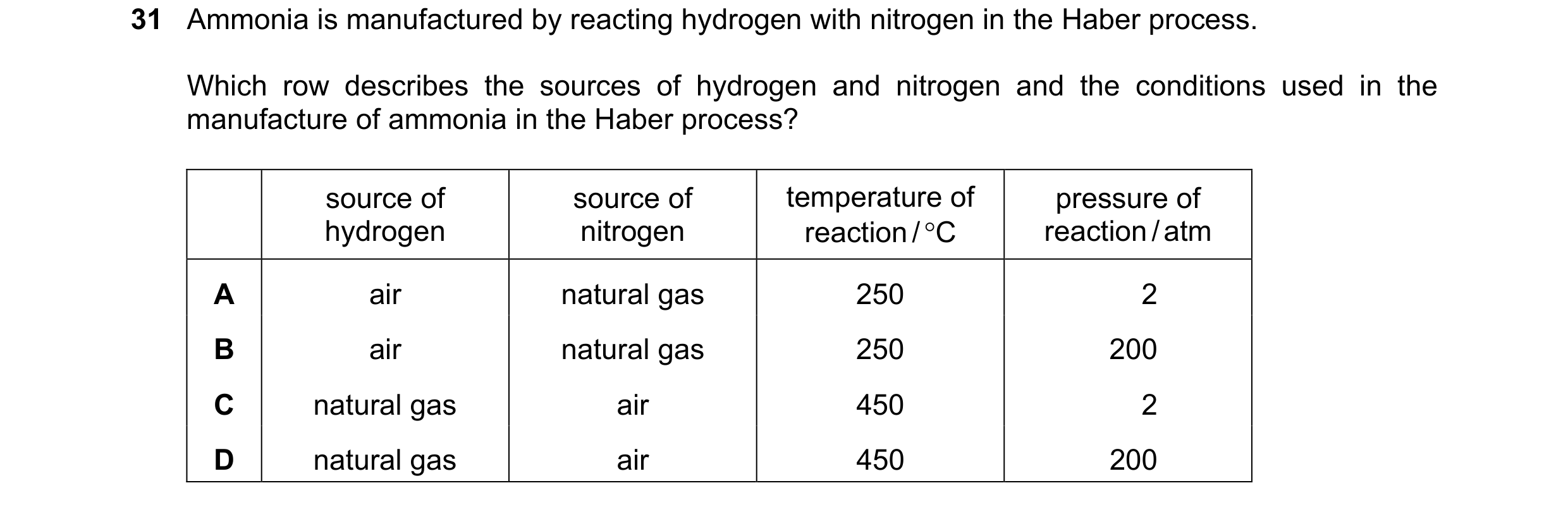
31 Ammonia is manufactured by reacting hydrogen with nitrogen in the Haber process. Which row describes the sources of hydrogen and nitrogen and the conditions used in the manufacture of ammonia in the Haber process? source of source of temperature of pressure of hydrogen nitrogen reaction / °C reaction / atm A air natural gas 250 2 B air natural gas 250 200 C natural gas air 450 2 D natural gas air 450 200
1 marks
Answer: D
This question in 0971/21 May/June 2018
Q3 · Methanol is prepared by the reversible reaction shown 0971/22 Oct/Nov 2018
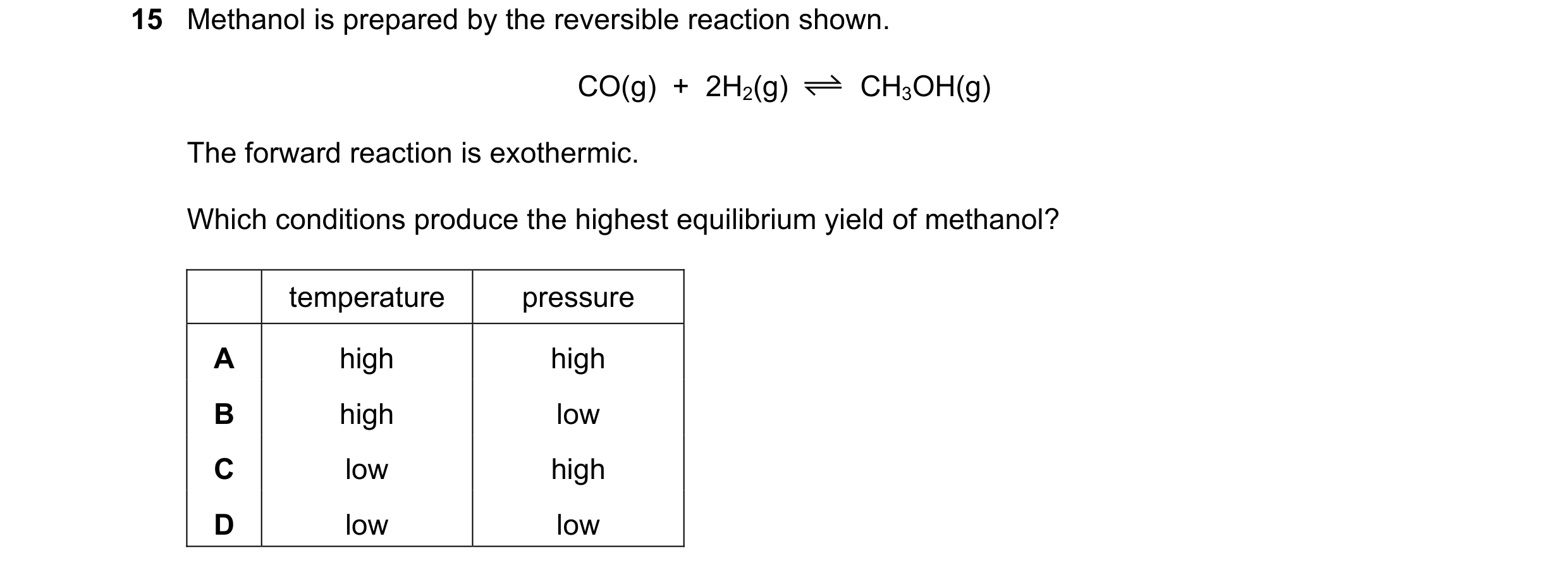
15 Methanol is prepared by the reversible reaction shown. CO(g) + 2H2(g) CH3OH(g) The forward reaction is exothermic. Which conditions produce the highest equilibrium yield of methanol? temperature pressure A high high B high low C low high D low low
1 marks
Answer: C
This question in 0971/22 Oct/Nov 2018
Q4 · Which statement about the Haber process is correct? 0971/22 Oct/Nov 2018
28 Which statement about the Haber process is correct? A The hydrogen used is obtained from the air. B The nitrogen used is obtained from nitrates in the soil. C Nitrogen reacts with hydrogen to make ammonia. D The reaction takes place at room temperature and pressure.
1 marks
Answer: C
This question in 0971/22 Oct/Nov 2018
Q5 · When blue-green crystals of nickel(II) sulfate are heated, water is produced and a yellow… 0971/21 May/June 2019
14 When blue-green crystals of nickel(II) sulfate are heated, water is produced and a yellow solid remains. When water is added to the yellow solid, the blue-green colour returns. Which process describes these changes? A combustion B corrosion C neutralisation D reversible reaction
1 marks
Answer: D
This question in 0971/21 May/June 2019
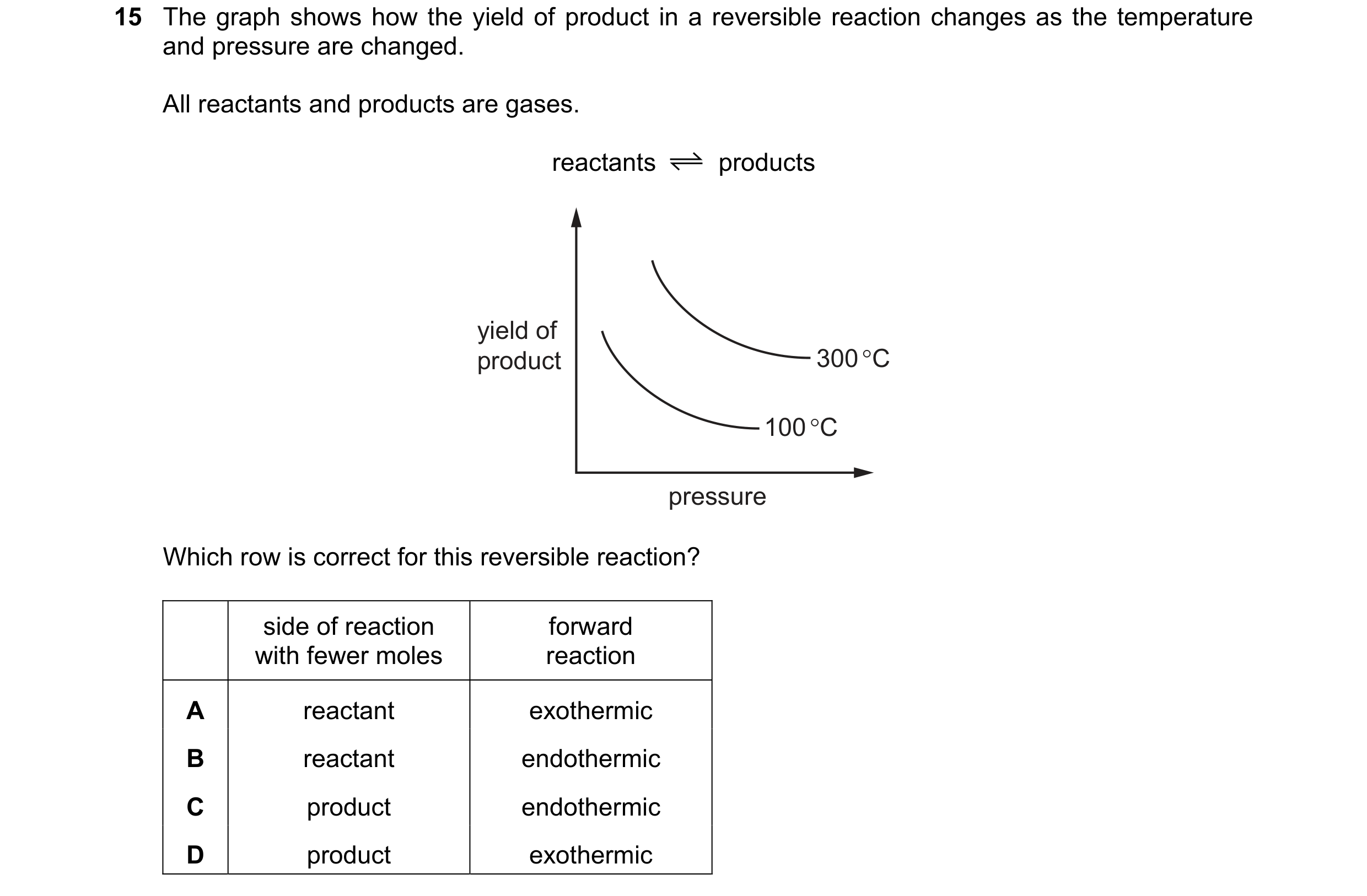
Q6 · The graph shows how the yield of product in a reversible reaction changes as the… 0971/21 May/June 2019
15 The graph shows how the yield of product in a reversible reaction changes as the temperature and pressure are changed. All reactants and products are gases. reactants products yield of product 300 °C 100 °C pressure Which row is correct for this reversible reaction? side of reaction forward with fewer moles reaction A reactant exothermic B reactant endothermic C product endothermic D product exothermic
1 marks
Answer: B
This question in 0971/21 May/June 2019
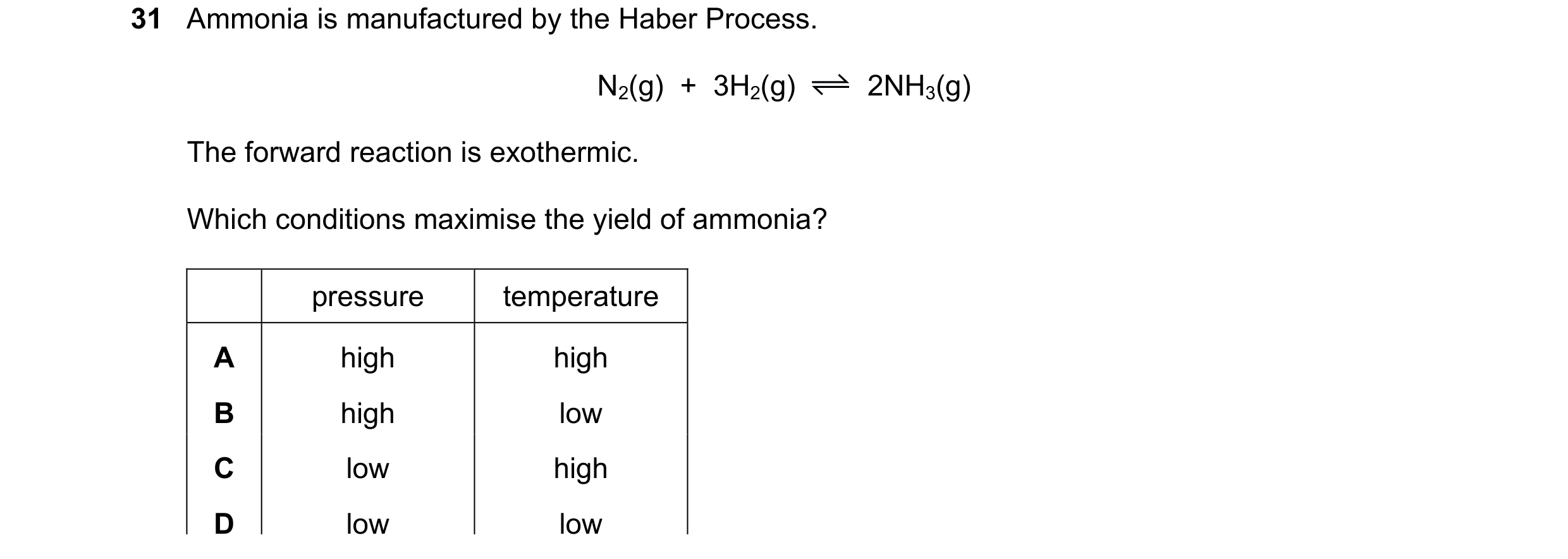
Q7 · Ammonia is manufactured by the Haber Process 0971/21 May/June 2019
31 Ammonia is manufactured by the Haber Process. N2(g) + 3H2(g) 2NH3(g) The forward reaction is exothermic. Which conditions maximise the yield of ammonia? pressure temperature A high high B high low C low high D low low
1 marks
Answer: B
This question in 0971/21 May/June 2019
Q8 · Which row shows the conditions used in the Contact process? 0971/21 May/June 2019
33 Which row shows the conditions used in the Contact process? temperature pressure catalyst / °C / atm A 25 2 iron B 25 200 iron C 450 2 vanadium(V) oxide D 450 200 vanadium(V) oxide
1 marks
Answer: C
This question in 0971/21 May/June 2019
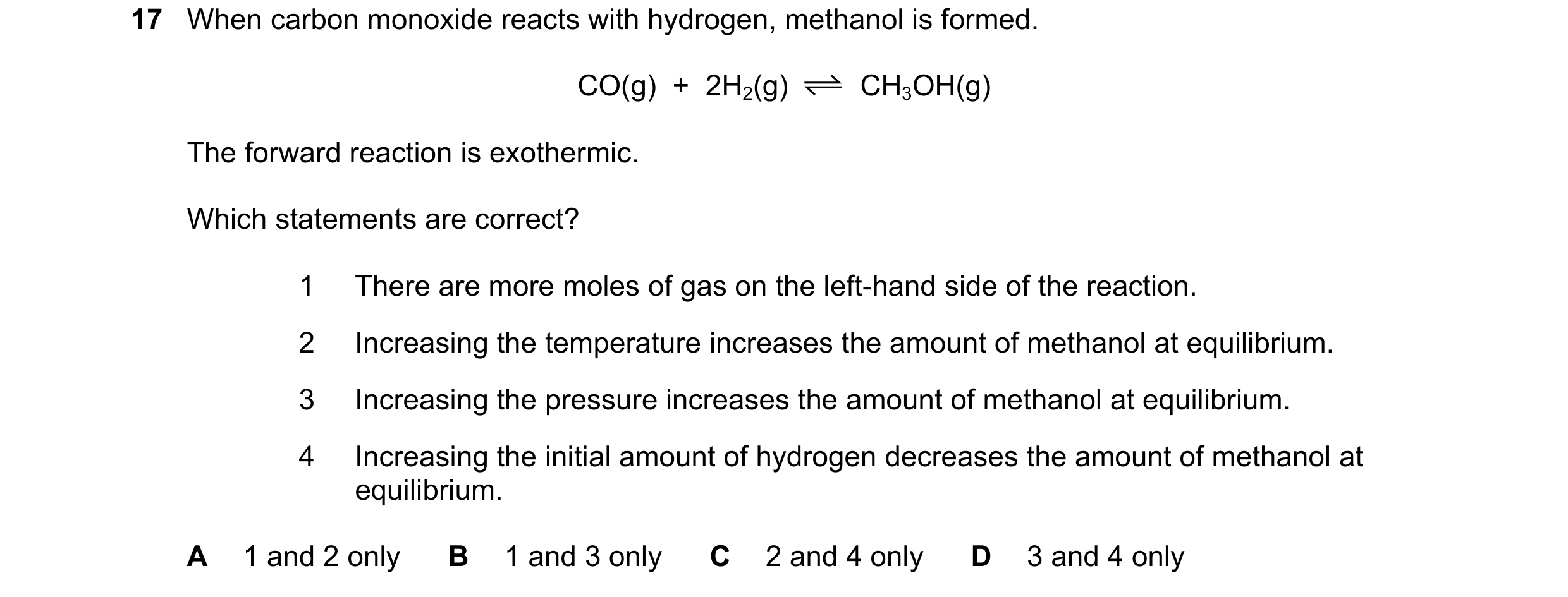
Q9 · When carbon monoxide reacts with hydrogen, methanol is formed 0971/22 Oct/Nov 2019
17 When carbon monoxide reacts with hydrogen, methanol is formed. CO(g) + 2H2(g) CH3OH(g) The forward reaction is exothermic. Which statements are correct? 1 There are more moles of gas on the left-hand side of the reaction. 2 Increasing the temperature increases the amount of methanol at equilibrium. 3 Increasing the pressure increases the amount of methanol at equilibrium. 4 Increasing the initial amount of hydrogen decreases the amount of methanol at equilibrium. A 1 and 2 only B 1 and 3 only C 2 and 4 only D 3 and 4 only
1 marks
Answer: B
This question in 0971/22 Oct/Nov 2019
Q10 · The equation shows the equilibrium between dinitrogen tetroxide, N2O4, and nitrogen… 0971/21 May/June 2020
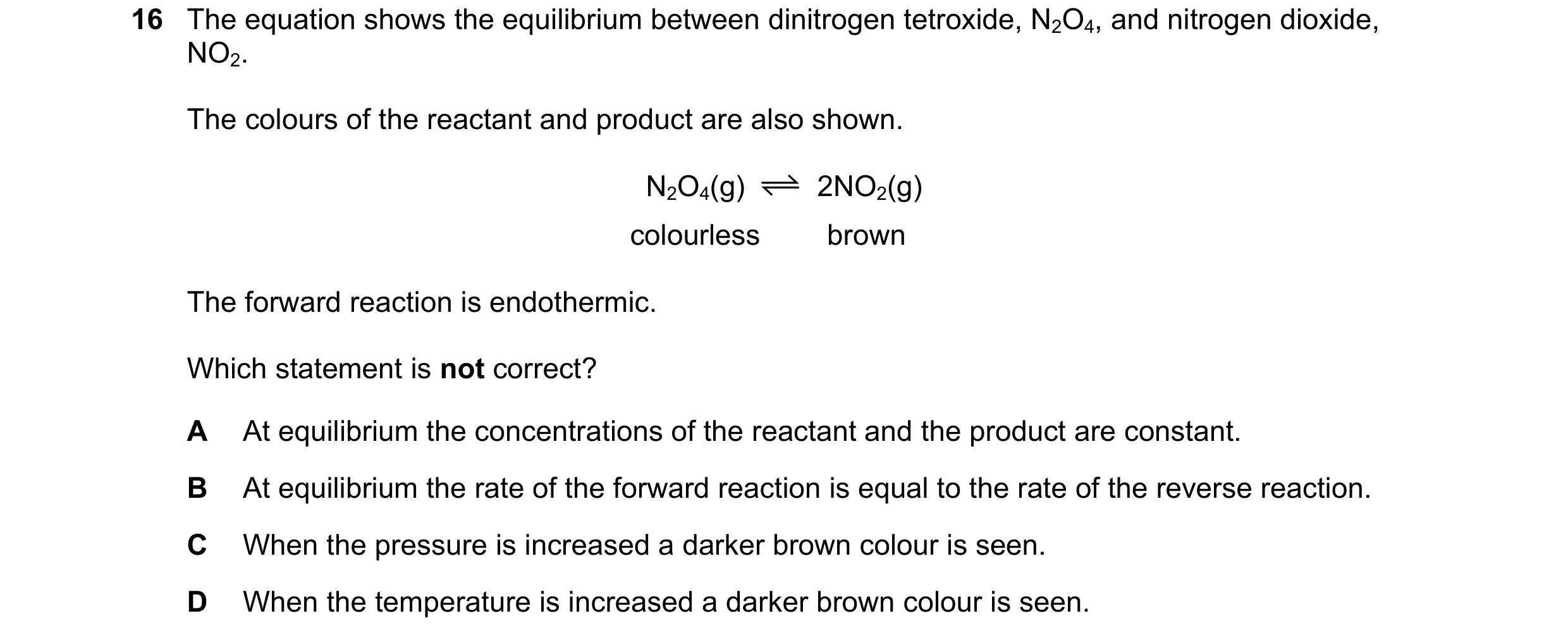
16 The equation shows the equilibrium between dinitrogen tetroxide, N2O4, and nitrogen dioxide, NO2. The colours of the reactant and product are also shown. N2O4(g) 2NO2(g) colourless brown The forward reaction is endothermic. Which statement is not correct? A At equilibrium the concentrations of the reactant and the product are constant. B At equilibrium the rate of the forward reaction is equal to the rate of the reverse reaction. C When the pressure is increased a darker brown colour is seen. D When the temperature is increased a darker brown colour is seen.
1 marks
Answer: C
This question in 0971/21 May/June 2020
Q11 · Ammonia is manufactured by the Haber process 0971/21 May/June 2020
31 Ammonia is manufactured by the Haber process. N2(g) + 3H2(g) 2NH3(g) What are the conditions used in the Haber process? temperature pressure / °C / atm A 400 100 B 400 300 C 20 300 D 20 100
1 marks
Answer: B
This question in 0971/21 May/June 2020
Q12 · Methane reacts with steam and an equilibrium is reached 0971/22 May/June 2020
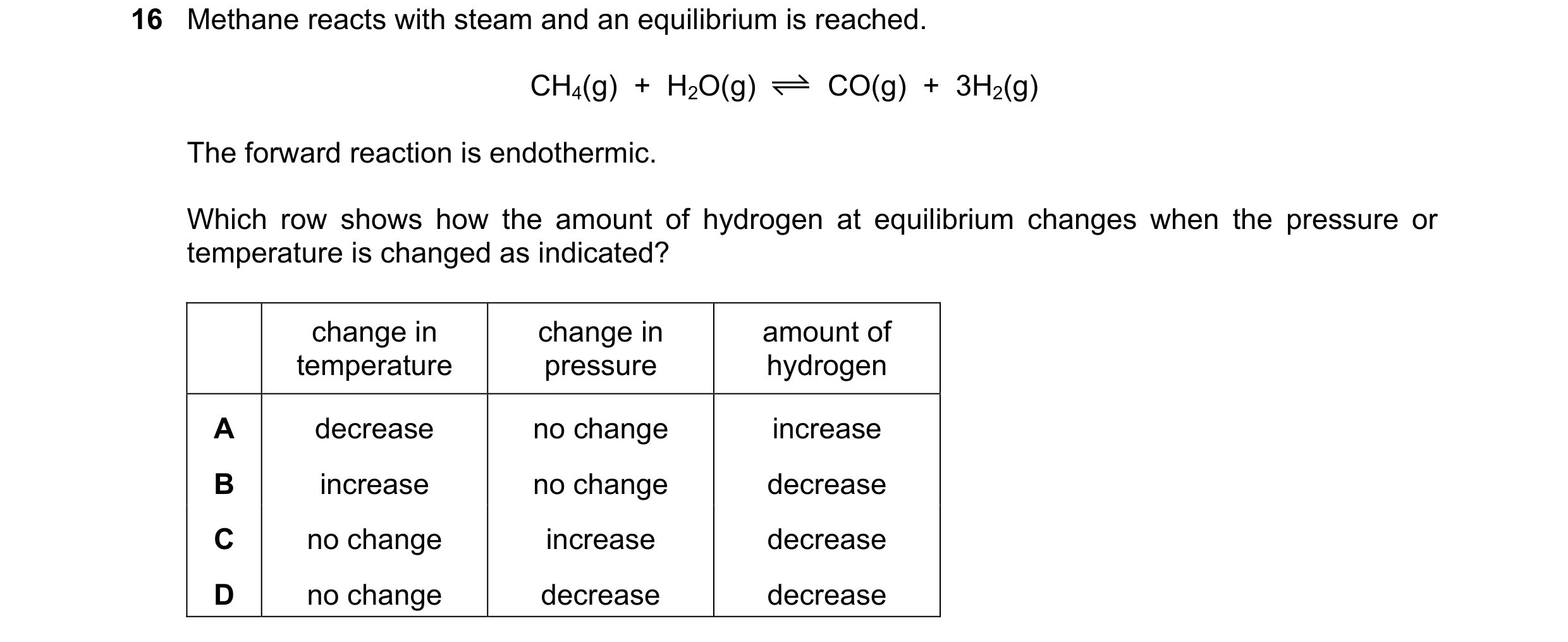
16 Methane reacts with steam and an equilibrium is reached. CH4(g) + H2O(g) CO(g) + 3H2(g) The forward reaction is endothermic. Which row shows how the amount of hydrogen at equilibrium changes when the pressure or temperature is changed as indicated? change in change in amount of temperature pressure hydrogen A decrease no change increase B increase no change decrease C no change increase decrease D no change decrease decrease
1 marks
Answer: C
This question in 0971/22 May/June 2020
Q13 · In the Haber process, nitrogen and hydrogen are reacted to make ammonia 0971/22 May/June 2020
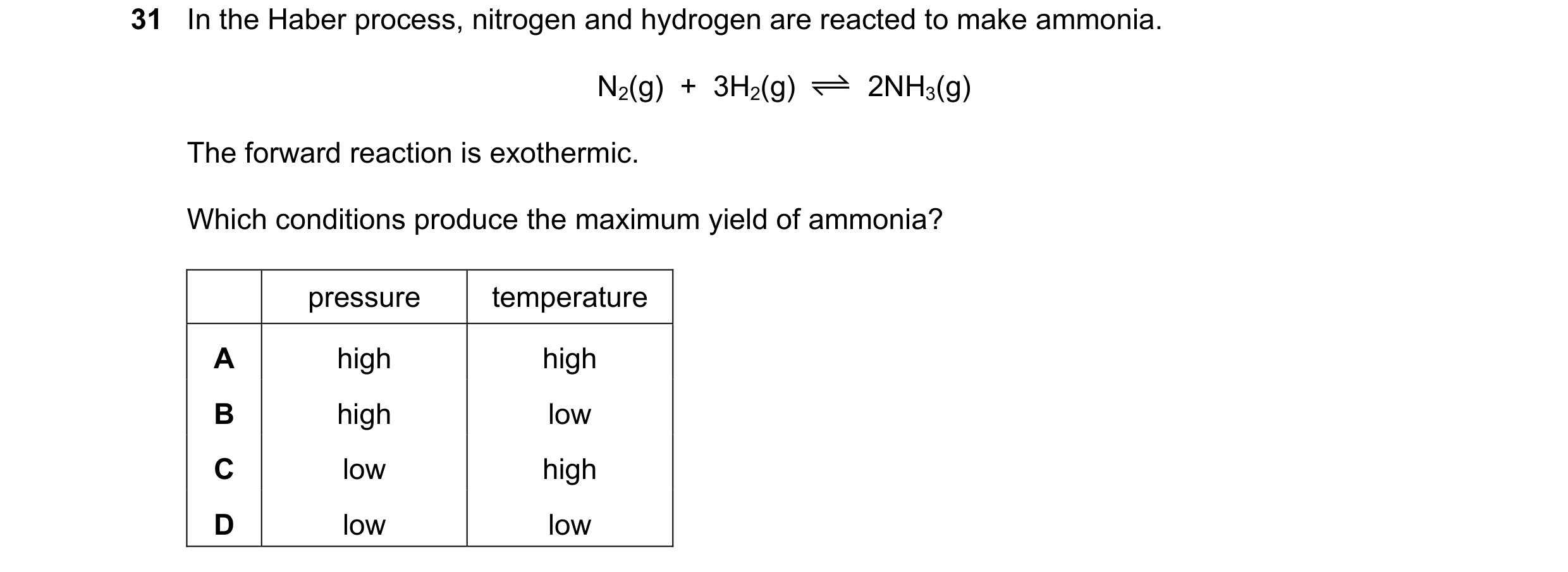
31 In the Haber process, nitrogen and hydrogen are reacted to make ammonia. N2(g) + 3H2(g) 2NH3(g) The forward reaction is exothermic. Which conditions produce the maximum yield of ammonia? pressure temperature A high high B high low C low high D low low
1 marks
Answer: B
This question in 0971/22 May/June 2020
Q14 · Ammonia is produced by the Haber process 0971/22 Oct/Nov 2020
18 Ammonia is produced by the Haber process. The equation is shown. N2(g) + 3H2(g) 2NH3(g) The forward reaction is exothermic. Which statement is correct? A Increasing pressure decreases the yield of ammonia, but speeds up the reaction. B Increasing temperature decreases the yield of ammonia, but speeds up the reaction. C Increasing the concentration of hydrogen and nitrogen results in a lower yield of ammonia. D Increasing the temperature increases the yield of ammonia and speeds up the reaction.
1 marks
Answer: B
This question in 0971/22 Oct/Nov 2020
Q15 · Which statement about a reaction in equilibrium is correct? 0971/21 May/June 2021
17 Which statement about a reaction in equilibrium is correct? A Both the forward and the backward reactions are proceeding at the same rate. B Neither the forward nor the backward reaction is proceeding. C The amount of product present is no longer affected by changes in temperature or pressure. D The amount of product present is only affected by a change in pressure.
1 marks
Answer: A
This question in 0971/21 May/June 2021
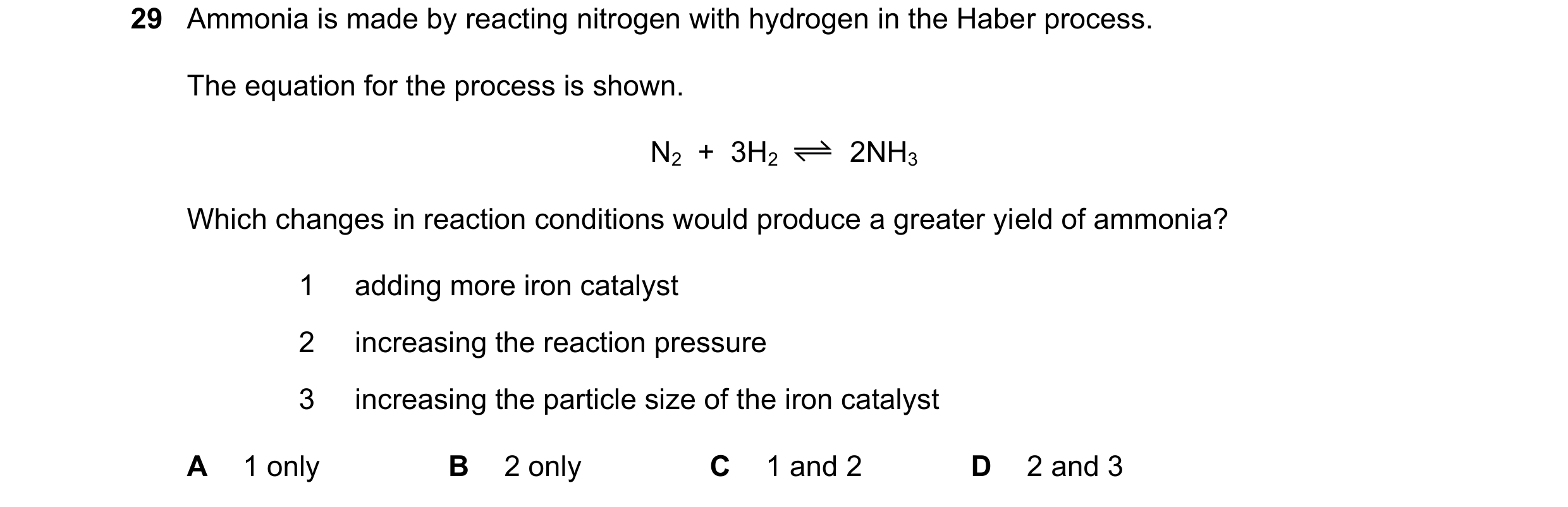
Q16 · Ammonia is made by reacting nitrogen with hydrogen in the Haber process 0971/21 May/June 2021
29 Ammonia is made by reacting nitrogen with hydrogen in the Haber process. The equation for the process is shown. N2 + 3H2 2NH3 Which changes in reaction conditions would produce a greater yield of ammonia? 1 adding more iron catalyst 2 increasing the reaction pressure 3 increasing the particle size of the iron catalyst A 1 only B 2 only C 1 and 2 D 2 and 3
1 marks
Answer: B
This question in 0971/21 May/June 2021
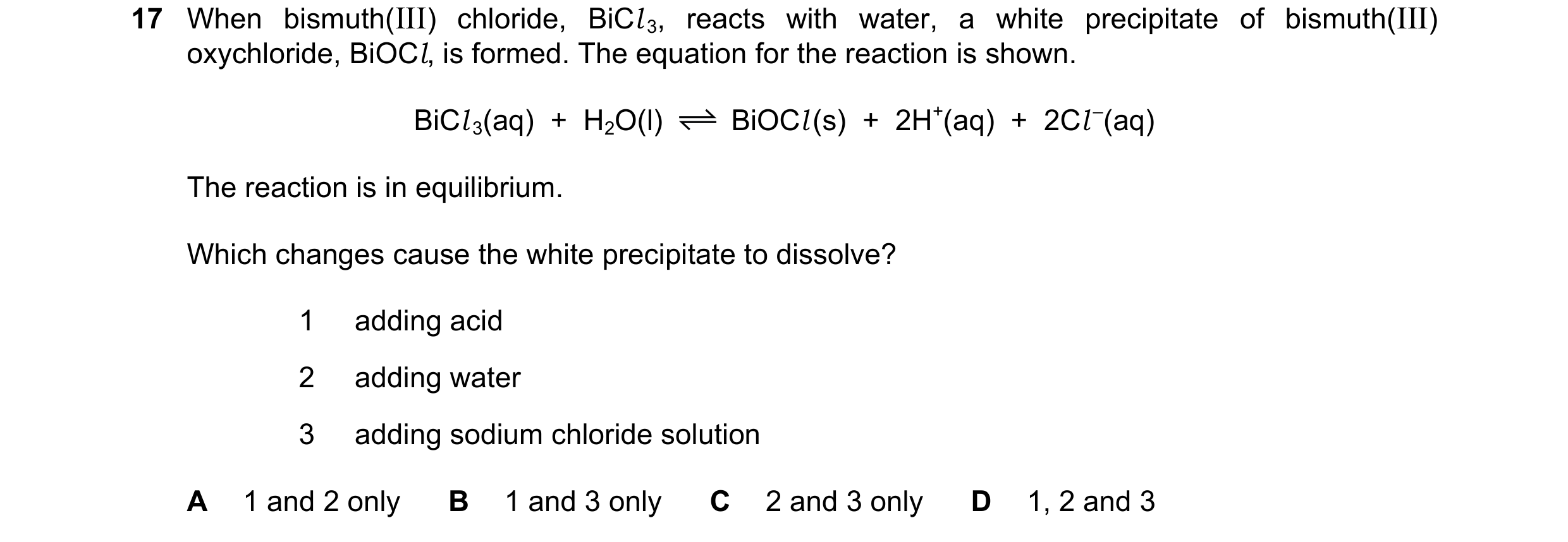
Q17 · When bismuth(III) chloride, BiCl 3, reacts with water, a white precipitate of… 0971/22 May/June 2021
17 When bismuth(III) chloride, BiCl 3, reacts with water, a white precipitate of bismuth(III) oxychloride, BiOCl, is formed. The equation for the reaction is shown. BiCl 3(aq) + H2O(l) BiOCl (s) + 2H+(aq) + 2Cl –(aq) The reaction is in equilibrium. Which changes cause the white precipitate to dissolve? 1 adding acid 2 adding water 3 adding sodium chloride solution A 1 and 2 only B 1 and 3 only C 2 and 3 only D 1, 2 and 3
1 marks
Answer: B
This question in 0971/22 May/June 2021
Q18 · Ammonia is made in the Haber process 0971/22 May/June 2021
31 Ammonia is made in the Haber process. Which conditions are used in the Haber process? temperature pressure catalyst used / C / atmospheres A 450 200 iron B 450 5 vanadium(V) oxide C 200 450 iron D 200 5 vanadium(V) oxide
1 marks
Answer: A
This question in 0971/22 May/June 2021
Q19 · The equation shown represents a reaction at equilibrium 0971/22 Oct/Nov 2021
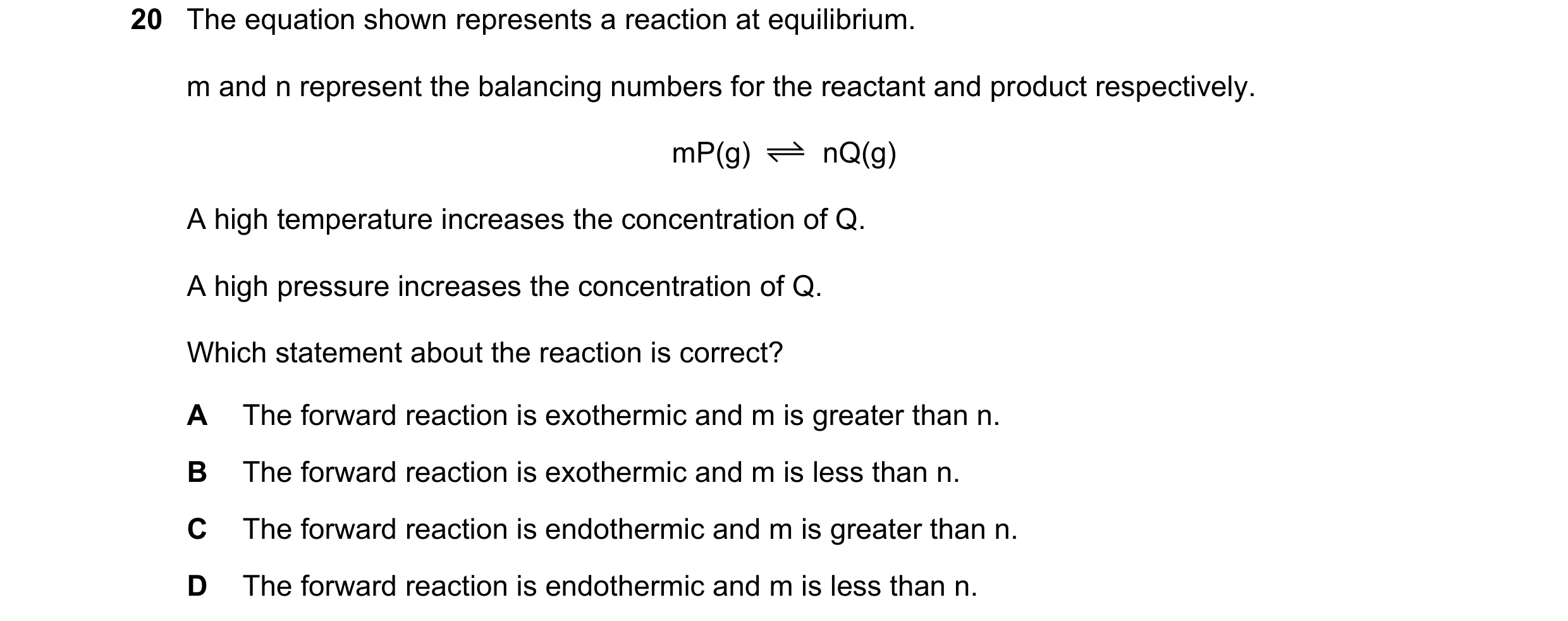
20 The equation shown represents a reaction at equilibrium. m and n represent the balancing numbers for the reactant and product respectively. mP(g) nQ(g) A high temperature increases the concentration of Q. A high pressure increases the concentration of Q. Which statement about the reaction is correct? A The forward reaction is exothermic and m is greater than n. B The forward reaction is exothermic and m is less than n. C The forward reaction is endothermic and m is greater than n. D The forward reaction is endothermic and m is less than n.
1 marks
Answer: C
This question in 0971/22 Oct/Nov 2021
Q20 · Which conditions are used in the Haber process? 0971/22 Oct/Nov 2021
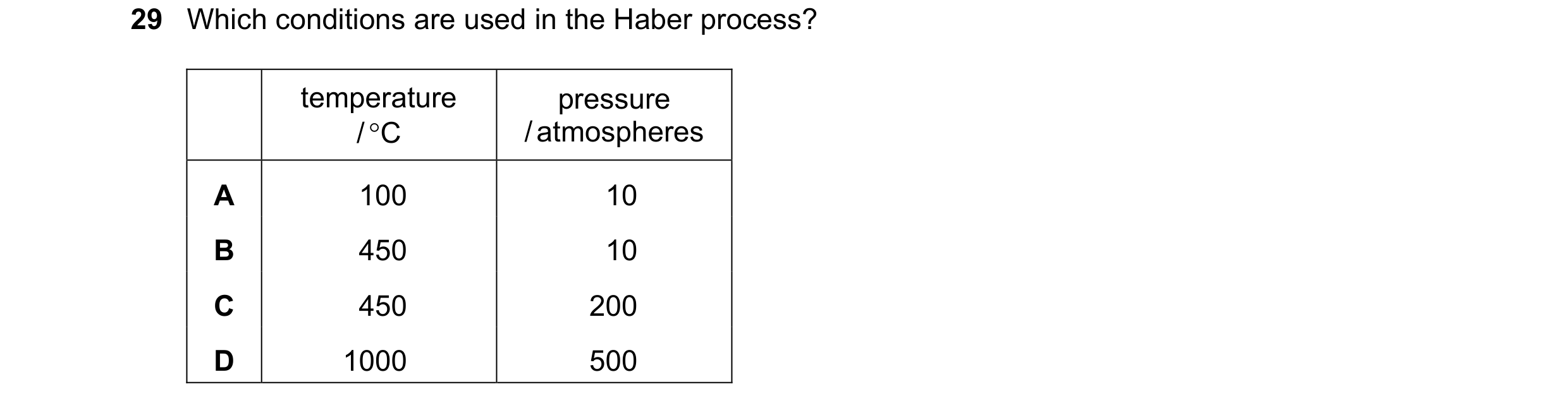
29 Which conditions are used in the Haber process? temperature pressure / C / atmospheres A 100 10 B 450 10 C 450 200 D 1000 500
1 marks
Answer: C
This question in 0971/22 Oct/Nov 2021
Q21 · The equation for the manufacture of ammonia in the Haber process is shown 0971/21 May/June 2022
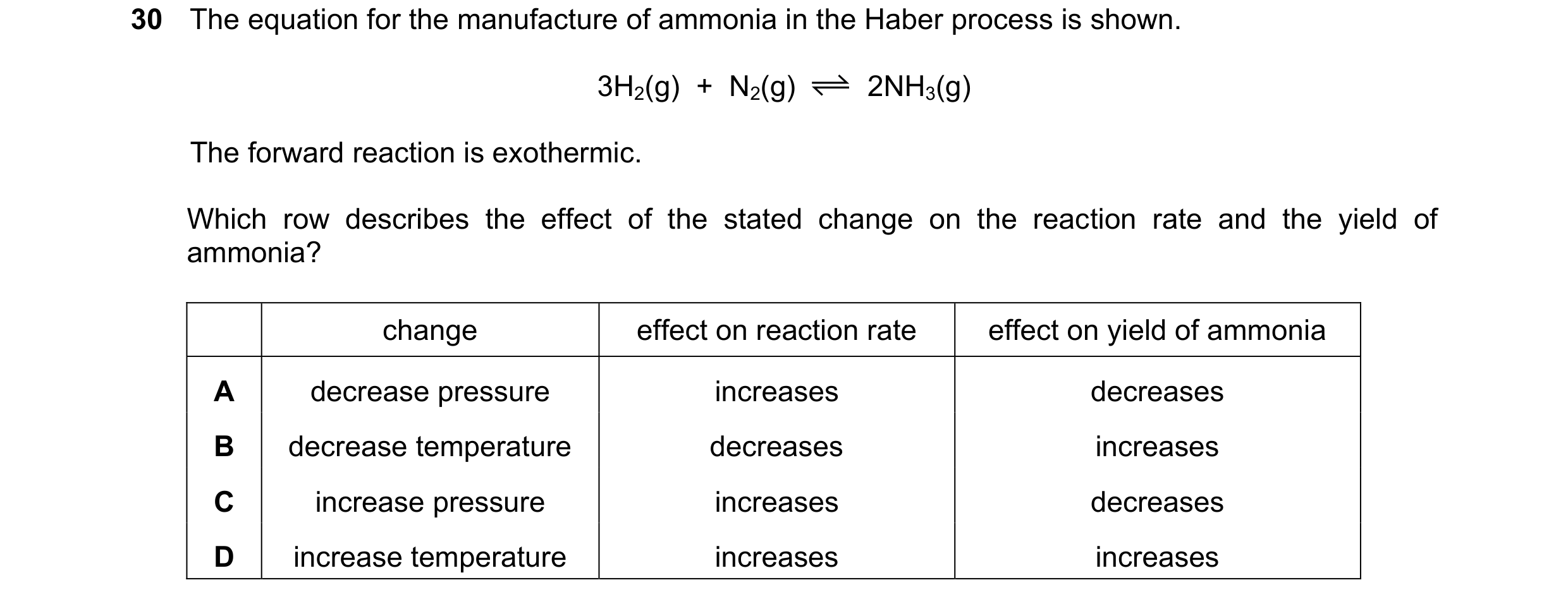
30 The equation for the manufacture of ammonia in the Haber process is shown. 3H2(g) + N2(g) 2NH3(g) The forward reaction is exothermic. Which row describes the effect of the stated change on the reaction rate and the yield of ammonia? change effect on reaction rate effect on yield of ammonia A decrease pressure increases decreases B decrease temperature decreases increases C increase pressure increases decreases D increase temperature increases increases
1 marks
Answer: B
This question in 0971/21 May/June 2022
Q22 · When the colourless gas N2O4 is heated, it forms the brown gas NO2 0971/22 May/June 2022
14 When the colourless gas N2O4 is heated, it forms the brown gas NO2. When the reaction mixture is cooled, the brown colour fades and turns back to colourless. Which type of reaction is described by these observations? A decomposition B displacement C reduction D reversible
1 marks
Answer: D
This question in 0971/22 May/June 2022
Q23 · Which reaction in the Contact process requires the use of a catalyst? 0971/22 May/June 2022
33 Which reaction in the Contact process requires the use of a catalyst? A S + O2 SO2 B 2SO2 + O2 2SO3 C SO3 + H2SO4 H2S2O7 D H2S2O7 + H2O 2H2SO4
1 marks
Answer: B
This question in 0971/22 May/June 2022
Q24 · Dinitrogen tetroxide, N2O4, is converted into nitrogen dioxide, NO2, in a reversible… 0971/22 Oct/Nov 2022
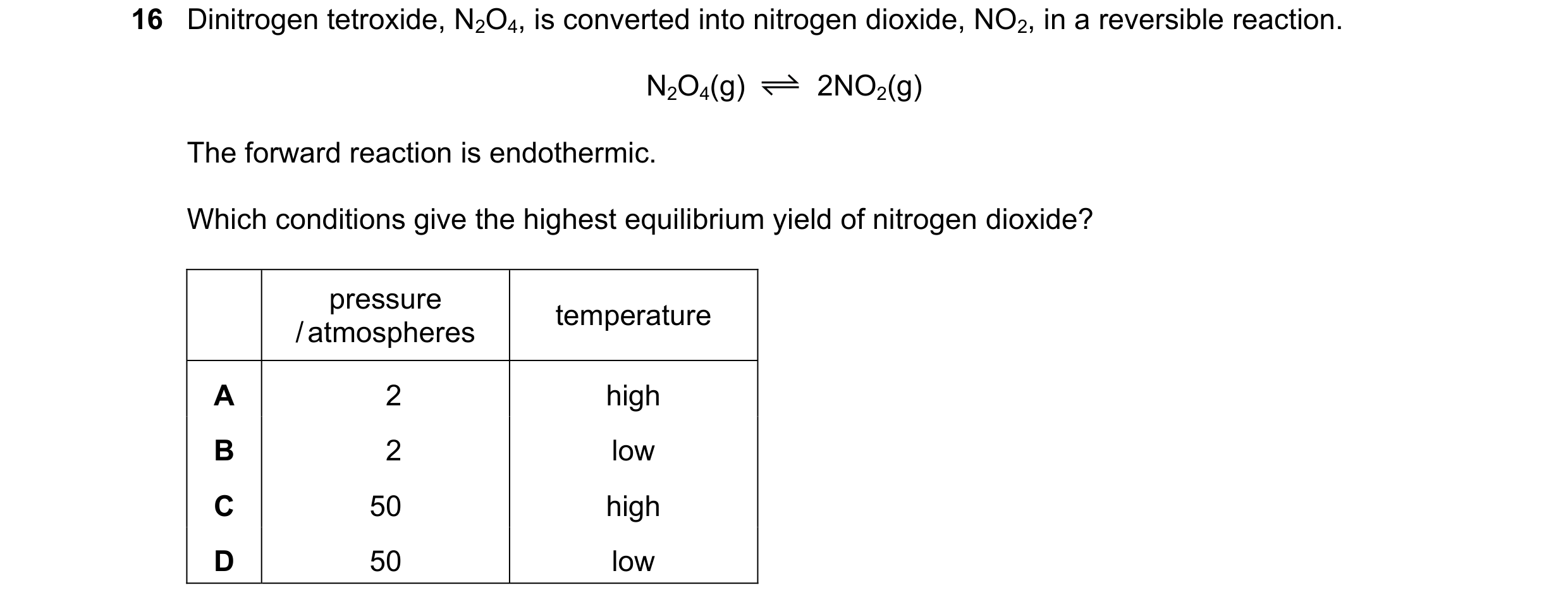
16 Dinitrogen tetroxide, N2O4, is converted into nitrogen dioxide, NO2, in a reversible reaction. N2O4(g) 2NO2(g) The forward reaction is endothermic. Which conditions give the highest equilibrium yield of nitrogen dioxide? pressure temperature / atmospheres A 2 high B 2 low C 50 high D 50 low
1 marks
Answer: A
This question in 0971/22 Oct/Nov 2022
Q25 · Solid copper(II) sulfate exists in two different forms, anhydrous and hydrated 0971/21 May/June 2023
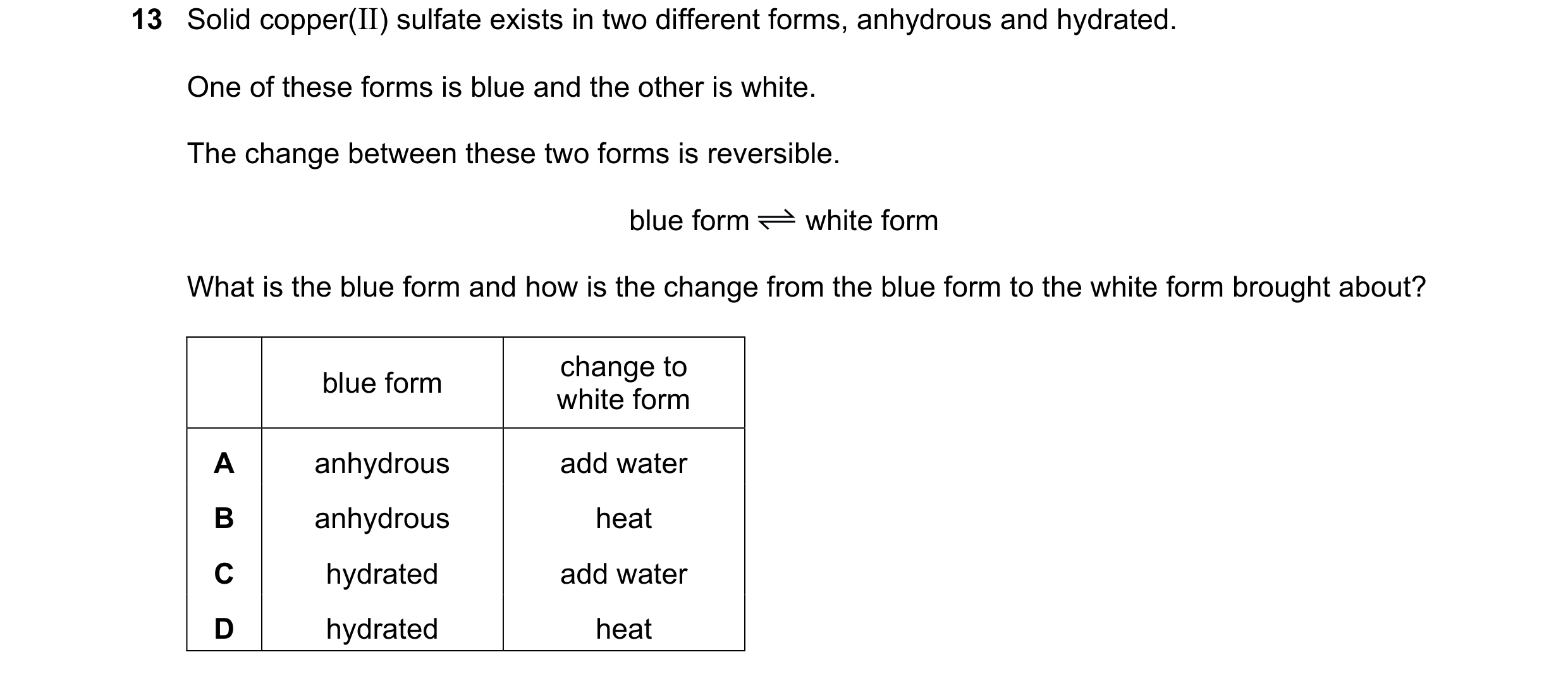
13 Solid copper(II) sulfate exists in two different forms, anhydrous and hydrated. One of these forms is blue and the other is white. The change between these two forms is reversible. blue form white form What is the blue form and how is the change from the blue form to the white form brought about? change to blue form white form A anhydrous add water B anhydrous heat C hydrated add water D hydrated heat
1 marks
Answer: D
This question in 0971/21 May/June 2023
Q26 · In the Contact process, sulfur dioxide is reacted with oxygen to form sulfur trioxide 0971/22 May/June 2023
13 In the Contact process, sulfur dioxide is reacted with oxygen to form sulfur trioxide. Which conditions are used in this reaction? temperature pressure catalyst / °C / kPa A 300 200 iron B 300 20 000 vanadium(V) oxide C 450 200 vanadium(V) oxide D 450 20 000 iron
1 marks
Answer: C
This question in 0971/22 May/June 2023
Q27 · Which reaction is reversible? 0971/22 May/June 2023
14 Which reaction is reversible? A an iron nail rusting when left in moist air B limestone reacting with an acid to form carbon dioxide gas C magnesium burning in air to produce a white ash D white anhydrous copper(II) sulfate turning blue when water is added
1 marks
Answer: D
This question in 0971/22 May/June 2023
Q28 · The decomposition of dinitrogen tetroxide, N2O4, into nitrogen dioxide, NO2, is a… 0971/22 Oct/Nov 2023
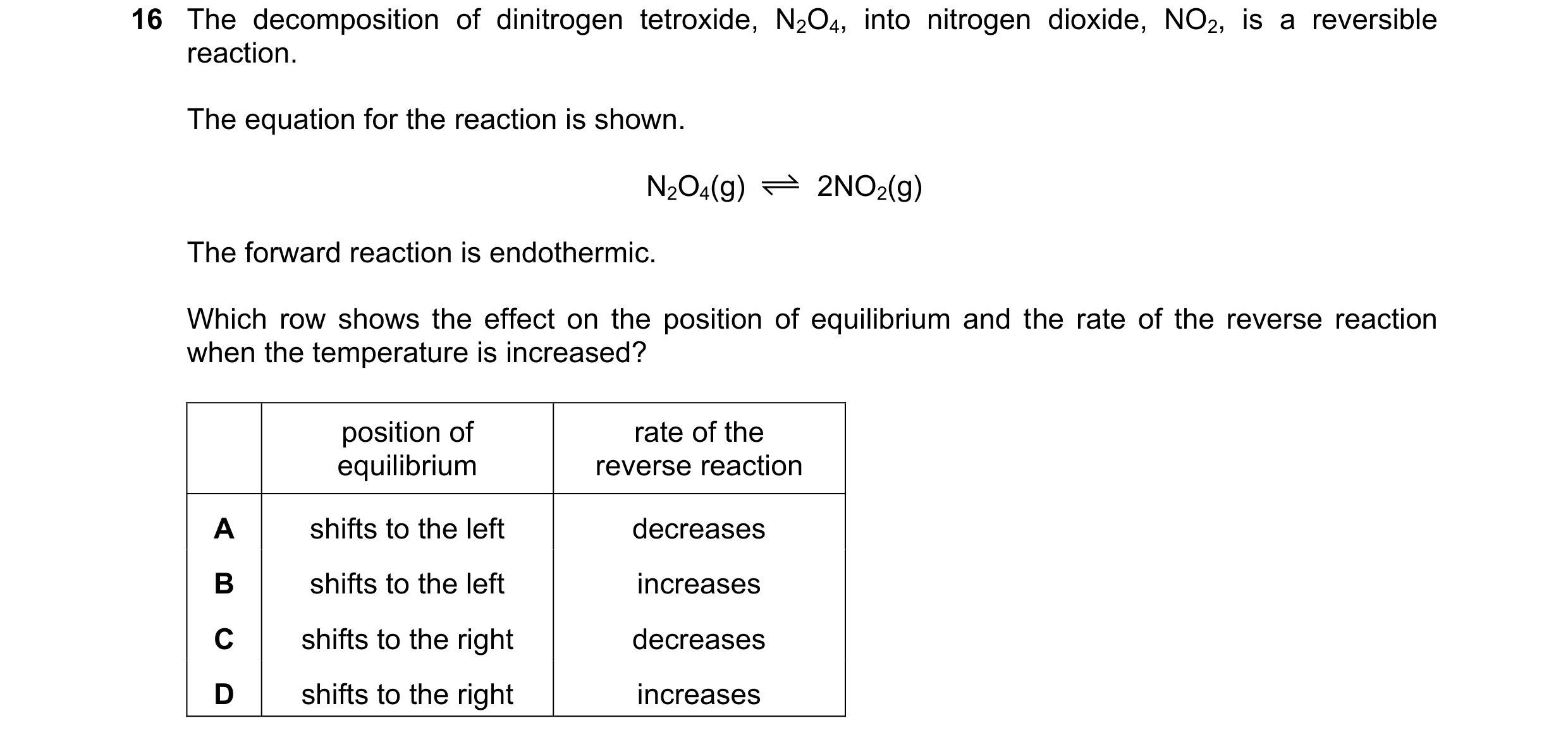
16 The decomposition of dinitrogen tetroxide, N2O4, into nitrogen dioxide, NO2, is a reversible reaction. The equation for the reaction is shown. N2O4(g) 2NO2(g) The forward reaction is endothermic. Which row shows the effect on the position of equilibrium and the rate of the reverse reaction when the temperature is increased? position of rate of the equilibrium reverse reaction A shifts to the left decreases B shifts to the left increases C shifts to the right decreases D shifts to the right increases
1 marks
Answer: D
This question in 0971/22 Oct/Nov 2023
Q29 · Hydrogen is made by reacting carbon with steam 0971/21 May/June 2024
20 Hydrogen is made by reacting carbon with steam. The equation for the reaction is shown. C(s) + H2O(g) ⇌H2(g) + CO(g) The forward reaction is endothermic. Which row describes changes in the pressure and the temperature that will both shift the position of equilibrium to the right? pressure temperature A decrease decrease B decrease increase C increase decrease D increase increase
1 marks
Answer: B
This question in 0971/21 May/June 2024
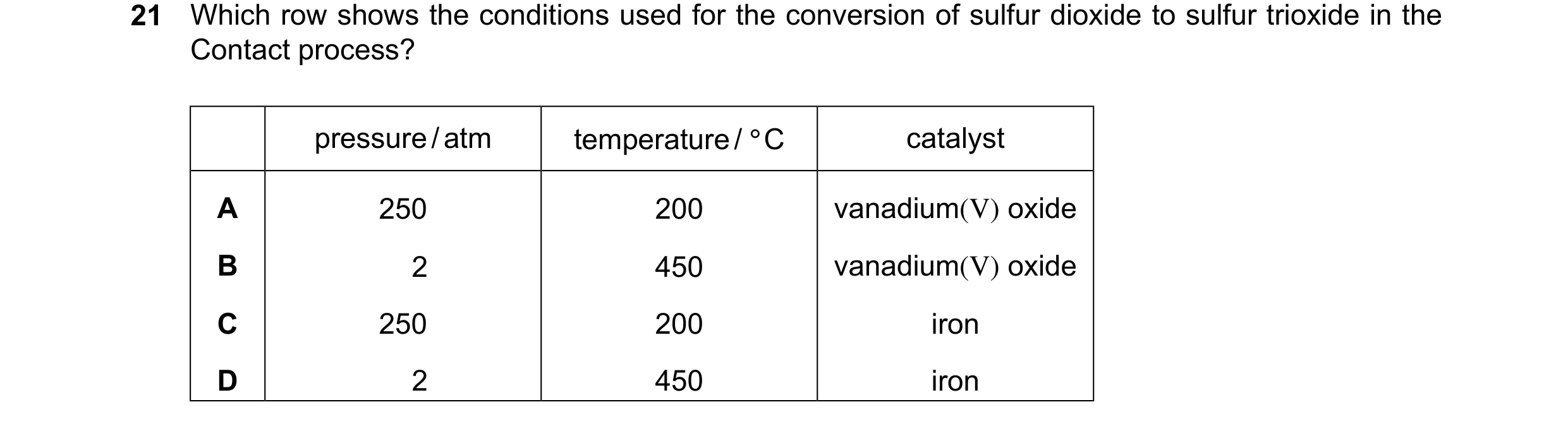
Q30 · Which row shows the conditions used for the conversion of sulfur dioxide to sulfur… 0971/21 May/June 2024
21 Which row shows the conditions used for the conversion of sulfur dioxide to sulfur trioxide in the Contact process? pressure/atm temperature/°C catalyst A 250 200 vanadium(V) oxide B 2 450 vanadium(V) oxide C 250 200 iron D 2 450 iron
1 marks
Answer: B
This question in 0971/21 May/June 2024
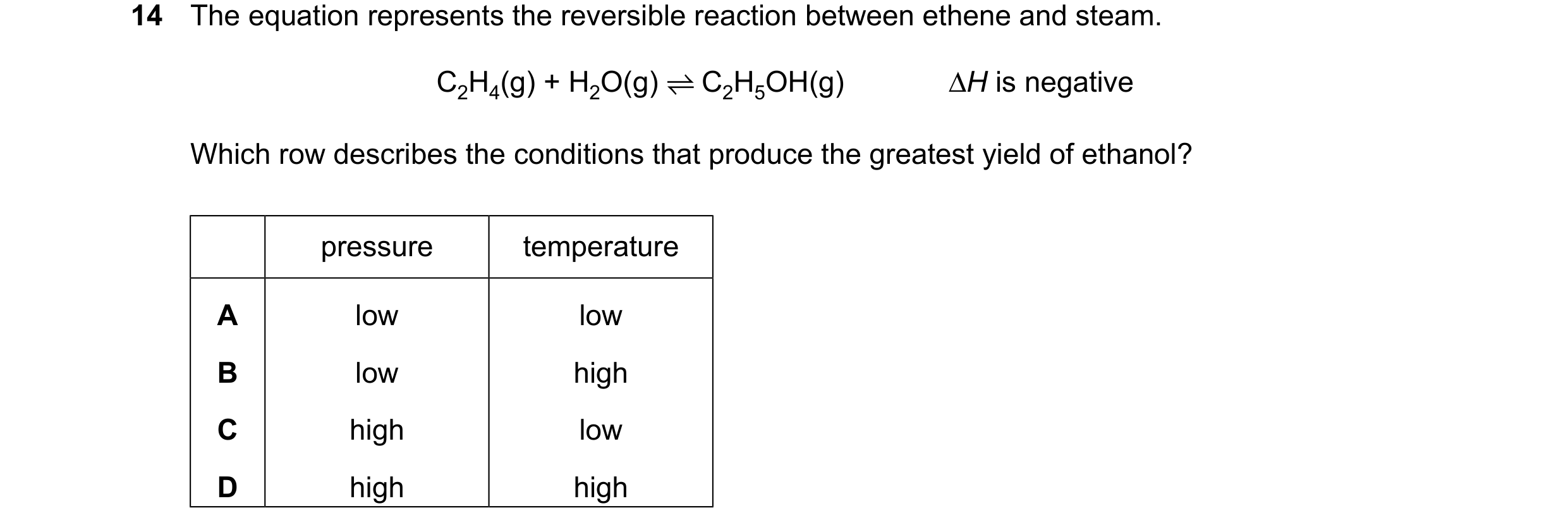
Q31 · The equation represents the reversible reaction between ethene and steam 0971/22 May/June 2024
14 The equation represents the reversible reaction between ethene and steam. C2H4(g) + H2O(g) ⇌ C2H5OH(g) ∆H is negative Which row describes the conditions that produce the greatest yield of ethanol? pressure temperature A low low B low high C high low D high high
1 marks
Answer: C
This question in 0971/22 May/June 2024
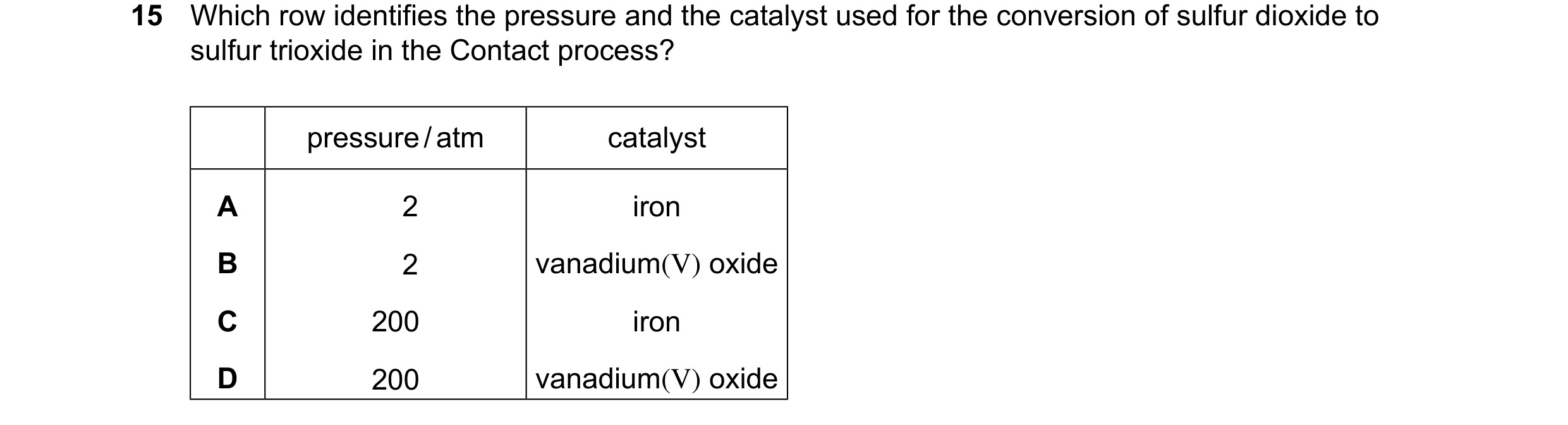
Q32 · Which row identifies the pressure and the catalyst used for the conversion of sulfur… 0971/22 May/June 2024
15 Which row identifies the pressure and the catalyst used for the conversion of sulfur dioxide to sulfur trioxide in the Contact process? pressure/atm catalyst A 2 iron B 2 vanadium(V) oxide C 200 iron D 200 vanadium(V) oxide
1 marks
Answer: B
This question in 0971/22 May/June 2024
Q33 · Hydrogen gas reacts with iodine gas to form hydrogen iodide gas in an equilibrium reaction 0971/22 Oct/Nov 2024
16 Hydrogen gas reacts with iodine gas to form hydrogen iodide gas in an equilibrium reaction. H2(g) + I2(g) 2HI(g) ∆H = +26.5 kJ / mol Which changes increase the yield of HI at equilibrium? 1 adding a catalyst 2 adding more hydrogen gas 3 increasing the pressure 4 increasing the temperature A 1 and 3 B 1 and 4 C 2 and 3 D 2 and 4
1 marks
Answer: D
This question in 0971/22 Oct/Nov 2024
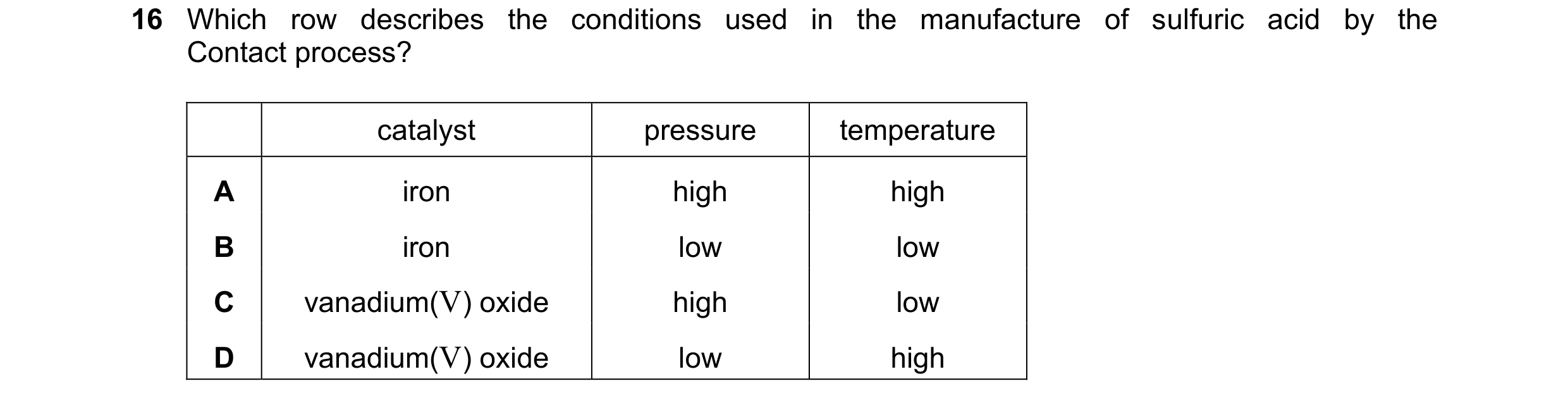
Q34 · Which row describes the conditions used in the manufacture of sulfuric acid by the… 0971/22 May/June 2025
16 Which row describes the conditions used in the manufacture of sulfuric acid by the Contact process? catalyst pressure temperature A iron high high B iron low low C vanadium(V) oxide high low D vanadium(V) oxide low high
1 marks
Answer: D
This question in 0971/22 May/June 2025
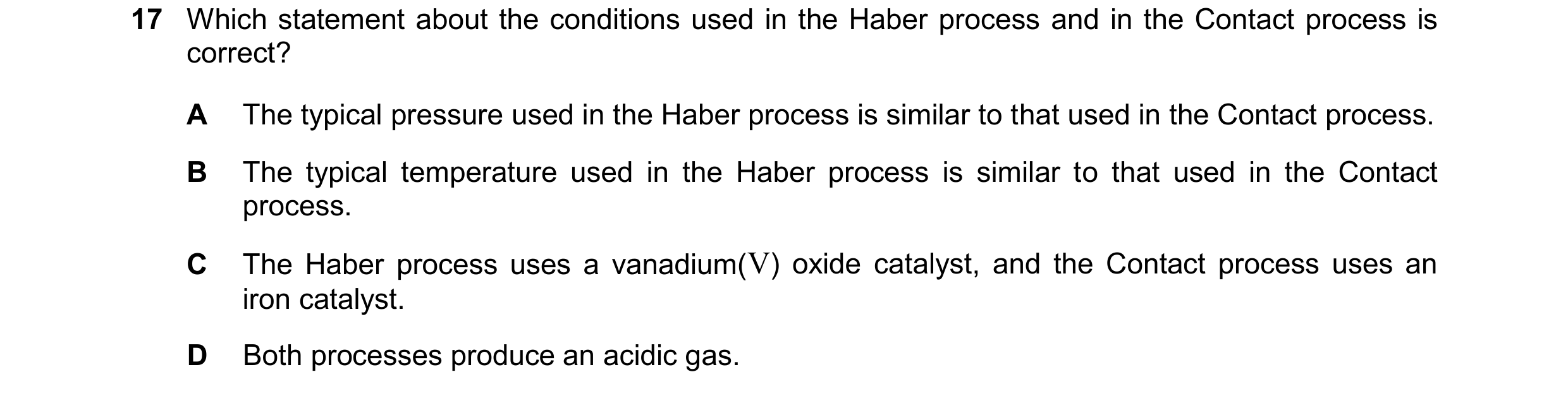
Q35 · Which statement about the conditions used in the Haber process and in the Contact process… 0971/22 Oct/Nov 2025
17 Which statement about the conditions used in the Haber process and in the Contact process is correct? A The typical pressure used in the Haber process is similar to that used in the Contact process. B The typical temperature used in the Haber process is similar to that used in the Contact process. C The Haber process uses a vanadium(V) oxide catalyst, and the Contact process uses an iron catalyst. D Both processes produce an acidic gas.
1 marks
Answer: B
This question in 0971/22 Oct/Nov 2025
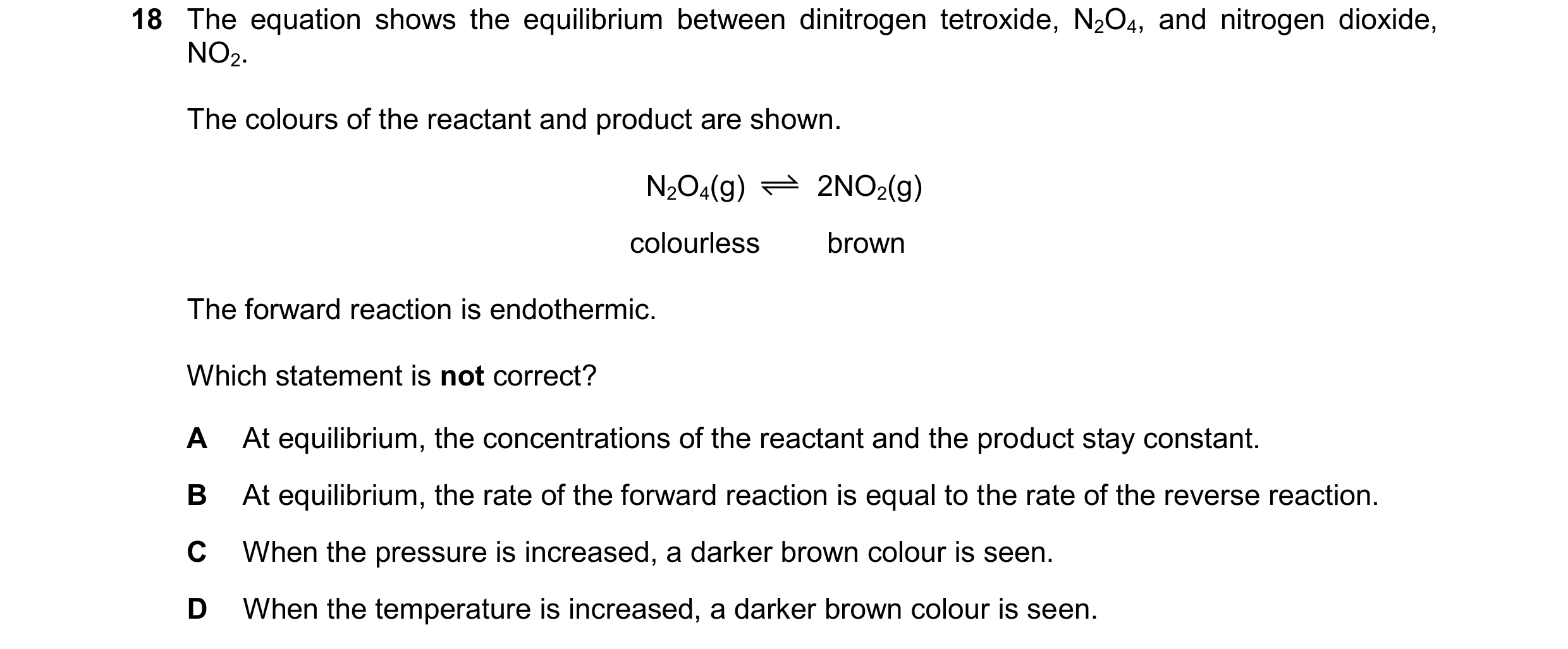
Q36 · The equation shows the equilibrium between dinitrogen tetroxide, N2O4, and nitrogen… 0971/22 Oct/Nov 2025
18 The equation shows the equilibrium between dinitrogen tetroxide, N2O4, and nitrogen dioxide, NO2. The colours of the reactant and product are shown. N2O4(g) 2NO2(g) colourless brown The forward reaction is endothermic. Which statement is not correct? A At equilibrium, the concentrations of the reactant and the product stay constant. B At equilibrium, the rate of the forward reaction is equal to the rate of the reverse reaction. C When the pressure is increased, a darker brown colour is seen. D When the temperature is increased, a darker brown colour is seen.
1 marks
Answer: C
This question in 0971/22 Oct/Nov 2025
 1 / 10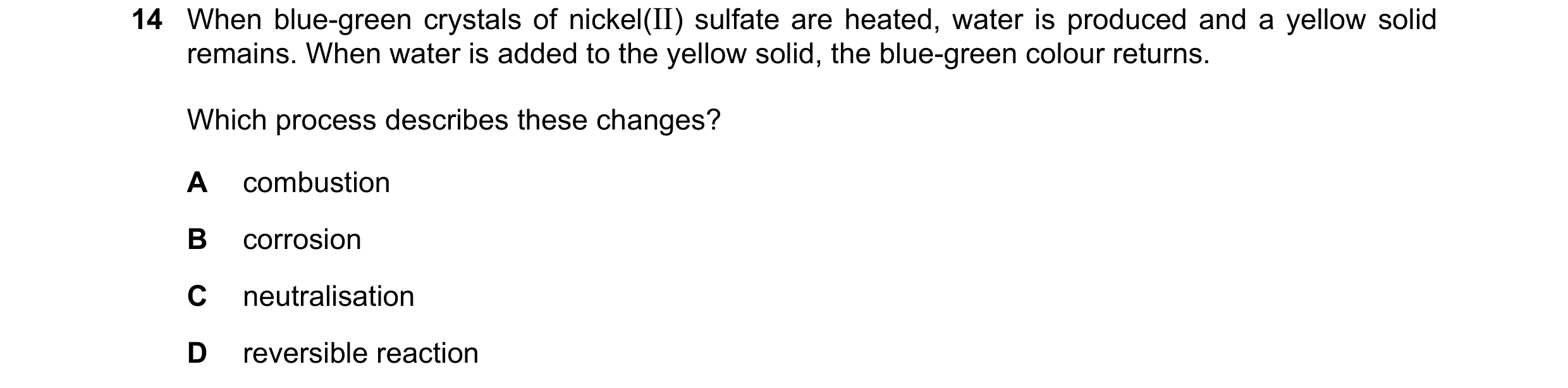
 2 / 10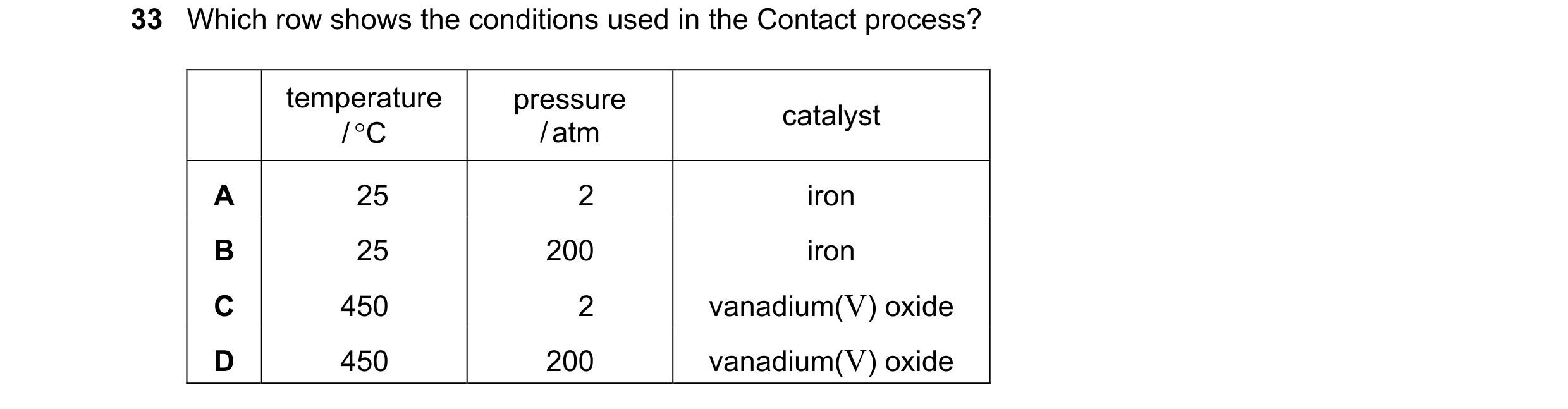
 3 / 10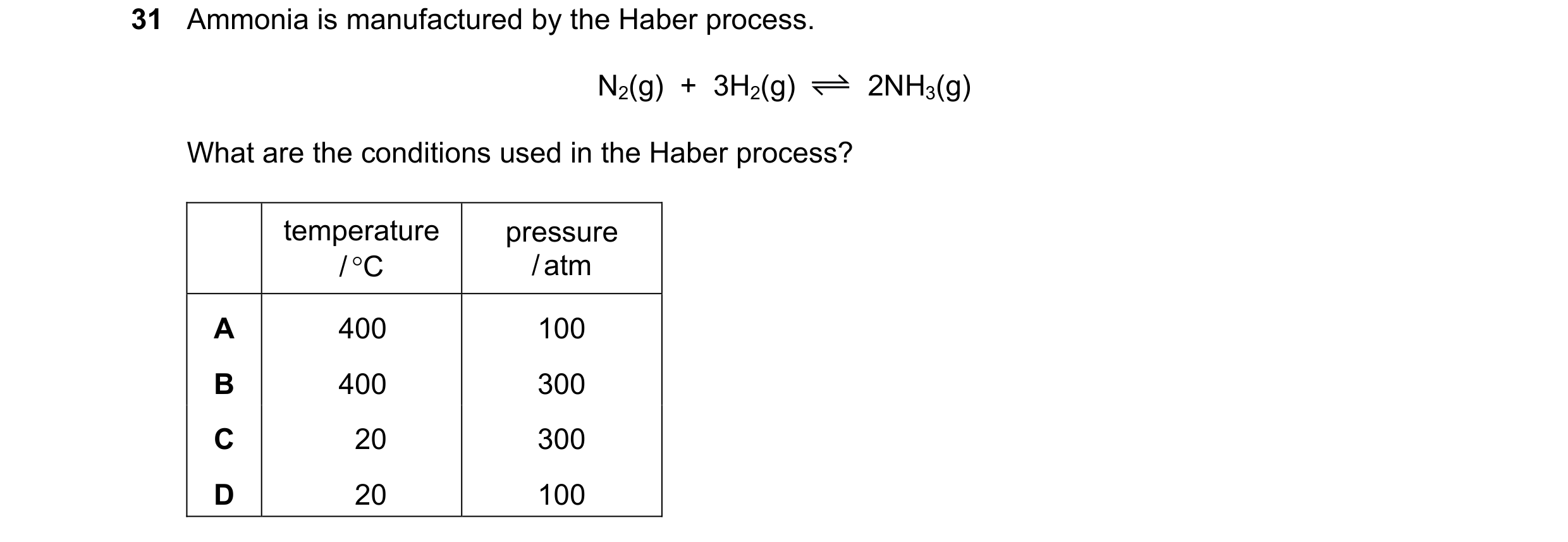
 4 / 10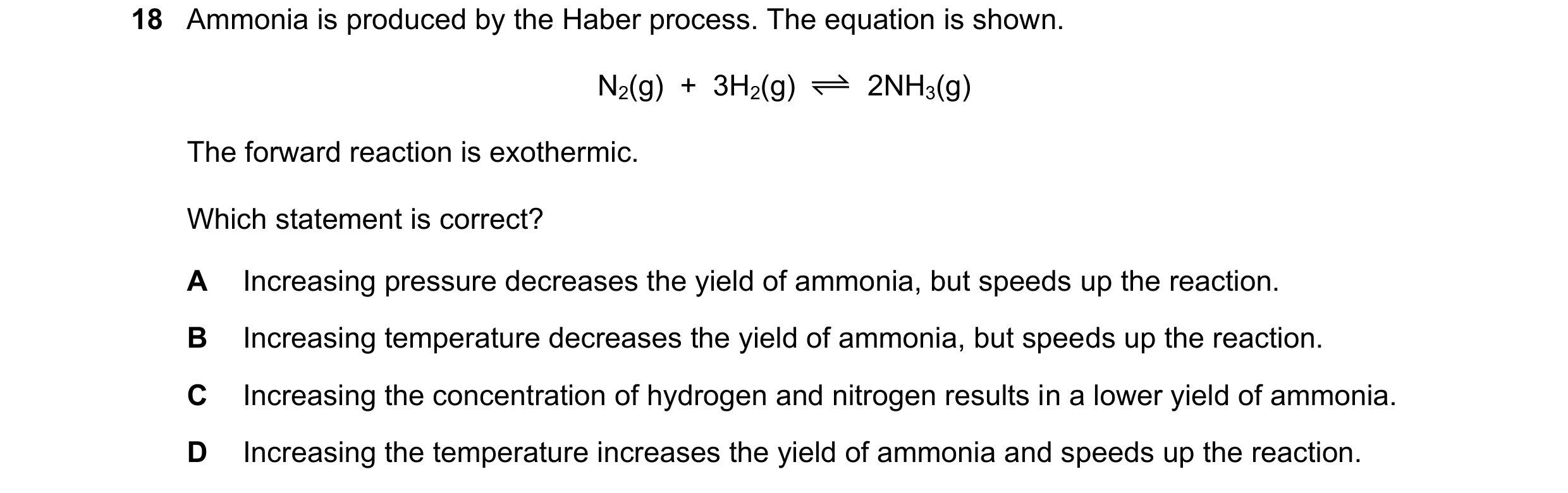

 5 / 10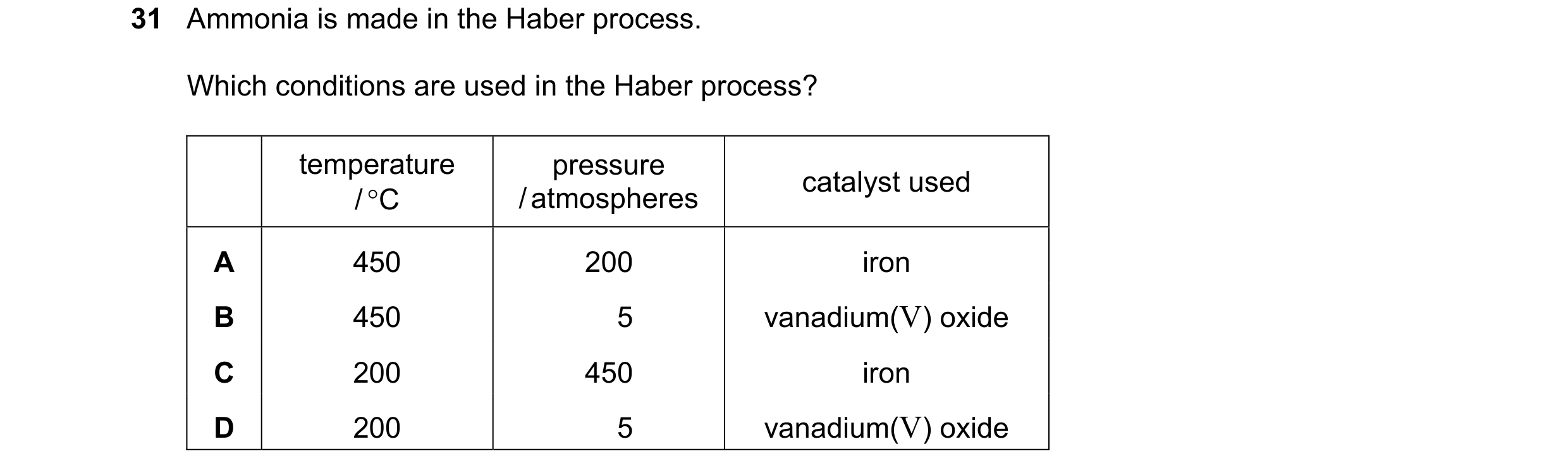
 6 / 10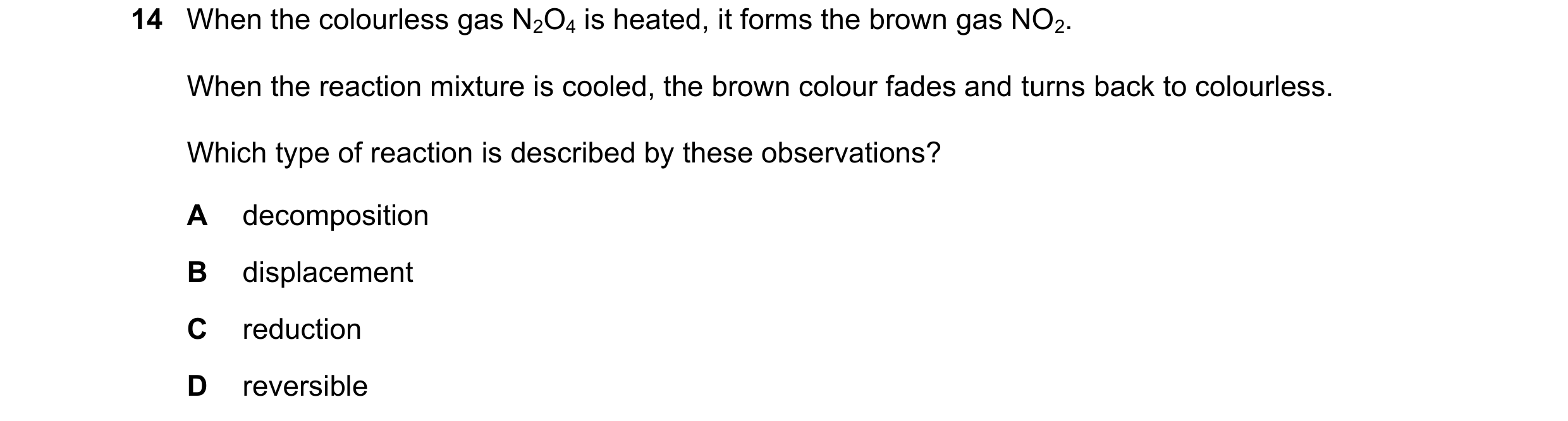

 7 / 10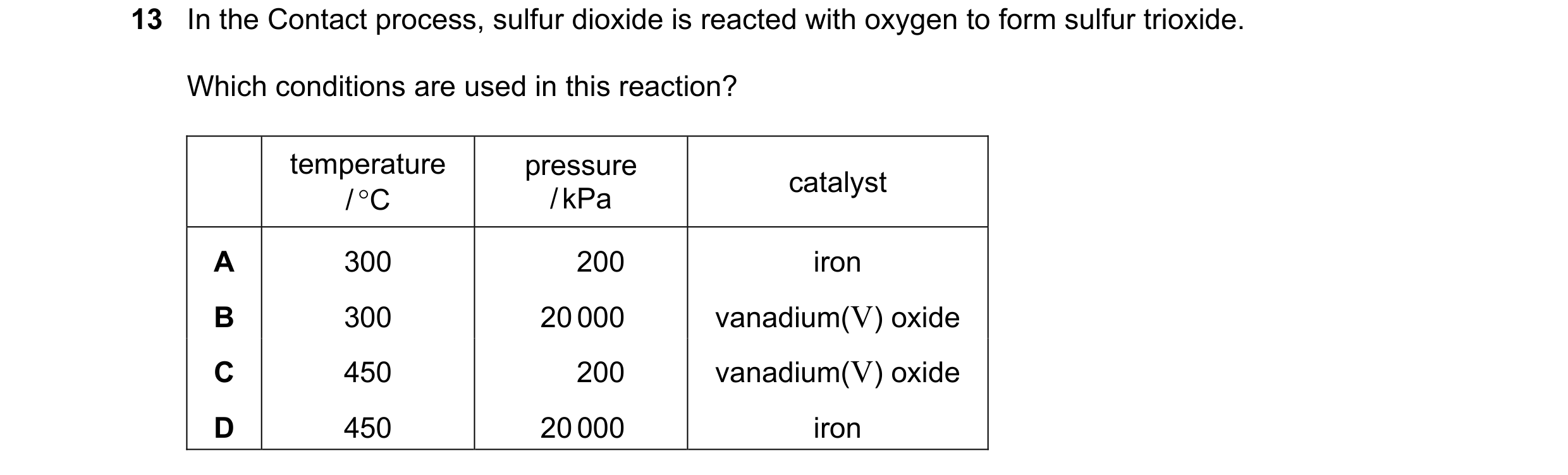

 8 / 10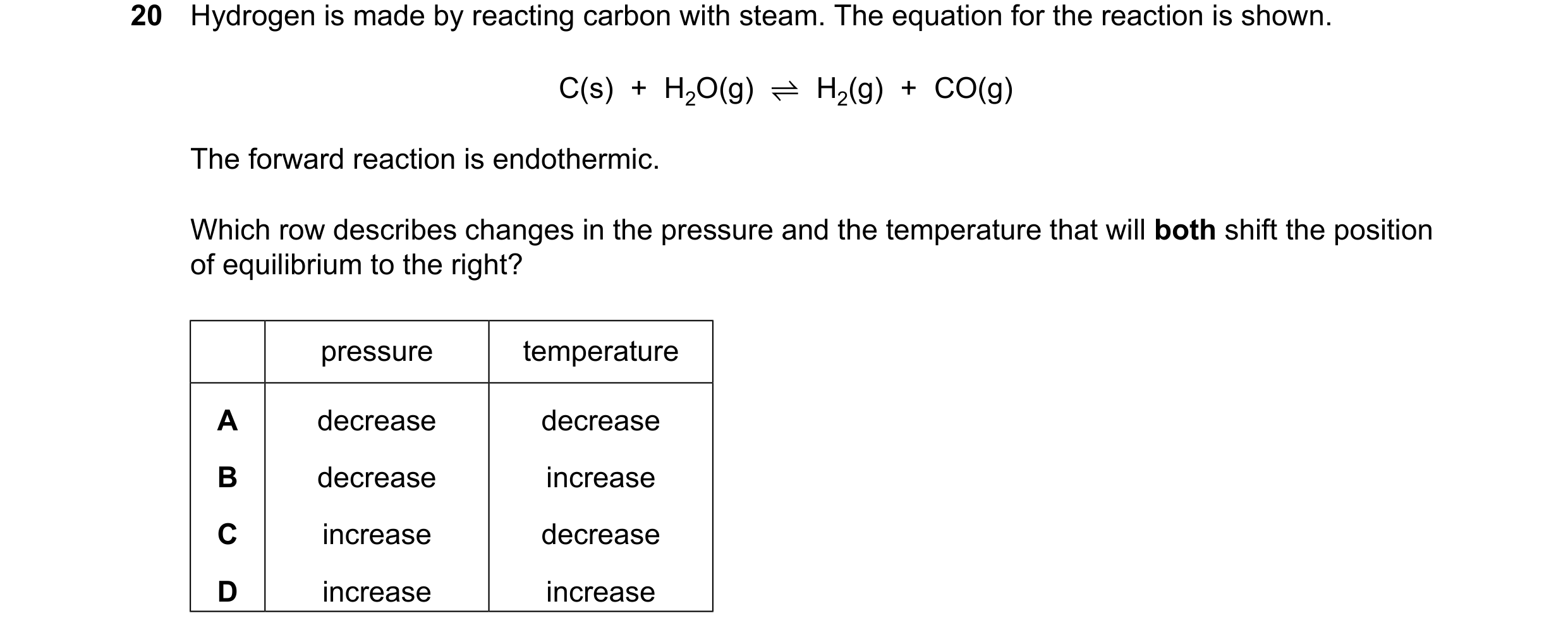
 9 / 10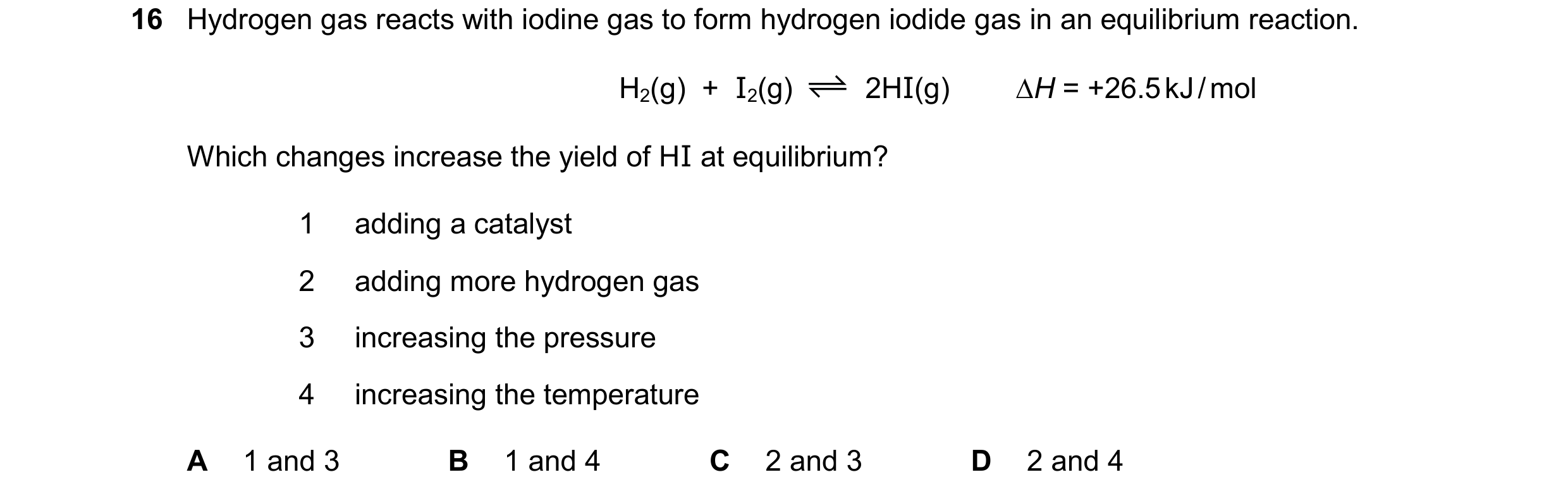
 10 / 10