Questions as text
Q1 · Plant cells use energy from sunlight for photosynthesis 0971/21 May/June 2018
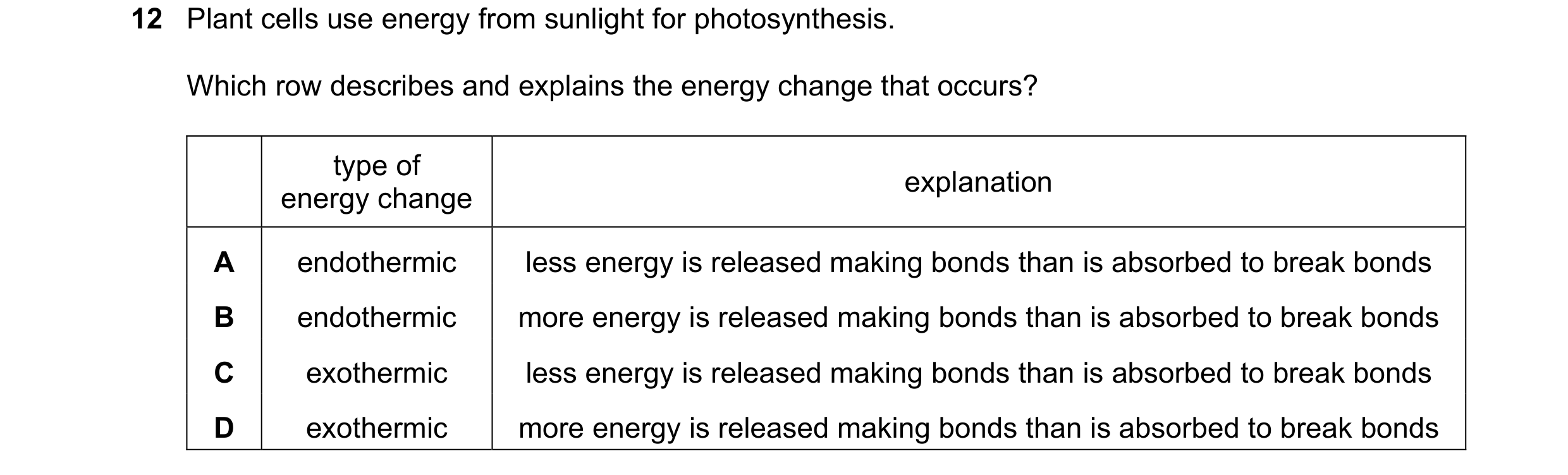
12 Plant cells use energy from sunlight for photosynthesis. Which row describes and explains the energy change that occurs? type of explanation energy change A endothermic less energy is released making bonds than is absorbed to break bonds B endothermic more energy is released making bonds than is absorbed to break bonds C exothermic less energy is released making bonds than is absorbed to break bonds D exothermic more energy is released making bonds than is absorbed to break bonds
1 marks
Answer: A
This question in 0971/21 May/June 2018
Q2 · Hydrogen bromide decomposes to form hydrogen and bromine 0971/21 May/June 2018
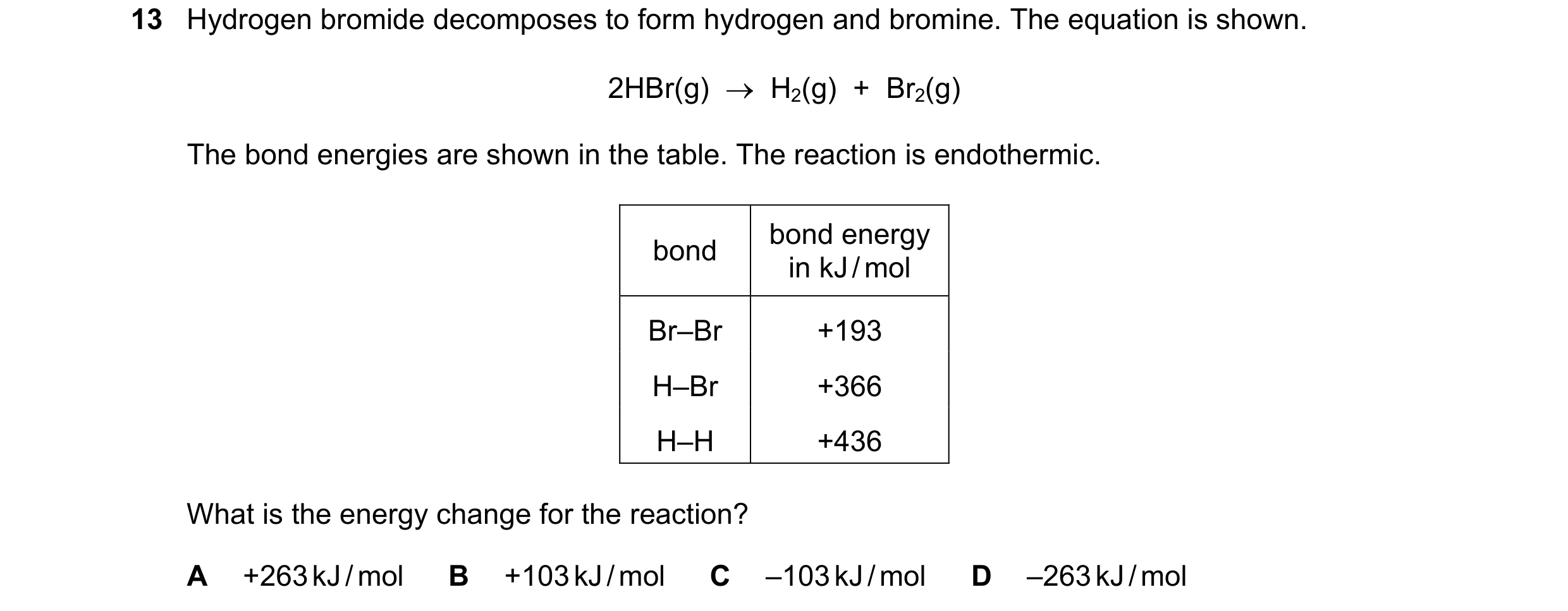
13 Hydrogen bromide decomposes to form hydrogen and bromine. The equation is shown. 2HBr(g) → H2(g) + Br2(g) The bond energies are shown in the table. The reaction is endothermic. bond energy bond in kJ / mol Br–Br +193 H–Br +366 H–H +436 What is the energy change for the reaction? A +263 kJ / mol B +103 kJ / mol C –103 kJ / mol D –263 kJ / mol
1 marks
Answer: B
This question in 0971/21 May/June 2018
Q3 · The formation of sulfur trioxide is a reversible reaction 0971/21 May/June 2018
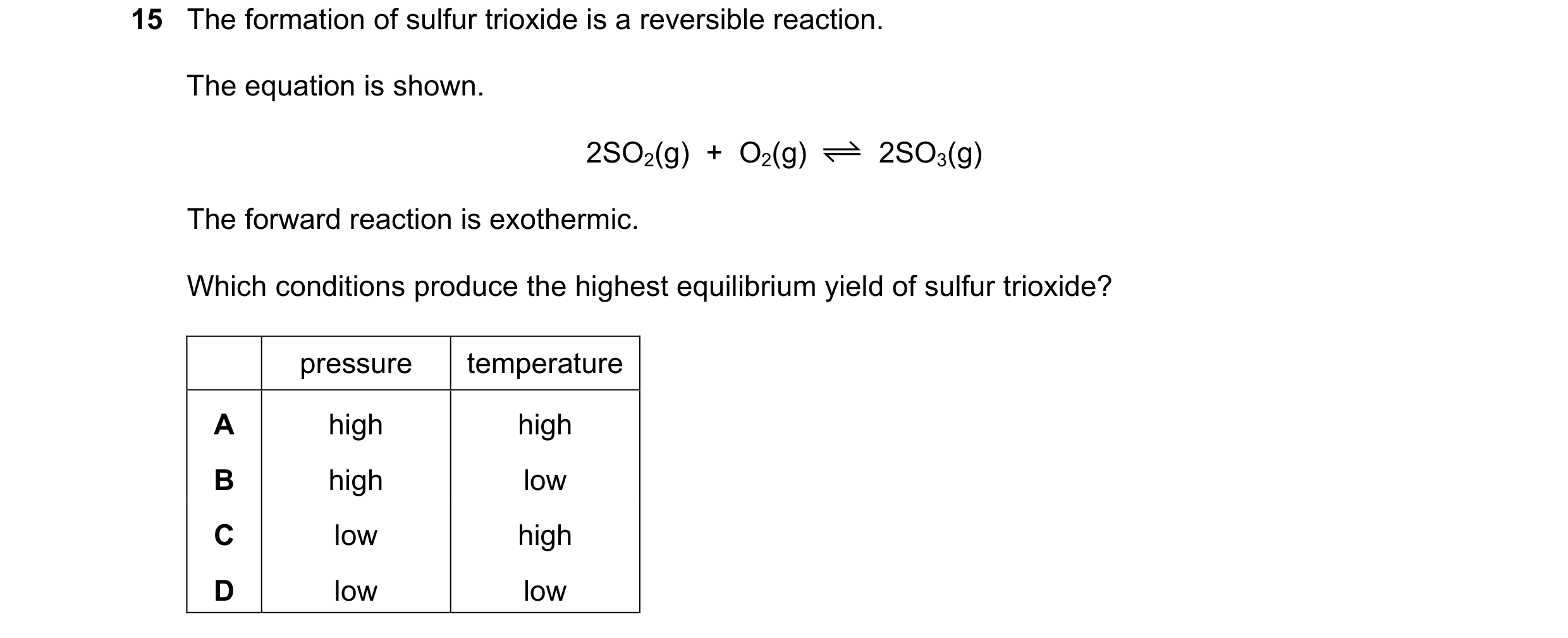
15 The formation of sulfur trioxide is a reversible reaction. The equation is shown. 2SO2(g) + O2(g) 2SO3(g) The forward reaction is exothermic. Which conditions produce the highest equilibrium yield of sulfur trioxide? pressure temperature A high high B high low C low high D low low
1 marks
Answer: B
This question in 0971/21 May/June 2018
Q4 · The diagrams show four pieces of laboratory equipment 0971/22 Oct/Nov 2018
2 The diagrams show four pieces of laboratory equipment.
balance pipette stop-clock thermometer
00:00:13.08
Which equipment is essential to find out if dissolving a salt in water is an exothermic process?
balance pipette stop-clock thermometer
A x x x v
B Jv x x v
Cc x v x v
D Jv x Jv x
1 marks
Answer: A
This question in 0971/22 Oct/Nov 2018
Q5 · Hydrogen peroxide, H–O–O–H, decomposes to form water and oxygen 0971/22 Oct/Nov 2018
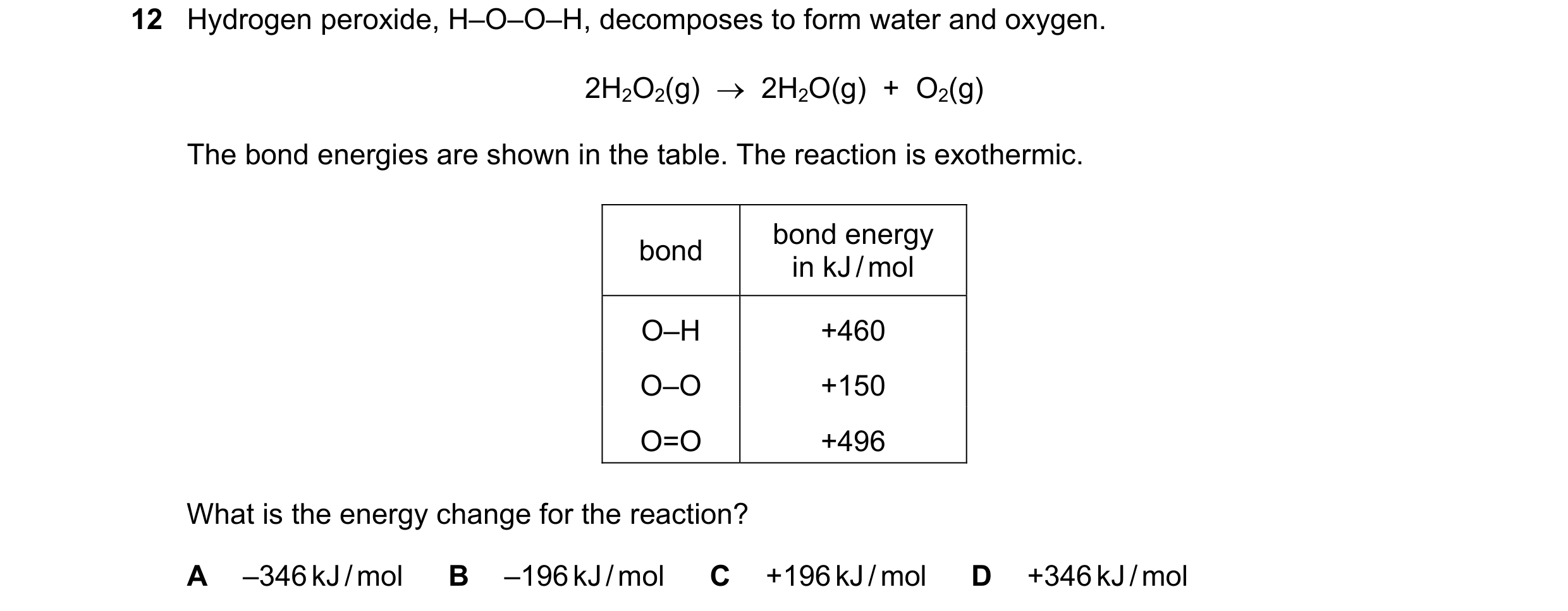
12 Hydrogen peroxide, H–O–O–H, decomposes to form water and oxygen. 2H2O2(g) → 2H2O(g) + O2(g) The bond energies are shown in the table. The reaction is exothermic. bond energy bond in kJ / mol O–H +460 O–O +150 O=O +496 What is the energy change for the reaction? A –346 kJ / mol B –196 kJ / mol C +196 kJ / mol D +346 kJ / mol
1 marks
Answer: B
This question in 0971/22 Oct/Nov 2018
Q6 · The equation for the formation of ammonia is shown 0971/22 Oct/Nov 2018
13 The equation for the formation of ammonia is shown. N2 + 3H2 → 2NH3 The energy level diagram for the reaction is shown. activation energy = +250 kJ / mol total energy N2 + 3H2 released energy = –342 kJ / mol energy change 2NH3 progress of reaction What is the energy change for the reaction? A –592 kJ / mol B –92 kJ / mol C +92 kJ / mol D +592 kJ / mol
1 marks
Answer: B
This question in 0971/22 Oct/Nov 2018
Q7 · Nitrogen reacts with hydrogen to produce ammonia 0971/21 May/June 2019
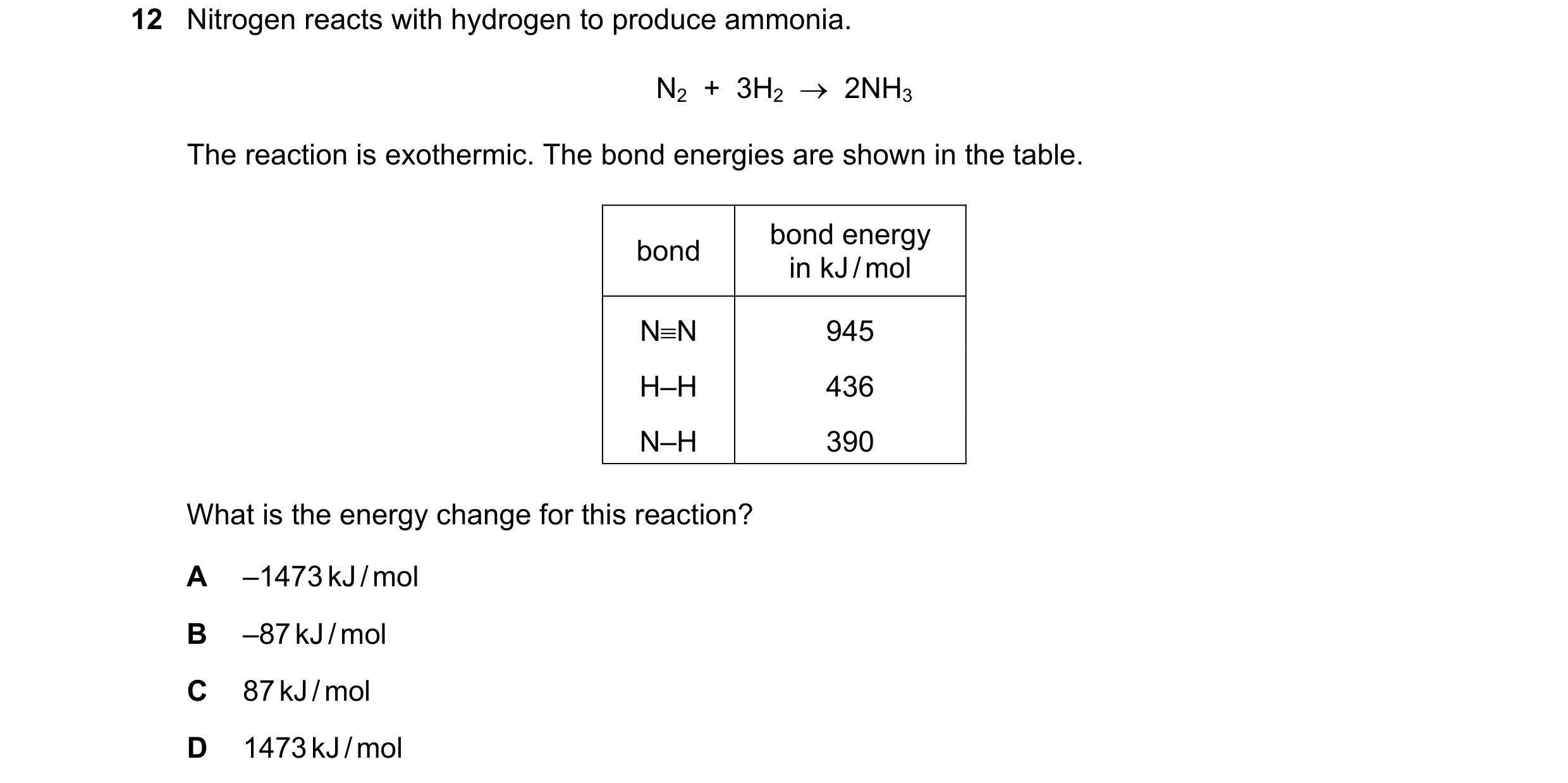
12 Nitrogen reacts with hydrogen to produce ammonia. N2 + 3H2 → 2NH3 The reaction is exothermic. The bond energies are shown in the table. bond energy bond in kJ / mol N≡N 945 H–H 436 N–H 390 What is the energy change for this reaction? A –1473 kJ / mol B –87 kJ / mol C 87 kJ / mol D 1473 kJ / mol
1 marks
Answer: B
This question in 0971/21 May/June 2019
Q8 · The temperature of the water in two beakers, X and Y, is measured as 21.5 °C 0971/22 Oct/Nov 2019
13 The temperature of the water in two beakers, X and Y, is measured as 21.5 °C. 5 g of sodium chloride is dissolved in the water in beaker X. The temperature changes to 18.0 °C. 5 g of calcium oxide is dissolved in the water in beaker Y. The temperature changes to 29.4 °C. Which types of process are occurring in beakers X and Y? X Y A endothermic endothermic B endothermic exothermic C exothermic endothermic D exothermic exothermic
1 marks
Answer: B
This question in 0971/22 Oct/Nov 2019
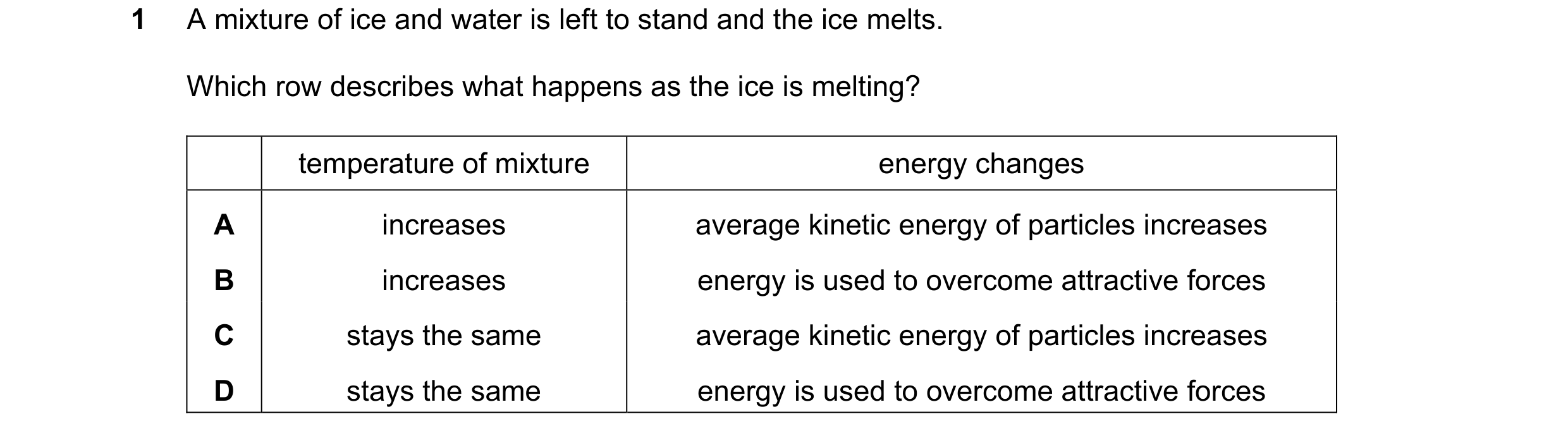
Q9 · A mixture of ice and water is left to stand and the ice melts 0971/21 May/June 2020
1 A mixture of ice and water is left to stand and the ice melts. Which row describes what happens as the ice is melting? temperature of mixture energy changes A increases average kinetic energy of particles increases B increases energy is used to overcome attractive forces C stays the same average kinetic energy of particles increases D stays the same energy is used to overcome attractive forces
1 marks
Answer: D
This question in 0971/21 May/June 2020
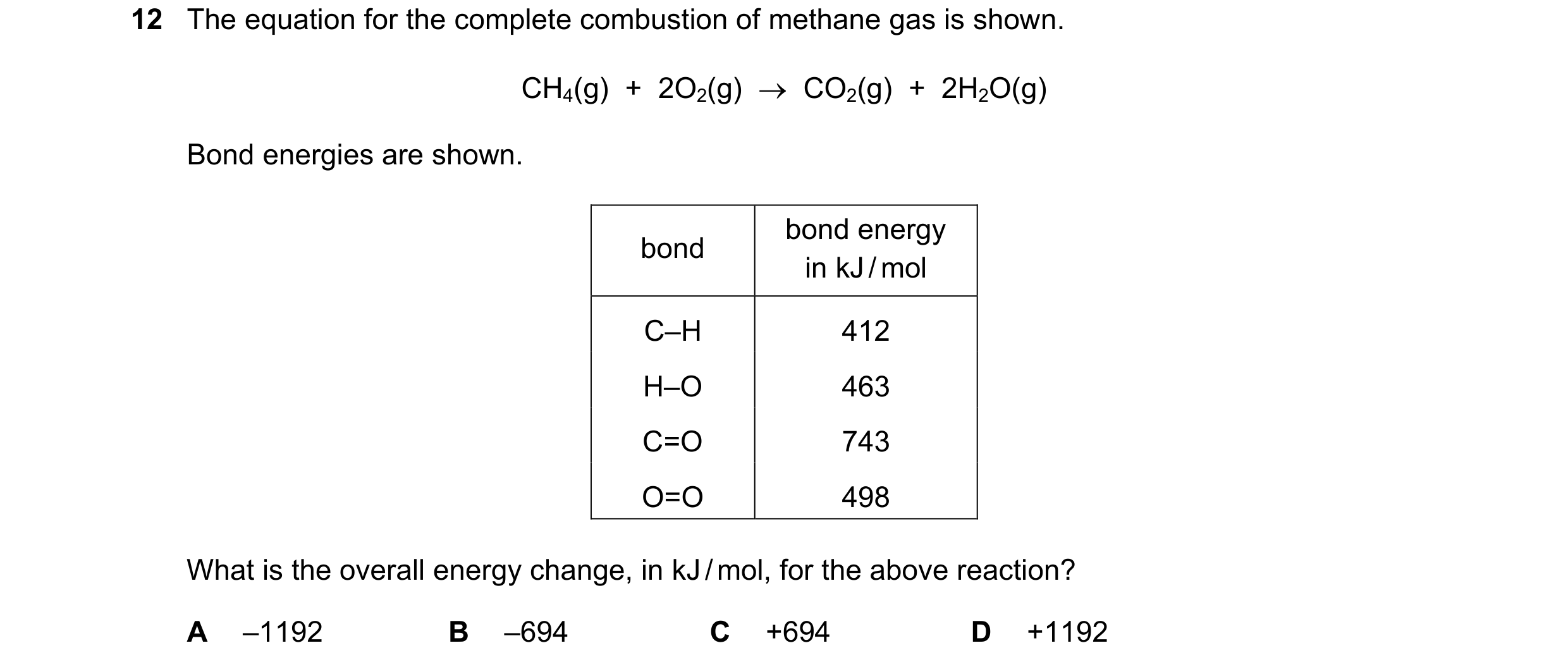
Q10 · The equation for the complete combustion of methane gas is shown 0971/21 May/June 2020
12 The equation for the complete combustion of methane gas is shown. CH4(g) + 2O2(g) → CO2(g) + 2H2O(g) Bond energies are shown. bond energy bond in kJ / mol C–H 412 H–O 463 C=O 743 O=O 498 What is the overall energy change, in kJ / mol, for the above reaction? A –1192 B –694 C +694 D +1192
1 marks
Answer: B
This question in 0971/21 May/June 2020
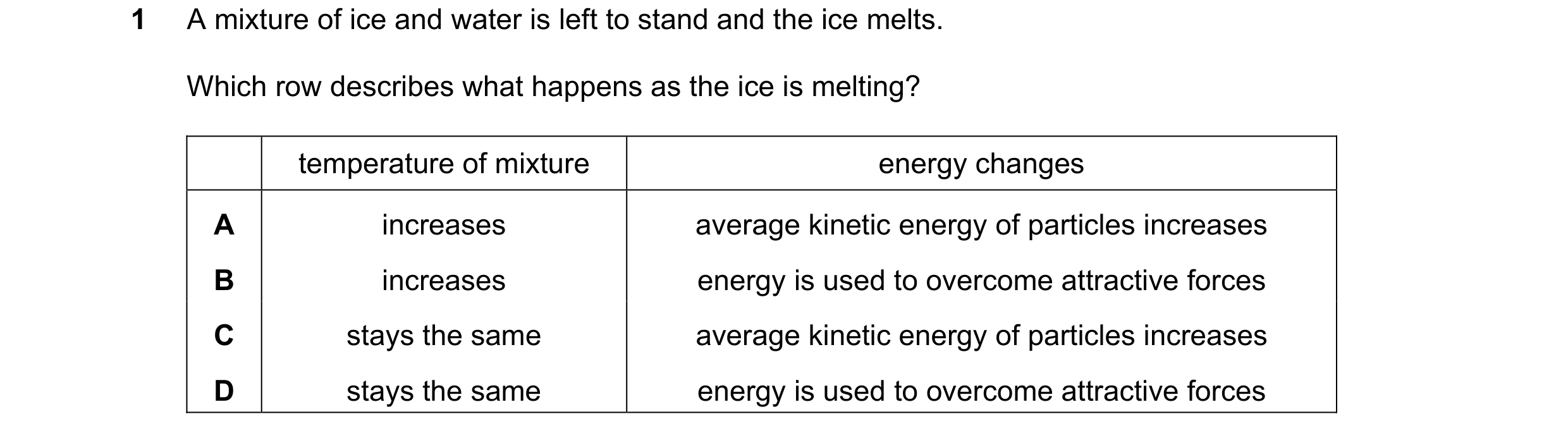
Q11 · A mixture of ice and water is left to stand and the ice melts 0971/22 May/June 2020
1 A mixture of ice and water is left to stand and the ice melts. Which row describes what happens as the ice is melting? temperature of mixture energy changes A increases average kinetic energy of particles increases B increases energy is used to overcome attractive forces C stays the same average kinetic energy of particles increases D stays the same energy is used to overcome attractive forces
1 marks
Answer: D
This question in 0971/22 May/June 2020
Q12 · Methane burns in excess oxygen 0971/22 May/June 2020
12 Methane burns in excess oxygen. The equation is shown. CH4(g) + 2O2(g) → CO2(g) + 2H2O(g) Bond energies are shown. bond energy bond / kJ mol–1 C=O 805 C–H 410 O=O 496 O–H 460 What is the energy change for the reaction? A (4 × 410 + 2 × 496) – (2 × 805 + 4 × 460) B (2 × 805 + 2 × 460) – (410 + 2 × 496) C (410 + 2 × 496) – (805 + 2 × 460) D (410 + 496) – (805 + 460)
1 marks
Answer: A
This question in 0971/22 May/June 2020
Q13 · The combustion of methane is exothermic 0971/22 Oct/Nov 2020
14 The combustion of methane is exothermic. CH4 + 2O2 CO2 + 2H2O Which statement about this reaction is correct? A The energy needed to break the bonds in methane and oxygen is greater than the energy released in making new bonds in carbon dioxide and water. B The energy needed to break the bonds in methane and oxygen is less than the energy released in making new bonds in carbon dioxide and water. C The energy released in breaking bonds in methane and oxygen is greater than the energy needed to make new bonds in carbon dioxide and water. D The energy released in breaking bonds in methane and oxygen is less than the energy needed to make new bonds in carbon dioxide and water.
1 marks
Answer: B
This question in 0971/22 Oct/Nov 2020
Q14 · Hydrogen reacts with oxygen in a fuel cell 0971/22 Oct/Nov 2020
15 Hydrogen reacts with oxygen in a fuel cell. 2H2 + O2 2H2O The reaction is exothermic. 286 kJ of energy is released for every mole of water formed. Which volume of hydrogen gas, measured at room temperature and pressure, would react with oxygen with the release of 7000 J of energy? A 587 cm3 B 1175 cm3 C 587 dm3 D 1175 dm3
1 marks
Answer: A
This question in 0971/22 Oct/Nov 2020
Q15 · The complete combustion of propane is exothermic 0971/21 May/June 2021
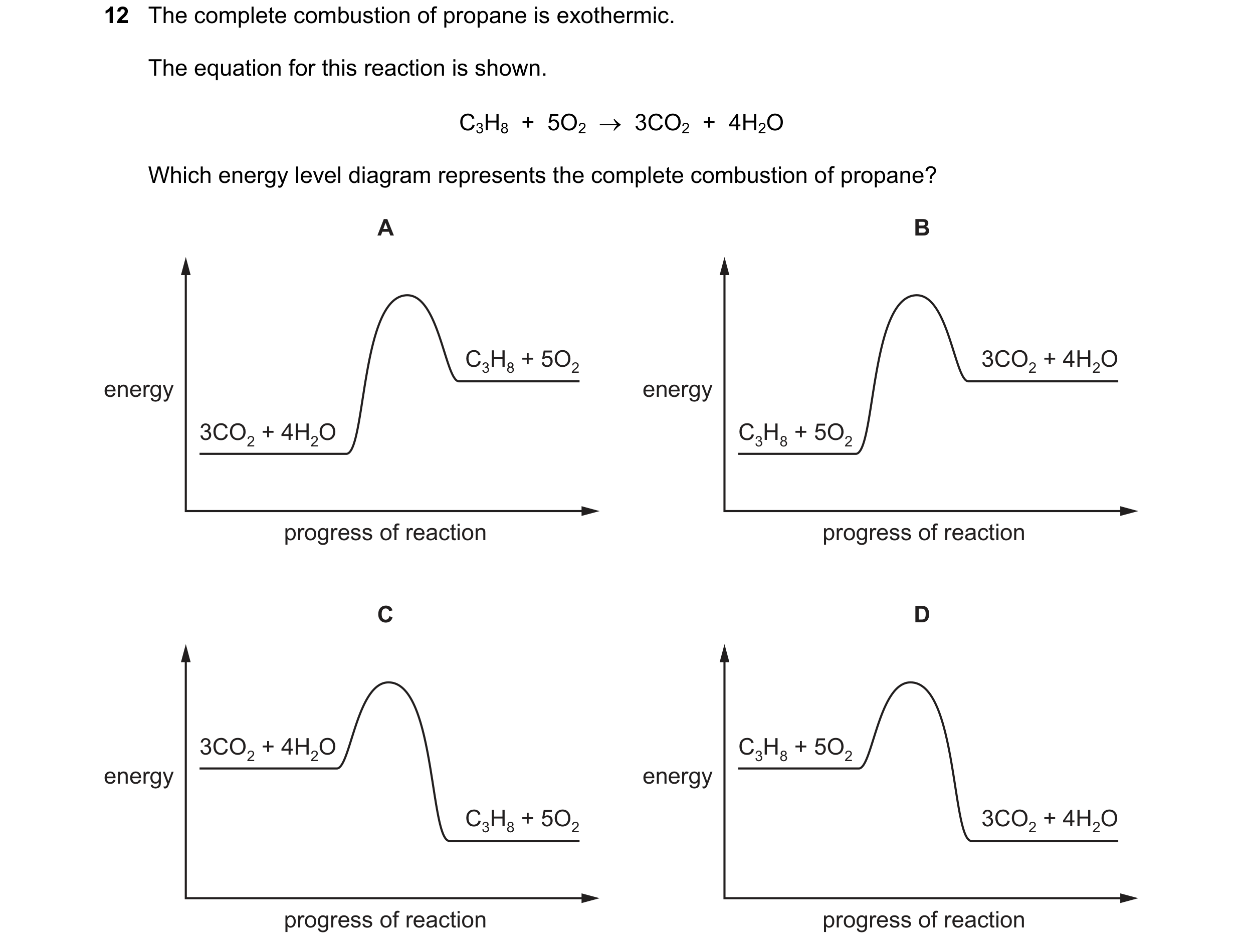
12 The complete combustion of propane is exothermic. The equation for this reaction is shown. C3H8 + 5O2 3CO2 + 4H2O Which energy level diagram represents the complete combustion of propane? A B C3H8 + 5O2 3CO2 + 4H2O energy energy 3CO2 + 4H2O C3H8 + 5O2 progress of reaction progress of reaction C D 3CO2 + 4H2O C3H8 + 5O2 energy energy C3H8 + 5O2 3CO2 + 4H2O progress of reaction progress of reaction
1 marks
Answer: D
This question in 0971/21 May/June 2021
Q16 · Four different fuels are used to heat a beaker of water, for the same amount of time… 0971/22 May/June 2021
12 Four different fuels are used to heat a beaker of water, for the same amount of time, using the apparatus shown. thermometer stirrer screen to reduce draughts 200 g of water spirit burner fuel The initial temperature of the water and the temperature after heating by the fuel are recorded. Which fuel releases the most heat energy? initial temperature temperature after / C heating / C A 17 46 B 24 52 C 26 61 D 30 62
1 marks
Answer: C
This question in 0971/22 May/June 2021
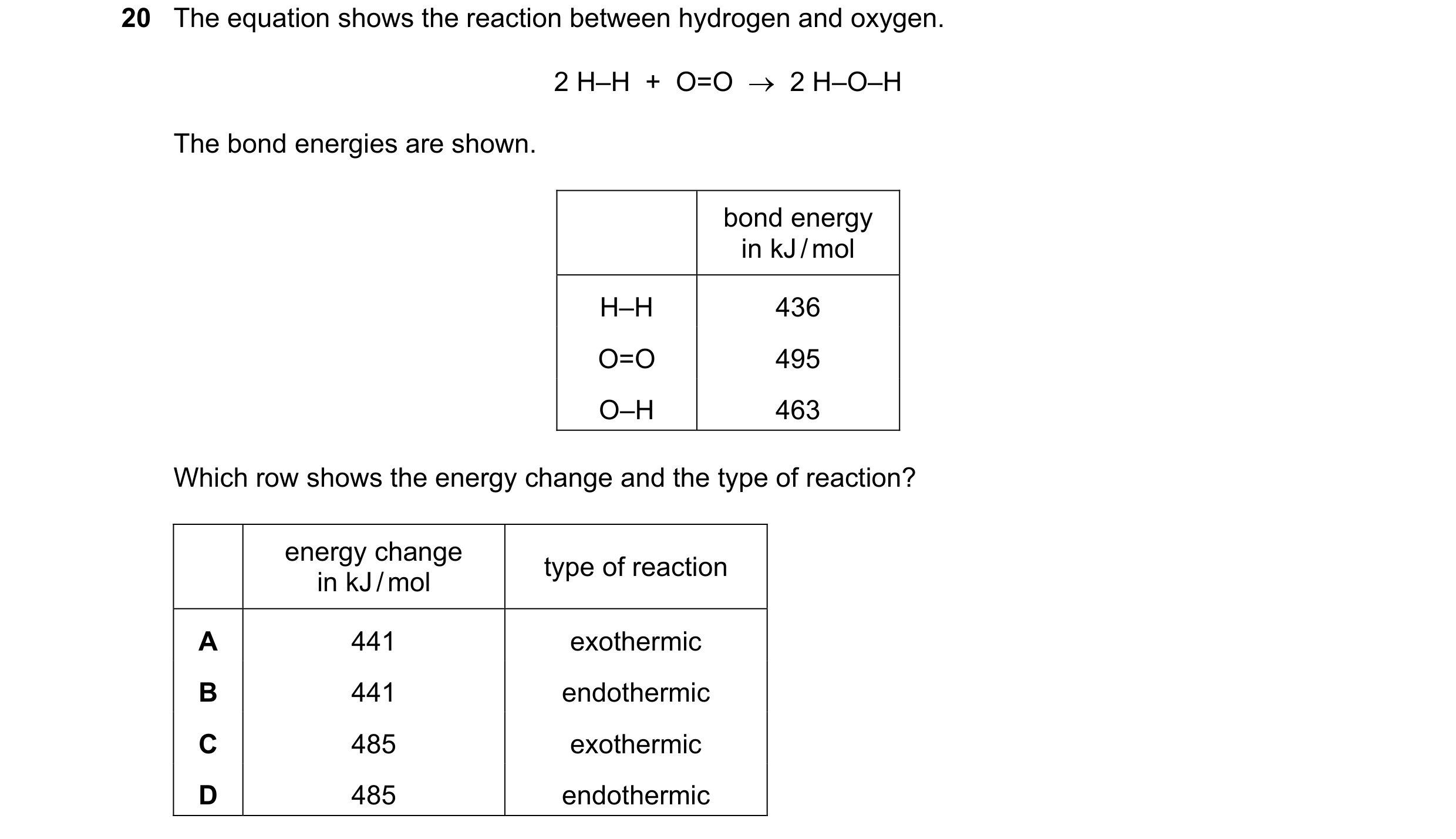
Q17 · The equation shows the reaction between hydrogen and oxygen 0971/22 May/June 2021
20 The equation shows the reaction between hydrogen and oxygen. 2 H–H + O=O 2 H–O–H The bond energies are shown. bond energy in kJ / mol H–H 436 O=O 495 O–H 463 Which row shows the energy change and the type of reaction? energy change type of reaction in kJ / mol A 441 exothermic B 441 endothermic C 485 exothermic D 485 endothermic
1 marks
Answer: C
This question in 0971/22 May/June 2021
Q18 · Chlorine reacts with ethane to produce chloroethane and hydrogen chloride 0971/22 Oct/Nov 2021
11 Chlorine reacts with ethane to produce chloroethane and hydrogen chloride. H H H H H C C H + Cl Cl H C C Cl + H Cl H H H H The reaction is exothermic. The bond energies are shown in the table. bond energy bond in kJ / mol C–Cl +340 C–C +350 C–H +410 Cl –Cl +240 H–Cl +430 What is the energy change for the reaction? A –1420 kJ / mol B –120 kJ / mol C +120 kJ / mol D +1420 kJ / mol
1 marks
Answer: B
This question in 0971/22 Oct/Nov 2021
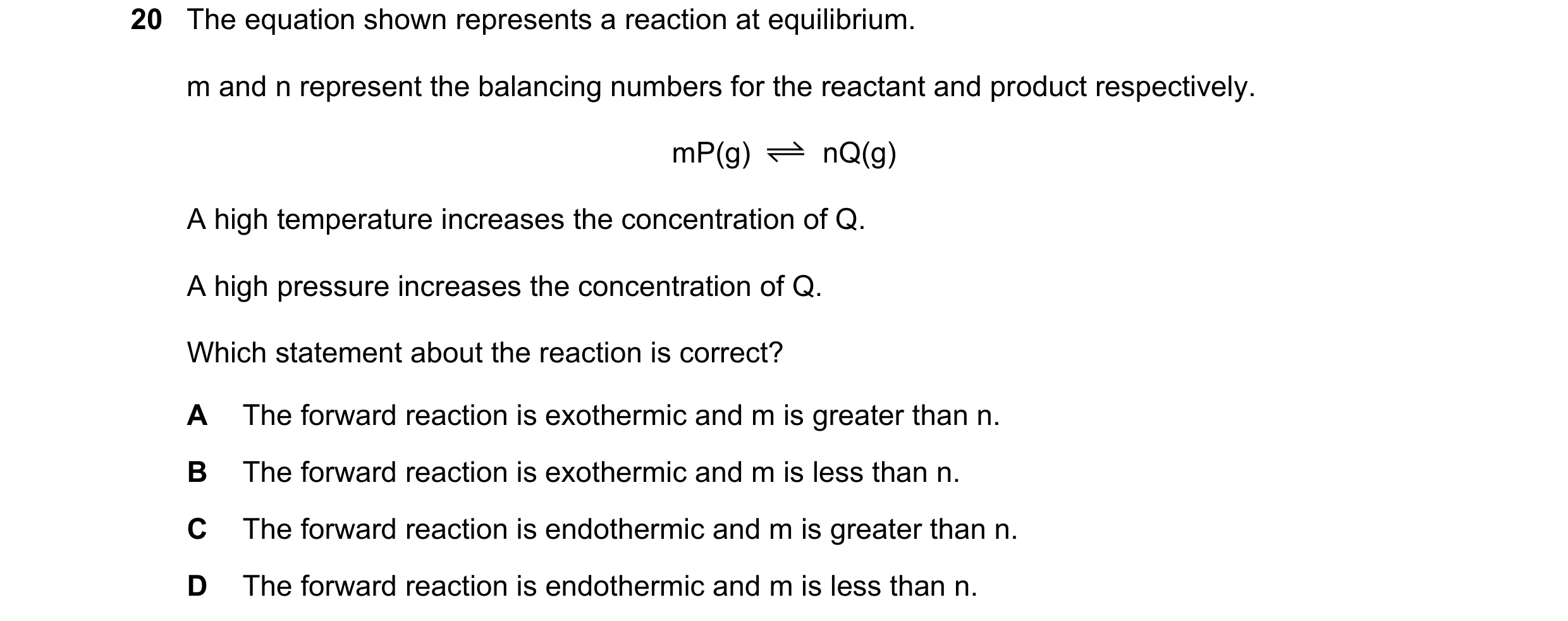
Q19 · The equation shown represents a reaction at equilibrium 0971/22 Oct/Nov 2021
20 The equation shown represents a reaction at equilibrium. m and n represent the balancing numbers for the reactant and product respectively. mP(g) nQ(g) A high temperature increases the concentration of Q. A high pressure increases the concentration of Q. Which statement about the reaction is correct? A The forward reaction is exothermic and m is greater than n. B The forward reaction is exothermic and m is less than n. C The forward reaction is endothermic and m is greater than n. D The forward reaction is endothermic and m is less than n.
1 marks
Answer: C
This question in 0971/22 Oct/Nov 2021
Q20 · The equation for the reaction between gaseous hydrogen and gaseous iodine to form gaseous… 0971/21 May/June 2022
13 The equation for the reaction between gaseous hydrogen and gaseous iodine to form gaseous hydrogen iodide is shown. H2(g) + I2(g) 2HI(g) The reaction is exothermic. Which statement explains why the reaction is exothermic? A Energy is released when H–H and I–I bonds are broken. B The bond energies of the reactants are larger than the bond energies of the products. C The products are at a higher energy level than the reactants. D More energy is released when two HI bonds are formed than is used when the H–H and I–I bonds are broken.
1 marks
Answer: D
This question in 0971/21 May/June 2022
Q21 · Water is added to anhydrous copper(II) sulfate 0971/21 May/June 2022
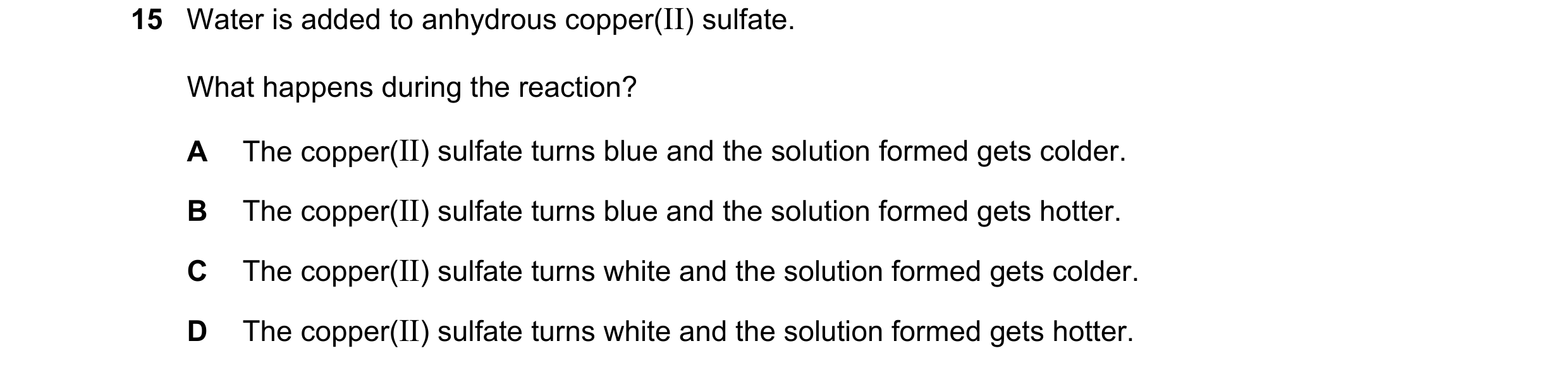
15 Water is added to anhydrous copper(II) sulfate. What happens during the reaction? A The copper(II) sulfate turns blue and the solution formed gets colder. B The copper(II) sulfate turns blue and the solution formed gets hotter. C The copper(II) sulfate turns white and the solution formed gets colder. D The copper(II) sulfate turns white and the solution formed gets hotter.
1 marks
Answer: B
This question in 0971/21 May/June 2022
Q22 · Water is added to anhydrous copper(II) sulfate 0971/22 May/June 2022
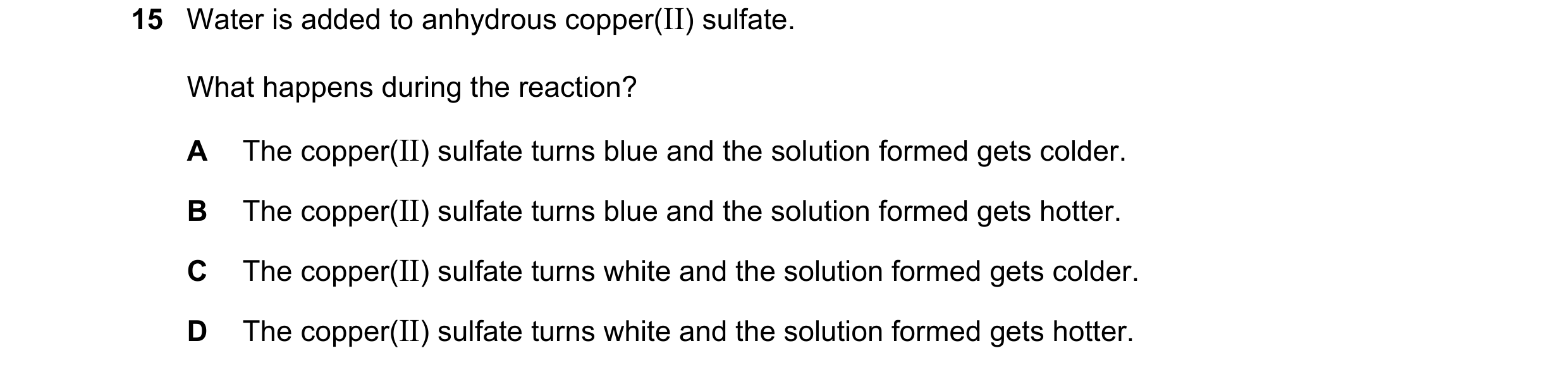
15 Water is added to anhydrous copper(II) sulfate. What happens during the reaction? A The copper(II) sulfate turns blue and the solution formed gets colder. B The copper(II) sulfate turns blue and the solution formed gets hotter. C The copper(II) sulfate turns white and the solution formed gets colder. D The copper(II) sulfate turns white and the solution formed gets hotter.
1 marks
Answer: B
This question in 0971/22 May/June 2022
Q23 · Which arrow on the energy level diagram shows the overall energy change for an… 0971/22 May/June 2022
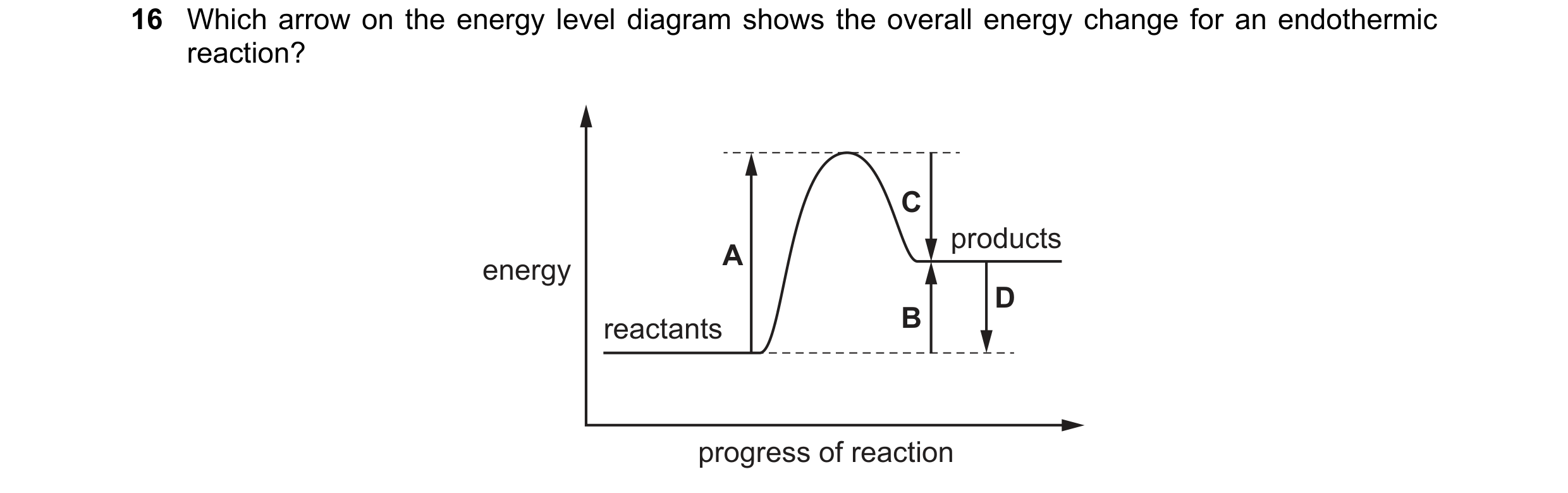
16 Which arrow on the energy level diagram shows the overall energy change for an endothermic reaction? C A products energy D B reactants progress of reaction
1 marks
Answer: B
This question in 0971/22 May/June 2022
Q24 · When an acid is added to an alkali, the temperature of the reaction mixture rises 0971/22 Oct/Nov 2022
11 When an acid is added to an alkali, the temperature of the reaction mixture rises. Which words describe this reaction? A decomposition and endothermic B decomposition and exothermic C neutralisation and endothermic D neutralisation and exothermic
1 marks
Answer: D
This question in 0971/22 Oct/Nov 2022
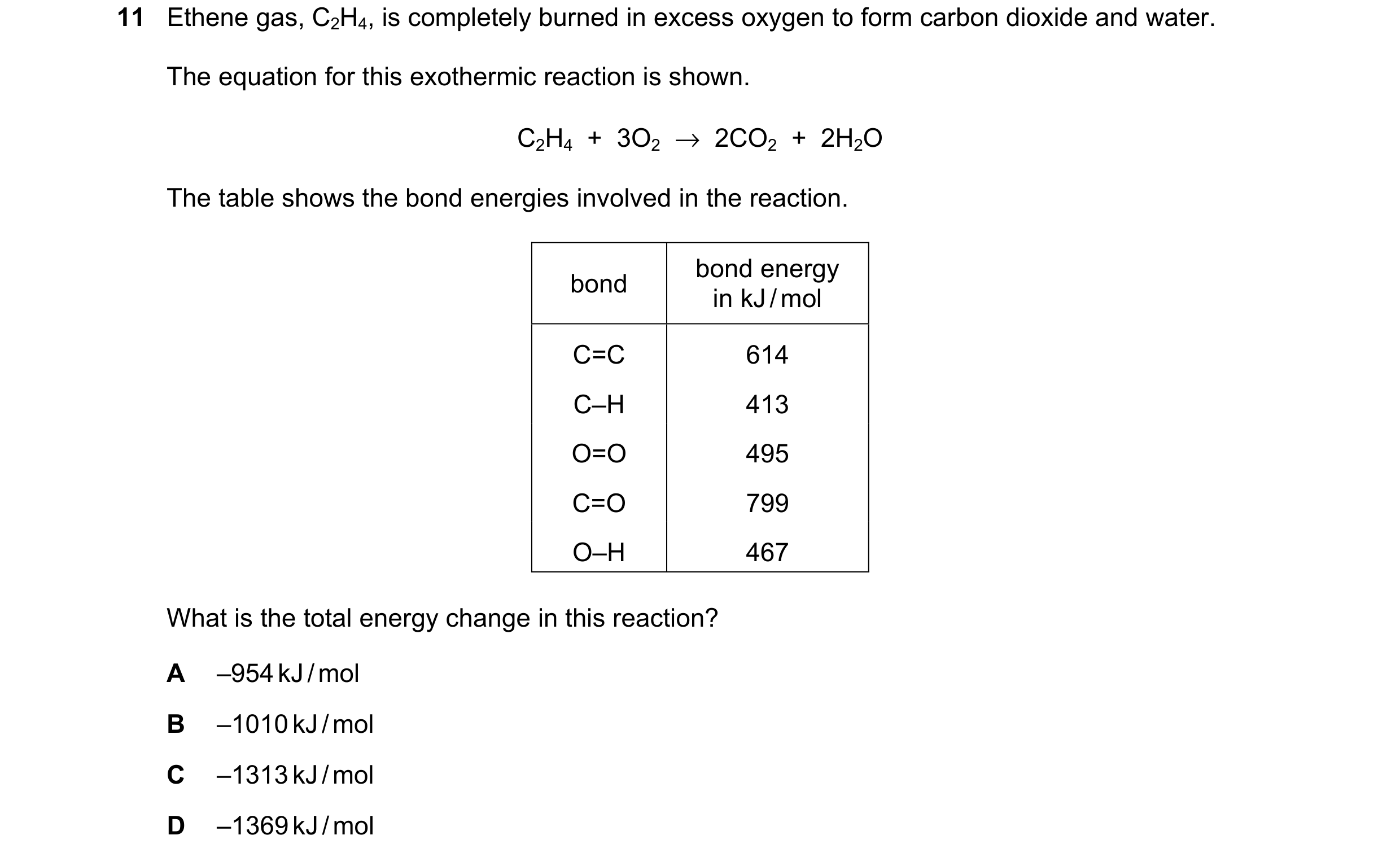
Q25 · Ethene gas, C2H4, is completely burned in excess oxygen to form carbon dioxide and water 0971/21 May/June 2023
11 Ethene gas, C2H4, is completely burned in excess oxygen to form carbon dioxide and water. The equation for this exothermic reaction is shown. C2H4 + 3O2 → 2CO2 + 2H2O The table shows the bond energies involved in the reaction. bond energy bond in kJ / mol C=C 614 C–H 413 O=O 495 C=O 799 O–H 467 What is the total energy change in this reaction? A –954 kJ / mol B –1010 kJ / mol C –1313 kJ / mol D –1369 kJ / mol
1 marks
Answer: C
This question in 0971/21 May/June 2023
Q26 · Methane burns in excess oxygen 0971/22 May/June 2023
11 Methane burns in excess oxygen. The equation is shown. CH4(g) + 2O2(g) → CO2(g) + 2H2O(g) Bond energies are shown. bond energy bond in kJ / mol C=O 805 C–H 410 O=O 496 O–H 460 What is the energy change for the reaction? A (4 × 410 + 2 × 496) – (2 × 805 + 4 × 460) B (2 × 805 + 4 × 460) – (4 × 410 + 2 × 496) C (410 + 2 × 496) – (805 + 2 × 460) D (410 + 496) – (805 + 460)
1 marks
Answer: A
This question in 0971/22 May/June 2023
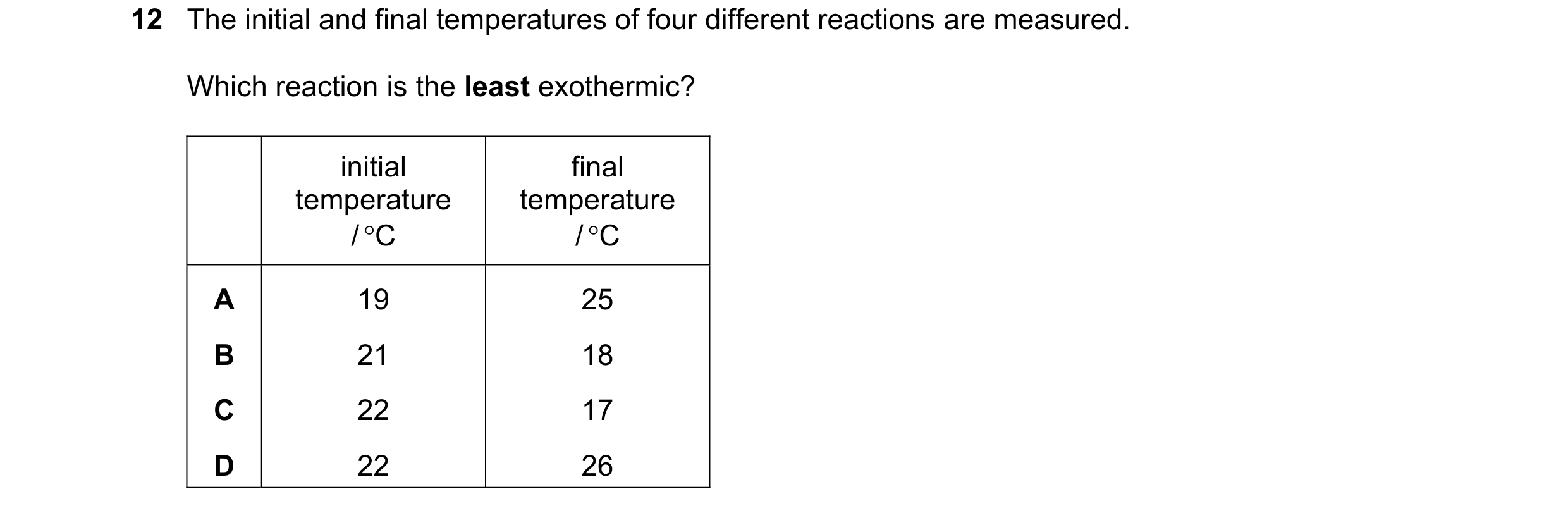
Q27 · The initial and final temperatures of four different reactions are measured 0971/22 Oct/Nov 2023
12 The initial and final temperatures of four different reactions are measured. Which reaction is the least exothermic? initial final temperature temperature / C / C A 19 25 B 21 18 C 22 17 D 22 26
1 marks
Answer: D
This question in 0971/22 Oct/Nov 2023
Q28 · Which equation represents an endothermic reaction? 0971/22 Oct/Nov 2023
13 Which equation represents an endothermic reaction? A Cl 2(g) 2Cl (g) B CH4(g) + 2O2(g) CO2(g) + 2H2O(l) C H(g) + H(g) H2(g) D 2K(s) + 2H2O(l) 2KOH(aq) + H2(g)
1 marks
Answer: A
This question in 0971/22 Oct/Nov 2023
Q29 · Methane burns in oxygen to form carbon dioxide and water 0971/22 Oct/Nov 2023
14 Methane burns in oxygen to form carbon dioxide and water. CH4(g) + 2O2(g) CO2(g) + 2H2O(l) The bond energies are shown. bond energy bond in kJ / mol C–H 410 C–O 360 C=O 805 O–H 460 O–O 146 O=O 496 What is the energy change for this reaction? A –818 kJ / mol B –102 kJ / mol C +102 kJ / mol D +818 kJ / mol
1 marks
Answer: A
This question in 0971/22 Oct/Nov 2023
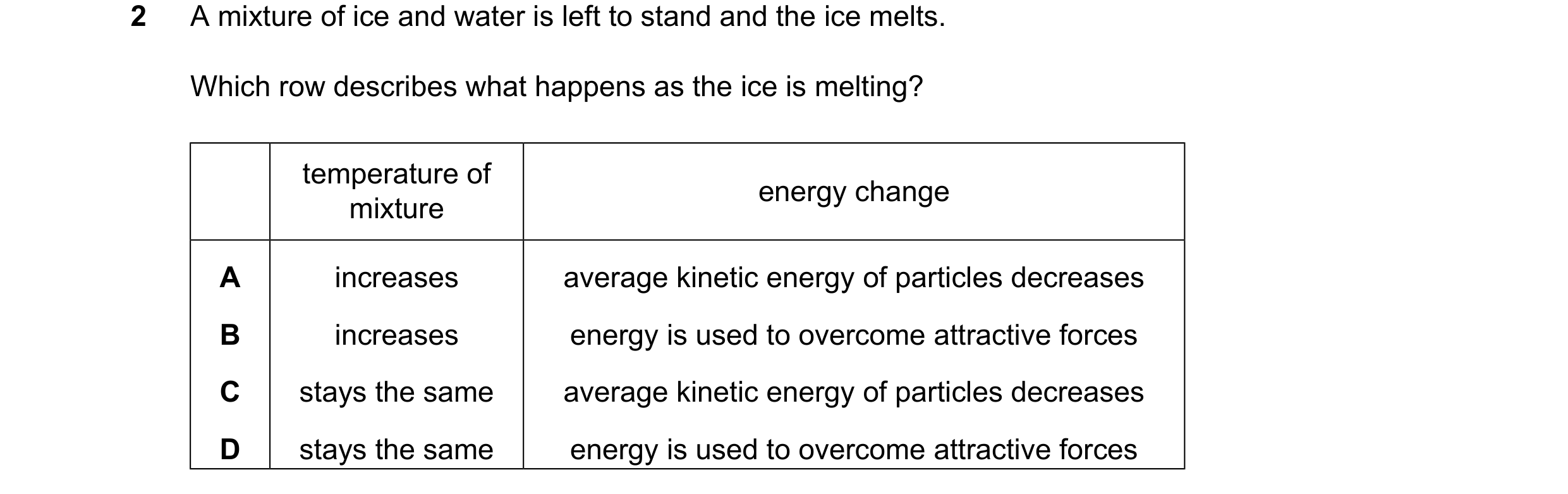
Q30 · A mixture of ice and water is left to stand and the ice melts 0971/21 May/June 2024
2 A mixture of ice and water is left to stand and the ice melts. Which row describes what happens as the ice is melting? temperature of energy change mixture A increases average kinetic energy of particles decreases B increases energy is used to overcome attractive forces C stays the same average kinetic energy of particles decreases D stays the same energy is used to overcome attractive forces
1 marks
Answer: D
This question in 0971/21 May/June 2024
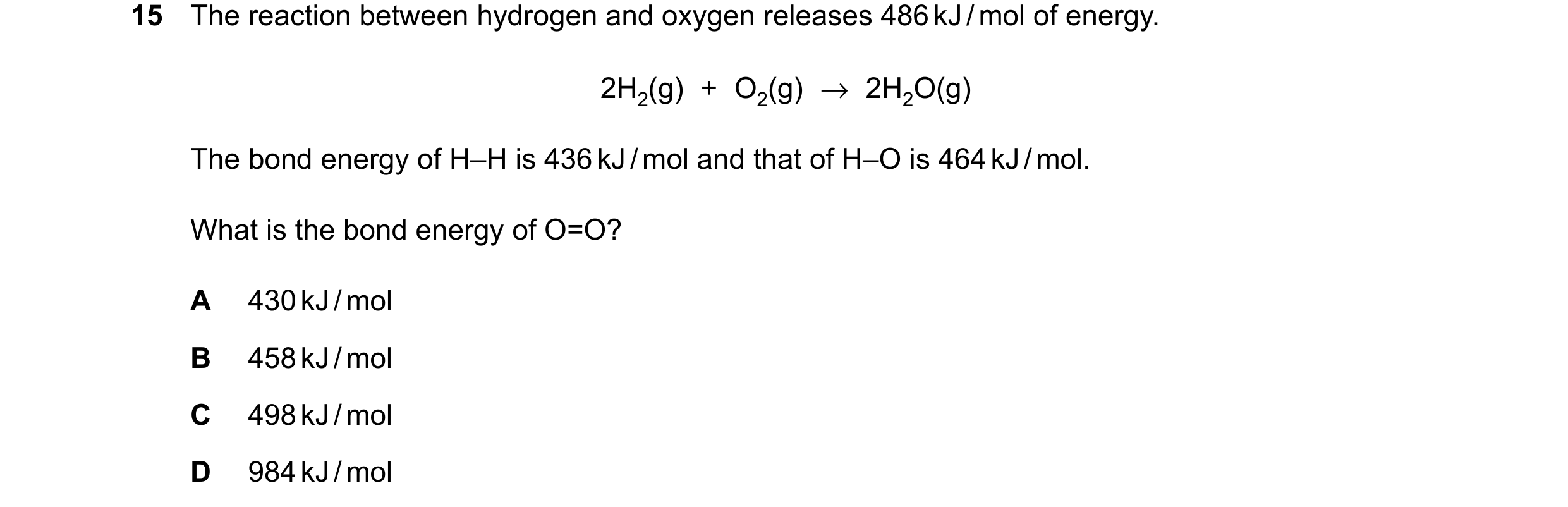
Q31 · The reaction between hydrogen and oxygen releases 486kJ/mol of energy 0971/21 May/June 2024
15 The reaction between hydrogen and oxygen releases 486kJ/mol of energy. 2H2(g) + O2(g) →2H2O(g) The bond energy of H–H is 436kJ/mol and that of H–O is 464kJ/mol. What is the bond energy of O=O? A 430kJ/mol B 458kJ/mol C 498kJ/mol D 984kJ/mol
1 marks
Answer: C
This question in 0971/21 May/June 2024
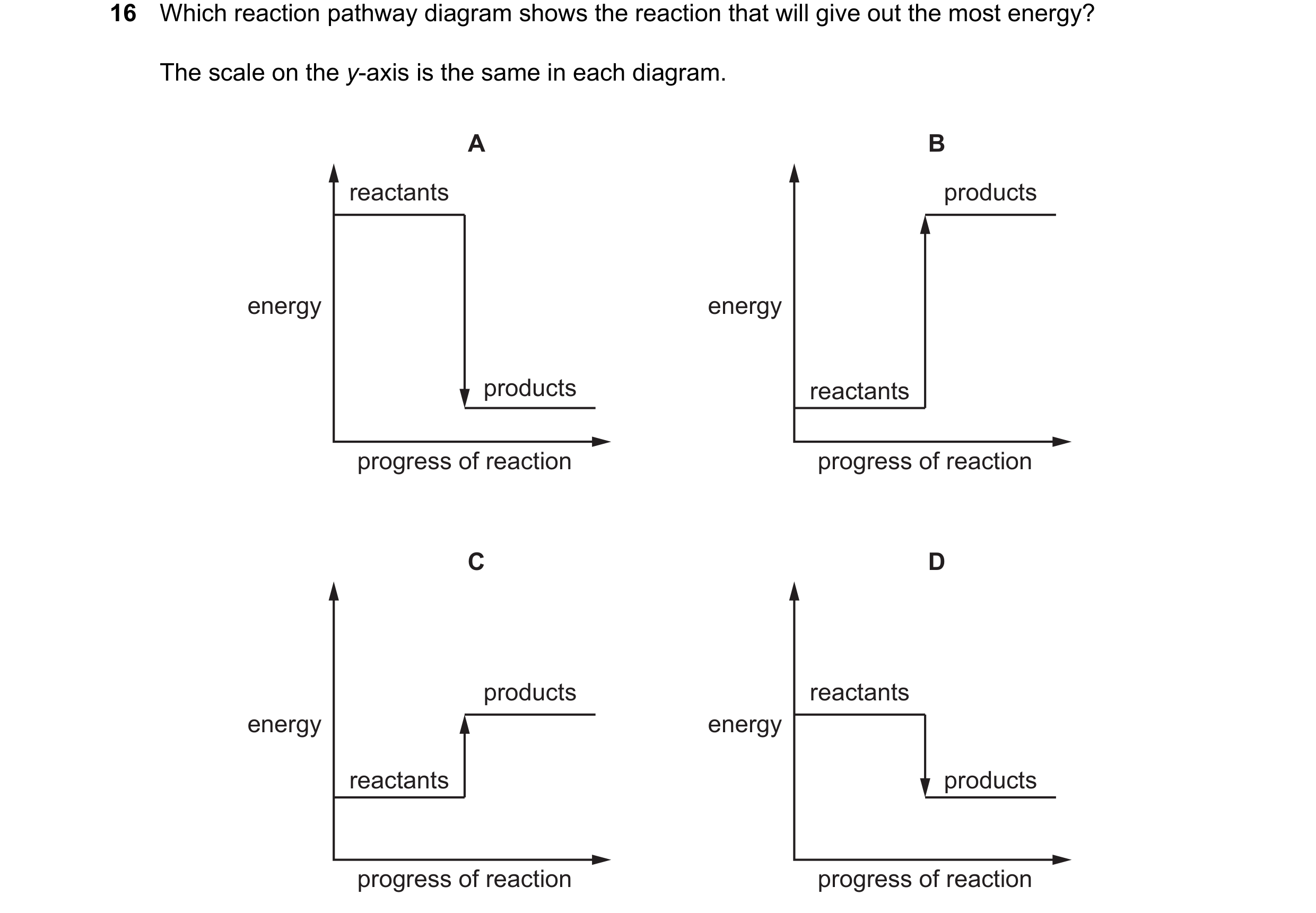
Q32 · Which reaction pathway diagram shows the reaction that will give out the most energy? 0971/21 May/June 2024
16 Which reaction pathway diagram shows the reaction that will give out the most energy? The scale on the y-axis is the same in each diagram. A B reactants products energy energy products reactants progress of reaction progress of reaction C D products reactants energy energy reactants products progress of reaction progress of reaction
1 marks
Answer: A
This question in 0971/21 May/June 2024
Q33 · Three statements about activation energy, Ea, are listed 0971/22 May/June 2024
12 Three statements about activation energy, Ea, are listed. 1 Colliding particles must have at least Ea before they can react. 2 Ea for exothermic reactions is always greater than for endothermic reactions. 3 Ea is always endothermic. Which statements are correct? A 1, 2 and 3 B 1 and 2 only C 1 and 3 only D 2 and 3 only A student adds excess magnesium ribbon to 10cm3 of 0.5mol/dm3 sulfuric acid.
1 marks
Answer: C
This question in 0971/22 May/June 2024
Q34 · The equation for the formation of ammonia is shown 0971/22 Oct/Nov 2024
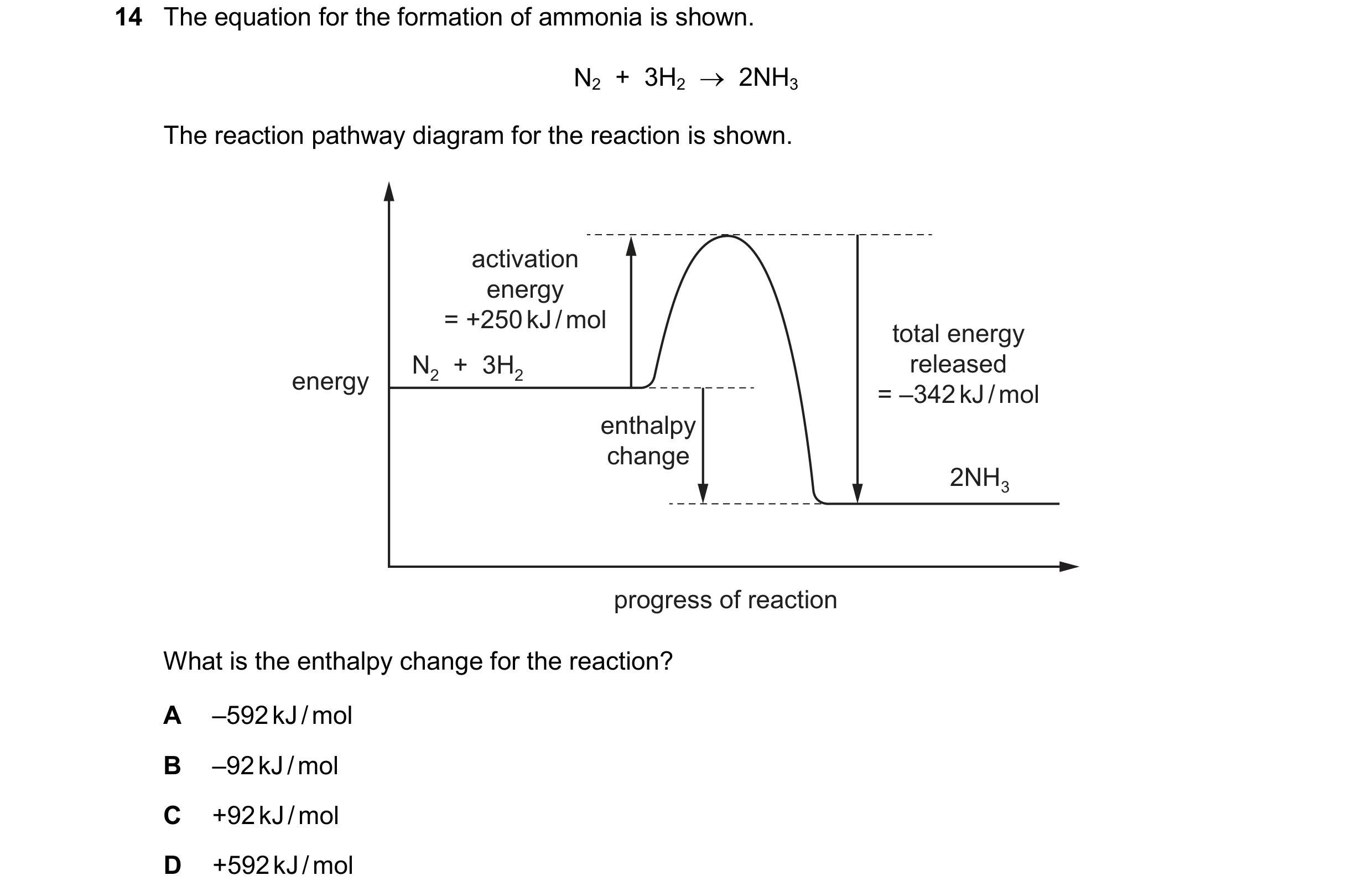
14 The equation for the formation of ammonia is shown. N2 + 3H2 2NH3 The reaction pathway diagram for the reaction is shown. activation energy = +250 kJ / mol total energy N2 + 3H2 released energy = –342 kJ / mol enthalpy change 2NH3 progress of reaction What is the enthalpy change for the reaction? A –592 kJ / mol B –92 kJ / mol C +92 kJ / mol D +592 kJ / mol
1 marks
Answer: B
This question in 0971/22 Oct/Nov 2024
Q35 · A reaction pathway diagram is shown 0971/22 May/June 2025
13 A reaction pathway diagram is shown. products energy reactants progress of reaction Which row identifies the type of reaction and how the temperature of the surroundings changes during the reaction? temperature of type of reaction the surroundings A endothermic decreases B endothermic increases C exothermic decreases D exothermic increases
1 marks
Answer: A
This question in 0971/22 May/June 2025
Q36 · The average bond energy for the C–H bond is 413 kJ / mol 0971/22 May/June 2025
14 The average bond energy for the C–H bond is 413 kJ / mol. What is the enthalpy change when 1.0 mol of methane molecules is formed from carbon and hydrogen atoms? A –1652 kJ B – 413 kJ C +413 kJ D +1652 kJ
1 marks
Answer: A
This question in 0971/22 May/June 2025
Q37 · The equation for the combustion of hydrazine, N2H,, is shown 0971/22 Oct/Nov 2025
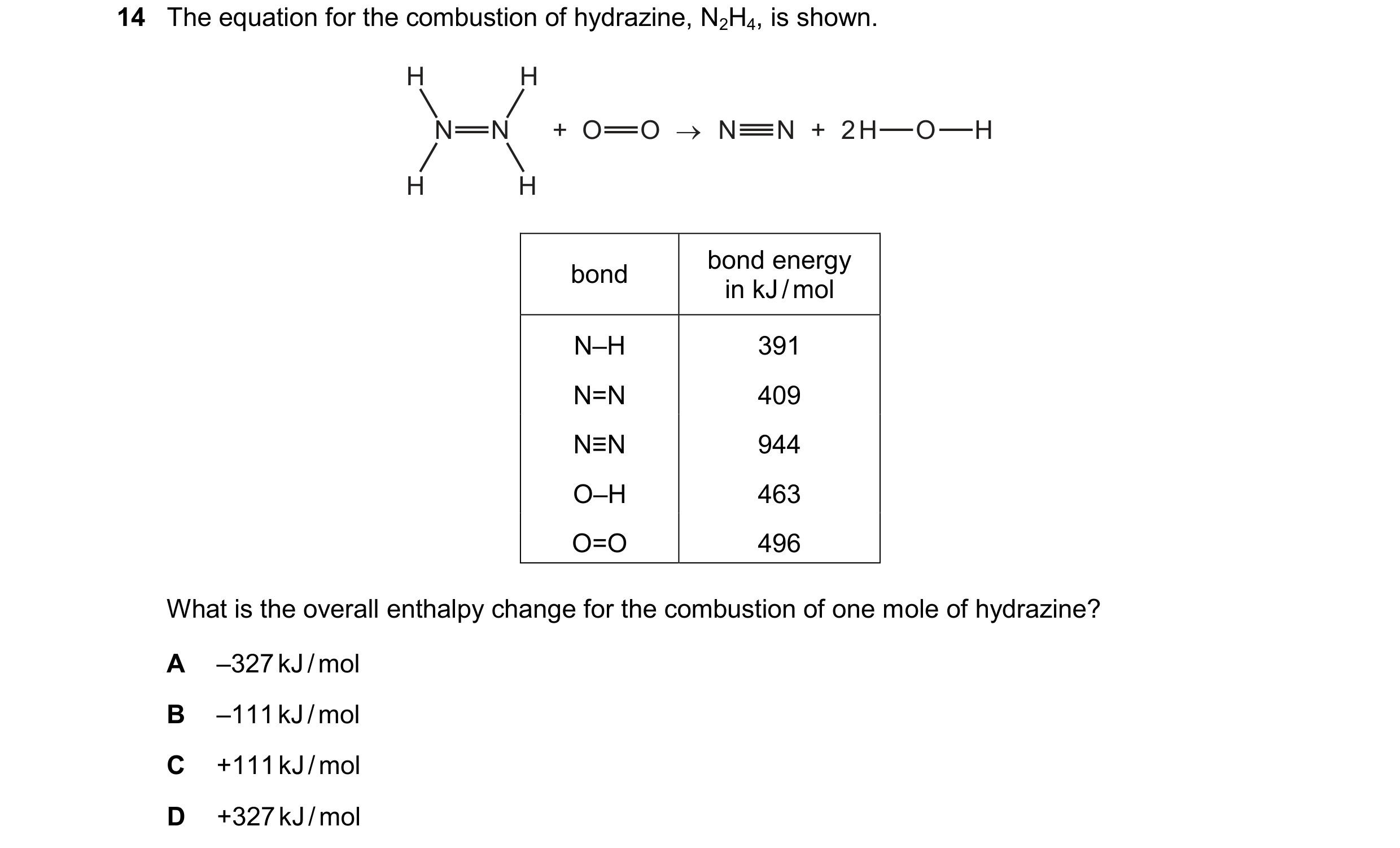
14 The equation for the combustion of hydrazine, N2H,, is shown.
H H
N=N + OO > N=N + 2H—O—H
{ \
bond | tn elmo!
N-H 391
N=N 409
N=N 944
O-H 463
O=O 496
What is the overall enthalpy change for the combustion of one mole of hydrazine?
A -327kJ/mol
B -111kJ/mol
C +111kJ/mol
D +327kJ/mol
1 marks
Answer: A
This question in 0971/22 Oct/Nov 2025
Q38 · Dissolving ammonium chloride in water is an endothermic change 0971/22 Oct/Nov 2025
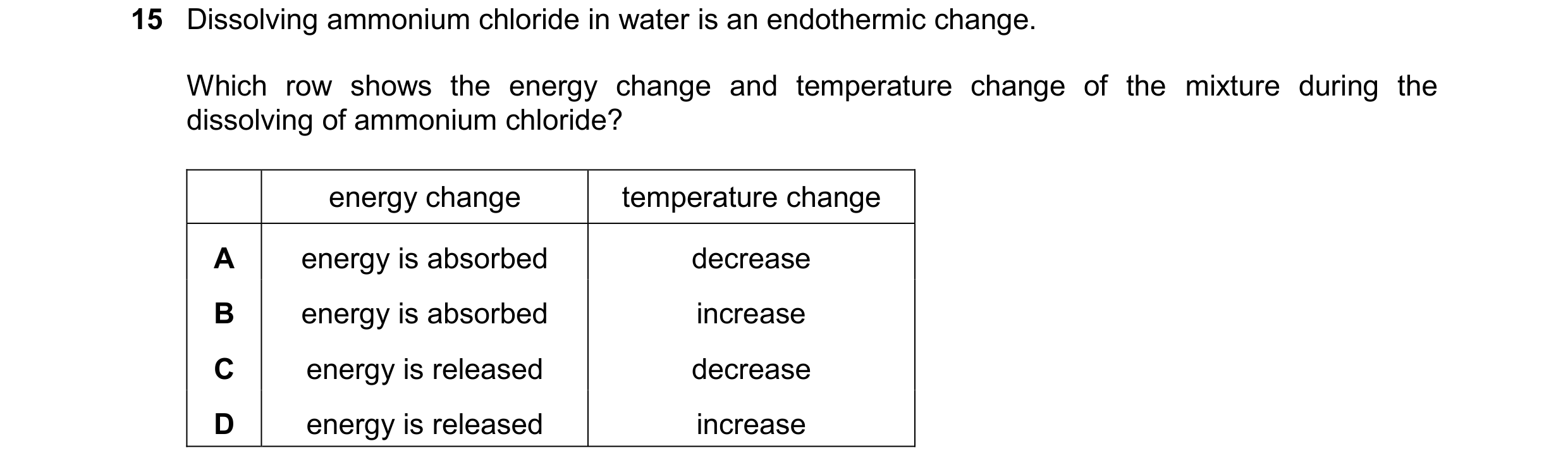
15 Dissolving ammonium chloride in water is an endothermic change. Which row shows the energy change and temperature change of the mixture during the dissolving of ammonium chloride? energy change temperature change A energy is absorbed decrease B energy is absorbed increase C energy is released decrease D energy is released increase
1 marks
Answer: A
This question in 0971/22 Oct/Nov 2025
 1 / 16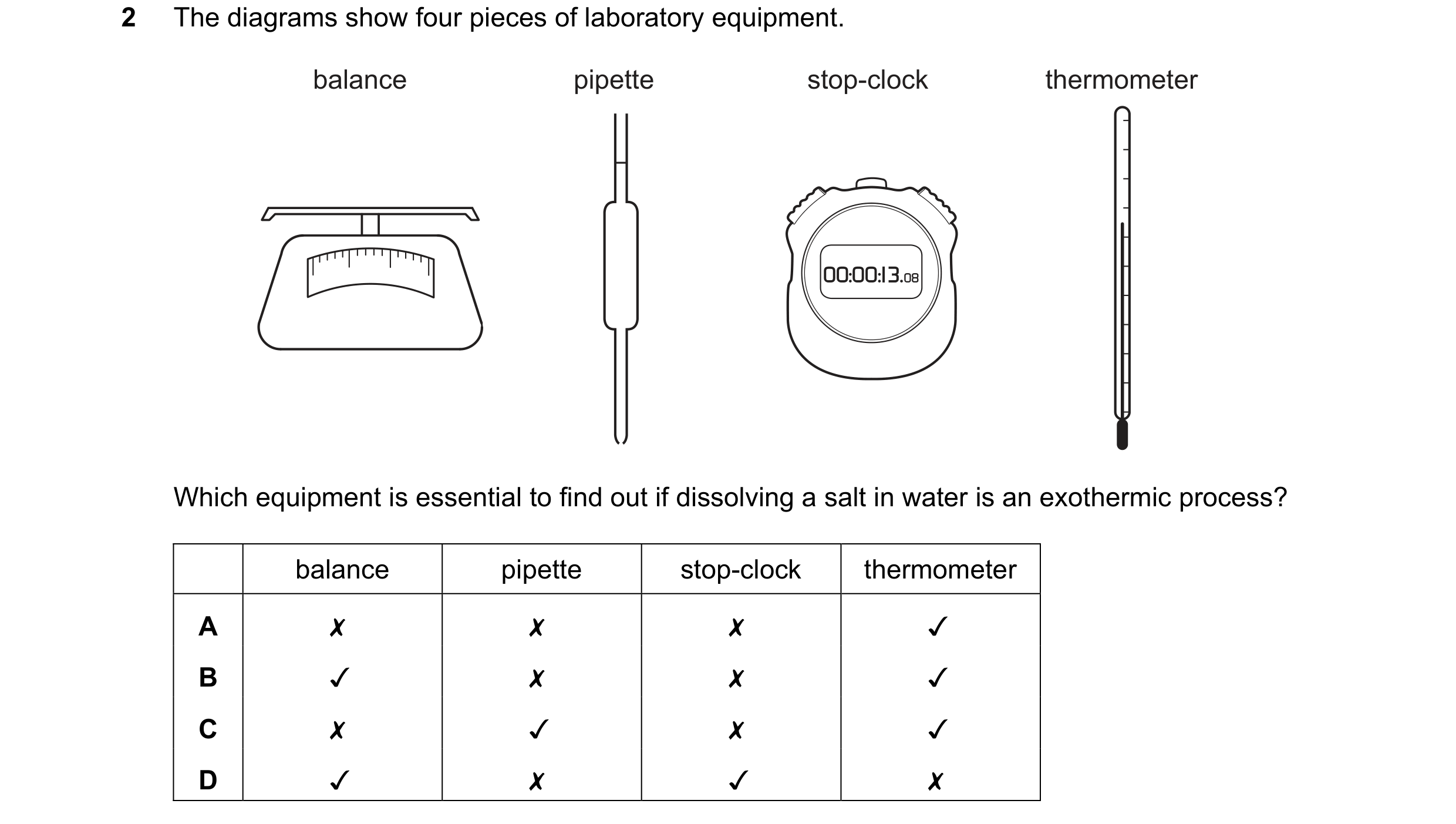
 2 / 16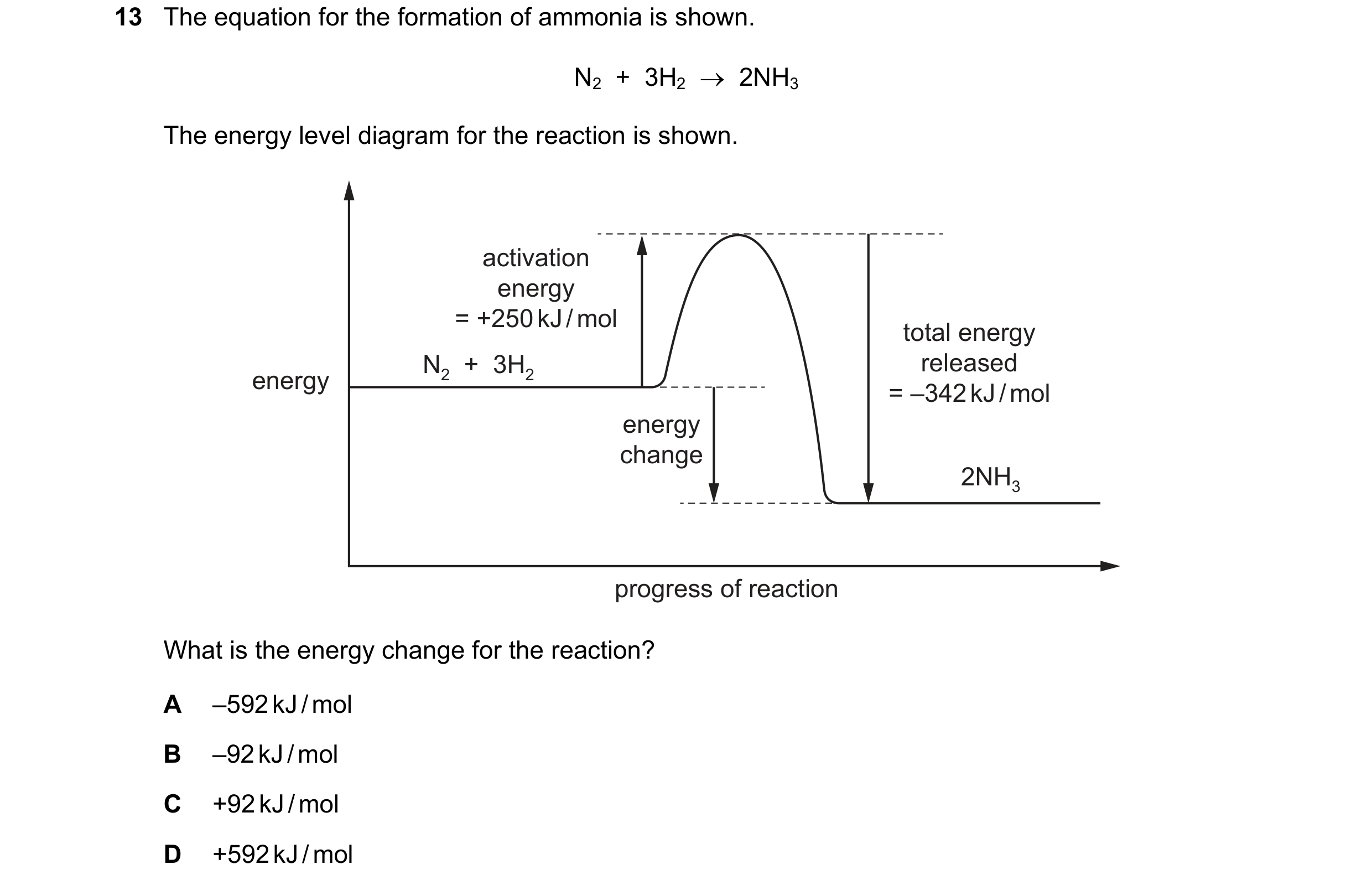
 3 / 16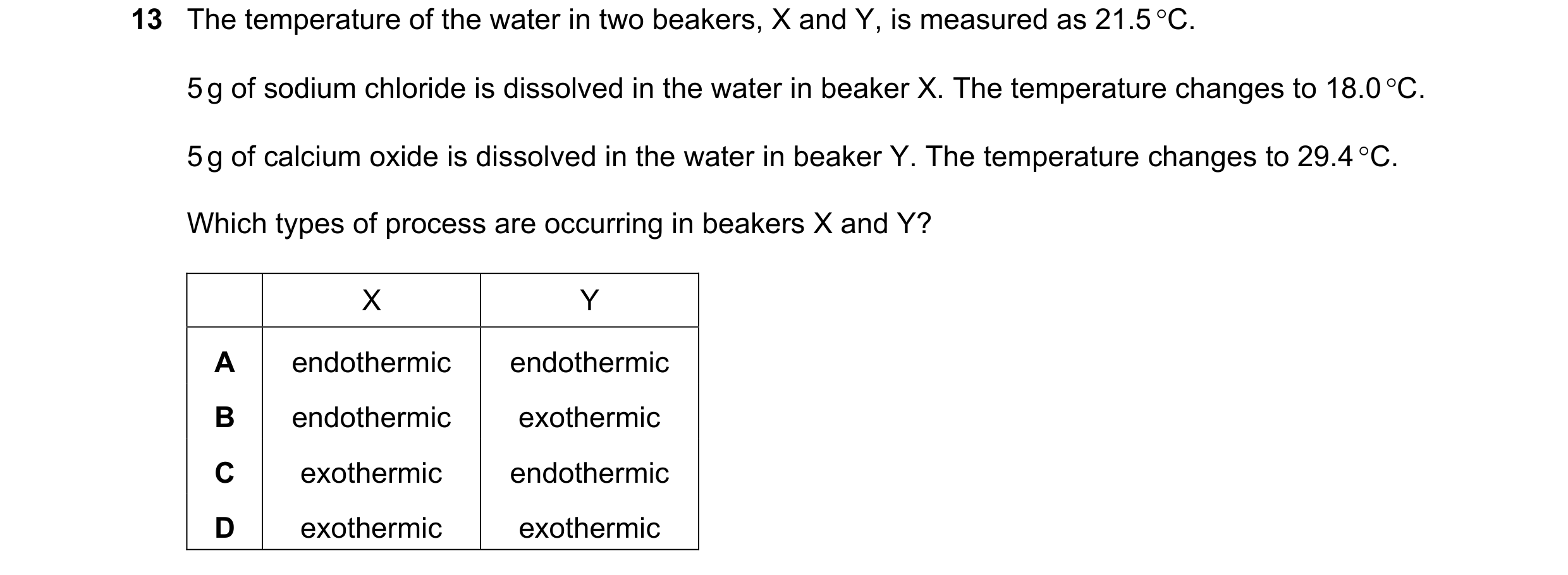
 4 / 16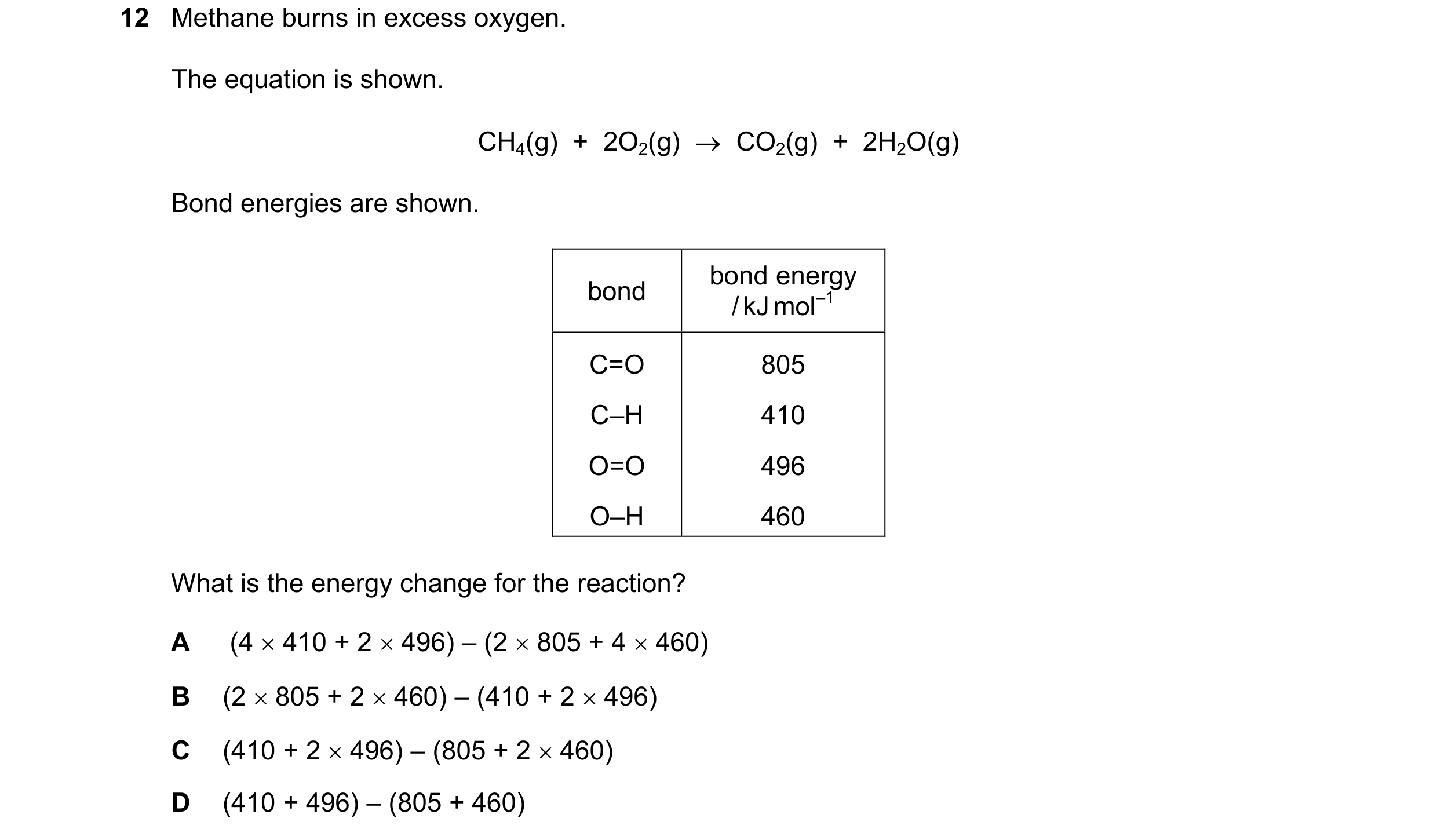
 5 / 16
 6 / 16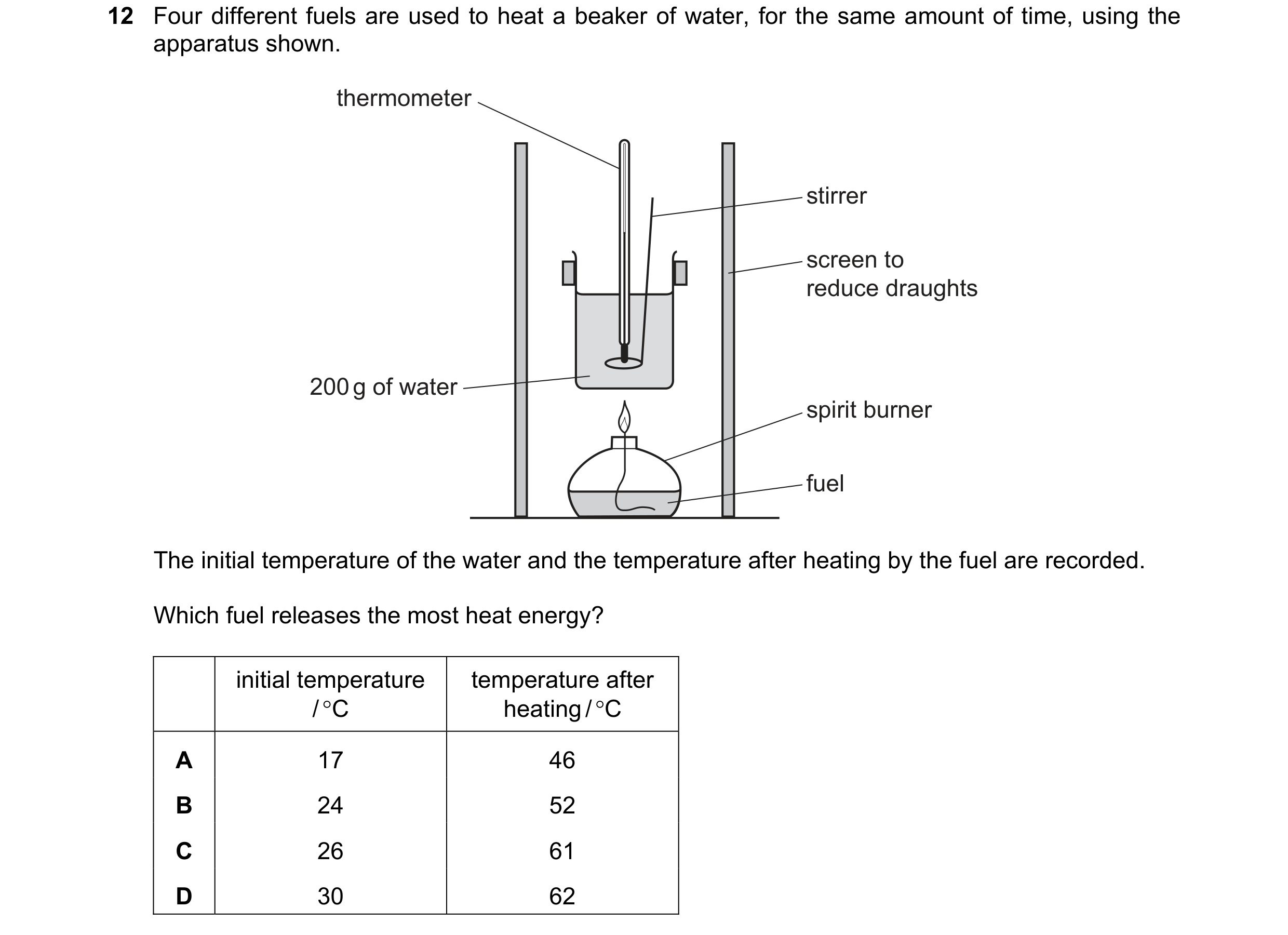
 7 / 16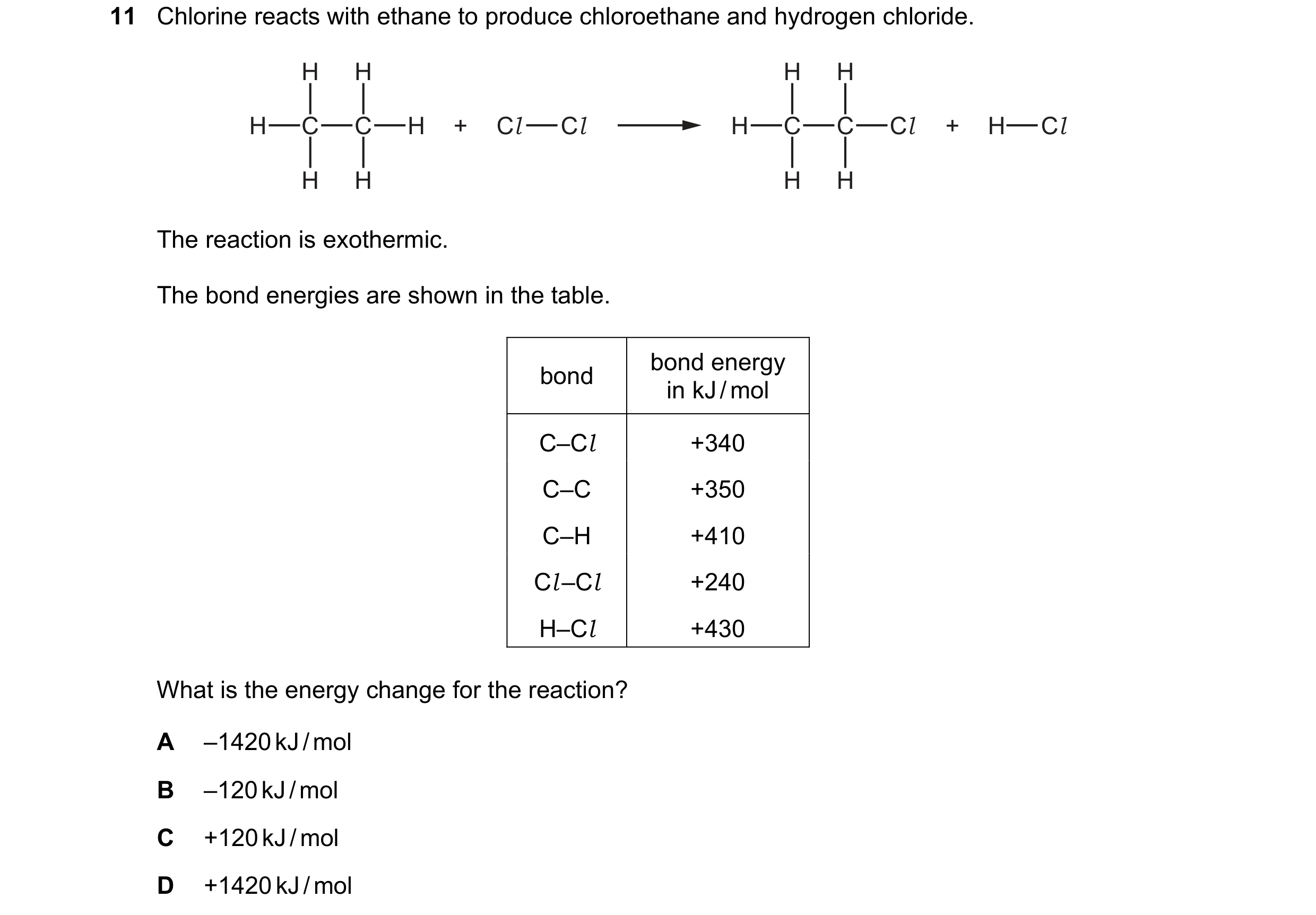
 8 / 16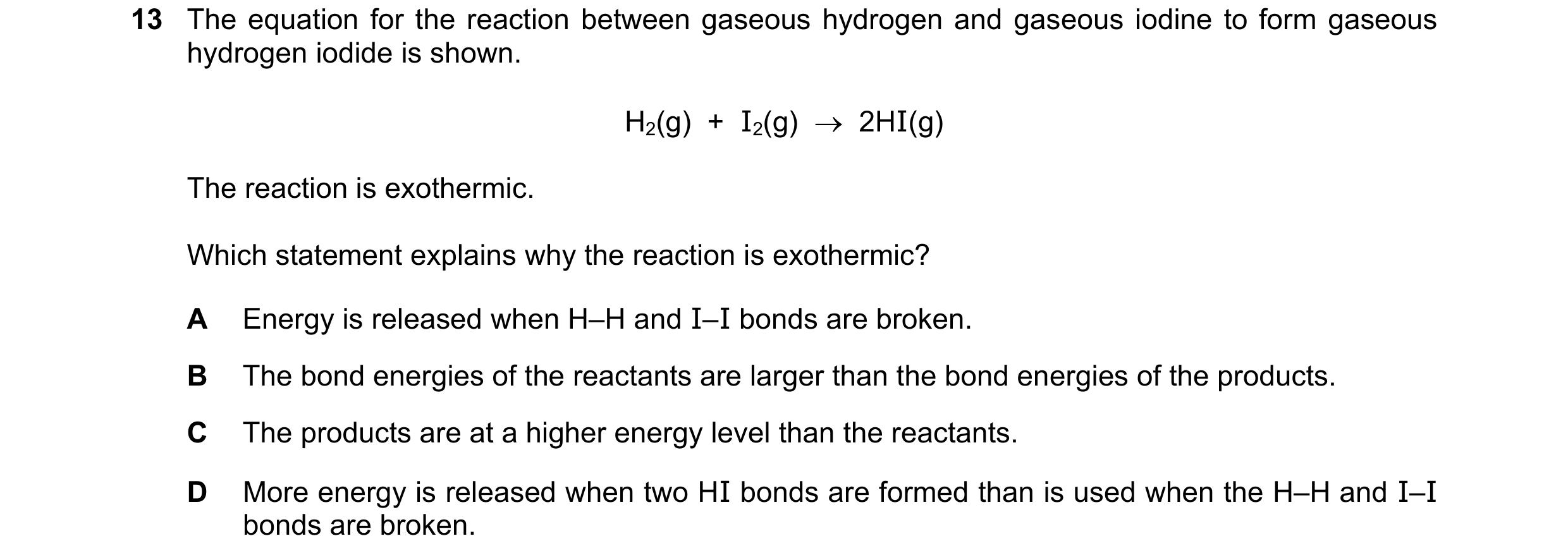
 9 / 16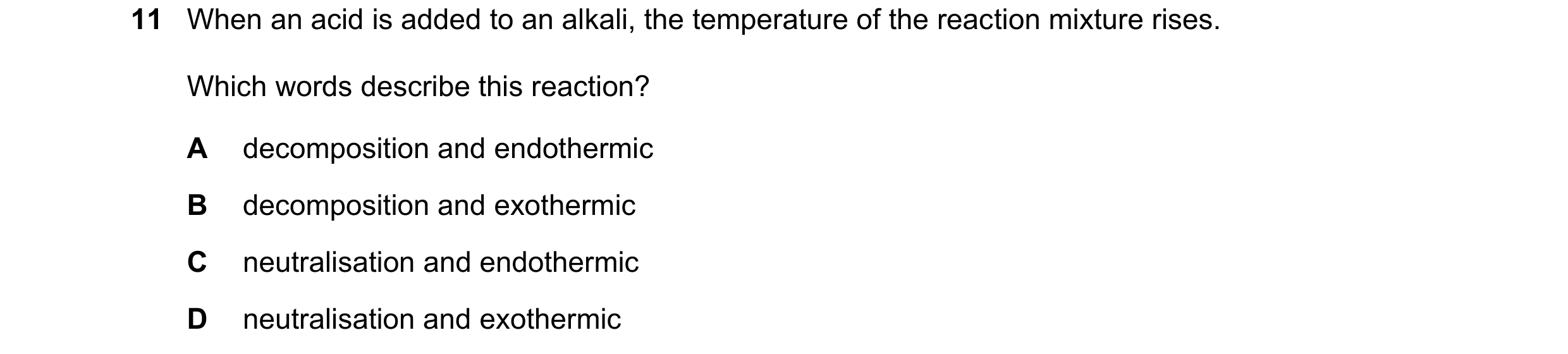
 10 / 16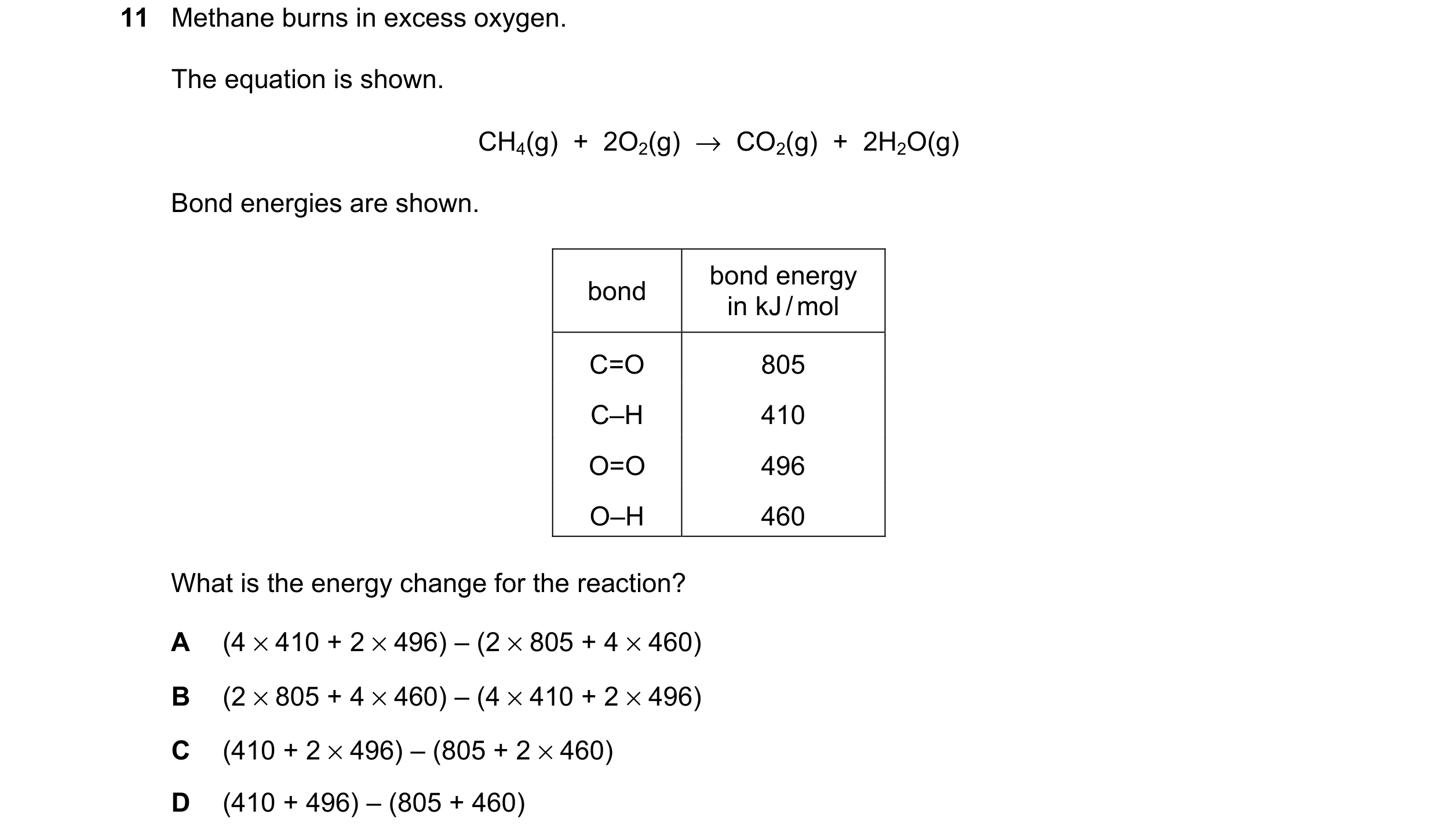
 11 / 16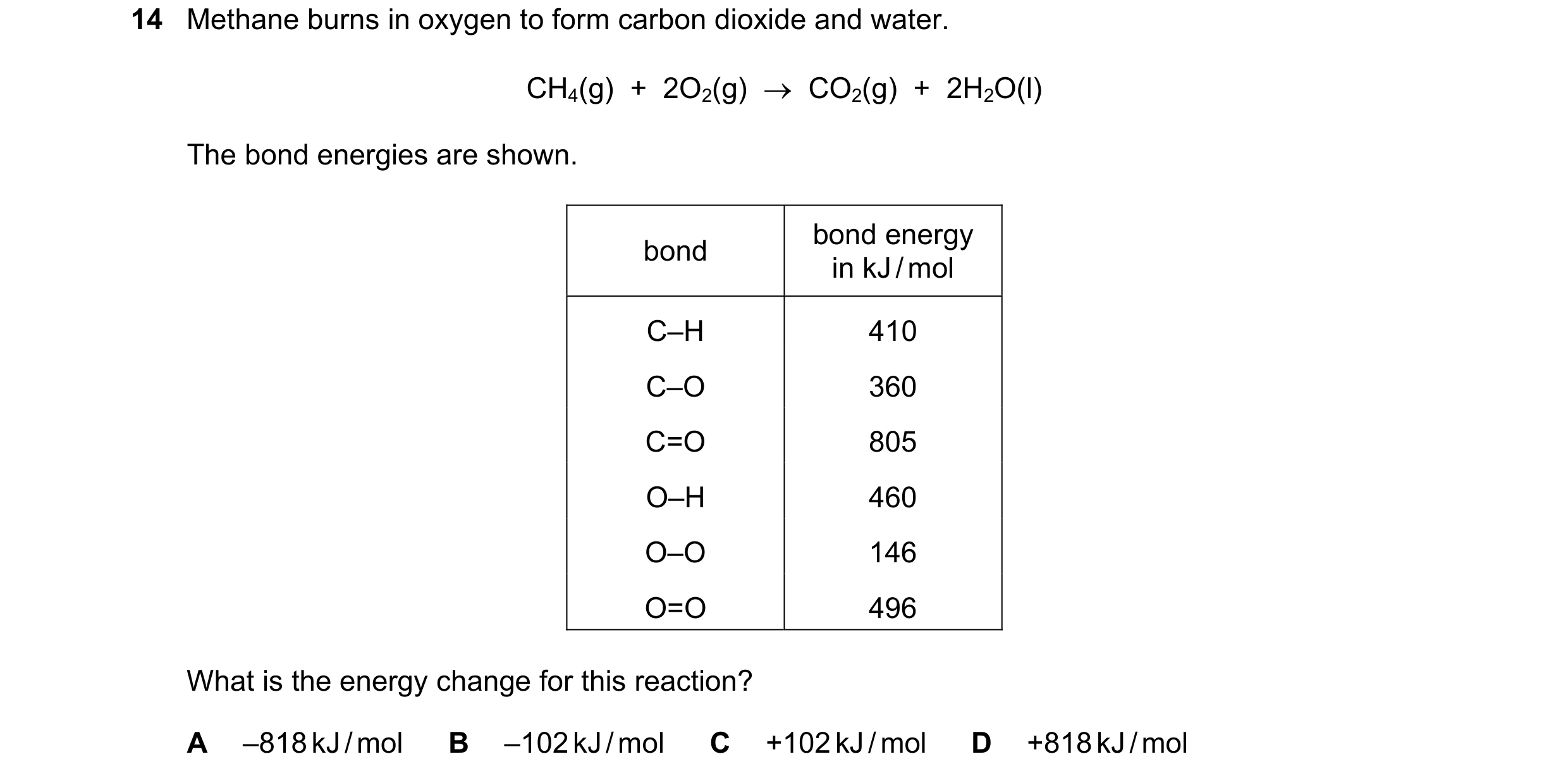
 12 / 16
 13 / 16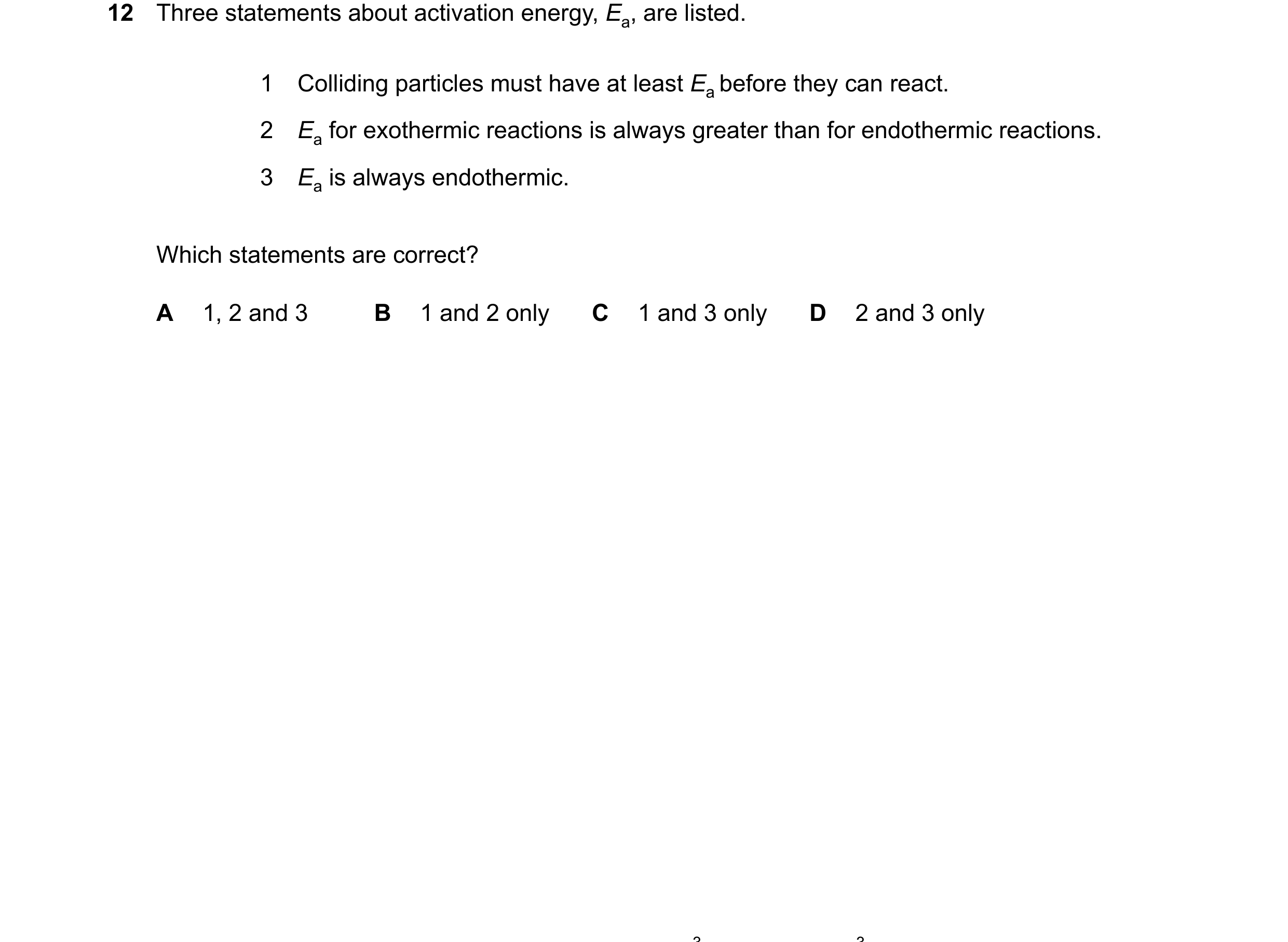
 14 / 16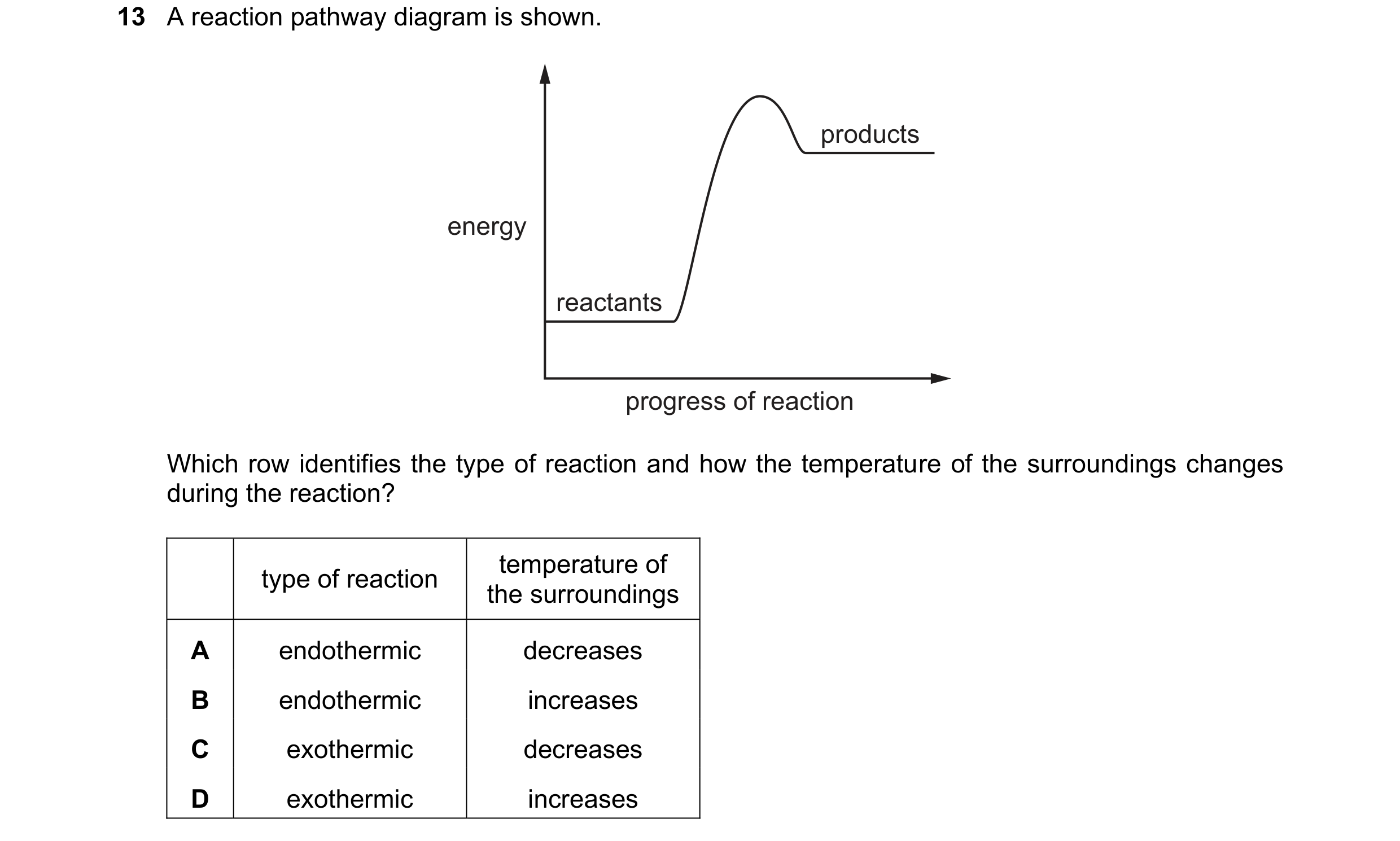

 15 / 16
 16 / 16