Questions as text
Q1 · Aqueous copper(II) sulfate is electrolysed using copper electrodes 0971/21 May/June 2018
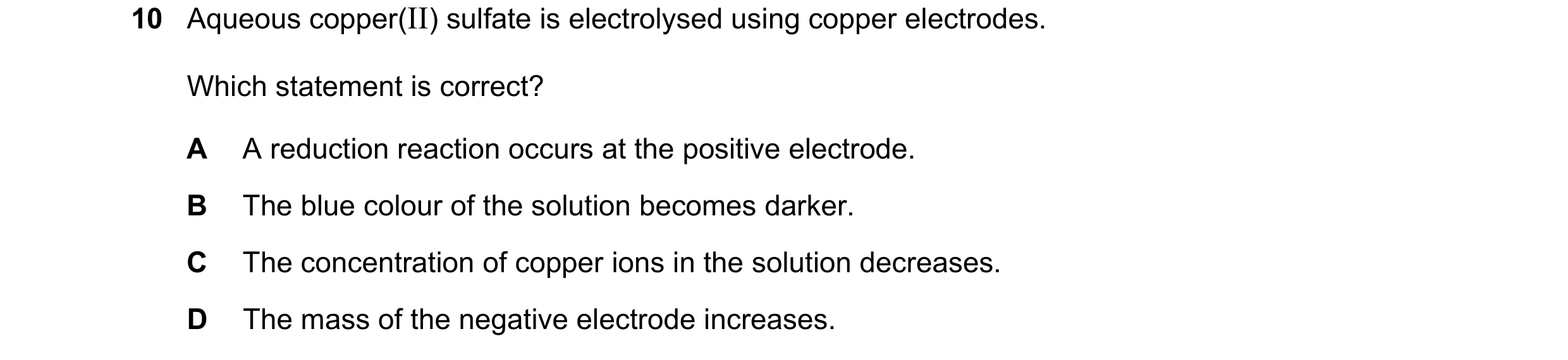
10 Aqueous copper(II) sulfate is electrolysed using copper electrodes. Which statement is correct? A A reduction reaction occurs at the positive electrode. B The blue colour of the solution becomes darker. C The concentration of copper ions in the solution decreases. D The mass of the negative electrode increases.
1 marks
Answer: D
This question in 0971/21 May/June 2018
Q2 · Dilute sulfuric acid is electrolysed using inert electrodes 0971/21 May/June 2018
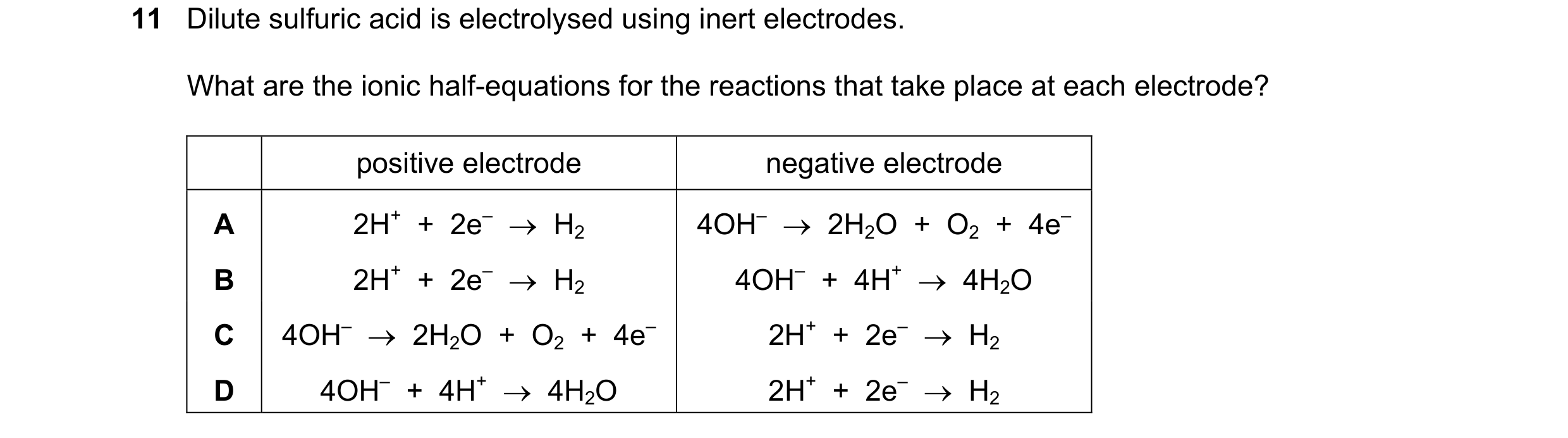
11 Dilute sulfuric acid is electrolysed using inert electrodes. What are the ionic half-equations for the reactions that take place at each electrode? positive electrode negative electrode A 2H+ + 2e– → H2 4OH– → 2H2O + O2 + 4e– B 2H+ + 2e– → H2 4OH– + 4H+ → 4H2O C 4OH– → 2H2O + O2 + 4e– 2H+ + 2e– → H2 D 4OH– + 4H+ → 4H2O 2H+ + 2e– → H2
1 marks
Answer: C
This question in 0971/21 May/June 2018
Q3 · Aluminium metal is extracted from aluminium oxide using electrolysis 0971/21 May/June 2018
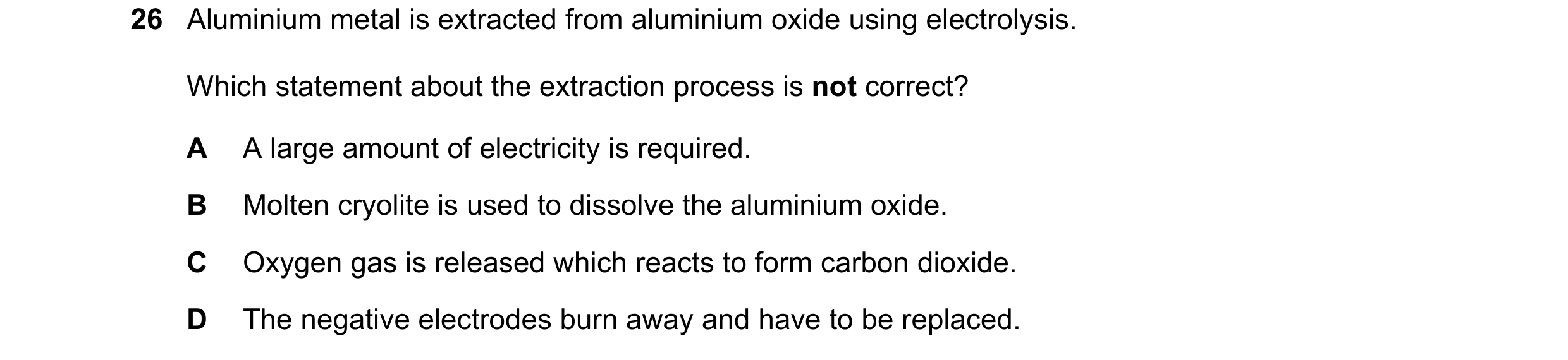
26 Aluminium metal is extracted from aluminium oxide using electrolysis. Which statement about the extraction process is not correct? A A large amount of electricity is required. B Molten cryolite is used to dissolve the aluminium oxide. C Oxygen gas is released which reacts to form carbon dioxide. D The negative electrodes burn away and have to be replaced.
1 marks
Answer: D
This question in 0971/21 May/June 2018
Q4 · Concentrated aqueous copper(II) chloride is electrolysed using copper electrodes as shown 0971/22 Oct/Nov 2018
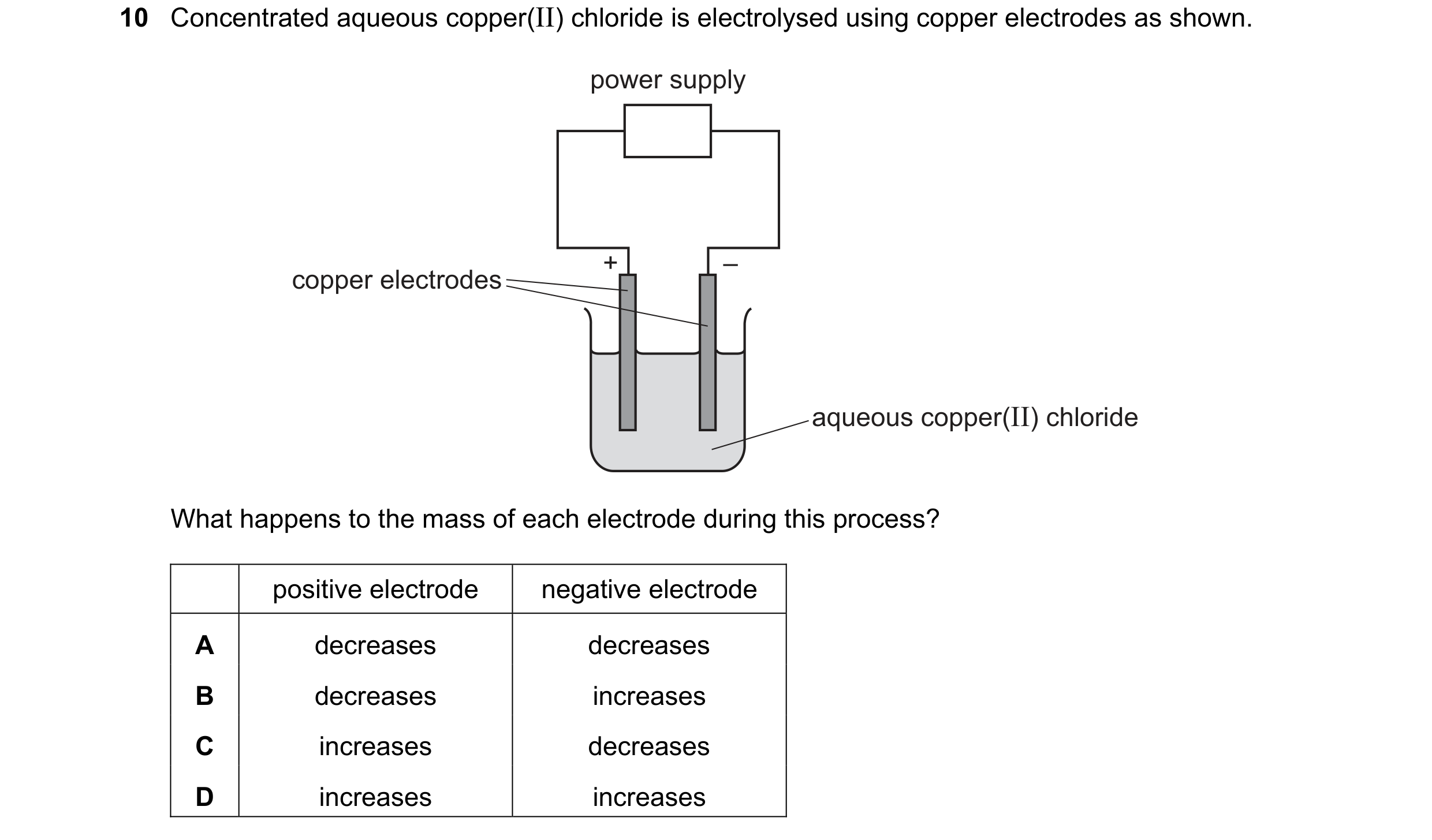
10 Concentrated aqueous copper(II) chloride is electrolysed using copper electrodes as shown. power supply + – copper electrodes aqueous copper(II) chloride What happens to the mass of each electrode during this process? positive electrode negative electrode A decreases decreases B decreases increases C increases decreases D increases increases
1 marks
Answer: B
This question in 0971/22 Oct/Nov 2018
Q5 · The diagram shows a circuit used to electrolyse aqueous copper(II) sulfate 0971/22 Oct/Nov 2018
11 The diagram shows a circuit used to electrolyse aqueous copper(II) sulfate. power supply + – 3 4 + – copper electrodes 1 aqueous 2 copper(II) sulfate Which arrows indicate the movement of the copper ions in the electrolyte and of the electrons in the external circuit? copper ions electrons A 1 3 B 1 4 C 2 3 D 2 4
1 marks
Answer: C
This question in 0971/22 Oct/Nov 2018
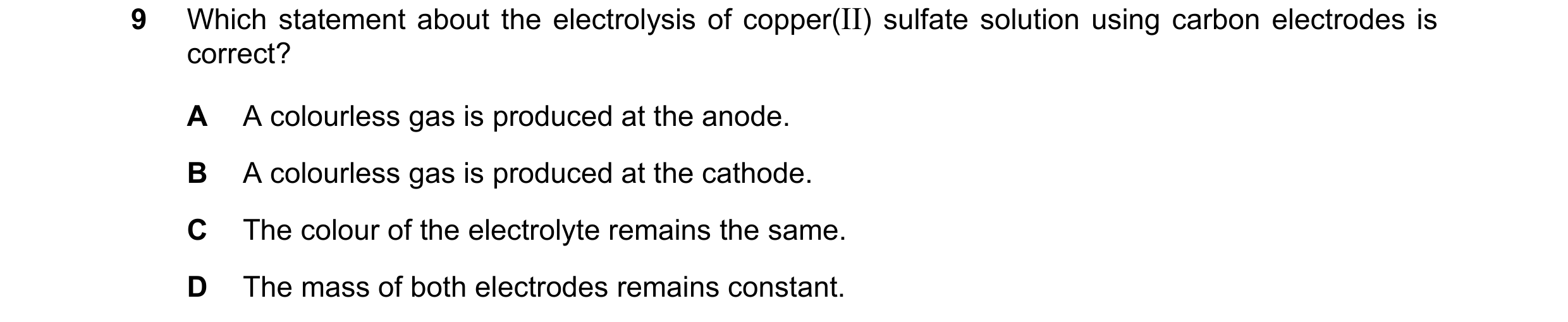
Q6 · Which statement about the electrolysis of copper(II) sulfate solution using carbon… 0971/21 May/June 2019
9 Which statement about the electrolysis of copper(II) sulfate solution using carbon electrodes is correct? A A colourless gas is produced at the anode. B A colourless gas is produced at the cathode. C The colour of the electrolyte remains the same. D The mass of both electrodes remains constant.
1 marks
Answer: A
This question in 0971/21 May/June 2019
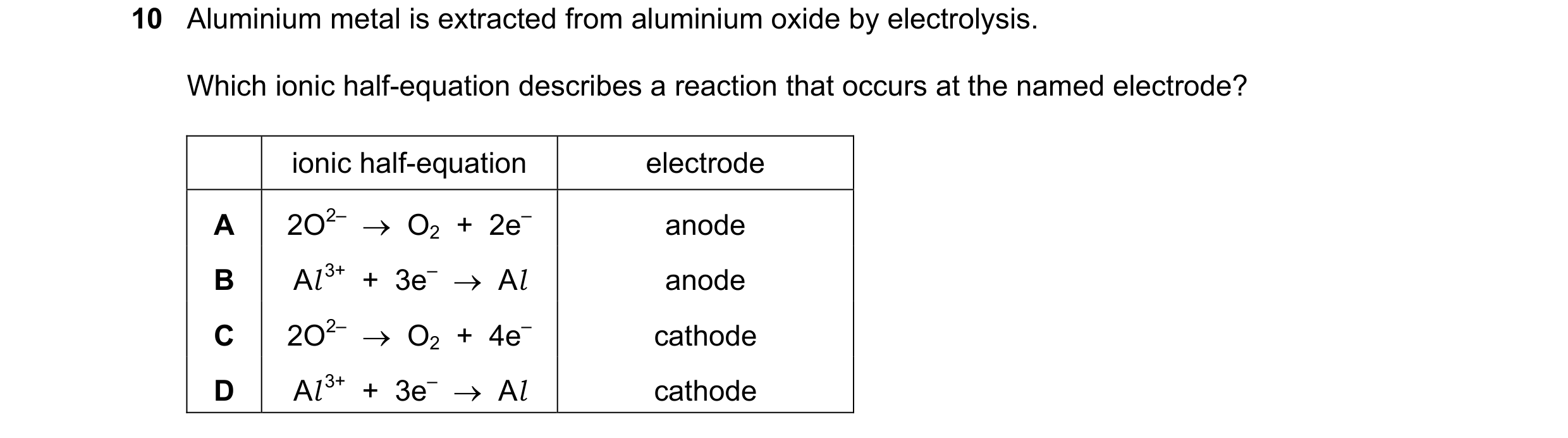
Q7 · Aluminium metal is extracted from aluminium oxide by electrolysis 0971/21 May/June 2019
10 Aluminium metal is extracted from aluminium oxide by electrolysis. Which ionic half-equation describes a reaction that occurs at the named electrode? ionic half-equation electrode A 2O2– → O2 + 2e– anode B Al 3+ + 3e– → Al anode C 2O2– → O2 + 4e– cathode D Al 3+ + 3e– → Al cathode
1 marks
Answer: D
This question in 0971/21 May/June 2019
Q8 · What are the ionic half-equations for the electrode reactions during the electrolysis of… 0971/22 Oct/Nov 2019
12 What are the ionic half-equations for the electrode reactions during the electrolysis of concentrated aqueous sodium chloride? anode cathode A Cl 2 + 2e– → 2Cl – H2 → 2H+ + 2e– B 2Cl – → Cl 2 + 2e– 2H+ + 2e– → H2 C H2 → 2H+ + 2e– Cl 2 + 2e– → 2Cl – D 2H+ + 2e– → H2 2Cl – → Cl 2 + 2e–
1 marks
Answer: B
This question in 0971/22 Oct/Nov 2019
Q9 · Dilute aqueous sodium chloride is electrolysed using platinum electrodes 0971/21 May/June 2020
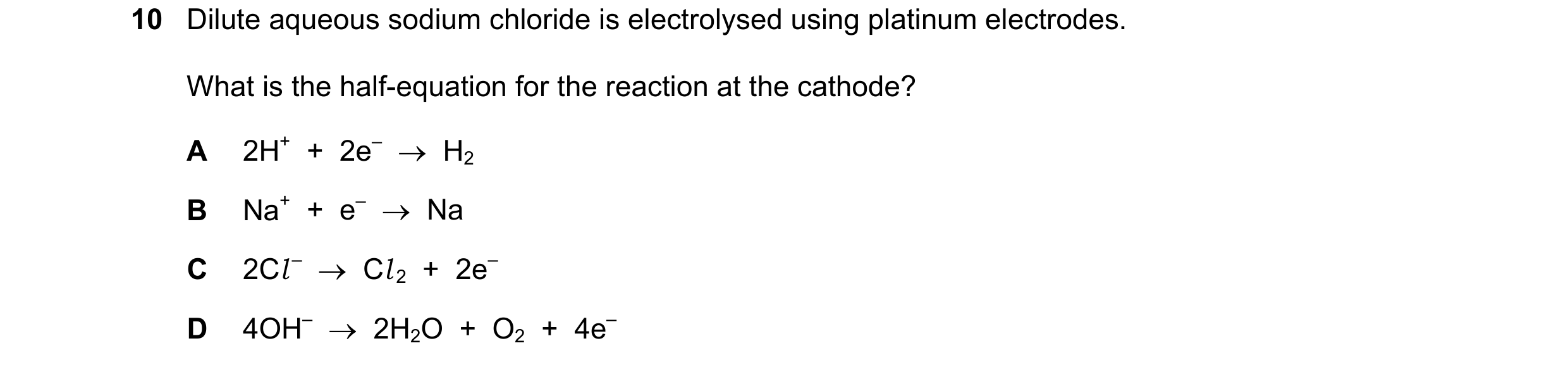
10 Dilute aqueous sodium chloride is electrolysed using platinum electrodes. What is the half-equation for the reaction at the cathode? A 2H+ + 2e– → H2 B Na+ + e– → Na C 2Cl – → Cl 2 + 2e– D 4OH– → 2H2O + O2 + 4e–
1 marks
Answer: A
This question in 0971/21 May/June 2020
Q10 · The electrolysis of aqueous copper(II) sulfate, using inert electrodes, is shown 0971/21 May/June 2020
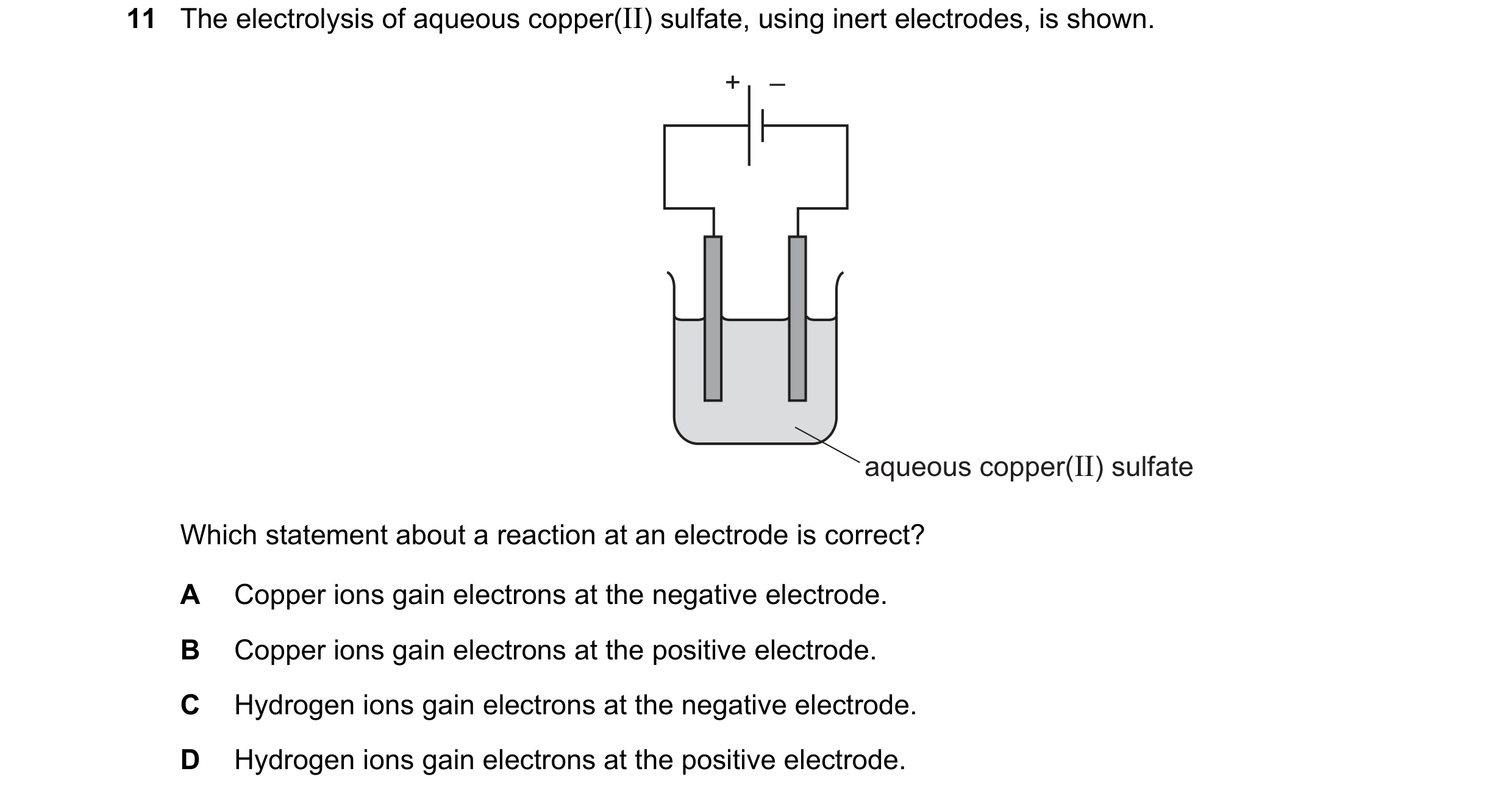
11 The electrolysis of aqueous copper(II) sulfate, using inert electrodes, is shown. + – aqueous copper(II) sulfate Which statement about a reaction at an electrode is correct? A Copper ions gain electrons at the negative electrode. B Copper ions gain electrons at the positive electrode. C Hydrogen ions gain electrons at the negative electrode. D Hydrogen ions gain electrons at the positive electrode.
1 marks
Answer: A
This question in 0971/21 May/June 2020
Q11 · Electrolytes can be broken down by electrolysis 0971/22 May/June 2020
10 Electrolytes can be broken down by electrolysis. Which rows are correct for each electrolyte? reaction product electrolyte at cathode at anode 1 dilute aqueous sodium chloride 2H+ + 2e– → H2 oxygen 2 concentrated hydrochloric acid 2H+ + 2e– → H2 chlorine 3 molten aluminium oxide 2O2– → O2 + 4e– aluminium 4 concentrated aqueous sodium bromide Na+ + e– → Na bromine A 1 and 2 B 1 and 4 C 2 and 3 D 3 and 4
1 marks
Answer: A
This question in 0971/22 May/June 2020
Q12 · The electrolysis of aqueous copper(II) sulfate, using inert electrodes, is shown 0971/22 May/June 2020
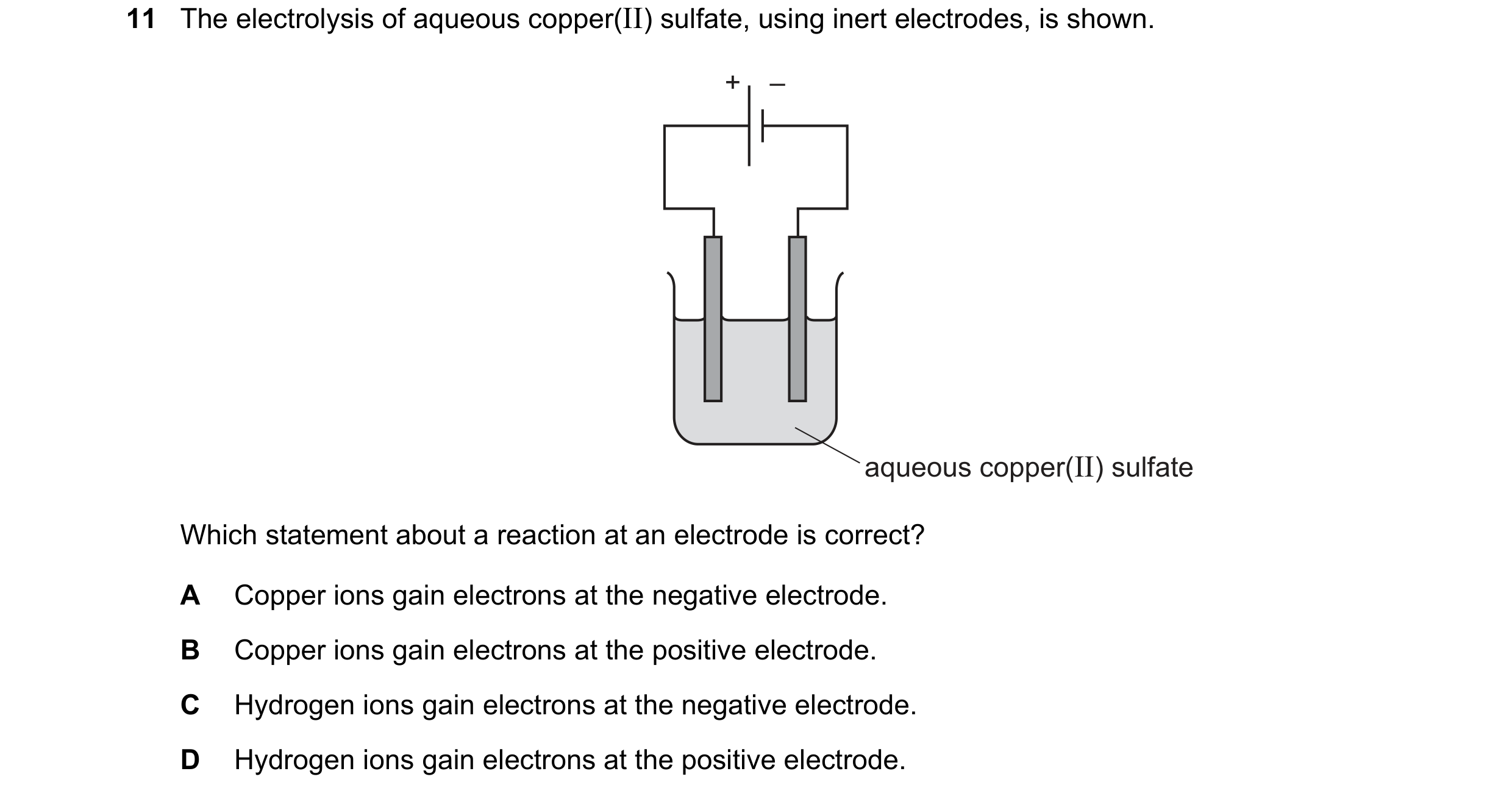
11 The electrolysis of aqueous copper(II) sulfate, using inert electrodes, is shown. + – aqueous copper(II) sulfate Which statement about a reaction at an electrode is correct? A Copper ions gain electrons at the negative electrode. B Copper ions gain electrons at the positive electrode. C Hydrogen ions gain electrons at the negative electrode. D Hydrogen ions gain electrons at the positive electrode.
1 marks
Answer: A
This question in 0971/22 May/June 2020
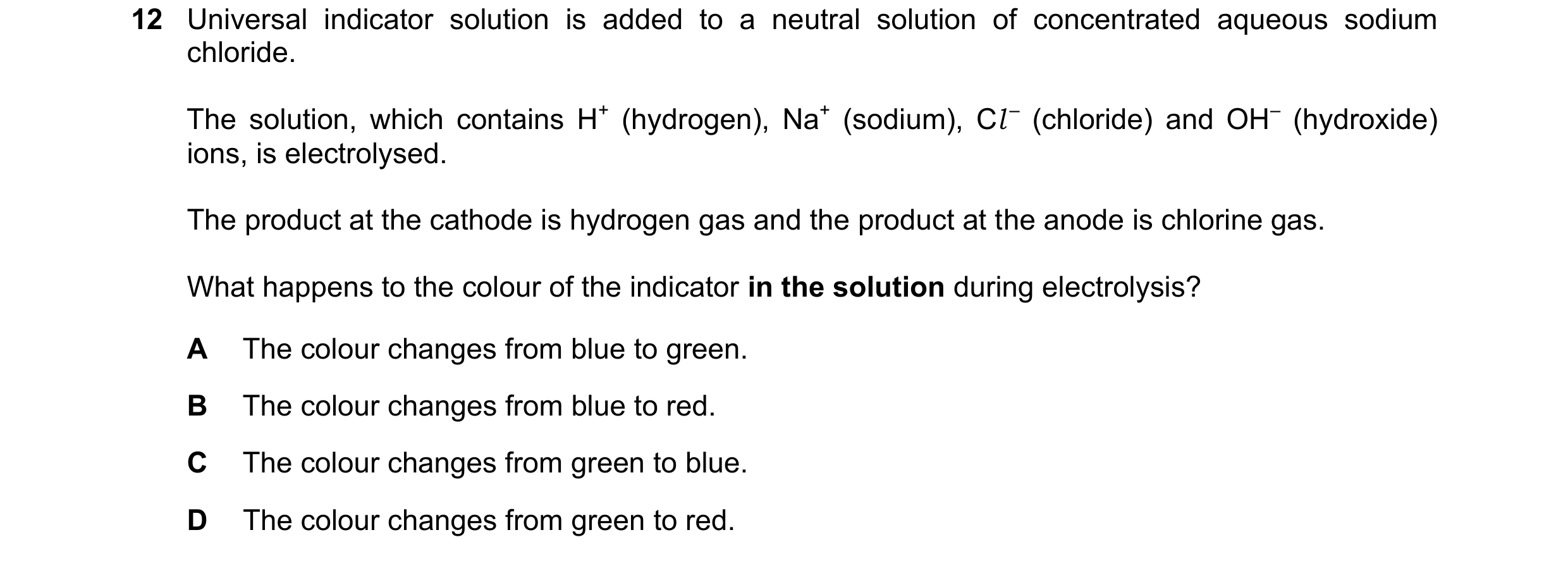
Q13 · Universal indicator solution is added to a neutral solution of concentrated aqueous… 0971/22 Oct/Nov 2020
12 Universal indicator solution is added to a neutral solution of concentrated aqueous sodium chloride. The solution, which contains H+ (hydrogen), Na+ (sodium), Cl – (chloride) and OH– (hydroxide) ions, is electrolysed. The product at the cathode is hydrogen gas and the product at the anode is chlorine gas. What happens to the colour of the indicator in the solution during electrolysis? A The colour changes from blue to green. B The colour changes from blue to red. C The colour changes from green to blue. D The colour changes from green to red.
1 marks
Answer: C
This question in 0971/22 Oct/Nov 2020
Q14 · The apparatus used for the extraction of aluminium oxide by electrolysis is shown 0971/22 Oct/Nov 2020
31 The apparatus used for the extraction of aluminium oxide by electrolysis is shown. carbon anodes – + carbon lining solution of as cathode aluminium oxide in molten cryolite molten aluminium collects at the bottom Which equation represents a reaction taking place at the anode? A O + 2e– O2– B 2O2– O2 + 4e– C Al 3– Al + 3e– D Al 3+ + 3e– Al
1 marks
Answer: B
This question in 0971/22 Oct/Nov 2020
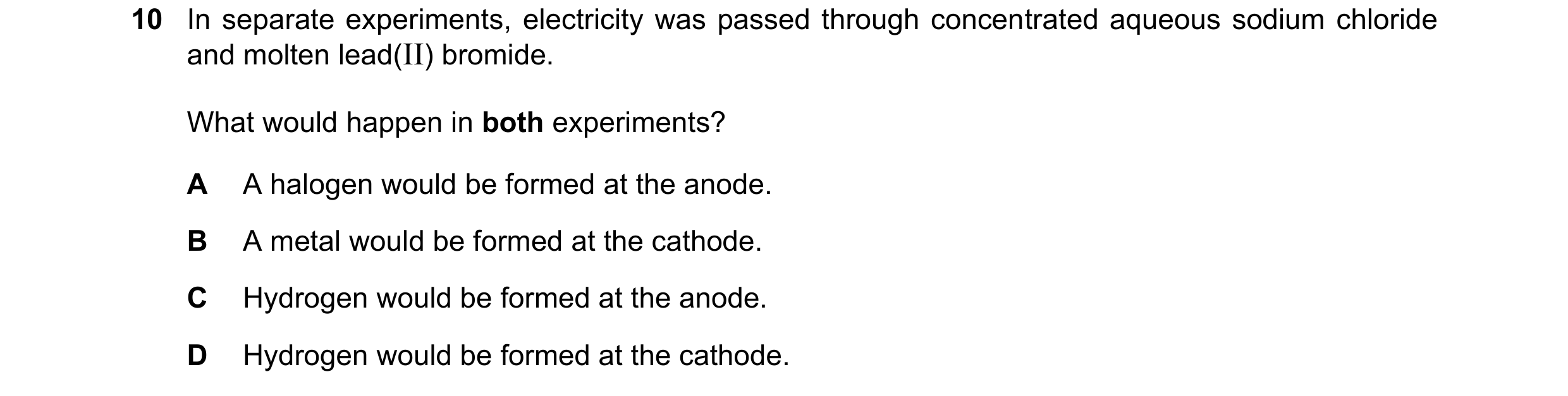
Q15 · In separate experiments, electricity was passed through concentrated aqueous sodium… 0971/21 May/June 2021
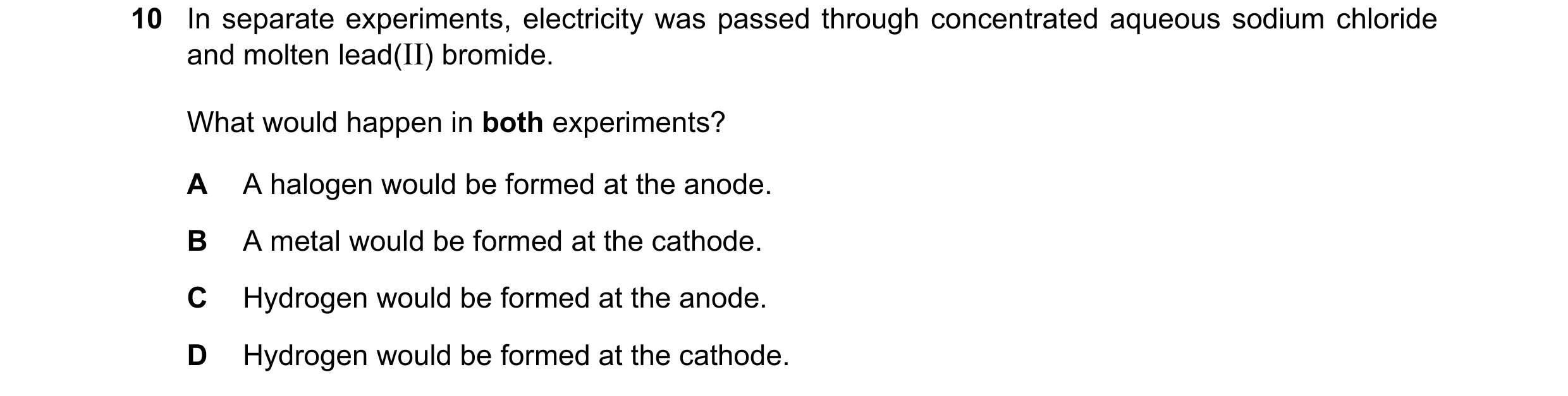
10 In separate experiments, electricity was passed through concentrated aqueous sodium chloride and molten lead(II) bromide. What would happen in both experiments? A A halogen would be formed at the anode. B A metal would be formed at the cathode. C Hydrogen would be formed at the anode. D Hydrogen would be formed at the cathode.
1 marks
Answer: A
This question in 0971/21 May/June 2021
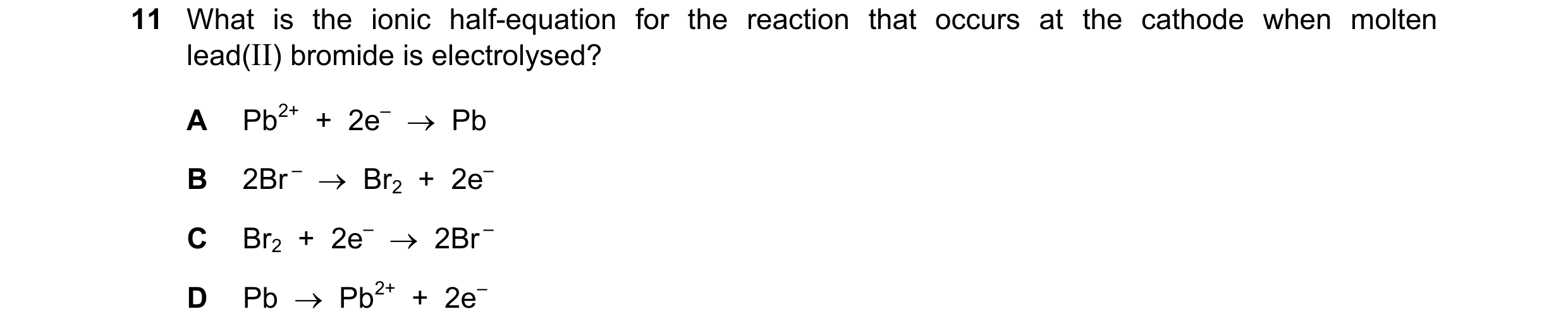
Q16 · What is the ionic half-equation for the reaction that occurs at the cathode when molten… 0971/21 May/June 2021
11 What is the ionic half-equation for the reaction that occurs at the cathode when molten lead(II) bromide is electrolysed? A Pb2+ + 2e– Pb B 2Br – Br2 + 2e– C Br2 + 2e– 2Br – D Pb Pb2+ + 2e–
1 marks
Answer: A
This question in 0971/21 May/June 2021
Q17 · In separate experiments, electricity was passed through concentrated aqueous sodium… 0971/22 May/June 2021
10 In separate experiments, electricity was passed through concentrated aqueous sodium chloride and molten lead(II) bromide. What would happen in both experiments? A A halogen would be formed at the anode. B A metal would be formed at the cathode. C Hydrogen would be formed at the anode. D Hydrogen would be formed at the cathode.
1 marks
Answer: A
This question in 0971/22 May/June 2021
Q18 · Aluminium is extracted from its ore by electrolysis 0971/22 May/June 2021
27 Aluminium is extracted from its ore by electrolysis. Which equation represents the reaction that occurs at the anode during the electrolysis? A Al 3+ + 3e– Al B Al 3+ Al + 3e– C 2O2– O2 + 4e– D 2O2– + 2e– O2
1 marks
Answer: C
This question in 0971/22 May/June 2021
Q19 · Iron can be electroplated with zinc to make it resistant to corrosion 0971/22 Oct/Nov 2021
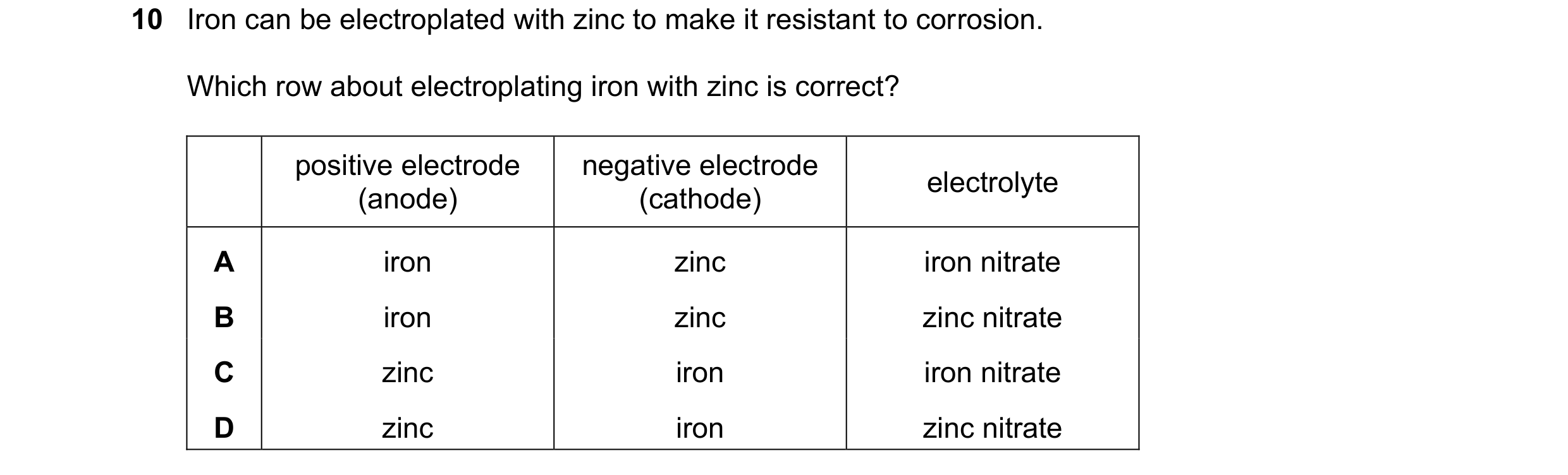
10 Iron can be electroplated with zinc to make it resistant to corrosion. Which row about electroplating iron with zinc is correct? positive electrode negative electrode electrolyte (anode) (cathode) A iron zinc iron nitrate B iron zinc zinc nitrate C zinc iron iron nitrate D zinc iron zinc nitrate
1 marks
Answer: D
This question in 0971/22 Oct/Nov 2021
Q20 · Concentrated aqueous sodium chloride is electrolysed 0971/22 Oct/Nov 2021
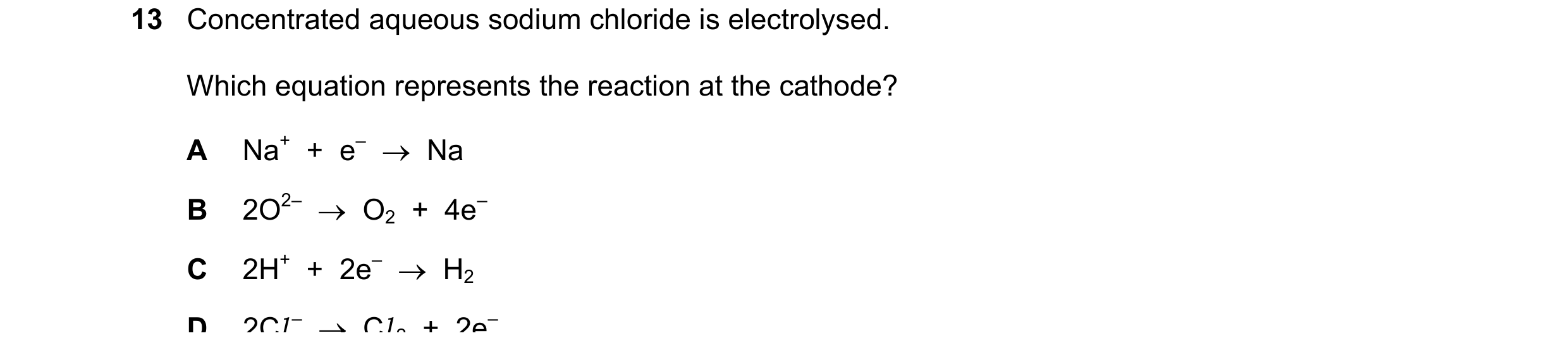
13 Concentrated aqueous sodium chloride is electrolysed. Which equation represents the reaction at the cathode? A Na+ + e– Na B 2O2– O2 + 4e– C 2H+ + 2e– H2 D 2Cl – Cl 2 + 2e–
1 marks
Answer: C
This question in 0971/22 Oct/Nov 2021
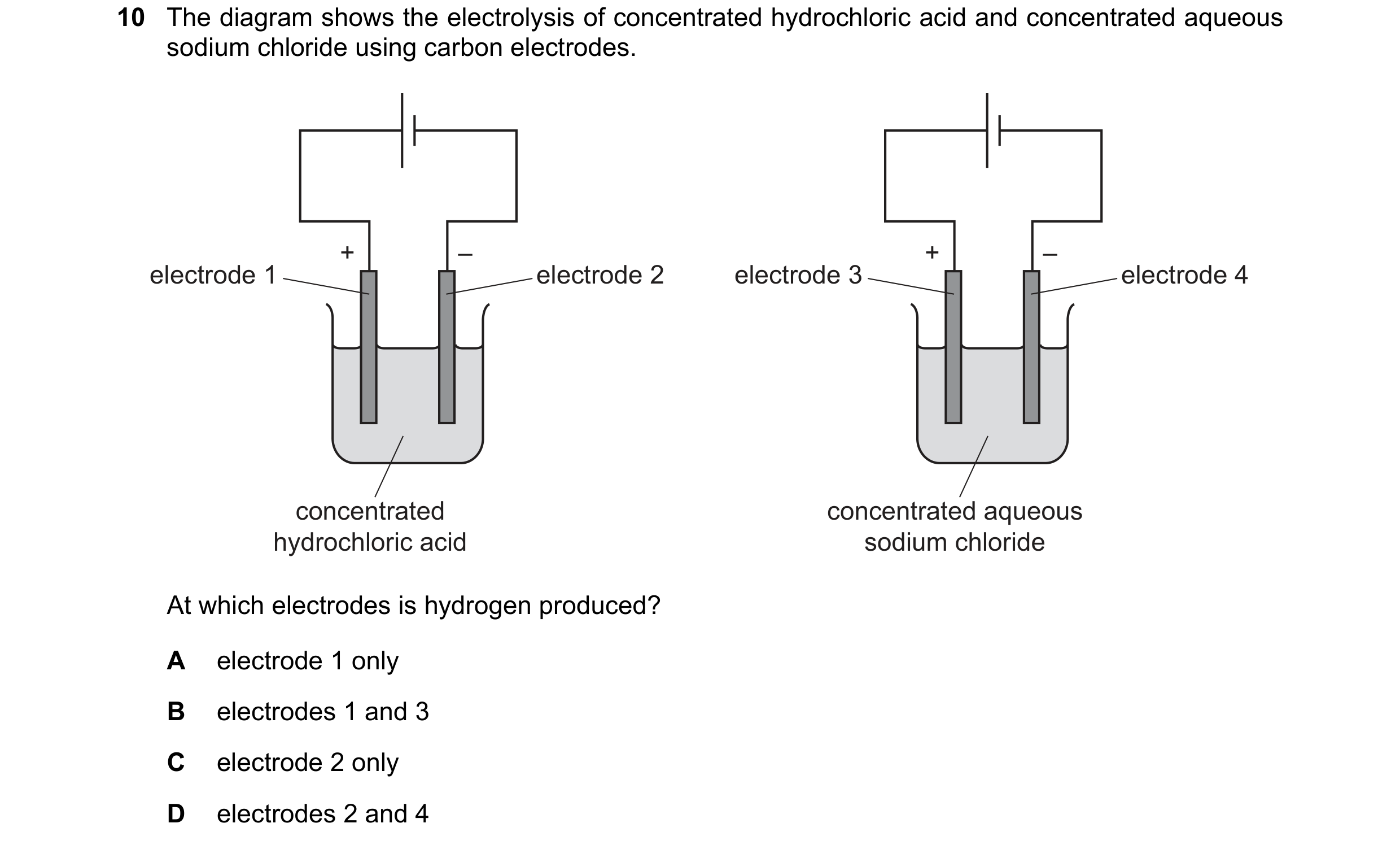
Q21 · The diagram shows the electrolysis of concentrated hydrochloric acid and concentrated… 0971/21 May/June 2022
10 The diagram shows the electrolysis of concentrated hydrochloric acid and concentrated aqueous sodium chloride using carbon electrodes. + – + – electrode 1 electrode 2 electrode 3 electrode 4 concentrated concentrated aqueous hydrochloric acid sodium chloride At which electrodes is hydrogen produced? A electrode 1 only B electrodes 1 and 3 C electrode 2 only D electrodes 2 and 4
1 marks
Answer: D
This question in 0971/21 May/June 2022
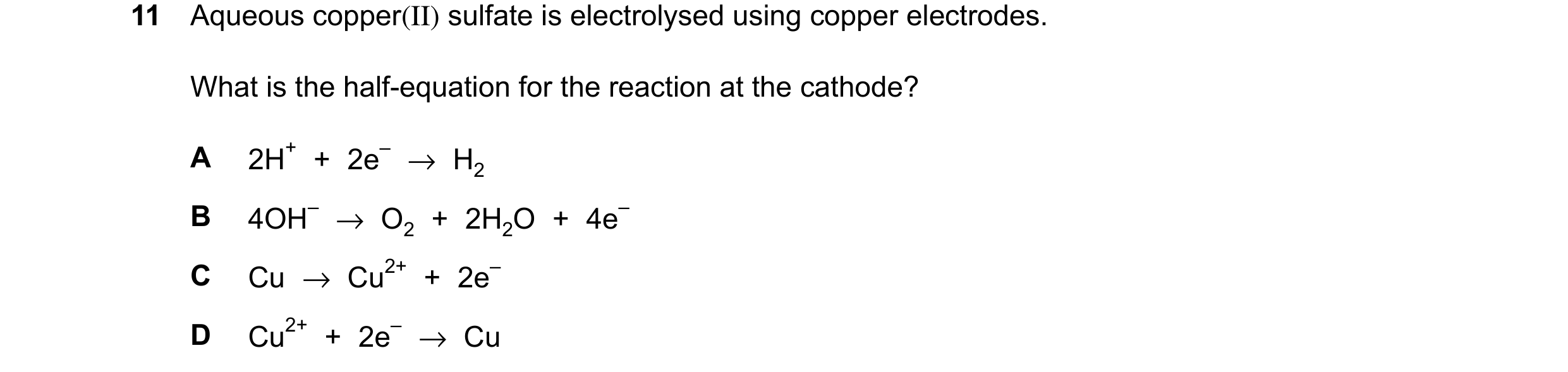
Q22 · Aqueous copper(II) sulfate is electrolysed using copper electrodes 0971/21 May/June 2022
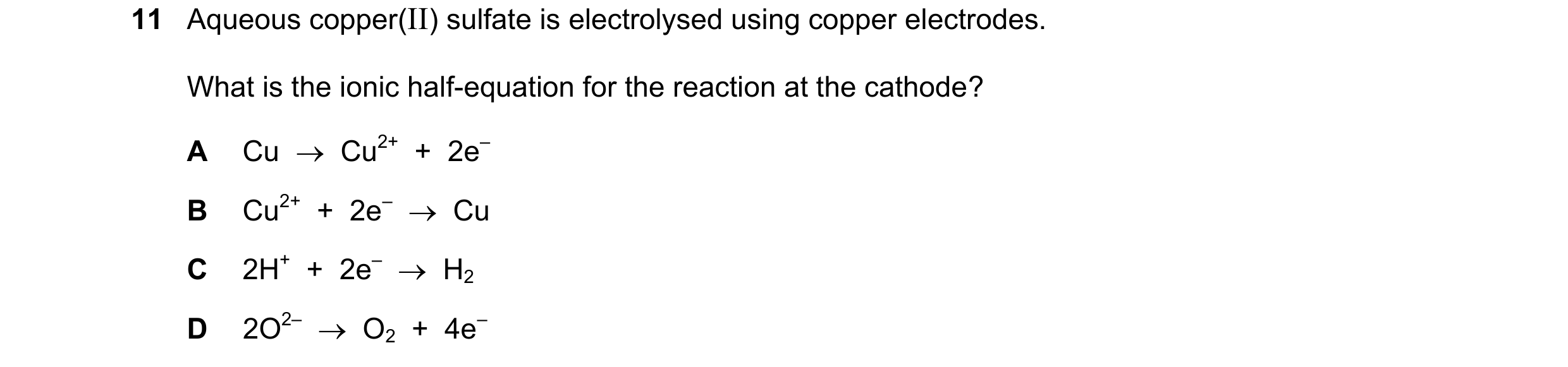
11 Aqueous copper(II) sulfate is electrolysed using copper electrodes. What is the ionic half-equation for the reaction at the cathode? A Cu Cu2+ + 2e– B Cu2+ + 2e– Cu C 2H+ + 2e– H2 D 2O2– O2 + 4e–
1 marks
Answer: B
This question in 0971/21 May/June 2022
Q23 · In the extraction of aluminium by electrolysis, cryolite is added to the bauxite ore 0971/21 May/June 2022
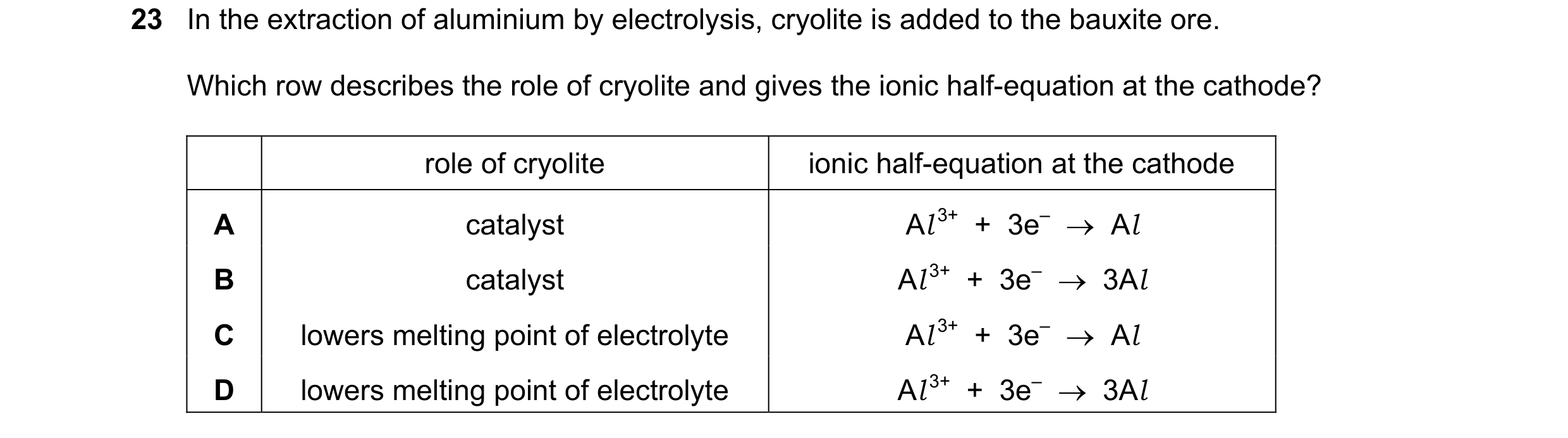
23 In the extraction of aluminium by electrolysis, cryolite is added to the bauxite ore. Which row describes the role of cryolite and gives the ionic half-equation at the cathode? role of cryolite ionic half-equation at the cathode A catalyst Al 3+ + 3e– Al B catalyst Al 3+ + 3e– 3Al C lowers melting point of electrolyte Al 3+ + 3e– Al D lowers melting point of electrolyte Al 3+ + 3e– 3Al
1 marks
Answer: C
This question in 0971/21 May/June 2022
Q24 · The flow chart shows part of the process for the manufacture of sulfuric acid and its… 0971/21 May/June 2022
32 The flow chart shows part of the process for the manufacture of sulfuric acid and its electrolysis. electrolysis gas 2 concentrated dilute gas 3 sulfuric acid sulfuric acid gas 1 What are gases 1, 2 and 3? gas 1 gas 2 gas 3 A sulfur dioxide hydrogen sulfur trioxide B sulfur dioxide oxygen sulfur trioxide C sulfur trioxide hydrogen sulfur dioxide D sulfur trioxide oxygen sulfur dioxide
1 marks
Answer: B
This question in 0971/21 May/June 2022
Q25 · The diagram shows the electrolysis of concentrated hydrochloric acid and concentrated… 0971/22 May/June 2022
10 The diagram shows the electrolysis of concentrated hydrochloric acid and concentrated aqueous sodium chloride using carbon electrodes. + – + – electrode 1 electrode 2 electrode 3 electrode 4 concentrated concentrated aqueous hydrochloric acid sodium chloride At which electrodes is hydrogen produced? A electrode 1 only B electrodes 1 and 3 C electrode 2 only D electrodes 2 and 4
1 marks
Answer: D
This question in 0971/22 May/June 2022
Q26 · The diagram shows the electrolysis of aqueous copper(II) sulfate using inert electrodes 0971/22 May/June 2022
11 The diagram shows the electrolysis of aqueous copper(II) sulfate using inert electrodes. Which arrow shows the movement of electrons in the circuit? power supply A B anode cathode C D
1 marks
Answer: B
This question in 0971/22 May/June 2022
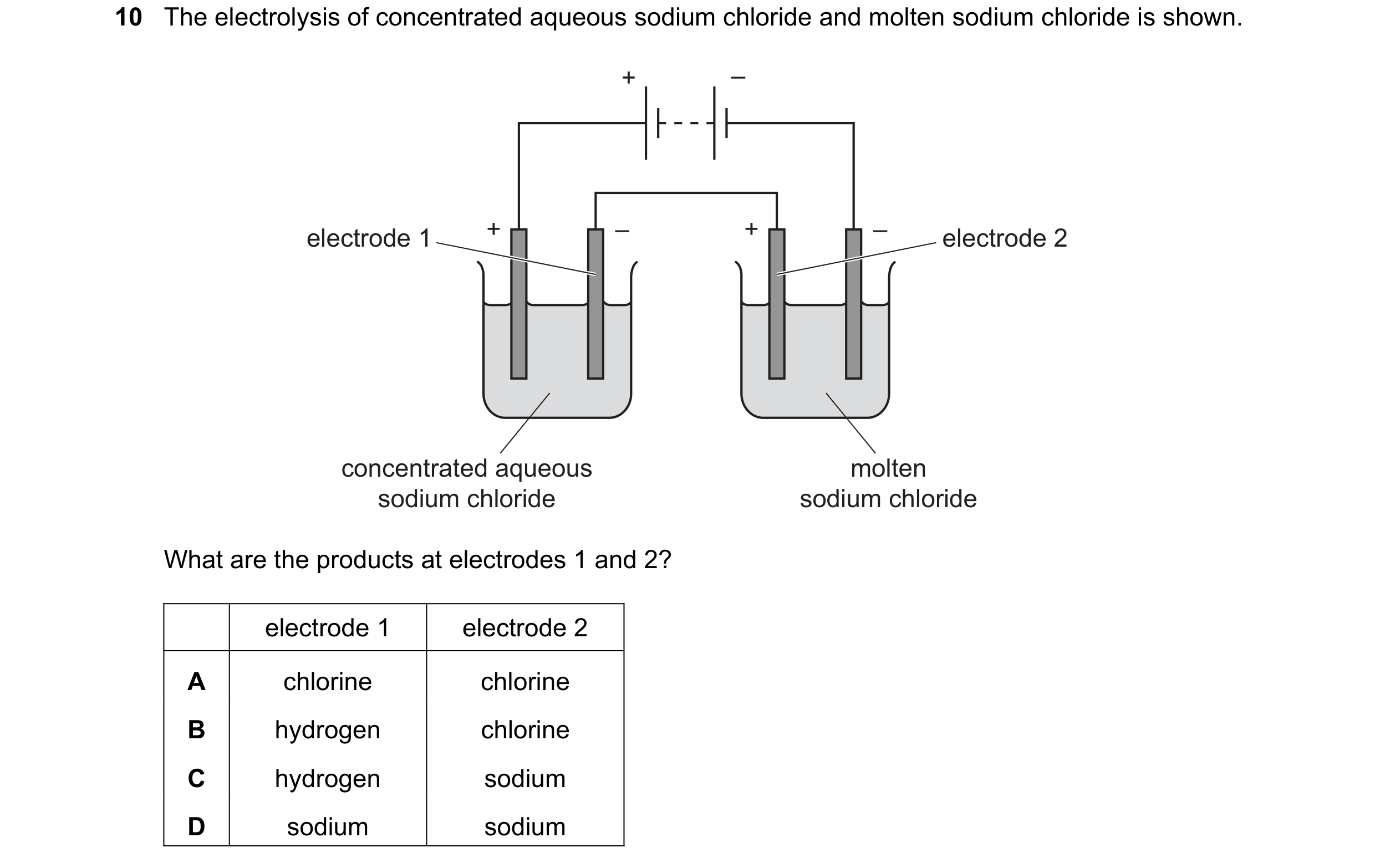
Q27 · The electrolysis of concentrated aqueous sodium chloride and molten sodium chloride is… 0971/22 Oct/Nov 2022
10 The electrolysis of concentrated aqueous sodium chloride and molten sodium chloride is shown. + – electrode 1 + – + – electrode 2 concentrated aqueous molten sodium chloride sodium chloride What are the products at electrodes 1 and 2? electrode 1 electrode 2 A chlorine chlorine B hydrogen chlorine C hydrogen sodium D sodium sodium
1 marks
Answer: B
This question in 0971/22 Oct/Nov 2022
Q28 · Dilute aqueous sodium chloride is electrolysed using carbon electrodes 0971/22 Oct/Nov 2022
14 Dilute aqueous sodium chloride is electrolysed using carbon electrodes. What is the product at the anode? A carbon dioxide B hydrogen C oxygen D sodium
1 marks
Answer: C
This question in 0971/22 Oct/Nov 2022
Q29 · Which substance produces hydrogen and bromine when electrolysed? 0971/21 May/June 2023
9 Which substance produces hydrogen and bromine when electrolysed? A concentrated aqueous copper(II) bromide B concentrated aqueous sodium bromide C dilute aqueous potassium bromide D molten lead(II) bromide
1 marks
Answer: B
This question in 0971/21 May/June 2023
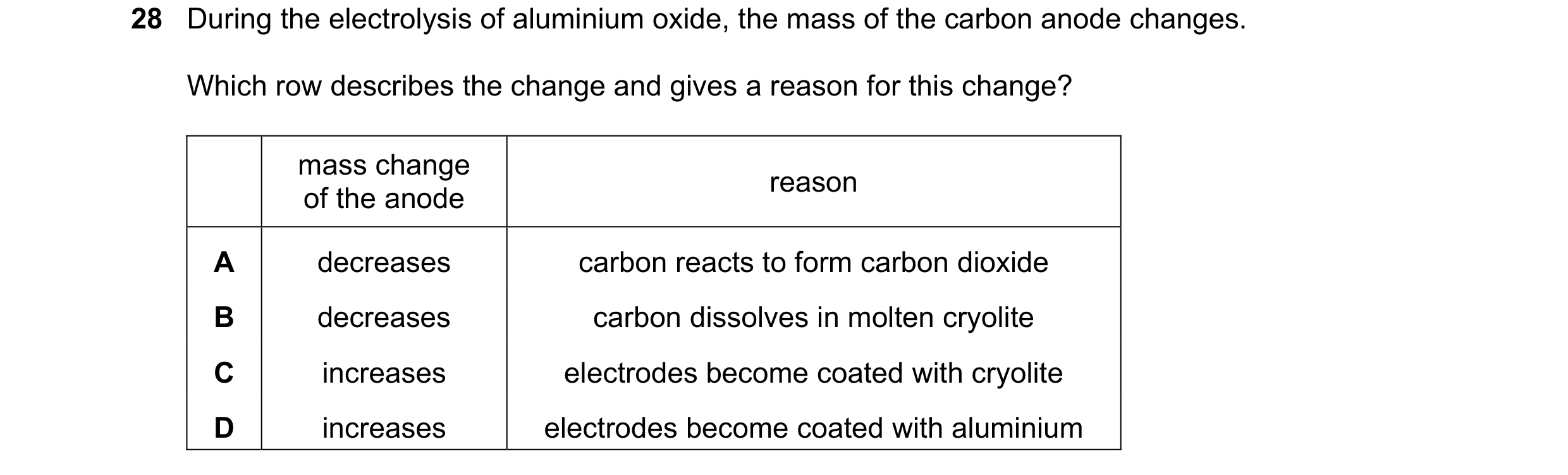
Q30 · During the electrolysis of aluminium oxide, the mass of the carbon anode changes 0971/21 May/June 2023
28 During the electrolysis of aluminium oxide, the mass of the carbon anode changes. Which row describes the change and gives a reason for this change? mass change reason of the anode A decreases carbon reacts to form carbon dioxide B decreases carbon dissolves in molten cryolite C increases electrodes become coated with cryolite D increases electrodes become coated with aluminium
1 marks
Answer: A
This question in 0971/21 May/June 2023
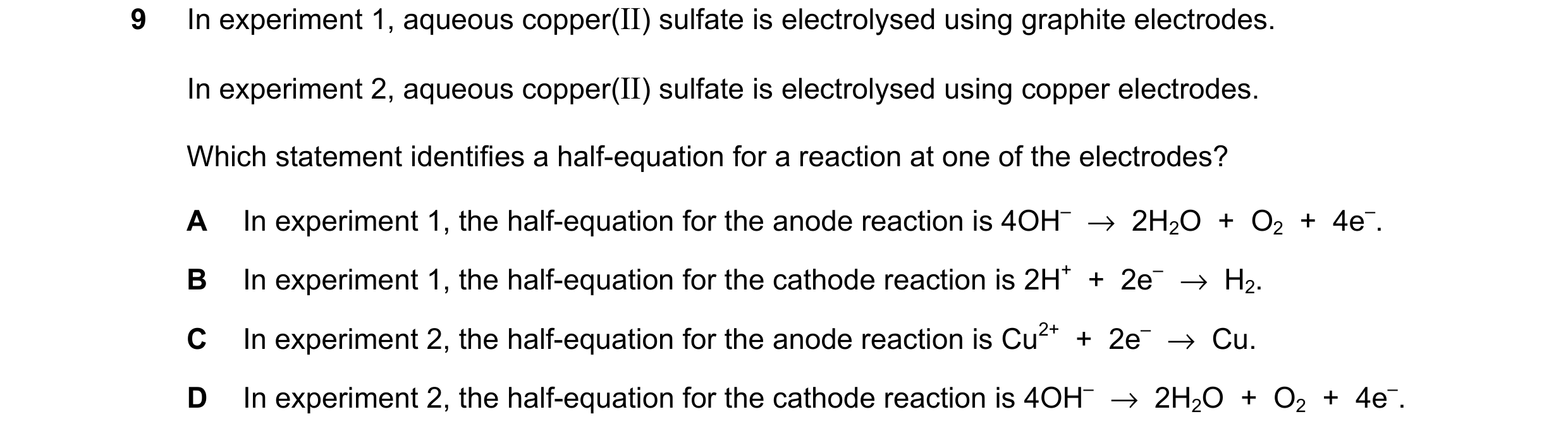
Q31 · In experiment 1, aqueous copper(II) sulfate is electrolysed using graphite electrodes 0971/22 May/June 2023
9 In experiment 1, aqueous copper(II) sulfate is electrolysed using graphite electrodes. In experiment 2, aqueous copper(II) sulfate is electrolysed using copper electrodes. Which statement identifies a half-equation for a reaction at one of the electrodes? A In experiment 1, the half-equation for the anode reaction is 4OH– → 2H2O + O2 + 4e–. B In experiment 1, the half-equation for the cathode reaction is 2H+ + 2e– → H2. C In experiment 2, the half-equation for the anode reaction is Cu2+ + 2e– → Cu. D In experiment 2, the half-equation for the cathode reaction is 4OH– → 2H2O + O2 + 4e–.
1 marks
Answer: A
This question in 0971/22 May/June 2023
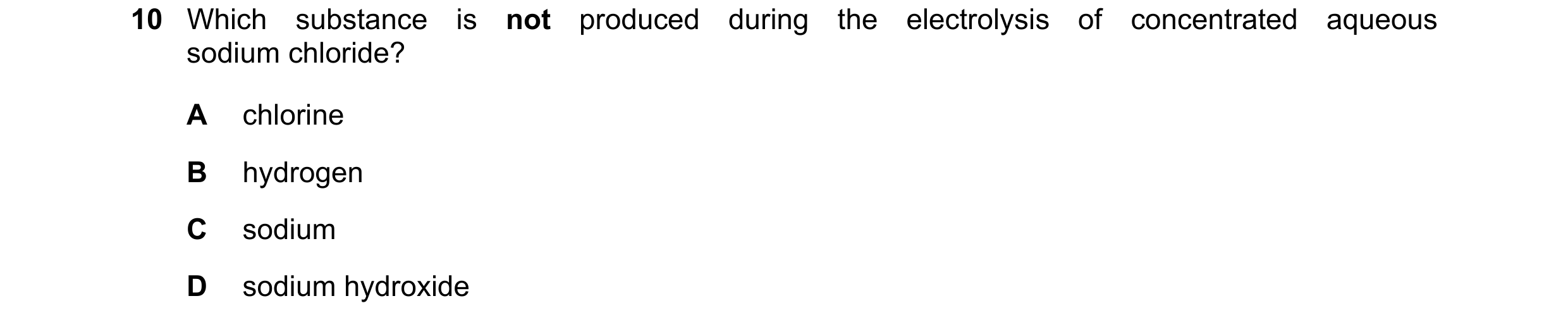
Q32 · Which substance is not produced during the electrolysis of concentrated aqueous sodium… 0971/22 May/June 2023
10 Which substance is not produced during the electrolysis of concentrated aqueous sodium chloride? A chlorine B hydrogen C sodium D sodium hydroxide
1 marks
Answer: C
This question in 0971/22 May/June 2023
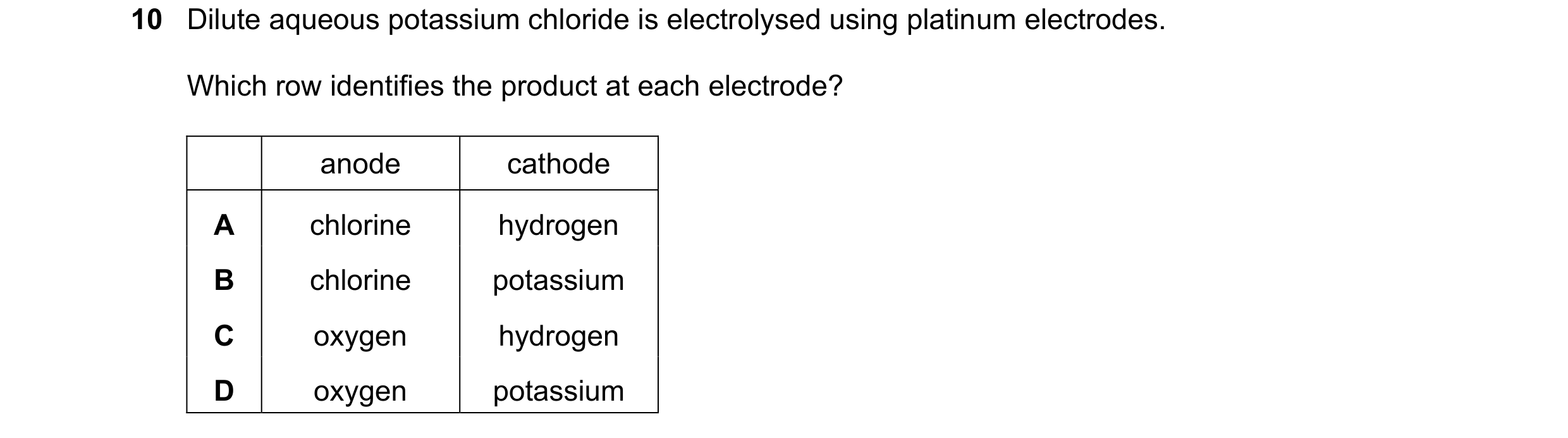
Q33 · Dilute aqueous potassium chloride is electrolysed using platinum electrodes 0971/22 Oct/Nov 2023
10 Dilute aqueous potassium chloride is electrolysed using platinum electrodes. Which row identifies the product at each electrode? anode cathode A chlorine hydrogen B chlorine potassium C oxygen hydrogen D oxygen potassium
1 marks
Answer: C
This question in 0971/22 Oct/Nov 2023
Q34 · Concentrated aqueous copper(II) chloride is electrolysed using copper electrodes, as shown 0971/22 Oct/Nov 2023
11 Concentrated aqueous copper(II) chloride is electrolysed using copper electrodes, as shown. power supply + – copper electrodes aqueous copper(II) chloride What happens to the mass of each electrode during this process? positive electrode negative electrode A decreases decreases B decreases increases C increases decreases D increases increases
1 marks
Answer: B
This question in 0971/22 Oct/Nov 2023
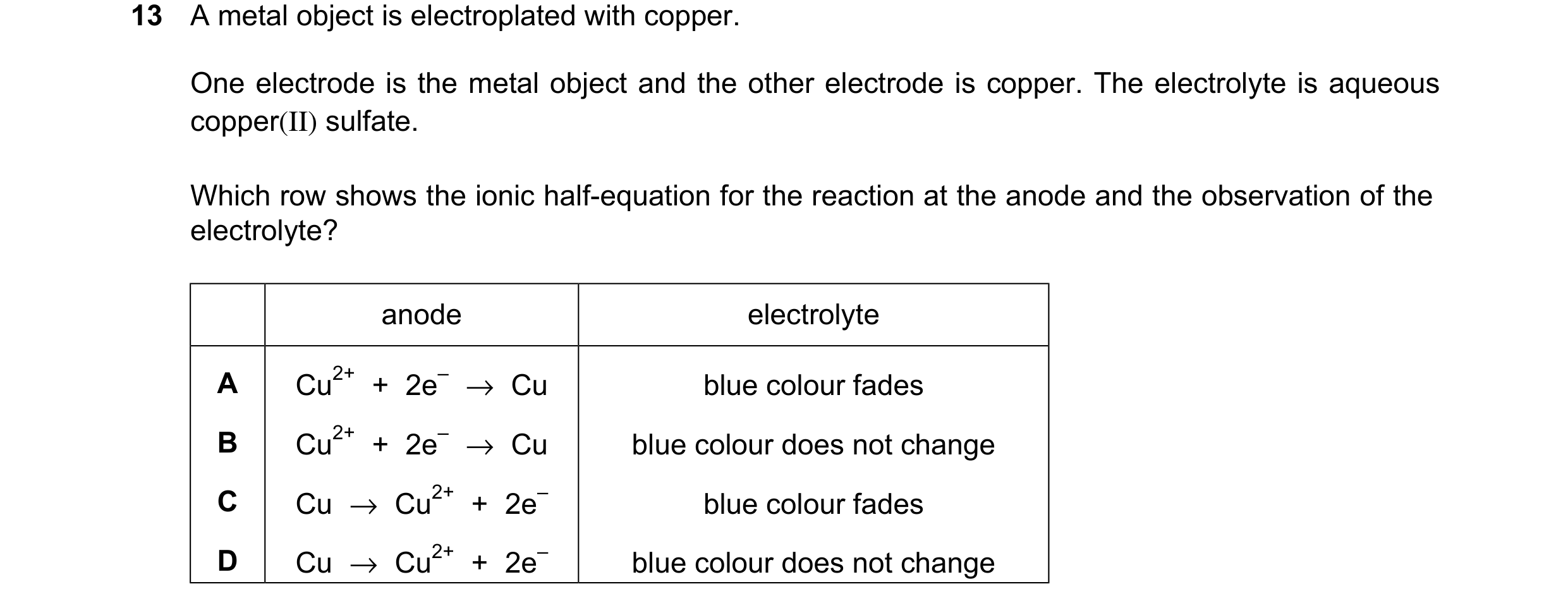
Q35 · A metal object is electroplated with copper 0971/21 May/June 2024
13 A metal object is electroplated with copper. One electrode is the metal object and the other electrode is copper. The electrolyte is aqueous copper(II) sulfate. Which row shows the ionic half-equation for the reaction at the anode and the observation of the electrolyte? anode electrolyte Cu2+ + 2e– →Cu A blue colour fades Cu2+ + 2e– →Cu B blue colour does not change C Cu →Cu2+ + 2e– blue colour fades D Cu →Cu2+ + 2e– blue colour does not change
1 marks
Answer: D
This question in 0971/21 May/June 2024
Q36 · Which statement about electrolysis is correct? 0971/21 May/June 2024
14 Which statement about electrolysis is correct? A Chemical energy is converted to electrical energy. B Electrons flow through the electrolyte. C Ionic compounds are broken down. D Metals are formed at the positive electrode.
1 marks
Answer: C
This question in 0971/21 May/June 2024
Q37 · Which statement about electrolysis is correct? 0971/22 May/June 2024
10 Which statement about electrolysis is correct? A Electrons move through the electrolyte from the cathode to the anode. B Electrons move in the external circuit towards the cathode. C Negative ions move in the external circuit towards the anode. D Positive ions move through the electrolyte towards the anode.
1 marks
Answer: B
This question in 0971/22 May/June 2024
Q38 · Aqueous copper(II) sulfate is electrolysed using copper electrodes 0971/22 May/June 2024
11 Aqueous copper(II) sulfate is electrolysed using copper electrodes. What is the half-equation for the reaction at the cathode? 2H+ + 2e– →H2 A 4OH– →O2 + 2H2O + 4e– B C Cu →Cu2+ + 2e– Cu2+ + 2e– →Cu D
1 marks
Answer: D
This question in 0971/22 May/June 2024
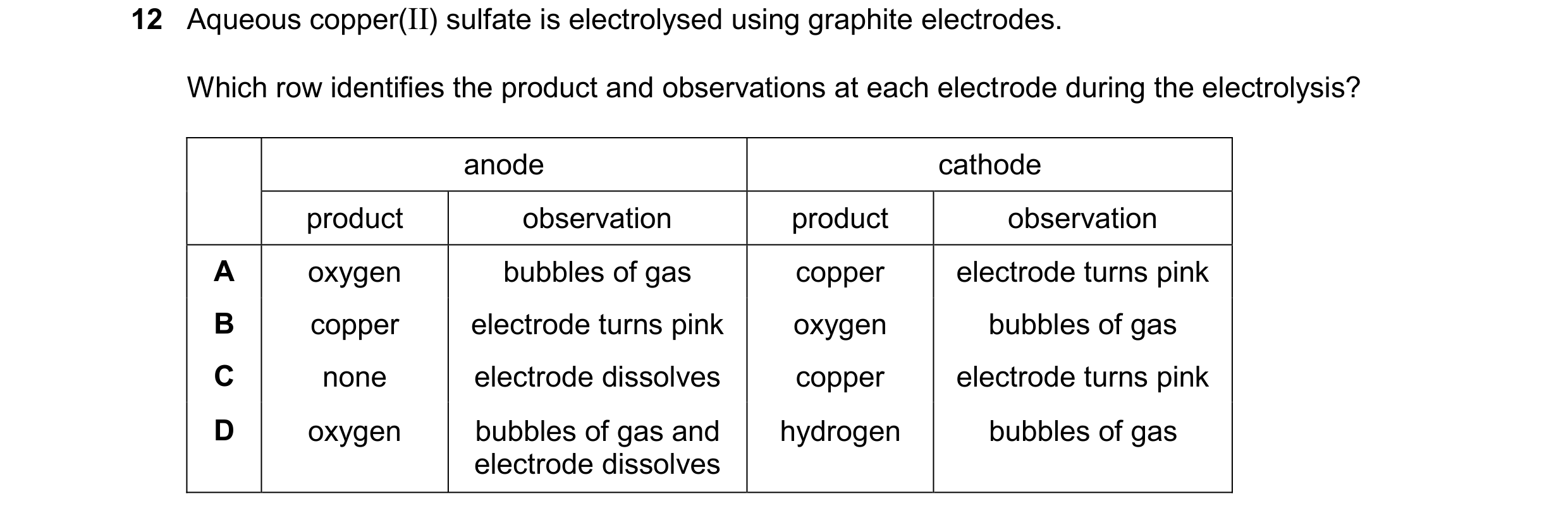
Q39 · Aqueous copper(II) sulfate is electrolysed using graphite electrodes 0971/22 Oct/Nov 2024
12 Aqueous copper(II) sulfate is electrolysed using graphite electrodes. Which row identifies the product and observations at each electrode during the electrolysis? anode cathode product observation product observation A oxygen bubbles of gas copper electrode turns pink B copper electrode turns pink oxygen bubbles of gas C none electrode dissolves copper electrode turns pink D oxygen bubbles of gas and hydrogen bubbles of gas electrode dissolves
1 marks
Answer: A
This question in 0971/22 Oct/Nov 2024
Q40 · Molten sodium chloride is electrolysed using inert electrodes 0971/22 Oct/Nov 2024
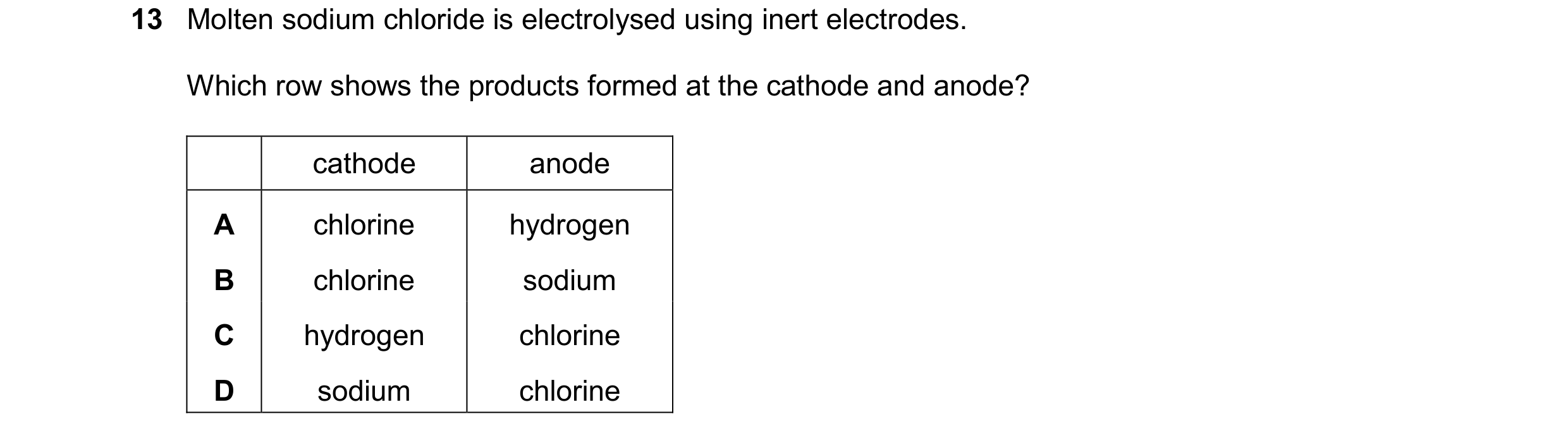
13 Molten sodium chloride is electrolysed using inert electrodes. Which row shows the products formed at the cathode and anode? cathode anode A chlorine hydrogen B chlorine sodium C hydrogen chlorine D sodium chlorine
1 marks
Answer: D
This question in 0971/22 Oct/Nov 2024
Q41 · Molten zinc oxide is electrolysed using inert electrodes 0971/22 May/June 2025
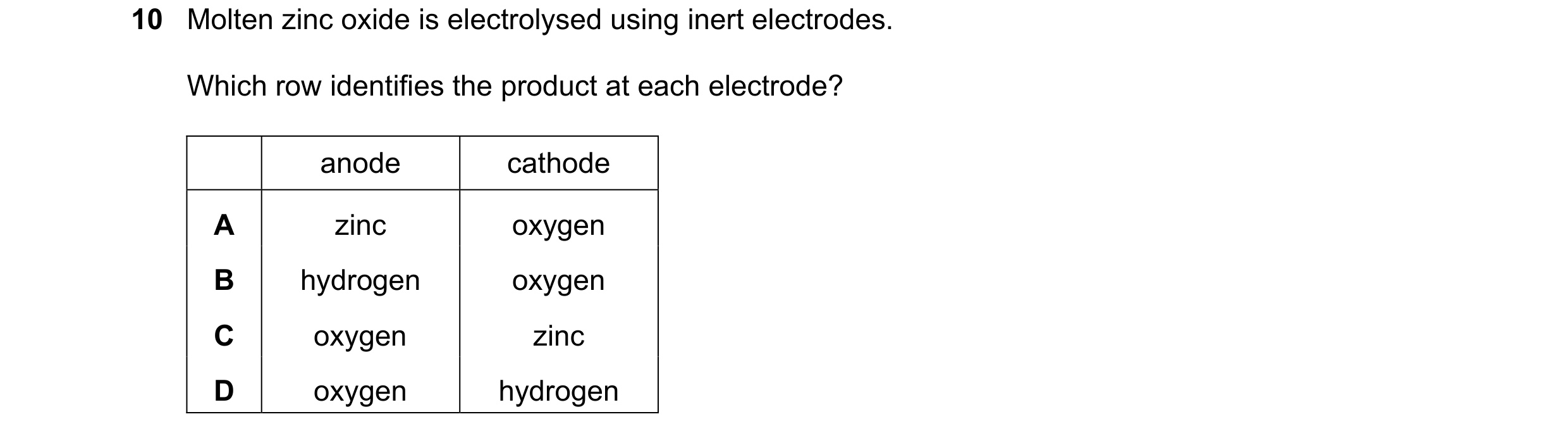
10 Molten zinc oxide is electrolysed using inert electrodes. Which row identifies the product at each electrode? anode cathode A zinc oxygen B hydrogen oxygen C oxygen zinc D oxygen hydrogen
1 marks
Answer: C
This question in 0971/22 May/June 2025
Q42 · Dilute aqueous sodium chloride is electrolysed using platinum electrodes 0971/22 May/June 2025
11 Dilute aqueous sodium chloride is electrolysed using platinum electrodes. What is the half-equation for the reaction at the cathode? A 2H+ + 2e– H2 B Na+ + e– Na C 2Cl – Cl 2 + 2e– D 4OH– 2H2O + O2 + 4e–
1 marks
Answer: A
This question in 0971/22 May/June 2025
Q43 · A solution of copper(II) sulfate can be electrolysed using copper electrodes or carbon… 0971/22 Oct/Nov 2025
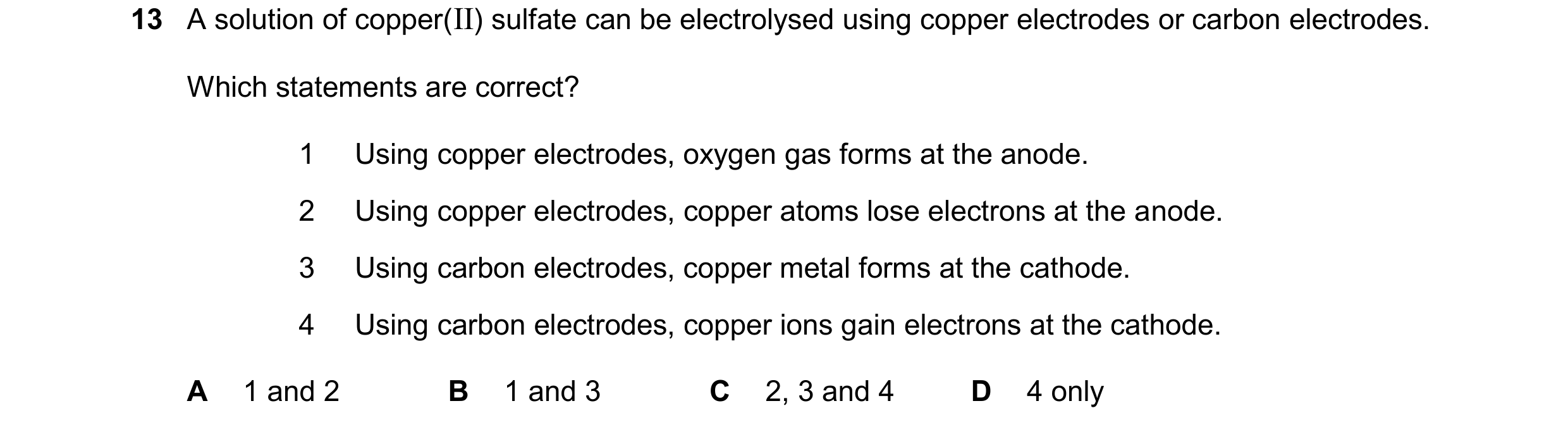
13 A solution of copper(II) sulfate can be electrolysed using copper electrodes or carbon electrodes. Which statements are correct? 1 Using copper electrodes, oxygen gas forms at the anode. 2 Using copper electrodes, copper atoms lose electrons at the anode. 3 Using carbon electrodes, copper metal forms at the cathode. 4 Using carbon electrodes, copper ions gain electrons at the cathode. A 1 and 2 B 1 and 3 C 2, 3 and 4 D 4 only
1 marks
Answer: C
This question in 0971/22 Oct/Nov 2025
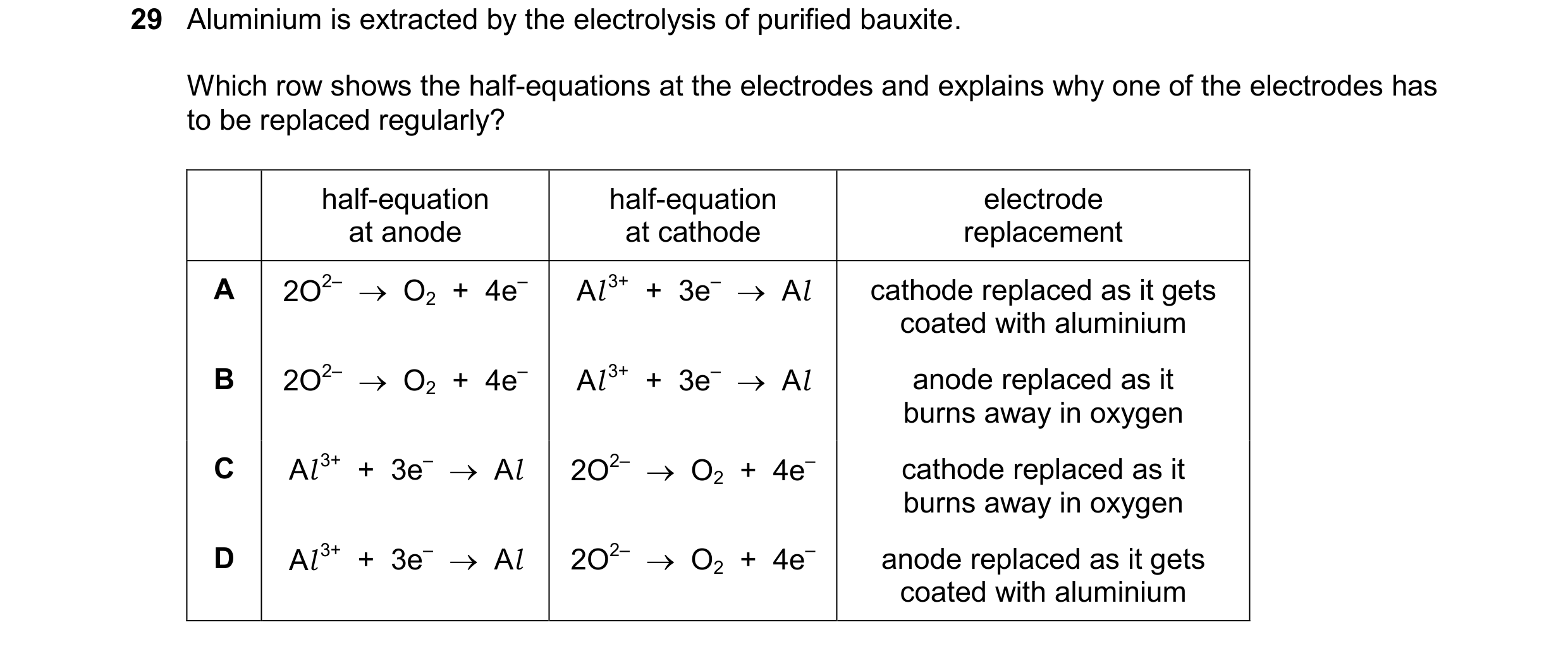
Q44 · Aluminium is extracted by the electrolysis of purified bauxite 0971/22 Oct/Nov 2025
29 Aluminium is extracted by the electrolysis of purified bauxite. Which row shows the half-equations at the electrodes and explains why one of the electrodes has to be replaced regularly? half-equation half-equation electrode at anode at cathode replacement A 2O2– O2 + 4e– Al 3+ + 3e– Al cathode replaced as it gets coated with aluminium B 2O2– O2 + 4e– Al 3+ + 3e– Al anode replaced as it burns away in oxygen C Al 3+ + 3e– Al 2O2– O2 + 4e– cathode replaced as it burns away in oxygen D Al 3+ + 3e– Al 2O2– O2 + 4e– anode replaced as it gets coated with aluminium
1 marks
Answer: B
This question in 0971/22 Oct/Nov 2025
 1 / 13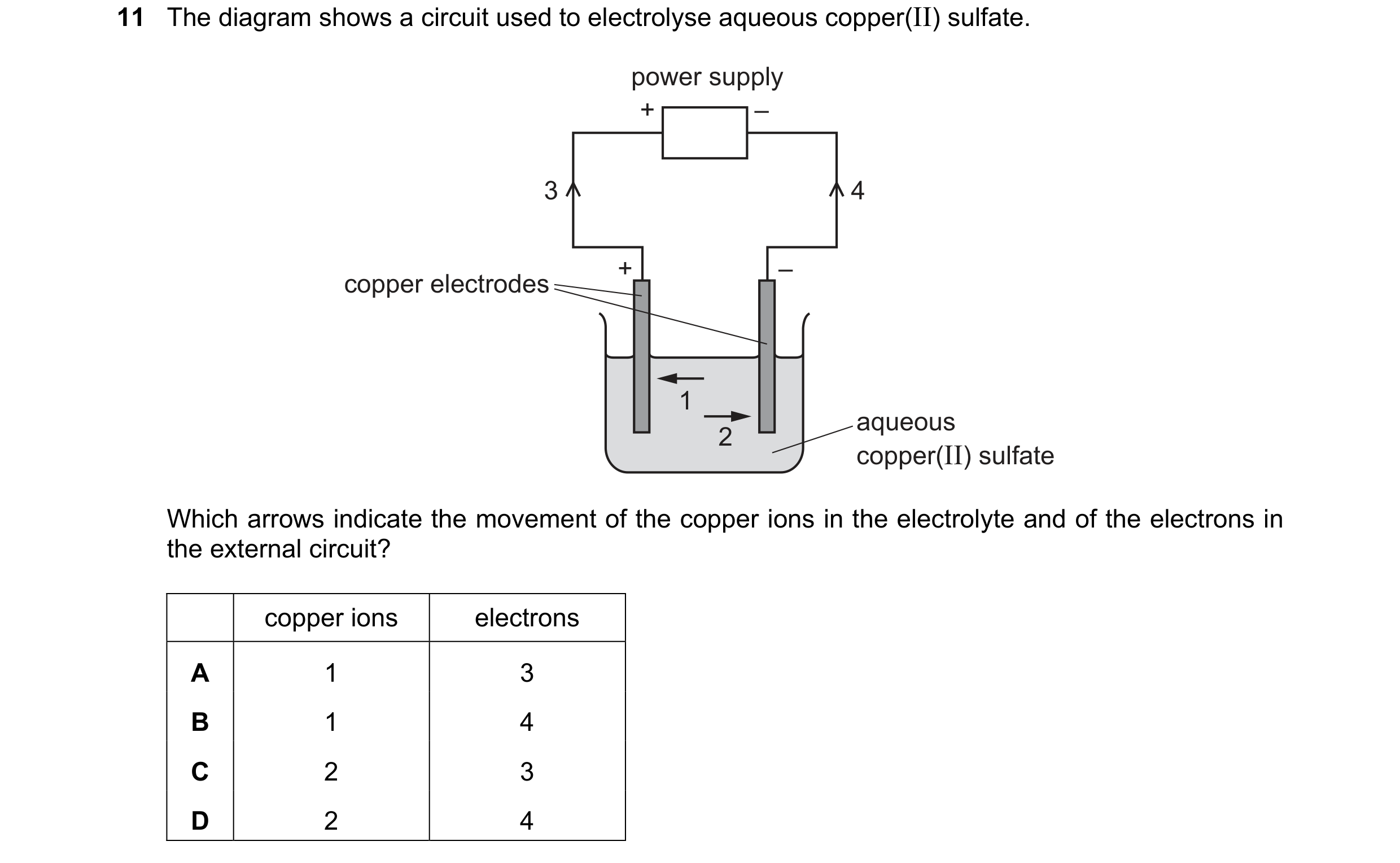
 2 / 13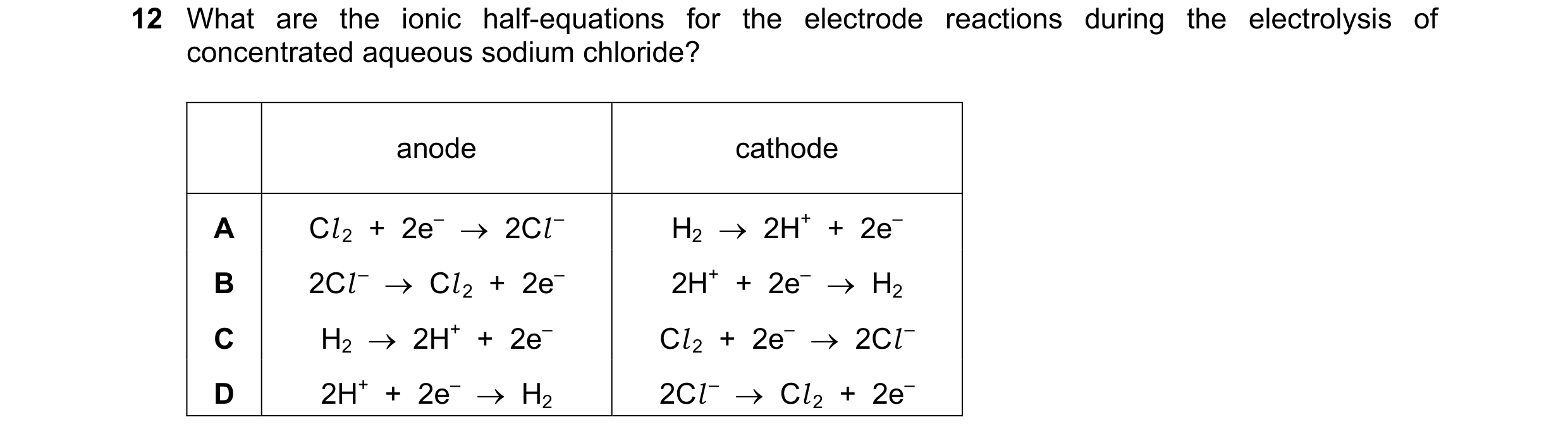
 3 / 13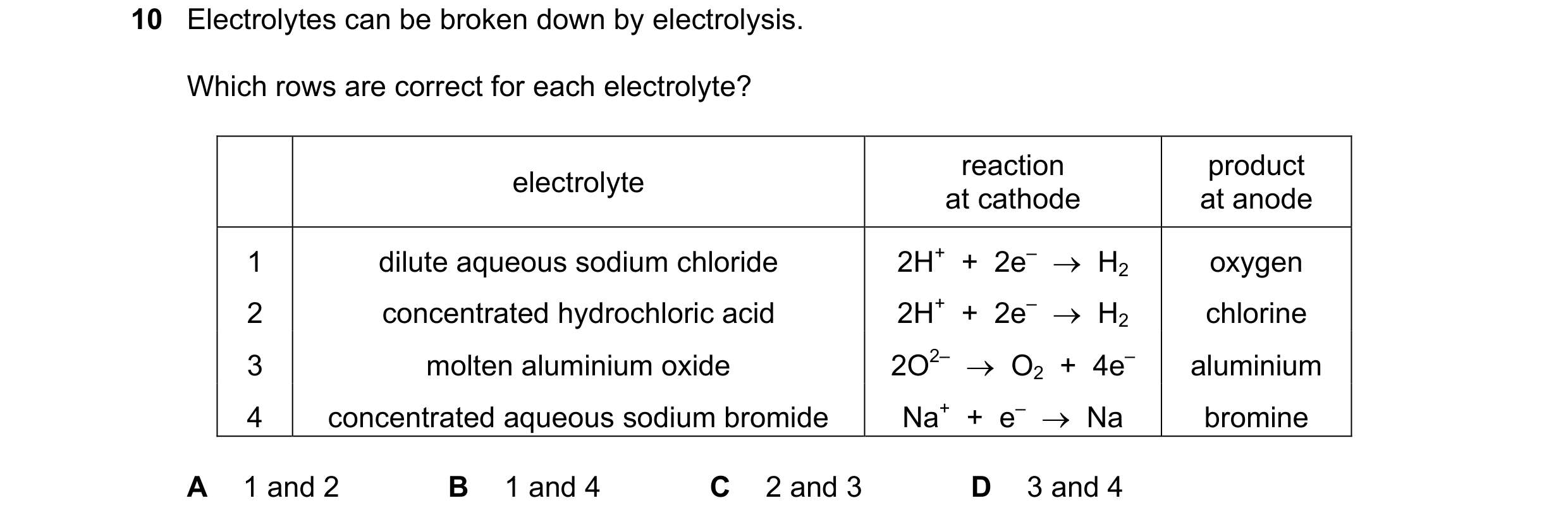
 4 / 13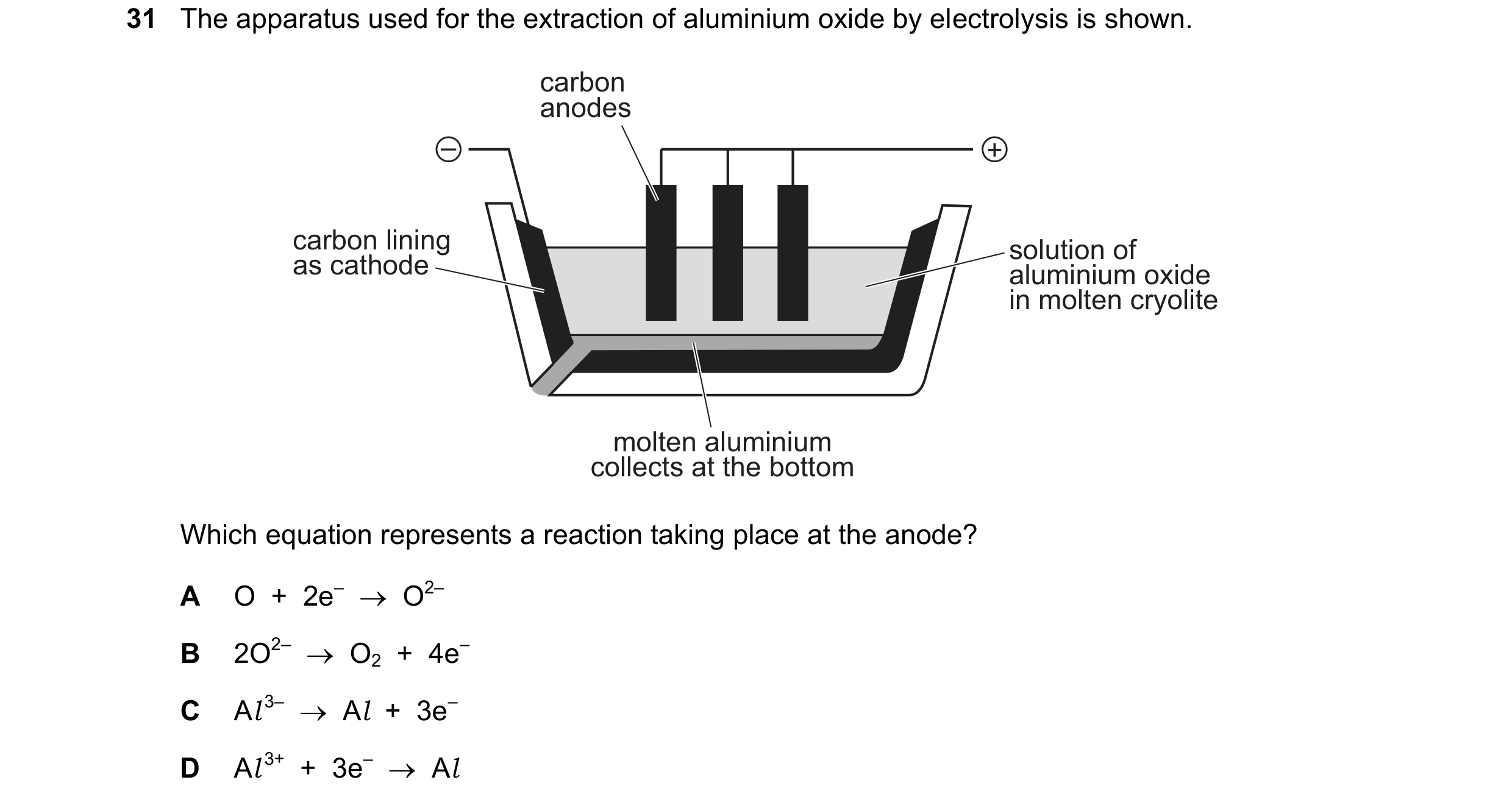
 5 / 13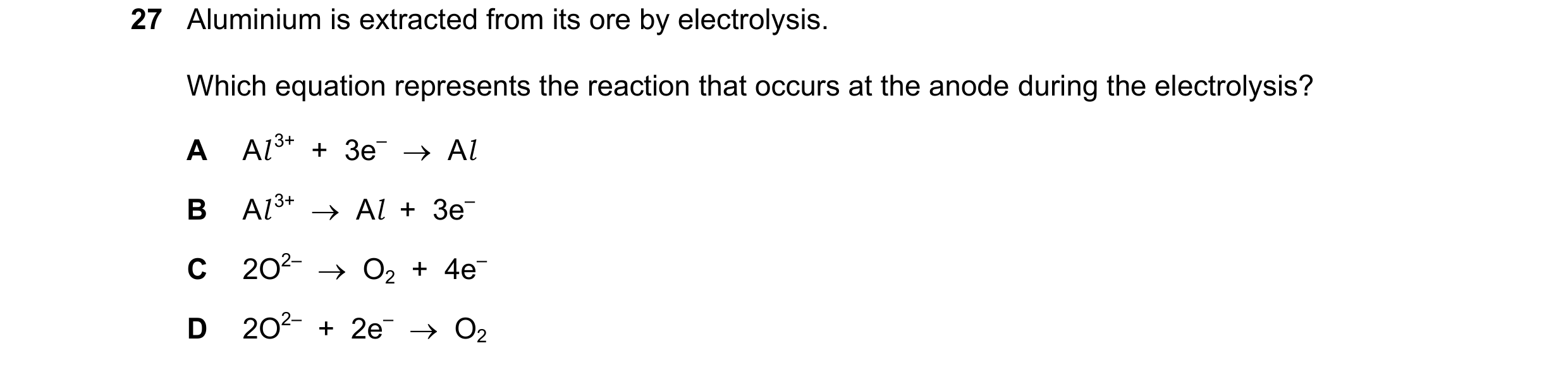
 6 / 13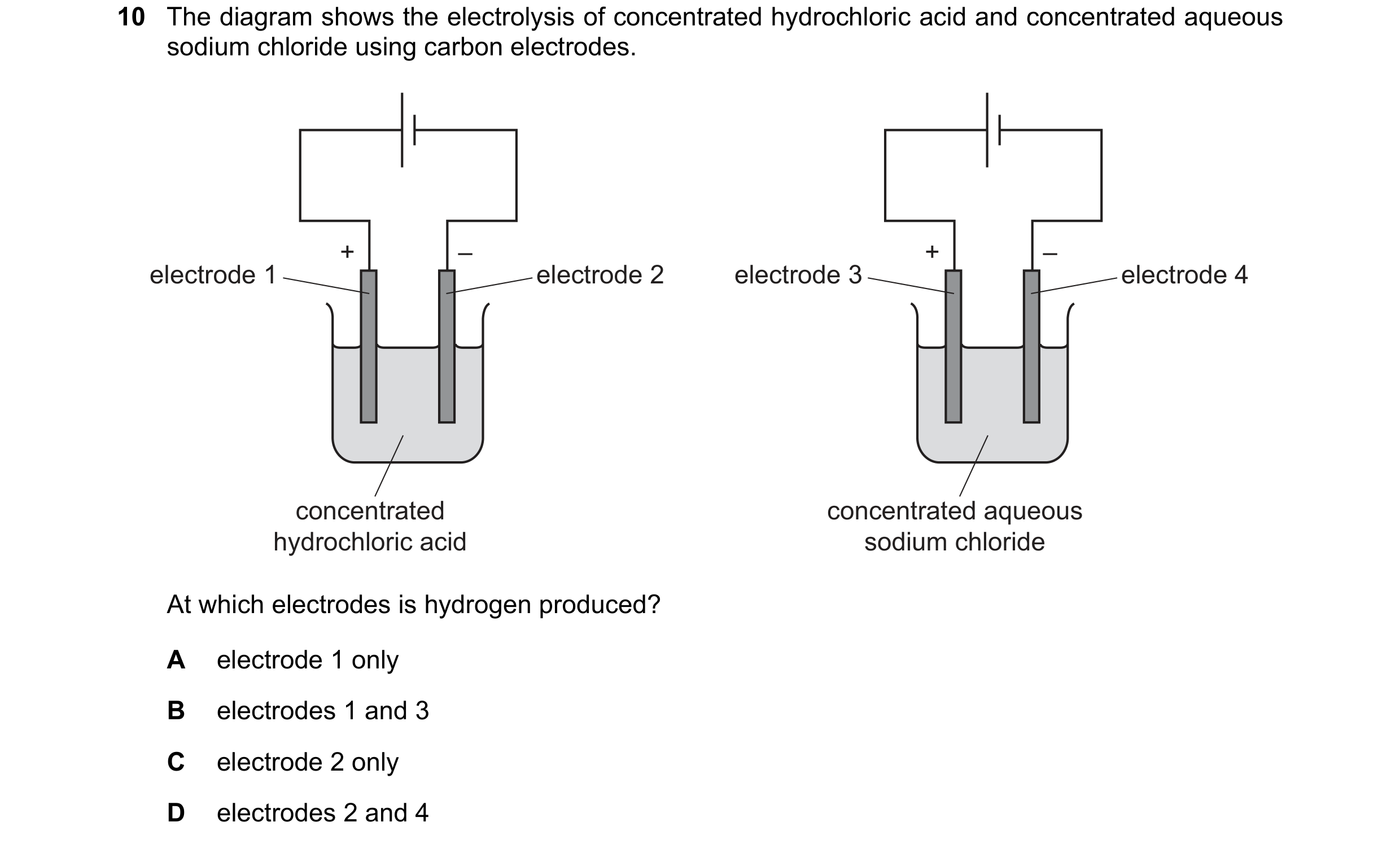
 7 / 13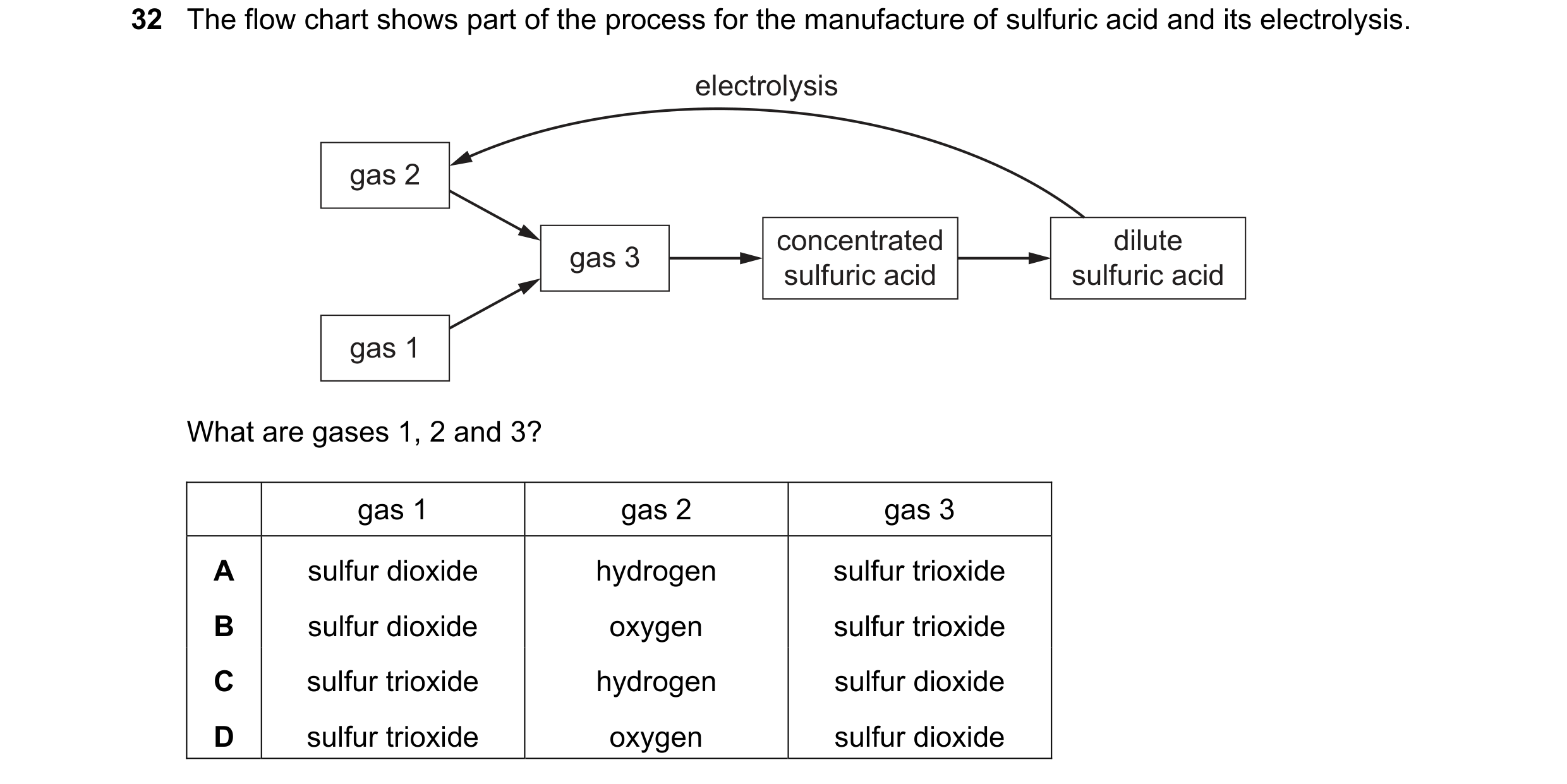
 8 / 13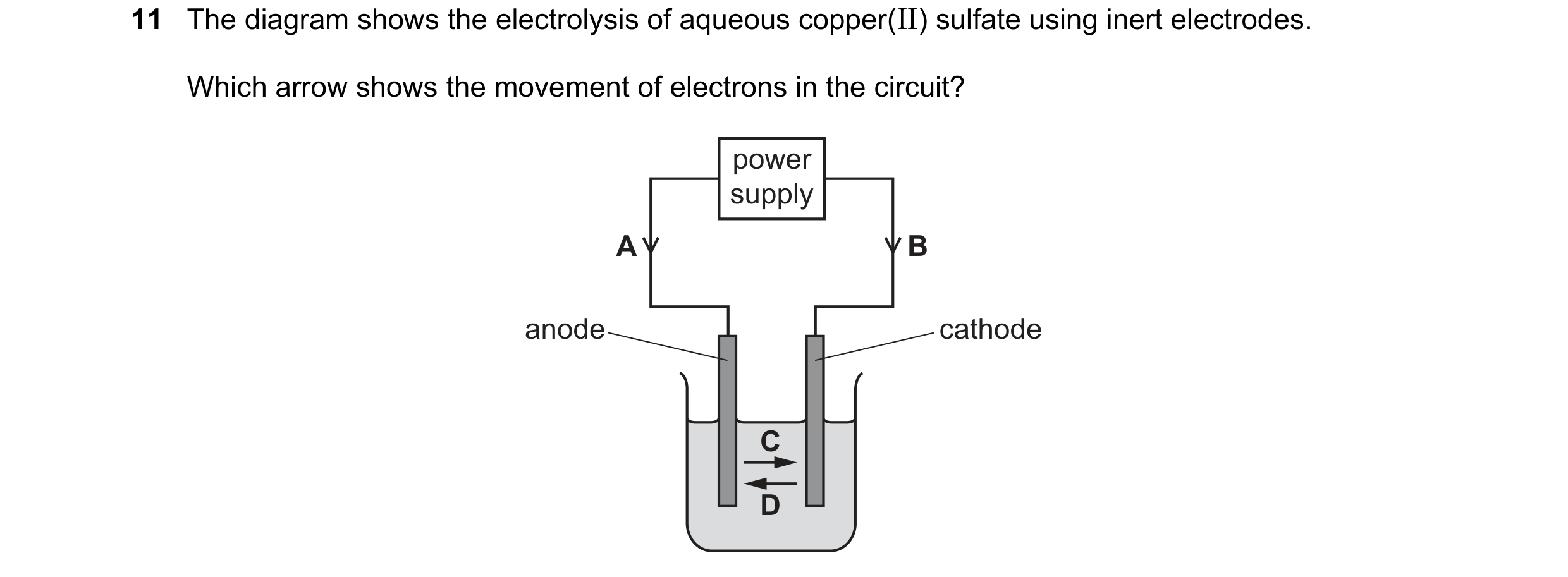
 9 / 13
 10 / 13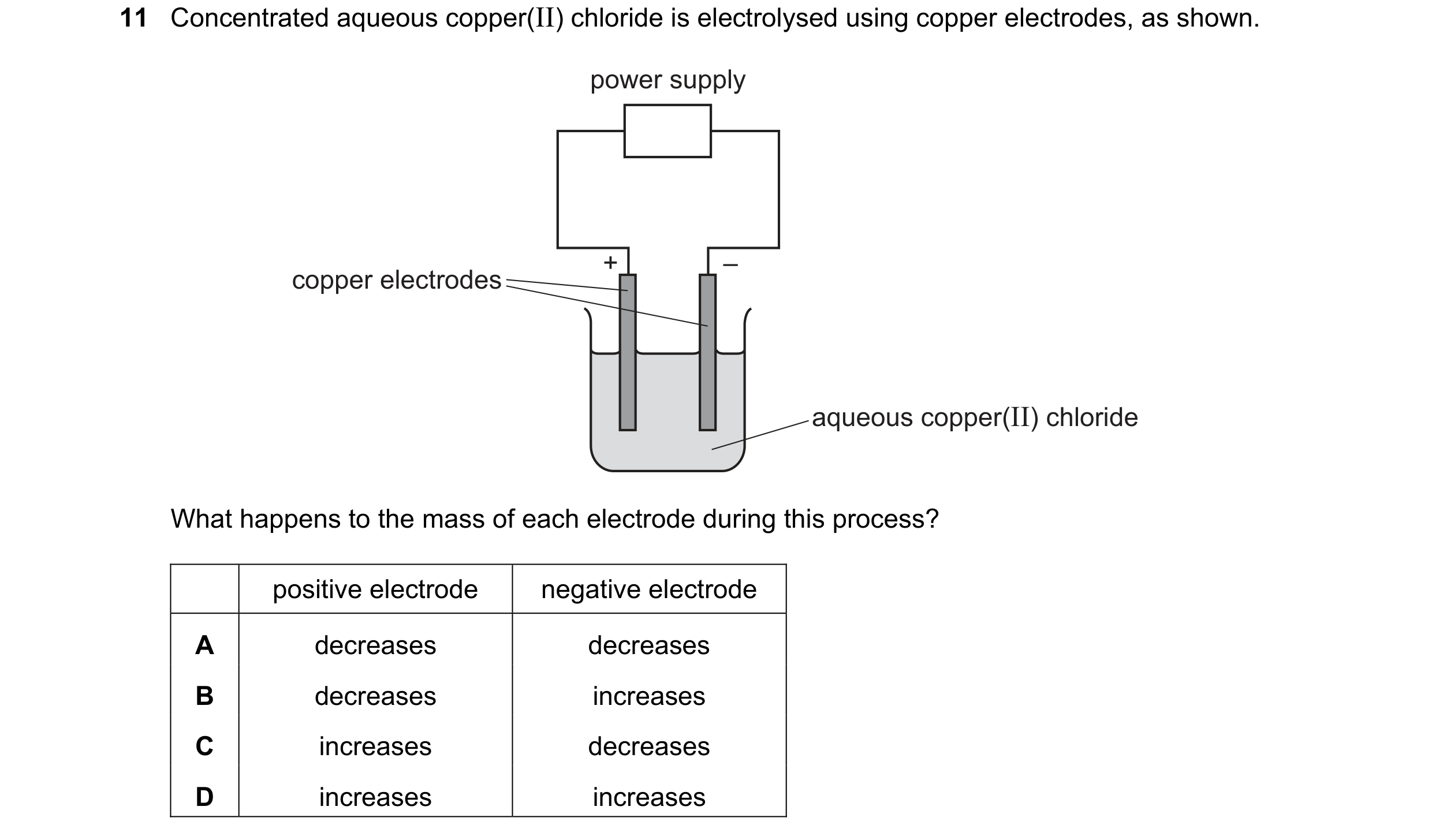
 11 / 13
 12 / 13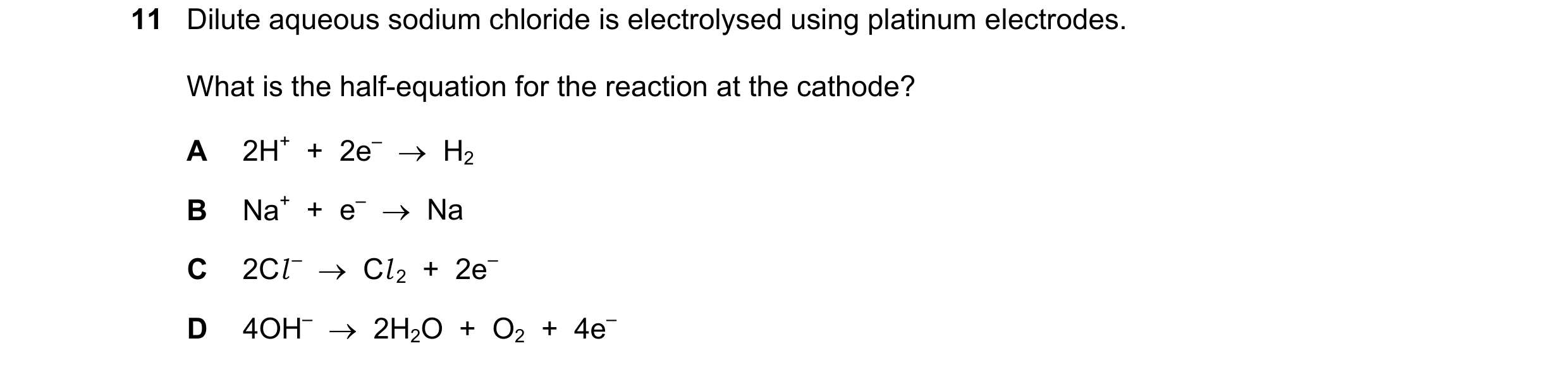
 13 / 13