Questions as text
Q1 · The ‘lead’ in a pencil is made of a mixture of graphite and clay 0971/11 May/June 2018
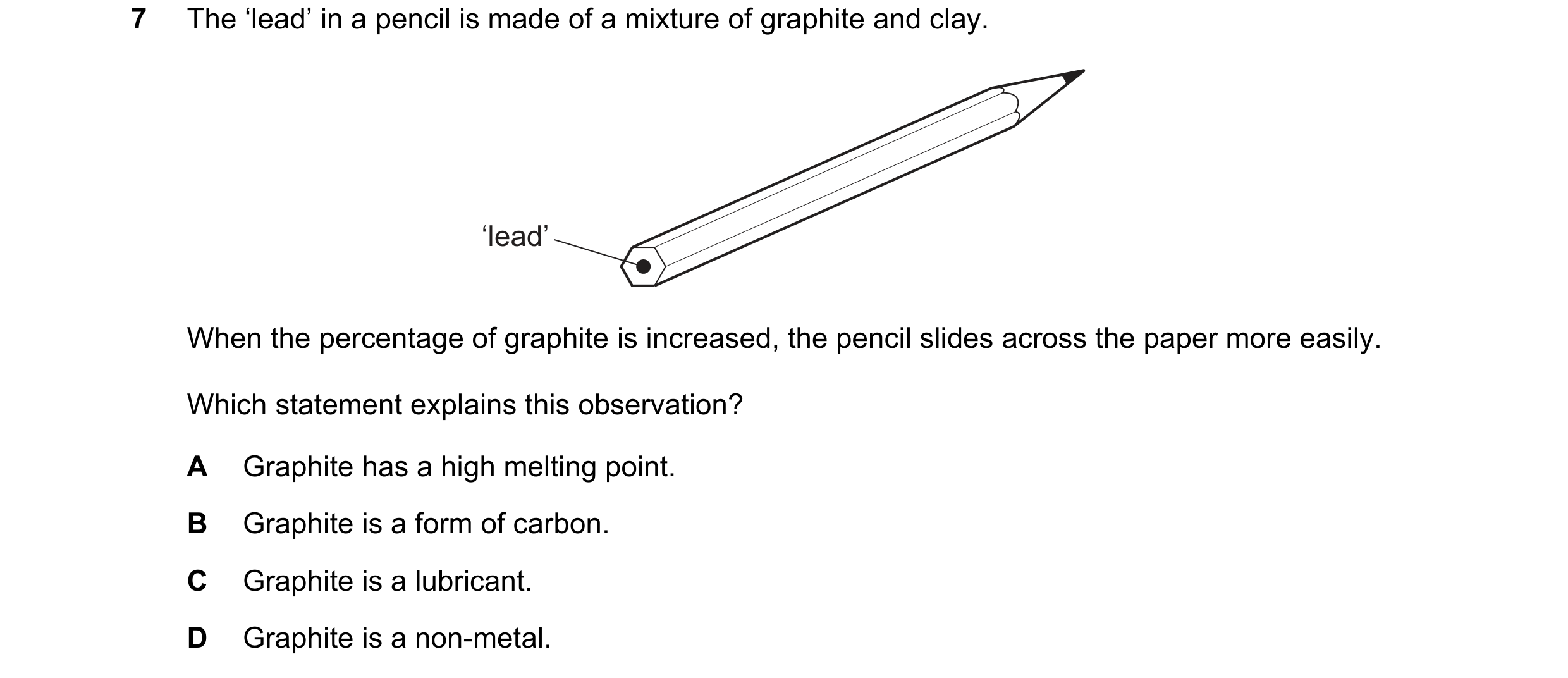
7 The ‘lead’ in a pencil is made of a mixture of graphite and clay. ‘lead’ When the percentage of graphite is increased, the pencil slides across the paper more easily. Which statement explains this observation? A Graphite has a high melting point. B Graphite is a form of carbon. C Graphite is a lubricant. D Graphite is a non-metal.
1 marks
Answer: C
This question in 0971/11 May/June 2018
Q2 · Diamond and graphite have giant covalent structures of carbon atoms 0971/11 May/June 2019
8 Diamond and graphite have giant covalent structures of carbon atoms. Which statement describes graphite? A It has a strong, rigid three-dimensional structure. B It has four strong covalent bonds between each carbon atom. C It has layers, which can slide over each other. D It has no free electrons, so does not conduct electricity.
1 marks
Answer: C
This question in 0971/11 May/June 2019
Q3 · Graphite is a form of carbon 0971/12 Oct/Nov 2019
8 Graphite is a form of carbon. Why can graphite be used as a lubricant? A Graphite contains unbonded electrons which move through the structure. B Graphite contains weak covalent bonds so the atoms move easily. C Graphite has a low melting point so it easily turns into a liquid. D Graphite has weak attractive forces between layers so they can move.
1 marks
Answer: D
This question in 0971/12 Oct/Nov 2019
Q4 · The structures of diamond and graphite are shown 0971/11 May/June 2020
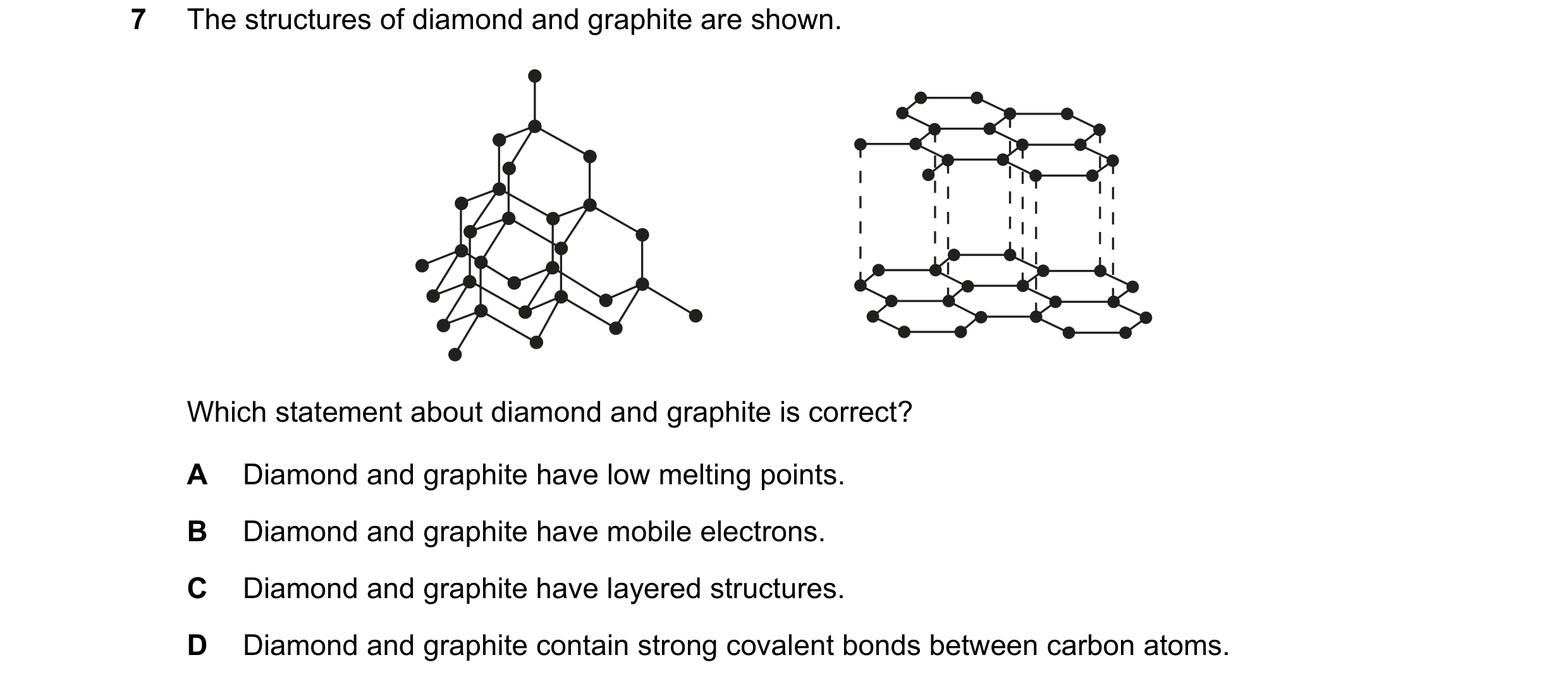
7 The structures of diamond and graphite are shown. Which statement about diamond and graphite is correct? A Diamond and graphite have low melting points. B Diamond and graphite have mobile electrons. C Diamond and graphite have layered structures. D Diamond and graphite contain strong covalent bonds between carbon atoms.
1 marks
Answer: D
This question in 0971/11 May/June 2020
Q5 · Graphite is a macromolecule 0971/12 May/June 2020
7 Graphite is a macromolecule. Which statements about graphite are correct? 1 Carbon atoms form four covalent bonds with neighbouring atoms. 2 There are free electrons between layers of carbon atoms. 3 Graphite is a useful lubricant. 4 Graphite is a good conductor of electricity. A 1 and 2 B 1, 3 and 4 C 2, 3 and 4 D 3 and 4 only
1 marks
Answer: C
This question in 0971/12 May/June 2020
Q6 · Which statement explains why graphite is used as a lubricant? 0971/12 Oct/Nov 2020
10 Which statement explains why graphite is used as a lubricant? A All bonds between the atoms are weak. B It conducts electricity. C It has a low melting point. D Layers in the structure can slide over each other.
1 marks
Answer: D
This question in 0971/12 Oct/Nov 2020
Q7 · Which substance is described as a macromolecule? 0971/12 Oct/Nov 2021
8 Which substance is described as a macromolecule? A ammonia B graphite C iron D sodium chloride
1 marks
Answer: B
This question in 0971/12 Oct/Nov 2021
Q8 · Which statement explains why graphite can be used as a lubricant? 0971/12 May/June 2022
8 Which statement explains why graphite can be used as a lubricant? A All of the atoms in graphite are carbon. B Each carbon atom forms three bonds. C Graphite has a macromolecular structure. D The layers in graphite can slide over each other.
1 marks
Answer: D
This question in 0971/12 May/June 2022
Q9 · Which statement explains why diamond is used in cutting tools? 0971/12 Oct/Nov 2022
7 Which statement explains why diamond is used in cutting tools? A It has no free electrons. B It has a high melting point. C It is colourless. D It is hard.
1 marks
Answer: D
This question in 0971/12 Oct/Nov 2022
Q10 · Which substance has a giant covalent structure? 0971/12 May/June 2023
6 Which substance has a giant covalent structure? A ethanol B graphite C methane D sodium chloride
1 marks
Answer: B
This question in 0971/12 May/June 2023
Q11 · Different forms of an element G are used as lubricants and in cutting tools 0971/12 Oct/Nov 2023
7 Different forms of an element G are used as lubricants and in cutting tools. What is the structure of G? A giant covalent B ionic C metallic D simple covalent
1 marks
Answer: A
This question in 0971/12 Oct/Nov 2023
Q12 · Which substance has a giant covalent structure? 0971/11 May/June 2024
7 Which substance has a giant covalent structure? A sodium chloride B sodium C ethane D diamond
1 marks
Answer: D
This question in 0971/11 May/June 2024
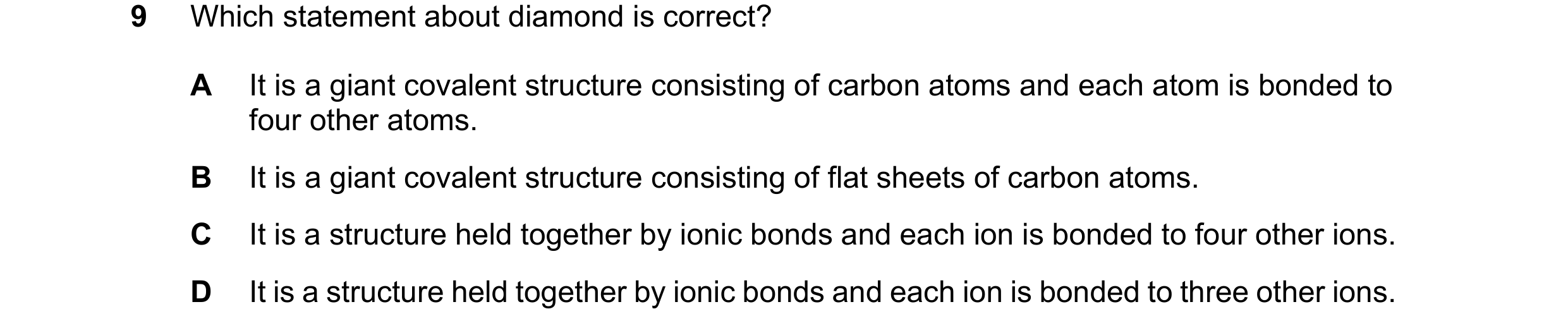
Q13 · Which statement about diamond is correct? 0971/12 May/June 2024
9 Which statement about diamond is correct? A It is a giant covalent structure consisting of carbon atoms and each atom is bonded to four other atoms. B It is a giant covalent structure consisting of flat sheets of carbon atoms. C It is a structure held together by ionic bonds and each ion is bonded to four other ions. D It is a structure held together by ionic bonds and each ion is bonded to three other ions.
1 marks
Answer: A
This question in 0971/12 May/June 2024
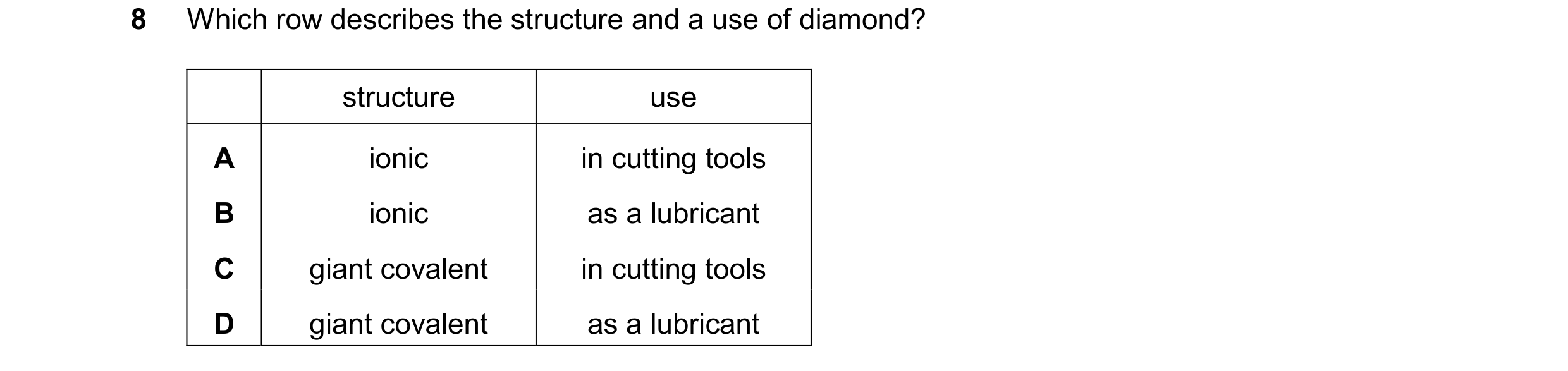
Q14 · Which row describes the structure and a use of diamond? 0971/12 Oct/Nov 2024
8 Which row describes the structure and a use of diamond? structure use A ionic in cutting tools B ionic as a lubricant C giant covalent in cutting tools D giant covalent as a lubricant
1 marks
Answer: C
This question in 0971/12 Oct/Nov 2024
Q15 · Which substance has a giant covalent structure at room temperature and pressure? 0971/11 May/June 2025
8 Which substance has a giant covalent structure at room temperature and pressure? A ammonia B carbon dioxide C diamond D water
1 marks
Answer: C
This question in 0971/11 May/June 2025
Q16 · Which substance has a giant covalent structure? 0971/12 May/June 2025
9 Which substance has a giant covalent structure? A sodium chloride B ammonia C magnesium chloride D graphite
1 marks
Answer: D
This question in 0971/12 May/June 2025
Q17 · Diamond is extremely hard and does not conduct electricity 0971/12 Oct/Nov 2025
9 Diamond is extremely hard and does not conduct electricity. Which statement explains these properties? A It has positive carbon ions surrounded by delocalised electrons. B It has strong ionic bonds between each carbon atom. C It has delocalised electrons, and each carbon atom forms three covalent bonds with other carbon atoms. D It has no delocalised electrons, and each carbon atom forms four covalent bonds with other carbon atoms.
1 marks
Answer: D
This question in 0971/12 Oct/Nov 2025
 1 / 4
1 / 4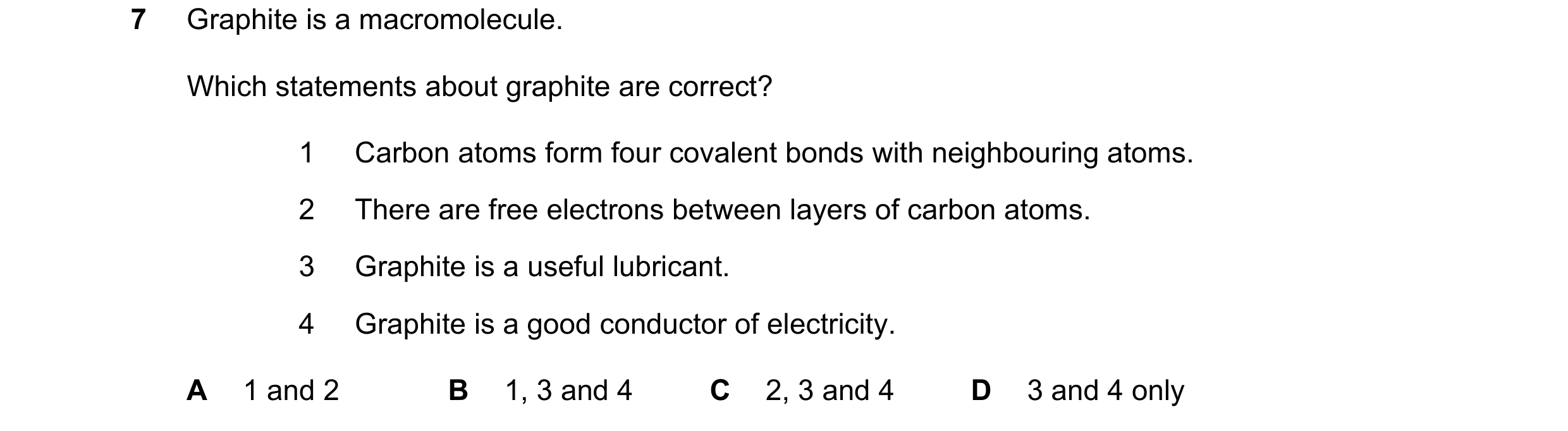




 2 / 4
2 / 4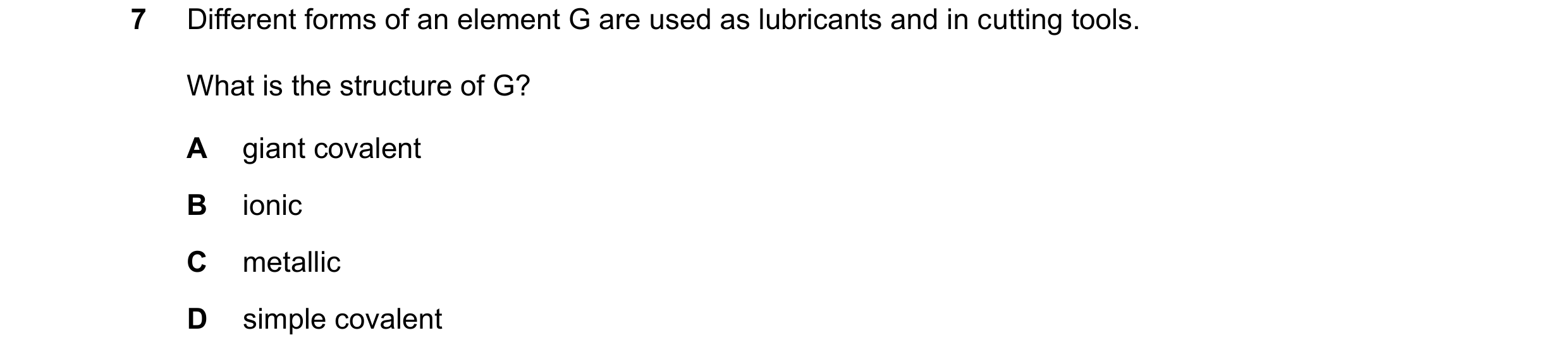


 3 / 4
3 / 4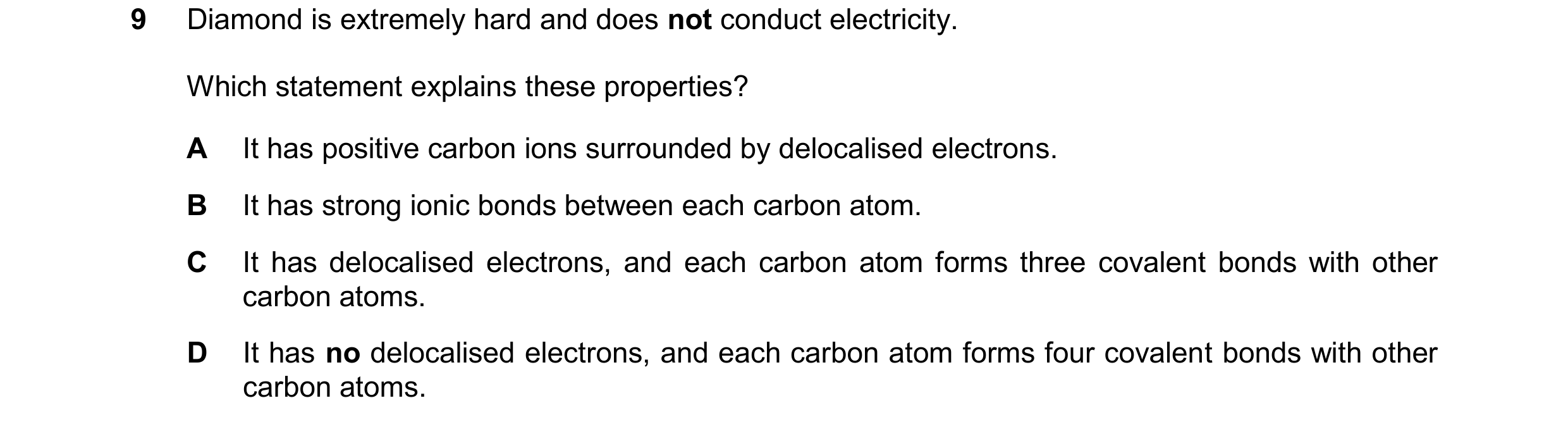 4 / 4
4 / 4