Questions as text
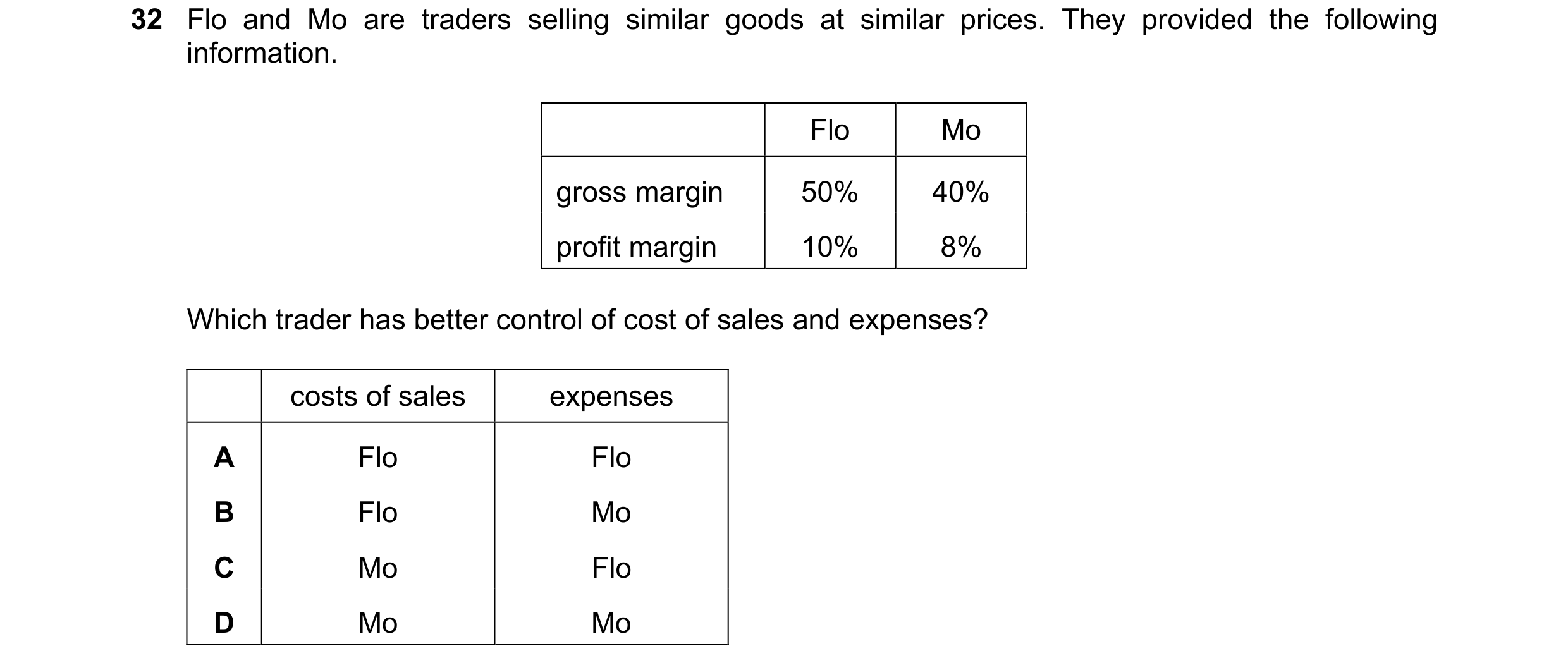
Q1 · Flo and Mo are traders selling similar goods at similar prices 0452/12 Feb/March 2020
32 Flo and Mo are traders selling similar goods at similar prices. They provided the following information. Flo Mo gross margin 50% 40% profit margin 10% 8% Which trader has better control of cost of sales and expenses? costs of sales expenses A Flo Flo B Flo Mo C Mo Flo D Mo Mo
1 marks
Answer: B
This question in 0452/12 Feb/March 2020
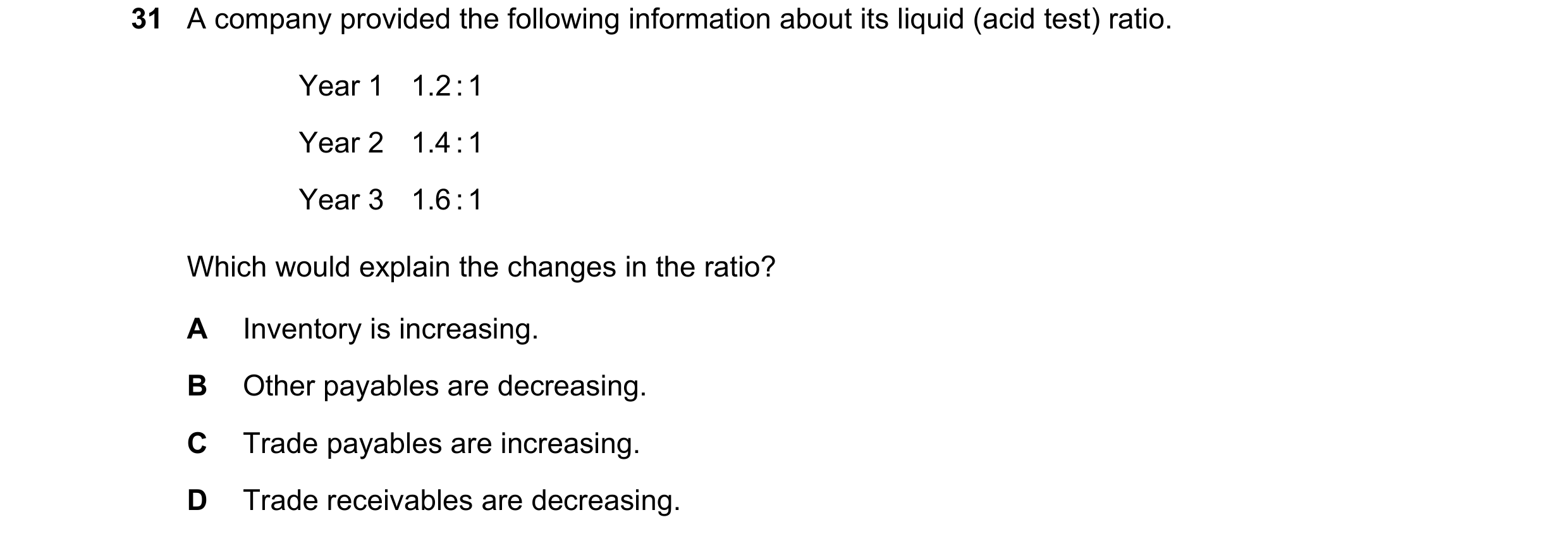
Q2 · A company provided the following information about its liquid (acid test) ratio 0452/11 May/June 2020
31 A company provided the following information about its liquid (acid test) ratio. Year 1 1.2 : 1 Year 2 1.4 : 1 Year 3 1.6 : 1 Which would explain the changes in the ratio? A Inventory is increasing. B Other payables are decreasing. C Trade payables are increasing. D Trade receivables are decreasing.
1 marks
Answer: B
This question in 0452/11 May/June 2020
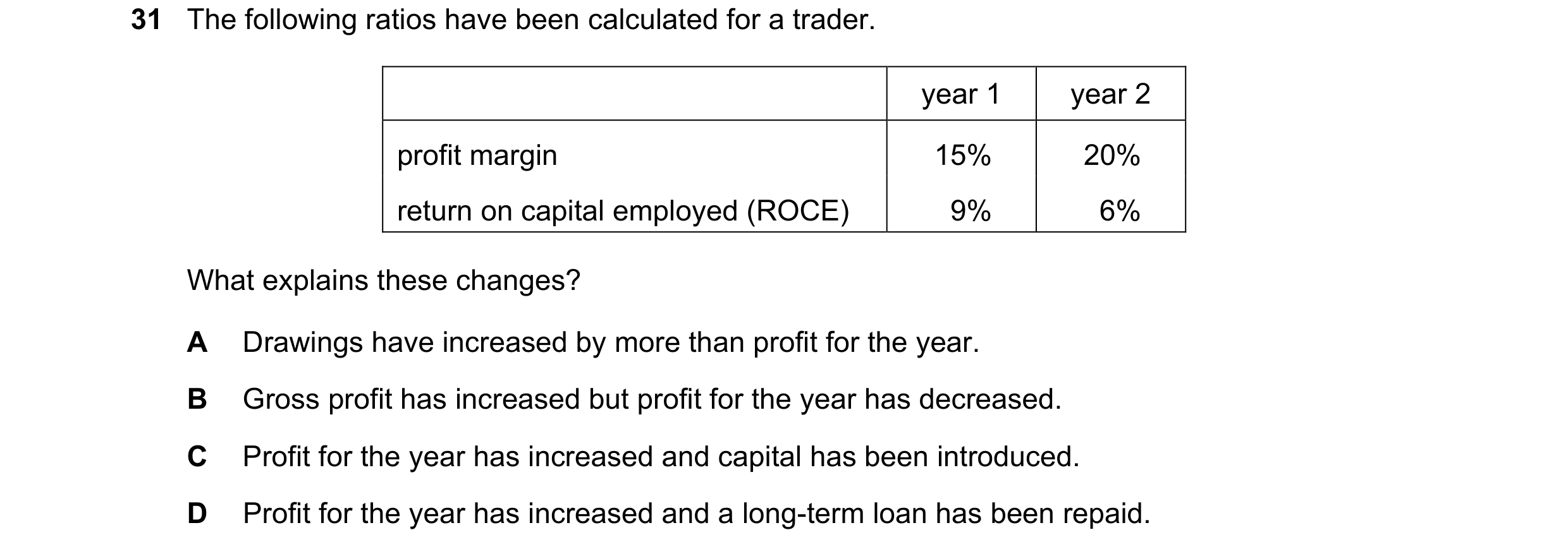
Q3 · The following ratios have been calculated for a trader 0452/12 May/June 2020
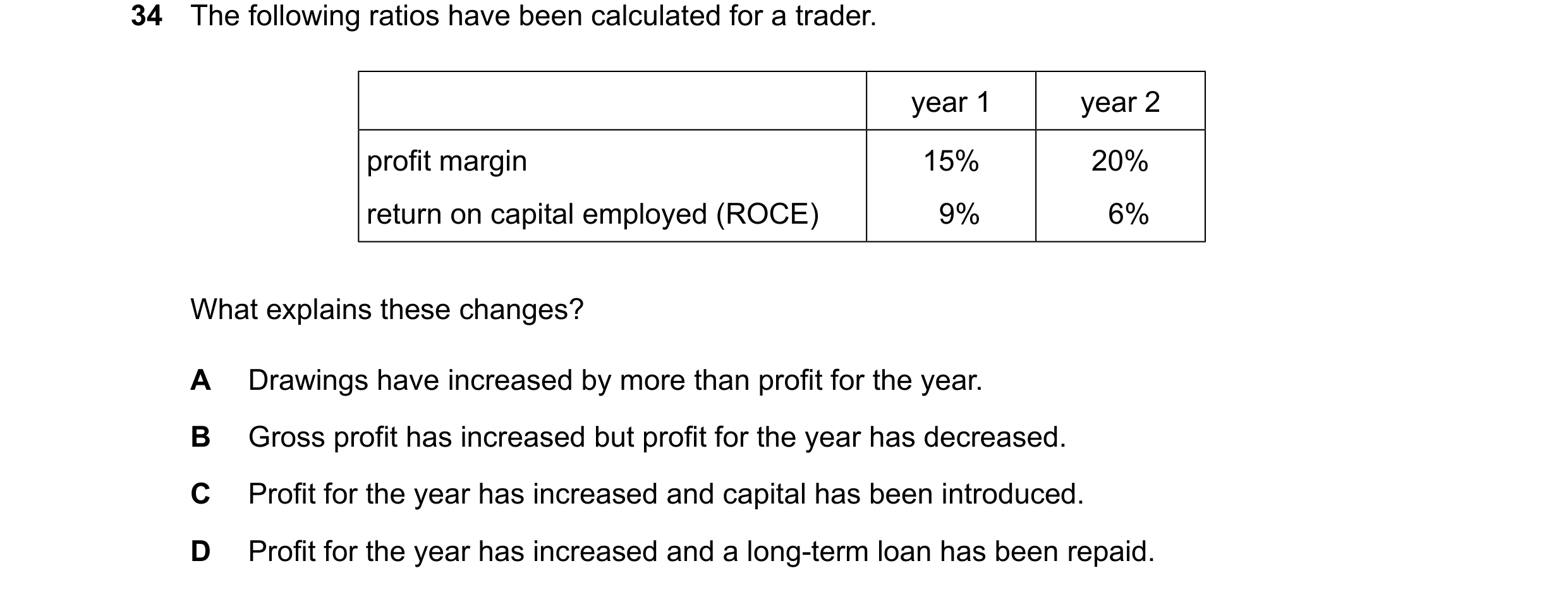
31 The following ratios have been calculated for a trader. year 1 year 2 profit margin 15% 20% return on capital employed (ROCE) 9% 6% What explains these changes? A Drawings have increased by more than profit for the year. B Gross profit has increased but profit for the year has decreased. C Profit for the year has increased and capital has been introduced. D Profit for the year has increased and a long-term loan has been repaid.
1 marks
Answer: C
This question in 0452/12 May/June 2020
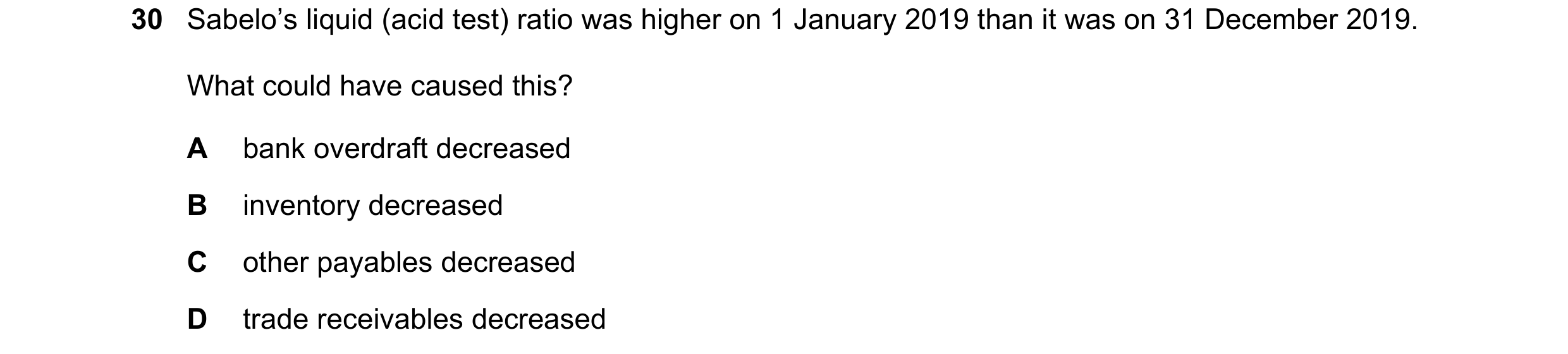
Q4 · Sabelo’s liquid (acid test) ratio was higher on 1 January 2019 than it was on 31 December… 0452/13 May/June 2020
30 Sabelo’s liquid (acid test) ratio was higher on 1 January 2019 than it was on 31 December 2019. What could have caused this? A bank overdraft decreased B inventory decreased C other payables decreased D trade receivables decreased
1 marks
Answer: D
This question in 0452/13 May/June 2020
Q5 · The following ratios have been calculated for a trader 0452/13 May/June 2020
31 The following ratios have been calculated for a trader. year 1 year 2 profit margin 15% 20% return on capital employed (ROCE) 9% 6% What explains these changes? A Drawings have increased by more than profit for the year. B Gross profit has increased but profit for the year has decreased. C Profit for the year has increased and capital has been introduced. D Profit for the year has increased and a long-term loan has been repaid.
1 marks
Answer: C
This question in 0452/13 May/June 2020
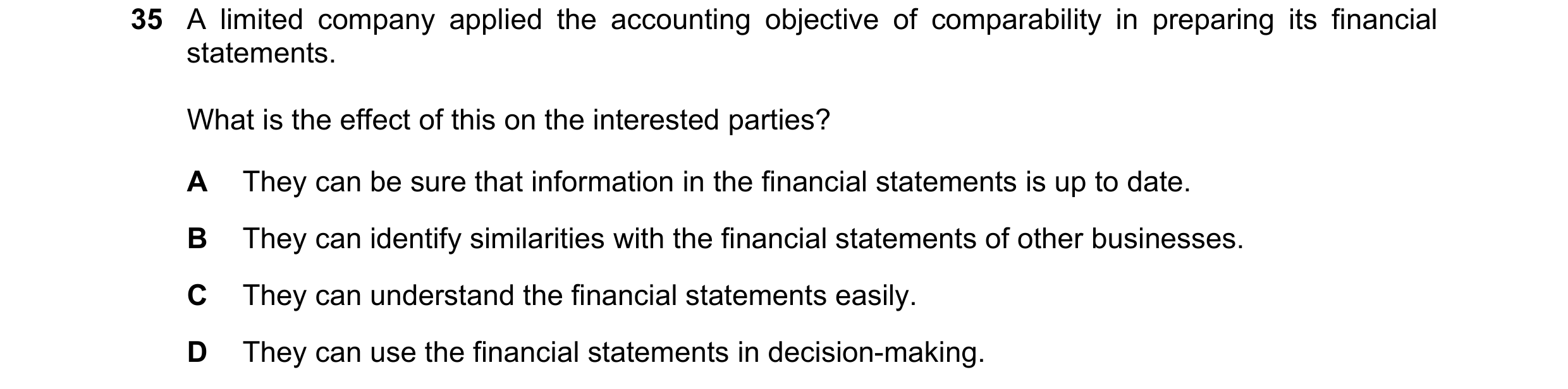
Q6 · A limited company applied the accounting objective of comparability in preparing its… 0452/13 May/June 2020
35 A limited company applied the accounting objective of comparability in preparing its financial statements. What is the effect of this on the interested parties? A They can be sure that information in the financial statements is up to date. B They can identify similarities with the financial statements of other businesses. C They can understand the financial statements easily. D They can use the financial statements in decision-making.
1 marks
Answer: B
This question in 0452/13 May/June 2020
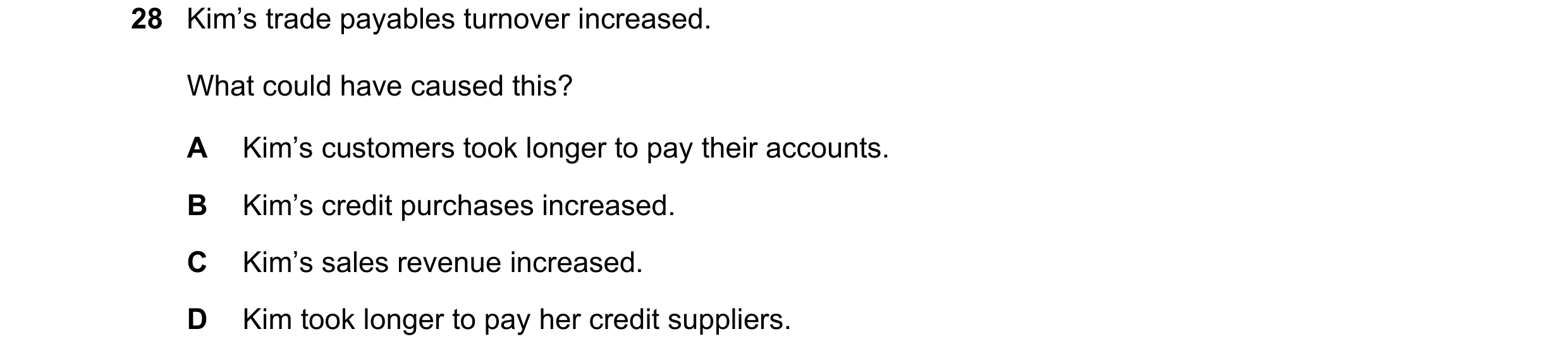
Q7 · Kim’s trade payables turnover increased 0452/11 Oct/Nov 2020
28 Kim’s trade payables turnover increased. What could have caused this? A Kim’s customers took longer to pay their accounts. B Kim’s credit purchases increased. C Kim’s sales revenue increased. D Kim took longer to pay her credit suppliers.
1 marks
Answer: D
This question in 0452/11 Oct/Nov 2020
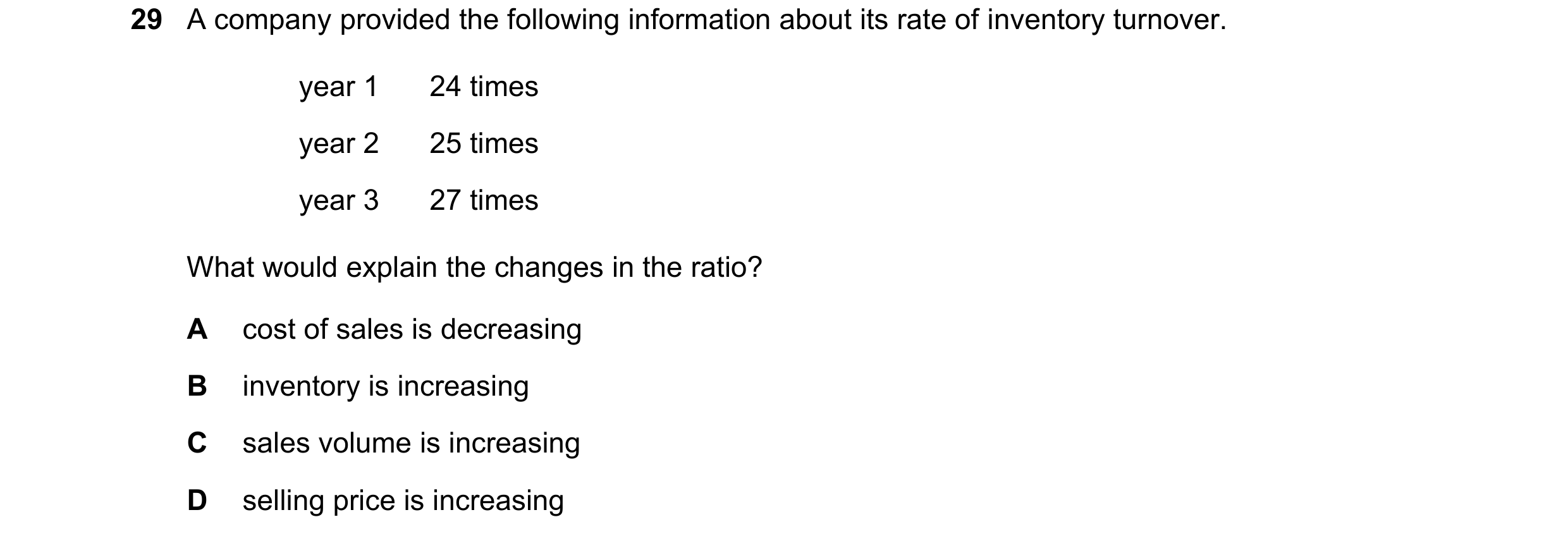
Q8 · A company provided the following information about its rate of inventory turnover 0452/11 Oct/Nov 2020
29 A company provided the following information about its rate of inventory turnover. year 1 24 times year 2 25 times year 3 27 times What would explain the changes in the ratio? A cost of sales is decreasing B inventory is increasing C sales volume is increasing D selling price is increasing
1 marks
Answer: C
This question in 0452/11 Oct/Nov 2020
Q9 · A company provided the following information about its current ratio 0452/11 Oct/Nov 2020
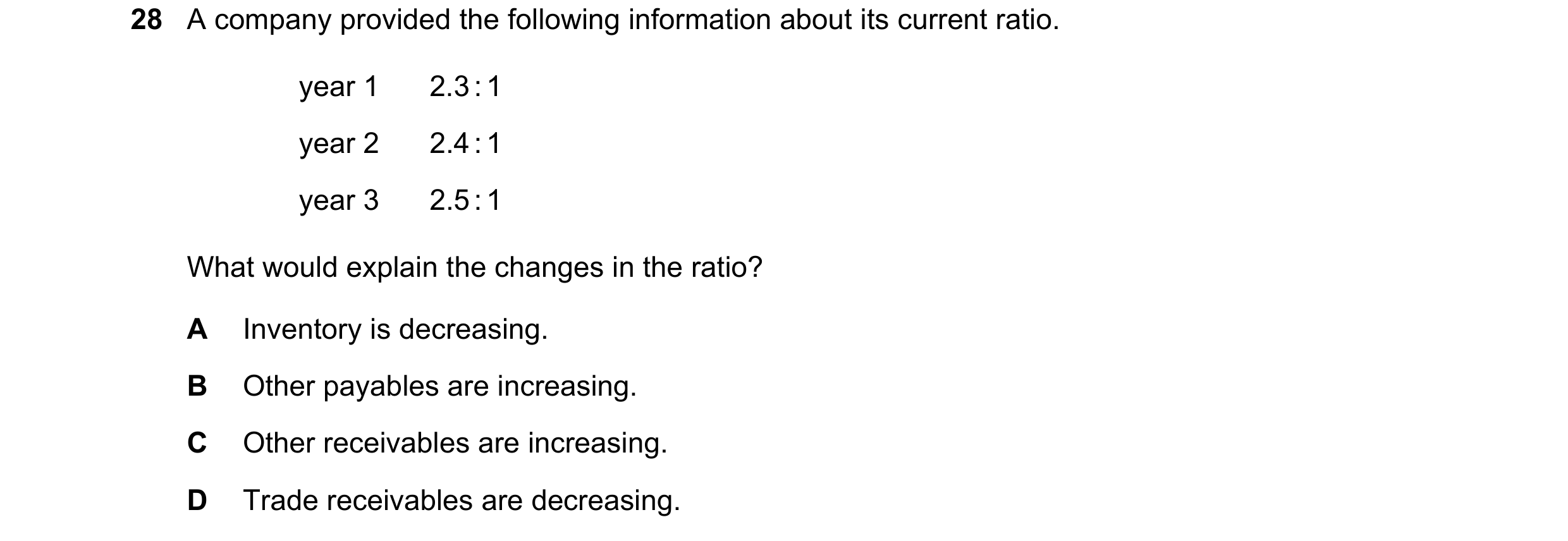
30 A company provided the following information about its current ratio. year 1 2.3 : 1 year 2 2.4 : 1 year 3 2.5 : 1 What would explain the changes in the ratio? A Inventory is decreasing. B Other payables are increasing. C Other receivables are increasing. D Trade receivables are decreasing.
1 marks
Answer: C
This question in 0452/11 Oct/Nov 2020
Q10 · A trader wants to improve his gross margin 0452/11 Oct/Nov 2020
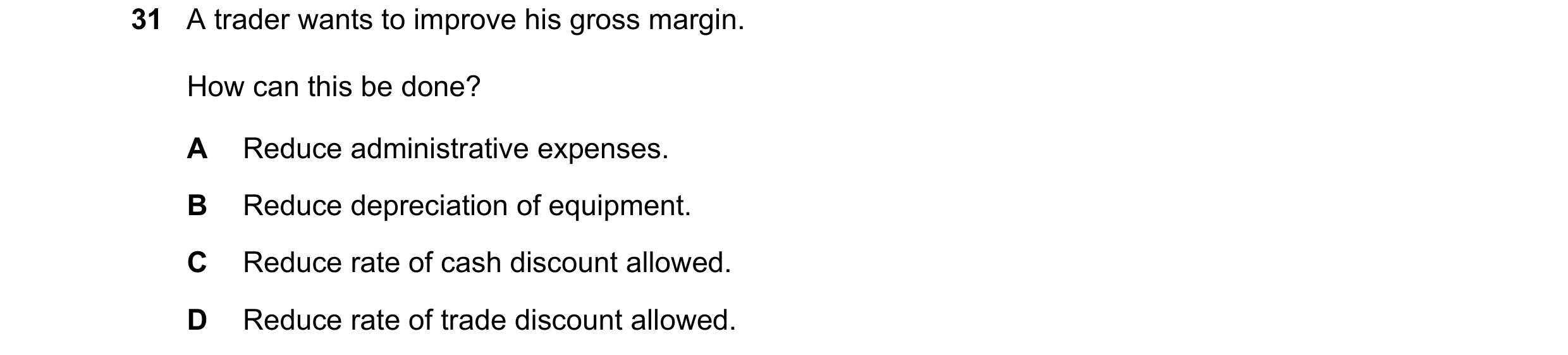
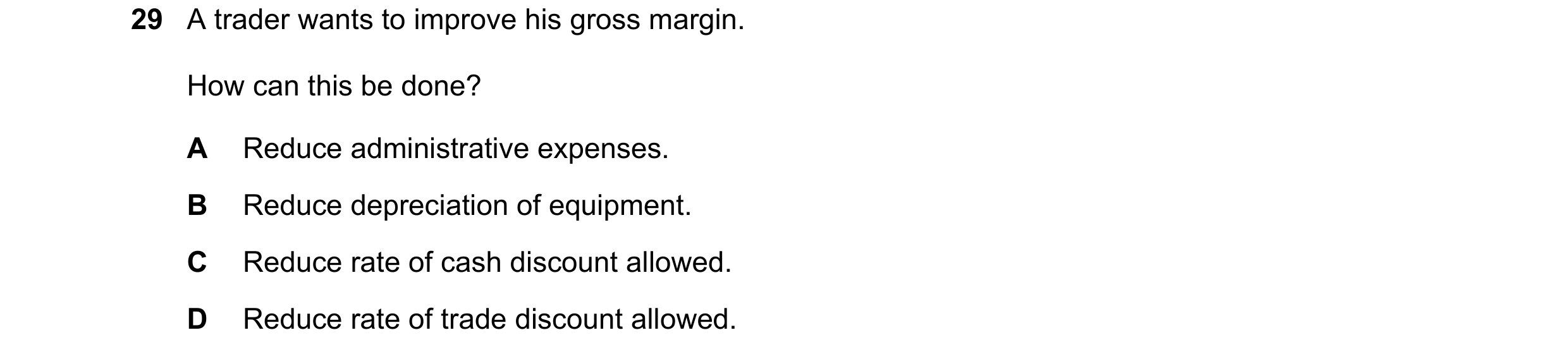
31 A trader wants to improve his gross margin. How can this be done? A Reduce administrative expenses. B Reduce depreciation of equipment. C Reduce rate of cash discount allowed. D Reduce rate of trade discount allowed.
1 marks
Answer: D
This question in 0452/11 Oct/Nov 2020
Q11 · A company provided the following information about its current ratio 0452/12 Oct/Nov 2020
28 A company provided the following information about its current ratio. year 1 2.3 : 1 year 2 2.4 : 1 year 3 2.5 : 1 What would explain the changes in the ratio? A Inventory is decreasing. B Other payables are increasing. C Other receivables are increasing. D Trade receivables are decreasing.
1 marks
Answer: C
This question in 0452/12 Oct/Nov 2020
Q12 · A trader wants to improve his gross margin 0452/12 Oct/Nov 2020
29 A trader wants to improve his gross margin. How can this be done? A Reduce administrative expenses. B Reduce depreciation of equipment. C Reduce rate of cash discount allowed. D Reduce rate of trade discount allowed.
1 marks
Answer: D
This question in 0452/12 Oct/Nov 2020
Q13 · AB Limited and CD Limited both started business on 1 January 2019 with an ordinary share… 0452/12 Oct/Nov 2020
31 AB Limited and CD Limited both started business on 1 January 2019 with an ordinary share capital of $100 000. Neither company had any debentures or loans. Both companies had the same profit in 2019. Only AB Limited paid a dividend. The return on capital employed (ROCE) was calculated using closing capital employed. Which statement about AB Limited’s ROCE is correct when compared to that of CD Limited? A It is higher because the dividend reduced retained earnings. B It is lower because the dividend reduced capital employed. C It is lower because the dividend reduced the profit for the year. D It is the same as that of CD Limited.
1 marks
Answer: A
This question in 0452/12 Oct/Nov 2020
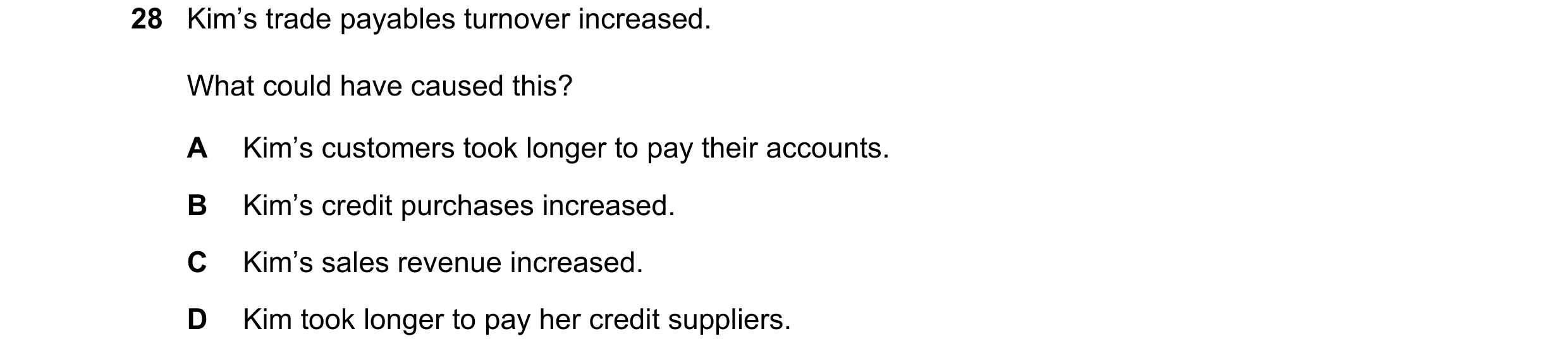
Q14 · Kim’s trade payables turnover increased 0452/13 Oct/Nov 2020
28 Kim’s trade payables turnover increased. What could have caused this? A Kim’s customers took longer to pay their accounts. B Kim’s credit purchases increased. C Kim’s sales revenue increased. D Kim took longer to pay her credit suppliers.
1 marks
Answer: D
This question in 0452/13 Oct/Nov 2020
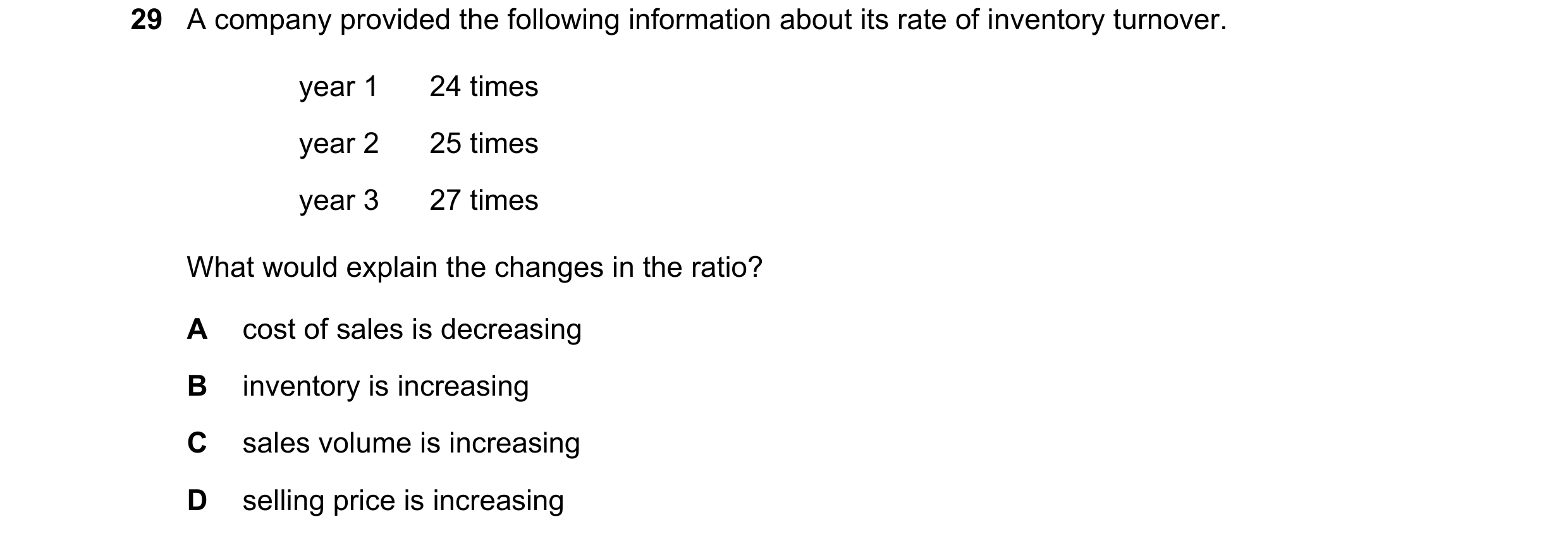
Q15 · A company provided the following information about its rate of inventory turnover 0452/13 Oct/Nov 2020
29 A company provided the following information about its rate of inventory turnover. year 1 24 times year 2 25 times year 3 27 times What would explain the changes in the ratio? A cost of sales is decreasing B inventory is increasing C sales volume is increasing D selling price is increasing
1 marks
Answer: C
This question in 0452/13 Oct/Nov 2020
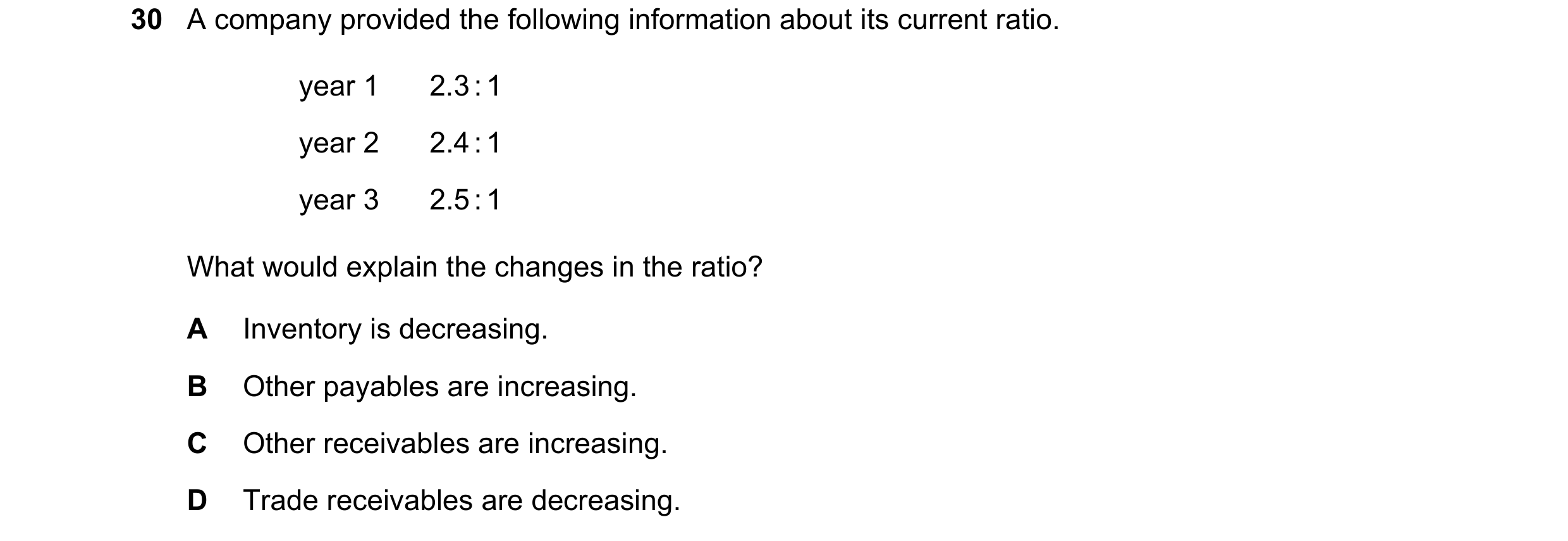
Q16 · A company provided the following information about its current ratio 0452/13 Oct/Nov 2020
30 A company provided the following information about its current ratio. year 1 2.3 : 1 year 2 2.4 : 1 year 3 2.5 : 1 What would explain the changes in the ratio? A Inventory is decreasing. B Other payables are increasing. C Other receivables are increasing. D Trade receivables are decreasing.
1 marks
Answer: C
This question in 0452/13 Oct/Nov 2020
Q17 · A trader wants to improve his gross margin 0452/13 Oct/Nov 2020
31 A trader wants to improve his gross margin. How can this be done? A Reduce administrative expenses. B Reduce depreciation of equipment. C Reduce rate of cash discount allowed. D Reduce rate of trade discount allowed.
1 marks
Answer: D
This question in 0452/13 Oct/Nov 2020
Q18 · Which action will improve the gross margin? 0452/12 Feb/March 2021
33 Which action will improve the gross margin? A increasing expenses B increasing selling price C reducing expenses D reducing selling price
1 marks
Answer: B
This question in 0452/12 Feb/March 2021
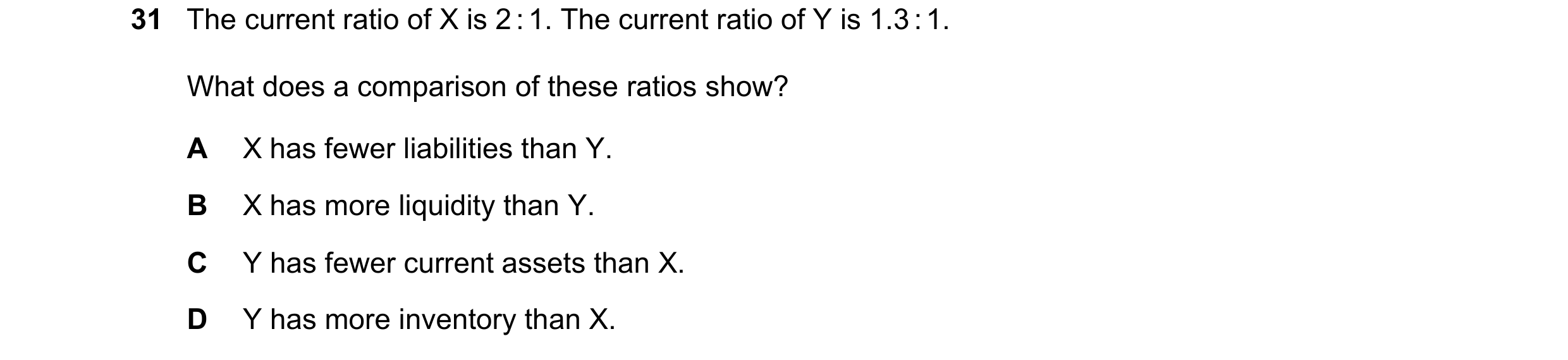
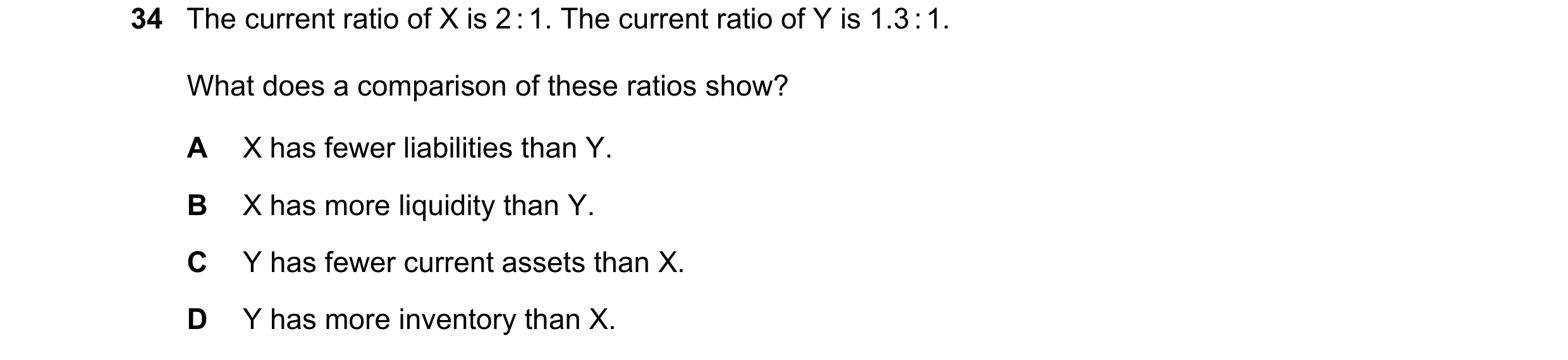
Q19 · The current ratio of X is 2 : 1 0452/11 May/June 2021
31 The current ratio of X is 2 : 1. The current ratio of Y is 1.3 : 1. What does a comparison of these ratios show? A X has fewer liabilities than Y. B X has more liquidity than Y. C Y has fewer current assets than X. D Y has more inventory than X.
1 marks
Answer: B
This question in 0452/11 May/June 2021
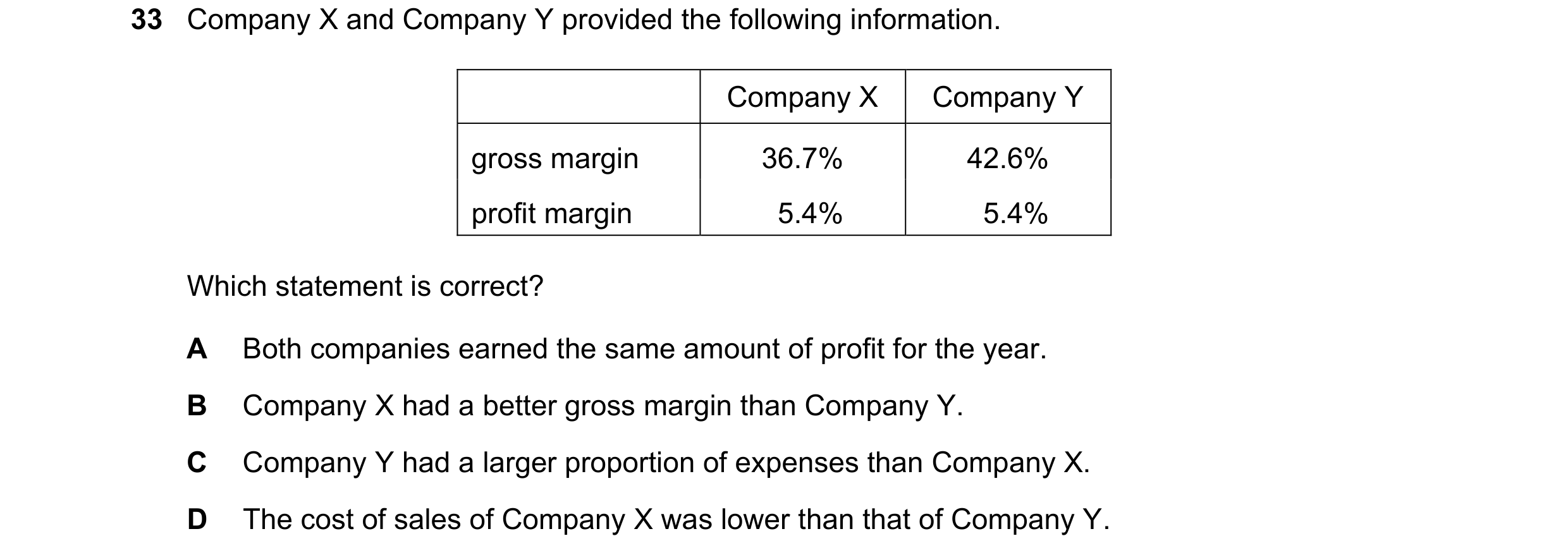
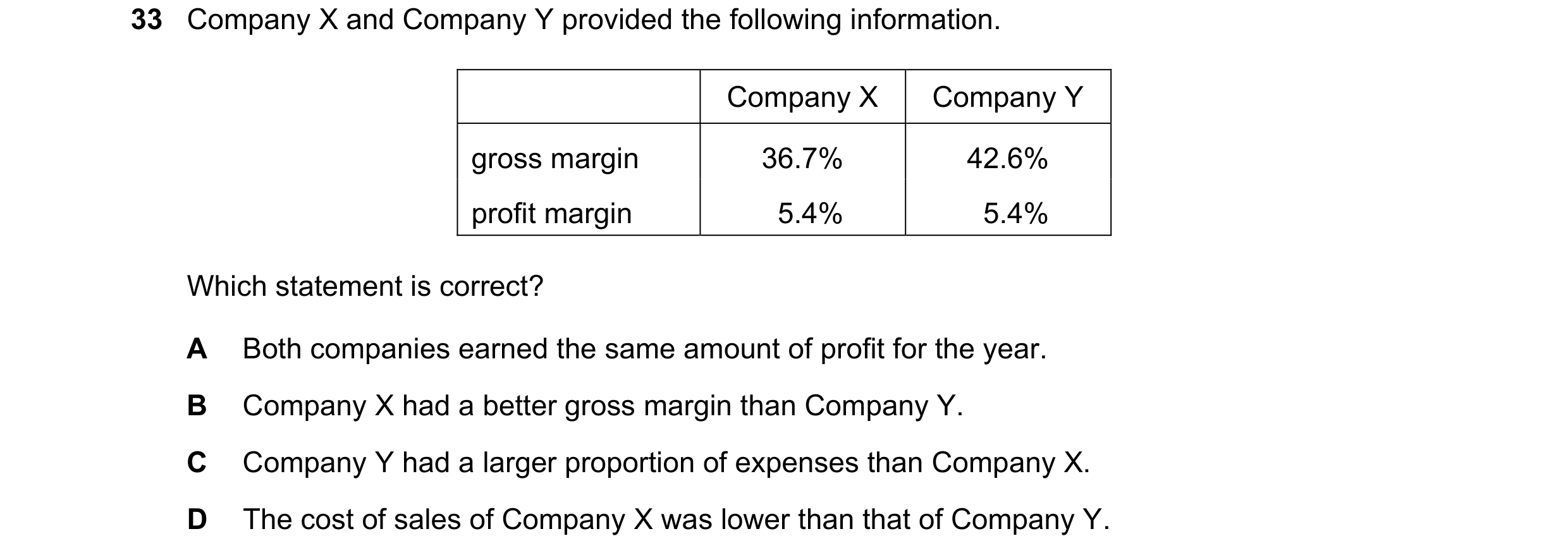
Q20 · Company X and Company Y provided the following information 0452/12 May/June 2021
33 Company X and Company Y provided the following information. Company X Company Y gross margin 36.7% 42.6% profit margin 5.4% 5.4% Which statement is correct? A Both companies earned the same amount of profit for the year. B Company X had a better gross margin than Company Y. C Company Y had a larger proportion of expenses than Company X. D The cost of sales of Company X was lower than that of Company Y.
1 marks
Answer: C
This question in 0452/12 May/June 2021
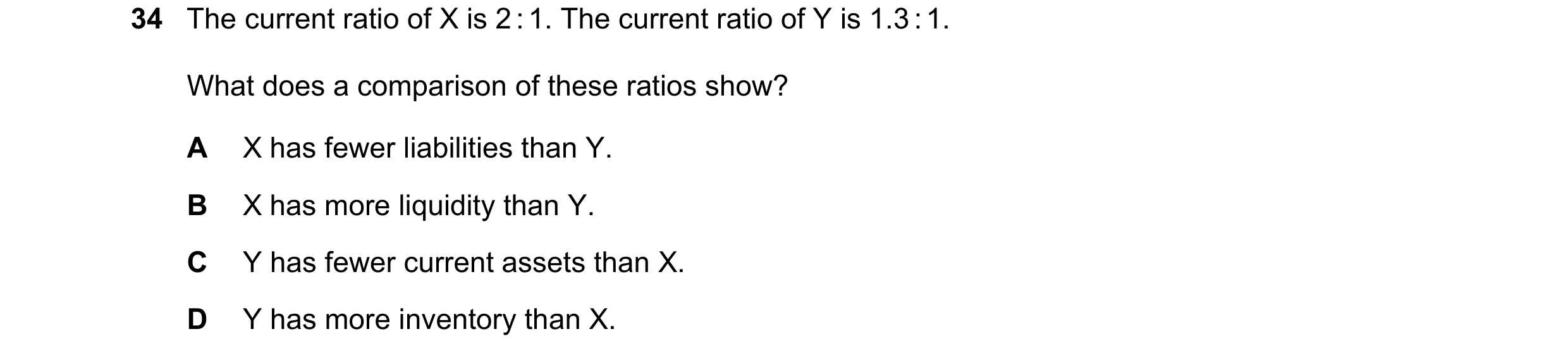
Q21 · The current ratio of X is 2 : 1 0452/12 May/June 2021
34 The current ratio of X is 2 : 1. The current ratio of Y is 1.3 : 1. What does a comparison of these ratios show? A X has fewer liabilities than Y. B X has more liquidity than Y. C Y has fewer current assets than X. D Y has more inventory than X.
1 marks
Answer: B
This question in 0452/12 May/June 2021
Q22 · Sally’s business has reached the overdraft limit set by the bank of $1500 and is not able… 0452/13 May/June 2021
32 Sally’s business has reached the overdraft limit set by the bank of $1500 and is not able to pay its debts when they fall due. Sally is considering the following proposals. 1 asking the bank to increase the bank overdraft limit to $2000 2 borrowing $2000 from a relative and paying the money back in six months 3 obtaining a loan from the bank of $2000 repayable in two years 4 paying $2000 from Sally’s personal bank account into the business bank account Which proposals will improve the working capital of the business? A 1 and 2 B 1 and 4 C 2 and 3 D 3 and 4
1 marks
Answer: D
This question in 0452/13 May/June 2021
Q23 · Company X and Company Y provided the following information 0452/13 May/June 2021
33 Company X and Company Y provided the following information. Company X Company Y gross margin 36.7% 42.6% profit margin 5.4% 5.4% Which statement is correct? A Both companies earned the same amount of profit for the year. B Company X had a better gross margin than Company Y. C Company Y had a larger proportion of expenses than Company X. D The cost of sales of Company X was lower than that of Company Y.
1 marks
Answer: C
This question in 0452/13 May/June 2021
Q24 · The current ratio of X is 2 : 1 0452/13 May/June 2021
34 The current ratio of X is 2 : 1. The current ratio of Y is 1.3 : 1. What does a comparison of these ratios show? A X has fewer liabilities than Y. B X has more liquidity than Y. C Y has fewer current assets than X. D Y has more inventory than X.
1 marks
Answer: B
This question in 0452/13 May/June 2021
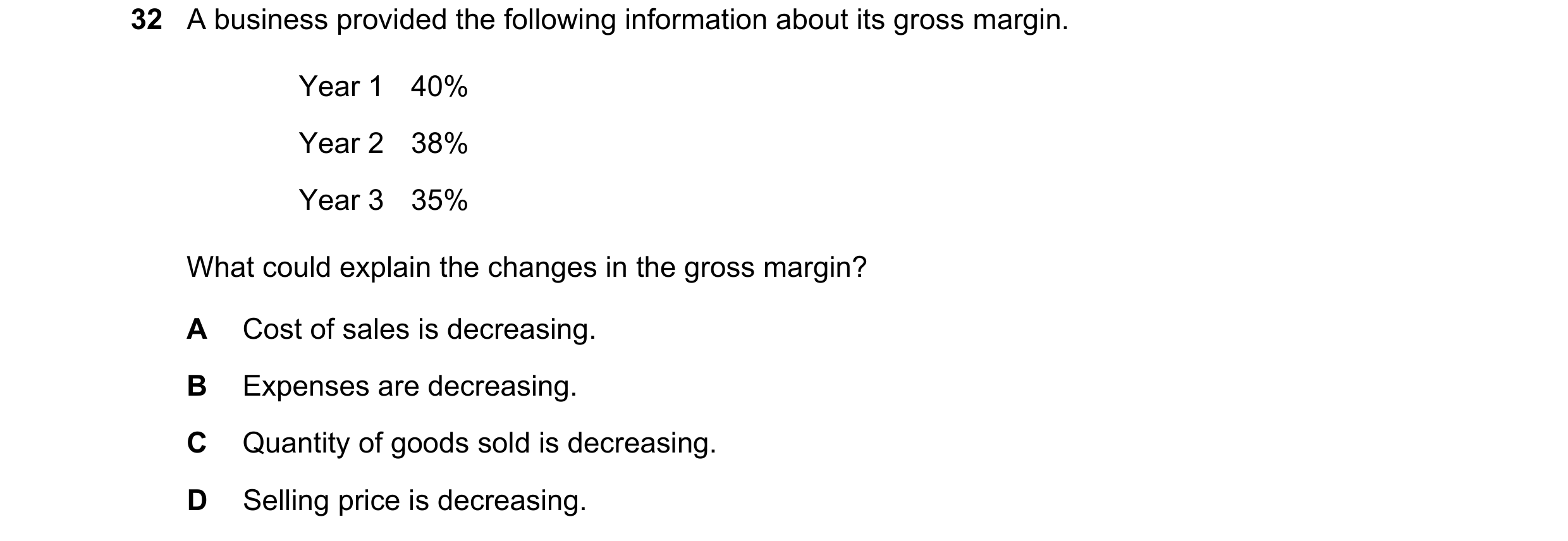
Q25 · A business provided the following information about its gross margin 0452/11 Oct/Nov 2021
32 A business provided the following information about its gross margin. Year 1 40% Year 2 38% Year 3 35% What could explain the changes in the gross margin? A Cost of sales is decreasing. B Expenses are decreasing. C Quantity of goods sold is decreasing. D Selling price is decreasing.
1 marks
Answer: D
This question in 0452/11 Oct/Nov 2021
Q26 · A business provided the following information about its gross margin 0452/12 Oct/Nov 2021
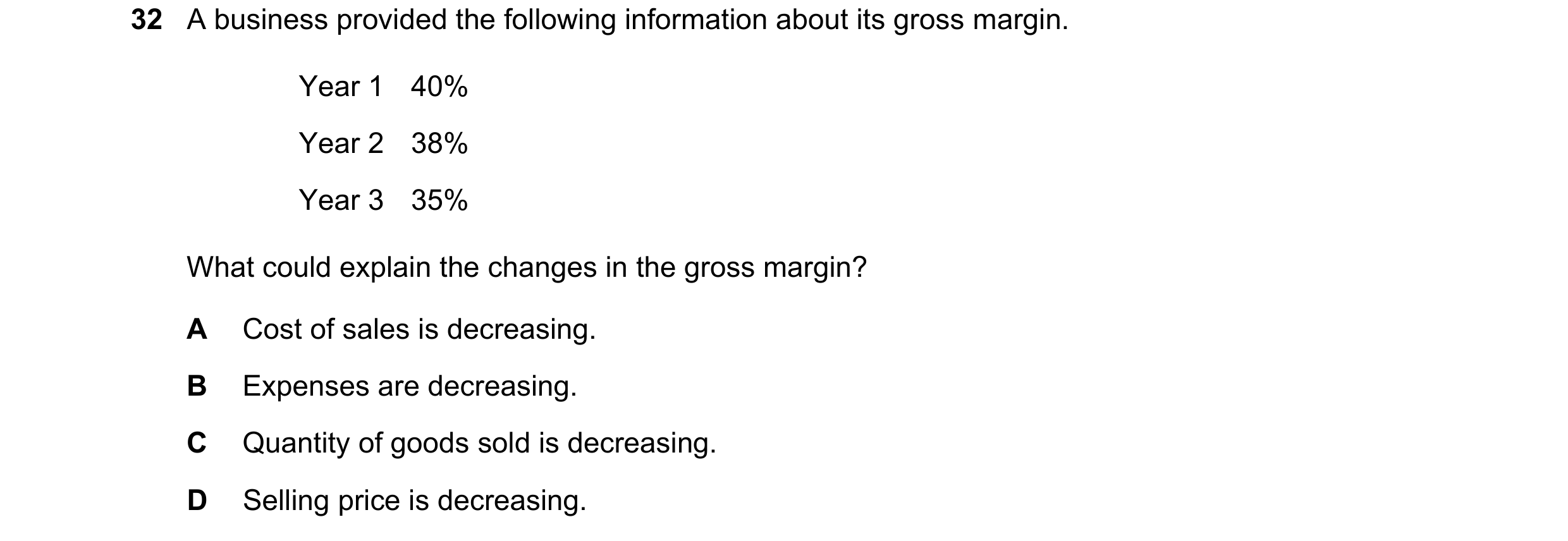
31 A business provided the following information about its gross margin. Year 1 40% Year 2 38% Year 3 35% What could explain the changes in the gross margin? A Cost of sales is decreasing. B Expenses are decreasing. C Quantity of goods sold is decreasing. D Selling price is decreasing.
1 marks
Answer: D
This question in 0452/12 Oct/Nov 2021
Q27 · Sam and Rob each own a trading business 0452/12 Oct/Nov 2021
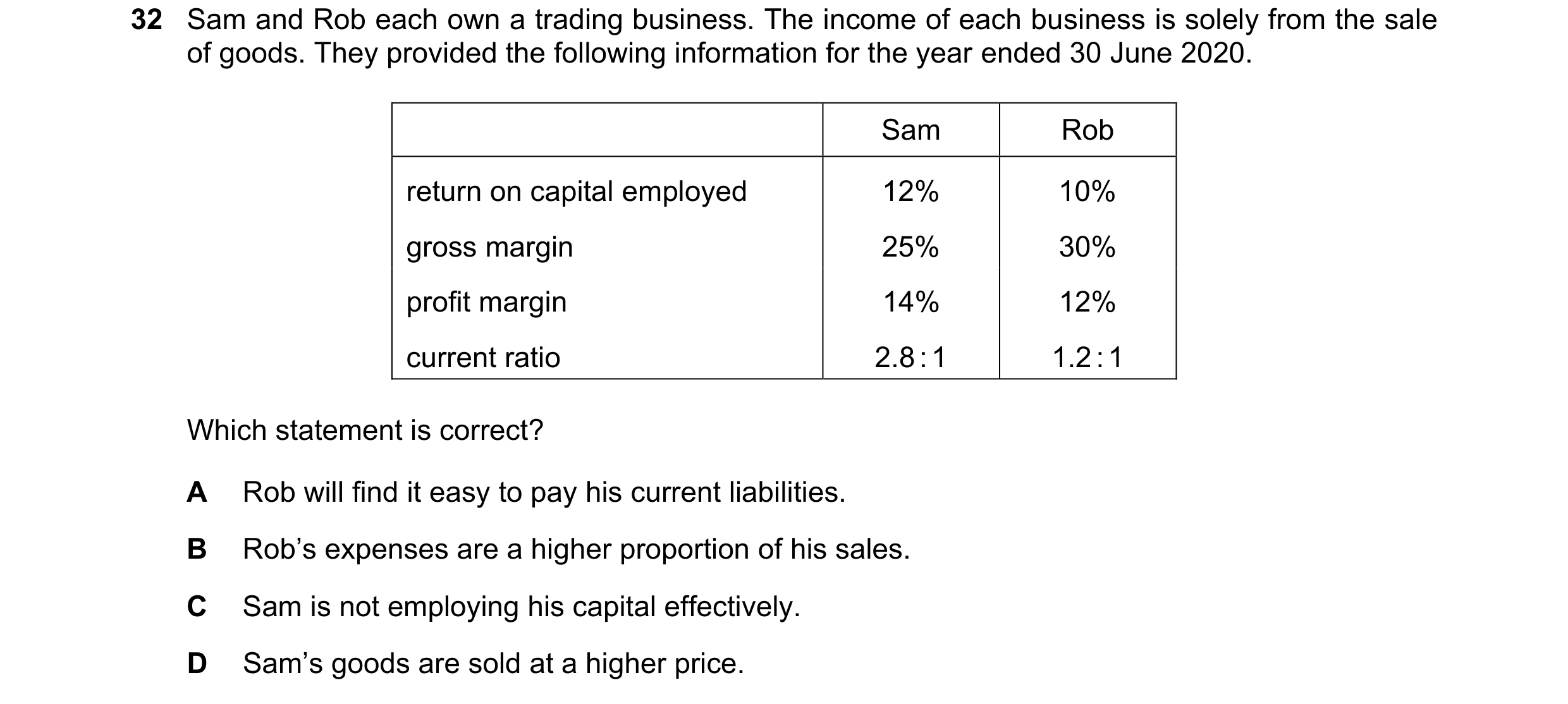
32 Sam and Rob each own a trading business. The income of each business is solely from the sale of goods. They provided the following information for the year ended 30 June 2020. Sam Rob return on capital employed 12% 10% gross margin 25% 30% profit margin 14% 12% current ratio 2.8 : 1 1.2 : 1 Which statement is correct? A Rob will find it easy to pay his current liabilities. B Rob’s expenses are a higher proportion of his sales. C Sam is not employing his capital effectively. D Sam’s goods are sold at a higher price.
1 marks
Answer: B
This question in 0452/12 Oct/Nov 2021
Q28 · A business provided the following information about its gross margin 0452/13 Oct/Nov 2021
32 A business provided the following information about its gross margin. Year 1 40% Year 2 38% Year 3 35% What could explain the changes in the gross margin? A Cost of sales is decreasing. B Expenses are decreasing. C Quantity of goods sold is decreasing. D Selling price is decreasing.
1 marks
Answer: D
This question in 0452/13 Oct/Nov 2021
Q29 · A trader decided to reduce her level of inventory in order to reduce the storage costs 0452/12 Feb/March 2022
33 A trader decided to reduce her level of inventory in order to reduce the storage costs. Sales quantity and selling price were not affected. How did this affect profit for the year and the rate of inventory turnover? profit for rate of inventory the year turnover A decreased decreased B decreased increased C increased decreased D increased increased
1 marks
Answer: D
This question in 0452/12 Feb/March 2022
Q30 · Which actions could a clothing retailer take to improve his rate of inventory turnover? 0452/11 May/June 2022
33 Which actions could a clothing retailer take to improve his rate of inventory turnover? 1 increase the selling prices of all clothing 2 offer discounts on last year’s designs 3 pay clothing suppliers as quickly as possible A 1 and 3 only B 1, 2 and 3 C 2 only D 3 only
1 marks
Answer: C
This question in 0452/11 May/June 2022
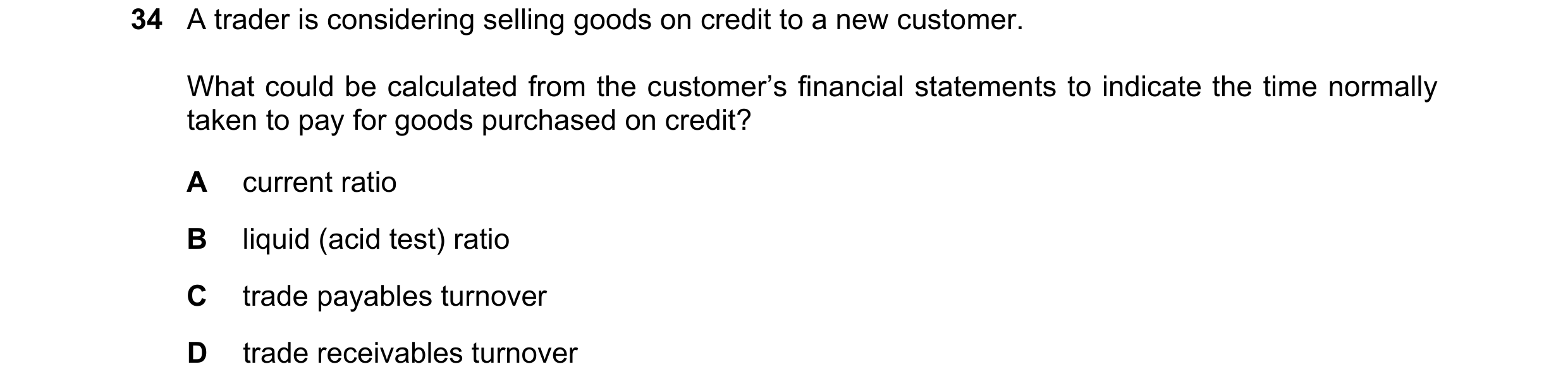
Q31 · A trader is considering selling goods on credit to a new customer 0452/11 May/June 2022
34 A trader is considering selling goods on credit to a new customer. What could be calculated from the customer’s financial statements to indicate the time normally taken to pay for goods purchased on credit? A current ratio B liquid (acid test) ratio C trade payables turnover D trade receivables turnover
1 marks
Answer: C
This question in 0452/11 May/June 2022
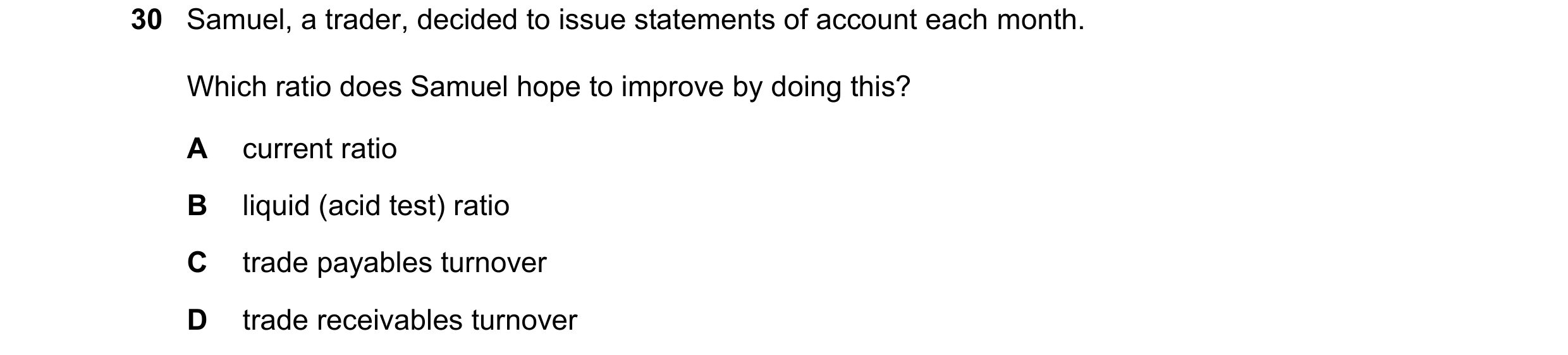
Q32 · Samuel, a trader, decided to issue statements of account each month 0452/12 May/June 2022
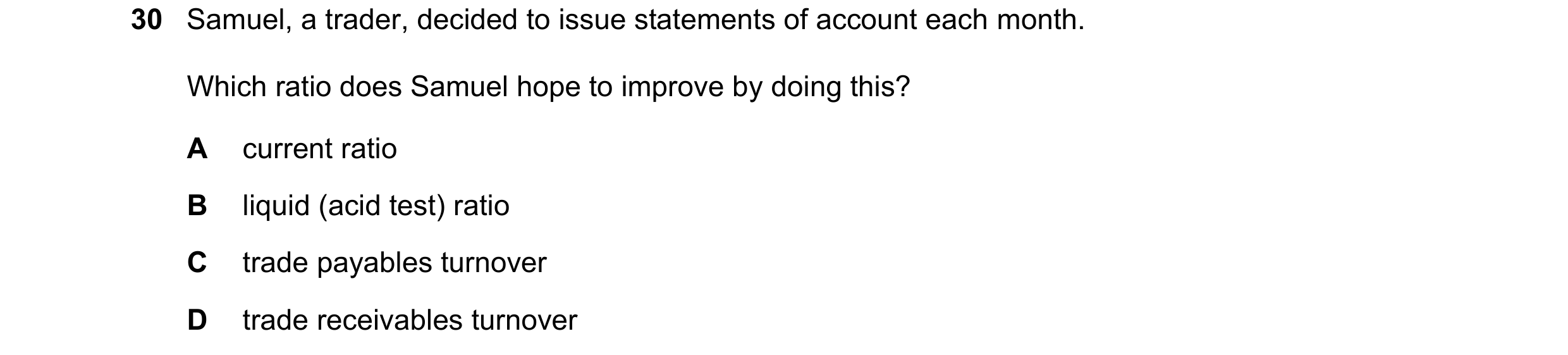
30 Samuel, a trader, decided to issue statements of account each month. Which ratio does Samuel hope to improve by doing this? A current ratio B liquid (acid test) ratio C trade payables turnover D trade receivables turnover
1 marks
Answer: D
This question in 0452/12 May/June 2022
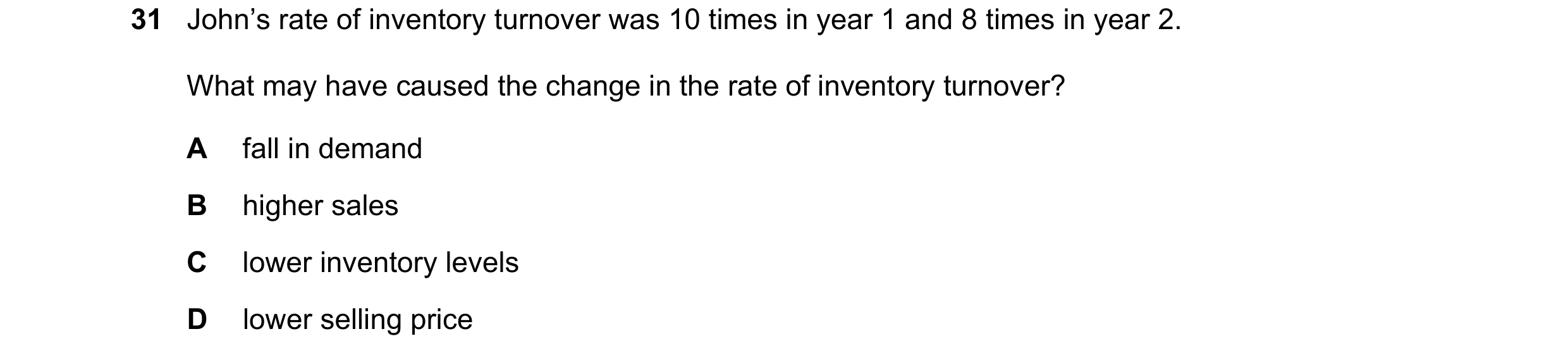
Q33 · John’s rate of inventory turnover was 10 times in year 1 and 8 times in year 2 0452/12 May/June 2022
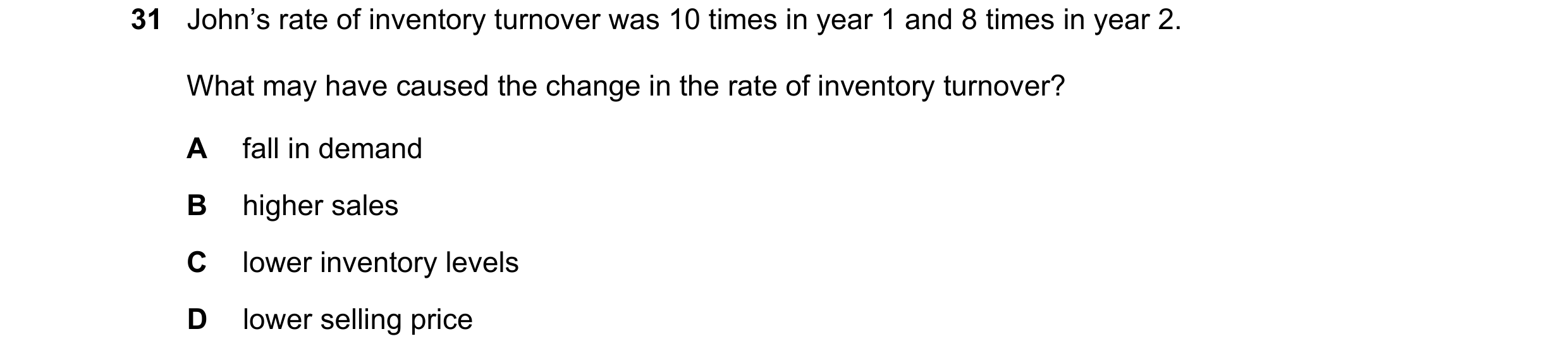
31 John’s rate of inventory turnover was 10 times in year 1 and 8 times in year 2. What may have caused the change in the rate of inventory turnover? A fall in demand B higher sales C lower inventory levels D lower selling price
1 marks
Answer: A
This question in 0452/12 May/June 2022
Q34 · Maya had annual revenue of $100 000 0452/12 May/June 2022
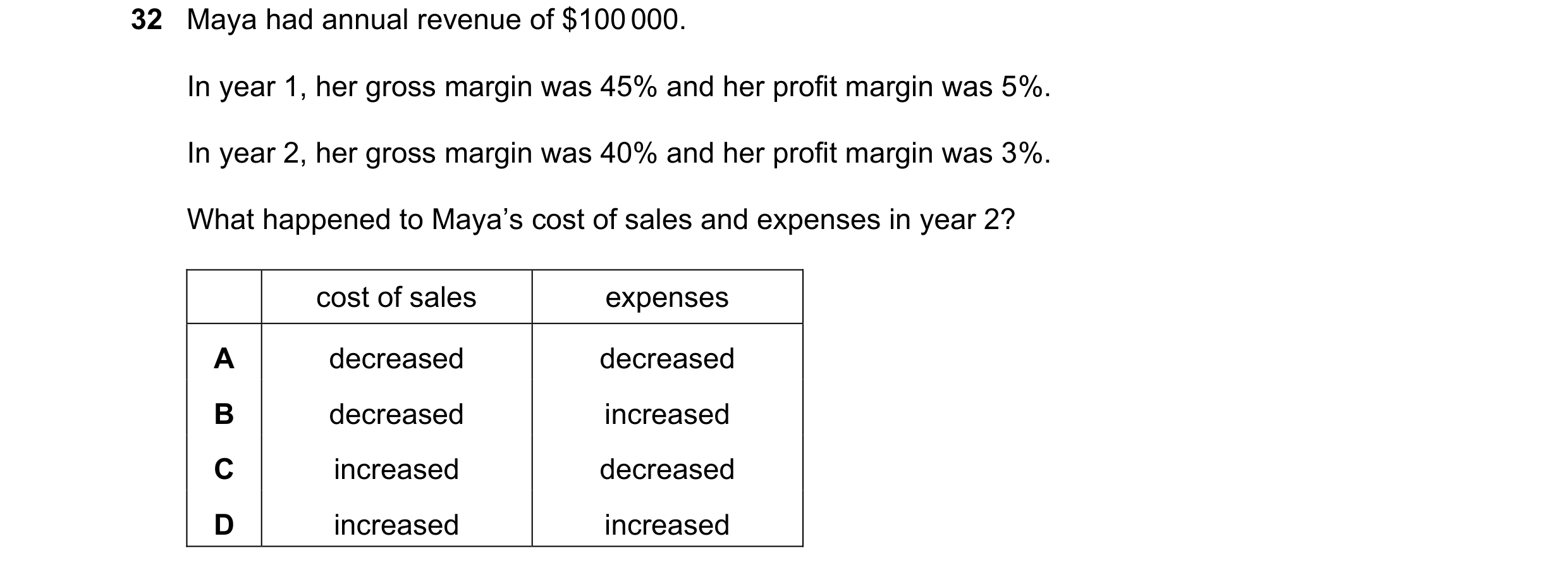
32 Maya had annual revenue of $100 000. In year 1, her gross margin was 45% and her profit margin was 5%. In year 2, her gross margin was 40% and her profit margin was 3%. What happened to Maya’s cost of sales and expenses in year 2? cost of sales expenses A decreased decreased B decreased increased C increased decreased D increased increased
1 marks
Answer: C
This question in 0452/12 May/June 2022
Q35 · Samuel, a trader, decided to issue statements of account each month 0452/13 May/June 2022
30 Samuel, a trader, decided to issue statements of account each month. Which ratio does Samuel hope to improve by doing this? A current ratio B liquid (acid test) ratio C trade payables turnover D trade receivables turnover
1 marks
Answer: D
This question in 0452/13 May/June 2022
Q36 · John’s rate of inventory turnover was 10 times in year 1 and 8 times in year 2 0452/13 May/June 2022
31 John’s rate of inventory turnover was 10 times in year 1 and 8 times in year 2. What may have caused the change in the rate of inventory turnover? A fall in demand B higher sales C lower inventory levels D lower selling price
1 marks
Answer: A
This question in 0452/13 May/June 2022
Q37 · Maya had annual revenue of $100 000 0452/13 May/June 2022
32 Maya had annual revenue of $100 000. In year 1, her gross margin was 45% and her profit margin was 5%. In year 2, her gross margin was 40% and her profit margin was 3%. What happened to Maya’s cost of sales and expenses in year 2? cost of sales expenses A decreased decreased B decreased increased C increased decreased D increased increased
1 marks
Answer: C
This question in 0452/13 May/June 2022
Q38 · A trader provided the following information 0452/12 Oct/Nov 2022
32 A trader provided the following information. year 1 year 2 gross profit $40 000 $75 000 gross margin 35% 35% profit margin 11% 22% What would explain these changes? A an increase in selling price and a decrease in sales quantity B an increase in selling price and an increase in expenses C an increase in sales quantity and a decrease in selling price D an increase in sales quantity and a decrease in expenses
1 marks
Answer: D
This question in 0452/12 Oct/Nov 2022
Q39 · How can a trader increase her current ratio? 0452/13 Oct/Nov 2022
32 How can a trader increase her current ratio? A keep inventory at the lowest possible level B obtain a long-term bank loan C reduce the trade receivables turnover D sell goods for cash instead of on credit
1 marks
Answer: B
This question in 0452/13 Oct/Nov 2022
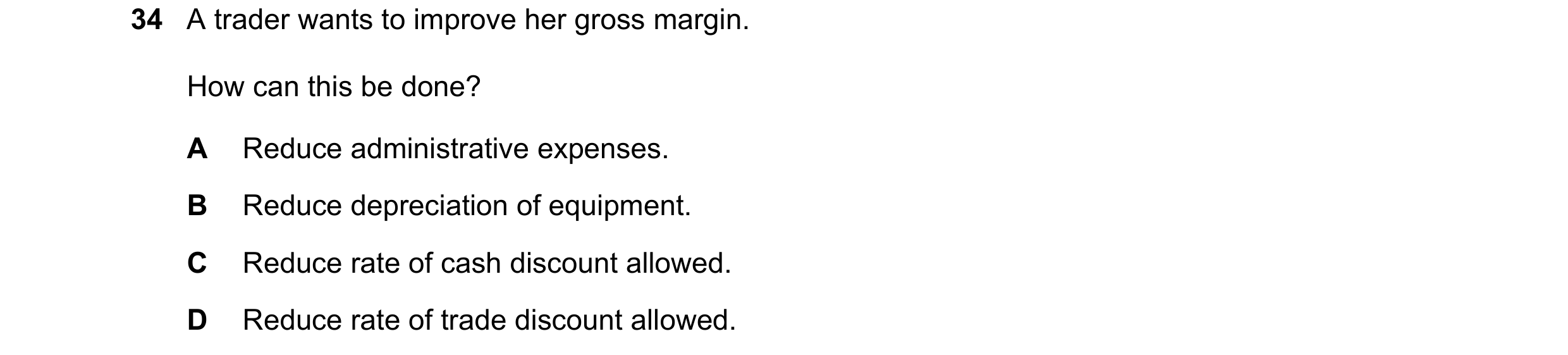
Q40 · A trader wants to improve her gross margin 0452/12 Feb/March 2023
34 A trader wants to improve her gross margin. How can this be done? A Reduce administrative expenses. B Reduce depreciation of equipment. C Reduce rate of cash discount allowed. D Reduce rate of trade discount allowed.
1 marks
Answer: D
This question in 0452/12 Feb/March 2023
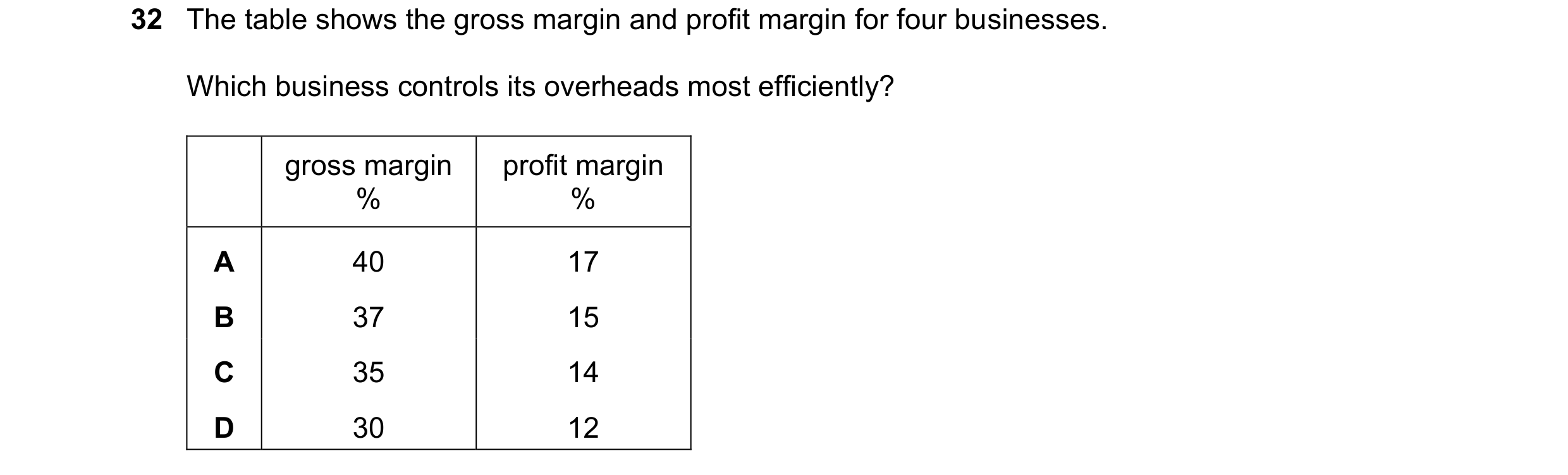
Q41 · The table shows the gross margin and profit margin for four businesses 0452/11 May/June 2023
32 The table shows the gross margin and profit margin for four businesses. Which business controls its overheads most efficiently? gross margin profit margin % % A 40 17 B 37 15 C 35 14 D 30 12
1 marks
Answer: D
This question in 0452/11 May/June 2023
Q42 · The following ratios relate to the businesses of Ewa and Max 0452/12 May/June 2023
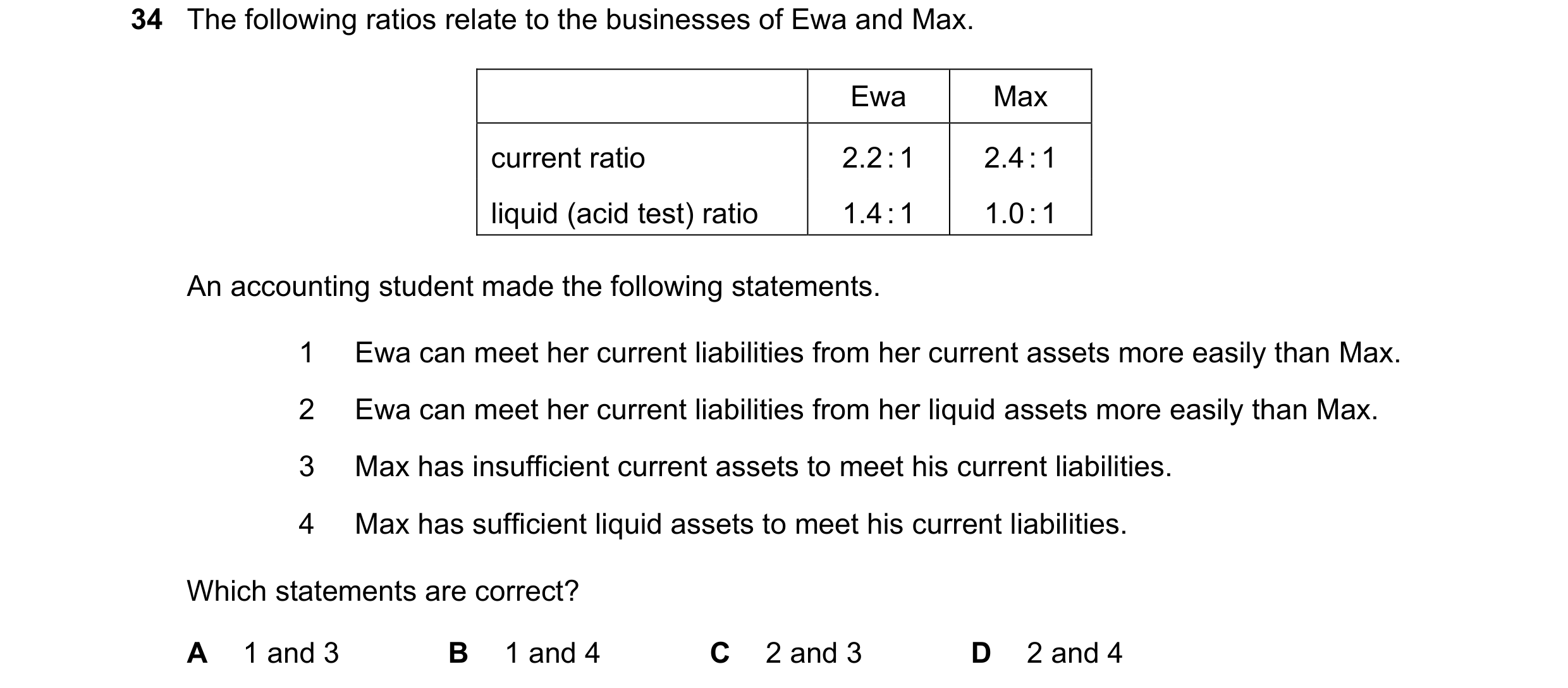
34 The following ratios relate to the businesses of Ewa and Max. Ewa Max current ratio 2.2 : 1 2.4 : 1 liquid (acid test) ratio 1.4 : 1 1.0 : 1 An accounting student made the following statements. 1 Ewa can meet her current liabilities from her current assets more easily than Max. 2 Ewa can meet her current liabilities from her liquid assets more easily than Max. 3 Max has insufficient current assets to meet his current liabilities. 4 Max has sufficient liquid assets to meet his current liabilities. Which statements are correct? A 1 and 3 B 1 and 4 C 2 and 3 D 2 and 4
1 marks
Answer: D
This question in 0452/12 May/June 2023
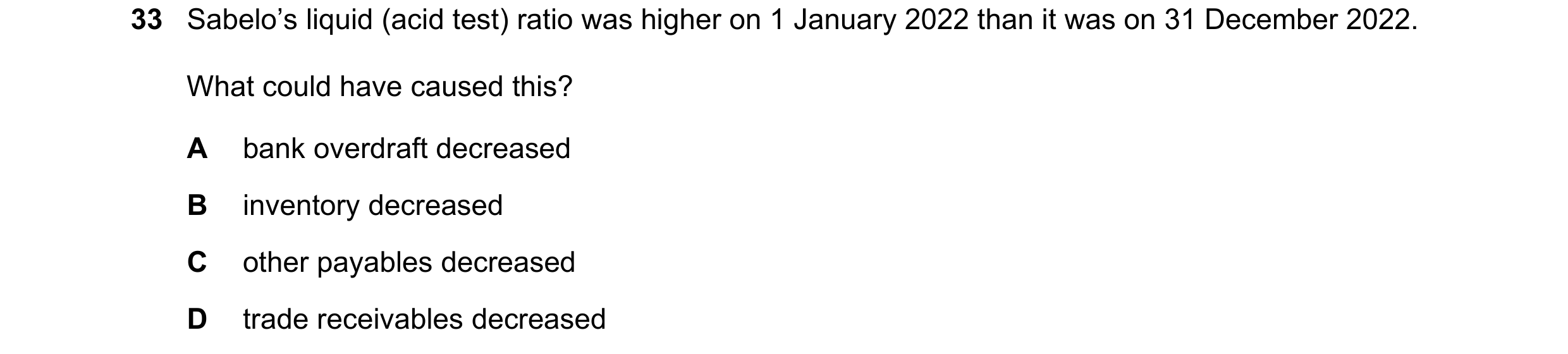
Q43 · Sabelo’s liquid (acid test) ratio was higher on 1 January 2022 than it was on 31 December… 0452/13 May/June 2023
33 Sabelo’s liquid (acid test) ratio was higher on 1 January 2022 than it was on 31 December 2022. What could have caused this? A bank overdraft decreased B inventory decreased C other payables decreased D trade receivables decreased
1 marks
Answer: D
This question in 0452/13 May/June 2023
Q44 · The following ratios relate to the businesses of Ewa and Max 0452/13 May/June 2023
34 The following ratios relate to the businesses of Ewa and Max. Ewa Max current ratio 2.2 : 1 2.4 : 1 liquid (acid test) ratio 1.4 : 1 1.0 : 1 An accounting student made the following statements. 1 Ewa can meet her current liabilities from her current assets more easily than Max. 2 Ewa can meet her current liabilities from her liquid assets more easily than Max. 3 Max has insufficient current assets to meet his current liabilities. 4 Max has sufficient liquid assets to meet his current liabilities. Which statements are correct? A 1 and 3 B 1 and 4 C 2 and 3 D 2 and 4
1 marks
Answer: D
This question in 0452/13 May/June 2023
Q45 · CD Limited took out a long-term bank loan and used part of the funds to pay some of its… 0452/11 Oct/Nov 2023
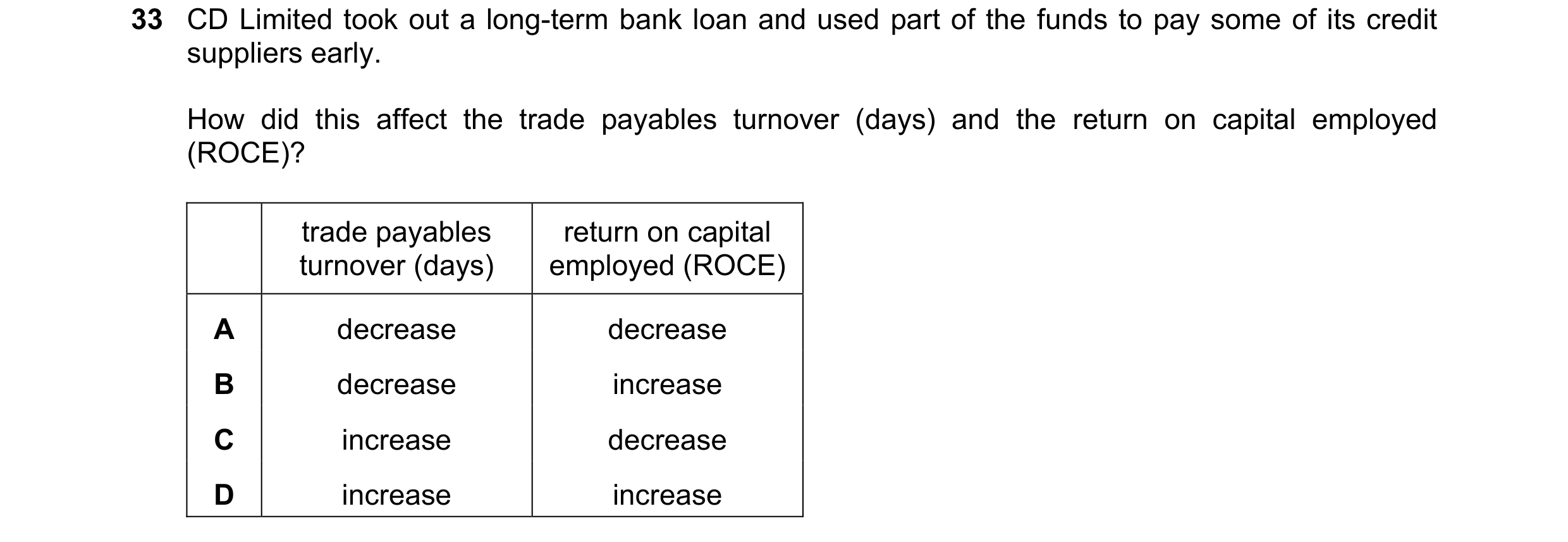
33 CD Limited took out a long-term bank loan and used part of the funds to pay some of its credit suppliers early. How did this affect the trade payables turnover (days) and the return on capital employed (ROCE)? trade payables return on capital turnover (days) employed (ROCE) A decrease decrease B decrease increase C increase decrease D increase increase
1 marks
Answer: A
This question in 0452/11 Oct/Nov 2023
Q46 · CD Limited took out a long-term bank loan and used part of the funds to pay some of its… 0452/13 Oct/Nov 2023
33 CD Limited took out a long-term bank loan and used part of the funds to pay some of its credit suppliers early. How did this affect the trade payables turnover (days) and the return on capital employed (ROCE)? trade payables return on capital turnover (days) employed (ROCE) A decrease decrease B decrease increase C increase decrease D increase increase
1 marks
Answer: A
This question in 0452/13 Oct/Nov 2023
Q47 · The following ratios have been calculated for a trader 0452/11 May/June 2024
34 The following ratios have been calculated for a trader. year 1 year 2 profit margin 15% 20% return on capital employed (ROCE) 9% 6% What explains these changes? A Drawings have increased by more than profit for the year. B Gross profit has increased but profit for the year has decreased. C Profit for the year has increased and capital has been introduced. D Profit for the year has increased and a long-term loan has been repaid.
1 marks
Answer: C
This question in 0452/11 May/June 2024
Q48 · Miranda’s gross margin fell from 25% in year 1 to 15% in year 2 0452/12 May/June 2024
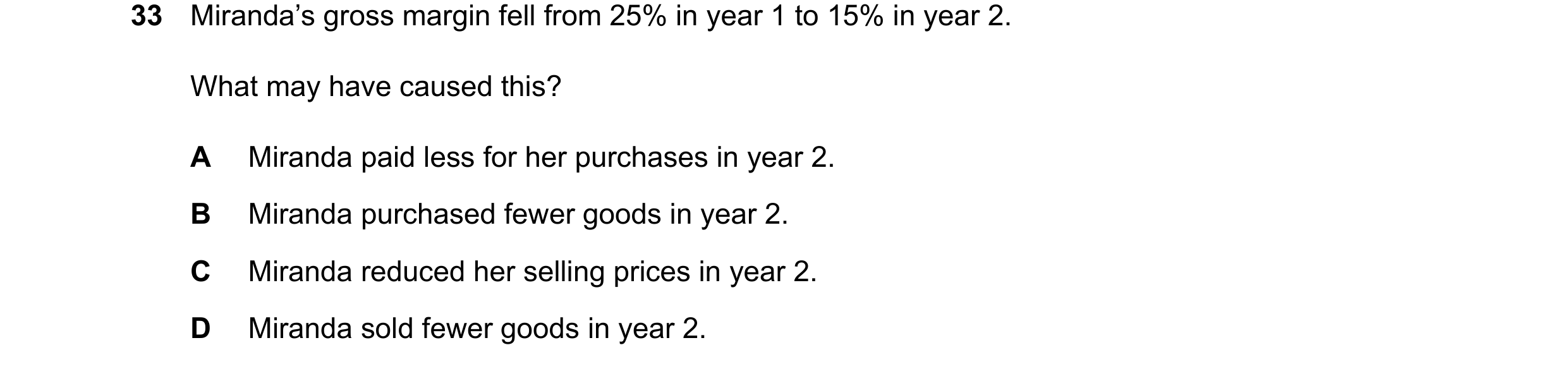
33 Miranda’s gross margin fell from 25% in year 1 to 15% in year 2. What may have caused this? A Miranda paid less for her purchases in year 2. B Miranda purchased fewer goods in year 2. C Miranda reduced her selling prices in year 2. D Miranda sold fewer goods in year 2.
1 marks
Answer: C
This question in 0452/12 May/June 2024
Q49 · How does a trader use the information provided by financial statements? 0452/13 May/June 2024
1 How does a trader use the information provided by financial statements? A to calculate the amount of cash drawings taken B to calculate the amount that is owed by trade receivables C to check the balance shown on a bank statement D to compare the business performance over a number of years
1 marks
Answer: D
This question in 0452/13 May/June 2024
Q50 · Miranda’s gross margin fell from 25% in year 1 to 15% in year 2 0452/13 May/June 2024
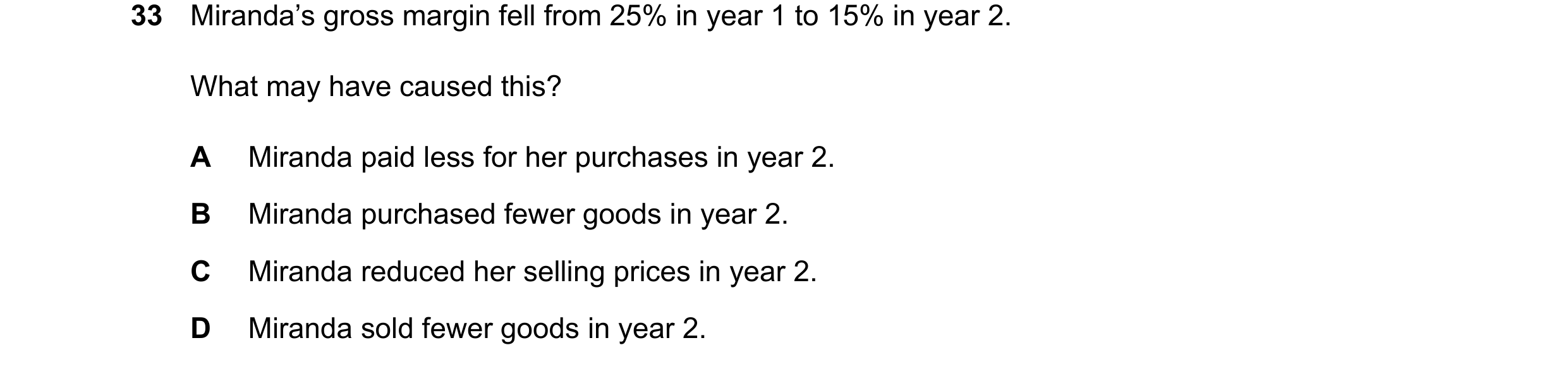
33 Miranda’s gross margin fell from 25% in year 1 to 15% in year 2. What may have caused this? A Miranda paid less for her purchases in year 2. B Miranda purchased fewer goods in year 2. C Miranda reduced her selling prices in year 2. D Miranda sold fewer goods in year 2.
1 marks
Answer: C
This question in 0452/13 May/June 2024
Q51 · The trade payables turnover of a business is 36 days 0452/11 Oct/Nov 2024
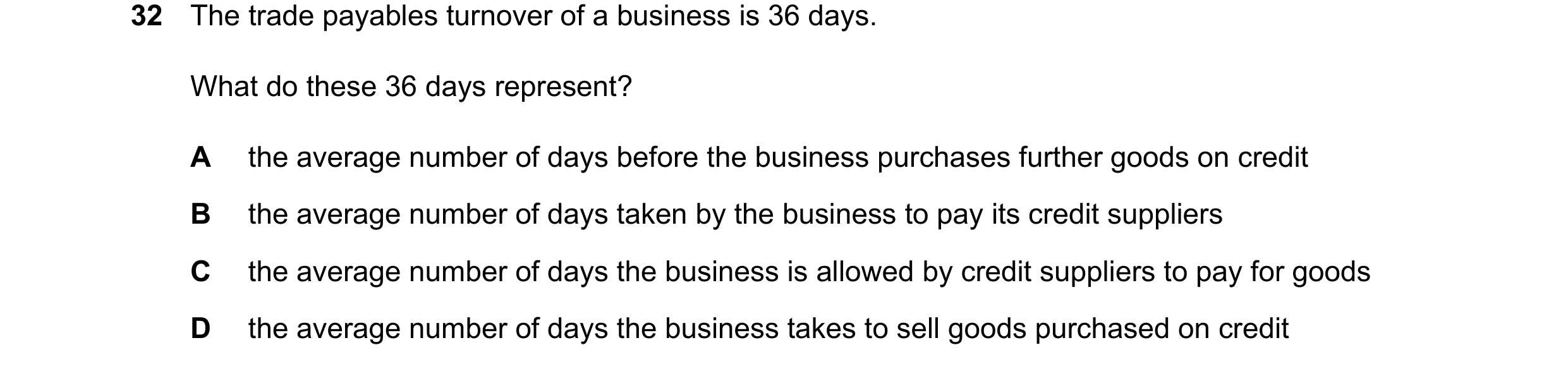
32 The trade payables turnover of a business is 36 days. What do these 36 days represent? A the average number of days before the business purchases further goods on credit B the average number of days taken by the business to pay its credit suppliers C the average number of days the business is allowed by credit suppliers to pay for goods D the average number of days the business takes to sell goods purchased on credit
1 marks
Answer: B
This question in 0452/11 Oct/Nov 2024
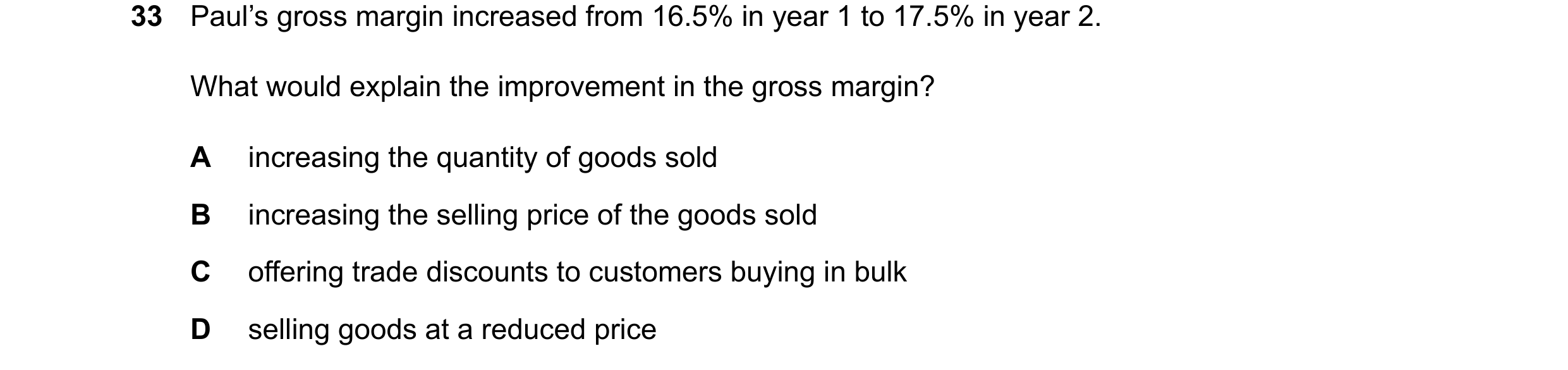
Q52 · Paul’s gross margin increased from 16.5% in year 1 to 17.5% in year 2 0452/11 Oct/Nov 2024
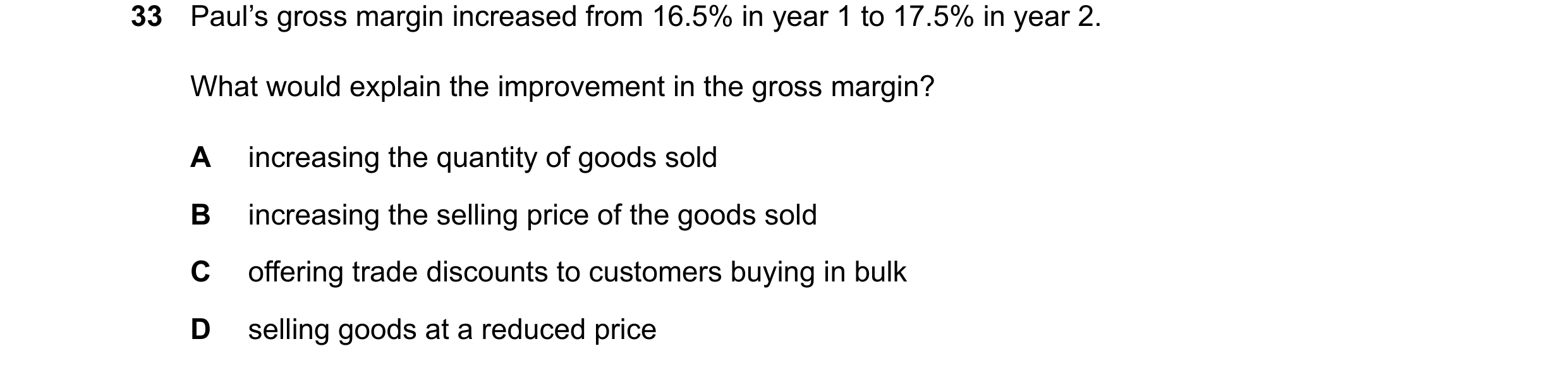
33 Paul’s gross margin increased from 16.5% in year 1 to 17.5% in year 2. What would explain the improvement in the gross margin? A increasing the quantity of goods sold B increasing the selling price of the goods sold C offering trade discounts to customers buying in bulk D selling goods at a reduced price
1 marks
Answer: B
This question in 0452/11 Oct/Nov 2024
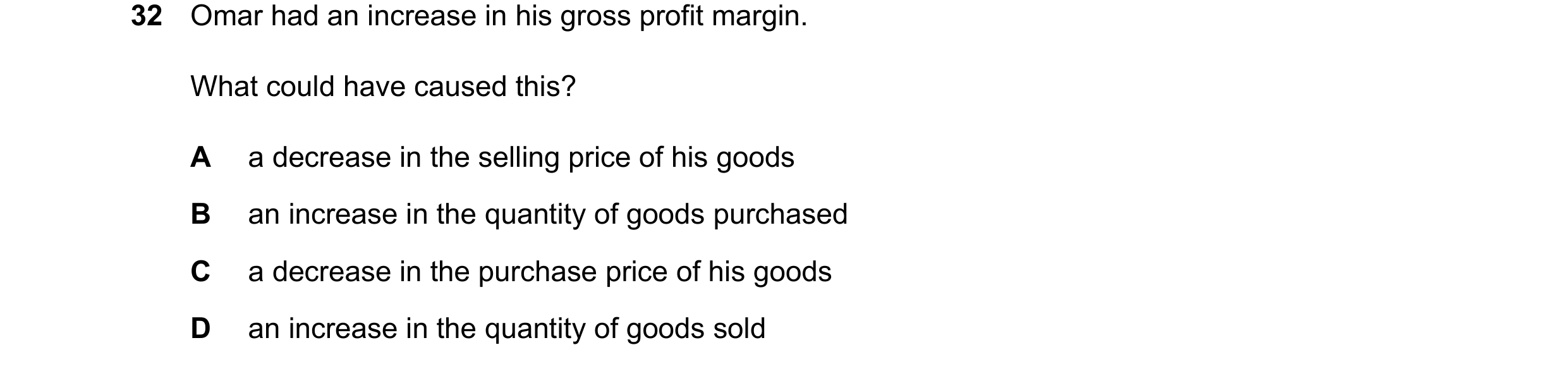
Q53 · Omar had an increase in his gross profit margin 0452/12 Oct/Nov 2024
32 Omar had an increase in his gross profit margin. What could have caused this? A a decrease in the selling price of his goods B an increase in the quantity of goods purchased C a decrease in the purchase price of his goods D an increase in the quantity of goods sold
1 marks
Answer: C
This question in 0452/12 Oct/Nov 2024
Q54 · The trade payables turnover of a business is 36 days 0452/13 Oct/Nov 2024
32 The trade payables turnover of a business is 36 days. What do these 36 days represent? A the average number of days before the business purchases further goods on credit B the average number of days taken by the business to pay its credit suppliers C the average number of days the business is allowed by credit suppliers to pay for goods D the average number of days the business takes to sell goods purchased on credit
1 marks
Answer: B
This question in 0452/13 Oct/Nov 2024
Q55 · Paul’s gross margin increased from 16.5% in year 1 to 17.5% in year 2 0452/13 Oct/Nov 2024
33 Paul’s gross margin increased from 16.5% in year 1 to 17.5% in year 2. What would explain the improvement in the gross margin? A increasing the quantity of goods sold B increasing the selling price of the goods sold C offering trade discounts to customers buying in bulk D selling goods at a reduced price
1 marks
Answer: B
This question in 0452/13 Oct/Nov 2024
Q56 · Why might a trader wish to increase his trade payables turnover days? 0452/12 Feb/March 2025
32 Why might a trader wish to increase his trade payables turnover days? 1 to improve his total working capital 2 to keep funds available for other purposes 3 to receive more cash discounts A 1, 2 and 3 B 1 only C 2 only D 3 only
1 marks
Answer: C
This question in 0452/12 Feb/March 2025
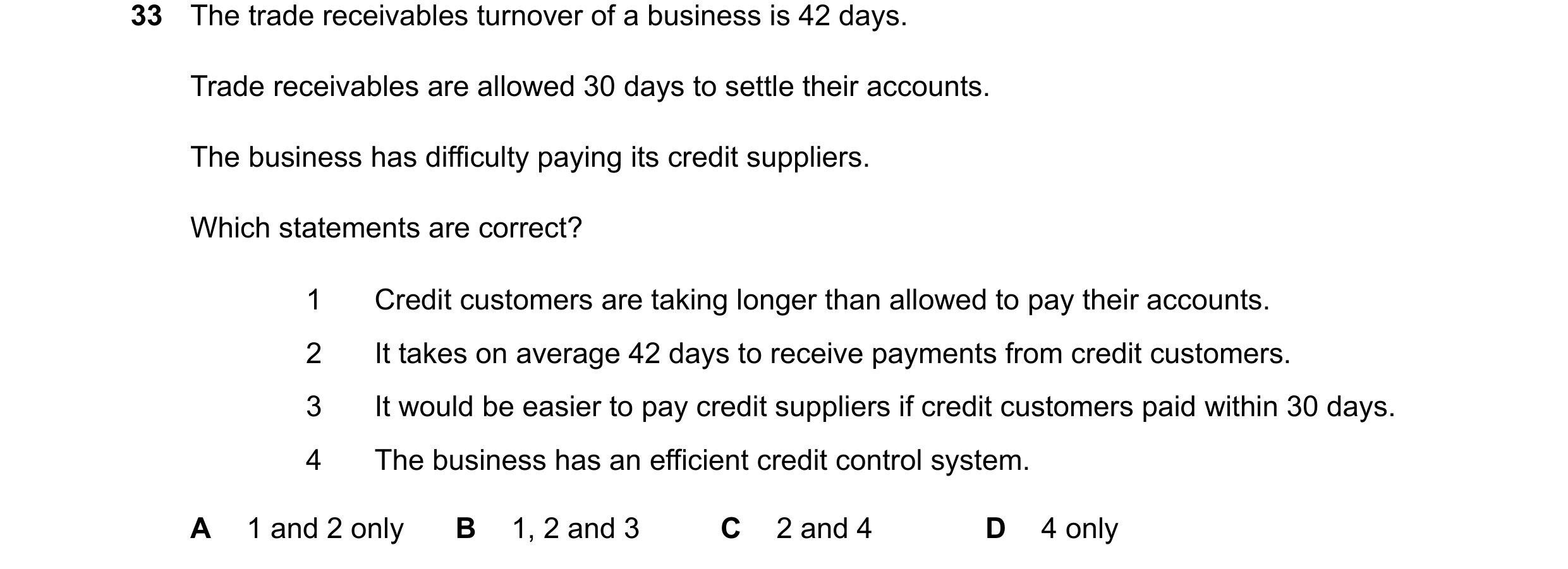
Q57 · The trade receivables turnover of a business is 42 days 0452/11 May/June 2025
33 The trade receivables turnover of a business is 42 days. Trade receivables are allowed 30 days to settle their accounts. The business has difficulty paying its credit suppliers. Which statements are correct? 1 Credit customers are taking longer than allowed to pay their accounts. 2 It takes on average 42 days to receive payments from credit customers. 3 It would be easier to pay credit suppliers if credit customers paid within 30 days. 4 The business has an efficient credit control system. A 1 and 2 only B 1, 2 and 3 C 2 and 4 D 4 only
1 marks
Answer: B
This question in 0452/11 May/June 2025
Q58 · The trade receivables turnover of a business is 42 days 0452/13 May/June 2025
33 The trade receivables turnover of a business is 42 days. Trade receivables are allowed 30 days to settle their accounts. The business has difficulty paying its credit suppliers. Which statements are correct? 1 Credit customers are taking longer than allowed to pay their accounts. 2 It takes on average 42 days to receive payments from credit customers. 3 It would be easier to pay credit suppliers if credit customers paid within 30 days. 4 The business has an efficient credit control system. A 1 and 2 only B 1, 2 and 3 C 2 and 4 D 4 only
1 marks
Answer: B
This question in 0452/13 May/June 2025
Q59 · Jose runs a business providing accounting and book-keeping services 0452/12 Oct/Nov 2025
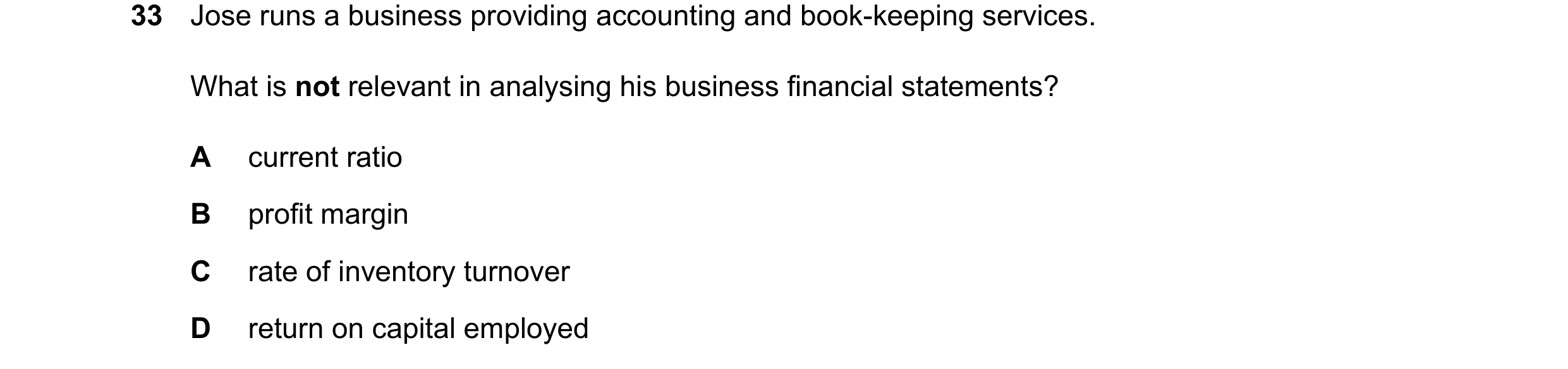
33 Jose runs a business providing accounting and book-keeping services. What is not relevant in analysing his business financial statements? A current ratio B profit margin C rate of inventory turnover D return on capital employed
1 marks
Answer: C
This question in 0452/12 Oct/Nov 2025
Q60 · Jamila’s business sells one type of product only 0452/12 Oct/Nov 2025
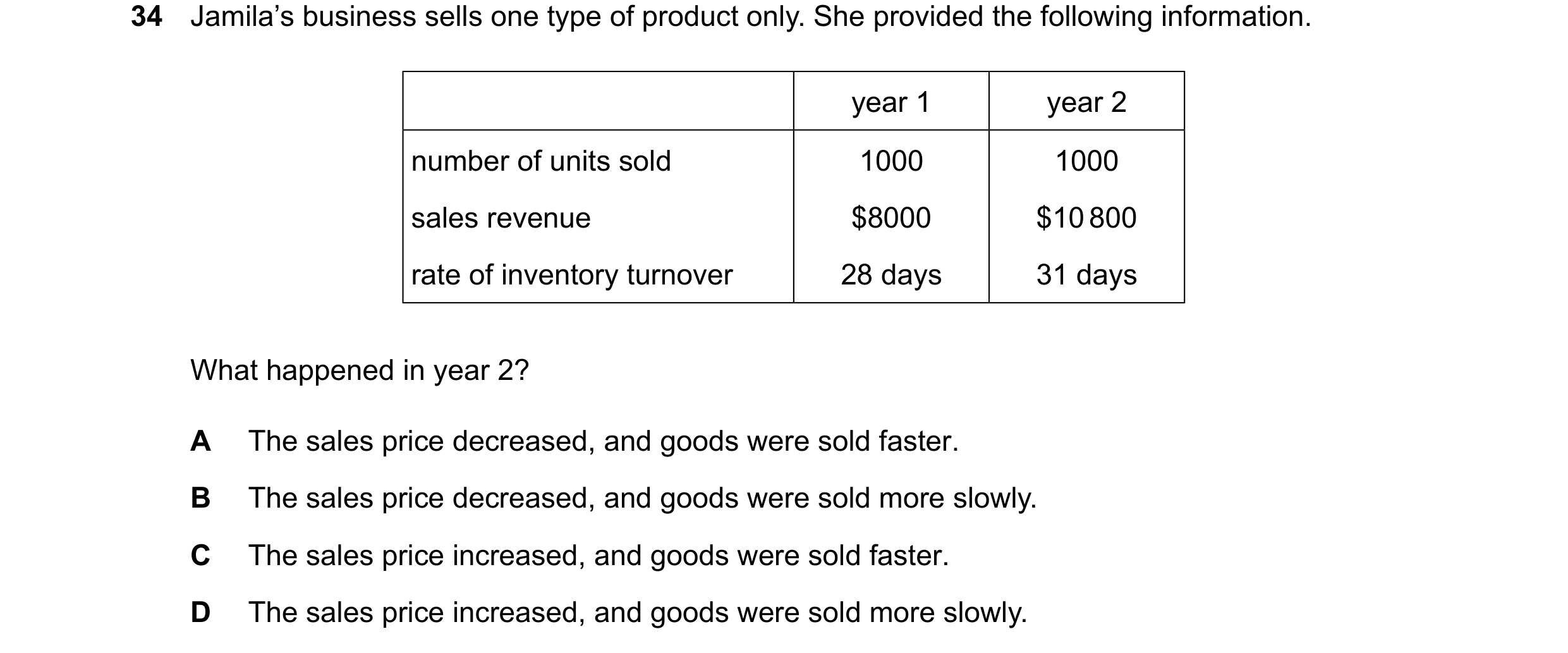
34 Jamila’s business sells one type of product only. She provided the following information. year 1 year 2 number of units sold 1000 1000 sales revenue $8000 $10800 rate of inventory turnover 28 days 31 days What happened in year 2? A The sales price decreased, and goods were sold faster. B The sales price decreased, and goods were sold more slowly. C The sales price increased, and goods were sold faster. D The sales price increased, and goods were sold more slowly.
1 marks
Answer: D
This question in 0452/12 Oct/Nov 2025
Q61 · Senga is concerned that the current ratio of her business is worsening each year 0452/13 Oct/Nov 2025
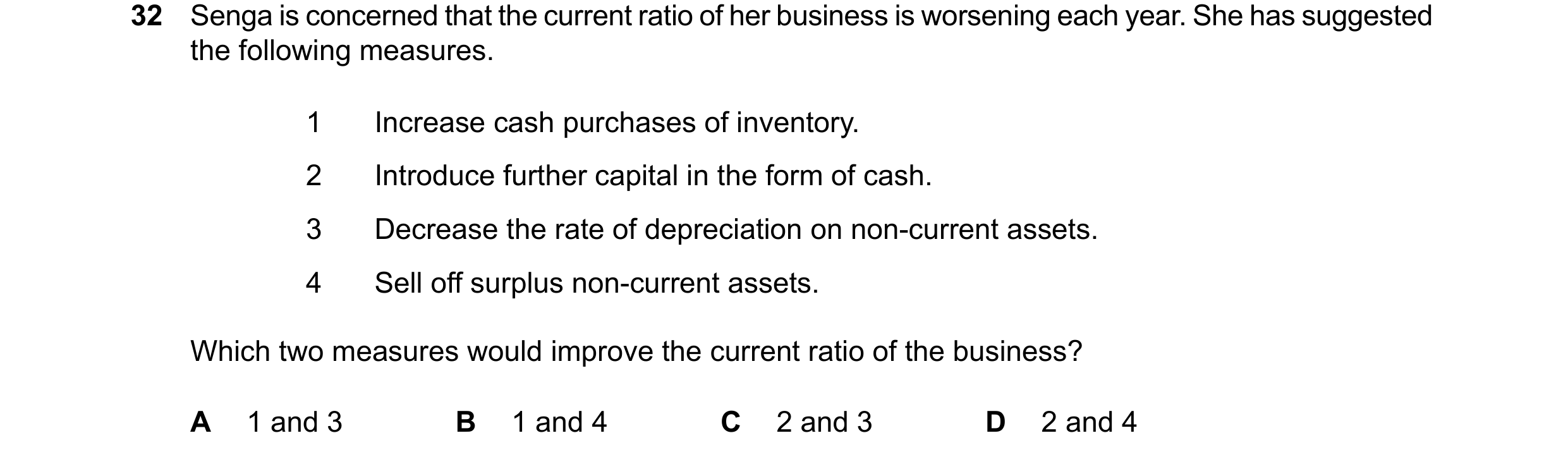
32 Senga is concerned that the current ratio of her business is worsening each year. She has suggested the following measures. 1 Increase cash purchases of inventory. 2 Introduce further capital in the form of cash. 3 Decrease the rate of depreciation on non-current assets. 4 Sell off surplus non-current assets. Which two measures would improve the current ratio of the business? A 1 and 3 B 1 and 4 C 2 and 3 D 2 and 4
1 marks
Answer: D
This question in 0452/13 Oct/Nov 2025
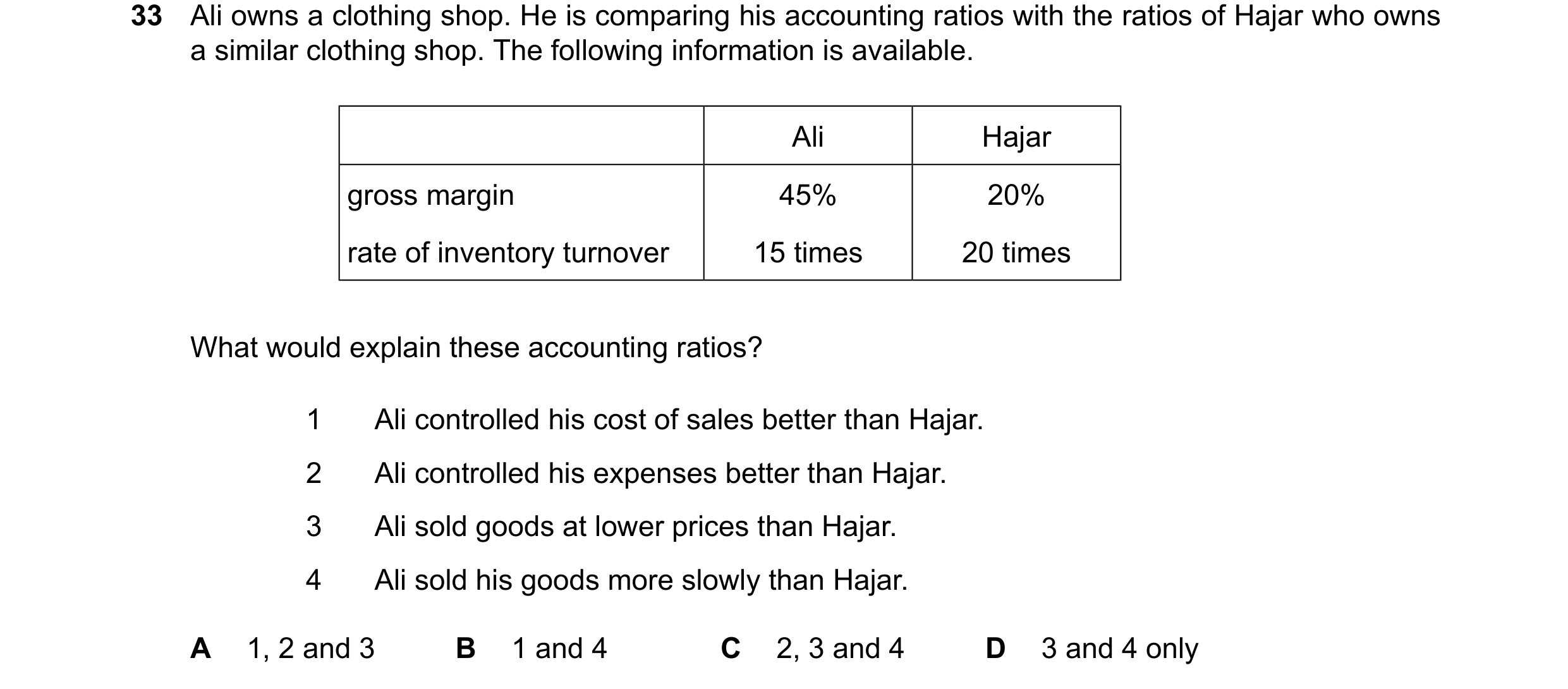
Q62 · Ali owns a clothing shop 0452/13 Oct/Nov 2025
33 Ali owns a clothing shop. He is comparing his accounting ratios with the ratios of Hajar who owns a similar clothing shop. The following information is available. Ali Hajar gross margin 45% 20% rate of inventory turnover 15 times 20 times What would explain these accounting ratios? 1 Ali controlled his cost of sales better than Hajar. 2 Ali controlled his expenses better than Hajar. 3 Ali sold goods at lower prices than Hajar. 4 Ali sold his goods more slowly than Hajar. A 1, 2 and 3 B 1 and 4 C 2, 3 and 4 D 3 and 4 only
1 marks
Answer: B
This question in 0452/13 Oct/Nov 2025
 1 / 16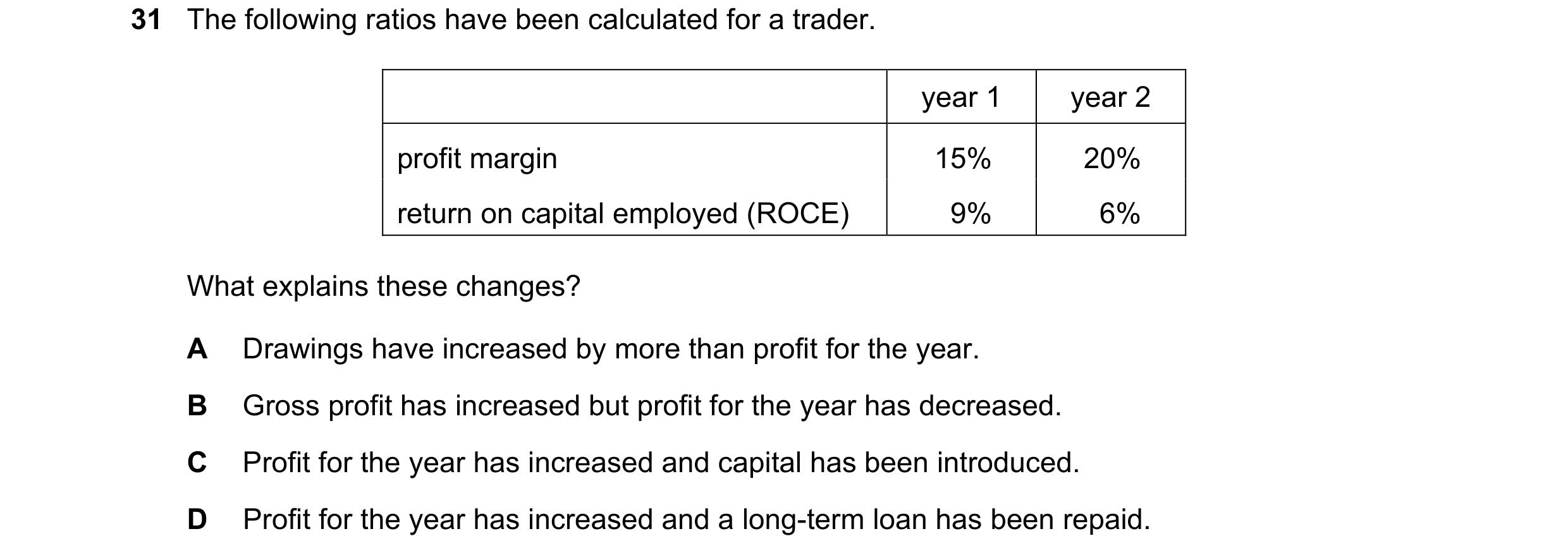
 2 / 16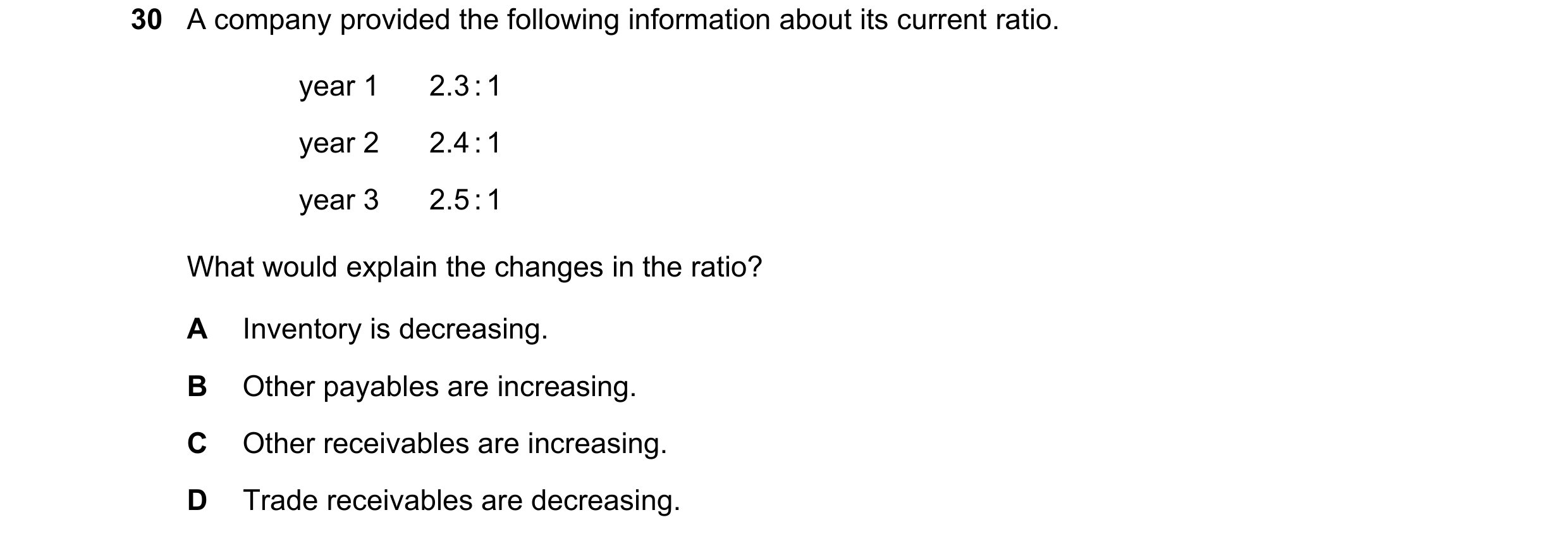
 3 / 16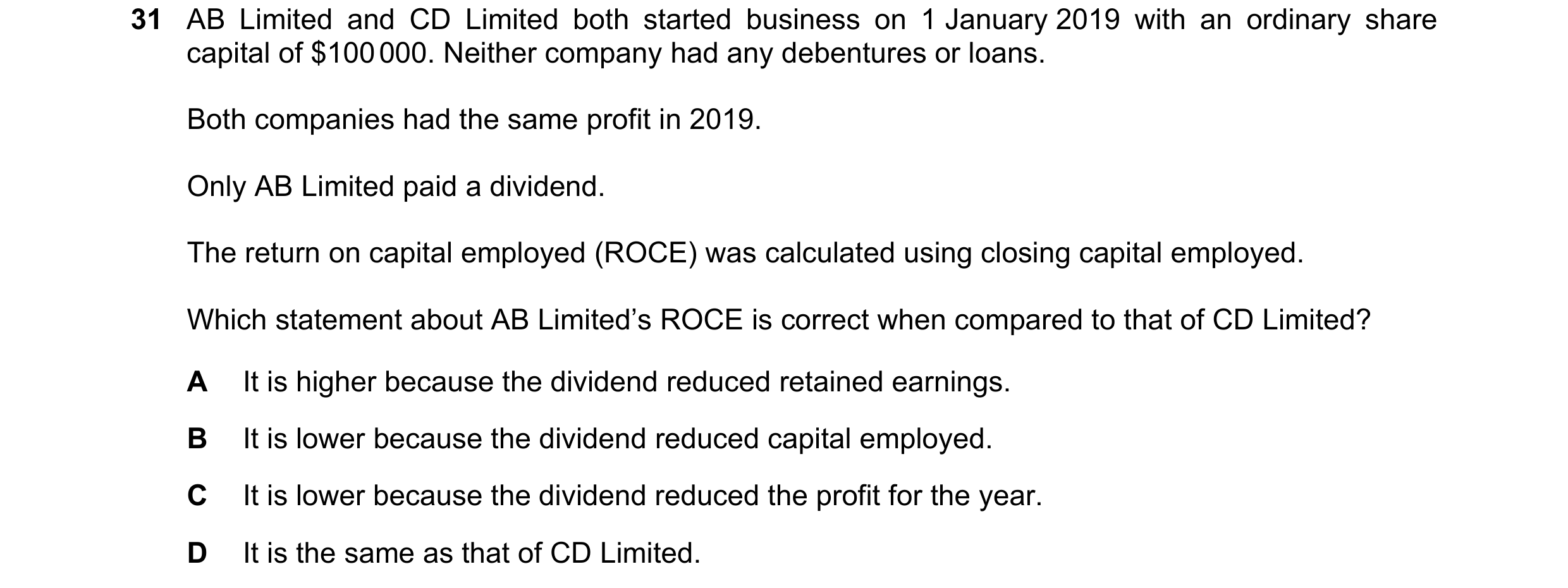
 4 / 16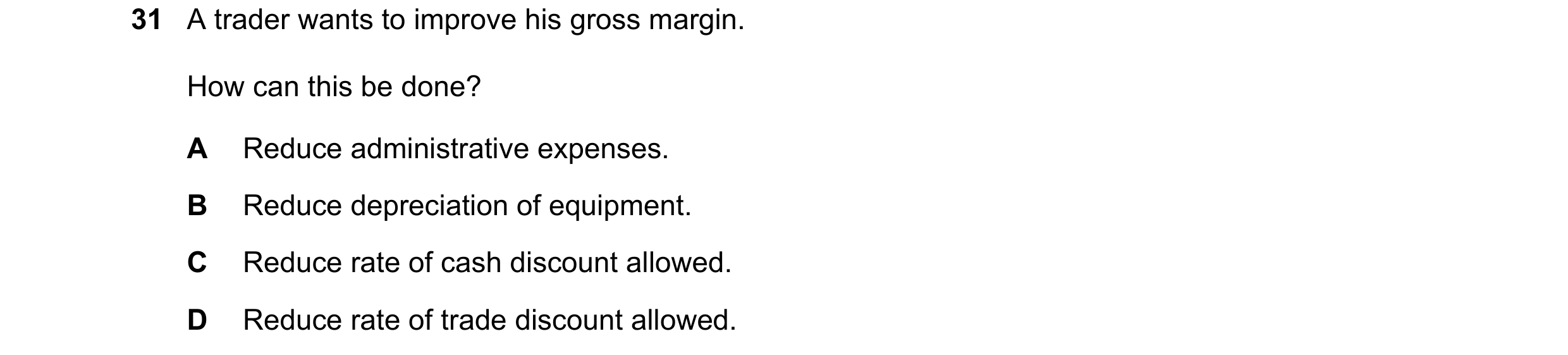

 5 / 16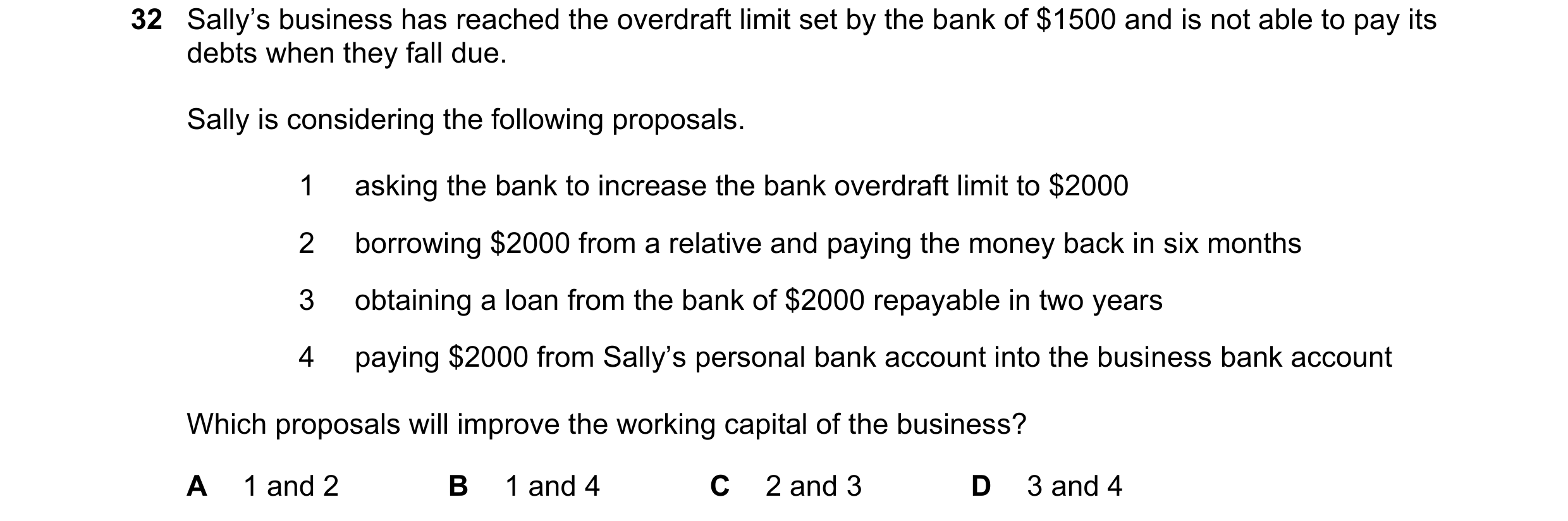
 6 / 16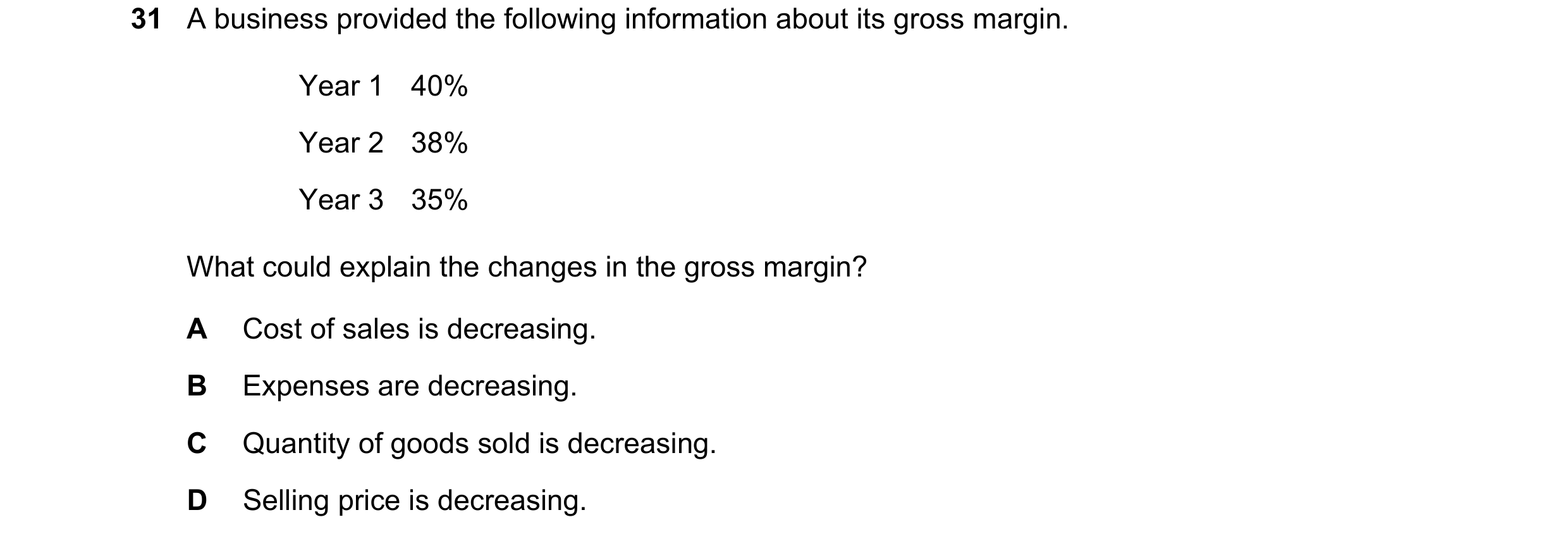
 7 / 16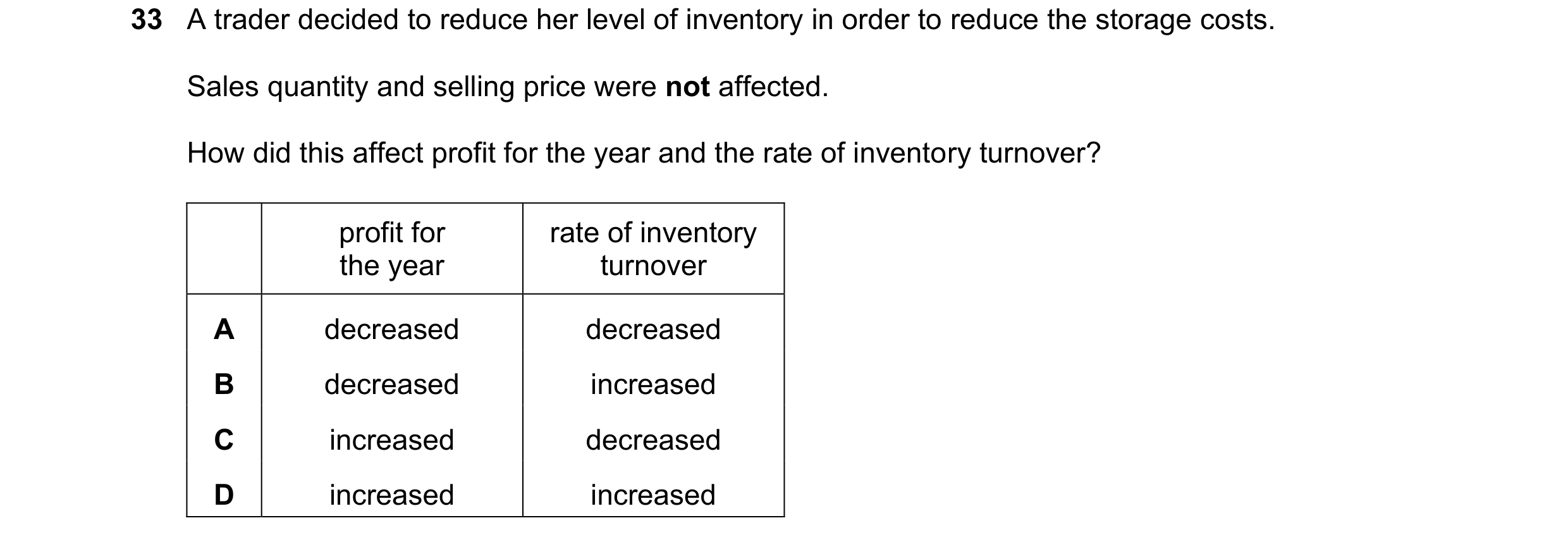

 8 / 16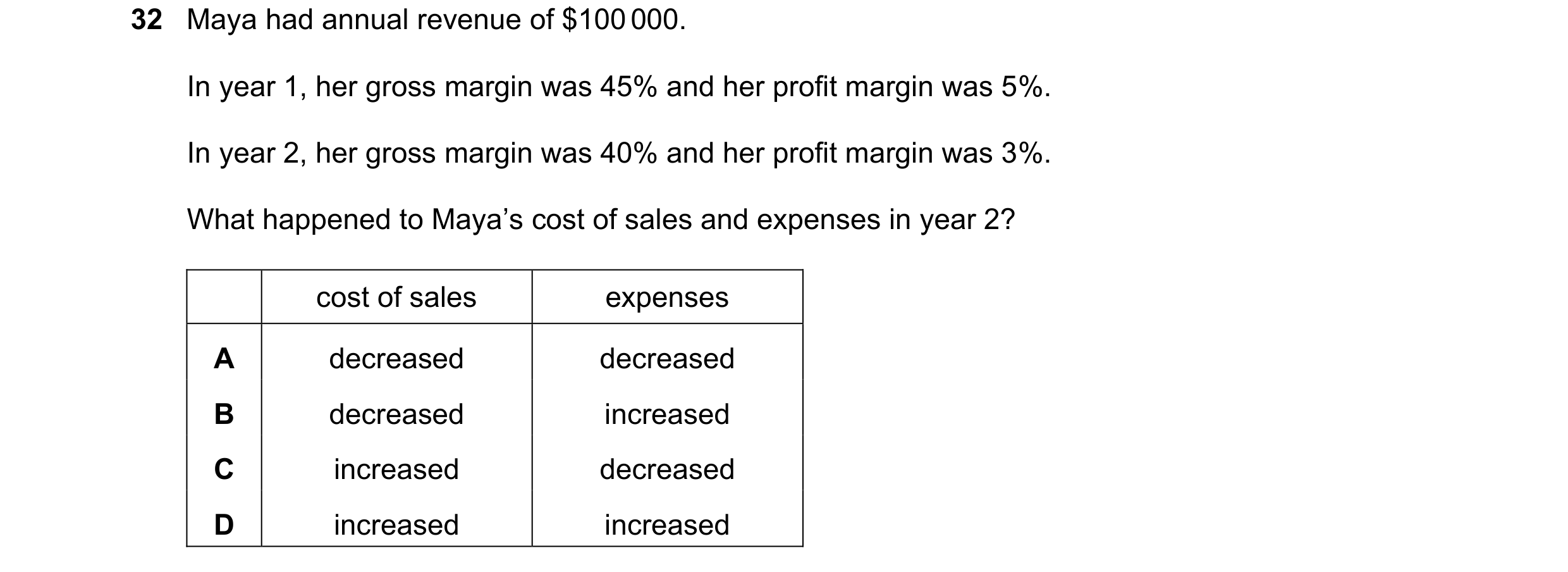
 9 / 16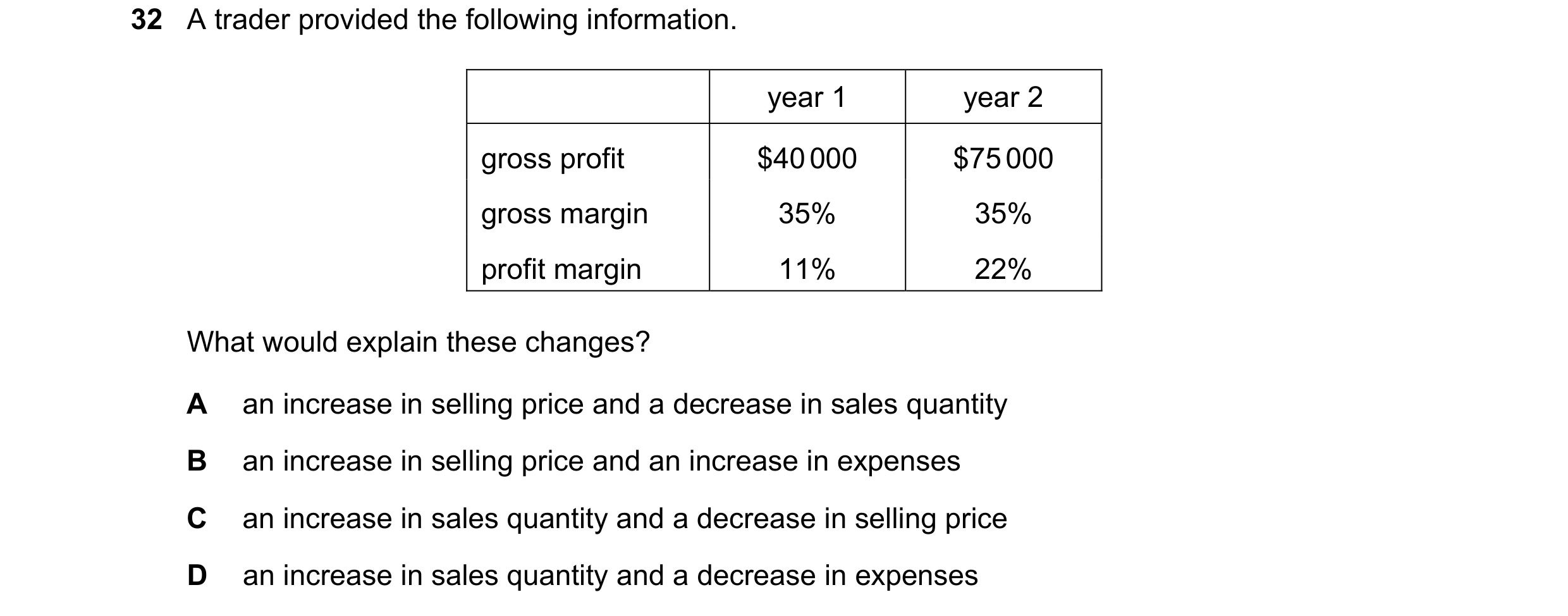

 10 / 16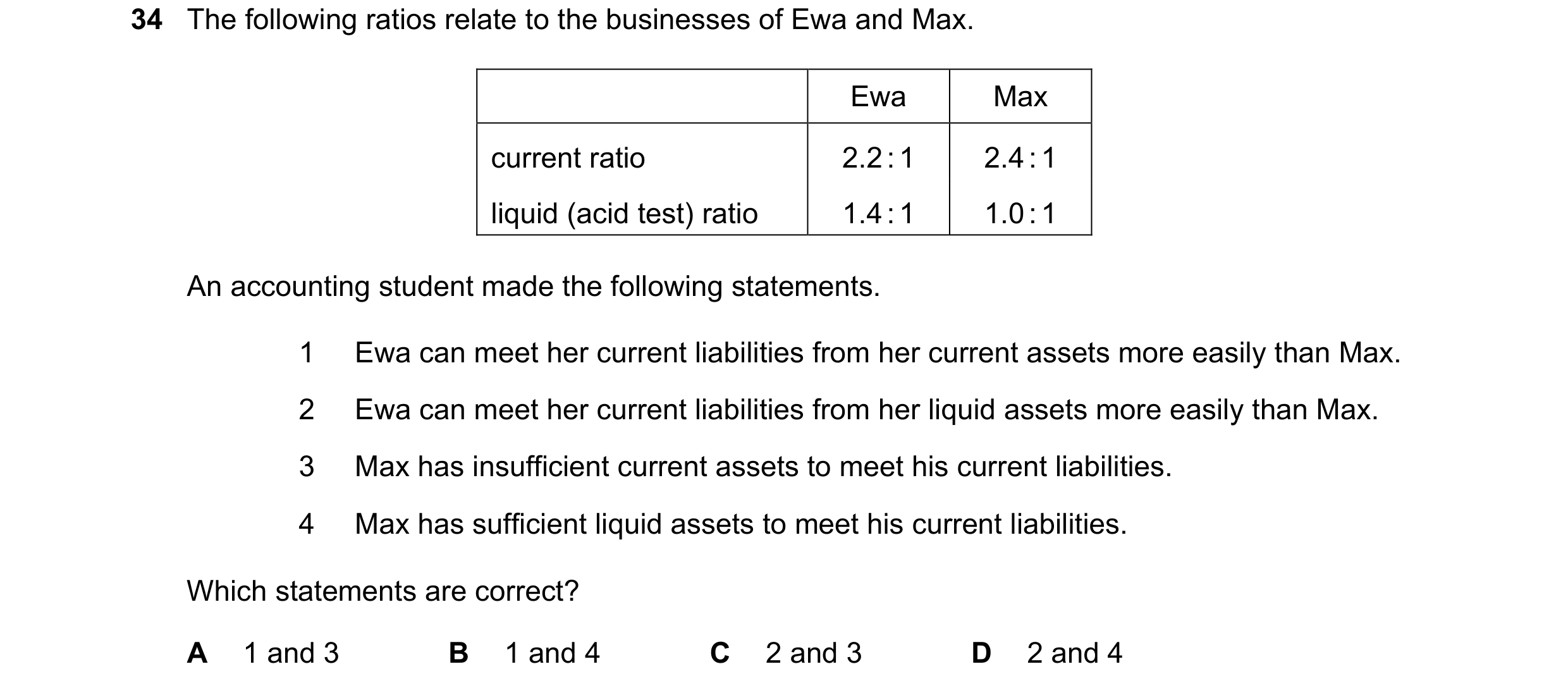
 11 / 16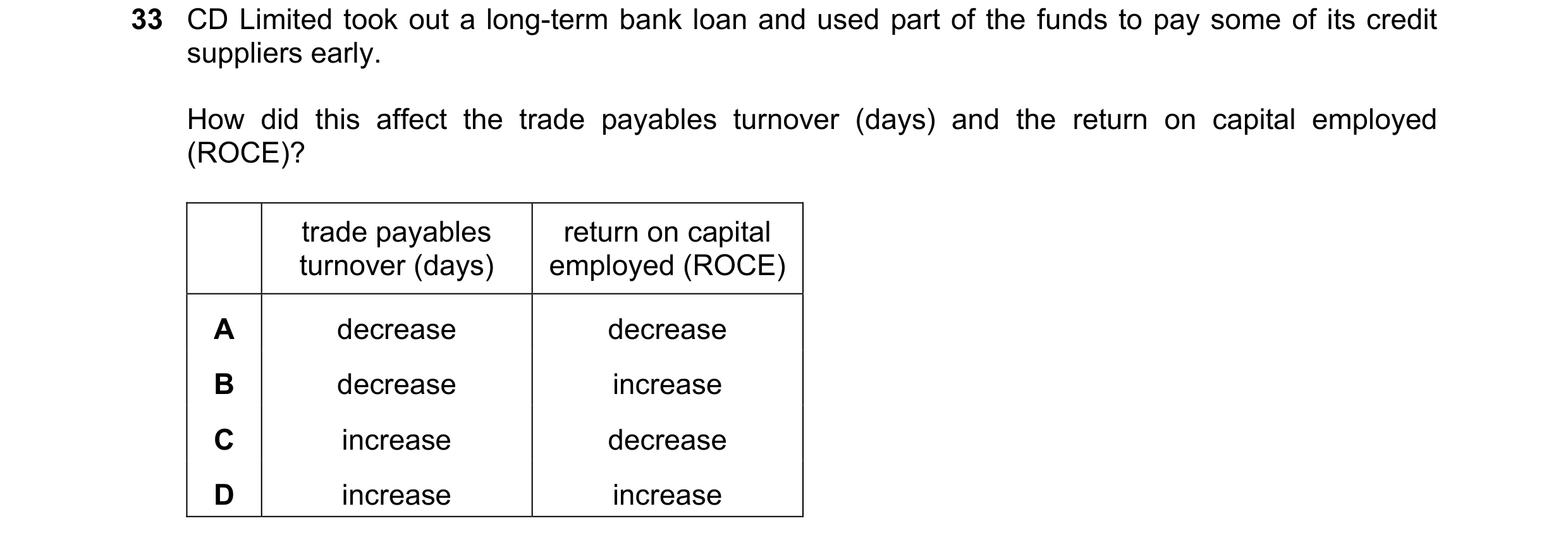
 12 / 16
 13 / 16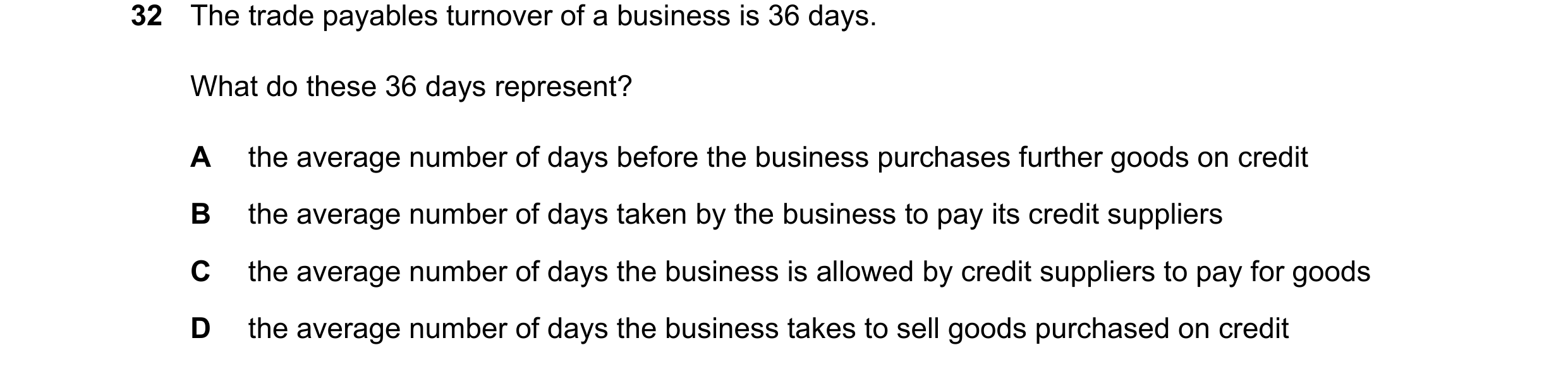

 14 / 16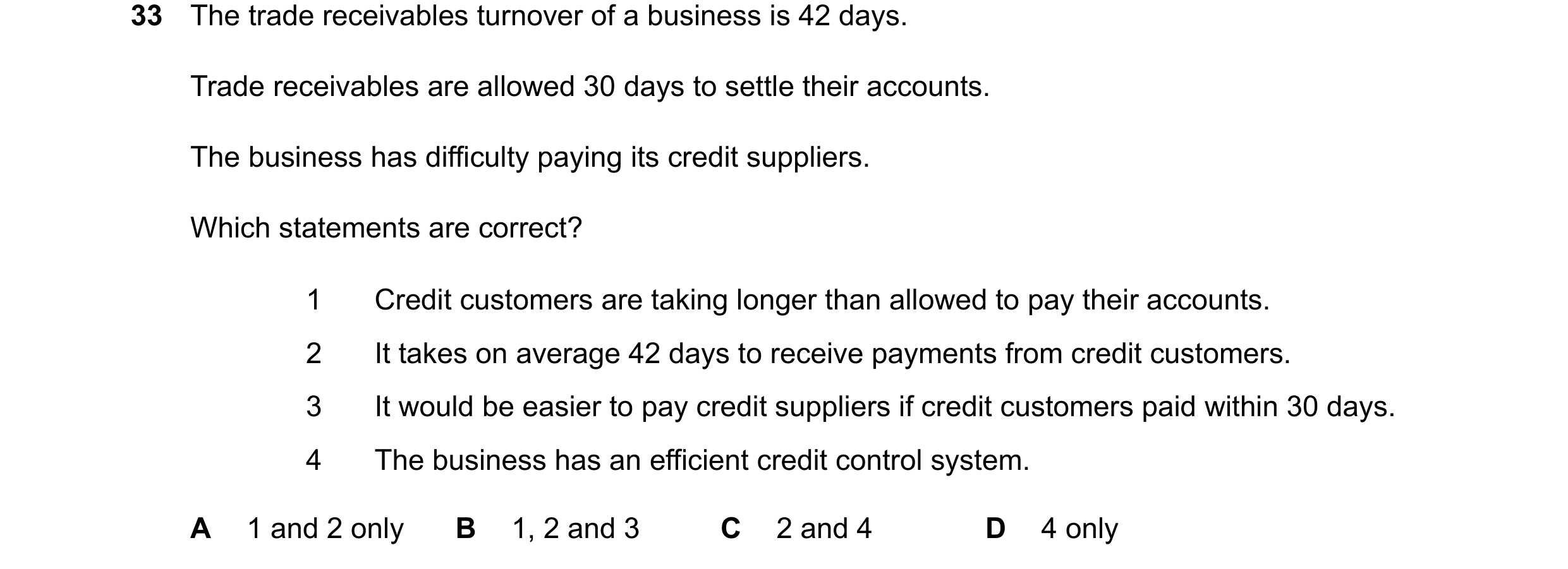
 15 / 16
 16 / 16