Cambridge A Level Physics 9702 — 2020 May/June Paper 2 · Variant 3
9702/23/M/J/20 · 7 questions · 60 marks · ≈68 min
The question paper and its mark scheme, free to read here and free to download. This is Cambridge’s own paper, exactly as it was sat.
Question paper16 pages


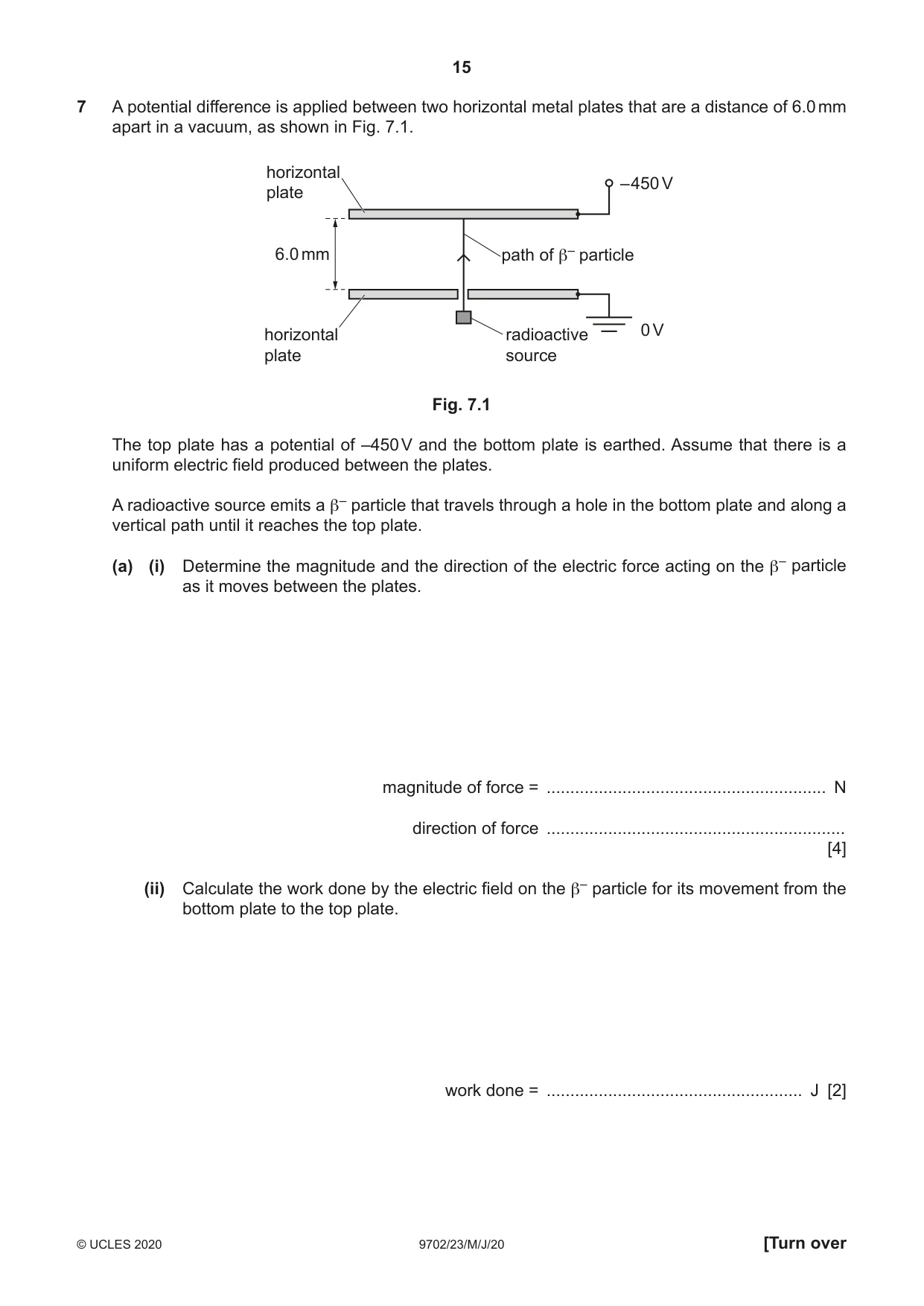
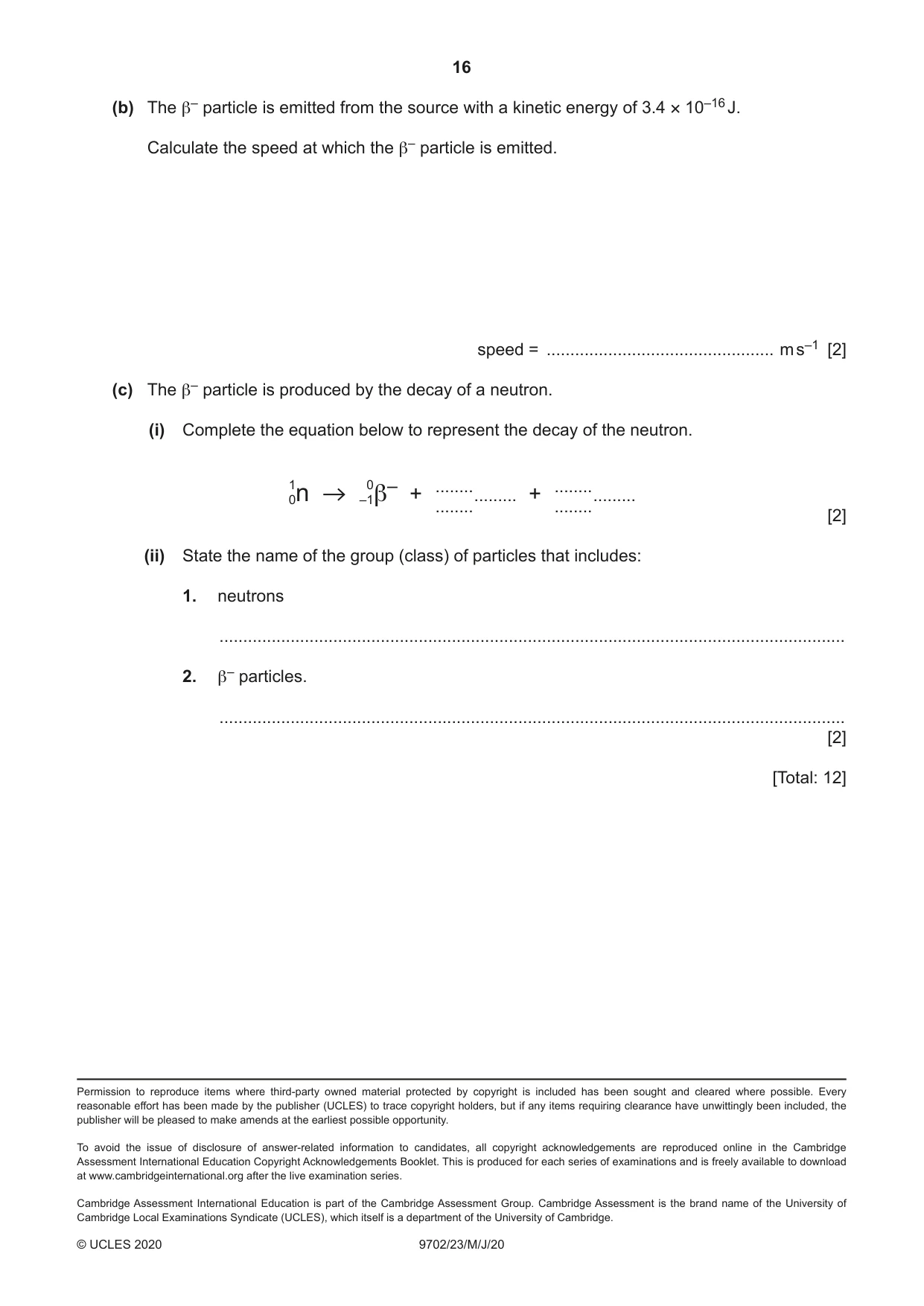
Mark scheme14 pages
Answers below. Sit the paper first if you are practising.
Questions as text
Q1 · State one similarity and one difference between distance and displacement
1 (a) State one similarity and one difference between distance and displacement. similarity: ................................................................................................................................... ................................................................................................................................................... difference: ................................................................................................................................. ................................................................................................................................................... [2] (b) A student takes several measurements of the same quantity. This set of measurements has high precision, but low accuracy. Describe what is meant by: (i) high precision ........................................................................................................................................... ..................................................................................................................................... [1] (ii) low accuracy. ........................................................................................................................................... ..................................................................................................................................... [1] [Total: 4]
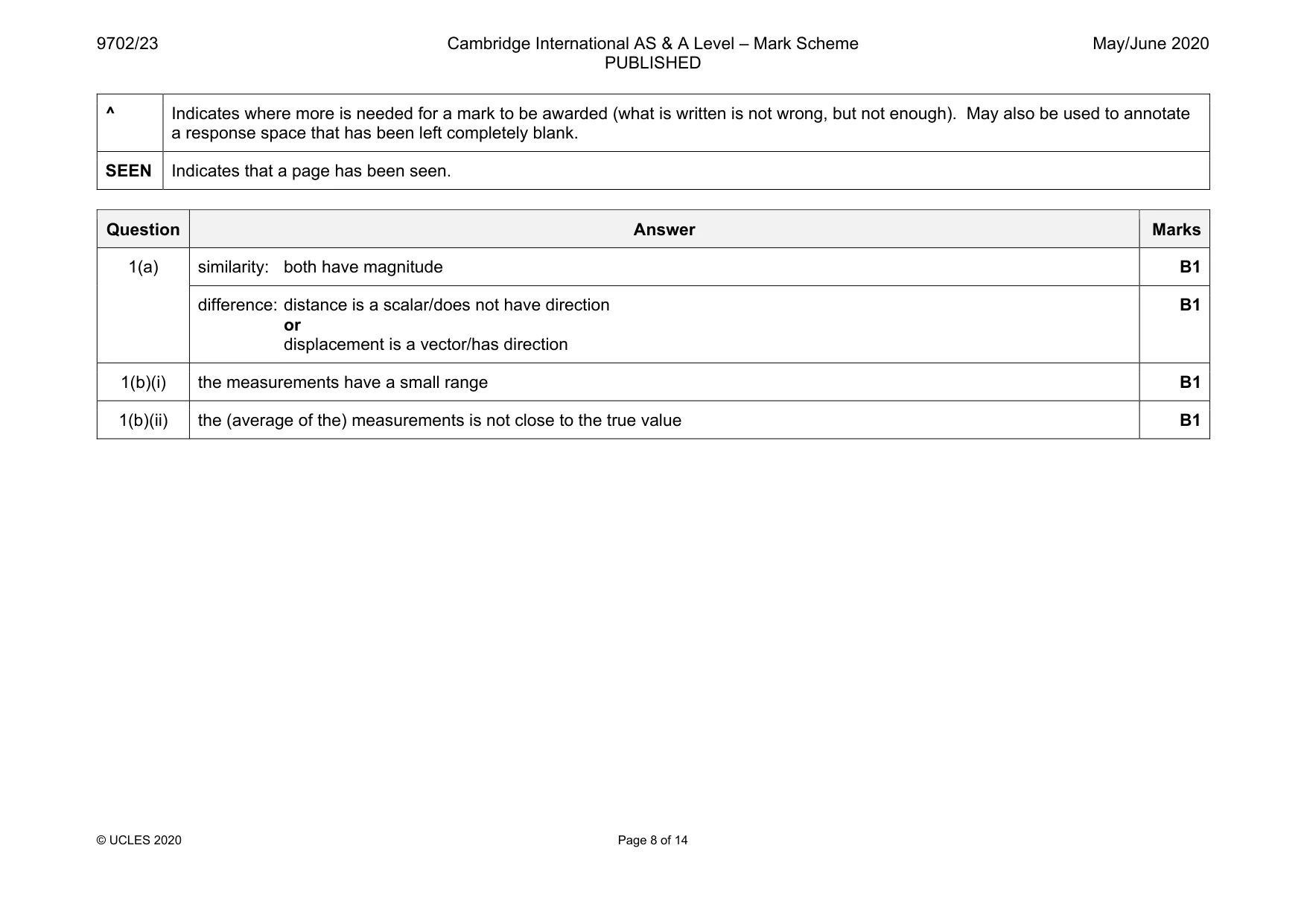
Mark scheme: 1(a) similarity: both have magnitude B1 difference: distance is a scalar/does not have direction or displacement is a vector/has direction B1 1(b)(i) the measurements have a small range B1 1(b)(ii) the (average of the) measurements is not close to the true value B1
Q2 · State Newton’s first law of motion
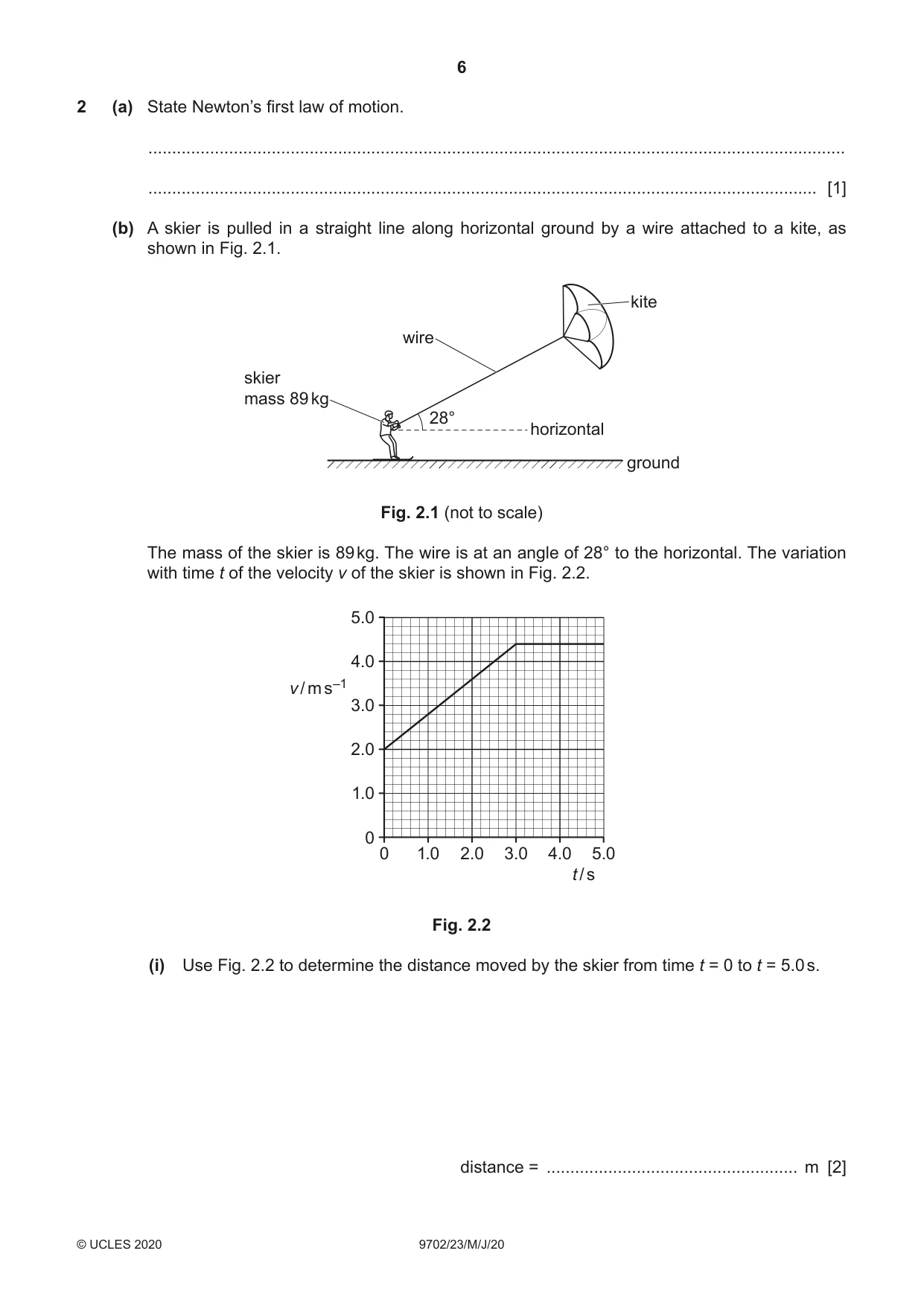
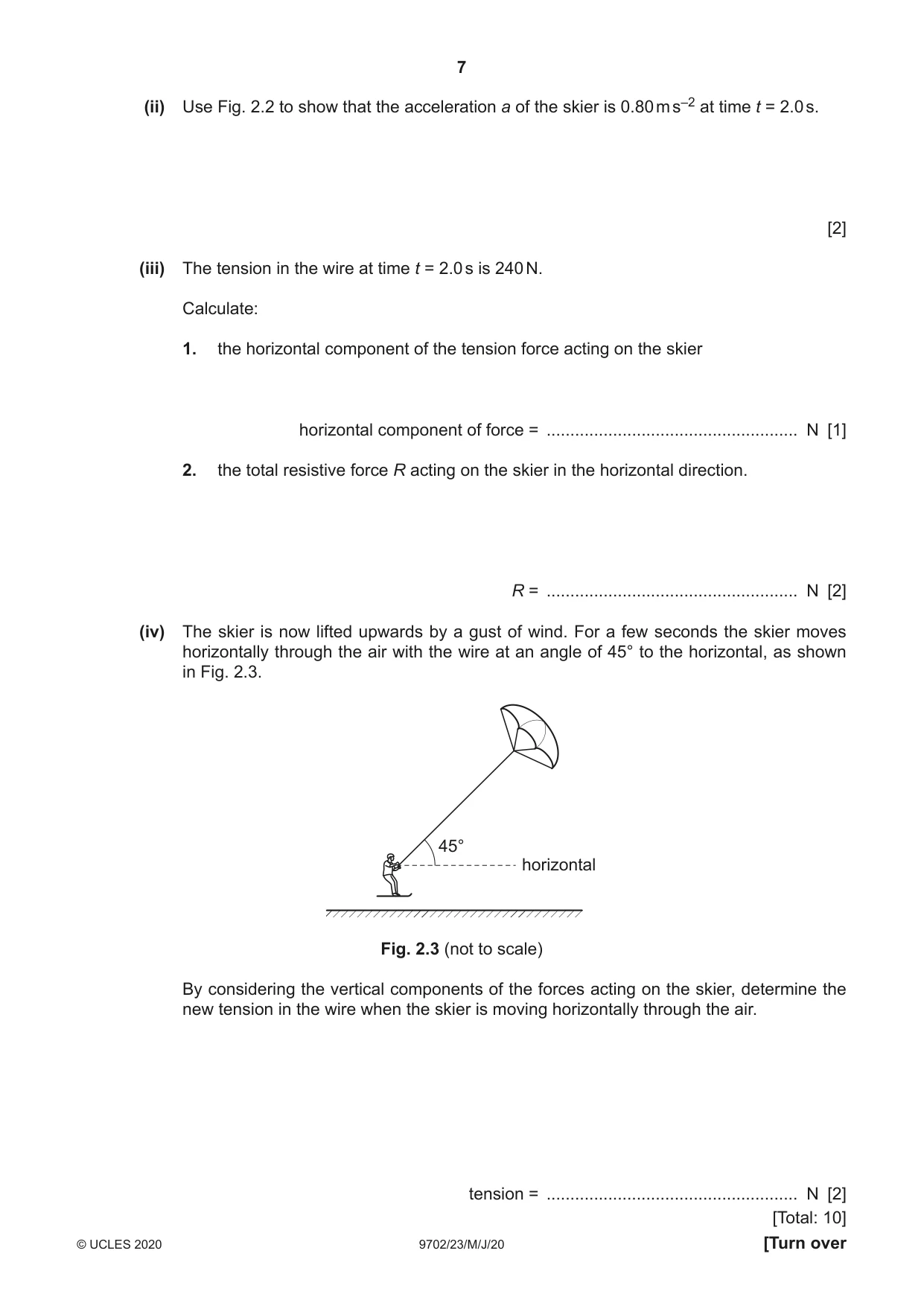
2 (a) State Newton’s first law of motion. ................................................................................................................................................... ............................................................................................................................................. [1] (b) A skier is pulled in a straight line along horizontal ground by a wire attached to a kite, as shown in Fig. 2.1. kite wire skier mass 89 kg 28° horizontal ground Fig. 2.1 (not to scale) The mass of the skier is 89 kg. The wire is at an angle of 28° to the horizontal. The variation with time t of the velocity v of the skier is shown in Fig. 2.2. 5.0 4.0 v / m s–1 3.0 2.0 1.0 0 0 1.0 2.0 3.0 4.0 5.0 t / s Fig. 2.2 (i) Use Fig. 2.2 to determine the distance moved by the skier from time t = 0 to t = 5.0 s. distance = ..................................................... m [2] (ii) Use Fig. 2.2 to show that the acceleration a of the skier is 0.80 m s–2 at time t = 2.0 s. [2] (iii) The tension in the wire at time t = 2.0 s is 240 N. Calculate: 1. the horizontal component of the tension force acting on the skier horizontal component of force = ..................................................... N [1] 2. the total resistive force R acting on the skier in the horizontal direction. R = ..................................................... N [2] (iv) The skier is now lifted upwards by a gust of wind. For a few seconds the skier moves horizontally through the air with the wire at an angle of 45° to the horizontal, as shown in Fig. 2.3. 45° horizontal Fig. 2.3 (not to scale) By considering the vertical components of the forces acting on the skier, determine the new tension in the wire when the skier is moving horizontally through the air. tension = ..................................................... N [2] [Total: 10]
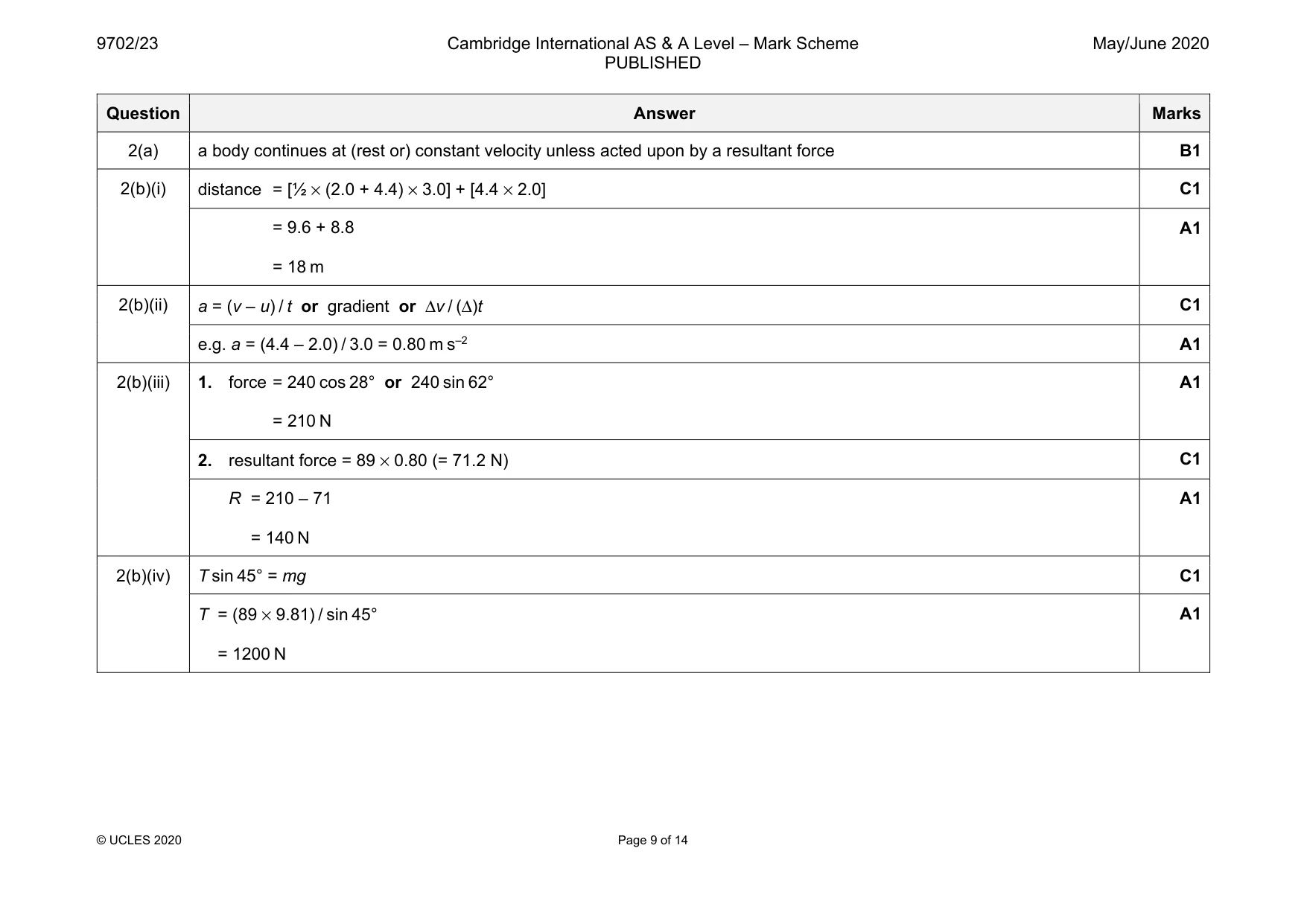
Mark scheme: 2(a) a body continues at (rest or) constant velocity unless acted upon by a resultant force B1 2(b)(i) distance = [½ × (2.0 + 4.4) × 3.0] + [4.4 × 2.0] C1 = 9.6 + 8.8 = 18 m A1 2(b)(ii) a = (v – u) / t or gradient or Δv / (Δ)t C1 e.g. a = (4.4 – 2.0) / 3.0 = 0.80 m s–2 A1 2(b)(iii) 1. force = 240 cos 28° or 240 sin 62° = 210 N A1 2. resultant force = 89 × 0.80 (= 71.2 N) C1 R = 210 – 71 = 140 N A1 2(b)(iv) T sin 45° = mg C1 T = (89 × 9.81) / sin 45° = 1200 N A1
Q3 · State the principle of moments
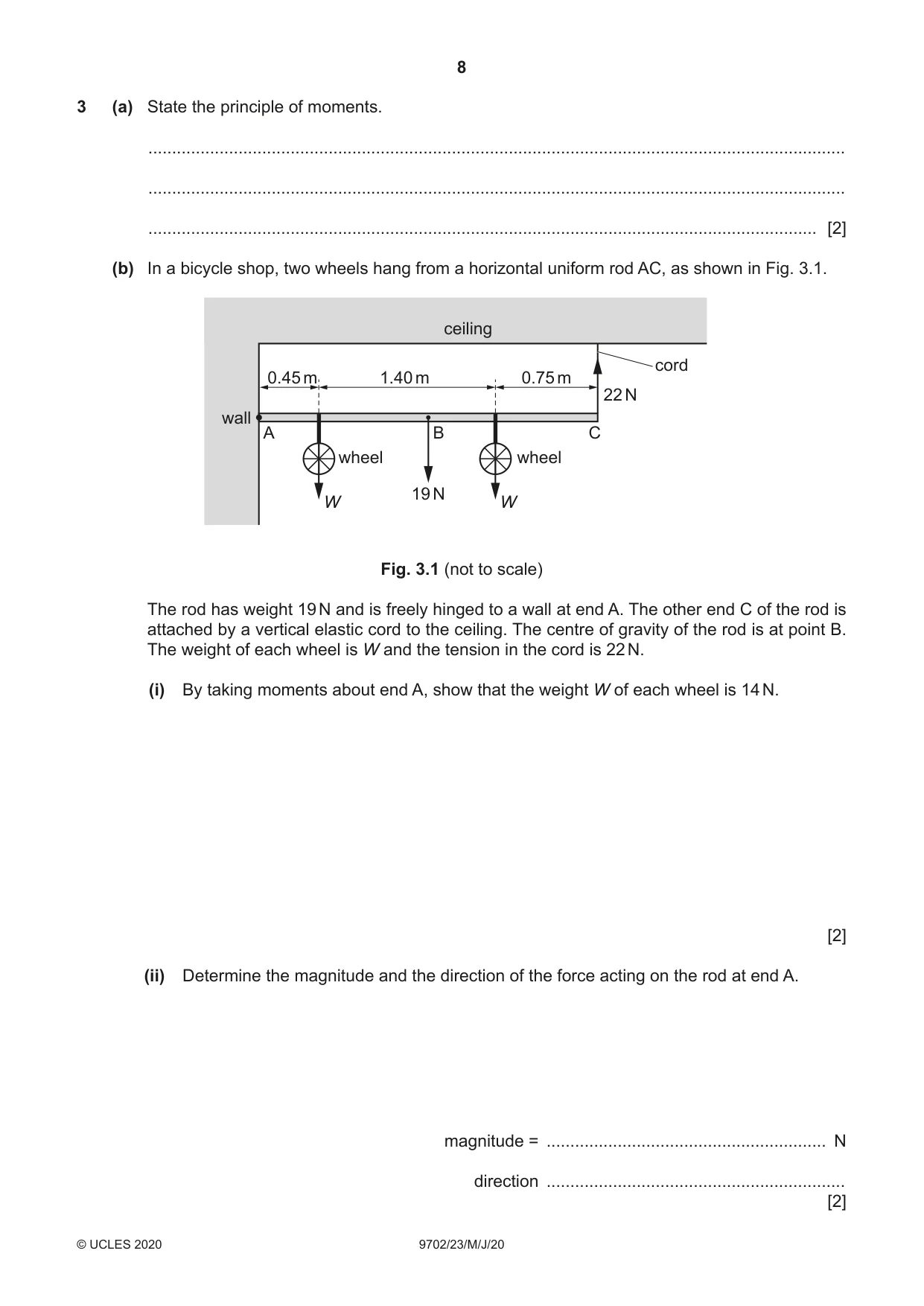
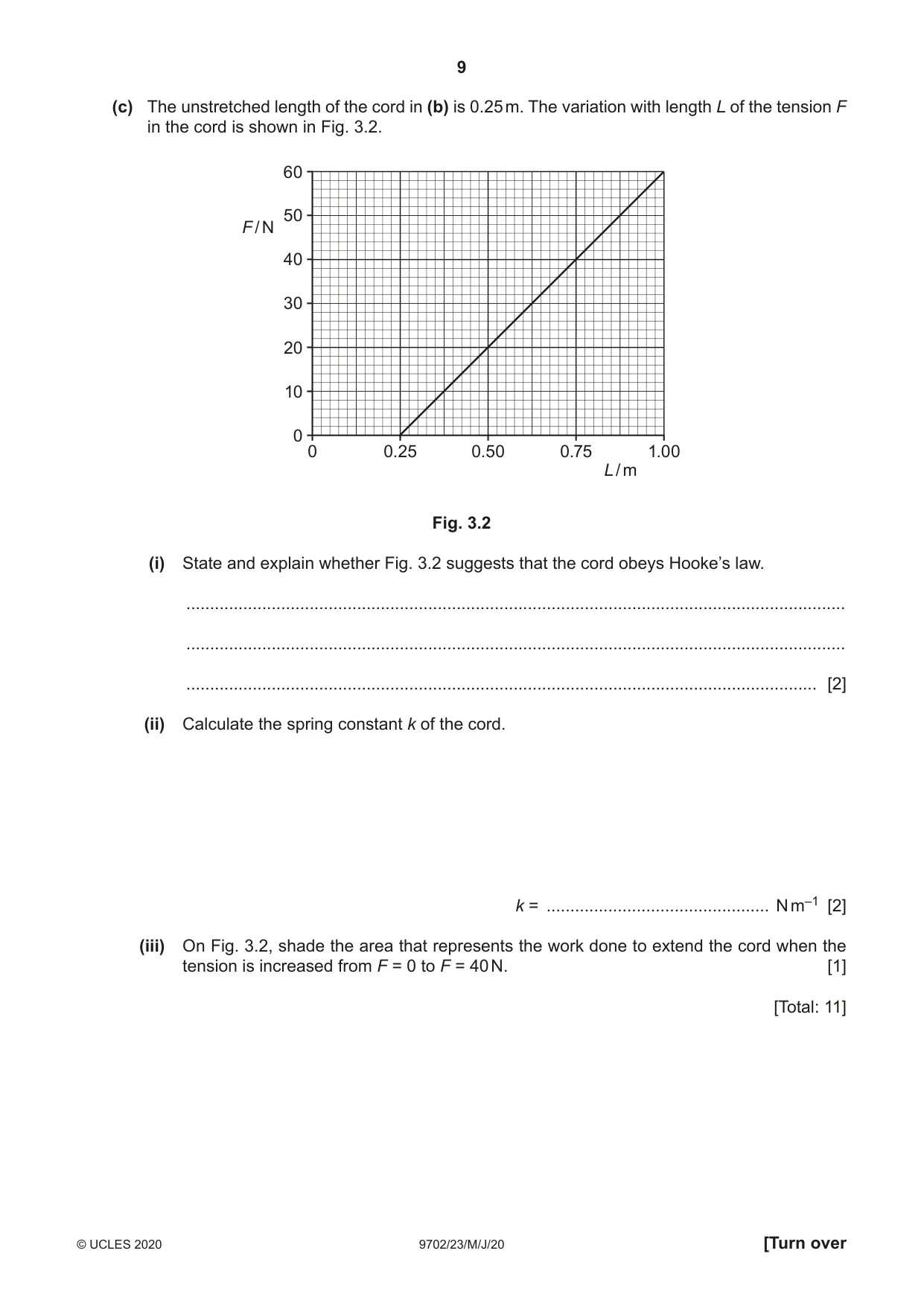
3 (a) State the principle of moments. ................................................................................................................................................... ................................................................................................................................................... ............................................................................................................................................. [2] (b) In a bicycle shop, two wheels hang from a horizontal uniform rod AC, as shown in Fig. 3.1. ceiling cord 0.45 m 1.40 m 0.75 m 22 N wall A B C wheel wheel 19 N W W Fig. 3.1 (not to scale) The rod has weight 19 N and is freely hinged to a wall at end A. The other end C of the rod is attached by a vertical elastic cord to the ceiling. The centre of gravity of the rod is at point B. The weight of each wheel is W and the tension in the cord is 22 N. (i) By taking moments about end A, show that the weight W of each wheel is 14 N. [2] (ii) Determine the magnitude and the direction of the force acting on the rod at end A. magnitude = ........................................................... N direction ............................................................... [2] (c) The unstretched length of the cord in (b) is 0.25 m. The variation with length L of the tension F in the cord is shown in Fig. 3.2. 60 50 F / N 40 30 20 10 0 0 0.25 0.50 0.75 1.00 L / m Fig. 3.2 (i) State and explain whether Fig. 3.2 suggests that the cord obeys Hooke’s law. ........................................................................................................................................... ........................................................................................................................................... ..................................................................................................................................... [2] (ii) Calculate the spring constant k of the cord. k = ............................................... N m–1 [2] (iii) On Fig. 3.2, shade the area that represents the work done to extend the cord when the tension is increased from F = 0 to F = 40 N. [1] [Total: 11]
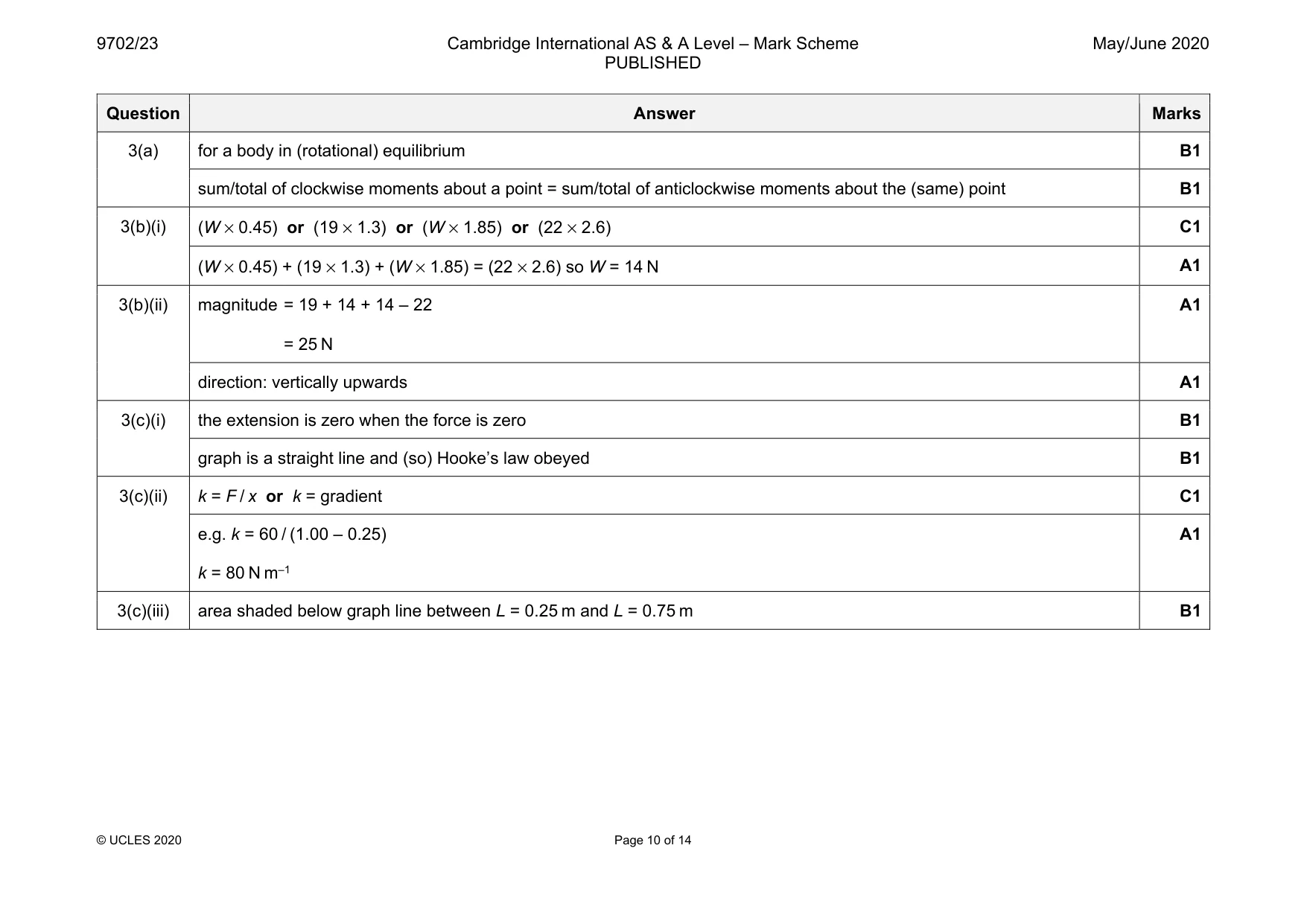
Mark scheme: 3(a) for a body in (rotational) equilibrium B1 sum/total of clockwise moments about a point = sum/total of anticlockwise moments about the (same) point B1 3(b)(i) (W × 0.45) or (19 × 1.3) or (W × 1.85) or (22 × 2.6) C1 (W × 0.45) + (19 × 1.3) + (W × 1.85) = (22 × 2.6) so W = 14 N A1 3(b)(ii) magnitude = 19 + 14 + 14 – 22 = 25 N A1 direction: vertically upwards A1 3(c)(i) the extension is zero when the force is zero B1 graph is a straight line and (so) Hooke’s law obeyed B1 3(c)(ii) k = F / x or k = gradient C1 e.g. k = 60 / (1.00 – 0.25) k = 80 N m–1 A1 3(c)(iii) area shaded below graph line between L = 0.25 m and L = 0.75 m B1
Q4 · Two progressive sound waves Y and Z meet at a fixed point P
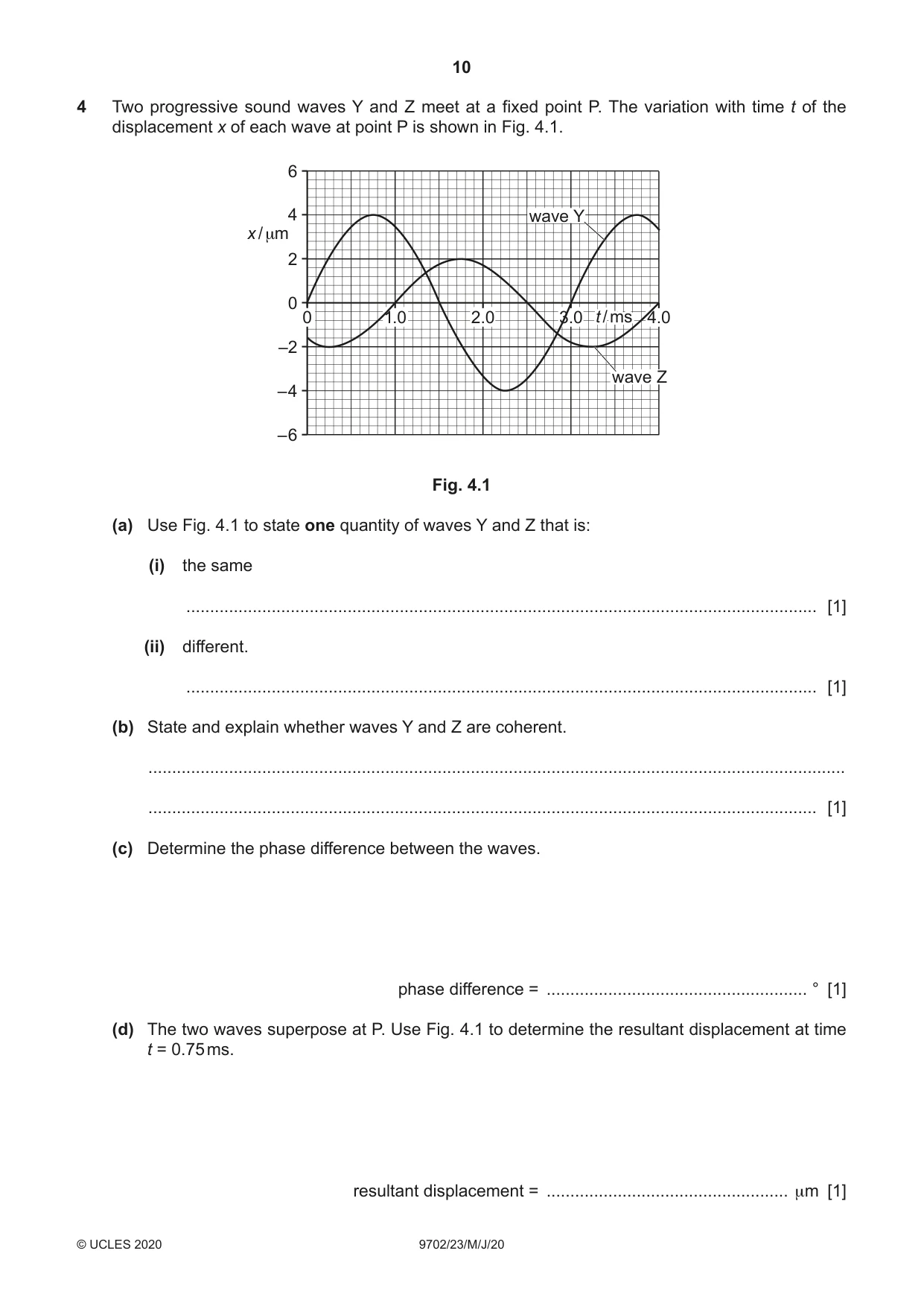
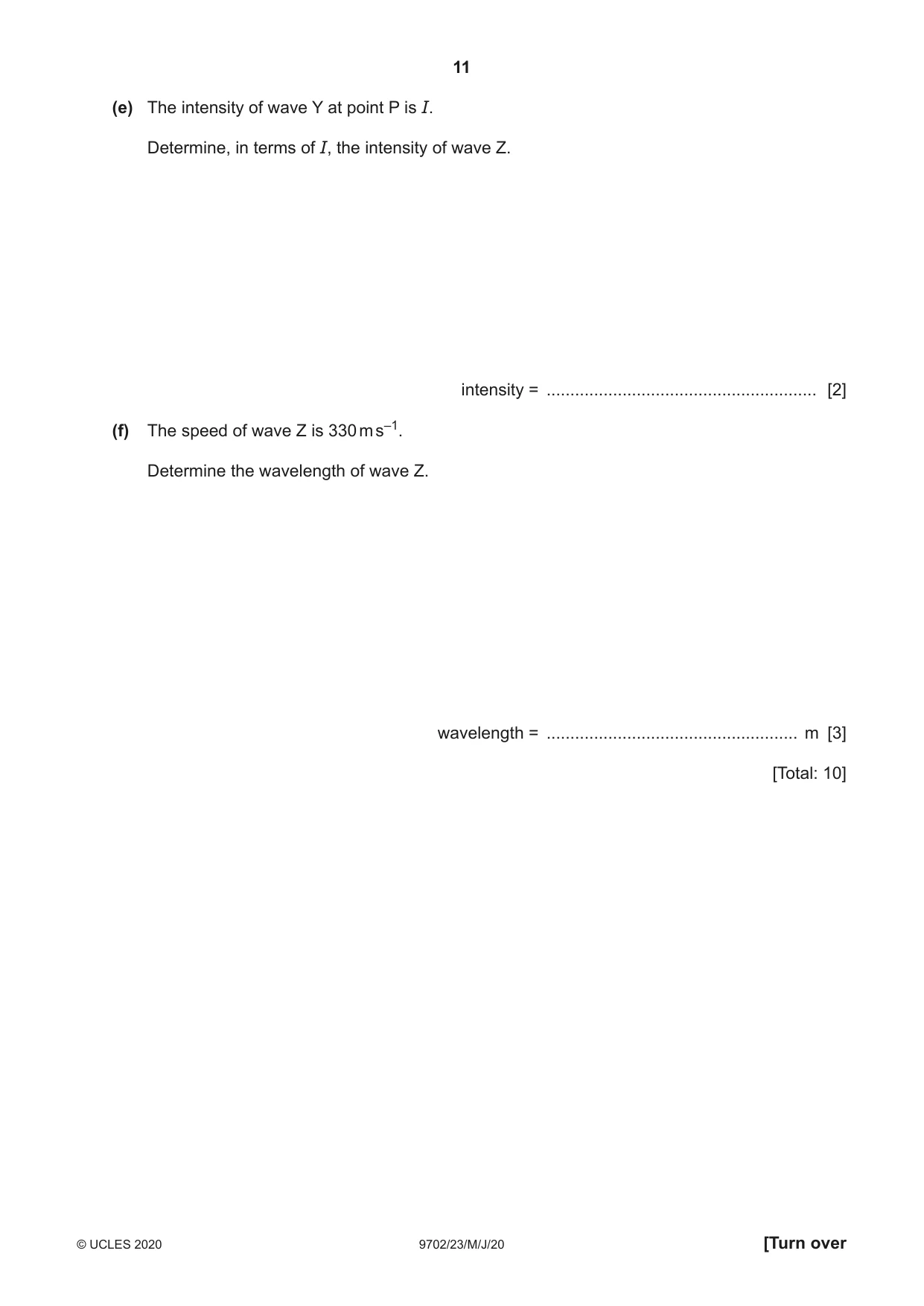
4 Two progressive sound waves Y and Z meet at a fixed point P. The variation with time t of the displacement x of each wave at point P is shown in Fig. 4.1. 6 4 wave Y x / μm 2 0 0 1.0 2.0 3.0 tt // msms 4.0 –2 wave Z –4 –6 Fig. 4.1 (a) Use Fig. 4.1 to state one quantity of waves Y and Z that is: (i) the same ..................................................................................................................................... [1] (ii) different. ..................................................................................................................................... [1] (b) State and explain whether waves Y and Z are coherent. ................................................................................................................................................... ............................................................................................................................................. [1] (c) Determine the phase difference between the waves. phase difference = ....................................................... ° [1] (d) The two waves superpose at P. Use Fig. 4.1 to determine the resultant displacement at time t = 0.75 ms. resultant displacement = ................................................... μm [1] (e) The intensity of wave Y at point P is I. Determine, in terms of I, the intensity of wave Z. intensity = ......................................................... [2] (f) The speed of wave Z is 330 m s–1. Determine the wavelength of wave Z. wavelength = ..................................................... m [3] [Total: 10]
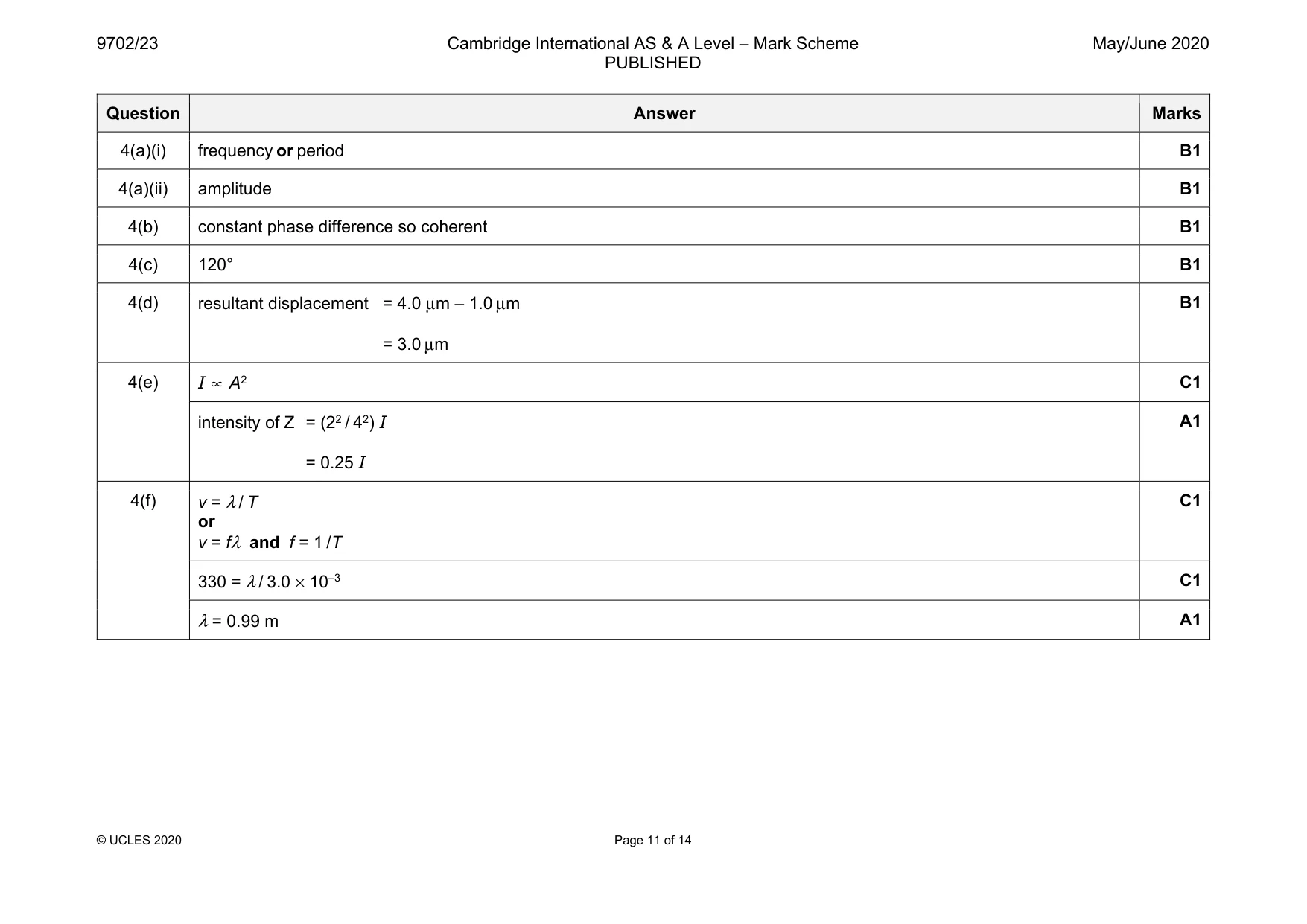
Mark scheme: 4(a)(i) frequency or period B1 4(a)(ii) amplitude B1 4(b) constant phase difference so coherent B1 4(c) 120° B1 4(d) resultant displacement = 4.0 μm – 1.0 μm = 3.0 μm B1 4(e) I ∝ A2 C1 intensity of Z = (22 / 42) I = 0.25 I A1 4(f) v = λ / T or v = fλ and f = 1 /T C1 330 = λ / 3.0 × 10⁻³ C1 λ = 0.99 m A1
Question 5
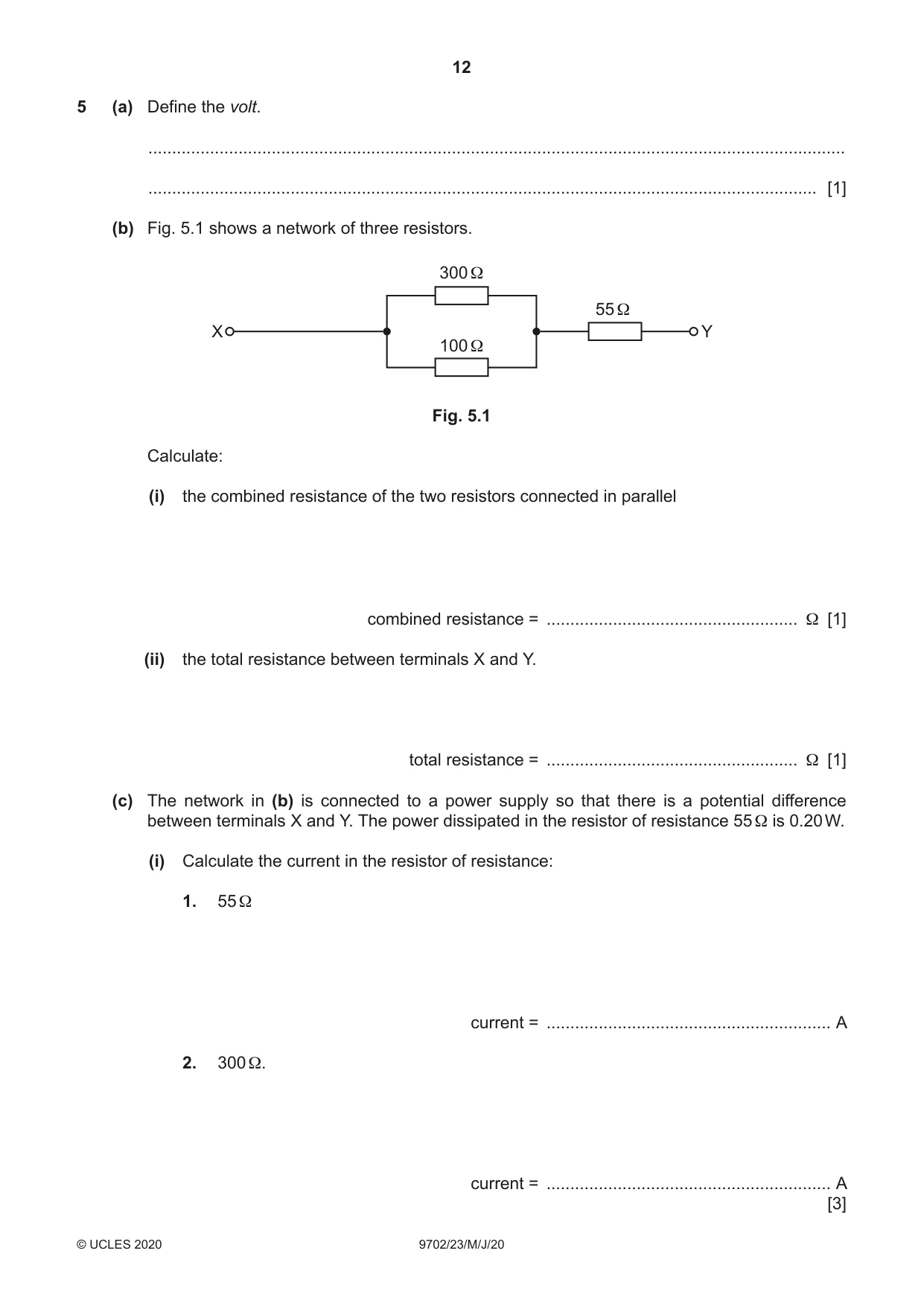
5 (a) Define the volt. ................................................................................................................................................... ............................................................................................................................................. [1] (b) Fig. 5.1 shows a network of three resistors. 300 Ω 55 Ω X Y 100 Ω Fig. 5.1 Calculate: (i) the combined resistance of the two resistors connected in parallel combined resistance = ..................................................... Ω [1] (ii) the total resistance between terminals X and Y. total resistance = ..................................................... Ω [1] (c) The network in (b) is connected to a power supply so that there is a potential difference between terminals X and Y. The power dissipated in the resistor of resistance 55 Ω is 0.20 W. (i) Calculate the current in the resistor of resistance: 1. 55 Ω current = ............................................................ A 2. 300 Ω. current = ............................................................ A [3] (ii) Calculate the potential difference between X and Y. potential difference = ...................................................... V [1] [Total: 7]
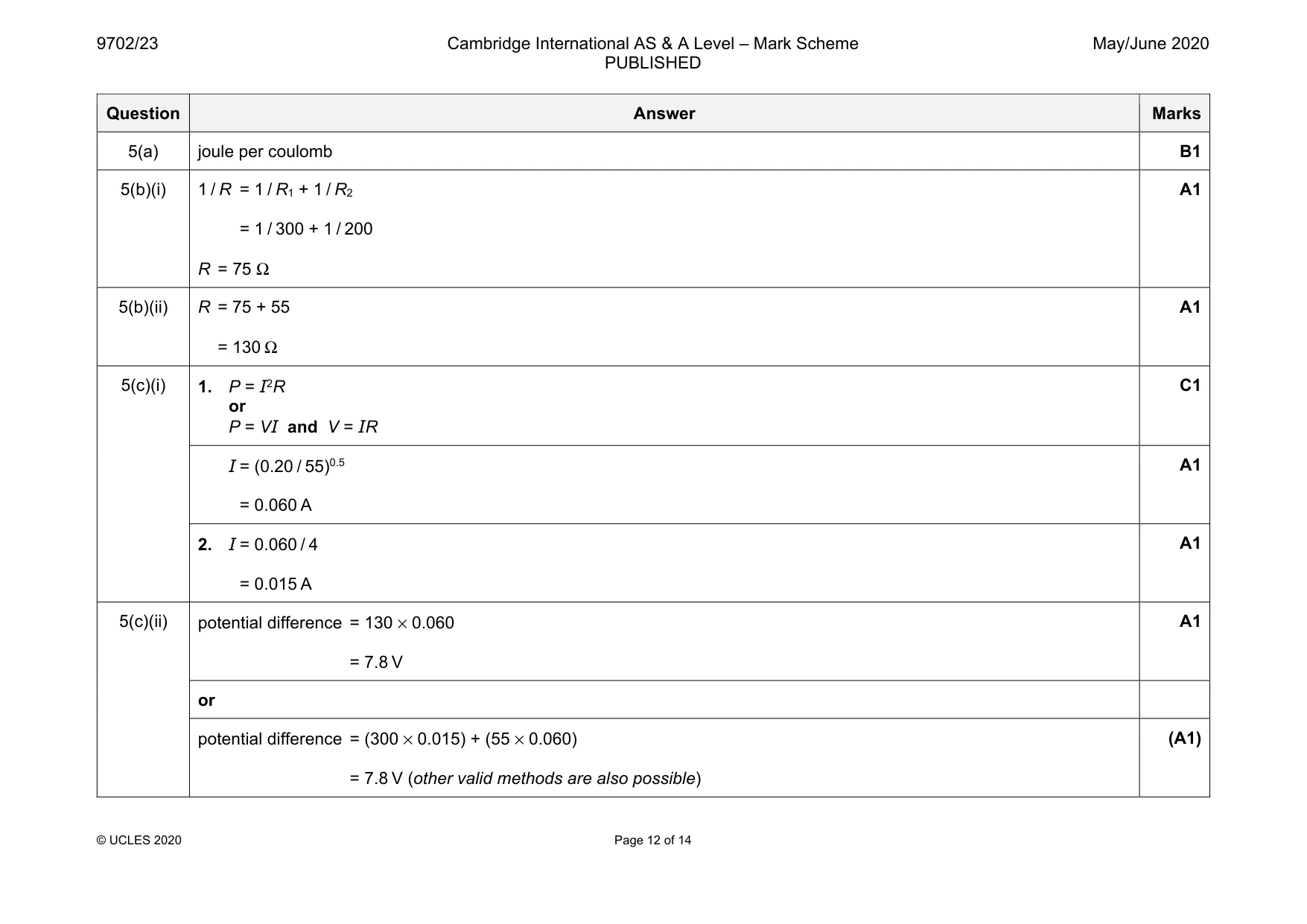
Mark scheme: 5(a) joule per coulomb B1 5(b)(i) 1 / R = 1 / R1 + 1 / R2 = 1 / 300 + 1 / 200 R = 75 Ω A1 5(b)(ii) R = 75 + 55 = 130 Ω A1 5(c)(i) 1. P = I2R or P = VI and V = IR C1 I = (0.20 / 55)0.5 = 0.060 A A1 2. I = 0.060 / 4 = 0.015 A A1 5(c)(ii) potential difference = 130 × 0.060 = 7.8 V A1 or potential difference = (300 × 0.015) + (55 × 0.060) = 7.8 V (other valid methods are also possible) (A1)
Q6 · The current I in a metal wire is given by the expression I = Anve where v is the average…
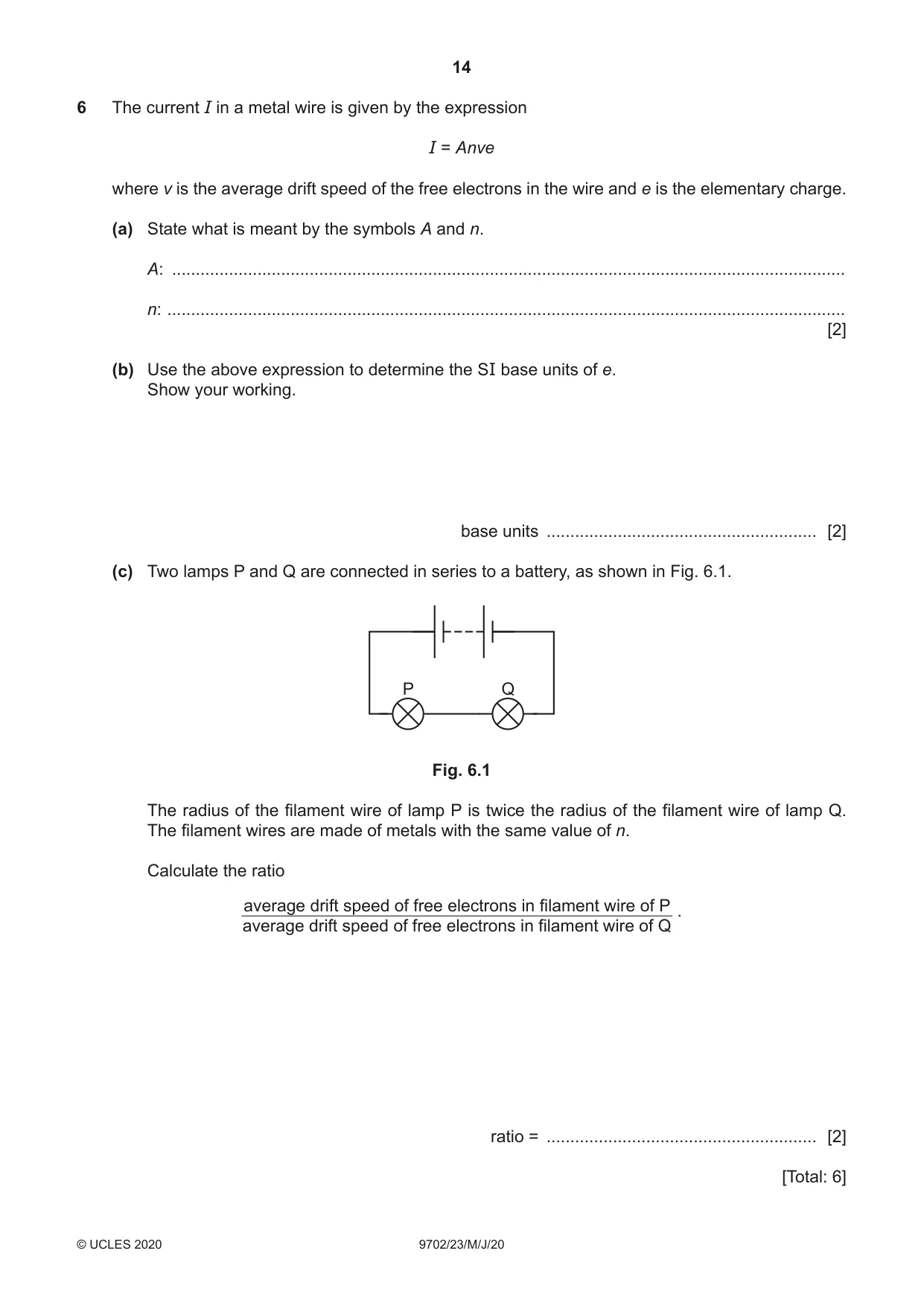
6 The current I in a metal wire is given by the expression I = Anve where v is the average drift speed of the free electrons in the wire and e is the elementary charge. (a) State what is meant by the symbols A and n. A: .............................................................................................................................................. n: ............................................................................................................................................... [2] (b) Use the above expression to determine the SI base units of e. Show your working. base units ......................................................... [2] (c) Two lamps P and Q are connected in series to a battery, as shown in Fig. 6.1. P Q Fig. 6.1 The radius of the filament wire of lamp P is twice the radius of the filament wire of lamp Q. The filament wires are made of metals with the same value of n. Calculate the ratio average drift speed of free electrons in filament wire of P . average drift speed of free electrons in filament wire of Q ratio = ......................................................... [2] [Total: 6]
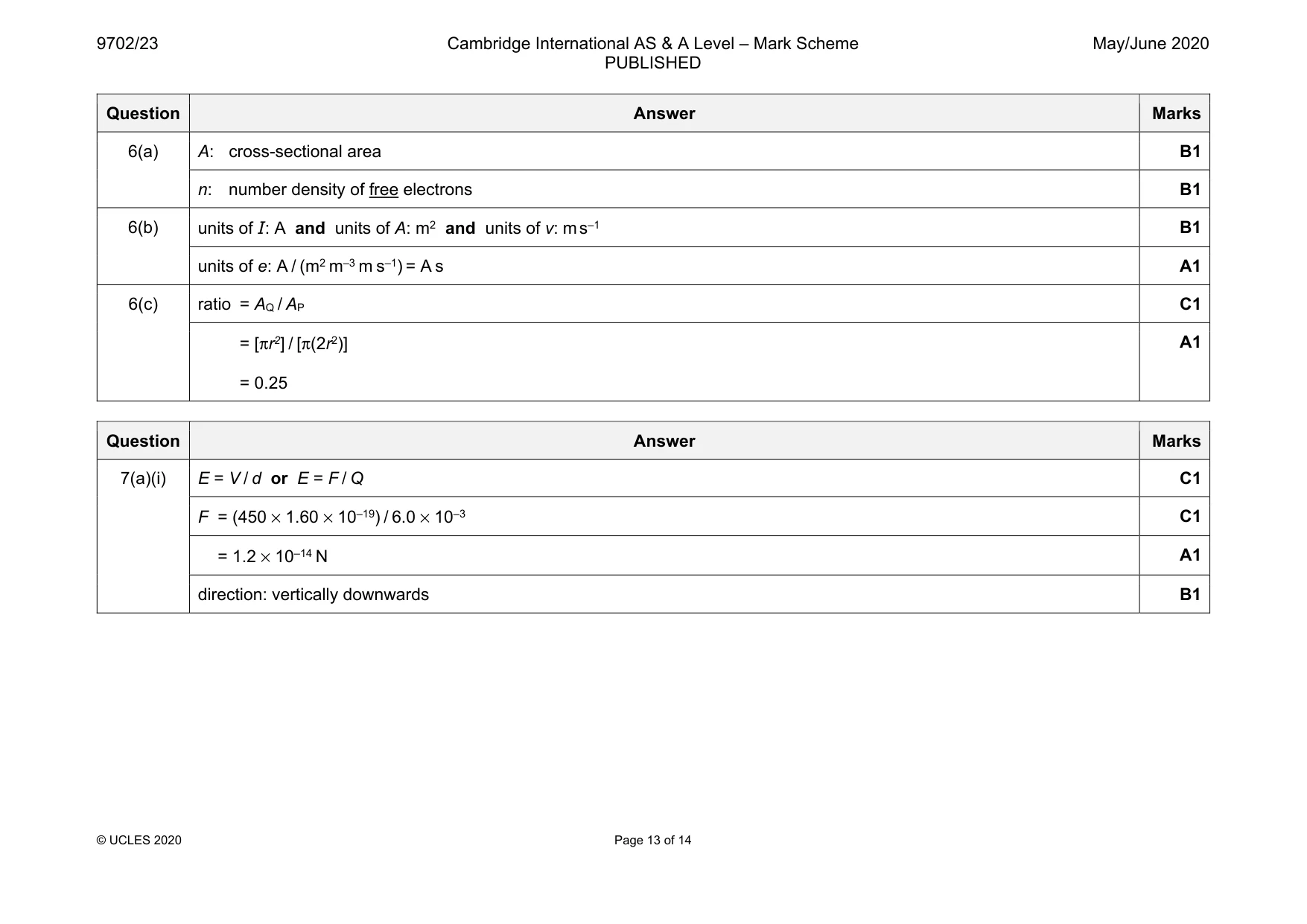
Mark scheme: 6(a) A: cross-sectional area B1 n: number density of free electrons B1 6(b) units of I: A and units of A: m2 and units of v: m s–1 B1 units of e: A / (m2 m–3 m s–1) = A s A1 6(c) ratio = AQ / AP C1 = [πr2] / [π(2r2)] = 0.25 A1
Q7 · A potential difference is applied between two horizontal metal plates that are a distance…
7 A potential difference is applied between two horizontal metal plates that are a distance of 6.0 mm apart in a vacuum, as shown in Fig. 7.1. horizontal – 450 V plate 6.0 mm path of β– particle horizontal radioactive 0 V plate source Fig. 7.1 The top plate has a potential of –450 V and the bottom plate is earthed. Assume that there is a uniform electric field produced between the plates. A radioactive source emits a β– particle that travels through a hole in the bottom plate and along a vertical path until it reaches the top plate. (a) (i) Determine the magnitude and the direction of the electric force acting on the β– particle as it moves between the plates. magnitude of force = ........................................................... N direction of force ............................................................... [4] (ii) Calculate the work done by the electric field on the β– particle for its movement from the bottom plate to the top plate. work done = ...................................................... J [2] (b) The β– particle is emitted from the source with a kinetic energy of 3.4 × 10⁻¹⁶ J. Calculate the speed at which the β– particle is emitted. speed = ................................................ m s–1 [2] (c) The β– particle is produced by the decay of a neutron. (i) Complete the equation below to represent the decay of the neutron. 10n –1β–0 + ........ + ........ ................. ................. [2] (ii) State the name of the group (class) of particles that includes: 1. neutrons .................................................................................................................................... 2. β– particles. .................................................................................................................................... [2] [Total: 12]
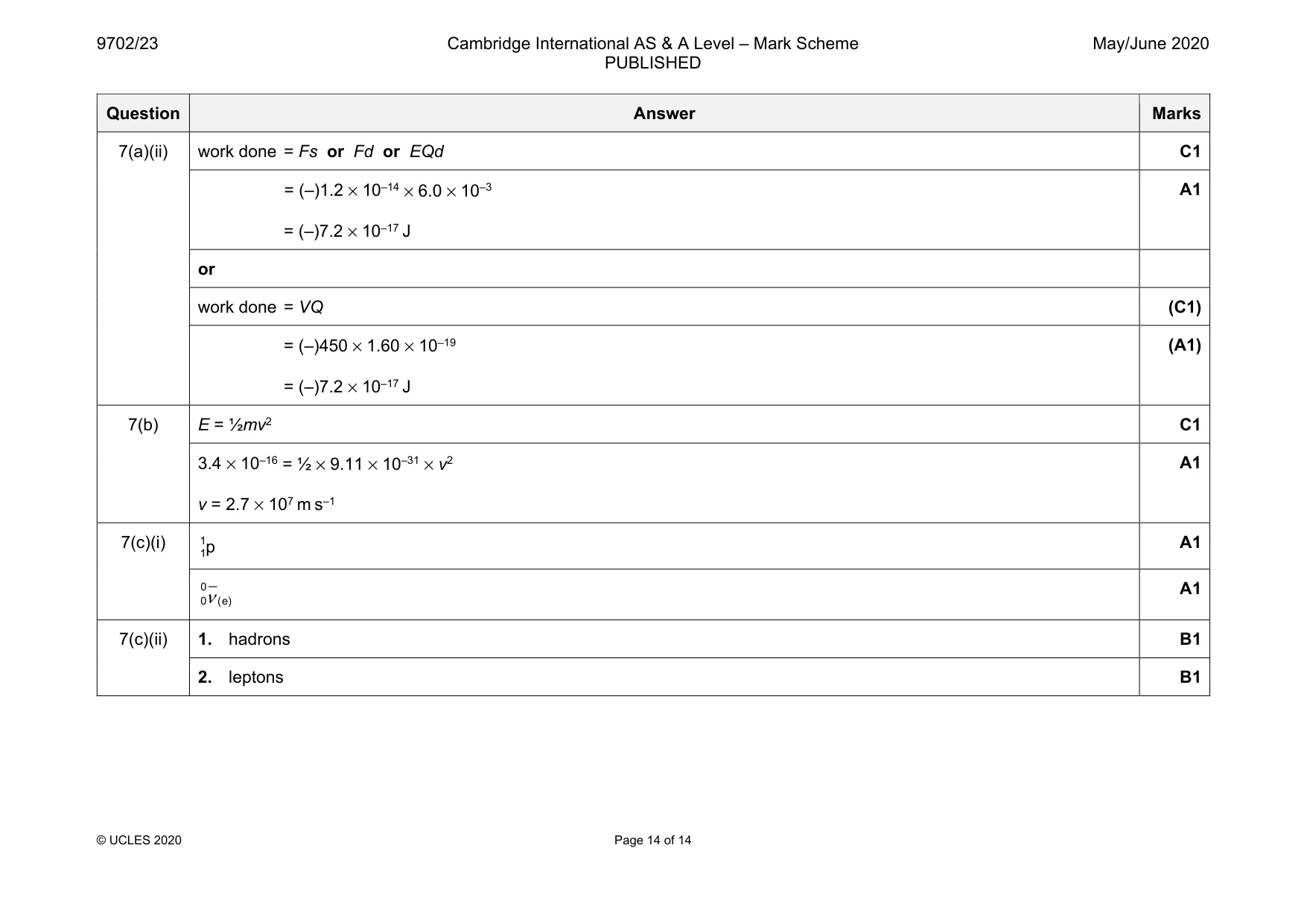
Mark scheme: 7(a)(i) E = V / d or E = F / Q C1 F = (450 × 1.60 × 10–19) / 6.0 × 10⁻³ C1 = 1.2 × 10⁻¹⁴ N A1 direction: vertically downwards B1 Question Answer Marks 7(a)(ii) work done = Fs or Fd or EQd C1 = (–)1.2 × 10–14 × 6.0 × 10–3 = (–)7.2 × 10⁻¹⁷ J A1 or work done = VQ (C1) = (–)450 × 1.60 × 10–19 = (–)7.2 × 10⁻¹⁷ J (A1) 7(b) E = ½mv2 C1 3.4 × 10–16 = ½ × 9.11 × 10⁻³¹ × v2 v = 2.7 × 10⁷ m s–1 A1 7(c)(i) 1 1p A1 0 0 (e) ν A1 7(c)(ii) 1. hadrons B1 2. leptons B1
What was in this paper
The subtopics covered by these 7 questions, and how many questions each got. Open one in a new tab to see every Cambridge question on it.