Questions as text
Q1 · State what is meant by a photon 9702/42 Feb/March 2017
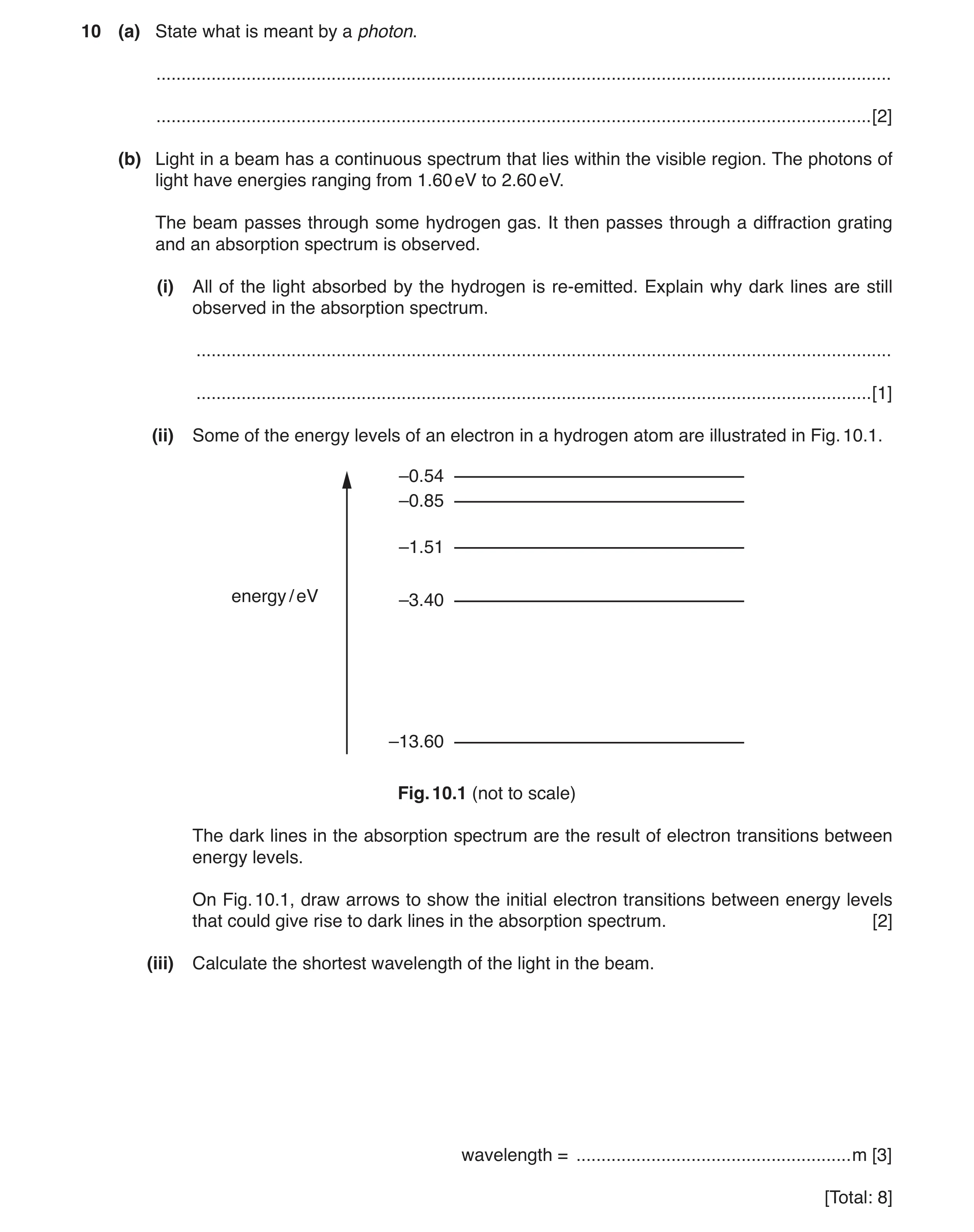
10 (a) State what is meant by a photon. … … [2] (b) Light in a beam has a continuous spectrum that lies within the visible region. The photons of light have energies ranging from 1.60 eV to 2.60 eV. The beam passes through some hydrogen gas. It then passes through a diffraction grating and an absorption spectrum is observed. (i) All of the light absorbed by the hydrogen is re-emitted. Explain why dark lines are still observed in the absorption spectrum. … … [1] (ii) Some of the energy levels of an electron in a hydrogen atom are illustrated in Fig. 10.1. –0.54 –0.85 –1.51 energy / eV –3.40 –13.60 Fig. 10.1 (not to scale) The dark lines in the absorption spectrum are the result of electron transitions between energy levels. On Fig. 10.1, draw arrows to show the initial electron transitions between energy levels that could give rise to dark lines in the absorption spectrum. [2] (iii) Calculate the shortest wavelength of the light in the beam. wavelength = … m [3] [Total: 8]
8 marks
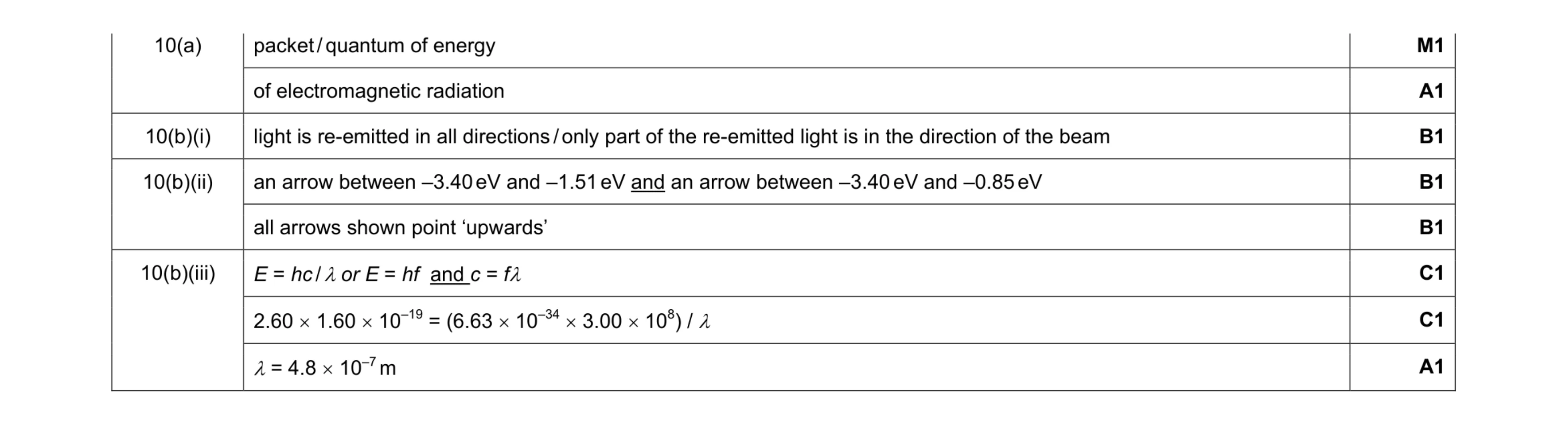
Mark scheme: 10(a) packet / quantum of energy M1 of electromagnetic radiation A1 10(b)(i) light is re-emitted in all directions / only part of the re-emitted light is in the direction of the beam B1 10(b)(ii) an arrow between –3.40 eV and –1.51 eV and an arrow between –3.40 eV and –0.85 eV B1 all arrows shown point ‘upwards’ B1 10(b)(iii) E = hc / λ or E = hf and c = fλ C1 2.60 × 1.60 × 10–19 = (6.63 × 10–34 × 3.00 × 108) / λ C1 λ = 4.8 × 10⁻⁷ m A1
This question in 9702/42 Feb/March 2017
Q2 · State what is meant by a photon 9702/41 Oct/Nov 2017
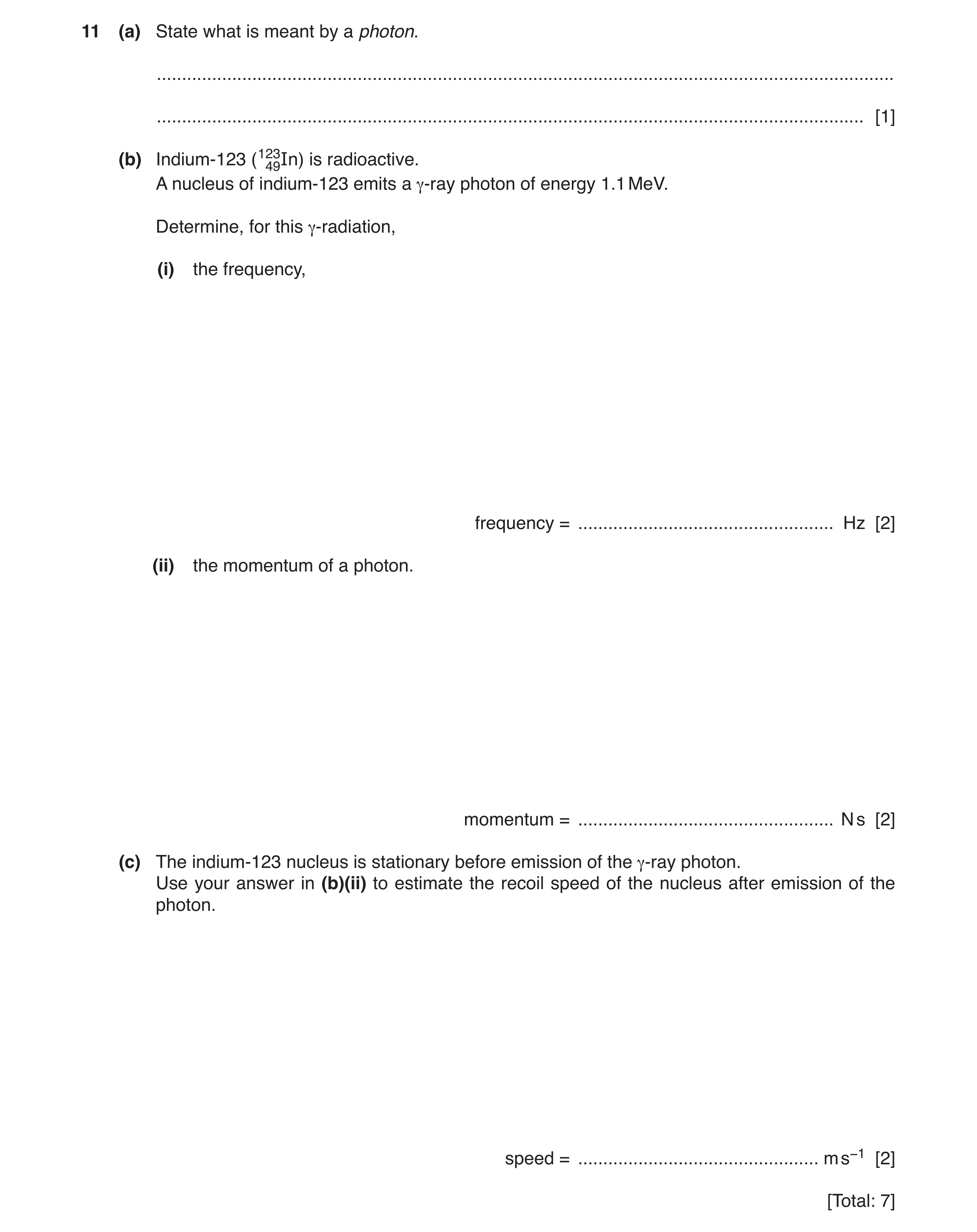
11 (a) State what is meant by a photon. … … [1] (b) Indium-123 (12349In) is radioactive. A nucleus of indium-123 emits a γ-ray photon of energy 1.1 MeV. Determine, for this γ-radiation, (i) the frequency, frequency = … Hz [2] (ii) the momentum of a photon. momentum = … N s [2] (c) The indium-123 nucleus is stationary before emission of the γ-ray photon. Use your answer in (b)(ii) to estimate the recoil speed of the nucleus after emission of the photon. speed = … m s−1 [2] [Total: 7]
7 marks
Mark scheme: 11(a) packet/quantum of energy of electromagnetic/EM radiation B1 11(b)(i) E = hf 1.1 × 106 × 1.60 × 10–19 = 6.63 × 10⁻³⁴ × f C1 f = 2.7 × 10²⁰ (2.65 × 10²⁰) Hz A1 11(b)(ii) p = h / λ = hf / c = (6.63 × 10–34 × 2.65 × 1020) / (3.00 × 10⁸) or p = E / c = (1.1 × 1.60 × 10–13) / (3.00 × 10⁸) C1 p = 5.9 × 10⁻²² (5.87 × 10⁻²²) N s A1 11(c) 123 × 1.66 × 10–27 × v = 5.87 × 10⁻²² C1 v = 2.9 × 10³ m s–1 A1
This question in 9702/41 Oct/Nov 2017
Q3 · State what is meant by a photon 9702/43 Oct/Nov 2017
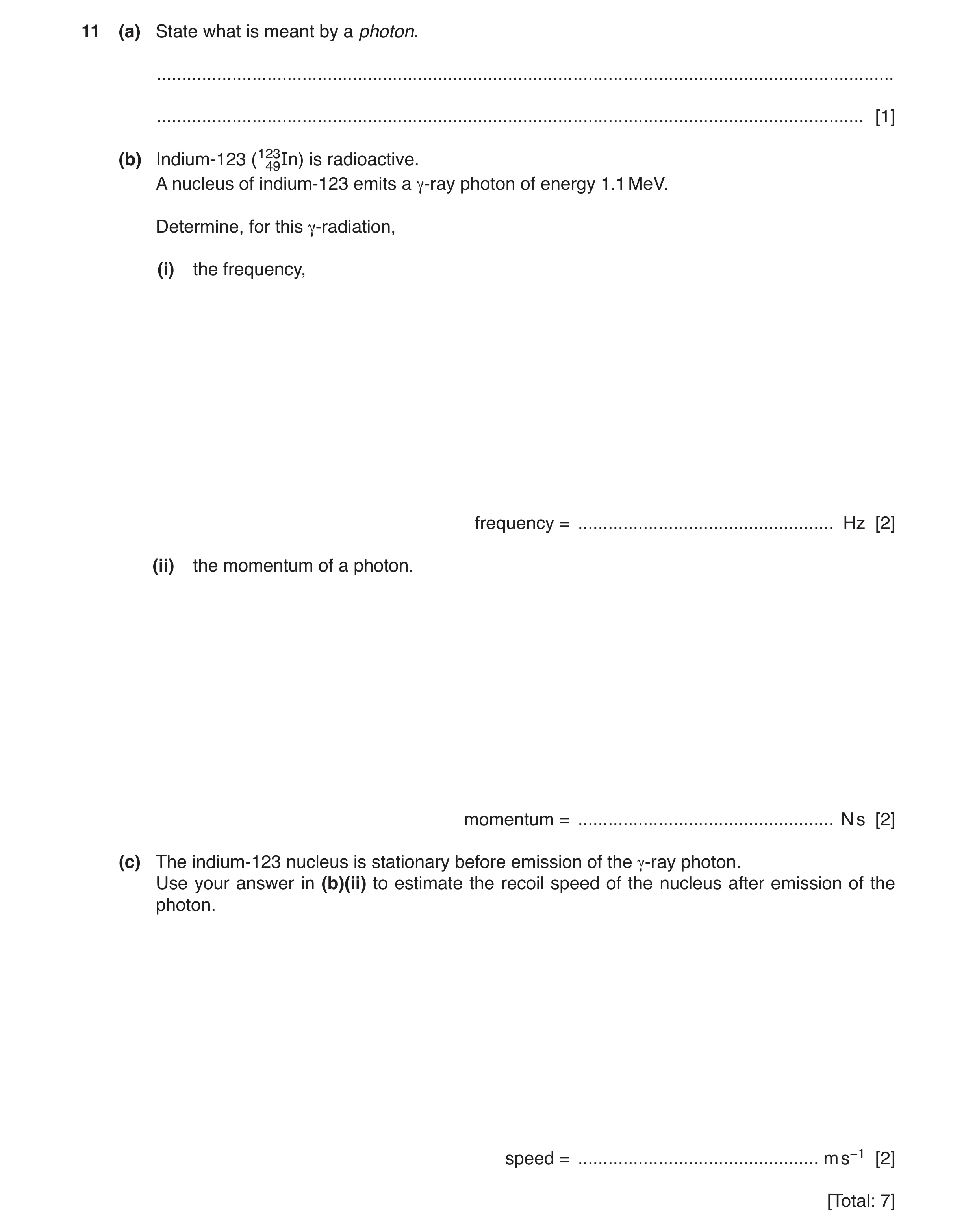
11 (a) State what is meant by a photon. … … [1] (b) Indium-123 (12349In) is radioactive. A nucleus of indium-123 emits a γ-ray photon of energy 1.1 MeV. Determine, for this γ-radiation, (i) the frequency, frequency = … Hz [2] (ii) the momentum of a photon. momentum = … N s [2] (c) The indium-123 nucleus is stationary before emission of the γ-ray photon. Use your answer in (b)(ii) to estimate the recoil speed of the nucleus after emission of the photon. speed = … m s−1 [2] [Total: 7]
7 marks
Mark scheme: 11(a) packet/quantum of energy of electromagnetic/EM radiation B1 11(b)(i) E = hf 1.1 × 106 × 1.60 × 10–19 = 6.63 × 10⁻³⁴ × f C1 f = 2.7 × 10²⁰ (2.65 × 10²⁰) Hz A1 11(b)(ii) p = h / λ = hf / c = (6.63 × 10–34 × 2.65 × 1020) / (3.00 × 10⁸) or p = E / c = (1.1 × 1.60 × 10–13) / (3.00 × 10⁸) C1 p = 5.9 × 10⁻²² (5.87 × 10⁻²²) N s A1 11(c) 123 × 1.66 × 10–27 × v = 5.87 × 10⁻²² C1 v = 2.9 × 10³ m s–1 A1
This question in 9702/43 Oct/Nov 2017
Q4 · Explain what is meant by a photon 9702/41 May/June 2018
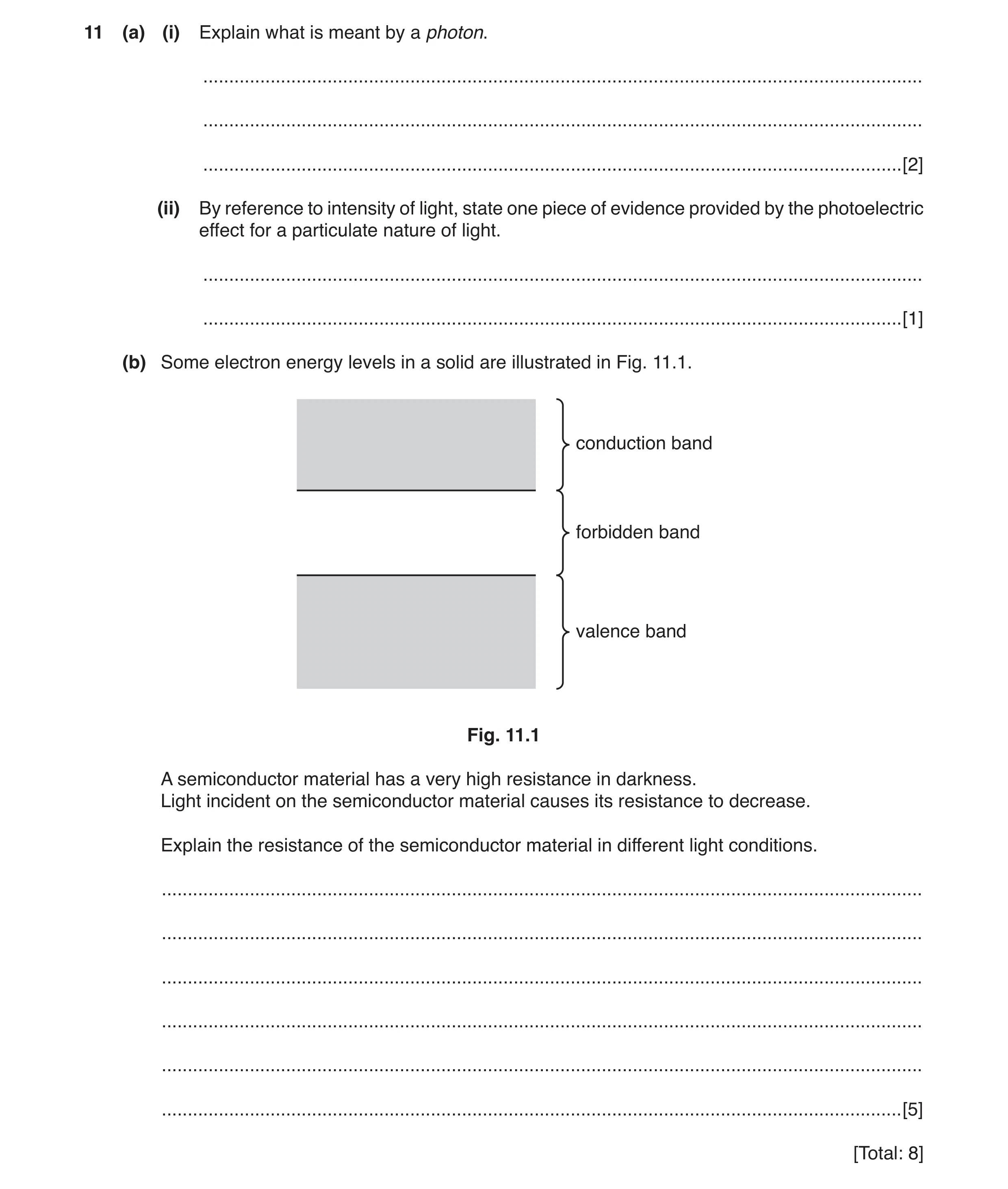
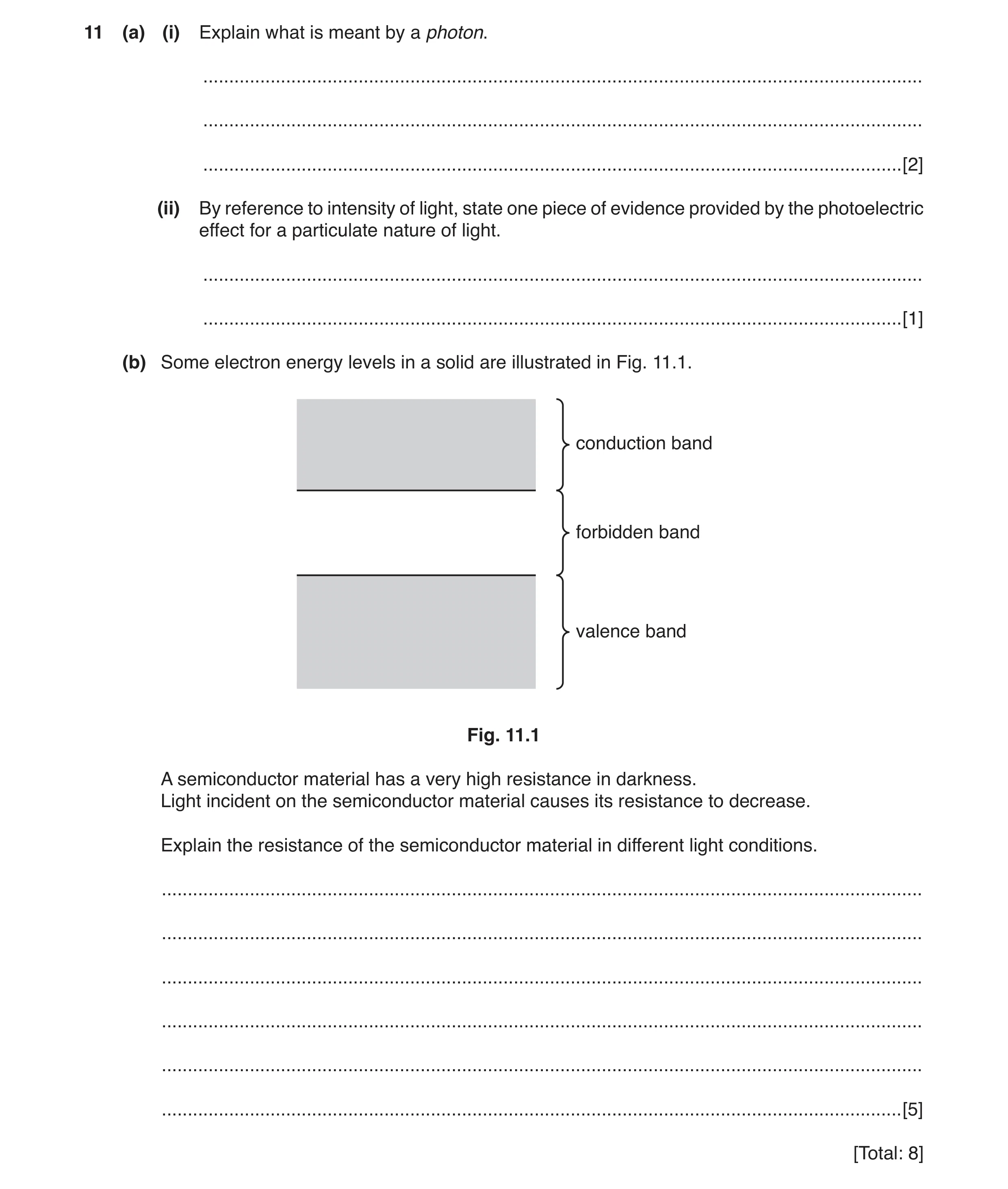
11 (a) (i) Explain what is meant by a photon. … … … [2] (ii) By reference to intensity of light, state one piece of evidence provided by the photoelectric effect for a particulate nature of light. … … [1] (b) Some electron energy levels in a solid are illustrated in Fig. 11.1. conduction band forbidden band valence band Fig. 11.1 A semiconductor material has a very high resistance in darkness. Light incident on the semiconductor material causes its resistance to decrease. Explain the resistance of the semiconductor material in different light conditions. … … … … … … [5] [Total: 8]
8 marks
Mark scheme: 11(a)(i) packet/quantum/discrete amount of energy M1 of electromagnetic radiation A1 11(a)(ii) (maximum) energy of emitted electrons is independent of intensity or no emission of electrons below the threshold frequency regardless of intensity or no emission of electrons when photon energy is less than work function (energy) regardless of intensity B1 11(b) in darkness: conduction band empty so high resistance B1 in daylight: electrons in valence band absorb photons B1 in daylight: electrons ‘jump’ to conduction band B1 this leaves holes in valence band B1 more charge carriers in daylight so resistance decreases B1
This question in 9702/41 May/June 2018
Q5 · Describe the photoelectric effect 9702/42 May/June 2018
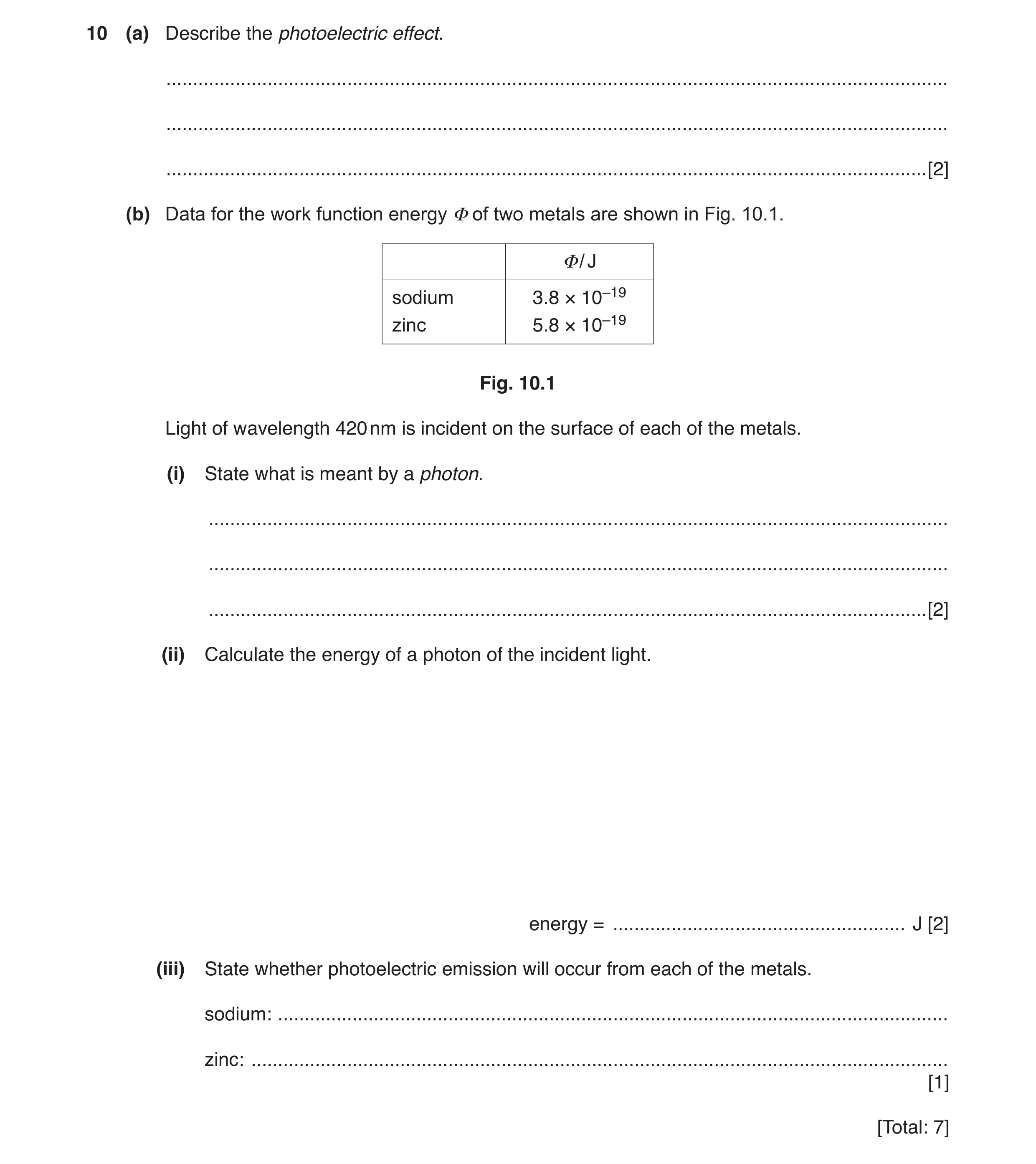
10 (a) Describe the photoelectric effect. … … … [2] (b) Data for the work function energy Φ of two metals are shown in Fig. 10.1. Φ/ J sodium 3.8 × 10⁻¹⁹ zinc 5.8 × 10⁻¹⁹ Fig. 10.1 Light of wavelength 420 nm is incident on the surface of each of the metals. (i) State what is meant by a photon. … … … [2] (ii) Calculate the energy of a photon of the incident light. energy = … J [2] (iii) State whether photoelectric emission will occur from each of the metals. sodium: … zinc: … [1] [Total: 7]
7 marks
Mark scheme: 10(a) emission of electron B1 when electromagnetic radiation incident (on surface) B1 10(b)(i) packet/quantum/discrete amount of energy M1 of electromagnetic radiation A1 10(b)(ii) E = hc / λ C1 = (6.63 × 10–34 × 3.00 × 108) / (420 × 10–9) = 4.7 × 10⁻¹⁹ J A1 10(b)(iii) sodium: yes zinc: no B1
This question in 9702/42 May/June 2018
Q6 · Explain what is meant by a photon 9702/43 May/June 2018
11 (a) (i) Explain what is meant by a photon. … … … [2] (ii) By reference to intensity of light, state one piece of evidence provided by the photoelectric effect for a particulate nature of light. … … [1] (b) Some electron energy levels in a solid are illustrated in Fig. 11.1. conduction band forbidden band valence band Fig. 11.1 A semiconductor material has a very high resistance in darkness. Light incident on the semiconductor material causes its resistance to decrease. Explain the resistance of the semiconductor material in different light conditions. … … … … … … [5] [Total: 8]
8 marks
Mark scheme: 11(a)(i) packet/quantum/discrete amount of energy M1 of electromagnetic radiation A1 11(a)(ii) (maximum) energy of emitted electrons is independent of intensity or no emission of electrons below the threshold frequency regardless of intensity or no emission of electrons when photon energy is less than work function (energy) regardless of intensity B1 11(b) in darkness: conduction band empty so high resistance B1 in daylight: electrons in valence band absorb photons B1 in daylight: electrons ‘jump’ to conduction band B1 this leaves holes in valence band B1 more charge carriers in daylight so resistance decreases B1
This question in 9702/43 May/June 2018
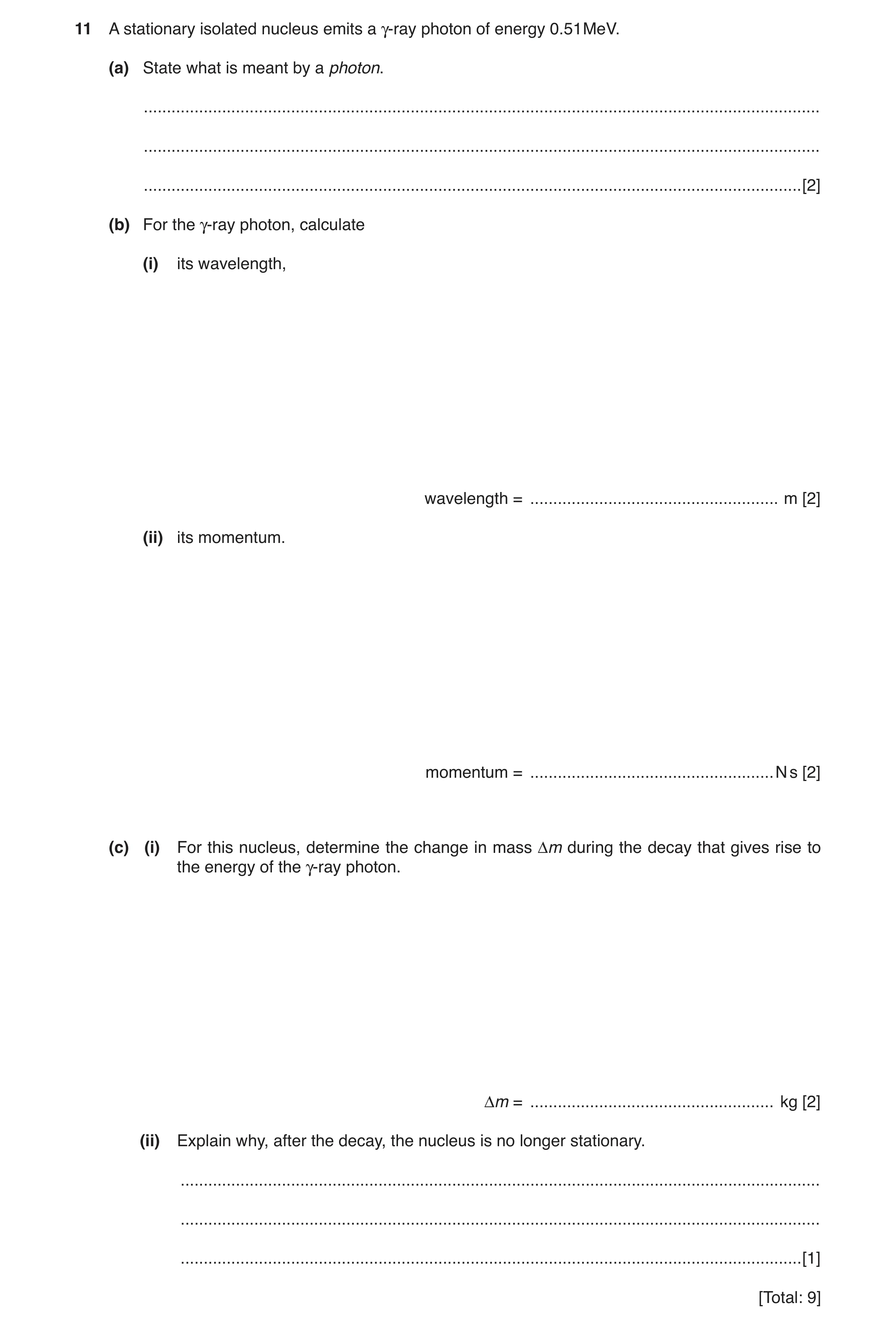
Q7 · A stationary isolated nucleus emits a γ-ray photon of energy 0.51MeV 9702/41 Oct/Nov 2018
11 A stationary isolated nucleus emits a γ-ray photon of energy 0.51MeV. (a) State what is meant by a photon. … … … [2] (b) For the γ-ray photon, calculate (i) its wavelength, wavelength = … m [2] (ii) its momentum. momentum = … N s [2] (c) (i) For this nucleus, determine the change in mass Δm during the decay that gives rise to the energy of the γ-ray photon. Δm = … kg [2] (ii) Explain why, after the decay, the nucleus is no longer stationary. … … … [1] [Total: 9]
9 marks
Mark scheme: 11(a) discrete amount/quantum/packet of energy M1 of electromagnetic radiation A1 11(b)(i) energy = hc / λ C1 λ = (6.63 × 10–34 × 3.00 × 108) / (0.51 × 106 × 1.60 × 10–19) = 2.4 × 10⁻¹² m A1 11(b)(ii) p = h / λ = (6.63 × 10⁻³⁴) / (2.44 × 10⁻¹²) or p = E / c = (0.51 × 1.60 × 10–13) / (3.00 × 10⁸) C1 p = 2.7 × 10⁻²² N s A1 11(c)(i) E = c2∆m C1 ∆m = (0.51 × 1.60 × 10–13) / (3.00 × 10⁸)2 = 9.1 × 10⁻³¹ kg A1 11(c)(ii) (momentum is conserved so) nucleus must have momentum in opposite direction to photon B1
This question in 9702/41 Oct/Nov 2018
Q8 · State what is meant by a photon 9702/42 Oct/Nov 2018
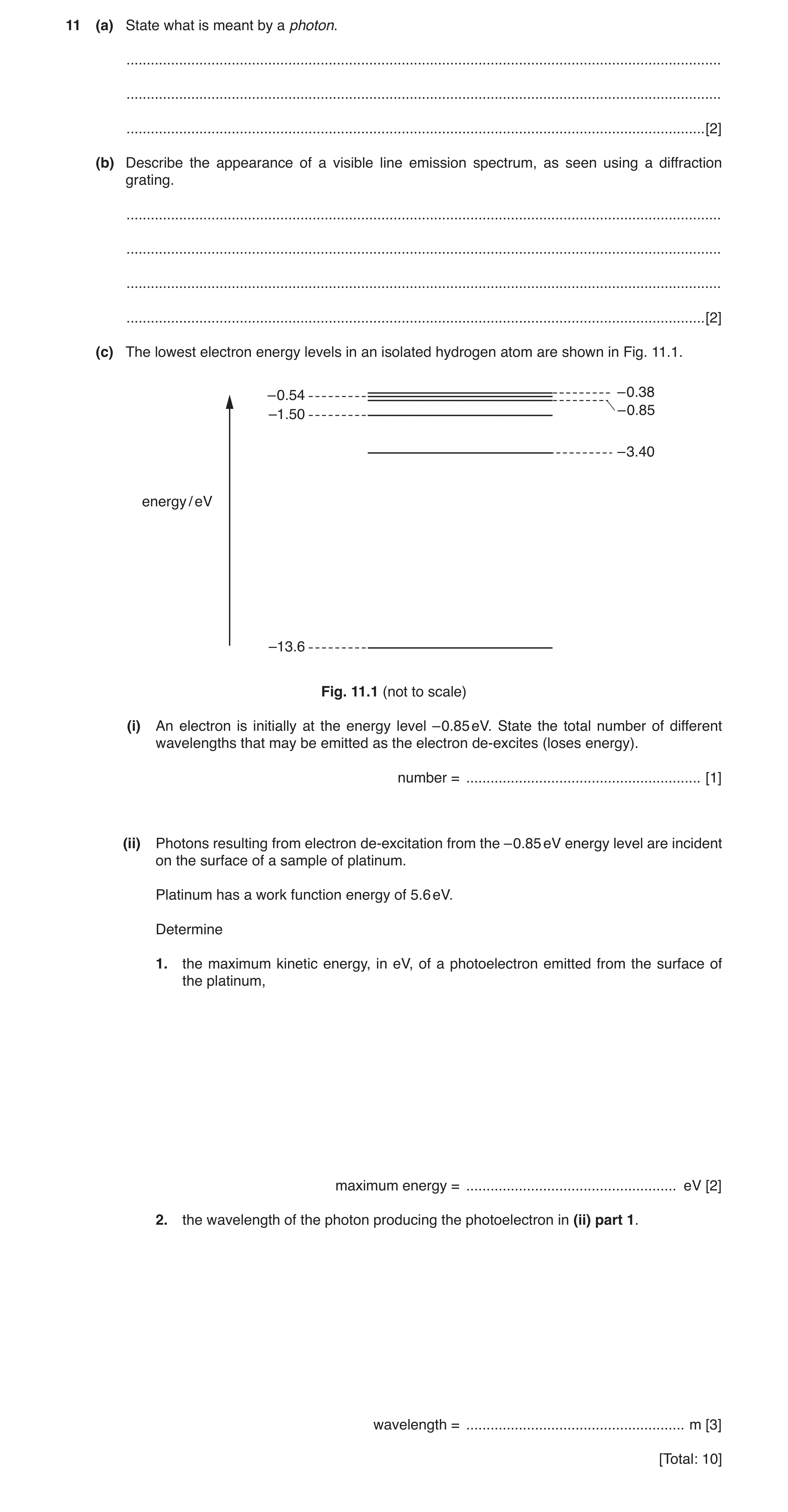
11 (a) State what is meant by a photon. … … … [2] (b) Describe the appearance of a visible line emission spectrum, as seen using a diffraction grating. … … … … [2] (c) The lowest electron energy levels in an isolated hydrogen atom are shown in Fig. 11.1. – 0.54 – 0.38 – 0.85 –1.50 – 3.40 energy / eV –13.6 Fig. 11.1 (not to scale) (i) An electron is initially at the energy level –0.85 eV. State the total number of different wavelengths that may be emitted as the electron de-excites (loses energy). number = … [1] (ii) Photons resulting from electron de-excitation from the –0.85 eV energy level are incident on the surface of a sample of platinum. Platinum has a work function energy of 5.6 eV. Determine 1. the maximum kinetic energy, in eV, of a photoelectron emitted from the surface of the platinum, maximum energy = … eV [2] 2. the wavelength of the photon producing the photoelectron in (ii) part 1. wavelength = … m [3] [Total: 10]
10 marks
Mark scheme: 11(a) discrete amount/quantum/packet of energy M1 of electromagnetic radiation A1 11(b) mostly dark/dark background B1 coloured lines B1 11(c)(i) 6 A1 11(c)(ii) 1. maximum photon energy = 13.6 – 0.85 (= 12.75 eV) C1 maximum kinetic energy = (13.6 – 0.85) – 5.6 = 7.2 eV A1 2. energy = hc / λ C1 λ = (6.63 × 10–34 × 3.00 × 108) / [(13.6 – 0.85) × 1.60 × 10–19] C1 = 9.8 × 10⁻⁸ m A1
This question in 9702/42 Oct/Nov 2018
Q9 · A stationary isolated nucleus emits a γ-ray photon of energy 0.51MeV 9702/43 Oct/Nov 2018
11 A stationary isolated nucleus emits a γ-ray photon of energy 0.51MeV. (a) State what is meant by a photon. … … … [2] (b) For the γ-ray photon, calculate (i) its wavelength, wavelength = … m [2] (ii) its momentum. momentum = … N s [2] (c) (i) For this nucleus, determine the change in mass Δm during the decay that gives rise to the energy of the γ-ray photon. Δm = … kg [2] (ii) Explain why, after the decay, the nucleus is no longer stationary. … … … [1] [Total: 9]
9 marks
Mark scheme: 11(a) discrete amount/quantum/packet of energy M1 of electromagnetic radiation A1 11(b)(i) energy = hc / λ C1 λ = (6.63 × 10–34 × 3.00 × 108) / (0.51 × 106 × 1.60 × 10–19) = 2.4 × 10⁻¹² m A1 11(b)(ii) p = h / λ = (6.63 × 10⁻³⁴) / (2.44 × 10⁻¹²) or p = E / c = (0.51 × 1.60 × 10–13) / (3.00 × 10⁸) C1 p = 2.7 × 10⁻²² N s A1 11(c)(i) E = c2∆m C1 ∆m = (0.51 × 1.60 × 10–13) / (3.00 × 10⁸)2 = 9.1 × 10⁻³¹ kg A1 11(c)(ii) (momentum is conserved so) nucleus must have momentum in opposite direction to photon B1
This question in 9702/43 Oct/Nov 2018
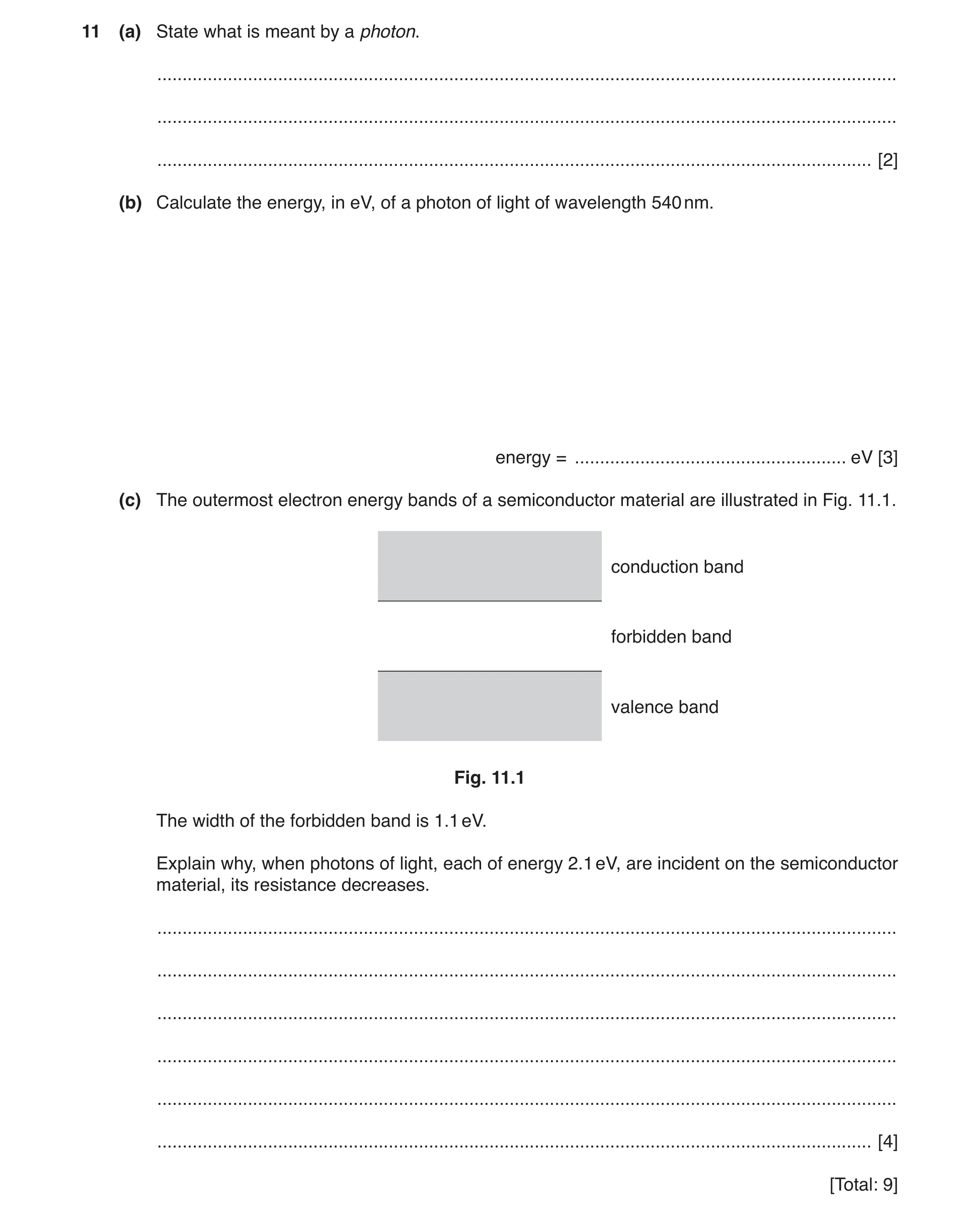
Q10 · State what is meant by a photon 9702/42 Feb/March 2019
11 (a) State what is meant by a photon. … … … [2] (b) Calculate the energy, in eV, of a photon of light of wavelength 540 nm. energy = … eV [3] (c) The outermost electron energy bands of a semiconductor material are illustrated in Fig. 11.1. conduction band forbidden band valence band Fig. 11.1 The width of the forbidden band is 1.1 eV. Explain why, when photons of light, each of energy 2.1 eV, are incident on the semiconductor material, its resistance decreases. … … … … … … [4] [Total: 9]
9 marks
Mark scheme: 11(a) quantum / packet / discrete amount of energy M1 of electromagnetic radiation A1 11(b) E = hc / λ C1 = (6.63 × 10–34 × 3.0 × 108) / (540 × 10–9) C1 = (3.68 × 10⁻¹⁹) / (1.6 × 10⁻¹⁹) = 2.3 eV A1 11(c) Any 4 from: photon absorbed by electron in valence band (1) photon energy > energy of forbidden band (1) electron promoted to conduction band (1) hole left in valence band (1) more charge carriers so lower resistance (1) B4
This question in 9702/42 Feb/March 2019
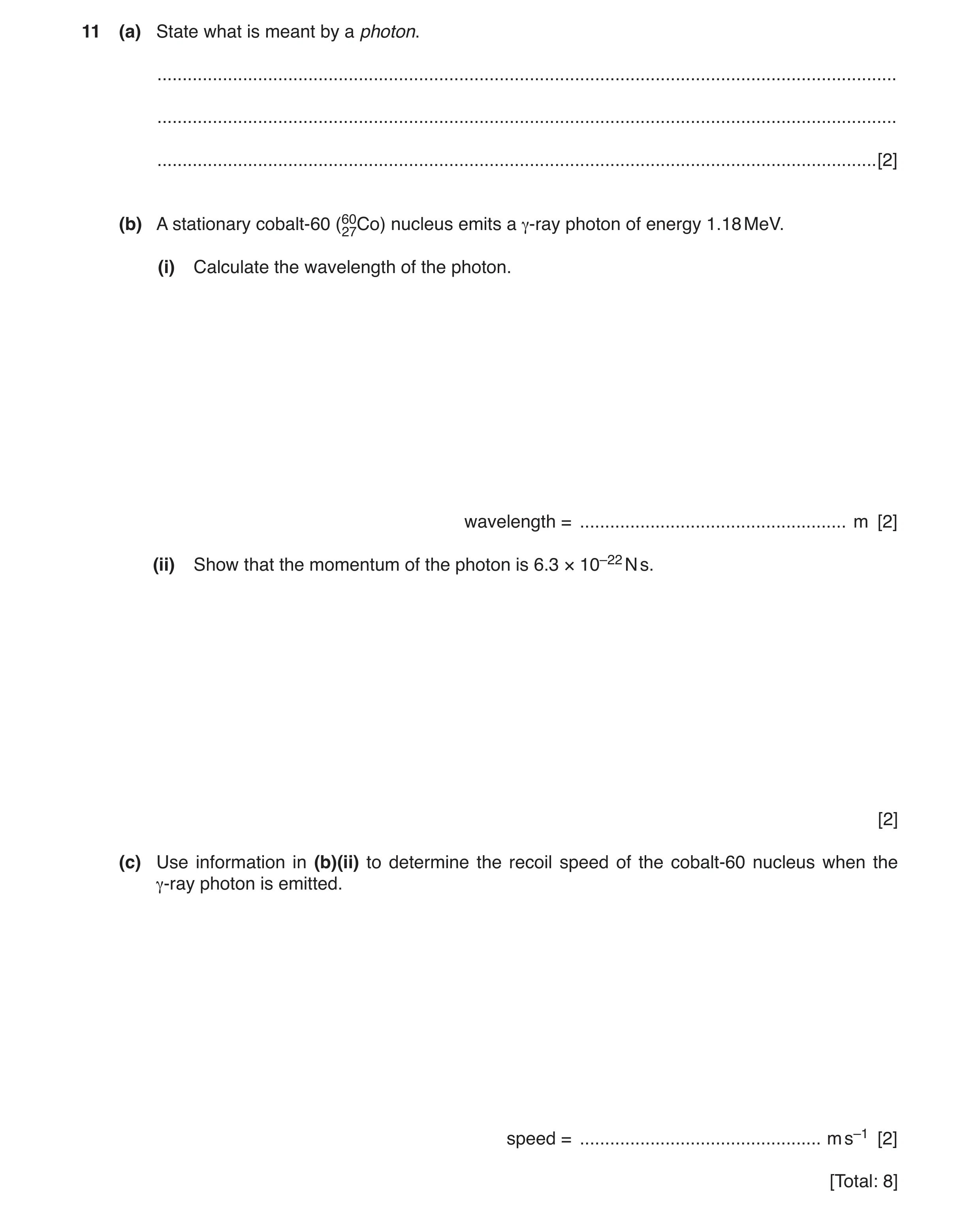
Q11 · State what is meant by a photon 9702/42 May/June 2019
11 (a) State what is meant by a photon. … … … [2] (b) A stationary cobalt-60 (6027Co) nucleus emits a γ-ray photon of energy 1.18 MeV. (i) Calculate the wavelength of the photon. wavelength = … m [2] (ii) Show that the momentum of the photon is 6.3 × 10⁻²² N s. [2] (c) Use information in (b)(ii) to determine the recoil speed of the cobalt-60 nucleus when the γ-ray photon is emitted. speed = … m s–1 [2] [Total: 8]
8 marks
Mark scheme: 11(a) packet/quantum of energy M1 of electromagnetic radiation A1 11(b)(i) E = hc / λ C1 1.18 × 1.60 × 10–13 = (6.63 × 10–34 × 3.00 × 108) / λ λ = 1.05 × 10⁻¹² m A1 11(b)(ii) λ = h / p or E = pc C1 p = (6.63 × 10⁻³⁴) / (1.05 × 10⁻¹²) or p = (1.18 × 1.60 × 10–13) / (3.00 × 10⁸) leading to p = 6.3 × 10⁻²² N s B1 11(c) 6.3 × 10–22 = 60 × 1.66 × 10–27 × v C1 v = 6.3 × 10³ m s–1 A1
This question in 9702/42 May/June 2019
Q12 · A photon of wavelength 540 nm collides with an isolated stationary electron, as… 9702/41 Oct/Nov 2020
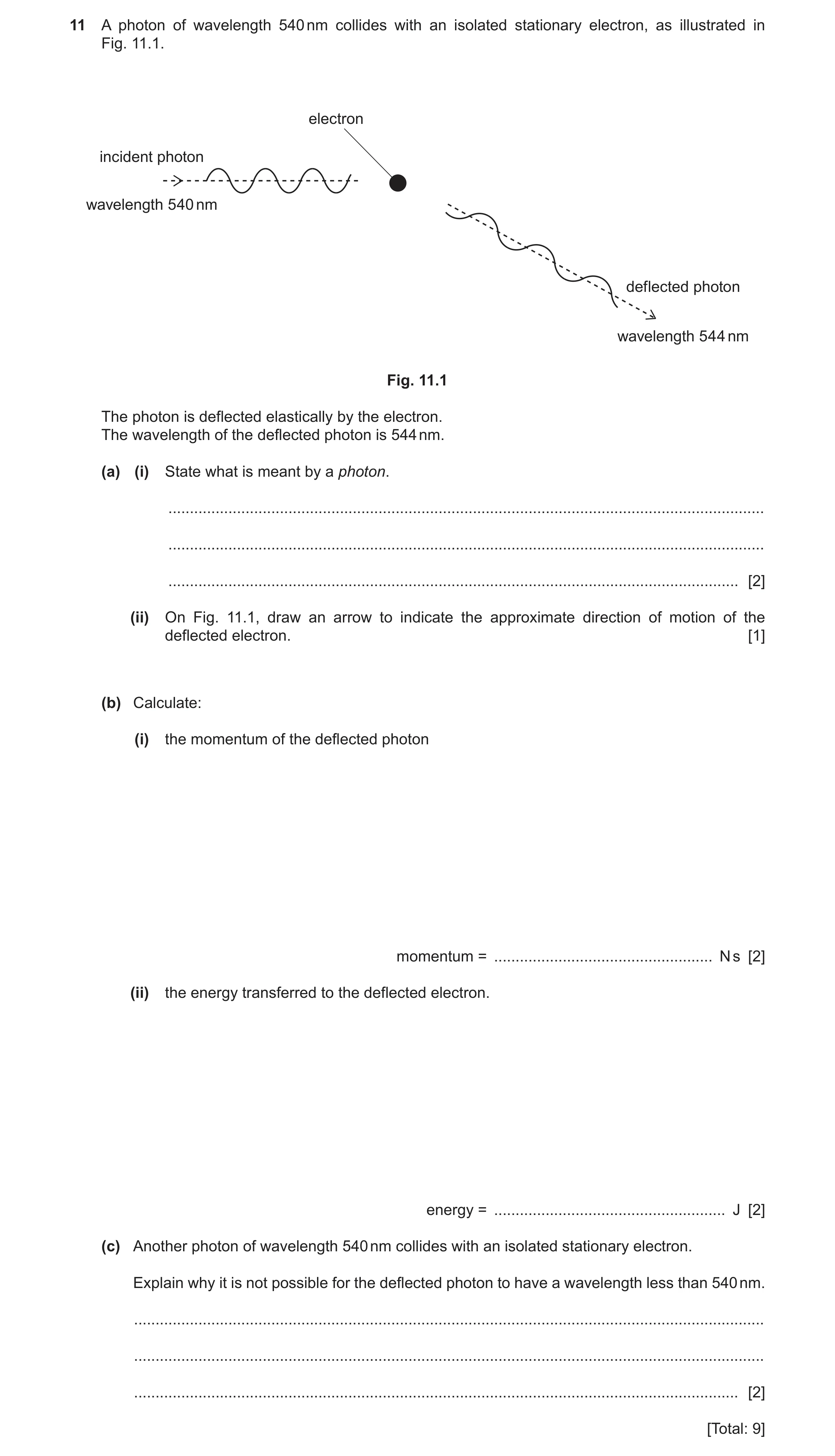
11 A photon of wavelength 540 nm collides with an isolated stationary electron, as illustrated in Fig. 11.1. electron incident photon wavelength 540 nm deflected photon wavelength 544 nm Fig. 11.1 The photon is deflected elastically by the electron. The wavelength of the deflected photon is 544 nm. (a) (i) State what is meant by a photon. … … … [2] (ii) On Fig. 11.1, draw an arrow to indicate the approximate direction of motion of the deflected electron. [1] (b) Calculate: (i) the momentum of the deflected photon momentum = … N s [2] (ii) the energy transferred to the deflected electron. energy = … J [2] (c) Another photon of wavelength 540 nm collides with an isolated stationary electron. Explain why it is not possible for the deflected photon to have a wavelength less than 540 nm. … … … [2] [Total: 9]
9 marks
Mark scheme: 11(a)(i) quantum of energy M1 of electromagnetic radiation A1 11(a)(ii) arrow (on Fig. 11.1) pointing upwards and to the right B1 11(b)(i) λ = h / p C1 p = (6.63 × 10⁻³⁴) / (544 × 10–9) = 1.22 × 10⁻²⁷ N s A1 11(b)(ii) energy = hc / λ C1 = 6.63 × 10–34 × 3.00 × 108 × (540–1 – 544–1) × 109 = 2.7 × 10⁻²¹ J A1 11(c) (smaller wavelength corresponds to) greater photon energy B1 any one point from: • (deflected) photon loses energy (so not possible) • (deflected) photon would need to gain energy (so not possible) • electron would need to lose energy (so not possible) • initially electron energy is zero (so not possible) B1
This question in 9702/41 Oct/Nov 2020
Q13 · A photon of wavelength 540 nm collides with an isolated stationary electron, as… 9702/43 Oct/Nov 2020
11 A photon of wavelength 540 nm collides with an isolated stationary electron, as illustrated in Fig. 11.1. electron incident photon wavelength 540 nm deflected photon wavelength 544 nm Fig. 11.1 The photon is deflected elastically by the electron. The wavelength of the deflected photon is 544 nm. (a) (i) State what is meant by a photon. … … … [2] (ii) On Fig. 11.1, draw an arrow to indicate the approximate direction of motion of the deflected electron. [1] (b) Calculate: (i) the momentum of the deflected photon momentum = … N s [2] (ii) the energy transferred to the deflected electron. energy = … J [2] (c) Another photon of wavelength 540 nm collides with an isolated stationary electron. Explain why it is not possible for the deflected photon to have a wavelength less than 540 nm. … … … [2] [Total: 9]
9 marks
Mark scheme: 11(a)(i) quantum of energy M1 of electromagnetic radiation A1 11(a)(ii) arrow (on Fig. 11.1) pointing upwards and to the right B1 11(b)(i) λ = h / p C1 p = (6.63 × 10⁻³⁴) / (544 × 10–9) = 1.22 × 10⁻²⁷ N s A1 11(b)(ii) energy = hc / λ C1 = 6.63 × 10–34 × 3.00 × 108 × (540–1 – 544–1) × 109 = 2.7 × 10⁻²¹ J A1 11(c) (smaller wavelength corresponds to) greater photon energy B1 any one point from: • (deflected) photon loses energy (so not possible) • (deflected) photon would need to gain energy (so not possible) • electron would need to lose energy (so not possible) • initially electron energy is zero (so not possible) B1
This question in 9702/43 Oct/Nov 2020
Q14 · State what is meant by a photon 9702/42 May/June 2021
12 (a) State what is meant by a photon. … … … [2] (b) A stationary nucleus of samarium-157 (15762 Sm) emits a gamma-ray (γ-ray) photon of energy 0.57 MeV. Determine, for one γ-ray photon: (i) its wavelength wavelength = … m [2] (ii) its momentum. momentum = … N s [2] (c) (i) Using your answer to (b)(ii), determine the speed of the samarium-157 nucleus after emission of the photon. speed = … m s−1 [2] (ii) By reference to your answer in (c)(i), explain quantitatively why the speed of the samarium-157 nucleus may be assumed to be negligible compared with the speed of the photon. … … [1] [Total: 9]
9 marks
Mark scheme: 12(a) quantum of energy M1 of electromagnetic radiation A1 12(b)(i) energy = hc / λ or energy = hf and f = c / λ C1 0.57 × 106 × 1.60 × 10–19 = (6.63 × 10–34 × 3.00 × 108) / λ λ = 2.2 × 10⁻¹² m A1 Question Answer Marks 12(b)(ii) p = h / λ C1 = (6.63 × 10⁻³⁴) / (2.2 × 10⁻¹²) = 3.0 × 10⁻²² N s A1 or p = E / c (C1) = (0.57 × 106 × 1.60 × 10–19) / (3.00 × 10⁸) = 3.0 × 10⁻²² N s (A1) 12(c)(i) mass (of Sm-157 nucleus) = 157 × 1.66 × 10–27 or mass (of Sm-157 nucleus) = 0.157 / (6.02 × 10²³) C1 recoil speed = (3.00 × 10⁻²²) / (157 × 1.66 × 10–27) = 1.2 × 10³ m s–1 A1 12(c)(ii) (1.2 ×) 103 m s–1 is much less than (3.0 ×) 108 m s–1 B1
This question in 9702/42 May/June 2021
Q15 · State what is meant by a photon 9702/41 May/June 2022
7 (a) State what is meant by a photon. … … … [2] (b) Electromagnetic radiation of a varying frequency f and constant intensity I is used to illuminate a metal surface. At certain frequencies, electrons are emitted from the surface of the metal. The variation with f of the maximum kinetic energy EMAX of the emitted electrons is shown in Fig. 7.1. 4.0 EMAX / 10–19 J 3.0 2.0 1.0 0 0 2 4 6 8 10 12 f / 1014 Hz Fig. 7.1 (i) State the name of this phenomenon. … [1] (ii) Describe three conclusions that can be drawn from the graph in Fig. 7.1. The conclusions may be qualitative or quantitative. 1 … … 2 … … 3 … … [3] (c) The experiment in (b) is repeated twice, each time making one change. State, with a reason, how the graph obtained would compare with Fig. 7.1 when: (i) a different metal is used, but keeping the intensity I of the radiation the same … … … [2] (ii) the same metal is used, but with electromagnetic radiation of intensity 2I. … … … [2] [Total: 10]
10 marks
Mark scheme: 7(a) quantum of energy M1 of electromagnetic radiation A1 7(b)(i) photoelectric effect B1 7(b)(ii) there is a frequency below which no electrons are emitted or threshold frequency = 5.4 1014 Hz work function of the metal = 3.6 10–19 J (or 2.2 eV) EMAX increases (linearly) with (increasing) frequency gradient of the line is the Planck constant or gradient of the line is 6.7 10–34 J s Any three bullet points, 1 mark each B3 7(c)(i) different threshold frequency B1 (line has) same gradient but different intercept B1 7(c)(ii) photons have same energy B1 line unchanged B1
This question in 9702/41 May/June 2022
Q16 · State what is meant by a photon 9702/43 May/June 2022
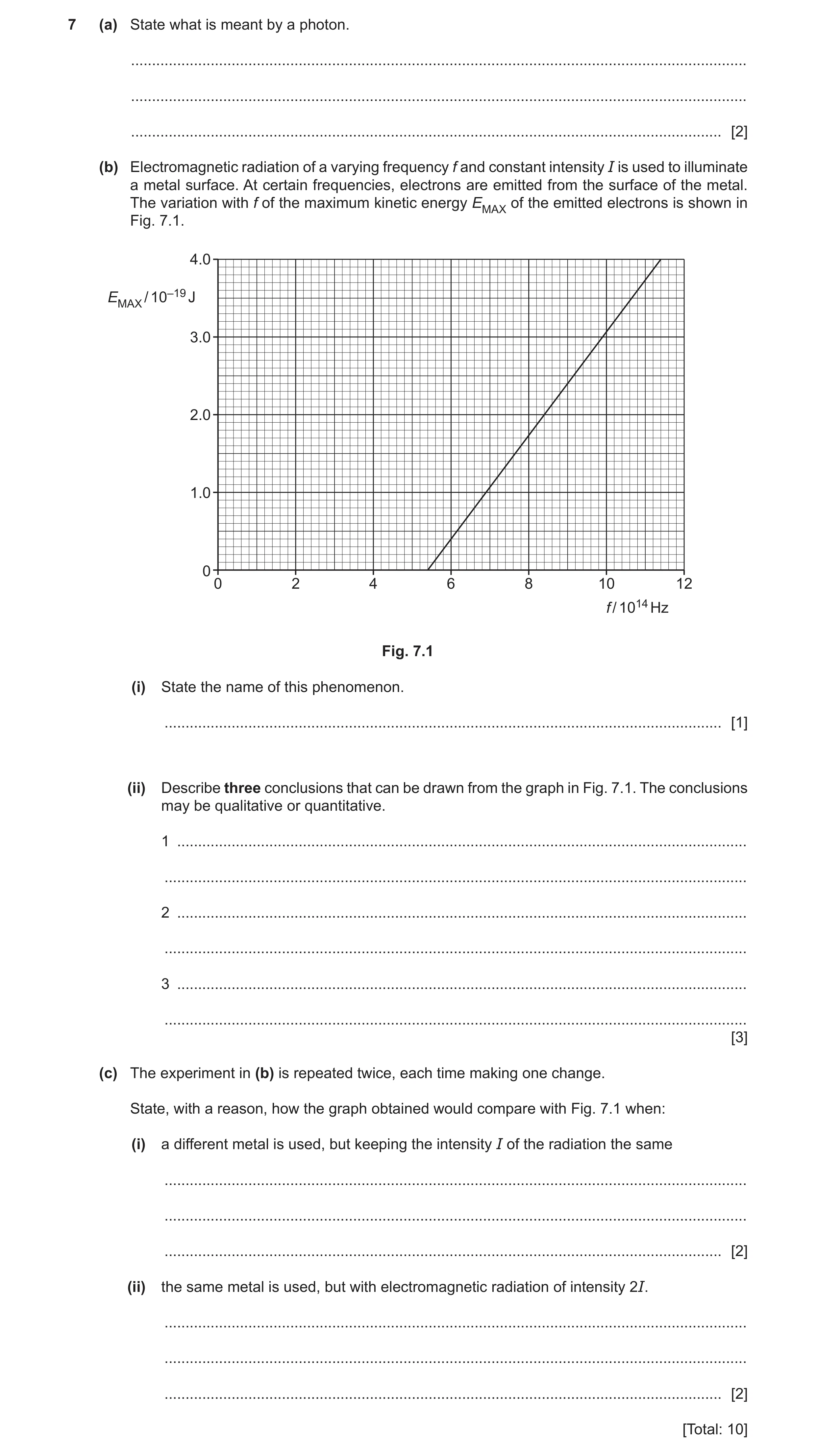
7 (a) State what is meant by a photon. … … … [2] (b) Electromagnetic radiation of a varying frequency f and constant intensity I is used to illuminate a metal surface. At certain frequencies, electrons are emitted from the surface of the metal. The variation with f of the maximum kinetic energy EMAX of the emitted electrons is shown in Fig. 7.1. 4.0 EMAX / 10–19 J 3.0 2.0 1.0 0 0 2 4 6 8 10 12 f / 1014 Hz Fig. 7.1 (i) State the name of this phenomenon. … [1] (ii) Describe three conclusions that can be drawn from the graph in Fig. 7.1. The conclusions may be qualitative or quantitative. 1 … … 2 … … 3 … … [3] (c) The experiment in (b) is repeated twice, each time making one change. State, with a reason, how the graph obtained would compare with Fig. 7.1 when: (i) a different metal is used, but keeping the intensity I of the radiation the same … … … [2] (ii) the same metal is used, but with electromagnetic radiation of intensity 2I. … … … [2] [Total: 10]
10 marks
Mark scheme: 7(a) quantum of energy M1 of electromagnetic radiation A1 7(b)(i) photoelectric effect B1 7(b)(ii) there is a frequency below which no electrons are emitted or threshold frequency = 5.4 1014 Hz work function of the metal = 3.6 10–19 J (or 2.2 eV) EMAX increases (linearly) with (increasing) frequency gradient of the line is the Planck constant or gradient of the line is 6.7 10–34 J s Any three bullet points, 1 mark each B3 7(c)(i) different threshold frequency B1 (line has) same gradient but different intercept B1 7(c)(ii) photons have same energy B1 line unchanged B1
This question in 9702/43 May/June 2022
Q17 · State what is meant by the work function energy of a metal 9702/41 Oct/Nov 2022
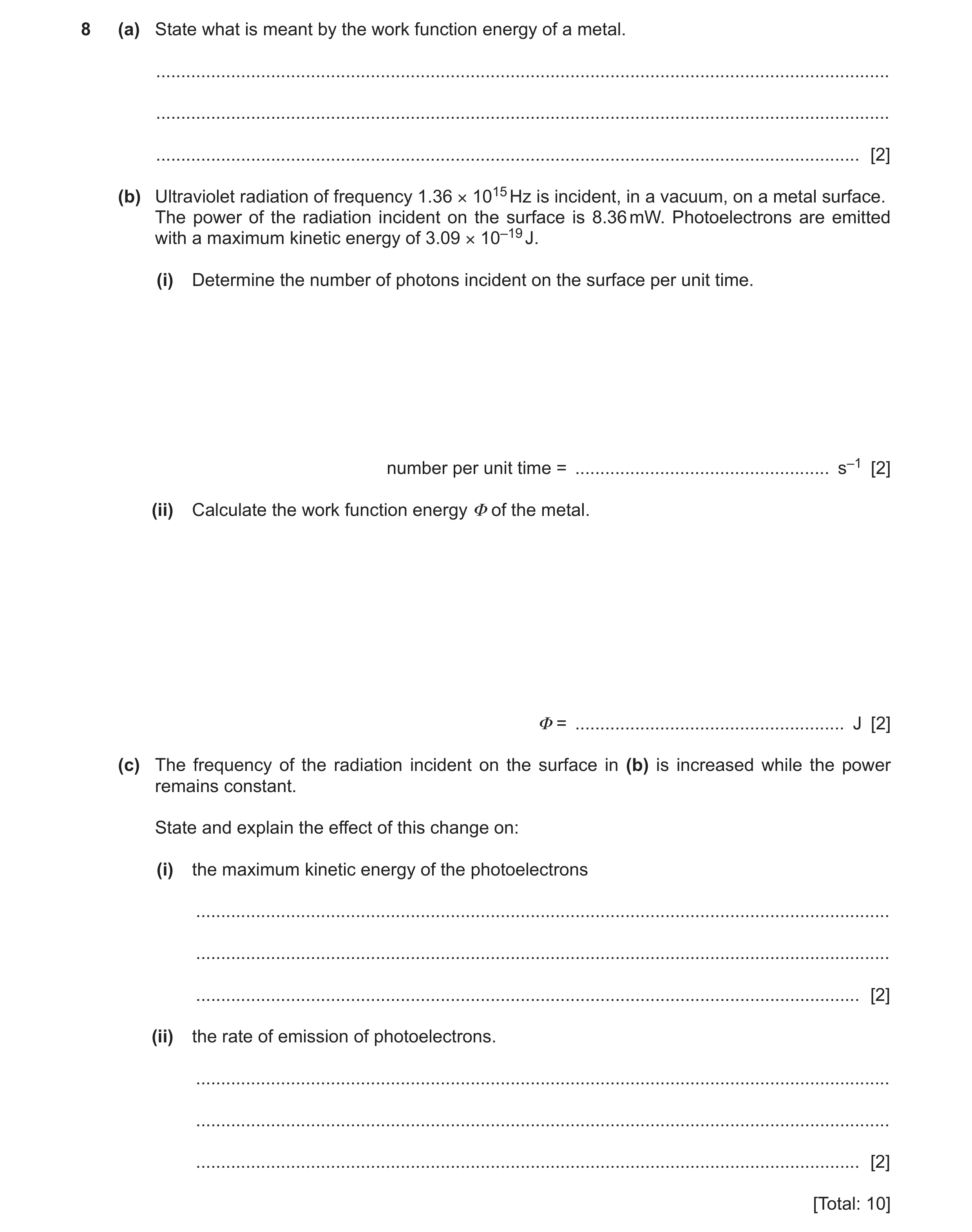
8 (a) State what is meant by the work function energy of a metal. … … … [2] (b) Ultraviolet radiation of frequency 1.36 × 10¹⁵ Hz is incident, in a vacuum, on a metal surface. The power of the radiation incident on the surface is 8.36 mW. Photoelectrons are emitted with a maximum kinetic energy of 3.09 × 10⁻¹⁹ J. (i) Determine the number of photons incident on the surface per unit time. number per unit time = … s–1 [2] (ii) Calculate the work function energy Φ of the metal. Φ = … J [2] (c) The frequency of the radiation incident on the surface in (b) is increased while the power remains constant. State and explain the effect of this change on: (i) the maximum kinetic energy of the photoelectrons … … … [2] (ii) the rate of emission of photoelectrons. … … … [2] [Total: 10]
10 marks
Mark scheme: 8(a) photon energy (to remove electron) B1 minimum energy to remove electron B1 or energy to remove electron from surface or energy to remove electron with zero kinetic energy 8(b)(i) photon energy = hf C1 number per unit time = 8.36 10–3 / (1.36 1015 6.63 10–34) A1 = 9.27 1015 s–1 8(b)(ii) hf = + EMAX C1 = (1.36 1015 6.63 10–34) – (3.09 10–19) A1 = 5.93 10–19 J 8(c)(i) greater photon energy (and same work function) M1 so maximum kinetic energy is increased A1 8(c)(ii) (greater photon energy and same power so) lower number of photons (per unit time) M1 (each electron absorbs one photon) so lower rate of emission A1
This question in 9702/41 Oct/Nov 2022
Q18 · State what is meant by the work function energy of a metal 9702/43 Oct/Nov 2022
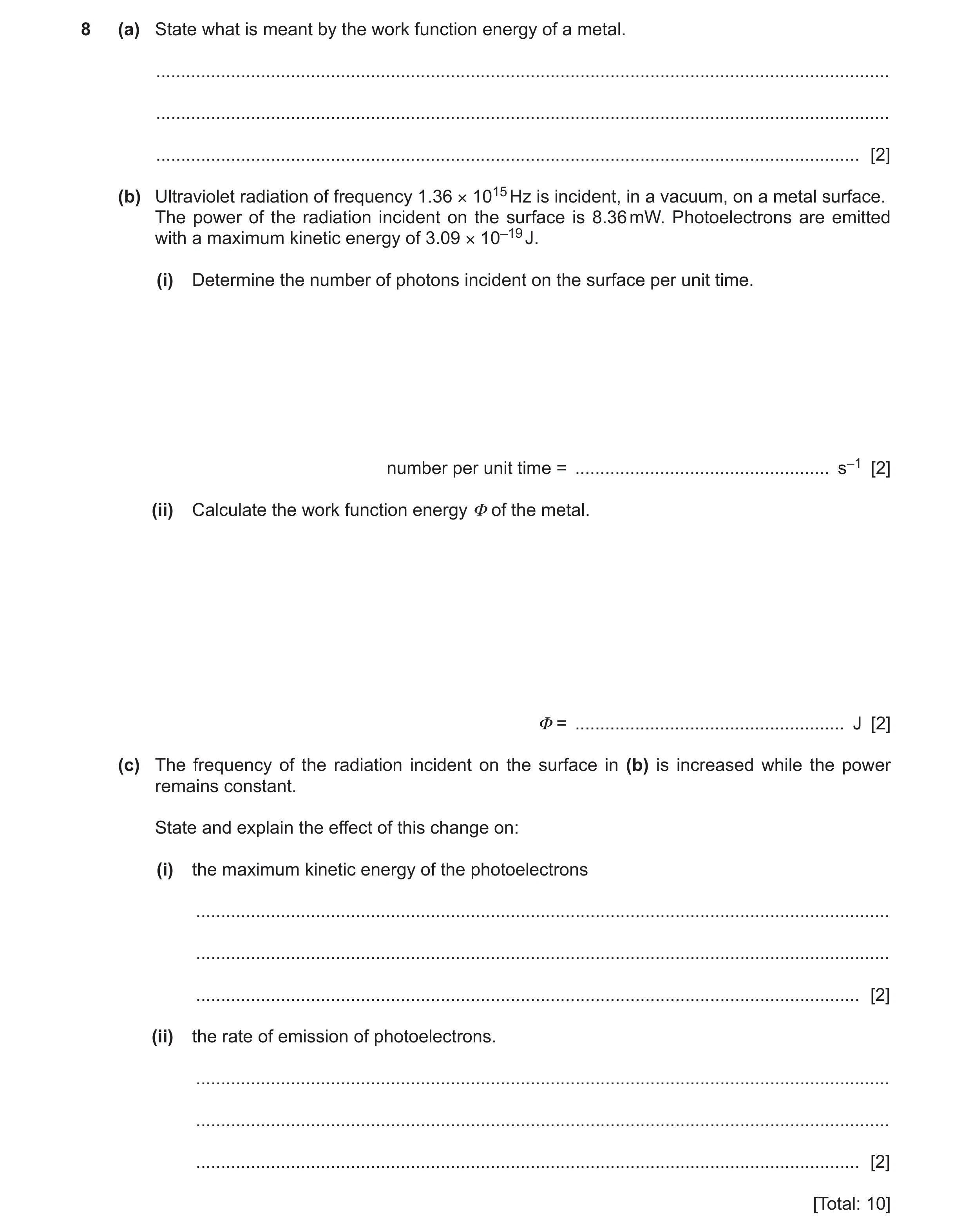
8 (a) State what is meant by the work function energy of a metal. … … … [2] (b) Ultraviolet radiation of frequency 1.36 × 10¹⁵ Hz is incident, in a vacuum, on a metal surface. The power of the radiation incident on the surface is 8.36 mW. Photoelectrons are emitted with a maximum kinetic energy of 3.09 × 10⁻¹⁹ J. (i) Determine the number of photons incident on the surface per unit time. number per unit time = … s–1 [2] (ii) Calculate the work function energy Φ of the metal. Φ = … J [2] (c) The frequency of the radiation incident on the surface in (b) is increased while the power remains constant. State and explain the effect of this change on: (i) the maximum kinetic energy of the photoelectrons … … … [2] (ii) the rate of emission of photoelectrons. … … … [2] [Total: 10]
10 marks
Mark scheme: 8(a) photon energy (to remove electron) B1 minimum energy to remove electron B1 or energy to remove electron from surface or energy to remove electron with zero kinetic energy 8(b)(i) photon energy = hf C1 number per unit time = 8.36 10–3 / (1.36 1015 6.63 10–34) A1 = 9.27 1015 s–1 8(b)(ii) hf = + EMAX C1 = (1.36 1015 6.63 10–34) – (3.09 10–19) A1 = 5.93 10–19 J 8(c)(i) greater photon energy (and same work function) M1 so maximum kinetic energy is increased A1 8(c)(ii) (greater photon energy and same power so) lower number of photons (per unit time) M1 (each electron absorbs one photon) so lower rate of emission A1
This question in 9702/43 Oct/Nov 2022
Q19 · Show that the momentum p of a photon of electromagnetic radiation with wavelength λ is… 9702/41 Oct/Nov 2023
8 (a) (i) Show that the momentum p of a photon of electromagnetic radiation with wavelength λ is given by h p = λ where h is the Planck constant. [2] (ii) Use the expression in (a)(i) to show that a photon in free space that has a momentum of 9.5 × 10⁻²⁸ N s is a photon of red light. [1] (b) A beam of red light of intensity 160 W m–2 is incident normally on a plane mirror, as shown in Fig. 8.1. The momentum of each photon in the beam is 9.5 × 10⁻²⁸ N s. plane mirror beam of red light, intensity 160 W m–2 Fig. 8.1 All of the light is reflected by the mirror in the opposite direction to its original path. The cross-sectional area of the beam is 2.5 × 10⁻⁶ m2. (i) Show that the number of photons incident on the mirror per unit time is 1.4 × 10¹⁵ s–1. [2] (ii) Use the information in (b)(i) to determine the pressure exerted by the light beam on the mirror. pressure = … Pa [3] (c) The beam of red light in (b) is now replaced with a beam of blue light of the same intensity. Suggest and explain whether the pressure exerted on the mirror by the beam of blue light is less than, the same as, or greater than the pressure exerted by the beam of red light. … … … … [2] [Total: 10]
10 marks
Mark scheme: 8(a)(i) p = E / c M1 E = hc / and completion of algebra leading to p = h / A1 8(a)(ii) wavelength = (6.63 10–34) / (9.5 10–28) = 700 10–9 m so red B1 8(b)(i) power = intensity area C1 number per unit time = (160 2.5 10–6) / (9.5 10–28 3.00 108) = 1.4 1015 s–1 A1 8(b)(ii) pressure = force / area C1 force = rate of change of momentum C1 = 2 9.5 10–28 1.4 1015 pressure = (2 9.5 10–28 1.4 1015) / (2.5 10–6) A1 = 1.1 10–6 Pa 8(c) photons have greater momentum B1 or fewer photons per unit time greater photon momentum but smaller number of photons (per unit time) so pressure is the same B1
This question in 9702/41 Oct/Nov 2023
Q20 · State what is meant by a photon 9702/42 Oct/Nov 2023
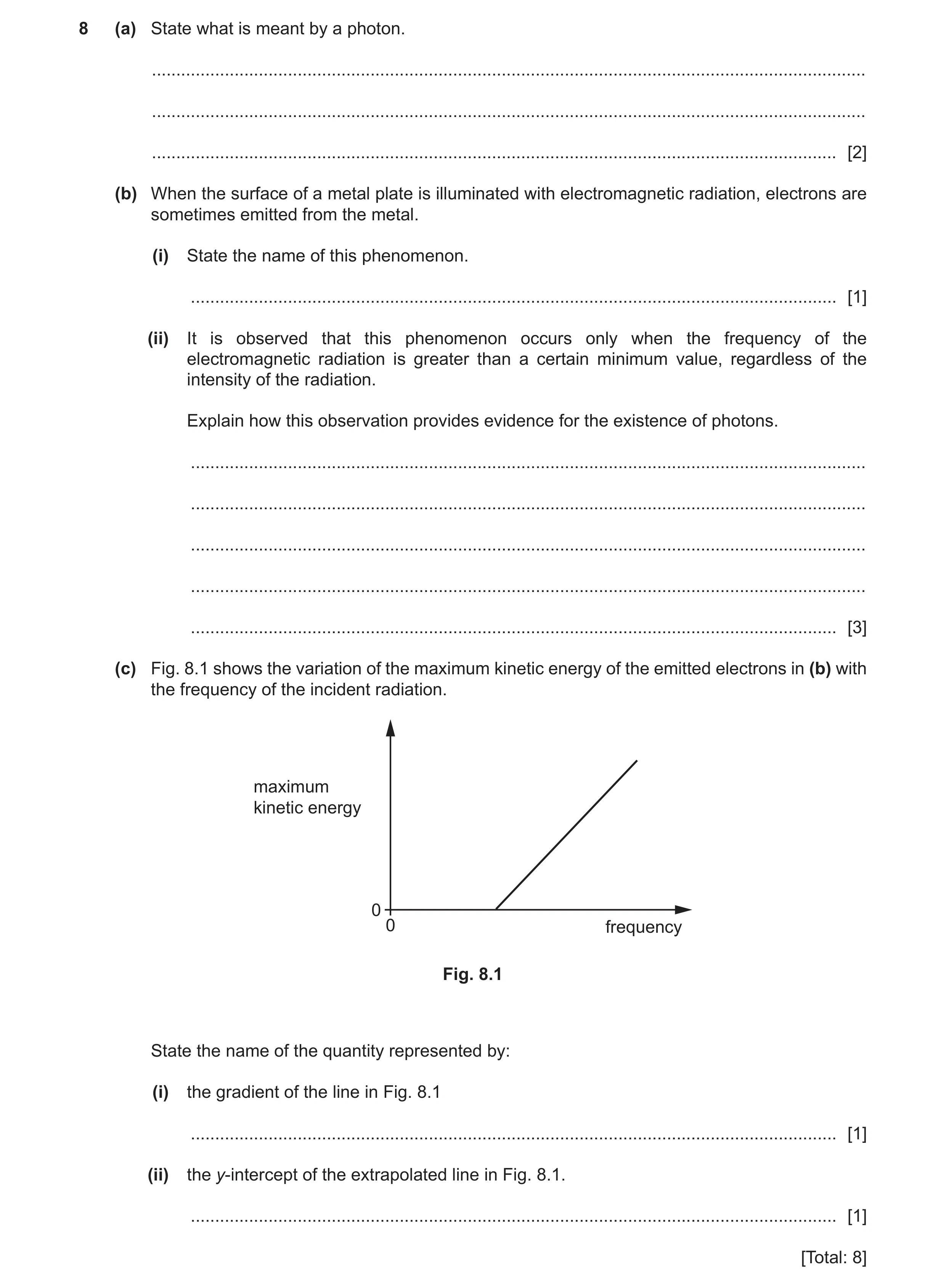
8 (a) State what is meant by a photon. … … … [2] (b) When the surface of a metal plate is illuminated with electromagnetic radiation, electrons are sometimes emitted from the metal. (i) State the name of this phenomenon. … [1] (ii) It is observed that this phenomenon occurs only when the frequency of the electromagnetic radiation is greater than a certain minimum value, regardless of the intensity of the radiation. Explain how this observation provides evidence for the existence of photons. … … … … … [3] (c) Fig. 8.1 shows the variation of the maximum kinetic energy of the emitted electrons in (b) with the frequency of the incident radiation. maximum kinetic energy 0 0 frequency Fig. 8.1 State the name of the quantity represented by: (i) the gradient of the line in Fig. 8.1 … [1] (ii) the y-intercept of the extrapolated line in Fig. 8.1. … [1] [Total: 8]
8 marks
Mark scheme: 8(a) packet / quantum of energy M1 of electromagnetic radiation A1 8(b)(i) photoelectric effect B1 8(b)(ii) • electron needs a minimum energy to escape B3 or electron emitted if energy in packet is enough • energy must be absorbed in packets that are related to frequency • intensity relates to number of packets (not to energy in packet) • electron absorbs only a single whole packet Any three points, 1 mark each 8(c)(i) Planck constant B1 8(c)(ii) – work function (energy) B1
This question in 9702/42 Oct/Nov 2023
Q21 · Show that the momentum p of a photon of electromagnetic radiation with wavelength λ is… 9702/43 Oct/Nov 2023
8 (a) (i) Show that the momentum p of a photon of electromagnetic radiation with wavelength λ is given by h p = λ where h is the Planck constant. [2] (ii) Use the expression in (a)(i) to show that a photon in free space that has a momentum of 9.5 × 10⁻²⁸ N s is a photon of red light. [1] (b) A beam of red light of intensity 160 W m–2 is incident normally on a plane mirror, as shown in Fig. 8.1. The momentum of each photon in the beam is 9.5 × 10⁻²⁸ N s. plane mirror beam of red light, intensity 160 W m–2 Fig. 8.1 All of the light is reflected by the mirror in the opposite direction to its original path. The cross-sectional area of the beam is 2.5 × 10⁻⁶ m2. (i) Show that the number of photons incident on the mirror per unit time is 1.4 × 10¹⁵ s–1. [2] (ii) Use the information in (b)(i) to determine the pressure exerted by the light beam on the mirror. pressure = … Pa [3] (c) The beam of red light in (b) is now replaced with a beam of blue light of the same intensity. Suggest and explain whether the pressure exerted on the mirror by the beam of blue light is less than, the same as, or greater than the pressure exerted by the beam of red light. … … … … [2] [Total: 10]
10 marks
Mark scheme: 8(a)(i) p = E / c M1 E = hc / and completion of algebra leading to p = h / A1 8(a)(ii) wavelength = (6.63 10–34) / (9.5 10–28) = 700 10–9 m so red B1 8(b)(i) power = intensity area C1 number per unit time = (160 2.5 10–6) / (9.5 10–28 3.00 108) = 1.4 1015 s–1 A1 8(b)(ii) pressure = force / area C1 force = rate of change of momentum C1 = 2 9.5 10–28 1.4 1015 pressure = (2 9.5 10–28 1.4 1015) / (2.5 10–6) A1 = 1.1 10–6 Pa 8(c) photons have greater momentum B1 or fewer photons per unit time greater photon momentum but smaller number of photons (per unit time) so pressure is the same B1
This question in 9702/43 Oct/Nov 2023
Q22 · State what is meant by a photon 9702/41 May/June 2024
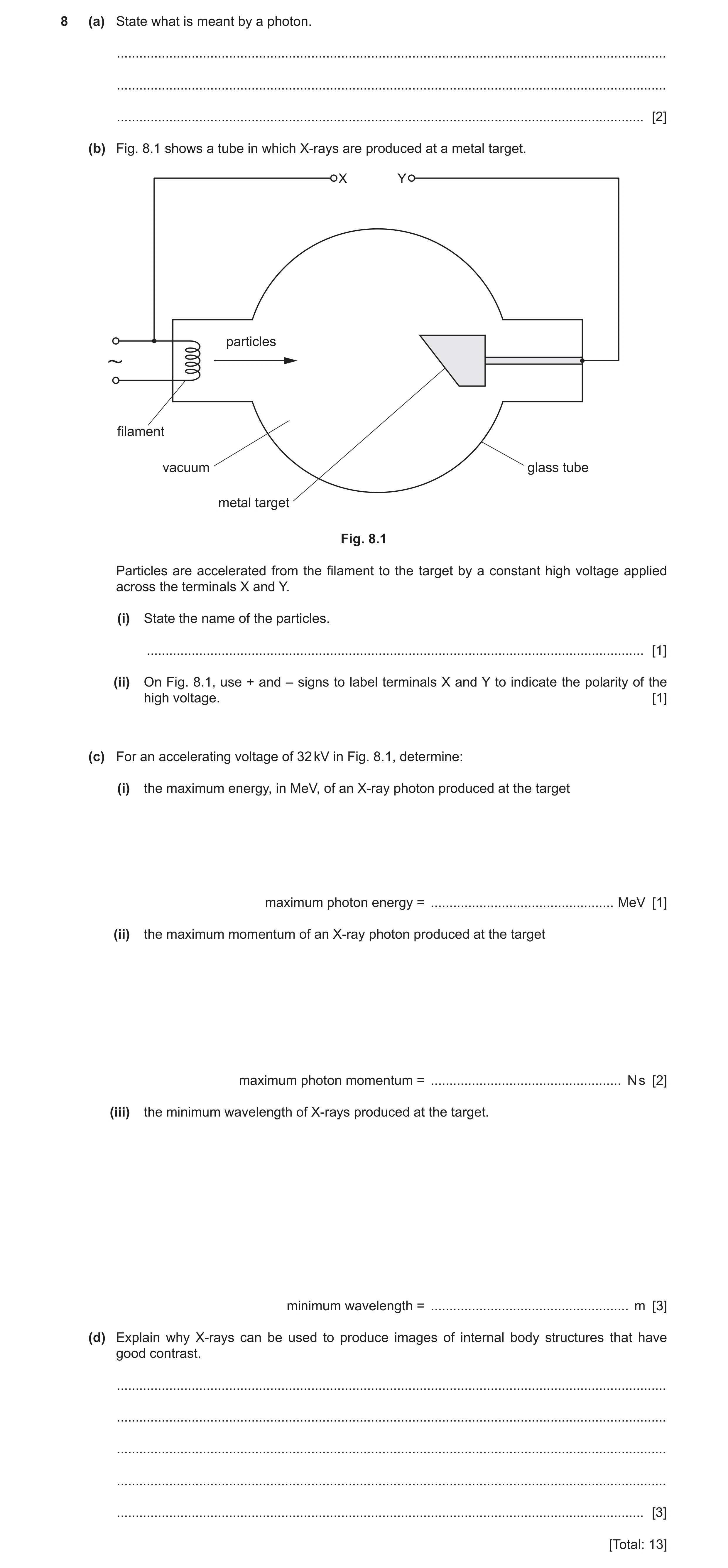
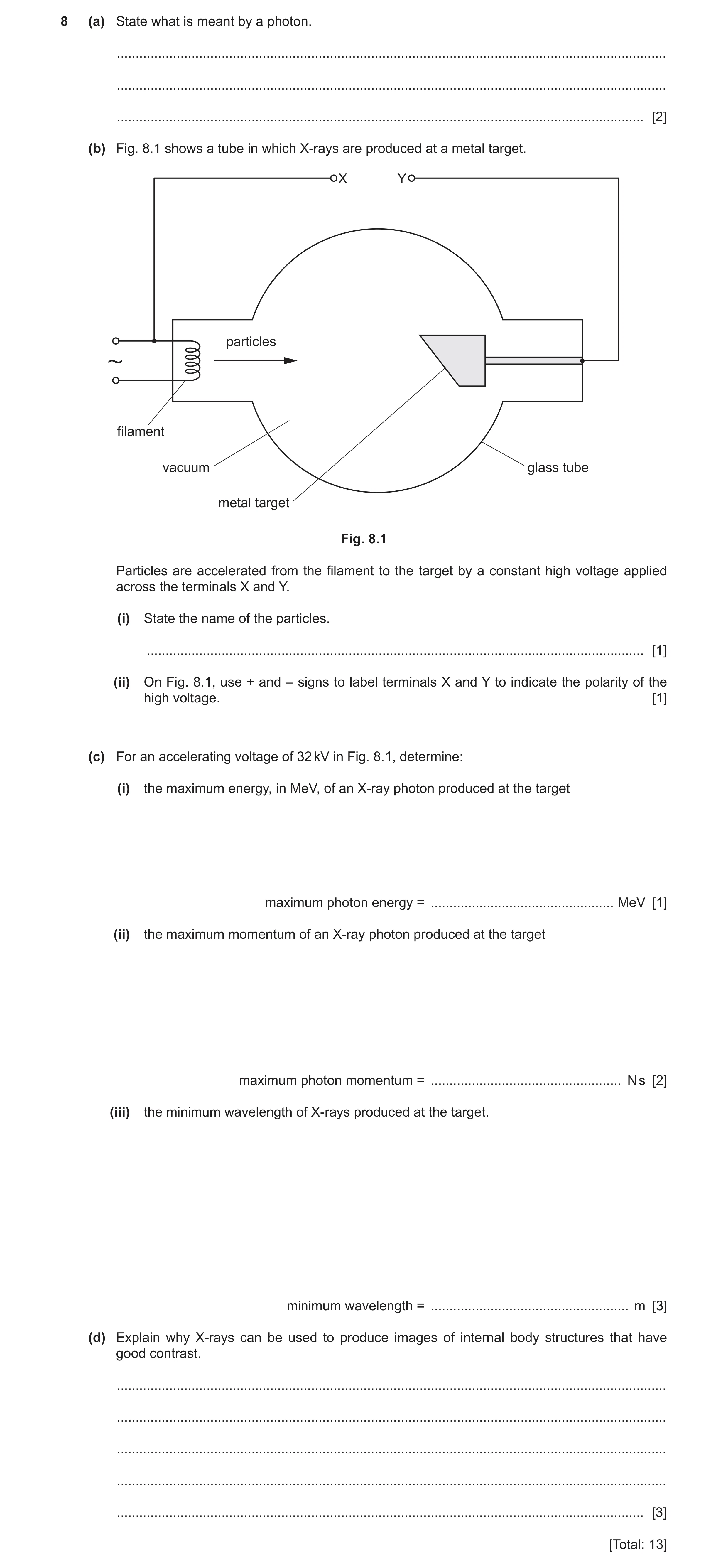
8 (a) State what is meant by a photon. … … … [2] (b) Fig. 8.1 shows a tube in which X-rays are produced at a metal target. X Y particles filament vacuum glass tube metal target Fig. 8.1 Particles are accelerated from the filament to the target by a constant high voltage applied across the terminals X and Y. (i) State the name of the particles. … [1] (ii) On Fig. 8.1, use + and – signs to label terminals X and Y to indicate the polarity of the high voltage. [1] (c) For an accelerating voltage of 32 kV in Fig. 8.1, determine: (i) the maximum energy, in MeV, of an X-ray photon produced at the target maximum photon energy = … MeV [1] (ii) the maximum momentum of an X-ray photon produced at the target maximum photon momentum = … N s [2] (iii) the minimum wavelength of X-rays produced at the target. minimum wavelength = … m [3] (d) Explain why X-rays can be used to produce images of internal body structures that have good contrast. … … … … … [3] [Total: 13]
13 marks
Mark scheme: 8(a) packet / quantum of energy M1 of electromagnetic radiation A1 8(b)(i) electron(s) B1 8(b)(ii) X labelled – and Y labelled + B1 8(c)(i) 0.032 MeV A1 8(c)(ii) momentum = E / c C1 momentum = (0.032 × 1.60 10–13) / (3.00 108) = 1.7 10–23 N s A1 8(c)(iii) E = hf and = c / f C1 = hc / E = (6.63 10–34 × 3.00 108) / (0.032 1.60 × 10⁻¹³) C1 = 3.9 10–11 m A1 8(d) discussion of bone and soft tissue B1 discussion of different attenuation (coefficients) or discussion differences in penetration / transmission / absorption B1 transmitted intensities (by bone and tissue) are very different (leading to good contrast images) B1
This question in 9702/41 May/June 2024
Q23 · State what is meant by a photon 9702/43 May/June 2024
8 (a) State what is meant by a photon. … … … [2] (b) Fig. 8.1 shows a tube in which X-rays are produced at a metal target. X Y particles filament vacuum glass tube metal target Fig. 8.1 Particles are accelerated from the filament to the target by a constant high voltage applied across the terminals X and Y. (i) State the name of the particles. … [1] (ii) On Fig. 8.1, use + and – signs to label terminals X and Y to indicate the polarity of the high voltage. [1] (c) For an accelerating voltage of 32 kV in Fig. 8.1, determine: (i) the maximum energy, in MeV, of an X-ray photon produced at the target maximum photon energy = … MeV [1] (ii) the maximum momentum of an X-ray photon produced at the target maximum photon momentum = … N s [2] (iii) the minimum wavelength of X-rays produced at the target. minimum wavelength = … m [3] (d) Explain why X-rays can be used to produce images of internal body structures that have good contrast. … … … … … [3] [Total: 13]
13 marks
Mark scheme: 8(a) packet / quantum of energy M1 of electromagnetic radiation A1 8(b)(i) electron(s) B1 8(b)(ii) X labelled – and Y labelled + B1 8(c)(i) 0.032 MeV A1 8(c)(ii) momentum = E / c C1 momentum = (0.032 × 1.60 10–13) / (3.00 108) = 1.7 10–23 N s A1 8(c)(iii) E = hf and = c / f C1 = hc / E = (6.63 10–34 × 3.00 108) / (0.032 1.60 × 10⁻¹³) C1 = 3.9 10–11 m A1 8(d) discussion of bone and soft tissue B1 discussion of different attenuation (coefficients) or discussion differences in penetration / transmission / absorption B1 transmitted intensities (by bone and tissue) are very different (leading to good contrast images) B1
This question in 9702/43 May/June 2024
Q24 · Electrons in a vacuum are accelerated from rest through a potential difference (p.d.) V… 9702/42 Oct/Nov 2024
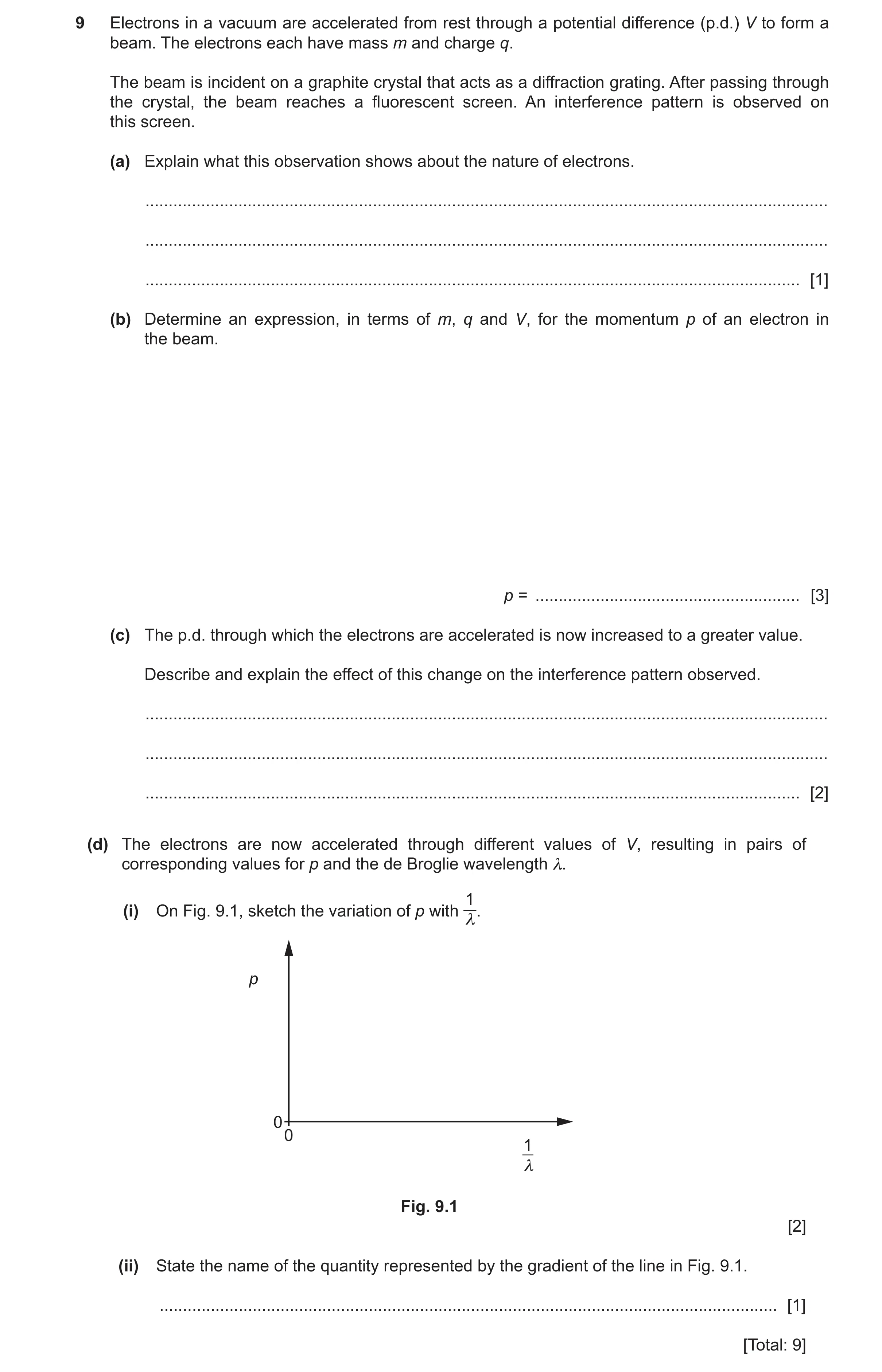
9 Electrons in a vacuum are accelerated from rest through a potential difference (p.d.) V to form a beam. The electrons each have mass m and charge q. The beam is incident on a graphite crystal that acts as a diffraction grating. After passing through the crystal, the beam reaches a fluorescent screen. An interference pattern is observed on this screen. (a) Explain what this observation shows about the nature of electrons. … … … [1] (b) Determine an expression, in terms of m, q and V, for the momentum p of an electron in the beam. p = … [3] (c) The p.d. through which the electrons are accelerated is now increased to a greater value. Describe and explain the effect of this change on the interference pattern observed. … … … [2] (d) The electrons are now accelerated through different values of V, resulting in pairs of corresponding values for p and the de Broglie wavelength λ. 1 (i) On Fig. 9.1, sketch the variation of p with λ. p 0 0 1 λ Fig. 9.1 [2] (ii) State the name of the quantity represented by the gradient of the line in Fig. 9.1. … [1] [Total: 9]
9 marks
Mark scheme: 9(a) diffraction is characteristic of wave behaviour so shows that electrons can behave like waves B1 9(b) qV = ½mv2 C1 p = mv C1 p = m √(2qV / m) A1 = √(2qVm) 9(c) (electrons have) greater momentum so smaller (de Broglie) wavelength B1 fringes become closer together B1 9(d)(i) straight line with positive gradient B1 line with positive gradient passing through the origin B1 9(d)(ii) Planck constant B1
This question in 9702/42 Oct/Nov 2024
Q25 · State what is meant by a photon 9702/42 Feb/March 2025
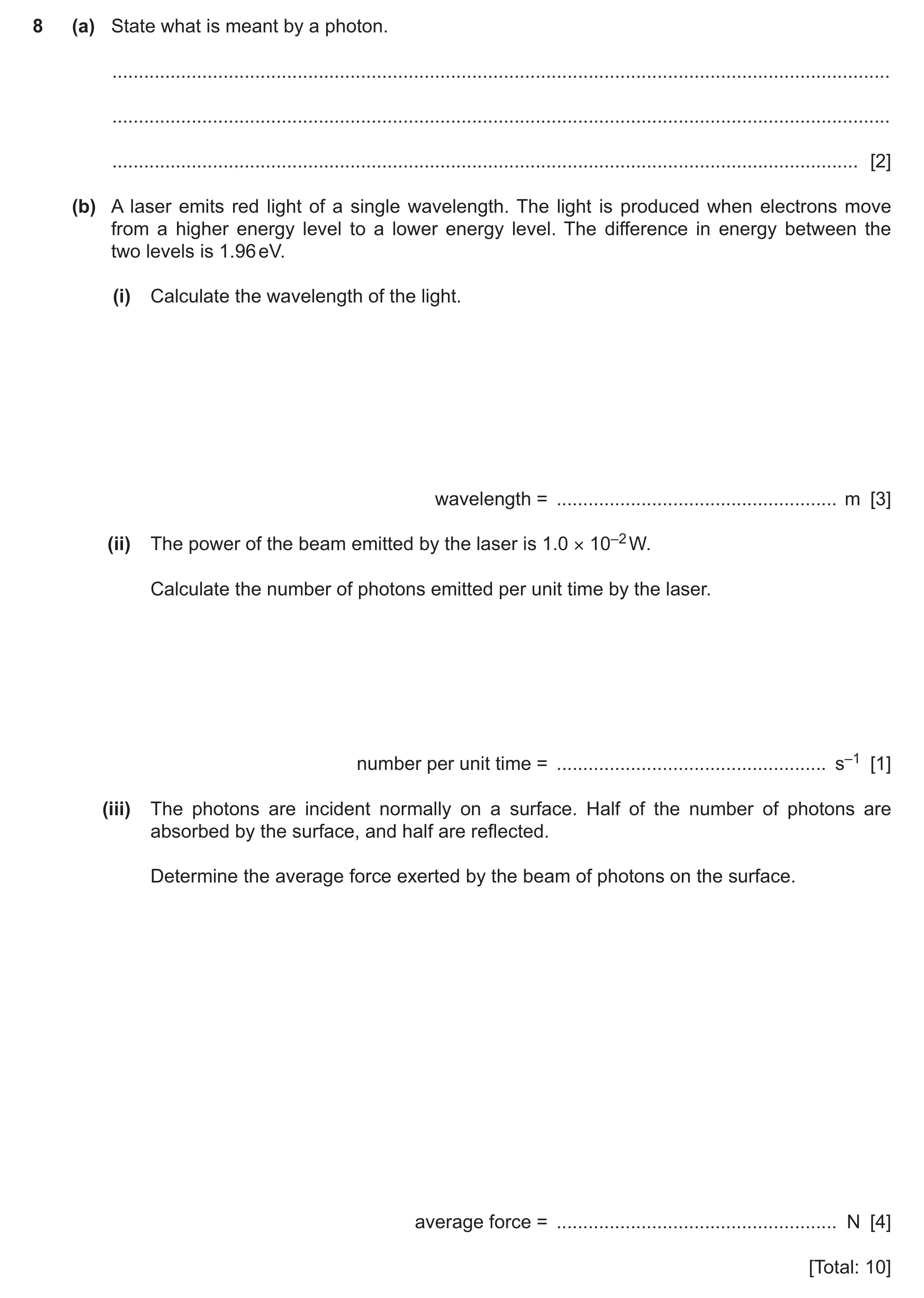
8 (a) State what is meant by a photon. … … … [2] (b) A laser emits red light of a single wavelength. The light is produced when electrons move from a higher energy level to a lower energy level. The difference in energy between the two levels is 1.96 eV. (i) Calculate the wavelength of the light. wavelength = … m [3] (ii) The power of the beam emitted by the laser is 1.0 × 10⁻² W. Calculate the number of photons emitted per unit time by the laser. number per unit time = … s–1 [1] (iii) The photons are incident normally on a surface. Half of the number of photons are absorbed by the surface, and half are reflected. Determine the average force exerted by the beam of photons on the surface. average force = … N [4] [Total: 10]
10 marks
Mark scheme: 8(a) • quantum of energy M1 • of electromagnetic radiation A1 8(b)(i) ()E = hc / C1 = (6.63 10–34 3.00 108) / (1.96 1.60 10–19) C1 = 6.3 10–7 m A1 8(b)(ii) number per unit time = power / energy per photon A1 = (1.0 10–2) / (1.96 1.60 10–19) = 3.2 1016 s–1 8(b)(iii) either: force = rate of change of momentum C1 or: F = p / t p = E / c C1 half the photons have change in momentum p, the other half have change in momentum 2p C1 F = [(1.96 1.60 10–19) / (3.00 108)] 3.2 1016 [(2 + 1) / 2] A1 = 5.0 10–11 N
This question in 9702/42 Feb/March 2025
Q26 · State what is meant by a photon 9702/41 Oct/Nov 2025
8 (a) State what is meant by a photon. … … … [2] 238 (b) A stationary nucleus of uranium-238 ( 92U) undergoes alpha decay to produce a nucleus 234 of thorium-234 ( 90Th). The kinetic energy of the emitted alpha particle is 4.200 MeV. A gamma-ray photon is also emitted during the decay. Assume that the rebound kinetic energy of the thorium nucleus is negligible. Table 8.1 shows the masses of the nuclides involved in the decay reaction. The mass of the uranium-238 nuclide is missing. Table 8.1 nuclide nuclide mass / u 4 4.000 407 2α 234 233.915 174 90Th 238 92U The total energy released in the decay of the nucleus of uranium-238 is 4.274 MeV. (i) Calculate the mass, in u, of the uranium-238 nuclide. Give your answer to five decimal places. mass = … u [3] (ii) Determine a value for the wavelength of the gamma radiation emitted during the decay of the uranium-238 nucleus. wavelength = … m [3] (iii) In practice, the rebound kinetic energy of the thorium nucleus is not negligible. Explain, without further calculation, how your answer in (b)(ii) compares with the true wavelength of gamma radiation emitted during the decay of the uranium-238 nucleus. … … … [1] (c) Gamma radiation emitted during the decay of a sample of uranium-238 has a single wavelength. decay by beta emission, and also emit gamma radiation in the Nuclei of cobalt-60 (6027Co) process. Suggest why there is not a single wavelength for the gamma radiation emitted during the decay of a sample of cobalt-60. … … … [2] [Total: 11]
11 marks
Mark scheme: 8(a) packet / quantum of energy M1 of electromagnetic radiation A1 8(b)(i) E = c2m C1 m = (4.274 106 1.60 10–19) / (1.66 10–27 (3.00 108)2) C1 ( = 0.00458 u) m = 233.915174 + 4.000407 + 0.00458 A1 = 237.92016 u 8(b)(ii) E = hc / C1 or E = hf and c = f (4.274 – 4.200) 1.60 10–13 = (6.63 10–34 3.00 108) / C1 = 1.7 10–11 m A1 8(b)(iii) (true) energy of gamma photon is smaller so (true) wavelength is larger B1 8(c) (anti)neutrinos are emitted during beta decay B1 particles emitted during beta decay carry varying amounts of energy, so energy of gamma photon is also variable (between B1 decays)
This question in 9702/41 Oct/Nov 2025
Q27 · State what is meant by a photon 9702/43 Oct/Nov 2025
8 (a) State what is meant by a photon. … … … [2] 238 (b) A stationary nucleus of uranium-238 ( 92U) undergoes alpha decay to produce a nucleus 234 of thorium-234 ( 90Th). The kinetic energy of the emitted alpha particle is 4.200 MeV. A gamma-ray photon is also emitted during the decay. Assume that the rebound kinetic energy of the thorium nucleus is negligible. Table 8.1 shows the masses of the nuclides involved in the decay reaction. The mass of the uranium-238 nuclide is missing. Table 8.1 nuclide nuclide mass / u 4 4.000 407 2α 234 233.915 174 90Th 238 92U The total energy released in the decay of the nucleus of uranium-238 is 4.274 MeV. (i) Calculate the mass, in u, of the uranium-238 nuclide. Give your answer to five decimal places. mass = … u [3] (ii) Determine a value for the wavelength of the gamma radiation emitted during the decay of the uranium-238 nucleus. wavelength = … m [3] (iii) In practice, the rebound kinetic energy of the thorium nucleus is not negligible. Explain, without further calculation, how your answer in (b)(ii) compares with the true wavelength of gamma radiation emitted during the decay of the uranium-238 nucleus. … … … [1] (c) Gamma radiation emitted during the decay of a sample of uranium-238 has a single wavelength. decay by beta emission, and also emit gamma radiation in the Nuclei of cobalt-60 (6027Co) process. Suggest why there is not a single wavelength for the gamma radiation emitted during the decay of a sample of cobalt-60. … … … [2] [Total: 11]
11 marks
Mark scheme: 8(a) packet / quantum of energy M1 of electromagnetic radiation A1 8(b)(i) E = c2m C1 m = (4.274 106 1.60 10–19) / (1.66 10–27 (3.00 108)2) C1 ( = 0.00458 u) m = 233.915174 + 4.000407 + 0.00458 A1 = 237.92016 u 8(b)(ii) E = hc / C1 or E = hf and c = f (4.274 – 4.200) 1.60 10–13 = (6.63 10–34 3.00 108) / C1 = 1.7 10–11 m A1 8(b)(iii) (true) energy of gamma photon is smaller so (true) wavelength is larger B1 8(c) (anti)neutrinos are emitted during beta decay B1 particles emitted during beta decay carry varying amounts of energy, so energy of gamma photon is also variable (between B1 decays)
This question in 9702/43 Oct/Nov 2025
 1 / 35
 2 / 35
 3 / 35
 4 / 35
 5 / 35
 6 / 35
 11 / 35
 12 / 35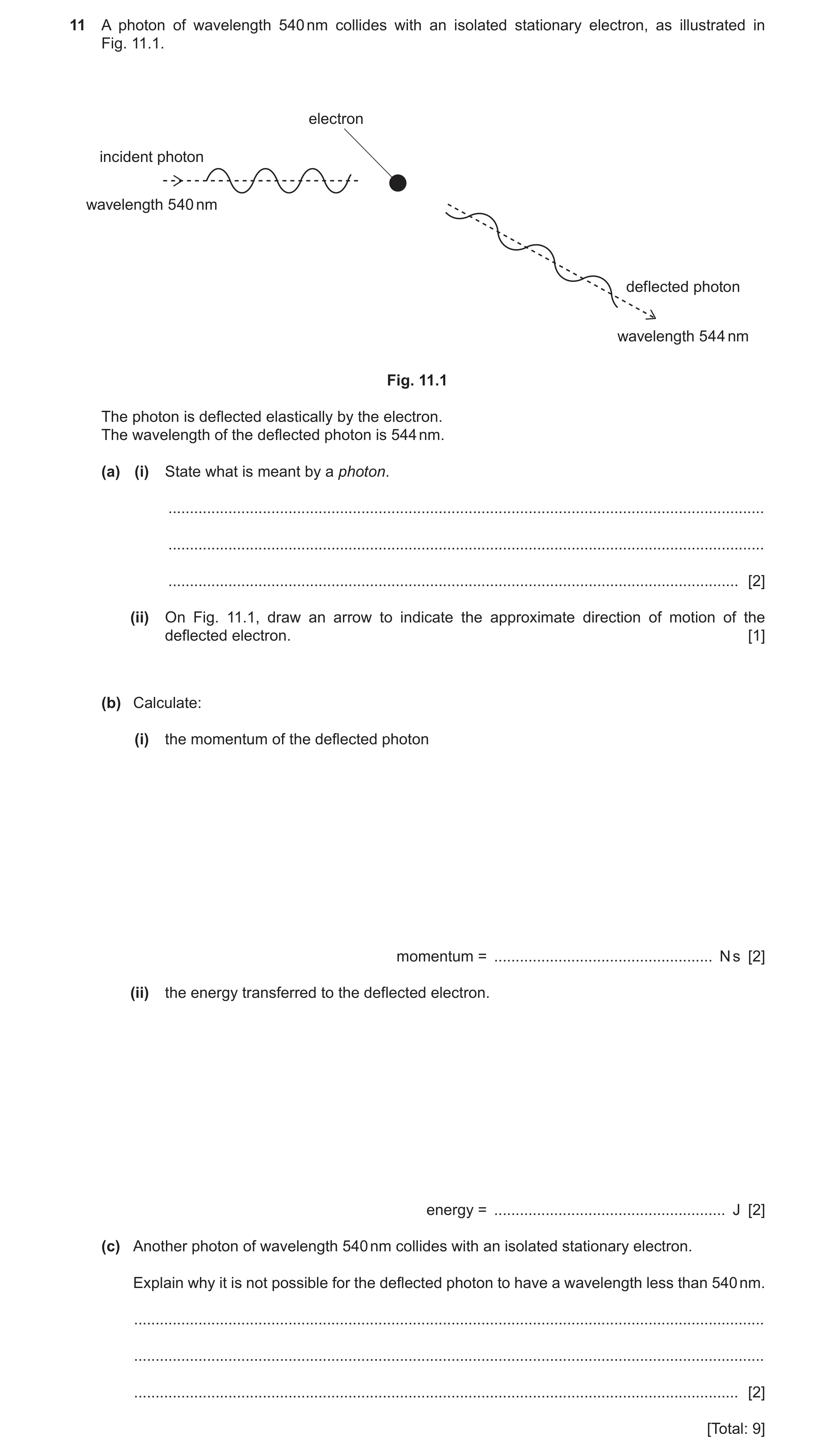
 16 / 35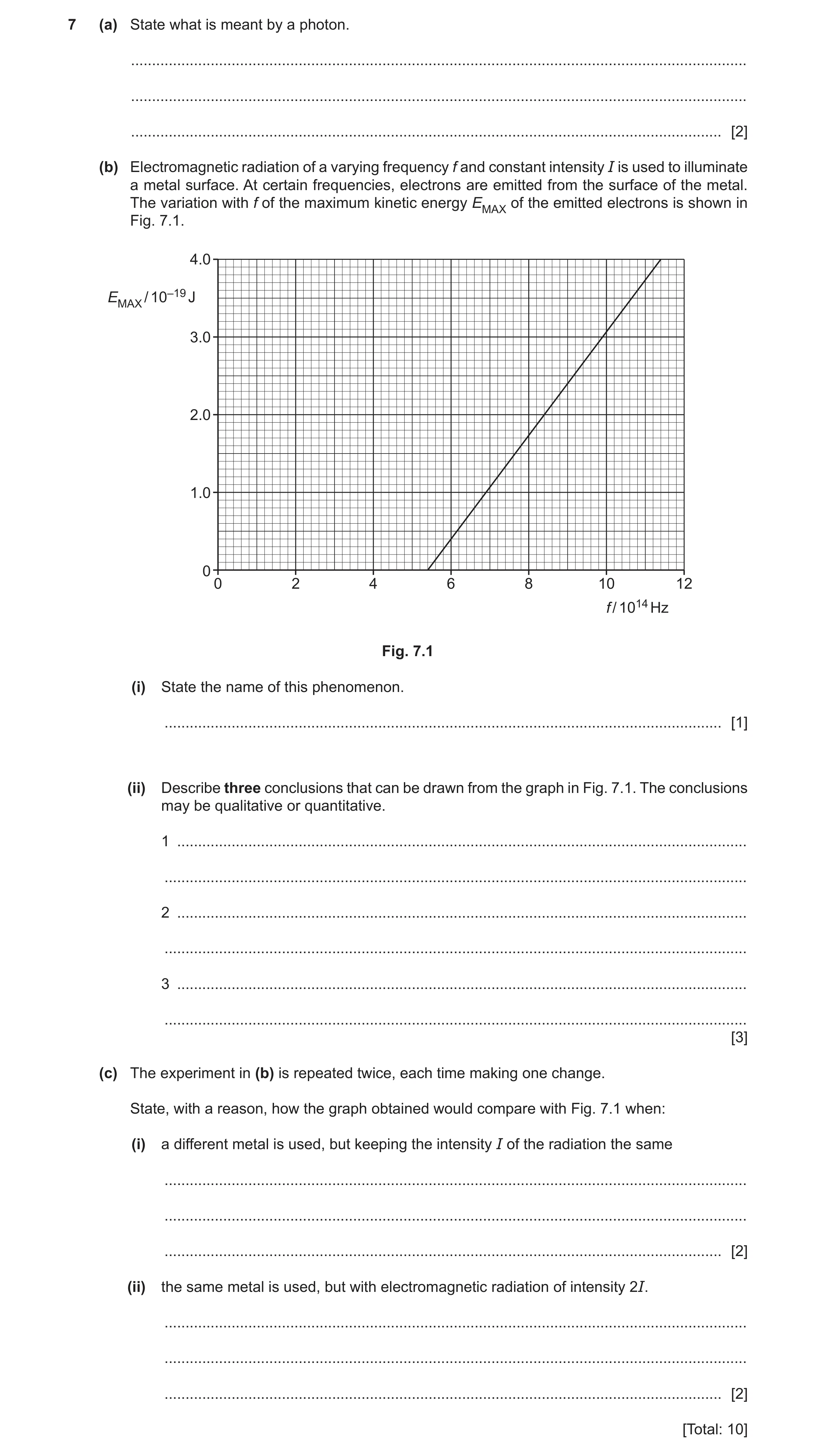
 20 / 35
 21 / 35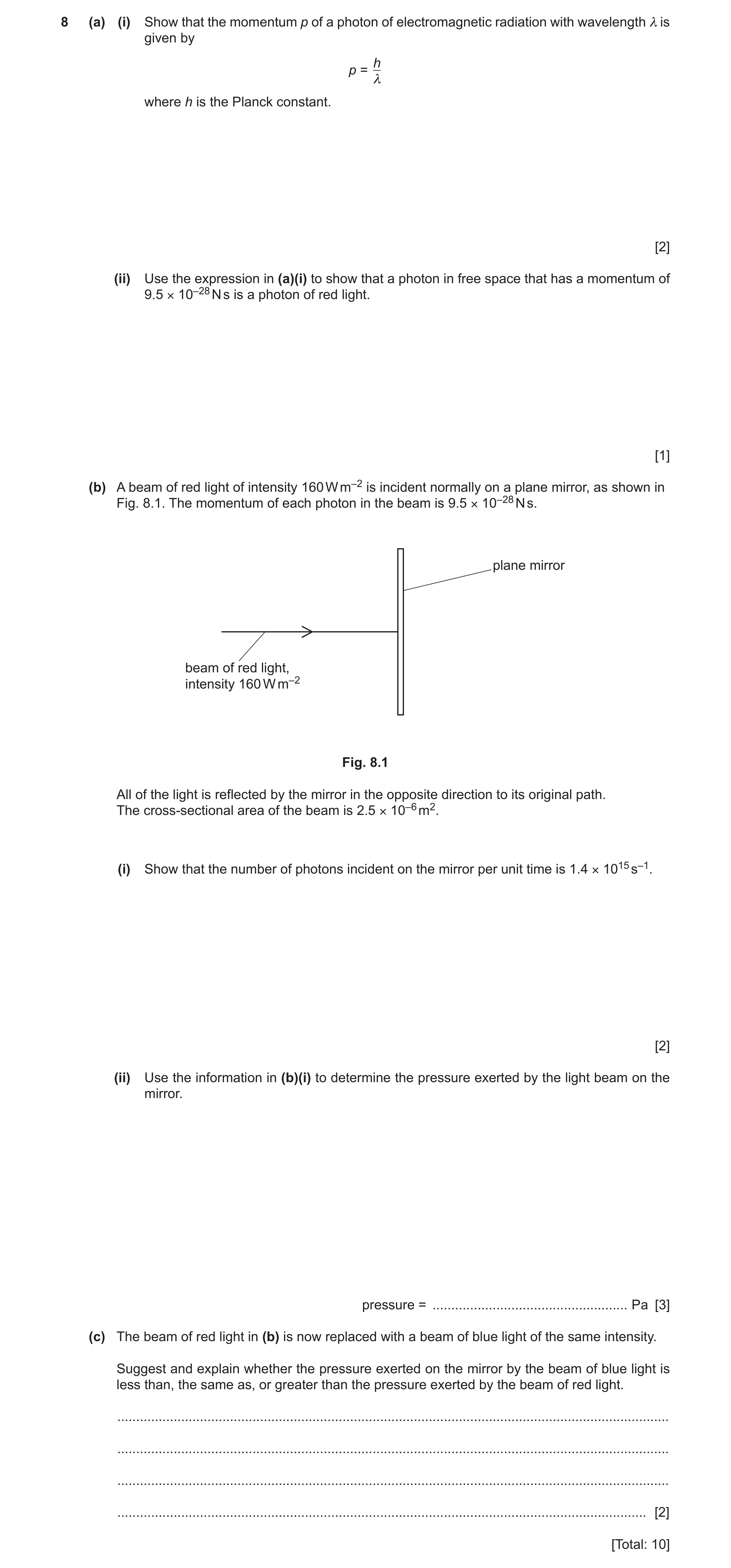
 24 / 35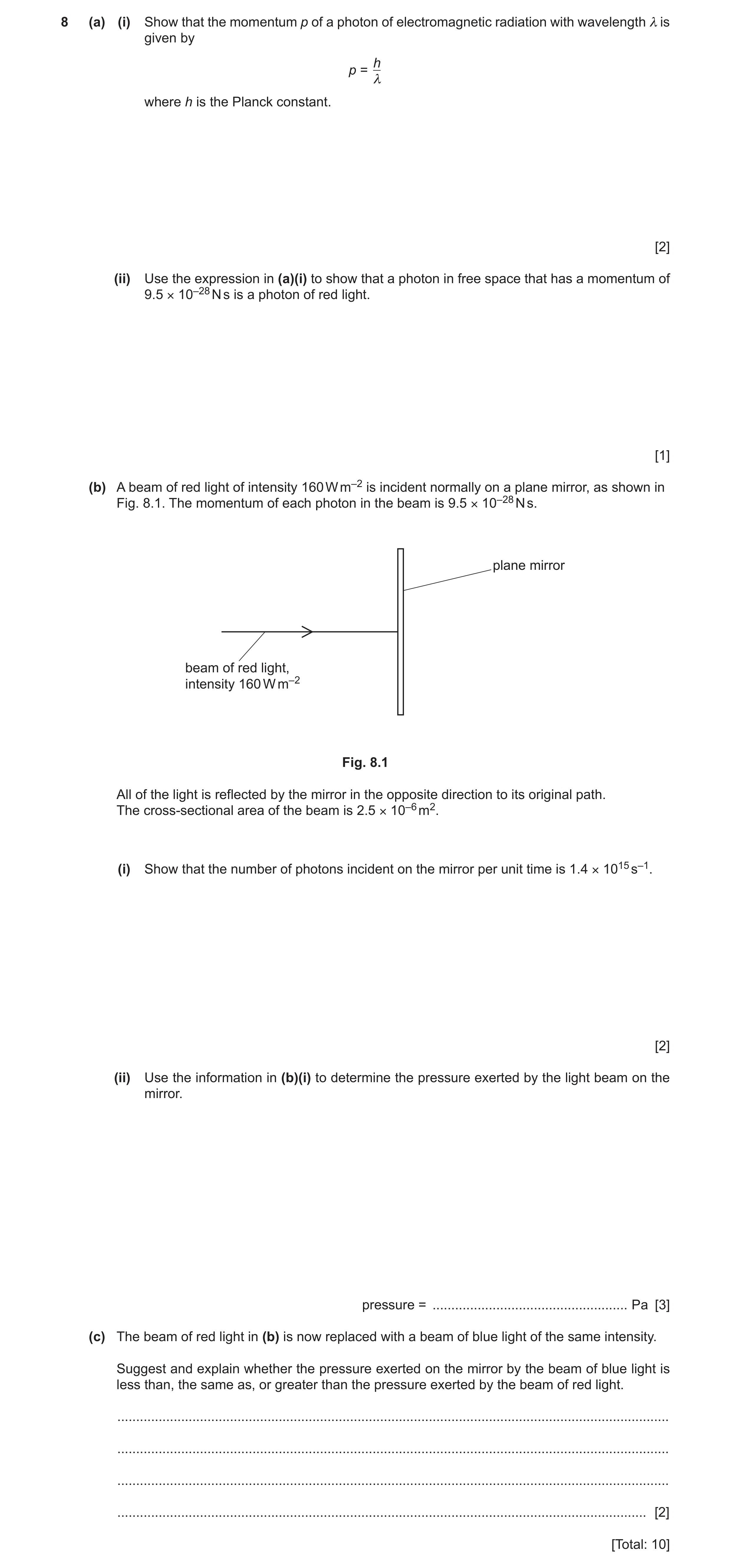
 32 / 35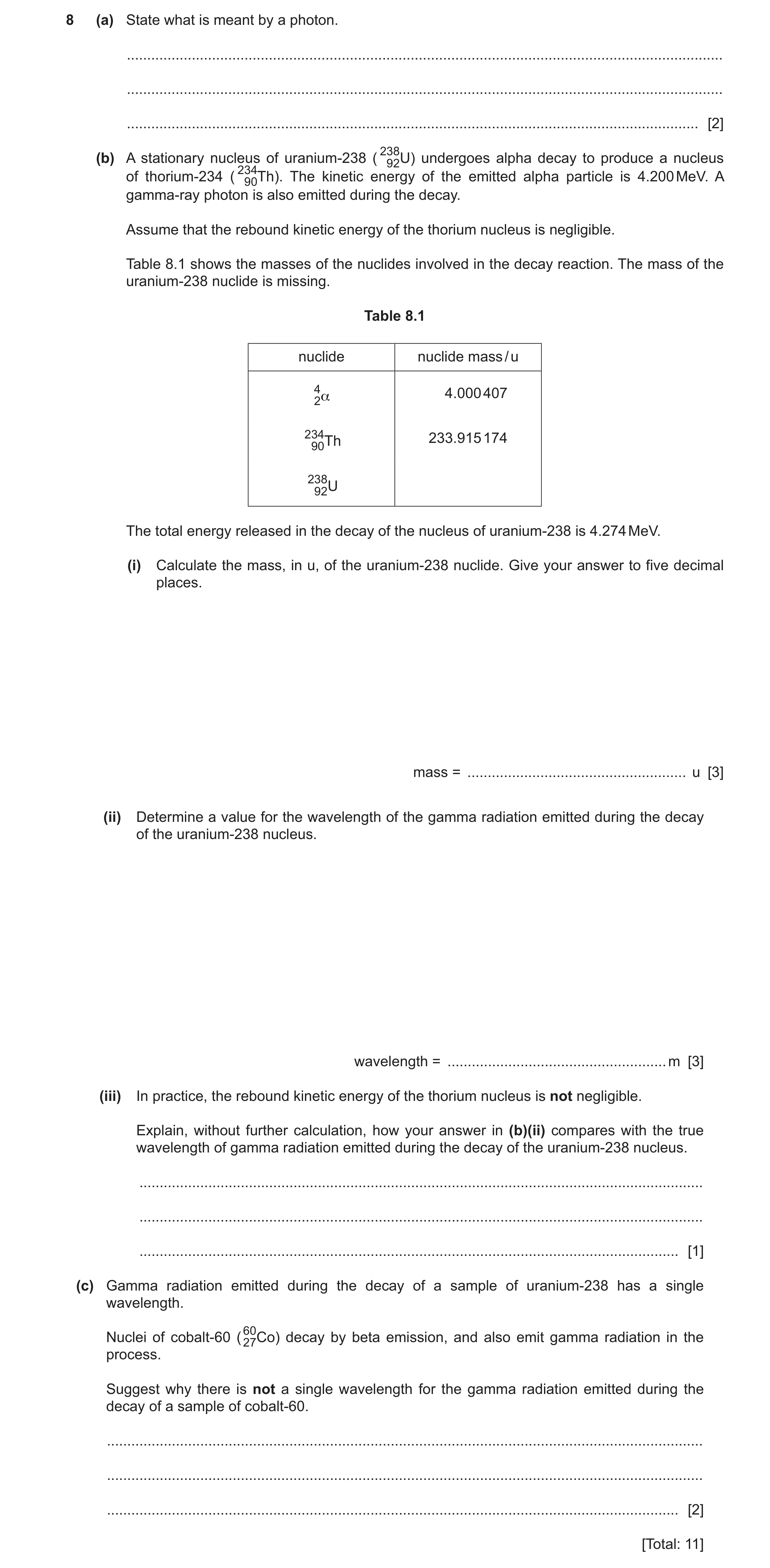
 8
8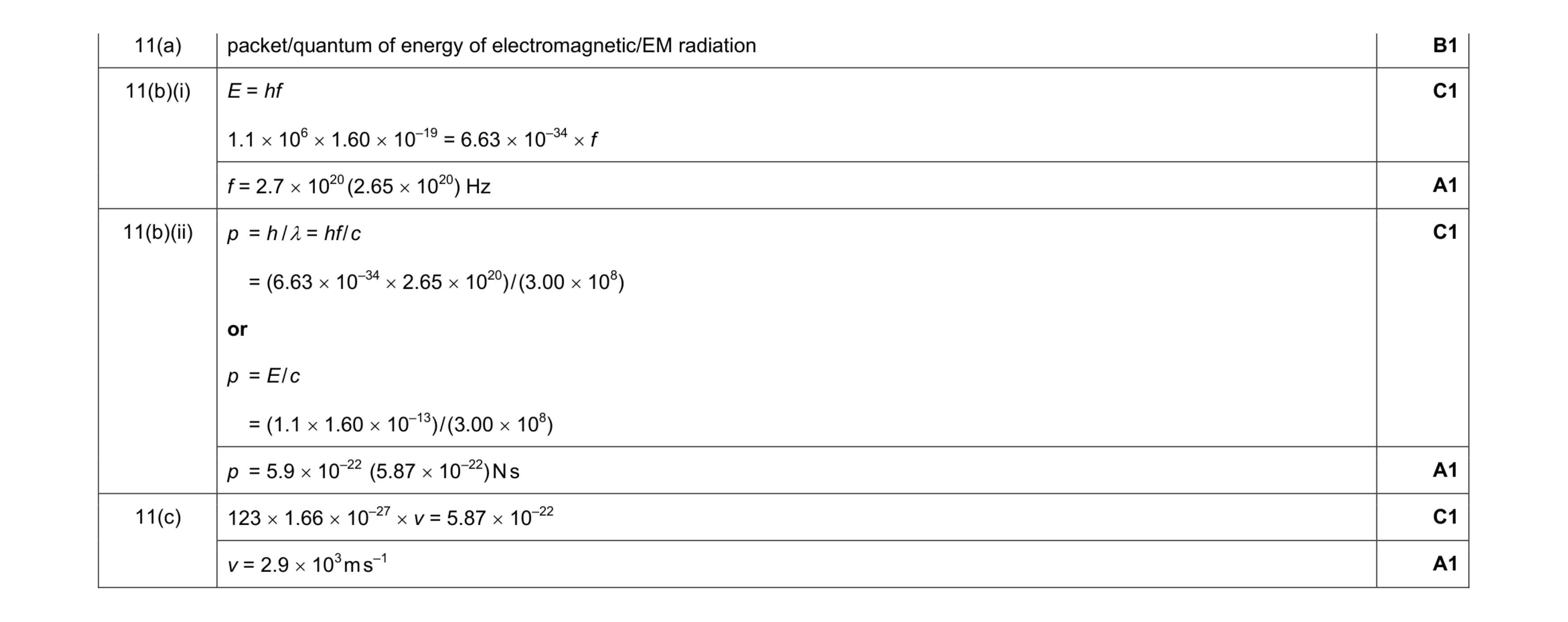 7
7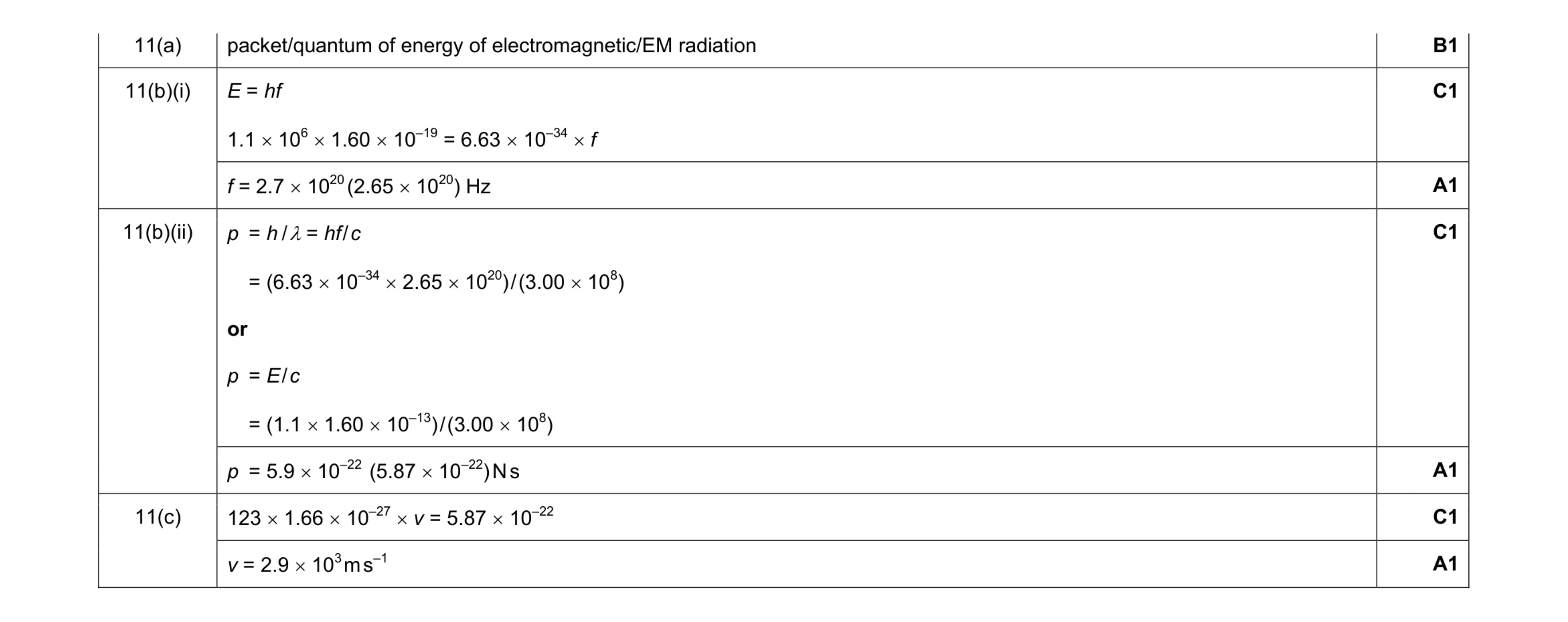 7
7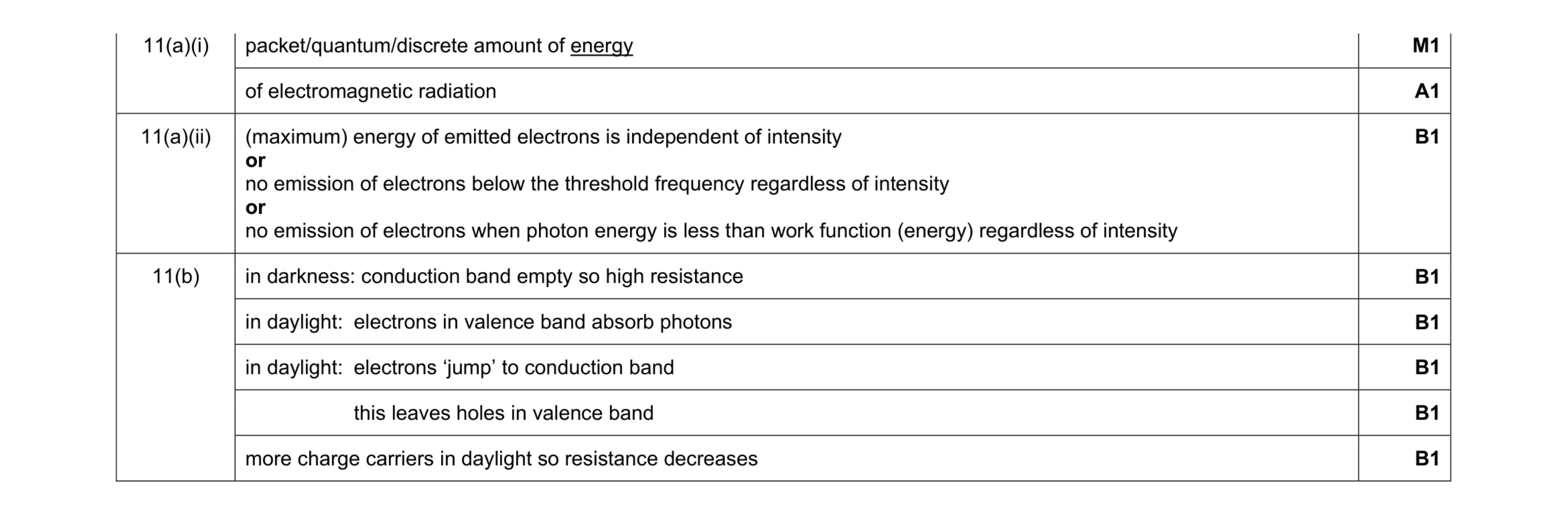 8
8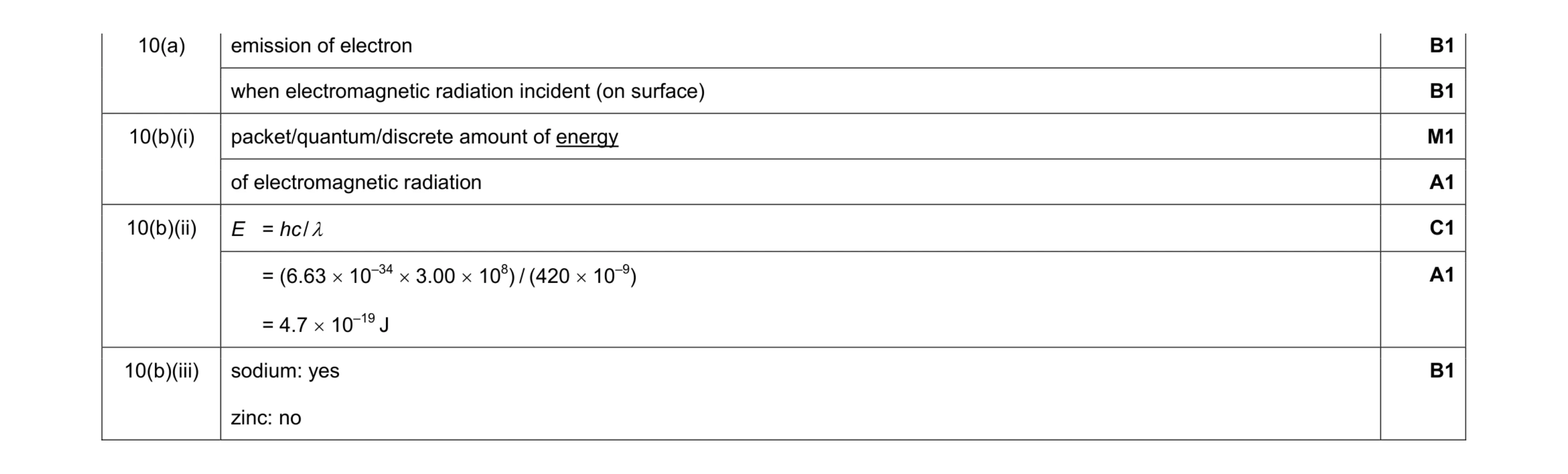 7
7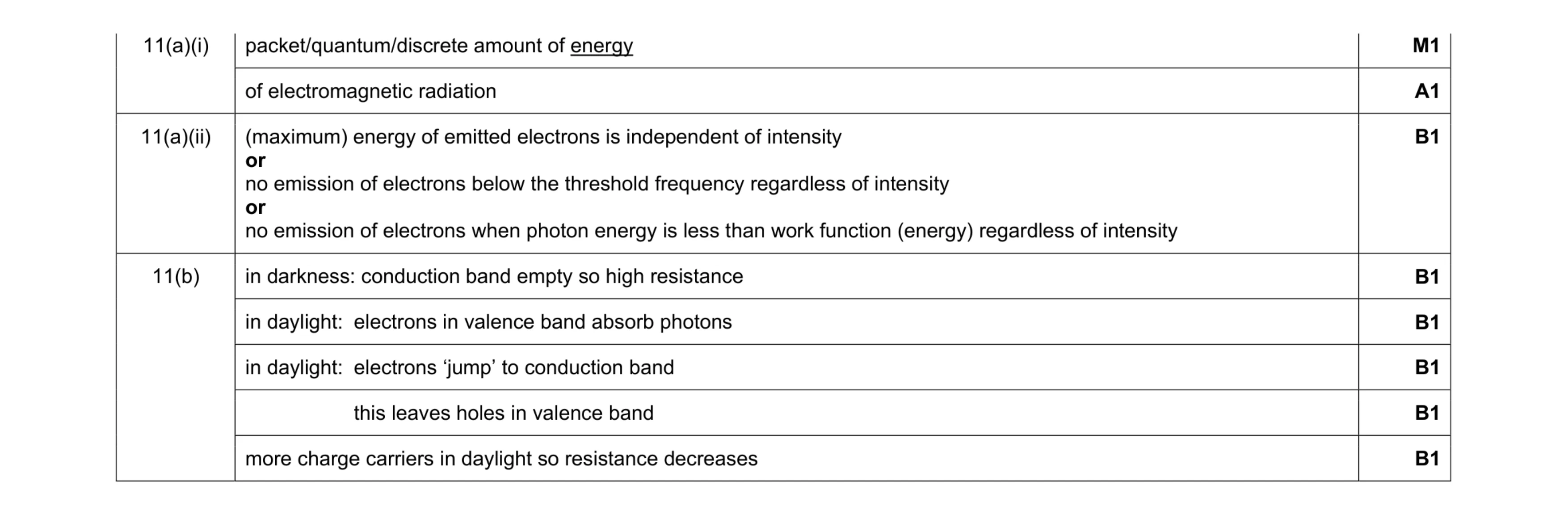 8
8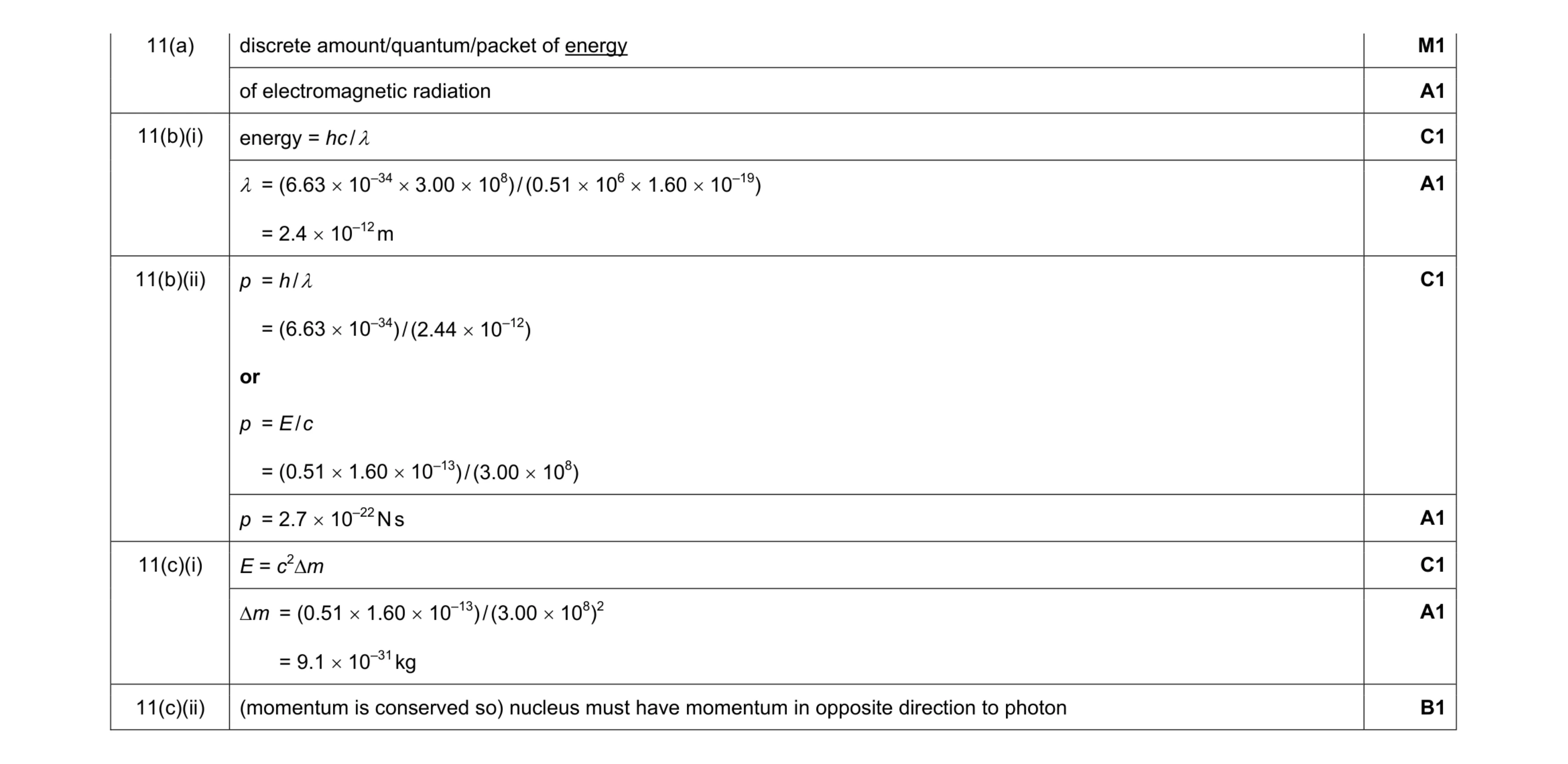 9
9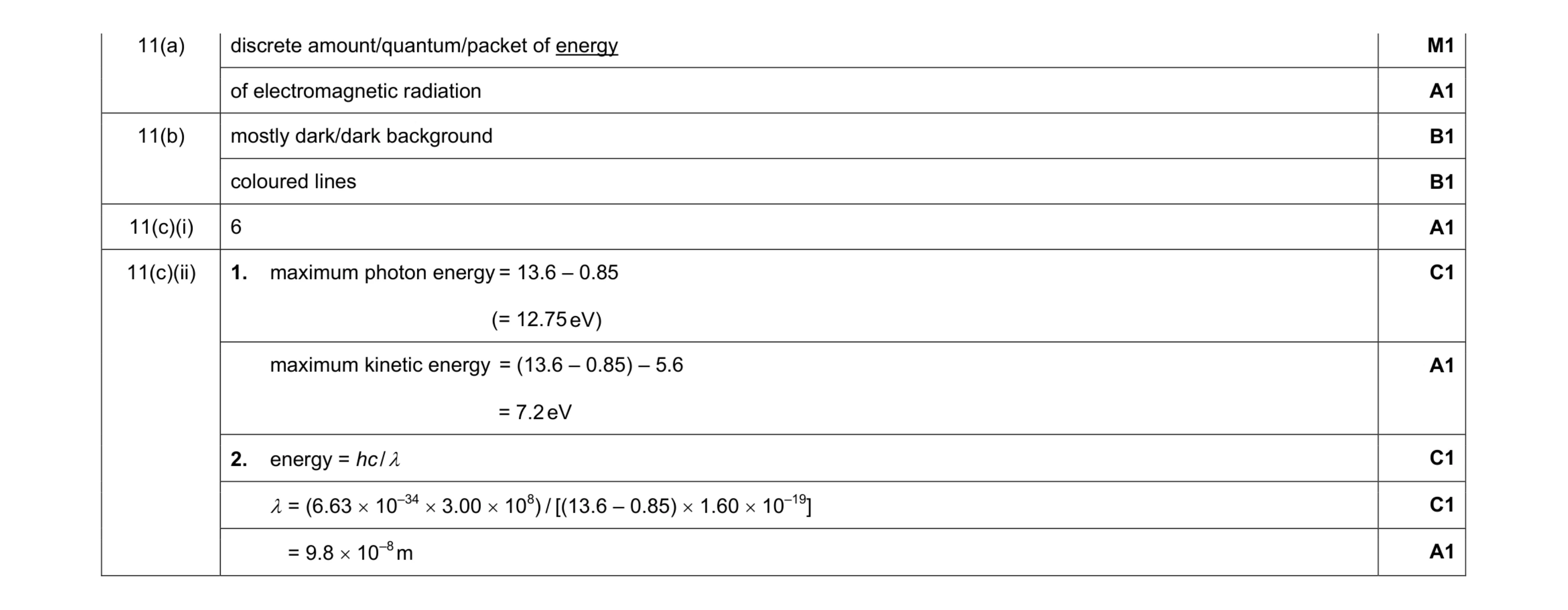 10
10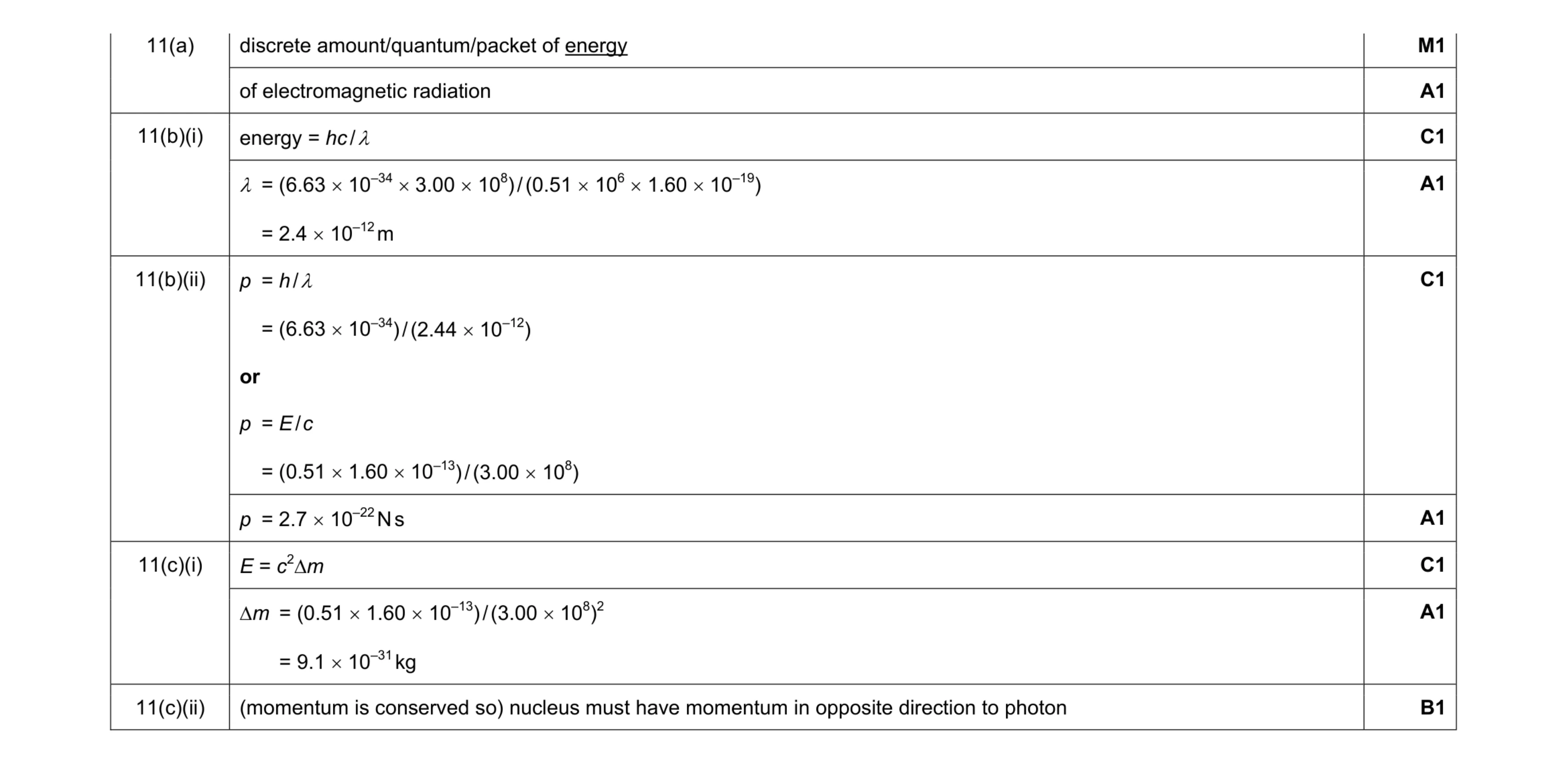 9
9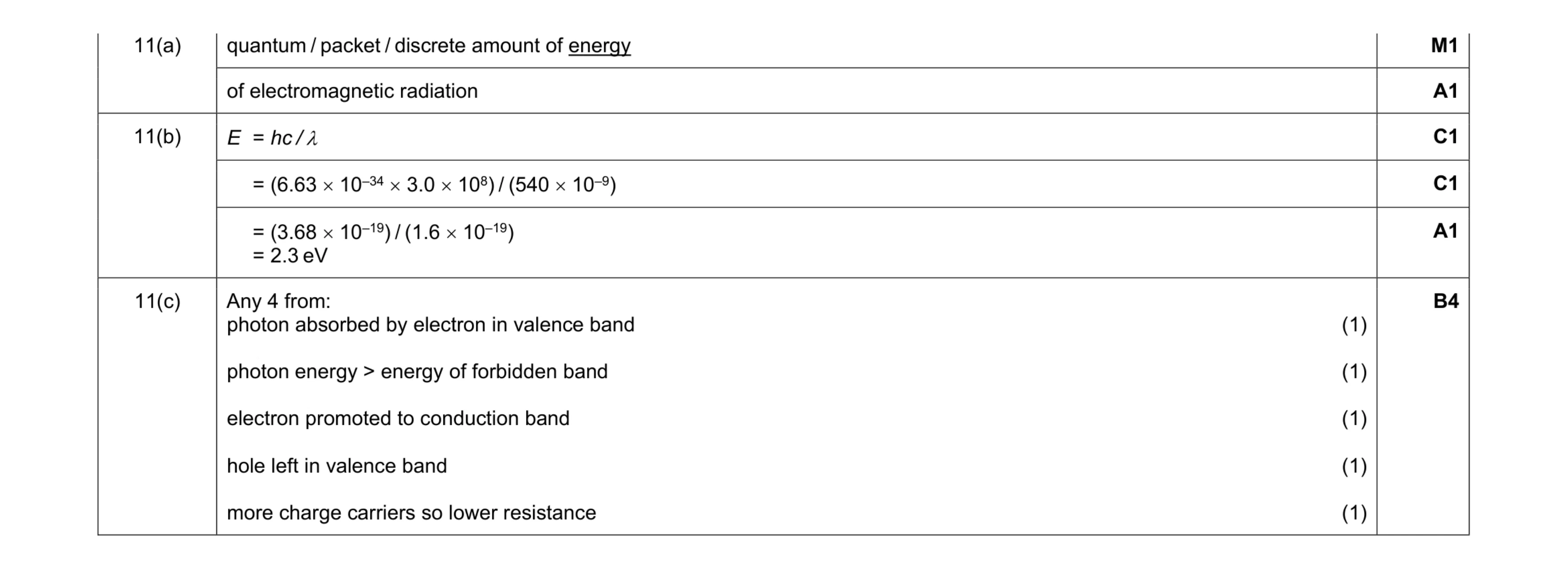 9
9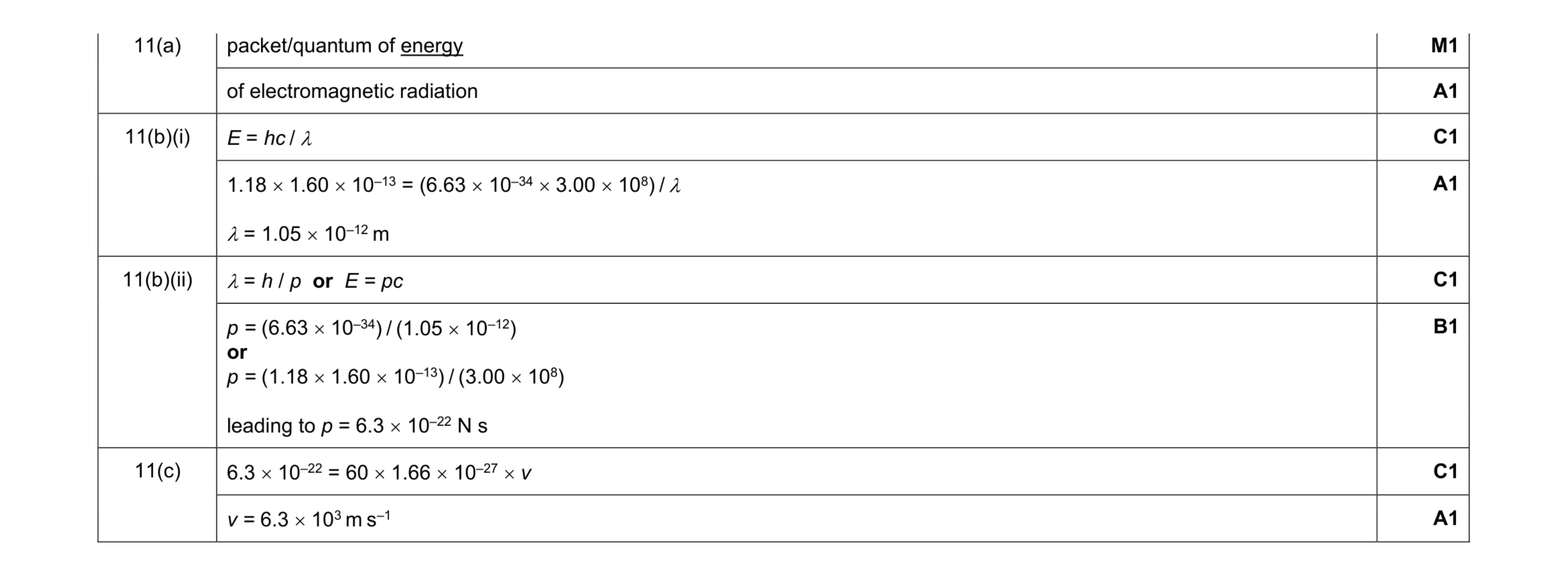 8
8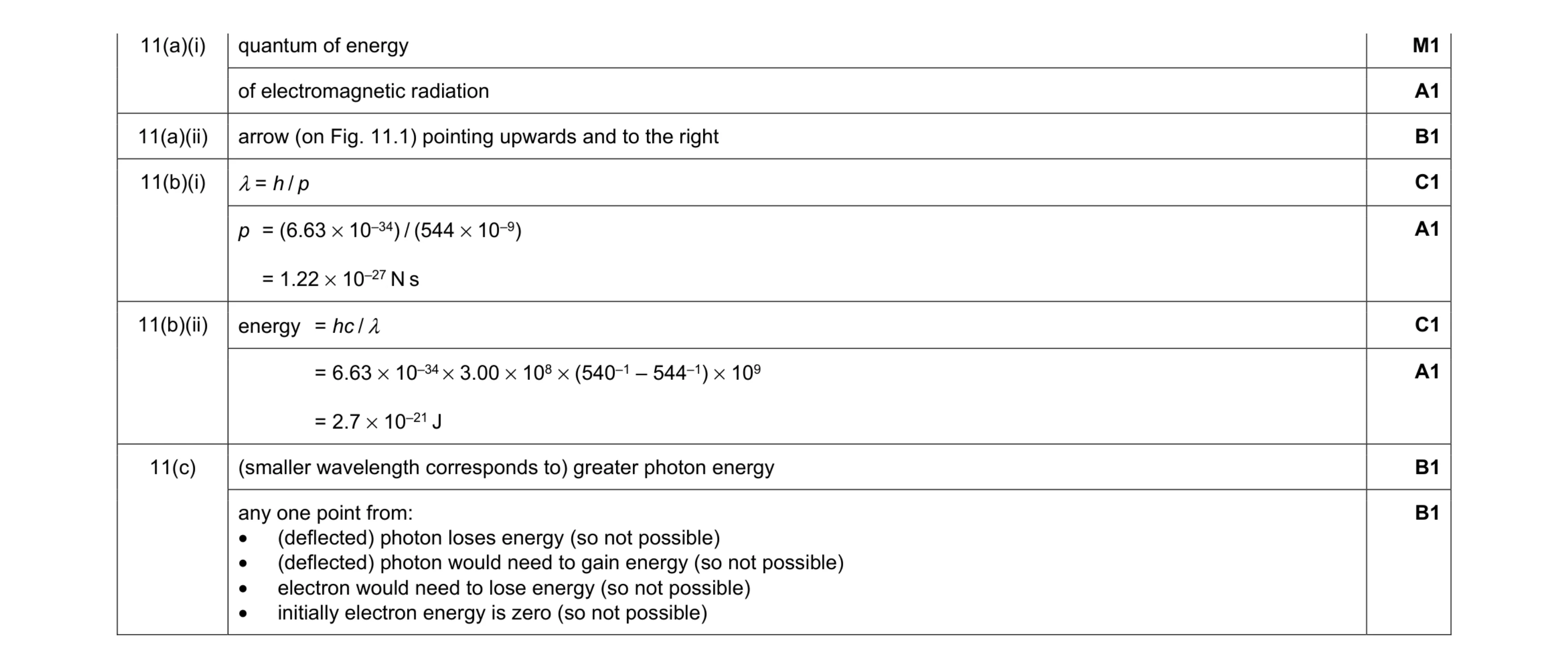 9
9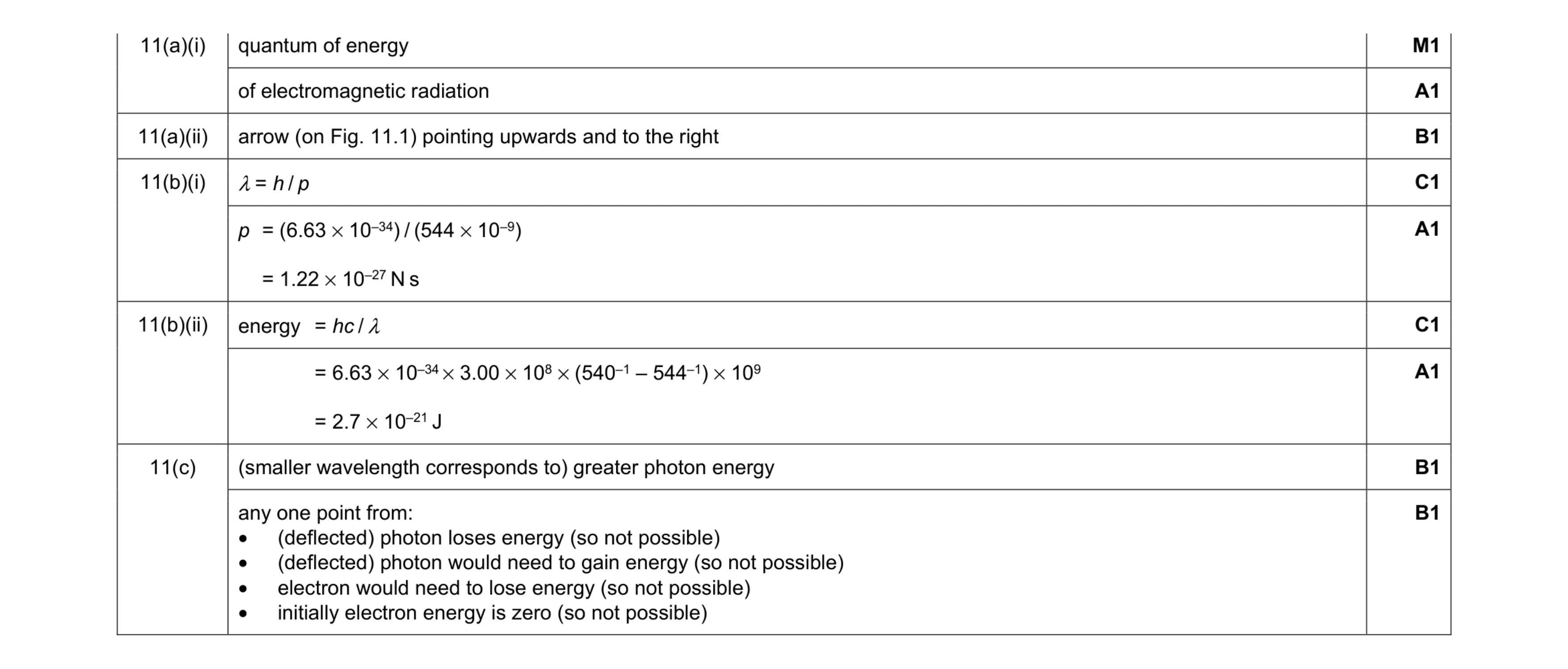 9
9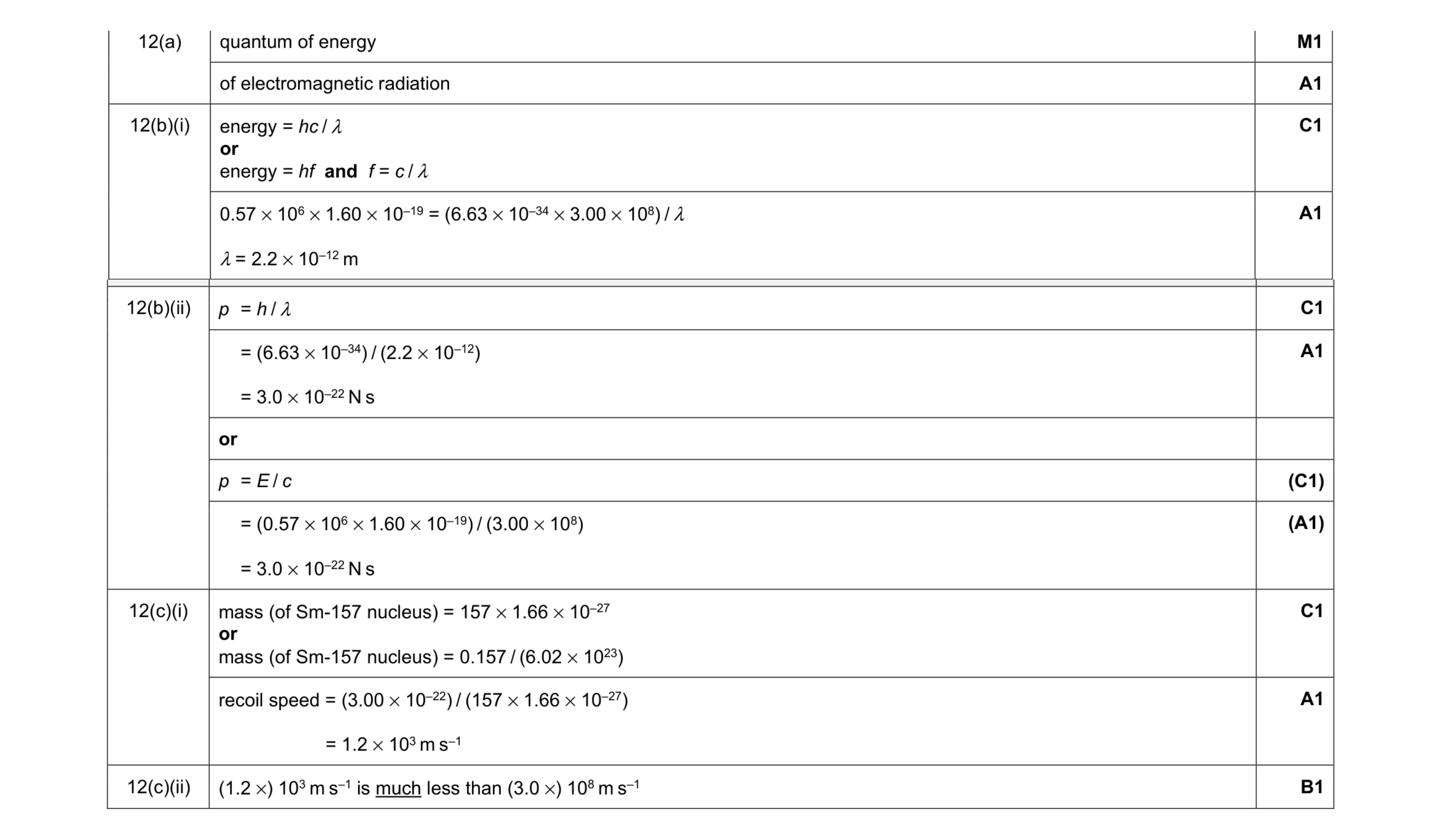 9
9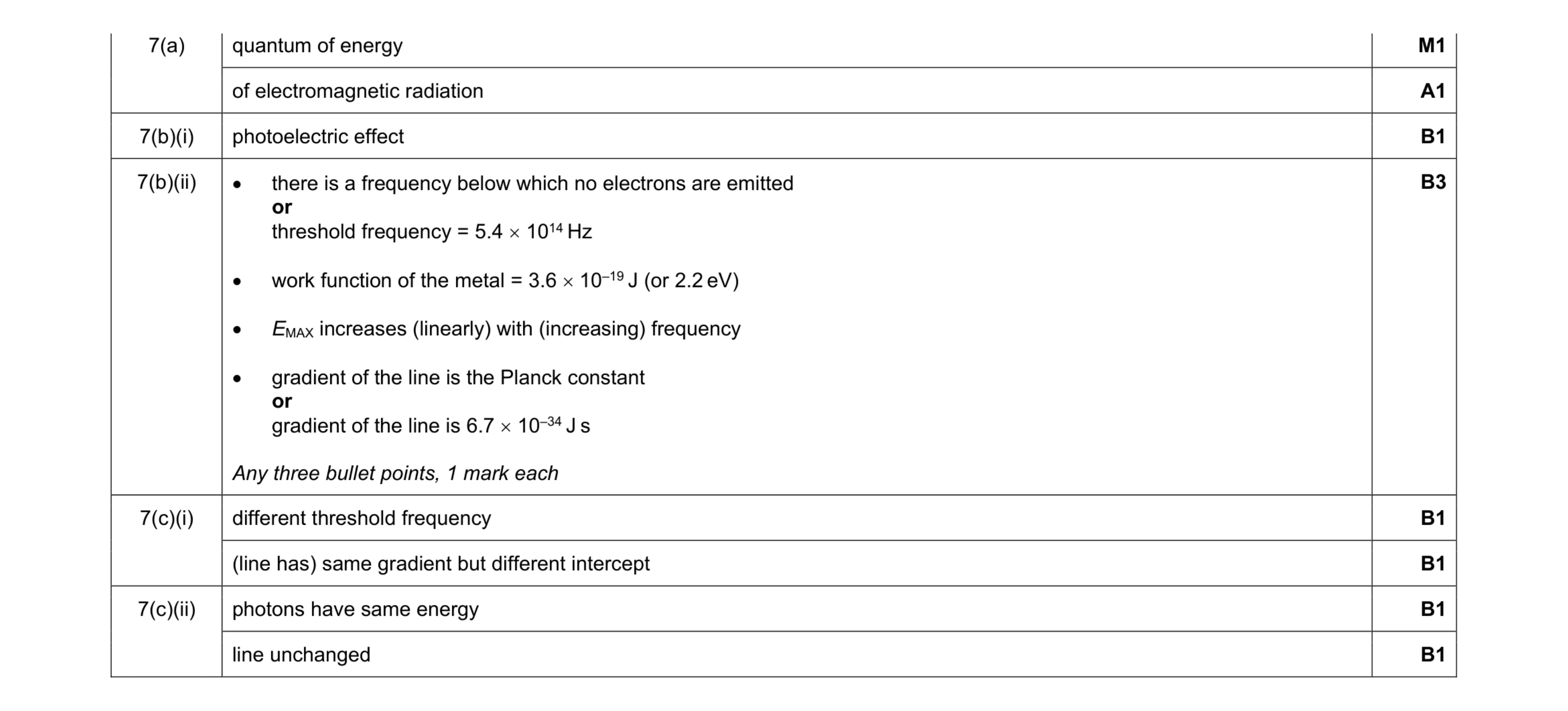 10
10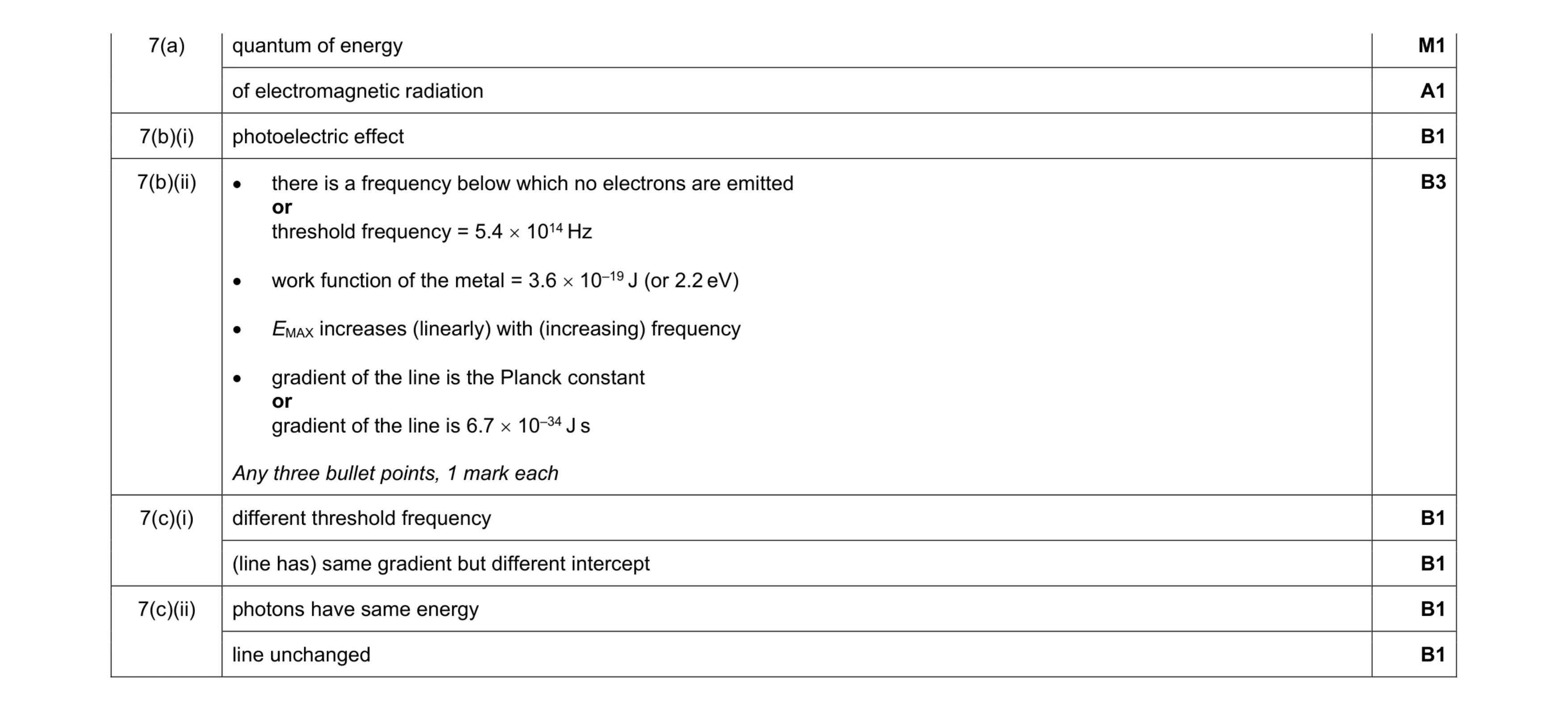 10
10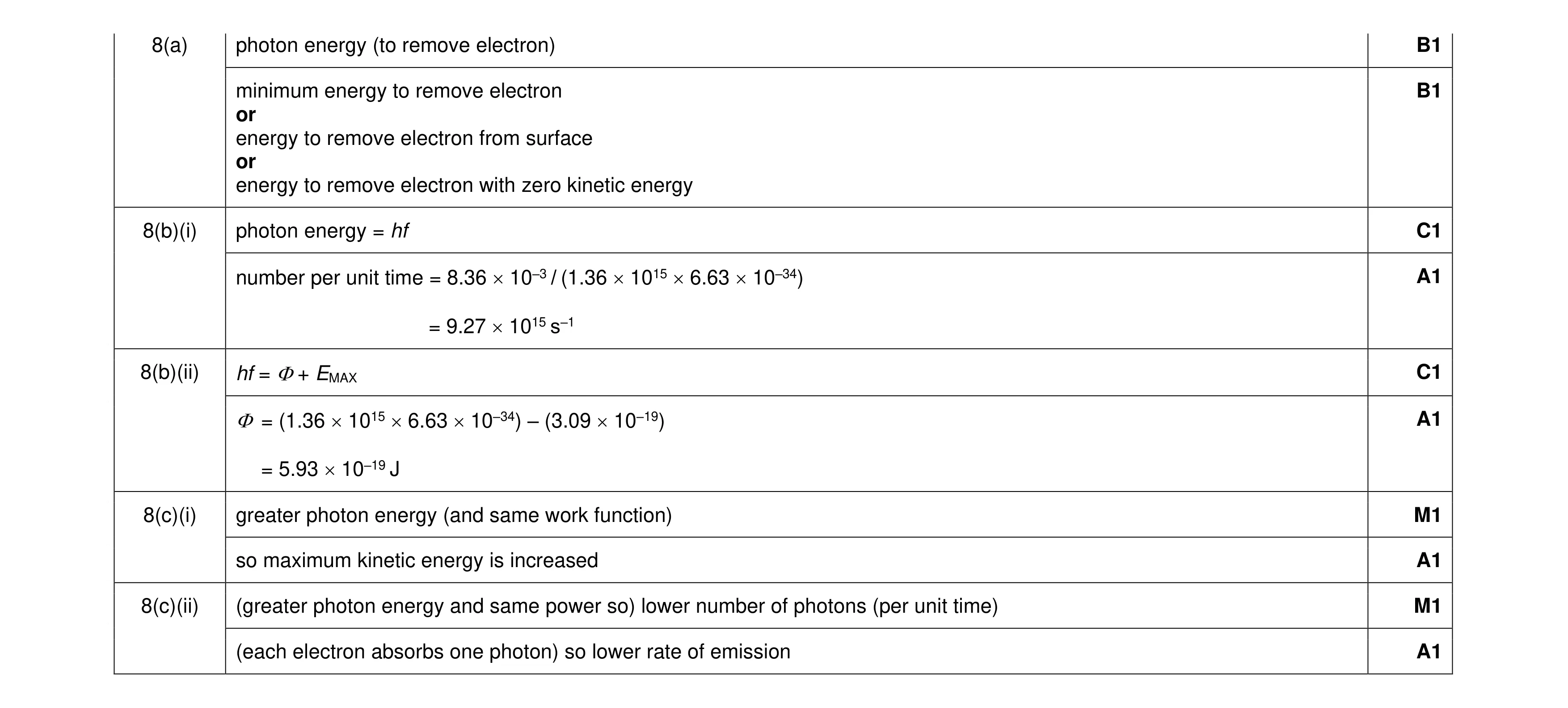 10
10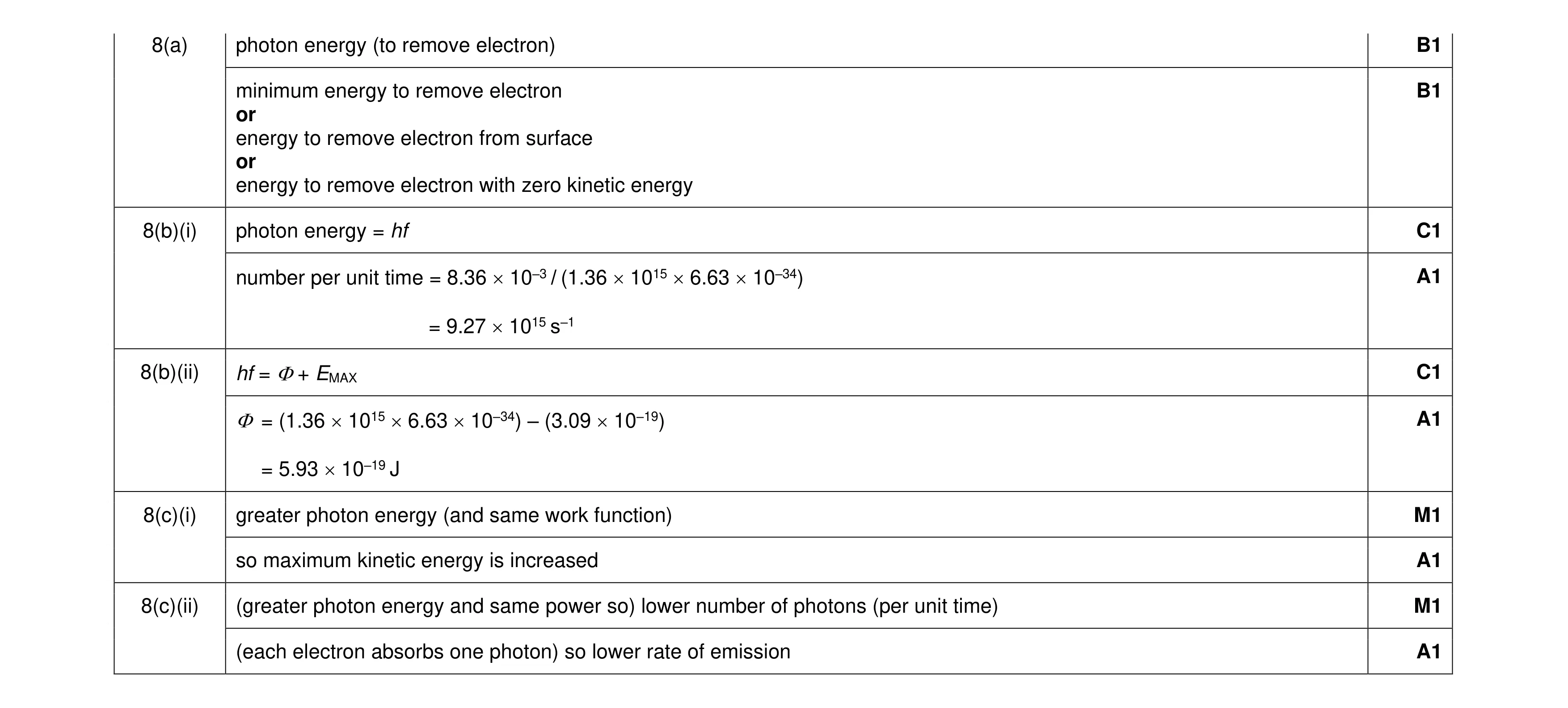 10
10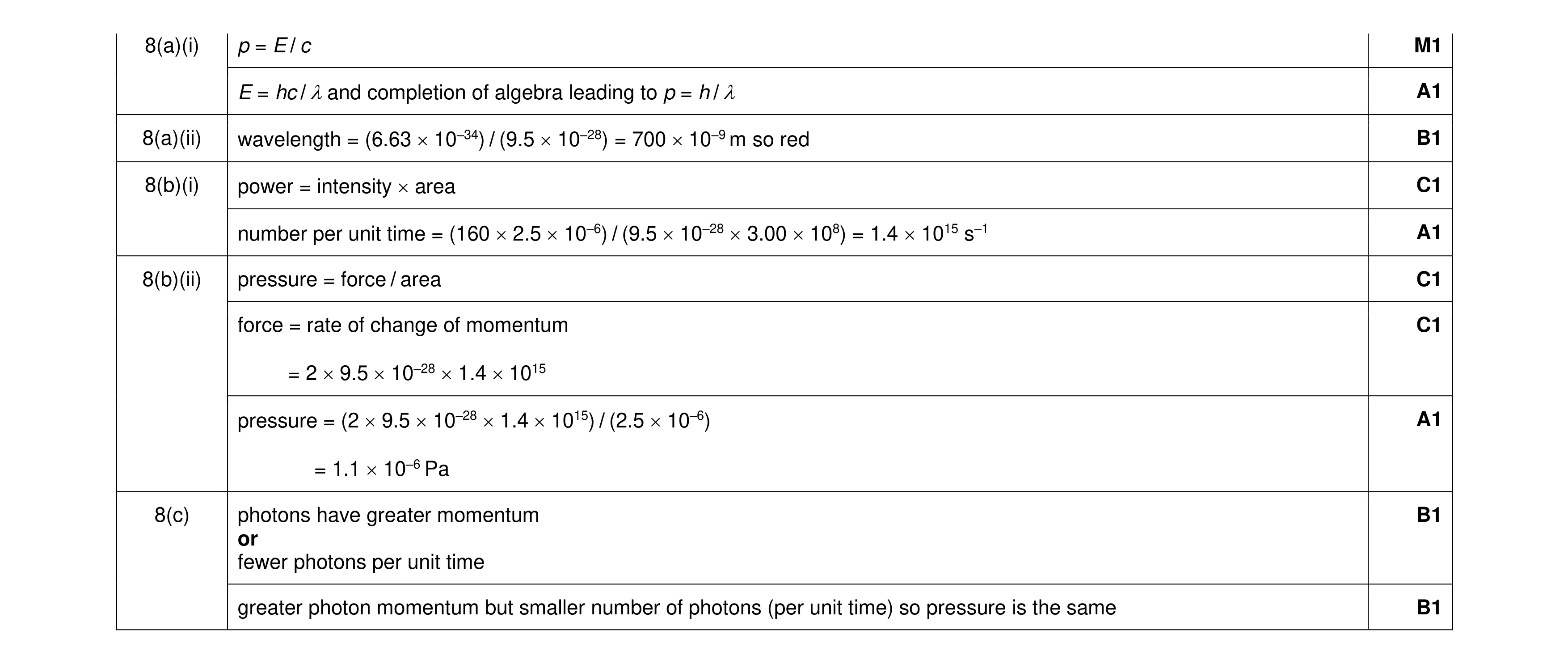 10
10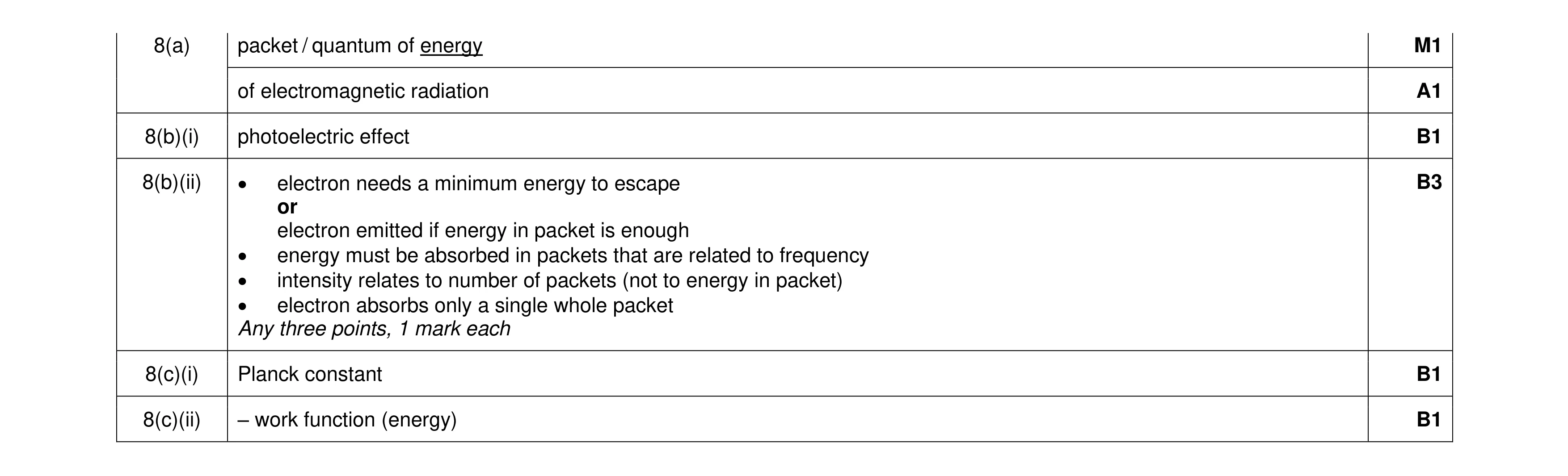 8
8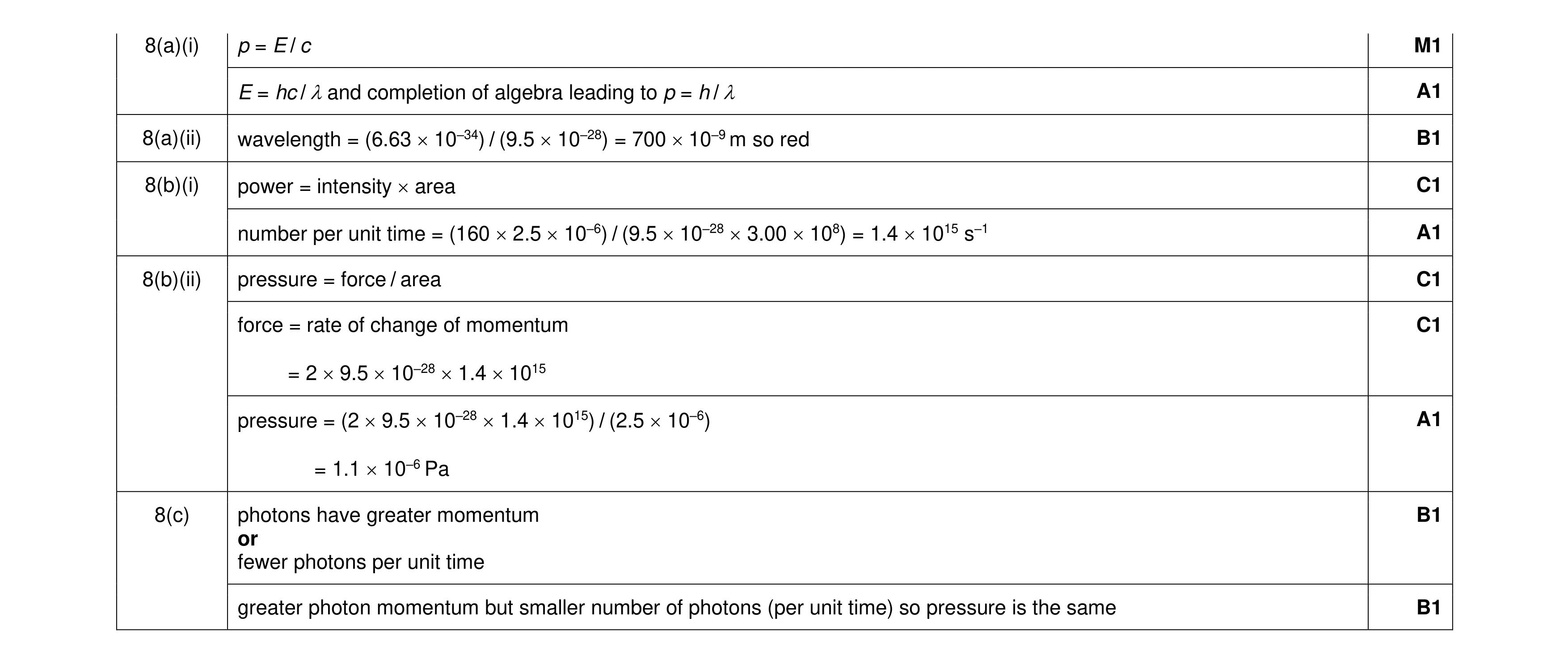 10
10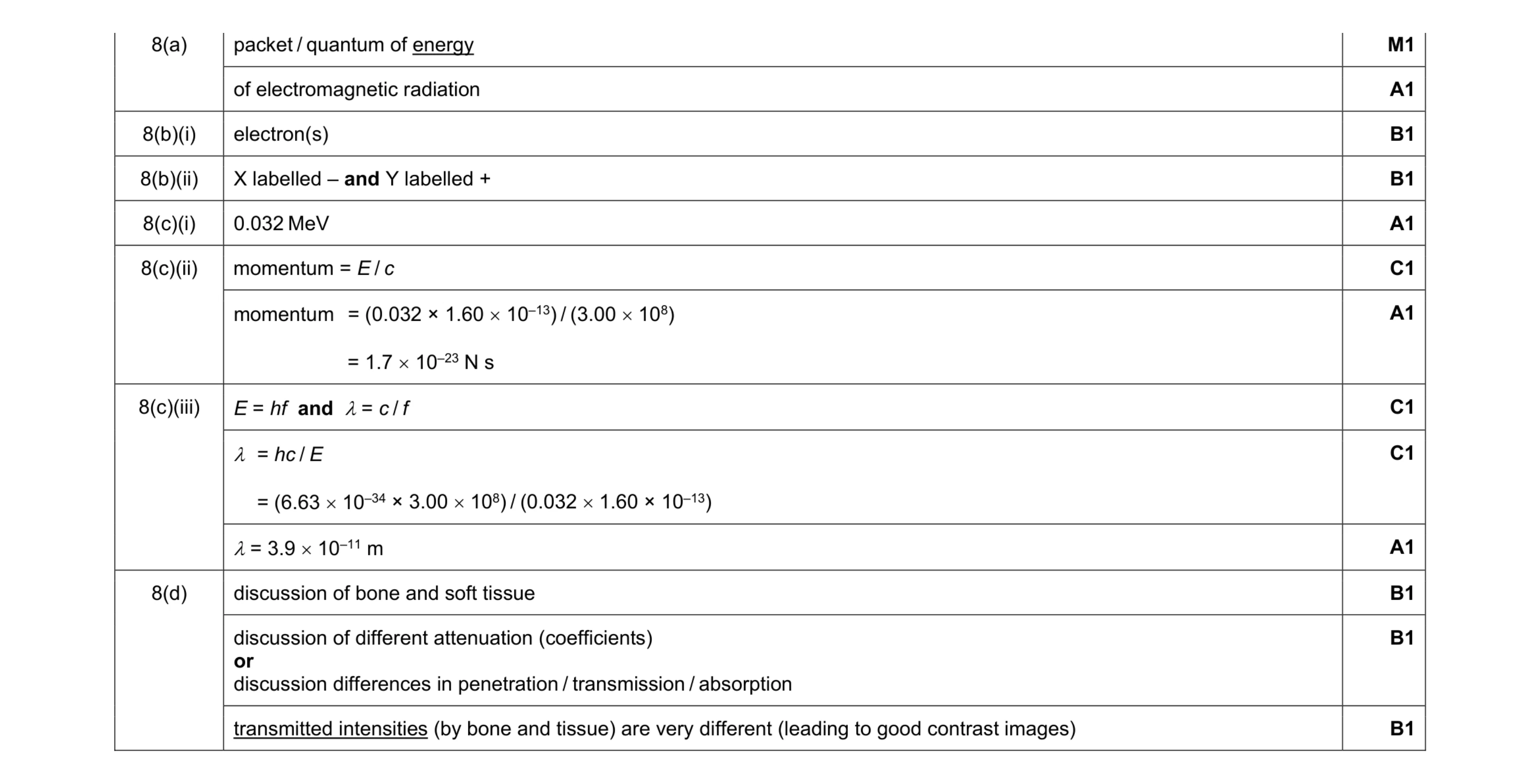 13
13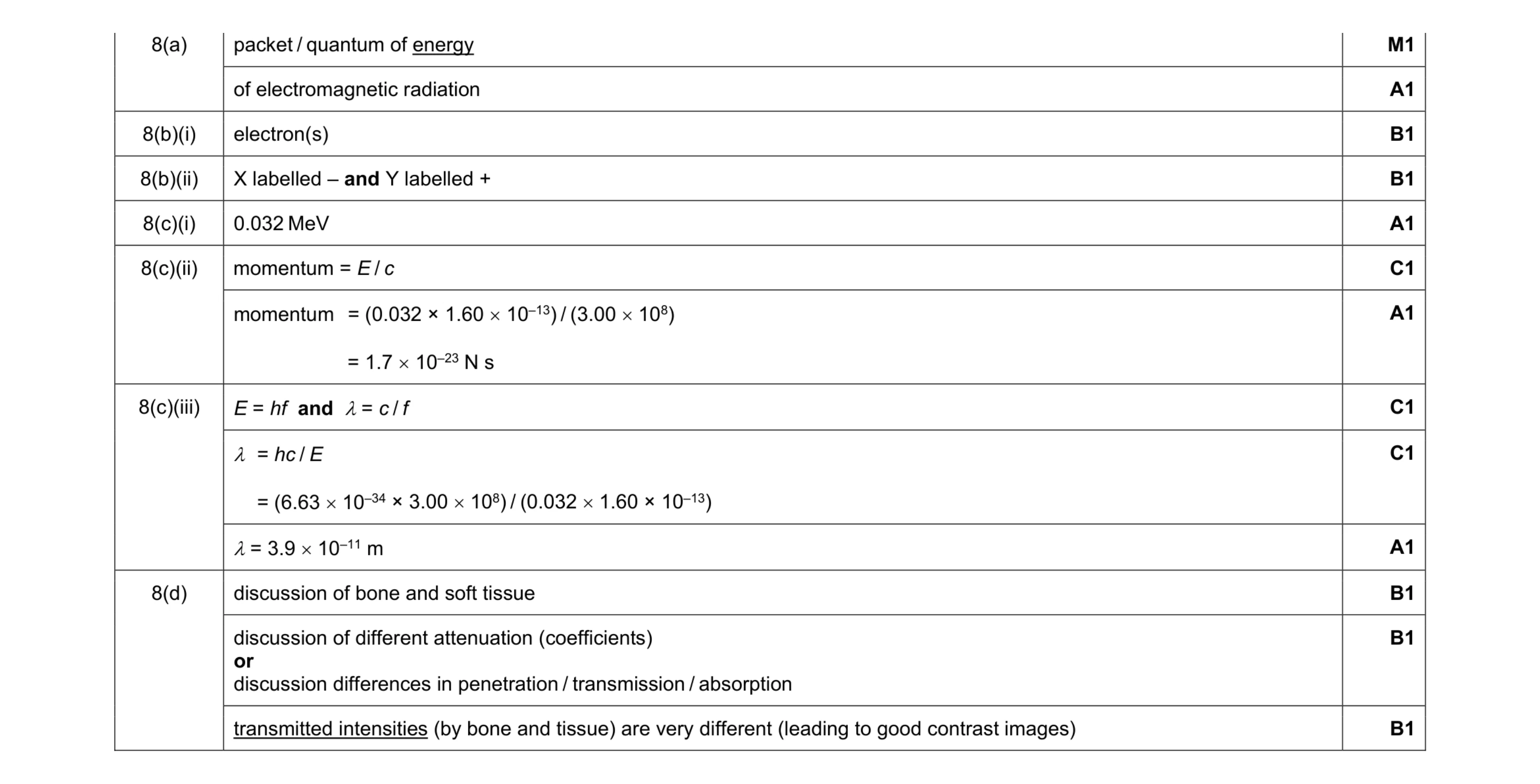 13
13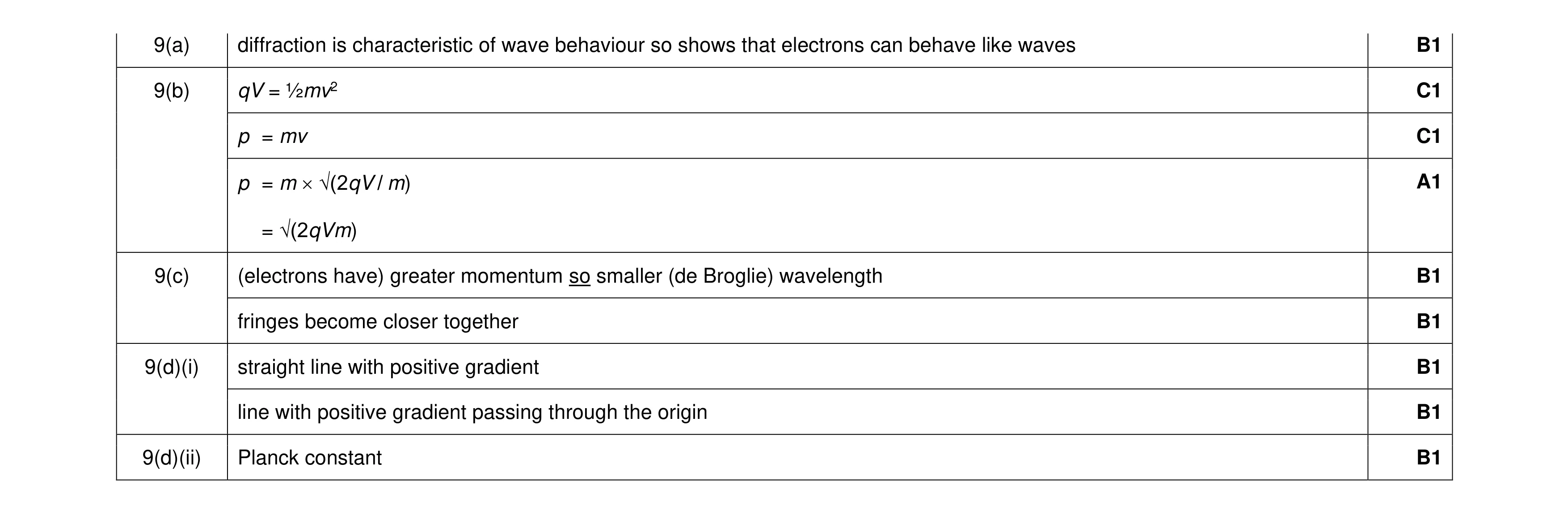 9
9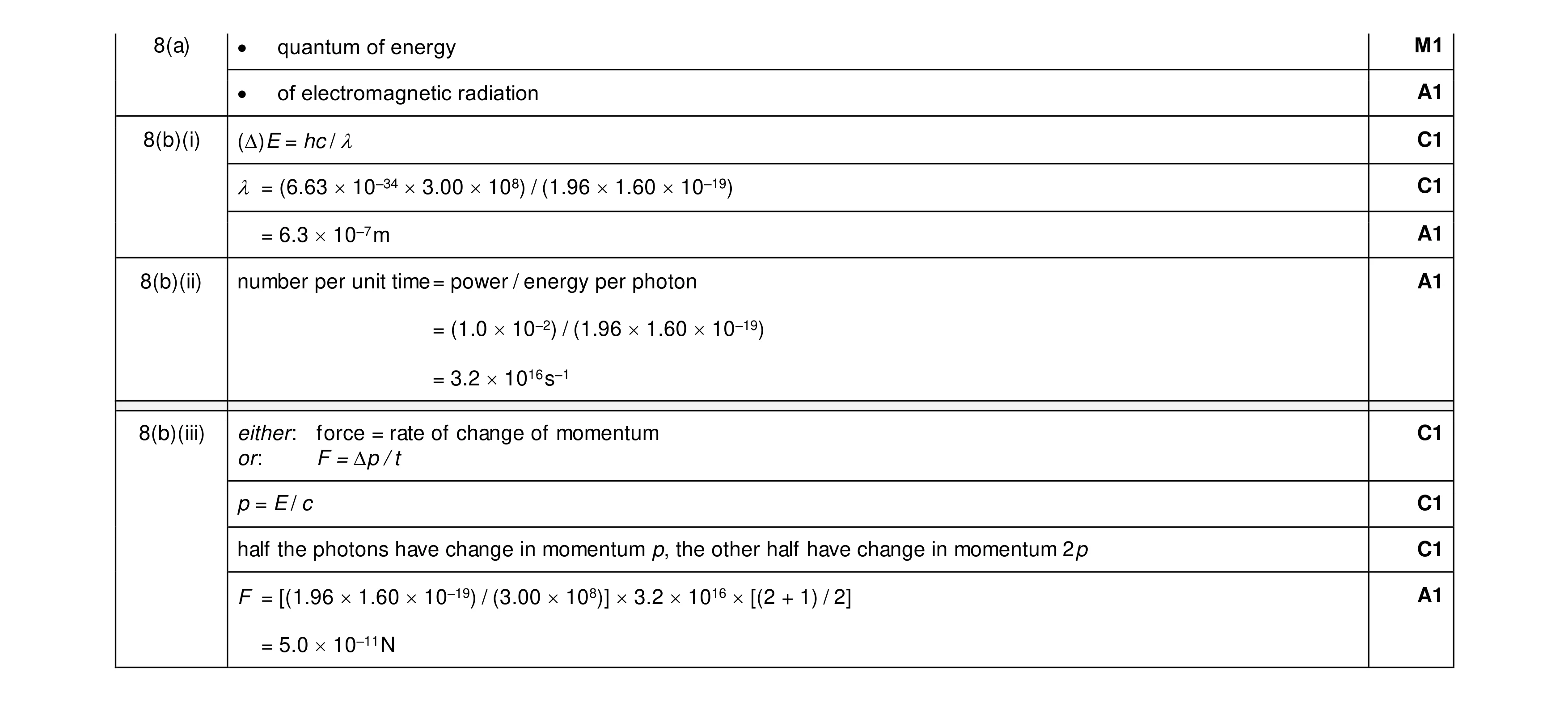 10
10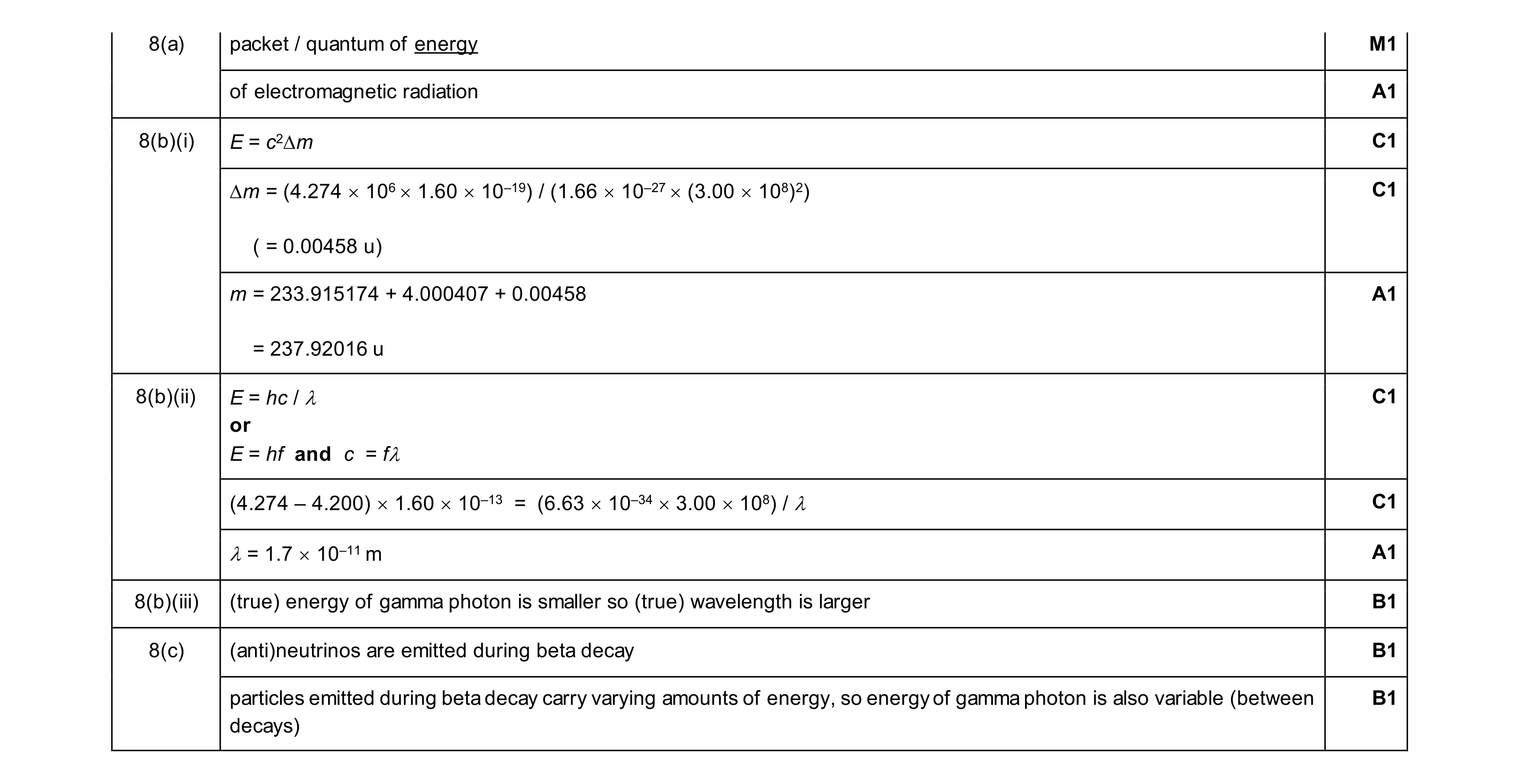 11
11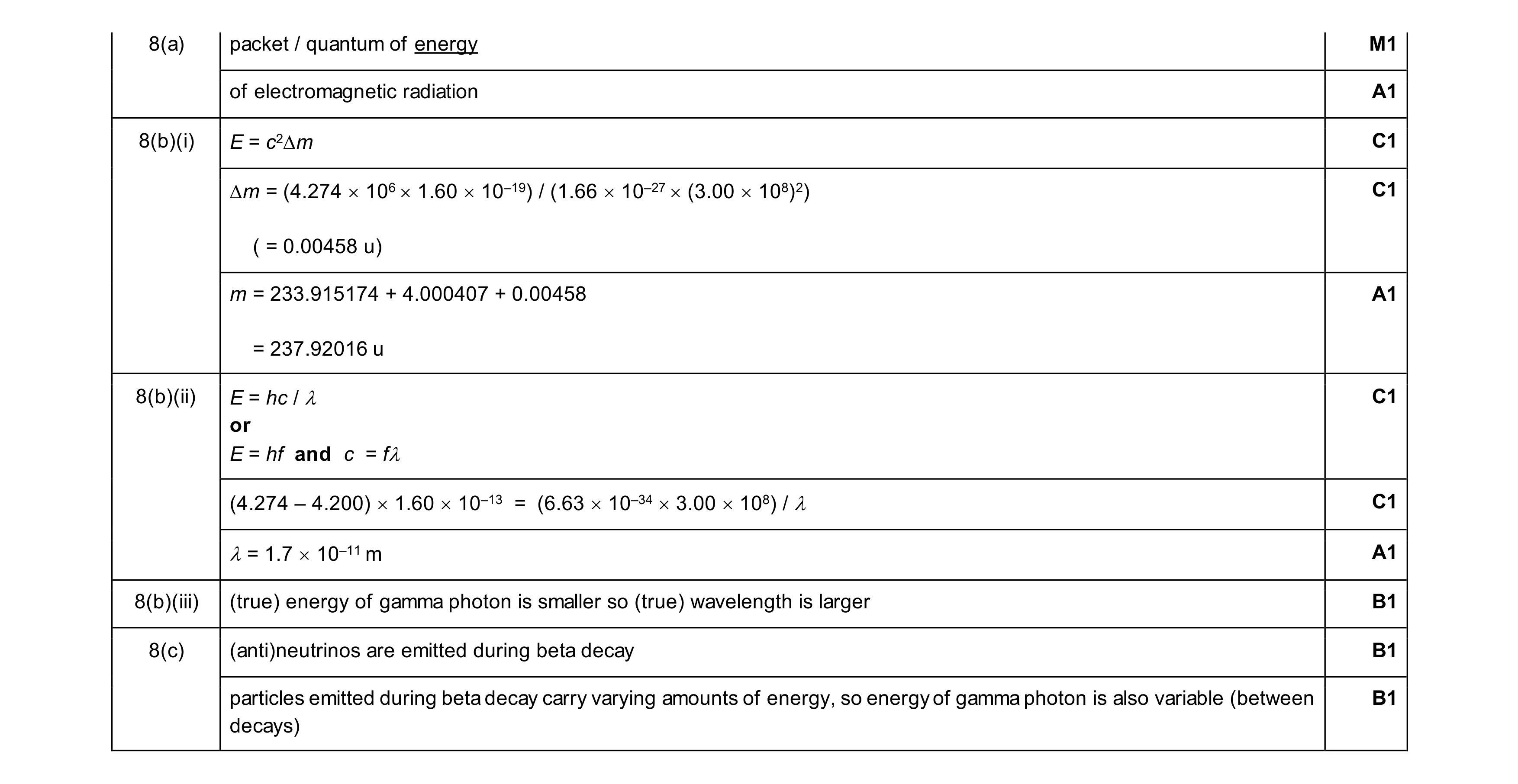 11
11