Questions as text
Q1 · The life cycle of a marine shrimp 9693/31 May/June 2017
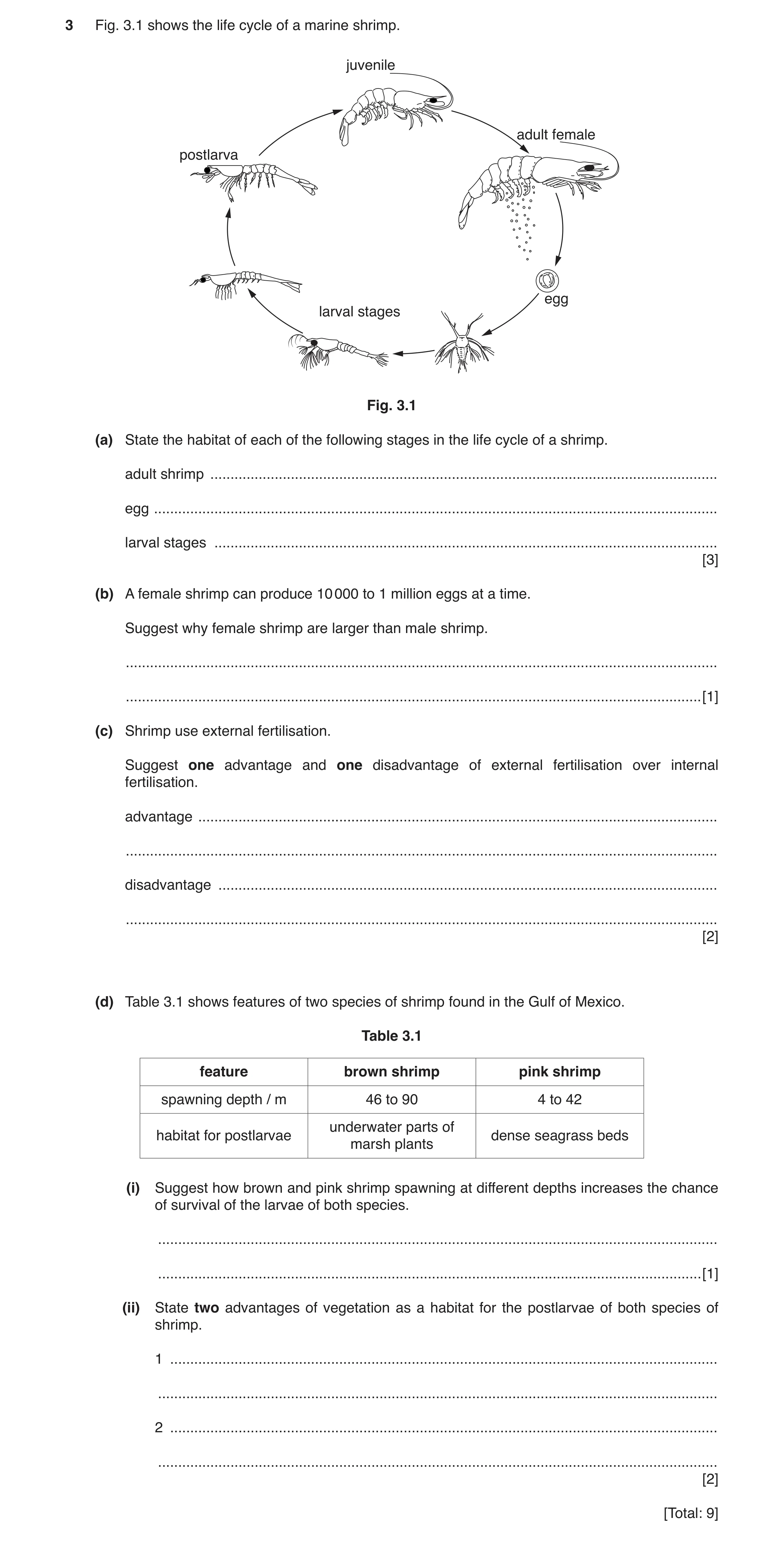
3 Fig. 3.1 shows the life cycle of a marine shrimp. juvenile adult female postlarva egg larval stages Fig. 3.1 (a) State the habitat of each of the following stages in the life cycle of a shrimp. adult shrimp … egg … larval stages … [3] (b) A female shrimp can produce 10 000 to 1 million eggs at a time. Suggest why female shrimp are larger than male shrimp. … … [1] (c) Shrimp use external fertilisation. Suggest one advantage and one disadvantage of external fertilisation over internal fertilisation. advantage … … disadvantage … … [2] (d) Table 3.1 shows features of two species of shrimp found in the Gulf of Mexico. Table 3.1 feature brown shrimp pink shrimp spawning depth / m 46 to 90 4 to 42 underwater parts of habitat for postlarvae dense seagrass beds marsh plants (i) Suggest how brown and pink shrimp spawning at different depths increases the chance of survival of the larvae of both species. … … [1] (ii) State two advantages of vegetation as a habitat for the postlarvae of both species of shrimp. 1 … … 2 … … [2] [Total: 9]
9 marks
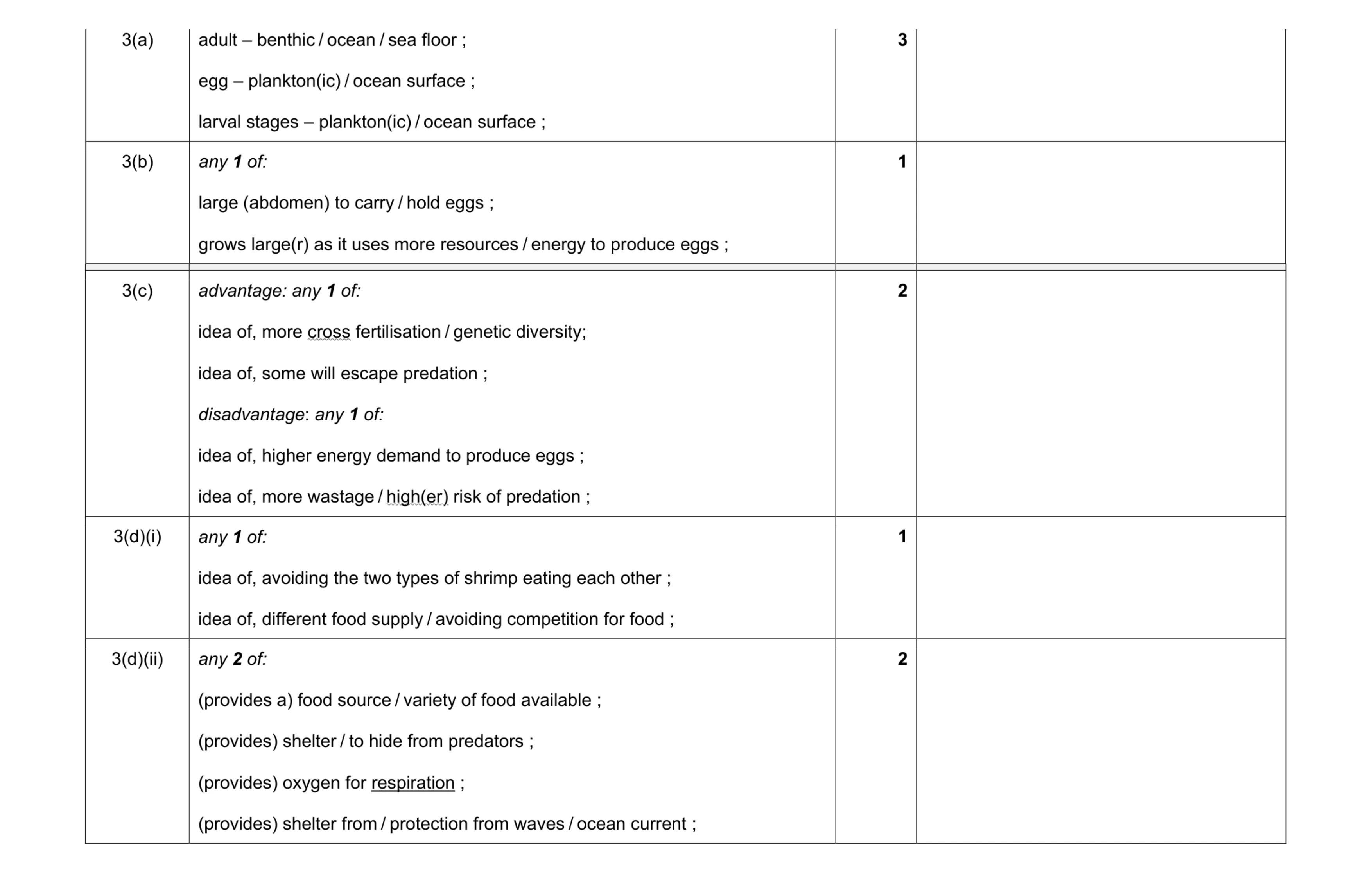
Mark scheme: 3(a) adult – benthic / ocean / sea floor ; egg – plankton(ic) / ocean surface ; larval stages – plankton(ic) / ocean surface ; 3 3(b) any 1 of: large (abdomen) to carry / hold eggs ; grows large(r) as it uses more resources / energy to produce eggs ; 1 Question Answer Marks Guidance 3(c) advantage: any 1 of: idea of, more cross fertilisation / genetic diversity; idea of, some will escape predation ; disadvantage: any 1 of: idea of, higher energy demand to produce eggs ; idea of, more wastage / high(er) risk of predation ; 2 3(d)(i) any 1 of: idea of, avoiding the two types of shrimp eating each other ; idea of, different food supply / avoiding competition for food ; 1 3(d)(ii) any 2 of: (provides a) food source / variety of food available ; (provides) shelter / to hide from predators ; (provides) oxygen for respiration ; (provides) shelter from / protection from waves / ocean current ; 2
This question in 9693/31 May/June 2017
Q2 · Read the information about the whale shark and the minke whale 9693/31 Oct/Nov 2017
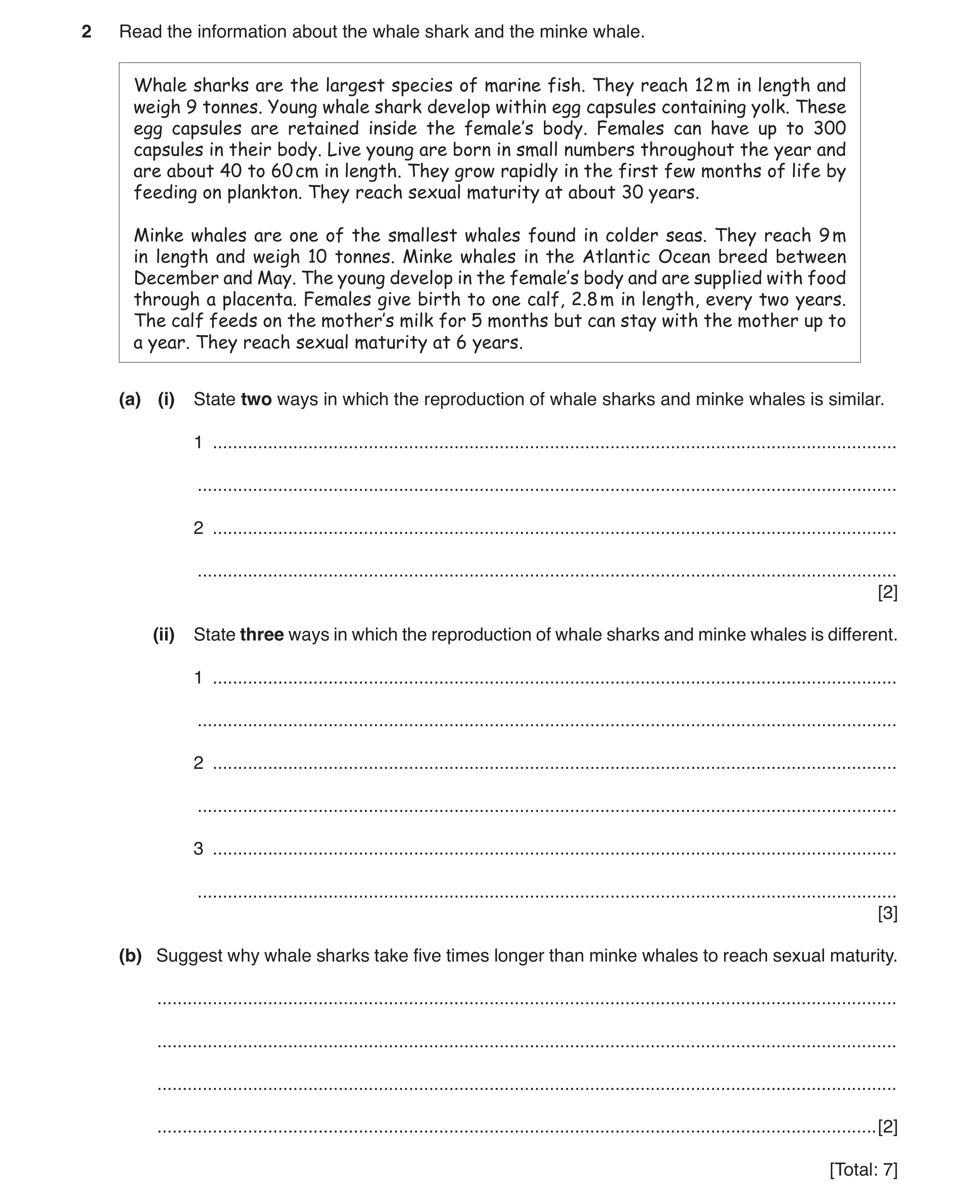
2 Read the information about the whale shark and the minke whale. Whale sharks are the largest species of marine fish. They reach 12 m in length and weigh 9 tonnes. Young whale shark develop within egg capsules containing yolk. These egg capsules are retained inside the female’s body. Females can have up to 300 capsules in their body. Live young are born in small numbers throughout the year and are about 40 to 60 cm in length. They grow rapidly in the first few months of life by feeding on plankton. They reach sexual maturity at about 30 years. Minke whales are one of the smallest whales found in colder seas. They reach 9 m in length and weigh 10 tonnes. Minke whales in the Atlantic Ocean breed between December and May. The young develop in the female’s body and are supplied with food through a placenta. Females give birth to one calf, 2.8 m in length, every two years. The calf feeds on the mother’s milk for 5 months but can stay with the mother up to a year. They reach sexual maturity at 6 years. (a) (i) State two ways in which the reproduction of whale sharks and minke whales is similar. 1 … … 2 … … [2] (ii) State three ways in which the reproduction of whale sharks and minke whales is different. 1 … … 2 … … 3 … … [3] (b) Suggest why whale sharks take five times longer than minke whales to reach sexual maturity. … … … … [2] [Total: 7]
7 marks
Mark scheme: 2(a)(i) internal fertilisation ; young, develop / provided with food source, inside mothers body OR give birth to live young ; 2 2(a)(ii) any 3 of: before birth whale shark fed by yolk + before birth minke whale fed by mother / placenta ; whale shark gives birth throughout the year + minke whale has breeding season; whale shark several young born at same time + minke whale only 1 at a time ; whale shark has a greater number of offspring than minke whale ; whale shark young feed themselves + minke whale fed on mothers milk ; whale shark no parental care + minke whale stay with mother up to a year ; 3 A whale shark breeds every year and minke whale every two years Question Answer Marks Guidance 2(b) any 2 of: whale shark, very much smaller / 5 to 7 times smaller, at birth than minke whale ; young whale shark feed on phytoplankton, young minke whales feed on milk ; milk is nutrient rich, so faster initial growth in minke whales ; (but) adults very similar size ; take much longer for whale shark to grow to adult size ; 2 A 5 times longer for whale shark to reach adult size.
This question in 9693/31 Oct/Nov 2017
Q3 · Some information about the life cycle of salmon 9693/31 Oct/Nov 2017
6 (a) Table 6.1 shows some information about the life cycle of salmon. Complete Table 6.1 to match the stage of the life cycle of salmon to the habitat where it is most likely to be found. Table 6.1 habitat stage in life cycle nest in stream bed freshwater streams smolt [3] (b) Fig. 6.1 shows part of the Bristol Bay area in the state of Alaska, United States of America, and the proposed location of a mine. If constructed, the mine would be one of the largest gold and copper mines in the world. N Key Lake direction of Iliamna Cook river flow Inlet proposed Dillingham mine site proposed new road Naknek Bristol Bay Fig. 6.1 The mining process will involve: • extracting water from local streams and rivers, • adding toxic chemicals to the rocks, • using explosives on the highly permeable rocks, • construction of large dams to contain the toxic liquid mine waste and over 10 billion tonnes of waste rock and silt. The proposed site is in an area of unspoilt wilderness and the streams close to the site are spawning grounds for 25% of the world’s sockeye salmon population. (i) Explain why the mine could pose a threat to salmon spawning grounds. … … … … … … [3] The human population is very small and lives in villages around Lake Iliamna and Cook Inlet. There are two small towns on the Bristol Bay coast. Scattered hunting and fishing lodges found throughout the area generate vital income from tourism. Bristol Bay is one of the largest sustainable commercial salmon fishing areas in the world. A meeting took place between the owners of the proposed mine and other stakeholders to discuss the need to maintain biodiversity with economic activities for the local people. (ii) State what is meant by the term stakeholder. … … [1] (iii) Identify two stakeholders, other than the owners of the proposed mine, one who would support the mine project and another who would oppose the mine project. For each stakeholder, give a reason for your answer. support … reason … … oppose … reason … … [4] [Total: 11]
11 marks
Mark scheme: 6(a) environment stage in life cycle nest in stream bed egg / alevin ; freshwater streams parr / fry ; estuaries ; smolt 3 Question Answer Marks Guidance 6(b)(i) any 3 of: less water in rivers and streams, so salmon can’t reach spawning grounds ; rocks are porous, so toxic chemicals could pass into the water and poison the eggs and sperm / alevin / parr / fry ; vibrations / noise, in water from, blasting / explosives, keep fish away from spawning areas ; damage to dams could release toxic chemicals into the water to poison, eggs and sperm / alevin / parr / fry ; damage to dams could release silt which makes water too cloudy and unsuitable for spawning OR ref. to silt damaging gills ; dams could block migration route to spawning grounds ; 3 A vibrations may damage nests / river bed 6(b)(ii) idea of, a person who has an interest (commercial or ecological) in a particular area ; 1 Question Answer Marks Guidance 6(b)(iii) support villager from Cook Inlet / villager from Iliamna lake ; idea of, new employment opportunities (from mine / new port) / better transport links / more money in local economy ; oppose any 1 × 2 of: hunting / fishing lodge owner ; idea of, ensuring local wildlife is preserved to maintain income from tourism ; OR villager from Iliamna lake ; idea of, protecting fish stocks in the lake to sustain local population / income from tourism ; OR commercial salmon fisherman ; idea of, protecting employment in salmon fishing industry / ensuring salmon stocks are sustainable ; OR environmental groups / named environmental groups ; idea of, protecting specific species / representing the interests of their group ; 4 Note: The stakeholder should be a person or representative of a group of people
This question in 9693/31 Oct/Nov 2017
Q4 · The habitat of each stage in the life cycle of tuna and grouper 9693/30 May/June 2018
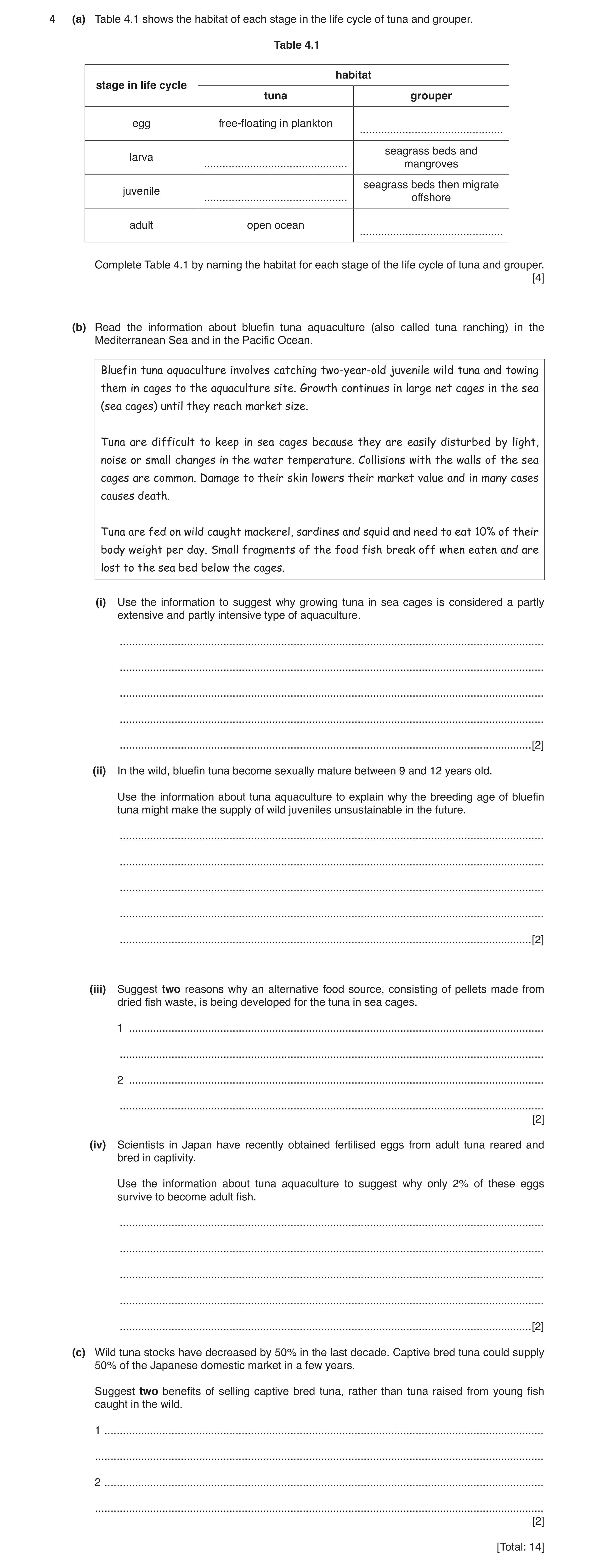
4 (a) Table 4.1 shows the habitat of each stage in the life cycle of tuna and grouper. Table 4.1 habitat stage in life cycle tuna grouper egg free-floating in plankton … seagrass beds and larva … mangroves seagrass beds then migrate juvenile … offshore adult open ocean … Complete Table 4.1 by naming the habitat for each stage of the life cycle of tuna and grouper. [4] (b) Read the information about bluefin tuna aquaculture (also called tuna ranching) in the Mediterranean Sea and in the Pacific Ocean. Bluefin tuna aquaculture involves catching two-year-old juvenile wild tuna and towing them in cages to the aquaculture site. Growth continues in large net cages in the sea (sea cages) until they reach market size. Tuna are difficult to keep in sea cages because they are easily disturbed by light, noise or small changes in the water temperature. Collisions with the walls of the sea cages are common. Damage to their skin lowers their market value and in many cases causes death. Tuna are fed on wild caught mackerel, sardines and squid and need to eat 10% of their body weight per day. Small fragments of the food fish break off when eaten and are lost to the sea bed below the cages. (i) Use the information to suggest why growing tuna in sea cages is considered a partly extensive and partly intensive type of aquaculture. … … … … … [2] (ii) In the wild, bluefin tuna become sexually mature between 9 and 12 years old. Use the information about tuna aquaculture to explain why the breeding age of bluefin tuna might make the supply of wild juveniles unsustainable in the future. … … … … … [2] (iii) Suggest two reasons why an alternative food source, consisting of pellets made from dried fish waste, is being developed for the tuna in sea cages. 1 … … 2 … … [2] (iv) Scientists in Japan have recently obtained fertilised eggs from adult tuna reared and bred in captivity. Use the information about tuna aquaculture to suggest why only 2% of these eggs survive to become adult fish. … … … … … [2] (c) Wild tuna stocks have decreased by 50% in the last decade. Captive bred tuna could supply 50% of the Japanese domestic market in a few years. Suggest two benefits of selling captive bred tuna, rather than tuna raised from young fish caught in the wild. 1 … … 2 … … [2] [Total: 14]
14 marks
This question in 9693/30 May/June 2018
Q5 · Some of the stages in the life cycle of oysters 9693/30 Oct/Nov 2018
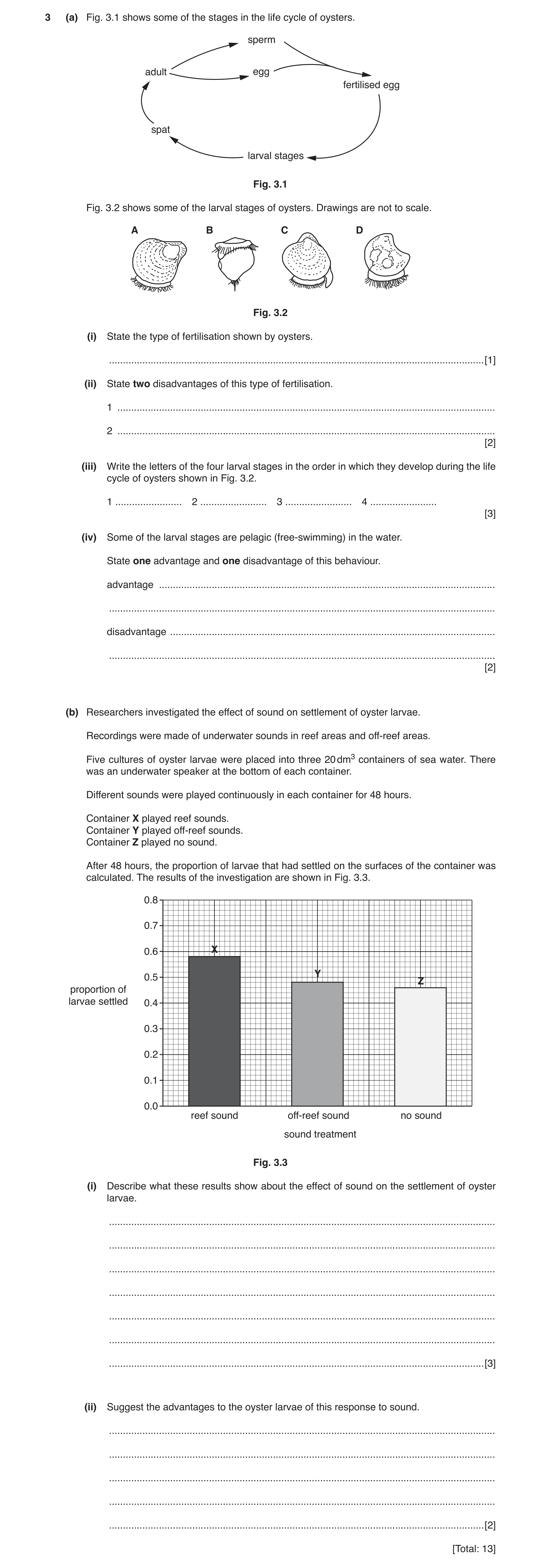
3 (a) Fig. 3.1 shows some of the stages in the life cycle of oysters. sperm adult egg fertilised egg spat larval stages Fig. 3.1 Fig. 3.2 shows some of the larval stages of oysters. Drawings are not to scale. A B C D Fig. 3.2 (i) State the type of fertilisation shown by oysters. … [1] (ii) State two disadvantages of this type of fertilisation. 1 … 2 … [2] (iii) Write the letters of the four larval stages in the order in which they develop during the life cycle of oysters shown in Fig. 3.2. 1 … 2 … 3 … 4 … [3] (iv) Some of the larval stages are pelagic (free‑swimming) in the water. State one advantage and one disadvantage of this behaviour. advantage … … disadvantage … … [2] (b) Researchers investigated the effect of sound on settlement of oyster larvae. Recordings were made of underwater sounds in reef areas and off‑reef areas. Five cultures of oyster larvae were placed into three 20 dm3 containers of sea water. There was an underwater speaker at the bottom of each container. Different sounds were played continuously in each container for 48 hours. Container X played reef sounds. Container Y played off‑reef sounds. Container Z played no sound. After 48 hours, the proportion of larvae that had settled on the surfaces of the container was calculated. The results of the investigation are shown in Fig. 3.3. 0.8 0.7 0.6 X Y 0.5 Z proportion of larvae settled 0.4 0.3 0.2 0.1 0.0 reef sound off-reef sound no sound sound treatment Fig. 3.3 (i) Describe what these results show about the effect of sound on the settlement of oyster larvae. … … … … … … … [3] (ii) Suggest the advantages to the oyster larvae of this response to sound. … … … … … [2] [Total: 13]
13 marks
This question in 9693/30 Oct/Nov 2018
Q6 · Define the term gene 9693/30 Oct/Nov 2018
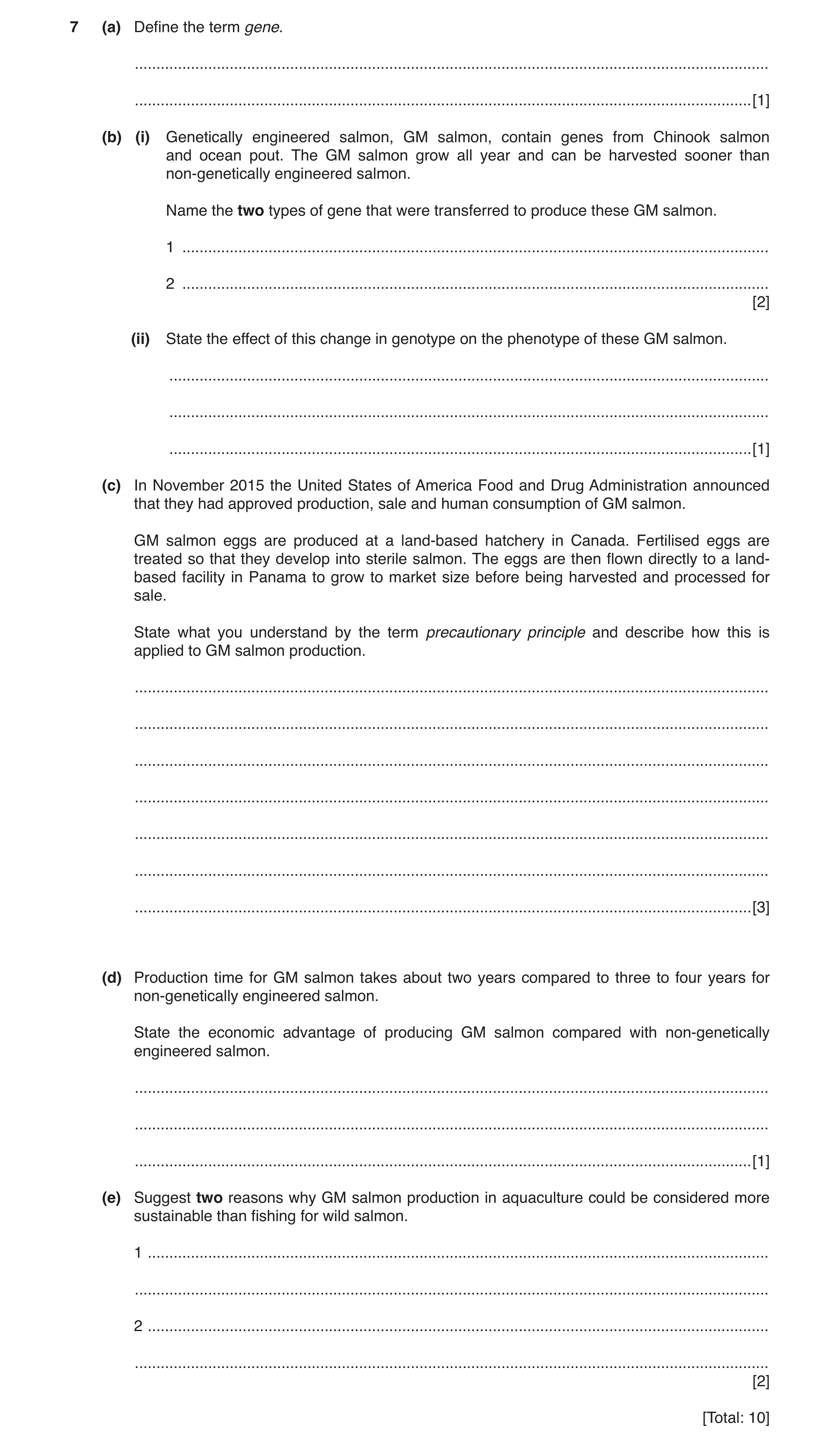
7 (a) Define the term gene. … … [1] (b) (i) Genetically engineered salmon, GM salmon, contain genes from Chinook salmon and ocean pout. The GM salmon grow all year and can be harvested sooner than non‑genetically engineered salmon. Name the two types of gene that were transferred to produce these GM salmon. 1 … 2 … [2] (ii) State the effect of this change in genotype on the phenotype of these GM salmon. … … … [1] (c) In November 2015 the United States of America Food and Drug Administration announced that they had approved production, sale and human consumption of GM salmon. GM salmon eggs are produced at a land‑based hatchery in Canada. Fertilised eggs are treated so that they develop into sterile salmon. The eggs are then flown directly to a land‑ based facility in Panama to grow to market size before being harvested and processed for sale. State what you understand by the term precautionary principle and describe how this is applied to GM salmon production. … … … … … … … [3] (d) Production time for GM salmon takes about two years compared to three to four years for non‑genetically engineered salmon. State the economic advantage of producing GM salmon compared with non‑genetically engineered salmon. … … … [1] (e) Suggest two reasons why GM salmon production in aquaculture could be considered more sustainable than fishing for wild salmon. 1 … … 2 … … [2] [Total: 10]
10 marks
This question in 9693/30 Oct/Nov 2018
Q7 · Adult groupers are solitary fish, but during the breeding season they swim many… 9693/31 May/June 2019
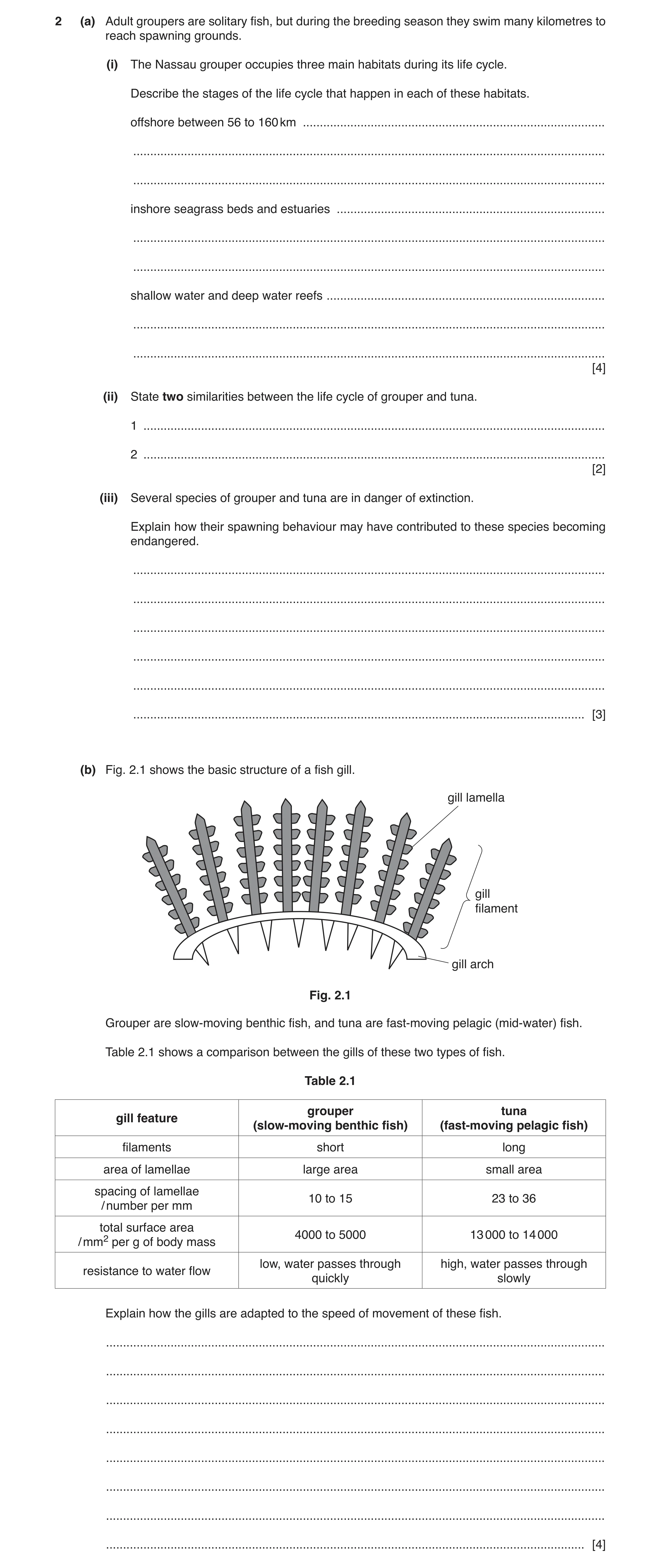
2 (a) Adult groupers are solitary fish, but during the breeding season they swim many kilometres to reach spawning grounds. (i) The Nassau grouper occupies three main habitats during its life cycle. Describe the stages of the life cycle that happen in each of these habitats. offshore between 56 to 160 km … … … inshore seagrass beds and estuaries … … … shallow water and deep water reefs … … … [4] (ii) State two similarities between the life cycle of grouper and tuna. 1 … 2 … [2] (iii) Several species of grouper and tuna are in danger of extinction. Explain how their spawning behaviour may have contributed to these species becoming endangered. … … … … … … [3] (b) Fig. 2.1 shows the basic structure of a fish gill. gill lamella gill filament gill arch Fig. 2.1 Grouper are slow-moving benthic fish, and tuna are fast-moving pelagic (mid-water) fish. Table 2.1 shows a comparison between the gills of these two types of fish. Table 2.1 grouper tuna gill feature (slow-moving benthic fish) (fast-moving pelagic fish) filaments short long area of lamellae large area small area spacing of lamellae 10 to 15 23 to 36 / number per mm total surface area 4000 to 5000 13 000 to 14 000/ mm2 per g of body mass low, water passes through high, water passes through resistance to water flow quickly slowly Explain how the gills are adapted to the speed of movement of these fish. … … … … … … … … [4]
13 marks
Mark scheme: 2(a)(i) minimum of 1 and max 2 for each habitat offshore : ref. to collecting in shoals / groups (for spawning offshore) ; eggs fertilised, externally / in the water / broadcast spawning or description of ; (develop into free-floating) larvae in, surface of ocean / plankton ; inshore: (where) juveniles, feed / grow ; idea of: to avoid competition with adults ; reefs: where they develop into adults / where fish reach maturity ; develop first as female and then become male ; 4 2(a)(ii) any 2 of: idea of: spawning grounds / spawn in open ocean ; planktonic / open ocean, larvae ; external fertilisation / broadcast spawning ; AVP ; 2 e.g. no fresh water stage / no parental care / both are r-strategists / larvae undergo metamorphosis Question Answer Marks Guidance 2(a)(iii) any 3 of: idea of: all the eggs / fish are in one place ; spawning grounds / migration routes, known to fishermen / predators ; catch large numbers of (mature) fish at the same time ; too few left to maintain population / population unsustainable ; adults take years to become sexually mature ; idea of: lots of, egg / larvae wastage ; 3 2(b) any 4 of: 1 grouper / benthic fish move more slowly / less active / use less energy (than tuna / pelagic fish) (so) less oxygen demand ; 2 correct linkage of surface area (of gills) to, movement of fish / oxygen demands / diffusion rates / gas exchange ; 3 larger area of lamellae obtain more oxygen in grouper / benthic fish (from faster water flow) ; 4 longer filaments obtain more oxygen in tuna / pelagic fish (from slower moving water) ; 5 close packing of lamellae obtain more oxygen in tuna / pelagic fish (from slower moving water) ; 6 slower moving water / greater resistance to flow, in tuna / pelagic fish, allows more time to obtain oxygen / greater diffusion / maintains diffusion gradient / greater gas exchange ; 4 I ref. to ram and pumped ventilation and respiration
This question in 9693/31 May/June 2019
Q8 · Different species of marine organism reproduce using internal or external fertilisation 9693/30 May/June 2020
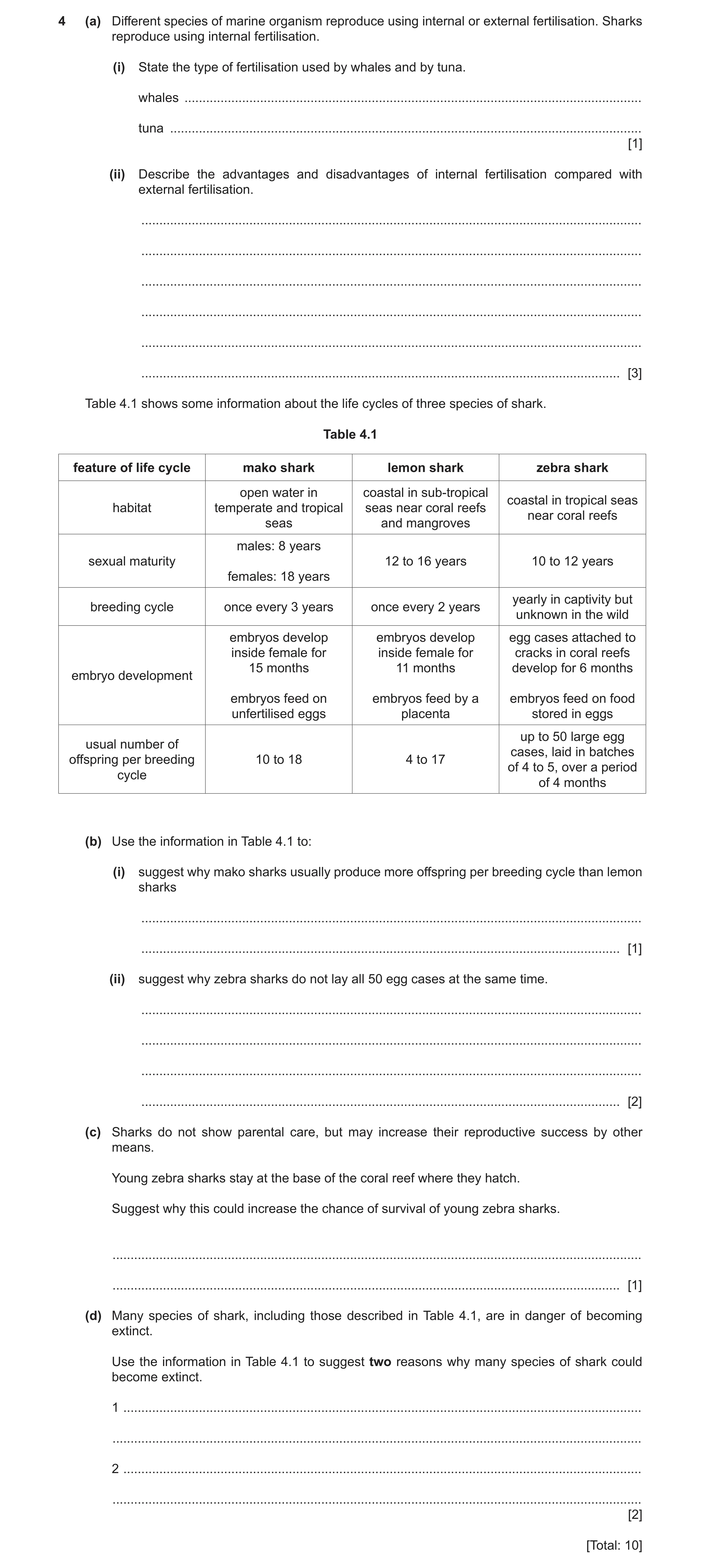
4 (a) Different species of marine organism reproduce using internal or external fertilisation. Sharks reproduce using internal fertilisation. (i) State the type of fertilisation used by whales and by tuna. whales … tuna … [1] (ii) Describe the advantages and disadvantages of internal fertilisation compared with external fertilisation. … … … … … … [3] Table 4.1 shows some information about the life cycles of three species of shark. Table 4.1 feature of life cycle mako shark lemon shark zebra shark open water in coastal in sub-tropical coastal in tropical seas habitat temperate and tropical seas near coral reefs near coral reefs seas and mangroves males: 8 years sexual maturity 12 to 16 years 10 to 12 years females: 18 years yearly in captivity but breeding cycle once every 3 years once every 2 years unknown in the wild embryos develop embryos develop egg cases attached to inside female for inside female for cracks in coral reefs 15 months 11 months develop for 6 months embryo development embryos feed on embryos feed by a embryos feed on food unfertilised eggs placenta stored in eggs up to 50 large egg usual number of cases, laid in batches offspring per breeding 10 to 18 4 to 17 of 4 to 5, over a period cycle of 4 months (b) Use the information in Table 4.1 to: (i) suggest why mako sharks usually produce more offspring per breeding cycle than lemon sharks … … [1] (ii) suggest why zebra sharks do not lay all 50 egg cases at the same time. … … … … [2] (c) Sharks do not show parental care, but may increase their reproductive success by other means. Young zebra sharks stay at the base of the coral reef where they hatch. Suggest why this could increase the chance of survival of young zebra sharks. … … [1] (d) Many species of shark, including those described in Table 4.1, are in danger of becoming extinct. Use the information in Table 4.1 to suggest two reasons why many species of shark could become extinct. 1 … … 2 … … [2] [Total: 10]
10 marks
This question in 9693/30 May/June 2020
Q9 · The albacore tuna, Thunnus alalunga, is an important commercial species in the Indian… 9693/30 Oct/Nov 2020
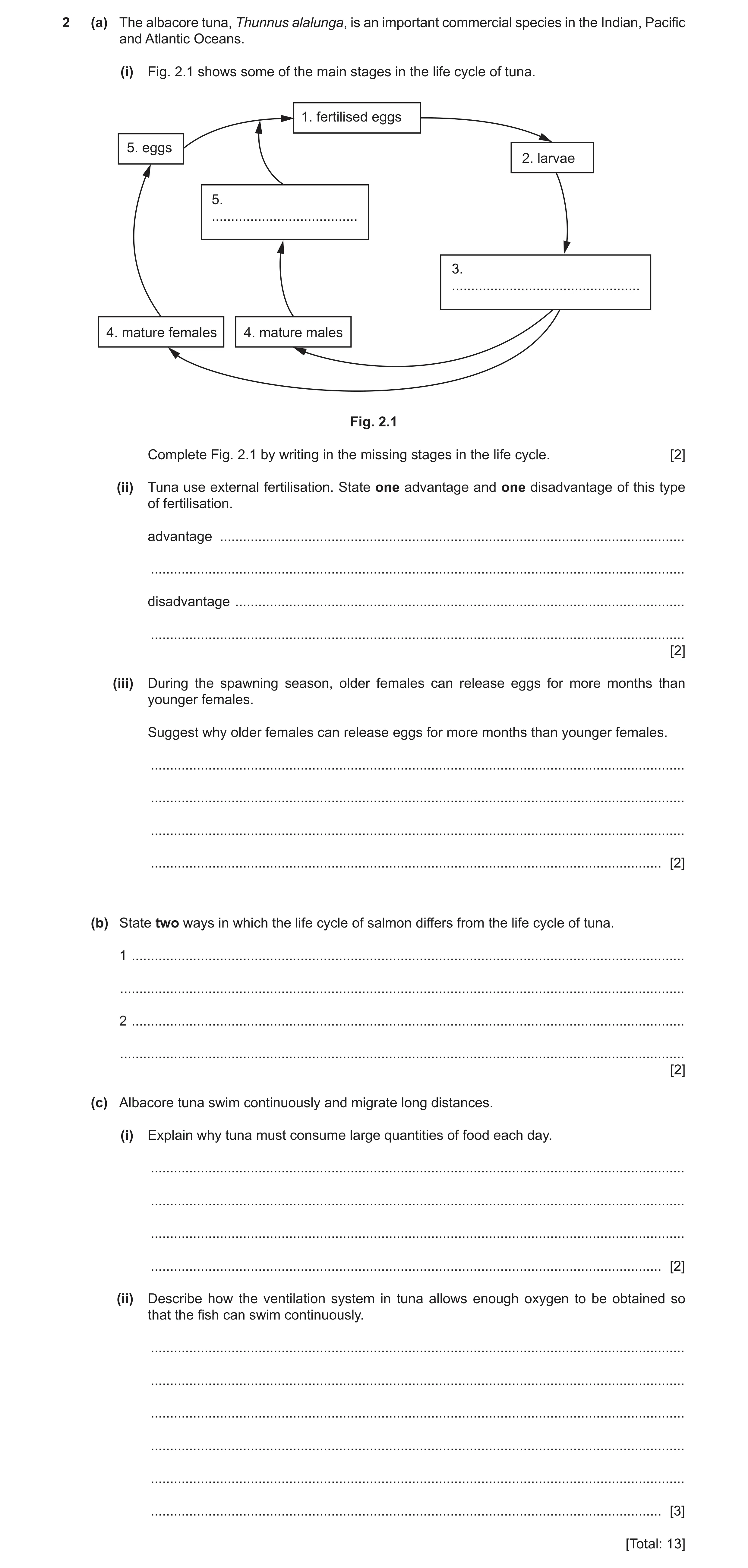
2 (a) The albacore tuna, Thunnus alalunga, is an important commercial species in the Indian, Pacific and Atlantic Oceans. (i) Fig. 2.1 shows some of the main stages in the life cycle of tuna. 1. fertilised eggs 5. eggs 2. larvae 5. … 3. … 4. mature females 4. mature males Fig. 2.1 Complete Fig. 2.1 by writing in the missing stages in the life cycle. [2] (ii) Tuna use external fertilisation. State one advantage and one disadvantage of this type of fertilisation. advantage … … disadvantage … … [2] (iii) During the spawning season, older females can release eggs for more months than younger females. Suggest why older females can release eggs for more months than younger females. … … … … [2] (b) State two ways in which the life cycle of salmon differs from the life cycle of tuna. 1 … … 2 … … [2] (c) Albacore tuna swim continuously and migrate long distances. (i) Explain why tuna must consume large quantities of food each day. … … … … [2] (ii) Describe how the ventilation system in tuna allows enough oxygen to be obtained so that the fish can swim continuously. … … … … … … [3] [Total: 13]
13 marks
This question in 9693/30 Oct/Nov 2020
Q10 · The stages in the life cycle of Pacific salmon 9693/30 May/June 2021
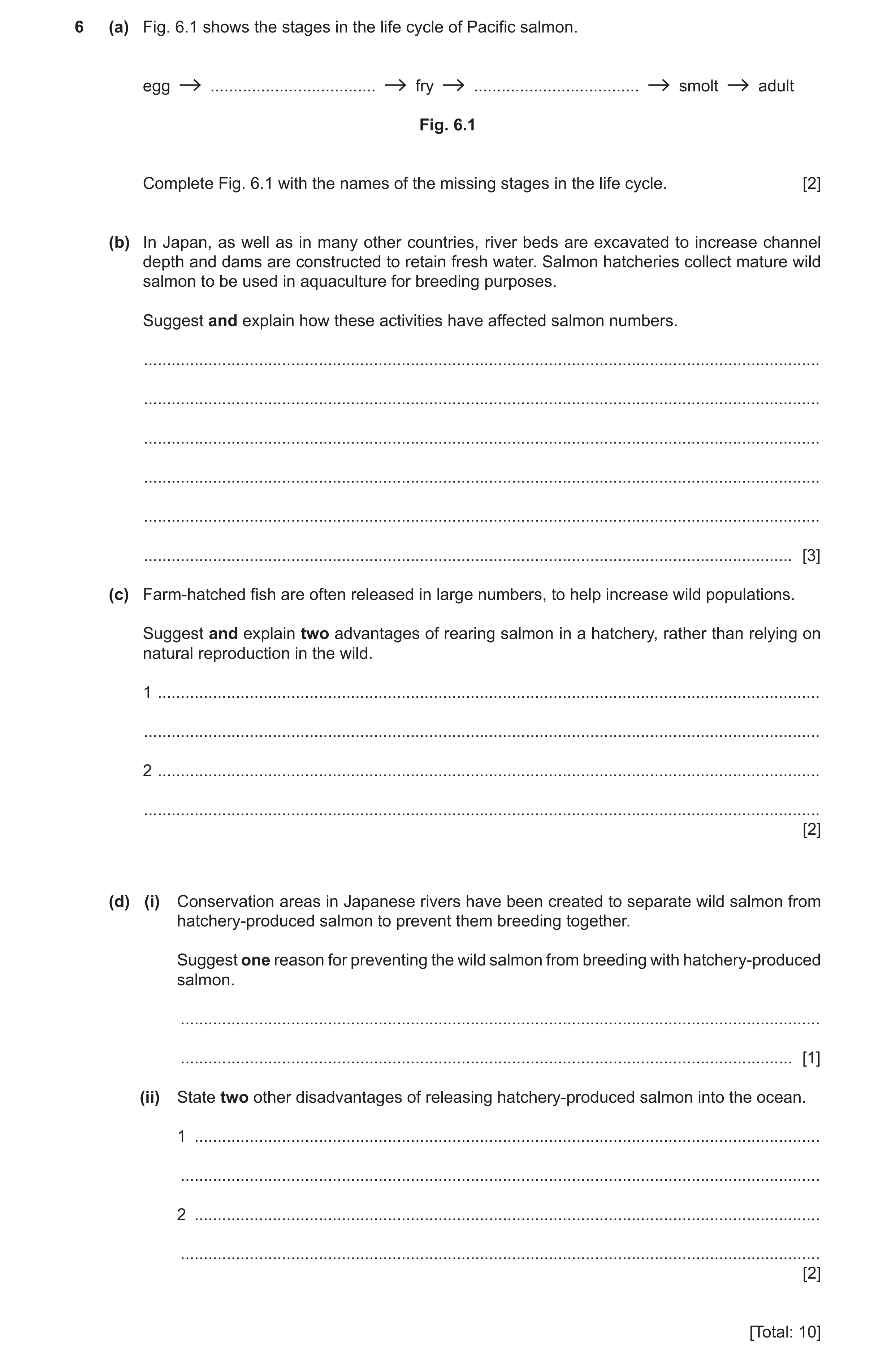
6 (a) Fig. 6.1 shows the stages in the life cycle of Pacific salmon. egg … fry … smolt adult Fig. 6.1 Complete Fig. 6.1 with the names of the missing stages in the life cycle. [2] (b) In Japan, as well as in many other countries, river beds are excavated to increase channel depth and dams are constructed to retain fresh water. Salmon hatcheries collect mature wild salmon to be used in aquaculture for breeding purposes. Suggest and explain how these activities have affected salmon numbers. … … … … … … [3] (c) Farm-hatched fish are often released in large numbers, to help increase wild populations. Suggest and explain two advantages of rearing salmon in a hatchery, rather than relying on natural reproduction in the wild. 1 … … 2 … … [2] (d) (i) Conservation areas in Japanese rivers have been created to separate wild salmon from hatchery-produced salmon to prevent them breeding together. Suggest one reason for preventing the wild salmon from breeding with hatchery-produced salmon. … … [1] (ii) State two other disadvantages of releasing hatchery-produced salmon into the ocean. 1 … … 2 … … [2] [Total: 10]
10 marks
This question in 9693/30 May/June 2021
Q11 · State the type of fertilisation used by whales and tuna 9693/30 Oct/Nov 2021
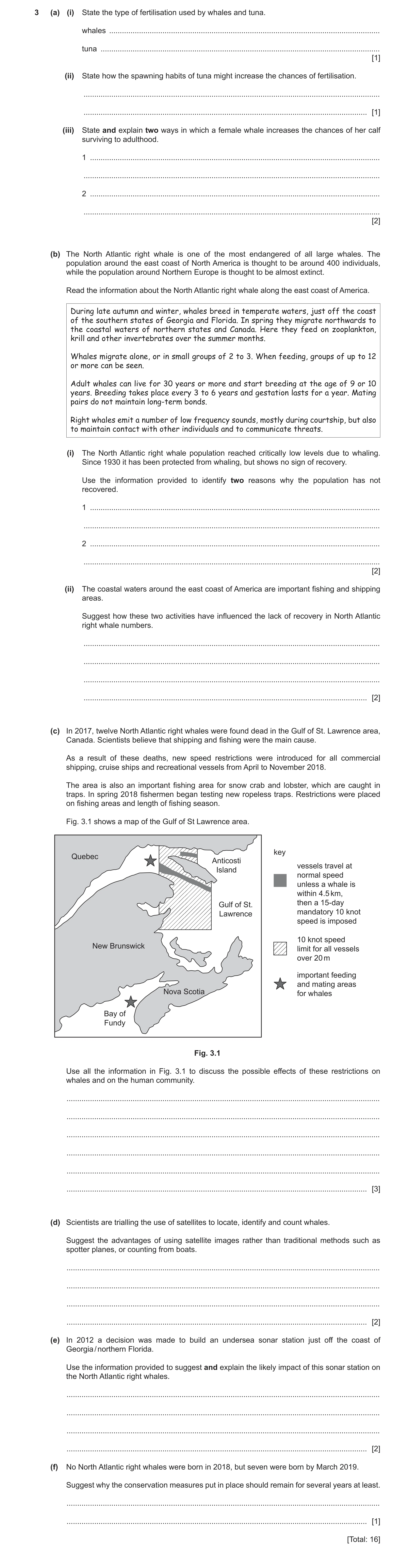
3 (a) (i) State the type of fertilisation used by whales and tuna. whales … tuna … [1] (ii) State how the spawning habits of tuna might increase the chances of fertilisation. … … [1] (iii) State and explain two ways in which a female whale increases the chances of her calf surviving to adulthood. 1 … … 2 … … [2] (b) The North Atlantic right whale is one of the most endangered of all large whales. The population around the east coast of North America is thought to be around 400 individuals, while the population around Northern Europe is thought to be almost extinct. Read the information about the North Atlantic right whale along the east coast of America. During late autumn and winter, whales breed in temperate waters, just off the coast of the southern states of Georgia and Florida. In spring they migrate northwards to the coastal waters of northern states and Canada. Here they feed on zooplankton, krill and other invertebrates over the summer months. Whales migrate alone, or in small groups of 2 to 3. When feeding, groups of up to 12 or more can be seen. Adult whales can live for 30 years or more and start breeding at the age of 9 or 10 years. Breeding takes place every 3 to 6 years and gestation lasts for a year. Mating pairs do not maintain long-term bonds. Right whales emit a number of low frequency sounds, mostly during courtship, but also to maintain contact with other individuals and to communicate threats. (i) The North Atlantic right whale population reached critically low levels due to whaling. Since 1930 it has been protected from whaling, but shows no sign of recovery. Use the information provided to identify two reasons why the population has not recovered. 1 … … 2 … … [2] (ii) The coastal waters around the east coast of America are important fishing and shipping areas. Suggest how these two activities have influenced the lack of recovery in North Atlantic right whale numbers. … … … … [2] (c) In 2017, twelve North Atlantic right whales were found dead in the Gulf of St. Lawrence area, Canada. Scientists believe that shipping and fishing were the main cause. As a result of these deaths, new speed restrictions were introduced for all commercial shipping, cruise ships and recreational vessels from April to November 2018. The area is also an important fishing area for snow crab and lobster, which are caught in traps. In spring 2018 fishermen began testing new ropeless traps. Restrictions were placed on fishing areas and length of fishing season. Fig. 3.1 shows a map of the Gulf of St Lawrence area. key Quebec Anticosti vessels travel at Island normal speed unless a whale is within 4.5 km, Gulf of St. then a 15-day Lawrence mandatory 10 knot speed is imposed 10 knot speed New Brunswick limit for all vessels over 20 m important feeding and mating areas Nova Scotia for whales Bay of Fundy Fig. 3.1 Use all the information in Fig. 3.1 to discuss the possible effects of these restrictions on whales and on the human community. … … … … … … [3] (d) Scientists are trialling the use of satellites to locate, identify and count whales. Suggest the advantages of using satellite images rather than traditional methods such as spotter planes, or counting from boats. … … … … [2] (e) In 2012 a decision was made to build an undersea sonar station just off the coast of Georgia / northern Florida. Use the information provided to suggest and explain the likely impact of this sonar station on the North Atlantic right whales. … … … … [2] (f) No North Atlantic right whales were born in 2018, but seven were born by March 2019. Suggest why the conservation measures put in place should remain for several years at least. … … [1] [Total: 16]
16 marks
This question in 9693/30 Oct/Nov 2021
Q12 · Marine mussels can tolerate a wide range of salinities 9693/31 Oct/Nov 2022
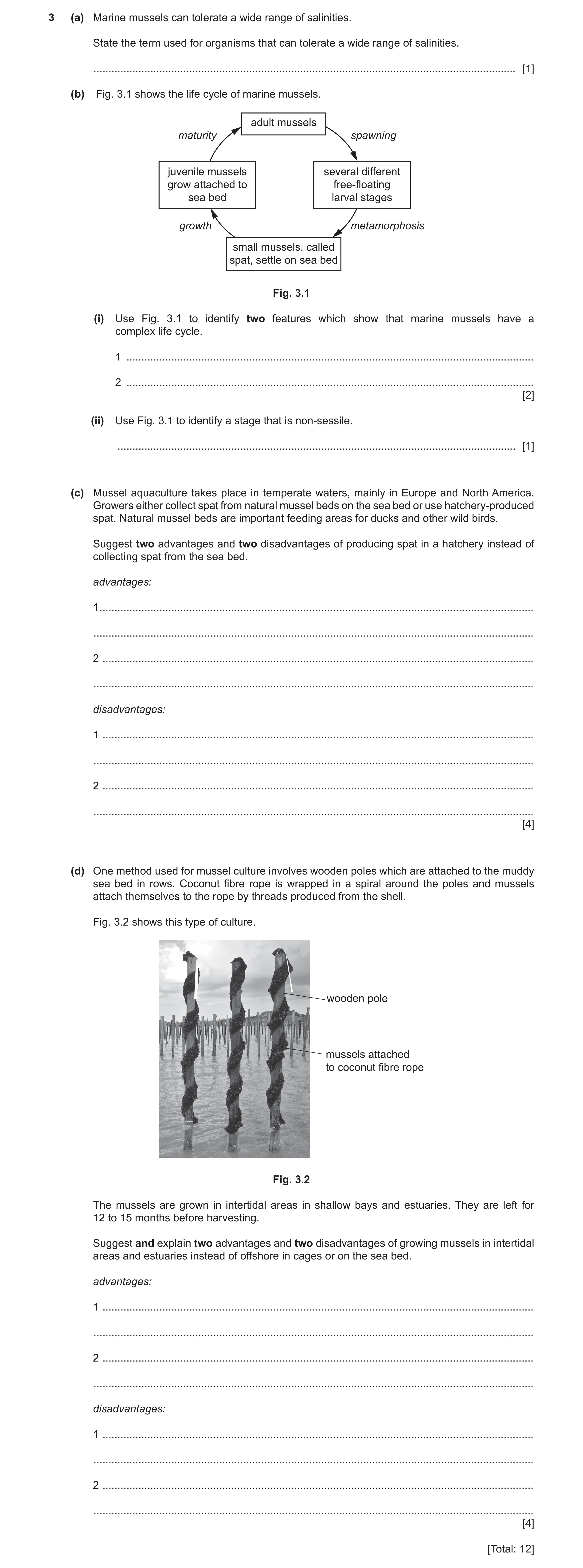
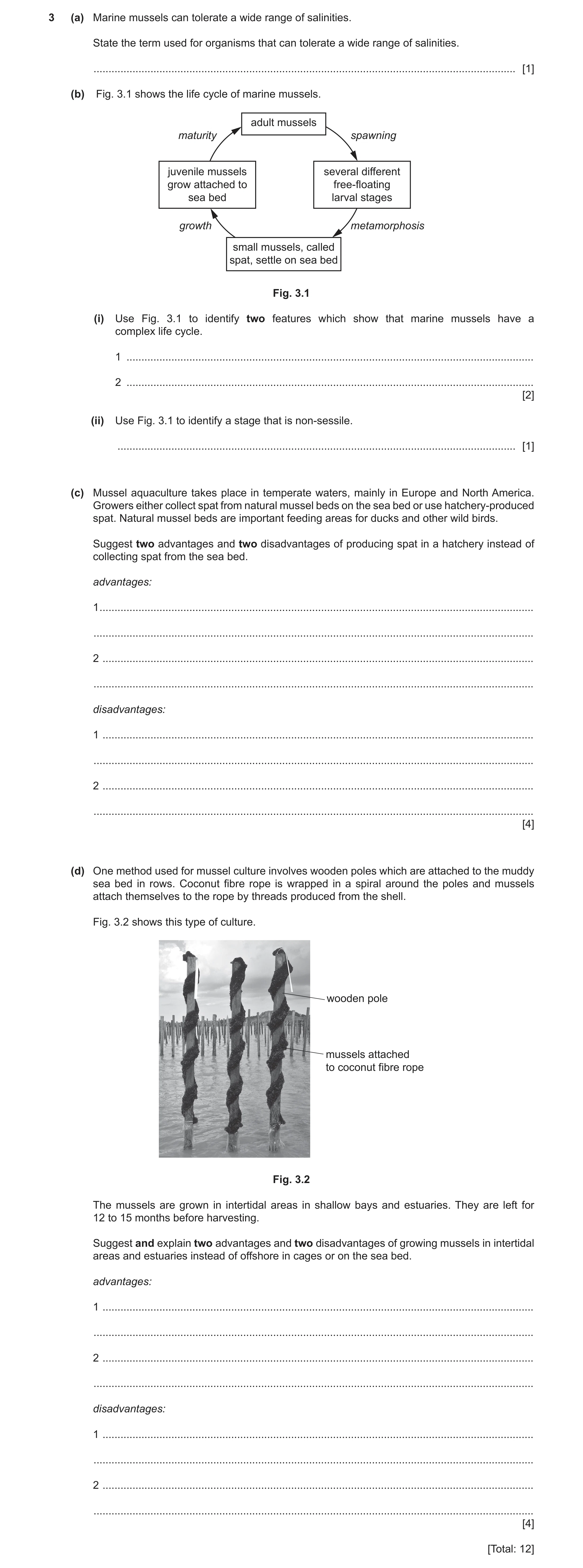
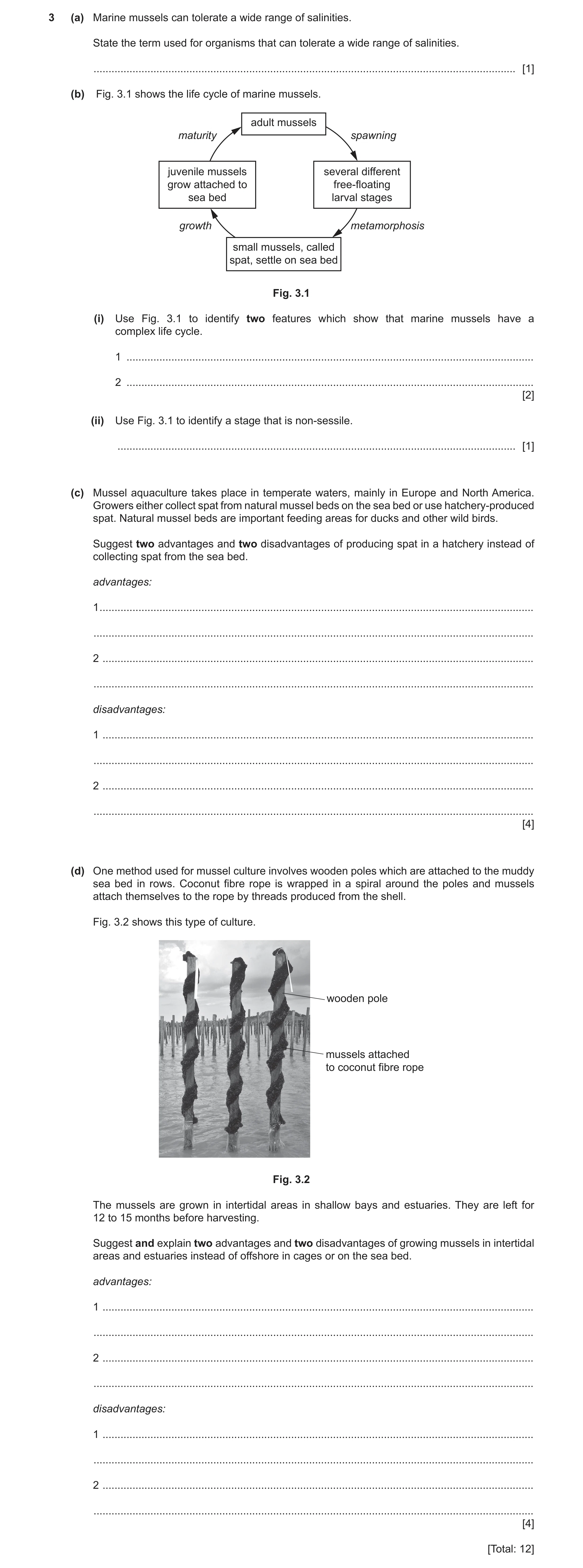
3 (a) Marine mussels can tolerate a wide range of salinities. State the term used for organisms that can tolerate a wide range of salinities. … [1] (b) Fig. 3.1 shows the life cycle of marine mussels. adult mussels maturity spawning juvenile mussels several different grow attached to free-floating sea bed larval stages growth metamorphosis small mussels, called spat, settle on sea bed Fig. 3.1 (i) Use Fig. 3.1 to identify two features which show that marine mussels have a complex life cycle. 1 … 2 … [2] (ii) Use Fig. 3.1 to identify a stage that is non-sessile. … [1] (c) Mussel aquaculture takes place in temperate waters, mainly in Europe and North America. Growers either collect spat from natural mussel beds on the sea bed or use hatchery-produced spat. Natural mussel beds are important feeding areas for ducks and other wild birds. Suggest two advantages and two disadvantages of producing spat in a hatchery instead of collecting spat from the sea bed. advantages: 1 … … 2 … … disadvantages: 1 … … 2 … … [4] (d) One method used for mussel culture involves wooden poles which are attached to the muddy sea bed in rows. Coconut fibre rope is wrapped in a spiral around the poles and mussels attach themselves to the rope by threads produced from the shell. Fig. 3.2 shows this type of culture. wooden pole mussels attached to coconut fibre rope Fig. 3.2 The mussels are grown in intertidal areas in shallow bays and estuaries. They are left for 12 to 15 months before harvesting. Suggest and explain two advantages and two disadvantages of growing mussels in intertidal areas and estuaries instead of offshore in cages or on the sea bed. advantages: 1 … … 2 … … disadvantages: 1 … … 2 … … [4] [Total: 12]
12 marks
Mark scheme: 3(a) euryhaline ; 1 3(b)(i) many larval stages ; 2 metamorphosis occurs ; 3(b)(ii) larvae ; 1 3(c) advantages: any 2 of: 4 supply guaranteed ; does not reduce food supply for wild birds / ducks ; spat protected from, adverse weather / pollution / toxins from algal blooms / predators ; spat protected from temperature increases due to climate change ; AVP ; disadvantages: any 2 of: high cost of setting up hatchery ; high running / maintenance costs e.g. pump / filtration / aeration ; mussels / larvae will need to be fed ; AVP ; 3(d) advantages – any 2 of: 4 easier to check growth ; easier to harvest (from land) / no need for a boat to harvest ; muddy shores and estuaries are high in nutrients ; regular water flow brings food / phytoplankton ; regular water flow washes away waste products ; regular water flow maintains oxygen levels (for respiration) ; easier to check for predators / biofouling ; estuaries more protected from wave action / storms ; disadvantages – any 2 of: mussels exposed, to atmosphere / during low tide ; so greater chance of, predation by birds / desiccation / temperature or salinity fluctuations ; less time available to feed ; so less growth ; longer time before harvest ; greater chance of being affected by algal blooms / pollutants ; greater risk of sediment blocking gills ;
This question in 9693/31 Oct/Nov 2022
Q13 · Marine mussels can tolerate a wide range of salinities 9693/32 Oct/Nov 2022
3 (a) Marine mussels can tolerate a wide range of salinities. State the term used for organisms that can tolerate a wide range of salinities. … [1] (b) Fig. 3.1 shows the life cycle of marine mussels. adult mussels maturity spawning juvenile mussels several different grow attached to free-floating sea bed larval stages growth metamorphosis small mussels, called spat, settle on sea bed Fig. 3.1 (i) Use Fig. 3.1 to identify two features which show that marine mussels have a complex life cycle. 1 … 2 … [2] (ii) Use Fig. 3.1 to identify a stage that is non-sessile. … [1] (c) Mussel aquaculture takes place in temperate waters, mainly in Europe and North America. Growers either collect spat from natural mussel beds on the sea bed or use hatchery-produced spat. Natural mussel beds are important feeding areas for ducks and other wild birds. Suggest two advantages and two disadvantages of producing spat in a hatchery instead of collecting spat from the sea bed. advantages: 1 … … 2 … … disadvantages: 1 … … 2 … … [4] (d) One method used for mussel culture involves wooden poles which are attached to the muddy sea bed in rows. Coconut fibre rope is wrapped in a spiral around the poles and mussels attach themselves to the rope by threads produced from the shell. Fig. 3.2 shows this type of culture. wooden pole mussels attached to coconut fibre rope Fig. 3.2 The mussels are grown in intertidal areas in shallow bays and estuaries. They are left for 12 to 15 months before harvesting. Suggest and explain two advantages and two disadvantages of growing mussels in intertidal areas and estuaries instead of offshore in cages or on the sea bed. advantages: 1 … … 2 … … disadvantages: 1 … … 2 … … [4] [Total: 12]
12 marks
Mark scheme: 3(a) euryhaline ; 1 3(b)(i) many larval stages ; 2 metamorphosis occurs ; 3(b)(ii) larvae ; 1 3(c) advantages: any 2 of: 4 supply guaranteed ; does not reduce food supply for wild birds / ducks ; spat protected from, adverse weather / pollution / toxins from algal blooms / predators ; spat protected from temperature increases due to climate change ; AVP ; disadvantages: any 2 of: high cost of setting up hatchery ; high running / maintenance costs e.g. pump / filtration / aeration ; mussels / larvae will need to be fed ; AVP ; 3(d) advantages – any 2 of: 4 easier to check growth ; easier to harvest (from land) / no need for a boat to harvest ; muddy shores and estuaries are high in nutrients ; regular water flow brings food / phytoplankton ; regular water flow washes away waste products ; regular water flow maintains oxygen levels (for respiration) ; easier to check for predators / biofouling ; estuaries more protected from wave action / storms ; disadvantages – any 2 of: mussels exposed, to atmosphere / during low tide ; so greater chance of, predation by birds / desiccation / temperature or salinity fluctuations ; less time available to feed ; so less growth ; longer time before harvest ; greater chance of being affected by algal blooms / pollutants ; greater risk of sediment blocking gills ;
This question in 9693/32 Oct/Nov 2022
Q14 · Marine mussels can tolerate a wide range of salinities 9693/33 Oct/Nov 2022
3 (a) Marine mussels can tolerate a wide range of salinities. State the term used for organisms that can tolerate a wide range of salinities. … [1] (b) Fig. 3.1 shows the life cycle of marine mussels. adult mussels maturity spawning juvenile mussels several different grow attached to free-floating sea bed larval stages growth metamorphosis small mussels, called spat, settle on sea bed Fig. 3.1 (i) Use Fig. 3.1 to identify two features which show that marine mussels have a complex life cycle. 1 … 2 … [2] (ii) Use Fig. 3.1 to identify a stage that is non-sessile. … [1] (c) Mussel aquaculture takes place in temperate waters, mainly in Europe and North America. Growers either collect spat from natural mussel beds on the sea bed or use hatchery-produced spat. Natural mussel beds are important feeding areas for ducks and other wild birds. Suggest two advantages and two disadvantages of producing spat in a hatchery instead of collecting spat from the sea bed. advantages: 1 … … 2 … … disadvantages: 1 … … 2 … … [4] (d) One method used for mussel culture involves wooden poles which are attached to the muddy sea bed in rows. Coconut fibre rope is wrapped in a spiral around the poles and mussels attach themselves to the rope by threads produced from the shell. Fig. 3.2 shows this type of culture. wooden pole mussels attached to coconut fibre rope Fig. 3.2 The mussels are grown in intertidal areas in shallow bays and estuaries. They are left for 12 to 15 months before harvesting. Suggest and explain two advantages and two disadvantages of growing mussels in intertidal areas and estuaries instead of offshore in cages or on the sea bed. advantages: 1 … … 2 … … disadvantages: 1 … … 2 … … [4] [Total: 12]
12 marks
Mark scheme: 3(a) euryhaline ; 1 3(b)(i) many larval stages ; 2 metamorphosis occurs ; 3(b)(ii) larvae ; 1 3(c) advantages: any 2 of: 4 supply guaranteed ; does not reduce food supply for wild birds / ducks ; spat protected from, adverse weather / pollution / toxins from algal blooms / predators ; spat protected from temperature increases due to climate change ; AVP ; disadvantages: any 2 of: high cost of setting up hatchery ; high running / maintenance costs e.g. pump / filtration / aeration ; mussels / larvae will need to be fed ; AVP ; 3(d) advantages – any 2 of: 4 easier to check growth ; easier to harvest (from land) / no need for a boat to harvest ; muddy shores and estuaries are high in nutrients ; regular water flow brings food / phytoplankton ; regular water flow washes away waste products ; regular water flow maintains oxygen levels (for respiration) ; easier to check for predators / biofouling ; estuaries more protected from wave action / storms ; disadvantages – any 2 of: mussels exposed, to atmosphere / during low tide ; so greater chance of, predation by birds / desiccation / temperature or salinity fluctuations ; less time available to feed ; so less growth ; longer time before harvest ; greater chance of being affected by algal blooms / pollutants ; greater risk of sediment blocking gills ;
This question in 9693/33 Oct/Nov 2022
Q15 · Antarctic krill feed on phytoplankton 9693/31 Oct/Nov 2023
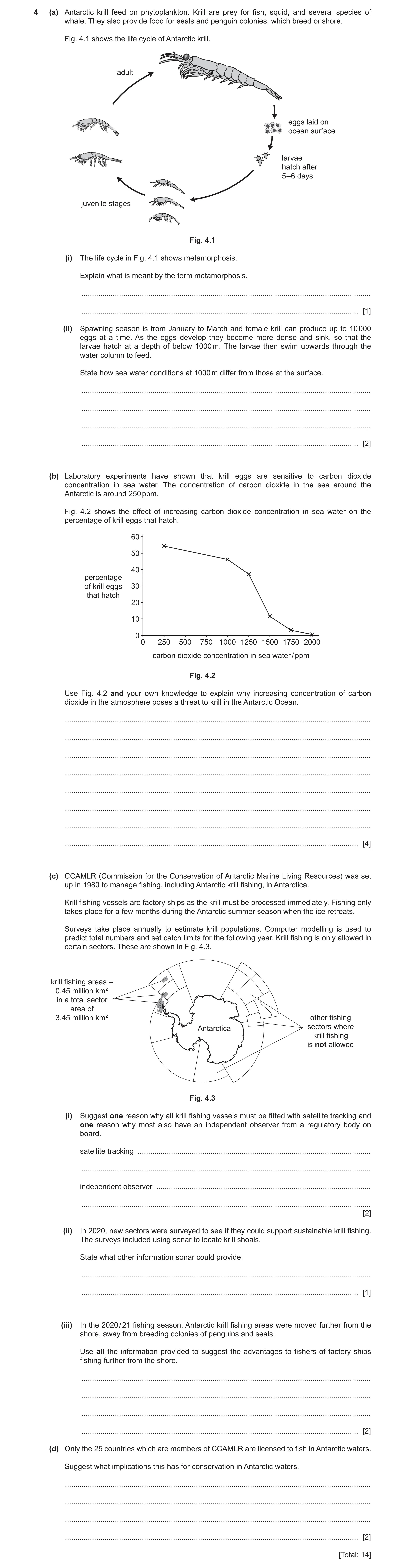
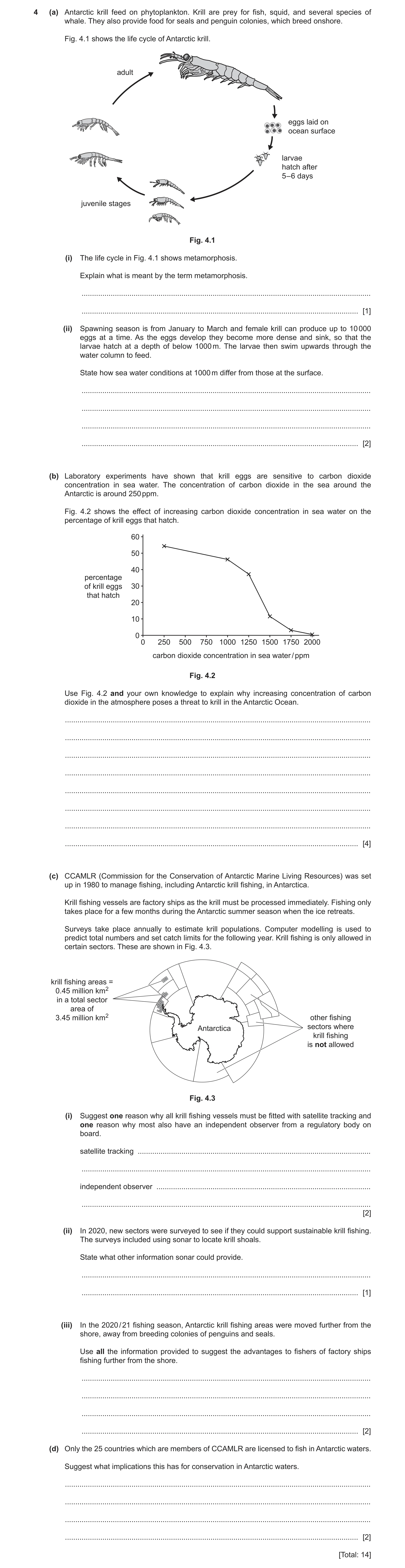
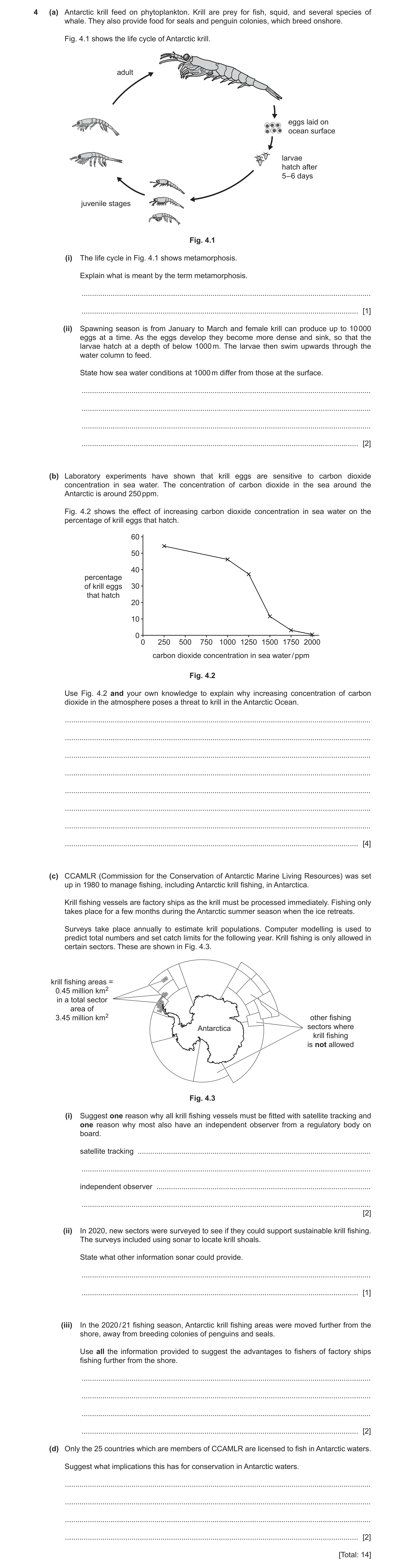
4 (a) Antarctic krill feed on phytoplankton. Krill are prey for fish, squid, and several species of whale. They also provide food for seals and penguin colonies, which breed onshore. Fig. 4.1 shows the life cycle of Antarctic krill. adult eggs laid on ocean surface larvae hatch after 5–6 days juvenile stages Fig. 4.1 (i) The life cycle in Fig. 4.1 shows metamorphosis. Explain what is meant by the term metamorphosis. … … [1] (ii) Spawning season is from January to March and female krill can produce up to 10 000 eggs at a time. As the eggs develop they become more dense and sink, so that the larvae hatch at a depth of below 1000 m. The larvae then swim upwards through the water column to feed. State how sea water conditions at 1000 m differ from those at the surface. … … … … [2] (b) Laboratory experiments have shown that krill eggs are sensitive to carbon dioxide concentration in sea water. The concentration of carbon dioxide in the sea around the Antarctic is around 250 ppm. Fig. 4.2 shows the effect of increasing carbon dioxide concentration in sea water on the percentage of krill eggs that hatch. 60 50 40 percentage of krill eggs 30 that hatch 20 10 0 0 250 500 750 1000 1250 1500 1750 2000 carbon dioxide concentration in sea water / ppm Fig. 4.2 Use Fig. 4.2 and your own knowledge to explain why increasing concentration of carbon dioxide in the atmosphere poses a threat to krill in the Antarctic Ocean. … … … … … … … … [4] (c) CCAMLR (Commission for the Conservation of Antarctic Marine Living Resources) was set up in 1980 to manage fishing, including Antarctic krill fishing, in Antarctica. Krill fishing vessels are factory ships as the krill must be processed immediately. Fishing only takes place for a few months during the Antarctic summer season when the ice retreats. Surveys take place annually to estimate krill populations. Computer modelling is used to predict total numbers and set catch limits for the following year. Krill fishing is only allowed in certain sectors. These are shown in Fig. 4.3. krill fishing areas = 0.45 million km2 in a total sector area of 3.45 million km2 other fishing Antarctica sectors where krill fishing is not allowed Fig. 4.3 (i) Suggest one reason why all krill fishing vessels must be fitted with satellite tracking and one reason why most also have an independent observer from a regulatory body on board. satellite tracking … … independent observer … … [2] (ii) In 2020, new sectors were surveyed to see if they could support sustainable krill fishing. The surveys included using sonar to locate krill shoals. State what other information sonar could provide. … … [1] (iii) In the 2020 / 21 fishing season, Antarctic krill fishing areas were moved further from the shore, away from breeding colonies of penguins and seals. Use all the information provided to suggest the advantages to fishers of factory ships fishing further from the shore. … … … … [2] (d) Only the 25 countries which are members of CCAMLR are licensed to fish in Antarctic waters. Suggest what implications this has for conservation in Antarctic waters. … … … … [2] [Total: 14]
14 marks
Mark scheme: 4(a)(i) any 1 of: 1 different forms of the same animal ; adult and larval (forms) present ; process of transformation / change from immature to adult form ; 4(a)(ii) any 2 of: 2 cooler / more temperature stable ; increased pressure ; oxygen concentration decreases ; ref. to salinity increasing / density increasing ; water darker (due to less light penetration) ; 4(b) any 4 of: 4 increasing carbon dioxide decreases hatch rate ; so krill population decreases ; increased dissolution of carbon dioxide ; forms hydrogen ions and hydrogencarbonate ions ; increased ocean acidification / pH decreases ; less carbonate for krill exoskeleton ; so krill deformed / more easily preyed upon ; 4(c)(i) satellite tracking: can ensure vessel is fishing in correct location / can show when a vessel is fishing / can show method of 2 fishing ; observer: can inspect catch size or limit / monitor fishing gear / ensure that there is no by-catch ; 4(c)(ii) any 1 of: 1 depth of shoal / size of shoal / underwater objects / depth of water ; 4(c)(iii) any 2 of: 2 idea of less competition, from krill predators / fish / squid / whales / seals / penguins ; so Antarctic krill numbers higher further from shore ; so quota can be increased ; less fuel required to reach fishing areas ; AVP ; 4(d) any 2 of: 2 countries which are not members are not bound by the rules ; ref. to IUU fishing ; will result in overfishing ; ref to all 25 countries have to agree to any (change in) regulation ; fishing in area / number of licenses, is restricted ; to maintain sustainable fishing ;
This question in 9693/31 Oct/Nov 2023
Q16 · Antarctic krill feed on phytoplankton 9693/32 Oct/Nov 2023
4 (a) Antarctic krill feed on phytoplankton. Krill are prey for fish, squid, and several species of whale. They also provide food for seals and penguin colonies, which breed onshore. Fig. 4.1 shows the life cycle of Antarctic krill. adult eggs laid on ocean surface larvae hatch after 5–6 days juvenile stages Fig. 4.1 (i) The life cycle in Fig. 4.1 shows metamorphosis. Explain what is meant by the term metamorphosis. … … [1] (ii) Spawning season is from January to March and female krill can produce up to 10 000 eggs at a time. As the eggs develop they become more dense and sink, so that the larvae hatch at a depth of below 1000 m. The larvae then swim upwards through the water column to feed. State how sea water conditions at 1000 m differ from those at the surface. … … … … [2] (b) Laboratory experiments have shown that krill eggs are sensitive to carbon dioxide concentration in sea water. The concentration of carbon dioxide in the sea around the Antarctic is around 250 ppm. Fig. 4.2 shows the effect of increasing carbon dioxide concentration in sea water on the percentage of krill eggs that hatch. 60 50 40 percentage of krill eggs 30 that hatch 20 10 0 0 250 500 750 1000 1250 1500 1750 2000 carbon dioxide concentration in sea water / ppm Fig. 4.2 Use Fig. 4.2 and your own knowledge to explain why increasing concentration of carbon dioxide in the atmosphere poses a threat to krill in the Antarctic Ocean. … … … … … … … … [4] (c) CCAMLR (Commission for the Conservation of Antarctic Marine Living Resources) was set up in 1980 to manage fishing, including Antarctic krill fishing, in Antarctica. Krill fishing vessels are factory ships as the krill must be processed immediately. Fishing only takes place for a few months during the Antarctic summer season when the ice retreats. Surveys take place annually to estimate krill populations. Computer modelling is used to predict total numbers and set catch limits for the following year. Krill fishing is only allowed in certain sectors. These are shown in Fig. 4.3. krill fishing areas = 0.45 million km2 in a total sector area of 3.45 million km2 other fishing Antarctica sectors where krill fishing is not allowed Fig. 4.3 (i) Suggest one reason why all krill fishing vessels must be fitted with satellite tracking and one reason why most also have an independent observer from a regulatory body on board. satellite tracking … … independent observer … … [2] (ii) In 2020, new sectors were surveyed to see if they could support sustainable krill fishing. The surveys included using sonar to locate krill shoals. State what other information sonar could provide. … … [1] (iii) In the 2020 / 21 fishing season, Antarctic krill fishing areas were moved further from the shore, away from breeding colonies of penguins and seals. Use all the information provided to suggest the advantages to fishers of factory ships fishing further from the shore. … … … … [2] (d) Only the 25 countries which are members of CCAMLR are licensed to fish in Antarctic waters. Suggest what implications this has for conservation in Antarctic waters. … … … … [2] [Total: 14]
14 marks
Mark scheme: 4(a)(i) any 1 of: 1 different forms of the same animal ; adult and larval (forms) present ; process of transformation / change from immature to adult form ; 4(a)(ii) any 2 of: 2 cooler / more temperature stable ; increased pressure ; oxygen concentration decreases ; ref. to salinity increasing / density increasing ; water darker (due to less light penetration) ; 4(b) any 4 of: 4 increasing carbon dioxide decreases hatch rate ; so krill population decreases ; increased dissolution of carbon dioxide ; forms hydrogen ions and hydrogencarbonate ions ; increased ocean acidification / pH decreases ; less carbonate for krill exoskeleton ; so krill deformed / more easily preyed upon ; 4(c)(i) satellite tracking: can ensure vessel is fishing in correct location / can show when a vessel is fishing / can show method of 2 fishing ; observer: can inspect catch size or limit / monitor fishing gear / ensure that there is no by-catch ; 4(c)(ii) any 1 of: 1 depth of shoal / size of shoal / underwater objects / depth of water ; 4(c)(iii) any 2 of: 2 idea of less competition, from krill predators / fish / squid / whales / seals / penguins ; so Antarctic krill numbers higher further from shore ; so quota can be increased ; less fuel required to reach fishing areas ; AVP ; 4(d) any 2 of: 2 countries which are not members are not bound by the rules ; ref. to IUU fishing ; will result in overfishing ; ref to all 25 countries have to agree to any (change in) regulation ; fishing in area / number of licenses, is restricted ; to maintain sustainable fishing ;
This question in 9693/32 Oct/Nov 2023
Q17 · Antarctic krill feed on phytoplankton 9693/33 Oct/Nov 2023
4 (a) Antarctic krill feed on phytoplankton. Krill are prey for fish, squid, and several species of whale. They also provide food for seals and penguin colonies, which breed onshore. Fig. 4.1 shows the life cycle of Antarctic krill. adult eggs laid on ocean surface larvae hatch after 5–6 days juvenile stages Fig. 4.1 (i) The life cycle in Fig. 4.1 shows metamorphosis. Explain what is meant by the term metamorphosis. … … [1] (ii) Spawning season is from January to March and female krill can produce up to 10 000 eggs at a time. As the eggs develop they become more dense and sink, so that the larvae hatch at a depth of below 1000 m. The larvae then swim upwards through the water column to feed. State how sea water conditions at 1000 m differ from those at the surface. … … … … [2] (b) Laboratory experiments have shown that krill eggs are sensitive to carbon dioxide concentration in sea water. The concentration of carbon dioxide in the sea around the Antarctic is around 250 ppm. Fig. 4.2 shows the effect of increasing carbon dioxide concentration in sea water on the percentage of krill eggs that hatch. 60 50 40 percentage of krill eggs 30 that hatch 20 10 0 0 250 500 750 1000 1250 1500 1750 2000 carbon dioxide concentration in sea water / ppm Fig. 4.2 Use Fig. 4.2 and your own knowledge to explain why increasing concentration of carbon dioxide in the atmosphere poses a threat to krill in the Antarctic Ocean. … … … … … … … … [4] (c) CCAMLR (Commission for the Conservation of Antarctic Marine Living Resources) was set up in 1980 to manage fishing, including Antarctic krill fishing, in Antarctica. Krill fishing vessels are factory ships as the krill must be processed immediately. Fishing only takes place for a few months during the Antarctic summer season when the ice retreats. Surveys take place annually to estimate krill populations. Computer modelling is used to predict total numbers and set catch limits for the following year. Krill fishing is only allowed in certain sectors. These are shown in Fig. 4.3. krill fishing areas = 0.45 million km2 in a total sector area of 3.45 million km2 other fishing Antarctica sectors where krill fishing is not allowed Fig. 4.3 (i) Suggest one reason why all krill fishing vessels must be fitted with satellite tracking and one reason why most also have an independent observer from a regulatory body on board. satellite tracking … … independent observer … … [2] (ii) In 2020, new sectors were surveyed to see if they could support sustainable krill fishing. The surveys included using sonar to locate krill shoals. State what other information sonar could provide. … … [1] (iii) In the 2020 / 21 fishing season, Antarctic krill fishing areas were moved further from the shore, away from breeding colonies of penguins and seals. Use all the information provided to suggest the advantages to fishers of factory ships fishing further from the shore. … … … … [2] (d) Only the 25 countries which are members of CCAMLR are licensed to fish in Antarctic waters. Suggest what implications this has for conservation in Antarctic waters. … … … … [2] [Total: 14]
14 marks
Mark scheme: 4(a)(i) any 1 of: 1 different forms of the same animal ; adult and larval (forms) present ; process of transformation / change from immature to adult form ; 4(a)(ii) any 2 of: 2 cooler / more temperature stable ; increased pressure ; oxygen concentration decreases ; ref. to salinity increasing / density increasing ; water darker (due to less light penetration) ; 4(b) any 4 of: 4 increasing carbon dioxide decreases hatch rate ; so krill population decreases ; increased dissolution of carbon dioxide ; forms hydrogen ions and hydrogencarbonate ions ; increased ocean acidification / pH decreases ; less carbonate for krill exoskeleton ; so krill deformed / more easily preyed upon ; 4(c)(i) satellite tracking: can ensure vessel is fishing in correct location / can show when a vessel is fishing / can show method of 2 fishing ; observer: can inspect catch size or limit / monitor fishing gear / ensure that there is no by-catch ; 4(c)(ii) any 1 of: 1 depth of shoal / size of shoal / underwater objects / depth of water ; 4(c)(iii) any 2 of: 2 idea of less competition, from krill predators / fish / squid / whales / seals / penguins ; so Antarctic krill numbers higher further from shore ; so quota can be increased ; less fuel required to reach fishing areas ; AVP ; 4(d) any 2 of: 2 countries which are not members are not bound by the rules ; ref. to IUU fishing ; will result in overfishing ; ref to all 25 countries have to agree to any (change in) regulation ; fishing in area / number of licenses, is restricted ; to maintain sustainable fishing ;
This question in 9693/33 Oct/Nov 2023
Q18 · Compare the life cycle of a crustacean such as a shrimp, with that of a marine mammal… 9693/31 May/June 2024
7 Compare the life cycle of a crustacean such as a shrimp, with that of a marine mammal such as a whale. … … … … … … … … … … [5]
5 marks
Mark scheme: 7 any 5 of: 1 shrimp has a complex life cycle and a whale has a simple life cycle ; 2 shrimp life cycle shows metamorphosis but whale life cycle does not ; 3 shrimp life cycle has larval forms but these are absent in whales ; 4 both life cycles only have non-sessile forms ; 5 idea of paired mating occurs in both ; 6 external fertilisation in shrimp and internal fertilisation in whales ; 7 internal development in whales but not in shrimp ; 8 idea of parental care of offspring in whales but not in shrimp ; 9 hundreds (AW) of offspring produced by shrimp but only one / few in whales ; 10 both have a breeding season ; 11 a range of habitats are required to complete life cycle of shrimp but only open ocean / coastal waters required by whales ;
This question in 9693/31 May/June 2024
Q19 · Discuss the role of the IWC (International Whaling Commission) moratorium in conservation 9693/32 May/June 2024
6 (a) Discuss the role of the IWC (International Whaling Commission) moratorium in conservation. … … … … … … … … … … … … [6] (b) Compare fertilisation and subsequent investment in the care of offspring in sharks and whales. … … … … … … … … … … … … … … [7] [Total: 13]
13 marks
Mark scheme: 6(a) any 6 of: 1 introduce legislation (locally and globally) ; 2 help to secure international cooperation ; 3 protects whale stocks ; 4 whaling can be banned altogether ; 5 e.g. Southern Ocean Sanctuary ; 6 or managed by having, quotas / seasons ; 7 not always successful / not all countries sign up ; 8 idea that funding provided for conservation ; 9 does not apply if whale is killed for research ; 10 enforcement / monitoring, difficult to apply ; 6 Question Answer Marks 6(b) any 7 of: 1 sharks and whales carry our internal fertilisation ; 2 males introduce sperm into the female’s body ; 3 via claspers in sharks and penis in whales ; 4. fewer sperm are produced than if fertilisation was external ; 5 as fertilisation is more guaranteed ; 6 both are K-strategists ; 7 whale young are fed via placenta ; 8 shark eggs fed, via yolk sac / via placenta ; 9 sharks have a few offspring, whales have only one calf ; 10 whales and (some) sharks give birth to live young / viviparous ; 11 some sharks give birth to live young inside a mermaid’s purse ; 12 shark young are independent straight away ; 13 young whales fed on milk ; 14 whale calf remains with mother until sexually mature / for many years ; 15 whale pod protect calf from predators / calf learns from parent ; 7
This question in 9693/32 May/June 2024
Q20 · Discuss the role of the IWC (International Whaling Commission) moratorium in conservation 9693/33 May/June 2024
6 (a) Discuss the role of the IWC (International Whaling Commission) moratorium in conservation. … … … … … … … … … … … … [6] (b) Compare fertilisation and subsequent investment in the care of offspring in sharks and whales. … … … … … … … … … … … … … … [7] [Total: 13]
13 marks
Mark scheme: 6(a) any 6 of: 1 introduce legislation (locally and globally) ; 2 help to secure international cooperation ; 3 protects whale stocks ; 4 whaling can be banned altogether ; 5 e.g. Southern Ocean Sanctuary ; 6 or managed by having, quotas / seasons ; 7 not always successful / not all countries sign up ; 8 idea that funding provided for conservation ; 9 does not apply if whale is killed for research ; 10 enforcement / monitoring, difficult to apply ; 6 Question Answer Marks 6(b) any 7 of: 1 sharks and whales carry our internal fertilisation ; 2 males introduce sperm into the female’s body ; 3 via claspers in sharks and penis in whales ; 4. fewer sperm are produced than if fertilisation was external ; 5 as fertilisation is more guaranteed ; 6 both are K-strategists ; 7 whale young are fed via placenta ; 8 shark eggs fed, via yolk sac / via placenta ; 9 sharks have a few offspring, whales have only one calf ; 10 whales and (some) sharks give birth to live young / viviparous ; 11 some sharks give birth to live young inside a mermaid’s purse ; 12 shark young are independent straight away ; 13 young whales fed on milk ; 14 whale calf remains with mother until sexually mature / for many years ; 15 whale pod protect calf from predators / calf learns from parent ; 7
This question in 9693/33 May/June 2024
Q21 · Snow crabs, Chionoecetes opilio, are found in the Bering Sea around Alaska, in the far… 9693/32 May/June 2025
1 Snow crabs, Chionoecetes opilio, are found in the Bering Sea around Alaska, in the far northwest of North America. Fig. 1.1 shows a snow crab. Fig. 1.1 (a) Snow crabs are crustaceans. State two features of crustaceans which are visible in Fig. 1.1. 1 … 2 … [1] (b) A female snow crab can produce up to 160 000 eggs per year. The eggs hatch in spring and the pelagic larvae feed on phytoplankton. After three to five months, in late autumn and winter, the larvae settle on the muddy sea bed. Juvenile snow crabs mature in cold water pools on the sea floor. They can take up to nine years to mature into adults. State why the life cycle is an example of a complex life cycle. … … … … [2] (c) (i) Bottom trawl surveys take place annually to monitor snow crab populations. Suggest two reasons why bottom trawl surveys are a suitable method of monitoring. 1 … … 2 … … [2] (ii) In 2018 the snow crab population was estimated at 11.7 billion. By 2022 the population was estimated at 1.9 billion. Calculate the percentage decrease in population between 2018 and 2022. Show your working. … % [2] (iii) Only large male snow crabs are caught commercially as they are up to five times the size of females. In 2022 the commercial fishing season for snow crab was cancelled. Use 1(c)(ii) to explain why the commercial fishing season was cancelled. … … … … [2] (iv) In 2018 and again in 2019 there was a heatwave in Alaska. Sea water temperatures increased from 1.5 °C to 3.5 °C. Use all the information provided in the question and your own knowledge to suggest how the increase in sea water temperature could have caused the decrease in the snow crab population. … … … … … … … … [4] (d) Scientists are concerned that in the future the sea water around Alaska will continue to warm due to climate change. Colder waters have protected the ecosystem from predatory fish such as cod, which are less adapted to very cold water. Cod is an important commercial fish. Discuss the possible implications of increasing sea water temperatures on commercial fishing in the waters around Alaska in the future. … … … … … … … … [4] [Total: 17]
17 marks
Mark scheme: Question Answer Marks 1(a) any 2 of: 1 carapace present / jointed legs / two pairs of antennae ; 1(b) shows metamorphosis ; 2 larval stages present ; 1(c)(i) any 2 of: 2 they cause minimal damage to the mud substrate ; (most) stages in the life cycle are bottom dwelling ; catches more crabs than any other method ; 1(c)(ii) 1.9 − 11.7 2 100 11.7 (–) 83.8(%) ; 1(c)(iii) any 2 of: 2 1 insufficient numbers (of males) to catch ; 2 idea of too few males available to breed ; 3 so, few offspring produced for future / low recruitment ; 4 allows time for population to recover / prevents extinction ; 1(c)(iv) any 4 of: 4 1 kills / damages, eggs / larval stages / too few cold-water pools for juveniles to mature ; 2 correct ref. to phytoplankton blooms ; 3 introduction of new crab predators / invasive species / diseases ; 5 reduced oxygen concentration in seawater ; 6 less available for respiration / causes suffocation ; 7 so reducing growth / productivity ; 8 effect of increased temperature on salinity ; 9 so affecting water potential ; 10 AVP ; 1(d) any 4 of: 4 1 snow crab numbers will continue to decline ; 2 crabs / native species will be predated by cod / predatory fish ; 3 fewer cold-water pools for juveniles to mature ; 4 which could lead to overcrowding / increase in disease / starvation ; 5 could result in overfishing of other cold water species ; 6 less / no, income / employment, from commercial fishing for, snow crabs / cold water species ; 7 causing changes in food chains / webs ; 8 increased fishing for, cod / other warm water species, (could provide an alternative source of, income / employment) ;
This question in 9693/32 May/June 2025
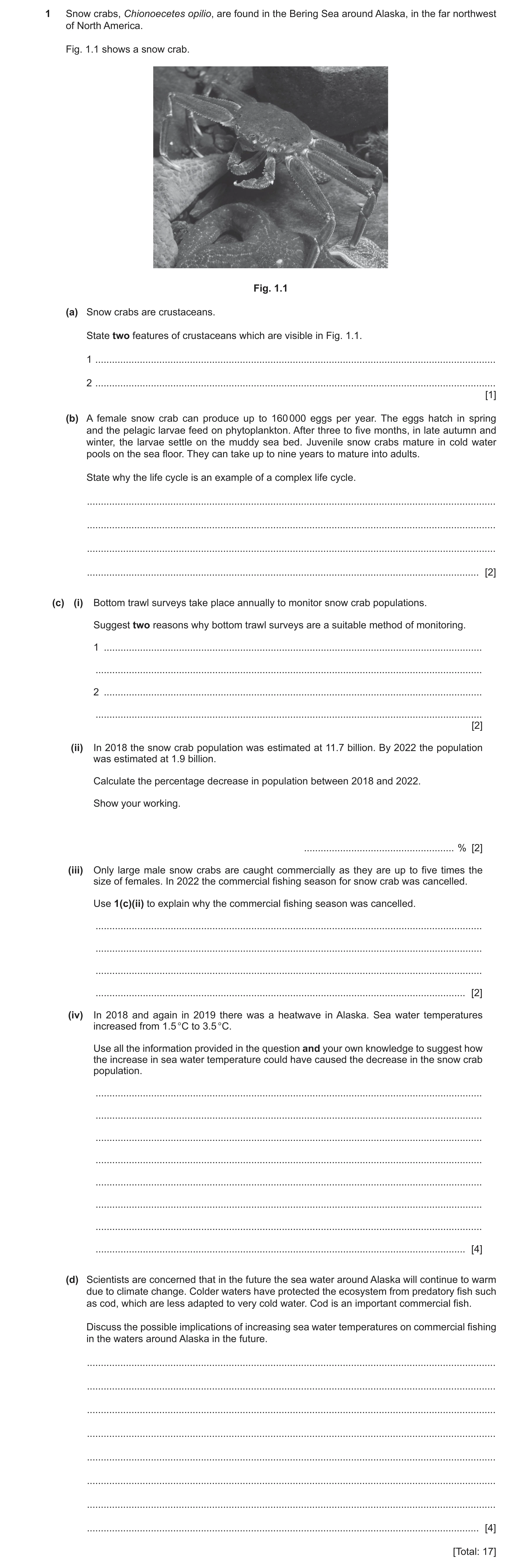
Q22 · Snow crabs, Chionoecetes opilio, are found in the Bering Sea around Alaska, in the far… 9693/33 May/June 2025
1 Snow crabs, Chionoecetes opilio, are found in the Bering Sea around Alaska, in the far northwest of North America. Fig. 1.1 shows a snow crab. Fig. 1.1 (a) Snow crabs are crustaceans. State two features of crustaceans which are visible in Fig. 1.1. 1 … 2 … [1] (b) A female snow crab can produce up to 160 000 eggs per year. The eggs hatch in spring and the pelagic larvae feed on phytoplankton. After three to five months, in late autumn and winter, the larvae settle on the muddy sea bed. Juvenile snow crabs mature in cold water pools on the sea floor. They can take up to nine years to mature into adults. State why the life cycle is an example of a complex life cycle. … … … … [2] (c) (i) Bottom trawl surveys take place annually to monitor snow crab populations. Suggest two reasons why bottom trawl surveys are a suitable method of monitoring. 1 … … 2 … … [2] (ii) In 2018 the snow crab population was estimated at 11.7 billion. By 2022 the population was estimated at 1.9 billion. Calculate the percentage decrease in population between 2018 and 2022. Show your working. … % [2] (iii) Only large male snow crabs are caught commercially as they are up to five times the size of females. In 2022 the commercial fishing season for snow crab was cancelled. Use 1(c)(ii) to explain why the commercial fishing season was cancelled. … … … … [2] (iv) In 2018 and again in 2019 there was a heatwave in Alaska. Sea water temperatures increased from 1.5 °C to 3.5 °C. Use all the information provided in the question and your own knowledge to suggest how the increase in sea water temperature could have caused the decrease in the snow crab population. … … … … … … … … [4] (d) Scientists are concerned that in the future the sea water around Alaska will continue to warm due to climate change. Colder waters have protected the ecosystem from predatory fish such as cod, which are less adapted to very cold water. Cod is an important commercial fish. Discuss the possible implications of increasing sea water temperatures on commercial fishing in the waters around Alaska in the future. … … … … … … … … [4] [Total: 17]
17 marks
Mark scheme: Question Answer Marks 1(a) any 2 of: 1 carapace present / jointed legs / two pairs of antennae ; 1(b) shows metamorphosis ; 2 larval stages present ; 1(c)(i) any 2 of: 2 they cause minimal damage to the mud substrate ; (most) stages in the life cycle are bottom dwelling ; catches more crabs than any other method ; 1(c)(ii) 1.9 − 11.7 2 100 11.7 (–) 83.8(%) ; 1(c)(iii) any 2 of: 2 1 insufficient numbers (of males) to catch ; 2 idea of too few males available to breed ; 3 so, few offspring produced for future / low recruitment ; 4 allows time for population to recover / prevents extinction ; 1(c)(iv) any 4 of: 4 1 kills / damages, eggs / larval stages / too few cold-water pools for juveniles to mature ; 2 correct ref. to phytoplankton blooms ; 3 introduction of new crab predators / invasive species / diseases ; 5 reduced oxygen concentration in seawater ; 6 less available for respiration / causes suffocation ; 7 so reducing growth / productivity ; 8 effect of increased temperature on salinity ; 9 so affecting water potential ; 10 AVP ; 1(d) any 4 of: 4 1 snow crab numbers will continue to decline ; 2 crabs / native species will be predated by cod / predatory fish ; 3 fewer cold-water pools for juveniles to mature ; 4 which could lead to overcrowding / increase in disease / starvation ; 5 could result in overfishing of other cold water species ; 6 less / no, income / employment, from commercial fishing for, snow crabs / cold water species ; 7 causing changes in food chains / webs ; 8 increased fishing for, cod / other warm water species, (could provide an alternative source of, income / employment) ;
This question in 9693/33 May/June 2025
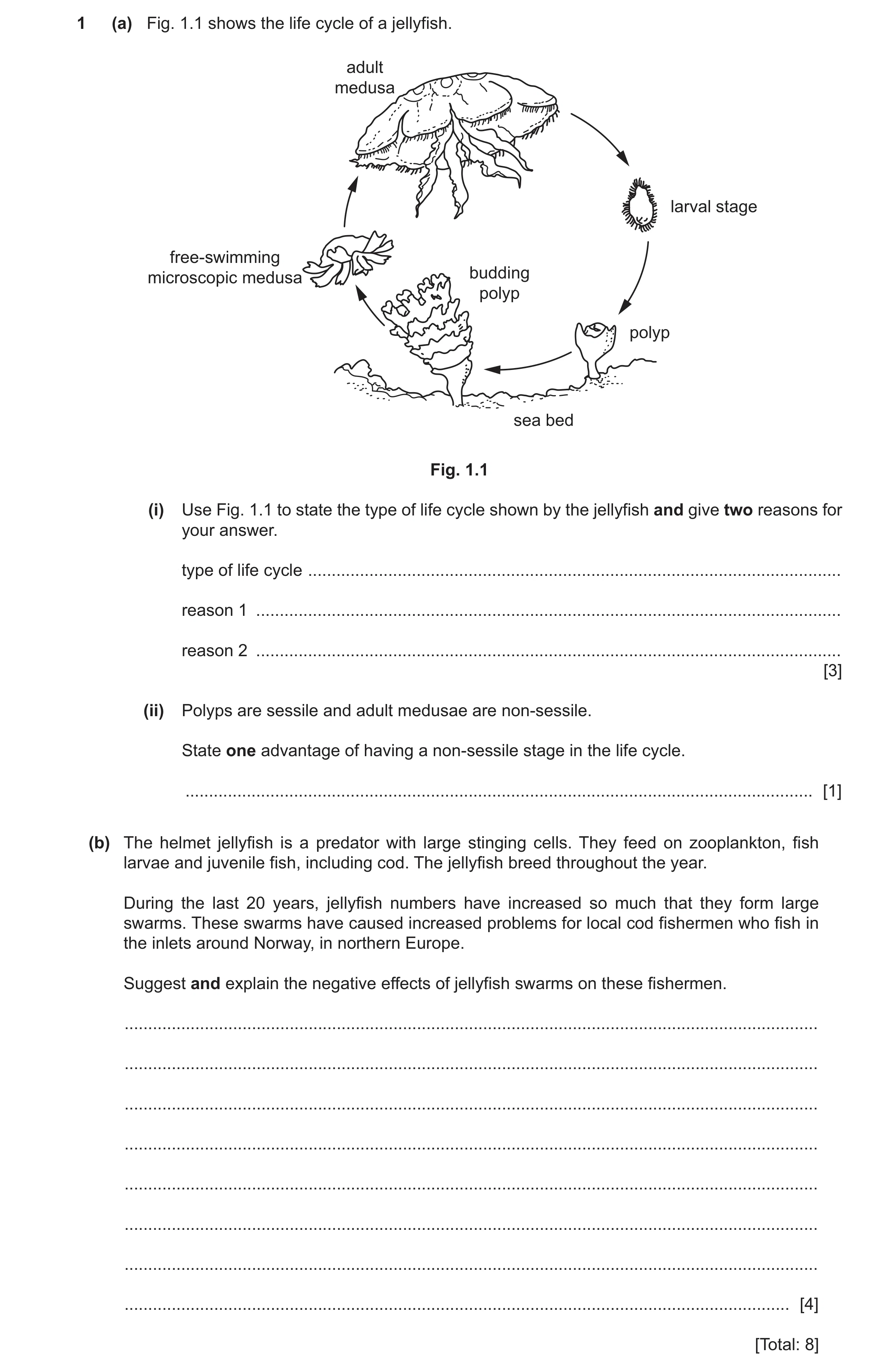
Q23 · The life cycle of a jellyfish 9693/31 Oct/Nov 2025
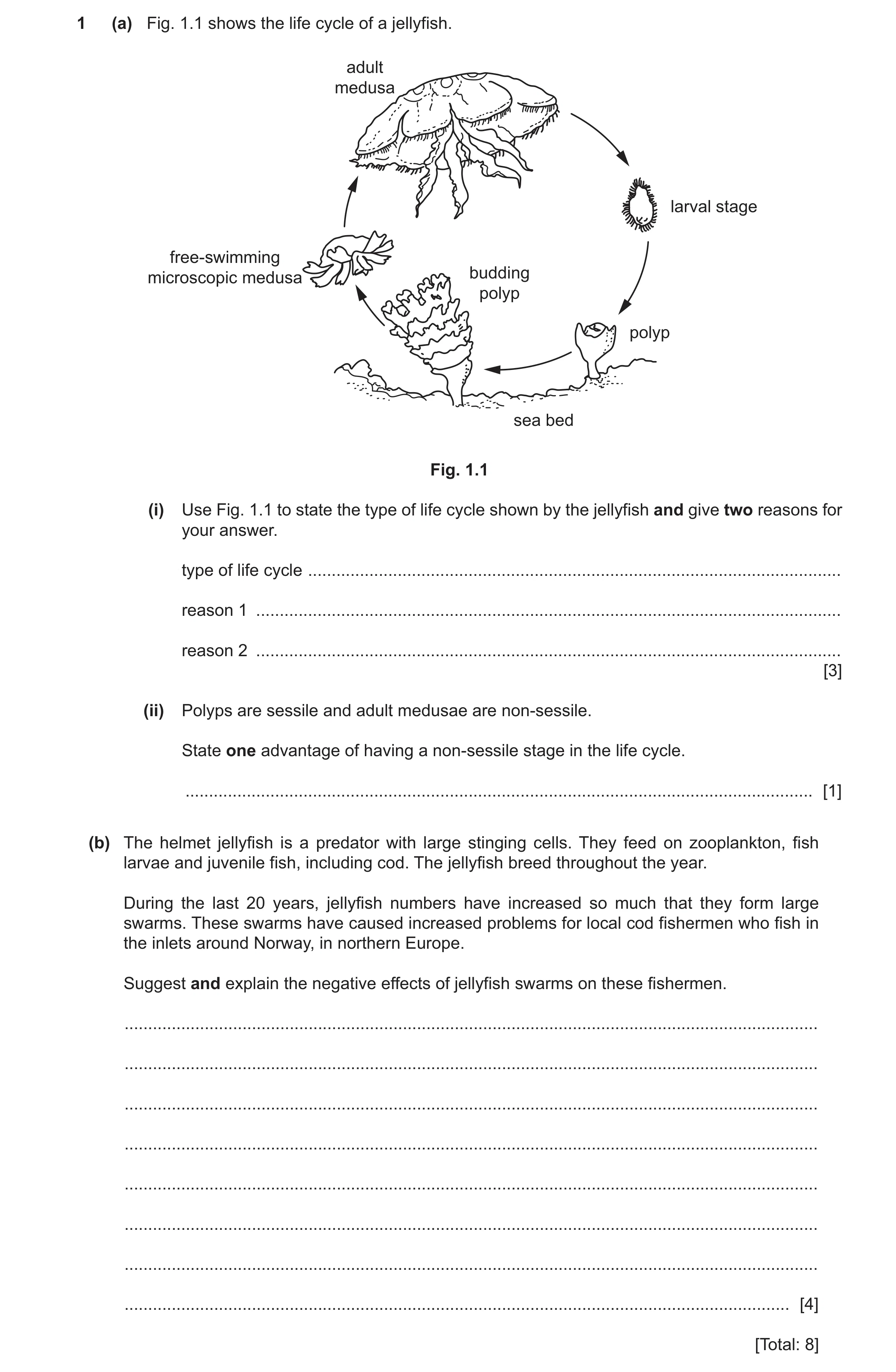
1 (a) Fig. 1.1 shows the life cycle of a jellyfish. adult medusa larval stage free-swimming budding microscopic medusa polyp polyp sea bed Fig. 1.1 (i) Use Fig. 1.1 to state the type of life cycle shown by the jellyfish and give two reasons for your answer. type of life cycle … reason 1 … reason 2 … [3] (ii) Polyps are sessile and adult medusae are non-sessile. State one advantage of having a non-sessile stage in the life cycle. … [1] (b) The helmet jellyfish is a predator with large stinging cells. They feed on zooplankton, fish larvae and juvenile fish, including cod. The jellyfish breed throughout the year. During the last 20 years, jellyfish numbers have increased so much that they form large swarms. These swarms have caused increased problems for local cod fishermen who fish in the inlets around Norway, in northern Europe. Suggest and explain the negative effects of jellyfish swarms on these fishermen. … … … … … … … … [4] [Total: 8]
8 marks
Mark scheme: Question Answer Marks 1(a)(i) type of life cycle: complex ; 3 reasons: larval stages present ; metamorphosis shown / polyp and medusa present ; 1(a)(ii) idea of dispersal ; 1 1(b) any four of: 4 1 fishermen get stung by jellyfish so, cannot fish / need treatment ; 2 reduced catch of fish (as nets fill with jellyfish) / jellyfish increase by-catch, so reducing, income / employment for fishermen ; 3 idea that large swarms, clog boat propeller / interfere with navigation, so preventing movement (of boat) ; 4 extra time spent on, cleaning nets / propeller instead of fishing reduces income ; 5 harvested fish, damaged / killed by stinging cells from jellyfish, so lower price obtained for fish ; 6 travel further / out from inlet, to fish (due to swarms), so more money spent on fuel / time wasted reaching shoal ; 7 decaying swarms use up oxygen in the water, so less available for fish ; 8 jellyfish prey on, cod eggs / juveniles or compete with cod for prey so, recruitment reduced / fewer cod survive to adulthood ;
This question in 9693/31 Oct/Nov 2025
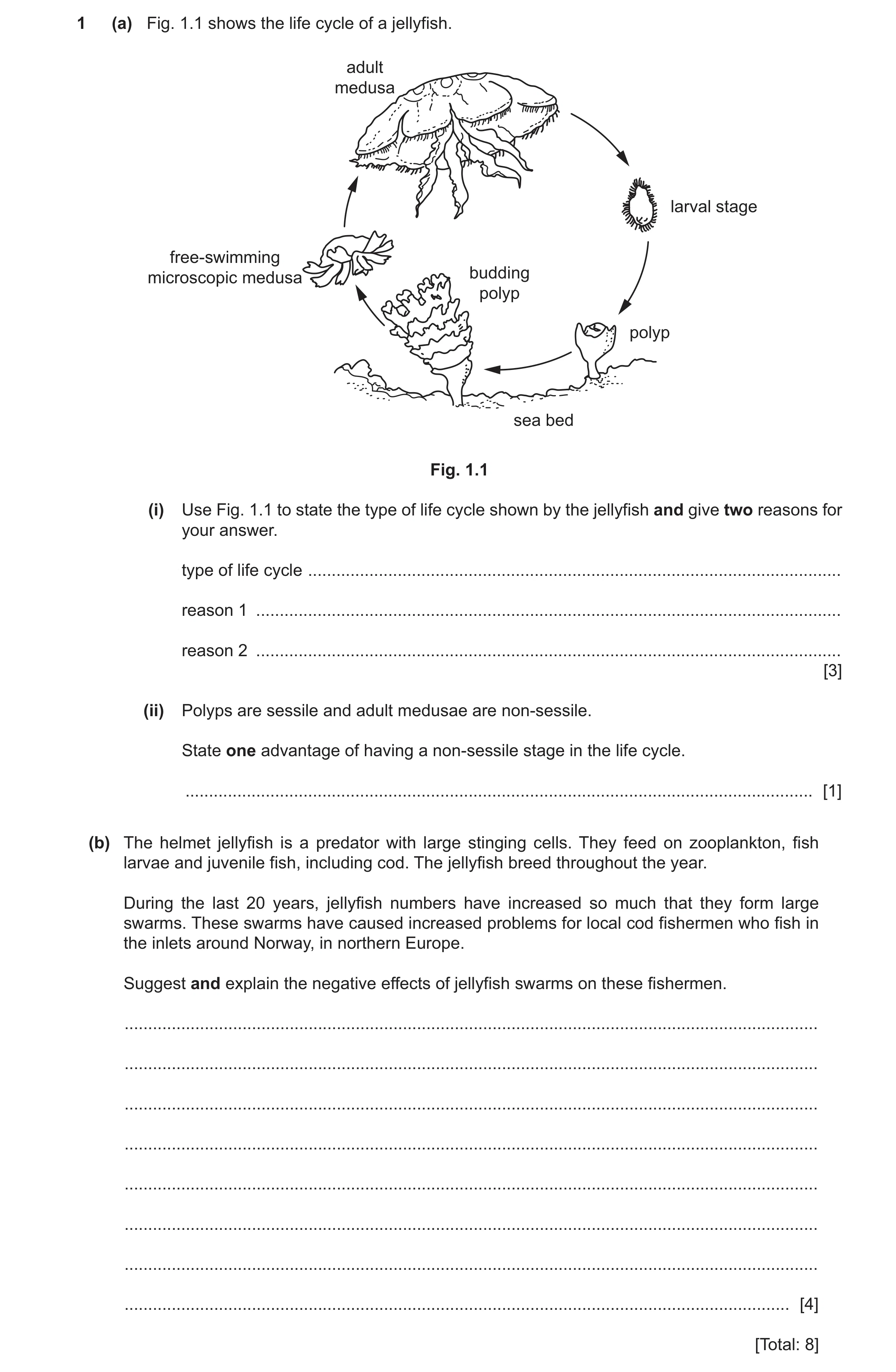
Q24 · The life cycle of a jellyfish 9693/32 Oct/Nov 2025
1 (a) Fig. 1.1 shows the life cycle of a jellyfish. adult medusa larval stage free-swimming budding microscopic medusa polyp polyp sea bed Fig. 1.1 (i) Use Fig. 1.1 to state the type of life cycle shown by the jellyfish and give two reasons for your answer. type of life cycle … reason 1 … reason 2 … [3] (ii) Polyps are sessile and adult medusae are non-sessile. State one advantage of having a non-sessile stage in the life cycle. … [1] (b) The helmet jellyfish is a predator with large stinging cells. They feed on zooplankton, fish larvae and juvenile fish, including cod. The jellyfish breed throughout the year. During the last 20 years, jellyfish numbers have increased so much that they form large swarms. These swarms have caused increased problems for local cod fishermen who fish in the inlets around Norway, in northern Europe. Suggest and explain the negative effects of jellyfish swarms on these fishermen. … … … … … … … … [4] [Total: 8]
8 marks
Mark scheme: Question Answer Marks 1(a)(i) type of life cycle: complex ; 3 reasons: larval stages present ; metamorphosis shown / polyp and medusa present ; 1(a)(ii) idea of dispersal ; 1 1(b) any four of: 4 1 fishermen get stung by jellyfish so, cannot fish / need treatment ; 2 reduced catch of fish (as nets fill with jellyfish) / jellyfish increase by-catch, so reducing, income / employment for fishermen ; 3 idea that large swarms, clog boat propeller / interfere with navigation, so preventing movement (of boat) ; 4 extra time spent on, cleaning nets / propeller instead of fishing reduces income ; 5 harvested fish, damaged / killed by stinging cells from jellyfish, so lower price obtained for fish ; 6 travel further / out from inlet, to fish (due to swarms), so more money spent on fuel / time wasted reaching shoal ; 7 decaying swarms use up oxygen in the water, so less available for fish ; 8 jellyfish prey on, cod eggs / juveniles or compete with cod for prey so, recruitment reduced / fewer cod survive to adulthood ;
This question in 9693/32 Oct/Nov 2025
Q25 · The life cycle of a jellyfish 9693/33 Oct/Nov 2025
1 (a) Fig. 1.1 shows the life cycle of a jellyfish. adult medusa larval stage free-swimming budding microscopic medusa polyp polyp sea bed Fig. 1.1 (i) Use Fig. 1.1 to state the type of life cycle shown by the jellyfish and give two reasons for your answer. type of life cycle … reason 1 … reason 2 … [3] (ii) Polyps are sessile and adult medusae are non-sessile. State one advantage of having a non-sessile stage in the life cycle. … [1] (b) The helmet jellyfish is a predator with large stinging cells. They feed on zooplankton, fish larvae and juvenile fish, including cod. The jellyfish breed throughout the year. During the last 20 years, jellyfish numbers have increased so much that they form large swarms. These swarms have caused increased problems for local cod fishermen who fish in the inlets around Norway, in northern Europe. Suggest and explain the negative effects of jellyfish swarms on these fishermen. … … … … … … … … [4] [Total: 8]
8 marks
Mark scheme: Question Answer Marks 1(a)(i) type of life cycle: complex ; 3 reasons: larval stages present ; metamorphosis shown / polyp and medusa present ; 1(a)(ii) idea of dispersal ; 1 1(b) any four of: 4 1 fishermen get stung by jellyfish so, cannot fish / need treatment ; 2 reduced catch of fish (as nets fill with jellyfish) / jellyfish increase by-catch, so reducing, income / employment for fishermen ; 3 idea that large swarms, clog boat propeller / interfere with navigation, so preventing movement (of boat) ; 4 extra time spent on, cleaning nets / propeller instead of fishing reduces income ; 5 harvested fish, damaged / killed by stinging cells from jellyfish, so lower price obtained for fish ; 6 travel further / out from inlet, to fish (due to swarms), so more money spent on fuel / time wasted reaching shoal ; 7 decaying swarms use up oxygen in the water, so less available for fish ; 8 jellyfish prey on, cod eggs / juveniles or compete with cod for prey so, recruitment reduced / fewer cod survive to adulthood ;
This question in 9693/33 Oct/Nov 2025
 3 / 46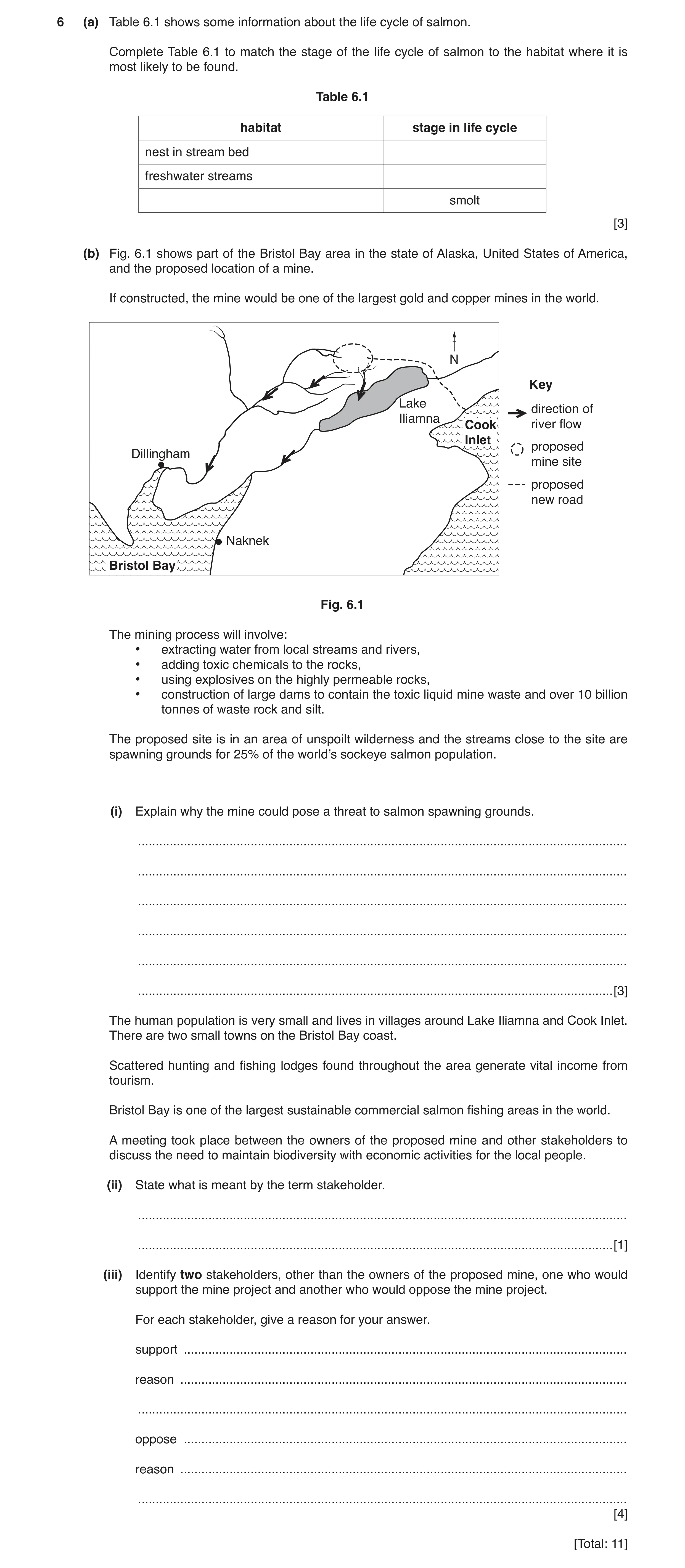
 36 / 46
 37 / 46
 38 / 46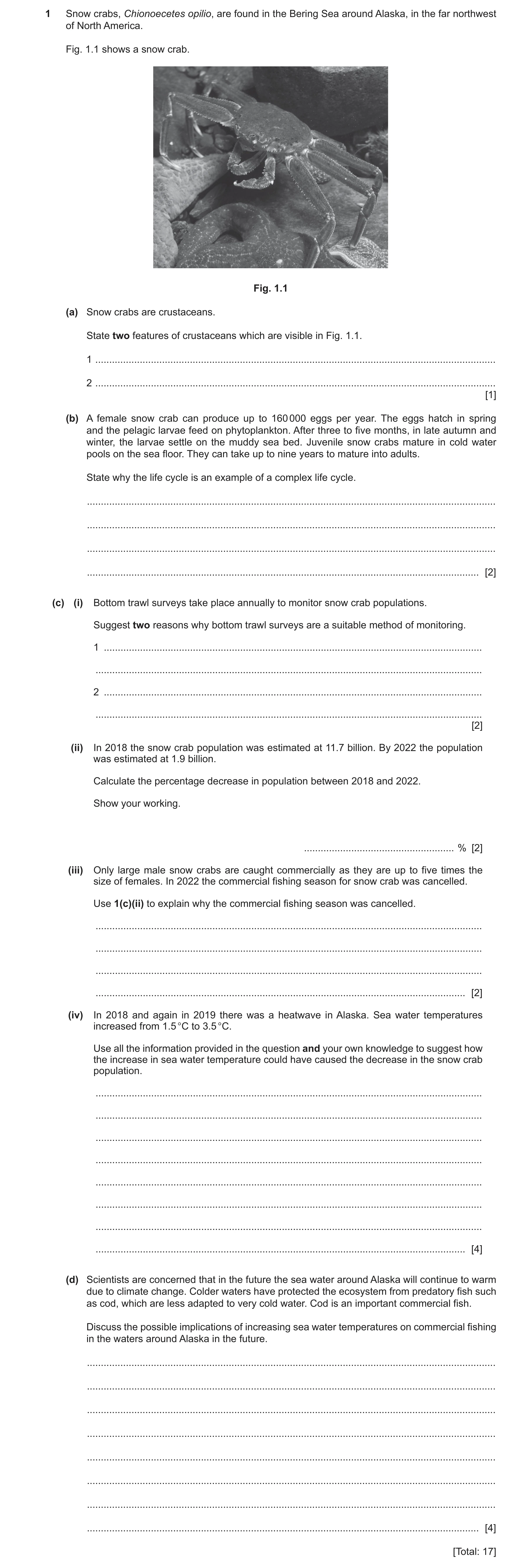
 9
9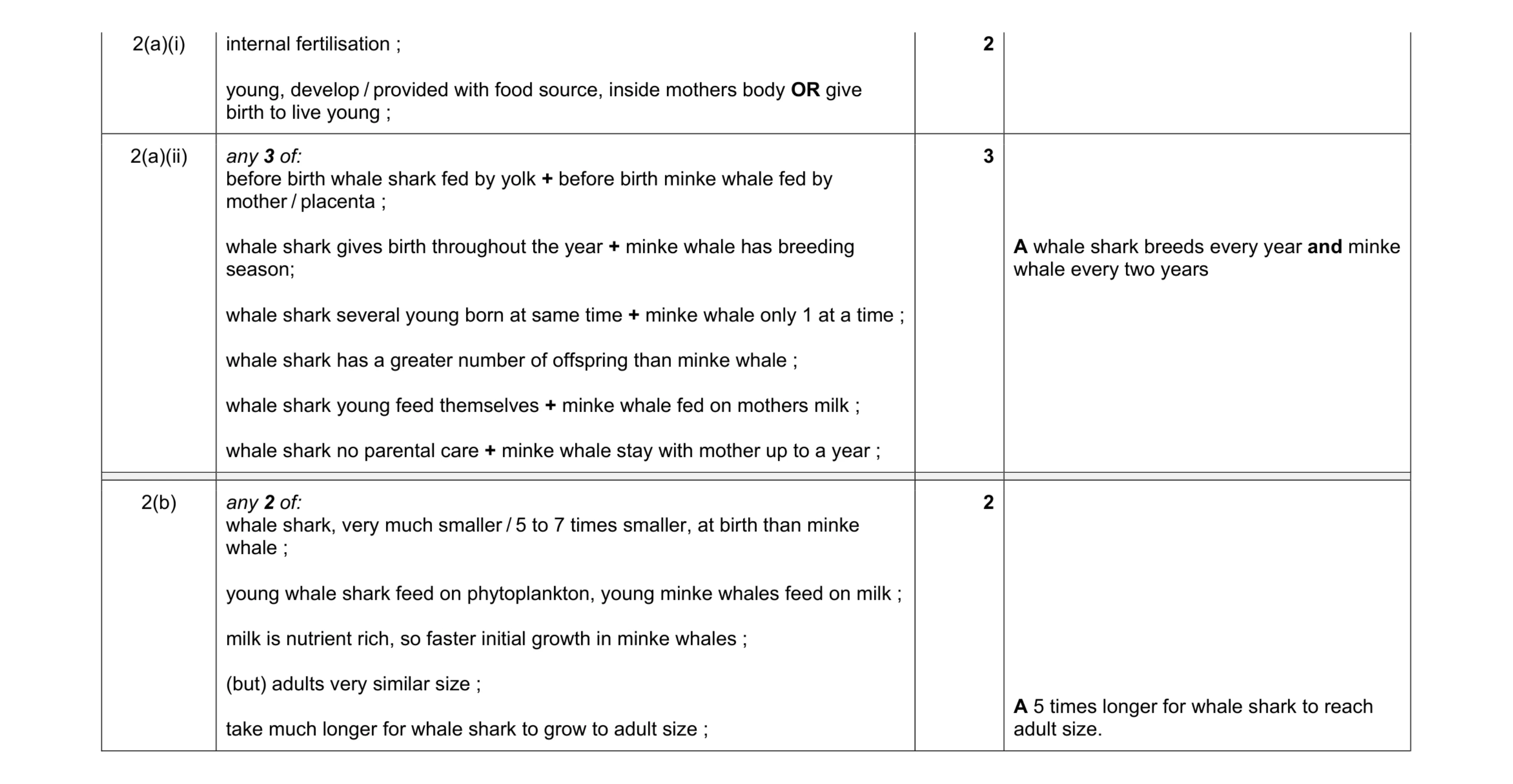 7
7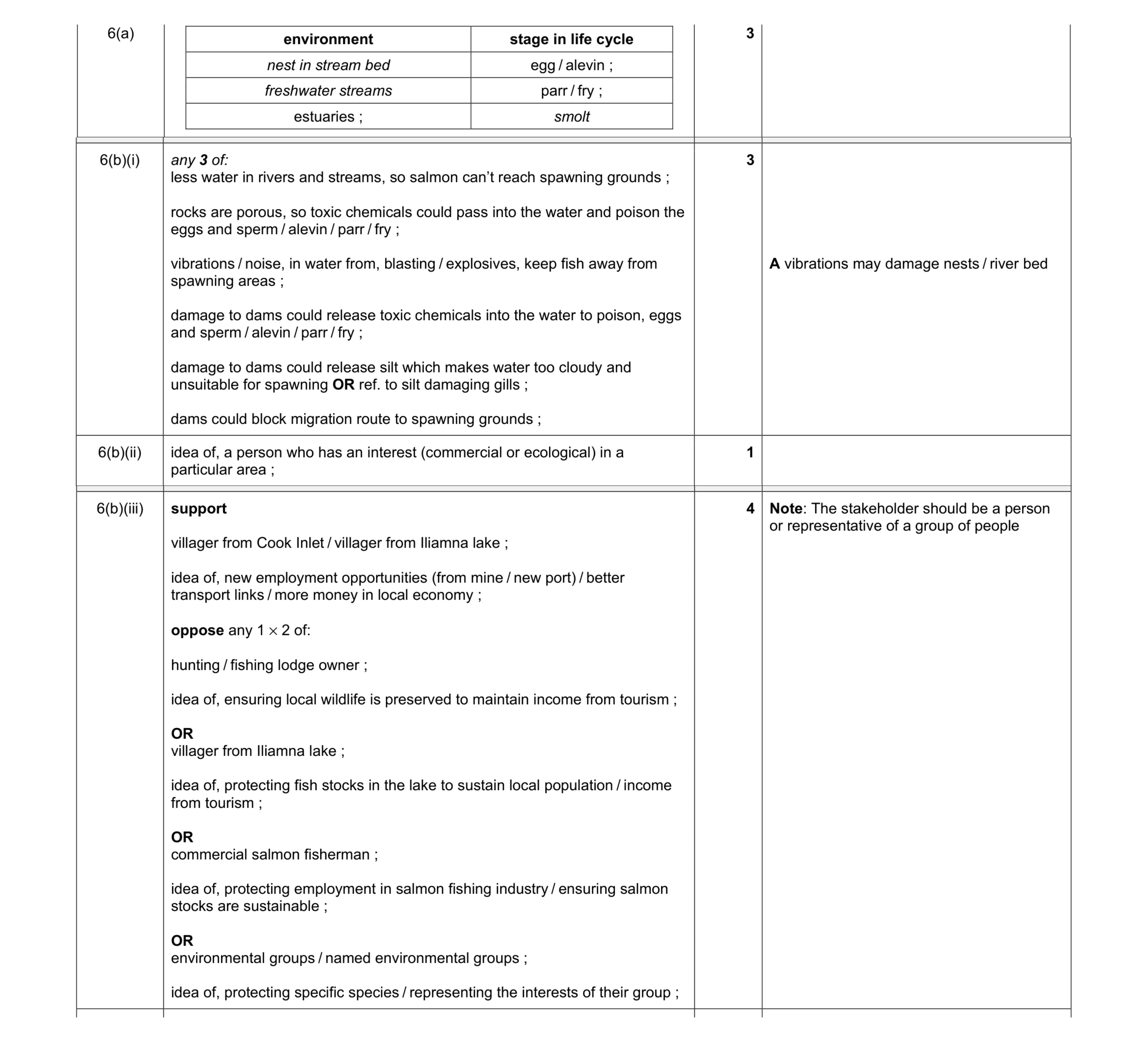 11
11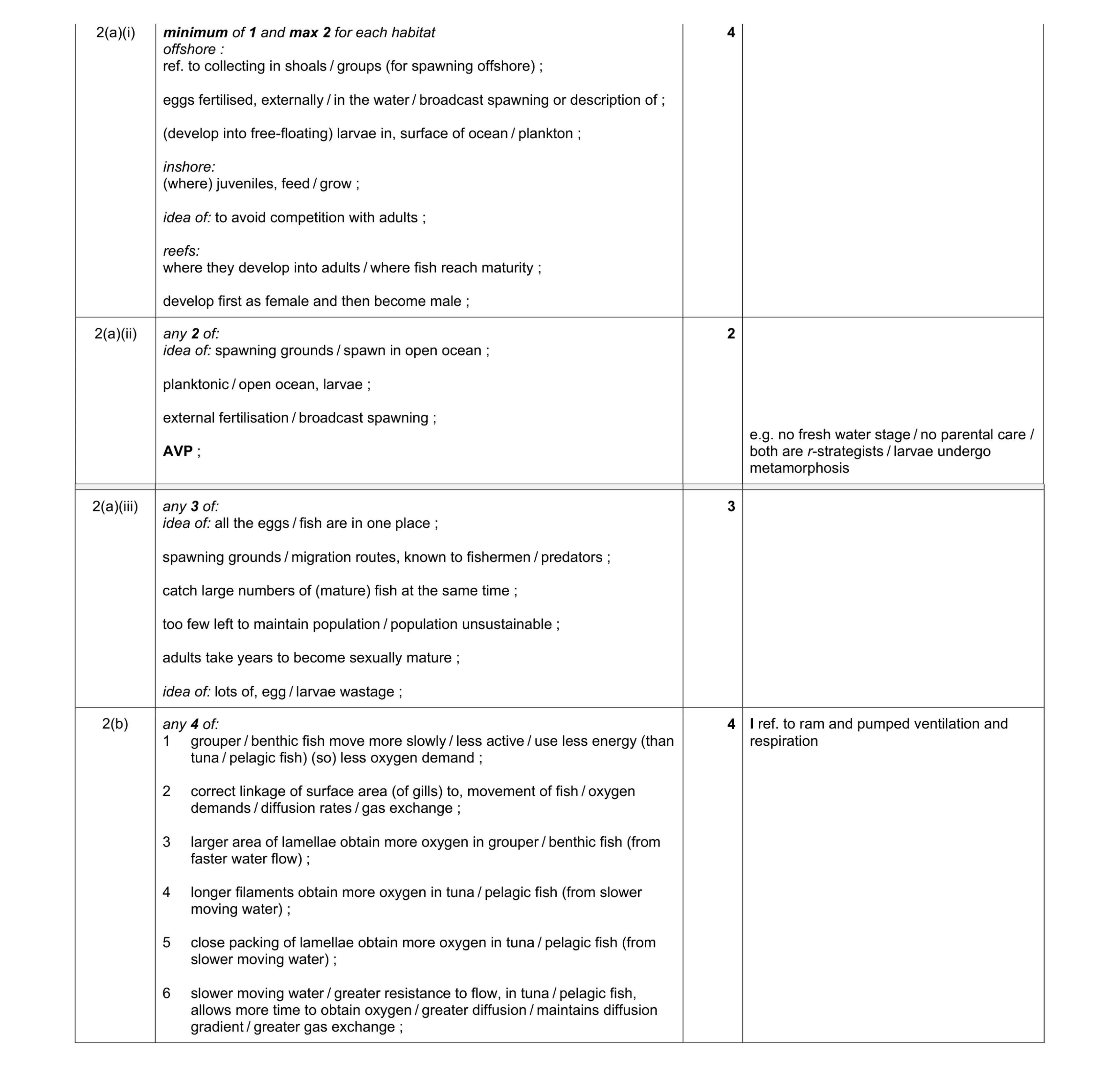 13
13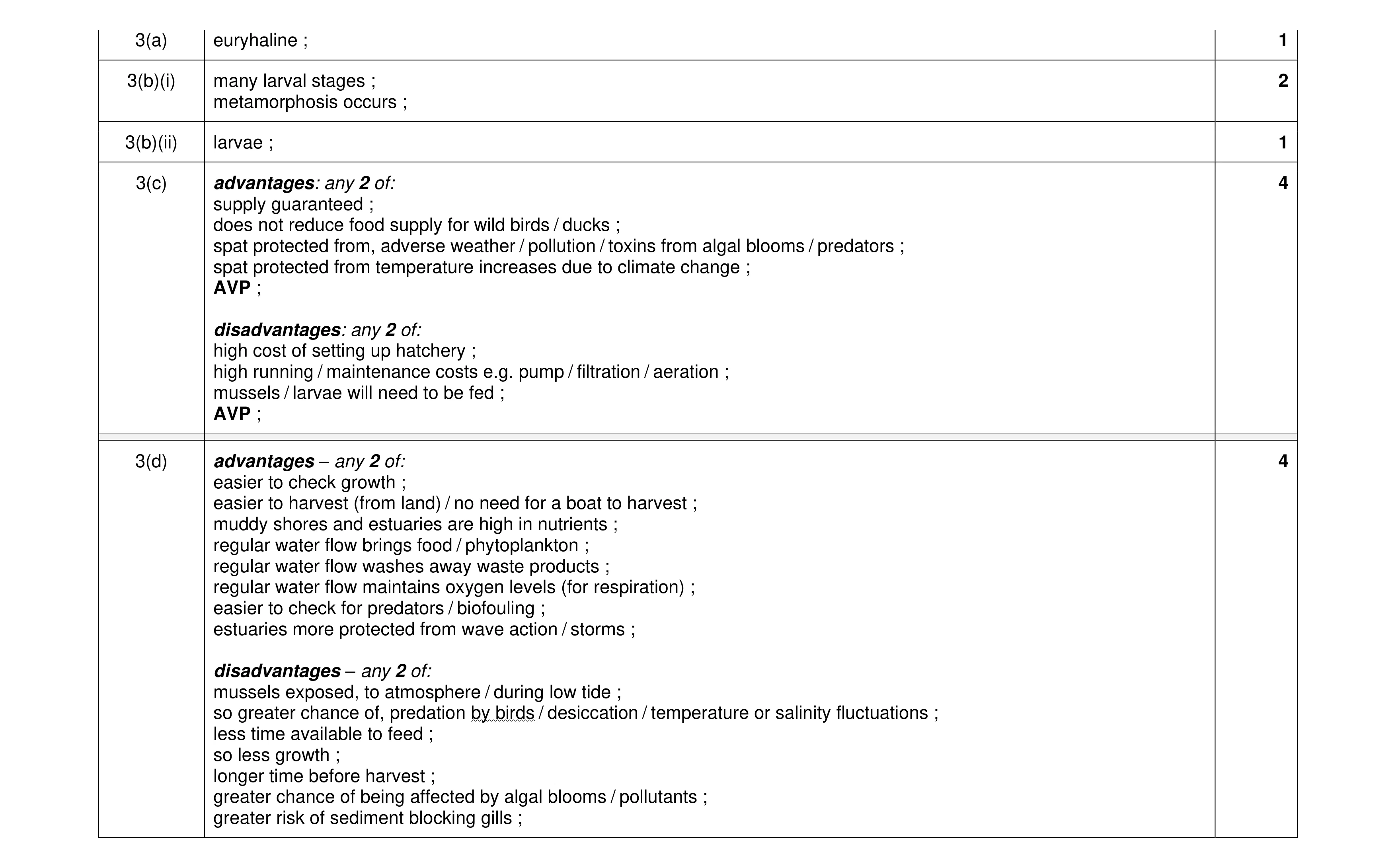 12
12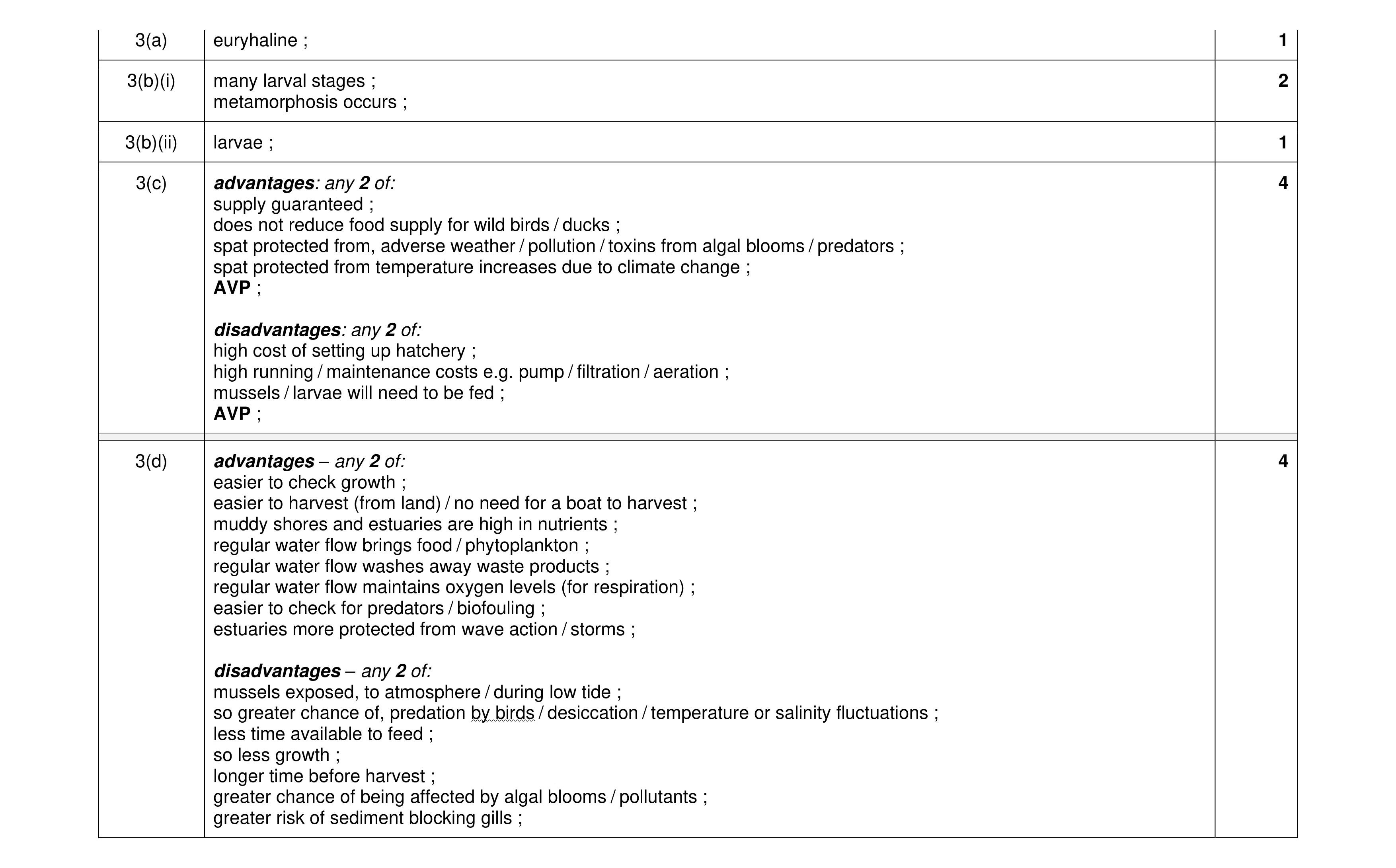 12
12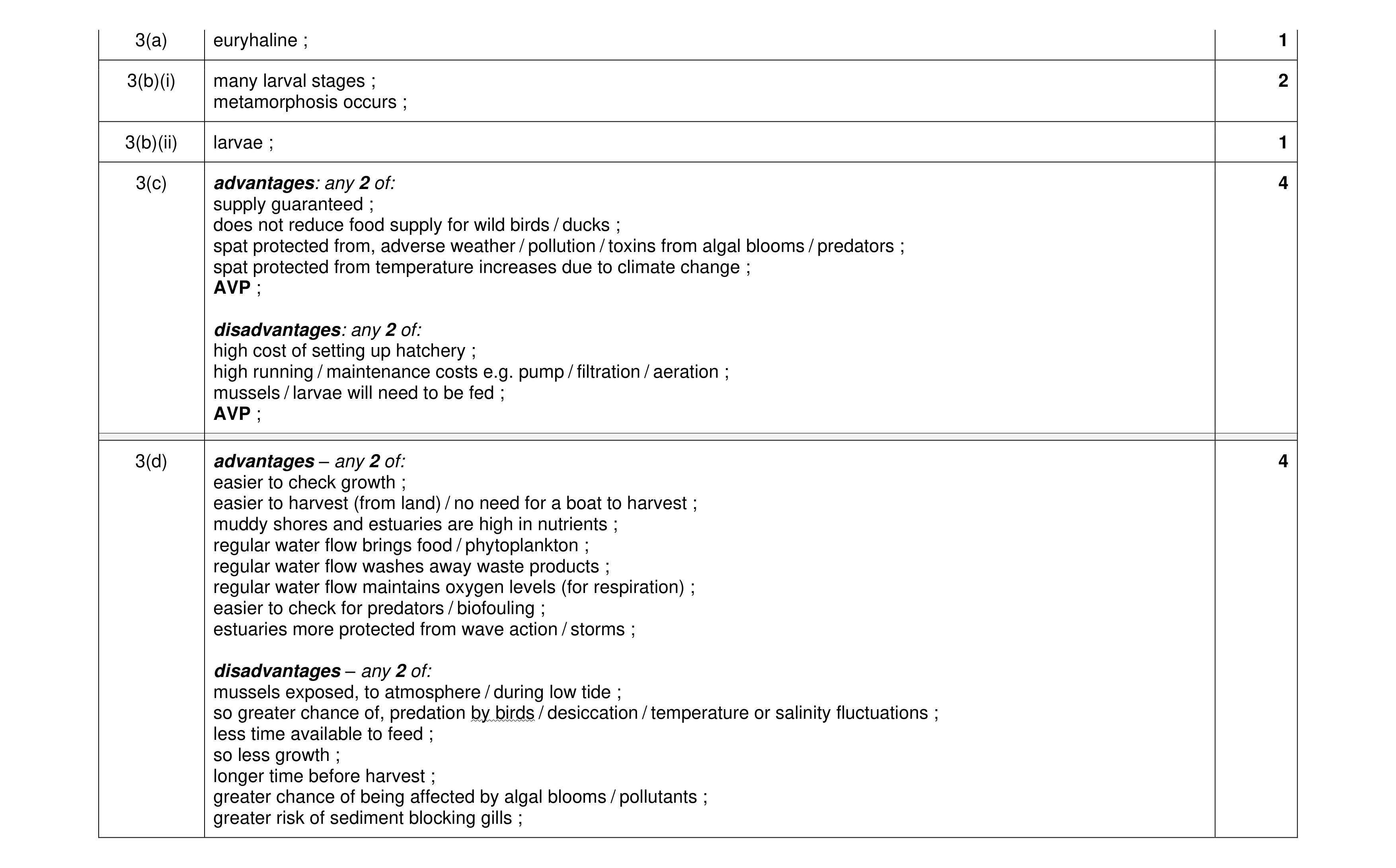 12
12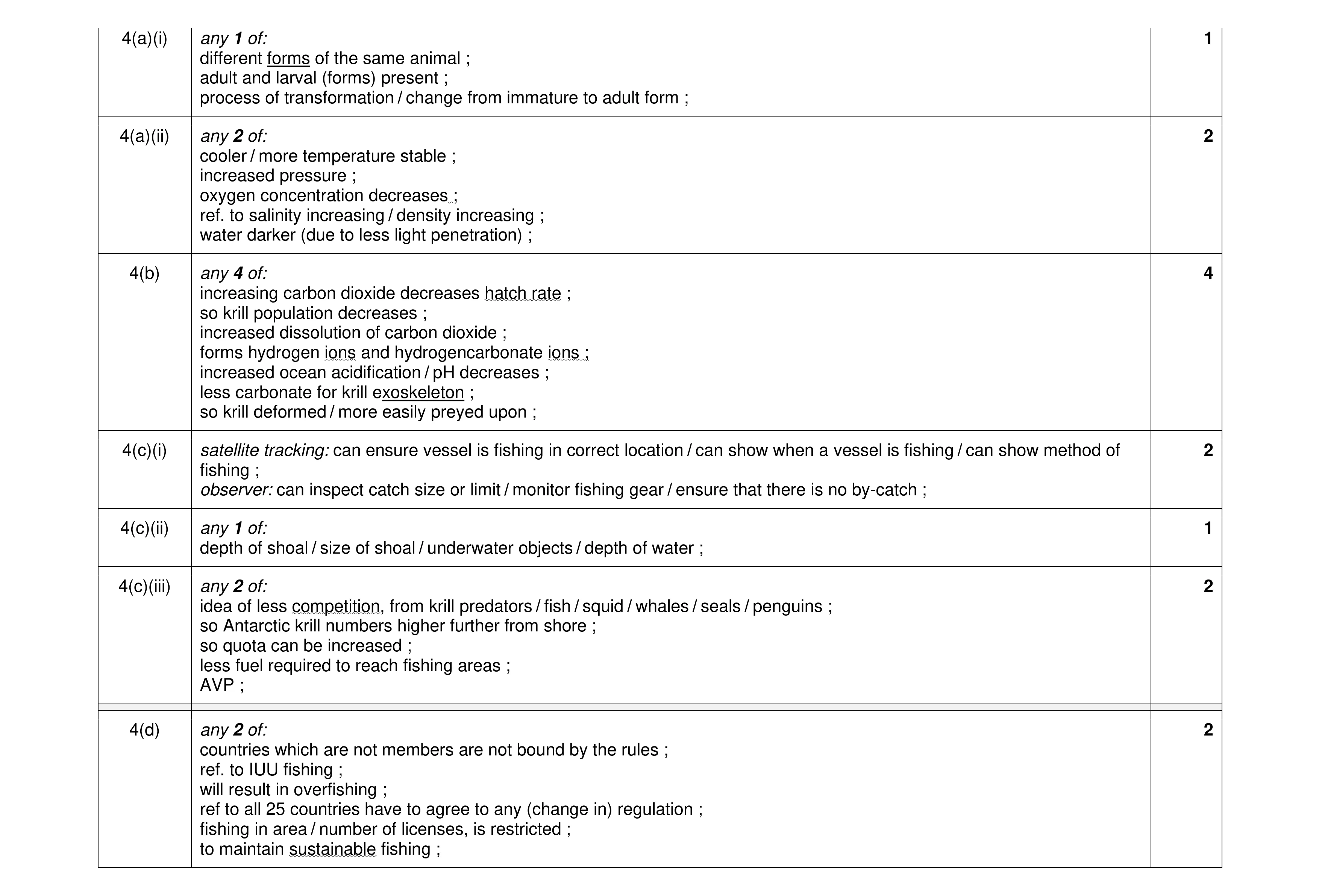 14
14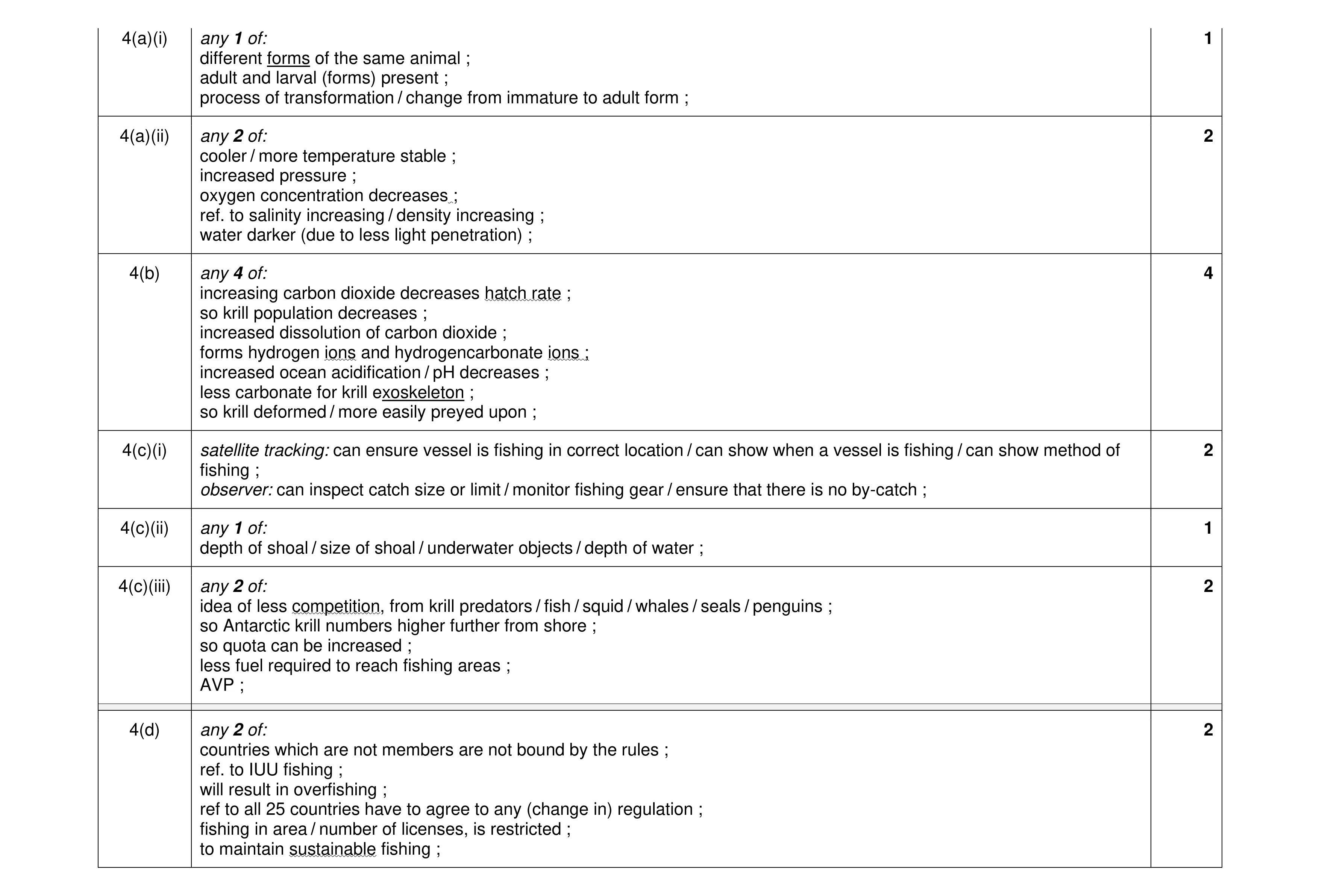 14
14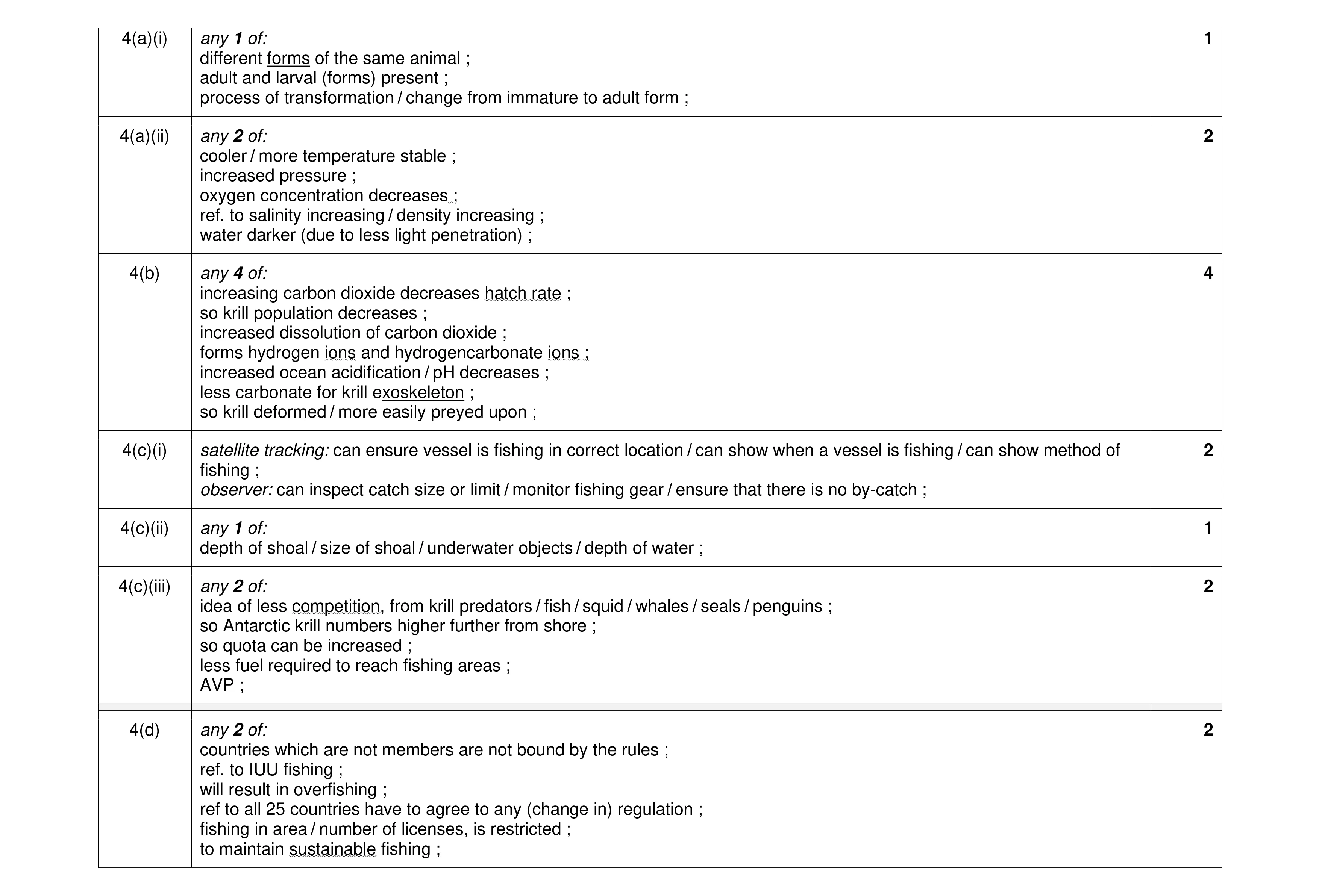 14
14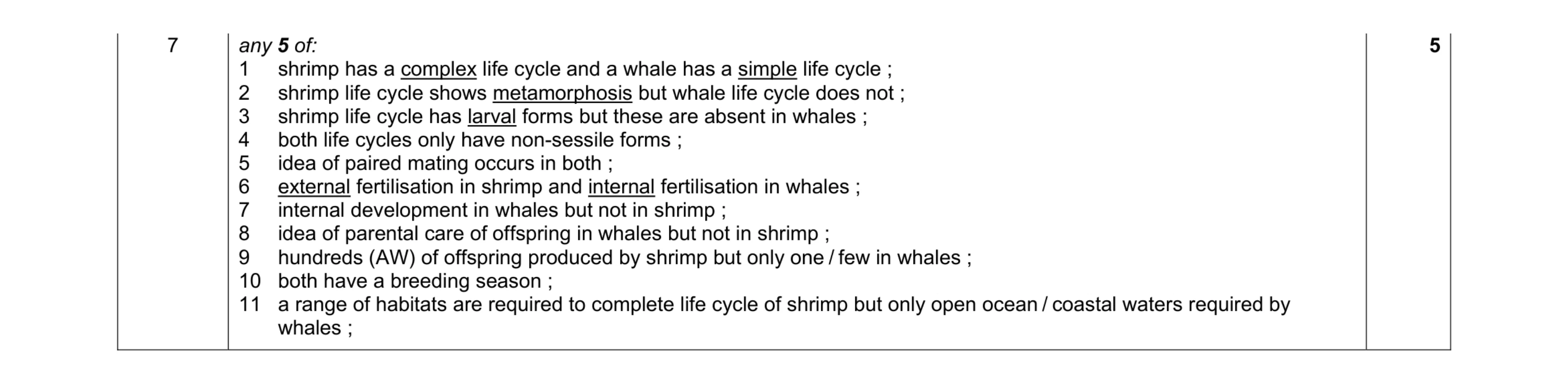 5
5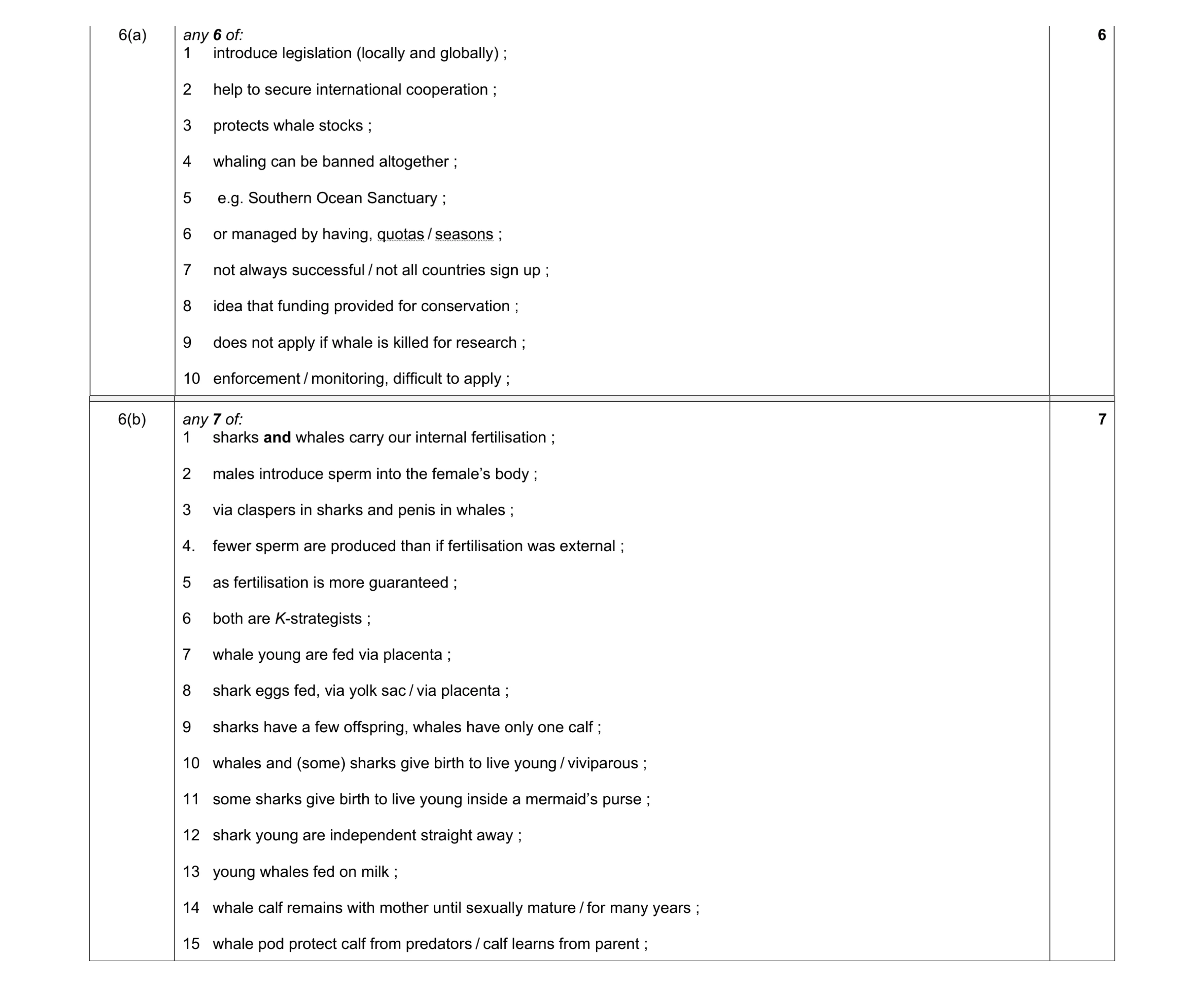 13
13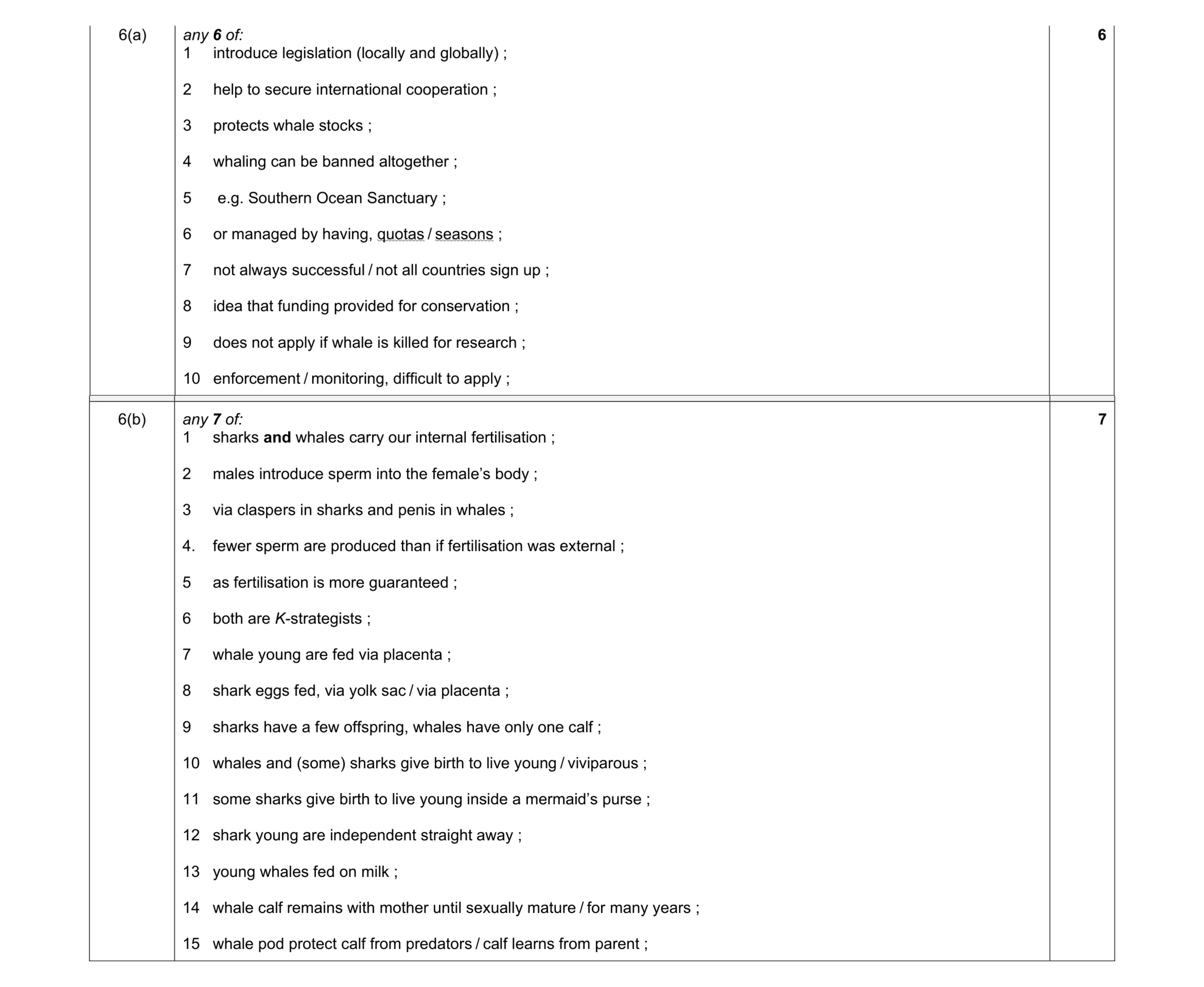 13
13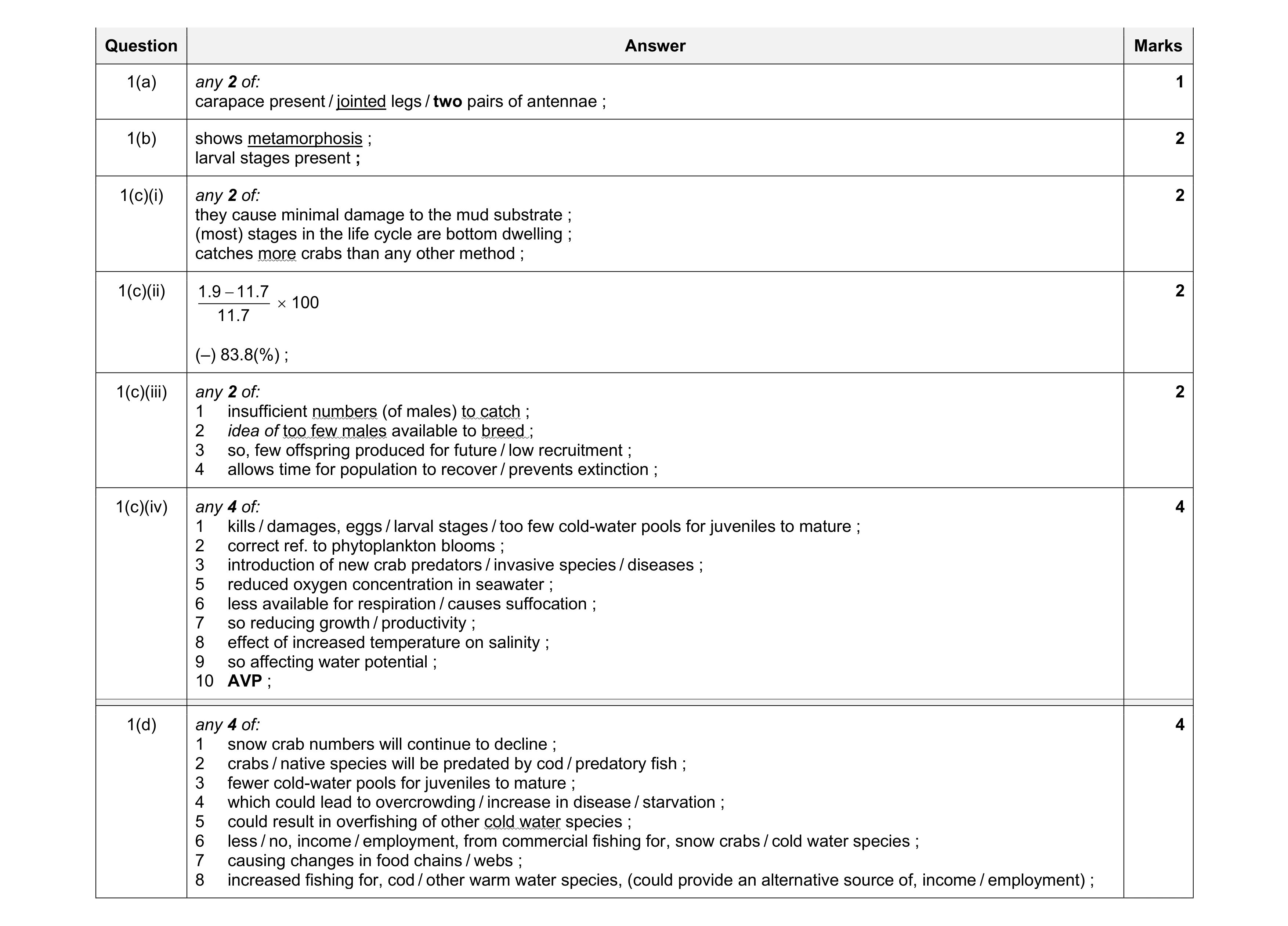 17
17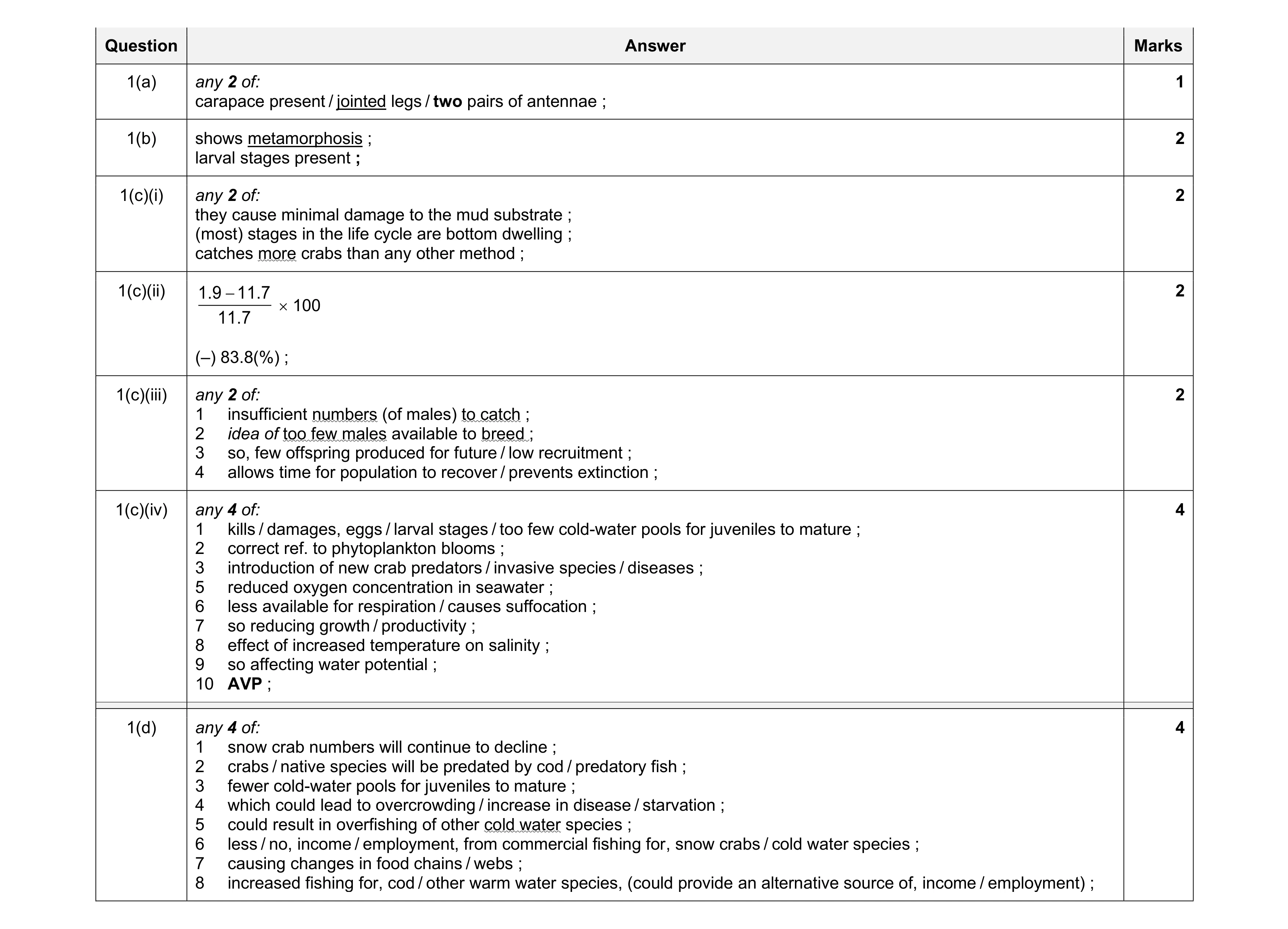 17
17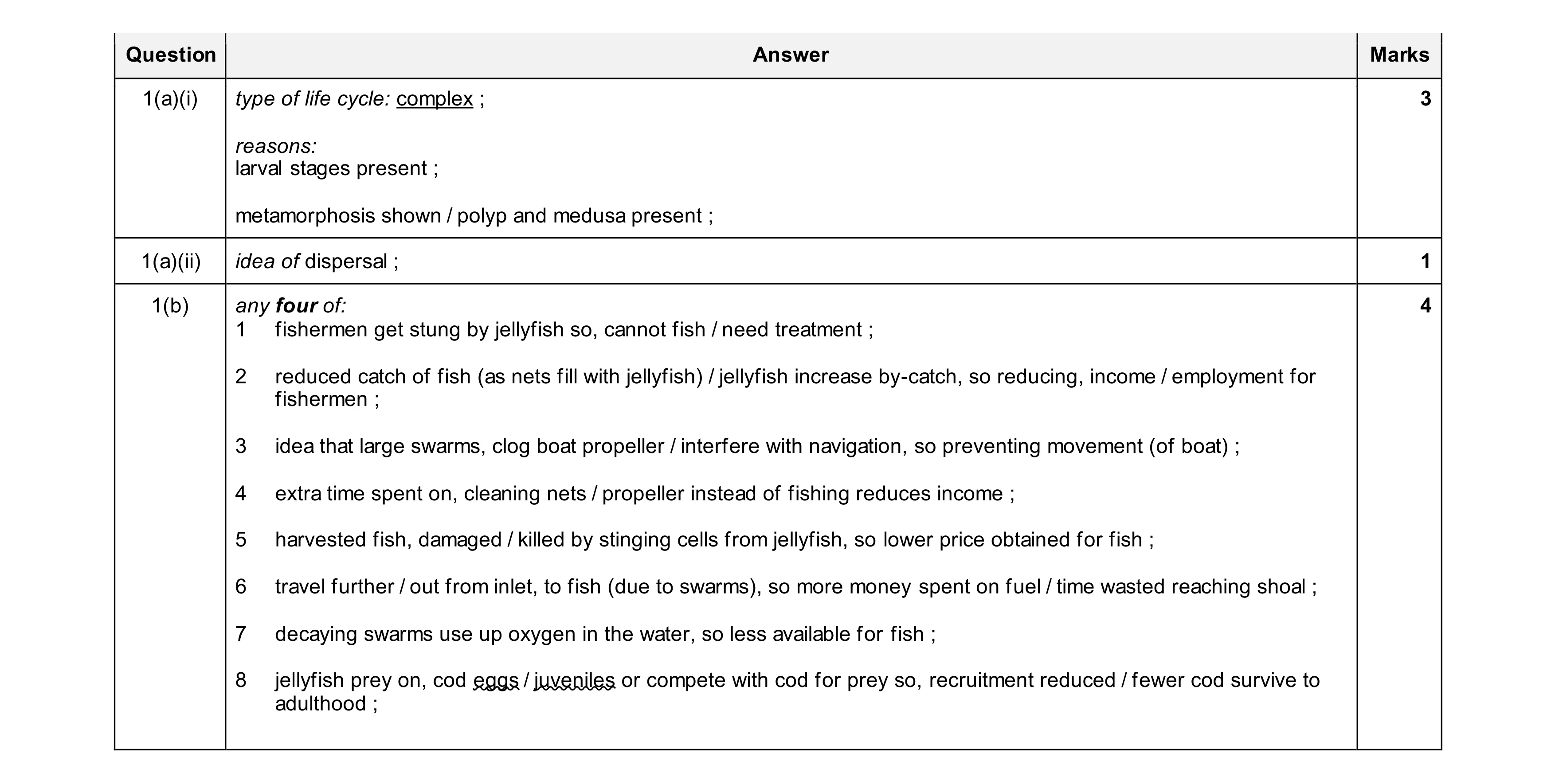 8
8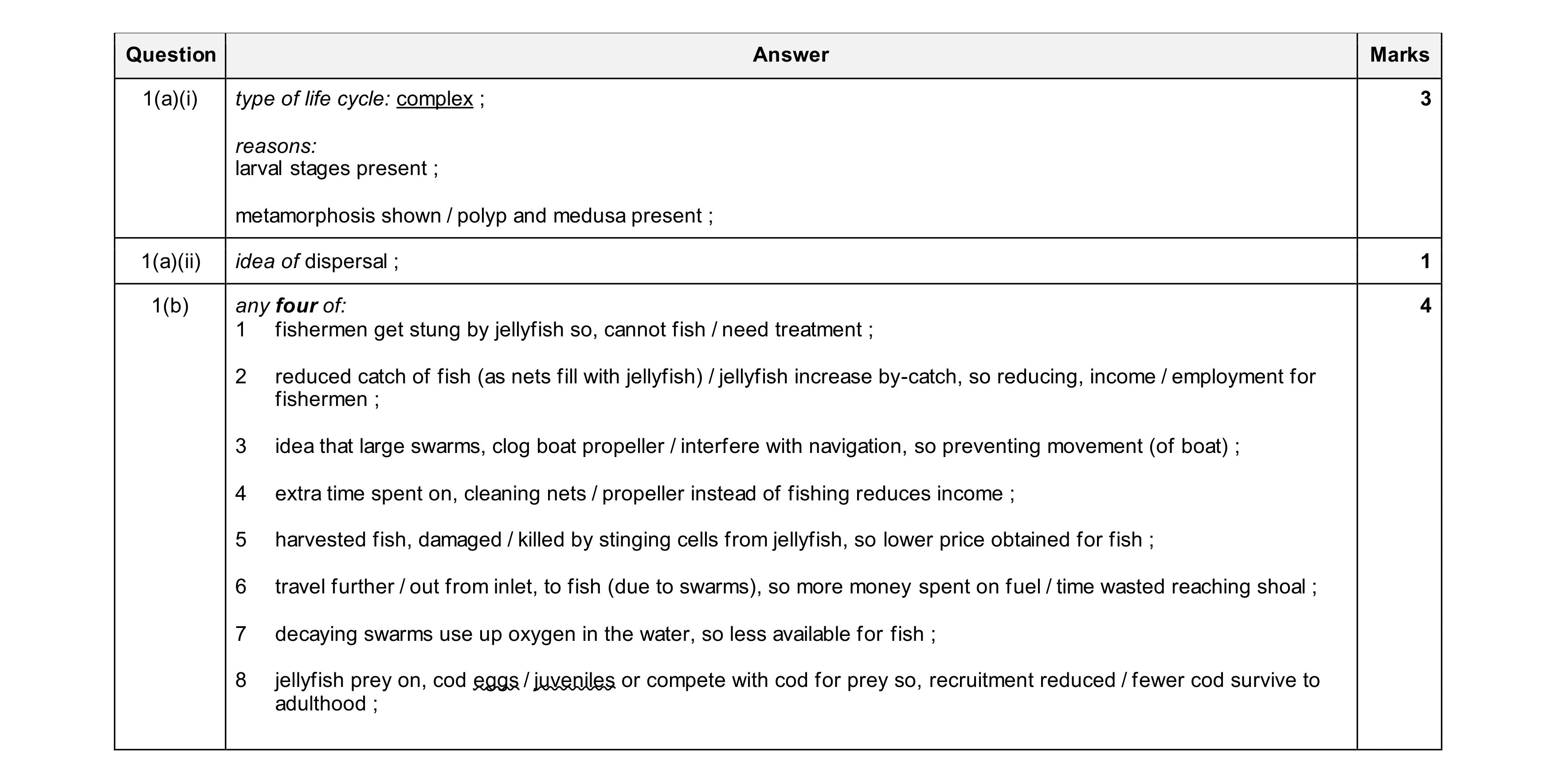 8
8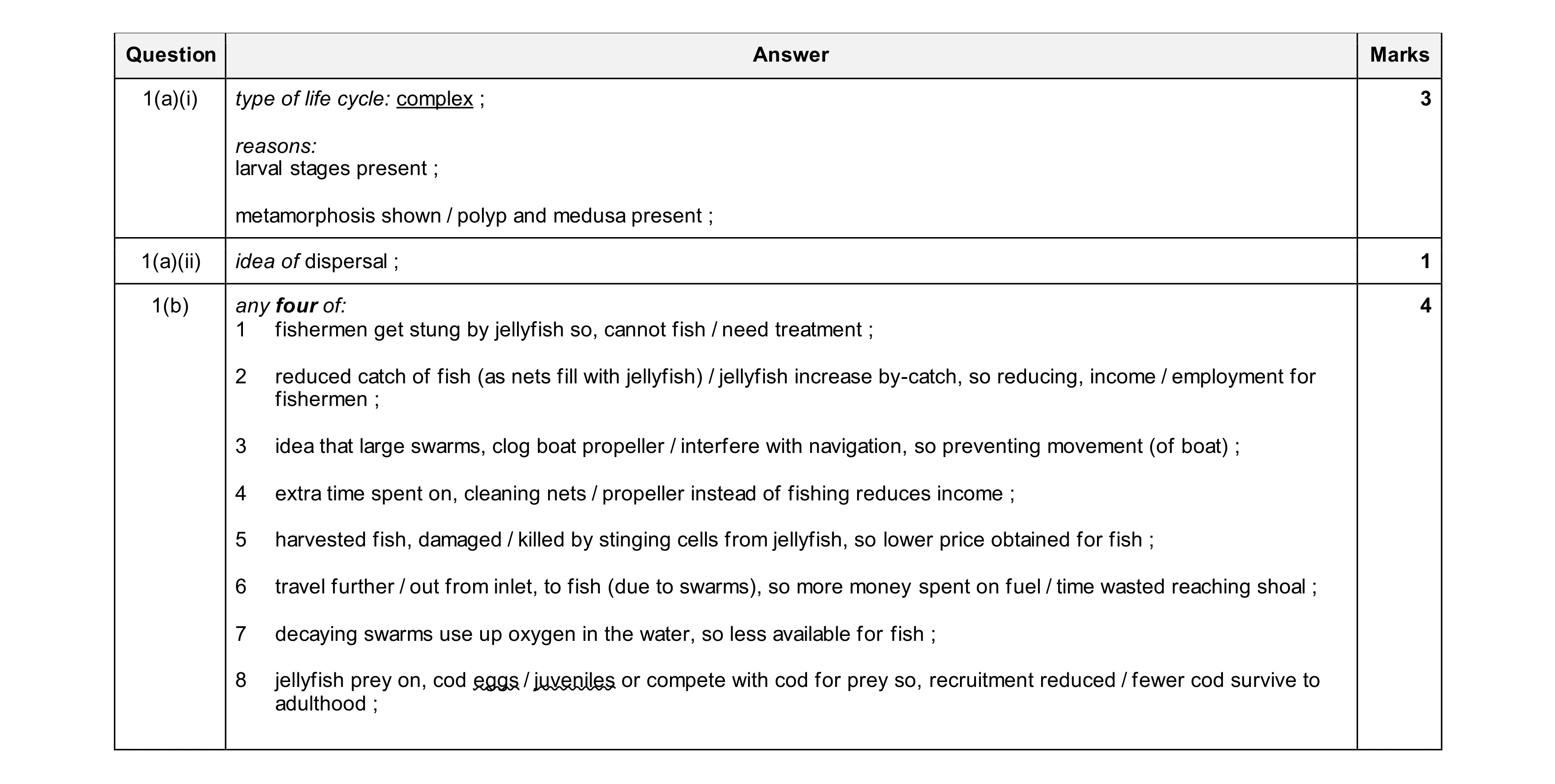 8
8