Questions as text
Q1 · An economy’s GDP per capita grows over a certain period of time, but its development when… 9708/31 Oct/Nov 2009
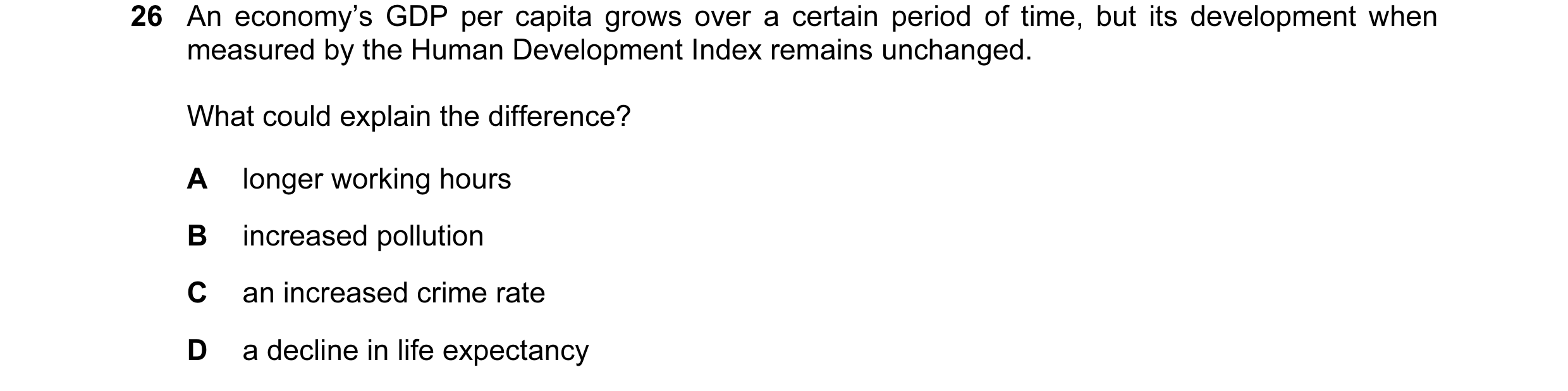
26 An economy’s GDP per capita grows over a certain period of time, but its development when measured by the Human Development Index remains unchanged. What could explain the difference? A longer working hours B increased pollution C an increased crime rate D a decline in life expectancy
1 marks
Answer: D
This question in 9708/31 Oct/Nov 2009
Q2 · An economy’s GDP per capita grows over a certain period of time, but its development when… 9708/32 Oct/Nov 2009
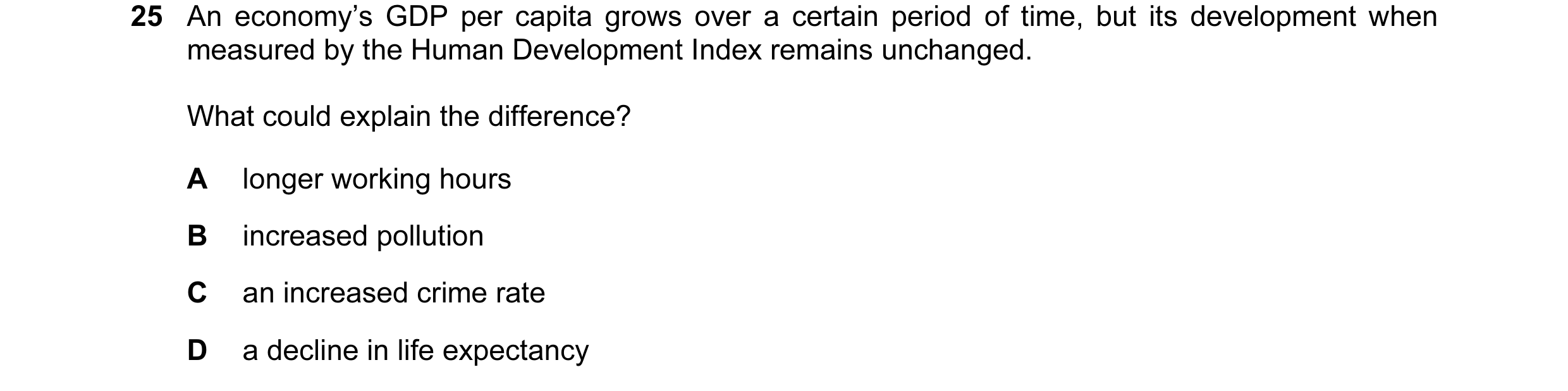
25 An economy’s GDP per capita grows over a certain period of time, but its development when measured by the Human Development Index remains unchanged. What could explain the difference? A longer working hours B increased pollution C an increased crime rate D a decline in life expectancy
1 marks
Answer: D
This question in 9708/32 Oct/Nov 2009
Q3 · What could explain why the terms of trade of most developing economies tend to worsen… 9708/31 May/June 2010
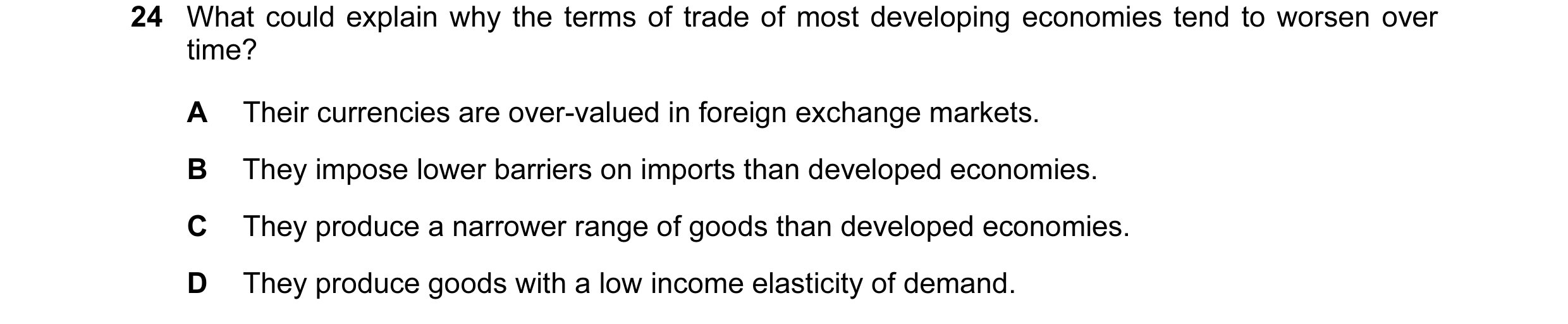
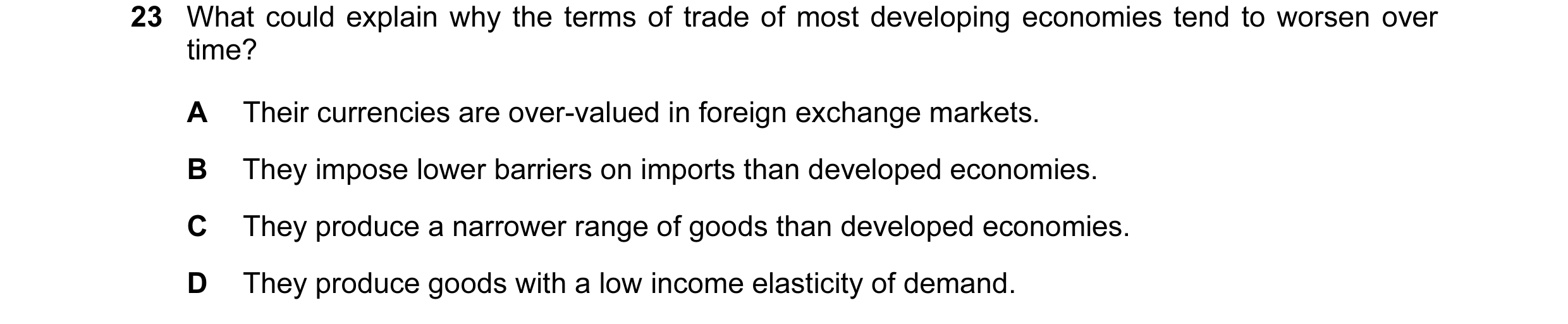
24 What could explain why the terms of trade of most developing economies tend to worsen over time? A Their currencies are over-valued in foreign exchange markets. B They impose lower barriers on imports than developed economies. C They produce a narrower range of goods than developed economies. D They produce goods with a low income elasticity of demand.
1 marks
Answer: D
This question in 9708/31 May/June 2010
Q4 · A government requires all its young citizens to undertake community service for a period… 9708/32 May/June 2010
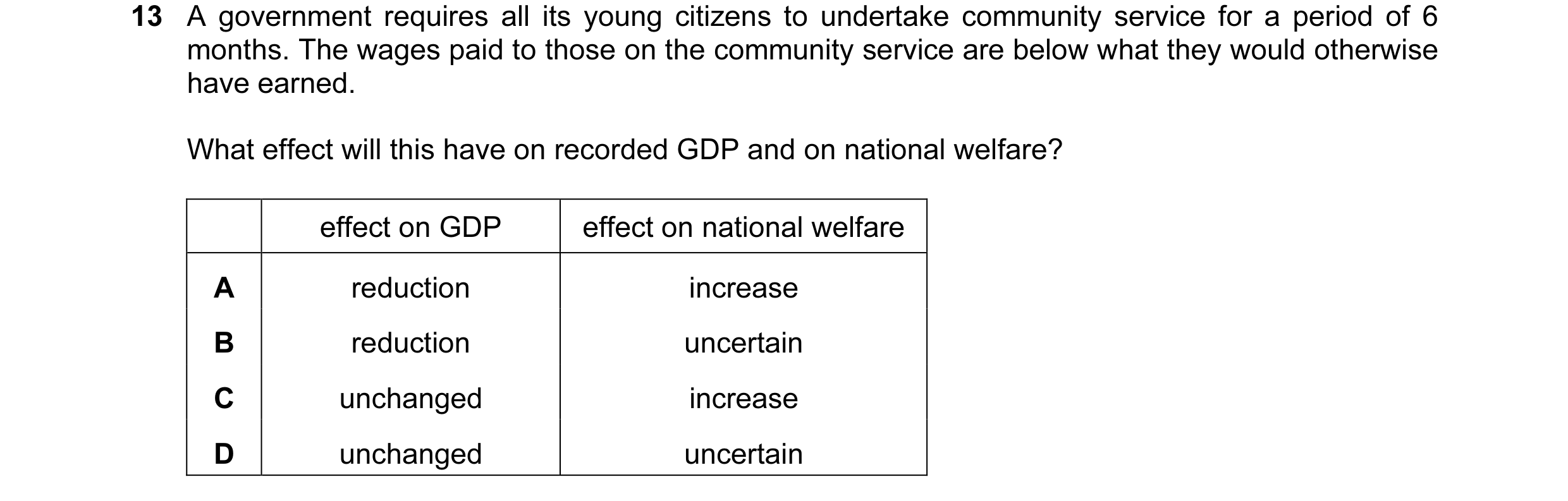
13 A government requires all its young citizens to undertake community service for a period of 6 months. The wages paid to those on the community service are below what they would otherwise have earned. What effect will this have on recorded GDP and on national welfare? effect on GDP effect on national welfare A reduction increase B reduction uncertain C unchanged increase D unchanged uncertain
1 marks
Answer: B
This question in 9708/32 May/June 2010
Q5 · What could explain why the terms of trade of most developing economies tend to worsen… 9708/33 May/June 2010
23 What could explain why the terms of trade of most developing economies tend to worsen over time? A Their currencies are over-valued in foreign exchange markets. B They impose lower barriers on imports than developed economies. C They produce a narrower range of goods than developed economies. D They produce goods with a low income elasticity of demand.
1 marks
Answer: D
This question in 9708/33 May/June 2010
Q6 · Which cause of economic growth would involve the least cost for present and future… 9708/31 May/June 2011
22 Which cause of economic growth would involve the least cost for present and future generations of a country’s population? A increased exploitation of a country’s mineral resources B investment financed by borrowing from abroad C investment financed by high rates of domestic savings D technological innovations in productive processes
1 marks
Answer: D
This question in 9708/31 May/June 2011
Q7 · Which cause of economic growth would involve the least cost for present and future… 9708/33 May/June 2011
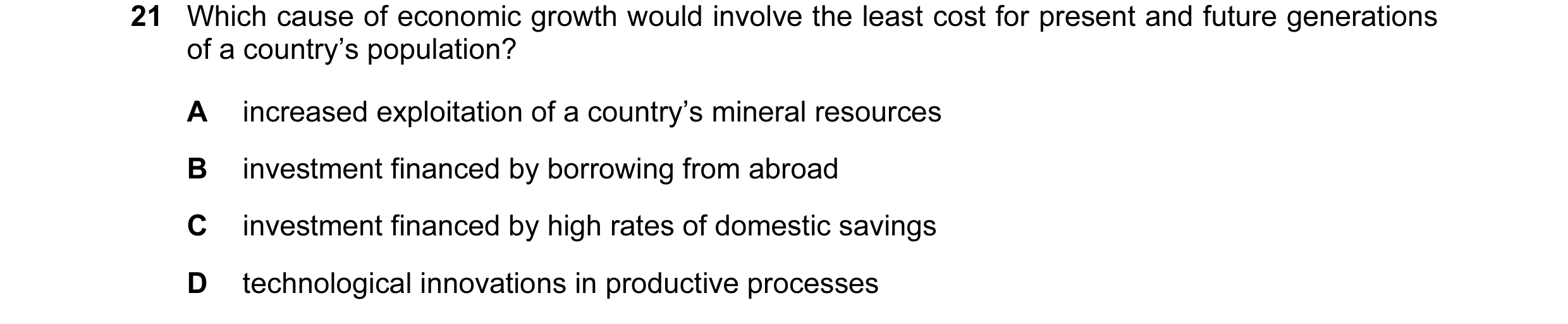
21 Which cause of economic growth would involve the least cost for present and future generations of a country’s population? A increased exploitation of a country’s mineral resources B investment financed by borrowing from abroad C investment financed by high rates of domestic savings D technological innovations in productive processes
1 marks
Answer: D
This question in 9708/33 May/June 2011
Q8 · Economists have proposed that the best policy to promote development is ‘trade not aid’ 9708/31 Oct/Nov 2011
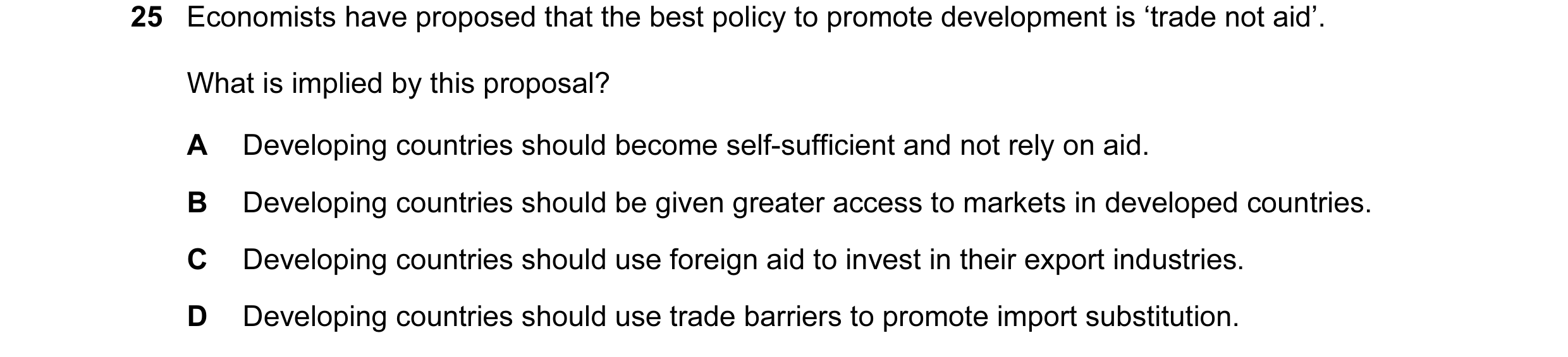
25 Economists have proposed that the best policy to promote development is ‘trade not aid’. What is implied by this proposal? A Developing countries should become self-sufficient and not rely on aid. B Developing countries should be given greater access to markets in developed countries. C Developing countries should use foreign aid to invest in their export industries. D Developing countries should use trade barriers to promote import substitution.
1 marks
Answer: B
This question in 9708/31 Oct/Nov 2011
Q9 · Which change would directly affect a country’s Human Development Index? 9708/32 Oct/Nov 2011
16 Which change would directly affect a country’s Human Development Index? A a change in average hours worked by the labour force B a change in life expectancy of the population C a change in the level of carbon dioxide emissions D a change in the size of the population
1 marks
Answer: B
This question in 9708/32 Oct/Nov 2011
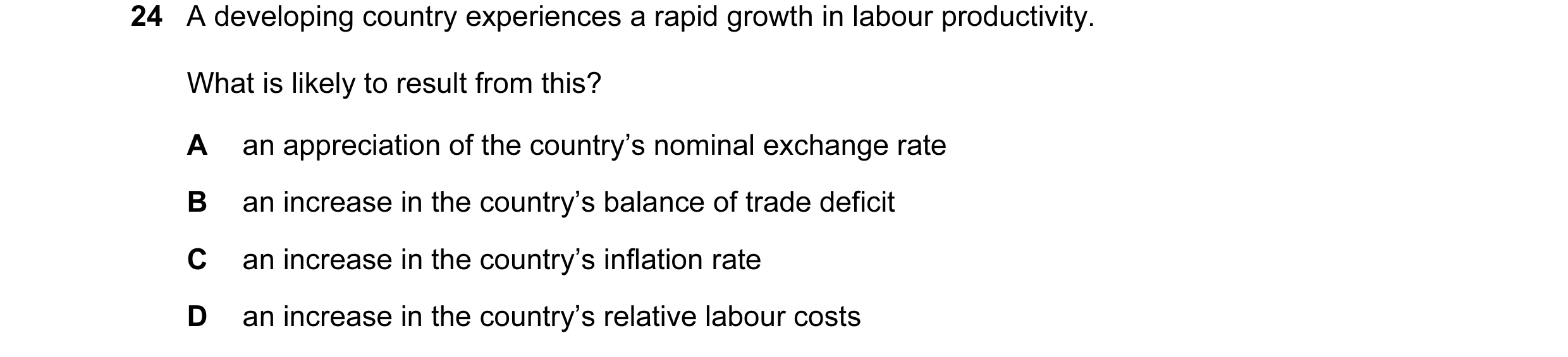
Q10 · A developing country experiences a rapid growth in labour productivity 9708/32 Oct/Nov 2011
24 A developing country experiences a rapid growth in labour productivity. What is likely to result from this? A an appreciation of the country’s nominal exchange rate B an increase in the country’s balance of trade deficit C an increase in the country’s inflation rate D an increase in the country’s relative labour costs
1 marks
Answer: A
This question in 9708/32 Oct/Nov 2011
Q11 · What is likely to result from foreign direct investment in developing economies? 9708/33 Oct/Nov 2011
25 What is likely to result from foreign direct investment in developing economies? A a reduction in local wage levels B a reduction in tax revenues in developing economies C a reduction in the range of consumer goods available to the local population D a worsening of net income flows from investments
1 marks
Answer: D
This question in 9708/33 Oct/Nov 2011
Q12 · What is likely to result from the discovery of oil reserves in a developing economy? 9708/31 May/June 2012
26 What is likely to result from the discovery of oil reserves in a developing economy? A a more equal distribution of income and wealth B an increase in the real exchange rate C an increase in the competitiveness of commercial agriculture D a reduction in the volume of imports of manufactured goods
1 marks
Answer: B
This question in 9708/31 May/June 2012
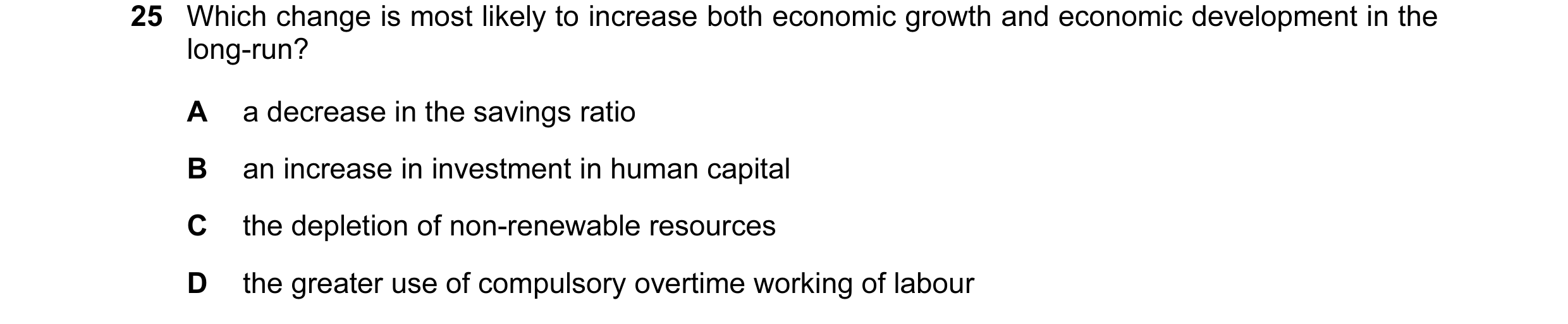
Q13 · Which change is most likely to increase both economic growth and economic development in… 9708/32 May/June 2012
25 Which change is most likely to increase both economic growth and economic development in the long-run? A a decrease in the savings ratio B an increase in investment in human capital C the depletion of non-renewable resources D the greater use of compulsory overtime working of labour
1 marks
Answer: B
This question in 9708/32 May/June 2012
Q14 · What is likely to result from the discovery of oil reserves in a developing economy? 9708/32 May/June 2012
26 What is likely to result from the discovery of oil reserves in a developing economy? A a more equal distribution of income and wealth B an increase in the real exchange rate C an increase in the competitiveness of commercial agriculture D a reduction in the volume of imports of manufactured goods
1 marks
Answer: B
This question in 9708/32 May/June 2012
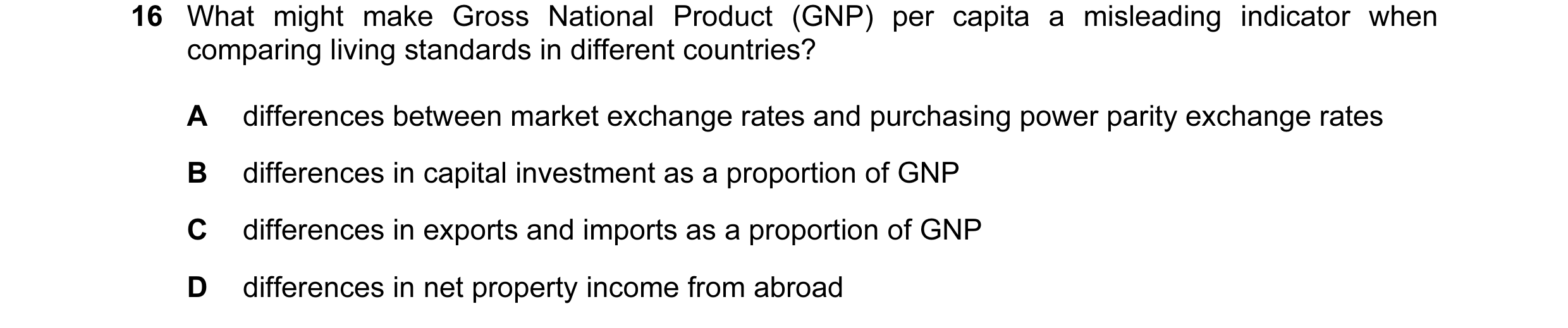
Q15 · What might make Gross National Product (GNP) per capita a misleading indicator when… 9708/33 May/June 2012
16 What might make Gross National Product (GNP) per capita a misleading indicator when comparing living standards in different countries? A differences between market exchange rates and purchasing power parity exchange rates B differences in capital investment as a proportion of GNP C differences in exports and imports as a proportion of GNP D differences in net property income from abroad
1 marks
Answer: A
This question in 9708/33 May/June 2012
Q16 · Which change would best indicate that a country has experienced economic development? 9708/33 May/June 2012
24 Which change would best indicate that a country has experienced economic development? A an appreciation in the country’s currency B an improvement in the average citizen‘s quality of life C an improvement in the country’s trade balance D an increase in the country’s real GDP
1 marks
Answer: B
This question in 9708/33 May/June 2012
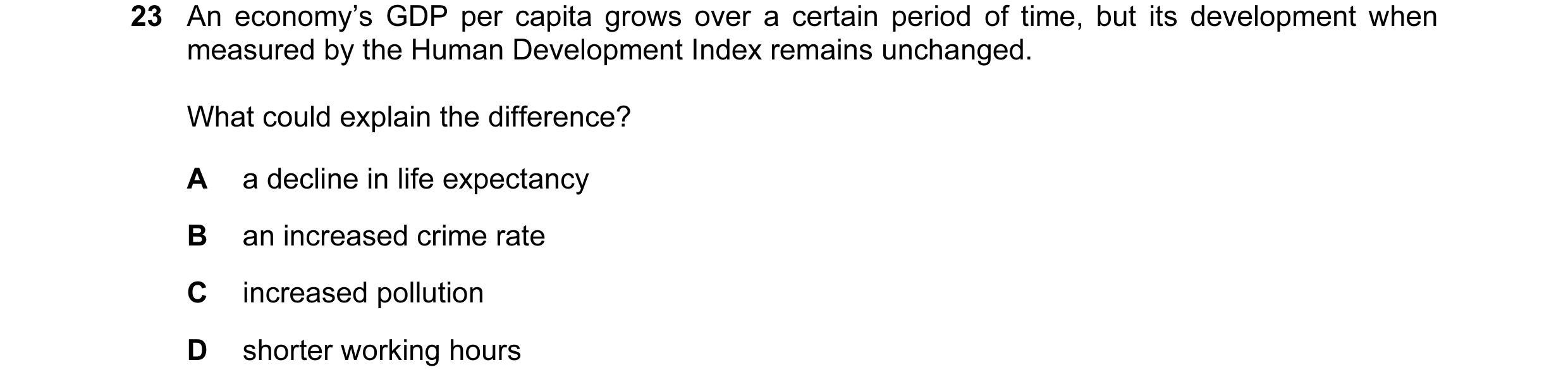
Q17 · An economy’s GDP per capita grows over a certain period of time, but its development when… 9708/33 Oct/Nov 2012
23 An economy’s GDP per capita grows over a certain period of time, but its development when measured by the Human Development Index remains unchanged. What could explain the difference? A a decline in life expectancy B an increased crime rate C increased pollution D shorter working hours
1 marks
This question in 9708/33 Oct/Nov 2012
Q18 · A developing country’s level of debt rises 9708/33 Oct/Nov 2012
26 A developing country’s level of debt rises. In which circumstance is this least likely to be a problem? A Global aggregate demand is falling. B Global real interest rates rise. C The country’s Gross Domestic Product rises by less than its debt. D The debt finances capital investment.
1 marks
This question in 9708/33 Oct/Nov 2012
Q19 · What is likely to be the effect on developing economies of an increase in inward foreign… 9708/33 Oct/Nov 2012
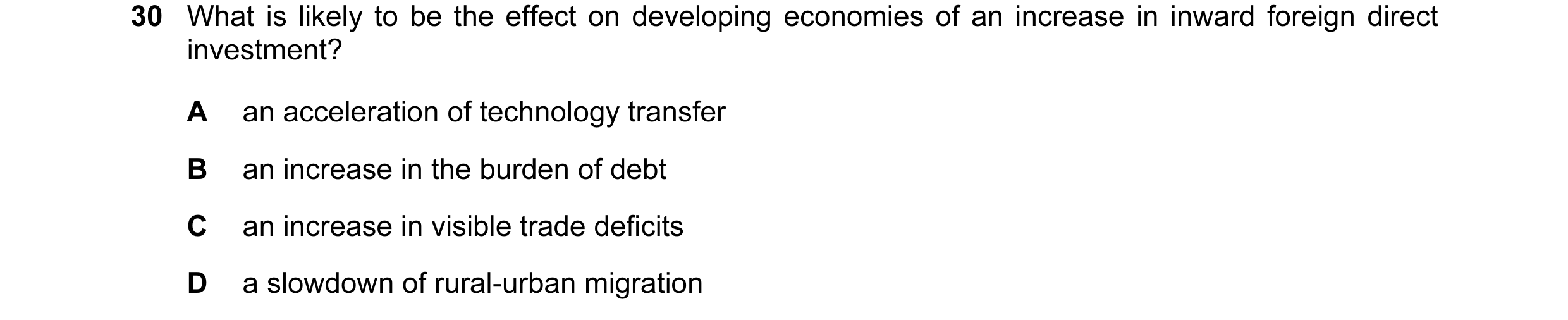
30 What is likely to be the effect on developing economies of an increase in inward foreign direct investment? A an acceleration of technology transfer B an increase in the burden of debt C an increase in visible trade deficits D a slowdown of rural-urban migration
1 marks
This question in 9708/33 Oct/Nov 2012
Q20 · The World Bank publishes statistics on changes in the number of people in the world who… 9708/33 Oct/Nov 2013
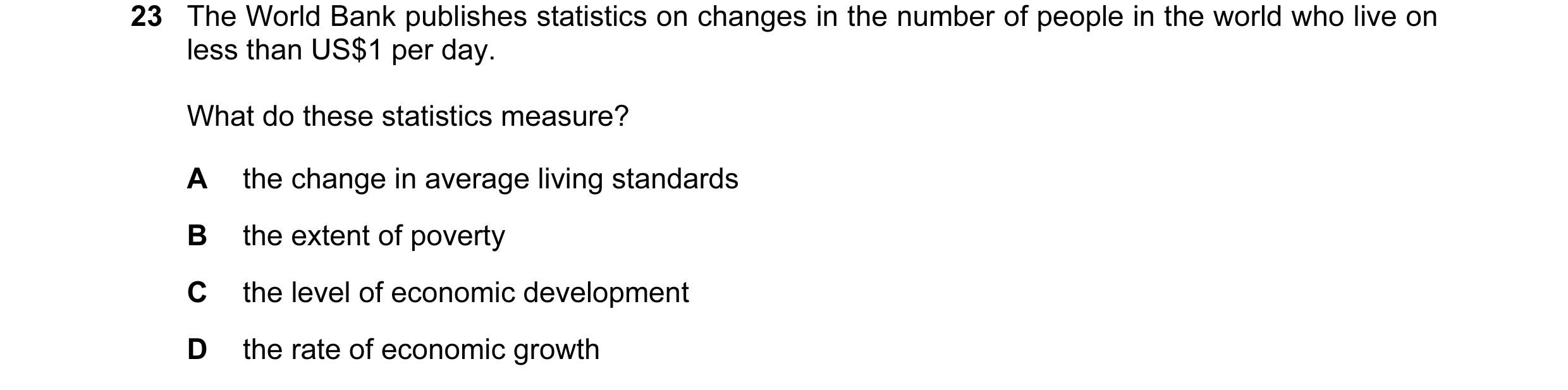
23 The World Bank publishes statistics on changes in the number of people in the world who live on less than US$1 per day. What do these statistics measure? A the change in average living standards B the extent of poverty C the level of economic development D the rate of economic growth
1 marks
Answer: B
This question in 9708/33 Oct/Nov 2013
Q21 · What is most likely to result from foreign direct investment in developing economies? 9708/33 Oct/Nov 2013
28 What is most likely to result from foreign direct investment in developing economies? A a deterioration in the trade balances of developing economies B a reduction in migration to urban areas C a reduction in the transfer of technology to developing economies D a rise in per capita levels of consumption in developing economies
1 marks
Answer: D
This question in 9708/33 Oct/Nov 2013
Q22 · Which change would best indicate that a country has experienced economic development? 9708/31 May/June 2015
23 Which change would best indicate that a country has experienced economic development? A an appreciation in the country’s currency B an improvement in the average citizen’s quality of life C an improvement in the country’s trade balance D an increase in the country’s real GDP
1 marks
Answer: B
This question in 9708/31 May/June 2015
Q23 · A developing country receiving foreign financial aid is most likely to experience… 9708/32 May/June 2015
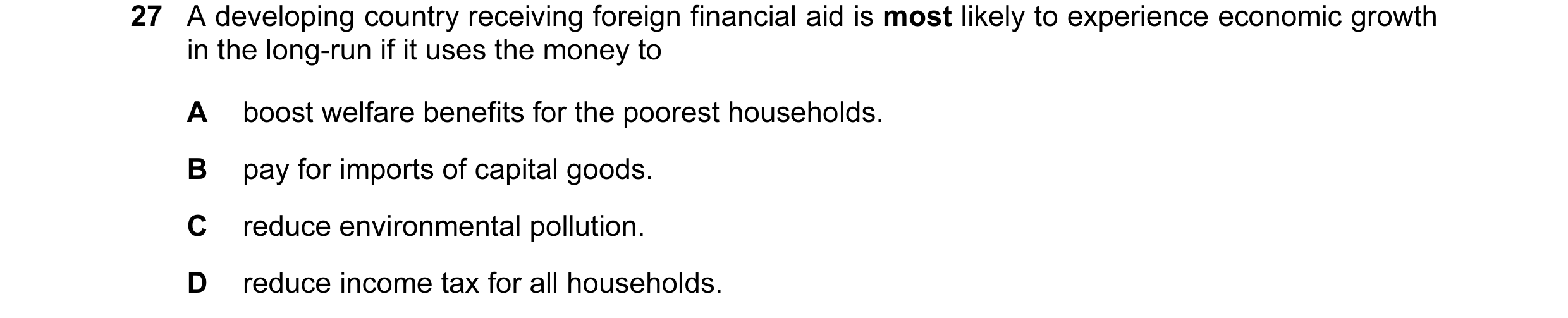
27 A developing country receiving foreign financial aid is most likely to experience economic growth in the long-run if it uses the money to A boost welfare benefits for the poorest households. B pay for imports of capital goods. C reduce environmental pollution. D reduce income tax for all households.
1 marks
Answer: B
This question in 9708/32 May/June 2015
Q24 · The data below relate to a particular country for the four years shown: Year 1 2 3 4 real… 9708/32 May/June 2015
29 The data below relate to a particular country for the four years shown: Year 1 2 3 4 real GNP / head (Year 1 = 100) 100 110 121 121 life expectancy at birth (years) 65 64 65 67 % of age group enrolled in secondary 40 38 42 42 education What can definitely be concluded from these data? A Economic growth between Year 2 and Year 3 was 11%. B The level of economic development was better in Year 2 than in Year 1. C There was both economic growth and an improvement in economic development between Year 2 and Year 3. D No conclusions can be drawn as to whether the level of economic development was better in Year 4 than Year 3.
1 marks
Answer: C
This question in 9708/32 May/June 2015
Q25 · A government requires all its young citizens to undertake community service for a period… 9708/31 Oct/Nov 2015
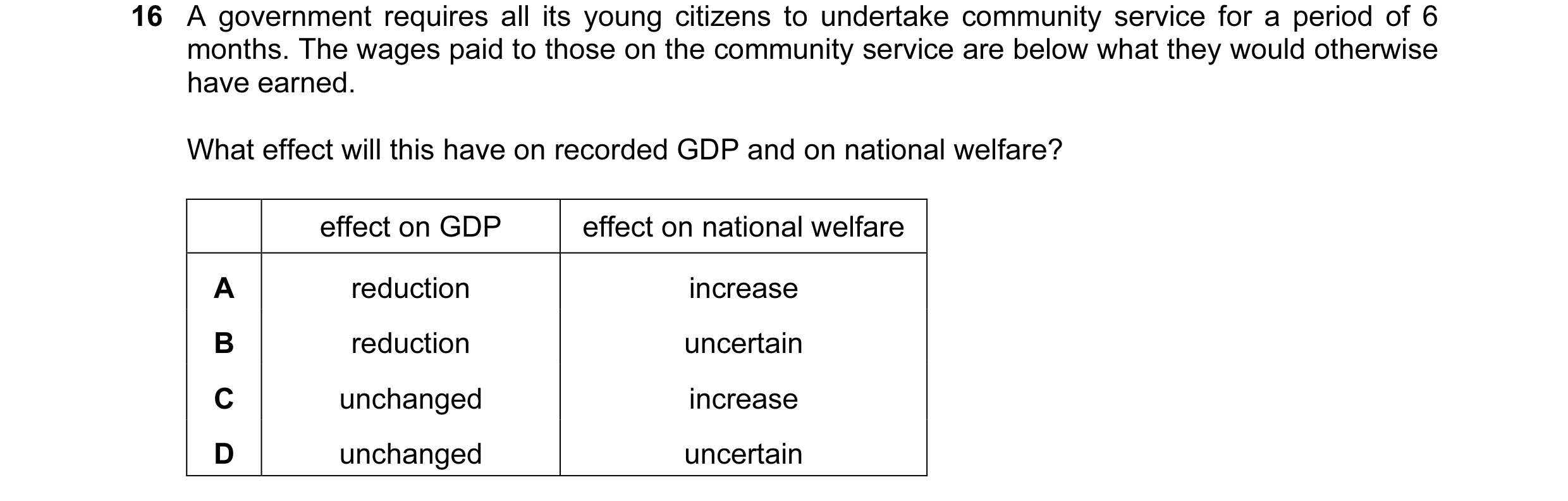
16 A government requires all its young citizens to undertake community service for a period of 6 months. The wages paid to those on the community service are below what they would otherwise have earned. What effect will this have on recorded GDP and on national welfare? effect on GDP effect on national welfare A reduction increase B reduction uncertain C unchanged increase D unchanged uncertain
1 marks
This question in 9708/31 Oct/Nov 2015
Q26 · Cuba, a developing country, achieves health and education standards as high as those… 9708/31 Oct/Nov 2015
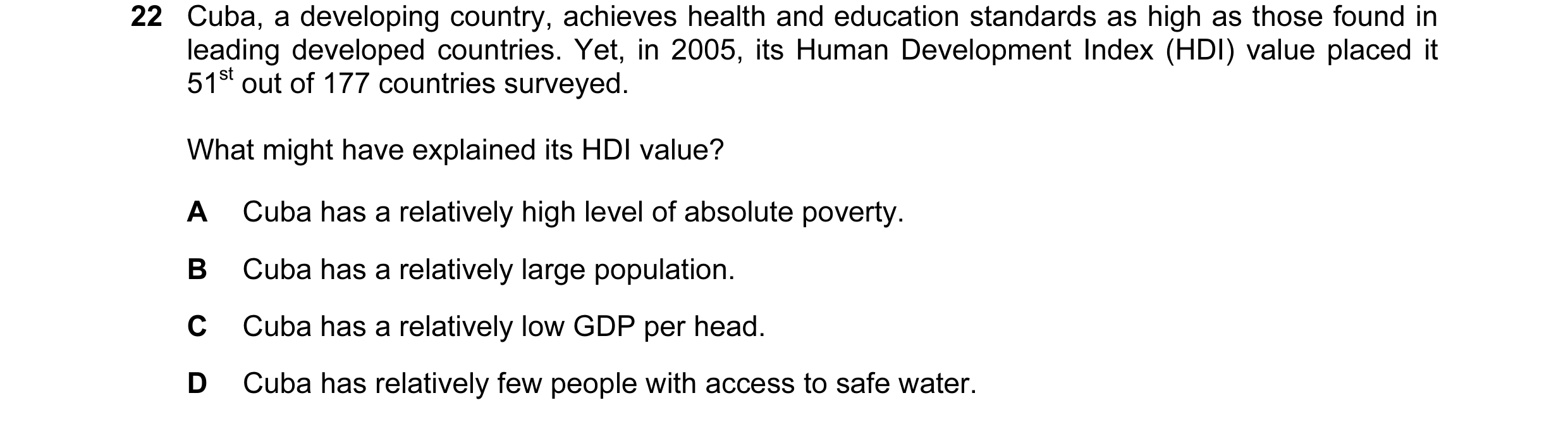
22 Cuba, a developing country, achieves health and education standards as high as those found in leading developed countries. Yet, in 2005, its Human Development Index (HDI) value placed it 51st out of 177 countries surveyed. What might have explained its HDI value? A Cuba has a relatively high level of absolute poverty. B Cuba has a relatively large population. C Cuba has a relatively low GDP per head. D Cuba has relatively few people with access to safe water.
1 marks
This question in 9708/31 Oct/Nov 2015
Q27 · What is likely to be the effect on developing economies of an increase in inward foreign… 9708/32 Oct/Nov 2015
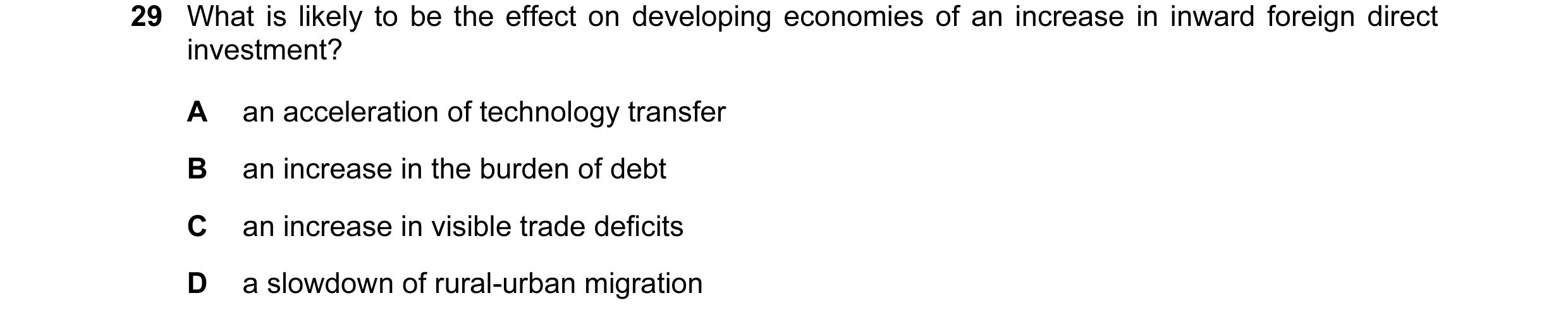
29 What is likely to be the effect on developing economies of an increase in inward foreign direct investment? A an acceleration of technology transfer B an increase in the burden of debt C an increase in visible trade deficits D a slowdown of rural-urban migration
1 marks
Answer: A
This question in 9708/32 Oct/Nov 2015
Q28 · Why do economists draw a distinction between economic development and economic growth? 9708/33 Oct/Nov 2015
24 Why do economists draw a distinction between economic development and economic growth? A because a country’s stage of economic development depends on its level of output rather than its growth rate B because it is the allocation rather than the overall level of a country’s resources which determines its economic well-being C because of the concern about quality of life rather than quantity of output D because the prime determinant of economic development is investment rather than consumption
1 marks
Answer: C
This question in 9708/33 Oct/Nov 2015
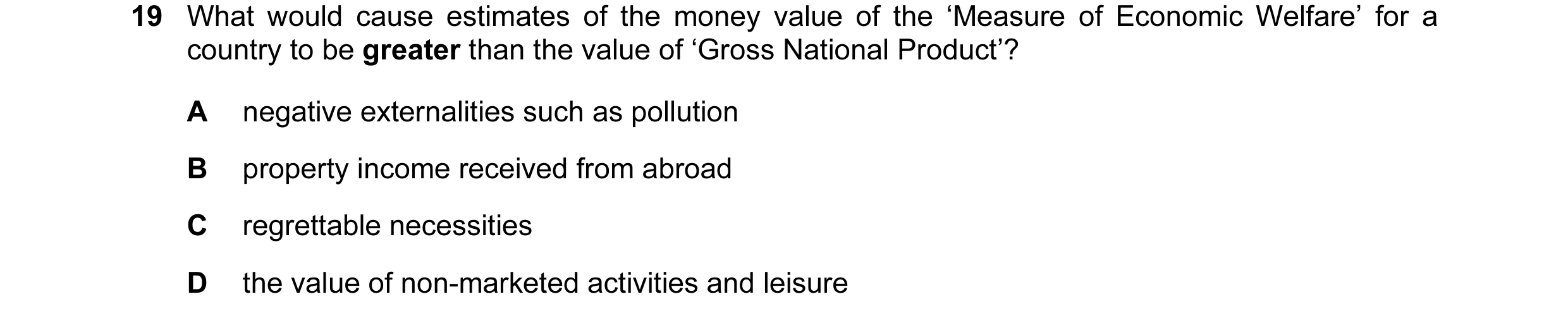
Q29 · What would cause estimates of the money value of the ‘Measure of Economic Welfare’ for a… 9708/32 May/June 2016
19 What would cause estimates of the money value of the ‘Measure of Economic Welfare’ for a country to be greater than the value of ‘Gross National Product’? A negative externalities such as pollution B property income received from abroad C regrettable necessities D the value of non-marketed activities and leisure
1 marks
Answer: D
This question in 9708/32 May/June 2016
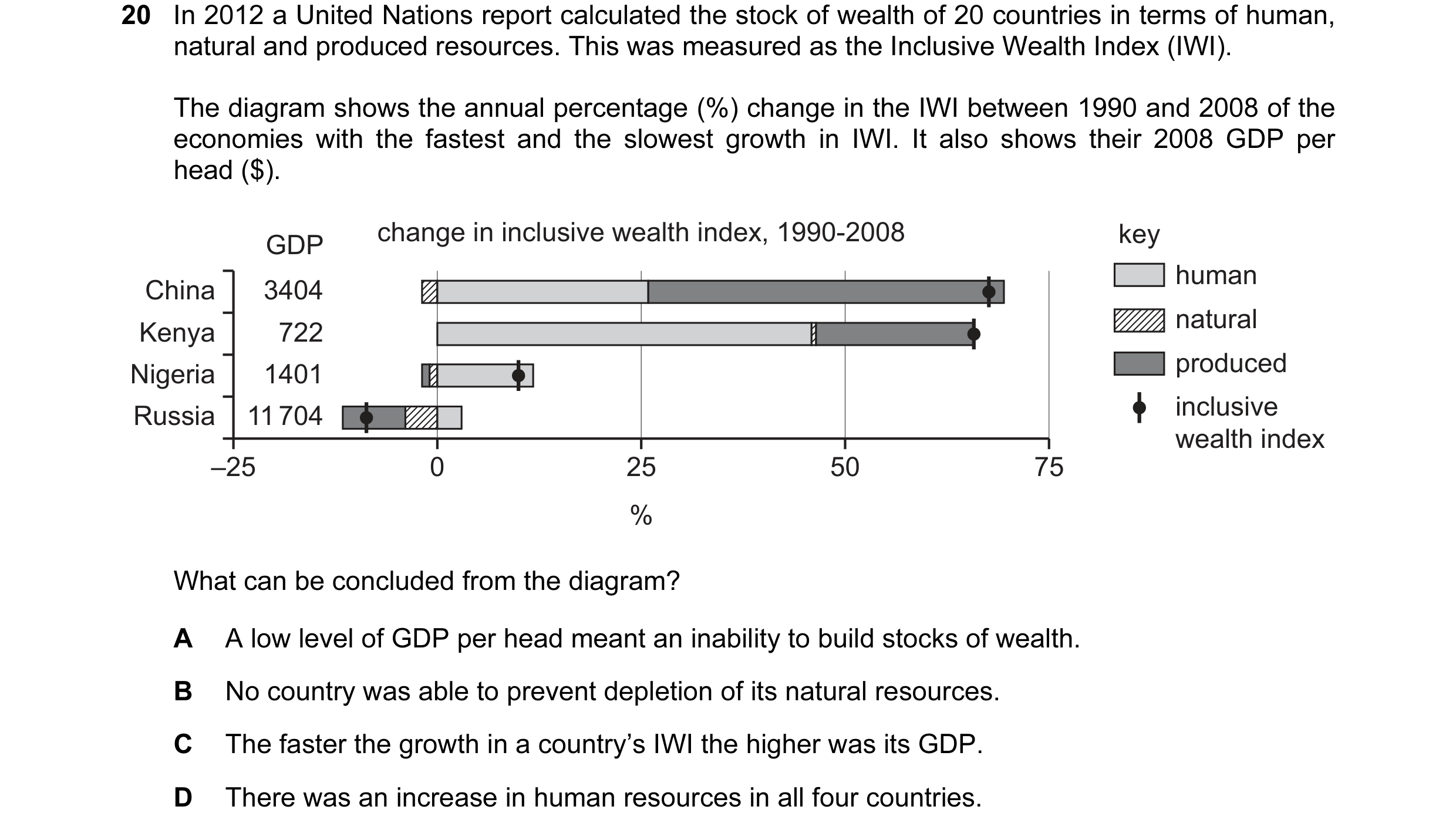
Q30 · In 2012 a United Nations report calculated the stock of wealth of 20 countries in terms… 9708/32 May/June 2016
20 In 2012 a United Nations report calculated the stock of wealth of 20 countries in terms of human, natural and produced resources. This was measured as the Inclusive Wealth Index (IWI). The diagram shows the annual percentage (%) change in the IWI between 1990 and 2008 of the economies with the fastest and the slowest growth in IWI. It also shows their 2008 GDP per head ($). change in inclusive wealth index, 1990-2008 key GDP human China 3404 natural Kenya 722 Nigeria 1401 produced Russia 11 704 inclusive wealth index –25 0 25 50 75 % What can be concluded from the diagram? A A low level of GDP per head meant an inability to build stocks of wealth. B No country was able to prevent depletion of its natural resources. C The faster the growth in a country’s IWI the higher was its GDP. D There was an increase in human resources in all four countries.
1 marks
Answer: D
This question in 9708/32 May/June 2016
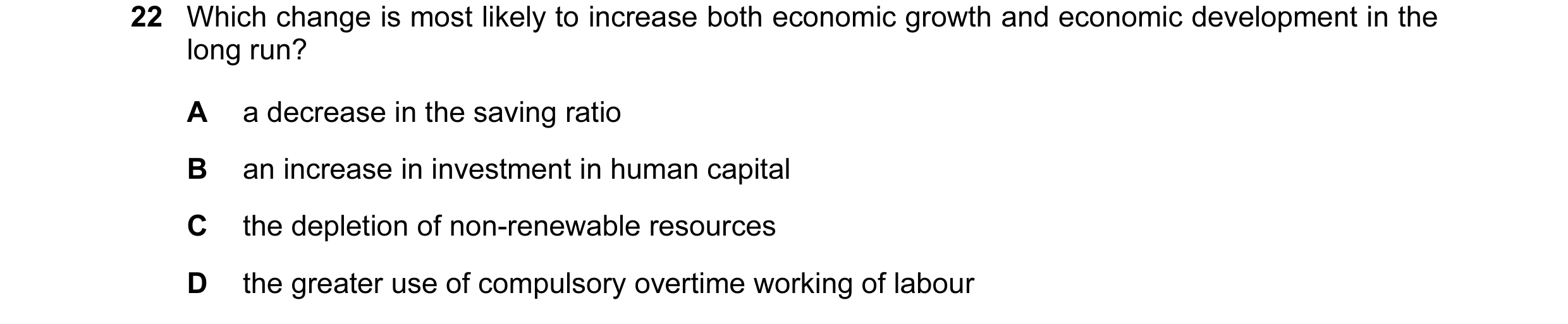
Q31 · Which change is most likely to increase both economic growth and economic development in… 9708/32 May/June 2016
22 Which change is most likely to increase both economic growth and economic development in the long run? A a decrease in the saving ratio B an increase in investment in human capital C the depletion of non-renewable resources D the greater use of compulsory overtime working of labour
1 marks
Answer: B
This question in 9708/32 May/June 2016
Q32 · What is most likely to result from foreign direct investment in developing economies? 9708/32 May/June 2016
29 What is most likely to result from foreign direct investment in developing economies? A a deterioration in the trade balances of developing economies B a reduction in migration to urban areas in developing economies C a reduction in the transfer of technology to developing economies D a rise in per capita levels of consumption in developing economies
1 marks
Answer: D
This question in 9708/32 May/June 2016
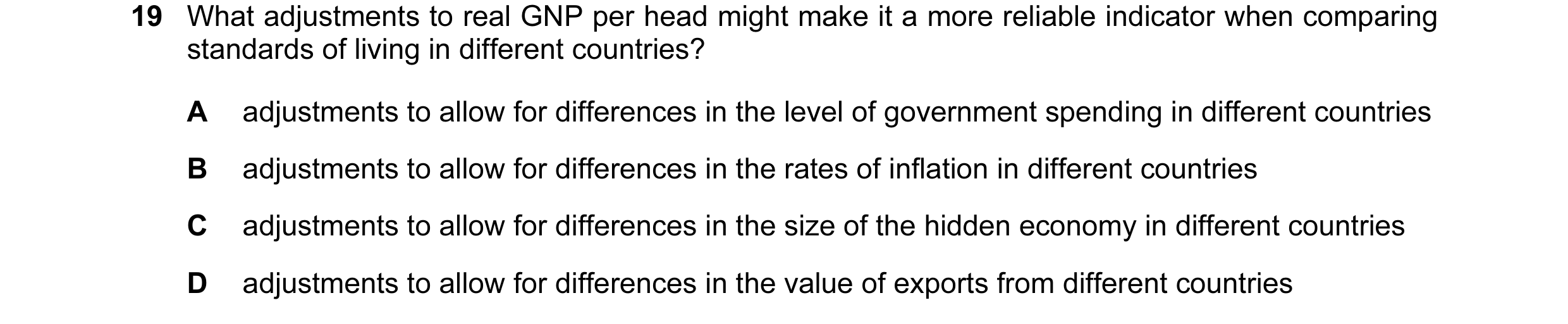
Q33 · What adjustments to real GNP per head might make it a more reliable indicator when… 9708/33 May/June 2016
19 What adjustments to real GNP per head might make it a more reliable indicator when comparing standards of living in different countries? A adjustments to allow for differences in the level of government spending in different countries B adjustments to allow for differences in the rates of inflation in different countries C adjustments to allow for differences in the size of the hidden economy in different countries D adjustments to allow for differences in the value of exports from different countries
1 marks
Answer: C
This question in 9708/33 May/June 2016
Q34 · Which combination is usually found in developing countries? 9708/33 May/June 2016
21 Which combination is usually found in developing countries? A a low birth rate and a dominant primary sector B capital-intensive production and a rapidly growing population C external debt and a low death rate D labour-intensive production and a low rate of saving
1 marks
Answer: D
This question in 9708/33 May/June 2016
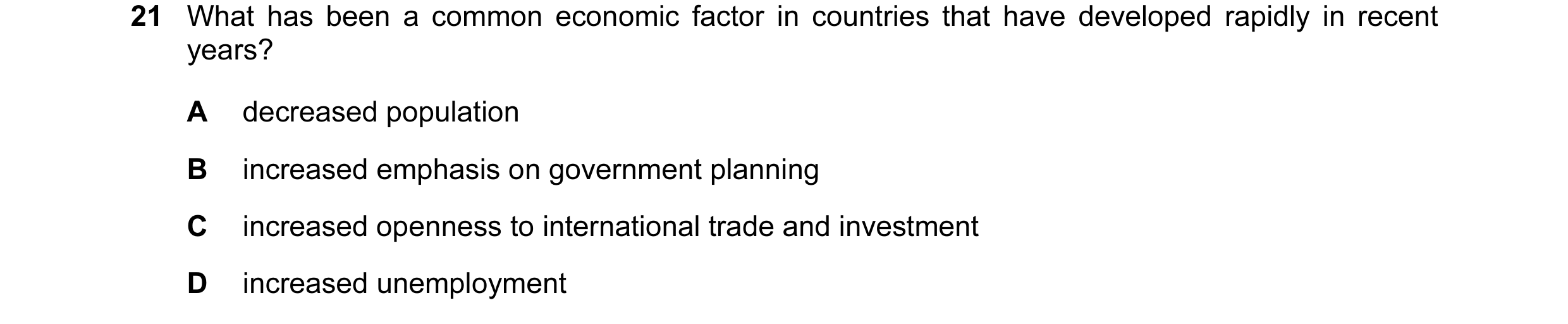
Q35 · What has been a common economic factor in countries that have developed rapidly in recent… 9708/33 Oct/Nov 2016
21 What has been a common economic factor in countries that have developed rapidly in recent years? A decreased population B increased emphasis on government planning C increased openness to international trade and investment D increased unemployment
1 marks
Answer: C
This question in 9708/33 Oct/Nov 2016
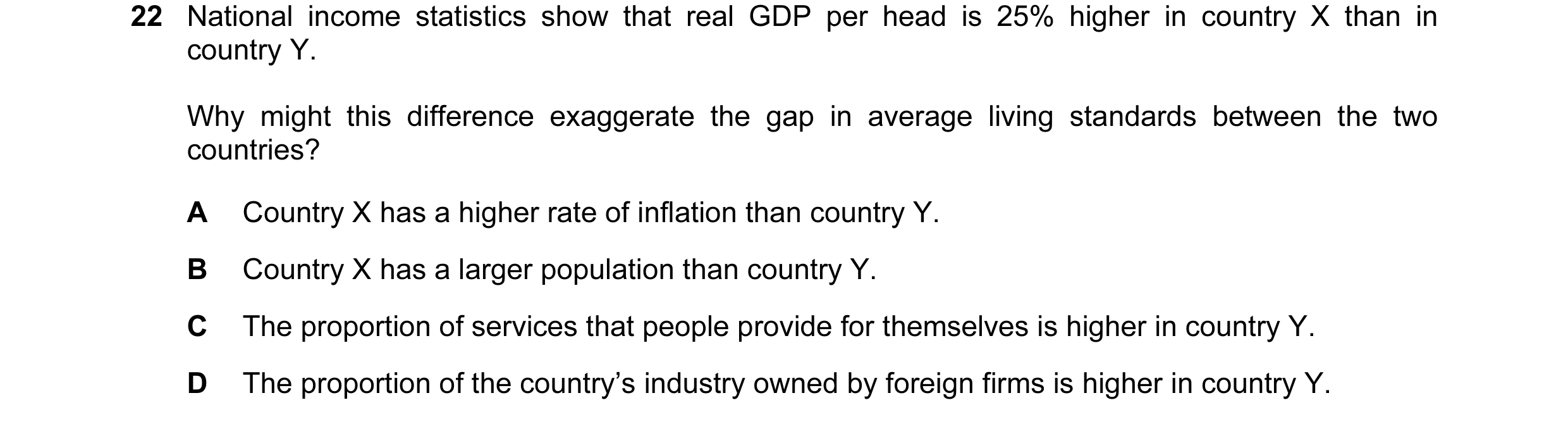
Q36 · National income statistics show that real GDP per head is 25% higher in country X than in… 9708/33 Oct/Nov 2016
22 National income statistics show that real GDP per head is 25% higher in country X than in country Y. Why might this difference exaggerate the gap in average living standards between the two countries? A Country X has a higher rate of inflation than country Y. B Country X has a larger population than country Y. C The proportion of services that people provide for themselves is higher in country Y. D The proportion of the country’s industry owned by foreign firms is higher in country Y.
1 marks
Answer: C
This question in 9708/33 Oct/Nov 2016
Q37 · What might help improve economic growth in developing countries over the next five years? 9708/33 Oct/Nov 2016
23 What might help improve economic growth in developing countries over the next five years? A an increase in income tax B an increase in the birth rate C an increase in the budget surplus D an increase in training
1 marks
Answer: D
This question in 9708/33 Oct/Nov 2016
Q38 · What is typically associated with a relatively low level of income per capita in a… 9708/32 May/June 2017
20 What is typically associated with a relatively low level of income per capita in a country? A low exports B low inflation C low investment D low population
1 marks
Answer: C
This question in 9708/32 May/June 2017
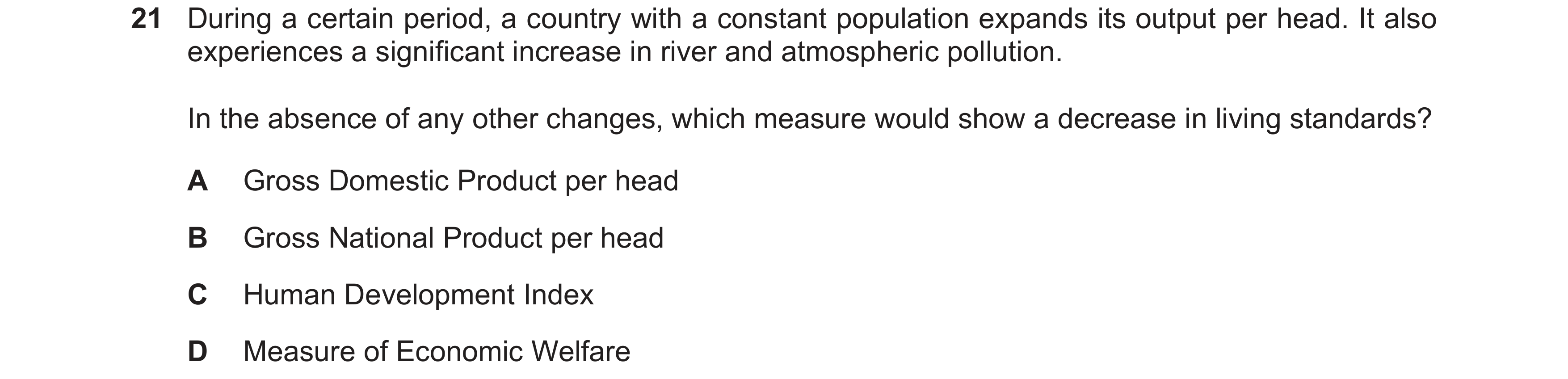
Q39 · During a certain period, a country with a constant population expands its output per head 9708/32 May/June 2017
21 During a certain period, a country with a constant population expands its output per head. It also experiences a significant increase in river and atmospheric pollution. In the absence of any other changes, which measure would show a decrease in living standards? A Gross Domestic Product per head B Gross National Product per head C Human Development Index D Measure of Economic Welfare
1 marks
Answer: D
This question in 9708/32 May/June 2017
Q40 · Which could cause the official statistics for the national income per head of a… 9708/32 May/June 2017
25 Which could cause the official statistics for the national income per head of a developing country to overstate the true level of economic well-being of its inhabitants? A if there is dependence on barter in internal trade B if subsistence agriculture dominates total economic activity C if services are an important component of exports D if there is extreme income inequality
1 marks
Answer: D
This question in 9708/32 May/June 2017
Q41 · In 2015, the World Bank agreed to give a loan of $650 m to Angola to help stabilise the… 9708/32 May/June 2017
27 In 2015, the World Bank agreed to give a loan of $650 m to Angola to help stabilise the economy. The Bank said Angola needed to have a fiscal policy that would encourage the diversification of its economy. Which policy would be consistent with this requirement? A the lowering of interest rates to encourage investment in solar power B the relaxing of regulations to allow the development of a new hydro-power project C the spending of the loan supporting its oil industry after oil prices collapsed D the subsidising of a partnership with a French company to establish a chain of tourist hotels
1 marks
Answer: D
This question in 9708/32 May/June 2017
Q42 · Immigrants are awarded entry points according to their ability to fulfil criteria set by… 9708/33 May/June 2017
18 Immigrants are awarded entry points according to their ability to fulfil criteria set by the Canadian Government. A new Express Entry system for the immigration of skilled workers was introduced. The diagram shows the change in the relative importance or weighting given to these criteria between the old and new systems. Criteria weighting (%) for skilled worker immigration skill transferability 100 work experience % adaptability 80 age 60 education 40 language 20 job offer 0 old Express system Entry system What can be concluded from the diagram? A Canada intended to maintain the same level of skilled immigrants under both systems. B Canada wanted a smaller number of highly educated skilled immigrants. C Certainty of employment for skilled immigrants was made the main criterion. D Skilled immigrants needed to have fewer years of work experience than previously.
1 marks
Answer: C
This question in 9708/33 May/June 2017
Q43 · A developing country experiences economic growth 9708/33 May/June 2017
24 A developing country experiences economic growth. The economic growth is most likely to lead to economic development when it A causes rapid rural to urban migration. B is based on the extraction of mineral raw materials. C mainly rewards the country’s entrepreneurs. D results from the expansion of labour-intensive industries.
1 marks
Answer: D
This question in 9708/33 May/June 2017
Q44 · Which factor has been least associated with the rapid growth of many economies recently? 9708/33 May/June 2017
30 Which factor has been least associated with the rapid growth of many economies recently? A high savings rates as a percentage of national income B more efficient mechanisms for transmitting funds from savers to investors C more emphasis on detailed government planning D more openness to foreign trade and investment
1 marks
Answer: C
This question in 9708/33 May/June 2017
Q45 · When is economic growth most likely to promote economic development? 9708/32 Oct/Nov 2018
20 When is economic growth most likely to promote economic development? A when it achieves maximum rates of extraction of raw materials B when it concentrates on increasing production C when it discovers valuable new resources in remote natural environments D when it provides the funds to finance cleaner production processes
1 marks
Answer: D
This question in 9708/32 Oct/Nov 2018
Q46 · Country X’s living standards were compared with country Y’s living standards using real… 9708/32 Oct/Nov 2018
22 Country X’s living standards were compared with country Y’s living standards using real GNP per head converted into US dollars. Country X was ranked above country Y. Which factor might have caused this ranking to be incorrect? A Actual market exchange rates were used rather than purchasing power parity rates. B Government spending on transfer payments was higher in country Y than in country X. C Inflation was higher in country X than in country Y. D The distribution of income was more unequal in country X than in country Y.
1 marks
Answer: A
This question in 9708/32 Oct/Nov 2018
Q47 · What is most likely to result from the discovery of oil reserves in a developing economy? 9708/32 Oct/Nov 2018
30 What is most likely to result from the discovery of oil reserves in a developing economy? A a more equal distribution of income and wealth B an increase in the competitiveness of commercial agriculture C an increase in the exchange rate D a reduction in the volume of imports of manufactured goods
1 marks
Answer: C
This question in 9708/32 Oct/Nov 2018
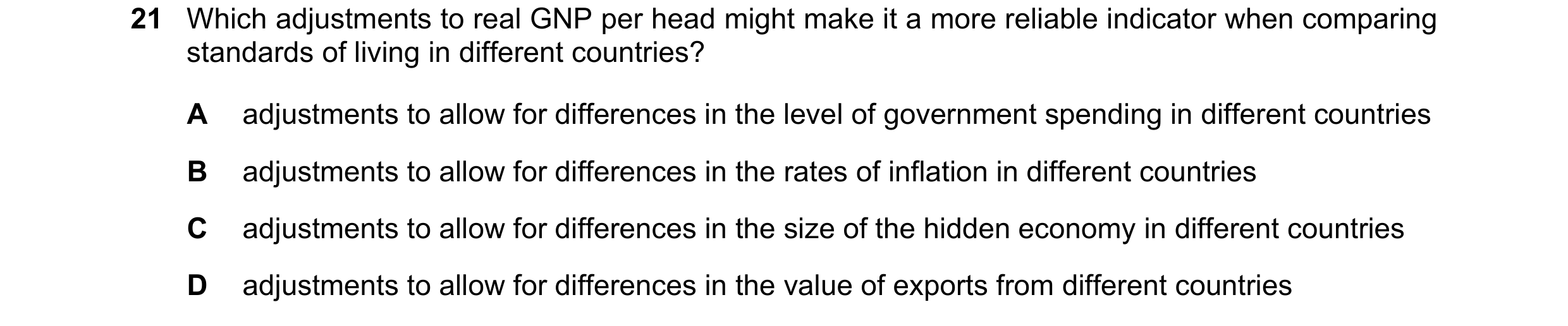
Q48 · Which adjustments to real GNP per head might make it a more reliable indicator when… 9708/32 Feb/March 2019
21 Which adjustments to real GNP per head might make it a more reliable indicator when comparing standards of living in different countries? A adjustments to allow for differences in the level of government spending in different countries B adjustments to allow for differences in the rates of inflation in different countries C adjustments to allow for differences in the size of the hidden economy in different countries D adjustments to allow for differences in the value of exports from different countries
1 marks
Answer: C
This question in 9708/32 Feb/March 2019
Q49 · The graphs show the Human Development Index and its component parts for Zimbabwe 9708/32 May/June 2019
20 The graphs show the Human Development Index and its component parts for Zimbabwe. Human Development Index education index 0.55 0.6 0.5 0.55 0.5 0.45 0.45 0.4 0.4 0.35 0.35 0.3 0.3 1990 2000 2005 2010 2011 2012 2013 1990 2000 2005 2010 2011 2012 2013 1995 1995 life expectancy GNI per capita, ppp (2011 ppp) 0.55 0.6 0.5 0.55 0.5 0.45 0.45 0.4 0.4 0.35 0.35 0.3 0.3 1990 2000 2005 2010 2011 2012 2013 1990 2000 2005 2010 2011 2012 2013 1995 1995 Between 2005–2010, which components of HDI have comparable changes to its overall change? A education and GNI per capita B education and life expectancy C education, GNI per capita and life expectancy D GNI per capita and life expectancy
1 marks
Answer: B
This question in 9708/32 May/June 2019
Q50 · Which statement is correct? 9708/32 Oct/Nov 2019
24 Which statement is correct? A Economic development is necessary for economic growth. B Economic growth and economic development are directly proportional. C Economic growth enables economic development. D Economic growth is always sustainable.
1 marks
Answer: C
This question in 9708/32 Oct/Nov 2019
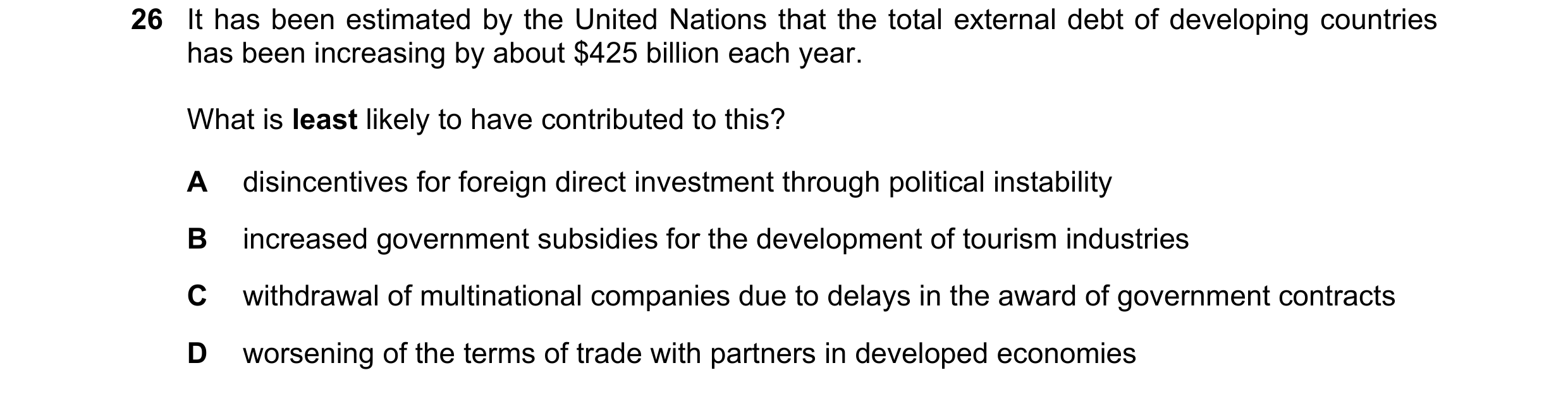
Q51 · It has been estimated by the United Nations that the total external debt of developing… 9708/32 Oct/Nov 2019
26 It has been estimated by the United Nations that the total external debt of developing countries has been increasing by about $425 billion each year. What is least likely to have contributed to this? A disincentives for foreign direct investment through political instability B increased government subsidies for the development of tourism industries C withdrawal of multinational companies due to delays in the award of government contracts D worsening of the terms of trade with partners in developed economies
1 marks
Answer: B
This question in 9708/32 Oct/Nov 2019
Q52 · The following are four conditions sometimes attached to IMF loans to developing countries 9708/32 Oct/Nov 2019
27 The following are four conditions sometimes attached to IMF loans to developing countries. Which condition would conflict with the ‘infant industry’ argument? A the need to allow free trade B the need to control inflation C the need to have a contractionary fiscal policy D the need to privatise government enterprises
1 marks
Answer: A
This question in 9708/32 Oct/Nov 2019
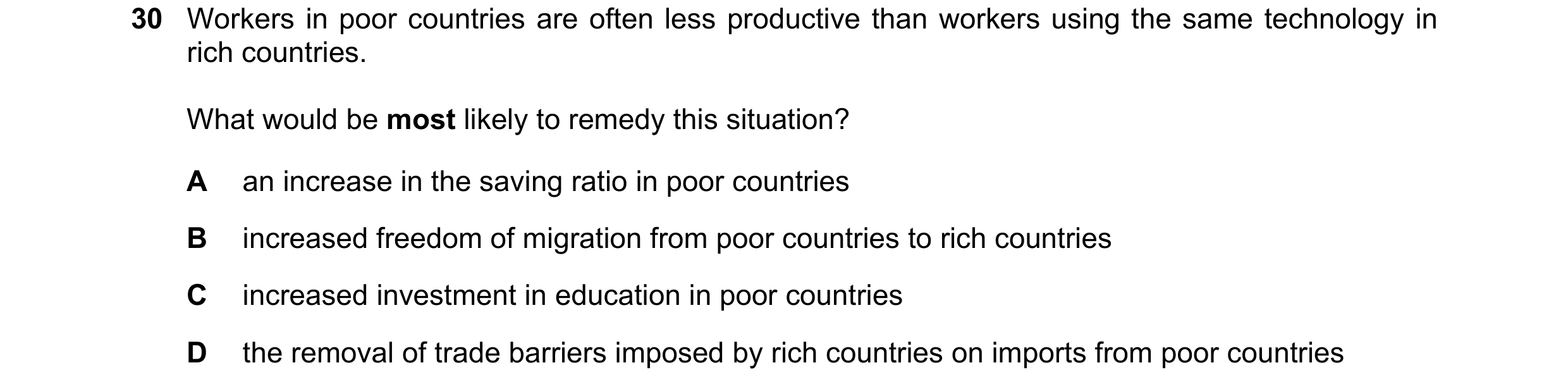
Q53 · Workers in poor countries are often less productive than workers using the same… 9708/32 Oct/Nov 2019
30 Workers in poor countries are often less productive than workers using the same technology in rich countries. What would be most likely to remedy this situation? A an increase in the saving ratio in poor countries B increased freedom of migration from poor countries to rich countries C increased investment in education in poor countries D the removal of trade barriers imposed by rich countries on imports from poor countries
1 marks
Answer: C
This question in 9708/32 Oct/Nov 2019
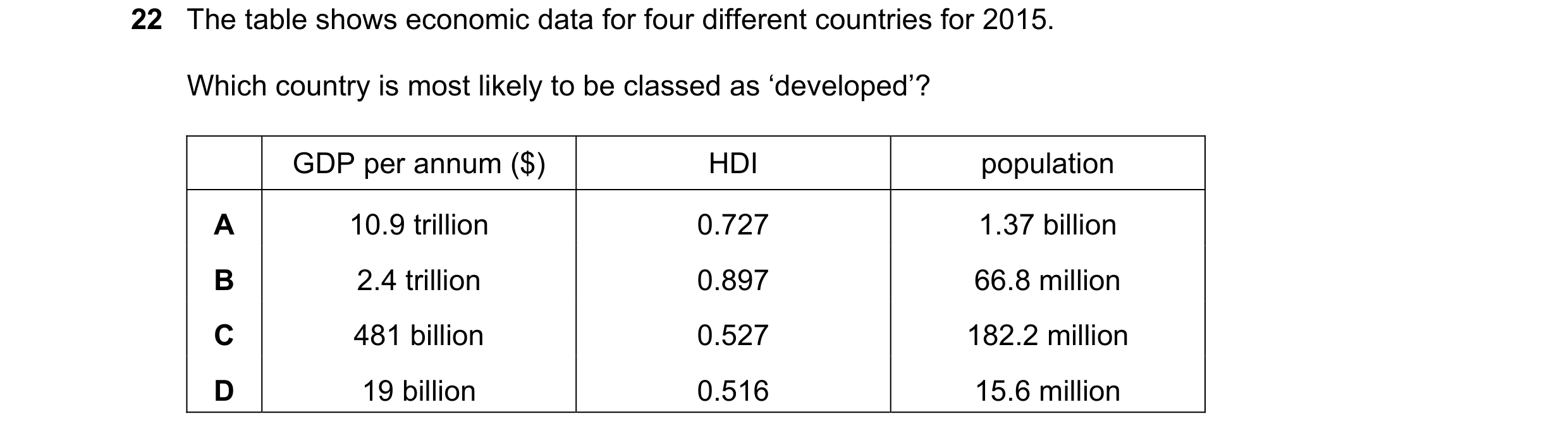
Q54 · The table shows economic data for four different countries for 2015 9708/32 Feb/March 2020
22 The table shows economic data for four different countries for 2015. Which country is most likely to be classed as ‘developed’? GDP per annum ($) HDI population A 10.9 trillion 0.727 1.37 billion B 2.4 trillion 0.897 66.8 million C 481 billion 0.527 182.2 million D 19 billion 0.516 15.6 million
1 marks
Answer: B
This question in 9708/32 Feb/March 2020
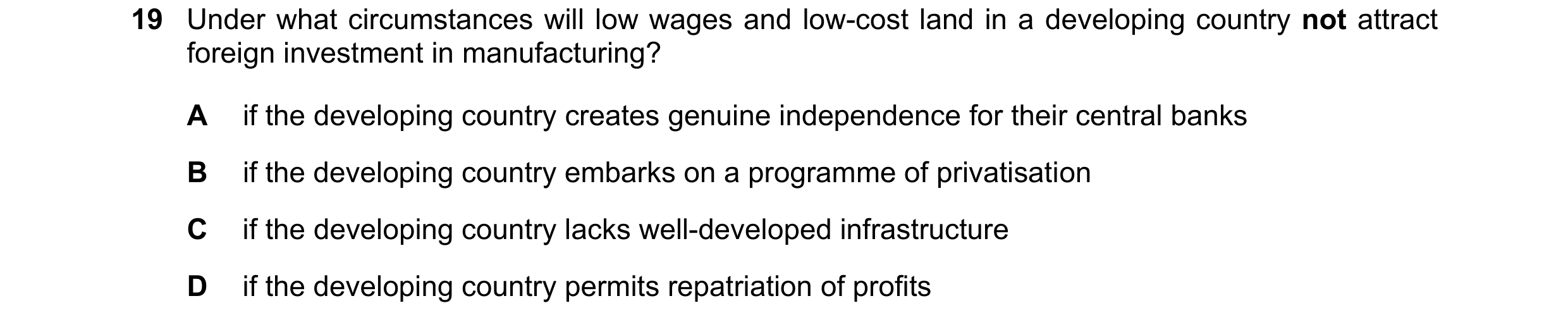
Q55 · Under what circumstances will low wages and low-cost land in a developing country not… 9708/31 Oct/Nov 2020
19 Under what circumstances will low wages and low-cost land in a developing country not attract foreign investment in manufacturing? A if the developing country creates genuine independence for their central banks B if the developing country embarks on a programme of privatisation C if the developing country lacks well-developed infrastructure D if the developing country permits repatriation of profits
1 marks
Answer: C
This question in 9708/31 Oct/Nov 2020
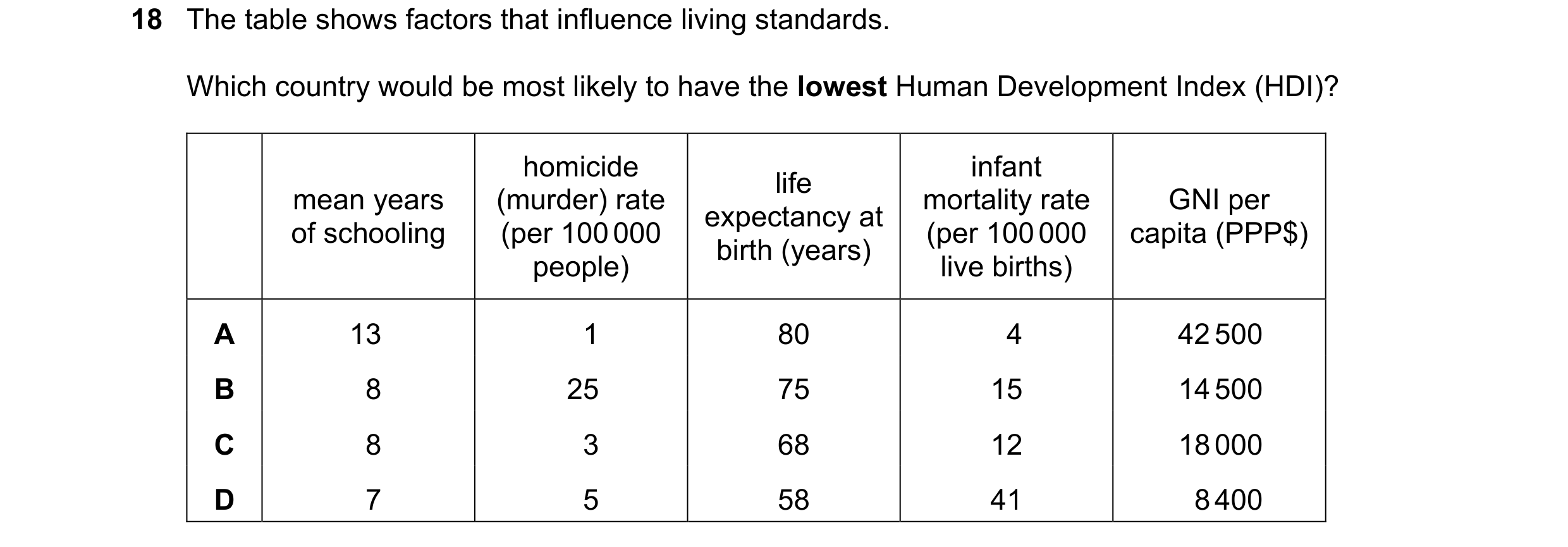
Q56 · The table shows factors that influence living standards 9708/32 Oct/Nov 2020
18 The table shows factors that influence living standards. Which country would be most likely to have the lowest Human Development Index (HDI)? homicide infant life mean years (murder) rate mortality rate GNI per expectancy at of schooling (per 100 000 (per 100 000 capita (PPP$) birth (years) people) live births) A 13 1 80 4 42 500 B 8 25 75 15 14 500 C 8 3 68 12 18 000 D 7 5 58 41 8 400
1 marks
Answer: D
This question in 9708/32 Oct/Nov 2020
Q57 · The table provides data on the Gross National Income (GNI) and the foreign aid… 9708/32 Oct/Nov 2020
19 The table provides data on the Gross National Income (GNI) and the foreign aid expenditure of selected countries in 2016. foreign aid expenditure country GNI (US$ billion) (US$ billion) Belgium 468.9 2.10 Germany 3612.1 23.84 Sweden 532.7 5.38 South Korea 1403.6 2.10 What can be concluded from the table? A Countries with a higher GNI always spend more on foreign aid. B Germany has the world’s highest expenditure on foreign aid. C South Korea and Belgium spent an equal proportion of GNI on foreign aid. D Sweden spent the highest proportion of GNI on foreign aid.
1 marks
Answer: D
This question in 9708/32 Oct/Nov 2020
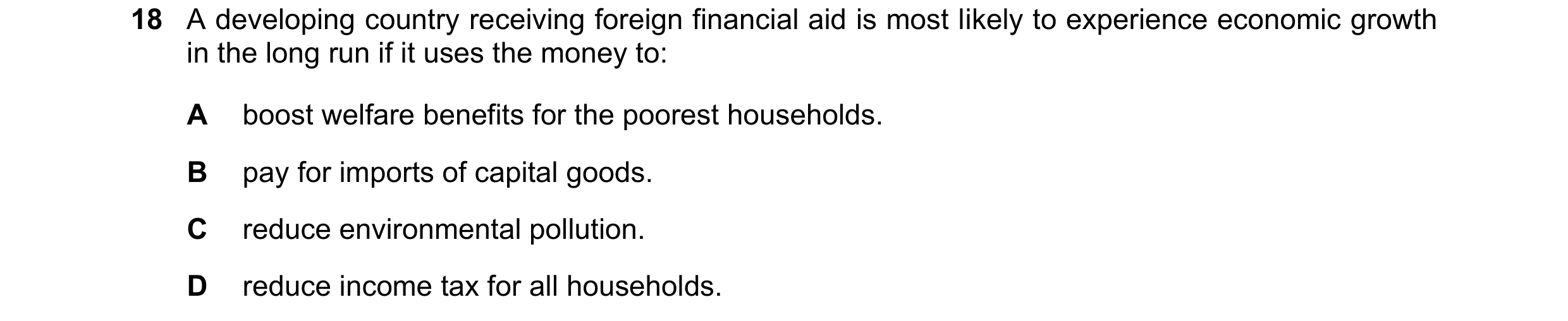
Q58 · A developing country receiving foreign financial aid is most likely to experience… 9708/33 Oct/Nov 2020
18 A developing country receiving foreign financial aid is most likely to experience economic growth in the long run if it uses the money to: A boost welfare benefits for the poorest households. B pay for imports of capital goods. C reduce environmental pollution. D reduce income tax for all households.
1 marks
Answer: B
This question in 9708/33 Oct/Nov 2020
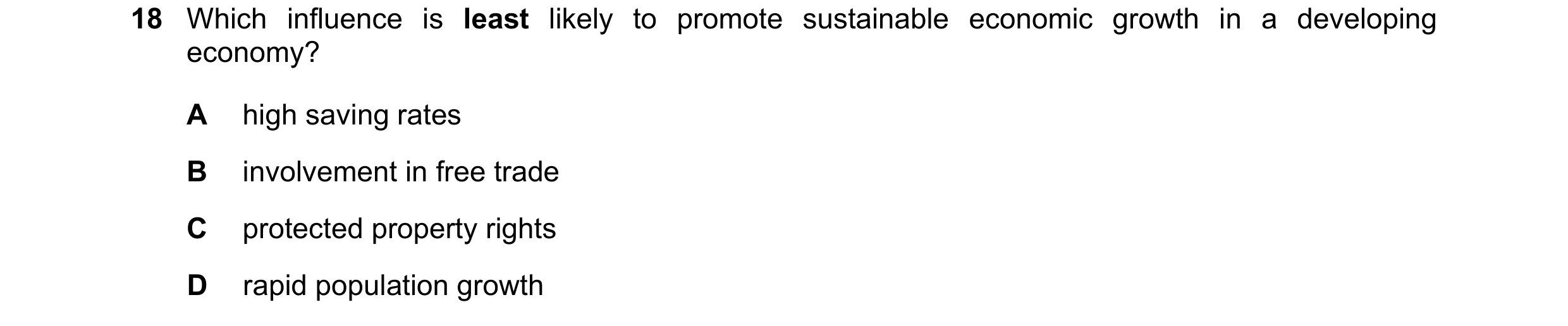
Q59 · Which influence is least likely to promote sustainable economic growth in a developing… 9708/32 Feb/March 2021
18 Which influence is least likely to promote sustainable economic growth in a developing economy? A high saving rates B involvement in free trade C protected property rights D rapid population growth
1 marks
Answer: D
This question in 9708/32 Feb/March 2021
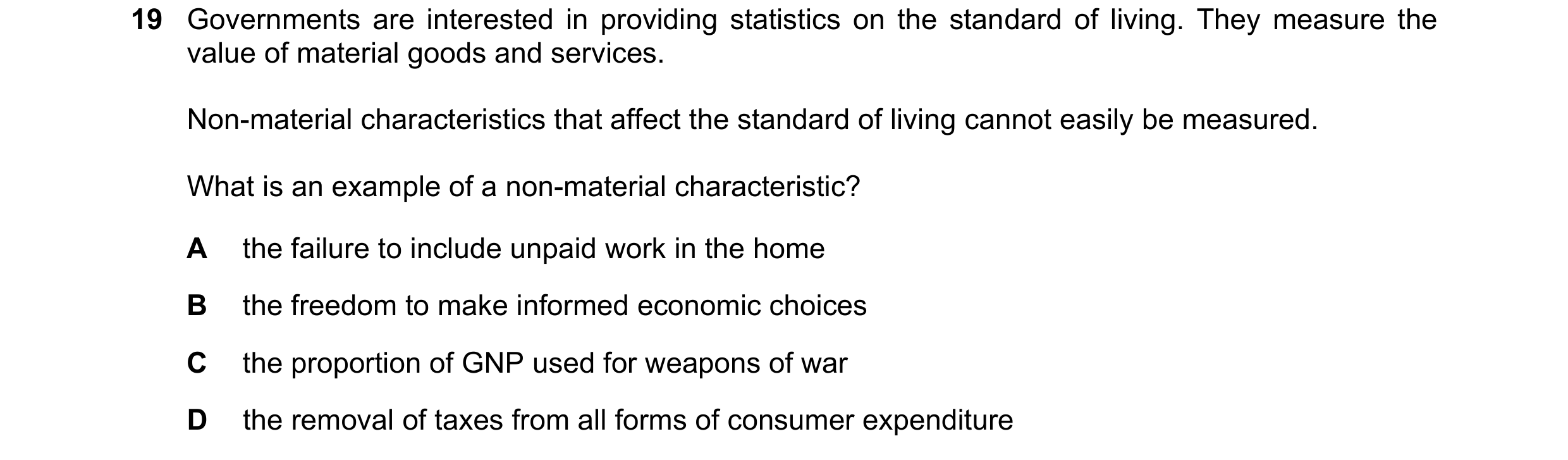
Q60 · Governments are interested in providing statistics on the standard of living 9708/32 Feb/March 2021
19 Governments are interested in providing statistics on the standard of living. They measure the value of material goods and services. Non-material characteristics that affect the standard of living cannot easily be measured. What is an example of a non-material characteristic? A the failure to include unpaid work in the home B the freedom to make informed economic choices C the proportion of GNP used for weapons of war D the removal of taxes from all forms of consumer expenditure
1 marks
Answer: B
This question in 9708/32 Feb/March 2021
Q61 · Which policy by developed economies would be most beneficial for developing economies? 9708/32 Feb/March 2021
28 Which policy by developed economies would be most beneficial for developing economies? A a ban on resource exploration by mining companies in developing economies B restrictions on investment by global firms in developing economies C the removal of restrictions on emigration of skilled labour from developing economies D the withdrawal of agricultural subsidies in developed economies
1 marks
Answer: D
This question in 9708/32 Feb/March 2021
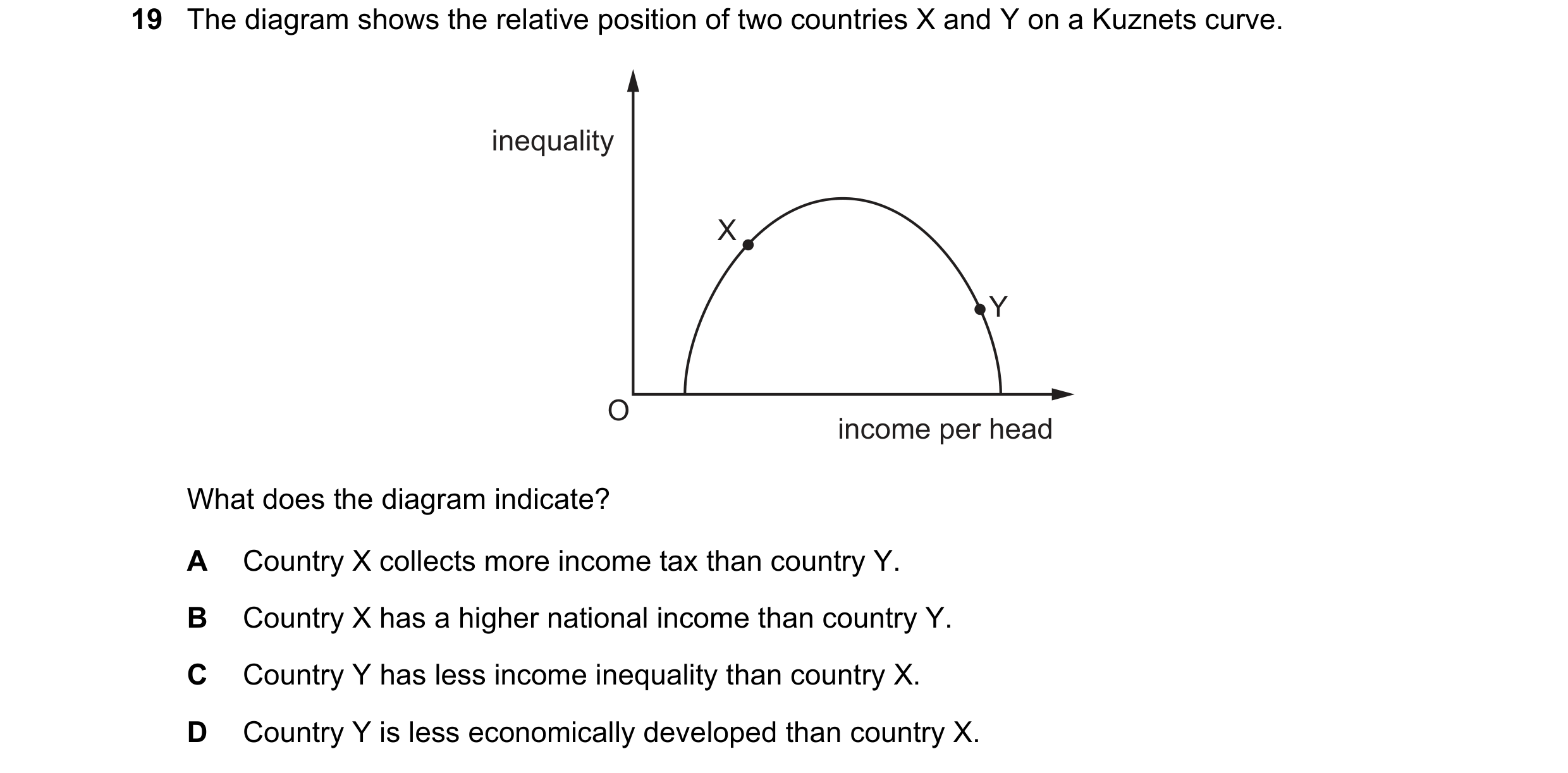
Q62 · The diagram shows the relative position of two countries X and Y on a Kuznets curve 9708/31 May/June 2021
19 The diagram shows the relative position of two countries X and Y on a Kuznets curve. inequality X Y O income per head What does the diagram indicate? A Country X collects more income tax than country Y. B Country X has a higher national income than country Y. C Country Y has less income inequality than country X. D Country Y is less economically developed than country X.
1 marks
Answer: C
This question in 9708/31 May/June 2021
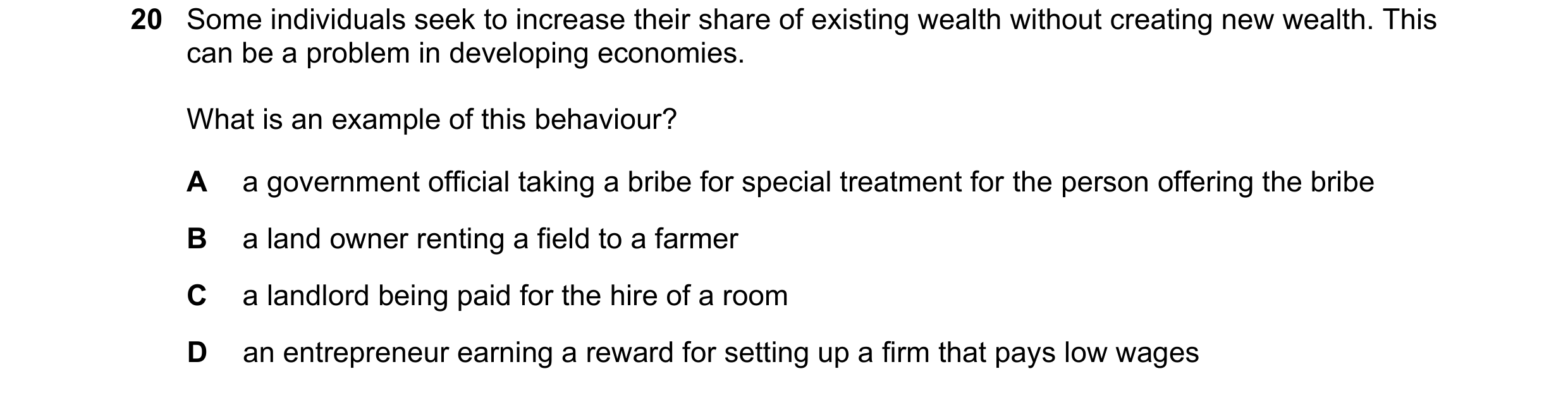
Q63 · Some individuals seek to increase their share of existing wealth without creating new… 9708/32 May/June 2021
20 Some individuals seek to increase their share of existing wealth without creating new wealth. This can be a problem in developing economies. What is an example of this behaviour? A a government official taking a bribe for special treatment for the person offering the bribe B a land owner renting a field to a farmer C a landlord being paid for the hire of a room D an entrepreneur earning a reward for setting up a firm that pays low wages
1 marks
Answer: A
This question in 9708/32 May/June 2021
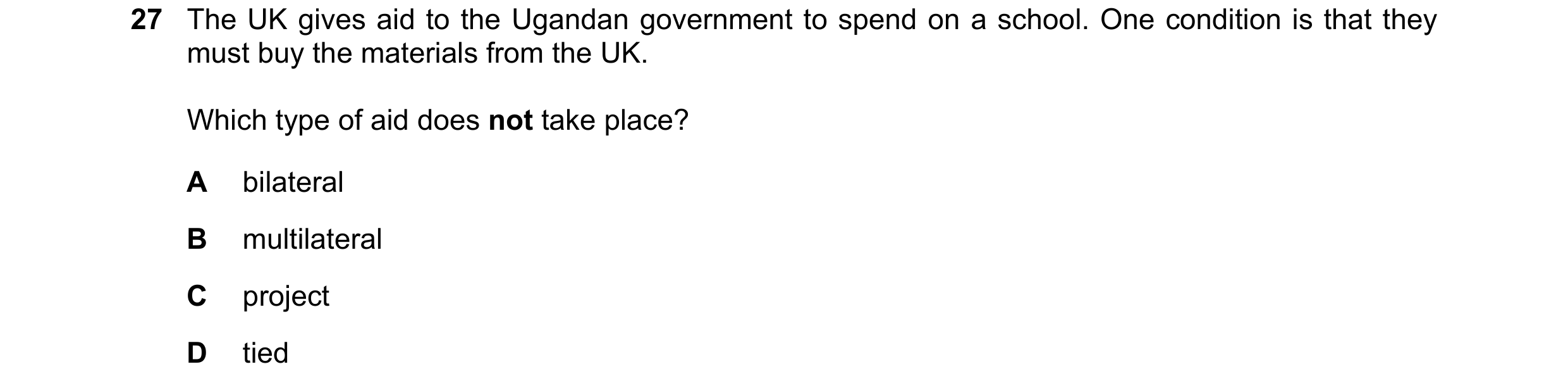
Q64 · The UK gives aid to the Ugandan government to spend on a school 9708/32 May/June 2021
27 The UK gives aid to the Ugandan government to spend on a school. One condition is that they must buy the materials from the UK. Which type of aid does not take place? A bilateral B multilateral C project D tied
1 marks
Answer: B
This question in 9708/32 May/June 2021
Q65 · The diagram shows the relative position of two countries X and Y on a Kuznets curve 9708/33 May/June 2021
19 The diagram shows the relative position of two countries X and Y on a Kuznets curve. inequality X Y O income per head What does the diagram indicate? A Country X collects more income tax than country Y. B Country X has a higher national income than country Y. C Country Y has less income inequality than country X. D Country Y is less economically developed than country X.
1 marks
Answer: C
This question in 9708/33 May/June 2021
Q66 · The Measure of Economic Welfare (MEW) is often regarded as a better measure of economic… 9708/33 May/June 2021
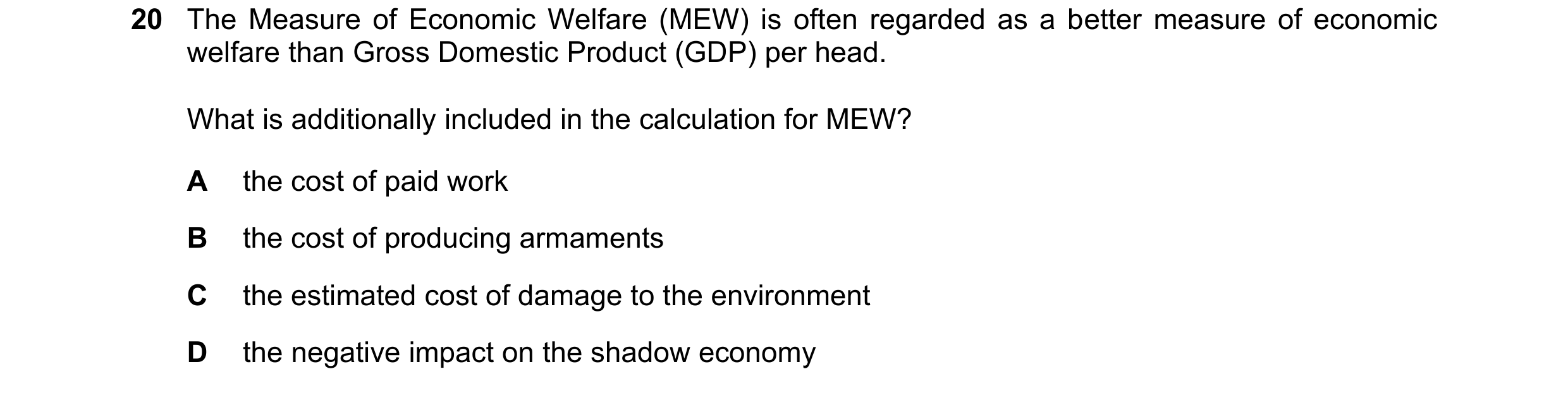
20 The Measure of Economic Welfare (MEW) is often regarded as a better measure of economic welfare than Gross Domestic Product (GDP) per head. What is additionally included in the calculation for MEW? A the cost of paid work B the cost of producing armaments C the estimated cost of damage to the environment D the negative impact on the shadow economy
1 marks
Answer: C
This question in 9708/33 May/June 2021
Q67 · The chart provides information about employment rates, as a percentage of total… 9708/33 May/June 2021
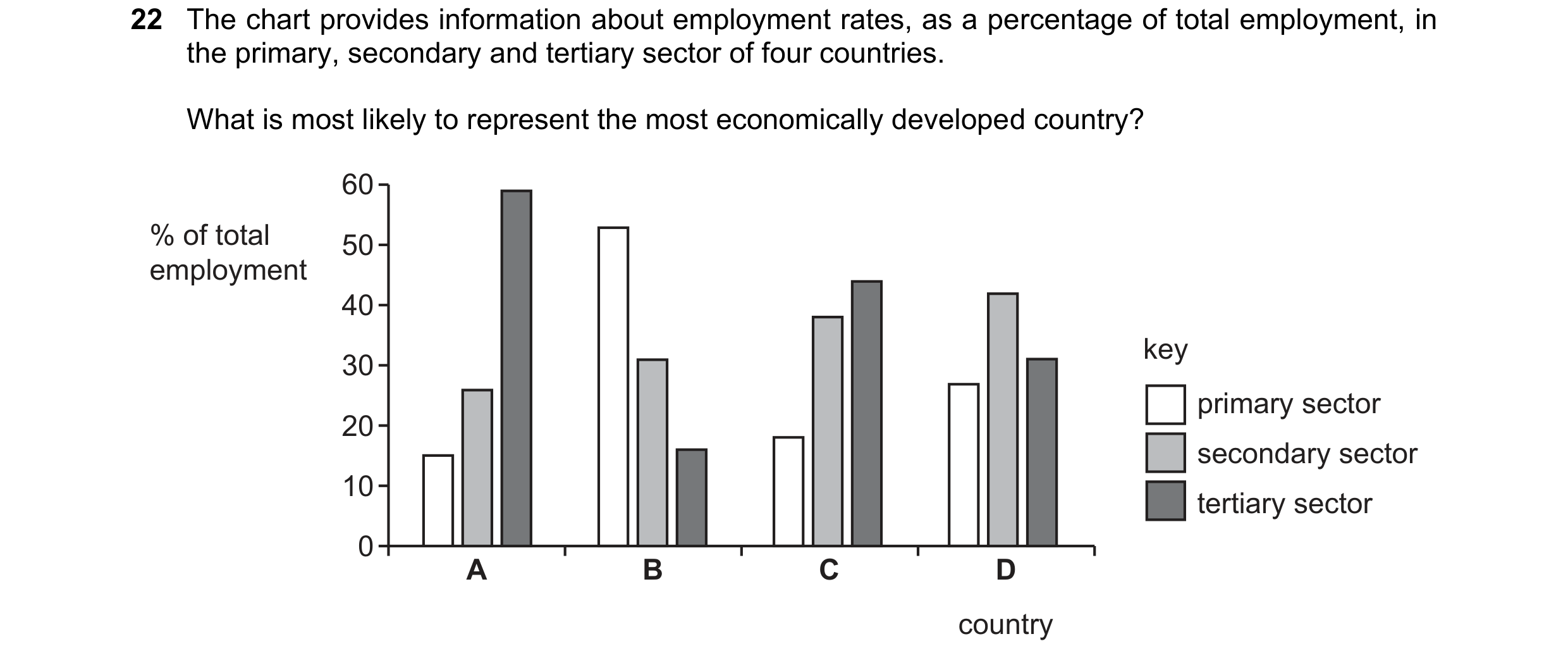
22 The chart provides information about employment rates, as a percentage of total employment, in the primary, secondary and tertiary sector of four countries. What is most likely to represent the most economically developed country? 60 % of total 50 employment 40 key 30 primary sector 20 secondary sector 10 tertiary sector 0 A B C D country
1 marks
Answer: A
This question in 9708/33 May/June 2021
Q68 · The diagram shows the Kuznets curve 9708/31 Oct/Nov 2021
19 The diagram shows the Kuznets curve. income inequality Q R P S O per capita income Which statement is correct with respect to the description of an economy and the corresponding letter on the Kuznets curve? A P is a market economy. B Q is a developed economy. C R is a developing economy. D S is an economy with a Gini coefficient = 0.
1 marks
Answer: D
This question in 9708/31 Oct/Nov 2021
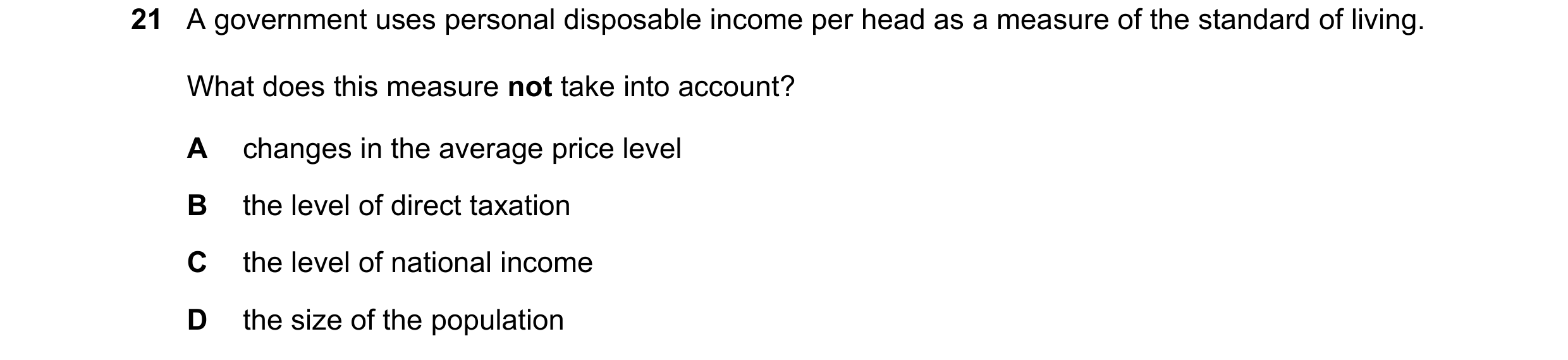
Q69 · A government uses personal disposable income per head as a measure of the standard of… 9708/31 Oct/Nov 2021
21 A government uses personal disposable income per head as a measure of the standard of living. What does this measure not take into account? A changes in the average price level B the level of direct taxation C the level of national income D the size of the population
1 marks
Answer: A
This question in 9708/31 Oct/Nov 2021
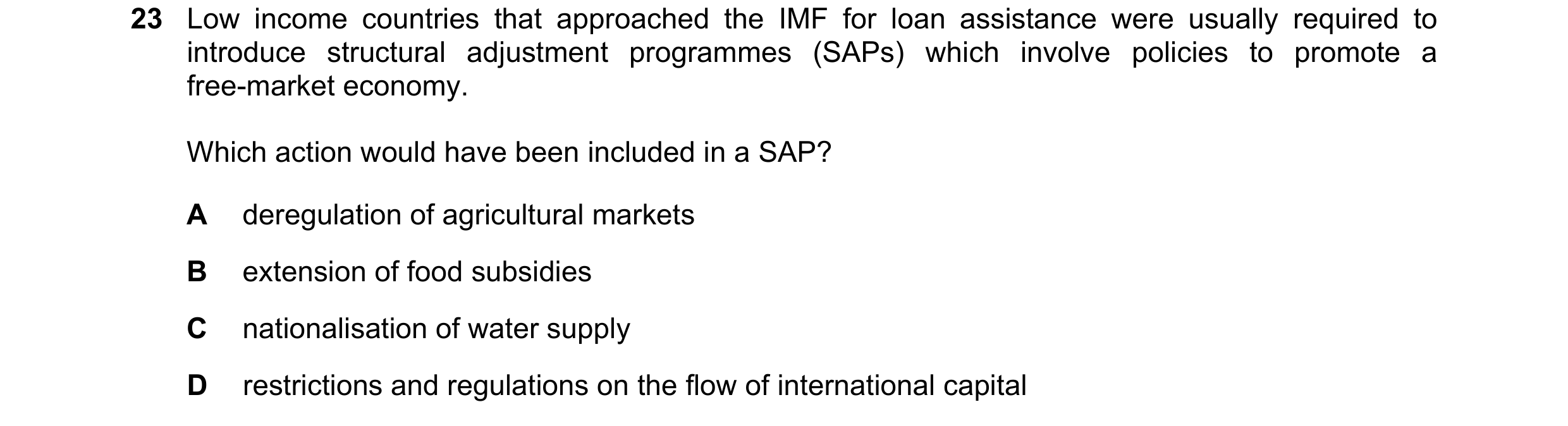
Q70 · Low income countries that approached the IMF for loan assistance were usually required to… 9708/31 Oct/Nov 2021
23 Low income countries that approached the IMF for loan assistance were usually required to introduce structural adjustment programmes (SAPs) which involve policies to promote a free-market economy. Which action would have been included in a SAP? A deregulation of agricultural markets B extension of food subsidies C nationalisation of water supply D restrictions and regulations on the flow of international capital
1 marks
Answer: A
This question in 9708/31 Oct/Nov 2021
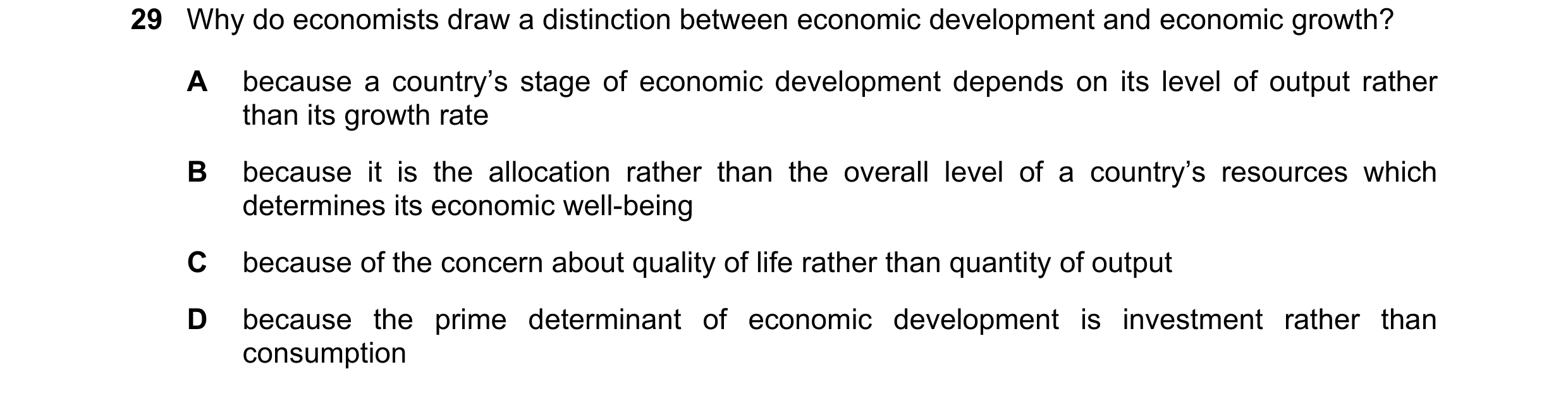
Q71 · Why do economists draw a distinction between economic development and economic growth? 9708/31 Oct/Nov 2021
29 Why do economists draw a distinction between economic development and economic growth? A because a country’s stage of economic development depends on its level of output rather than its growth rate B because it is the allocation rather than the overall level of a country’s resources which determines its economic well-being C because of the concern about quality of life rather than quantity of output D because the prime determinant of economic development is investment rather than consumption
1 marks
Answer: C
This question in 9708/31 Oct/Nov 2021
Q72 · Why is real GDP per head thought to be an imperfect measure of welfare in developed… 9708/32 Oct/Nov 2021
19 Why is real GDP per head thought to be an imperfect measure of welfare in developed economies? A frequent government manipulation and misuse of data B no account is taken of inflation C the restricted scope of the data’s content and coverage D the shadow economy is greater than the official economy
1 marks
Answer: C
This question in 9708/32 Oct/Nov 2021
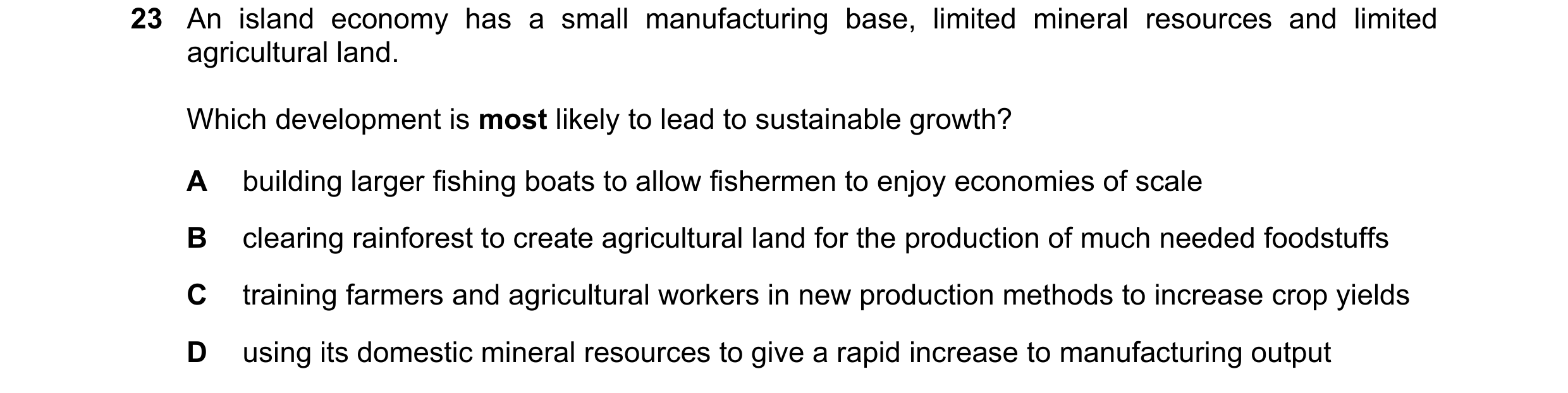
Q73 · An island economy has a small manufacturing base, limited mineral resources and limited… 9708/32 Oct/Nov 2021
23 An island economy has a small manufacturing base, limited mineral resources and limited agricultural land. Which development is most likely to lead to sustainable growth? A building larger fishing boats to allow fishermen to enjoy economies of scale B clearing rainforest to create agricultural land for the production of much needed foodstuffs C training farmers and agricultural workers in new production methods to increase crop yields D using its domestic mineral resources to give a rapid increase to manufacturing output
1 marks
Answer: C
This question in 9708/32 Oct/Nov 2021
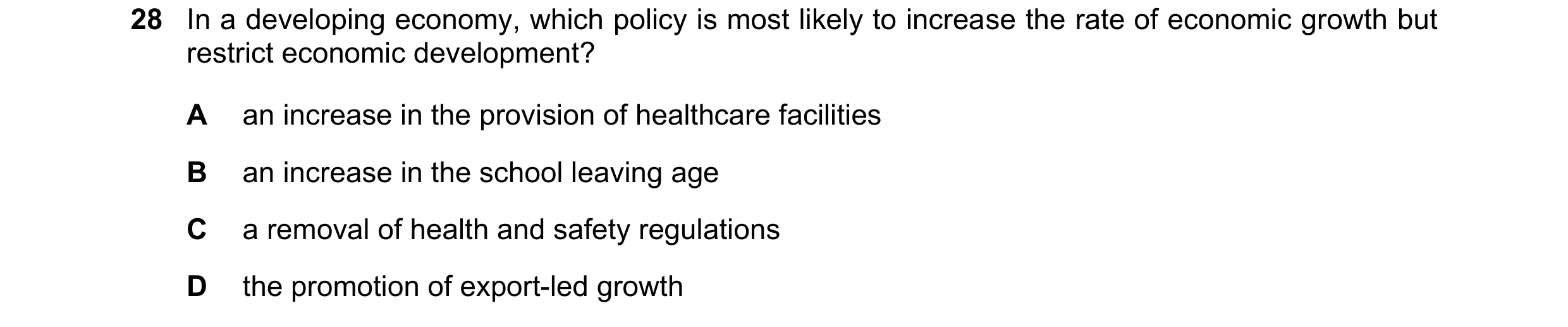
Q74 · In a developing economy, which policy is most likely to increase the rate of economic… 9708/32 Oct/Nov 2021
28 In a developing economy, which policy is most likely to increase the rate of economic growth but restrict economic development? A an increase in the provision of healthcare facilities B an increase in the school leaving age C a removal of health and safety regulations D the promotion of export-led growth
1 marks
Answer: C
This question in 9708/32 Oct/Nov 2021
Q75 · What is shown by the Kuznets curve? 9708/31 May/June 2022
20 What is shown by the Kuznets curve? A the rise and then fall in the balance of trade deficit following a devaluation B the rise and then fall in the economic growth rate as the GDP increases C the rise and then fall in inequality as the level of income per head rises D the rise and then fall in tax revenue as the tax rate is increased
1 marks
Answer: C
This question in 9708/31 May/June 2022
Q76 · What is shown by the Kuznets curve? 9708/33 May/June 2022
20 What is shown by the Kuznets curve? A the rise and then fall in the balance of trade deficit following a devaluation B the rise and then fall in the economic growth rate as the GDP increases C the rise and then fall in inequality as the level of income per head rises D the rise and then fall in tax revenue as the tax rate is increased
1 marks
Answer: C
This question in 9708/33 May/June 2022
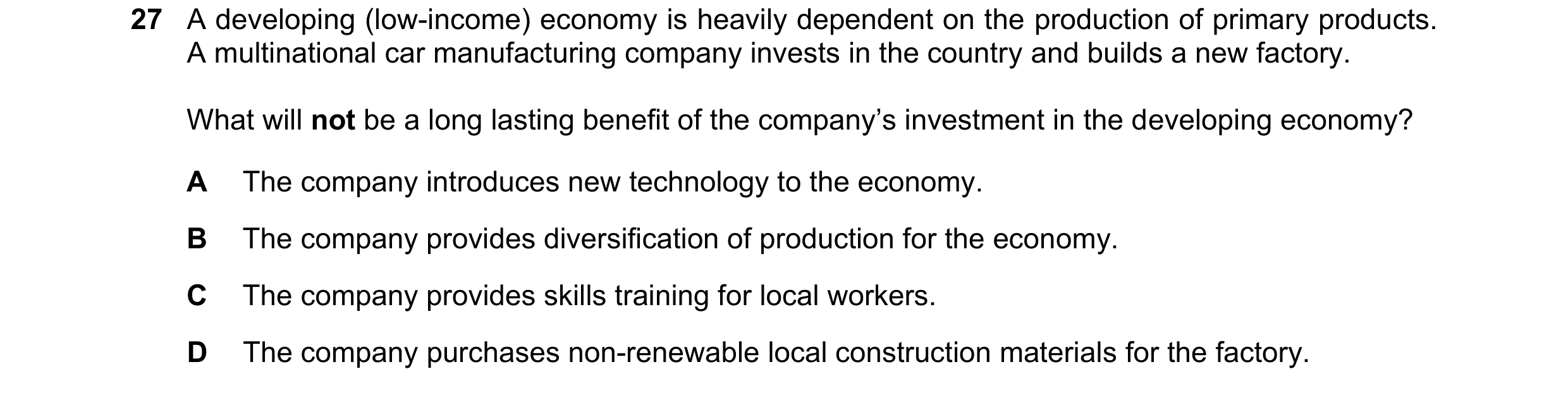
Q77 · A developing (low-income) economy is heavily dependent on the production of primary… 9708/31 Oct/Nov 2022
27 A developing (low-income) economy is heavily dependent on the production of primary products. A multinational car manufacturing company invests in the country and builds a new factory. What will not be a long lasting benefit of the company’s investment in the developing economy? A The company introduces new technology to the economy. B The company provides diversification of production for the economy. C The company provides skills training for local workers. D The company purchases non-renewable local construction materials for the factory.
1 marks
Answer: D
This question in 9708/31 Oct/Nov 2022
Q78 · Which statement does not support the view that extraction of mineral resources by a… 9708/32 Oct/Nov 2022
18 Which statement does not support the view that extraction of mineral resources by a foreign company will make it more difficult for a developing economy to achieve future economic growth? A Exports of these mineral resources will result in an appreciation of the exchange rate. B Reduced tax rates aimed at encouraging the foreign company to invest in the country will increase inflation. C The foreign company will raise the skill levels of the local population through training schemes. D The foreign company will send profits back to its own country.
1 marks
Answer: C
This question in 9708/32 Oct/Nov 2022
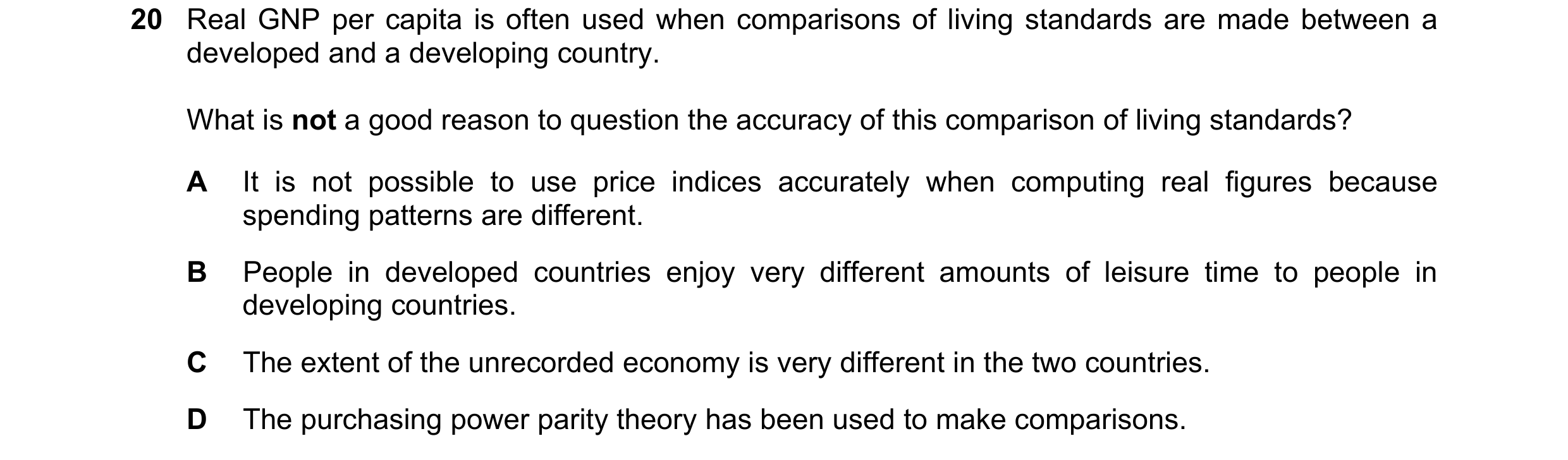
Q79 · Real GNP per capita is often used when comparisons of living standards are made between a… 9708/33 Oct/Nov 2022
20 Real GNP per capita is often used when comparisons of living standards are made between a developed and a developing country. What is not a good reason to question the accuracy of this comparison of living standards? A It is not possible to use price indices accurately when computing real figures because spending patterns are different. B People in developed countries enjoy very different amounts of leisure time to people in developing countries. C The extent of the unrecorded economy is very different in the two countries. D The purchasing power parity theory has been used to make comparisons.
1 marks
Answer: D
This question in 9708/33 Oct/Nov 2022
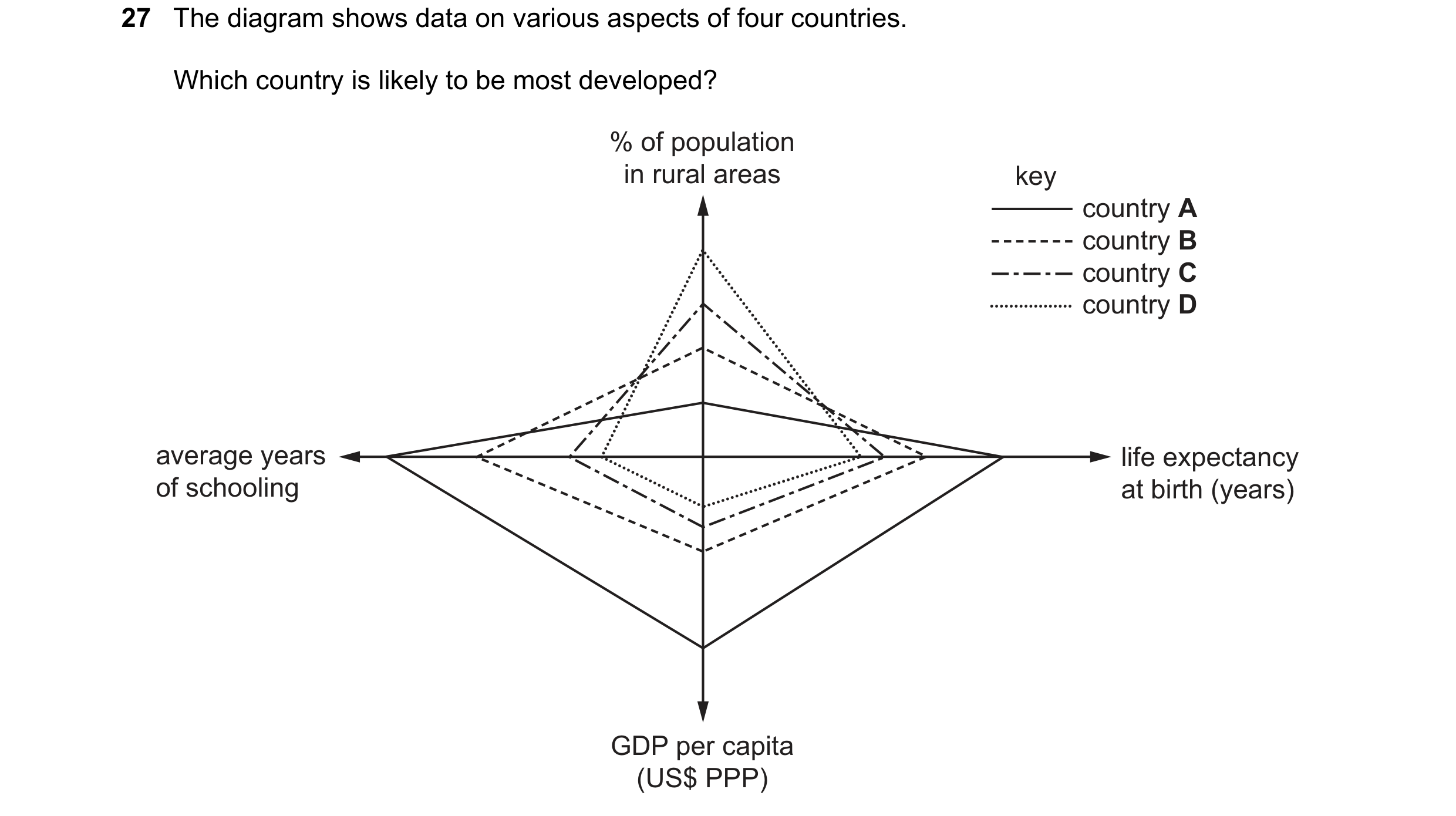
Q80 · The diagram shows data on various aspects of four countries 9708/33 Oct/Nov 2022
27 The diagram shows data on various aspects of four countries. Which country is likely to be most developed? % of population in rural areas key country A country B country C country D average years life expectancy of schooling at birth (years) GDP per capita (US$ PPP)
1 marks
Answer: A
This question in 9708/33 Oct/Nov 2022
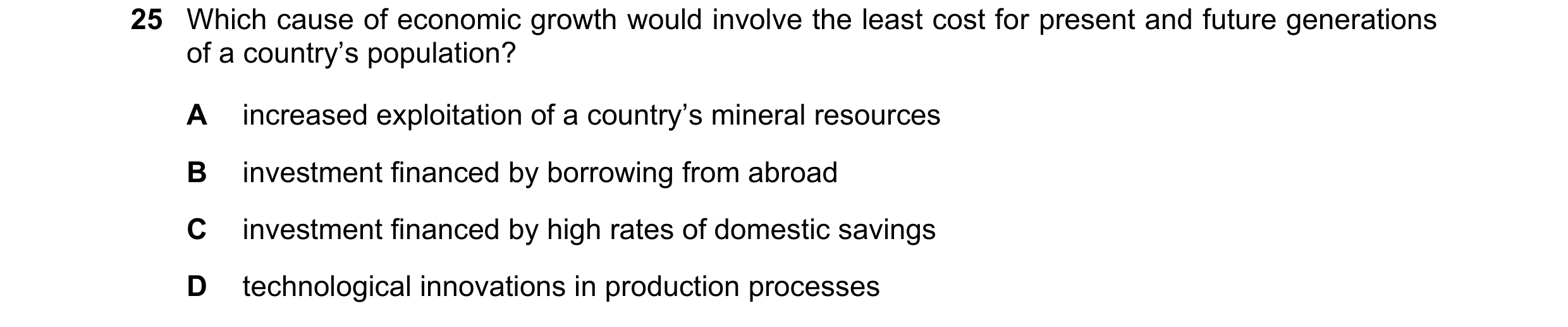
Q81 · Which cause of economic growth would involve the least cost for present and future… 9708/32 Feb/March 2023
25 Which cause of economic growth would involve the least cost for present and future generations of a country’s population? A increased exploitation of a country’s mineral resources B investment financed by borrowing from abroad C investment financed by high rates of domestic savings D technological innovations in production processes
1 marks
Answer: D
This question in 9708/32 Feb/March 2023
Q82 · Which additional components may be included when measuring economic development that are… 9708/32 Feb/March 2023
26 Which additional components may be included when measuring economic development that are not included in measures of economic growth? changes in level of real income the distribution poverty per capita of GDP A no no yes B no yes no C yes yes no D yes yes yes
1 marks
Answer: C
This question in 9708/32 Feb/March 2023
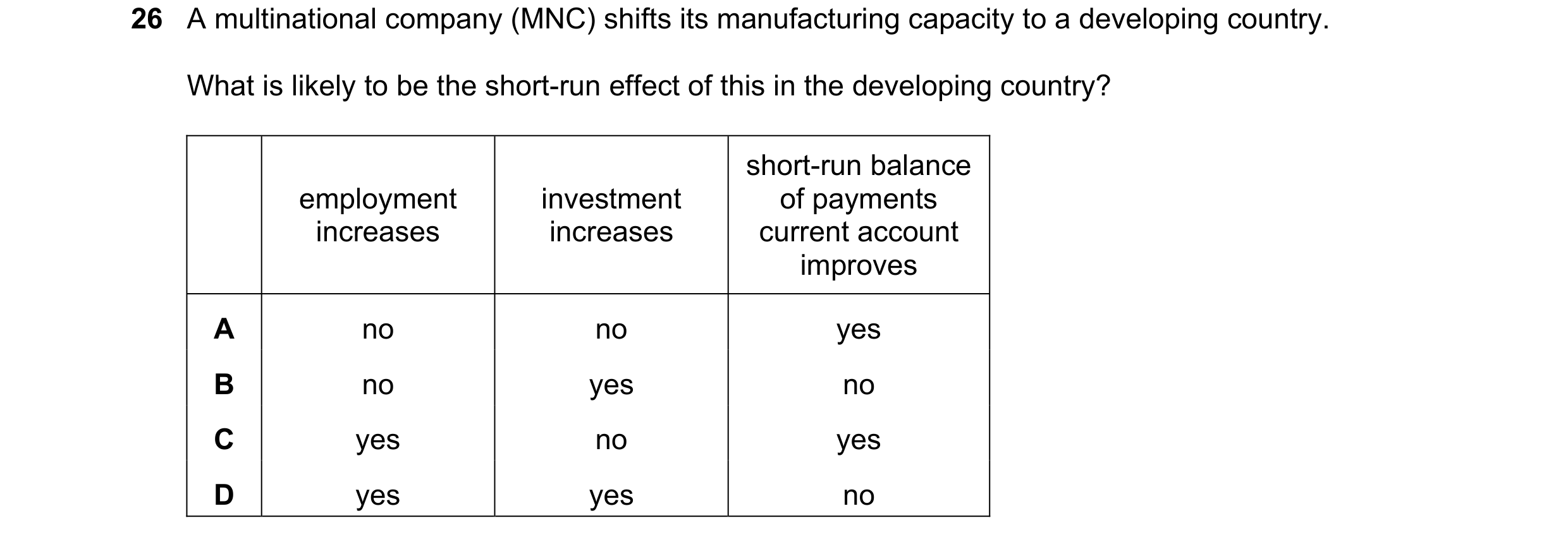
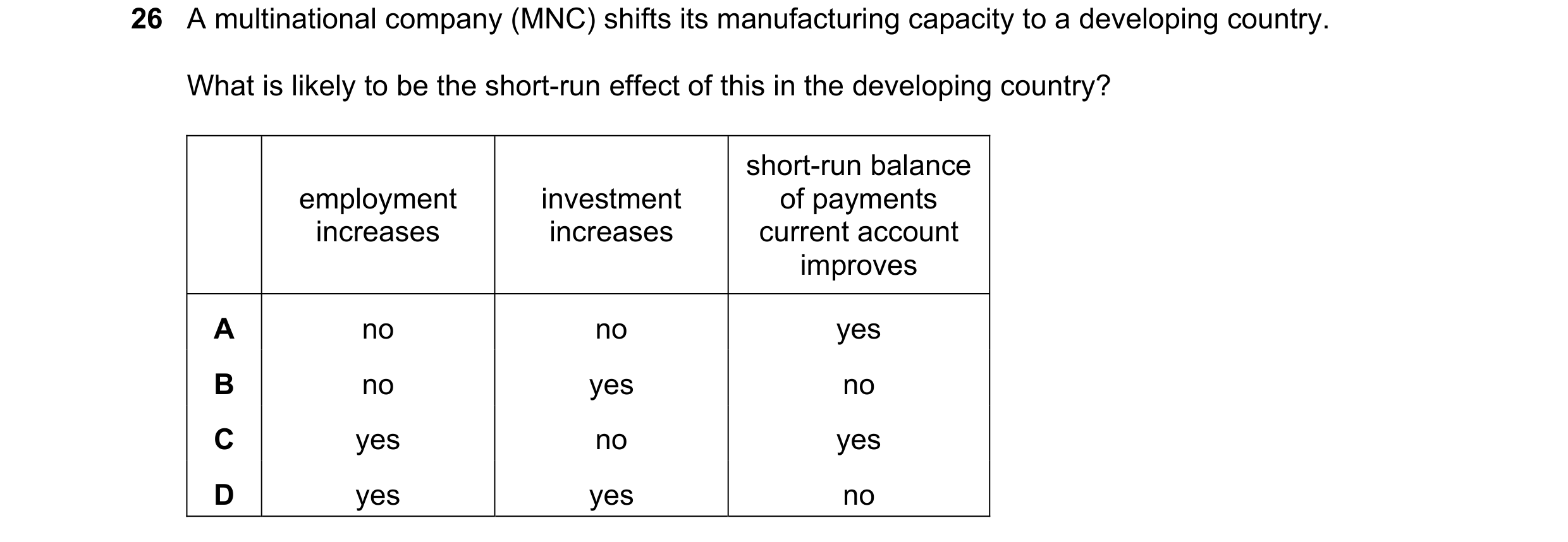
Q83 · A multinational company (MNC) shifts its manufacturing capacity to a developing country 9708/31 May/June 2023
26 A multinational company (MNC) shifts its manufacturing capacity to a developing country. What is likely to be the short-run effect of this in the developing country? short-run balance employment investment of payments increases increases current account improves A no no yes B no yes no C yes no yes D yes yes no
1 marks
Answer: D
This question in 9708/31 May/June 2023
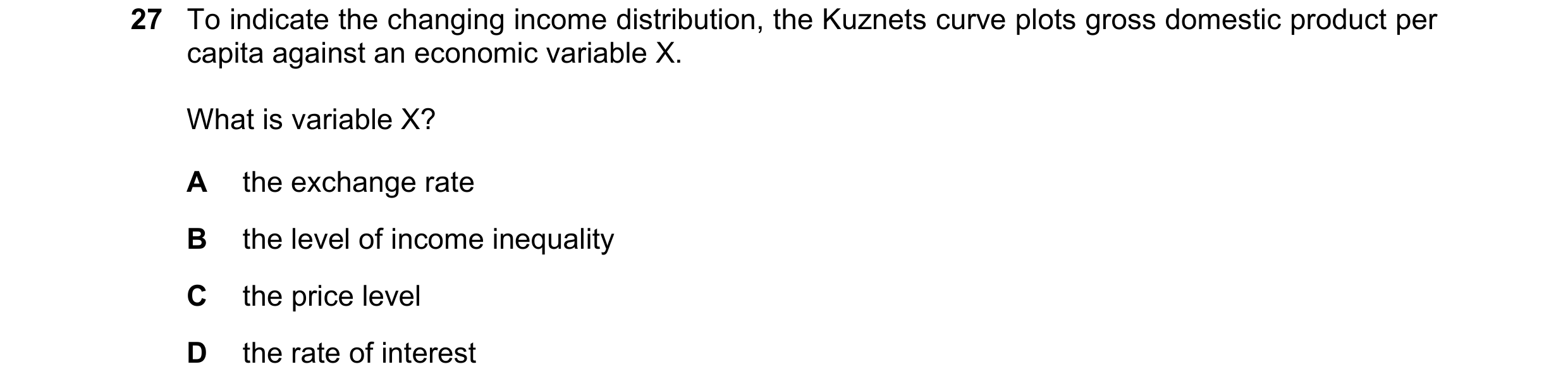
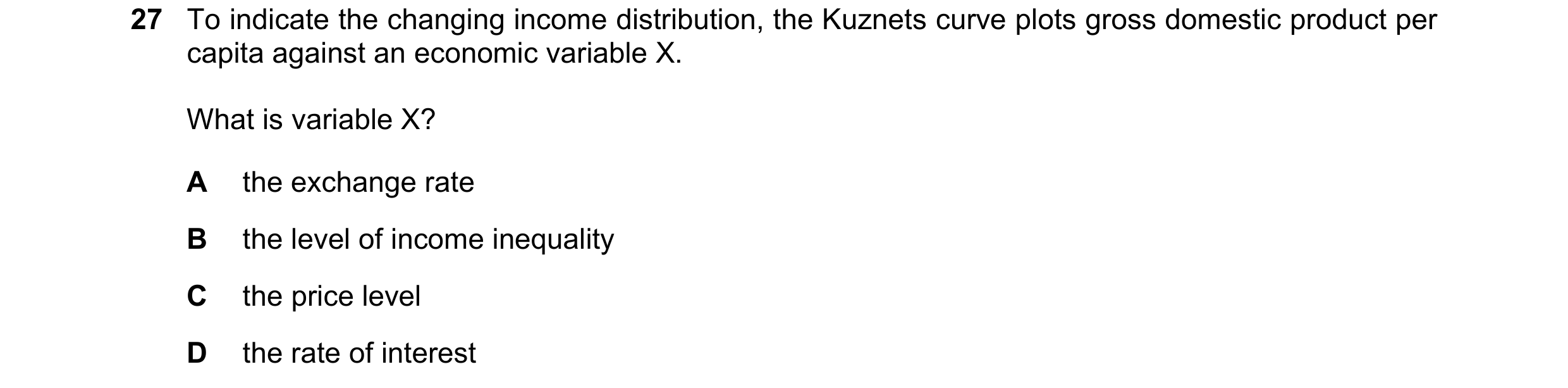
Q84 · To indicate the changing income distribution, the Kuznets curve plots gross domestic… 9708/31 May/June 2023
27 To indicate the changing income distribution, the Kuznets curve plots gross domestic product per capita against an economic variable X. What is variable X? A the exchange rate B the level of income inequality C the price level D the rate of interest
1 marks
Answer: B
This question in 9708/31 May/June 2023
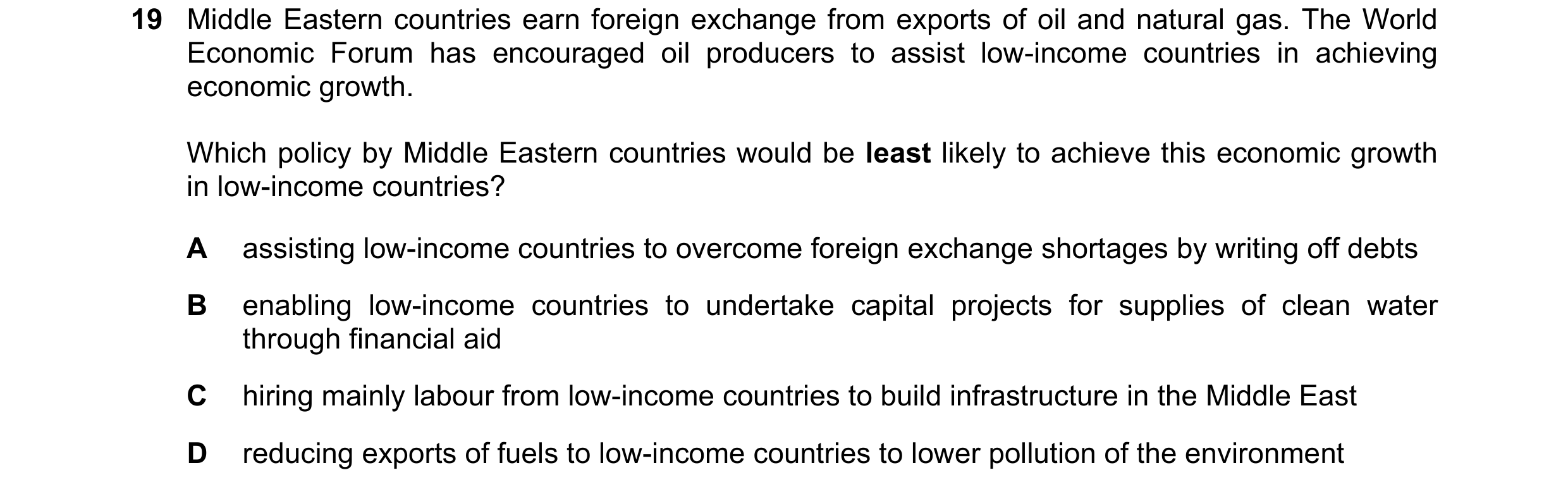
Q85 · Middle Eastern countries earn foreign exchange from exports of oil and natural gas 9708/32 May/June 2023
19 Middle Eastern countries earn foreign exchange from exports of oil and natural gas. The World Economic Forum has encouraged oil producers to assist low-income countries in achieving economic growth. Which policy by Middle Eastern countries would be least likely to achieve this economic growth in low-income countries? A assisting low-income countries to overcome foreign exchange shortages by writing off debts B enabling low-income countries to undertake capital projects for supplies of clean water through financial aid C hiring mainly labour from low-income countries to build infrastructure in the Middle East D reducing exports of fuels to low-income countries to lower pollution of the environment
1 marks
Answer: D
This question in 9708/32 May/June 2023
Q86 · The table shows the Human Development Index (HDI) values for India in 2014 and 2020 9708/32 May/June 2023
27 The table shows the Human Development Index (HDI) values for India in 2014 and 2020. HDI value 2014 0.60 2020 0.64 Which conclusion is most likely to be drawn from the table about the change in the HDI value from 2014 to 2020? A India had a fall in life expectancy at birth. B India had a fall in real national income per head. C India had a rise in environmental pollution and crime rates. D India had a rise in the mean years of schooling of the adult population.
1 marks
Answer: D
This question in 9708/32 May/June 2023
Q87 · What is central to economic growth but not necessarily to economic development? 9708/32 May/June 2023
30 What is central to economic growth but not necessarily to economic development? A an expansion of the range of economic choices available to individuals B an increase in Gross Domestic Product C the eradication of absolute poverty D the satisfaction of basic needs amongst the whole population
1 marks
Answer: B
This question in 9708/32 May/June 2023
Q88 · A multinational company (MNC) shifts its manufacturing capacity to a developing country 9708/33 May/June 2023
26 A multinational company (MNC) shifts its manufacturing capacity to a developing country. What is likely to be the short-run effect of this in the developing country? short-run balance employment investment of payments increases increases current account improves A no no yes B no yes no C yes no yes D yes yes no
1 marks
Answer: D
This question in 9708/33 May/June 2023
Q89 · To indicate the changing income distribution, the Kuznets curve plots gross domestic… 9708/33 May/June 2023
27 To indicate the changing income distribution, the Kuznets curve plots gross domestic product per capita against an economic variable X. What is variable X? A the exchange rate B the level of income inequality C the price level D the rate of interest
1 marks
Answer: B
This question in 9708/33 May/June 2023
Q90 · The turning point on the Kuznets curve for income inequality has been estimated to be in… 9708/31 Oct/Nov 2023
30 The turning point on the Kuznets curve for income inequality has been estimated to be in the region of US$10 500. For a country that has a GDP per capita of $8000, what is most likely? A A reduction in GDP per capita will have no effect on income inequality. B A reduction in GDP per capita will increase income inequality. C An increase in GDP per capita will have no effect on income inequality. D An increase in GDP per capita will increase income inequality.
1 marks
Answer: D
This question in 9708/31 Oct/Nov 2023
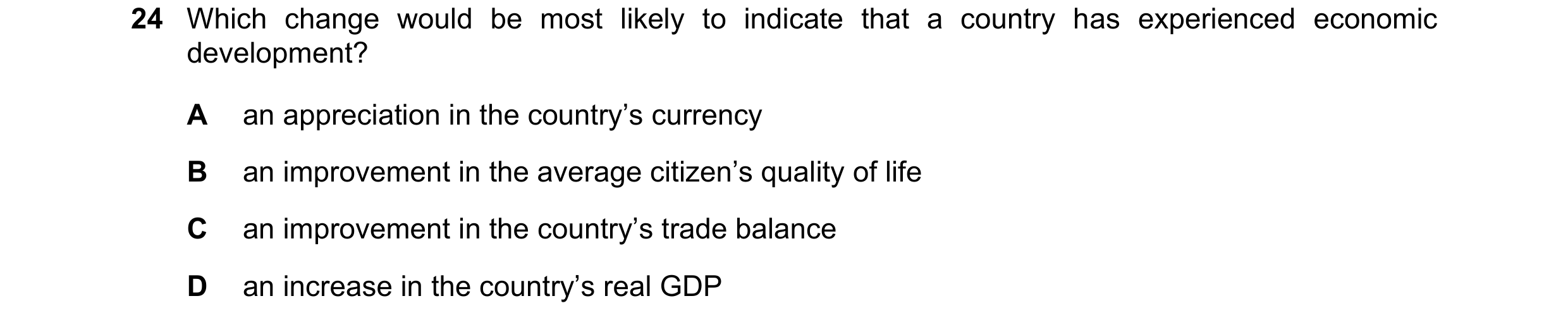
Q91 · Which change would be most likely to indicate that a country has experienced economic… 9708/33 Oct/Nov 2023
24 Which change would be most likely to indicate that a country has experienced economic development? A an appreciation in the country’s currency B an improvement in the average citizen’s quality of life C an improvement in the country’s trade balance D an increase in the country’s real GDP
1 marks
Answer: B
This question in 9708/33 Oct/Nov 2023
Q92 · What will increase the size of a country’s optimum population? 9708/31 May/June 2024
29 What will increase the size of a country’s optimum population? A a rise in the birth rate B a lowering of the age of retirement C a rise in the stock of capital available in the country D a decrease in the productivity of the country’s industries
1 marks
Answer: C
This question in 9708/31 May/June 2024
Q93 · What will increase the size of a country’s optimum population? 9708/33 May/June 2024
29 What will increase the size of a country’s optimum population? A a rise in the birth rate B a lowering of the age of retirement C a rise in the stock of capital available in the country D a decrease in the productivity of the country’s industries
1 marks
Answer: C
This question in 9708/33 May/June 2024
Q94 · What is least likely to lead to an increase in optimum population? 9708/32 Feb/March 2025
27 What is least likely to lead to an increase in optimum population? A an improvement in labour productivity B an improvement in the quality of capital and technology C an increase in birth rate and a fall in death rate D an increase in the availability of natural resources
1 marks
Answer: C
This question in 9708/32 Feb/March 2025
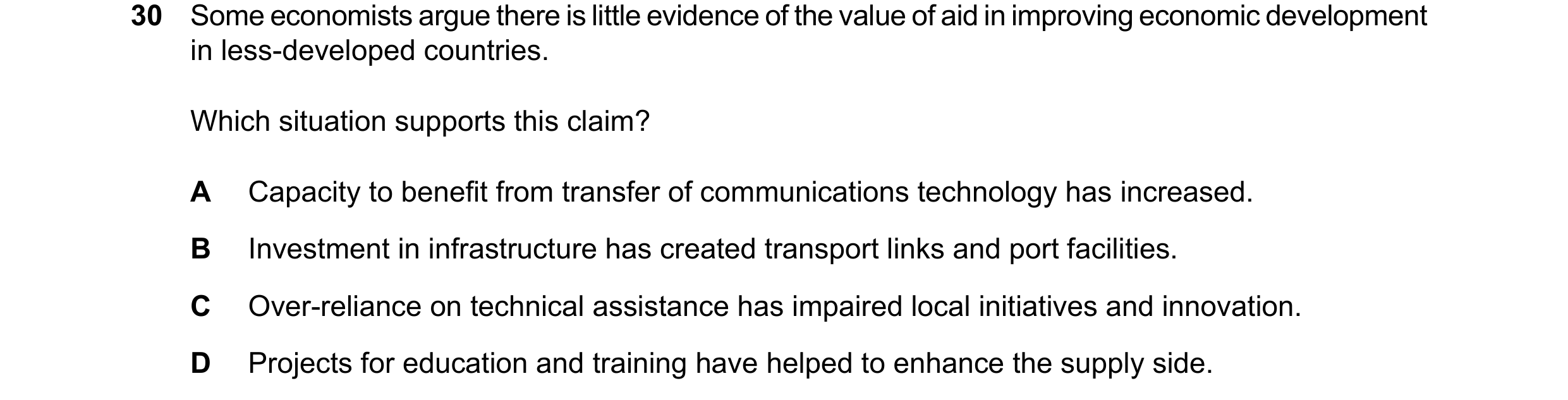
Q95 · Some economists argue there is little evidence of the value of aid in improving economic… 9708/32 Feb/March 2025
30 Some economists argue there is little evidence of the value of aid in improving economic development in less-developed countries. Which situation supports this claim? A Capacity to benefit from transfer of communications technology has increased. B Investment in infrastructure has created transport links and port facilities. C Over-reliance on technical assistance has impaired local initiatives and innovation. D Projects for education and training have helped to enhance the supply side.
1 marks
Answer: C
This question in 9708/32 Feb/March 2025
 1 / 21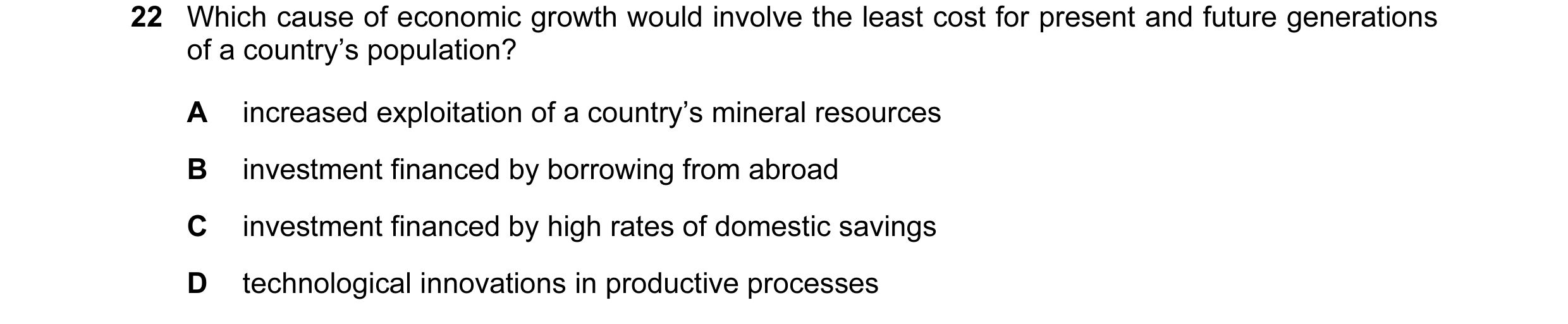

 2 / 21


 3 / 21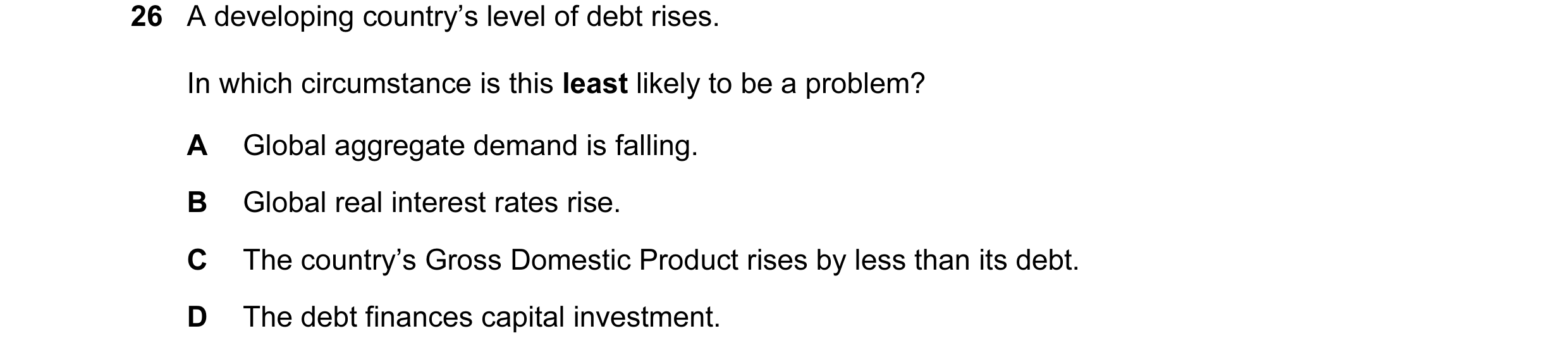


 4 / 21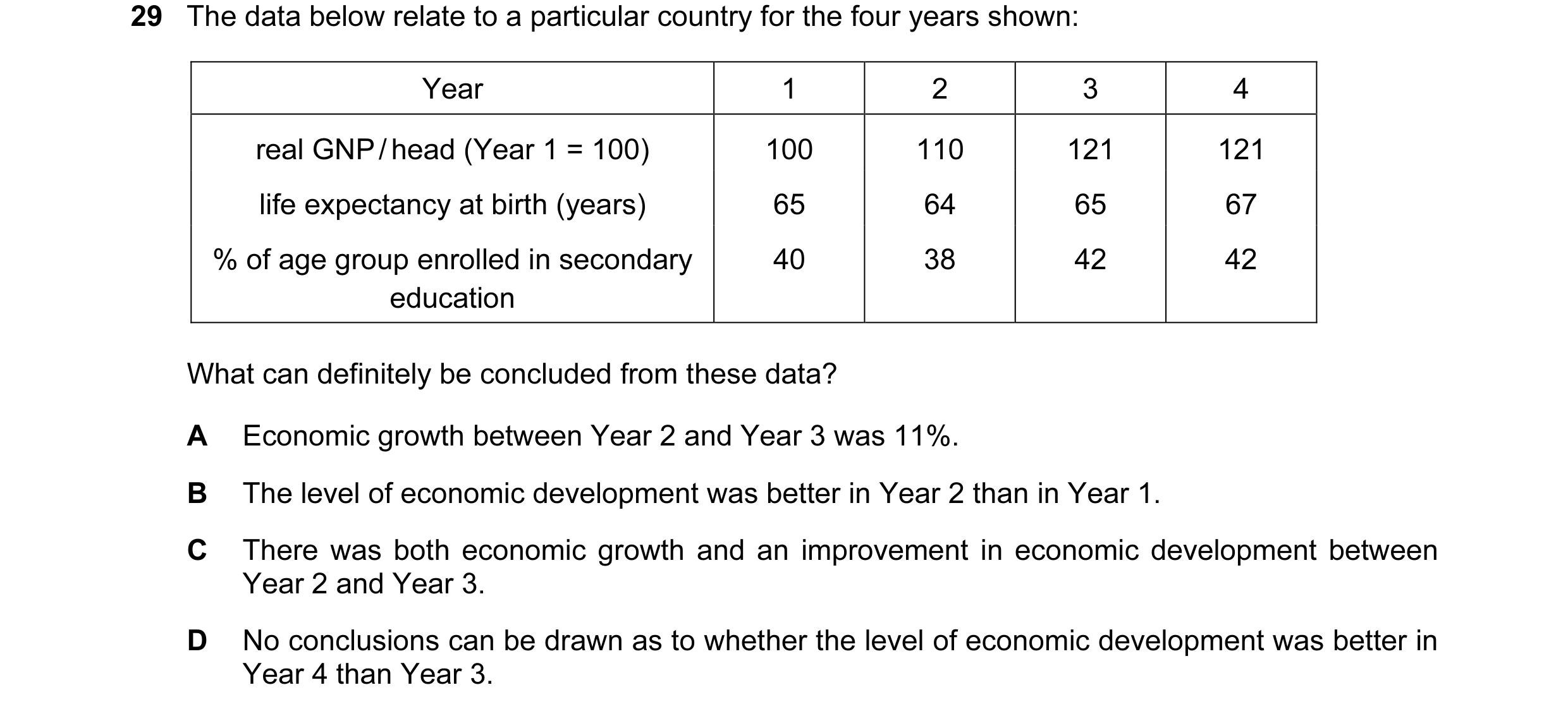
 5 / 21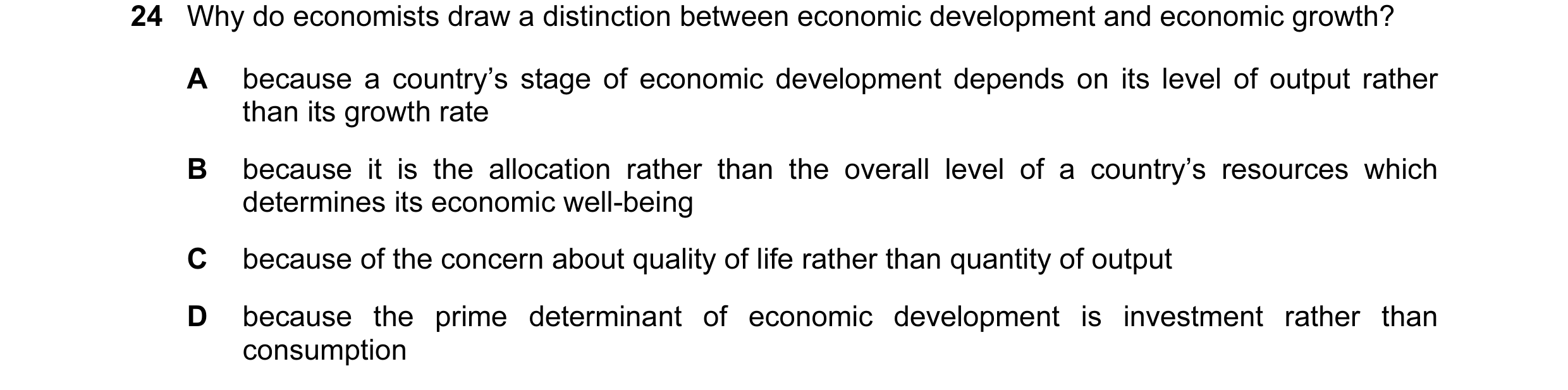
 6 / 21

 7 / 21
 8 / 21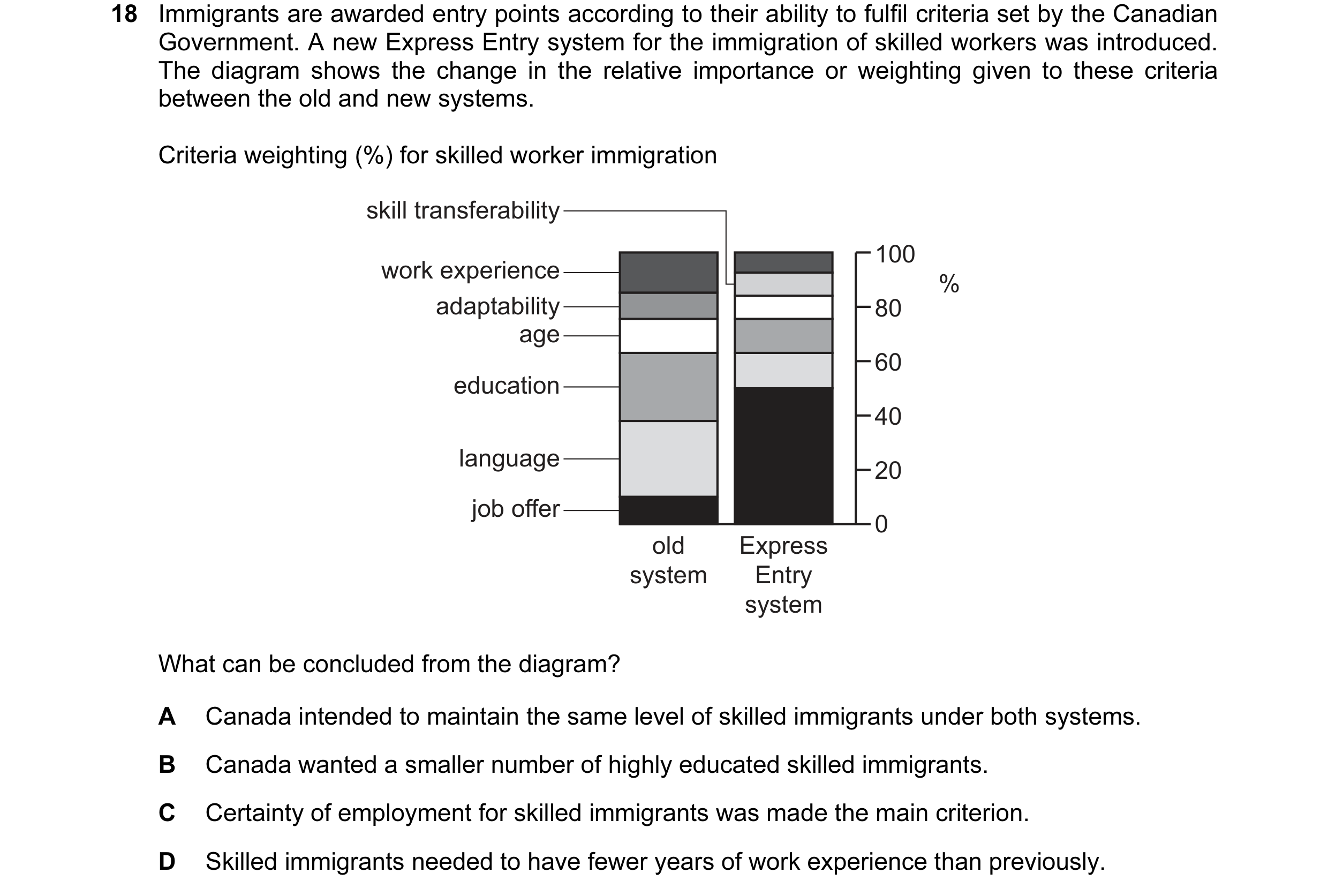

 9 / 21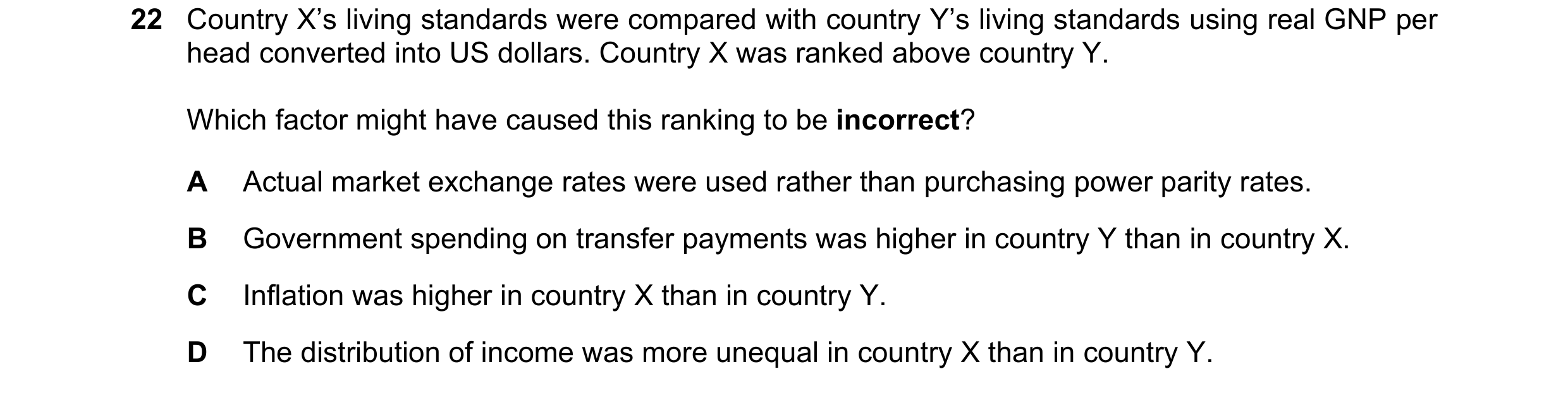

 10 / 21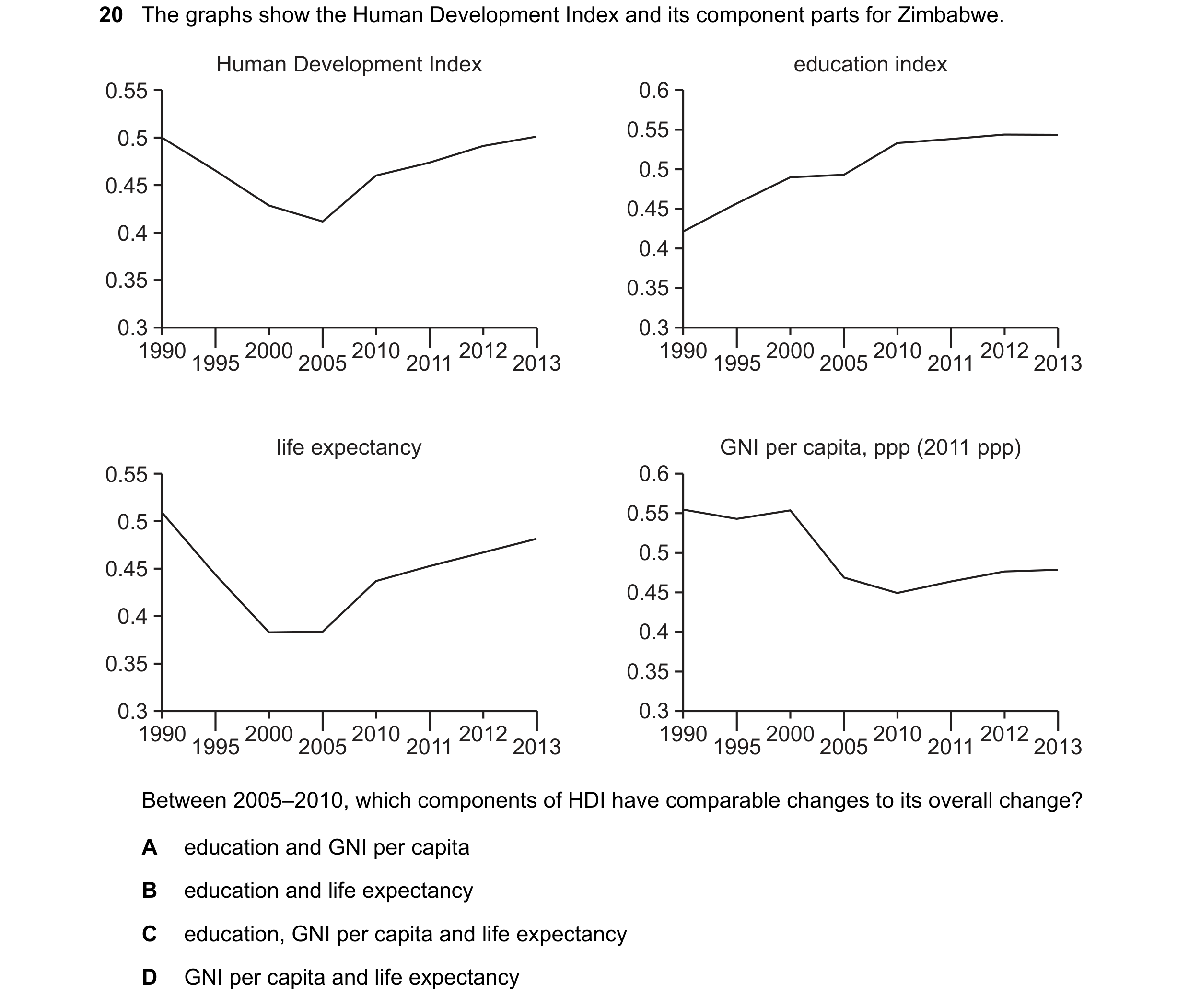

 11 / 21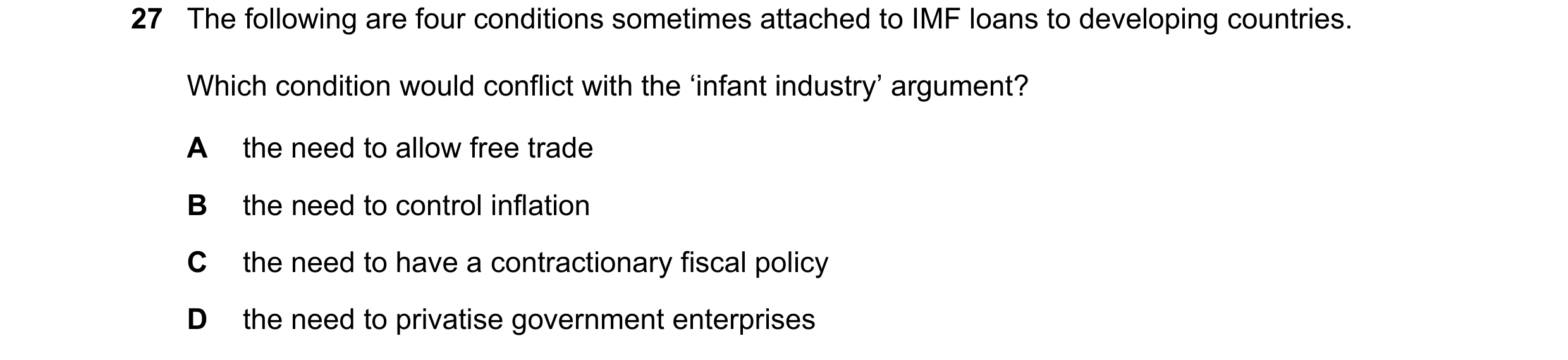
 12 / 21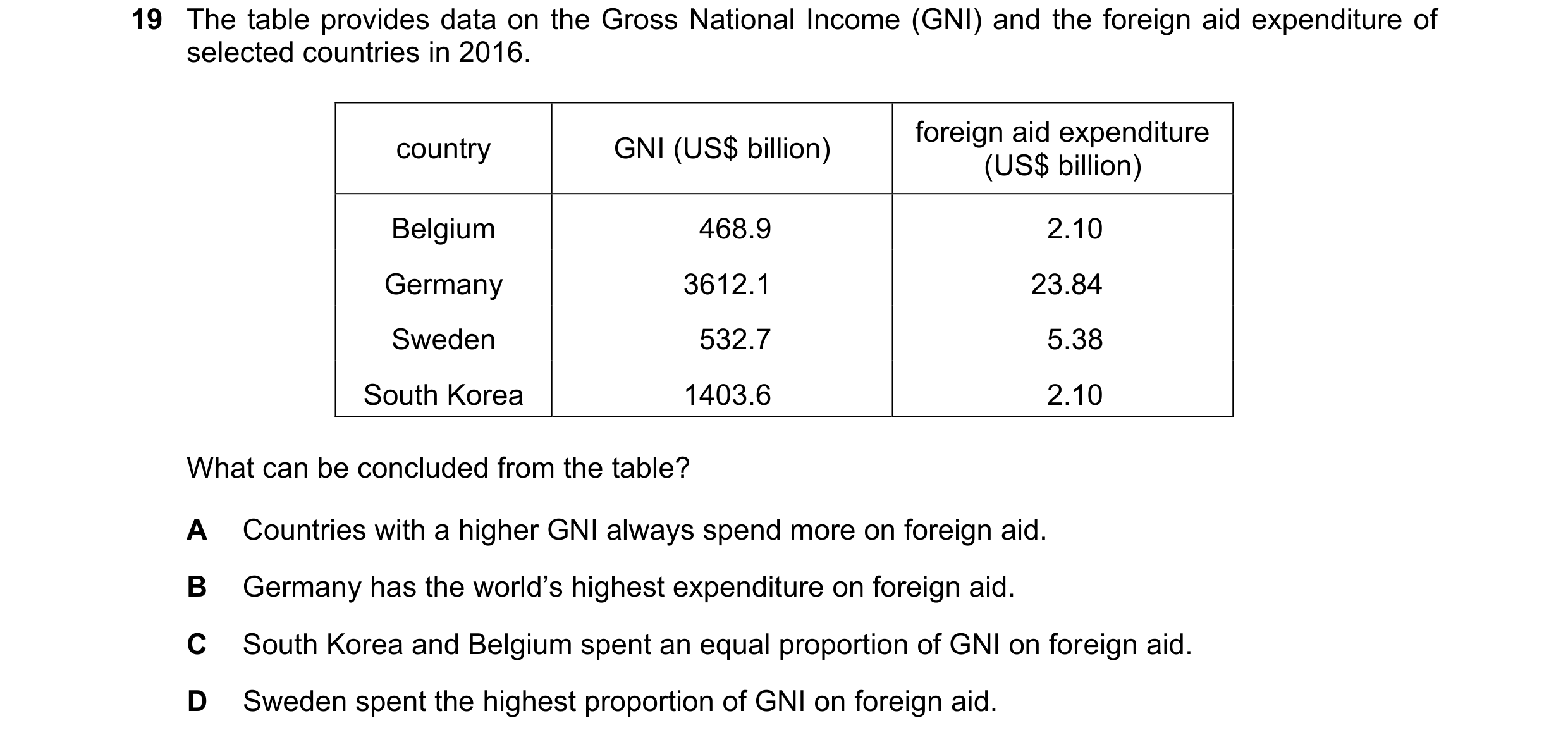
 13 / 21
 14 / 21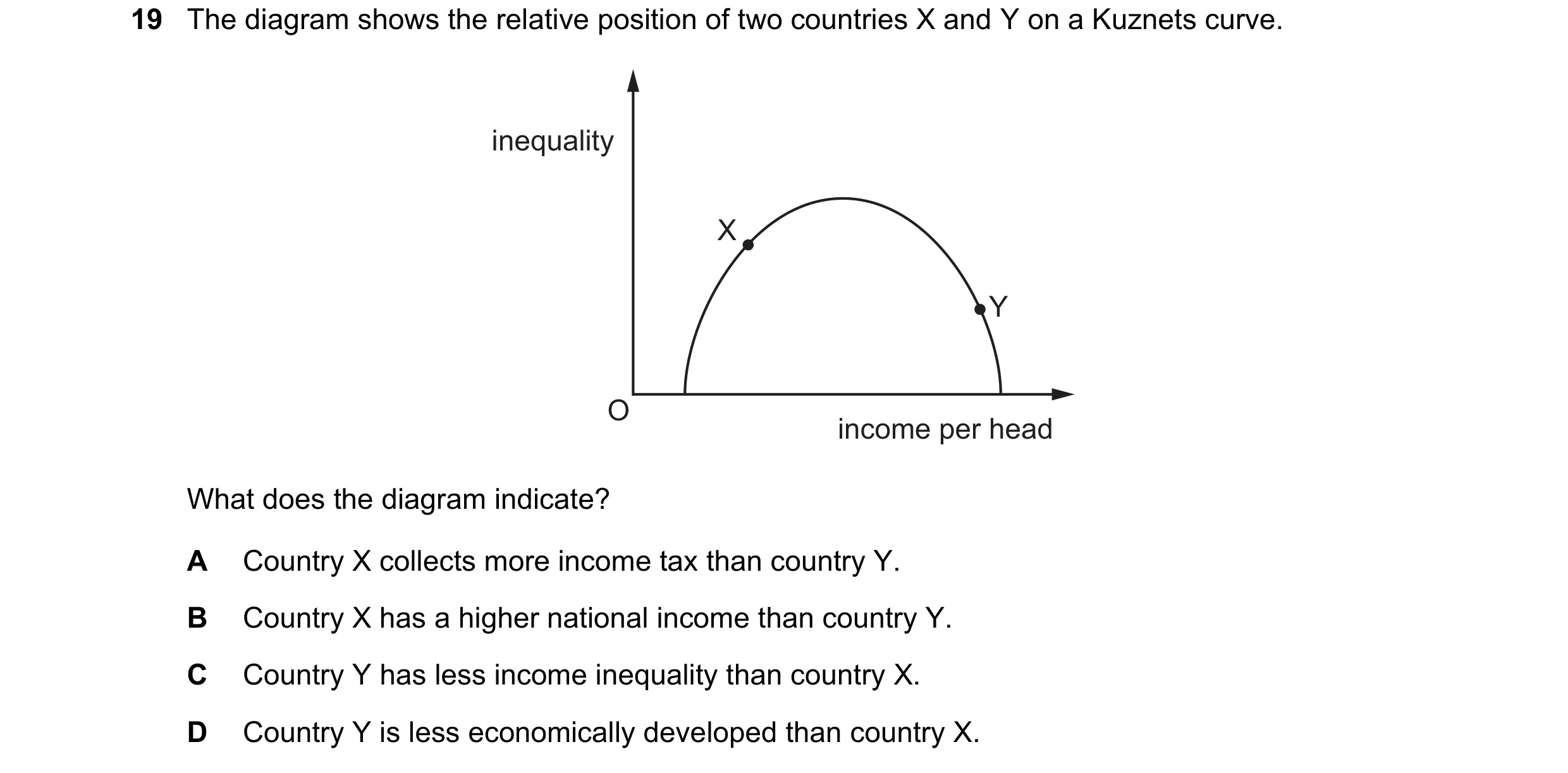
 15 / 21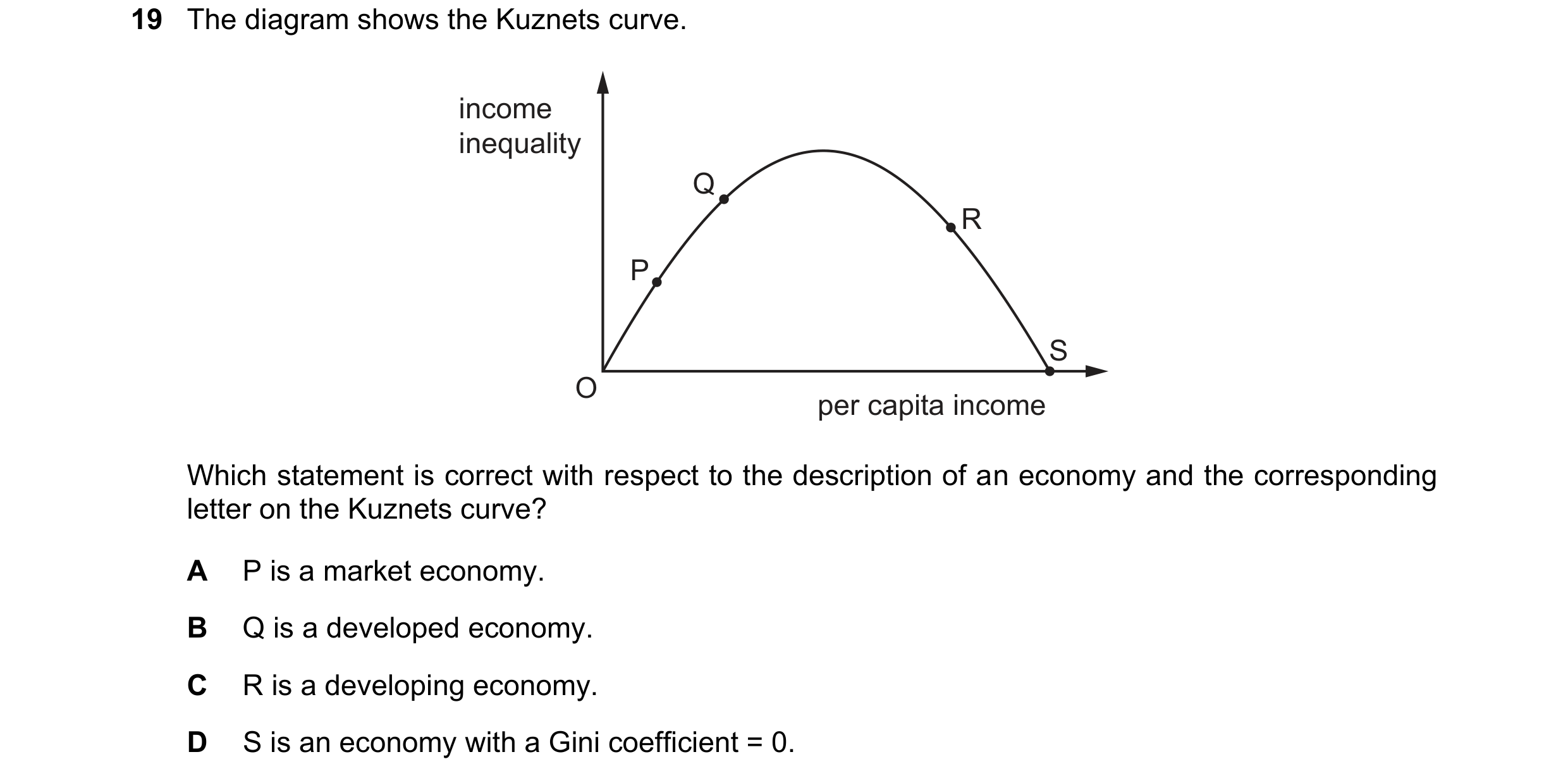
 16 / 21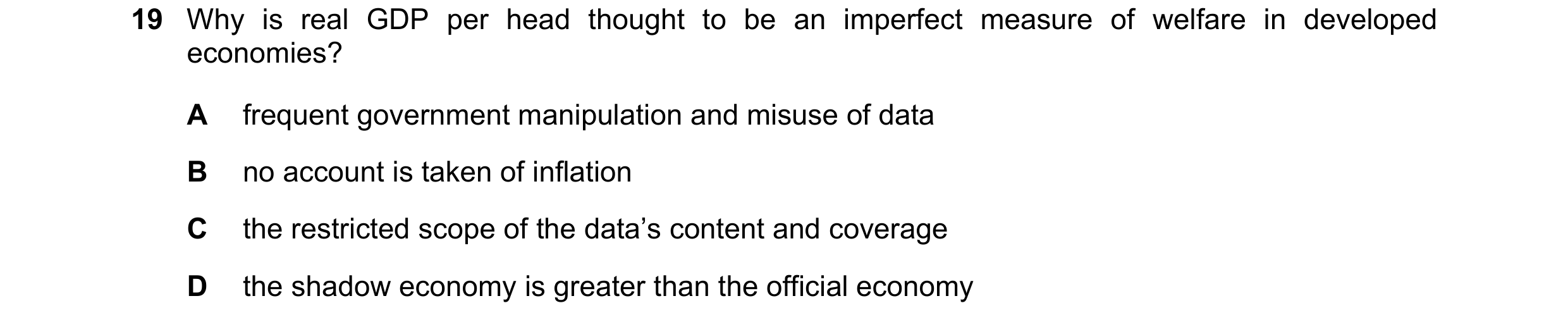


 17 / 21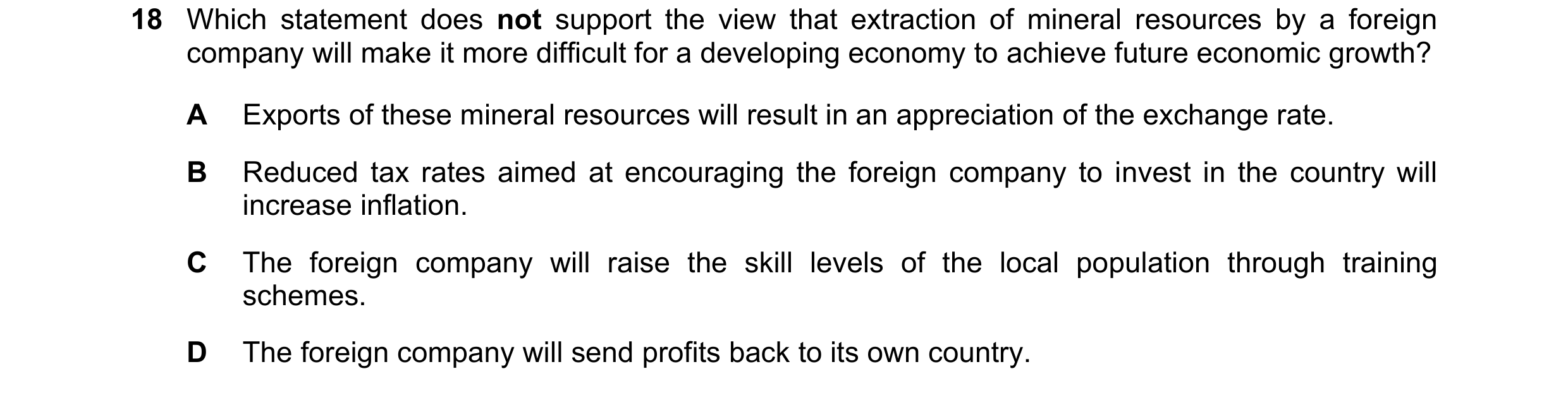
 18 / 21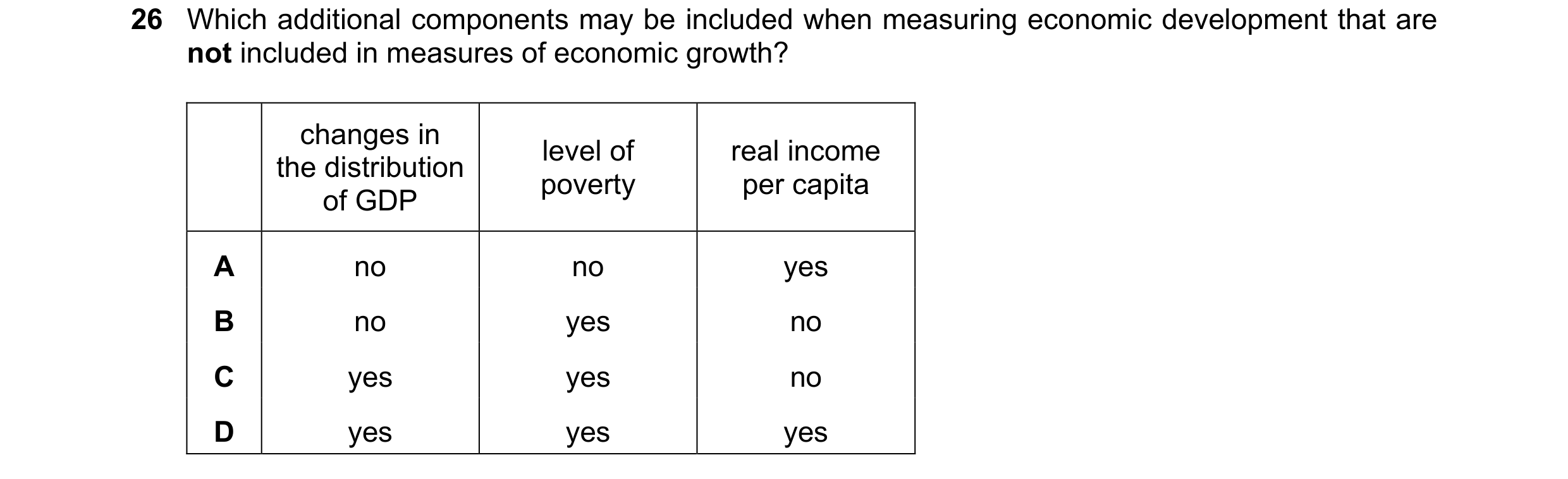
 19 / 21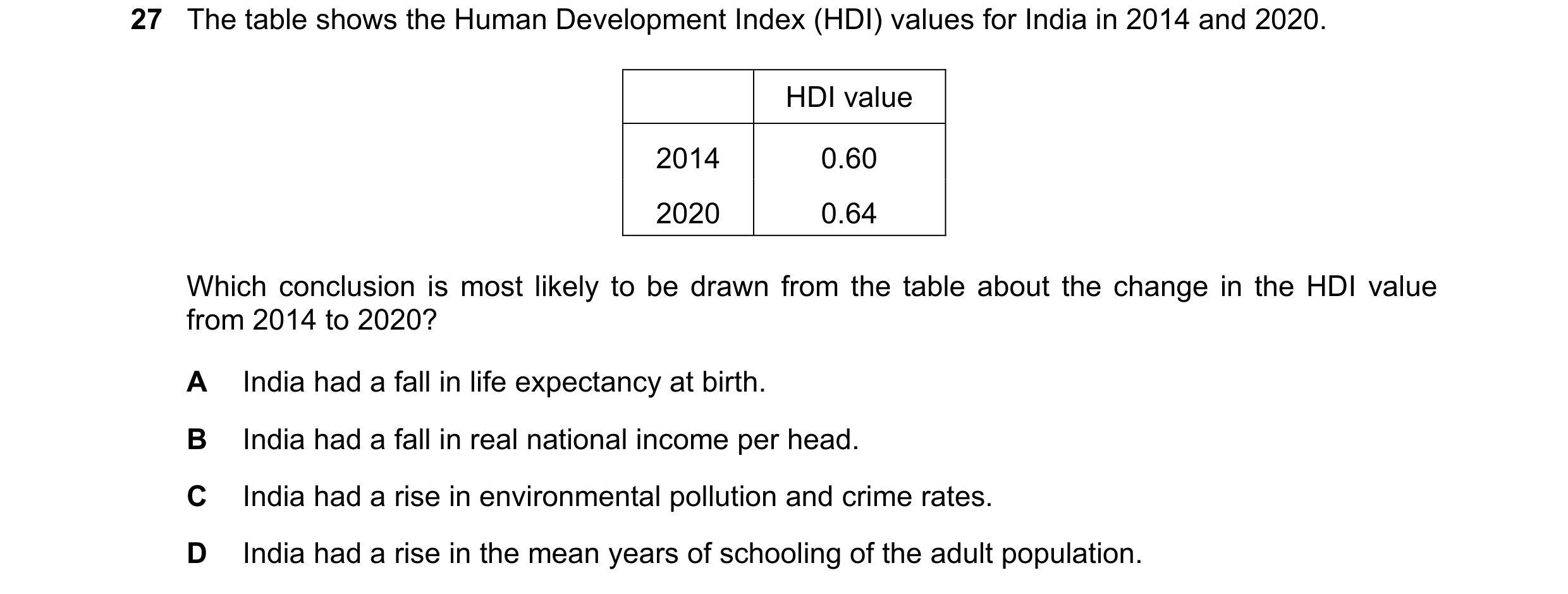

 20 / 21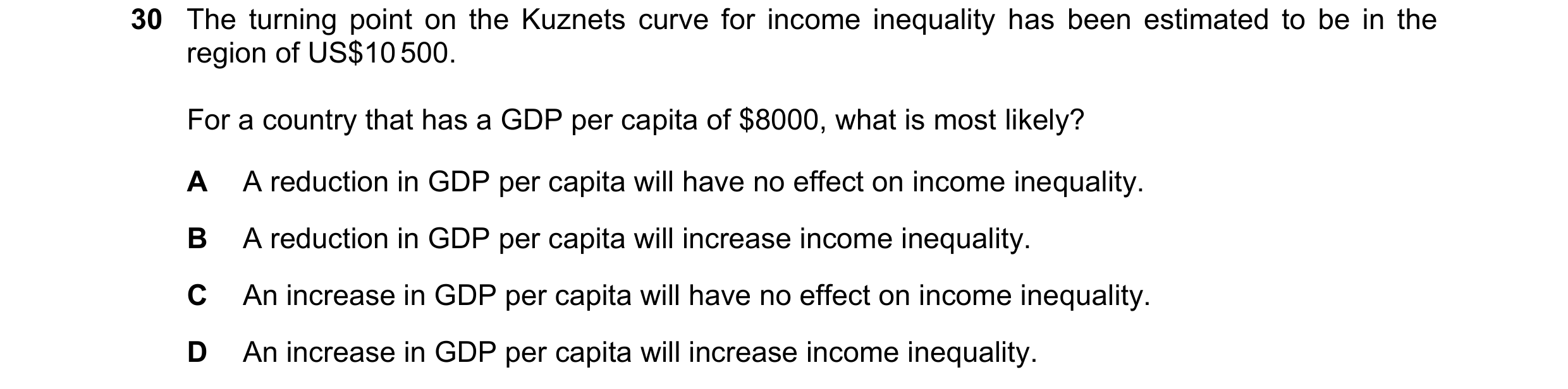



 21 / 21