Questions as text
Q1 · Which compounds will produce ethanoic acid when boiled under reflux with dilute alkali… 9701/12 Oct/Nov 2011
39 Which compounds will produce ethanoic acid when boiled under reflux with dilute alkali followed by acidification? 1 CH3CH2Cl 2 CH3CO2CH3 3 CH3CN
1 marks
This question in 9701/12 Oct/Nov 2011
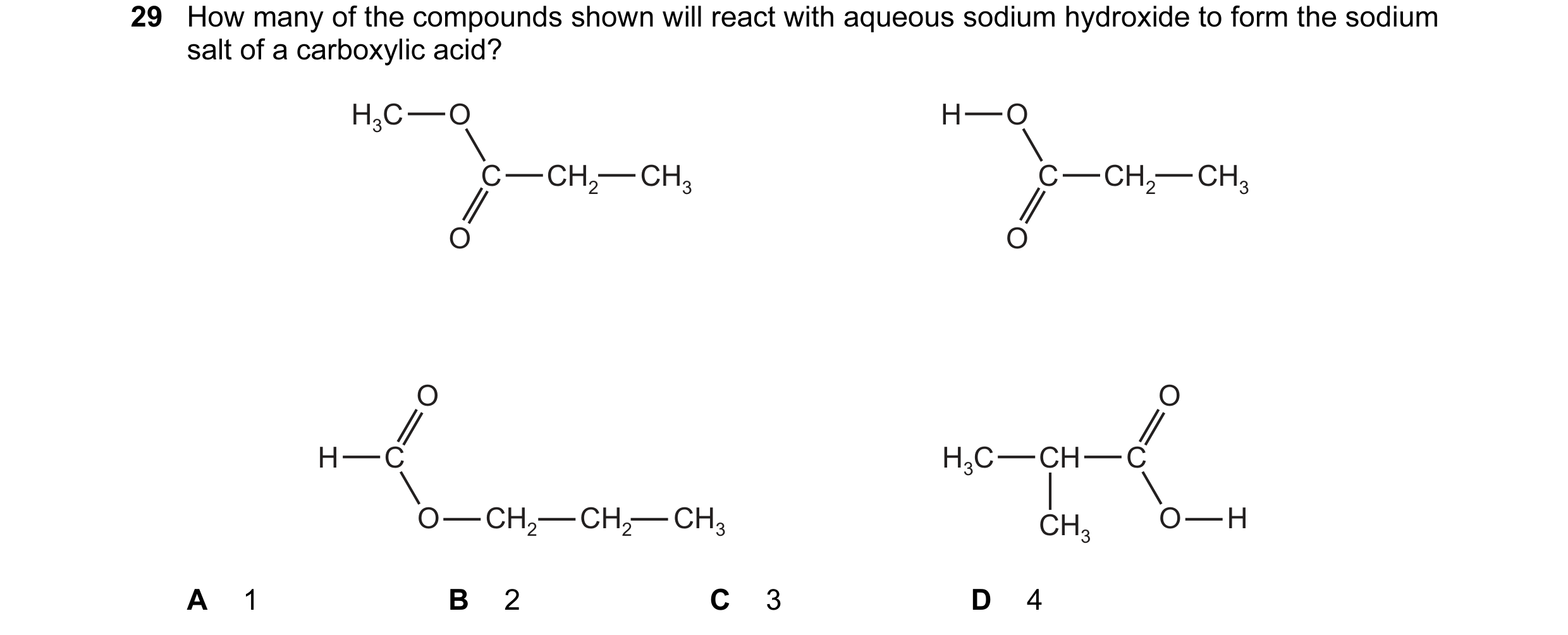
Q2 · How many of the compounds shown will react with aqueous sodium hydroxide to form the… 9701/12 Oct/Nov 2013
29 How many of the compounds shown will react with aqueous sodium hydroxide to form the sodium salt of a carboxylic acid? H3C O H O C CH2 CH3 C CH2 CH3 O O O O H C H3C CH C O CH2 CH2 CH3 CH3 O H A 1 B 2 C 3 D 4
1 marks
Answer: D
This question in 9701/12 Oct/Nov 2013
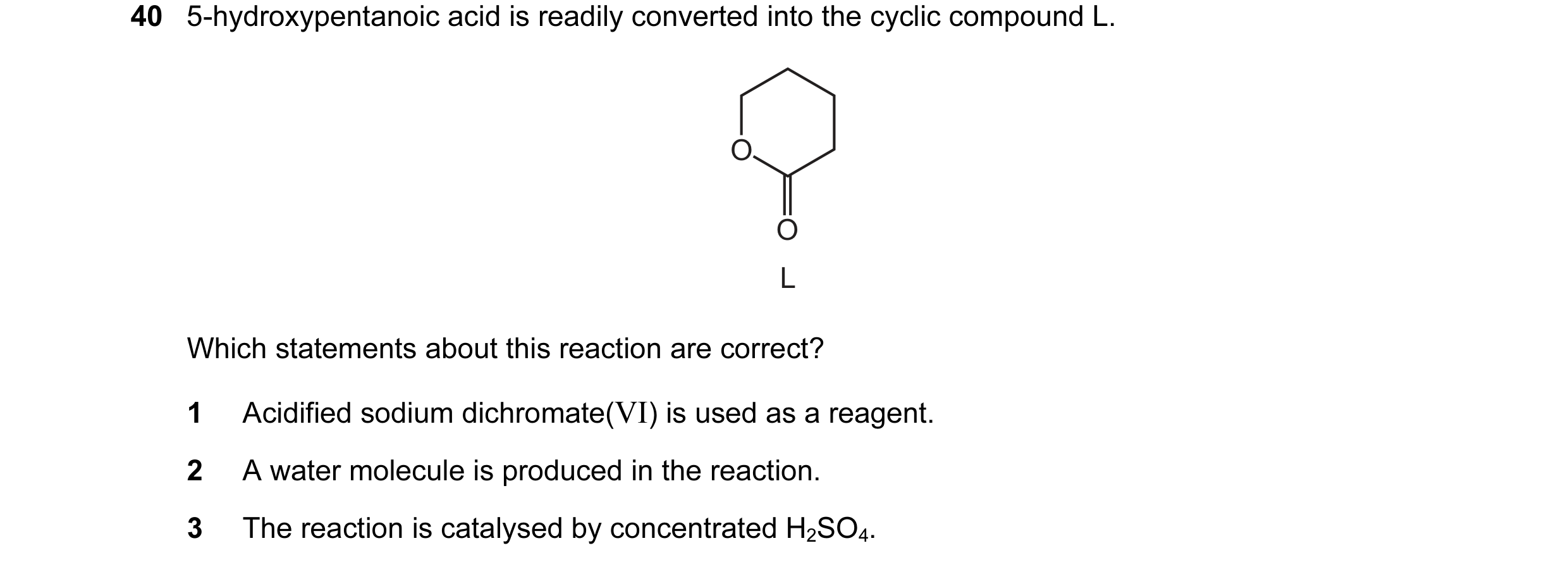
Q3 · 5-hydroxypentanoic acid is readily converted into the cyclic compound L 9701/11 May/June 2015
40 5-hydroxypentanoic acid is readily converted into the cyclic compound L. O O L Which statements about this reaction are correct? 1 Acidified sodium dichromate(VI) is used as a reagent. 2 A water molecule is produced in the reaction. 3 The reaction is catalysed by concentrated H2SO4.
1 marks
Answer: C
This question in 9701/11 May/June 2015
Q4 · The structure of aspartame, which is used as an artificial sweetener, is shown 9701/12 Oct/Nov 2015
30 The structure of aspartame, which is used as an artificial sweetener, is shown. C6H5 O 1 2 O OCH3 N H OH NH2 O aspartame If aspartame is warmed in aqueous alkali, which of bonds 1 and 2 will be broken? A both bond 1 and bond 2 B bond 1 only C bond 2 only D neither bond 1 nor bond 2 Section B
1 marks
This question in 9701/12 Oct/Nov 2015
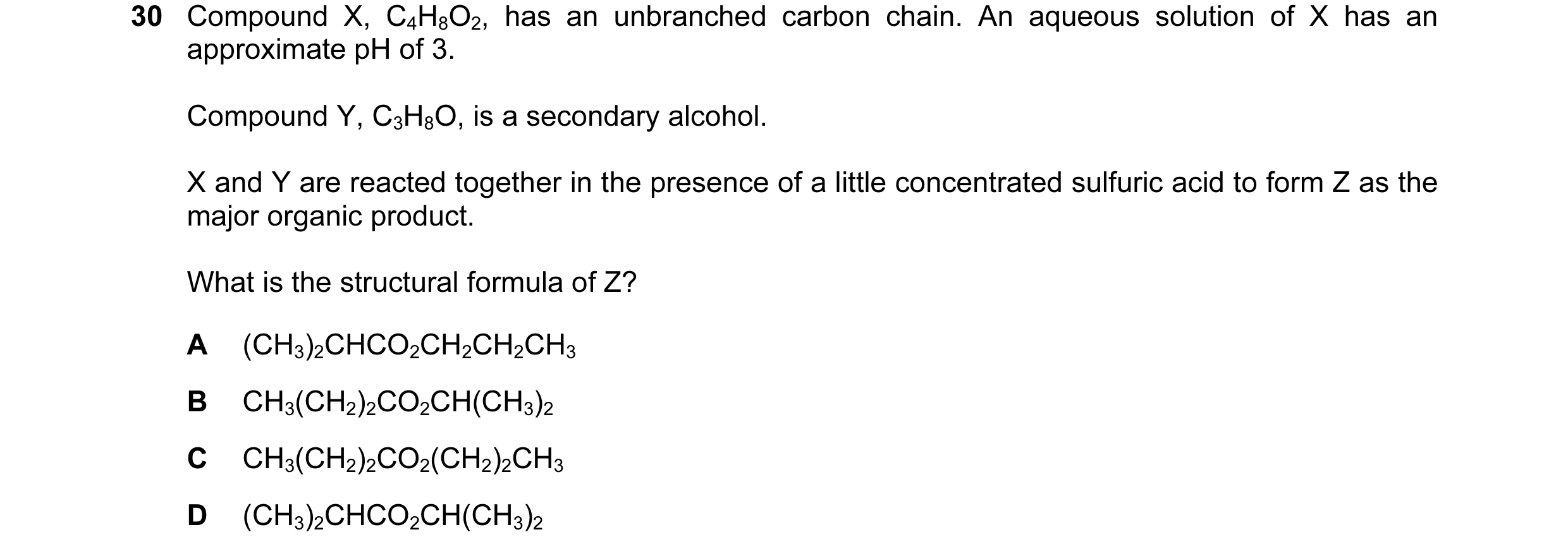
Q5 · Compound X, C4H8O2, has an unbranched carbon chain 9701/12 May/June 2016
30 Compound X, C4H8O2, has an unbranched carbon chain. An aqueous solution of X has an approximate pH of 3. Compound Y, C3H8O, is a secondary alcohol. X and Y are reacted together in the presence of a little concentrated sulfuric acid to form Z as the major organic product. What is the structural formula of Z? A (CH3)2CHCO2CH2CH2CH3 B CH3(CH2)2CO2CH(CH3)2 C CH3(CH2)2CO2(CH2)2CH3 D (CH3)2CHCO2CH(CH3)2
1 marks
Answer: B
This question in 9701/12 May/June 2016
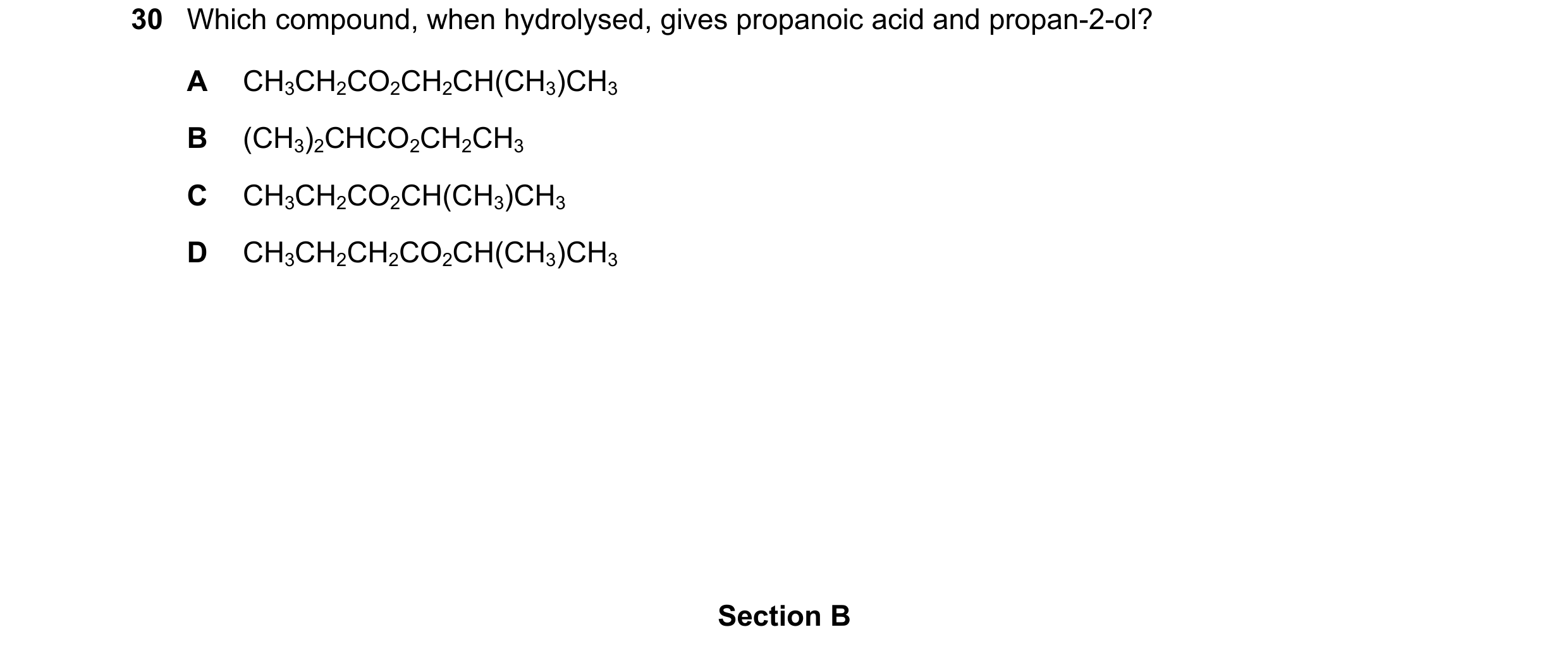
Q6 · Which compound, when hydrolysed, gives propanoic acid and propan-2-ol? 9701/12 May/June 2017
30 Which compound, when hydrolysed, gives propanoic acid and propan-2-ol? A CH3CH2CO2CH2CH(CH3)CH3 B (CH3)2CHCO2CH2CH3 C CH3CH2CO2CH(CH3)CH3 D CH3CH2CH2CO2CH(CH3)CH3 Section B
1 marks
Answer: C
This question in 9701/12 May/June 2017
Q7 · One molecule of ammonia reacts with one molecule of ethyl methanoate, HCO2C2H5, to… 9701/12 Feb/March 2018
19 One molecule of ammonia reacts with one molecule of ethyl methanoate, HCO2C2H5, to produce one molecule of methanamide, HCONH2, and only one other molecule, X. One molecule of methanamide decomposes on heating strongly to produce one molecule of ammonia and only one other molecule, Y. What could be the identities of X and Y? X Y A ethanoic acid carbon monoxide B ethanoic acid hydrogen cyanide C ethanol carbon monoxide D ethanol hydrogen cyanide
1 marks
Answer: C
This question in 9701/12 Feb/March 2018
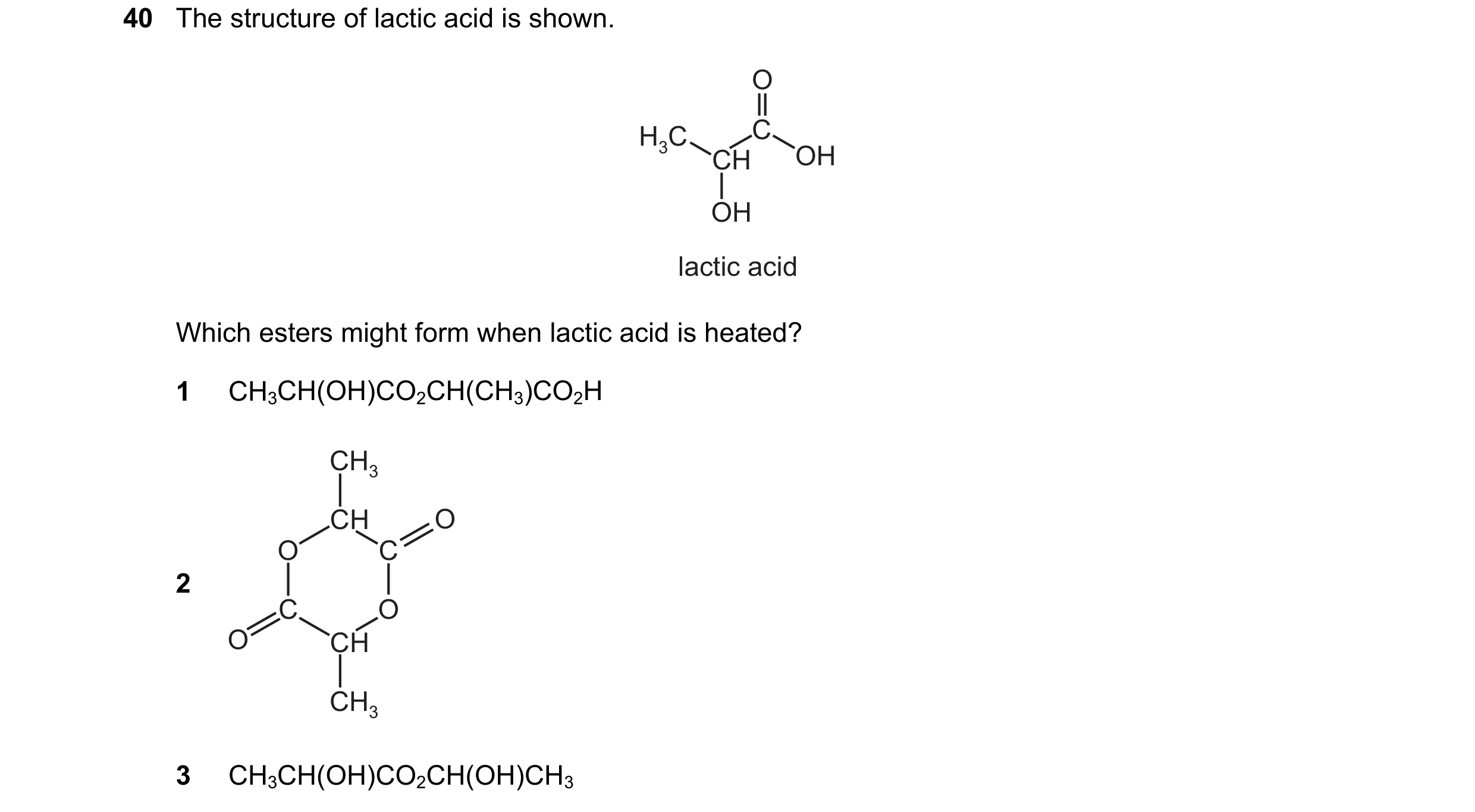
Q8 · The structure of lactic acid is shown 9701/12 Feb/March 2018
40 The structure of lactic acid is shown. O H3C C CH OH OH lactic acid Which esters might form when lactic acid is heated? 1 CH3CH(OH)CO2CH(CH3)CO2H CH3 CH O O C 2 C O O CH CH3 3 CH3CH(OH)CO2CH(OH)CH3
1 marks
Answer: B
This question in 9701/12 Feb/March 2018
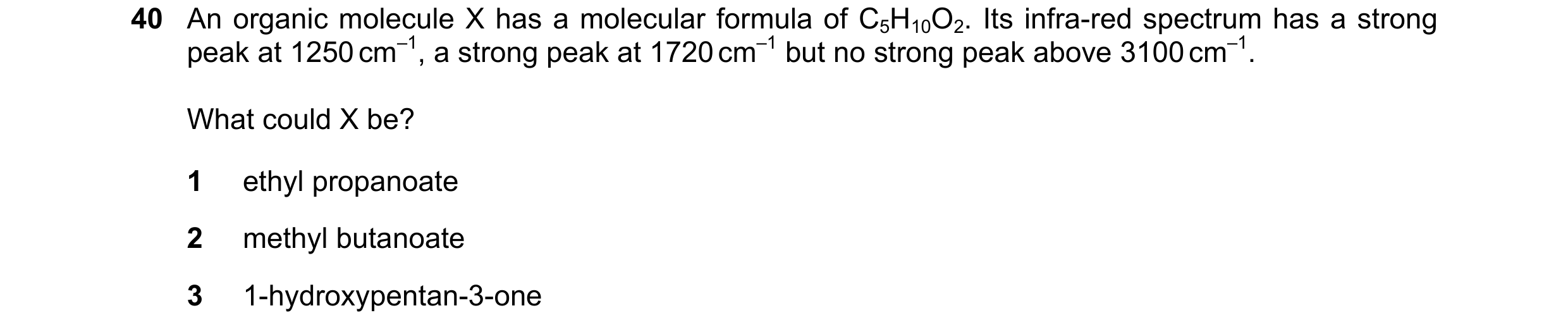
Q9 · An organic molecule X has a molecular formula of C5H10O2 9701/13 May/June 2019
40 An organic molecule X has a molecular formula of C5H10O2. Its infra-red spectrum has a strong peak at 1250 cm–1, a strong peak at 1720 cm–1 but no strong peak above 3100 cm–1. What could X be? 1 ethyl propanoate 2 methyl butanoate 3 1-hydroxypentan-3-one
1 marks
Answer: B
This question in 9701/13 May/June 2019
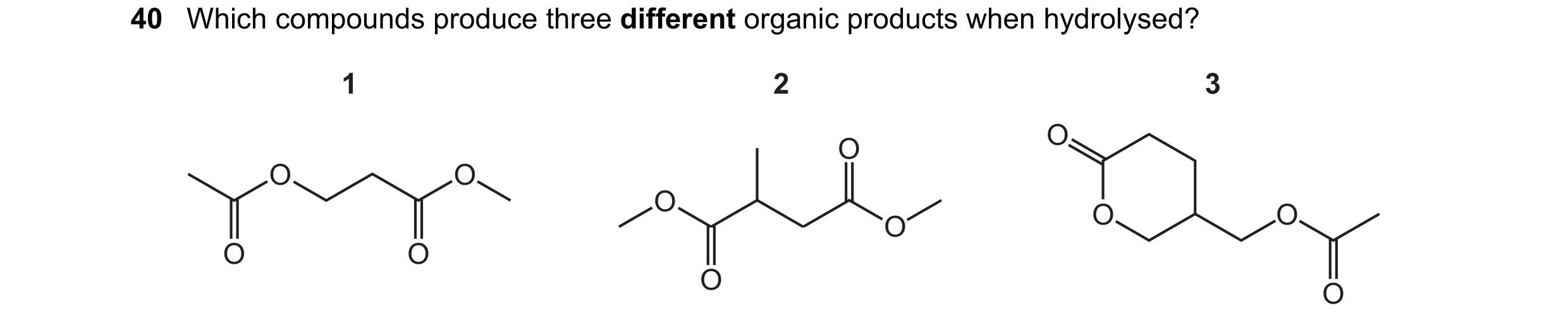
Q10 · Which compounds produce three different organic products when hydrolysed? 9701/11 Oct/Nov 2019
40 Which compounds produce three different organic products when hydrolysed? 1 2 3 O O O O O O O O O O O O
1 marks
Answer: D
This question in 9701/11 Oct/Nov 2019
Q11 · Which compounds produce three different organic products when hydrolysed? 9701/13 Oct/Nov 2019
40 Which compounds produce three different organic products when hydrolysed? 1 2 3 O O O O O O O O O O O O
1 marks
Answer: D
This question in 9701/13 Oct/Nov 2019
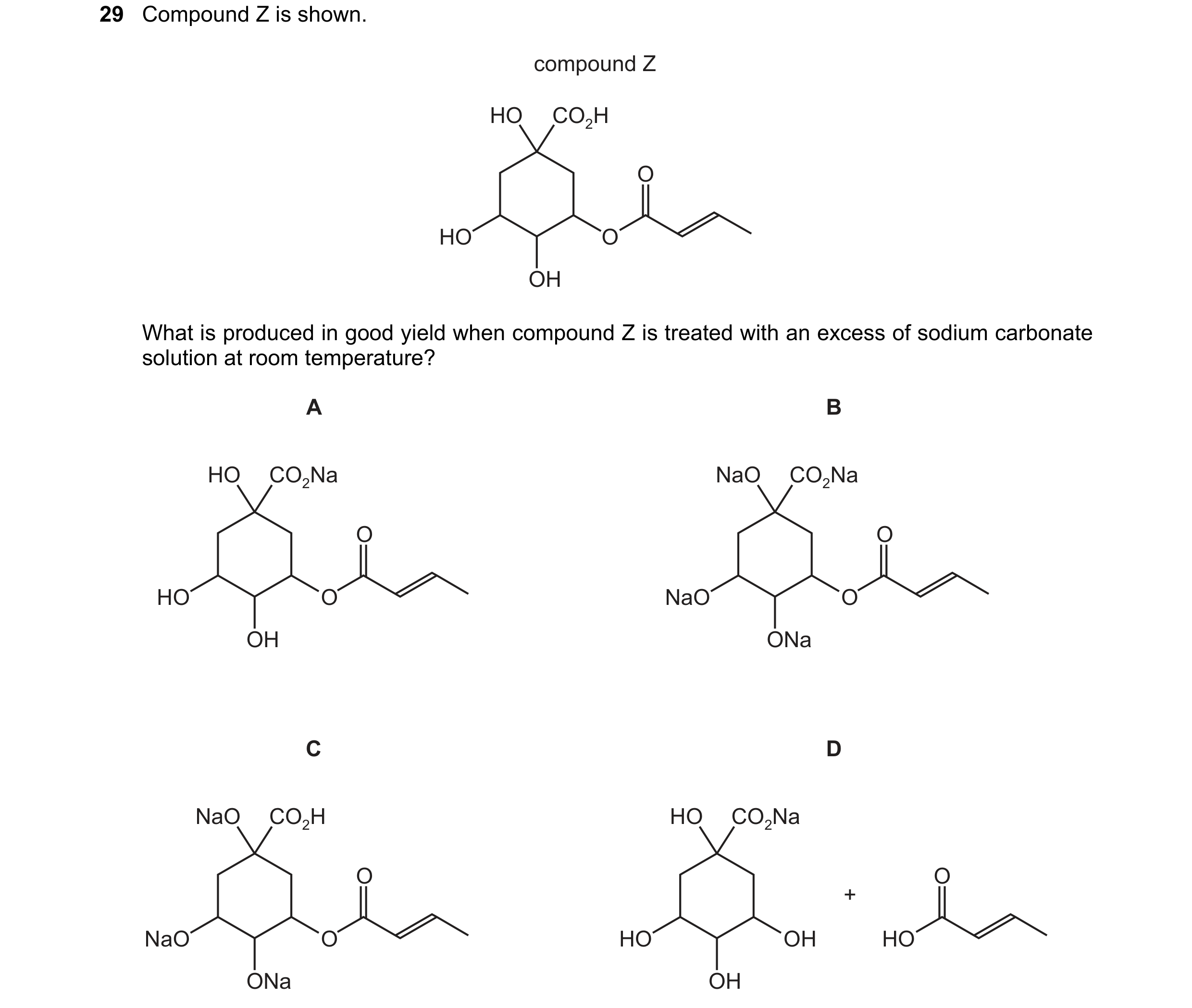
Q12 · Compound Z is shown 9701/12 Oct/Nov 2020
29 Compound Z is shown. compound Z HO CO2H O HO O OH What is produced in good yield when compound Z is treated with an excess of sodium carbonate solution at room temperature? A B HO CO2Na NaO CO2Na O O HO O NaO O OH ONa C D NaO CO2H HO CO2Na O O + NaO O HO OH HO ONa OH
1 marks
Answer: A
This question in 9701/12 Oct/Nov 2020
Q13 · Which reactions produce pentanoic acid? 9701/12 Oct/Nov 2020
40 Which reactions produce pentanoic acid? 1 CH3CH2CH2CH(OH)CH3 + H+ / MnO4 –(aq) 2 CH3OCO(CH2)3CH3 + HCl (aq) 3 CH3(CH2)3CN + H2SO4(aq)
1 marks
Answer: C
This question in 9701/12 Oct/Nov 2020
Q14 · 5-hydroxypentanoic acid is readily converted into the cyclic compound L 9701/13 May/June 2021
40 5-hydroxypentanoic acid is readily converted into the cyclic compound L. L O O Which statements about this reaction are correct? 1 Acidified sodium dichromate(VI) is used as a reagent. 2 A water molecule is produced in the reaction. 3 The reaction can be catalysed by concentrated H2SO4.
1 marks
Answer: C
This question in 9701/13 May/June 2021
Q15 · Compound X reacts with ethanoic acid in the presence of an H+ catalyst to produce the… 9701/11 Oct/Nov 2022
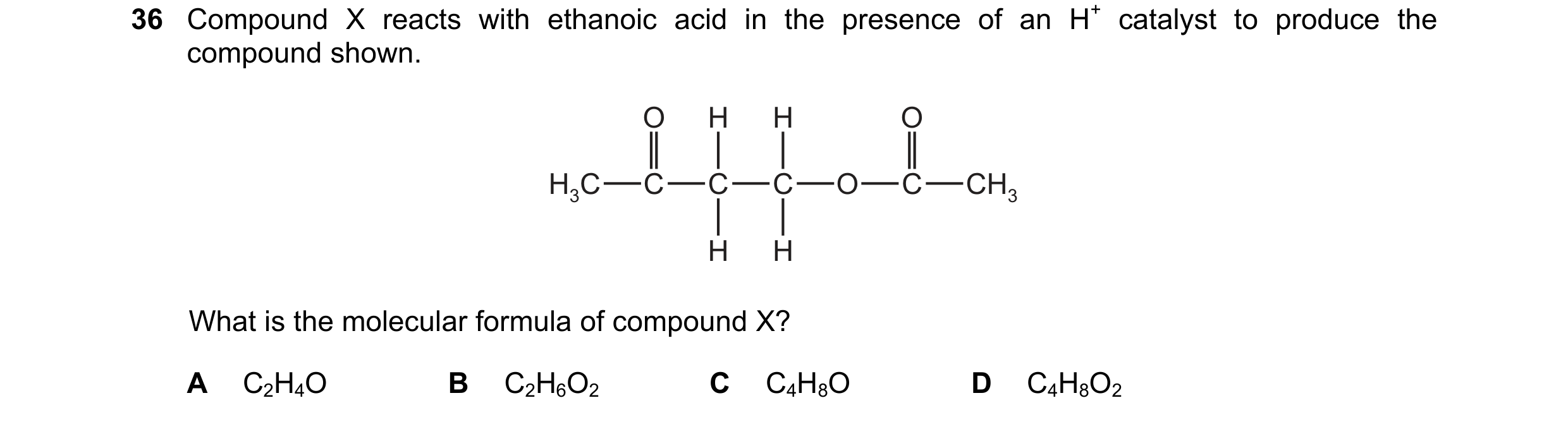
36 Compound X reacts with ethanoic acid in the presence of an H+ catalyst to produce the compound shown. O H H O H3C C C C O C CH3 H H What is the molecular formula of compound X? A C2H4O B C2H6O2 C C4H8O D C4H8O2
1 marks
Answer: D
This question in 9701/11 Oct/Nov 2022
Q16 · Which compounds can be used to make Y in a single-step reaction? 9701/11 Oct/Nov 2022
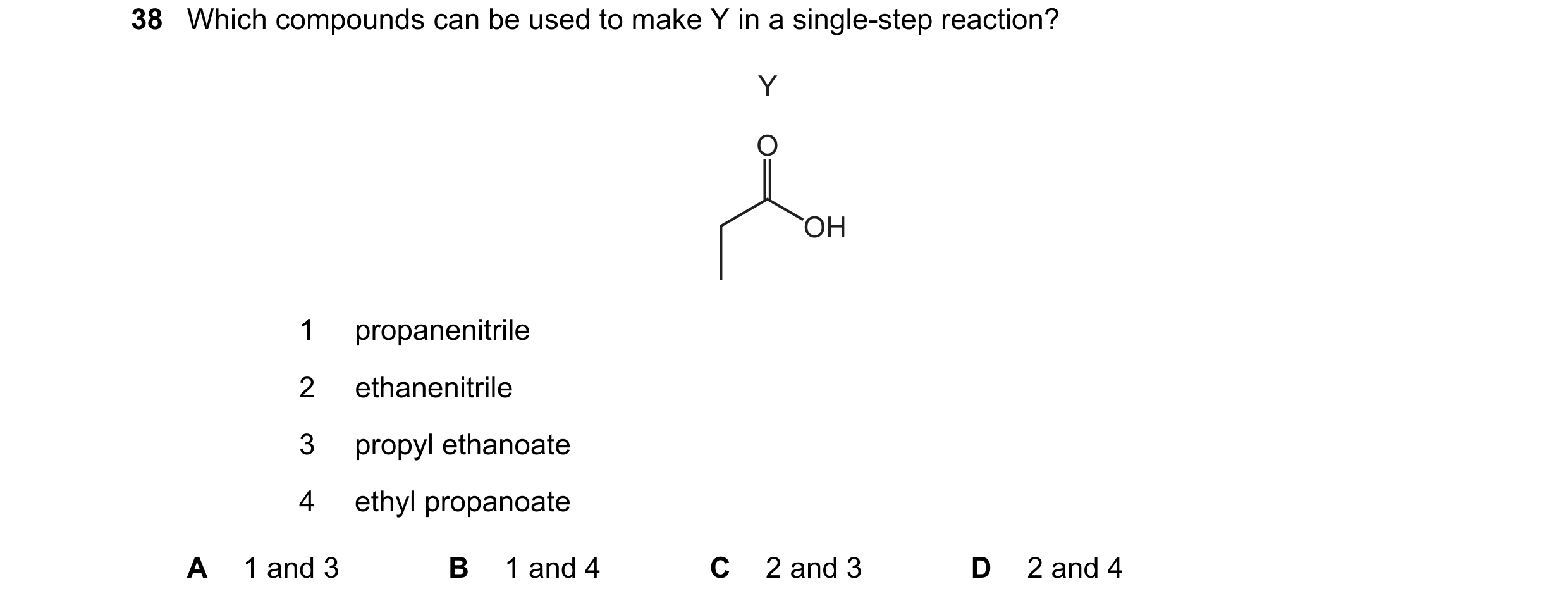
38 Which compounds can be used to make Y in a single-step reaction? Y O OH 1 propanenitrile 2 ethanenitrile 3 propyl ethanoate 4 ethyl propanoate A 1 and 3 B 1 and 4 C 2 and 3 D 2 and 4
1 marks
Answer: B
This question in 9701/11 Oct/Nov 2022
Q17 · Which compounds can be used to make Y in a single-step reaction? 9701/13 Oct/Nov 2022
38 Which compounds can be used to make Y in a single-step reaction? Y O OH 1 propanenitrile 2 ethanenitrile 3 propyl ethanoate 4 ethyl propanoate A 1 and 3 B 1 and 4 C 2 and 3 D 2 and 4
1 marks
Answer: B
This question in 9701/13 Oct/Nov 2022
Q18 · The ester ethyl butanoate can be hydrolysed using an excess of dilute sodium hydroxide… 9701/12 Feb/March 2023
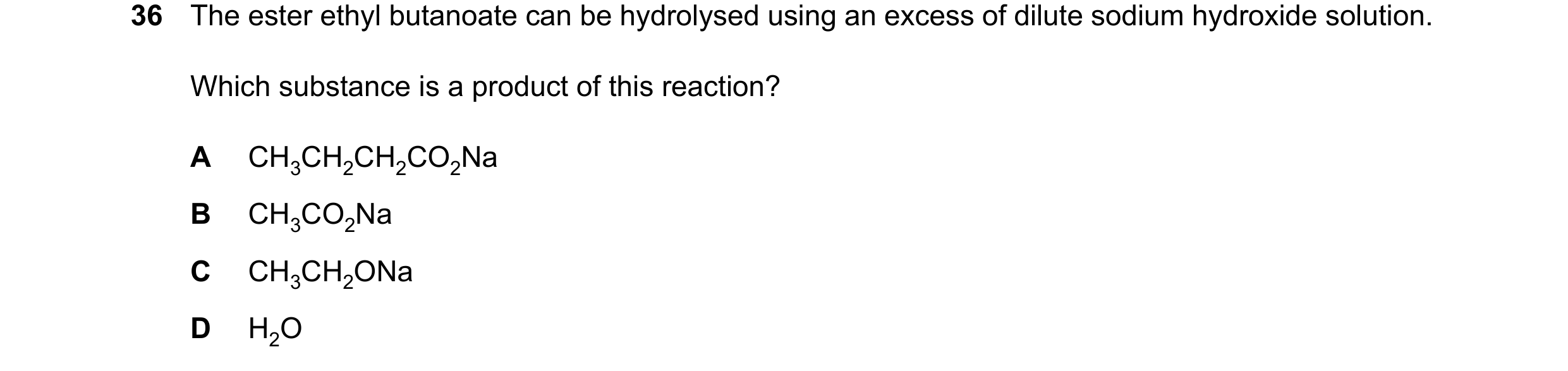
36 The ester ethyl butanoate can be hydrolysed using an excess of dilute sodium hydroxide solution. Which substance is a product of this reaction? A CH3CH2CH2CO2Na B CH3CO2Na C CH3CH2ONa D H2O
1 marks
Answer: A
This question in 9701/12 Feb/March 2023
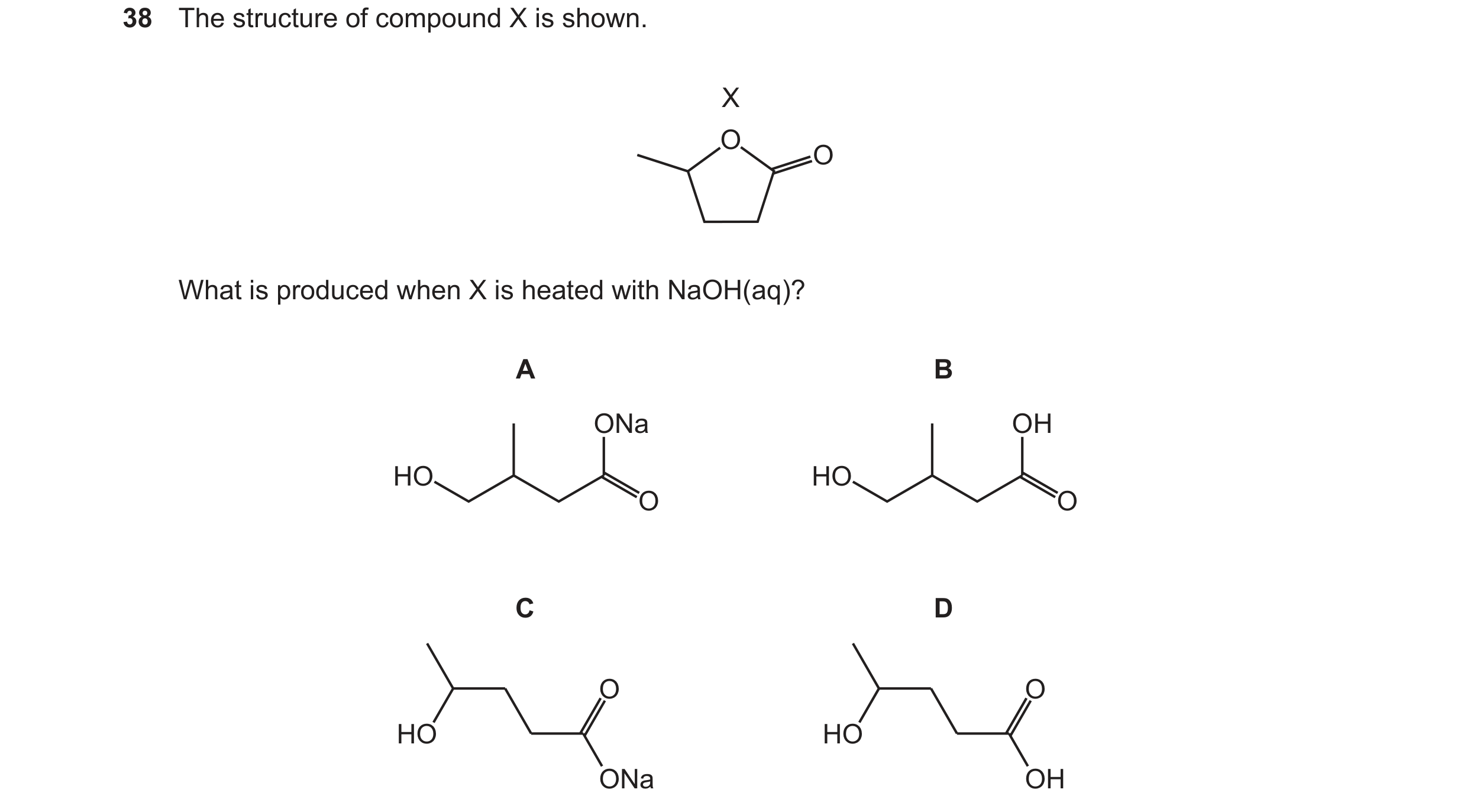
Q19 · The structure of compound X is shown 9701/11 Oct/Nov 2023
38 The structure of compound X is shown. X O O What is produced when X is heated with NaOH(aq)? A B ONa OH HO HO O O C D O O HO HO ONa OH
1 marks
Answer: C
This question in 9701/11 Oct/Nov 2023
Q20 · Four organic compounds are shown 9701/13 May/June 2025
28 Four organic compounds are shown. O O O O O O O O A mixture of these four compounds reacts with hot aqueous sodium hydroxide. The products of this reaction are acidified. Which organic acids are present in the products? A butanoic, ethanoic and propanoic acids B butanoic, ethanoic and methanoic acids C ethanoic, 3-methylbutanoic and propanoic acids D methanoic, 3-methylbutanoic and propanoic acids
1 marks
Answer: B
This question in 9701/13 May/June 2025
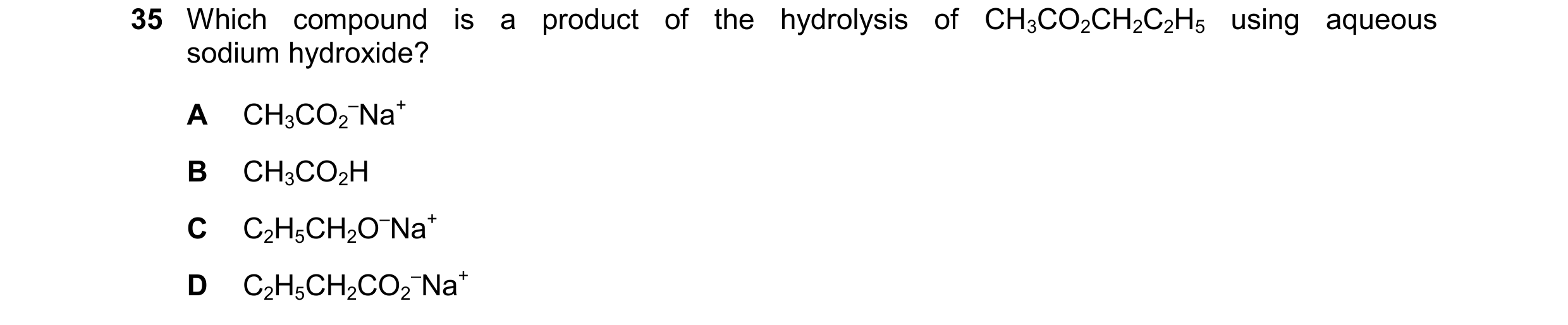
Q21 · Which compound is a product of the hydrolysis of CH3CO2CH2C2H5 using aqueous sodium… 9701/11 Oct/Nov 2025
35 Which compound is a product of the hydrolysis of CH3CO2CH2C2H5 using aqueous sodium hydroxide? A CH3CO2 –Na+ B CH3CO2H C C2H5CH2O–Na+ D C2H5CH2CO2 –Na+
1 marks
Answer: A
This question in 9701/11 Oct/Nov 2025

 1 / 7
1 / 7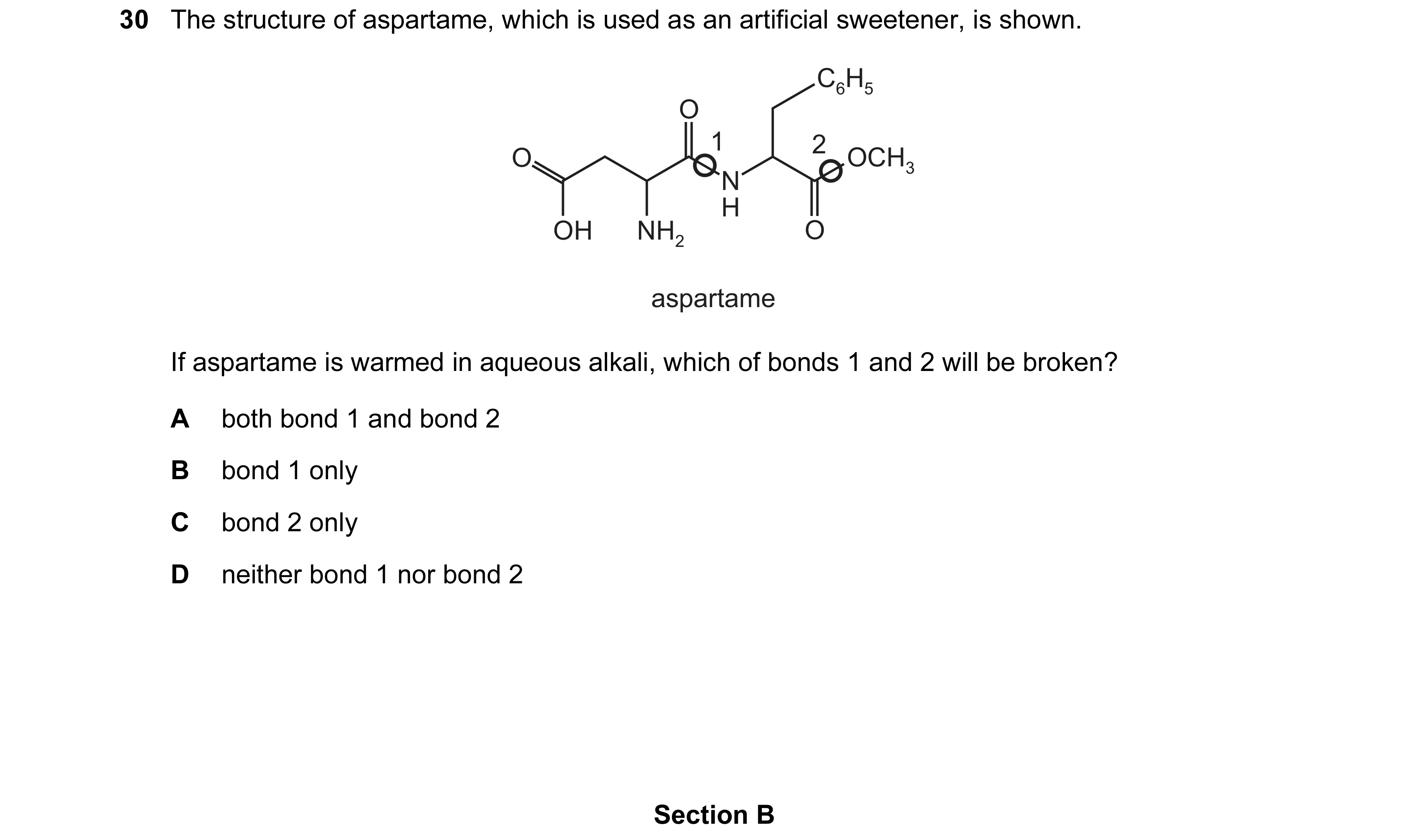
 2 / 7
2 / 7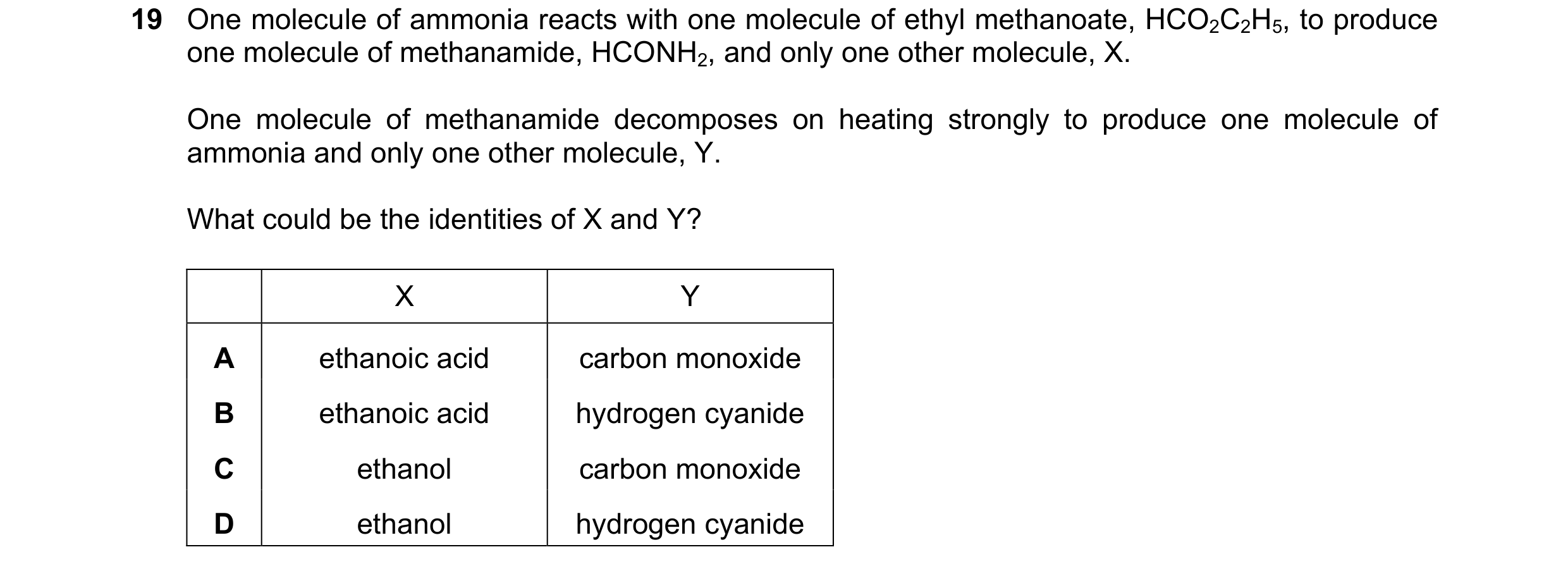
 3 / 7
3 / 7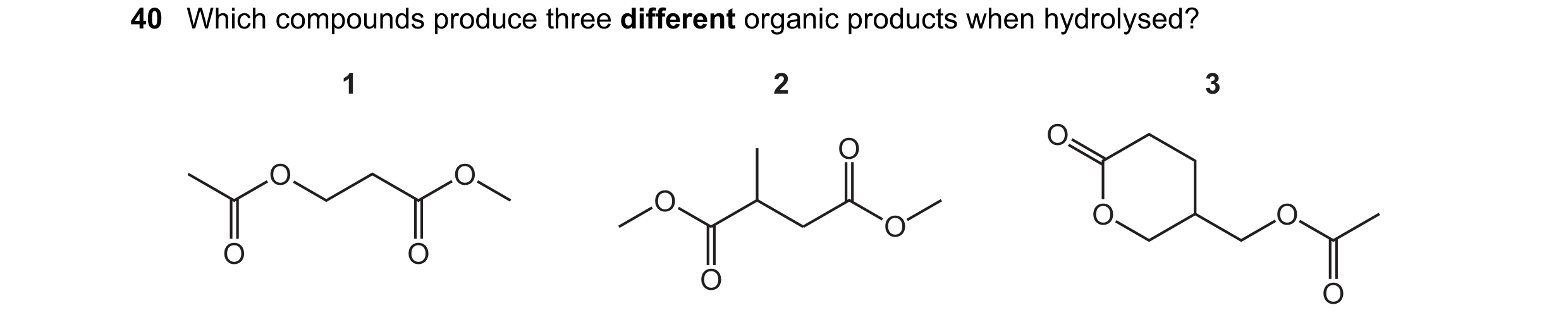
 4 / 7
4 / 7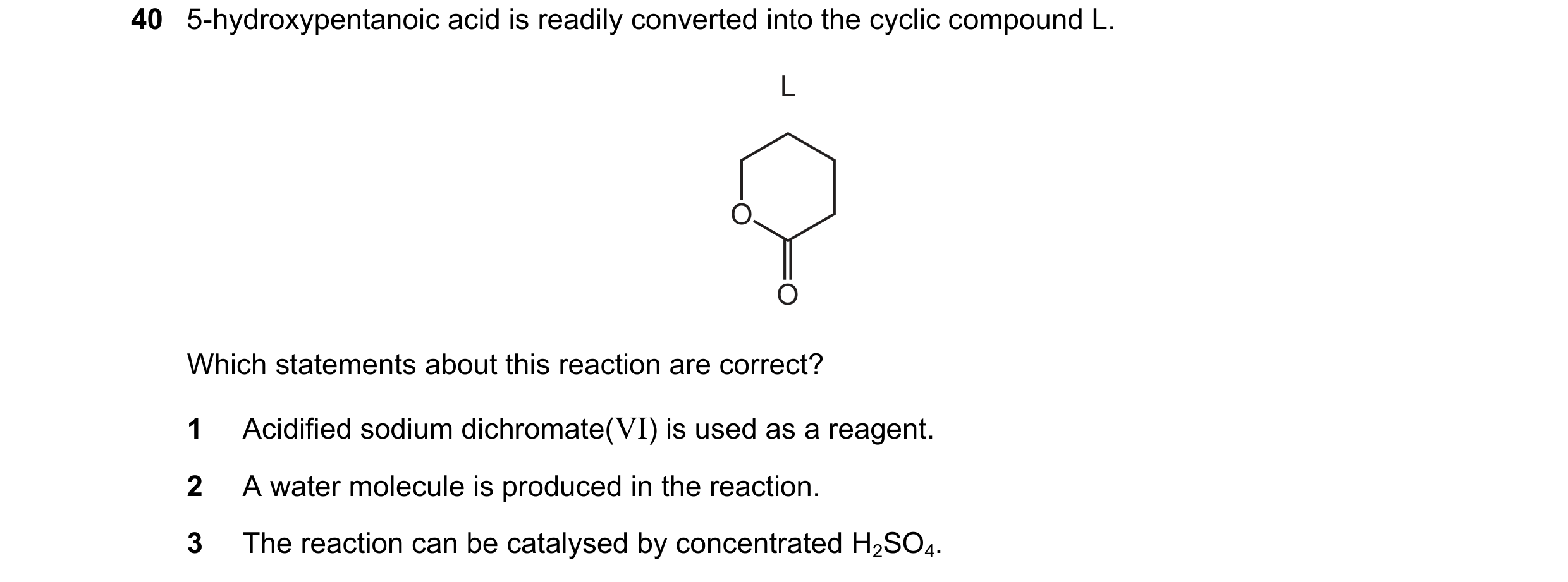
 5 / 7
5 / 7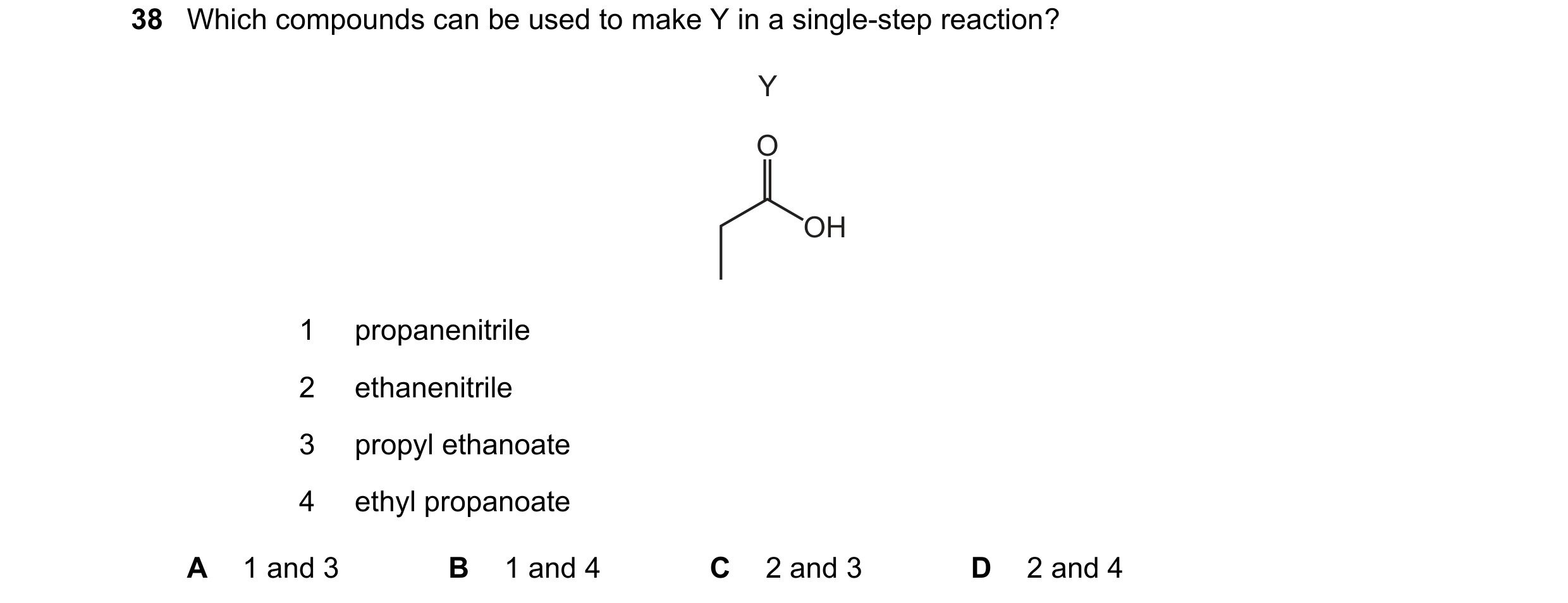
 6 / 7
6 / 7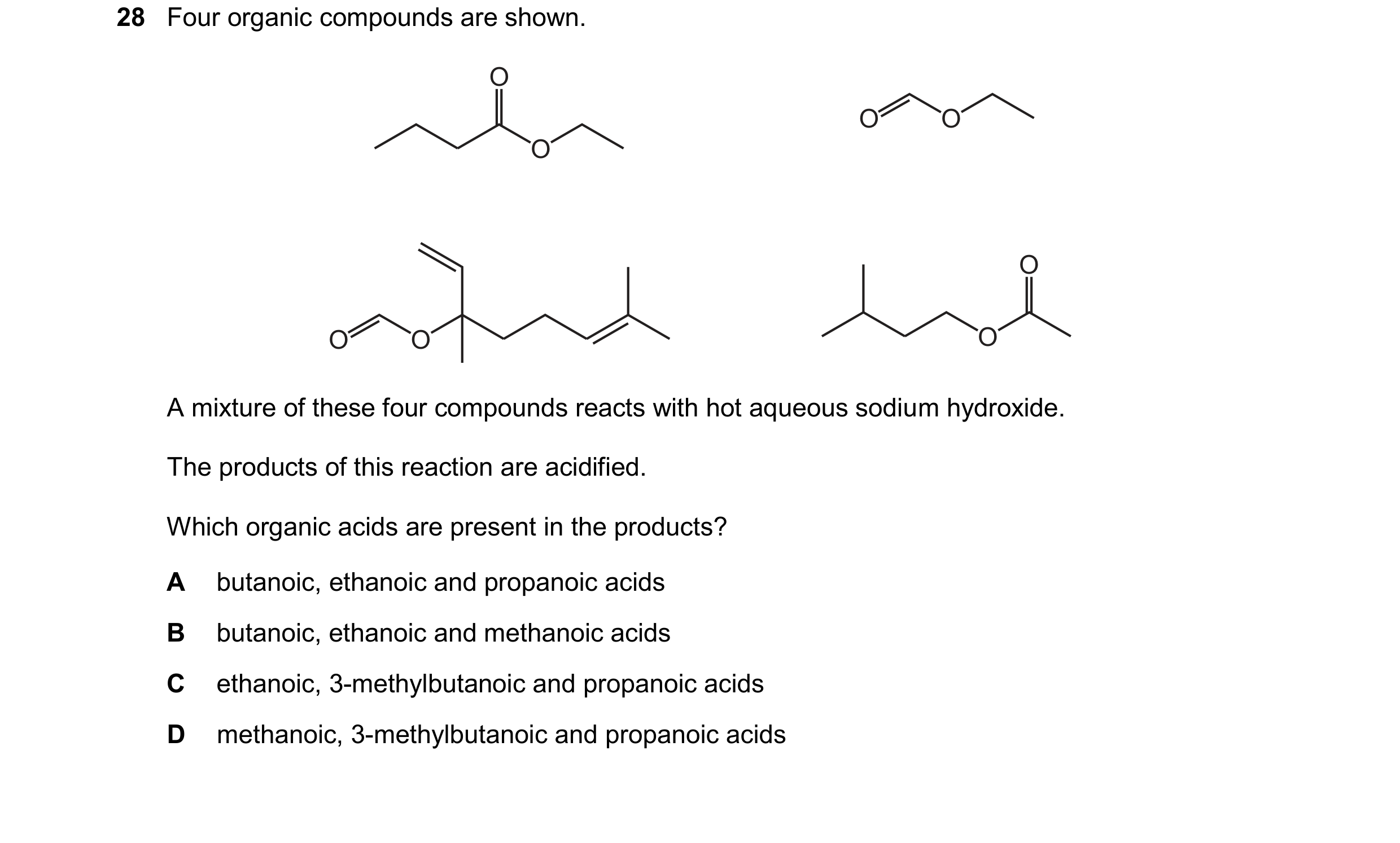
 7 / 7
7 / 7