Questions as text
Q1 · The diagram shows part of the lattice structures of solids X and Y 9701/11 May/June 2006
7 The diagram shows part of the lattice structures of solids X and Y. [In X, represent particles of different elements.] X Y What are the types of bonding present in X and Y? X Y A covalent metallic B ionic covalent C ionic metallic D metallic ionic
1 marks
Answer: B
This question in 9701/11 May/June 2006
Q2 · Which pair of elements have bonds of the same type between their atoms in the solid state? 9701/11 May/June 2008
7 Which pair of elements have bonds of the same type between their atoms in the solid state? A aluminium and phosphorus B chlorine and argon C magnesium and silicon D sulphur and chlorine
1 marks
Answer: D
This question in 9701/11 May/June 2008
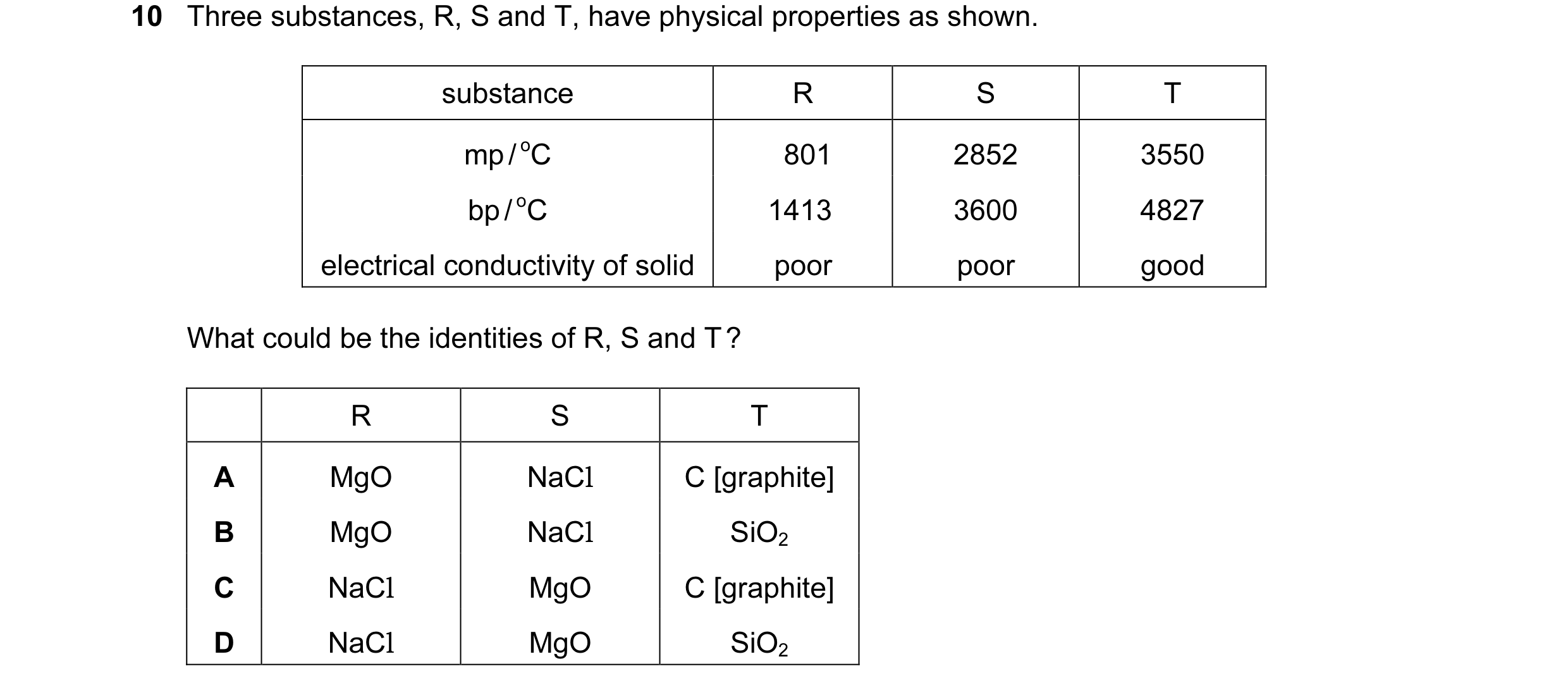
Q3 · Three substances, R, S and T, have physical properties as shown 9701/11 May/June 2011
10 Three substances, R, S and T, have physical properties as shown. substance R S T mp / oC 801 2852 3550 bp / oC 1413 3600 4827 electrical conductivity of solid poor poor good What could be the identities of R, S and T ? R S T A MgO NaCl C [graphite] B MgO NaCl SiO2 C NaCl MgO C [graphite] D NaCl MgO SiO2
1 marks
Answer: C
This question in 9701/11 May/June 2011
Q4 · Which are features of the structure of metallic copper? 9701/11 May/June 2011
32 Which are features of the structure of metallic copper? 1 a lattice of ions 2 delocalised electrons 3 ionic bonds
1 marks
Answer: B
This question in 9701/11 May/June 2011
Q5 · Which are features of the structure of metallic copper? 9701/13 May/June 2011
31 Which are features of the structure of metallic copper? 1 a lattice of ions 2 delocalised electrons 3 ionic bonds
1 marks
Answer: B
This question in 9701/13 May/June 2011
Q6 · Which substances have a giant structure? 9701/13 Oct/Nov 2012
33 Which substances have a giant structure? 1 calcium oxide 2 calcium 3 baked clay found in crockery
1 marks
Answer: A
This question in 9701/13 Oct/Nov 2012
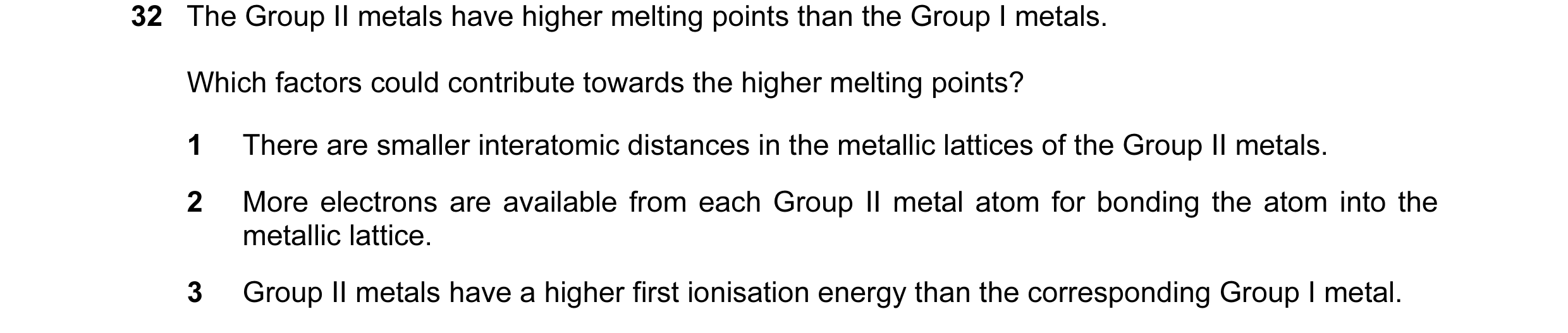
Q7 · The Group II metals have higher melting points than the Group I metals 9701/11 May/June 2013
32 The Group II metals have higher melting points than the Group I metals. Which factors could contribute towards the higher melting points? 1 There are smaller interatomic distances in the metallic lattices of the Group II metals. 2 More electrons are available from each Group II metal atom for bonding the atom into the metallic lattice. 3 Group II metals have a higher first ionisation energy than the corresponding Group I metal.
1 marks
Answer: B
This question in 9701/11 May/June 2013
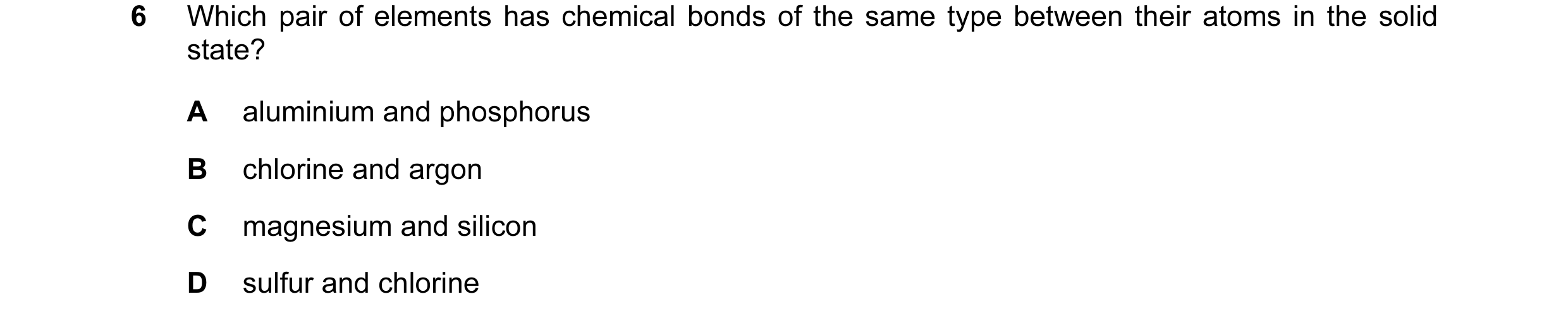
Q8 · Which pair of elements has chemical bonds of the same type between their atoms in the… 9701/12 May/June 2013
6 Which pair of elements has chemical bonds of the same type between their atoms in the solid state? A aluminium and phosphorus B chlorine and argon C magnesium and silicon D sulfur and chlorine
1 marks
Answer: D
This question in 9701/12 May/June 2013
Q9 · Which substances contain delocalised electrons? 9701/12 May/June 2013
33 Which substances contain delocalised electrons? 1 cyclohexene 2 graphite 3 sodium
1 marks
Answer: C
This question in 9701/12 May/June 2013
Q10 · Which solid contains more than one kind of bonding? 9701/13 Oct/Nov 2013
8 Which solid contains more than one kind of bonding? A copper B diamond C ice D magnesium oxide
1 marks
Answer: C
This question in 9701/13 Oct/Nov 2013
Q11 · Copper and iodine are both shiny crystalline solids 9701/13 Oct/Nov 2014
7 Copper and iodine are both shiny crystalline solids. Which forces exist between particles in solid copper and between neighbouring iodine molecules in solid iodine? copper iodine A ionic bonds covalent bonds B ionic bonds van der Waals’ forces C metallic bonds covalent bonds D metallic bonds van der Waals’ forces
1 marks
Answer: D
This question in 9701/13 Oct/Nov 2014
Q12 · Which type of bonding is never found in elements? 9701/12 Oct/Nov 2015
1 Which type of bonding is never found in elements? A covalent B ionic C metallic D van der Waals’ forces
1 marks
This question in 9701/12 Oct/Nov 2015
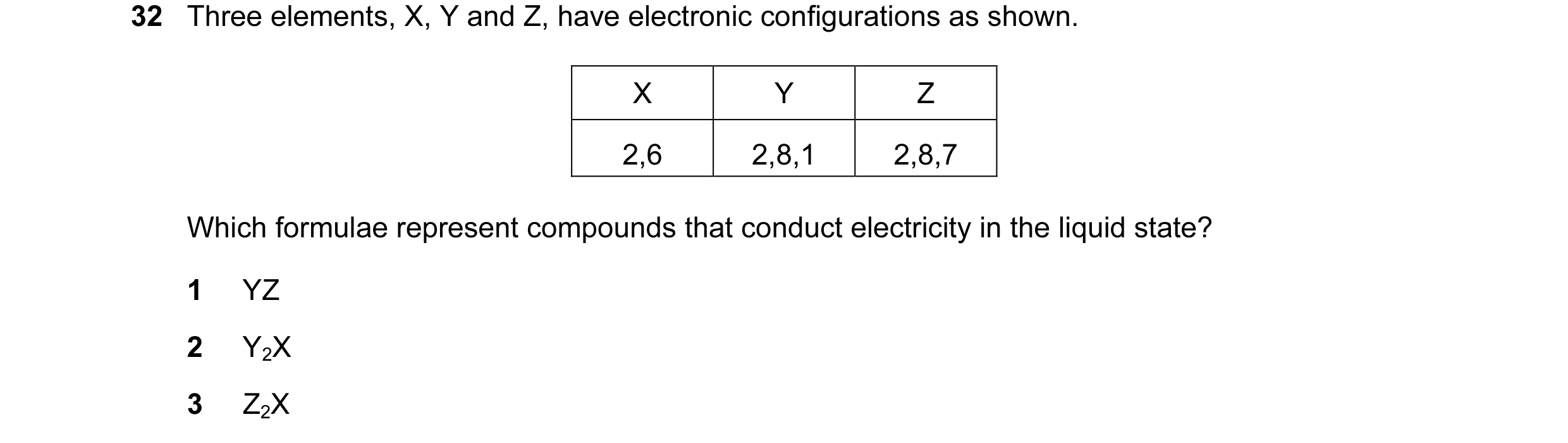
Q13 · Three elements, X, Y and Z, have electronic configurations as shown 9701/12 May/June 2016
32 Three elements, X, Y and Z, have electronic configurations as shown. X Y Z 2,6 2,8,1 2,8,7 Which formulae represent compounds that conduct electricity in the liquid state? 1 YZ 2 Y2X 3 Z2X
1 marks
Answer: B
This question in 9701/12 May/June 2016
Q14 · The structure of metals is considered to be positive ions surrounded by delocalised… 9701/13 May/June 2018
35 The structure of metals is considered to be positive ions surrounded by delocalised electrons. The melting points of the metals in Period 3 increase with increasing atomic number. Which statements help to explain this trend from sodium to aluminium? 1 The charge on the metal ion increases. 2 There are more delocalised electrons per metal ion. 3 The radius of the metal ion decreases.
1 marks
Answer: A
This question in 9701/13 May/June 2018
Q15 · Carbon exists in several different forms 9701/11 May/June 2020
33 Carbon exists in several different forms. Two of these forms are buckminsterfullerene and graphene. Buckminsterfullerene is a fullerene allotrope of carbon. Which statements about buckminsterfullerene and graphene are correct? 1 Both have delocalised electrons. 2 Buckminsterfullerene has a giant molecular structure. 3 The carbon atoms in graphene form a tetrahedral lattice.
1 marks
Answer: D
This question in 9701/11 May/June 2020
Q16 · Copper has a high melting point 9701/11 Oct/Nov 2020
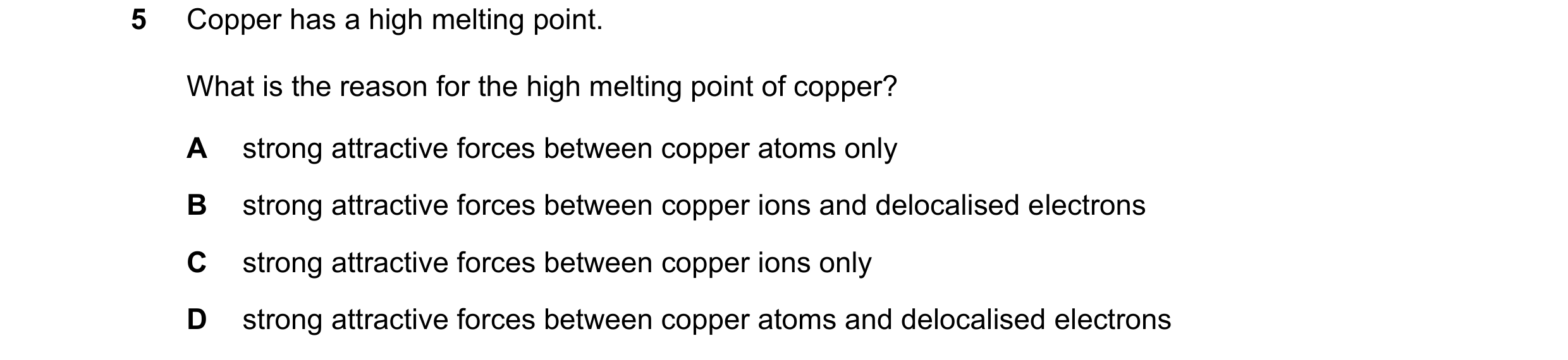
5 Copper has a high melting point. What is the reason for the high melting point of copper? A strong attractive forces between copper atoms only B strong attractive forces between copper ions and delocalised electrons C strong attractive forces between copper ions only D strong attractive forces between copper atoms and delocalised electrons
1 marks
Answer: B
This question in 9701/11 Oct/Nov 2020
Q17 · Which rows correctly show the relative electrical conductivities of the sets of three… 9701/11 Oct/Nov 2020
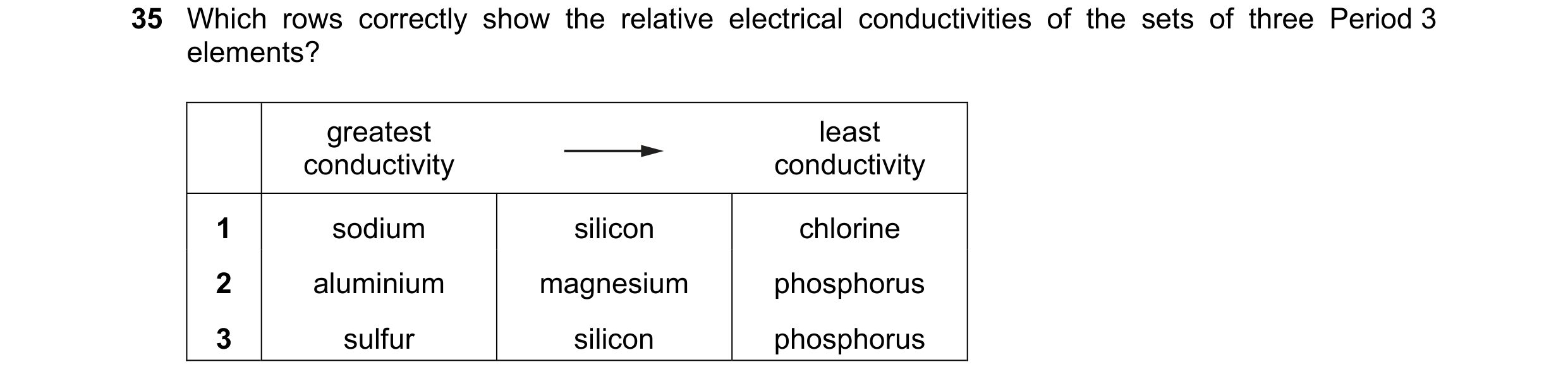
35 Which rows correctly show the relative electrical conductivities of the sets of three Period 3 elements? greatest least conductivity conductivity 1 sodium silicon chlorine 2 aluminium magnesium phosphorus 3 sulfur silicon phosphorus
1 marks
Answer: B
This question in 9701/11 Oct/Nov 2020
Q18 · Copper has a high melting point 9701/13 Oct/Nov 2020
5 Copper has a high melting point. What is the reason for the high melting point of copper? A strong attractive forces between copper atoms only B strong attractive forces between copper ions and delocalised electrons C strong attractive forces between copper ions only D strong attractive forces between copper atoms and delocalised electrons
1 marks
Answer: B
This question in 9701/13 Oct/Nov 2020
Q19 · Which rows correctly show the relative electrical conductivities of the sets of three… 9701/13 Oct/Nov 2020
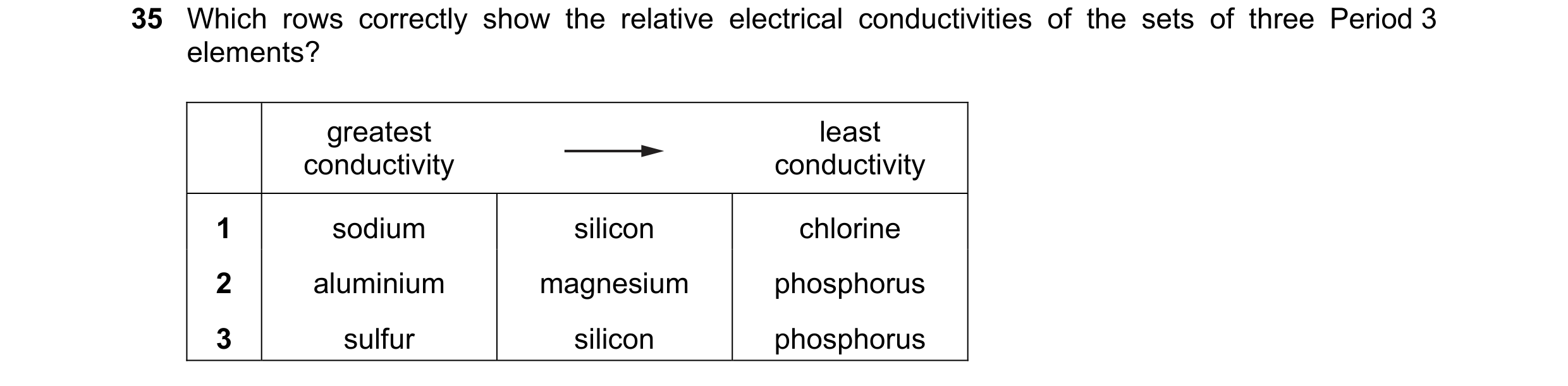
35 Which rows correctly show the relative electrical conductivities of the sets of three Period 3 elements? greatest least conductivity conductivity 1 sodium silicon chlorine 2 aluminium magnesium phosphorus 3 sulfur silicon phosphorus
1 marks
Answer: B
This question in 9701/13 Oct/Nov 2020
Q20 · Which statements help to explain the increase in melting point from sodium to aluminium? 9701/13 May/June 2021
36 Which statements help to explain the increase in melting point from sodium to aluminium? 1 The charge on the metal ion increases. 2 There are more delocalised electrons per metal ion. 3 The radius of the metal ion decreases.
1 marks
Answer: A
This question in 9701/13 May/June 2021
Q21 · The melting points of the Period 3 elements sodium to aluminium are shown in the table 9701/12 Oct/Nov 2022
18 The melting points of the Period 3 elements sodium to aluminium are shown in the table. element Na Mg Al melting point / K 371 923 932 Which factor explains the increase in melting points from sodium to aluminium? A the change in first ionisation energy from sodium to aluminium B the increase in electronegativity from sodium to aluminium C the increase in the Ar of the elements from sodium to aluminium D the increase in the number of outer electrons in each atom from sodium to aluminium
1 marks
Answer: D
This question in 9701/12 Oct/Nov 2022
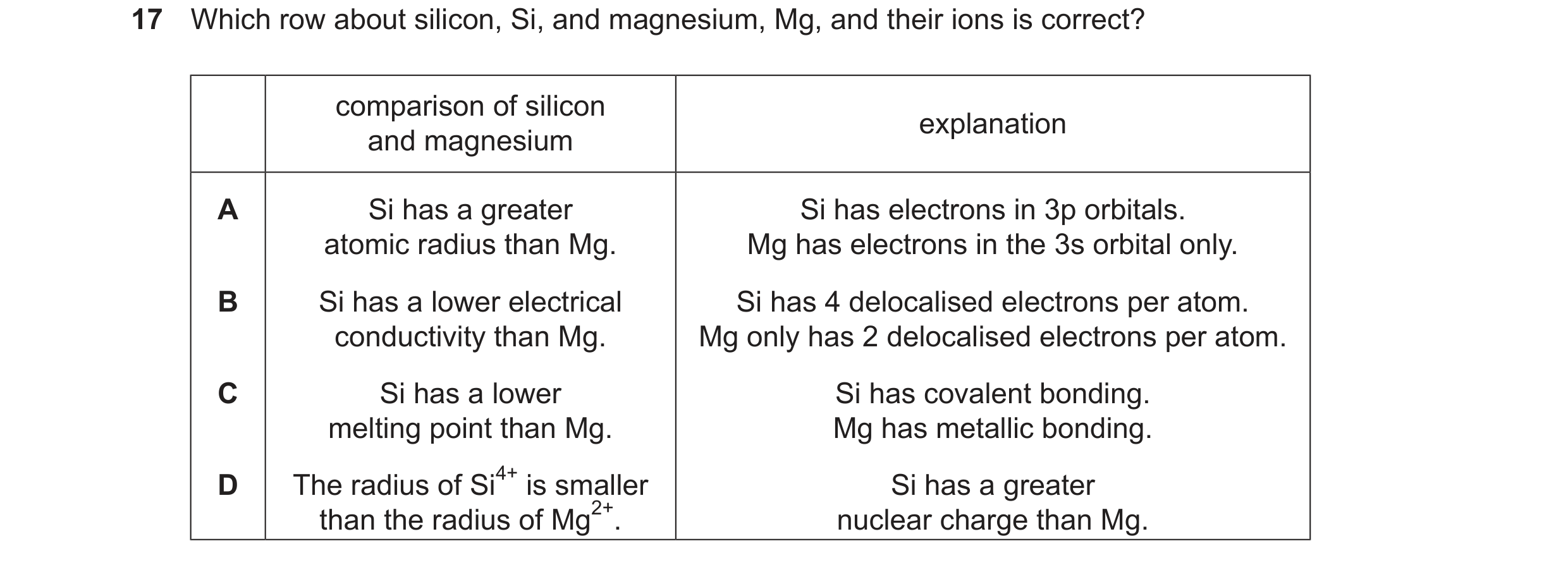
Q22 · Which row about silicon, Si, and magnesium, Mg, and their ions is correct? 9701/11 Oct/Nov 2023
17 Which row about silicon, Si, and magnesium, Mg, and their ions is correct? comparison of silicon explanation and magnesium A Si has a greater Si has electrons in 3p orbitals. atomic radius than Mg. Mg has electrons in the 3s orbital only. B Si has a lower electrical Si has 4 delocalised electrons per atom. conductivity than Mg. Mg only has 2 delocalised electrons per atom. C Si has a lower Si has covalent bonding. melting point than Mg. Mg has metallic bonding. The radius of Si4+ is smaller D Si has a greater than the radius of Mg2+. nuclear charge than Mg.
1 marks
Answer: D
This question in 9701/11 Oct/Nov 2023
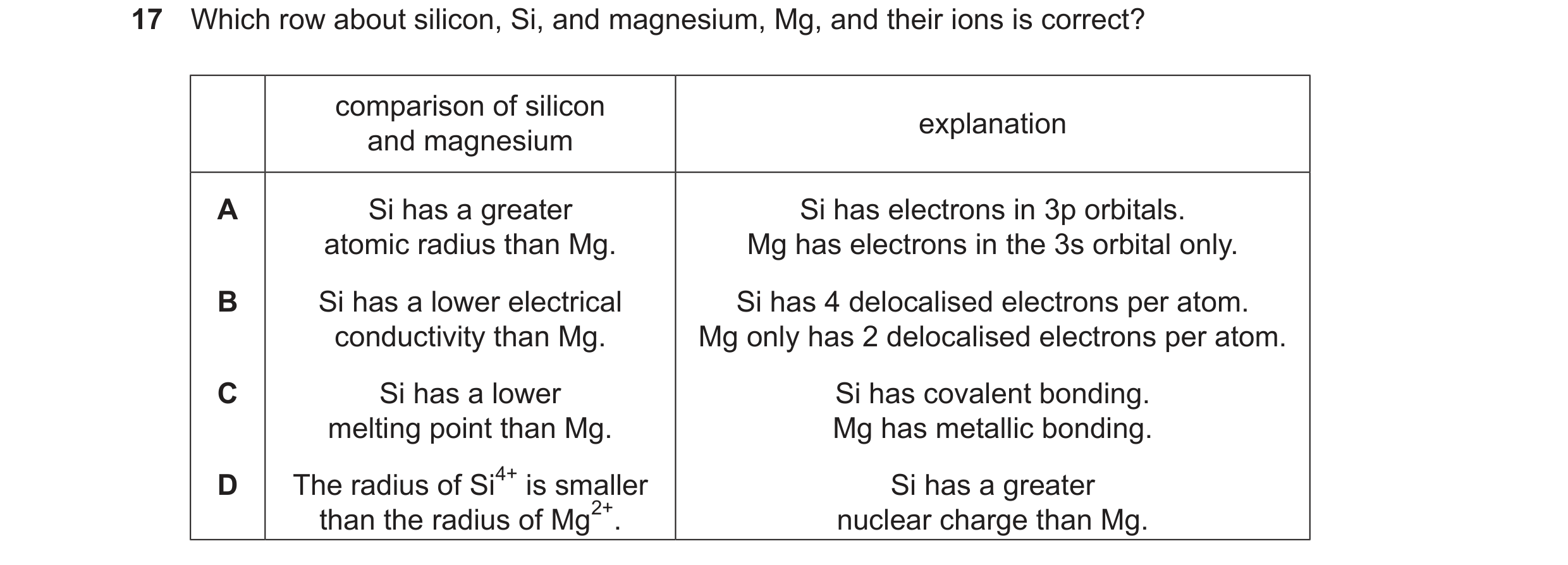
Q23 · Which row about silicon, Si, and magnesium, Mg, and their ions is correct? 9701/13 Oct/Nov 2023
17 Which row about silicon, Si, and magnesium, Mg, and their ions is correct? comparison of silicon explanation and magnesium A Si has a greater Si has electrons in 3p orbitals. atomic radius than Mg. Mg has electrons in the 3s orbital only. B Si has a lower electrical Si has 4 delocalised electrons per atom. conductivity than Mg. Mg only has 2 delocalised electrons per atom. C Si has a lower Si has covalent bonding. melting point than Mg. Mg has metallic bonding. The radius of Si4+ is smaller D Si has a greater than the radius of Mg2+. nuclear charge than Mg.
1 marks
Answer: D
This question in 9701/13 Oct/Nov 2023
Q24 · Which statement explains why sodium and potassium have different melting points? 9701/11 Oct/Nov 2025
5 Which statement explains why sodium and potassium have different melting points? A The attraction between cations and delocalised electrons is stronger in sodium. B The attraction between cations and anions is stronger in sodium. C The attraction between atoms is stronger in sodium. D The attraction between nuclei and shared electron pairs is stronger in sodium.
1 marks
Answer: A
This question in 9701/11 Oct/Nov 2025
Q25 · Which statement explains why sodium and potassium have different melting points? 9701/13 Oct/Nov 2025
5 Which statement explains why sodium and potassium have different melting points? A The attraction between cations and delocalised electrons is stronger in sodium. B The attraction between cations and anions is stronger in sodium. C The attraction between atoms is stronger in sodium. D The attraction between nuclei and shared electron pairs is stronger in sodium.
1 marks
Answer: A
This question in 9701/13 Oct/Nov 2025
![Question 1: The diagram shows part of the lattice structures of solids X and Y. [In X, represent particles of different elements.] X Y What are the typ…](https://img.pastlit.com/crops/50d15f8e-f916-487f-a253-9019ae77e62a/q7.png)

 1 / 6
1 / 6


 2 / 6
2 / 6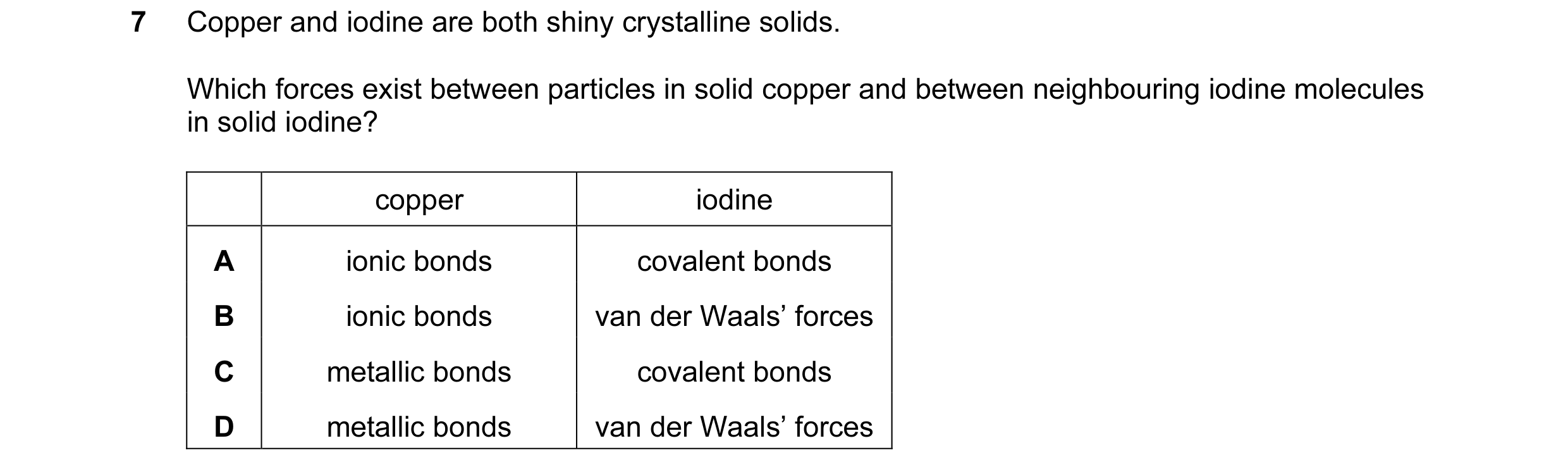

 3 / 6
3 / 6
 4 / 6
4 / 6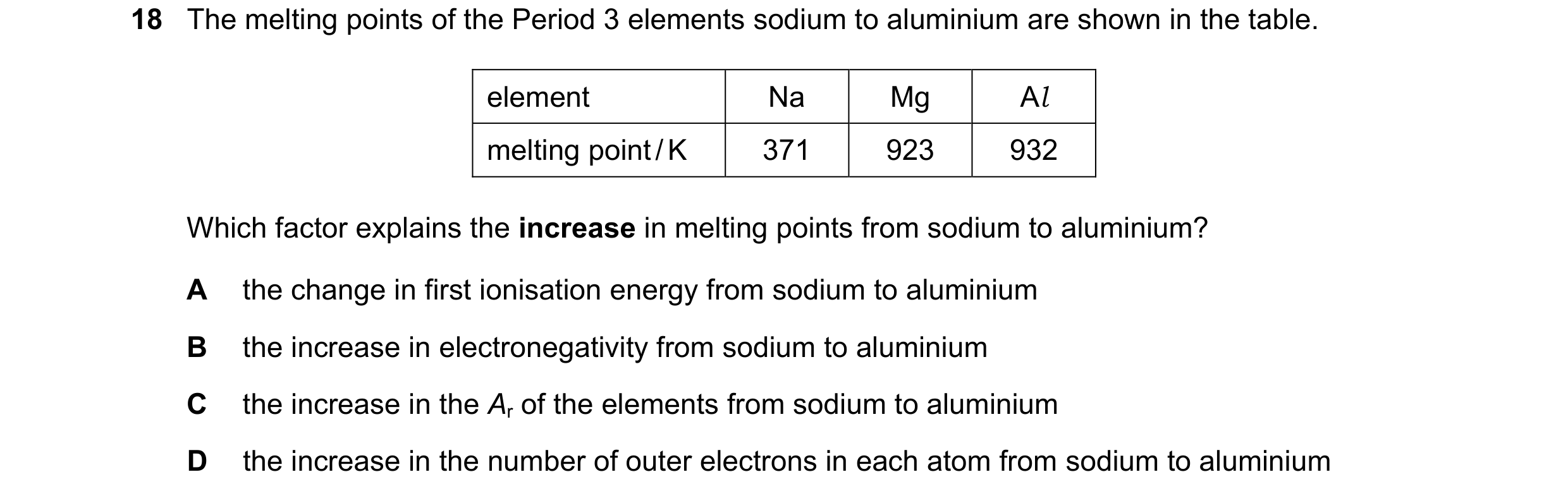
 5 / 6
5 / 6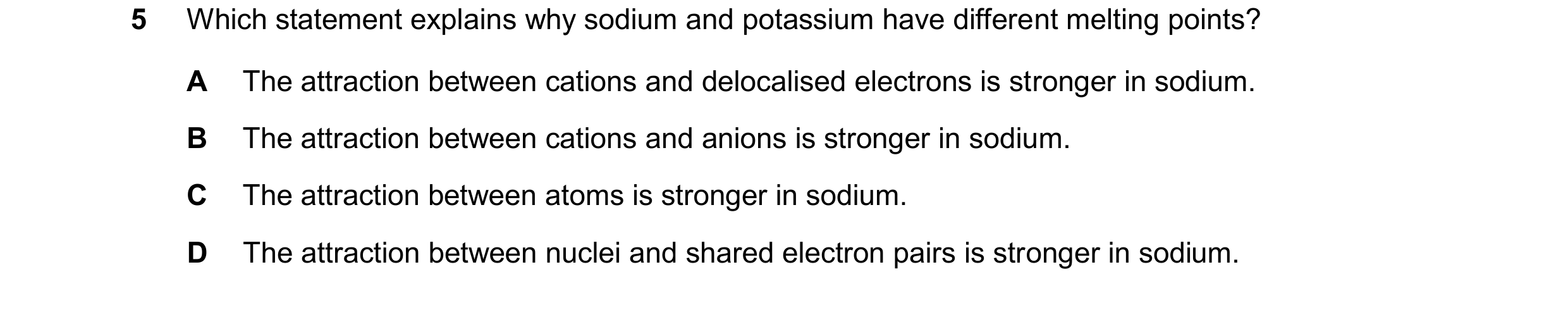 6 / 6
6 / 6