Questions as text
Q1 · How does ammonia behave when its aqueous solution is used to dissolve silver chloride… 9701/11 Oct/Nov 2005
17 How does ammonia behave when its aqueous solution is used to dissolve silver chloride, AgCl ? A as a base B as a ligand with the Ag+ ion C as a ligand with the Cl – ion D as a reducing agent
1 marks
Answer: B
This question in 9701/11 Oct/Nov 2005
Q2 · In black and white photographic film, light converts silver chloride into metallic silver 9701/11 May/June 2009
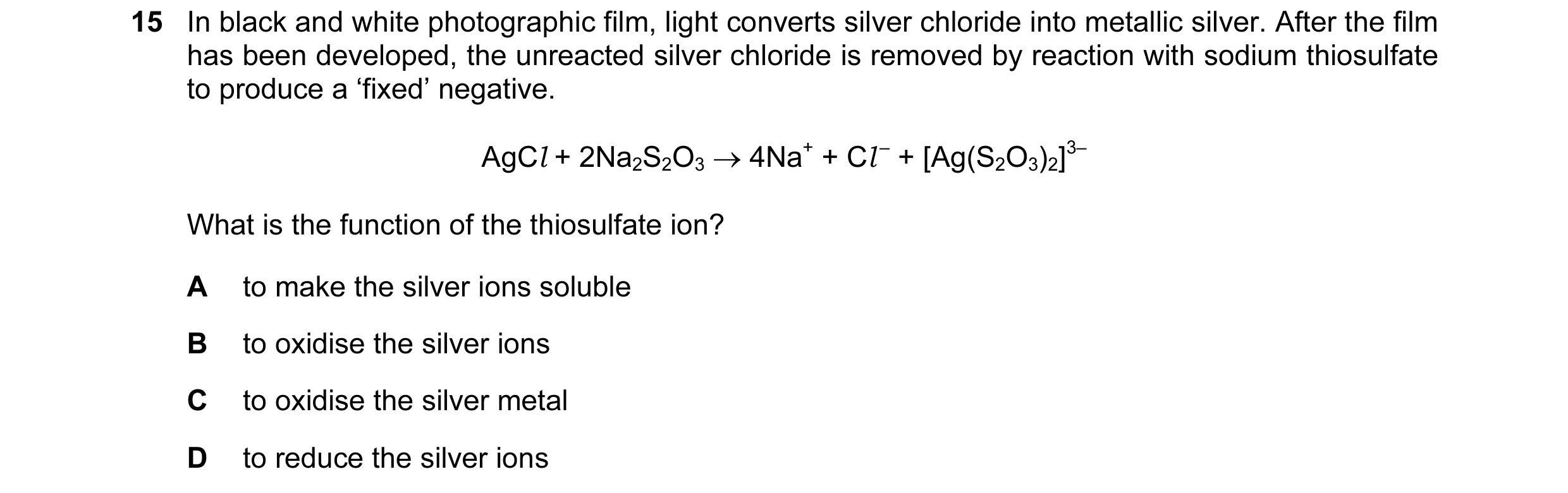
15 In black and white photographic film, light converts silver chloride into metallic silver. After the film has been developed, the unreacted silver chloride is removed by reaction with sodium thiosulfate to produce a ‘fixed’ negative. AgCl + 2Na2S2O3 → 4Na+ + Cl – + [Ag(S2O3)2]3– What is the function of the thiosulfate ion? A to make the silver ions soluble B to oxidise the silver ions C to oxidise the silver metal D to reduce the silver ions
1 marks
Answer: A
This question in 9701/11 May/June 2009
Q3 · Transition elements and their compounds are important as catalysts 9701/13 May/June 2013
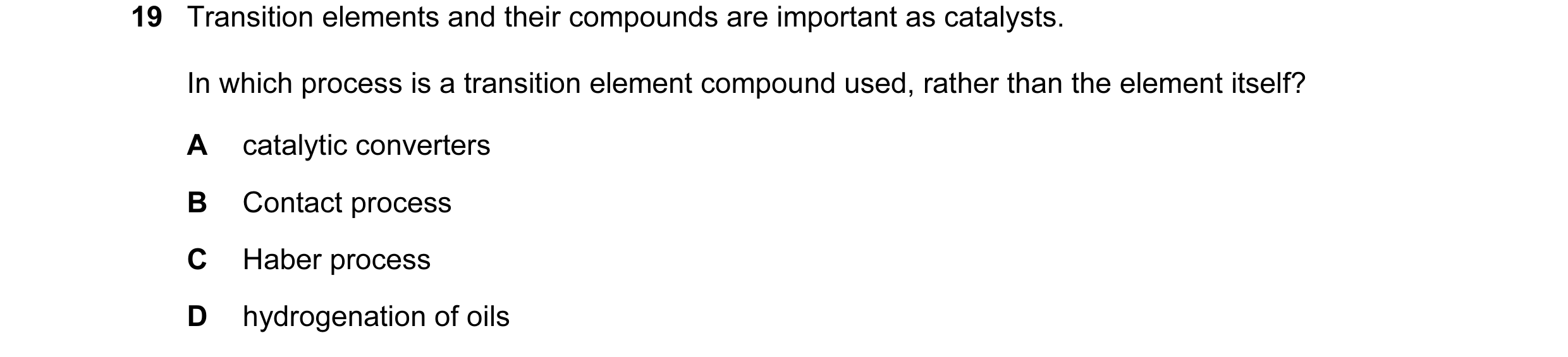
19 Transition elements and their compounds are important as catalysts. In which process is a transition element compound used, rather than the element itself? A catalytic converters B Contact process C Haber process D hydrogenation of oils
1 marks
Answer: B
This question in 9701/13 May/June 2013
Q4 · Transition metals and their compounds are used as catalysts 9701/11 Oct/Nov 2013
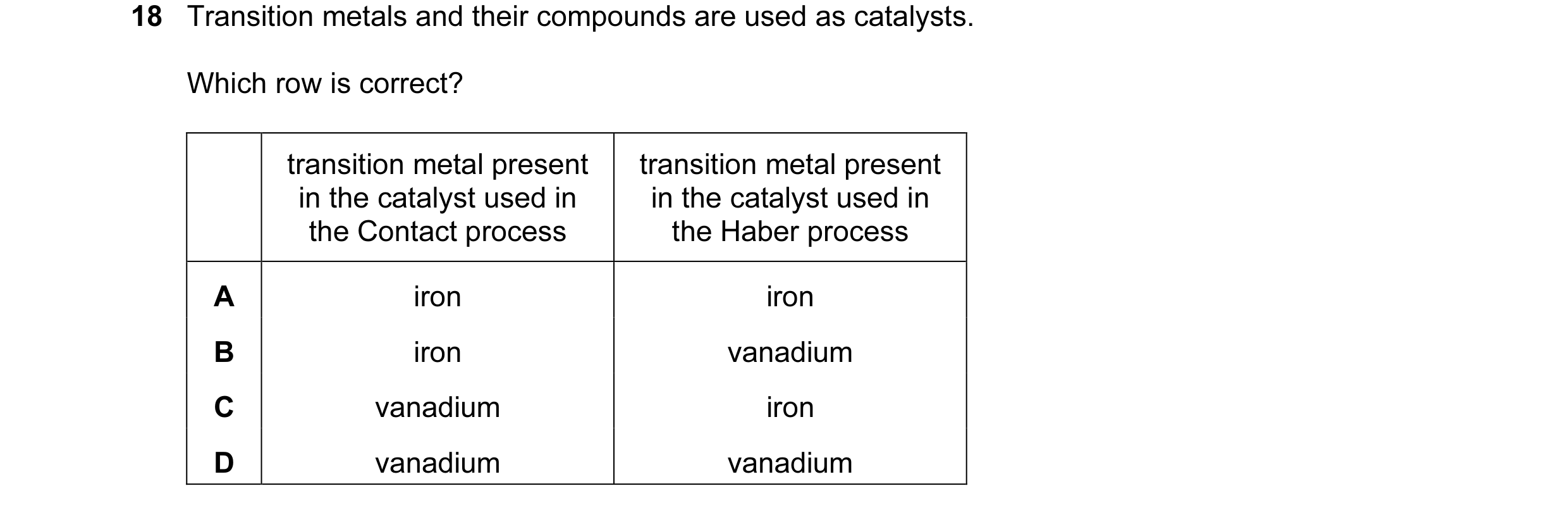
18 Transition metals and their compounds are used as catalysts. Which row is correct? transition metal present transition metal present in the catalyst used in in the catalyst used in the Contact process the Haber process A iron iron B iron vanadium C vanadium iron D vanadium vanadium
1 marks
Answer: C
This question in 9701/11 Oct/Nov 2013
Q5 · Transition metals and their compounds are used as catalysts 9701/12 Oct/Nov 2013
18 Transition metals and their compounds are used as catalysts. Which row is correct? transition metal present transition metal present in the catalyst used in in the catalyst used in the Contact process the Haber process A iron iron B iron vanadium C vanadium iron D vanadium vanadium
1 marks
Answer: C
This question in 9701/12 Oct/Nov 2013
Q6 · Silver chloride dissolves in aqueous ammonia 9701/12 May/June 2014
35 Silver chloride dissolves in aqueous ammonia. What happens in this process? 1 Ammonia forms a complex with the Ag+ ion. 2 Ammonia acts as a Brønsted-Lowry base. 3 A redox reaction occurs.
1 marks
Answer: D
This question in 9701/12 May/June 2014
Q7 · Use of the Data Booklet is relevant to this question 9701/11 Oct/Nov 2014
31 Use of the Data Booklet is relevant to this question. Which ions contain one or more unpaired electrons? 1 Cu2+ 2 Mn3+ 3 V3+
1 marks
Answer: A
This question in 9701/11 Oct/Nov 2014
Q8 · Mohr’s salt is a pale green crystalline solid which is soluble in water 9701/11 May/June 2015
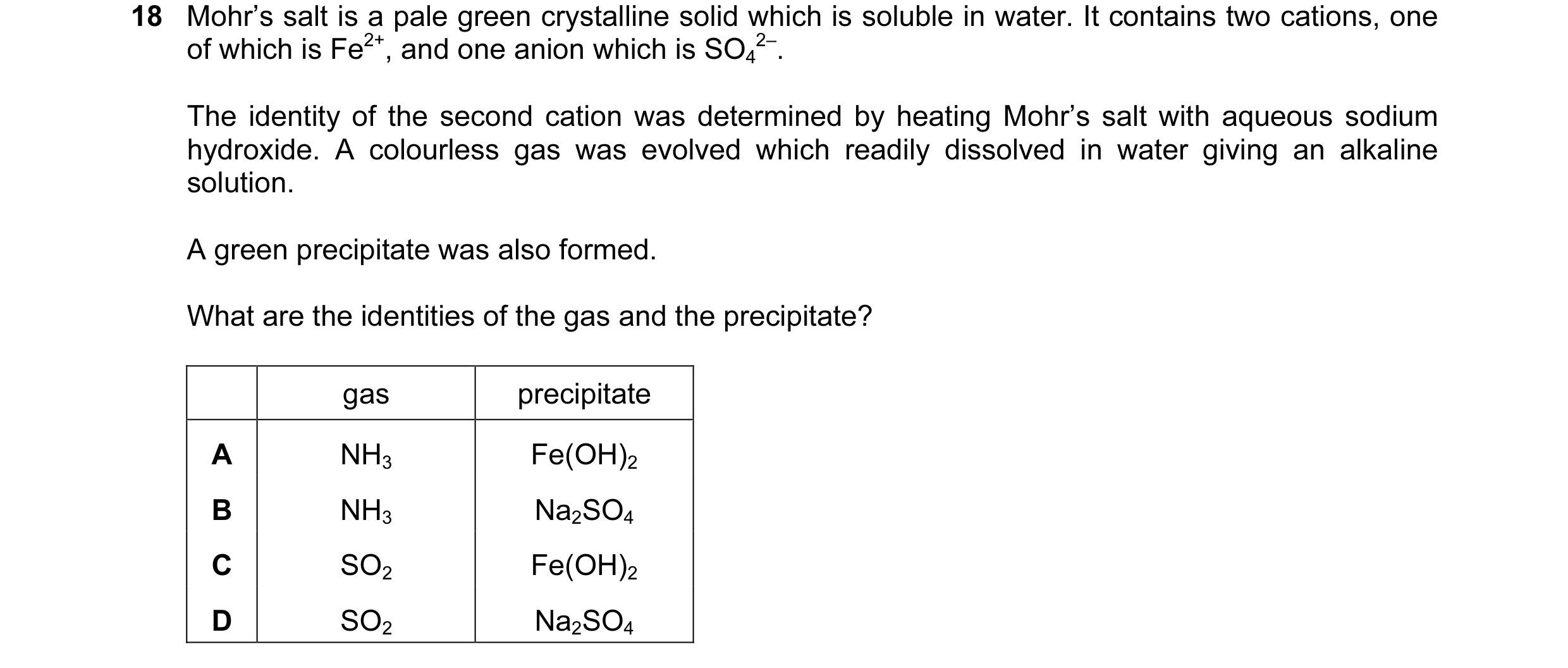
18 Mohr’s salt is a pale green crystalline solid which is soluble in water. It contains two cations, one of which is Fe2+, and one anion which is SO4 2–. The identity of the second cation was determined by heating Mohr’s salt with aqueous sodium hydroxide. A colourless gas was evolved which readily dissolved in water giving an alkaline solution. A green precipitate was also formed. What are the identities of the gas and the precipitate? gas precipitate A NH3 Fe(OH)2 B NH3 Na2SO4 C SO2 Fe(OH)2 D SO2 Na2SO4
1 marks
Answer: A
This question in 9701/11 May/June 2015
Q9 · In industry, copper metal is purified by electrolysis 9701/12 May/June 2015
7 In industry, copper metal is purified by electrolysis. Which changes occur to the masses of the electrodes and to the colour of the electrolyte during this process? mass of mass of colour of anode cathode electrolyte A decrease increase little or no change occurs B decrease increase pale blue to blue C increase decrease little or no change occurs D increase decrease blue to pale blue
1 marks
Answer: A
This question in 9701/12 May/June 2015
Q10 · The process of electrolysis can be used to purify copper, and to extract aluminium from… 9701/12 Oct/Nov 2015
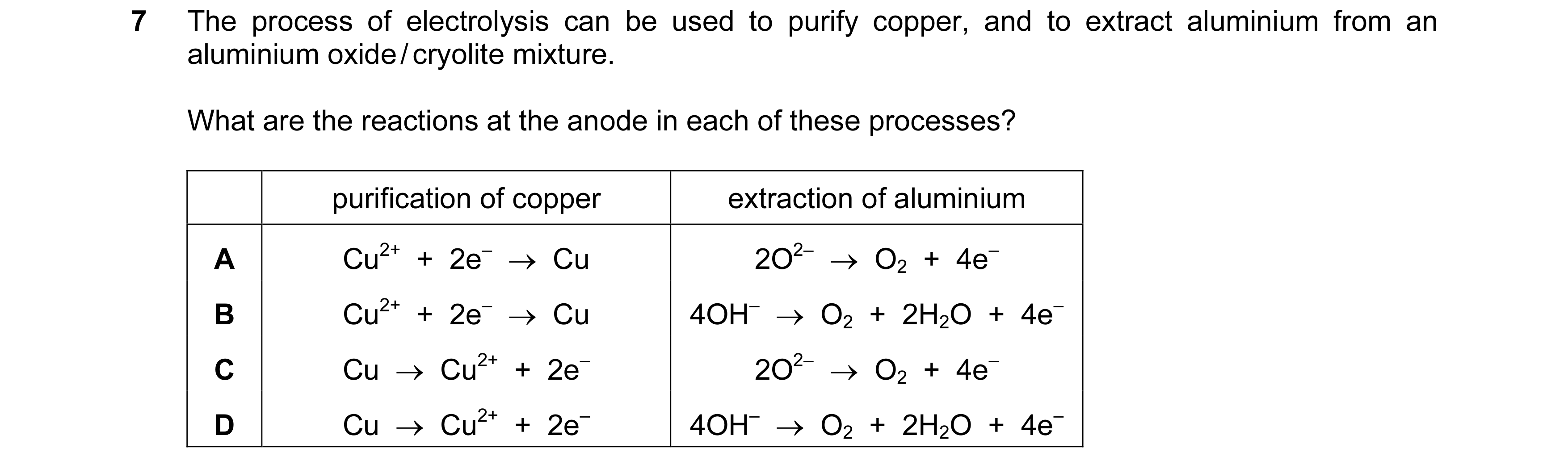
7 The process of electrolysis can be used to purify copper, and to extract aluminium from an aluminium oxide / cryolite mixture. What are the reactions at the anode in each of these processes? purification of copper extraction of aluminium A Cu2+ + 2e– → Cu 2O2– → O2 + 4e– B Cu2+ + 2e– → Cu 4OH– → O2 + 2H2O + 4e– C Cu → Cu2+ + 2e– 2O2– → O2 + 4e– D Cu → Cu2+ + 2e– 4OH– → O2 + 2H2O + 4e–
1 marks
This question in 9701/12 Oct/Nov 2015
Q11 · After black and white photographic film has been developed, unreacted silver bromide is… 9701/12 Feb/March 2016
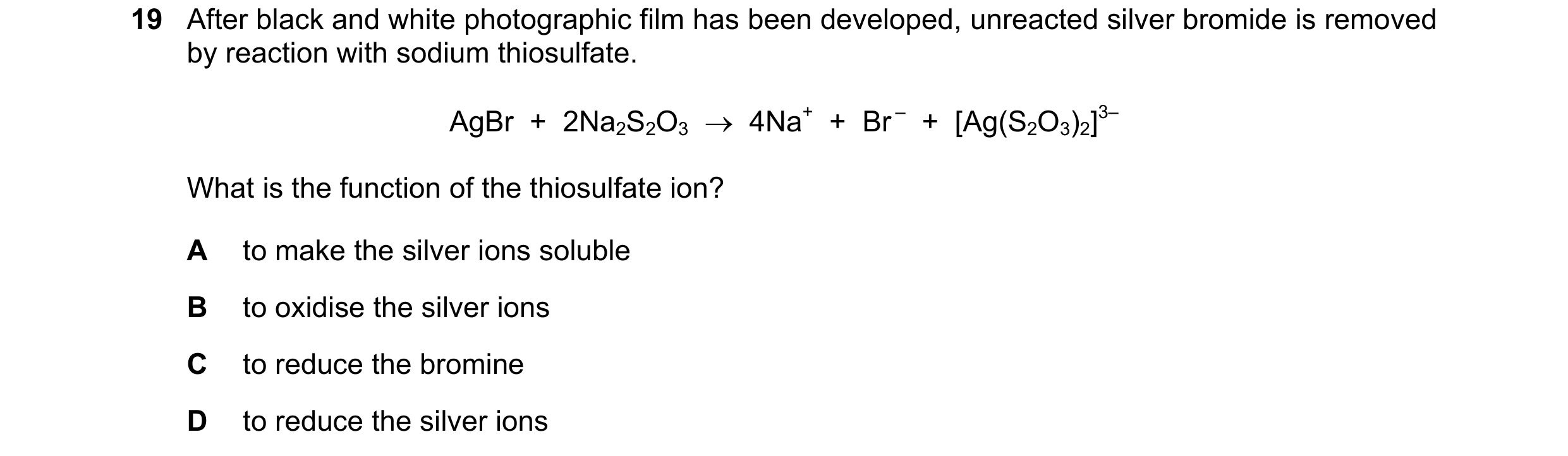
19 After black and white photographic film has been developed, unreacted silver bromide is removed by reaction with sodium thiosulfate. AgBr + 2Na2S2O3 → 4Na+ + Br – + [Ag(S2O3)2]3– What is the function of the thiosulfate ion? A to make the silver ions soluble B to oxidise the silver ions C to reduce the bromine D to reduce the silver ions
1 marks
Answer: A
This question in 9701/12 Feb/March 2016
Q12 · Water is added to anhydrous aluminium chloride to make a 0.1 mol dm–3 solution 9701/13 Oct/Nov 2016
35 Water is added to anhydrous aluminium chloride to make a 0.1 mol dm–3 solution. Which observations are correct? 1 The reaction is endothermic. 2 The solution is acidic. 3 The solution contains the ion [Al (H2O)6]3+.
1 marks
Answer: C
This question in 9701/13 Oct/Nov 2016
Q13 · A transition metal ion, M2+, reacts with acidified dichromate(VI) ions to form M4+ ions… 9701/11 Oct/Nov 2018
8 A transition metal ion, M2+, reacts with acidified dichromate(VI) ions to form M4+ ions, Cr3+ ions, and H2O. Which equation correctly represents this reaction? A Cr2O7 2– + 14H+ + M2+ → 2Cr3+ + 7H2O + M4+ B Cr2O7 2– + 14H+ + 2M2+ → 2Cr3+ + 7H2O + 2M4+ C Cr2O7 2– + 14H+ + 3M2+ → 2Cr3+ + 7H2O + 3M4+ D Cr2O7 2– + 14H+ + 6M2+ → 2Cr3+ + 7H2O + 6M4+
1 marks
Answer: C
This question in 9701/11 Oct/Nov 2018
Q14 · Transition elements and their compounds are widely used as catalysts 9701/11 Oct/Nov 2018
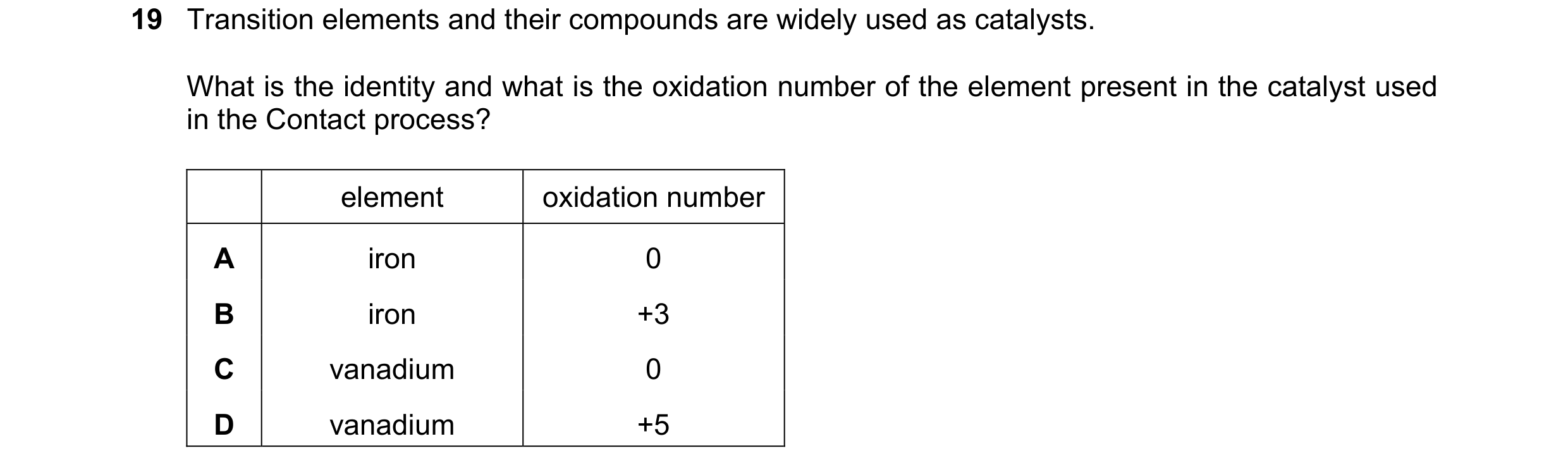
19 Transition elements and their compounds are widely used as catalysts. What is the identity and what is the oxidation number of the element present in the catalyst used in the Contact process? element oxidation number A iron 0 B iron +3 C vanadium 0 D vanadium +5
1 marks
Answer: D
This question in 9701/11 Oct/Nov 2018
Q15 · A transition metal ion, M2+, reacts with acidified dichromate(VI) ions to form M4+ ions… 9701/13 Oct/Nov 2018
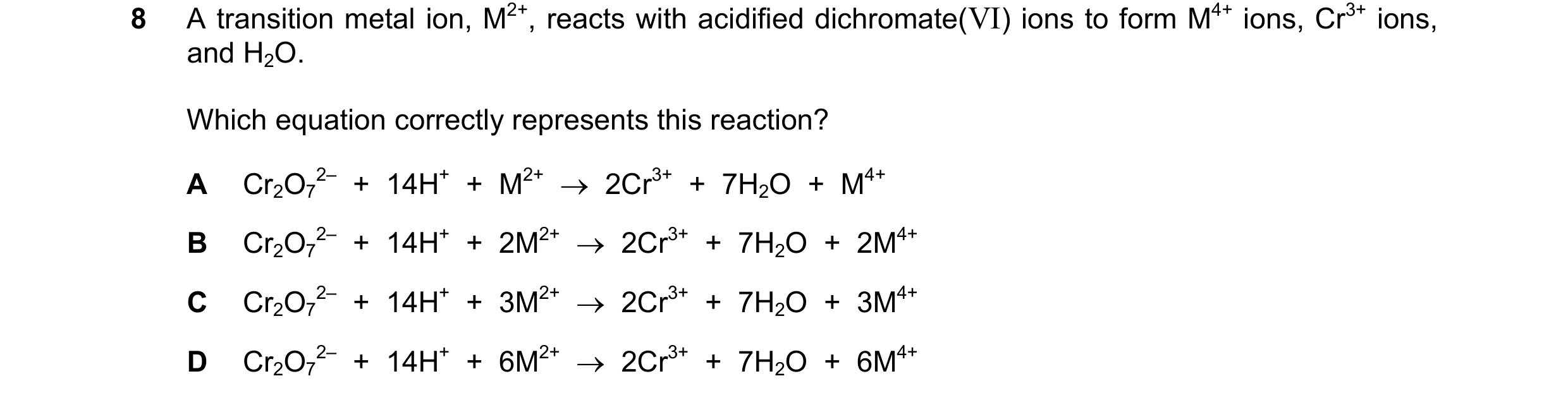
8 A transition metal ion, M2+, reacts with acidified dichromate(VI) ions to form M4+ ions, Cr3+ ions, and H2O. Which equation correctly represents this reaction? A Cr2O7 2– + 14H+ + M2+ → 2Cr3+ + 7H2O + M4+ B Cr2O7 2– + 14H+ + 2M2+ → 2Cr3+ + 7H2O + 2M4+ C Cr2O7 2– + 14H+ + 3M2+ → 2Cr3+ + 7H2O + 3M4+ D Cr2O7 2– + 14H+ + 6M2+ → 2Cr3+ + 7H2O + 6M4+
1 marks
Answer: C
This question in 9701/13 Oct/Nov 2018
Q16 · Transition elements and their compounds are widely used as catalysts 9701/13 Oct/Nov 2018
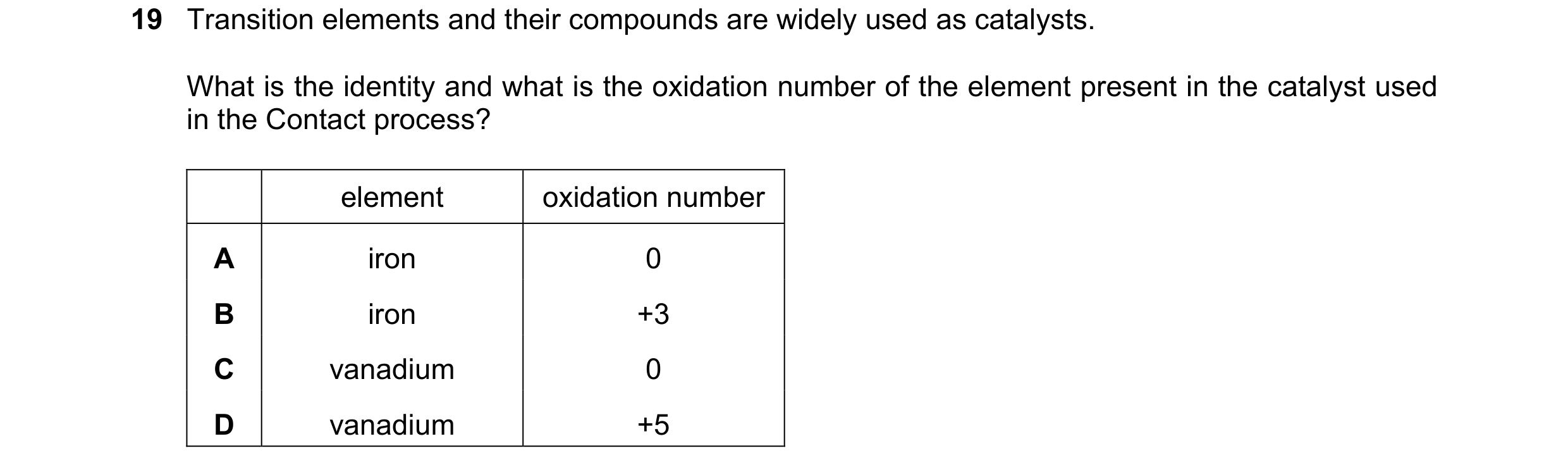
19 Transition elements and their compounds are widely used as catalysts. What is the identity and what is the oxidation number of the element present in the catalyst used in the Contact process? element oxidation number A iron 0 B iron +3 C vanadium 0 D vanadium +5
1 marks
Answer: D
This question in 9701/13 Oct/Nov 2018
Q17 · Vanadium and pepsin can both act as catalysts 9701/11 May/June 2019
34 Vanadium and pepsin can both act as catalysts. Vanadium is a metal. Pepsin is an enzyme. Which statements are correct for both vanadium and pepsin? 1 They will speed up any chemical reaction. 2 They can lower the activation energy for a reaction. 3 They are not used up when they act as catalysts.
1 marks
Answer: C
This question in 9701/11 May/June 2019
Q18 · Two moles of VO2 + ions react with one mole of zinc atoms in the presence of dilute acid 9701/12 Oct/Nov 2022
5 Two moles of VO2 + ions react with one mole of zinc atoms in the presence of dilute acid. The products include Zn2+ ions and an ion, Y. Ion Y contains vanadium. Only zinc and vanadium change oxidation state in the reaction. What is ion Y? A VO3 – B VO+ C VO2+ D VO2 2+
1 marks
Answer: C
This question in 9701/12 Oct/Nov 2022
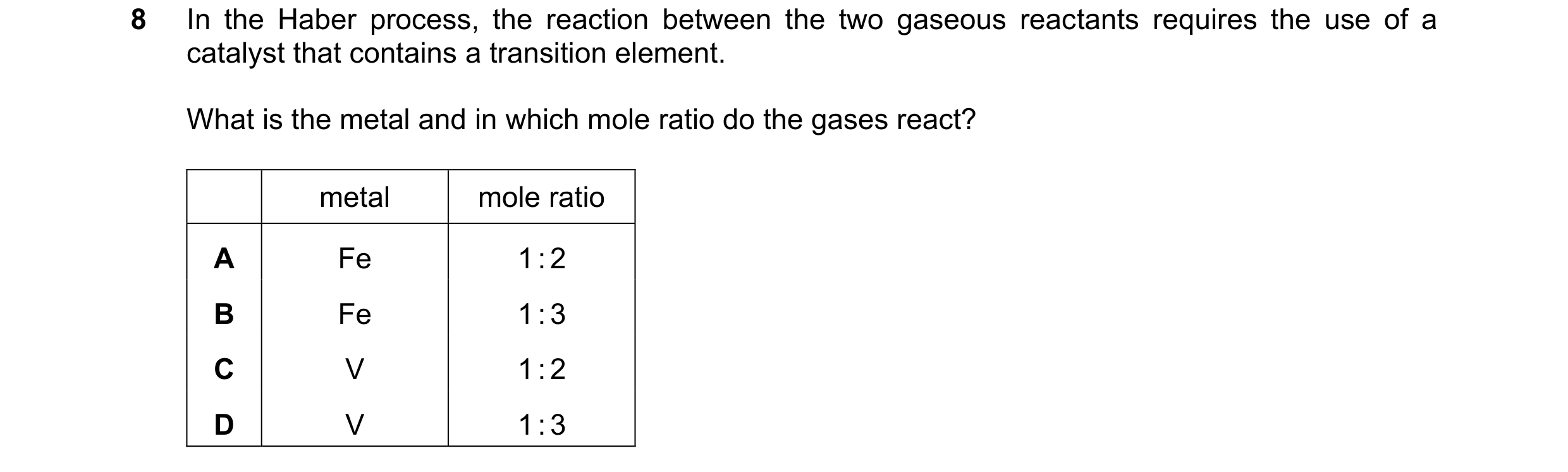
Q19 · In the Haber process, the reaction between the two gaseous reactants requires the use of… 9701/12 May/June 2025
8 In the Haber process, the reaction between the two gaseous reactants requires the use of a catalyst that contains a transition element. What is the metal and in which mole ratio do the gases react? metal mole ratio A Fe 1 : 2 B Fe 1 : 3 C V 1 : 2 D V 1 : 3
1 marks
Answer: B
This question in 9701/12 May/June 2025
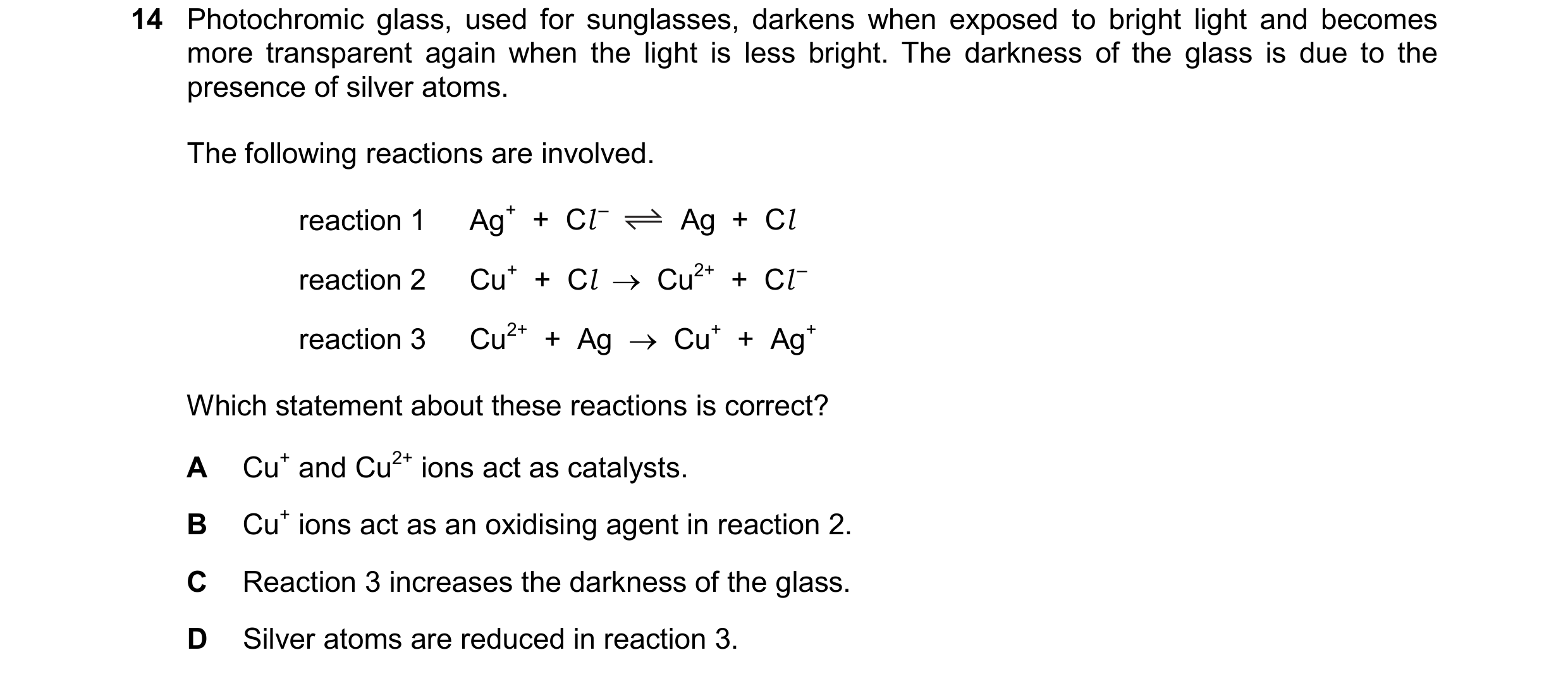
Q20 · Photochromic glass, used for sunglasses, darkens when exposed to bright light and becomes… 9701/11 Oct/Nov 2025
14 Photochromic glass, used for sunglasses, darkens when exposed to bright light and becomes more transparent again when the light is less bright. The darkness of the glass is due to the presence of silver atoms. The following reactions are involved. reaction 1 Ag+ + Cl– Ag + Cl reaction 2 Cu+ + Cl Cu2+ + Cl– reaction 3 Cu2+ + Ag Cu+ + Ag+ Which statement about these reactions is correct? A Cu+ and Cu2+ ions act as catalysts. B Cu+ ions act as an oxidising agent in reaction 2. C Reaction 3 increases the darkness of the glass. D Silver atoms are reduced in reaction 3.
1 marks
Answer: A
This question in 9701/11 Oct/Nov 2025
Q21 · Photochromic glass, used for sunglasses, darkens when exposed to bright light and becomes… 9701/13 Oct/Nov 2025
14 Photochromic glass, used for sunglasses, darkens when exposed to bright light and becomes more transparent again when the light is less bright. The darkness of the glass is due to the presence of silver atoms. The following reactions are involved. reaction 1 Ag+ + Cl– Ag + Cl reaction 2 Cu+ + Cl Cu2+ + Cl– reaction 3 Cu2+ + Ag Cu+ + Ag+ Which statement about these reactions is correct? A Cu+ and Cu2+ ions act as catalysts. B Cu+ ions act as an oxidising agent in reaction 2. C Reaction 3 increases the darkness of the glass. D Silver atoms are reduced in reaction 3.
1 marks
Answer: A
This question in 9701/13 Oct/Nov 2025

 1 / 6
1 / 6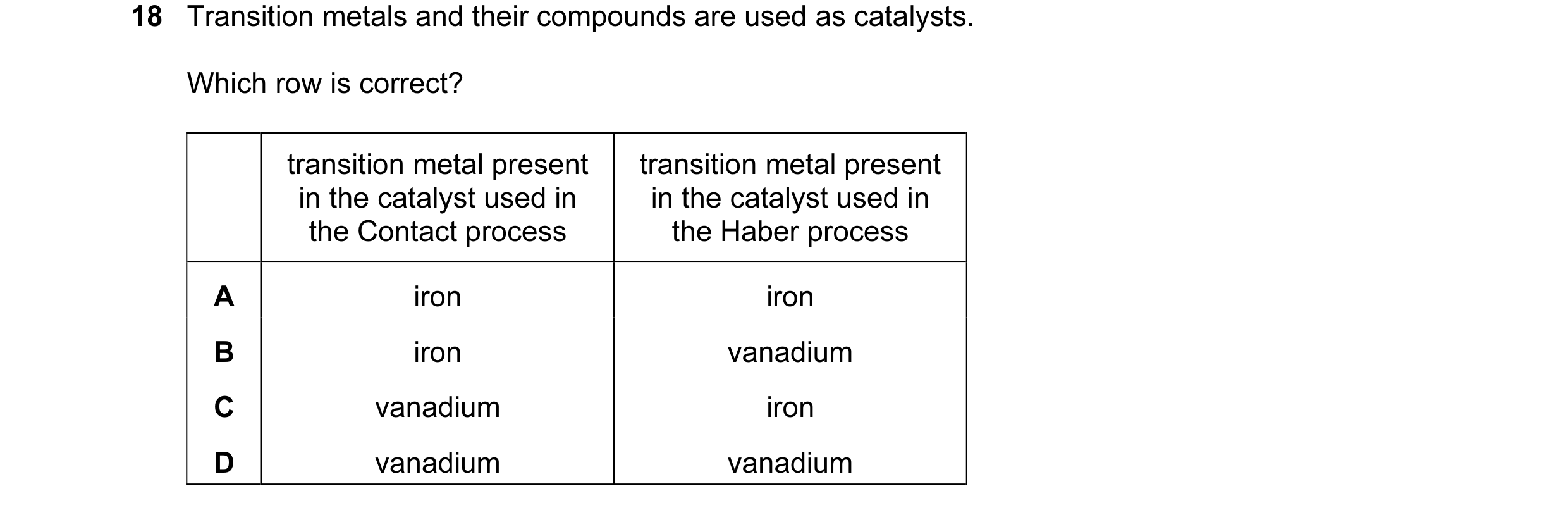


 2 / 6
2 / 6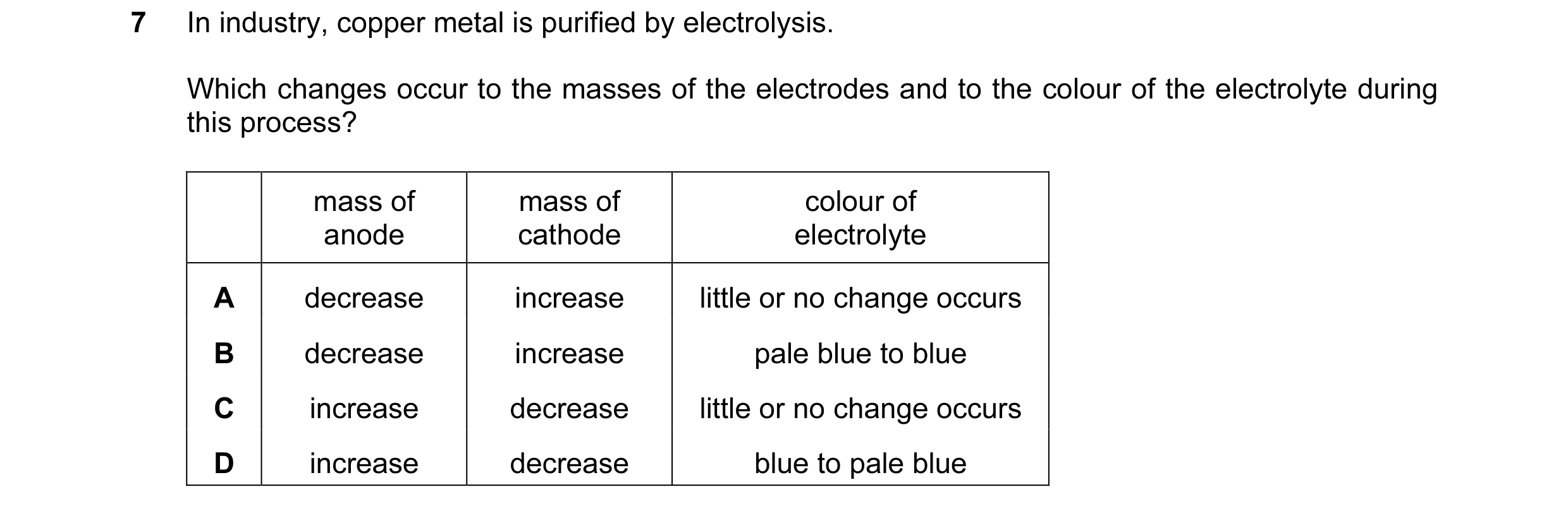
 3 / 6
3 / 6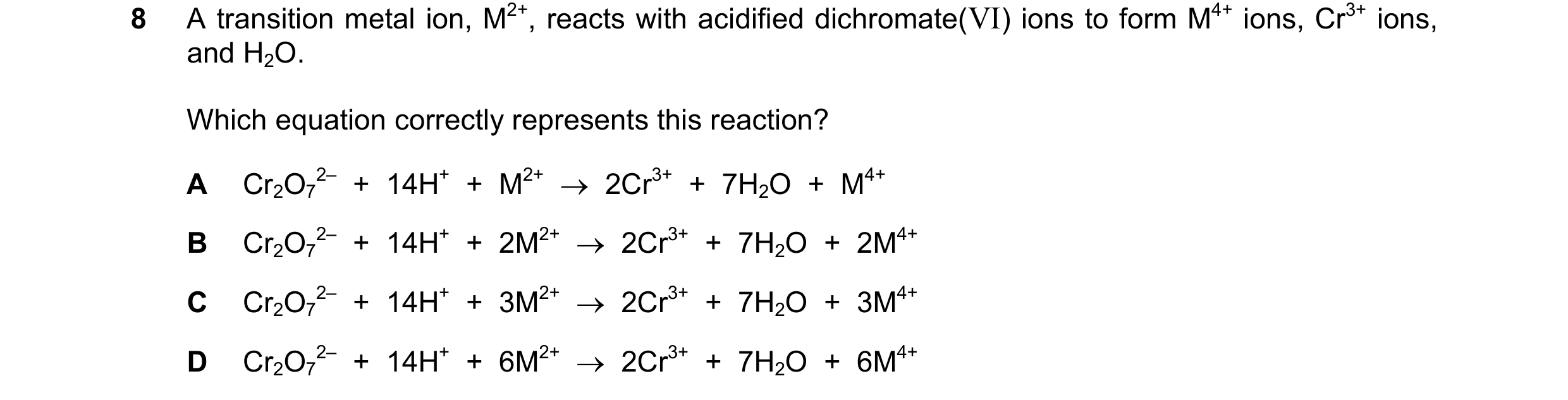
 4 / 6
4 / 6
 5 / 6
5 / 6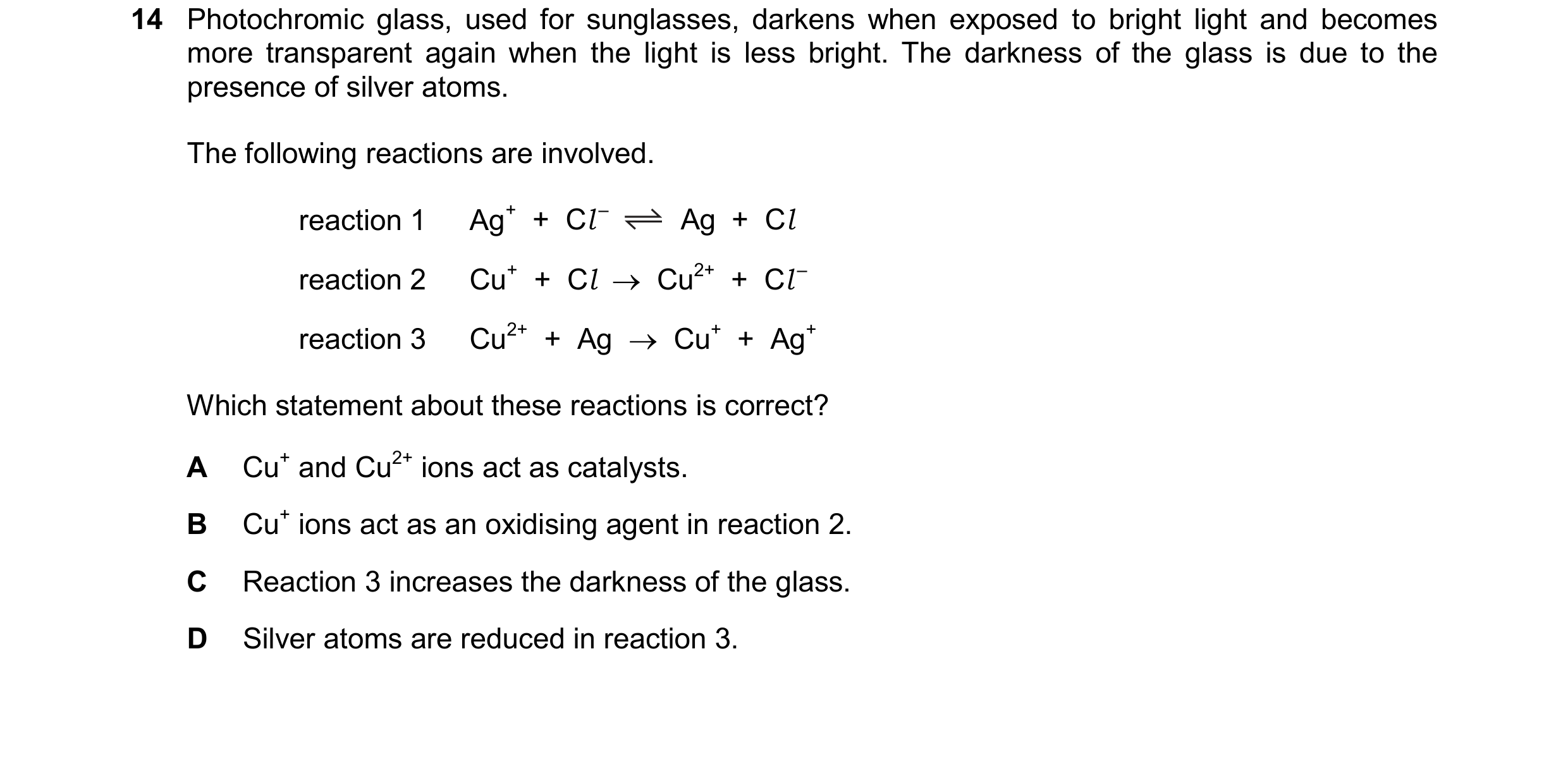 6 / 6
6 / 6