Questions as text
Q1 · Four elements are shown in order of reactivity 0654/42 May/June 2017
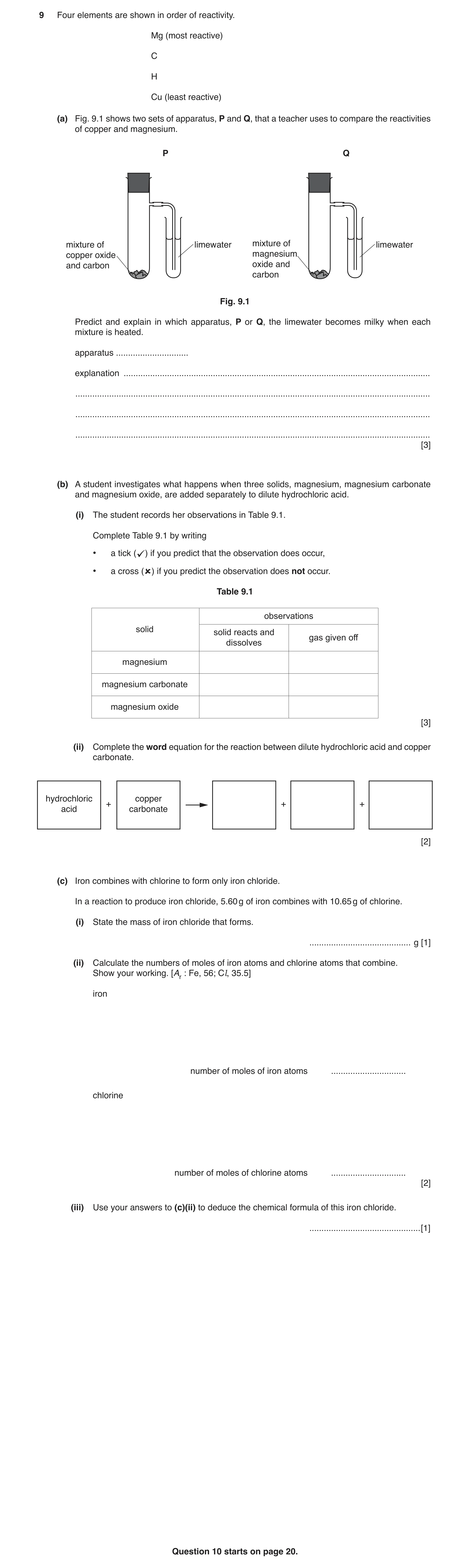
9 Four elements are shown in order of reactivity. Mg (most reactive) C H Cu (least reactive) (a) Fig. 9.1 shows two sets of apparatus, P and Q, that a teacher uses to compare the reactivities of copper and magnesium. P Q mixture of limewater mixture of limewater copper oxide magnesium and carbon oxide and carbon Fig. 9.1 Predict and explain in which apparatus, P or Q, the limewater becomes milky when each mixture is heated. apparatus … explanation … … … … [3] (b) A student investigates what happens when three solids, magnesium, magnesium carbonate and magnesium oxide, are added separately to dilute hydrochloric acid. (i) The student records her observations in Table 9.1. Complete Table 9.1 by writing • a tick () if you predict that the observation does occur, • a cross (û) if you predict the observation does not occur. Table 9.1 observations solid solid reacts and gas given off dissolves magnesium magnesium carbonate magnesium oxide [3] (ii) Complete the word equation for the reaction between dilute hydrochloric acid and copper carbonate. hydrochloric copper + + + acid carbonate [2] (c) Iron combines with chlorine to form only iron chloride. In a reaction to produce iron chloride, 5.60 g of iron combines with 10.65 g of chlorine. (i) State the mass of iron chloride that forms. … g [1] (ii) Calculate the numbers of moles of iron atoms and chlorine atoms that combine. Show your working. [Ar : Fe, 56; Cl, 35.5] iron number of moles of iron atoms … chlorine number of moles of chlorine atoms … [2] (iii) Use your answers to (c)(ii) to deduce the chemical formula of this iron chloride. … [1] Question 10 starts on page 20.
12 marks
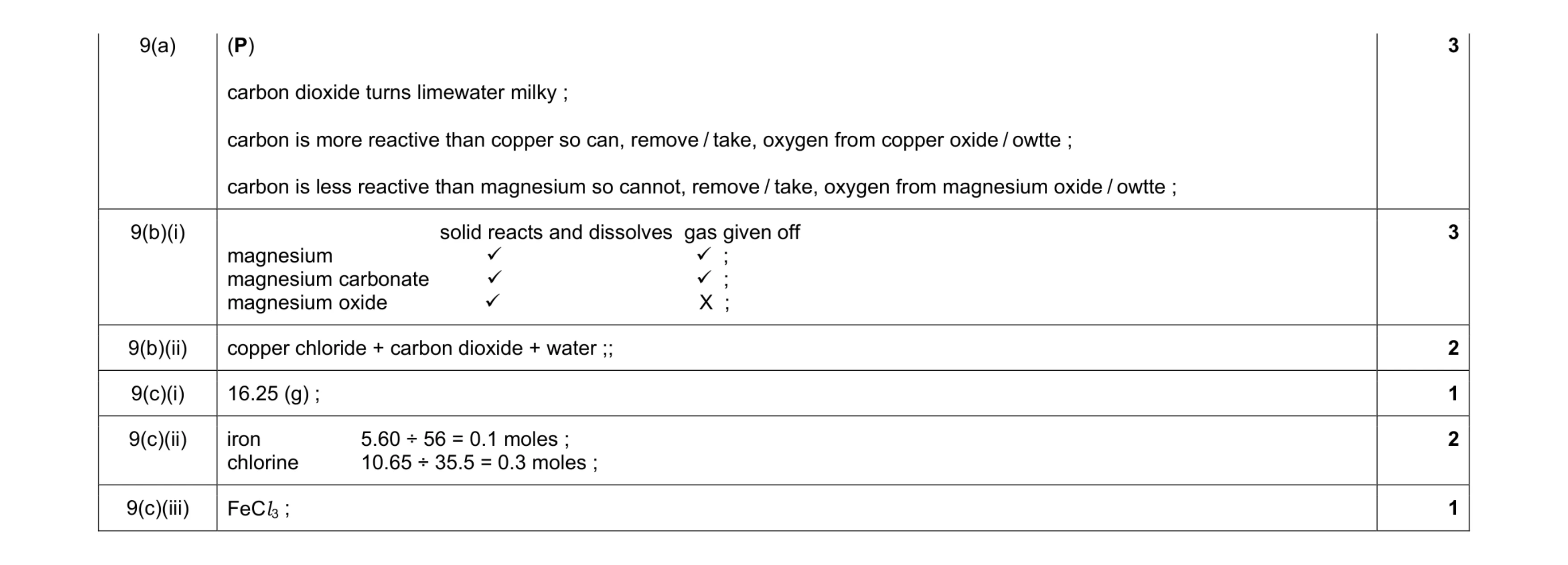
Mark scheme: 9(a) (P) carbon dioxide turns limewater milky ; carbon is more reactive than copper so can, remove / take, oxygen from copper oxide / owtte ; carbon is less reactive than magnesium so cannot, remove / take, oxygen from magnesium oxide / owtte ; 3 9(b)(i) solid reacts and dissolves gas given off magnesium 9 9 ; magnesium carbonate 9 9 ; magnesium oxide 9 X ; 3 9(b)(ii) copper chloride + carbon dioxide + water ;; 2 9(c)(i) 16.25 (g) ; 1 9(c)(ii) iron 5.60 ÷ 56 = 0.1 moles ; chlorine 10.65 ÷ 35.5 = 0.3 moles ; 2 9(c)(iii) FeCl3 ; 1
This question in 0654/42 May/June 2017
Q2 · Apparatus a student uses to collect the gas that is made when a solid reacts with a liquid 0654/41 Oct/Nov 2017
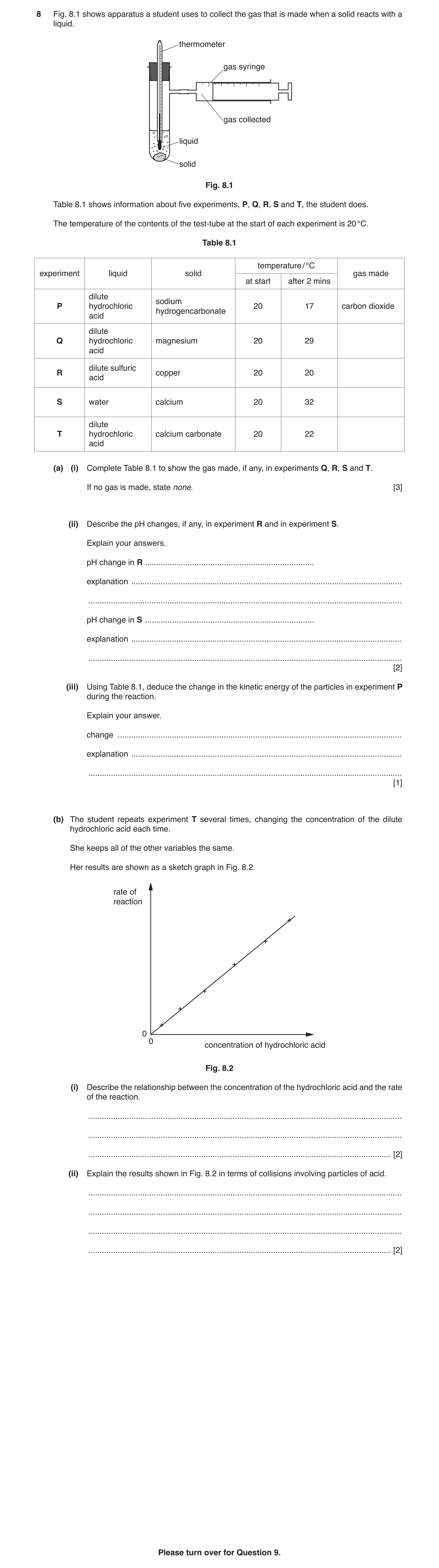
8 Fig. 8.1 shows apparatus a student uses to collect the gas that is made when a solid reacts with a liquid. thermometer gas syringe gas collected liquid solid Fig. 8.1 Table 8.1 shows information about five experiments, P, Q, R, S and T, the student does. The temperature of the contents of the test-tube at the start of each experiment is 20 °C. Table 8.1 temperature / °C experiment liquid solid gas made at start after 2 mins dilute sodium P hydrochloric 20 17 carbon dioxide hydrogencarbonate acid dilute Q hydrochloric magnesium 20 29 acid dilute sulfuric R copper 20 20 acid S water calcium 20 32 dilute T hydrochloric calcium carbonate 20 22 acid (a) (i) Complete Table 8.1 to show the gas made, if any, in experiments Q, R, S and T. If no gas is made, state none. [3] (ii) Describe the pH changes, if any, in experiment R and in experiment S. Explain your answers. pH change in R … explanation … … pH change in S … explanation … … [2] (iii) Using Table 8.1, deduce the change in the kinetic energy of the particles in experiment P during the reaction. Explain your answer. change … explanation … … [1] (b) The student repeats experiment T several times, changing the concentration of the dilute hydrochloric acid each time. She keeps all of the other variables the same. Her results are shown as a sketch graph in Fig. 8.2. rate of reaction 0 0 concentration of hydrochloric acid Fig. 8.2 (i) Describe the relationship between the concentration of the hydrochloric acid and the rate of the reaction. … … … [2] (ii) Explain the results shown in Fig. 8.2 in terms of collisions involving particles of acid. … … … … [2] Please turn over for Question 9.
10 marks
Mark scheme: 8(a)(i) Q – hydrogen R – none S – hydrogen T – carbon dioxide 1 correct ; 2 or 3 correct ; 4 correct ; 3 8(a)(ii) R no change in pH because copper does not react with dilute sulfuric acid ; S pH increases because solution becomes alkaline / calcium hydroxide is produced ; 2 8(a)(iii) particle K. E. decreases because reaction endothermic / temperature decreases ; 1 8(b)(i) the higher the concentration (of acid) the higher the rate of reaction / proportional ; relationship is direct proportion / or description ; 2 8(b)(ii) greater concentration of acid causes greater concentration of particles ; at higher concentration of particles there is a greater collision frequency ; max 2
This question in 0654/41 Oct/Nov 2017
Q3 · Diamonds, limestone and sand are found in the Earth’s crust 0654/41 Oct/Nov 2018
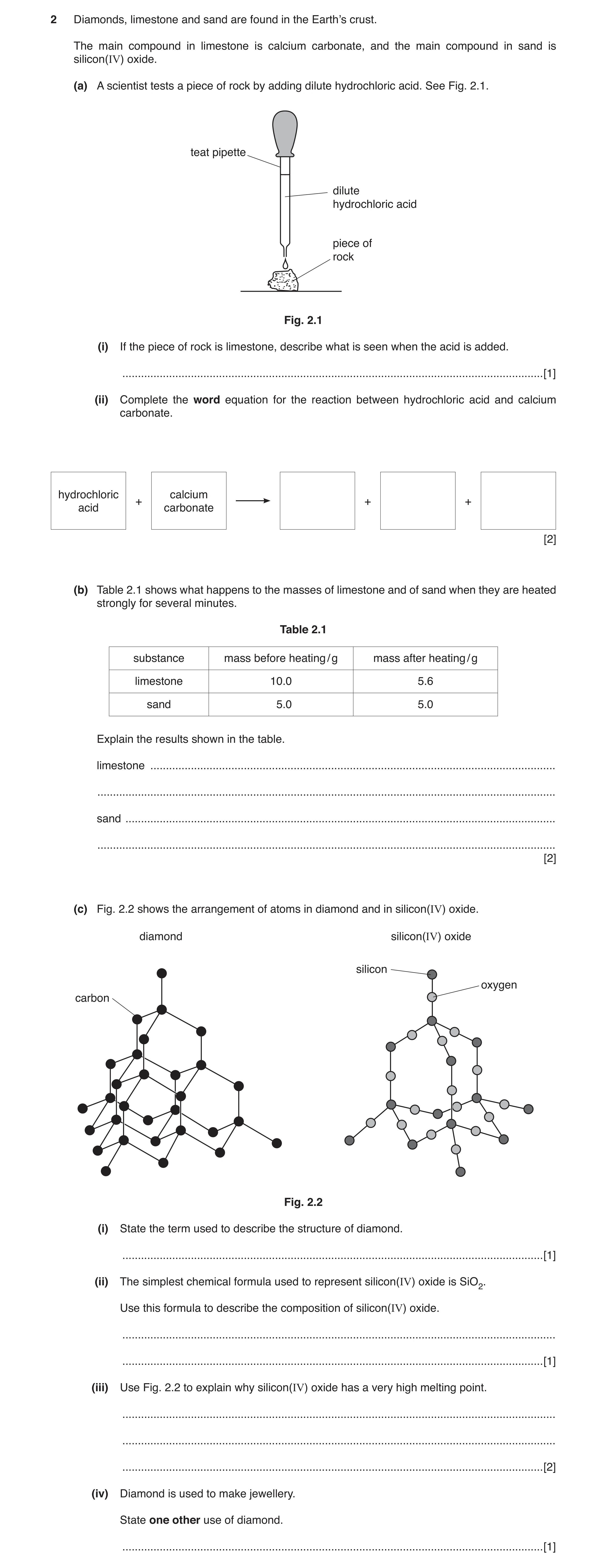
2 Diamonds, limestone and sand are found in the Earth’s crust. The main compound in limestone is calcium carbonate, and the main compound in sand is silicon(IV) oxide. (a) A scientist tests a piece of rock by adding dilute hydrochloric acid. See Fig. 2.1. teat pipette dilute hydrochloric acid piece of rock Fig. 2.1 (i) If the piece of rock is limestone, describe what is seen when the acid is added. … [1] (ii) Complete the word equation for the reaction between hydrochloric acid and calcium carbonate. hydrochloric calcium + + + acid carbonate [2] (b) Table 2.1 shows what happens to the masses of limestone and of sand when they are heated strongly for several minutes. Table 2.1 substance mass before heating / g mass after heating / g limestone 10.0 5.6 sand 5.0 5.0 Explain the results shown in the table. limestone … … sand … … [2] (c) Fig. 2.2 shows the arrangement of atoms in diamond and in silicon(IV) oxide. diamond silicon(IV) oxide silicon oxygen carbon Fig. 2.2 (i) State the term used to describe the structure of diamond. … [1] (ii) The simplest chemical formula used to represent silicon(IV) oxide is SiO2. Use this formula to describe the composition of silicon(IV) oxide. … … [1] (iii) Use Fig. 2.2 to explain why silicon(IV) oxide has a very high melting point. … … … [2] (iv) Diamond is used to make jewellery. State one other use of diamond. … [1]
10 marks
Mark scheme: 2(a)(i) effervescence / bubbles ; 1 2(a)(ii) (calcium carbonate + hydrochloric acid →) calcium chloride ; carbon dioxide and water ; 2 2(b) limestone has decomposed / broken down / released carbon dioxide / a gas ; (silicon (IV) oxide) is stable / does not react / does not decompose ; 2 2(c)(i) giant (covalent) / macromolecule ; 1 2(c)(ii) ratio of Si atoms to O atoms is 1:2 ; 1 2(c)(iii) the idea that (thermal) energy is required to break bonds ; bonds are strong / a large number of bonds (have to be broken) ; 2 2(c)(iv) cutting tools / other correct ; 1
This question in 0654/41 Oct/Nov 2018
Q4 · Limestone is a useful material obtained from the Earth’s crust 0654/42 Oct/Nov 2018
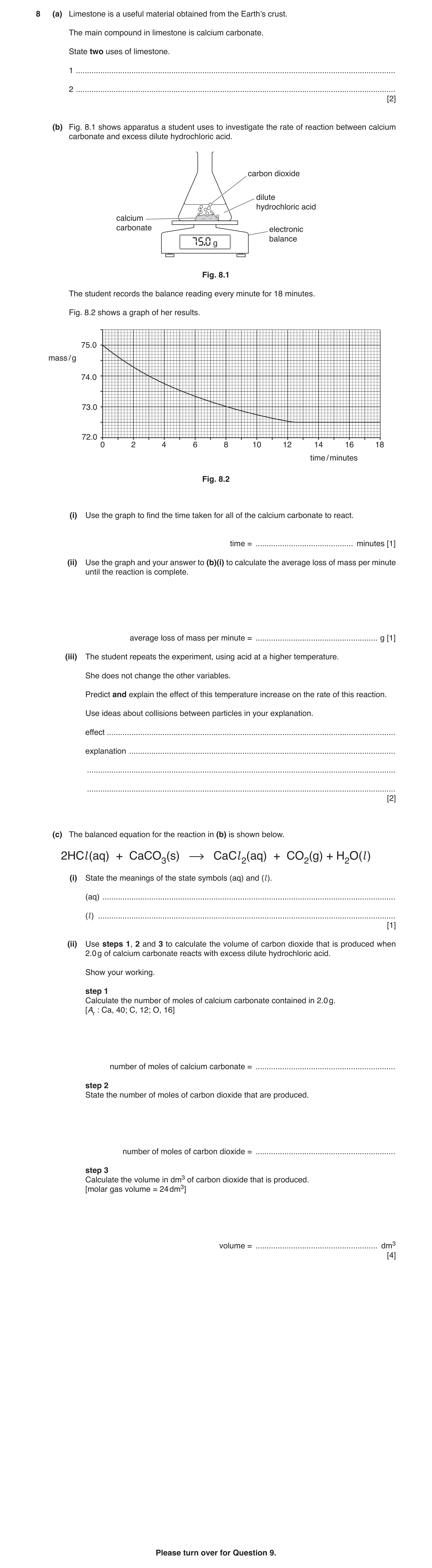
8 (a) Limestone is a useful material obtained from the Earth’s crust. The main compound in limestone is calcium carbonate. State two uses of limestone. 1 … 2 … [2] (b) Fig. 8.1 shows apparatus a student uses to investigate the rate of reaction between calcium carbonate and excess dilute hydrochloric acid. carbon dioxide dilute hydrochloric acid calcium carbonate electronic 75.0 g balance Fig. 8.1 The student records the balance reading every minute for 18 minutes. Fig. 8.2 shows a graph of her results. 75.0 mass / g 74.0 73.0 72.0 0 2 4 6 8 10 12 14 16 18 time / minutes Fig. 8.2 (i) Use the graph to find the time taken for all of the calcium carbonate to react. time = … minutes [1] (ii) Use the graph and your answer to (b)(i) to calculate the average loss of mass per minute until the reaction is complete. average loss of mass per minute = … g [1] (iii) The student repeats the experiment, using acid at a higher temperature. She does not change the other variables. Predict and explain the effect of this temperature increase on the rate of this reaction. Use ideas about collisions between particles in your explanation. effect … explanation … … … [2] (c) The balanced equation for the reaction in (b) is shown below. 2HCl (aq) + CaCO3(s) CaCl 2(aq) + CO2(g) + H2O(l ) (i) State the meanings of the state symbols (aq) and (l ). (aq) … (l ) … [1] (ii) Use steps 1, 2 and 3 to calculate the volume of carbon dioxide that is produced when 2.0 g of calcium carbonate reacts with excess dilute hydrochloric acid. Show your working. step 1 Calculate the number of moles of calcium carbonate contained in 2.0 g. [Ar : Ca, 40; C, 12; O, 16] number of moles of calcium carbonate = … step 2 State the number of moles of carbon dioxide that are produced. number of moles of carbon dioxide = … step 3 Calculate the volume in dm3 of carbon dioxide that is produced. [molar gas volume = 24 dm3] volume = … dm3 [4] Please turn over for Question 9.
11 marks
Mark scheme: 8(a) making, lime / calcium oxide ; neutralisation of, acidic industrial waste / acidic soil ; used in blast furnace / for iron extraction ; AVP ; max 2 8(b)(i) 12.5 ; 1 8(b)(ii) (75.0 – 72.5) ÷ 12.5 = 0.20 (g / min) ; 1 8(b)(iii) (rate increases) particles move more quickly / kinetic energy of particles increases ; which increases collision frequency / increases the chance of successful collision / more particles with activation energy ; 2 Question Answer Marks 8(c)(i) aqueous / the substance is dissolved in water / is in water solution AND liquid / the substance is a liquid ; 1 8(c)(ii) step 1 calculate Mr CaCO3 , 40 + 12 + (16 × 3) = 100 ; number of moles = 2.0 ÷ 100 = 0.02 ; step 2 moles of carbon dioxide = 0.02 ; step 3 volume of carbon dioxide = 24 × 0.02 = 0.48 (dm3 ) ; 4
This question in 0654/42 Oct/Nov 2018
Q5 · Limestone consists mainly of calcium carbonate 0654/41 Oct/Nov 2019
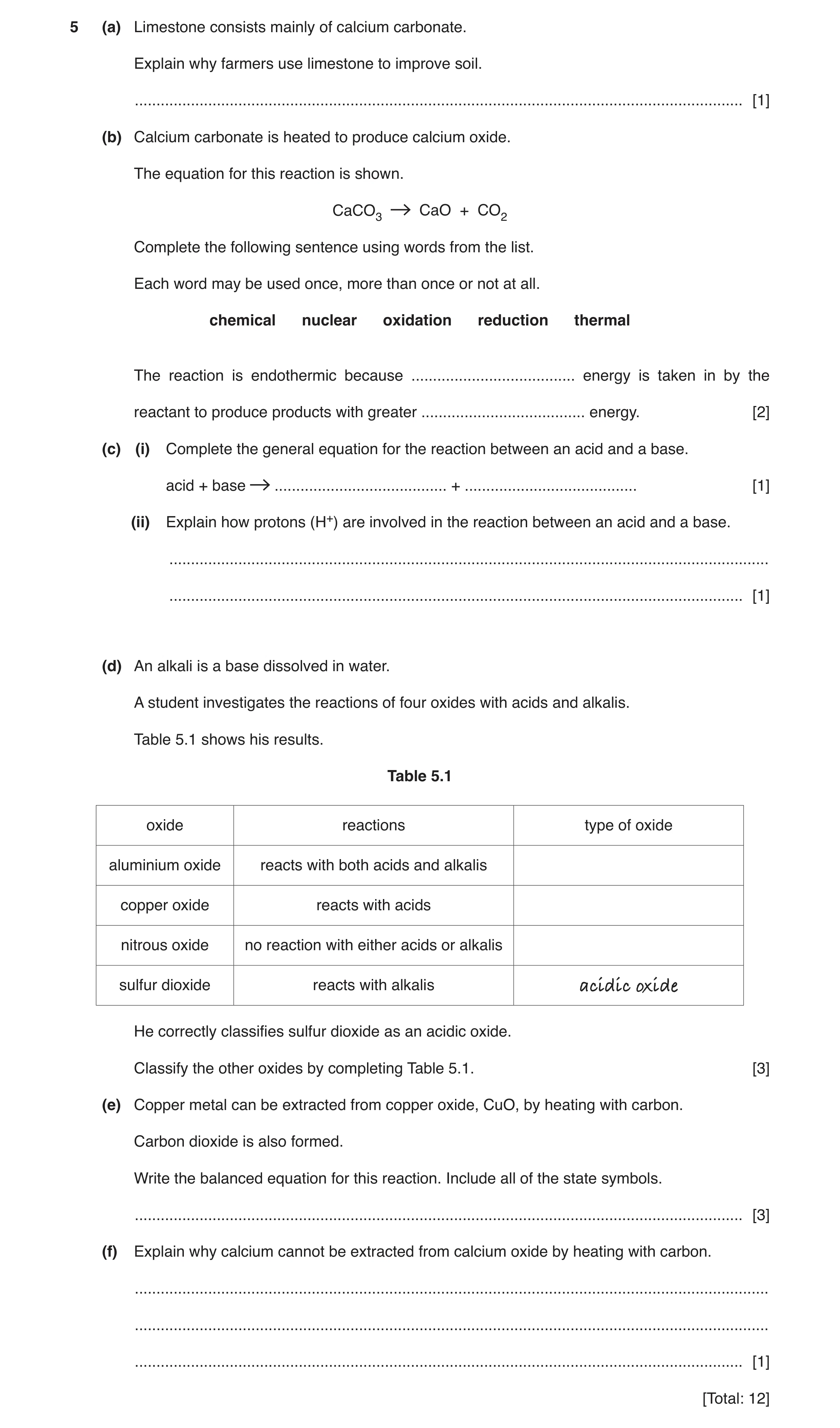
5 (a) Limestone consists mainly of calcium carbonate. Explain why farmers use limestone to improve soil. … [1] (b) Calcium carbonate is heated to produce calcium oxide. The equation for this reaction is shown. CaCO3 CaO + CO2 Complete the following sentence using words from the list. Each word may be used once, more than once or not at all. chemical nuclear oxidation reduction thermal The reaction is endothermic because … energy is taken in by the reactant to produce products with greater … energy. [2] (c) (i) Complete the general equation for the reaction between an acid and a base. acid + base … + … [1] (ii) Explain how protons (H+) are involved in the reaction between an acid and a base. … … [1] (d) An alkali is a base dissolved in water. A student investigates the reactions of four oxides with acids and alkalis. Table 5.1 shows his results. Table 5.1 oxide reactions type of oxide aluminium oxide reacts with both acids and alkalis copper oxide reacts with acids nitrous oxide no reaction with either acids or alkalis sulfur dioxide reacts with alkalis acidic oxide He correctly classifies sulfur dioxide as an acidic oxide. Classify the other oxides by completing Table 5.1. [3] (e) Copper metal can be extracted from copper oxide, CuO, by heating with carbon. Carbon dioxide is also formed. Write the balanced equation for this reaction. Include all of the state symbols. … [3] (f) Explain why calcium cannot be extracted from calcium oxide by heating with carbon. … … … [1] [Total: 12]
12 marks
Mark scheme: 5(a) reduces acidity ; 1 5(b) thermal ; chemical ; 2 5(c)(i) → salt + water ; 1 5(c)(ii) protons / H+ transferred from acid to base ; 1 5(d) amphoteric ; basic ; neutral ; 3 5(e) 2CuO(s) + C(s) → 2Cu(s) + CO2(g) formulae ; state symbols ; balancing ; 3 5(f) calcium more reactive than carbon ; 1
This question in 0654/41 Oct/Nov 2019
Q6 · Ammonia, NH3, is made by the reaction between nitrogen gas and hydrogen gas in the Haber… 0654/43 Oct/Nov 2019
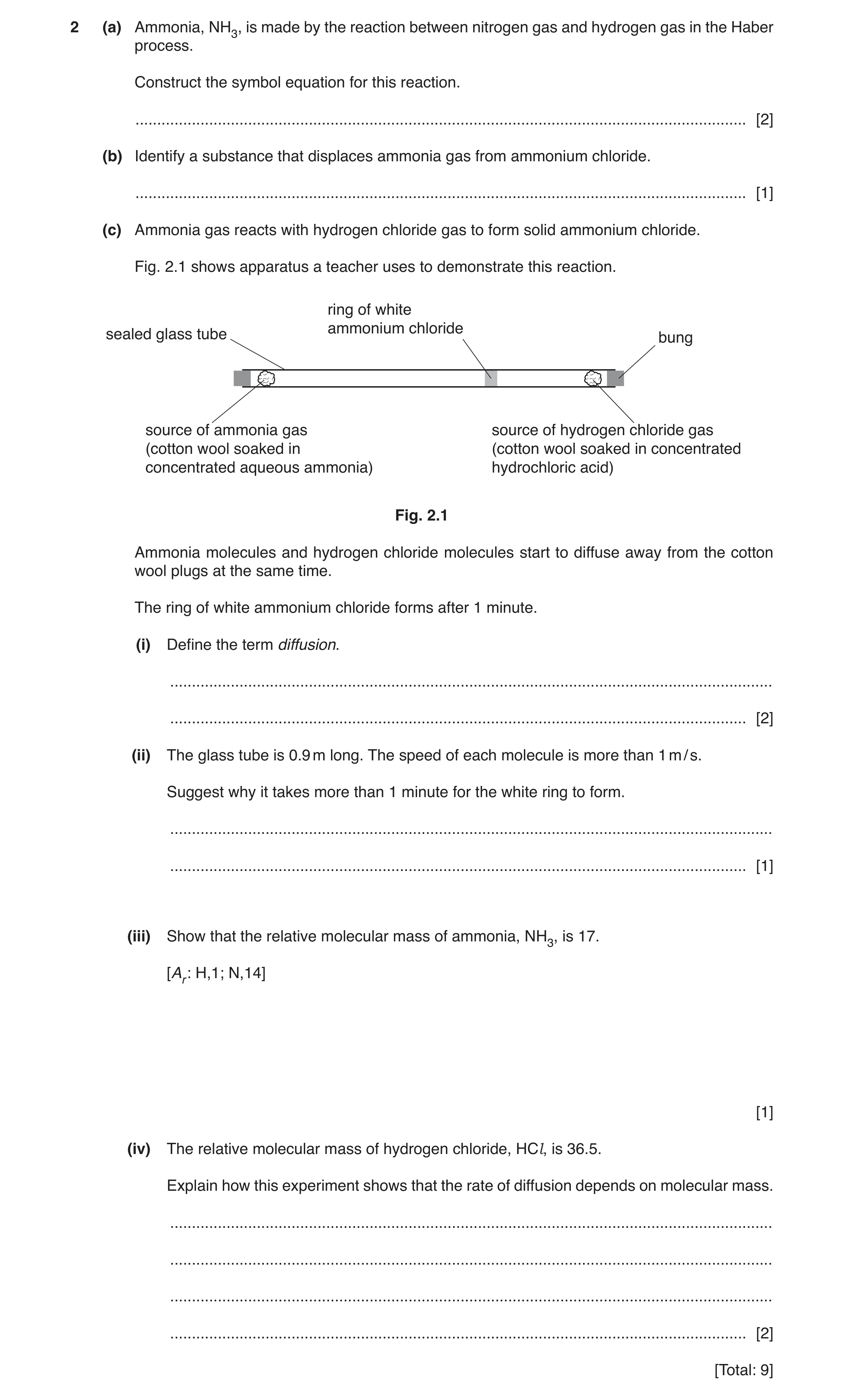
2 (a) Ammonia, NH3, is made by the reaction between nitrogen gas and hydrogen gas in the Haber process. Construct the symbol equation for this reaction. … [2] (b) Identify a substance that displaces ammonia gas from ammonium chloride. … [1] (c) Ammonia gas reacts with hydrogen chloride gas to form solid ammonium chloride. Fig. 2.1 shows apparatus a teacher uses to demonstrate this reaction. ring of white ammonium chloride sealed glass tube bung source of ammonia gas source of hydrogen chloride gas (cotton wool soaked in (cotton wool soaked in concentrated concentrated aqueous ammonia) hydrochloric acid) Fig. 2.1 Ammonia molecules and hydrogen chloride molecules start to diffuse away from the cotton wool plugs at the same time. The ring of white ammonium chloride forms after 1 minute. (i) Define the term diffusion. … … [2] (ii) The glass tube is 0.9 m long. The speed of each molecule is more than 1 m / s. Suggest why it takes more than 1 minute for the white ring to form. … … [1] (iii) Show that the relative molecular mass of ammonia, NH3, is 17. [Ar : H,1; N,14] [1] (iv) The relative molecular mass of hydrogen chloride, HCl, is 36.5. Explain how this experiment shows that the rate of diffusion depends on molecular mass. … … … … [2] [Total: 9]
9 marks
Mark scheme: 2(a) N2 + 3H2 → 2NH3 formulae ; balancing ; 2 2(b) any named base ; 1 2(c)(i) the (net) movement of particles from a region of their higher concentration to a region of their lower concentration / down a concentration gradient ; as a result of their random movement ; 2 2(c)(ii) collisions between molecules (which slows progress through tube) ; 1 2(c)(iii) 14 + (3 × 1) ( = 17) ; 1 2(c)(iv) white ring closer to HCl / right of centre / NH3 diffuses further than HCl (in the same time) ; NH3 diffuses faster than HCl ; rate of diffusion decreases with increasing molecular mass ; max 2 2
This question in 0654/43 Oct/Nov 2019
Q7 · Calcium carbonate, CaCO3, reacts with dilute hydrochloric acid 0654/41 May/June 2020
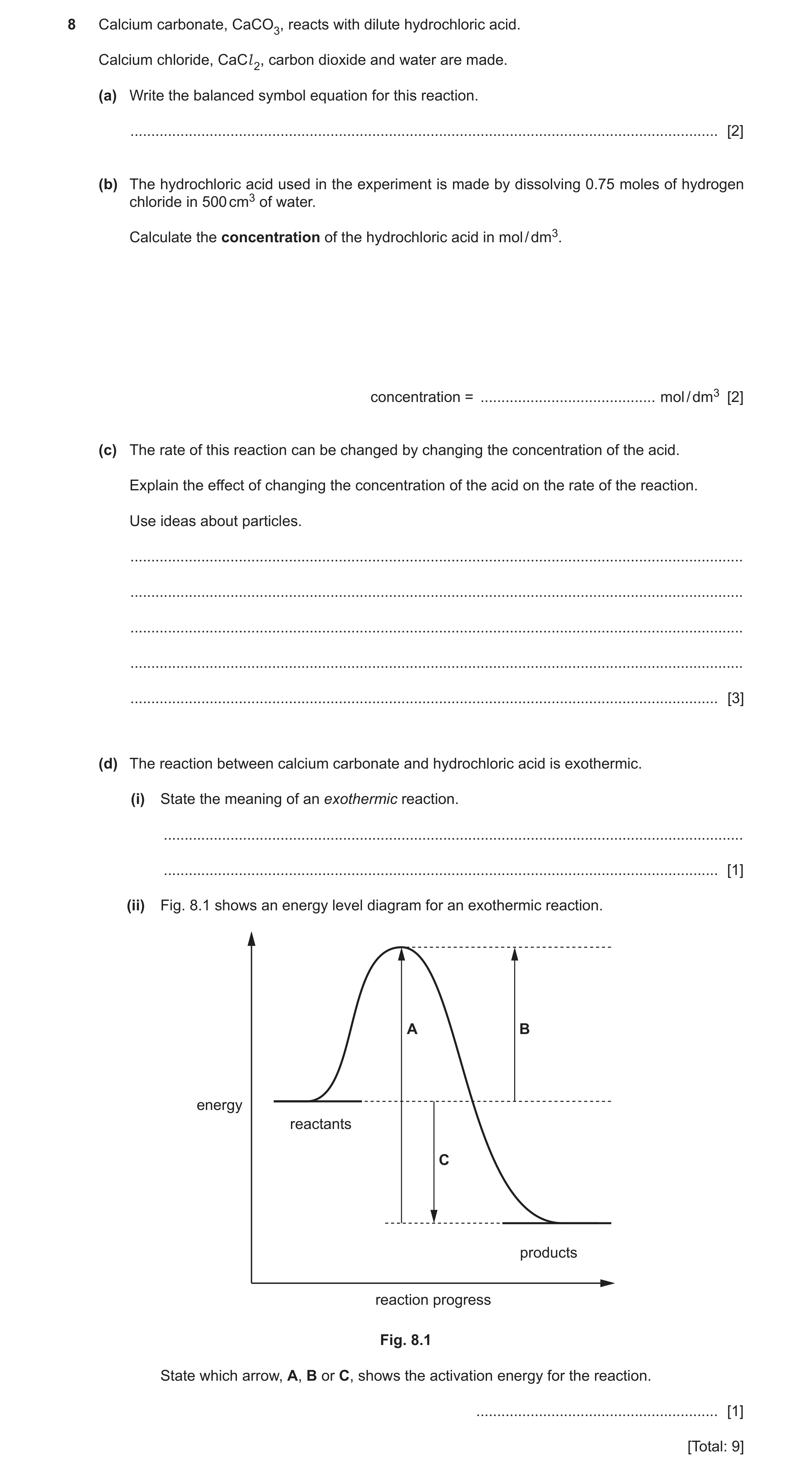
8 Calcium carbonate, CaCO3, reacts with dilute hydrochloric acid. Calcium chloride, CaCl 2, carbon dioxide and water are made. (a) Write the balanced symbol equation for this reaction. … [2] (b) The hydrochloric acid used in the experiment is made by dissolving 0.75 moles of hydrogen chloride in 500 cm3 of water. Calculate the concentration of the hydrochloric acid in mol / dm3. concentration = … mol / dm3 [2] (c) The rate of this reaction can be changed by changing the concentration of the acid. Explain the effect of changing the concentration of the acid on the rate of the reaction. Use ideas about particles. … … … … … [3] (d) The reaction between calcium carbonate and hydrochloric acid is exothermic. (i) State the meaning of an exothermic reaction. … … [1] (ii) Fig. 8.1 shows an energy level diagram for an exothermic reaction. A B energy reactants C products reaction progress Fig. 8.1 State which arrow, A, B or C, shows the activation energy for the reaction. … [1] [Total: 9]
9 marks
Mark scheme: 8(a) CaCO3 + 2HCl → CaCl2 + H2O + CO2 correct formulae ; correctly balanced ; Question Answer Marks 8(b) (0.75 × 1000) ÷ 500 ; 1.5 (mol/dm3) ; or volume of water = 0.500 dm3 ; (0.75 ÷ 0.500 =) 1.5 (mol/dm3) ; 2 8(c) higher the concentration, higher the rate of reaction ; particles are more crowded / more particles per unit volume / more particles per cm3 / increased chance of collision ; more frequent collisions / more collisions per second ; 3 8(d)(i) (reaction in which), thermal energy / heat, is given out / more energy is given out than taken in / energy of products is less than energy of reactants ; 1 8(d)(ii) B 1
This question in 0654/41 May/June 2020
Q8 · A student is investigating indigestion tablets 0654/42 May/June 2021
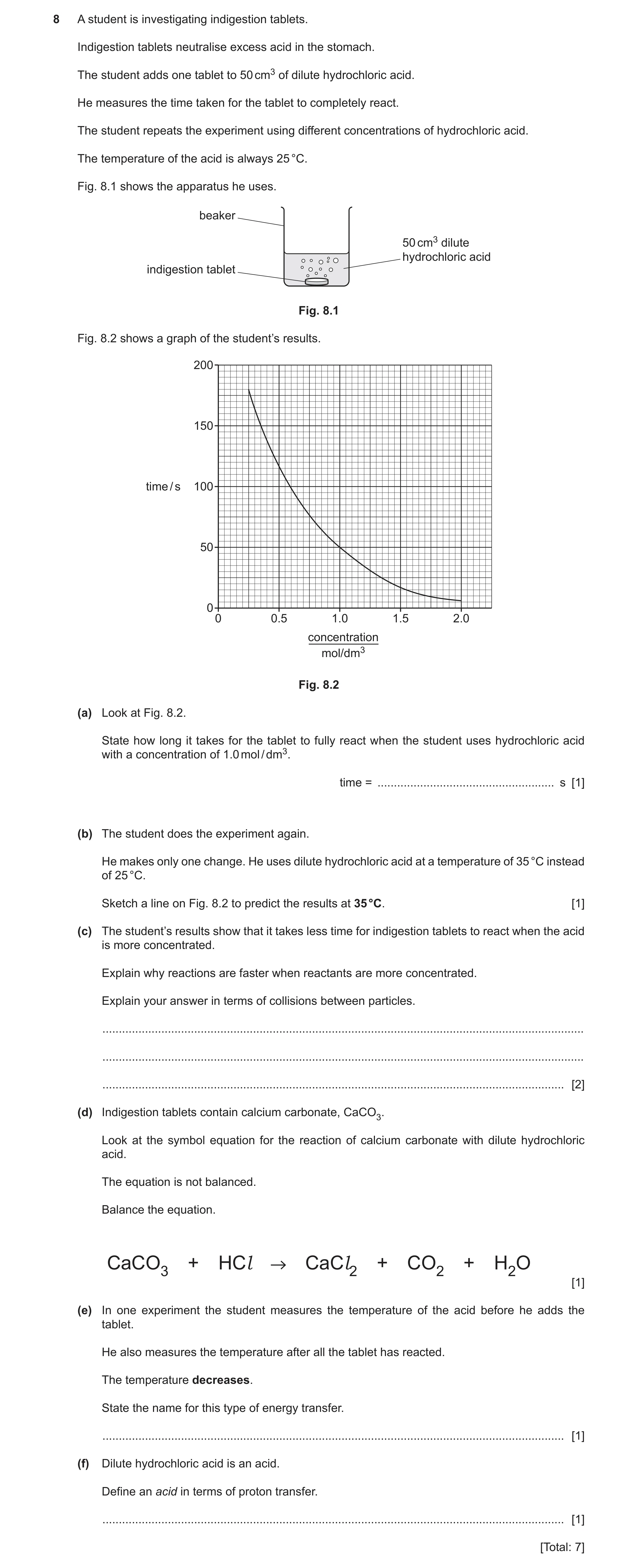
8 A student is investigating indigestion tablets. Indigestion tablets neutralise excess acid in the stomach. The student adds one tablet to 50 cm3 of dilute hydrochloric acid. He measures the time taken for the tablet to completely react. The student repeats the experiment using different concentrations of hydrochloric acid. The temperature of the acid is always 25 °C. Fig. 8.1 shows the apparatus he uses. beaker 50 cm3 dilute hydrochloric acid indigestion tablet Fig. 8.1 Fig. 8.2 shows a graph of the student’s results. 200 150 time / s 100 50 0 0 0.5 1.0 1.5 2.0 concentration mol/dm3 Fig. 8.2 (a) Look at Fig. 8.2. State how long it takes for the tablet to fully react when the student uses hydrochloric acid with a concentration of 1.0 mol / dm3. time = … s [1] (b) The student does the experiment again. He makes only one change. He uses dilute hydrochloric acid at a temperature of 35 °C instead of 25 °C. Sketch a line on Fig. 8.2 to predict the results at 35 °C. [1] (c) The student’s results show that it takes less time for indigestion tablets to react when the acid is more concentrated. Explain why reactions are faster when reactants are more concentrated. Explain your answer in terms of collisions between particles. … … … [2] (d) Indigestion tablets contain calcium carbonate, CaCO3. Look at the symbol equation for the reaction of calcium carbonate with dilute hydrochloric acid. The equation is not balanced. Balance the equation. CaCO3 + HCl CaCl2 + CO2 + H2O [1] (e) In one experiment the student measures the temperature of the acid before he adds the tablet. He also measures the temperature after all the tablet has reacted. The temperature decreases. State the name for this type of energy transfer. … [1] (f) Dilute hydrochloric acid is an acid. Define an acid in terms of proton transfer. … [1] [Total: 7]
7 marks
Mark scheme: 8(a) 50 (seconds) ; 1 8(b) line is same shape as original and is always underneath it ; 1 8(c) more particles per unit volume / more particles per cm3 ; more frequent collisions / more collisions per second ; 2 8(d) CaCO3 + 2 HCl → CaCl2 + CO2 + H2O ; 1 8(e) endothermic ; 1 8(f) (acid is a) proton donor / donates protons / owtte ; 1
This question in 0654/42 May/June 2021
Q9 · Chlorine and bromine are Group VII elements of the Periodic Table 0654/43 Oct/Nov 2021
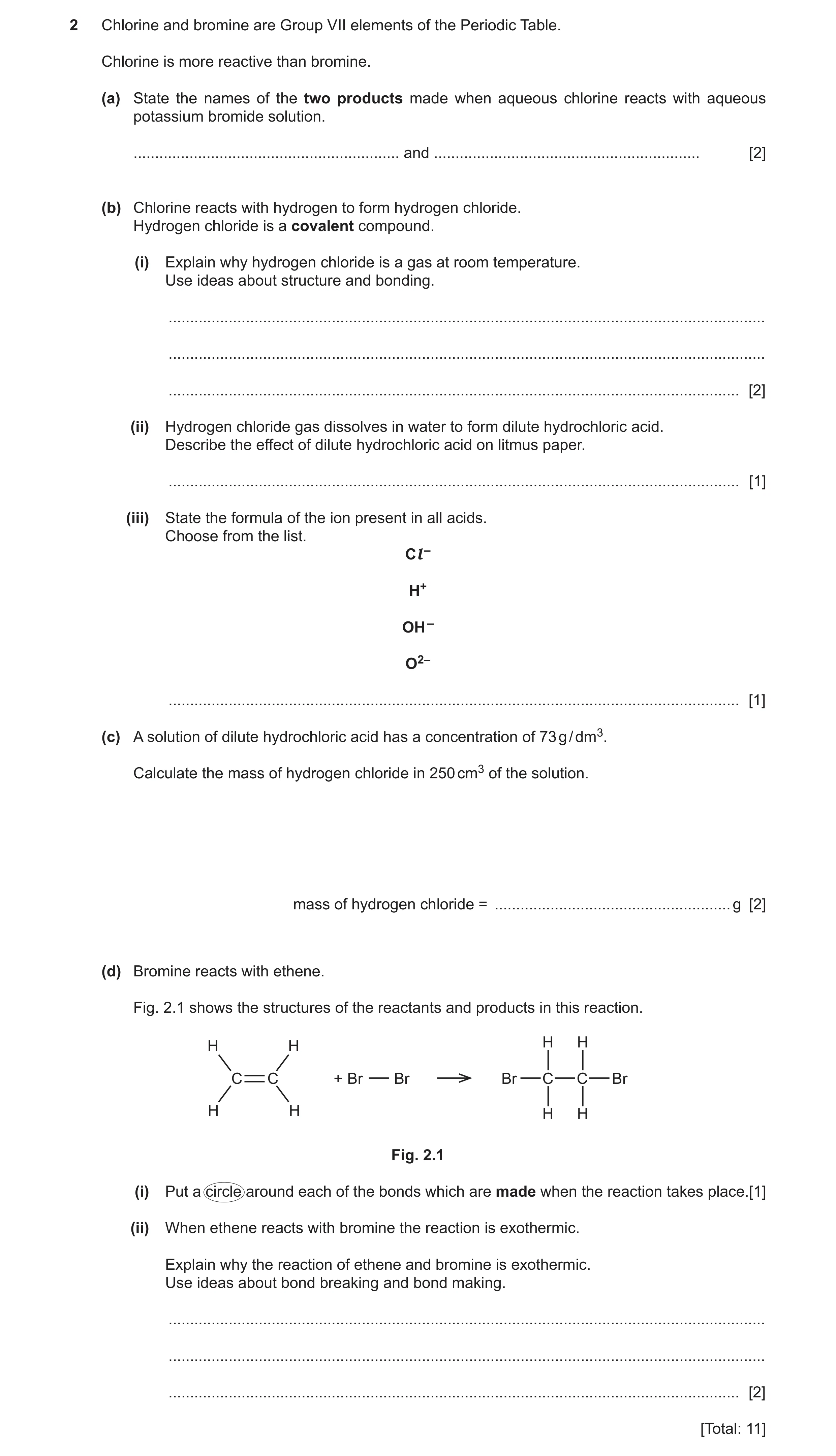
2 Chlorine and bromine are Group VII elements of the Periodic Table. Chlorine is more reactive than bromine. (a) State the names of the two products made when aqueous chlorine reacts with aqueous potassium bromide solution. … and … [2] (b) Chlorine reacts with hydrogen to form hydrogen chloride. Hydrogen chloride is a covalent compound. (i) Explain why hydrogen chloride is a gas at room temperature. Use ideas about structure and bonding. … … … [2] (ii) Hydrogen chloride gas dissolves in water to form dilute hydrochloric acid. Describe the effect of dilute hydrochloric acid on litmus paper. … [1] (iii) State the formula of the ion present in all acids. Choose from the list. Cl – H+ OH – O2– … [1] (c) A solution of dilute hydrochloric acid has a concentration of 73 g / dm3. Calculate the mass of hydrogen chloride in 250 cm3 of the solution. mass of hydrogen chloride = … g [2] (d) Bromine reacts with ethene. Fig. 2.1 shows the structures of the reactants and products in this reaction. H H H H C C + Br Br Br C C Br H H H H Fig. 2.1 (i) Put a circle around each of the bonds which are made when the reaction takes place. [1] (ii) When ethene reacts with bromine the reaction is exothermic. Explain why the reaction of ethene and bromine is exothermic. Use ideas about bond breaking and bond making. … … … [2] [Total: 11]
11 marks
Mark scheme: 2(a) potassium chloride ; bromine ; 2 2(b)(i) hydrogen chloride has weak intermolecular forces / weak attractions between (hydrogen chloride) molecules ; (weak intermolecular forces) take little energy to break / owtte ; 2 2(b)(ii) litmus paper turns red ; 1 2(b)(iii) H+ ; 1 2(c) mass of HCl in 250 cm³ = 73 250 1000 × OR 73 × 0.25 OR 73 ÷ 4 ; 18.25 (g) ; 2 2(d)(i) both C-Br bonds circled ; 1 2(d)(ii) bond breaking is endothermic / takes in energy and bond making is exothermic / gives out energy ; more energy is given out (during bond making) than is taken in (during bond breaking) / energy stored in product is less than energy stored in reactant ; 2
This question in 0654/43 Oct/Nov 2021
Q10 · A student investigates acids and bases 0654/42 Oct/Nov 2022
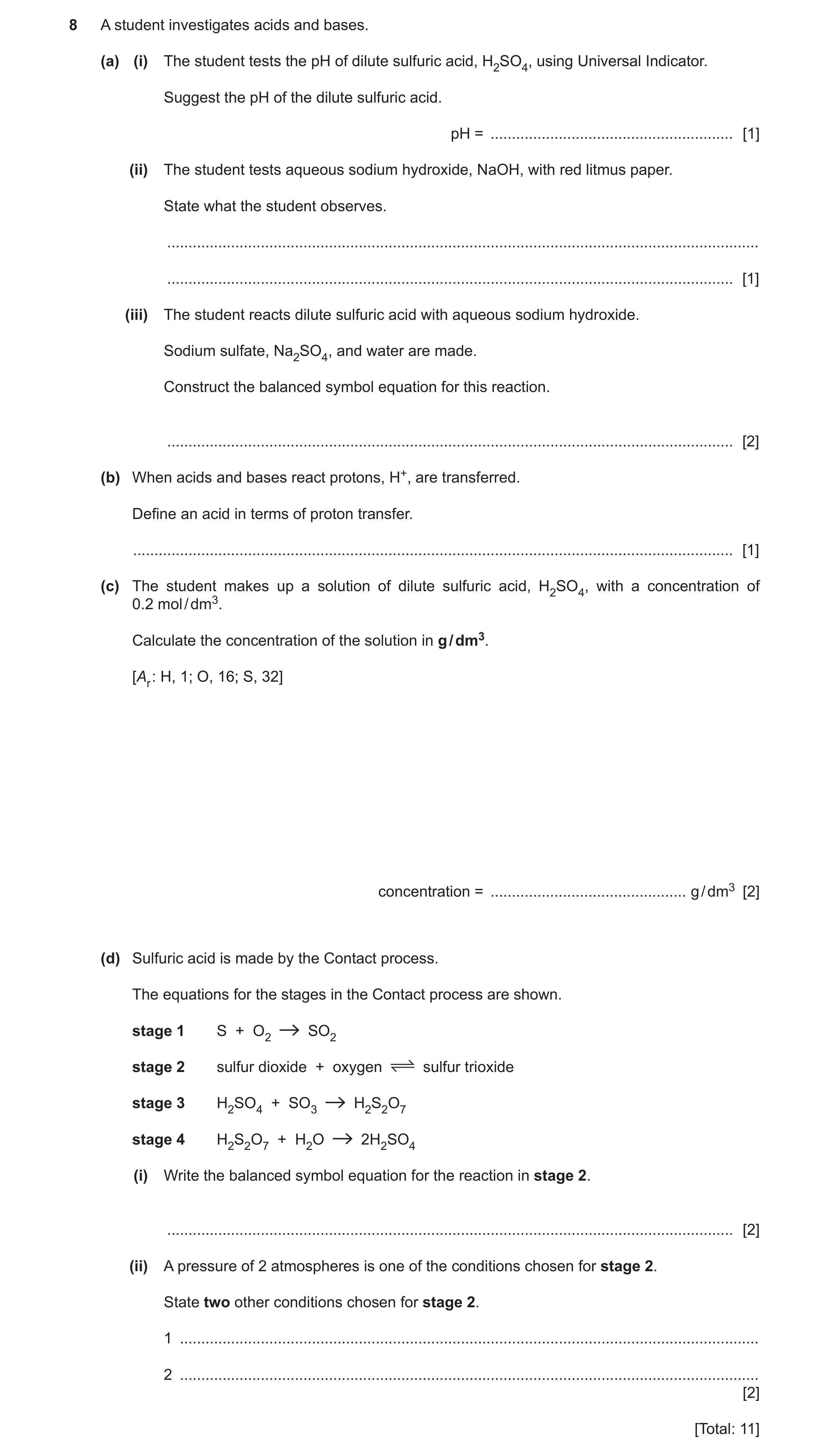
8 A student investigates acids and bases. (a) (i) The student tests the pH of dilute sulfuric acid, H2SO4, using Universal Indicator. Suggest the pH of the dilute sulfuric acid. pH = … [1] (ii) The student tests aqueous sodium hydroxide, NaOH, with red litmus paper. State what the student observes. … … [1] (iii) The student reacts dilute sulfuric acid with aqueous sodium hydroxide. Sodium sulfate, Na2SO4, and water are made. Construct the balanced symbol equation for this reaction. … [2] (b) When acids and bases react protons, H+, are transferred. Define an acid in terms of proton transfer. … [1] (c) The student makes up a solution of dilute sulfuric acid, H2SO4, with a concentration of 0.2 mol / dm3. Calculate the concentration of the solution in g / dm3. [Ar : H, 1; O, 16; S, 32] concentration = … g / dm3 [2] (d) Sulfuric acid is made by the Contact process. The equations for the stages in the Contact process are shown. stage 1 S + O2 SO2 stage 2 sulfur dioxide + oxygen sulfur trioxide stage 3 H2SO4 + SO3 H2S2O7 stage 4 H2S2O7 + H2O 2H2SO4 (i) Write the balanced symbol equation for the reaction in stage 2. … [2] (ii) A pressure of 2 atmospheres is one of the conditions chosen for stage 2. State two other conditions chosen for stage 2. 1 … 2 … [2] [Total: 11]
11 marks
Mark scheme: 8(a)(i) any pH below 7 ; 1 8(a)(ii) (red litmus paper turns) blue ; 1 8(a)(iii) H2SO4 + 2NaOH → Na2SO4 + 2H2O ; 2 8(b) (an acid is) a proton donor / owtte ; 1
This question in 0654/42 Oct/Nov 2022
Q11 · The pH of a solution describes how acidic or alkaline it is 0654/41 Oct/Nov 2023
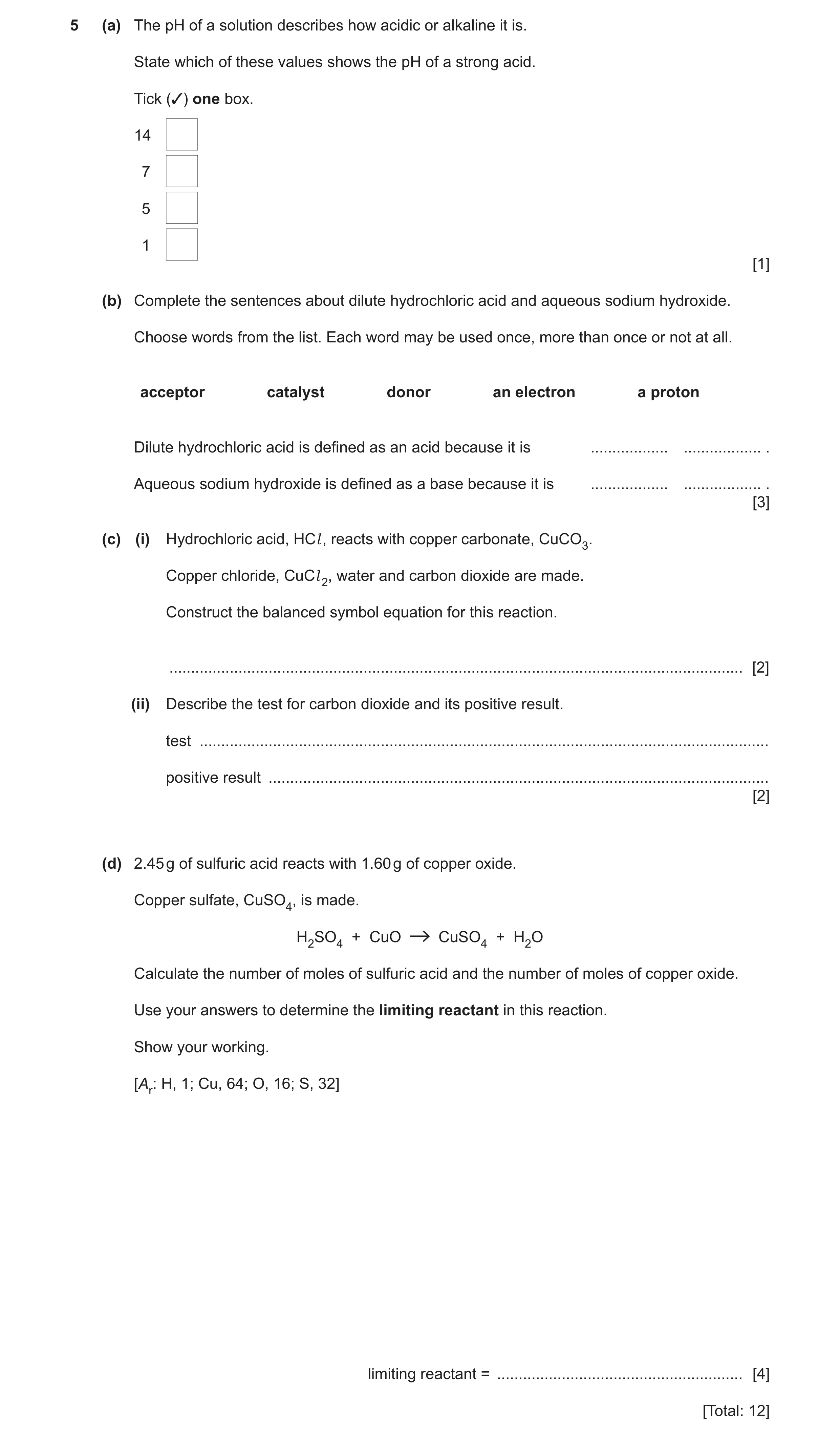
5 (a) The pH of a solution describes how acidic or alkaline it is. State which of these values shows the pH of a strong acid. Tick (3) one box. 14 7 5 1 [1] (b) Complete the sentences about dilute hydrochloric acid and aqueous sodium hydroxide. Choose words from the list. Each word may be used once, more than once or not at all. acceptor catalyst donor an electron a proton Dilute hydrochloric acid is defined as an acid because it is … … . Aqueous sodium hydroxide is defined as a base because it is … … . [3] (c) (i) Hydrochloric acid, HCl , reacts with copper carbonate, CuCO3. Copper chloride, CuCl 2, water and carbon dioxide are made. Construct the balanced symbol equation for this reaction. … [2] (ii) Describe the test for carbon dioxide and its positive result. test … positive result … [2] (d) 2.45 g of sulfuric acid reacts with 1.60 g of copper oxide. Copper sulfate, CuSO4, is made. H2SO4 + CuO CuSO4 + H2O Calculate the number of moles of sulfuric acid and the number of moles of copper oxide. Use your answers to determine the limiting reactant in this reaction. Show your working. [Ar: H, 1; Cu, 64; O, 16; S, 32] limiting reactant = … [4] [Total: 12]
12 marks
Mark scheme: 5(a) 1 ; 1 5(b) proton donor 3 proton acceptor ;; 5(c)(i) 2HCl + CuCO3 → CuCl2 + H2O + CO2 2 formulae ; balancing ; 5(c)(ii) test: limewater ; 2 observation: milky/cloudy / white precipitate ; 5(d) relative formula mass of H2SO4 = 98 and of CuO = 80 ; 4 moles of sulfuric acid (2.45 98 =) 0.025 ; moles of copper oxide (1.60 80 =) 0.02 ; (there are less moles of copper oxide so) copper oxide is the limiting reactant ;
This question in 0654/41 Oct/Nov 2023
Q12 · An aqueous solution of dilute hydrochloric acid is acidic 0654/43 Oct/Nov 2023
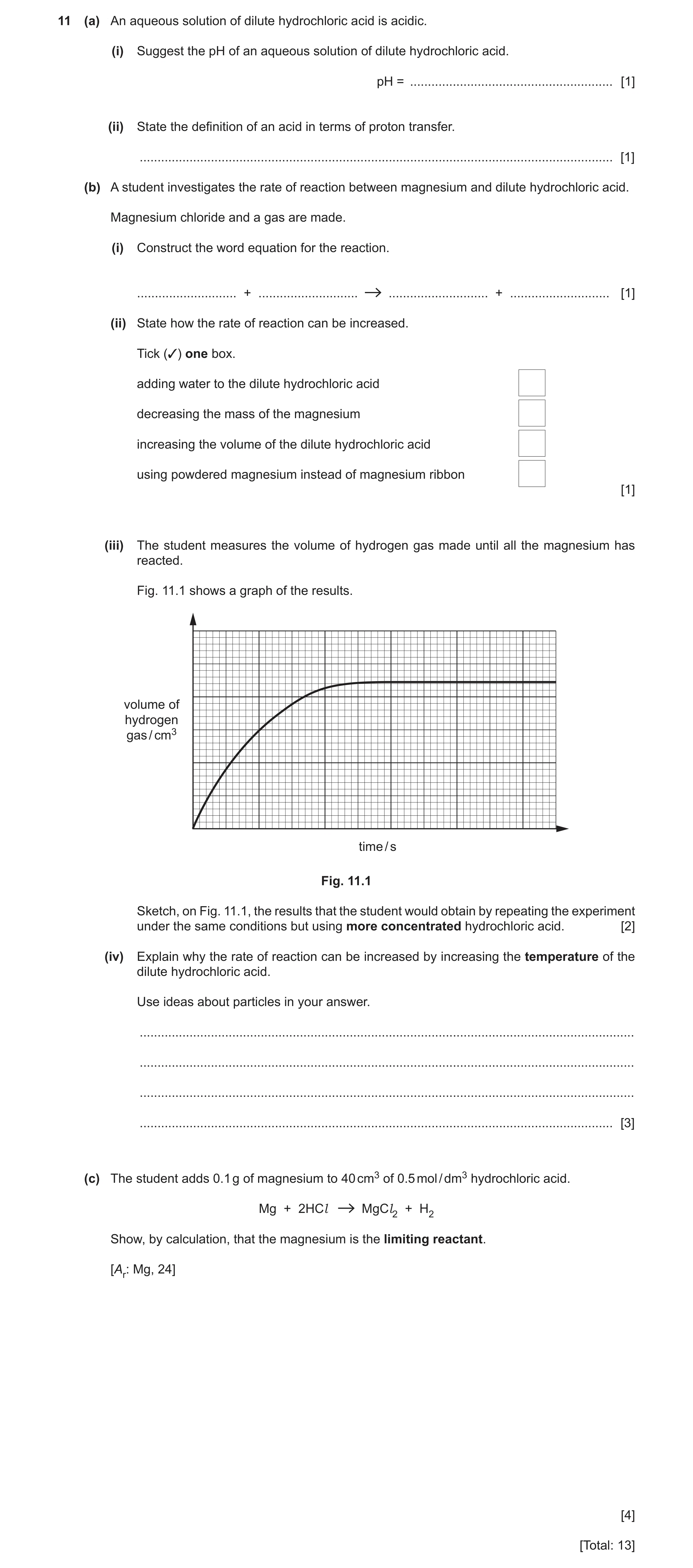
11 (a) An aqueous solution of dilute hydrochloric acid is acidic. (i) Suggest the pH of an aqueous solution of dilute hydrochloric acid. pH = … [1] (ii) State the definition of an acid in terms of proton transfer. … [1] (b) A student investigates the rate of reaction between magnesium and dilute hydrochloric acid. Magnesium chloride and a gas are made. (i) Construct the word equation for the reaction. … + … … + … [1] (ii) State how the rate of reaction can be increased. Tick (3) one box. adding water to the dilute hydrochloric acid decreasing the mass of the magnesium increasing the volume of the dilute hydrochloric acid using powdered magnesium instead of magnesium ribbon [1] (iii) The student measures the volume of hydrogen gas made until all the magnesium has reacted. Fig. 11.1 shows a graph of the results. volume of hydrogen gas / cm3 time / s Fig. 11.1 Sketch, on Fig. 11.1, the results that the student would obtain by repeating the experiment under the same conditions but using more concentrated hydrochloric acid. [2] (iv) Explain why the rate of reaction can be increased by increasing the temperature of the dilute hydrochloric acid. Use ideas about particles in your answer. … … … … [3] (c) The student adds 0.1 g of magnesium to 40 cm3 of 0.5 mol / dm3 hydrochloric acid. Mg + 2HCl MgCl2 + H2 Show, by calculation, that the magnesium is the limiting reactant. [Ar: Mg, 24] [4] [Total: 13]
13 marks
Mark scheme: 11(a)(i) any value between 0 and 6.9 ; 1 11(a)(ii) proton donor / owtte ; 1 11(b)(i) magnesium + hydrochloric acid → magnesium chloride + hydrogen ; 1 11(b)(ii) using powdered magnesium instead of magnesium ribbon ✓ ; 1 11(b)(iii) line starting at origin, but steeper than original ; 2 levels off at same point ; 11(b)(iv) any three from: 3 molecules have higher (average)(kinetic) energy / molecules are moving faster ; more molecules with activation energy ; frequency of collision (of molecules) is higher / more collisions per second ; more successful collisions ; 11(c) 40 4 moles of HCl = 0.5 = 0.02 ; 1000 0.1 moles of Mg = = 0.004(166667) ; 24 (from equation) 1 mol of Mg reacts with 2 mol of HCl ; so (2 0.004) = 0.008 mol of HCl are needed but there is more than this ;
This question in 0654/43 Oct/Nov 2023
 12
12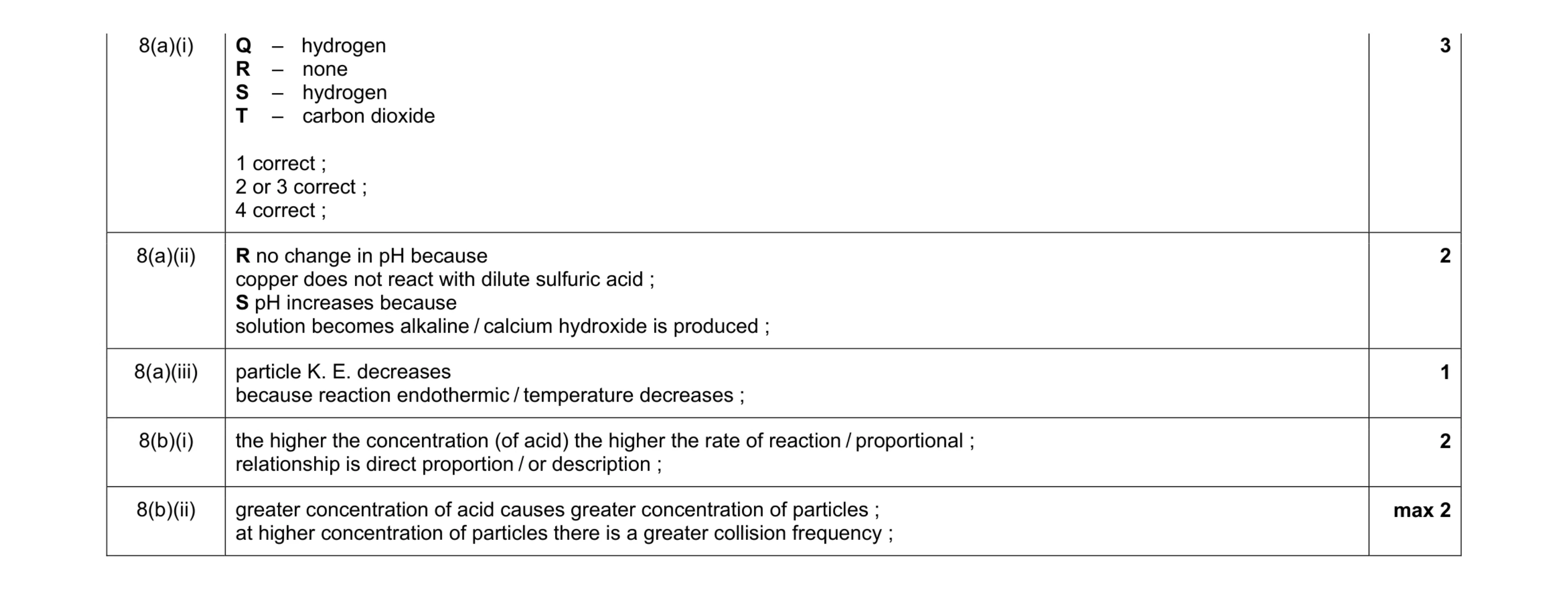 10
10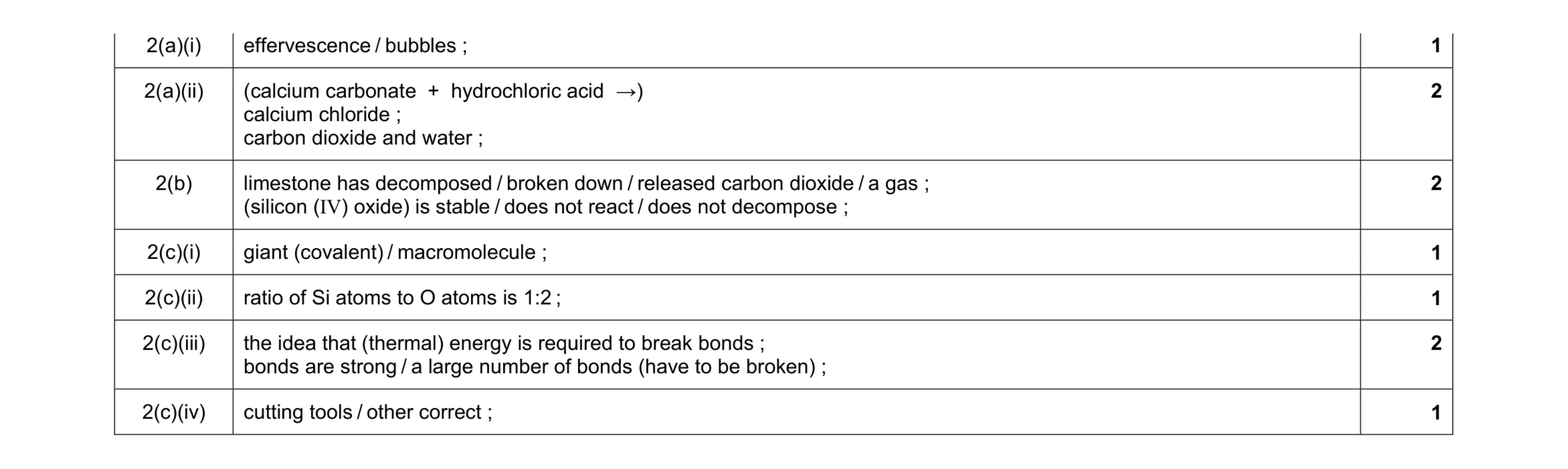 10
10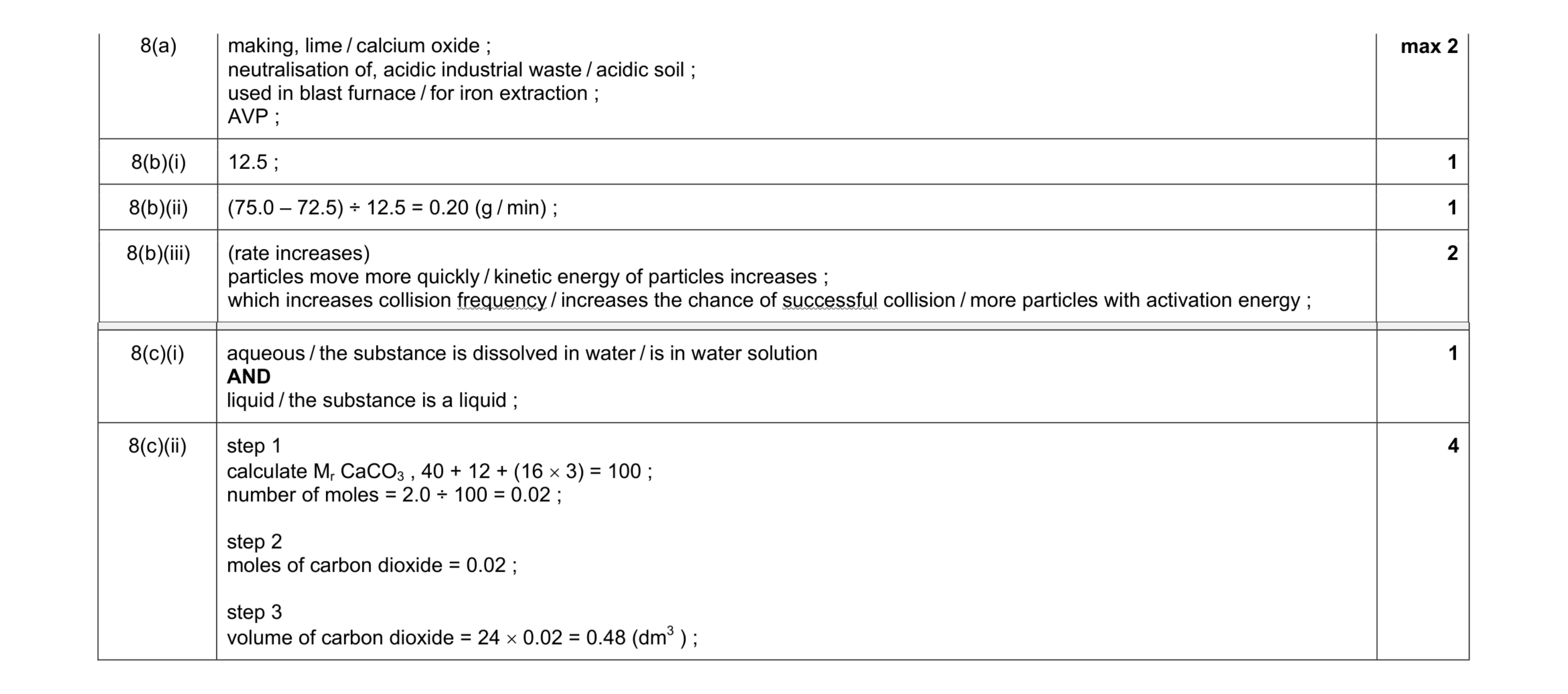 11
11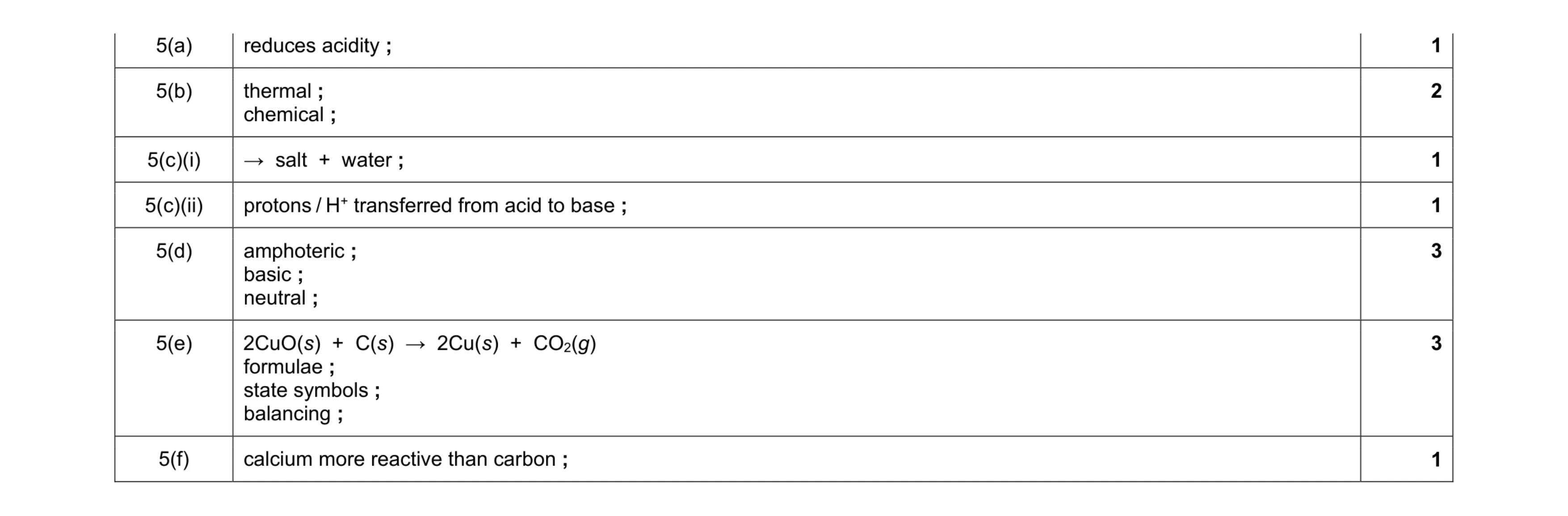 12
12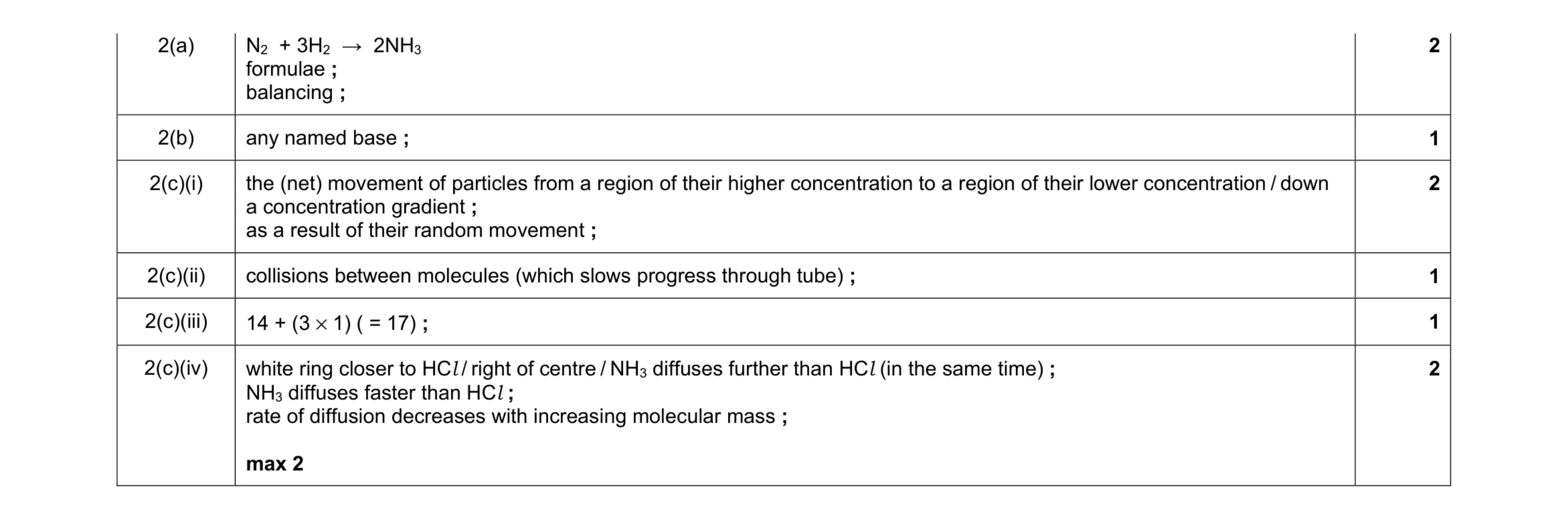 9
9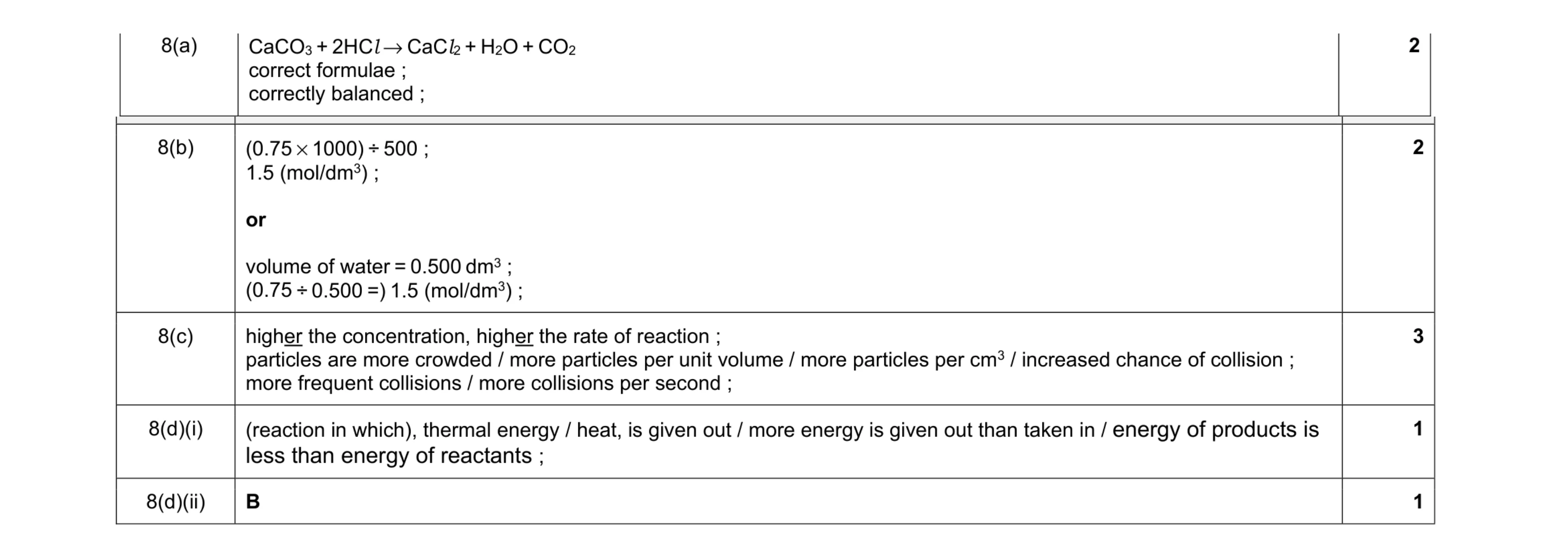 9
9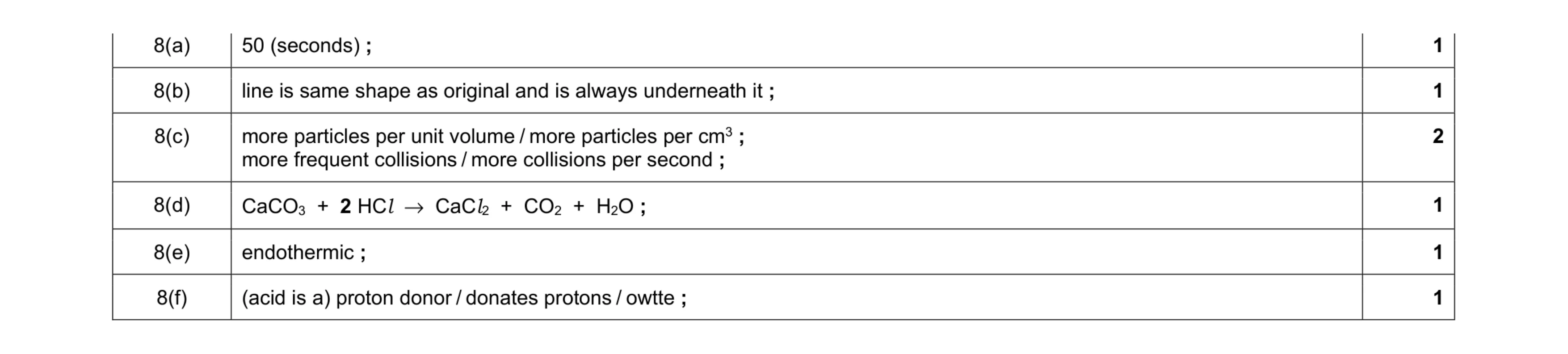 7
7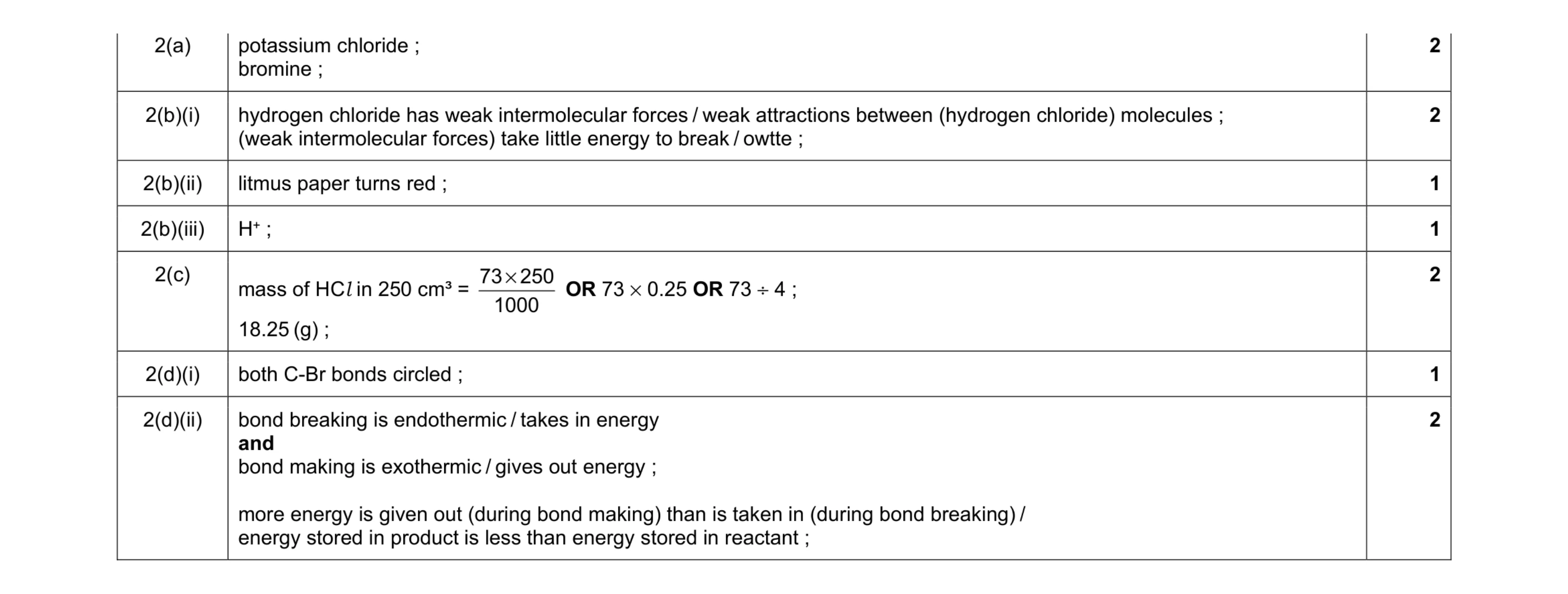 11
11 11
11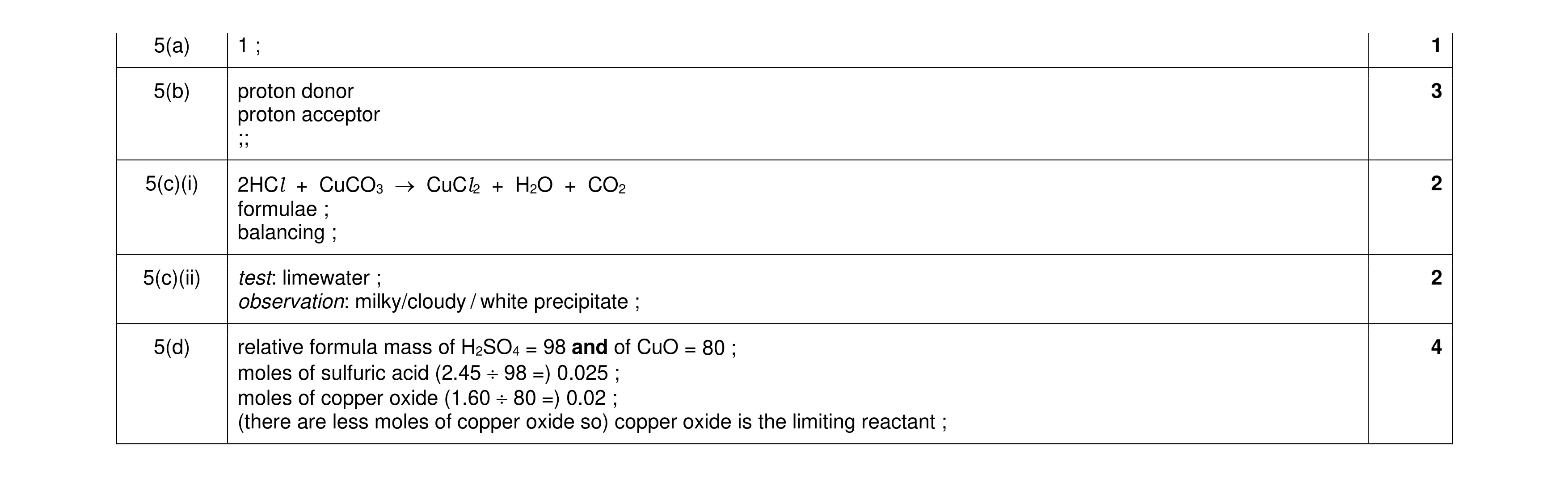 12
12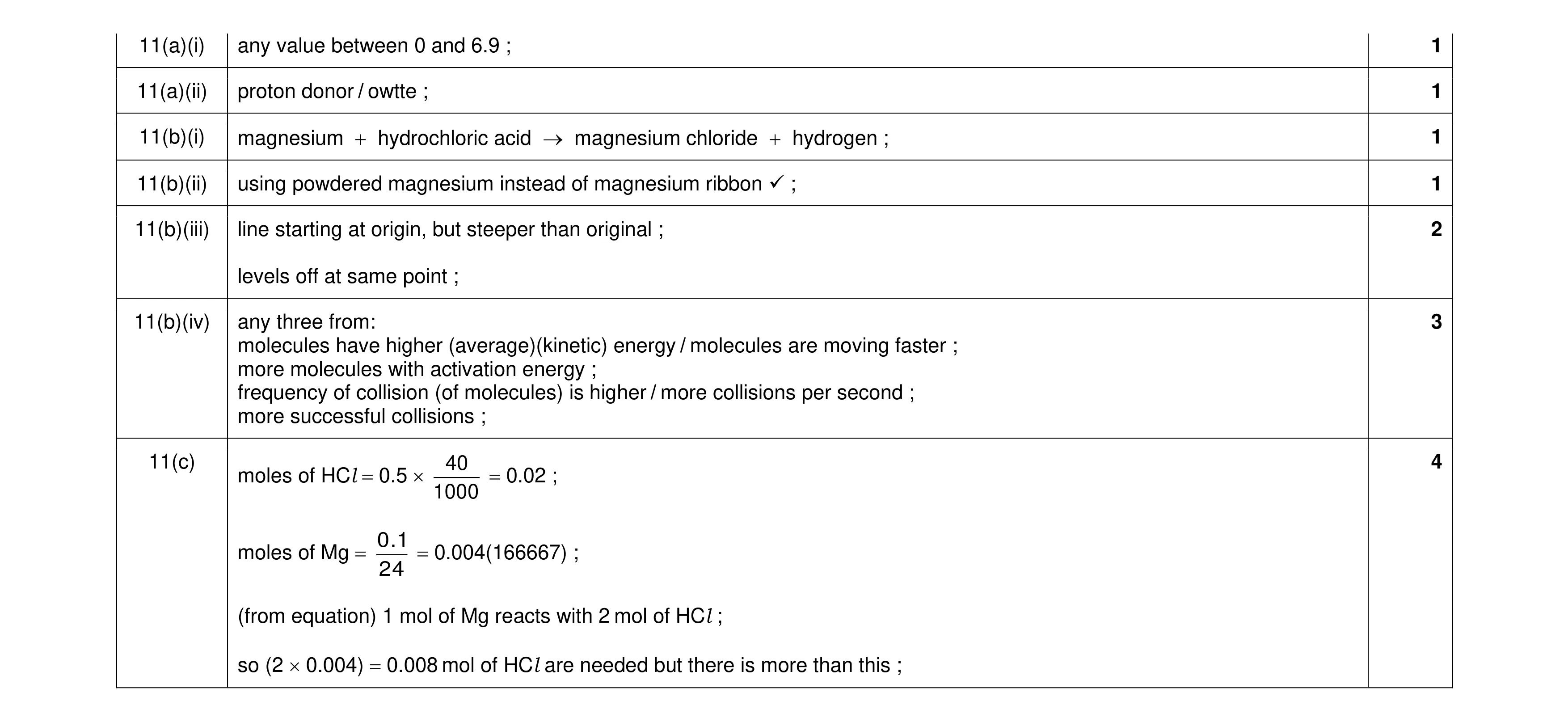 13
13