Questions as text
Q1 · Petroleum is a black liquid 0654/41 May/June 2017
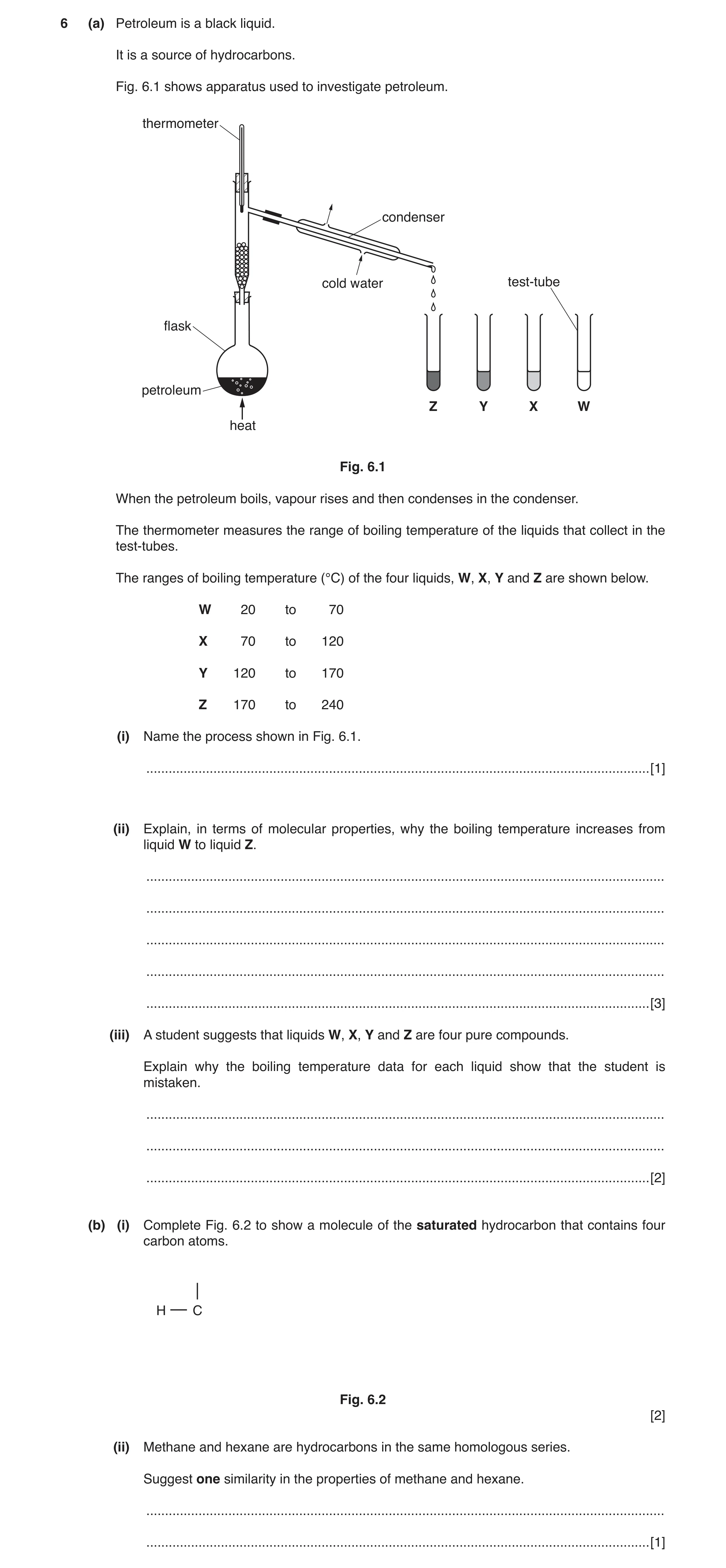
6 (a) Petroleum is a black liquid. It is a source of hydrocarbons. Fig. 6.1 shows apparatus used to investigate petroleum. thermometer condenser cold water test-tube flask petroleum Z Y X W heat Fig. 6.1 When the petroleum boils, vapour rises and then condenses in the condenser. The thermometer measures the range of boiling temperature of the liquids that collect in the test-tubes. The ranges of boiling temperature (°C) of the four liquids, W, X, Y and Z are shown below. W 20 to 70 X 70 to 120 Y 120 to 170 Z 170 to 240 (i) Name the process shown in Fig. 6.1. … [1] (ii) Explain, in terms of molecular properties, why the boiling temperature increases from liquid W to liquid Z. … … … … … [3] (iii) A student suggests that liquids W, X, Y and Z are four pure compounds. Explain why the boiling temperature data for each liquid show that the student is mistaken. … … … [2] (b) (i) Complete Fig. 6.2 to show a molecule of the saturated hydrocarbon that contains four carbon atoms. H C Fig. 6.2 [2] (ii) Methane and hexane are hydrocarbons in the same homologous series. Suggest one similarity in the properties of methane and hexane. … … [1]
9 marks
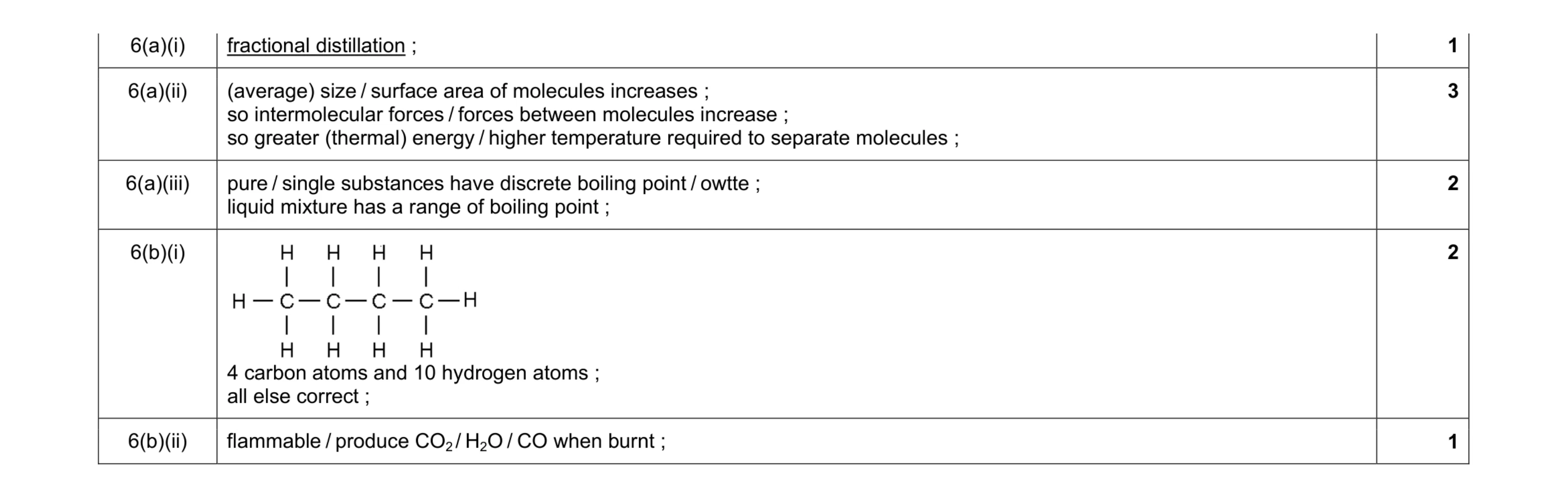
Mark scheme: 6(a)(i) fractional distillation ; 1 6(a)(ii) (average) size / surface area of molecules increases ; so intermolecular forces / forces between molecules increase ; so greater (thermal) energy / higher temperature required to separate molecules ; 3 6(a)(iii) pure / single substances have discrete boiling point / owtte ; liquid mixture has a range of boiling point ; 2 6(b)(i) 4 carbon atoms and 10 hydrogen atoms ; all else correct ; 2 6(b)(ii) flammable / produce CO2 / H2O / CO when burnt ; 1
This question in 0654/41 May/June 2017
Q2 · Petroleum is a liquid fossil fuel that is a mixture containing many different hydrocarbons 0654/41 Oct/Nov 2017
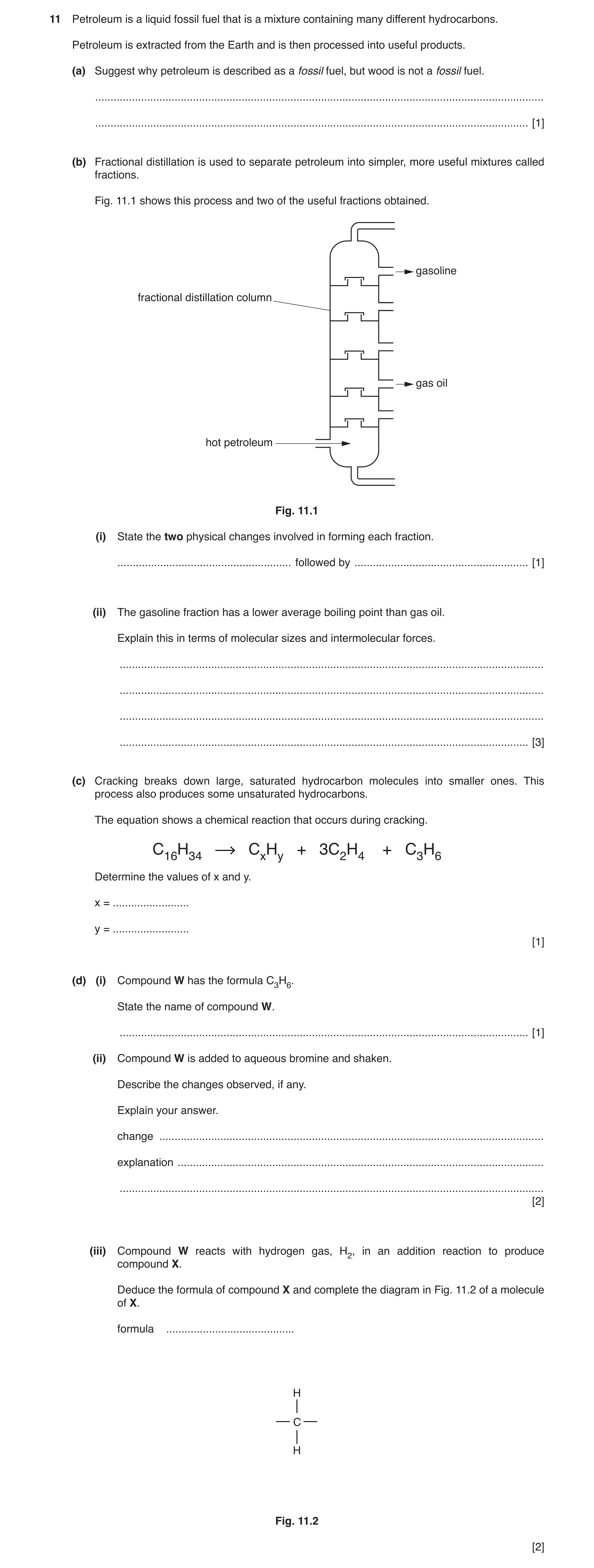
11 Petroleum is a liquid fossil fuel that is a mixture containing many different hydrocarbons. Petroleum is extracted from the Earth and is then processed into useful products. (a) Suggest why petroleum is described as a fossil fuel, but wood is not a fossil fuel. … … [1] (b) Fractional distillation is used to separate petroleum into simpler, more useful mixtures called fractions. Fig. 11.1 shows this process and two of the useful fractions obtained. gasoline fractional distillation column gas oil hot petroleum Fig. 11.1 (i) State the two physical changes involved in forming each fraction. … followed by … [1] (ii) The gasoline fraction has a lower average boiling point than gas oil. Explain this in terms of molecular sizes and intermolecular forces. … … … … [3] (c) Cracking breaks down large, saturated hydrocarbon molecules into smaller ones. This process also produces some unsaturated hydrocarbons. The equation shows a chemical reaction that occurs during cracking. C16H34 CxHy + 3C2H4 + C3H6 Determine the values of x and y. x = … y = … [1] (d) (i) Compound W has the formula C3H6. State the name of compound W. … [1] (ii) Compound W is added to aqueous bromine and shaken. Describe the changes observed, if any. Explain your answer. change … explanation … … [2] (iii) Compound W reacts with hydrogen gas, H2, in an addition reaction to produce compound X. Deduce the formula of compound X and complete the diagram in Fig. 11.2 of a molecule of X. formula … H C H Fig. 11.2 [2]
11 marks
Mark scheme: 11(a) reference to long time required to form fossil fuels / AVP ; 1 11(b)(i) evaporation followed by condensation ; 1 11(b)(ii) (average) size / surface area of molecules in gasoline is lower ; intermolecular forces / forces between molecules are lower ; lower (thermal) energy / lower temperature required to separate molecules / overcome forces ; 3 11(c) x = 7 and y = 16 ; 1 11(d) propene ; 1 11(d)(ii) bromine decolourised / orange to colourless ; propene is an alkene / is unsaturated / double bond ; 2 11(d)(iii) C3H8 ; same number of C and H as in formula and correctly bonded ; 2
This question in 0654/41 Oct/Nov 2017
Q3 · State the percentage of nitrogen in clean air 0654/42 Oct/Nov 2018
2 (a) State the percentage of nitrogen in clean air. … % [1] (b) Fig. 2.1 shows the separation of nitrogen and oxygen from liquid air. nitrogen gas liquid air at –200 °C liquid oxygen Fig. 2.1 The boiling point of liquid nitrogen is −196 °C. The boiling point of liquid oxygen is −183 °C. Suggest a suitable temperature that produces nitrogen gas and liquid oxygen from liquid air. Explain your answer. temperature … °C explanation … … … [2] (c) (i) Nitrogen from the air is used to make ammonium nitrate. There are three steps in this process. Table 2.1 shows these steps. They are not in the correct order. Complete Table 2.1, using the numbers 1, 2 and 3, to show the correct order of these steps. Table 2.1 step order A neutralisation reaction is used to produce ammonium nitrate. Nitrogen is used to produce ammonia in the Haber process. Nitrogen is separated from air. [1] (ii) Name the element that combines with nitrogen to form ammonia in the Haber process. … [1] (d) (i) Complete Fig. 2.2 to show the dot-and-cross diagram of all the outer shell electrons in a nitrogen molecule. N N Fig. 2.2 [2] (ii) During thunderstorms, lightning causes nitrogen and oxygen to combine to form nitrogen dioxide, NO2. Suggest why a large amount of energy is needed for this reaction. … … … [2] (iii) Predict the effect that nitrogen dioxide has, if any, on the pH of rainwater. Explain your answer. effect on pH … explanation … … [2]
11 marks
Mark scheme: 2(a) 78 (%) ; 1 2(b) in the range −195 to −184 °C inclusive ; idea that temperature needs to be above the b.pt. of N and below the b. pt. of O ; 2 2(c)(i) 3 2 1 ; 1 2(c)(ii) hydrogen ; 1 Question Answer Marks 2(d)(i) 1 mark for 3 shared pairs only ; 1 mark for two lone pairs only ; 2 2(d)(ii) the idea that the bond in N2 has to break ; the bond is very strong / there are multiple bonds ; 2 2(d)(iii) pH is reduced ; nitrogen dioxide is an acidic oxide / non-metal oxides are acidic / nitrogen oxides react with (rain)water to form acid with water ; 2
This question in 0654/42 Oct/Nov 2018
Q4 · A student investigates the colour in a leaf 0654/42 May/June 2019
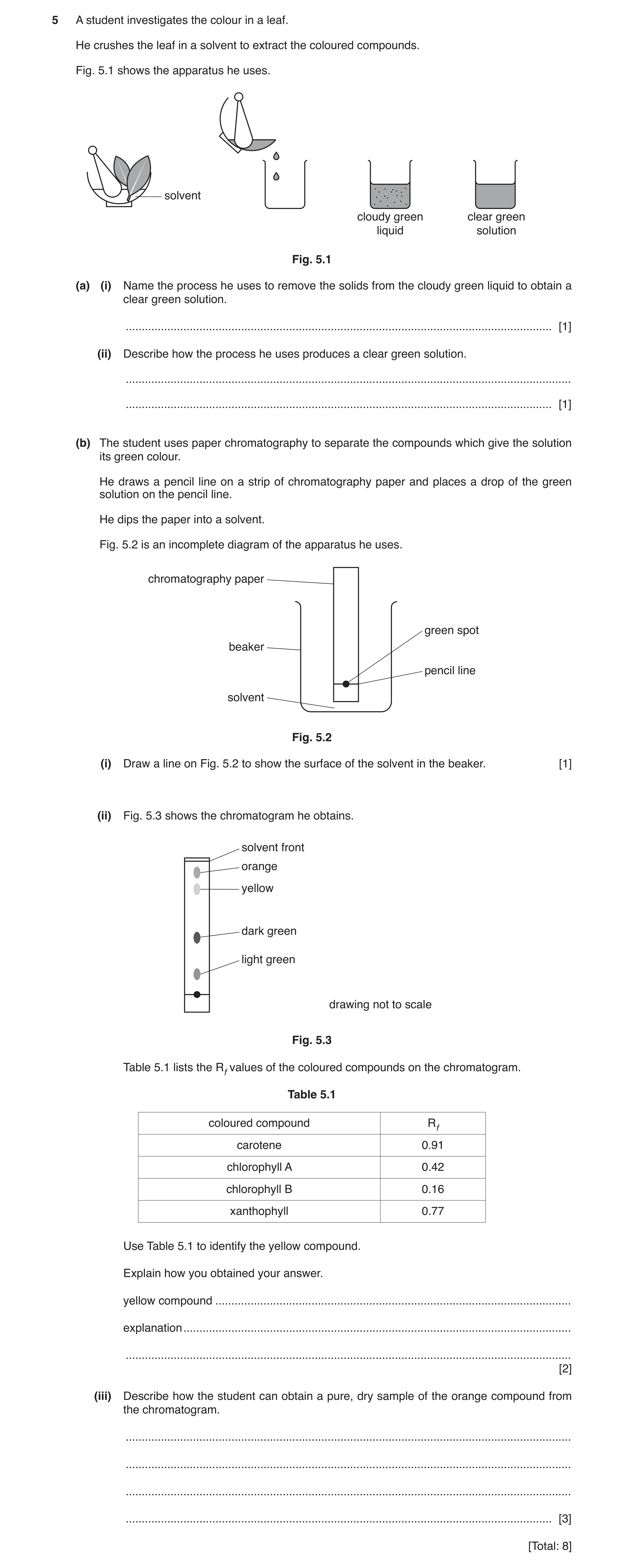
5 A student investigates the colour in a leaf. He crushes the leaf in a solvent to extract the coloured compounds. Fig. 5.1 shows the apparatus he uses. solvent cloudy green clear green liquid solution Fig. 5.1 (a) (i) Name the process he uses to remove the solids from the cloudy green liquid to obtain a clear green solution. … [1] (ii) Describe how the process he uses produces a clear green solution. … … [1] (b) The student uses paper chromatography to separate the compounds which give the solution its green colour. He draws a pencil line on a strip of chromatography paper and places a drop of the green solution on the pencil line. He dips the paper into a solvent. Fig. 5.2 is an incomplete diagram of the apparatus he uses. chromatography paper green spot beaker pencil line solvent Fig. 5.2 (i) Draw a line on Fig. 5.2 to show the surface of the solvent in the beaker. [1] (ii) Fig. 5.3 shows the chromatogram he obtains. solvent front orange yellow dark green light green drawing not to scale Fig. 5.3 Table 5.1 lists the Rf values of the coloured compounds on the chromatogram. Table 5.1 coloured compound Rf carotene 0.91 chlorophyll A 0.42 chlorophyll B 0.16 xanthophyll 0.77 Use Table 5.1 to identify the yellow compound. Explain how you obtained your answer. yellow compound … explanation … … [2] (iii) Describe how the student can obtain a pure, dry sample of the orange compound from the chromatogram. … … … … [3] [Total: 8]
8 marks
Mark scheme: 5(a)(i) filtration ; 1 5(a)(ii) solid / insoluble (substance) / residue / large particles, does not pass through filter paper / pores ; 1 5(b)(i) solvent surface above bottom of paper and below spot ; 1 5(b)(ii) xanthophyll ; second, highest / furthest up paper or third furthest, from solvent front or second highest Rf ; 2 5(b)(iii) idea of isolating orange spot ; dissolve compound in solvent ; evaporate solvent ; 3
This question in 0654/42 May/June 2019
Q5 · Industrial processes carried out to make some useful materials from petroleum 0654/43 May/June 2019
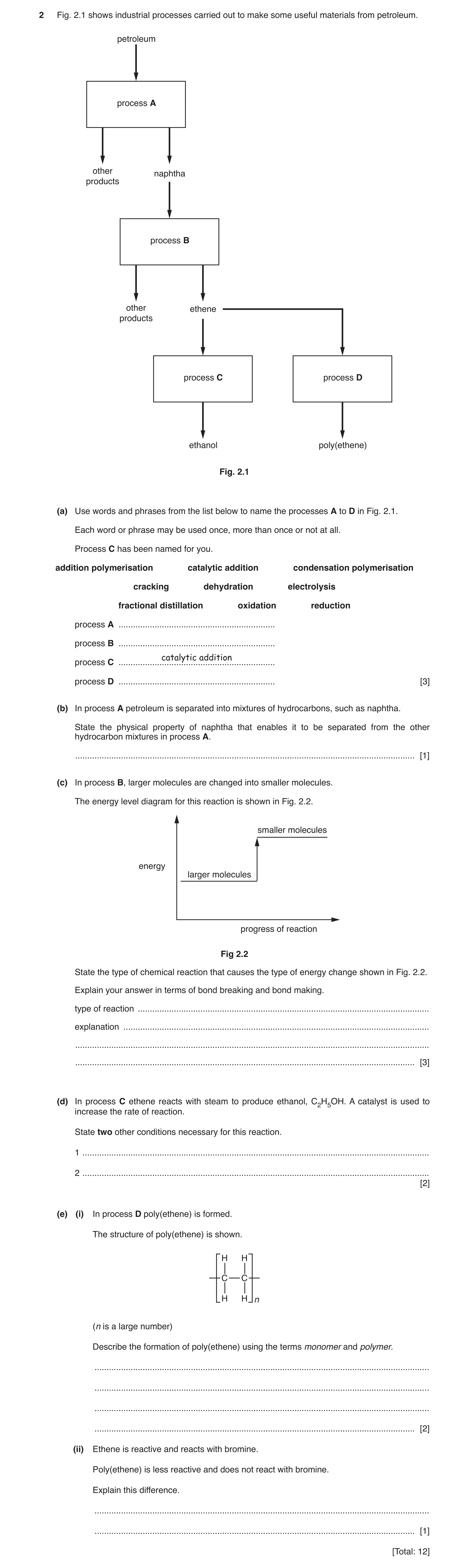
2 Fig. 2.1 shows industrial processes carried out to make some useful materials from petroleum. petroleum process A other naphtha products process B other ethene products process C process D ethanol poly(ethene) Fig. 2.1 (a) Use words and phrases from the list below to name the processes A to D in Fig. 2.1. Each word or phrase may be used once, more than once or not at all. Process C has been named for you. addition polymerisation catalytic addition condensation polymerisation cracking dehydration electrolysis fractional distillation oxidation reduction process A … process B … catalytic addition process C … process D … [3] (b) In process A petroleum is separated into mixtures of hydrocarbons, such as naphtha. State the physical property of naphtha that enables it to be separated from the other hydrocarbon mixtures in process A. … [1] (c) In process B, larger molecules are changed into smaller molecules. The energy level diagram for this reaction is shown in Fig. 2.2. smaller molecules energy larger molecules progress of reaction Fig 2.2 State the type of chemical reaction that causes the type of energy change shown in Fig. 2.2. Explain your answer in terms of bond breaking and bond making. type of reaction … explanation … … … [3] (d) In process C ethene reacts with steam to produce ethanol, C2H5OH. A catalyst is used to increase the rate of reaction. State two other conditions necessary for this reaction. 1 … 2 … [2] (e) (i) In process D poly(ethene) is formed. The structure of poly(ethene) is shown. H H C C H H n (n is a large number) Describe the formation of poly(ethene) using the terms monomer and polymer. … … … … [2] (ii) Ethene is reactive and reacts with bromine. Poly(ethene) is less reactive and does not react with bromine. Explain this difference. … … [1] [Total: 12]
12 marks
Mark scheme: 2(a) A fractional distillation ; B cracking ; (C catalytic addition) D addition polymerisation ; 3 2(b) boiling point (range) ; 1 2(c) endothermic ; bond breaking takes in energy / is an endothermic process and bond formation gives out energy / is an exothermic process ; more energy taken in than given out ; 3 2(d) high temperature ; high pressure ; 2 2(e)(i) ethene is monomer ; many (monomers / molecules) join to make (long chain) polymer ; 2 2(e)(ii) poly(ethene) is not an alkene / does not have double bond / is saturated ; 1
This question in 0654/43 May/June 2019
Q6 · The three states of matter 0654/42 May/June 2020
2 (a) (i) Fig. 2.1 shows the three states of matter. Complete the labels on Fig. 2.1. [2] … boiling solid freezing liquid … gas Fig. 2.1 (ii) Describe what happens to the total kinetic energy of the particles as the gas changes to a liquid and then to a solid. … [1] (b) A scientist analyses an unknown ink sample and four dyes, A, B, C and D. solvent front pencil line ink dye dye dye dye sample A B C D Fig. 2.2 Fig. 2.2 shows the chromatogram produced. (i) Calculate the Rf value for dye A. Rf value = … [2] (ii) State which dye cannot be in the ink sample. Explain your answer. dye … explanation … … … [2] (iii) A solvent is used during chromatography. Define the term solvent. … … [1] (c) Table 2.1 shows the melting point of two substances, X and Y. Table 2.1 substance melting point / °C X 84 Y 78–82 State which substance is pure. Explain your answer. pure substance … explanation … … [1] [Total: 9]
9 marks
Mark scheme: 2(a)(i) solid to liquid = melting ; gas to liquid = condensing ; 2 2(a)(ii) (kinetic energy) decreases / owtte 1 2(b)(i) (Rf =) distance travelled by substance ÷ distance travelled by solvent or 2.3 ÷ 5.8 ; = 0.4 ; 2 2(b)(ii) dye B ; idea that the colours (in dye B) moved different distances up the paper from the colours in the ink sample ; 2 2(b)(iii) a substance that can dissolve a solute (to form a solution) 1 Question Answer Marks 2(c) (pure substance is X) no mark idea that pure substances have a specific melting point / ORA / idea that pure substances do not melt over a range (of temperatures) / ORA ; 1
This question in 0654/42 May/June 2020
Q7 · Petroleum is a fossil fuel 0654/42 Feb/March 2021
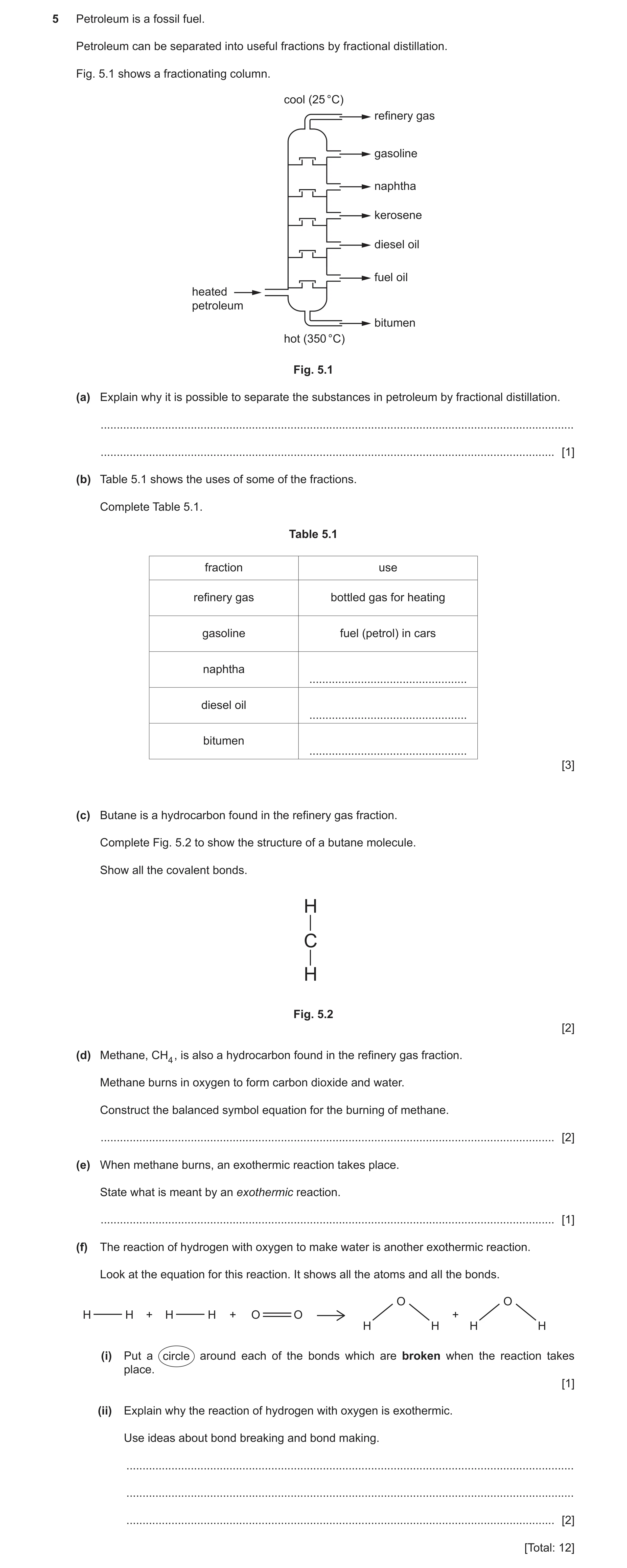
5 Petroleum is a fossil fuel. Petroleum can be separated into useful fractions by fractional distillation. Fig. 5.1 shows a fractionating column. cool (25 °C) refinery gas gasoline naphtha kerosene diesel oil fuel oil heated petroleum bitumen hot (350 °C) Fig. 5.1 (a) Explain why it is possible to separate the substances in petroleum by fractional distillation. … … [1] (b) Table 5.1 shows the uses of some of the fractions. Complete Table 5.1. Table 5.1 fraction use refinery gas bottled gas for heating gasoline fuel (petrol) in cars naphtha … diesel oil … bitumen … [3] (c) Butane is a hydrocarbon found in the refinery gas fraction. Complete Fig. 5.2 to show the structure of a butane molecule. Show all the covalent bonds. H C H Fig. 5.2 [2] (d) Methane, CH4 , is also a hydrocarbon found in the refinery gas fraction. Methane burns in oxygen to form carbon dioxide and water. Construct the balanced symbol equation for the burning of methane. … [2] (e) When methane burns, an exothermic reaction takes place. State what is meant by an exothermic reaction. … [1] (f) The reaction of hydrogen with oxygen to make water is another exothermic reaction. Look at the equation for this reaction. It shows all the atoms and all the bonds. O O H H + H H + O O + H H H H (i) Put a circle around each of the bonds which are broken when the reaction takes place. [1] (ii) Explain why the reaction of hydrogen with oxygen is exothermic. Use ideas about bond breaking and bond making. … … … [2] [Total: 12]
12 marks
Mark scheme: 5(a) substances have different boiling points ; 1 5(b) fraction use refinery gas bottled gas for heating gasoline fuel (petrol) in cars naphtha feedstock for making chemicals ; diesel oil fuel in diesel engines ; bitumen road surfaces ; 3 Question Answer Marks 5(c) ;; 2 5(d) CH4 + 2O2 → CO2 + 2H2O ;; 2 5(e) reaction in which thermal energy is given out ; 1 5(f)(i) + → ; 1 5(f)(ii) bond breaking is endothermic / owtte AND bond making is exothermic / owtte ; more energy is given out in bond making than is taken in in bond breaking ; 2
This question in 0654/42 Feb/March 2021
Q8 · Mixtures of coloured substances can be separated by paper chromatography 0654/41 May/June 2021
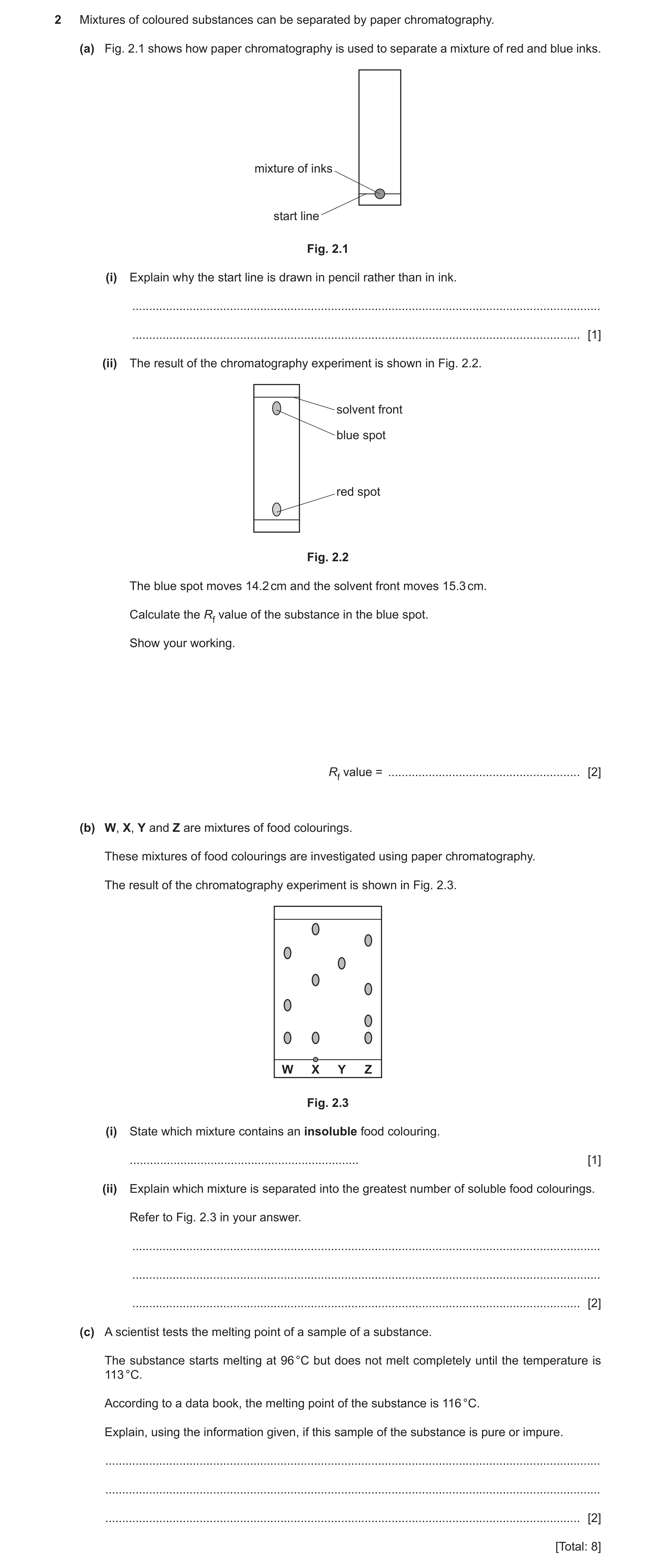
2 Mixtures of coloured substances can be separated by paper chromatography. (a) Fig. 2.1 shows how paper chromatography is used to separate a mixture of red and blue inks. mixture of inks start line Fig. 2.1 (i) Explain why the start line is drawn in pencil rather than in ink. … … [1] (ii) The result of the chromatography experiment is shown in Fig. 2.2. solvent front blue spot red spot Fig. 2.2 The blue spot moves 14.2 cm and the solvent front moves 15.3 cm. Calculate the Rf value of the substance in the blue spot. Show your working. Rf value = … [2] (b) W, X, Y and Z are mixtures of food colourings. These mixtures of food colourings are investigated using paper chromatography. The result of the chromatography experiment is shown in Fig. 2.3. W X Y Z Fig. 2.3 (i) State which mixture contains an insoluble food colouring. … [1] (ii) Explain which mixture is separated into the greatest number of soluble food colourings. Refer to Fig. 2.3 in your answer. … … … [2] (c) A scientist tests the melting point of a sample of a substance. The substance starts melting at 96 °C but does not melt completely until the temperature is 113 °C. According to a data book, the melting point of the substance is 116 °C. Explain, using the information given, if this sample of the substance is pure or impure. … … … [2] [Total: 8]
8 marks
Mark scheme: 2(a)(i) pencil does not dissolve in the solvent / AW ; 1 2(a)(ii) (Rf =) 14.2 ÷ 15.3 ; 0.928 ; 2 2(b)(i) X ; 1 2(b)(ii) Z ; (because) it has the most spots, above the line / that have moved / AW ; 2 2(c) (It is impure because) it melts over a range of temperatures / melts at different melting points ; the melting point is not the same as the ‘standard’ reference melting point / AW ; 2
This question in 0654/41 May/June 2021
Q9 · Ammonia, NH3, is made in the Haber process 0654/41 Oct/Nov 2021
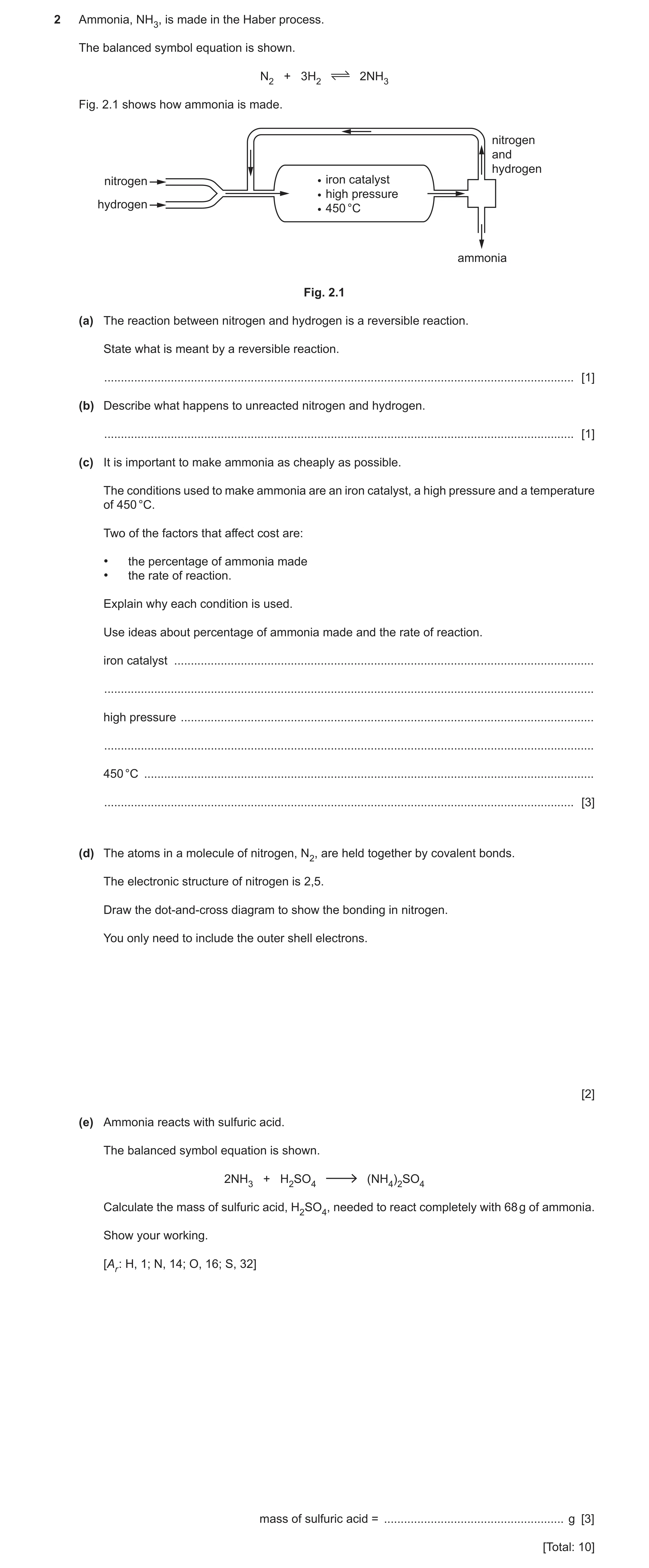
2 Ammonia, NH3, is made in the Haber process. The balanced symbol equation is shown. N2 + 3H2 2NH3 Fig. 2.1 shows how ammonia is made. nitrogen and hydrogen nitrogen • iron catalyst • high pressure hydrogen • 450 °C ammonia Fig. 2.1 (a) The reaction between nitrogen and hydrogen is a reversible reaction. State what is meant by a reversible reaction. … [1] (b) Describe what happens to unreacted nitrogen and hydrogen. … [1] (c) It is important to make ammonia as cheaply as possible. The conditions used to make ammonia are an iron catalyst, a high pressure and a temperature of 450 °C. Two of the factors that affect cost are: • the percentage of ammonia made • the rate of reaction. Explain why each condition is used. Use ideas about percentage of ammonia made and the rate of reaction. iron catalyst … … high pressure … … 450 °C … … [3] (d) The atoms in a molecule of nitrogen, N2, are held together by covalent bonds. The electronic structure of nitrogen is 2,5. Draw the dot-and-cross diagram to show the bonding in nitrogen. You only need to include the outer shell electrons. [2] (e) Ammonia reacts with sulfuric acid. The balanced symbol equation is shown. 2NH3 + H2SO4 (NH4)2SO4 Calculate the mass of sulfuric acid, H2SO4, needed to react completely with 68 g of ammonia. Show your working. [Ar : H, 1; N, 14; O, 16; S, 32] mass of sulfuric acid = … g [3] [Total: 10]
10 marks
Mark scheme: 2(a) idea of a reaction that goes both ways ; 1 2(b) recycled / owtte ; 1 2(c) iron catalyst: increases rate of reaction / owtte ; high pressure: increases the yield of ammonia / increases rate of reaction ; 450 °C: idea of compromise of temperature to give high enough rate of reaction with reasonable yield ; 3 2(d) triple bond between N atoms ; lone pairs on N atoms ; 2 2(e) Mr of NH3 = 17 and Mr H2SO4 = 98 ; 2 moles of NH3 needs 1 mole of H2SO4 ; 98 68 34 × = 196 (g) ; 3
This question in 0654/41 Oct/Nov 2021
Q10 · Petroleum is a fossil fuel 0654/43 May/June 2022
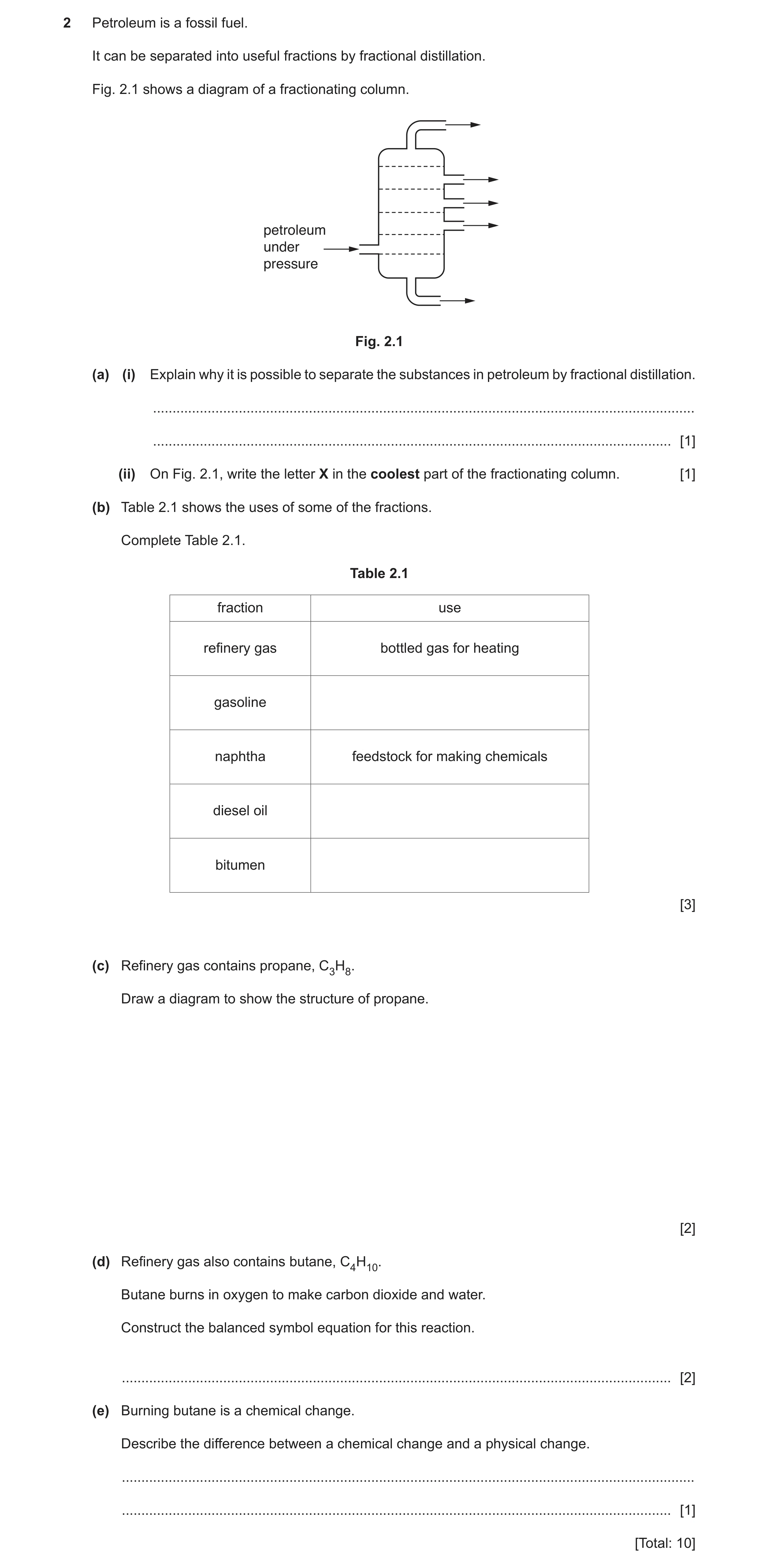
2 Petroleum is a fossil fuel. It can be separated into useful fractions by fractional distillation. Fig. 2.1 shows a diagram of a fractionating column. petroleum under pressure Fig. 2.1 (a) (i) Explain why it is possible to separate the substances in petroleum by fractional distillation. … … [1] (ii) On Fig. 2.1, write the letter X in the coolest part of the fractionating column. [1] (b) Table 2.1 shows the uses of some of the fractions. Complete Table 2.1. Table 2.1 fraction use refinery gas bottled gas for heating gasoline naphtha feedstock for making chemicals diesel oil bitumen [3] (c) Refinery gas contains propane, C3H8. Draw a diagram to show the structure of propane. [2] (d) Refinery gas also contains butane, C4H10. Butane burns in oxygen to make carbon dioxide and water. Construct the balanced symbol equation for this reaction. … [2] (e) Burning butane is a chemical change. Describe the difference between a chemical change and a physical change. … … [1] [Total: 10]
10 marks
Mark scheme: 2(a)(i) (fractions have) different boiling points ; 1 2(a)(ii) X marked inside the top of the column, above the top dotted line ; 1 Question Answer Marks 2(b) fraction use refinery gas bottled gas for heating gasoline fuel in cars ; naphtha feedstock for making chemicals diesel oil fuel in diesel engines ; bitumen road surfaces ; 3 2(c) ;; 2 2(d) 2C4H10 + 13O2 8CO2 + 10H2O correct formulae ; correct balancing ; 2 2(e) (in a chemical change) a new substance is made / owtte ; 1
This question in 0654/43 May/June 2022
Q11 · A scientist investigates a food colouring, X, using chromatography 0654/42 Oct/Nov 2022
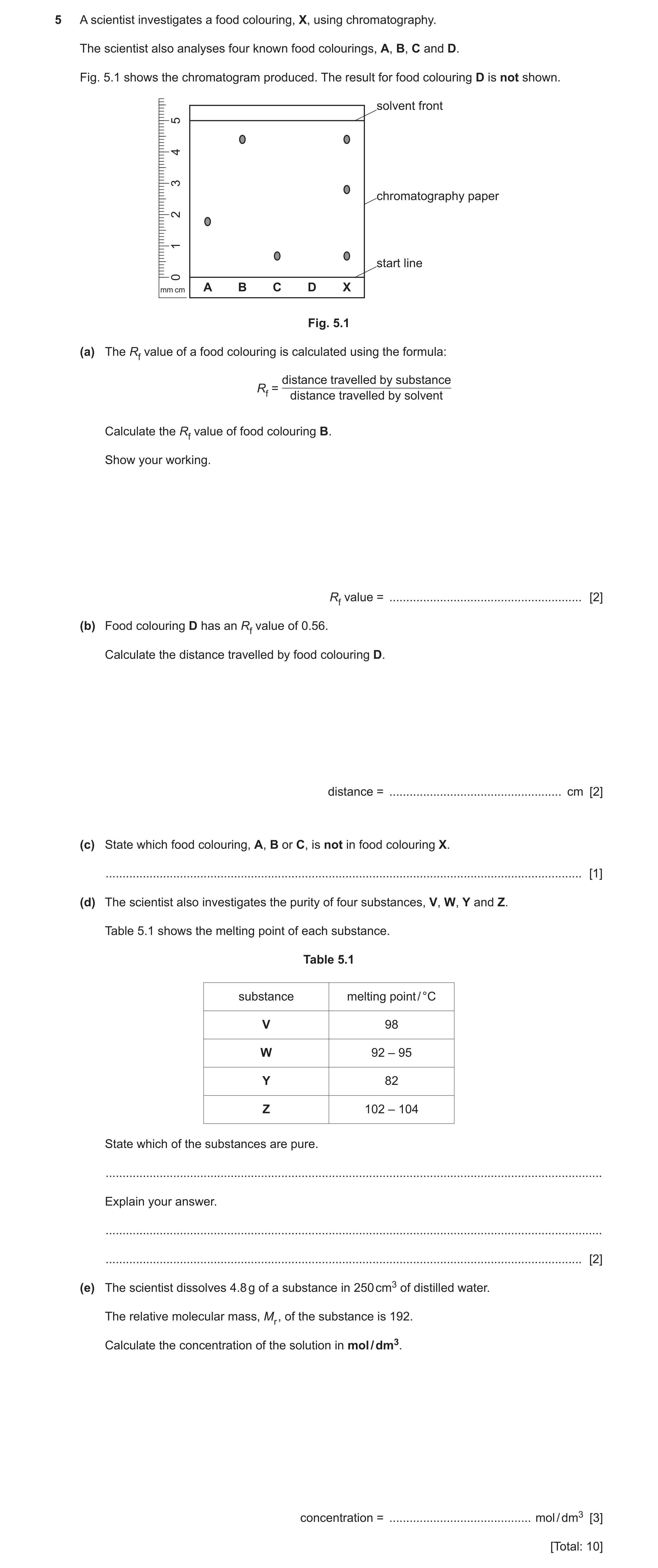
5 A scientist investigates a food colouring, X, using chromatography. The scientist also analyses four known food colourings, A, B, C and D. Fig. 5.1 shows the chromatogram produced. The result for food colouring D is not shown. solvent front 5 4 3 chromatography paper 2 1 start line 0 mm cm A B C D X Fig. 5.1 (a) The Rf value of a food colouring is calculated using the formula: distance travelled by substance Rf = distance travelled by solvent Calculate the Rf value of food colouring B. Show your working. Rf value = … [2] (b) Food colouring D has an Rf value of 0.56. Calculate the distance travelled by food colouring D. distance = … cm [2] (c) State which food colouring, A, B or C, is not in food colouring X. … [1] (d) The scientist also investigates the purity of four substances, V, W, Y and Z. Table 5.1 shows the melting point of each substance. Table 5.1 substance melting point / °C V 98 W 92 – 95 Y 82 Z 102 – 104 State which of the substances are pure. … Explain your answer. … … [2] (e) The scientist dissolves 4.8 g of a substance in 250 cm3 of distilled water. The relative molecular mass, Mr , of the substance is 192. Calculate the concentration of the solution in mol / dm3. concentration = … mol / dm3 [3] [Total: 10]
10 marks
Mark scheme: 5(a) (distance travelled by substance =) 4.5 ; 2 (Rf = 4.5 5.0 =) 0.90 ; 5(b) (distance moved by D) = Rf distance moved by solvent or 0.56 5.0 ; 2 (distance moved by D) = 2.8 (cm) ; 5(c) A ; 1 5(d) V and Y; 2 idea that pure substances, have a specific melting point / do not melt over a range (of temperatures) / ORA ; 5(e) moles = 4.8 ÷ 192 or 0.025 ; 3 conversion of cm³ to dm³ / 250 cm³ = 0.25 dm³ ; concentration = 0.025 ÷ 0.25 = 0.10 (mol / dm³) ;
This question in 0654/42 Oct/Nov 2022
Q12 · Petroleum is separated into different fractions 0654/43 May/June 2023
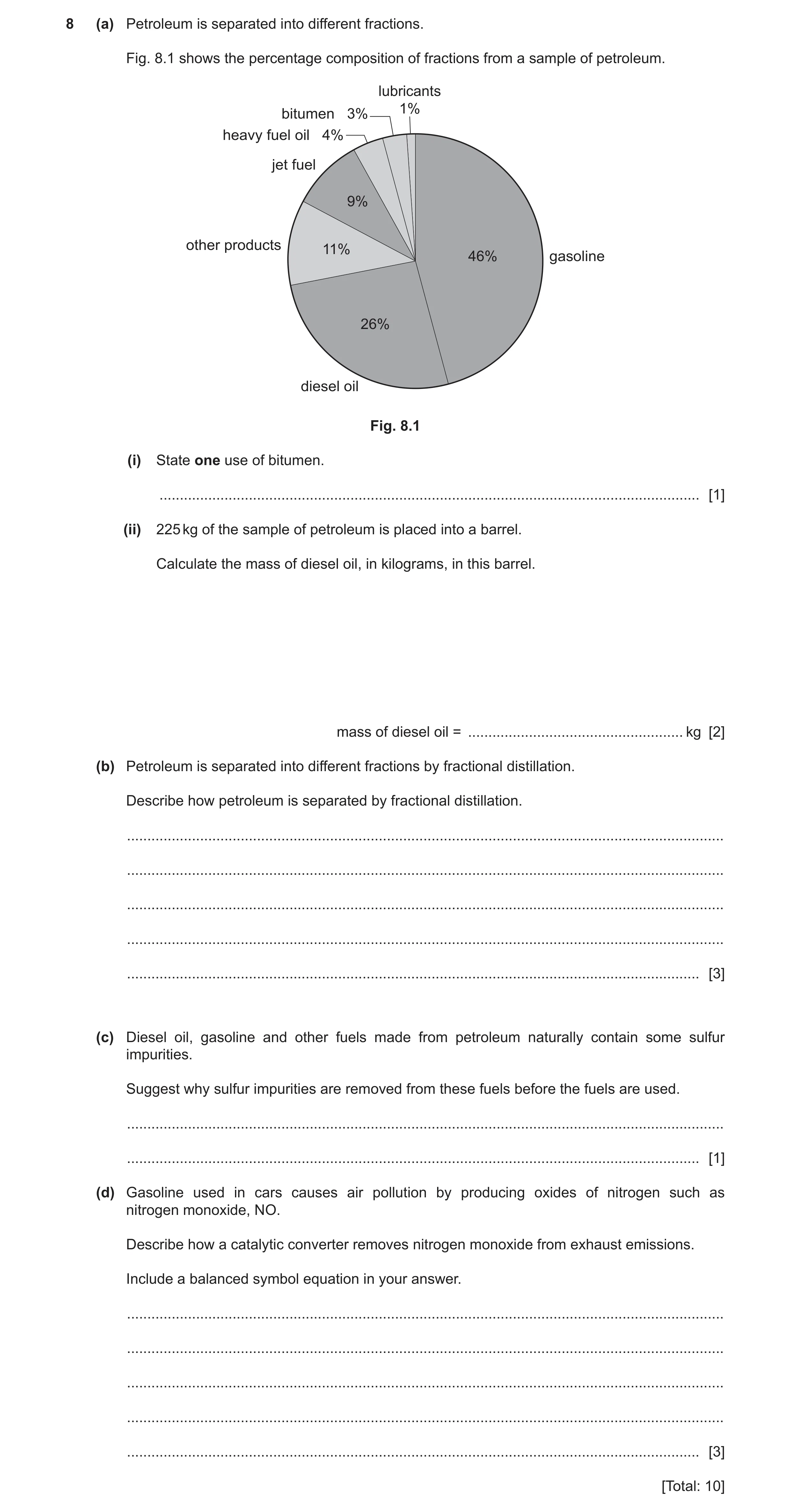
8 (a) Petroleum is separated into different fractions. Fig. 8.1 shows the percentage composition of fractions from a sample of petroleum. lubricants 1% bitumen 3% heavy fuel oil 4% jet fuel 9% other products 11% 46% gasoline 26% diesel oil Fig. 8.1 (i) State one use of bitumen. … [1] (ii) 225 kg of the sample of petroleum is placed into a barrel. Calculate the mass of diesel oil, in kilograms, in this barrel. mass of diesel oil = … kg [2] (b) Petroleum is separated into different fractions by fractional distillation. Describe how petroleum is separated by fractional distillation. … … … … … [3] (c) Diesel oil, gasoline and other fuels made from petroleum naturally contain some sulfur impurities. Suggest why sulfur impurities are removed from these fuels before the fuels are used. … … [1] (d) Gasoline used in cars causes air pollution by producing oxides of nitrogen such as nitrogen monoxide, NO. Describe how a catalytic converter removes nitrogen monoxide from exhaust emissions. Include a balanced symbol equation in your answer. … … … … … [3] [Total: 10]
10 marks
Mark scheme: 8(a)(i) road surfaces ; 1 8(a)(ii) 225 26 100 ; = 59 (kg) ; 2 8(b) fractions are separated according to their boiling point ; petroleum is heated AND idea that vapours rise (and cool) ; idea that vapours condense when they become cool enough ; 3 8(c) idea that sulfur impurities cause acid rain ; 1 Question Answer Marks 8(d) idea that nitrogen monoxide is removed from exhaust emissions by reaction over a hot catalyst / at high temperature ; AND ONE EQUATION FROM 2NO + 2CO N2 + 2CO2 or 2NO N2 + O2 correct formulae ; correct balancing ; 3
This question in 0654/43 May/June 2023
Q13 · Petroleum is a mixture of hydrocarbons 0654/43 May/June 2024
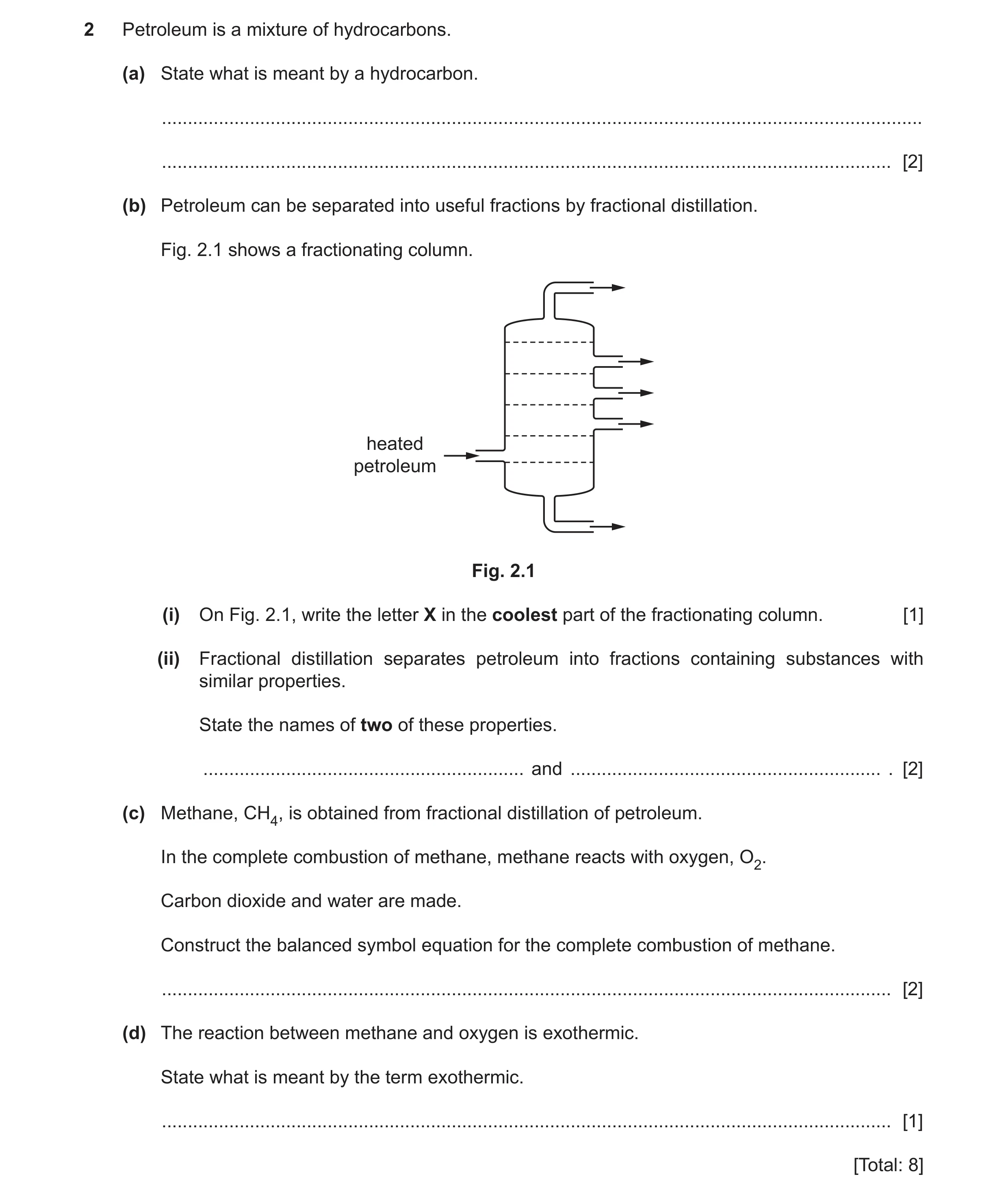
2 Petroleum is a mixture of hydrocarbons. (a) State what is meant by a hydrocarbon. … … [2] (b) Petroleum can be separated into useful fractions by fractional distillation. Fig. 2.1 shows a fractionating column. heated petroleum Fig. 2.1 (i) On Fig. 2.1, write the letter X in the coolest part of the fractionating column. [1] (ii) Fractional distillation separates petroleum into fractions containing substances with similar properties. State the names of two of these properties. … and … . [2] (c) Methane, CH4, is obtained from fractional distillation of petroleum. In the complete combustion of methane, methane reacts with oxygen, O2. Carbon dioxide and water are made. Construct the balanced symbol equation for the complete combustion of methane. … [2] (d) The reaction between methane and oxygen is exothermic. State what is meant by the term exothermic. … [1] [Total: 8]
8 marks
Mark scheme: 2(a) (compound containing) carbon and hydrogen (atoms) ; only ; 2 2(b)(i) X inside the column, either inside the pipe or anywhere above the top dotted line ; e.g. 1 2(b)(ii) Any two from: boiling point / volatility / viscosity / flammability / density ;; 2 2(c) CH4 + 2O2 CO2 + 2H2O ;; 2 2(d) Idea of thermal energy given out ; 1
This question in 0654/43 May/June 2024
![Question 3: (a) State the percentage of nitrogen in clean air. ....................................................... % [1] (b) Fig. 2.1 shows the sep…](https://img.pastlit.com/crops/74e26cce-806a-4bae-af4d-983ff41c5fe0/q2.webp)
![Question 6: (a) (i) Fig. 2.1 shows the three states of matter. Complete the labels on Fig. 2.1. [2] .......................... boiling solid freezing l…](https://img.pastlit.com/crops/19c0ab04-423f-4640-911e-42ca27a14cc1/q2.webp)
 24 / 24
 9
9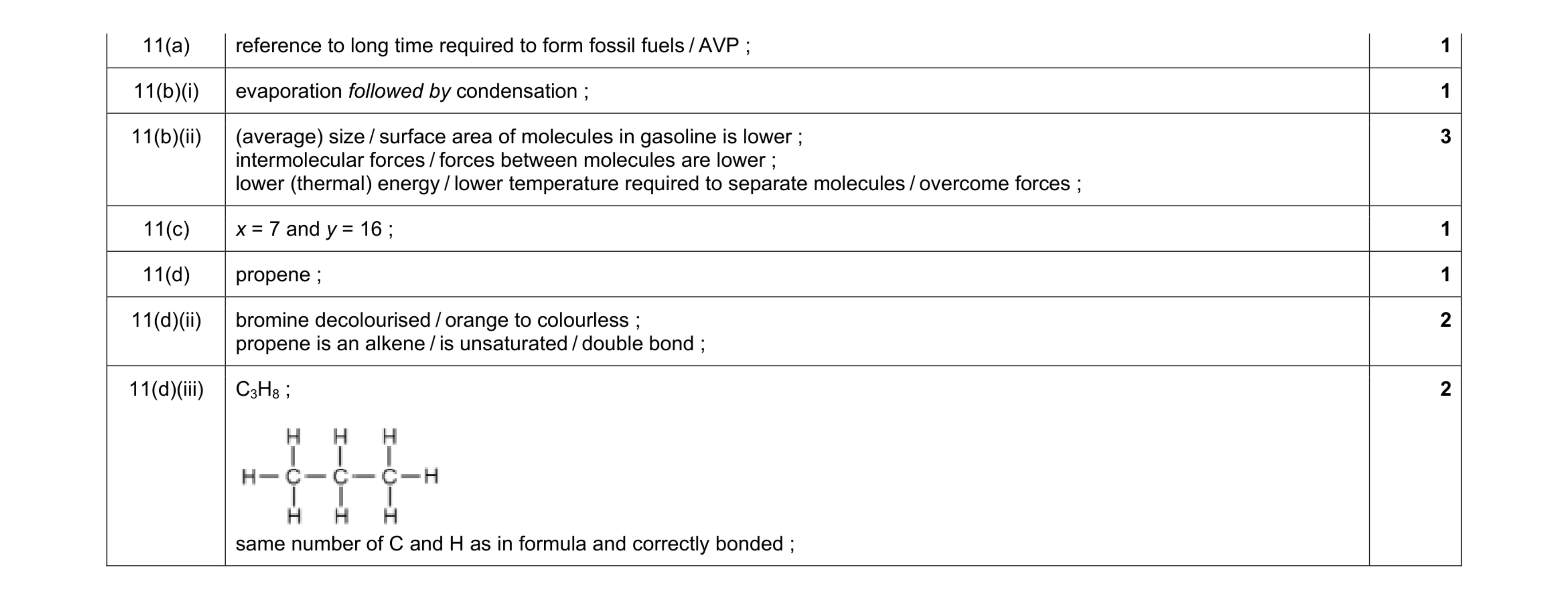 11
11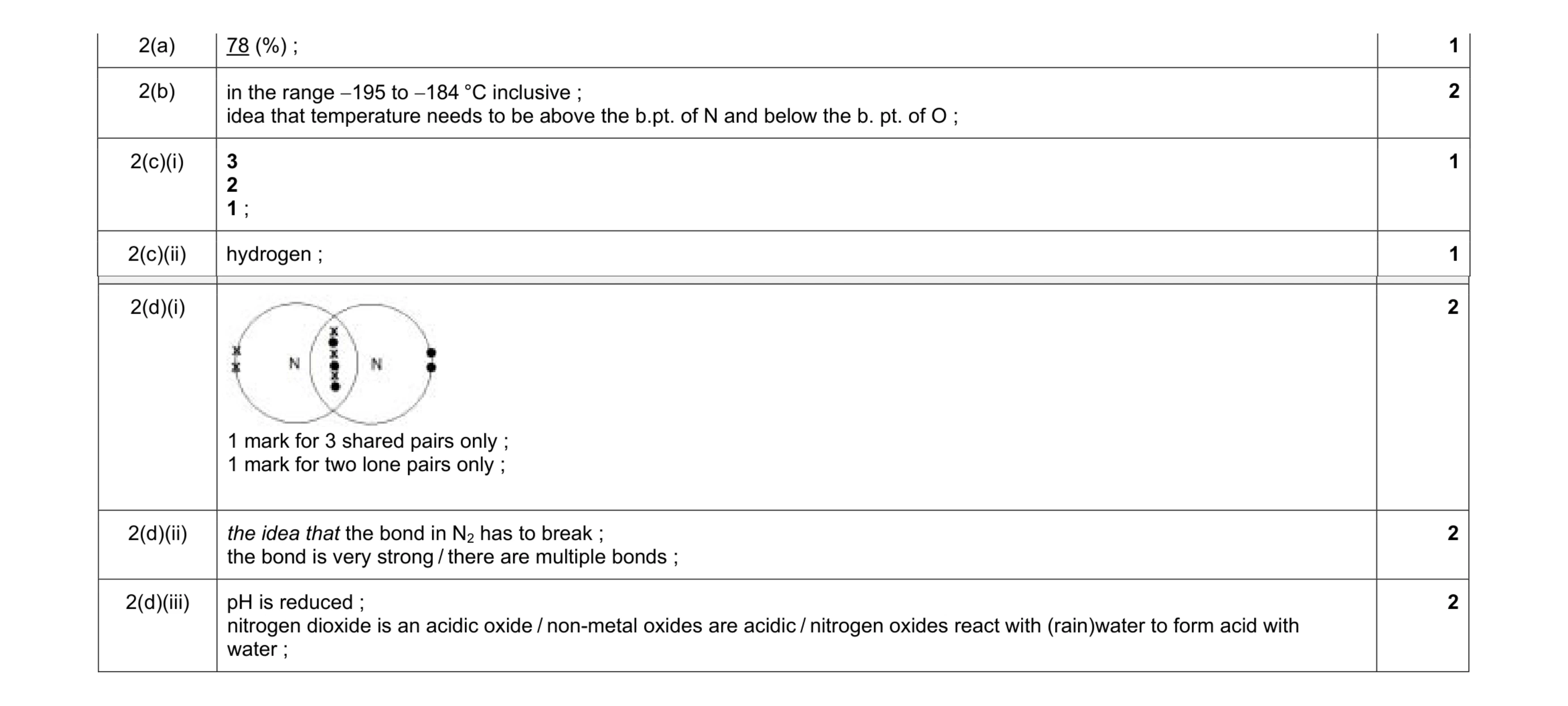 11
11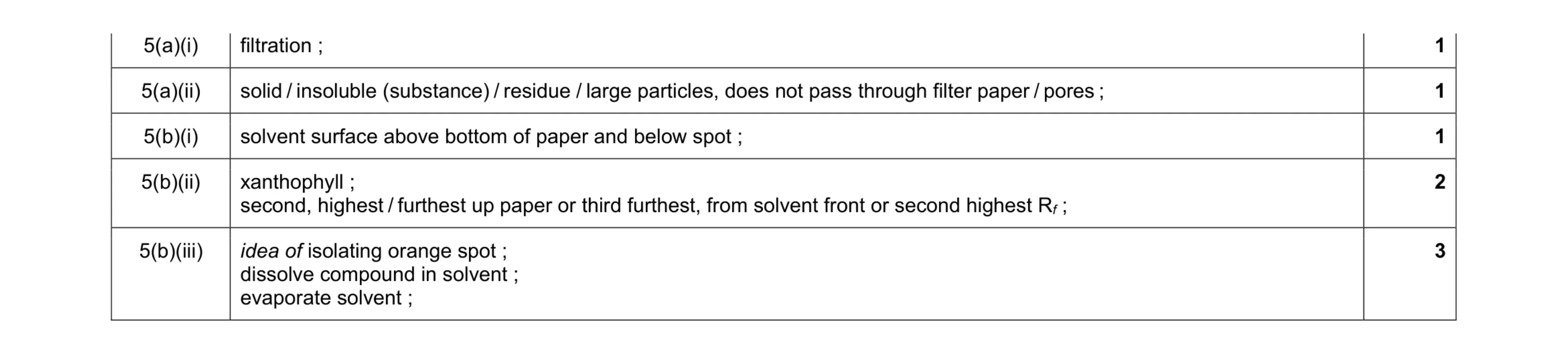 8
8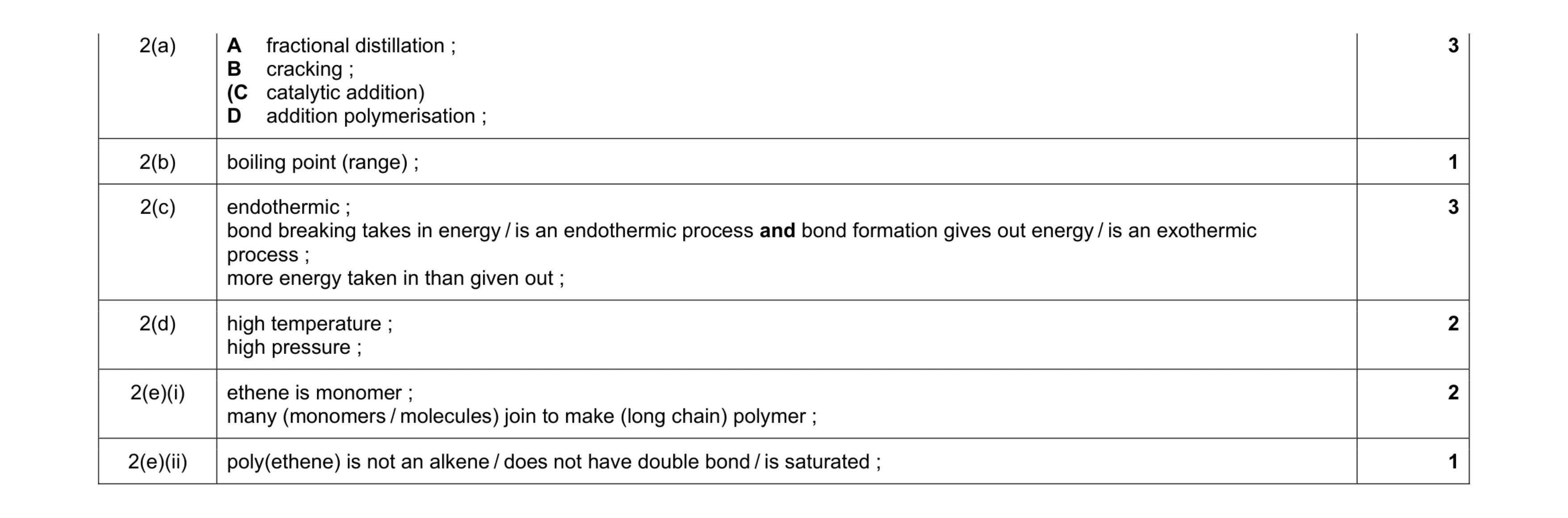 12
12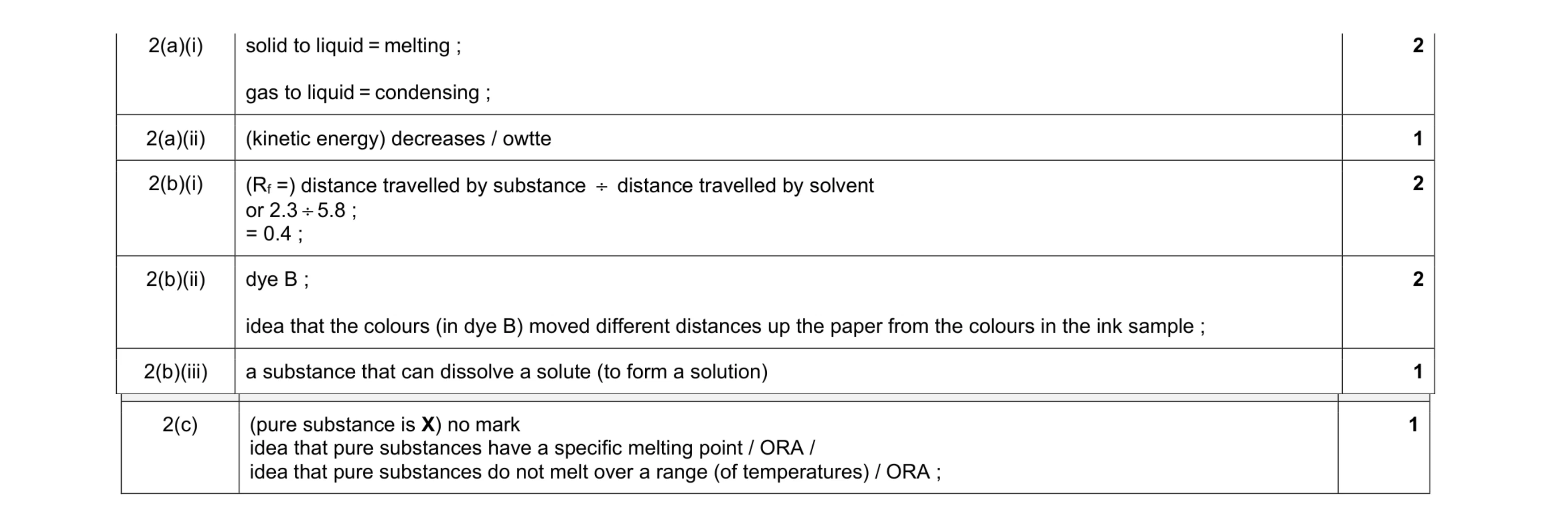 9
9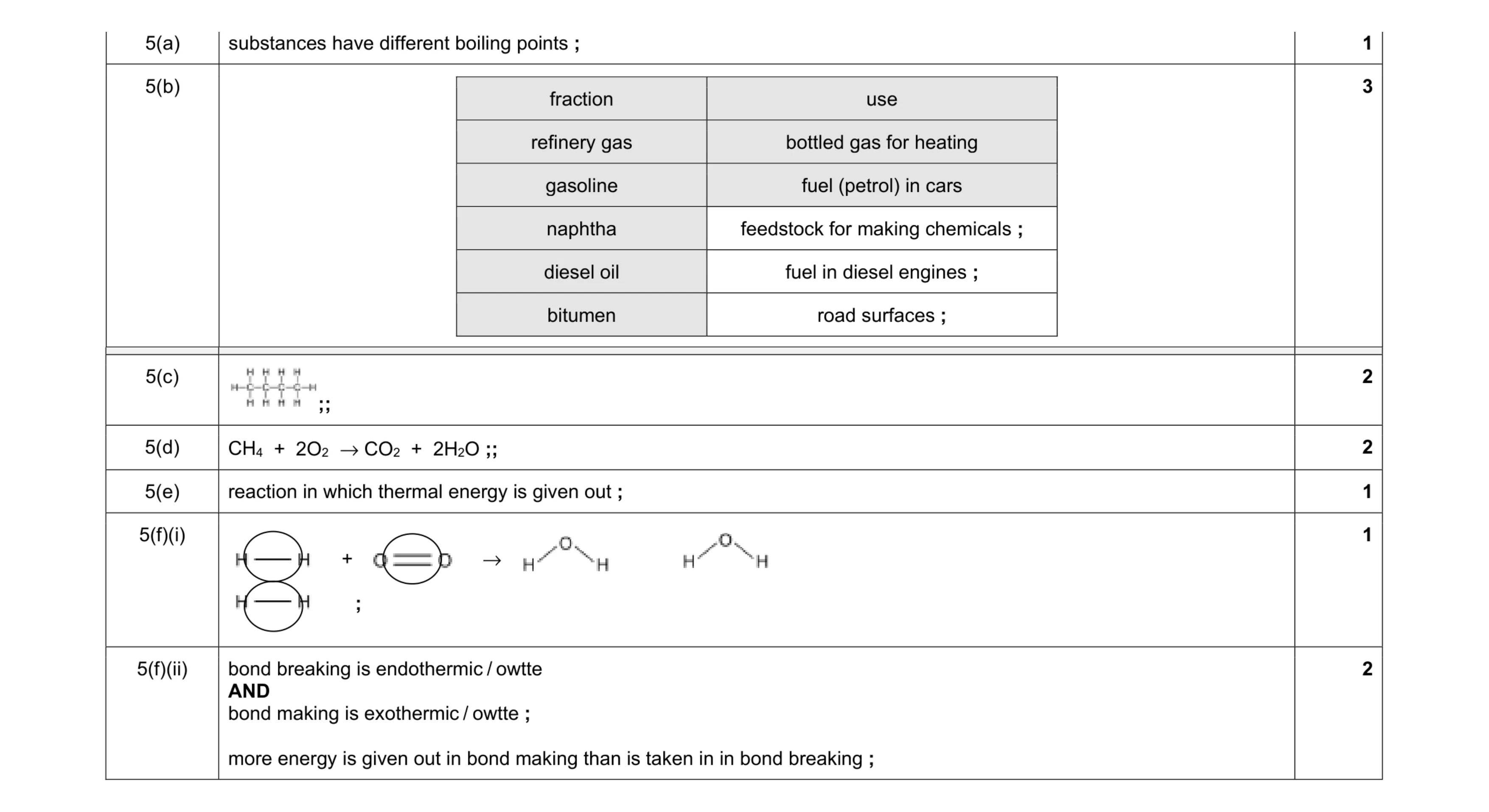 12
12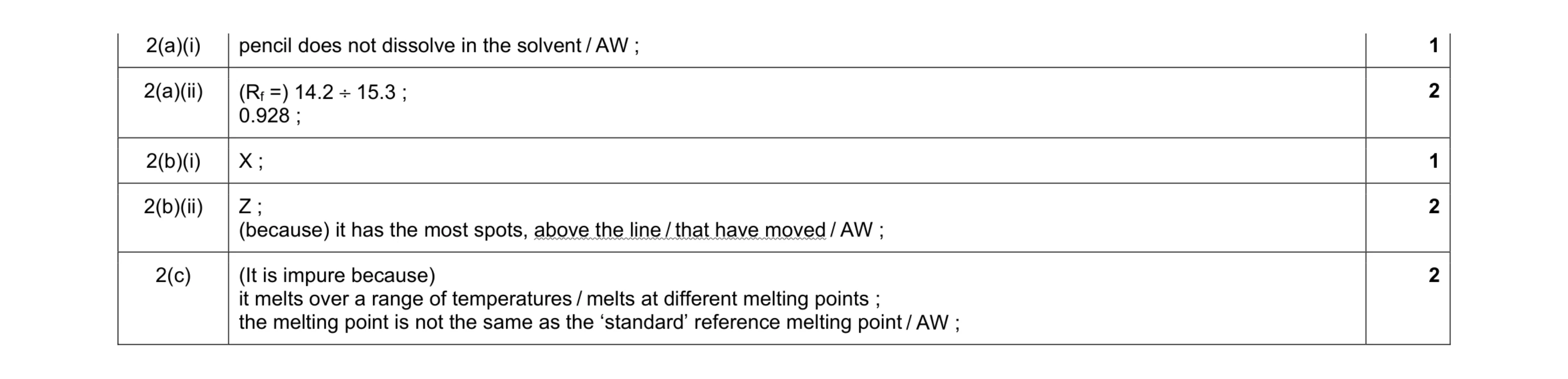 8
8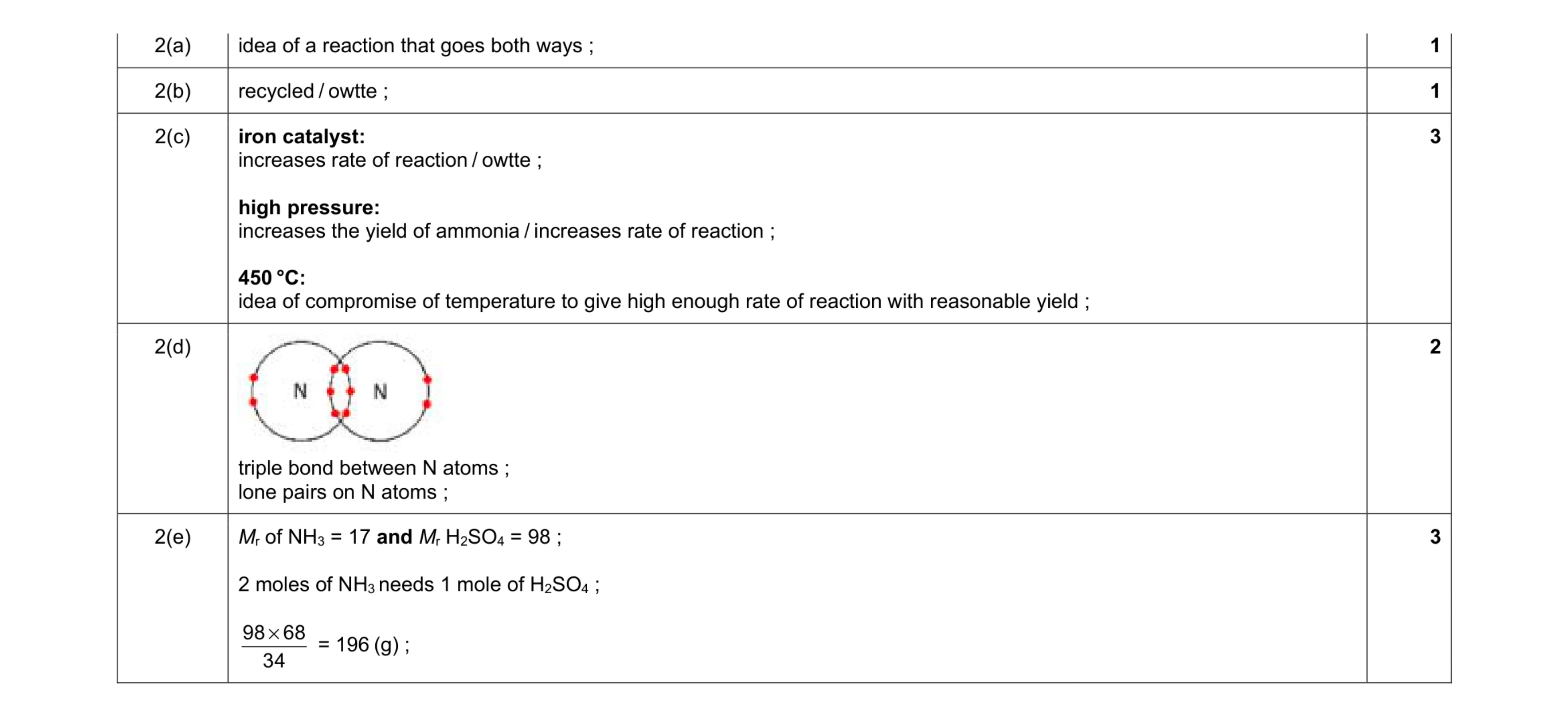 10
10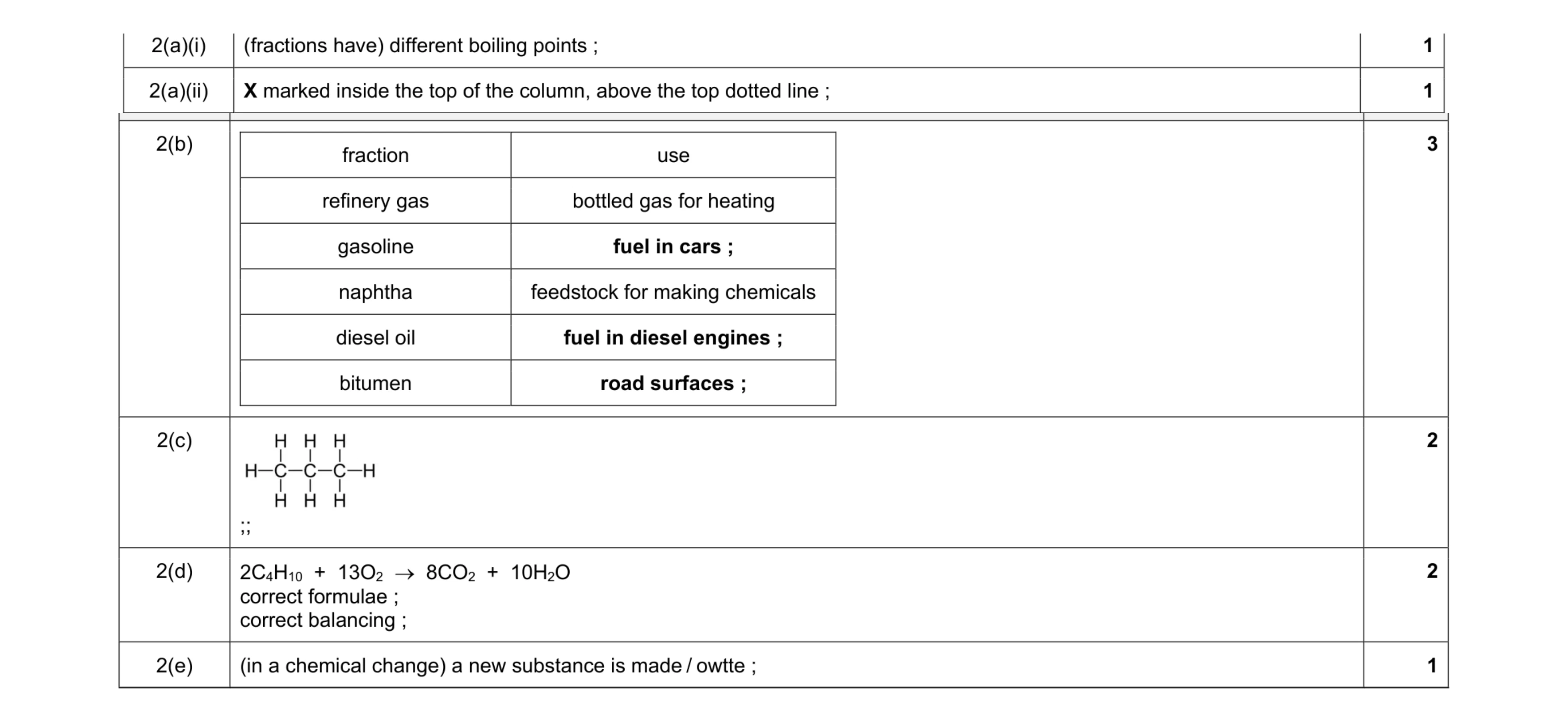 10
10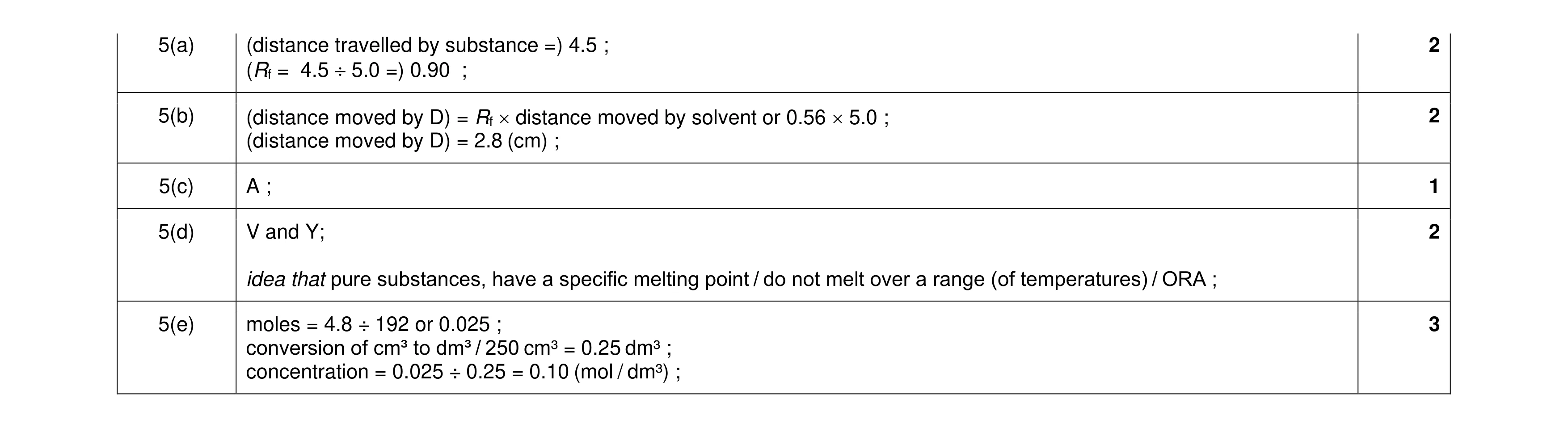 10
10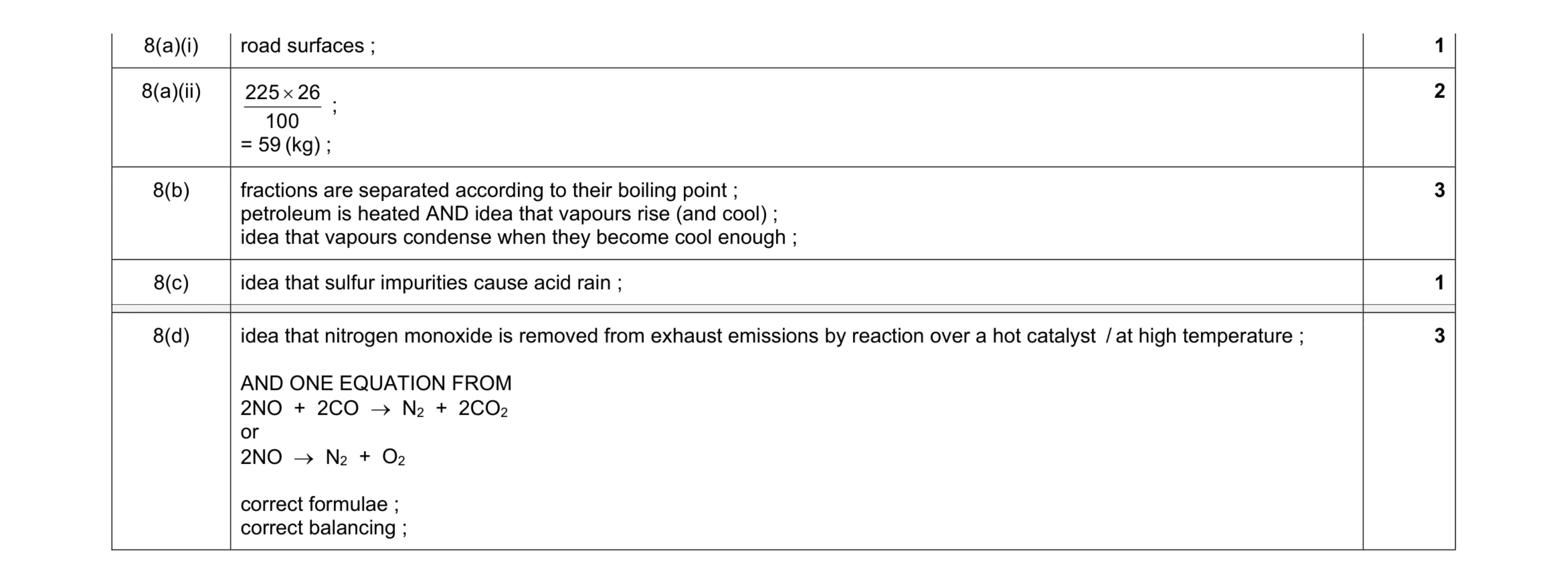 10
10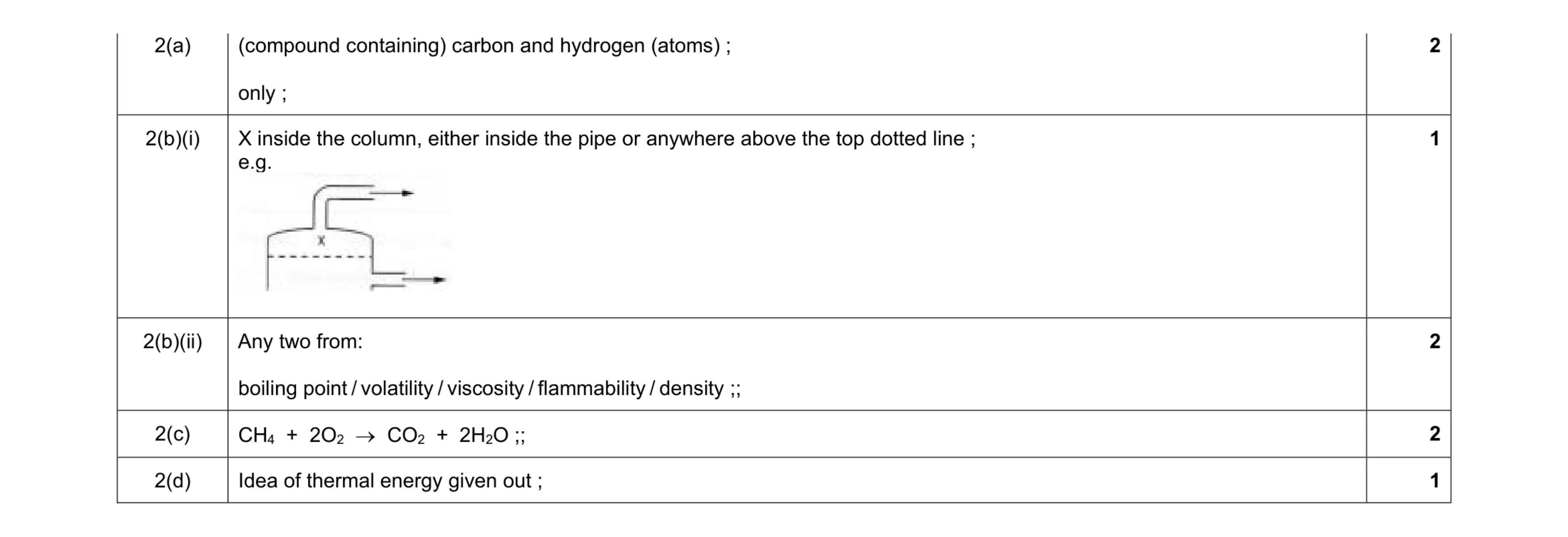 8
8