Questions as text
Q1 · Natural gas and petroleum are fossil fuels 0654/31 May/June 2017
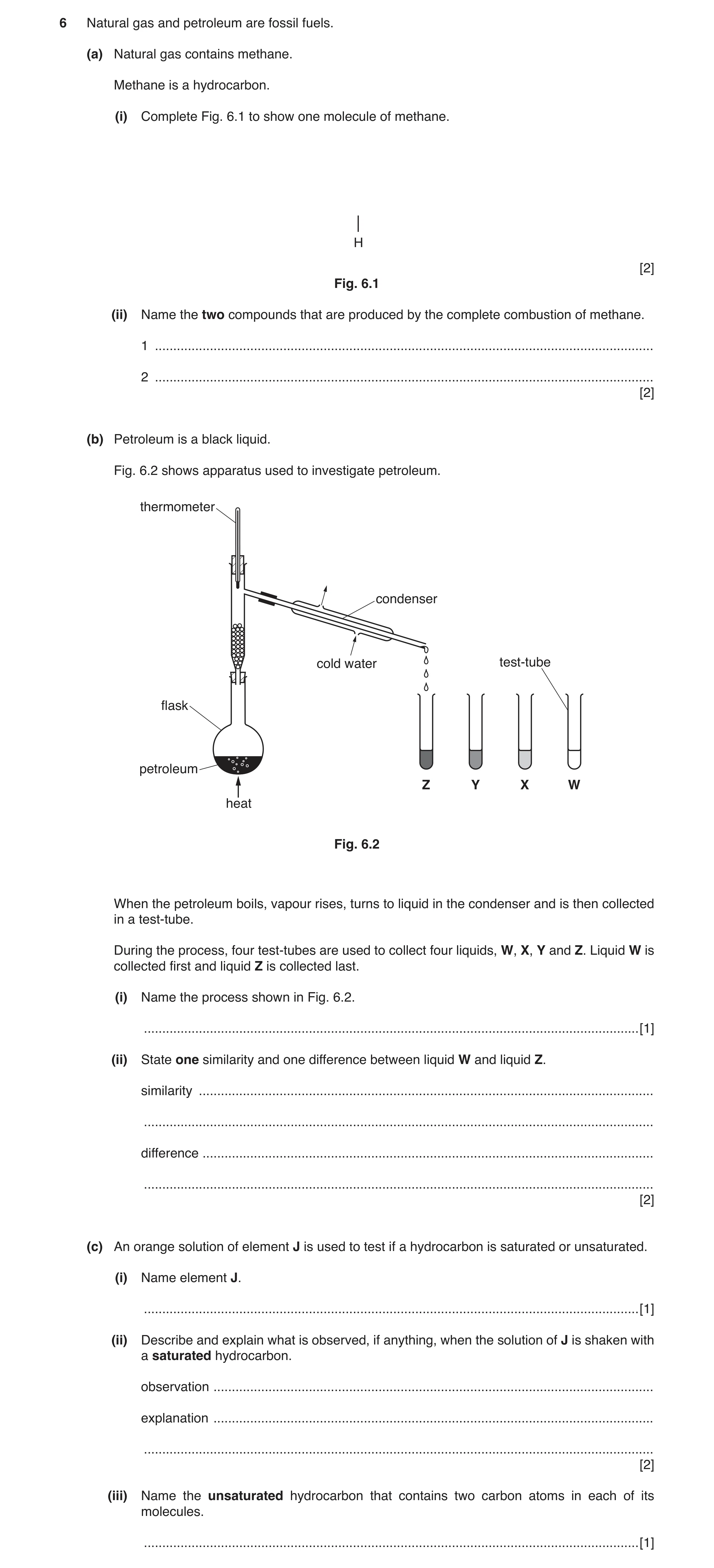
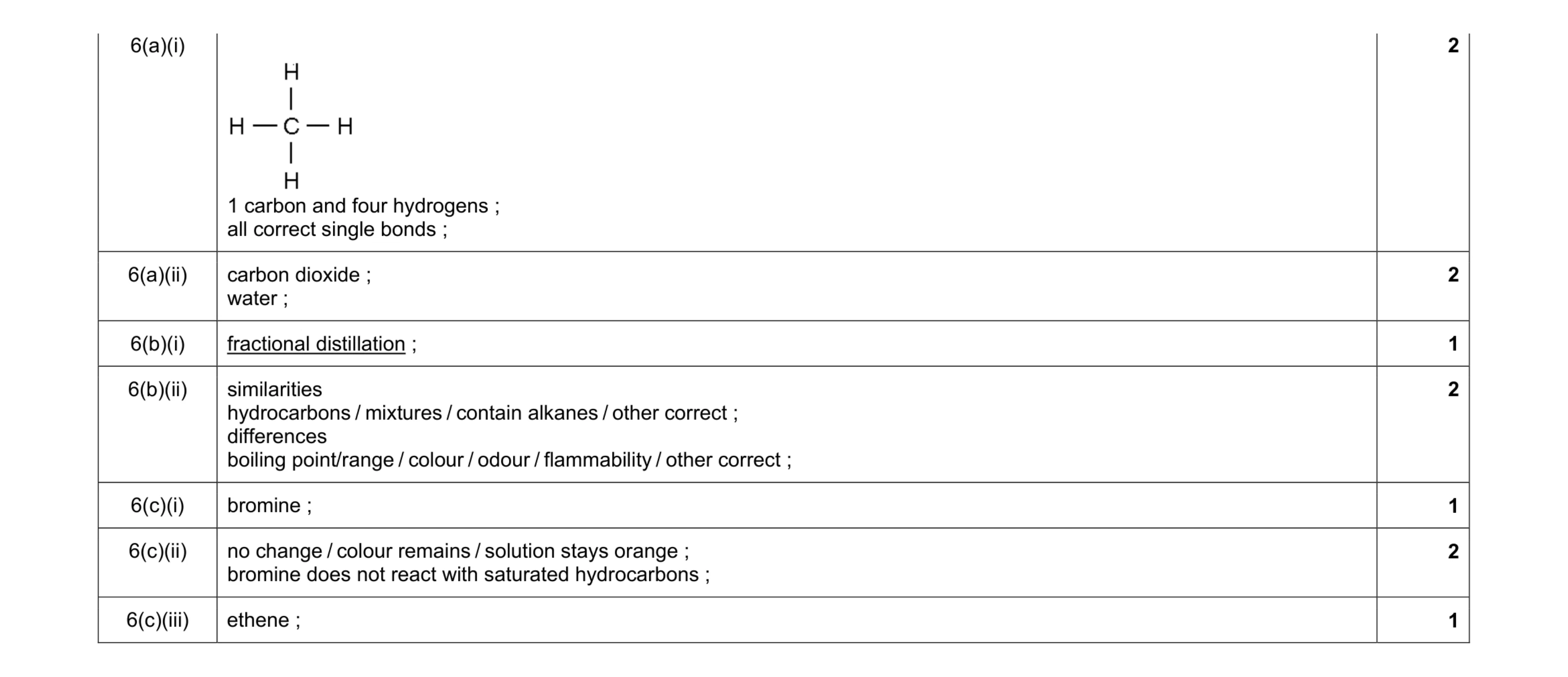
6 Natural gas and petroleum are fossil fuels. (a) Natural gas contains methane. Methane is a hydrocarbon. (i) Complete Fig. 6.1 to show one molecule of methane. H [2] Fig. 6.1 (ii) Name the two compounds that are produced by the complete combustion of methane. 1 … 2 … [2] (b) Petroleum is a black liquid. Fig. 6.2 shows apparatus used to investigate petroleum. thermometer condenser cold water test-tube flask petroleum Z Y X W heat Fig. 6.2 When the petroleum boils, vapour rises, turns to liquid in the condenser and is then collected in a test-tube. During the process, four test-tubes are used to collect four liquids, W, X, Y and Z. Liquid W is collected first and liquid Z is collected last. (i) Name the process shown in Fig. 6.2. … [1] (ii) State one similarity and one difference between liquid W and liquid Z. similarity … … difference … … [2] (c) An orange solution of element J is used to test if a hydrocarbon is saturated or unsaturated. (i) Name element J. … [1] (ii) Describe and explain what is observed, if anything, when the solution of J is shaken with a saturated hydrocarbon. observation … explanation … … [2] (iii) Name the unsaturated hydrocarbon that contains two carbon atoms in each of its molecules. … [1]
11 marks
Mark scheme: 6(a)(i) 1 carbon and four hydrogens ; all correct single bonds ; 2 6(a)(ii) carbon dioxide ; water ; 2 6(b)(i) fractional distillation ; 1 6(b)(ii) similarities hydrocarbons / mixtures / contain alkanes / other correct ; differences boiling point/range / colour / odour / flammability / other correct ; 2 6(c)(i) bromine ; 1 6(c)(ii) no change / colour remains / solution stays orange ; bromine does not react with saturated hydrocarbons ; 2 6(c)(iii) ethene ; 1
This question in 0654/31 May/June 2017
Q2 · Ethanol is a colourless liquid compound that contains the elements carbon, hydrogen and… 0654/33 May/June 2017
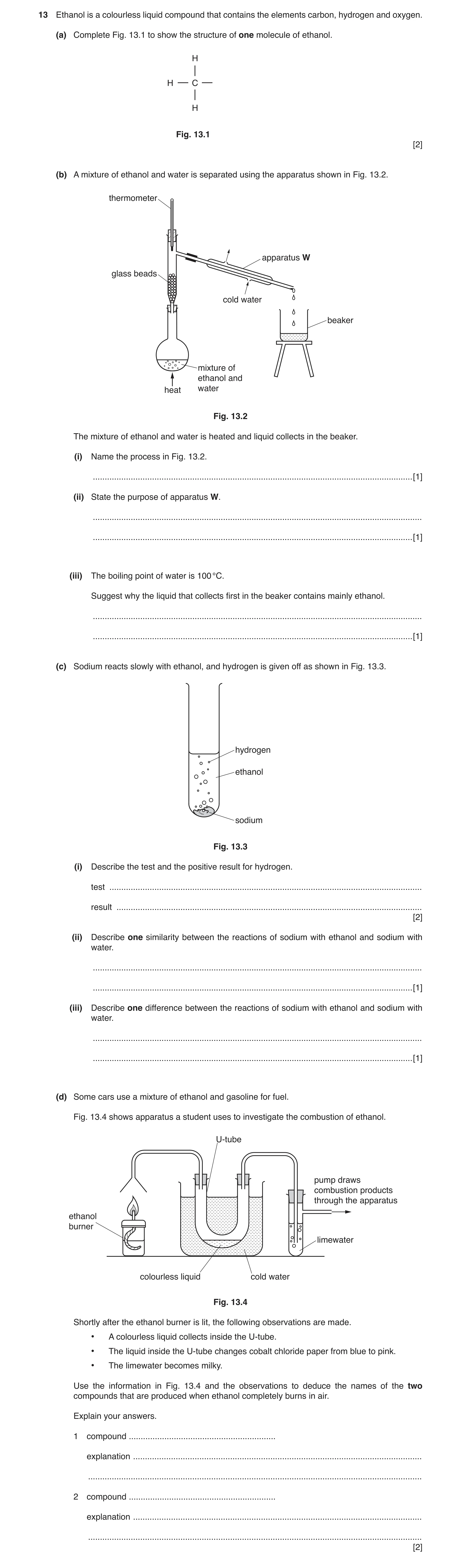
13 Ethanol is a colourless liquid compound that contains the elements carbon, hydrogen and oxygen. (a) Complete Fig. 13.1 to show the structure of one molecule of ethanol. H H C H Fig. 13.1 [2] (b) A mixture of ethanol and water is separated using the apparatus shown in Fig. 13.2. thermometer apparatus W glass beads cold water beaker mixture of ethanol and heat water Fig. 13.2 The mixture of ethanol and water is heated and liquid collects in the beaker. (i) Name the process in Fig. 13.2. … [1] (ii) State the purpose of apparatus W. … … [1] (iii) The boiling point of water is 100 °C. Suggest why the liquid that collects first in the beaker contains mainly ethanol. … … [1] (c) Sodium reacts slowly with ethanol, and hydrogen is given off as shown in Fig. 13.3. hydrogen ethanol sodium Fig. 13.3 (i) Describe the test and the positive result for hydrogen. test … result … [2] (ii) Describe one similarity between the reactions of sodium with ethanol and sodium with water. … … [1] (iii) Describe one difference between the reactions of sodium with ethanol and sodium with water. … … [1] (d) Some cars use a mixture of ethanol and gasoline for fuel. Fig. 13.4 shows apparatus a student uses to investigate the combustion of ethanol. U-tube pump draws combustion products through the apparatus ethanol burner limewater colourless liquid cold water Fig. 13.4 Shortly after the ethanol burner is lit, the following observations are made. • A colourless liquid collects inside the U-tube. • The liquid inside the U-tube changes cobalt chloride paper from blue to pink. • The limewater becomes milky. Use the information in Fig. 13.4 and the observations to deduce the names of the two compounds that are produced when ethanol completely burns in air. Explain your answers. 1 compound … explanation … … 2 compound … explanation … … [2]
11 marks
Mark scheme: 13(a) C – C single bond / – O – H ; all else correct ; 2 13(b)(i) (fractional) distillation ; 1 13(b)(ii) it is a condenser / condenses (hot) vapours to liquid ; 1 13(b)(iii) ethanol has a lower boiling point / ethanol easier to boil than water ; 1 13(c)(i) flame ; pops ; 2 13(c)(ii) gas / hydrogen released ; 1 13(c)(iii) reaction speed higher in water ; 1 13(d) in any order water because it turns cobalt chloride from blue to pink ; carbon dioxide because it turns limewater milky ; 2
This question in 0654/33 May/June 2017
Q3 · Useful products containing hydrocarbons are obtained from petroleum 0654/31 Oct/Nov 2018
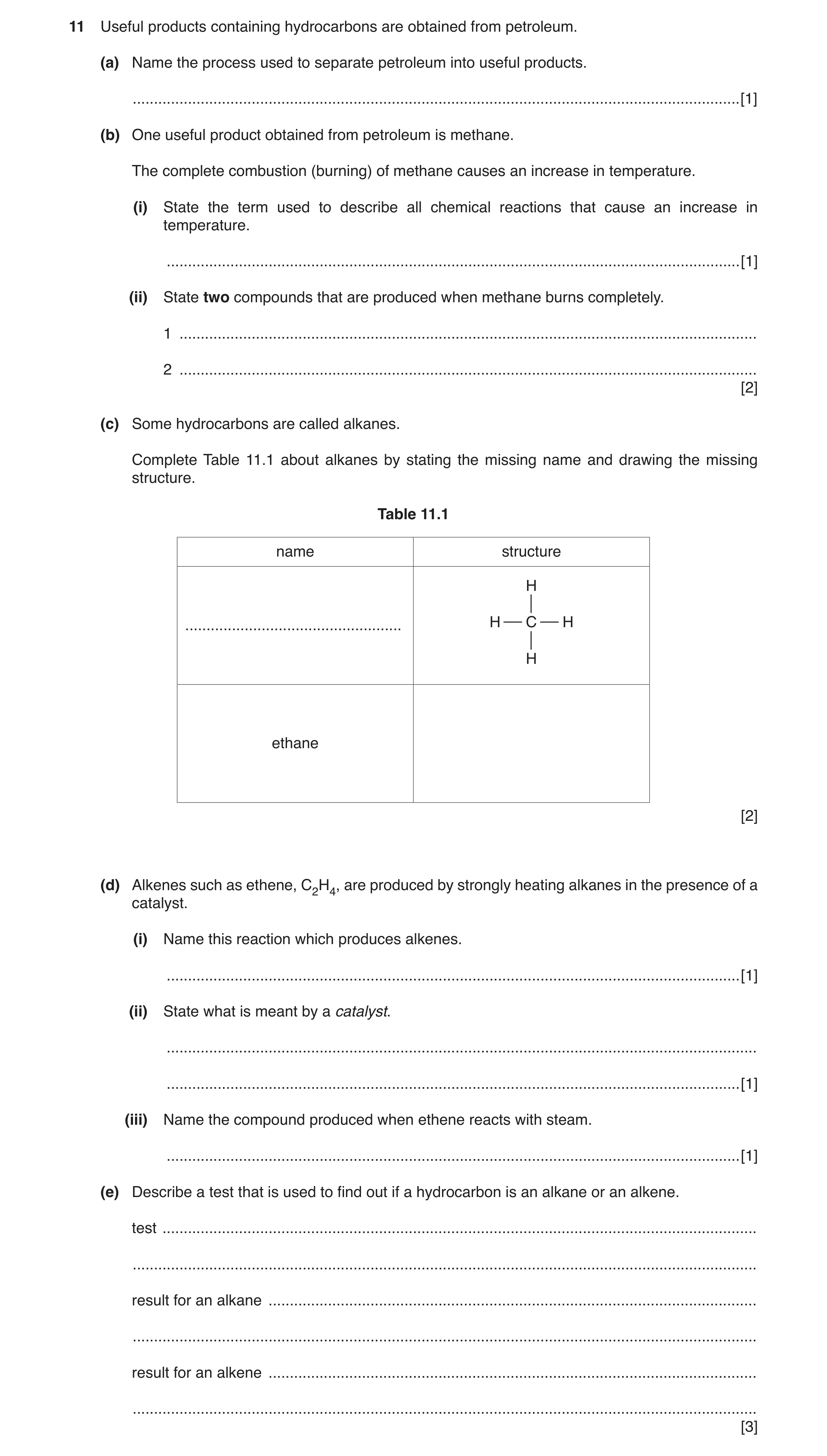
11 Useful products containing hydrocarbons are obtained from petroleum. (a) Name the process used to separate petroleum into useful products. … [1] (b) One useful product obtained from petroleum is methane. The complete combustion (burning) of methane causes an increase in temperature. (i) State the term used to describe all chemical reactions that cause an increase in temperature. … [1] (ii) State two compounds that are produced when methane burns completely. 1 … 2 … [2] (c) Some hydrocarbons are called alkanes. Complete Table 11.1 about alkanes by stating the missing name and drawing the missing structure. Table 11.1 name structure H … H C H H ethane [2] (d) Alkenes such as ethene, C2H4, are produced by strongly heating alkanes in the presence of a catalyst. (i) Name this reaction which produces alkenes. … [1] (ii) State what is meant by a catalyst. … … [1] (iii) Name the compound produced when ethene reacts with steam. … [1] (e) Describe a test that is used to find out if a hydrocarbon is an alkane or an alkene. test … … result for an alkane … … result for an alkene … … [3]
12 marks
Mark scheme: 11(a) fractional distillation ; 1 11(b)(i) exothermic ; 1 11(b)(ii) carbon dioxide ; water ; 2 11(c) methane ; ; 2 11(d)(i) (catalytic / thermal) cracking ; 1 11(d)(ii) speeds up a reaction ; 1 11(d)(iii) ethanol ; 1 11(e) (react with / shake with ) bromine (solution) ; (with alkane) no change / no reaction / mixture remains orange ; (with alkene) orange to colourless ; 3
This question in 0654/31 Oct/Nov 2018
Q4 · Information about some of the elements in Group VII of the Periodic Table 0654/33 Oct/Nov 2018
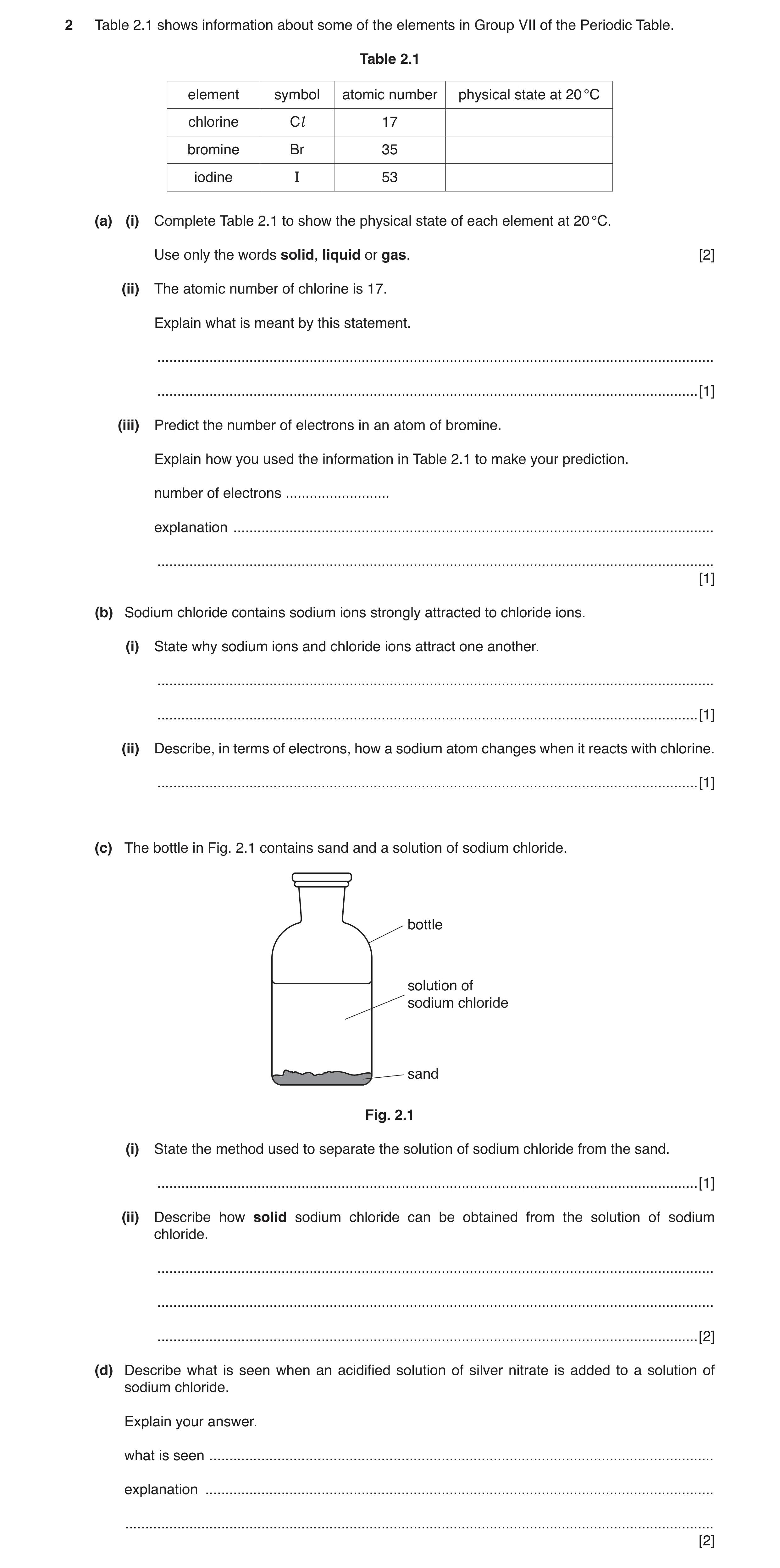
2 Table 2.1 shows information about some of the elements in Group VII of the Periodic Table. Table 2.1 element symbol atomic number physical state at 20 °C chlorine Cl 17 bromine Br 35 iodine I 53 (a) (i) Complete Table 2.1 to show the physical state of each element at 20 °C. Use only the words solid, liquid or gas. [2] (ii) The atomic number of chlorine is 17. Explain what is meant by this statement. … … [1] (iii) Predict the number of electrons in an atom of bromine. Explain how you used the information in Table 2.1 to make your prediction. number of electrons … explanation … … [1] (b) Sodium chloride contains sodium ions strongly attracted to chloride ions. (i) State why sodium ions and chloride ions attract one another. … … [1] (ii) Describe, in terms of electrons, how a sodium atom changes when it reacts with chlorine. … [1] (c) The bottle in Fig. 2.1 contains sand and a solution of sodium chloride. bottle solution of sodium chloride sand Fig. 2.1 (i) State the method used to separate the solution of sodium chloride from the sand. … [1] (ii) Describe how solid sodium chloride can be obtained from the solution of sodium chloride. … … … [2] (d) Describe what is seen when an acidified solution of silver nitrate is added to a solution of sodium chloride. Explain your answer. what is seen … explanation … … [2]
11 marks
Mark scheme: 2(a)(i) gas liquid solid 1 or 2 correct ; 3 correct ; 2 2(a)(ii) chlorine atoms contain 17 protons ; 1 2(a)(iii) (35) number of electrons equal to number of protons / atomic number ; 1 2(b)(i) they have opposite electrical charges / opposite charges attract ; 1 2(b)(ii) outer electron is lost (from sodium) / it is transferred to the chlorine atom ; 1 2(c)(i) filtration / decantation ; 1 2(c)(ii) heat (solution) ; so all water evaporates / leave to evaporate ; 2 2(d) white precipitate / goes cloudy ; solution contains chloride (anions) / this is the chloride ion test / silver chloride is insoluble ; 2
This question in 0654/33 Oct/Nov 2018
Q5 · A beaker containing sand and aqueous sodium chloride 0654/32 May/June 2019
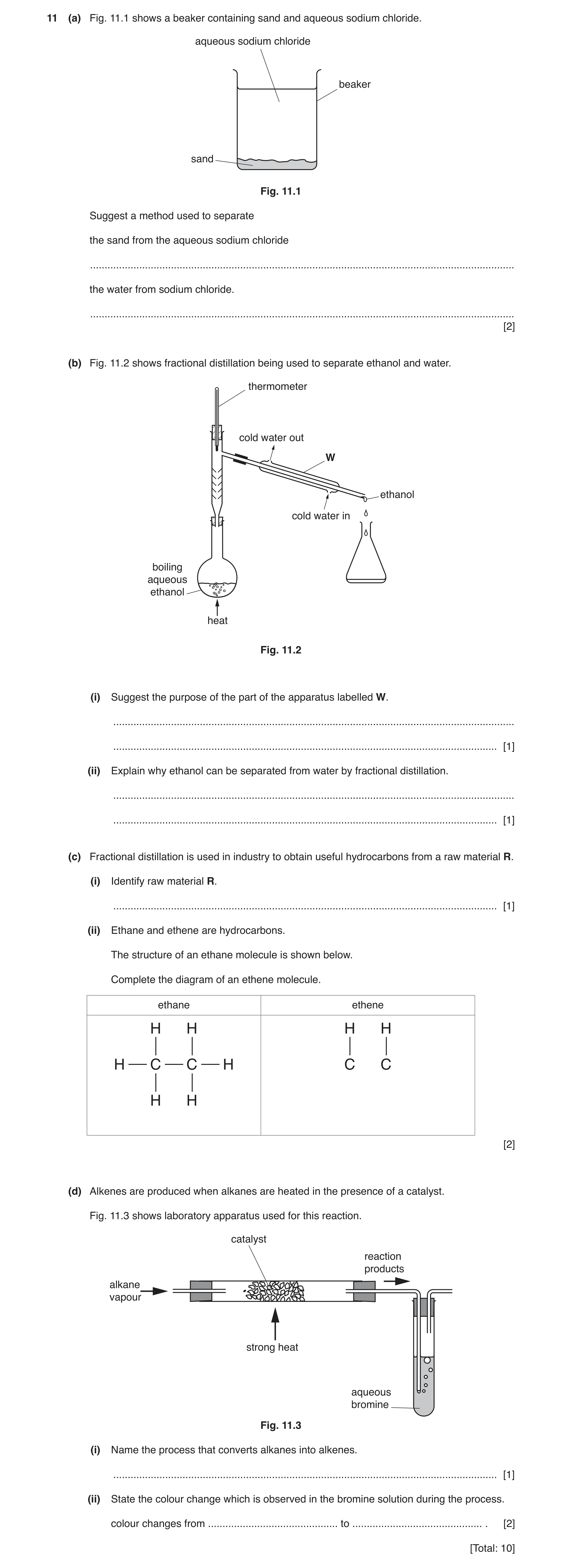
11 (a) Fig. 11.1 shows a beaker containing sand and aqueous sodium chloride. aqueous sodium chloride beaker sand Fig. 11.1 Suggest a method used to separate the sand from the aqueous sodium chloride … the water from sodium chloride. … [2] (b) Fig. 11.2 shows fractional distillation being used to separate ethanol and water. thermometer cold water out W ethanol cold water in boiling aqueous ethanol heat Fig. 11.2 (i) Suggest the purpose of the part of the apparatus labelled W. … … [1] (ii) Explain why ethanol can be separated from water by fractional distillation. … … [1] (c) Fractional distillation is used in industry to obtain useful hydrocarbons from a raw material R. (i) Identify raw material R. … [1] (ii) Ethane and ethene are hydrocarbons. The structure of an ethane molecule is shown below. Complete the diagram of an ethene molecule. ethane ethene H H H H H C C H C C H H [2] (d) Alkenes are produced when alkanes are heated in the presence of a catalyst. Fig. 11.3 shows laboratory apparatus used for this reaction. catalyst reaction products alkane vapour strong heat aqueous bromine Fig. 11.3 (i) Name the process that converts alkanes into alkenes. … [1] (ii) State the colour change which is observed in the bromine solution during the process. colour changes from … to … . [2] [Total: 10]
10 marks
Mark scheme: 11(a) filtration / decantation ; crystallisation / (heat to) evaporate the water ; 2 11(b)(i) condense ethanol vapour ; 1 11(b)(ii) liquids have different boiling points ; 1 11(c)(i) petroleum / crude oil ; 1 11(c)(ii) 1 for double bond between carbons ; 1 for four single C-H bonds ; 2 11(d)(i) (catalytic / thermal) cracking ; 1 11(d)(ii) from orange ; to colourless ; 2
This question in 0654/32 May/June 2019
Q6 · A beaker containing sand and aqueous sodium chloride 0654/33 May/June 2019
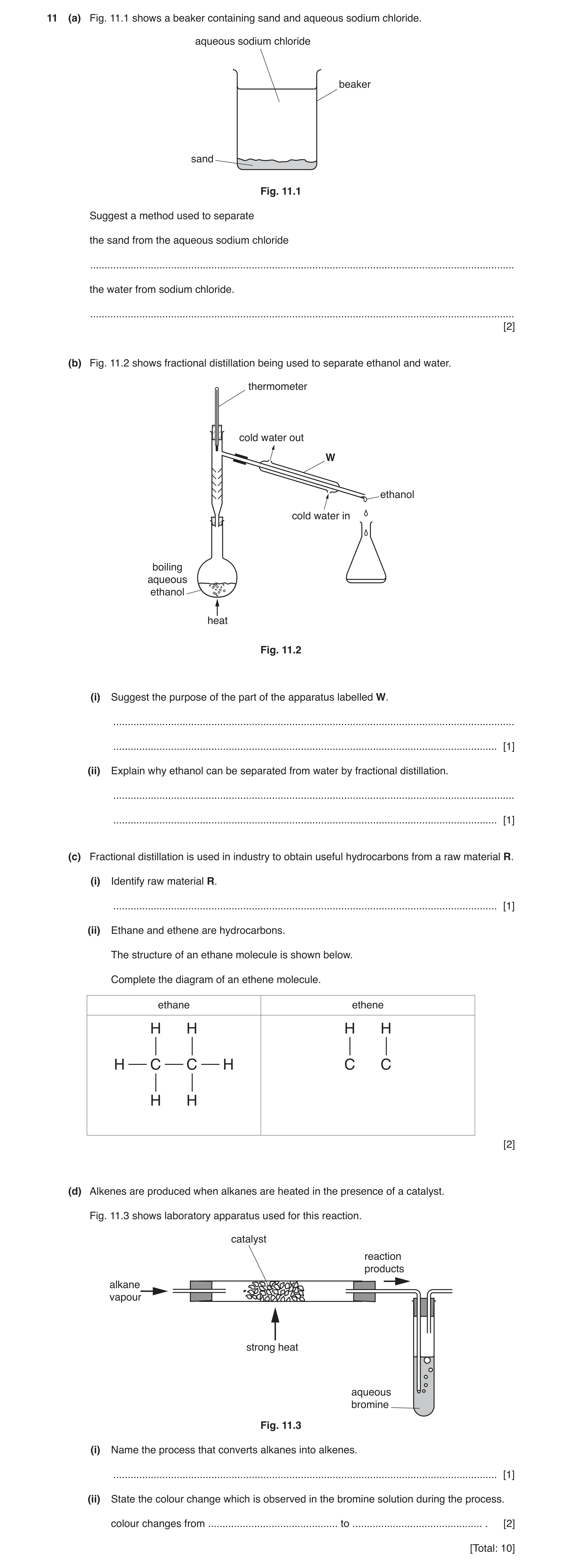
11 (a) Fig. 11.1 shows a beaker containing sand and aqueous sodium chloride. aqueous sodium chloride beaker sand Fig. 11.1 Suggest a method used to separate the sand from the aqueous sodium chloride … the water from sodium chloride. … [2] (b) Fig. 11.2 shows fractional distillation being used to separate ethanol and water. thermometer cold water out W ethanol cold water in boiling aqueous ethanol heat Fig. 11.2 (i) Suggest the purpose of the part of the apparatus labelled W. … … [1] (ii) Explain why ethanol can be separated from water by fractional distillation. … … [1] (c) Fractional distillation is used in industry to obtain useful hydrocarbons from a raw material R. (i) Identify raw material R. … [1] (ii) Ethane and ethene are hydrocarbons. The structure of an ethane molecule is shown below. Complete the diagram of an ethene molecule. ethane ethene H H H H H C C H C C H H [2] (d) Alkenes are produced when alkanes are heated in the presence of a catalyst. Fig. 11.3 shows laboratory apparatus used for this reaction. catalyst reaction products alkane vapour strong heat aqueous bromine Fig. 11.3 (i) Name the process that converts alkanes into alkenes. … [1] (ii) State the colour change which is observed in the bromine solution during the process. colour changes from … to … . [2] [Total: 10]
10 marks
Mark scheme: 11(a) filtration / decantation ; crystallisation / (heat to) evaporate the water ; 2 11(b)(i) condense ethanol vapour ; 1 11(b)(ii) liquids have different boiling points ; 1 11(c)(i) petroleum / crude oil ; 1 11(c)(ii) 1 for double bond between carbons ; 1 for four single C-H bonds ; 2 11(d)(i) (catalytic / thermal) cracking ; 1 11(d)(ii) from orange ; to colourless ; 2
This question in 0654/33 May/June 2019
Q7 · Useful hydrocarbons are obtained from petroleum 0654/32 Oct/Nov 2019
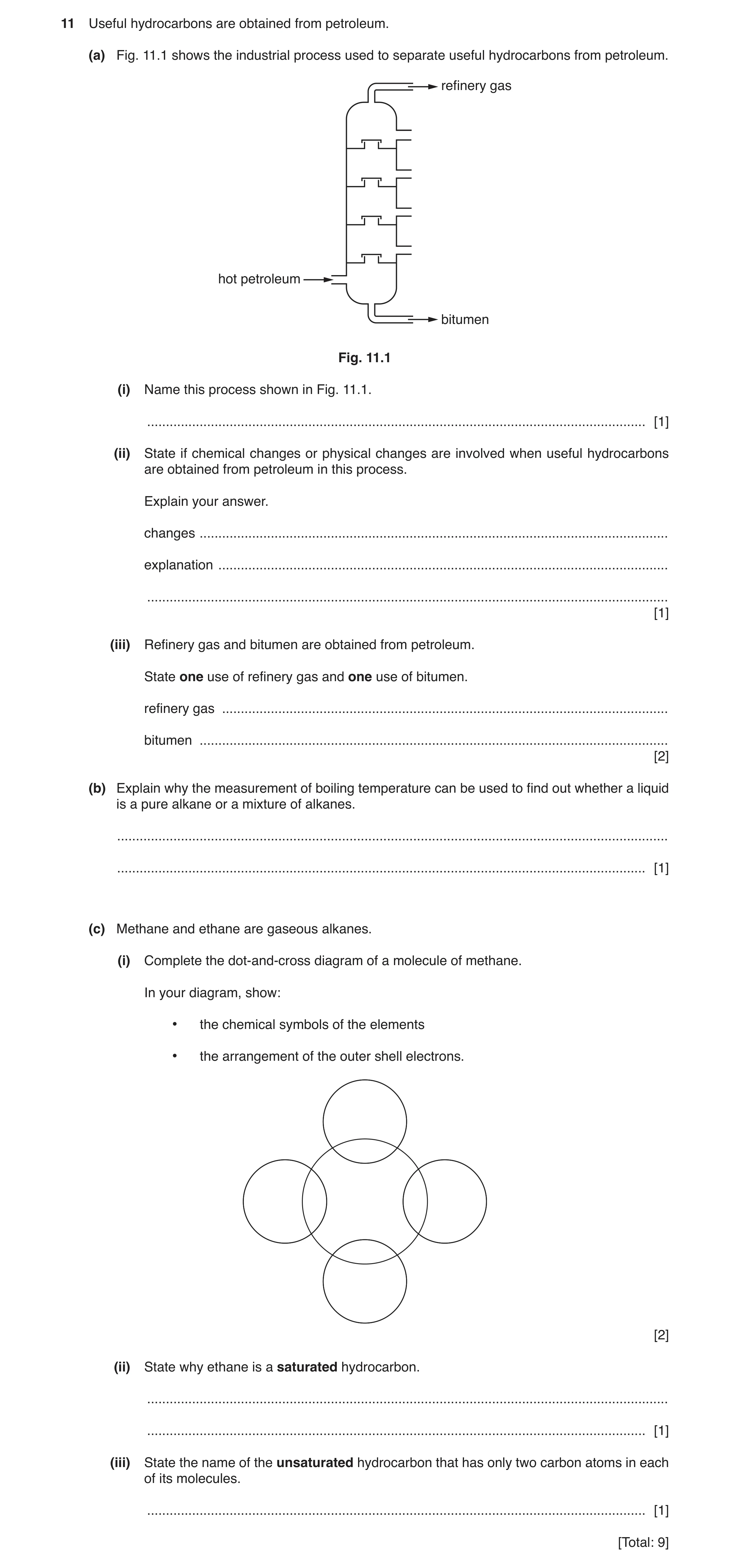
11 Useful hydrocarbons are obtained from petroleum. (a) Fig. 11.1 shows the industrial process used to separate useful hydrocarbons from petroleum. refinery gas hot petroleum bitumen Fig. 11.1 (i) Name this process shown in Fig. 11.1. … [1] (ii) State if chemical changes or physical changes are involved when useful hydrocarbons are obtained from petroleum in this process. Explain your answer. changes … explanation … … [1] (iii) Refinery gas and bitumen are obtained from petroleum. State one use of refinery gas and one use of bitumen. refinery gas … bitumen … [2] (b) Explain why the measurement of boiling temperature can be used to find out whether a liquid is a pure alkane or a mixture of alkanes. … … [1] (c) Methane and ethane are gaseous alkanes. (i) Complete the dot-and-cross diagram of a molecule of methane. In your diagram, show: • the chemical symbols of the elements • the arrangement of the outer shell electrons. [2] (ii) State why ethane is a saturated hydrocarbon. … … [1] (iii) State the name of the unsaturated hydrocarbon that has only two carbon atoms in each of its molecules. … [1] [Total: 9]
9 marks
Mark scheme: 11(a)(i) fractional distillation ; 1 11(a)(ii) (physical) no new substances produced / only changes of state involved ; 1 11(a)(iii) refinery gas heating / cooking / other correct ; bitumen surfacing roads / water-proofing / other correct ; 2 11(b) the idea that single substances (hexane) have a single boiling point but mixtures (gasoline) boil over a temperature range ; 1 11(c)(i) 1 mark symbols correct ; 1 mark bonding pairs correct ; 2 11(c)(ii) only single bonds ; 1 11(c)(iii) ethene ; 1
This question in 0654/32 Oct/Nov 2019
Q8 · Water is a compound of the elements hydrogen and oxygen 0654/32 May/June 2020
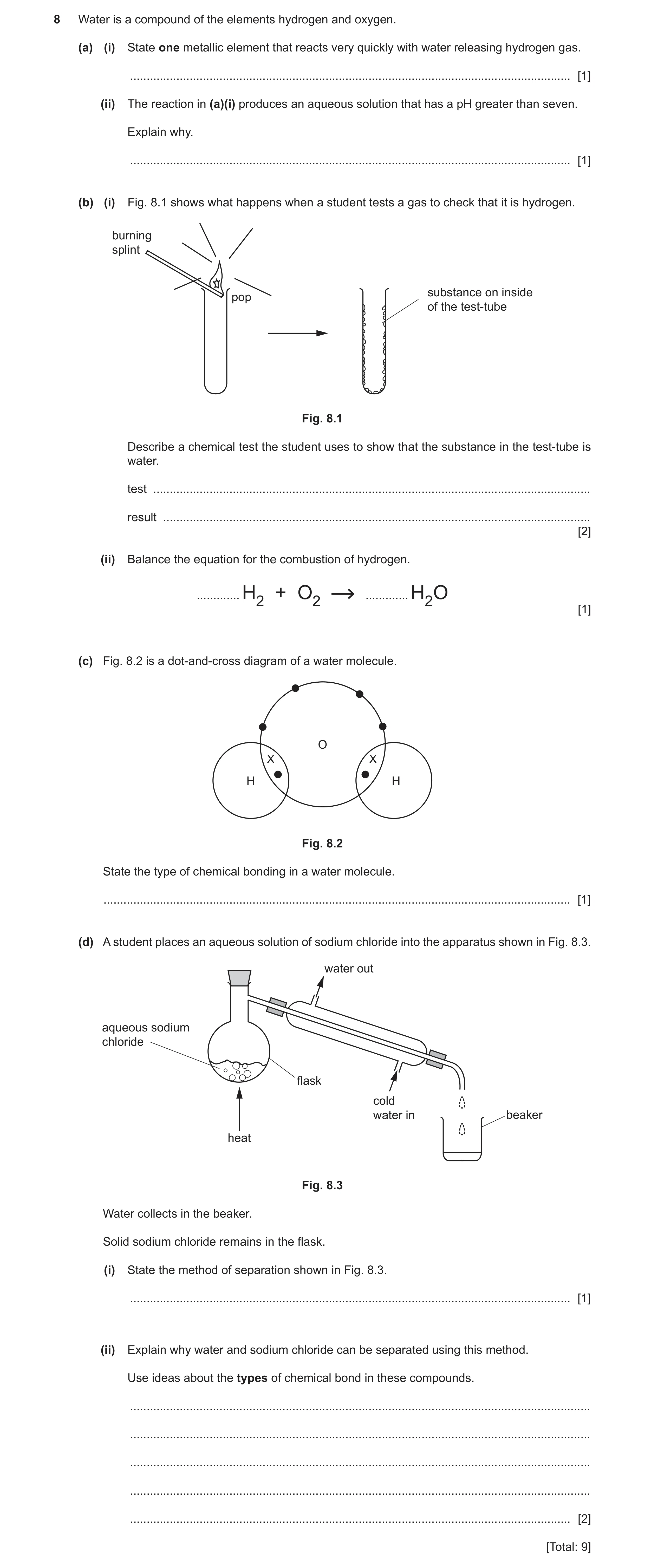
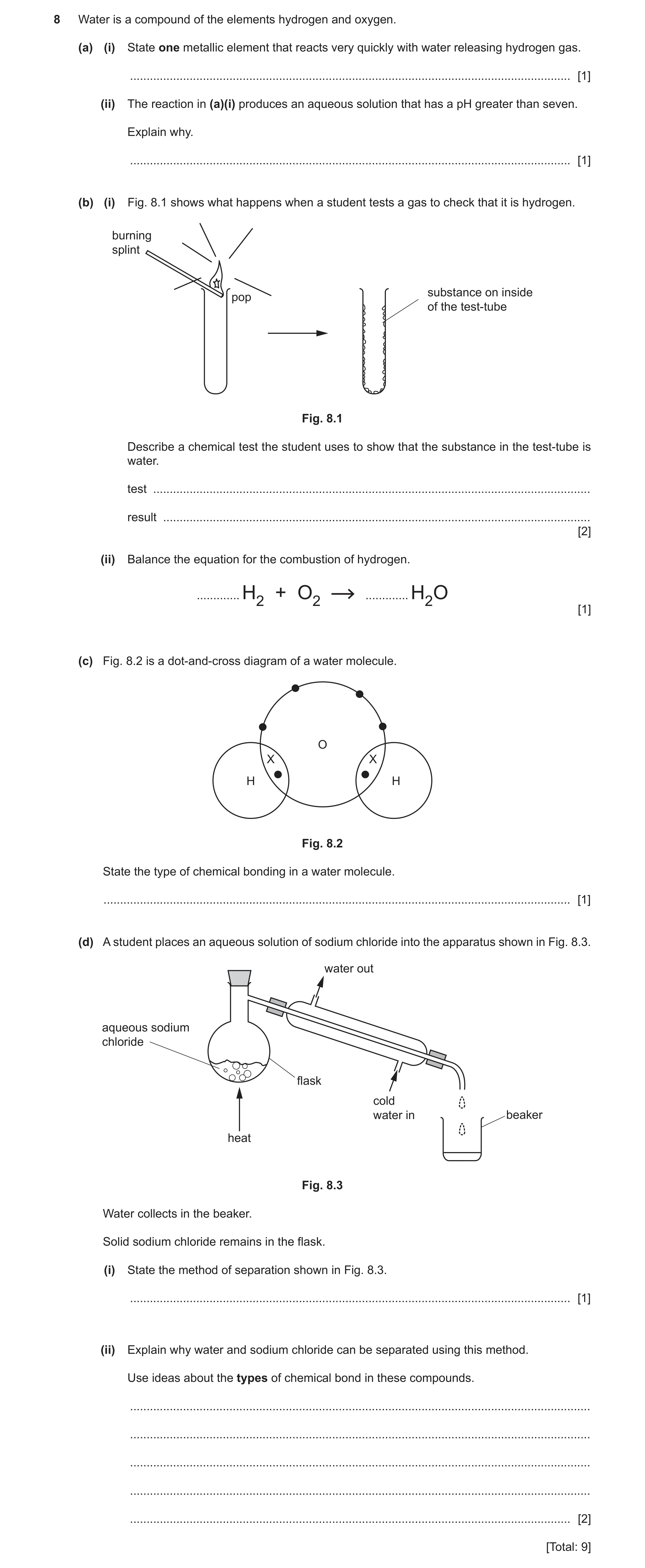
8 Water is a compound of the elements hydrogen and oxygen. (a) (i) State one metallic element that reacts very quickly with water releasing hydrogen gas. … [1] (ii) The reaction in (a)(i) produces an aqueous solution that has a pH greater than seven. Explain why. … [1] (b) (i) Fig. 8.1 shows what happens when a student tests a gas to check that it is hydrogen. burning splint substance on inside pop of the test-tube Fig. 8.1 Describe a chemical test the student uses to show that the substance in the test-tube is water. test … result … [2] (ii) Balance the equation for the combustion of hydrogen. … … H2 + O2 H2O [1] (c) Fig. 8.2 is a dot-and-cross diagram of a water molecule. O X X H H Fig. 8.2 State the type of chemical bonding in a water molecule. … [1] (d) A student places an aqueous solution of sodium chloride into the apparatus shown in Fig. 8.3. water out aqueous sodium chloride flask cold water in beaker heat Fig. 8.3 Water collects in the beaker. Solid sodium chloride remains in the flask. (i) State the method of separation shown in Fig. 8.3. … [1] (ii) Explain why water and sodium chloride can be separated using this method. Use ideas about the types of chemical bond in these compounds. … … … … … [2] [Total: 9]
9 marks
Mark scheme: 8(a)(i) any Group 1 element / other correct (e.g. calcium); 1 8(a)(ii) solution is alkaline / reaction produces (soluble) base / hydroxide of element in (i) ; 1 8(b)(i) cobalt chloride ; blue to pink ; OR anhydrous copper(II) sulfate ; white to blue ; 2 8(b)(ii) 2H2 + O2 → 2 H2O ; 1 8(c) covalent ; 1 8(d)(i) (simple) distillation ; 1 8(d)(ii) the idea that water boils and sodium chloride does not / water is more volatile than sodium chloride ; because covalent compounds tend to have low bpts / ionic compounds high bpts; 2
This question in 0654/32 May/June 2020
Q9 · Water is a compound of the elements hydrogen and oxygen 0654/33 May/June 2020
8 Water is a compound of the elements hydrogen and oxygen. (a) (i) State one metallic element that reacts very quickly with water releasing hydrogen gas. … [1] (ii) The reaction in (a)(i) produces an aqueous solution that has a pH greater than seven. Explain why. … [1] (b) (i) Fig. 8.1 shows what happens when a student tests a gas to check that it is hydrogen. burning splint substance on inside pop of the test-tube Fig. 8.1 Describe a chemical test the student uses to show that the substance in the test-tube is water. test … result … [2] (ii) Balance the equation for the combustion of hydrogen. … … H2 + O2 H2O [1] (c) Fig. 8.2 is a dot-and-cross diagram of a water molecule. O X X H H Fig. 8.2 State the type of chemical bonding in a water molecule. … [1] (d) A student places an aqueous solution of sodium chloride into the apparatus shown in Fig. 8.3. water out aqueous sodium chloride flask cold water in beaker heat Fig. 8.3 Water collects in the beaker. Solid sodium chloride remains in the flask. (i) State the method of separation shown in Fig. 8.3. … [1] (ii) Explain why water and sodium chloride can be separated using this method. Use ideas about the types of chemical bond in these compounds. … … … … … [2] [Total: 9]
9 marks
Mark scheme: 8(a)(i) any Group 1 element / other correct (e.g. calcium); 1 8(a)(ii) solution is alkaline / reaction produces (soluble) base / hydroxide of element in (i) ; 1 8(b)(i) cobalt chloride ; blue to pink ; OR anhydrous copper(II) sulfate ; white to blue ; 2 8(b)(ii) 2H2 + O2 → 2 H2O ; 1 8(c) covalent ; 1 8(d)(i) (simple) distillation ; 1 8(d)(ii) the idea that water boils and sodium chloride does not / water is more volatile than sodium chloride ; because covalent compounds tend to have low bpts / ionic compounds high bpts; 2
This question in 0654/33 May/June 2020
Q10 · Hydrogen burning in air 0654/32 Oct/Nov 2020
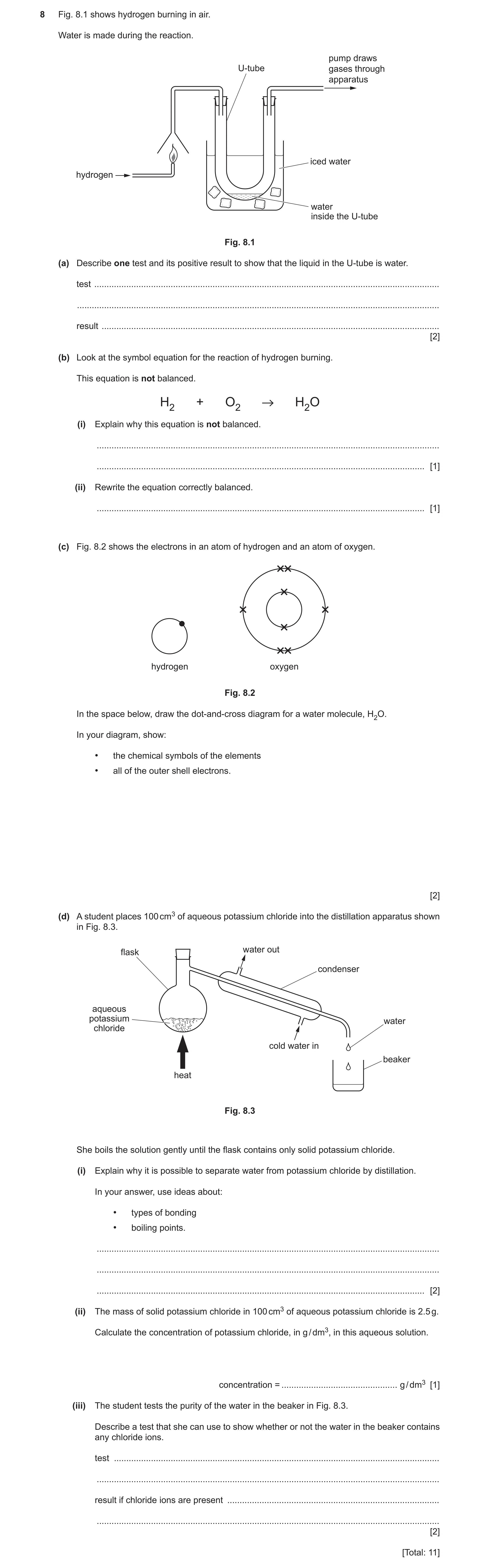
8 Fig. 8.1 shows hydrogen burning in air. Water is made during the reaction. pump draws U-tube gases through apparatus iced water hydrogen water inside the U-tube Fig. 8.1 (a) Describe one test and its positive result to show that the liquid in the U-tube is water. test … … result … [2] (b) Look at the symbol equation for the reaction of hydrogen burning. This equation is not balanced. H2 + O2 H2O (i) Explain why this equation is not balanced. … … [1] (ii) Rewrite the equation correctly balanced. … [1] (c) Fig. 8.2 shows the electrons in an atom of hydrogen and an atom of oxygen. hydrogen oxygen Fig. 8.2 In the space below, draw the dot-and-cross diagram for a water molecule, H2O. In your diagram, show: • the chemical symbols of the elements • all of the outer shell electrons. [2] (d) A student places 100 cm3 of aqueous potassium chloride into the distillation apparatus shown in Fig. 8.3. water out flask condenser aqueous potassium water chloride cold water in beaker heat Fig. 8.3 She boils the solution gently until the flask contains only solid potassium chloride. (i) Explain why it is possible to separate water from potassium chloride by distillation. In your answer, use ideas about: • types of bonding • boiling points. … … … [2] (ii) The mass of solid potassium chloride in 100 cm3 of aqueous potassium chloride is 2.5 g. Calculate the concentration of potassium chloride, in g / dm3, in this aqueous solution. concentration = … g / dm3 [1] (iii) The student tests the purity of the water in the beaker in Fig. 8.3. Describe a test that she can use to show whether or not the water in the beaker contains any chloride ions. test … … result if chloride ions are present … … [2] [Total: 11]
11 marks
Mark scheme: 8(a) cobalt chloride ; (blue to) pink ; OR anhydrous copper(II) sulfate ; (white to) blue ; 8(b)(i) different numbers of oxygen atoms on LHS and RHS / the numbers of each type of atom is not the same on both sides ; 1 8(b)(ii) 2 H2 + O2 → 2 H2O ; 1 8(c) symbols correct ; dot-and -cross diagram correct; 2 8(d)(i) the idea that water boils and potassium chloride does not / water is more volatile than potassium chloride ; because water is covalent / molecular and potassium chloride is ionic ; 2 8(d)(ii) 100 cm3 contains 2.5 g KCl so concentration is 25 (g / dm3 ) ; 1 8(d)(iii) addition of (acidified aqueous) silver nitrate ; white precipitate ; 2
This question in 0654/32 Oct/Nov 2020
Q11 · The melting points and reactivity with water of three Group I metals 0654/32 Oct/Nov 2021
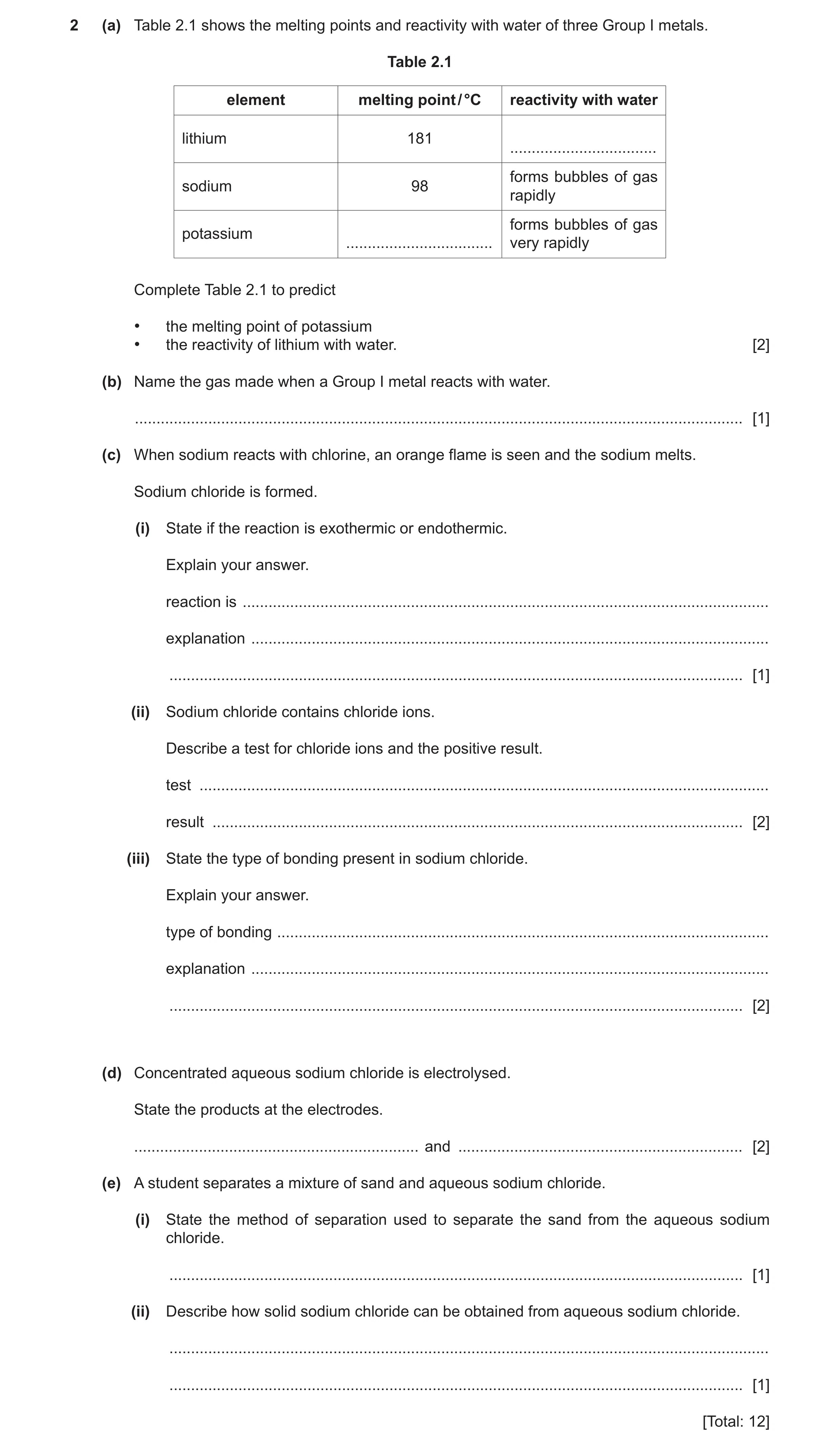
2 (a) Table 2.1 shows the melting points and reactivity with water of three Group I metals. Table 2.1 element melting point / °C reactivity with water lithium 181 … forms bubbles of gas sodium 98 rapidly forms bubbles of gas potassium … very rapidly Complete Table 2.1 to predict • the melting point of potassium • the reactivity of lithium with water. [2] (b) Name the gas made when a Group I metal reacts with water. … [1] (c) When sodium reacts with chlorine, an orange flame is seen and the sodium melts. Sodium chloride is formed. (i) State if the reaction is exothermic or endothermic. Explain your answer. reaction is … explanation … … [1] (ii) Sodium chloride contains chloride ions. Describe a test for chloride ions and the positive result. test … result … [2] (iii) State the type of bonding present in sodium chloride. Explain your answer. type of bonding … explanation … … [2] (d) Concentrated aqueous sodium chloride is electrolysed. State the products at the electrodes. … and … [2] (e) A student separates a mixture of sand and aqueous sodium chloride. (i) State the method of separation used to separate the sand from the aqueous sodium chloride. … [1] (ii) Describe how solid sodium chloride can be obtained from aqueous sodium chloride. … … [1] [Total: 12]
12 marks
Mark scheme: 2(a) below 90 °C ; reacts / forms bubbles of gas slowly / moderately ; 2 2(b) hydrogen ; 1 2(c)(i) exothermic because (thermal) energy released (to melt sodium) ; 1 2(c)(ii) aqueous silver nitrate ; white precipitate ; 2 Question Answer Marks 2(c)(iii) ionic ; bonding between a metal and a non-metal / electron transfer ; 2 2(d) hydrogen ; chlorine ; 2 2(e)(i) filtration ; 1 2(e)(ii) evaporation / crystallisation ; 1
This question in 0654/32 Oct/Nov 2021
Q12 · The formula of sulfuric acid is H2SO4 0654/33 Oct/Nov 2021
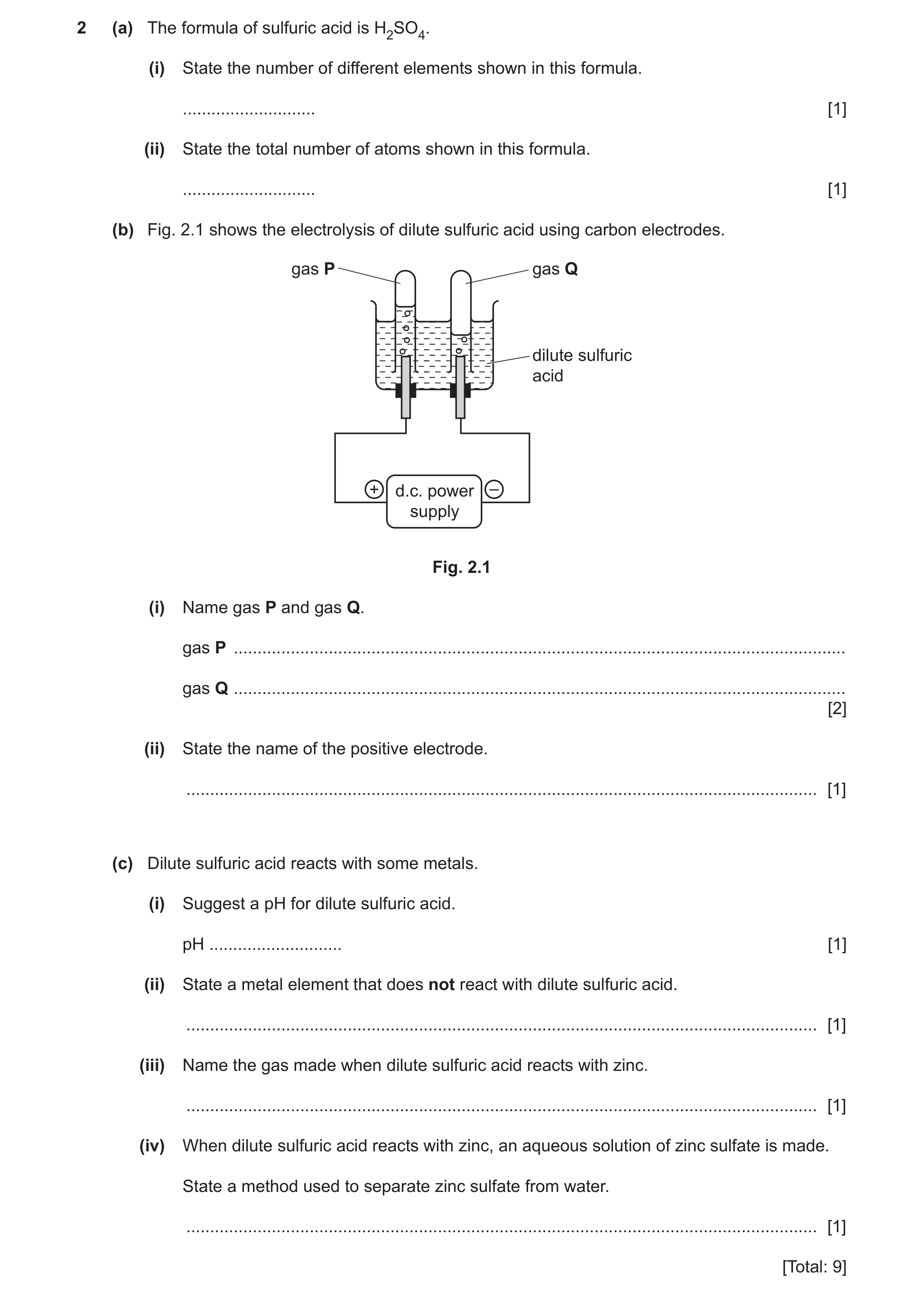
2 (a) The formula of sulfuric acid is H2SO4. (i) State the number of different elements shown in this formula. … [1] (ii) State the total number of atoms shown in this formula. … [1] (b) Fig. 2.1 shows the electrolysis of dilute sulfuric acid using carbon electrodes. gas P gas Q dilute sulfuric acid + d.c. power – supply Fig. 2.1 (i) Name gas P and gas Q. gas P … gas Q … [2] (ii) State the name of the positive electrode. … [1] (c) Dilute sulfuric acid reacts with some metals. (i) Suggest a pH for dilute sulfuric acid. pH … [1] (ii) State a metal element that does not react with dilute sulfuric acid. … [1] (iii) Name the gas made when dilute sulfuric acid reacts with zinc. … [1] (iv) When dilute sulfuric acid reacts with zinc, an aqueous solution of zinc sulfate is made. State a method used to separate zinc sulfate from water. … [1] [Total: 9]
9 marks
Mark scheme: 2(a)(i) 3 ; 1 2(a)(ii) 7 ; 1 2(b)(i) P – oxygen ; Q – hydrogen ; 2 2(b)(ii) anode ; 1 2(c)(i) any number less than 7 ; 1 2(c)(ii) copper ; 1 2(c)(iii) hydrogen ; 1 2(c)(iv) evaporation / crystallisation ; 1
This question in 0654/33 Oct/Nov 2021
Q13 · There are different methods of separating mixtures 0654/33 Oct/Nov 2023
2 (a) (i) There are different methods of separating mixtures. Fig. 2.1 shows that distillation is used to separate water from aqueous potassium chloride. Complete Fig. 2.1 to show how the other three substances are separated from the mixtures. method of substance mixture separation aqueous copper chromatography bitumen sulfate aqueous potassium crystallisation blue dye chloride distillation copper sulfate black ink fractional water petroleum distillation Fig. 2.1 [3] (ii) Name the solvent in aqueous copper sulfate. … [1] (iii) State one use for bitumen. … [1] (b) The treatment of a water supply uses filtration and chlorination. Give a reason for using filtration and chlorination. filtration … … chlorination … … [2] (c) Electrolysis is a process which uses electricity to break down a compound. For example, when molten lead bromide is electrolysed, lead and bromine are made. Complete the sentences about the electrolysis of lead bromide using words from the list. Each word may be used once, more than once or not at all. bromine cell electrolyte electrons hydrogen ions lead molecules negative positive Molten lead bromide is called the … because it contains … which are free to move. The … electrode is called the cathode and the … electrode is called the anode. … forms at the anode and … forms at the cathode. [4] [Total: 11]
11 marks
Mark scheme: 2(a)(i) 3 method of separation substance mixture aqueous copper chromatography bitumen sulfate aqueous potassium crystallisation blue dye chloride distillation copper sulfate black ink fractional water petroleum distillation one pair of links correct ; two pairs of links correct ; three pairs of links correct ; 2(a)(ii) water ; 1 2(a)(iii) road surfaces ; 1 2(b) filtration – removes solid particles ; 2 chlorination – kills microbes / sterilises water ; 2(c) electrolyte ; 4 ions ; negative and positive (in that order) ; bromine and lead (in that order) ;
This question in 0654/33 Oct/Nov 2023
Q14 · A list of formulae is shown 0654/31 Oct/Nov 2024
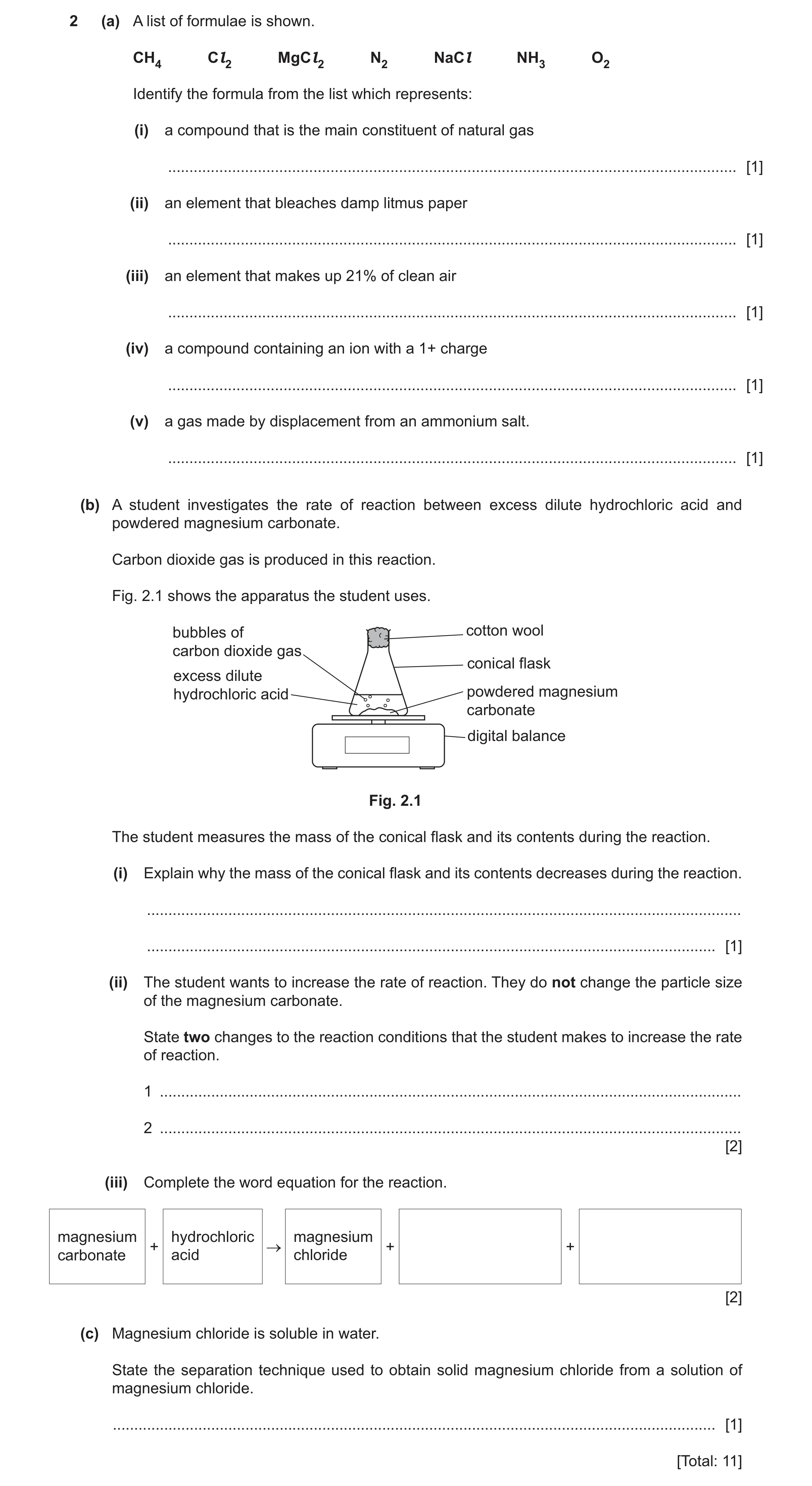
2 (a) A list of formulae is shown. CH4 Cl 2 MgCl 2 N2 NaCl NH3 O2 Identify the formula from the list which represents: (i) a compound that is the main constituent of natural gas … [1] (ii) an element that bleaches damp litmus paper … [1] (iii) an element that makes up 21% of clean air … [1] (iv) a compound containing an ion with a 1+ charge … [1] (v) a gas made by displacement from an ammonium salt. … [1] (b) A student investigates the rate of reaction between excess dilute hydrochloric acid and powdered magnesium carbonate. Carbon dioxide gas is produced in this reaction. Fig. 2.1 shows the apparatus the student uses. bubbles of cotton wool carbon dioxide gas conical flask excess dilute hydrochloric acid powdered magnesium carbonate digital balance Fig. 2.1 The student measures the mass of the conical flask and its contents during the reaction. (i) Explain why the mass of the conical flask and its contents decreases during the reaction. … … [1] (ii) The student wants to increase the rate of reaction. They do not change the particle size of the magnesium carbonate. State two changes to the reaction conditions that the student makes to increase the rate of reaction. 1 … 2 … [2] (iii) Complete the word equation for the reaction. magnesium hydrochloric magnesium + + + carbonate acid chloride [2] (c) Magnesium chloride is soluble in water. State the separation technique used to obtain solid magnesium chloride from a solution of magnesium chloride. … [1] [Total: 11]
11 marks
Mark scheme: 2(a)(i) CH4 ; 1 2(a)(ii) Cl2 ; 1 2(a)(iii) O2 ; 1 2(a)(iv) NaCl ; 1 2(a)(v) NH3 ; 1 2(b)(i) carbon dioxide is lost ; 1 2(b)(ii) increase temperature (of acid) ; 2 increase concentration (of acid) ; 2(b)(iii) carbon dioxide ; 2 water ; 2(c) crystallisation ; 1
This question in 0654/31 Oct/Nov 2024
Q15 · Choose from the following substances to answer the questions 0654/33 Oct/Nov 2024
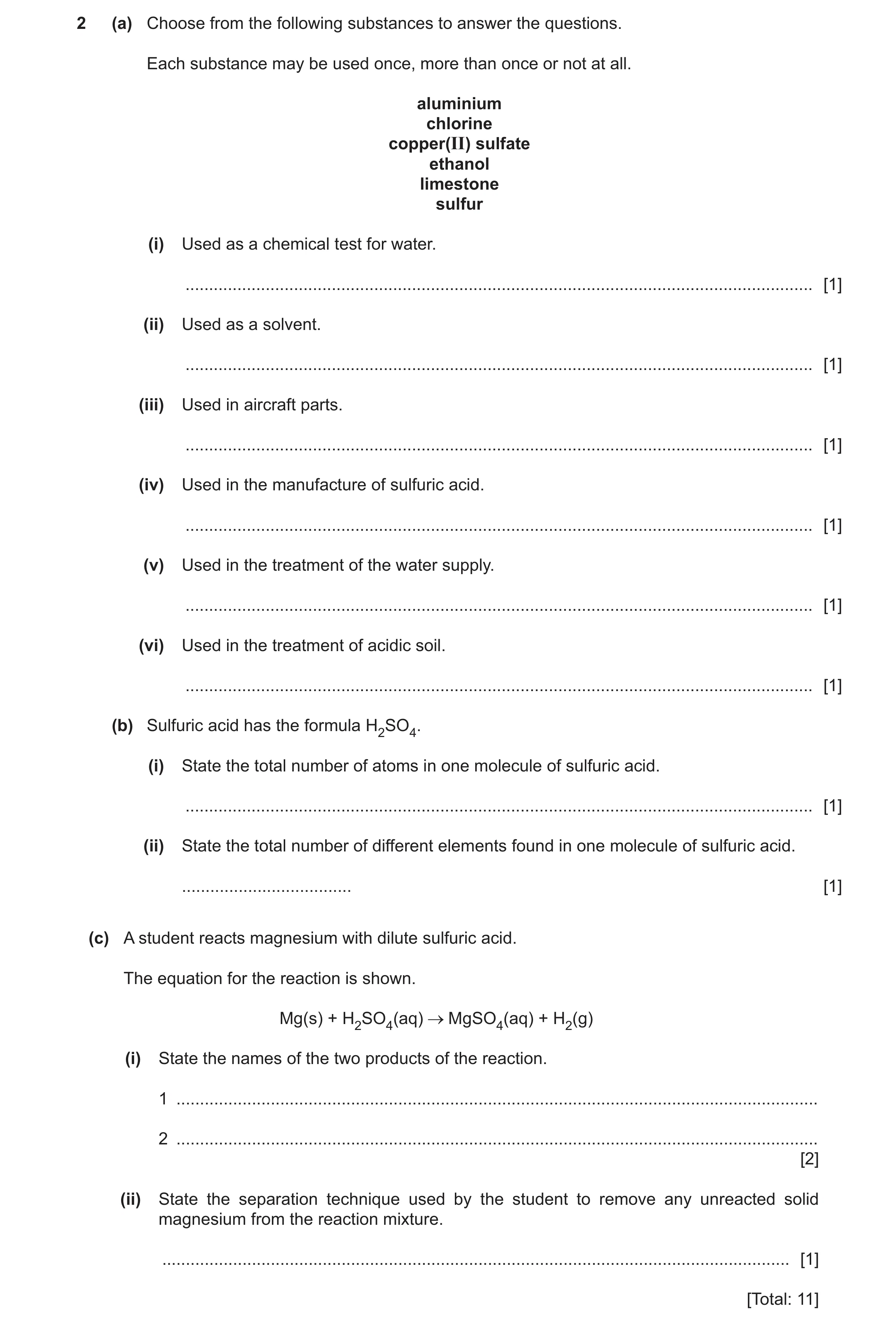
2 (a) Choose from the following substances to answer the questions. Each substance may be used once, more than once or not at all. aluminium chlorine copper(II) sulfate ethanol limestone sulfur (i) Used as a chemical test for water. … [1] (ii) Used as a solvent. … [1] (iii) Used in aircraft parts. … [1] (iv) Used in the manufacture of sulfuric acid. … [1] (v) Used in the treatment of the water supply. … [1] (vi) Used in the treatment of acidic soil. … [1] (b) Sulfuric acid has the formula H2SO4. (i) State the total number of atoms in one molecule of sulfuric acid. … [1] (ii) State the total number of different elements found in one molecule of sulfuric acid. … [1] (c) A student reacts magnesium with dilute sulfuric acid. The equation for the reaction is shown. Mg(s) + H2SO4(aq) MgSO4(aq) + H2(g) (i) State the names of the two products of the reaction. 1 … 2 … [2] (ii) State the separation technique used by the student to remove any unreacted solid magnesium from the reaction mixture. … [1] [Total: 11]
11 marks
Mark scheme: 2(a)(i) copper sulfate ; 1 2(a)(ii) ethanol ; 1 2(a)(iii) aluminium ; 1 2(a)(iv) sulfur ; 1 2(a)(v) chlorine ; 1 2(a)(vi) limestone ; 1 2(b)(i) 7 ; 1 2(b)(ii) 3 ; 1 2(c)(i) magnesium sulfate ; 2 hydrogen ; 2(c)(ii) filtration ; 1
This question in 0654/33 Oct/Nov 2024
 22 / 26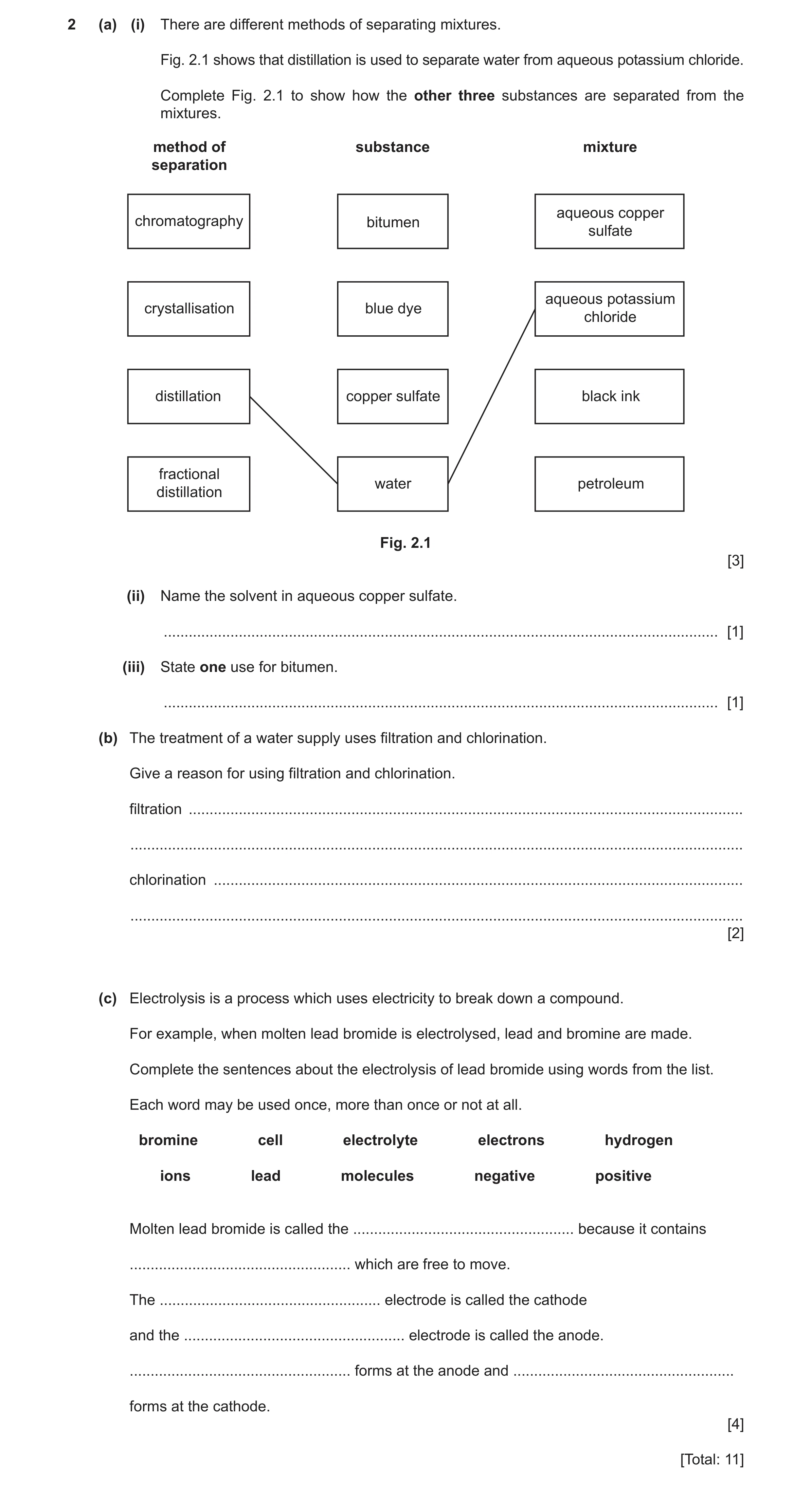
 11
11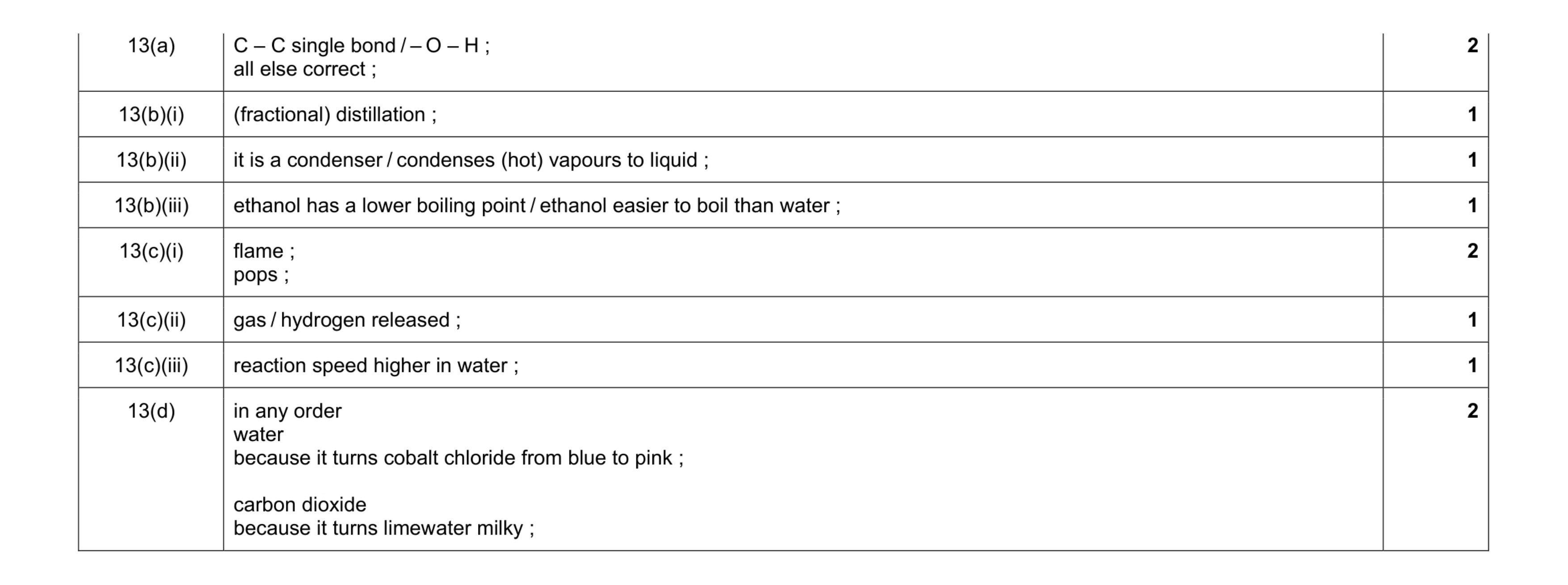 11
11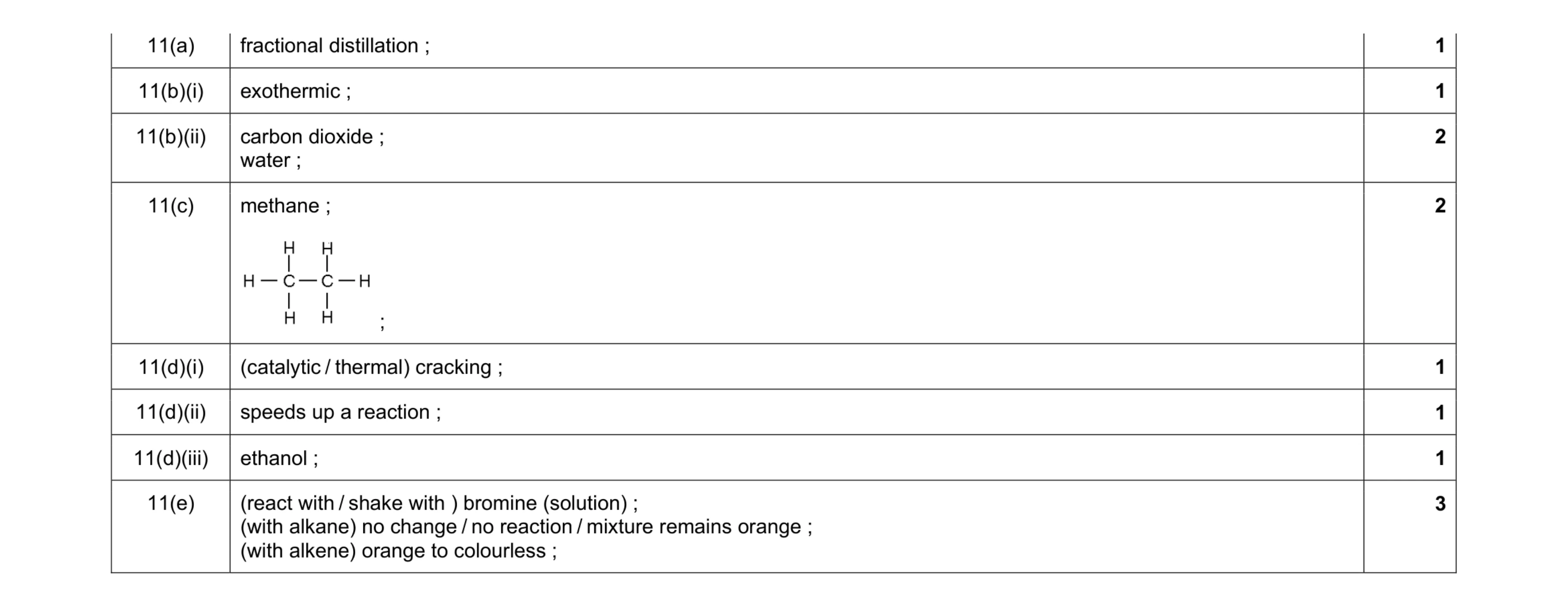 12
12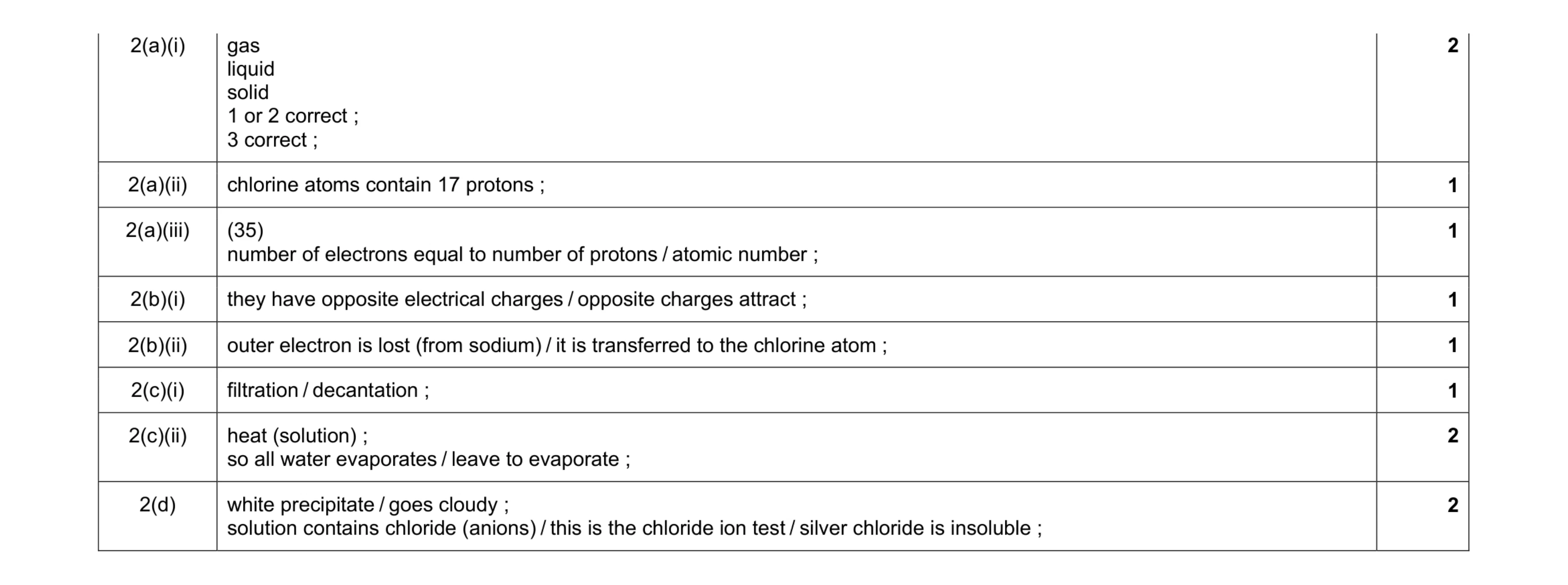 11
11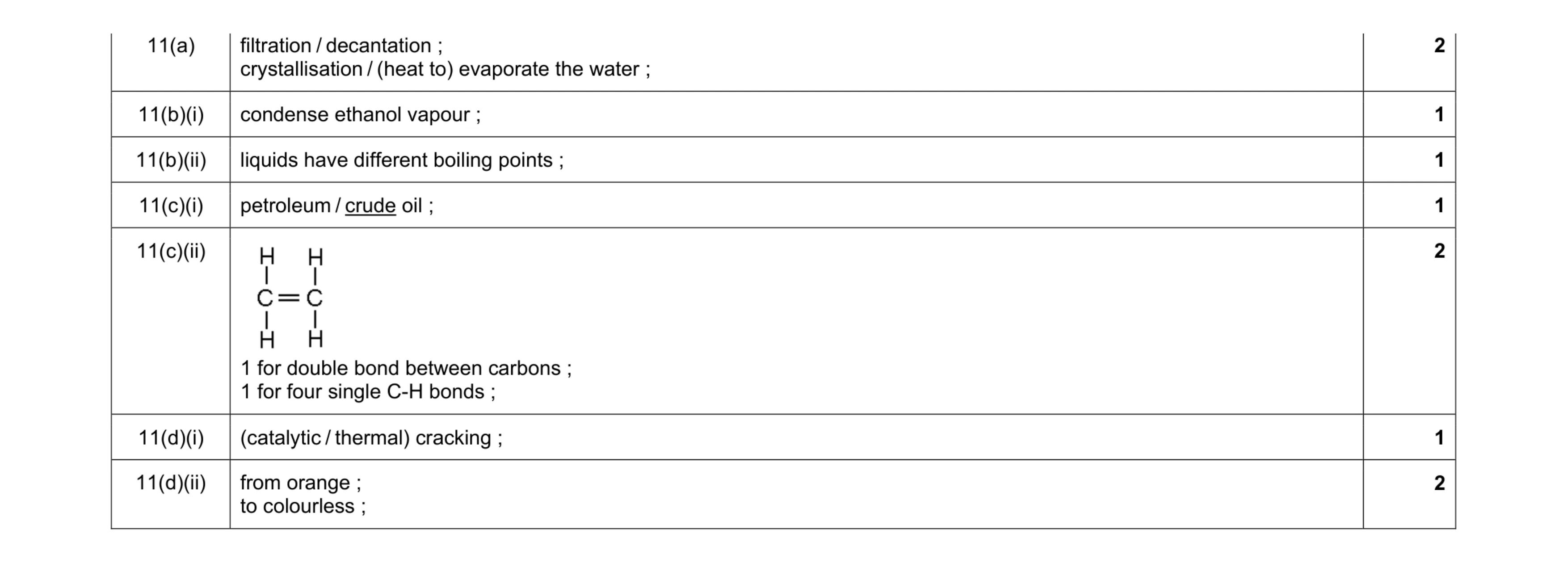 10
10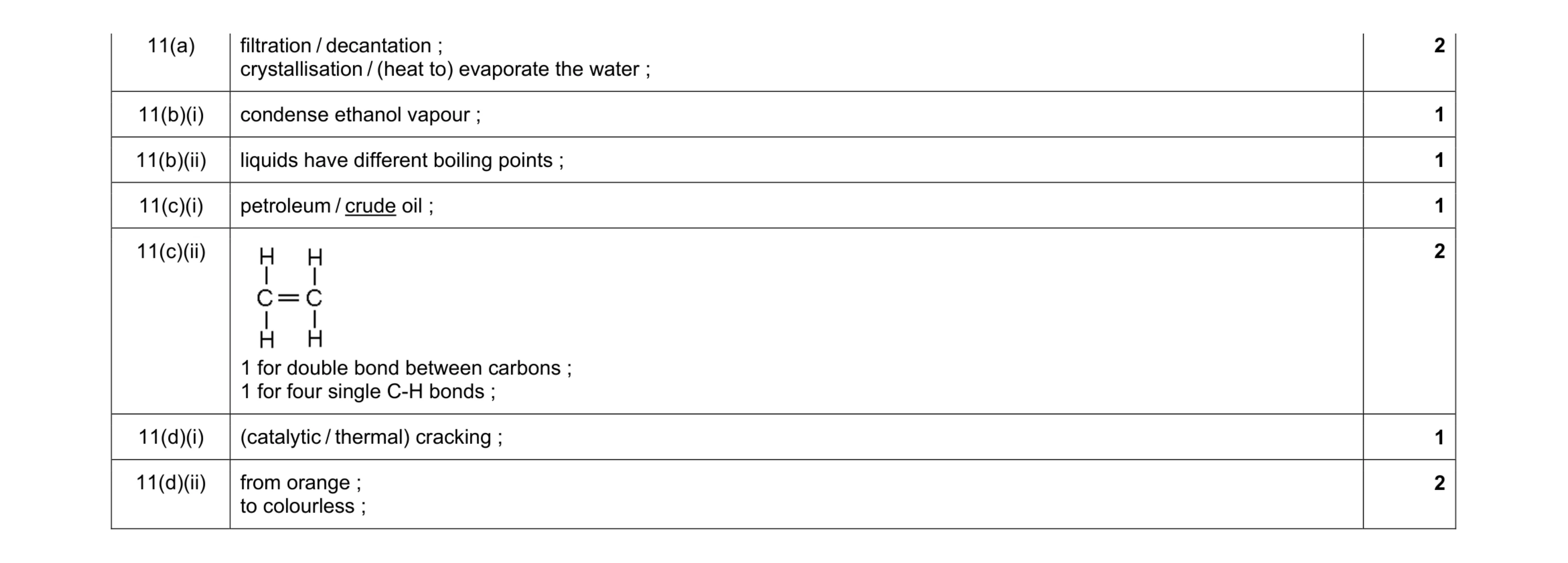 10
10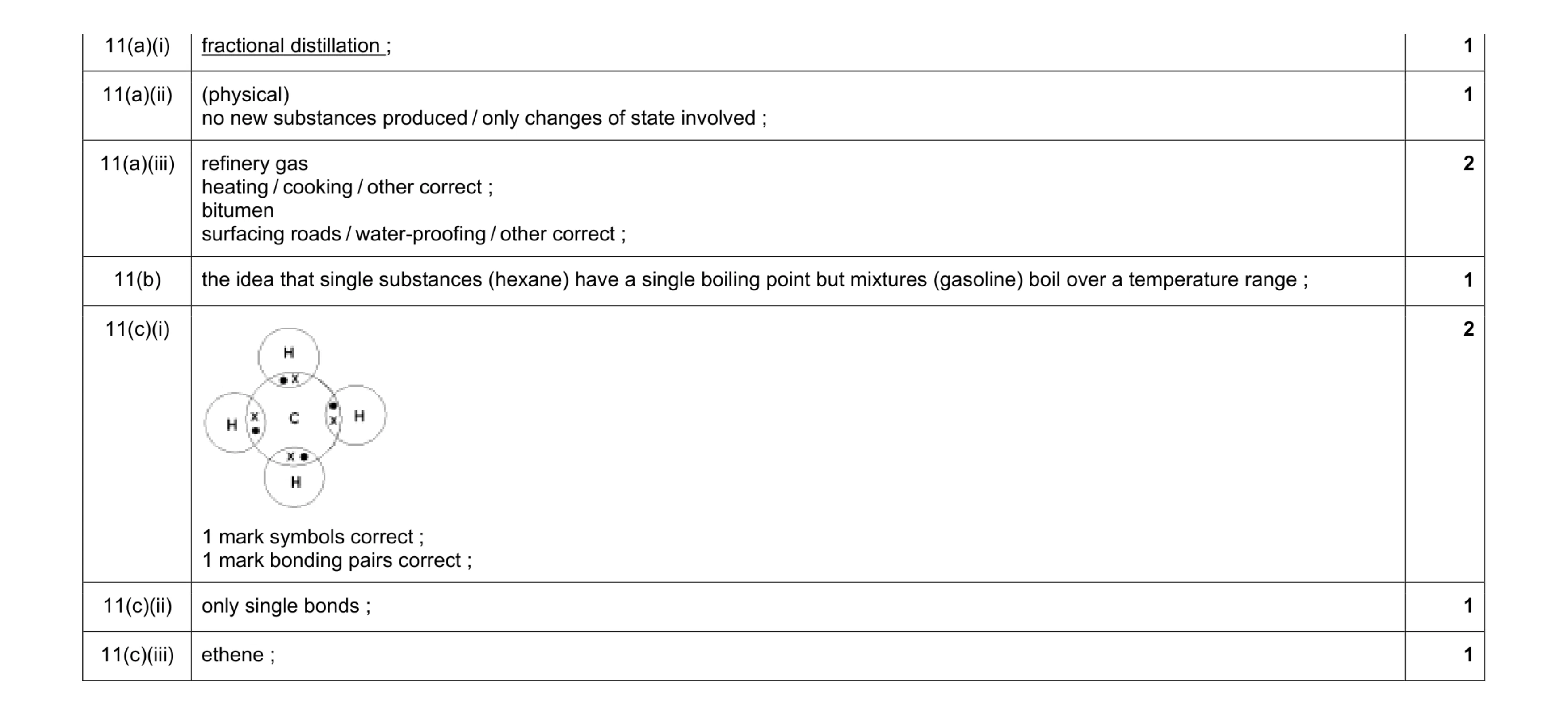 9
9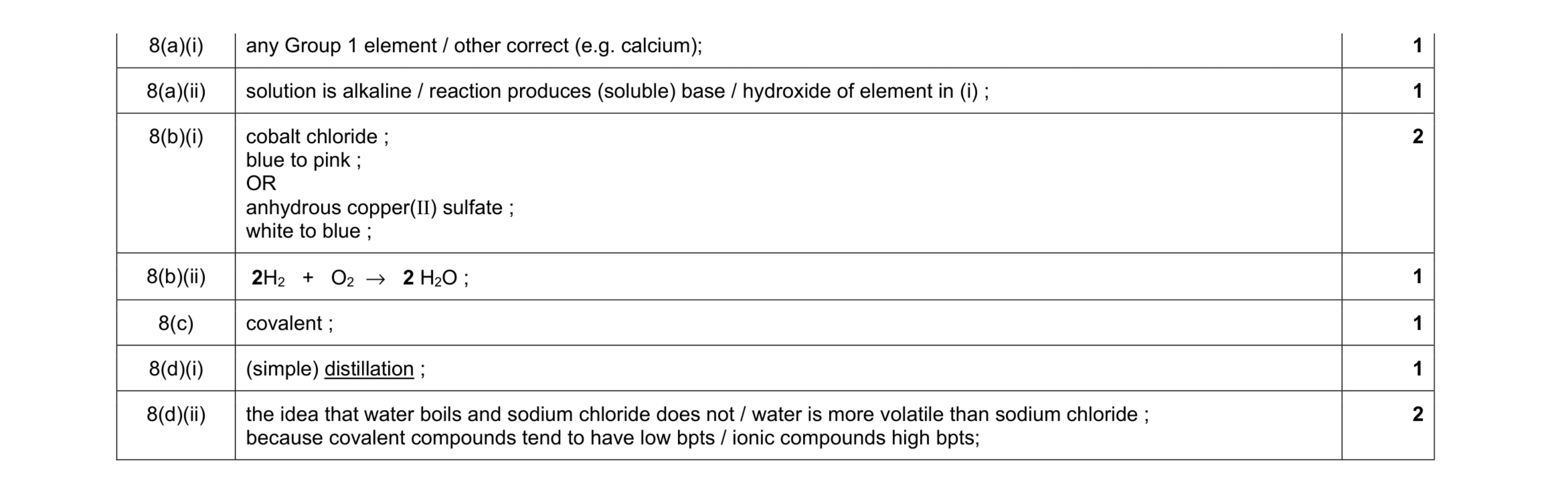 9
9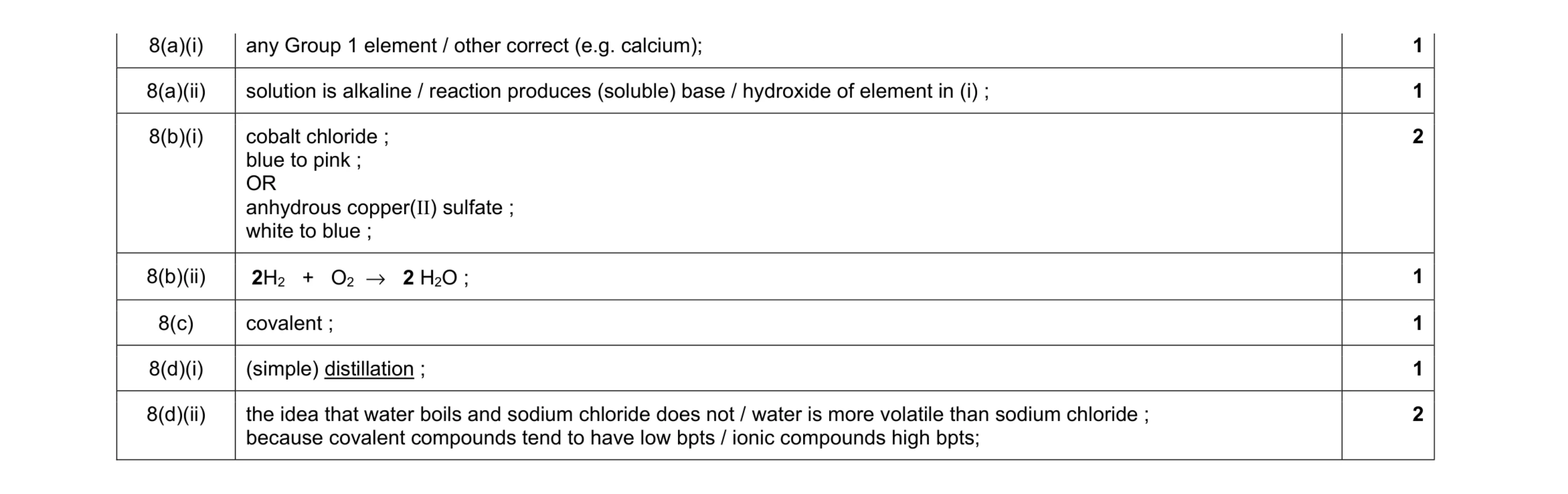 9
9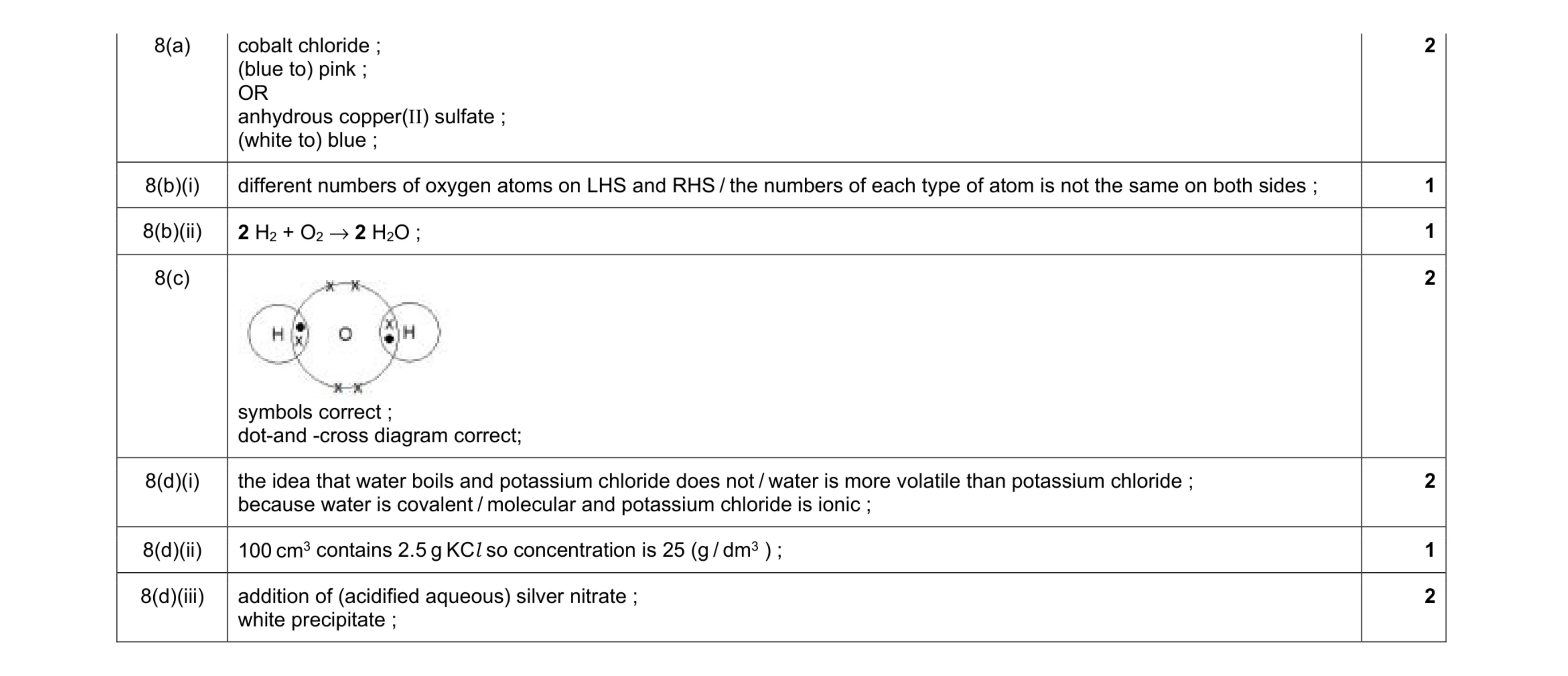 11
11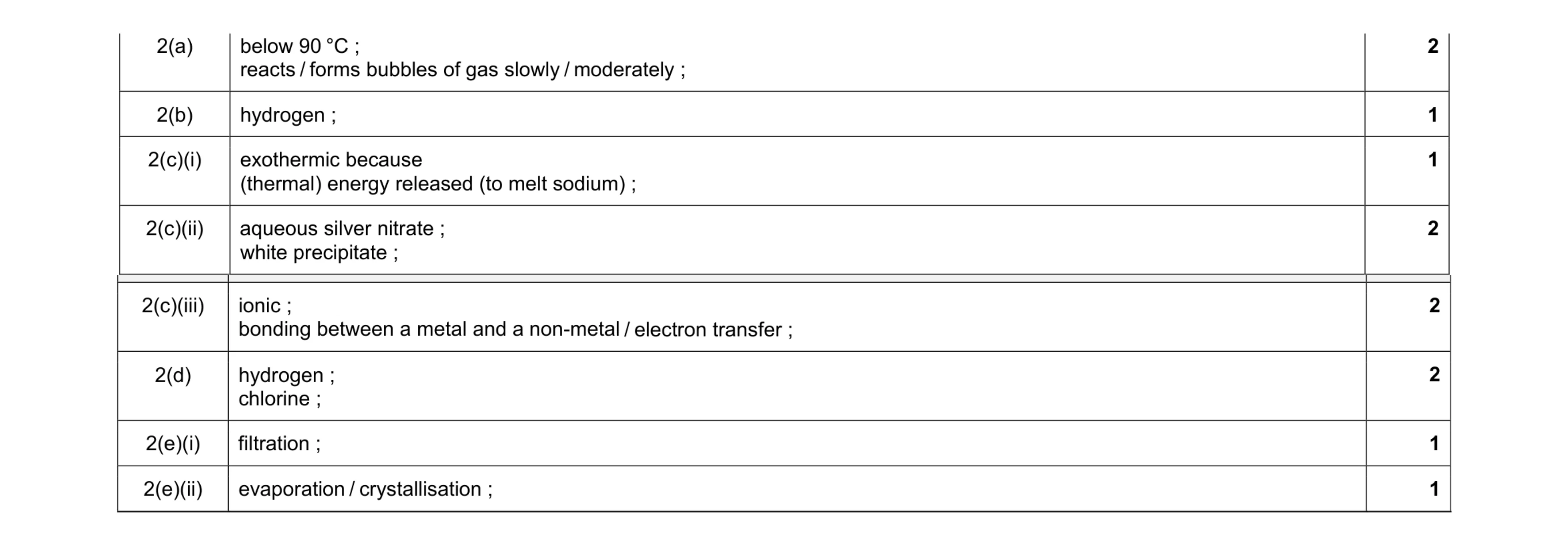 12
12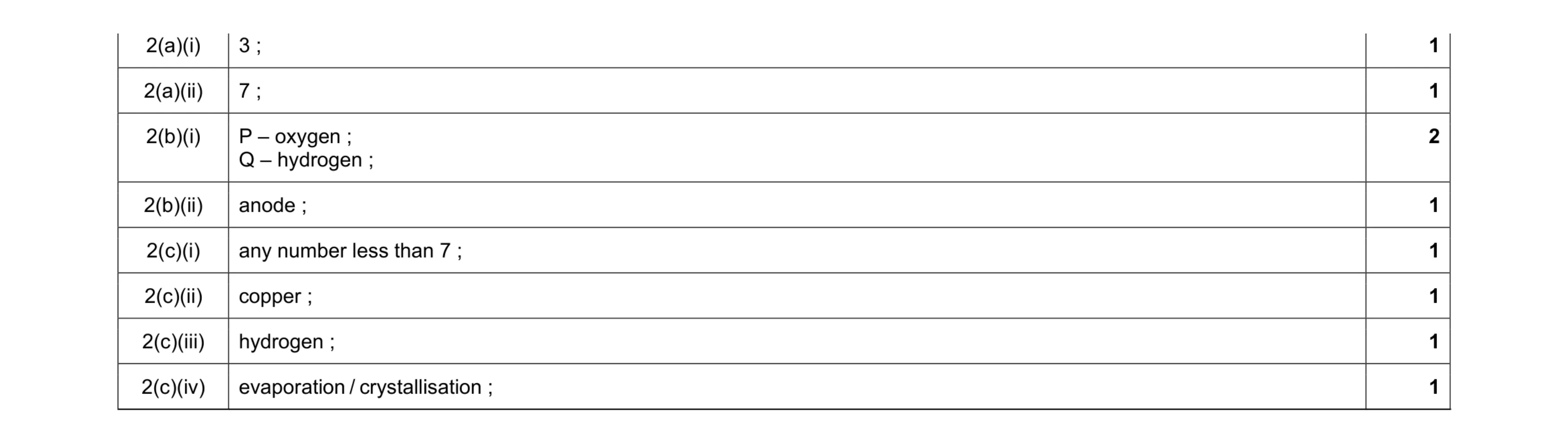 9
9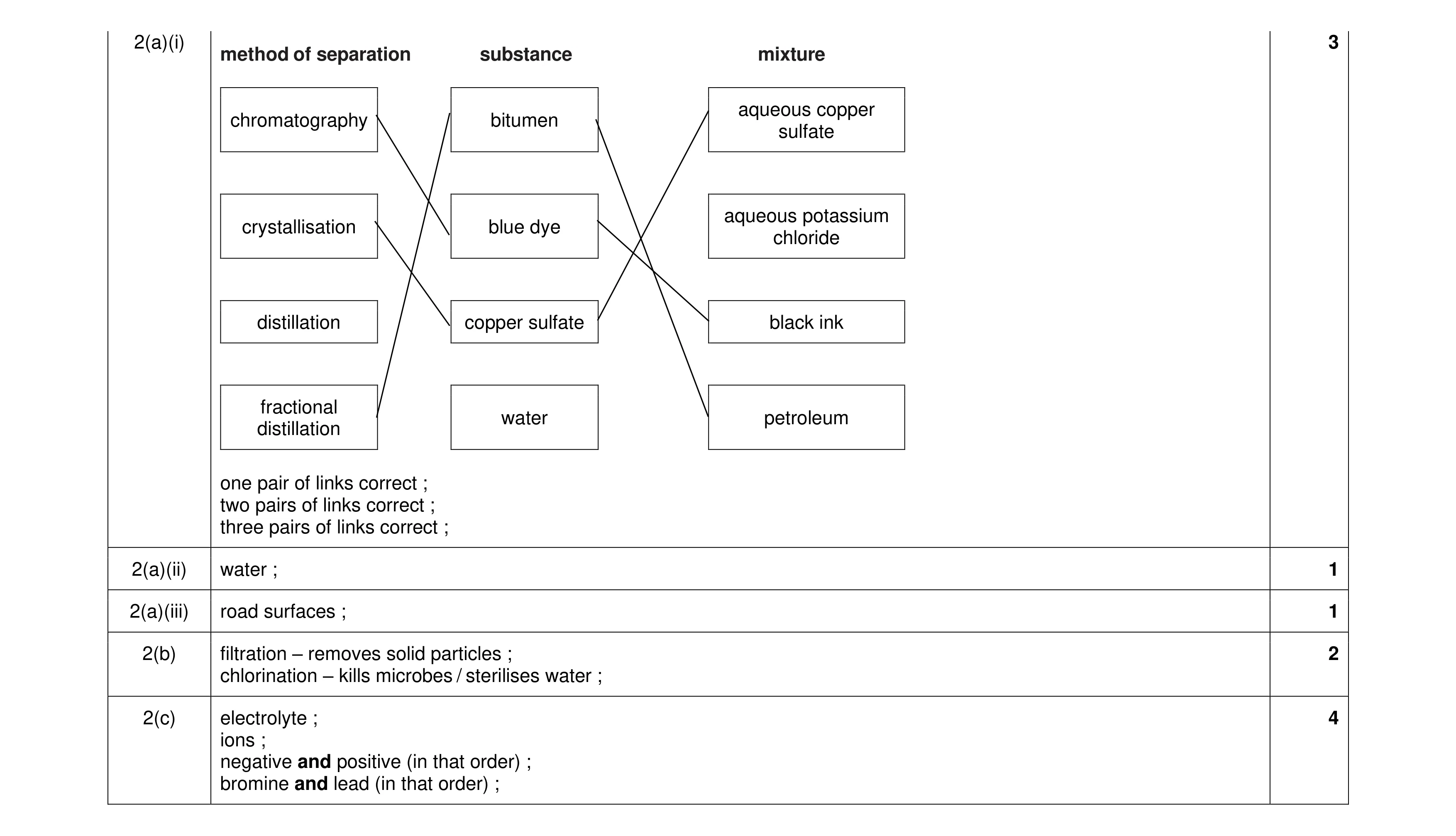 11
11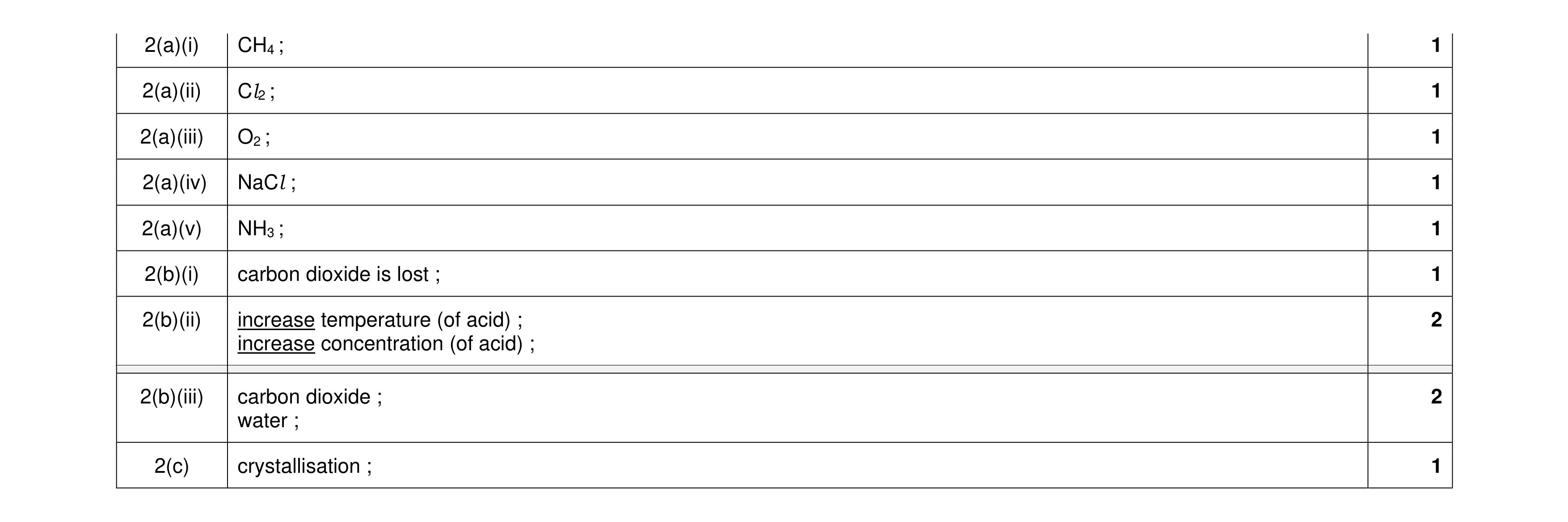 11
11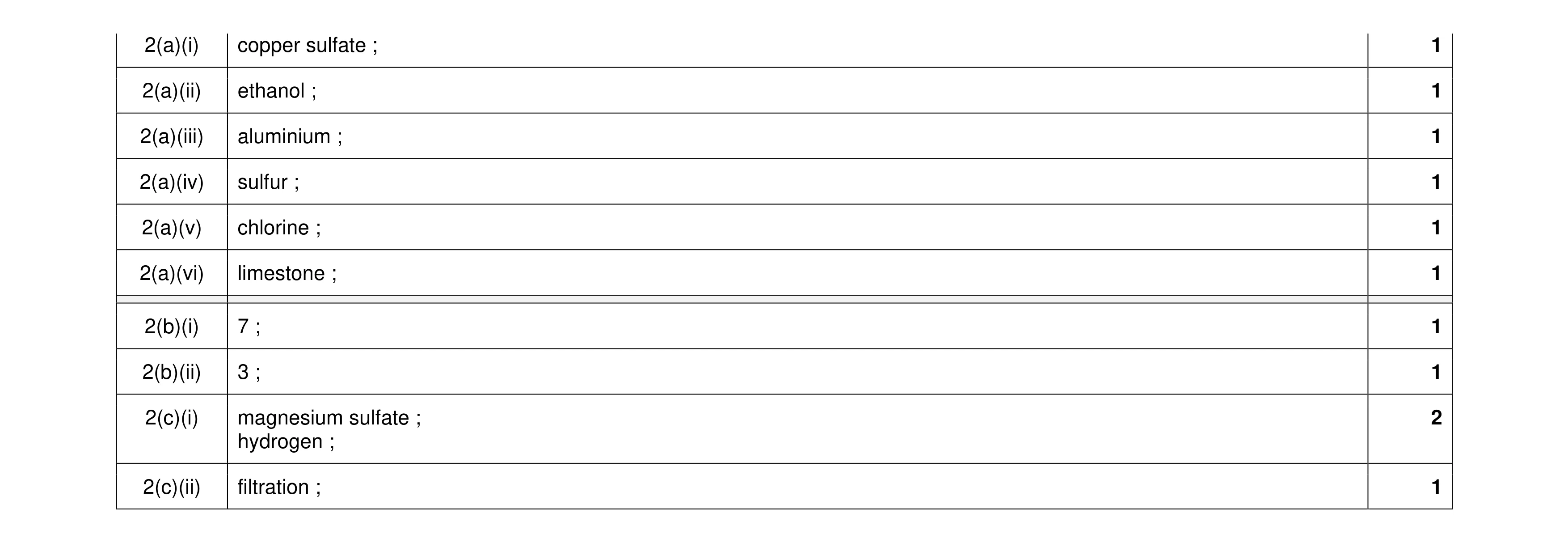 11
11