Questions as text
Q1 · The activity of three enzymes, A, B and C, at different pHs 0654/41 May/June 2017
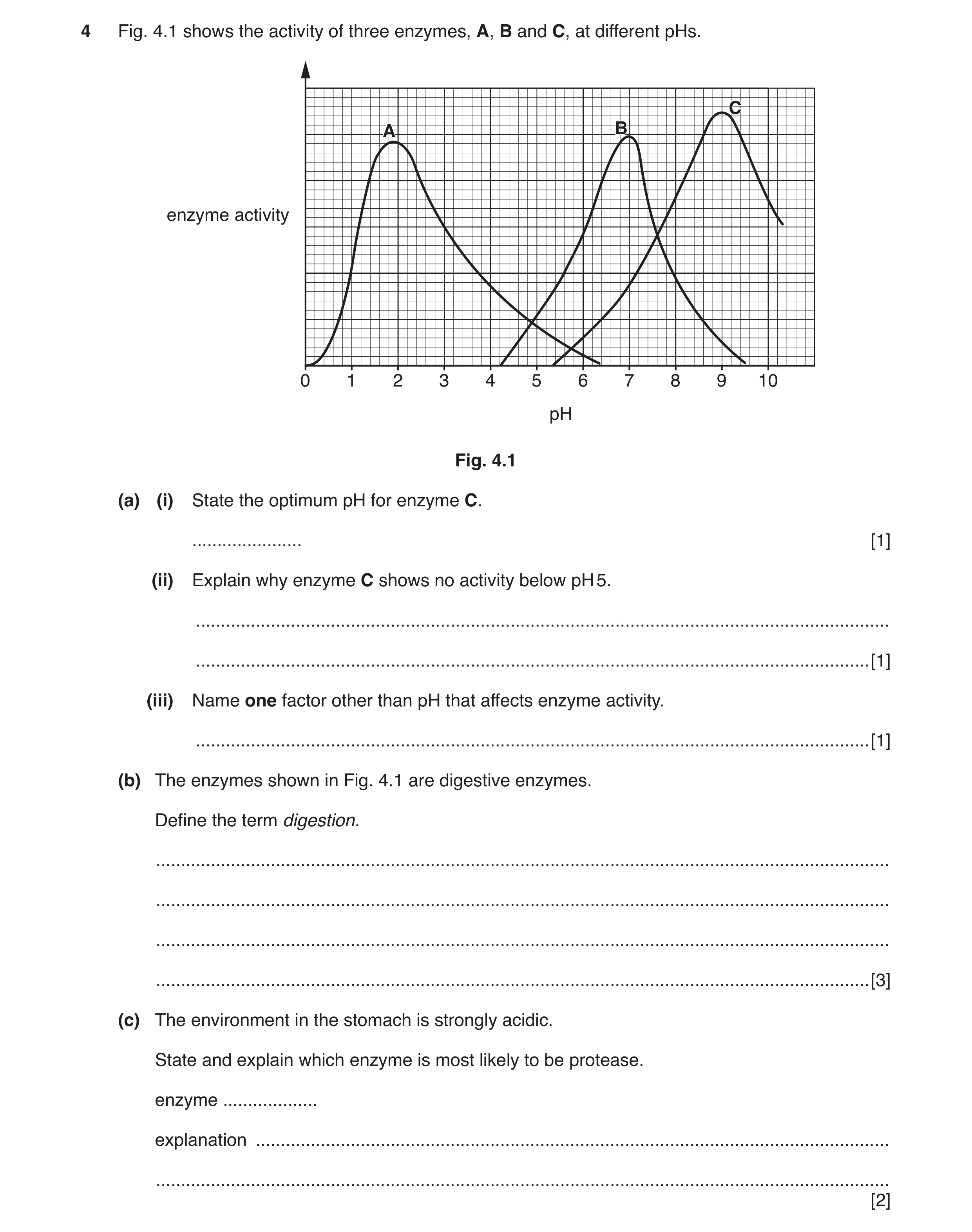
4 Fig. 4.1 shows the activity of three enzymes, A, B and C, at different pHs. C A B enzyme activity 0 1 2 3 4 5 6 7 8 9 10 pH Fig. 4.1 (a) (i) State the optimum pH for enzyme C. … [1] (ii) Explain why enzyme C shows no activity below pH 5. … … [1] (iii) Name one factor other than pH that affects enzyme activity. … [1] (b) The enzymes shown in Fig. 4.1 are digestive enzymes. Define the term digestion. … … … … [3] (c) The environment in the stomach is strongly acidic. State and explain which enzyme is most likely to be protease. enzyme … explanation … … [2]
8 marks
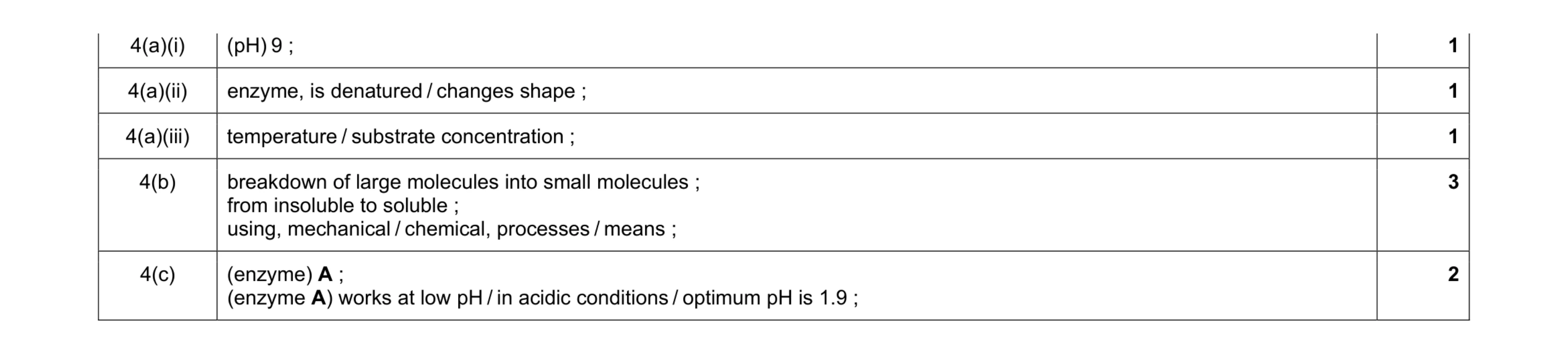
Mark scheme: 4(a)(i) (pH) 9 ; 1 4(a)(ii) enzyme, is denatured / changes shape ; 1 4(a)(iii) temperature / substrate concentration ; 1 4(b) breakdown of large molecules into small molecules ; from insoluble to soluble ; using, mechanical / chemical, processes / means ; 3 4(c) (enzyme) A ; (enzyme A) works at low pH / in acidic conditions / optimum pH is 1.9 ; 2
This question in 0654/41 May/June 2017
Q2 · A diagram of the alimentary canal and associated organs 0654/43 Oct/Nov 2017
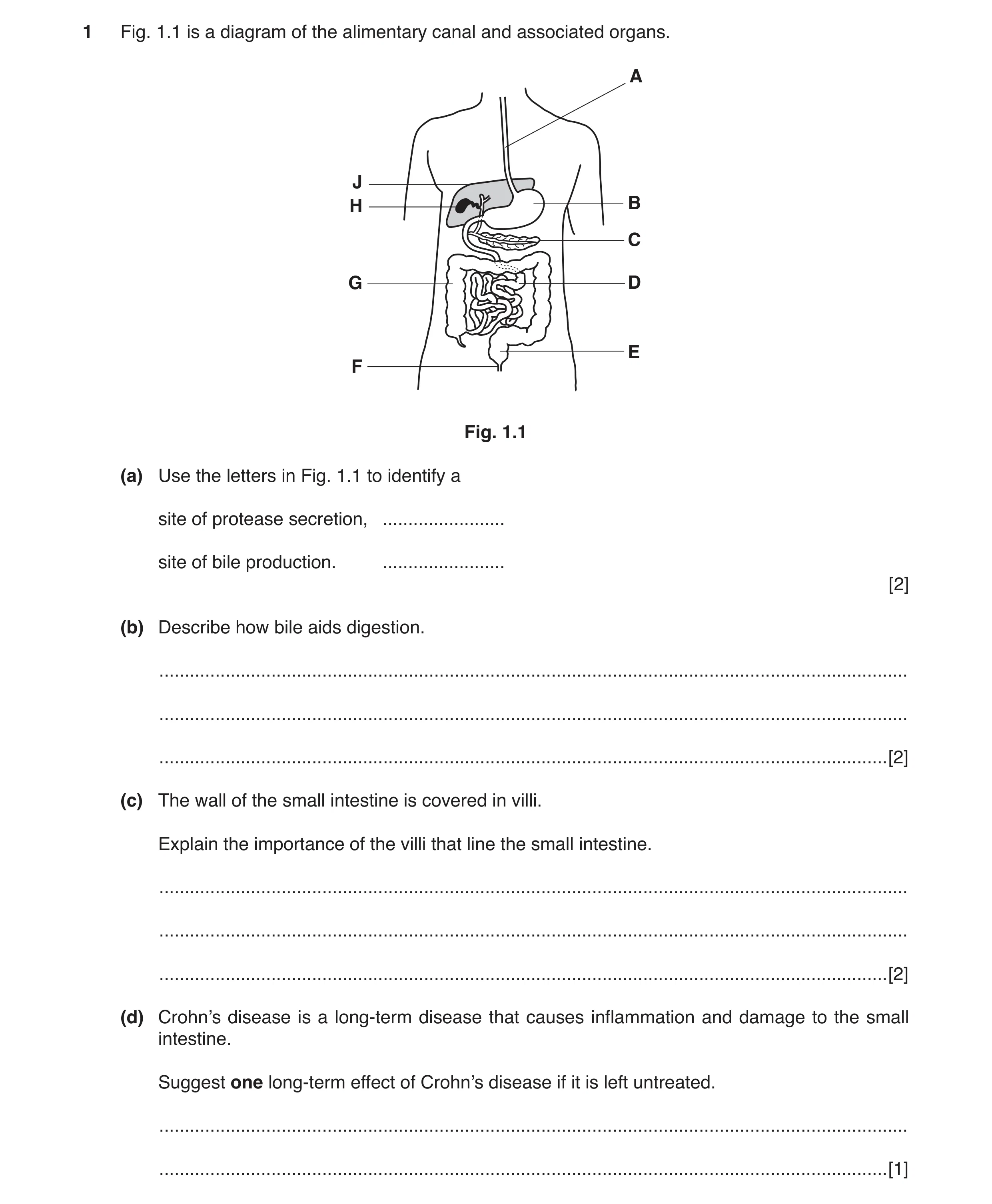
1 Fig. 1.1 is a diagram of the alimentary canal and associated organs. A J H B C G D E F Fig. 1.1 (a) Use the letters in Fig. 1.1 to identify a site of protease secretion, … site of bile production. … [2] (b) Describe how bile aids digestion. … … … [2] (c) The wall of the small intestine is covered in villi. Explain the importance of the villi that line the small intestine. … … … [2] (d) Crohn’s disease is a long-term disease that causes inflammation and damage to the small intestine. Suggest one long-term effect of Crohn’s disease if it is left untreated. … … [1]
7 marks
Mark scheme: 1(a) B / C / D ; J ; 2 1(b) emulsifies fats ; increases surface area (of fat globules) ; for the action of enzymes ; max 2 1(c) increases surface area ; for absorption ; 2 1(d) malnutrition / weight loss / dehydration / fatigue ; 1
This question in 0654/43 Oct/Nov 2017
Q3 · Lipase is a digestive enzyme 0654/41 Oct/Nov 2019
7 (a) Lipase is a digestive enzyme. A student investigates the action of lipase on fats present in milk. He uses an indicator that turns pink in alkaline solutions and colourless in acidic solutions. • He adds a few drops of indicator to a test-tube containing milk. The indicator remains colourless. • He adds sodium carbonate solution to the milk. The indicator now turns pink. • He then adds lipase to the mixture. • He times how long it takes the indicator to go colourless. Fig. 7.1 shows the apparatus. lipase solution 000s stopclock mixture of milk, sodium carbonate solution and indicator Fig. 7.1 (i) Suggest why sodium carbonate is added to the mixture. … … [1] (ii) It takes 240 seconds for the mixture to turn colourless and become acidic. Explain why the mixture becomes acidic. … … … … [2] (iii) The investigation is repeated at a temperature of 80 °C. Explain the effect this would have on the result. … … … … … [3] (b) Fig. 7.2 is a diagram of the alimentary canal and associated organs. B A C H D E F G Fig. 7.2 (i) Use the letters in Fig. 7.2 to identify: • two structures where amylase is secreted … and … • a structure with very acidic conditions. … [2] (ii) State two reasons why acidic conditions are needed in parts of the digestive system. 1 … … 2 … … [2] [Total: 10]
10 marks
Mark scheme: 7(a)(i) to make the solution alkaline / so the solution changes colour (when acid is formed) ; 1 7(a)(ii) lipase breaks down the fat (in the milk) ; into fatty acids (and glycerol) ; 2 7(a)(iii) the mixture would not become colourless ; lipase / enzyme is denatured (at higher temperature) ; fat is no longer broken down / fatty acids not produced ; 3 7(b)(i) any two from B, E, F ; D ; 2 7(b)(ii) Kill microorganisms (in food) ; acidic conditions needed for protein digestion ; 2
This question in 0654/41 Oct/Nov 2019
Q4 · The alimentary canal and associated organs 0654/42 Oct/Nov 2019
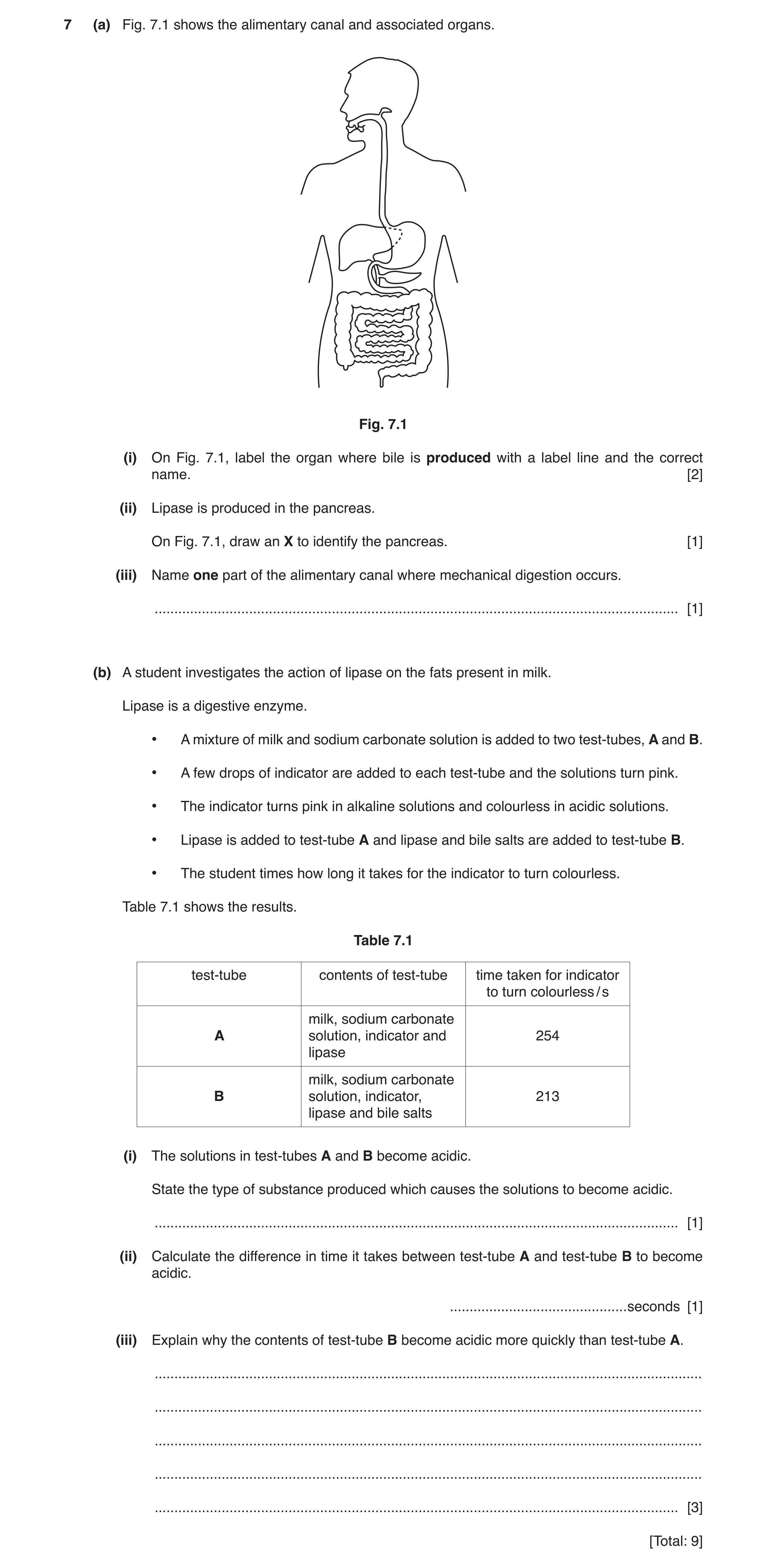
7 (a) Fig. 7.1 shows the alimentary canal and associated organs. Fig. 7.1 (i) On Fig. 7.1, label the organ where bile is produced with a label line and the correct name. [2] (ii) Lipase is produced in the pancreas. On Fig. 7.1, draw an X to identify the pancreas. [1] (iii) Name one part of the alimentary canal where mechanical digestion occurs. … [1] (b) A student investigates the action of lipase on the fats present in milk. Lipase is a digestive enzyme. • A mixture of milk and sodium carbonate solution is added to two test-tubes, A and B. • A few drops of indicator are added to each test-tube and the solutions turn pink. • The indicator turns pink in alkaline solutions and colourless in acidic solutions. • Lipase is added to test-tube A and lipase and bile salts are added to test-tube B. • The student times how long it takes for the indicator to turn colourless. Table 7.1 shows the results. Table 7.1 test-tube contents of test-tube time taken for indicator to turn colourless / s milk, sodium carbonate A solution, indicator and 254 lipase milk, sodium carbonate B solution, indicator, 213 lipase and bile salts (i) The solutions in test-tubes A and B become acidic. State the type of substance produced which causes the solutions to become acidic. … [1] (ii) Calculate the difference in time it takes between test-tube A and test-tube B to become acidic. … seconds [1] (iii) Explain why the contents of test-tube B become acidic more quickly than test-tube A. … … … … … [3] [Total: 9]
9 marks
Mark scheme: 7(a)(i) liver ; correctly labelled ; 2 7(a)(ii) centre of X drawn on the pancreas ; 1 7(a)(iii) mouth / stomach ; 1 7(b)(i) fatty acids ; 1 7(b)(ii) 41 (seconds) ; 1 7(b)(iii) bile emulsifies fats ; increasing the surface area ; lipase / enzyme, break down fat at a faster rate / faster production of fatty acids ; 3
This question in 0654/42 Oct/Nov 2019
Q5 · An X-ray of a molar tooth 0654/43 Oct/Nov 2019
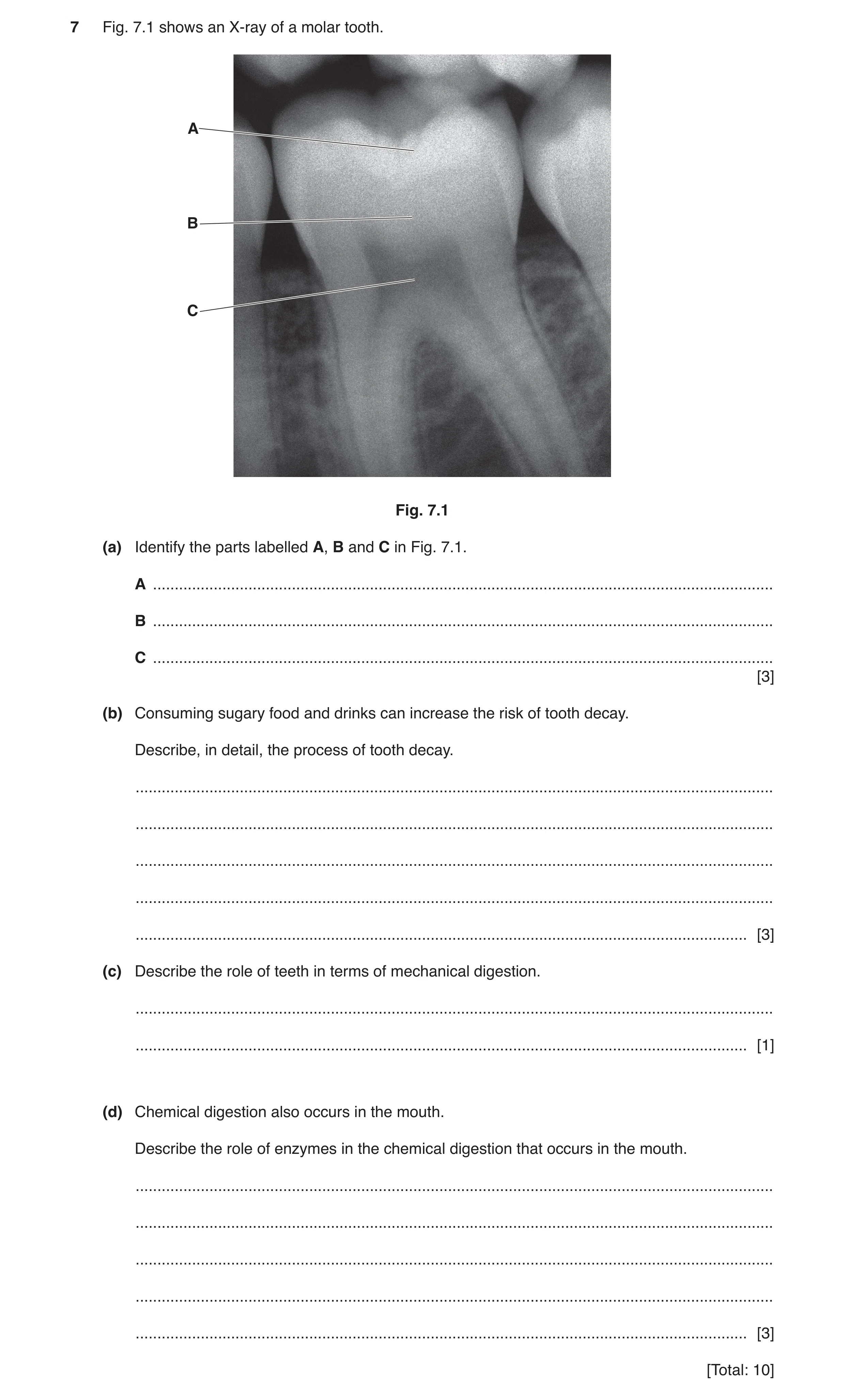
7 Fig. 7.1 shows an X-ray of a molar tooth. A B C Fig. 7.1 (a) Identify the parts labelled A, B and C in Fig. 7.1. A … B … C … [3] (b) Consuming sugary food and drinks can increase the risk of tooth decay. Describe, in detail, the process of tooth decay. … … … … … [3] (c) Describe the role of teeth in terms of mechanical digestion. … … [1] (d) Chemical digestion also occurs in the mouth. Describe the role of enzymes in the chemical digestion that occurs in the mouth. … … … … … [3] [Total: 10]
10 marks
Mark scheme: 7(a) A enamel ; B dentine ; C pulp ; 3 7(b) bacteria (and food coat teeth) ; ref to respiration ; acids (produced by bacteria) dissolve enamel and dentine ; 3 7(c) break food into smaller pieces ; 1 7(d) ref to (salivary) amylase ; breaks down starch ; to (simple) sugars ; large insoluble to smaller soluble molecules ; max 3 3
This question in 0654/43 Oct/Nov 2019
Q6 · The vitamin D content in 100 g of different foods 0654/41 May/June 2021
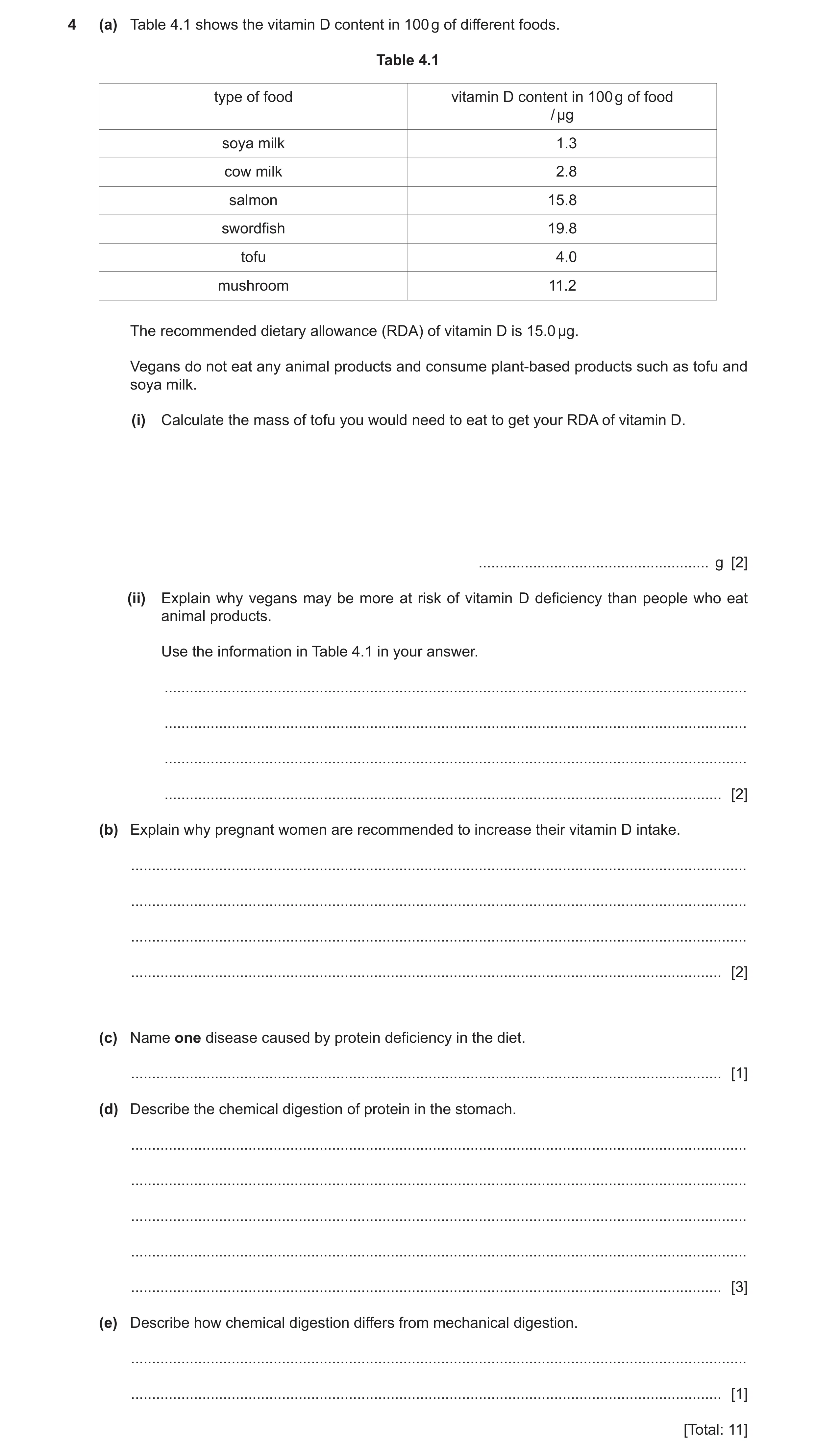
4 (a) Table 4.1 shows the vitamin D content in 100 g of different foods. Table 4.1 type of food vitamin D content in 100 g of food / µg soya milk 1.3 cow milk 2.8 salmon 15.8 swordfish 19.8 tofu 4.0 mushroom 11.2 The recommended dietary allowance (RDA) of vitamin D is 15.0 µg. Vegans do not eat any animal products and consume plant‑based products such as tofu and soya milk. (i) Calculate the mass of tofu you would need to eat to get your RDA of vitamin D. … g [2] (ii) Explain why vegans may be more at risk of vitamin D deficiency than people who eat animal products. Use the information in Table 4.1 in your answer. … … … … [2] (b) Explain why pregnant women are recommended to increase their vitamin D intake. … … … … [2] (c) Name one disease caused by protein deficiency in the diet. … [1] (d) Describe the chemical digestion of protein in the stomach. … … … … … [3] (e) Describe how chemical digestion differs from mechanical digestion. … … [1] [Total: 11]
11 marks
Mark scheme: 4(a)(i) 15.0 100 4.0 × 380 (g) ; 4(a)(ii) plant-based foods / tofu / soya milk, contain less vitamin D than (equivalent) animal products ; they would need to eat a larger amount of food to get enough vitamin D / comparison of data / ref. to per 100 g ; 2 4(b) (vitamin D is needed) for (the formation of) bones ; by the (growing) baby ; 2 4(c) marasmus / kwashiorkor ; 1 Question Answer Marks 4(d) large / insoluble molecules broken down to small / soluble molecules ; to form amino acids ; by protease ; ref to acidic conditions (in the stomach) ; max 3 3 4(e) food is broken into smaller molecules / involves enzymes ; 1
This question in 0654/41 May/June 2021
Q7 · A diagram of a villus 0654/41 Oct/Nov 2021
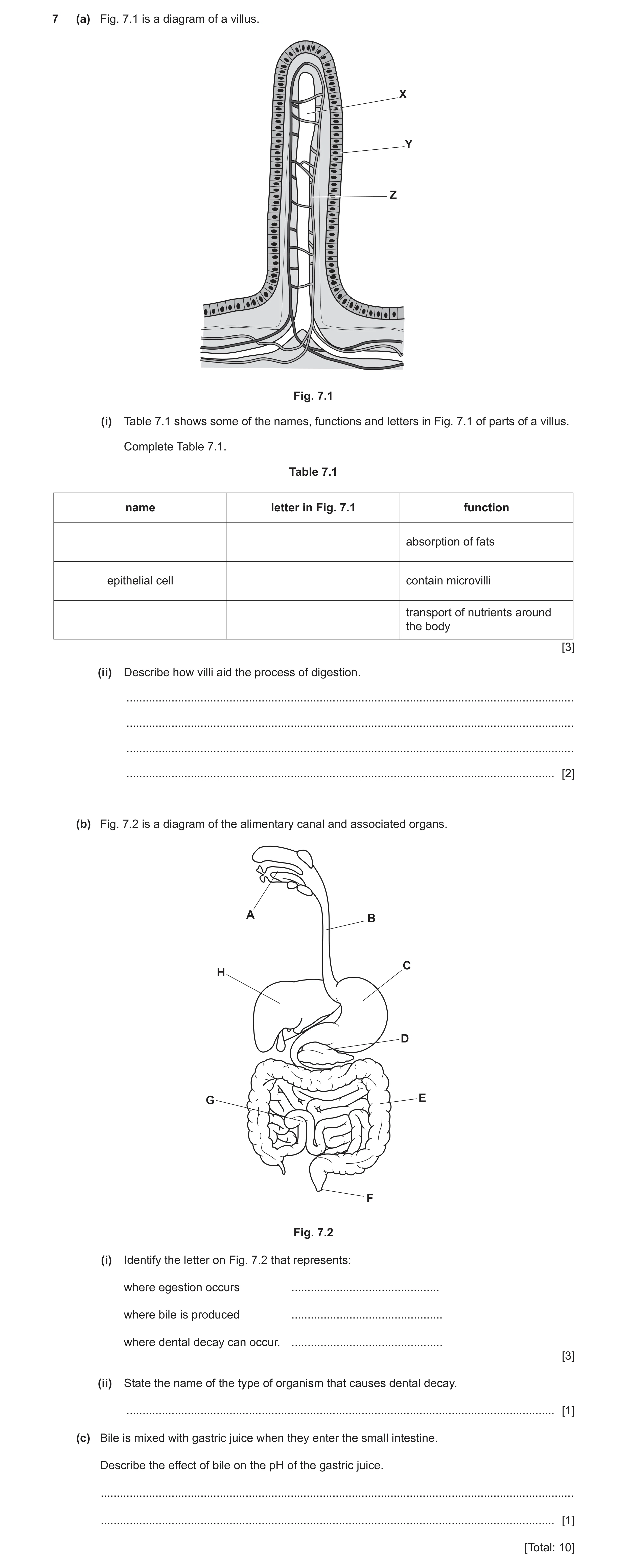
7 (a) Fig. 7.1 is a diagram of a villus. X Y Z Fig. 7.1 (i) Table 7.1 shows some of the names, functions and letters in Fig. 7.1 of parts of a villus. Complete Table 7.1. Table 7.1 name letter in Fig. 7.1 function absorption of fats epithelial cell contain microvilli transport of nutrients around the body [3] (ii) Describe how villi aid the process of digestion. … … … … [2] (b) Fig. 7.2 is a diagram of the alimentary canal and associated organs. A B C H D G E F Fig. 7.2 (i) Identify the letter on Fig. 7.2 that represents: where egestion occurs … where bile is produced … where dental decay can occur. … [3] (ii) State the name of the type of organism that causes dental decay. … [1] (c) Bile is mixed with gastric juice when they enter the small intestine. Describe the effect of bile on the pH of the gastric juice. … … [1] [Total: 10]
10 marks
Mark scheme: 7(a)(i) name letter in Fig. 3.1 function lacteal X absorption of fats ; epithelial cell Y contain microvilli ; capillary Z transport of nutrients around the body ; 3 7(a)(ii) increases surface area ; for more absorption ; 2 7(b)(i) F ; H ; A ; 3 7(b)(ii) bacteria ; 1 7(c) increases ; 1
This question in 0654/41 Oct/Nov 2021
Q8 · The effect of pH on the activity of one digestive enzyme 0654/42 Feb/March 2023
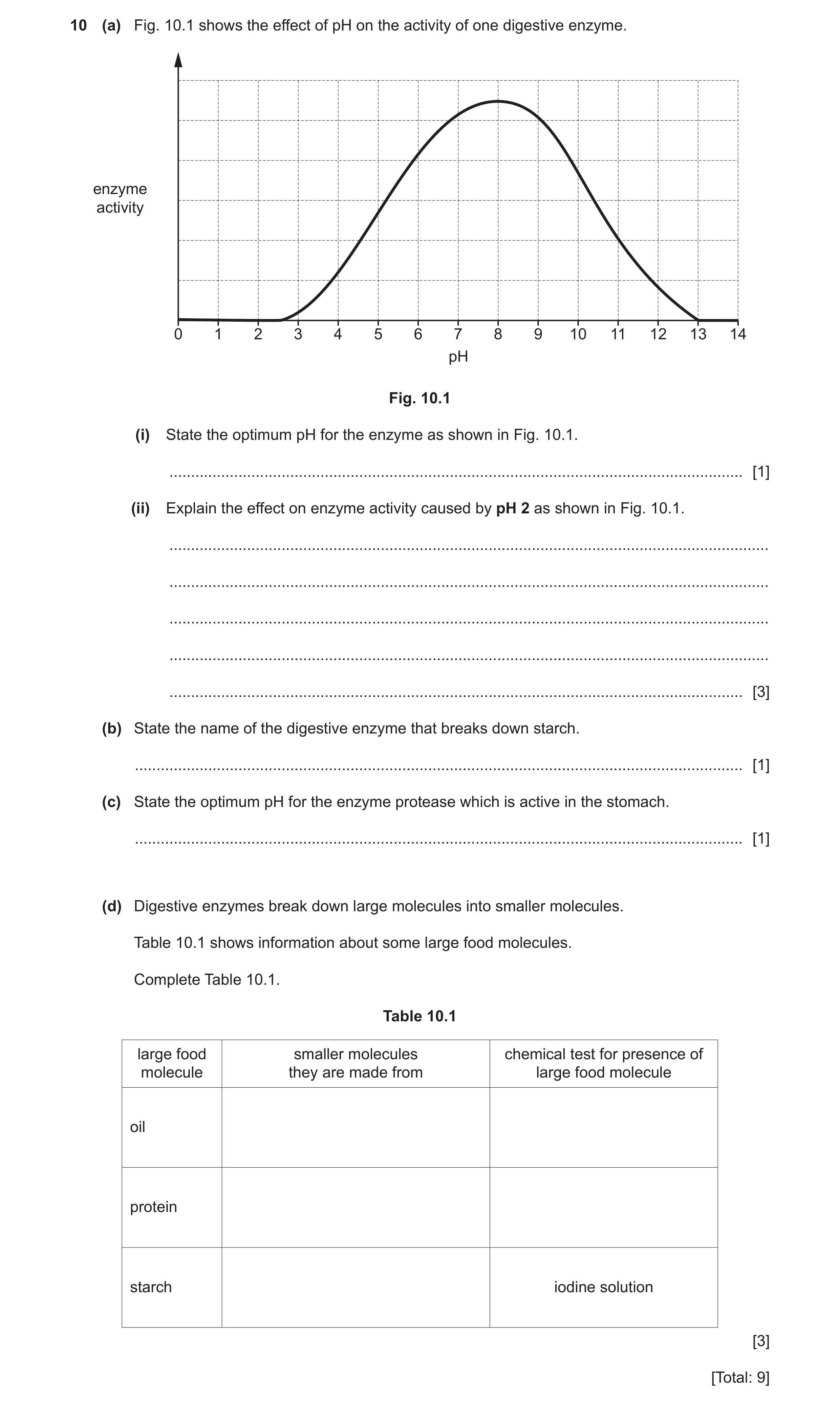
10 (a) Fig. 10.1 shows the effect of pH on the activity of one digestive enzyme. enzyme activity 0 1 2 3 4 5 6 7 8 9 10 11 12 13 14 pH Fig. 10.1 (i) State the optimum pH for the enzyme as shown in Fig. 10.1. … [1] (ii) Explain the effect on enzyme activity caused by pH 2 as shown in Fig. 10.1. … … … … … [3] (b) State the name of the digestive enzyme that breaks down starch. … [1] (c) State the optimum pH for the enzyme protease which is active in the stomach. … [1] (d) Digestive enzymes break down large molecules into smaller molecules. Table 10.1 shows information about some large food molecules. Complete Table 10.1. Table 10.1 large food smaller molecules chemical test for presence of molecule they are made from large food molecule oil protein starch iodine solution [3] [Total: 9]
9 marks
Mark scheme: 10(a)(i) 8 ; 1 10(a)(ii) (no activity at pH2) 3 enzymes are denatured ; (low / acidic, pH) causes shape of active site to change ; substrate is no longer complementary to the, active site or enzyme ; 10(b) amylase ; 1 10(c) pH 1–3 ; 1 10(d) 3 smaller molecules chemical test for presence large food molecule they are made from of large food molecule fatty acids and fats and oils ethanol emulsion glycerol protein amino acids biuret (solution) starch glucose iodine solution ;;;
This question in 0654/42 Feb/March 2023
Q9 · A diagram of a villus 0654/42 Oct/Nov 2023
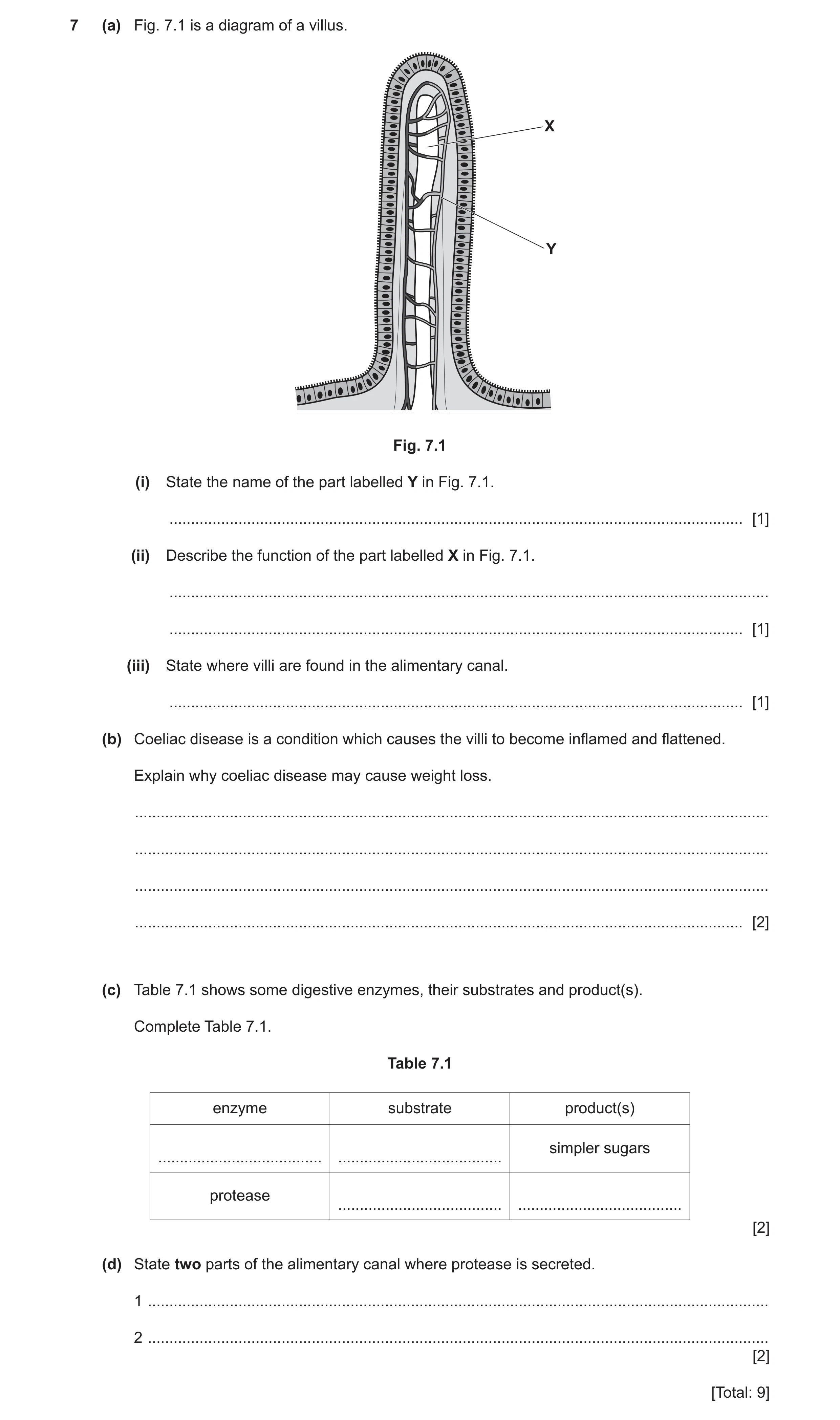
7 (a) Fig. 7.1 is a diagram of a villus. X Y Fig. 7.1 (i) State the name of the part labelled Y in Fig. 7.1. … [1] (ii) Describe the function of the part labelled X in Fig. 7.1. … … [1] (iii) State where villi are found in the alimentary canal. … [1] (b) Coeliac disease is a condition which causes the villi to become inflamed and flattened. Explain why coeliac disease may cause weight loss. … … … … [2] (c) Table 7.1 shows some digestive enzymes, their substrates and product(s). Complete Table 7.1. Table 7.1 enzyme substrate product(s) simpler sugars … … protease … … [2] (d) State two parts of the alimentary canal where protease is secreted. 1 … 2 … [2] [Total: 9]
9 marks
Mark scheme: 7(a)(i) capillary ; 1 7(a)(ii) absorption of fats ; 1 7(a)(iii) small intestine ; 1 7(b) smaller surface area (of villi / small intestine) ; 2 (idea of) less nutrients absorbed ; 7(c) 2 enzyme substrate product(s) amylase starch simpler sugars protease protein amino acids ;; four correct = 2 marks two or three correct = 1 mark one correct = 0 marks 7(d) any two from: 2 stomach ; pancreas ; small intestine ;
This question in 0654/42 Oct/Nov 2023
Q10 · The effect of adrenaline on blood glucose concentration 0654/43 Oct/Nov 2023
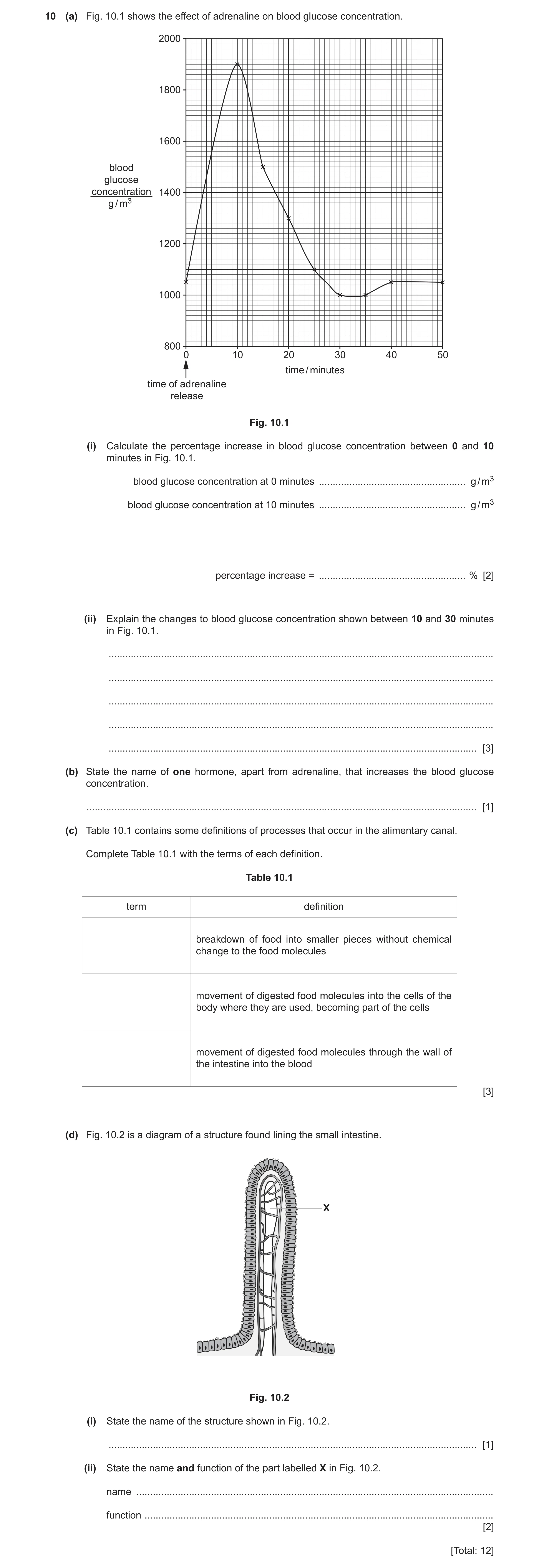
10 (a) Fig. 10.1 shows the effect of adrenaline on blood glucose concentration. 2000 1800 1600 blood glucose concentration 1400 g / m3 1200 1000 800 0 10 20 30 40 50 time / minutes time of adrenaline release Fig. 10.1 (i) Calculate the percentage increase in blood glucose concentration between 0 and 10 minutes in Fig. 10.1. blood glucose concentration at 0 minutes … g / m3 blood glucose concentration at 10 minutes … g / m3 percentage increase = … % [2] (ii) Explain the changes to blood glucose concentration shown between 10 and 30 minutes in Fig. 10.1. … … … … … [3] (b) State the name of one hormone, apart from adrenaline, that increases the blood glucose concentration. … [1] (c) Table 10.1 contains some definitions of processes that occur in the alimentary canal. Complete Table 10.1 with the terms of each definition. Table 10.1 term definition breakdown of food into smaller pieces without chemical change to the food molecules movement of digested food molecules into the cells of the body where they are used, becoming part of the cells movement of digested food molecules through the wall of the intestine into the blood [3] (d) Fig. 10.2 is a diagram of a structure found lining the small intestine. X Fig. 10.2 (i) State the name of the structure shown in Fig. 10.2. … [1] (ii) State the name and function of the part labelled X in Fig. 10.2. name … function … [2] [Total: 12]
12 marks
Mark scheme: 10(a)(i) 1050( 10) and 1900(10) ; 2 (((1900–1050) / 1050) 100) = 81 (%) ; 10(a)(ii) any three from: 3 increase in blood glucose concentration detected by pancreas ; insulin released (by pancreas) ; conversion of glucose to glycogen ; glycogen stored in liver ; 10(b) glucagon ; 1 10(c) 3 mechanical digestion ; assimilation ; absorption ; 10(d)(i) villus ; 1 10(d)(ii) lacteal ; 2 fat / lipid absorption ;
This question in 0654/43 Oct/Nov 2023
Q11 · A diagram of the alimentary canal and some of the associated organs in humans 0654/43 May/June 2024
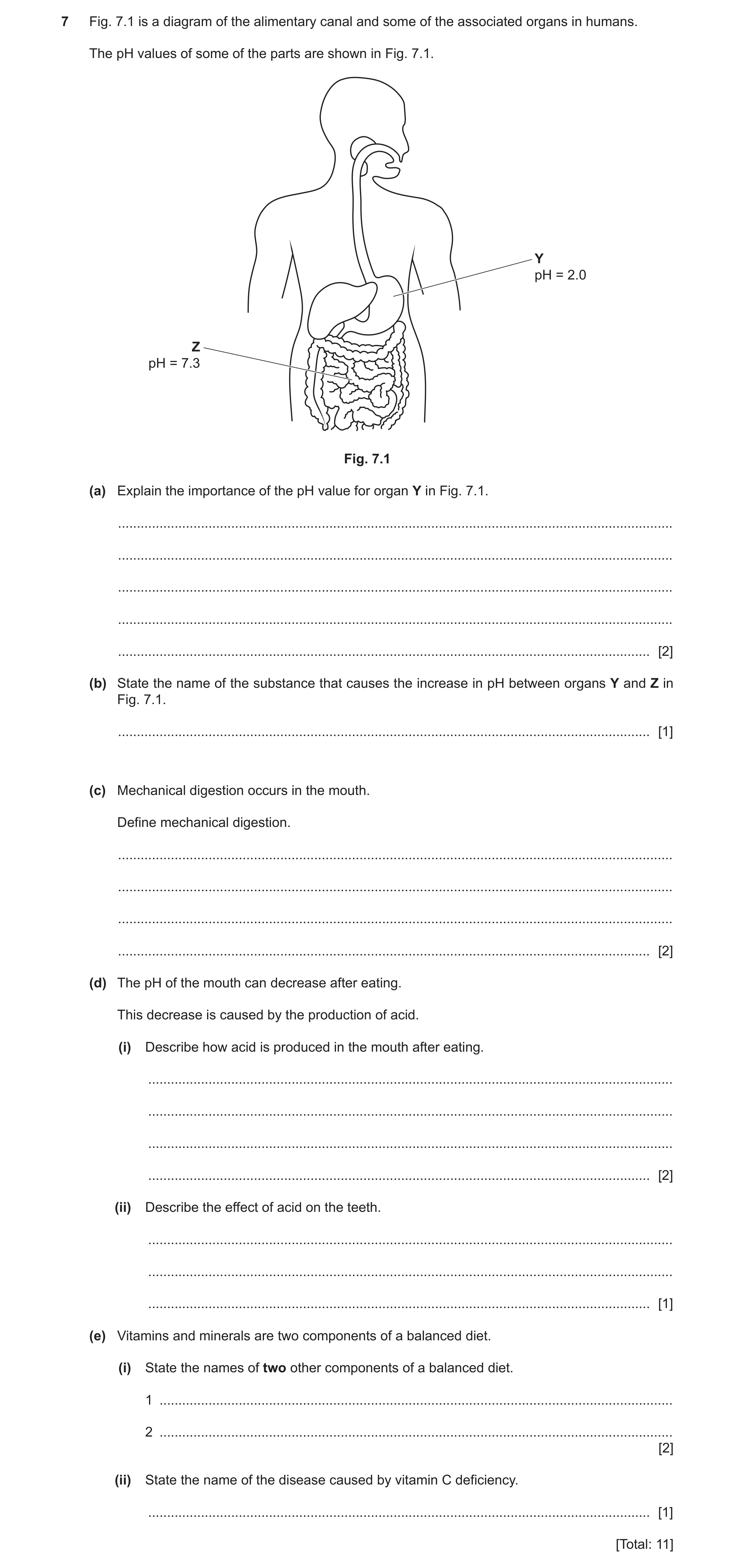
7 Fig. 7.1 is a diagram of the alimentary canal and some of the associated organs in humans. The pH values of some of the parts are shown in Fig. 7.1. Y pH = 2.0 Z pH = 7.3 Fig. 7.1 (a) Explain the importance of the pH value for organ Y in Fig. 7.1. … … … … … [2] (b) State the name of the substance that causes the increase in pH between organs Y and Z in Fig. 7.1. … [1] (c) Mechanical digestion occurs in the mouth. Define mechanical digestion. … … … … [2] (d) The pH of the mouth can decrease after eating. This decrease is caused by the production of acid. (i) Describe how acid is produced in the mouth after eating. … … … … [2] (ii) Describe the effect of acid on the teeth. … … … [1] (e) Vitamins and minerals are two components of a balanced diet. (i) State the names of two other components of a balanced diet. 1 … 2 … [2] (ii) State the name of the disease caused by vitamin C deficiency. … [1] [Total: 11]
11 marks
Mark scheme: 7(a) (acidic environment) kills, bacteria / microorganisms / denatures enzymes in microorganisms or bacteria ; provides, optimum / suitable, pH for protease ; 7(b) bile ; 1 7(c) the breakdown of food into smaller pieces / AW ; without chemical change (to the food molecules) ; 2 7(d)(i) ref to bacteria ; respiring (sugars) ; 2 7(d)(ii) dissolving enamel or dentine / (dental) decay ; 1 7(e)(i) any two from: carbohydrates ; fats ; protein ; fibre ; water ; 2 Question Answer Marks 7(e)(ii) scurvy ; 1
This question in 0654/43 May/June 2024
Q12 · A diagram of the alimentary canal and associated organs in humans 0654/41 Oct/Nov 2024
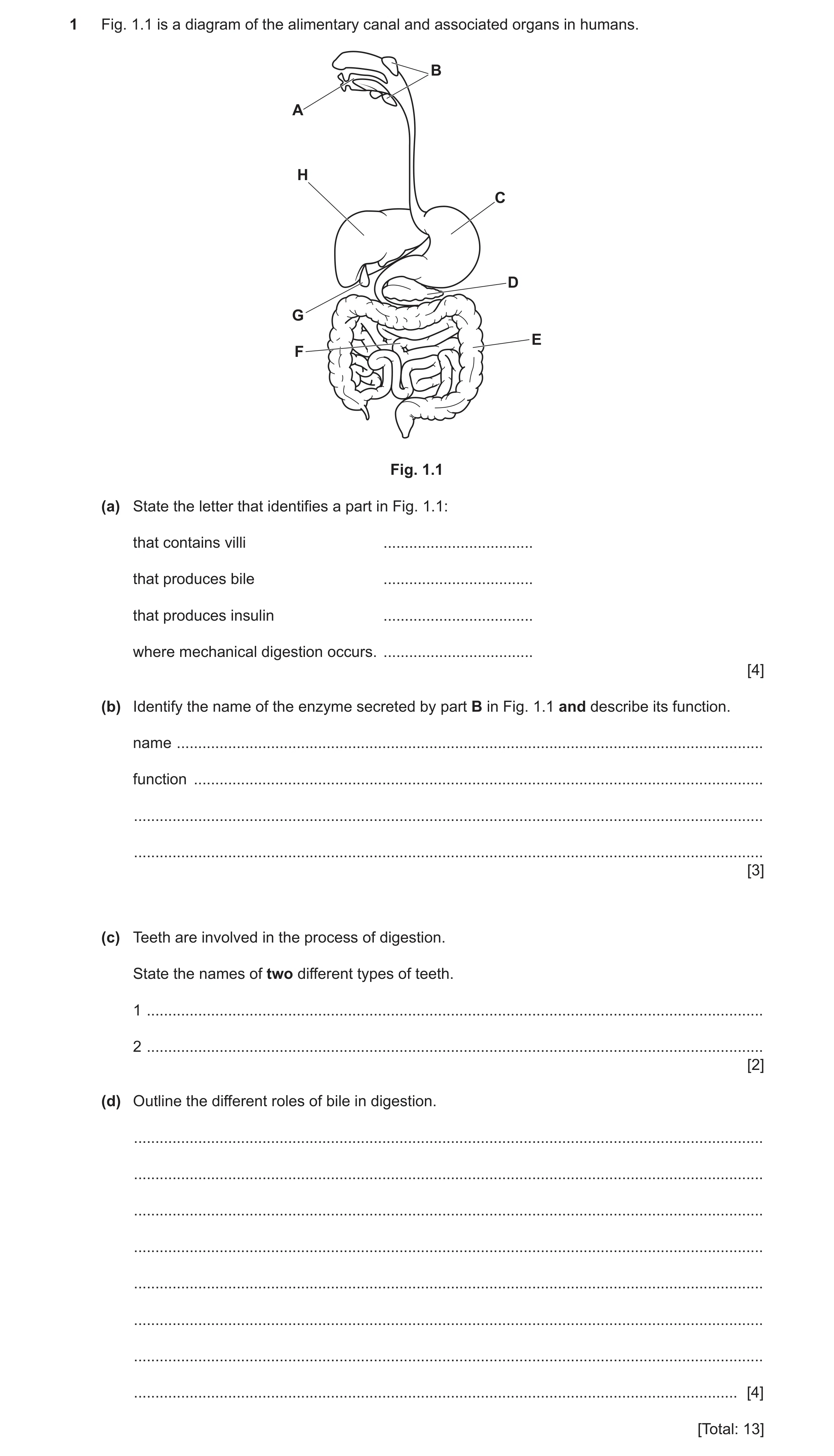
1 Fig. 1.1 is a diagram of the alimentary canal and associated organs in humans. B A H C D G E F Fig. 1.1 (a) State the letter that identifies a part in Fig. 1.1: that contains villi … that produces bile … that produces insulin … where mechanical digestion occurs. … [4] (b) Identify the name of the enzyme secreted by part B in Fig. 1.1 and describe its function. name … function … … … [3] (c) Teeth are involved in the process of digestion. State the names of two different types of teeth. 1 … 2 … [2] (d) Outline the different roles of bile in digestion. … … … … … … … … [4] [Total: 13]
13 marks
Mark scheme: Question Answer Marks 1(a) F ; 4 H ; D ; A and / or C ; 1(b) (salivary) amylase ; 3 breaks down, starch / carbohydrates ; to, (simpler) sugar(s) ; 1(c) any two from: 2 incisor ; canine ; pre-molar ; molar ; 1(d) any four from: 4 neutralises, (stomach) acid / gastric juice ; to provide suitable pH (for enzymes) ; emulsifies fats ; to provide a larger surface area (for chemical digestion) ; to increase the rate of digestion ;
This question in 0654/41 Oct/Nov 2024
Q13 · The structure of a villus 0654/43 Oct/Nov 2024
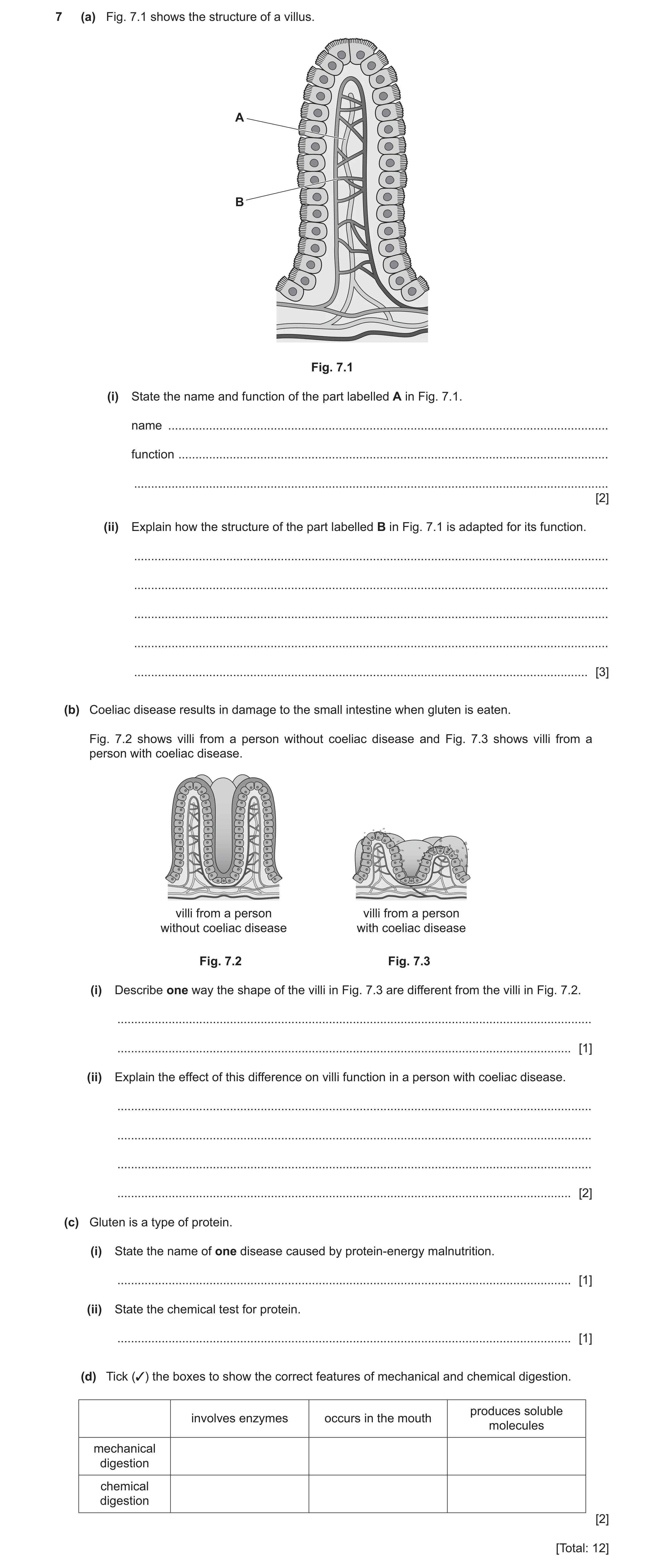
7 (a) Fig. 7.1 shows the structure of a villus. A B Fig. 7.1 (i) State the name and function of the part labelled A in Fig. 7.1. name … function … … [2] (ii) Explain how the structure of the part labelled B in Fig. 7.1 is adapted for its function. … … … … … [3] (b) Coeliac disease results in damage to the small intestine when gluten is eaten. Fig. 7.2 shows villi from a person without coeliac disease and Fig. 7.3 shows villi from a person with coeliac disease. villi from a person villi from a person without coeliac disease with coeliac disease Fig. 7.2 Fig. 7.3 (i) Describe one way the shape of the villi in Fig. 7.3 are different from the villi in Fig. 7.2. … … [1] (ii) Explain the effect of this difference on villi function in a person with coeliac disease. … … … … [2] (c) Gluten is a type of protein. (i) State the name of one disease caused by protein-energy malnutrition. … [1] (ii) State the chemical test for protein. … [1] (d) Tick (3) the boxes to show the correct features of mechanical and chemical digestion. produces soluble involves enzymes occurs in the mouth molecules mechanical digestion chemical digestion [2] [Total: 12]
12 marks
Mark scheme: 7(a)(i) lacteal ; 2 absorption of fat / transport of fat ; 7(a)(ii) thin walls / walls only one cell thick ; 3 short diffusion distance ; for transfer of (named) nutrients ; 7(b)(i) shorter / flatter / smaller AW ; 1 7(b)(ii) less surface area ; 2 for absorption (of nutrients) ; 7(c)(i) marasmus / kwashiorkor ; 1 7(c)(ii) biuret (solution) ; 1 7(d) 2 involves occurs in the produces enzymes mouth soluble molecules mechanical digestion chemical digestion 1 mark for each correct row ;;
This question in 0654/43 Oct/Nov 2024
 1 / 20
 2 / 20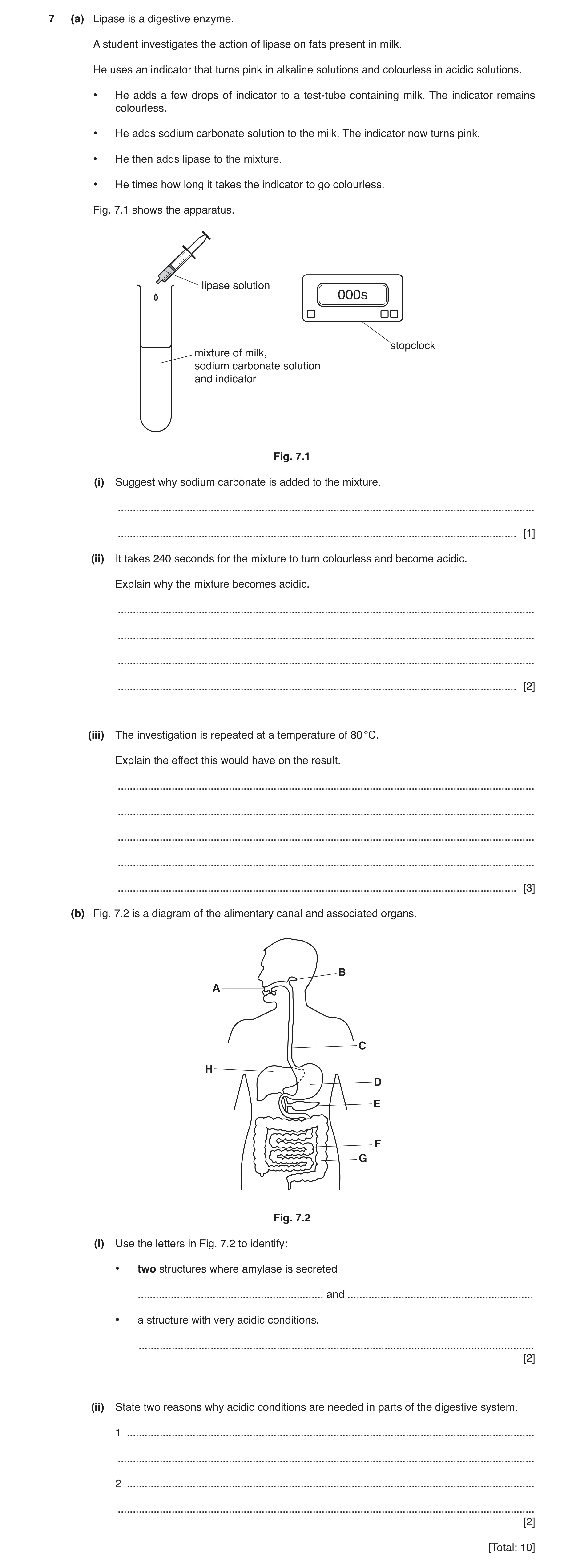
 8
8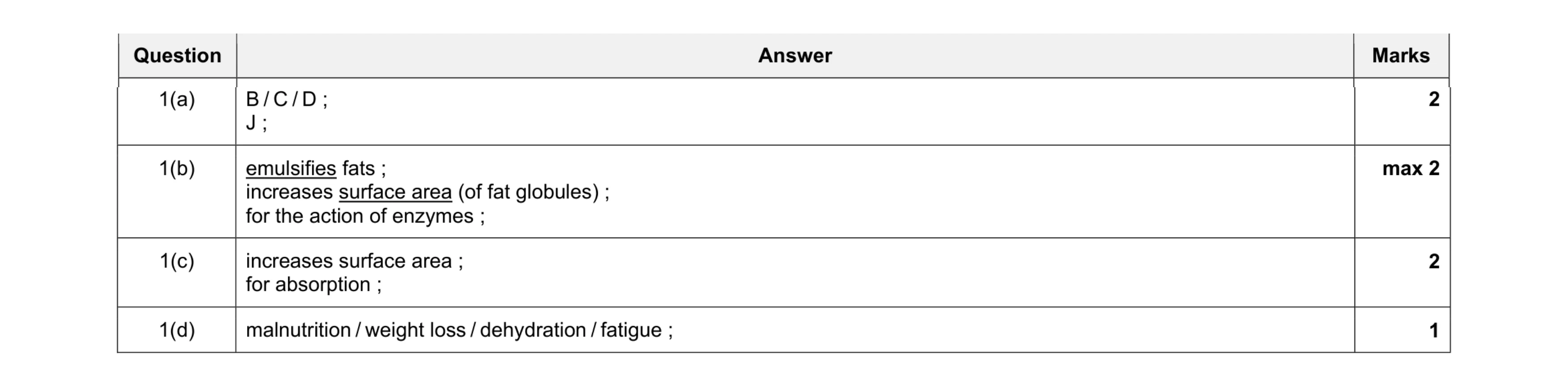 7
7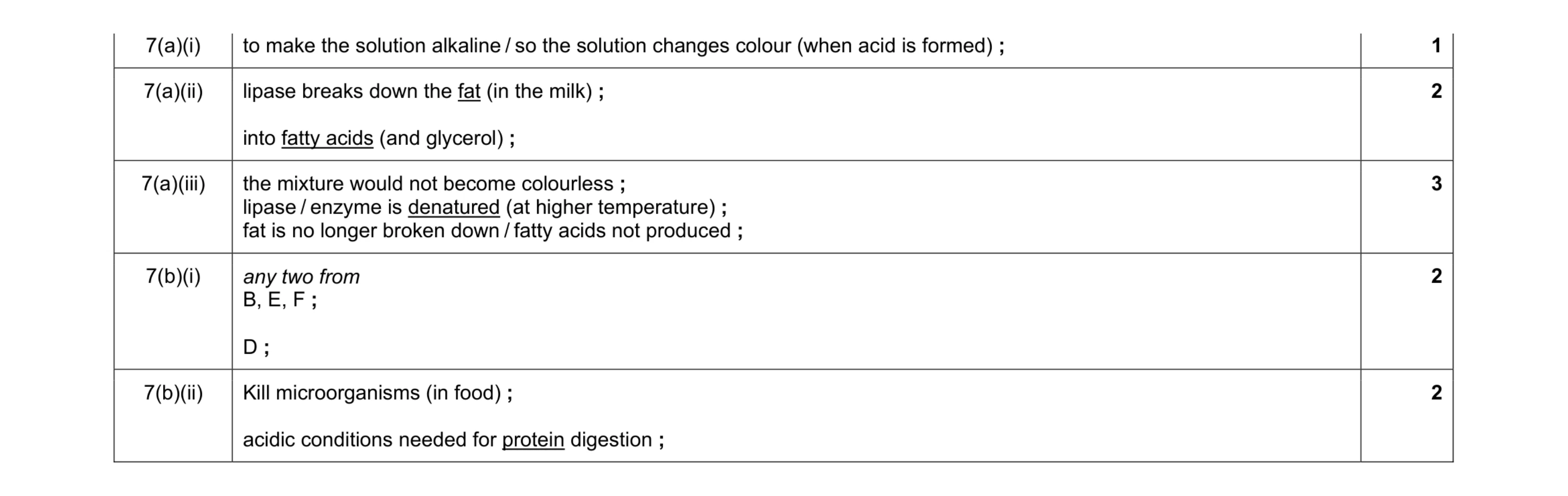 10
10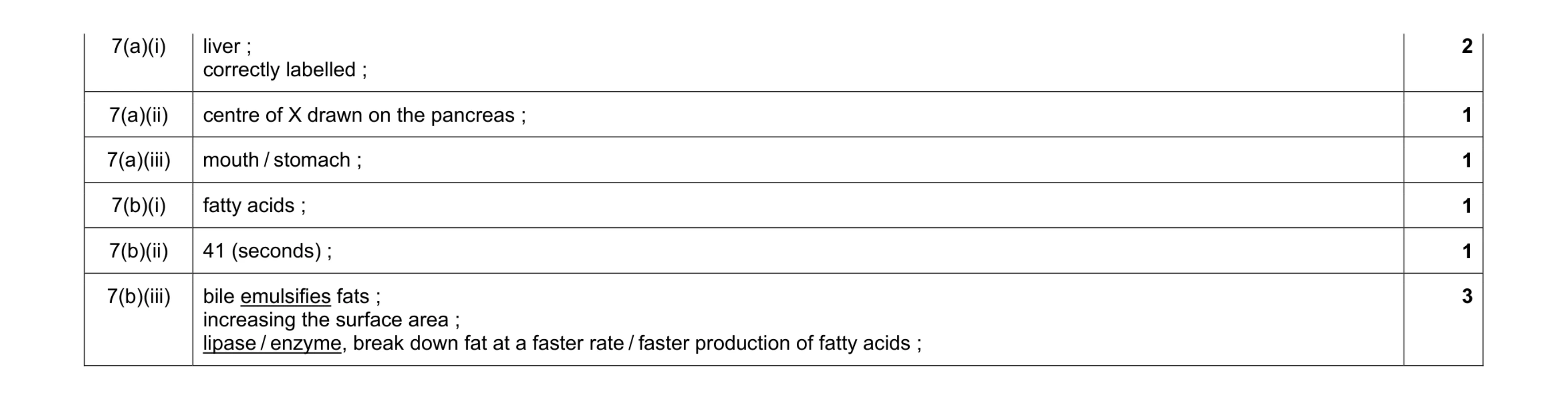 9
9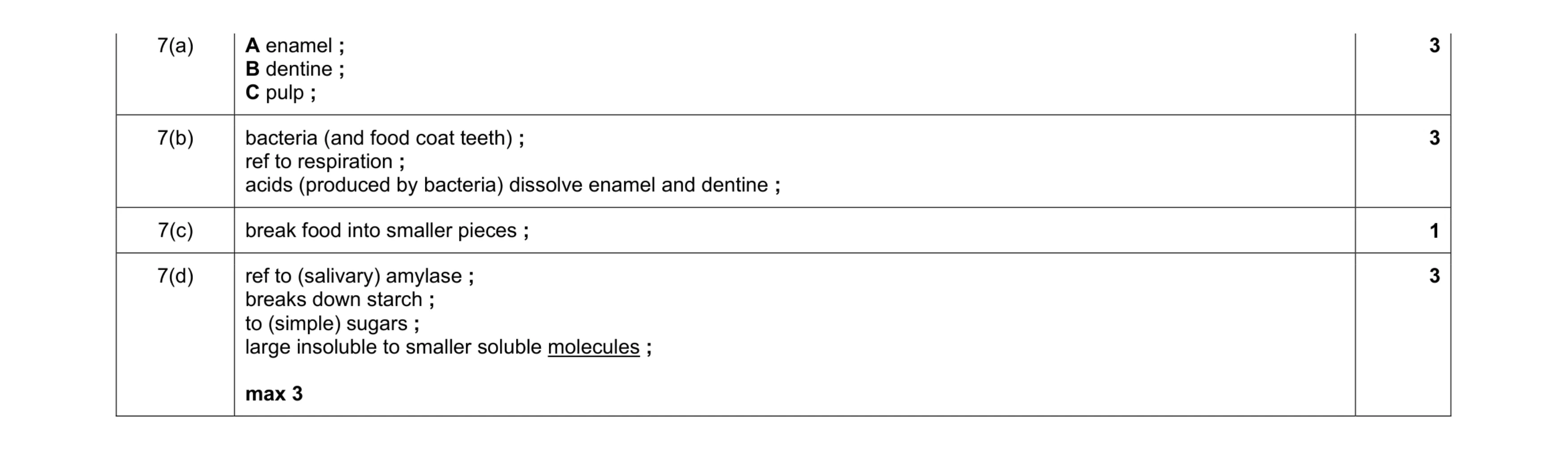 10
10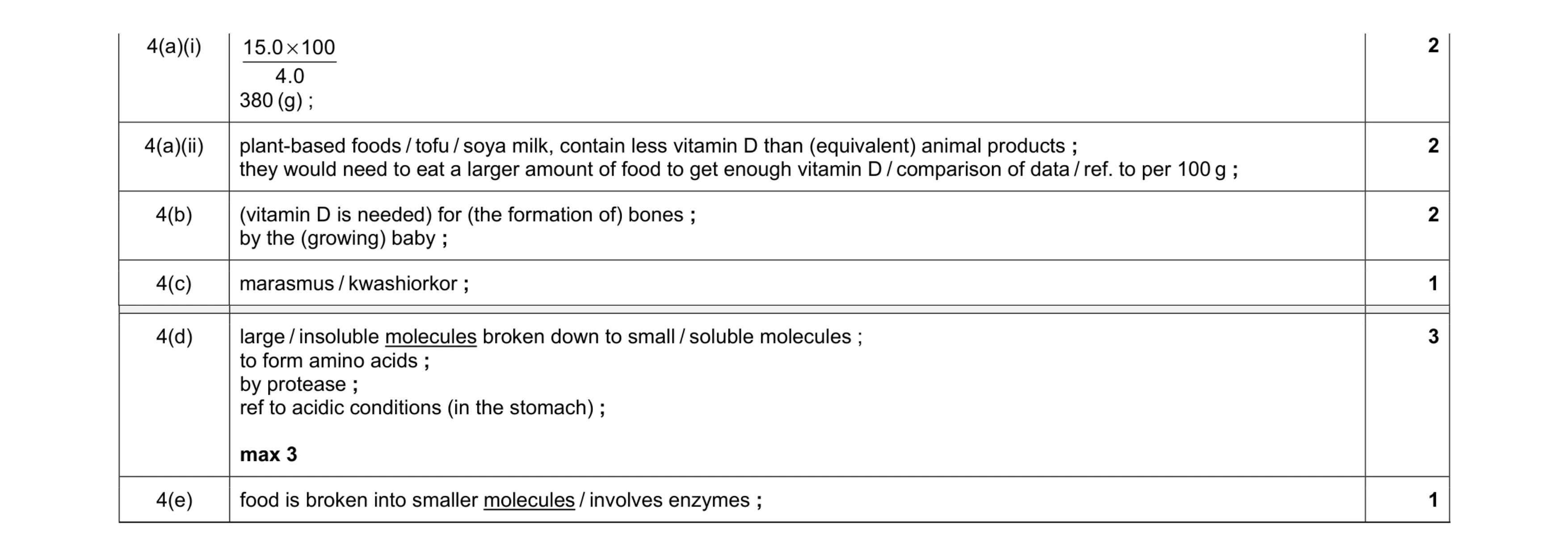 11
11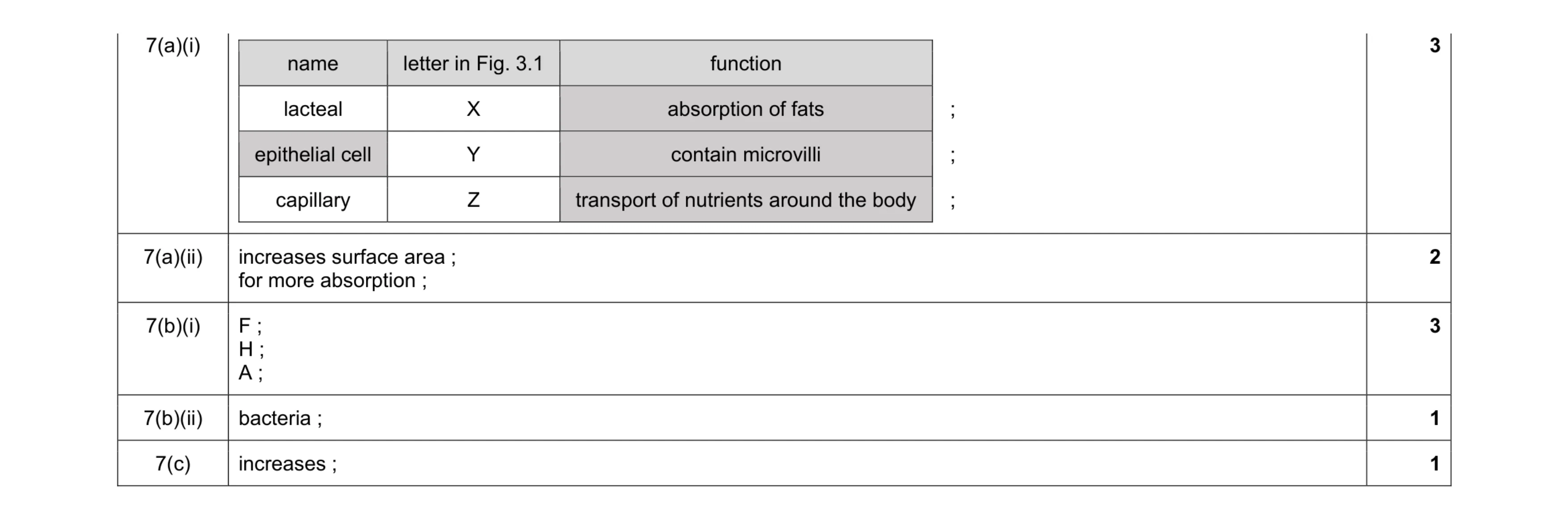 10
10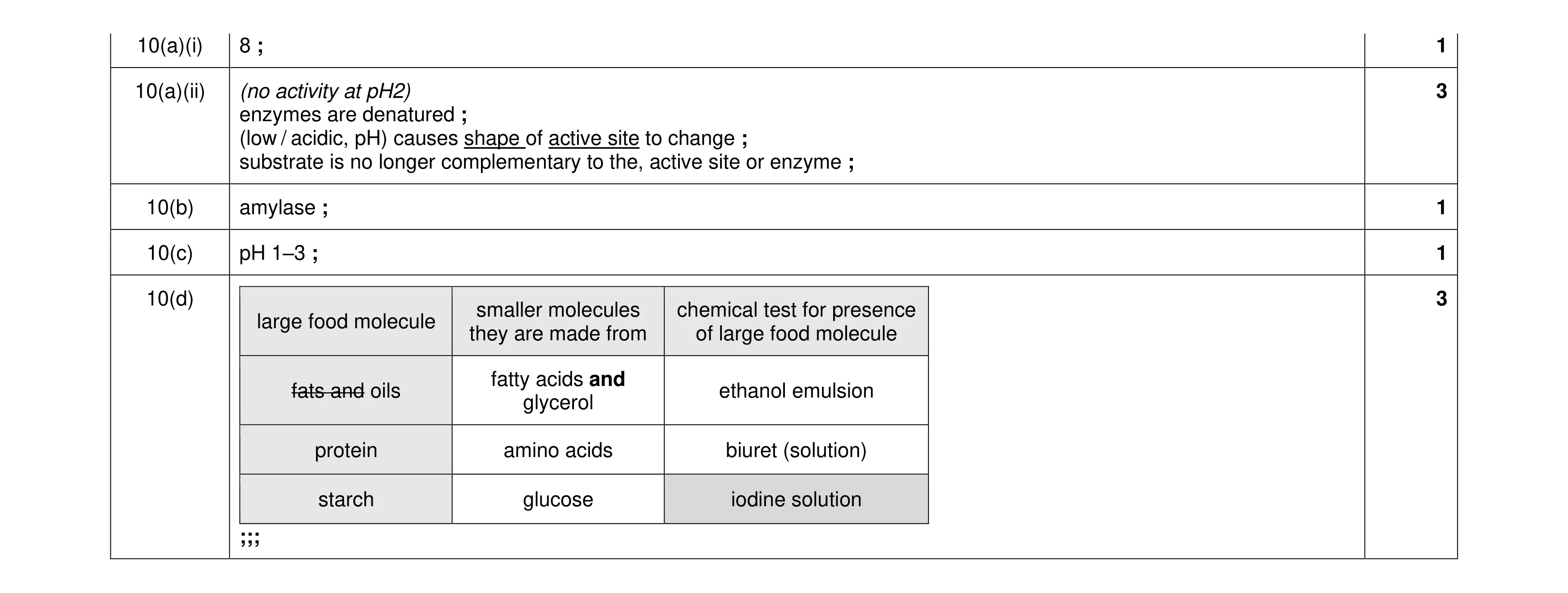 9
9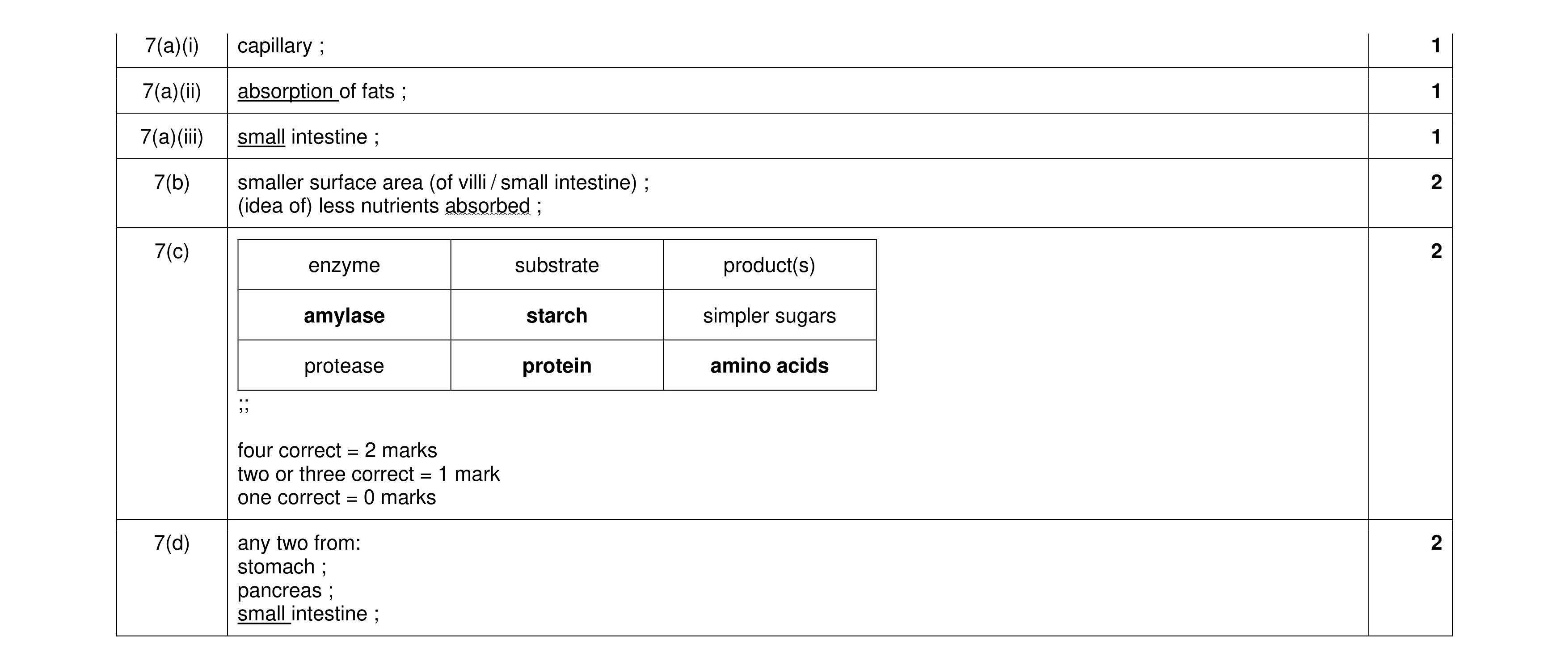 9
9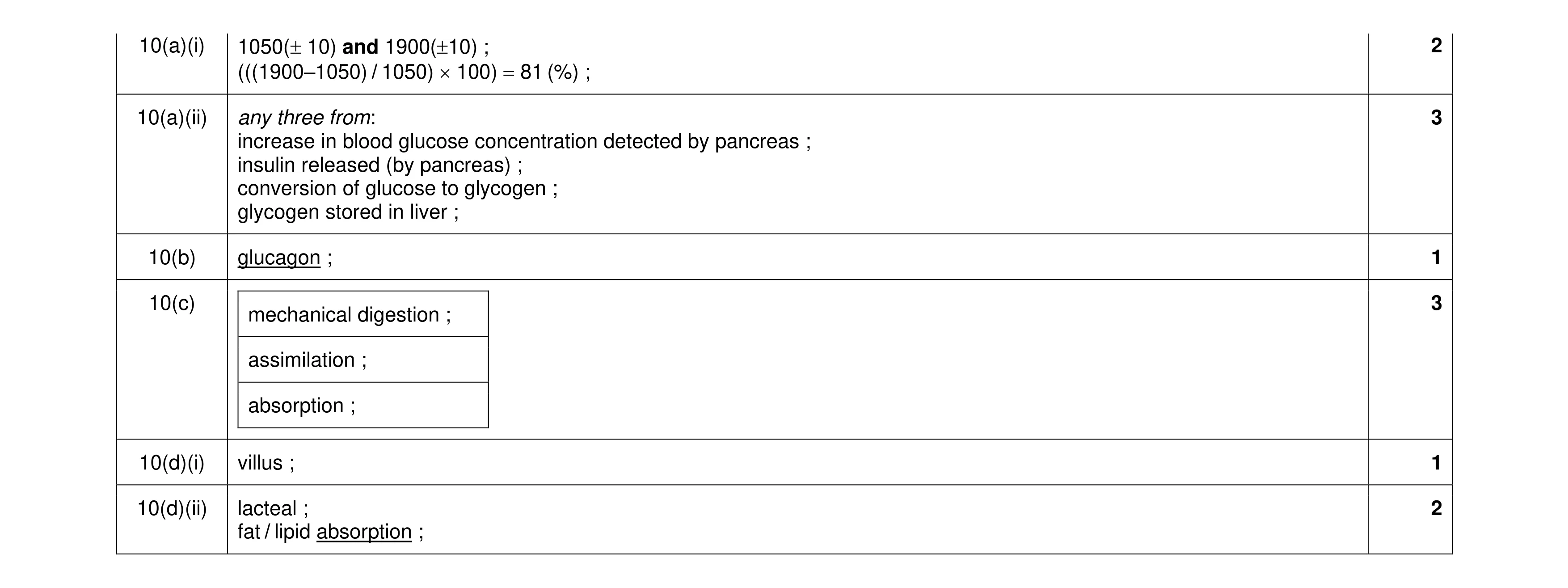 12
12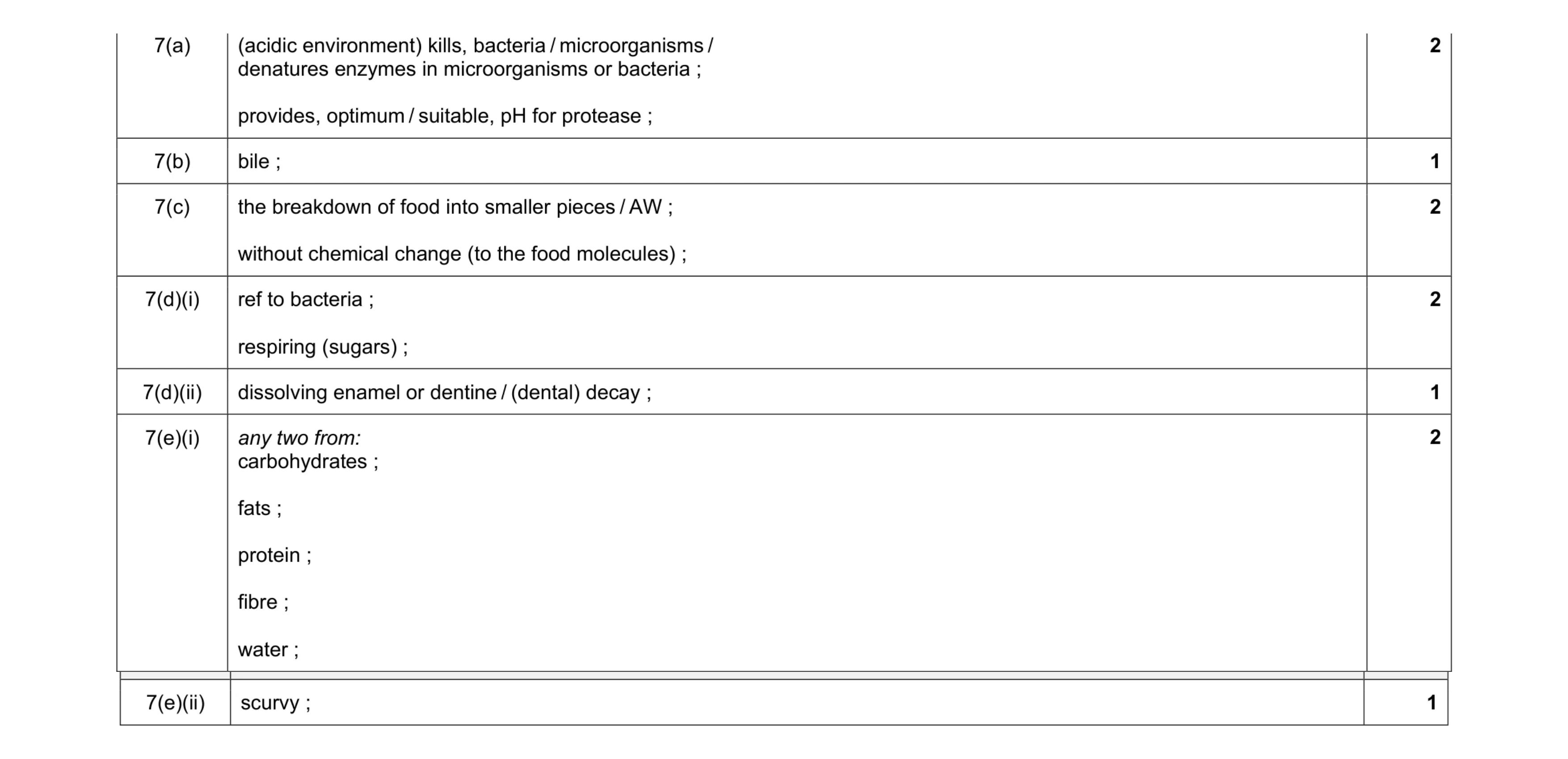 11
11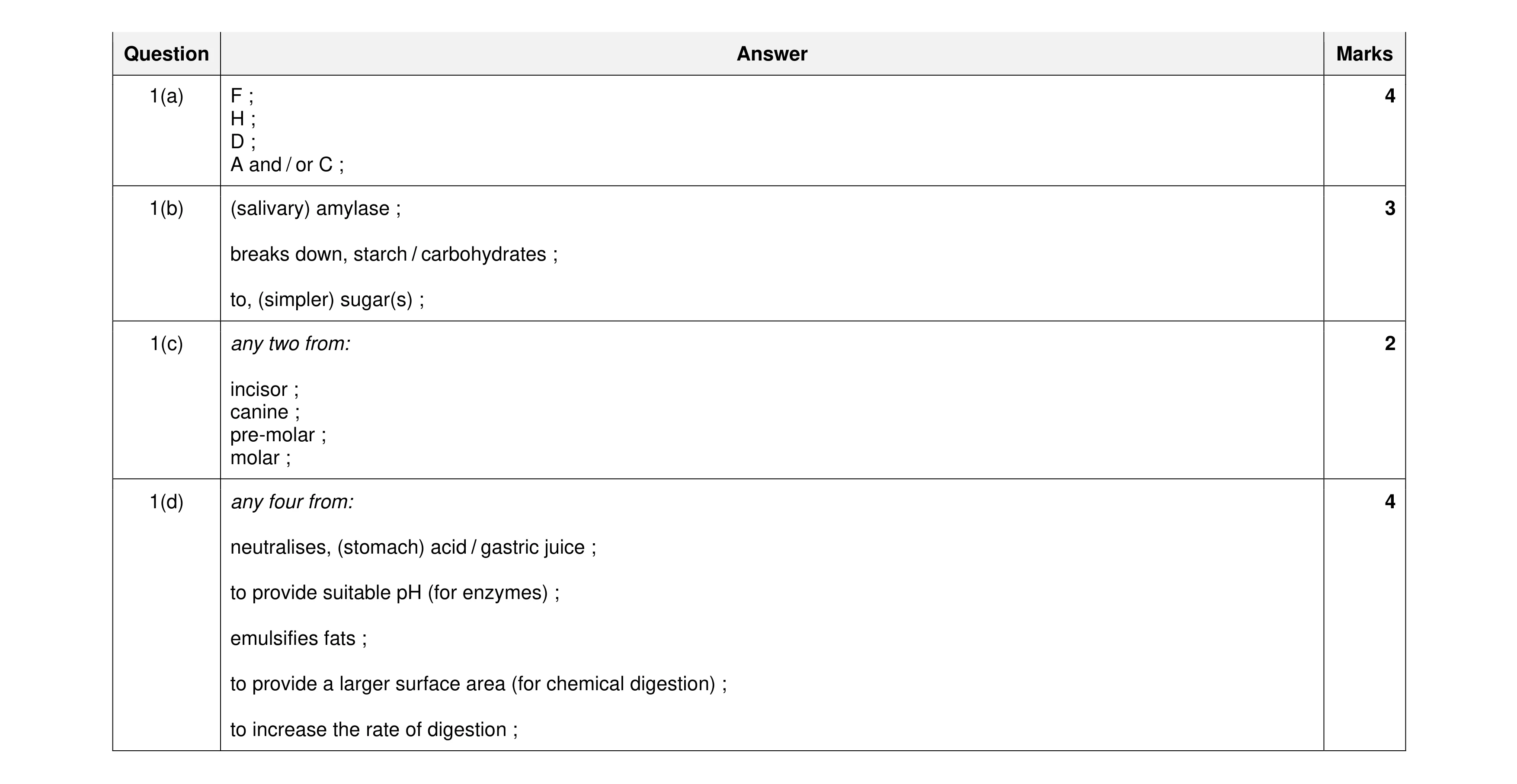 13
13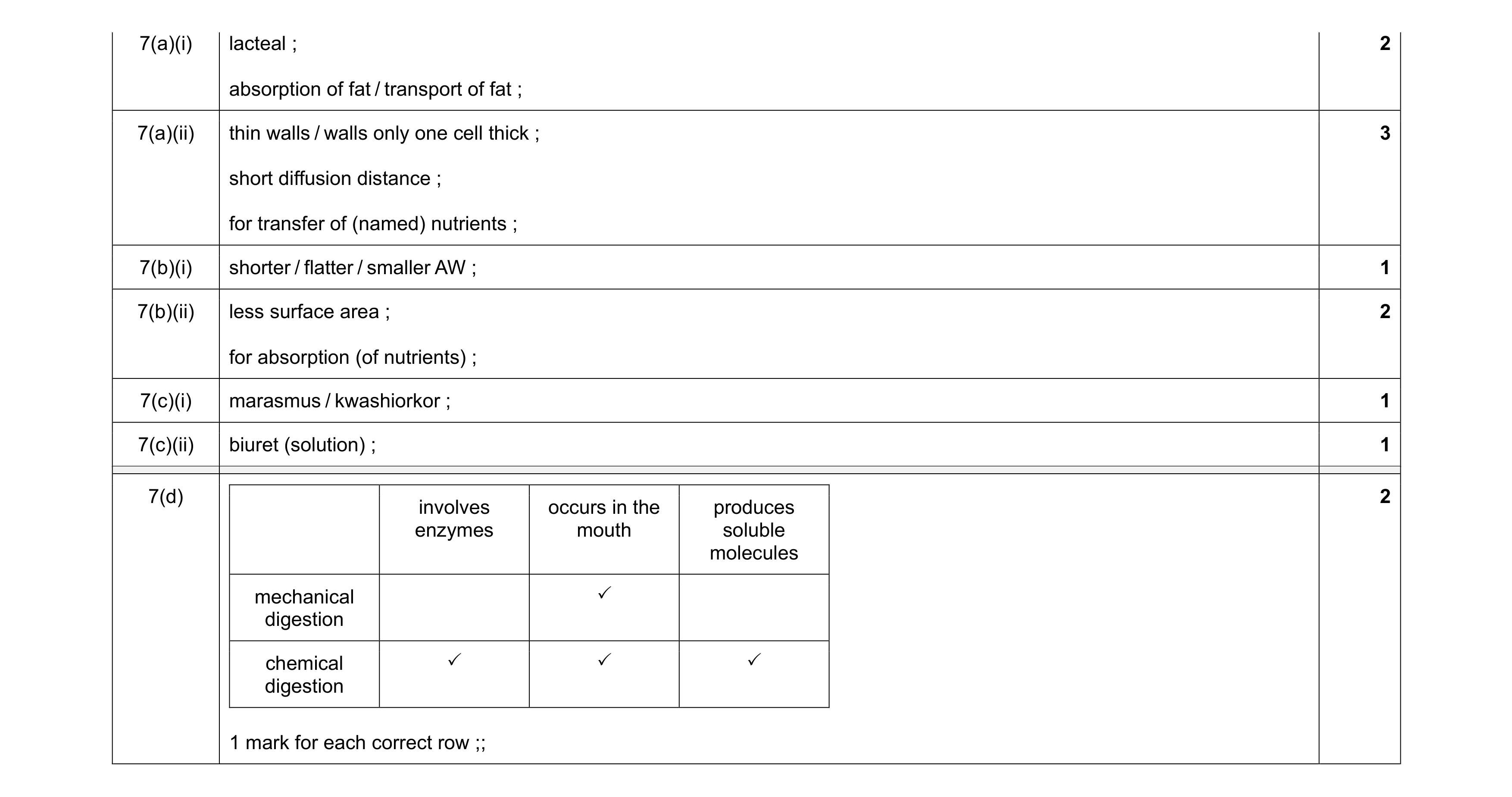 12
12