Questions as text
Q1 · The list shows some processes that occur in living organisms 0653/31 Oct/Nov 2018
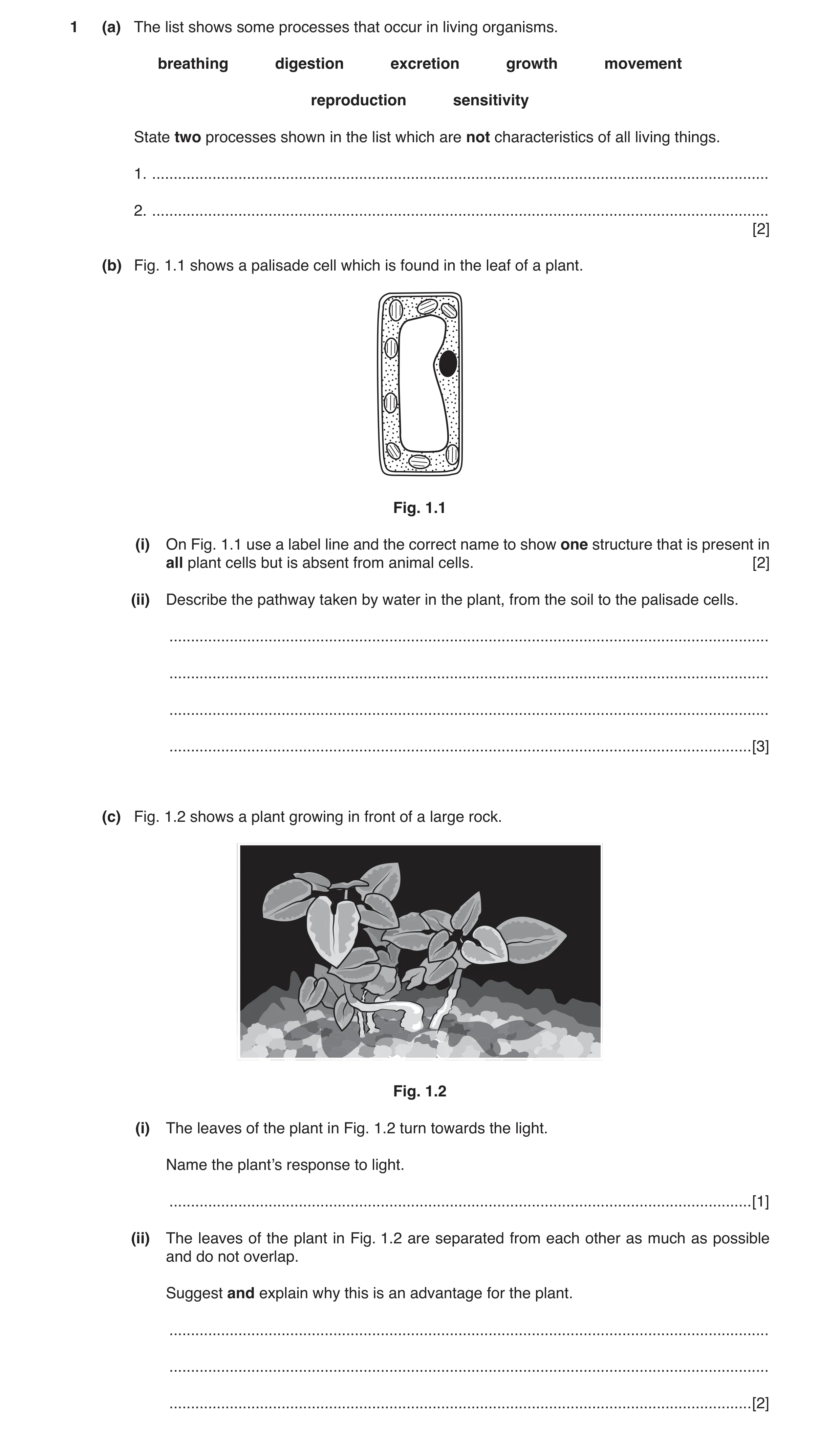
1 (a) The list shows some processes that occur in living organisms. breathing digestion excretion growth movement reproduction sensitivity State two processes shown in the list which are not characteristics of all living things. 1. … 2. … [2] (b) Fig. 1.1 shows a palisade cell which is found in the leaf of a plant. Fig. 1.1 (i) On Fig. 1.1 use a label line and the correct name to show one structure that is present in all plant cells but is absent from animal cells. [2] (ii) Describe the pathway taken by water in the plant, from the soil to the palisade cells. … … … … [3] (c) Fig. 1.2 shows a plant growing in front of a large rock. Fig. 1.2 (i) The leaves of the plant in Fig. 1.2 turn towards the light. Name the plant’s response to light. … [1] (ii) The leaves of the plant in Fig. 1.2 are separated from each other as much as possible and do not overlap. Suggest and explain why this is an advantage for the plant. … … … [2]
10 marks
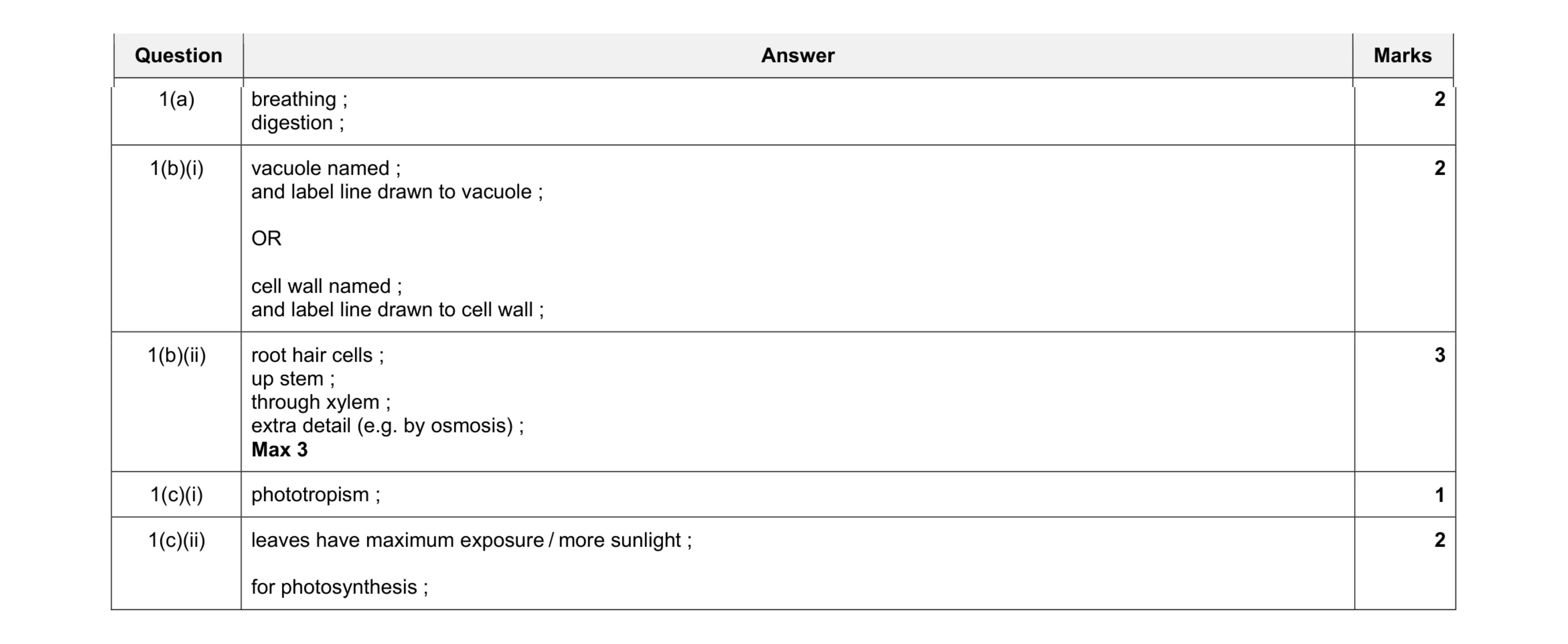
Mark scheme: 1(a) breathing ; digestion ; 2 1(b)(i) vacuole named ; and label line drawn to vacuole ; OR cell wall named ; and label line drawn to cell wall ; 2 1(b)(ii) root hair cells ; up stem ; through xylem ; extra detail (e.g. by osmosis) ; Max 3 3 1(c)(i) phototropism ; 1 1(c)(ii) leaves have maximum exposure / more sunlight ; for photosynthesis ; 2
This question in 0653/31 Oct/Nov 2018
Q2 · A diagram showing five of the characteristics of living organisms 0653/32 May/June 2019
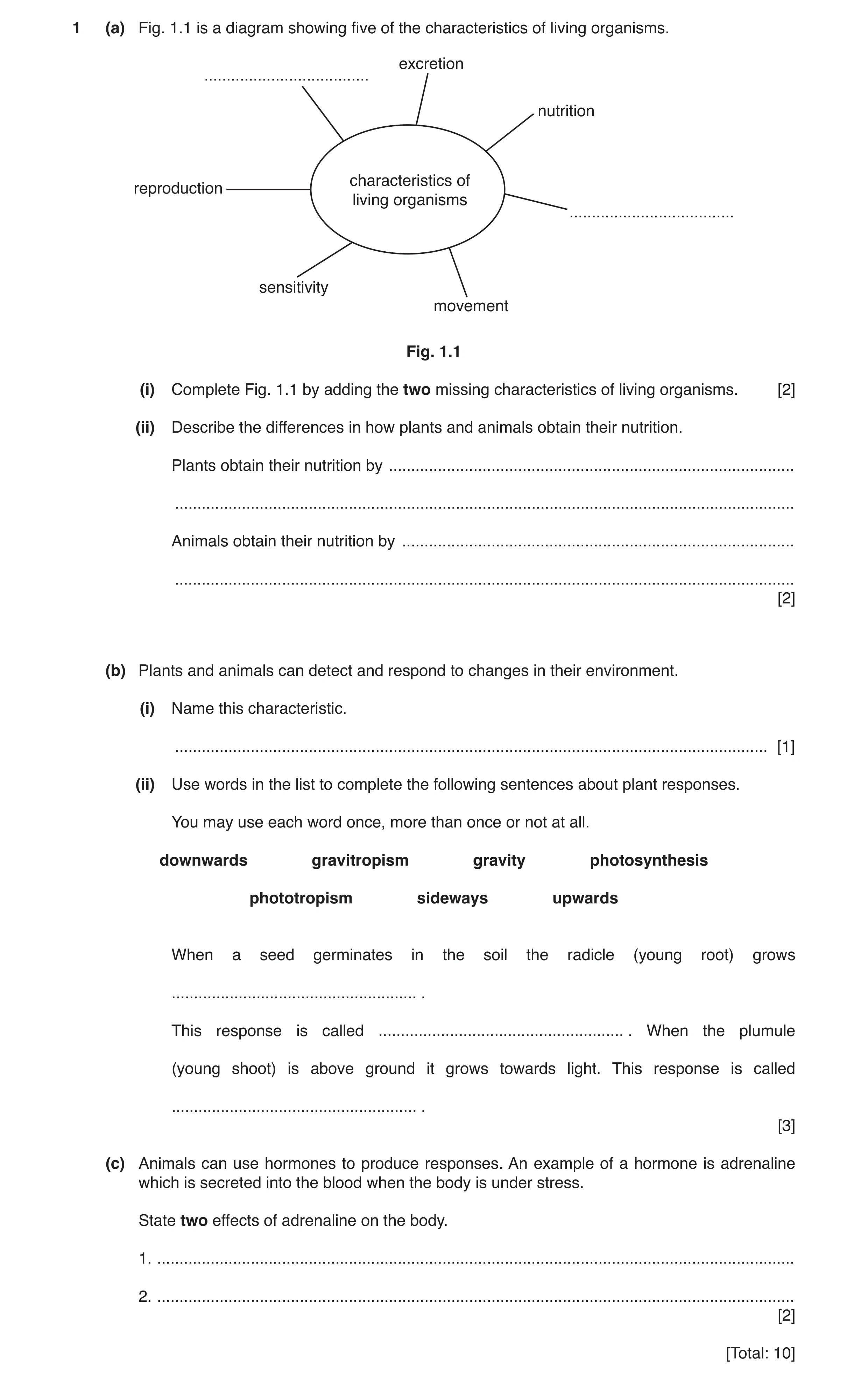
1 (a) Fig. 1.1 is a diagram showing five of the characteristics of living organisms. excretion … nutrition characteristics of reproduction living organisms … sensitivity movement Fig. 1.1 (i) Complete Fig. 1.1 by adding the two missing characteristics of living organisms. [2] (ii) Describe the differences in how plants and animals obtain their nutrition. Plants obtain their nutrition by … … Animals obtain their nutrition by … … [2] (b) Plants and animals can detect and respond to changes in their environment. (i) Name this characteristic. … [1] (ii) Use words in the list to complete the following sentences about plant responses. You may use each word once, more than once or not at all. downwards gravitropism gravity photosynthesis phototropism sideways upwards When a seed germinates in the soil the radicle (young root) grows … . This response is called … . When the plumule (young shoot) is above ground it grows towards light. This response is called … . [3] (c) Animals can use hormones to produce responses. An example of a hormone is adrenaline which is secreted into the blood when the body is under stress. State two effects of adrenaline on the body. 1. … 2. … [2] [Total: 10]
10 marks
Mark scheme: 1(a)(i) either order growth ; respiration ; 2 1(a)(ii) (plants obtain their nutrition by) photosynthesis ; (animals obtain their nutrition by) eating ; 2 1(b)(i) sensitivity ; 1 1(b)(ii) downwards ; gravitropism ; phototropism ; 3 1(c) any two of increased breathing rate ; increased pulse rate ; widened pupils ; 2
This question in 0653/32 May/June 2019
Q3 · Some leaves of the plant Mimosa pudica 0653/33 May/June 2019
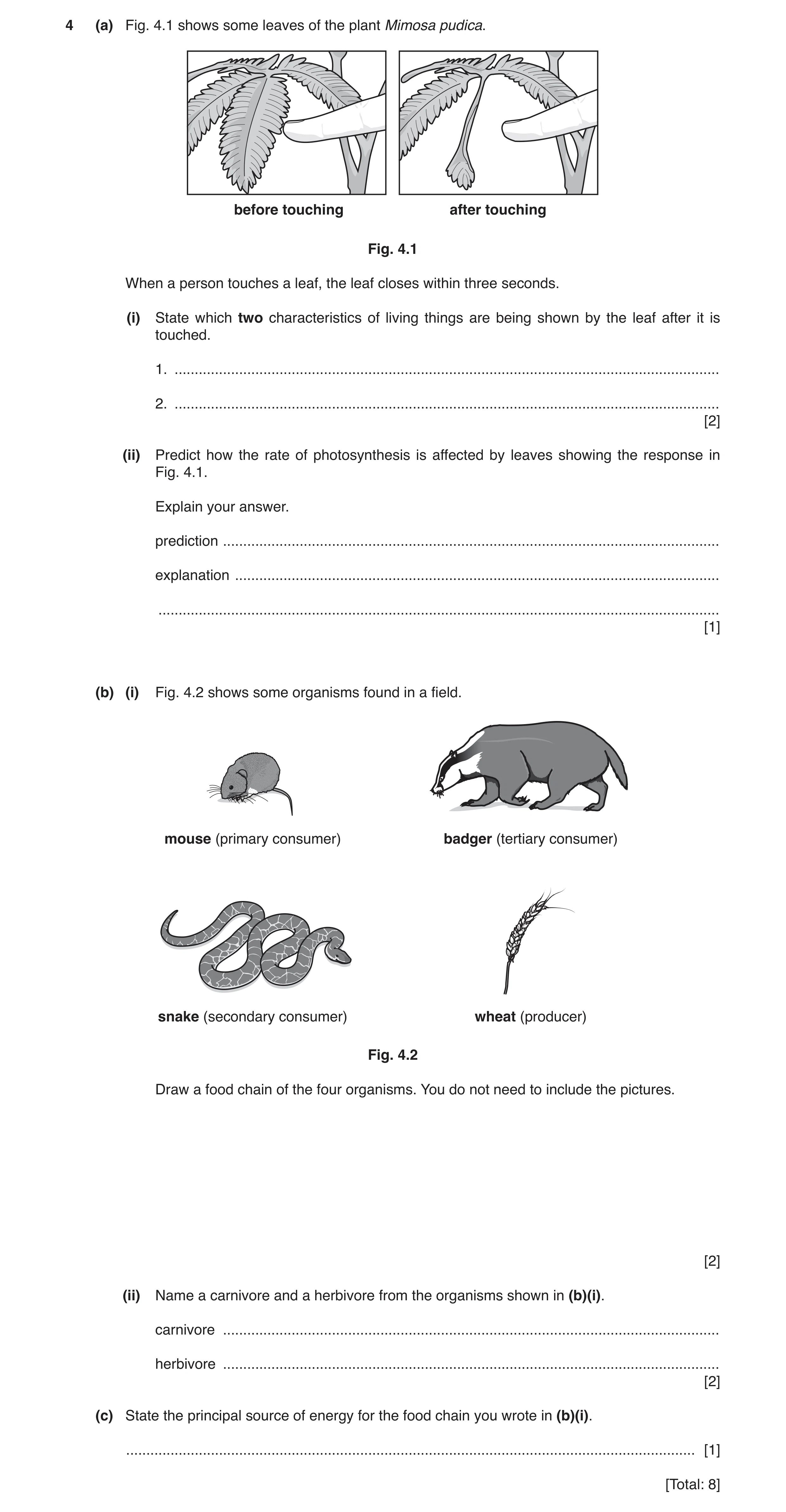
4 (a) Fig. 4.1 shows some leaves of the plant Mimosa pudica. before touching after touching Fig. 4.1 When a person touches a leaf, the leaf closes within three seconds. (i) State which two characteristics of living things are being shown by the leaf after it is touched. 1. … 2. … [2] (ii) Predict how the rate of photosynthesis is affected by leaves showing the response in Fig. 4.1. Explain your answer. prediction … explanation … … [1] (b) (i) Fig. 4.2 shows some organisms found in a field. mouse (primary consumer) badger (tertiary consumer) snake (secondary consumer) wheat (producer) Fig. 4.2 Draw a food chain of the four organisms. You do not need to include the pictures. [2] (ii) Name a carnivore and a herbivore from the organisms shown in (b)(i). carnivore … herbivore … [2] (c) State the principal source of energy for the food chain you wrote in (b)(i). … [1] [Total: 8]
8 marks
Mark scheme: 4(a)(i) sensitivity ; movement ; 2 4(a)(ii) rate stops / reduces and less leaf area / less light (energy) absorbed ; 1 Question Answer Marks 4(b)(i) wheat mouse snake badger correct order of organisms ; arrows going in correct direction ; 2 4(b)(ii) snake / badger ; mouse ; 2 4(c) Sun ; 1
This question in 0653/33 May/June 2019
Q4 · Plants need water to survive 0653/31 Oct/Nov 2019
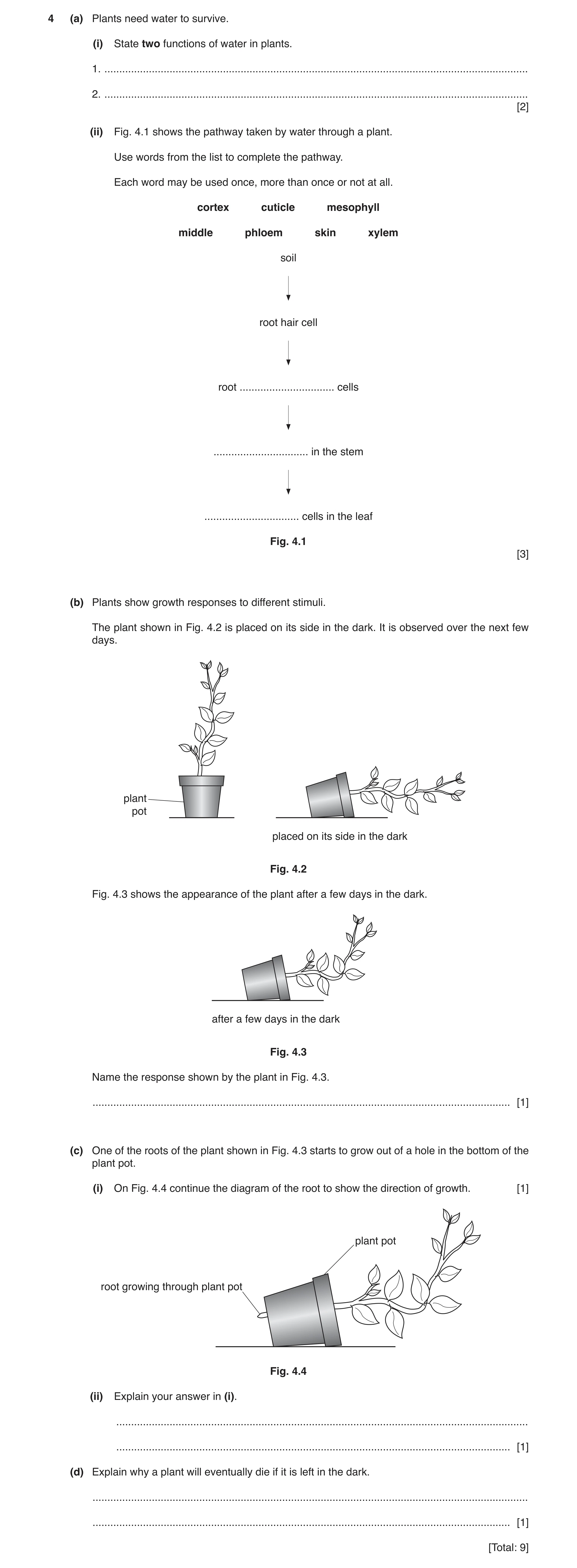
4 (a) Plants need water to survive. (i) State two functions of water in plants. 1. … 2. … [2] (ii) Fig. 4.1 shows the pathway taken by water through a plant. Use words from the list to complete the pathway. Each word may be used once, more than once or not at all. cortex cuticle mesophyll middle phloem skin xylem soil root hair cell root … cells … in the stem … cells in the leaf Fig. 4.1 [3] (b) Plants show growth responses to different stimuli. The plant shown in Fig. 4.2 is placed on its side in the dark. It is observed over the next few days. plant pot placed on its side in the dark Fig. 4.2 Fig. 4.3 shows the appearance of the plant after a few days in the dark. after a few days in the dark Fig. 4.3 Name the response shown by the plant in Fig. 4.3. … [1] (c) One of the roots of the plant shown in Fig. 4.3 starts to grow out of a hole in the bottom of the plant pot. (i) On Fig. 4.4 continue the diagram of the root to show the direction of growth. [1] plant pot root growing through plant pot Fig. 4.4 (ii) Explain your answer in (i). … … [1] (d) Explain why a plant will eventually die if it is left in the dark. … … [1] [Total: 9]
9 marks
Mark scheme: 4(a)(i) any two from: for photosynthesis ; transport in plants ; as a solvent ; 2 4(a)(ii) cortex ; xylem ; mesophyll ; 3 4(b) gravitropism ; 1 4(c)(i) root continued and bending downwards ; 1 4(c)(ii) roots respond to gravity; 1 4(d) no light for photosynthesis ; 1
This question in 0653/31 Oct/Nov 2019
Q5 · Parts of the human gas exchange system 0653/32 Oct/Nov 2020
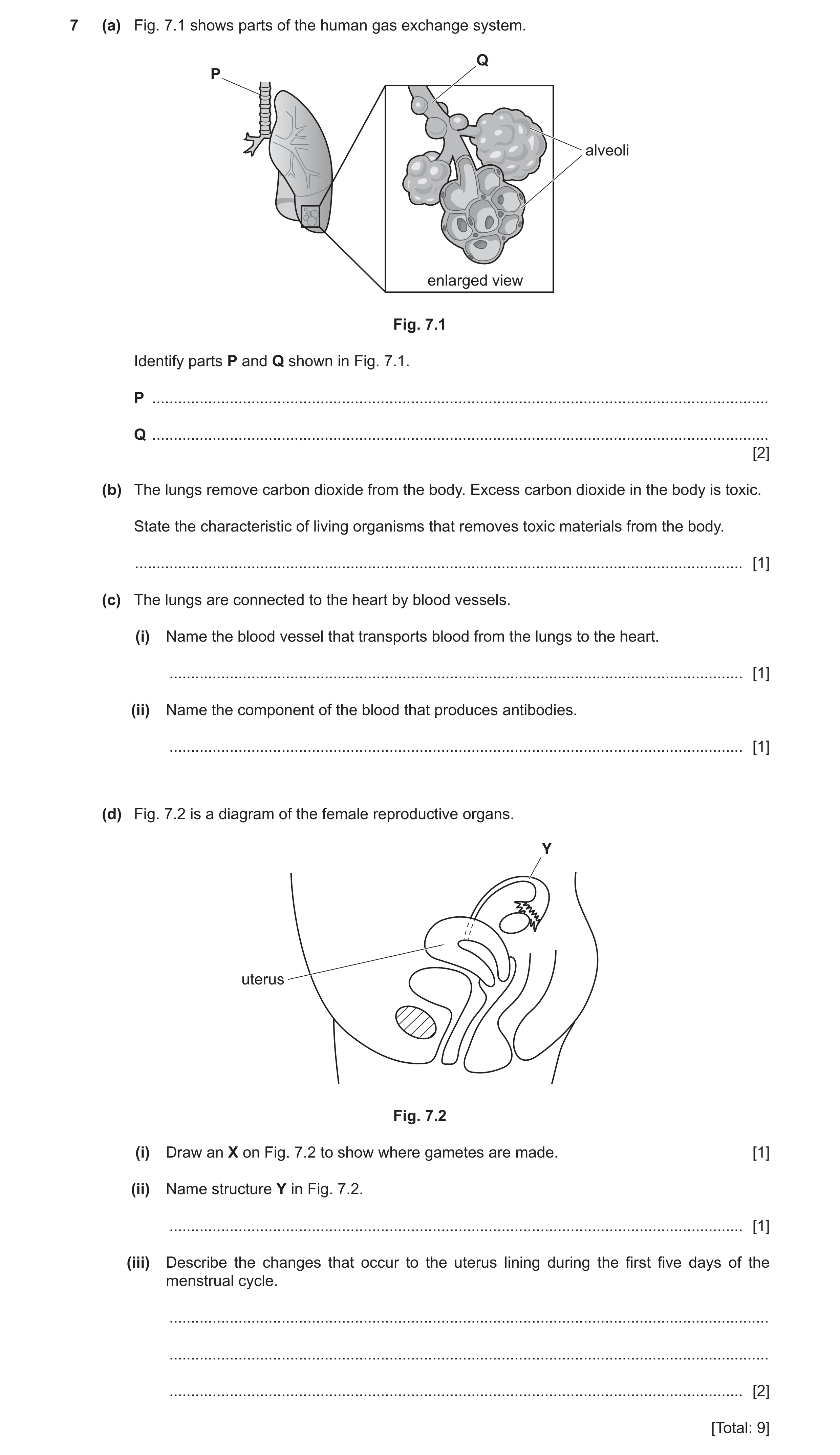
7 (a) Fig. 7.1 shows parts of the human gas exchange system. Q P alveoli enlarged view Fig. 7.1 Identify parts P and Q shown in Fig. 7.1. P … Q … [2] (b) The lungs remove carbon dioxide from the body. Excess carbon dioxide in the body is toxic. State the characteristic of living organisms that removes toxic materials from the body. … [1] (c) The lungs are connected to the heart by blood vessels. (i) Name the blood vessel that transports blood from the lungs to the heart. … [1] (ii) Name the component of the blood that produces antibodies. … [1] (d) Fig. 7.2 is a diagram of the female reproductive organs. Y uterus Fig. 7.2 (i) Draw an X on Fig. 7.2 to show where gametes are made. [1] (ii) Name structure Y in Fig. 7.2. … [1] (iii) Describe the changes that occur to the uterus lining during the first five days of the menstrual cycle. … … … [2] [Total: 9]
9 marks
Mark scheme: 7(a) P trachea ; Q bronchiole ; 2 7(b) excretion ; 1 7(c)(i) pulmonary vein ; 1 7(c)(ii) white blood cell ; 1 Question Answer Marks 7(d)(i) centre of X on ovary ; 1 7(d)(ii) oviduct ; 1 7(d)(iii) any two from: (uterus lining) breaks down ; (uterus lining) is shed ; (uterus) thickness decreases ; 2
This question in 0653/32 Oct/Nov 2020
Q6 · The boxes on the left show characteristics of living organisms 0653/31 May/June 2021
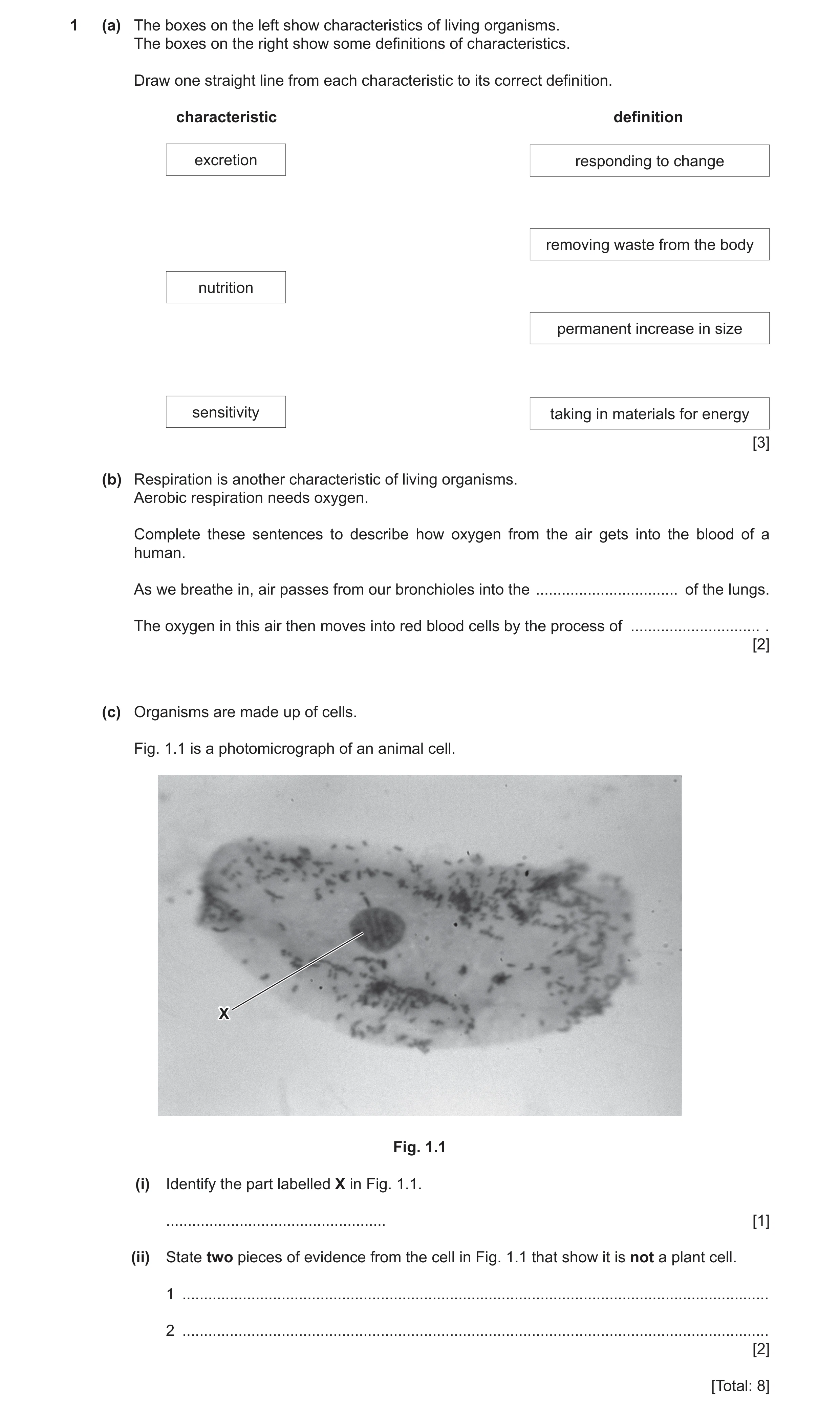
1 (a) The boxes on the left show characteristics of living organisms. The boxes on the right show some definitions of characteristics. Draw one straight line from each characteristic to its correct definition. characteristic definition excretion responding to change removing waste from the body nutrition permanent increase in size sensitivity taking in materials for energy [3] (b) Respiration is another characteristic of living organisms. Aerobic respiration needs oxygen. Complete these sentences to describe how oxygen from the air gets into the blood of a human. As we breathe in, air passes from our bronchioles into the … of the lungs. The oxygen in this air then moves into red blood cells by the process of … . [2] (c) Organisms are made up of cells. Fig. 1.1 is a photomicrograph of an animal cell. X Fig. 1.1 (i) Identify the part labelled X in Fig. 1.1. … [1] (ii) State two pieces of evidence from the cell in Fig. 1.1 that show it is not a plant cell. 1 … 2 … [2] [Total: 8]
8 marks
Mark scheme: 1(a) responding to change excretion removing waste from the body nutrition permanent increases in size sensitivity taking in materials for energy ;;; 1(b) alveoli ; diffusion ; 2 1(c)(i) nucleus ; 1 1(c)(ii) any two from: no cell wall ; no chloroplasts ; no (large) vacuole ; 2
This question in 0653/31 May/June 2021
Q7 · Reproduction is one of the characteristics of living organisms 0653/32 May/June 2021
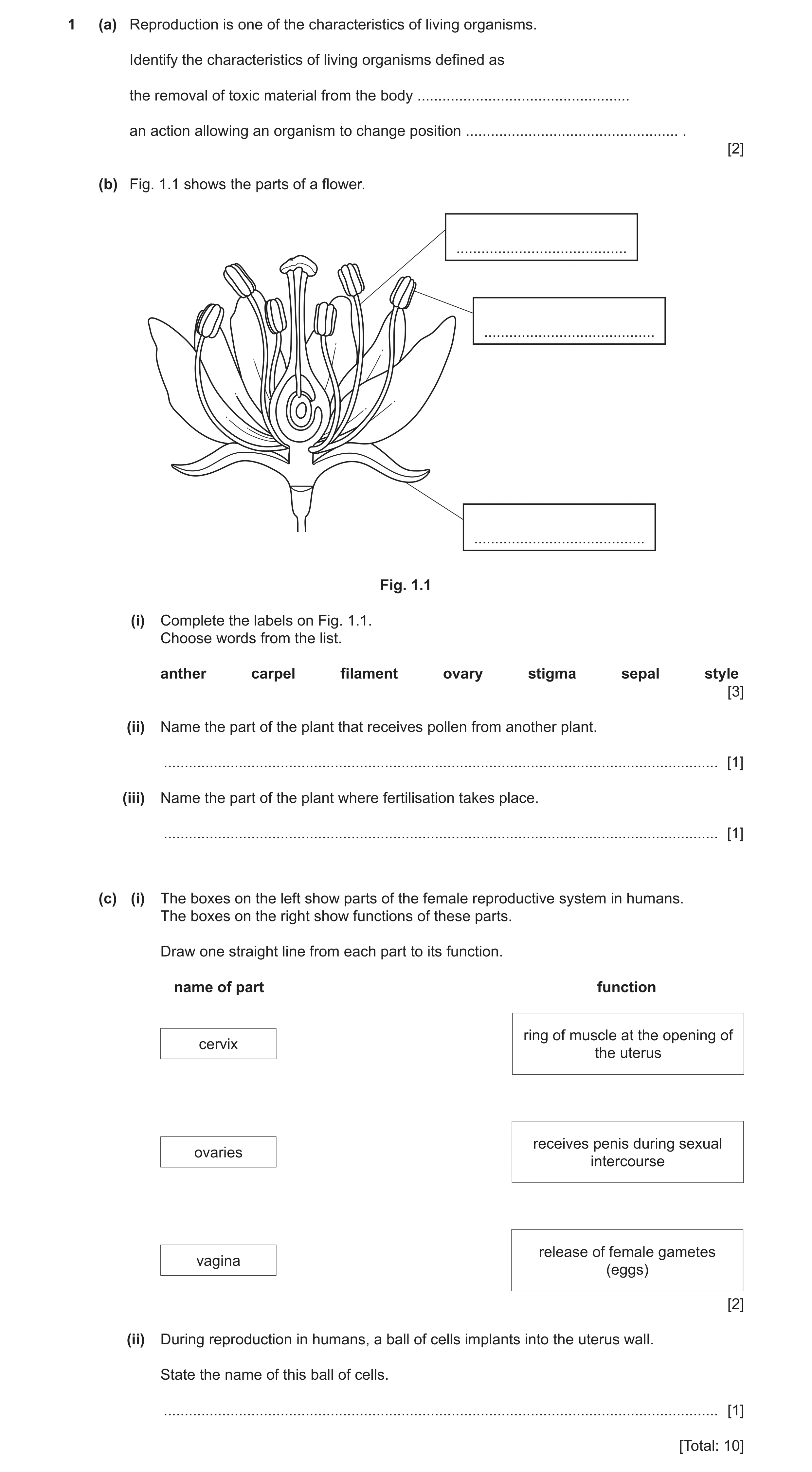
1 (a) Reproduction is one of the characteristics of living organisms. Identify the characteristics of living organisms defined as the removal of toxic material from the body … an action allowing an organism to change position … . [2] (b) Fig. 1.1 shows the parts of a flower. … … … Fig. 1.1 (i) Complete the labels on Fig. 1.1. Choose words from the list. anther carpel filament ovary stigma sepal style [3] (ii) Name the part of the plant that receives pollen from another plant. … [1] (iii) Name the part of the plant where fertilisation takes place. … [1] (c) (i) The boxes on the left show parts of the female reproductive system in humans. The boxes on the right show functions of these parts. Draw one straight line from each part to its function. name of part function ring of muscle at the opening of cervix the uterus receives penis during sexual ovaries intercourse release of female gametes vagina (eggs) [2] (ii) During reproduction in humans, a ball of cells implants into the uterus wall. State the name of this ball of cells. … [1] [Total: 10]
10 marks
Mark scheme: 1(a) excretion ; movement ; 2 1(b)(i) filament ; anther ; sepal ; 3 1(b)(ii) stigma ; 1 1(b)(iii) ovule ; 1 1(c)(i) cervix ring of muscle at the opening of the uterus ovaries receives penis during sexual intercourse vagina release of female gametes (eggs) ;; all three correct = 2 marks one or two correct = 1 mark 2 1(c)(ii) embryo ; 1
This question in 0653/32 May/June 2021
Q8 · Nutrition is one of the characteristics of living organisms 0653/33 May/June 2021
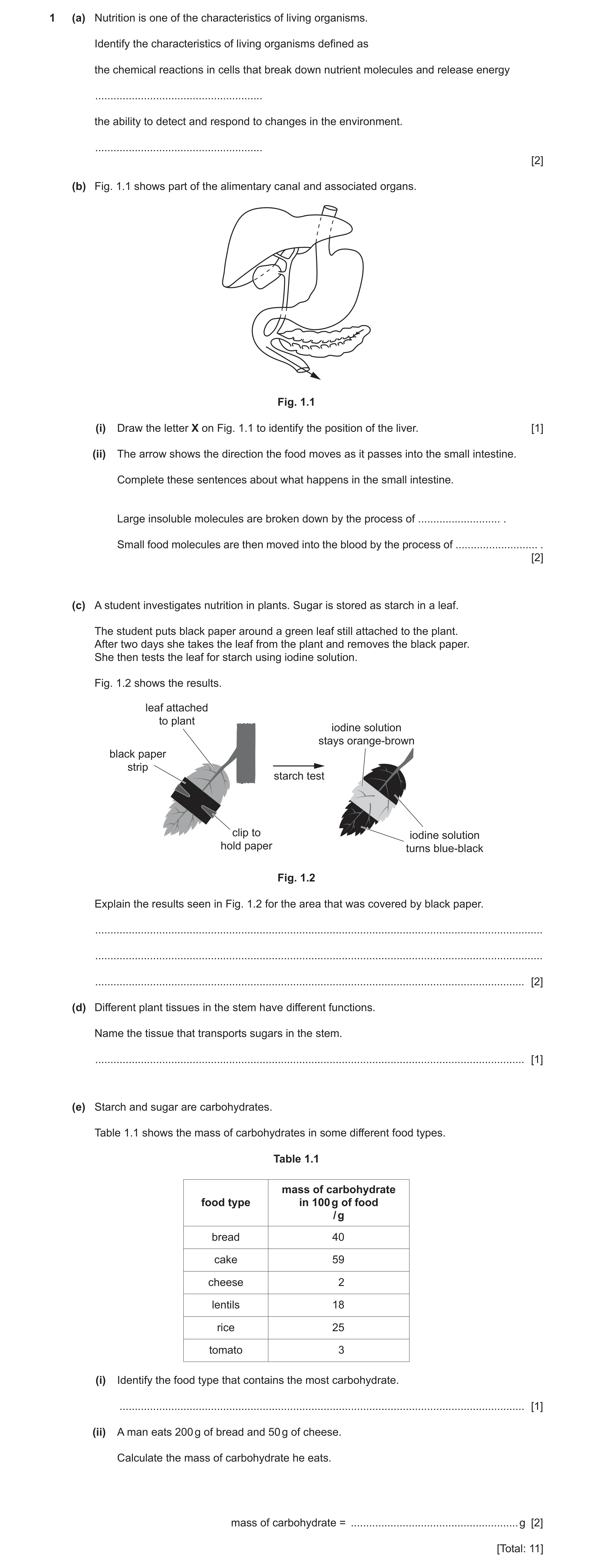
1 (a) Nutrition is one of the characteristics of living organisms. Identify the characteristics of living organisms defined as the chemical reactions in cells that break down nutrient molecules and release energy … the ability to detect and respond to changes in the environment. … [2] (b) Fig. 1.1 shows part of the alimentary canal and associated organs. Fig. 1.1 (i) Draw the letter X on Fig. 1.1 to identify the position of the liver. [1] (ii) The arrow shows the direction the food moves as it passes into the small intestine. Complete these sentences about what happens in the small intestine. Large insoluble molecules are broken down by the process of … . Small food molecules are then moved into the blood by the process of … . [2] (c) A student investigates nutrition in plants. Sugar is stored as starch in a leaf. The student puts black paper around a green leaf still attached to the plant. After two days she takes the leaf from the plant and removes the black paper. She then tests the leaf for starch using iodine solution. Fig. 1.2 shows the results. leaf attached to plant iodine solution stays orange-brown black paper strip starch test clip to iodine solution hold paper turns blue-black Fig. 1.2 Explain the results seen in Fig. 1.2 for the area that was covered by black paper. … … … [2] (d) Different plant tissues in the stem have different functions. Name the tissue that transports sugars in the stem. … [1] (e) Starch and sugar are carbohydrates. Table 1.1 shows the mass of carbohydrates in some different food types. Table 1.1 mass of carbohydrate food type in 100 g of food / g bread 40 cake 59 cheese 2 lentils 18 rice 25 tomato 3 (i) Identify the food type that contains the most carbohydrate. … [1] (ii) A man eats 200 g of bread and 50 g of cheese. Calculate the mass of carbohydrate he eats. mass of carbohydrate = … g [2] [Total: 11]
11 marks
Mark scheme: 1(a) respiration ; sensitivity ; 2 1(b)(i) centre of X must be on liver ; 1 1(b)(ii) digestion ; absorption ; 2 1(c) no starch is made ; as light is needed for photosynthesis ; 2 1(d) phloem ; 1 1(e)(i) cake ; 1 1(e)(ii) (40 x 2) + (2 x 0.5) ; 81 (g) ; 2
This question in 0653/33 May/June 2021
Q9 · The boxes on the left show some of the characteristics of living organisms 0653/32 Oct/Nov 2022
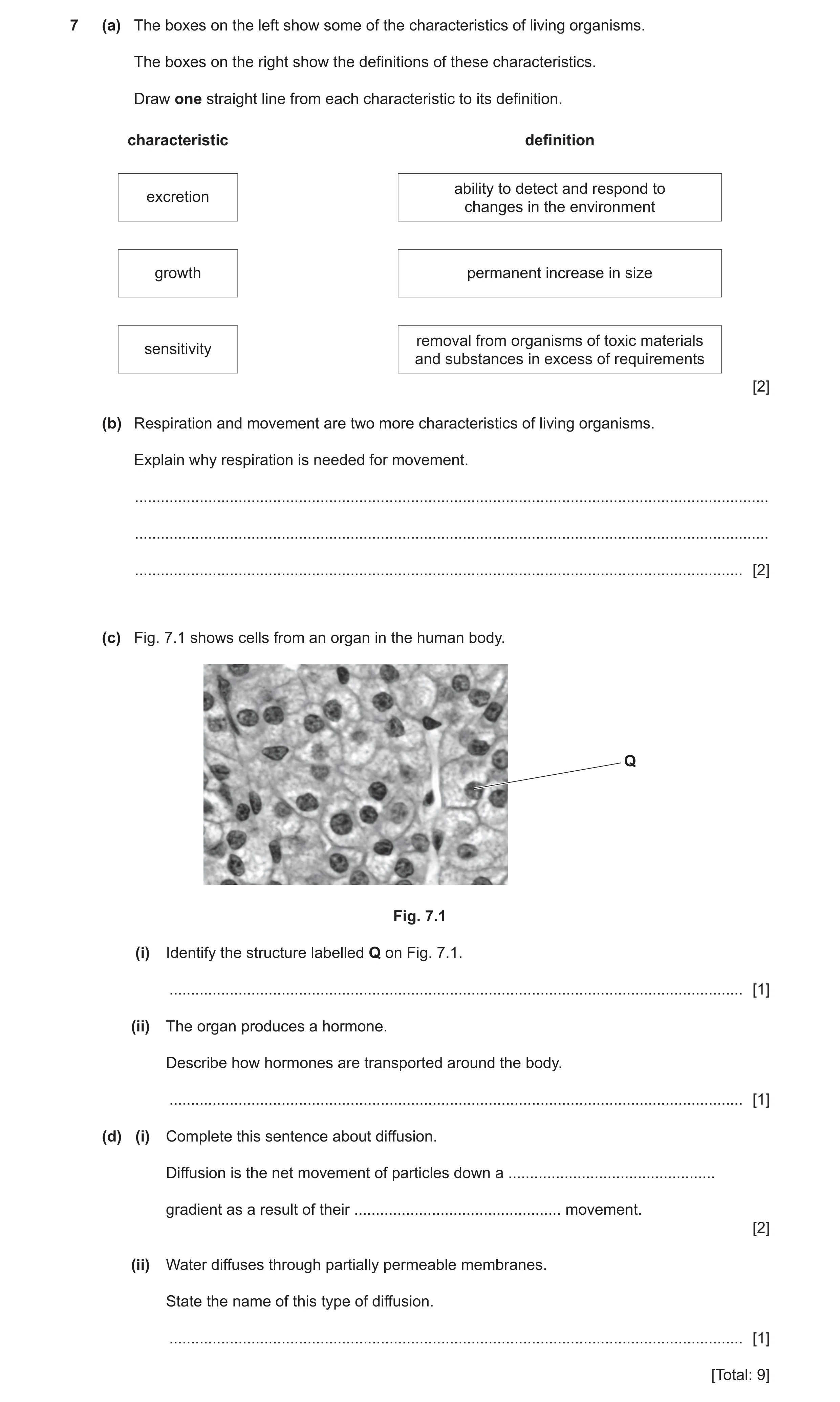
7 (a) The boxes on the left show some of the characteristics of living organisms. The boxes on the right show the definitions of these characteristics. Draw one straight line from each characteristic to its definition. characteristic definition ability to detect and respond to excretion changes in the environment growth permanent increase in size removal from organisms of toxic materials sensitivity and substances in excess of requirements [2] (b) Respiration and movement are two more characteristics of living organisms. Explain why respiration is needed for movement. … … … [2] (c) Fig. 7.1 shows cells from an organ in the human body. Q Fig. 7.1 (i) Identify the structure labelled Q on Fig. 7.1. … [1] (ii) The organ produces a hormone. Describe how hormones are transported around the body. … [1] (d) (i) Complete this sentence about diffusion. Diffusion is the net movement of particles down a … gradient as a result of their … movement. [2] (ii) Water diffuses through partially permeable membranes. State the name of this type of diffusion. … [1] [Total: 9]
9 marks
Mark scheme: 7(a) 2 ability to detect and respond to excretion changes in the environment growth permanent increase in size removal from organisms of toxic sensitivity materials and substances in excess of requirements one correct ; all three correct ; 7(b) respiration releases energy ; 2 energy needed for muscle contraction ; 7(c)(i) nucleus ; 1 7(c)(ii) (in the) blood / plasma ; 1 7(d)(i) concentration ; 2 random ; 7(d)(ii) osmosis ; 1
This question in 0653/32 Oct/Nov 2022
Q10 · The boxes on the left show some of the characteristics of living organisms 0653/33 Oct/Nov 2022
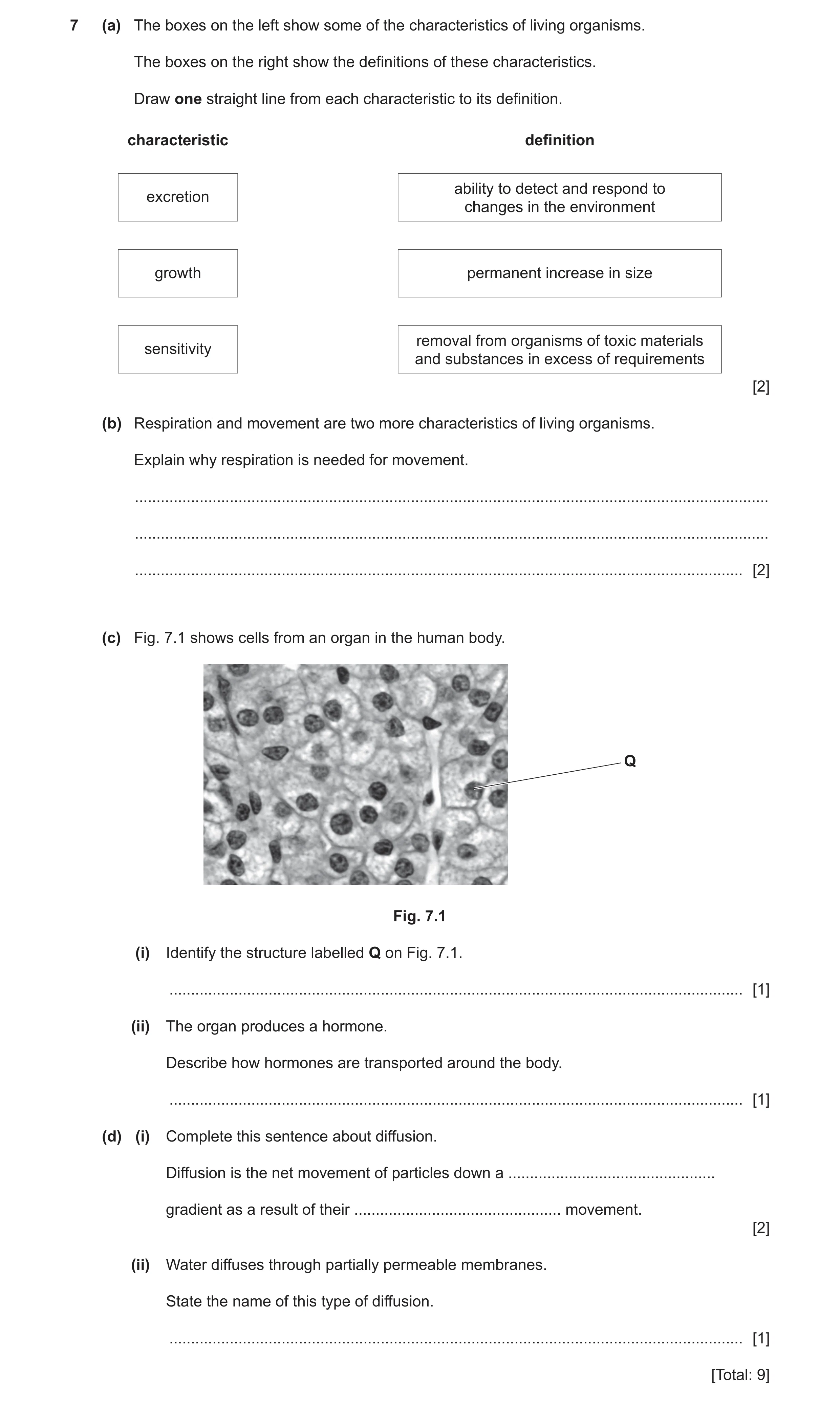
7 (a) The boxes on the left show some of the characteristics of living organisms. The boxes on the right show the definitions of these characteristics. Draw one straight line from each characteristic to its definition. characteristic definition ability to detect and respond to excretion changes in the environment growth permanent increase in size removal from organisms of toxic materials sensitivity and substances in excess of requirements [2] (b) Respiration and movement are two more characteristics of living organisms. Explain why respiration is needed for movement. … … … [2] (c) Fig. 7.1 shows cells from an organ in the human body. Q Fig. 7.1 (i) Identify the structure labelled Q on Fig. 7.1. … [1] (ii) The organ produces a hormone. Describe how hormones are transported around the body. … [1] (d) (i) Complete this sentence about diffusion. Diffusion is the net movement of particles down a … gradient as a result of their … movement. [2] (ii) Water diffuses through partially permeable membranes. State the name of this type of diffusion. … [1] [Total: 9]
9 marks
Mark scheme: 7(a) 2 ability to detect and respond to excretion changes in the environment growth permanent increase in size removal from organisms of toxic sensitivity materials and substances in excess of requirements one correct ; all three correct ; 7(b) respiration releases energy ; 2 energy needed for muscle contraction ; 7(c)(i) nucleus ; 1 7(c)(ii) (in the) blood / plasma ; 1 7(d)(i) concentration ; 2 random ; 7(d)(ii) osmosis ; 1
This question in 0653/33 Oct/Nov 2022
Q11 · The leaves of some plants have green and white areas 0653/31 May/June 2023
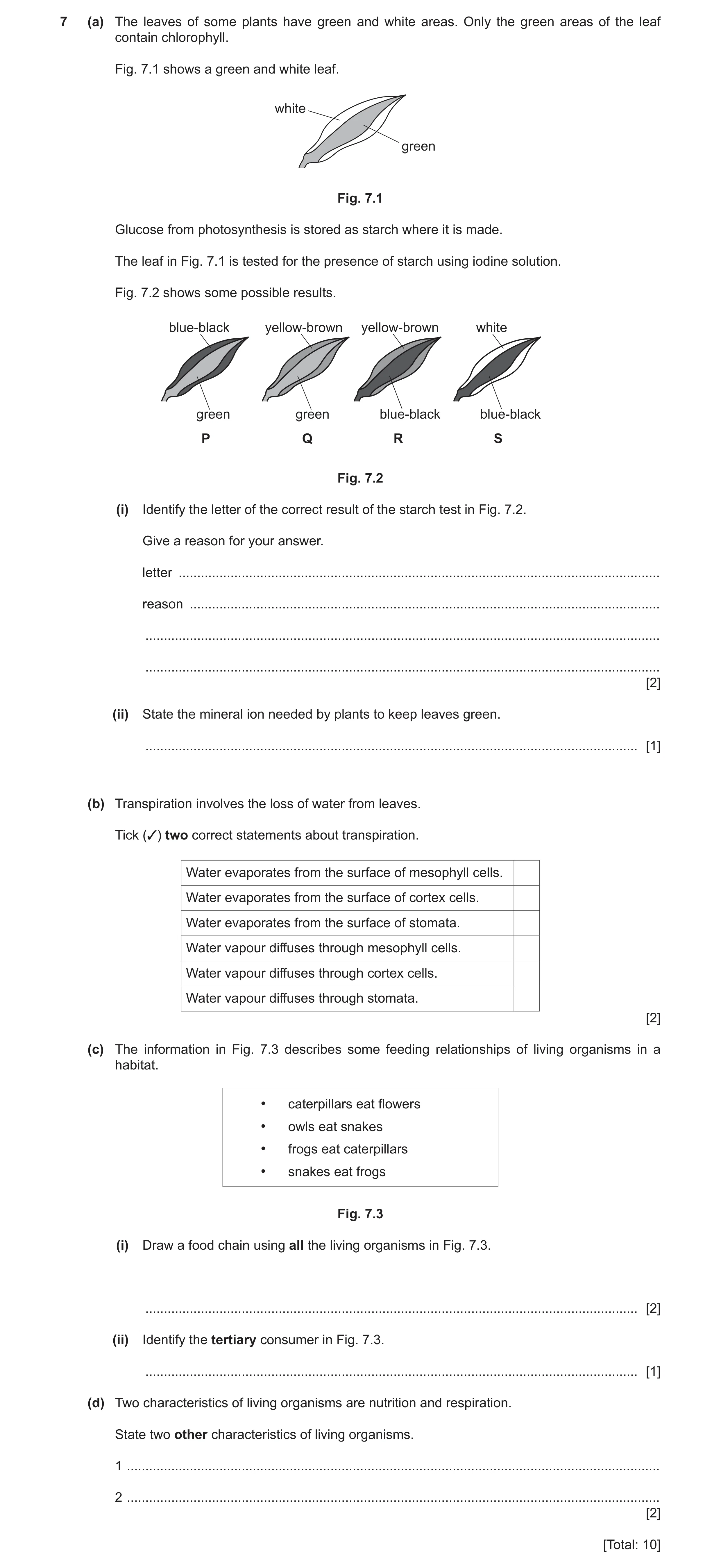
7 (a) The leaves of some plants have green and white areas. Only the green areas of the leaf contain chlorophyll. Fig. 7.1 shows a green and white leaf. white green Fig. 7.1 Glucose from photosynthesis is stored as starch where it is made. The leaf in Fig. 7.1 is tested for the presence of starch using iodine solution. Fig. 7.2 shows some possible results. blue-black yellow-brown yellow-brown white green green blue-black blue-black P Q R S Fig. 7.2 (i) Identify the letter of the correct result of the starch test in Fig. 7.2. Give a reason for your answer. letter … reason … … … [2] (ii) State the mineral ion needed by plants to keep leaves green. … [1] (b) Transpiration involves the loss of water from leaves. Tick (3) two correct statements about transpiration. Water evaporates from the surface of mesophyll cells. Water evaporates from the surface of cortex cells. Water evaporates from the surface of stomata. Water vapour diffuses through mesophyll cells. Water vapour diffuses through cortex cells. Water vapour diffuses through stomata. [2] (c) The information in Fig. 7.3 describes some feeding relationships of living organisms in a habitat. • caterpillars eat flowers • owls eat snakes • frogs eat caterpillars • snakes eat frogs Fig. 7.3 (i) Draw a food chain using all the living organisms in Fig. 7.3. … [2] (ii) Identify the tertiary consumer in Fig. 7.3. … [1] (d) Two characteristics of living organisms are nutrition and respiration. State two other characteristics of living organisms. 1 … 2 … [2] [Total: 10]
10 marks
Mark scheme: 7(a)(i) R ; then any one from: chlorophyll is needed for photosynthesis ; (iodine) solution turns blue-black when starch is present ; (iodine) solution remains yellow-brown when starch is absent ; 7(a)(ii) magnesium (ions) ; 1 Question Answer Marks 7(b) Water evaporates from the surface of mesophyll cells. Water evaporates from the surface of cortex cells. Water evaporates from the surface of stomata. Water vapour diffuses through mesophyll cells. Water vapour diffuses through cortex cells. Water vapour diffuses through stomata. ;; 2 7(c)(i) flower(s) caterpillar(s) frog(s) snake(s) owl(s) ;; one mark for correct order one mark for correct arrows 2 7(c)(ii) snake ; 1 7(d) any two from: movement ; growth ; sensitivity ; reproduction ; excretion ; 2
This question in 0653/31 May/June 2023
Q12 · The boxes on the left show different characteristics of living organisms 0653/33 May/June 2023
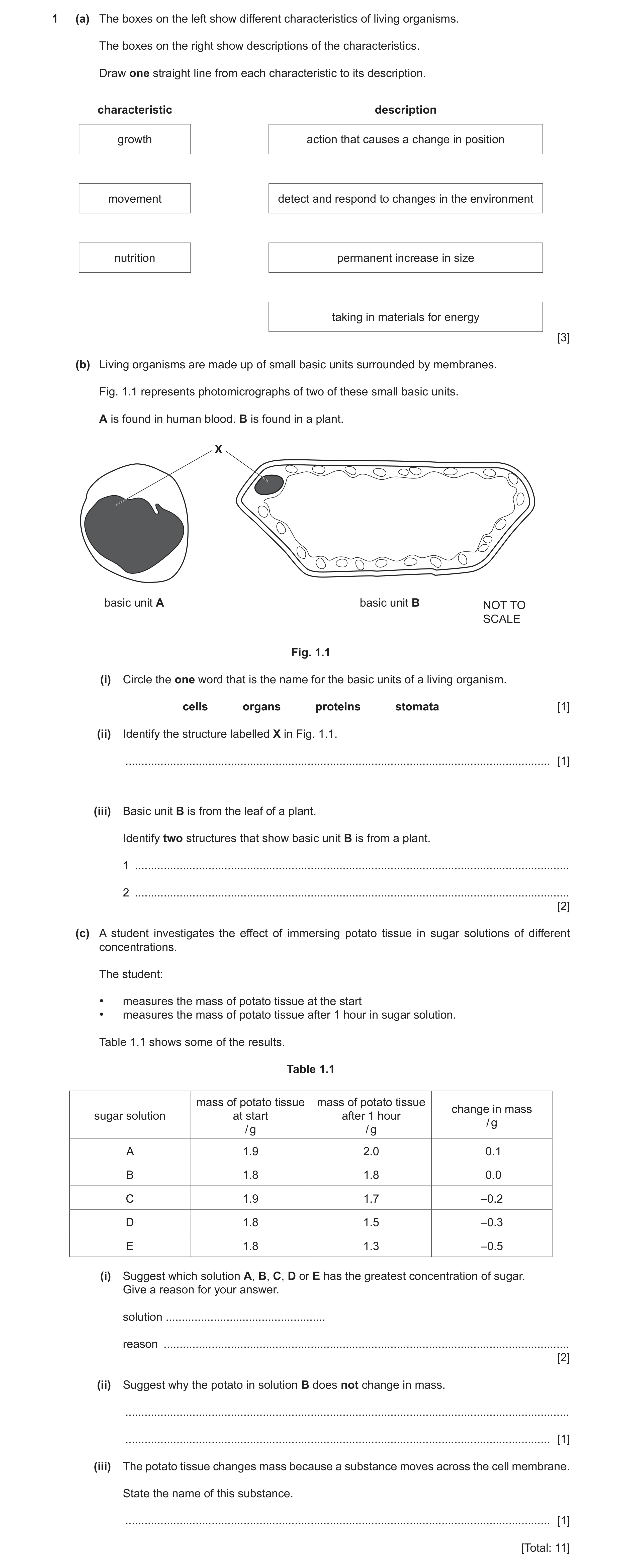
1 (a) The boxes on the left show different characteristics of living organisms. The boxes on the right show descriptions of the characteristics. Draw one straight line from each characteristic to its description. characteristic description growth action that causes a change in position movement detect and respond to changes in the environment nutrition permanent increase in size taking in materials for energy [3] (b) Living organisms are made up of small basic units surrounded by membranes. Fig. 1.1 represents photomicrographs of two of these small basic units. A is found in human blood. B is found in a plant. X basic unit A basic unit B NOT TO SCALE Fig. 1.1 (i) Circle the one word that is the name for the basic units of a living organism. cells organs proteins stomata [1] (ii) Identify the structure labelled X in Fig. 1.1. … [1] (iii) Basic unit B is from the leaf of a plant. Identify two structures that show basic unit B is from a plant. 1 … 2 … [2] (c) A student investigates the effect of immersing potato tissue in sugar solutions of different concentrations. The student: • measures the mass of potato tissue at the start • measures the mass of potato tissue after 1 hour in sugar solution. Table 1.1 shows some of the results. Table 1.1 mass of potato tissue mass of potato tissue change in mass sugar solution at start after 1 hour / g / g / g A 1.9 2.0 0.1 B 1.8 1.8 0.0 C 1.9 1.7 –0.2 D 1.8 1.5 –0.3 E 1.8 1.3 –0.5 (i) Suggest which solution A, B, C, D or E has the greatest concentration of sugar. Give a reason for your answer. solution … reason … [2] (ii) Suggest why the potato in solution B does not change in mass. … … [1] (iii) The potato tissue changes mass because a substance moves across the cell membrane. State the name of this substance. … [1] [Total: 11]
11 marks
Mark scheme: 1(a) growth action that causes a change in position movement detect and respond to changes in the environment nutrition permanent increase in size taking in materials for energy ;;; 3 1(b)(i) cells (circled) ; 1 1(b)(ii) nucleus ; 1 1(b)(iii) any two from: (large) vacuole ; chloroplasts ; cell wall ; 2 1(c)(i) (solution) E ; (reason) it causes the biggest, change / loss in mass ; 2 1(c)(ii) concentration of solution inside cell is the same as the concentration of the sugar solution ; 1 1(c)(iii) water ; 1
This question in 0653/33 May/June 2023
Q13 · Nutrition is one of the characteristics of living organisms 0653/31 May/June 2025
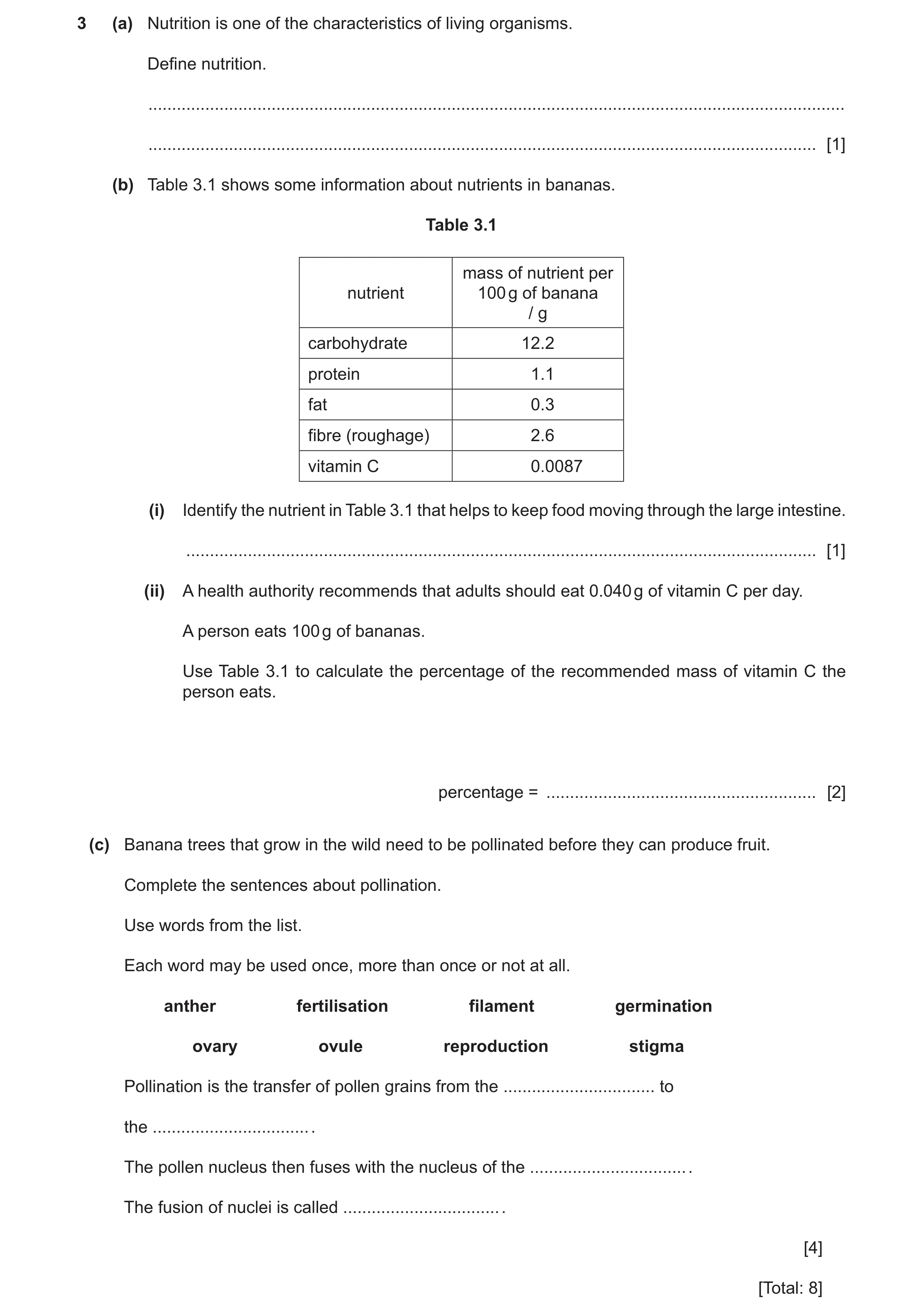
3 (a) Nutrition is one of the characteristics of living organisms. Define nutrition. … … [1] (b) Table 3.1 shows some information about nutrients in bananas. Table 3.1 mass of nutrient per nutrient 100 g of banana / g carbohydrate 12.2 protein 1.1 fat 0.3 fibre (roughage) 2.6 vitamin C 0.0087 (i) Identify the nutrient in Table 3.1 that helps to keep food moving through the large intestine. … [1] (ii) A health authority recommends that adults should eat 0.040 g of vitamin C per day. A person eats 100 g of bananas. Use Table 3.1 to calculate the percentage of the recommended mass of vitamin C the person eats. percentage = … [2] (c) Banana trees that grow in the wild need to be pollinated before they can produce fruit. Complete the sentences about pollination. Use words from the list. Each word may be used once, more than once or not at all. anther fertilisation filament germination ovary ovule reproduction stigma Pollination is the transfer of pollen grains from the … to the … . The pollen nucleus then fuses with the nucleus of the … . The fusion of nuclei is called … . [4] [Total: 8]
8 marks
Mark scheme: 3(a) the taking in of materials for, energy / growth / development ; 1 3(b)(i) fibre / roughage ; 1 3(b)(ii) 0.0087 100 ÷ 0.040 ; 2 22 (%) ; 3(c) anther ; 4 stigma ; ovule ; fertilisation ;
This question in 0653/31 May/June 2025
Q14 · Nutrition is one of the characteristics of living organisms 0653/32 May/June 2025
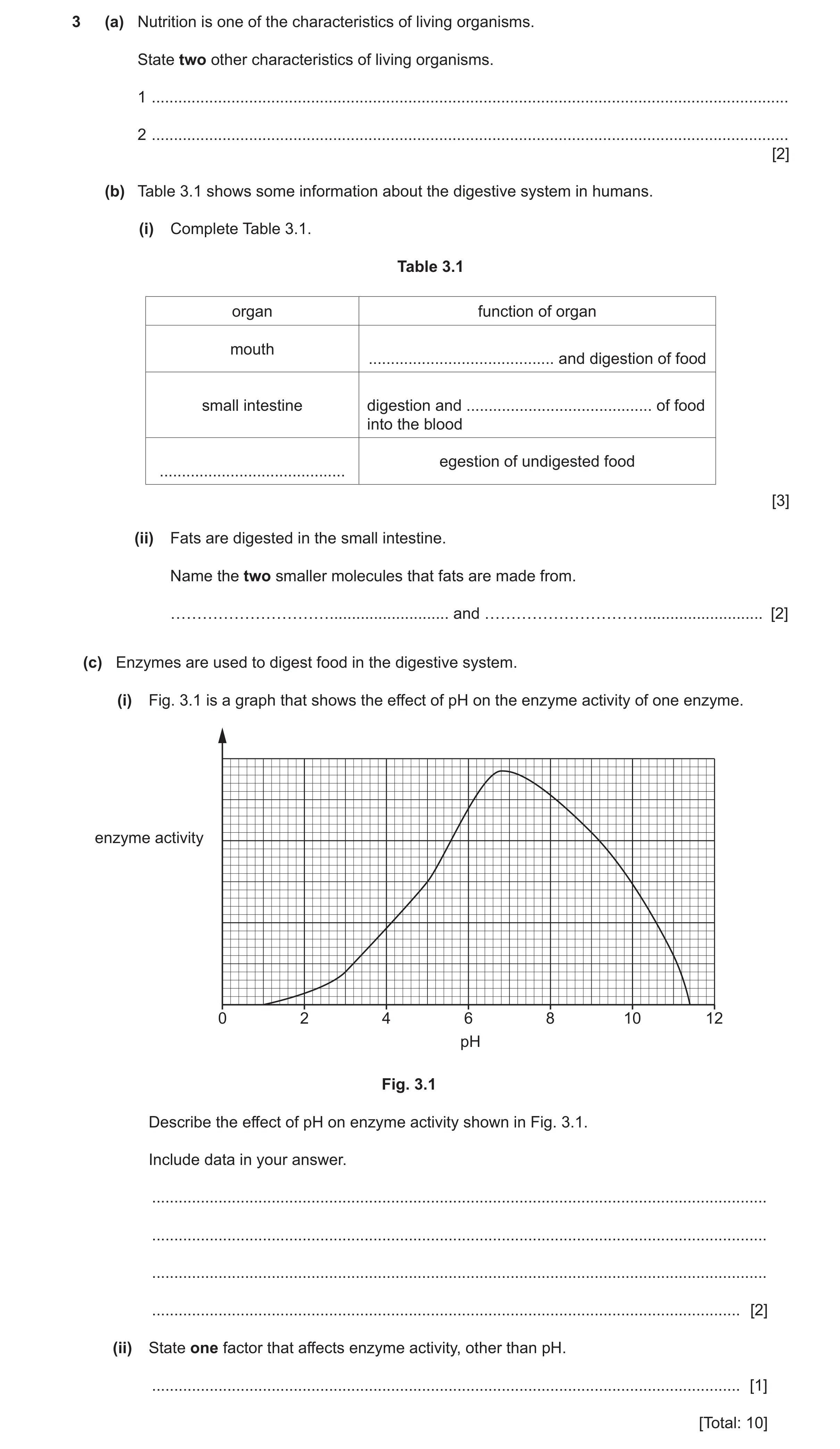
3 (a) Nutrition is one of the characteristics of living organisms. State two other characteristics of living organisms. 1 … 2 … [2] (b) Table 3.1 shows some information about the digestive system in humans. (i) Complete Table 3.1. Table 3.1 organ function of organ mouth … and digestion of food small intestine digestion and … of food into the blood egestion of undigested food … [3] (ii) Fats are digested in the small intestine. Name the two smaller molecules that fats are made from. ………………………… … and ………………………… … [2] (c) Enzymes are used to digest food in the digestive system. (i) Fig. 3.1 is a graph that shows the effect of pH on the enzyme activity of one enzyme. enzyme activity 0 2 4 6 8 10 12 pH Fig. 3.1 Describe the effect of pH on enzyme activity shown in Fig. 3.1. Include data in your answer. … … … … [2] (ii) State one factor that affects enzyme activity, other than pH. … [1] [Total: 10]
10 marks
Mark scheme: 3(a) any two from: 2 movement ; respiration ; growth ; sensitivity ; reproduction ; excretion ; 3(b)(i) 3 organ function of organ mouth ingestion (and digestion of food) (digestion and) absorption small intestine (of food into the blood) anus egestion undigested food ;;; 3(b)(ii) fatty acids ; 2 glycerol ; 3(c)(i) increasing pH increases then decreases enzyme activity ; 2 use of data, e.g. peak at pH6.8, no activity below pH1 / no activity above pH11.4, etc. ; 3(c)(ii) temperature ; 1
This question in 0653/32 May/June 2025
 10
10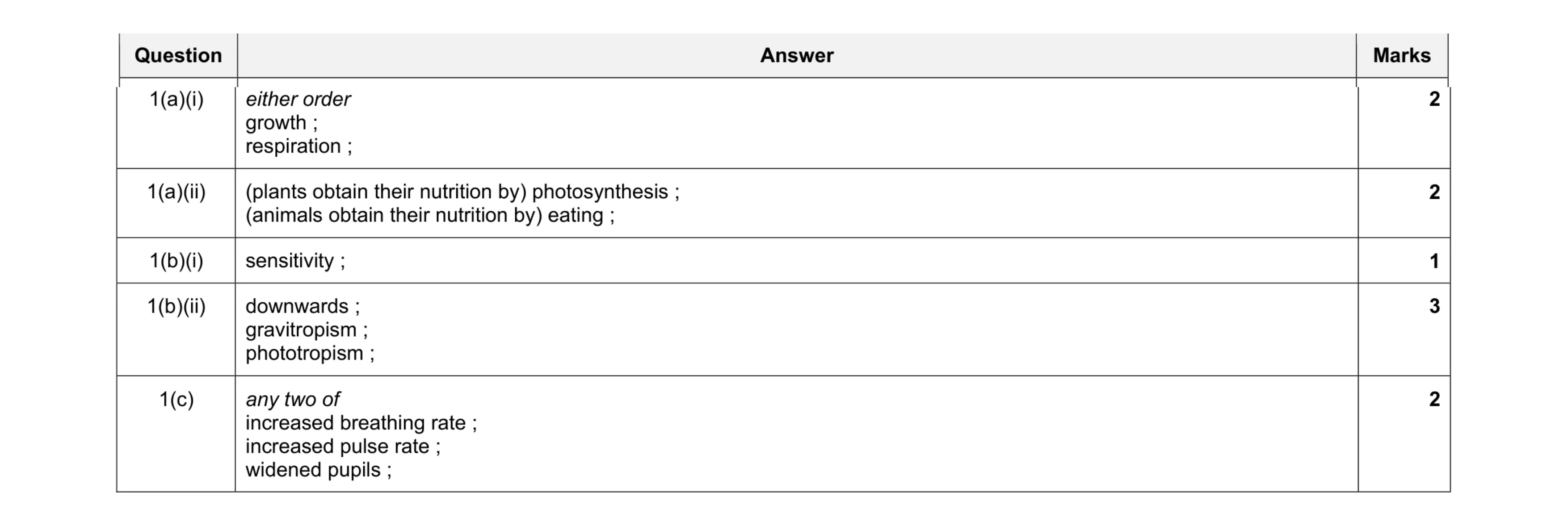 10
10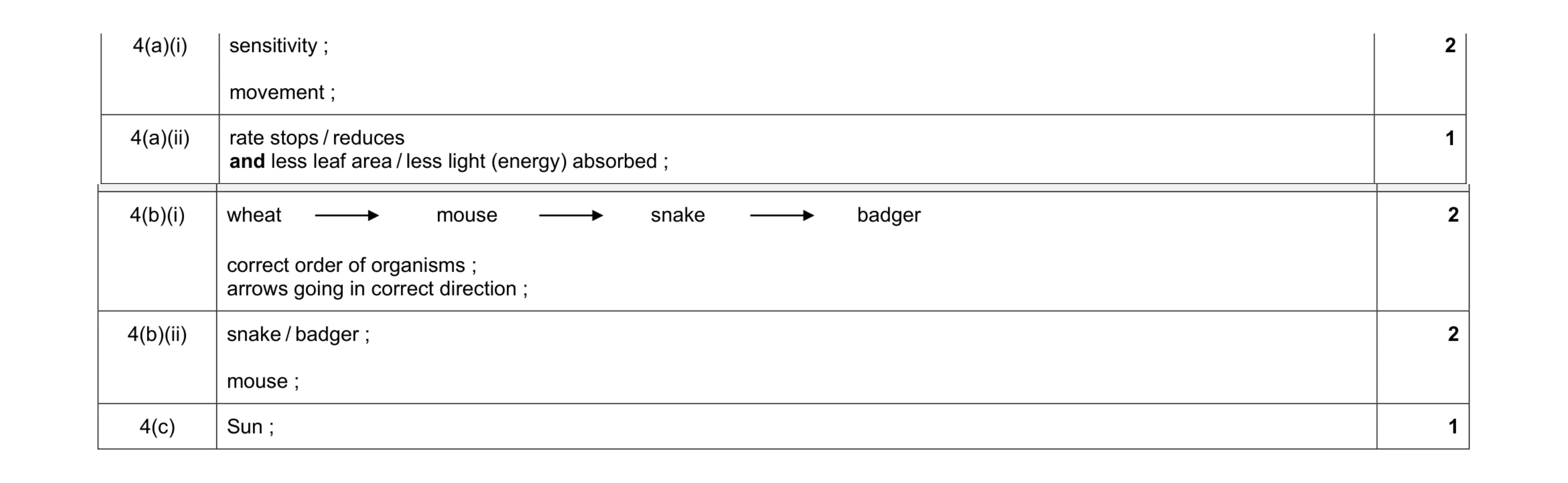 8
8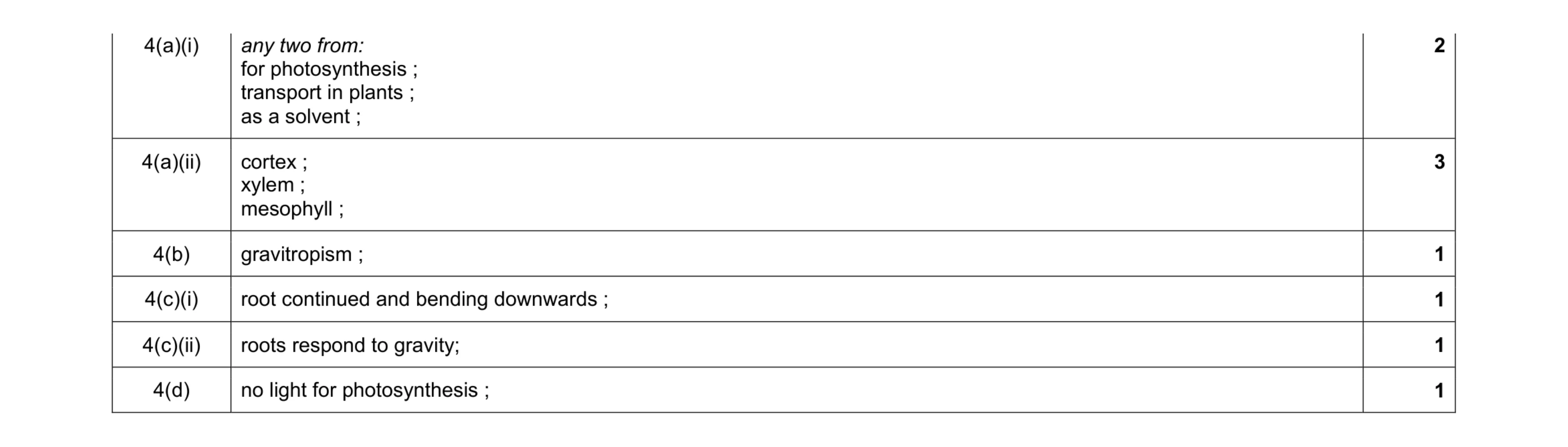 9
9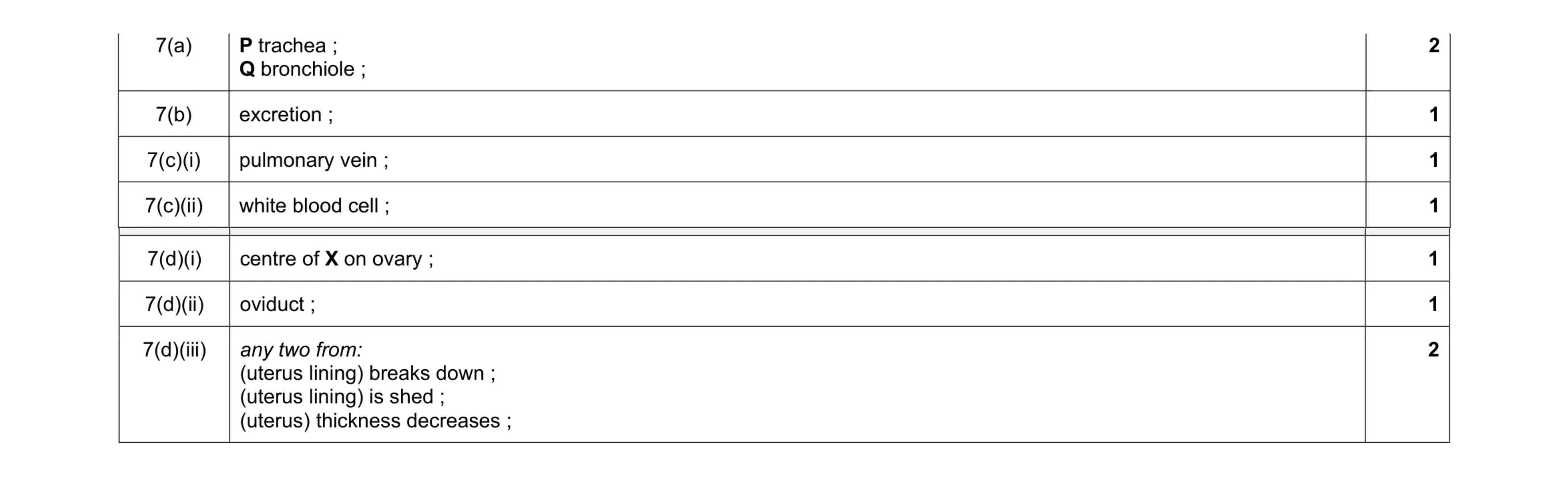 9
9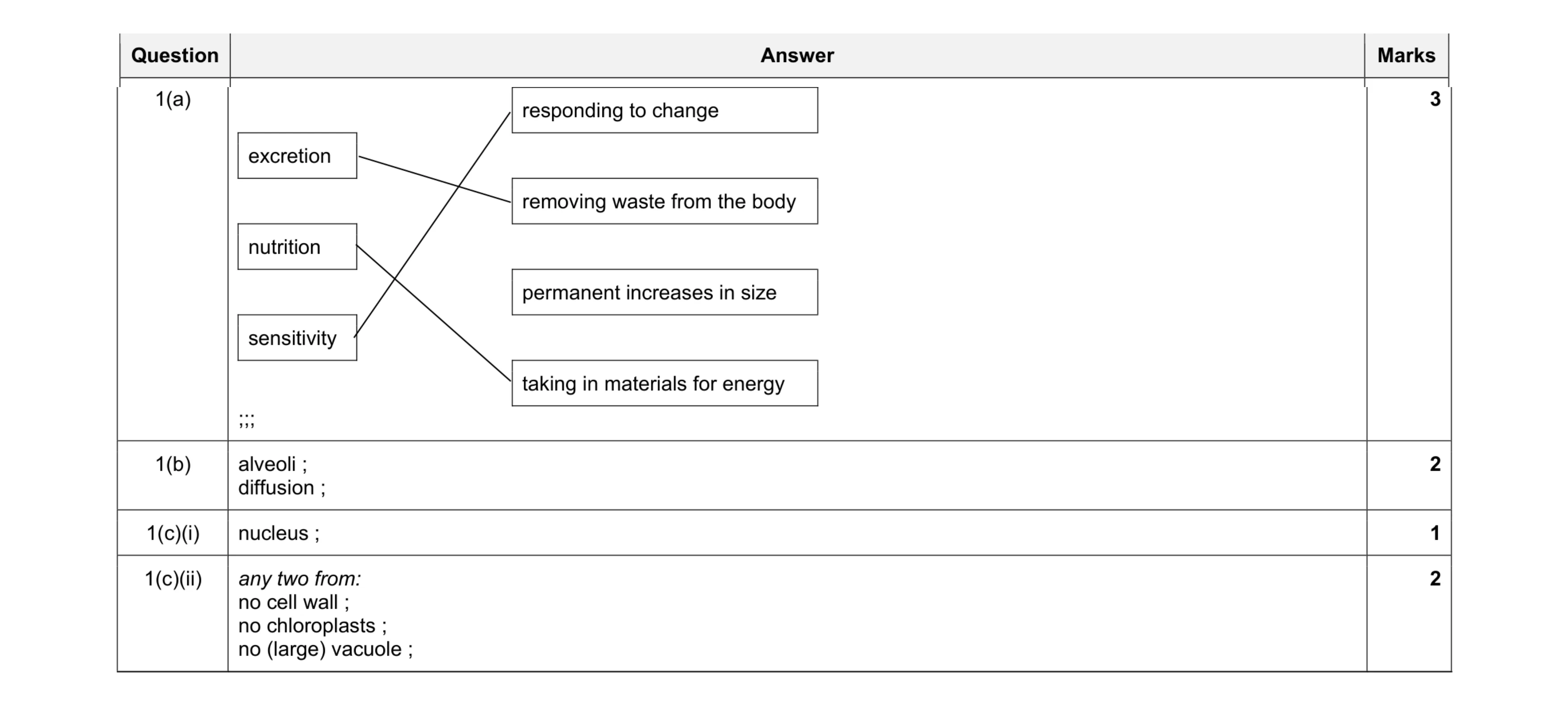 8
8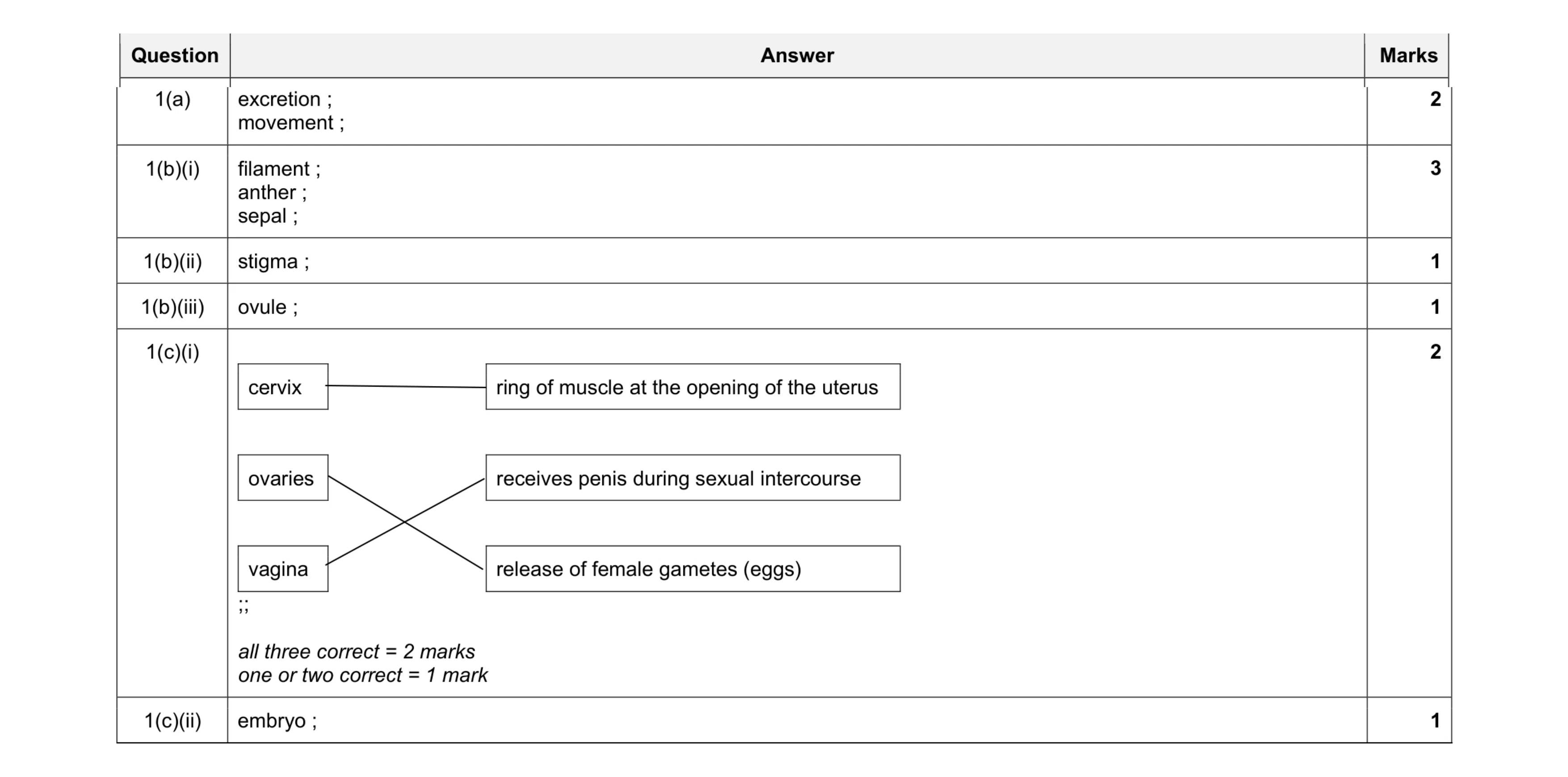 10
10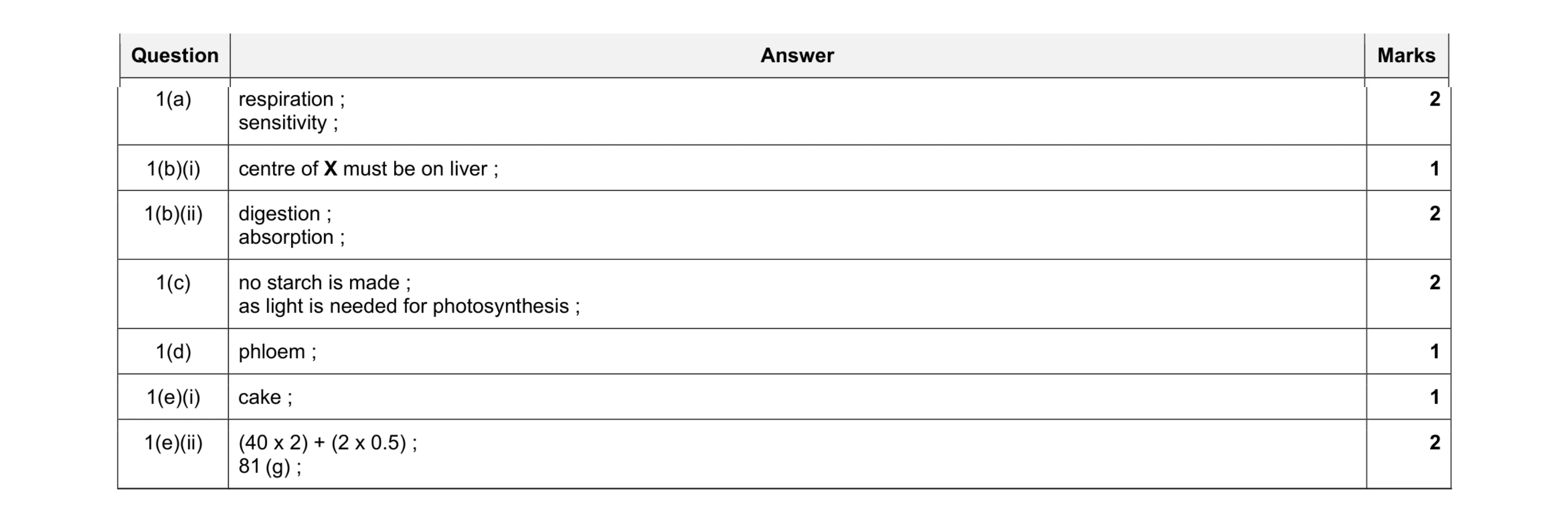 11
11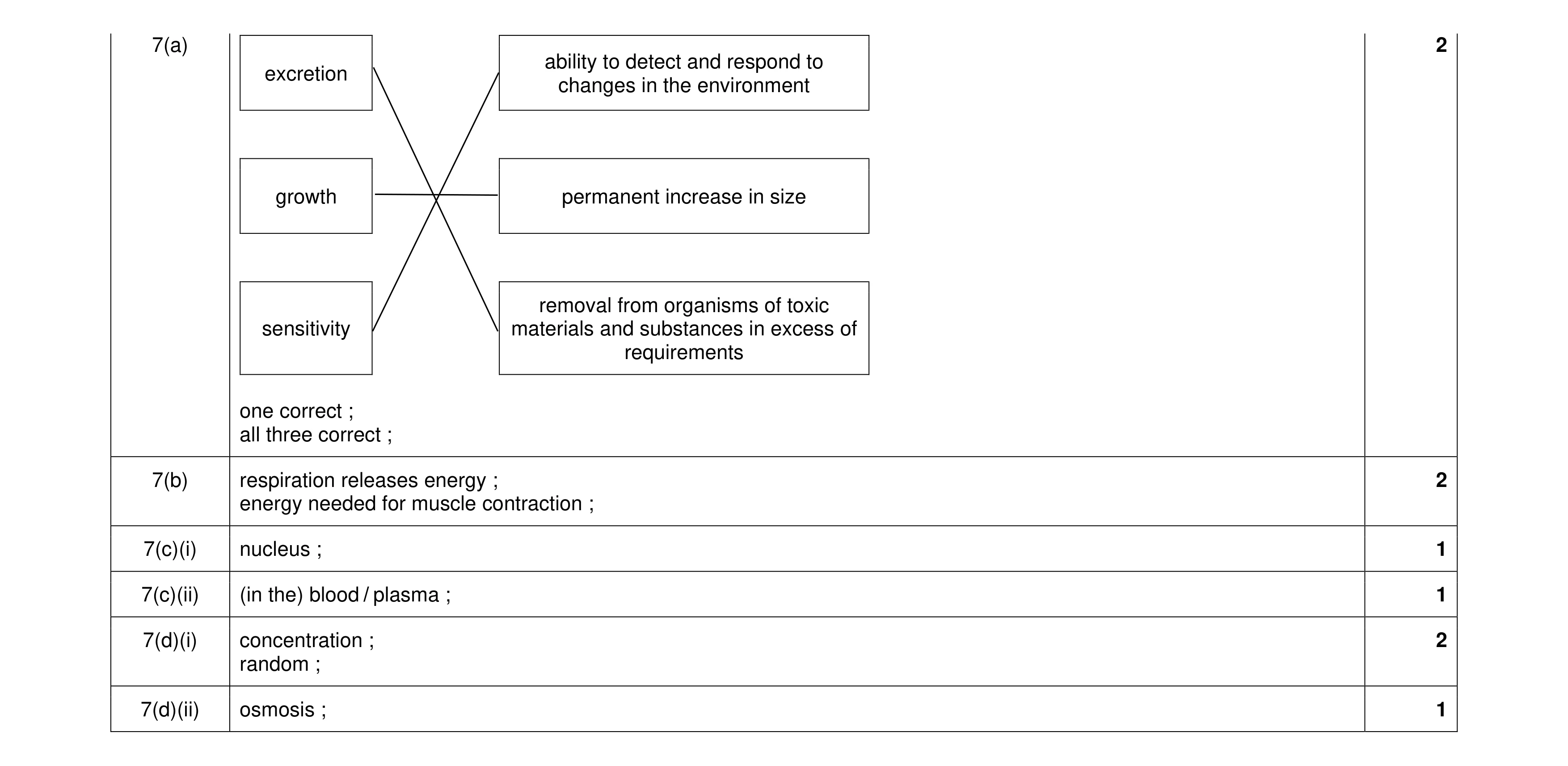 9
9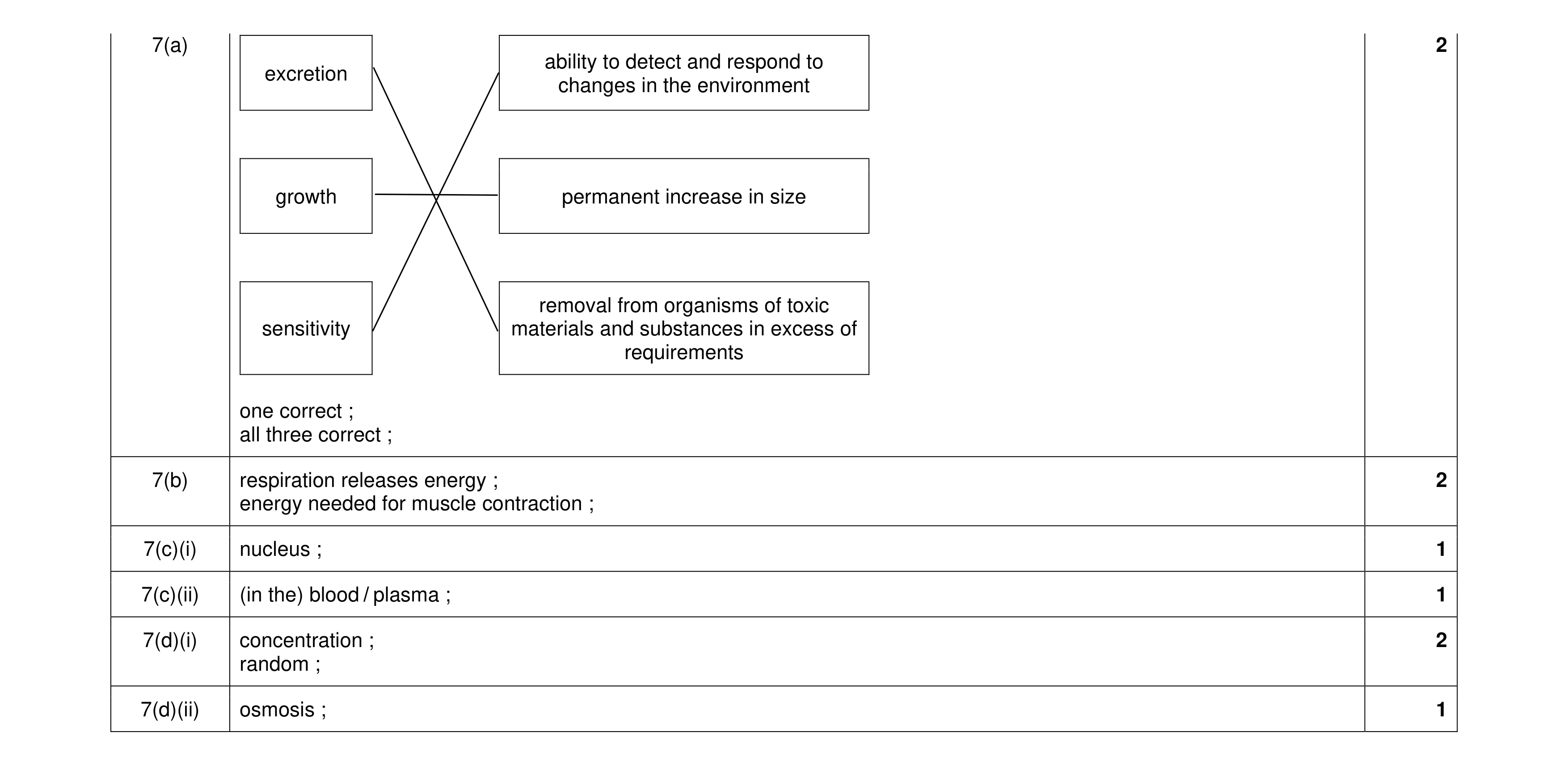 9
9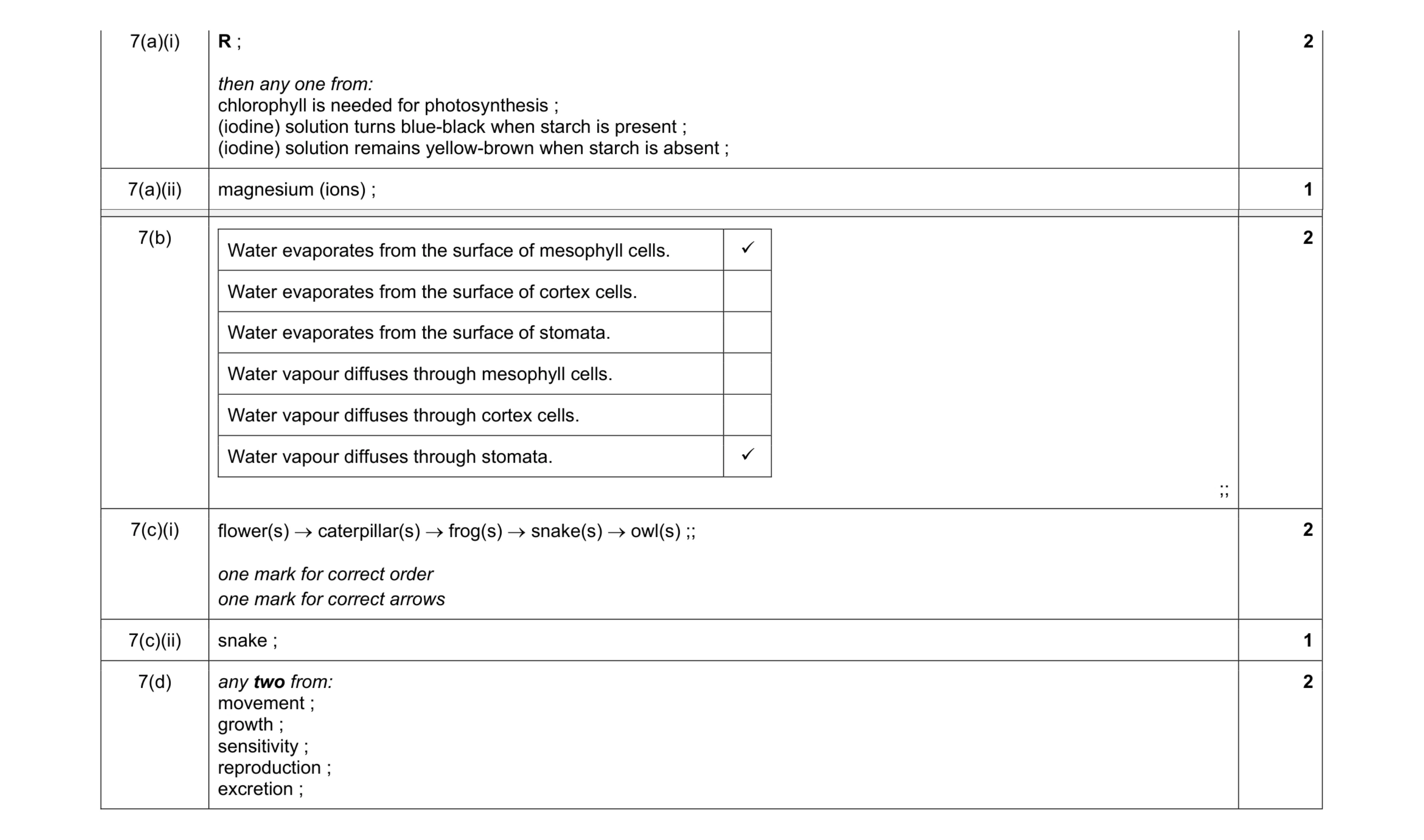 10
10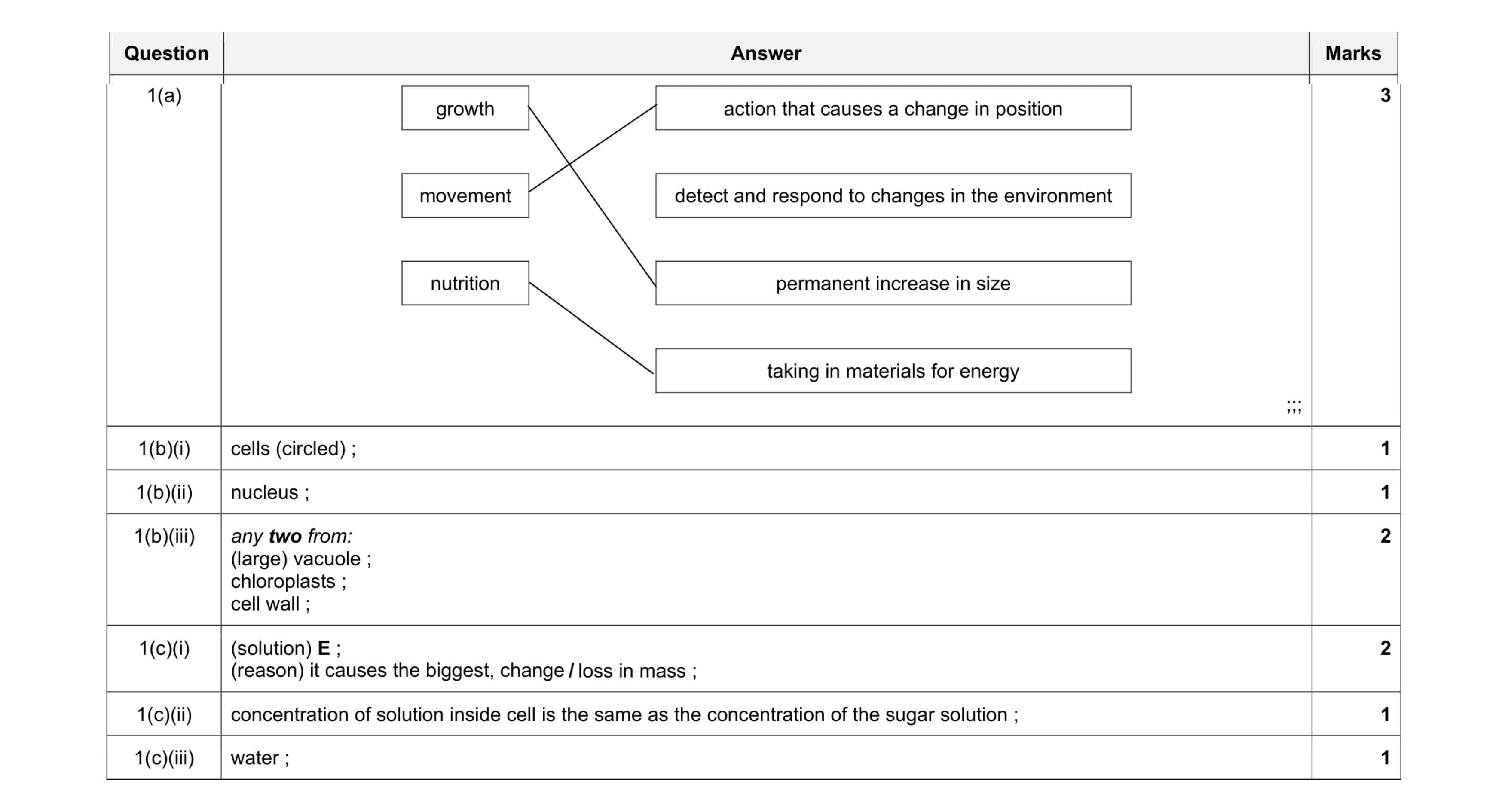 11
11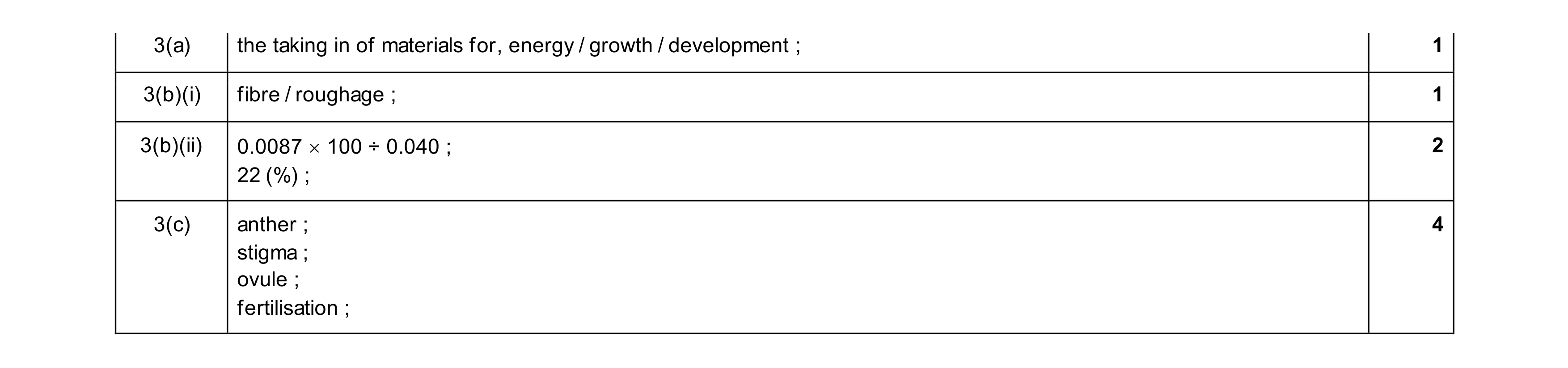 8
8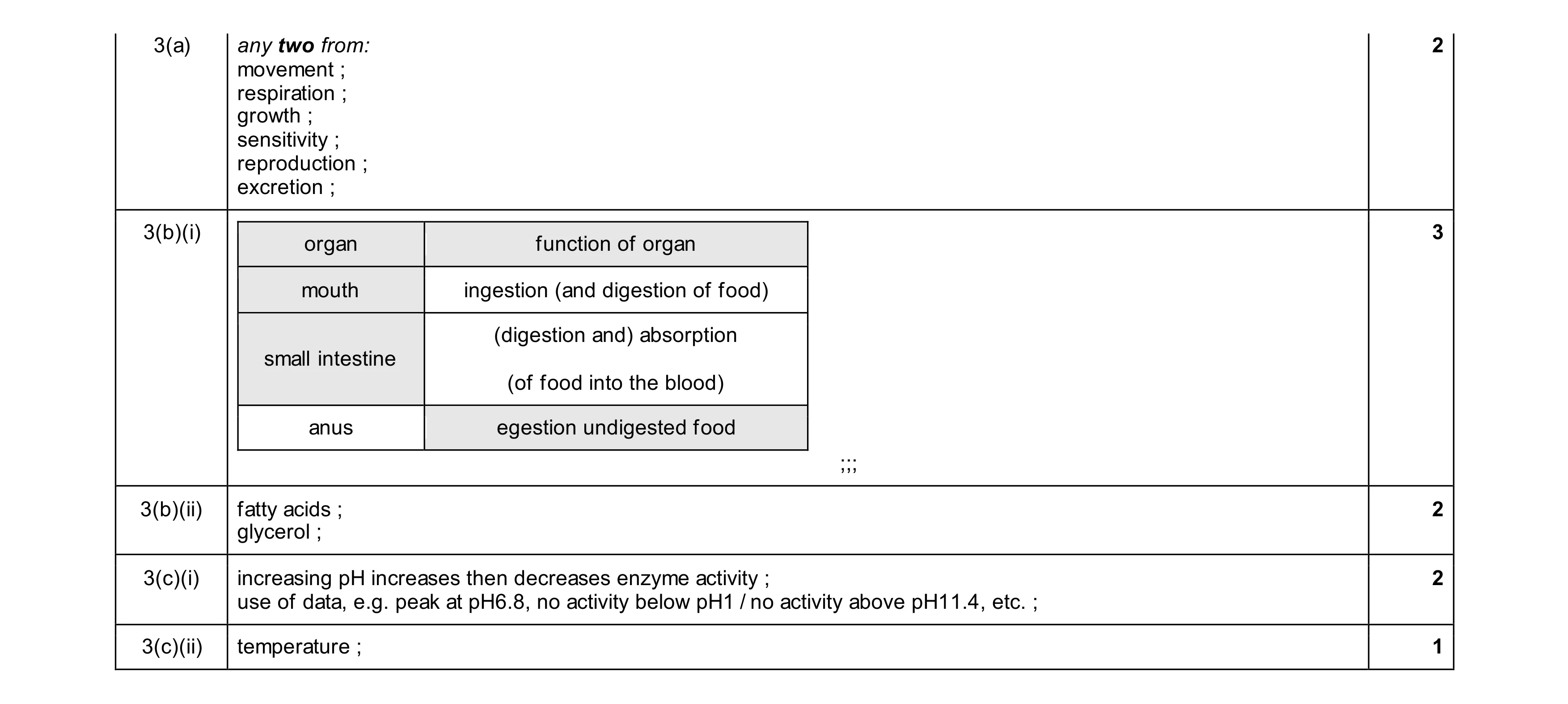 10
10