Questions as text
Q1 · State how a vector quantity differs from a scalar quantity 0625/43 Oct/Nov 2016
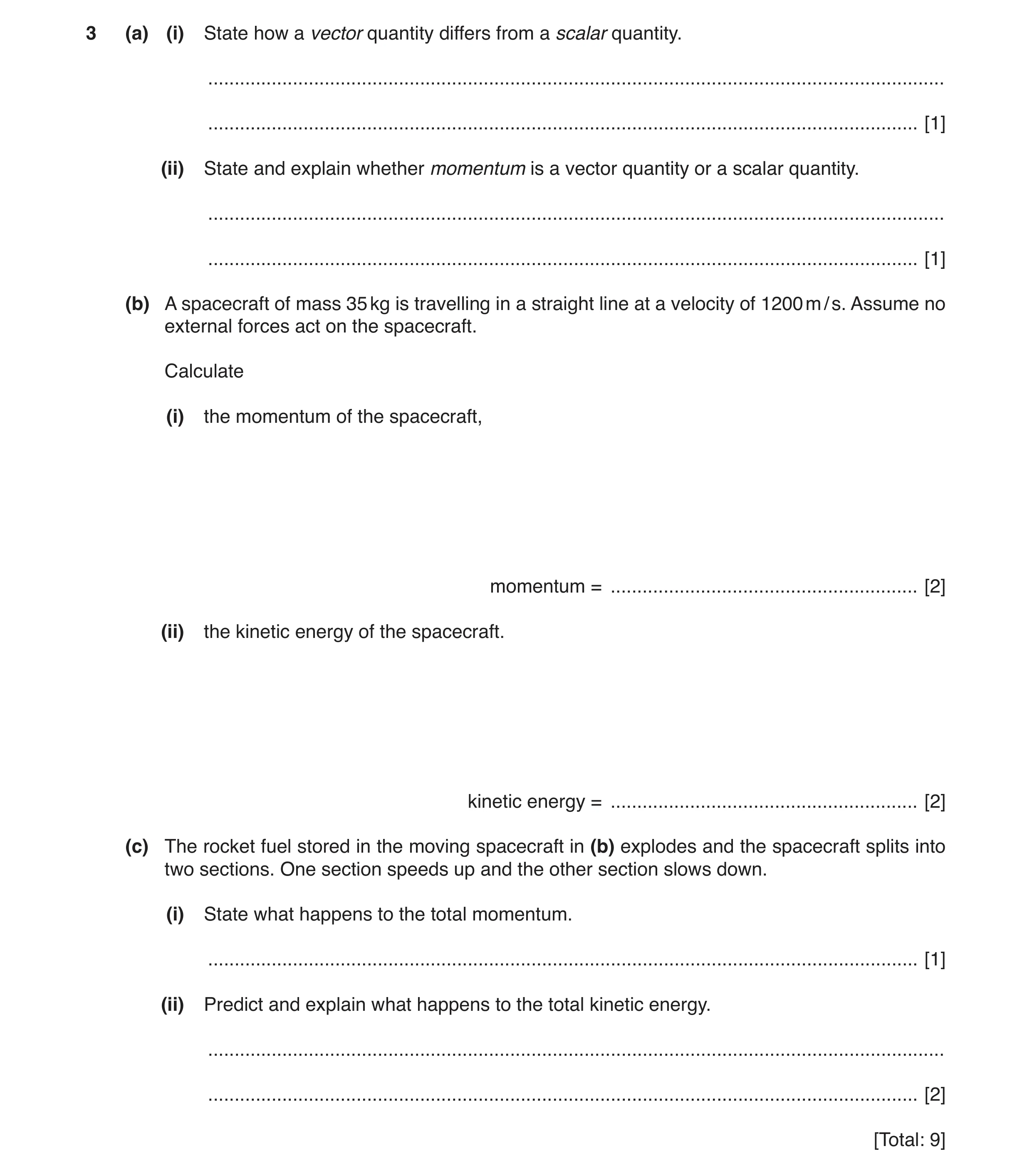
3 (a) (i) State how a vector quantity differs from a scalar quantity. … … [1] (ii) State and explain whether momentum is a vector quantity or a scalar quantity. … … [1] (b) A spacecraft of mass 35 kg is travelling in a straight line at a velocity of 1200 m / s. Assume no external forces act on the spacecraft. Calculate (i) the momentum of the spacecraft, momentum = … [2] (ii) the kinetic energy of the spacecraft. kinetic energy = … [2] (c) The rocket fuel stored in the moving spacecraft in (b) explodes and the spacecraft splits into two sections. One section speeds up and the other section slows down. (i) State what happens to the total momentum. … [1] (ii) Predict and explain what happens to the total kinetic energy. … … [2] [Total: 9]
9 marks
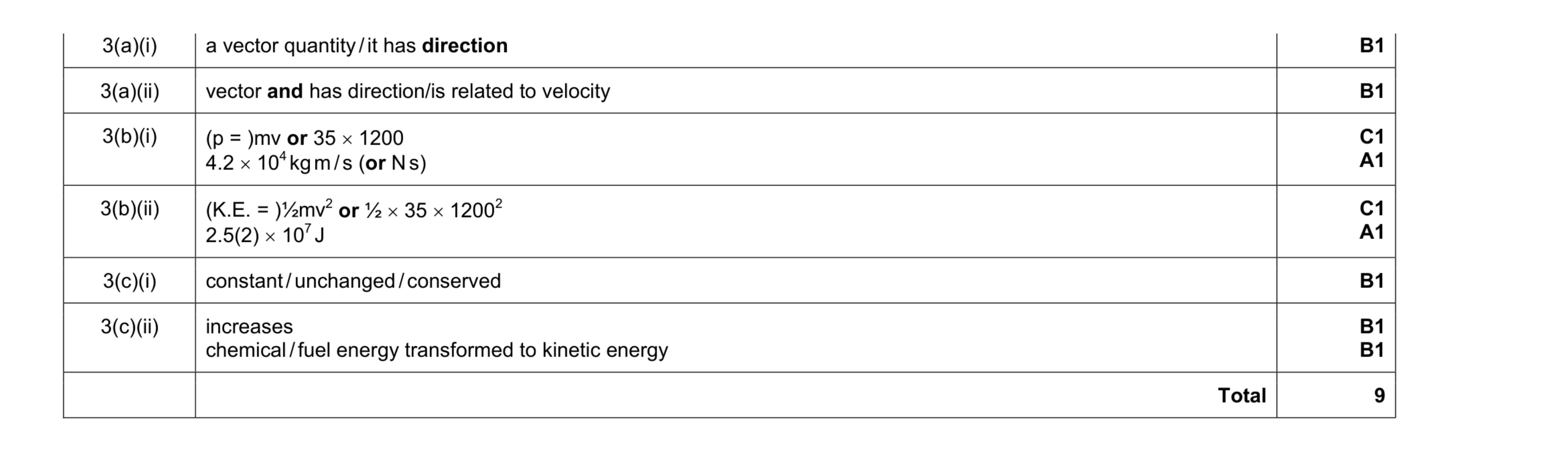
Mark scheme: 3(a)(i) a vector quantity / it has direction B1 3(a)(ii) vector and has direction/is related to velocity B1 3(b)(i) (p = )mv or 35 × 1200 4.2 × 10⁴ kg m / s (or N s) C1 A1 3(b)(ii) (K.E. = )½mv2 or ½ × 35 × 12002 2.5(2) × 107 J C1 A1 3(c)(i) constant / unchanged / conserved B1 3(c)(ii) increases chemical / fuel energy transformed to kinetic energy B1 B1 Total 9
This question in 0625/43 Oct/Nov 2016
Q2 · Acceleration is a vector quantity 0625/43 May/June 2017
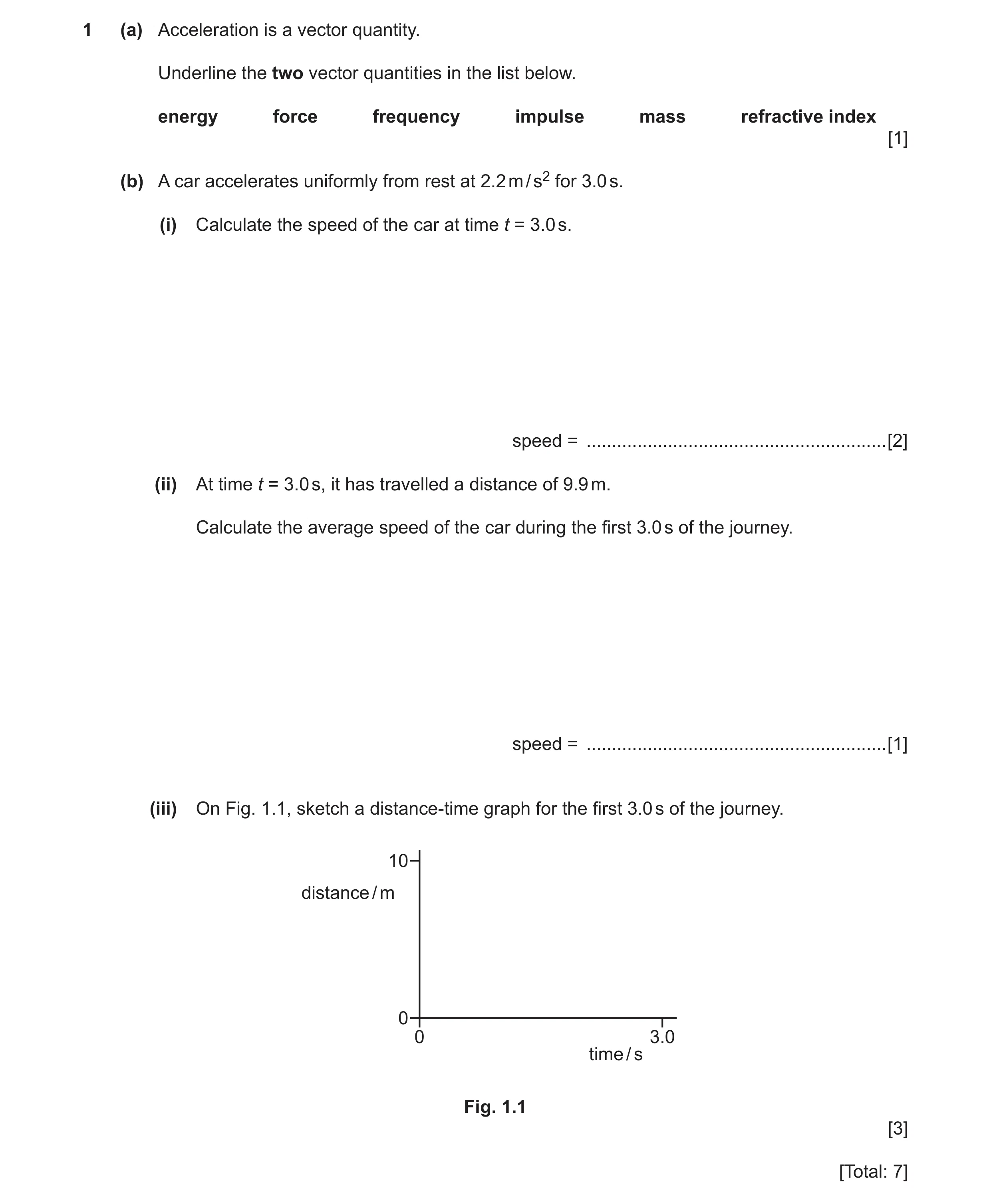
1 (a) Acceleration is a vector quantity. Underline the two vector quantities in the list below. energy force frequency impulse mass refractive index [1] (b) A car accelerates uniformly from rest at 2.2 m / s2 for 3.0 s. (i) Calculate the speed of the car at time t = 3.0 s. speed = … [2] (ii) At time t = 3.0 s, it has travelled a distance of 9.9 m. Calculate the average speed of the car during the first 3.0 s of the journey. speed = … [1] (iii) On Fig. 1.1, sketch a distance-time graph for the first 3.0 s of the journey. 10 distance / m 0 0 3.0 time / s Fig. 1.1 [3] [Total: 7]
7 marks
Mark scheme: 1(a) force and impulse underlined B1 1(b)(i) (v =) at OR 2.2 × 3.0 C1 6.6 m / s A1 1(b)(ii) 3.3 m / s B1 1(c) curve/line starts at origin B1 initial gradient zero OR curve passing through (3.0, 9.9) B1 gradient increasing (with time) B1 Total: 7
This question in 0625/43 May/June 2017
Q3 · A beaker contains some water at room temperature 0625/43 May/June 2018
4 A beaker contains some water at room temperature. A student places a mercury-in-glass thermometer in the water with the bulb of the thermometer just beneath the surface of the water. Fig. 4.1 shows the arrangement. thermometer water Fig. 4.1 The student uses an electric fan to blow air across the open top of the beaker. She notices that the reading on the thermometer begins to decrease. (a) Explain, in terms of water molecules, why the temperature of the water at the surface begins to decrease. … … … … … [3] (b) The student places the thermometer near the bottom of the beaker. The electric fan continues to blow air across the top of the beaker. After some time, the student observes that the temperature of the water at the bottom of the beaker is decreasing. State the name of the thermal transfer method causing this and explain what is happening in the water. … … … … … [3] (c) The thermometer used in this experiment has a small range and a large sensitivity. (i) State what is meant by 1. range, … … [1] 2. sensitivity. … … [1] (ii) State and explain the effect on the range of the thermometer of using a smaller bulb that contains less mercury. … … [1] [Total: 9]
9 marks
Mark scheme: 4(a) more energetic molecules escape/evaporate B1 less energetic molecules remain B1 average kinetic energy of molecules decreases OR temperature depends on kinetic energy B1 4(b) convection B1 surface/colder water more dense OR contracts B1 (cold water) sinks OR warmer water rises B1 4(c)(i)1 difference between the maximum temperature and minimum temperature it can measure B1 4(c)(i)2 distance moved by the thread per °C OR per unit temperature change B1 4(c)(ii) (range) increases and less expansion/increase in volume (of mercury per unit temperature rise) B1
This question in 0625/43 May/June 2018
Q4 · The top view of a rectangular paddling pool of constant depth 0625/42 Oct/Nov 2019
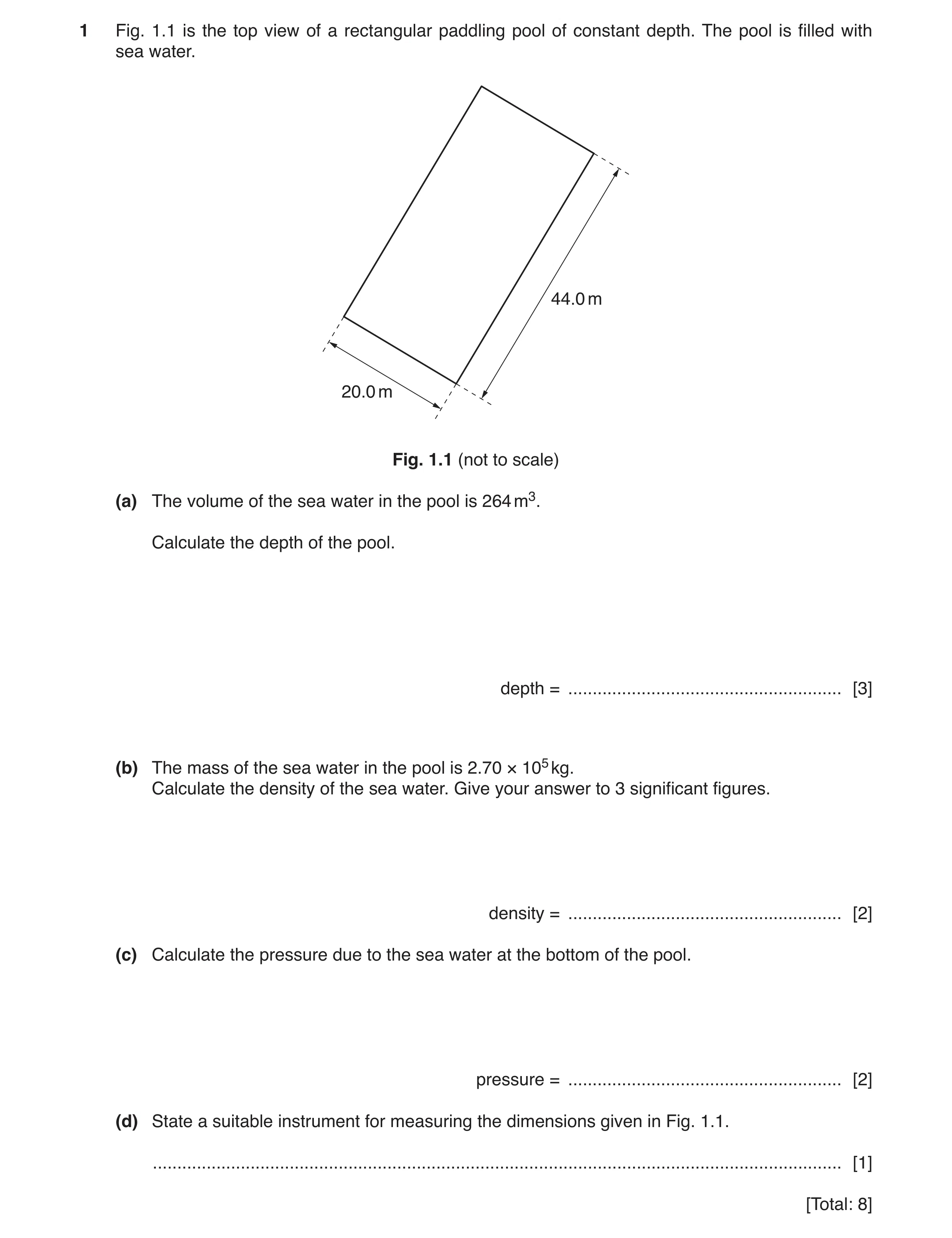
1 Fig. 1.1 is the top view of a rectangular paddling pool of constant depth. The pool is filled with sea water. 44.0 m 20.0 m Fig. 1.1 (not to scale) (a) The volume of the sea water in the pool is 264 m3. Calculate the depth of the pool. depth = … [3] (b) The mass of the sea water in the pool is 2.70 × 10⁵ kg. Calculate the density of the sea water. Give your answer to 3 significant figures. density = … [2] (c) Calculate the pressure due to the sea water at the bottom of the pool. pressure = … [2] (d) State a suitable instrument for measuring the dimensions given in Fig. 1.1. … [1] [Total: 8]
8 marks
Mark scheme: 1(a) C1 V = A × depth in any form OR (d =) V / A C1 (d = 264 / 880 =) 0.30 m A1 1(b) ρ = m / V in any form OR (ρ =) m / V C1 (ρ = 2.7 × 10⁵ / 264 =) 1020 kg / m3 A1 1(c) p = ρgh in any form OR (p =) ρgh C1 (p = 1020 × 10 × 0.3 =) 3 100 Pa A1 1(d) tape measure B1
This question in 0625/42 Oct/Nov 2019
Q5 · A wire of length 2.0 m and cross-sectional area 0.40 mm2 has a resistance of 0.14 Ω 0625/42 Oct/Nov 2019
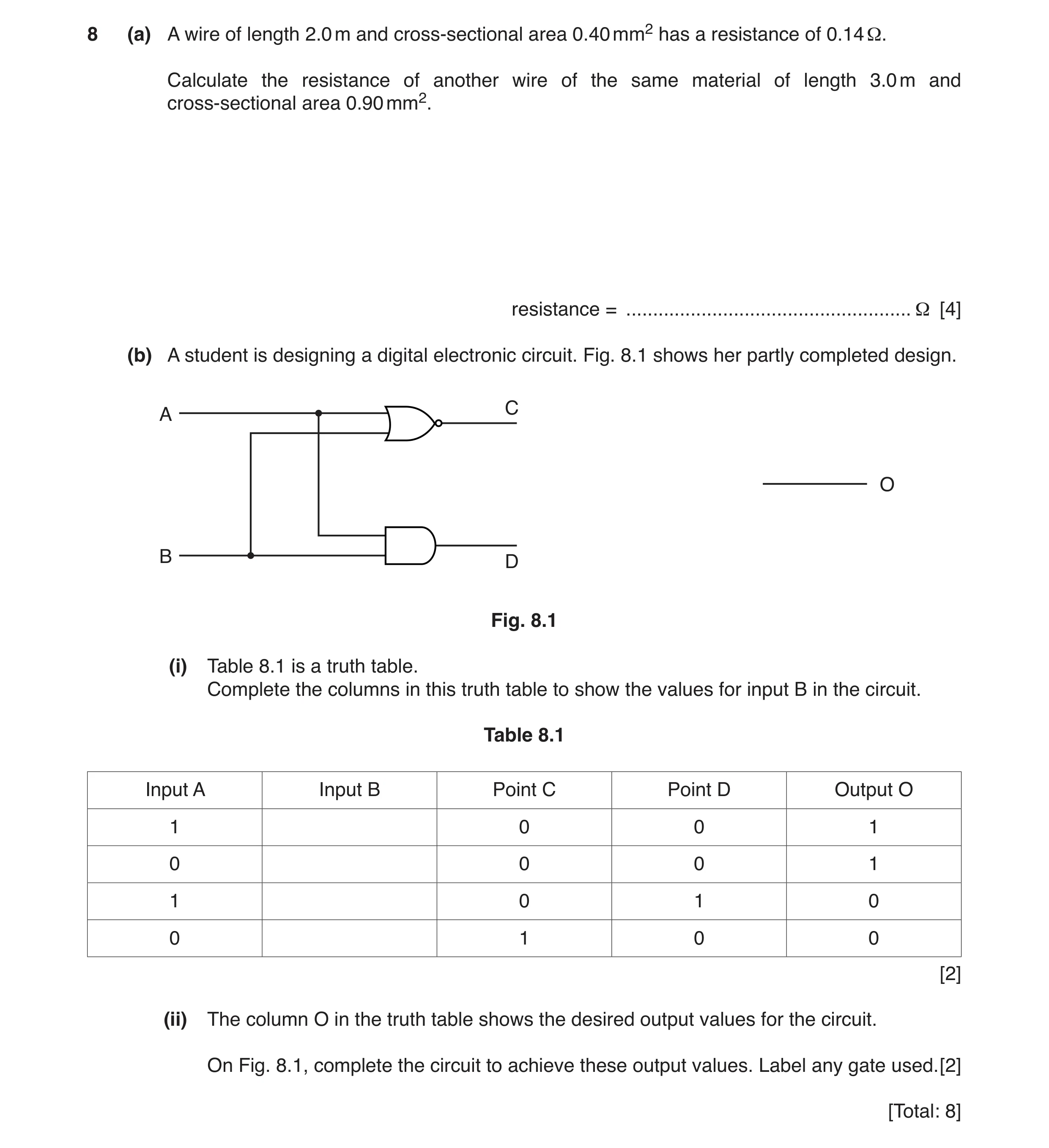
8 (a) A wire of length 2.0 m and cross-sectional area 0.40 mm2 has a resistance of 0.14 Ω. Calculate the resistance of another wire of the same material of length 3.0 m and cross-sectional area 0.90 mm2. resistance = … Ω [4] (b) A student is designing a digital electronic circuit. Fig. 8.1 shows her partly completed design. C A O B D Fig. 8.1 (i) Table 8.1 is a truth table. Complete the columns in this truth table to show the values for input B in the circuit. Table 8.1 Input A Input B Point C Point D Output O 1 0 0 1 0 0 0 1 1 0 1 0 0 1 0 0 [2] (ii) The column O in the truth table shows the desired output values for the circuit. On Fig. 8.1, complete the circuit to achieve these output values. Label any gate used. [2] [Total: 8]
8 marks
Mark scheme: 8(a) R proportional to length C1 R proportional to 1 / area C1 (R =) 0.14 × (3 / 2) × (4 / 9) C1 (R =) 0.093 (Ω) A1 8(b)(i) first two rows correct B1 last two rows correct B1 8(b)(ii) NOR gate correctly connected accept OR gate followed by NOT gate M1 correct symbol(s) for NOR gate accept OR gate followed by NOT gate A1
This question in 0625/42 Oct/Nov 2019
Q6 · Speed is a scalar quantity 0625/43 Oct/Nov 2020
3 (a) (i) Speed is a scalar quantity. State one other scalar quantity. … [1] (ii) Velocity is a vector quantity. State one other vector quantity. … [1] (b) Fig. 3.1 shows a model car travelling at constant speed on a flat circular track. car circular track Fig. 3.1 The speed of the car is 0.30 m / s. In one complete revolution around the track, the car travels 3.9 m. (i) Calculate the time taken for the car to complete one revolution around the track. time = … [2] (ii) On Fig. 3.1, draw and label with the letter F an arrow to show the resultant force acting on the car. [1] (iii) The speed of the car increases and at point P on Fig. 3.2 the car does not stay on the track. P Fig. 3.2 1. Suggest, in terms of the force acting on the car, why the car does not stay on the track at point P. … … [1] 2. On Fig. 3.2, draw and label an arrow with the letter S to show the direction of motion of the car as it leaves the track at point P. [1] [Total: 7]
7 marks
Mark scheme: 3(a)(i) One other scalar quantity B1 3(a)(ii) One other vector quantity B1 3(b)(i) v = d ÷ t in any form OR (t= ) d ÷ v OR 3.9 ÷ 0.3 C1 (t =) 13 s A1 3(b)(ii) inward arrow labelled F towards centre of circle B1 3(b)(iii) 1 frictional / inward force / resultant force insufficient (at higher speed) B1 2 tangential arrow at P in either direction, labelled S B1
This question in 0625/43 Oct/Nov 2020
Q7 · Some physical quantities are scalars and other physical quantities are vectors 0625/41 Oct/Nov 2021
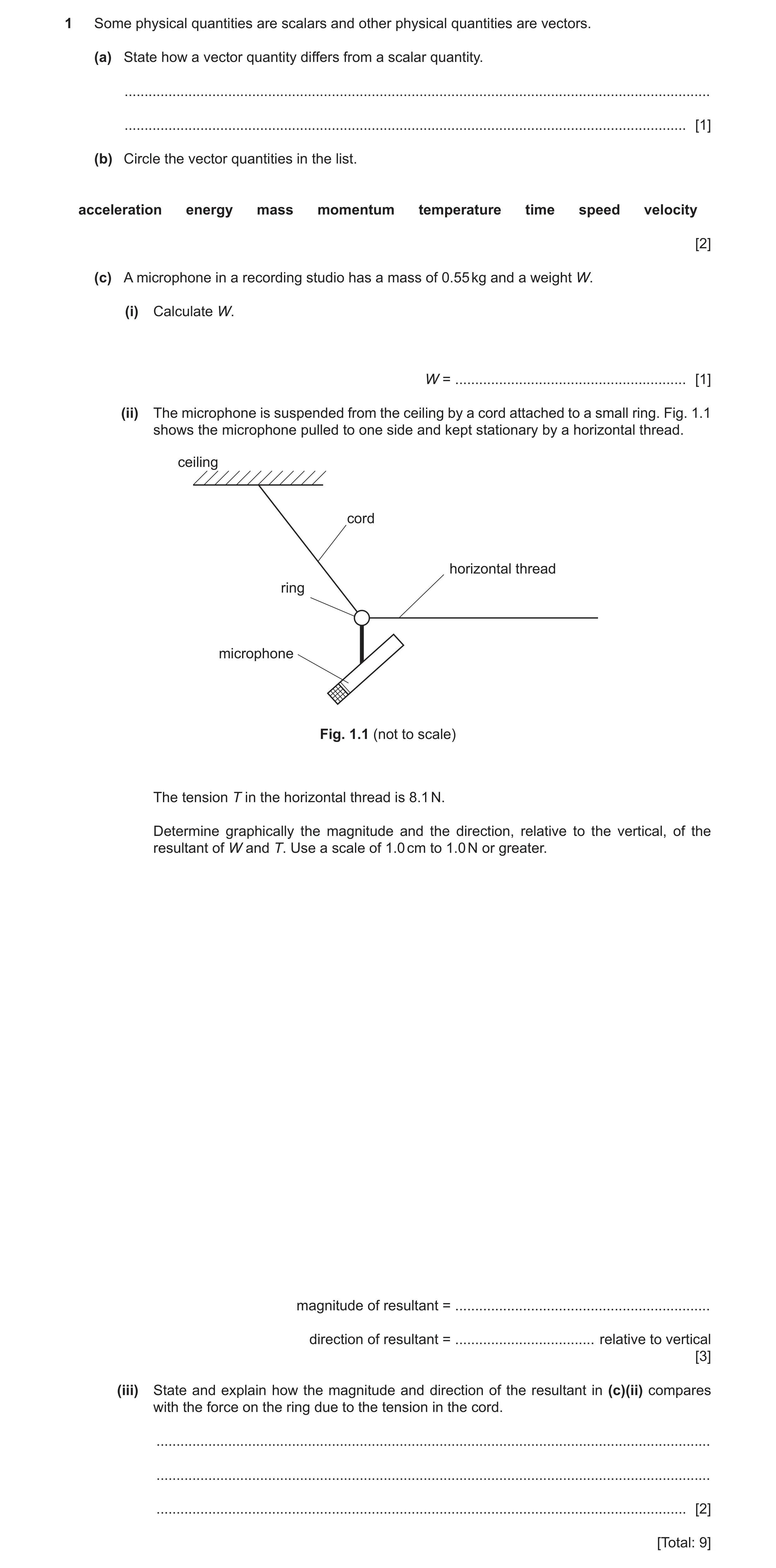
1 Some physical quantities are scalars and other physical quantities are vectors. (a) State how a vector quantity differs from a scalar quantity. … … [1] (b) Circle the vector quantities in the list. acceleration energy mass momentum temperature time speed velocity [2] (c) A microphone in a recording studio has a mass of 0.55 kg and a weight W. (i) Calculate W. W = … [1] (ii) The microphone is suspended from the ceiling by a cord attached to a small ring. Fig. 1.1 shows the microphone pulled to one side and kept stationary by a horizontal thread. ceiling cord horizontal thread ring microphone Fig. 1.1 (not to scale) The tension T in the horizontal thread is 8.1 N. Determine graphically the magnitude and the direction, relative to the vertical, of the resultant of W and T. Use a scale of 1.0 cm to 1.0 N or greater. magnitude of resultant = … direction of resultant = … relative to vertical [3] (iii) State and explain how the magnitude and direction of the resultant in (c)(ii) compares with the force on the ring due to the tension in the cord. … … … [2] [Total: 9]
9 marks
Mark scheme: 1(a) it / a vector has a direction B1 1(b) two / three vectors and no more than one other quantity underlined C1 acceleration and momentum and velocity underlined and no others A1 1(c)(i) 5.5 N B1 1(c)(ii) correct right-angled triangle / rectangle / intersecting arcs seen e.g. B1 (magnitude from) 9.6 to 10.0 N B1 (angle to vertical from) 54.0 to 57.5° B1 1(c)(iii) any two of: equal (in magnitude) opposite (in direction) the ring is in equilibrium or no resultant force on ring or forces on ring balance B2
This question in 0625/41 Oct/Nov 2021
Q8 · A boat stored in a shed 0625/43 May/June 2022
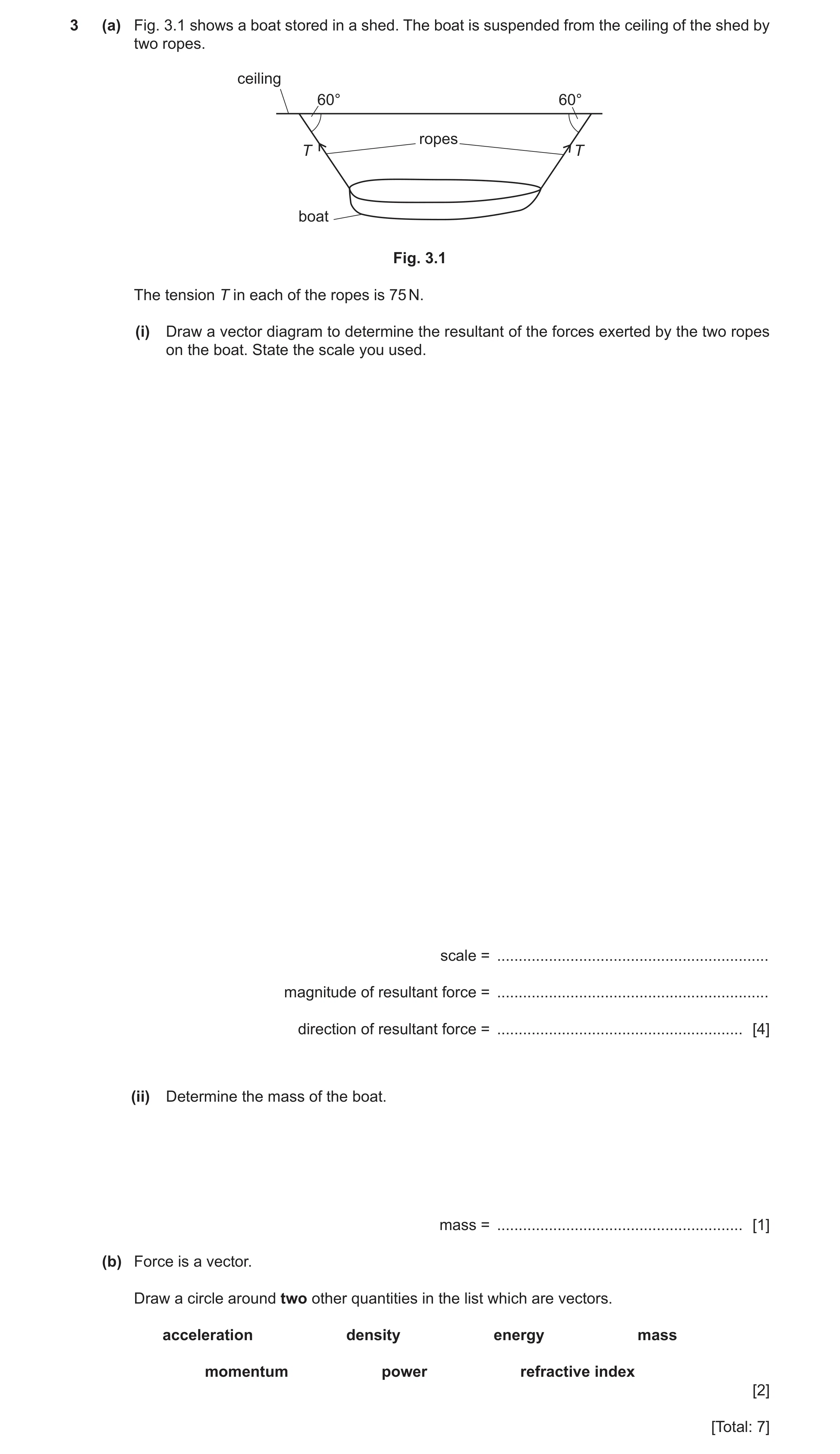
3 (a) Fig. 3.1 shows a boat stored in a shed. The boat is suspended from the ceiling of the shed by two ropes. ceiling 60° 60° ropes T T boat Fig. 3.1 The tension T in each of the ropes is 75 N. (i) Draw a vector diagram to determine the resultant of the forces exerted by the two ropes on the boat. State the scale you used. scale = … magnitude of resultant force = … direction of resultant force = … [4] (ii) Determine the mass of the boat. mass = … [1] (b) Force is a vector. Draw a circle around two other quantities in the list which are vectors. acceleration density energy mass momentum power refractive index [2] [Total: 7]
7 marks
Mark scheme: 3(a)(i) suitable scale recorded (e.g. 2 cm : 25 N) B1 two vectors correctly drawn by eye AND correct resultant M1 130 N A1 (vertically) upwards A1 3(a)(ii) 13 kg B1 3(b) acceleration B1 momentum B1
This question in 0625/43 May/June 2022
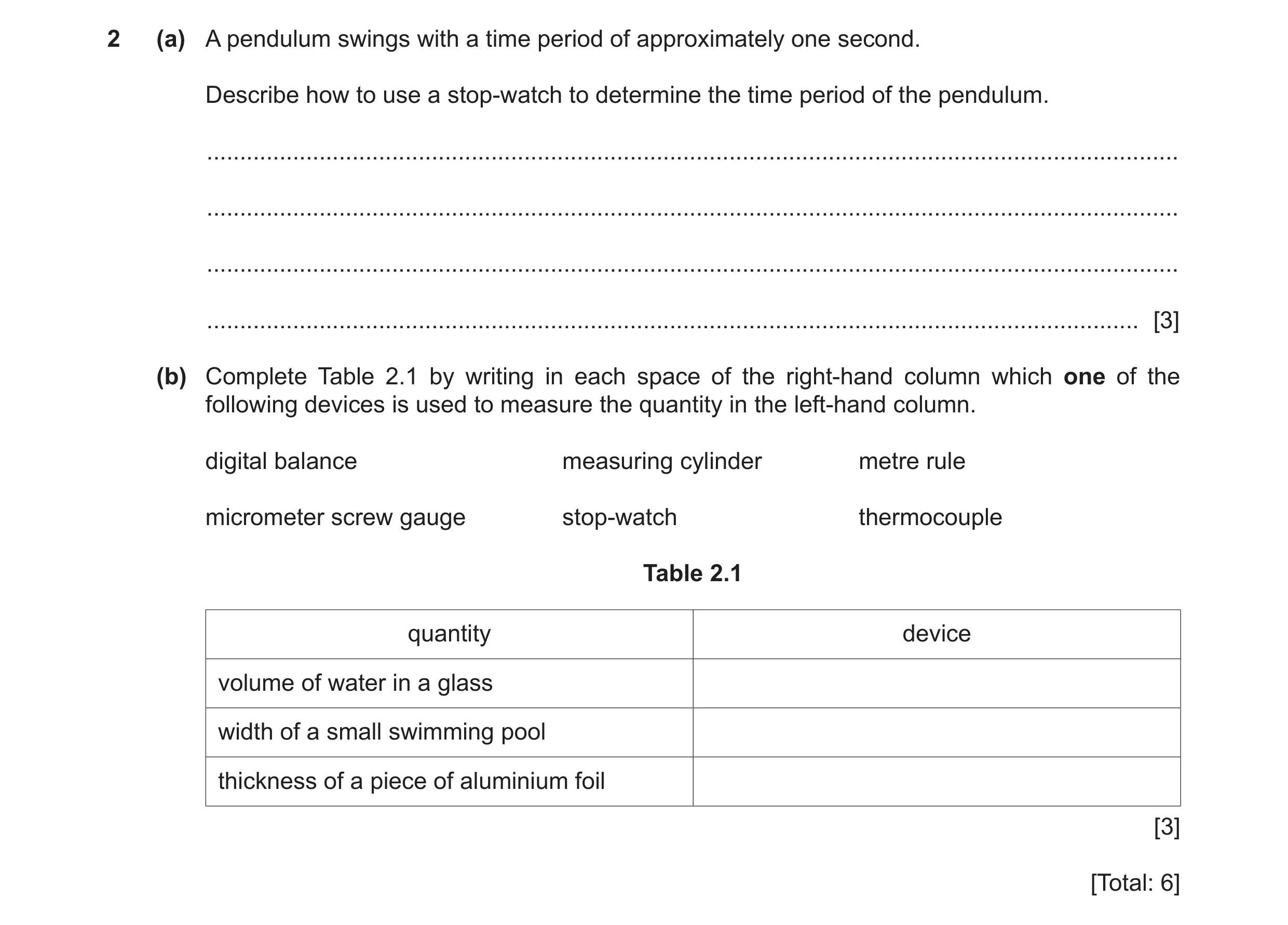
Q9 · A pendulum swings with a time period of approximately one second 0625/42 Oct/Nov 2022
2 (a) A pendulum swings with a time period of approximately one second. Describe how to use a stop-watch to determine the time period of the pendulum. … … … … [3] (b) Complete Table 2.1 by writing in each space of the right-hand column which one of the following devices is used to measure the quantity in the left-hand column. digital balance measuring cylinder metre rule micrometer screw gauge stop-watch thermocouple Table 2.1 quantity device volume of water in a glass width of a small swimming pool thickness of a piece of aluminium foil [3] [Total: 6]
6 marks
Mark scheme: 2(a) (use stop-watch to) time oscillations B1 (use of fiduciary) aid to determine a complete cycle B1 (use of) multiple oscillations AND division (to determine period) B1 2(b) B3 quantity device volume of water in a glass measuring cylinder width of a small swimming pool metre rule thickness of a piece of aluminium foil micrometer screw gauge 1 mark for each correct response
This question in 0625/42 Oct/Nov 2022
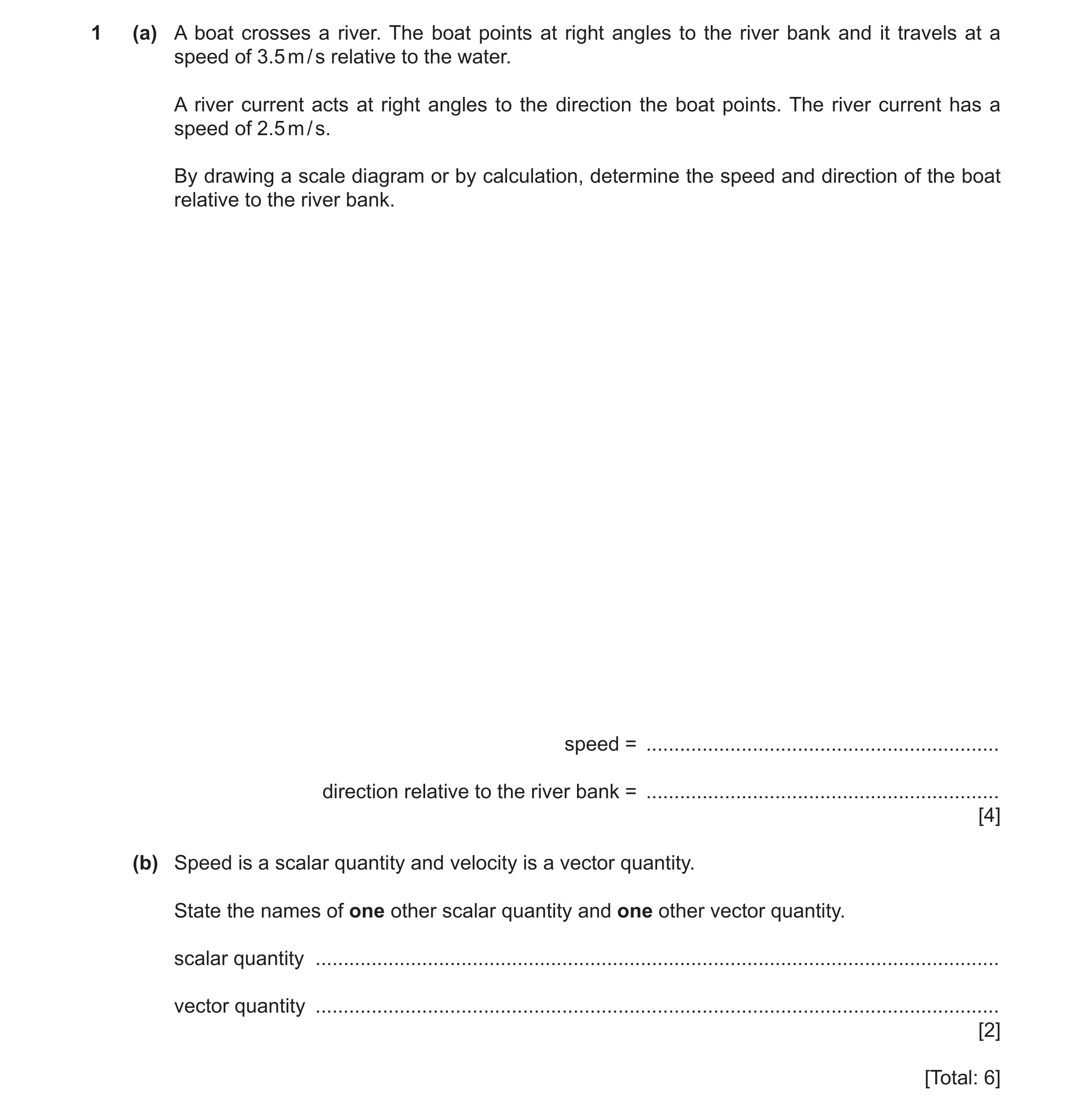
Q10 · A boat crosses a river 0625/42 Feb/March 2023
1 (a) A boat crosses a river. The boat points at right angles to the river bank and it travels at a speed of 3.5 m / s relative to the water. A river current acts at right angles to the direction the boat points. The river current has a speed of 2.5 m / s. By drawing a scale diagram or by calculation, determine the speed and direction of the boat relative to the river bank. speed = … direction relative to the river bank = … [4] (b) Speed is a scalar quantity and velocity is a vector quantity. State the names of one other scalar quantity and one other vector quantity. scalar quantity … vector quantity … [2] [Total: 6]
6 marks
Mark scheme: Question Answer Marks 1(a) A2 speed = 4.3 m / s speed = 4.3 m / s (C1) correct vector triangle or rectangle drawn use of Pythagoras’ theorem e.g. a2 + b2 = c2 OR (speed =) 2.5 2 + 3.5 2 ( ) A2 direction = 54° or 55° direction = 54° or 55° (C1) resultant velocity vector (including arrow) use of trigonometry to find angle e.g. tan = 3.5 / 2.5 1(b) a scalar quantity B1 distance, time, mass, energy, temperature a vector quantity B1 force, weight, acceleration, momentum, electric field strength, gravitational field strength
This question in 0625/42 Feb/March 2023
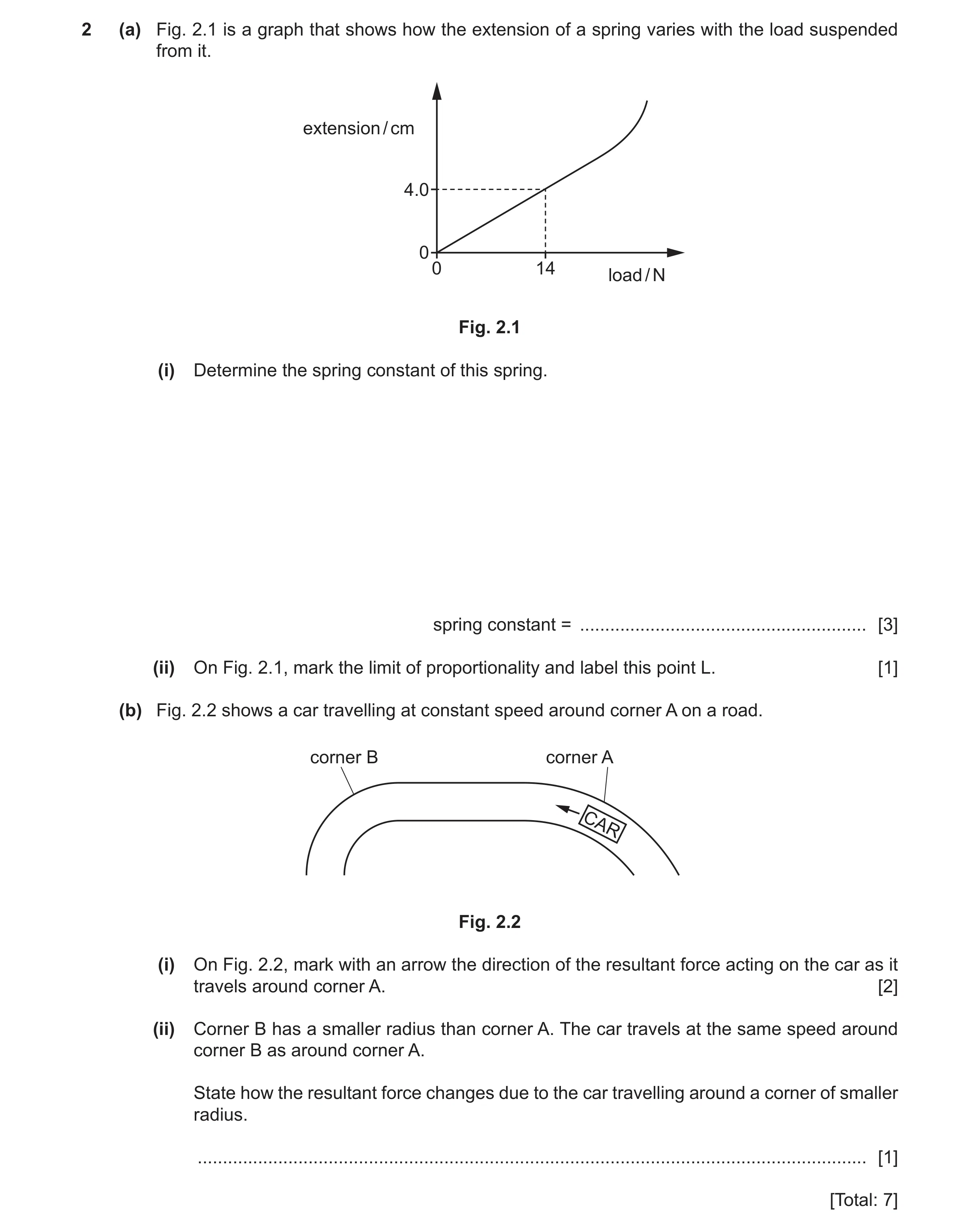
Q11 · A graph that shows how the extension of a spring varies with the load suspended from it 0625/43 Oct/Nov 2023
2 (a) Fig. 2.1 is a graph that shows how the extension of a spring varies with the load suspended from it. extension / cm 4.0 0 0 14 load / N Fig. 2.1 (i) Determine the spring constant of this spring. spring constant = … [3] (ii) On Fig. 2.1, mark the limit of proportionality and label this point L. [1] (b) Fig. 2.2 shows a car travelling at constant speed around corner A on a road. corner B corner A CAR Fig. 2.2 (i) On Fig. 2.2, mark with an arrow the direction of the resultant force acting on the car as it travels around corner A. [2] (ii) Corner B has a smaller radius than corner A. The car travels at the same speed around corner B as around corner A. State how the resultant force changes due to the car travelling around a corner of smaller radius. … [1] [Total: 7]
7 marks
Mark scheme: 2(a)(i) 3.5 N / cm OR 350 N / m A3 k = F / x OR (k =) F / x OR (k =) load / extension OR 14 / 4 C1 (k =) 14 / 4 OR 14 / 0.04 OR 3.5 10n C1 2(a)(ii) mark at end of straight-line portion B1 2(b)(i) arrow below the horizontal and to the left of vertically down from car M1 arrow radial A1 2(b)(ii) (force) increases B1 Question Answer Marks
This question in 0625/43 Oct/Nov 2023
Q12 · A force–extension graph for a spring 0625/42 Feb/March 2025
1 Fig. 1.1 shows a force–extension graph for a spring. 5000 4000 force / N 3000 2000 1000 –0.04 –0.02 0.02 0.04 0.06 0.08 0.10 extension / m Fig. 1.1 (a) Calculate the spring constant k of the spring. k = … [2] (b) A student states that the spring has not reached the limit of proportionality when a force of 4500 N is applied to it. State how the graph shows that this statement is true. … … [1] (c) Springs can be compressed by forces. The spring described by Fig. 1.1 is compressed by a force F and has an extension of –0.025 m. Determine F. F = … [2] (d) State whether force is a scalar quantity or a vector quantity. Explain your answer. … … [1] [Total: 6]
6 marks
Mark scheme: Question Answer Marks 1(a) 50 000 N / m OR 5.0 104 N / m A2 (k =) F x OR k is (determined from) the gradient (of the line in Fig. 1.1) C1 1(b) Any one from: B1 • The graph is a straight line (through the origin) • The slope / gradient is constant • The graph / line does not curve 1(c) 1300 N B1 any negative number OR indication that force is in opposite direction B1 1(d) (Force is a) vector quantity. Forces have (both magnitude / size and) direction B1
This question in 0625/42 Feb/March 2025
Q13 · Circle the vector quantities in the list 0625/41 May/June 2025
1 (a) Circle the vector quantities in the list. acceleration mass speed time velocity [1] (b) Fig. 1.1 shows the speed–time graph for a train travelling from station A to station B. 60 speed m / s 50 40 30 20 10 0 0 100 200 300 400 500 600 time / s Fig. 1.1 (i) State the maximum speed of the train. maximum speed = … [1] (ii) Describe the motion of the train between station A and station B. … … … [2] (iii) Calculate the distance between station A and station B. distance = … [3] (iv) On a different day, the train takes 650 s to travel between station A and station B. Suggest one change to the motion of the train that leads to this longer journey time. … … [1] [Total: 8]
8 marks
Mark scheme: Question Answer Marks 1(a) (only) acceleration AND velocity circled B1 1(b)(i) 56 m / s B1 braille: 55 m / s 1(b)(ii) accelerates OR speed increases B1 AND (then) constant speed AND (then) decelerates OR speed decreases constant acceleration OR constant deceleration B1 1(b)(iii) 26 000 m OR 26 km A3 braille: 26 125 m (distance =) area under the speed–time graph OR C1 (distance =) average speed time taken 0.5 80 56 AND 56 400 AND 0.5 50 56 C1 OR 1 400 + 530 56 2 braille: 0.5 100 55 AND 55 400 AND 0.5 50 55 OR 1 {400 + 550} 55 2 1(b)(iv) any one from: B1 • lower acceleration OR less acceleration • lower deceleration OR less deceleration • lower maximum speed OR lower average speed OR lower constant speed
This question in 0625/41 May/June 2025
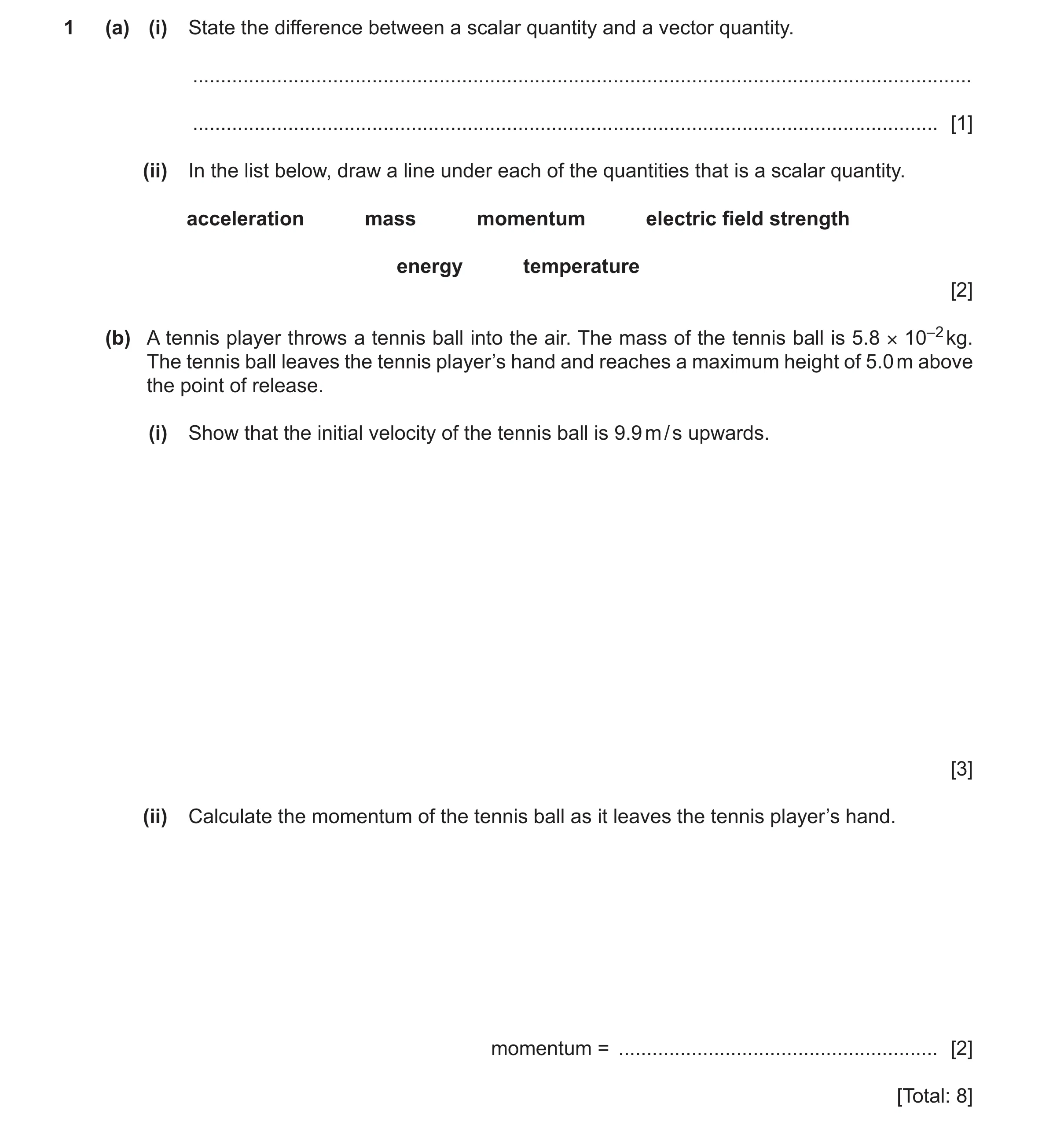
Q14 · State the difference between a scalar quantity and a vector quantity 0625/42 Oct/Nov 2025
1 (a) (i) State the difference between a scalar quantity and a vector quantity. … … [1] (ii) In the list below, draw a line under each of the quantities that is a scalar quantity. acceleration mass momentum electric field strength energy temperature [2] (b) A tennis player throws a tennis ball into the air. The mass of the tennis ball is 5.8 × 10⁻² kg. The tennis ball leaves the tennis player’s hand and reaches a maximum height of 5.0 m above the point of release. (i) Show that the initial velocity of the tennis ball is 9.9 m / s upwards. [3] (ii) Calculate the momentum of the tennis ball as it leaves the tennis player’s hand. momentum = … [2] [Total: 8]
8 marks
Mark scheme: Question Answer Marks 1(a)(i) scalar has magnitude (size) only OR vector has (magnitude and) direction B1 1(a)(ii) mass, energy and temperature B2 all correct and no additional quantities 2 marks 2 correct and no additional quantities 1 mark 1(b)(i) decrease in kinetic energy = increase in gravitational (potential) energy OR B1 ½ mv2 = mg()h v2 = 2gh OR v2 = 2 9.8 5.0 OR v2 =98 B1 v = √98 OR 9.899 B1 1(b)(ii) 0.57 kg m / s (upwards) OR 0.57 Ns (upwards) A2 (momentum = ) mv OR 5.8 10-2 9.9 C1
This question in 0625/42 Oct/Nov 2025
 1 / 17
 2 / 17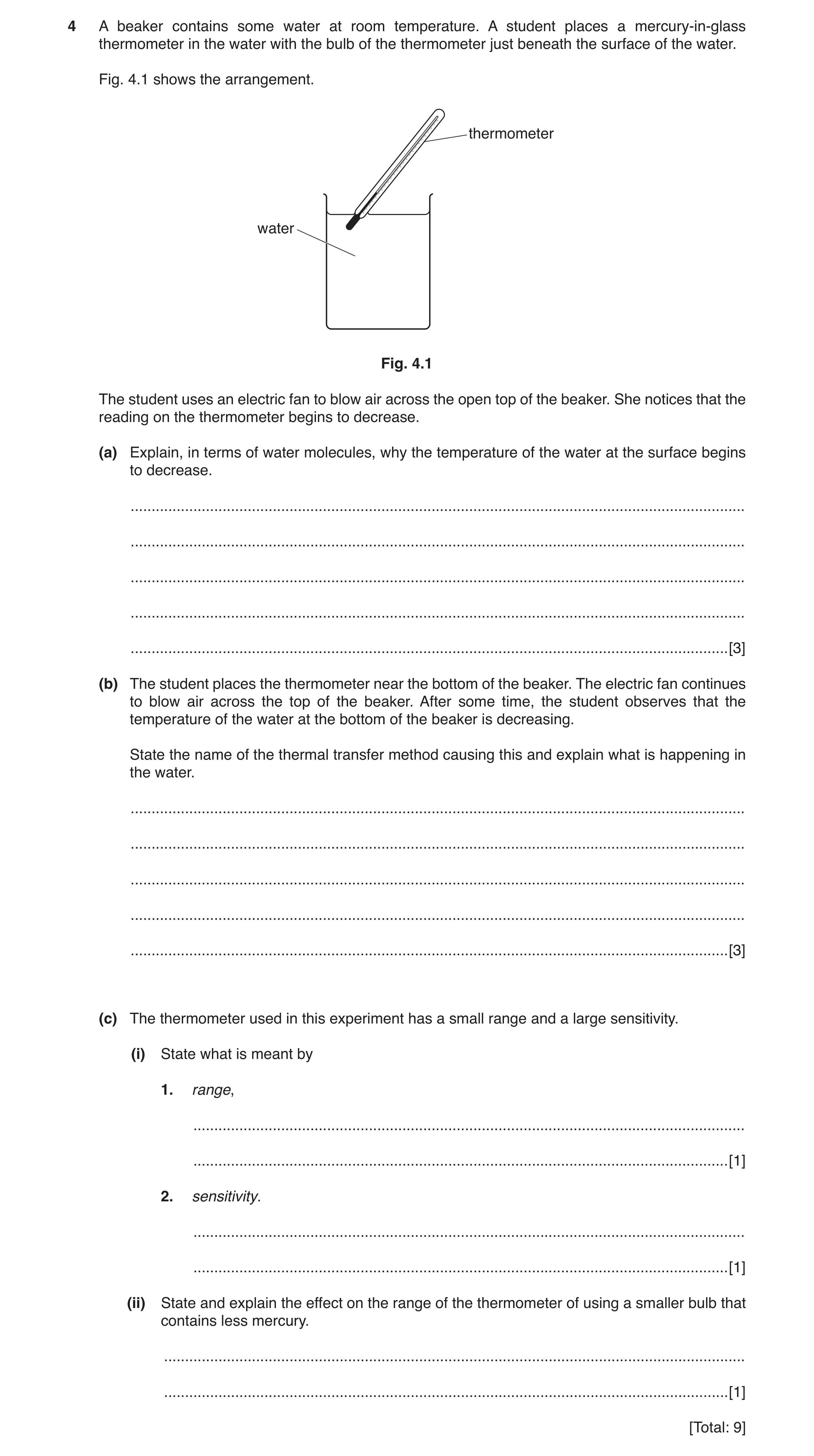
 5 / 17
 6 / 17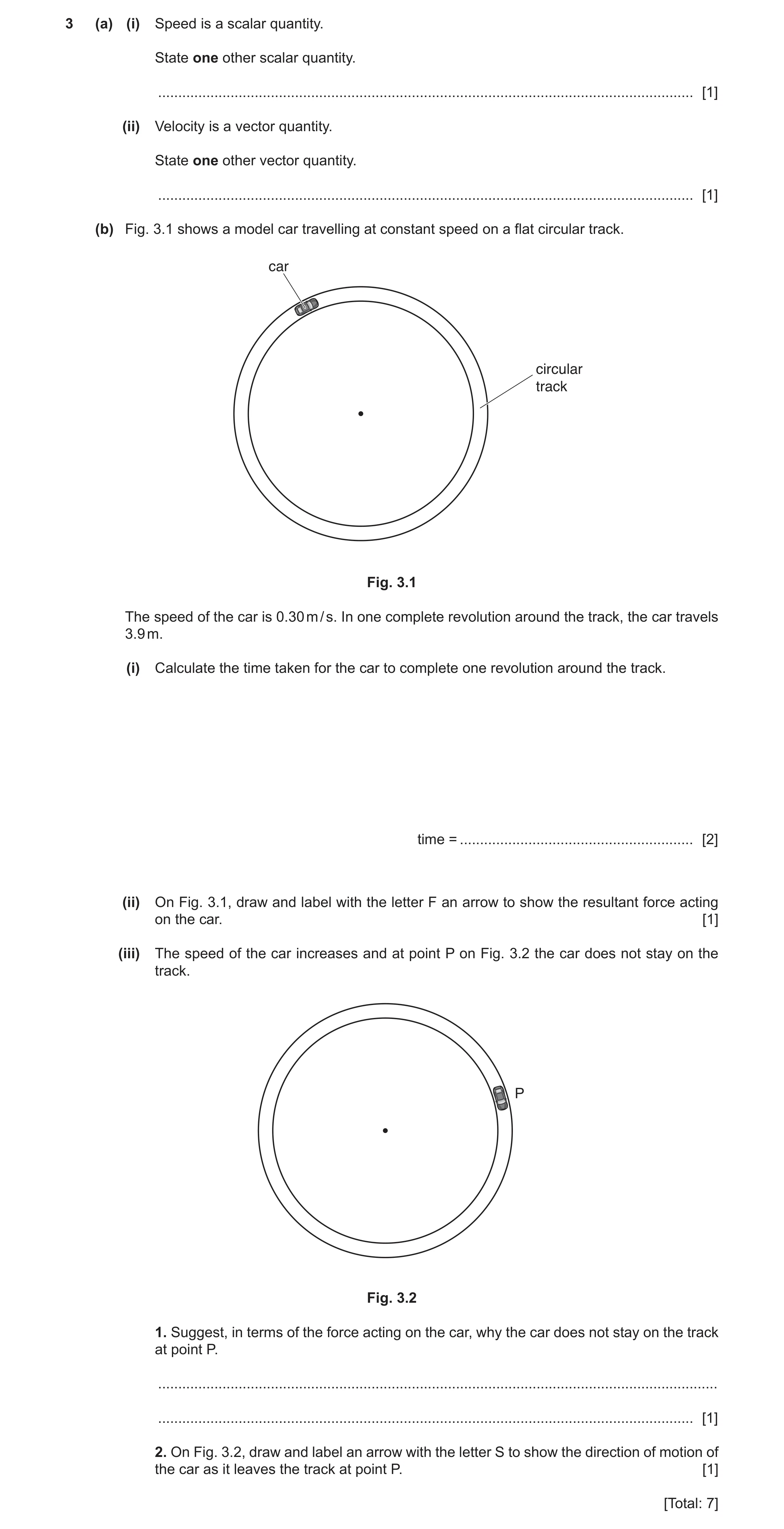
 11 / 17
 12 / 17
 13 / 17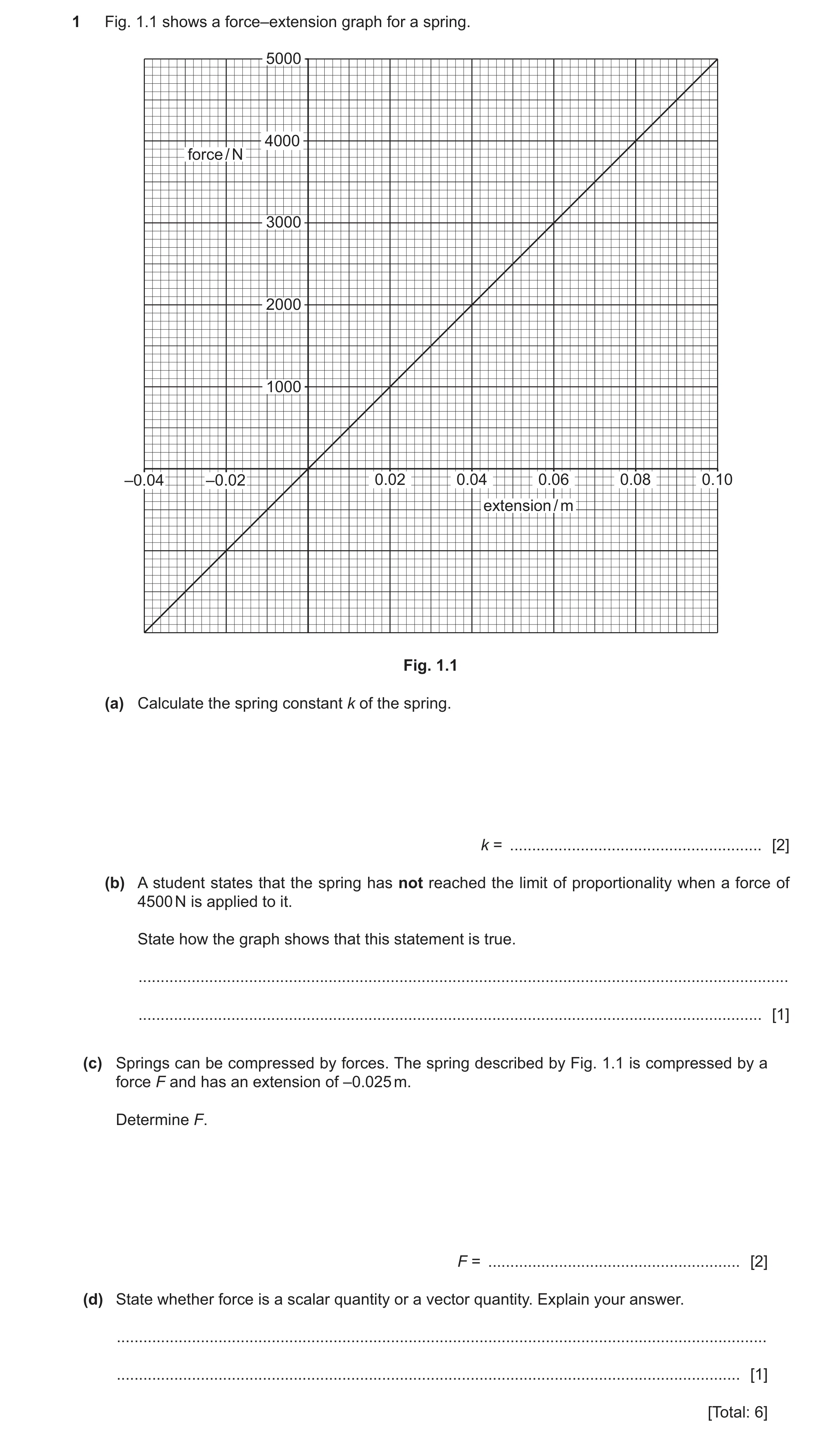
![Question 13: (a) Circle the vector quantities in the list. acceleration mass speed time velocity [1] (b) Fig. 1.1 shows the speed–time graph for a train…](https://img.pastlit.com/crops/e5df5ae0-9411-49fa-b526-c459662ba24f/q1.webp)
 17 / 17
 9
9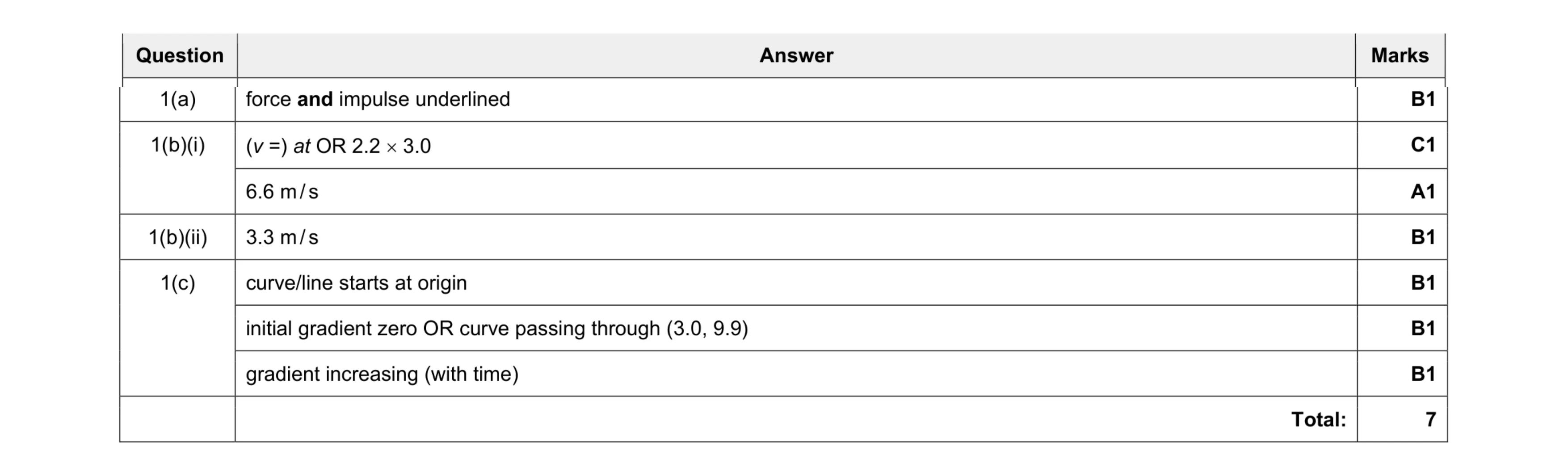 7
7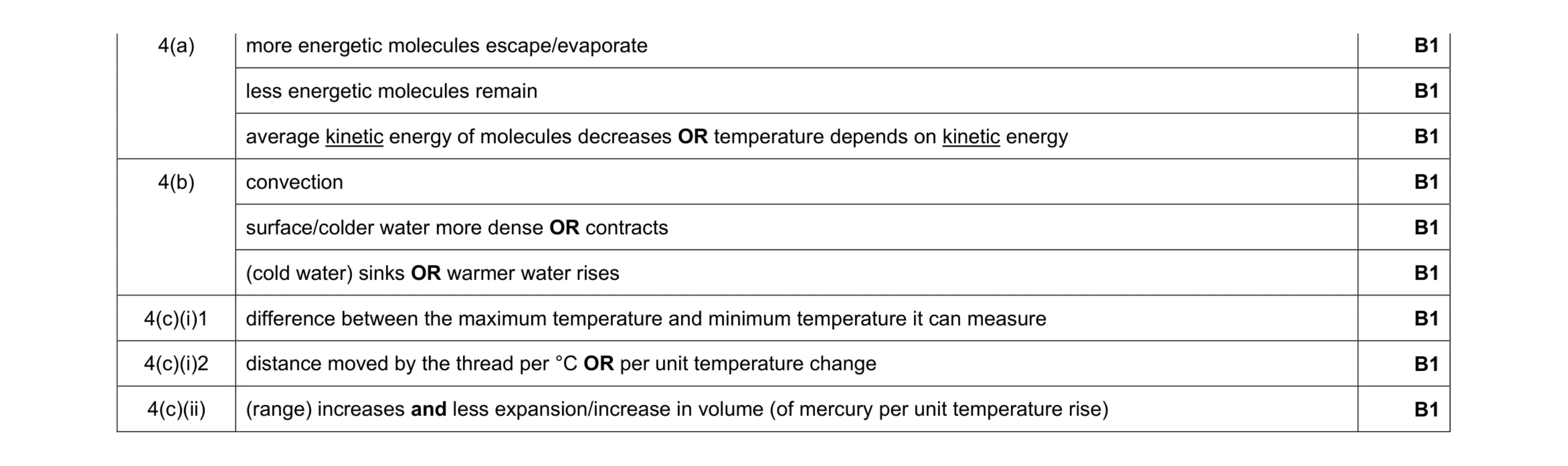 9
9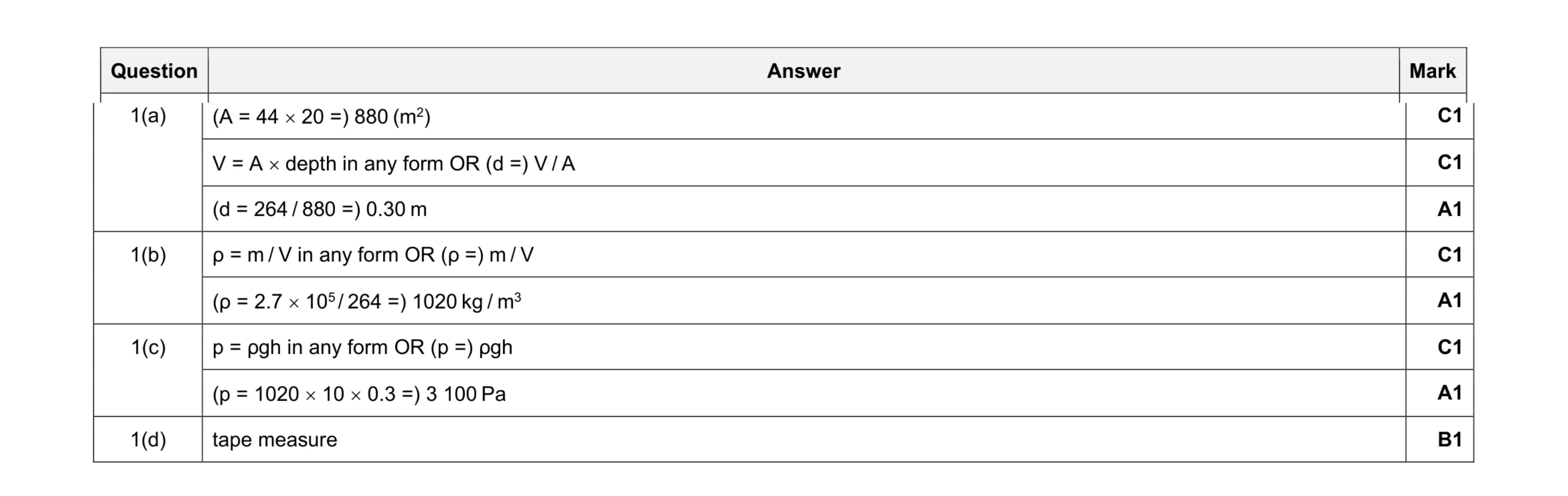 8
8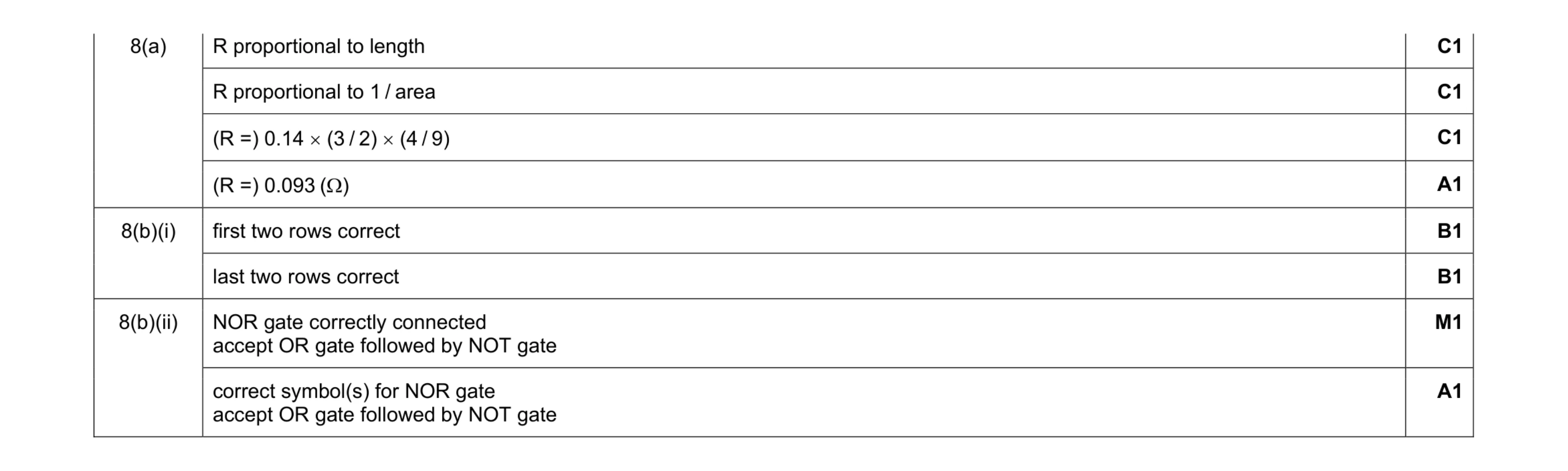 8
8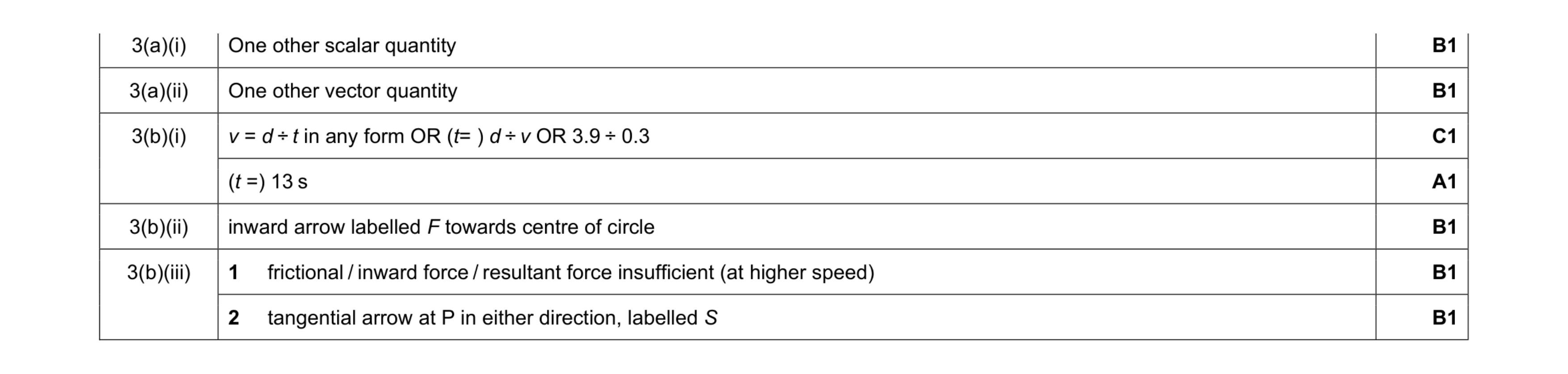 7
7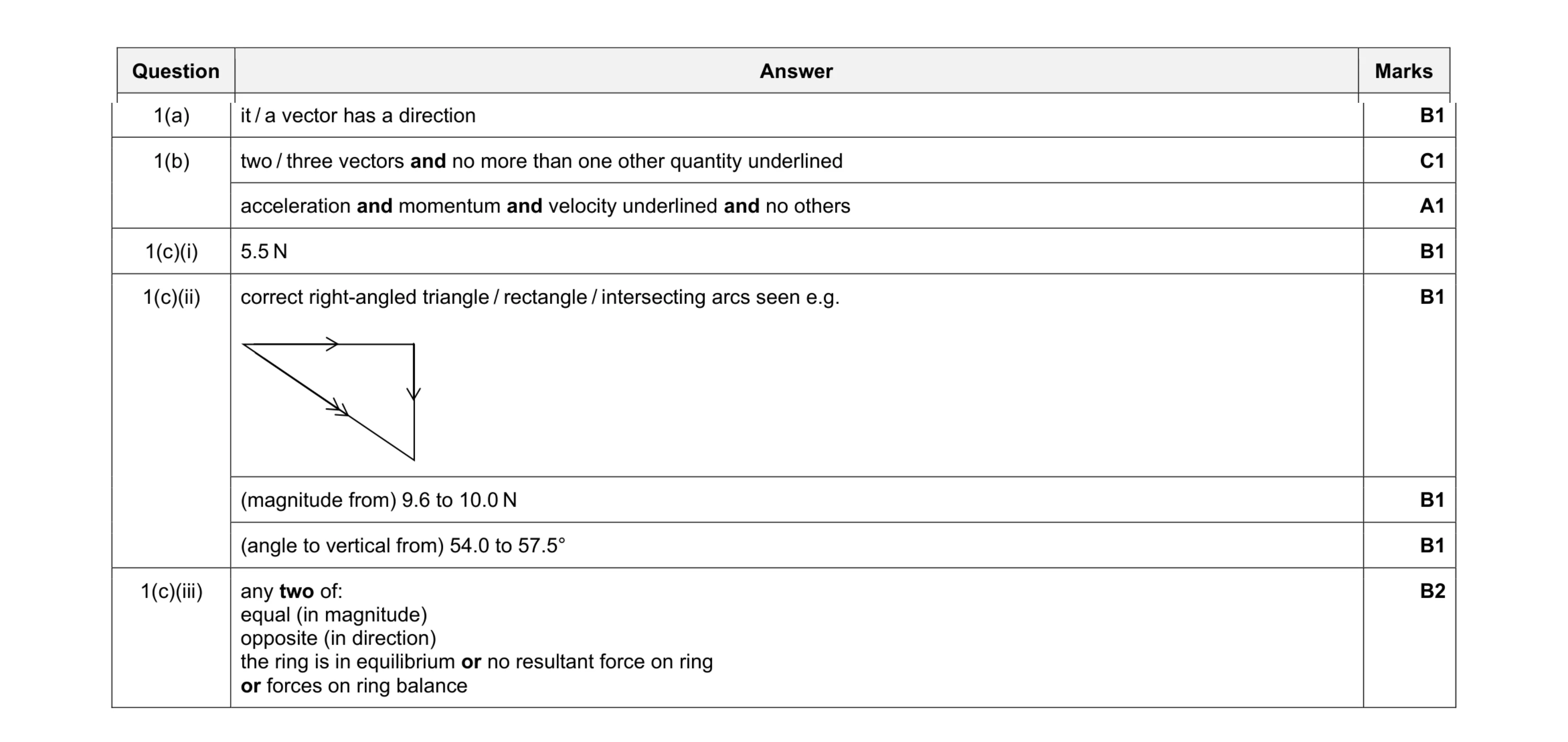 9
9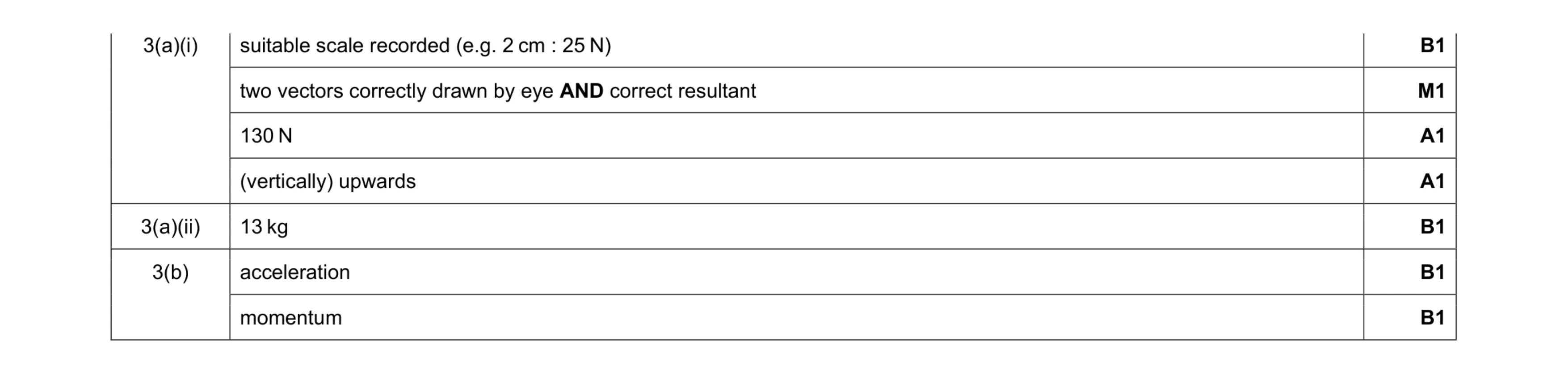 7
7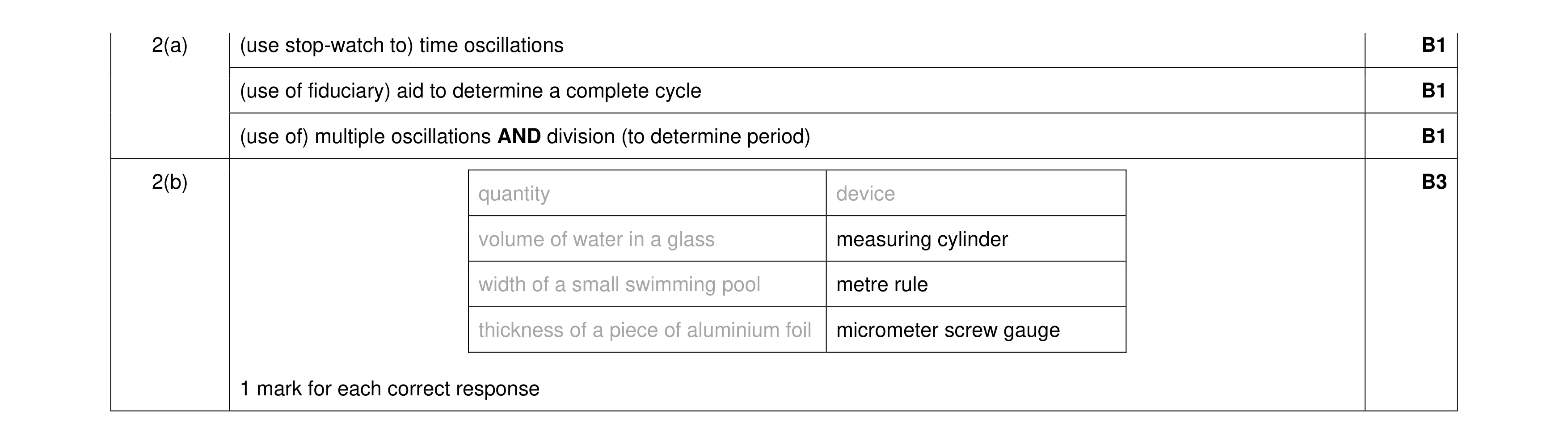 6
6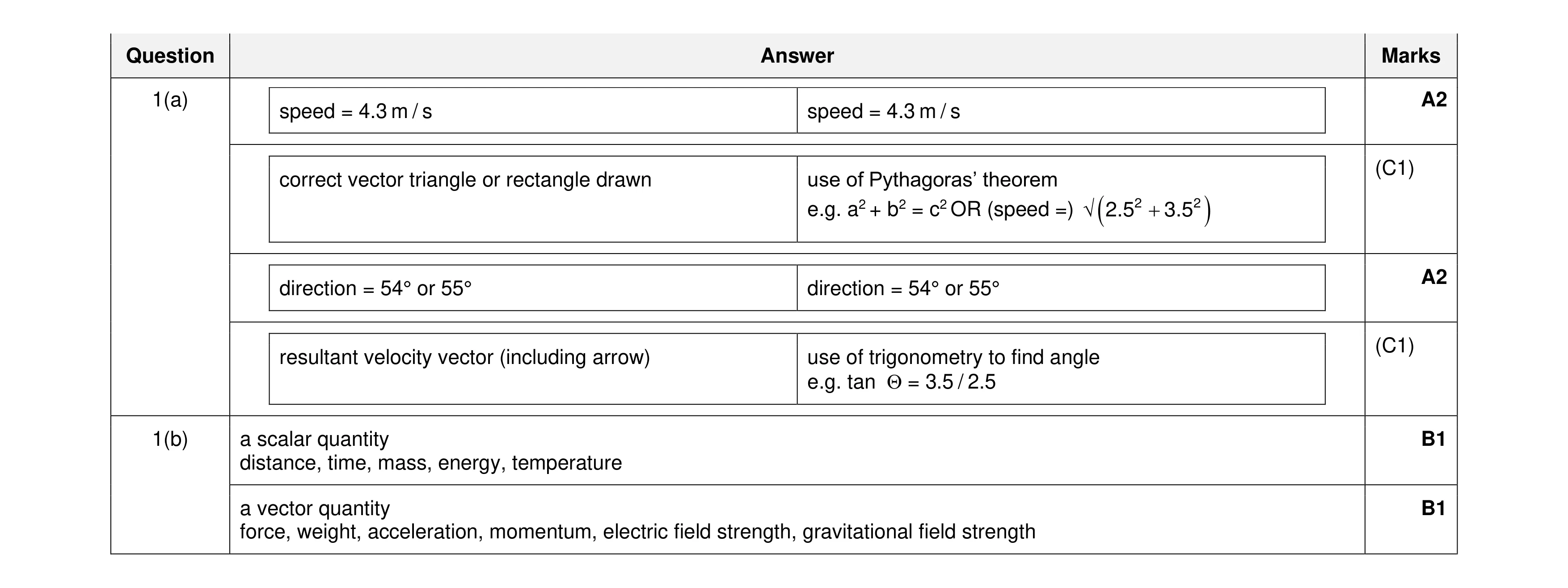 6
6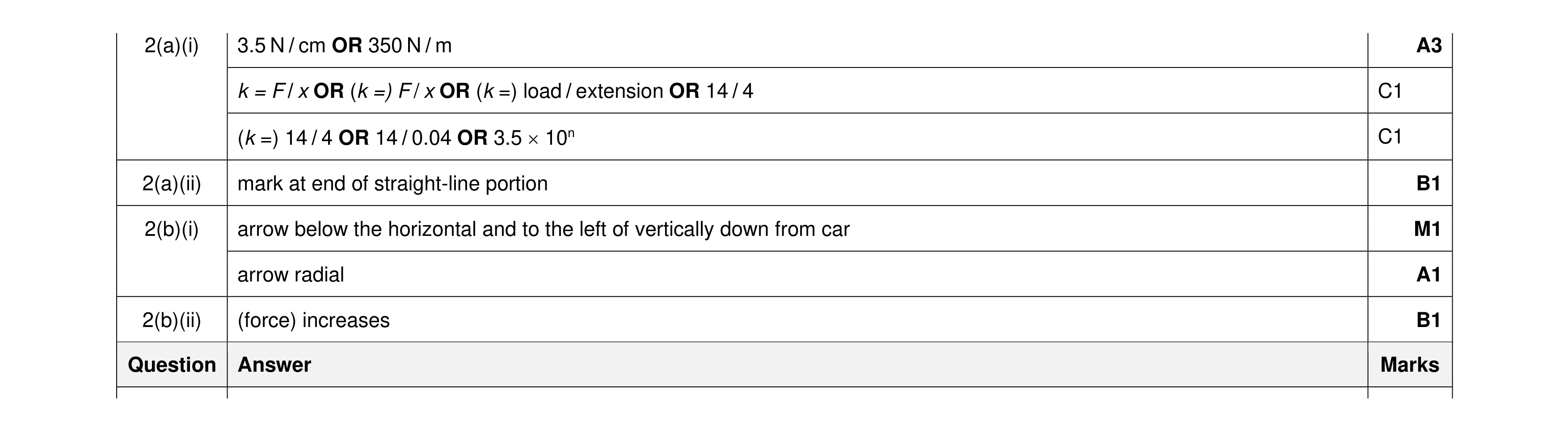 7
7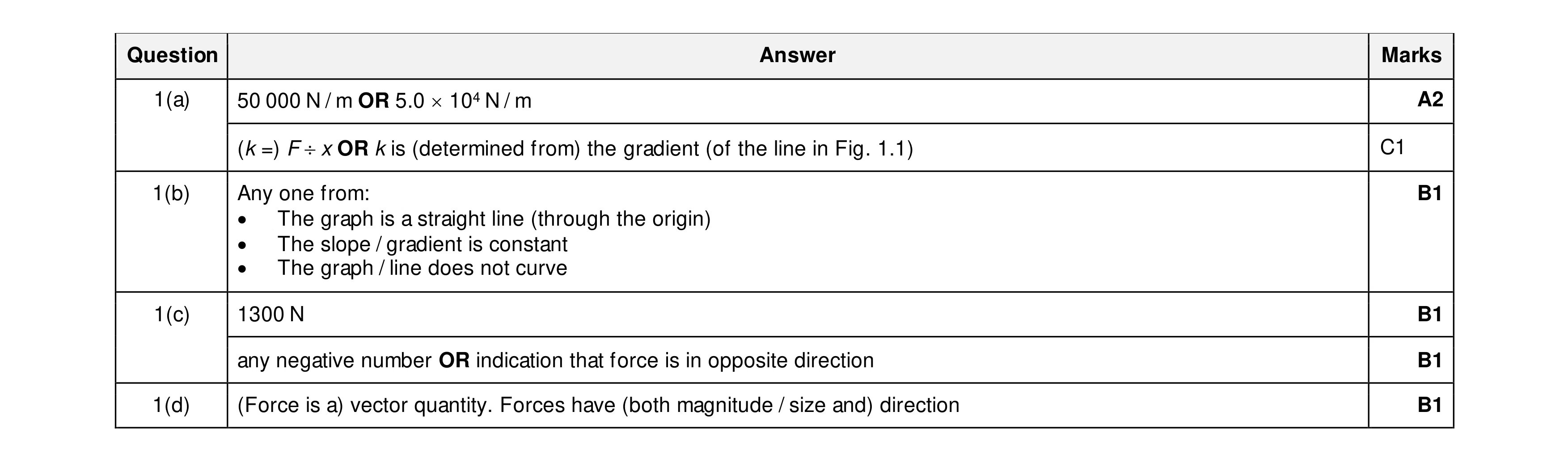 6
6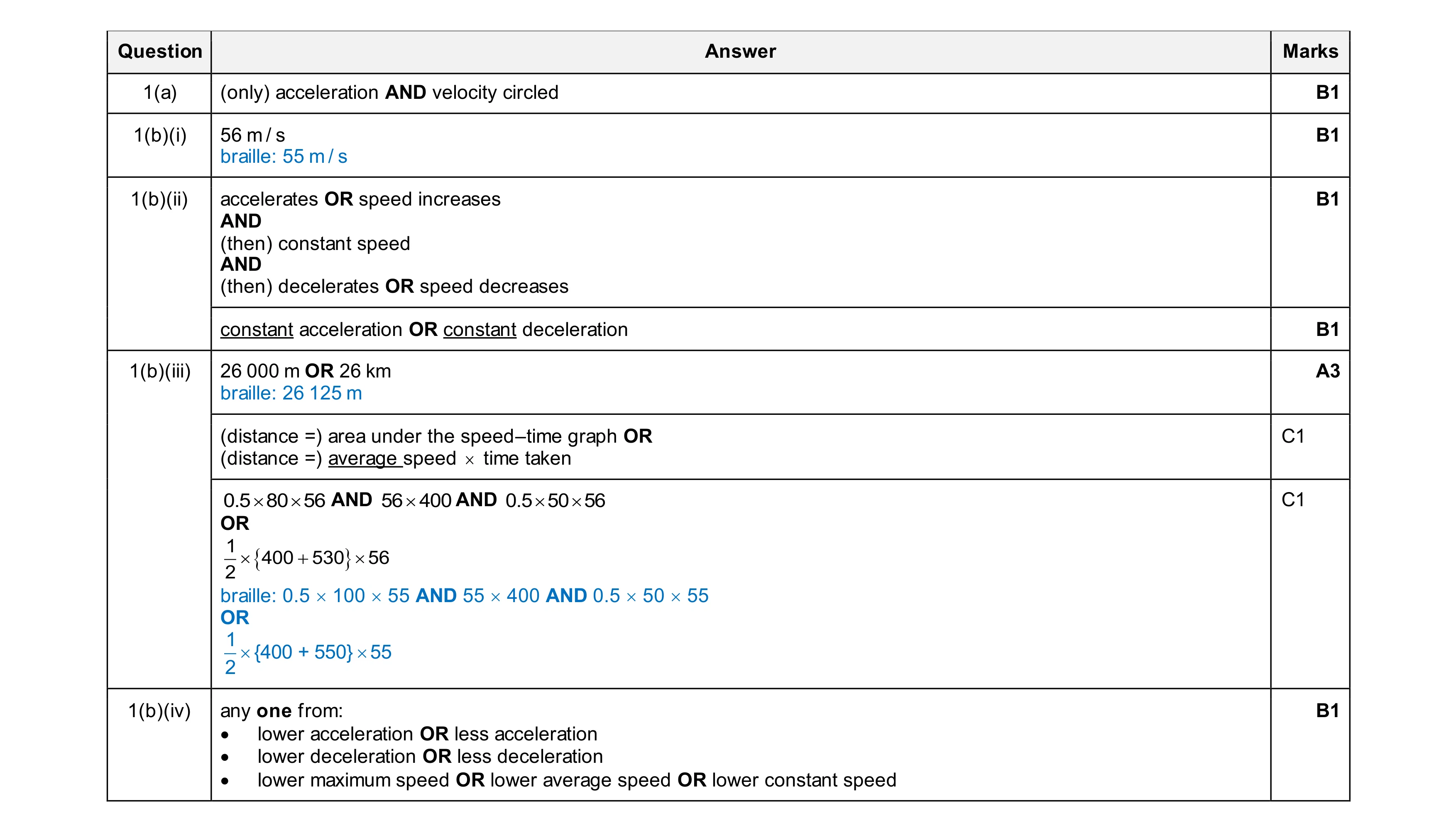 8
8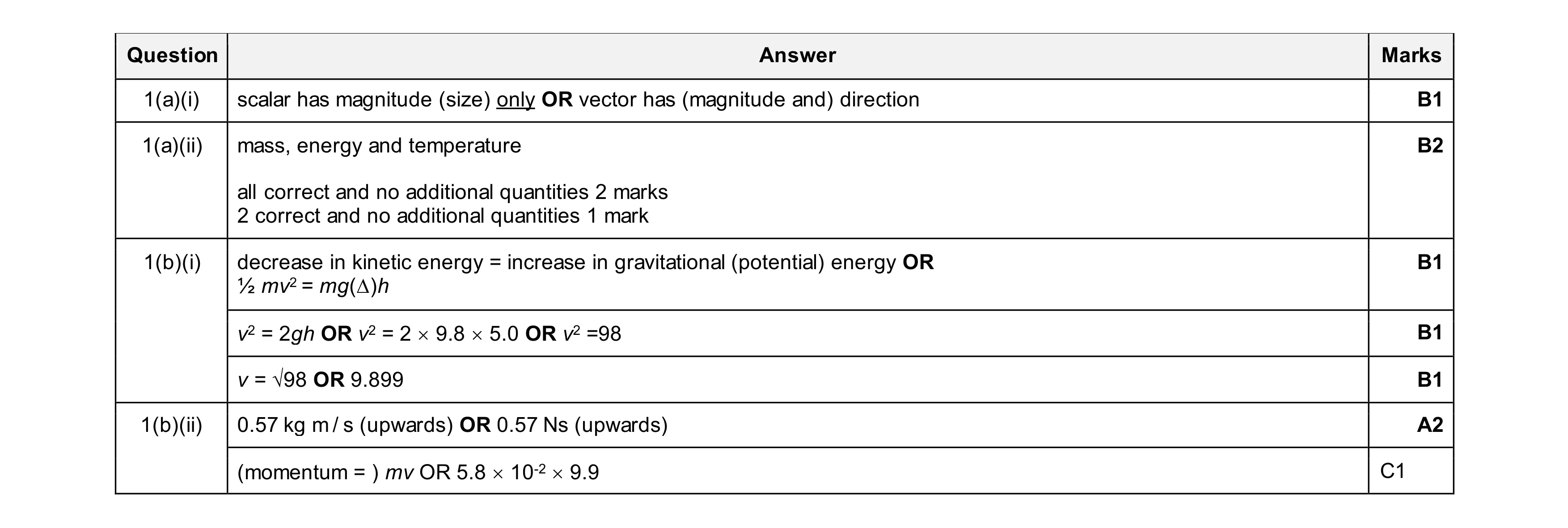 8
8