Questions as text
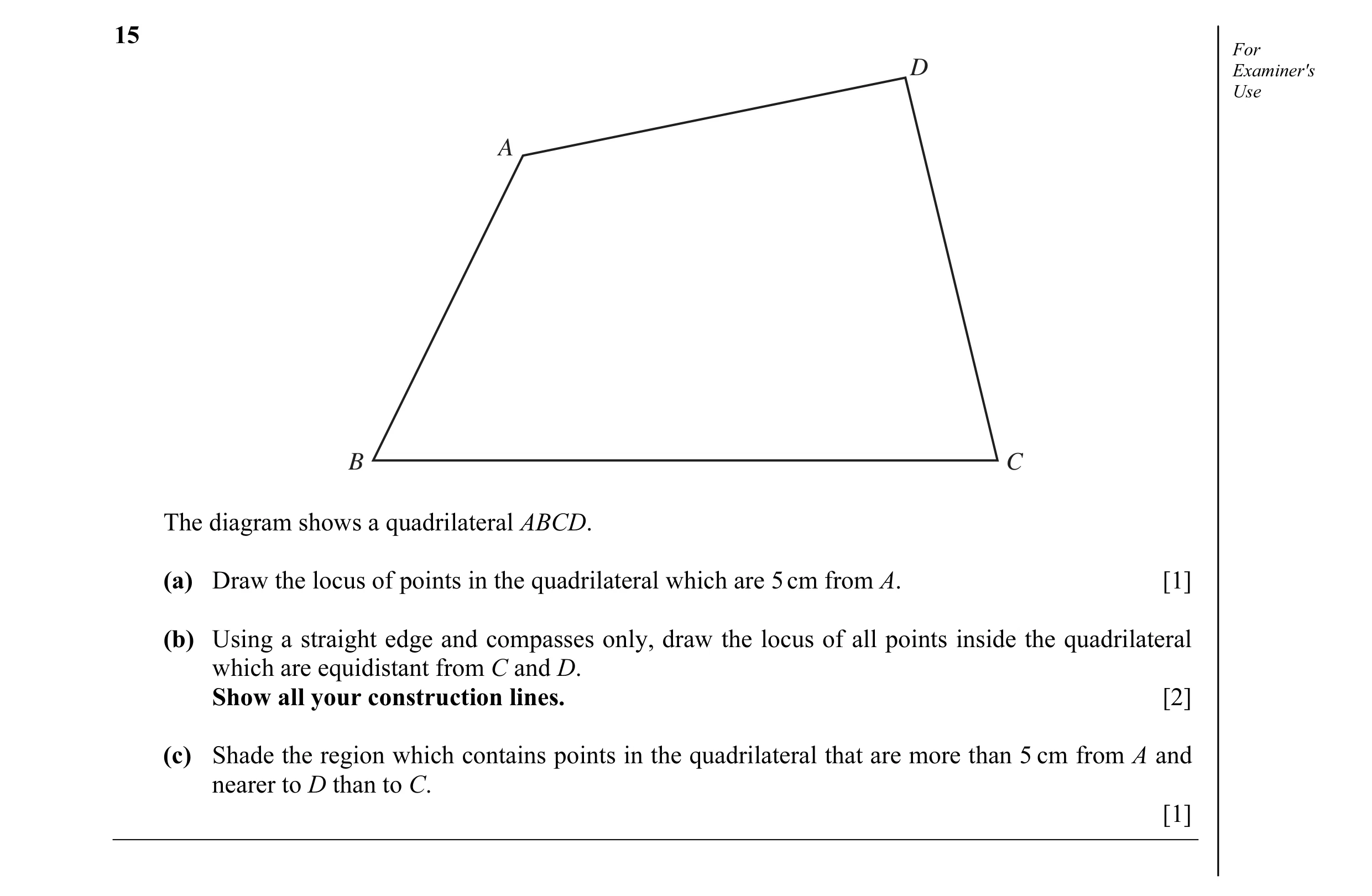
Q1 · For D Examiner's Use A B C The diagram shows a quadrilateral ABCD 0580/21 Oct/Nov 2004
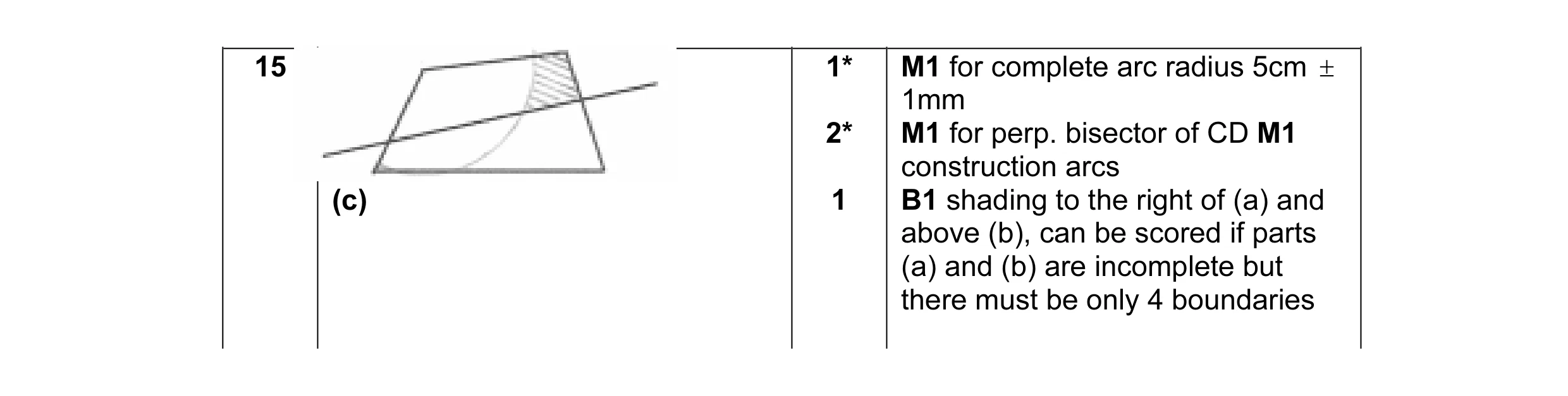
15 For D Examiner's Use A B C The diagram shows a quadrilateral ABCD. (a) Draw the locus of points in the quadrilateral which are 5 cm from A. [1] (b) Using a straight edge and compasses only, draw the locus of all points inside the quadrilateral which are equidistant from C and D. Show all your construction lines. [2] (c) Shade the region which contains points in the quadrilateral that are more than 5 cm from A and nearer to D than to C. [1]
4 marks
Mark scheme: 15 (a) 1* M1 for complete arc radius 5cm ± 1mm (b) 2* M1 for perp. bisector of CD M1 construction arcs (c) 1 B1 shading to the right of (a) and above (b), can be scored if parts (a) and (b) are incomplete but there must be only 4 boundaries
This question in 0580/21 Oct/Nov 2004
Q2 · Using a straight edge and compasses only, draw the locus of all points inside the… 0580/21 May/June 2009
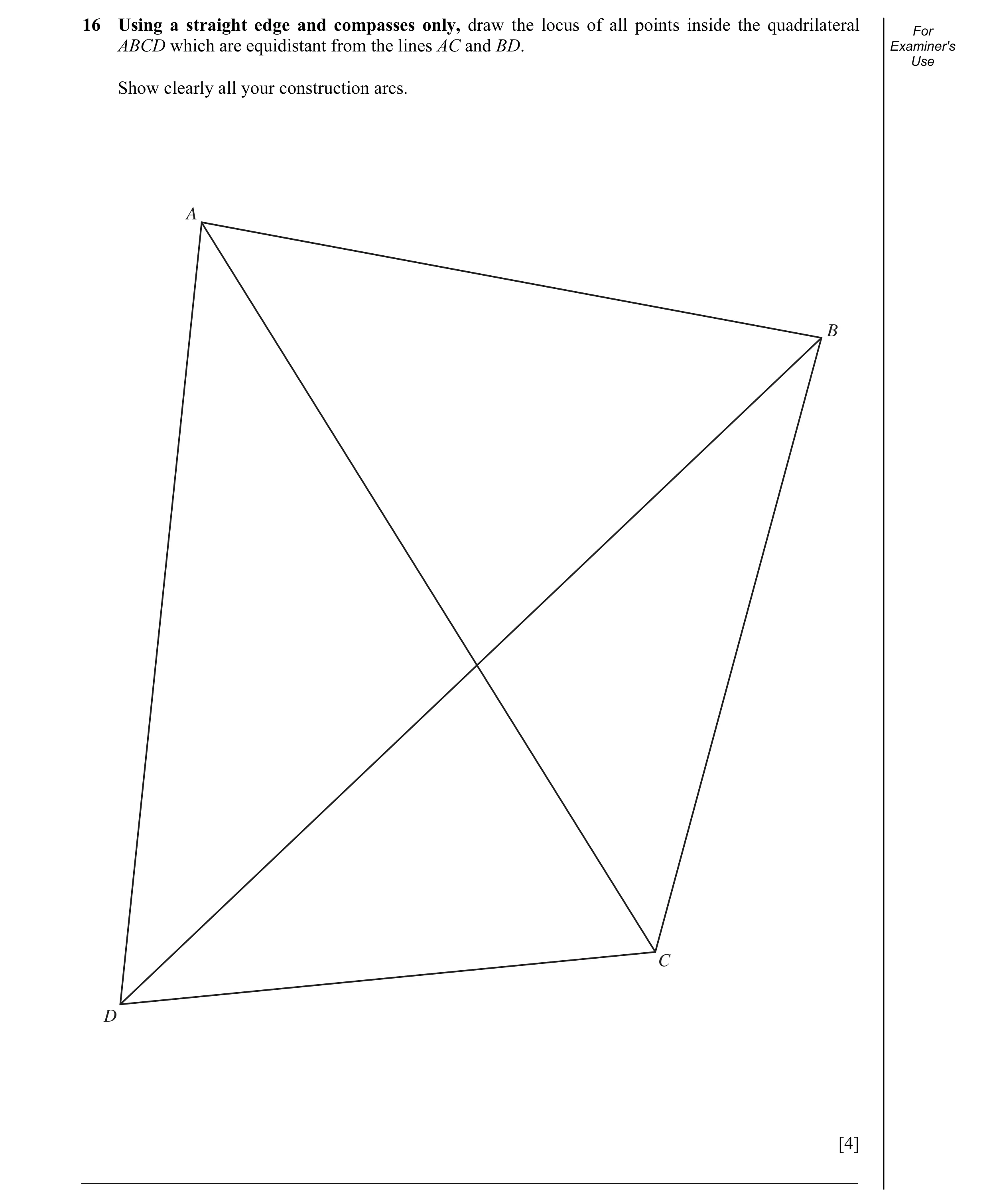
16 Using a straight edge and compasses only, draw the locus of all points inside the quadrilateral For ABCD which are equidistant from the lines AC and BD. Examiner's Use Show clearly all your construction arcs. A B C D [4]
4 marks
Mark scheme: 16 Angle bisector of angle in the middle 4 W1 correct bisector drawn W1 at least two arcs drawn on the arms and one Second angle bisector drawn pair of correct crossing arcs W1 as above W1 as above Accuracy ±1° but line must go from edge to edge. IGCSE – May/June 2009 0580, 0581 21
This question in 0580/21 May/June 2009
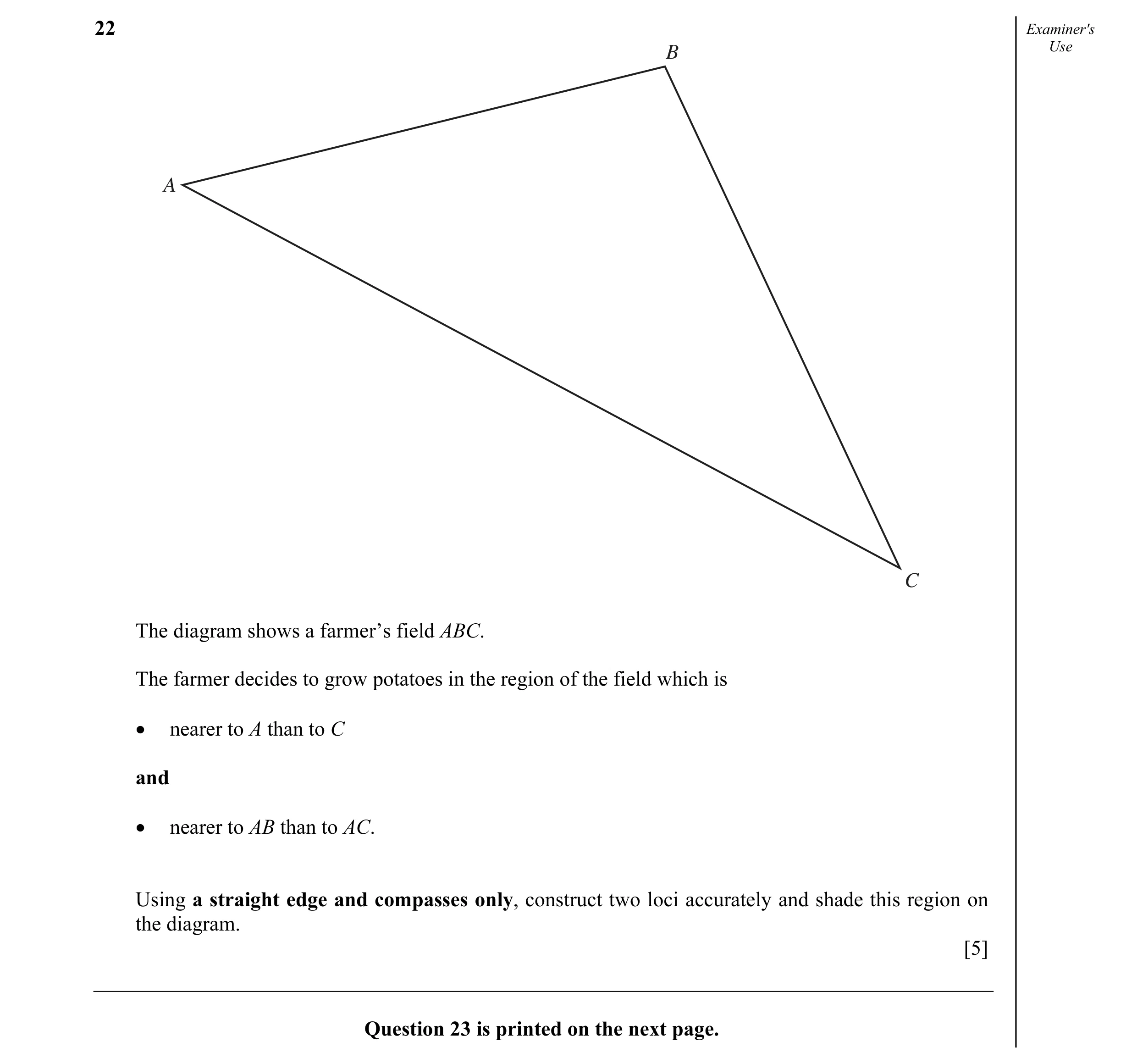
Q3 · Examiner's B Use A C The diagram shows a farmer’s field ABC 0580/23 May/June 2010
22 Examiner's B Use A C The diagram shows a farmer’s field ABC. The farmer decides to grow potatoes in the region of the field which is • nearer to A than to C and • nearer to AB than to AC. Using a straight edge and compasses only, construct two loci accurately and shade this region on the diagram. [5] Question 23 is printed on the next page.
5 marks
Mark scheme: 22 Perpendicular bisector of AC 2 B1 accurate line B1 two pairs of correct construction arcs Bisector of angle A 2 B1 accurate line B1 two pairs of correct construction arcs Shaded region inside triangle and 1 B1 dep on first B1 being scored for both lines to left of perp bisector of AC and above bisector of angle A ( )
This question in 0580/23 May/June 2010
Q4 · Draw, accurately, the locus of all the points outside the triangle which are 3… 0580/22 Oct/Nov 2010
14 Draw, accurately, the locus of all the points outside the triangle which are 3 centimetres away from the triangle. [3]
3 marks
Mark scheme: 14 3 M1 2 lines correct length M1 2 compass arcs correct length A1 complete accurate drawing with all lines and arcs solid
This question in 0580/22 Oct/Nov 2010
Q5 · For y Examiner's Use 6 5 B 4 3 2 A 1 x 0 1 2 3 4 5 6 The points A(1, 2) and B(5, 5) are… 0580/22 Oct/Nov 2011
15 For y Examiner's Use 6 5 B 4 3 2 A 1 x 0 1 2 3 4 5 6 The points A(1, 2) and B(5, 5) are shown on the diagram . (a) Work out the co-ordinates of the midpoint of AB. Answer(a) ( , ) [1] (b) Write down the column vector . Answer(b) = [1] (c) Using a straight edge and compasses only, draw the locus of points which are equidistant from A and from B. [2]
4 marks
Mark scheme: 15 (a) (3, 3½) 1 4 (b) 1 3 (c) Correct perpendicular bisector with 2 B1 line through (3, 3½) perp to AB arcs B1 two sets of correct arcs
This question in 0580/22 Oct/Nov 2011
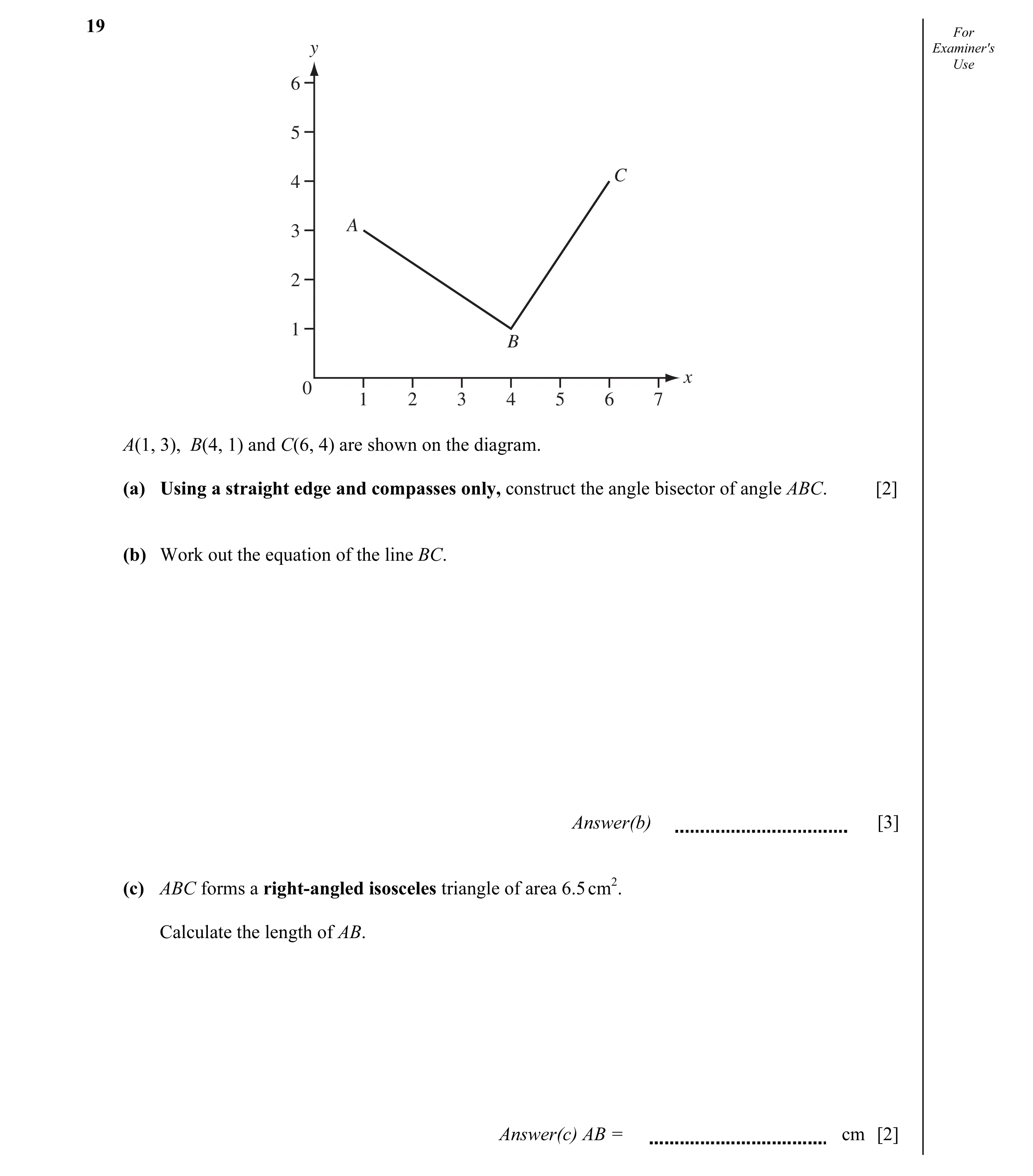
Q6 · For y Examiner's Use 6 5 C 4 A 3 2 1 B x 0 1 2 3 4 5 6 7 A(1, 3), B(4, 1) and C(6, 4) are… 0580/22 Oct/Nov 2011
19 For y Examiner's Use 6 5 C 4 A 3 2 1 B x 0 1 2 3 4 5 6 7 A(1, 3), B(4, 1) and C(6, 4) are shown on the diagram. (a) Using a straight edge and compasses only, construct the angle bisector of angle ABC. [2] (b) Work out the equation of the line BC. Answer(b) [3] (c) ABC forms a right-angled isosceles triangle of area 6.5 cm2. Calculate the length of AB. Answer(c) AB = cm [2]
7 marks
Mark scheme: 19 (a) correct bisector (through 3½, 3½) 2 B1 correct line B1 correct arcs 1 1 (b) y = 1 x – 5 oe 3 B2 y = 1 x + k or y = kx – 5 k any number 2 2 1 or B1 1 x + k or kx – 5 2 1 If O scored allow one each for m = 1 or c = –5 2 clearly identified in working 1 2 2 (c) 3.61 2 M1 × L × L = 6.5 or M1 (3 + 2 ) 2
This question in 0580/22 Oct/Nov 2011
Q7 · D A B (a) The point C lies on AD and angle ABC = 67° 0580/21 May/June 2012
9 D A B (a) The point C lies on AD and angle ABC = 67°. Draw accurately the line BC. [1] (b) Using a straight edge and compasses only, construct the perpendicular bisector of AB. Show clearly all your construction arcs. [2]
3 marks
Mark scheme: 9 (a) 1 B1 C marked on AD unless the line stops at AD and angle of 67° at B also correct ruled line (b) 2 B1 correct arcs B1 correct ruled line perpendicular bisector of AB 750 × 5 × 2 5
This question in 0580/21 May/June 2012
Q8 · R T Using a straight edge and compasses only, construct the locus of points which are… 0580/23 Oct/Nov 2012
6 R T Using a straight edge and compasses only, construct the locus of points which are equidistant from R and from T. [2]
2 marks
Mark scheme: 6 Accurate perpendicular bisector of RT with 2 B1 for 2 pairs of correct arcs arcs. B1 for correct line
This question in 0580/23 Oct/Nov 2012
Q9 · For Examiner′s Use D C A B Scale: 1 cm to 8 m The rectangle ABCD is a scale drawing of a… 0580/22 May/June 2013
19 For Examiner′s Use D C A B Scale: 1 cm to 8 m The rectangle ABCD is a scale drawing of a rectangular football pitch. The scale used is 1 centimetre to represent 8 metres. (a) Construct the locus of points 40 m from A and inside the rectangle. [2] (b) Using a straight edge and compasses only, construct the perpendicular bisector of DB. [2] (c) Shade the region on the football pitch which is more than 40 m from A and nearer to D than to B. [1] _____________________________________________________________________________________
5 marks
Mark scheme: 19 (a) arc centre A radius 5 cm 2 B1 arc with centre A (b) ruled perpendicular bisector of DB with 2 2 B1 correct ruled line pairs of correct arcs B1 2 pairs of correct arcs (c) cao 1
This question in 0580/22 May/June 2013
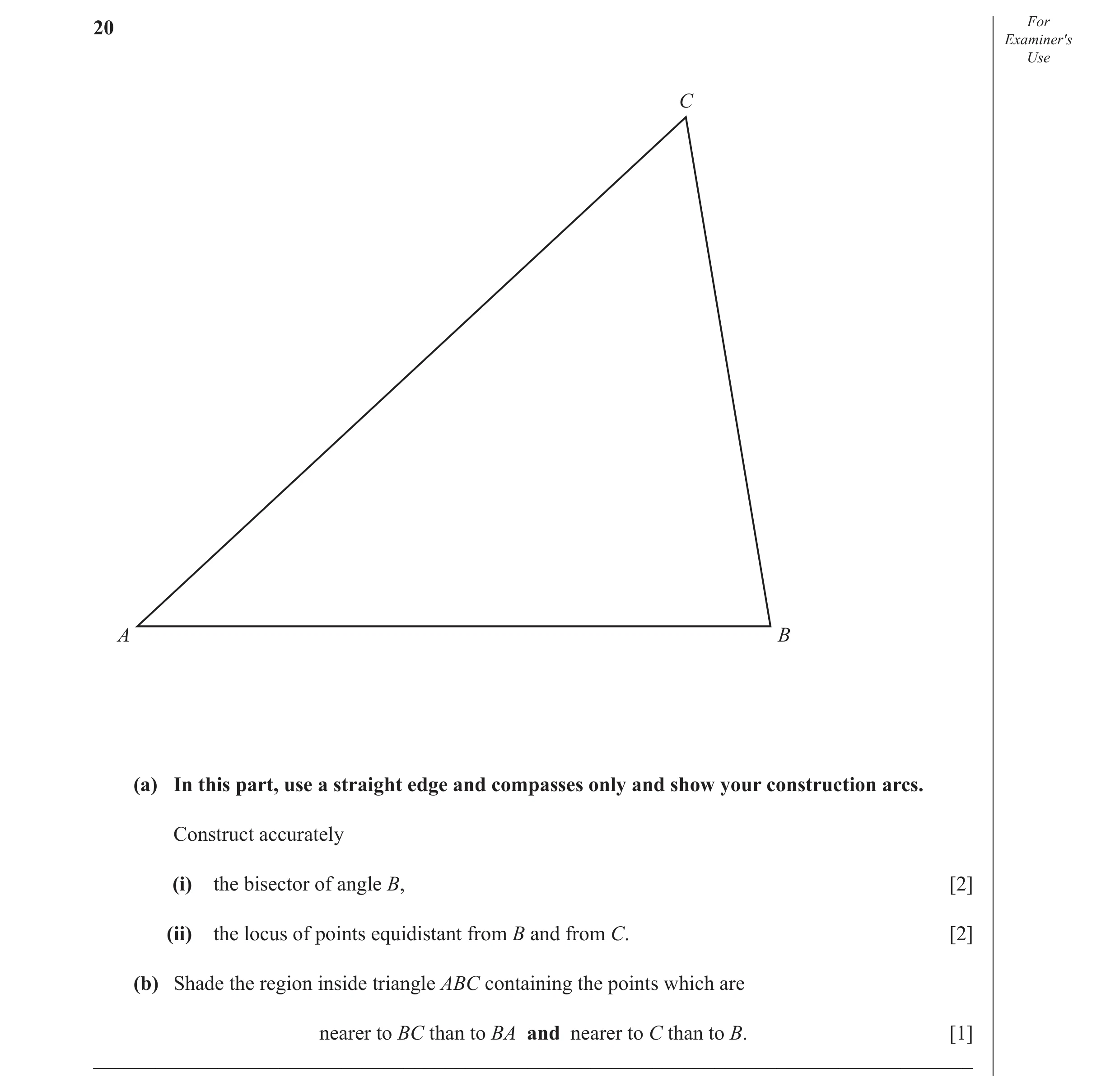
Q10 · For Examiner′s Use C A B (a) In this part, use a straight edge and compasses only and… 0580/21 Oct/Nov 2013
20 For Examiner′s Use C A B (a) In this part, use a straight edge and compasses only and show your construction arcs. Construct accurately (i) the bisector of angle B, [2] (ii) the locus of points equidistant from B and from C. [2] (b) Shade the region inside triangle ABC containing the points which are nearer to BC than to BA and nearer to C than to B. [1] _____________________________________________________________________________________
5 marks
Mark scheme: 20 (a) (i) Accurate bisector of angle B with correct arcs 2 B1 for correct line or correct arcs (ii) Accurate perpendicular bisector of BC with correct arcs 2 B1 for correct line or correct arcs (b) correct region shaded 1 20 f f
This question in 0580/21 Oct/Nov 2013
Q11 · C A B (a) Using compasses and straight edge only, construct (i) the perpendicular… 0580/21 Oct/Nov 2014
15 C A B (a) Using compasses and straight edge only, construct (i) the perpendicular bisector of AC, [2] (ii) the bisector of angle ACB. [2] (b) Shade the region inside the triangle which is ● nearer to A than to C and ● nearer to AC than to BC. [1] __________________________________________________________________________________________
5 marks
Mark scheme: 15 (a) (i) 2 B2 for correct ruled bisector with correct arcs or B1 for correct bisector with no/incorrect arcs (ii) 2 B2 for correct ruled bisector with correct arcs or B1 for correct bisector with no/incorrect arcs (b) 1 correct shading
This question in 0580/21 Oct/Nov 2014
Q12 · The diagram shows the plan, ABCD, of a park 0580/22 Oct/Nov 2014
20 The diagram shows the plan, ABCD, of a park. The scale is 1 centimetre represents 20 metres. D C A B Scale: 1 cm to 20 m (a) Find the actual distance BC. Answer(a) … m [2] (b) A fountain, F, is to be placed ● 160 m from C and ● equidistant from AB and AD. On the diagram, using a ruler and compasses only, construct and mark the position of F. Leave in all your construction lines. [5] __________________________________________________________________________________________ Question 21 is printed on the next page.
7 marks
Mark scheme: 20 (a) 102 to 106 2 B1 for 5.1 to 5.3 seen (b) Correct position of F with correct arcs for 5 B2 for Correct ruled angle bisector of A with angle bisector correct arcs or B1 for correct bisector with no/wrong arcs and B2 for Arc centre C, radius 8 cm or B1 for arc centre C with incorrect radius or correct conversion to 8cm and B1 for marking position of F on their bisector and 8cm from C or on their arc centre C x + 7
This question in 0580/22 Oct/Nov 2014
Q13 · D C E A B (a) Draw the locus of the points which are 3 cm from E 0580/23 Oct/Nov 2014
12 D C E A B (a) Draw the locus of the points which are 3 cm from E. [1] (b) Using a straight edge and compasses only, construct the bisector of angle DCB. [2] (c) Shade the region which is ● less than 3 cm from E and ● nearer to CB than to CD. [1] __________________________________________________________________________________________
4 marks
Mark scheme: 12 (a) Complete circle centre E radius 1 3cm (b) Correct ruled bisector with two 2 B1 for correct bisector with no/wrong arcs pairs of correct arcs (c) 1 dep on attempt at bisector of C and enclosed region 16 x 2 + 18 x + 9
This question in 0580/23 Oct/Nov 2014
Q14 · The diagram shows the positions of three points A, B and C 0580/22 May/June 2015
19 The diagram shows the positions of three points A, B and C. C B A (a) Draw the locus of points which are 4 cm from C. [1] (b) Using a straight edge and compasses only, construct the locus of points which are equidistant from A and B. [2] (c) Shade the region which is • less than 4 cm from C and • nearer to B than to A. [1] __________________________________________________________________________________________
4 marks
Mark scheme: 19 (a) 1 Correct circle, radius 4 cm centre C (b) 2 B2 for correct bisector with 2 pairs of correct arcs or B1 for correct bisector with no/wrong arcs C (c) 1 Correct complete boundary and correct shading. A B Dep on at least B1 in (b)
This question in 0580/22 May/June 2015
Q15 · Using a straight edge and compasses only, construct the perpendicular bisector of the… 0580/23 May/June 2016
6 Using a straight edge and compasses only, construct the perpendicular bisector of the line AB. A B [2]
2 marks
Mark scheme: 6 Correct perpendicular bisector 2 B1 for correct bisector with no arcs or incorrect arcs with 2 pairs of correct arcs or for correct intersecting arcs with no/wrong line 6 k 6
This question in 0580/23 May/June 2016
Q16 · B A C (a) Using compasses and a straight edge only, construct the bisector of angle BAC 0580/22 Oct/Nov 2016
11 B A C (a) Using compasses and a straight edge only, construct the bisector of angle BAC. [2] (b) Complete the statement. The bisector of angle BAC is the locus of points that are … … [1]
3 marks
Mark scheme: 11 (a) Accurate angle bisector with correct 2 B1 for accurate angle bisector arcs or correct arcs with no/wrong line (b) Equidistant (oe) from AB and AC 1
This question in 0580/22 Oct/Nov 2016
Q17 · The line AB is one side of an equilateral triangle ABC 0580/22 Feb/March 2017
2 The line AB is one side of an equilateral triangle ABC. Using a straight edge and compasses only, construct triangle ABC. A B [2]
2 marks
Mark scheme: 2 Equilateral triangle with correct 2 M1 for clear evidence of constructed 60° arcs angles or arcs crossing equal in length to AB or an accurate diagram with no/incorrect arcs 10 × 20
This question in 0580/22 Feb/March 2017
Q18 · B A C (a) Using a straight edge and compasses only, construct the bisector of angle BAC 0580/22 May/June 2017
16 B A C (a) Using a straight edge and compasses only, construct the bisector of angle BAC. [2] (b) Shade the region inside the triangle that is nearer to AC than to AB. [1]
3 marks
Mark scheme: 16(a) Correct bisector with correct arcs 2 B1 for correct bisector but no arcs or correct arcs but no line 16(b) Correct region shaded 1
This question in 0580/22 May/June 2017
Q19 · The diagram shows a scale drawing of Tariq’s garden 0580/21 Oct/Nov 2017
18 The diagram shows a scale drawing of Tariq’s garden. The scale is 1 centimetre represents 2 metres. Tree Bird bath Tree Scale: 1 cm to 2 m Tariq puts a statue in the garden. The statue is equidistant from the two trees and 10 m from the bird bath. Find, by construction, the point where Tariq puts the statue. Label the point S. [4]
4 marks
Mark scheme: 18 Correct position of S with 2 pairs of 4 B3 for correct position of S with correct construction arcs for line missing/incorrect construction arcs but correct line or B2 for correct ruled line equidistant from the two trees with correct arcs or B1 for correct line with no/wrong arcs or correct arcs with no line and B1 for arc centre bird bath, radius 5 cm or S in correct position with no/incorrect working
This question in 0580/21 Oct/Nov 2017
Q20 · Using a straight edge and compasses only, construct the locus of points that are… 0580/22 May/June 2018
9 Using a straight edge and compasses only, construct the locus of points that are equidistant from A and B. A B [2]
2 marks
Mark scheme: 9 Correct perpendicular bisector of 2 B1 for correct perpendicular bisector of AB AB with 2 pairs of correct arcs with no or wrong arcs or for 2 pairs of correct arcs
This question in 0580/22 May/June 2018
Q21 · The diagram shows a pentagon ABCDE 0580/22 Oct/Nov 2018
19 The diagram shows a pentagon ABCDE. A E B D C (a) Using a straight edge and compasses only, construct the bisector of angle BCD. [2] (b) Draw the locus of the points inside the pentagon that are 3 cm from E. [1] (c) Shade the region inside the pentagon that is • less than 3 cm from E and • nearer to DC than to BC. [1]
4 marks
Mark scheme: 19(a) Correct rulled bisector withw two 2 B1B for correcct ruled bisecctor with no//wrong arcs pairs of arccs 19(b) Correct arcc centre E raadius 3 cm 1 inside penttagon 19(c) Correct reggion shaded 1 DependentD ono at least B11 in part (a) anda 1 mark in partp (b) and a closed regiion
This question in 0580/22 Oct/Nov 2018
Q22 · 6 cm NOT TO SCALE 4 cm The diagram shows a pyramid with a square base 0580/23 May/June 2019
13 6 cm NOT TO SCALE 4 cm The diagram shows a pyramid with a square base. The triangular faces are congruent isosceles triangles. (a) Write down the number of planes of symmetry of this pyramid. … [1] (b) Using a ruler and compasses only, construct an accurate drawing of one of the triangular faces of the pyramid. [2]
3 marks
Mark scheme: 13(a) 4 1 13(b) Accurate drawing with correct 2 B1 for accurate drawing without the correct construction arcs arcs
This question in 0580/23 May/June 2019
Q23 · The diagram shows a scale drawing of Lei’s garden, PQRS 0580/22 Oct/Nov 2019
17 The diagram shows a scale drawing of Lei’s garden, PQRS. The scale is 1 centimetre represents 2 metres. P Q S R Scale: 1 cm to 2 m Lei has a bird table in the garden that is • equidistant from PQ and QR and • 13 m from R. On the diagram, construct the position of the bird table. Use a ruler and compasses only and show all your construction arcs. [4]
4 marks
Mark scheme: 17 Bisector of angle Q accurate with two 4 M2 for bisector of angle Q accurate with pairs of correct arcs two pairs of correct arcs or M1 for accurate bisector with no/wrong and arcs Arc centre R, radius 6.5 cm M2 for arc centre R, radius 6.5 cm or M1 for arc centre R With bird table correctly indicated or implied by correct intersecting Maximum 3 marks if constructions incorrect position/region is labelled, or there is no label and a region is shaded, or their constructions do not intersect
This question in 0580/22 Oct/Nov 2019
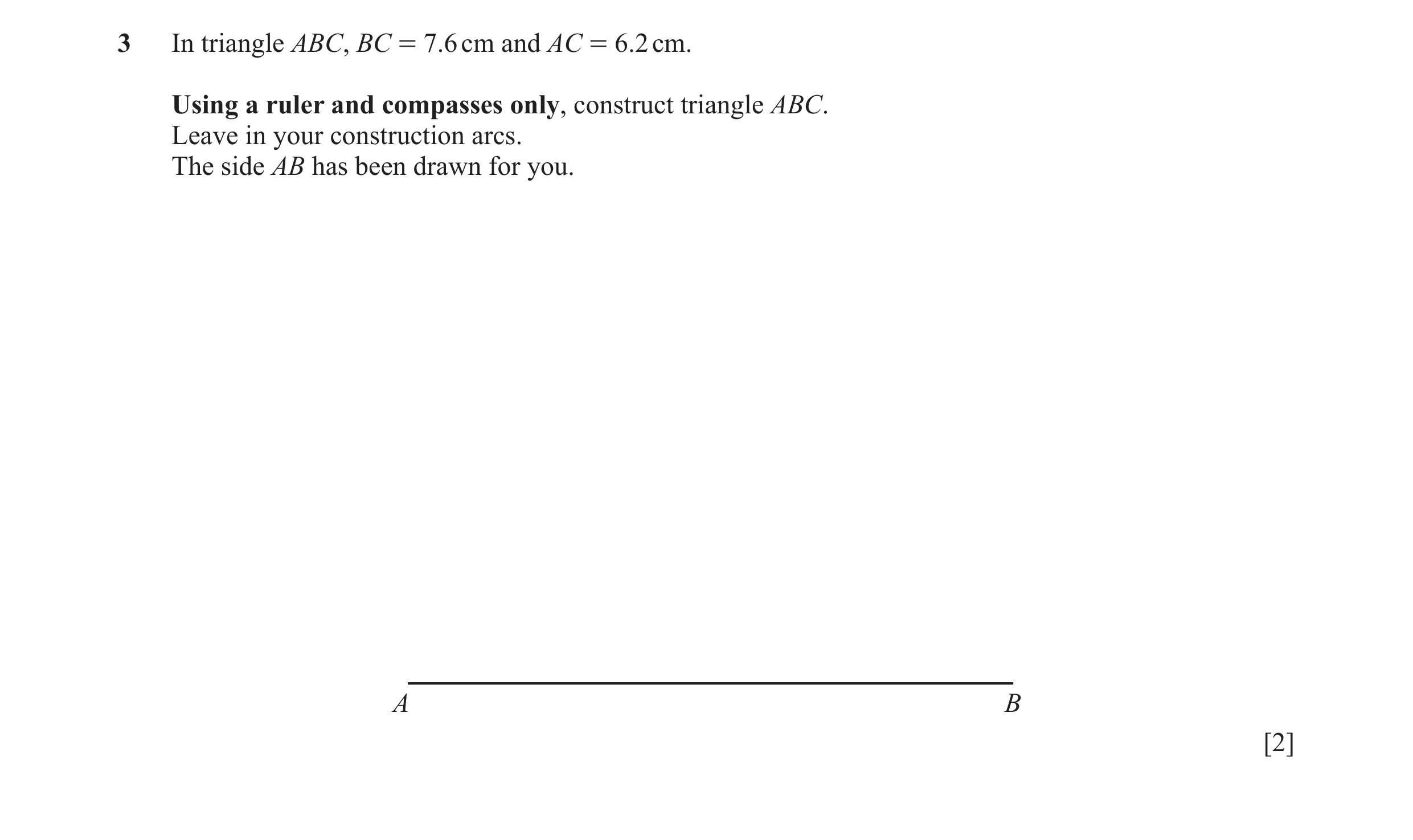
Q24 · In triangle ABC, BC = 7.6 cm and AC = 6.2 cm 0580/23 Oct/Nov 2020
3 In triangle ABC, BC = 7.6 cm and AC = 6.2 cm. Using a ruler and compasses only, construct triangle ABC. Leave in your construction arcs. The side AB has been drawn for you. A B [2]
2 marks
Mark scheme: 3 Accurate triangle with correct 2 B1 for accurate triangle with construction arcs no/incorrect arcs or SC1 for accurate triangle with arcs with sides interchanged
This question in 0580/23 Oct/Nov 2020
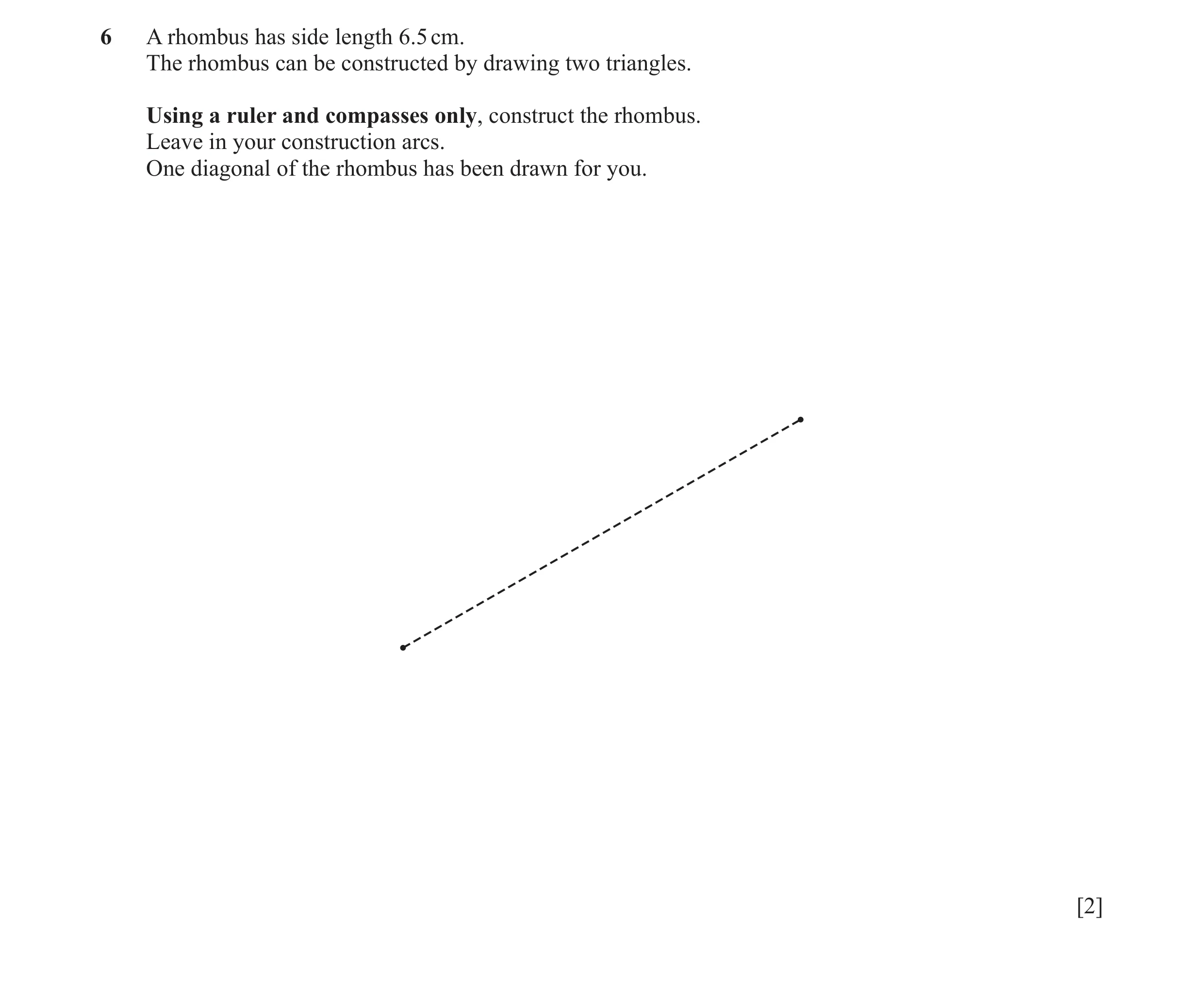
Q25 · A rhombus has side length 6.5 cm 0580/22 May/June 2021
6 A rhombus has side length 6.5 cm. The rhombus can be constructed by drawing two triangles. Using a ruler and compasses only, construct the rhombus. Leave in your construction arcs. One diagonal of the rhombus has been drawn for you. [2]
2 marks
Mark scheme: 6 Accurate construction of rhombus with 2 B1 for accurate diagram with no/wrong sides 6.5 cm and correct construction arcs. arcs or for one triangle (6.5 cm, 6.5 cm, 8 cm) correctly constructed with correct arcs or for four correct arcs
This question in 0580/22 May/June 2021
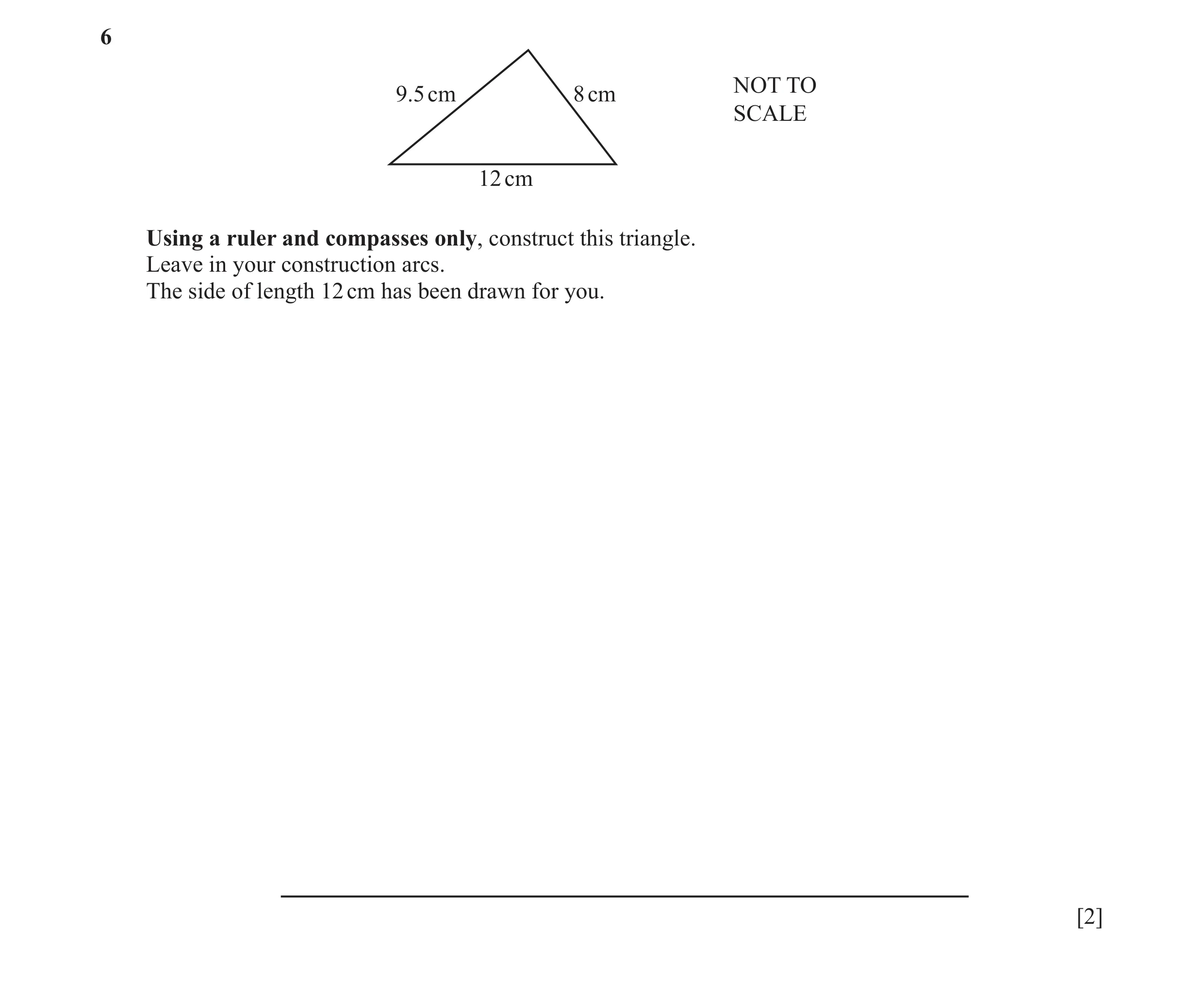
Q26 · NOT TO 9.5 cm 8 cm SCALE 12 cm Using a ruler and compasses only, construct this triangle 0580/22 Feb/March 2022
6 NOT TO 9.5 cm 8 cm SCALE 12 cm Using a ruler and compasses only, construct this triangle. Leave in your construction arcs. The side of length 12 cm has been drawn for you. [2]
2 marks
Mark scheme: 6 correct triangle with arcs 2 B1 for correct triangle with incorrect or no arcs or for two correct arcs. or a triangle with arcs but one side not in range
This question in 0580/22 Feb/March 2022
 1 / 21
 2 / 21
 3 / 21
![Question 4: Draw, accurately, the locus of all the points outside the triangle which are 3 centimetres away from the triangle. [3]](https://img.pastlit.com/crops/1539116e-00f9-477b-9c16-9d514ffa5114/q14.webp) 4 / 21
4 / 21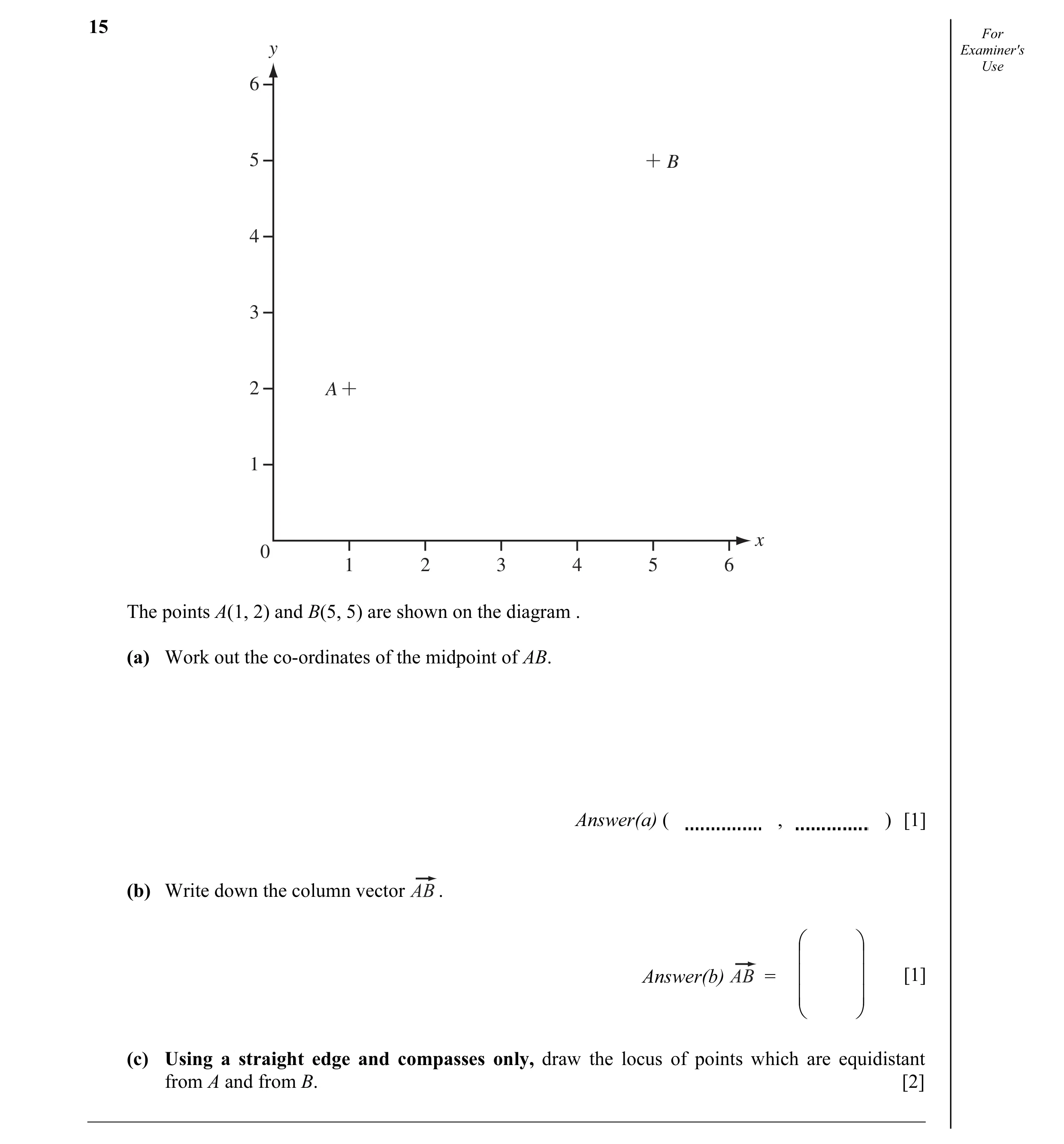 5 / 21
 6 / 21
![Question 7: D A B (a) The point C lies on AD and angle ABC = 67°. Draw accurately the line BC. [1] (b) Using a straight edge and compasses only, constr…](https://img.pastlit.com/crops/2346ec6b-d055-4a6f-b6c8-4c76b616bea6/q9.webp)
![Question 8: R T Using a straight edge and compasses only, construct the locus of points which are equidistant from R and from T. [2]](https://img.pastlit.com/crops/73c2e362-eb78-4535-a178-14563a324ae3/q6.webp) 7 / 21
7 / 21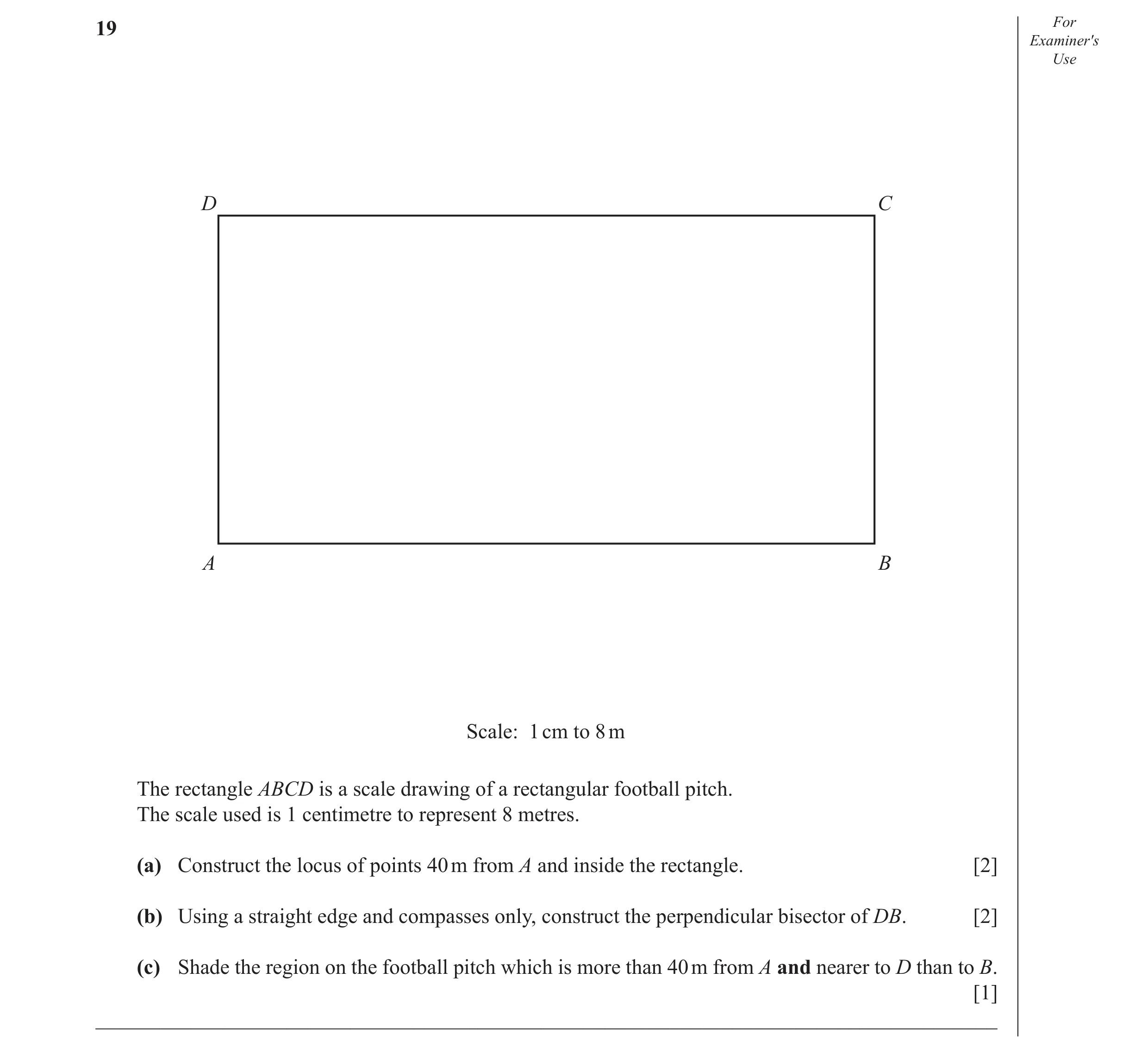 8 / 21
 9 / 21
![Question 11: C A B (a) Using compasses and straight edge only, construct (i) the perpendicular bisector of AC, [2] (ii) the bisector of angle ACB. [2] (…](https://img.pastlit.com/crops/a724e0db-d396-4e7c-8e05-d846dab51964/q15.webp) 10 / 21
10 / 21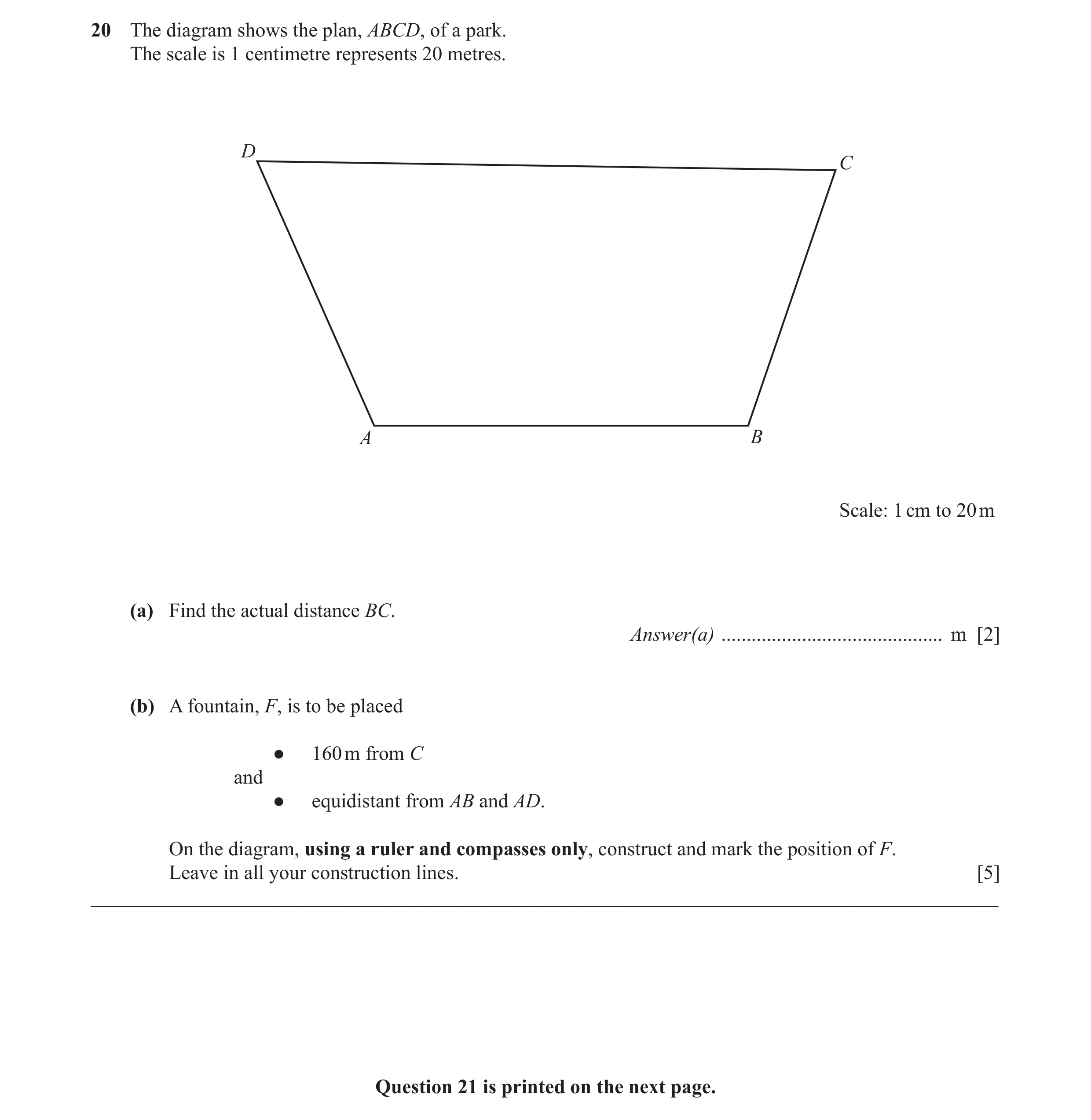 11 / 21
![Question 13: D C E A B (a) Draw the locus of the points which are 3 cm from E. [1] (b) Using a straight edge and compasses only, construct the bisector …](https://img.pastlit.com/crops/2ccc6e7f-bbe3-4a9d-a6b3-e26ea3381111/q12.webp) 12 / 21
12 / 21![Question 14: The diagram shows the positions of three points A, B and C. C B A (a) Draw the locus of points which are 4 cm from C. [1] (b) Using a strai…](https://img.pastlit.com/crops/0166788e-45f2-4de0-bd76-935f9dda492d/q19.webp) 13 / 21
13 / 21![Question 15: Using a straight edge and compasses only, construct the perpendicular bisector of the line AB. A B [2]](https://img.pastlit.com/crops/9ebe8dee-fff4-4d3e-8385-64f2e2620945/q6.webp)
![Question 16: B A C (a) Using compasses and a straight edge only, construct the bisector of angle BAC. [2] (b) Complete the statement. The bisector of an…](https://img.pastlit.com/crops/e18cd8ca-3982-4ed1-875e-59ee460b0e12/q11.webp) 14 / 21
14 / 21![Question 17: The line AB is one side of an equilateral triangle ABC. Using a straight edge and compasses only, construct triangle ABC. A B [2]](https://img.pastlit.com/crops/ad8e95d4-1fac-4050-9d0a-89c408ad2db4/q2.webp)
![Question 18: B A C (a) Using a straight edge and compasses only, construct the bisector of angle BAC. [2] (b) Shade the region inside the triangle that …](https://img.pastlit.com/crops/cae494a3-a333-4a4a-8193-3f050cf63cf3/q16.webp) 15 / 21
15 / 21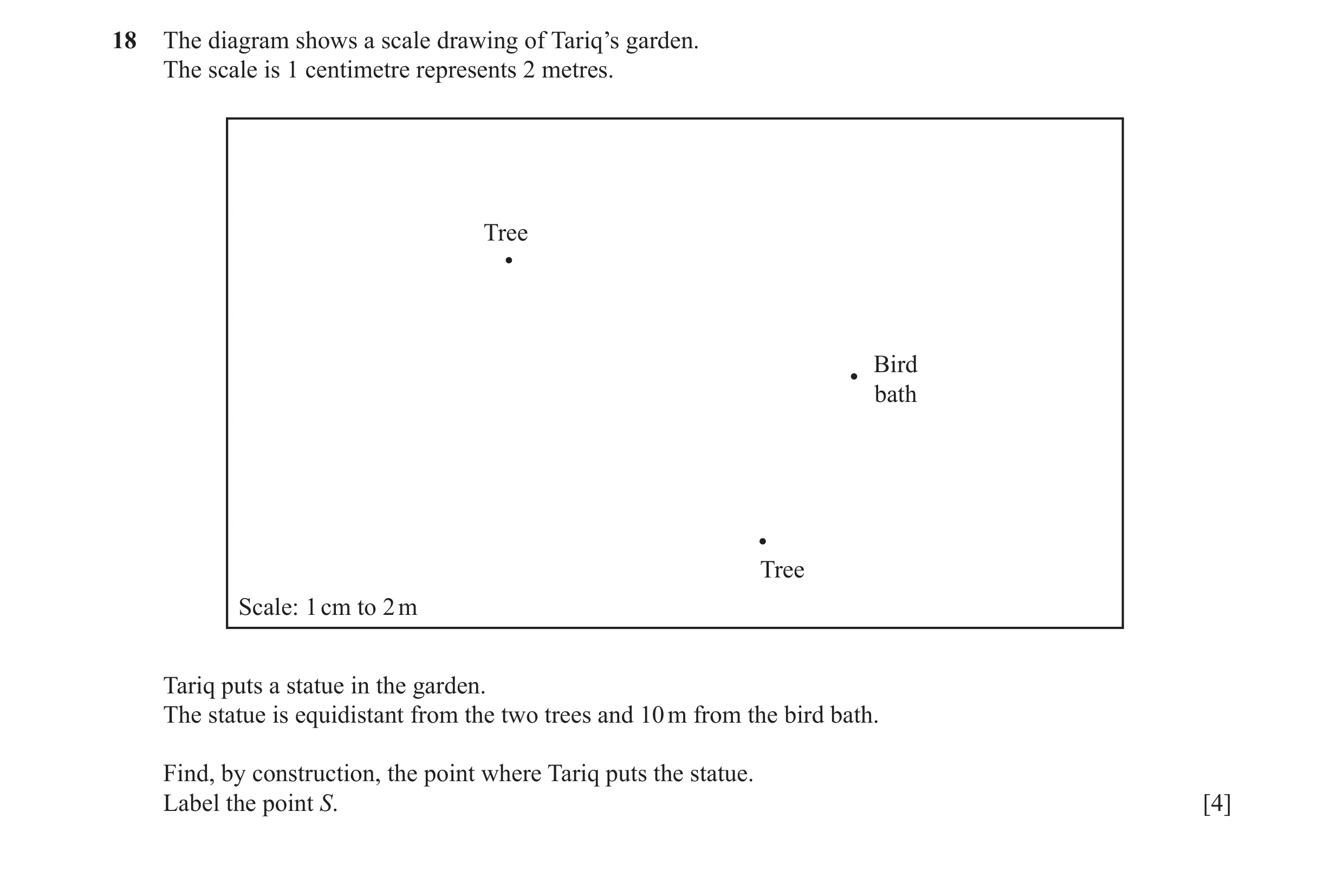
![Question 20: Using a straight edge and compasses only, construct the locus of points that are equidistant from A and B. A B [2]](https://img.pastlit.com/crops/16b70a96-30d0-4aad-a962-c34516d076ab/q9.webp) 16 / 21
16 / 21![Question 21: The diagram shows a pentagon ABCDE. A E B D C (a) Using a straight edge and compasses only, construct the bisector of angle BCD. [2] (b) Dr…](https://img.pastlit.com/crops/89eda026-7406-41bc-bd06-ed159e01f609/q19.webp) 17 / 21
17 / 21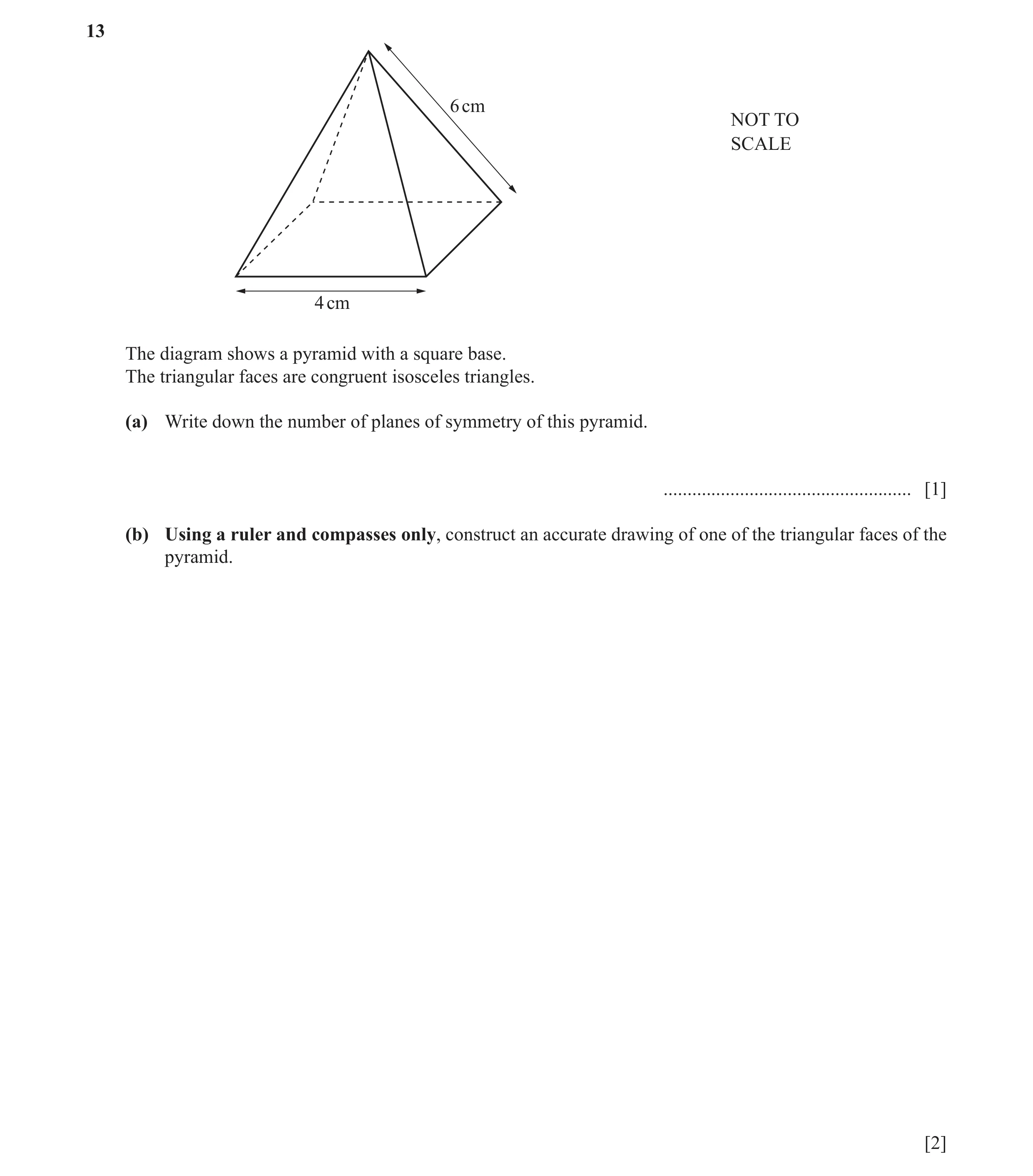 18 / 21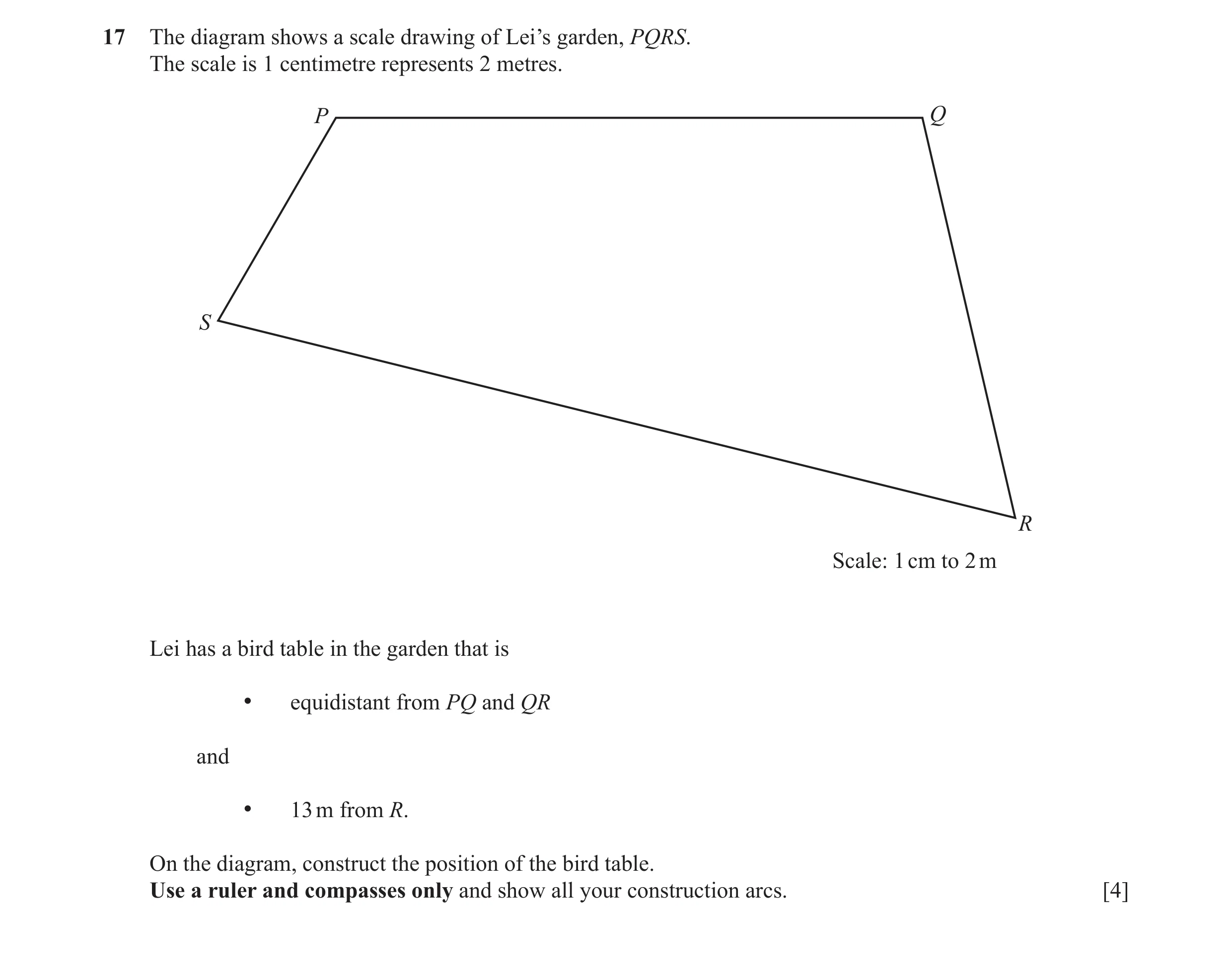
 19 / 21
 20 / 21
 21 / 21
 4
4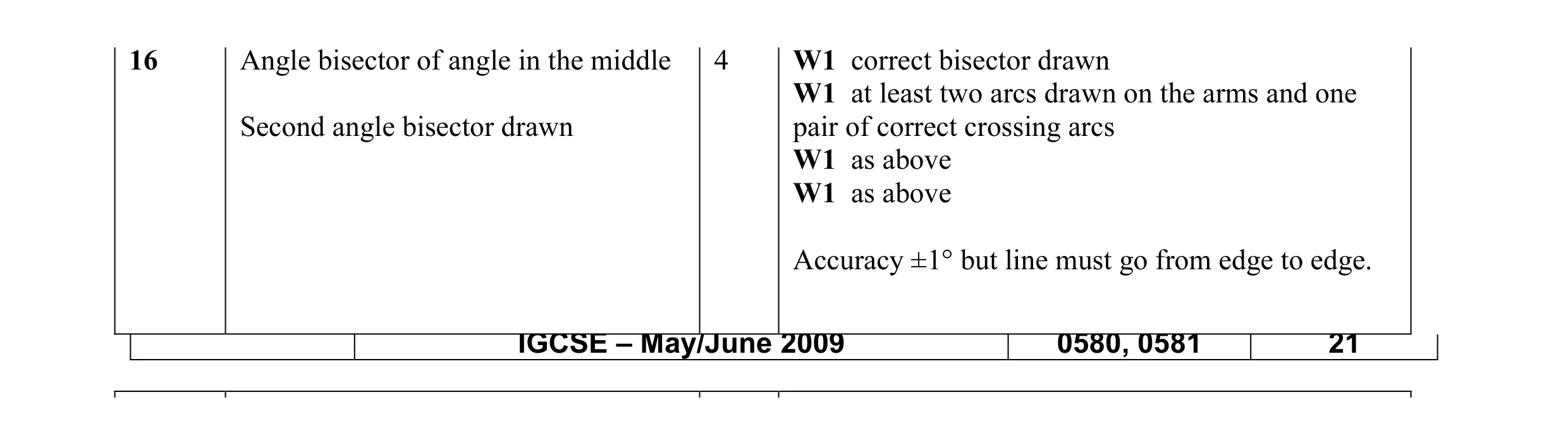 4
4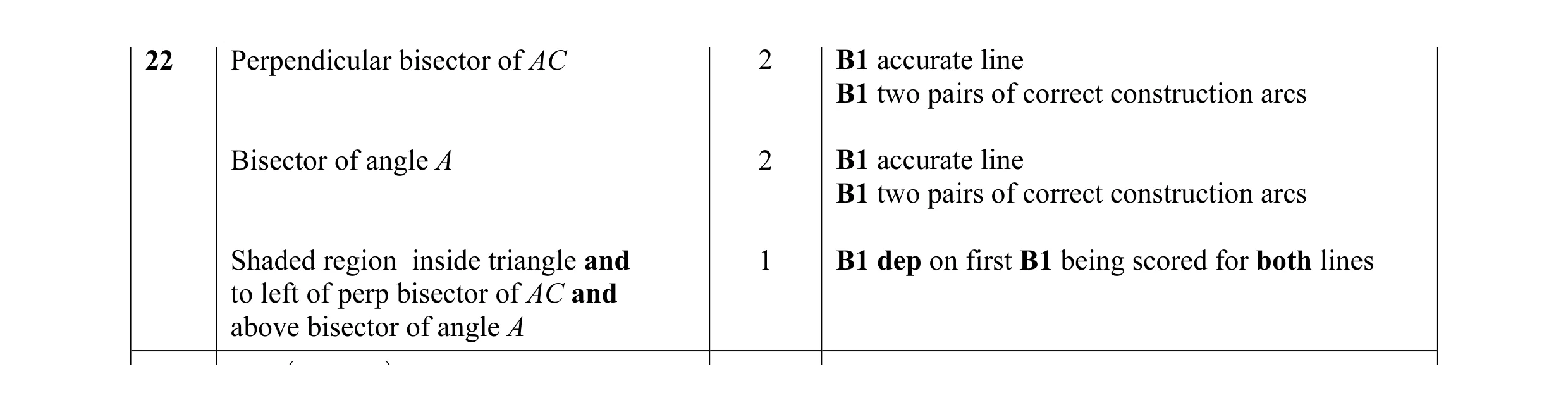 5
5 3
3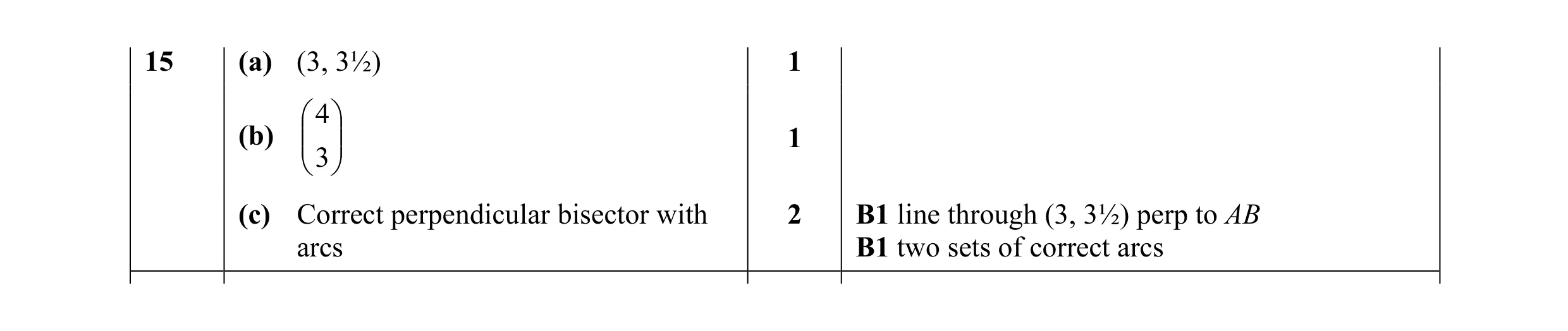 4
4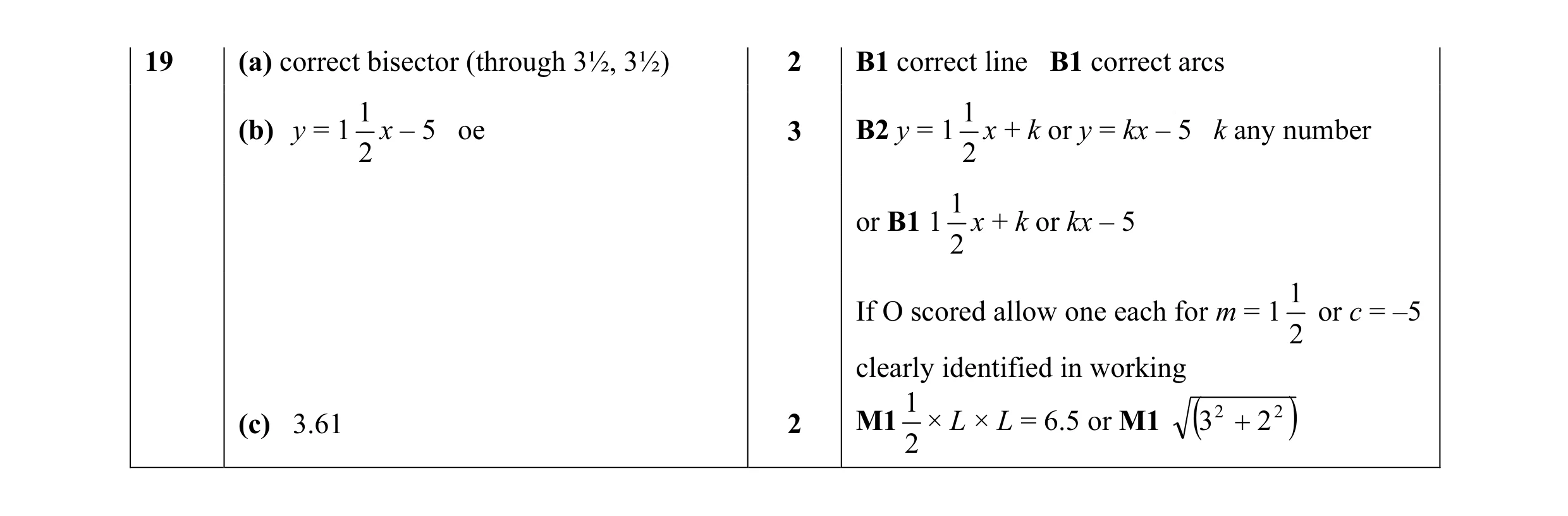 7
7 3
3 2
2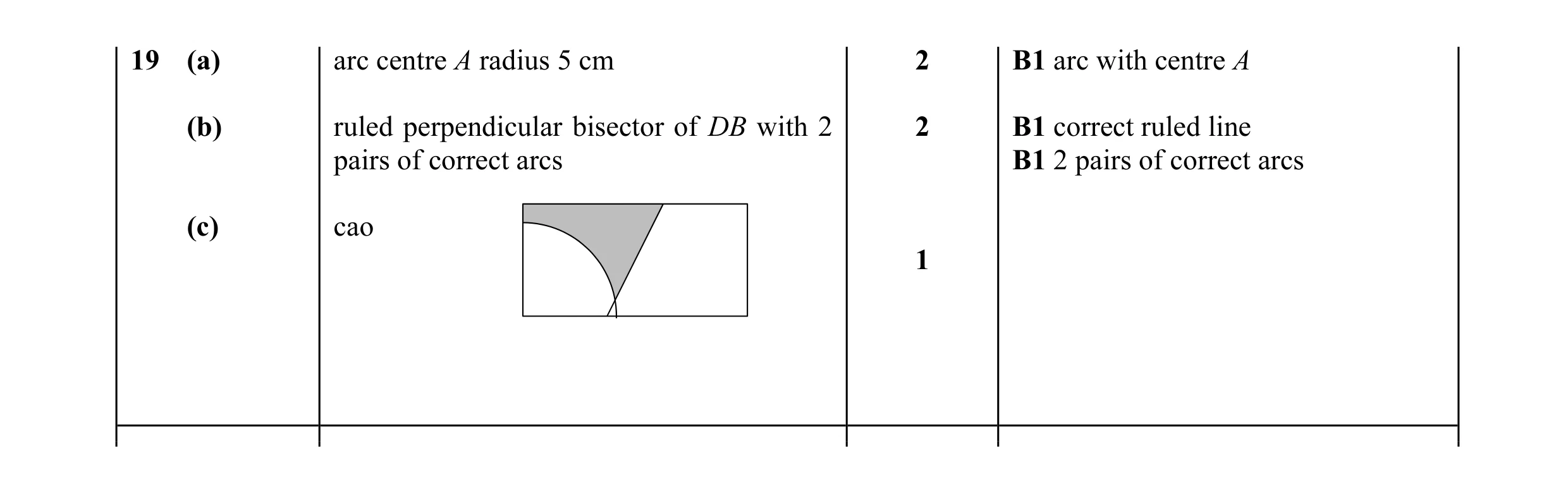 5
5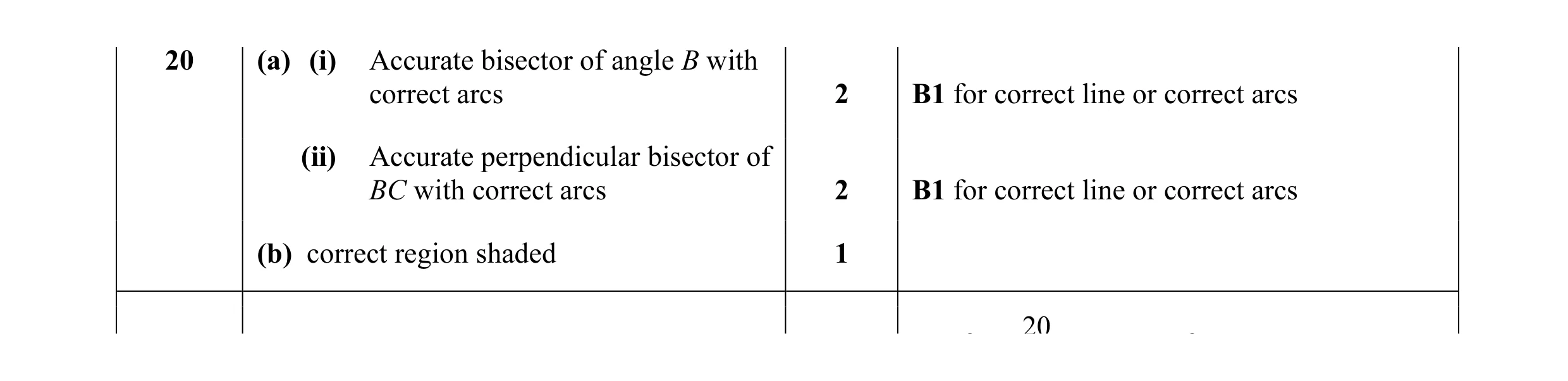 5
5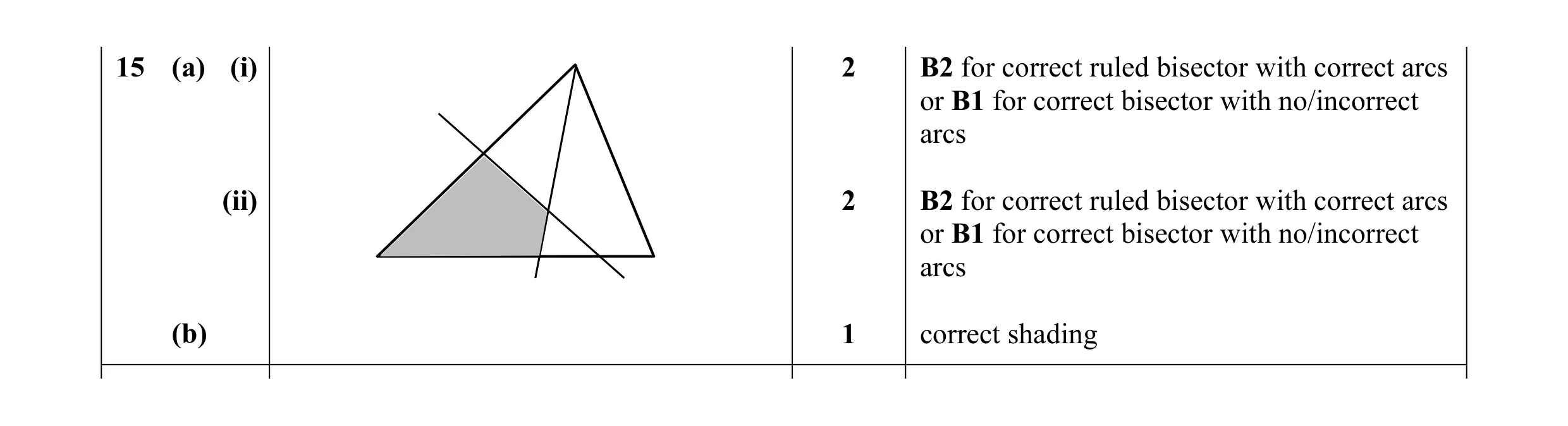 5
5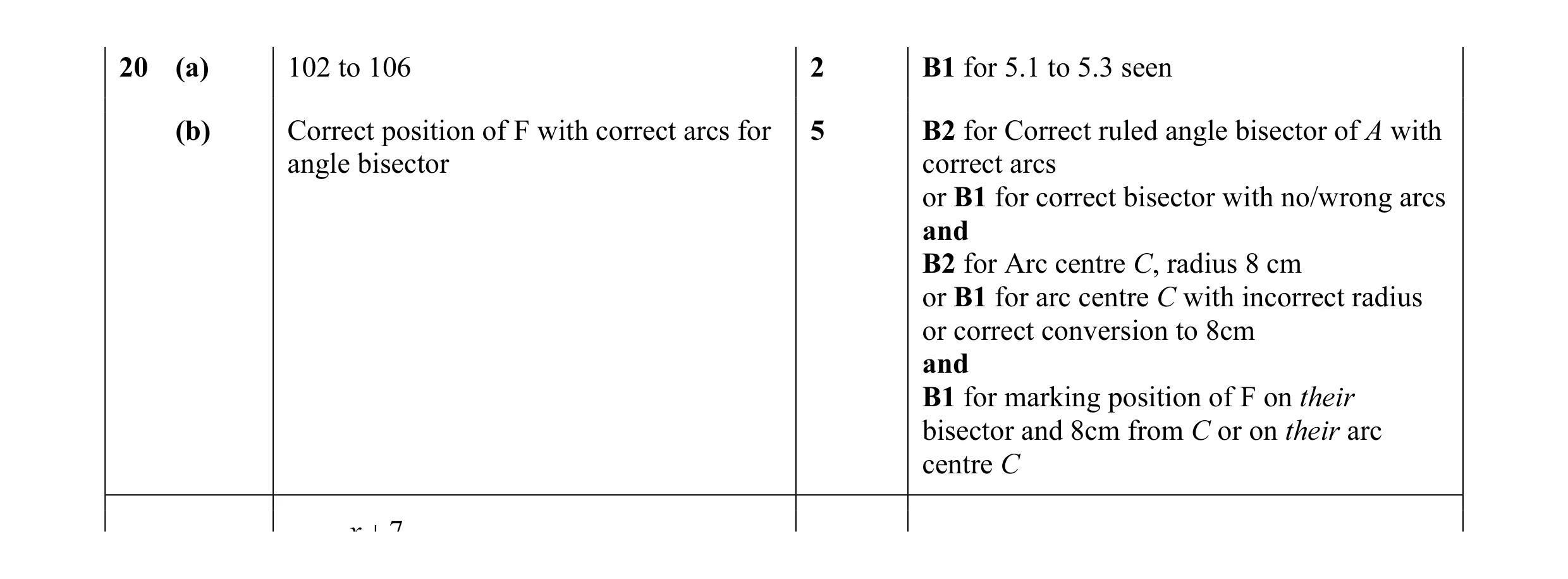 7
7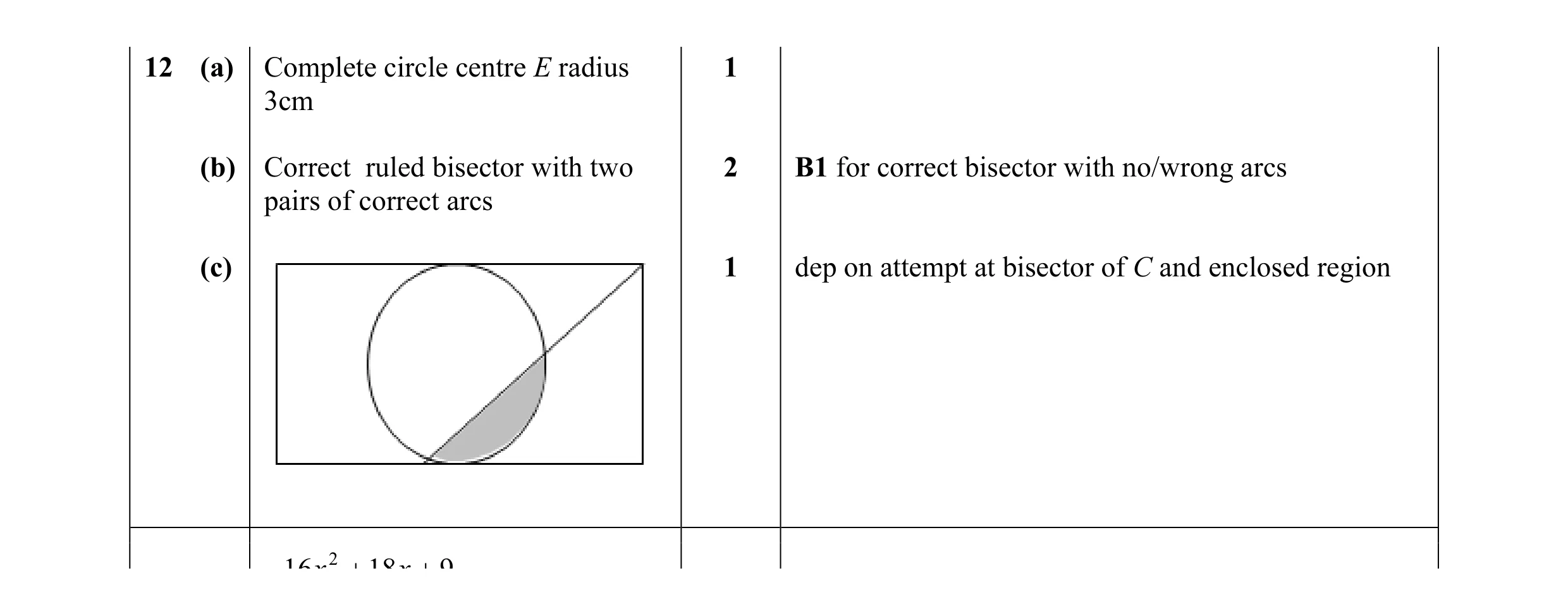 4
4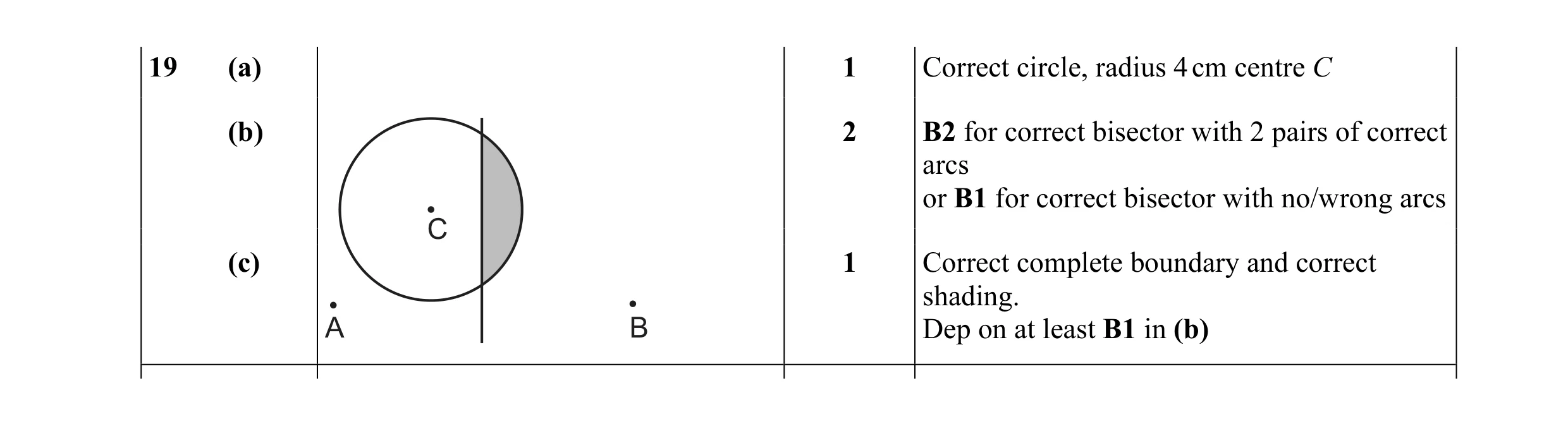 4
4 2
2 3
3 2
2 3
3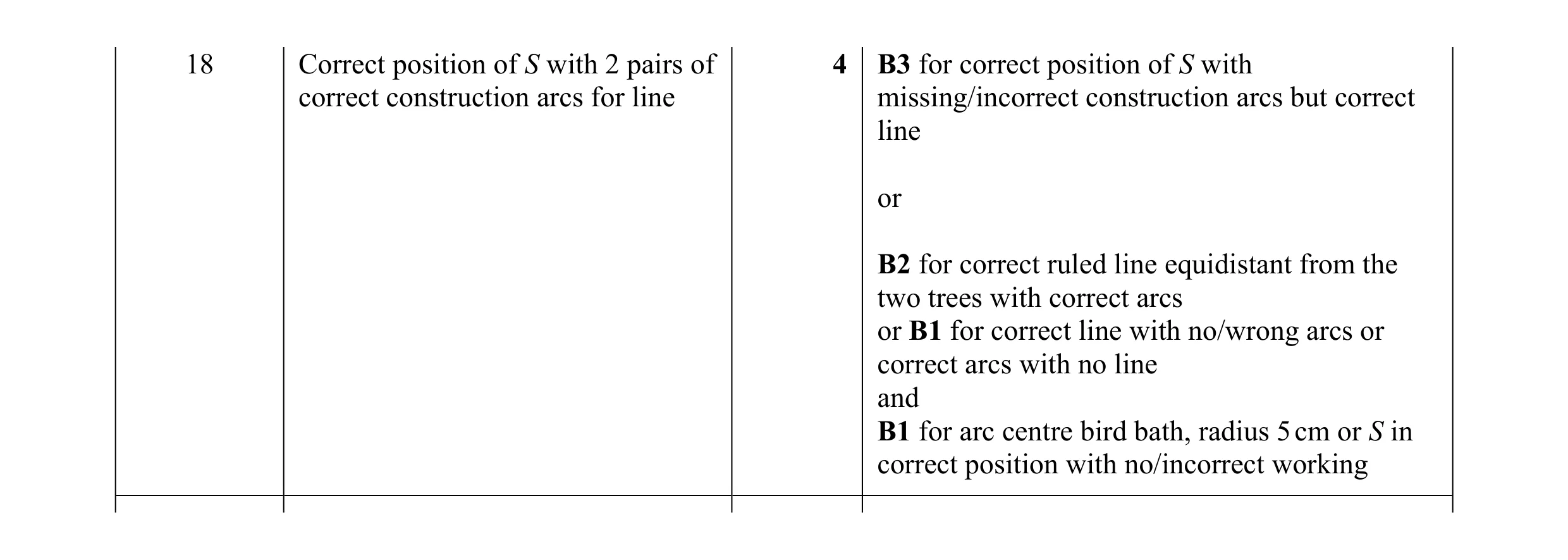 4
4 2
2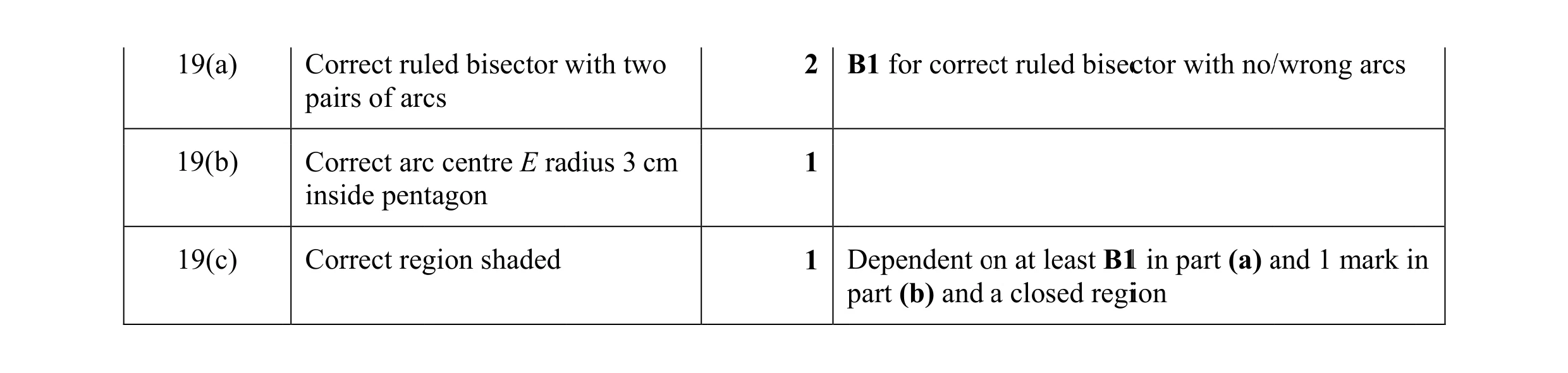 4
4 3
3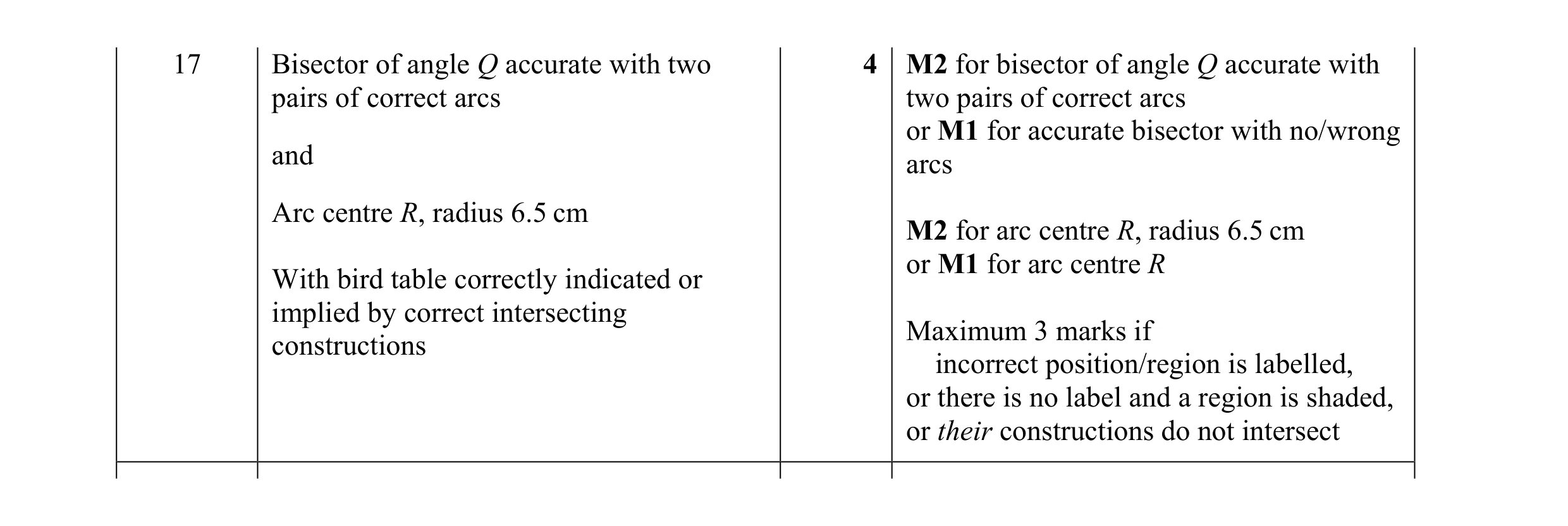 4
4 2
2 2
2 2
2